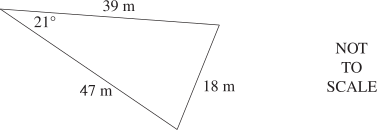
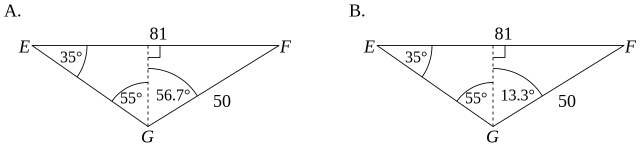
A triangle is shown.
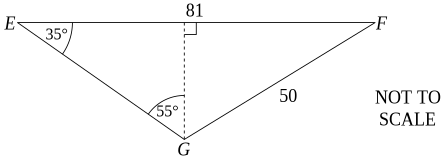
It is given that \(\sin^{-1}\left(\dfrac{81\times\sin35^{\circ}}{50}\right)=68.3^{\circ}\), correct to 1 decimal place.
Which diagram shows the correct angle sizes at \(\angle EGF\), given that the angle is obtuse?
Aussie Maths & Science Teachers: Save your time with SmarterEd
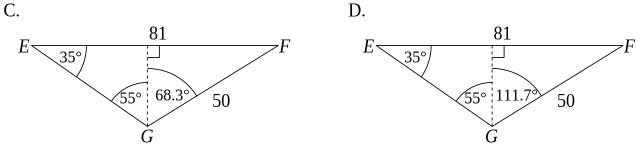
A triangle is shown.
It is given that \(\sin^{-1}\left(\dfrac{81\times\sin35^{\circ}}{50}\right)=68.3^{\circ}\), correct to 1 decimal place.
Which diagram shows the correct angle sizes at \(\angle EGF\), given that the angle is obtuse?
The diagram shows a park consisting of two equilateral triangles. The shaded triangle is a grassed section. All measurements on the diagram are in metres.
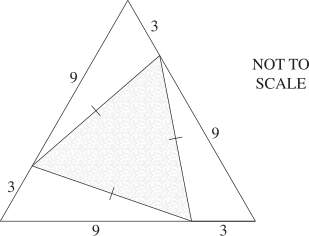
How long will it take to mow the grassed section if it takes 5 minutes to mow 20 m² ? Give your answer to the nearest minute. (4 marks)
--- 12 WORK AREA LINES (style=lined) ---
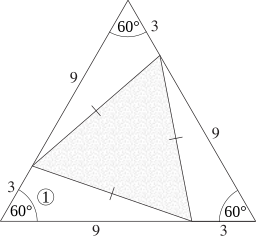
\(\text{Large triangle is equilateral (all sides = 12 m)}\)
| \(\text{Area of large} \ \triangle\) | \(=\dfrac{1}{2}ab \, \sin C\) |
| \(=\dfrac{1}{2} \times 12 \times 12 \times \sin 60^{\circ}\) | |
| \(=36 \sqrt{3}\) |
\(\text{Area of} \ \ \triangle_1=\dfrac{1}{2} \times 3 \times 9 \times \sin 60^{\circ}=\dfrac{27 \sqrt{3}}{4}\)
\(\text{Grassed area}=36 \sqrt{3}-3 \times \dfrac{27 \sqrt{3}}{4}=27.2798 \ldots \ \text{m}^2\)
| \(\text{Time to mow}\) | \(=\dfrac{27.2798 \ldots}{20} \times 5\) |
| \(=6.81 \ldots\) | |
| \(=7 \ \text{minutes (nearest min)}\) |
The triangle \(PTA\) is shown. The length of \(PA\) is 75 m and the length of \(PT\) is 51 m.
The angle of depression from \(T\) to \(A\) is 36°, and the angle \(PTA\) is obtuse.
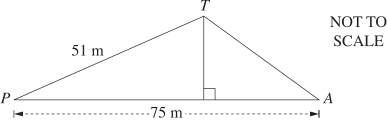
Find the length of \(TA\). Give your answer correct to 2 decimal places. (3 marks)
--- 10 WORK AREA LINES (style=lined) ---
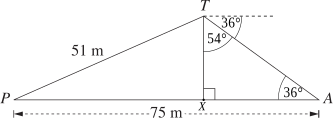
\(\angle TAP=36^{\circ} \ \text {(alternate)}\)
\(\text{Using sine rule in} \ \triangle TAP:\)
| \(\dfrac{\sin \angle PTA}{75}\) | \(=\dfrac{\sin 36^{\circ}}{51}\) |
| \(\sin \angle PTA\) | \(=75 \times \dfrac{\sin 36^{\circ}}{54}=0.864 \ldots\) |
| \(\angle PTA\) | \(=\sin ^{-1}(0.864 \ldots)=180-59.81=120.19^{\circ}\ \ \text{(obtuse)}\) |
\(\angle PTX=120.19-54=66.19^{\circ}\)
\(\angle TPA=90-66.19=23.81^{\circ}\ \left(180^{\circ}\ \text{in}\ \triangle \right)\)
\(\text{Using sine rule in} \ \triangle TAP:\)
| \(\dfrac{TA}{\sin 23.81^{\circ}}\) | \(=\dfrac{51}{\sin 36^{\circ}}\) |
| \(TA\) | \(=\dfrac{51 \times \sin 23.81^{\circ}}{\sin 36^{\circ}}\) |
| \(=35.03 \ \text{m (2 d.p.)}\) |
The diagram shows two vertical flagpoles, \(BE\) and \(CD\), set on sloping ground.
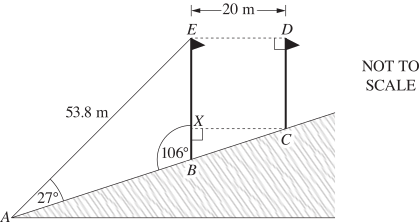
--- 6 WORK AREA LINES (style=lined) ---
--- 6 WORK AREA LINES (style=lined) ---
A regular pentagon \(ABCDE\) is drawn inside a circle with a radius 30 cm.
\(O\) is the centre of the circle.
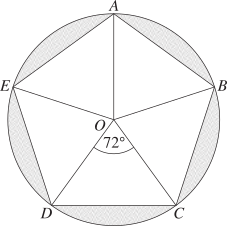
What is the area of the shaded region of the circle. Answer correct to 2 significant figures. (4 marks)
--- 10 WORK AREA LINES (style=lined) ---
The diagram shows triangle `ABC`.
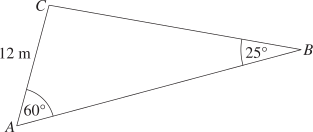
Calculate the area of the triangle, to the nearest square metre. (3 marks)
--- 6 WORK AREA LINES (style=lined) ---
The diagram shows a shape `APQBCD`. The shape consists of a rectangle `ABCD` with an arc `PQ` on side `AB` and with side lengths `BC` = 3.6 m and `CD` = 8.0 m.
The arc `PQ` is an arc of a circle with centre `O` and radius 2.1 m and `∠POQ=110°`.
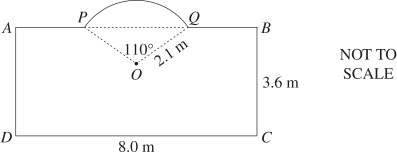
What is the perimeter of the shape `APQBCD`? Give your answer correct to one decimal place. (4 marks)
--- 8 WORK AREA LINES (style=lined) ---
| `text{Arc length}\ PQ` | `=110/360 xx2 pi xx 2.1` |
| `=4.03171… \ text{m}` |
`text{Consider}\ ΔOPQ:`
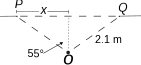
| `sin 55^@` | `=x/2.1` |
| `x` | `=2.1 xx sin 55^@` |
| `=1.7202…` |
`PQ=2x=3.440\ text{m}`
| `:.\ text{Perimeter}` | `=8+(2xx3.6)+4.031+(8-3.440…)` |
| `=23.79…` | |
| `=23.8\ text{m (to 1 d.p.)}` |
The diagram shows two right-angled triangles, `ABC` and `ABD`,
where `AC=35 \ text{cm},BD=93 \ text{cm}, /_ACB=41^(@)` and `/_ADB=theta`.
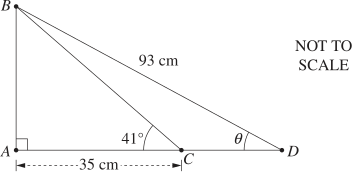
Calculate the size of angle `theta`, to the nearest minute. (4 marks)
--- 8 WORK AREA LINES (style=lined) ---
A right-angled triangle `XYZ` is cut out from a semicircle with centre `O`. The length of the diameter `XZ` is 16 cm and `angle YXZ` = 30°, as shown on the diagram.
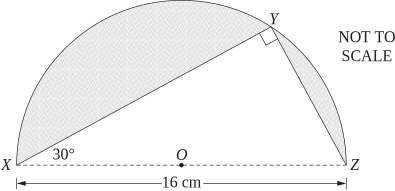
--- 4 WORK AREA LINES (style=lined) ---
--- 6 WORK AREA LINES (style=lined) ---
The diagram shows a triangle `ABC` where `AC` = 25 cm, `BC` = 16 cm, `angle BAC` = 28° and angle `ABC` is obtuse.
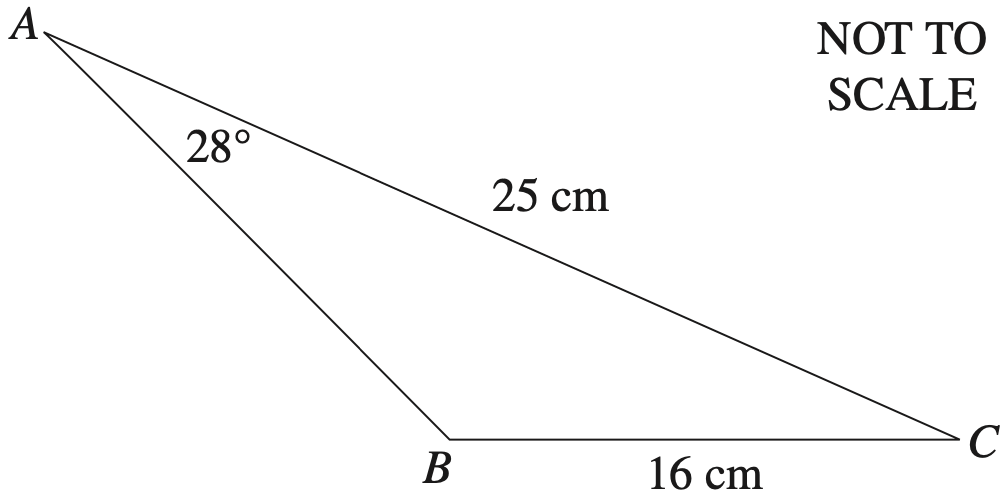
Find the size of the obtuse angle `ABC` correct to the nearest degree. (3 marks)
--- 6 WORK AREA LINES (style=lined) ---
The diagram shows a triangle with side lengths 25 cm and 47 cm and angle 30° and `theta`.
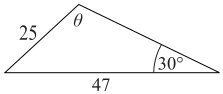
Find `theta` given it is an obtuse angle. Give your answer to the nearest minute. (3 marks)
--- 6 WORK AREA LINES (style=lined) ---
The diagram shows a triangle with sides of length `x` cm, 11 cm and 13 cm and an angle of 80°.
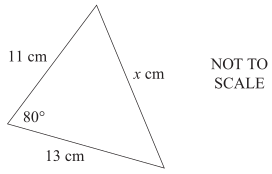
Use the cosine rule to calculate the value of `x`, correct to two significant figures. (3 marks)
The diagram shows two triangles.
Triangle `ABC` is right-angled, with `AB = 13 text(cm)` and `/_ABC = 62°`.
In triangle `ACD, \ AD = x\ text(cm)` and `/_DAC = 40°`. The area of triangle `ACD` is 30 cm².
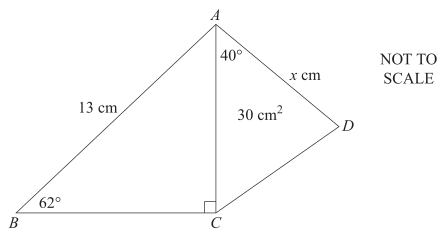
What is the value of `x`, correct to one decimal place? (3 marks)
--- 6 WORK AREA LINES (style=lined) ---
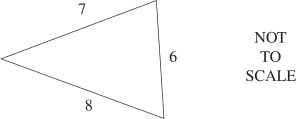
The diagram shows a triangle with side lengths 8 m, 9 m and 10m.
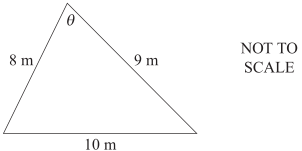
What is the value of `theta`, marked on the diagram, to the nearest degree?
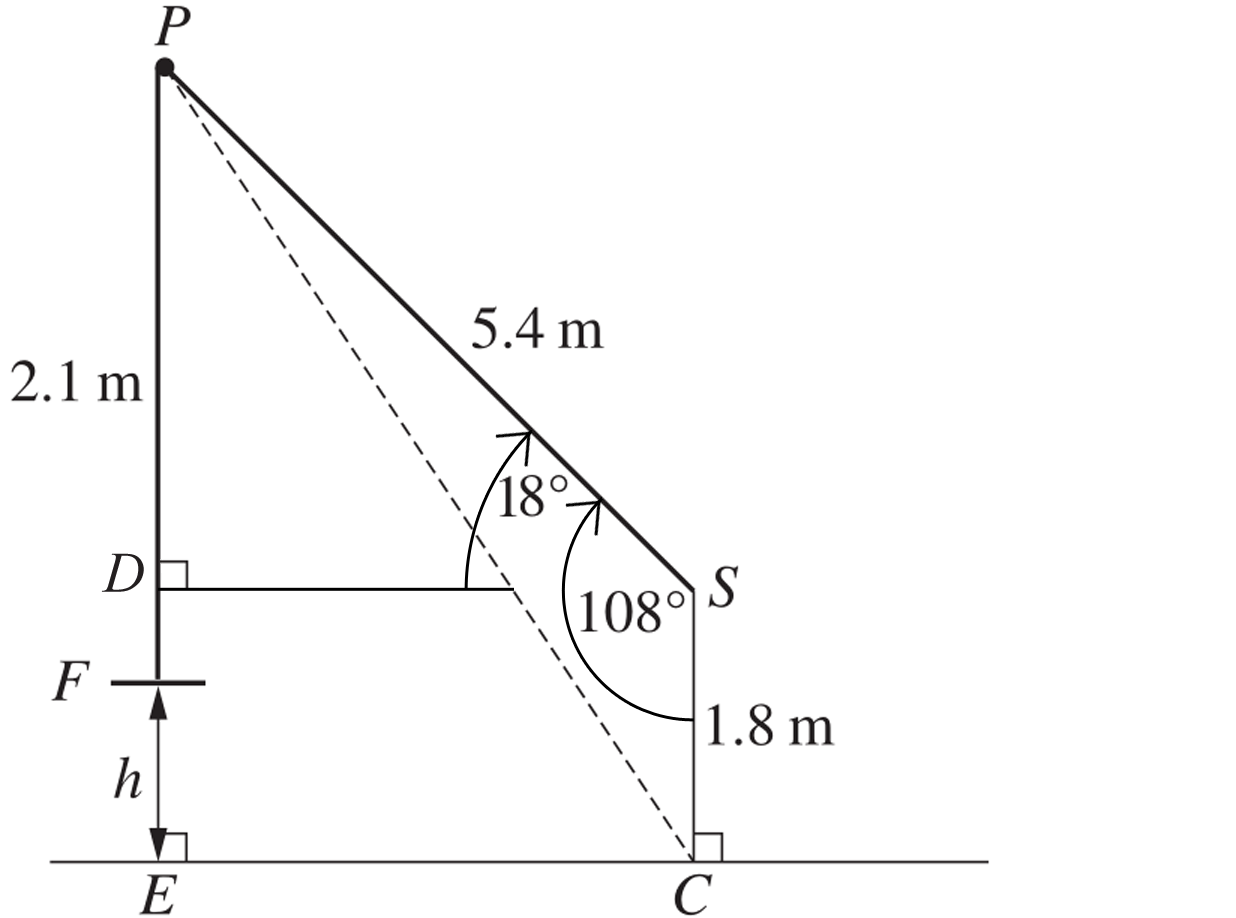
From point `S`, which is 1.8 m above the ground, a pulley at `P` is used to lift a flat object `F`. The lengths `SP` and `PF` are 5.4 m and 2.1 m respectively. The angle `PSC` is 108°.
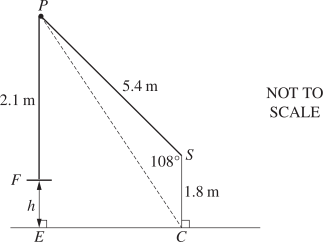
--- 2 WORK AREA LINES (style=lined) ---
--- 8 WORK AREA LINES (style=lined) ---
| a. |
|
`text(Show)\ PC = 6.197\ text(m)`
`text(Using the cosine rule in)\ Delta PSC`
| `PC^2` | `= PS^2 + SC^2-2 xx PS xx SC xx cos\ 108^@` |
| `= 5.4^2 + 1.8^2-2 xx 5.4 xx 1.8 xx cos\ 108^@` | |
| `= 38.4072…` | |
| `:.PC` | `= 6.19736…` |
| `= 6.197\ text{m (to 3 d.p.) …as required}` |
b. `text(Let)\ \ SD⊥PE`
`∠DSC\ text(is a right angle)`
`:.∠DSP = 108^@-90^@ = 18^@`
`text(In)\ ΔPDS`
| `cos\ 18^@` | `= (DS)/5.4` |
| `DS` | `= 5.4 xx cos\ 18^@` |
| `= 5.1357…\ text(m)` |
`EC = DS = 5.1357…\ text{m (opposite sides of rectangle}\ DECS text{)}`
`text(Using Pythagoras in)\ Delta PEC:`
`PE^2 + EC^2 = PC^2`
| `PE^2 + 5.1357^2` | `= 6.197^2` |
| `PE^2` | `= 12.027…` |
| `PE` | `= 3.468…\ text(m)` |
`text(From the diagram,)`
| `h` | `= PE-PF` |
| `= 3.468…-2.1` | |
| `= 1.368…` | |
| `= 1.37\ text{m (to 2 d.p.)}` |
The area of the triangle shown is 250 cm².
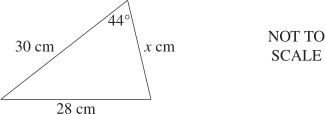
What is the value of `x`, correct to the nearest whole number?
A 130 cm long garden rake leans against a fence. The end of the rake is 44 cm from the base of the fence.

--- 4 WORK AREA LINES (style=lined) ---

--- 4 WORK AREA LINES (style=lined) ---
| a. |
|
| `cos theta` | `= 44/130` |
| `theta` | `= 70.216… = 70^@\ text{(nearest degree)}` |
| b. |
|
`text(Using cosine rule:)`
| `x^2` | `= 130^2 + 44^2-2 xx 130 xx 44 xx cos 53^@` |
| `= 11\ 951.23…` | |
| `x` | `= 109.32…= 109\ text{cm (nearest cm)}` |
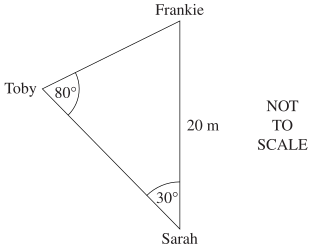
Which formula should be used to calculate the distance between Toby and Frankie?
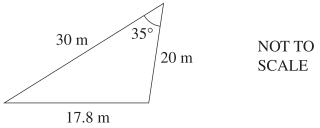
What is the area of the triangle to the nearest square metre?
The angle of depression from `J` to `M` is 75°. The length of `JK` is 20 m and the length of `MK` is 18 m.
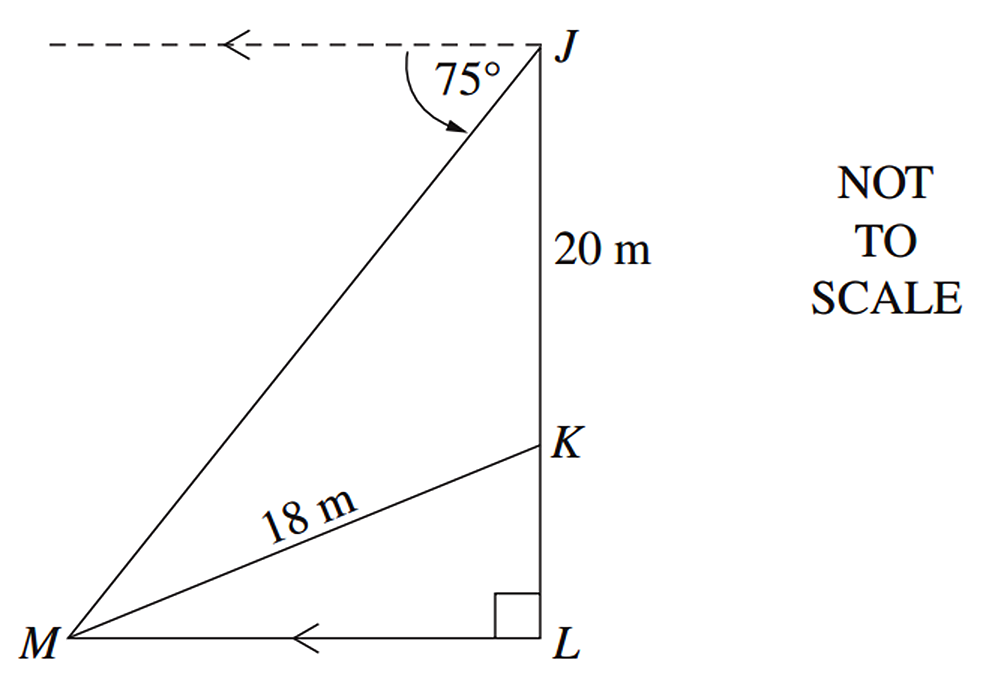
Copy or trace this diagram into your writing booklet and calculate the angle of elevation from `M` to `K`. Give your answer to the nearest degree. (3 marks)
--- 8 WORK AREA LINES (style=lined) ---
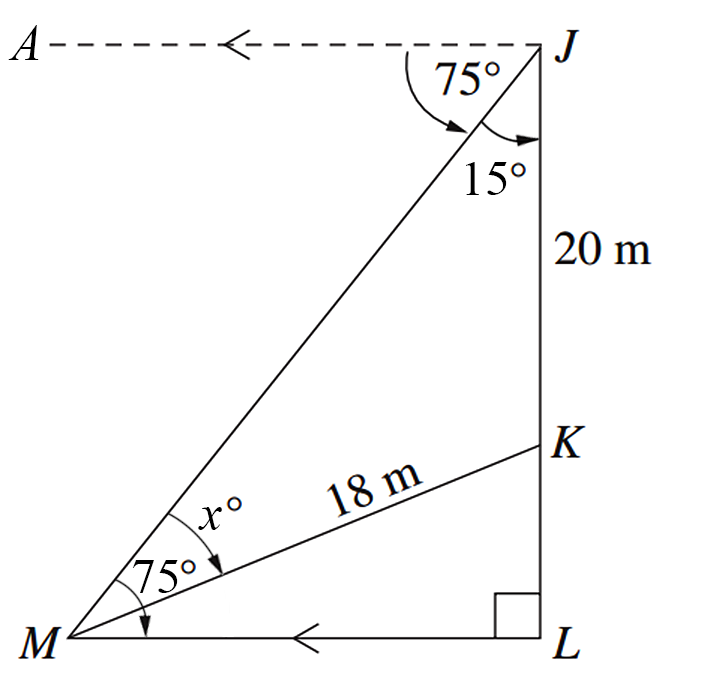
`/_AJL = 90^@`
`/_MJL = 90-75 = 15^@`
`text(Using sine rule in)\ Delta MJK`
`text(Let)\ /_JMK = x^@`
| `20/sin x` | `= 18/sin15^@` |
| `18 sin x` | `= 20 xx sin 15^@` |
| `sin x` | `= (20 xx sin 15^@)/18 = 0.2875…` |
| `x` | `= 16.71…^@` |
`/_JML = 75^@\ text{(} text(alternate angles,)\ ML \ text(||) \ AJ text{)}`
| `:.\ /_KML` | `= 75^@-16.71…` |
| `= 58.287…^@` | |
| `= 58^@\ \ \ text{(nearest degree)}` |
`:.\ text(Angle of Elevation from)\ M\ text(to)\ K\ text(is)\ 58^@.`
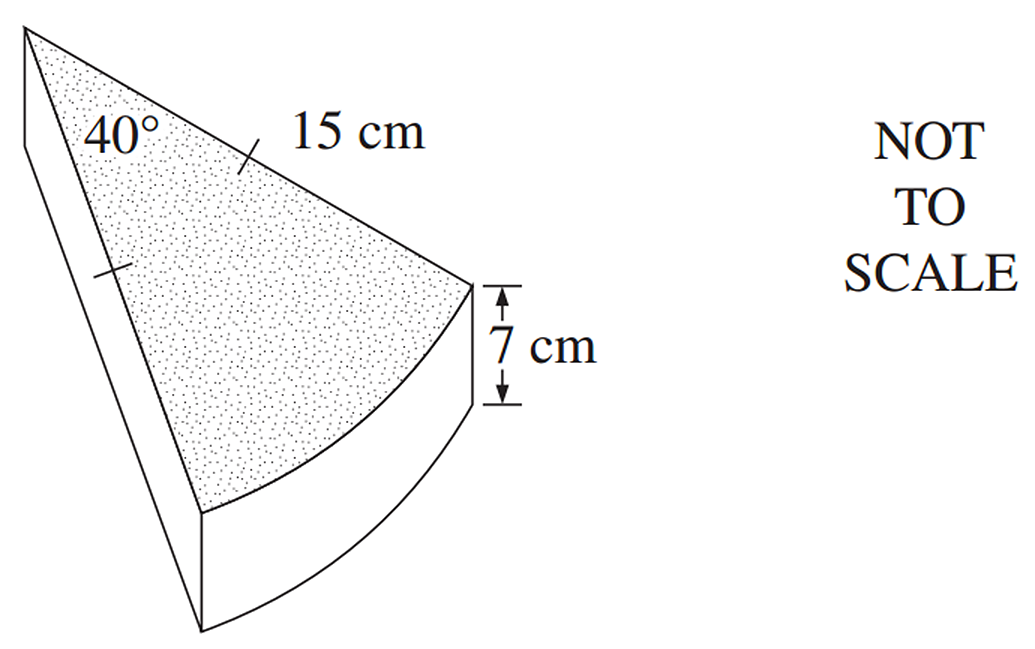
Pieces of cheese are cut from cylindrical blocks with dimensions as shown.
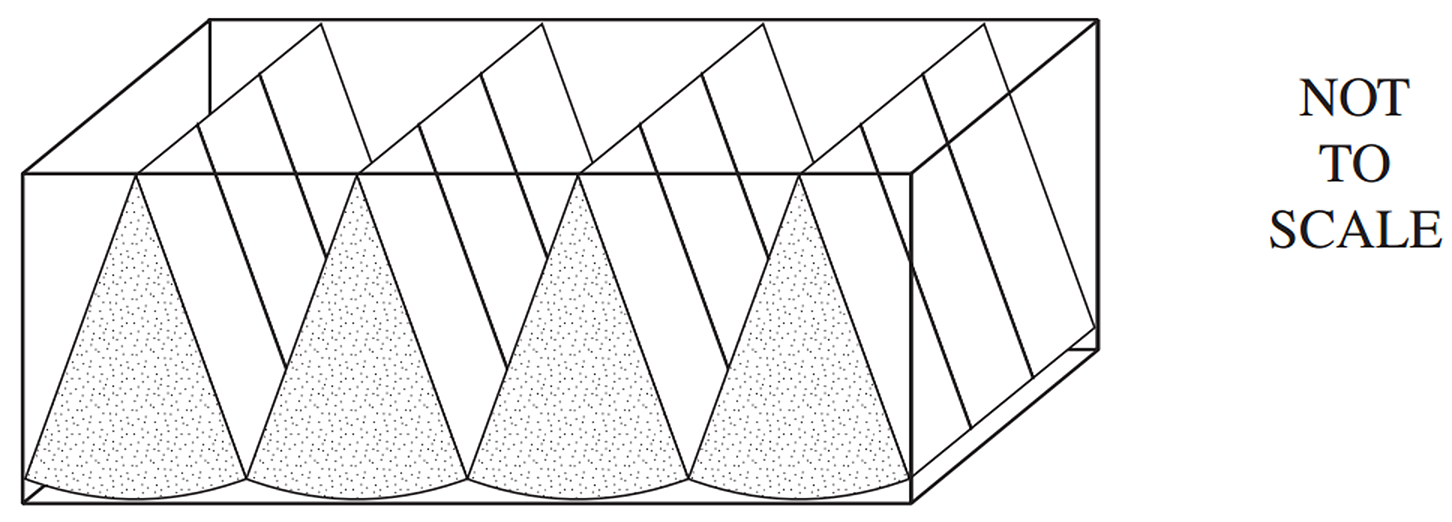
Twelve pieces are packed in a rectangular box. There are three rows with four pieces of cheese in each row. The curved surface is face down with the pieces touching as shown.
--- 8 WORK AREA LINES (style=lined) ---
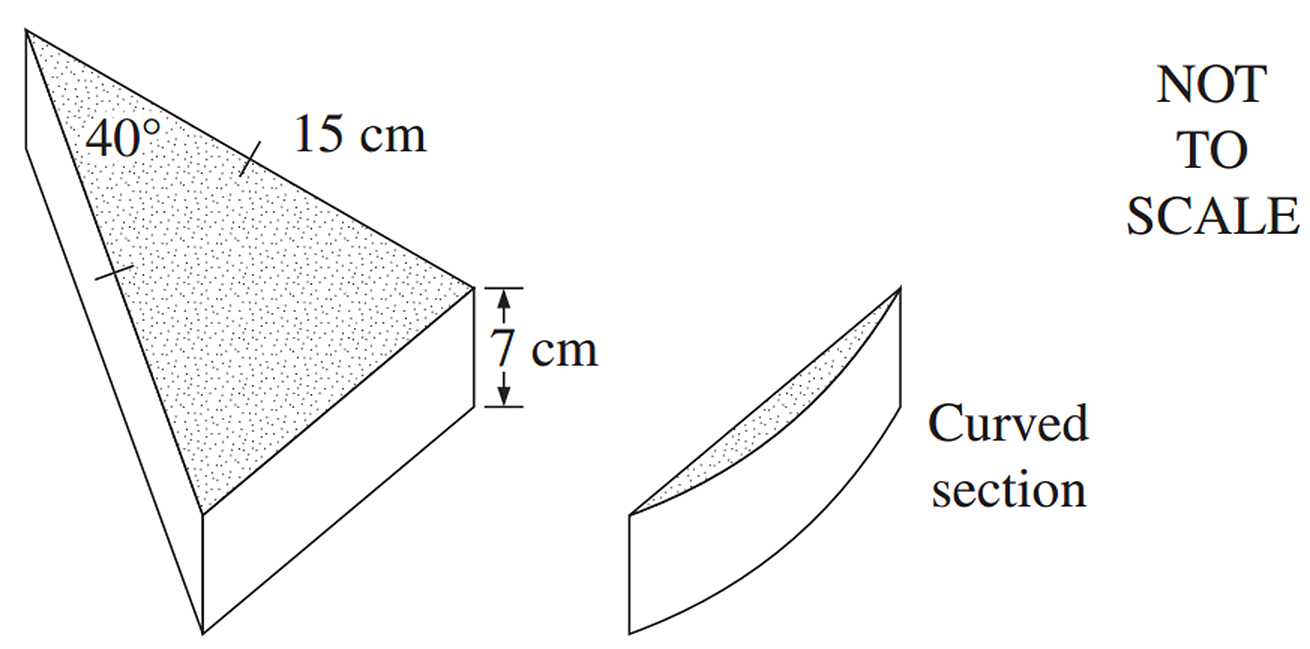
To save packing space, the curved section is removed.
--- 4 WORK AREA LINES (style=lined) ---
a. `text(Box height) = 15\ text(cm)`
`text{(radius of the arc)}`
| `text(Box width)` | `= 3 xx 7= 21\ text(cm)` |
| `text(Box length)` | `= 4x` |
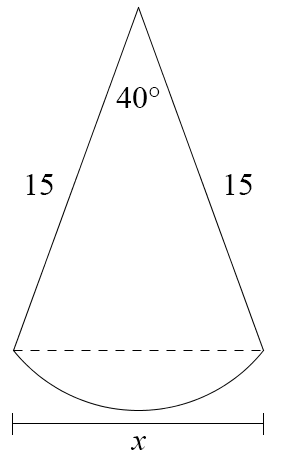
`text(Using cosine rule:)`
| `c^2` | `= a^2 + b^2-2ab\ cos C` |
| `x^2` | `= 15^2 + 15^2-2 xx 15 xx 15 xx cos 40^@` |
| `= 450-344.7199…= 105.2800…` | |
| `x` | `= 10.2606…` |
`text{Box length} = 4 xx 10.2606…= 41.04…`
`:.\ text(Dimensions are)\ \ 41\ text(cm) xx 21\ text(cm) xx 15\ text(cm)`
b. `text(Volume) = Ah`
`h = 7\ text(cm)`
`A= 1/2 ab\ sin C= 1/2 xx 15 xx 15 xx sin 40^@= 72.3136…`
| `:. V` | `= 72.3136… xx 7= 506.195…` |
| `= 506\ text(cm)^3\ \ text{(nearest whole)}` |
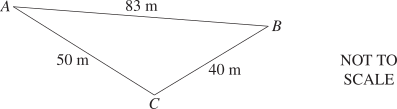
Find the area of triangle `ABC`, correct to the nearest square metre. (3 marks)
--- 6 WORK AREA LINES (style=lined) ---
Triangle `PQR` is shown.
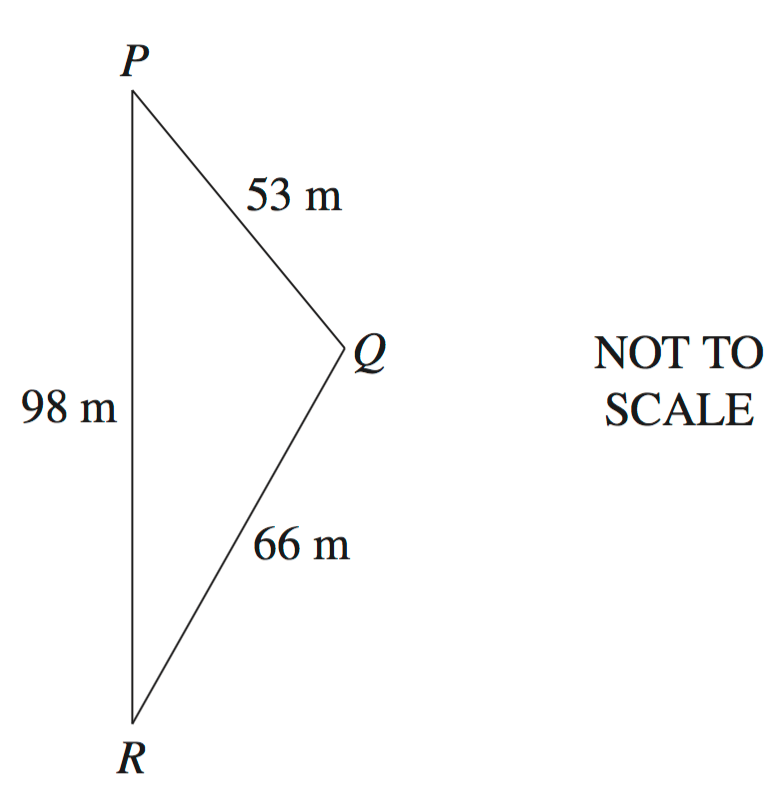
Find the size of angle `Q`, to the nearest degree. (2 marks)
--- 4 WORK AREA LINES (style=lined) ---
In the diagram, `AD` and `DC` are equal to 30 cm.
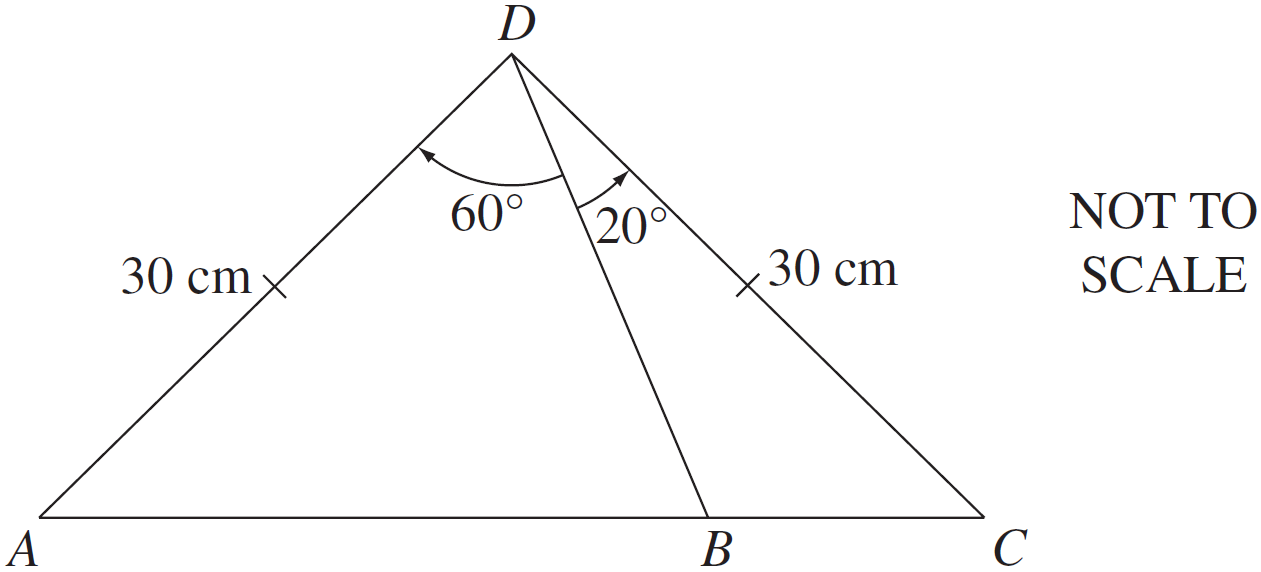
What is the length of `AB` to the nearest centimetre?
Three towns `P`, `Q` and `R` are marked on the diagram.
The distance from `R` to `P` is 76 km. `angle RQP=26^circ` and `angle RPQ=46^@.`
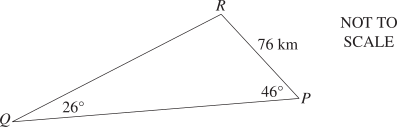
What is the distance from `P` to `Q` to the nearest kilometre?
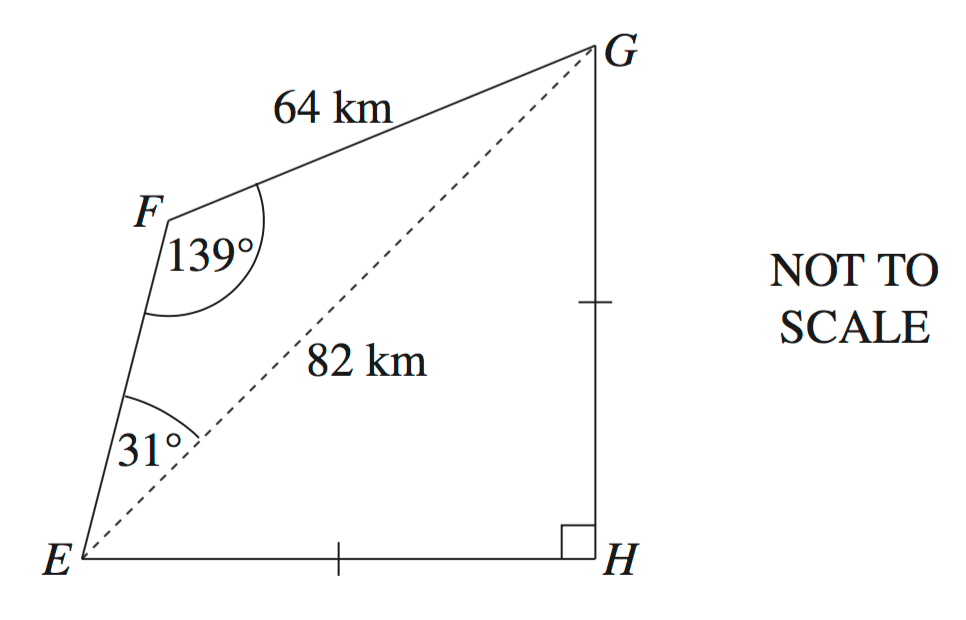
Raj cycles around a course. The course starts at `E`, passes through `F`, `G` and `H` and finishes at `E`. The distances `EH` and `GH` are equal.
--- 4 WORK AREA LINES (style=lined) ---
--- 6 WORK AREA LINES (style=lined) ---
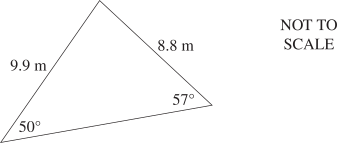
What is the area of this triangle, to the nearest square metre?
What is the value of `theta`, to the nearest degree?