SmarterEd

Aussie Maths & Science Teachers: Save your time with SmarterEd

  • Login
  • Get Help
  • About

Calculus, 2ADV C1 EQ-Bank 6

Use the definition of the derivative, `f^{\prime}(x)=\lim _{h \rightarrow 0} \frac{f(x+h)-f(x)}{h}`  to find  `f^{\prime}(x)`  if  `f(x)=5x^2-2x`.   (2 marks)

--- 11 WORK AREA LINES (style=lined) ---

Show Answers Only

`f(x)=5x^2-2x`

`f^{′}(x)` `= \lim_{h->0} \frac{5(x+h)^2-2(x+h)-(5x^2-2x)}{h}`  
  `= \lim_{h->0} \frac{5x^2+10xh+h^2-2x-2h-5x^2+2x}{h}`  
  `= \lim_{h->0} \frac{10xh+h^2-2h}{h}`  
  `= \lim_{h->0} \frac{h(10x+h-2)}{h}`  
  `= \lim_{h->0} 10x+h-2`  
  `=10x-2`  

Show Worked Solution

`f(x)=5x^2-2x`

`f^{′}(x)` `= \lim_{h->0} \frac{5(x+h)^2-2(x+h)-(5x^2-2x)}{h}`  
  `= \lim_{h->0} \frac{5x^2+10xh+h^2-2x-2h-5x^2+2x}{h}`  
  `= \lim_{h->0} \frac{10xh+h^2-2h}{h}`  
  `= \lim_{h->0} \frac{h(10x+h-2)}{h}`  
  `= \lim_{h->0} 10x+h-2`  
  `=10x-2`  

Filed Under: Standard Differentiation (Adv-2027), Standard Differentiation (Y11) Tagged With: Band 4, smc-1069-40-1st Principles, smc-6436-40-1st Principles

Trigonometry, 2ADV T2 EQ-Bank 6

Simplify  \(\sin \,  \theta \, \cos \theta \,\operatorname{cosec}^2 \,  \theta\).   (2 marks)

--- 4 WORK AREA LINES (style=lined) ---

Show Answers Only

\(\cot \theta\)

Show Worked Solution

\(\sin \theta \cos \theta \times \dfrac{1}{\sin ^2 \theta}\)

\(=\dfrac{\cos \, \theta}{\sin \, \theta}\)

\(=\cot \, \theta\)

Filed Under: Trig Identities and Harder Equations (Adv-2027), Trig Identities and Harder Equations (Y11) Tagged With: Band 4, smc-1189-30-Other, smc-6412-30-Other

Functions, 2ADV F1 EQ-Bank 20

Find the value of \(k\)  if  \(4kx^2-(3-4k) x+k=0\)  has one root.   (2 marks)

--- 7 WORK AREA LINES (style=lined) ---

Show Answers Only

\(k=\dfrac{3}{8}\)

Show Worked Solution

\(4kx^2-(3-4k) x+k=0\)

\(\text{1 root}\ \Rightarrow \Delta=0\)

  \(\Delta\) \(=b^2-4 a c\)
  \(0\) \(=\left[ -\left( 3-4k \right)\right]^2-4\times 4k \times k\)
  \(0\) \(=9-24k + 16k^2-16k^2\)
  \(24k\) \(=9\)
  \(k\) \(=\dfrac{9}{24}=\dfrac{3}{8}\)

Filed Under: Quadratics and Cubic Functions (Adv-2027), Quadratics and Cubic Functions (Y11) Tagged With: Band 4, smc-6215-80-Discriminant, smc-984-50-Discriminant

Functions, 2ADV F1 EQ-Bank 19

\(R\left(r, r^2\right), S\left(s, s^2\right)\) and \(T\left(t, t^2\right)\) are points on the parabola  \(y=x^2\).

Given \(RT\) is parallel to \(SO\), show  \(r+t=s\)   (2 marks)
 

--- 5 WORK AREA LINES (style=lined) ---

Show Answers Only

\(R\left(r, r^2\right), S\left(s, s^2\right), T\left(t, t^2\right)\)

\(m_{S O}=\dfrac{y_2-y_1}{x_2-x_1}=\dfrac{s^2-0}{s-0}=s\)

\(m_{R T}=\dfrac{t^2-r^2}{t-r}=\dfrac{(t-r)(t+r)}{(t-r)}=t+r\)

\(\text{Given}\ R T \ \| \  SO \ \Rightarrow \ m_{SO}=m_{R T}\)

\(\therefore s=r+t\ \ …\ \text{as required} \)

Show Worked Solution

\(R\left(r, r^2\right), S\left(s, s^2\right), T\left(t, t^2\right)\)

\(m_{S O}=\dfrac{y_2-y_1}{x_2-x_1}=\dfrac{s^2-0}{s-0}=s\)

\(m_{R T}=\dfrac{t^2-r^2}{t-r}=\dfrac{(t-r)(t+r)}{(t-r)}=t+r\)

\(\text{Given}\ R T \ \| \  SO \ \Rightarrow \ m_{SO}=m_{R T}\)

\(\therefore s=r+t\ \ …\ \text{as required} \)

Filed Under: Quadratics and Cubic Functions (Adv-2027), Quadratics and Cubic Functions (Y11) Tagged With: Band 4, smc-6215-10-Quadratics, smc-984-10-Quadratics

Calculus, 2ADV C1 EQ-Bank 5

A magpie plague hit Raymond Terrace this year but was eventually brought under control. A bird researcher estimated that the magpie population \(M\), in hundreds, \(t\) months after 1st January, was given by  \(M=7+20t-3t^2\)

  1. Find the magpie population on 1st March.   (1 mark)

    --- 3 WORK AREA LINES (style=lined) ---

  2. At what rate was the population changing at this time?   (1 mark)

    --- 3 WORK AREA LINES (style=lined) ---

  3. In what month does the magpie population start to decrease?   (2 marks)

    --- 5 WORK AREA LINES (style=lined) ---

Show Answers Only

a.    \(\text{Population}\ =35 \times 100=3500\)

b.   \(M\ \text{is increasing at 800 per month}\)

c.   \(\text{Population starts to decrease in May.}\)

Show Worked Solution

a.    \(\text{Find}\ M\ \text{when}\ \ t=2:\)

\(M=7+20 \times 2-3 \times 2^2 = 35\)

\(\therefore \text{Population}\ =35 \times 100=3500\)
 

b.    \(M=7+20t-3t^2\)

\(\dfrac{dM}{dt}=20-6t\)

\(\text{Find}\ \dfrac{dM}{dt}\ \text{when}\ \ t=2: \)

\(\dfrac{dM}{dt}=20-6 \times 2 = 8\)

\(\therefore M\ \text{is increasing at 800 per month}\)
 

c.    \(\text{Find}\ t\ \text{when}\ \dfrac{dM}{dt}=0: \)

\(\dfrac{dM}{dt}=20-6t = 0\ \ \Rightarrow \ t= 3\ \dfrac{1}{3}\)

\(\dfrac{dM}{dt}<0\ \ \text{when}\ \ t>3\ \dfrac{1}{3} \)

\(\therefore\ \text{Population starts to decrease in May.}\)

Filed Under: Rates of Change (Adv-2027), Rates of Change (Y11) Tagged With: Band 3, Band 4, smc-1083-20-Polynomial Function, smc-6438-20-Polynomial Function

Trigonometry, 2ADV T1 EQ-Bank 3

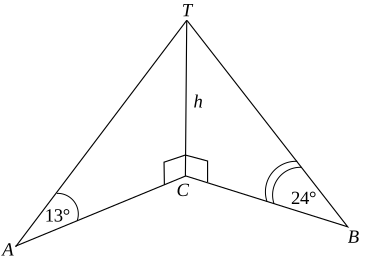
A tower \(T C\) is \(h\) metres high.

At point \(A\), due south of the tower, the angle of elevation to the top of the tower, point \(T\), is 13°.

Point \(B\) is due east of the tower, with an angle of elevation to the top of 24°, as shown in the diagram.

Point \(A\) is 1.1 kilometres from Point \(B\) and both points are on the same ground level as the base of the tower, point \(C\).


  1. Show \(B C=h \times \tan 66^{\circ}\).   (1 mark)

    --- 3 WORK AREA LINES (style=lined) ---

  2. Find a similar expression for \(A C\).   (1 mark)

    --- 3 WORK AREA LINES (style=lined) ---

  3. Hence, or otherwise, determine the height, \(h\), of the tower. Give your answer correct to the nearest metre.   (3 marks)

    --- 5 WORK AREA LINES (style=lined) ---

Show Answers Only

a.   \(\text{See Worked Solutions}\)

b.   \(\text{See Worked Solutions}\)

c.   \(\text{225 metres}\)

Show Worked Solution

a.   \(\text{In}\ \Delta TBC\ \Rightarrow \angle CTB=90-24=66^{\circ}\)

\(\tan 66^{\circ}\) \(=\dfrac{BC}{h} \)  
\(BC\) \(=h \times \tan 66^{\circ}\)  


b.   \(\text{In}\ \Delta TAC\ \Rightarrow \angle CTA=90-13=77^{\circ}\)

\(\tan 77^{\circ}\) \(=\dfrac{AC}{h} \)  
\(AC\) \(=h \times \tan 77^{\circ}\)  

 
c.   \(\Delta ACB\ \text{is right-angled.}\)
  

\(\text{By Pythagoras:}\)

\(AC^{2}+BC^{2}\) \(=1100^{2}\)  
\(h^2 \times \tan^{2} 77^{\circ} + h^2 \times \tan^{2}66^{\circ}\) \(=1100^2\)  
\(h^2(\tan^{2} 77^{\circ}+\tan^{2} 66^{\circ})\) \(=1100^2\)  
\(h^2\) \(=\dfrac{1100^2}{(\tan^{2} 77^{\circ}+\tan^{2} 66^{\circ})}\)  
\(h\) \(=225.44…\)  
  \(=225\ \text{m (nearest m)}\)  

Filed Under: 3D Trigonometry (Y11) Tagged With: Band 4, Band 5

Trigonometry, 2ADV T2 EQ-Bank 5

Solve  \(\sin x-\cos x=0 \quad-\pi \leqslant x \leqslant \pi\)   (2 marks)

--- 5 WORK AREA LINES (style=lined) ---

Show Answers Only

\(x=\dfrac{\pi}{4}, -\dfrac{3\pi}{4}\)

Show Worked Solution
  \(\sin x-\cos x\) \(=0\)
  \(\dfrac{\sin x}{\cos x}-\dfrac{\cos x}{\cos x}\) \(=0\)
  \(\tan x-1\) \(=0\)
  \(\tan x\) \(=1\)
  \(x\) \(=\tan ^{-1}(1)\)

 
\(\therefore x=\dfrac{\pi}{4}, -\dfrac{3\pi}{4}\)

Filed Under: Trig Identities and Harder Equations (Adv-2027), Trig Identities and Harder Equations (Y11) Tagged With: Band 4, smc-1189-10-Solve Equation, smc-6412-10-Solve Equation

Trigonometry, 2ADV T3 EQ-Bank 4

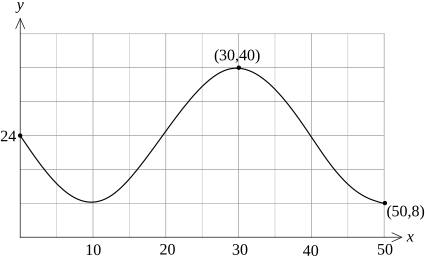
The graph below has the equation  \(y=a \sin (b x)+c\)  for  \(0 \leqslant x \leqslant 50\).
 

Determine the values of  \(a, b\)  and  \(c\).  (3 marks)

--- 5 WORK AREA LINES (style=lined) ---

Show Answers Only

\(a=16, b=9, c=24\)

Show Worked Solution

\(\text {Amplitude}\ =\dfrac{40-8}{2}=16\ \ \Rightarrow a=16\)

\(\text {Centre of motion}\ =24\ \ \Rightarrow c=24\)

\(\text {Period }=\dfrac{360}{n}=40\ \ \Rightarrow n=b=9\)

Filed Under: Trig Graphs (Y12) Tagged With: Band 4, smc-977-10-sin

Trigonometry, 2ADV T2 EQ-Bank 2

Express  \(3 \operatorname{cosec}(180+x)+5 \cos (90-x)\)  as a single fraction in terms of \(\sin x\), given all angles are measured in degrees.   (3 marks)

--- 8 WORK AREA LINES (style=lined) ---

Show Answers Only

\(\dfrac{-3+5 \sin ^2 x}{\sin x}\)

Show Worked Solution

\(3 \operatorname{cosec}(180+x)+5 \cos (90-x)\)

\(=\dfrac{3}{\sin \left(180^{\circ}+x\right)}+5 \sin x\)

\(=\dfrac{3}{-\sin x}+5 \sin x\)

\(=\dfrac{-3}{\sin x}+\dfrac{5 \sin ^2 x}{\sin x}\)

\(=\dfrac{-3+5 \sin ^2 x}{\sin x}\)

Filed Under: Trig Identities and Harder Equations (Adv-2027), Trig Identities and Harder Equations (Y11) Tagged With: Band 4, smc-1189-30-Other, smc-6412-30-Other

Functions, 2ADV F1 EQ-Bank 18

If  \(f(x)=x^2-3\)  and  \(g(x)=\sqrt{x-2}\),

  1. Find  \(f(g(x))\).   (1 mark)

    --- 3 WORK AREA LINES (style=lined) ---

  2. What is the domain of \(f(g(x))\) ?   (1 mark)

    --- 2 WORK AREA LINES (style=lined) ---

Show Answers Only

a.  \(f(g(x))=x-5\)

b.   \(\text{Restriction for}\ \ g(x)\ \Rightarrow \ x-2\geqslant 0 \ \Rightarrow \ x \geqslant 2\)

\(\text{Domain}\ \ f(g(x)):\ x \geqslant 2\)

Show Worked Solution

a.    \(f(g(x))\) \(=(\sqrt{x-2})^2-3\)
    \(=x-2-3\)
    \(=x-5\)


b.   \(\text{Restriction for}\ \ g(x)\ \Rightarrow \ x-2\geqslant 0 \ \Rightarrow \ x \geqslant 2\)

\(\text{Domain}\ \ f(g(x)):\ x \geqslant 2\)

Filed Under: Composite Functions (Adv-2027), Composite Functions (Y11) Tagged With: Band 3, Band 4, smc-6216-30-Other Functions, smc-6216-40-Domain/Range, smc-986-30-Other, smc-986-40-Domain/Range

Functions, 2ADV F1 EQ-Bank 10

Fully simplify the expression  \(\dfrac{4}{x^2-9}-\dfrac{2x+1}{x+3}\)   (3 marks)

--- 6 WORK AREA LINES (style=lined) ---

Show Answers Only

\(\dfrac{-(2x-7)(x+1)}{(x^2-9)}\)

Show Worked Solution
\(\dfrac{4}{x^2-9}-\dfrac{2x+1}{x+3}\) \(=\dfrac{4-(2x+1)(x-3)}{(x+3)(x-3)}\)  
  \(=\dfrac{4-(2x^2-5x-3)}{(x+3)(x-3)}\)  
  \(=\dfrac{-(2x^2-5x-7)}{(x+3)(x-3)}\)  
  \(=\dfrac{-(2x-7)(x+1)}{(x^2-9)}\)  

Filed Under: Algebraic Techniques (Adv-2027), Algebraic Techniques (Y11) Tagged With: Band 4, smc-6213-10-Algebraic Fractions, smc-983-40-Algebraic Fractions

Calculus, 2ADV C1 EQ-Bank 2 MC

The displacement of a particle is given by  \(x=3t^{3}-6t^{2}-15\) . The acceleration is zero at:

  1. \(t=\dfrac{2}{3}\)
  2. \(t=\dfrac{4}{3}\)
  3. \(t=\dfrac{5}{2}\)
  4. \(\text{never}\)
Show Answers Only

\(A\)

Show Worked Solution

\(x=3t^{3}-6t^{2}-15\)

\(v=9t^{2}-12t\)

\(a=18t-12\)

\(\text{Find}\ t\ \text{when}\ \ a=0:\)

\(18t-12=0\ \ \Rightarrow\ \ t=\dfrac{2}{3} \)

\(\Rightarrow A\)

Filed Under: Rates of Change (Adv-2027), Rates of Change (Y11) Tagged With: Band 4, smc-1083-20-Polynomial Function, smc-6438-20-Polynomial Function

Functions, 2ADV F1 EQ-Bank 45

Determine whether the function  \(f(x)=2x^3-5x\)  is even, odd or neither. Show all working.   (2 marks)

--- 5 WORK AREA LINES (style=lined) ---

Show Answers Only

\(f(x)=2x^{3}-5x\)

\(\text{Function is odd if:}\ \ f(-x)=-f(x) \)

\(f(-x)\) \(=2(-x)^{3}-5(-x) \)  
  \(=-2x^{3}+5x \)  
  \(=-(2x^{3}-5x)\)  
  \(=-f(x)\)  

 
\(\therefore f(x)\ \text{is odd.}\)

Show Worked Solution

\(f(x)=2x^{3}-5x\)

\(\text{Function is odd if:}\ \ f(-x)=-f(x) \)

\(f(-x)\) \(=2(-x)^{3}-5(-x) \)  
  \(=-2x^{3}+5x \)  
  \(=-(2x^{3}-5x)\)  
  \(=-f(x)\)  

 
\(\therefore f(x)\ \text{is odd.}\)

Filed Under: Further Functions and Relations (Y11), Quadratics and Cubic Functions (Adv-2027) Tagged With: Band 4, smc-6215-50-Cubics, smc-6215-75-Odd/Even Functions, smc-987-70-Odd/even functions

Calculus, 2ADV C1 EQ-Bank 1 MC

The derivative of  \(n x^{2n+1}\)  can be expressed as

  1. \(2 n^2 x^{2 n+1}\)
  2. \(2 n^2 x^{2 n}\)
  3. \((2 n+1) n x^{2 n}\)
  4. \((2 n+1) n x^{2 n+1}\)
Show Answers Only

\(C\)

Show Worked Solution
\(y\) \(=n x^{2n+1}\)  
\(y^{′}\) \(=(2 n+1) n x^{2n+1-1}\)  
  \(=(2 n+1) n x^{2 n}\)  

 
\(\Rightarrow C\)

Filed Under: Standard Differentiation (Adv-2027), Standard Differentiation (Y11) Tagged With: Band 4, smc-1069-30-Basic Differentiation, smc-6436-30-Basic Differentiation

BIOLOGY, M2 EQ-Bank 1

"Multicellular organisms exhibit different levels of cell complexity, from simple cells to highly specialised ones."

Justify this statement, providing examples to support your answer.   (4 marks)

--- 8 WORK AREA LINES (style=lined) ---

Show Answers Only
  • Multicellular organisms show different levels of cell complexity, starting with simple cells that perform basic functions, like skin cells, to highly specialised cells, such as neurons, which have unique structures for transmitting signals.
  • Cell groups within multicellular organisms cannot survive without other cell types performing their role.
  • A hierarchy arises, organising cells into tissues, organs and other systems, each with distinct functions that work together to support life.
  • For example, muscle cells form muscle tissue, which contracts to allow movement, while red blood cells transport oxygen through the circulatory system but cannot reproduce.
  • The specialisation of cells allows multicellular organisms to perform complex tasks more efficiently, contributing to the organism’s overall survival and adaptability.
  • This organisation enhances both the functionality and efficiency of biological processes
Show Worked Solution
  • Multicellular organisms show different levels of cell complexity, starting with simple cells that perform basic functions, like skin cells, to highly specialised cells, such as neurons, which have unique structures for transmitting signals.
  • Cell groups within multicellular organisms cannot survive without other cell types performing their role.
  • A hierarchy arises, organising cells into tissues, organs and other systems, each with distinct functions that work together to support life.
  • For example, muscle cells form muscle tissue, which contracts to allow movement, while red blood cells transport oxygen through the circulatory system but cannot reproduce.
  • The specialisation of cells allows multicellular organisms to perform complex tasks more efficiently, contributing to the organism’s overall survival and adaptability.
  • This organisation enhances both the functionality and efficiency of biological processes

Filed Under: Organisation of Cells Tagged With: Band 4, Band 5, smc-4304-20-Multicellular, smc-4304-60-Hierarchy

BIOLOGY, M2 EQ-Bank 1 MC

Which of the following best distinguishes a unicellular organism from a colonial organism?

  1. A unicellular organism is made up of multiple cells, while a colonial organism is a single cell.
  2. A unicellular organism can survive independently, while a colonial organism involves many specialised cells that must live as a group to survive.
  3. Unicellular organisms rely on other cells to perform essential functions, while colonial organisms do not.
  4. Unicellular organisms consist of one cell that performs all life functions, while colonial organisms are groups of identical cells that function together but can survive independently.
Show Answers Only

\(D\)

Show Worked Solution
  • In unicellular organisms, a single cell carries out all necessary life processes.
  • Colonial organisms consist of individual cells that are physically connected or grouped, but each cell can perform essential functions independently, allowing survival even if separated from the colony.

\(\Rightarrow D\)

Filed Under: Organisation of Cells Tagged With: Band 4, smc-4304-10-Unicellular, smc-4304-30-Colonial

BIOLOGY, M1 EQ-Bank 10

Explain why lysosomes store acidic enzymes, including one way in which this storage process benefits the cell.   (2 marks)

--- 4 WORK AREA LINES (style=lined) ---

Show Answers Only
  • Lysosomes store acidic enzymes because these type of enzymes are most effective in helping the organelle perform its major role of breaking down waste and cellular debris.
  • This storage process plays a crucial role in protecting the cell by keeping these enzymes contained.
  • If the acidic enzymes were released into the cytoplasm, they would lower the pH in the cytosol, adversely affecting other enzymes and potentially damaging other cellular components.
Show Worked Solution
  • Lysosomes store acidic enzymes because these type of enzymes are most effective in helping the organelle perform its major role of breaking down waste and cellular debris.
  • This storage process plays a crucial role in protecting the cell by keeping these enzymes contained.
  • If the acidic enzymes were released into the cytoplasm, they would lower the pH in the cytosol, adversely affecting other enzymes and potentially damaging other cellular components.

Filed Under: Cell Function Tagged With: Band 4

BIOLOGY, M1 EQ-Bank 8

Discuss how the structure of the phospholipid bilayer contributes to the selective permeability of a cell membrane.   (3 marks)

--- 5 WORK AREA LINES (style=lined) ---

Show Answers Only
  • The phospholipid bilayer’s structure, with hydrophilic heads facing outward and hydrophobic tails facing inward, forms a barrier that allows only small, nonpolar molecules to pass through easily, while blocking larger or charged molecules.
  • This selective permeability is further controlled by embedded proteins, which act as channels or carriers to facilitate the movement of ions and larger molecules that cannot cross the bilayer on their own.
  • This structure helps the cell regulate the entry and exit of specific substances, maintaining internal balance.
Show Worked Solution
  • The phospholipid bilayer’s structure, with hydrophilic heads facing outward and hydrophobic tails facing inward, forms a barrier that allows only small, nonpolar molecules to pass through easily, while blocking larger or charged molecules.
  • This selective permeability is further controlled by embedded proteins, which act as channels or carriers to facilitate the movement of ions and larger molecules that cannot cross the bilayer on their own.
  • This structure helps the cell regulate the entry and exit of specific substances, maintaining internal balance.

Filed Under: Cell Function Tagged With: Band 4

BIOLOGY, M1 EQ-Bank 7

How do temperature and pH affect enzyme activity? In your answer, briefly explain how extreme conditions of each factor influence enzyme function.   (4 marks)

--- 7 WORK AREA LINES (style=lined) ---

Show Answers Only

→ Temperature and pH significantly impact enzyme activity.

→ At high temperatures, enzymes can denature, losing their shape and functionality. At extreme heat, the active site can be destroyed or made inaccessible.

→ At low temperatures, enzyme activity slows down due to reduced molecular movement.

→ Certain enzymes have evolved to be most effective in specific pH environments (such as the acidity of the stomach) and are much less effective in more alkaline settings.

→ Extreme pH levels can alter the enzyme’s structure, affecting the active site’s ability to bind with substrates.

→ Optimal enzyme activity occurs within specific temperature and pH ranges for each enzyme.

Show Worked Solution

→ Temperature and pH significantly impact enzyme activity.

→ At high temperatures, enzymes can denature, losing their shape and functionality. At extreme heat, the active site can be destroyed or made inaccessible.

→ At low temperatures, enzyme activity slows down due to reduced molecular movement.

→ Certain enzymes have evolved to be most effective in specific pH environments (such as the acidity of the stomach) and are much less effective in more alkaline settings.

→ Extreme pH levels can alter the enzyme’s structure, affecting the active site’s ability to bind with substrates.

→ Optimal enzyme activity occurs within specific temperature and pH ranges for each enzyme.

Filed Under: Uncategorized Tagged With: Band 4, Band 5

BIOLOGY, M1 EQ-Bank 6 MC

Which of the following best distinguishes cellular waste from cellular secretions?

  1. Both cellular waste and secretions are expelled by the cell for communication with other cells.
  2. Cellular waste is produced as a byproduct of metabolic reactions, while secretions are released by cells to perform specific functions.
  3. Cellular waste is stored in vesicles, while secretions are immediately broken down within the cell.
  4. Secretions are only produced by prokaryotic cells, while waste is produced by all cell types.
Show Answers Only

\(B\)

Show Worked Solution
  • Cellular waste includes substances like carbon dioxide or urea, which result from metabolic processes and must be removed.
  • Secretions, on the other hand, are purposeful substances like hormones or enzymes that are actively produced and released by cells for specific roles in the body.

\(\Rightarrow B\)

Filed Under: Cell Function Tagged With: Band 4

BIOLOGY, M1 EQ-Bank 5

Explain how cells remove waste products to maintain proper function and provide an example of a specific waste product that cells eliminate.   (3 marks)

--- 5 WORK AREA LINES (style=lined) ---

Show Answers Only
  • Cells remove waste products through exocytosis, where waste is trapped within vesicles inside the cell.
  • These vesicles then fuse with the cell membrane, releasing the waste to the outside environment.
  • Examples of a waste product: could include carbon dioxide, lactic acid or urea (and other nitrogen based waste compounds).
Show Worked Solution
  • Cells remove waste products through exocytosis, where waste is trapped within vesicles inside the cell.
  • These vesicles then fuse with the cell membrane, releasing the waste to the outside environment.
  • Examples of a waste product: could include carbon dioxide, lactic acid or urea (and other nitrogen based waste compounds).

Filed Under: Cell Function Tagged With: Band 4

BIOLOGY, M1 EQ-Bank 5 MC

Which process is primarily responsible for removing waste materials from a cell?

  1. Phagocytosis
  2. Endocytosis
  3. Exocytosis
  4. Osmosis
Show Answers Only

\(C\)

Show Worked Solution
  • Exocytosis is the process by which cells expel waste materials and other substances by transporting vesicles to the cell membrane, where they fuse and release their contents outside the cell. 

\(\Rightarrow C\)

Filed Under: Cell Function Tagged With: Band 4

BIOLOGY, M1 EQ-Bank 3

Discuss how concentration gradients affect the transport of molecules across the cell membrane?   (3 marks)

--- 5 WORK AREA LINES (style=lined) ---

Show Answers Only
  • Concentration gradients determine the direction of molecule movement across the cell membrane.
  • Molecules naturally move from areas of high concentration to low concentration in processes like diffusion and osmosis (passive transport). The higher the gradient, the faster the movement.
  • In contrast, active transport requires energy to move substances against the gradient, from low to high concentration. The higher the gradient, the more energy that is required.
  • These gradients are crucial for maintaining cellular balance and function.
Show Worked Solution
  • Concentration gradients determine the direction of molecule movement across the cell membrane.
  • Molecules naturally move from areas of high concentration to low concentration in processes like diffusion and osmosis (passive transport). The higher the gradient, the faster the movement.
  • In contrast, active transport requires energy to move substances against the gradient, from low to high concentration. The higher the gradient, the more energy that is required.
  • These gradients are crucial for maintaining cellular balance and function.

Filed Under: Cell Function Tagged With: Band 4

BIOLOGY, M1 EQ-Bank 2

   "The surface area to volume ratio is crucial for efficient cellular transport."

Evaluate the above statement, providing an example of how cells adapt their shape to maintain an effective ratio.   (3 marks)

--- 6 WORK AREA LINES (style=lined) ---

Show Answers Only
  • The surface area to volume ratio is vital for efficient cellular transport because a higher ratio allows for quicker exchange of materials, such as nutrients and waste, across the cell membrane.
  • As cells grow larger, their volume increases faster than their surface area, reducing efficiency.
  • To compensate, some cells increase surface area without significantly adding volume.
  • An example is red blood cells that have adapted to be biconcave in shape. This maximises surface area relative to volume to enhance oxygen exchange.
Show Worked Solution
  • The surface area to volume ratio is vital for efficient cellular transport because a higher ratio allows for quicker exchange of materials, such as nutrients and waste, across the cell membrane.
  • As cells grow larger, their volume increases faster than their surface area, reducing efficiency.
  • To compensate, some cells increase surface area without significantly adding volume.
  • An example is red blood cells that have adapted to be biconcave in shape. This maximises surface area relative to volume to enhance oxygen exchange.

Filed Under: Cell Function Tagged With: Band 4

BIOLOGY, M1 EQ-Bank 3 MC

Which of the following best describes movement of molecules in passive transport with respect to concentration gradients?

  1. Molecules move against the concentration gradient, from low to high concentration.
  2. Molecules move down the concentration gradient, from high to low concentration.
  3. Molecules remain stationary when the concentration gradient is equal.
  4. Molecules move randomly, regardless of the concentration gradient.
Show Answers Only

\(B\)

Show Worked Solution
  • Passive transport relies on molecules moving naturally from an area of high concentration to an area of low concentration without the need for energy.
  • This process includes diffusion and osmosis, allowing molecules to equalise concentration across membranes.

\(\Rightarrow B\)

Filed Under: Cell Function Tagged With: Band 4

BIOLOGY, M1 EQ-Bank 1

Describe how active transport and passive transport differ in their mechanisms for moving substances into and out of cells, and give an example of each.   (2 marks)

--- 5 WORK AREA LINES (style=lined) ---

Show Answers Only
  • Active transport requires energy (usually in the form of ATP) to move or create the passage for substances into or out of cells.
  • Endocytosis and exocytosis are examples of active transport (only one example required).
  • In contrast, passive transport does not require energy to move substances into or out of cells.
  • Diffusion and osmosis are examples of passive transport (only one example required).
Show Worked Solution
  • Active transport requires energy (usually in the form of ATP) to move or create the passage for substances into or out of cells.
  • Endocytosis and exocytosis are examples of active transport (only one example required).
  • In contrast, passive transport does not require energy to move substances into or out of cells.
  • Diffusion and osmosis are examples of passive transport (only one example required).

Filed Under: Cell Function Tagged With: Band 4

BIOLOGY, M1 EQ-Bank 2 MC

Exocytosis is critical for which of the following cellular functions?

  1. Importing large food particles into the cell.
  2. Exporting proteins and other materials out of the cell.
  3. Transporting ions directly through the phospholipid bilayer.
  4. Facilitating the movement of oxygen into the cell.
Show Answers Only

\(B\)

Show Worked Solution

→ Exocytosis is a process where vesicles fuse with the plasma membrane to expel materials, such as proteins or waste, from the cell.

→ This process is crucial for cellular secretion and maintaining cell health.

\(\Rightarrow B\)

Filed Under: Uncategorized Tagged With: Band 4

BIOLOGY, M1 EQ-Bank 1 MC

Which of the following best describes the process of endocytosis?

  1. The movement of water molecules through a membrane by osmosis.
  2. The transport of large molecules into the cell by engulfing them in a vesicle.
  3. The passive diffusion of small molecules across the cell membrane.
  4. The removal of cellular waste through the membrane via a vesicle.
Show Answers Only

\(B\)\

Show Worked Solution
  • Endocytosis is a process by which the cell membrane folds inward to form a vesicle, bringing large molecules like nutrients or particles into the cell. 

\(\Rightarrow B\)

Filed Under: Cell Function Tagged With: Band 4

BIOLOGY, M1 EQ-Bank 7

Explain how the cell arrangement supports the role and specific functions of the following cellular structures

  1. Cytoplasm   (2 marks)

    --- 4 WORK AREA LINES (style=lined) ---

  2. Ribosomes   (2 marks)

    --- 4 WORK AREA LINES (style=lined) ---

Show Answers Only

a.    Cytoplasm:

  • The cytoplasm is a gel-like substance that fills the cell, providing a medium in which organelles are suspended.
  • It facilitates the movement of materials within the cell and allows biochemical reactions to occur efficiently. 

b.    Ribosomes:

  • Ribosomes can be found either floating freely in the cytoplasm or attached to the rough endoplasmic reticulum.
  • Their arrangement allows them to efficiently translate mRNA into proteins, with free ribosomes synthesising proteins for use within the cell and membrane-bound ribosomes manufacturing proteins for export or use in the cell membrane.
Show Worked Solution

a.    Cytoplasm:

  • The cytoplasm is a gel-like substance that fills the cell, providing a medium in which organelles are suspended.
  • It facilitates the movement of materials within the cell and allows biochemical reactions to occur efficiently. 

b.    Ribosomes:

  • Ribosomes can be found either floating freely in the cytoplasm or attached to the rough endoplasmic reticulum.
  • Their arrangement allows them to efficiently translate mRNA into proteins, with free ribosomes synthesising proteins for use within the cell and membrane-bound ribosomes manufacturing proteins for export or use in the cell membrane.

Filed Under: Cell Structure Tagged With: Band 4

BIOLOGY, M1 EQ-Bank 8 MC

Which of the following correctly compares the structure and function of the mitochondria and the chloroplast?

  1. Both mitochondria and chloroplasts produce energy through photosynthesis.
  2. Mitochondria have a single membrane, while chloroplasts have a double membrane.
  3. Mitochondria generate ATP through cellular respiration, while chloroplasts convert light energy into chemical energy via photosynthesis.
  4. Both mitochondria and chloroplasts are responsible for protein synthesis.
Show Answers Only

\(C\)

Show Worked Solution
  • Mitochondria are responsible for producing ATP through the process of cellular respiration.
  • Chloroplasts, found in plant cells, convert light energy into glucose via photosynthesis.
  • Both organelles have distinct functions related to energy conversion in cells.

\(\Rightarrow C\)

Filed Under: Cell Structure Tagged With: Band 4

BIOLOGY, M1 EQ-Bank 6

Describe the structure and role of phospholipids in the cell membrane based on the fluid mosaic model.   (3 marks)

--- 6 WORK AREA LINES (style=lined) ---

Show Answers Only
  • In the fluid mosaic model, phospholipids form a bilayer that acts as the fundamental structure of the cell membrane.
  • Each phospholipid has a hydrophilic head that faces outward and a hydrophobic tail that faces inward, creating a barrier that separates the cell’s internal and external environments.
  • This bilayer is semi-permeable, allowing selective substances to pass through while blocking others. 
Show Worked Solution
  • In the fluid mosaic model, phospholipids form a bilayer that acts as the fundamental structure of the cell membrane.
  • Each phospholipid has a hydrophilic head that faces outward and a hydrophobic tail that faces inward, creating a barrier that separates the cell’s internal and external environments.
  • This bilayer is semi-permeable, allowing selective substances to pass through while blocking others. 

Filed Under: Cell Structure Tagged With: Band 4

BIOLOGY, M1 EQ-Bank 5

According to the fluid mosaic model of the cell membrane

  1. describe the structure of the phospholipid bilayer.   (2 marks)

    --- 5 WORK AREA LINES (style=lined) ---

  2. explain the role of proteins.   (1 mark)

    --- 5 WORK AREA LINES (style=lined) ---

Show Answers Only

a.    The phospholipid bilayer:

  • Consists of two layers of phospholipids.
  • One layer involves hydrophilic (water-attracting) heads facing outward toward the water-based environment while the opposite layer has hydrophobic (water-repelling) tails facing inward, away from water. 

b.     Role of proteins:

  • Proteins are embedded in the double phospholid layer.
  • They play an important role in the cell structure and communication.
Show Worked Solution

a.    The phospholipid bilayer:

  • Consists of two layers of phospholipids.
  • One layer involves hydrophilic (water-attracting) heads facing outward toward the water-based environment while the opposite layer has hydrophobic (water-repelling) tails facing inward, away from water. 

b.     Role of proteins:

  • Proteins are embedded in the double phospholid layer.
  • They play an important role in the cell structure and communication.

Filed Under: Cell Structure Tagged With: Band 4, Band 5

BIOLOGY, M1 EQ-Bank 4

Describe the progression of microscopy technologies and discuss how these advancements have enhanced our knowledge of cell structure and function.   (4 marks)

--- 5 WORK AREA LINES (style=lined) ---

Show Answers Only
  • The progression of microscopy technologies has revolutionised our understanding of cell structure and function.
  • Early light microscopes allowed scientists to observe basic cell components, such as the nucleus, but were limited in resolution.
  • The invention of the transmission electron microscope brought a major leap, enabling the detailed 2-D visualisation of organelles like mitochondria and the endoplasmic reticulum.
  • The development of the scanning electron microscope created high resolution 3-D images of cells. This allowed for the study of bacteria and cell-surface structures such as cilia.
  • More recently, confocal and fluorescence microscopy have allowed researchers to study living cells in real-time, providing dynamic insights into cellular processes.
  • These advancements have deepened our knowledge of cell biology, revealing intricate structures and functions previously unseen.
Show Worked Solution
  • The progression of microscopy technologies has revolutionised our understanding of cell structure and function.
  • Early light microscopes allowed scientists to observe basic cell components, such as the nucleus, but were limited in resolution.
  • The invention of the transmission electron microscope brought a major leap, enabling the detailed 2-D visualisation of organelles like mitochondria and the endoplasmic reticulum.
  • The development of the scanning electron microscope created high resolution 3-D images of cells. This allowed for the study of bacteria and cell-surface structures such as cilia.
  • More recently, confocal and fluorescence microscopy have allowed researchers to study living cells in real-time, providing dynamic insights into cellular processes.
  • These advancements have deepened our knowledge of cell biology, revealing intricate structures and functions previously unseen.

Filed Under: Cell Structure Tagged With: Band 4

BIOLOGY, M1 EQ-Bank 3

Describe how the development of electron microscopy has improved our understanding of cell structure and function.

In your answer, compare the capabilities of transmission electron microscopes (TEM) and scanning electron microscopes (SEM), and give examples of how each is used in biological research.   (4 marks)

--- 8 WORK AREA LINES (style=lined) ---

Show Answers Only
  • The development of electron microscopy has significantly enhanced our understanding of cell structure and function by providing much higher resolution images than light microscopes.
  • Transmission electron microscopes (TEM) allow scientists to view internal structures of cells in great detail by transmitting electrons through thin slices of specimens, revealing organelles like the mitochondria and endoplasmic reticulum.
  • In contrast, scanning electron microscopes (SEM) produce three-dimensional images by scanning the surface of a specimen with electrons, which is useful for studying cell surfaces and structures such as cilia or bacterial shapes.
  • Both TEM and SEM have been pivotal in biological research, allowing the discovery of cellular organelles and understanding of cell interactions at the microscopic level.
Show Worked Solution
  • The development of electron microscopy has significantly enhanced our understanding of cell structure and function by providing much higher resolution images than light microscopes.
  • Transmission electron microscopes (TEM) allow scientists to view internal structures of cells in great detail by transmitting electrons through thin slices of specimens, revealing organelles like the mitochondria and endoplasmic reticulum.
  • In contrast, scanning electron microscopes (SEM) produce three-dimensional images by scanning the surface of a specimen with electrons, which is useful for studying cell surfaces and structures such as cilia or bacterial shapes.
  • Both TEM and SEM have been pivotal in biological research, allowing the discovery of cellular organelles and understanding of cell interactions at the microscopic level.

Filed Under: Cell Structure Tagged With: Band 4

BIOLOGY, M1 EQ-Bank 7 MC

Which of the following correctly explains why a scanning electron microscope is advantageous in studying living cells?

  1. It provides three-dimensional imaging of cells with high resolution.
  2. It uses X-rays to visualise internal structures in detail.
  3. It only detects non-living tissue with electron beams.
  4. It relies on staining methods that permanently kill cells before imaging.
Show Answers Only

\(A\)

Show Worked Solution
  • Scanning electron microscopes capture detailed three-dimensional images of living cells, allowing researchers to observe cellular processes in real time with high resolution.
  • Unlike electron microscopes, this technology can be used to study live cells without extensive sample preparation that might kill the cells.

\(\Rightarrow A\)

Filed Under: Cell Structure Tagged With: Band 4

BIOLOGY, M1 EQ-Bank 6 MC

Which of the following technologies was pivotal in discovering the internal structure of organelles such as mitochondria and the endoplasmic reticulum?

  1. Light microscope
  2. Transmission electron microscope
  3. X-ray diffraction
  4. Gel electrophoresis
Show Answers Only

\(B\)

Show Worked Solution
  • The transmission electron microscope (TEM) allows for the visualisation of internal cell structures at high resolution by passing electrons through thin sections of a sample.
  • This technology was crucial in discovering detailed organelle structures like mitochondria and the endoplasmic reticulum, which are not visible with light microscopes.

\(\Rightarrow B\)

Filed Under: Cell Structure Tagged With: Band 4

BIOLOGY, M1 EQ-Bank 2

  1. Describe the role of two cell organelles found in eukaryotic cells.   (2 marks)

    --- 5 WORK AREA LINES (style=lined) ---

  2. How do specialised organelles contribute to the efficient functioning of eukaryotic cells, compared to prokaryotic cells?   (2 marks)

    --- 6 WORK AREA LINES (style=lined) ---

Show Answers Only

a.    Answers could include any two of the following:

  • Nucleus – the nucleus contains the cell’s genetic material and regulates gene expression.
  • Mitochondria – generates ATP through cellular respiration, providing energy for the cell’s functions.
  • Endoplasmic reticulum (ER) – helps synthesise proteins (rough ER) and lipids (smooth ER), contributing to various cell processes. 

b.    Specialised organelles allow eukaryotic cells to compartmentalise tasks.

  • This increases metabolic efficiency and enables complex processes to occur within the cell.
  • In contrast, prokaryotic cells, lacking organelles, must perform all functions in the cytoplasm, limiting their ability to handle as many simultaneous or specialised activities as eukaryotic cells.
Show Worked Solution

a.    Answers could include any two of the following:

  • Nucleus – the nucleus contains the cell’s genetic material and regulates gene expression.
  • Mitochondria – generates ATP through cellular respiration, providing energy for the cell’s functions.
  • Endoplasmic reticulum (ER) – helps synthesise proteins (rough ER) and lipids (smooth ER), contributing to various cell processes. 

b.    Specialised organelles allow eukaryotic cells to compartmentalise tasks.

  • This increases metabolic efficiency and enables complex processes to occur within the cell.
  • In contrast, prokaryotic cells, lacking organelles, must perform all functions in the cytoplasm, limiting their ability to handle as many simultaneous or specialised activities as eukaryotic cells.

Filed Under: Cell Structure Tagged With: Band 3, Band 4

BIOLOGY, M1 EQ-Bank 1

  1. Compare the structural and functional differences between prokaryotic and eukaryotic cells.   (2 marks)

    --- 5 WORK AREA LINES (style=lined) ---

  2. Discuss how these differences influence the complexity and organisation of organisms that consist of these cell types.   (2 marks)

    --- 5 WORK AREA LINES (style=lined) ---

Show Answers Only

a.    Structural and functional differences:

  • Prokaryotic cells lack membrane-bound organelles and a true nucleus, with their DNA free-floating in the cytoplasm.
  • Eukaryotic cells, on the other hand, have a membrane-bound nucleus and various organelles such as mitochondria, which allow compartmentalisation of functions.
  • This structural difference enables eukaryotes to perform more complex processes, while prokaryotes are limited to simpler metabolic activities. 

b.    Eukarytic organisms can manage multiple, specialised functions simultaneously.

  • This supports greater complexity in multicellular organisms and leads to highly organised systems with differentiated tissues and organs.
  • Prokaryotic organisms remain unicellular or simple multicellular forms, with all functions occurring in the same space.
Show Worked Solution

a.    Structural and functional differences:

  • Prokaryotic cells lack membrane-bound organelles and a true nucleus, with their DNA free-floating in the cytoplasm.
  • Eukaryotic cells, on the other hand, have a membrane-bound nucleus and various organelles such as mitochondria, which allow compartmentalisation of functions.
  • This structural difference enables eukaryotes to perform more complex processes, while prokaryotes are limited to simpler metabolic activities. 

b.    Eukarytic organisms can manage multiple, specialised functions simultaneously.

  • This supports greater complexity in multicellular organisms and leads to highly organised systems with differentiated tissues and organs.
  • Prokaryotic organisms remain unicellular or simple multicellular forms, with all functions occurring in the same space.

Filed Under: Cell Structure Tagged With: Band 3, Band 4

BIOLOGY, M1 EQ-Bank 5 MC

Which of the following accurately explains why prokaryotic cells are generally smaller than eukaryotic cells?

  1. Prokaryotic cells lack a cell membrane, limiting their size.
  2. The absence of internal compartmentalisation in prokaryotic cells restricts their metabolic efficiency.
  3. Prokaryotic cells do not perform cellular respiration, which reduces their need for space.
  4. Eukaryotic cells require less genetic material, allowing them to be larger than prokaryotic cells.
Show Answers Only

\(B\)

Show Worked Solution
  • Prokaryotic cells lack membrane-bound organelles, which limits their ability to compartmentalize functions.
  • This results in lower metabolic efficiency, constraining their size compared to eukaryotic cells.

\(\Rightarrow B\)

Filed Under: Cell Structure Tagged With: Band 4

BIOLOGY, M7 2019 VCE 20 MC

The diagram below shows the process of phagocytosis. This process is vital for immunity against extracellular infections.
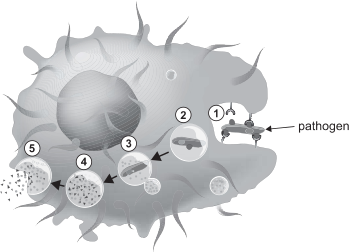
What is happening at position 3 ?

  1. Enzymes that break down the microorganism are released into the vesicle.
  2. Antibodies are added to the vesicle to kill the microorganism.
  3. The cell is sampling the vesicle for antigen presentation.
  4. Intracellular microbes are attacking the microorganism.
Show Answers Only

\(A\)

Show Worked Solution
  • When the phagosome and lysosome fuse, they form a phagolysosome (vesicle), an acidic and oxidising environment that can effectively kill and degrade the ingested microorganism.

\(\Rightarrow A\)

Filed Under: Immunity and Responses to Pathogens Tagged With: Band 4, smc-3657-30-Innate Response (2nd Line)

BIOLOGY, M7 2020 VCE 35 MC

Monoclonal antibodies attaching to antigens on a cancer cell are shown in the diagram below.
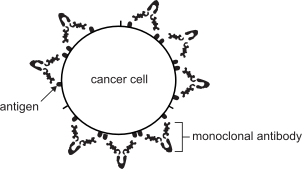
 

Monoclonal antibodies

  1. are used to suppress B cells acting on cancer cells.
  2. make it easier for cells of the immune system to detect cancer cells.
  3. can bind to dendritic cells to stimulate them to destroy cancer cells.
  4. can attach to many structurally different proteins found on the surface of cancer cells.
Show Answers Only

\(B\)

Show Worked Solution
  • Monoclonal antibodies bind to proteins on the surface of cancer cells, marking them for detection and destruction by the immune system.
  • By making the cancer cells more visible to the immune system, the monoclonal antibodies facilitate the immune system’s ability to recognise and attack the cancer cells.

\(\Rightarrow B\)

Filed Under: Immunity and Responses to Pathogens Tagged With: Band 4, smc-3657-25-Antibodies

BIOLOGY, M6 2020 VCE 27*

Tasmanian devils (Sarcophilus harrisii) were originally broadly distributed across Australia. When sea levels rose 12 000 years ago, an island, now referred to as Tasmania, was formed. The small number of Tasmanian devils on Tasmania was cut off from the Australian mainland populations. The population in Tasmania showed less genetic variation than the mainland populations. Mainland populations became extinct approximately 3000 years ago.

Over the last 20 years, the total Tasmanian devil population on Tasmania has halved. Many of the deaths have been the result of Tasmanian devil facial tumour disease (DFTD). Scientists have taken some Tasmanian devils that do not have DFTD to mainland Australia to set up a conservation program. The scientists have shown that greater genetic diversity among offspring in this program is observed when the Tasmanian devils are kept in isolated male-female pairs rather than in larger groups.

Giving reasons, describe if the conservation program for Tasmanian devils is an example of

  1. allopatric speciation   (1 mark)

    --- 2 WORK AREA LINES (style=lined) ---

  2. selective breeding   (1 mark)

    --- 2 WORK AREA LINES (style=lined) ---

  3. natural selection   (1 mark)

    --- 2 WORK AREA LINES (style=lined) ---

Show Answers Only

a.    Allopatric speciation – No

  • Involves the formation of new species due to geographic isolation whereas the program focuses on preserving the existing Tasmanian devil species.

b.   Selective breeding – Yes

  • Scientists are intentionally choosing which Tasmanian devils to breed together based on their genetic diversity.

c.  Natural selection – No

  • Natural selection is the differential survival and reproduction based on inherited traits.
  • The program involves intentional breeding decisions by scientists.
Show Worked Solution

a.    Allopatric speciation – No

  • Involves the formation of new species due to geographic isolation whereas the program focuses on preserving the existing Tasmanian devil species.

b.   Selective breeding – Yes

  • Scientists are intentionally choosing which Tasmanian devils to breed together based on their genetic diversity.

c.  Natural selection – No

  • Natural selection is the differential survival and reproduction based on inherited traits.
  • The program involves intentional breeding decisions by scientists.

Filed Under: Mutation Tagged With: Band 3, Band 4, smc-3652-10-Mechanisms of Change/Variation

BIOLOGY, M7 2020 VCE 18*

Some human cells produce proteins called cytokines.

Describe the major function of cytokines.   (2 marks)

--- 4 WORK AREA LINES (style=lined) ---

Show Answers Only
  • The major function of cytokines is to regulate the immune response.
  • Cytokines do this by signalling between cells, which helps coordinate the body’s defense against infections and inflammation.
Show Worked Solution
  • The major function of cytokines is to regulate the immune response.
  • Cytokines do this by signalling between cells, which helps coordinate the body’s defense against infections and inflammation.

Filed Under: Immunity and Responses to Pathogens Tagged With: Band 4, smc-3657-30-Innate Response (2nd Line)

BIOLOGY, M5 2020 VCE 8 MC

The primary structure of a protein is important because it

  1. is the active, functional form of the protein.
  2. has a very specific three-dimensional shape.
  3. influences the way that the polypeptide folds.
  4. directly controls the way proteins are transported into a cell.
Show Answers Only

\(C\)

Show Worked Solution

Consider each option:

  • Option A: Incorrect – The active form depends on the 3D structure, not just the primary sequence.
  • Option B: Incorrect – The primary structure itself is linear, not 3D.
  • Option C: Correct – The primary structure (linear sequence of amino acids) influences how the polypeptide chain folds into its 3D conformation.
  • Option D: Incorrect – Protein transport is controlled by signal sequences, not directly by the primary structure.

\(\Rightarrow C\)

Filed Under: DNA and Polypeptide Synthesis Tagged With: Band 4, smc-3650-60-Proteins

BIOLOGY, M7 2021 VCE 15 MC

Neutrophils

  1. secrete complement proteins
  2. migrate to the site of infection and engulf invading pathogens.
  3. increase the diameter of blood vessels to make them more permeable.
  4. release histamine following the binding of the antigen to receptors on the neutrophil's surface.
Show Answers Only

\(B\)

Show Worked Solution
  • Neutrophils use phagocytosis to engulf and destroy invading pathogens, such as bacteria, fungi, and other microorganisms.
  • They recognise and bind to pathogens, then internalize and digest them using various antimicrobial mechanisms.

\(\Rightarrow B\)

Filed Under: Immunity and Responses to Pathogens Tagged With: Band 4, smc-3657-30-Innate Response (2nd Line)

BIOLOGY, M7 2021 VCE 4a

Varicella (chickenpox) is a highly contagious disease caused by the varicella zoster virus. A live, attenuated varicella zoster virus vaccine is recommended for children at age 18 months. In Australia, this vaccine is provided free of charge under the National Immunisation Program.

Once the varicella zoster virus vaccine is injected into the arm of a child, an immune response occurs.

Summarise the immune response that occurs within the child to result in long-term protection from chickenpox.  (5 marks)

--- 10 WORK AREA LINES (style=lined) ---

Show Answers Only
  • The varicella zoster virus vaccine is taken up by cells in the body, such as macrophages.
  • These cells then display the viral antigens on their surface.
  • Antigen-presenting cells then migrate to the lymph nodes, where they interact with naive B cells.
  • The interaction with the antigen-presenting cells stimulates the naive B cells to divide and differentiate into plasma cells and memory B and T cells.
  • Plasma cells produce specific antibodies.
  • Some of the activated B cells and T cells become memory cells.
  • These memory cells provide long-term immunity against the virus. 
Show Worked Solution
  • The varicella zoster virus vaccine is taken up by cells in the body, such as macrophages.
  • These cells then display the viral antigens on their surface.
  • Antigen-presenting cells then migrate to the lymph nodes, where they interact with naive B cells.
  • The interaction with the antigen-presenting cells stimulates the naive B cells to divide and differentiate into plasma cells and memory B and T cells.
  • Plasma cells produce specific antibodies.
  • Some of the activated B cells and T cells become memory cells.
  • These memory cells provide long-term immunity against the virus. 

Filed Under: Prevention, Treatment and Control Tagged With: Band 4, smc-3658-20-Vaccines

BIOLOGY, M7 EQ-Bank 18

It is recommended that a previously unvaccinated 14 year-old female receives two doses of the HPV (Human Papillomavirus) vaccine. The second dose should be given at least four weeks after the first dose.

What is the benefit of having two doses instead of one dose? Justify your response.   (2 marks)

--- 4 WORK AREA LINES (style=lined) ---

Show Answers Only

Benefits of 2 doses of vaccine:

  • The first dose primes the immune system by activating B cells and creating memory cells.
  • The second dose expands the population of memory B cells, enabling a quicker and more effective antibody response.
  • This enhanced secondary immune response provides improved protection against future infections.
Show Worked Solution

Benefits of 2 doses of vaccine:

  • The first dose primes the immune system by activating B cells and creating memory cells.
  • The second dose expands the population of memory B cells, enabling a quicker and more effective antibody response.
  • This enhanced secondary immune response provides improved protection against future infections.

Filed Under: Prevention, Treatment and Control Tagged With: Band 4, smc-3658-20-Vaccines

BIOLOGY, M7 2021 VCE 4c

Outline similarities and/or differences in active and passive ways of acquiring immunity.   (3 marks)

--- 6 WORK AREA LINES (style=lined) ---

Show Answers Only

  • Active immunity leads to the body producing its own antibodies and memory cells, resulting in long-lasting protection.
  • Passive immunity provides immediate protection by transferring pre-existing antibodies, but this protection is temporary and short-term.
  • Both active and passive immunity involve the presence of antibodies that can neutralize or eliminate the target pathogen.
  • The key difference is that active immunity develops the immune system’s own capacity to respond, while passive immunity borrows antibodies from an external source.
Show Worked Solution
  • Active immunity leads to the body producing its own antibodies and memory cells, resulting in long-lasting protection.
  • Passive immunity provides immediate protection by transferring pre-existing antibodies, but this protection is temporary and short-term.
  • Both active and passive immunity involve the presence of antibodies that can neutralize or eliminate the target pathogen.
  • The key difference is that active immunity develops the immune system’s own capacity to respond, while passive immunity borrows antibodies from an external source.

Filed Under: Prevention, Treatment and Control Tagged With: Band 4, smc-3658-30-Procedures to Prevent Spread

BIOLOGY, M6 2021 VCE 9

The following table provides information on three commonly grown genetically modified (GM) crops in Australia.

\begin{array} {|l|l|l|}
\hline
\rule{0pt}{2.5ex} \quad \ \  \textbf{Crop} \rule[-1ex]{0pt}{0pt} & \quad \quad \textbf{Genetic modification} &  \quad  \ \textbf{Characteristic given by} \\
& & \quad \quad \quad \quad \textbf{modification} \rule[-1ex]{0pt}{0pt} \\
\hline
\rule{0pt}{2.5ex} \text{GM cotton} \rule[-1ex]{0pt}{0pt} & \text{several bacterial genes inserted} & \text{insect resistance and herbicide} \\
& & \text{tolerance} \rule[-1ex]{0pt}{0pt} \\
\hline
\rule{0pt}{2.5ex} \text{GM canola} \rule[-1ex]{0pt}{0pt} & \text{two genes from two different} & \text{tolerance to several herbicides} \\
& \text{bacterial species inserted} & \rule[-1ex]{0pt}{0pt}\\
\hline
\rule{0pt}{2.5ex} \text{GM safflower} \rule[-1ex]{0pt}{0pt} & \text{a selection of genes silenced within} & \text{elevated levels of oleic acid in its} \\
& \text{the safflower genome} & \text{seeds} \rule[-1ex]{0pt}{0pt} \\
\hline
\end{array}

  1. Select one of the GM crops in the table above and determine whether or not this crop could be described as transgenic.   (1 mark)

    --- 3 WORK AREA LINES (style=lined) ---

  2. One issue with GM canola is the accidental release, during transport, of seeds along roadsides. Usually, unwanted plants that grow on the side of the road are killed using the herbicide glyphosate. However, GM canola is resistant to glyphosate.
  3. Suggest one practical solution for treating GM canola that is found growing along roadsides.  (1 mark)

    --- 3 WORK AREA LINES (style=lined) ---

  4. A new GM canola crop has been approved for use in Australia. It contains increased levels of omega-3 fatty acids, which are important in humans for building healthy cell membranes and for general growth and development, and also protect against a wide variety of diseases.
  5. Omega-3 has traditionally been sourced from fish. Due to the growing demand for sources of omega-3 , bioengineers have been encouraged to continue developing GM canola crops as a sustainable alternative.
  6. Discuss one social implication and one biological implication of using GM canola with increased levels of omega-3. Use a different implication in each response.   (4 marks)

    --- 8 WORK AREA LINES (style=lined) ---

Show Answers Only

a.   Answers should include one of the following:

  • GM cotton contains genes from other species or bacteria and is therefore transgenic.
  • GM canola contains genes from other species or bacteria and is therefore transgenic.
  • GM safflower does not contain genes from another species and is therefore not transgenic. 

b.    Possible answers include:

  • use alternative herbicides that the GM canola is not resistant to
  • digging out and removing roadside GM canola by hand
  • mowing the roadsides could help manage GM canola
  • burn the GM canola using controlled methods. 

c.    Social Implication – possible answers could include:

  • Depending on market demand non-GM canola farmers may see increased sales and improved quality of life, or decreased sales and lower quality of life.
  • GM canola farmers may benefit from higher yields and lower production costs may lead to increased profits and a better quality of life.
  • Consumers may benefit from improved nutrition that may lead to reduced strain on the healthcare system.
  • If GM canola becomes more affordable and accessible than alternative sources of nutrition, such as fish, a wider range of consumers will enjoy the health benefits.
  • Decreased consumption of fish due to the availability of cheaper, more accessible GM canola could lead to reduced sales and lower incomes for fish farmers, potentially decreasing their quality of life.
  • Some consumers may be hesitant to purchase or consume GM food products. This could lead to decreased demand for GM canola and lower incomes for farmers growing it.  

Biological Implication – possible answers could include:

  • Crossbreeding between GM canola and non-GM canola crops could lead to changes in the genome of the crops which may reduce the genetic variation within the GM canola crop
  • Consumer safety concerns regarding consumption of GM products could negatively impact the demand for GM canola and other GM crops.
  • If GM canola leads to a reduction in fish consumption, it could have a positive impact on fish populations by reducing over-fishing. This could help to restore and maintain healthy fish populations in the long run.
  • Improved nutrition for consumers through the consumption of GM crops could lead to better health outcomes and improved well-being for the broader population.
Show Worked Solution

a.   Answers should include one of the following:

  • GM cotton contains genes from other species or bacteria and is therefore transgenic.
  • GM canola contains genes from other species or bacteria and is therefore transgenic.
  • GM safflower does not contain genes from another species and is therefore not transgenic. 

b.    Possible answers include:

  • use alternative herbicides that the GM canola is not resistant to
  • digging out and removing roadside GM canola by hand
  • mowing the roadsides could help manage GM canola
  • burn the GM canola using controlled methods.  

c.    Social Implication – possible answers could include:

  • Depending on market demand non-GM canola farmers may see increased sales and improved quality of life, or decreased sales and lower quality of life.
  • GM canola farmers may benefit from higher yields and lower production costs may lead to increased profits and a better quality of life.
  • Consumers may benefit from improved nutrition that may lead to reduced strain on the healthcare system.
  • If GM canola becomes more affordable and accessible than alternative sources of nutrition, such as fish, a wider range of consumers will enjoy the health benefits.
  • Decreased consumption of fish due to the availability of cheaper, more accessible GM canola could lead to reduced sales and lower incomes for fish farmers, potentially decreasing their quality of life.
  • Some consumers may be hesitant to purchase or consume GM food products. This could lead to decreased demand for GM canola and lower incomes for farmers growing it.  

Biological Implication – possible answers could include:

  • Crossbreeding between GM canola and non-GM canola crops could lead to changes in the genome of the crops which may reduce the genetic variation within the GM canola crop
  • Consumer safety concerns regarding consumption of GM products could negatively impact the demand for GM canola and other GM crops.
  • If GM canola leads to a reduction in fish consumption, it could have a positive impact on fish populations by reducing over-fishing. This could help to restore and maintain healthy fish populations in the long run.
  • Improved nutrition for consumers through the consumption of GM crops could lead to better health outcomes and improved well-being for the broader population.
♦ Mean mark (c) 47%.

Filed Under: Biotechnology Tagged With: Band 4, Band 5, smc-3653-20-Evaluating Genetic Technology

BIOLOGY, M6 2021 VCE 28 MC

Small amounts of DNA can be collected from items such as cigarette butts and hair follicles that are found at crime scenes. This DNA can be replicated for analysis and used as evidence in court cases.

Which of the following identifies the method of DNA replication and the enzyme used?

\begin{align*}
\begin{array}{l}
\rule{0pt}{2.5ex} \ \rule[-1ex]{0pt}{0pt}& \\
\rule{0pt}{2.5ex}\textbf{A.}\rule[-1ex]{0pt}{0pt}\\
\rule{0pt}{2.5ex}\textbf{B.}\rule[-1ex]{0pt}{0pt}\\
\rule{0pt}{2.5ex}\textbf{C.}\rule[-1ex]{0pt}{0pt}\\
\rule{0pt}{2.5ex}\textbf{D.}\rule[-1ex]{0pt}{0pt}\\
\end{array}
\begin{array}{|l|l|}
\hline
\rule{0pt}{2.5ex}\quad \quad \quad \quad \text{Method}\rule[-1ex]{0pt}{0pt}& \quad \ \ \  \text{Enzyme} \\
\hline
\rule{0pt}{2.5ex}\text{polymerase chain reaction}\rule[-1ex]{0pt}{0pt}&\textit{Taq}\ \text{polymerase}\\
\hline
\rule{0pt}{2.5ex}\text{DNA profiling}\rule[-1ex]{0pt}{0pt}& \text{DNA ligase}\\
\hline
\rule{0pt}{2.5ex}\text{polymerase chain reaction}\rule[-1ex]{0pt}{0pt} & \text{DNA ligase} \\
\hline
\rule{0pt}{2.5ex}\text{DNA profiling}\rule[-1ex]{0pt}{0pt}& \textit{Taq} \ \text{polymerase} \\
\hline
\end{array}
\end{align*}

Show Answers Only

\(A\)

Show Worked Solution
  • The method of DNA replication used to replicate small amounts of DNA collected from crime scenes is called Polymerase Chain Reaction (PCR).
  • The key enzyme involved in PCR is a thermostable DNA polymerase enzyme called Taq polymerase.

\(\Rightarrow A\)

Filed Under: Genetic Technologies Tagged With: Band 4, smc-3654-80-Gene Cloning

BIOLOGY, M8 2021 VCE 34 MC

The World Health Organization (WHO) runs a campaign to eliminate cervical cancer globally. In response to this campaign, a study was conducted to model the impact of cervical cancer screening along with a human papillomavirus (HPV) vaccination program in low-income and lower-middle-income countries. HPV is the cause of most cervical cancers. The results of the modelling are shown below.

 

Which one of the following conclusions is supported by the data in the graph?

  1. The incidence of cervical cancer would be unaffected by a cervical cancer screening program.
  2. The largest factor in reducing the incidence of cervical cancer in the long term is vaccination.
  3. With vaccination only, it is possible to achieve fewer than 10 cervical cancer cases per 100,000 women by 2050 .
  4. Vaccination and one lifetime screen would be more effective than vaccination and two lifetime screens by 2070 .
Show Answers Only

\(B\)

Show Worked Solution

Consider each option:

Option A:  The evidence shows an effect from screening programs → Incorrect

Option B:  The graph shows the incidence of cervical cancer has decreased since the introduction of the vaccination. Screening has only added to this marginally → Correct

Option C:  With vaccination only fewer than 10 cases per 100,000 women could be achieved by 2060 not 2050 → Incorrect

Option D:  The graph shows that vaccination and two lifetime screens is more effective in 2070 → Incorrect
 

\(\Rightarrow B\)

Filed Under: Prevention Tagged With: Band 4, smc-3662-11-Educational Programs

CHEMISTRY, M8 2012 VCE 6

The iron content in multivitamin tablets was determined using atomic absorption spectroscopy.

The absorbances of four standards were measured.

Three multivitamin tablets were selected. Each tablet was dissolved in 100.0 mL of water. The absorbance of each of the three solutions was then measured.

The following absorbances were obtained.

\begin{array}{|l|c|c|}
\hline
\rule{0pt}{2.5ex}\quad \ \textbf{Solution} \rule[1ex]{0pt}{0pt} & \textbf{Concentration} & \textbf{Absorbance} \\
& \textbf{mg/L} & \\
\hline
\rule{0pt}{2.5ex} \text{Standard 1} \quad \quad & 0.00 & 0.06 \\
\hline
\rule{0pt}{2.5ex} \text{Standard 2} & 100.0 & 0.16 \\
\hline
\rule{0pt}{2.5ex} \text{Standard 3} & 200.0 & 0.25 \\
\hline
\rule{0pt}{2.5ex} \text{Standard 4} & 300.0 & 0.36 \\
\hline
\rule{0pt}{2.5ex} \text{Standard 5} & 400.0 & 0.46 \\
\hline
\rule{0pt}{2.5ex} \text{Tablet 1} & - & 0.39 \\
\hline
\rule{0pt}{2.5ex} \text{Tablet 2} & - & 0.42 \\
\hline
\rule{0pt}{2.5ex} \text{Tablet 3} & - & 0.45 \\
\hline
\end{array}
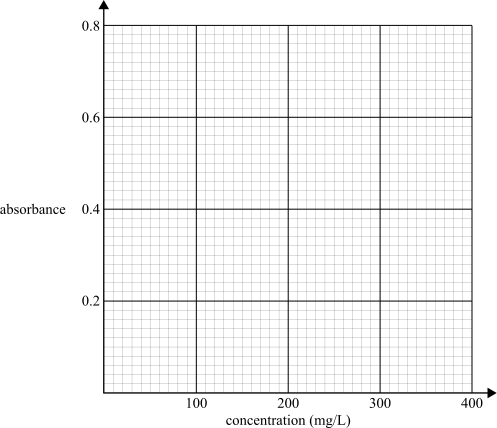
  1.  i.  Use the grid below to construct a calibration graph of the absorbances of the standard solutions.  (2 marks)

    --- 0 WORK AREA LINES (style=lined) ---

  2. ii.  Determine the average iron content, in milligrams, of the multivitamin tablets.  (2 marks)

    --- 4 WORK AREA LINES (style=lined) ---

Spectroscopic techniques work on the principle that, under certain conditions, atoms, molecules or ions will interact with electromagnetic radiation. The type of interaction depends on the wavelength of the electromagnetic radiation.

  1. Name one spectroscopic technique that you have studied this year.

    --- 1 WORK AREA LINES (style=lined) ---

    1. Which part of the electromagnetic spectrum does this technique use?  (1 mark)

      --- 1 WORK AREA LINES (style=lined) ---

    2. How does this part of the electromagnetic spectrum interact with matter? What information does this spectroscopic technique provide?  (2 marks)

      --- 5 WORK AREA LINES (style=lined) ---

Show Answers Only

a.i.  

a.ii.  \(35.5\ \text{mg}\)
 

b.i. Answers could include:

  • AAS (visible light)
  • UV-Vis (UV or visible light)
  • IR (Infrared radiation)
  • NMR (radio waves) 

b.ii. Spectroscopic technique: AAS (one of many possible – see b.i.)

  • During AAS energy of a certain frequency is transferred to electrons within atoms to move them into higher energy levels.
  • The absorption of the light indicates the concentration of the targeted element within the sample.

Show Worked Solution

a.i.  

a.ii. Average absorbance (tablets) \(=\dfrac{0.39+0.42+0.45}{3}=0.42\)

Using the graph: absorbance value of \(0.42 → 355\ \text{mg L}^{-1}\)

\(\ce{m(Fe) (100\ \text{ml}) = 355 \times 0.1 =35.5\ \text{mg}}\)
 

b.i.  Answers could include:

  • AAS (visible light)
  • UV-Vis (UV or visible light)
  • IR (Infrared radiation)
  • NMR (radiowaves) 

b.ii. Spectroscopic technique: AAS (one of many possible – see b.i.)

  • During AAS energy of a certain frequency is transferred to electrons within atoms to move them into higher energy levels.
  • The absorption of the light indicates the concentration of the targeted element within the sample.
♦ Mean mark (b.ii) 42%.

Filed Under: Inorganic Substances Tagged With: Band 4, Band 5, smc-3682-10-Tests for Ions in Solution, smc-3682-60-Colourimetry UV-Vis and AAS

CHEMISTRY, M8 EQ-Bank 5

A chemical reaction occurs at a constant temperature.

Describe the effect on the yield if

  1. the value of the equilibrium expression is higher.   (2 marks)
  2. the activation energy of the reaction is decreased.   (2 marks)
Show Answers Only

a.   Equilibrium expression is higher:

  • The equilibrium expression shows the ratio of reactants to products in a chemical equation.
  • A higher value for the equilibrium expression suggests a higher proportion of products / increased product concentration compared to reactants, and hence a higher yield. 

b.   The activation energy is decreased:

  • A decrease in activation energy increases the reaction rate and allows the system to get to equilibrium faster.
  • This has no effect on the equilibrium yield which remains the same.
Show Worked Solution

a.   Equilibrium expression is higher:

  • The equilibrium expression shows the ratio of reactants to products in a chemical equation.
  • A higher value for the equilibrium expression suggests a higher proportion of products / increased product concentration compared to reactants, and hence a higher yield. 

b.   The activation energy is decreased:

  • A decrease in activation energy increases the reaction rate and allows the system to get to equilibrium faster.
  • This has no effect on the equilibrium yield which remains the same.

Filed Under: Chemical Synthesis and Design Tagged With: Band 3, Band 4, smc-3684-30-Yield and purity

v1 Algebra, STD2 A4 SM-Bank 4

Bec is a baker and makes cookies to sell every week.

The cost of making \(n\) cookies, $\(C\),  can be calculated using the equation

\(C=400+2.5n\)

Bec sells the cookies for $4.50 each, and her income is calculated using the equation

\(I=450n\)
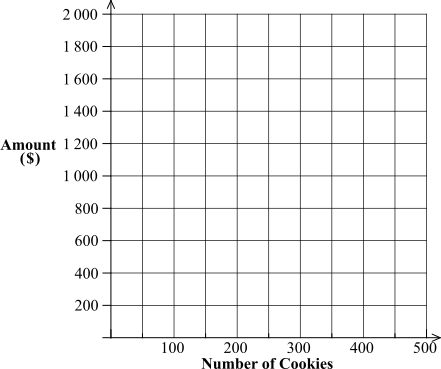
  1. On the grid above, draw the graphs of  \(C\) and \(I\).  (2 marks)

    --- 0 WORK AREA LINES (style=lined) ---

  2. On the graph, label the breakeven point and the loss zone.  (2 marks)

    --- 0 WORK AREA LINES (style=lined) ---

Show Answers Only

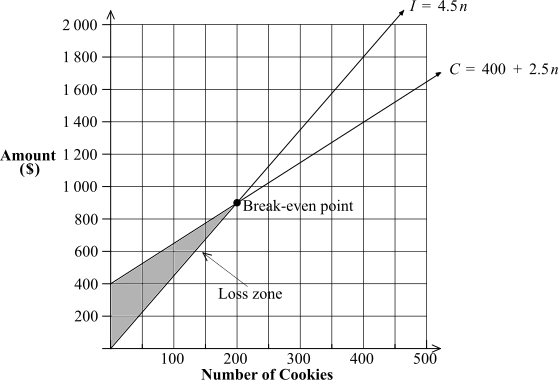
(i) and (ii)
Show Worked Solution
i.   


ii.  \(\text{Loss zone occurs when}\ C > I,\ \text{which is shaded}\)

\(\text{in the diagram above.}\)

Filed Under: Simultaneous Equations and Applications (Std 2-X) Tagged With: Band 4, Band 5, smc-5237-40-Cost/Revenue

v1 Algebra, STD2 A4 2005 HSC 28b

Jake and Preston are planning a fund-raising event at the local swim centre. They can have access to the giant pool float for $550 and the party room hire for $250. A sausage sizzle and drinks will cost them $9 per person.

  1. Write a formula for the cost ($C) of running the event for \(x\) people. (1 mark)

    --- 2 WORK AREA LINES (style=lined) ---

The graph shows planned income and costs when the ticket price is $15. 
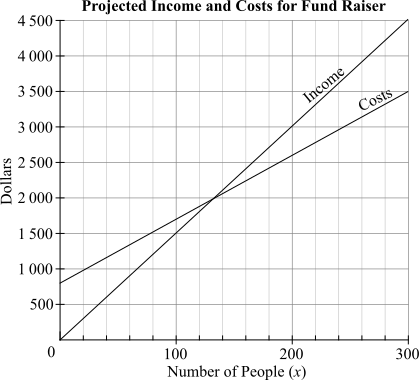
  

  1. Estimate the minimum number of people needed at the fund raising event to cover the costs.  (1 mark)

    --- 1 WORK AREA LINES (style=lined) ---

  2. How much profit will be made if 200 people attend the fund raiser? (1 mark)

    --- 2 WORK AREA LINES (style=lined) ---

Jake and Preston have 300 tickets to sell. They want to make a profit of $1510.

  1. What should be the price of a ticket, assuming all 300 tickets will be sold?  (3 marks)

    --- 6 WORK AREA LINES (style=lined) ---

Show Answers Only
  1. \(C=800+9x\)
  2. \(\text{Approximately }135\)
  3. \($400\)
  4. \($16.70\)
Show Worked Solution
i.    \($C\) \(=550+250+(9\times x)\)
    \(=800+9x\)


ii.  \(\text{Using the graph intersection}\)

\(\text{Approximately 135 people are needed}\)

\(\text{to cover the costs.}\)


iii.  \(\text{If 200 people attend}\)

\(\text{Income}\) \(=200\times $15\)
  \(=$3000\)
\(\text{Costs}\) \(=800+(9\times 200)\)
  \(=$2600\)


\(\therefore\ \text{Profit}\) \(=3000-2600\)
  \(=$400\)


iv.  \(\text{Costs when}\ x=300:\)

\(C\) \(=800+(9\times 300)\)
  \(=$3500\)


\(\text{Income required to make }$1510\ \text{profit}\)

\(=3500+1510\)

\(=$5010\)
 

\(\therefore\ \text{Price per ticket}\) \(=\dfrac{5010}{300}\)
  \(=$16.70\)

Filed Under: Simultaneous Equations and Applications (Std 2-X) Tagged With: Band 4, Band 5, smc-5237-40-Cost/Revenue

v1 Algebra, STD2 A4 2020 HSC 24

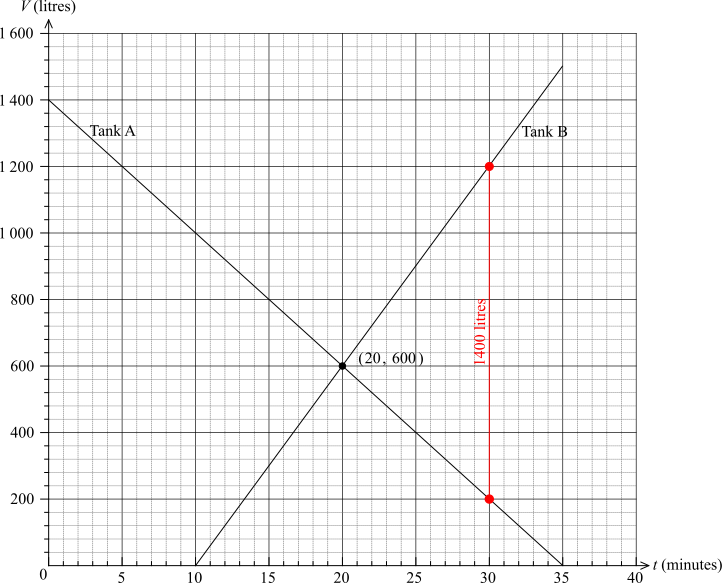
There are two tanks at an industrial plant, Tank A and Tank B. Initially, Tank A holds 2520 litres of liquid fertiliser and Tank B is empty.

  1. Tank A begins to empty liquid fertiliser into a transport vehicle at a constant rate of 40 litres per minute.


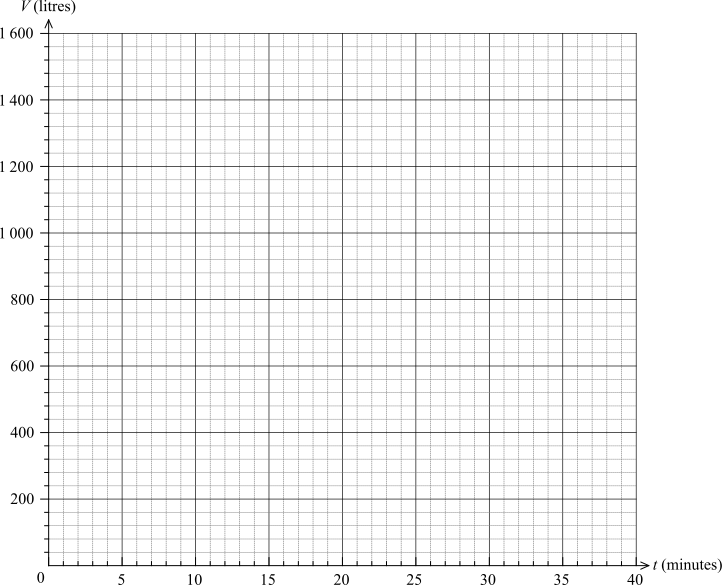
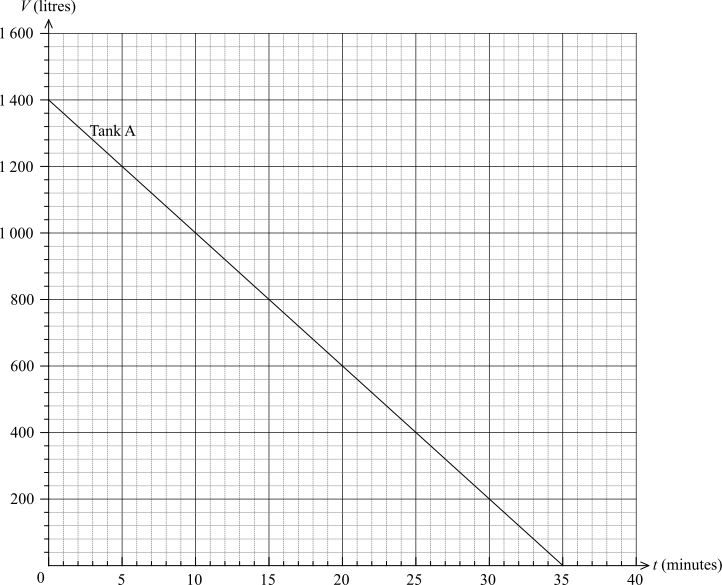
    The volume of liquid fertiliser in Tank A is modelled by  \(V=1400-40t\)  where \(V\) is the volume in litres and  \(t\) is the time in minutes from when the tank begins to drain the fertiliser.


    On the grid below, draw the graph of this model and label it as Tank A.   (1 mark)


  2. Tank B remains empty until  \(t=10\)  when liquid fertiliser is added to it at a constant rate of 60 litres per minute.
    By drawing a line on the grid (above), or otherwise, find the value of  \(t\)  when the two tanks contain the same volume of liquid fertiliser.  (2 marks)

    --- 2 WORK AREA LINES (style=lined) ---

  3. Using the graphs drawn, or otherwise, find the value of  \(t\)  (where  \(t > 0\)) when the total volume of liquid fertiliser in the two tanks is 1400 litres.  (1 mark)

    --- 1 WORK AREA LINES (style=lined) ---

Show Answers Only
  1.  \(\text{Tank} \ A \ \text{will pass through (0, 1400) and (35, 0)}\)
      
  2. \(20 \ \text{minutes}\)
  3. \(30 \ \text{minutes}\)
Show Worked Solution

a.     \(\text{Tank} \ A \ \text{will pass through (0, 1400) and (35, 0)}\)


b.   \(\text{Tank} \ B \ \text{will pass through (10, 0) and (30, 1200)}\)  
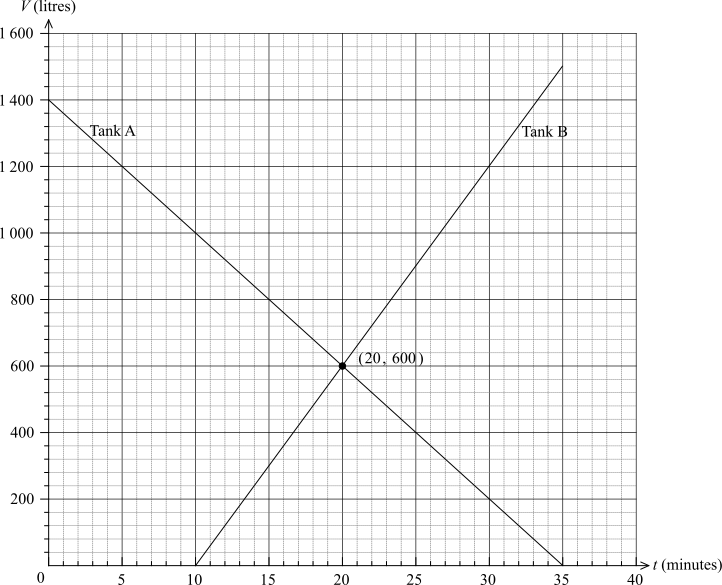


\(\text{By inspection, the two graphs intersect at} \ \ t = 20 \ \text{minutes}\)

c.   \(\text{Strategy 1}\)

\(\text{By inspection of the graph, consider} \ \ t = 30\)

\(\text{Tank A} = 200 \ \text{L} , \ \text{Tank B} =1200 \ \text{L}\)

\(\therefore\ \text{Total volume = 1400 L when  t = 30}\)
  

\(\text{Strategy 2}\)

\(\text{Total Volume}\) \(=\text{Tank A} + \text{Tank B}\)
\(1400\) \(=1400-40t+(t-10)\times 60\)
\(1400\) \(=1400-40t+60t-600\)
\(20t\) \(= 600\)
\(t\) \(= 30 \ \text{minutes}\)

♦♦ Mean mark part (c) 22%.

Filed Under: Simultaneous Equations and Applications (Std 2-X) Tagged With: Band 3, Band 4, Band 5, smc-5237-10-Find intersection, smc-5237-20-Other SE Applications, smc-5237-40-Sketch Linear Equations

v1 Algebra, STD2 A4 2020 VCAA 3

Noah's business manufactures car seat covers.

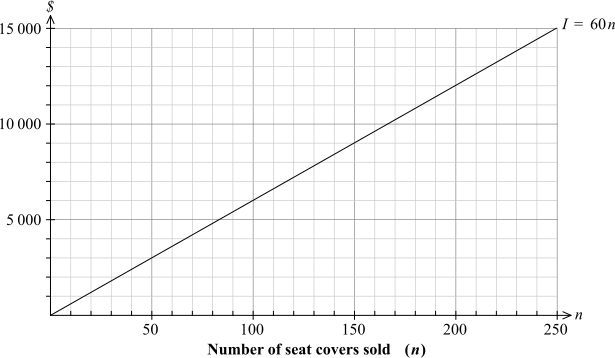
The monthly oncome, \(I\), in dollars, from selling \(n\) seat covers is given by

\(I=60n\)

This relationship is shown on the graph below.
 

The monthly cost, \(C\), in dollars, of making \(n\) seat covers is given by

\(C=35n+5000\)

  1. On the graph above, sketch the monthly cost, \(C\), of making \(n\) seat covers.   (1 mark) 
  2. Find the number of seat covers that need to be sold in order to break even and state the profit made at this point.   (2 marks)

    --- 3 WORK AREA LINES (style=lined) ---


Show Answers Only

a.
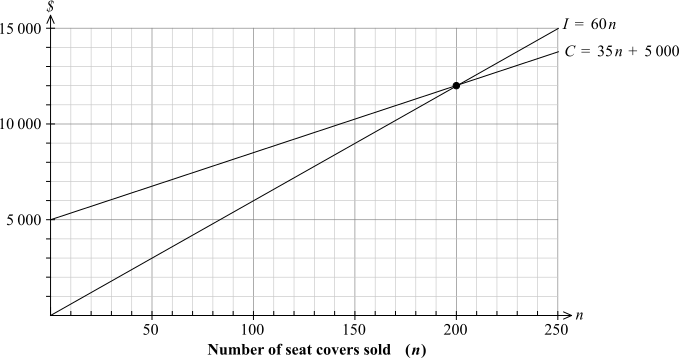


b.   \(\text{200 seat covers and zero profit at this point}\)

Show Worked Solution

a.   \(\text{Draw graph through points (0, 5000) and (250, 13 750)}\)


b.    \(C=35n+5000\ \text{and }I=60n\)

\(\text{Break-even occurs when} \ \ I=C\)
  

\(\text{Method 2: Graphically}\)

\(\text{Point of intersection is }\rightarrow (200, 12\ 000)\)
  

\(\text{Method 2: Algebraically}\)

\(\text{Solve for} \ n:\)

\(60n\) \(=35n+5000\)
\(25n\) \(=5000\)
\(n\) \(=200\)

  
  \(\therefore\ \text{200 seat covers must be sold to break even}\)

\(\text{and the profit at this point is zero}\)

Filed Under: Simultaneous Equations and Applications (Std 2-X) Tagged With: Band 4, smc-5237-40-Cost/Revenue, smc-5237-40-Sketch Linear Equations

v1 Algebra, STD2 A4 EQ-Bank 8

Two farmers, River and Jacqueline, sold organic honey at the the local market.

River sold his 500 gram jars of honey for $8 each and Jacqueline sold her 200 gram jars of honey for $4 each. In the first hour, their total combined sales were $40.

If River sold \(x\) jars of honey and Jacqueline sold \(y\) jars of honey, then the following equation can be formed:

\(8x+4y=40\)

In the first hour, the friends sold a total of 6 jars of honey between them.

Find the number of jars of honey each of the friends sold during this time by forming a second equation and solving the simultaneous equations graphically.  (5 marks)
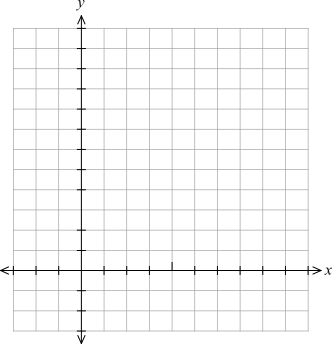
Show Answers Only

\(\text{River sold 4 and Jacqueline sold 2.}\)

Show Worked Solution
\(\text{Graphing}\ \ 8x + 4y\) \(=40\)
\(y\) \(=-2x+10\)

 
\(y\text{-intercept}\ = (0, 10)\)

\(x\text{-intercept}\ = (5, 0)\)

\(\text{Gradient}\ = -2\)
 

\(\text{Second equation:}\)

\(x+y=6\)
\(\text{From the graph,}\)

\(\text{River sold 4 and Jacqueline sold 2.}\)

Filed Under: Simultaneous Equations and Applications (Std 2-X) Tagged With: Band 4, smc-5237-20-Other SE Applications, smc-5237-40-Sketch Linear Equations

v1 Algebra, STD2 A4 SM-Bank 7

The graph of the line  \(x+y=3\)  is shown.


By graphing  \(y=2x-3\)  on the same grid, find the point of intersection of  \(x+y=3\) and  \(y=2x-3\).  (3 marks)

--- 1 WORK AREA LINES (style=lined) ---

Show Answers Only
\((2, 1)\)

Show Worked Solution

\(\text{Graphing}\ y=2x-3:\)

\(y\text{-intercept }=-3\)

\(\text{Gradient }=2\)


\(\therefore\ \text{Point of intersection is (2, 1).}\)

Filed Under: Simultaneous Equations and Applications (Std 2-X) Tagged With: Band 4, smc-5237-10-Find intersection, smc-5237-40-Sketch Linear Equations

v1 Algebra, STD2 A4 SM-Bank 6

A student was asked to solve the following simultaneous equations.

\(y=2x-5\)

\(x-2y+2=0\)

After graphing the equations, the student found the point of intersection to be \((4,3)\)?

Is the student correct? Support your answer with calculations.  (2 marks)

--- 5 WORK AREA LINES (style=lined) ---

Show Answers Only

\(\text{See Worked Solutions}\)

Show Worked Solution

\(\text{If the student is correct, the co-ordinates will}\)

\(\text{satisfy both equations.}\)

\(\text{Substitute (4, 3) into}\ \ y=2x-5\)

\(\text{LHS}\) \(=3\)
\(\text{RHS}\) \(= 2(4)-5\)
  \(=3\)

  
\(\therefore\ \text{LHS = RHS}\)
 

\(\text{Substitute (4, 3) into}\ \ x-2y+2=0\)

\(\text{LHS}\) \(=4-2(3)+2\)
  \(=0\)
  \(\ =\ \text{RHS}\)

  
\(\rightarrow\ (4,3)\ \text{satisfies both equations.}\)

\(\therefore\ \text{Student is correct.}\)

Filed Under: Simultaneous Equations and Applications (Std 2-X) Tagged With: Band 4, smc-5237-10-Find intersection

  • « Previous Page
  • 1
  • …
  • 34
  • 35
  • 36
  • 37
  • 38
  • …
  • 114
  • Next Page »

Copyright © 2014–2025 SmarterEd.com.au · Log in