SmarterEd

Aussie Maths & Science Teachers: Save your time with SmarterEd

  • Login
  • Get Help
  • About

CHEMISTRY, M3 EQ-Bank 11

A student stirs 2.45 g of copper \(\text{(II)}\) nitrate powder into 200.0 mL of 1.25 mol L\(^{-1}\) sodium carbonate solution until it is fully dissolved. A reaction occurs and a precipitate appears.

  1. Write a balanced chemical equation for the reaction.   (1 mark)

    --- 1 WORK AREA LINES (style=lined) ---

  2. Calculate the theoretical mass of precipitate that will be formed.   (3 marks)

    --- 6 WORK AREA LINES (style=lined) ---

The student weighed a piece of filter paper, filtered out the precipitate and dried it thoroughly in an incubator. The final precipitate mass was higher than predicted in (b).

  1. Identify one scientific reason why the precipitate mass was too high and suggest an improvement to the experimental method which would eliminate this error.   (2 marks)

    --- 5 WORK AREA LINES (style=lined) ---
Show Answers Only

a.    \(\ce{Cu(NO3)2(aq) + Na2CO3(aq) -> CuCO3(s) + 2NaNO3(aq)}\)

b.    \(1.61 \text{ g}\)

c.    Possible reasons for the higher mass:

  • Presence of excess solution in the filter paper or incomplete drying.
  • Presence of soluble ions on the filter paper which would crystalise when dried and increase the mass of the precipitate.

Experimental adjustment to eliminate error:

  • Ensure the precipitate is thoroughly rinsed with distilled water to remove soluble impurities.
  • Dry precipitate completely in the incubator before weighing.
Show Worked Solution

a.    \(\ce{Cu(NO3)2(aq) + Na2CO3(aq) -> CuCO3(s) + 2NaNO3(aq)}\)
 

b.   \(\ce{MM(Cu(NO3)2) = 63.55 + 2 \times (14.01 + 16.00 \times 3) = 187.57}\)

\(\ce{n(Cu(NO3)2) = \dfrac{\text{m}}{\text{MM}} = \dfrac{2.45}{187.57} = 0.01306 \text{ mol}}\)

\(\ce{n(Na2CO3) = c \times V = 1.25 \times 0.200 = 0.250 \text{ mol}}\)

\(\Rightarrow \ce{Cu(NO3)2} \text{ is the limiting reagent}\)

\(\ce{n(CuCO3) = n(Cu(NO3)2) = 0.01306 \text{ mol}}\)

\(\ce{m(CuCO3) = n \times MM = 0.01306 \times (63.55 + 12.01 + 16.00 \times 3) = 1.61 \text{ g}}\)
 

c.    Possible reasons for the higher mass:

  • Presence of excess solution in the filter paper or incomplete drying.
  • Presence of soluble ions on the filter paper which would crystalise when dried and increase the mass of the precipitate.

Experimental adjustment to eliminate error:

  • Ensure the precipitate is thoroughly rinsed with distilled water to remove soluble impurities.
  • Dry precipitate completely in the incubator before weighing.

Filed Under: Chemical Reactions Tagged With: Band 4, Band 5, Band 6, smc-4263-15-Predicting products, smc-4263-25-Precipitation

CHEMISTRY, M2 EQ-Bank 4

  1. Consider the compounds butyraldehyde \(\ce{(C4H8O)}\), lactic acid \(\ce{(C3H6O3)}\), and fructose \(\ce{(C6H12O6)}\).
  2. Identify which TWO of these compounds have the same empirical formula and justify your choice.    (2 marks)

    --- 4 WORK AREA LINES (style=lined) ---

  3. The empirical formula of a compound is \(\ce{C4H5O2}\) and its molar mass is determined to be 340.32 g mol\(^{-1}\).
  4. Calculate the molecular formula of this compound.     (3 marks)

    --- 6 WORK AREA LINES (style=lined) ---

Show Answers Only

a.    Determine the empirical formula of each compound.

Butyraldehyde \(\ce{(C4H8O)}\): Empirical formula = \(\ce{C4H8O}\)

Lactic acid \(\ce{(C3H6O3)}\): Empirical formula = \(\ce{CH2O}\)

Fructose \(\ce{(C6H12O6)}\): Empirical formula = \(\ce{CH2O}\)

  • Lactic acid and fructose have the same empirical formula of \(\ce{CH2O}\). 

b.    \(\ce{C16H20O8}\)

Show Worked Solution

a.    Determine the empirical formula of each compound.

Butyraldehyde \(\ce{(C4H8O)}\): Empirical formula = \(\ce{C4H8O}\)

Lactic acid \(\ce{(C3H6O3)}\): Empirical formula = \(\ce{CH2O}\)

Fructose \(\ce{(C6H12O6)}\): Empirical formula = \(\ce{CH2O}\)

  • Lactic acid and fructose have the same empirical formula of \(\ce{CH2O}\). 

b.    Calculate the molar mass of the empirical formula \(\ce{C4H5O2}\):

  \(\text{Molar mass}\ \ce{(C4H5O2)} = 4 \times 12.01 + 5 \times 1.008 + 2 \times 16.00 = 85.08\ \text{g/mol}\)
 

Ratio of the molar mass of the compound to the molar mass of the empirical formula:

  \(\text{Ratio} = \dfrac{\text{Molar mass}}{\text{Empirical formula mass}} = \dfrac{340.32\ \text{g mol}^{-1}}{85.08\ \text{g mol}^{-1}} =4\)
 

Multiply the subscripts in the empirical formula by 4 to get the molecular formula:

  \(\text{Molecular formula} = \ce{(C4H5O2)} \times 4 = \ce{C16H20O8}\)
 

  • Thus, the molecular formula of the compound is \(\ce{C16H20O8}\).

Filed Under: Mole Concept Tagged With: Band 3, Band 4, smc-4260-60-Empirical formula

CHEMISTRY, M2 EQ-Bank 3

During a laboratory experiment, 32.0 grams of oxygen gas \(\ce{(O2)}\) is required. Calculate the number of molecules of oxygen gas needed.   (2 marks)

--- 5 WORK AREA LINES (style=lined) ---
Show Answers Only

\(6.022 \times 10^{23}\) molecules.

Show Worked Solution

Calculate the number of moles of oxygen gas (\(\ce{O2}\)):

  \(\ce{n(O2) = \dfrac{\text{m}}{\text{MM}} = \dfrac{32.0\ \text{g}}{32.00\ \text{g mol}^{-1}} = 1.00\ \text{mol}}\)
 

Use Avogadro’s number to find the number of molecules:

  \(\ce{N(O2) = n \times N_A = 1.00 \, mol \times 6.022 \times 10^{23} \, mol^{-1} = 6.022 \times 10^{23} \, molecules}\)
 

  • Oxygen gas required = \(6.022 \times 10^{23}\) molecules.

Filed Under: Mole Concept Tagged With: Band 4, smc-4260-20-Mole conversions

CHEMISTRY, M2 EQ-Bank 2

Ammonia \(\ce{(NH3)}\) is synthesized from nitrogen \(\ce{(N2)}\) and hydrogen \(\ce{(H2)}\) according to the following equation:

\(\ce{N2(g) + 3H2(g) -> 2NH3(g)}\)

If 1.50 moles of nitrogen gas react completely with hydrogen gas, calculate the mass of ammonia produced.   (2 marks)

--- 5 WORK AREA LINES (style=lined) ---
Show Answers Only

\(\ce{m(NH3) = 51.0\ \text{g}}\)

Show Worked Solution

Calculate the number of moles of ammonia \(\ce{(NH3)}\) produced:

  \(\ce{n(NH3) = 2 \times n(N2) = 2 \times 1.50 \, mol = 3.00 \, mol}\)
 

Calculate the mass of ammonia produced:

  \(\ce{m(NH3) = n \times MM = 3.00 \, mol \times 17.03\ \text{g mol}^{-1} = 51.09\ \text{g}}\)
 

  • The mass of ammonia produced is 51.0 grams.

Filed Under: Mole Concept Tagged With: Band 4, smc-4260-30-Molar mass

Calculus, MET2 2023 SM-Bank 1

The function \(g\) is defined as follows.

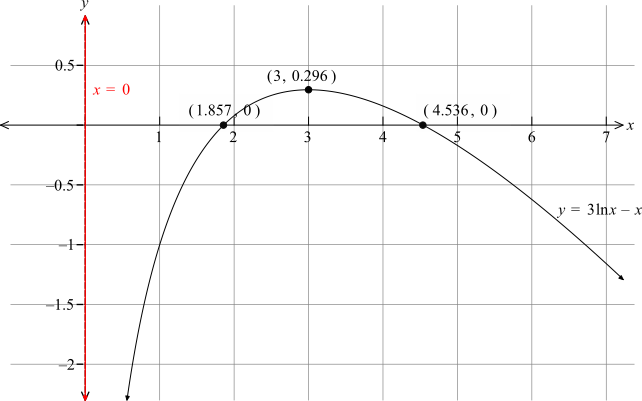
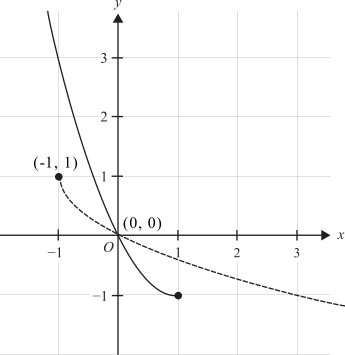
\(g:(0,7] \rightarrow R, g(x)=3\, \log _e(x)-x\)

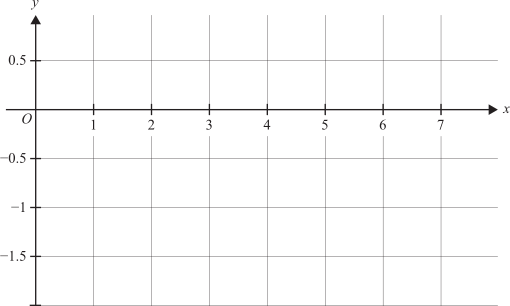
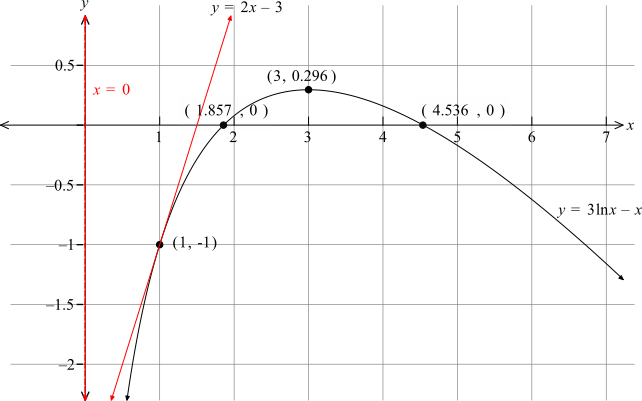
  1. Sketch the graph of \(g\) on the axes below. Label the vertical asymptote with its equation, and label any axial intercepts, stationary points and endpoints in coordinate form, correct to three decimal places.   (3 marks)

    --- 0 WORK AREA LINES (style=lined) ---


  2.  i. Find the equation of the tangent to the graph of \(g\) at the point where \(x=1\).   (1 mark)

    --- 2 WORK AREA LINES (style=lined) ---

  3. ii. Sketch the graph of the tangent to the graph of \(g\) at \(x=1\) on the axes in part a.   (1 mark)

    --- 0 WORK AREA LINES (style=lined) ---

Newton's method is used to find an approximate \(x\)-intercept of \(g\), with an initial estimate of \(x_0=1\).

  1. Find the value of \(x_1\).   (1 mark)

    --- 3 WORK AREA LINES (style=lined) ---

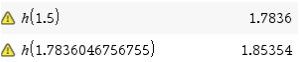
  2. Find the horizontal distance between \(x_3\) and the closest \(x\)-intercept of \(g\), correct to four decimal places.   (1 mark)

    --- 3 WORK AREA LINES (style=lined) ---

  3.  i. Find the value of \(k\), where \(k>1\), such that an initial estimate of  \(x_0=k\)  gives the same value of  \(x_1\)  as found in part \(c\). Give your answer correct to three decimal places.   (2 marks)

    --- 4 WORK AREA LINES (style=lined) ---

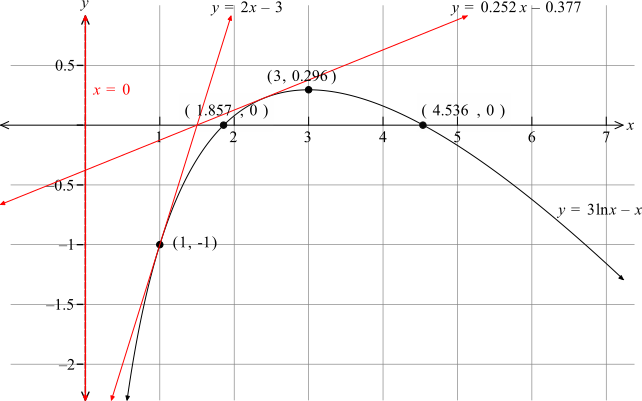
  4. ii. Using this value of \(k\), sketch the tangent to the graph of \(g\) at the point where  \(x=k\)  on the axes in part a.   (1 mark)

    --- 0 WORK AREA LINES (style=lined) ---

Show Answers Only
a.    
  
b.i

\(y=2x-3\)
  
b.ii
  
c. \(\dfrac{3}{2}=1.5\)
  
d. \(0.0036\)
  
e.i \(k=2.397\)
  
e.ii
Show Worked Solution

a.

b.i    \(g(x)\) \(=3\log_{e}x-x\)
  \(g(1)\) \(=3\log_{e}1-1=-1\)
  \(g^{\prime}(x)\) \(=\dfrac{3}{x}-1\)
  \(g^{\prime}(1)\) \(=\dfrac{3}{1}-1=2\)

  
\(\text{Equation of tangent at }(1, -1)\ \text{with }m=2\)

\(y+1=2(x-1)\ \ \rightarrow \ \ y=2x-3\)

b.ii

 
c. 
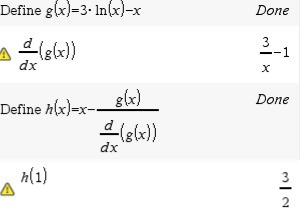
  \(\text{Newton’s Method}\)

\(x_1\) \(=x_0-\dfrac{g(x)}{g'(x)}\)
  \(=1-\left(\dfrac{-1}{2}\right)\)
  \(=\dfrac{3}{2}=1.5\)

\(\text{Using CAS:}\)


d.    \(\text{Using CAS}\)

\(x\text{-intercept}:\ x=1.85718\)

\(\therefore\ \text{Horizontal distance}=1.85718-1.85354=0.0036\)


e.i.  \(\text{Using CAS}\)

\(k-\dfrac{3\log_{e}x-x}{\dfrac{3}{x}-1}\) \(=1.5\)
\(k>1\ \therefore\ \ k\) \(=2.397\)

 
e.ii

Filed Under: Curve Sketching, Differentiation (L&E), L&E Differentiation, Tangents and Normals, Trapezium Rule and Newton Tagged With: Band 4, Band 5, Band 6, smc-5145-50-Newton's method, smc-634-20-Log/Exp Function, smc-724-30-Log/Exponential, smc-739-30-Logs, smc-745-20-Logs

CHEMISTRY, M2 EQ-Bank 2

During a laboratory experiment, a gas is collected in a sealed syringe. Initially, the gas has a volume of 5.0 litres and a pressure of 1.0 atmosphere. 

  1.  Calculate the new pressure inside the syringe when the volume is decreased to 3.0 litres, assuming no temperature change.   (2 marks)

    --- 4 WORK AREA LINES (style=lined) ---

  2. After reaching the pressure calculated in part a, the volume is further decreased so that the pressure inside the syringe doubles. Calculate the final volume of the gas.   (2 marks)

    --- 4 WORK AREA LINES (style=lined) ---

  3. Discuss two potential experimental errors that could affect the accuracy of the observed results compared to the theoretical predictions of Boyle's Law.   (2 marks)

    --- 4 WORK AREA LINES (style=lined) ---

Show Answers Only

a.    \(1.67\ \text{atm}\)

b.    \(1.5\ \text{L}\)

c.    Potential experimental errors could include:

  • Temperature Control. Any temperature changes violate the assumptions of Boyle’s Law which holds only at constant temperature.
  • Measurement Accuracy. Errors in measuring volume changes can lead to inaccuracies in pressure calculations.
  • Non-Ideal Behaviour. At high pressures, gases may deviate from ideal behaviour, affecting the accuracy of Boyle’s Law predictions.
Show Worked Solution

a.    Using Boyle’s Law  \( P_1V_1 = P_2V_2 \):

\( P_1 = 1.0 \, \text{atm}, \quad V_1 = 5.0 \, \text{L}, \quad V_2 = 3.0 \, \text{L} \)

\(P_2 = \dfrac{P_1 \times V_1}{V_2} = \dfrac{1.0 \times 5.0}{3.0} = 1.67 \, \text{atm} \)
 

b.    To find the new volume when pressure doubles:

\( P_3 = 2 \times P_2 = 2 \times 1.67 \, \text{atm} = 3.34 \, \text{atm}\)

\( P_1V_1 = P_3V_3 \ \  \Rightarrow \ \  V_3 = \dfrac{P_1 \times V_1}{P_3} = \dfrac{1.0  \times 5.0 }{3.34} \approx 1.5 \, \text{L}\)
 

c.    Potential experimental errors could include:

  • Temperature Control. Any temperature changes violate the assumptions of Boyle’s Law which holds only at constant temperature.
  • Measurement Accuracy. Errors in measuring volume changes can lead to inaccuracies in pressure calculations.
  • Non-Ideal Behaviour. At high pressures, gases may deviate from ideal behaviour, affecting the accuracy of Boyle’s Law predictions.

Filed Under: Gas Laws Tagged With: Band 4, Band 5, Band 6, smc-4262-60-Boyles Law

CHEMISTRY, M2 EQ-Bank 1

A cylinder equipped with a movable piston contains an inert gas. The initial pressure of the gas is 1.5 atmospheres, and the cylinder's initial volume is 4.0 litres.

The piston is then adjusted to change the volume of the cylinder.

Assuming the temperature of the gas remains constant throughout the process, calculate the new pressure of the gas when the volume is adjusted to 2.0 litres.   (2 marks)

--- 5 WORK AREA LINES (style=lined) ---
Show Answers Only

\(3.0\ \text{atm}\)

Show Worked Solution

\(P_1 = 1.5\ \text{atm},\ \ V_1 = 4.0\ \text{L},\ \ V_2 = 2.0\ \text{L} \)

Boyle’s Law  \(\Rightarrow \ P_1V_1 = P_2V_2 \).

\( P_2 = \dfrac{P_1 \times V_1}{V_2} = \dfrac{1.5 \, \text{atm} \times 4.0 \, \text{L}}{2.0 \, \text{L}} = 3.0 \, \text{atm}\)

Filed Under: Gas Laws Tagged With: Band 4, smc-4262-60-Boyles Law

CHEMISTRY, M2 EQ-Bank 4

A cylinder equipped with a movable piston contains an inert gas. The initial pressure of the gas is 1.35 atmospheres, and the cylinder's initial volume is 5.0 litres.

The piston is then adjusted to change the volume of the cylinder.

Assuming the temperature of the gas remains constant throughout the process, calculate the new pressure of the gas when the volume of the cylinder is adjusted to 8.0 litres.   (2 marks)

--- 5 WORK AREA LINES (style=lined) ---
Show Answers Only

\(0.84\ \text{atm}\)

Show Worked Solution

\(V_1 = 5.0\ \text{L},\ \ V_2 = 8.0\ \text{L},\ \ P_1=1.35\ \text{atm} \)

Boyle’s Law  \(\Rightarrow \ P_1V_1 = P_2V_2 \).

\(P_2 = \dfrac{P_1 \times V_1}{V_{2}} = \dfrac{1.35\ \text{atm} \times 5.0\ \text{L}}{8.0\ \text{L}} = 0.84\ \text{atm}\)

Filed Under: Gas Laws Tagged With: Band 4, smc-4262-60-Boyles Law

CHEMISTRY, M1 EQ-Bank 14

A mixture of sand and salt was provided to a group of students for them to determine its percentage composition by mass.

They added water to the sample before using filtration and evaporation to separate the components.

During the evaporation step, the students noticed white powder ‘spitting’ out of the basin onto the bench, so they turned off the Bunsen burner and allowed the remaining water to evaporate overnight.

After filtering, they allowed the filter paper to dry overnight before weighing. An electronic balance was used to measure the mass of each component to two decimal places.

The results were recorded as shown:

    • Mass of the original sand and salt mixture = 15.73 g
    • Mass of the filter paper = 0.80 g
    • Mass of the dried filter paper after filtering = 11.95 g
    • Mass of the empty evaporating basin = 33.50 g
    • Mass of the evaporating basin after evaporation = 36.60 g
  1. Calculate the percentage composition by mass of sand AND salt in the mixture.   (3 marks)

    --- 6 WORK AREA LINES (style=lined) ---
  2. Consider the following definition of validity
  3. Validity is the degree to which tests measure what was intended, or the accuracy of actions, data and inferences produced from tests and other processes.
  4. Use this definition of to assess the validity of the experiment.   (2 marks)

    --- 5 WORK AREA LINES (style=lined) ---

Show Answers Only

a.    % Sand = 70.88%, % Salt = 19.71%

b.   Experiment validity:

  • The calculations show that the percentages do not add up to 100.
  • Some mass (salt) was observed to be lost during the experiment, and thus the mass of salt determined is lower than the true value and the results are not accurate.
  • Hence, experiment is not valid.
Show Worked Solution
a.     \(\text{Sand mass}\ \) \(\text{ = Mass of dried filter paper – Mass of filter paper}\)
    \(= 11.95-0.80 = 11.15\ \text{g}\)
\(\text{Salt mass}\) \(\text{ = Mass of dried filter paper – Mass of filter paper}\)  
  \(= 36.60-33.50 = 3.10\ \text{g}\)  


\(\text{% sand} = \left(\dfrac{\text{Mass of sand}}{\text{Mass of original mixture}}\right) \times 100= \left(\dfrac{11.15 \ \text{g}}{15.73 \ \text{g}}\right) \times 100 = 70.88\%\)

\(\text{% salt} = \left(\dfrac{\text{Mass of salt}}{\text{Mass of original mixture}}\right) \times 100 = \left(\dfrac{3.10 \ \text{g}}{15.73 \ \text{g}}\right) \times 100 = 19.71\%\)
 

b.   Experiment validity:

  • The calculations show that the percentages do not add up to 100.
  • Some mass (salt) was observed to be lost during the experiment, and thus the mass of salt determined is lower than the true value and the results are not accurate.
  • Hence, experiment is not valid.

Filed Under: Properties of Matter Tagged With: Band 4, Band 5, smc-4255-30-Percentage composition, smc-4255-35-Separation techniques

Calculus, SPEC2 2022 VCAA 3

A particle moves in a straight line so that its distance, \(x\) metres, from a fixed origin \(O\) after time \(t\) seconds is given by the differential equation \(\dfrac{d x}{d t}=\dfrac{2 e^{-x}}{1+4 t^2}\), where  \(x=0\)  when  \(t=0\).

  1.  i. Express the differential equation in the form \(\displaystyle \int g(x)dx=\int f(t)dt\).   (1 mark)

    --- 2 WORK AREA LINES (style=lined) ---

  2. ii. Hence, show that  \(x=\log _e\left(\tan ^{-1}(2 t)+1\right)\).   (2 marks)

    --- 4 WORK AREA LINES (style=lined) ---
  3. The graph of  \(x=\log _e\left(\tan ^{-1}(2 t)+1\right)\) has a horizontal asymptote.
    1. Write down the equation of this asymptote.   (1 mark)

      --- 3 WORK AREA LINES (style=lined) ---
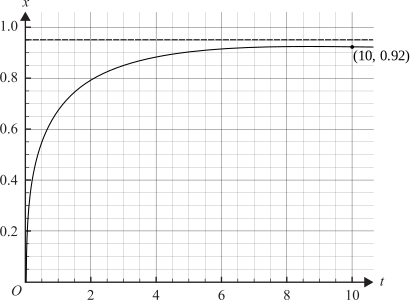
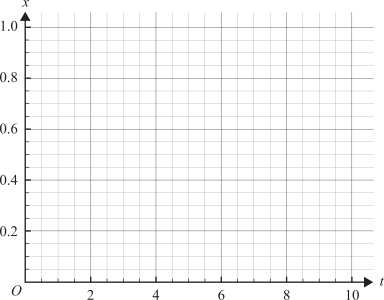
    2. Sketch the graph of  \(x=\log _e\left(\tan ^{-1}(2 t)+1\right)\) and the horizontal asymptote on the axes below. Using coordinates, plot and label the point where  \(t=10\), giving the value of \(x\) correct to two decimal places.   (2 marks)

      --- 3 WORK AREA LINES (style=lined) ---
  1. Find the speed of the particle when  \(t=3\). Give your answer in metres per second, correct to two decimal places.   (1 mark)

    --- 3 WORK AREA LINES (style=lined) ---
Two seconds after the first particle passed through \(O\), a second particle passes through \(O\).

Its distance \(x\) metres from \(O, t\) seconds after the first particle passed through \(O\), is given by  \(x=\log _e\left(\tan ^{-1}(3 t-6)+1\right).\)

  1. Verify that the particles are the same distance from \(O\) when  \(t=6\).   (1 mark)

    --- 3 WORK AREA LINES (style=lined) ---
  2. Find the ratio of the speed of the first particle to the speed of the second particle when the particles are at the same distance from \(O\). Give your answer as \(\dfrac{a}{b}\) in simplest form, where \(a\) and \(b\) are positive integers.   (2 marks)

    --- 4 WORK AREA LINES (style=lined) ---
Show Answers Only

a.i.  \(\displaystyle\int e^x d x=\int \frac{2}{1+4 t^2}\,dt\)

a.ii.  \(x=\log _e\left(\tan ^{-1}(2 t)+1\right) \)

b.i.   \(\text{Asymptote: }\  x=\log _e\left(\dfrac{\pi}{2}+1\right)\)

b.ii. 
           

c.    \(0.02\)

d.   \(\text {Particle positions at}\ \ t=6:\)

\(x_1=\log _e\left(\tan ^{-1}(2 \times 6)+1\right)=\log _e\left(\tan ^{-1}(12)+1\right)\)

\(x_2=\log _e\left(\tan ^{-1}(3 \times 6-6)+1\right)=\log _e\left(\tan ^{-1}(12)+1\right)=x_1\)

e.    \(\dfrac{v_1}{v_2}=\dfrac{2}{3}\)

Show Worked Solution

a.i.  \(\dfrac{d x}{d t}=\dfrac{2 e^{-x}}{1+4 t^2}\)

 \(\displaystyle\int e^x d x=\int \frac{2}{1+4 t^2}\,dt\)
  

a.ii. \(e^x=\tan ^{-1}(2 t)+c\)

\(\text {When}\ \ t=0, \ x=0 \ \Rightarrow \ c=1\)

\begin{aligned}
e^x& =\tan ^{-1}(2 t)+1 \\
x&=\log _e\left(\tan ^{-1}(2 t)+1\right)
\end{aligned}

 
b.i.
\(\text {As}\ \ t \rightarrow \infty, \ \tan ^{-1}(2 t) \rightarrow \dfrac{\pi}{2}\)

\(x \rightarrow \log _e\left(\dfrac{\pi}{2}+1\right)\)

\(\therefore \text{Asymptote: }\  x=\log _e\left(\dfrac{\pi}{2}+1\right)\)

♦♦♦ Mean mark 23%.

 
b.ii.
\(\log _e\left(\dfrac{\pi}{2}+1\right) \approx 0.944\)

\(\text{When}\ \ t=10 :\)

\(x=\log _e\left( \tan ^{-1}(20)+1\right)=0.92\ \text{(2 d.p.)}\)
 

c.    \(\text {At}\ \  t=3, x=\log _e\left(\tan ^{-1}(6)+1\right)\)

\(\text {Substitute } t \text { and } x \text { into } \dfrac{d x}{d t}:\)

\(\dfrac{d x}{d t}=\dfrac{2 e^{-x}}{1+4 t^2}=0.02\, \text{ms} ^{-1}\ \text{(2 d.p.)}\)
 

d.   \(\text {Particle positions at}\ \ t=6:\)

\(x_1=\log _e\left(\tan ^{-1}(2 \times 6)+1\right)=\log _e\left(\tan ^{-1}(12)+1\right)\)

\(x_2=\log _e\left(\tan ^{-1}(3 \times 6-6)+1\right)=\log _e\left(\tan ^{-1}(12)+1\right)=x_1\)
 

e.    \(e^x=e^{\log _e\left(\tan ^{-1}(12)+1\right)}=\tan ^{-1}(12)+1\)

\(\text {At}\ \ t=6:\)

\(\dfrac{d x_1}{d t}=\dfrac{2}{1+4 t^2} \times \dfrac{1}{\tan ^{-1}(2 t)+1}=\dfrac{2}{145\left(\tan ^{-1}(12)+1\right)}\)

\(\dfrac{d x^2}{d t}=\dfrac{3}{1+(3 t-6)^2} \times \dfrac{1}{\tan ^{-1}(3 t-6)-1}=\dfrac{3}{145\left(\tan ^{-1}(12)+1\right)}\)

\(\therefore \dfrac{v_1}{v_2}=\dfrac{2}{3}\)

Filed Under: Applied Contexts Tagged With: Band 3, Band 4, Band 6, smc-1184-75-Motion

CHEMISTRY, M1 EQ-Bank 9

Explain why Neon, similar to other noble gases, does not easily form chemical bonds with other elements.

In your explanation, include Neon's electron configuration and how this relates to its position on the periodic table and its chemical characteristics.   (3 marks)

--- 8 WORK AREA LINES (style=lined) ---
Show Answers Only
  • Neon is located in Group 18 of the periodic table and has an atomic number of 10.
  • Its electron configuration is 1s² 2s² 2p⁶. This configuration shows that Neon has a completely filled outer shell, a characteristic of noble gases, which contributes to its chemical inertness.
  • As a member of Group 18, Neon shares this fully filled valence shell characteristic with other noble gases, resulting in high stability and very low reactivity.
Show Worked Solution
  • Neon is located in Group 18 of the periodic table and has an atomic number of 10.
  • Its electron configuration is \(1s^2 2s^2 2p^6\). This configuration shows that Neon has a completely filled outer shell, a characteristic of noble gases, which contributes to its chemical inertness.
  • As a member of Group 18, Neon shares this fully filled valence shell characteristic with other noble gases, resulting in high stability and very low reactivity.

Filed Under: Periodicity Tagged With: Band 4, smc-4257-25-Physical/Chemical properties

CHEMISTRY, M1 EQ-Bank 13

You are given the task to separate the components of two mixtures: a saltwater solution and a mixture of sand and iron filings.

  1.  Suggest a suitable separation technique to extract the salt from the saltwater solution. Explain your reasoning based on the physical property involved.  (2 marks)

    --- 4 WORK AREA LINES (style=blank) ---

  2.  Identify the physical property that allow the mixture of sand and iron fillings to be separated and whether it is a homogeneous or heterogeneous mixture.  (1 marks)

    --- 2 WORK AREA LINES (style=blank) ---

  3. Describe one safety precaution that should be followed during the separation of the saltwater solution.  (2 marks)

    --- 4 WORK AREA LINES (style=blank) ---

Show Answers Only

a.   Separation technique:

  • Evaporation is a suitable technique because water has a much lower boiling point than salt.
  • By heating the solution, the water evaporates, leaving salt crystals behind.
  • Further distillation could be used to collect and condense the evaporated water.

b.   Physical property:

  • Iron fillings are magnetic and hence can be separated using a magnet.
  • The mixture is heterogeneous.

c.   Safety precaution:

  • For evaporation, wear heat-resistant gloves when handling hot equipment like the tripod or beaker to avoid burns to the hands.
Show Worked Solution

a.   Separation technique:

  • Evaporation is a suitable technique because water has a much lower boiling point than salt.
  • By heating the solution, the water evaporates, leaving salt crystals behind.
  • Further distillation could be used to collect and condense the evaporated water.

b.   Physical property:

  • Iron fillings are magnetic and hence can be separated using a magnet.
  • The mixture is heterogeneous.

c.   Safety precaution:

  • For evaporation, wear heat-resistant gloves when handling hot equipment like the tripod or beaker to avoid burns to the hands.

Filed Under: Properties of Matter Tagged With: Band 3, Band 4, smc-4255-35-Separation techniques

Probability, MET2 2023 SM-Bank 4 MC

The probability density function \(f\) of a random variable \(X\) is given by

\(f(x)= \begin{cases}\dfrac{x+1}{20} & 0 \leq x<4 \\ \dfrac{36-5 x}{64} & 4 \leq x \leq 7.2 \\ 0 & \text {elsewhere}\end{cases}\)

The value of \(a\) such that \(\text{Pr}(X \leq a)=\dfrac{5}{8}\) is

  1. \(\dfrac{4(\sqrt{15}-9)}{5}\)
  2. \(\sqrt{26}-1\)
  3. \(\dfrac{36-4 \sqrt{15}}{5}\)
  4. \(\dfrac{4 \sqrt{15}+9}{5}\)
  5. \(\dfrac{4 \sqrt{15}+36}{5}\)
Show Answers Only


Show Worked Solution

\(\text{Using CAS:}\)

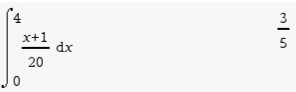
\(\displaystyle \int_{0}^{4}\dfrac{x+1}{20}\,dx =\dfrac{3}{5}<\dfrac{5}{8}\)

\(\therefore\ \text{Pr}(0\leq X<4)+\text{Pr}(4\leq X<a)=\dfrac{5}{8}\)

\(\rightarrow\quad\) \(\dfrac{3}{5}+\displaystyle \int_{4}^{a}\dfrac{36-5x}{64}\,dx\)  \(=\dfrac{5}{8}\)
  \(\displaystyle \int_{4}^{a}\dfrac{36-5x}{64}\,dx\) \(=\dfrac{5}{8}-\dfrac{3}{5}=\dfrac{1}{40}\)
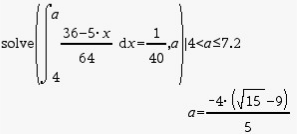
  \(\therefore\ \text{from CAS:}\quad \ a\)

\(=\dfrac{-4\Big(\sqrt{15}-9\Big)}{5}\)


\(=\dfrac{36-4\sqrt{15}}{5}\)

  
\(\text{Using CAS:}\)

  
\(\Rightarrow C\)

Filed Under: Probability density functions Tagged With: Band 4, smc-637-50-Linear PDF

Calculus, MET2 2023 VCE SM-Bank 3 MC

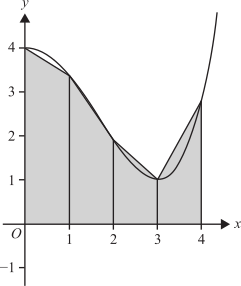
The area between the curve  \(\displaystyle y=\frac{1}{27}(x-3)^2(x+3)^2+1\)  and the \(x\)-axis on the interval \(x \in[0,4]\) has been approximated using the trapezium rule, as shown in the graph below.

Using the trapezium rule, the approximate area calculated is equal to

  1. \(\displaystyle \frac{1}{2}\left(4+\frac{91}{27}+\frac{52}{27}+1+\frac{76}{27}\right)\)
  2. \(\displaystyle \frac{1}{2}\left(4+\frac{182}{27}+\frac{104}{27}+2+\frac{76}{27}\right)\)
  3. \(\displaystyle \frac{1}{2}\left(8+\frac{182}{27}+\frac{104}{27}+2+\frac{152}{27}\right)\)
  4. \(\displaystyle \frac{1}{2}\left(\frac{182}{27}+\frac{104}{27}+2+\frac{76}{27}\right)\)
  5. \(\displaystyle \frac{1}{2}\left(8+\frac{182}{27}+\frac{104}{27}+2\right)\)
Show Answers Only

\(B\)

Show Worked Solution

\(\text{Area each trapezium}=\dfrac{h}{2}(f(a)+f(b))\)

\(A\) \(=\Bigg(\dfrac{1}{2}(f(0)+f(1))+\dfrac{1}{2}(f(1)+f(2))+\dfrac{1}{2}(f(2)+f(3))+\dfrac{1}{2}(f(3)+f(4)\Bigg)\)
  \(=\dfrac{1}{2}\Bigg(f(0)+2f(1)+2f(2)+2f(3)+f(4)\Bigg)\)
  \(=\dfrac{1}{2}\Bigg(4+2\times\dfrac{91}{27}+2\times\dfrac{52}{27}+2\times 1+\dfrac{76}{27}\Bigg)\)
  \(=\dfrac{1}{2}\Bigg(4+\dfrac{182}{27}+\dfrac{104}{27}+2+\dfrac{76}{27}\Bigg)\)

  
\(\Rightarrow B\)

Filed Under: Trapezium Rule and Newton Tagged With: Band 4, smc-5145-04-Trapezium rule, smc-5145-15-Graph

Algebra, MET2 2023 SM-Bank 1 MC

\begin{aligned}
& x-2 y=3 \\
& 2 y-z=4
\end{aligned}

Which one of the following correctly describes the general solution to the system of linear equations given above?

  1. \(x=k, \quad y=\dfrac{1}{2}(k+3), \ z=k-1\), for all \(k \in R\)
  2. \(x=k, \quad y=\dfrac{1}{2}(k+3), \ z=k+1\), for all \(k \in R\)
  3. \(x=k, \quad y=\dfrac{1}{2}(k-3), \ z=k+7\), for all \(k \in R\)
  4. \(x=k, \quad y=\dfrac{1}{2}(k-3), \ z=k-7\), for all \(k \in R\)
  5. \(x=k, \quad y=\dfrac{1}{2}(k+3), \ z=k-7\), for all \(k \in R\)
Show Answers Only

\(D\)

Show Worked Solution

\(\text{When }x=k\quad (1)\)

\(2y\) \(=k-3\)
\(y\) \(=\dfrac{1}{2}(k-3)\quad (2)\)
\(\text{and}\ z\) \(=2y-4\)
\(z\) \(=2\times\dfrac{1}{2}(k-3)-4\)
  \(=k-7\quad (3)\)

  
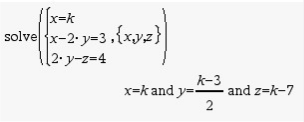
\(\text{Using CAS:}\)

\(\Rightarrow D\)

Filed Under: Simultaneous Equations Tagged With: Band 4, smc-721-10-Unique solution

Calculus, MET2 2022 VCAA 5

Consider the composite function `g(x)=f(\sin (2 x))`, where the function `f(x)` is an unknown but differentiable function for all values of `x`.

Use the following table of values for `f` and `f^{\prime}`.

`\quad x \quad` `\quad\quad 1/2\quad\quad` `\quad\quad(sqrt{2})/2\quad\quad` `\quad\quad(sqrt{3})/2\quad\quad`
`f(x)` `-2` `5` `3`
`\quad\quad f^{prime}(x)\quad\quad` `7` `0` `1/9`


  1. Find the value of `g\left(\frac{\pi}{6}\right)`.   (1 mark)

    --- 3 WORK AREA LINES (style=lined) ---
The derivative of `g` with respect to `x` is given by `g^{\prime}(x)=2 \cdot \cos (2 x) \cdot f^{\prime}(\sin (2 x))`.

  1. Show that `g^{\prime}\left(\frac{\pi}{6}\right)=\frac{1}{9}`.   (1 mark)

    --- 2 WORK AREA LINES (style=lined) ---
  2. Find the equation of the tangent to `g` at `x=\frac{\pi}{6}`.   (2 marks)

    --- 4 WORK AREA LINES (style=lined) ---
  3. Find the average value of the derivative function `g^{\prime}(x)` between `x=\frac{\pi}{8}` and `x=\frac{\pi}{6}`.   (2 marks)

    --- 5 WORK AREA LINES (style=lined) ---
  4. Find four solutions to the equation `g^{\prime}(x)=0` for the interval `x \in[0, \pi]`.   (3 marks)

    --- 8 WORK AREA LINES (style=lined) ---
Show Answers Only

a.    `3`

b.    `1/9`

c.    `y=1/9x+3-pi/54`

d.    `-48/pi`

e.    ` x = pi/8 , pi/4 , (3pi)/8 ,(3pi)/4`

Show Worked Solution
 

a.  `g(pi/6)`
`= f(sin(pi/3))`  
  `= f(sqrt3/2)`  
  `= 3`  


b.  `g\ ^{prime}(x)` `= 2\cdot\ cos(pi/3)\cdot\ f\ ^{prime}(sin(pi/3))`  
`g\ ^{prime}(pi/6)` `= 2 xx 1/2 xx f\ ^{prime}(sqrt3/2)`  
  `= 1/9`  


c.   `m = 1/9`  and  `g(pi/6) = 3`

`y  –  y_1` `= m(x-x_1)`  
`y  –  3` `= 1/9(x-pi/6)`  
`y` `= 1/9x + 3-pi/54`  

♦♦ Mean mark (c) 45%.
MARKER’S COMMENT: Some students did not produce an equation as required.

  
d.   The average value of `g^{\prime}(x)` between `x=\frac{\pi}{8}` and `x=\frac{\pi}{6}`

Average `= \frac{1}{\frac{\pi}{6}-\frac{\pi}{8}}\cdot\int_{\frac{\pi}{8}}^{\frac{\pi}{6}} g^{\prime}(x) d x`  
  `=24/pi \cdot[g(x)]_{\frac{\pi}{8}}^{\frac{\pi}{\6}}`  
  `= 24/pi \cdot(f(sqrt3/2)-f(sqrt2/2))`  
  `= 24/pi (3-5) = -48/pi`  

♦♦ Mean mark (d) 30%.
MARKER’S COMMENT: Those who used the Average Value formula were generally successful.
Some students substituted `g^{\prime}(x)`, not `g(x)`.

e.   `2 \cos (2 x) f^{\prime}(\sin (2 x)) = 0`

`:.\   2 \cos (2 x) = 0\ ….(1)`  or  ` f^{\prime}(\sin (2 x)) = 0\ ….(2)`

(1):   ` 2 \cos (2 x)`  `= 0`      `x \in[0, \pi]`
`\cos (2 x)` `= 0`      `2 x \in[0,2 \pi]`
`2x` `= pi/2 , (3pi)/2`  
`x` `= pi/4 , (3pi)/4`  
     
(2): ` f^{\prime}(\sin (2 x)) ` `= sqrt2/2`  
`2x` `= pi/4 , (3pi)/4`  
`x` `= pi/8 , (3pi)/8`  

  
`:. \  x = pi/8 , pi/4 , (3pi)/8 ,(3pi)/4`


♦♦ Mean mark (e) 30%.
MARKER’S COMMENT: Some students were able to find `pi/4, (3pi)/4`. Some solved `2 cos(2x)=0` or `f^{\prime}(sin(2x))=0` but not both.

Filed Under: Differentiation (Trig), Integration (Trig), Trig Differentiation, Trig Equations, Trig Integration Tagged With: Band 4, Band 5, Band 6, smc-725-10-Sin, smc-725-20-Cos, smc-736-10-sin, smc-736-20-cos, smc-737-10-sin, smc-737-20-cos, smc-737-50-Average Value, smc-737-60-Find f(x) given f'(x), smc-744-10-sin, smc-744-20-cos, smc-747-10-sin, smc-747-20-cos, smc-747-60-Average Value

Functions, MET2 2022 VCAA 4

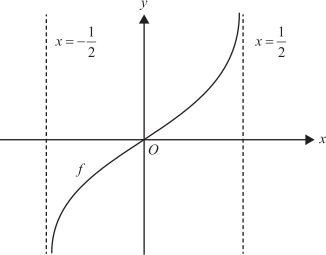
Consider the function `f`, where `f:\left(-\frac{1}{2}, \frac{1}{2}\right) \rightarrow R, f(x)=\log _e\left(x+\frac{1}{2}\right)-\log _e\left(\frac{1}{2}-x\right).`

Part of the graph of `y=f(x)` is shown below.
 

  1. State the range of `f(x)`.   (1 mark)

    --- 1 WORK AREA LINES (style=lined) ---

  2.  i. Find `f^{\prime}(0)`.   (2 marks)

    --- 4 WORK AREA LINES (style=lined) ---
  3. ii. State the maximal domain over which `f` is strictly increasing.   (1 mark)

    --- 1 WORK AREA LINES (style=lined) ---
  4. Show that `f(x)+f(-x)=0`.   (1 mark)

    --- 3 WORK AREA LINES (style=lined) ---

  5. Find the domain and the rule of `f^{-1}`, the inverse of `f`.   (3 marks)

    --- 6 WORK AREA LINES (style=lined) ---
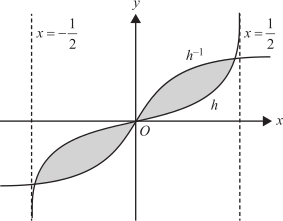
  6. Let `h` be the function `h:\left(-\frac{1}{2}, \frac{1}{2}\right) \rightarrow R, h(x)=\frac{1}{k}\left(\log _e\left(x+\frac{1}{2}\right)-\log _e\left(\frac{1}{2}-x\right)\right)`, where `k \in R` and `k>0`.
  7. The inverse function of `h` is defined by `h^{-1}: R \rightarrow R, h^{-1}(x)=\frac{e^{k x}-1}{2\left(e^{k x}+1\right)}`.
  8. The area of the regions bound by the functions `h` and `h^{-1}` can be expressed as a function, `A(k)`.
  9. The graph below shows the relevant area shaded.
     

  1. You are not required to find or define `A(k)`.
  2.  i. Determine the range of values of `k` such that `A(k)>0`.   (1 mark)

    --- 2 WORK AREA LINES (style=lined) ---
  3. ii. Explain why the domain of `A(k)` does not include all values of `k`.   (1 mark

    --- 2 WORK AREA LINES (style=lined) ---
Show Answers Only
a.     `R`
b.i `f^{\prime}(0)=4`
b.ii `\left(-\frac{1}{2}, \frac{1}{2}\right)`
c. `0`
d. `x \in \mathbb{R}`
e.i  ` k > 4`
e.ii No bounded area for `0<k \leq 4`
Show Worked Solution

a.   `R` is the range.

b.i    `f(x)`
`= \log _e\left(x+\frac{1}{2}\right)-\log _e\left(\frac{1}{2}-x\right)`  
  `f^{\prime}(x)` `= \frac{1}{x+\frac{1}{2}}+\frac{1}{\frac{1}{2}-x}`  
    `= \frac{2}{2 x+1}-\frac{2}{2 x-1}`  
  `f^{\prime}(0)` `= \frac{2}{2 xx 0+1}-\frac{2}{2 xx 0-1}`  
    `= 4`  

 
b.ii 
`\left(-\frac{1}{2}, \frac{1}{2}\right)`

c.   `f(x)+f(-x)`

`= \log _e\left(x+\frac{1}{2}\right)-\log _e\left(\frac{1}{2}-x\right)+\log _e\left(-x+\frac{1}{2}\right)-\log _e\left(\frac{1}{2}+x\right)`  
`= 0`  

 
d.  
To find the inverse swap `x` and `y` in `y=f(x)`

`x` `= \log _e\left(y+\frac{1}{2}\right)-\log _e\left(\frac{1}{2}-y\right)`  
`x` `= \log _e\left(\frac{y+\frac{1}{2}}{\frac{1}{2}-y}\right)`  
`e^x` `=\frac{y+\frac{1}{2}}{\frac{1}{2}-y}`  
`y+\frac{1}{2}` `= e^x\left(-y+\frac{1}{2}\right)`  
`y+\frac{1}{2}` `= -e^x y+\frac{e^x}{2}`  
`y\left(e^x+1\right)` `= \frac{e^x-1}{2}`  
`:.\ f^(-1)(x)` `= \frac{e^x-1}{2(e^x + 1)}`  

 
  `:.`  Domain: `x \in \mathbb{R}`
  

e.i   The vertical dilation factor of  `f(x)` is  `1/k`

For `A(k)>=0` , `h^{\prime}(0)<1`

`\frac{1}{k}(4)<1`   [Using CAS]

`:.\  k > 4`


♦♦♦♦ Mean mark (e.i) 10%.
MARKER’S COMMENT: Incorrect responses included `k>0` and `4<k<33`.

e.ii  When `h \geq h^{-1}` for  `x>0` (or `h \leq h^{-1}` for  `x<0`) there is no bounded area.

`:.`  There will be no bounded area for `0<k \leq 4`.


♦♦♦♦ Mean mark (e.ii) 10%.

Filed Under: Area Under Curves, Differentiation (L&E), Graphs and Applications, L&E Differentiation, Logs and Exponential Functions Tagged With: Band 3, Band 4, Band 6, smc-2745-40-Log graphs, smc-2745-50-Find Domain/Range, smc-5204-80-Area between curves, smc-723-50-Log/Exponential, smc-723-80-Area between graphs, smc-723-95-Transformations

Probability, MET2 2022 VCAA 3

Mika is flipping a coin. The unbiased coin has a probability of \(\dfrac{1}{2}\) of landing on heads and \(\dfrac{1}{2}\) of landing on tails.

Let \(X\) be the binomial random variable representing the number of times that the coin lands on heads.

Mika flips the coin five times.

    1. Find \(\text{Pr}(X=5)\).   (1 mark)

      --- 2 WORK AREA LINES (style=lined) ---
    2. Find \(\text{Pr}(X \geq 2).\) (1 mark)

      --- 2 WORK AREA LINES (style=lined) ---

    3. Find \(\text{Pr}(X \geq 2 | X<5)\), correct to three decimal places.   (2 marks)

      --- 4 WORK AREA LINES (style=lined) ---
    4. Find the expected value and the standard deviation for \(X\).   (2 marks)

      --- 4 WORK AREA LINES (style=lined) ---

The height reached by each of Mika's coin flips is given by a continuous random variable, \(H\), with the probability density function
  

\(f(h)=\begin{cases} ah^2+bh+c         &\ \ 1.5\leq h\leq 3 \\ \\ 0       &\ \ \text{elsewhere} \\ \end{cases}\)
  

where \(h\) is the vertical height reached by the coin flip, in metres, between the coin and the floor, and \(a, b\) and \(c\) are real constants.

    1. State the value of the definite integral \(\displaystyle\int_{1.5}^3 f(h)\,dh\).   (1 mark)

      --- 5 WORK AREA LINES (style=lined) ---

    2. Given that  \(\text{Pr}(H \leq 2)=0.35\)  and  \(\text{Pr}(H \geq 2.5)=0.25\), find the values of \(a, b\) and \(c\).   (3 marks)

      --- 5 WORK AREA LINES (style=lined) ---
    3. The ceiling of Mika's room is 3 m above the floor. The minimum distance between the coin and the ceiling is a continuous random variable, \(D\), with probability density function \(g\).
    4. The function \(g\) is a transformation of the function \(f\) given by \(g(d)=f(rd+s)\), where \(d\) is the minimum distance between the coin and the ceiling, and \(r\) and \(s\) are real constants.
    5. Find the values of \(r\) and \(s\).   (1 mark)

      --- 5 WORK AREA LINES (style=lined) ---
  1. Mika's sister Bella also has a coin. On each flip, Bella's coin has a probability of \(p\) of landing on heads and \((1-p)\) of landing on tails, where \(p\) is a constant value between 0 and 1 .
  2. Bella flips her coin 25 times in order to estimate \(p\).
  3. Let \(\hat{P}\) be the random variable representing the proportion of times that Bella's coin lands on heads in her sample.
    1. Is the random variable \(\hat{P}\) discrete or continuous? Justify your answer.   (1 mark)

      --- 2 WORK AREA LINES (style=lined) ---
    2. If \(\hat{p}=0.4\), find an approximate 95% confidence interval for \(p\), correct to three decimal places.   (1 mark)

      --- 6 WORK AREA LINES (style=lined) ---
    3. Bella knows that she can decrease the width of a 95% confidence interval by using a larger sample of coin flips.
    4. If \(\hat{p}=0.4\), how many coin flips would be required to halve the width of the confidence interval found in part c.ii.?   (1 mark)

      --- 2 WORK AREA LINES (style=lined) ---
Show Answers Only

a. i.    `frac{1}{32}`    ii.    `frac{13}{16}`    iii.    `0.806` (3 d.p.)

a. iv    `text{E}(X)=5/2,  text{sd}(X)=\frac{\sqrt{5}}{2}`

b. i.   `1`   

b. ii.    `a=-frac{4}{5},  b=frac{17}{5},  c=-frac{167}{60}`

b. iii. `r=-1,  s=3`

c. i.   `text{Discrete}`   ii.   `(0.208,  0.592)`   iii.   `n=100`

Show Worked Solution

a.i  `X ~ text{Bi}(5 , frac{1}{2})`

`text{Pr}(X = 5) = (frac{1}{2})^5 = frac{1}{32}`
 

a.ii  By CAS:    `text{binomCdf}(5,0.5,2,5)`     `0.8125`

`text{Pr}(X>= 2) = 0.8125 = frac{13}{16}`

  
a.iii 
`\text{Pr}(X \geq 2 | X<5)`

`=frac{\text{Pr}(2 <= X < 5)}{\text{Pr}(X < 5)} = frac{\text{Pr}(2 <= X <= 4)}{text{Pr}(X <= 4)}`

  
By CAS: `frac{text{binomCdf}(5,0.5,2,4)}{text{binomCdf}(5,0.5,0,4)}`
 

`= 0.806452 ~~ 0.806` (3 decimal places)
  

a.iv `X ~ text{Bi}(5 , frac{1}{2})`

`text{E}(X) = n xx p= 5 xx 1/2 = 5/2`

`text{sd}(X) =\sqrt{n p(1-p)}=\sqrt((5/2)(1 – 0.5)) = \sqrt{5/4} =\frac{\sqrt{5}}{2}`


b.i   `\int_{1.5}^3 f(h) d h = 1`


♦♦ Mean mark (b.i) 40%.
MARKER’S COMMENT: Many students did not evaluate the integral or evaluated incorrectly.

b.ii  By CAS:

`f(h):= a\·\h^2 + b\·\h +c`
 

`text{Solve}( {(\int_{1.5}^2 f(h) d h = 0.35), (\int_{2.5}^3 f(h) d h = 0.25), (\int_{1.5}^3 f(h) d h = 1):})`

`a = -0.8 = frac{-4}{5}, \ b = 3.4 = frac{17}{5},\  c = =-2.78 \dot{3} = frac{-167}{60}`


♦♦ Mean mark (b.ii) 47%.
MARKER’S COMMENT: Many students did not give exact answers.

b.iii  `h + d = 3`

`:.\  f(h) = f(3  –  d) = f(- d + 3)`

`:.\  r = – 1 ` and ` s = 3`


♦♦♦♦ Mean mark (b.iii) 10%.
MARKER’S COMMENT: Many students did not attempt this question.

c.i  `\hat{p}`  is discrete.

The number of coin flips must be zero or a positive integer so  `\hat{p}`  is countable and therefore discrete.
 

c.ii  `\left(\hat{p}-z \sqrt{\frac{\hat{p}(1-\hat{p})}{n}}, \hat{p}+z \sqrt{\frac{\hat{p}(1-\hat{p})}{n}}\right)`

`\left(0.4-1.96 \sqrt{\frac{0.4 \times 0.6}{25}}\ , 0.4-1.96 \sqrt{\frac{0.4 \times 0.6}{25}}\right)`

`\approx(0.208\ ,0.592)`


c.iii To halve the width of the confidence interval, the standard deviation needs to be halved.

`:.\  \frac{1}{2} \sqrt{\frac{0.4 \times 0.6}{25}} = \sqrt{\frac{0.4 \times 0.6}{4 xx 25}} = \sqrt{\frac{0.4 \times 0.6}{100}}`

`:.\  n = 100`

She would need to flip the coin 100 times


♦♦♦ Mean mark (c.iii) 30%.
MARKER’S COMMENT: Common incorrect answers were 0, 10, 11, 50 and 101.

Filed Under: Binomial, Probability density functions Tagged With: Band 2, Band 4, Band 5, Band 6, smc-637-35-Sum probabilities = 1, smc-637-60-Polynomial PDF, smc-638-20-binomCdf (CAS), smc-638-32-Find E(X)/var(X) given n p, smc-638-50-Conditional, smc-719-20-95% confidence intervals, smc-719-40-Find sample size

Functions, 2ADV F1 SM-Bank 25

Show that the parabola  \(2x^2-kx+k-2\)  has at least one real root.  (3 marks)

--- 7 WORK AREA LINES (style=lined) ---

Show Answers Only

\(2x^2-kx+k-2=0\)

\(\Delta=b^2-4ac=(-k)^2-4 \times 2(k-2) = k^{2}-8k+16\)

\(\text{Real roots:}\ \ \Delta \geqslant 0\)

\(k^2-8k+16\) \(\geqslant 0\)  
\((x-4)^2\) \(\geqslant 0\)  

 
\(\therefore\ \text{At least one root exists for all}\ k\)

Show Worked Solution

\(2x^2-kx+k-2=0\)

\(\Delta=b^2-4ac=(-k)^2-4 \times 2(k-2) = k^{2}-8k+16\)

\(\text{Real roots:}\ \ \Delta \geqslant 0\)

\(k^2-8k+16\) \(\geqslant 0\)  
\((x-4)^2\) \(\geqslant 0\)  

 
\(\therefore\ \text{At least one root exists for all}\ k\)

Filed Under: Quadratics and Cubic Functions (Adv-2027), Quadratics and Cubic Functions (Y11) Tagged With: Band 4, smc-6215-10-Quadratics, smc-6215-80-Discriminant, smc-984-10-Quadratics, smc-984-50-Discriminant

CHEMISTRY, M1 EQ-Bank 12

Silver oxide, when heated, decomposes according to the following chemical equation:

\(\ce{2Ag2O -> 4Ag + O2}\)

231.74 grams of silver oxide (\(\ce{Ag2O}\)) is heated, and the metallic silver (\(\ce{Ag}\)) residue is weighed and recorded in the table below.

\begin{array} {|l|c|}
\hline
\rule{0pt}{2.5ex} \text{Mass of}\ \ce{Ag2O} \rule[-1ex]{0pt}{0pt} & \text{231.74 grams} \\
\hline
\rule{0pt}{2.5ex} \text{Mass of}\ \ce{Ag} \rule[-1ex]{0pt}{0pt} & \text{216.0 grams} \\
\hline
\end{array}

Calculate the percentage of oxygen (\(\ce{O2}\)), by weight, released from the silver oxide during this process.   (2 marks)

--- 5 WORK AREA LINES (style=lined) ---
Show Answers Only

\(\%\ce{O2} = 6.8\%\)

Show Worked Solution

\(\text{Initial mass of}\ \ce{Ag2O} = 231.74\ \text{grams}\)

\(\text{Mass of}\ \ce{Ag} = 216.0\ \text{grams}\)

\(\text{Mass of}\ \ce{O2} = 231.74-216.0 = 15.74\ \text{grams}\)

\(\%\ce{O2}\ \text{released}\ = \left(\dfrac{15.74}{231.74} \times 100\%\right) = 6.8\%\)

Filed Under: Properties of Matter Tagged With: Band 4, smc-4255-30-Percentage composition

Complex Numbers, SPEC2 2022 VCAA 2

Two complex numbers \(u\) and \(v\) are given by  \(u=a+i\)  and  \(v=b-\sqrt{2}i\), where \(a, b \in R\).

  1.  i. Given that  \(uv=(\sqrt{2}+\sqrt{6})+(\sqrt{2}-\sqrt{6})i\), show that  \(a^2+(1-\sqrt{3}) a-\sqrt{3}=0\).   (2 marks)

    --- 7 WORK AREA LINES (style=lined) ---

  2. ii. One set of possible values for \(a\) and \(b\) is  \(a=\sqrt{3}\)  and  \(b=\sqrt{2}\).
  3.     Hence, or otherwise, find the other set of possible values.   (1 mark)

    --- 3 WORK AREA LINES (style=lined) ---

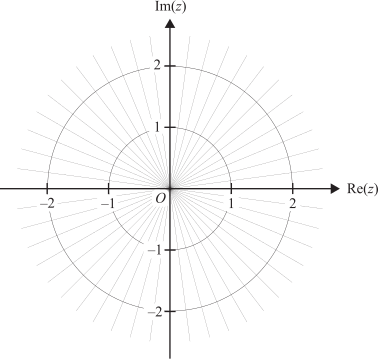
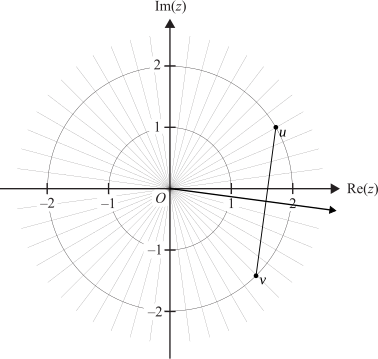
  4. Plot and label the points representing  \(u=\sqrt{3}+i\)  and  \(v=\sqrt{2}-\sqrt{2}i\)  on the Argand diagram below.
     

--- 0 WORK AREA LINES (style=lined) ---

  1. The ray given by  \(\text{Arg}(z)=\theta\)  passes through the midpoint of the line interval that joins the points  \(u=\sqrt{3}+i\)  and  \(v=\sqrt{2}-\sqrt{2}i\).
  2. Find, in radians, the value of \(\theta\) and plot this ray on the Argand diagram in part b.   (2 marks)

    --- 4 WORK AREA LINES (style=lined) ---

  3. The line interval that joins the points  \(u=\sqrt{3}+i\)  and  \(v=\sqrt{2}-\sqrt{2}i\)  cuts the circle  \(|z|=2\)  into a major and a minor segment.
  4. Find the area of the minor segment, giving your answer correct to two decimal places.   (2 marks)

    --- 5 WORK AREA LINES (style=lined) ---
Show Answers Only

a.i.  \(\text{See worked solutions.}\)

a.ii.  \(a=-1, \ b=-\sqrt{6}\)

b.   
       

c.   \(\theta=-\dfrac{\pi}{24}\)

d.    \(0.69\ \text{u}^2\)

Show Worked Solution

a.i.  \(u v=(\sqrt{2}+\sqrt{6})+(\sqrt{2}-\sqrt{6}) i\)

\begin{aligned}
(a+i)(b-\sqrt{2} i) & =a b-\sqrt{2} a i+b i+\sqrt{2} \\
& =a b+\sqrt{2}+(b-\sqrt{2}a) i
\end{aligned}

\(\text {Equating co-efficients: }\)

  \(ab=\sqrt{6} \ \Rightarrow \ b=\dfrac{\sqrt{6}}{a}\ \cdots\ \text {(1)}\)

  \(b-\sqrt{2} a=\sqrt{2}-\sqrt{6}\ \cdots\ \text {(2)}\)

\(\text{Substitute (1) into (2):}\)

\(\dfrac{\sqrt{6}}{a}-\sqrt{2}a=\sqrt{2}-\sqrt{6}\)

\(\sqrt{6}-\sqrt{2} a^2=(\sqrt{2}-\sqrt{6}) a\)

\(\sqrt{2} a^2+(\sqrt{2}-\sqrt{6}) a-\sqrt{6}\) \(=0\)  
\(a^2+(1-\sqrt{3}) a-\sqrt{3}\) \(=0\)  
Mean mark (a) 54%.

 
a.ii.
\(\text{Solve } a^2+(1-\sqrt{3}) a-\sqrt{3}=0 \ \ \text{for}\  a :\)

\(a=\sqrt{3} \ \text{ or } -1\)

\(\therefore \text{ Other solution: } a=-1, \ b=-\sqrt{6}\)
 

b.   


c. 
  
\begin{aligned}
\theta & =\frac{\operatorname{Arg}(u)-\operatorname{Arg}(v)}{2} \\
& =\frac{1}{2}\left(\frac{\pi}{6}-\frac{\pi}{4}\right) \\
& =-\frac{\pi}{24}
\end{aligned}
♦ Mean mark (c) 39%.

d.   \(\text {Sector angle (centre) }=\dfrac{\pi}{6}+\dfrac{\pi}{4}=\dfrac{5 \pi}{12}\)

\(\text {Area of sector }=\dfrac{\frac{5 \pi}{12}}{2 \pi} \times \pi \times 2^2=\dfrac{5 \pi}{6}\)

\begin{aligned}
\text {Area of segment } & =\frac{5 \pi}{6}-\dfrac{1}{2} \times 2 \times 2 \times \sin \left(\dfrac{5 \pi}{6}\right) \\
& \approx 0.69\ \text{u} ^2
\end{aligned}

♦ Mean mark (d) 40%.

Filed Under: Mod/Arg Form and Argand Diagrams (SM) Tagged With: Band 4, Band 5, smc-2597-20-Cartesian to Mod/Arg, smc-2597-60-Argand diagrams

Calculus, SPEC2 2022 VCAA 1

Consider the family of functions \(f\) with rule  \(f(x)=\dfrac{x^2}{x-k}\), where \(k \in R \backslash\{0\}\).

  1. Write down the equations of the two asymptotes of the graph of \(f\) when \(k=1\).   (2 marks)

    --- 3 WORK AREA LINES (style=lined) ---

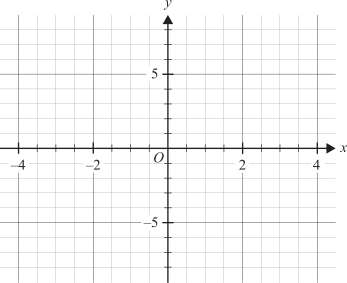
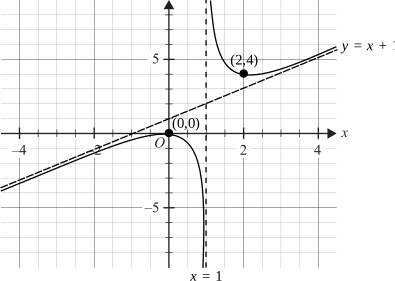
  2. Sketch the graph of  \(y=f(x)\)  for  \(k=1\)  on the set of axes below. Clearly label any turning points with their coordinates and label any asymptotes with their equations.   (3 marks)
     

--- 0 WORK AREA LINES (style=lined) ---

  1.  i. Find, in terms of \(k\), the equations of the asymptotes of the graph of  \(f(x)=\dfrac{x^2}{x-k}\).   (1 mark)

    --- 2 WORK AREA LINES (style=lined) ---

  2. ii. Find the distance between the two turning points of the graph of  \(f(x)=\dfrac{x^2}{x-k}\) in terms of \(k\).   (2 marks)

    --- 4 WORK AREA LINES (style=lined) ---

  3. Now consider the functions \(h\) and \(g\), where  \(h(x)=x+3\)  and  \(g(x)=\abs{\dfrac{x^2}{x-1}}\).
  4. The region bounded by the curves of \(h\) and \(g\) is rotated about the \(x\)-axis.
    1. Write down the definite integral that can be used to find the volume of the resulting solid.   (2 marks)

      --- 5 WORK AREA LINES (style=lined) ---
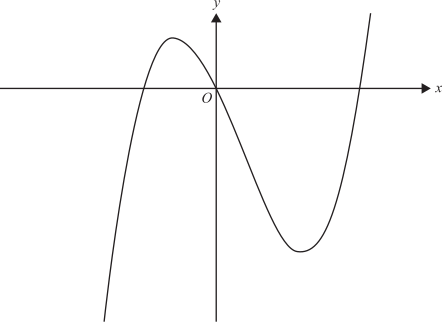
    2. Hence, find the volume of this solid. Give your answer correct to two decimal places.   (1 mark)

      --- 2 WORK AREA LINES (style=lined) ---

Show Answers Only

a.  \(\text {Asymptotes: } x=1,\  y=x+1\)

b.   
       

c.i.   \(\text {Asymptotes: } x=k,\  y=x+k\)

c.ii.  \(\text {Distance }=2 \sqrt{5}|k|\)

d.i.  \(\displaystyle V=\pi \int_{\frac{-\sqrt{7}-1}{2}}^{\frac{\sqrt{7}-1}{2}}(x+3)^2-\left(\frac{x^2}{x-1}\right)^2 dx\)

d.ii.  \(V=51.42\ \text{u}^3 \)

Show Worked Solution

a.    \(\text {When } k=1 :\)

\(f(x)=\dfrac{x^2}{x-1}=\dfrac{(x+1)(x-1)+1}{(x-1)}=x+1+\dfrac{1}{x-1}\)

\(\text {Asymptotes: } x=1,\  y=x+1\)
 

b.    


c.i. \(f(x)=\dfrac{x^2}{x-k}=\dfrac{(x+k)(x-k)+k^2}{x-k}=x+k+\dfrac{k^2}{x-k}\)

\(\text {Using part a.}\)

\(\text {Asymptotes: } x=k,\  y=x+k\)
 

c.ii.  \(f^{\prime}(x)=1-\left(\dfrac{k}{x-k}\right)^2\)

\(\text {TP’s when } f^{\prime}(x)=0 \text { (by CAS):}\)

\(\Rightarrow(2 k, 4 k),(0,0)\)

\(\text {Distance }\displaystyle=\sqrt{(2 k-0)^2+(4 k-0)^2}=\sqrt{20 k^2}=2 \sqrt{5}|k|\)
 

d.i  \(\text {Solve for intersection of graphs (by CAS):}\)

\(\displaystyle x+3=\left|\frac{x^2}{x-1}\right|\)

\(\displaystyle \Rightarrow x=\frac{3}{2}, x=\frac{-1 \pm \sqrt{7}}{2}\)

\(\displaystyle V=\pi \int_{\frac{-\sqrt{7}-1}{2}}^{\frac{\sqrt{7}-1}{2}}(x+3)^2-\left(\frac{x^2}{x-1}\right)^2 dx\)
 

d.ii. \(V=51.42\ \text{u}^3 \text{ (by CAS) }\)

♦♦ Mean mark (d)(ii) 37%.

Filed Under: Partial Fractions, Quotient and Other Functions (SM), Solids of Revolution Tagged With: Band 3, Band 4, Band 5, smc-1154-10-Quotient functions/Asymptotes, smc-1154-30-Absolute value, smc-1154-50-Sketch graph, smc-1180-40-Other graphs, smc-1180-50-x-axis rotations

Vectors, EXT2 V1 2022 SPEC2 12 MC

Consider the vectors  \(\underset{\sim}{\text{u}}(x)=-\text{cosec}(x) \underset{\sim}{\text{i}}+\sqrt{3} \underset{\sim}{\text{j}}\)  and  \(\underset{\sim}{\text{v}}(x)=\text{cos}(x) \underset{\sim}{\text{i}}+\underset{\sim}{\text{j}}\).

If \(\underset{\sim}{\text{u}}(x)\) is perpendicular to \(\underset{\sim}{\text{v}}(x)\), then possible values for \(x\) are

  1. \(\dfrac{\pi}{6}\) and \(\dfrac{7 \pi}{6}\)
  2. \(\dfrac{\pi}{3}\) and \(\dfrac{4 \pi}{3}\)
  3. \(\dfrac{5 \pi}{6}\) and \(\dfrac{11 \pi}{6}\)
  4. \(\dfrac{2 \pi}{3}\) and \(\dfrac{5 \pi}{3}\)
Show Answers Only

\(A\)

Show Worked Solution

\(\underset{\sim}{u} \perp \underset{\sim}{v} \ \Rightarrow \ \underset{\sim}{u} \cdot \underset{\sim}{v}=0\)

\(-\text{cosec}(x) \cos (x)+\sqrt{3}=0\)

\begin{aligned}
-\dfrac{\cos (x)}{\sin (x)}+\sqrt{3} & =0 \\
\tan (x) & =\dfrac{1}{\sqrt{3}}
\end{aligned}

\(x=\dfrac{\pi}{6}, \dfrac{7 \pi}{6}\)

\(\Rightarrow A\)

Filed Under: Basic Concepts and Arithmetic Tagged With: Band 4, smc-1195-30-Perpendicular Vectors

Vectors, SPEC2 2022 VCAA 12 MC

Consider the vectors  \(\underset{\sim}{\text{u}}(x)=-\text{cosec}(x) \underset{\sim}{\text{i}}+\sqrt{3} \underset{\sim}{\text{j}}\)  and  \(\underset{\sim}{\text{v}}(x)=\text{cos}(x) \underset{\sim}{\text{i}}+\underset{\sim}{\text{j}}\).

If \(\underset{\sim}{\text{u}}(x)\) is perpendicular to \(\underset{\sim}{\text{v}}(x)\), then possible values for \(x\) are

  1. \(\dfrac{\pi}{6}\) and \(\dfrac{7 \pi}{6}\)
  2. \(\dfrac{\pi}{3}\) and \(\dfrac{4 \pi}{3}\)
  3. \(\dfrac{5 \pi}{6}\) and \(\dfrac{11 \pi}{6}\)
  4. \(\dfrac{2 \pi}{3}\) and \(\dfrac{5 \pi}{3}\)
  5. \(\dfrac{\pi}{6}\) and \(\dfrac{5 \pi}{6}\)
Show Answers Only

\(A\)

Show Worked Solution

\(\underset{\sim}{u} \perp \underset{\sim}{v} \ \Rightarrow \ \underset{\sim}{u} \cdot \underset{\sim}{v}=0\)

\(-\text{cosec}(x) \cos (x)+\sqrt{3}=0\)

\begin{aligned}
-\dfrac{\cos (x)}{\sin (x)}+\sqrt{3} & =0 \\
\tan (x) & =\dfrac{1}{\sqrt{3}}
\end{aligned}

\(\text {Solve by (CAS)}: \ x=\dfrac{\pi}{6}, \dfrac{7 \pi}{6}\)

\(\Rightarrow A\)

Filed Under: Basic Concepts and Calculations Tagged With: Band 4, smc-1176-30-Perpendicular vectors

Vectors, SPEC2 2022 VCAA 11 MC

Consider the vectors  \(\underset{\sim}{\text{a}}=2 \underset{\sim}{\text{i}}-3 \underset{\sim}{\text{j}}+p \underset{\sim}{\text{k}}, \ \underset{\sim}{\text{b}}=\underset{\sim}{\text{i}}+2 \underset{\sim}{\text{j}}-q \underset{\sim}{\text{k}}\)  and  \(\underset{\sim}{\text{c}}=-3 \underset{\sim}{\text{i}}+2 \underset{\sim}{\text{j}}+5 \underset{\sim}{\text{k}}\), where \(p\) and \(q\) are real numbers.

If these vectors are linearly dependent, then

  1. \(8p=5q-35\)
  2. \(5p=8q-35\)
  3. \(8p=-5q-35\)
  4. \(8p=5q+35\)
  5. \(5p=8q+35\)
Show Answers Only

\(A\)

Show Worked Solution

\(\text{Linearly dependent when}\ \underset{\sim}{c}=m\underset{\sim}{a}+n\underset{\sim}{b}\)

\(\underset{\sim}{c}=-3 \underset{\sim}{i}+2 \underset{\sim}{j}+\underset{\sim}{k}\)

\(m\underset{\sim}{a}+n \underset{\sim}{b}=(2 m+n) \underset{\sim}{i}-(3 m-2 n) \underset{\sim}{j}+(m p-q n) \underset{\sim}{k}\)

\(\text{Equating co-efficients:}\)

  \(2 m+n=-3 \ \ldots\ (1)\) 

  \(-3 m+2 n=2\ \ldots\ (2)\)

  \(p m-q n=5\ \ldots\ (3)\)

\(\text{Solve (1) and (2) by CAS:}\)

  \(m=-\dfrac{8}{7}, n=-\dfrac{5}{7}\)

\(\text { Substitute } m,n \text { into (3): }\)

\begin{aligned}
-\dfrac{8}{7}\,p+\dfrac{5}{7}\,q & =5 \\
8 p & =5 q-35
\end{aligned}

\(\Rightarrow A\)

Filed Under: Basic Concepts and Calculations Tagged With: Band 4, smc-1176-50-Linear dependence

PHYSICS, M5 2020 VCE 8 MC

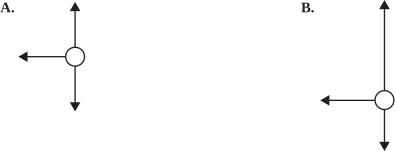
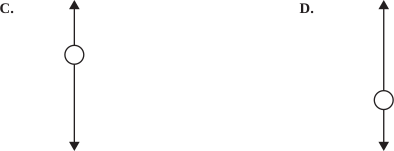
A ball is attached to the end of a string and rotated in a circle at a constant speed in a vertical plane, as shown in the diagram below.
 

The arrows in options \(\text{A}\). to \(\text{D}\). below indicate the direction and the size of the forces acting on the ball.

Ignoring air resistance, which one of the following best represents the forces acting on the ball when it is at the bottom of the circular path and moving to the left?
 

Show Answers Only

\(D\)

Show Worked Solution
  • There are only two forces acting on the ball, gravitational force directly down, and the centripetal force (string tension) directly towards the centre of the circular motion.
  • As the ball is following a circular path, the tension in the string is greater than the gravitational force acting on the ball.

\(\Rightarrow D\)

Mean mark 56%.

Filed Under: Circular Motion Tagged With: Band 4, smc-3691-10-Centripetal Forces

PHYSICS, M6 2020 VCE 5 MC

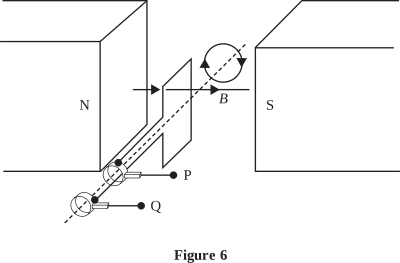
A coil consisting of 20 loops with an area of 10 cm\(^2\) is placed in a uniform magnetic field \(B\) of strength 0.03 T so that the plane of the coil is perpendicular to the field direction, as shown in the diagram below.
 

The magnetic flux through the coil is closest to

  1. 0 Wb
  2. 3.0 × 10\(^{-5}\) Wb
  3. 6.0 × 10\(^{-4}\) Wb
  4. 3.0 × 10\(^{-1}\) Wb
Show Answers Only

\(B\)

Show Worked Solution
  • Convert cm\(^2\) to m\(^2\): 1 cm\(^2\) = 0.01 m × 0.01 m = 0.0001 m\(^2\)
  • 10 cm\(^2\) = 0.0010 m\(^2\)
  • \(\Phi = BA = 0.03 \times 0.0010 = 3.0 \times 10^{-5}\ \text{Wb}\)

\(\Rightarrow B\)

Filed Under: Electromagnetic Induction Tagged With: Band 4, smc-3705-30-Magnetic Flux

PHYSICS, M6 2020 VCE 3-4 MC

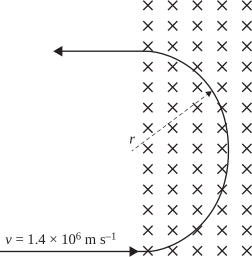
A positron with a velocity of 1.4 × 10\(^6\) m s\(^{-1}\) is injected into a uniform magnetic field of 4.0 × 10\(^{-2}\) T, directed into the page, as shown in the diagram below.

It moves in a vacuum in a semicircle of radius \(r\). The mass of the positron is 9.1 × 10\(^{-31}\) kg and the charge on the positron is 1.6 × 10\(^{-19}\) C. Ignore relativistic effects.


Question 3

Which one of the following best gives the speed of the positron as it exits the magnetic field?

  1. 0 m s\(^{-1}\)
  2. much less than 1.4 × 10\(^6\) m s\(^{-1}\)
  3. 1.4 × 10\(^6\) m s\(^{-1}\)
  4. greater than 1.4 × 10\(^6\) m s\(^{-1}\)


Question 4

The speed of the positron is changed to 7.0 × 10\(^5\) m s\(^{-1}\).

Which one of the following best gives the value of the radius \(r\) for this speed?

  1. \(\dfrac{r}{4}\)
  2. \(\dfrac{r}{2}\)
  3. \(r\)
  4. \(2 r\)
Show Answers Only

\(\text{Question 3:}\ C\)

\(\text{Question 4:}\ B\)

Show Worked Solution

Question 3

  • As the direction of the force is perpendicular to the velocity, the velocity will not change.
  • The velocity will be \(1.4 \times 10^6\ \text{ms}^{-1}\)

\(\Rightarrow C\)
 

Question 4

\(F_B\) \(=F_c\)  
\(qvB\) \(=\dfrac{mv^2}{r}\)  
\(r\) \(=\dfrac{mv}{qB}\)  
  •  Therefore, \(r \propto v\).
  • If the velocity is halved, the radius will also be halved.

\(\Rightarrow B\)

Filed Under: Charged Particles, Conductors and Electric/Magnetic Fields Tagged With: Band 4, smc-3693-15-Charged Particles in MF, smc-3693-65-Uniform Circular Motion

Functions, EXT1 F1 2023 MET1 7

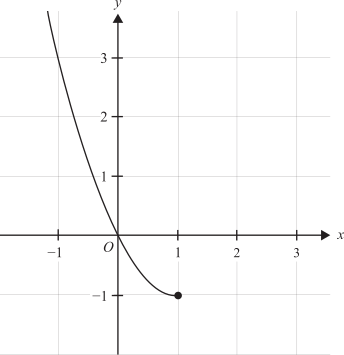
Consider \(f:(-\infty, 1]\rightarrow R, f(x)=x^2-2x\). Part of the graph of  \(y=f(x)\)  is shown below.
 

  1. State the range of \(f\).   (1 mark)

    --- 2 WORK AREA LINES (style=lined) ---

  2. Sketch the graph of the inverse function  \(y=f^{-1}(x)\) on the axes above. Label any endpoints and axial intercepts with their coordinates.   (2 marks)

    --- 0 WORK AREA LINES (style=lined) ---

  3. Determine the equation of the domain for the inverse function  \(f^{-1}\).   (2 marks)

    --- 3 WORK AREA LINES (style=lined) ---

Show Answers Only

a.    \([-1, \infty)\)

b.   

c.    \(f^{-1}(x)=1-\sqrt{x+1}\)

\(\text{Domain}\ [-1, \infty)\)

Show Worked Solution

a.    \([-1, \infty)\)

b.   

c.    \(\text{When }f(x)\ \text{is written in turning point form}\)

\(y=(x-1)^2-1\)
 

\(\text{Inverse function: swap}\ x \leftrightarrow y\)

\(x\) \(=(y-1)^2-1\)
\(x+1\) \(=(y-1)^2\)
\(-\sqrt{x+1}\) \(=y-1\)
\(f^{-1}(x)\) \(=1-\sqrt{x+1}\)

 
\(\text{Domain}\ [-1, \infty)\)


♦ Mean mark (c) 48%.
MARKER’S COMMENT: Common error → writing the function as \(f^{-1}(x)=1+\sqrt{x+1}\).

Filed Under: Inverse Functions (Ext1) Tagged With: Band 3, Band 4, Band 5, smc-1034-20-Other Functions

Calculus, 2ADV C4 2023 MET1 5

  1. Evaluate  \(\displaystyle \int_{0}^{\frac{\pi}{3}} \sin(x)\,dx\).   (1 mark)

    --- 3 WORK AREA LINES (style=lined) ---

  2. Hence, or otherwise, find all values of \(k\) such that \(\displaystyle \int_{0}^{\frac{\pi}{3}} \sin(x)\,dx=\displaystyle \int_{k}^{\frac{\pi}{2}} \cos(x)\,dx\), where \(-3\pi<k<2\pi\).   (3 marks)

    --- 6 WORK AREA LINES (style=lined) ---

Show Answers Only

a.    \(\dfrac{1}{2}\)

b.    \(k=\dfrac{-11\pi}{6},\ \dfrac{-7\pi}{6},\ \dfrac{\pi}{6},\ \dfrac{5\pi}{6}\)

Show Worked Solution
a.    \(\displaystyle \int_{0}^{\frac{\pi}{3}} \sin(x)\,dx\) \(=\left[-\cos x\right]_0^\frac{\pi}{3}\)
    \(=-\cos\dfrac{\pi}{3}+\cos 0\)
    \(=-\dfrac{1}{2}+1\)
    \(=\dfrac{1}{2}\)


b.    \(\displaystyle \int_{k}^{\frac{\pi}{2}} \cos(x)\,dx\) \(=\left[\sin x\right]_k^\frac{\pi}{2}\)
    \(=\sin\bigg(\dfrac{\pi}{2}\bigg)-\sin (k)\)
    \(=1-\sin (k)\)

 
\(\text{Using part (a):}\)

\(1-\sin (k)\) \(=\dfrac{1}{2}\)
\(\sin (k)\) \(=\dfrac{1}{2}\)
\(\therefore\ k\) \(=\dfrac{-11\pi}{6},\ \dfrac{-7\pi}{6},\ \dfrac{\pi}{6},\ \dfrac{5\pi}{6}\)

Filed Under: Trig Integration Tagged With: Band 4, smc-1204-10-Sin, smc-1204-20-Cos

PHYSICS, M7 2021 VCE 15

A photoelectric experiment is carried out by students. They measure the threshold frequency of light required for photoemission to be 6.5 × 10\(^{14}\) Hz and the work function to be 3.2 × 10\(^{-19}\) J.

Using the students' measurements, what value would they calculate for Planck's constant? Outline your reasoning and show all your working. Give your answer in joule-seconds.   (3 marks)

--- 6 WORK AREA LINES (style=lined) ---

Show Answers Only

\(h=4.9 \times 10^{-34}\ \text{J s}\)

Show Worked Solution

\(f=6.5 \times 10^{14}\ \text{Hz},\ \ E=3.2 \times 10^{-19}\ \text{J}\)

\(E=hf\ \ \Rightarrow\ \ h=\dfrac{E}{f}\)

\(\therefore h=\dfrac{3.2 \times 10^{-19}}{6.5 \times 10^{14}} = 4.92 \times 10^{-34}\ \text{J s}\)

Filed Under: Light: Quantum Model Tagged With: Band 4, smc-3698-10-Photoelectric Effect, smc-3698-30-E=hf calcs

Calculus, MET2 2022 VCAA 2

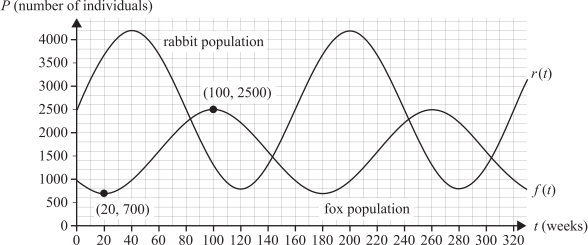
On a remote island, there are only two species of animals: foxes and rabbits. The foxes are the predators and the rabbits are their prey.

The populations of foxes and rabbits increase and decrease in a periodic pattern, with the period of both populations being the same, as shown in the graph below, for all `t \geq 0`, where time `t` is measured in weeks.

One point of minimum fox population, (20, 700), and one point of maximum fox population, (100, 2500), are also shown on the graph.

The graph has been drawn to scale.
 

The population of rabbits can be modelled by the rule `r(t)=1700 \sin \left(\frac{\pi t}{80}\right)+2500`.

  1.   i. State the initial population of rabbits.   (1 mark)

    --- 2 WORK AREA LINES (style=lined) ---

  2.  ii. State the minimum and maximum population of rabbits.   (1 mark)

    --- 2 WORK AREA LINES (style=lined) ---

  3. iii. State the number of weeks between maximum populations of rabbits.   (1 mark)

    --- 2 WORK AREA LINES (style=lined) ---

The population of foxes can be modelled by the rule `f(t)=a \sin (b(t-60))+1600`.

  1. Show that `a=900` and `b=\frac{\pi}{80}`.   (2 marks)

    --- 4 WORK AREA LINES (style=lined) ---

  2. Find the maximum combined population of foxes and rabbits. Give your answer correct to the nearest whole number.   (1 mark)

    --- 1 WORK AREA LINES (style=lined) ---

  3. What is the number of weeks between the periods when the combined population of foxes and rabbits is a maximum?   (1 mark)

    --- 1 WORK AREA LINES (style=lined) ---

The population of foxes is better modelled by the transformation of `y=\sin (t)` under `Q` given by
 

  1. Find the average population during the first 300 weeks for the combined population of foxes and rabbits, where the population of foxes is modelled by the transformation of `y=\sin(t)` under the transformation `Q`. Give your answer correct to the nearest whole number.   (4 marks)

    --- 8 WORK AREA LINES (style=lined) ---

Over a longer period of time, it is found that the increase and decrease in the population of rabbits gets smaller and smaller.

The population of rabbits over a longer period of time can be modelled by the rule

`s(t)=1700cdote^(-0.003t)cdot sin((pit)/80)+2500,\qquad text(for all)\ t>=0`

  1. Find the average rate of change between the first two times when the population of rabbits is at a maximum. Give your answer correct to one decimal place.   (2 marks)

    --- 3 WORK AREA LINES (style=lined) ---

  2. Find the time, where `t>40`, in weeks, when the rate of change of the rabbit population is at its greatest positive value. Give your answer correct to the nearest whole number.   (2 marks)

    --- 3 WORK AREA LINES (style=lined) ---

  3. Over time, the rabbit population approaches a particular value.
  4. State this value.   (1 mark)

    --- 1 WORK AREA LINES (style=lined) ---

Show Answers Only

ai.   `r(0)=2500`

aii.  Minimum population of rabbits `= 800`

Maximum population of rabbits `= 4200`

aiii. `160`  weeks

b.    See worked solution.

c.    `~~ 5339` (nearest whole number)

d.    Weeks between the periods is 160

e.    `~~ 4142` (nearest whole number)

f.    Average rate of change `=-3.6` rabbits/week (1 d.p.)

g.    `t = 156` weeks (nearest whole number)  

h.    ` s → 2500`

Show Worked Solution

ai.  Initial population of rabbits

From graph when `t=0, \ r(0) = 2500`

Using formula when `t=0`

`r(t)` `= 1700\ sin \left(\frac{\pi t}{80}\right)+2500`  
`r(0)` `= 1700\ sin \left(\frac{\pi xx 0}{80}\right)+2500 = 2500`  rabbits  


aii.
From graph,

Minimum population of rabbits `= 800`

Maximum population of rabbits `= 4200`

OR

Using formula

Minimum is when `t = 120`

`r(120) = 1700\ sin \left(\frac{\pi xx 120}{80}\right)+2500 = 1700 xx (-1) + 2500 = 800`

Maximum is when `t = 40`

`r(40) = 1700\ sin \left(\frac{\pi xx 40}{80}\right)+2500 = 1700 xx (1) + 2500 = 4200`

 
aiii. Number of weeks between maximum populations of rabbits `= 200-40 = 160`  weeks

 
b.  Period of foxes = period of rabbits = 160:

`frac{\2pi}{b} = 160`

`:.\  b = frac{\2pi}{160} = frac{\pi}{80}` which is the same period as the rabbit population.

Using the point `(100 , 2500)`

Amplitude when `b = frac{\pi}{80}`: 

`f(t)` `=a \ sin (pi/80(t-60))+1600`  
`f(100)` `= 2500`  
`2500` `= a \ sin (pi/80(100-60))+1600`  
`2500` `= a \ sin (pi/2)+1600`  
`a` `= 2500-1600 = 900`  

 
`:.\  f(t)= 900 \ sin (pi/80)(t-60) + 1600`


c.    Using CAS find `h(t) = f(t) + r(t)`:

`h(t):=900 \cdot \sin \left(\frac{\pi}{80} \cdot(t-60)\right)+1600+1700\cdot \sin \left(\frac{\pit}{80}\right) +2500`

  
`text{fMax}(h(t),t)|0 <= t <= 160`      `t = 53.7306….`
  

`h(53.7306…)=5339.46`

  
Maximum combined population `~~ 5339` (nearest whole number)


♦♦ Mean mark (c) 40%.
MARKER’S COMMENT: Many rounding errors with a common error being 5340. Many students incorrectly added the max value of rabbits to the max value of foxes, however, these points occurred at different times.

d.    Using CAS, check by changing domain to 0 to 320.

`text{fMax}(h(t),t)|0 <= t <= 320`     `t = 213.7305…`
 
`h(213.7305…)=5339.4568….`
 
Therefore, the number of weeks between the periods is 160.
  

e.    Fox population:

`t^{\prime} = frac{90}{pi}t + 60`   →   `t = frac{pi}{90}(t^{\prime}-60)`

`y^{\prime} = 900y+1600`   →   `y = frac{1}{900}(y^{\prime}-1600)`

`frac{y^{\prime}-1600}{900} = sin(frac{pi(t^{\prime}-60)}{90})`

`:.\  f(t) = 900\ sin\frac{pi}{90}(t-60) + 1600`

  
Average combined population  [Using CAS]   
  
`=\frac{1}{300} \int_0^{300} left(\900 \sin \left(\frac{\pi(t-60)}{90}\right)+1600+1700\ sin\ left(\frac{\pi t}{80}\right)+2500\right) d t`
  

`= 4142.2646…..  ~~ 4142` (nearest whole number)


♦ Mean mark (e) 40%.
MARKER’S COMMENT: Common incorrect answer 1600. Some incorrectly subtracted `r(t)`. Others used average rate of change instead of average value.

f.   Using CAS

`s(t):= 1700e^(-0.003t) dot\sin\frac{pit}{80} + 2500`
 

`text{fMax}(s(t),t)|0<=t<=320`        `x = 38.0584….`
 

`s(38.0584….)=4012.1666….`
 

`text{fMax}(s(t),t)|160<=t<=320`     `x = 198.0584….`
 

`s(198.0584….)=3435.7035….`
 

Av rate of change between the points

`(38.058 , 4012.167)`  and  `(198.058 , 3435.704)`

`= frac{4012.1666….-3435.7035….}{38.0584….-198.0584….} =-3.60289….`
 

`:.` Average rate of change `=-3.6` rabbits/week (1 d.p.)


♦ Mean mark (f ) 45%.
MARKER’S COMMENT: Some students rounded too early.
`frac{s(200)-s(40)}{200-40}` was commonly seen.
Some found average rate of change between max and min populations.

g.   Using CAS

`s^(primeprime)(t) = 0` , `t = 80(n-0.049) \ \forall n \in Z`

After testing `n = 1, 2, 3, 4` greatest positive value occurs for `n = 2` 

`t` `= 80(n-0.049)`  
  `= 80(2-0.049)`  
  `= 156.08`  

 
`:. \ t = 156` weeks (nearest whole number)


♦♦♦ Mean mark (g) 25%.
MARKER’S COMMENT: Many students solved `frac{ds}{dt}=0`.
A common answer was 41.8, as `s(156.11…)=41.79`.
Another common incorrect answer was 76 weeks.

h.   As `t → ∞`, `e^(-0.003t) → 0`

`:.\ s → 2500`

Filed Under: Average Value and Other, Differentiation (Trig), Maxima and Minima, Trig Differentiation Tagged With: Band 2, Band 4, Band 5, Band 6, smc-2757-10-Sin, smc-2757-80-Applications, smc-641-60-Other themes, smc-736-10-sin, smc-744-10-sin, smc-753-60-Matrix, smc-756-20-Trig

Calculus, MET2 2022 VCAA 1

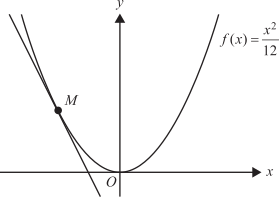
The diagram below shows part of the graph of `y=f(x)`, where `f(x)=\frac{x^2}{12}`.
 

  1. State the equation of the axis of symmetry of the graph of `f`.   (1 mark)

    --- 2 WORK AREA LINES (style=lined) ---

  2. State the derivative of `f` with respect to `x`.   (1 mark)

    --- 2 WORK AREA LINES (style=lined) ---

The tangent to `f` at point `M` has gradient `-2` .

  1. Find the equation of the tangent to `f` at point `M`.   (2 marks)

    --- 6 WORK AREA LINES (style=lined) ---

The diagram below shows part of the graph of `y=f(x)`, the tangent to `f` at point `M` and the line perpendicular to the tangent at point `M`.


  1.  i. Find the equation of the line perpendicular to the tangent passing through point `M`.   (1 mark)

    --- 5 WORK AREA LINES (style=lined) ---

  2. ii. The line perpendicular to the tangent at point `M` also cuts `f` at point `N`, as shown in the diagram above.
  3.     Find the area enclosed by this line and the curve `y=f(x)`.   (2 marks)

    --- 8 WORK AREA LINES (style=lined) ---

  4. Another parabola is defined by the rule `g(x)=\frac{x^2}{4 a^2}`, where `a>0`.
  5. A tangent to `g` and the line perpendicular to the tangent at `x=-b`, where `b>0`, are shown below.

  1. Find the value of `b`, in terms of `a`, such that the shaded area is a minimum.   (4 marks)

    --- 8 WORK AREA LINES (style=lined) ---

Show Answers Only

a.    `x=0`

b.    ` f^{\prime}(x)=1/6x`

c.    `x=-12`

di.    `y=1/2x + 18`

dii.   Area`= 375` units²

e.    `b = 2a^2`

Show Worked Solution

a.   Axis of symmetry:  `x=0`
  

b.    `f(x)`  `=\frac{x^2}{12}`  
  ` f^{\prime}(x)` `= 1/6x`  

  
c.  
At `M` gradient `= -2`

`1/6x` `= -2`  
`x` `= -12`  

 
When  `x = -12`
 

`f(x) = (-12)^2/12 = 12`
 
Equation of tangent at `(-12 , 12)`:

`y-y_1` `=m(x-x_1)`  
`y-12` `= -2(x + 12)`  
`y` `= -2x-12`  


d.i  
Gradient of tangent `= -2`

`:.`  gradient of normal `= 1/2` 

Equation at `M(- 12 , 12)`

`y -y_1` `=m(x-x_1)`  
`y-12` `= 1/2(x + 12)`  
`y` `=1/2x + 18`  


d.ii 
Points of intersection of `f(x)` and normal are at  `M` and `N`.

So equate ` y = x^2/12` and  `y = 1/2x + 18` to find `N`

`x^2/12` `=1/2x + 18`  
`x^2-6x-216` `=0`  
`(x + 12)(x-18)` `=0`  

   
`:.\  x = -12` or `x = 18`

Area `= \int_{-12}^{18}\left(\frac{1}{2} x+18-\frac{x^2}{12}\right) d x`  
  `= [x^2/4 + 18x-x^3/36]_(-12)^18`  
  `= [18^2/4 +18^2-18^3/36] – [12^2/4 + 18 xx (-12)-(-12)^3/36]`  
  `= 375` units²  


e.   `g(x) = x^2/(4a^2)`   `a > 0`

At `x = -b`   `y = (-b)^2/(4a^2) = b^2/4a^2`

`g^{\prime}(x) = (2x)/(4a^2) = x/(2a^2)`

Gradient of tangent `= (-b)/(2a^2)`

Gradient of normal `= (2a^2)/b`

Equation of normal at `(- b , b^2/(4a^2))`

`y-y_1` `= m(x-x_1)`  
`y-b^2/(4a^2)` `= (2a^2)/b(x-(-b))`  
`y` `= (2a^2x)/b + 2a^2 + b^2/(4a^2)`  
`y` `= (2a^2x)/b +(8a^4 + b^2)/(4a^2)`  

 
Points of intersection of normal and parabola (Using CAS)

solve `((2a^2x)/b +(8a^4 + b^2)/(4a^2) = x^2/(4a^2),x)`

`x =-b`  or  `x = (8a^4+b^2)/b`

 
Calculate area using CAS

`A = \int_{-b}^{(8a^4+b^2)/b}\left(\frac{2a^2x}{b} +\frac{8a^4 + b^2}{4a^2}-frac{x^2}{4a^2} \right) dx`

`A = frac{64a^12 + 48a^8b^2 + 12a^4b^4 + b^6}{3a^2b^3}`
 
Using CAS Solve derivative of `A = 0`  with respect to `b` to find `b`

solve`(d/(db)(frac{64a^12 + 48a^8b^2 + 12a^4b^4 + b^6}{3a^2b^3})=0,b)`

 
`b =-2a^2`   and  `b = 2a^2`

Given `b > 0`

`b = 2a^2`


♦♦ Mean mark (e) 33%.
MARKER’S COMMENT: Common errors: Students found `\int_{-b}^{\frac{8 a^4+b^2}{b}}\left(y_n\right) d x` and failed to subtract `g(x)` or had incorrect terminals.

Filed Under: Area Under Curves, Maxima and Minima, Tangents and Normals Tagged With: Band 2, Band 4, Band 5, Band 6, smc-634-10-Polynomial, smc-634-50-Find tangent given curve, smc-641-10-Area, smc-723-10-Quadratic, smc-723-80-Area between graphs

Calculus, MET2 2022 VCAA 16 MC

The function `f(x)=\frac{1}{3} x^3+m x^2+n x+p`, for `m, n, p \in R`, has turning points at `x=-3` and `x=1` and passes through the point (3, 4).

The values of `m, n` and `p` respectively are

  1. `m=0, \quad n=-\frac{7}{3}, p=2`
  2. `m=1, n=-3, \quad p=-5`
  3. `m=-1, n=-3, \quad p=13`
  4. `m=\frac{5}{4}, \quad n=\frac{3}{2}, \quad p=-\frac{83}{4}`
  5. `m=\frac{5}{2}, \quad n=6, \quad p=-\frac{91}{2}`
Show Answers Only

`B`

Show Worked Solution

For turning point `f^{\prime}(x) = 0`

`f(x)` `=\frac{1}{3} x^3 + mx^2 + nx + p`  
`:.\ f^{\prime}(x)` `= x^2-2mx+n`  
` f^{\prime}(- 3)` `= 9 – 6m + n`   …. (1)  
` f^{\prime}( 1)` `= 1 + 2m + n`   ….(2)  


Solving (1) and (2)     `9  –  6m + n`  `= 0`
  `1 + 2m + n` `= 0`

`m = 1`  and `n = – 3`

`:. \ f(x)=\frac{1}{3} x^3 + x^2- 3x + p`
  

The point `(3 , 4)` lies on the line

`4` `= \frac{1}{3} xx 3^3 +3^2- 3 xx 3 + p`  
`:. \ p` `= – 5 `  

 
`:. \ f(x)=\frac{1}{3} x^3 + x^2- 3x – 5`

→  `m=1, n=-3, \quad p=-5`
  
 `=>B`


Filed Under: The Derivative Function and its Graph Tagged With: Band 4, smc-2830-50-SP problems

Probability, MET2 2022 VCAA 14 MC

A continuous random variable, \(X\), has a probability density function given by
  

\(f(x)=\begin{cases}\dfrac{2}{9}xe^{-\frac{1}{9}x^2}         &\ \ x\geq 0 \\ \\ 0       &\ \ x<0 \\ \end{cases}\)
 

The expected value of \(X\), correct to three decimal places, is

  1. 1.000
  2. 2.659
  3. 3.730
  4. 6.341
  5. 9.000
Show Answers Only

\(B\)

Show Worked Solution
\(\text{E}(X) = \displaystyle\int_0^{\infty} \dfrac{2}{9} x^2 e^{-\frac{1}{9} x^2}\,dx\) \(\approx 2.65868\dots\)    [by CAS]  
   \(\approx 2.659\)  

  
\(\Rightarrow B\)

Filed Under: Probability density functions Tagged With: Band 4, smc-637-10-E(X)

Calculus, MET2 2022 VCAA 11 MC

If `\frac{d}{d x}(x \cdot \sin(x))=\sin (x)+x \cdot \cos(x)`, then `\frac{1}{k} \int x \ cos(x)dx` is equal to

  1. `k\left(x \cdot \sin (x)-\int \sin (x) d x\right)+c`
  2. `\frac{1}{k} x \cdot \sin (x)-\int \sin (x) d x+c`
  3. `\frac{1}{k}\left(x \cdot \sin (x)-\int \sin (x) d x\right)+c`
  4. `\frac{1}{k}(x \cdot \sin (x)-\sin (x))+c`
  5. `\frac{1}{k}\left(\int x \cdot \sin (x) d x-\int \sin (x) d x\right)+c`
Show Answers Only

`C`

Show Worked Solution

Given `\frac{d}{d x}(x \cdot \sin(x))=\sin (x)+x \cdot \cos(x)`, then

`x\cdot \cos (x)` `=\frac{d}{d x}(x\cdot \sin (x))-\sin (x)`  
`\frac{1}{k} \int x \cos (x) d x` `= \frac{1}{k}\left(\int \frac{d}{d x}(x \cdot \sin (x)) d x-\int \sin (x) d x\right)`  
  `= \frac{1}{k}\left(x \cdot \sin (x)-\int \sin (x)d x\right)+c`  

 
`=> C`

Filed Under: Integration (Trig), Trig Integration Tagged With: Band 4, smc-737-20-cos, smc-737-40-Integration by recognition, smc-747-20-cos, smc-747-50-Integration by recognition

Calculus, MET2 2022 VCAA 7 MC

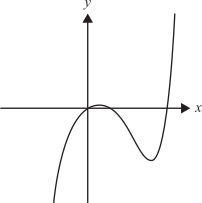
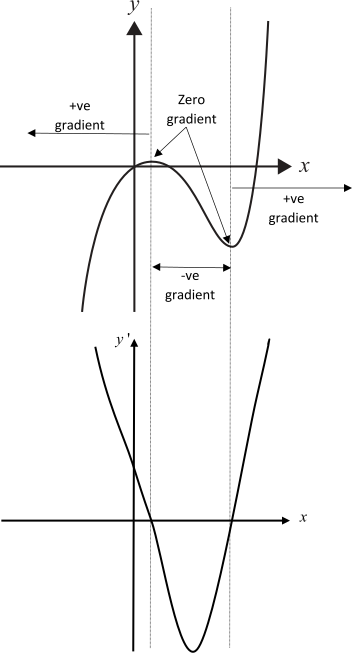
The graph of `y=f(x)` is shown below.
 

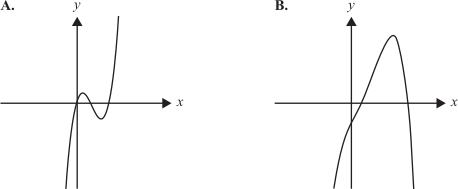
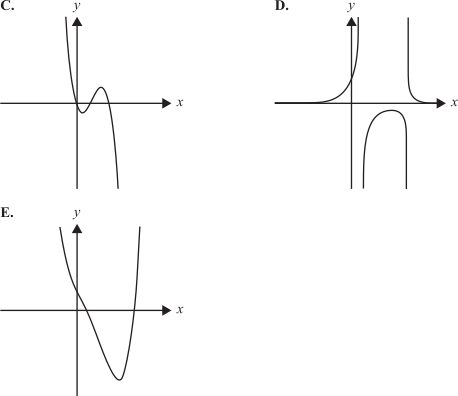
The graph of `y=f^{\prime}(x)`, the first derivative of `f(x)` with respect to `x` could be
 

Show Answers Only

`E`

Show Worked Solution

`=>E`

Filed Under: The Derivative Function and its Graph Tagged With: Band 4, smc-2830-20-Find f'(x) graph given f(x)

Functions, MET2 2022 VCAA 5 MC

The largest value of `a` such that the function `f:(-\infty, a] \rightarrow R, f(x)=x^2+3 x-10`, where `f` is one-to-one, is

  1. `-12.25`
  2. `-5`
  3. `-1.5`
  4. `0`
  5. `2`
Show Answers Only

`C`

Show Worked Solution
`f(x)` `= x^2+3 x-10`  
`f^{\prime}(x)` `= 2x + 3`  

  
Turning point when `f^{\prime}(x) = 0`

`\ 2x+3 = 0  \rightarrow  x = -3/2`

`:.\ a = – 1.5`

`=>C`

Filed Under: Polynomials Tagged With: Band 4, smc-750-60-Other

Graphs, MET2 2022 VCAA 4 MC

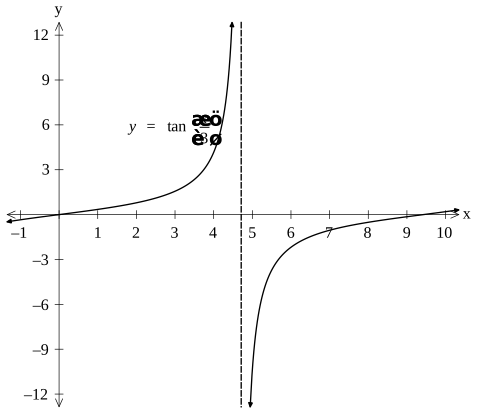
Which one of the following functions is not continuous over the interval `x \in[0,5]`?

  1. `f(x)=\frac{1}{(x+3)^2}`
  2. `f(x)=\sqrt{x+3}`
  3. `f(x)=x^{\frac{1}{3}}`
  4. `f(x)=\tan \left(\frac{x}{3}\right)`
  5. `f(x)=\sin ^2\left(\frac{x}{3}\right)`
Show Answers Only

`D`

Show Worked Solution

From graph `f(x)=\tan \left(\frac{x}{3}\right)` is not continuous for `x \in[0,5]`

Alternatively `f(x)=\tan \left(\frac{x}{3}\right)` is discontinuous when `x/3 = pi/2`

i.e. when `x = (3pi)/2 ~~ 4.71… <5`


`=>D`

Filed Under: Quotient and Other Graphs Tagged With: Band 4, smc-757-40-Domain/Range

Calculus, MET2 2022 VCAA 3 MC

The gradient of the graph of `y=e^{3 x}` at the point where the graph crosses the vertical axis is equal to

  1. 0
  2. `\frac{1}{e}`
  3. 1
  4. `e`
  5. 3
Show Answers Only

`E`

Show Worked Solution

Graph crosses vertical axis when `x = 0`

`y` `= e^(3x)`
`dy/dx` `= 3e^(3x)`


When `x = 0`,   `m = 3 xx e^(3 xx 0) = 3`
 

`=>E`

Filed Under: Tangents and Normals Tagged With: Band 4, smc-634-20-Log/Exp Function

PHYSICS, M7 2021 VCE 13

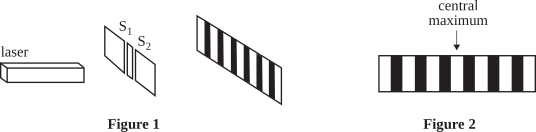
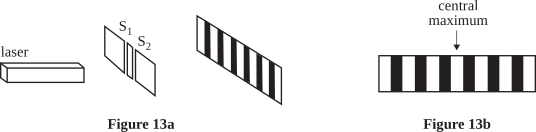
In Young's double-slit experiment, the distance between two slits, S\(_1\) and S\(_2\), is 2.0 mm. The slits are 1.0 m from a screen on which an interference pattern is observed, as shown in Figure 1. Figure 2 shows the central maximum of the observed interference pattern.
 

  1. If a laser with a wavelength of 620 nm is used to illuminate the two slits, what would be the distance between two successive dark bands? Show your working.   (2 marks)

--- 5 WORK AREA LINES (style=lined) ---
  1. Explain how this experiment supports the wave model of light.   (2 marks)

--- 5 WORK AREA LINES (style=lined) ---
Show Answers Only

a.    \(3.1 \times 10^{-4}\ \text{m}\)

b.    The experiment supports the wave theory as follows:

  • Young’s double slit experiment demonstrates how light will refract and form an interference pattern against a screen.
  • Since interference is a wave phenomenon, the experiment supports the wave model of light.

Show Worked Solution

a.    \(d\,\sin \theta=m \lambda\ \ \text{and}\ \ \sin \theta=\dfrac{\Delta x}{D}\)

  • \(\Delta x\) is the distance between two successive dark bands and \(D\) is the distance from the slits to the screen.
  •    \( \dfrac{d \Delta x}{D}\) \(=m \lambda \)
  •         \( \Delta x-\dfrac{D \lambda}{d} \)
  •              \(=\dfrac{1 \times 620 \times 10^{-9}}{2 \times 10^{-3}}\)
  •              \(=3.1 \times 10^{-4}\ \text{m}\)
♦ Mean mark (a) 51%.

b.    The experiment supports the wave theory as follows:

  • Young’s double slit experiment demonstrates how light will refract and form an interference pattern against a screen.
  • Since interference is a wave phenomenon, the experiment supports the wave model of light.

Filed Under: Light: Wave Model Tagged With: Band 4, Band 5, smc-3697-20-Young, smc-3697-30-Double Slit Calcs

PHYSICS, M7 2021 VCE 11

The diagram shows a system of two ideal polarising filters, \(\text{F}_1\) and \(\text{F}_2\), in the path of an initially unpolarised light beam. The polarising axis of the first filter, \(\text{F}_1\), is parallel to the \(y\)-axis and the polarising axis of the second filter, \(\text{F}_2\), is parallel to the \(x\)-axis.  

Will any light be observed at point \(\text{P}\)? Give your reasoning.  (2 marks)

--- 4 WORK AREA LINES (style=lined) ---

Show Answers Only
  • Light will initially pass through \(F_1\) and so will be polarised in the vertical plane with the intensity of the light will reducing to 50%.
  • \(F_2\) will polarise light in the horizontal direction, but as the light beam is already polarised in the vertical direction, none of the light will be able to pass through \(F_2\).
  • Therefore, there will be no light visible at \(P\).
Show Worked Solution
  • Light will initially pass through \(F_1\) and so will be polarised in the vertical plane with the intensity of the light will reducing to 50%.
  • \(F_2\) will polarise light in the horizontal direction, but as the light beam is already polarised in the vertical direction, none of the light will be able to pass through \(F_2\).
  • Therefore, there will be no light visible at \(P\).

Filed Under: Light: Wave Model Tagged With: Band 4, smc-3697-40-Polarisation

PHYSICS, M7 2021 VCE 10

A new spaceship that can travel at 0.7\(c\) has been constructed on Earth. A technician is observing the spaceship travelling past in space at 0.7\(c\), as shown in the diagram. The technician notices that the length of the spaceship does not match the measurement taken when the spaceship was stationary in a laboratory, but its width matches the measurement taken in the laboratory.

  1. Explain, in terms of special relativity, why the technician notices there is a different measurement for the length of the spaceship, but not for the width of the spaceship.   (2 marks)

--- 4 WORK AREA LINES (style=lined) ---

  1. If the technician measures the spaceship to be 135 m long while travelling at a constant 0.7\(c\), what was the length of the spaceship when it was stationary on Earth? Show your working.   (2 marks)

--- 4 WORK AREA LINES (style=lined) ---

Show Answers Only

a.    By Einstein’s theory of special relativity:

  • When travelling at high speeds, length contraction occurs.
  • Length contraction only occurs in the direction of motion thus the technician measures a different measurement for the length but not the width of the spaceship.

b.    \(l_o=189\ \text{m}\)

Show Worked Solution

a.    By Einstein’s theory of special relativity:

  • When travelling at high speeds, length contraction occurs.
  • Length contraction only occurs in the direction of motion thus the technician measures a different measurement for the length but not the width of the spaceship.
b.     \(l\) \(=l_0\sqrt{1-\frac{v^2}{c^2}}\)
  \(l_0\) \(=\dfrac{l}{\sqrt{1-\frac{v^2}{c^2}}}\)
    \(=\dfrac{135}{\sqrt{1-\frac{(0.7c)^2}{c^2}}}\)
    \(=\dfrac{135}{\sqrt{1-0.7^2}}\)
    \(=189\ \text{m}\)

Filed Under: Light and Special Relativity Tagged With: Band 4, smc-3699-20-Length Contraction

PHYSICS, M6 2021 VCE 6

The diagram shows a simple AC generator. A mechanical energy source rotates the loop smoothly at 50 revolutions per second and the loop generates a voltage of 6 V. The magnetic field, \(B\), is constant and uniform. The direction of rotation is as shown in the diagram.
 

  1. Sketch the output EMF between \(\text{P}\) and \(\text{Q}\) versus time, \(t\), on the grid below, starting with the loop in the position shown in the diagram. Show at least two complete revolutions.   (3 marks)
     

--- 0 WORK AREA LINES (style=blank) ---

  1. Describe the function of the slip rings shown in the diagram.   (1 mark)

--- 2 WORK AREA LINES (style=lined) ---

  1.  i. How could the AC generator shown be changed to a DC generator?   (1 mark)

  2. ii. Sketch the output EMF versus time, \(t\), for this DC generator.
  3.     Graph the output for at least two complete revolutions.   (2 marks)


--- 0 WORK AREA LINES (style=blank) ---

Show Answers Only

a.   


b.    The function of the slip rings:

  • Produce an AC voltage output by maintaining a constant connection between the loop and the external circuit.
     

c.i.   Changing the slip rings to a split ring commutator.

c.ii. 


Show Worked Solution

a.    \(\text{Period}\ (T)=\dfrac{1}{f}=\dfrac{1}{50}=0.02\ \text{s}\).

b.    The function of the slip rings:

  • Produce an AC voltage output by maintaining a constant connection between the loop and the external circuit.
♦ Mean mark (b) 54%.

c.i.   Changing the slip rings to a split ring commutator.
 

c.ii.  The output of a DC generator is positive only.


♦ Mean mark (c)(i) 55%.

Filed Under: Applications of the Motor Effect Tagged With: Band 4, Band 5, smc-3695-40-Generators

Calculus, SPEC2 2022 VCAA 9 MC

Euler's method is used to find an approximate solution to the differential equation  `\frac{d y}{d x}=2 x^2`.

Given that  `x_0=1, y_0=2`  and  `y_2=2.976`, the value of the step size `h` is

  1. 0.1
  2. 0.2
  3. 0.3
  4. 0.4
  5. 0.5
Show Answers Only

`B`

Show Worked Solution

`y_{n+1}=y_{n}+y_{n}^{\prime}*h`

`y_1=y_0+y_0^{′}*h = 2+2 xx 1^2 * h=2+2h`

`y_2=y_1+y_1^{′}*h = (2+2h)+2 xx (1+h)^2*h = 2h(1+h)^2+2(1+h)`

`text{Solve:}\ 2h(1+h)^2+2(1+h)=2.976,\ \text{for}\ h:`

`h=0.2`

`=>B`

Filed Under: Euler, Pseudocode and Slope Fields Tagged With: Band 4, smc-1183-10-Euler method

Calculus, SPEC2 2022 VCAA 8 MC

The direction field shown above best represents the differential equation

  1. `\frac{d y}{d x}=\frac{2 x}{y}`
  2. `\frac{d y}{d x}=-\frac{x}{2 y}`
  3. `\frac{d y}{d x}=-\frac{2 x}{y}`
  4. `\frac{d y}{d x}=\frac{y^2}{2}+x^2`
  5. `\frac{d y}{d x}=\frac{x^2}{2}+y^2`
Show Answers Only

`C`

Show Worked Solution

`text{Slope lines are vertical when}\ y=0\ \text{(eliminate D and E)}`

`text{Slope lines are negative in 1st/3rd quadrants (eliminate A)}`

`text{Consider slope at point (1, 1) ⇒ gradient close to –2.}`

`=>C`

Filed Under: Euler, Pseudocode and Slope Fields Tagged With: Band 4, smc-1183-20-Slope fields

Calculus, EXT2 C1 2022 SPEC2 7 MC

Using the substitution  `u=1+e^x, \int_0^{\log _e 2} \frac{1}{1+e^x}dx`  can be expressed as

  1. `\int_0^{\log _e 2}\left(\frac{1}{u-1}-\frac{1}{u}\right) du`
  2. `\int_2^3\left(\frac{1}{u}-\frac{1}{u-1}\right) du`
  3. `\int_1^3\left(\frac{1}{u}-\frac{1}{u-1}\right) du`
  4. `\int_2^3\left(\frac{1}{u-1}-\frac{1}{u}\right) du`
Show Answers Only

`D`

Show Worked Solution

`u=1+e^x\ \ =>\ \ \frac{du}{dx}=e^x\ \ =>\ \ dx=\frac{du}{e^x}=\frac{du}{u-1}`

`text{When}\ \ x=0,\ \ u=2`

`text{When}\ \ x=\log_e 2,\ \ u=1+e^{\log_e 2} = 3`

`\int_0^{\log _e 2} \frac{1}{1+e^x}dx = \int_2^3\left(\frac{1}{u}*\frac{1}{u-1}\right) du= \int_2^{1+e^2}\left(\frac{1}{u-1}-\frac{1}{u}\right) du`

`=>D`

Filed Under: Substitution and Harder Integration Tagged With: Band 4, smc-1057-30-Exponential, smc-1057-50-Substitution given

Calculus, SPEC2 2022 VCAA 7 MC

Using the substitution  `u=1+e^x, \int_0^{\log _e 2} \frac{1}{1+e^x}dx`  can be expressed as

  1. `\int_0^{\log _e 2}\left(\frac{1}{u-1}-\frac{1}{u}\right) du`
  2. `\int_2^3\left(\frac{1}{u}-\frac{1}{u-1}\right) du`
  3. `\int_1^3\left(\frac{1}{u}-\frac{1}{u-1}\right) du`
  4. `\int_2^3\left(\frac{1}{u-1}-\frac{1}{u}\right) du`
  5. `\int_2^{1+e^2}\left(\frac{1}{u-1}-\frac{1}{u}\right) du`
Show Answers Only

`D`

Show Worked Solution

`u=1+e^x\ \ =>\ \ \frac{du}{dx}=e^x\ \ =>\ \ dx=\frac{du}{e^x}=\frac{du}{u-1}`

`text{When}\ \ x=0,\ \ u=2`

`text{When}\ \ x=\log_e 2,\ \ u=1+e^{\log_e 2} = 3`

`\int_0^{\log _e 2} \frac{1}{1+e^x}dx = \int_2^3\left(\frac{1}{u}*\frac{1}{u-1}\right) du= \int_2^{1+e^2}\left(\frac{1}{u-1}-\frac{1}{u}\right) du`

`=>D`

Filed Under: Integration by Substitution (SM) Tagged With: Band 4, smc-2564-40-Logs and exponentials

Complex Numbers, SPEC2 2022 VCAA 6 MC

Given  `z=x+yi`, where `x, y \in R` and `z \in C`, an equation that has a graph that has two points of intersection with the graph given by  `|z-5|=2`  is

  1. `\text{Arg}(z-3)=\frac{\pi}{2}`
  2. `|z-1|=2`
  3. `\text{Im}(z)=2`
  4. `\text{Re}(z)+\text{Im}(z)=2`
  5. `|z-5-5 i|=4`
Show Answers Only

`E`

Show Worked Solution

`text{Using CAS, sketch all graphs together with the circle}\ |z-5|=2`

`|z-5-5 i|=4\ \ text{has 2 points of intersection.}`

`=>E`

Filed Under: Geometry and Complex Numbers (SM) Tagged With: Band 4, smc-1173-10-Circles

Complex Numbers, SPEC2 2022 VCAA 5 MC

Let  `z=x+yi`, where `x, y \in R` and `z \in C`.

If  `\text{Arg}(z-i)=\frac{3\pi}{4}`, which one of the following is true?

  1. `y=1-x, x<0`
  2. `y=1-x, x>0`
  3. `y=1+x`
  4. `y=1+x, x>0`
  5. `y=1+x, x<0`
Show Answers Only

`A`

Show Worked Solution

`\text{Arg}(z-i)=\frac{3\pi}{4}`

`\frac{y-1}{x}=tan (\frac{3pi}{4})`

`:.y=1-x, \ x<0`

`=>A`

Filed Under: Mod/Arg Form and Argand Diagrams (SM) Tagged With: Band 4, smc-2597-20-Cartesian to Mod/Arg

Calculus, MET2 2023 VCAA 3

Consider the function \(g:R \to R, g(x)=2^x+5\).

  1. State the value of \(\lim\limits_{x\to -\infty} g(x)\).   (1 mark)

    --- 1 WORK AREA LINES (style=lined) ---

  2. The derivative, \(g^{'}(x)\), can be expressed in the form \(g^{'}(x)=k\times 2^x\).
  3. Find the real number \(k\).   (1 mark)

    --- 2 WORK AREA LINES (style=lined) ---

  4.  i. Let \(a\) be a real number. Find, in terms of \(a\), the equation of the tangent to \(g\) at the point \(\big(a, g(a)\big)\).   (1 mark)

    --- 3 WORK AREA LINES (style=lined) ---

    ii. Hence, or otherwise, find the equation of the tangent to \(g\) that passes through the origin, correct to three decimal places.   (2 marks)

    --- 8 WORK AREA LINES (style=lined) ---

  1.  

Let \(h:R\to R, h(x)=2^x-x^2\).

  1. Find the coordinates of the point of inflection for \(h\), correct to two decimal places.   (1 mark)

    --- 2 WORK AREA LINES (style=lined) ---

  2. Find the largest interval of \(x\) values for which \(h\) is strictly decreasing.
  3. Give your answer correct to two decimal places.   (1 mark)

    --- 2 WORK AREA LINES (style=lined) ---

  4. Apply Newton's method, with an initial estimate of \(x_0=0\), to find an approximate \(x\)-intercept of \(h\).
  5. Write the estimates \(x_1, x_2,\) and \(x_3\) in the table below, correct to three decimal places.   (2 marks)
      

    \begin{array} {|c|c|}
    \hline
    \rule{0pt}{2.5ex} \qquad x_0\qquad \ \rule[-1ex]{0pt}{0pt} & \qquad \qquad 0 \qquad\qquad \\
    \hline
    \rule{0pt}{2.5ex} x_1 \rule[-1ex]{0pt}{0pt} &  \\
    \hline
    \rule{0pt}{2.5ex} x_2 \rule[-1ex]{0pt}{0pt} &  \\
    \hline
    \rule{0pt}{2.5ex} x_3 \rule[-1ex]{0pt}{0pt} &  \\
    \hline
    \end{array}

    --- 0 WORK AREA LINES (style=lined) ---

  6. For the function \(h\), explain why a solution to the equation \(\log_e(2)\times (2^x)-2x=0\) should not be used as an initial estimate \(x_0\) in Newton's method.   (1 mark)

    --- 3 WORK AREA LINES (style=lined) ---

  7. There is a positive real number \(n\) for which the function \(f(x)=n^x-x^n\) has a local minimum on the \(x\)-axis.
  8. Find this value of \(n\).   (2 marks)

    --- 5 WORK AREA LINES (style=lined) ---

Show Answers Only

a.    \(5\)

b.    \(\log_{e}{2}\ \ \text{or}\ \ \ln\ 2\)

ci.  \(y=2^a\ \log_{e}{(2)x}-(a\ \log_{e}{(2)}-1)\times2^a+5\)

\(\text{or}\ \ y=2^a\ \log_{e}{(2)x}-a\ 2^a\ \log_{e}{(2)}+2^a+5\)

cii. \(y=4.255x\)

d. \((2.06 , -0.07)\)

e. \([0.49, 3.21]\)

f. 

\begin{array} {|c|c|}
\hline
\rule{0pt}{2.5ex} \qquad x_0\qquad \ \rule[-1ex]{0pt}{0pt} & \qquad \qquad 0 \qquad\qquad \\
\hline
\rule{0pt}{2.5ex} x_1 \rule[-1ex]{0pt}{0pt} &  -1.433 \\
\hline
\rule{0pt}{2.5ex} x_2 \rule[-1ex]{0pt}{0pt} &  -0.897 \\
\hline
\rule{0pt}{2.5ex} x_3 \rule[-1ex]{0pt}{0pt} &  -0.773 \\
\hline
\end{array}

g. \(\text{See worked solution.}\)

h. \(n=e\)

Show Worked Solution

a.    \(\text{As }x\to -\infty,\ \ 2^x\to 0\)

\(\therefore\ 2^x+5\to 5\)
  

b.     \(g(x)\) \(=2^x+5\)
    \(=\Big(e^{\log_{e}{2}}\Big)^x\)
    \(=e\ ^{x\log_{e}{2}}+5\)
  \(g^{\prime}(x)\) \(=\log_{e}{2}\times e\ ^{x\log_{e}{2}}\)
     \(=\log_{e}{2}\times 2^x\)
  \(\therefore\ k\) \(=\log_{e}{2}\ \ \text{or}\ \ \ln\ 2\)
   
ci.  \(\text{Tangent at}\ (a, g(a)):\)

\(y-(2^a+5)\) \(=\log_{e}{2}\times2^a(x-a)\)
\(\therefore\ y\) \(=2^a\ \log_{e}{(2)x}-a\ 2^a\ \log_{e}{(2)}+2^a+5\)

♦♦ Mean mark (c)(i) 50%.

cii.  \(\text{Substitute }(0, 0)\ \text{into equation from c(i) to find}\ a\)

\( y\) \(=2^a\ \log_{e}{(2)x}-a\ 2^a\ \log_{e}{(2)}+2^a+5\)
\(0\) \(=2^a\ \log_{e}{(2)\times 0}-a\ 2^a\ \log_{e}{(2)}+2^a+5\)
\(0\) \(=-a\ 2^a\ \log_{e}{(2)}+2^a+5\)

  
\(\text{Solve for }a\text{ using CAS }\rightarrow\ a\approx 2.61784\dots\)

\(\text{Equation of tangent when }\ a\approx 2.6178\)

\( y\) \(=2^{2.6178..}\ \log_{e}{(2)x}+0\)
\(\therefore\  y\) \(=4.255x\)

♦♦♦ Mean mark (c)(ii) 30%.
MARKER’S COMMENT: Some students did not substitute (0, 0) into the correct equation or did not find the value of \(a\) and used \(a=0\).
d.     \(h(x)\) \(=2^x-x^2\)
  \(h^{\prime}(x)\) \(=\log_{e}{(2)}\cdot 2^x-2x\ \ \text{(Using CAS)}\)
  \(h^{”}(x)\) \(=(\log_{e}{(2)})^2\cdot 2^x-2\ \ \text{(Using CAS)}\)

\(\text{Solving }h^{”}(x)=0\ \text{using CAS }\rightarrow\ x\approx 2.05753\dots\)

\(\text{Substituting into }h(x)\ \rightarrow\ h(2.05753\dots)\approx-0.070703\dots\)

\(\therefore\ \text{Point of inflection at }(2.06 , -0.07)\ \text{ correct to 2 decimal places.}\)

e.    \(\text{From graph (CAS), }h(x)\ \text{is strictly decreasing between the 2 turning points.}\)

\(\therefore\ \text{Largest interval includes endpoints and is given by }\rightarrow\ [0.49, 3.21]\)


♦♦ Mean mark (e) 40%.
MARKER’S COMMENT: Round brackets were often used which were incorrect as endpoints were included. Some responses showed the interval where the function was strictly increasing.

f.    \(\text{Newton’s Method }\Rightarrow\  x_a-\dfrac{h(x_a)}{h'(x_a)}\) 

\(\text{for }a=0, 1, 2, 3\ \text{given an initial estimation for }x_0=0\)

\(h(x)=2x-x^2\ \text{and }h^{\prime}(x)=\ln{2}\times 2^x-2x\)

\begin{array} {|c|l|}
\hline
\rule{0pt}{2.5ex} \qquad x_0\qquad \ \rule[-1ex]{0pt}{0pt} & \qquad \qquad 0 \qquad\qquad \\
\hline
\rule{0pt}{2.5ex} x_1 \rule[-1ex]{0pt}{0pt} &  0-\dfrac{2^0-2\times 0}{\ln2\times 2^0\times 0}=-1.433 \\
\hline
\rule{0pt}{2.5ex} x_2 \rule[-1ex]{0pt}{0pt} &  -1.433-\dfrac{2^{-1.433}-2\times -1.433}{\ln2\times 2^{-1.433}\times -1.433}=-0.897 \\
\hline
\rule{0pt}{2.5ex} x_3 \rule[-1ex]{0pt}{0pt} &  -0.897-\dfrac{2^{-0.897}-2\times -0.897}{\ln2\times 2^{-0.897}\times -0.897}=-0.773 \\
\hline
\end{array}

g.    \(\text{The denominator in Newton’s Method is}\ h^{\prime}(x)=\log_{e}{(2)}\cdot 2^x-2x\)

\(\text{and the calculation will be undefined if }h^{\prime}(x)=0\ \text{as the tangent lines are horizontal}.\)

\(\therefore\ \text{The solution to }h^{\prime}(x)=0\ \text{cannot be used for }x_0.\)

♦♦♦ Mean mark (g) 20%.

h.    \(\text{For a local minimum }f(x)=0\)

\(\rightarrow\ n^x-x^n=0\)

\(\rightarrow\ n^x=x^n\ \ \ (1)\)

\(\text{Also for a local minimum }f^{\prime}(x)=0\)

\(\rightarrow\ \ln(n)\cdot n^x-nx^{n-1}=0\ \ \ (2)\)

\(\text{Substitute (1) into (2)}\)

\(\ln(n)\cdot x^n-nx^{n-1}=0\) 

\(x^n\Big(\ln(n)-\dfrac{n}{x}\Big)=0\)

\(\therefore\ x^n=0\ \text{or }\ \ln(n)=\dfrac{n}{x}\)

\(x=0\ \text{or }x=\dfrac{n}{\ln(n)}\)

\(\therefore\ n=e\)


♦♦♦ Mean mark (h) 10%.
MARKER’S COMMENT: Many students showed that \(f'(x)=0\) but failed to couple it with \(f(x)=0\). Ensure exact values are given where indicated not approximations.

Filed Under: Differentiation (L&E), Functional Equations, L&E Differentiation, Tangents and Normals Tagged With: Band 2, Band 4, Band 5, Band 6, smc-634-20-Log/Exp Function, smc-634-50-Find tangent given curve, smc-745-10-Exponential, smc-750-35-Newton's method

Trigonometry, EXT1 T2 2022 SPEC2 2 MC

The expression `1-\frac{4\sin^2(x)}{\tan^2(x)+1}` simplifies to

  1. `1-2\cos^2(2x)`
  2. `2\sin(2x)`
  3. `2\sin^2(2x)`
  4. `\cos^2(2x)`
Show Answers Only

`D`

Show Worked Solution
`1-\frac{4 \sin ^2 x}{\tan ^2 x+1}` `= 1-\frac{4 \sin ^2 x}{\sec ^2 x}`  
  `= 1-(2 \sin x\ \cos x)^2`  
  `= 1-\sin ^2 (2 x)`  
  `= \cos ^2 (2 x)`  

 
`=>D`

Filed Under: T2 Further Trigonometric Identities (Y11) Tagged With: Band 4, smc-1025-10-Double Angles

Algebra, SPEC2 2022 VCAA 2 MC

The expression `1-\frac{4\sin^2(x)}{\tan^2(x)+1}` simplifies to

  1. `sin(x) \cos(x)`
  2. `1-2\cos^2(2x)`
  3. `2\sin(2x)`
  4. `2\sin^2(2x)`
  5. `\cos^2(2x)`
Show Answers Only

`E`

Show Worked Solution
`1-\frac{4 \sin ^2 x}{\tan ^2 x+1}` `= 1-\frac{4 \sin ^2 x}{\sec ^2 x}`  
  `= 1-(2 \sin x\ \cos x)^2`  
  `= 1-\sin ^2 (2 x)`  
  `= \cos ^2 (2 x)`  

 
`=>E`

Filed Under: Trigonometry (SM) Tagged With: Band 4, smc-1150-40-Compound angles

Mechanics, EXT2 M1 2023 SPEC1 8

A body moves in a straight line so that when its displacement from a fixed origin `O` is `x` metres, its acceleration, `a`, is `-4 x \ text{ms}^{-2}`. The body accelerates from rest and its velocity, `v`, is equal to `-2 \ text{ms}^{-1}` as it passes through the origin. The body then comes to rest again.

Find `v` in terms of `x` for this interval.  (4 marks)

--- 9 WORK AREA LINES (style=lined) ---

Show Answers Only

` – 2sqrt(1-x^2)`

Show Worked Solution

`a = -4x`

`d/dx(1/2v^2)` `= -4x`  
`1/2v^2` `= -2x^2 +c`  

 
`v= -2\ \ \text{when}\ \ x = 0\ \ =>\ \ c = 2`

`v^2` `= -4x^2 + 4`  
`v^2` `= 4(1-x^2)`  

 
`v= -2\ \ text{when}\ \ x=0:`

`:.\ v` `= -sqrt(4(1-x^2))`  
  `= -2sqrt(1-x^2)`  

Filed Under: Motion Without Resistance Tagged With: Band 4, smc-1060-02-Motion as f(x), smc-1060-10-Polynomial

Calculus, SPEC1 2022 VCAA 8

A body moves in a straight line so that when its displacement from a fixed origin `O` is `x` metres, its acceleration, `a`, is `-4 x \ text{ms}^{-2}`. The body accelerates from rest and its velocity, `v`, is equal to `-2 \ text{ms}^{-1}` as it passes through the origin. The body then comes to rest again.

Find `v` in terms of `x` for this interval.  (4 marks)

--- 9 WORK AREA LINES (style=lined) ---

Show Answers Only

` – 2sqrt(1-x^2)`

Show Worked Solution

`a = -4x`

`d/dx(1/2v^2)` `= -4x`  
`1/2v^2` `= -2x^2 +c`  

 
`v= -2\ \ \text{when}\ \ x = 0\ \ =>\ \ c = 2`

`v^2` `= -4x^2 + 4`  
`v^2` `= 4(1-x^2)`  

 
`v= -2\ \ text{when}\ \ x=0:`

`:.\ v` `= -sqrt(4(1-x^2))`  
  `= -2sqrt(1-x^2)`  

Filed Under: Motion (SM) Tagged With: Band 4, smc-1159-20-Motion as f(x)

Vectors, EXT1 V1 2022 SPEC1 6b

`OPQ` is a semicircle of radius `a` with equation  `y=sqrt(a^(2)-(x-a)^(2))`. `P(x,y)` is a point on the semicircle `OPQ`, as shown below.

  1. Express the vectors `vec(OP)` and `vec(QP)` in terms of  `a`, `x`, `y`, `underset~i` and `underset~j`, where `underset~i` is a unit vector in the direction of the positive `x`-axis and `underset~j` is a unit vector in the direction of the positive `y`-axis.   (1 mark)

    --- 3 WORK AREA LINES (style=lined) ---

  2. Hence, using the vector scalar (dot) product, determine whether `vec(OP)` is perpendicular to `vec(QP)`.   (3 marks)

    --- 8 WORK AREA LINES (style=lined) ---

Show Answers Only

i.    `vec(OP)= xunderset~i + sqrt(a^2-(x-a)^2 underset~j`

`vec(QP)= (x-2a) underset~i + sqrt(a^2-(x-a)^2) underset~j`
 

ii.   `vec(OP)* vec(QP)` `=x(x-2a)+a^(2)-(x-a)^(2)`
  `=x^(2)-2ax+a^(2)-x^(2)+2ax-a^(2)`
  `= 0`

 
`:. vec(OP)\ \text{and}\ vec(QP)\ \text{are perpendicular.}`

Show Worked Solution

i.    `vec(OP)= xunderset~i + sqrt(a^2-(x-a)^2 underset~j`

`vec(QP)= (x-2a) underset~i + sqrt(a^2-(x-a)^2) underset~j`
 

ii.   `vec(OP)* vec(QP)` `=x(x-2a)+a^(2)-(x-a)^(2)`
  `=x^(2)-2ax+a^(2)-x^(2)+2ax-a^(2)`
  `= 0`

 
`:. vec(OP)\ \text{and}\ vec(QP)\ \text{are perpendicular.}`

Filed Under: Vectors and Geometry (Ext1) Tagged With: Band 4, smc-1211-10-Triangle, smc-1211-50-(Semi)circle

Vectors, SPEC1 2022 VCAA 6b

`OPQ` is a semicircle of radius `a` with equation  `y=sqrt(a^(2)-(x-a)^(2))`. `P(x,y)` is a point on the semicircle `OPQ`, as shown below.

  1. Express the vectors `vec(OP)` and `vec(QP)` in terms of  `a`, `x`, `y`, `underset~i` and `underset~j`, where `underset~i` is a unit vector in the direction of the positive `x`-axis and `underset~j` is a unit vector in the direction of the positive `y`-axis.   (1 mark)

    --- 3 WORK AREA LINES (style=lined) ---

  2. Hence, using the vector scalar (dot) product, determine whether `vec(OP)` is perpendicular to `vec(QP)`.   (3 marks)

    --- 8 WORK AREA LINES (style=lined) ---

Show Answers Only

i.    `vec(OP)= xunderset~i + sqrt(a^2-(x-a)^2 underset~j`

`vec(QP)= (x-2a) underset~i + sqrt(a^2-(x-a)^2) underset~j`
 

ii.   `vec(OP)* vec(QP)` `=x(x-2a)+a^(2)-(x-a)^(2)`
  `=x^(2)-2ax+a^(2)-x^(2)+2ax-a^(2)`
  `= 0`

 
`:. vec(OP)\ \text{and}\ vec(QP)\ \text{are perpendicular.}`

Show Worked Solution

i.    `vec(OP)= xunderset~i + sqrt(a^2-(x-a)^2 underset~j`

`vec(QP)= (x-2a) underset~i + sqrt(a^2-(x-a)^2) underset~j`
 

ii.   `vec(OP)* vec(QP)` `=x(x-2a)+a^(2)-(x-a)^(2)`
  `=x^(2)-2ax+a^(2)-x^(2)+2ax-a^(2)`
  `= 0`

 
`:. vec(OP)\ \text{and}\ vec(QP)\ \text{are perpendicular.}`

Filed Under: Vector Lines, Planes and Geometry Tagged With: Band 4, smc-1177-40-Triangles, smc-1177-45-(Semi)circles, smc-1177-50-2D problems

Calculus, EXT2 C1 2022 SPEC1 4

Find `int(3x^(2)+4x+12)/(x(x^(2)+4))\ dx`.   (4 marks)

--- 9 WORK AREA LINES (style=lined) ---

Show Answers Only

`3ln |x|+2tan^(-1)((x)/(2))+c`

Show Worked Solution

`text{Using partial fractions:}`

`(3x^(2)+4x+12)/(x(x^(2)+4))` `-=(A)/(x)+(Bx+C)/(x^(2)+4)`  
`3x^(2)+4x+12` `=A(x^(2)+4)+x(Bx+C)`  
`3x^(2)+4x+12` `=(A+B)x^(2)+Cx+4A`  

 
`4A=12\ \ =>\ \ A=3`

`C=4`

`A+B=3\ \ =>\ \ B=0`

`:.\int(3x^(2)+4x+12)/(x(x^(2)+4))\ dx` `=int(3)/(x)+(4)/(4+x^(2))\ dx`  
  `=3ln |x|+2tan^(-1)((x)/(2))+c`  
Mean mark 55%.

Filed Under: Partial Fractions Tagged With: Band 4, smc-1056-20-Cubic denom, smc-1056-40-PF not given

Calculus, SPEC1 2022 VCAA 4

Find `int(3x^(2)+4x+12)/(x(x^(2)+4))\ dx`.   (4 marks)

--- 9 WORK AREA LINES (style=lined) ---

Show Answers Only

`3ln |x|+2tan^(-1)((x)/(2))+c`

Show Worked Solution

`text{Using partial fractions:}`

`(3x^(2)+4x+12)/(x(x^(2)+4))` `-=(A)/(x)+(Bx+C)/(x^(2)+4)`  
`3x^(2)+4x+12` `=A(x^(2)+4)+x(Bx+C)`  
`3x^(2)+4x+12` `=(A+B)x^(2)+Cx+4A`  

 
`4A=12\ \ =>\ \ A=3`

`C=4`

`A+B=3\ \ =>\ \ B=0`

`:.\int(3x^(2)+4x+12)/(x(x^(2)+4))\ dx` `=int(3)/(x)+(4)/(4+x^(2))\ dx`  
  `=3ln |x|+2tan^(-1)((x)/(2))+c`  
Mean mark 55%.

Filed Under: Partial Fractions and Other Integration (SM) Tagged With: Band 4, smc-2565-20-Cubic denom, smc-2565-60-PF not given

Calculus, EXT1 C3 2022 SPEC1 2

Solve the differential equation  `(dy)/(dx) = -x sqrt(4-y^2)`  given that  `y(2) = 0`. Give your answer in the form  `y = f(x)`.   (3 marks)

--- 7 WORK AREA LINES (style=lined) ---

Show Answers Only

`y=2sin(-(1)/(2)x^(2)+2)`

Show Worked Solution
`int(dy)/(sqrt(4-y^(2)))` `=int-x\ dx`  
`sin^(-1)((y)/(2))` `=-(1)/(2)x^(2)+c`  

 
`y(2)=0\ \=> \ c=2`

`(y)/(2)` `=sin(-(1)/(2)x^(2)+2)`  
`y` `=2sin(-(1)/(2)x^(2)+2)`  

Filed Under: Equations and Slope Fields Tagged With: Band 4, smc-1197-30-dy/dx = f(x y)

  • « Previous Page
  • 1
  • …
  • 37
  • 38
  • 39
  • 40
  • 41
  • …
  • 114
  • Next Page »

Copyright © 2014–2025 SmarterEd.com.au · Log in