SmarterEd

Aussie Maths & Science Teachers: Save your time with SmarterEd

  • Login
  • Get Help
  • About

CHEMISTRY, M4 EQ-Bank 31

Define Hess's Law with reference to reaction pathways and changes in enthalpy.   (2 marks)

--- 4 WORK AREA LINES (style=lined) ---

Show Answers Only
  • The enthalpy change in a chemical reaction between the reactants and products is constant, regardless of the number of pathways or chemical reactions undertaken to get from the reactants to the products.
Show Worked Solution
  • The enthalpy change in a chemical reaction between the reactants and products is constant, regardless of the number of pathways or chemical reactions undertaken to get from the reactants to the products.

Filed Under: Enthalpy and Hess's Law Tagged With: Band 4, smc-4267-10-Hess's Law in energy cycles

BIOLOGY, M4 EQ-Bank 35

"The thylacine was declared extinct in 1982, 50 years after it's last record. It is believed multiple factors influenced it's decline and extinction including competition with wild dogs, erosion of its habitat, the concurrent extinction of its prey and a distemper-like disease which affected many captive specimens at the time".

Using the extract above, outline measures that could have been implemented to save the thylacine.   (4 marks)

Show Answers Only
  • If European settlers researched the implication of introducing dogs into Australia then their numbers may be reduced or may have not been introduced at all, and a better alternative would have been found.
  • Introducing mulch and vegetation would have reduced erosion, better preserving thylacine habitats.
  • The concurrent extinction of it’s prey would have contributed to the thylacines extinction due to the reduction of it’s food source. By protecting prey species through strategies such as reducing the erosion in the habitat, breeding programs and legal protection can subsequently save the thylacine.
  • Better monitoring and research surrounding the disease which affected captive specimens may have prevented it’s extreme impact on the thylacine and perhaps many other species.
Show Worked Solution
  • If European settlers researched the implication of introducing dogs into Australia then their numbers may be reduced or may have not been introduced at all, and a better alternative would have been found.
  • Introducing mulch and vegetation would have reduced erosion, better preserving thylacine habitats.
  • The concurrent extinction of it’s prey would have contributed to the thylacines extinction due to the reduction of it’s food source. By protecting prey species through strategies such as reducing the erosion in the habitat, breeding programs and legal protection can subsequently save the thylacine.
  • Better monitoring and research surrounding the disease which affected captive specimens may have prevented it’s extreme impact on the thylacine and perhaps many other species.

Filed Under: Population Dynamics Tagged With: Band 4, smc-4311-50-Extinction

ENGINEERING, TE 2023 HSC 23d

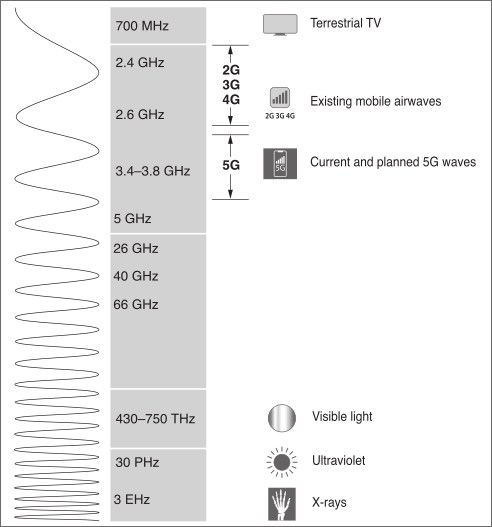
The diagram shows the relative placement of 4G and 5G telecommunication bands within the electromagnetic spectrum.
 

With reference to the diagram, explain why 5G networks need more cellular antennae and closer positioning of antennae than 4G networks.   (3 marks)

--- 6 WORK AREA LINES (style=lined) ---
Show Answers Only

  • The diagram shows that 5G networks use shorter wavelengths and are subsequently on a higher frequency bandwidth than 4G networks.
  • The short wavelength means that the signal cannot travel as far as the signal in the 4G Network.
  • Given that there is shorter signal range and the signal cannot travel as far there needs to be antennae positioned closer together.
  • Since the antennae are closer together, they require more antennae to cover the same distances.

Show Worked Solution

  • The diagram shows that 5G networks use shorter wavelengths and are subsequently on a higher frequency bandwidth than 4G networks.
  • The short wavelength means that the signal cannot travel as far as the signal in the 4G Network.
  • Given that there is shorter signal range and the signal cannot travel as far there needs to be antennae positioned closer together.
  • Since the antennae are closer together, they require more antennae to cover the same distances.

Filed Under: Electricity/Electronics Tagged With: Band 4, smc-3730-20-Telephony

ENGINEERING, TE 2023 HSC 23c

How are insulating materials used in the telecommunications industry? Include an example in your answer.   (3 marks)

--- 6 WORK AREA LINES (style=lined) ---

Show Answers Only

  • In the telecommunications industry, insulating materials act as a barrier to prevent the flow of electrical current to unintended paths or surfaces, thus ensuring electrical safety and environmental protection.
  • An example is polyethylene which is a versatile polymer used for cable insulation and sheathing due to its insulation characteristics, temperature resistance, and durability.

Other answers could include:

  • Epoxy resin on printed circuit board.
  • Polymer casing for telecommunication devices.

Show Worked Solution

  • In the telecommunications industry, insulating materials act as a barrier to prevent the flow of electrical current to unintended paths or surfaces, thus ensuring electrical safety and environmental protection.
  • An example is polyethylene which is a versatile polymer used for cable insulation and sheathing due to its insulation characteristics, temperature resistance, and durability.

Other answers could include:

  • Epoxy resin on printed circuit board.
  • Polymer casing for telecommunication devices.
Mean mark 59%.

Filed Under: Materials Tagged With: Band 4, smc-3729-15-Insulation/Polymers

ENGINEERING, TE 2023 HSC 23b

Describe the responsibilities of the engineer when considering security issues of telecommunications devices.   (3 marks)

--- 6 WORK AREA LINES (style=lined) ---

Show Answers Only

Engineer responsibilities:

  • Ensuring the ongoing integrity of telecommunications networks.
  • Designing and implementing the integration of service devices.
  • Ensure consumer data is protected and cannot be intercepted by others.

Answers could also include:

  • Providing threat analysis.
  • Keeping device software up to date so that they are protected from viruses.
  • Design and implementation of protective protocols into the devices such as encryption and password protection.

Show Worked Solution

Engineer responsibilities:

  • Ensuring the ongoing integrity of telecommunications networks.
  • Designing and implementing the integration of service devices.
  • Ensure consumer data is protected and cannot be intercepted by others.

Answers could also include:

  • Providing threat analysis.
  • Keeping device software up to date so that they are protected from viruses.
  • Design and implementation of protective protocols into the devices such as encryption and password protection.

Filed Under: Scope, Historical and Societal Influences Tagged With: Band 4, smc-3728-10-Professional scope, smc-3728-40-Safety/Environment

ENGINEERING, PPT 2023 HSC 23a

Draw the symbols which match the electronic components named in the table.   (3 marks)
 

--- 0 WORK AREA LINES (style=lined) ---

Show Answers Only
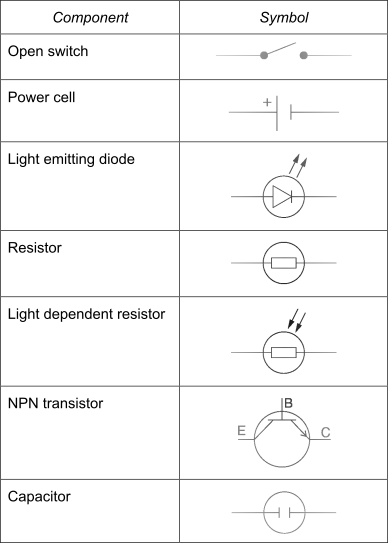
Show Worked Solution

Mean mark 57%.

Filed Under: Electricity/Electronics Tagged With: Band 4, page-break-before-question, smc-3720-20-Circuit diagrams

ENGINEERING, CS 2023 HSC 22b

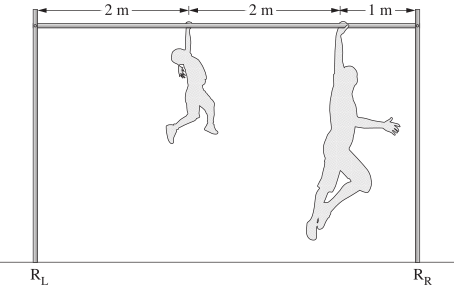
The diagram shows a child with a mass of 45 kg hanging 2 metres from the left end of a structure, and an adult with a mass of 85 kg hanging 1 metre from the right end.


  1. Calculate the reactions at \(\text{R}_\text{L}\) and \(\text{R}_\text{R}\).   (3 marks)
      

\begin{array} {ll}
\text{R}_\text{L} = \text{............................... N} & \text{Direction ...............................} \\
 &  \\
\text{R}_\text{R} = \text{............................... N} & \text{Direction ...............................} \end{array}
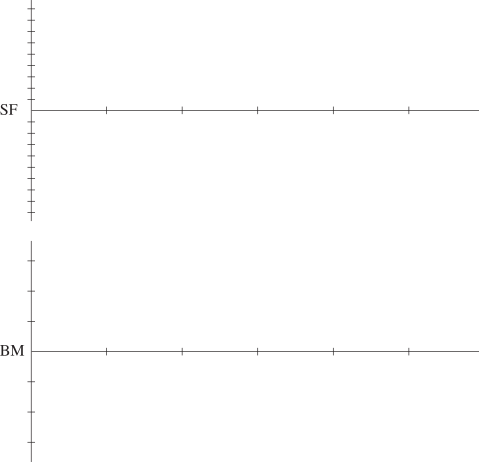
 

  1. Complete the shear force and bending moment diagrams of the scenario described.   (3 marks)


Show Answers Only

i.    \( \text{R}_{\text{L}}=860\ \text{N} \uparrow \)

\( \text{R}_{\text{L}}= 440\ \text{N} \uparrow \)

  
ii.    

Show Worked Solution

i.    \(  \stackrel {\curvearrowright} {\sum{ \text{M}}{^{+}_\text{L}}}: \)

\(0\) \(=(2 \times 450)+(4 \times 850)-(\text{R}_\text{R} \times 5) \)  
\(5 \times \text{R}_\text{R}\) \(=900 + 3400\)  
\(\text{R}_\text{R}\) \(=860\ \text{N} \uparrow \)  


\( \sum \text{F}_\text{V} \uparrow:\)

\(0\) \(= -450-850+860+\text{R}_\text{L} \)  
\( \text{R}_{\text{L}}\) \(= 440\ \text{N} \uparrow \)  

 
ii.    

Filed Under: Engineering Mechanics Tagged With: Band 3, Band 4, smc-3714-10-Truss analysis, smc-3714-20-Bending stress, smc-3714-30-Shear force diagram, smc-3714-40-Bending moment diagram

ENGINEERING, CS 2023 HSC 22a

Previously, children's playground structures were constructed from 'treated pine' logs. The logs were treated with a copper chromium arsenate (CCA) solution which resisted fungi, insect attack and decay.

  1. Outline why new materials are being used to replace CCA treated logs in children's playground structures.   (2 marks)

    --- 4 WORK AREA LINES (style=lined) ---

  2. Justify a suitable material to use for a playground structure which will be exposed to the weather at all times.   (3 marks)

    --- 6 WORK AREA LINES (style=lined) ---

Show Answers Only

i.     CCA materials contain arsenic.

  • Arsenic is a carcinogen/poison and not considered suitable for use in children’s playground structures.
  • Other modern plastic materials also have superior characteristics for playground use including better resistance to insect attack and improved traction. 

ii.   Compact Laminate is suitable material.

  • It is made of softwood and phenolic binder provides excellent stability over time and good abrasion resistance.

Other possible answers include:

  • Finished hardwood: resistant to corrosion and degradation in bright sunlight while also being very tough and wear resistant.
  • UV stabilised High Density Polyethylene: Provides bright colours, formability of complex shapes and low maintenance.
  • Stainless Steel: Provides good corrosion resistance, strength and wear resistance.
  • UV Stabilised ABS: Strong and light with excellent water resistance.

Show Worked Solution

i.   CCA materials contain arsenic.

  • Arsenic is a carcinogen/poison and not considered suitable for use in children’s playground structures.
  • Other modern plastic materials also have superior characteristics for playground use including better resistance to insect attack and improved traction.  

ii.   Compact Laminate is suitable material.

  • It is made of softwood and phenolic binder provides excellent stability over time and good abrasion resistance.

Other possible answers include:

  • Finished hardwood: resistant to corrosion and degradation in bright sunlight while also being very tough and wear resistant.
  • UV stabilised High Density Polyethylene: Provides bright colours, formability of complex shapes and low maintenance.
  • Stainless Steel: Provides good corrosion resistance, strength and wear resistance.
  • UV Stabilised ABS: Strong and light with excellent water resistance.

Filed Under: Engineering Materials Tagged With: Band 4, smc-3715-60-Laminates, smc-3715-68-Other materials/composites

BIOLOGY, M4 EQ-Bank 10 MC

Volcanic eruptions emit toxic gases and high heat lava flows, surrounding areas in a layer of ash. Over time, the ash breaks down and creates very fertile soils.

Which of the following statements correctly describes a volcanic eruptions effect on the surrounding ecosystem?

  1. It promotes biodiversity in the short term.
  2. It acts as a negative biotic selection pressure in the long term.
  3. It acts as a positive abiotic selection pressure to plants in the long term.
  4. It acts as a positive abiotic selection pressure to all organisms in the short term.
Show Answers Only

\(C\)

Show Worked Solution
  • They break down of volcanic ash into fertile soil can expand previous plant habitats or even create an entirely new plant habitat.

\(\Rightarrow C\)

Filed Under: Population Dynamics Tagged With: Band 4, smc-4311-20-Biotic/Abiotic factors

BIOLOGY, M2 EQ-Bank 31

What is the advantage of having a higher density of stomata on the bottom side of the leaf for most plants?   (3 marks)

--- 6 WORK AREA LINES (style=lined) ---

Show Answers Only
  • Stomata are the pores that appear on the leaf and are responsible for transpiration, i.e. the diffusion of water vapour out of the cell.
  • By having stomata on the underside of the leaf, water won’t be caught on top of the leaf when transpiration occurs.
  • Having stomata pointing down also increases the effectiveness of transpiration by the assistance of gravity.
Show Worked Solution
  • Stomata are the pores that appear on the leaf and are responsible for transpiration, i.e. the diffusion of water vapour out of the cell.
  • By having stomata on the underside of the leaf, water won’t be caught on top of the leaf when transpiration occurs.
  • Having stomata pointing down also increases the effectiveness of transpiration by the assistance of gravity.

Filed Under: Transport Tagged With: Band 4, smc-4306-30-Plants

BIOLOGY, M2 EQ-Bank 30

Red and white blood cells are critical components of human blood with very different functions.

  1. Describe the structure and role of red blood cells.   (3 marks)

    --- 7 WORK AREA LINES (style=lined) ---

  2. Describe the the role of white blood cells and platelets.   (2 marks)

    --- 5 WORK AREA LINES (style=lined) ---

Show Answers Only

a.    Red blood cells:

  • Red blood cells (RBCs) make up 40-50% of total blood volume and transport oxygen and carbon dioxide throughout the body.
  • They are able to achieve this by haemoglobin, a globular protein consisting of 4 polypeptide chains and iron. Haemoglobin’s structure allows each of its proteins to carry 4 molecules of oxygen and 4 molecules of carbon dioxide.
  • RBCs are specialised cells and have no nucleus which allows them to carry more haemoglobin, and therefore more oxygen, around the body. 

b.   White blood cells and platelets:

  • Platelets are small membrane bound cell fragments derived from bone marrow. They are involved in initiating blood clotting.
  • White blood cells (leucocytes) are involved in internal defence.
  • This can include antibody production (B cells), mediating allergic responses (eosinophils) and fighting inflammation (basophils).
Show Worked Solution

a.    Red blood cells:

  • Red blood cells (RBCs) make up 40-50% of total blood volume and transport oxygen and carbon dioxide throughout the body.
  • They are able to achieve this by haemoglobin, a globular protein consisting of 4 polypeptide chains and iron. Haemoglobin’s structure allows each of its proteins to carry 4 molecules of oxygen and 4 molecules of carbon dioxide.
  • RBCs are specialised cells and have no nucleus which allows them to carry more haemoglobin, and therefore more oxygen, around the body. 

b.   White blood cells and platelets:

  • Platelets are small membrane bound cell fragments derived from bone marrow. They are involved in initiating blood clotting.
  • White blood cells (leucocytes) are involved in internal defence.
  • This can include antibody production (B cells), mediating allergic responses (eosinophils) and fighting inflammation (basophils).

Filed Under: Transport Tagged With: Band 3, Band 4, smc-4306-10-Blood

CHEMISTRY, M3 EQ-Bank 7

Explain the role of a catalyst in altering the rate of a reaction.   (2 marks)

--- 4 WORK AREA LINES (style=lined) ---

Show Answers Only
  • A catalyst increases the rate of a reaction by providing an alternate reaction pathway with a lower activation energy \((\text{E}_{a})\), and does not undergo any permanent chemical change in this process.
  • This means the threshold kinetic energy \((\text{E}_{a})\) for a successful collision between particles is lowered.
  • This leads to more successful collisions and an increase in reaction rate.
Show Worked Solution
  • A catalyst increases the rate of a reaction by providing an alternate reaction pathway with a lower activation energy \((\text{E}_{a})\), and does not undergo any permanent chemical change in this process.
  • This means the threshold kinetic energy \((\text{E}_{a})\) for a successful collision between particles is lowered.
  • This leads to more successful collisions and an increase in reaction rate.

Filed Under: Rates of Reactions Tagged With: Band 4, smc-4265-50-Catalysts

CHEMISTRY, M3 EQ-Bank 8

Collision Theory is a principle of chemistry that can be used to predict the rates of chemical reactions.

Explain how this theory works with reference to an increase in reactant concentration and a decrease in temperature.   (4 marks)

--- 8 WORK AREA LINES (style=lined) ---

Show Answers Only
  • Collision Theory states that for a chemical reaction to occur, reactant particles must collide. A reaction will then only proceed if:
    • Particles collide with sufficient energy \((\text{E}_\text{a}) \)
    • Particles collide with the proper orientation
  • All reactions have a certain amount of particles colliding and exceeding \(\ce{E_{a}}\) which defines the reaction rate. Increasing the rate is achieved through increasing the amount of successful collisions.

Increase in reactant concentration:

  • Increases the number of reactant particles.
  • This increases the number of collisions, which leads to more successful collisions and a higher reaction rate.

Decrease in temperature

  • Decreases the kinetic energy of colliding particles.
  • As the kinetic energy of particles is decreased, they are less likely to exceed the \(\ce{E_{a}}\) required for a successful collision and a lower reaction rate results.
Show Worked Solution
  • Collision Theory states that for a chemical reaction to occur, reactant particles must collide. A reaction will then only proceed if:
    • Particles collide with sufficient energy \((\text{E}_\text{a}) \)
    • Particles collide with the proper orientation
  • All reactions have a certain amount of particles colliding and exceeding \(\ce{E_{a}}\) which defines the reaction rate. Increasing the rate is achieved through increasing the amount of successful collisions.

Increase in reactant concentration:

  • Increases the number of reactant particles.
  • This increases the number of collisions, which leads to more successful collisions and a higher reaction rate.

Decrease in temperature

  • Decreases the kinetic energy of colliding particles.
  • As the kinetic energy of particles is decreased, they are less likely to exceed the \(\ce{E_{a}}\) required for a successful collision and a lower reaction rate results.

Filed Under: Rates of Reactions Tagged With: Band 4, smc-4265-30-Temperature, smc-4265-40-Concentration

CHEMISTRY M3 EQ-Bank 6

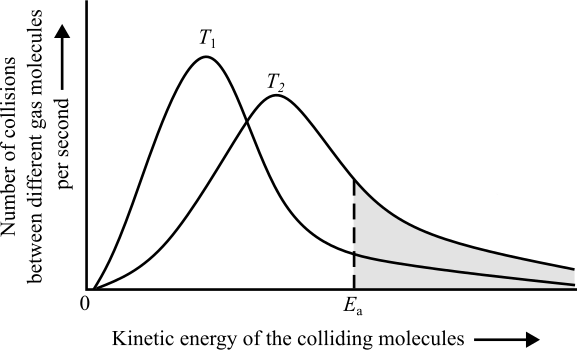
The following graph represents the number of collisions between reactant molecules as a function of their kinetic energy at two different temperatures.

Using collision theory, explain why \(\ce{T_{2}}\) results in a greater number of successful reactant molecule collisions.   (3 marks)
 

Show Answers Only
  • Successful reactant collisions occur when the kinetic energy of the reactant particles the activation energy required \( (\text{E}_\text{a})\).
  • From the above graph, we can see that at the kinetic energy level \( (\text{E}_\text{a})\), the \(\ce{T_{2}}\) graph has more reactant particles colliding. It follows that \(\ce{T_{2} > T_{1}}\).
  • Collision theory states that an increase in temperature increases the kinetic energy of reactant particles and thus the force of their collision. Increasing the force of collision means that the amount of successful collisions converting reactants into products is greater, increasing the reaction rate. 
Show Worked Solution
  • Successful reactant collisions occur when the kinetic energy of the reactant particles the activation energy required \( (\text{E}_\text{a})\).
  • From the above graph, we can see that at the kinetic energy level \( (\text{E}_\text{a})\), the \(\ce{T_{2}}\) graph has more reactant particles colliding. It follows that \(\ce{T_{2} > T_{1}}\).
  • Collision theory states that an increase in temperature increases the kinetic energy of reactant particles and thus the force of their collision. Increasing the force of collision means that the amount of successful collisions converting reactants into products is greater, increasing the reaction rate. 

Filed Under: Rates of Reactions Tagged With: Band 4, smc-4265-30-Temperature

CHEMISTRY, M3 EQ-Bank 5

The following reaction is exothermic

\(\ce{N2(g) + 3H2(g) \rightarrow \ 2NH3(g)} \)

Lead \(\ce{(Pb)}\) can be used as a catalyst for this exothermic reaction. Describe what is meant by catalyst and how it influences this chemical reaction.   (3 marks)

--- 6 WORK AREA LINES (style=lined) ---

Show Answers Only
  • A catalyst increases the rate of a chemical reaction without undergoing any permanent chemical reaction itself.
  • The addition of \(\ce{Pb}\) in this reaction lowers the activation energy of a successful reaction.
  • More particles will exceed activation energy \(\ce{(E_{a})}\) when they collide with each other which increases the reaction rate.
Show Worked Solution
  • A catalyst increases the rate of a chemical reaction without undergoing any permanent chemical reaction itself.
  • The addition of \(\ce{Pb}\) in this reaction lowers the activation energy of a successful reaction.
  • More particles will exceed activation energy \(\ce{(E_{a})}\) when they collide with each other which increases the reaction rate.

Filed Under: Rates of Reactions Tagged With: Band 4, smc-4265-50-Catalysts

CHEMISTRY, M3 EQ-Bank 4

Explain how using a reagent in powdered form versus a crystal form would influence the rate of a chemical reaction.   (2 marks)

--- 5 WORK AREA LINES (style=lined) ---

Show Answers Only
  • Using a reactant in powdered form increases its surface area.
  • This increases the area in which reactant particles can make contact with each other, leading to more frequent and effective particle collisions that exceed activation energy \(\ce{(E_{a})}\) which increases the reaction rate.
Show Worked Solution
  • Using a reactant in powdered form increases its surface area.
  • This increases the area in which reactant particles can make contact with each other, leading to more frequent and effective particle collisions that exceed activation energy \(\ce{(E_{a})}\) which increases the reaction rate.

Filed Under: Rates of Reactions Tagged With: Band 4, smc-4265-35-Surface area

CHEMISTRY, M3 EQ-Bank 3

Explain how increasing the concentration of a reactant would influence the rate of a chemical reaction.   (2 marks)

--- 5 WORK AREA LINES (style=lined) ---

Show Answers Only
  • Increasing reactant concentration will increase the reaction rate.
  • A higher concentration of reactants allows for a greater likelihood of collisions between particles, consequently increasing the number of successful collisions that exceed activation energy \(\ce{(E_{a})}\) which increases the reaction rate.
Show Worked Solution
  • Increasing reactant concentration will increase the reaction rate.
  • A higher concentration of reactants allows for a greater likelihood of collisions between particles, consequently increasing the number of successful collisions that exceed activation energy \(\ce{(E_{a})}\) which increases the reaction rate.

Filed Under: Rates of Reactions Tagged With: Band 4, smc-4265-40-Concentration

BIOLOGY, M2 EQ-Bank 27

  1. Define the term differentiation.   (1 mark)

    --- 2 WORK AREA LINES (style=lined) ---

  2. Explain, using examples, why multicellular organisms require specialised cells.   (4 marks)

    --- 8 WORK AREA LINES (style=lined) ---

Show Answers Only

a.    Differentiation:

  • The difference in shape and size between different cells in a multicellular organism due to their specialised function.

b.    Multicellular organisms require specialised cells:

  • Multicellular organisms are large organisms which require many complex internal processes to function.
  • To be more effective, multicellular organisms have specialised cells. Specialised cells have a certain shape, size and number and type of organelles.
  • Cell specialisation allows cells to perform one specific role to benefit the whole organism rather than every individual cell performing every function.
  • This makes multicellular organisms able to carry out many complex functions while still remaining energy efficient.
  • Examples: human muscle cells contain many mitochondria in order to produce a large supply of energy via cellular respiration, while red blood cells contain no nucleus, enabling them to carry more haemoglobin and therefore more oxygen.
Show Worked Solution

a.    Differentiation:

  • The difference in shape and size between different cells in a multicellular organism due to their specialised function.

b.    Multicellular organisms require specialised cells:

  • Multicellular organisms are large organisms which require many complex internal processes to function.
  • To be more effective, multicellular organisms have specialised cells. Specialised cells have a certain shape, size and number and type of organelles.
  • Cell specialisation allows cells to perform one specific role to benefit the whole organism rather than every individual cell performing every function.
  • This makes multicellular organisms able to carry out many complex functions while still remaining energy efficient.
  • Examples: human muscle cells contain many mitochondria in order to produce a large supply of energy via cellular respiration, while red blood cells contain no nucleus, enabling them to carry more haemoglobin and therefore more oxygen.

Filed Under: Organisation of Cells Tagged With: Band 3, Band 4, smc-4304-40-Cell Specialisation

CHEMISTRY, M3 EQ-Bank 4

When aqueous lead \(\text{(II)}\) nitrate \(\ce{(Pb(NO3)2)}\) is mixed with a potassium iodide solution \((\ce{KI}) \), a precipitation of lead \(\text{(II)}\) iodide \(\ce{(PbI2)}\) results.

Write a balanced chemical equation for this precipitation reaction.  (2 marks)

--- 3 WORK AREA LINES (style=lined) ---

Show Answers Only

\(\ce{Pb(NO3)2(aq) + 2KI(aq) \rightarrow PbI2(s) + 2KNO3(aq)}\)

Show Worked Solution
  • Reaction products: \(\ce{PbI2,\ KNO3}\)
  • Balanced equation:
  •    \(\ce{Pb(NO3)2(aq) + 2KI(aq) \rightarrow PbI2(s) + 2KNO3(aq)}\)

Filed Under: Chemical Reactions Tagged With: Band 4, smc-4263-10-Balanced chemical equations, smc-4263-25-Precipitation

CHEMISTRY, M3 EQ-Bank 3

Identify the products when solid calcium carbonate \(\ce{(CaCO3)}\) reacts with aqueous nitric acid \(\ce{(HNO3)}\) and write the balanced chemical equation for the reaction.   (3 marks)

--- 4 WORK AREA LINES (style=lined) ---

Show Answers Only

\(\ce{CaCO3_{(s)} + 2HNO3_{(aq)} \rightarrow H2O_{(l)} + CO2_{(g)} + Ca(NO3)2_{(aq)}}\)

Show Worked Solution
  • Solid calcium carbonate and nitric acid produce: \(\ce{H2O(l),\ CO2(g), Ca(NO3)2(aq)} \).
  • Balanced equation:
  •    \(\ce{CaCO3(s) + 2HNO3(aq) \rightarrow H2O(l) + CO2(g) + Ca(NO3)2(aq)}\)

Filed Under: Chemical Reactions Tagged With: Band 4, smc-4263-10-Balanced chemical equations, smc-4263-40-Acid/base reactions

CHEMISTRY, M1 EQ-Bank 7

Explain, with the use of a diagram or otherwise, why the oxide ion has a valency of minus 2.   (2 marks)

Show Answers Only
  • An oxide ion is the ion of the element oxygen \(\ce{(O)}\), atomic weight 16.
  • An oxygen atom has 8 electrons and 8 protons. It has 2 electrons in its inner shell and 6 electrons in its valence (outer) shell.
  • An oxygen atom can gain 2 electrons to form a stable octet in its valence shell and therefore has a valency of minus 2.

Show Worked Solution
  • An oxide ion is the ion of the element oxygen \(\ce{(O)}\), atomic weight 16.
  • An oxygen atom has 8 electrons and 8 protons. It has 2 electrons in its inner shell and 6 electrons in its valence (outer) shell.
  • An oxygen atom can gain 2 electrons to form a stable octet in its valence shell and therefore has a valency of minus 2.

Filed Under: Bonding Tagged With: Band 4, smc-4258-35-Valency

CHEMISTRY, M1 EQ-Bank 6

What are the valencies of the following simple and polyatomic ions

  1. Phosphate \((\ce{PO4})\)  (1 mark)

    --- 1 WORK AREA LINES (style=lined) ---

  2. Zinc \((\ce{Zn})\)  (1 mark)

    --- 1 WORK AREA LINES (style=lined) ---

  3. Carbonate \((\ce{CO3})\)  (1 mark)

    --- 1 WORK AREA LINES (style=lined) ---

Show Answers Only

a.   Valency: Phosphate \((\ce{PO4}) = 3^{-}\)

b.  Valency: Zinc \((\ce{Zn}) = 2^{+}\)

c. Valency: Carbonate \((\ce{CO3}) = 2^{-}\)

Show Worked Solution

a.   Valency: Phosphate \((\ce{PO4}) = 3^{-}\)

b.  Valency: Zinc \((\ce{Zn}) = 2^{+}\)

c. Valency: Carbonate \((\ce{CO3}) = 2^{-}\)

Filed Under: Bonding Tagged With: Band 4, smc-4258-35-Valency

CHEMISTRY, M1 EQ-Bank 5

What are the valencies of the following simple ions

  1. Barium \((\ce{Ba})\)   (1 mark)

    --- 1 WORK AREA LINES (style=lined) ---

  2. Phosphide \((\ce{P})\)  (1 mark)

    --- 1 WORK AREA LINES (style=lined) ---

  3. Silver \((\ce{Ag})\)  (1 mark)

    --- 1 WORK AREA LINES (style=lined) ---

Show Answers Only

a.   Valency: Barium \((\ce{Ba}) = 2^{+}\)

b.  Valency: Phosphide \((\ce{P}) = 3^{-}\)

c.  Valency: Silver \((\ce{Ag}) = 1^{+}\)

Show Worked Solution

a.   Valency: Barium \((\ce{Ba}) = 2^{+}\)

b.  Valency: Phosphide \((\ce{P}) = 3^{-}\)

c.  Valency: Silver \((\ce{Ag}) = 1^{+}\)

Filed Under: Bonding Tagged With: Band 3, Band 4, smc-4258-35-Valency

CHEMISTRY, M1 EQ-Bank 4

Draw Lewis electron dot structures for the following ionic molecular compounds

  1. Sodium chloride  \((\ce{NaCl})\)   (1 mark)

    --- 4 WORK AREA LINES (style=lined) ---

  2. Aluminium fluoride \((\ce{GaF3})\)   (1 mark)

    --- 4 WORK AREA LINES (style=lined) ---

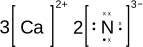
  3. Calcium nitride  \((\ce{Ca3N2})\)   (2 marks)

    --- 4 WORK AREA LINES (style=lined) ---

Show Answers Only

a.    Sodium chloride  \((\ce{NaCl}\)


b.  Aluminium Fluoride \((\ce{GaF3}\)
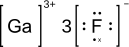
c.  Calcium nitride   \((\ce{Ca3N2}\)
Show Worked Solution

a.    Sodium chloride  \((\ce{NaCl}\)


b.  Aluminium Fluoride \((\ce{GaF3}\)

c.  Calcium nitride   \((\ce{Ca3N2}\)

Filed Under: Bonding Tagged With: Band 3, Band 4, Band 5, smc-4258-30-Lewis Dot

CHEMISTRY, M1 EQ-Bank 3

Draw Lewis electron dot structures for the following covalent molecular compounds

  1. Ammonia   (2 marks)

    --- 4 WORK AREA LINES (style=lined) ---

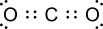
  2. Carbon dioxide   (2 marks)

    --- 4 WORK AREA LINES (style=lined) ---

Show Answers Only

a.    Ammonia \( (\ce{CH3})\)


b.   Carbon dioxide \( (\ce{CO2}) \)
Show Worked Solution

a.    Ammonia \( (\ce{CH3})\)


b.   Carbon dioxide \( (\ce{CO2}) \)
 

Filed Under: Bonding Tagged With: Band 4, Band 5, smc-4258-30-Lewis Dot

CHEMISTRY, M1 EQ-Bank 2

Draw Lewis electron dot structures for

  1. a nitrogen molecule \( (\ce{N2})\)   (1 mark)

    --- 3 WORK AREA LINES (style=lined) ---

  2. an oxygen molecule \( (\ce{O2}) \)  (1 mark)

    --- 3 WORK AREA LINES (style=lined) ---

Show Answers Only

a.    
       

b.     
        

Show Worked Solution

a.    
     

b.     
     

Filed Under: Bonding Tagged With: Band 3, Band 4, smc-4258-30-Lewis Dot

PHYSICS, M3 EQ-Bank 4

Define latent heat and name the stages of latent heat that occur between the states of solid and liquid, and liquid and gas.   (3 marks)

--- 6 WORK AREA LINES (style=lined) ---

Show Answers Only
  • Latent heat is the heat energy required to change the state of matter from a solid to a liquid, or a liquid to a gas, without changing the temperature of the substance.
  • During this process, energy is supplied to break the bonds between particles. This leads to a greater degree of freedom without increasing the kinetic energy of the particles.
  • The two stages of latent heat are the latent heat of fusion (solid to liquid) and the latent heat of evaporation (liquid to gas).
Show Worked Solution
  • Latent heat is the heat energy required to change the state of matter from a solid to a liquid, or a liquid to a gas, without changing the temperature of the substance.
  • During this process, energy is supplied to break the bonds between particles. This leads to a greater degree of freedom without increasing the kinetic energy of the particles.
  • The two stages of latent heat are the latent heat of fusion (solid to liquid) and the latent heat of evaporation (liquid to gas).

Filed Under: Thermodynamics Tagged With: Band 4, smc-4282-50-Latent heat

PHYSICS, M3 EQ-Bank 3

A concrete wall has the dimensions 3 m × 5.5 m and a depth \((d)\) of 0.25 metres.

Calculate the heat energy that passes through the wall if the outside temperature is 5°C and the temperature inside is 26°C across a 5 minute period.   \((k= 2.25\ \text{W m}^{-1}\ K^{-1}) \)   (3 marks)

--- 5 WORK AREA LINES (style=lined) ---

Show Answers Only

\(935\ 550\ \text{J}\)

Show Worked Solution
\(\dfrac{Q}{t}\) \(=\dfrac{kA(T_{hot}-T_{cold})}{d}\)  
\(Q\) \(=\dfrac{kA(T_{hot}-T_{cold})}{d} \times t\)  
  \(=\dfrac{2.25 \times 3 \times 5.5 \times (26-5)}{0.25} \times (5 \times 60)\)  
  \(=935\ 550\ \text{J}\)  

Filed Under: Thermodynamics Tagged With: Band 4, smc-4282-20-Thermal conductivity

PHYSICS, M3 EQ-Bank 2

A glass panel has thickness \(d\) mm and a temperature difference between its two sides of \(\Delta T\).

If the surface area of a glass panel was increased from \(A\) m² to \(4A\) m², what two changes could be made to the glass panel to ensure the rate of change of heat energy through the glass remains the same.   (3 marks)

--- 6 WORK AREA LINES (style=lined) ---

Show Answers Only

Thermal conductivity equation \(\ \Rightarrow \dfrac{Q}{t}=\dfrac{kA\Delta T}{d}\).

Given \(A\) increases to \(4A\):

  • \(\dfrac{Q}{t} \) remains the same if the distance through which the heat travels through the glass increases from \(d\) to \(4d\).
  • \(\dfrac{Q}{t} \) remains the same if the temperature difference between the two sides of the glass panel decreases from \(\Delta T\) to \(\dfrac{\Delta T}{4}\). 
Show Worked Solution

Thermal conductivity equation \(\ \Rightarrow \dfrac{Q}{t}=\dfrac{kA\Delta T}{d}\).

Given \(A\) increases to \(4A\):

  • \(\dfrac{Q}{t} \) remains the same if the distance through which the heat travels through the glass increases from \(d\) to \(4d\).
  • \(\dfrac{Q}{t} \) remains the same if the temperature difference between the two sides of the glass panel decreases from \(\Delta T\) to \(\dfrac{\Delta T}{4}\). 

Filed Under: Thermodynamics Tagged With: Band 4, smc-4282-20-Thermal conductivity

CHEMISTRY, M1 EQ-Bank 1

Describe three differences between covalent and ionic bonds, with reference to relevant compounds.  (3 marks)

--- 7 WORK AREA LINES (style=lined) ---

Show Answers Only
  • Ionic bonding occurs when atoms donate electrons to one another, forming positive and negative ions. 
  • Positive and negatively charged ions then attract to form ionic bonds. eg. \(\ce{Na^{+} + Cl^{-} \Rightarrow NaCl} \)
  • Covalent bonds occur when atoms share electrons, such as \(\ce{H2O}\).
  • Covalent bonds are much weaker than ionic bonds.
  • Covalent bonds tend to form between non-metals.
Show Worked Solution
  • Ionic bonding occurs when atoms donate electrons to one another, forming positive and negative ions. 
  • Positive and negatively charged ions then attract to form ionic bonds. eg. \(\ce{Na^{+} + Cl^{-} \Rightarrow NaCl} \)
  • Covalent bonds occur when atoms share electrons, such as \(\ce{H2O}\).
  • Covalent bonds are much weaker than ionic bonds.
  • Covalent bonds tend to form between non-metals.

Filed Under: Bonding Tagged With: Band 4, smc-4258-40-Inter/Intramolecular Bonding

CHEMISTRY, M3 EQ-Bank 2

Using a specific example, explain a chemical process exploited by Aboriginal and Torres Strait Islander peoples when detoxifying poisonous food items.  (4 marks)

--- 9 WORK AREA LINES (style=lined) ---

Show Answers Only
  • Aboriginal and Torres Strait Islander peoples used the principles of solution equilibria to detoxify the Cycad, a highly toxic and carcinogenic plant that was part of their diets for thousands of years.
  • The cycad fruit was cut open and left in a water container. The following equilibrium occurs
  •    \(\ce{\text{Toxin}(s) \rightleftharpoons \text{Toxin}(aq)}\)
  • The solid is the toxins in the cycad and the aqueous is the toxin dissolved in water.
  • Over time an equilibrium will be reached. The water is then removed and replenished.
  • This causes, in effect, the concentration of the aqueous solution to suddenly decrease. Le Chatelier’s principle stays that a system will shift to minimise change.
  • Consequently, the system will want to shift to the right to balance the level of toxin in the aqueous solution.
  • Repeating this process reduces the toxins in the fruit.
Show Worked Solution
  • Aboriginal and Torres Strait Islander peoples used the principles of solution equilibria to detoxify the Cycad, a highly toxic and carcinogenic plant that was part of their diets for thousands of years.
  • The cycad fruit was cut open and left in a water container. The following equilibrium occurs
  •    \(\ce{\text{Toxin}(s) \rightleftharpoons \text{Toxin}(aq)}\)
  • The solid is the toxins in the cycad and the aqueous is the toxin dissolved in water.
  • Over time an equilibrium will be reached. The water is then removed and replenished.
  • This causes, in effect, the concentration of the aqueous solution to suddenly decrease. Le Chatelier’s principle stays that a system will shift to minimise change.
  • Consequently, the system will want to shift to the right to balance the level of toxin in the aqueous solution.
  • Repeating this process reduces the toxins in the fruit.

Filed Under: Chemical Reactions Tagged With: Band 4

PHYSICS, M1 EQ-Bank 4

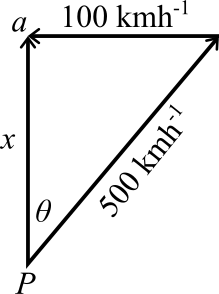
A plane that can fly at 500 kmh\(^{-1}\) with no wind, encounters a strong cross wind of 100 kmh\(^{-1}\) from the east. The plane needs to travel directly north to an airstrip

  1. Calculate the angle, correct to one decimal place, at which the pilot should steer for the plane to fly directly to the airstrip?   (3 marks)

    --- 6 WORK AREA LINES (style=lined) ---

  2. If the airstrip is 100 km from the planes current position, how long, to the nearest minute, will it take for the plane to complete the journey?   (2 marks)
  3. --- 4 WORK AREA LINES (style=lined) ---

Show Answers Only

a.    \(\text{N11.5°E}\)

b.    \(\text{12 minutes}\)

Show Worked Solution

a.    
       

\(\sin\theta\) \(=\dfrac{100}{500}\)  
\(\theta\) \(=\sin^{-1}\Big{(}\dfrac{100}{500}\Big{)}\)  
  \(=11.5^{\circ}\)  

 
\(\text{Plane direction should be N11.5°E}\)
 

b.    \(\text{Using the diagram in part (i):}\)

\(\tan(11.5°)\) \(=\dfrac{100}{x}\)  
\(x\) \(=\dfrac{100}{\tan(11.5°)}\)  
  \(=491.5\ \text{kmh}^{-1}\)  


\(t\) \(=\dfrac{\text{distance}}{\text{speed}}\)  
  \(=\dfrac{100}{491.5}\)  
  \(=0.203\ \text{h}\)  
  \(=12\ \text{m (nearest minute)}\)  

Filed Under: Motion on a Plane Tagged With: Band 4, Band 5, smc-4274-40-Relative motion, smc-4274-50-Vector diagrams

PHYSICS, M1 EQ-Bank 1

A ball is thrown vertically upwards from ground level, it gains 50 metres vertically and then falls back to the ground.

  1. Determine the initial velocity, in metres per second, that the ball was thrown. Give your answer correct to one decimal place.   (2 marks)

    --- 4 WORK AREA LINES (style=lined) ---

  2. Calculate the total time of flight of the ball, in seconds, giving your answer correct to two decimal places.   (2 marks)
  3. --- 4 WORK AREA LINES (style=lined) ---

Show Answers Only

a.    \(u=31.3\ \text{ms}^{-1}\)

b.   \(6.39\ \text{s}\).

Show Worked Solution

a.    \(\text{At 50 m}\ \Rightarrow\ v=0\ \text{ms}^{-1}\)

\(v^2\) \(=u^2+2as\)  
\(0^2\) \(=u^2+2 \times -9.8 \times 50\)  
\(u^2\) \(=980\)  
\(u\) \(=31.3\ \text{ms}^{-1}\)  


b.   \(\text{Time to highest point}\ = \dfrac{1}{2}\ \text{time of flight} \)

\(v\) \(=u+at\)  
\(0\) \(=31.3-9.8t\)  
\(9.8t\) \(=31.3\)  
\(t\) \(=3.194\ \text{s}\)  


\(\text{Total time of flight}\ = 2\times 3.194 = 6.39\ \text{s (2 d.p.)}\)

Filed Under: Motion in a Straight Line Tagged With: Band 3, Band 4, smc-4273-40-v=u+at

CHEMISTRY, M1 EQ-Bank 7

Outline two physical properties and two chemical properties of transition metals.   (2 marks)

--- 4 WORK AREA LINES (style=lined) ---

Show Answers Only

Physical properties (choose two):

  • Hard and tough metals, high densities, can be hammered into shape, good heat conductor, high melting/boiling points.

Chemical properties(choose two):

  • Less reactive than Group 1 metals, often have variable oxidation states, can form alloys, form coloured ions.
Show Worked Solution

Physical properties (choose two):

  • Hard and tough metals, high densities, can be hammered into shape, good heat conductor, high melting/boiling points.

Chemical properties(choose two):

  • Less reactive than Group 1 metals, often have variable oxidation states, can form alloys, form coloured ions.

Filed Under: Periodicity Tagged With: Band 4, smc-4257-25-Physical/Chemical properties

CHEMISTRY, M1 EQ-Bank 5

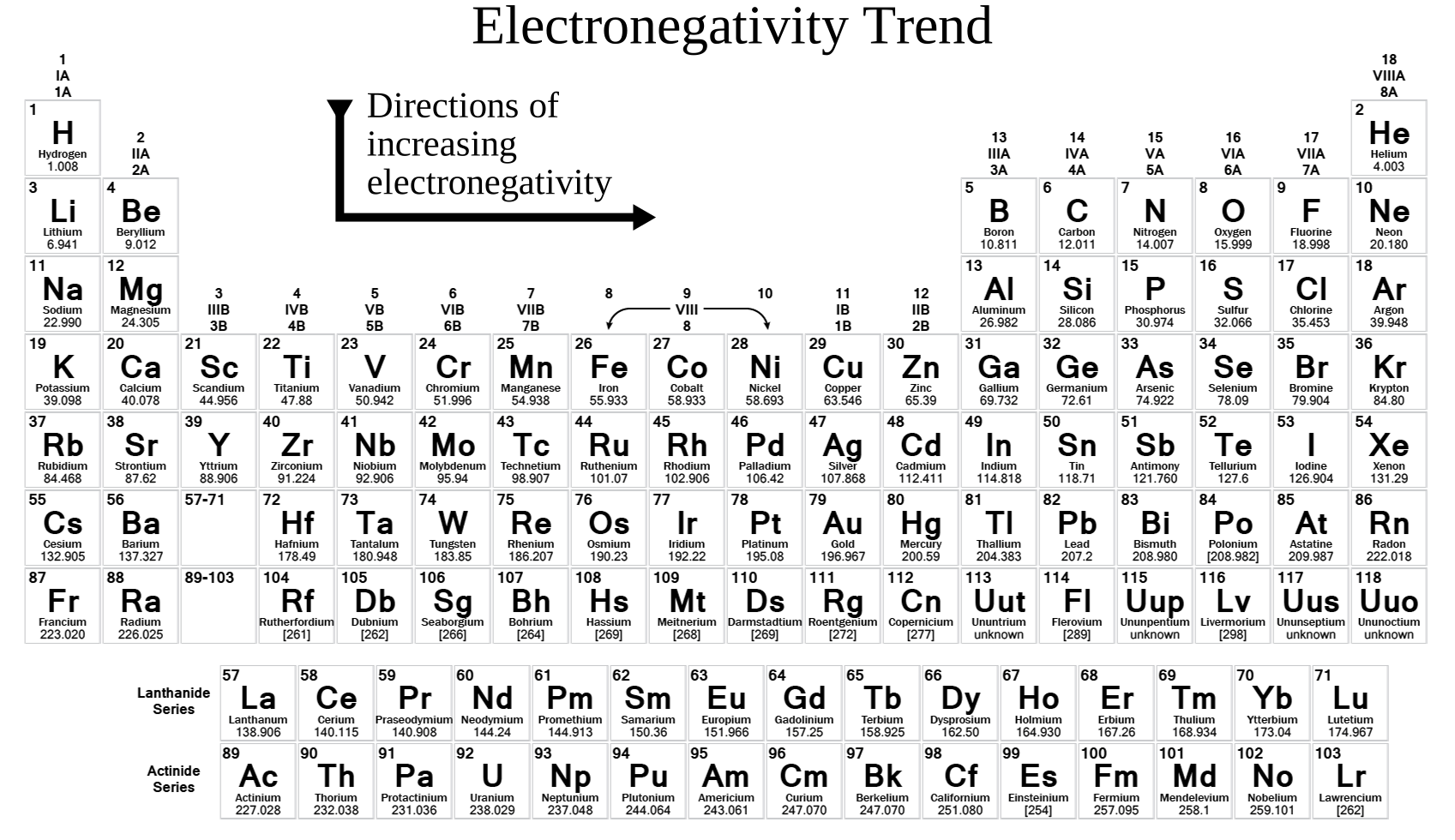
"Electronegativity increases as you move across periods left to right and decreases as you move down groups".

Explain this trend with reference to the following periodic table.   (4 marks)
  

Show Answers Only

Moving from left to right:

  • As you move across a period from left to right in the same row, the number of protons in the nucleus of elements increases in accordance with their atomic number.
  • eg. \(\ce{Li}\) (far left) has 3 protons in its nucleus whereas \(\ce{F}\) (far right) has 9 protons in its nucleus.
  • This leads to a greater attractive force and thus higher electronegativity. 

Moving down within a group (column):

  • Adding electron shells to a nucleus decreases electronegativity.
  • This is due to an increase in atomic radius and the effect that extra electron shells have in shielding the attractive forces of protons.
  • All the elements in a period (row) further down the periodic table have an extra electron shell than the period directly above them, decreasing electronegativity as you move down.
Show Worked Solution

Moving from left to right:

  • As you move across a period from left to right in the same row, the number of protons in the nucleus of elements increases in accordance with their atomic number.
  • eg. \(\ce{Li}\) (far left) has 3 protons in its nucleus whereas \(\ce{F}\) (far right) has 9 protons in its nucleus.
  • This leads to a greater attractive force and thus higher electronegativity. 

Moving down within a group (column):

  • Adding electron shells to a nucleus decreases electronegativity.
  • This is due to an increase in atomic radius and the effect that extra electron shells have in shielding the attractive forces of protons.
  • All the elements in a period (row) further down the periodic table have an extra electron shell than the period directly above them, decreasing electronegativity as you move down.

Filed Under: Periodicity Tagged With: Band 4, Band 5, smc-4257-10-Atomic Radii, smc-4257-20-Electronegativity

CHEMISTRY, M1 EQ-Bank 4

Describe two factors which affect the degree of electronegativity of an atom.   (2 marks)

--- 4 WORK AREA LINES (style=lined) ---

Show Answers Only

Number of Protons in the Nucleus:

  • The greater the number of protons in the nucleus of an atom, the greater the attractive force exerted on electrons and therefore the greater the electronegativity.

Atomic Radius:

  • The smaller the atomic radius, the larger the attractive force that can be exerted on electrons (due to lack of shielding).
Show Worked Solution

Number of Protons in the Nucleus:

  • The greater the number of protons in the nucleus of an atom, the greater the attractive force exerted on electrons and therefore the greater the electronegativity.

Atomic Radius:

  • The smaller the atomic radius, the larger the attractive force that can be exerted on electrons (due to lack of shielding).

Filed Under: Periodicity Tagged With: Band 4, smc-4257-10-Atomic Radii, smc-4257-20-Electronegativity

CHEMISTRY, M1 EQ-Bank 3

What is electronegativity and how is it measured?   (2 marks)

Show Answers Only
  • Electronegativity is a measure of the attractive force an atom can exert on an electron to bond to it.
  • It is measured using the Pauling scale.
Show Worked Solution
  • Electronegativity is a measure of the attractive force an atom can exert on an electron to bond to it.
  • It is measured using the Pauling scale.

Filed Under: Periodicity Tagged With: Band 4, smc-4257-20-Electronegativity

CHEMISTRY, M1 EQ-Bank 2

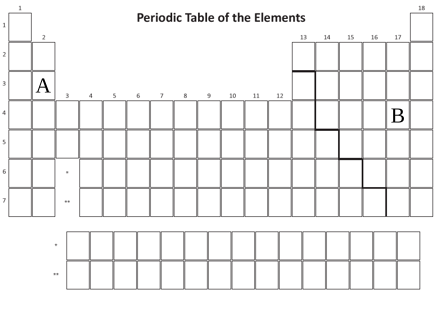
Outline both a physical and chemical property of the elements contained in the highlighted periodic table groups below.   (4 marks)
--- 6 WORK AREA LINES (style=lined) ---

Show Answers Only

Group \(\text{A:}\) Earth metals (aka “alkaline metals”)

  • → Physical properties: shiny, silver coloured metals, low density, malleable.
  • → Chemical properties: low melting/boiling points, ductile.
      

Group \(\text{B:}\) Halogens (aka the “fluorines”)

  • → Physical properties: Group 7 elements are dull and brittle in solid form
  • → Chemical properties: low melting/boiling points, poor conductors of heat and electricity.
Show Worked Solution

Group \(\text{A:}\) Earth metals (aka “alkaline metals”)

  • Physical properties: shiny, silver coloured metals, low density, malleable.
  • Chemical properties: low melting/boiling points, ductile.  

Group \(\text{B:}\) Halogens (aka the “fluorines”)

  • Physical properties: Group 7 elements are dull and brittle in solid form
  • Chemical properties: low melting/boiling points, poor conductors of heat and electricity.

Filed Under: Periodicity Tagged With: Band 4, smc-4257-25-Physical/Chemical properties

CHEMISTRY, M1 EQ-Bank 6

Name the following inorganic compounds: 

  1. \(\ce{H2SO4}\)   (1 mark)

    --- 1 WORK AREA LINES (style=lined) ---

  2. \(\ce{H2SO3}\)   (1 mark)

    --- 1 WORK AREA LINES (style=lined) ---

Show Answers Only
  1. Sulfuric Acid
  2. Sulfurous Acid
Show Worked Solution

a.    Sulfuric Acid

b.   Sulfurous Acid

Filed Under: Properties of Matter Tagged With: Band 3, Band 4, smc-4255-45-Inorganic compounds

CHEMISTRY, M1 EQ-Bank 8

Name the following inorganic compounds:

  1. \(\ce{HClO}\)   (1 mark)

    --- 1 WORK AREA LINES (style=lined) ---

  2. \(\ce{NaHCO3}\)   (1 mark)

    --- 1 WORK AREA LINES (style=lined) ---

Show Answers Only
  1. Hypochlorous Acid
  2. Sodium Bicarbonate
Show Worked Solution

a.    Hypochlorous Acid

b.   Sodium Bicarbonate

Filed Under: Properties of Matter Tagged With: Band 4, smc-4255-45-Inorganic compounds

CHEMISTRY, M1 EQ-Bank 7

Name the following inorganic compounds:

  1. \(\ce{MgCO3}\)   (1 mark)

    --- 1 WORK AREA LINES (style=lined) ---

  2. \(\ce{HgBr2}\)   (1 mark)

    --- 1 WORK AREA LINES (style=lined) ---

Show Answers Only
  1. Magnesium Carbonate 
  2. Mercury Bromide
Show Worked Solution

a.    Magnesium Carbonate 

b.   Mercury Bromide

Filed Under: Properties of Matter Tagged With: Band 3, Band 4, smc-4255-45-Inorganic compounds

CHEMISTRY, M1 EQ-Bank 4

Calculate the mass of \(\ce{H}\) within 100 grams of the compound \(\ce{H2CO3}\). Give your answer in grams correct to two decimal places.   (2 marks)

--- 4 WORK AREA LINES (style=lined) ---

Show Answers Only

\(3.25\ \text{grams}\)

Show Worked Solution

\(\ce{MM(H2CO3) = 2 \times 1.008 + 12.01 + 3 \times 16.00 = 62.026\ \text{g mol}^{-1}}\)

\(\ce{\% of H = \dfrac{2.016}{62.026} \times 100 = 3.25\%}\)

\(\ce{m(H)\ \text{within 100g}\ H2CO3 = 3.25\% \times 100 = 3.25\ \text{grams}} \)

Filed Under: Properties of Matter Tagged With: Band 4, smc-4255-30-Percentage composition

CHEMISTRY, M1 EQ-Bank 3

Calculate the mass of \(\ce{O}\) in 8.4 grams of \(\ce{CO2}\). Give your answer in grams correct to two decimal places.   (2 marks)

--- 4 WORK AREA LINES (style=lined) ---

Show Answers Only

\(6.11\ \text{g}\)

Show Worked Solution

\(\ce{MM(CO2) = 12.01 + 2 \times 16.00 = 44.01\ \text{g mol}^{-1}}\)

\(\ce{\% of O = \dfrac{32.00}{44.01} \times 100 = 72.71\%}\)

\(\ce{m(O\ \text{in 8.4 g})}\) \(= 8.4 \times 72.71\% \)  
  \(=6.11\ \text{g (2 d.p.)}\)  

Filed Under: Properties of Matter Tagged With: Band 4, smc-4255-30-Percentage composition

CHEMISTRY, M1 EQ-Bank 2

A student is given a known mixture that contains methanol, water, salt and sand.

Describe a process where the student can separate each component of the mixture.  (3 marks)

--- 6 WORK AREA LINES (style=lined) ---

Show Answers Only
  • Each of the components in the mixture have their own unique physical properties which can be exploited to separate them.

Mixture separation process:

  1. A sieve can be used to separate the sand from the mixture.
  2. Following this, a distillation set up can be used to remove the methanol from the mixture (as methanol has a lower boiling point than water).
  3. An evaporating basin can then be used to evaporate the water, leaving salt behind.
Show Worked Solution
  • Each of the components in the mixture have their own unique physical properties which can be exploited to separate them.

Mixture separation process:

  1. A sieve can be used to separate the sand from the mixture.
  2. Following this, a distillation set up can be used to remove the methanol from the mixture (as methanol has a lower boiling point than water).
  3. An evaporating basin can then be used to evaporate the water, leaving salt behind.

Filed Under: Properties of Matter Tagged With: Band 4, smc-4255-35-Separation techniques

CHEMISTRY, M1 EQ-Bank 1

Complete the following table by providing the physical properties of compounds exploited by various separation methods.  (3 marks)

\begin{array} {|l|c|}
\hline
\rule{0pt}{2.5ex} \text{Separation Method} \rule[-1ex]{0pt}{0pt} & \text{Physical Property Exploited} \\
\hline
\rule{0pt}{2.5ex} \text{Filtration:} \rule[-1ex]{0pt}{0pt} &  \\
\hline
\rule{0pt}{2.5ex} \text{Evaporation:} \rule[-1ex]{0pt}{0pt} &  \\
\hline
\rule{0pt}{2.5ex} \text{Distillation:} \rule[-1ex]{0pt}{0pt} &  \\
\hline
\end{array}

--- 0 WORK AREA LINES (style=lined) ---

Show Answers Only

\begin{array} {|l|c|}
\hline
\rule{0pt}{2.5ex} \text{Separation Method} \rule[-1ex]{0pt}{0pt} & \text{Physical Property Exploited} \\
\hline
\rule{0pt}{2.5ex} \text{Filtration:} \rule[-1ex]{0pt}{0pt} &  \text{Particle size} \\
\hline
\rule{0pt}{2.5ex} \text{Evaporation:} \rule[-1ex]{0pt}{0pt} & \text{State of matter} \\
\hline
\rule{0pt}{2.5ex} \text{Distillation:} \rule[-1ex]{0pt}{0pt} & \text{Boiling point} \\
\hline
\end{array}

Show Worked Solution

\begin{array} {|l|c|}
\hline
\rule{0pt}{2.5ex} \text{Separation Method} \rule[-1ex]{0pt}{0pt} & \text{Physical Property Exploited} \\
\hline
\rule{0pt}{2.5ex} \text{Filtration:} \rule[-1ex]{0pt}{0pt} &  \text{Particle size} \\
\hline
\rule{0pt}{2.5ex} \text{Evaporation:} \rule[-1ex]{0pt}{0pt} & \text{State of matter} \\
\hline
\rule{0pt}{2.5ex} \text{Distillation:} \rule[-1ex]{0pt}{0pt} & \text{Boiling point} \\
\hline
\end{array}

Filed Under: Properties of Matter Tagged With: Band 4, smc-4255-35-Separation techniques

BIOLOGY, M3 2020 VCE 8*

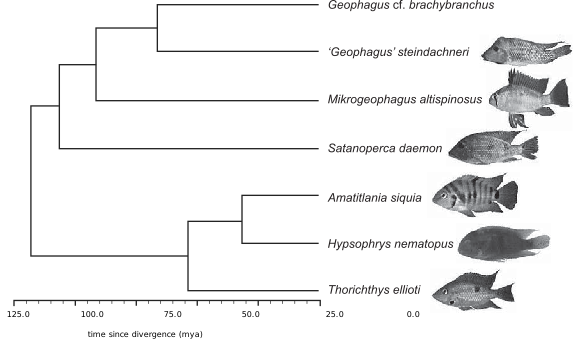
The phylogenetic tree below shows the evolutionary relationship between seven species of cichlid fish.
 

  1. Fossils of species of fish are more likely to be found than fossils of land-dwelling animals.
  2. Explain why this is the case with reference to two conditions required for the fossilisation of an organism.   (2 marks)

    --- 4 WORK AREA LINES (style=lined) ---

  1. A group of scientists stated that a particular fossilised fish was 5000 years old.
  2. Outline a dating technique that could have been used by the scientists to determine the age of the fossil.   (2 marks)

    --- 4 WORK AREA LINES (style=lined) ---

Show Answers Only

a.    Fossilisation is more likely in water than on land because:

  • Water contains more sediment which allows remains to be covered quicker, reducing disturbance and hiding them from scavengers.
  • Water contains less oxygen and lower temperatures, factors which reduce decomposition of remains.

b.   Carbon dating:

  • This technique can be used to validate the age of fossils between 500 and 50,000 years old.
  • It involves measuring the ratio of carbon-14 to carbon-12. Since carbon-14 decays into carbon-12 over time and knowing the half-life of carbon-14, the age of fossils can be accurately calculated.
Show Worked Solution

a.    Fossilisation is more likely in water than on land because:

  • Water contains more sediment which allows remains to be covered quicker, reducing disturbance and hiding them from scavengers.
  • Water contains less oxygen and lower temperatures, factors which reduce decomposition of remains.

b.   Carbon dating:

  • This technique can be used to validate the age of fossils between 500 and 50,000 years old.
  • It involves measuring the ratio of carbon-14 to carbon-12. Since carbon-14 decays into carbon-12 over time and knowing the half-life of carbon-14, the age of fossils can be accurately calculated.

Filed Under: Evolution - The Evidence Tagged With: Band 4, smc-4310-05-Fossils

BIOLOGY, M1 2020 VCE 4c

The diagram below is a simplified example of a signal transduction pathway. Three steps in the pathway are labelled.


Explain whether the pathway shown is initiated at Step 1 by a hydrophobic molecule or by a hydrophilic molecule.   (2 marks)

--- 3 WORK AREA LINES (style=lined) ---

Show Answers Only

→ The molecule must be hydrophilic as it does not pass through the plasma membrane but instead attaches to a receptor protein.

Show Worked Solution

→ The molecule does not pass through the plasma membrane but instead attaches to a receptor protein.

→ Therefore, the molecule is hydrophilic.

Filed Under: BIO - Ex-syllabus checks required Tagged With: Band 4, smc-4302-50-Cell membrane

BIOLOGY, M1 2020 VCE 3c

In plants and algae, photosynthesis is carried out in chloroplasts. It is thought that chloroplasts originated from bacteria.

Describe two features of chloroplasts that support the theory that chloroplasts originated from bacteria.   (2 marks)

--- 4 WORK AREA LINES (style=lined) ---

Show Answers Only

Answers can include two of the following:

  • Chloroplasts contain their own DNA, which in itself has many parallels to the DNA found in bacteria, such as it being circular.
  • Chloroplasts contain their own ribosomes.
  • New chloroplasts are made by division of previously existing chloroplasts, similar to the division of bacterial cells.
Show Worked Solution

Answers can include two of the following:

  • Chloroplasts contain their own DNA, which in itself has many parallels to the DNA found in bacteria, such as it being circular.
  • Chloroplasts contain their own ribosomes.
  • New chloroplasts are made by division of previously existing chloroplasts, similar to the division of bacterial cells.

Filed Under: Cell Structure Tagged With: Band 4, smc-4302-20-Organelles

PHYSICS, M3 2017 VCE 14

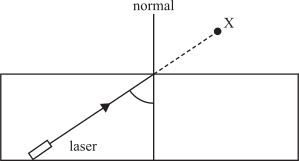
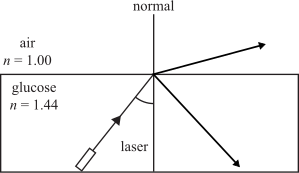
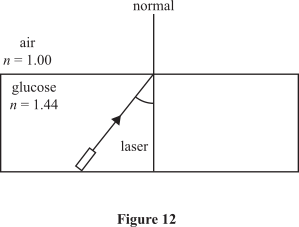
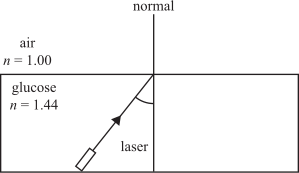
A light ray from a laser passes from a glucose solution \((n=1.44)\) into the air \((n=1.00)\), as shown in Figure 12.
 

  1. Calculate the critical angle (total internal reflection) from the glucose solution to the air.   (1 mark)

    --- 2 WORK AREA LINES (style=lined) ---

  2. The light ray strikes the surface at an angle of incidence to the normal of less than the critical angle calculated in part a.
  3. On the diagram above, sketch the ray or rays that should be observed.   (2 marks)

    --- 0 WORK AREA LINES (style=lined) ---

  4. The angle to the normal is increased to a value greater than the critical angle. An observer at point \(\text{X}\) in the image below says she cannot see the laser.
     

  1. Explain why the observer says she cannot see the laser.   (2 marks)

    --- 6 WORK AREA LINES (style=lined) ---

Show Answers Only

a.    \(\theta_c=44^{\circ}\)

b.    
       
  • As the light strikes the surface at an angle less than that of the critical angle, both reflection and refraction will be observed. 
c.    Observer cannot see the laser:
  • When the light strikes the surface at an angle greater than the critical angle, Total Internal Reflection will occur.
  • As a result of the total internal reflection, all the light will be reflected off the boundary back into the glucose solution and therefore will not travel to the observer.

Show Worked Solution

a.     \(\sin\theta_c\) \(=\dfrac{n_2}{n_1}\)
  \(\theta_c\) \(=\sin^{-1}\Big{(}\dfrac{1.00}{1.44}\Big{)}=44^{\circ}\)

 
b.


  • As the light strikes the surface at an angle less than that of the critical angle, both reflection and refraction will be observed.
♦♦ Mean mark (b) 37%.

c.    Observer cannot see the laser:

  • When the light strikes the surface at an angle greater than the critical angle, Total Internal Reflection will occur.
  • As a result of the total internal reflection, all the light will be reflected off the boundary back into the glucose solution and therefore will not travel to the observer.

Filed Under: Ray Model of Light Tagged With: Band 3, Band 4, Band 5, smc-4281-20-Snell's Law and TIR

PHYSICS, M2 2017 VCE 12

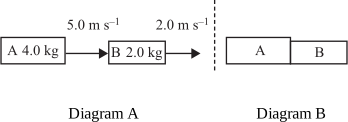
Students are using two trolleys, Trolley \(\text{A}\) of mass 4.0 kg and Trolley \(\text{B}\) of mass 2.0 kg, to investigate kinetic energy and momentum in collisions.

Before the collision, Trolley \(\text{A}\) is moving to the right at 5.0 m s\(^{-1}\) and Trolley \(\text{B}\) is moving to the right at 2.0 m s\(^{-1}\), as shown in Diagram A. The trolleys collide and lock together, as shown in Diagram B.
 

Determine, using calculations, whether the collision is elastic or inelastic. Show your working and justify your answer.   (3 marks)

--- 8 WORK AREA LINES (style=lined) ---
Show Answers Only

By the conservation of momentum:

\(m_Au_A+m_Bu_B\) \(=v(m_A+m_B)\)  
\(4 \times 5 + 2 \times 2\) \(=v(4 +2)\)  
\(24\) \(=6v\)  
\(v\) \(=4\ \text{ms}^{-1}\)  
 

 For the collision to be elastic, the kinetic energy must be conserved.

\(KE_{\text{init}}=\dfrac{1}{2} m_Au_A^2+ \dfrac{1}{2} m_Bu_B^2 =\dfrac{1}{2} \times 4 \times 5^2+\times \dfrac{1}{2} \times 2 \times 2^2=54\ \text{J}\)

\(KE_{\text{final}}=\dfrac{1}{2} (m_Am_B)v^2=\dfrac{1}{2} \times (4+2) \times 4^2=48\ \text{J}\)

\(\therefore\) Since the kinetic energy of the system decreases after the collision, the collision is inelastic.

Show Worked Solution

By the conservation of momentum:

\(m_Au_A+m_Bu_B\) \(=v(m_A+m_B)\)  
\(4 \times 5 + 2 \times 2\) \(=v(4 +2)\)  
\(24\) \(=6v\)  
\(v\) \(=4\ \text{ms}^{-1}\)  
 

 For the collision to be elastic, the kinetic energy must be conserved.

\(KE_{\text{init}}=\dfrac{1}{2} m_Au_A^2+ \dfrac{1}{2} m_Bu_B^2 =\dfrac{1}{2} \times 4 \times 5^2+\times \dfrac{1}{2} \times 2 \times 2^2=54\ \text{J}\)

\(KE_{\text{final}}=\dfrac{1}{2} (m_A + m_B)v^2=\dfrac{1}{2} \times (4+2) \times 4^2=48\ \text{J}\)

\(\therefore\) Since the kinetic energy of the system decreases after the collision, the collision is inelastic.

Filed Under: Momentum, Energy and Simple Systems Tagged With: Band 4, smc-4277-40-Elastic/inelastic collisions

PHYSICS, M4 2017 VCE 1

Three charges are arranged in a line, as shown in the diagram below.


Draw an arrow at point \(\text{X}\) to show the direction of the resultant electric field at \(\text{X}\). If the resultant electric field is zero, write the letter ' \(\text{N}\) ' at \(\text{X}\).   (2 mark)

Show Answers Only


Show Worked Solution

  • The electric field direction will be from the positive charge to the negative charge.
  • The \(-Q\) on the right has no effect to the direction of the electric field at \(\text{X}\).


Filed Under: Electrostatics Tagged With: Band 4, smc-4283-10-Electric fields

BIOLOGY, M1 2020 VCE 1

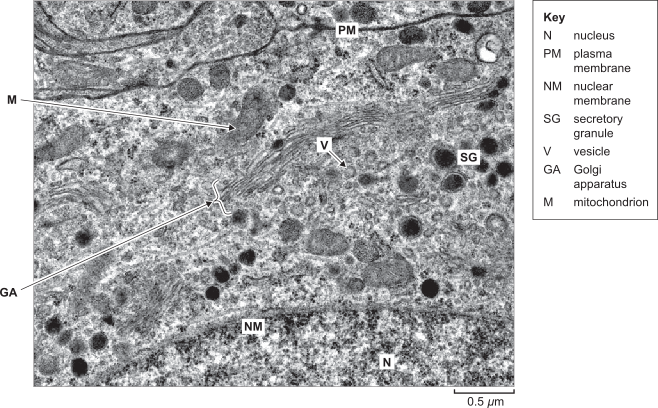
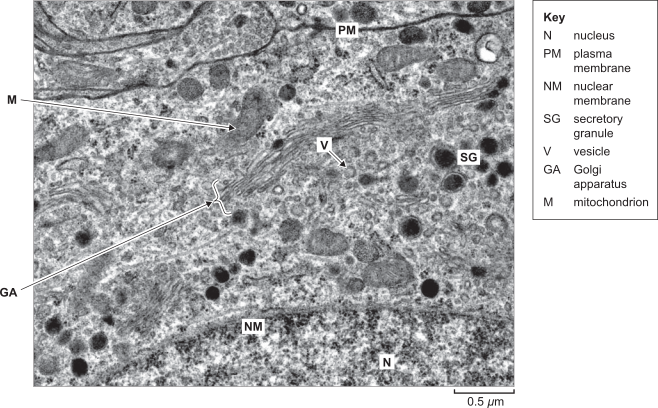
Adrenaline is an amino-acid-based hormone. The image below shows a cell section of an adrenaline-secreting cell examined under a transmission electron microscope.

A secretory granule is a large vesicle formed when several smaller vesicles fuse. Each secretory granule contains a large amount of adrenaline, which is stored until the cell receives a signal to release it.
 

  1. There are many organelles of the types labelled GA and M visible in the cell section.
  2. Complete the table below by stating the specific function of each organelle with the following labels in the adrenaline-secreting cell.   (2 marks)
     

\begin{array} {|c|l|}
\hline \ \ \ \textbf{Label} & \ \ \ \ \ \ \ \ \ \ \textbf{Specific function in the adrenaline-secreting cell} \ \ \ \ \ \ \ \ \ \  \\ 
\hline   &  \\ \text{GA} & \text{......................................................................................................................} \\ & \\ & \text{......................................................................................................................} \\
\hline   &  \\ \text{M} & \text{......................................................................................................................} \\& \\ & \text{......................................................................................................................}  \\
\hline \end{array}

--- 0 WORK AREA LINES (style=lined) ---

  1. Adrenaline is secreted from the cell by exocytosis.
  2. Describe this process with reference to the roles of relevant organelles labelled in the cell section above.  (2 marks)

--- 4 WORK AREA LINES (style=lined) ---

Show Answers Only

a.    

\begin{array} {|c|l|}
\hline
\rule{0pt}{2.5ex} \textbf{Label} \rule[-1ex]{0pt}{0pt} & \textbf{Specific function in the adrenaline-secreting cell} \ \ \ \ \ \ \ \ \ \  \\ 
\hline
\rule{0pt}{2.5ex} \text{GA} \rule[-1ex]{0pt}{0pt} & \text{To modify a protein into adrenaline and/or package adrenaline into } \\
\rule{0pt}{2.5ex} \text{} \rule[-1ex]{0pt}{0pt} & \text{vesicles to be secreted from cell.} \\
\hline
\rule{0pt}{2.5ex} \text{M} \rule[-1ex]{0pt}{0pt} & \text{To create ATP molecules to be used as energy in the transport or } \\
\rule{0pt}{2.5ex} \text{} \rule[-1ex]{0pt}{0pt} & \text{synthesis of adrenaline.} \\
\hline
\end{array}

 
b. 
  The mitochondria (M) provides energy for vesicles (V) and secretory granules (SG) to form.

  • They then fuse with the plasma membrane (PM) and release their contents, in this case adrenaline, into the environment.
Show Worked Solution

a.    

\begin{array} {|c|l|}
\hline
\rule{0pt}{2.5ex} \textbf{Label} \rule[-1ex]{0pt}{0pt} & \textbf{Specific function in the adrenaline-secreting cell} \ \ \ \ \ \ \ \ \ \  \\ 
\hline
\rule{0pt}{2.5ex} \text{GA} \rule[-1ex]{0pt}{0pt} & \text{To modify a protein into adrenaline and/or package adrenaline into } \\
\rule{0pt}{2.5ex} \text{} \rule[-1ex]{0pt}{0pt} & \text{vesicles to be secreted from cell.} \\
\hline
\rule{0pt}{2.5ex} \text{M} \rule[-1ex]{0pt}{0pt} & \text{To create ATP molecules to be used as energy in the transport or } \\
\rule{0pt}{2.5ex} \text{} \rule[-1ex]{0pt}{0pt} & \text{synthesis of adrenaline.} \\
\hline
\end{array}

 
b. 
  The mitochondria (M) provides energy for vesicles (V) and secretory granules (SG) to form.

  • They then fuse with the plasma membrane (PM) and release their contents, in this case adrenaline, into the environment.

Filed Under: Cell Structure Tagged With: Band 4, smc-4302-20-Organelles

BIOLOGY, M1 2020 VCE 40 MC

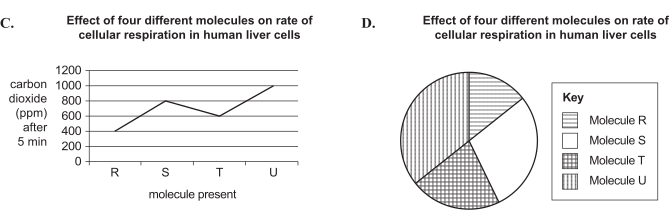
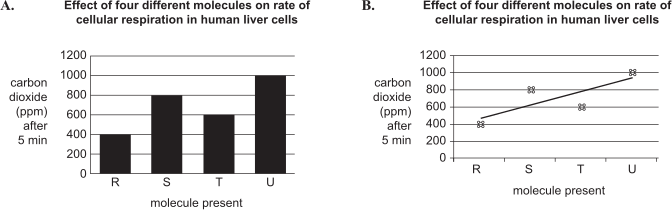
A student investigated the effect of the presence of four different molecules, R, S, T and U, on the rate of cellular respiration in human liver cells. The production of carbon dioxide by the cells was recorded over a five-minute interval. The final concentration of carbon dioxide was recorded. The data collected is shown below.

\begin{array} {|c|c|}
\hline
\rule{0pt}{2.5ex} \textbf{Molecule present } & \textbf{Concentration of carbon dioxide (ppm) } \\
\textbf{} \rule[-1ex]{0pt}{0pt} & \textbf{after five minutes } \\
\hline
\rule{0pt}{2.5ex} \textbf{R} \rule[-1ex]{0pt}{0pt} & 400 \\
\hline
\rule{0pt}{2.5ex} \textbf{S} \rule[-1ex]{0pt}{0pt} & 800 \\
\hline
\rule{0pt}{2.5ex} \textbf{T} \rule[-1ex]{0pt}{0pt} & 600 \\
\hline
\rule{0pt}{2.5ex} \textbf{U} \rule[-1ex]{0pt}{0pt} & 1000 \\
\hline
\end{array}

The student presented the results as a graph.

Which one of the following graphs is the best representation of the results?
 
Show Answers Only

\(A\)

Show Worked Solution
  • The data is quantitive but not continuous, therefore the column graph is the most appropriate way to represent the results.

\(\Rightarrow A\)

Filed Under: Cell Function Tagged With: Band 4, smc-4303-20-Respiration

BIOLOGY, M1 2021 VCE 1

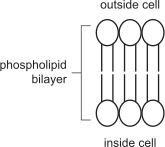
The diagram below shows a small part of a cross-section of the plasma membrane of a cell.
 

Some substances can move directly through the phospholipid bilayer.

  1. Complete the table below by naming one small hydrophilic substance and one small hydrophobic substance that can move through the phospholipid bilayer. Provide an example of a situation when each small substance would move through the phospholipid bilayer. The first row has been completed for you.   (2 marks)

    --- 0 WORK AREA LINES (style=lined) ---

\begin{array} {|c|l|l|}
\hline \textbf{Name of small} & \textbf{Hydrophilic or} & \ \ \textbf{Situation when substance moves} \ \ \\
\textbf{substance} & \ \ \textbf{hydrophobic} & \ \ \ \ \  \textbf{through phospholipid bilayer}  \\
\hline \text{oxygen}  & \text{hydrophobic} & \text{Oxygen diffuses out of photosynthetic}  \\
& & \text{plant.}\\
\hline  & \text{hydrophilic} &  \\
& & \\
\hline  & \text{hydrophobic} &  \\
& & \\
\hline \end{array}

  1. Some very large substances and/or large particles that do not dissolve in the phospholipid bilayer can still move into or out of a cell.

    Using one example, explain how the phospholipid bilayer transports these very large substances and/or large particles without the use of channel or carrier proteins either into a cell or out of a cell.   (3 marks)

--- 6 WORK AREA LINES (style=lined) ---

Show Answers Only

a.   

\begin{array} {|c|l|l|}
\hline \textbf{Name of small} & \textbf{Hydrophilic or} & \ \ \textbf{Situation when substance moves} \ \ \\
\textbf{substance} & \ \ \textbf{hydrophobic} & \ \ \ \ \  \textbf{through phospholipid bilayer}  \\
\hline \text{oxygen}  & \text{hydrophobic} & \text{Oxygen diffuses out of photosynthetic}  \\
& & \text{plant}\\
\hline \text{water} & \text{hydrophilic} & \text{Water diffuses out of a cell during} \\
& & \text{respiration. }\\
\hline \text{carbon dioxide} & \text{hydrophobic} & \text{Carbon dioxide diffuses out of a cell} \\
& & \text{during respiration. } \\
\hline \end{array}

b.    Into a cell:

  • Endocytosis is a process which allows large particles such as proteins or antigens to enter a cell.
  • Endocytosis involves the folding over of a membrane to form a vesicle. The contents of the vesicle can then be digested by enzymes within the cell. 

Out of a cell:

  • Exocytosis is a process which allows large particles such as proteins, antibodies or neurotransmitters to exit a cell.
  • Exocytosis involves the formation of a vesicle around the materials which need to exit the cell.
  • This vesicle then fuses with the plasma membrane, releasing the contents into the environment.
Show Worked Solution

a.   

\begin{array} {|c|l|l|}
\hline \textbf{Name of small} & \textbf{Hydrophilic or} & \ \ \textbf{Situation when substance moves} \ \ \\
\textbf{substance} & \ \ \textbf{hydrophobic} & \ \ \ \ \  \textbf{through phospholipid bilayer}  \\
\hline \text{oxygen}  & \text{hydrophobic} & \text{Oxygen diffuses out of photosynthetic}  \\
& & \text{plant}\\
\hline \text{water} & \text{hydrophilic} & \text{Water diffuses out of a cell during} \\
& & \text{respiration. }\\
\hline \text{carbon dioxide} & \text{hydrophobic} & \text{Carbon dioxide diffuses out of a cell} \\
& & \text{during respiration. } \\
\hline \end{array}

 
b.
    Into a cell:

  • Endocytosis is a process which allows large particles such as proteins or antigens to enter a cell.
  • Endocytosis involves the folding over of a membrane to form a vesicle. The contents of the vesicle can then be digested by enzymes within the cell. 

Out of a cell:

  • Exocytosis is a process which allows large particles such as proteins, antibodies or neurotransmitters to exit a cell.
  • Exocytosis involves the formation of a vesicle around the materials which need to exit the cell.
  • This vesicle then fuses with the plasma membrane, releasing the contents into the environment.

Filed Under: Cell Structure Tagged With: Band 4, Band 5, smc-4302-50-Cell membrane

CHEMISTRY, M4 2022 VCE 2 MC

A fuel undergoes combustion to heat water.

Which of the following descriptions of the energy and enthalpy of combustion, \(\Delta H\), of the reaction is correct?
 

  \(\text{Energy}\) \(\ \ \Delta H\ \ \)
A.     absorbed by the water   negative
B.   released by the water   negative
C.   absorbed by the water   positive
D.   released by the water   positive
Show Answers Only

\(A\)

Show Worked Solution
  • Combustion is exothermic (\(\Delta H\) is negative).
  • Energy released is absorbed by the water.

\(\Rightarrow A\)

Filed Under: Entropy and Gibbs Free Energy Tagged With: Band 4

CHEMISTRY, M4 2022 VCE 11*

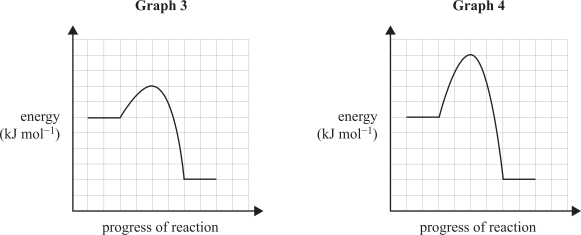
The graphs shown below are energy profiles for the following reaction.

\(\ce{A + B\leftrightharpoons C}\) \(\quad \quad \Delta H < 0\)

The graphs represent the forward reaction, with and without a catalyst, and the reverse reaction, with and without a catalyst. All graphs are drawn to the same scale.
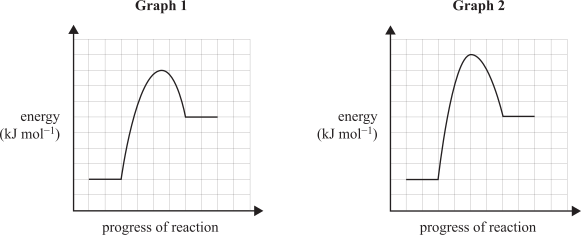
 

Which energy profile represents the reverse reaction without a catalyst? Give reasons for your answer.  (2 marks)

--- 4 WORK AREA LINES (style=lined) ---

Show Answers Only
  • Since forward reaction is exothermic, reverse reaction is endothermic where energy of reactants < energy of products (eliminate Graphs 3 and 4).
  • A catalyst lowers the activation energy required. Graph 1 has a lower activation energy than Graph 2.
  • Therefore, Graph 2 represents the energy profile of the reverse reaction without a catalyst.
Show Worked Solution
  • Since forward reaction is exothermic, reverse reaction is endothermic where energy of reactants < energy of products (eliminate Graphs 3 and 4).
  • A catalyst lowers the activation energy required. Graph 1 has a lower activation energy than Graph 2.
  • Therefore, Graph 2 represents the energy profile of the reverse reaction without a catalyst.

Filed Under: Energy Changes in Chemical Reactions Tagged With: Band 4

PHYSICS, M3 2017 VCE 14 MC

A teacher stands in the corridor at a short distance from the open door of her classroom, as shown in the diagram below. She can hear her students. but cannot see them.
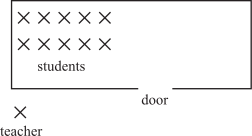
 

Which one of the following best explains why the teacher can hear her students?

  1. The speed of sound is much greater than the speed of light.
  2. The speed of sound is comparable with the speed of light.
  3. Sound diffracts because the wavelength of sound is much smaller than the width of the door.
  4. Sound diffracts because the wavelength of sound is comparable with the width of the door.
Show Answers Only

\(D\)

Show Worked Solution
  • Sound waves can range anywhere from 20mm to 17m and thus the some sounds made by the students would have a wavelength of 1 metre.
  • Therefore, sound will diffract through the doorway as it is the same order of magnitude of the size of the door whereas light will not as its wavelengths are much smaller in size.

\(\Rightarrow D\)

Filed Under: Wave Properties and Behaviour Tagged With: Band 4, smc-4278-25-Diffraction

PHYSICS, M4 2017 VCE 1 MC

A group of students is considering how to create a magnetic monopole. Which one of the following is correct?

  1. Break a bar magnet in half.
  2. Pass a current through a long solenoid.
  3. Pass a current through a circular loop of wire.
  4. It is not known how to create a magnetic monopole.
Show Answers Only

\(D\)

Show Worked Solution
  • There is currently no evidence that a magnetic monopole exists.

\(\Rightarrow D\)

Filed Under: Magnetism Tagged With: Band 4, smc-4285-40-Properties of magnetic fields

PHYSICS, M3 2018 VCE 12

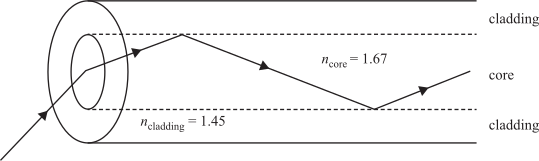
Optical fibres are constructed using transparent materials with different refractive indices.

The diagram below shows one type of optical fibre that has a cylindrical core and surrounding cladding. Laser light of wavelength 565 nm is shone from air into the optical fibre (\(v=3 \times 10^8\)).
 

  1. Calculate the frequency of the laser light before it enters the optical fibre.  (1 mark)

    --- 2 WORK AREA LINES (style=lined) ---

  2. Calculate the critical angle for the laser light at the cladding-core boundary. Show your working.  (2 marks)

    --- 4 WORK AREA LINES (style=lined) ---
  3. Calculate the speed of the laser light once it enters the core of the optical fibre. Give your answer correct to three significant figures. Show your working.  (2 marks)

    --- 4 WORK AREA LINES (style=lined) ---

Show Answers Only

a.    \(f=5.31 \times 10^{14}\ \text{Hz}\)

b.    \(\theta_c=60.3^{\circ}\)

c.    \(v_{\text{x}}=1.80 \times 10^8\ \text{ms}^{-1}\)

Show Worked Solution

a.     \(f\) \(=\dfrac{v}{\lambda}\)
    \(=\dfrac{3\times 10^8}{565 \times 10^{-9}}\)
    \(=5.31 \times 10^{14}\ \text{Hz}\)

 
b.
  \(\theta_c=\sin^{-1}\Big{(}\dfrac{n_2}{n_1}\Big{)}=\sin^{-1} \Big{(}\dfrac{1.45}{1.67} \Big{)}=60.3^{\circ}\) 

c.     \(v_{\text{x}}\) \(=\dfrac{c}{n_{\text{x}}}\)
    \(=\dfrac{3 \times 10^8}{1.67}\)
    \(=1.80 \times 10^8\ \text{ms}^{-1}\)
♦ Mean mark (c) 50%.

Filed Under: Ray Model of Light Tagged With: Band 4, Band 5, smc-4281-20-Snell's Law and TIR, smc-4281-40-Speed of light in medium

PHYSICS, M2 2018 VCE 8

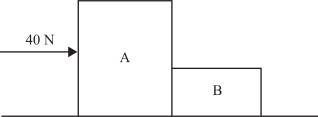
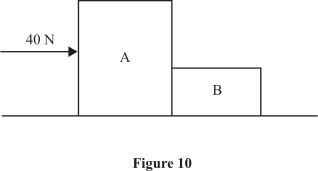
Two blocks, \(\text{A}\) of mass 4.0 kg and \(\text{B}\) of mass 1.0 kg, are being pushed to the right on a smooth, frictionless surface by a 40 N force, as shown in the diagram.
 

  1. Calculate the magnitude of the force on block \(\text{B}\) by block \(\text{A}\) (\(\left.F_{\text {on B by A}}\right)\). Show your working.   (2 marks)

    --- 5 WORK AREA LINES (style=lined) ---
  2. State the magnitude and the direction of the force on block \(\text{A}\) by block \(\text{B}\) (\(\left.F_{\text {on A by B}}\right)\).   (2 marks)

    --- 5 WORK AREA LINES (style=lined) ---
Show Answers Only

a.    \(8\ \text{N}\)

b.    \(8\ \text{N}\) to the left.

Show Worked Solution

a.   Using \(F=ma\), calculate the acceleration of the entire system:

\(a=\dfrac{F}{m}=\dfrac{40}{5}=8\ \text{ms}^{-2}\)

\(F_{\text {on B by A }}=m \times a=1 \times 8=8\ \text{N}\)

♦♦ Mean mark (a) 36%.

 
b.   
Newton’s third law of motion:

  • \(F_{\text {on A by B }}\) will be equal in magnitude and opposite in direction.
  • \(F_{\text {on A by B }}= 8\ \text{N}\) to the left.

Filed Under: Forces Tagged With: Band 4, Band 5, smc-4275-20-Newtons 3rd Law, smc-4275-30-Newton's 2nd Law

  • « Previous Page
  • 1
  • …
  • 41
  • 42
  • 43
  • 44
  • 45
  • …
  • 114
  • Next Page »

Copyright © 2014–2025 SmarterEd.com.au · Log in