
The graph shown could have equation
- `y = 2cos(x + pi/6) + 1`
- `y = 2cos4(x - pi/6) + 1`
- `y = 4sin2(x - pi/12) - 1`
- `y = 3cos(2x + pi/6) - 1`
Aussie Maths & Science Teachers: Save your time with SmarterEd
The graph shown could have equation
The function with equation `f(x) = 4 tan (x/3)` has period
The UV index, `y`, for a summer day in Newcastle East is illustrated in the graph below, where `t` is the number of hours after 6 am.

The graph is most likely to be the graph of
A section of the graph of `f(x)` is shown below.

The equation of `f(x)` could be
Francis is buying a fridge. The energy usage of his two choices are below:
Fridge 1 (5 star rating): 227 kWh per year
Fridge 2 (2 star rating): 492 kWh per year
Each fridge has an expected life of 8 years.
If electricity costs 32.4 cents per kWh, how much will Francis save in electricity over the expected life of the more energy efficient fridge, to the nearest dollar? (2 marks)
--- 4 WORK AREA LINES (style=lined) ---
A potting mix is made up of two ingredients, potting soil and manure, in the ratio 5:2.
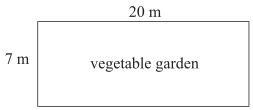
21 kilograms of potting mix are used to fertilise the rectangular vegetable garden pictured below.
--- 4 WORK AREA LINES (style=lined) ---
--- 1 WORK AREA LINES (style=lined) ---
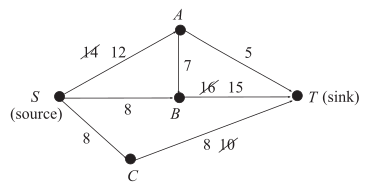
The network diagram below flows from the source (S) to sink (T).
Which of the edges is not at maximum capacity?
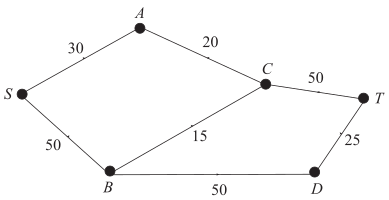
`text(Consider the minimum cut line: all edges are saturated.)`
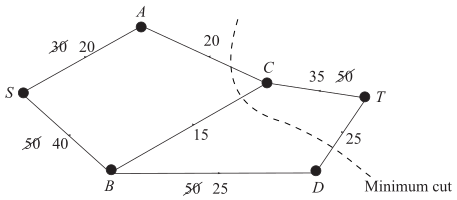
`:.\ text(Edge)\ CT\ text(is not at maximum capacity.)`
`=>\ C`
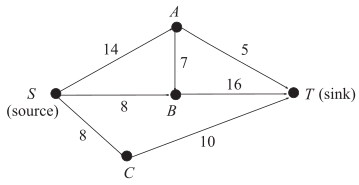
A network diagram is drawn below.
--- 2 WORK AREA LINES (style=lined) ---
--- 7 WORK AREA LINES (style=lined) ---
| i. | 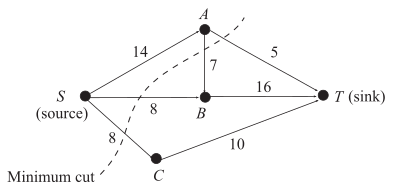 |
| `text(Maximum flow)` | `=\ text(minimum cut)` |
| `= 8 + 8 + 7 + 5` | |
| `= 28` |
| ii. |
|
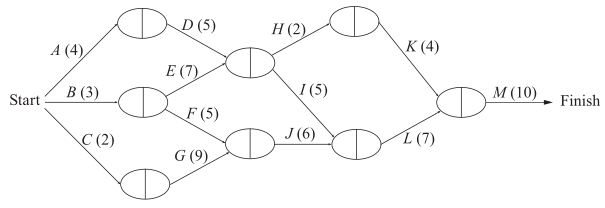
Bianca is designing a project for producing an advertising brochure. It involves activities A-M.
The network below shows these activities and their completion time in hours.
--- 1 WORK AREA LINES (style=lined) ---
--- 1 WORK AREA LINES (style=lined) ---
--- 1 WORK AREA LINES (style=lined) ---
--- 4 WORK AREA LINES (style=lined) ---
i. `text(Scanning forwards and backwards)`
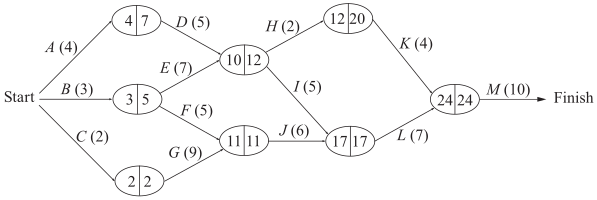
`text{EST (activity}\ J) = 11\ text(hours)`
| ii. | `text{LST (activity}\ H)` | `=\ text{LST}\ (H)-text(weight)\ (H)` |
| `= 20-2` | ||
| `=18\ text(hours)` |
| iii. | `text{Float time}\ (I)` | `=\ text(LST)\ (I)-text(EST)\ (I)` |
| `=12-10` | ||
| `= 2\ text(hours)` |
iv. `text(Critical Path is)\ CGJLM`
| `:.\ text(Minimum time)` | `= 2 + 9 + 6 + 7 + 10` |
| `= 34\ text(hours)` |
The graph below represents `y = a^x`.
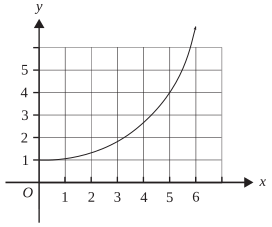
What is the approximate value of `2(a^5)`?
At her favourite fun park, Katherine’s first activity is to slide down a 10 m long straight slide. She starts from rest at the top and accelerates at a constant rate, until she reaches the end of the slide with a velocity of `6\ text(ms)^(-1)`.
--- 3 WORK AREA LINES (style=lined) ---
When at the top of the slide, which is 6 m above the ground, Katherine throws a chocolate vertically upwards. The chocolate travels up and then descends past the top of the slide to land on the ground below. Assume that the chocolate is subject only to gravitational acceleration and that air resistance is negligible.
--- 4 WORK AREA LINES (style=lined) ---
At what velocity would the chocolate need to be propelled upwards, if Katherine were to immediately slide down the slide and run to reach the chocolate just as it hits the ground?
Give your answer in `text(ms)^(-1)`, correct to one decimal place. (2 marks)
--- 4 WORK AREA LINES (style=lined) ---
Katherine’s next activity is to ride a mini speedboat. To stop at the correct boat dock, she needs to stop the engine and allow the boat to be slowed by air and water resistance.
At time `t` seconds after the engine has been stopped, the acceleration of the boat, `a\ text(ms)^(-2)`, is related to its velocity, `v\ text(ms)^(-1)`, by
`a = -1/10 sqrt(196-v^2)`.
Katherine stops the engine when the speedboat is travelling at `7\ text(m/s)`.
--- 6 WORK AREA LINES (style=lined) ---
--- 4 WORK AREA LINES (style=lined) ---
--- 5 WORK AREA LINES (style=lined) ---
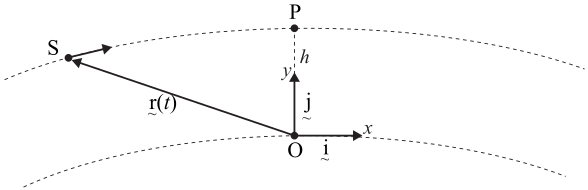
The position vector of the International Space Station `text{(S)}`, when visible above the horizon from a radar tracking location `text{(O)}` on the surface of Earth, is modelled by
`underset ~r(t) = 6800 sin(pi(1.3t-0.1))underset~i + (6800 cos(pi(1.3t-0.1))-6400)underset ~j`,
for `t in [0, 0.154]`,
where `underset ~i` is a unit vector relative to `text(O)` as shown and `underset ~j` is a unit vector vertically up from point `text(O)`. Time `t` is measured in hours and displacement components are measured in kilometres.
--- 3 WORK AREA LINES (style=lined) ---
--- 5 WORK AREA LINES (style=lined) ---
--- 4 WORK AREA LINES (style=lined) ---
--- 4 WORK AREA LINES (style=lined) ---
--- 6 WORK AREA LINES (style=lined) ---
A car accelerates from rest. Its speed after `T` seconds is `V\ text(ms)^(−1)`, where
`V = 17 tan^(−1)((pi T)/6), T >= 0`
--- 1 WORK AREA LINES (style=lined) ---
--- 2 WORK AREA LINES (style=lined) ---
--- 4 WORK AREA LINES (style=lined) ---
After accelerating to `25\text(ms)^(−1)`, the car stays at this speed for 120 seconds and then begins to decelerate while braking. The speed of the car `t` seconds after the brakes are first applied is `v\ text(ms)^(−1)` where
`(dv)/(dt) =-1/100 (145-2t),`
until the car comes to rest.
--- 3 WORK AREA LINES (style=lined) ---
--- 3 WORK AREA LINES (style=lined) ---
--- 4 WORK AREA LINES (style=lined) ---
Give your answer in metres correct to the nearest metre. (1 mark)
--- 3 WORK AREA LINES (style=lined) ---
--- 5 WORK AREA LINES (style=lined) ---
--- 2 WORK AREA LINES (style=lined) ---
--- 2 WORK AREA LINES (style=lined) ---
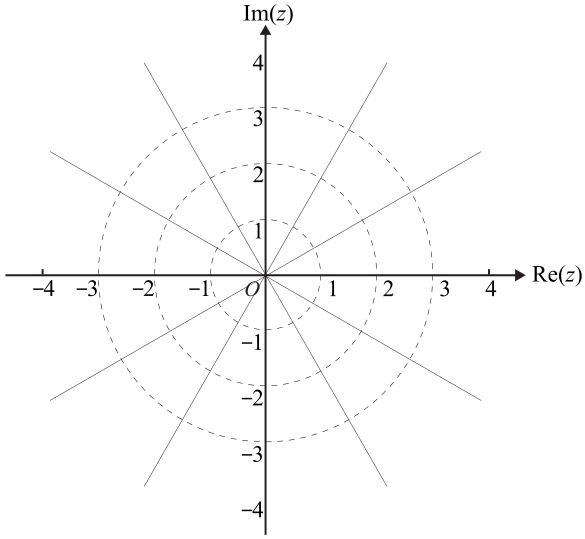
`{z: text(Arg)(z_1) <= text(Arg)(z) <= text(Arg)(z_1^4)} ∩ {z: 1 <= |\ z\ | <= 2}, z ∈ C`. (2 marks)
--- 0 WORK AREA LINES (style=lined) ---
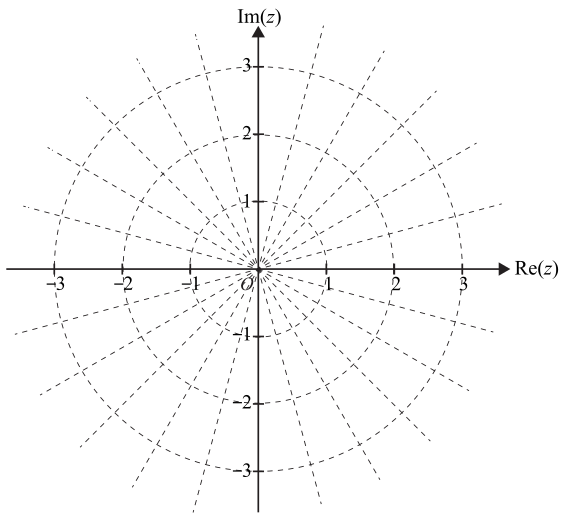
--- 5 WORK AREA LINES (style=lined) ---
--- 6 WORK AREA LINES (style=lined) ---
--- 2 WORK AREA LINES (style=lined) ---
| a. | `cos^2(pi/12) + sin^2(pi/12)` | `= 1` |
| `sin^2(pi/12)` | `= 1-(sqrt 3 + 2)/4` | |
| `= (2-sqrt 3)/4` |
`:. sin (pi/12) = sqrt(2-sqrt 3)/2,\ \ \ (sin (pi/12) > 0)`
| b.i. | `z_1` | `= cos(pi/12) + i sin (pi/12)` |
| `= text(cis)(pi/12)` |
| b.ii. | `z_1^4` | `= 1^4 text(cis) ((4 pi)/12)` |
| `= text(cis)(pi/3)` |
| c. | 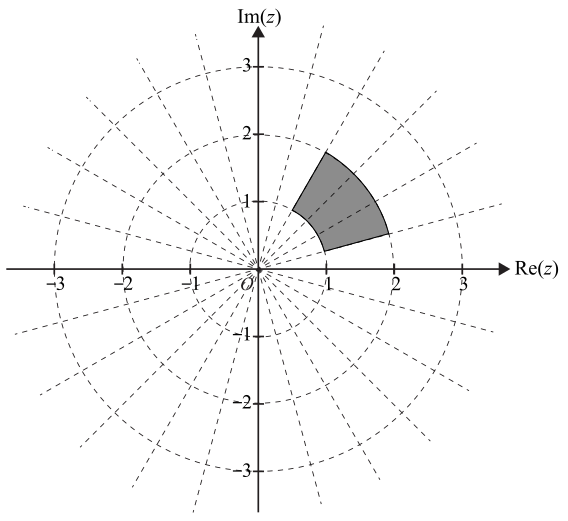 |
d. `text(Area of large sector)`Mean mark 51%.
`=theta/(2pi) xx pi r^2`
`=(pi/3-pi/12)/(2pi) xx pi xx 2^2`
`=pi/2`
`text(Area of small sector)`
`=1/2 xx pi/4 xx 1`
`=pi/8`
`:.\ text(Area shaded)`
`= pi/2-pi/8`
`= (3 pi)/8`
♦ Mean mark (e)(i) 34%.
| e.i. | `z_1^n` | `= 1^n text(cis) ((n pi)/12)` |
| `text(Re)(z_1^n)` | `= cos((n pi)/12) = 0` | |
| `(n pi)/12` | `=cos^(-1)0 +2pik,\ \ \ k in ZZ` | |
| `(n pi)/12` | `= pi/2 + k pi` | |
| `n` | `= 6 + 12k,\ \ \ k in ZZ` |
e.ii. `text(When)\ \ n=(6 + 12k):`♦ Mean mark (e)(ii) 36%.
| `z_1^n` | `= 1^(6 + 12k) text(cis) (((6 + 12k)pi)/12), quad k in ZZ` | |
| `= i xx sin (((6 + 12k)pi)/12)` | ||
| `= i xx sin (pi/2 + k pi)` |
`text(If)\ \ k=0 or text(even,)\ \ z_1^n=i`
`text(If)\ \ k\ text(is odd,)\ \ z_1^n=-i`
`:. z_1^n = +-i,\ \ \ k in ZZ`
A 12 kg mass is suspended in equilibrium from a horizontal ceiling by two identical light strings. Each string makes an angle of 60° with the ceiling, as shown.
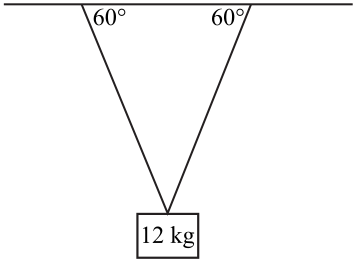
The magnitude, in newtons, of the tension in each string is equal to
A. `6 g`
B. `12 g`
C. `24 g`
D. `4 sqrt 3 g`
E. `8 sqrt 3 g`
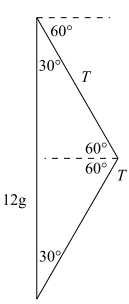
| `T/(sin 30^@)` | `= (12 g)/(sin 120^@)` |
| `2T` | `= (24 g)/sqrt3` |
| `T` | `= (12 g)/sqrt3` |
| `= 4g sqrt 3` |
`=> D`
If `underset ~u = 2 underset ~i - 2 underset ~j + underset ~k` and `underset ~v = 3 underset ~i - 6 underset ~j + 2 underset ~k`, the vector resolute of `underset ~v` in the direction of `underset ~u` is
A. `20/49(3 underset ~i - 6 underset ~j + 2 underset ~k)`
B. `20/3(2 underset ~i - 2underset ~j + underset ~k)`
C. `20/7(3 underset ~i - 6 underset ~j + 2 underset ~k)`
D. `20/9(2 underset ~i - 2 underset ~j + underset ~k)`
E. `1/9(−2 underset ~i + 2 underset ~j - underset ~k)`
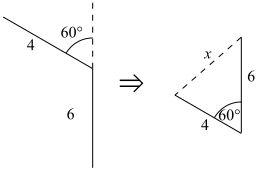
A particle is acted on by two forces, one of 6 newtons acting due south, the other of 4 newtons acting in the direction N60° W.
The magnitude of the resultant force, in newtons, acting on the particle is
Mean mark 51%.
| `x^2` | `= 6^2 + 4^2 – 2(6)(4) cos 60^@` |
| `= 28` | |
| `:. x` | `= sqrt 28` |
| `= 2 sqrt 7` |
`=> B`
Using a suitable substitution, `int_0^(pi/3) sin^3 (x) cos^4 (x)\ dx` can be expressed in terms of `u` as
A. `int_0^(pi/3) (u^6 - u^4)\ du`
B. `int_1^(1/2) (u^6 - u^4)\ du`
C. `int_(1/2)^1 (u^6 - u^4)\ du`
D. `int_0^(sqrt3/2) (u^6 - u^4)\ du`
E. `int_0^(sqrt3/2) (u^4 - u^6)\ du`
If `(d^2y)/(dx^2) = x^2 - x` and `(dy)/(dx) = 0` at `x = 0`, then the graph of `y` will have
The diagram that best represents the direction field of the differential equation `(dy)/(dx) = xy` is
| A. | 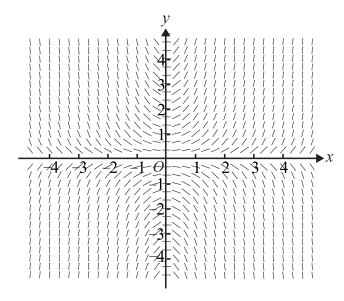 |
B. |  |
| C. | 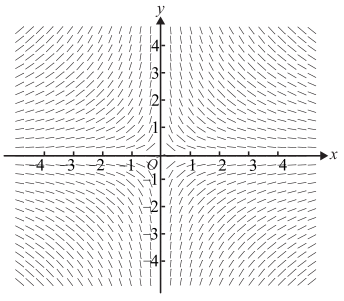 |
D. |  |
Euler's formula is used to find `y_2`, where `(dy)/(dx) = cos(x),\ x_0 = 0, \ y_0 = 1` and `h = 0.1`.
The value of `y_2` correct to four decimal places is
A. 1.1000 and this is an underestimate of `y(0.2)`
B. 1.1995 and this is an overestimate of `y(0.2)`
C. 1.1995 and this is an underestimate of `y(0.2)`
D. 1.2975 and this is an underestimate of `y(0.2)`
E. 1.2975 and this is an overestimate of `y(0.2)`
A particle moves in a straight line. At time `t` seconds, where `t >= 0`, its displacement `x` metres from the origin and its velocity `v` metres per second are such that `v = 25 + x^2`.
If `x = 5` initially, then `t` is equal to
A body moves in a straight line such that its velocity `v\ text(ms)^(-1)` is given by `v = 2sqrt(1 - x^2)`, where `x` metres is its displacement from the origin.
The acceleration of the body in `text(ms)^(-2)` is given by
The motion of a lift (elevator) in a shopping centre is given by the velocity-time graph below, where time `t` is in seconds, and the velocity of the lift is `v` metres per second. For `v > 0` the lift is moving upwards.

The graph shows that at the end of 30 seconds, the position of the lift is
A. 17.5 metres above its starting level.
B. 5 metres above its starting level.
C. at the same position as its starting level.
D. 5 metres below its starting level.
E. 17.5 metres below its starting level.
The amount of chemical `x` in a tank at time `t` is given by the differential equation `dx/dt = -10/(10 - t)` and when `t = 0`, `\ x_0 = 5`. Euler's method is used with a step size of 0.5 in the values of `t`.
The value of `x` correct to two decimal places when `t = 1` is found to be
A. 3.95
B. 3.97
C. 4.50
D. 5.50
E. 6.03

The differential equation which best represents the above direction field is
A. `(dy)/(dx) = (y - 2x)/(2y + x)`
B. `(dy)/(dx) = (2x - y)/(y - 2x)`
C. `(dy)/(dx) = (2y - x)/(y + 2x)`
D. `(dy)/(dx) = (y - 2x)/(2y - x)`
E. `(dy)/(dx) = (x - 2y)/(2y + x)`
Using a suitable substitution, the definite integral `int_0^(pi/24)tan(2x)sec^2(2x)\ dx` is equivalent to
A. `1/2int_0^(pi/24)(u)\ du`
B. `2int_0^(pi/24)(u)\ du`
C. `int_0^(2 - sqrt3)(u)\ du`
D. `1/2int_0^(2 - sqrt3)(u)\ du`
E. `2int_0^(2 - sqrt3)(u)\ du`
If `f″(x) = 2e^xsin(x)`, `f′(0) = 0` and `f(0) = 0`, the `f(x)` equals
A. `−e^x(cos(x) + sin(x))`
B. `−e^x(cos(x) - sin(x)) + 1`
C. `−e^xcos(x)`
D. `x - e^xcos(x) + 1`
E. `x - e^xcos(x)`
The position of a particle at time `t` is given by `underset~r(t) = (sqrt(t - 2))underset~i + (2t)underset~j` for `t >= 2`.
The cartesian equation of the path of the particle is
| A. `y = 2x^2 + 4`, | `x >= 2` |
| B. `y = 2x^2 + 2`, | `x >= 2` |
| C. `y = 2x^2 + 4`, | `x >= 0` |
| D. `y = sqrt((x - 4)/2)`, | `x >= 4` |
| E. `y = 2x^2 + 2`, | `x >= 0` |
Consider the three forces
`underset~F_1 = −sqrt3underset~j`, `underset~F_2 = underset~i + sqrt3underset~j` and `underset~F_3 = −1/2underset~i + sqrt3/2underset~j`.
The magnitude of the sum of these three forces is equal to
The diagram below shows a rhombus, spanned by the two vectors `underset~a` and `underset~b`.

It follows that
A. `underset~a.underset~b = 0`
B. `underset~a = underset~b`
C. `(underset~a + underset~b).(underset~a - underset~b) = 0`
D. `|\ underset~a + underset~b\ | = |\ underset~a - underset~b|`
E. `2underset~a + 2underset~b = underset~0`
`text(Consider A:)`
`text(If)\ \ underset~a · underset~b = 0\ \ =>\ \ underset~a ⊥ underset~b\ \ text{(incorrect)}`
`text(Consider B:)`
`underset~a != underset~b\ \ text{(incorrect)}`
`text(Consider C:)`
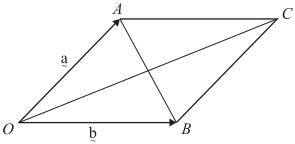
| `underset~a + underset~b` | `= overset(->)(OC)` |
| `underset~a – underset~b` | `= overset(->)(BA)` |
`overset(->)(OC) · overset(->)(BA)=0`
`text{The diagonals of a rhombus are perpendicular (correct)}`
`=> C`
In the complex plane, the circle with equation `|\ z - (2 + 3i)\ | = 1` is intersected exactly twice by the curve with equation
A. `|\ z - 3i\ | = 1`
B. `|\ z + 3\ | = |\ z - 3i\ |`
C. `|\ z - 3\ | = |\ z - 3i\ |`
D. `text(Im)(z) = 4`
E. `text(Re)(z) = 3`
`text(Consider option C:)`
`|z – 3| = |z – 3i|`
`=> y = x\ text{(perpendicular bisector}`
`text{between (3, 0) and (0, 3)}`
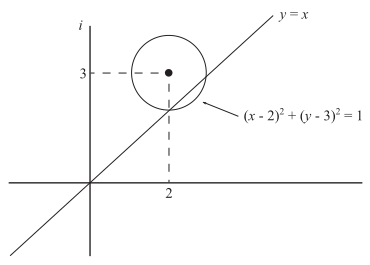
`=> C`
The polynomial `P(z)` has real coefficients. Four of the roots of the equation `P(z) = 0` are `z = 0`, `z = 1 - 2i`, `z = 1 + 2i` and `z = 3i`.
The minimum number of roots that the equation `P(z) = 0` could have is
A. 4
B. 5
C. 6
D. 7
E. 8
A certain complex number `z`, where `|\ z\ | > 1`, is represented by the point on the following argand diagram.

All axes below have the same scale as those in the diagram above.
The complex number `1/barz` is best represented by


The region in the first quadrant enclosed by the curve `y = sin(x)`, the line `y = 0` and the line `x = pi/6` is rotated about the `x`-axis. Find the volume of the resulting solid of revolution. (3 marks) --- 8 WORK AREA LINES (style=lined) ---
Show Worked Solution
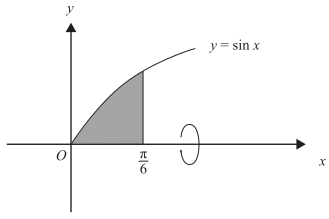
`V`
`= pi int_(0)^(pi/6) y^2\ dx`
`= pi int_0^(pi/6) sin^2(x)\ dx`
`= pi/2 int_0^(pi/6) (1-cos 2x)\ dx`
`= pi/2 [x-1/2 sin (2x)]_0^(pi/6)`
`=pi/2 [(pi/6-1/2 sin (pi/3))-0]`
`=pi/2 (pi/6-(sqrt 3)/4)`
`=pi^2/12-(sqrt3 pi)/8\ \ text(u³)`
The velocity–time graph for the first 2 seconds of the motion of a particle that is moving in a straight line with respect to a fixed point is shown below.
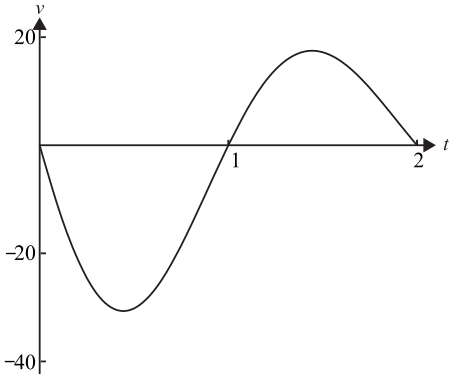
The particle’s velocity `v` is measured in cm/s. Initially the particle is `x_0` cm from the fixed point.
The distance travelled by the particle in the first 2 seconds of its motion is given by
A. `int_0^2 v\ dt`
B. `int_0^2 v\ dt + x_0`
C. `int_1^2 v\ dt - int_0^1 v\ dt`
D. `|\ int_0^2 v\ dt\ |`
E. `int_1^2 v\ dt - int_0^1 v\ dt + x_0`
Consider the three vectors `underset ~a = underset ~i - underset ~j + 2underset ~k,\ underset ~b = underset ~i + 2 underset ~j + m underset ~k` and `underset ~c = underset ~i + underset ~j - underset ~k`, where `m in R.` --- 4 WORK AREA LINES (style=lined) --- --- 4 WORK AREA LINES (style=lined) --- --- 3 WORK AREA LINES (style=lined) --- --- 4 WORK AREA LINES (style=lined) ---
A flowerpot of mass `m` kg is held in equilibrium by two light ropes, both of which are connected to a ceiling. The first rope makes an angle of 30° to the vertical and has tension `T_1` newtons. The second makes an angle of 60° to the vertical and has tension `T_2` newtons.

Find the maximum value of `m` for which the flowerpot will remain in equilibrium. (3 marks)
a. `text(Forces in equilibrium:)`
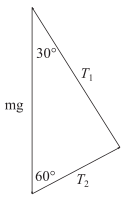
| `tan 30^@` | `=T_2/T_1` |
| `T_2` | `= T_1 xx tan30^@` |
| `T_2` | `= T_1/sqrt3\ \ text(.. as required)` |
| b. | `sin30^@` | `= (T_2)/(mg)` |
| `T_2` | `= (mg)/2` | |
| `98` | `=(m_text(max) xx 9.8)/2` | |
| `m_text(max)` | `=(2 xx 98)/9.8` | |
| `=20\ text(kg)` |
Evaluate `int_0^1 e^x cos (e^x)\ dx.` (2 marks)
For the curve with parametric equations
`x = 4 sin (t) - 1`
`y = 2 cos (t) + 3`
Find `(dy)/(dx)` at the point `(1, sqrt 3 + 3).` (3 marks)
If `z = a + bi`, where both `a` and `b` are non-zero real numbers and `z in C`, which of the following does not represent a real number?
The set of points in the complex plane defined by `|\ z + 2i\ | = |\ z\ |` corresponds to
A. the point given by `z = −i`
B. the line `text(Im)(z) = −1`
C. the line `text(Im)(z) = −i`
D. the line `text(Re)(z) = −1`
E. the circle with centre `−2i` and radius `1`
If `z = sqrt 2 text(cis)(-(4 pi)/5)` and `w = z^9`, then
A. `w = 16 sqrt 2 text(cis)((36 pi)/5)`
B. `w = 16 sqrt 2 text(cis)(−pi/5)`
C. `w = 16 sqrt 2 text(cis)((4pi)/5)`
D. `w = 9 sqrt 2 text(cis)(-pi/5)`
E. `w = 9 sqrt 2 text(cis)((4pi)/5)`
--- 3 WORK AREA LINES (style=lined) --- --- 0 WORK AREA LINES (style=lined) --- --- 5 WORK AREA LINES (style=lined) ---

Show Answers Only

b. `underset (x→oo) (lim y) = 2` `text(S)text(ince)\ \ x^2>0\ \ text(for all)\ x,` `=> f(x)_text(max)\ \ text(occurs when)\ \ x=0\ \ text(at)\ \ (0,3)` c. `f(x)\ \ text(is an even function.)`Show Worked Solution
a.
`f(x)`
`= (2x^2 + 3)/(x^2 + 1)`
`= (2(x^2 + 1) + 1)/(x^2 + 1)`
`= 2 + 1/(x^2 + 1)`
`:.\ text(Area)`
`= 2 int_0^1 2 + 1/(x^2 + 1)\ dx`
`= 2[2x + tan^(−1)(x)]_0^1`
`=2[(2+pi/4)-0]`
`= 4 + pi/2`
Find the value of the real constant `k` given that `kxe^(2x)` is a solution of the differential equation
`(d^2y)/(dx^2)-2 (dy)/(dx) + 5y = e^(2x) (15x + 6).` (3 marks)
--- 8 WORK AREA LINES (style=lined) ---
Find an antiderivative of `(1 + x)/(9-x^2),\ \ x in R \ text(\{– 3, 3}).` (3 marks)
--- 7 WORK AREA LINES (style=lined) ---
The graph of `y = f(x)` is shown below.

All the axes below have the same scale as the axes in the diagram above.
The graph of `y = 1/(f(x))` is best represented by
| A. | 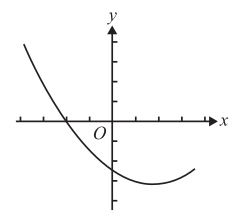 |
B. | 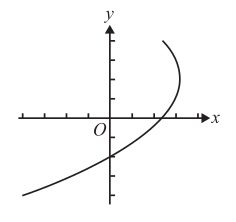 |
| C. | 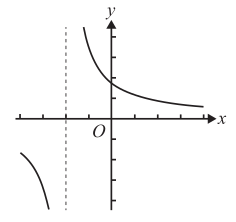 |
D. | 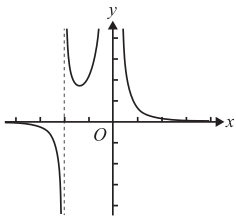 |
| E. | 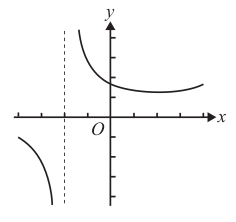 |
Consider the functions with rules `f(x) = arcsin (x/2) + 3/sqrt (25 x^2-1)` and `g(x) = arcsin (3x)-3/sqrt (25x^2-1).`
--- 2 WORK AREA LINES (style=lined) ---
--- 3 WORK AREA LINES (style=lined) ---
--- 3 WORK AREA LINES (style=lined) ---
Give your answer in the form `(a sqrt b)/c, \ a, b, c in Z.` (3 marks)
--- 7 WORK AREA LINES (style=lined) ---
a.i. `text(Maximal Domain occurs when:)`
| `-1 <= x/2 <= 1` | |
| `{x: -2 <= x <= 2}` |
a.ii. `text(Maximal Domain occurs when:)`♦♦ Mean mark part (a)(ii) 33%.
| `25x^2-1 > 0` | |
| `x^2 > 1/25` | |
| `{x: x < -1/5 uu x > 1/5}` |
a.iii. `text(Max domain for which)\ \ f(x)\ \ text(is defined:)`♦♦ Mean mark part (a)(iii) 26%.
| `(-2 <= x <= 2) nn (x < -1/5 uu x > 1/5)` | |
| `{x: -2 <= x < -1/5 \ uu \ 1/5 < x <= 2}` |
| b. | `h(x)` | `= sin^(-1) (x/2) + 3/sqrt(25x^2-1) + sin^(-1)(3x)-3/sqrt(25x^2-1)` |
| `= sin^(-1)(x/2) + sin^(-1)(3x)` |
`text(When)\ \ x=1/4,\ \ h(x)=theta`♦♦♦ Mean mark part (b) 20%.
`theta=sin^(-1) (1/8) + sin^(-1) (3/4)`
`text(Let)\ \ theta_1 = sin^(-1) (1/8),\ \ theta_2 = sin^(-1) (3/4)`
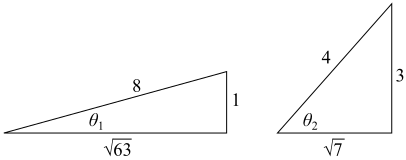
`text(Using)\ \ sin(theta_1 + theta_2)=sin theta_1 cos theta_2 + cos theta_1 sin theta_2:`
| `sin(theta)` | `= 1/8 * sqrt7/4 + sqrt63/8 * 3/4` |
| `=sqrt7/32 + (9sqrt7)/32` | |
| `=(5 sqrt7)/16` |
The position of a particle at time `t` is given by
`underset ~r (t) = (2 sqrt (t^2 + 2) - t^2) underset ~i + (2 sqrt (t^2 + 2) + 2t) underset ~j,\ \ t >= 0.`
--- 4 WORK AREA LINES (style=lined) ---
--- 6 WORK AREA LINES (style=lined) ---
--- 5 WORK AREA LINES (style=lined) ---
--- 6 WORK AREA LINES (style=lined) ---
a. `underset ~r (t) = (2 sqrt (t^2 + 2) – t^2) underset ~i + (2 sqrt (t^2 + 2) +2t) underset ~j`
| `underset ~v(t)` | `=dot underset ~r(t)` | |
| `= (2(2t)(1/2)(t^2 + 2)^(-1/2) – 2t) underset ~i + (2(2t)(1/2)(t^2 + 2)^(-1/2) + 2)underset ~j` | ||
| `= ((2t)/sqrt(t^2 + 2) – 2t) underset ~i + ((2t)/sqrt(t^2 + 2) + 2) underset ~j` |
| b. | `underset ~v(1)` | `= (2/sqrt(1 + 2) – 2)underset ~i + (2/sqrt(1 + 2) + 2) underset ~j` |
| `= (2/sqrt 3 – 2) underset ~i + (2/sqrt 3 + 2)underset ~j` | ||
| `|\ underset ~v(1)\ |` | `= sqrt((2/sqrt 3 – 2)^2 + (2/sqrt 3 + 2)^2)` | |
| `= sqrt(4/3 – 8/sqrt 3 + 4 + 4/3 + 8/sqrt 3 + 4)` | ||
| `= sqrt(8/3 + 8)` | ||
| `= sqrt(32/3)` | ||
| `= (4sqrt2)/sqrt3` | ||
| `= (4 sqrt 6)/3` |
♦ Mean mark part (c) 41%.
| c. | `(dy)/(dt)` | `= (dy)/(dx) xx (dx)/(dt)` |
| `(dy)/(dx)` | `=((dy)/(dt))/((dx)/(dt))` | |
| `:. (dy)/(dx)|_(t=1)` | `= (2/sqrt 3 + 2)/(2/sqrt 3 – 2)` | |
| `= ((2 + 2 sqrt 3)/sqrt 3) xx (sqrt 3/(2 – 2 sqrt 3))` | ||
| `= (2 + 2 sqrt 3)/(2 – 2 sqrt 3)` | ||
| `= (1 + sqrt 3)/(1 – sqrt 3)` |
d. `text(At)\ \ t=0:` ♦♦ Mean mark part (d) 32%.
`underset ~r(0) = 2 sqrt 2 underset ~i + 2 sqrt 2 underset ~j`
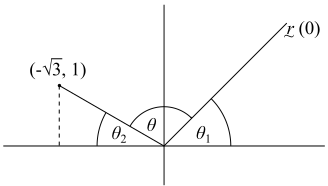
| `theta_1` | `= tan^(-1)((2 sqrt 2)/(2 sqrt 2)) = pi/4` |
| `theta_2` | `= tan^(-1)(1/sqrt 3)=pi/6` |
`text(Let)\ \ theta=\ text(angle between the vectors:)`
| `theta` | `= pi – theta_1 – theta_2` |
| `= pi – pi/4 – pi/6` | |
| `= (12 pi – 3 pi – 2 pi)/12` | |
| `= (7 pi)/12` |
The velocity, `v` m/s, of a body when it is `x` metres from a fixed point `O` is given by
`v = (2x)/sqrt(1 + x^2).`
Find an expression for the acceleration of the body in terms of `x` in simplest form. (3 marks)
Consider the curve with equation `y = (x - 1) sqrt (2 - x),\ \ 1 <= x <= 2.`
Calculate the area of the region enclosed by the curve and the `x`-axis. (3 marks)
Find the gradient of the tangent to the curve `xy^2 + y + (log_e (x - 2))^2 = 14` at the point `(3, 2).` (3 marks)
Let `y = arctan (2x).`
Find the value of `a` given that `(d^2y)/(dx^2) = ax ((dy)/(dx))^2`, where `a` is a real constant. (3 marks)
--- 7 WORK AREA LINES (style=lined) ---
Find `int(3x^2 + 8)/(x(x^2 +4))\ dx`. (3 marks)
--- 7 WORK AREA LINES (style=lined) ---
Consider the equation `z^3-z^2-2z-12 = 0, \ z in C.`
--- 7 WORK AREA LINES (style=lined) ---
--- 0 WORK AREA LINES (style=lined) ---
a. `text(Given)\ \ z = 2 text(cis)((2 pi)/3)\ \ text(is a root, and)`
`z^3-z^2-2z-12 = 0\ \ text(has real coefficients,)`
`=> z= 2 text(cis)(-(2 pi)/3)\ \ text{is a root (conjugate).}`
`=> text(Roots:)\ \ -1+sqrt3i,\ \ -1-sqrt3i`
`(z-alpha) (z-beta) (z-gamma) = z^3-z^2-2z-12`
`text(Using)\ \ alpha beta gamma = 12:`
| `(-1 + i sqrt 3) (-1-i sqrt 3) gamma` | `=12` | |
| `((-1)^2-(sqrt3i)^2)gamma` | `=12` | |
| `4gamma` | `=12` | |
| `gamma` | `=3` |
`:.\ text(Other two roots:)`♦♦ Mean mark part (b) 33%.
| `z_2` | `= -1-i sqrt 3` |
| `z_3` | `= 3 + 0i` |
| b. | 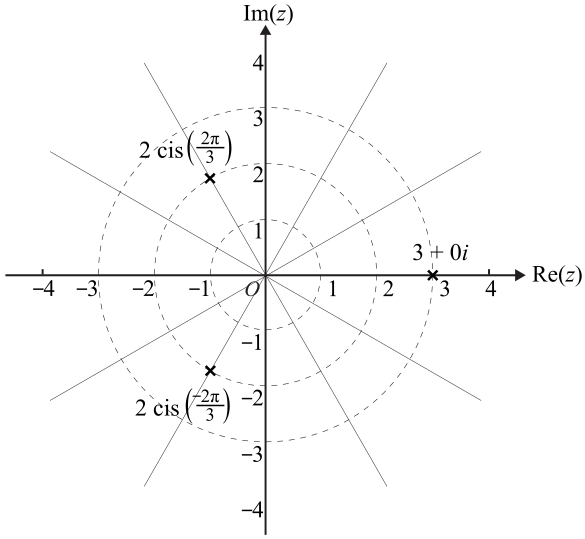 |
Find an antiderivative of `(6 + x)/(x^2 + 4).` (2 marks)
A 5 kg parcel is on the floor of a lift that is accelerating downwards at 3 m/s².
The reaction, in newtons, of the floor of the lift on the parcel is
A. `−15 + 5g`
B. `15 + 5g`
C. `−15 + 3g`
D. `−15 − 5g`
E. `15 + 3g`
A tourist in a hot air balloon, which is rising at 2 m/s, accidentally drops a camera over the side and it falls 100 m to the ground.
Neglecting the effect of air resistance on the camera, the time taken for the camera to hit the ground, correct to the nearest tenth of a second, is
A. 4.3 s
B. 4.5 s
C. 4.7 s
D. 4.9 s
E. 5.0 s
A particle moves in a straight line such that its acceleration is given by `a = sqrt(v^2 - 1)` , where `v` is its velocity and `x` is its displacement from a fixed point.
Given that `v = sqrt2` when `x = 0`, the velocity `v` in terms of `x` is
A. `v = sqrt(2 + x)`
B. `v = 1 + |\ x + 1\ |`
C. `v = sqrt(2 + x^2)`
D. `v = sqrt(1 + (1 + x)^2)`
E. `v = sqrt(1 + (x - 1)^2)`
Consider the four vectors `underset~a = underset~j + 3underset~k`, `underset~b = underset~i - 4underset~k`, `underset~c = 3underset~j - k` and `underset~d = 2underset~j + underset~k`.
Which one of the following is a linearly dependent set of vectors?