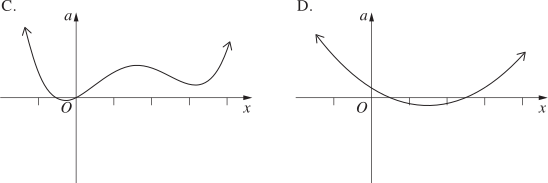
The graphs of `y = mx + c` and `y = ax^2` will have no points of intersection for all values of `m, c` and `a` such that
- `a > 0 and c > 0`
- `m > 0 and c > 0`
- `a > 0 and c > -m^2/(4a)`
- `a < 0 and c > -m^2/(4a)`
Aussie Maths & Science Teachers: Save your time with SmarterEd
The graphs of `y = mx + c` and `y = ax^2` will have no points of intersection for all values of `m, c` and `a` such that
`D`
`text(Intersect when:)`
| `mx + c` | `= ax^2` |
| `ax^2-mx-c` | `= 0` |
`text(S)text(ince no points of intersection:)`
| `Delta` | `< 0` |
| `m^2-4a(−c)` | `< 0` |
| `m^2 + 4ac` | `< 0` |
`text(Solve for)\ c:`
`:.\ c > (−m^2)/(4a),quada < 0`
`text(or)`
`c < (−m^2)/(4a),quada > 0`
`=> D`
A train departs from Town X at 1:00 pm to travel to Town Y. Its average speed for the journey is 80 km/h, and it arrives at 4:00 pm. A second train departs from Town X at 1:20 pm and arrives at Town Y at 3:30 pm.
What is the average speed of the second train? Give your answer to the nearest kilometre per hour. (2 marks)
--- 5 WORK AREA LINES (style=lined) ---
\(\text{111 km/h}\)
\(\text{Distance between towns X and Y using first train}\)
\(\text{Time taken by first train = 3 hours}\)
\(\text{Distance}=\text{speed}\times\text{time}=80\times 2=240\ \text{km}\)
\(\text{Time taken by second train = 2 hours 10 minutes.}\)
\(\text{2 hours 10 minutes = }\dfrac{130}{60}=\dfrac{13}{6}\ \text{hours.}\)
\(\text{Find speed of second train using}\ \ s=\dfrac{d}{t}:\)
\(s=\dfrac{240}{\frac{13}{6}}=240\times \dfrac{6}{13}=110.769…\)
\(\therefore\ \text{The average speed of the second train is 111 km/h (nearest km/h).}\)
City A is at latitude \( 27^{\circ}\text{S} \) and longitude \( 153^{\circ}\text{E} \). City B is \( 45^{\circ} \) north of City A and \( 38^{\circ} \) east of City A.
What are the latitude and longitude of City B?
\(D\)
\(\text{Latitude of City B}=45^{\circ}-27^{\circ}=18^{\circ}\text{N}\)
\(\text{Longitude of City B}=153^{\circ}+38^{\circ}=191^{\circ}\text{E}\)
\(\text{Since longitude}\ >180^{\circ},\ \text{convert to Western hemisphere}:\)
\(\text{Western longitude}=360^{\circ}-191^{\circ}=169^{\circ}\text{W}\)
\(\Rightarrow D\)
Island \(A\) is located at longitude \(104^{\circ}\text{E}\) and Island \(B\) is located at longitude \(56^{\circ}\text{W}\). Ignoring timezones, estimate the time on Island \(B\) when it is 9:20 am on Island \(A\)?
\(C\)
\(\text{Longitudinal difference} = 104^{\circ}+56^{\circ}=160^{\circ}\)
\(\text{Calculate the time difference (using 15° = 1 hour time difference):}\)
\(\text{Time Difference} = \dfrac{160}{15} \text{ hours} = 10.666…\ \text{ hours}=10\text{ hours}\ 40\ \text{minutes} \)
\(\text{Island A is east of Island B}\ \ \Rightarrow\ \ \text{Island A is ahead}\)
\(\text{Time on Island A}\ =\ 9:20\ \text{am}\)
| \(\text{Time on Island B}\) | \(=9:20\ \text{am}-10\ \text{hours}\ 40\text{ minutes}\) |
| \(=11:20\ \text{pm}-40\ \text{minutes}\) | |
| \(=10:40\ \text{pm (previous day)}\) |
\(\Rightarrow C\)
City \(A\) is located at longitude \(0^{\circ}\) (on the Prime Meridian) and while City \(B\) is located at longitude \(118^{\circ}\text{W}\). Ignoring timezones, what is the estimated time in City \(B\) when it is 11:00 pm in city \(A\)?
\(A\)
\(\text{Longitudinal difference}= 118^{\circ}-0=118^{\circ}\)
\(\text{Calculate time difference (using 15° = 1 hour):}\)
\(\text{Time Difference} = \dfrac{118}{15} \text{ hours} = 7.866\text{ hours}=7\text{ hours}\ 52\ \text{minutes} \)
\(\text{City B is west of City A}\ \ \Rightarrow\ \ \text{City B is behind}\)
\(\text{Time in City A}\ =\ 11:00\ \text{pm}\)
| \(\therefore\ \text{Time in City B}\) | \( = 11:00\ \text{pm}-7\ \text{hours}\ 52\text{ minutes}\) |
| \(=\ 4:00\ \text{pm}-52\ \text{minutes}\) | |
| \(=3:08\ \text{pm}\) |
\(\Rightarrow A\)
Use the train timetable below to answer this question.
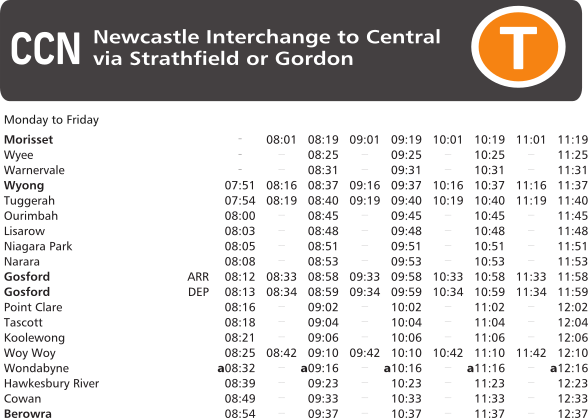
Emma lives in Berowra and travels to Wyong for an appointment. After her appointment, she needs to attend a meeting in Gosford before returning home to Berowra.
--- 2 WORK AREA LINES (style=lined) ---
--- 3 WORK AREA LINES (style=lined) ---
a. \(17\ \text{minutes}\)
b. \(09:37\ \text{train}\)
c. \(\text{11:34 am Gosford train, arrives at Berowra at 12:37 pm}\)
a. \(\text{Elapsed time:}\ =09:33-09:16 = 17 \text{ minutes} \)
b. \(\text{Step 1: Meeting starts at 10:15 am}\)
\(\rightarrow\ 7\text{ minutes to walk from Gosford station to the venue.}\)
\(\rightarrow\ \text{At Gosford Station by: }\ 10:15-7 \text{ minutes} = 10:08 \text{ am}\)
\(\text{Step 2: Find latest train arriving at Gosford by 10:08 am}\)
\(\rightarrow\ \text{Arrival times: } 08:12, 08:33, 08:58, 09:33, 09:58, 10:33\)
\(\rightarrow\ \text{She must catch the }09:58.\)
\(\text{Step 3: When does 09:58 depart Wyong?}\)
\(\rightarrow\ 09:37\ \text{train}\)
c. \(\text{Step 1: Determine when Emma arrives back at Gosford station}\)
\(\rightarrow\ \text{Meeting finishes at }11:20 \text{ am}\)
\(\text{Walking time back to station: 7 minutes}\)
\(\text{Emma arrives at Gosford station at:}\ 11:20 + 7 \text{ minutes} = 11:27 \text{ am} \)
\(\text{Step 1: Find the earliest train departing Gosford after 11:27 am}\)
\(\rightarrow\ \text{Meeting finishes at }11:20 \text{ am}\)
\(\rightarrow\ \text{Relevant departure times:} …10:34, 10:59, 11:34, 11:59\)
\(\rightarrow\ \text{Earliest train after 11:27 am is the }11:34 \text{ am}\)
\(\text{Step 3: Find when this train arrives in Berowra}\)
\(\rightarrow\ \text{11:34 am Gosford train, arrives at Berowra at }12:37 \text{ pm}\)
Twenty-five people were surveyed about the amount of money they spent on groceries per week, to the nearest dollar.
The results are shown in the frequency table.
\begin{array} {|c|c|}
\hline
\rule{0pt}{2.5ex} \textit{Amount Spent} ($) \rule[-1ex]{0pt}{0pt} & \ \ \ \ \ \textit{Frequency}\ \ \ \ \ \\
\hline
\rule{0pt}{2.5ex} 50-99 \rule[-1ex]{0pt}{0pt} & 4 \\
\hline
\rule{0pt}{2.5ex} 100-149 \rule[-1ex]{0pt}{0pt} & 9 \\
\hline
\rule{0pt}{2.5ex} 150-199 \rule[-1ex]{0pt}{0pt} & 8 \\
\hline
\rule{0pt}{2.5ex} 200-249 \rule[-1ex]{0pt}{0pt} & 4 \\
\hline
\end{array}
What is the mean amount spent on groceries by these people per week?
\(B\)
\(\text{Using the class centres}\)
\(\text{Class centres: } 74.5, 124.5, 174.5, 224.5\)
| \(\text{Total hours}\) | \(=(74.5 \times 4) + (124.5 \times 9) + (174.5 \times 8) + (224.5 \times 4)\) |
| \(=298 + 1120.5 + 1396 + 898=3712.5\) |
\(\text{Mean amount}=\dfrac{3712.5}{25} =$148.50\)
\(\Rightarrow B\)
Thirty students were surveyed about the number of hours they spent on homework per week, to the nearest hour.
The results are shown in the frequency table.
\begin{array} {|c|c|}
\hline
\rule{0pt}{2.5ex} \textit{Hours per week} \rule[-1ex]{0pt}{0pt} & \ \ \ \ \ \textit{Frequency}\ \ \ \ \ \\
\hline
\rule{0pt}{2.5ex} 0-4 \rule[-1ex]{0pt}{0pt} & 8 \\
\hline
\rule{0pt}{2.5ex} 5-9 \rule[-1ex]{0pt}{0pt} & 10 \\
\hline
\rule{0pt}{2.5ex} 10-14 \rule[-1ex]{0pt}{0pt} & 7 \\
\hline
\rule{0pt}{2.5ex} 15-19 \rule[-1ex]{0pt}{0pt} & 5 \\
\hline
\end{array}
What is the mean number of hours of homework completed by the students per week?
\(B\)
\(\text{Using the class centres}\)
\(\text{Class centres: } 2, 7, 12, 17\)
| \(\text{Total hours}\) | \(=(2\times 8) + (7\times 10) + (12\times 7) + (17\times 5)\) |
| \(=16 + 70 + 84 + 85=255\) |
\(\text{Mean hours}=\dfrac{255}{30} =8.5\)
\(\Rightarrow B\)
A dataset has an interquartile range (IQR) of 18.
The upper quartile (Q₃) is 45.
What is the maximum value that would NOT be classified as an outlier?
\(D\)
\(1.5 \times \text{IQR} = 1.5 \times 18 = 27\)
\(\text{Upper boundary} = Q_3 + 27 = 45 + 27 = 72\)
\(\text{Values up to and including 72 are not outliers}\)
\(\text{Values above 72 are outliers}\)
\(\therefore\ \text{Maximum value that is not an outlier} = 72\)
\(\Rightarrow D\)
PAI-1 protein is encoded by the SERPINE 1 gene in humans. Anopheles mosquitoes have been genetically modified to express PAI-1, which blocks the entry of the malarial Plasmodium into the mosquito gut. This disrupts the Plasmodium life cycle, resulting in reduced transmission of malaria.
'Genetic technologies are beneficial for society.'
Evaluate this statement. (7 marks)
--- 24 WORK AREA LINES (style=lined) ---
Evaluation Statement
Health Benefits
Food Security and Agricultural Benefits
Final Evaluation
Evaluation Statement
Health Benefits
Food Security and Agricultural Benefits
Final Evaluation
David and Mary are a couple living together. They each receive the maximum Age Pension payment of $888.50 per fortnight (which includes basic rate, Pension Supplement and Energy Supplement).
Their combined income from part-time work is $520 per fortnight. Their Age Pension is reduced by 25 cents each for every dollar of combined income over $380 per fortnight..
--- 3 WORK AREA LINES (style=lined) ---
a. \($35\)
b. \($2227\)
c. \(76.6\%\ \text{(to 1 d.p.)}\)
a. \(\text{Combined income over free area} = 520-380=$140\)
\(\text{Reduction for each person} = 0.25 \times 140= $35\)
\(\therefore\ \text{Each person’s pension is reduced by \$35}\)
b. \(\text{Reduced pension for each person}=888.50-35= $853.50\)
\(\text{Combined Age Pension} = 2 \times 853.50=$1707\)
\(\text{Total household income} = 1707+520=$2227\)
c. \(\text{Percentage from Age Pension} =\dfrac{1707}{2227}\times 100=76.6\%\ \text{(to 1 d.p.)}\)
\(\therefore\ 76.6\%\text{ of their household income comes from Age Pension}\)
Baron is 19 years old, single with no children, and lives away from his parents' home to study. He receives the maximum Youth Allowance payment of $663.30 per fortnight.
Baron supplements his payments by working part-time and earns $15.50 per hour in a retail position. His Youth Allowance is reduced by 50 cents for each dollar earned over $236 per fortnight.
--- 4 WORK AREA LINES (style=lined) ---
a. \(\text{\$951.80 per fortnight}\)
b. \(\text{101 hours per fortnight}\)
a. \(\text{Baron’s earnings} = 15.50\times 22=$341\)
\(\text{Income over free area} = 341-236 = $105\)
\(\text{Reduction in payment} = 0.50\times 105= $52.50\)
\(\text{Reduced Youth Allowance} = 663.30-52.50=$610.80\)
\(\text{Total fortnightly income} = 610.80+341=$951.80\)
b. \(\text{For payment to reduce to zero, reduction needed} = $663.30\)
\(\text{Income over free area} = \dfrac{663.30}{0.50}=$1326.60\)
\(\text{Total earnings needed} = 1326.60+236=$1562.60\)
\(\text{Hours needed}=\dfrac{1562.60}{15.50}=100.8\)
\(\therefore\ \text{Baron can work a maximum of 101 hours per fortnight}\)
Yuki is single with no children and receives the maximum JobSeeker Payment of $793.60 per fortnight.
Her JobSeeker Payment is reduced by 50 cents for each dollar earned over $150 per fortnight.
--- 4 WORK AREA LINES (style=lined) ---
a. \($678.60\ \text{per fortnight}\)
b. \($537.20\ \text{per fortnight}\)
a. \(\text{Income over free area} = 380-150=$230\)
\(\text{Reduction in payment} = 0.50\times 230 = $115\)
\(\text{Reduced JobSeeker Payment} = 793.60-115 = $678.60\)
\(\therefore\ \text{Yuki receives \$678.60 per fortnight}\)
b. \(\text{Required reduction} = 793.60-600=$193.60\)
\(\text{Income over free area} = \dfrac{193.60}{0.50}=$387.20\)
\(\text{Total income needed} = 387.20+150=$537.20\)
\(\therefore\ \text{Yuki needs to earn \$537.20 per fortnight}\)
Sarah is single with no children and receives the maximum JobSeeker Payment of $793.60 per fortnight.
She earns $350 per fortnight from casual work. The JobSeeker Payment is reduced by 50 cents for each dollar earned over $150 per fortnight.
What is Sarah's reduced JobSeeker Payment this fortnight?
\(C\)
\(\text{Maximum JobSeeker Payment (single, no children)} = $793.60\)
\(\text{Income over free area} = 350-150 = $200\)
\(\text{Reduction in payment} = 0.50\times 200 = $100\)
\(\therefore\ \text{Reduced JobSeeker Payment} = 793.60-100 = $693.60\)
\(\Rightarrow C\)
The diagram shows the graph of \(y = f(x)\). The line \(y = x\) is an asymptote.
Draw separate one-third page sketches of the graphs of the following:
--- 10 WORK AREA LINES (style=lined) ---
The diagram shows the graph of a function `f(x).`
Sketch the curve `y = 1/(1-f(x)).` (3 marks)
--- 12 WORK AREA LINES (style=lined) ---
Ian works in a packaging factory and is paid $0.85 for each box he packs. Last month he worked 160 hours and packed 8960 boxes.
--- 2 WORK AREA LINES (style=lined) ---
--- 5 WORK AREA LINES (style=lined) ---
a. \($7616\)
b. \(\text{6.5% decrease}\)
a. \(\text{Total Earnings}=0.85\times 8960=$7616\)
b. \(\text{Hourly rate (last month)}=\dfrac{7616}{160}=$47.60\)
\(\text{New hourly wage} = $44.50\ \text{(given)}\)
\(\text{% decrease}=\dfrac{47.60-44.50}{47.60}=0.0651… = 6.5\%\ \text{decrease}\)
\(\therefore\ \text{Ian’s hourly rate has decreased 6.5%.}\)
Use the data sheet provided and the information in the table to answer this question.
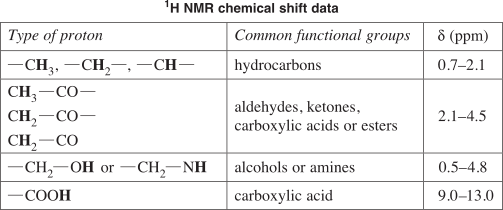
Consider the molecule shown.
For each of the following instrumental techniques, predict the expected features of the spectra produced.
Refer to the structural features of the molecule in your answer.
--- 30 WORK AREA LINES (style=lined) ---
Infrared (IR)
\(^{13}\text{C NMR}\)
\(^{1}\text{H NMR (Proton NMR)}\)
Mass Spectrometry
Infrared (IR)
\(^{13}\text{C NMR}\)
\(^{1}\text{H NMR (Proton NMR)}\)
Mass Spectrometry
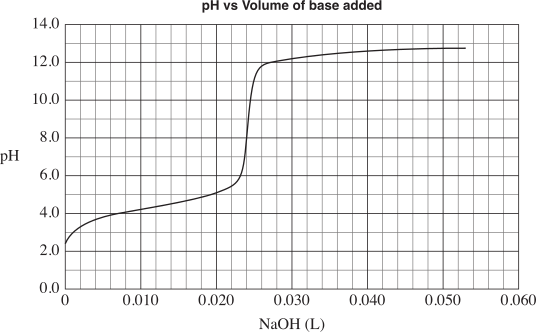
A 0.010 L aliquot of an acid was titrated with 0.10 mol L\(^{-1} \ \ce{NaOH}\), resulting in the following titration curve.
--- 9 WORK AREA LINES (style=lined) ---
--- 6 WORK AREA LINES (style=lined) ---
a. \(\text{Strategy 1:}\)
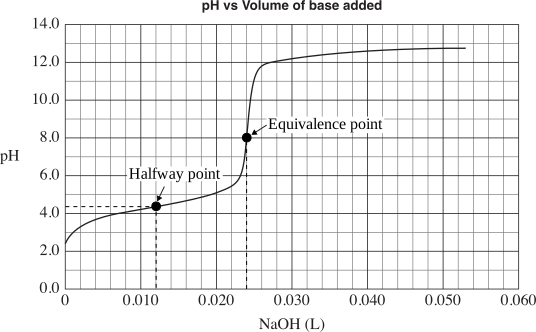
\(\text{From the shape of the titration curve, the acid was weak.}\)
\(\text{Equivalence point}\ \ \Rightarrow \ \ \ce{NaOH}\ \text{added}\ = 0.24\ \text{L} \)
\(\text{Halfway to the equivalent point = 0.012 L}, \ce{[ HA ]=\left[ A^{-}\right]}\)
\(\text{Here the pH} \approx 4.4 , \text{or}\ \ce{\left[H^{+}\right] is 4.0 \times 10^{-5}}\).
\(K_a=10^{-\text{pH}}=\ce{\left[H+\right]} \times \dfrac{\ce{\left[A^{-}\right]}}{\ce{[HA]}}\)
\(\text{At this pH,} \ \ce{\left[A^{-}\right]=[HA] so} \ K_a=4.0 \times 10^{-5}\).
\(\text{Strategy 2:}\)
\(\text{Equivalence point is at} \ \ce{0.024 L NaOH added}\).
\(\text{Shape of curve shows acid is monoprotic.}\)
\(\ce{[HA] \times 0.010=0.1 \times 0.024}\)
\(\ce{[HA]=0.24 mol L^{-1}}\)
\(\text{pH at start is approximately 2.5}\)
\(\text{So,} \ \ce{\left[H+\right]=3.16 \times 10^{-3}}\)
\(K_a=\dfrac{\ce{\left[H^{+}\right]\left[A^{-}\right]}}{\ce{[HA]}} \quad \ce{\left[A^{-}\right]=\left[H^{+}\right]}\)
\(\ce{[HA]=0.24-3.16 \times 10^{-3}=0.237}\)
\(K_a=\dfrac{\left(3.16 \times 10^{-3}\right)^2}{0.237}=4.2 \times 10^{-5}\)
b. pH of the final solution < 13:
\(\text{From the shape of the titration curve, the acid was weak.}\)
\(\text{Equivalence point}\ \ \Rightarrow \ \ \ce{NaOH}\ \text{added}\ = 0.24\ \text{L} \)
\(\text{Halfway to the equivalent point = 0.012 L}, \ce{[ HA ]=\left[ A^{-}\right]}\)
\(\text{Here the pH} \approx 4.4 , \text{or}\ \ce{\left[H^{+}\right] is 4.0 \times 10^{-5}}\).
\(K_a=10^{-\text{pH}}=\ce{\left[H+\right]} \times \dfrac{\ce{\left[A^{-}\right]}}{\ce{[HA]}}\)
\(\text{At this pH,} \ \ce{\left[A^{-}\right]=[HA] so} \ K_a=4.0 \times 10^{-5}\).
\(\text{Strategy 2:}\)
\(\text{Equivalence point is at} \ \ce{0.024 L NaOH added}\).
\(\text{Shape of curve shows acid is monoprotic.}\)
\(\ce{[HA] \times 0.010=0.1 \times 0.024}\)
\(\ce{[HA]=0.24 mol L^{-1}}\)
\(\text{pH at start is approximately 2.5}\)
\(\text{So,} \ \ce{\left[H+\right]=3.16 \times 10^{-3}}\)
\(K_a=\dfrac{\ce{\left[H^{+}\right]\left[A^{-}\right]}}{\ce{[HA]}} \quad \ce{\left[A^{-}\right]=\left[H^{+}\right]}\)
\(\ce{[HA]=0.24-3.16 \times 10^{-3}=0.237}\)
\(K_a=\dfrac{\left(3.16 \times 10^{-3}\right)^2}{0.237}=4.2 \times 10^{-5}\)
b. pH of the final solution < 13:
Chalk is predominantly calcium carbonate. Different brands of chalk vary in their calcium carbonate composition.
The table shows the composition of three different brands of chalk.
\begin{array}{|l|c|c|c|}
\hline \rule{0pt}{2.5ex}\rule[-1ex]{0pt}{0pt}& \ \ \textit{Brand X} \ \ & \ \ \textit{Brand Y} \ \ & \ \ \textit{Brand Z} \ \ \\
\hline \rule{0pt}{2.5ex}\ce{CaCO3(\%)} \rule[-1ex]{0pt}{0pt}& 85.5 & 83.9 & 82.4 \\
\hline
\end{array}
The following procedure was used to determine the calcium carbonate composition of a chalk sample.
The results of the titrations are recorded.
\begin{array}{|l|c|c|c|c|}
\hline
\rule{0pt}{2.5ex}\textit{Burette volume}\text{(mL)} \rule[-1ex]{0pt}{0pt}& \textit{Trial 1} & \textit{Trial 2} & \textit{Trial 3} & \textit{Trial 4} \\
\hline
\rule{0pt}{2.5ex}\text{Final} \rule[-1ex]{0pt}{0pt}& 7.80 & 14.90 & 22.10 & 29.25 \\
\hline
\rule{0pt}{2.5ex}\text{Initial} \rule[-1ex]{0pt}{0pt}& 0.00 & 7.80 & 14.90 & 22.10 \\
\hline
\rule{0pt}{2.5ex}\text{Total used} \rule[-1ex]{0pt}{0pt}& 7.80 & 7.10 & 7.20 & 7.15 \\
\hline
\end{array}
Determine the brand of the chalk sample. Include a relevant chemical equation in your answer. (7 marks)
--- 14 WORK AREA LINES (style=lined) ---
\(\text{Exclude the outlier (Trial 1):}\)
\(\text{Average volume} \ \ce{(KOH)} =\dfrac{7.10+7.20+7.15}{3}=0.00715 \ \text{L}\)
\(\ce{HCl(aq) + KOH(aq) \rightarrow KCl(aq) + H2O(l)}\)
\(\text{moles} \ \ce{KOH=0.10 \times 0.00715=0.000715 mol }\)
\(\text{Ratio}\ \ \ce{HCl:KOH=1: 1}\)
\(\ce{0.000715 mol HCl} \ \text{for each sample}\)
\(\ce{0.000715 \times 5=0.003575 mol}\ \text{total in sampled solution}\)
\(\text{Initial} \ \ \ce{n(HCl)=0.550 \times 0.1000=0.0550 mol}\)
\(\ce{n(HCl)}\ \text{that reacted with} \ \ce{CaCO3=0.0550-0.003575=0.051425 mol}\)
\(\ce{2HCl(aq) + CaCO3(s) \rightarrow CaCl2(aq) + H2O(l) + CO2(g)}\)
\(\text{Ratio}\ \ \ce{HCl:CaCO3=2:1}\)
\(\ce{n(CaCO3)}=\dfrac{0.051425}{2}=0.0257125\ \text{mol}\)
\(\ce{MM(CaCO3)}=40.08+12.01+3 \times 16=100.09\)
\(\text{Mass} \ \ce{CaCO3} =0.0257125 \times 100.09=2.5735641\ \text{g}\)
\(\% \ce{CaCO3}=\dfrac{2.5735641}{3.00} \times 100=85.7854 \% \approx 85.8 \%\)
\(\text{Chalk sample has to be Brand X.}\)
\(\text{Exclude the outlier (Trial 1):}\)
\(\text{Average volume} \ \ce{(KOH)} =\dfrac{7.10+7.20+7.15}{3}=0.00715 \ \text{L}\)
\(\ce{HCl(aq) + KOH(aq) \rightarrow KCl(aq) + H2O(l)}\)
\(\text{moles} \ \ce{KOH=0.10 \times 0.00715=0.000715 mol }\)
\(\text{Ratio}\ \ \ce{HCl:KOH=1: 1}\)
\(\ce{0.000715 mol HCl} \ \text{for each sample}\)
\(\ce{0.000715 \times 5=0.003575 mol}\ \text{total in sampled solution}\)
\(\text{Calculate}\ \ce{HCl}\ \text{that reacted with}\ \ce{CaCO3}:\)
\(\text{Initial} \ \ \ce{n(HCl)=0.550 \times 0.1000=0.0550 mol}\)
\(\ce{n(HCl)}\ \text{that reacted with} \ \ce{CaCO3=0.0550-0.003575=0.051425 mol}\)
\(\ce{2HCl(aq) + CaCO3(s) \rightarrow CaCl2(aq) + H2O(l) + CO2(g)}\)
\(\text{Ratio}\ \ \ce{HCl:CaCO3=2:1}\)
\(\ce{n(CaCO3)}=\dfrac{0.051425}{2}=0.0257125\ \text{mol}\)
\(\ce{MM(CaCO3)}=40.08+12.01+3 \times 16=100.09\)
\(\text{Mass} \ \ce{CaCO3} =0.0257125 \times 100.09=2.5735641\ \text{g}\)
\(\% \ce{CaCO3}=\dfrac{2.5735641}{3.00} \times 100=85.7854 \% \approx 85.8 \%\)
\(\text{Chalk sample has to be Brand X.}\)
The following three solids were added together to 1 litre of water:
Which precipitate(s), if any, will form? Justify your answer with appropriate calculations. (5 marks)
--- 12 WORK AREA LINES (style=lined) ---
All sodium and nitrate salts are soluble \(\Rightarrow\) possible precipitates are \(\ce{Mg(OH)2}\) and \(\ce{MgCO3}\).
\(\ce{\left[Mg^{2+}\right]=6 \times 10^{-3} \quad\left[ OH^{-}\right]=1 \times 10^{-2} \quad\left[ CO3^{2-}\right]=2 \times 10^{-3}}\)
\(\ce{\left[Mg^{2+}\right]\left[ OH^{-}\right]^2=6 \times 10^{-7} \quad \quad \quad \ \ \ K_{\textit{sp}}=5.61 \times 10^{-12}}\)
\(\ce{\left[ Mg^{2+}\right]\left[ CO3^{2-}\right]=1.2 \times 10^{-5} \quad \quad K_{\textit{sp}}=6.82 \times 10^{-6}}\)
\(\ce{Mg(OH)2}\) is a lot less soluble than \(\ce{MgCO3}\) and will precipitate preferentially.
\(\ce{\left[Mg^{2+}\right]\left[OH^{-}\right]^2 > K_{\textit{sp}}}\)
\(\Rightarrow \ce{Mg(OH)2}\) will precipitate.
\(\ce{Mg^{2+}(aq) + 2OH-(aq) \rightarrow Mg(OH)2(s)}\)
Since \(K_{\textit{sp}}\) is small, assume reaction goes to completion.
\(\ce{n(Mg^{2+})=0.006\ mol, n(OH^{-})=0.010\ mol}\)
Using stoichiometric ratio \((1:2)\)
\(0.006 > \dfrac{0.010}{2}=0.005\ \ \Rightarrow \ce{Mg^{2+}}\) is in excess.
Concentration drops to: \(6 \times 10^{-3}-5 \times 10^{-3}=1 \times 10^{-3}\).
Check if \(\ce{MgCO3}\) will precipitate:
\(\ce{\left[Mg^{2+}\right]\left[CO3^{2-}\right]}\) becomes \(2 \times 10^{-6} <K_{\textit{sp}}\).
\(\ce{\Rightarrow\ MgCO3}\) won’t precipitate.
All sodium and nitrate salts are soluble \(\Rightarrow\) possible precipitates are \(\ce{Mg(OH)2}\) and \(\ce{MgCO3}\).
\(\ce{\left[Mg^{2+}\right]=6 \times 10^{-3} \quad\left[ OH^{-}\right]=1 \times 10^{-2} \quad\left[ CO3^{2-}\right]=2 \times 10^{-3}}\)
\(\ce{\left[Mg^{2+}\right]\left[ OH^{-}\right]^2=6 \times 10^{-7} \quad \quad \quad \ \ \ K_{\textit{sp}}=5.61 \times 10^{-12}}\)
\(\ce{\left[ Mg^{2+}\right]\left[ CO3^{2-}\right]=1.2 \times 10^{-5} \quad \quad K_{\textit{sp}}=6.82 \times 10^{-6}}\)
\(\ce{Mg(OH)2}\) is a lot less soluble than \(\ce{MgCO3}\) and will precipitate preferentially.
\(\ce{\left[Mg^{2+}\right]\left[OH^{-}\right]^2 > K_{\textit{sp}}}\)
\(\Rightarrow \ce{Mg(OH)2}\) will precipitate.
\(\ce{Mg^{2+}(aq) + 2OH-(aq) \rightarrow Mg(OH)2(s)}\)
Since \(K_{\textit{sp}}\) is small, assume reaction goes to completion.
\(\ce{n(Mg^{2+})=0.006\ mol, n(OH^{-})=0.010\ mol}\)
Using stoichiometric ratio \((1:2)\)
\(0.006 > \dfrac{0.010}{2}=0.005\ \ \Rightarrow \ce{Mg^{2+}}\) is in excess.
Concentration drops to: \(6 \times 10^{-3}-5 \times 10^{-3}=1 \times 10^{-3}\).
Check if \(\ce{MgCO3}\) will precipitate:
\(\ce{\left[Mg^{2+}\right]\left[CO3^{2-}\right]}\) becomes \(2 \times 10^{-6} <K_{\textit{sp}}\).
\(\ce{\Rightarrow\ MgCO3}\) won’t precipitate.
A satellite with velocity \(v\), is in a geostationary orbit as shown in Figure 1.
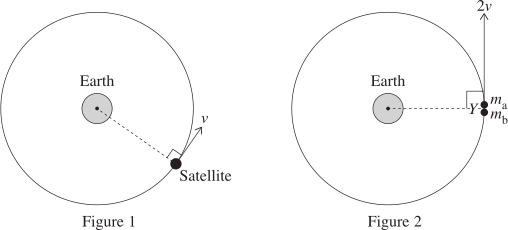
At point \(Y\), the satellite explodes and splits into two pieces \(m_{ a }\) and \(m_{ b }\), of identical mass. As a result of the explosion, the velocity of one piece, \(m_{ a }\), changes from \(v\) to \(2 v\) as shown in Figure 2.
Analyse the subsequent motion of BOTH \(m_{ a }\) and \(m_{ b }\) after the explosion. Include reference to relevant conservation laws and formulae in your answer. (8 marks)
--- 22 WORK AREA LINES (style=lined) ---
At the point in time of the explosion:
Motion after the explosion:
At the point in time of the explosion:
Motion after the explosion:
A hollow copper pipe is placed upright on an electronic balance, which shows a reading of 300 g. A 50 g magnet is suspended inside the pipe and subsequently released.
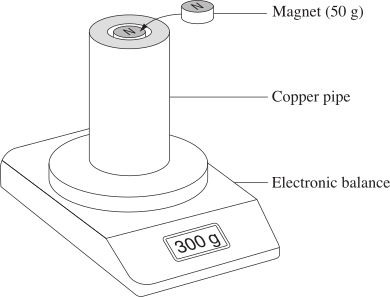
It was observed that the readings on the balance began to increase after the magnet began to fall, and that the reading reached a constant maximum of 350 g before the magnet reached the bottom of the tube.
Explain these observations. (4 marks)
--- 14 WORK AREA LINES (style=lined) ---
The balance reading changes in two stages:
Stage 1 – The Magnet Accelerates
Stage 2 – The Magnet Reaches a Constant Speed
The balance reading changes in two stages:
Stage 1 – The Magnet Accelerates
Stage 2 – The Magnet Reaches a Constant Speed
The diagram shows a model of the orbits of Earth, Jupiter and Io, including their orbital direction and periods of orbit. In this model, it is assumed that the orbits of Earth, Jupiter and Io are circular.
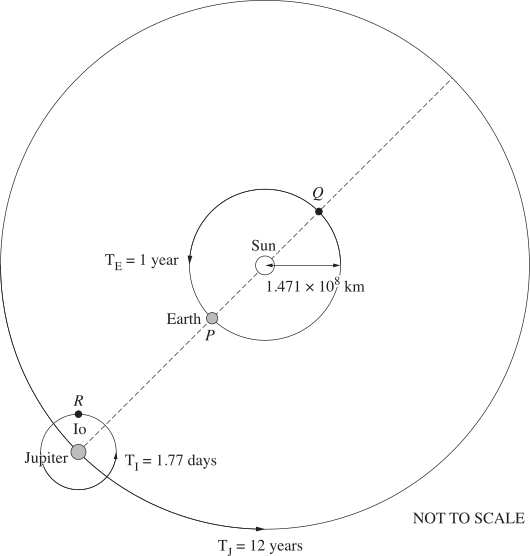
A method to determine the speed of light using this model is described below.
When Earth was at position \(P\), the orbital period of Io was measured, and the time that Io was at position \(R\) was recorded.
Six months later, Io had orbited Jupiter 103 times, and Earth had reached position \(Q\). The orbital period of Io was used to predict when it would be at position \(R\). Assume that Jupiter has not moved significantly in its orbit around the Sun.
The time for Io to reach position \(R\) was measured to be \(1.000 \times 10^3\) seconds later than predicted, due to the time it takes light to cross the diameter of Earth's orbit from \(P\) to \(Q\).
--- 5 WORK AREA LINES (style=lined) ---
--- 8 WORK AREA LINES (style=lined) ---
a. \(d=2 \times 1.471 \times 10^{11} = 2.942 \times 10^{11}\ \text{metres} \)
\(v=\dfrac{d}{t}=\dfrac{2.942 \times 10^{11}}{1 \times 10^3} = 2.942 \times 10^8\ \text{m s}^{-1}\)
b. Model modifications:
Consider the long axis of the ellipse in line with \(PQ:\)
Consider the short axis of the ellipse in line with \(PQ:\)
a. \(d=2 \times 1.471 \times 10^{11} = 2.942 \times 10^{11}\ \text{metres} \)
\(v=\dfrac{d}{t}=\dfrac{2.942 \times 10^{11}}{1 \times 10^3} = 2.942 \times 10^8\ \text{m s}^{-1}\)
b. Model modifications:
Consider the long axis of the ellipse in line with \(PQ:\)
Consider the short axis of the ellipse in line with \(PQ:\)
The amount of water (\(W\)) in litres used by a garden irrigation system varies directly with the time (\(t\)) in minutes that the system operates.
This relationship is modelled by the formula \(W=kt\), where \(k\) is a constant.
The irrigation system uses 96 litres of water when it operates for 24 minutes.
--- 3 WORK AREA LINES (style=lined) ---
--- 5 WORK AREA LINES (style=lined) ---
a. \(W=kt\)
\(\text{When } W = 96 \text{ and } t = 24:\)
| \(96\) | \(=k \times 24\) |
| \(k\) | \(=\dfrac{96}{24}=4\ \text{(as required)}\) |
b. \(162.5\ \text{minutes}\)
a. \(W=kt\)
\(\text{When } W = 96 \text{ and } t = 24:\)
| \(96\) | \(=k \times 24\) |
| \(k\) | \(=\dfrac{96}{24}=4\ \text{(as required)}\) |
b. \(W = 4t\)
\(\text{When } W = 650:\)
| \(650\) | \(=4\times t\) |
| \(t\) | \( =\dfrac{650}{4}=162.5\ \text{minutes}\) |
\(\therefore\ \text{The irrigation system can operate for 162.5 minutes.}\)
The cost (\(C\)) of copper wire varies directly with the length (\(L\)) in metres of the wire.
This relationship is modelled by the formula \(C = kL\), where \(k\) is a constant.
A 250 metre roll of copper wire costs $87.50.
--- 3 WORK AREA LINES (style=lined) ---
--- 5 WORK AREA LINES (style=lined) ---
a. \(C=kL\)
\(\text{When } C = 87.50 \text{ and } L = 250:\)
| \(87.50\) | \(=k \times 250\) |
| \(k\) | \(=\dfrac{87.50}{250}\) |
| \(k\) | \(=0.35\ \text{(as required)}\) |
b. \(400\ \text{m}\)
a. \(C=kL\)
\(\text{When } C = 87.50 \text{ and } L = 250:\)
| \(87.50\) | \(=k \times 250\) |
| \(k\) | \(=\dfrac{87.50}{250}\) |
| \(k\) | \(=0.35\ \text{(as required)}\) |
b. \(C = 0.35L\)
\(\text{When } C = 140:\)
| \(140\) | \(=0.35\times L\) |
| \(L\) | \( =\dfrac{140}{0.35}=400\ \text{m}\) |
\(\therefore\ \text{The builder can purchase 400 metres of wire.}\)
The amount of paint (\(P\)) needed to cover a wall varies directly with the area (\(A\)) of the wall.
A painter uses 3.5 litres of paint to cover a wall with an area of 28 square metres.
How much paint is needed to cover a wall with an area of 42 square metres?
\(C\)
\(P \propto A\)
\(P=kA\)
\(\text{When } P = 3.5 \text{ and } A = 28:\)
| \(3.5\) | \(=k \times 28\) |
| \(k\) | \(=\dfrac{3.5}{28}\) |
| \(k\) | \(=0.125\) |
\(\text{When } A = 42:\)
\(P=0.125\times 42=5.25\)
\(\Rightarrow C\)
A circular loop of wire is placed at position \(X\), next to a straight current-carrying wire with the current direction shown.
The loop is moved to position \(Y\) at a constant speed.
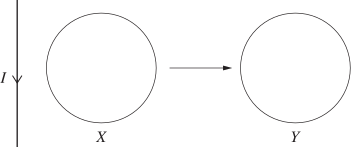
Which row in the table best describes the induced electromotive force (emf) in the loop as it moves from \(X\) to \(Y\) ?
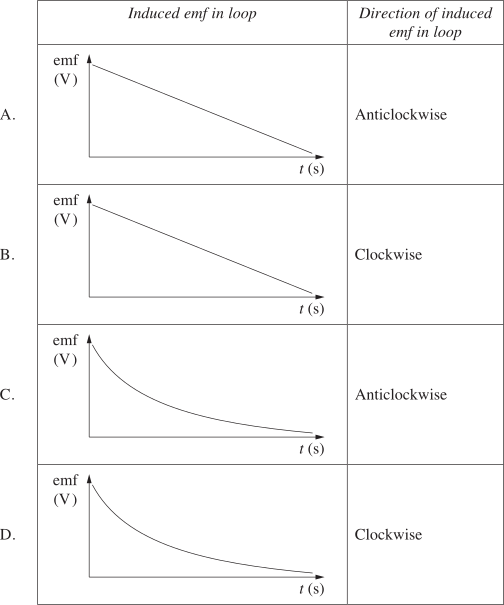
\(C\)
\(\Rightarrow C\)
A neutron is absorbed by a nucleus, \(X\).
The resulting nucleus undergoes alpha decay, producing lithium-7.
What is nucleus \(X\) ?
\(A\)
\(\Rightarrow A\)
A proton having a velocity of \(1 \times 10^6 \ \text{m s}^{-1}\) enters a uniform field with a trajectory that is initially perpendicular to the field.
Which row in the table correctly identifies the field, and its effect on the kinetic energy of the proton?
\begin{align*}
\begin{array}{l}
\rule{0pt}{2.5ex} \ & \\
\ \rule[-1ex]{0pt}{0pt}& \\
\rule{0pt}{2.5ex}\textbf{A.}\rule[-1ex]{0pt}{0pt}\\
\rule{0pt}{2.5ex}\textbf{B.}\rule[-1ex]{0pt}{0pt}\\
\rule{0pt}{2.5ex}\textbf{C.}\rule[-1ex]{0pt}{0pt}\\
\rule{0pt}{2.5ex}\textbf{D.}\rule[-1ex]{0pt}{0pt}\\
\end{array}
\begin{array}{|c|c|}
\hline
\rule{0pt}{2.5ex}\ \ \textit{Type of field}\ \ & \textit{Effect on} \\
\textit{}\rule[-1ex]{0pt}{0pt}& \textit{kinetic energy } \\
\hline
\rule{0pt}{2.5ex}\text{Electric}\rule[-1ex]{0pt}{0pt}&\text{Decreases}\\
\hline
\rule{0pt}{2.5ex}\text{Electric}\rule[-1ex]{0pt}{0pt}& \text{Increases}\\
\hline
\rule{0pt}{2.5ex}\text{Magnetic}\rule[-1ex]{0pt}{0pt}& \text{Decreases} \\
\hline
\rule{0pt}{2.5ex}\text{Magnetic}\rule[-1ex]{0pt}{0pt}& \text{Increases} \\
\hline
\end{array}
\end{align*}
\(B\)
\(\Rightarrow B\)
A DC motor connected to a 12 V supply is maintaining a constant rotational speed. An ammeter in the circuit reads 0.5 A .
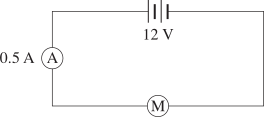
Some material falls into the running motor, causing it to slow down.
What is the subsequent ammeter reading likely to be?
\(D\)
\(\Rightarrow D\)
The diagram shows four lines, \(W, X, Y\) and \(Z\), depicting radioactivity varying with time.
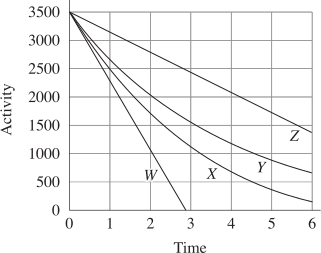
Which of the four lines is consistent with a decay graph with the smallest decay constant \((\lambda)\) ?
\(C\)
\(\Rightarrow C\)
A beam of electrons travelling at \(4 \times 10^3 \ \text{m s}^{-1}\) exits an electron gun and is directed toward two narrow slits with a separation, \(d\), of 1 \(\mu\text{m}\). The resulting interference pattern is detected on a screen 50 cm from the slits.
--- 4 WORK AREA LINES (style=lined) ---
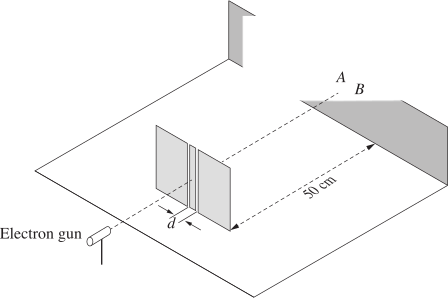
a. \(\text {Using} \ \ \lambda=\dfrac{h}{m v}:\)
\(\lambda=\dfrac{6.626 \times 10^{-34}}{9.109 \times 10^{-31} \times 4 \times 10^3}=1.82 \times 10^{-7} \ \text{m}=182 \ \text{nm}\)
b. \(x=9.1 \ \text{cm}\)
c. \(V=4.5 \times 10^{-5} \ \text{V}\)
a. \(\text {Using} \ \ \lambda=\dfrac{h}{m v}:\)
\(\lambda=\dfrac{6.626 \times 10^{-34}}{9.109 \times 10^{-31} \times 4 \times 10^3}=1.82 \times 10^{-7} \ \text{m}=182 \ \text{nm}\)
b. \(\text {Using}\ \ x=\dfrac{\lambda m L}{d}\)
\(\text{where} \ \ x=\text{distance between middle of adjacent bright spots}\)
\(x=\dfrac{182 \times 10^{-9} \times 1 \times 0.5}{1 \times 10^{-6}}=0.091 \ \text{m}=9.1 \ \text{cm}\)
c. \(\text{Work done by field}=\Delta K=K_f-K_i\)
| \(qV\) | \(=\dfrac{1}{2} m v^2-0\) |
| \(V\) | \(=\dfrac{m v^2}{2 q}=\dfrac{9.109 \times 10^{-31} \times\left(4 \times 10^3\right)^2}{2 \times 1.602 \times 10^{-19}}=4.5 \times 10^{-5} \ \text{V}\) |
Analyse the role of experimental evidence and theoretical ideas in developing the Standard Model of matter. (6 marks)
--- 18 WORK AREA LINES (style=lined) ---
Overview Statement
Particle Discovery
Experimental Tools Driving Theoretical Refinement
Implications and Synthesis
Overview Statement
Particle Discovery
Experimental Tools Driving Theoretical Refinement
Implications and Synthesis
Analyse the consequences of the theory of special relativity in relation to length, time and motion. Support your answer with reference to experimental evidence. (8 marks)
--- 22 WORK AREA LINES (style=lined) ---
Overview Statement
Time–Length Relationship in Muon Observations
Momentum–Energy Relationship in Particle Accelerators
Implications and Synthesis
Overview Statement
Time–Length Relationship in Muon Observations
Momentum–Energy Relationship in Particle Accelerators
Implications and Synthesis
Experiments have been carried out by scientists to investigate cathode rays.
Assess the contribution of the results of these experiments in developing an understanding of the existence and properties of electrons. (5 marks)
--- 15 WORK AREA LINES (style=lined) ---
Judgment Statement
Demonstrating Particle Nature
Quantifying Electron Properties
Overall Assessment
Other answers could include:
Judgment Statement
Demonstrating Particle Nature
Quantifying Electron Properties
Overall Assessment
Other answers could include:
A mass moves around a vertical circular path of radius \(r\), in Earth's gravitational field, without loss of mechanical energy. A string of length \(r\) maintains the circular motion of the mass.
When the mass is at its highest point \(B\), the tension in the string is zero.
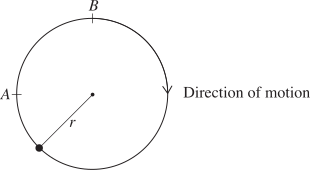
--- 4 WORK AREA LINES (style=lined) ---
--- 10 WORK AREA LINES (style=lined) ---
a. \(\text {At point} \ B \ \Rightarrow \ F_c=F_{\text {net}}\)
| \(\dfrac{mv_B^2}{r}\) | \(=T+mg\) |
| \(v_B^2\) | \(=rg \ \ (T=0)\) |
| \(v_B\) | \(=\sqrt{r g}\) |
b. \(\text {Total} \ ME=E_k+GPE\)
\(\text{At point} \ B :\)
| \(\text {Total} \ ME\) | \(=\dfrac{1}{2} m v_B^2+mg(2r)\) |
| \(=\dfrac{1}{2} m \times r g+2 mrg\) | |
| \(=\dfrac{5}{2} m r g\) |
\(\text{At point} \ A :\)
\(\text {Total} \ ME=\dfrac{1}{2} mv_A^2+mrg\)
\(\text{Since \(ME\) is conserved:}\)
| \(\dfrac{5}{2} mrg\) | \(=\dfrac{1}{2} m v_A^2+m r g\) |
| \(\dfrac{1}{2} mv_A^2\) | \(=\dfrac{3}{2} m r g\) |
| \(v_A^2\) | \(=3 rg\) |
| \(v_A\) | \(=\sqrt{3rg}=\sqrt{3} \times v_B\) |
a. \(\text {At point} \ B \ \Rightarrow \ F_c=F_{\text {net}}\)
| \(\dfrac{mv_B^2}{r}\) | \(=T+mg\) |
| \(v_B^2\) | \(=rg \ \ (T=0)\) |
| \(v_B\) | \(=\sqrt{r g}\) |
b. \(\text {Total} \ ME=E_k+GPE\)
\(\text{At point} \ B :\)
| \(\text {Total} \ ME\) | \(=\dfrac{1}{2} m v_B^2+mg(2r)\) |
| \(=\dfrac{1}{2} m \times r g+2 mrg\) | |
| \(=\dfrac{5}{2} m r g\) |
\(\text{At point} \ A :\)
\(\text {Total} \ ME=\dfrac{1}{2} mv_A^2+mrg\)
\(\text{Since \(ME\) is conserved:}\)
| \(\dfrac{5}{2} mrg\) | \(=\dfrac{1}{2} m v_A^2+m r g\) |
| \(\dfrac{1}{2} mv_A^2\) | \(=\dfrac{3}{2} m r g\) |
| \(v_A^2\) | \(=3 rg\) |
| \(v_A\) | \(=\sqrt{3rg}=\sqrt{3} \times v_B\) |
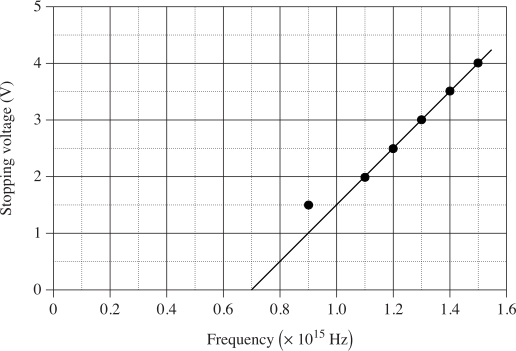
A student conducts an experiment to determine the work function of potassium.
The following diagram depicts the experimental setup used, where light of varying frequency is incident on a potassium electrode inside an evacuated tube.
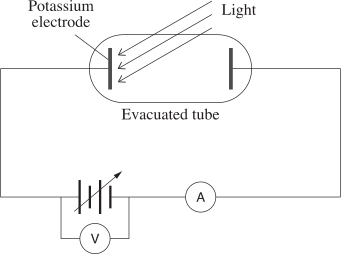
For each frequency of light tested, the voltage in the circuit is varied, and the minimum voltage (called the stopping voltage) required to bring the current in the circuit to zero is recorded.
\begin{array}{|c|c|}
\hline
\rule{0pt}{2.5ex}\ \ \textit{Frequency of incident light} \ \ & \quad \quad \quad \textit{Stopping voltage} \quad \quad \quad \\
\left(\times 10^{15} \ \text{Hz}\right) \rule[-1ex]{0pt}{0pt}& \text{(V)}\\
\hline
\rule{0pt}{2.5ex}0.9 \rule[-1ex]{0pt}{0pt}& 1.5 \\
\hline
\rule{0pt}{2.5ex}1.1 \rule[-1ex]{0pt}{0pt}& 2.0 \\
\hline
\rule{0pt}{2.5ex}1.2 \rule[-1ex]{0pt}{0pt}& 2.5 \\
\hline
\rule{0pt}{2.5ex}1.3 \rule[-1ex]{0pt}{0pt}& 3.0 \\
\hline
\rule{0pt}{2.5ex}1.4 \rule[-1ex]{0pt}{0pt}& 3.5 \\
\hline
\rule{0pt}{2.5ex}1.5 \rule[-1ex]{0pt}{0pt}& 4.0 \\
\hline
\end{array}
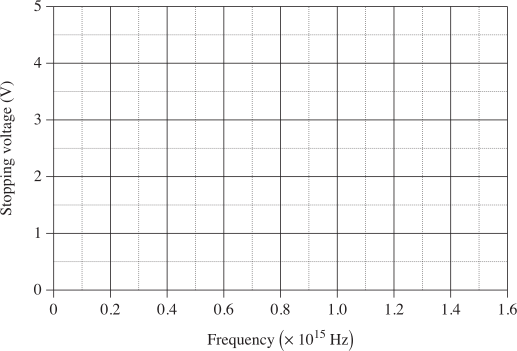
--- 0 WORK AREA LINES (style=lined) ---
--- 6 WORK AREA LINES (style=lined) ---
b. Features shown in experiment results:
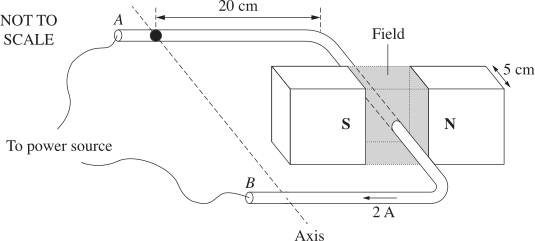
A wire loop is carrying a current of 2 A from \(A\) to \(B\) as shown. The length of wire within the magnetic field is 5 cm. The loop is free to pivot around the axis. The magnetic field is of magnitude \(3 \times 10^{-2}\ \text{T}\) and at right angles to the wire.
--- 6 WORK AREA LINES (style=lined) ---
--- 5 WORK AREA LINES (style=lined) ---
a. \(\tau=6 \times 10^{-4} \ \text{Nm clockwise from side} \ B\)
b. \(\text{Torque is doubled in same direction (given)}\)
\(\text{Using}\ \ \tau=BILd:\)
\(\text{If current is halved}\ \ \left(I \rightarrow \frac{1}{2} I\right) \ \ \text{and the magnetic field is}\)
\(\text {increased by a factor of} \ 4 \ (B \rightarrow 4B),\ \text{torque is doubled.}\)
\(\tau_{\text{new}}=4B \times \frac{1}{2} I \times Ld=2 \times BILd=2 \tau_{\text {orig }}\)
a. \(\text{Convert units:}\ \ 5 \ \text{cm} \ \Rightarrow \ \dfrac{5}{100}=0.05 \ \text{m}\)
\(F=BIL=3 \times 10^{-2} \times 2 \times 0.05=0.003 \ \text{N}\)
\(\text{Convert units:}\ \ 20\ \text{cm} \ \Rightarrow \ \ 0.2 \ \text{m}\)
| \(\tau\) | \(=F d\) |
| \(=0.003 \times 0.2\) | |
| \(=6 \times 10^{-4} \ \text{Nm clockwise from side} \ B\) |
b. \(\text{Torque is doubled in same direction (given)}\)
\(\text{Using}\ \ \tau=BILd:\)
\(\text{If current is halved}\ \ \left(I \rightarrow \frac{1}{2} I\right) \ \ \text{and the magnetic field is}\)
\(\text {increased by a factor of} \ 4 \ (B \rightarrow 4B),\ \text{torque is doubled.}\)
\(\tau_{\text{new}}=4B \times \frac{1}{2} I \times Ld=2 \times BILd=2 \tau_{\text {orig }}\)
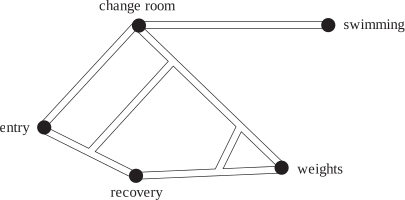
The map below shows the passages connecting five areas in the gym: entry \((E)\), recovery \((R)\), weights \((W)\), change room \((C)\) and swimming \((S)\).
A network can be constructed from this map.
An adjacency matrix for this network is shown below.
Some values in the matrix are given as \(x, y\) and \(z\).
\begin{aligned}
& \quad \ \ \ E \ \ \ R \ \ \ W \ \ \ C \ \ \ S\\
&\begin{array}{l}
E\\
R\\
W\\
C\\
S
\end{array}\begin{bmatrix}
0 & x & 2 & 2 & 0\\
x & 1 & y & 2 & 0\\
2 & y & 1 & z & 0\\
2 & 2 & z & 0 & 1\\
0 & 0 & 0 & 1 & 0
\end{bmatrix}
\end{aligned}
In this matrix, the '2' in row \(E\), column \(C\) indicates that there are two ways of moving from the entry to the change room without passing through another area or backtracking.
Determine the values of \(x, y\) and \(z\) in the boxes below. (2 marks)
--- 2 WORK AREA LINES (style=lined) ---
\(x=2, y=4, z=2\)
\(x=2, y=4, z=2\)
\(\text{One strategy}\)
\(\text{Consider the two paths from \(E\) to \(R\) (\(x\) in the table):}\)
\(\text{Path 1: straight line from \(E\) to \(R\).}\)
\(\text{Path 2: start towards \(E\) then left, right, right, right.}\)
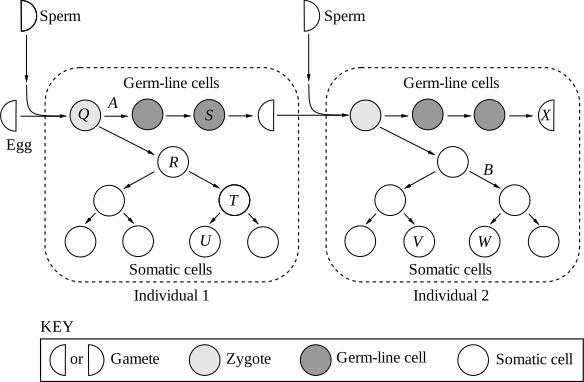
The following diagram shows the cell division processes occurring in two related individuals.
--- 8 WORK AREA LINES (style=lined) ---
--- 3 WORK AREA LINES (style=lined) ---
--- 12 WORK AREA LINES (style=lined) ---
a. Similarities:
Differences:
b. Relationship between Individuals 1 and 2
c. Mutation’s affect on genetic information
a. Similarities:
Differences:
b. Relationship between Individuals 1 and 2
c. Mutation’s affect on genetic information
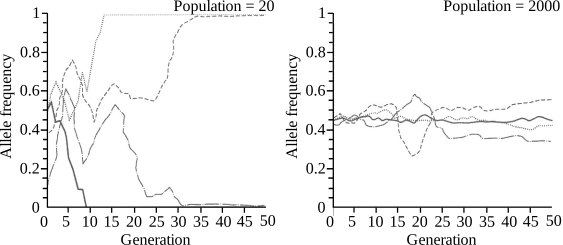
The following graph shows the changes in allele frequencies in two separate populations of the same species. Each line represents an introduced allele.
--- 4 WORK AREA LINES (style=lined) ---
--- 12 WORK AREA LINES (style=lined) ---
a. Genetic Drift and Population Size
b. Evaluation Statement
Population Size Differences
Vulnerability in Small Populations
Final Evaluation
a. Genetic Drift and Population Size
b. Evaluation Statement
Population Size Differences
Vulnerability in Small Populations
Final Evaluation
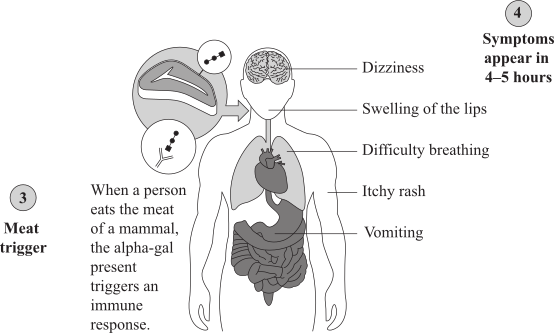
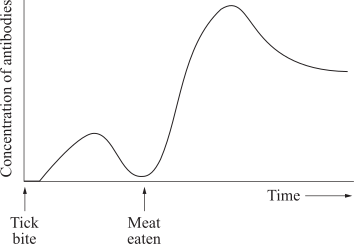
Alpha-gal syndrome (AGS) is a tick-borne allergy to red meat caused by tick bites. Alpha-gal is a sugar molecule found in most mammals but not humans, and can also be found in the saliva of ticks. The diagram shows how a tick bite might cause a person to develop an allergic reaction to red meat.
--- 10 WORK AREA LINES (style=lined) ---
--- 4 WORK AREA LINES (style=lined) ---
--- 6 WORK AREA LINES (style=lined) ---
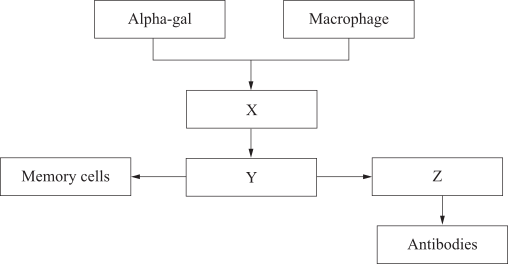
a. Antibody Production Process
b. Features of Antibody Production
c. Role of Memory Cells
a. Antibody Production Process
b. Features of Antibody Production
c. Role of Memory Cells
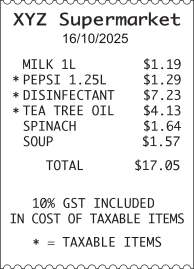
Jacinta buys several items at the supermarket. The docket for her purchases is shown below.
What is the amount of GST included in the total?
\(A\)
\(\text{Total price of taxable items}\ +\ 10\%\ \text{ GST}\ =1.29+7.23+4.13=$12.65\)
| \(\therefore\ 110\%\ \text{of original price}\) | \(=$12.65\) |
| \(\therefore\ \text{GST}\) | \(=$12.65\times\dfrac{100}{110}=$1.15\) |
\(\Rightarrow A\)
The sheets of paper Jenny uses in her photocopier are 21 cm by 30 cm. The paper is 80 gsm, which means that one square metre of this paper has a mass of 80 grams. Jenny has a pile of this paper weighing 25.2 kg.
How many sheets of paper are in the pile?
\(D\)
\(1\ \text{square metre} = 100\ \text{cm}\times 100\ \text{cm}=10\,000\ \text{cm}^2\)
\(\text{Area of paper sheet}\ = \ 21\times 30=630\ \text{cm}^2\)
\(\text{Number of 80 gsm sheets in 25.2 kg}\ =\dfrac{25.2\times 1000}{80}=315\)
| \(\therefore\ \text{Sheets in pile}\) | \(=315\times\dfrac{10\,000}{630}\) |
| \(=5000\) |
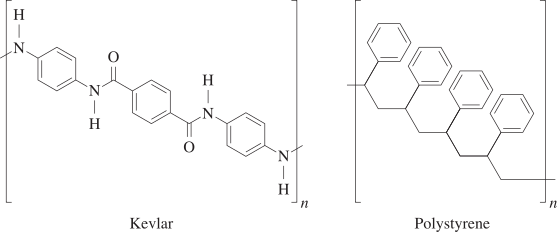
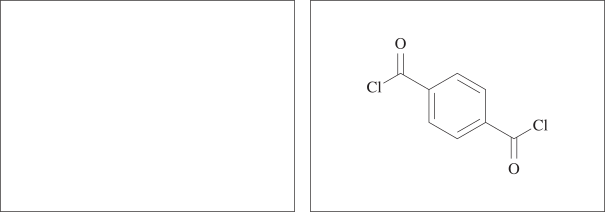
Kevlar and polystyrene are two common polymers.
A section of their structures is shown.
--- 0 WORK AREA LINES (style=lined) ---
--- 10 WORK AREA LINES (style=lined) ---
a.
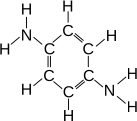
b. The physical differences between the two polymers are:
a.
b. The physical differences between the two polymers are:
The solubility constant for silver\(\text{(I)}\) oxalate \(\ce{(Ag2C₂O4)}\) was determined using the following method.
The calibration curve for the AAS is provided below.
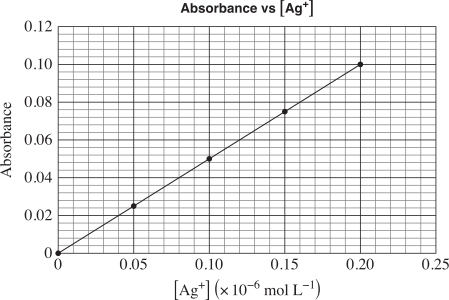
The absorbance of the diluted sample was 0.055.
What is the \(K_{s p}\) for silver oxalate?
\(B\)
\(\Rightarrow B\)
A single straight strand of polyester was produced through a condensation reaction of 1000 molecules of 3-hydroxypropanoic acid, \(\ce{HOCH2CH2COOH}\).
What is the approximate molar mass of the strand (in g mol\(^{-1}\) )?
\(B\)
| \(MM_{\text{strand}}\) | \(=MM_{\text{monomers}}-MM_{\text{water}}\) | |
| \(=90.078 \times 1000 -18.016 \times 999\) | ||
| \( = 72\ 080\ \text{g mol}^{-1}\) |
\(\Rightarrow B\)
Consider the point \(B\) with three-dimensional position vector \(\underset{\sim}{b}\) and the line \(\ell: \underset{\sim}{a}+\lambda \underset{\sim}{d}\), where \(\underset{\sim}{a}\) and \(\underset{\sim}{d}\) are three-dimensional vectors, \(\abs{\underset{\sim}{d}}=1\) and \(\lambda\) is a parameter.
Let \(f(\lambda)\) be the distance between a point on the line \(\ell\) and the point \(B\).
--- 12 WORK AREA LINES (style=lined) ---
--- 7 WORK AREA LINES (style=lined) ---
--- 16 WORK AREA LINES (style=lined) ---
i. \(\lambda_0=\underset{\sim}{d}(\underset{\sim}{b}-\underset{\sim}{a})\)
ii. \(\text{See Worked Solutions.}\)
iii. \(d_{\min }= \begin{cases}\sqrt{\abs{\underset{\sim}{a}}^2-(\underset{\sim}{a} \cdot \underset{\sim}{d})^2}-1, & \sqrt{\abs{\underset{\sim}{a}}^2-(\underset{\sim}{a} \cdot \underset{\sim}{d})^2}>1 \\ 0, & \sqrt{\abs{\underset{\sim}{a}}^2-(\underset{\sim}{a} \cdot \underset{\sim}{d})^2} \leqslant 1 \ \ \text{(i.e. it touches sphere) }\end{cases}\)
i. \(\ell=\underset{\sim}{a}+\lambda \underset{\sim}{d}, \quad\abs{\underset{\sim}{d}}=1\)
\(\text{Vector from point \(B\) to a point on \(\ell\)}:\ \underset{\sim}{a}+\lambda \underset{\sim}{d}-\underset{\sim}{b}\)
\(f(\lambda)=\text{distance between \(\ell\) and \(B\)}\)
\(f(\lambda)=\abs{\underset{\sim}{a}-\underset{\sim}{b}+\lambda \underset{\sim}{d}}\)
\(\text{At} \ \ \lambda_0, f(\lambda) \ \ \text{is a min}\ \Rightarrow \ f(\lambda)^2 \ \ \text {is also a min}\)
| \(f(\lambda)^2\) | \(=\abs{\underset{\sim}{a}-\underset{\sim}{b}+\lambda \underset{\sim}{d}}^2\) |
| \(=(\underset{\sim}{a}-\underset{\sim}{b}+\lambda \underset{\sim}{d})(\underset{\sim}{a}-\underset{\sim}{b}+\lambda \underset{\sim}{d})\) | |
| \(=(\underset{\sim}{a}-\underset{\sim}{b})\cdot (\underset{\sim}{a}-\underset{\sim}{b})+2\lambda (\underset{\sim}{a}-\underset{\sim}{b}) \cdot \underset{\sim}{d}+\lambda^2 \underset{\sim}{d} \cdot \underset{\sim}{d}\) | |
| \(=\lambda^2|\underset{\sim}{d}|^2+2 \underset{\sim}{d} \cdot (\underset{\sim}{a}-\underset{\sim}{b}) \lambda +\abs{\underset{\sim}{a}-\underset{\sim}{b}}^2\) | |
| \(=\lambda^2+2 \underset{\sim}{d} \cdot (\underset{\sim}{a}-\underset{\sim}{b}) \lambda+\abs{\underset{\sim}{a}-\underset{\sim}{b}}^2\) |
\(f(\lambda)^2 \ \ \text{is a concave up quadratic.}\)
\(f(\lambda)_{\text {min}}^2 \ \ \text{occurs at the vertex.}\)
\(\lambda_0=-\dfrac{b}{2 a}=-\dfrac{2 \underset{\sim}{d} \cdot (\underset{\sim}{a}-\underset{\sim}{b})}{2}=\underset{\sim}{d} \cdot (\underset{\sim}{b}-\underset{\sim}{a})\)
ii. \(P \ \text{has position vector} \ \ \underset{\sim}{a}+\lambda_0 \underset{\sim}{d}\)
\(\text{Show} \ \ \overrightarrow{PB} \perp \ell:\)
\(\overrightarrow{PB}=\underset{\sim}{b}-\underset{\sim}{p}=\underset{\sim}{b}-\underset{\sim}{a}-\lambda_0 \underset{\sim}{d}\)
| \(\overrightarrow{P B} \cdot \underset{\sim}{d}\) | \(=\left(\underset{\sim}{b}-\underset{\sim}{a}-\lambda_0 \underset{\sim}{d}\right) \cdot \underset{\sim}{d}\) |
| \(=(\underset{\sim}{b}-\underset{\sim}{a}) \cdot \underset{\sim}{d}-\lambda_0 \underset{\sim}{d} \cdot \underset{\sim}{d}\) | |
| \(=\lambda_0-\lambda_0\abs{\underset{\sim}{d}}^2\) | |
| \(=0\) |
\(\therefore \overrightarrow{PB}\ \text{is perpendicular to the direction of the line}\ \ell. \)
iii. \(\text{Shortest distance between} \ \ell \ \text{and sphere (radius\(=1\))}\)
\(=\ \text{(shortest distance \(\ell\) to \(O\))}-1\)
\(f\left(\lambda_0\right)=\text{shortest distance \(\ell\) to point \(B\)}\)
\(\text{Set} \ \ \underset{\sim}{b}=0 \ \Rightarrow \ f\left(\lambda_0\right)=\text{shortest distance \(\ell\) to \(0\)}\)
\(\Rightarrow \lambda_0=\underset{\sim}{d} \cdot (\underset{\sim}{b}-\underset{\sim}{a})=-\underset{\sim}{d} \cdot \underset{\sim}{a}\)
| \(f\left(\lambda_0\right)\) | \(=\abs{\underset{\sim}{a}-\underset{\sim}{b}-(\underset{\sim}{d} \cdot \underset{\sim}{a})\cdot \underset{\sim}{d}}=\abs{\underset{\sim}{a}-(\underset{\sim}{d} \cdot \underset{\sim}{a})\cdot \underset{\sim}{d}}\) |
| \(f\left(\lambda_0\right)^2\) | \(=\abs{\underset{\sim}{a}}^2-2( \underset{\sim}{a}\cdot \underset{\sim}{d})^2+(\underset{\sim}{d} \cdot \underset{\sim}{a})^2\abs{\underset{\sim}{d}}^2\) |
| \(=\abs{\underset{\sim}{a}}^2-(\underset{\sim}{a} \cdot \underset{\sim}{d})^2\) | |
| \(f\left(\lambda_0\right)\) | \(=\sqrt{\abs{\underset{\sim}{a}}^2-(\underset{\sim}{a} \cdot \underset{\sim}{d})^2}\) |
\(\text {Shortest distance of \(\ell\) to sphere \(\left(d_{\min }\right)\):}\)
\(d_{\min }= \begin{cases}\sqrt{\abs{\underset{\sim}{a}}^2-(\underset{\sim}{a} \cdot \underset{\sim}{d})^2}-1, & \sqrt{\abs{\underset{\sim}{a}}^2-(\underset{\sim}{a} \cdot \underset{\sim}{d})^2}>1 \\ 0, & \sqrt{\abs{\underset{\sim}{a}}^2-(\underset{\sim}{a} \cdot \underset{\sim}{d})^2} \leqslant 1 \ \ \text{(i.e. it touches sphere) }\end{cases}\)
The structures of two substances, \(\text{X}\) and \(\text{Y}\), are shown.
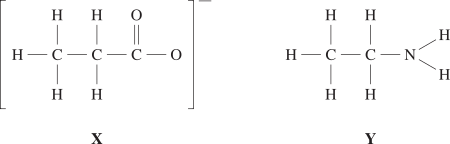
Which row of the table correctly classifies these substances as a Brønsted-Lowry acid or a Brønsted-Lowry base?
\begin{align*}
\begin{array}{l}
\rule{0pt}{2.5ex} \ & \\
\ \rule[-1ex]{0pt}{0pt}& \\
\rule{0pt}{2.5ex}\textbf{A.}\rule[-1ex]{0pt}{0pt}\\
\rule{0pt}{2.5ex}\textbf{B.}\rule[-1ex]{0pt}{0pt}\\
\rule{0pt}{2.5ex}\textbf{C.}\rule[-1ex]{0pt}{0pt}\\
\rule{0pt}{2.5ex}\textbf{D.}\rule[-1ex]{0pt}{0pt}\\
\end{array}
\begin{array}{|c|c|}
\hline
\rule{0pt}{2.5ex}\textit{Brønsted-Lowry} & \textit{Brønsted-Lowry} \\
\textit{acid}\rule[-1ex]{0pt}{0pt}& \textit{base} \\
\hline
\rule{0pt}{2.5ex}\text{-}\rule[-1ex]{0pt}{0pt}&\text{X and Y}\\
\hline
\rule{0pt}{2.5ex}\text{X and Y}\rule[-1ex]{0pt}{0pt}& \text{-}\\
\hline
\rule{0pt}{2.5ex}\text{Y}\rule[-1ex]{0pt}{0pt}& \text{X} \\
\hline
\rule{0pt}{2.5ex}\text{X}\rule[-1ex]{0pt}{0pt}& \text{Y} \\
\hline
\end{array}
\end{align*}
\(A\)
\(\Rightarrow A\)
The fruit fly, Drosophila melanogaster, normally has large round eyes. A mutation of the eye shape gene, found on the X-chromosome, causes the eye to be a narrow slit (bar-eye), which is a dominant allele for eye shape.
Offspring were produced when a bar-eyed male was crossed with a normal female. Males are XY and females are XX.
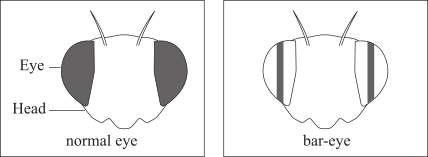
Which row in the table shows the correct percentage of male and female offspring produced with bar-eye?
| \(\quad\quad\quad\textit{Percentage of offspring with bar-eyes}\quad\quad\quad\) | ||
| \(\quad\textit{Males}\quad\) | \(\quad\textit{Females}\quad\) | |
| A. | \(100\) | \(100\) |
| B. | \(0\) | \(100\) |
| C. | \(100\) | \(0\) |
| D. | \(50\) | \(0\) |
\(B\)
Other Options:
A particle of mass 1 kg is projected from the origin with a speed of 50 ms\(^{-1}\), at an angle of \(\theta\) below the horizontal into a resistive medium.
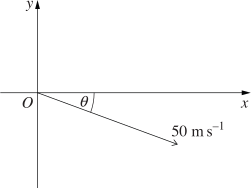
The position of the particle \(t\) seconds after projection is \((x, y)\), and the velocity of the particle at that time is \(\underset{\sim}{v}=\displaystyle \binom{\dot{x}}{\dot{y}}\).
The resistive force, \(\underset{\sim}{R}\), is proportional to the velocity of the particle, so that \(\underset{\sim}{R}=-k \underset{\sim}{v}\), where \(k\) is a positive constant.
Taking the acceleration due to gravity to be 10 ms\(^{-2}\), and the upwards vertical direction to be positive, the acceleration of the particle at time \(t\) is given by:
\(\underset{\sim}{a}=\displaystyle \binom{-k \dot{x}}{-k \dot{y}-10}\). (Do NOT prove this.)
Derive the Cartesian equation of the motion of the particle, given \(\sin \theta=\dfrac{3}{5}\). (5 marks)
--- 25 WORK AREA LINES (style=lined) ---
\(y=\left(\dfrac{1-3 k}{4 k}\right) x+\dfrac{10}{k^2} \times \ln \abs{1-\dfrac{k x}{40}}\)
\(\sin \theta=\dfrac{3}{5} \ \Rightarrow \ \cos \theta=\dfrac{4}{5}\)
\(\text{Components of initial velocity:}\)
\(\dot{x}(0)=50\, \cos \theta=50 \times \dfrac{4}{5}=40 \ \text{ms}^{-1}\)
\(\dot{y}(0)=50\, \sin \theta=50 \times \dfrac{3}{5}=-30\ \text{ms}^{-1}\)
\(\text{Horizontal motion:}\)
| \(\dfrac{d \dot{x}}{dt}\) | \(=-k \dot{x} \ \ \text{(given)}\) | |
| \(\dfrac{dt}{d \dot{x}}\) | \(=-\dfrac{1}{k \dot{x}}\) | |
| \(\displaystyle \int dt\) | \(=-\dfrac{1}{k} \int \dfrac{1}{\dot{x}}\, d x\) | |
| \(t\) | \(=-\dfrac{1}{k} \ln \dot{x}+c\) |
\(\text{When} \ \ t=0, \ \dot{x}=40 \ \Rightarrow \ c=\dfrac{1}{k} \ln 40\)
| \(t\) | \(=\dfrac{1}{k} \ln 40-\dfrac{1}{k} \ln \abs{\dot{x}}=\dfrac{1}{k} \ln \abs{\dfrac{40}{\dot{x}}}\) |
| \(k t\) | \(=\ln \abs{\dfrac{40}{\dot{x}}}\) |
| \(e^{k t}\) | \(=\dfrac{40}{\dot{x}}\) |
| \(\dot{x}\) | \(=40 e^{-k t}\) |
| \(x\) | \(\displaystyle=\int 40 e^{-k t}\, d t=-\dfrac{40}{k} \times e^{-k t}+c\) |
\(\text{When} \ \ t=0, x=0 \ \Rightarrow \ c=\dfrac{40}{k}\)
\(x=\dfrac{40}{k}-\dfrac{40}{k} e^{-k t}=\dfrac{40}{k}\left(1-e^{-k t}\right)\ \ldots\ (1)\)
\(\text{Vertical Motion }\)
| \(\dfrac{d \dot{y}}{dt}\) | \(=-k \dot{y}-10 \quad \text{(given)}\) |
| \(\dfrac{d t}{d \dot{y}}\) | \(=-\dfrac{1}{k} \times \dfrac{1}{\dot{y}+\frac{10}{k}}\) |
| \(t\) | \(=-\dfrac{1}{k} \displaystyle \int \dfrac{1}{\dot{y}+\frac{10}{k}} \, d \dot{y}=-\dfrac{1}{k} \ln \abs{\dot{y}+\frac{10}{k}}+c\) |
\(\text{When} \ \ t=0, \, \dot{y}=-30 \ \ \Rightarrow\ \ c=\dfrac{1}{k} \ln \abs{-30+\frac{10}{k}}\)
| \(t\) | \(=\dfrac{1}{k} \ln \abs{-30+\frac{10}{k}}-\dfrac{1}{k} \ln \abs{\dot{y}+\frac{10}{k}}\) |
| \(=\dfrac{1}{k} \ln \abs{\frac{-30+\frac{10}{k}}{\dot{y}+\frac{10}{k}}}\) | |
| \(e^{k t}\) | \(=\abs{\dfrac{-30+\frac{10}{k}}{y+\frac{10}{k}}}\) |
| \(\dot{y}\) | \(=\left(-30+\dfrac{10}{k}\right) e^{-k t}-\dfrac{10}{k}\) |
| \(y\) | \(=\displaystyle \left(-30+\dfrac{10}{k}\right) \int e^{-kt}\, d t-\int \dfrac{10}{k}\, dt\) |
| \(=-\dfrac{1}{k}\left(-30+\dfrac{10}{k}\right) e^{-k t}-\dfrac{10 t}{k}+c\) |
\(\text{When} \ \ t=0, y=0 \ \Rightarrow \ c=\dfrac{1}{k}\left(-30+\dfrac{10}{k}\right)\)
| \(y\) | \(=\dfrac{1}{k}\left(-30+\dfrac{10}{k}\right)-\dfrac{1}{k}\left(-30+\dfrac{10}{k}\right) e^{-k t}-\dfrac{10t}{k}\) |
| \(=\left(\dfrac{10}{k^2}-\dfrac{30}{k}\right)\left(1-e^{-k t}\right)-\dfrac{10 t}{k}\ \ldots\ (2)\) |
\(\text {Cartesian equation (using (1) above):}\)
| \(x\) | \(=\dfrac{40}{k}\left(1-e^{-k t}\right)\) |
| \(\dfrac{k x}{40}\) | \(=1-e^{-k t}\) |
| \(e^{-k t}\) | \(=1-\dfrac{k x}{40}\) |
| \(-k t\) | \(=\ln \abs{1-\dfrac{k x}{40}}\) |
| \(t\) | \(=-\dfrac{1}{k} \ln \abs{1-\dfrac{kx}{40}}\) |
| \(y\) | \(=\left(\dfrac{10}{k^2}-\dfrac{30}{k}\right) \times \dfrac{k x}{40}+\dfrac{10}{k^2} \times \ln \abs{1-\dfrac{k x}{40}}\) |
| \(=\left(\dfrac{1-3 k}{4 k}\right) x+\dfrac{10}{k^2} \times \ln \abs{1-\dfrac{k x}{40}}\) |
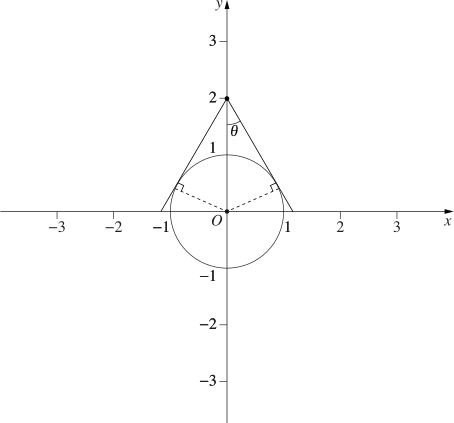
The complex number \(z\) lies on the unit circle.
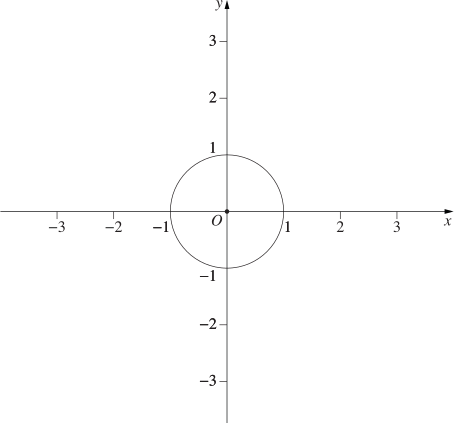
What is the range of \(\operatorname{Arg}(z-2 i)\) ?
\(D\)
\(\sin \theta=\dfrac{1}{2} \ \Rightarrow \ \theta=\dfrac{\pi}{6}\)
\(\text {Range Arg}(z-2 i):\)
\(-\dfrac{\pi}{2}-\dfrac{\pi}{6} \leqslant \operatorname{Arg}(z-2 i) \leqslant-\dfrac{\pi}{2}+\dfrac{\pi}{6}\)
\(-\dfrac{2 \pi}{3} \leqslant \operatorname{Arg}(2-2 i) \leqslant-\dfrac{\pi}{3}\)
\(\Rightarrow D\)
The complex numbers \(z\) and \(w\) lie on the unit circle. The modulus of \(z+w\) is \(\dfrac{3}{2}\).
What is the modulus of \(z-w\) ?
\(B\)
\(|z|=|w|=1, \quad \abs{z+w}=\dfrac{3}{2} \ \text{(given)}\)
\(\text{Find}\ \ \abs{z-w}:\)
\(\abs{z+\omega}^2=(z+\omega)(\bar{z}+\bar{\omega})=z \bar{z}+z \bar{\omega}+\omega \bar{z}+\omega \bar{\omega}\)
\(\abs{z-\omega}^2=(z-\omega)(\bar{z}-\bar{\omega})=\bar{z} z-z \bar{\omega}-\omega \bar{z}+\omega \bar{\omega}\)
| \(\abs{z+\omega}^2+|z-\omega|^2\) | \(=2 z \bar{z}+2 \omega \bar{\omega}=2\abs{z}^2+2\abs{\omega}^2=4\) |
| \(\dfrac{9}{4}+\abs{z-\omega}^2\) | \(=4\) |
| \(\abs{z-w}^2\) | \(=\dfrac{7}{4}\) |
| \(\abs{z-\omega}\) | \(=\dfrac{\sqrt{7}}{2}\) |
\(\Rightarrow B\)
Which of the following gives the same curve as \(\left(\begin{array}{c}\cos (t) \\ -t \\ \sin (t)\end{array}\right)\) for \(t \in \mathbb{R}\) ?
\(D\)
\(\text{Find which option is a re-parametrisation of the given curve.}\)
\(\text{Consider option D:}\)
\(\text{Let}\ \ u=- \left(2t + \dfrac{\pi}{2}\right)\)
\(\text{Since}\ t \in \mathbb{R}\ \ \Rightarrow \ \ u \in \mathbb{R}\)
\(\cos \left(2 t+\dfrac{\pi}{2}\right) = \cos\left(- \left(2 t+\dfrac{\pi}{2}\right) \right) = \cos\,u\)
\(2 t+\dfrac{\pi}{2} = -\left( -\left(2 t+\dfrac{\pi}{2} \right) \right) = -u\)
\(-\sin \left(2 t+\dfrac{\pi}{2}\right) = \sin\left(- \left(2 t+\dfrac{\pi}{2}\right) \right) = \sin\,u\)
\(\Rightarrow D\)
The points \(U, V, W\) and \(Z\) represent the complex numbers \(u, v, w\) and \(z\) respectively. It is given that \(v+z=u+w\) and \(u+k i z=w+k i v\) where \(k \in \mathbb{R} , k>1\).
Which quadrilateral best describes \(UVWZ\) ?
\(C\)
\(\text{Quadrilateral}\ UVWZ\ \ \Rightarrow\ \ \text{Diagonals are \(UW\) and \(VZ\)} \).
\(\text{Given}\ \ v+z=u+w\ \ \Rightarrow\ \ \dfrac{v+z}{2}=\dfrac{u+w}{2}\)
\(\text{Mid-points of diagonals are equal (diagonals bisect).}\)
| \(u+kiz\) | \(=w+kiv\) | |
| \(u-w\) | \(=ki(v-z)\) |
\(\therefore UW\ \text{and}\ VZ\ \text{are perpendicular.}\)
\(\Rightarrow C\)
The graph shows the velocity of a particle as a function of its displacement.
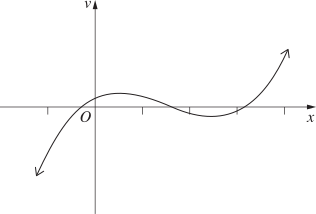
Which of the following graphs best shows the acceleration of the particle as a function of its displacement?
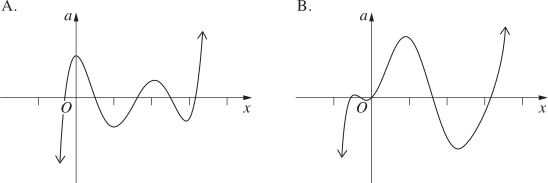
\(A\)
\(\text{By elimination:}\)
\(v(x)\ \Rightarrow\ \text{degree 3 (see graph)},\ \ \dfrac{dv}{dx}\ \Rightarrow\ \text{degree 2}\)
\(a=v \cdot \dfrac{dv}{dx}\ \Rightarrow\ \text{degree 5 (eliminate C and D)}\)
\(\text{At}\ \ x=0,\ \ v(x)>0\ \ \text{and}\ \ \dfrac{dv}{dx}<0\ \ \Rightarrow\ \ v \cdot \dfrac{dv}{dx} \neq 0\ \text{(eliminate B)}\)
\(\Rightarrow A\)
A particle moves in simple harmonic motion about the origin with amplitude \(A\), and it completes two cycles per second. When it is \(\dfrac{1}{4}\) metres from the origin, its speed is half its maximum speed.
Find the maximum positive acceleration of the particle during its motion. (4 marks)
--- 12 WORK AREA LINES (style=lined) ---
\(a_{\text{max}}=\dfrac{8 \pi^2}{\sqrt{3}}\)
\(v^2=-n^2\left(x^2-A^2\right)\)
\(\operatorname{Period}\ (T)=\dfrac{1}{2} \ \Rightarrow \ \dfrac{2 \pi}{n}=\dfrac{1}{2} \ \Rightarrow \ n=4 \pi\)
\(\text{Max velocity occurs at}\ \ x=0:\)
\(v_{\text{max}}^2=-(4 \pi)^2\left(0-A^2\right)=16 \pi^2 A^2\)
\(v_{\text{max}}=\sqrt{16 \pi^2 A^2}=4 \pi A\)
\(\text{At} \ \ x=\dfrac{1}{4}, \ v=\dfrac{1}{2} \times 4 \pi A=2 \pi A\)
| \((2 \pi A)^2\) | \(=-(4 \pi)^2\left(\dfrac{1}{16}-A^2\right)\) |
| \(\dfrac{A^2}{4}\) | \(=A^2-\dfrac{1}{16}\) |
| \(\dfrac{3 A^2}{4}\) | \(=\dfrac{1}{16}\) |
| \(A^2\) | \(=\dfrac{1}{12}\) |
| \(A\) | \(=\dfrac{1}{\sqrt{12}}\) |
\(\text{Max positive acceleration occurs at} \ \ x=-\dfrac{1}{\sqrt{12}}:\)
\(a_{\text{max}}=-n^2 x=-(4 \pi)^2 \times-\dfrac{1}{\sqrt{12}}=\dfrac{8 \pi^2}{\sqrt{3}}\)
Positive real numbers \(a, b, c\) and \(d\) are chosen such that \(\dfrac{1}{a}, \dfrac{1}{b}, \dfrac{1}{c}\) and \(\dfrac{1}{d}\) are consecutive terms in an arithmetic sequence with common difference \(k\), where \(k \in \mathbb{R} , k>0\).
Show that \(b+c<a+d\). (3 marks)
--- 12 WORK AREA LINES (style=lined) ---
\(\text{AP:} \ \dfrac{1}{a}, \dfrac{1}{b}, \dfrac{1}{c}, \dfrac{1}{d} \ \ \text{where common difference}=k\ \ (k>0)\)
\(\text{Show} \ \ b+c<a+d\)
\(\dfrac{1}{a}<\dfrac{1}{a}+k(k>0)\)
\(\dfrac{1}{a}<\dfrac{1}{b}\)
\(\text{Similarly for}\ \ \dfrac{1}{b}<\dfrac{1}{c}\ \ldots\ \text{such that}\)
\(\dfrac{1}{a}<\dfrac{1}{b}<\dfrac{1}{c}<\dfrac{1}{d} \ \ \Rightarrow\ \ a>b>c>d\ \ldots\ (1)\)
\(\dfrac{1}{b}=\dfrac{1}{a}+k \ \ \Rightarrow \ \ k=\dfrac{1}{b}-\dfrac{1}{a}=\dfrac{a-b}{a b}\ \ \Rightarrow \ \ a-b=kab\)
\(\text {Similarly:}\)
\(\dfrac{1}{d}=\dfrac{1}{c}+k \ \ \Rightarrow \ \ k=\dfrac{c-d}{cd}\ \ \Rightarrow\ \ c-d=kcd\)
\(\text{Using \(\ a>b>c>d\ \) (see (1) above):}\)
\(a-b>c-d\)
\(b+c<a+d\)
\(\text{AP:} \ \dfrac{1}{a}, \dfrac{1}{b}, \dfrac{1}{c}, \dfrac{1}{d} \ \ \text{where common difference}=k\ \ (k>0)\)
\(\text{Show} \ \ b+c<a+d\)
\(\dfrac{1}{a}<\dfrac{1}{a}+k(k>0)\)
\(\dfrac{1}{a}<\dfrac{1}{b}\)
\(\text{Similarly for}\ \ \dfrac{1}{b}<\dfrac{1}{c}\ \ldots\ \text{such that}\)
\(\dfrac{1}{a}<\dfrac{1}{b}<\dfrac{1}{c}<\dfrac{1}{d} \ \ \Rightarrow\ \ a>b>c>d\ \ldots\ (1)\)
\(\dfrac{1}{b}=\dfrac{1}{a}+k \ \ \Rightarrow \ \ k=\dfrac{1}{b}-\dfrac{1}{a}=\dfrac{a-b}{a b}\ \ \Rightarrow \ \ a-b=kab\)
\(\text {Similarly:}\)
\(\dfrac{1}{d}=\dfrac{1}{c}+k \ \ \Rightarrow \ \ k=\dfrac{c-d}{cd}\ \ \Rightarrow\ \ c-d=kcd\)
\(\text{Using \(\ a>b>c>d\ \) (see (1) above):}\)
\(a-b>c-d\)
\(b+c<a+d\)