NETWORKS, FUR1-NHT 2019 VCAA 3 MC
Four students, Alice, Brad, Charli and Dexter, are working together on a school project.
This project has four parts.
Each of the students will complete only one part of the project.
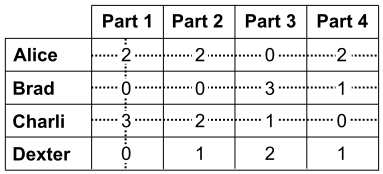
The table below shows the time it would take each student to complete each part of the project, in minutes.
| Part 1 | Part 2 | Part 3 | Part 4 | ||
| Alice | 5 | 5 | 3 | 5 | |
| Brad | 3 | 3 | 6 | 4 | |
| Charli | 6 | 5 | 4 | 3 | |
| Dexter | 4 | 5 | 6 | 5 |
The parts of this project must be completed one after the other.
Which allocation of student to part must occur for this project to be completed in the minimum time possible?
| A. | Part 1 | Part 2 | Part 3 | Part 4 |
| Brad | Dexter | Alice | Charli | |
| B. | Part 1 | Part 2 | Part 3 | Part 4 |
| Brad | Dexter | Charli | Alice | |
| C. | Part 1 | Part 2 | Part 3 | Part 4 |
| Dexter | Alice | Charli | Brad | |
| D. | Part 1 | Part 2 | Part 3 | Part 4 |
| Dexter | Brad | Alice | Charli | |
| E. | Part 1 | Part 2 | Part 3 | Part 4 |
| Dexter | Brad | Charli | Alice |
Calculus, 2ADV C4 2019 MET-N 15 MC
Functions, EXT1 F1 2019 MET2-N 11 MC
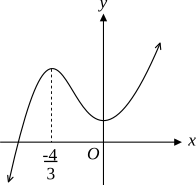
The function `f(x) = 5x^3 + 10x^2 + 1` will have an inverse function for the domain
- `D = (–2, ∞)`
- `D = (–∞ , (1)/(2)]`
- `D = (–∞ , –1]`
- `D = [0 , ∞)`
Calculus, MET2-NHT 2019 VCAA 5
Let `f: R → R, \ f(x) = e^((x/2))` and `g: R → R, \ g(x) = 2log_e(x)`.
- Find `g^-1 (x)`. (1 mark)
--- 4 WORK AREA LINES (style=lined) ---
- Find the coordinates of point `A`, where the tangent to the graph of `f` at `A` is parallel to the graph of `y = x`. (2 marks)
--- 5 WORK AREA LINES (style=lined) ---
- Show that the equation of the line that is perpendicular to the graph of `y = x` and goes through point `A` is `y = -x + 2log_e(2) + 2`. (1 mark)
--- 3 WORK AREA LINES (style=lined) ---
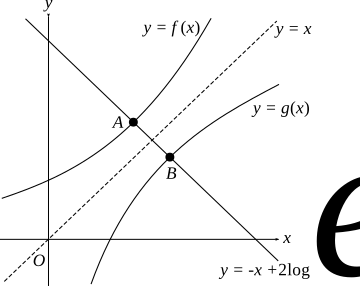
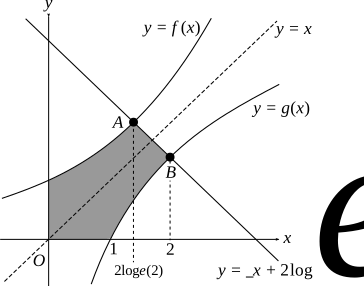
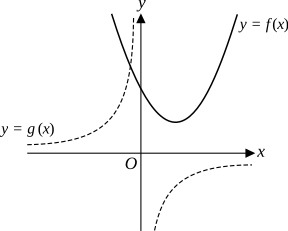
Let `B` be the point of intersection of the graphs of `g` and `y =-x + 2log_e(2) + 2`, as shown in the diagram below.
- Determine the coordinates of point `B`. (1 mark)
--- 4 WORK AREA LINES (style=lined) ---
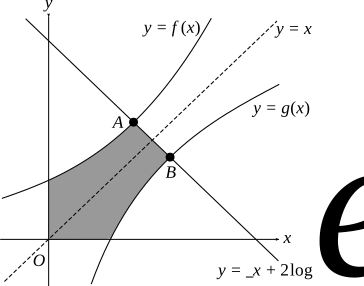
- The shaded region below is enclosed by the axes, the graphs of `f` and `g`, and the line `y =-x + 2log_e(2) + 2`.
Find the area of the shaded region. (2 marks)
--- 4 WORK AREA LINES (style=lined) ---
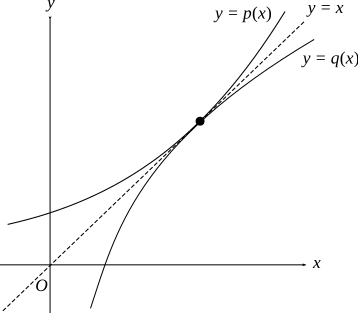
Let `p : R→ R, \ p(x) = e^(kx)` and `q : R→ R, \ q(x) = (1)/(k) log_e(x)`.
- The graphs of `p`, `q` and `y = x` are shown in the diagram below. The graphs of `p` and `q` touch but do not cross.
Find the value of `k`. (2 marks)
--- 6 WORK AREA LINES (style=lined) ---
- Find the value of `k, k > 0`, for which the tangent to the graph of `p` at its `y`-intercept and the tangent to the graph of `q` at its `x`-intercept are parallel. (1 mark)
--- 5 WORK AREA LINES (style=lined) ---
Calculus, MET2-NHT 2019 VCAA 4
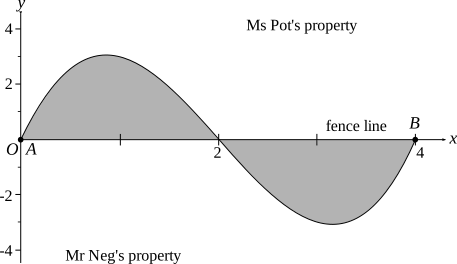
A mining company has found deposits of gold between two points, `A` and `B`, that are located on a straight fence line that separates Ms Pot's property and Mr Neg's property. The distance between `A` and `B` is 4 units.
The mining company believes that the gold could be found on both Ms Pot's property and Mr Neg's property.
The mining company initially models he boundary of its proposed mining area using the fence line and the graph of
`f : [0, 4] → R, \ f(x) = x(x-2)(x-4)`
where `x` is the number of units from point `A` in the direction of point `B` and `y` is the number of units perpendicular to the fence line, with the positive direction towards Ms Pot's property. The mining company will only mine from the boundary curve to the fence line, as indicated by the shaded area below.
- Determine the total number of square units that will be mined according to this model. (2 marks)
--- 3 WORK AREA LINES (style=lined) ---
The mining company offers to pay Mr Neg $100 000 per square unit of his land mined and Ms Pot $120 000 per square unit of her land mined.
- Determine the total amount of money that the mining company offers to pay. (1 mark)
--- 2 WORK AREA LINES (style=lined) ---
The mining company reviews its model to use the fence line and the graph of
`p : [0, 4] → R, \ p(x) = x(x-4 + (4)/(1 + a)) (x-4)` where `a > 0`.
- Find the value of `a` for which `p(x) = f(x)` for all `x`. (1 mark)
--- 3 WORK AREA LINES (style=lined) ---
- Solve `p^{′}(x) = 0` for `x` in terms of `a`. (2 marks)
--- 3 WORK AREA LINES (style=lined) ---
Mr Neg does not want his property to be mined further than 4 units measured perpendicular from the fence line.
- Find the smallest value of `a`, correct to three decimal places, for this condition to be met. (2 marks)
--- 5 WORK AREA LINES (style=lined) ---
- Find the value of `a` for which the total area of land mined is a minimum. (3 marks)
--- 5 WORK AREA LINES (style=lined) ---
- The mining company offers to pay Ms Pot $120 000 per square unit of her land mined and Mr Neg $100 000 per square unit of his land mined.
- Determine the value of `a` that will minimize the total cost of the land purchase for the mining company. Give your answer correct to three decimal places. (2 marks)
--- 4 WORK AREA LINES (style=lined) ---
Statistics, MET2-NHT 2019 VCAA 3
Concerts at the Mathsland Concert Hall begin `L` minutes after the scheduled starting time. `L` is a random variable that is normally distributed with a mean of 10 minutes and a standard deviation of four minutes. --- 2 WORK AREA LINES (style=lined) --- --- 2 WORK AREA LINES (style=lined) --- If a concert begins more than 15 minutes after the scheduled starting time, the cleaner is given an extra payment of $200. If a concert begins up to 15 minutes after the scheduled starting time, the cleaner is given an extra payment of $100. If a concert begins at or before the scheduled starting time, there is no extra payment for the cleaner. Let `C` be the random variable that represents the extra payment for the cleaner, in dollars. --- 0 WORK AREA LINES (style=lined) --- --- 3 WORK AREA LINES (style=lined) --- --- 3 WORK AREA LINES (style=lined) --- The owners of the Mathsland Concert Hall decide to review their operation. They study information from 1000 concerts at other similar venues, collected as a simple random sample. The sample value for the number of concerts that start more than 15 minutes after the scheduled starting time is 43. --- 3 WORK AREA LINES (style=lined) --- --- 3 WORK AREA LINES (style=lined) --- The owners of the Mathsland Concert Hall decide that concerts must not begin before the scheduled starting time. They also make changes to reduce the number of concerts that begin after the scheduled starting time. Following these changes, `M` is the random variable that represents the number of minutes after the scheduled starting time that concerts begin. The probability density function for `M` is `qquad qquad f(x) = {(8/(x + 2)^3), (0):} qquad {:(x ≥ 0), (x < 0):}` where `x` is the the time, in minutes, after the scheduled starting time. --- 3 WORK AREA LINES (style=lined) --- --- 2 WORK AREA LINES (style=lined) --- --- 5 WORK AREA LINES (style=lined) --- --- 5 WORK AREA LINES (style=lined) ---
Trigonometry, EXT1 T3 EQ-Bank 5
A particular energy wave can be modelled by the function
`f(t) = sqrt5 sin 0.2t + 2 cos 0.2t, \ \ t ∈ [0, 50]`
- Express this function in the form `f(t) = Rsin(nt-alpha), \ \ alpha ∈ [0, 2pi]`. (2 marks)
--- 6 WORK AREA LINES (style=lined) ---
- Find the time the wave first attains its maximum value. Give your answer to one decimal place. (2 marks)
--- 6 WORK AREA LINES (style=lined) ---
Trigonometry, MET2-NHT 2019 VCAA 2
The wind speed at a weather monitoring station varies according to the function
`v(t) = 20 + 16sin ((pi t)/(14))`
where `v` is the speed of the wind, in kilometres per hour (km/h), and `t` is the time, in minutes, after 9 am.
- What is the amplitude and the period of `v(t)`? (2 marks)
--- 3 WORK AREA LINES (style=lined) ---
- What are the maximum and minimum wind speeds at the weather monitoring station? (1 mark)
--- 2 WORK AREA LINES (style=lined) ---
- Find `v(60)`, correct to four decimal places. (1 mark)
--- 2 WORK AREA LINES (style=lined) ---
- Find the average value of `v(t)` for the first 60 minutes, correct to two decimal places. (2 marks)
--- 5 WORK AREA LINES (style=lined) ---
A sudden wind change occurs at 10 am. From that point in time, the wind speed varies according to the new function
`v_1(t) = 28 + 18 sin((pi(t-k))/(7))`
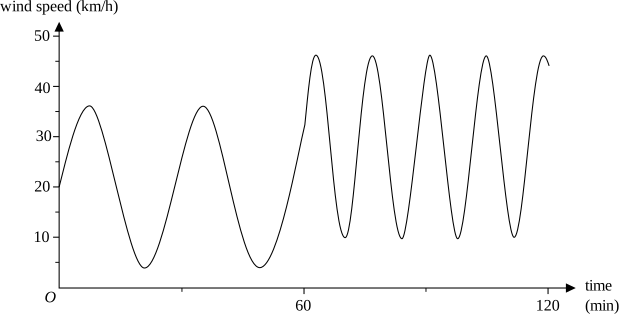
where `v_1` is the speed of the wind, in kilometres per hour, `t` is the time, in minutes, after 9 am and `k ∈ R^+`. The wind speed after 9 am is shown in the diagram below.
- Find the smallest value of `k`, correct to four decimal places, such that `v(t)` and `v_1(t)` are equal and are both increasing at 10 am. (2 marks)
--- 2 WORK AREA LINES (style=lined) ---
- Another possible value of `k` was found to be 31.4358
Using this value of `k`, the weather monitoring station sends a signal when the wind speed is greater than 38 km/h.
i. Find the value of `t` at which a signal is first sent, correct to two decimal places. (1 mark)
--- 2 WORK AREA LINES (style=lined) ---
ii. Find the proportion of one cycle, to the nearest whole percent, for which `v_1 > 38`. (2 marks)
--- 5 WORK AREA LINES (style=lined) ---
- Let `f(x) = 20 + 16 sin ((pi x)/(14))` and `g(x) = 28 + 18 sin ((pi(x-k))/(7))`.
The transformation `T([(x),(y)]) = [(a \ \ \ \ 0),(0 \ \ \ \ b)][(x),(y)] + [(c),(d)]` maps the graph of `f` onto the graph of `g`.State the values of `a`, `b`, `c` and `d`, in terms of `k` where appropriate. (3 marks)
--- 11 WORK AREA LINES (style=lined) ---
Graphs, MET2-NHT 2019 VCAA 1
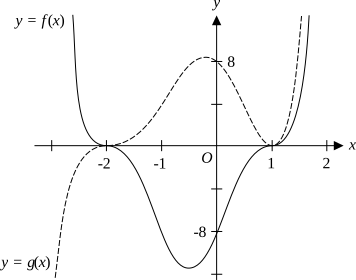
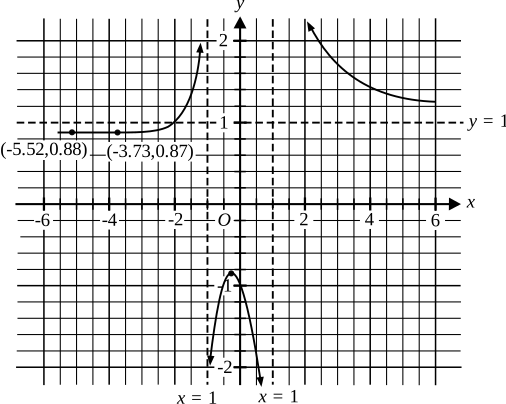
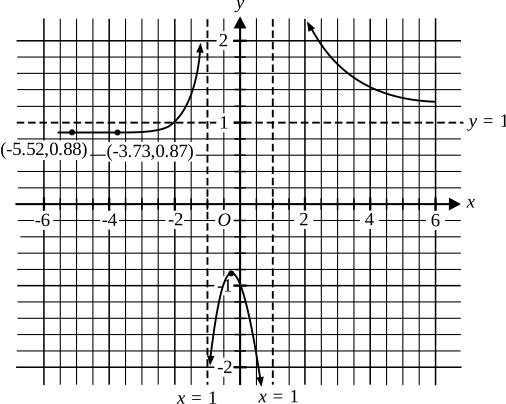
Parts of the graphs of `f(x) = (x-1)^3(x + 2)^3` and `g(x) = (x-1)^2(x + 2)^3` are shown on the axes below.
The two graphs intersect at three points, (–2, 0), (1, 0) and (`c`, `d`). The point (`c`, `d`) is not shown in the diagram above.
- Find the values of `c` and `d`. (2 marks)
--- 4 WORK AREA LINES (style=lined) ---
- Find the values of `x` such that `f(x) > g(x)`. (1 mark)
--- 2 WORK AREA LINES (style=lined) ---
- State the values of `x` for which
- `f^{'}(x) > 0` (1 mark)
--- 2 WORK AREA LINES (style=lined) ---
- `g^{'}(x) > 0` (1 mark)
--- 2 WORK AREA LINES (style=lined) ---
- `f^{'}(x) > 0` (1 mark)
- Show that `f(1 + m) = f(–2-m)` for all `m`. (1 mark)
--- 3 WORK AREA LINES (style=lined) ---
- Find the values of `h` such that `g(x + h) = 0` has exactly one negative solution. (2 marks)
--- 4 WORK AREA LINES (style=lined) ---
- Find the values of `k` such that `f(x) + k = 0` has no solutions. (1 mark)
--- 2 WORK AREA LINES (style=lined) ---
Trigonometry, EXT1 T3 EQ-Bank 1
- Show that `sinx + sin3x = 2sin2xcosx`. (2 marks)
--- 8 WORK AREA LINES (style=lined) ---
- Hence or otherwise, find all values of `x` that satisfy
`qquad sinx + sin2x + sin3x = 0,\ \ \ x in [0,2pi]`. (2 marks)
--- 8 WORK AREA LINES (style=lined) ---
Data Analysis, GEN1 2019 NHT 12 MC
Which one of the following statements could be true when written as part of the results of a statistical investigation?
- The correlation coefficient between height (in centimetres) and foot length (in centimetres) was found to be `r = 1.24`
- The correlation coefficient between height (below average, average, above average) and arm span (in centimetres) was found to be `r = 0.64`
- The correlation coefficient between blood pressure (low, normal, high) and age (under 25, 25–49, over 50) was found to be `r = 0.74`
- The correlation coefficient between the height of students of the same age (in centimetres) and the money they spent on snack food (in dollars) was found to be `r = 0.22`
- The correlation coefficient between height of wheat (in centimetres) and grain yield (in tonnes) was found to be `r = –0.40` and the coefficient of determination was found to be `r^2 = –0.16`
Data Analysis, GEN1 2019 NHT 11 MC
The Human Development Index (HDI) and the mean number of children per woman for 13 countries are related.
This relationship is non-linear.
To linearise the data, a `log_10` transformation is applied to the response variable children.
A least squares line is then fitted to the linearised data.
The equation of this least squares line is
`log_10 (text(children)) = 1.06 - 0.00674 xx HDI`
Using this equation, the mean number of children per woman for a country with a HDI of 95 is predicted to be closest to
- 0.4
- 1.5
- 2.6
- 2.9
- 3.1
Data Analysis, GEN1 2019 NHT 5-7 MC
The birth weights of a large population of babies are approximately normally distributed with a mean of 3300 g and a standard deviation of 550 g.
Part 1
A baby selected at random from this population has a standardised weight of `z = – 0.75`
Which one of the following calculations will result in the actual birth weight of this baby?
- `text(actual birth weight)\ = 550 - 0.75 × 3300`
- `text(actual birth weight)\ = 550 + 0.75 × 3300`
- `text(actual birth weight)\ = 3300 - 0.75 × 550`
- `text(actual birth weight)\ = 3300 + 0.75/550`
- `text(actual birth weight)\ = 3300 - 0.75/550`
Part 2
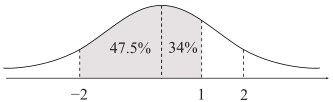
Using the 68–95–99.7% rule, the percentage of babies with a birth weight of less than 1650 g is closest to
- 0.14%
- 0.15%
- 0.17%
- 0.3%
- 2.5%
Part 3
A sample of 600 babies was drawn at random from this population.
Using the 68–95–99.7% rule, the number of these babies with a birth weight between 2200 g and 3850 g is closest to
- 111
- 113
- 185
- 408
- 489
Probability, MET2 2019 NHT 19 MC
A random sample of computer users was surveyed about whether the users had played a particular computer game. An approximate 95% confidence interval for the proportion of computer users who had played this game was calculated from this random sample to be (0.6668, 0.8147).
The number of computer users in the sample is closest to
- 5
- 33
- 135
- 150
- 180
Calculus, MET2-NHT 2019 VCAA 18 MC
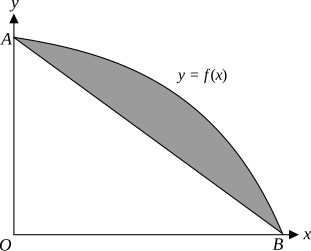
Part of the graph of the function `f`, where `f(x) = 8 - 2^(x-1)`, is shown below. It intersects the axes at the points `A` and `B`. The line segment joining `A` and `B` is also shown on the graph.
The area of the shaded region is
- `16 - (15)/(log_e (2))`
- `17 - (15)/(2log_e (2))`
- `(7)/(log_e (2)) - (159)/(16)`
- `16 - (15)/(2log_e (2))`
- `(17)/(2log_e (2)) - 15`
Functions, MET2-NHT 2019 VCAA 17 MC
The graph of the function `g` is obtained from the graph of the function `f` with rule `f(x) = cos(x) - (3)/(8)` by a dilation of factor `(4)/(pi)` from the `y`-axis, a dilation of factor `(4)/(3)` from the `x`-axis, a reflection in the `y`-axis and a translation of `(3)/(2)` units in the positive `y` direction, in that order.
The range and period of `g` are respectively
- `[–(1)/(3) , (7)/(3)] \ text(and) \ 2`
- `[–(1)/(3) , (7)/(3)] \ text(and) \ 8`
- `[–(7)/(3) , (1)/(3)] \ text(and) \ 2`
- `[–(7)/(3) , (1)/(3)] \ text(and) \ 8`
- `[–(4)/(3) , (4)/(3)] \ text(and) \ (pi^2)/(2)`
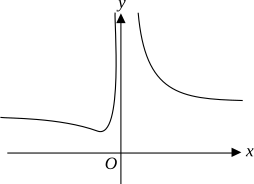
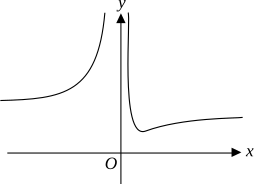
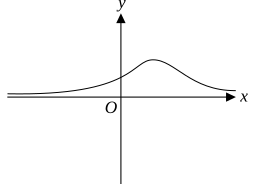
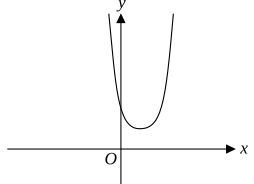
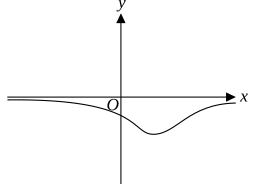
Graphs, MET2-NHT 2019 VCAA 16 MC
Calculus, MET2-NHT 2019 VCAA 15 MC
Graphs, MET2-NHT 2019 VCAA 12 MC
The transformation `T : R^2 → R^2`, which maps the graph of `y = -sqrt(2x + 1)-3` onto the graph of `y = sqrtx`, has rule
- `T ([(x),(y)]) = [((1)/(2) \ \ \ \ \ 0),(\ \ 0\ \ \ \–1)] [(x),(y)] + [(–1),(–3)]`
- `T ([(x),(y)]) = [((1)/(2) \ \ \ \ \ 0),(\ \ 0\ \ \ \–1)] [(x),(y)] + [(–1),(3)]`
- `T ([(x),(y)]) = [((1)/(2) \ \ \ \ \ 0),(\ \ 0 \ \ \ \ –1)] [(x),(y)] + [(1),(–3)]`
- `T ([(x),(y)]) = [(2 \ \ \ \ \ 0),(\ \ 0 \ \ \ –1)] [(x),(y)] + [(1),(–3)]`
- `T ([(x),(y)]) = [(2 \ \ \ \ \ 0),(\ \ 0 \ \ \ –1)] [(x),(y)] + [(–1),(3)]`
Algebra, MET2-NHT 2019 VCAA 11 MC
The function `f : D → R, \ f(x) = 5x^3 + 10x^2 + 1` will have an inverse function for
- `D = R`
- `D = (–2, ∞)`
- `D = (–∞ , (1)/(2)]`
- `D = (–∞ , –1]`
- `D = [0 , ∞)`
Algebra, MET2-NHT 2019 VCAA 7 MC
If `m = int_1^3 (2)/(x)\ dx`, then the value of `e^m` is
- `log_e (9)`
- `–9`
- `(1)/(9)`
- `9`
- `–(1)/(9)`
Combinatorics, EXT1 A1 2019 MET1 8
A fair standard die is rolled 50 times. Let `W` be a random variable with binomial distribution that represents the number of times the face with a six on it appears uppermost.
- Write down the expression for `P(W = k)`, where `k in {0, 1, 2, …, 50}`. (1 mark)
--- 1 WORK AREA LINES (style=lined) ---
- Show that `(P(W = k + 1))/(P(W = k)) = (50 - k)/(5(k + 1))`. (2 marks)
--- 4 WORK AREA LINES (style=lined) ---
Statistics, EXT1 S1 2019 MET1 6
Jacinta tosses a coin five times.
- Assuming that the coin is fair and given that Jacinta observes a head on the first two tosses, find the probability that she observes a total of either four or five heads. (2 marks)
--- 3 WORK AREA LINES (style=lined) ---
- Albin suspects that a coin is not actually a fair coin and he tosses it 18 times.
Albin observes a total of 12 heads from the 18 tosses.
- Let `X` = probability of obtaining a head.
- Find the range of `X` in which 95% of observations are expected to lie within. (2 marks)
--- 5 WORK AREA LINES (style=lined) ---
Calculus, 2ADV C3 2019 MET1 4
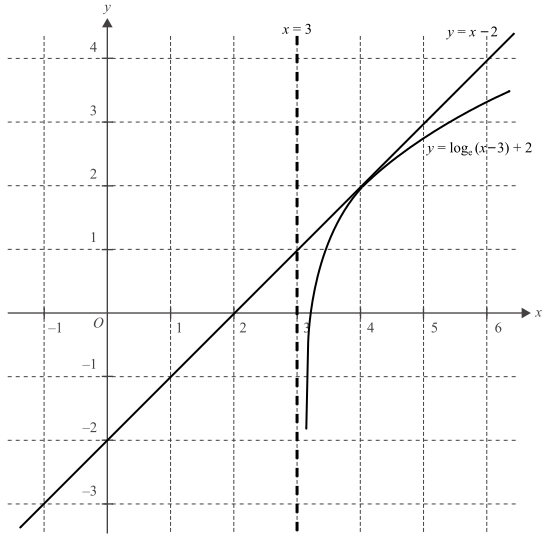
Given the function `f(x) = log_e (x-3) + 2`,
- State the domain and range of `f(x)`. (1 mark)
--- 1 WORK AREA LINES (style=lined) ---
- i. Find the equation of the tangent to the graph of `f(x)` at `(4, 2)`. (2 marks)
--- 4 WORK AREA LINES (style=lined) ---
ii. On the axes below, sketch the graph of the function `f(x)`, labelling any asymptote with its equation.
Also draw the tangent to the graph of `f(x)` at `(4, 2)`. (4 marks)
--- 0 WORK AREA LINES (style=lined) ---
Probability, MET1-NHT 2019 VCAA 8
A fair standard die is rolled 50 times. Let `W` be a random variable with binomial distribution that represents the number of times the face with a six on it appears uppermost. --- 1 WORK AREA LINES (style=lined) --- --- 4 WORK AREA LINES (style=lined) --- --- 5 WORK AREA LINES (style=lined) ---
Calculus, MET1-NHT 2019 VCAA 7
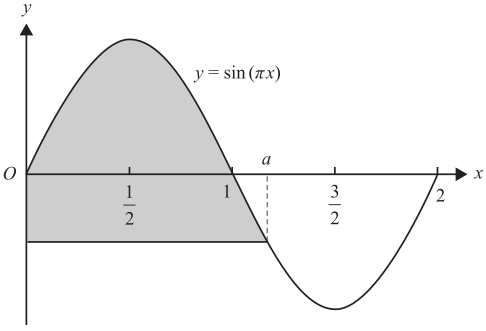
The shaded region in the diagram below is bounded by the vertical axis, the graph of the function with rule `f(x) = sin(pix)` and the horizontal line segment that meets the graph at `x = a`, where `1 <= a <= 3/2`.
Let `A(a)` be the area of the shaded region.
- Show that `A(a) = 1/pi-1/pi cos(a pi)-a sin (a pi)`. (3 marks)
--- 6 WORK AREA LINES (style=lined) ---
- Determine the range of values of `A(a)`. (2 marks)
--- 4 WORK AREA LINES (style=lined) ---
-
- Express in terms of `A(a)`, for a specific value of `a`, the area bounded by the vertical axis, the graph of `y = 2(sin(pi x) + sqrt 3/2)` and the horizontal axis. (2 marks)
--- 5 WORK AREA LINES (style=lined) ---
- Hence, or otherwise, find the area described in part c.i. (1 mark)
--- 3 WORK AREA LINES (style=lined) ---
- Express in terms of `A(a)`, for a specific value of `a`, the area bounded by the vertical axis, the graph of `y = 2(sin(pi x) + sqrt 3/2)` and the horizontal axis. (2 marks)
Statistics, MET1-NHT 2019 VCAA 6b
Albin suspects that a coin is not actually a fair coin and he tosses it 18 times.
Albin observes a total of 12 heads from the 18 tosses.
Based on this sample, find the approximate 90% confidence interval for the probability of observing a head when this coin is tossed. Use the `z` value `33/20`. (2 marks)
Statistics, EXT1 S1 EQ-Bank 23
A light manufacturer knows that 6% of the light bulbs it produces are defective.
Light bulbs are supplied in boxes of 20 bulbs. Boxes are supplied in pallets of 120 boxes.
Calculate the probability that
- A box of light bulbs contains exactly 3 defective bulbs. (1 mark)
--- 2 WORK AREA LINES (style=lined) ---
- A box of light bulbs contains at least 1 defective bulb. (1 mark)
--- 2 WORK AREA LINES (style=lined) ---
- A pallet contains between 90 and 95 (inclusive) boxes with at least 1 defective bulb (use the probability table attached). (3 marks)
--- 8 WORK AREA LINES (style=lined) ---
Statistics, EXT1 S1 EQ-Bank 21
A biased coin has a 0.6 chance of landing on heads. The coin is tossed 15 times.
- Calculate the probability of obtaining 7, 8 or 9 heads using binomial probability distribution.
- Give your answer correct to 3 decimal places. (2 marks)
--- 2 WORK AREA LINES (style=lined) ---
- Calculate the probability of obtaining 7, 8 or 9 heads using normal approximation to the binomial distribution and the probability table attached.
- Give your answer correct to 3 decimal places. (2 marks)
--- 6 WORK AREA LINES (style=lined) ---
- Could this binomial distribution be reasonably approximated with a normal distribution? Support your answer with a brief calculation. (1 mark)
--- 2 WORK AREA LINES (style=lined) ---
Statistics, SPEC2-NHT 2019 VCAA 6
A paint company claims that the mean time taken for its paint to dry when motor vehicles are repaired is 3.55 hours, with a standard deviation of 0.66 hours.
Assume that the drying time for the paint follows a normal distribution and that the claimed standard deviation value is accurate.
- Let the random variable `barX` represent the mean time taken for the paint to dry for a random sample of 36 motor vehicles.
Write down the mean and standard deviation of `barX`. (2 marks)
--- 4 WORK AREA LINES (style=lined) ---
At a car crash repair centre, it was found that the mean time taken for the paint company's paint to dry on randomly selected vehicles was 3.85 hours. The management of this crash repair centre was not happy and believed that the claim regarding the mean time taken for the paint to dry was too low. To test the paint company's claim, a statistical test was carried out.
- Write down suitable null and alternative hypotheses `H_0` and `H_1` respectively to test whether the mean time taken for the paint to dry is longer than claimed. (1 mark)
--- 1 WORK AREA LINES (style=lined) ---
- Write down an expression for the `p` value of the statistical test and evaluate it correct to three decimal places. (2 marks)
--- 4 WORK AREA LINES (style=lined) ---
- Using a 1% level of significance, state with a reason whether the crash repair centre is justified in believing that the paint company's claim of mean time taken for its paint to dry of 3.55 hours is too low. (1 mark)
--- 2 WORK AREA LINES (style=lined) ---
- At the 1% level of significance, find the set of sample mean values that would support the conclusion that the mean time taken for the paint to dry exceeded 3.55 hours. Give your answer in hours, correct to three decimal places. (2 marks)
--- 4 WORK AREA LINES (style=lined) ---
- If the true time taken for the paint to dry is 3.83 hours, find the probability that the paint company's claim is not rejected at the 1% level of significance, assuming the standard deviation for the paint to dry is still 0.66 hours. Give your answer correct to two decimal places. (1 mark)
--- 3 WORK AREA LINES (style=lined) ---
Mechanics, SPEC2-NHT 2019 VCAA 5
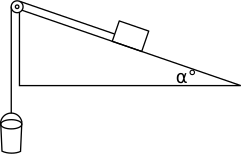
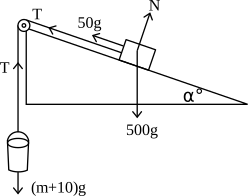
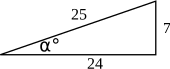
A pallet of bricks weighing 500 kg sits on a rough plane inclined at an angle of `α°` to the horizontal, where `tan(α°) = (7)/(24)`. The pallet is connected by a light inextensible cable that passes over a smooth pulley to a hanging container of mass `m` kilograms in which there is 10 L of water. The pallet of bricks is held in equilibrium by the tension `T` newtons in the cable and a frictional resistance force of 50 `g` newtons acting up and parallel to the plane. Take the weight force exerted by 1 L of water to be `g` newtons.
- Label all forces acting on both the pallet of bricks and the hanging container on the diagram above, when the pallet of bricks is in equilibrium as described. (1 mark)
- Show that the value of `m` is 80. (3 marks)
Suddenly the water is completely emptied from the container and the pallet of bricks begins to slide down the plane. The frictional resistance force of 50 `g` newtons acting up the plane continues to act on the pallet.
- Find the distance, in metres, travelled by the pallet after 10 seconds. (3 marks)
- When the pallet reaches a velocity of `3\ text(ms)^-1`, water is poured back into the container at a constant rate of 2 L per second, which in turn retards the motion of the pallet moving down the plane. Let `t` be the time, in seconds, after the container begins to fill.
- i. Write down, in terms of `t`, an expression for the total mass of the hanging container and the water it contains after `t` seconds. Give your answer in kilograms. (1 mark)
- ii. Show that the acceleration of the pallet down the plane is given by `(text(g)(5 - t))/(t + 290)\ text(ms)^-2` for `t ∈[0, 5)`. (2 marks)
- iii. Find the velocity of the pallet when `t = 4`. Give your answer in metres per second, correct to one decimal place. (2 marks)
Calculus, SPEC2-NHT 2019 VCAA 3
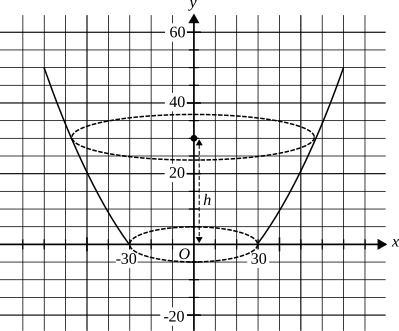
The vertical cross-section of a barrel is shown above. The radius of the circular base (along the `x`-axis) is 30 cm and the radius of the circular top is 70 cm. The curved sides of the cross-section shown are parts of the parabola with rule `y = (x^2)/(80) - (45)/(4)`. The height of the barrel is 50 cm.
a. i. Show that the volume of the barrel is given by `pi int_0^50 (900 + 80 y)\ dy`. (1 marks)
ii. Find the volume of the barrel in cubic centimetres. (1 marks)
The barrel is initially full of water. Water begins to leak from the bottom of the barrel such that `(dV)/(dt) = (-8000pi sqrth)/(A)` cubic centimetres per second, where after `t` seconds the depth of the water is `h` centimetres, the volume of water remaining in the barrel is `V` cubic centimetres and the uppermost surface area of the water is `A` square centimetres.
b. Show that `(dV)/(dt) = (-400 sqrth)/(4h + 45)`? (2 marks)
c. Find `(dh)/(dt)` in terms of `h`. Express your answer in the form `(-a sqrth)/(pi(b + ch)^2)`, where `a, b` and `c` are positive integers. (3 marks)
d. Using a definite integral in terms of `h`, find the time, in hours, correct to one decimal place, taken for the barrel to empty. (2 marks)
Calculus, SPEC2-NHT 2019 VCAA 2
Consider the function `f` with rule `f(x) = (x^2 + x + 1)/(x^2-1)`. --- 2 WORK AREA LINES (style=lined) --- --- 5 WORK AREA LINES (style=lined) --- --- 0 WORK AREA LINES (style=lined) ---
Consider the function `f_k` with rule `f_k(x) = (x^2 + x + k)/(x^2-1)` where `k ∈ R`. --- 5 WORK AREA LINES (style=lined) --- --- 3 WORK AREA LINES (style=lined) ---
Vectors, EXT1 V1 SM-Bank 30
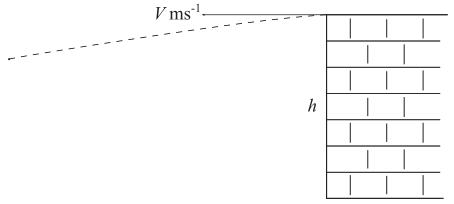
A canon ball is fired from a castle wall across a horizontal plane at `V` ms−1.
Its position vector `t` seconds after it is fired from its origin is given by `underset~s(t) = V tunderset~i - 1/2g t^2 underset~j`.
- If the projectile hits the ground at a distance 8 times the height at which it was fired, show that it initial velocity is given by
`V = 4sqrt(2hg)` (2 marks)
--- 5 WORK AREA LINES (style=lined) ---
- Show that the total distance the canon ball travels can be expressed as
`int_0^sqrt((2h)/g) sqrt(g(32h + g t^2))\ dt` (2 marks)
--- 5 WORK AREA LINES (style=lined) ---
Vectors, EXT1 V1 2019 SPEC2-N 4
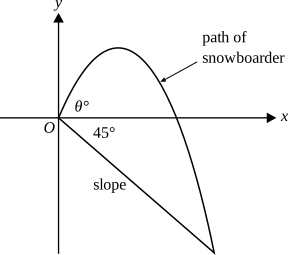
A snowboarder at the Winter Olympics leaves a ski jump at an angle of `theta` degrees to the horizontal, rises up in the air, performs various tricks and then lands at a distance down a straight slope that makes an angle of 45° to the horizontal, as shown below.
Let the origin `O` of a cartesian coordinate system be at the point where the snowboarder leaves the jump, with a unit vector in the positive `x` direction being represented by `underset~i` and a unit vector in the positive `y` direction being represented by `underset~j`. Distances are measured in metres and time is measured in seconds.
The position vector of the snowboarder `t` seconds after leaving the jump is given by
`underset~r (t) = (6t-0.01t^3) underset~i + (6 sqrt3 t-4.9t^2 + 0.01t^3) underset~j , \ t ≥ 0`
- Find the angle `theta °`. (2 marks)
--- 5 WORK AREA LINES (style=lined) ---
- Find the speed, in metres per second, of the snowboarder when she leaves the jump at `O`. (1 mark)
--- 2 WORK AREA LINES (style=lined) ---
- Find the maximum height above `O` reached by the snow boarder. Give your answer in metres, correct to one decimal place. (2 marks)
--- 4 WORK AREA LINES (style=lined) ---
- Show that the time spent in the air by the snowboarder is `(60(sqrt3 + 1))/(49)` seconds. (3 marks)
--- 6 WORK AREA LINES (style=lined) ---
Vectors, SPEC2-NHT 2019 VCAA 4
A snowboarder at the Winter Olympics leaves a ski jump at an angle of `theta` degrees to the horizontal, rises up in the air, performs various tricks and then lands at a distance down a straight slope that makes an angle of 45° to the horizontal, as shown below.
Let the origin `O` of a cartesian coordinate system be at the point where the snowboarder leaves the jump, with a unit vector in the positive `x` direction being represented by `underset~i` and a unit vector in the positive `y` direction being represented by `underset~j`. Distances are measured in metres and time is measured in seconds.
The position vector of the snowboarder `t` seconds after leaving the jump is given by
`underset~r (t) = (6t-0.01t^3) underset~i + (6 sqrt3 t-4.9t^2 + 0.01t^3) underset~j , \ t ≥ 0`
- Find the angle `theta °`. (2 marks)
--- 4 WORK AREA LINES (style=lined) ---
- Find the speed, in metres per second, of the snowboarder when she leaves the jump at `O`. (1 mark)
--- 4 WORK AREA LINES (style=lined) ---
- Show that the time spent in the air by the snowboarder is `(60(sqrt3 + 1))/(49)` seconds. (3 marks)
--- 5 WORK AREA LINES (style=lined) ---
- Find the total distance the snowboarder travels while airborne. Give your answer in metres, correct to two decimal places. (2 marks)
--- 4 WORK AREA LINES (style=lined) ---
Complex Numbers, SPEC2-NHT 2019 VCAA 1
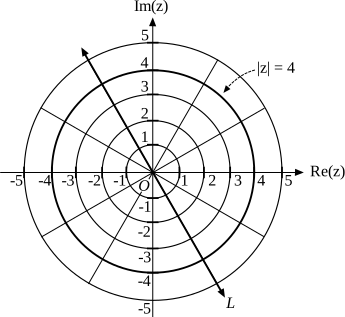
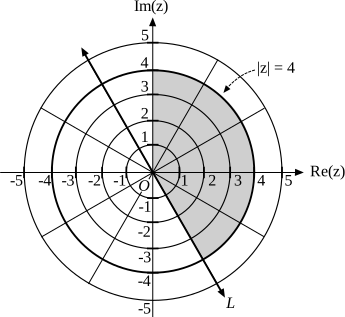
In the complex plane, `L` is the with equation `|z + 2| = |z-1-sqrt3 i|`.
- Verify that the point (0, 0) lies on `L`. (1 marks)
--- 4 WORK AREA LINES (style=lined) ---
- The line `L` can also be expressed in the form `|z-1| = |z-z_1|`, where `z_1 ∈ C`.
Find `z_1` in cartesian form. (2 marks)
--- 5 WORK AREA LINES (style=lined) ---
- Find, in cartesian form, the points(s) of intersection of `L` and the graph of `|z| = 4`. (2 marks)
--- 5 WORK AREA LINES (style=lined) ---
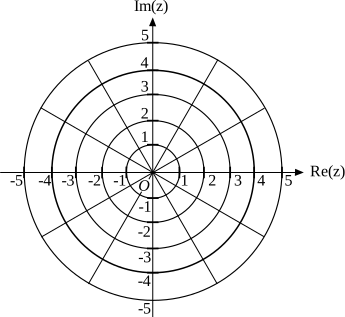
- Sketch `L` and the graph of `|z| = 4` on the Argand diagram below. (2 marks)
--- 0 WORK AREA LINES (style=lined) ---
- Find the area of the sector defined by the part of `L` where `text(Re)(z) ≥ 0`, the graph of `|z| = 4` where `text(Re)(z) ≥ 0`, and imaginary axis where `text(Im)(z) > 0`. (1 marks)
--- 3 WORK AREA LINES (style=lined) ---
Calculus, 2ADV C4 SM-Bank 1 MC
A lift accelerates from rest at a constant rate until it reaches a speed of 3 ms−1. It continues at this speed for 10 seconds and then decelerates at a constant rate before coming to rest. The total travel time for the lift is 30 seconds.
The total distance, in metres, travelled by the lift is
- 45
- 60
- 75
- 90
Mechanics, SPEC2-NHT 2019 VCAA 15 MC
A lift accelerates from rest at a constant rate until it reaches a speed of 3 ms−1. It continues at this speed for 10 seconds and then decelerates at a constant rate before coming to rest. The total travel time for the lift is 30 seconds.
The total distance, in metres, travelled by the lift is
- 30
- 45
- 60
- 75
- 90
Statistics, SPEC2 2019 NHT 19 MC
Bags of peanuts are packed by a machine. The masses of the bags are normally distributed with a standard deviation of three grams.
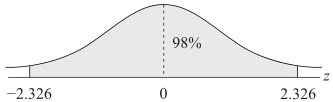
The minimum size of a sample required to ensure that the manufacturer can be 98% confident that the sample mean is within one gram of the population mean is
- 37
- 38
- 48
- 49
- 60
Statistics, SPEC2-NHT 2019 VCAA 20 MC
Nitrogen oxide emissions for a certain type of car are known to be normally distributed with a mean of 0.875 g/km and a standard deviation of 0.188 g/km.
For two randomly selected cars, the probability that their nitrogen oxide emissions differ by more than 0.5 g/km is closest to
- 0.030
- 0.060
- 0.960
- 0.970
- 0.977
Mechanics, SPEC2-NHT 2019 VCAA 17 MC
A ball is thrown vertically upwards with an initial velocity of `7sqrt6` ms−1, and is subject to gravity and air resistance. The acceleration of the ball is given by `overset(¨)x = −(9.8 + 0.1v^2)`, where `v` ms−1 is its velocity when it is at a height of `x` metres above ground level.
The maximum height, in metres, reached by the ball is
- `5log_e(4)`
- `log_e(sqrt31)`
- `(5pisqrt2)/21`
- `5log_e(2)`
- `(7pisqrt2)/3`
Mechanics, SPEC2-NHT 2019 VCAA 16 MC
An object of mass 2 kg is travelling horizontally in a straight line at a constant velocity of magnitude 2 ms−1. The object is hit in such a way that it deflects 30° from its original path, continuing at the same speed in a straight line.
The magnitude, correct to two decimal places, of the change of momentum, in kg ms−1, of the object is
- 0.00
- 0.24
- 1.04
- 1.46
- 2.07
Complex Numbers, SPEC2-NHT 2019 VCAA 5 MC
The circle defined by `|z + a| = 3 |z + i|`, where `a ∈ R`, has a centre and radius respectively given by
- `(a/8, −9/8), \ 3/8sqrt(a^2 + 1)`
- `(a/8, −9/8), \ (9a^2 + 9)/64`
- `(a/8, −9/8), \ 1/8sqrt(153 - 7a^2)`
- `(−a/8, 9/8), \ (9a^2 + 9)/64`
- `(−a/8, 9/8), \ 3/8sqrt(a^2 + 1)`
Calculus, EXT1 C3 2019 SPEC1-N 9
Calculus, SPEC1-NHT 2019 VCAA 9
Vectors, EXT2 V1 2019 SPEC2 4
The base of a pyramid is the parallelogram `ABCD` with vertices at points `A(2,−1,3), B(4,−2,1), C(a,b,c)` and `D(4,3,−1)`. The apex (top) of the pyramid is located at `P(4,−4,9)`.
- Find the values of `a, b` and `c`. (2 marks)
--- 4 WORK AREA LINES (style=lined) ---
- Find the cosine of the angle between the vectors `overset(->)(AB)` and `overset(->)(AD)`. (2 marks)
--- 4 WORK AREA LINES (style=lined) ---
- Find the area of the base of the pyramid. (2 marks)
--- 4 WORK AREA LINES (style=lined) ---
Statistics, SPEC1-NHT 2019 VCAA 3
The number of cars per day making a U-turn at a particular location is known to be normally distributed with a standard deviation of 17.5. In a sample of 25 randomly selected days, a total of 1450 cars were observed making the U-turn.
- Based on this sample, calculate an approximate 95% confidence interval for the number of cars making the U-turn each day. Use an integer multiple of the standard deviation in your calculations. (3 marks)
--- 5 WORK AREA LINES (style=lined) ---
- The average number of U-turns made at the location is actually 60 per day.
Find an approximation, correct to two decimal places, for the probability that on 25 randomly selected days the average number of U-turns is less than 53. (1 mark)
--- 3 WORK AREA LINES (style=lined) ---
Trigonometry, 2ADV* T1 2011 HSC 24c
A ship sails 6 km from `A` to `B` on a bearing of 121°. It then sails 9 km to `C`. The
size of angle `ABC` is 114°.
Copy the diagram into your writing booklet and show all the information on it.
- What is the bearing of `C` from `B`? (1 mark)
--- 2 WORK AREA LINES (style=lined) ---
- Find the distance `AC`. Give your answer correct to the nearest kilometre. (2 marks)
--- 5 WORK AREA LINES (style=lined) ---
- What is the bearing of `A` from `C`? Give your answer correct to the nearest degree. (3 marks)
--- 6 WORK AREA LINES (style=lined) ---
Trigonometry, 2ADV* T1 2017 HSC 30c
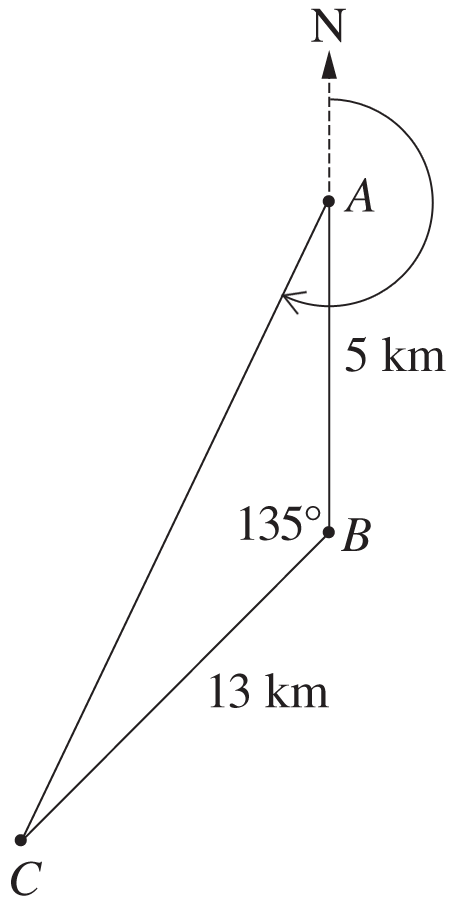
The diagram shows the location of three schools. School `A` is 5 km due north of school `B`, school `C` is 13 km from school `B` and `angleABC` is 135°.
- Calculate the shortest distance from school `A` to school `C`, to the nearest kilometre. (2 marks)
--- 4 WORK AREA LINES (style=lined) ---
- Determine the bearing of school `C` from school `A`, to the nearest degree. (3 marks)
--- 6 WORK AREA LINES (style=lined) ---
Trigonometry, 2ADV* T1 2007 26a
The diagram shows information about the locations of towns `A`, `B` and `Q`.
- It takes Elina 2 hours and 48 minutes to walk directly from Town `A` to Town `Q`.
Calculate her walking speed correct to the nearest km/h. (1 mark)
--- 2 WORK AREA LINES (style=lined) ---
- Elina decides, instead, to walk to Town `B` from Town `A` and then to Town `Q`.
Find the distance from Town `A` to Town `B`. Give your answer to the nearest km. (2 marks)
--- 4 WORK AREA LINES (style=lined) ---
- Calculate the bearing of Town `Q` from Town `B`. (1 mark)
--- 2 WORK AREA LINES (style=lined) ---
Vectors, SPEC2 2009 VCAA 17 MC
Vectors `underset ~a, underset ~b` and `underset ~c` are shown below.
From the diagram it follows that
A. `|\ underset ~c\ |^2 = |\ underset ~a\ |^2 + |\ underset ~b\ |^2`
B. `|\ underset ~c\ |^2 = |\ underset ~a\ |^2 + |\ underset ~b\ |^2 - |\ underset ~a\ | |\ underset ~b\ |`
C. `|\ underset ~c\ |^2 = |\ underset ~a\ |^2 + |\ underset ~b\ |^2 + |\ underset ~a * underset ~b\ |`
D. `|\ underset ~c\ |^2 = |\ underset ~a\ |^2 + |\ underset ~b\ |^2 + |\ underset ~a\ | |\ underset ~b\ |`
E. `|\ underset ~c\ |^2 = |\ underset ~a\ |^2 + |\ underset ~b\ |^2 - |\ underset ~a * underset ~b\ |`
Vectors, EXT1 V1 SPEC2 2009 17 MC
Vectors `underset ~a, underset ~b` and `underset ~c` are shown below.

From the diagram it follows that
- `|\ underset ~c\ |^2 = |\ underset ~a\ |^2 + |\ underset ~b\ |^2`
- `|\ underset ~c\ |^2 = |\ underset ~a\ |^2 + |\ underset ~b\ |^2-|\ underset ~a\ | |\ underset ~b\ |`
- `|\ underset ~c\ |^2 = |\ underset ~a\ |^2 + |\ underset ~b\ |^2 + |\ underset ~a * underset ~b\ |`
- `|\ underset ~c\ |^2 = |\ underset ~a\ |^2 + |\ underset ~b\ |^2 + |\ underset ~a\ | |\ underset ~b\ |`
Statistics, STD2 S1 EQ-Bank 4
A high school conducted a survey asking students what their favourite Summer sport was.
The Pareto chart shows the data collected.
- What percentage of students chose Hockey as their favourite Summer sport? (1 mark)
--- 2 WORK AREA LINES (style=lined) ---
- What percentage of students chose Touch Football as their favourite Summer sport? (1 mark)
--- 2 WORK AREA LINES (style=lined) ---
Statistics, STD2 S1 EQ-Bank 6
GRAPHS, FUR2 2019 VCAA 3
Members of the association will travel to a conference in cars and minibuses:
- Let `x` be the number of cars used for travel.
- Let `y` be the number of minibuses used for travel.
- A maximum of eight cars and minibuses in total can be used.
- At least three cars must be used.
- At least two minibuses must be used.
The constraints above can be represented by the following three inequalities.
`text(Inequality 1) qquad qquad x + y <= 8`
`text(Inequality 2) qquad qquad x >= 3`
`text(Inequality 3) qquad qquad y >= 2`
- Each car can carry a total of five people and each minibus can carry a total of 10 people.
A maximum of 60 people can attend the conference.
Use this information to write Inequality 4. (1 mark)
The graph below shows the four lines representing Inequalities 1 to 4.
Also shown on this graph are four of the integer points that satisfy Inequalities 1 to 4. Each of these integer points is marked with a cross (✖).
- On the graph above, mark clearly, with a circle (o), the remaining integer points that satisfy Inequalities 1 to 4. (1 mark)
Each car will cost $70 to hire and each minibus will cost $100 to hire.
- What is the cost for 60 members to travel to the conference? (1 mark)
- What is the minimum cost for 55 members to travel to the conference? (1 mark)
- Just before the cars were booked, the cost of hiring each car increased.
The cost of hiring each minibus remained $100.
All original constraints apply.
If the increase in the cost of hiring each car is more than `k` dollars, then the maximum cost of transporting members to this conference can only occur when using six cars and two minibuses.
Determine the value of `k`. (1 mark)
GRAPHS, FUR2 2019 VCAA 2
Each branch within the association pays an annual fee based on the number of members it has.
To encourage each branch to find new members, two new annual fee systems have been proposed.
Proposal 1 is shown in the graph below, where the proposed annual fee per member, in dollars, is displayed for branches with up to 25 members.
- What is the smallest number of members that a branch may have? (1 mark)
- The incomplete inequality below shows the number of members required for an annual fee per member of $10.
Complete the inequality by writing the appropriate symbol and number in the box provided. (1 mark)
| 3 ≤ number of members |
|
Proposal 2 is modelled by the following equation.
annual fee per member = – 0.25 × number of members + 12.25
- Sketch this equation on the graph for Proposal 1, shown below. (1 mark)
- Proposal 1 and Proposal 2 have the same annual fee per member for some values of the number of members.
Write down all values of the number of members for which this is the case. (1 mark)
GEOMETRY, FUR2 2019 VCAA 2
A cargo ship travels from Magadan (60° N, 151° E) to Sydney (34° S, 151° E).
- Explain, with reference to the information provided, how we know that Sydney is closer to the equator than Magadan. (1 mark)
- Assume that the radius of Earth is 6400 km.
Find the shortest great circle distance between Magadan and Sydney.
Round your answer to the nearest kilometre. (1 mark)
- The cargo ship left Sydney (34° S, 151° E) at 6 am on 1 June and arrived in Perth (32° S, 116° E) at 10 am on 11 June.
There is a two-hour time difference between Sydney and Perth at that time of year.
How many hours did it take the cargo ship to travel from Sydney to Perth? (1 mark)
Statistics, STD2 S1 EQ-Bank 5
- « Previous Page
- 1
- …
- 49
- 50
- 51
- 52
- 53
- …
- 81
- Next Page »