SmarterEd

Aussie Maths & Science Teachers: Save your time with SmarterEd

  • Login
  • Get Help
  • About

HMS, HAG EQ-Bank 038 MC

Which of the following best describes the primary purpose of the Australian government's Assessment Framework for mHealth apps?

  1. To regulate the pricing of health apps in Australia
  2. To enhance app credibility and help users identify reliable apps
  3. To prevent international health apps from entering the Australian market
  4. To ensure all health apps are free for Australian citizens

Show Answers Only

\(B\)

Show Worked Solution
  • B is correct. The framework aims to improve the trustworthiness of apps and assist users in recognising dependable applications.

Other options:

  • A is incorrect: The framework focuses on quality and reliability, not pricing regulation.
  • C is incorrect: The framework doesn’t restrict international apps but guides all developers.
  • D is incorrect: The framework doesn’t mandate free access to apps.

Filed Under: New technologies and treatments Tagged With: Band 5, smc-5485-10-Health Apps

HMS, HAG EQ-Bank 78 MC

Some private organisations such as the Heart Foundation and Cancer Council Australia receive funding from:

  1. Only private donations and corporate sponsorship
  2. Both state governments and the Australian government
  3. International health organisations exclusively
  4. Local government councils and community fundraising
Show Answers Only

\(B\)

Show Worked Solution
  • B is correct: Some private organisations receive funding from both state and Australian governments.

Other Options:

  • A is incorrect: These organisations receive government funding not only private sources.
  • C is incorrect: They receive domestic government funding not exclusively international funding.
  • D is incorrect: Funding comes from state and federal levels not primarily local councils.

Filed Under: Govt and Non-Govt responsibilities Tagged With: Band 5, smc-5480-15-Non-govt roles

HMS, HAG EQ-Bank 75 MC

Which statement accurately describes the governance relationship between different government levels in Australia's health system?

  1. Each level operates independently with no overlap in responsibilities
  2. The Australian government controls policy while states implement identical programs nationwide
  3. The Australian government influences state policy through funding arrangements and national guidelines
  4. State governments must seek federal approval before implementing any health initiatives
Show Answers Only

\(C\)

Show Worked Solution
  • C is correct: Federal government influences state health policy through funding and gives funds to states.

Other Options:

  • A is incorrect: Significant overlap exists between government levels in health responsibilities.
  • B is incorrect: States have autonomy in program implementation not identical programs.
  • D is incorrect: States don’t need federal approval for all health initiatives.

Filed Under: Govt and Non-Govt responsibilities Tagged With: Band 5, smc-5480-10-Governance structures

HMS, HAG EQ-Bank 68 MC

Yoga and tai chi represent mind-body practices that can function as preventative healthcare measures. Which mechanism explains how these practices contribute to chronic disease prevention?

  1. They primarily target acute symptoms rather than addressing underlying health determinants
  2. They focus mainly on flexibility and balance without significant cardiovascular benefits
  3. They provide short-term relaxation but have limited impact on long-term health outcomes
  4. They reduce stress levels and improve physical fitness, lowering disease risk factors
Show Answers Only

\(D\)

Show Worked Solution
  • D is correct: Stress reduction and fitness improvement address risk factors preventing chronic disease development.

Other Options:

  • A is incorrect: Mind-body practices address underlying stress and fitness factors, not just acute symptoms.
  • B is incorrect: Yoga and tai chi provide cardiovascular benefits alongside flexibility and balance.
  • C is incorrect: Regular practice creates sustained physiological and psychological benefits for health.

Filed Under: Complementary Healthcare Tagged With: Band 5, smc-5489-20-Preventative applications

HMS, HAG EQ-Bank 63 MC

The World Health Organisation supports countries in developing national policies on complementary medicine to study their potential usefulness. What does this international recognition indicate about integrative healthcare approaches?

  1. All complementary medicines have been scientifically proven effective for treating diseases
  2. Complementary approaches require systematic evaluation within established healthcare frameworks
  3. Traditional medicine should completely replace conventional medical treatments globally
  4. Alternative healing methods need no regulation or professional standards
Show Answers Only

\(B\)

Show Worked Solution
  • B is correct: WHO support indicates need for systematic evaluation within established healthcare frameworks.

Other Options:

  • A is incorrect: WHO support for study indicates ongoing evaluation needed, not proven effectiveness.
  • C is incorrect: Integration involves combining approaches, not replacing conventional medicine entirely.
  • D is incorrect: WHO policy development suggests regulation and standards are important.

Filed Under: Complementary Healthcare Tagged With: Band 5, smc-5489-05-Integrative health

HMS, HAG EQ-Bank 60 MC

Australia's healthcare system shows strong performance in life expectancy and cancer survival rates but faces challenges with mental health service wait times and rural access. This mixed evaluation suggests which conclusion about system effectiveness?

  1. The healthcare system is completely failing and requires total restructuring
  2. Strong clinical outcomes indicate overall success despite access and equity challenges requiring targeted improvements
  3. Wait times are the only important measure of healthcare system effectiveness
  4. Rural access issues mean the entire system should be centralised in major cities
Show Answers Only

\(B\)

Show Worked Solution
  • B is correct: Mixed performance indicates overall effectiveness with specific areas needing targeted improvements.

Other Options:

  • A is incorrect: Strong outcomes in key areas indicate system strengths alongside improvement needs.
  • C is incorrect: Wait times important but clinical outcomes and other factors also crucial.
  • D is incorrect: Centralisation would worsen rather than address rural access challenges.

Filed Under: Healthcare System effectiveness Tagged With: Band 5, smc-5479-20-System evaluation

HMS, HAG EQ-Bank 027

Wearable devices and portable technologies are changing the way health is measured.

Analyse how these innovations have shifted health assessment beyond hospitals and clinics, and discuss the consequences of this shift for both healthcare professionals and individuals managing their own health.   (8 marks)

--- 22 WORK AREA LINES (style=lined) ---

Show Answers Only

Overview

  • Wearable devices and portable technologies have changed how health is measured. These tools now connect personal data with professional care.
  • This change presents new opportunities and challenges for individuals and healthcare workers.

Consequences for health professionals

  • Smartwatches and portable ultrasounds are two examples where consumer wearable devices interact with clinical practice.
  • A smartwatch measuring heart rate can connect to digital health records, allowing continuous updates.
  • Similarly, portable ultrasounds enable rural doctors to diagnose without hospital imaging.
  • This interaction leads to earlier identification of problems and faster responses.
  • The implication is that healthcare becomes more proactive, but professionals must adapt to the increased flow of patient data that has become available.

Consequences for individuals

  • Continuous monitoring by individuals influences their health behaviours.
  • Devices that track sleep, steps, or diet affect motivation and self-management. For example, reminders to move or log food intake result in behaviour change.
  • At the same time, constant alerts cause stress or over-reliance on numbers.
  • This relationship shows the double impact: empowerment on one hand, anxiety on the other.
  • Healthcare workers must guide patients to interpret this information accurately and react appropriately.

Implications and Synthesis

  • Together, these technologies create a system where individuals gather data and professionals interpret it.
  • This means that roles are shifting, with patients more involved in their care.
  • The significance is improved access and prevention, but also greater demand for professional support.
  • Therefore, wearable technology is critically reshaping health measurement and redefining patient–professional relationships.
Show Worked Solution

Overview

  • Wearable devices and portable technologies have changed how health is measured. These tools now connect personal data with professional care.
  • This change presents new opportunities and challenges for individuals and healthcare workers.

Consequences for health professionals

  • Smartwatches and portable ultrasounds are two examples where consumer wearable devices interact with clinical practice.
  • A smartwatch measuring heart rate can connect to digital health records, allowing continuous updates.
  • Similarly, portable ultrasounds enable rural doctors to diagnose without hospital imaging.
  • This interaction leads to earlier identification of problems and faster responses.
  • The implication is that healthcare becomes more proactive, but professionals must adapt to the increased flow of patient data that has become available.

Consequences for individuals

  • Continuous monitoring by individuals influences their health behaviours.
  • Devices that track sleep, steps, or diet affect motivation and self-management. For example, reminders to move or log food intake result in behaviour change.
  • At the same time, constant alerts cause stress or over-reliance on numbers.
  • This relationship shows the double impact: empowerment on one hand, anxiety on the other.
  • Healthcare workers must guide patients to interpret this information accurately and react appropriately.

Implications and Synthesis

  • Together, these technologies create a system where individuals gather data and professionals interpret it.
  • This means that roles are shifting, with patients more involved in their care.
  • The significance is improved access and prevention, but also greater demand for professional support.
  • Therefore, wearable technology is critically reshaping health measurement and redefining patient–professional relationships.

Filed Under: Technology and Health relationship Tagged With: Band 4, Band 5, smc-5490-10-Measuring, smc-5490-20-Monitoring, smc-5490-30-Early diagnosis

HMS, HAG EQ-Bank 026

Discuss how precision surgery technologies contribute to both patient outcomes and healthcare system efficiency. In your answer include references to at least two relevant technologies.   (6 marks)

--- 18 WORK AREA LINES (style=lined) ---

Show Answers Only
  • [P] A key advantage of precision surgery is the improvement of patient outcomes through greater accuracy.
  • [E] These technologies enhance surgical precision by reducing surgeon tremors and enabling smaller, controlled incisions.
  • [Ev] For instance, the da Vinci robotic system allows surgeons to remove cancerous tissue with minimal damage to surrounding areas.
  • [L] As a result, patients experience fewer complications, shorter recovery times, and increased confidence in surgical procedures.
     
  • [P] Another strength is the contribution of precision surgery to overall healthcare efficiency.
  • [E] Minimally invasive techniques reduce hospital stays, freeing up resources for other patients.
  • [Ev] LASIK eye surgery demonstrates this efficiency, as patients often resume daily activities within days, lowering long-term care needs.
  • [L] Therefore, precision surgery reduces demand on hospital beds and staff, helping the system operate more effectively.
     
  • [P] However, this must be weighed against the significant costs and access limitations of precision surgery.
  • [E] While these technologies create efficiencies, initial investment and maintenance costs remain substantial. Critics contend that access is limited to the wealthy.
  • [Ev] Systems such as the NuVasive Pulse also require specialised training and ongoing education, creating resource burdens.
  • [L] Nevertheless, long-term benefits such as reduced complications and shorter hospital stays indicate that these technologies still promote sustainability in healthcare delivery.
Show Worked Solution
  • [P] A key advantage of precision surgery is the improvement of patient outcomes through greater accuracy.
  • [E] These technologies enhance surgical precision by reducing surgeon tremors and enabling smaller, controlled incisions.
  • [Ev] For instance, the da Vinci robotic system allows surgeons to remove cancerous tissue with minimal damage to surrounding areas.
  • [L] As a result, patients experience fewer complications, shorter recovery times, and increased confidence in surgical procedures.
     
  • [P] Another strength is the contribution of precision surgery to overall healthcare efficiency.
  • [E] Minimally invasive techniques reduce hospital stays, freeing up resources for other patients.
  • [Ev] LASIK eye surgery demonstrates this efficiency, as patients often resume daily activities within days, lowering long-term care needs.
  • [L] Therefore, precision surgery reduces demand on hospital beds and staff, helping the system operate more effectively.
     
  • [P] However, this must be weighed against the significant costs and access limitations of precision surgery.
  • [E] While these technologies create efficiencies, initial investment and maintenance costs remain substantial. Critics contend that access is limited to the wealthy.
  • [Ev] Systems such as the NuVasive Pulse also require specialised training and ongoing education, creating resource burdens.
  • [L] Nevertheless, long-term benefits such as reduced complications and shorter hospital stays indicate that these technologies still promote sustainability in healthcare delivery.

Filed Under: Technology and Health relationship Tagged With: Band 4, Band 5, smc-5490-40-Precision surgery

HMS, HAG EQ-Bank 025

Explain how remote monitoring technology reduces the burden on Australia's healthcare system.   (5 marks)

--- 15 WORK AREA LINES (style=lined) ---

Show Answers Only

Home monitoring prevents hospital admissions 

  • Telehealth devices track vital signs at home for chronic disease patients. This works by alerting healthcare workers to changes before emergencies occur.
  • Supporting the use of this technology is a CSIRO telehealth trial that showed hospital admissions were reduced by over 50% for users.
  • This creates significant cost savings given a hospital bed overnight stay costs around $2000.

Early intervention shortens hospital stays

  • Remote monitoring enables doctors to detect problems quickly. This happens because devices can communicate real-time data about measurements such as heart rate, oxygen levels, and blood pressure.
  • Consequently, if patients do need hospitalisation, stays are much shorter.
  • This in turn frees up beds for other patients.

Technology reduces healthcare visits

  • Patients manage conditions from home using monitoring equipment. This leads to fewer GP visits, specialist appointments, and procedures.
  • The reason for this is that continuous monitoring generates better disease management.
  • Therefore, healthcare professionals can focus on patients who need immediate care.
  • This demonstrates why the return on investment into remote monitoring technology is estimated at 5:1.
Show Worked Solution

Home monitoring prevents hospital admissions 

  • Telehealth devices track vital signs at home for chronic disease patients. This works by alerting healthcare workers to changes before emergencies occur.
  • Supporting the use of this technology is a CSIRO telehealth trial that showed hospital admissions were reduced by over 50% for users.
  • This creates significant cost savings given a hospital bed overnight stay costs around $2000.

Early intervention shortens hospital stays

  • Remote monitoring enables doctors to detect problems quickly. This happens because devices can communicate real-time data about measurements such as heart rate, oxygen levels, and blood pressure.
  • Consequently, if patients do need hospitalisation, stays are much shorter.
  • This in turn frees up beds for other patients.

Technology reduces healthcare visits

  • Patients manage conditions from home using monitoring equipment. This leads to fewer GP visits, specialist appointments, and procedures.
  • The reason for this is that continuous monitoring generates better disease management.
  • Therefore, healthcare professionals can focus on patients who need immediate care.
  • This demonstrates why the return on investment into remote monitoring technology is estimated at 5:1.

Filed Under: Technology and Health relationship Tagged With: Band 4, Band 5, smc-5490-30-Early diagnosis

HMS, HAG EQ-Bank 57 MC

Aboriginal and Torres Strait Islander Peoples continue to experience health disparities compared to other Australians. What represents the most significant future opportunity for improving health outcomes for First Nations people?

  1. Expanding culturally safe healthcare services with increased Aboriginal and Torres Strait Islander health worker employment
  2. Applying identical mainstream healthcare approaches without considering cultural differences
  3. Focusing solely on acute medical treatment rather than preventive health measures
  4. Centralising all Indigenous healthcare services in major metropolitan hospitals
Show Answers Only

\(A\)

Show Worked Solution
  • A is correct: Culturally safe services and Indigenous health worker expansion represent key future opportunities.

Other Options:

  • B is incorrect: Cultural responsiveness essential for effective healthcare delivery to First Nations peoples.
  • C is incorrect: Prevention crucial for addressing health disparities and long-term outcomes.
  • D is incorrect: Centralisation reduces access and cultural appropriateness of healthcare services.

Filed Under: Healthcare System effectiveness Tagged With: Band 5, smc-5479-15-Future opportunities

HMS, HAG EQ-Bank 55 MC

Beyond providing medical treatment, Australia's healthcare system has a role in addressing health inequities across different population groups. How does this equity role manifest in practice?

  1. The system provides identical services to all groups regardless of specific needs
  2. Healthcare resources are allocated proportionally to population size only
  3. Targeted programs address specific barriers faced by disadvantaged communities
  4. Equal funding is distributed to all geographic regions without consideration of health outcomes
Show Answers Only

\(C\)

Show Worked Solution
  • C is correct: Targeted programs address specific barriers demonstrating healthcare system’s equity role.

Other Options:

  • A is incorrect: Equity requires tailored approaches, not identical services for different needs.
  • B is incorrect: Proportional allocation ignores varying health needs and existing disadvantages.
  • D is incorrect: Equal distribution doesn’t address different health challenges and access barriers.

Filed Under: Healthcare System effectiveness Tagged With: Band 5, smc-5479-05-Healthcare roles

HMS, HAG EQ-Bank 036 MC

Which of the following best describes the advantages of minimally invasive precision surgery techniques?

  1. Shorter surgery time
  2. Longer recovery times but better outcomes
  3. Smaller incisions, reduced cost of surgery
  4. Less radiation exposure and minimal risk of complications
Show Answers Only

\(D\)

Show Worked Solution
  • D is correct. Minimally invasive precision surgery techniques typically result in less radiation exposure (when advanced imaging is used), reduced complication risk and faster recovery.

Other options:

  • A is incorrect. Precision surgery does not always shorten surgery time. Robotic set-up can make procedures longer, even if outcomes are improved.
  • B is incorrect. Recovery times are usually shorter, not longer, due to smaller incisions and reduced tissue damage.
  • C is incorrect. Smaller incisions are correct, but precision surgery often increases surgical cost because of expensive robotic equipment.

Filed Under: Technology and Health relationship Tagged With: Band 5, smc-5490-40-Precision surgery

HMS, HAG EQ-Bank 035 MC

How does precision surgery support improved health system efficiency?

  1. By reducing the role of human surgeons
  2. By reducing recovery times and hospital stays
  3. By diagnosing diseases before symptoms occur
  4. By reducing the overall cost of surgery
Show Answers Only

\(B\)

Show Worked Solution
  • B is correct. Precision surgery improves health system efficiency primarily by reducing recovery times and hospital stays.

Other options:

  • A is incorrect. Precision surgery does not reduce the role of human surgeons who remain essential to operate robotic systems and make clinical decisions.
  • C is incorrect. Diagnosing diseases before symptoms occur is a function of early diagnostic imaging and screening, not surgical technology.
  • D is incorrect. Precision surgery often has higher upfront costs due to specialised equipment. Long-term savings come indirectly from shorter hospital stays (as in option B), which is the more direct reason for improved efficiency.

Filed Under: Technology and Health relationship Tagged With: Band 5, smc-5490-40-Precision surgery

HMS, HAG EQ-Bank 030 MC

The ACEMID system contributes most effectively to early melanoma diagnosis by:

  1. Taking high resolution photographs of suspicious moles
  2. Using cameras to create a 3D body model that identifies and measures moles
  3. Facilitates more effective patient self-examination
  4. Comparing mole changes over time using advanced imaging software
Show Answers Only

\(B\)

Show Worked Solution
  • B is correct. The ACEMID system uses 92 cameras to create a 3D body model (avatar) that identifies, maps and measures moles, enabling early detection of melanoma.

Other options:

  • A is incorrect. While high-resolution photos assist dermatologists, ACEMID provides more comprehensive body-wide imaging, not just individual mole photographs.
  • C is incorrect. ACEMID is a diagnostic tool used by professionals, not primarily designed for self-examination.
  • D is incorrect. Although advanced imaging software can compare mole changes, ACEMID’s key contribution is its 3D whole-body modelling.

Filed Under: Technology and Health relationship Tagged With: Band 5, smc-5490-30-Early diagnosis

HMS, HAG EQ-Bank 026 MC

How does continuous digital health monitoring most effectively reduce the burden on the healthcare system?

  1. Eliminates the need for patient records
  2. Prevents patients from requiring professional treatment
  3. Allows early intervention before conditions worsen
  4. Decreases the need for specialist referrals
Show Answers Only

\(C\)

Show Worked Solution
  • C is correct. Continuous digital health monitoring allows early intervention before conditions worsen, reducing hospital admissions and easing demand on health services.

Other options:

  • A is incorrect. Patient records remain essential for continuity of care.
  • B is incorrect. Professional treatment is still required. Monitoring simply enables earlier and more effective intervention.
  • D is incorrect. While monitoring may reduce the frequency of unnecessary referrals, specialist input is still essential for accurate diagnosis and treatment.

Filed Under: Technology and Health relationship Tagged With: Band 5, smc-5490-20-Monitoring

HMS, HAG EQ-Bank 52 MC

Person-centred healthcare requires coordination between different service providers to meet individual patient needs. Which characteristic defines effective collaborative service delivery in this context?

  1. Each organisation operates independently to avoid confusion in patient care
  2. Services are standardised across all providers regardless of individual patient circumstances
  3. Care plans are developed jointly with input from multiple providers and the patient
  4. Government services take priority over all non-government healthcare providers
Show Answers Only

\(C\)

Show Worked Solution
  • C is correct: Joint care planning involving multiple providers and patients exemplifies person-centred collaboration.

Other Options:

  • A is incorrect: Independent operation prevents coordination needed for person-centred care.
  • B is incorrect: Person-centred care requires individualisation, not standardisation across all cases.
  • D is incorrect: Effective collaboration involves equal partnership rather than hierarchical priority.

Filed Under: Person centred health - Govt/Non-Govt orgs Tagged With: Band 5, smc-5481-20-Service delivery

HMS, HAG EQ-Bank 023 MC

Which of the following best explains how wearable technology contributes to preventative healthcare?

  1. It warns the user when surgical treatment is needed
  2. Diagnoses diseases without medical input
  3. Removes the need for professional health consultation
  4. Tracks lifestyle behaviours and identifies early risk factors
Show Answers Only

\(D\)

Show Worked Solution
  • D is correct. Wearables track lifestyle behaviours such as physical activity, sleep and heart rate, which can help identify early risk factors for chronic conditions.

Other options:

  • A is incorrect. Wearables cannot directly warn a user when surgical treatment is needed; that requires medical assessment and diagnosis.
  • B is incorrect. Wearables provide health data but do not independently diagnose diseases without professional interpretation.
  • C is incorrect. Professional health consultation remains essential; wearables complement, rather than replace, medical expertise.

Filed Under: Technology and Health relationship Tagged With: Band 5, smc-5490-10-Measuring

CHEMISTRY, M2 EQ-Bank 3 MC

Which manganese oxide contains 69.6% manganese and 30.4% oxygen?

  1. Manganese \(\text{(II)}\) oxide
  2. Manganese \(\text{(III)}\) oxide
  3. Manganese \(\text{(IV)}\) oxide
  4. Manganese \(\text{(VII)}\) oxide
Show Answers Only

\(B\)

Show Worked Solution
  • Assume that there is 100 grams in sample.
  • Therefore sample has 69.6 grams of \(\ce{Mn}\) and 30.4 grams of \(\ce{O}\).
  •    \(n(\ce{Mn}) = \dfrac{69.6}{54.94} = 1.27\ \text{mol}\).
  •    \(n(\ce{O}) = \dfrac{30.4}{16.00} = 1.90\ \text{mol}\).
  •  Divide through by the smallest number of moles to determine the empirical formula:
  •    \(\ce{Mn}:\dfrac{1.27}{1.27} = 1\)
  •    \(\ce{O}:\dfrac{1.90}{1.27} = 1.5\)
  • The empirical formula for the compound is \(\ce{Mn2O3}\).
  • The empirical formula for the compound is \(\ce{Mn2O3}\).
  • The ionic formula equation for the compound above must be  \(\ce{2Mn^{3+} + 3O^{2-}\rightarrow Mn2O3}\)
  • Therefore, the name of the manganese oxide compound is manganese \(\text{(III)}\) oxide.

\(\Rightarrow B\)

Filed Under: Mole Concept Tagged With: Band 5, smc-4260-60-Empirical formula

HMS, HAG EQ-Bank 41 MC

A health website claims a new herbal supplement can "boost immunity by 300%" based on a single study involving 20 participants over 2 weeks. Which factor MOST significantly undermines the accuracy of this health claim?

  1. The small sample size and short duration limit the reliability of findings
  2. The study uses herbal ingredients rather than pharmaceutical drugs
  3. The website doesn't include testimonials from satisfied customers
  4. The study was conducted recently rather than several years ago
Show Answers Only

\(A\)

Show Worked Solution
  • A is correct: Small sample size and brief duration indicate insufficient evidence for broad claims.

Other Options:

  • B is incorrect: Herbal ingredients can be scientifically studied with valid methodologies.
  • C is incorrect: Testimonials are less reliable than scientific evidence for accuracy assessment.
  • D is incorrect: Recent studies can provide valid evidence if methodology is sound.

Filed Under: Being a critical health consumer Tagged With: Band 5, smc-5483-17-Accuracy and credibility

CHEMISTRY, M2 EQ-Bank 5

An organic compound is analysed and found to have the following percentage composition by mass:

\(\ce{C}\) - 54.5%, \(\ce{H}\) - 9.1%, \(\ce{O}\) - 36.4%

  1. Calculate the empirical formula of this compound.   (2 marks)

--- 4 WORK AREA LINES (style=lined) ---

  1. If the relative molecular mass of the compound is 88.104, determine its molecular formula.   (1 mark)

--- 2 WORK AREA LINES (style=lined) ---

Show Answers Only

a.    \(\ce{C2H4O}\)

b.    \(\ce{C4H8O2}\)

Show Worked Solution

a.    Assume that there is \(100\) grams in sample of the organic compound.

Then there are \(54.5\) grams of \(\ce{C}\), \(9.1\) grams of \(\ce{H}\) and \(36.4\) grams of \(\ce{O}\).

\(n(\ce{C}) = \dfrac{54.5}{12.01} = 4.54\ \text{mol}\).

\(n(\ce{H}) = \dfrac{9.01}{1.008} = 8.94\ \text{mol}\).

\(n(\ce{O}) = \dfrac{36.4}{16.00} = 2.28\ \text{mol}\).

 
Divide through by the smallest number of moles to determine the empirical formula

\(\ce{C}: \dfrac{4.54}{2.28} \approx 2\)

\(\ce{H}: \dfrac{8.94}{2.28} \approx 4\)

\(\ce{O}: \dfrac{2.28}{2.28} = 1\)

 
The empirical formula for the organic compound is \(\ce{C2H4O}\).
 

b.    The molar mass of \(\ce{C2H4O} = 2(12.01) + 4(1.008) + 16.00 = 44.052\).

Ratio of the molar mass of the compound to the molar mass of the empirical formula:

Ratio \(= \dfrac{88.104}{44.052} = 2\).

Hence, the molecular formula for the compound is \(\ce{C4H8O2}\).

Filed Under: Mole Concept Tagged With: Band 3, Band 5, smc-4260-60-Empirical formula

HMS, HAG EQ-Bank 018 MC

Which of the following identifies examples of how big data could be used to reduce hospital expenditure?

  1. Personalised online medical appointments and reduced staff numbers.
  2. Improved pharmaceutical research and enhanced management performance.
  3. Improved population health measures and patient access to digital health records.
  4. Personalised, targeted healthcare and early diagnosis resulting in specialist referrals.
Show Answers Only

\(B\)

Show Worked Solution
  • B is correct. Big data enables faster identification of effective treatments, reducing drug development costs. It also optimises hospital resource allocation and operational efficiency.

Other options:

  • A is incorrect. Reducing staff numbers could compromise patient care. Big data optimises healthcare delivery, not simply cuts costs through staff reductions.
  • C is incorrect. While beneficial, these don’t directly reduce hospital expenditure. Digital health records may initially increase costs through implementation.
  • D is incorrect. Early diagnosis leading to specialist referrals typically increases immediate healthcare costs, though may reduce long-term expenses.

Filed Under: Influence of Big Data Tagged With: Band 5

HMS, HAG EQ-Bank 019

During a school placement at the local hospital, 16-year-old James observes that young people presenting to emergency with mental health crises often wait 8-10 hours before receiving appropriate care.

Describe a multi-level advocacy approach James could develop to address the lack of youth mental health services in his regional community.   (4 marks)

--- 12 WORK AREA LINES (style=lined) ---

Show Answers Only

Individual level:

  • James could collect stories from young people about long wait times, showing the real impact of delayed care on wellbeing and recovery.

Community level:

  • He could partner with local schools, youth groups and parents to raise awareness, organising forums or petitions calling for improved mental health services.

Government level:

  • James could present evidence and community voices to local MPs and health authorities, advocating for funding of initiatives like headspace services and youth-specific crisis teams.

Media level:

  • Using local newspapers and social media campaigns, he could highlight inequities in regional care and build broader public support.
Show Worked Solution

Individual level:

  • James could collect stories from young people about long wait times, showing the real impact of delayed care on wellbeing and recovery.

Community level:

  • He could partner with local schools, youth groups and parents to raise awareness, organising forums or petitions calling for improved mental health services.

Government level:

  • James could present evidence and community voices to local MPs and health authorities, advocating for funding of initiatives like headspace services and youth-specific crisis teams.

Media level:

  • Using local newspapers and social media campaigns, he could highlight inequities in regional care and build broader public support.

Filed Under: Application of SDGs 3, 4, 10 & 11 Tagged With: Band 5, smc-5492-20-Advocacy strategies

HMS, HAG EQ-Bank 018

Sarah, a 17-year-old student from Western Sydney, notices her grandmother frequently misses medical appointments because the closest specialist is two hours away by public transport. After researching, she discovers many elderly residents in her multicultural community face similar barriers, with some avoiding healthcare entirely due to language difficulties and transport costs.

Describe THREE strategies Sarah could implement to advocate for improved healthcare access in her community. Consider both immediate actions and long-term systemic changes.   (5 marks)

--- 15 WORK AREA LINES (style=lined) ---

Show Answers Only

Immediate action:

  • Organise a community transport network.
  • Sarah could coordinate with local churches, community centres and youth groups to establish a volunteer driver program. Volunteers would provide transport to medical appointments for elderly residents.
  • She could create a simple booking system using social media or phone calls to match drivers with those needing assistance.

Medium-term advocacy:

  • Partner with medical students for language support.
  • Sarah could contact Western Sydney University’s medical program to recruit bilingual students as interpreters.
  • These students could accompany elderly patients to appointments, gaining clinical experience while addressing language barriers. This creates a sustainable model benefiting both parties.

Longer-term advocacy:

  • Sarah could document the health impacts of poor specialist access through surveys and case studies and present the data to local government
  • By presenting this evidence at council meetings and to the local MP, she could advocate for mobile specialist clinics or telehealth hubs in community centres.
  • This initiative would permanently improve healthcare accessibility for her community.
Show Worked Solution

Immediate action:

  • Organise a community transport network.
  • Sarah could coordinate with local churches, community centres and youth groups to establish a volunteer driver program. Volunteers would provide transport to medical appointments for elderly residents.
  • She could create a simple booking system using social media or phone calls to match drivers with those needing assistance.

Medium-term advocacy:

  • Partner with medical students for language support.
  • Sarah could contact Western Sydney University’s medical program to recruit bilingual students as interpreters.
  • These students could accompany elderly patients to appointments, gaining clinical experience while addressing language barriers. This creates a sustainable model benefiting both parties.

Longer-term advocacy:

  • Sarah could document the health impacts of poor specialist access through surveys and case studies and present the data to local government
  • By presenting this evidence at council meetings and to the local MP, she could advocate for mobile specialist clinics or telehealth hubs in community centres.
  • This initiative would permanently improve healthcare accessibility for her community.

Filed Under: Application of SDGs 3, 4, 10 & 11 Tagged With: Band 4, Band 5, smc-5492-20-Advocacy strategies

HMS, HAG EQ-Bank 017

Analyse TWO approaches to health used in other OECD countries and describe how they could be used in Australia to improve health outcomes. Provide examples to support your answer.   (8 marks)

--- 22 WORK AREA LINES (style=lined) ---

Show Answers Only

Overview Statement

  • Two OECD approaches – New Zealand’s Maori partnership model and UK’s sugar tax – demonstrate how targeted health interventions connect to improved wider population outcomes. These strategies reveal ways that Australia can address health inequities.

Cultural Partnerships

  • New Zealand’s Maori health model influences health outcomes by embedding indigenous voices in healthcare decisions.
  • This approach enables Maori communities to shape culturally appropriate services that result from genuine partnerships at all governance levels.
  • The model depends on recognising distinct health needs and safeguarding cultural practices. Evidence shows this leads to improved health service utilisation among Maori populations.
  • This pattern shows that empowering communities in healthcare design creates more effective, trusted services. In this way, Australia could strengthen ATSI health services with more meaningful community-control.

Economic Interventions and Behaviour Change

  • The UK sugar tax affects consumption patterns by making unhealthy choices less affordable. This economic lever interacts with public health goals by simultaneously reducing sugar intake and generating revenue.
  • The levy causes manufacturers to reformulate products while funding childhood obesity programs. This reveals how financial disincentives prevent harmful consumption.
  • Consequently, Australia could implement similar taxes on unhealthy products, with revenue directed to health programs. 

Implications and Synthesis

  • These approaches work together as a holistic system – cultural responsiveness enables service access while economic measures prevent disease.
  • The significance is that combining community empowerment with strategic taxation creates sustainable health improvements. In this way, Australia could address both health inequities and chronic disease through integrated policy approaches.
Show Worked Solution

Overview Statement

  • Two OECD approaches – New Zealand’s Maori partnership model and UK’s sugar tax – demonstrate how targeted health interventions connect to improved wider population outcomes. These strategies reveal ways that Australia can address health inequities.

Cultural Partnerships

  • New Zealand’s Maori health model influences health outcomes by embedding indigenous voices in healthcare decisions.
  • This approach enables Maori communities to shape culturally appropriate services that result from genuine partnerships at all governance levels.
  • The model depends on recognising distinct health needs and safeguarding cultural practices. Evidence shows this leads to improved health service utilisation among Maori populations.
  • This pattern shows that empowering communities in healthcare design creates more effective, trusted services. In this way, Australia could strengthen ATSI health services with more meaningful community-control.

Economic Interventions and Behaviour Change

  • The UK sugar tax affects consumption patterns by making unhealthy choices less affordable. This economic lever interacts with public health goals by simultaneously reducing sugar intake and generating revenue.
  • The levy causes manufacturers to reformulate products while funding childhood obesity programs. This reveals how financial disincentives prevent harmful consumption.
  • Consequently, Australia could implement similar taxes on unhealthy products, with revenue directed to health programs. 

Implications and Synthesis

  • These approaches work together as a holistic system – cultural responsiveness enables service access while economic measures prevent disease.
  • The significance is that combining community empowerment with strategic taxation creates sustainable health improvements. In this way, Australia could address both health inequities and chronic disease through integrated policy approaches.

Filed Under: Application of SDGs 3, 4, 10 & 11 Tagged With: Band 5, Band 6, smc-5492-05-Community applications/lessons

HMS, HAG EQ-Bank 015

Explain the challenges for both patients and medical professionals of online medical consultations.   (4 marks)

--- 12 WORK AREA LINES (style=lined) ---

Show Answers Only

Challenges for patients:

  • Technology barriers create difficulties accessing online consultations. This occurs because patients may lack reliable internet or struggle with digital platforms. Consequently, older patients or those in low-income areas face exclusion from telehealth services.
  • Privacy concerns lead to reluctance in sharing sensitive health information. The reason for this is uncertainty about data security and who might access medical records. Therefore, patients may withhold important symptoms.

Challenges for medical professionals:

  • Limited physical examination capabilities result in diagnostic challenges. This happens when doctors cannot palpate, listen to chest sounds, or observe subtle physical signs. As a result, conditions requiring hands-on assessment may be missed.
  • Communication barriers generate misdiagnosis risks. This is due to poor video quality or patients struggling to describe symptoms accurately. Hence, doctors must rely on incomplete information, potentially compromising care quality.
Show Worked Solution

Challenges for patients:

  • Technology barriers create difficulties accessing online consultations. This occurs because patients may lack reliable internet or struggle with digital platforms. Consequently, older patients or those in low-income areas face exclusion from telehealth services.
  • Privacy concerns lead to reluctance in sharing sensitive health information. The reason for this is uncertainty about data security and who might access medical records. Therefore, patients may withhold important symptoms.

Challenges for medical professionals:

  • Limited physical examination capabilities result in diagnostic challenges. This happens when doctors cannot palpate, listen to chest sounds, or observe subtle physical signs. As a result, conditions requiring hands-on assessment may be missed.
  • Communication barriers generate misdiagnosis risks. This is due to poor video quality or patients struggling to describe symptoms accurately. Hence, doctors must rely on incomplete information, potentially compromising care quality.

Filed Under: New technologies and treatments Tagged With: Band 4, Band 5, smc-5485-40-Innovation challenges

HMS, HAG EQ-Bank 014

Discuss two challenges faced by Australian communities in achieving equitable health outcomes in an urban environment and the strategies that could address these disparities.   (6 marks)

--- 18 WORK AREA LINES (style=lined) ---

Show Answers Only

Challenge 1: Socioeconomic disparities

  • [P] Low-income urban residents face significant barriers to accessing quality healthcare.
  • [E] This occurs because private healthcare costs too much for disadvantaged populations while public services experience long wait times.
  • [Ev] Western Sydney residents have lower median incomes and poorer health outcomes than affluent eastern suburbs.
  • [L] This demonstrates how income inequality directly impacts health equity in cities.

Strategy: Implement community health hubs in disadvantaged areas

  • [P] Establishing integrated health centres addresses multiple barriers simultaneously.
  • [E] These hubs combine medical services, mental health support and preventive programs in accessible locations.
  • [Ev] Illawarra’s Healthy Cities initiatives show multi-service approaches improve engagement.
  • [L] This holistic strategy reduces health disparities.

Challenge 2: Cultural barriers limiting healthcare access

  • [P] Culturally diverse urban populations often underutilise mainstream health services.
  • [E] Language barriers and cultural misunderstandings prevent effective healthcare delivery.
  • [Ev] ATSI Peoples report lower satisfaction with healthcare despite availability.
  • [L] Cultural competency gaps create inequitable health outcomes.

Strategy: Develop culturally responsive healthcare services

  • [P] Training healthcare workers in cultural competency improves service delivery.
  • [E] This ensures providers understand diverse health beliefs and communication styles.
  • [Ev] Employing bilingual health workers and interpreters increases service utilisation.
  • [L] In this way, culturally appropriate care reduces barriers and improves health equity.
Show Worked Solution

Challenge 1: Socioeconomic disparities

  • [P] Low-income urban residents face significant barriers to accessing quality healthcare.
  • [E] This occurs because private healthcare costs too much for disadvantaged populations while public services experience long wait times.
  • [Ev] Western Sydney residents have lower median incomes and poorer health outcomes than affluent eastern suburbs.
  • [L] This demonstrates how income inequality directly impacts health equity in cities.

Strategy: Implement community health hubs in disadvantaged areas

  • [P] Establishing integrated health centres addresses multiple barriers simultaneously.
  • [E] These hubs combine medical services, mental health support and preventive programs in accessible locations.
  • [Ev] Illawarra’s Healthy Cities initiatives show multi-service approaches improve engagement.
  • [L] This holistic strategy reduces health disparities.

Challenge 2: Cultural barriers limiting healthcare access

  • [P] Culturally diverse urban populations often underutilise mainstream health services.
  • [E] Language barriers and cultural misunderstandings prevent effective healthcare delivery.
  • [Ev] ATSI Peoples report lower satisfaction with healthcare despite availability.
  • [L] Cultural competency gaps create inequitable health outcomes.

Strategy: Develop culturally responsive healthcare services

  • [P] Training healthcare workers in cultural competency improves service delivery.
  • [E] This ensures providers understand diverse health beliefs and communication styles.
  • [Ev] Employing bilingual health workers and interpreters increases service utilisation.
  • [L] In this way, culturally appropriate care reduces barriers and improves health equity.

Filed Under: Application of SDGs 3, 4, 10 & 11 Tagged With: Band 4, Band 5, smc-5492-20-Advocacy strategies

HMS, HAG EQ-Bank 012

Explain how two lessons from Healthy Cities Illawarra's community health initiatives could be adapted to improve health outcomes in your local community. Provide specific examples of implementation.    (5 marks)

--- 15 WORK AREA LINES (style=lined) ---

Show Answers Only

Answers could include two of the following:

Lesson – Use holistic approach

  • Integrating multiple SDGs produces synergistic health improvements. This happens when programs simultaneously address health, education, equity and sustainability.
  • For example, Safe Routes to School combines physical activity (SDG 3), road safety education (SDG 4), equal access (SDG 10) and sustainable transport (SDG 11).
  • Therefore, one initiative achieves multiple community benefits efficiently.

Lesson – Target specific age groups

  • Targeting specific age groups with tailored programs creates more effective health interventions. This works by addressing the unique developmental needs of different populations.
  • For instance, when my local community implements an “Active In-betweens” style program for 8-12 year olds, it could focus on “after school” junior sports clubs. By tailoring physical activity to a targeted group of children, they are more inclined to willingly participate during their crucial developmental years.
  • The reason for this is that age-specific programs engage participants more effectively than generic approaches. Consequently, children develop healthy habits early and achieve better long-term health outcomes.

 Lesson – Build collaborative partnerships

  • Building collaborative partnerships enables comprehensive health solutions. This occurs because multiple organisations bring different resources and expertise.
  • There is a direct link between multi-sector collaboration and sustainable program delivery. As a result, initiatives receive broader community support and funding.
  • More specifically, my community could unite schools, local health services and sporting clubs. This process ensures programs address health holistically and benefit from broad community awareness.
Show Worked Solution

Answers could include two of the following:

Lesson – Use holistic approach

  • Integrating multiple SDGs produces synergistic health improvements. This happens when programs simultaneously address health, education, equity and sustainability.
  • For example, Safe Routes to School combines physical activity (SDG 3), road safety education (SDG 4), equal access (SDG 10) and sustainable transport (SDG 11).
  • Therefore, one initiative achieves multiple community benefits efficiently.

Lesson – Target specific age groups

  • Targeting specific age groups with tailored programs creates more effective health interventions. This works by addressing the unique developmental needs of different populations.
  • For instance, when my local community implements an “Active In-betweens” style program for 8-12 year olds, it could focus on “after school” junior sports clubs. By tailoring physical activity to a targeted group of children, they are more inclined to willingly participate during their crucial developmental years.
  • The reason for this is that age-specific programs engage participants more effectively than generic approaches. Consequently, children develop healthy habits early and achieve better long-term health outcomes.

 Lesson – Build collaborative partnerships

  • Building collaborative partnerships enables comprehensive health solutions. This occurs because multiple organisations bring different resources and expertise.
  • There is a direct link between multi-sector collaboration and sustainable program delivery. As a result, initiatives receive broader community support and funding.
  • More specifically, my community could unite schools, local health services and sporting clubs. This process ensures programs address health holistically and benefit from broad community awareness.

Filed Under: Application of SDGs 3, 4, 10 & 11 Tagged With: Band 4, Band 5, smc-5492-05-Community applications/lessons

HMS, HAG EQ-Bank 011

Describe how a community initiative can provide a holistic approach incorporating three Sustainable Development Goals (SDG's) to improve health outcomes.   (5 marks)

--- 15 WORK AREA LINES (style=lined) ---

Show Answers Only
  • The ‘Safe and Active Routes to School’ program addresses SDGs 3, 10 and 11 by creating protected walking and cycling paths to schools.
  • This infrastructure promotes children’s physical activity (SDG 3) while ensuring equal access to safe transport regardless of socioeconomic status (SDG 10).
  • These routes connect to broader community cycling networks, enabling families to adopt active transport for daily activities. This reduces car dependence, lowering emissions and creating more sustainable urban environments (SDG 11).
  • Drug Action Teams complement this by addressing substance misuse through education programs in schools along these safe routes. They target vulnerable populations including culturally diverse communities, reducing health inequalities (SDG 10).
  • The interconnection occurs when safer streets encourage community engagement, reducing social isolation that often contributes to substance misuse. Active transport improves mental and physical health while building stronger community connections (SDG 3, 10).
  • Together, these initiatives holistically create environments where healthy choices become easier, education is more accessible, and all residents can participate equally in community life (SDG 3, 10, 11).
Show Worked Solution
  • The ‘Safe and Active Routes to School’ program addresses SDGs 3, 10 and 11 by creating protected walking and cycling paths to schools.
  • This infrastructure promotes children’s physical activity (SDG 3) while ensuring equal access to safe transport regardless of socioeconomic status (SDG 10).
  • These routes connect to broader community cycling networks, enabling families to adopt active transport for daily activities. This reduces car dependence, lowering emissions and creating more sustainable urban environments (SDG 11).
  • Drug Action Teams complement this by addressing substance misuse through education programs in schools along these safe routes. They target vulnerable populations including culturally diverse communities, reducing health inequalities (SDG 10).
  • The interconnection occurs when safer streets encourage community engagement, reducing social isolation that often contributes to substance misuse. Active transport improves mental and physical health while building stronger community connections (SDG 3, 10).
  • Together, these initiatives holistically create environments where healthy choices become easier, education is more accessible, and all residents can participate equally in community life (SDG 3, 10, 11).

Filed Under: Application of SDGs 3, 4, 10 & 11 Tagged With: Band 4, Band 5, smc-5492-05-Community applications/lessons

HMS, HAG EQ-Bank 009

Discuss how geographic isolation impacts healthcare delivery in rural and remote Australian communities. In your response, examine both the barriers created and the potential solutions available, explaining how these relate to Sustainable Development Goals.   (6 marks)

--- 18 WORK AREA LINES (style=lined) ---

Show Answers Only

Challenges of geographic isolation on healthcare access:

  • [P] Geographic isolation creates significant barriers to healthcare services (SDG 10).
  • [E] Remote communities often lack basic medical facilities and specialists, forcing residents to travel hundreds of kilometres for treatment.
  • [Ev] Western NSW has only around 400 GPs serving over 400,000 square kilometres, with services concentrated in larger cities (SDG 10).
  • [L] This demonstrates how distance becomes a major obstacle to accessing timely healthcare (SDG 3).
     
  • [P] Workforce shortages worsen healthcare inequities in isolated areas (SDG 10).
  • [E] Healthcare professionals often prefer urban positions, leaving rural communities understaffed.
  • [Ev] Remote areas experience higher preventable hospitalisation rates due to limited preventive care access (SDG 3).
  • [L] This highlights how isolation compounds existing health disparities.

Opportunities to address these inequities:

  • [P] Telehealth technology offers promising solutions (SDG 10).
  • [E] Digital consultations can connect remote patients with specialists without travel.
  • [Ev] Expanding broadband infrastructure (SDG 11) enables diagnosis, treatment and follow-up care remotely.
  • [L] This shows how technology can bridge geographical gaps in healthcare delivery.
     
  • [P] Rural medical training programs (SDG 4) create sustainable workforce solutions.
  • [E] Training healthcare professionals locally increases retention in rural areas.
  • [Ev] Students trained in rural settings are more likely to practice there after graduation.
  • [L] This demonstrates how targeted education initiatives can address long-term workforce needs.
Show Worked Solution

Challenges of geographic isolation on healthcare access:

  • [P] Geographic isolation creates significant barriers to healthcare services (SDG 10).
  • [E] Remote communities often lack basic medical facilities and specialists, forcing residents to travel hundreds of kilometres for treatment.
  • [Ev] Western NSW has only around 400 GPs serving over 400,000 square kilometres, with services concentrated in larger cities (SDG 10).
  • [L] This demonstrates how distance becomes a major obstacle to accessing timely healthcare (SDG 3).
     
  • [P] Workforce shortages worsen healthcare inequities in isolated areas (SDG 10).
  • [E] Healthcare professionals often prefer urban positions, leaving rural communities understaffed.
  • [Ev] Remote areas experience higher preventable hospitalisation rates due to limited preventive care access (SDG 3).
  • [L] This highlights how isolation compounds existing health disparities.

Opportunities to address these inequities:

  • [P] Telehealth technology offers promising solutions (SDG 10).
  • [E] Digital consultations can connect remote patients with specialists without travel.
  • [Ev] Expanding broadband infrastructure (SDG 11) enables diagnosis, treatment and follow-up care remotely.
  • [L] This shows how technology can bridge geographical gaps in healthcare delivery.
     
  • [P] Rural medical training programs (SDG 4) create sustainable workforce solutions.
  • [E] Training healthcare professionals locally increases retention in rural areas.
  • [Ev] Students trained in rural settings are more likely to practice there after graduation.
  • [L] This demonstrates how targeted education initiatives can address long-term workforce needs.

Filed Under: Application of SDGs 3, 4, 10 & 11 Tagged With: Band 4, Band 5, smc-5492-15-Community health issues

HMS, HAG EQ-Bank 008

Describe a mentorship program that connects local professionals with students at risk of leaving school early. Explain how this approach addresses SDG 4 (Quality Education) and SDG 3 (Good Health and Wellbeing) in communities facing educational disadvantage.   (5 marks)

--- 15 WORK AREA LINES (style=lined) ---

Show Answers Only
  • Mentorship programs create regular one-on-one connections between at-risk students and working professionals. This occurs because students receive personalised support and see real-world applications of education. As a result, they develop stronger motivation to continue their schooling.
  • This process ensures students gain both academic guidance and career insights. The reason for this is that mentors share their educational journeys and workplace experiences. Consequently, students understand how education connects to future opportunities.
  • Regular mentor meetings generate improved mental wellbeing among participants. This happens when students build trusting relationships with supportive adults outside their usual circles. Therefore, anxiety about the future decreases while self-confidence grows.
  • This shows a clear connection between educational support (SDG 4) and health outcomes (SDG 3). More specifically, students who feel supported academically experience less stress and depression. This demonstrates why addressing educational disadvantage simultaneously improves psychological health.
  • The underlying reason is that education and wellbeing are interconnected. Hence, programs targeting school completion naturally support both SDG 4 and SDG 3.
Show Worked Solution
  • Mentorship programs create regular one-on-one connections between at-risk students and working professionals. This occurs because students receive personalised support and see real-world applications of education. As a result, they develop stronger motivation to continue their schooling.
  • This process ensures students gain both academic guidance and career insights. The reason for this is that mentors share their educational journeys and workplace experiences. Consequently, students understand how education connects to future opportunities.
  • Regular mentor meetings generate improved mental wellbeing among participants. This happens when students build trusting relationships with supportive adults outside their usual circles. Therefore, anxiety about the future decreases while self-confidence grows.
  • This shows a clear connection between educational support (SDG 4) and health outcomes (SDG 3). More specifically, students who feel supported academically experience less stress and depression. This demonstrates why addressing educational disadvantage simultaneously improves psychological health.
  • The underlying reason is that education and wellbeing are interconnected. Hence, programs targeting school completion naturally support both SDG 4 and SDG 3.

Filed Under: Application of SDGs 3, 4, 10 & 11 Tagged With: Band 4, Band 5

HMS, HAG EQ-Bank 007 MC

A developing nation is designing education reforms to align with SDG 4. Which combination of initiatives would most effectively address this goal?

  1. Mandatory primary education for all children and standardised national testing to measure literacy rates
  2. Free university education for high-achieving students and vocational training for workforce development
  3. Universal access to early childhood education, inclusive programs for students with disabilities, and adult literacy classes
  4. Technology-based learning platforms in urban schools and scholarship programs for rural students
Show Answers Only

\(C\)

Show Worked Solution
  • C is correct. This option addresses all three core dimensions of SDG 4 – it ensures quality education from early childhood, promotes equity through inclusive programs for marginalised groups, and supports lifelong learning through adult education opportunities.

Other options:

  • A is incorrect – While addressing basic education, it lacks inclusivity measures and lifelong learning components, and standardised testing alone doesn’t ensure quality.

  • B is incorrect – This approach creates inequality by only supporting high achievers and doesn’t address early childhood or primary education needs.

  • D is incorrect – Although addressing the urban-rural divide, it doesn’t ensure universal access and may deepen inequalities between those with and without technology access.

Filed Under: Key features of SDGs Tagged With: Band 5, smc-5491-10-SDG 4

HMS, HAG EQ-Bank 006

Explain how creating sustainable cities and communities can address inequality in urban environments, with particular reference to the relationship between SDG 11 (Sustainable Cities and Communities) and SDG 10 (Reduced Inequalities). Provide examples to support your answer.   (5 marks)

--- 15 WORK AREA LINES (style=lined) ---

Show Answers Only
  • Affordable housing in well-serviced areas creates equal opportunities for all income groups. This occurs because low-income families gain access to quality schools, healthcare and jobs. Consequently, economic segregation decreases. For instance, when mixed-income developments are built, all residents share the same infrastructure.
  • Public transport systems directly link disadvantaged communities to employment centres. This works by removing the financial barrier of car ownership. As a result, people from all backgrounds can reach job opportunities. This demonstrates why efficient metro networks reduce inequality between suburbs and city centres.
  • Inclusive public spaces such as parks give free recreation for all residents. This creates social cohesion and breaks down class barriers. The underlying reason is shared spaces encourage community connection and improve health.
  • Safe pedestrian infrastructure uses universal design. This demonstrates why cities become fairer when everyone, including people with disabilities, can move independently.
Show Worked Solution
  • Affordable housing in well-serviced areas creates equal opportunities for all income groups. This occurs because low-income families gain access to quality schools, healthcare and jobs. Consequently, economic segregation decreases. For instance, when mixed-income developments are built, all residents share the same infrastructure.
  • Public transport systems directly link disadvantaged communities to employment centres. This works by removing the financial barrier of car ownership. As a result, people from all backgrounds can reach job opportunities. This demonstrates why efficient metro networks reduce inequality between suburbs and city centres.
  • Inclusive public spaces such as parks give free recreation for all residents. This creates social cohesion and breaks down class barriers. The underlying reason is shared spaces encourage community connection and improve health.
  • Safe pedestrian infrastructure uses universal design. This demonstrates why cities become fairer when everyone, including people with disabilities, can move independently.

Filed Under: Key features of SDGs Tagged With: Band 4, Band 5, smc-5491-30-SDG 10, smc-5491-40-SDG 11, smc-5491-50-Interconnected

HMS, HAG EQ-Bank 002

Describe the relationship between achieving SDG 4 (Quality Education) and progress toward SDG 11 (Sustainable Cities and Communities). Include specific examples in your response.   (5 marks)

--- 15 WORK AREA LINES (style=lined) ---

Show Answers Only
  • Quality education (SDG 4) equips citizens with knowledge and skills needed for sustainable urban development (SDG 11), enabling them to make informed decisions about resource use and environmental protection.
  • Educated populations better understand and advocate for sustainable practices like waste reduction, public transport use, and green space preservation.
  • Education on urban planning and environmental science creates professionals who can design inclusive, resilient cities.
  • Schools teaching sustainability concepts produce environmentally conscious citizens who support eco-friendly urban policies.
  • Education improves employment opportunities, reducing urban poverty and enabling communities to invest in sustainable infrastructure and housing solutions.
Show Worked Solution
  • Quality education (SDG 4) equips citizens with knowledge and skills needed for sustainable urban development (SDG 11), enabling them to make informed decisions about resource use and environmental protection.
  • Educated populations better understand and advocate for sustainable practices like waste reduction, public transport use, and green space preservation.
  • Education on urban planning and environmental science creates professionals who can design inclusive, resilient cities.
  • Schools teaching sustainability concepts produce environmentally conscious citizens who support eco-friendly urban policies.
  • Education improves employment opportunities, reducing urban poverty and enabling communities to invest in sustainable infrastructure and housing solutions.

Filed Under: Key features of SDGs Tagged With: Band 4, Band 5, smc-5491-10-SDG 4, smc-5491-40-SDG 11, smc-5491-50-Interconnected

HMS, HAG EQ-Bank 006 MC

Which statement best explains how addressing SDG 10 (Reduced Inequalities) is essential for achieving SDG 3 (Good Health and Wellbeing)?

  1. Reducing inequalities automatically improves health outcomes without requiring specific health interventions.
  2. Economic equality ensures all citizens can afford private healthcare services.
  3. Addressing systemic inequalities removes barriers that prevent marginalised groups from accessing healthcare services and achieving good health.
  4. Inequality reduction focuses primarily on income distribution, which directly funds health initiatives.
Show Answers Only

\(C\)

Show Worked Solution
  • C is correct. SDG 10 tackles the root causes of health disparities by removing systemic barriers (social, economic, and political) that prevent vulnerable populations from accessing healthcare.

Other options:

  • A is incorrect – Reducing inequalities creates conditions for better health but specific health interventions are still needed.
  • B is incorrect – SDG 3 focuses on universal health coverage, not just private healthcare affordability.
  • D is incorrect – SDG 10 addresses multiple forms of inequality beyond income and the relationship with health is more complex than just funding.

Filed Under: Key features of SDGs Tagged With: Band 5, smc-5491-50-Interconnected

HMS, HAG EQ-Bank 005 MC

A developing nation must prioritise limited resources. Which approach would best demonstrate understanding of the interconnected nature of SDGs 3, 4, 10 and 11?

  1. Focus exclusively on building hospitals in urban areas to maximise healthcare access.
  2. Invest in teacher training programs that include health education modules for rural communities.
  3. Create inclusive urban planning that provides equal access to schools, healthcare facilities and public transport.
  4. Implement universal healthcare coverage followed by educational and housing needs.
Show Answers Only

\(C\)

Show Worked Solution
  • C is correct. This option clearly addresses sustainable cities, education, health and inequities (equal access).

Other options:

  • A is incorrect – This only addresses SDG 3 and ignores the interconnected nature of the goals.
  • B is incorrect – While this links SDGs 3, 4 and 10, it doesn’t address the sustainable cities/communities as directly and option C..
  • D is incorrect – This sequential approach ignores the synergistic benefits of addressing goals simultaneously.

Filed Under: Key features of SDGs Tagged With: Band 5, smc-5491-50-Interconnected

Vectors, EXT1 V1 EQ-Bank 4

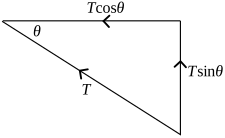
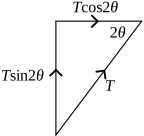
A light inextensible string is connected at each end to horizontal ceiling, as shown in the diagram. A mass of \(m\) kilograms hangs from a smooth ring on the string.

A horizontal force of \(F\) newtons is applied to the string until the tension in the string equals \(T\) and is constant across the whole system. At one end, the string makes an angle \(\theta\) with the ceiling and at the other end it makes an angle of \(2\theta\).
 

  1. Resolve the vertical forces to show that  \(T=\dfrac{mg}{sin\,\theta+\sin\,2\theta}\)   (1 mark)
  2. Hence, or otherwise, show  \(F=mg\Bigg( \dfrac{1-\cos\,\theta}{\sin\,\theta} \Bigg) \).   (3 marks)
Show Answers Only

a.   \(\text{See Worked Solutions}\)

b.   \(\text{See Worked Solutions}\)

Show Worked Solution

a.
                          

\(\text{Resolving forces vertically:}\)

\(T \sin \theta+T \sin 2 \theta\) \(=mg\)
\(T(\sin \theta+\sin 2 \theta)\) \(=mg\)
\(T\) \(=\dfrac{m g}{\sin \theta+\sin 2 \theta}\)


b.    \(\text{Resolving forces horizontally: }\)

\(F+T \cos 2 \theta\) \(=T \cos \theta\)
\(F\) \(=T(\cos \theta-\cos 2 \theta)\)
  \(=\dfrac{m g\left(\cos \theta-2 \cos ^2 \theta+1\right)}{\sin \theta+2 \sin \theta \cos \theta}\)
  \(=\dfrac{m g(1-\cos \theta)(1+2 \cos \theta)}{\sin \theta(1+2 \cos \theta)}\)
  \(=mg\left(\dfrac{1-\cos \theta}{\sin \theta}\right)\)

Filed Under: Vectors, Force and Velocity (Ext1) Tagged With: Band 3, Band 5, smc-3577-20-Force

Calculus, EXT1 C3 EQ-Bank 16

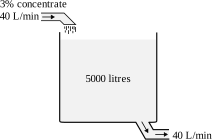
A tank contains 5000 litres of fruit juice concentrate solution with an initial concentrate percentage of 5.0%. Another fruit juice solution with a concentrate percentage of 3.0% is pumped into the tank at a rate of 40 litres per minute. The mixture is pumped out at the same rate, keeping the volume constant, and the liquid is kept thoroughly mixed.
 

Let \(y\) be the volume of fruit concentrate, in litres, present in the tank at time \(t\).

  1. Show that  \(\dfrac{dy}{dt}=\dfrac{150-y}{125} \)   (1 mark)

    --- 4 WORK AREA LINES (style=lined) ---

  2. Show that the amount fruit juice concentrate in the tank at time \(t\) is given by
  3.       \(y=150 + 100e^{-0.008t} \)   (3 marks)

    --- 9 WORK AREA LINES (style=lined) ---

  4. Determine how long will it take for the mixture to reach a fruit juice concentration of 3.5%, giving your answer to the nearest minute?   (2 marks)

    --- 6 WORK AREA LINES (style=lined) ---

Show Answers Only

a.   \(\text{See Worked Solutions}\)

b.  \(\text{See Worked Solutions}\)

c.   \(\text{174 minutes}\)

Show Worked Solution

a.    \(\text{Inflow}=40 \ \text{L/min} \times 0.03=1.2 \ \text{L/min}\)

\(\text{Outflow }=40 \ \text{L/min} \times \dfrac{y}{5000}=\dfrac{y}{125} \ \text{L/min}\)

\(\dfrac{dy}{dt}\) \(=\text{Inflow}-\text{Outflow}\)
  \(=1.2-\dfrac{y}{125}\)
  \(=\dfrac{150-y}{125}\)


b.     \(\dfrac{dy}{dt}\) \(=\dfrac{150-y}{125}\)
  \(\dfrac{dt}{dy}\) \(=\dfrac{125}{150-y}\)
  \(\displaystyle\int dt\) \(=\displaystyle \int \dfrac{125}{150-y} \, dy\)
  \(t\) \(=-125\, \ln \abs{150-y}+c\)
  \(\ln \abs{150-y}\) \(=-\dfrac{t}{125}+c\)
  \(150-y\) \(=e^{-0.008 t+c}\)
  \(150-y\) \(=e^{-0.008 t} \cdot e^c\)
  \(150-y\) \(=A e^{-0.008 t}\)

 
\(\text{At} \ \ t=0, y=5000 \times 0.05=250\ \text{L}\)

\(150-250=Ae^{\circ} \ \  \Rightarrow \ \  A=-100\)

\(150-y\) \(=-100 e^{-0.008 t}\)
\(y\) \(=150+100 e^{0.008 t}\)


c.   \(\text{When fruit concentrate}=3.5 \%\)

\(y=5000 \times 0.035=175 \ \text{L}\)

\(\text{Find} \ t \ \text{when} \ \ y=175:\)

\(175\) \(=150+100 e^{-0.008 t}\)
\(25\) \(=100 e^{-0.008 t}\)
\(e^{-0.008t}\) \(=0.25\)
\(-0.008 t\) \(=\ln (0.25)\)
\(t\) \(=\dfrac{\ln (0.25)}{-0.008}\)
  \(=173.28 \ldots\)


\(\therefore \ \text{After 174 minutes, the fruit concentrate first falls below} \  3.5\%\)

Filed Under: Applications of Differential Equations Tagged With: Band 4, Band 5, smc-1198-10-Mixing

Calculus, EXT2 C2 EQ-Bank 3

  1. Find  \(\displaystyle \int \frac{1}{\sqrt{4 x-x^2}}\, d x\).   (2 marks)

    --- 5 WORK AREA LINES (style=lined) ---

  2. Determine the values of \(x\) for which the antiderivative  \(\int \dfrac{1}{\sqrt{4 x-x^2}}\, d x\)  is real and finite.     (1 mark)

    --- 3 WORK AREA LINES (style=lined) ---

Show Answers Only

a.   \(\sin ^{-1}\left(\frac{x-2}{2}\right)+c\)

b.  \(0<x<4\)

Show Worked Solution
a.     \(\displaystyle\int \frac{1}{\sqrt{4 x-x^2}}\, d x\) \(=\displaystyle\int \frac{1}{\sqrt{4-4+4 x-x^2}}\, d x\)
    \(=\displaystyle\int \frac{1}{\sqrt{4-(x-2)^2}}\, d x\)
    \(=\sin ^{-1}\left(\dfrac{x-2}{2}\right)+c\)


b.    \(4 x-x^2>0\)

\(x(4-x)>0\)

\(0<x<4\)

Filed Under: Inverse Functions Calculus (Ext1) Tagged With: Band 3, Band 5, smc-1037-30-Sin/Cos Integration

HMS, HAG EQ-Bank 32 MC

A student researching mental health treatment options finds information from four different sources. Which source should be considered MOST reliable when evaluating health information hierarchy?

  1. A personal blog written by someone who experienced mental health challenges
  2. A news article summarising recent mental health research findings
  3. A peer-reviewed journal article published by mental health researchers
  4. An advertisement from a pharmaceutical company promoting their medication
Show Answers Only

\(C\)

Show Worked Solution
  • C is correct: Peer-reviewed research represents highest standard of scientific evidence and reliability.

Other Options:

  • A is incorrect: Personal experiences valuable but lack scientific rigour and generalisability.
  • B is incorrect: News articles may simplify or misinterpret original research findings.
  • D is incorrect: Advertisements have commercial bias and may not present balanced information.

Filed Under: Being a critical health consumer Tagged With: Band 5, smc-5483-07-Trustworthy sources

HMS, HAG EQ-Bank 28 MC

A teenager's parents are deciding whether to consent to a new medical treatment that has both potential benefits and side effects. Which process BEST demonstrates informed decision making in this healthcare context?

  1. Weighing benefits against risks after gathering comprehensive information from multiple reliable sources
  2. Making a quick decision based solely on the doctor's initial recommendation
  3. Delaying the decision indefinitely to avoid any potential negative outcomes
  4. Following advice from other parents on social media who have faced similar situations
Show Answers Only

\(A\)

Show Worked Solution
  • A is correct: Comprehensive information gathering and risk-benefit analysis demonstrates informed decision making.

Other Options:

  • B is incorrect: Single source information insufficient for complex medical decisions.
  • C is incorrect: Avoidance prevents necessary healthcare decisions from being made.
  • D is incorrect: Anecdotal social media advice lacks professional medical context.

Filed Under: Being a critical health consumer Tagged With: Band 5, smc-5483-12-Informed decisions

HMS, HAG EQ-Bank 23 MC

Japan has the highest life expectancy among OECD countries at 84.5 years compared to Australia's fourth ranking at 83.3 years. Which factor BEST explains why some countries like Japan achieve superior longevity outcomes?

  1. Countries with higher life expectancy spend significantly more on healthcare than Australia
  2. Geographic location determines life expectancy more than any other factor
  3. Cultural dietary patterns and lifestyle practices contribute to population health differences
  4. All OECD countries have identical healthcare systems and social determinants
Show Answers Only

\(C\)

Show Worked Solution
  • C is correct: Cultural practices like Japanese diet and lifestyle contribute to longevity differences.

Other Options:

  • A is incorrect: Higher spending doesn’t always correlate with better health outcomes.
  • B is incorrect: Geography influences but cultural factors more significant for longevity.
  • D is incorrect: Healthcare systems and social determinants vary significantly between countries.

Filed Under: Australia vs OECD Countries Tagged With: Band 5, smc-5476-12-OECD differences

HMS, HAG EQ-Bank 20 MC

The United Kingdom implemented a soft drink industry levy in 2018 which has shown success in reducing childhood obesity rates. Based on this international example, which approach would be MOST suitable for addressing Australia's obesity challenge?

  1. Copy the UK model exactly without any modifications for Australian conditions
  2. Focus only on individual behaviour change rather than policy interventions
  3. Adapt the levy concept to target high-sugar products while considering Australian dietary patterns
  4. Ignore international examples as they cannot apply to the Australian context
Show Answers Only

\(C\)

Show Worked Solution
  • C is correct: Adapting successful policies to local context maximises effectiveness.

Other Options:

  • A is incorrect: Direct copying ignores unique Australian cultural and economic factors.
  • B is incorrect: Policy interventions complement individual approaches for population health.
  • D is incorrect: International best practices provide valuable learning opportunities.

Filed Under: Australia vs OECD Countries Tagged With: Band 5, smc-5476-15-Global lessons

HMS, HAG EQ-Bank 15 MC

Australia's Health 2024 data shows that Australia had the 15th highest health spending as a proportion of GDP among OECD countries. Which statement BEST analyses this ranking in relation to Australia's health outcomes?

  1. Australia achieves relatively good health outcomes despite moderate health spending levels
  2. Australia spends the least amount on health among all OECD countries
  3. Higher health spending always guarantees better health outcomes across OECD countries
  4. Australia's health spending is below the OECD median for all member countries
Show Answers Only

\(A\)

Show Worked Solution
  • A is correct: Fourth highest life expectancy with 15th highest spending shows efficiency.

Other Options:

  • B is incorrect: 15th highest indicates substantial spending, not lowest.
  • C is incorrect: Spending doesn’t always correlate directly with outcomes.
  • D is incorrect: Australia’s 10.5% GDP exceeds OECD median of 9.5%.

Filed Under: Australia vs OECD Countries Tagged With: Band 5, smc-5476-10-Health comparisons

HMS, HAG EQ-Bank 9 MC

A construction worker develops excessive alcohol consumption as a coping mechanism due to long working hours and high workplace pressure, combined with a workplace culture where drinking after work is considered normal bonding behaviour. This scenario demonstrates which combination of sociological causes?

  1. Social relationships and family environment only
  2. Social interaction and culture of everyday life
  3. Culture of everyday life and family environment only
  4. Social relationships and workplace policies only
Show Answers Only

\(B\)

Show Worked Solution
  • B is correct: Work stress shows social interaction; normalised drinking shows cultural factors.

Other Options:

  • A is incorrect: No family factors mentioned in scenario.
  • C is incorrect: Family environment not involved in workplace scenario.
  • D is incorrect: Workplace culture, not policies, and social norms involved.

Filed Under: Current Health Status Tagged With: Band 5, smc-5474-15-Sociological factors

HMS, HAG EQ-Bank 6 MC

Based on Australia's Health 2024 mortality data, which statement BEST explains the pattern of leading causes of death between males and females in 2022?

  1. Males and females share identical top 5 causes of death in the same ranking order
  2. The same 5 conditions cause the most deaths but males have higher absolute numbers for coronary heart disease
  3. Infectious diseases rank higher for females than males in the top 5 causes
  4. Cancer-related deaths affect males significantly more than females across all types
Show Answers Only

\(B\)

Show Worked Solution
  • B is correct: Same 5 causes but males have 11,303 coronary deaths vs 10,976 females.

Other Options:

  • A is incorrect: Same causes but different ranking order between genders.
  • C is incorrect: COVID-19 ranks similarly for both genders.
  • D is incorrect: Lung cancer affects both genders in top 5.

Filed Under: Current Health Status Tagged With: Band 5, smc-5474-05-Major causes

Functions, 2ADV F1 EQ-Bank 1 MC

The graph of a quadratic function  \(f(x)=a x^2+b x+c\)  is drawn below.
 

Which of the following are true?

  1. \(a<0, c=0\)  and  \(b^2-4 a c=0\)
  2. \(a>0, c=0\)  and  \(b^2-4 a c=0\)
  3. \(a>0, c>0\)  and  \(b^2-4 a c>0\)
  4. \(a<0, c>0\)  and  \(b^2-4 a c=0\)
Show Answers Only

\(D\)

Show Worked Solution

\(\text{Quadratic touches } x \text{-axis once only} \ \ \Rightarrow b^2-4 a c=0\ \ \text{(eliminate C)}\)

\(\text{Quadratic is inverted} \Rightarrow a<0 \ \ \text{(eliminate B)}\)

\(\text{If} \ \ c=0, f(x)=a x^2+b x+0=x(a x+b) \Rightarrow \text{cuts twice (Eliminate A)}\)

\(\Rightarrow D\)

Filed Under: Quadratics and Cubic Functions (Adv-2027), Quadratics and Cubic Functions (Y11) Tagged With: Band 5, smc-6215-10-Quadratics, smc-6215-80-Discriminant, smc-984-10-Quadratics, smc-984-50-Discriminant

Calculus, 2ADV C4 EQ-Bank 2

  1. The graph of \(f(x)\) is drawn below
     

  1. Evaluate \(\displaystyle \int_0^6 f(x)\, d x\)   (2 marks)

    --- 6 WORK AREA LINES (style=lined) ---

  2. Evaluate \(\displaystyle \int_0^6[f(x)-3]\, d x\)    (2 marks)

    --- 6 WORK AREA LINES (style=lined) ---

  3. Evaluate \(\displaystyle \int_4^6 f^{\prime}(x)\, d x\)   (1 mark)

    --- 6 WORK AREA LINES (style=lined) ---

Show Answers Only

a.   \(8 \dfrac{1}{2}\)

b.   \(-9 \dfrac{1}{2}\)

c.   \(-3\)

Show Worked Solution

a.
     

\(\displaystyle \int_0^6 f(x)\) \(=\text{net area above the}\ x \text{-axis }\)
  \(=\text{Area 1}+ \text{Area 3}-\text{Area 2}\)
  \(=\left(6+1 \dfrac{1}{2}\right)+3-2\)
  \(=8 \dfrac{1}{2}\)


b.    \(f(x)-3 \ \ \text{shifts graph (above) 3 units lower:}\)
 

\(\displaystyle\int_0^6[f(x)-3] \ \ \text{will be negative (areas below \(x\)-axis)}\)
  \(=-\left(1 \dfrac{1}{2}+5+3\right)\)
  \(=-9 \dfrac{1}{2}\)


c.     \(\displaystyle \int_4^6 f^{\prime}(x) d x\) \(=[f(x)]_4^6\)
    \(=f(6)-f(4)\)
    \(=0-3\)
    \(=-3\)

Filed Under: Areas Under Curves (Y12) Tagged With: Band 4, Band 5, smc-975-70-Functions - no integration

HMS, HIC 2012 HSC 33b

Evaluate the characteristics of health promotion strategies that may contribute to their success.   (12 marks)

--- 28 WORK AREA LINES (style=lined) ---

Show Answers Only

Evaluation Statement

  • Health promotion strategies demonstrate varying levels of effectiveness depending on their design characteristics and implementation approach.
  • Assessment reveals that community engagement, evidence-based targeting and sustainable funding are most critical for achieving successful health outcomes.

Community Engagement and Cultural Relevance

  • Community involvement shows excellent effectiveness in ensuring health promotion strategies meet population needs and gain widespread acceptance.
  • Programs developed with target communities demonstrate superior participation rates and sustained behaviour change compared to top-down approaches.
  • Aboriginal health programs incorporating Elder knowledge and cultural practices achieve significantly better outcomes than culturally inappropriate interventions.
      
  • Target group participation in program design creates strong ownership and relevance that enhances message acceptance.
  • For example, youth-led anti-smoking campaigns resonate more effectively with teenagers than adult-designed programs.
  • Cultural competence proves essential for reaching diverse populations effectively.
  • Multilingual resources and culturally appropriate imagery increase program accessibility and effectiveness across different demographic groups.

Evidence-Based Targeting and Intersectoral Collaboration

  • Scientific evidence demonstrates high value in guiding strategy development and resource allocation toward proven interventions.
  • Programs targeting specific risk factors with measurable objectives achieve superior results compared to broad, unfocused approaches.
  • Heart health initiatives focusing on dietary modification and physical activity show clear effectiveness through reduced cardiovascular disease rates in targeted populations.
     
  • Intersectoral collaboration produces substantial benefits by addressing multiple health determinants simultaneously.
  • Partnerships between health services, schools, community organisations and government agencies create comprehensive support systems that reinforce health messages across different environments.
  • Australia’s Slip Slop Slap campaign exemplifies this approach, combining media, education and policy interventions to achieve remarkable success in reducing skin cancer rates.

Final Evaluation

  • Assessment demonstrates that highly successful health promotion strategies consistently incorporate community engagement, cultural relevance, evidence-based targeting and intersectoral collaboration.
  • These characteristics create optimal conditions for sustainable health behaviour change and maximum population impact across diverse Australian communities.
Show Worked Solution

Evaluation Statement

  • Health promotion strategies demonstrate varying levels of effectiveness depending on their design characteristics and implementation approach.
  • Assessment reveals that community engagement, evidence-based targeting and sustainable funding are most critical for achieving successful health outcomes.

Community Engagement and Cultural Relevance

  • Community involvement shows excellent effectiveness in ensuring health promotion strategies meet population needs and gain widespread acceptance.
  • Programs developed with target communities demonstrate superior participation rates and sustained behaviour change compared to top-down approaches.
  • Aboriginal health programs incorporating Elder knowledge and cultural practices achieve significantly better outcomes than culturally inappropriate interventions.
      
  • Target group participation in program design creates strong ownership and relevance that enhances message acceptance.
  • For example, youth-led anti-smoking campaigns resonate more effectively with teenagers than adult-designed programs.
  • Cultural competence proves essential for reaching diverse populations effectively.
  • Multilingual resources and culturally appropriate imagery increase program accessibility and effectiveness across different demographic groups.

Evidence-Based Targeting and Intersectoral Collaboration

  • Scientific evidence demonstrates high value in guiding strategy development and resource allocation toward proven interventions.
  • Programs targeting specific risk factors with measurable objectives achieve superior results compared to broad, unfocused approaches.
  • Heart health initiatives focusing on dietary modification and physical activity show clear effectiveness through reduced cardiovascular disease rates in targeted populations.
     
  • Intersectoral collaboration produces substantial benefits by addressing multiple health determinants simultaneously.
  • Partnerships between health services, schools, community organisations and government agencies create comprehensive support systems that reinforce health messages across different environments.
  • Australia’s Slip Slop Slap campaign exemplifies this approach, combining media, education and policy interventions to achieve remarkable success in reducing skin cancer rates.

Final Evaluation

  • Assessment demonstrates that highly successful health promotion strategies consistently incorporate community engagement, cultural relevance, evidence-based targeting and intersectoral collaboration.
  • These characteristics create optimal conditions for sustainable health behaviour change and maximum population impact across diverse Australian communities.

♦♦♦♦ Mean mark 28%.

Filed Under: Models of health promotion Tagged With: Band 5, Band 6, smc-5515-10-Ottawa Charter

HMS, HAG 2012 HSC 33a

What issues should be considered when determining the allocation of funding to address health inequities of specific population groups?   (8 marks)

--- 24 WORK AREA LINES (style=lined) ---

Show Answers Only
  • Population health data guides funding priorities by identifying groups with the greatest health disparities and highest disease burden.
  • Epidemiological evidence reveals mortality and morbidity patterns that inform resource allocation decisions.
  • For example, higher cardiovascular disease rates among Aboriginal and Torres Strait Islander peoples necessitate increased funding for culturally appropriate prevention programs.
      
  • Geographic accessibility influences funding distribution as remote and rural populations require different service delivery models.
  • Distance from healthcare facilities creates additional costs for mobile services, telehealth infrastructure and specialist visits.
  • This results in higher per-capita funding requirements for geographically isolated communities compared to metropolitan areas.
      
  • Cost-effectiveness analysis determines optimal resource allocation by comparing intervention outcomes with financial investment.
  • Prevention programs demonstrate better long-term value than treatment-focused approaches because they reduce future healthcare costs.
  • For instance, immunisation programs prevent expensive disease management while smoking cessation initiatives reduce cardiovascular treatment expenditure.
      
  • Political and social considerations affect funding decisions through community advocacy, media attention and electoral priorities.
  • Visible health issues attract greater public support and government commitment resulting in disproportionate funding allocation.
  • However, this can lead to neglect of less publicised health problems affecting smaller population groups.
      
  • Administrative capacity impacts funding effectiveness as some organisations possess better infrastructure and expertise to implement health programs successfully than others.
Show Worked Solution
  • Population health data guides funding priorities by identifying groups with the greatest health disparities and highest disease burden.
  • Epidemiological evidence reveals mortality and morbidity patterns that inform resource allocation decisions.
  • For example, higher cardiovascular disease rates among Aboriginal and Torres Strait Islander peoples necessitate increased funding for culturally appropriate prevention programs.
      
  • Geographic accessibility influences funding distribution as remote and rural populations require different service delivery models.
  • Distance from healthcare facilities creates additional costs for mobile services, telehealth infrastructure and specialist visits.
  • This results in higher per-capita funding requirements for geographically isolated communities compared to metropolitan areas.
      
  • Cost-effectiveness analysis determines optimal resource allocation by comparing intervention outcomes with financial investment.
  • Prevention programs demonstrate better long-term value than treatment-focused approaches because they reduce future healthcare costs.
  • For instance, immunisation programs prevent expensive disease management while smoking cessation initiatives reduce cardiovascular treatment expenditure.
      
  • Political and social considerations affect funding decisions through community advocacy, media attention and electoral priorities.
  • Visible health issues attract greater public support and government commitment resulting in disproportionate funding allocation.
  • However, this can lead to neglect of less publicised health problems affecting smaller population groups.
      
  • Administrative capacity impacts funding effectiveness as some organisations possess better infrastructure and expertise to implement health programs successfully than others.

♦♦ Mean mark 44%.

Filed Under: Healthcare expenditure Tagged With: Band 5, smc-5482-25-Sustainable healthcare, smc-5482-35-Government spending

HMS, TIP 2012 HSC 32b

Evaluate the risks and ethical issues related to the use of drugs to improve performance.   (12 marks)

--- 28 WORK AREA LINES (style=lined) ---

Show Answers Only

Evaluation Statement

  • Performance-enhancing drug use presents significant risks and serious ethical concerns that outweigh potential performance benefits.
  • Assessment reveals substantial health dangers and major ethical violations that undermine sport integrity.

Health and Safety Risks

  • Drug use demonstrates severe health consequences affecting multiple body systems and long-term wellbeing.
  • Anabolic steroids cause liver damage, cardiovascular disease and hormonal disruptions that persist beyond athletic careers.
  • EPO increases blood viscosity, creating high risk of stroke and heart attack, particularly during intense competition.
  • Stimulants produce cardiac arrhythmias and hyperthermia that can result in sudden death during performance.
      
  • Long-term health effects prove extremely concerning as many consequences emerge years after use ceases.
  • Steroid use in adolescents causes premature growth plate closure, permanently stunting height development.
  • Female athletes experience masculinisation effects including voice deepening and increased body hair that remain irreversible.
  • Mental health impacts include depression, aggression and dependency issues that affect life quality beyond sport participation.

Ethical and Fair Play Issues

  • Drug use creates fundamental ethical problems that violate sport integrity and fair competition principles.
  • Enhanced performance through artificial means provides unfair advantages over clean athletes who train naturally.
  • This undermines fair competition in sport and devalues genuine athletic achievement earned through training and talent.
      
  • Role model responsibilities present serious ethical concerns as athletes influence youth behaviour and sporting culture.
  • Professional athletes using drugs send dangerous messages to young participants who may emulate these practices.
  • This perpetuates harmful behaviours throughout sporting communities and normalises cheating as acceptable practice.

Final Evaluation

  • Evidence demonstrates that performance-enhancing drugs present unacceptable risks and severe ethical violations that cannot be justified by temporary performance gains.
  • The overwhelming negative consequences for individual health and sport integrity establish drug use as fundamentally incompatible with ethical athletic participation.
Show Worked Solution

Evaluation Statement

  • Performance-enhancing drug use presents significant risks and serious ethical concerns that outweigh potential performance benefits.
  • Assessment reveals substantial health dangers and major ethical violations that undermine sport integrity.

Health and Safety Risks

  • Drug use demonstrates severe health consequences affecting multiple body systems and long-term wellbeing.
  • Anabolic steroids cause liver damage, cardiovascular disease and hormonal disruptions that persist beyond athletic careers.
  • EPO increases blood viscosity, creating high risk of stroke and heart attack, particularly during intense competition.
  • Stimulants produce cardiac arrhythmias and hyperthermia that can result in sudden death during performance.
      
  • Long-term health effects prove extremely concerning as many consequences emerge years after use ceases.
  • Steroid use in adolescents causes premature growth plate closure, permanently stunting height development.
  • Female athletes experience masculinisation effects including voice deepening and increased body hair that remain irreversible.
  • Mental health impacts include depression, aggression and dependency issues that affect life quality beyond sport participation.

Ethical and Fair Play Issues

  • Drug use creates fundamental ethical problems that violate sport integrity and fair competition principles.
  • Enhanced performance through artificial means provides unfair advantages over clean athletes who train naturally.
  • This undermines fair competition in sport and devalues genuine athletic achievement earned through training and talent.
      
  • Role model responsibilities present serious ethical concerns as athletes influence youth behaviour and sporting culture.
  • Professional athletes using drugs send dangerous messages to young participants who may emulate these practices.
  • This perpetuates harmful behaviours throughout sporting communities and normalises cheating as acceptable practice.

Final Evaluation

  • Evidence demonstrates that performance-enhancing drugs present unacceptable risks and severe ethical violations that cannot be justified by temporary performance gains.
  • The overwhelming negative consequences for individual health and sport integrity establish drug use as fundamentally incompatible with ethical athletic participation.

Filed Under: Impact of drug use Tagged With: Band 4, Band 5, smc-5473-10-Health implications, smc-5473-20-Ethical considerations

HMS, TIP 2012 HSC 32a

Explain the relationship between planning and the avoidance of overtraining.   (8 marks)

--- 24 WORK AREA LINES (style=lined) ---

Show Answers Only
  • Systematic training planning prevents overtraining by establishing appropriate work-to-rest ratios throughout training cycles. Periodised programs divide the training year into specific phases that allow for recovery periods between intense training blocks. When planning is absent, athletes risk accumulating excessive fatigue leading to performance decline and injury.
  • Training load progression requires careful monitoring to avoid sudden increases in volume or intensity. Progressive overload principles ensure gradual adaptation while planned recovery periods allow physiological systems to adapt and strengthen. For example, a swimmer’s training plan increases weekly distance by only 10% to prevent overuse injuries and chronic fatigue syndrome.
  • Periodisation models incorporate strategic recovery phases that prevent accumulated stress from becoming overtraining syndrome. Macrocycles include preparation, competition and transition periods with varying intensities designed to optimise performance timing. Mesocycles alternate high-intensity training blocks with recovery weeks. This structure ensures athletes peak for competitions while avoiding prolonged high-stress training periods.
  • Individual athlete monitoring enables coaches to adjust training plans based on physiological and psychological indicators throughout the season. Heart rate variability, sleep quality and perceived exertion data inform daily training modifications and recovery protocols. When planning incorporates these feedback mechanisms, it becomes possible to reduce training loads before overtraining symptoms develop. This also facilitates the maintenance of optimal performance capacity throughout the competitive season and prevents long-term performance plateaus and health complications.
Show Worked Solution
  • Systematic training planning prevents overtraining by establishing appropriate work-to-rest ratios throughout training cycles. Periodised programs divide the training year into specific phases that allow for recovery periods between intense training blocks. When planning is absent, athletes risk accumulating excessive fatigue leading to performance decline and injury.
  • Training load progression requires careful monitoring to avoid sudden increases in volume or intensity. Progressive overload principles ensure gradual adaptation while planned recovery periods allow physiological systems to adapt and strengthen. For example, a swimmer’s training plan increases weekly distance by only 10% to prevent overuse injuries and chronic fatigue syndrome.
  • Periodisation models incorporate strategic recovery phases that prevent accumulated stress from becoming overtraining syndrome. Macrocycles include preparation, competition and transition periods with varying intensities designed to optimise performance timing. Mesocycles alternate high-intensity training blocks with recovery weeks. This structure ensures athletes peak for competitions while avoiding prolonged high-stress training periods.
  • Individual athlete monitoring enables coaches to adjust training plans based on physiological and psychological indicators throughout the season. Heart rate variability, sleep quality and perceived exertion data inform daily training modifications and recovery protocols. When planning incorporates these feedback mechanisms, it becomes possible to reduce training loads before overtraining symptoms develop. This also facilitates the maintenance of optimal performance capacity throughout the competitive season and prevents long-term performance plateaus and health complications.

♦♦ Mean mark 47%.

Filed Under: Individual vs group programs Tagged With: Band 5, smc-5463-05-Competition phases

HMS, HIC 2012 HSC 29b

Assess the skills that enable young people to attain better health.   (12 marks)

--- 28 WORK AREA LINES (style=lined) ---

Show Answers Only

Assessment Statement

  • Individual health skills are highly effective in enabling young people to attain better health outcomes.
  • Assessment demonstrates significant value in developing self-efficacy, health literacy and resilience as primary factors for health improvement.

Self-efficacy and Resilience

  • Self-efficacy demonstrates strong effectiveness in empowering young people to make positive health decisions and maintain long-term behavioural changes.
  • Young people with high self-belief successfully manage stress, resist peer pressure and maintain healthy behaviours despite external challenges.
  • Evidence shows adolescents with developed self-efficacy achieve higher physical activity levels and better nutritional choices compared to those lacking confidence in their abilities.
      
  • Resilience produces substantial results in helping young people recover from health challenges and setbacks while building emotional strength.
  • Resilient teenagers effectively cope with mental health issues, family problems and academic stress without resorting to harmful behaviours such as substance abuse or self-harm.
  • Research indicates resilient youth demonstrate lower rates of depression and substance abuse across various socioeconomic backgrounds.

Health Literacy and Help-seeking

  • Health literacy shows considerable impact on young people’s ability to access, understand and interpret complex health information from multiple sources.
  • Students with strong health literacy skills make informed decisions about sexual health, nutrition and mental wellbeing while critically evaluating health information.
  • They effectively navigate healthcare systems and understand preventive health measures including vaccination and screening programs.
      
  • Help-seeking behaviours demonstrate high practical value when young people face health challenges requiring professional intervention or support.
  • Those comfortable seeking support from trusted adults, school counsellors or health professionals receive early intervention for emerging problems.
  • This prevents minor issues from developing into serious health conditions requiring intensive treatment and long-term management.

Overall Assessment

  • Assessment reveals excellent overall effectiveness of individual health skills in promoting better health outcomes for young Australians.
  • The combined development of multiple skills creates comprehensive protection against health risks while enabling proactive health management throughout adolescence and into adulthood.
Show Worked Solution

Assessment Statement

  • Individual health skills are highly effective in enabling young people to attain better health outcomes.
  • Assessment demonstrates significant value in developing self-efficacy, health literacy and resilience as primary factors for health improvement.

Self-efficacy and Resilience

  • Self-efficacy demonstrates strong effectiveness in empowering young people to make positive health decisions and maintain long-term behavioural changes.
  • Young people with high self-belief successfully manage stress, resist peer pressure and maintain healthy behaviours despite external challenges.
  • Evidence shows adolescents with developed self-efficacy achieve higher physical activity levels and better nutritional choices compared to those lacking confidence in their abilities.
      
  • Resilience produces substantial results in helping young people recover from health challenges and setbacks while building emotional strength.
  • Resilient teenagers effectively cope with mental health issues, family problems and academic stress without resorting to harmful behaviours such as substance abuse or self-harm.
  • Research indicates resilient youth demonstrate lower rates of depression and substance abuse across various socioeconomic backgrounds.

Health Literacy and Help-seeking

  • Health literacy shows considerable impact on young people’s ability to access, understand and interpret complex health information from multiple sources.
  • Students with strong health literacy skills make informed decisions about sexual health, nutrition and mental wellbeing while critically evaluating health information.
  • They effectively navigate healthcare systems and understand preventive health measures including vaccination and screening programs.
      
  • Help-seeking behaviours demonstrate high practical value when young people face health challenges requiring professional intervention or support.
  • Those comfortable seeking support from trusted adults, school counsellors or health professionals receive early intervention for emerging problems.
  • This prevents minor issues from developing into serious health conditions requiring intensive treatment and long-term management.

Overall Assessment

  • Assessment reveals excellent overall effectiveness of individual health skills in promoting better health outcomes for young Australians.
  • The combined development of multiple skills creates comprehensive protection against health risks while enabling proactive health management throughout adolescence and into adulthood.

♦♦♦♦ Mean mark 34%.

Filed Under: Strengthening, protecting and enhancing health Tagged With: Band 5, Band 6, smc-5511-40-Skills application/impact

HMS, HIC 2012 HSC 29a

Explain the determining factors that affect the health of young people in Australia.   (8 marks)

--- 24 WORK AREA LINES (style=lined) ---

Show Answers Only
  • Socioeconomic factors significantly impact young people’s health through education, employment and income levels. When families experience financial disadvantage, this leads to reduced access to nutritious food, healthcare services and recreational facilities. For example, adolescents from low-income households are more likely to consume processed foods due to cost constraints, resulting in higher obesity rates and nutritional deficiencies. Educational disadvantage creates limited health literacy, preventing young people from making informed health decisions.
  • Environmental determinants influence health through both built and natural surroundings. Poor housing conditions create respiratory problems while lack of safe recreational spaces limits physical activity opportunities. Urban pollution causes increased asthma rates among young people, particularly those living near busy roads or industrial areas. Inadequate transport infrastructure results in social isolation and reduced healthcare access.
  • Sociocultural factors shape health behaviours through peer influence, family values and cultural norms. Social media exposure leads to body image concerns and mental health issues among teenagers. Family attitudes towards alcohol and substance use directly affect adolescent experimentation patterns. Cultural beliefs about help-seeking behaviour can prevent young people from accessing mental health support services.
  • Individual health behaviours determine immediate and long-term health outcomes. Risk-taking behaviours such as excessive alcohol consumption, smoking and unprotected sexual activity result in acute injuries, addiction and sexually transmitted infections among young Australians.
Show Worked Solution
  • Socioeconomic factors significantly impact young people’s health through education, employment and income levels. When families experience financial disadvantage, this leads to reduced access to nutritious food, healthcare services and recreational facilities. For example, adolescents from low-income households are more likely to consume processed foods due to cost constraints, resulting in higher obesity rates and nutritional deficiencies. Educational disadvantage creates limited health literacy, preventing young people from making informed health decisions.
  • Environmental determinants influence health through both built and natural surroundings. Poor housing conditions create respiratory problems while lack of safe recreational spaces limits physical activity opportunities. Urban pollution causes increased asthma rates among young people, particularly those living near busy roads or industrial areas. Inadequate transport infrastructure results in social isolation and reduced healthcare access.
  • Sociocultural factors shape health behaviours through peer influence, family values and cultural norms. Social media exposure leads to body image concerns and mental health issues among teenagers. Family attitudes towards alcohol and substance use directly affect adolescent experimentation patterns. Cultural beliefs about help-seeking behaviour can prevent young people from accessing mental health support services.
  • Individual health behaviours determine immediate and long-term health outcomes. Risk-taking behaviours such as excessive alcohol consumption, smoking and unprotected sexual activity result in acute injuries, addiction and sexually transmitted infections among young Australians.

♦♦ Mean mark 50%.

Filed Under: Broad features of society Tagged With: Band 4, Band 5, smc-5803-60-Interaction of determinants

HMS, HAG 2012 HSC 24

Explain the roles of individuals, communities and governments in addressing the health inequities experienced by ONE group other than Aboriginal and Torres Strait Islander peoples.   (8 marks)

--- 24 WORK AREA LINES (style=lined) ---

Show Answers Only

Socioeconomically disadvantaged people experience significant health inequities requiring coordinated responses.

  • Individual roles involve pursuing education and employment opportunities, which leads to improved income and health outcomes. Disadvantaged individuals can access community health services, resulting in better preventive care. This occurs when people develop health literacy skills and seek appropriate medical attention early.
  • Community organisations provide essential support services that bridge healthcare gaps. For example, community health centres offer bulk-billing services in low-income areas, ensuring affordable healthcare access. Food banks and community kitchens address nutritional needs, while employment training programs create pathways to economic stability.
  • Government interventions target systemic inequities through policy and funding. Medicare provides universal healthcare coverage, removing financial barriers to medical treatment. Centrelink payments ensure basic income support, enabling disadvantaged families to meet essential needs. Public housing programs address accommodation security, which directly impacts health outcomes.
  • Collaborative approaches prove most effective when all three levels work together. This integration results in comprehensive support addressing multiple determinants of health simultaneously.
Show Worked Solution

Socioeconomically disadvantaged people experience significant health inequities requiring coordinated responses.

  • Individual roles involve pursuing education and employment opportunities, which leads to improved income and health outcomes. Disadvantaged individuals can access community health services, resulting in better preventive care. This occurs when people develop health literacy skills and seek appropriate medical attention early.
  • Community organisations provide essential support services that bridge healthcare gaps. For example, community health centres offer bulk-billing services in low-income areas, ensuring affordable healthcare access. Food banks and community kitchens address nutritional needs, while employment training programs create pathways to economic stability.
  • Government interventions target systemic inequities through policy and funding. Medicare provides universal healthcare coverage, removing financial barriers to medical treatment. Centrelink payments ensure basic income support, enabling disadvantaged families to meet essential needs. Public housing programs address accommodation security, which directly impacts health outcomes.
  • Collaborative approaches prove most effective when all three levels work together. This integration results in comprehensive support addressing multiple determinants of health simultaneously.

♦♦ Mean mark 46%.

Filed Under: Groups Experiencing Inequities Tagged With: Band 4, Band 5, smc-5475-25-Vulnerable groups

HMS, HAG 2012 HSC 10 MC

Which of the following is a government strategy that promotes the social justice principle of diversity?

  1. Involving community groups in the planning of their local area health services
  2. Increasing the amount of funding to address the health needs of ATSI peoples
  3. Road safety education programs that target behaviours of adolescents
  4. Legislation to ban smoking in the workplace and public spaces
Show Answers Only

\(A\)

Show Worked Solution
  • A is correct: Community involvement promotes participation and recognises diverse needs.

Other Options:

  • B is incorrect: This promotes equity rather than diversity.
  • C is incorrect: Age-targeted programs don’t address diversity principles.
  • D is incorrect: Universal smoking bans promote health but not diversity.

♦♦♦♦ Mean mark 38%.

Filed Under: Social Justice Principles Tagged With: Band 5, smc-5505-10-Participation

HMS, HIC 2012 HSC 6 MC

A doctor prescribes nicotine patches as a strategy to help patients stop smoking.

Which action area of the Ottawa Charter is the doctor implementing?

  1. Building public policy
  2. Developing personal skills
  3. Re-orienting health services
  4. Creating a supportive environment
Show Answers Only

\(C\)

Show Worked Solution
  • C is correct: Doctor providing smoking cessation treatment represents re-orienting health services.

Other Options:

  • A is incorrect: Building policy involves legislation and population-level strategies.
  • B is incorrect: Developing skills focuses on individual knowledge and capabilities.
  • D is incorrect: Creating environments involves changing physical or social settings.

♦♦ Mean mark 44%.

Filed Under: Models of health promotion Tagged With: Band 5, smc-5515-10-Ottawa Charter

HMS, HIC 2013 HSC 33b

How can the social justice framework be applied to address the causal factors of health inequities?   (12 marks)

--- 28 WORK AREA LINES (style=lined) ---

Show Answers Only
  • The social justice framework provides systematic approaches to address health inequity causes. It ensures fair distribution of resources and opportunities across all population groups through structured policy interventions.
  • Participation enables disadvantaged communities to engage in health decision-making processes that affect their wellbeing and community outcomes. Community consultation programs allow Indigenous communities to design culturally appropriate health services. These services address specific needs rather than imposing mainstream approaches that ignore cultural values. Health committees include diverse population representatives who can identify local health priorities and barriers. Such involvement ensures that interventions reflect actual community needs rather than government assumptions. This results in more effective and acceptable health programs that communities actively support.
  • Equity requires resource allocation based on need rather than equal distribution. This ensures disadvantaged groups receive additional support to achieve similar health outcomes as privileged populations. Targeted funding for Aboriginal Community Controlled Health Organisations provides culturally safe healthcare. This addresses historical trauma and systemic discrimination effects. Additional funding for rural health services compensates for geographic disadvantages. These include mobile clinics, specialist visits and telehealth services. The approach recognises that equal treatment does not produce equal outcomes.
  • Access focuses on removing structural barriers that prevent people from obtaining necessary health services. Medicare provides universal healthcare coverage that eliminates financial barriers to essential medical treatment. Interpreter services remove language barriers for multicultural communities, enabling effective healthcare communication. These measures ensure that structural obstacles do not determine health outcomes.
  • Rights establish legal entitlements to health services and protection from discrimination. These cannot be denied based on personal characteristics or group membership. Anti-discrimination legislation protects people with disability from healthcare exclusion, ensuring equal treatment access.
Show Worked Solution
  • The social justice framework provides systematic approaches to address health inequity causes. It ensures fair distribution of resources and opportunities across all population groups through structured policy interventions.
  • Participation enables disadvantaged communities to engage in health decision-making processes that affect their wellbeing and community outcomes. Community consultation programs allow Indigenous communities to design culturally appropriate health services. These services address specific needs rather than imposing mainstream approaches that ignore cultural values. Health committees include diverse population representatives who can identify local health priorities and barriers. Such involvement ensures that interventions reflect actual community needs rather than government assumptions. This results in more effective and acceptable health programs that communities actively support.
  • Equity requires resource allocation based on need rather than equal distribution. This ensures disadvantaged groups receive additional support to achieve similar health outcomes as privileged populations. Targeted funding for Aboriginal Community Controlled Health Organisations provides culturally safe healthcare. This addresses historical trauma and systemic discrimination effects. Additional funding for rural health services compensates for geographic disadvantages. These include mobile clinics, specialist visits and telehealth services. The approach recognises that equal treatment does not produce equal outcomes.
  • Access focuses on removing structural barriers that prevent people from obtaining necessary health services. Medicare provides universal healthcare coverage that eliminates financial barriers to essential medical treatment. Interpreter services remove language barriers for multicultural communities, enabling effective healthcare communication. These measures ensure that structural obstacles do not determine health outcomes.
  • Rights establish legal entitlements to health services and protection from discrimination. These cannot be denied based on personal characteristics or group membership. Anti-discrimination legislation protects people with disability from healthcare exclusion, ensuring equal treatment access.

♦♦♦♦ Mean mark 36%.

Filed Under: Social Justice Principles Tagged With: Band 5, Band 6, smc-5505-60-Inequities

HMS, HAG 2013 HSC 33a

Explain TWO factors that contribute to health inequities in different population groups.   (8 marks)

--- 24 WORK AREA LINES (style=lined) ---

Show Answers Only
  • Health inequities arise from complex interactions between social, economic and environmental factors that systematically disadvantage certain population groups through unequal access to health-promoting resources.
  • Socioeconomic disadvantage creates health inequities by limiting access to essential health-promoting resources and opportunities. Low income levels restrict access to nutritious foods, safe housing and quality healthcare services that are necessary for optimal health outcomes. Educational limitations reduce health literacy and decision-making capacity, leading to poor health choices and delayed healthcare seeking. Employment instability generates chronic stress and prevents consistent healthcare access through insurance coverage. This results in higher rates of chronic diseases, mental health issues and premature mortality among disadvantaged populations compared to affluent groups.
  • Geographic isolation contributes to health inequities through reduced access to healthcare services and health-promoting infrastructure. Rural and remote communities experience significant barriers including limited healthcare facilities, specialist shortages and extensive travel requirements for medical care. Distance from services delays emergency treatment and prevents regular preventive healthcare access. Poor infrastructure limits access to clean water, sanitation systems and recreational facilities that support healthy lifestyles. These geographic barriers result in higher injury rates, unmanaged chronic conditions and reduced life expectancy compared to metropolitan populations.
  • Both factors interact to compound disadvantage, as socioeconomically disadvantaged groups are more likely to live in geographically isolated areas where healthcare access remains most limited.
Show Worked Solution
  • Health inequities arise from complex interactions between social, economic and environmental factors that systematically disadvantage certain population groups through unequal access to health-promoting resources.
  • Socioeconomic disadvantage creates health inequities by limiting access to essential health-promoting resources and opportunities. Low income levels restrict access to nutritious foods, safe housing and quality healthcare services that are necessary for optimal health outcomes. Educational limitations reduce health literacy and decision-making capacity, leading to poor health choices and delayed healthcare seeking. Employment instability generates chronic stress and prevents consistent healthcare access through insurance coverage. This results in higher rates of chronic diseases, mental health issues and premature mortality among disadvantaged populations compared to affluent groups.
  • Geographic isolation contributes to health inequities through reduced access to healthcare services and health-promoting infrastructure. Rural and remote communities experience significant barriers including limited healthcare facilities, specialist shortages and extensive travel requirements for medical care. Distance from services delays emergency treatment and prevents regular preventive healthcare access. Poor infrastructure limits access to clean water, sanitation systems and recreational facilities that support healthy lifestyles. These geographic barriers result in higher injury rates, unmanaged chronic conditions and reduced life expectancy compared to metropolitan populations.
  • Both factors interact to compound disadvantage, as socioeconomically disadvantaged groups are more likely to live in geographically isolated areas where healthcare access remains most limited.

♦♦ Mean mark 54%.

Filed Under: Groups Experiencing Inequities Tagged With: Band 4, Band 5, smc-5475-15-Inequity causes

HMS, TIP 2013 HSC 32b

Justify each of the elements that need to be considered when designing a training session.   (12 marks)

--- 28 WORK AREA LINES (style=lined) ---

Show Answers Only

Position Statement

  • Each training session element is essential for optimal athlete development because they systematically address safety, skill acquisition, physical adaptation and performance evaluation requirements.

Health and Safety Considerations

  • Health and safety considerations provide the fundamental foundation for all training activities by protecting athlete welfare and preventing injury occurrence.
  • Pre-session injury screening identifies existing limitations that require modification or exclusion from certain exercises.
  • Environmental assessments ensure appropriate conditions for safe training, including surface quality, weather conditions and equipment functionality.
  • Risk management protocols establish emergency procedures and first aid accessibility for immediate response.
  • Evidence demonstrates that systematic safety planning reduces training injuries by 40-60%, protecting athletes from setbacks that could compromise seasonal preparation and competitive readiness.
  • Without proper safety frameworks, training sessions become liability risks that potentially cause long-term athlete harm and program disruption.

Warm-up and Cool-down Protocols

  • Warm-up and cool-down protocols prepare the body physiologically and psychologically whilst facilitating optimal recovery processes between sessions.
  • Progressive warm-up activities increase core temperature, heart rate and joint mobility that enable safe transition to high-intensity training loads.
  • Neural activation exercises prepare the nervous system for complex movement patterns and skill execution demands.
  • Cool-down protocols facilitate lactate clearance, reduce muscle stiffness and promote parasympathetic recovery responses.
  • Research confirms that structured warm-ups reduce injury rates by 25-30% whilst effective cool-downs accelerate recovery between training sessions.

Skill Development Integration

  • Skill instruction and practice enable technique refinement and tactical understanding that directly transfer to competitive performance scenarios.
  • Progressive skill development ensures athletes master fundamental movements before advancing to sport-specific applications. 
  • This builds confidence and competence systematically through structured learning progressions.

Reinforcement

  • The evidence overwhelmingly supports comprehensive training session design because each element addresses specific physiological and psychological needs that combine to create optimal learning and adaptation environments for sustained athletic development and competitive success.
Show Worked Solution

Position Statement

  • Each training session element is essential for optimal athlete development because they systematically address safety, skill acquisition, physical adaptation and performance evaluation requirements.

Health and Safety Considerations

  • Health and safety considerations provide the fundamental foundation for all training activities by protecting athlete welfare and preventing injury occurrence.
  • Pre-session injury screening identifies existing limitations that require modification or exclusion from certain exercises.
  • Environmental assessments ensure appropriate conditions for safe training, including surface quality, weather conditions and equipment functionality.
  • Risk management protocols establish emergency procedures and first aid accessibility for immediate response.
  • Evidence demonstrates that systematic safety planning reduces training injuries by 40-60%, protecting athletes from setbacks that could compromise seasonal preparation and competitive readiness.
  • Without proper safety frameworks, training sessions become liability risks that potentially cause long-term athlete harm and program disruption.

Warm-up and Cool-down Protocols

  • Warm-up and cool-down protocols prepare the body physiologically and psychologically whilst facilitating optimal recovery processes between sessions.
  • Progressive warm-up activities increase core temperature, heart rate and joint mobility that enable safe transition to high-intensity training loads.
  • Neural activation exercises prepare the nervous system for complex movement patterns and skill execution demands.
  • Cool-down protocols facilitate lactate clearance, reduce muscle stiffness and promote parasympathetic recovery responses.
  • Research confirms that structured warm-ups reduce injury rates by 25-30% whilst effective cool-downs accelerate recovery between training sessions.

Skill Development Integration

  • Skill instruction and practice enable technique refinement and tactical understanding that directly transfer to competitive performance scenarios.
  • Progressive skill development ensures athletes master fundamental movements before advancing to sport-specific applications. 
  • This builds confidence and competence systematically through structured learning progressions.

Reinforcement

  • The evidence overwhelmingly supports comprehensive training session design because each element addresses specific physiological and psychological needs that combine to create optimal learning and adaptation environments for sustained athletic development and competitive success.

♦♦ Mean mark 51%.

Filed Under: Designing training sessions Tagged With: Band 4, Band 5, smc-5462-25-Integrated session design

HMS, TIP 2013 HSC 31a

How are skill and physical tests used to indicate an athlete's readiness to return to play after injury?   (8 marks)

--- 24 WORK AREA LINES (style=lined) ---

Show Answers Only
  • Skill and physical tests provide objective measures that ensure athletes have regained necessary capacities before resuming competitive participation safely.
  • Physical testing assesses whether injured body parts have recovered sufficient strength, flexibility and endurance. Strength testing compares the injured limb to the uninjured side, requiring 90-95% strength return before clearance. A footballer with hamstring injury must demonstrate equal strength between both legs through isokinetic testing. Range of motion assessments confirm full joint mobility has returned, preventing re-injury from compensatory movement patterns. Cardiovascular fitness tests verify the athlete can meet sport-specific demands without excessive fatigue that increases injury risk.
  • Skill testing evaluates whether technical abilities and decision-making capacities have returned to pre-injury levels. Sport-specific drills test coordination and timing that may be affected by injury or time away from training. A basketball player must demonstrate accurate shooting, dribbling and defensive movements at competition intensity. Reaction time tests ensure the athlete can respond appropriately to game situations, particularly important for contact sports where delayed reactions increase vulnerability.
  • Progressive testing protocols guide safe return by gradually increasing intensity and complexity. Athletes progress through controlled training environments before facing unpredictable competition scenarios. Functional movement screens identify compensatory patterns that could lead to secondary injuries.
  • Objective criteria remove subjective bias and ensure consistent standards across different practitioners and sports, protecting athlete welfare whilst maintaining competitive integrity.
Show Worked Solution
  • Skill and physical tests provide objective measures that ensure athletes have regained necessary capacities before resuming competitive participation safely.
  • Physical testing assesses whether injured body parts have recovered sufficient strength, flexibility and endurance. Strength testing compares the injured limb to the uninjured side, requiring 90-95% strength return before clearance. A footballer with hamstring injury must demonstrate equal strength between both legs through isokinetic testing. Range of motion assessments confirm full joint mobility has returned, preventing re-injury from compensatory movement patterns. Cardiovascular fitness tests verify the athlete can meet sport-specific demands without excessive fatigue that increases injury risk.
  • Skill testing evaluates whether technical abilities and decision-making capacities have returned to pre-injury levels. Sport-specific drills test coordination and timing that may be affected by injury or time away from training. A basketball player must demonstrate accurate shooting, dribbling and defensive movements at competition intensity. Reaction time tests ensure the athlete can respond appropriately to game situations, particularly important for contact sports where delayed reactions increase vulnerability.
  • Progressive testing protocols guide safe return by gradually increasing intensity and complexity. Athletes progress through controlled training environments before facing unpredictable competition scenarios. Functional movement screens identify compensatory patterns that could lead to secondary injuries.
  • Objective criteria remove subjective bias and ensure consistent standards across different practitioners and sports, protecting athlete welfare whilst maintaining competitive integrity.

♦♦ Mean mark 49%.

Filed Under: Management/prevention of injuries Tagged With: Band 4, Band 5, smc-5472-25-Rehab/return-to-play

  • « Previous Page
  • 1
  • …
  • 4
  • 5
  • 6
  • 7
  • 8
  • …
  • 81
  • Next Page »

Copyright © 2014–2025 SmarterEd.com.au · Log in