SmarterEd

Aussie Maths & Science Teachers: Save your time with SmarterEd

  • Login
  • Get Help
  • About

Financial Maths, GEN1 2025 VCAA 24 MC

Dennis invests $800 000 in an annuity.

The annuity earns interest at 4.8% per annum, compounding monthly.

After the interest is credited to the annuity, Dennis receives a monthly payment of $6000.

After some years, the balance of the annuity is $521118.96

For the remainder of the annuity, Dennis receives a monthly payment of $4767.66.

The total number of years for which Dennis receives payments is closest to

  1. 19
  2. 20
  3. 21
  4. 22
Show Answers Only

\(A\)

Show Worked Solution

\(\text{Calculate time until annuity value is}\ \$521\,118.96.\)

\(\text{Solve for} \ N \ \text {(by CAS):}\)

\(N\) \(=\boldsymbol{84}\)
\(I(\%)\) \(=4.8\)
\(PV\) \(=800\,000\)
\(PMT\) \(=-6000\)
\(FV\) \(=521\,118.96\)
\(PY\) \(=CY=12\)
♦ Mean mark 52%.

\(\text{After 84 months, calculate time until annuity = 0.}\)

\(\text{Solve for} \ N \ \text {(by CAS):}\)

\(N\) \(=\boldsymbol{144}\)
\(I(\%)\) \(=4.8\)
\(PV\) \(=521\,118.96\)
\(PMT\) \(=-4767.66\)
\(FV\) \(=0\)
\(PY\) \(=CY=12\)


\(\therefore \ \text {Length of annuity}=\dfrac{84+144}{12}=19 \text { years.}\)

\(\Rightarrow A\)

Filed Under: Annuities and Perpetuities Tagged With: Band 5, smc-2512-10-Annuity, smc-2512-50-CAS solver

Financial Maths, GEN1 2025 VCAA 23 MC

Virat invested $5000 into an account that earned interest compounding fortnightly.

The effective annual interest rate for Virat's investment was 4.51%.

Assume that there are exactly 26 fortnights in one year.

After five years, the amount of interest earned by Virat was closest to

  1. $1128
  2. $1234
  3. $1262
  4. $1264
Show Answers Only

\(B\)

Show Worked Solution

\(\text{Find nominal interest rate (by CAS):}\)

\(\operatorname{nom}(4.51,26)=4.415 \%\)

\(\text{Solve for} \ FV \ \text {(by CAS):}\)

\(N\) \(=5 \times 26=130\)
\(I(\%)\) \(=4.415\)
\(PV\) \(=-5000\)
\(PMT\) \(=0\)
\(FV\) \(=\boldsymbol{6233.89}\)
\(PY\) \(=CY=26\)


\(\therefore \text{Interest}=6233.89-5000=\$1233.89\)

\(\Rightarrow B\)

♦ Mean mark 41%.

Filed Under: Interest Rates and Investing Tagged With: Band 5, smc-604-20-Compound interest, smc-604-25-Effective interest rate, smc-604-90-CAS Solver

Financial Maths, GEN1 2025 VCAA 19 MC

The table below compares the value of an asset at various times using the flat rate and reducing balance methods of depreciation.

\begin{array}{|l|c|c|}
\hline & \rule{0pt}{2.5ex}\ \ \quad \quad \textbf{Flat rate (\$)} \quad  \ \ \quad \rule[-1ex]{0pt}{0pt}& \textbf{Reducing balance (\$)} \\
\hline \rule{0pt}{2.5ex}\text{Original value} \rule[-1ex]{0pt}{0pt}& 60\,000.00 & 60\,000.00 \\
\hline \rule{0pt}{2.5ex}\text{Value after 1 year} \rule[-1ex]{0pt}{0pt}& 56\,000.00 & 55\,200.00 \\
\hline \rule{0pt}{2.5ex}\text{Value after 2 years} \rule[-1ex]{0pt}{0pt}& 52\,000.00 & 50\,784.00 \\
\hline \rule{0pt}{2.5ex}\text{Value after 3 years} \quad \rule[-1ex]{0pt}{0pt}& 48\,000.00 & 46\,721.28 \\
\hline
\end{array}

After how many years will the value using flat rate depreciation first be lower than the value using reducing balance depreciation?

  1. 5
  2. 6
  3. 7
  4. 8
Show Answers Only

\(B\)

Show Worked Solution

\(\text {Flat rate: value decreases by \$4000 each year.}\)

\(\text{Value}\ =6000-4000 \times n\)
 

\(\text {Reducing balance:}\ \ r=\dfrac{55\,200}{60\,000}=0.92\)

\(\text{Value }=6000 \times(0.92)^n\)
 

\(\text{Solve (by CAS):}\ 6000-4000 \times n=6000 \times 0.92^n\)

\(n=5.582 \ldots\)

\(\therefore \ \text{Flat rate value is lower after 6 years.}\)

\(\Rightarrow B\)

♦ Mean mark 49%.

Filed Under: Depreciation Tagged With: Band 5, smc-602-40-Comparing methods

Financial Maths, GEN1 2025 VCAA 18 MC

A recurrence relation is of the form

\(u_0=a, \quad u_{n+1}=R u_n+d\)

If  \(a>0, R=0.5\)  and  \(d=0\), the sequence generated will be

  1. arithmetic and increasing.
  2. arithmetic and decreasing.
  3. geometric and increasing.
  4. geometric and decreasing.
Show Answers Only

\(D\)

Show Worked Solution

\(\text{Given \(\ d=0\ \ \Rightarrow\)  series is geometric.}\)

\(\text{Given \(\ 0<R<1\ \ \Rightarrow\)  sequence is decreasing.}\)

\(\Rightarrow D\)

♦ Mean mark 52%.

Filed Under: Recursion - General Tagged With: Band 5, smc-714-60-Identify RR

Financial Maths, GEN1 2025 VCAA 17 MC

Dani invests $4000 for three years.

The account earns simple interest at 4% per annum.

The balance in the account after three years can be calculated using

  1. \(4000 \times 1.04^3\)
  2. \(3(1.04 \times 4000)\)
  3. \(4000+(0.04 \times 4000)^3\)
  4. \(4000+3(0.04 \times 4000)\)
Show Answers Only

\(D\)

Show Worked Solution
\(\text {Account balance}\) \(=P+\dfrac{P R T}{100}\)
  \(=4000+\dfrac{4000 \times 4 \times 3}{100}\)
  \(=4000+3(0.04 \times 4000)\)

 
\(\Rightarrow D\)

♦ Mean mark 53%.

Filed Under: Interest Rates and Investing Tagged With: Band 5, smc-604-10-Simple interest

Data Analysis, GEN1 2025 VCAA 16 MC

The seasonal index for the number of meat pie sales in winter is 1.75

To correct for seasonality, the actual number of meat pie sales for winter should be reduced, to the nearest whole percentage, by

  1. 25%
  2. 43%
  3. 57%
  4. 75%
Show Answers Only

\(B\)

Show Worked Solution
\(\text{Seasonal index}\) \(=\dfrac{\text {actual}}{\text {deseasonalised}}\)
\(\text{deseasonalised}\) \(=\dfrac{\text{actual}}{\text{seasonal index}}=\dfrac{\text{actual}}{1.75}=\text{actual} \times 0.57\)


\(\therefore \ \text{Reduce actual figure by 43% to adjust for seasonality.}\)

\(\Rightarrow B\)

♦ Mean mark 50%.

Filed Under: Time Series Tagged With: Band 5, smc-266-20-(De)Seasonalising Data

Data Analysis, GEN1 2025 VCAA 4 MC

The Association of Southeast Asian Nations (ASEAN) has 10 member nations.

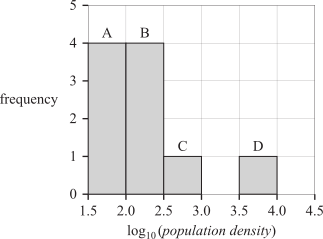
The population density, in people per km², for each of these nations in 2024 is displayed in the histogram below. The histogram has a logarithmic (base 10) scale.
 

Singapore is a member of ASEAN.

In 2024, Singapore's population was 6 028 460 and its total area was 720 km².

In which labelled column does the value of \(\log _{10}\)(population density) for Singapore lie?

  1. \(\text{A}\)
  2. \(\text{B}\)
  3. \(\text{C}\)
  4. \(\text{D}\)
Show Answers Only

\(D\)

Show Worked Solution

\(\text{Population density}\ = \dfrac{6\,028\,460}{720}=8372.86…\ \)

\(\log_{10}(8372.86)=3.92… \)

\(\Rightarrow D\)

♦ Mean mark 52%.

Filed Under: Graphs - Histograms and Other Tagged With: Band 5, smc-644-20-Histograms, smc-644-60-Histogram (log10)

Financial Maths, STD2 EQ-Bank 40

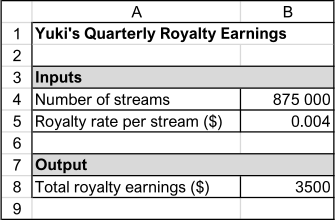
Yuki works as a musician and receives royalties from streaming services. A spreadsheet is used to calculate her quarterly royalty earnings.

Total royalty earnings = Number of streams \(\times\) Royalty rate per stream

A spreadsheet showing Yuki's quarterly royalty earnings is shown.


In the following quarter, Yuki's total royalty earnings were $4200. The royalty rate per stream remained at $0.004. Calculate the number of streams Yuki received that quarter.   (2 marks)

--- 5 WORK AREA LINES (style=lined) ---

Show Answers Only

\(1\,050\,000\)

Show Worked Solution

\(\text{Total royalty earnings (B8)} = $4200\)

\(\text{Royalty rate per stream (B5)}=$0.004\)

\(\text{Let the number of streams (B4)}=N\)

\(\text{Total royalty earnings} = \text{Number of streams} \times\text{Royalty rate per stream}\)

\(\text{B8}\) \(=\text{B4}^*\text{B5}\)
\(4200\) \(=N\times 0.004\)
\(N\) \(=\dfrac{4200}{0.004}\)
  \(=1\,050\,000\)

\(\text{Yuki had 1 050 000 streams in the next quarter}\)

Filed Under: Ways of Earning, Ways of Earning Tagged With: Band 5, smc-6276-30-Piecework/Royalties, smc-6276-60-Spreadsheets, smc-6515-30-Piecework/Royalties, smc-6515-60-Spreadsheets, syllabus-2027

Financial Maths, STD2 EQ-Bank 35

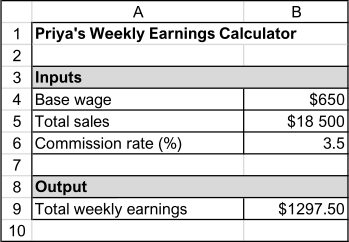
Priya works as a sales representative and earns a base wage plus commission. A spreadsheet is used to calculate her weekly earnings.

Total weekly earnings = Base wage + Total sales \(\times\) Commission rate

A spreadsheet showing Priya's weekly earnings is shown.


  1. Write down the formula used in cell B9, using appropriate grid references.   (1 mark)

    --- 1 WORK AREA LINES (style=lined) ---

  2. In the following week, Priya earned total weekly earnings of $1437.50. Her base wage and commission rate remained unchanged. Calculate Priya's total sales for that week.   (2 marks)

    --- 5 WORK AREA LINES (style=lined) ---

  3. Priya's employer increases her commission rate to 4.2% but keeps her base wage the same. If Priya makes $22 000 in sales, calculate her new total weekly earnings.   (2 marks)

    --- 5 WORK AREA LINES (style=lined) ---

Show Answers Only

a.   \(=\text{B4}+\text{B5}^*\text{B6}/100\)

b.    \($22\, 500\)

c.    \($1574\)

Show Worked Solution

a.   \(\text{Total weekly earnings} = \text{Base wage}+\text{Total sales} \times \text{Commission rate}\)

\(\therefore\ \text{Formula:}\ =\text{B4}+\text{B5}^*\text{B6}/100\)
 

b.   \(\text{Total weekly earnings} = \text{Base wage}+\text{Total sales} \times \text{Commission rate}\)

\(\text{Let the Total sales}=S\)

\(1437.50\) \(=650+S\times \dfrac{3.5}{100}\)
\(787.50\) \(=S\times \dfrac{3.5}{100}\)
\(S\) \(=\dfrac{787.50\times 100}{3.5}=$22\,500\)

 
\(\text{The amount of Priya’s total sales was \$22 500.}\)
 

c.    \(\text{Base wage}=650\)

\(\text{Total sales}=$22\,000\)

\(\text{New commission rate}=4.2\%\)

\(\text{Total weekly earnings}\) \(=650+22\,000\times \dfrac{4.2}{100}\)
  \(=650+924=$1574\)

Filed Under: Ways of Earning, Ways of Earning Tagged With: Band 3, Band 4, Band 5, smc-6276-20-Commission, smc-6276-60-Spreadsheets, smc-6515-20-Commission, smc-6515-60-Spreadsheets, syllabus-2027

Measurement, STD2 M1 2025 HSC 26*

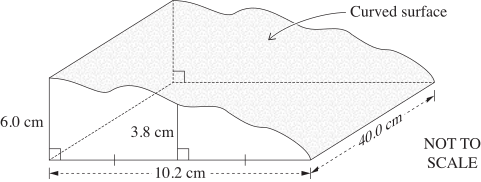
A toy has a curved surface on the top which has been shaded as shown. The toy has a uniform cross-section and a rectangular base.
 

  1. Use two applications of the trapezoidal rule to find an approximate area of the cross-section of the toy.   (2 marks)

    --- 6 WORK AREA LINES (style=lined) ---

  2. The total surface area of the plastic toy is 1300 cm².
  3. What is the approximate area of the curved surface?   (2 marks)

    --- 6 WORK AREA LINES (style=lined) ---

Show Answers Only

a.   \(34.68 \ \text{cm}^2\)

b.   \(582.64 \ \text{cm}^2\)

Show Worked Solution

a.   \(\text{Solution 1}\)

\(A\) \(=\dfrac{5.1}{2}(6.0+3.8) + \dfrac{5.1}{2}(3.8+0) \)  
  \(=34.68\ \text{cm}^2\)  

 
\(\text{Solution 2}\)

\(\begin{array}{|c|c|c|c|}
\hline\rule{0pt}{2.5ex} \quad x \quad \rule[-1ex]{0pt}{0pt}& \quad 0 \quad & \quad 5.1 \quad & \quad 10.2 \quad\\
\hline \rule{0pt}{2.5ex}y \rule[-1ex]{0pt}{0pt}& 6 & 3.8 & 0 \\
\hline
\end{array}\)

\(A\) \(\approx \dfrac{h}{2}\left(y_0+2y_1+y_2\right)\)
  \(\approx \dfrac{5.1}{2}\left(6+2 \times 3.8+0\right)\)
  \(\approx 34.68 \ \text{cm}^2\)


b.    \(\text{Toy has 5 sides.}\)

\(\text{Area of base}=10.2 \times 40=408 \ \text{cm}^2\)

\(\text{Area of rectangle}=6.0 \times 40=240 \ \text{cm}^2\)

\(\text{Approximated areas}=2 \times 34.68=69.36 \ \text{cm}^2\)

\(\therefore \ \text{Area of curved surface}\) \(=1300-(408+240+69.36)=582.64 \ \text{cm}^2\)
♦ Mean mark (b) 48%.

Filed Under: Trapezoidal Rule Tagged With: Band 4, Band 5, smc-6328-25-Surface Area, smc-6328-30-1-3 Approximations

Financial Maths, STD2 EQ-Bank 28

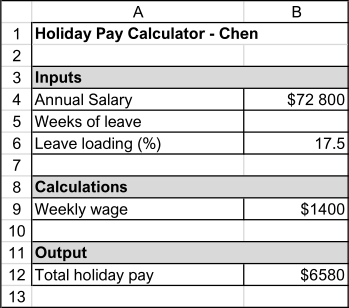
Chen earns an annual salary of $72 800. He is entitled to four weeks annual leave with 17.5% leave loading. A spreadsheet is used to calculate his total holiday pay.

Total holiday pay = 4 × weekly wage + 4 × weekly wage × 17.5%

A spreadsheet showing Chen's holiday pay calculation is shown.

  1. What value from the question should be entered in cell B5?   (1 mark)

    --- 1 WORK AREA LINES (style=lined) ---

  2. Write down the formula used in cell B9 to calculate the weekly wage, using appropriate grid references.   (2 marks)

    --- 2 WORK AREA LINES (style=lined) ---

  3. Verify the amount of Chen's total holiday pay using calculations.   (2 marks)

    --- 5 WORK AREA LINES (style=lined) ---

Show Answers Only

a.   \(4\)

b.   \(=\text{B4}/52\)

c.    \(\text{Total holiday pay}=\text{weekly wage}\times 4 +\ \text{weekly wage}\times 4\ \times 17.5\%\)

\(\text{Total holiday pay}=1400\times 4+1400\times 4\times\dfrac{17.5}{100}=5600+980=$6580\)

Show Worked Solution

a.    \(\text{Chen gets 4 weeks leave }\rightarrow\ 4\)
 

b.    \(\text{Weekly wage }=\dfrac{\text{Annual salary}}{52}\)

\(\text{Formula: }=\text{B4}/52\)
 

c.    \(\text{Total holiday pay}=\text{weekly wage}\times 4 +\ \text{weekly wage}\times 4\ \times 17.5\%\)

\(\text{Total holiday pay}=1400\times 4+1400\times 4\times\dfrac{17.5}{100}=5600+980=$6580\)

Filed Under: Ways of Earning, Ways of Earning Tagged With: Band 2, Band 3, Band 5, smc-6276-10-Wages/Salaries, smc-6276-60-Spreadsheets, smc-6515-10-Wages/Salaries, smc-6515-60-Spreadsheets, syllabus-2027

Financial Maths, STD2 EQ-Bank 15 MC

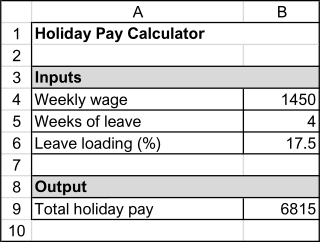
A company calculates holiday pay for employees entitled to four weeks annual leave with 17.5% leave loading on four weeks pay.

A spreadsheet is used to calculate the total holiday pay.
 

Which formula has been used in cell B9?

  1. \(=\text{B4}^*\text{B5}+\text{B4}^*\text{B5}^*\text{B6}\)
  2. \(=\text{B4}^*\text{B5}+\text{B4}^*\text{B5}^*\text{B6}/100\)
  3. \(=\text{B4}^*\text{B5}^*\text{B6}/100\)
  4. \(=\text{B4}+\text{B5}+\text{B6}\)
Show Answers Only

\(B\)

Show Worked Solution

\(\text{Total holiday pay}=\text{weekly wage}\times 4 +\text{weekly wage}\times 4\ \times 17.5\%\)

\(\text{Formula: }\text{weekly wage}\times 4 +\text{weekly wage}\times 4\ \times \dfrac{17.5}{100}\)

\(\text{Using cell references: }=\text{B4}^*\text{B5}+\text{B4}^*\text{B5}^*\text{B6}/100\)

\(\text{Check: }1450\times 4+1450\times 4\times\dfrac{17.5}{100}=5800+1015=6815\)

\(\Rightarrow B\)

Filed Under: Ways of Earning, Ways of Earning Tagged With: Band 5, smc-6276-10-Wages/Salaries, smc-6276-60-Spreadsheets, smc-6515-10-Wages/Salaries, smc-6515-60-Spreadsheets, syllabus-2027

Algebra, STD2 EQ-Bank 29

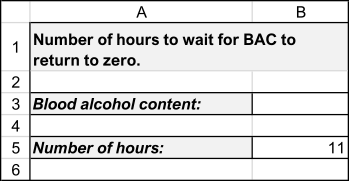
The formula below is used to estimate the number of hours you must wait before your blood alcohol content (BAC) will return to zero after consuming alcohol.

\(\text{Number of hours}\ =\dfrac{\text{BAC}}{0.015}\)

The spreadsheet below has been created by Ben so his 21st birthday attendees can monitor their alcohol consumption if they intend to drive, given their BAC reading. 

  1. By using appropriate grid references, write down a formula that could appear in cell B5.   (2 marks)

    --- 2 WORK AREA LINES (style=lined) ---

  2. Ben's friend Ryan's reading reflects that he will have to wait 11 hours for his BAC to return to zero. Using the formula, calculate the value Ryan entered into cell B3.   (2 marks)

    --- 5 WORK AREA LINES (style=lined) ---

Show Answers Only

a.    \(=\text{B3}/0.015\)

b.    \(0.165\)

Show Worked Solution

a.    \(=\text{B3}/0.015\)

b.    \(11\) \(=\dfrac{\text{BAC}}{0.015}\)
  \(\text{BAC}\) \(=11\times 0.015=0.165\)

  
\(\text{Ryan entered 0.165 into cell B3.}\)

Filed Under: Applications: BAC, D=SxT and Medication, Applications: BAC, Medicine and D=S x T Tagged With: Band 3, Band 5, smc-6235-10-\(BAC\ \) formula, smc-6235-60-Spreadsheets, smc-6509-10-BAC, smc-6509-60-Spreadsheets, syllabus-2027

Algebra, STD2 EQ-Bank 34

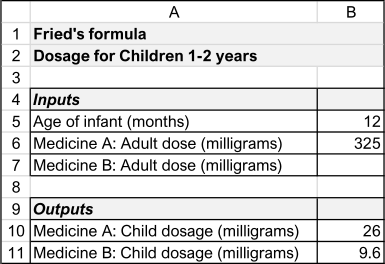
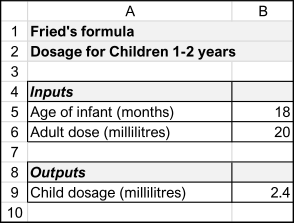
Fried's formula for determining the medicine dosage for children aged 1 - 2 years is:

\(\text{Dosage}=\dfrac{\text{Age of infant (months)}\  \times \ \text{adult dose}}{150}\)

The spreadsheet below is used as a calculator for determining an infant's medicine dosage according to Fried's formula.
 

Amber, a 12 month old child, is being discharged from hospital with two medications. Medicine A has an adult dosage of 325 milligrams and she is to take 26 milligrams. She must also take 9.6 milligrams of Medicine B but the equivalent adult dosage has been left off the spreadsheet.

  1. By using appropriate grid references, write down a formula that could appear in cell B10.   (2 marks)

    --- 1 WORK AREA LINES (style=lined) ---

  2. Calculate the equivalent adult dosage for Medicine B (cell B7) using the information in the spreadsheet.    (2 marks)

    --- 5 WORK AREA LINES (style=lined) ---

Show Answers Only

a.    \(=\text{B5}^*\text{B6}/150\)

b.    \(120 \ \text{milligrams}\)

Show Worked Solution

a.     \(=\text{B5}^*\text{B6}/150\)
 

b.    \(\text{Let} \ A= \text{Adult dose}\)

\(\text{Using given formula:}\)

\(9.6\) \(=\dfrac{12 \times A}{150}\)
\(A\) \(=\dfrac{9.6 \times 150}{12}=120 \ \text{milligrams}\)

Filed Under: Applications: BAC, D=SxT and Medication, Applications: BAC, Medicine and D=S x T Tagged With: Band 4, Band 5, smc-6235-40-Medication Formulas, smc-6235-60-Spreadsheets, smc-6509-30-Medication Formulas, smc-6509-60-Spreadsheets, syllabus-2027

Algebra, STD2 EQ-Bank 12 MC

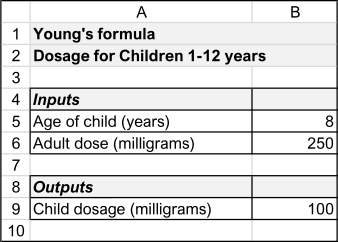
Young's formula for determining the medicine dosage for children aged 1 - 12 years is:

\(\text{Dosage} = \dfrac{\text{Age of child (years)}\ \times\ \text{Adult dose}}{\text{Age of child (years) } +\  12}\)

The spreadsheet below is used as a calculator for determining an child's medicine dosage according to Young's formula.


Young's formula for calculating an 8 year old child's dosage has been used in cell B9. Using appropriate cell references, the correct formula to input into cell B9 is:

  1. \(=\text{B5}^*\text{B6}/\text{B5}+12\)
  2. \(=(\text{B5}^*\text{B6})/\text{B5}+12\)
  3. \(=\text{B5}^*\text{B6}/(\text{B6}+12)\)
  4. \(=(\text{B5}^*\text{B6})/(\text{B5}+12)\)
Show Answers Only

\(D\)

Show Worked Solution

\(=(\text{B5}^*\text{B6})/(\text{B5}+12)\)

\(\Rightarrow D\)

Filed Under: Applications: BAC, D=SxT and Medication, Applications: BAC, Medicine and D=S x T Tagged With: Band 5, smc-6235-40-Medication Formulas, smc-6235-60-Spreadsheets, smc-6509-30-Medication Formulas, smc-6509-60-Spreadsheets, syllabus-2027

Algebra, STD2 EQ-Bank 35

Fried's formula for determining the medicine dosage for children aged 1 - 2 years is:

\(\text{Dosage}=\dfrac{\text{Age of infant (months)}\  \times \ \text{adult dose}}{150}\)

The spreadsheet below is used as a calculator for determining an infant's medicine dosage according to Fried's formula.
 

  1. By using appropriate grid references, write down a formula that could appear in cell B9.   (2 marks)

    --- 1 WORK AREA LINES (style=lined) ---

  2. Another infant requiring the same medicine has been recommended a dosage of 2 millilitres. What is the age of the infant?   (2 marks)

    --- 5 WORK AREA LINES (style=lined) ---

Show Answers Only

a.    \(=\text{B5}^*\text{B6}/150\)

b.    \(15 \ \text{months}\)

Show Worked Solution

a.     \(=\text{B5}^*\text{B6}/150\)
 

b.    \(\text{Let} \ n= \text{age of infant}\)

\(\text{Using given formula:}\)

\(2\) \(=\dfrac{n \times 20}{150}\)
\(n\) \(=\dfrac{2 \times 150}{20}=15 \ \text{months}\)

Filed Under: Applications: BAC, D=SxT and Medication, Applications: BAC, Medicine and D=S x T Tagged With: Band 4, Band 5, smc-6235-40-Medication Formulas, smc-6235-60-Spreadsheets, smc-6509-30-Medication Formulas, smc-6509-60-Spreadsheets, syllabus-2027

Financial Maths, STD2 EQ-Bank 37

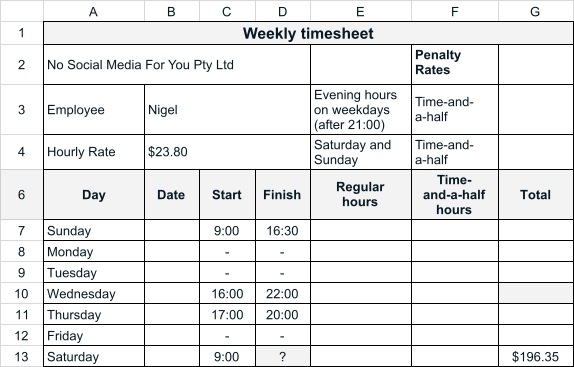
Nigel's weekly wages are calculated using the partially completed spreadsheet below.
 

  1. Calculate the total wages Nigel earned on Wednesday.   (2 marks)

    --- 4 WORK AREA LINES (style=lined) ---

  2. Determine the time Nigel finished work on Saturday, given he earned $196.35 on the day.   (2 marks)

    --- 5 WORK AREA LINES (style=lined) ---

Show Answers Only

a.    \(\text{Total wages}=119.00+35.70=\$ 154.70\)

b.    \(14:30\)

Show Worked Solution

a.    \(\text{Wednesday wages:}\)

\(\text{Regular hours:} \ 5 \times 23.80=\$ 119.00\)

\(\text{Time-and-a-half:} \ 1 \times 1.5 \times 23.80=\$35.70\)

\(\text{Total wages}=119.00+35.70=\$ 154.70\)
 

b.    \(\text{Let \(h=\) total hours worked:}\)

\(\text{Since Saturday wages are time-and-a-half rate:}\)

\(h \times 1.5 \times 23.80\) \(=196.35\)
\(h\) \(=\dfrac{196.35}{1.5 \times 23.80}=5.5\ \text{hours}\)


\(\text{Nigel’s shift started at 09:00 and lasted 5.5 hours.}\)

\(\therefore\ \text{Nigel finished work at 14:30.}\)

Filed Under: Ways of Earning, Ways of Earning Tagged With: Band 4, Band 5, smc-6276-10-Wages/Salaries, smc-6276-60-Spreadsheets, smc-6515-10-Wages/Salaries, smc-6515-60-Spreadsheets, syllabus-2027

Financial Maths, STD2 EQ-Bank 38

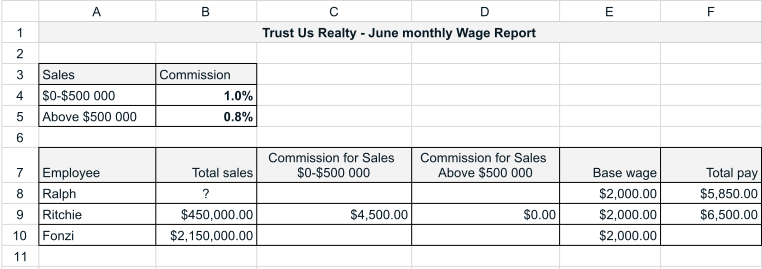
Trust Us Realty has three salespeople, Ralph, Ritchie, and Fonzi.

Their June monthly wages include a base wage and commission earned, which is modelled in the spreadsheet below.

  1. Write down the formula that was used in cell C9, using appropriate grid references.   (1 mark)

    --- 2 WORK AREA LINES (style=lined) ---

  2. Calculate Fonzi's total pay for the month of June.   (2 marks)

    --- 4 WORK AREA LINES (style=lined) ---

  3. Ralph's total pay for June is $5850. Determine Ralph's total sales for the month.   (2 marks)

    --- 4 WORK AREA LINES (style=lined) ---

Show Answers Only

a.    \(=0.01^* \text{B9}\)

b.    \(\$ 20\,200\)

c.    \(\$ 385\,000\)

Show Worked Solution

a.    \(=0.01^* \text{B9}\)
 

b.    \(\text{Fonzi’s Commission:}\)

\(\text{Sales}\ \$0-\$500\,000=0.01 \times 500\,000=\$ 5000\)

\(\text{Sales over} \ \$500\, 000=(2\,150\,000-500\,000) \times 0.008=\$13\,200\)

\(\text{Total June wages}=5000+13\,200+2000=\$ 20\,200\)
 

c.    \(\text{Ralph’s sales commission}\ =5850-2000=\$3850\)

\(\text {Since Ralph earned} \ \$3850 \ \text{in commission:}\)

\(\text{Sales} \times 0.01\) \(=3850\)
\(\text{Sales}\) \(=\dfrac{3850}{0.01}=\$ 385\,000\)

Filed Under: Ways of Earning, Ways of Earning Tagged With: Band 4, Band 5, smc-6276-20-Commission, smc-6276-60-Spreadsheets, smc-6515-20-Commission, smc-6515-60-Spreadsheets, syllabus-2027

Algebra, STD2 EQ-Bank 31

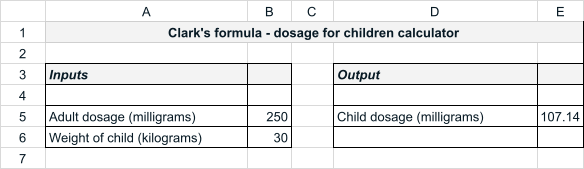
Clark's formula for determining the medicine dosage for children is:

\(\text{Dosage}=\dfrac{\text{weight in kilograms}\  \times \ \text{adult dosage}}{70}\)

The spreadsheet below is used as a calculator for determining a child's medicine dosage according to Clark's formula.
 

  1. By using appropriate grid references, write down a formula that could appear in cell E5.   (2 marks)

    --- 1 WORK AREA LINES (style=lined) ---

  2. Another child requiring the same medicine has been recommended a dosage of 62.5 milligrams. How much does the child weigh?   (2 marks)

    --- 5 WORK AREA LINES (style=lined) ---

Show Answers Only

a.    \(=\text{B6}^*\text{B5}/70\)

b.    \(17.5 \ \text{kilograms}\)

Show Worked Solution

a.    \(=\text{B6}^*\text{B5}/70\)
 

b.    \(\text{Let} \ w= \text{weight of the child.}\)

\(\text{Using given formula:}\)

\(62.5\) \(=\dfrac{w \times 250}{70}\)
\(w\) \(=\dfrac{62.5 \times 70}{250}=17.5 \ \text{kilograms}\)

Filed Under: Applications: BAC, D=SxT and Medication, Applications: BAC, Medicine and D=S x T Tagged With: Band 4, Band 5, smc-6235-40-Medication Formulas, smc-6235-60-Spreadsheets, smc-6509-30-Medication Formulas, smc-6509-60-Spreadsheets, syllabus-2027

Algebra, STD2 EQ-Bank 28

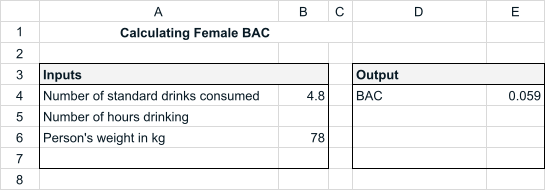
Sharon drinks three glasses of chardonnay over a 180-minute period, each glass containing 1.6 standard drinks.

Sharon weighs 78 kilograms, and her blood alcohol content (BAC) at the end of this period can be calculated using the following formula:

\(\text{BAC}_{\text {female }}=\dfrac{10 N-7.5 H }{5.5 M}\)

where \(N\) = number of standard drinks consumed
\(H\) = the number of hours drinking
\(M\) = the person's mass in kilograms

 
The spreadsheet below can be used to calculate Sharon's \(\text{BAC}\).
 

  1. What value should be input into cell B5.   (1 mark)

    --- 2 WORK AREA LINES (style=lined) ---

  2. Write down the formula that has been used in cell E4, using appropriate grid references.   (2 marks)

    --- 2 WORK AREA LINES (style=lined) ---

Show Answers Only

a.    \(\text{Cell B5 value}=3\)

b.  \(=\left(10^* \text{B4}-7.5^* \text{B5}\right) /(5.5^* \text{B6})\)

Show Worked Solution

a.    \(\text{180 minutes}\ =\ \text{3 hours}\)

\(\therefore \ \text{Cell B5 value}=3\)
 

b.  \(=\left(10^* \text{B4}-7.5^* \text{B5}\right) /(5.5^* \text{B6})\)

Filed Under: Applications: BAC, D=SxT and Medication, Applications: BAC, Medicine and D=S x T Tagged With: Band 3, Band 5, smc-6235-10-\(BAC\ \) formula, smc-6235-60-Spreadsheets, smc-6509-10-BAC, smc-6509-60-Spreadsheets, syllabus-2027

HMS, HAG 2025 HSC 32b

To what extent do THREE factors that create health inequities affect ONE population group in Australia?   ( 12 marks)

--- 27 WORK AREA LINES (style=lined) ---

Show Answers Only

Population group: The aged (65+ years)

Judgement Statement

  • Three factors—access to services, socioeconomic disadvantage and social isolation— create significant health inequities for aged Australians, with compounding effects that substantially reduce health outcomes and quality of life.

Access to Services and Transport

  • Limited access to healthcare services creates major health inequities for older Australians.
  • Rural and remote aged populations face substantial barriers reaching specialist care, diagnostic services and preventative health programs.
  • Transport difficulties compound these issues as declining mobility reduces medical appointment attendance.
  • This results in delayed diagnosis of cardiovascular disease, cancer and dementia related illnesses, increasing mortality rates among the elderly.
  • Fewer preventative visits mean chronic conditions progress undetected whilst inadequate allied health access reduces rehabilitation opportunities.
  • Geographic isolation intensifies these barriers, creating cycles of declining health status compared to urban counterparts.

Socioeconomic Factors

  • Financial constraints significantly affect aged Australians relying solely on age pensions.
  • Lower incomes restrict access to private healthcare, specialists and medications not fully covered by Medicare.
  • Gap payments and medication costs force delays in seeking care, resulting in untreated chronic conditions.
  • This leads to preventable hospitalisations and poorer disease management outcomes.
  • Socioeconomically disadvantaged older adults experience higher rates of inadequate nutrition and poor housing quality, further compromising health.

Social Isolation

  • Social isolation profoundly impacts mental and physical health for older adults living alone following bereavement or family relocation.
  • Reduced social connections correlate strongly with increased depression, anxiety and cognitive decline including dementia progression.
  • Isolation decreases motivation for self-care and physical activity whilst poor housing modifications increase fall risk and injury rates.
  • Limited support networks mean delayed help-seeking when unwell, worsening health outcomes and recovery times.

Reaffirmation

  • These three factors interact substantially to create significant health inequities for aged Australians.
  • The combined effect exceeds individual factors as limited access, financial barriers and isolation reinforce each other.
  • Aged populations experiencing multiple disadvantages demonstrate markedly worse health outcomes including higher chronic disease rates and premature mortality.
Show Worked Solution

Population group: The aged (65+ years)

Judgement Statement

  • Three factors—access to services, socioeconomic disadvantage and social isolation— create significant health inequities for aged Australians, with compounding effects that substantially reduce health outcomes and quality of life.

Access to Services and Transport

  • Limited access to healthcare services creates major health inequities for older Australians.
  • Rural and remote aged populations face substantial barriers reaching specialist care, diagnostic services and preventative health programs.
  • Transport difficulties compound these issues as declining mobility reduces medical appointment attendance.
  • This results in delayed diagnosis of cardiovascular disease, cancer and dementia related illnesses, increasing mortality rates among the elderly.
  • Fewer preventative visits mean chronic conditions progress undetected whilst inadequate allied health access reduces rehabilitation opportunities.
  • Geographic isolation intensifies these barriers, creating cycles of declining health status compared to urban counterparts.

Socioeconomic Factors

  • Financial constraints significantly affect aged Australians relying solely on age pensions.
  • Lower incomes restrict access to private healthcare, specialists and medications not fully covered by Medicare.
  • Gap payments and medication costs force delays in seeking care, resulting in untreated chronic conditions.
  • This leads to preventable hospitalisations and poorer disease management outcomes.
  • Socioeconomically disadvantaged older adults experience higher rates of inadequate nutrition and poor housing quality, further compromising health.

Social Isolation

  • Social isolation profoundly impacts mental and physical health for older adults living alone following bereavement or family relocation.
  • Reduced social connections correlate strongly with increased depression, anxiety and cognitive decline including dementia progression.
  • Isolation decreases motivation for self-care and physical activity whilst poor housing modifications increase fall risk and injury rates.
  • Limited support networks mean delayed help-seeking when unwell, worsening health outcomes and recovery times.

Reaffirmation

  • These three factors interact substantially to create significant health inequities for aged Australians.
  • The combined effect exceeds individual factors as limited access, financial barriers and isolation reinforce each other.
  • Aged populations experiencing multiple disadvantages demonstrate markedly worse health outcomes including higher chronic disease rates and premature mortality.

♦♦ Mean mark 45%.

Filed Under: Groups Experiencing Inequities Tagged With: Band 4, Band 5, smc-5475-10-Determinants interaction, smc-5475-15-Inequity causes, smc-5475-25-Vulnerable groups

HMS, TIP 2025 HSC 31b

Justify THREE elements a coach needs to consider when designing a training session for a sport.   ( 12 marks)

--- 27 WORK AREA LINES (style=lined) ---

Show Answers Only

Sport: Netball

Position Statement:

  • Warm-up, skill instruction and conditioning are essential elements when designing effective training sessions.
  • These elements prepare athletes physically, develop technical competence and build sport-specific fitness for optimal performance.

Warm-Up Preparation:

  • Structured warm-ups prepare athletes physiologically and psychologically for training. Research confirms gradual cardiovascular activation and dynamic stretching increase muscle temperature whilst reducing injury risk.
  • For example, netball players performing 10 minutes jogging at 70% maximum heart rate followed by side-stepping and pivoting experience improved muscle elasticity. This justifies warm-up inclusion because prepared muscles respond effectively to training whilst preventing strains.
  • Athletes completing structured warm-ups demonstrate noticeably better performance quality during skill work, proving warm-up effectiveness in optimising session outcomes.

Skill Instruction and Practice:

  • Deliberate skill instruction develops technical proficiency essential for competitive success. Structured practice with immediate feedback accelerates skill acquisition compared to unguided repetition.
  • Netball coaches implementing progression models—basic chest pass drills advancing to contested passing under defensive pressure—enable athletes to master fundamentals whilst introducing pressure gradually. This justifies systematic instruction because controlled complexity builds confidence and competence simultaneously.
  • Athletes receiving structured instruction show significantly faster technique improvement than those practising without guidance, demonstrating critical importance for training efficiency.

Conditioning for Sport-Specific Fitness:

  • Sport-specific conditioning builds physiological capacities for competition demands. Targeted fitness development enhances performance whilst reducing fatigue-related errors.
  • Combining agility ladder drills with defensive shadowing in netball develops quick directional changes and sustained movement capacity players need. This justifies conditioning because it transfers directly to game performance.
  • Athletes following sport-specific conditioning reportedly maintain higher intensity for longer during competition, supporting conditioning as essential for advantage.
Show Worked Solution

Sport: Netball

Position Statement:

  • Warm-up, skill instruction and conditioning are essential elements when designing effective training sessions.
  • These elements prepare athletes physically, develop technical competence and build sport-specific fitness for optimal performance.

Warm-Up Preparation:

  • Structured warm-ups prepare athletes physiologically and psychologically for training. Research confirms gradual cardiovascular activation and dynamic stretching increase muscle temperature whilst reducing injury risk.
  • For example, netball players performing 10 minutes jogging at 70% maximum heart rate followed by side-stepping and pivoting experience improved muscle elasticity. This justifies warm-up inclusion because prepared muscles respond effectively to training whilst preventing strains.
  • Athletes completing structured warm-ups demonstrate noticeably better performance quality during skill work, proving warm-up effectiveness in optimising session outcomes.

Skill Instruction and Practice:

  • Deliberate skill instruction develops technical proficiency essential for competitive success. Structured practice with immediate feedback accelerates skill acquisition compared to unguided repetition.
  • Netball coaches implementing progression models—basic chest pass drills advancing to contested passing under defensive pressure—enable athletes to master fundamentals whilst introducing pressure gradually. This justifies systematic instruction because controlled complexity builds confidence and competence simultaneously.
  • Athletes receiving structured instruction show significantly faster technique improvement than those practising without guidance, demonstrating critical importance for training efficiency.

Conditioning for Sport-Specific Fitness:

  • Sport-specific conditioning builds physiological capacities for competition demands. Targeted fitness development enhances performance whilst reducing fatigue-related errors.
  • Combining agility ladder drills with defensive shadowing in netball develops quick directional changes and sustained movement capacity players need. This justifies conditioning because it transfers directly to game performance.
  • Athletes following sport-specific conditioning reportedly maintain higher intensity for longer during competition, supporting conditioning as essential for advantage.

♦♦ Mean mark 37%.

Filed Under: Individual vs group programs Tagged With: Band 4, Band 5, smc-5463-20-Sports specific

HMS, TIP 2025 HSC 30b

Justify the use of heat and cold and progressive mobilisation as rehabilitation procedures for a shoulder dislocation.   ( 12 marks)

--- 27 WORK AREA LINES (style=lined) ---

Show Answers Only

Position Statement:

  • Heat and cold therapy combined with progressive mobilisation provides optimal rehabilitation for shoulder dislocations.
  • These procedures effectively manage inflammation whilst restoring range of motion and facilitating safe return to function.

Cold Therapy in Acute Phase:

  • Immediate cold application reduces inflammatory response and controls swelling after dislocation. Evidence confirms cold constricts blood vessels, limiting fluid accumulation around damaged tissue.
  • Research shows applying ice for 15-20 minutes every two hours during first 48-72 hours significantly decreases pain and tissue damage. This demonstrates cold therapy’s effectiveness in protecting injured structures during the acute inflammatory phase.
  • Cold application enables earlier mobilisation by controlling pain and swelling. Athletes experience reduced discomfort, allowing gentle movement exercises to begin sooner whilst preventing excessive inflammation that delays healing. This justifies cold as essential for initial injury management.

Heat Application in Later Stages:

  • After initial inflammation subsides (typically 72 hours post-injury), heat therapy increases blood flow to promote tissue repair. Studies indicate heat dilates vessels, delivering oxygen and nutrients essential for healing damaged ligaments and capsule tissue.
  • Heat application before mobilisation exercises improves muscle elasticity and joint flexibility. Evidence shows warming tissues reduces stiffness, allowing greater range of movement during rehabilitation exercises without causing re-injury or excessive discomfort.

Progressive Mobilisation Throughout Recovery:

  • Progressive mobilisation systematically restores shoulder function through graduated exercises matched to healing stages. This approach begins with passive pendulum movements, advancing to active-assisted exercises, then resistance training as tissue strength develops.
  • Evidence demonstrates controlled movement prevents joint stiffness, maintains neuromuscular patterns and reduces muscle atrophy that prolonged immobilisation causes.
  • Athletes following progressive protocols can achieve full range of motion faster than those using rest alone.

Reinforcement:

  • Some argue rest alone suffices for recovery. However, research consistently demonstrates controlled movement combined with appropriate thermal therapy optimises healing timeframes whilst minimising complications.
  • This evidence-based protocol remains valid because it addresses both tissue healing requirements and functional restoration needs.
  • The combined approach facilitates complete recovery whilst significantly reducing re-dislocation risk during return to sport.
Show Worked Solution

Position Statement:

  • Heat and cold therapy combined with progressive mobilisation provides optimal rehabilitation for shoulder dislocations.
  • These procedures effectively manage inflammation whilst restoring range of motion and facilitating safe return to function.

Cold Therapy in Acute Phase:

  • Immediate cold application reduces inflammatory response and controls swelling after dislocation. Evidence confirms cold constricts blood vessels, limiting fluid accumulation around damaged tissue.
  • Research shows applying ice for 15-20 minutes every two hours during first 48-72 hours significantly decreases pain and tissue damage. This demonstrates cold therapy’s effectiveness in protecting injured structures during the acute inflammatory phase.
  • Cold application enables earlier mobilisation by controlling pain and swelling. Athletes experience reduced discomfort, allowing gentle movement exercises to begin sooner whilst preventing excessive inflammation that delays healing. This justifies cold as essential for initial injury management.

Heat Application in Later Stages:

  • After initial inflammation subsides (typically 72 hours post-injury), heat therapy increases blood flow to promote tissue repair. Studies indicate heat dilates vessels, delivering oxygen and nutrients essential for healing damaged ligaments and capsule tissue.
  • Heat application before mobilisation exercises improves muscle elasticity and joint flexibility. Evidence shows warming tissues reduces stiffness, allowing greater range of movement during rehabilitation exercises without causing re-injury or excessive discomfort.

Progressive Mobilisation Throughout Recovery:

  • Progressive mobilisation systematically restores shoulder function through graduated exercises matched to healing stages. This approach begins with passive pendulum movements, advancing to active-assisted exercises, then resistance training as tissue strength develops.
  • Evidence demonstrates controlled movement prevents joint stiffness, maintains neuromuscular patterns and reduces muscle atrophy that prolonged immobilisation causes.
  • Athletes following progressive protocols can achieve full range of motion faster than those using rest alone.

Reinforcement:

  • Some argue rest alone suffices for recovery. However, research consistently demonstrates controlled movement combined with appropriate thermal therapy optimises healing timeframes whilst minimising complications.
  • This evidence-based protocol remains valid because it addresses both tissue healing requirements and functional restoration needs.
  • The combined approach facilitates complete recovery whilst significantly reducing re-dislocation risk during return to sport.

♦♦ Mean mark 52%.

Filed Under: Management/prevention of injuries Tagged With: Band 4, Band 5, smc-5472-25-Rehab/return-to-play

HMS, HIC 2025 HSC 28aii

Explain how becoming involved in community service can assist young people in attaining better health.  ( 5 marks)

--- 15 WORK AREA LINES (style=lined) ---

Show Answers Only
  • Community service creates opportunities for social connection with like-minded peers. This occurs when young people work alongside others towards shared goals in volunteer settings.
  • For example, a young person volunteering at environmental clean-up events develops teamwork and communication abilities. As a result, their social health improves through new friendships and increased confidence in group interactions.
  • Volunteering enhances mental health by providing sense of purpose and direction. This happens because contributing meaningfully to community needs generates feelings of value and belonging.
  • For instance, a young person supporting elderly residents through hospital visits experiences improved emotional wellbeing. The reason for this is that helping others creates perspective on personal challenges whilst building resilience through meaningful relationships.
  • Community service leads to increased physical activity in many volunteer roles. Consequently, young people gain health benefits from active engagement rather than sedentary screen time.
Show Worked Solution
  • Community service creates opportunities for social connection with like-minded peers. This occurs when young people work alongside others towards shared goals in volunteer settings.
  • For example, a young person volunteering at environmental clean-up events develops teamwork and communication abilities. As a result, their social health improves through new friendships and increased confidence in group interactions.
  • Volunteering enhances mental health by providing sense of purpose and direction. This happens because contributing meaningfully to community needs generates feelings of value and belonging.
  • For instance, a young person supporting elderly residents through hospital visits experiences improved emotional wellbeing. The reason for this is that helping others creates perspective on personal challenges whilst building resilience through meaningful relationships.
  • Community service leads to increased physical activity in many volunteer roles. Consequently, young people gain health benefits from active engagement rather than sedentary screen time.

♦♦ Mean mark 51%.

Filed Under: Strengthening, protecting and enhancing health Tagged With: Band 4, Band 5, smc-5511-30-Social connection/ethics, smc-5511-40-Skills application/impact

HMS, HIC 2025 HSC 27

Explain the responsibilities of individuals, communities and governments in creating supportive environments to promote health. Support your answer with examples.  ( 8 marks)

--- 26 WORK AREA LINES (style=lined) ---

Show Answers Only

Individual Responsibilities:

  • Individuals must adopt health-promoting behaviours that create safe environments for themselves and others. This occurs when people apply health literacy to make informed decisions.
  • For example, a parent choosing active transport to school reduces vehicle emissions and models healthy physical activity patterns. This leads to improved air quality and encourages children to adopt active lifestyles.

Community Responsibilities:

  • Communities must advocate for and support their members through accessible programs and resources. This enables individuals to access culturally appropriate health services.
  • For instance, neighbourhood walking groups organised by local councils provide social connection and physical activity opportunities. Consequently, participants experience improved mental and physical health through regular engagement and peer support networks.

Government Responsibilities:

  • Governments must develop and enforce policies that facilitate health-promoting environments. This works through legislation creating safe public spaces and restricting harmful exposures.
  • For example, mandatory bicycle helmet laws and dedicated cycling infrastructure protect cyclists from injury whilst encouraging active transport adoption. As a result, communities experience reduced traffic congestion, improved air quality and increased population physical activity levels.

Collective Impact:

  • These responsibilities work together to create comprehensive supportive environments. The significance is that sustained health improvements require coordinated action across all three levels rather than isolated individual efforts.
Show Worked Solution

Individual Responsibilities:

  • Individuals must adopt health-promoting behaviours that create safe environments for themselves and others. This occurs when people apply health literacy to make informed decisions.
  • For example, a parent choosing active transport to school reduces vehicle emissions and models healthy physical activity patterns. This leads to improved air quality and encourages children to adopt active lifestyles.

Community Responsibilities:

  • Communities must advocate for and support their members through accessible programs and resources. This enables individuals to access culturally appropriate health services.
  • For instance, neighbourhood walking groups organised by local councils provide social connection and physical activity opportunities. Consequently, participants experience improved mental and physical health through regular engagement and peer support networks.

Government Responsibilities:

  • Governments must develop and enforce policies that facilitate health-promoting environments. This works through legislation creating safe public spaces and restricting harmful exposures.
  • For example, mandatory bicycle helmet laws and dedicated cycling infrastructure protect cyclists from injury whilst encouraging active transport adoption. As a result, communities experience reduced traffic congestion, improved air quality and increased population physical activity levels.

Collective Impact:

  • These responsibilities work together to create comprehensive supportive environments. The significance is that sustained health improvements require coordinated action across all three levels rather than isolated individual efforts.

Filed Under: Models of health promotion Tagged With: Band 4, Band 5, smc-5515-10-Ottawa Charter, smc-5515-20-Policy legislation

HMS, TIP 2025 HSC 26

Analyse the relationship between training thresholds and TWO physiological adaptations. In your answer, provide examples of both aerobic and resistance training.  (8 marks)

--- 24 WORK AREA LINES (style=lined) ---

Show Answers Only

Overview Statement:

  • Training thresholds represent critical intensity levels that trigger specific physiological adaptations.
  • Understanding how aerobic and resistance thresholds connect to metabolic and muscular changes can open up pathways to enhanced athletic performance.

Aerobic Threshold and Cardiovascular Adaptations:

  • The aerobic training threshold occurs at approximately 70% of maximum heart rate. Training at this intensity influences fuel utilisation and cardiovascular function.
  • This causes the body to shift from primarily using fat to using carbohydrates for energy. For example, a marathon runner training at 70% max heart rate stimulates this metabolic adaptation.
  • The threshold also triggers increased stroke volume through enhanced left ventricle filling capacity. This relationship results in improved cardiac output and oxygen delivery to working muscles.
  • Consequently, athletes sustain effort over extended periods with greater efficiency. This shows that aerobic threshold training enables both metabolic and cardiovascular improvements for endurance performance.

Resistance Threshold and Muscular Adaptations:

  • Resistance training thresholds involve working at 70-85% of one-rep maximum with 6-12 repetitions. This intensity creates sufficient mechanical stress to stimulate muscle hypertrophy.
  • For instance, a weightlifter performing squats at 80% of 1RM bmicroscopic muscle fibre damage. This initiates increased protein synthesis and muscle repair processes.
  • The threshold works through progressive overload that leads to enlarged muscle fibres with increased actin and myosin filaments. As a result, greater force production capacity develops.
  • The significance is that athletes gain strength and power output essential for explosive movements.

Implications and Synthesis:

  • These thresholds work together as intensity markers that determine adaptation type. Aerobic thresholds influence metabolic and cardiovascular systems whilst resistance thresholds affect muscular structure.
  • Therefore, coaches must apply appropriate threshold intensities to achieve specific performance goals. This reveals that training success depends on understanding the precise relationship between intensity levels and resulting physiological changes.
Show Worked Solution

Overview Statement:

  • Training thresholds represent critical intensity levels that trigger specific physiological adaptations.
  • Understanding how aerobic and resistance thresholds connect to metabolic and muscular changes can open up pathways to enhanced athletic performance.

Aerobic Threshold and Cardiovascular Adaptations:

  • The aerobic training threshold occurs at approximately 70% of maximum heart rate. Training at this intensity influences fuel utilisation and cardiovascular function.
  • This causes the body to shift from primarily using fat to using carbohydrates for energy. For example, a marathon runner training at 70% max heart rate stimulates this metabolic adaptation.
  • The threshold also triggers increased stroke volume through enhanced left ventricle filling capacity. This relationship results in improved cardiac output and oxygen delivery to working muscles.
  • Consequently, athletes sustain effort over extended periods with greater efficiency. This shows that aerobic threshold training enables both metabolic and cardiovascular improvements for endurance performance.

Resistance Threshold and Muscular Adaptations:

  • Resistance training thresholds involve working at 70-85% of one-rep maximum with 6-12 repetitions. This intensity creates sufficient mechanical stress to stimulate muscle hypertrophy.
  • For instance, a weightlifter performing squats at 80% of 1RM bmicroscopic muscle fibre damage. This initiates increased protein synthesis and muscle repair processes.
  • The threshold works through progressive overload that leads to enlarged muscle fibres with increased actin and myosin filaments. As a result, greater force production capacity develops.
  • The significance is that athletes gain strength and power output essential for explosive movements.

Implications and Synthesis:

  • These thresholds work together as intensity markers that determine adaptation type. Aerobic thresholds influence metabolic and cardiovascular systems whilst resistance thresholds affect muscular structure.
  • Therefore, coaches must apply appropriate threshold intensities to achieve specific performance goals. This reveals that training success depends on understanding the precise relationship between intensity levels and resulting physiological changes.

♦♦ Mean mark 36%.

Filed Under: Physiological adaptations and improved performance, Principles of training Tagged With: Band 4, Band 5, Band 6, smc-5460-10-Thresholds, smc-5461-10-Cardio adaptations, smc-5461-30-Muscular adaptations

Probability, 2ADV EQ-Bank 25

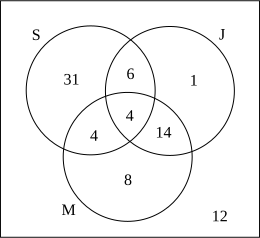
In Year 11 there are 80 students. The students may choose to study Spanish (S), Japanese (J) and Mandarin (M).

The Venn diagram shows their choices.


Two of the students are selected at random.

  1. What is the probability that both students study only Spanish?   (2 marks)

    --- 6 WORK AREA LINES (style=lined) ---

  2. What is the probability that at least one of the students studies two languages.   (2 marks)

    --- 6 WORK AREA LINES (style=lined) ---

Show Answers Only

a.    \(\dfrac{93}{632}\)

b.   \(\dfrac{81}{158} \)

Show Worked Solution

a.    \(\text{Students only studying Spanish = 31}\)

\(P(\text{both study only Spanish})\ =\dfrac{31}{80} \times \dfrac{30}{79} = \dfrac{93}{632}\)
 

b.   \(\text{1st student chosen:}\)

\(P(2L) =\dfrac{6+4+14}{80} = \dfrac{24}{80}\ \ \Rightarrow\ \ P(\overline{2L})=\dfrac{56}{80} \)

\(\text{2nd student chosen:}\)

\(P(\overline{2L})=\dfrac{55}{79} \)
 

\(P(\text{at least one studies two languages})\)

\(= 1- P(\text{both don’t study two languages)}\)

\(=1-\dfrac{56}{80} \times \dfrac{55}{79} \)

\(=\dfrac{81}{158} \)

Filed Under: Conditional Probability and Venn Diagrams Tagged With: Band 4, Band 5, smc-6470-20-Venn Diagrams

Functions, 2ADV EQ-Bank 28

The cost of hiring an open space for a music festival is  $120 000. The cost will be shared equally by the people attending the festival, so that `C` (in dollars) is the cost per person when `n` people attend the festival.

  1. Complete the table below and draw the graph showing the relationship between `n` and `C`.   (2 marks)
    \begin{array} {|l|c|c|c|c|c|c|}
    \hline
    \rule{0pt}{2.5ex}\text{Number of people} (n) \rule[-1ex]{0pt}{0pt} & \ 500\ & \ 1000 \ & 1500 \ & 2000 \ & 2500\ & 3000 \ \\
    \hline
    \rule{0pt}{2.5ex}\text{Cost per person} (C)\rule[-1ex]{0pt}{0pt} &  &  &  & 60 & 48\ & 40 \ \\
    \hline
    \end{array}


  2. What equation represents the relationship between `n` and `C`?   (1 mark)

    --- 1 WORK AREA LINES (style=lined) ---

  3. Give ONE limitation of this equation in relation to this context.   (1 mark)

    --- 2 WORK AREA LINES (style=lined) ---

Show Answers Only

a.   

\begin{array} {|l|c|c|c|c|c|c|}
\hline
\rule{0pt}{2.5ex}\text{Number of people} (n) \rule[-1ex]{0pt}{0pt} & \ 500\ & \ 1000 \ & 1500 \ & 2000 \ & 2500\ & 3000 \ \\
\hline
\rule{0pt}{2.5ex}\text{Cost per person} (C)\rule[-1ex]{0pt}{0pt} & 240 & 120 & 80 & 60 & 48\ & 40 \ \\
\hline
\end{array}

b.   `C = (120\ 000)/n` 

c.   `text(Limitations can include:)`

  `•\ n\ text(must be a whole number)`

  `•\ C > 0`

Show Worked Solution

a.   

\begin{array} {|l|c|c|c|c|c|c|}
\hline
\rule{0pt}{2.5ex}\text{Number of people} (n) \rule[-1ex]{0pt}{0pt} & \ 500\ & \ 1000 \ & 1500 \ & 2000 \ & 2500\ & 3000 \ \\
\hline
\rule{0pt}{2.5ex}\text{Cost per person} (C)\rule[-1ex]{0pt}{0pt} & 240 & 120 & 80 & 60 & 48\ & 40 \ \\
\hline
\end{array}

b.   `C = (120\ 000)/n` 

c.   `text(Limitations can include:)`

  `•\ n\ text(must be a whole number)`

  `•\ C > 0`

Filed Under: Other Functions and Relations Tagged With: Band 3, Band 4, Band 5, smc-6218-30-Reciprocal

HMS, TIP 2025 HSC 18 MC

An elite athlete is training to enhance their muscular strength.

Which of the following approaches best demonstrates progressive overload for increased strength? (RM = repetition maximum)

  1. Adding exercises while performing four sets of eight repetitions at 60% of one RM
  2. Alternating between 80% and 90% of one RM weekly for three sets of 12 repetitions
  3. Starting with weights at 50% of one RM and gradually increasing the total repetitions each week repetitions each week 
  4. Adjusting the resistance from 80% to 90% of one RM, performing three to five sets of four to six repetitions
Show Answers Only

\(D\)

Show Worked Solution
  • D is correct: Progressive resistance increase (80% to 90% 1RM) with low reps (4-6) targets absolute strength development

Other Options:

  • A is incorrect: 60% 1RM with 8 reps develops muscular endurance, not maximal strength; adding exercises doesn’t increase load
  • B is incorrect: Alternating loads weekly lacks progressive overload; 12 reps targets endurance rather than strength
  • C is incorrect: Starting at 50% 1RM and increasing repetitions develops endurance, not strength; requires higher loads

♦♦ Mean mark 43%.

Filed Under: Principles of training Tagged With: Band 5, smc-5460-10-Thresholds

HMS, TIP 2025 HSC 14 MC

Which row in the table describes both a valid and reliable test for measuring the speed of an athlete?

\begin{align*}
\begin{array}{l}
\rule{0pt}{2.5ex} \ \rule[-1ex]{0pt}{0pt}&  \\
\textbf{}\ \rule[-1ex]{0pt}{0pt}& \\
\rule{0pt}{2.5ex}  \textbf{A.}\ \rule[-1ex]{0pt}{0pt}&\\
\textbf{}\ \rule[-1ex]{0pt}{0pt}& \\
\rule{0pt}{2.5ex}  \textbf{B.} \ \rule[-1ex]{0pt}{0pt}&\\
\textbf{} \ \rule[-1ex]{0pt}{0pt}&\\
\rule{0pt}{2.5ex}  \textbf{C.} \ \rule[-1ex]{0pt}{0pt}& \\
\textbf{} \ \rule[-1ex]{0pt}{0pt}& \\
\rule{0pt}{2.5ex}  \rule{0pt}{2.5ex}  \textbf{D.} \ \rule[-1ex]{0pt}{0pt}& \\
\textbf{}\ \rule[-1ex]{0pt}{0pt}& \\
\end{array}
\begin{array}{|l|l|}
\hline
\rule{0pt}{2.5ex} \ \ \ \ \ Athlete \rule[-1ex]{0pt}{0pt} &\ \ \ \ \ \ \ Test  \rule[-1ex]{0pt}{0pt} & \ \ \ \ \ \ \ \ \ \ \ \ \ \ \ \ \ \ \ \ \ \ \ \ Result  \\
\hline
\rule{0pt}{2.5ex}\text{100 m sprinter} & \text{Reaction time} & \text{There are changes in the athlete’s sprint} \\
\text{} &\text{to starter } &\text{times.} \\
\hline
\rule{0pt}{2.5ex}\text{100 m sprinter} &\text{Reaction time}  & \text{Results are consistent across multiple} \\
\text{} & \text{to starter} & \text{training sessions.} \\
\hline
\rule{0pt}{2.5ex} \text{Midfielder in } & \text{40 m sprint } & \text{There are changes in the athlete’s sprint} \\
 \text{soccer } &\text{choice} & \text{times.} \\
\hline
\rule{0pt}{2.5ex}\text{Midfielder in } & \text{40 m sprint } & \text{Results are consistent across multiple} \\
\text{soccer } &\text{choice} & \text{training sessions. } \\
\hline
\end{array}
\end{align*}

Show Answers Only

\(D\)

Show Worked Solution
  • D is correct: 40m sprint test is valid (measures speed); consistent results demonstrate reliability

Other Options:

  • A is incorrect: Reaction time measures response speed, not running speed (lacks validity)
  • B is incorrect: Reaction time test is not valid for measuring running speed
  • C is incorrect: Changes in sprint times indicate inconsistent results (lacks reliability)

♦♦ Mean mark 50%.

Filed Under: Performance/fitness testing Tagged With: Band 5, smc-5457-30-Specific tests

HMS, BM 2025 HSC 13 MC

Which of the following best demonstrates how the characteristics of the learner can influence their progression through to the associative stage of skill acquisition?

  1. A swimmer relies on their heredity traits and confidence to improve their freestyle technique.
  2. A gymnast performs a routine, relying on additional practice and feedback from their coach.
  3. A basketball player learns the technique of shooting by relying on demonstrations but gives up easily.
  4. A tennis player is struggling to return serves, due to limited confidence and inconsistent attention.
Show Answers Only

\(A\)

Show Worked Solution
  • A is correct: Heredity traits and confidence are learner characteristics enabling progression from cognitive to associative stage

Other Options:

  • B is incorrect: Practice and feedback are teaching methods, not learner characteristics influencing progression
  • C is incorrect: Giving up easily indicates failure to progress beyond cognitive stage, not advancement
  • D is incorrect: Struggling with limited confidence shows barriers preventing progression, not successful advancement

♦♦♦ Mean mark 36%.

Filed Under: Characteristics of learners, Stages of learning Tagged With: Band 5, smc-5534-60-Identify characteristics, smc-5921-20-Associative

HMS, HAG 2025 HSC 12 MC

Which of the following lists only non-institutional health facilities or services?

  1. Dentists, nursing homes and public hospitals
  2. Dentists, general practitioners and pharmaceutical services
  3. General practitioners, physiotherapists and public hospitals
  4. Nursing homes, pharmaceutical services and physiotherapists
Show Answers Only

\(B\)

Show Worked Solution
  • B is correct: Dentists, GPs and pharmacies are all non-institutional services operating outside residential/hospital facilities

Other Options:

  • A is incorrect: Nursing homes and public hospitals are institutional facilities requiring overnight/residential care
  • C is incorrect: Public hospitals are institutional facilities providing inpatient care and accommodation
  • D is incorrect: Nursing homes are institutional facilities providing residential aged care with overnight stays

♦♦ Mean mark 45%.

Filed Under: Healthcare System effectiveness Tagged With: Band 5, smc-5479-05-Healthcare roles

HMS, HAG 2025 HSC 9 MC

Which of the following is a circulatory disease which causes the blood vessels to narrow, resulting in blockages that reduce the delivery of oxygen to the limbs, kidneys and stomach?

  1. Angina
  2. Coronary heart disease
  3. Cerebrovascular disease
  4. Peripheral vascular disease
Show Answers Only

\(D\)

Show Worked Solution
  • D is correct: Peripheral vascular disease affects blood vessels supplying limbs, kidneys and stomach with narrowed arteries

Other Options:

  • A is incorrect: Angina is chest pain symptom from reduced heart blood flow, not systemic vessel narrowing
  • B is incorrect: Coronary heart disease affects heart arteries specifically, not peripheral vessels to limbs/organs
  • C is incorrect: Cerebrovascular disease affects brain blood vessels, not limbs, kidneys or stomach circulation

♦♦ Mean mark 40%.

Filed Under: Chronic Conditions, Diseases and Injury Tagged With: Band 5, smc-5477-05-Cardiovascular disease

HMS, BM 2025 HSC 6 MC

A golfer is practising hitting the ball.

Which of the following best describes the nature of the skill?

  1. Fine, discrete and self-paced
  2. Gross, discrete and self-paced
  3. Fine, serial and externally paced
  4. Gross, serial and externally paced
Show Answers Only

\(B\)

Show Worked Solution
  • B is correct: A golf swing uses large muscle groups, has clear beginning/end, controlled by performer’s timing.

Other Options:

  • A is incorrect: Fine motor skills involve small muscles; golf requires large muscle coordination.
  • C is incorrect: Serial skills link multiple actions; golf swing is single distinct movement.
  • D is incorrect: Externally paced means environment controls timing; golfer controls swing initiation.

♦♦ Mean mark 44%.

Filed Under: Characteristics of skills Tagged With: Band 5, smc-5922-20-Gross/Fine, smc-5922-30-Discrete/Serial/Continuous, smc-5922-40-Self and externally paced

Functions, 2ADV EQ-Bank 28

Given \(p\) and \(q\) are rational numbers, and  \(p, q \neq 0\), show

\(px^2-(p+q) x+q=0\)

has rational roots.   (3 marks)

--- 10 WORK AREA LINES (style=lined) ---

Show Answers Only

\(\text{Proof (See Worked Solution)}\)

Show Worked Solution
\(\Delta\) \(=b^2-4 a c\)
  \(=[-(p+q)]^2-4 \times p \times q\)
  \(=p^2+2 p q+q^2-4 p q\)
  \(=p^2-2 p q+q^2\)
  \(=(p-q)^2\)


\(\text{Roots of equation using quadratic formula:}\)

\(x\) \(=\dfrac{(p+q) \pm \sqrt{(p-q)^2}}{2 p}\)
  \(=\dfrac{p+q+(p-q)}{2 p} \ \ \text{or} \ \ \dfrac{p+q-(p-q)}{2 p}\)
  \(=1 \ \ \text{or} \ \ \dfrac{q}{p}\).


\(\text{Since \(p, q\) are rational, all roots are rational.}\)

Filed Under: Quadratics and Cubic Functions Tagged With: Band 5, smc-6215-80-Discriminant

Financial Maths, STD2 EQ-Bank 29

A used car is for sale at $19 500. Priya purchases it using a finance package with a 15% deposit and weekly repayments of $143.27 for 3 years.

What is the interest Priya will pay?   (3 marks)

--- 6 WORK AREA LINES (style=lined) ---

Show Answers Only

\($5775.12\)

Show Worked Solution

\(\text{Deposit}=\dfrac{15}{100}\times 19\,500=$2925\)

\(\text{Weeks in 3 years}=3\times 52=156\)

\(\text{Total repayments}=156\times 143.27=$22\,350.12\)

\(\text{Total cost}=2925+22\,350.12=$25\,275.12\)

\(\therefore\ \text{Interest paid}=25\,275.12-19\,500=$5775.12\)

Filed Under: Purchasing Goods, Purchasing Goods Tagged With: Band 5, smc-6278-35-Buy Now/Pay Later, smc-6517-35-Buy Now/Pay Later

Financial Maths, STD2 EQ-Bank 30

A smart TV is for sale at $2850. Liam purchases it using a finance package with a 20% deposit and monthly repayments of $87.63 for 3 years.

What is the interest Liam will pay?   (3 marks)

--- 6 WORK AREA LINES (style=lined) ---

Show Answers Only

\($874.68\)

Show Worked Solution

\(\text{Deposit}=\dfrac{20}{100}\times 2850=$570\)

\(\text{Months in 3 years}=3\times 12=36\)

\(\text{Total repayments}=36\times 87.63=$3154.68\)

\(\text{Total cost}=570+3154.68=$3724.68\)

\(\therefore\ \text{Interest paid}=3724.68-2850=$874.68\)

Filed Under: Purchasing Goods, Purchasing Goods Tagged With: Band 5, smc-6278-35-Buy Now/Pay Later, smc-6517-35-Buy Now/Pay Later

Financial Maths, STD2 EQ-Bank 12 MC

Tom purchased a car using a finance package. He paid a deposit of $6500 and the total amount he paid for the car was $38 900. The loan was for 4 years with equal monthly repayments.

What was Tom's monthly repayment?

  1. $675
  2. $810
  3. $8100
  4. $9725
Show Answers Only

\(A\)

Show Worked Solution
\(\text{Total repayments:}\) \(=\text{Total amount paid}-\text{Deposit}\)
  \(=38\,900-6500\)
  \(=$32\,400\)

 
\(\text{Number of repayments}=4\times 12=48\)

\(\text{Monthly repayment:}=\dfrac{32\,400}{48}=$675\ \text{per month}\)

\(\Rightarrow A\)

Filed Under: Purchasing Goods, Purchasing Goods Tagged With: Band 5, smc-6278-35-Buy Now/Pay Later, smc-6517-35-Buy Now/Pay Later

Functions, 2ADV EQ-Bank 8 MC

The equation  `(p-1)x^2 + 4x = 5-p`  has no real roots when

  1. `p^2-6p + 6 < 0`
  2. `p^2-6p + 1 > 0`
  3. `p^2-6p-6 < 0`
  4. `p^2-6p + 1 < 0`
Show Answers Only

`B`

Show Worked Solution

`(p-1)x^2 + 4x + (p-5) = 0`

 
`text(No real solutions when)\ \ Δ<0:`

`b^2-4ac` `<0`
`4^2-4 (p-1)(p-5)` `< 0`
`16-4(p^2-6p+5)` `<0`
`−4p^2 + 24p-4` `< 0`
`p^2-6p + 1` `> 0`

 
`=> B`

Filed Under: Quadratics and Cubic Functions Tagged With: Band 5, smc-6215-80-Discriminant

Functions, 2ADV EQ-Bank 9 MC

The graphs of  `y = mx + c`  and  `y = ax^2`  will have no points of intersection for all values of `m, c` and `a` such that

  1. `a > 0 and c > 0`
  2. `m > 0 and c > 0`
  3. `a > 0 and c > -m^2/(4a)`
  4. `a < 0 and c > -m^2/(4a)`
Show Answers Only

`D`

Show Worked Solution

`text(Intersect when:)`

`mx + c` `= ax^2`
`ax^2-mx-c` `= 0`

 
`text(S)text(ince no points of intersection:)`

`Delta` `< 0`
`m^2-4a(−c)` `< 0`
`m^2 + 4ac` `< 0`

 
`text(Solve for)\ c:`

`:.\ c > (−m^2)/(4a),quada < 0`

`text(or)`

`c < (−m^2)/(4a),quada > 0`

`=>   D`

Filed Under: Quadratics and Cubic Functions Tagged With: Band 5, smc-6215-80-Discriminant

Algebra, STD2 EQ-Bank 38

A train departs from Town X at 1:00 pm to travel to Town Y. Its average speed for the journey is 80 km/h, and it arrives at 4:00 pm. A second train departs from Town X at 1:20 pm and arrives at Town Y at 3:30 pm.

What is the average speed of the second train? Give your answer to the nearest kilometre per hour.   (2 marks)

--- 5 WORK AREA LINES (style=lined) ---

Show Answers Only

\(\text{111 km/h}\)

Show Worked Solution

\(\text{Distance between towns X and Y using first train}\)

\(\text{Time taken by first train = 3 hours}\)

\(\text{Distance}=\text{speed}\times\text{time}=80\times 2=240\ \text{km}\)
 

\(\text{Time taken by second train = 2 hours 10 minutes.}\)

\(\text{2 hours 10 minutes = }\dfrac{130}{60}=\dfrac{13}{6}\ \text{hours.}\)

\(\text{Find speed of second train using}\ \ s=\dfrac{d}{t}:\)

\(s=\dfrac{240}{\frac{13}{6}}=240\times \dfrac{6}{13}=110.769…\)

\(\therefore\ \text{The average speed of the second train is 111 km/h (nearest km/h).}\)

Filed Under: Applications: BAC, D=SxT and Medication, Applications: BAC, Medicine and D=S x T Tagged With: Band 5, smc-6235-20-\(d=s\times t\), smc-6509-20-\(d=s \times t\)

Measurement, STD2 EQ-Bank 11 MC

City A is at latitude \( 27^{\circ}\text{S} \) and longitude \( 153^{\circ}\text{E} \). City B is \( 45^{\circ} \) north of City A and \( 38^{\circ} \) east of City A.

What are the latitude and longitude of City B?

  1. \( 18^{\circ}\text{N} \), \( 191^{\circ}\text{E} \)
  2. \( 18^{\circ}\text{N} \), \( 115^{\circ}\text{E} \)
  3. \( 72^{\circ}\text{S} \), \( 191^{\circ}\text{E} \)
  4. \( 18^{\circ}\text{N} \), \( 169^{\circ}\text{W} \)
Show Answers Only

\(D\)

Show Worked Solution

\(\text{Latitude of City B}=45^{\circ}-27^{\circ}=18^{\circ}\text{N}\)

\(\text{Longitude of City B}=153^{\circ}+38^{\circ}=191^{\circ}\text{E}\)

\(\text{Since longitude}\ >180^{\circ},\ \text{convert to Western hemisphere}:\)

\(\text{Western longitude}=360^{\circ}-191^{\circ}=169^{\circ}\text{W}\)

\(\Rightarrow D\)

Filed Under: Positions on the Earth's Surface, Positions on the Earth's Surface Tagged With: Band 5, smc-6305-20-Earth Coordinates, smc-6524-20-Earth Coordinates

Measurement, STD2 EQ-Bank 10 MC

Island \(A\) is located at longitude \(104^{\circ}\text{E}\) and Island \(B\) is located at longitude \(56^{\circ}\text{W}\). Ignoring timezones, estimate the time on Island \(B\) when it is 9:20 am on Island \(A\)?

  1. 10:16 pm
  2. 8:40 pm
  3. 10:40 pm
  4. 8:16 am
Show Answers Only

\(C\)

Show Worked Solution

\(\text{Longitudinal difference} = 104^{\circ}+56^{\circ}=160^{\circ}\)

\(\text{Calculate the time difference (using 15° = 1 hour time difference):}\)

\(\text{Time Difference} = \dfrac{160}{15} \text{ hours} = 10.666…\ \text{ hours}=10\text{ hours}\ 40\ \text{minutes} \)

\(\text{Island A is east of Island B}\ \ \Rightarrow\ \ \text{Island A is ahead}\)

\(\text{Time on Island A}\ =\ 9:20\ \text{am}\)

\(\text{Time on Island B}\) \(=9:20\ \text{am}-10\ \text{hours}\ 40\text{ minutes}\)
  \(=11:20\ \text{pm}-40\ \text{minutes}\)
  \(=10:40\ \text{pm (previous day)}\)

 
\(\Rightarrow C\)

Filed Under: Positions on the Earth's Surface, Positions on the Earth's Surface Tagged With: Band 5, smc-6305-10-Longitude and Time Differences, smc-6524-10-Longitude and Time Differences

Measurement, STD2 EQ-Bank 9 MC

City \(A\) is located at longitude \(0^{\circ}\) (on the Prime Meridian) and while City \(B\) is located at longitude \(118^{\circ}\text{W}\). Ignoring timezones, what is the estimated time in City \(B\) when it is 11:00 pm in city \(A\)?

  1. 3:08 pm
  2. 6:52 pm
  3. 3:52 am
  4. 6:52 am
Show Answers Only

\(A\)

Show Worked Solution

\(\text{Longitudinal difference}= 118^{\circ}-0=118^{\circ}\)

\(\text{Calculate time difference (using 15° = 1 hour):}\)

\(\text{Time Difference} = \dfrac{118}{15} \text{ hours} = 7.866\text{ hours}=7\text{ hours}\ 52\ \text{minutes} \)
 

\(\text{City B is west of City A}\ \ \Rightarrow\ \ \text{City B is behind}\)

\(\text{Time in City A}\ =\ 11:00\ \text{pm}\)

\(\therefore\ \text{Time in City B}\) \( = 11:00\ \text{pm}-7\ \text{hours}\ 52\text{ minutes}\)
  \(=\ 4:00\ \text{pm}-52\ \text{minutes}\)
  \(=3:08\ \text{pm}\)

 
\(\Rightarrow A\)

Filed Under: Positions on the Earth's Surface, Positions on the Earth's Surface Tagged With: Band 5, smc-6305-10-Longitude and Time Differences, smc-6524-10-Longitude and Time Differences

Measurement, STD2 EQ-Bank 26

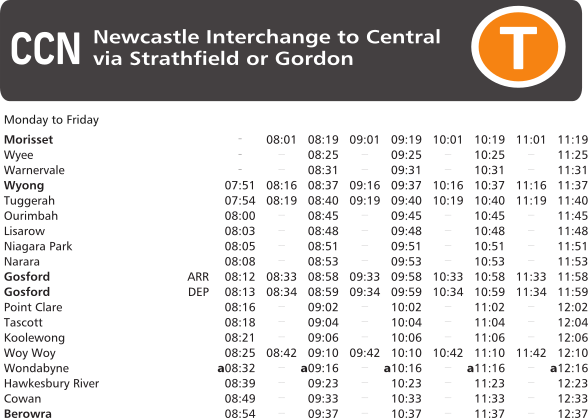
Use the train timetable below to answer this question.

Emma lives in Berowra and travels to Wyong for an appointment. After her appointment, she needs to attend a meeting in Gosford before returning home to Berowra.

  1. Emma catches the train that departs Wyong at 09:16. How long does this train take to reach Gosford?   (1 mark)

    --- 2 WORK AREA LINES (style=lined) ---

  2. Emma's meeting in Gosford starts at 10:15 am at a venue that is 7 minutes walk from Gosford station. What is the latest train she can catch from Wyong to arrive at her meeting on time?   (2 marks)

    --- 3 WORK AREA LINES (style=lined) ---

  3. After her meeting finishes at 11:20 am, Emma walks back to Gosford station (taking 7 minutes). What is the earliest train she can catch from Gosford to return home to Berowra, and what time will she arrive home?   (2 marks)

    --- 3 WORK AREA LINES (style=lined) ---

Show Answers Only

a.   \(17\ \text{minutes}\)

b.   \(09:37\ \text{train}\)

c.   \(\text{11:34 am Gosford train, arrives at Berowra at 12:37 pm}\)

Show Worked Solution

a.   \(\text{Elapsed time:}\ =09:33-09:16 = 17 \text{ minutes} \)

b.   \(\text{Step 1: Meeting starts at 10:15 am}\)

\(\rightarrow\ 7\text{ minutes to walk from Gosford station to the venue.}\)

\(\rightarrow\ \text{At Gosford Station by: }\ 10:15-7 \text{ minutes} = 10:08 \text{ am}\)

\(\text{Step 2: Find latest train arriving at Gosford by 10:08 am}\)

\(\rightarrow\ \text{Arrival times: } 08:12, 08:33, 08:58, 09:33, 09:58, 10:33\)

\(\rightarrow\ \text{She must catch the }09:58.\)

\(\text{Step 3: When does 09:58 depart Wyong?}\)

\(\rightarrow\ 09:37\ \text{train}\)

c.   \(\text{Step 1: Determine when Emma arrives back at Gosford station}\)

\(\rightarrow\ \text{Meeting finishes at }11:20 \text{ am}\)

\(\text{Walking time back to station: 7 minutes}\)

\(\text{Emma arrives at Gosford station at:}\ 11:20 + 7 \text{ minutes} = 11:27 \text{ am} \)

\(\text{Step 1: Find the earliest train departing Gosford after 11:27 am}\)

\(\rightarrow\ \text{Meeting finishes at }11:20 \text{ am}\)

\(\rightarrow\ \text{Relevant departure times:} …10:34, 10:59, 11:34, 11:59\)

\(\rightarrow\ \text{Earliest train after 11:27 am is the }11:34 \text{ am}\)

\(\text{Step 3: Find when this train arrives in Berowra}\)

\(\rightarrow\ \text{11:34 am Gosford train, arrives at Berowra at }12:37 \text{ pm}\)

Filed Under: Uncategorized Tagged With: Band 3, Band 4, Band 5, smc-6306-20-Elapsed Time Problems, smc-6525-20-Elapsed Time Problems

Statistics, STD2 EQ-Bank 13 MC

Twenty-five people were surveyed about the amount of money they spent on groceries per week, to the nearest dollar.

The results are shown in the frequency table.

\begin{array} {|c|c|}
\hline
\rule{0pt}{2.5ex} \textit{Amount Spent}  ($) \rule[-1ex]{0pt}{0pt} & \ \ \ \ \ \textit{Frequency}\ \ \ \ \  \\
\hline
\rule{0pt}{2.5ex} 50-99 \rule[-1ex]{0pt}{0pt} & 4 \\
\hline
\rule{0pt}{2.5ex} 100-149 \rule[-1ex]{0pt}{0pt} & 9 \\
\hline
\rule{0pt}{2.5ex} 150-199 \rule[-1ex]{0pt}{0pt} & 8 \\
\hline
\rule{0pt}{2.5ex} 200-249 \rule[-1ex]{0pt}{0pt} & 4 \\
\hline
\end{array}

What is the mean amount spent on groceries by these people per week?

  1. $143.50
  2. $148.50
  3. $153.50
  4. $158.50
Show Answers Only

\(B\)

Show Worked Solution

\(\text{Using the class centres}\)

\(\text{Class centres: } 74.5, 124.5, 174.5, 224.5\)

\(\text{Total hours}\) \(=(74.5 \times 4) + (124.5 \times 9) + (174.5 \times 8) + (224.5 \times 4)\)
  \(=298 + 1120.5 + 1396 + 898=3712.5\)

  
\(\text{Mean amount}=\dfrac{3712.5}{25} =$148.50\)

\(\Rightarrow B\)

Filed Under: Measures of Centre and Spread, Measures of Centre and Spread, Summary Statistics, Summary Statistics - No Graph, Summary Statistics - No graph, Summary Statistics (no graph) Tagged With: Band 5, smc-1131-10-Mean, smc-1131-40-Class Centres, smc-6312-10-Mean, smc-6312-40-Class Centres, smc-6532-10-Mean, smc-6532-40-Class Centres, smc-824-10-Mean, smc-824-40-Class Centres, smc-999-10-Mean, smc-999-40-Class Centres

Statistics, STD2 EQ-Bank 12 MC

Thirty students were surveyed about the number of hours they spent on homework per week, to the nearest hour.

The results are shown in the frequency table.

\begin{array} {|c|c|}
\hline
\rule{0pt}{2.5ex} \textit{Hours per week} \rule[-1ex]{0pt}{0pt} & \ \ \ \ \ \textit{Frequency}\ \ \ \ \  \\
\hline
\rule{0pt}{2.5ex} 0-4 \rule[-1ex]{0pt}{0pt} & 8 \\
\hline
\rule{0pt}{2.5ex} 5-9 \rule[-1ex]{0pt}{0pt} & 10 \\
\hline
\rule{0pt}{2.5ex} 10-14 \rule[-1ex]{0pt}{0pt} & 7 \\
\hline
\rule{0pt}{2.5ex} 15-19 \rule[-1ex]{0pt}{0pt} & 5 \\
\hline
\end{array}

What is the mean number of hours of homework completed by the students per week?

  1. 8.0
  2. 8.5
  3. 9.0
  4. 9.5
Show Answers Only

\(B\)

Show Worked Solution

\(\text{Using the class centres}\)

\(\text{Class centres: } 2, 7, 12, 17\)

\(\text{Total hours}\) \(=(2\times 8) + (7\times 10) + (12\times 7) + (17\times 5)\)
  \(=16 + 70 + 84 + 85=255\)

\(\text{Mean hours}=\dfrac{255}{30} =8.5\)

\(\Rightarrow B\)

Filed Under: Measures of Centre and Spread, Measures of Centre and Spread, Summary Statistics, Summary Statistics - No Graph, Summary Statistics - No graph, Summary Statistics (no graph) Tagged With: Band 5, smc-1131-10-Mean, smc-1131-40-Class Centres, smc-6312-10-Mean, smc-6312-40-Class Centres, smc-6532-10-Mean, smc-6532-40-Class Centres, smc-824-10-Mean, smc-824-40-Class Centres, smc-999-10-Mean, smc-999-40-Class Centres

Statistics, STD2 EQ-Bank 15 MC

A dataset has an interquartile range \( (IQR)\) of 18.

The upper quartile \((Q_3)\) is 45.

What is the maximum value that would NOT be classified as an outlier? 

  1. 63
  2. 68
  3. 70
  4. 72
Show Answers Only

\(D\)

Show Worked Solution

\(1.5 \times \text{IQR} = 1.5 \times 18 = 27\)

\(\text{Upper boundary} = Q_3 + 27 = 45 + 27 = 72\)

\(\text{Values above 72 are outliers.}\)

\(\therefore\ \text{Maximum value that is not an outlier} = 72\)

\(\Rightarrow D\)

Filed Under: Measures of Centre and Spread Tagged With: Band 5, smc-6312-30-IQR and Outliers

BIOLOGY, M6 2025 HSC 30b

PAI-1 protein is encoded by the SERPINE 1 gene in humans. Anopheles mosquitoes have been genetically modified to express PAI-1, which blocks the entry of the malarial Plasmodium into the mosquito gut. This disrupts the Plasmodium life cycle, resulting in reduced transmission of malaria. 

'Genetic technologies are beneficial for society.'

Evaluate this statement.   (7 marks)

--- 24 WORK AREA LINES (style=lined) ---

Show Answers Only

Evaluation Statement

  • Genetic technologies are highly beneficial for society when evaluated against health improvements and food security criteria.
  • Despite some ethical and environmental concerns requiring careful management, the overall net benefits are substantial.

Health Benefits

  • Genetically modified mosquitoes expressing PAI-1 significantly reduce malaria transmission, potentially saving millions of lives annually.
  • Recombinant DNA technology produces insulin and vaccines, improving accessibility to life-saving treatments for diabetes and infectious diseases.
  • Gene therapy offers potential cures for inherited genetic disorders, dramatically improving quality of life for affected individuals.
  • The health criterion strongly meets beneficial status because these technologies address major global health challenges.

Food Security and Agricultural Benefits

  • Genetically modified crops like Bt cotton and Golden Rice increase crop yields and nutritional content, addressing food scarcity.
  • Drought-resistant GM crops enable farming in challenging environments, supporting population growth and farmer livelihoods.
  • However, concerns exist about reduced genetic diversity and corporate control over seeds, creating inequalities in access.

Final Evaluation

  • Weighing these factors shows genetic technologies are substantially beneficial for society.
  • The health improvements and food security gains outweigh the manageable ethical concerns.
  • While challenges like biodiversity impacts and equitable access require ongoing attention, the overall societal benefit remains considerable through life-saving medical applications and enhanced food production.
Show Worked Solution

Evaluation Statement

  • Genetic technologies are highly beneficial for society when evaluated against health improvements and food security criteria.
  • Despite some ethical and environmental concerns requiring careful management, the overall net benefits are substantial.

Health Benefits

  • Genetically modified mosquitoes expressing PAI-1 significantly reduce malaria transmission, potentially saving millions of lives annually.
  • Recombinant DNA technology produces insulin and vaccines, improving accessibility to life-saving treatments for diabetes and infectious diseases.
  • Gene therapy offers potential cures for inherited genetic disorders, dramatically improving quality of life for affected individuals.
  • The health criterion strongly meets beneficial status because these technologies address major global health challenges.

Food Security and Agricultural Benefits

  • Genetically modified crops like Bt cotton and Golden Rice increase crop yields and nutritional content, addressing food scarcity.
  • Drought-resistant GM crops enable farming in challenging environments, supporting population growth and farmer livelihoods.
  • However, concerns exist about reduced genetic diversity and corporate control over seeds, creating inequalities in access.

Final Evaluation

  • Weighing these factors shows genetic technologies are substantially beneficial for society.
  • The health improvements and food security gains outweigh the manageable ethical concerns.
  • While challenges like biodiversity impacts and equitable access require ongoing attention, the overall societal benefit remains considerable through life-saving medical applications and enhanced food production.

♦ Mean mark 64%.

Filed Under: Biotechnology Tagged With: Band 4, Band 5, smc-3653-20-Evaluating Genetic Technology

Financial Maths, STD2 EQ-Bank 34

David and Mary are a couple living together. They each receive the maximum Age Pension payment of $888.50 per fortnight (which includes basic rate, Pension Supplement and Energy Supplement).

Their combined income from part-time work is $520 per fortnight. Their Age Pension is reduced by 25 cents each for every dollar of combined income over $380 per fortnight..

  1. Calculate the reduction in each person's Age Pension payment.   (2 marks)

    --- 3 WORK AREA LINES (style=lined) ---

  2. Calculate their total household fortnightly income including their reduced Age Pension payments and earnings.   (2 marks)

    --- 3 WORK AREA LINES (style=lined) ---

  3. What percentage of their total household income comes from their Age Pension payments? Give your answer to 1 decimal place.   (1 mark)

    --- 3 WORK AREA LINES (style=lined) ---

Show Answers Only

a.    \($35\)

b.    \($2227\)

c.    \(76.6\%\ \text{(to 1 d.p.)}\)

Show Worked Solution

a.    \(\text{Combined income over free area} = 520-380=$140\)

\(\text{Reduction for each person} = 0.25 \times 140= $35\)

\(\therefore\ \text{Each person’s pension is reduced by \$35}\)
  

b.    \(\text{Reduced pension for each person}=888.50-35= $853.50\)

\(\text{Combined Age Pension} = 2 \times 853.50=$1707\)

\(\text{Total household income} = 1707+520=$2227\)
  

c.    \(\text{Percentage from Age Pension} =\dfrac{1707}{2227}\times 100=76.6\%\ \text{(to 1 d.p.)}\)

\(\therefore\ 76.6\%\text{ of their household income comes from Age Pension}\)

Filed Under: Ways of Earning Tagged With: Band 3, Band 4, Band 5, smc-6276-40-Govt Payments

Financial Maths, STD2 EQ-Bank 30

Baron is 19 years old, single with no children, and lives away from his parents' home to study. He receives the maximum Youth Allowance payment of $663.30 per fortnight.

Baron supplements his payments by working part-time and earns $15.50 per hour in a retail position. His Youth Allowance is reduced by 50 cents for each dollar earned over $236 per fortnight.

  1. Baron works 22 hours per fortnight. Calculate his total fortnightly income including his reduced Youth Allowance payment and earnings.   (2 marks)

    --- 4 WORK AREA LINES (style=lined) ---

  2. What is the maximum number of hours Baron can work per fortnight before his Youth Allowance payment is reduced to zero? Give your answer to the nearest whole hour.   (2 marks)

    --- 4 WORK AREA LINES (style=lined) ---

Show Answers Only

a.    \(\text{\$951.80 per fortnight}\)

b.    \(\text{101 hours per fortnight}\)

Show Worked Solution

a.    \(\text{Baron’s earnings} = 15.50\times 22=$341\)

\(\text{Income over free area} = 341-236 = $105\)

\(\text{Reduction in payment} = 0.50\times 105= $52.50\)

\(\text{Reduced Youth Allowance} = 663.30-52.50=$610.80\)

\(\text{Total fortnightly income} = 610.80+341=$951.80\)
 

b.    \(\text{For payment to reduce to zero, reduction needed} = $663.30\)

\(\text{Income over free area} = \dfrac{663.30}{0.50}=$1326.60\)

\(\text{Total earnings needed} = 1326.60+236=$1562.60\)

\(\text{Hours needed}=\dfrac{1562.60}{15.50}=100.8\)

\(\therefore\ \text{Baron can work a maximum of 101 hours per fortnight}\)

Filed Under: Ways of Earning Tagged With: Band 3, Band 5, smc-6276-40-Govt Payments

Financial Maths, STD2 EQ-Bank 29

Yuki is single with no children and receives the maximum JobSeeker Payment of $793.60 per fortnight.

Her JobSeeker Payment is reduced by 50 cents for each dollar earned over $150 per fortnight.

  1. Yuki earns $380 per fortnight from casual work. Calculate her reduced JobSeeker Payment.   (2 marks)

    --- 4 WORK AREA LINES (style=lined) ---

  2. How much would Yuki need to earn per fortnight for her JobSeeker Payment to be reduced to $600?   (2 marks)

    --- 4 WORK AREA LINES (style=lined) ---

Show Answers Only

a.    \($678.60\ \text{per fortnight}\)

b.    \($537.20\ \text{per fortnight}\)

Show Worked Solution

a.    \(\text{Income over free area} = 380-150=$230\)

\(\text{Reduction in payment} = 0.50\times 230 = $115\)

\(\text{Reduced JobSeeker Payment} = 793.60-115 = $678.60\)

\(\therefore\ \text{Yuki receives \$678.60 per fortnight}\)

b.    \(\text{Required reduction} = 793.60-600=$193.60\)

\(\text{Income over free area} = \dfrac{193.60}{0.50}=$387.20\)

\(\text{Total income needed} = 387.20+150=$537.20\)

\(\therefore\ \text{Yuki needs to earn \$537.20 per fortnight}\)

Filed Under: Ways of Earning Tagged With: Band 3, Band 5, smc-6276-40-Govt Payments

Financial Maths, STD1 EQ-Bank 14 MC

Sarah is single with no children and receives the maximum JobSeeker Payment of $793.60 per fortnight.

She earns $350 per fortnight from casual work. The JobSeeker Payment is reduced by 50 cents for each dollar earned over $150 per fortnight.

What is Sarah's reduced JobSeeker Payment this fortnight?

  1. $593.60
  2. $643.60
  3. $693.60
  4. $743.60
Show Answers Only

\(C\)

Show Worked Solution

\(\text{Maximum JobSeeker Payment (single, no children)} = $793.60\)

\(\text{Income over free area} = 350-150 = $200\)

\(\text{Reduction in payment} = 0.50\times 200 = $100\)

\(\therefore\ \text{Reduced JobSeeker Payment} = 793.60-100 = $693.60\)

\(\Rightarrow C\)

Filed Under: Ways of Earning Tagged With: Band 5, smc-6515-40-Govt Payments

Functions, EXT1′ F1 2007 HSC 3a*

The diagram shows the graph of  \(y = f(x)\). The line  \(y = x\)  is an asymptote.

Draw separate one-third page sketches of the graphs of the following:

  1.   \(f(\abs{x})\).   (2 marks)

    --- 10 WORK AREA LINES (style=lined) ---

  2.    \(f(x)-x\).   (2 marks)

    --- 10 WORK AREA LINES (style=lined) ---

Show Answers Only

a.       
       

b.
           

Show Worked Solution
MARKER’S COMMENT: In part (i), a significant number of students graphed  \(y=\abs{f(x)}\).
a.    


b.    

Filed Under: Graphical Relationships Tagged With: Band 4, Band 5, page-break-before-solution, smc-6640-30-\(y=\abs{f(x)}; y=f(\abs{x}) \), smc-6640-60-\(f(x)-g(x)\)

Functions, EXT1′ F1 2013 HSC 13bii

The diagram shows the graph of a function `f(x).`
 

Sketch the curve  `y = 1/(1-f(x)).`   (3 marks)

--- 12 WORK AREA LINES (style=lined) ---

Show Answers Only

Show Worked Solution

`y = 1/(1-f(x))`

MARKER’S COMMENT: Correct working sketches such as `y=-f(x)` and `y=1-f(x)` meant that students could obtain some marks, even if their final sketch was wrong.

`f(x) = 1,\ \ \ y\ text(undefined.)`

`f(x) > 1,\ \ \ y < 0`

`f(x) <= 0, \ \ \ y <= 1`

`\text{Create graph in 3 stages:}`
 

Filed Under: Graphical Relationships Tagged With: Band 5, smc-6640-10-\(y=\dfrac{1}{f(x)}\)

Financial Maths, STD2 EQ-Bank 28

Ian works in a packaging factory and is paid $0.85 for each box he packs. Last month he worked 160 hours and packed 8960 boxes.

  1. Calculate Ian's total earnings for the month.   (1 mark)

    --- 2 WORK AREA LINES (style=lined) ---

  2. The following month the factory decides to pay Ian a flat hourly rate of $44.50. What percentage increase/decrease is this from his equivalent hourly wage of the previous month. Give your answer correct to 1 decimal place.   (2 marks)

    --- 5 WORK AREA LINES (style=lined) ---

Show Answers Only

a.    \($7616\)

b.    \(\text{6.5% decrease}\)

Show Worked Solution

a.    \(\text{Total Earnings}=0.85\times 8960=$7616\)
 

b.    \(\text{Hourly rate (last month)}=\dfrac{7616}{160}=$47.60\)

\(\text{New hourly wage} = $44.50\ \text{(given)}\)

\(\text{% decrease}=\dfrac{47.60-44.50}{47.60}=0.0651… = 6.5\%\ \text{decrease}\) 

\(\therefore\ \text{Ian’s hourly rate has decreased 6.5%.}\)

Filed Under: Purchasing Goods, Ways of Earning Tagged With: Band 3, Band 5, smc-6276-30-Piecework/Royalties, smc-6278-10-% Increase/Decrease

CHEMISTRY, M8 2025 HSC 36

Use the data sheet provided and the information in the table to answer this question.


Consider the molecule shown.

For each of the following instrumental techniques, predict the expected features of the spectra produced.

Refer to the structural features of the molecule in your answer.

  • Infrared (IR)    (Ignore any absorptions due to \(\ce{C - C}\) or \(\ce{C - H}\) )
  • Carbon-13 NMR
  • Proton NMR
  • Mass spectrometry   (7 marks)

    --- 30 WORK AREA LINES (style=lined) ---

Show Answers Only

Infrared (IR)

  • Strong broad \(\ce{OH}\) signal at approximately 2750 cm\(^{-1}\)
  • Strong sharp \(\ce{CO}\) signal at approximately 1700 cm\(^{-1}\)

\(^{13}\text{C NMR}\)

  • 3 distinct carbon environments 
  • 1 signal at 5−40 ppm \(\ce{(CH3)}\)
  • 1 signal at 20−50 ppm \(\ce{(CH2)}\)
  • 1 signal at 160−185 ppm \(\ce{(acid CO)}\)

\(^{1}\text{H NMR (Proton NMR)}\)

  • 3 distinct hydrogen environments
  • 1 signal at 0.7−2.1 ppm \(\ce{(CH3)}\), triplet splitting pattern, integration of 3
  • 1 signal at 2.1−4.5 ppm \(\ce{(CH2)}\), quartet splitting pattern, integration of 2
  • 1 signal at 9.0−13.0 ppm \(\ce{(COOH)}\), singlet, integration of 1

Mass Spectrometry

  • Molecular ion at 74 m/z (molar mass of propanoic acid ~74 g/mol)
Show Worked Solution

Infrared (IR)

  • Strong broad \(\ce{OH}\) signal at approximately 2750 cm\(^{-1}\)
  • Strong sharp \(\ce{CO}\) signal at approximately 1700 cm\(^{-1}\)
♦ Mean mark 62%.

\(^{13}\text{C NMR}\)

  • 3 distinct carbon environments 
  • 1 signal at 5−40 ppm \(\ce{(CH3)}\)
  • 1 signal at 20−50 ppm \(\ce{(CH2)}\)
  • 1 signal at 160−185 ppm \(\ce{(acid CO)}\)

\(^{1}\text{H NMR (Proton NMR)}\)

  • 3 distinct hydrogen environments
  • 1 signal at 0.7−2.1 ppm \(\ce{(CH3)}\), triplet splitting pattern, integration of 3
  • 1 signal at 2.1−4.5 ppm \(\ce{(CH2)}\), quartet splitting pattern, integration of 2
  • 1 signal at 9.0−13.0 ppm \(\ce{(COOH)}\), singlet, integration of 1

Mass Spectrometry

  • Molecular ion at 74 m/z (molar mass of propanoic acid ~74 g/mol)

Filed Under: Organic Substances Tagged With: Band 4, Band 5, smc-3683-10-C NMR, smc-3683-20-H NMR, smc-3683-40-Mass Spectrometry, smc-3683-43-IR Spectroscopy, smc-3683-50-Combining Techniques

CHEMISTRY, M6 2025 HSC 34

A 0.010 L aliquot of an acid was titrated with 0.10 mol L\(^{-1} \ \ce{NaOH}\), resulting in the following titration curve.
 

  1. Calculate the \(K_a\) for the acid used.   (3 marks)

    --- 9 WORK AREA LINES (style=lined) ---

  2. The concentration of the \(\ce{NaOH}\) was 0.10 mol L\(^{-1}\).
  3. Explain why the pH of the final solution never reached 13.   (2 marks)
  4. --- 6 WORK AREA LINES (style=lined) ---

Show Answers Only

a.   \(\text{Strategy 1:}\)
 

\(\text{From the shape of the titration curve, the acid was weak.}\)

\(\text{Equivalence point}\ \ \Rightarrow \ \ \ce{NaOH}\ \text{added}\ = 0.24\ \text{L} \)

\(\text{Halfway to the equivalent point = 0.012 L}, \ce{[ HA ]=\left[ A^{-}\right]}\)

\(\text{Here the pH} \approx 4.4 , \text{or}\ \ce{\left[H^{+}\right] is 4.0 \times 10^{-5}}\).

\(K_a=10^{-\text{pH}}=\ce{\left[H+\right]} \times \dfrac{\ce{\left[A^{-}\right]}}{\ce{[HA]}}\)

\(\text{At this pH,} \ \ce{\left[A^{-}\right]=[HA] so} \ K_a=4.0 \times 10^{-5}\).
 

\(\text{Strategy 2:}\)

\(\text{Equivalence point is at} \ \ce{0.024 L NaOH added}\).

\(\text{Shape of curve shows acid is monoprotic.}\)

\(\ce{[HA] \times 0.010=0.1 \times 0.024}\)

\(\ce{[HA]=0.24 mol L^{-1}}\)

\(\text{pH at start is approximately 2.5}\)

\(\text{So,} \ \ce{\left[H+\right]=3.16 \times 10^{-3}}\)

\(K_a=\dfrac{\ce{\left[H^{+}\right]\left[A^{-}\right]}}{\ce{[HA]}} \quad \ce{\left[A^{-}\right]=\left[H^{+}\right]}\)

\(\ce{[HA]=0.24-3.16 \times 10^{-3}=0.237}\)

\(K_a=\dfrac{\left(3.16 \times 10^{-3}\right)^2}{0.237}=4.2 \times 10^{-5}\)
 

b.   pH of the final solution < 13:

  • Some of the hydroxide was neutralised by the acid.
  • The 10 mL of acid also diluted the NaOH.
  • So the \(\ce{NaOH}\) concentration of the mixture will be less than 0.1 mol L\(^{-1}\) and the pH will be less than 13.
Show Worked Solution

a.   \(\text{Strategy 1:}\)
 

♦♦ Mean mark 40%.

\(\text{From the shape of the titration curve, the acid was weak.}\)

\(\text{Equivalence point}\ \ \Rightarrow \ \ \ce{NaOH}\ \text{added}\ = 0.24\ \text{L} \)

\(\text{Halfway to the equivalent point = 0.012 L}, \ce{[ HA ]=\left[ A^{-}\right]}\)

\(\text{Here the pH} \approx 4.4 , \text{or}\ \ce{\left[H^{+}\right] is 4.0 \times 10^{-5}}\).

\(K_a=10^{-\text{pH}}=\ce{\left[H+\right]} \times \dfrac{\ce{\left[A^{-}\right]}}{\ce{[HA]}}\)

\(\text{At this pH,} \ \ce{\left[A^{-}\right]=[HA] so} \ K_a=4.0 \times 10^{-5}\).
 

\(\text{Strategy 2:}\)

\(\text{Equivalence point is at} \ \ce{0.024 L NaOH added}\).

\(\text{Shape of curve shows acid is monoprotic.}\)

\(\ce{[HA] \times 0.010=0.1 \times 0.024}\)

\(\ce{[HA]=0.24 mol L^{-1}}\)

\(\text{pH at start is approximately 2.5}\)

\(\text{So,} \ \ce{\left[H+\right]=3.16 \times 10^{-3}}\)

\(K_a=\dfrac{\ce{\left[H^{+}\right]\left[A^{-}\right]}}{\ce{[HA]}} \quad \ce{\left[A^{-}\right]=\left[H^{+}\right]}\)

\(\ce{[HA]=0.24-3.16 \times 10^{-3}=0.237}\)

\(K_a=\dfrac{\left(3.16 \times 10^{-3}\right)^2}{0.237}=4.2 \times 10^{-5}\)
 

b.   pH of the final solution < 13:

  • Some of the hydroxide was neutralised by the acid.
  • The 10 mL of acid also diluted the NaOH.
  • So the \(\ce{NaOH}\) concentration of the mixture will be less than 0.1 mol L\(^{-1}\) and the pH will be less than 13.
♦♦♦ Mean mark 19%.

Filed Under: Quantitative Analysis Tagged With: Band 5, Band 6, smc-3675-20-Titration Curves and Conductivity Graphs, smc-3675-30-Ka/Kb

CHEMISTRY, M6 2025 HSC 33

Chalk is predominantly calcium carbonate. Different brands of chalk vary in their calcium carbonate composition.

The table shows the composition of three different brands of chalk.

\begin{array}{|l|c|c|c|}
\hline \rule{0pt}{2.5ex}\rule[-1ex]{0pt}{0pt}& \ \ \textit{Brand X} \ \ & \ \ \textit{Brand Y} \ \ & \ \ \textit{Brand Z} \ \ \\
\hline \rule{0pt}{2.5ex}\ce{CaCO3(\%)} \rule[-1ex]{0pt}{0pt}& 85.5 & 83.9 & 82.4 \\
\hline
\end{array}

The following procedure was used to determine the calcium carbonate composition of a chalk sample.

  • A sample of chalk was crushed in a mortar and pestle.
  • A 3.00 g sample of the crushed chalk was placed in a conical flask.
  • 100.0 mL of 0.550 mol L\(^{-1} \ \ce{HCl(aq)}\) was added to the sample and left to react completely, resulting in a clear solution.
  • Four 20 mL aliquots of this mixture were then titrated with 0.10 mol L\(^{-1} \ \ce{KOH}\) .

The results of the titrations are recorded.

\begin{array}{|l|c|c|c|c|}
\hline
\rule{0pt}{2.5ex}\textit{Burette volume}\text{(mL)} \rule[-1ex]{0pt}{0pt}& \textit{Trial 1} & \textit{Trial 2} & \textit{Trial 3} & \textit{Trial 4} \\
\hline
\rule{0pt}{2.5ex}\text{Final} \rule[-1ex]{0pt}{0pt}& 7.80 & 14.90 & 22.10 & 29.25 \\
\hline
\rule{0pt}{2.5ex}\text{Initial} \rule[-1ex]{0pt}{0pt}& 0.00 & 7.80 & 14.90 & 22.10 \\
\hline
\rule{0pt}{2.5ex}\text{Total used} \rule[-1ex]{0pt}{0pt}& 7.80 & 7.10 & 7.20 & 7.15 \\
\hline
\end{array}

Determine the brand of the chalk sample. Include a relevant chemical equation in your answer.   (7 marks)

--- 14 WORK AREA LINES (style=lined) ---

Show Answers Only

\(\text{Exclude the outlier (Trial 1):}\)

\(\text{Average volume} \ \ce{(KOH)} =\dfrac{7.10+7.20+7.15}{3}=0.00715 \ \text{L}\)

\(\ce{HCl(aq) + KOH(aq) \rightarrow KCl(aq) + H2O(l)}\)

\(\text{moles} \ \ce{KOH=0.10 \times 0.00715=0.000715 mol }\)

\(\text{Ratio}\ \ \ce{HCl:KOH=1: 1}\)

   \(\ce{0.000715 mol HCl} \ \text{for each sample}\)

   \(\ce{0.000715 \times 5=0.003575 mol}\ \text{total in sampled solution}\)
 

\(\text{Initial} \ \ \ce{n(HCl)=0.550 \times 0.1000=0.0550 mol}\)

\(\ce{n(HCl)}\ \text{that reacted with} \ \ce{CaCO3=0.0550-0.003575=0.051425 mol}\)

\(\ce{2HCl(aq) + CaCO3(s) \rightarrow CaCl2(aq) + H2O(l) + CO2(g)}\)

\(\text{Ratio}\ \ \ce{HCl:CaCO3=2:1}\)

\(\ce{n(CaCO3)}=\dfrac{0.051425}{2}=0.0257125\ \text{mol}\)

\(\ce{MM(CaCO3)}=40.08+12.01+3 \times 16=100.09\)

\(\text{Mass} \ \ce{CaCO3} =0.0257125 \times 100.09=2.5735641\ \text{g}\)

\(\% \ce{CaCO3}=\dfrac{2.5735641}{3.00} \times 100=85.7854 \% \approx 85.8 \%\)

\(\text{Chalk sample has to be Brand X.}\)

Show Worked Solution

\(\text{Exclude the outlier (Trial 1):}\)

\(\text{Average volume} \ \ce{(KOH)} =\dfrac{7.10+7.20+7.15}{3}=0.00715 \ \text{L}\)

\(\ce{HCl(aq) + KOH(aq) \rightarrow KCl(aq) + H2O(l)}\)

\(\text{moles} \ \ce{KOH=0.10 \times 0.00715=0.000715 mol }\)

\(\text{Ratio}\ \ \ce{HCl:KOH=1: 1}\)

   \(\ce{0.000715 mol HCl} \ \text{for each sample}\)

   \(\ce{0.000715 \times 5=0.003575 mol}\ \text{total in sampled solution}\)

♦ Mean mark 55%.

\(\text{Calculate}\ \ce{HCl}\ \text{that reacted with}\ \ce{CaCO3}:\)

\(\text{Initial} \ \ \ce{n(HCl)=0.550 \times 0.1000=0.0550 mol}\)

\(\ce{n(HCl)}\ \text{that reacted with} \ \ce{CaCO3=0.0550-0.003575=0.051425 mol}\)

\(\ce{2HCl(aq) + CaCO3(s) \rightarrow CaCl2(aq) + H2O(l) + CO2(g)}\)

\(\text{Ratio}\ \ \ce{HCl:CaCO3=2:1}\)

\(\ce{n(CaCO3)}=\dfrac{0.051425}{2}=0.0257125\ \text{mol}\)

\(\ce{MM(CaCO3)}=40.08+12.01+3 \times 16=100.09\)

\(\text{Mass} \ \ce{CaCO3} =0.0257125 \times 100.09=2.5735641\ \text{g}\)
 

\(\% \ce{CaCO3}=\dfrac{2.5735641}{3.00} \times 100=85.7854 \% \approx 85.8 \%\)

\(\text{Chalk sample has to be Brand X.}\)

Filed Under: Quantitative Analysis Tagged With: Band 4, Band 5, smc-3675-10-Titration

CHEMISTRY, M5 2025 HSC 32

The following three solids were added together to 1 litre of water:

  • \(\ce{0.006\ \text{mol}\ Mg(NO3)2}\)
  • \(\ce{0.010\ \text{mol}\ NaOH}\)
  • \(\ce{0.002\ \text{mol}\ Na2CO3}\).

Which precipitate(s), if any, will form? Justify your answer with appropriate calculations.   (5 marks)

--- 12 WORK AREA LINES (style=lined) ---

Show Answers Only

All sodium and nitrate salts are soluble  \(\Rightarrow\)  possible precipitates are \(\ce{Mg(OH)2}\) and \(\ce{MgCO3}\). 

\(\ce{\left[Mg^{2+}\right]=6 \times 10^{-3} \quad\left[ OH^{-}\right]=1 \times 10^{-2} \quad\left[ CO3^{2-}\right]=2 \times 10^{-3}}\)

\(\ce{\left[Mg^{2+}\right]\left[ OH^{-}\right]^2=6 \times 10^{-7} \quad \quad \quad \ \ \ K_{\textit{sp}}=5.61 \times 10^{-12}}\)

\(\ce{\left[ Mg^{2+}\right]\left[ CO3^{2-}\right]=1.2 \times 10^{-5} \quad \quad  K_{\textit{sp}}=6.82 \times 10^{-6}}\)
 

\(\ce{Mg(OH)2}\) is a lot less soluble than \(\ce{MgCO3}\) and will precipitate preferentially.

\(\ce{\left[Mg^{2+}\right]\left[OH^{-}\right]^2 > K_{\textit{sp}}}\)

\(\Rightarrow \ce{Mg(OH)2}\) will precipitate.
 

\(\ce{Mg^{2+}(aq) + 2OH-(aq) \rightarrow Mg(OH)2(s)}\)

Since \(K_{\textit{sp}}\) is small, assume reaction goes to completion.

\(\ce{n(Mg^{2+})=0.006\ mol, n(OH^{-})=0.010\ mol}\)

Using stoichiometric ratio \((1:2)\)

\(0.006 > \dfrac{0.010}{2}=0.005\ \ \Rightarrow \ce{Mg^{2+}}\) is in excess.

Concentration drops to: \(6 \times 10^{-3}-5 \times 10^{-3}=1 \times 10^{-3}\).
 

Check if \(\ce{MgCO3}\) will precipitate:

\(\ce{\left[Mg^{2+}\right]\left[CO3^{2-}\right]}\) becomes  \(2 \times 10^{-6} <K_{\textit{sp}}\).

\(\ce{\Rightarrow\ MgCO3}\) won’t precipitate.

Show Worked Solution

All sodium and nitrate salts are soluble  \(\Rightarrow\)  possible precipitates are \(\ce{Mg(OH)2}\) and \(\ce{MgCO3}\). 

\(\ce{\left[Mg^{2+}\right]=6 \times 10^{-3} \quad\left[ OH^{-}\right]=1 \times 10^{-2} \quad\left[ CO3^{2-}\right]=2 \times 10^{-3}}\)

\(\ce{\left[Mg^{2+}\right]\left[ OH^{-}\right]^2=6 \times 10^{-7} \quad \quad \quad \ \ \ K_{\textit{sp}}=5.61 \times 10^{-12}}\)

\(\ce{\left[ Mg^{2+}\right]\left[ CO3^{2-}\right]=1.2 \times 10^{-5} \quad \quad  K_{\textit{sp}}=6.82 \times 10^{-6}}\)

♦♦ Mean mark 40%.

\(\ce{Mg(OH)2}\) is a lot less soluble than \(\ce{MgCO3}\) and will precipitate preferentially.

\(\ce{\left[Mg^{2+}\right]\left[OH^{-}\right]^2 > K_{\textit{sp}}}\)

\(\Rightarrow \ce{Mg(OH)2}\) will precipitate.
 

\(\ce{Mg^{2+}(aq) + 2OH-(aq) \rightarrow Mg(OH)2(s)}\)

Since \(K_{\textit{sp}}\) is small, assume reaction goes to completion.

\(\ce{n(Mg^{2+})=0.006\ mol, n(OH^{-})=0.010\ mol}\)

Using stoichiometric ratio \((1:2)\)

\(0.006 > \dfrac{0.010}{2}=0.005\ \ \Rightarrow \ce{Mg^{2+}}\) is in excess.

Concentration drops to: \(6 \times 10^{-3}-5 \times 10^{-3}=1 \times 10^{-3}\).
 

Check if \(\ce{MgCO3}\) will precipitate:

\(\ce{\left[Mg^{2+}\right]\left[CO3^{2-}\right]}\) becomes  \(2 \times 10^{-6} <K_{\textit{sp}}\).

\(\ce{\Rightarrow\ MgCO3}\) won’t precipitate.

Filed Under: Solution Equilibria Tagged With: Band 5, Band 6, smc-3672-10-Mixed ionic solutions, smc-3672-20-Calcs given K(sp), smc-3672-70-Precipitate

  • « Previous Page
  • 1
  • 2
  • 3
  • 4
  • 5
  • 6
  • …
  • 85
  • Next Page »

Copyright © 2014–2026 SmarterEd.com.au · Log in