SmarterEd

Aussie Maths & Science Teachers: Save your time with SmarterEd

  • Login
  • Get Help
  • About

Measurement, STD2 M6 2015 HSC 30e

From point `S`, which is 1.8 m above the ground, a pulley at `P` is used to lift a flat object `F`. The lengths `SP` and `PF` are 5.4 m and 2.1 m respectively. The angle `PSC` is 108°.


  1. Show that the length  `PC`  is 6.197 m, correct to 3 decimal places.  (1 mark)

    --- 2 WORK AREA LINES (style=lined) ---

  2. Calculate `h`, the height of the object above the ground.  (4 marks)

    --- 8 WORK AREA LINES (style=lined) ---

Show Answers Only
  1. `6.197\ text{m  (to 3 d.p.)  … as required}`
  2. `1.37\ text{m  (to 2 d.p.)}`
Show Worked Solution
i.   

2UG 2015 30e Answer

`text(Show)\ PC = 6.197\ text(m)`

♦ Mean mark 41%.

`text(Using the cosine rule in)\ Delta PSC` 

`PC^2` `= PS^2 + SC^2-2 xx PS xx SC xx cos\ 108^@`
  `= 5.4^2 + 1.8^2-2 xx 5.4 xx 1.8 xx cos\ 108^@`
  `= 38.4072…`
`:.PC` `= 6.19736…`
  `= 6.197\ text{m  (to 3 d.p.)  …as required}`


ii.   `text(Let)\ \ SD⊥PE`

♦♦ Mean mark below 19%.
STRATEGY: Finding `PC` in part (i) and needing `PE` to find `h` should flag the strategy of finding `EC` and using Pythagoras.

`∠DSC\ text(is a right angle)`

`:.∠DSP = 108^@-90^@ = 18^@`


`text(In)\ ΔPDS`

`cos\ 18^@` `= (DS)/5.4`
 `DS` `= 5.4 xx cos\ 18^@`
  `= 5.1357…\ text(m)`

 
`EC = DS = 5.1357…\ text{m  (opposite sides of rectangle}\ DECS text{)}`
 

`text(Using Pythagoras in)\ Delta PEC:`

`PE^2 + EC^2 = PC^2`

`PE^2 + 5.1357^2` `= 6.197^2`
`PE^2` `= 12.027…`
`PE` `= 3.468…\ text(m)`

 
`text(From the diagram,)`

`h` `= PE-PF`
  `= 3.468…-2.1`
  `= 1.368…`
  `= 1.37\ text{m  (to 2 d.p.)}`

Filed Under: 2-Triangle and Harder Examples, Non-Right Angled Trig, Non-Right Angled Trig (Std2) Tagged With: Band 5, Band 6, smc-804-10-Cosine Rule, smc-804-40-2-Triangle

Algebra, STD2 A4 2015 HSC 29e

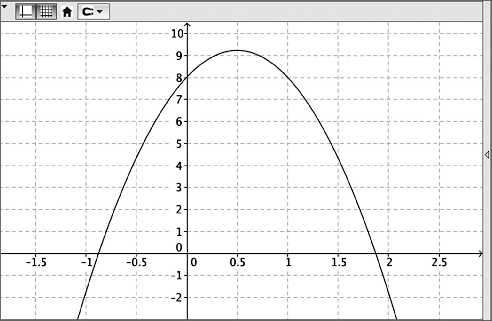
A diver springs upwards from a diving board, then plunges into the water. The diver’s height above the water as it varies with time is modelled by a quadratic function. Graphing software is used to produce the graph of this function.
 

Explain how the graph could be used to determine how high above the height of the diving board the diver was when he reached the maximum height.   (2 marks)

--- 5 WORK AREA LINES (style=lined) ---

Show Answers Only

`1.2\ text(m)`

Show Worked Solution

`text(We can calculate the height of the board by)`

♦♦ Mean mark 19%.

`text(finding the)\ ytext(-value at)\ t = 0,\ text(which is 8 m.)`

`text(The diver’s maximum height occurs at)\ t=0.5,`

`text(which is approximately 9.2 m.)`
 

`:.\ text(Maximum height above the board)`

`= 9.2-8`

`= 1.2\ text(m)`

Filed Under: Exponential/Quadratic (Projectile), Non-Linear: Exponential/Quadratics (Std 2) Tagged With: Band 6, smc-830-20-Quadratics

Statistics, STD2 S1 2015 HSC 29d

Data from 200 recent house sales are grouped into class intervals and a cumulative frequency histogram is drawn.
 

2UG 2015 29d1 
 

  1. Use the graph to estimate the median house price.   (1 mark)

    --- 1 WORK AREA LINES (style=lined) ---

  2. By completing the table, calculate the mean house price.   (3 marks)

\begin{array} {|c|c|}
\hline
\rule{0pt}{2.5ex} \text{Class Centre} \rule[-1ex]{0pt}{0pt} & \text{Frequency} \\ \text{(\$'000)} &  \\
\hline
\rule{0pt}{2.5ex}  \rule[-1ex]{0pt}{0pt} &  \\
\hline
\rule{0pt}{2.5ex}  \rule[-1ex]{0pt}{0pt} &  \\
\hline
\rule{0pt}{2.5ex}  \rule[-1ex]{0pt}{0pt} &  \\
\hline
\rule{0pt}{2.5ex}  \rule[-1ex]{0pt}{0pt} & \\
\hline
\end{array}

--- 2 WORK AREA LINES (style=lined) ---

Show Answers Only
  1. `text(See Worked Solutions.)`
  2. `text(See Worked Solutions.)`
Show Worked Solution
i.   

2UG 2015 29d Answer

`text(From the graph, the estimated median)`

`text(house price = $392 500)`

♦♦♦ Mean marks of 9% for part (i) and 34% for part (ii)!

 
ii.

\begin{array} {|c|c|}
\hline
\rule{0pt}{2.5ex} \text{Class Centre} \rule[-1ex]{0pt}{0pt} & \text{Frequency} \\ \text{(\$’000)} &  \\
\hline
\rule{0pt}{2.5ex}  375 \rule[-1ex]{0pt}{0pt} & 30\\
\hline
\rule{0pt}{2.5ex}  385 \rule[-1ex]{0pt}{0pt} &  50 \\
\hline
\rule{0pt}{2.5ex}  395 \rule[-1ex]{0pt}{0pt} & 70 \\
\hline
\rule{0pt}{2.5ex}  405 \rule[-1ex]{0pt}{0pt} & 50 \\
\hline
\end{array}

 
`text(Mean house price ($’000))`

`= (375xx30 + 385xx50 + 395xx70 + 405xx50)/200`

`=$392`

`:. text(Mean house price is)\ $392\ 000`

Filed Under: Bar Charts and Histograms, Bar Charts and Histograms (Std 2), Bar Charts and Histograms (Std2-2027), Bar Charts and Histograms (Y12) Tagged With: Band 5, Band 6, common-content, smc-6310-30-Cumulative Frequency Histograms, smc-6310-50-Class Centres, smc-821-20-Cumulative Frequency Histograms, smc-821-40-Class Centres, smc-997-20-Cumulative Frequency Histograms, smc-997-40-Class Centres

Measurement, STD2 M7 2015 HSC 29c

The image shows a rectangular farm shed with a flat roof.
 

Measurement, 2UG 2015 HSC 29c

 
The real width of the shed indicated by the dotted line was measured using an online ruler tool, and found to be approximately 12 metres.

  1. By measurement and calculation, show that the area of the roof of the shed is approximately 216 m².  (2 marks)

    --- 4 WORK AREA LINES (style=lined) ---

  2. All the rain that falls onto this roof is diverted into a cylindrical water tank which has a diameter of 3.6 m. During a storm, 5 mm of rain falls onto the roof.


    Calculate the increase in the depth of water in the tank due to the rain that falls onto the roof during the storm.  (3 marks)

    --- 6 WORK AREA LINES (style=lined) ---

Show Answers Only
  1. `text(See Worked Solutions.)`
  2. `10.6\ text{cm  (to 1 d.p.)}`
Show Worked Solution

i.    `text(By measurement,)`

♦ Mean mark 35%.

`text(Roof length = 1.5 times the roof width)`

`text{Width = 12 m  (given)}`

`text(Length)` `= 1.5 xx 12`
  `= 18\ text(m)`


`:.\ text(Area of roof)` `= 12 xx 18`
  `= 216\ text(m²)\ \ text(…as required)`


ii.  `text(Volume of water)`

♦♦♦ Mean mark 14%.

`= Ah`

`= 216 xx 0.005\ \ \ (5\ text(mm) = 0.005\ text(m))`

`= 1.08\ text(m³)`
 

`text(Volume of cylinder =)\ pir^2h`

`r = 3.6/2 = 1.8\ text(m)`
 

`text(Find)\ h\ text(when)\ V= 1.08\ text(m³),`

`pi xx 1.8^2 xx h` `= 1.08`
 `:. h` `= 1.08/(pi xx 1.8^2)`
  `= 0.1061…\ text(m)`
  `= 10.6\ text{cm  (to 1 d.p.)}`

Filed Under: M5 Scale Drawings (Y12), MM2 - Perimeter, Area and Volume (Prelim), Ratio and Scale (Std2), Similarity and Scale Tagged With: Band 5, Band 6, smc-1105-10-Floor Plans, smc-1187-50-Floor Plans

Calculus, 2ADV C3 2015 HSC 16c

The diagram shows a cylinder of radius `x` and height `y` inscribed in a cone of radius `R` and height `H`, where `R` and `H` are constants.
  

The volume of a cone of radius `r` and height `h` is  `1/3 pi r^2 h.`

The volume of a cylinder of radius `r` and height `h` is  `pi r^2 h.`

  1. Show that the volume, `V`, of the cylinder can be written as
     
         `V = H/R pi x^2 (R-x).`   (3 marks)

    --- 6 WORK AREA LINES (style=lined) ---

  2. By considering the inscribed cylinder of maximum volume, show that the volume of any inscribed cylinder does not exceed `4/9` of the volume of the cone.   (4 marks)

    --- 10 WORK AREA LINES (style=lined) ---

Show Answers Only
  1. `text(Proof)\ \ text{(See Worked Solutions)}`
  2. `text(Proof)\ \ text{(See Worked Solutions)}`
Show Worked Solution

i.   `text(Show)\ \ V = H/R pi x^2 (R-x)`
 

♦♦ Mean mark (i) 16%.


`text(Consider)\ \ Delta ABC and Delta DEC`

`/_ ABC = /_DEC = 90°`

`/_ BCA\ \ text(is common)`

`:. Delta ABC\ \ text(|||)\ \ Delta DEC\ \ text{(equiangular)}`

`:.\ (DE)/(EC)`

`= (AB)/(BC)`

`\ text{(corresponding sides of}`

`\ text{similar triangles)}`

`y/(R-x)` `= H/R`  
`y` `= H/R (R-x)`  


`text(Volume of cylinder)`

`= pi r^2 h`

`= pi x^2 xx H/R (R-x)`

`= H/R pi x^2 (R-x)\ \ text(…  as required.)`
 

♦♦ Mean mark (ii) 21%.

ii.   `V= H/R pi x^2 (R-x)`

`(dV)/(dx)` `= H/R pi [(x^2 xx -1) + 2x (R-x)]`
  `= H/R pi [-x^2 + 2xR-2x^2]`
  `= H/R pi [2xR-3x^2]`
`(dV^2)/(dx^2)` `= H/R pi [2R-6x]`


`text(Max or min when)\ \ (dV)/(dx) = 0`

`H/R pi [2xR-3x^2]` `= 0`
`2xR-3x^2` `= 0`
`x (2R-3x)` `= 0`
`x = 0\ \ or\ \ 3x` `= 2R`
`x` `= (2R)/3`


`text(When)\ \ x = 0:`

`(d^2V)/(dx^2) = H/R pi [2R-0] > 0\ \ =>\  text(MIN)`
 

`text(When)\ \ x = (2R)/3:`

`(d^2V)/(dx^2)` `= H/R pi [2R-6 xx (2R)/3]`
  `= H/R pi [-2R] < 0\ \ =>\ \text{MAX}`

 
`text(Maximum Volume of cylinder)`

`= H/R pi ((2R)/3)^2 (R-(2R)/3)`

`= H/R pi xx (4R^2)/9 xx R/3`

`= (4 pi H R^2)/27`


`text(Volume of cone)\ = 1/3 pi R^2 H`

`:.\ text(Max Volume of Cylinder)/text(Volume of cone)`

`= ((4 pi H R^2)/27)/(1/3 pi R^2 H)`

`= (4 pi H R^2)/27 xx 3/(pi R^2 H)`

`= 4/9`


`:.\ text(The volume of the inscribed cylinder does)`

`text(not exceed)\ 4/9\ text(of the cone volume.)`

Filed Under: Maxima and Minima, Maxima and Minima (Y12) Tagged With: Band 6, smc-970-20-Volume - Cone, smc-970-30-Volume - Cylinder

Plane Geometry, 2UA 2015 HSC 15b

The diagram shows `Delta ABC` which has a right angle at `C`. The point `D` is the midpoint of the side `AC`. The point `E` is chosen on `AB` such that `AE = ED`. The line segment `ED` is produced to meet the line `BC` at `F`.

Copy or trace the diagram into your writing booklet.

  1. Prove that `Delta ACB` is similar to `Delta DCF.`  (2 marks)
  2. Explain why `Delta EFB` is isosceles.  (1 mark)
  3. Show that `EB = 3AE.`  (2 marks)
Show Answers Only
  1. `text(Proof)\ \ text{(See Worked Solutions)}`
  2. `text(Proof)\ \ text{(See Worked Solutions)}`
  3. `text(Proof)\ \ text{(See Worked Solutions)}`
Show Worked Solution

(i)  `text(Prove)\ \ Delta ACB\ \ text(|||)\ \ Delta DCF`

`/_ EAD = /_ ADE = theta\ \ text{(base angles of isosceles}\ \ Delta AED text{)}`

`/_ CDF = /_ ADE = theta\ \ text{(vertically opposite angles)}`

`/_ DCF = /_ ACB = 90°\ \ text{(}/_ FCB\ text{is a straight angle)}`

`:.\ Delta ACB\ \ text(|||)\ \ Delta DCF\ \ text{(equiangular)}`


♦ Mean mark 45%.

(ii)  `/_ DFC = 90 – theta\ \ text{(angle sum of}\ \ Delta DCF text{)}`

`/_ ABC = 90 – theta\ \ text{(angle sum of}\ \ Delta ACB text{)}`

`:.\ Delta EFB\ \ text{is isosceles  (base angles are equal)}`


(iii)  `text(Show)\ \ EB = 3AE`

♦♦ Mean mark 23%.
`(DC)/(AC)` `= (DF)/(AB)`

`\ \ \ \ \ text{(corresponding sides of}`

`\ \ \ \ \ text{similar triangles)}`

`1/2` `= (DF)/(AB)`  
`2DF` `= AB`  
`2(EF – ED)` `= AE + EB`  
`2(EB – AE)` `= AE + EB` `\ \ \ \ \ text{(given}\ EF = EB, ED = AE text{)}`
`2EB – 2AE` `= AE + EB`  


`:. EB = 3AE\ \ text(…  as required)`

Filed Under: 2. Plane Geometry Tagged With: Band 4, Band 5, Band 6, HSC

Calculus, 2ADV C4 2015 HSC 9 MC

A particle is moving along the `x`‑axis. The graph shows its velocity `v` metres per second at time `t` seconds.
 

2012 2ua 9 mc
 

When `t = 0` the displacement `x` is equal to `2` metres.

What is the maximum value of the displacement `x`?

  1. `text(8 m)`
  2. `text(14 m)`
  3. `text(16 m)`
  4. `text(18 m)`
Show Answers Only

`D`

Show Worked Solution

`text(Distance travelled)`

♦♦ Mean mark 31%.

`= int_0^4 v\ dt`

`= text(Area under the velocity curve)`

`= 1/2 xx b xx h`

`= 1/2 xx 4 xx 8`

`= 16\ \ text(metres.)`


`text(S)text(ince velocity is always positive between)\ t=0`

`text(and)\  t = 4,\ text(and the original displacement = 2,)`

`text(the maximum displacement) = 16 + 2 = 18\ \ text(metres)`

`=> D`

Filed Under: Motion, Other Integration Applications (Y12) Tagged With: Band 6, smc-1213-10-Motion

Plane Geometry, 2UA 2006 HSC 10b

A rectangular piece of paper `PQRS` has sides `PQ = 12` cm and `PS = 13` cm. The point `O` is the midpoint of `PQ`. The points `K` and `M` are to be chosen on `OQ` and `PS` respectively, so that when the paper is folded along `KM`, the corner that was at `P` lands on the edge `QR` at `L`. Let `OK = x` cm and `LM = y` cm.

Copy or trace the diagram into your writing booklet.

  1. Show that `QL^2 = 24x`.  (1 mark)
  2. Let `N` be the point on `QR` for which `MN` is perpendicular to `QR`.
  3. By showing that `Delta QKL\ text(|||)\ Delta NLM`, deduce that `y = {sqrt 6 (6 + x)}/sqrt x`.  (3 marks)
  4. Show that the area, `A`, of `Delta KLM` is given by
    1. `A = {sqrt 6 (6 + x)^2}/(2 sqrt x)`  (1 mark)
    2.  
  5. Use the fact that `12 <= y <= 13` to find the possible values of `x`.  (2 marks)
  6. Find the minimum possible area of `Delta KLM`.  (3 marks)
Show Answers Only
  1. `text(Proof)\ \ text{(See Worked Solutions)}`
  2. `text(Proof)\ \ text{(See Worked Solutions)}`
  3. `text(Proof)\ \ text{(See Worked Solutions)}`
  4. `2 2/3 <= x <= 6`
  5.  
  6. `53.33…\ text(cm²)`
Show Worked Solution
(i)     

 `text(Show)\ QL^2 = 24x`

`KP = KL = 6 + x`

`KQ = 6 – x`

`text(Using Pythagoras)`

`QL^2` `= KL^2 – KQ^2`
  `= (6 + x)^2 – (6 – x)^2`
  `= 36 + 12x + x^2 – 36 + 12x – x^2`
  `= 24x\ …\ text(as required)`


(ii)  `text(Show)\ y = {sqrt 6 (6 + x)}/sqrt x`

`text(In)\ Delta QKL`

`/_LQK=90°\ \ text{(given)}`

`text(Let)\ /_QKL = theta`

`:. /_QLK = 90 – theta\ \ text{(angle sum of}\ Delta QKL text{)}`

`text(In)\ Delta NLM`

`/_LNM=90°\ \ text{(given)}`

`/_NLM` `= 180 – (90 + 90 – theta)\ \ (/_QLN\ text(is a straight angle))`
  `= theta`

`:. Delta QKL\ text(|||)\ Delta NLM\ \ \ text{(equiangular)}`

`:. y/(MN)` `= (KL)/(QL)\ \ text{(corresponding sides of}`
  `text{similar triangles)}` 
`y/12` `= (6 + x)/sqrt(24x)`
`y` `= (12(6 + x))/(2 sqrt (6x))`
  `= (6 (6 + x))/(sqrt x xx sqrt 6) xx sqrt 6/sqrt 6`
  `= (sqrt 6 (6 + x))/sqrt x\ …\ text(as required)`


(iii)  `text(Area)\ DeltaKLM` `= 1/2 xx y xx KL`
  `= 1/2 xx (sqrt 6 (6 + x))/sqrt x xx (6 + x)`
  `= (sqrt 6 (6 + x)^2)/(2 sqrt x)\ …\ text(as required.)`


(iv)  `text(Given that)\ \ \ \ \ \ \ \ 12 <= y <= 13`

`12 <= (sqrt 6 (6 + x))/sqrt x <= 13`

`text(Consider)\ (sqrt 6 ( 6 + x))/sqrt x` `>= 12`
`(6 (6 + x)^2)/x` `>= 144`
`(6 + x)^2` `>= 24x`
`36 + 12x + x^2` `>= 24x`
`x^2 – 12x + 36` `>= 0`
`(x – 6)^2` `>= 0`
`:. x` `>= 6`

`text(However, we know)\ OP=6,\ text(and)\ x <= 6`.

`:. x = 6\ text(satisfies both conditions)`

`text(Consider)\ (sqrt 6 (6 + x))/sqrt x` `<= 13`
`(6 (6 + x)^2)/x` `<= 169`
`6 (6 + x)^2` `<= 169x`
`6 (36 + 12x + x^2)` `<= 169x`
`216 + 72x + 6x^2` `<= 169x`
`6x^2 – 97x + 216` `<= 0`


`text(Using the quadratic formula)`

`x` `= (-b +- sqrt (b^2 -4ac))/(2a)`
  `= (97 +- sqrt ((-97)^2 -4 xx 6 xx 216))/(2 xx 6)`
  `= (97 +- sqrt 4225)/12`
  `= (97 +- 65)/12`
  `= 13 1/2 or 2 2/3`

`:. 2 2/3 <= x <= 13 1/2`

`text(However, we know)\ x <= 6,\ text(so)`

`2 2/3 <= x <= 6\ text(satisfies both conditions)`

`:.\ text(All possible values of)\ x\ text(are)`

`2 2/3 <= x <= 6`.


(v)  `A = (sqrt 6 (6 + x)^2)/(2 sqrt x)`

`text(Using the quotient rule)`

`(dA)/(dx)` `= (u prime v – uv prime)/v^2`
  `= {2 sqrt 6 (6 + x) xx 2 sqrt x – sqrt 6 (6 + x)^2 xx 1/2 xx 2 xx x^(-1/2)}/(2 sqrt x)^2`
  `= {4 sqrt x sqrt 6 (6 + x) – sqrt 6 (6 + x)^2 * 1/sqrt x}/(4x)`
  `= {4 sqrt 6 x (6 + x) – sqrt 6 (6 + x)^2}/(4x sqrt x)`
  `= (sqrt 6 (6 + x) (4x – 6 – x))/(4x sqrt x)`
  `= (sqrt 6 (6 + x) (3x – 6))/(4x sqrt x)`

`text(Max or min when)\ (dA)/(dx) = 0`

`sqrt 6 (6 + x) (3x – 6) = 0`

`:. 3x = 6\ \ ,\ \ x ≠ -6`

`x = 2`

`text(However,)\ x = 2\ text(lies outside the range)`

`text(of possible values)\ \ 2 2/3 <= x <= 6`

`:.\ text(Check limits)`

`text(At)\ \ x = 2 2/3`

`A` `= (sqrt 6 (6 + 2 2/3)^2)/(2 sqrt (2 2/3))`
  `= 56.33…\ text(cm²)`


`text(At)\ \ x = 6`

`A` `= (sqrt 6 (6 + 6)^2)/(2 sqrt 6)`
  `= 72.0\ text(cm²)`


`:.\ text(Minimum area of)\ Delta KLM\ text(is 56.33… cm²)`

Filed Under: 2. Plane Geometry, Maxima and Minima Tagged With: Band 4, Band 5, Band 6

Calculus, 2ADV C3 2006 HSC 9c

A cone is inscribed in a sphere of radius `a`, centred at `O`. The height of the cone is `x` and the radius of the base is `r`, as shown in the diagram.

  1. Show that the volume, `V`, of the cone is given by
     
         `V = 1/3 pi(2ax^2 - x^3)`.  (2 marks)

    --- 5 WORK AREA LINES (style=lined) ---

  2. Find the value of `x` for which the volume of the cone is a maximum. You must give reasons why your value of `x` gives the maximum volume.  (3 marks)

    --- 8 WORK AREA LINES (style=lined) ---

Show Answers Only
  1. `text(Proof)\ \ text{(See Worked Solutions)}`
  2. `x = 4/3 a`
Show Worked Solution

i.  `text(Show)\ V = 1/3 pi (2ax^2 – x^3)`

`V = 1/3 pi r^2 h`

`text(Using Pythagoras)`

`(x – a)^2 + r^2` `= a^2`
`r^2` `= a^2 – (x – a)^2`
  `= a^2 – x^2 + 2ax – a^2`
  `= 2ax – x^2`
`:. V` `= 1/3 xx pi xx (2ax – x^2) xx x`
  `= 1/3 pi (2ax^2 – x^3)\ …\ text(as required)`


ii.  `(dV)/(dx) = 1/3 pi (4ax – 3x^2)`

`(d^2V)/(dx^2) = 1/3 pi (4a – 6x)`

`text(Max or min when)\ (dV)/(dx) = 0`

`1/3 pi (4ax – 3x^2)` `= 0`
`4ax – 3x^2` `= 0`
`x(4a – 3x)` `= 0`
`3x` `= 4a,` ` \ \ \ \ x ≠ 0`
`x` ` =4/3 a`  


`text(When)\ \ x = 4/3 a`

`(d^2V)/(dx^2)` `= 1/3 pi (4a – 6 xx 4/3 a)`
  `= 1/3 pi (-4a) < 0`
`=>\ text(MAX)`


`:.\ text(Cone volume is a maximum when)\ \ x = 4/3 a.`

Filed Under: Maxima and Minima, Maxima and Minima (Y12) Tagged With: Band 5, Band 6, smc-970-20-Volume - Cone

Calculus, 2ADV C4 2006 HSC 9b

During a storm, water flows into a 7000-litre tank at a rate of `(dV)/(dt)` litres per minute, where `(dV)/(dt) = 120 + 26t-t^2` and `t` is the time in minutes since the storm began.

  1. At what times is the tank filling at twice the initial rate?  (2 marks)

    --- 6 WORK AREA LINES (style=lined) ---

  2. Find the volume of water that has flowed into the tank since the start of the storm as a function of `t`.  (1 mark)

    --- 3 WORK AREA LINES (style=lined) ---

  3. Initially, the tank contains 1500 litres of water. When the storm finishes, 30 minutes after it began, the tank is overflowing.


    How many litres of water have been lost?  (2 marks)

    --- 6 WORK AREA LINES (style=lined) ---

Show Answers Only
  1. `t = 6 or 20\ text(minutes)`
  2. `V = 120t + 13t^2 – 1/3t^3`
  3. `800\ text(litres)`
Show Worked Solution

i.  `(dV)/(dt) = 120 + 26t-t^2`

`text(When)\ t = 0, (dV)/(dt) = 120`

`text(Find)\ t\ text(when)\ (dV)/(dt) = 240`

`240 = 120 + 26t-t^2`

`t^2-26t + 120 = 0`

`(t-6)(t-20) = 0`

`t = 6 or 20`

`:.\ text(The tank is filling at twice the initial rate)`

`text(when)\ t = 6 and t = 20\ text(minutes)`


ii.  `V` `= int (dV)/(dt)\ dt`
  `= int 120 + 26t-t^2\ dt`
  `= 120t + 13t^2-1/3t^3 + c`

 
`text(When)\ t = 0, V = 0`

`=>  c = 0`

`:. V= 120t + 13t^2-1/3t^3`


iii.  `text(Storm water volume into the tank when)\ t = 30`

`= 120(30) + 13(30^2)-1/3 xx 30^3`

`= 3600 + 11\ 700-9000`

`= 6300\ text(litres)`
 

`text(Total volume)` `= 6300 + 1500`
  `= 7800\ text(litres)`


`:.\ text(Overflow)` `= 7800-7000`
  `= 800\ text(litres)`

Filed Under: Other Integration Applications (Y12), Rates of Change Tagged With: Band 4, Band 5, Band 6, HSC, smc-1091-20-Flow, smc-1091-50-Other Function, smc-1213-15-Flow

Trigonometry, 2ADV T1 2005 HSC 9b

Trig Ratios, 2UA 2005 HSC 9b
 

The triangle  `ABC`  has a right angle at `B, \ ∠BAC = theta` and  `AB = 6`. The line `BD` is drawn perpendicular to `AC`. The line `DE` is then drawn perpendicular to `BC`. This process continues indefinitely as shown in the diagram.

  1. Find the length of the interval `BD`, and hence show that the length of the interval  `EF`  is  `6 sin^3\ theta`.  (2 marks)

    --- 4 WORK AREA LINES (style=lined) ---

  2. Show that the limiting sum 
     
    `qquad BD + EF + GH + ···`
     
    is given by  `6 sec\ theta tan\ theta`.  (3 marks)

    --- 6 WORK AREA LINES (style=lined) ---

Show Answers Only
  1. `text(See Worked Solutions)`
  2. `text(See Worked Solutions)`
Show Worked Solution
i.   Trig Ratios, 2UA 2005 HSC 9b Answer

`text(Show)\ EF = 6\ sin^3\ theta`

`text(In)\ ΔADB`

`sin\ theta` `= (DB)/6`
`DB` `= 6\ sin\ theta`
`∠ABD` `= 90 − theta\ \ \ text{(angle sum of}\ ΔADB)`
`:.∠DBE` `= theta\ \ \ (∠ABE\ text{is a right angle)}`


`text(In)\ ΔBDE:`

`sin\ theta` `= (DE)/(DB)`
  `= (DE)/(6\ sin\ theta)`
`DE` `= 6\ sin^2\ theta`
`∠BDE` `= 90 − theta\ \ \ text{(angle sum of}\ ΔDBE)`
`∠EDF` `= theta\ \ \ (∠FDB\ text{is a right angle)}`


`text(In)\ ΔDEF:`

`sin\ theta` `= (EF)/(DE)`
  `= (EF)/(6\ sin^2\ theta)`
`:.EF` `= 6\ sin^3\ theta\ \ …text(as required)`


ii. `text(Show)\ \ BD + EF + GH\ …`

`text(has limiting sum)\ =6 sec theta tan theta`

`underbrace{6\ sin\ theta + 6\ sin^3\ theta +\ …}_{text(GP where)\ \ a = 6 sin theta, \ \ r = sin^2 theta}`
 

`text(S)text(ince)\ \ 0 < theta < 90^@`

`−1` `< sin\ theta` `< 1`
`0` `< sin^2\ theta` `< 1`

 
`:. |\ r\ | < 1`
 

`:.S_∞` `= a/(1 − r)`
  `= (6\ sin\ theta)/(1 − sin^2\ theta)`
  `= (6\ sin\ theta)/(cos^2\ theta)`
  `= 6 xx 1/(cos\ theta) xx (sin\ theta)/(cos\ theta)`
  `= 6 sec\ theta\ tan\ theta\ \ …text(as required.)`

Filed Under: Geometric Series, Geometric Series (Y12), Sine and Cosine Rules, Bearings, Trig Ratios, Sine and Cosine Rules (Adv-2027), Trig Ratios, Sine and Cosine Rules (Y11) Tagged With: Band 4, Band 5, Band 6, smc-1006-40-Limiting Sum, smc-1006-80-Applied Context, smc-1006-95-X-topic, smc-6392-20-Trig Ratios, smc-980-20-Trig Ratios

Calculus, EXT1* C1 2005 HSC 7b

Calculus in the Physical World, 2UA 2005 HSC 7b
 

The graph shows the velocity, `(dx)/(dt)`, of a particle as a function of time. Initially the particle is at the origin. 

  1. At what time is the displacement, `x`, from the origin a maximum?  (1 mark)

    --- 2 WORK AREA LINES (style=lined) ---

  2. At what time does the particle return to the origin? Justify your answer.  (2 marks)

    --- 6 WORK AREA LINES (style=lined) ---

  3. Draw a sketch of the acceleration,  `(d^2x)/(dt^2)`, as a function of time for  `0 ≤ t ≤ 6`.  (2 marks)

    --- 8 WORK AREA LINES (style=lined) ---

Show Answers Only
  1. `2`
  2. `4`
  3. `text(See Worked Solutions.)`
Show Worked Solution

i.   `text(Maximum displacement in graph when)`

`(dx)/(dt)` `= 0`
`:.t` `= 2`


ii.  `text(Particle returns to the origin when)\ t = 4.`

`text(The displacement can be calculated by the)`

`text(net area below the curve and since the)`

`text(area above the curve between)\ t = 0\ text(and)\ t = 2`

`text(is equal to the area below the curve between)`

`t = 2\ text(and)\ t = 4,\ text(the displacement returns to)`

`text{the initial displacement (i.e. the origin).}`


iii.   Calculus in the Physical World, 2UA 2005 HSC 7b Answer

Filed Under: Motion, Rates of Change with respect to time (Ext1) Tagged With: Band 4, Band 5, Band 6, smc-1077-10-Motion

Algebra, STD2 A4 2006 HSC 28b

A new tunnel is built. When there is no toll to use the tunnel, 6000 vehicles use it each day. For each dollar increase in the toll, 500 fewer vehicles use the tunnel.

  1. Find the lowest toll for which no vehicles will use the tunnel.  (1 mark)

    --- 1 WORK AREA LINES (style=lined) ---

  2. For a toll of $5.00, how many vehicles use the tunnel each day and what is the total daily income from tolls?  (2 marks)

    --- 4 WORK AREA LINES (style=lined) ---

  3. If `d` (dollars) represents the value of the toll, find an equation for the number of vehicles `(v)` using the tunnel each day in terms of `d`.  (2 marks)

    --- 4 WORK AREA LINES (style=lined) ---

  4. Anne says ‘A higher toll always means a higher total daily income’.


    Show that Anne is incorrect and find the maximum daily income from tolls. (Use a table of values, or a graph, or suitable calculations.)  (3 marks)

    --- 7 WORK AREA LINES (style=lined) ---

Show Answers Only
  1. `text($12 toll is the lowest for which)`


    `text(no vehicles will use the tunnel.)`

  2. `$17\ 500`
  3. `v = 6000 – 500d`
  4. `text{Proof (See Worked Solutions)}`
Show Worked Solution

i.  `text(500 less vehicles per $1 toll)`

`12 xx 500 = 6000`

`:. $12\ text(toll is the lowest for which no)`

`text(vehicles will use the tunnel.)`


ii.  `text(If the toll is $5)`

`5 xx 500 = 2500\ text(less vehicles)`

`:.\ text(Vehicles using the tunnel)`

`= 6000 – 2500`

`= 3500`

`:.\ text(Daily toll income)` `= 3500 xx $5`
  `= $17\ 500`


iii.    `d` `=\ text(toll)`
`v` `=\ text(Number of vehicles using the tunnel)`
    `:. v` `= 6000 – 500d`


iv.  `text(Income from tolls)`

`=\ text(Number of vehicles) xx text(toll)`

`= (6000 – 500d) xx d`

`= 6000d – 500d^2`

`= 500d (12 – d)`


`text(From the graph, the maximum income from tolls)`

`text(occurs when the toll is $6.)`

`:.\ text(Anne is incorrect.)`


`text(Alternate Solution)`

`text{The table of values shows that income (I) increases}`

`text(and peaks when the toll hits $6 before decreasing)`

`text(again as the toll gets more expensive.)`

`:.\ text(Anne is incorrect.)`

Filed Under: Breakeven and Financial modelling, Exponential/Quadratic (Projectile), Non-Linear: Exponential/Quadratics (Std 2) Tagged With: Band 4, Band 5, Band 6, smc-830-20-Quadratics

Statistics, STD2 S4 2006 HSC 27b

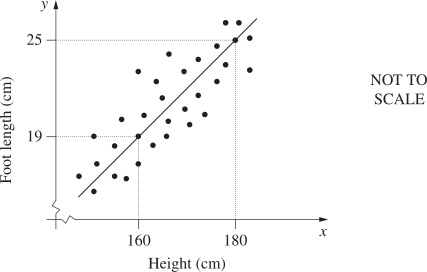
Each member of a group of males had his height and foot length measured and recorded. The results were graphed and a line of fit drawn.
 

  1. Why does the value of the `y`-intercept have no meaning in this situation?  (1 mark)

    --- 2 WORK AREA LINES (style=lined) ---

  2. George is 10 cm taller than his brother Harry. Use the line of fit to estimate the difference in their foot lengths.  (1 mark)

    --- 2 WORK AREA LINES (style=lined) ---

  3. Sam calculated a correlation coefficient of  −1.2  for the data. Give TWO reasons why Sam must be incorrect.  (2 marks)

    --- 5 WORK AREA LINES (style=lined) ---

Show Answers Only
  1. `text(The y-intercept occurs when)\ x = 0.\ text(It has`
    `text(no meaning to have a height of 0 cm.)`
  2. `text(A 10 cm height difference means George should)`
    `text(have a 3 cm longer foot.)`
  3. `text(A correlation co-efficient must be between –1 and 1.)`
    `text(Foot length is positively correlated to a person’s)`
    `text(height and therefore can’t be a negative value.)`
Show Worked Solution

i.  `text(The y-intercept occurs when)\ x = 0.\ text(It has)`

`text(no meaning to have a height of 0 cm.)`


ii.  `text(A 20 cm height difference results in a foot length)`

`text(difference of 6 cm.)`
 

`:.\ text(A 10 cm height difference means George should)`

`text(have a 3 cm longer foot.)`


iii.  `text(A correlation co-efficient must be between –1 and 1.)`

`text(Foot length is positively correlated to a person’s)`

`text(height and therefore isn’t a negative value.)`

Filed Under: Bivariate Data Analysis (Y12), Correlation / Body Measurements, S3 Further Statistical Analysis (Y12), S4 Bivariate Data Analysis (Y12) Tagged With: Band 4, Band 5, Band 6, common-content, smc-1001-10-Line of Best Fit, smc-1001-30-Correlation, smc-1113-10-Line of Best Fit, smc-1113-30-Correlation, smc-785-10-Line of Best Fit, smc-785-30-Correlation

Statistics, STD2 S1 2007 HSC 22 MC

A set of examination results is displayed in a cumulative frequency histogram and polygon (ogive).
 

2007 22 mc
 
Sanath knows that his examination mark is in the 4th decile.

Which of the following could have been Sanath’s examination mark?

  1.    37
  2.    57
  3.    67
  4.    77
Show Answers Only

`B`

Show Worked Solution

Data, 2UG 2007 HSC 22 MC Answer

`text(4th decile occurs when cumulative frequency)`

`text(is between 15 and 20.)`

`:.\ text(Examination mark must be between 55 and 60.)`

`=>  B`

Filed Under: Bar Charts and Histograms, Bar Charts and Histograms (Std 2), Bar Charts and Histograms (Std2-2027), Bar Charts and Histograms (Y12) Tagged With: Band 6, common-content, smc-6310-30-Cumulative Frequency Histograms, smc-821-20-Cumulative Frequency Histograms, smc-997-20-Cumulative Frequency Histograms

Probability, STD2 S2 2006 HSC 28a

On a bridge, the toll of $2.50 is paid in coins collected by a machine. The machine only accepts two-dollar coins, one-dollar coins and fifty-cent coins.

  1. List the different combinations of coins that could be used to pay the $2.50 toll.  (1 mark)

    --- 2 WORK AREA LINES (style=lined) ---

  2. Jill has three two-dollar coins, six one-dollar coins and two fifty-cent coins. She selects two coins at random.


    What is the probability that she selects exactly $2.50?  (3 marks)

    --- 6 WORK AREA LINES (style=lined) ---

  3. At the end of a day, the machine contains `x` two-dollar coins, `y` one-dollar coins and `w` fifty-cent coins.


    Write an expression for the total value of coins in dollars in the machine.  (1 mark)

    --- 2 WORK AREA LINES (style=lined) ---

Show Answers Only
  1. `text(Proof)\ \ text{(See Worked Solutions)}`
  2. `6/55`
  3. `$(2x + y + 0.5w)`
Show Worked Solution

i.  `text(Combinations for $2.50)`

`$2, 50c`

`$1, $1, 50c`

`$1, 50c, 50c, 50c`

`50c, 50c, 50c, 50c, 50c`


ii.  `3 xx $2, 6 xx $1, 2 xx 50c`

`P($2.50)` `= (3/11 xx 2/10) + (2/11 xx 3/10)`
  `= 6/110 + 6/110`
  `= 6/55`


iii.  `text(Total value) = $ (2x + y + 0.5w)`

Filed Under: Multi-stage Events, Multi-Stage Events (Std 2) Tagged With: Band 4, Band 5, Band 6, smc-829-10-Probability Trees, smc-829-15-Draw Probability Tree

Measurement, STD2 M1 2005 HSC 28a

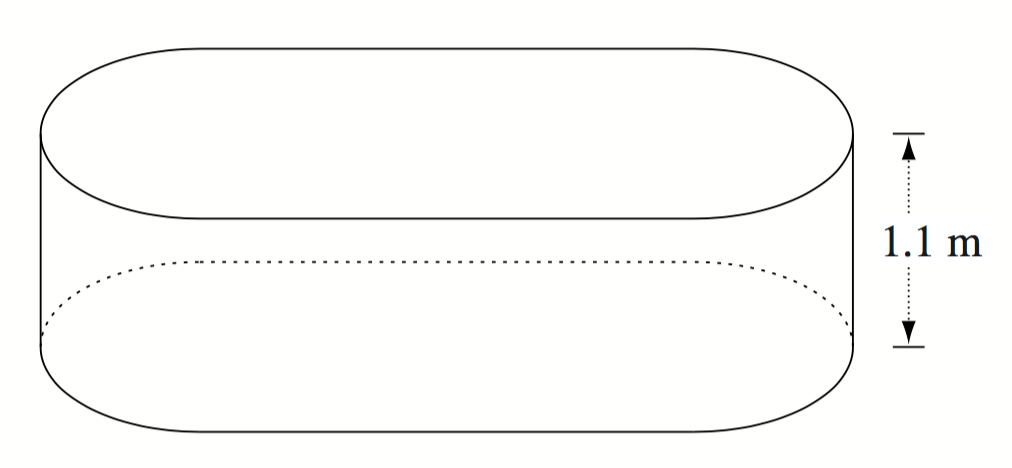
The Mitchell family has moved to a new house which has an empty swimming pool. The base of the pool is in the shape of a rectangle, with a semicircle on each end.

2005 28a1

  1. Explain why the expression for the area of the base of the pool is  `2xy + πy^2`.   (1 mark) 

    --- 2 WORK AREA LINES (style=lined) ---

      
            2005 28a2
      

The pool is 1.1 metres deep.

  1. The sides and base of the pool are covered in tiles. If  `x =6`  and  `y = 2.5`, find the total area covered by tiles. (Give your answer correct to the nearest square metre.)   (4 marks)

    --- 8 WORK AREA LINES (style=lined) ---

Before filling the pool, the Mitchells need to install a new shower head, which saves 6 litres of water per minute.

The shower is used 5 times every day, for 3 minutes each time.

  1. If the charge for water is $1.013 per kilolitre, how much money would be saved in one year by using this shower head? (Assume there are 365 days in a year.)   (2 marks)

    --- 5 WORK AREA LINES (style=lined) ---

Show Answers Only
  1. `text(See Worked Solutions)`
  2. `text(80 m)^2\ text{(nearest m}^2text{)}`
  3. `$33.28\ \ text{(nearest cent)}`
Show Worked Solution
i.    `text(Area of base)` `=\ text(Area of rectangle +)`
    `\ \ \ \ \ \2 xx text(Area of semi-circle)`
    `= (x xx 2y) + 2 xx (1/2 xx pi xx y^2)`
    `= 2xy + piy^2`


ii.   `text(Area of base)` `= (2 xx 6 xx 2.5) + (pi xx 2.5^2)`
    `= 49.634…\ text(m²)`


`text(Area of walls) = text(Length) xx text(Height)`

`text(Length)` `= 2x + 2 xx text(semi-circle perimeter)`
  `= (2 xx 6) + 2 xx (1/2 xx 2 xx pi xx 2.5)`
  `= 12 + 15.707…`
  `= 27.707…\ text(m)`


`:.\ text(Area of walls)` `= 27.707 xx 1.1`
  `= 30.478…\ text(m)^2`


`:.\ text(Total Area covered by tiles)`

`= 49.634… + 30.478…`

`= 80.11…`

`= 80\ text{m²  (nearest m²)}`


iii.  `text(Water saved)` `= 5 xx 3 xx 6`
    `= 90\ text(L per day.)`


`text(Water saved per year)`

`= 90 xx 365`

`= 32\ 850\ text(L)`

`= 32.85\ text(kL)`

`:.\ text(Money saved)` `= 32.85 xx $1.013`
  `= $33.277…`
  `= $33.28\ text{(nearest cent)}`

Filed Under: Areas and Volumes (Harder), Perimeter, Area and Volume (Std 2), Perimeter, Area and Volume (Std2-2027), Perimeter/Area problem Tagged With: Band 4, Band 5, Band 6, smc-6304-50-Volume (Circular Measure), smc-798-50-Volume (Circular Measure)

Statistics, STD2 S1 2005 HSC 27d

Nine students were selected at random from a school, and their ages were recorded.

\begin{array} {|c|}
\hline
\rule{0pt}{2.5ex} \textbf{Ages} \rule[-1ex]{0pt}{0pt} \\
\hline
\rule{0pt}{2.5ex} \ \ \ \text{12     11     16} \ \ \  \rule[-1ex]{0pt}{0pt} \\ \rule{0pt}{2.5ex} \text{14     16     15} \rule[-1ex]{0pt}{0pt} \\ \rule{0pt}{2.5ex} \text{14     15     14} \rule[-1ex]{0pt}{0pt} \\
\hline
\end{array}

  1. What is the sample standard deviation, correct to two decimal places?   (2 marks)

    --- 4 WORK AREA LINES (style=lined) ---

  2. Briefly explain what is meant by the term standard deviation.   (1 mark)

    --- 2 WORK AREA LINES (style=lined) ---

Show Answers Only
  1. `text{1.69  (to 2 d.p.)}`
  2. `text(Standard deviation is a measure of how much)`


    `text(members of a data group differ from the mean)`


    `text(value of the group)`

Show Worked Solution

i.  `text(Sample standard deviation)`

`= 1.6914…\ text{(by calculator)}`

`= 1.69\ \ \ text{(to 2 d.p.)}`


ii.  `text(Standard deviation is a measure of how much)`

`text(members of a data group differ from the mean)`

`text(value of the group.)`

Filed Under: Measures of Centre and Spread (Std2-2027), Summary Statistics - No Graph (Std 2), Summary Statistics - No graph (Y12), Summary Statistics (no graph), Summary Statistics (Std 1) Tagged With: Band 4, Band 6, common-content, smc-1131-50-Std Dev (by calc), smc-6312-50-Std Dev (by Calc), smc-824-50-Std Dev (by calc), smc-999-50-Std Dev (by calc)

Algebra, 2UG 2004 HSC 28b

2004 28b

A set of garden gnomes is made so that the cost (`$C`) varies directly with the cube of the base length (`b` centimetres). A gnome with a base length of `text(10 cm)` has a cost of `$50`.

  1. Write an equation relating the variables `C` and `b`, and a constant `k`.  (1 mark)
  2. Find the value of `k`.  (1 mark)
  3. Felicity says, ‘If you double the base length, you double the cost.’ Is she correct? Justify your answer with mathematical calculations.  (2 marks)


Show Answers Only
  1. `C = kb^3`
  2. `0.05`
  3. `text(Felicity is incorrect, because doubling)`
    `text(the base from 10 cm to 20 cm causes the)`
    `text(cost to increase 8 times.)`


Show Worked Solution
(i)  `C` `∝ b^3`
 `:.C` `= kb^3`


(ii)  `C = 50\ \ text(when)\ \ b = 10`

`50` `= k xx 10^3`
`:.k` `= 50/10^3`
  `= 0.05`


(iii)  `text(If)\ b = 20`

`C` `= 0.05 xx 20^3`
  `= $400`


`:.\ text(Felicity is incorrect, because doubling)`

`text(the base from 10 cm to 20 cm causes the)`

`text(cost to increase 8 times.)`

Filed Under: Exponential/Quadratic (Projectile) Tagged With: Band 5, Band 6

Algebra, STD2 A4 2004 HSC 28a

A health rating, `R`, is calculated by dividing a person’s weight, `w`, in kilograms by the square of the person’s height, `h`, in metres.

  1. Fred is 150 cm and weighs 72 kg. Calculate Fred’s health rating.  (1 mark)

    --- 2 WORK AREA LINES (style=lined) ---

  2. Over several years, Fred expects to grow 10 cm taller. By this time he wants his health rating to be 25. How much weight should he gain or lose to achieve his aim? Justify your answer with mathematical calculations.  (2 marks)

    --- 5 WORK AREA LINES (style=lined) ---

Show Answers Only

i.   `32`

ii.  `text(8 kg)`

Show Worked Solution

i.    `R = w/h^2`

`text(When)\ w = 72 and h = 1.5:`

`R=72/1.5^2= 32`
 

ii.  `text(Find)\ w\ text(if)\ R = 25 and h = 1.6:`

`25` `= w/1.6^2`
`w` `= 25 xx 1.6^2`
  `= 64\ text(kg)`

 
`:.\ text(Weight Fred should lose)`

`= 72-64`

`= 8\ text(kg)`

Filed Under: Exponential/Quadratic (Projectile), Inverse, Non-Linear: Inverse and Other Problems (Std 2) Tagged With: Band 5, Band 6, smc-795-10-Inverse

Financial Maths, STD2 F1 2006 HSC 22 MC

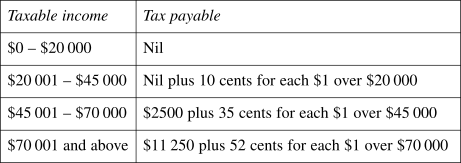
This income tax table is used to calculate Evelyn’s tax payable.
 

Evelyn’s taxable income increases from $50 000 to $80 000.

What percentage of her increase will she pay in additional tax?

  1. `text(15.25%)`
  2. `text(40.7%)`
  3. `text(43.5%)`
  4. `text(52%)`
Show Answers Only

`B`

Show Worked Solution
`text(Tax on $50 000)` `= 2500 + 0.35 xx (50\ 000-45\ 000)`
  `= 2500 + 1750`
  `= $4250`
`text(Tax on $80 000)` `= 11\ 250 + 0.52 xx (80\ 000-70\ 000)`
  `= 11\ 250 + 5200`
  `= $16\ 450`
`:.\ text(Extra tax)` `= 16\ 450-4250`
  `= $12\ 200`


`:.\ text(% Increase paid in tax)`

`= (12\ 200) / (30\ 000) xx 100`

`=\ text(40.66… %)`
 

`=>  B`

Filed Under: Earning and Spending Money, FM3 - Taxation, Tax and Percentage Increase/Decrease (Std 2), Taxation (Std2-2027) Tagged With: Band 6, num-title-ct-corea, num-title-qs-hsc, smc-4331-50-Tax tables, smc-6277-10-Tax Tables, smc-831-10-Tax Tables

Statistics, STD2 S1 2005 HSC 22 MC

Two groups of people were surveyed about their weekly wages. The results are shown in the box-and-whisker plots.
 

Which of the following statements is true for the people surveyed?

  1. The same percentage of people in each group earned more than $325 per week.
  2. Approximately 75% of people under 21 years earned less than $350 per week.
  3. Approximately 75% of people 21 years and older earned more than $350 per week.
  4. Approximately 50% of people in each group earned between $325 and $350 per week.
Show Answers Only

`B`

Show Worked Solution

`text{Option A: 50% of Under 21 group earned over $325 and 75%}`

`text{of Over 21 group did. NOT TRUE.}`
 

`text{Option B: 75% of Under 21 group earned below $350 is TRUE.}`
 

`text{Options C and D: can both be proven to be untrue using their}`

`text{median and quartile values.}`

`=>  B`

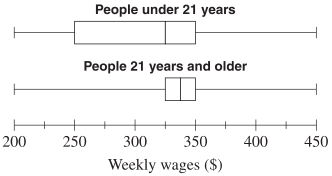
Filed Under: Box Plots and 5-Number Summary, Stem & Leaf, Box & Whisker, Summary Statistics - Box Plots (Std 2), Summary Statistics - Box Plots (Std2-2027), Summary Statistics - Box Plots (Y12) Tagged With: Band 6, common-content, num-title-ct-corea, num-title-qs-hsc, smc-1000-20-Parallel Box-Plots, smc-5021-60-Box plots (parallel), smc-6313-20-Parallel Box Plots, smc-825-20-Parallel Box-Plots

Probability, STD2 S2 2005 HSC 20 MC

Dave’s school has computer security codes made up of four digits (eg 0773). Juanita’s school has computer security codes made up of five digits (eg. 30 568).

How many more codes are available at Juanita’s school than at Dave’s school?

  1.    10
  2.    50
  3.    90 000
  4.    100 000
Show Answers Only

`C`

Show Worked Solution

`text(# Codes at Dave’s school)`

`= 10 × 10 × 10 × 10`

`= 10\ 000`

`text(# Codes at Juanita’s school)`

`= 10^5`

`= 100\ 000`

`:.\ text(Extra Codes)` `= 100\ 000 − 10 \ 000`
  `= 90\ 000`

`=>  C`

Filed Under: # Combinations, Combinations (Std 1), Combinations and Single Stage Events (Std 2) Tagged With: Band 6, smc-1134-20-Number Combinations, smc-828-20-Number Combinations

Financial Maths, 2UG 2006 HSC 16 MC

Two families borrow different amounts of money on the same day.

The Wang family has a flat rate loan. The Salama family has a reducing balance loan and repays the loan earlier than the Wang family.

Which graph best represents this situation?


2UG-2006-16abMC

2UG-2006-16cdMC

Show Answers Only

`C`

Show Worked Solution

`text(By elimination)`

`text(The families borrow different amounts)`

`:.\ text(NOT)\ D`

`text{The reducing balance loan (curved graph)}`

`text(is paid off earlier, and therefore intersects the)`

`text(‘time’ axis closer to zero)`

`:.\ text(NOT)\ A\ text(or)\ B`

`=>  C`

Filed Under: FM5 - Annuities and Loan repayments Tagged With: Band 6

CORE*, FUR1 2008 VCAA 9 MC

An amount of $8000 is invested for a period of 4 years.

The interest rate for this investment is 7.2% per annum compounding quarterly.

The interest earned by the investment in the fourth year (in dollars) is given by

A.   `4 xx (7.2/100 xx 8000)`

B.   `8000 xx 1.018^4 - 8000 xx 1.018^3`

C.   `8000 xx 1.018^16 - 8000 xx 1.018^12`

D.   `8000 xx 1.072^4 - 8000 xx 1.072^3`

E.   `8000 xx 1.072^16 - 8000 xx 1.072^12`

Show Answers Only

 `C`

Show Worked Solution
`text(4th year interest)` `=\ text(Value after 4 years) -`
  `text(Value after 3 years.)`

`text(Using)\ \ A = PR^n,`

♦♦ Mean mark 33%.
MARKERS’ COMMENT: The most common errors were not converting and applying the interest rate to a quarterly one.

`text(where)\ R = 1 + 7.2/(100 xx 4) = 1.018`
 

`text(Value after 4 years:)`

`A_4` `= 8000 xx 1.018^((4 xx 4))`
  `= 8000 xx 1.018^(16)`

 
`text(Value after 3 years:)`

`A_3` `= 8000 xx 1.018^((4 xx 3))`
  `= 8000 xx 1.018^(12)`

 
`:.\ text(4th year interest) = 8000 xx 1.018^(16) − 8000 xx 1.018^(12)`

`=>  C`

Filed Under: Interest Rates and Investing Tagged With: Band 6, smc-604-20-Compound interest

CORE*, FUR1 2008 VCAA 7 MC

Ernie took out a reducing balance loan to buy a new family home.

He correctly graphed the amount paid off the principal of his loan each year for the first five years.

The shape of this graph (for the first five years of the loan) is best represented by


Show Answers Only

 `B`

Show Worked Solution

`text(A reducing balance means that the amount of)`

♦♦ Mean mark 25%.

`text(interest paid decreases each year, and therefore)`

`text(the amount paid off the principal will not only)`

`text(increase each year, but will do so at an increasing)`

`text(rate.)`

`B\ text(correctly shows this trend.)`

`=>  B`

Filed Under: Borrowing and Loans Tagged With: Band 6, smc-603-80-Graphs

CORE*, FUR1 2007 VCAA 7 MC

At the start of each year Joe's salary increases to take inflation into account.

Inflation averaged 2% per annum last year and 3% per annum the year before that.

Joe's salary this year is $42 000.

Joe's salary two years ago, correct to the nearest dollar, would have been

A.   `$39\ 900`

B.   `$39\ 925`

C.   `$39\ 926`

D.   `$39\ 976`

E.   `$39\ 977`

Show Answers Only

`E`

Show Worked Solution

`text(Let last year’s salary)\ = x`

♦♦ Mean mark 23%.
MARKERS’ COMMENT: Depreciating this year’s salary of $42 000 by 3% and then 2% to get ($42 000 x 0.97 x 0.98) is an incorrect strategy used by almost half of students. Make sure you understand why!
`x xx 1.03` `= 42 \ 000`
`x` `= (42\ 000)/1.03`
  `= $40 \ 776.70`


`text(Let salary 2 years ago)\ = y`

`y xx 1.02` `= $40 \ 776.70`
 `:. y` `=$39 \ 977.15`

 
`=>  E`

Filed Under: Interest Rates and Investing Tagged With: Band 6, smc-604-40-% Increase/Decrease

CORE*, FUR1 2006 VCAA 9 MC

Jenny borrowed $18 000. She will fully repay the loan in five years with equal monthly payments.

Interest is charged at the rate of 9.2% per annum, calculated monthly, on the reducing balance.

The amount Jenny has paid off the principal immediately following the tenth repayment is

A.   $1876.77

B.   $2457.60

C.   $3276.00

D.   $3600.44

E.   $3754.00

Show Answers Only

`B`

Show Worked Solution

`text(Find monthly repayments,)`

♦♦ Mean mark 27%.

`text(By TVM Solver:)`

`N` `=  5 xx 12 = 60`
`I(%)` `= 9.2text(%)`
`PV` `= − 18\ 000`
`PMT` `= ?`
`FV` `= 0`
`text(P/Y)` `= text(C/Y) = 12`

 
`:. \ PMT = $375.40`


`text(Find the loan value after the 10th repayment,)`

`text(By TVM Solver:)`

`N` `=  10`
`I(%)` `= 9.2text(%)`
`PV` `= − 18\ 000`
`PMT` `= 375.40`
`FV` `= ?`
`text(P/Y)` `= text(C/Y) = 12`

 
`:. \ FV= 15\ 542.40`


`:.\ text(Amount paid off)` `= 18\ 000 − 15\ 542.40`
  `= $2457.60`

`=>B`

Filed Under: Borrowing and Loans Tagged With: Band 6, smc-603-22-Reducible balance loans, smc-603-65-CAS (2 step)

CORE*, FUR1 2006 VCAA 3 MC

Grandpa invested in an ordinary perpetuity from which he receives a monthly pension of $584.

The interest rate for the investment is 6.2% per annum.

The amount Grandpa has invested in the perpetuity is closest to

A.        $3600

B.        $9420

C.     $94 200

D.     $43 400

E.   $113 000

Show Answers Only

`E`

Show Worked Solution

`I = 584, \ r = 6.2, \ T = 1/12`

♦♦ Mean mark 23%.
MARKERS’ COMMENT: Nearly half of students read the monthly pension amount as a yearly amount. Be careful!
`I` `= (PrT)/100`
`584` `=(P xx 6.2 xx 1/12)/100`
`:. P` `=(584 xx 100)/(6.2 xx 1/12)`
  `=$113\ 032.25…`

 
`=>  E`

Filed Under: Annuities and Perpetuities Tagged With: Band 6, smc-2512-20-Perpetuity

CORE*, FUR1 2011 VCAA 7 MC

Anthony invested $15 000 in an account. It earned `rtext(%)` interest per annum, compounding monthly.

The amount of interest that is earned in the third year of the investment is given by

A.   `15\ 000 (1 + r / 1200)^3 - 15\ 000 (1 + r / 1200)^2`

B.   `15\ 000 (1 + r / 1200)^36 - 15\ 000 (1 + r / 1200)^24`

C.   `15\ 000 (1 + r / 100)^3 - 15\ 000 (1 + r / 100)^2`

D.   `15\ 000 (1 + r / 100)^36 - 15\ 000 (1 + r / 100)^24`

E.   `15\ 000 (1 + r / 1200)^4 - 15\ 000 (1 + r / 1200)^3` 

Show Answers Only

`B`

Show Worked Solution

`text(Interest in 3rd year)`

♦♦ Mean mark 33%.

`=\ text(Value after 3 yrs) – text(Value after 2 years)`


`text(Using)\ \ A = PR^n,\ \ text(where)\ \ A = 15\ 000, and`

`R` `= (1 + r / {12 xx 100})`
  `= (1 + r / 1200)`


`text(In first 3 years:)`

`A_3` `= 15\ 000 (1 + r / 1200)^(12 xx 3)`
  `= 15\ 000 (1 + r / 1200)^36`


`text(In first 2 years:)`

`A_2` `= 15\ 000 (1 + r / 1200)^(12 xx 2)`
  `= 15\ 000 (1 + r / 1200)^24`


`:.\ text(Interest in 3rd year)`

`= 15\ 000 (1 + r/1200)^36 – 15\ 000 (1 + r/1200)^24`

`=>  B`

Filed Under: Interest Rates and Investing Tagged With: Band 6, smc-604-20-Compound interest

CORE*, FUR1 2012 VCAA 9 MC

Peter took out a reducing balance loan where interest was calculated monthly. He planned to repay this loan fully, with eight equal monthly payments of $260.

Peter missed the fourth payment, but made a double payment of $520 in the fifth month. He then continued to make payments of $260 for the remaining three months.

Which graph could show the balance of the loan each month over the eight-month period?


Show Answers Only

`A`

Show Worked Solution

`text(By elimination,)`

`text(As Peter missed the 4th payment, the balance of the)`

♦♦ Mean mark 20%.

`text(loan will increase after 4 months due to interest.)`

`:.\ text(Eliminate B, C, D and E.)`

`=>  A`

Filed Under: Borrowing and Loans Tagged With: Band 6, smc-603-80-Graphs

CORE*, FUR1 2013 VCAA 8 MC

A car is purchased for $25 000. The value of the car is to be depreciated each year by 20% using the reducing balance method.

In the fourth year, the car will depreciate in value by

A.      $2048

B.      $2560

C.      $5000

D.   $10 240

E.   $14 760

Show Answers Only

`B`

Show Worked Solution

`text(Depreciated value after 3 years)`

♦♦ Mean mark 29%.
MARKERS’ COMMENT: A common mistake was to not read the question carefully and give the depreciated value of the car after 4 years.

`= 25\ 000 xx (1 – 0.2)^3`

`= 12\ 800`
 

`:.\ text(Depreciation in 4th year)`

`= 12\ 800 xx 0.2`

`= $2560`
 

`=>  B`

Filed Under: Depreciation Tagged With: Band 6, smc-602-20-Reducing balance

CORE*, FUR1 2013 VCAA 6 MC

A worker has received an annual salary increase of 3% for the past two years.

This year, the worker’s annual salary is $46 500.

Two years ago, her salary was closest to

A.   `$42\ 315`

B.   `$43\ 750`

C.   `$43\ 830`

D.   `$45\ 140`

E.   `$49\ 330`

Show Answers Only

`C`

Show Worked Solution

`text(Let)\ x\ text(be the worker’s salary 2 years ago)`

♦♦ Mean mark 30%.
`x xx 1.03 xx 1.03` `= 46\ 500`
`x (1.03)^2` `= 46\ 500`
`:. x` `= (46\ 500) / 1.03^2`
  `= 43\ 830.70…`

 
`=>  C`

Filed Under: Interest Rates and Investing Tagged With: Band 6, smc-604-40-% Increase/Decrease

CORE*, FUR1 2014 VCAA 9 MC

Leslie borrowed $35 000 from a bank.

Interest is charged at the rate of 4.75% on the reducing monthly balance.

The loan is to be repaid with 47 monthly payments of $802.00 and a final payment that is to be adjusted so that the loan will be fully repaid after exactly 48 monthly payments.

Correct to the nearest cent, the amount of the final payment will be

A.       $0.39

B.       $3.57

C.   $802.00

D.   $802.39

E.   $805.57

Show Answers Only

`E`

Show Worked Solution

`text(Calculate the FV of the loan after 47 payments)`

♦♦♦ Mean mark 18%.
MARKERS’ COMMENT: A majority of students found the amount still owed after the second last payment but failed to add interest during the last month.

`text(By TVM Solver:)`

`N` `= 47`
`I(%)` `= 4.75text(%)`
`PV` `= -35\ 000`
`PMT` `= 802`
`FV` `= text(?)`
`text(P/Y)` `= text(C/Y) = 12`

 
`:.\ text(Balance owing after 47 payments)\ =$802.39…`


`text(Final payment)`

`=\ text(Balance after 47 payments +  month’s interest)`

`=802.39… + (802.39… xx 4.75/12 xx 100text{%})`

`=$805.57`

`=>  E`

Filed Under: Borrowing and Loans Tagged With: Band 6, smc-603-22-Reducible balance loans, smc-603-60-CAS (1 step)

GRAPHS, FUR1 2007 VCAA 7 MC

GRAPHS, FUR1 2007 VCAA 7 MC

The graph above shows a relationship between `y` and `x^3`.

The graph that shows the same relationship between `y` and `x` is

GRAPHS, FUR1 2007 VCAA 7 MC ab

GRAPHS, FUR1 2007 VCAA 7 MC cd

GRAPHS, FUR1 2007 VCAA 7 MC e

Show Answers Only

`C`

Show Worked Solution

`text(The gradient of the linear graph of)`

♦♦♦ Mean mark 26%.

`y\ text(versus)\ x^3 = 1/3`

 `:.\ y = 1/3x^3`

`text(Test if the coordinates in each graph satisfy)`

`text(the equation)\ \ y=1/3x^3.`

`text(Consider)\ C,`

`text(Substitute)\ (1, 1/3)\ text(into equation,)`

`1/3 = 1/3 xx 1^3\ \ \ text{(true)}`

`text(All other options can be shown to not satisfy equation.)`

`=>  C`


Filed Under: Non-linear Relationships Tagged With: Band 6

GRAPHS, FUR1 2007 VCAA 6 MC

Russell is a wine producer. He makes both red and white wine.

Let `x` represent the number of bottles of red wine he makes and `y` represent the number of bottles of white wine he makes.

This year he plans to make at least twice as many bottles of red wine as white wine.

An inequality representing this situation is

A.   `y <= x + 2`

B.   `y <= 2x`

C.   `y >= 2x`

D.   `x <= 2y`

E.   `x >= 2y`

Show Answers Only

`E`

Show Worked Solution

`x = text(no. red wine bottles)`

♦♦ Mean mark 34%.

`y = text(no. white wine bottles)`

`text(The constraint states that the number of)`

`text(of bottles of red wine will be at least twice)`

`text(the number of bottles of white wine.)`

`x >= 2y`

`=>  E`

Filed Under: Linear Programming Tagged With: Band 6

GRAPHS, FUR1 2008 VCAA 4 MC

When shopping, Betty can use either Easypark or Safepark to park her car.

At Easypark, cars can be parked for up to 8 hours per day.

The fee structure is as follows.

`text(Fee)={(text($5.00,),     0 < text(hours) <= 2),(text($8.00,),     2 < text(hours) <= 5),(text($11.00,),     5 < text(hours) <= 8) :}`

Safepark charges fees according to the formula

`text(Fee) = $2.50 xx text(hours)`

Betty wants to park her car for 5 hours on Monday and 3 hours on Tuesday.

The minimum total fee that she can pay for parking for the two days is

A.     `$7.50`

B.   `$11.00`

C.   `$15.50`

D.   `$16.00`

E.   `$20.00`

Show Answers Only

`C`

Show Worked Solution

`text(Fee for 5 hours)`

♦♦ Mean mark 29%.
MARKER’S COMMENT: Almost half of students failed to take into account that the same car park did not have to be used on each day, and incorrectly answered D.

`text(Easypark = $8)`

`text(Safepark = $2.50) xx 5 = $12.50`

`text(Fee for 3 hours)`

`text(Easypark = $8)`

`text(Safepark = $2.50) xx 3 = $7.50`

`:.\ text(The minimum total fee is)`

`$8 + $7.50 = $15.50`

`=>  C`

Filed Under: Linear Programming Tagged With: Band 6

GRAPHS, FUR1 2009 VCAA 9 MC

The graph below shows the cost (in dollars) of producing birthday cards.

GRAPHS, FUR1 2009 VCAA 9 MC

If the profit from the sale of 150 birthday cards is $175, the selling price of one card is

A.   `$0.30`

B.   `$1.60`

C.   `$3.10`

D.   `$3.50`

E.   `$4.40`

Show Answers Only

`D`

Show Worked Solution

`text{Profit = Revenue – Costs = $175  (given)}`

♦ Mean mark 37%.

`text{Revenue}\ (R) = 150 xx S,\ \ \ (S= text{selling price})`


`text(Calculating cost of 150 cards,)\ C,`

`text(Fixed cost) = $50\ \ text{(}y\ text(intercept) text{)}`

`text{40 cards cost $130  (from graph)}`

`:.\ text(C)text(ost per card)= (130 − 50)/40=$2`

`:. C=50 + 150 xx 2=350`


`R-C` `=175`
`150S-350`  `= 175`
 `150S` `=525`
`:. S`  `= $3.50`

`=>  D`

Filed Under: Linear relationships Tagged With: Band 6

GEOMETRY, FUR1 2006 VCAA 9 MC

Points `M` and `P` are the same distance from a third point `O`.

The bearing of `M` from `O` is 038° and the bearing of `P` from `O` is 152°.

The bearing of `P` from `M` is

A.   between 000° and 090°

B.   between 090° and 180°

C.   exactly 180°

D.   between 180° and 270°

E.   between 270° and 360°

Show Answers Only

`D`

Show Worked Solution
♦♦ Mean mark 31%.

GEOMETRY, FUR1 2006 VCAA 9 MC Answer 

`/_ MOP`  `= 152 − 38`
  `= 114^@`


`text(Let)\ R\ text(be directly south of)\ O`

`/_POR` `= 180 − (38 + 114)\ \ text{(straight line)}`
  `= 28^@`


`text(Given)\ OM = OP`

`text(Diagram shows that)\ M\ text(is further east than)\ P.`

`:.\ text(Bearing of)\ P\ text(from)\ M\ text(just over 180°)`

`=>  D`

Filed Under: Trig - Bearings Tagged With: Band 6

GEOMETRY, FUR1 2006 VCAA 8 MC

GEOMETRY, FUR1 2006 VCAA 8 MC

The cross-section of a water pipe is circular with a radius, `r`, of 50 cm, as shown above.

The surface of the water has a width, `w`, of 80 cm.

The depth of water in the pipe, `d`, could be

A.    `20\ text(cm)`

B.    `25\ text(cm)`

C.    `30\ text(cm)`

D.    `40\ text(cm)`

E.    `50\ text(cm)`

Show Answers Only

`A`

Show Worked Solution
♦♦ Mean mark 22%.
MARKER’S COMMENT: 39% of students calculated `x` in the solution, without then using it to find the depth.

 GEOMETRY, FUR1 2006 VCAA 8 MC Answer

`text(Using Pythagoras,)`

`x^2 + 40^2` `= 50^2`
`x^2` `= 2500 − 1600`
  `= 900`
`x` `= 30\ text(cm)`
   
`d + x` `= 50\ text{(radius)}`
`:.\ d` `= 20\ text(cm)`

`=>  A`

Filed Under: Trig - Harder Applications Tagged With: Band 6

Measurement, 2UG 2007 HSC 28c

A piece of plaster has a uniform cross-section, which has been shaded, and has dimensions as shown.


  1. Use two applications of Simpson’s rule to approximate the area of the cross-section.    (3 marks)
  2. The total surface area of the piece of plaster is  `7480.8\ text(cm²)`.
  3. Calculate the area of the curved surface as shown on the diagram.   (2 marks)


Show Answers Only
  1. `50.4\ text(cm²)`
  2. `3500\ text(cm²)`
Show Worked Solution
(i)   
`A` `= h/3 [y_0 +4y_1 + y_2]\ text(… applied twice)`
  `= 3.6/3 (5 + 4 xx 4.6 + 3.7) + 3.6/3 (3.7 + 4 xx 2.8 + 0)`
  `= 32.52 + 17.88`
  `= 50.4\ text(cm²)`


(ii)  `text(Total Area) = 7480.8\ text(cm²)`

`text(Area of Base)` `= 14.4 xx 200`
  `= 2880\ text(cm²)`
`text(Area of End)` `= 5 xx 200`
  `= 1000\ text(cm²)`
`text(Area of sides)` `= 2 xx 50.4\ \ \ text{(from (i))}`
  `= 100.8\ text(cm²)`


`:.\ text(Area of curved surface)`

`= 7480.8 – (2880 + 1000 + 100.8)`

`= 3500\ text(cm²)`

Filed Under: Simpson's Rule/Measurement Error Tagged With: Band 4, Band 5, Band 6

Algebra, STD2 A1 2007 HSC 28b

This shape is made up of a right-angled triangle and a regular hexagon.


The area of a regular hexagon can be estimated using the formula  `A = 2.598H^2`  where  `H`  is the side-length.

Calculate the total area of the shape using this formula.   (3 marks)

--- 6 WORK AREA LINES (style=lined) ---

Show Answers Only

`22.784\ text(cm²)`

Show Worked Solution

`text(Area) = 2.598H^2`

`text(Using Pythagoras)`

`H^2` `= 2^2 + 2^2`
  `= 8`
`H` `= sqrt 8`
`:.\ text(Area of hexagon)` `= 2.598 xx (sqrt 8)^2`
  `= 20.784\ text(cm²)`
`text(Area of triangle)` `= 1/2 bh`
  `= 1/2 xx 2 xx 2`
  `= 2\ text(cm²)`


`:.\ text(Total Area)` `= 20.784 + 2`
  `= 22.784\ text(cm²)`

Filed Under: AM1 - Algebra (Prelim), MM2 - Perimeter, Area and Volume (Prelim), Perimeter, Area and Volume (Std 2), Perimeter, Area and Volume (Std2-2027), Substitution and Other Equations (Std2-2027) Tagged With: Band 6, smc-6234-10-Substitution, smc-6304-10-Perimeter and Area, smc-789-10-Substitution, smc-798-10-Perimeter and Area

Probability, 2UG 2007 HSC 28a

Two unbiased dice,  `A`  and  `B`, with faces numbered  `1`,  `2`,  `3`,  `4`,  `5`  and  `6`  are rolled.

The numbers on the uppermost faces are noted. This table shows all the possible outcomes.


A game is played where the difference between the highest number showing and the lowest number showing on the uppermost faces is calculated.

  1. What is the probability that the difference between the numbers showing on the uppermost faces of the two dice is one?   (1 mark)
  2. In the game, the following applies. 
  3. What is the financial expectation of the game?   (3 marks)
  4. If Jack pays  `$1`  to play the game, does he expect a gain or a loss, and how much will it be?  (1 mark)


Show Answers Only
  1. `5/18`
  2. `$0.75`
  3. `text(If Jack pays $1 to play, he should expect)`
  4. `text(a loss of $0.25.)`
Show Worked Solution

(i)   `text(# Outcomes with a difference of 1)`

`= 10`

`:.\ P text{(diff of 1)} = 10/36 = 5/18`


(ii)  `P text{(no difference)} = 6/36 = 1/6`

`P text{(2, 3, 4 or 5)}` `= 1 – [P(0) + P(1)]`
  `= 1 – [5/18 + 1/6]`
  `= 1 – 8/18`
  `= 5/9`

`:.\ text(Financial Expectation)`

`= (1/6 xx 3.50) – (5/18 xx 5) + (5/9 xx 2.80)`

`= $0.75`


(iii)  `text(If Jack pays $1 to play, he should expect)`

`text(a loss of $0.25.)`

Filed Under: Financial Expectation Tagged With: Band 5, Band 6

GEOMETRY, FUR1 2007 VCAA 6 MC

A solid cylinder has a height of 30 cm and a diameter of 40 cm.

A hemisphere is cut out of the top of the cylinder as shown below.

GEOMETRY, FUR1 2007 VCAA 6 MC

In square centimetres, the total surface area of the remaining solid (including its base) is closest to

A.     `1260`

B.     `2510`

C.     `6280`

D.     `7540`

E.  `10\ 050`

Show Answers Only

`D`

Show Worked Solution

`text(Total surface area of solid)`

`=\ text{S.A. (base)} + text{S.A. (side)} + text{S.A. (hemisphere)}`

♦♦ Mean mark 28%.
`text{S.A. (base)}` `= pir^2`
  `= pi xx 20^2`
  `= 1256.63…`
`text{S.A. (side)}` `= 2 pi r h`
  `= 2 xx pi xx 20 xx 30`
  `= 3769.91…`
`text{S.A. (hemisphere)}` `= 1/2 xx 4pir^2`
  `= 1/2 xx 4 xx pi xx 20^2`
  `= 2513.27…`
`:.\ text(Total S.A.)` `= 1256.63… + 3769.91… + 2513.27…`
  `= 7539.81…\ text(cm²)`

`=>  D`

Filed Under: Perimeter, Area and Volume Tagged With: Band 6

GEOMETRY, FUR1 2007 VCAA 5 MC

A block of land has an area of 4000 m².

When represented on a map, this block of land has an area of 10 cm².

On the map 1 cm would represent an actual distance of

A.       `10\ text(m)`

B.       `20\ text(m)`

C.       `40\ text(m)`

D.     `400\ text(m)`

E.   `4000\ text(m)`

Show Answers Only

`B`

Show Worked Solution

`text(Area scale factor) = k^2`

♦♦♦ Mean mark 18%.
MARKER’S COMMENT: A majority of students obtained the the “area” scale factor (k² = 400) but failed to convert this to the corresponding linear scale factor.
`k^2` `= 4000/10`
  `= 400`
`:. k` `= sqrt(400)`
  `= 20`

 
`:.\ text(Linear scale factor) = 20,`

`text(i.e.)\ \ 1\ text(cm):20\ text(m)`

`=>  B`

Filed Under: Similarity and Scale Tagged With: Band 6, smc-606-20-Scale - Maps, smc-606-30-Factors k / k^2 / k^3

GEOMETRY, FUR1 2011 VCAA 6 MC

In parallelogram `PQRS`, `/_ QPS = 74°.`

In this parallelogram, `PQ = 18\ text(cm)` and `PS = 25\ text(cm.)`

The length of the longer diagonal of this parallelogram is closest to

A.   `26.5\ text(cm)`

B.   `30.1\ text(cm)`

C.   `30.8\ text(cm)`

D.   `34.6\ text(cm)`

E.   `39.9\ text(cm)`

Show Answers Only

`D`

Show Worked Solution
♦♦ Mean mark 34%.

geometry 2011 VCAA 6mci

`/_ PQR` ` = 180 – 74\ \ \ text{(co-interior,}\ QR text(||) PS text{)}`
  ` = 106^@`

`text(Using cosine rule,)`

`PR^2` ` = 18^2 + 25^2 – 2 xx 18 xx 25 xx cos 106^@`
  ` = 324 + 625 + 248.07…`
  ` = 1197.07…`
`:. PR` ` = 34.59…\ \ text(cm)`

`=> D`

Filed Under: Trig - Harder Applications Tagged With: Band 6

GEOMETRY, FUR1 2009 VCAA 9 MC

GEOMETRY, FUR1 2009 VCAA 9 MC


A vertical pole, `TP`, is  4 metres tall and stands on level ground near a vertical wall.

The wall is 6 metres long and 4 metres high.

The base of the pole, `T`, is  5 metres from one end of the wall at `N` and 4 metres from the other end of the wall at `M`.

The pole falls and hits the wall.

The maximum height above ground level at which the pole could hit the wall is closest to

A.   `0\ text(m)`

B.   `1.5\ text(m)`

C.   `2.3\ text(m)`

D.   `2.7\ text(m)`

E.   `3.3\ text(m)`

Show Answers Only

`C`

Show Worked Solution
♦♦ Mean mark 27%.
MARKER’S COMMENT: The key concept to finding the solution is to realise that max height occurs when the pole falls at right angles to the wall.

GEOMETRY, FUR1 2009 VCAA 9 MC Answer1 

`text(Using cosine rule in)\ Delta MTN\ text(to find)\ theta`

`cos theta` `= (6^2 + 4^2 − 5^2) / (2 × 6 × 4)`
  `= 0.5625`
`theta` `= 55.77…^@`


`text(In)\ Delta AMT,`
`sin theta` `= x/4`
`x` `= 4 xx sin 55.77…^@`
  `= 3.307…`
`text(When the pole falls, max height) = h`


GEOMETRY, FUR1 2009 VCAA 9 MC Answer2  

`text(Using Pythagoras,)`

`4^2` `= h^2 + 3.307^2`
`h^2` `= 4^2 − 3.307^2`
  `= 5.0625`
`h` `= 2.25…\ text(m)`
`=> C`

Filed Under: Trig - Harder Applications Tagged With: Band 6

PATTERNS, FUR1 2009 VCAA 9 MC

There are 10 checkpoints in a 4500 metre orienteering course.

Checkpoint 1 is the start and checkpoint 10 is the finish.

The distance between successive checkpoints increases by 50 metres as each checkpoint is passed.

The distance, in metres, between checkpoint 2 and checkpoint 3 is

A.   `225`

B.   `275`

C.   `300`

D.   `350`

E.   `400`

Show Answers Only

`D`

Show Worked Solution

`text(9 distances exist between 10 checkpoints)`

♦♦ Mean mark 26%.

`text(9 distances form an AP, where)`

`d = 50,\ \ \ S_9 = 4500`

`S_n` `= n/2[2a + (n − 1)d]`
`4500` `= 9/2 [2a + (9 − 1) × 50]`
`4500` `= 9/2[2a + 400]`
`9a` `= 2700`
`a` `= 300`

`:.\ text(Distance between checkpoint 1 and 2)`

`= a=300\ text(m)`

`:.\ text(Distance between checkpoint 2 and 3)`

`= a+d=350\ text(m)`

`=>  D`

Filed Under: APs and GPs - MC Tagged With: Band 6

GEOMETRY, FUR1 2014 VCAA 9 MC

The middle section of a cone is shaded, as shown in the diagram below.

The surface area of the unshaded top section of the cone is 180 cm².

The surface area of the middle section of the cone, in square centimetres, is

A.     `80`

B.   `120`

C.   `300`

D.   `320`

E.   `500` 

Show Answers Only

`D`

Show Worked Solution

`text(Ratio of lengths of)`

♦♦ Mean mark 33%.

`text(Upper Cone : Top Section, is)`

`15:9 = 5:3`

`∴\ text(Ratio of Areas)` `=5^2:3^2`
  `=25:9`


`text(Let Area of Upper Cone)\ = x`

`x/180` `= 25/9`
`x`  `= 180 xx 25/9`
  `= 500\ \ text(cm²)`


`∴\ text(Area of shaded middle section)`

`= 500 – 180`

`= 320\ \ text(cm²)`

`=> D`

Filed Under: Perimeter, Area and Volume Tagged With: Band 6

GEOMETRY, FUR1 2012 VCAA 9 MC

The solid  `OPQR`, as shown below, is one-eighth of a sphere of radius 15 cm.

The point `O` is the centre of the sphere and the points  `P, Q` and `R`  are on the surface of the sphere.

`∠POQ =  ∠QOR = ∠ROP = 90°`
 

 The total surface area of the solid  `OPQR`, in cm², is closest to

A.    619

B.    648

C.    706

D.    884

E.  1767

Show Answers Only

`D`

Show Worked Solution

`text (Surface Area of sphere) = 4pir^2`

♦♦ Mean mark 31%.

`:.\ text (S.A. of)\ \ PQR\ \ text{(on surface)}`

`=1/8 xx 4 pi r^2`

`= 1/8 xx 4 xx pi xx 15^2`

`= 353.43\ text(cm²)`

 
 `text (Surface Area of sector)\  POQ`
`= 1/4pir^2`
`= 1/4pi × 15^2`
`= 176.71\ text(cm²)`
 
 `:. text (Surface Area of solid)\  OPQR`
`= 353.43 + 3 × 176.71`
`= 883.56\ text(cm²)`

 
`rArr D`

Filed Under: Perimeter, Area and Volume Tagged With: Band 6

Algebra, STD2 A2 2007 HSC 18 MC

Chris started to make this pattern of shapes using matchsticks.


If the pattern of shapes is continued, which shape would use exactly 486 matchsticks?

  1. Shape 96
  2. Shape 97
  3. Shape 121
  4. Shape 122
Show Answers Only

`C`

Show Worked Solution

`text(Equation rule:)`

`M = 4S + 2`

`text(Find)\ \ x\ \ text(when)\ \ M = 486:`

`486` `= 4S+2`
`4S` `= 484`
`S` `=121`

 
`:.\ text(The 121st shape uses 486 matchsticks.)`

`=>  C`

Filed Under: AM1 - Algebra (Prelim), Linear Equations and Basic Graphs (Std 1), Linear Equations and Basic Graphs (Std 2) Tagged With: Band 6, smc-1118-30-Patterns, smc-792-30-Patterns

CORE, FUR1 2014 VCAA 12 MC

The seasonal index for heaters in winter is 1.25.

To correct for seasonality, the actual heater sales in winter should be

A.   reduced by 20%. 

B.   increased by 20%. 

C.   reduced by 25%.

D.   increased by 25%.

E.   reduced by 75%.

Show Answers Only

`A`

Show Worked Solution

`text(Deseasonalised Sales)`

♦♦ Mean mark 26%.
MARKER’S COMMENT: A majority of students appeared to answer this question by inspection only which was not possible. Don’t be tricked!

`=\ text(Actual Sales)/text(Seasonal index)`

`=\ text(Actual Sales)/1.25`

`=80 text(%) xx text(Actual Sales)`

`∴\ text(Winter Sales should be reduced by 20%)`

`=>  A`

Filed Under: Time Series Tagged With: Band 6, smc-266-20-(De)Seasonalising Data

CORE, FUR1 2011 VCAA 12 MC

The seasonal index for headache tablet sales in summer is 0.80.

To correct for seasonality, the headache tablet sales figures for summer should be

A.   reduced by 80%

B.   reduced by 25%

C.   reduced by 20%

D.   increased by 20%

E.   increased by 25%

Show Answers Only

`E`

Show Worked Solution

`text(Deseasonalised Sales)`

♦♦♦ Mean mark 10%!
MARKERS’ COMMENT: The key to solving this problem is to rearrange the “Seasonal Index” formula in the formula sheet.
`= \ \ text(Actual Sales) / text(Seasonal index)`
`= \ \ text(Actual Sales) / 0.8`
`= \ \ 1.25 xx text(Actual Sales)`


`:.\ text(Deseasonalised Sales need Actual Sales to)`

`text(be increased by 25%)`

`=> E`

Filed Under: Time Series Tagged With: Band 6, smc-266-20-(De)Seasonalising Data

PATTERNS, FUR1 2010 VCAA 8 MC

The `n`th term in a geometric sequence is  `t_n`.

The common ratio is greater than one.

A graph that could be used to display the terms of this sequence is


Show Answers Only

`A`

Show Worked Solution

`text(GP where)\ \ r>1`

♦♦♦ Mean mark 16%!

`text(General term is)\ \ \ t_n=ar^(n – 1)`


`text(Consider)\ \a>0,`

`text(the graph of)\ \t_n\ \text(will be positive and)`

`text(increase exponentially, but no graph shows this.)`

`text(Consider)\ \a<0,`

`text(the graph will be negative and increase)`

`text(exponentially in a negative direction.)`

`=> A`

Filed Under: APs and GPs - MC Tagged With: Band 6

CORE, FUR1 2014 VCAA 8 MC

A single back-to-back stem plot would be an appropriate graphical tool to investigate the association between a car’s speed, in kilometres per hour, and the

A.   driver’s age, in years. 

B.   car’s colour (white, red, grey, other). 

C.   car’s fuel consumption, in kilometres per litre.

D.   average distance travelled, in kilometres.

E.   driver’s sex (female, male).

Show Answers Only

`E`

Show Worked Solution

`text(In a back-to-back stem plot, the numerical speed)`

♦♦ Mean mark 28%.

`text(data has to be plotted against categorical data)`

`text(with two options.)`

`∴\ text{Driver’s sex (M or F)}`

`=>  E`

Filed Under: Graphs - Stem/Leaf and Boxplots Tagged With: Band 6, smc-643-50-Back-to-Back Stem and Leaf

CORE, FUR1 2014 VCAA 3-5 MC

The following table shows the data collected from a sample of seven drivers who entered a supermarket car park. The variables in the table are:

distance – the distance that each driver travelled to the supermarket from their home
 

    • sex – the sex of the driver (female, male)
    • number of children – the number of children in the car
    • type of car – the type of car (sedan, wagon, other)
    • postcode – the postcode of the driver’s home.
       

Part 1

The mean,  `barx`, and the standard deviation, `s_x`, of the variable, distance, are closest to

A.  `barx = 2.5\ \ \ \ \ \ \s_x = 3.3`

B.  `barx = 2.8\ \ \ \ \ \ \s_x = 1.7`

C.  `barx = 2.8\ \ \ \ \ \ \s_x = 1.8`

D.  `barx = 2.9\ \ \ \ \ \ \s_x = 1.7`

E.  `barx = 3.3\ \ \ \ \ \ \s_x = 2.5`


Part 2

The number of categorical variables in this data set is

A.  `0`

B.  `1`

C.  `2`

D.  `3`

E.  `4`


Part 3

The number of female drivers with three children in the car is

A.  `0`

B.  `1`

C.  `2`

D.  `3`

E.  `4`


Show Answers Only

`text(Part 1:) \ C`

`text(Part 2:)\ D`

`text(Part 3:)\ B`

Show Worked Solution

`text(Part 1)`

`text(By calculator)`

`text(Distance)\ \ barx` `=2.8`
`s_x` `≈1.822`

 
`=>C`


`text(Part 2)`

♦♦ Mean mark 29%.
MARKER’S NOTE: Postcodes here are categorical variables. Ask yourself “Does it make sense to calculate the mean of this variable?” If the answer is “No”, the variable is categorical.

`text(Categorical variables are sex, type)`

`text(of car, and post code.)`

`=>D`


`text(Part 3)`

`text(1 female driver has 3 children.)`

`=>B`

Filed Under: Summary Statistics Tagged With: Band 2, Band 3, Band 6, smc-468-10-Data Classification, smc-468-20-Mean, smc-468-30-Std Dev

Measurement, 2UG 2008 HSC 28b

A tunnel is excavated with a cross-section as shown.


  1. Find an expression for the area of the cross-section using TWO applications of Simpson’s rule.  (2 marks)
  2. The area of the cross-section must be 600 m2. The tunnel is 80 m wide.   
  3. If the value of `a` increases by 2 metres, by how much will `b` change?   (2 marks)


Show Answers Only
  1. `(2h)/3 (4a + b)`
  2.  
  3. `b\ text(decreases by 8 m.)`
Show Worked Solution
(i)    `A` `~~ h/3 [y_0 + 4y_1 + y_2] + h/3 [y_0 + 4y_1 + y_2]`
    `~~ h/3 [0 + 4a + b] + h/3 [b + 4a + 0]`
    `~~ (2h)/3 (4a + b)`


(ii)    `text(Given)\ \ A = 600\ text(m²)`
  `text(If 80 m wide) \ => h = 20`


`A` `= (2h)/3 (4a + b)`
`600` `= ((2 xx 20))/3 (4a + b)`
`4a + b` `= (600 xx 3)/40`
`b` `= 45 – 4a`

 
`:.\ text(If)\ a\ text(increases by 2 m,)\ b\ text(will)`

`text(decrease by 8 m.)`

Filed Under: Other Linear Modelling, Simpson's Rule/Measurement Error Tagged With: Band 4, Band 6, HSC

Statistics, STD2 S5 2008 HSC 28a

The following graph indicates  `z`-scores of ‘height-for-age’ for girls aged  5 – 19 years.


  1. What is the  `z`-score for a six year old girl of height 120 cm? (1 mark)

    --- 2 WORK AREA LINES (style=lined) ---

  2. Rachel is 10 ½  years of age. 


    (1)  If  2.5% of girls of the same age are taller than Rachel, how tall is she?   (1 mark)

    --- 1 WORK AREA LINES (style=lined) ---


    (2)  Rachel does not grow any taller. At age 15 ½, what percentage of girls of the same age will be taller than Rachel?   (2 marks)

    --- 4 WORK AREA LINES (style=lined) ---

  3. What is the average height of an 18 year old girl?   (1 mark)

    --- 1 WORK AREA LINES (style=lined) ---

For adults (18 years and older), the Body Mass Index is given by

`B = m/h^2`  where  `m = text(mass)`  in kilograms and  `h = text(height)`  in metres.

The medically accepted healthy range for  `B`  is  `21 <= B <= 25`.

  1. What is the minimum weight for an 18 year old girl of average height to be considered healthy? (2 marks)

    --- 4 WORK AREA LINES (style=lined) ---

  2. The average height, `C`, in centimetres, of a girl between the ages of 6 years and 11 years can be represented by a line with equation
     
            `C = 6A + 79`   where `A` is the age in years. 
     
    (1)  For this line, the gradient is 6. What does this indicate about the heights of girls aged 6 to 11?   (1 mark)

    --- 2 WORK AREA LINES (style=lined) ---


    (2)  Give ONE reason why this equation is not suitable for predicting heights of girls older than 12.   (1 mark)

    --- 2 WORK AREA LINES (style=lined) ---

Show Answers Only
  1. `1`
  2. (1) `155\ text(cm)`


    (2) `text(84%)`

  3. `163\ text(cm)`
  4. `55.8\ text(kg)`
  5. (1) `text(It indicates that 6-11 year old girls)`


          `text(grow, on average, 6cm per year)`


    (2) `text(Girls eventually stop growing, and the)`


          `text(equation doesn’t factor this in.)`

Show Worked Solution
i.    `z text(-score) = 1`


ii. (1)   `text(If 2 ½ % are taller than Rachel)`
    `=> z text(-score of +2)`
    `:.\ text(She is 155 cm)`
     
   (2)   `text(At age)\ 15\ ½,\ 155\ text(cm has a)\ z text(-score of –1)`
    `text(68% between)\ z = 1\ text(and)\ –1`
    `=> text(34% between)\ z = 0\ text(and)\ –1`
    `text(50% have)\ z >= 0`
     
    `:.\ text(% Above)\ z text(-score of –1)`
    `= 50 + 34`
    `= 8text(4%)`

 
`:.\ text(84% of girls would be taller than Rachel at age)\ 15 ½.`


iii.   `text(Average height of 18 year old has)\ z text(-score = 0)`
  `:.\ text(Average height) = 163\ text(cm)`


iv.   `B = m/h^2`
  `h = 163\ text(cm) = 1.63\ text(m)`


`text(Given)\ \ 21 <= B <= 25,\ text(minimum healthy)`

`text(weight occurs when)\ B = 21`

`=> 21` `= m/1.63^2`
`m` `= 21 xx 1.63^2`
  `= 55.794…`
  `= 55.8\ text(kg)\ text{(1 d.p.)}`


v. (1)   `text(It indicates that 6-11 year old girls, on average, grow)`
    `text(6 cm per year.)`
  (2) `text(Girls eventually stop growing, and the equation doesn’t)`
    `text(factor this in.)`

Filed Under: DS5/6 - Normal Distribution and Sampling, Exponential/Quadratic (Projectile), Normal Distribution (Y12), Other Linear Modelling, S5 The Normal Distribution (Y12) Tagged With: Band 4, Band 5, Band 6, common-content, page-break-before-question, smc-819-10-Single z-score, smc-819-40-Graphs, smc-995-10-Single z-score, smc-995-40-Graphs

Measurement, STD2 M6 2008 HSC 25c

Pieces of cheese are cut from cylindrical blocks with dimensions as shown.


Twelve pieces are packed in a rectangular box. There are three rows with four pieces of cheese in each row. The curved surface is face down with the pieces touching as shown.
  

  1. What are the dimensions of the rectangular box?  (4 marks)

    --- 8 WORK AREA LINES (style=lined) ---


    To save packing space, the curved section is removed.


  2. What is the volume of the remaining triangular prism of cheese? Answer to the nearest cubic centimetre.    (2 marks)

    --- 4 WORK AREA LINES (style=lined) ---

Show Answers Only
  1. `41\ text(cm) xx 21\ text(cm) xx 15\ text(cm)`
  2. `506\ text(cm)³\ text{(nearest whole)}`
Show Worked Solution

i.  `text(Box height) = 15\ text(cm)`

♦ Mean mark 45%.

`text{(radius of the arc)}`

`text(Box width)` `= 3 xx 7`
  `= 21\ text(cm)`
`text(Box length)` `= 4x`

`text(Using cosine rule)`

`c^2` `= a^2 + b^2 – 2ab cos C`
`x^2` `= 15^2 + 15^2 – 2 xx 15 xx 15 xx cos 40^@`
  `= 450 – 344.7199…`
  `= 105.2800…`
`x` `= 10.2606…`


`text(Box length)` `= 4 xx 10.2606…`
  `= 41.04…`

 
`:.\ text(Dimensions are)\ \ 41\ text(cm) xx 21\ text(cm) xx 15\ text(cm)`


ii.  `text(Volume) = Ah`

♦♦♦ Mean mark 22%.

`h = 7\ text(cm)`

`text(Find)\ A:`

`A` `= 1/2 ab sin C`
  `= 1/2 xx 15 xx 15 xx sin 40^@`
  `= 72.3136…`


`:. V` `= 72.3136… xx 7`
  `= 506.195…`
  `= 506\ text(cm³)\ \ text{(nearest whole)}`

Filed Under: Areas and Volumes (Harder), Non-Right Angled Trig, Non-Right Angled Trig (Std2), Perimeter, Area and Volume (Std 2), Perimeter, Area and Volume (Std2-2027) Tagged With: Band 5, Band 6, smc-6304-50-Volume (Circular Measure), smc-798-50-Volume (Circular Measure), smc-804-10-Cosine Rule, smc-804-30-Sine Rule (Area), smc-804-60-X-topic with PAV

Probability, STD2 S2 2008 HSC 24b

Three-digit numbers are formed from five cards labelled  1,  2,  3,  4  and  5.

  1. How many different three-digit numbers can be formed?  (1 mark)

    --- 1 WORK AREA LINES (style=lined) ---

  2. If one of these numbers is selected at random, what is the probability that it is odd?   (1 mark)

    --- 2 WORK AREA LINES (style=lined) ---

  3. How many of these three-digit numbers are even?   (1 mark)

    --- 2 WORK AREA LINES (style=lined) ---

  4. What is the probability of randomly selecting a three-digit number less than 500 with its digits arranged in descending order?   (2 marks)

    --- 4 WORK AREA LINES (style=lined) ---
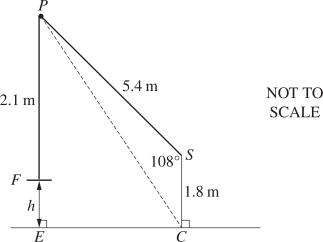
Show Answers Only
  1. `60`
  2. `3/5`
  3. `24`
  4. `1/15`
Show Worked Solution

i.  `text(# Different numbers)`

♦ Mean mark 45%.

`= 5 xx 4 xx 3`

`= 60`


ii.  `text(The last digit must be one of the)`

`text(5 numbers, of which 3 are odd)`

`:.\ text{P(odd)} = 3/5`


iii. `text{P(even)} = 1- text{P(odd)} = 2/5`

♦ Mean mark 48%.

`:.\ text(Number of even numbers)`

`= 2/5 xx 60`

`= 24`


iv.  `text(The numbers that satisfy the criteria:)`

♦♦♦ Mean mark 10%.

`432, 431, 421, 321`

`:.\ text{P(selection)} = 4/60 = 1/15`

Filed Under: # Combinations, Combinations (Std 1), Combinations and Single Stage Events (Std 2), Multi-stage Events Tagged With: Band 4, Band 5, Band 6, smc-1134-20-Number Combinations, smc-828-20-Number Combinations

  • « Previous Page
  • 1
  • …
  • 24
  • 25
  • 26
  • 27
  • 28
  • Next Page »

Copyright © 2014–2025 SmarterEd.com.au · Log in