Which of the following correctly expresses `T` as the subject of `B = 2pi (R + T/2)`?
- `T = B/pi-2R`
- `T = B/pi-R`
- `T = 2R-B/pi`
- `T = B/(4pi)-R/2`
Aussie Maths & Science Teachers: Save your time with SmarterEd
Which of the following correctly expresses `T` as the subject of `B = 2pi (R + T/2)`?
A point `P` lies between a tree, 2 metres high, and a tower, 8 metres high. `P` is 3 metres away from the base of the tree.
From `P`, the angles of elevation to the top of the tree and to the top of the tower are equal.
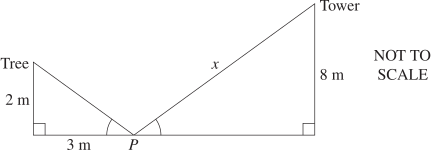
What is the distance, `x`, from `P` to the top of the tower?
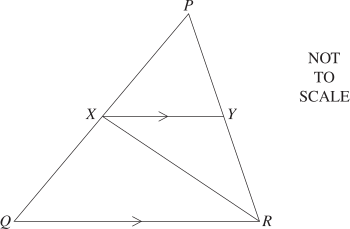
In the diagram, `XR` bisects `/_PRQ` and `XY\ text(||)\ QR`.
Prove that `Delta XYR` is an isosceles triangle. (2 marks)
--- 4 WORK AREA LINES (style=lined) ---
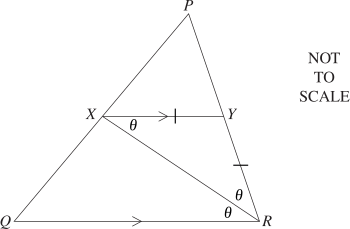
`text{Since}\ XR\ text{bisects}\ /_PRQ`
| `/_XRQ` | `= /_YRX = theta` |
| `/_RXY` | `= theta\ \ \ text{(} text(alternate angles,)\ XY\ text(||)\ QR text{)}` |
`:.\ Delta XYR\ \ text(is isosceles)`
Let `M` be the midpoint of `(-1, 4)` and `(5, 8)`.
Find the equation of the line through `M` with gradient `-1/2`. (2 marks)
--- 5 WORK AREA LINES (style=lined) ---
Expand and simplify `(sqrt3-1)(2 sqrt3 + 5)`. (2 marks)
Which equation represents the line perpendicular to `2x-3y = 8`, passing through the point `(2, 0)`?
The cost of hiring an open space for a music festival is $120 000. The cost will be shared equally by the people attending the festival, so that `C` (in dollars) is the cost per person when `n` people attend the festival.
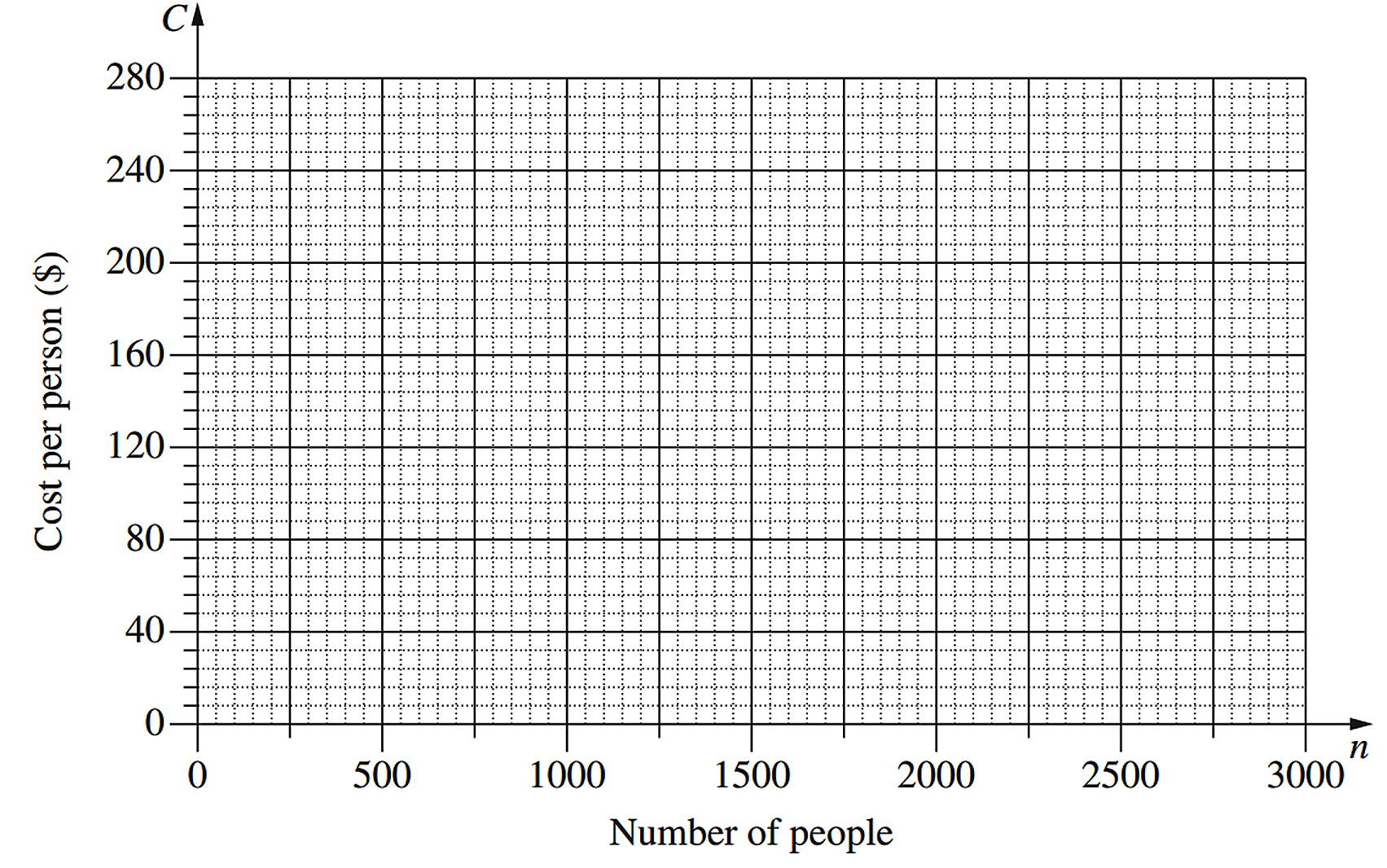
--- 1 WORK AREA LINES (style=lined) ---
--- 2 WORK AREA LINES (style=lined) ---
--- 2 WORK AREA LINES (style=lined) ---
i.
\begin{array} {|l|c|c|c|c|c|c|}
\hline
\rule{0pt}{2.5ex}\text{Number of people} (n) \rule[-1ex]{0pt}{0pt} & \ 500\ & \ 1000 \ & 1500 \ & 2000 \ & 2500\ & 3000 \ \\
\hline
\rule{0pt}{2.5ex}\text{Cost per person} (C)\rule[-1ex]{0pt}{0pt} & 240 & 120 & 80 & 60 & 48\ & 40 \ \\
\hline
\end{array}
| ii. |  |
iii. `C = (120\ 000)/n`
`n\ text(must be a whole number)`
iv. `text(Limitations can include:)`
`•\ n\ text(must be a whole number)`
`•\ C > 0`
v. `text(If)\ C = 94:`
| `94` | `= (120\ 000)/n` |
| `94n` | `= 120\ 000` |
| `n` | `= (120\ 000)/94` |
| `= 1276.595…` |
`:.\ text(C)text(ost cannot be $94 per person,)`
`text(because)\ n\ text(isn’t a whole number.)`
i.
\begin{array} {|l|c|c|c|c|c|c|}
\hline
\rule{0pt}{2.5ex}\text{Number of people} (n) \rule[-1ex]{0pt}{0pt} & \ 500\ & \ 1000 \ & 1500 \ & 2000 \ & 2500\ & 3000 \ \\
\hline
\rule{0pt}{2.5ex}\text{Cost per person} (C)\rule[-1ex]{0pt}{0pt} & 240 & 120 & 80 & 60 & 48\ & 40 \ \\
\hline
\end{array}
| ii. | |
iii. `C = (120\ 000)/n`
iv. `text(Limitations can include:)`
`•\ n\ text(must be a whole number)`
`•\ C > 0`
v. `text(If)\ C = 94`
| `=> 94` | `= (120\ 000)/n` |
| `94n` | `= 120\ 000` |
| `n` | `= (120\ 000)/94` |
| `= 1276.595…` |
`:.\ text(C)text(ost cannot be $94 per person,)`
`text(because)\ n\ text(isn’t a whole number.)`
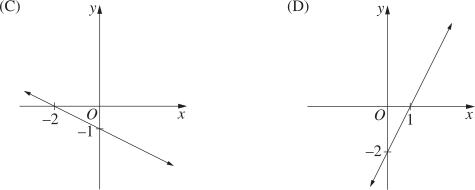
Which of the following is the graph of `y = 2x-2`?
Sketch the graph of `y-2x = 3`, showing the intercepts on both axes. (2 marks)
--- 8 WORK AREA LINES (style=lined) ---
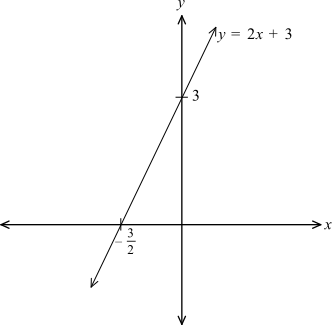
`y-2x=3\ \ =>\ \ y=2x+3`
`ytext{-intercept}\ = 3`
`text{Find}\ x\ text{when}\ y=0:`
`0-2x=3\ \ =>\ \ x=-3/2`
Write down the equation of the circle with centre `(-1, 2)` and radius 5. (1 mark)
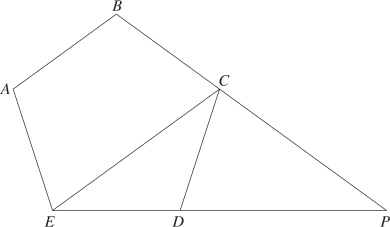
The diagram shows a regular pentagon `ABCDE`. Sides `ED` and `BC` are produced to meet at `P`.
--- 2 WORK AREA LINES (style=lined) ---
--- 5 WORK AREA LINES (style=lined) ---
| i. | 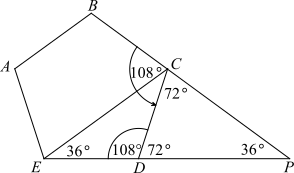 |
`text(Angle sum of pentagon)=(5-2) xx 180°=540°`
| `:.\ /_CDE` | `= 540/5\ \ \ text{(regular pentagon has equal angles)}` |
| `= 108°` |
ii. `text(Show)\ Delta EPC\ text(is isosceles)`
`text(S)text(ince)\ ED=CD\ \ text{(sides of a regular pentagon)}`
`Delta ECD\ text(is isosceles)`
`/_DEC=1/2 xx (180-108)= 36^{\circ}\ \ \ text{(Angle sum of}\ Delta DEC text{)}`
`/_CDP=72^@\ \ \ (\angle PDE\ \text{is a straight angle})`
`/_DCP=72^@\ \ \ (\angle PCB\ \text{is a straight angle})`
`=> /_CPD= 180-(72 + 72)=36^{\circ}\ \ \ text{(angle sum of}\ Delta CPD text{)}`
`:.\ Delta EPC\ \text(is isosceles)\ \ \ text{(2 equal angles)}`
What are the solutions of `2x^2-5x-1 = 0`?
Sarah tried to solve this equation and made a mistake in Line 2.
| `(W+4)/3-(2W-1)/5` | `=1` | `text(... Line 1)` |
| `5W+ 20-6W-3` | `=15` | `text(... Line 2)` |
| `17-W` | `=15` | `text(... Line 3)` |
| `W` | `=2` | `text(... Line 4)` |
Copy the equation in Line 1 and continue your solution to solve this equation for `W`.
Show all lines of working. (2 marks)
--- 5 WORK AREA LINES (style=lined) ---
Triangle `PQR` is shown.

Find the size of angle `Q`, to the nearest degree. (2 marks)
--- 4 WORK AREA LINES (style=lined) ---
Which of the following correctly express `x` as the subject of `a=(nx)/5` ?
Which of the following correctly expresses `a` as the subject of `s= ut+1/2at^2 `?
Three towns `P`, `Q` and `R` are marked on the diagram.
The distance from `R` to `P` is 76 km. `angle RQP=26^circ` and `angle RPQ=46^@.`
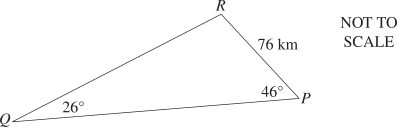
What is the distance from `P` to `Q` to the nearest kilometre?
Jacques and a flagpole both cast shadows on the ground. The difference between the lengths of their shadows is 3 metres.
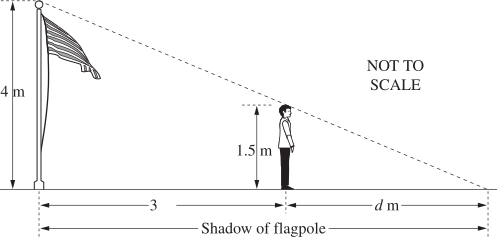
What is the value of `d`, the length of Jacques’ shadow? (3 marks)
--- 6 WORK AREA LINES (style=lined) ---

What is the area of this triangle, to the nearest square metre?
The line `l` has intercepts `p` and `q`, where `p` and `q` are positive integers.
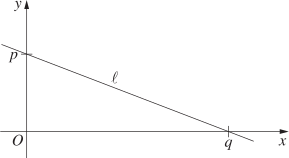
What is the gradient of line `l ` ?
Which equation correctly shows `r` as the subject of `S=800(1-r)`?