In a particular electrical circuit, the voltage \(V\) (volts) across a capacitor is given by \(V(t)=6.5\left(1-e^{-k t}\right)\), where \(k\) is a positive constant and \(t\) is the number of seconds after the circuit is switched on. --- 0 WORK AREA LINES (style=blank) --- --- 6 WORK AREA LINES (style=lined) --- --- 4 WORK AREA LINES (style=lined) --- a. b. \(k=0.511\) c. \(1.195\ \text{V/s}\) b. \(V=6.5(1-e^{-kt})\) \(\text{When}\ \ t=1, V=2.6:\) \(\dfrac{dV}{dt}=6.5ke^{-kt}\) \(\text{Find}\ \dfrac{dV}{dt}\ \text{when}\ \ t=2:\)

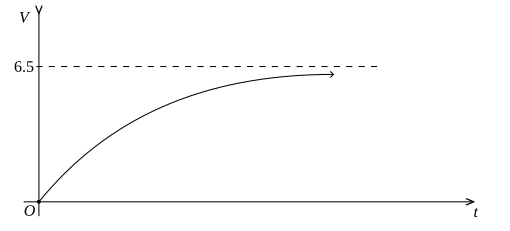
\(2.6\)
\(=6.5(1-e^{-k})\)
\(1-e^{-k}\)
\(=0.4\)
\(e^{-k}\)
\(=0.6\)
\(-k\)
\(=\ln(0.6)\)
\(k\)
\(=0.5108…\)
\(=0.511\ \text{(3 d.p.)}\)
c. \(V=6.5-6.5e^{-kt}\)
\(\dfrac{dV}{dt}\)
\(=6.5 \times 0.511 \times e^{-2 \times 0.511}\)
\(=1.1953…\)
\(=1.195\ \text{V/s (3 d.p.)}\)
Calculus, 2ADV C3 2022 HSC 20
A scientist is studying the growth of bacteria. The scientist models the number of bacteria, `N`, by the equation
`N(t)=200e^(0.013 t)`,
where `t` is the number of hours after starting the experiment.
- What is the initial number of bacteria in the experiment? (1 mark)
--- 1 WORK AREA LINES (style=lined) ---
- What is the number of bacteria 24 hours after starting the experiment? (1 mark)
--- 2 WORK AREA LINES (style=lined) ---
- What is the rate of increase in the number of bacteria 24 hours after starting the experiment? (2 marks)
--- 5 WORK AREA LINES (style=lined) ---
Calculus, 2ADV C3 2021 HSC 23
A population, \(P\), which is initially 5000, varies according to the formula
\(P = 5000b^\tfrac{-t}{10}\),
where \(b\) is a positive constant and \(t\) is time in years, \(t \geq 0\).
The population is 1250 after 20 years.
Find the value of \(t\), correct to one decimal place, for which the instantaneous rate of decrease is 30 people per year. (4 marks)
--- 8 WORK AREA LINES (style=lined) ---
Calculus, 2ADV C3 2020 HSC 21
Hot tea is poured into a cup. The temperature of tea can be modelled by `T = 25 + 70(1.5)^(−0.4t)`, where `T` is the temperature of the tea, in degrees Celsius, `t` minutes after it is poured.
- What is the temperature of the tea 4 minutes after it has been poured? (1 mark)
--- 1 WORK AREA LINES (style=lined) ---
- At what rate is the tea cooling 4 minutes after it has been poured? (2 marks)
--- 4 WORK AREA LINES (style=lined) ---
- How long after the tea is poured will it take for its temperature to reach 55°C? (3 marks)
--- 6 WORK AREA LINES (style=lined) ---
Calculus, 2ADV C4 2019 HSC 14a
A particle is moving along a straight line. The particle is initially at rest. The acceleration of the particle at time `t` seconds is given by `a = e^(2t)-4`, where `t >= 0`.
Find an expression, in terms of `t`, for the velocity of the particle. (2 marks)
--- 5 WORK AREA LINES (style=lined) ---
Calculus, 2ADV C3 2016 HSC 16b
Some yabbies are introduced into a small dam. The size of the population, `y`, of yabbies can be modelled by the function
`y = 200/(1 + 19e^(-0.5t)),`
where `t` is the time in months after the yabbies are introduced into the dam.
- Show that the rate of growth of the size of the population is
- `qquad qquad (1900 e^(-0.5t))/(1 + 19 e^(-0.5t))^2`. (2 marks)
--- 4 WORK AREA LINES (style=lined) ---
- Find the range of the function `y`, justifying your answer. (2 marks)
--- 4 WORK AREA LINES (style=lined) ---
- Show that the rate of growth of the size of the population can be written as
- `qquad qquad y/400 (200-y)`. (1 mark)
--- 4 WORK AREA LINES (style=lined) ---
- Hence, find the size of the population when it is growing at its fastest rate. (2 marks)
--- 4 WORK AREA LINES (style=lined) ---
Show Worked Solution
| a. | `y` | `= 200/(1 + 19 e^(-0.5t))` |
| `(dy)/(dt)` | `= 200/(1 + 19 e^(-0.5t))^2 xx d/(dt) (1 + 19 e^(-0.5t))` | |
| `= (-200)/(1 + 19 e^(-0.5t))^2 xx -0.5 xx 19 e^(-0.5t)` | ||
| `= (1900 e^(-0.5t))/(1 + 19 e^(-0.5t))^2\ \ text(… as required)` |
b. `text(When)\ \ t = 0,`
♦♦♦ Mean mark (b) 21%.
`y = 200/(1 + 19) = 10`
`text(As)\ \ t -> oo,\ \ (1 + 19^(-0.5t)) -> 1`
`:. y -> 200`
`:.\ text(Range)\ \ \ 10 <= y < 200`
c. `(dy)/(dt) = (1900 e^(-0.5t))/(1 + 19 e^(-0.5t))^2`
♦♦♦ Mean mark (c) 18%.
`text(S) text(ince)\ \ y = 200/(1 + 19 e^(-0.5t))`
`-> (1 + 19 e^(-0.5t)) = 200/y`
`-> 19 e^(-0.5t) = 200/y-1 = (200-y)/y`
`text(Substituting into)\ \ (dy)/(dt):`
| `(dy)/(dt)` | `= (100 ((200-y)/y))/(200/y)^2` |
| `= 100 ((200-y)/y) xx y^2/200^2` | |
| `= y/400 (200-y)\ \ text(… as required)` |
d. `(dy)/(dt) = -y^2/400 + y/2`
♦♦♦ Mean mark (d) 14%.
`text(Sketching the parabola:)`
| `(-y^2)/400 + y/2` | `= 0` |
| `-y^2 + 200y` | `= 0` |
| `y (200-y)` | `= 0` |
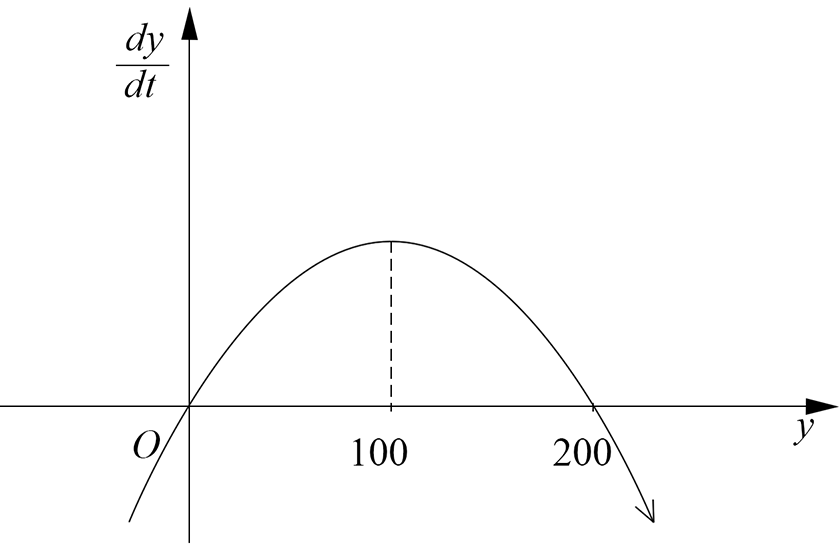
`:.\ text(Maximum)\ \ (dy)/(dt)\ \ text(occurs when)\ \ y = 100.`
Calculus, 2ADV C4 2009 HSC 7a
The acceleration of a particle is given by
`a=8e^(-2t)+3e^(-t)`,
where `x` is the displacement in metres and `t` is the time in seconds.
Initially its velocity is `-6\ text(ms)^(-1)` and its displacement is 5 m.
- Show that the displacement of the particle is given by
- `qquad x=2e^(-2t)+3e^-t+t`. (2 marks)
--- 5 WORK AREA LINES (style=lined) ---
- Find the time when the particle comes to rest. (3 marks)
--- 7 WORK AREA LINES (style=lined) ---
- Find the displacement when the particle comes to rest. (1 mark)
--- 3 WORK AREA LINES (style=lined) ---
Calculus, 2ADV C3 2011 HSC 7b
The velocity of a particle moving along the `x`-axis is given by
`v=8-8e^(-2t)`,
where `t` is the time in seconds and `x` is the displacement in metres.
- Show that the particle is initially at rest. (1 mark)
--- 1 WORK AREA LINES (style=lined) ---
- Show that the acceleration of the particle is always positive. (1 mark)
--- 2 WORK AREA LINES (style=lined) ---
- Explain why the particle is moving in the positive direction for all `t>0`. (2 marks)
--- 5 WORK AREA LINES (style=lined) ---
- As `t->oo`, the velocity of the particle approaches a constant.
Find the value of this constant. (1 mark)
--- 2 WORK AREA LINES (style=lined) ---
- Sketch the graph of the particle's velocity as a function of time. (2 marks)
--- 8 WORK AREA LINES (style=lined) ---
Show Worked Solution
a. `text(Initial velocity when)\ \ t=0`
`v=8-8e^0=0\ text(m/s)`
`:.\ text(Particle is initially at rest.)`
MARKER’S COMMENT: Students whose working showed `e^(-2t)` as `1/e^(2t)`, tended to score highly in this question.
b. `a=d/(dt) (v)=-2xx-8e^(-2t)=16e^(-2t)`
`text(S)text(ince)\ e^(-2t)=1/e^(2t)>0\ text(for all)\ t`.
`=>\ a=16e^(-2t)=16/e^(2t)>0\ text(for all)\ t`.
`:.\ text(Acceleration is positive for all)\ \ t>0`.
c. `text{S}text{ince the particle is initially at rest, and ALWAYS}`
♦♦♦ Mean mark (c) 22%
COMMENT: Students found part (iii) the most challenging part of this question by far.
COMMENT: Students found part (iii) the most challenging part of this question by far.
`text{has a positive acceleration.`
`:.\ text(It moves in a positive direction for all)\ t`.
d. `text(As)\ t->oo`, `e^(-2t)=1/e^(2t)->0`
`=>8/e^(2t)->0\ text(and)`
`=>v=8-8/e^(2t)->8\ text(m/s)`
`:.\ text(As)\ \ t->oo,\ text(velocity approaches 8 m/s.)`
IMPORTANT: Use previous parts to inform this diagram. i.e. clearly show velocity was zero at `t=0` and the asymptote at `v=8`.
| e. |
|
