SmarterEd

Aussie Maths & Science Teachers: Save your time with SmarterEd

  • Login
  • Get Help
  • About

Calculus, MET1-NHT 2018 VCAA 7

Let  `f : [ 0, (pi)/(2)] → R, \ f(x) = 4 cos(x)`  and  `g : [0, (pi)/(2)]  → R, \ g(x) = 3 sin(x)`.

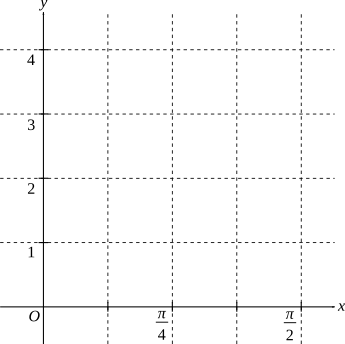
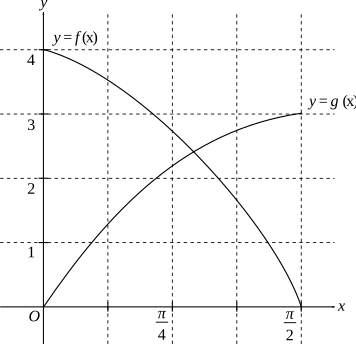
  1. Sketch the graph of `f` and the graph of `g` on the axes provided below.   (2 marks)

    --- 0 WORK AREA LINES (style=lined) ---


    `qquad qquad `
     

  2. Let `c` be such that  `f(c) = g(c)`,  where  `c∈[0, (pi)/(2)]`

     
    Find the value of  `sin(c)`  and the value of  `cos(c)`.   (3 marks)


    --- 4 WORK AREA LINES (style=lined) ---

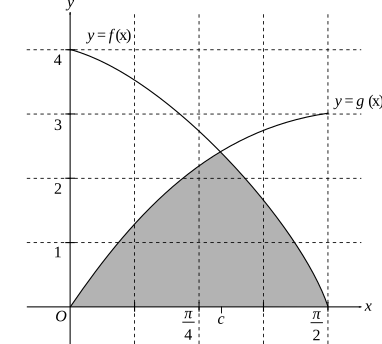
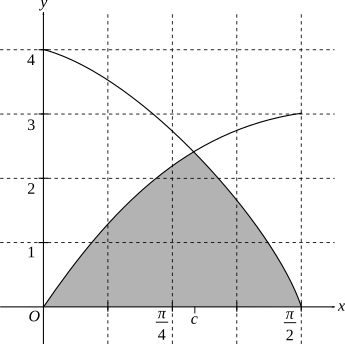
  3.  Let `A` be the region enclosed by the horizontal axis, the graph of `f` and the graph of `g`.
    1. Shade the region `A` on the axes provided in part a. and also label the position of `c` on the horizontal axis.   (1 mark)

      --- 0 WORK AREA LINES (style=lined) ---

    2. Calculate the area of the region `A`.   (3 marks)

      --- 7 WORK AREA LINES (style=lined) ---

Show Answers Only
  1.  


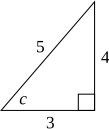
  2. `sin(c) = (4)/(5), \ cos(c) = (3)/(5)`


  3. i.

     
    ii. `2 \ u^2`
Show Worked Solution

a.   


b.   `text(At intersection:)`

`4cos(c)` `= 3sin(c)`
`tan(c)` `= (4)/(3)`

`sin(c) = (4)/(5)`

`cos(c) = (3)/(5)`


c. i.


   ii.       `A` `= int_0^c g(x)\ dx + int_c^((pi)/(2)) f(x)\ dx`
  `= int_0^c 3sin x \ dx + int_c^((pi)/(2)) 4cos \ x \ dx`
  `= 3[-cos x]_0^c + 4[sin x]_c^((pi)/(2))`
  `= 3(-cos(c) + cos \ 0) + 4(sin \ (pi)/(2)-sin(c))`
  `= 3(-(3)/(5) + 1) + 4(1-(4)/(5))`
  `= (6)/(5) + (4)/(5)`
  `= 2 \ \ text(u²)`

Filed Under: Area Under Curves, Trig Graphing Tagged With: Band 4, smc-2757-10-Sin, smc-2757-15-Cos, smc-2757-70-Sketch graph, smc-723-60-Trig, smc-723-80-Area between graphs

Graphs, MET1 2019 VCAA 4

  1. Solve  `1-cos (x/2) = cos (x/2)`  for  `x in [-2 pi, pi]`.   (2 marks) 

    --- 5 WORK AREA LINES (style=lined) ---

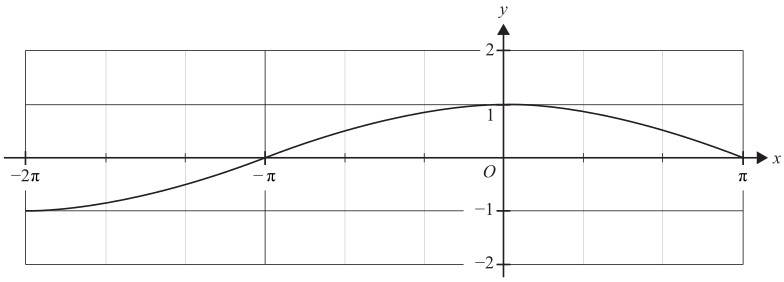
  2. The function  `f: [-2pi, pi] -> R,\ \ f(x) = cos (x/2)`  is shown on the axes below.


    Let  `g: [-2pi, pi] -> R,\ \ g(x) = 1-f(x)`.


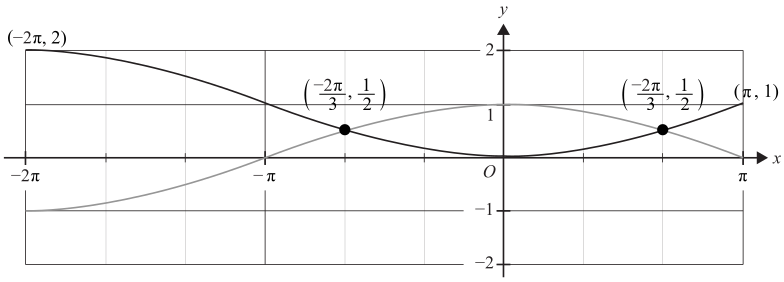
    Sketch the graph of  `g`  on the axes above. Label all points of intersection of the graphs of  `f`  and  `g`, and the endpoints of  `g`, with their coordinates.   (2 marks)

    --- 2 WORK AREA LINES (style=lined) ---

Show Answers Only
  1. `(2 pi)/3, (-2 pi)/3`
  2. `text(See Worked Solutions)`
Show Worked Solution
a.    `2 cos (x/2)` `= 1`
  `cos (x/2)` `= 1/2`

 
`=>\ text(Base angle)\ \ pi/3`

`x/2 = pi/3, -pi/3, (-5 pi)/3`

`x = (2 pi)/3, (-2 pi)/3 qquad (x in [-2pi, pi])`


b.   `text(Plot points for)\ \ g(x):`

`text(- reflect)\ f(x)\ text(in)\ x text(-axis, then)`

`text(- translate 1 upwards.)`

Filed Under: Trig Graphing Tagged With: Band 4, Band 5, smc-2757-15-Cos, smc-2757-70-Sketch graph

Graphs, MET1 2018 VCAA 3

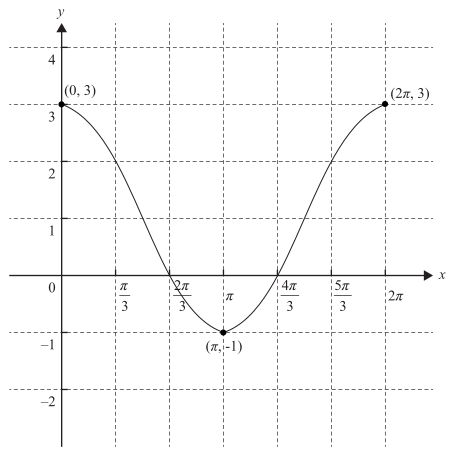
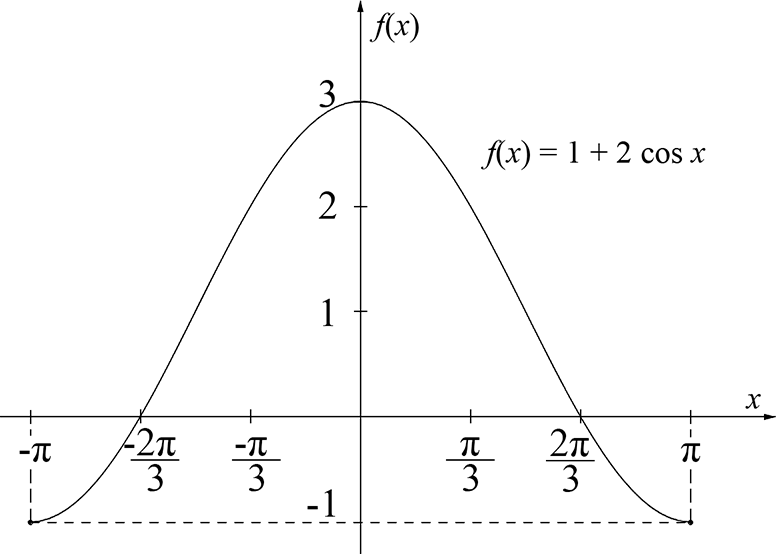
Let  `f:[0,2pi] -> R, \ f(x) = 2cos(x) + 1`.

  1. Solve the equation  `2cos(x) + 1 = 0`  for  `0 <= x <= 2pi`.   (2 marks)

    --- 5 WORK AREA LINES (style=lined) ---

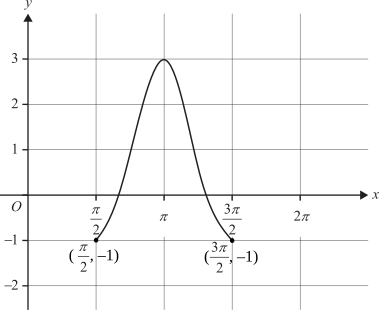
  2. Sketch the graph of the function  `f` on the axes below. Label the endpoints and local minimum point with their coordinates.   (3 marks)

    --- 0 WORK AREA LINES (style=lined) ---


Show Answers Only
  1. `(2pi)/3, (4pi)/3`
  2.  
Show Worked Solution
a. `2cos(x) + 1` `= 0`
  `cos(x)` `=-1/2`

`=> cos\ pi/3 = 1/2\ text(and cos is negative)`

`text(in 2nd/3rd quadrant)`

`:.x` `= pi-pi/3, pi + pi/3`
  `= (2pi)/3, (4pi)/3`


b.   

Filed Under: Trig Graphing Tagged With: Band 3, smc-2757-15-Cos, smc-2757-70-Sketch graph

Algebra, MET2 2018 VCAA 1 MC

Let  `f: R -> R,\ f(x) = 4 cos ((2 pi x)/3) + 1`.

The period of this function is

  1. 1
  2. 2
  3. 3
  4. 4
  5. 5
Show Answers Only

`C`

Show Worked Solution
`n` `=\ text(period)`
`(2 pi)/n` `= (2 pi)/3`
`n` `= 3`

 
`=>   C`

Filed Under: Trig Graphing Tagged With: Band 2, smc-2757-15-Cos, smc-2757-30-Find period

Algebra, MET2 2017 VCAA 2

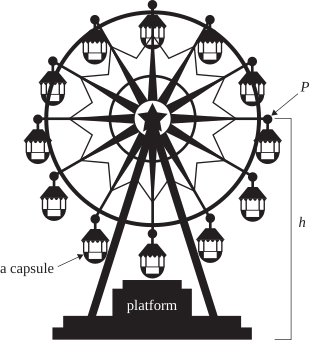
Sammy visits a giant Ferris wheel. Sammy enters a capsule on the Ferris wheel from a platform above the ground. The Ferris wheel is rotating anticlockwise. The capsule is attached to the Ferris wheel at point `P`. The height of `P` above the ground, `h`, is modelled by  `h(t) = 65-55cos((pit)/15)`, where `t` is the time in minutes after Sammy enters the capsule and `h` is measured in metres.

Sammy exits the capsule after one complete rotation of the Ferris wheel.


  1. State the minimum and maximum heights of `P` above the ground.   (1 mark)

    --- 2 WORK AREA LINES (style=lined) ---

  2. For how much time is Sammy in the capsule?   (1 mark)

    --- 2 WORK AREA LINES (style=lined) ---

  3. Find the rate of change of `h` with respect to `t` and, hence, state the value of `t` at which the rate of change of `h` is at its maximum.   (2 marks)

    --- 4 WORK AREA LINES (style=lined) ---

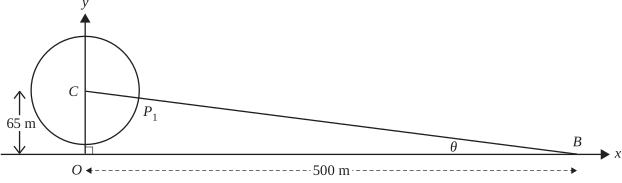
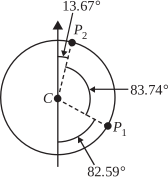
As the Ferris wheel rotates, a stationary boat at `B`, on a nearby river, first becomes visible at point `P_1`. `B` is 500 m horizontally from the vertical axis through the centre `C` of the Ferris wheel and angle `CBO = theta`, as shown below.


  1. Find `theta` in degrees, correct to two decimal places.   (1 mark)

    --- 3 WORK AREA LINES (style=lined) ---

Part of the path of `P` is given by  `y = sqrt(3025-x^2) + 65, x ∈ [-55,55]`, where `x` and `y` are in metres.

  1. Find `(dy)/(dx)`.   (1 mark)

    --- 2 WORK AREA LINES (style=lined) ---

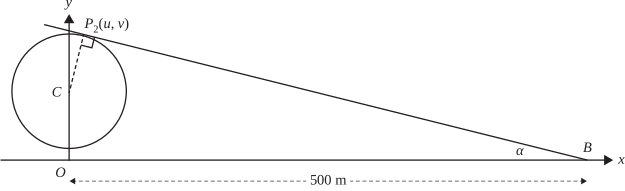
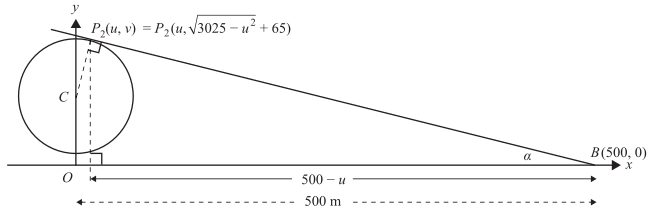
As the Ferris wheel continues to rotate, the boat at `B` is no longer visible from the point  `P_2(u, v)` onwards. The line through `B` and `P_2` is tangent to the path of `P`, where angle `OBP_2 = alpha`.


  1. Find the gradient of the line segment `P_2B` in terms of `u` and, hence, find the coordinates of `P_2`, correct to two decimal places.   (3 marks)

    --- 10 WORK AREA LINES (style=lined) ---

  2. Find `alpha` in degrees, correct to two decimal places.   (1 mark)

    --- 4 WORK AREA LINES (style=lined) ---

  3. Hence or otherwise, find the length of time, to the nearest minute, during which the boat at `B` is visible.   (2 marks)

    --- 5 WORK AREA LINES (style=lined) ---

Show Answers Only
  1. `h_text(min) = 10\ text(m), h_text(max) = 120\ text(m)`
  2. `30\ text(min)`
  3. `t = 7.5`
  4. `7.41^@`
  5. `(-x)/(sqrt(3025-x^2))`
  6. `P_2(13.00, 118.44)`
  7. `13.67^@`
  8. `7\ text(min)`
Show Worked Solution
a.    `h_text(min)` `= 65-55` `h_text(max)` `= 65 + 55`
    `= 10\ text(m)`   `= 120\ text(m)`


b.   `text(Period) = (2pi)/(pi/15) = 30\ text(min)`


c.   `h^{prime}(t) = (11pi)/3\ sin(pi/15 t)`

♦ Mean mark 50%.
MARKER’S COMMENT: A number of commons errors here – 2 answers given, calc not in radian mode, etc …


`text(Solve)\ h^{primeprime}(t) = 0, t ∈ (0,30)`

`t = 15/2\ \ text{(max)}`   `text(or)`   `t = 45/2\ \ text{(min – descending)}`

`:. t = 7.5`


d.   

♦ Mean mark 36%.
MARKER’S COMMENT: Choosing degrees vs radians in the correct context was critical here.

`tan(theta)` `= 65/500`
`:. theta` `=7.406…`
  `= 7.41^@`


e.    `(dy)/(dx)` `= (-x)/(sqrt(3025-x^2))`


f.   

`P_2(u,sqrt(3025-u^2) + 65),\ \ B(500,0)`

`:. m_(P_2B)` `= (sqrt(3025-u^2) + 65)/(u-500)`


`text{Using part (e), when}\ \ x=u,`

♦♦♦ Mean mark part (f) 18%.
MARKER’S COMMENT: Many students were unable to use the rise over run information to calculate the second gradient.

`dy/dx=(-u)/(sqrt(3025-u^2))`


`text{Solve (by CAS):}`

`(sqrt(3025-u^2) + 65)/(u-500)` `= (-u)/(sqrt(3025-u^2))\ \ text(for)\ u`


`u=12.9975…=13.00\ \ text{(2 d.p.)}`


`:. v` `= sqrt(3025-(12.9975…)^2) + 65`
  `= 118.4421…`
  `= 118.44\ \ text{(2 d.p.)}`


`:.P_2(13.00, 118.44)`


♦♦♦ Mean mark part (g) 7%.

g.    `tan alpha` `=v/(500-u)`
    `= (118.442…)/(500-12.9975…)`
  `:. alpha` `= 13.67^@\ \ text{(2 d.p.)}`


h.   

♦♦♦ Mean mark 5%.

`text(Find the rotation between)\ P_1 and P_2:`

`text(Rotation to)\ P_1 = 90-7.41=82.59^@`

`text(Rotation to)\ P_2 = 180-13.67=166.33^@`

`text(Rotation)\ \ P_1 → P_2 = 166.33-82.59 = 83.74^@`


`:.\ text(Time visible)` `= 83.74/360 xx 30\ text(min)`
  `=6.978…`
  `= 7\ text{min  (nearest degree)}`

Filed Under: Average Value and Other, Trig Graphing Tagged With: Band 2, Band 3, Band 4, Band 5, Band 6, page-break-before-question, smc-2757-15-Cos, smc-2757-80-Applications, smc-2757-85-Max/min (non-calc), smc-756-20-Trig

Calculus, MET1 SM-Bank 28

The function  `f`  has the rule  `f(x) = 1 + 2 cos x`.

  1. Show that the graph of  `y = f(x)`  cuts the `x`-axis at  `x = (2 pi)/3`.   (1 mark)

    --- 6 WORK AREA LINES (style=lined) ---

  2. Sketch the graph  `y = f(x)`  for  `x  in [-pi,pi]`  showing where the graph cuts each of the axes.   (2 marks)

    --- 0 WORK AREA LINES (style=lined) ---

  3. Find the area under the curve  `y = f(x)`  between  `x = -pi/2`  and  `x = (2 pi)/3`.   (3 marks)

    --- 6 WORK AREA LINES (style=lined) ---

Show Answers Only
  1. `text(Proof)\ \ text{(See Worked Solutions)}` 
  2.  
       
  3. `((7 pi)/6 + sqrt 3 + 1)\ text(u²)`
Show Worked Solution

a.   `f(x) = 1 + 2 cos x`

`f(x)\ text(cuts the)\ x text(-axis when)\ f(x) = 0`

`1 + 2 cos x` `= 0`
`2 cos x` `=-1`
 `cos x` `= -1/2`

 
`:.  x = (2 pi)/3\ …\ text(as required)`


b.   2UA HSC 2006 7b


c.  `text(Area)` `= int_(-pi/2)^((2 pi)/3) 1 + 2 cos x\ \ dx`
  `= [x + 2 sin x]_(-pi/2)^((2 pi)/3)`
  `= [((2 pi)/3 + 2 sin­ (2 pi)/3)-((-pi)/2 + 2 sin­ (-pi)/2)]`
  `= ((2 pi)/3 + 2 xx sqrt 3/2)-((-pi)/2 +2(- 1))`
  `= (2 pi)/3 + sqrt(3) + pi/2 + 2`
  `= ((7 pi)/6 + sqrt(3) + 2)\ text(u²)`

Filed Under: Area Under Curves, Trig Graphing Tagged With: Band 4, Band 5, smc-2757-15-Cos, smc-2757-70-Sketch graph, smc-723-60-Trig

Graphs, MET2 2016 VCAA 2 MC

Let  `f: R -> R,\ f(x) = 1 - 2 cos ({pi x}/2).`

The period and range of this function are respectively

  1. `4 and [−2, 2]`
  2. `4 and [−1, 3]`
  3. `1 and [−1, 3]`
  4. `4 pi and [−1, 3]`
  5. `4 pi and [−2, 2]`
Show Answers Only

`B`

Show Worked Solution
`text(Period)` `= (2 pi)/n = (2pi)/(pi/2)=4`
   

`text(Amplitude = 2 and median is)\ \ y=1.`

`text(Range)` `= [1 – 2, quad 1 + 2]`
  `= [−1, 3]`

`=>   B`

Filed Under: Trig Graphing Tagged With: Band 2, smc-2757-15-Cos, smc-2757-30-Find period, smc-2757-35-Find range

Functions, MET1 2006 VCAA 4

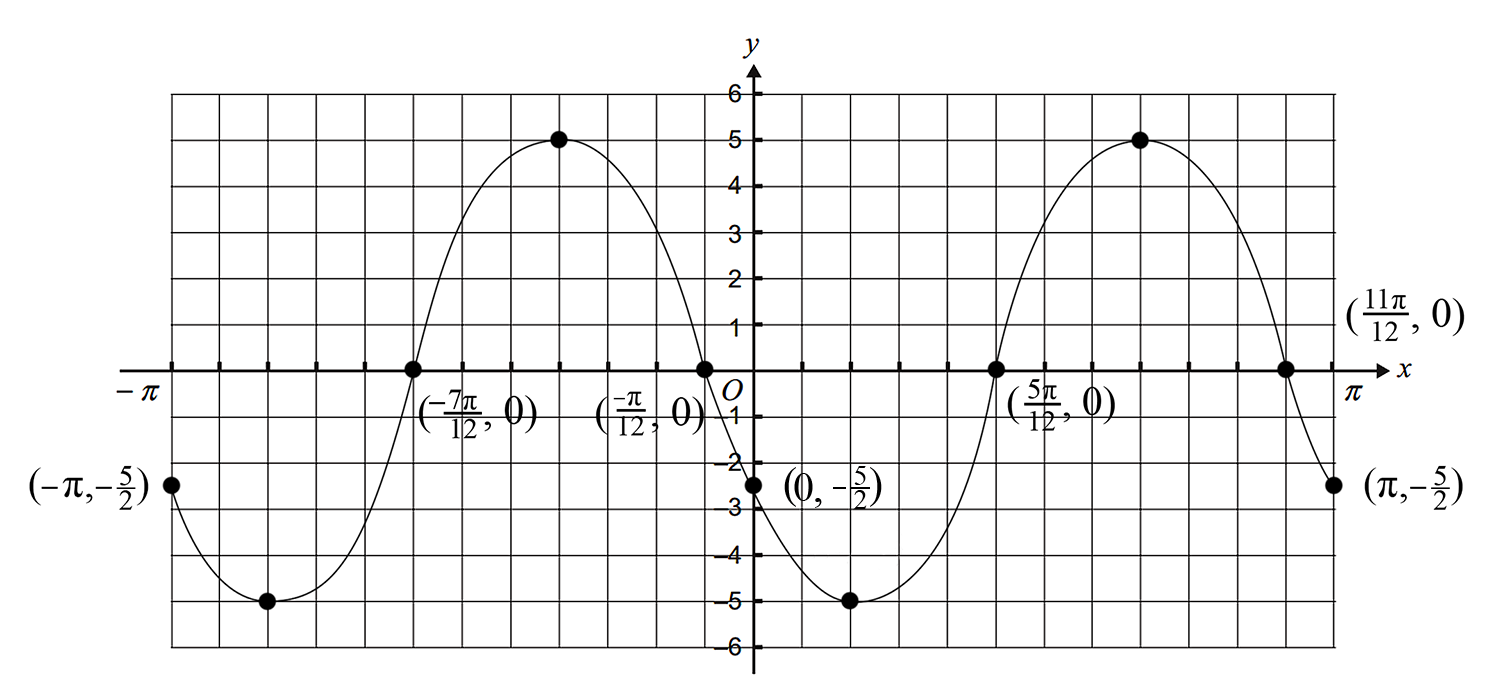
For the function  `f: [-pi, pi] -> R, f(x) = 5 cos (2 (x + pi/3))`

  1. write down the amplitude and period of the function.   (2 marks)

    --- 2 WORK AREA LINES (style=lined) ---

  2. sketch the graph of the function `f` on the set of axes below. Label axes intercepts with their coordinates.


    Label endpoints of the graph with their coordinates.   (3 marks)

    --- 3 WORK AREA LINES (style=lined) ---


VCAA 2006 meth 4b

Show Answers Only
  1. `text(Amplitude) = 5;\ \ \ text(Period) = pi`
  2.  
Show Worked Solution

a.   `text(Amplitude) = 5`

`text(Period) = (2 pi)/2 = pi`


b.  

`text(Shift)\ \ y = 5 cos (2x)\ \ text(left)\ \ pi/3\ \ text(units).`

`text(Period) = pi`

`text(Endpoints are)\ \ (-pi, -5/2) and (pi,-5/2)`

Filed Under: Trig Graphing Tagged With: Band 2, Band 5, smc-2757-15-Cos, smc-2757-30-Find period, smc-2757-40-Find amplitude, smc-2757-70-Sketch graph

Functions, MET1 2011 VCAA 3a

State the range and period of the function

`h: R -> R,\ \ h(x) = 4 + 3 cos ((pi x)/2)`.   (2 marks)

--- 5 WORK AREA LINES (style=lined) ---

Show Answers Only

`text(Range) = [1, 7];\ \ \ text(Period) = 4`

Show Worked Solution
  `-1` `<cos ((pi x)/2)<1`
  `-3` `<3cos ((pi x)/2)<3`
  `1` `< 4+ 3cos ((pi x)/2)<7`


`:.\ text(Range:)\  [1, 7]`

`text(Period) = (2pi)/n = (2 pi)/(pi/2) = 4`

Filed Under: Trig Graphing Tagged With: Band 4, smc-2757-15-Cos, smc-2757-30-Find period, smc-2757-35-Find range

Functions, MET1 2012 VCAA 6

The graphs of  `y = cos (x) and y = a sin (x)`,  where `a` is a real constant, have a point of intersection at  `x = pi/3.`

  1. Find the value of `a`.  (2 marks)

    --- 5 WORK AREA LINES (style=lined) ---

  2. If  `x in [0, 2 pi]`, find the `x`-coordinate of the other point of intersection of the two graphs.  (1 mark)

    --- 3 WORK AREA LINES (style=lined) ---

Show Answers Only
  1. `1/sqrt 3`
  2. `(4 pi)/3`
Show Worked Solution

a.   `text(Intersection occurs when)\ \ x=pi/3,`

`a sin(pi/3)` `= cos (pi/3)`
`tan(pi/3)` `= 1/a`
`sqrt 3` `=1/a`
`:. a` `=1/sqrt3`


b.   `tan (x)` `= sqrt 3`
  `x` `= pi/3, (4 pi)/3, 2pi+ pi/3, …\ text(but)\ x in [0, 2 pi]`
  `:. x` `= (4 pi)/3`

Filed Under: Trig Graphing Tagged With: Band 3, Band 5, smc-2757-10-Sin, smc-2757-15-Cos, smc-2757-40-Find amplitude, smc-2757-80-Applications

Algebra, MET2 2014 VCAA 1

The population of wombats in a particular location varies according to the rule  `n(t) = 1200 + 400 cos ((pi t)/3)`, where `n` is the number of wombats and `t` is the number of months after 1 March 2013.

  1. Find the period and amplitude of the function `n`.   (2 marks)

    --- 3 WORK AREA LINES (style=lined) ---

  2. Find the maximum and minimum populations of wombats in this location.   (2 marks)

    --- 2 WORK AREA LINES (style=lined) ---

  3. Find  `n(10)`.   (1 mark)

    --- 1 WORK AREA LINES (style=lined) ---

  4. Over the 12 months from 1 March 2013, find the fraction of time when the population of wombats in this location was less than  `n(10)`.   (2 marks)

    --- 6 WORK AREA LINES (style=lined) ---

Show Answers Only
  1. `text(Period) = text(6 months);\ text(Amplitude) = 400`
  2. `text(Max) = 1600;\ text(Min) = 800`
  3. `1000`
  4. `1/3`
Show Worked Solution

a.   `text(Period) = (2pi)/n = (2pi)/(pi/3) = 6\ text(months)`

MARKER’S COMMENT: Expressing the amplitude as [800,1600] in part (a) is incorrect.

`text(A)text(mplitude) = 400`
  

b.   `text(Max:)\ 1200 + 400 = 1600\ text(wombats)`

`text(Min:)\ 1200-400 = 800\ text(wombats)`
  

c.   `n(10) = 1000\ text(wombats)`
   

d.    `text(Solve)\ n(t)` `= 1000\ text(for)\ t ∈ [0,12]`

`t= 2,4,8,10`

`text(S)text(ince the graph starts at)\ \ (0,1600),`

♦ Mean mark 48%.

`=> n(t) < 1000\ \ text(for)`

`t ∈ (2,4)\ text(or)\ t ∈ (8,10)`

`:.\ text(Fraction)` `= ((4-2) + (10-8))/12`
  `= 1/3\ \ text(year)`

Filed Under: Trig Graphing Tagged With: Band 2, Band 3, Band 4, smc-2757-15-Cos, smc-2757-30-Find period, smc-2757-40-Find amplitude, smc-2757-80-Applications, smc-2757-85-Max/min (non-calc)

Graphs, MET2 2013 VCAA 1

Trigg the gardener is working in a temperature-controlled greenhouse. During a particular 24-hour time interval, the temperature  `(Ttext{°C})` is given by  `T(t) = 25 + 2 cos ((pi t)/8), \ 0 <= t <= 24`, where `t` is the time in hours from the beginning of the 24-hour time interval.

  1. State the maximum temperature in the greenhouse and the values of `t` when this occurs.   (2 marks)

    --- 3 WORK AREA LINES (style=lined) ---

  2. State the period of the function `T.`   (1 mark)

    --- 2 WORK AREA LINES (style=lined) ---

  3. Find the smallest value of `t` for which  `T = 26.`   (2 marks)

    --- 3 WORK AREA LINES (style=lined) ---

  4. For how many hours during the 24-hour time interval is  `T >= 26?`   (2 marks)

    --- 3 WORK AREA LINES (style=lined) ---

Trigg is designing a garden that is to be built on flat ground. In his initial plans, he draws the graph of  `y = sin(x)`  for  `0 <= x <= 2 pi`  and decides that the garden beds will have the shape of the shaded regions shown in the diagram below. He includes a garden path, which is shown as line segment `PC.`

  1. The line through points  `P((2 pi)/3, sqrt 3/2)`  and  `C (c, 0)`  is a tangent to the graph of  `y = sin (x)`  at point `P.`

    1. Find  `(dy)/(dx)`  when  `x = (2 pi)/3.`   (1 mark)

      --- 3 WORK AREA LINES (style=lined) ---

    2. Show that the value of `c` is  `sqrt 3 + (2 pi)/3.`   (1 mark)

      --- 6 WORK AREA LINES (style=lined) ---

In further planning for the garden, Trigg uses a transformation of the plane defined as a dilation of factor `k` from the `x`-axis and a dilation of factor `m` from the `y`-axis, where `k` and `m` are positive real numbers.

  1. Let `X^{′}, P^{′}` and `C^{′}` be the image, under this transformation, of the points `X, P` and `C` respectively. 


    1. Find the values of `k` and `m`  if  `X^{′}P^{′} = 10`  and  `X^{′} C^{′} = 30.`   (2 marks)

      --- 8 WORK AREA LINES (style=lined) ---

    2. Find the coordinates of the point `P^{′}.`   (1 mark)

      --- 3 WORK AREA LINES (style=lined) ---

Show Answers Only
  1. `t = 0, or 16\ text(h)`
  2. `16\ text(hours)`
  3. `8/3`
  4. `8\ text(hours)`
  5.  i.  `-1/2`
    ii.  `text(See worked solution)`
  6.  i.  `k=(20sqrt3)/3, m=10sqrt3`
    ii.  `P^{′}((20pisqrt3)/3,10)`
Show Worked Solution

a.   `T_text(max)\ text(occurs when)\ \ cos((pit)/8) = 1,`

`T_text(max)= 25 + 2 = 27^@C`

`text(Max occurs when)\ \ t = 0, or 16\ text(h)`


b.    `text(Period)` `= (2pi)/(pi/8)`
    `= 16\ text(hours)`


c.   `text(Solve:)\ \ 25 + 2 cos ((pi t)/8)=26\ \ text(for)\ t,`

`t`  `= 8/3,40/3,56/3\ \ text(for)\ t ∈ [0,24]`
`t_text(min)` `= 8/3`


d.   `text(Consider the graph:)`

met2-2013-vcaa-sec1-answer1

`text(Time above)\ 26 text(°C)` `= 8/3 + (56/3-40/3)`
  `= 8\ text(hours)`


e.i.   `(dy)/(dx) = cos(x)`

`text(At)\ x = (2pi)/3,`

`(dy)/(dx)` `= cos((2pi)/3)=-1/2`


e.ii.  `text(Solution 1)`

`text(Equation of)\ \ PC,`

`y-sqrt3/2` `=-1/2(x-(2pi)/3)`
`y` `=-1/2 x +pi/3 +sqrt3/2`


`PC\ \ text(passes through)\ \ (c,0),`

`0` `=-1/2 c +pi/3 + sqrt3/2`
`c` `=sqrt3 + (2 pi)/3\ …\ text(as required)`


`text(Solution 2)`

`text(Equating gradients:)`

`- 1/2` `= (sqrt3/2-0)/((2pi)/3-c)`
`-1` `= sqrt3/((2pi-3c)/3)`
`3c-2pi` `= 3sqrt3`
`3c` `= 3 sqrt3 + 2pi`
`:. c` `= sqrt3 + (2pi)/3\ …\ text(as required)`


f.i.   `X^{′} ((2pi)/3 m,0)qquadP^{′}((2pi)/3 m, sqrt3/2 k)qquadC^{′} ((sqrt3 + (2pi)/3)m, 0)`

`X^{′}P^{′}` `= 10`
`sqrt3/2 k` `= 10`
`:. k` `= 20/sqrt3`
  `=(20sqrt3)/3`
♦♦♦ Mean mark part (f)(i) 14%.


`X^{′}C^{′}=30`

`((sqrt3 + (2pi)/3)m)-(2pi)/3 m` `= 30`
`:. m` `= 30/sqrt3`
  `=10sqrt3`
♦♦♦ Mean mark part (f)(ii) 12%.


f.ii.    `P^{′}((2pi)/3 m, sqrt3/2 k)` `= P^{′}((2pi)/3 xx 10sqrt3, sqrt3/2 xx 20/sqrt3)`
    `= P^{′}((20pisqrt3)/3,10)`

Filed Under: Tangents and Normals, Transformations, Trig Graphing Tagged With: Band 3, Band 4, Band 6, smc-2757-15-Cos, smc-2757-30-Find period, smc-2757-80-Applications, smc-2757-85-Max/min (non-calc), smc-634-30-Trig Function, smc-634-50-Find tangent given curve, smc-753-20-Dilation (Only), smc-753-75-Trig functions

Algebra, MET2 2014 VCAA 13 MC

The domain of the function `h`, where  `h(x) = cos(log_a (x))`  and `a` is a real number greater than `1`, is chosen so that `h` is a one-to-one function.

Which one of the following could be the domain?

  1. `(a^(-pi/2), a^(pi/2))`
  2. `(0, pi)`
  3. `[1, a^(pi/2)]`
  4. `[a^(-pi/2), a^(pi/2))`
  5. `[a^(-pi/2), a^(pi/2)]`
Show Answers Only

`C`

Show Worked Solution

`text(Choose a value of)\ \ a > 1`

♦ Mean mark 42%.

`text(e.g.)\ \ a = 2`

`text(Graph)\ \ h(x) = cos(log_2(x)), text(and test)`

`text(all domain options.)`

`text(Only)\  C\ text(gives a one-to-one function.)`

`=>   C`

Filed Under: Graphs and Applications, Log/Index Laws and Equations, Trig Graphing Tagged With: Band 5, smc-2745-40-Log graphs, smc-2745-50-Find Domain/Range, smc-2757-15-Cos

Copyright © 2014–2025 SmarterEd.com.au · Log in