SmarterEd

Aussie Maths & Science Teachers: Save your time with SmarterEd

  • Login
  • Get Help
  • About

Calculus, MET2 2024 VCAA 16 MC

Suppose that a differentiable function  \(  f: R \rightarrow R \)  and its derivative  \(f^{\prime}: R \rightarrow R\)  satisfy  \(f(4)=25\)  and  \(f^{\prime}(4)=15\).

Determine the gradient of the tangent line to the graph of  \( {\displaystyle y=\sqrt{f(x)} } \)  at  \( x=4 \).

  1. \(\sqrt{15}\)
  2. \(\dfrac{1}{10}\)
  3. \(\dfrac{15}{2}\)
  4. \(\dfrac{3}{2}\)
Show Answers Only

\(D\)

Show Worked Solution
\(y\) \(=\sqrt{f(x)}={f(x)}^{\frac{1}{2}}\)
\(y^{\prime}\) \(=\dfrac{1}{2}\left({f(x)}^{-\frac{1}{2}}\right)\times f^{\prime}(x)=\dfrac{f^{\prime}(x)}{2\sqrt{f(x)}}\)

 
\(\text{Given}\ \ f(4)=25,\ f^{\prime}(4)=15\)

\(\therefore\ y^{\prime}=\dfrac{15}{2\sqrt{25}}=\dfrac{3}{2}\)

\(\Rightarrow D\)

♦♦ Mean mark 36%.

Filed Under: Tangents and Normals Tagged With: Band 4, smc-634-40-Other Function, smc-634-50-Find tangent given curve

Calculus, MET2 2022 VCAA 1

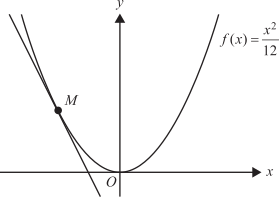
The diagram below shows part of the graph of `y=f(x)`, where `f(x)=\frac{x^2}{12}`.
 

  1. State the equation of the axis of symmetry of the graph of `f`.   (1 mark)

    --- 2 WORK AREA LINES (style=lined) ---

  2. State the derivative of `f` with respect to `x`.   (1 mark)

    --- 2 WORK AREA LINES (style=lined) ---

The tangent to `f` at point `M` has gradient `-2` .

  1. Find the equation of the tangent to `f` at point `M`.   (2 marks)

    --- 6 WORK AREA LINES (style=lined) ---

The diagram below shows part of the graph of `y=f(x)`, the tangent to `f` at point `M` and the line perpendicular to the tangent at point `M`.


  1.  i. Find the equation of the line perpendicular to the tangent passing through point `M`.   (1 mark)

    --- 5 WORK AREA LINES (style=lined) ---

  2. ii. The line perpendicular to the tangent at point `M` also cuts `f` at point `N`, as shown in the diagram above.
  3.     Find the area enclosed by this line and the curve `y=f(x)`.   (2 marks)

    --- 8 WORK AREA LINES (style=lined) ---

  4. Another parabola is defined by the rule `g(x)=\frac{x^2}{4 a^2}`, where `a>0`.
  5. A tangent to `g` and the line perpendicular to the tangent at `x=-b`, where `b>0`, are shown below.

  1. Find the value of `b`, in terms of `a`, such that the shaded area is a minimum.   (4 marks)

    --- 8 WORK AREA LINES (style=lined) ---

Show Answers Only

a.    `x=0`

b.    ` f^{\prime}(x)=1/6x`

c.    `x=-12`

di.    `y=1/2x + 18`

dii.   Area`= 375` units²

e.    `b = 2a^2`

Show Worked Solution

a.   Axis of symmetry:  `x=0`
  

b.    `f(x)`  `=\frac{x^2}{12}`  
  ` f^{\prime}(x)` `= 1/6x`  

  
c.  
At `M` gradient `= -2`

`1/6x` `= -2`  
`x` `= -12`  

 
When  `x = -12`
 

`f(x) = (-12)^2/12 = 12`
 
Equation of tangent at `(-12 , 12)`:

`y-y_1` `=m(x-x_1)`  
`y-12` `= -2(x + 12)`  
`y` `= -2x-12`  


d.i  
Gradient of tangent `= -2`

`:.`  gradient of normal `= 1/2` 

Equation at `M(- 12 , 12)`

`y -y_1` `=m(x-x_1)`  
`y-12` `= 1/2(x + 12)`  
`y` `=1/2x + 18`  


d.ii 
Points of intersection of `f(x)` and normal are at  `M` and `N`.

So equate ` y = x^2/12` and  `y = 1/2x + 18` to find `N`

`x^2/12` `=1/2x + 18`  
`x^2-6x-216` `=0`  
`(x + 12)(x-18)` `=0`  

   
`:.\  x = -12` or `x = 18`

Area `= \int_{-12}^{18}\left(\frac{1}{2} x+18-\frac{x^2}{12}\right) d x`  
  `= [x^2/4 + 18x-x^3/36]_(-12)^18`  
  `= [18^2/4 +18^2-18^3/36] – [12^2/4 + 18 xx (-12)-(-12)^3/36]`  
  `= 375` units²  


e.   `g(x) = x^2/(4a^2)`   `a > 0`

At `x = -b`   `y = (-b)^2/(4a^2) = b^2/4a^2`

`g^{\prime}(x) = (2x)/(4a^2) = x/(2a^2)`

Gradient of tangent `= (-b)/(2a^2)`

Gradient of normal `= (2a^2)/b`

Equation of normal at `(- b , b^2/(4a^2))`

`y-y_1` `= m(x-x_1)`  
`y-b^2/(4a^2)` `= (2a^2)/b(x-(-b))`  
`y` `= (2a^2x)/b + 2a^2 + b^2/(4a^2)`  
`y` `= (2a^2x)/b +(8a^4 + b^2)/(4a^2)`  

 
Points of intersection of normal and parabola (Using CAS)

solve `((2a^2x)/b +(8a^4 + b^2)/(4a^2) = x^2/(4a^2),x)`

`x =-b`  or  `x = (8a^4+b^2)/b`

 
Calculate area using CAS

`A = \int_{-b}^{(8a^4+b^2)/b}\left(\frac{2a^2x}{b} +\frac{8a^4 + b^2}{4a^2}-frac{x^2}{4a^2} \right) dx`

`A = frac{64a^12 + 48a^8b^2 + 12a^4b^4 + b^6}{3a^2b^3}`
 
Using CAS Solve derivative of `A = 0`  with respect to `b` to find `b`

solve`(d/(db)(frac{64a^12 + 48a^8b^2 + 12a^4b^4 + b^6}{3a^2b^3})=0,b)`

 
`b =-2a^2`   and  `b = 2a^2`

Given `b > 0`

`b = 2a^2`


♦♦ Mean mark (e) 33%.
MARKER’S COMMENT: Common errors: Students found `\int_{-b}^{\frac{8 a^4+b^2}{b}}\left(y_n\right) d x` and failed to subtract `g(x)` or had incorrect terminals.

Filed Under: Area Under Curves, Maxima and Minima, Tangents and Normals Tagged With: Band 2, Band 4, Band 5, Band 6, smc-634-10-Polynomial, smc-634-50-Find tangent given curve, smc-641-10-Area, smc-723-10-Quadratic, smc-723-80-Area between graphs

Calculus, MET2 2023 VCAA 3

Consider the function \(g:R \to R, g(x)=2^x+5\).

  1. State the value of \(\lim\limits_{x\to -\infty} g(x)\).   (1 mark)

    --- 1 WORK AREA LINES (style=lined) ---

  2. The derivative, \(g^{'}(x)\), can be expressed in the form \(g^{'}(x)=k\times 2^x\).
  3. Find the real number \(k\).   (1 mark)

    --- 2 WORK AREA LINES (style=lined) ---

  4.  i. Let \(a\) be a real number. Find, in terms of \(a\), the equation of the tangent to \(g\) at the point \(\big(a, g(a)\big)\).   (1 mark)

    --- 3 WORK AREA LINES (style=lined) ---

    ii. Hence, or otherwise, find the equation of the tangent to \(g\) that passes through the origin, correct to three decimal places.   (2 marks)

    --- 8 WORK AREA LINES (style=lined) ---

  1.  

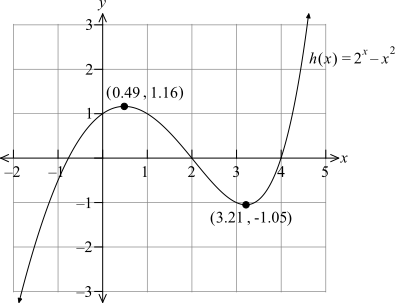
Let \(h:R\to R, h(x)=2^x-x^2\).

  1. Find the coordinates of the point of inflection for \(h\), correct to two decimal places.   (1 mark)

    --- 2 WORK AREA LINES (style=lined) ---

  2. Find the largest interval of \(x\) values for which \(h\) is strictly decreasing.
  3. Give your answer correct to two decimal places.   (1 mark)

    --- 2 WORK AREA LINES (style=lined) ---

  4. Apply Newton's method, with an initial estimate of \(x_0=0\), to find an approximate \(x\)-intercept of \(h\).
  5. Write the estimates \(x_1, x_2,\) and \(x_3\) in the table below, correct to three decimal places.   (2 marks)
      

    \begin{array} {|c|c|}
    \hline
    \rule{0pt}{2.5ex} \qquad x_0\qquad \ \rule[-1ex]{0pt}{0pt} & \qquad \qquad 0 \qquad\qquad \\
    \hline
    \rule{0pt}{2.5ex} x_1 \rule[-1ex]{0pt}{0pt} &  \\
    \hline
    \rule{0pt}{2.5ex} x_2 \rule[-1ex]{0pt}{0pt} &  \\
    \hline
    \rule{0pt}{2.5ex} x_3 \rule[-1ex]{0pt}{0pt} &  \\
    \hline
    \end{array}

    --- 0 WORK AREA LINES (style=lined) ---

  6. For the function \(h\), explain why a solution to the equation \(\log_e(2)\times (2^x)-2x=0\) should not be used as an initial estimate \(x_0\) in Newton's method.   (1 mark)

    --- 3 WORK AREA LINES (style=lined) ---

  7. There is a positive real number \(n\) for which the function \(f(x)=n^x-x^n\) has a local minimum on the \(x\)-axis.
  8. Find this value of \(n\).   (2 marks)

    --- 5 WORK AREA LINES (style=lined) ---

Show Answers Only

a.    \(5\)

b.    \(\log_{e}{2}\ \ \text{or}\ \ \ln\ 2\)

ci.  \(y=2^a\ \log_{e}{(2)x}-(a\ \log_{e}{(2)}-1)\times2^a+5\)

\(\text{or}\ \ y=2^a\ \log_{e}{(2)x}-a\ 2^a\ \log_{e}{(2)}+2^a+5\)

cii. \(y=4.255x\)

d. \((2.06 , -0.07)\)

e. \([0.49, 3.21]\)

f. 

\begin{array} {|c|c|}
\hline
\rule{0pt}{2.5ex} \qquad x_0\qquad \ \rule[-1ex]{0pt}{0pt} & \qquad \qquad 0 \qquad\qquad \\
\hline
\rule{0pt}{2.5ex} x_1 \rule[-1ex]{0pt}{0pt} &  -1.433 \\
\hline
\rule{0pt}{2.5ex} x_2 \rule[-1ex]{0pt}{0pt} &  -0.897 \\
\hline
\rule{0pt}{2.5ex} x_3 \rule[-1ex]{0pt}{0pt} &  -0.773 \\
\hline
\end{array}

g. \(\text{See worked solution.}\)

h. \(n=e\)

Show Worked Solution

a.    \(\text{As }x\to -\infty,\ \ 2^x\to 0\)

\(\therefore\ 2^x+5\to 5\)
  

b.     \(g(x)\) \(=2^x+5\)
    \(=\Big(e^{\log_{e}{2}}\Big)^x\)
    \(=e\ ^{x\log_{e}{2}}+5\)
  \(g^{\prime}(x)\) \(=\log_{e}{2}\times e\ ^{x\log_{e}{2}}\)
     \(=\log_{e}{2}\times 2^x\)
  \(\therefore\ k\) \(=\log_{e}{2}\ \ \text{or}\ \ \ln\ 2\)
   
ci.  \(\text{Tangent at}\ (a, g(a)):\)

\(y-(2^a+5)\) \(=\log_{e}{2}\times2^a(x-a)\)
\(\therefore\ y\) \(=2^a\ \log_{e}{(2)x}-a\ 2^a\ \log_{e}{(2)}+2^a+5\)

♦♦ Mean mark (c)(i) 50%.

cii.  \(\text{Substitute }(0, 0)\ \text{into equation from c(i) to find}\ a\)

\( y\) \(=2^a\ \log_{e}{(2)x}-a\ 2^a\ \log_{e}{(2)}+2^a+5\)
\(0\) \(=2^a\ \log_{e}{(2)\times 0}-a\ 2^a\ \log_{e}{(2)}+2^a+5\)
\(0\) \(=-a\ 2^a\ \log_{e}{(2)}+2^a+5\)

  
\(\text{Solve for }a\text{ using CAS }\rightarrow\ a\approx 2.61784\dots\)

\(\text{Equation of tangent when }\ a\approx 2.6178\)

\( y\) \(=2^{2.6178..}\ \log_{e}{(2)x}+0\)
\(\therefore\  y\) \(=4.255x\)

♦♦♦ Mean mark (c)(ii) 30%.
MARKER’S COMMENT: Some students did not substitute (0, 0) into the correct equation or did not find the value of \(a\) and used \(a=0\).
d.     \(h(x)\) \(=2^x-x^2\)
  \(h^{\prime}(x)\) \(=\log_{e}{(2)}\cdot 2^x-2x\ \ \text{(Using CAS)}\)
  \(h^{”}(x)\) \(=(\log_{e}{(2)})^2\cdot 2^x-2\ \ \text{(Using CAS)}\)

\(\text{Solving }h^{”}(x)=0\ \text{using CAS }\rightarrow\ x\approx 2.05753\dots\)

\(\text{Substituting into }h(x)\ \rightarrow\ h(2.05753\dots)\approx-0.070703\dots\)

\(\therefore\ \text{Point of inflection at }(2.06 , -0.07)\ \text{ correct to 2 decimal places.}\)

e.    \(\text{From graph (CAS), }h(x)\ \text{is strictly decreasing between the 2 turning points.}\)

\(\therefore\ \text{Largest interval includes endpoints and is given by }\rightarrow\ [0.49, 3.21]\)


♦♦ Mean mark (e) 40%.
MARKER’S COMMENT: Round brackets were often used which were incorrect as endpoints were included. Some responses showed the interval where the function was strictly increasing.

f.    \(\text{Newton’s Method }\Rightarrow\  x_a-\dfrac{h(x_a)}{h'(x_a)}\) 

\(\text{for }a=0, 1, 2, 3\ \text{given an initial estimation for }x_0=0\)

\(h(x)=2x-x^2\ \text{and }h^{\prime}(x)=\ln{2}\times 2^x-2x\)

\begin{array} {|c|l|}
\hline
\rule{0pt}{2.5ex} \qquad x_0\qquad \ \rule[-1ex]{0pt}{0pt} & \qquad \qquad 0 \qquad\qquad \\
\hline
\rule{0pt}{2.5ex} x_1 \rule[-1ex]{0pt}{0pt} &  0-\dfrac{2^0-2\times 0}{\ln2\times 2^0\times 0}=-1.433 \\
\hline
\rule{0pt}{2.5ex} x_2 \rule[-1ex]{0pt}{0pt} &  -1.433-\dfrac{2^{-1.433}-2\times -1.433}{\ln2\times 2^{-1.433}\times -1.433}=-0.897 \\
\hline
\rule{0pt}{2.5ex} x_3 \rule[-1ex]{0pt}{0pt} &  -0.897-\dfrac{2^{-0.897}-2\times -0.897}{\ln2\times 2^{-0.897}\times -0.897}=-0.773 \\
\hline
\end{array}

g.    \(\text{The denominator in Newton’s Method is}\ h^{\prime}(x)=\log_{e}{(2)}\cdot 2^x-2x\)

\(\text{and the calculation will be undefined if }h^{\prime}(x)=0\ \text{as the tangent lines are horizontal}.\)

\(\therefore\ \text{The solution to }h^{\prime}(x)=0\ \text{cannot be used for }x_0.\)

♦♦♦ Mean mark (g) 20%.

h.    \(\text{For a local minimum }f(x)=0\)

\(\rightarrow\ n^x-x^n=0\)

\(\rightarrow\ n^x=x^n\ \ \ (1)\)

\(\text{Also for a local minimum }f^{\prime}(x)=0\)

\(\rightarrow\ \ln(n)\cdot n^x-nx^{n-1}=0\ \ \ (2)\)

\(\text{Substitute (1) into (2)}\)

\(\ln(n)\cdot x^n-nx^{n-1}=0\) 

\(x^n\Big(\ln(n)-\dfrac{n}{x}\Big)=0\)

\(\therefore\ x^n=0\ \text{or }\ \ln(n)=\dfrac{n}{x}\)

\(x=0\ \text{or }x=\dfrac{n}{\ln(n)}\)

\(\therefore\ n=e\)


♦♦♦ Mean mark (h) 10%.
MARKER’S COMMENT: Many students showed that \(f'(x)=0\) but failed to couple it with \(f(x)=0\). Ensure exact values are given where indicated not approximations.

Filed Under: Differentiation (L&E), Functional Equations, L&E Differentiation, Tangents and Normals Tagged With: Band 2, Band 4, Band 5, Band 6, smc-634-20-Log/Exp Function, smc-634-50-Find tangent given curve, smc-745-10-Exponential, smc-750-35-Newton's method

Calculus, MET2 2023 VCAA 14 MC

A polynomial has the equation  \(y=x(3x-1)(x+3)(x+1)\).

The number of tangents to this curve that pass through the positive \(x\)-intercept is

  1. 0
  2. 1
  3. 2
  4. 3
  5. 4
Show Answers Only

\(D\)

Show Worked Solution

\(\text{Positive}\ x\text{-intercept occurs at}\ \Big(\dfrac{1}{3}, 0\Big) \)

\(\text{Find tangent line at}\ \ x=a\ \text{(by CAS):}\)

\(y_{\text{tang}}=\Big(12a^3+33a^2+10a-3\Big)x-a^2\Big(9a^2+22a+5\Big)\)

\(\text{Solve}\ \ \ y_{\text{tang}}\Bigg(\dfrac{1}{3}\Bigg)=0\ \text{for }a:\)

\(a=\dfrac{-\sqrt{7}-4}{3},\ a=\dfrac{\sqrt{7}-4}{3}\text{ or}\ a=\dfrac{1}{3}\)

\(\therefore\ \text{3 solutions exist.}\)

\(\Rightarrow D\)

\(\text{NOTE: Graphical methods could also be used}\)


♦♦♦ Mean mark 29%.

Filed Under: Tangents and Normals Tagged With: Band 5, smc-634-10-Polynomial, smc-634-50-Find tangent given curve, smc-750-60-Other

Calculus, MET2 2020 VCAA 5

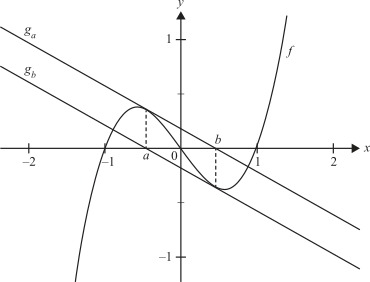
Let  `f: R to R, \ f(x)=x^{3}-x`.

Let  `g_{a}: R to R`  be the function representing the tangent to the graph of `f` at  `x=a`, where  `a in R`.

Let `(b, 0)` be the `x`-intercept of the graph of `g_{a}`.

  1. Show that  `b= {2a^{3}}/{3 a^{2}-1}`.   (3 marks)

    --- 7 WORK AREA LINES (style=lined) ---

  2. State the values of `a` for which `b` does not exist.    (1 mark)

    --- 2 WORK AREA LINES (style=lined) ---

  3. State the nature of the graph of `g_a` when `b` does not exist.   (1 mark)

    --- 2 WORK AREA LINES (style=lined) ---

  4. i.  State all values of `a` for which  `b=1.1`. Give your answer correct to four decimal places.   (1 mark)

    --- 2 WORK AREA LINES (style=lined) ---

  5. ii. The graph of `f` has an `x`-intercept at (1, 0).
  6.      State the values of  `a`  for which  `1 <= b <= 1.1`.
  7.      Give your answers correct to three decimal places.   (1 mark)

    --- 2 WORK AREA LINES (style=lined) ---

The coordinate `(b, 0)` is the horizontal axis intercept of `g_a`.

Let `g_b` be the function representing the tangent to the graph of `f` at  `x=b`, as shown in the graph below.


  1. Find the values of `a` for which the graphs of `g_a` and `g_b`, where `b` exists, are parallel and where  `b!=a`.   (3 marks)

    --- 8 WORK AREA LINES (style=lined) ---

Let  `p:R rarr R, \ p(x)=x^(3)+wx`, where  `w in R`.

  1. Show that  `p(-x)=-p(x)`  for all  `w in R`.   (1 mark)

    --- 3 WORK AREA LINES (style=lined) ---

A property of the graphs of `p` is that two distinct parallel tangents will always occur at `(t, p(t))` and `(-t,p(-t))` for all  `t!=0`.

  1. Find all values of `w` such that a tangent to the graph of `p` at `(t, p(t))`, for some  `t > 0`, will have an `x`-intercept at `(-t, 0)`.   (1 mark)

    --- 6 WORK AREA LINES (style=lined) ---

  2. Let  `T:R^(2)rarrR^(2),T([[x],[y]])=[[m,0],[0,n]][[x],[y]]+[[h],[k]]`, where  `m,n in R text(\{0})`  and  `h,k in R`.
     
    State any restrictions on the values of `m`, `n`, `h`, and `k`, given that the image of `p` under the transformation `T` always has the property that parallel tangents occur at  `x = -t`  and  `x = t`  for all  `t!=0`.   (1 mark)

    --- 2 WORK AREA LINES (style=lined) ---

Show Answers Only
  1. `text(See Worked Solutions.)`
  2. `a=+-sqrt3/3`
  3. `text(Horizontal line.)`
  4.  i. `a=-0.5052, 0.8084, 1.3468`
  5. ii. `a in (-0.505,-0.500]uu(0.808,1.347)`
  6. `a=+- sqrt5/5`
  7. `text(See Worked Solutions.)`
  8. `w=-5t^2`
  9. `h=0`
Show Worked Solution

a.   `f^{prime}(a) = 3a^2-1`

`g_a(x)\ \ text(has gradient)\ \ 3a^2-1\ \ text(and passes through)\ \ (a, a^3-a)`

`g_a(x)-(a^3-a)` `=(3a^2- 1)(x-a)`  
`g_a(x)` `=(3a^2-1)(x-a)+a^3-a`  

  
`x^{primeprime}-text(intercept occurs at)\ (b,0):`

`0=(3a^2-1)(b-a) + a^3-a`

`(3a^2-1)(b-a)` `=a-a^3`  
`3a^2b-3a^3-b+a` `=a-a^3`  
`b(3a^2-1)` `=a-a^3+3a^3-a`  
`:.b` `=(2a^3)/(3a^2-1)`  

 
b.   `b\ text{does not exist when:}`

♦ Mean mark part (b) 46%.

`(3a^2-1)=0`

`a=+-sqrt3/3`

♦♦ Mean mark part (c) 23%.
 

c.   `text{If}\ \ a=+-sqrt3/3,\ \ g_a^{prime}(x) = 0`

`=>\ text{the graph is a horizontal line (does not cross the}\ xtext{-axis).}`
 

d.i.  `text(Solve)\ {2a^{3}}/{3 a^{2}-1}=1.1\ text(for)\ a:`

`a=-0.5052\ text(or )\ =0.8084\ text(or)\ a=1.3468\ \ text{(to 4 d.p.)}`
  

d.ii.  `text(Solve)\ 1 <= (2a^(3))/(3a^(2)-1) < 1.1\ text(for)\ a:`

♦♦♦ Mean mark part (d)(ii) 13%.

`a in (-0.505,-0.500]uu(0.808,1.347)\ \ text{(to 3 d.p.)}`
 

e.   `f^{prime}(b) = 3b^2-1`

`g_b(x)\ \ text(has gradient)\ \ 3b^2-1\ \ text(and passes through)\ \ (b, b^3-b)`

`g_b(x)-(b^3-b)` `=(3b^2-1)(x-b)`  
`g_b(x)` `=(3b^2-1)(x-b)+b^3-b`  

 
`g_a(x)\ text{||}\ g_b(x)\ \ text{when}`

♦♦♦ Mean mark part (e) 13%.
`3a^2-1` `=3b^2-1`  
  `=3 cdot((2a^3)/(3a^2-1))-1`  

 
`=> a=+-1, +- sqrt5/5, 0`

`text(Test each solution so that)\ \ b!=a :`

`text(When)\ \ a=+-1, 0 \ => \ b=a`

`:. a=+- sqrt5/5`
 

f.    `p(-x)` `=(-x)^3-wx`
    `=-x^3-wx`
    `=-(x^3+wx)`
    `=-p(x)`

 
g. 
`p^{prime}(t) = 3t^2+w`

♦♦♦ Mean mark part (g) 3%.

`p(t)\ \ text(has gradient)\ \ 3t^2+w\ \ text(and passes through)\ \ (t, t^3+wt)`

`p(t)-(t^3+wt)` `=(3t^2+w)(x-t)`  
`p(t)` `=(3t^2+w)(x-t) + t^3+wt`  

 
`text{If}\ p(t)\ text{passes through}\ \ (-t, 0):`

`0=(3t^2+w)(-2t) + t^3+wt`

`=>w=-5t^2\ \ (t>0)`
 

h.   `text{Property of parallel tangents is retained under transformation}`

♦♦♦ Mean mark part (h) 2%.

`text{if rotational symmetry remains (odd function).}`

`=>h=0`

`text(No further restrictions apply to)\ m, n\ \ text{or}\ \ k.`

Filed Under: Tangents and Normals Tagged With: Band 4, Band 5, Band 6, smc-634-10-Polynomial, smc-634-50-Find tangent given curve, smc-634-80-Angle between tangents/axes, smc-634-81-Tangents and transformations

Calculus, MET2 2020 VCAA 4

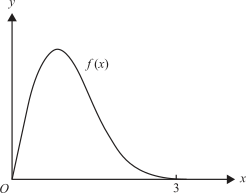
The graph of the function  `f(x)=2xe^((1-x^(2)))`, where  `0 <= x <= 3`, is shown below.
 

  1. Find the slope of the tangent to `f` at  `x=1`.   (1 mark)

    --- 2 WORK AREA LINES (style=lined) ---

  2. Find the obtuse angle that the tangent to `f` at  `x = 1`  makes with the positive direction of the horizontal axis. Give your answer correct to the nearest degree.   (1 mark)

    --- 2 WORK AREA LINES (style=lined) ---

  3. Find the slope of the tangent to `f` at a point  `x =p`. Give your answer in terms of  `p`.   (1 mark)

    --- 2 WORK AREA LINES (style=lined) ---

  4.  i. Find the value of `p` for which the tangent to `f` at  `x=1` and the tangent to `f` at  `x=p`  are perpendicular to each other. Give your answer correct to three decimal places.   (2 marks)

    --- 3 WORK AREA LINES (style=lined) ---

  5. ii. Hence, find the coordinates of the point where the tangents to the graph of `f` at  `x=1`  and  `x=p`  intersect when they are perpendicular. Give your answer correct to two decimal places.   (3 marks)

    --- 5 WORK AREA LINES (style=lined) ---

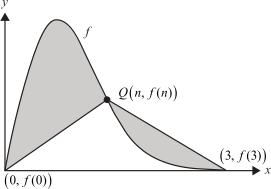
Two line segments connect the points `(0, f(0))`  and  `(3, f(3))`  to a single point  `Q(n, f(n))`, where  `1 < n < 3`, as shown in the graph below.


  1.   i. The first line segment connects the point `(0, f(0))` and the point `Q(n, f(n))`, where `1 < n < 3`.
  2.      Find the equation of this line segment in terms of  `n`.   (1 mark)

    --- 3 WORK AREA LINES (style=lined) ---

  3.  ii. The second line segment connects the point `Q(n, f(n))` and the point  `(3, f(3))`, where  `1 < n < 3`.
  4.      Find the equation of this line segment in terms of `n`.   (1 mark)

    --- 5 WORK AREA LINES (style=lined) ---

  5. iii. Find the value of `n`, where  `1 < n < 3`, if there are equal areas between the function `f` and each line segment.
  6.      Give your answer correct to three decimal places.   (3 marks)

    --- 3 WORK AREA LINES (style=lined) ---

Show Answers Only
  1. `-2`
  2. `117^@`
  3. `2(1-2p^(2))e^(1-p^(2))” or “(2e-4p^(2)e)e^(-p^(2))`
  4.  i. `0.655`
  5. ii. `(0.80, 2.39)`
  6.   i. `y_1=2e^((1-n^2))x`
  7.  ii. `y_2=(2n e^((1-n^2))-6e^(-8))/(n-3) (x-3) + 6e^(-8)`
  8. iii. `n= 1.088`
Show Worked Solution

a.   `f(x)=2xe^((1-x^(2)))`

`f^{′}(1)=-2`

♦ Mean mark part (b) 37%.


b.   `text{Solve:}\ tan theta =-2\ \ text{for}\ \ theta in (pi/2, pi)`

`theta = 117^@`
 

c.   `text{Slope of tangent}\ = f^{′}(p)`

`f^{′}(p)=2(1-2p^(2))e^(1-p^(2))\ \ text{or}\ \ (2e-4p^(2)e)e^(-p^(2))`
 

d.i.   `text{If tangents are perpendicular:}`

`f^{′}(p) xx-2 =-1\ \ =>\ \ f^^{′}(p)=1/2`

`text{Solve}\ \ 2(1-2p^(2))e^(1-p^(2))=1/2\ \ text{for}\ p:`

`p=0.655\ \ text{(to 3 d.p.)}`
 

d.ii.  `text{Equation of tangent at}\ \ x=1: \ y=4-2x`

♦ Mean mark part (d)(ii) 41%.

`text{Equation of tangent at}\ \ x=p: \ y= x/2 + 1.991…`

`text{Solve}\ \ 4-2x = x/2 + 1.991…\ \ text{for}\ x:`

`=> x = 0.8035…`

`=> y=4-2(0.8035…) = 2.392…`

`:.\ text{T}text{angents intersect at (0.80, 2.39)}`

♦ Mean mark part (e)(i) 44%.

 
e.i.
  `Q (n, 2n e^(1-n^2))`

`m_(OQ) = (2n e^((1-n^2)) – 0)/(n-0) = 2e^((1-n^2))`

`:.\ text{Equation of segment:}\ \ y_1=2e^((1-n^2))x`

♦♦ Mean mark part (e)(ii) 28%.
 

e.ii.  `P(3, f(3)) = (3, 6e^(-8))`

`m_(PQ) = (2n e^((1-n^2))-6e^(-8))/(n-3)`

`text{Equation of line segment:}`

`y_2-6e^(-8)` `=(2n e^((1-n^2))-6e^(-8))/(n-3) (x-3)`  
`y_2` `=(2n e^((1-n^2))-6e^(-8))/(n-3) (x-3) + 6e^(-8)`  
♦♦ Mean mark part (e)(iii) 28%.


e.iii.  `text{Find}\ n\ text{where shaded areas are equal.}`

`text{Solve}\ int_(0)^(n)(f(x)-y_(1))\ dx=int_(n)^(3)(y_(2)-f(x))\ dx\ \ text{for} n:`

`=> n= 1.088\ \ text{(to 3 d.p.)}`

Filed Under: Area Under Curves, Tangents and Normals Tagged With: Band 3, Band 4, Band 5, smc-634-20-Log/Exp Function, smc-634-50-Find tangent given curve, smc-634-80-Angle between tangents/axes, smc-634-90-Normals, smc-723-50-Log/Exponential

Calculus, MET2 2021 VCAA 3

Let  `q(x) = log_e (x^2-1)-log_e (1-x)`.

  1. State the maximal domain and the range of `q`.   (2 marks)

    --- 4 WORK AREA LINES (style=lined) ---

  2.  i. Find the equation of the tangent to the graph of `q` when  `x =-2`.   (1 mark)

    --- 2 WORK AREA LINES (style=lined) ---

  3. ii. Find the equation of the line that is perpendicular to the graph of `q` when  `x =-2`  and passes through the point  (-2, 0).   (1 mark)

    --- 2 WORK AREA LINES (style=lined) ---

Let  `p(x) = e^{-2x}-2e^-x + 1.`

  1. Explain why `p` is not a one-to one function.   (1 mark)

    --- 2 WORK AREA LINES (style=lined) ---

  2. Find the gradient of the tangent to the graph of `p` at  `x = a`.   (1 mark)

    --- 2 WORK AREA LINES (style=lined) ---

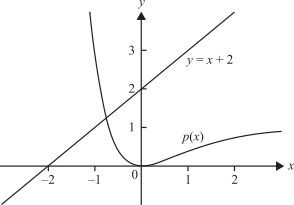
The diagram below shows parts of the graph of `p` and the line  `y = x + 2`.


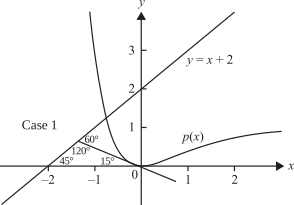
The line  `y = x + 2`  and the tangent to the graph of `p` at  `x = a`  intersect with an acute angle of `theta` between them.

  1. Find the value(s) of `a` for which  `theta = 60^@`. Give your answer(s) correct to two decimal places.   (3 marks)

    --- 8 WORK AREA LINES (style=lined) ---

  2. Find the `x`-coordinate of the point of intersection between the line  `y = x + 2` and the graph of `p`, and hence find the area bounded by  `y = x + 2`, the graph of `p` and the `x`-axis, both correct to three decimal places.   (3 marks)

    --- 5 WORK AREA LINES (style=lined) ---

Show Answers Only
  1. `text{Domain:} \ x ∈ (-∞, -1)`
    `text{Range:} \ y ∈ R`
  2. i.  `-x-2`
    ii. `x + 2`
  3. `text{Not a one-to-one function as it fails the horizontal line test.}`
  4. `-2e^{-2a} + 2e^{-a}`
  5. `-0.67`
  6. `1.038\ text(u)^2`
Show Worked Solution

a.    `text(Method 1)`

`x^2-1 > 0 \ \ => \ \ x > 1 \ \ ∪ \ \ x < -1`

`1-x > 0 \ \ => \ \ x < 1`
 
`:. \ x ∈ (-∞, -1)`
 

`text(Method 2)`

`text{Sketch graph by CAS}`

`text{Asymptote at} \ x = -1`

`text{Domain:} \ x ∈ (-∞, -1)`

`text{Range:} \ y ∈ R`


b.     i.   `text{By CAS (tanLine} \ (q (x), x, -2)):`

`y = -x-2`
 

ii.   `text{By CAS (normal} \ (q (x), x, -2)):`

`y = x + 2`
  

c.    `text{Sketch graph by CAS.}`

`p(x) \ text{is not a one-to-one function as it fails the horizontal line test}`

`text{(i.e. it is a many-to-one function)}`
 

d.   `p^{′}(x) = -2e^{-2x} + 2e^-x`

`p^{prime}(a) = -2e^{-2a} + 2e^{-a}`


e. 

 
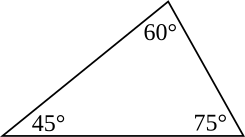
`text{Case 1}`

`text{By CAS, solve:}`

`2e^{-a} -2e^{-2a} =-tan (15^@) \ \ text{for}\ a:`

`a = -0.11`
 

`text{Case 2}`

`text{Case 1}`

`text{By CAS, solve:}`

`2e^{-a}-2e^{-2a} = -tan 75^@\ \ text{for}\ a:`

`a = -0.67`
 

f.     `text{At intersection,}`

`x + 2 = e^{-2x} -2e^{-x} + 1`

`x = -0.750`
 

`text{Area}` `= int_{-2}^{-0.750} x + 2\ dx + int_{-0.750}^0 e^{-2x}-2e^{-x} + 1\ dx`
  `= 1.038 \ text(u)^2`

Filed Under: Area Under Curves, Tangents and Normals Tagged With: Band 4, Band 5, Band 6, smc-634-20-Log/Exp Function, smc-634-50-Find tangent given curve, smc-634-90-Normals, smc-723-50-Log/Exponential, smc-723-80-Area between graphs

Calculus, MET2 2019 VCAA 5

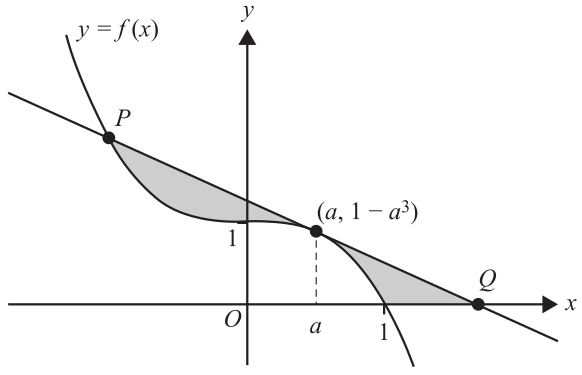
Let  `f: R -> R, \ f(x) = 1-x^3`. The tangent to the graph of `f` at  `x = a`, where  `0 < a < 1`, intersects the graph of `f` again at `P` and intersects the horizontal axis at `Q`. The shaded regions shown in the diagram below are bounded by the graph of `f`, its tangent at  `x = a`  and the horizontal axis.
 

  1. Find the equation of the tangent to the graph of `f` at  `x = a`, in terms of `a`.   (1 mark)

    --- 3 WORK AREA LINES (style=lined) ---

  2. Find the `x`-coordinate of `Q`, in terms of `a`.   (1 mark)

    --- 3 WORK AREA LINES (style=lined) ---

  3. Find the `x`-coordinate of `P`, in terms of `a`.   (2 marks)

    --- 4 WORK AREA LINES (style=lined) ---

Let  `A`  be the function that determines the total area of the shaded regions.

  1. Find the rule of `A`, in terms of `a`.   (3 marks)

    --- 5 WORK AREA LINES (style=lined) ---

  2. Find the value of `a` for which `A` is a minimum.   (2 marks)

    --- 3 WORK AREA LINES (style=lined) ---

Consider the regions bounded by the graph of `f^(-1)`, the tangent to the graph of `f^(-1)` at  `x = b`, where  `0 < b < 1`, and the vertical axis.

  1. Find the value of `b` for which the total area of these regions is a minimum.   (2 marks)

    --- 4 WORK AREA LINES (style=lined) ---

  2. Find the value of the acute angle between the tangent to the graph of `f` and the tangent to the graph of `f^(-1)` at  `x = 1`.   (1 mark)

    --- 4 WORK AREA LINES (style=lined) ---

Show Answers Only
  1. `y = 2a^3-3a^2x + 1`
  2. `(2a^3 + 1)/(3a^2)`
  3. `-2a`
  4. `(80a^6 + 8a^3-9a^2 + 2)/(12a^2)`
  5. `10^(-1/3)`
  6. `9/10`
  7. `tan^(-1)(1/3)`
Show Worked Solution

a.   `f(x) = 1-x^3,\ \ f^{\prime}(x) = -3x^2`

`m_text(tang) = -3a^2\ \ text(through)\ \ (a, 1-a^3)`

`y = 2a^3-3a^2x + 1`
 

b.   `text(Solve for)\ \x:`

`2a^3-3a^2x + 1 = 0`

`x = (2a^3 + 1)/(3a^2)`
 

c.   `text(Solve for)\ \ x:`

`2a^3-3a^2x + 1 = 1-x^3`

`x=-2a`

`:. x text(-coordinate of)\ P = -2a`
 

d.   `P(-2a, 8a^3 + 1),\ \ Q((2a^3 + 1)/(3a^2), 0)`

`A` `= text(Area of triangle)-int_(-2a)^1 f(x)\ dx`
  `= 1/2((2a^3 + 1)/(3a^2) + 2a)(8a^3 + 1)-int_(-2a)^1 1-x^3\ dx`
  `= (80a^6 + 8a^3-9a^2 + 2)/(12a^2)\ \ text{(by CAS)}`


e.   `text(Solve for)\ a: \ (dA)/(da) = 0\ \ text{(by CAS)}`

`a = 10^(-1/3)`
 

f.   `text(Consider)\ f(x):\ \ f(10^(-1/3)) = 9/10`

`A_text(min)\ text(for)\ \ f(x)\ \ text(occurs at)\ \ (10^(-1/3), 9/10)`

`=> A_text(min)\ text(for)\ \ f^(-1)(x)\ \ text(occurs when)\ \ x=9/10`

`:. b = 9/10`
 

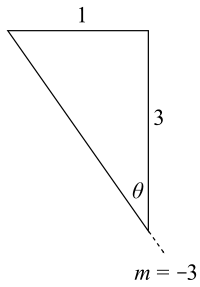
g.   `f^{\prime} (1)  = -3`

`text(Gradient of)\ \  f^(-1)(x)\ \ text(at)\ \ x = 1\ \ text(is vertical line.)`

`tan theta` `= 1/3`
`theta` `= tan^(-1)(1/3)`
  `=18.4°\ \ text{(to 1 d.p.)}`

Filed Under: Area Under Curves, Maxima and Minima, Tangents and Normals Tagged With: Band 4, Band 5, Band 6, smc-634-10-Polynomial, smc-634-50-Find tangent given curve, smc-641-10-Area, smc-723-20-Cubic, smc-723-80-Area between graphs

Calculus, MET1 2018 VCAA 9

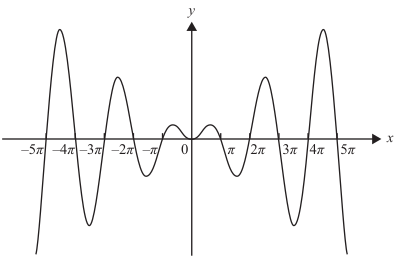
Consider a part of the graph of  `y = xsin(x)`, as shown below.

  1.  i. Given that  `int(xsin(x))\ dx = sin(x)-xcos(x) + c`, evaluate  `int_(npi)^((n + 1)pi)(xsin(x))\ dx`  when `n` is a positive even integer or 0.
      
    Give your answer in simplest form.   (2 marks)

    --- 5 WORK AREA LINES (style=lined) ---

    ii. Given that  `int(xsin(x))\ dx = sin(x)-xcos(x) + c`, evaluate  `int_(npi)^((n + 1)pi)(xsin(x))\ dx`  when `n` is a positive odd integer.
    Give your answer in simplest form.   (1 mark)

    --- 4 WORK AREA LINES (style=lined) ---

  2.  
  3. Find the equation of the tangent to  `y = xsin(x)`  at the point  `(−(5pi)/2,(5pi)/2)`.   (2 marks)

    --- 5 WORK AREA LINES (style=lined) ---

  4. The translation `T` maps the graph of  `y = xsin(x)`  onto the graph of  `y = (3pi-x)sin(x)`, where
  5. `qquad T: R^2 -> R^2, T([(x),(y)]) = [(x),(y)] + [(a),(0)]`
  6. and `a` is a real constant.
  7. State the value of `a`.   (1 mark)

    --- 2 WORK AREA LINES (style=lined) ---

  8. Let  `f:[0,3pi] -> R, f(x) = (3pi-x)sin(x)`  and  `g:[0,3pi] -> R, g(x) = (x-3pi)sin(x)`.
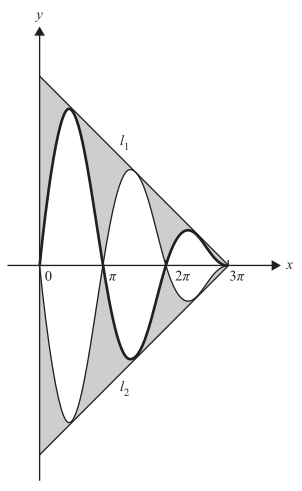
    The line `l_1` is the tangent to the graph of `f` at the point `(pi/2,(5pi)/2)` and the line `l_2` is the tangent to the graph of `g` at `(pi/2,-(5pi)/2)`, as shown in the diagram below.


    Find the total area of the shaded regions shown in the diagram above.   (2 marks)

    --- 8 WORK AREA LINES (style=lined) ---

Show Answers Only
  1.  i. `(2n + 1)pi`
    ii. `-(2n + 1)pi`
  2. `:. y =-x`
  3. `-3pi`
  4. `9pi(pi-2)`
Show Worked Solution

a.i.  `text(Given)\ \ n\ \ text(is a positive even integer:)`

♦♦ Mean mark 31%.

`int_(npi)^((n + 1)pi)(xsin(x))dx`

`= [sin(x)-xcos(x)]_(npi)^((n + 1)pi)`

`= [sin((n + 1)pi)-(n + 1)pi · cos((n + 1)pi)]-[sin(npi)-npi · cos(npi)]`

`= [0-(n + 1)pi (−1)]-[0-npi]`

`= (n + 1)pi + npi`

`= (2n + 1)pi`


a.ii. `text(Given)\ \ n\ \ text(is a positive odd integer:)`

♦♦♦ Mean mark 19%.

`int_(npi)^((n + 1)pi)(xsin(x))dx`

`= [sin((n + 1)pi)-(n + 1)pi · cos((n + 1)pi)]-[sin(npi)-npi · cos(npi)]`

`= [0-(n + 1)pi(1)]-[0-npi(−1)]`

`= -(n + 1)pi-npi`

`= -(2n + 1)pi`


b.    `y` `= xsin(x)`
  `(dy)/(dx)` `= x · cos(x) + sin(x)`


♦ Mean mark part (b) 49%.

`(dy)/(dx)` `= -(5pi)/2 · cos(-(5pi)/2) + sin(-(5pi)/2)`
  `= -(5pi)/2 · (0) + (-1)`
  `= -1`

 
`text(T)text(angent has equation)\ \ y =-x + c\ \ text(and passes through)\ \ (-(5pi)/2, (5pi)/2):`

`(5pi)/2` `= +(5pi)/2 + c`
`c` `= 0`

 
`:. y = -x`


♦♦ Mean mark part (c) 34%.

c.    `y` `= (3pi-x)sin(x)`
    `=-(x-3pi)sin(x)`

 
`:. a = 3pi`
 

d.   `f(x) = (3pi-x)sin(x)`

♦♦♦ Mean mark 7%.

  `-> l_1\ text(is the tangent)\ \ y =-x\ \ (text{using part (b)})`

`-> g(x)\ text(is)\ \ y=xsin(x)\ \ text(translated 3π to the right.)`

`-> f(x)\ text(is)\ \ g(x)\ \ text(reflected in the)\ \ x text(-axis.)`

 
`text(Area between)\ f(x)\ text(and)\ xtext(-axis)`

`= int_0^pi xsin(x)\ dx + | int_pi^(2pi) xsin(x)\ dx | + int_(2pi)^(3pi) xsin(x)\ dx`

`= (2 xx 0 + 1)pi + |-1(2 xx 1 + 1)pi | + (2 xx 2 + 1)pi\ \ (text{using part (a)})`

`= pi + 3pi + 5pi`

`= 9pi`
 

`:.\ text(Shaded Area)`

`= 2 xx (1/2 xx 3pi xx 3pi)-2 xx 9pi`

`= 9pi^2-18pi`

`= 9pi(pi-2)`

Filed Under: Area Under Curves, Tangents and Normals Tagged With: Band 5, Band 6, smc-634-30-Trig Function, smc-634-50-Find tangent given curve, smc-723-60-Trig, smc-723-80-Area between graphs

Calculus, MET2 2018 VCAA 9 MC

A tangent to the graph of  `y = log_e(2x)`  has a gradient of 2.

This tangent will cross the `y`-axis at

A.   `0`

B.   `-0.5`

C.   `-1`

D.   `-1 - log_e(2)`

E.   `-2 log_e(2)`

Show Answers Only

`C`

Show Worked Solution
`y` `= ln 2x`
`(dy)/(dx)` `= 1/x`

 
`text(When)\ \ (dy)/(dx) = 2:`

`1/x` `= 2`
`x` `= 1/2`

 
`text(When)\ \ x = 1/2,\ \ y = ln 1 = 0`

`text(Find equation)\ \ m = 2,\ \ text(through)\ \ (1/2, 0):`

`y – 0` `= 2 (x – 1/2)`
`y` `= 2x – 1`

 
`=>   C`

Filed Under: Tangents and Normals Tagged With: Band 4, smc-634-20-Log/Exp Function, smc-634-50-Find tangent given curve

Calculus, MET1 SM-Bank 21

Find the equation of the tangent to the curve  `y = cos 2x`  at the point whose `x`-coordinate is  `pi/6.`   (3 marks)

--- 7 WORK AREA LINES (style=lined) ---

Show Answers Only

`y =-sqrt 3 x + ((sqrt 3 pi)/6 + 1/2)`

Show Worked Solution

`y = cos 2x`

`dy/dx =-2 sin 2x`

`text(When)\ \ x = pi/6,`

`y` `= cos (2 xx pi/6)`
  `= cos (pi/3)`
  `= 1/2`


`dy/dx` `= -2 sin (pi/3)`
  `= -2 xx sqrt 3 / 2`
  `= -sqrt 3`


`:. text(Equation of tangent,)\ \ m =-sqrt 3, text(through)\ \ (pi/6, 1/2) :`

`y-y_1` `= m(x-x_1)`
`y-1/2` `= -sqrt 3 ( x-pi/6)`
`y-1/2` `= -sqrt 3 x + (sqrt 3 pi)/6`
`y` `= -sqrt 3 x + ((sqrt 3 pi)/6 + 1/2)`

Filed Under: Tangents and Normals Tagged With: Band 4, smc-634-30-Trig Function, smc-634-50-Find tangent given curve

Calculus, MET1 SM-Bank 2

Let  `f: (0,oo) → R,` where  `f(x) = log_e (x).`

Find the equation of the tangent to  `f(x)`  at the point  `(e, 1)`.   (2 marks)

--- 5 WORK AREA LINES (style=lined) ---

Show Answers Only

`y = x/e`

Show Worked Solution

`y = log_ex`

`dy/dx = 1/x`

`text(At)\ (e, 1),\ \ m = 1/e`

`text(Equation of tangent,)\ \ m = 1/e,\ text(through)\ (e, 1):`

`y-1`  `= 1/e(x-e)`
`:. y`  `= x/e`

Filed Under: Tangents and Normals Tagged With: Band 3, smc-634-20-Log/Exp Function, smc-634-50-Find tangent given curve

Calculus, MET2 2016 VCAA 2

Consider the function  `f(x) = -1/3 (x + 2) (x-1)^2.`

  1.  i. Given that  `g^{′}(x) = f (x) and g (0) = 1`,
  2.      show that  `g(x) = -x^4/12 + x^2/2-(2x)/3 + 1`.   (1 mark)

    --- 3 WORK AREA LINES (style=lined) ---

  3. ii. Find the values of `x` for which the graph of  `y = g(x)`  has a stationary point.   (1 mark)

    --- 3 WORK AREA LINES (style=lined) ---

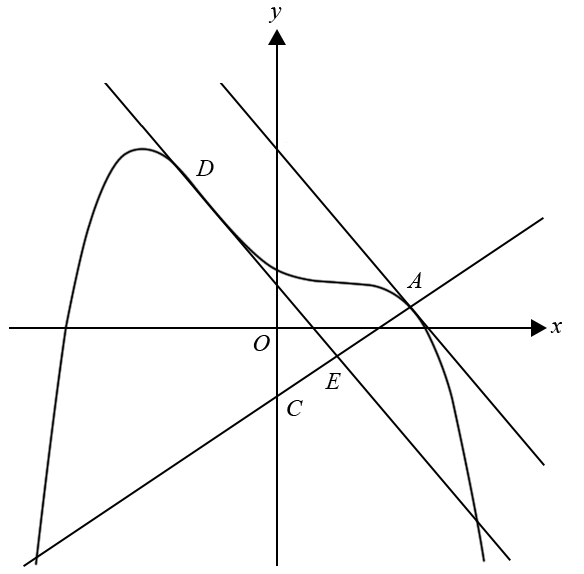
The diagram below shows part of the graph of  `y = g(x)`, the tangent to the graph at  `x = 2`  and a straight line drawn perpendicular to the tangent to the graph at  `x = 2`. The equation of the tangent at the point `A` with coordinates  `(2, g(2))`  is  `y = 3-(4x)/3`.

The tangent cuts the `y`-axis at `B`. The line perpendicular to the tangent cuts the `y`-axis at `C`.


  1.   i. Find the coordinates of `B`.   (1 mark)

    --- 2 WORK AREA LINES (style=lined) ---

  2.  ii. Find the equation of the line that passes through `A` and `C` and, hence, find the coordinates of `C`.   (2 marks)

    --- 5 WORK AREA LINES (style=lined) ---

  3. iii. Find the area of triangle `ABC`.   (2 marks)

    --- 4 WORK AREA LINES (style=lined) ---

  4. The tangent at `D` is parallel to the tangent at `A`. It intersects the line passing through `A` and `C` at `E`.


     i. Find the coordinates of `D`.   (2 marks)

    --- 4 WORK AREA LINES (style=lined) ---

  5. ii. Find the length of `AE`.   (3 marks)

    --- 6 WORK AREA LINES (style=lined) ---

Show Answers Only
  1.  i. `text(Proof)\ \ text{(See worked solutions)}`
  2. ii. `x = -2, 1`
  3.   i. `(0, 3)`
  4. ii. `y = 3/4 x-7/6`
  5.      `(0, -7/6)`
  6. iii. `25/6\ text(u²)`
  7. `(-1, 25/12)`
  8. `27/20\ text(u)`
Show Worked Solution
a.i.    `g(x)` `= int f(x)\ dx`
    `=-1/3 int (x + 2) (x-1)^2\ dx`
    `=-1/3int(x^3-3x+2)\ dx`
  `:.g(x)` `= -x^4/12 + x^2/2-(2x)/3 + c`

 
`text(S)text(ince)\ \ g(0) = 1,`

`1` `= 0 + 0-0 + c`
`:. c` `= 1`

  
`:. g(x) = -x^4/12 + x^2/2-(2x)/3 + 1\ \ …\ text(as required)`
 

a.ii.   `text(Stationary point when:)`

`g^{′}(x) = f(x) = 0`

`-1/3(x + 2) (x-1)^2=0`

`:. x = -2, 1`
 

b.i.   

`B\ text(is the)\ y text(-intercept of)\ \ y = 3-4/3 x`

`:. B (0, 3)`
 

b.ii.   `m_text(norm) = 3/4, \ text(passes through)\ \ A(2, 1/3)`

   `text(Equation of normal:)`

`y-1/3` `=3/4(x-2)`
`y` `=3/4 x-7/6`
   

`:. C (0, -7/6)`
 

b.iii.   `text(Area)` `= 1/2 xx text(base) xx text(height)`
    `= 1/2 xx (3 + 7/6) xx 2`
    `= 25/6\ text(u²)`


♦ Mean mark part (c)(i) 43%.
MARKER’S COMMENT: Many students gave an incorrect `y`-value here. Be careful!
c.i.    `text(Solve)\ \ \ g^{′}(x)` `= -4/3\ \ text(for)\ \ x < 0`
  `=> x` `= -1`
  `g(-1)` `=-1/12+1/2+2/3+1`
    `=25/12`

  
`:. D (−1, 25/12)`
 

c.ii.   `text(T) text(angent line at)\ \ D:`

`y-25/12` `=-4/3(x+1)`
`y` `=-4/3x + 3/4`

 
`DE\ \ text(intersects)\ \ AE\ text(at)\ E:`

♦♦ Mean mark 32%.
`-4/3 x + 3/4` `= 3/4 x-7/6`
`25/12 x` `= 23/12`
`x` `=23/25`

 
`:. E (23/25, -143/300)`
 

`:. AE` `= sqrt((2-23/25)^2 + (1/3-(-143/300))^2)`
  `= 27/20\ text(units)`

Filed Under: Coordinate Geometry, Curve Sketching, Tangents and Normals Tagged With: Band 3, Band 4, Band 5, smc-634-10-Polynomial, smc-634-50-Find tangent given curve, smc-634-70-Find point of tangency, smc-724-20-Degree 4, smc-727-10-Equation of line, smc-727-20-Distance

Calculus, MET2 2016 VCAA 1

Let  `f: [0, 8 pi] -> R, \ f(x) = 2 cos (x/2) + pi`.

  1. Find the period and range of `f`.   (2 marks)

    --- 4 WORK AREA LINES (style=lined) ---

  2. State the rule for the derivative function `f^{′}`.   (1 mark)

    --- 1 WORK AREA LINES (style=lined) ---

  3. Find the equation of the tangent to the graph of `f` at  `x = pi`.   (1 mark)

    --- 2 WORK AREA LINES (style=lined) ---

  4. Find the equations of the tangents to the graph of  `f: [0, 8 pi] -> R,\ \ f(x) = 2 cos (x/2) + pi`  that have a gradient of 1.   (2 marks)

    --- 4 WORK AREA LINES (style=lined) ---

  5. The rule of  `f^{′}` can be obtained from the rule of `f` under a transformation `T`, such that
      
    `qquad T: R^2 -> R^2,\ T([(x), (y)]) = [(1, 0), (0, a)] [(x), (y)] + [(−pi), (b)]`


    Find the value of `a` and the value of `b`.   (3 marks)

    --- 8 WORK AREA LINES (style=lined) ---

  6. Find the values of  `x, \ 0 <= x <= 8 pi`, such that  `f(x) = 2 f^{′} (x) + pi`.   (2 marks)

    --- 5 WORK AREA LINES (style=lined) ---

Show Answers Only
  1. `text(Period:)\ 4 pi; qquad text(Range:)\ [pi-2, pi + 2]`
  2. `f^{′} (x) =-sin (x/2)`
  3. `y =-x + 2 pi`
  4. `y = x-2 pi and y = x-6 pi`
  5. `a = 1/2 and b =-pi/2`
  6. `x = (3 pi)/2, (7 pi)/2, (11 pi)/2, (15 pi)/2`
Show Worked Solution

a.   `text(Period)= (2pi)/n = (2 pi)/(1/2) = 4pi`

MARKER’S COMMENT: Including round brackets rather than square ones was a common mistake.

`text(Range:)\ [pi-2, pi + 2]`
  

b.   `f^{′} (x) = text(−sin) (x/2)`
 

c.   `[text(CAS: tangentLine)\ (f(x), x, pi)]`

`y = -x + 2 pi`
 

d.   `text(Solve)\ \ f^{′} (x) = 1\ \ text(for)\ x in [0, 8 pi]`

♦ Mean mark part (d) 50%.

`-> x = 3 pi or 7 pi`

`:. y = x-2 pi and y = x-6 pi\ \ [text(CAS)]`


e.   `text(Using the transition matrix,)`

♦♦ Mean mark part (e) 27%.
`x_T` `=x-pi`
`x` `=x_T+pi`
`y_T` `=ay+b`
`y` `=(y_T-b)/a`
   

`f(x)= cos (x/2) + pi/2\ \ ->\ \ f{′}(x) = -sin(x/2)`

`(y_T-b)/a` `=2cos((x_T+pi)/2)+pi`
`y_T` `=2a cos((x_T+pi)/2)+a pi +b`
  `=-2a sin(x_T/2)+a pi + bqquad [text(Complementary Angles)]`
   
`-2a` `=-1`
`:. a` `=1/2`
`1/2 pi +b` `=0`
`:.b` `=-pi/2`


f.   `text(Solve)\ \ f(x) = 2 f^{′} (x) + pi\ \ text(for)\ \ x in [0, 8 pi]`

♦ Mean mark part (f) 50%.
`2 cos (x/2) + pi` `= -2 sin(x/2)+pi`
`tan(x/2)` `=-1`
`x/2` `=(3pi)/4, (7pi)/4, (11pi)/4, (15pi)/4`
`:.x` `= (3 pi)/2, (7 pi)/2, (11 pi)/2, (15 pi)/2`

Filed Under: Tangents and Normals, Transformations Tagged With: Band 3, Band 4, Band 5, smc-634-30-Trig Function, smc-634-50-Find tangent given curve, smc-753-60-Matrix, smc-753-75-Trig functions

Calculus, MET1 2009 VCAA 8

Let  `f: R -> R,\ f(x) = e^x + k`,  where `k` is a real number. The tangent to the graph of  `f` at the point where  `x = a`  passes through the point `(0, 0).` Find the value of `k` in terms of `a.`  (3 marks)

--- 10 WORK AREA LINES (style=lined) ---

Show Answers Only

`:. k = ae^a-e^a`

Show Worked Solution

`text(Point of tangency:)\ \ P (a, e^a + k)`

♦ Mean mark 45%.

`text(Find gradient of tangent at)\ \ x = a:`

`f(x)` `=e^x+k`
`f^{prime}(x)` `= e^x`
`:. m_tan` `= e^a`


`text(Find equation of tangent:)`

`y-y_1` `= m (x-x_1)`
`y-(e^a + k)` `= e^a (x-a)`


`text(Substitute)\ \ (0, 0):`

`0-e^a – k` `=-ae^a`
`:. k` `= ae^a-e^a`
  `=e^a(a-1)`

Filed Under: Tangents and Normals Tagged With: Band 5, smc-634-20-Log/Exp Function, smc-634-50-Find tangent given curve

Calculus, MET1 2010 VCAA 10

The line  `y = ax-1`  is a tangent to the curve  `y = x^(1/2) + d`  at the point  `(9, c)`  where `a, c` and `d` are real constants.

Find the values of `a, c` and `d`.   (4 marks)

--- 12 WORK AREA LINES (style=lined) ---

Show Answers Only

`a = 1/6,\ \ c = 1/2,\ \ d =-5/2`

Show Worked Solution

`text(Find)\ \ m_tan\ \ text(at)\ \ (9,c),`

`(dy)/(dx)` `= 1/(2 sqrt x)`
`m_tan` `= 1/(2 sqrt 9)=1/6`
`:. a` `= 1/6`


`text(Find equation of tangent:)`

`y-y_1` `= m (x-x_1)`
`y-c` `= 1/6 (x-9)`
`y` `= 1/6 x-3/2 + c`
   

`text(S)text(ince)\ y text(-intercept = – 1),`

`-1` `=-3/2 +c`
`:.c` `=1/2`


`text(S)text(ince)\ \ (9,1/2)\ \ text(lies on)\ \ y = x^(1/2) + d`

`1/2` `= 3 + d`
`:. d` `=-5/2`

Filed Under: Tangents and Normals Tagged With: Band 4, smc-634-50-Find tangent given curve

Calculus, MET1 2012 VCAA 10

Let  `f: R -> R,\ f(x) = e^(-mx) + 3x`,  where `m` is a positive rational number.

  1.  i. Find, in terms of `m`, the `x`-coordinate of the stationary point of the graph of  `y = f(x).`   (2 marks)

    --- 5 WORK AREA LINES (style=lined) ---

  2. ii. State the values of `m` such that the `x`-coordinate of this stationary point is a positive number.   (1 mark)

    --- 4 WORK AREA LINES (style=lined) ---

  3. For a particular value of `m`, the tangent to the graph of  `y = f(x)`  at  `x =-6`  passes through the origin.
  4. Find this value of `m`.   (3 marks)

    --- 10 WORK AREA LINES (style=lined) ---

Show Answers Only
  1.  i. `1/m log_e(m/3)`
  2. ii. `m > 3`
  3. `1/6`
Show Worked Solution

a.i.   `text(SP’s occur when)\ \ f^{prime}(x)=0`

`-me^(-mx) + 3` `= 0`
`me^(-mx)` `3`
`-mx` `= log_e (3/m)`
`:. x` `=-1/m log_e (3/m)`
  `= 1/m log_e (m/3), \ m>0`


♦♦♦ Part (a.ii.) mean mark 18%.
  ii.    `1/m log_e (m/3)` `> 0`
  `log_e (m/3)` `> 0`
  `m/3` `> 1`
  `:. m` `> 3`


b.   `text(Point of tangency:)\ \ (-6, e^(-6m)-18)`

♦♦ Mean mark (b) 33%.
MARKER’S COMMENT: Many confused `m` with the more common use of `m` for gradient in  `y=mx+c`.

`text(At)\ \ x=-6,`

`m_tan= f^{prime} (-6)= -me^(-6m) + 3`

`:.\ text(Equation of tangent:)`

`y-y_1` `= m (x-x_1)`
`y-(e^(-6m)-18)` `= (-me^(-6m) + 3) (x-(-6))`


`text(S)text{ince tangent passes through (0, 0):}`

`-e^(-6m) + 18` `= (-me^(-6m) + 3)(6)`
`-e^(-6m) + 18` `=-6 me^(-6m) + 18`
`e^(-6m)-6me^(-6m)` `= 0`
`e^(-6m) (1-6m)` `= 0`
`1-6m` `=0`
`:.m` `=1/6`

Filed Under: Curve Sketching, Tangents and Normals Tagged With: Band 4, Band 5, Band 6, smc-634-20-Log/Exp Function, smc-634-50-Find tangent given curve, smc-724-30-Log/Exponential

Calculus, MET2 2014 VCAA 5

Let  `f: R -> R, \ \ f (x) = (x-3)(x-1)(x^2 + 3)  and  g: R-> R, \ \ g (x) = x^4-8x.`

  1. Express  `x^4-8x`  in the form  `x(x-a) ((x + b)^2 + c)`.   (2 marks)

    --- 4 WORK AREA LINES (style=lined) ---

  2. Describe the translation that maps the graph of  `y = f (x)`  onto the graph of  `y = g (x)`.   (1 mark)

    --- 2 WORK AREA LINES (style=lined) ---

  3. Find the values of `d` such that the graph of  `y = f (x + d)` has
    1. one positive `x`-axis intercept.   (1 mark)

      --- 3 WORK AREA LINES (style=lined) ---

    2. two positive `x`-axis intercepts.   (1 mark)

      --- 2 WORK AREA LINES (style=lined) ---

  4. Find the value of `n` for which the equation  `g (x) = n`  has one solution.   (1 mark)

    --- 3 WORK AREA LINES (style=lined) ---

  5. At the point  `(u, g(u))`, the gradient of  `y = g(x)`  is `m` and at the point `(v, g(v))`, the gradient is  `-m`, where `m` is a positive real number.
    1. Find the value of  `u^3 + v^3`.   (2 marks)

      --- 3 WORK AREA LINES (style=lined) ---

    2. Find `u` and `v` if  `u + v = 1`.   (1 mark)

      --- 3 WORK AREA LINES (style=lined) ---

    1. Find the equation of the tangent to the graph of  `y = g(x)`  at the point  `(p, g(p))`.   (1 mark)

      --- 4 WORK AREA LINES (style=lined) ---

    2. Find the equations of the tangents to the graph of  `y = g(x)`  that pass through the point with coordinates  `(3/2, -12)`.   (3 marks)

      --- 5 WORK AREA LINES (style=lined) ---

Show Answers Only
  1. `x(x-2)((x + 1)^2 + 3)`
  2. `text(See Worked Solutions)`
  3.  i. `[1,3)`
  4. ii. `d < 1`
  5. `-6 xx 2^(1/3)`
  6.  i. `4`
  7. ii. `u = (sqrt5 + 1)/2,quad v = (-sqrt5 + 1)/2`
  8. i. `y = 4(p^3-2)x-3p^4`
  9. ii. `y = -8x;quady = 24x-48`
Show Worked Solution

a.  `text(Solution 1)`

`g(x) = x^4-8x`

`= x(x-2)(x^2 + 2x + 4)\ \ \ text([by CAS])`

`= x(x-2)((x + 1)^2 + 3)`
 

`text(Solution 2)`

`x^4-8x` `=x(x^3-2^3)`
  `=x(x-2)(x^2 +2x+4)`
  `=x(x-2)(x^2 +2x+1+3)`
  `=x(x-2)((x+1)^2+3)`


b.    `f(x + 1)` `= ((x + 1)-3)((x + 1)-1)((x + 1)^2 + 3)`
    `= x(x-2)((x + 1)^2 + 3)`
    `= g(x)`


♦ Mean mark (b) 37%.

`:.\ text(Horizontal translation of 1 unit to the left.)`
 

c.i.  `text(Consider part of the)\ \ f(x)\ text(graph below:)`

♦♦♦ Mean mark 7%.

 
met2-2014-vcaa-sec5-answer
 

`text(For one positive)\ xtext(-axis intercept, translate at least)`

`text(1 unit left, but not more than 3 units left.)`

`:. d ∈ [1,3)`
 

c.ii.   `text(Translate less than 1 unit left, or translate)`

♦♦♦ Mean mark part (c)(ii) 19%.

`text(right.)`

`:. d < 1`
 

d.   `text(If)\ \ g(x)=n\ \ text(has one solution, then it)`

`text(will occur when)\ \ g^{′}(x)=0  and  x>0.`

♦♦♦ Mean mark 17%.
`g^{′}(x)` `=4x^3-8`
`4x^3` `=8`
`x` `=2^(1/3)`


met2-2014-vcaa-sec5-answer1
 

`n` `=g(2^(1/3))`
  `=2^(4/3)-8xx2^(1/3)`
  `=-6 xx 2^(1/3)`


e.i.   `gprime(u) = mqquadgprime(v) = −m`

♦♦ Mean mark (e.i.) 28%.
`g^{prime}(u)` `= -g^{prime}(v)`
`4u^3-8` `= -(4v^3-8)`
`4u^3 + 4v^3` `= 16`
`:. u^3 + v^3` `= 4`


e.ii.   `u^3 + v^3 = 4\ …\ (1)`

♦♦♦ Mean mark (e.ii.) 10%.

`u + v = 1\ …\ (2)`

`text(Solve simultaneous equation for)\ \ u > 0:`

`:. u = (sqrt5 + 1)/2,quad v = (-sqrt5 + 1)/2`
 

f.i.   `text(Solution 1)`

`text(Using the point-gradient formula,)`

`y-g(p)` `=g^{prime}(p)(x-p)`
`y-(p^4-8p)` `=(4p^3-8)(x-p)`
`y` `=(4p^3-8)x -3p^4`

 
`text(Solution 2)`

♦♦ Mean mark (f.i.) 22%.

`y = 4(p^3-2)x-3p^4`

`text([CAS: tangentLine)\ (g(u),x,p)]`


f.ii.   `text(Sub)\ (3/2,-12)\ text(into tangent equation,)`

`text(Solve:)\ \ -12 = 4(p^3-2)(3/2)-3p^4\ \ text(for)\ p,`

♦♦♦ Mean mark (f.ii.) 14%.

`p = 0\ \ text(or)\ \ p = 2`

`text(When)\ \ p = 0:`    `y` `= 4(-2)x`
    `= -8x`
`text(When)\ \ p = 2:`    `y` `= 4(2^3-2)x-3(2)^4`
    `= 24x-48`

 
`:. text(Equations are:)\ \ y =-8x, \ y = 24x-48`

Filed Under: Curve Sketching, Polynomials, Tangents and Normals Tagged With: Band 4, Band 5, Band 6, smc-634-50-Find tangent given curve, smc-724-20-Degree 4, smc-750-60-Other

Calculus, MET2 2015 VCAA 1

Let  `f: R -> R,\ \ f(x) = 1/5 (x-2)^2 (5-x)`. The point  `P(1, 4/5)`  is on the graph of  `f`, as shown below.

The tangent at `P` cuts the y-axis at `S` and the x-axis at `Q.`

VCAA 2015 1ai

  1. Write down the derivative  `f^{prime} (x)` of `f (x)`.   (1 mark)

    --- 3 WORK AREA LINES (style=lined) ---

  2.  i. Find the equation of the tangent to the graph of  `f` at the point  `P(1, 4/5)`.   (1 mark)

    --- 5 WORK AREA LINES (style=lined) ---

    ii. Find the coordinates of points `Q` and `S`.   (2 marks)

    --- 6 WORK AREA LINES (style=lined) ---

  3. Find the distance `PS` and express it in the form  `sqrt b/c`, where `b` and `c` are positive integers.  (2 marks)

    --- 4 WORK AREA LINES (style=lined) ---

VCAA 2015 1di

  1. Find the area of the shaded region in the graph above.   (3 marks)

    --- 4 WORK AREA LINES (style=lined) ---

Show Answers Only
  1. `-3/5(x-4)(x-2)`
  2.  i.`y = -9/5x + 13/5`
    ii. `S (0, 13/5), \ \ Q (13/9, 0)`
  3. `sqrt 106/5`
  4. `108/5\ text(units²)`
Show Worked Solution
a.    `f(x)` `= 1/5 (x-2)^2 (5-x)`
  `f^{prime}(x)` `=1/5 xx 2(x-2)(5-x)-1/5 (x-2)^2`
    `= -3/5(x-4)(x-2)`


b.i.   `text(Solution 1)`

`y = -9/5x + 13/5qquad[text(CAS:tangentLine)\ (f(x),x,1)]`
  

`text(Solution 2)`

`m_text(tan) = -9/5,\ \ text(through)\ \ (1, 4/5)`

`y-4/5` `=-9/5 (x-1)`
`y` `=-9/5 x +13/5`

  
b.ii.
   `text(At)\ S,\ \ x=0`

`y =-9/5 xx 0 + 13/5 = 13/5`

`:. S(0,13/5)`
  

`text(At)\ Q,\ \ y=0`

`0` `=-9/5x + 13/5`
`x` `=13/5 xx 5/9=13/9`

 
`:. Q(13/9,0)`
  

c.   `P(1, 4/5),\ \ S(0,13/5)`

`text(dist)\ PS` `=sqrt((x_2-x_1)^2 + (y_2-y_1)^2)`
  `= sqrt((1-0)^2 + (4/5-13/5)^2)`
  `= (sqrt106)/5`


d.   `text(Find intersection pts of)\ SQ\ text(and)\ f(x),`

MARKER’S COMMENT: Many students complicated their answer by splitting up the area.

`text{Solve (using technology):}`

`1/5 (x-2)^2 (5-x) =-9/5x + 13/5`

`x = 1,7`

`:.\ text(Area)` `= int_1^7(f(x)-(-9/5x + 13/5))dx`
  `= 108/5\ text(u²)`

Filed Under: Area Under Curves, Tangents and Normals Tagged With: Band 2, Band 3, Band 4, smc-634-10-Polynomial, smc-634-50-Find tangent given curve, smc-723-20-Cubic, smc-723-80-Area between graphs

Calculus, MET2 2013 VCAA 4

Part of the graph of a function `g: R -> R, \ g (x) = (16-x^2)/4` is shown below.

VCAA 2013 4a

  1. Points `B` and `C` are the positive `x`-intercept and `y`-intercept of the graph `g`, respectively, as shown in the diagram above. The tangent to the graph of `g` at the point `A` is parallel to the line segment `BC.`
    1. Find the equation of the tangent to the graph of `g` at the point `A.`   (2 marks)

      --- 5 WORK AREA LINES (style=lined) ---

    2. The shaded region shown in the diagram above is bounded by the graph of `g`, the tangent at the point `A`, and the `x`-axis and `y`-axis.
    3. Evaluate the area of this shaded region.   (3 marks)

      --- 6 WORK AREA LINES (style=lined) ---

  2. Let `Q` be a point on the graph of  `y = g(x)`.
  3. Find the positive value of the `x`-coordinate of `Q`, for which the distance `OQ` is a minimum and find the minimum distance.   (3 marks)

    --- 6 WORK AREA LINES (style=lined) ---

The tangent to the graph of `g` at a point `P` has a negative gradient and intersects the `y`-axis at point  `D(0, k)`, where  `5 <= k <= 8.`
 

VCAA 2013 4c
 

  1. Find the gradient of the tangent in terms of `k.`   (2 marks)

    --- 8 WORK AREA LINES (style=lined) ---

  2.   i. Find the rule `A(k)` for the function of `k` that gives the area of the shaded region.   (2 marks)

    --- 5 WORK AREA LINES (style=lined) ---

  3.  ii. Find the maximum area of the shaded region and the value of `k` for which this occurs.   (2 marks)

    --- 5 WORK AREA LINES (style=lined) ---

  4. iii. Find the minimum area of the shaded region and the value of `k` for which this occurs.  (2 marks)

    --- 3 WORK AREA LINES (style=lined) ---

Show Answers Only
    1. `A: y = 5-x`
    2. `text(See Worked Solutions)`
  1. `2sqrt3\ text(units when)\ x = 2sqrt2`
  2. `gprime(2sqrt(k-4)) =-sqrt(k-4)`
    1. `A(k) = (k^2)/(2sqrt(k-4))-32/3, k ∈ [5,8]`
    2. `A_text(max) = 16/3quadtext(when)quadk = 8`
    3. `A_text(min) = (64sqrt3)/9-32/3quadtext(when)quadk = 16/3`
Show Worked Solution

a.i.   `B(4,0), C(0,4), A(a,(16-a^2)/4)`

`m_(BC) = m_text(tan) = (4-0)/(0-4) = -1`

`g(x)` `= (16-x^2)/4`
`g^{prime}(x)` `=-x/2`

 
`text(S)text(ince)\ \ g^{prime}(a) = -1,`

`=>a = 2`

`text(T)text(angent passes through)\ \ (2,3),`

`y-3` `=-(x-2)`
`y` `=-x + 5`

 
`text(Alternatively, using technology:)`

`[text(CAS: tangent Line)]\ (g(x),x,2)`
 

a.ii.   `text(Solution 1)`

♦ Mean mark 37%.
MARKER’S COMMENT: A common incorrect answer:
`int_0^5((-x+5)-g(x))dx=35/12`.  Know why it’s wrong!

  `D(5,0), E(0,5)`

`text(Area)` `= DeltaEOD-int_0^4 g(x)\ dx`
  `= 1/2 xx 5 xx 5-32/3`
  `= 11/6\ text(u²)`

 
`text(Solution 2)`

`text(Area)` `= int_0^5 (-x+5)\ dx-int_0^4 g(x)\ dx`
  `= 11/6\ text(u²)`


b.   `Q(x, (16-x^2)/4), O(0,0)`

♦♦♦ Mean mark 20%.
`z` `= OQ`
  `= sqrt(x^2 + ((16-x^2)/4)^2), x > 0`

 
`text(Max or min when)\ \ (dz)/(dx)=0,`

`text(Solve:)\ (dz)/dx = 0quadtext(for)quadx > 0`

`=> x = 2sqrt2`

`=>z(2sqrt2) = 2sqrt3`

`:. text(Min distance of)\ \ 2sqrt3\ \ text(units when)\ \ x = 2sqrt2`
 

c.   `text(Let)\ \ P(p, (16-p^2)/4)`

♦♦♦ Mean mark 8%.

`m_text(tan)\ text(at)\ P =-p/2`

`m_(PD) = ((16-p^2)/4-k)/(p-0)`
 

`text(Equating gradients,)`

`text(Solve:)\ \ ((16-p^2)/4-k)/p=-p/2\ \ text(for)\ p,`

`=> p=2sqrt(k-4)`
 

 `:.\ text(Gradient of tangent:)`

`g^{prime}(2sqrt(k-4)) =-sqrt(k-4)`
 

d.i.   `text(Equation of tangent:)`

♦♦♦ Mean mark 8%.

`y = -sqrt(k-4)x + k`

`text(CAS: tangent Line)\ (g(x),x,2sqrt(k-4))`

`xtext(-int of tangent:)\ x = k/(sqrt(k-4))`
 

`:. A(k)` `= 1/2 xx (k/(sqrt(k-4))) xx k-int_0^4 g(x)\ dx`
  `= (k^2)/(2sqrt(k-4))-32/3, \ \ k ∈ [5,8]`


d.ii.   `text(Solve:)\ \ A(k)=0quadtext(for)quadk ∈ [5,8]`

♦♦♦ Mean mark 5%.

`=> k=16/3`

  `text(Sketch the graph of)\ \ A(k)\ \ text(for)\ \ 5<=k<=8`


 met2-2013-vcaa-sec4-answer

`:. A_text(max) = 16/3quadtext(when)quadk = 8`
 

d.iii.   `A_text(min)\ text(occurs at the turning point)\ (k=16/3).`

♦♦♦ Mean mark 3%.
 `A_text(min)` `=A(16/3)`
  `=(64sqrt3)/9-32/3`

Filed Under: Area Under Curves, Maxima and Minima, Tangents and Normals Tagged With: Band 4, Band 5, Band 6, smc-634-10-Polynomial, smc-634-50-Find tangent given curve, smc-641-10-Area, smc-723-10-Quadratic, smc-723-80-Area between graphs

Graphs, MET2 2013 VCAA 1

Trigg the gardener is working in a temperature-controlled greenhouse. During a particular 24-hour time interval, the temperature  `(Ttext{°C})` is given by  `T(t) = 25 + 2 cos ((pi t)/8), \ 0 <= t <= 24`, where `t` is the time in hours from the beginning of the 24-hour time interval.

  1. State the maximum temperature in the greenhouse and the values of `t` when this occurs.   (2 marks)

    --- 3 WORK AREA LINES (style=lined) ---

  2. State the period of the function `T.`   (1 mark)

    --- 2 WORK AREA LINES (style=lined) ---

  3. Find the smallest value of `t` for which  `T = 26.`   (2 marks)

    --- 3 WORK AREA LINES (style=lined) ---

  4. For how many hours during the 24-hour time interval is  `T >= 26?`   (2 marks)

    --- 3 WORK AREA LINES (style=lined) ---

Trigg is designing a garden that is to be built on flat ground. In his initial plans, he draws the graph of  `y = sin(x)`  for  `0 <= x <= 2 pi`  and decides that the garden beds will have the shape of the shaded regions shown in the diagram below. He includes a garden path, which is shown as line segment `PC.`

  1. The line through points  `P((2 pi)/3, sqrt 3/2)`  and  `C (c, 0)`  is a tangent to the graph of  `y = sin (x)`  at point `P.`

    1. Find  `(dy)/(dx)`  when  `x = (2 pi)/3.`   (1 mark)

      --- 3 WORK AREA LINES (style=lined) ---

    2. Show that the value of `c` is  `sqrt 3 + (2 pi)/3.`   (1 mark)

      --- 6 WORK AREA LINES (style=lined) ---

In further planning for the garden, Trigg uses a transformation of the plane defined as a dilation of factor `k` from the `x`-axis and a dilation of factor `m` from the `y`-axis, where `k` and `m` are positive real numbers.

  1. Let `X^{′}, P^{′}` and `C^{′}` be the image, under this transformation, of the points `X, P` and `C` respectively. 


    1. Find the values of `k` and `m`  if  `X^{′}P^{′} = 10`  and  `X^{′} C^{′} = 30.`   (2 marks)

      --- 8 WORK AREA LINES (style=lined) ---

    2. Find the coordinates of the point `P^{′}.`   (1 mark)

      --- 3 WORK AREA LINES (style=lined) ---

Show Answers Only
  1. `t = 0, or 16\ text(h)`
  2. `16\ text(hours)`
  3. `8/3`
  4. `8\ text(hours)`
  5.  i.  `-1/2`
    ii.  `text(See worked solution)`
  6.  i.  `k=(20sqrt3)/3, m=10sqrt3`
    ii.  `P^{′}((20pisqrt3)/3,10)`
Show Worked Solution

a.   `T_text(max)\ text(occurs when)\ \ cos((pit)/8) = 1,`

`T_text(max)= 25 + 2 = 27^@C`

`text(Max occurs when)\ \ t = 0, or 16\ text(h)`


b.    `text(Period)` `= (2pi)/(pi/8)`
    `= 16\ text(hours)`


c.   `text(Solve:)\ \ 25 + 2 cos ((pi t)/8)=26\ \ text(for)\ t,`

`t`  `= 8/3,40/3,56/3\ \ text(for)\ t ∈ [0,24]`
`t_text(min)` `= 8/3`


d.   `text(Consider the graph:)`

met2-2013-vcaa-sec1-answer1

`text(Time above)\ 26 text(°C)` `= 8/3 + (56/3-40/3)`
  `= 8\ text(hours)`


e.i.   `(dy)/(dx) = cos(x)`

`text(At)\ x = (2pi)/3,`

`(dy)/(dx)` `= cos((2pi)/3)=-1/2`


e.ii.  `text(Solution 1)`

`text(Equation of)\ \ PC,`

`y-sqrt3/2` `=-1/2(x-(2pi)/3)`
`y` `=-1/2 x +pi/3 +sqrt3/2`


`PC\ \ text(passes through)\ \ (c,0),`

`0` `=-1/2 c +pi/3 + sqrt3/2`
`c` `=sqrt3 + (2 pi)/3\ …\ text(as required)`


`text(Solution 2)`

`text(Equating gradients:)`

`- 1/2` `= (sqrt3/2-0)/((2pi)/3-c)`
`-1` `= sqrt3/((2pi-3c)/3)`
`3c-2pi` `= 3sqrt3`
`3c` `= 3 sqrt3 + 2pi`
`:. c` `= sqrt3 + (2pi)/3\ …\ text(as required)`


f.i.   `X^{′} ((2pi)/3 m,0)qquadP^{′}((2pi)/3 m, sqrt3/2 k)qquadC^{′} ((sqrt3 + (2pi)/3)m, 0)`

`X^{′}P^{′}` `= 10`
`sqrt3/2 k` `= 10`
`:. k` `= 20/sqrt3`
  `=(20sqrt3)/3`
♦♦♦ Mean mark part (f)(i) 14%.


`X^{′}C^{′}=30`

`((sqrt3 + (2pi)/3)m)-(2pi)/3 m` `= 30`
`:. m` `= 30/sqrt3`
  `=10sqrt3`
♦♦♦ Mean mark part (f)(ii) 12%.


f.ii.    `P^{′}((2pi)/3 m, sqrt3/2 k)` `= P^{′}((2pi)/3 xx 10sqrt3, sqrt3/2 xx 20/sqrt3)`
    `= P^{′}((20pisqrt3)/3,10)`

Filed Under: Tangents and Normals, Transformations, Trig Graphing Tagged With: Band 3, Band 4, Band 6, smc-2757-15-Cos, smc-2757-30-Find period, smc-2757-80-Applications, smc-2757-85-Max/min (non-calc), smc-634-30-Trig Function, smc-634-50-Find tangent given curve, smc-753-20-Dilation (Only), smc-753-75-Trig functions

Calculus, MET2 2012 VCAA 2

Let  `f: R text(\{2}) -> R,\ f(x) = 1/(2x-4) + 3.`

  1. Sketch the graph of  `y = f(x)` on the set of axes below. Label the axes intercepts with their coordinates and label each of the asymptotes with its equation.   (3 marks)

    --- 0 WORK AREA LINES (style=lined) ---

           VCAA 2012 2a
     

  2.   i. Find `f^{′}(x)`.   (1 mark)

    --- 1 WORK AREA LINES (style=lined) ---

  3.  ii. State the range of  `f ^{′}`.   (1 mark)

    --- 1 WORK AREA LINES (style=lined) ---

  4. iii. Using the result of part ii. explain why `f` has no stationary points.   (1 mark)

    --- 2 WORK AREA LINES (style=lined) ---

  5. If  `(p, q)`  is any point on the graph of  `y = f(x)`, show that the equation of the tangent to  `y = f(x)`  at this point can be written as  `(2p-4)^2 (y-3) = -2x + 4p-4.`   (2 marks)

    --- 5 WORK AREA LINES (style=lined) ---

  6. Find the coordinates of the points on the graph of  `y = f(x)`  such that the tangents to the graph at these points intersect at  `(-1, 7/2).`   (4 marks)

    --- 4 WORK AREA LINES (style=lined) ---

  7. A transformation  `T: R^2 -> R^2`  that maps the graph of  `f` to the graph of the function  `g: R text(\{0}) -> R,\ g(x) = 1/x`  has rule
  8.      `T([(x), (y)]) = [(a, 0), (0, 1)] [(x), (y)] + [(c), (d)]`, where `a`, `c` and `d` are non-zero real numbers.
  9. Find the values of `a, c` and `d`.   (2 marks)

    --- 6 WORK AREA LINES (style=lined) ---

Show Answers Only
  1. met2-2012-vcaa-sec2-answer
  2.   i. `f^{′}(x) = (−2)/((2x-4)^3)`
     ii. `text(Range) = (−∞,0)`
    iii. `text(See Worked Solutions)`
  3. `text(See Worked Solutions)`
  4. `text(Coordinates:) (1,5/2)\ text(or)\ (5,19/6)`
  5. `a = 2, c = −4, d = −3`
Show Worked Solution

a.   `text(Asymptotes:)`

`x = 2`

`y = 3`

met2-2012-vcaa-sec2-answer


b.i.   `f^{′}(x) = (−2)/((2x-4)^2)`


b.ii.   `text(Range) = (−∞,0), or  R^-`

MARKER’S COMMENT: Incorrect notation in part (b)(ii) was common, including `{-oo,0}, -R, (0,-oo)`.


b.iii.    `text(As)\ \ ` `f^{′}(x) < 0quadtext(for)quadx ∈ R text(\{2})`
    `f^{′}(x) != 0`

 
`:. f\ text(has no stationary points.)`
 

c.   `text(Point of tangency) = P(p,1/(2p-4) + 3)`

♦♦ Mean mark 29%.
`m_text(tang)` `= f^{′}(p)`
  `= (-2)/((2p-4)^2)`

 
`text(Equation of tangent using:)`

`y-y_1` `= m(x-x_1)`
`y-(1/(2p-4) + 3)` `= (-2)/((2p-4)^2)(x-p)`
`y-3` `= (-2(x-p))/((2p-4)^2) + (2p-4)/((2p-4)^2)`
`(2p-4)^2(y-3)` `=-2x + 2p + 2p-4`
`:. (2p-4)^2(y-3)` `=-2x + 4p-4\ \ text(… as required)`


d.   `text(Substitute)\ \ (−1,7/2)\ text{into tangent (part c),}`

♦♦♦ Mean mark 19%.

`text(Solve)\ \ (2p-4)^2(7/2-3) = −2(-1) + 4p-4\ \ text(for)\ p:`

`:. p = 1,\ text(or)\ 5`

`text(Substitute)\ \ p = 1\ text(and)\ p = 5\ text(into)\ \ P(p,1/(2p-4) + 3)`

`:. text(Coordinates:)\ (1,5/2)\ text(or)\ (5,19/6)`
 

e.   `text(Determine transformations that that take)\ f -> g:`

`text(Dilate the graph of)\ \ f(x) = 1/(2x-4) + 3\ \ text(by a)`

`text(factor of 2 from the)\ \ ytext(-axis).`

`y = 1/(2(x/2)-4) + 3= 1/(x-4) + 3`

`text(Translate the graph 4 units to the left and 3)`

`text(units down to obtain)\ \ g(x).`
 

`text(Using the transformation matrix,)`

`x^{′}` `=ax+c`
`y^{′}` `=y+d`

 
`f -> g:\ \ 1/(2x-4) -> 1/(x^{′})`

`x^{′}=2x-4`

`=> a=2,\ \ c=-4`
 

`f -> g:\ \ y -> y^{′} + 3`

`y^{′}=y -3`

`=>\ \ d=-3`

Filed Under: Quotient and Other Graphs, Tangents and Normals, Transformations Tagged With: Band 3, Band 4, Band 5, Band 6, smc-634-50-Find tangent given curve, smc-753-60-Matrix, smc-753-85-Other functions, smc-757-10-Quotient function, smc-757-50-Sketch graph

Calculus, MET2 2015 VCAA 4 MC

Consider the tangent to the graph of  `y = x^2`  at the point  `(2, 4).`

Which of the following points lies on this tangent?

A.   `text{(1, −4)}`

B.   `(3, 8)`

C.   `text{(−2, 6)}`

D.   `(1, 8)`

E.   `text{(4, −4)}`

Show Answers Only

`B`

Show Worked Solution

`text(Find equation of tangent line)`

`text(at)\ x = 2:`

`y = 4x – 4qquadtext([CAS: tangentLine) (x^2,x,2)]`

`(3,8)\ \ text(is on)\ y = 4x – 4`

`=>   B`

Filed Under: Tangents and Normals Tagged With: Band 3, smc-634-10-Polynomial, smc-634-50-Find tangent given curve

Calculus, MET2 2012 VCAA 18 MC

The tangent to the graph of  `y = log_e(x)`  at the point  `(a, log_e(a))`  crosses the `x`-axis at the  point  `(b, 0)`, where  `b < 0.`

Which of the following is false?

A.   `1 < a < e`

B.   The gradient of the tangent is positive

C.   `a > e`

D.   The gradient of the tangent is `1/a`

E.   `a > 0`

Show Answers Only

`A`

Show Worked Solution

`text(Consider Option)\ A:`

♦♦ Mean mark 30%.

`text(T)text{angent at}\ x=1\ text{(from graph),}\ \ b>0.`

`text(T)text{angent at}\ \ x=e\ \ text{is}\ \ y=1/e x,\ \ b=0.`

 `text(Graphing the tangents:)`

`text(For negative)\ xtext{-intercept  (i.e.}\ \ b<0text{)}`

`a > e`

`:. A\ text(is false.)`

`=>   A`

Filed Under: Tangents and Normals Tagged With: Band 5, smc-634-20-Log/Exp Function, smc-634-50-Find tangent given curve

Calculus, MET2 2013 VCAA 11 MC

If the tangent to the graph of  ` y = e^(ax), a != 0,\ \ text(at)\ \ x = c`  passes through the origin, then  `c`  is equal to

A.   `0`

B.   `1/a`

C.   `1`

D.   `a`

E.   `-1/a`

Show Answers Only

`B`

Show Worked Solution

`y = e^(ax)\ \ \ => dy/dx = ae^(ax)`

♦ Mean mark 47%.

`text(At)\ \ x = c,`

`y = e^(ac)\ \ \ => (dy)/(dx) = ae^(ac)`

`text(T)text(angent passes through)\ \ (0,0) and (c,e^(ac))`

`:.\ text(Gradient of tangent) = (e^(ac)-0)/(c-0) = e^(ac)/c`

`text(Equating the gradients,)`

`ae^(ac)` `=e^(ac)/c`
`ac` `=1`
`c` `=1/a`

 
`=>   B`

Filed Under: Tangents and Normals Tagged With: Band 5, smc-634-20-Log/Exp Function, smc-634-50-Find tangent given curve

Copyright © 2014–2025 SmarterEd.com.au · Log in