SmarterEd

Aussie Maths & Science Teachers: Save your time with SmarterEd

  • Login
  • Get Help
  • About

Calculus, 2ADV C4 2020 HSC 20

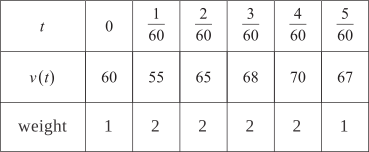
Kenzo is driving his car along a road while his friend records the velocity of the car, `v(t)`, in km/h every minute over a 5-minute period. The table gives the velocity  `v(t)`  at time  `t`  hours.
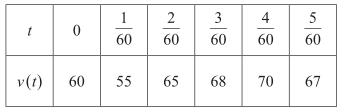


The distance covered by the car over the 5-minute period is given by

`int_0^(5/60) v(t)\ dt`.

Use the trapezoidal rule and the velocity at each of the six time values to find the approximate distance in kilometres the car has travelled in the 5-minute period. Give your answer correct to one decimal place.   (2 marks)

--- 5 WORK AREA LINES (style=lined) ---

Show Answers Only

`5.4\ text(km)`

Show Worked Solution

`int_0^(5/60) v(t)\ dt` `~~ 1/2 xx 1/60 [60 + 2(55 + 65 + 68 + 70) + 67]`
  `~~ 1/120 (643)`
  `~~ 5.358…`
  `~~ 5.4\ text(km)`

Filed Under: Trapezium Rule and Newton, Trapezoidal Rule, Trapezoidal Rule Tagged With: Band 4, smc-5145-04-Trapezium rule, smc-5145-10-Table provided, smc-7132-20-3+ Applications, smc-7132-25-Practical Problems, smc-976-10-Table provided

Calculus, 2ADV C4 2019 HSC 16b

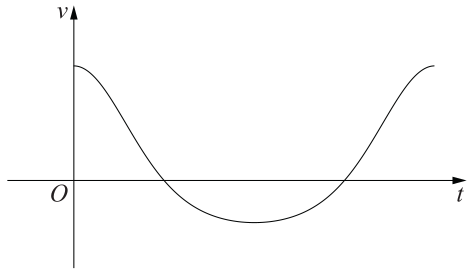
A particle moves in a straight line, starting at the origin. Its velocity, `v\ text(ms)^(_1)`, is given by  `v = e^(cos t)-1`, where `t` is in seconds.

The diagram shows the graph of the velocity against time.
 

Using the Trapezoidal Rule with three function values, estimate the position of the particle when it first comes to rest. Give your answer correct to two decimal places.   (3 marks)

--- 6 WORK AREA LINES (style=lined) ---

Show Answers Only

`1.48\ text{m}`

Show Worked Solution

`v = e^(cos t)-1`

♦♦ Mean mark 30%.

`text(Find)\ \ t\ \ text(when)\ \ v = 0:`

`e^(cos t)` `= 1`
`cos t` `= 0`
`t` `= pi/2`


`qquad t qquad ` `qquad qquad 0 qquad qquad` `qquad qquad pi/4 qquad qquad ` `qquad  pi/2 qquad `
`v` `e-1` `e^(1/sqrt 2)-1` `0`
  `v_0` `v_1` `v_2`


`A` `~~ h/2 (v_0 + 2v_1 + v_2)`
  `~~ pi/8 [e-1 + 2 (e^(1/sqrt 2)-1) + 0]`
  `~~ pi/8(3.774…)`
  `~~ 1.482…`
  `~~ 1.48\ text{(2 d.p.)}`

 
`:.\ text(The particle will be 1.48 metres to the right when it comes to rest.)`

Filed Under: Trapezium Rule and Newton, Trapezoidal Rule, Trapezoidal Rule Tagged With: Band 5, smc-5145-04-Trapezium rule, smc-5145-20-No table, smc-7132-10-1-2 Approximations, smc-7132-25-Practical Problems, smc-976-20-No Table

Calculus, 2ADV C4 2013* HSC 15a

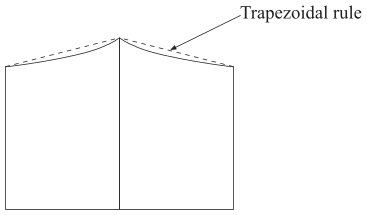
The diagram shows the front of a tent supported by three vertical poles. The poles are 1.2 m apart. The height of each outer pole is 1.5 m, and the height of the middle pole is 1.8 m. The roof hangs between the poles.

2013 15a

The front of the tent has area `A\ text(m)^2`. 

  1. Use the trapezoidal rule to estimate `A`.   (1 mark)

    --- 2 WORK AREA LINES (style=lined) ---

  2. Does the Trapezoidal rule give a higher or lower estimate of the actual area? Justify your answer.   (1 mark)

    --- 3 WORK AREA LINES (style=lined) ---

Show Answers Only

a.    `3.96\ text(m)^2`

b.    `text(See Worked Solutions)`

Show Worked Solution
a.     `A` `~~ h/2 [y_0 + 2y_1 + y_2]`
    `~~ 1.2/2 [1.5 + (2 xx 1.8) + 1.5]`
    `~~ 0.6 [6.6]~~ 3.96\ text(m)^2`


b.        

`text(The tent roof is concave up. Since the Trapezoidal rule uses)`

`text(straight lines, it will estimate a higher area.)`

Filed Under: Trapezium Rule and Newton, Trapezoidal Rule, Trapezoidal Rule Tagged With: Band 3, Band 6, smc-5145-04-Trapezium rule, smc-5145-20-No table, smc-5145-30-Estimate comparison, smc-7132-10-1-2 Approximations, smc-7132-25-Practical Problems, smc-7132-30-Estimate vs Actual, smc-976-20-No Table, smc-976-30-Estimate Comparison

Calculus, 2ADV C4 2011* HSC 5c

The table gives the speed  `v` of a jogger at time  `t` in minutes over a  20-minute period. The speed  `v` is measured in metres per minute, in intervals of 5 minutes.

\begin{array} {|l|c|}
\hline
\rule{0pt}{2.5ex} \ \ \ t\ \ \  \rule[-1ex]{0pt}{0pt} & \ \ \ 0\ \ \ &\ \ \ 5\ \ \ &\ \ \ 10\ \ \ &\ \ \ 15\ \ \ &\ \ \ 20\ \ \  \\
\hline
\rule{0pt}{2.5ex} \ \ \ v\ \ \  \rule[-1ex]{0pt}{0pt} & 173 & 81 & 127 & 195 & 168 \\
\hline
\end{array}

The distance covered by the jogger over the 20-minute period is given by  `int_0^20 v\ dt`.

Use the Trapezoidal rule and the speed at each of the five time values to find the approximate distance the jogger covers in the 20-minute period.   (3 marks)

--- 6 WORK AREA LINES (style=lined) ---

Show Answers Only

 `text(2867.5 metres)`

Show Worked Solution

\begin{array} {|l|c|}
\hline
\rule{0pt}{2.5ex} \ \ \ t\ \ \  \rule[-1ex]{0pt}{0pt} & \ \ \ 0\ \ \ &\ \ \ 5\ \ \ &\ \ \ 10\ \ \ &\ \ \ 15\ \ \ &\ \ \ 20\ \ \  \\
\hline
\rule{0pt}{2.5ex} \ \ \ v\ \ \  \rule[-1ex]{0pt}{0pt} & 173 & 81 & 127 & 195 & 168 \\
\hline
\rule{0pt}{2.5ex} \text{weight} \rule[-1ex]{0pt}{0pt} & 1 & 2 & 2 & 2 & 1 \\
\hline
\end{array}

`int_0^20 v\ dt` `~~ 5/2[173 + 2(81 + 127 + 195) + 168]`
  `~~ 5/2(1147)~~ 2867.5\ text(metres)`

Filed Under: Trapezium Rule and Newton, Trapezoidal Rule, Trapezoidal Rule Tagged With: Band 4, smc-5145-04-Trapezium rule, smc-5145-10-Table provided, smc-7132-20-3+ Applications, smc-7132-25-Practical Problems, smc-976-10-Table provided

Calculus, 2ADV C4 2012* HSC 12d

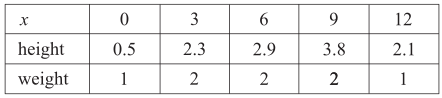
At a certain location a river is 12 metres wide. At this location the depth of the river, in metres, has been measured at 3 metre intervals. The cross-section is shown below.
 

2012 12d

  1. Use the Trapezoidal rule with the five depth measurements to calculate the approximate area of the cross-section.   (3 marks)

    --- 6 WORK AREA LINES (style=lined) ---

  2. The river flows at 0.4 metres per second.
  3. Calculate the approximate volume of water flowing through the cross-section in 10 seconds.   (1 mark)

    --- 2 WORK AREA LINES (style=lined) ---

Show Answers Only

a.    `30.9 \ text(m)^2`

b.    `123.6 \ text(m)^3`  

Show Worked Solution
a.     
`A` `~~ 3/2[0.5 + 2(2.3 + 2.9 + 3.8) + 2.1]`
  `~~ 3/2(20.6)~~ 30.9\ text(m)^2`

♦ Mean mark (b) 49%.

 
b.
    `text(Distance water flows)= 0.4 xx 10= 4 \ text(metres)`

`text(Volume flow in 10 seconds)~~ 4 xx 30.9 ~~123.6  text(m)^3`

Filed Under: Trapezium Rule and Newton, Trapezoidal Rule, Trapezoidal Rule Tagged With: Band 3, Band 5, smc-5145-04-Trapezium rule, smc-5145-20-No table, smc-7132-20-3+ Applications, smc-7132-25-Practical Problems, smc-976-20-No Table

Calculus, 2ADV C4 2016* HSC 14a

The diagram shows the cross-section of a tunnel and a proposed enlargement.

hsc-2016-14a

The heights, in metres, of the existing section at 1 metre intervals are shown in Table `A.`

hsc-2016-14ai

The heights, in metres, of the proposed enlargement are shown in Table `B.`

hsc-2016-14aii

Use the Trapezoidal rule with the measurements given to calculate the approximate increase in area.   (3 marks)

--- 6 WORK AREA LINES (style=lined) ---

Show Answers Only

`1.3\ text(m)^2`

Show Worked Solution

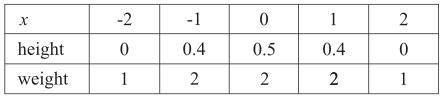
`text(Consider the shaded area distances:)`

`A` `~~ 1/2[0 + 2(0.4 + 0.5 + 0.4) + 0]`
  `~~ 1/2(2.6)`
  `~~ 1.3\ text(m)^2`

Filed Under: Trapezium Rule and Newton, Trapezoidal Rule, Trapezoidal Rule Tagged With: Band 3, smc-5145-04-Trapezium rule, smc-5145-10-Table provided, smc-5145-30-Estimate comparison, smc-7132-20-3+ Applications, smc-7132-25-Practical Problems, smc-976-10-Table provided, smc-976-30-Estimate Comparison

Copyright © 2014–2026 SmarterEd.com.au · Log in