SmarterEd

Aussie Maths & Science Teachers: Save your time with SmarterEd

  • Login
  • Get Help
  • About

Calculus, 2ADV C4 2024 HSC 22

The graph of the function  \(f(x) = \ln(1 + x^{2})\)  is shown.
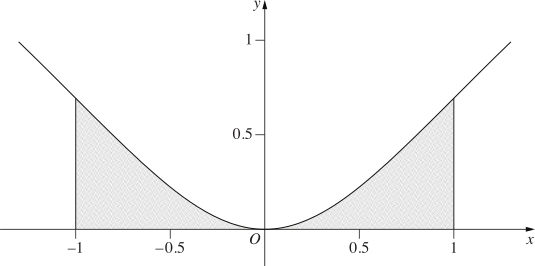
 

  1. Prove that \(f(x)\) is concave up for  \(-1 < x < 1\).   (3 marks)

    --- 10 WORK AREA LINES (style=lined) ---

  2. A table of function values, correct to 4 decimal places, for some \(x\) values is provided.

\begin{array} {|c|c|c|c|c|c|}
\hline
\rule{0pt}{2.5ex} x \rule[-1ex]{0pt}{0pt} & 0 & 0.25 & 0.5 & 0.75 & 1 \\
\hline
\rule{0pt}{2.5ex} \ln(1+x^2) \rule[-1ex]{0pt}{0pt} & \ \ \ \ 0\ \ \ \  & 0.0606 & 0.2231 & 0.4463 & 0.6931 \\
\hline
\end{array}

  1. Using the function values provided and the trapezoidal rule, estimate the shaded area in the diagram.   (2 marks)

    --- 5 WORK AREA LINES (style=lined) ---

  2. Is the answer to part (b) an overestimate or underestimate? Give a reason for your answer.   (1 mark)

    --- 5 WORK AREA LINES (style=lined) ---
Show Answers Only

a.   \(f(x)= \ln(1+x^2)\)

\(f^{′}(x)=\dfrac{2x}{1+x^2}\)

\(f^{″}(x)\) \(=\dfrac{2(1+x^2)-2x(2x)}{(1+x^2)^2}\)  
  \(=\dfrac{2+2x^2-4x^2}{(1+x^2)^2}\)  
  \(=\dfrac{2(1-x^2)}{(1+x^2)^2}\)  

 
\(\text{Consider domain}\ x \in(-1,1)\ \ \Rightarrow\ \ 1-x^2>0 \)

\((1+x^2)^2 \gt 0\ \ \text{for all}\ x\)

\(\Rightarrow \ f^{″}(x) \gt 0\ \text{for}\ x \in(-1,1) \)

\(\therefore f(x)\ \text{is concave up for}\ x \in(-1,1) \)
 

b.   \(\text{Total shaded area}\ \approx 0.5383\ \text{(4 d.p.)}\)

c.   \(\text{Trapezoidal rule assumes straight lines join points in the table.}\)

\(\text{Since the graph is concave up in the given domain, the trapezoidal rule will}\)

\(\text{overestimate the area.}\)

Show Worked Solution

a.   \(f(x)= \ln(1+x^2)\)

\(f^{′}(x)=\dfrac{2x}{1+x^2}\)

\(f^{″}(x)\) \(=\dfrac{2(1+x^2)-2x(2x)}{(1+x^2)^2}\)  
  \(=\dfrac{2+2x^2-4x^2}{(1+x^2)^2}\)  
  \(=\dfrac{2(1-x^2)}{(1+x^2)^2}\)  

 
\(\text{In domain}\ x \in(-1,1)\ \ \Rightarrow\ \ 1-x^2>0 \)

\((1+x^2)^2 \gt 0\ \ \text{for all}\ x\)

\(\Rightarrow \ f^{″}(x) \gt 0\ \text{for}\ x \in(-1,1) \)

\(\therefore f(x)\ \text{is concave up for}\ x \in(-1,1) \)

♦ Mean mark (a) 47%.

b.   \(\text{Total shaded area}\)

\(\approx 2 \times \dfrac{h}{2}[ y_0 + 2(y_1+y_2+y_3) + y_4] \)

\(\approx 2 \times \dfrac{0.25}{2}[ 0 + 2(0.0606+0.2231+0.4463) + 0.6931] \)

\(\approx 0.538275 \)

\(\approx 0.5383\ \text{(4 d.p.)}\)

♦ Mean mark (b) 50%.

c.   \(\text{Trapezoidal rule assumes straight lines join points in the table.}\)

\(\text{Since the graph is concave up in the given domain, the trapezoidal rule will}\)

\(\text{overestimate the area.}\)

♦ Mean mark (c) 49%.

Filed Under: Interpreting and Graphing Derivatives, The Derivative Function and its Graph, Trapezoidal Rule, Trapezoidal Rule Tagged With: Band 5, smc-1089-40-Investigate Graph Shapes, smc-7132-20-3+ Applications, smc-7132-50-Table Provided, smc-7133-10-Investigate Graph Shapes, smc-976-10-Table provided, smc-976-30-Estimate Comparison

Calculus, 2ADV C4 2022 HSC 29

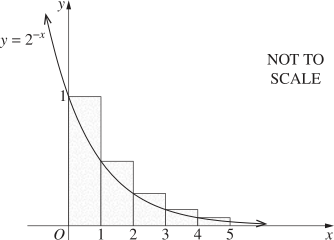
  1. The diagram shows the graph of  `y=2^{-x}`. Also shown on the diagram are the first 5 of an infinite number of rectangular strips of width 1 unit and height  `y=2^{-x}`  for non-negative integer values of `x`. For example, the second rectangle shown has width 1 and height `(1)/(2)`. 
     

  1. The sum of the areas of the rectangles forms a geometric series.
  2. Show that the limiting sum of this series is 2. (1 mark)

    --- 2 WORK AREA LINES (style=lined) ---

  3. Show that `int_(0)^(4)2^(-x)\ dx=(15)/(16 ln 2)`.   (2 marks)

    --- 5 WORK AREA LINES (style=lined) ---
  4. Use parts (a) and (b) to show that  `e^(15) < 2^(32)`.   (2 marks)

    --- 4 WORK AREA LINES (style=lined) ---

Show Answers Only

a.    `text{Proof (See Worked Solutions)}`

b.    `text{Proof (See Worked Solutions)}`

c.    `text{Proof (See Worked Solutions)}`

Show Worked Solution

a.   `text{Consider the rectangle heights:}`

`2^0=1, \ 2^(-1)=1/2, \ 2^(-2)= 1/4, \ 2^(-3)= 1/8, …`

`=>\ text{Rectangle Areas}\ = 1, \ 1/2, \  1/4, \ 1/8, …`

`a=1,\ \ r=1/2`

`S_oo=a/(1-r)=1/(1-1/2)=2\ \ text{… as required}`
 

b.   `text{Show}\ \ int_0^4 2^(-x)\ dx = 15/(16ln2)`

`int_0^4 2^(-x)\ dx ` `=(-1)/ln2[2^(-x)]_0^4`  
  `=(-1)/ln2(1/16-1)`  
  `=1/ln2-1/(16ln2)`  
  `=(16-1)/(16ln2)`  
  `=15/(16ln2)\ \ text{… as required}`  


Mean mark (b) 56%.

c.   `text{Show}\ \ e^15<2^32`

`text{Area under curve < Sum of rectangle areas}`

`15/(16ln2)` `<2`  
`15` `<32ln2`  
`15/32` `<ln2`  
`e^(15/32)` `<e^(ln2)`  
`root(32)(e^15)` `<2`  
`e^15` `<2^32\ \ text{… as required}`  

♦♦♦ Mean mark (c) 9%.

Filed Under: L&E Integration, L&E Integration, Trapezium Rule and Newton, Trapezoidal Rule, Trapezoidal Rule Tagged With: Band 4, Band 6, smc-1203-20-Exponential (Definite), smc-5145-04-Trapezium rule, smc-5145-30-Estimate comparison, smc-7132-20-3+ Applications, smc-7132-30-Estimate vs Actual, smc-7187-20-Exponential (Definite), smc-965-40-Definite Integrals, smc-976-30-Estimate Comparison

Calculus, 2ADV C4 2020 HSC 20

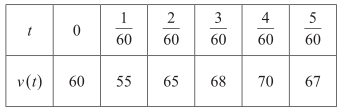
Kenzo is driving his car along a road while his friend records the velocity of the car, `v(t)`, in km/h every minute over a 5-minute period. The table gives the velocity  `v(t)`  at time  `t`  hours.


The distance covered by the car over the 5-minute period is given by

`int_0^(5/60) v(t)\ dt`.

Use the trapezoidal rule and the velocity at each of the six time values to find the approximate distance in kilometres the car has travelled in the 5-minute period. Give your answer correct to one decimal place.   (2 marks)

--- 5 WORK AREA LINES (style=lined) ---
Show Answers Only

`5.4\ text(km)`

Show Worked Solution

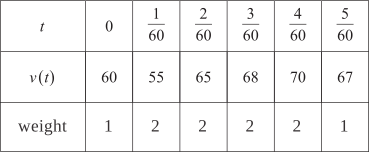
`int_0^(5/60) v(t)\ dt` `~~ 1/2 xx 1/60 [60 + 2(55 + 65 + 68 + 70) + 67]`
  `~~ 1/120 (643)`
  `~~ 5.358…`
  `~~ 5.4\ text(km)`

Filed Under: Trapezium Rule and Newton, Trapezoidal Rule, Trapezoidal Rule Tagged With: Band 4, smc-5145-04-Trapezium rule, smc-5145-10-Table provided, smc-7132-20-3+ Applications, smc-7132-25-Practical Problems, smc-976-10-Table provided

Calculus, 2ADV C4 2014* HSC 16a

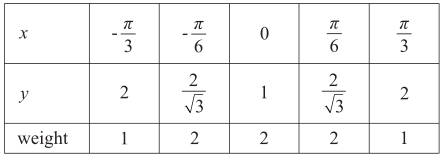
Use the Trapezoidal rule with five function values to show that 

`int_(- pi/3)^(pi/3) sec x\ dx ~~ pi/6 (3 + 4/sqrt3)`.   (3 marks)

--- 7 WORK AREA LINES (style=lined) ---

Show Answers Only

`text(Proof)\ \ text{(See Worked Solutions)}`

Show Worked Solution
♦ Mean mark below 50%. BE CAREFUL! 

`A` `~~ h/2 [y_0 + 2(y_1 + y_2 + y_3) + y_5]`
  `~~ pi/12 [2 + 2(2/sqrt3 + 1 + 2/sqrt3) + 2]`
  `~~ pi/12 [6 + 8/sqrt3]`
  `~~ pi/6 (3 + 4/sqrt3)\ text(u² … as required)`

Filed Under: Trapezium Rule and Newton, Trapezoidal Rule, Trapezoidal Rule Tagged With: Band 5, smc-5145-04-Trapezium rule, smc-5145-20-No table, smc-7132-20-3+ Applications, smc-976-20-No Table

Calculus, 2ADV C4 2018* HSC 15c

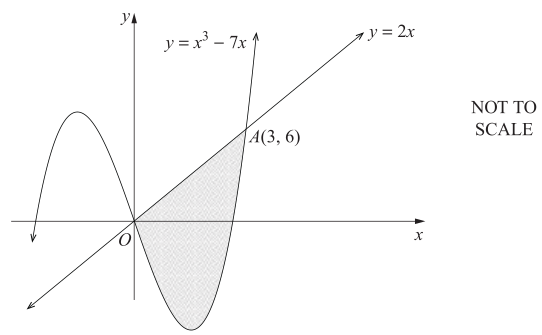
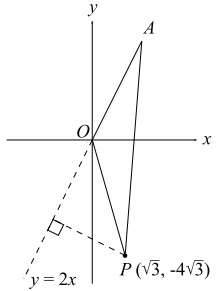
The shaded region is enclosed by the curve  `y = x^3-7x`  and the line  `y = 2x`, as shown in the diagram. The line  `y = 2x`  meets the curve  `y = x^3-7x`  at `O(0, 0)` and `A(3, 6)`. Do NOT prove this.
 

  1.  Use integration to find the area of the shaded region.   (2 marks)

    --- 4 WORK AREA LINES (style=lined) ---

  2. Use the Trapezoidal rule and four function values to approximate the area of the shaded region.  (2 marks)

    --- 5 WORK AREA LINES (style=lined) ---

The point `P` is chosen on the curve  `y = x^3 − 7x`  so that the tangent at `P` is parallel to the line  `y = 2x`  and the `x`-coordinate of `P` is positive

  1.  Show that the coordinates of `P` are `(sqrt 3, -4 sqrt 3)`.   (2 marks)

    --- 5 WORK AREA LINES (style=lined) ---
  2.  Using the perpendicular distance formula `|ax_1 + by_1 + c|/sqrt(a^2 + b^2)`, find the area of `Delta OAP`.   (2 marks)

    --- 4 WORK AREA LINES (style=lined) ---
Show Answers Only

i.    `81/4\ text(units)^2`

ii.   `18\ text(u)^2`

iii.  `text(Proof)\ \ text{(See Worked Solutions)}`

iv.   `9 sqrt 3\ text(units)^2`

Show Worked Solution
i.   `text(Area)` `= int_0^3 2x-(x^3-7x)\ dx`
    `= int_0^3 9x-x^3\ dx`
    `= [9/2 x^2-1/4 x^4]_0^3`
    `= [(9/2 xx 3^2-1/4 xx 3^4)-0]`
    `= 81/2-81/4`
    `= 81/4\ text(units)^2`


ii.  `f(x) = 9x-x^3`

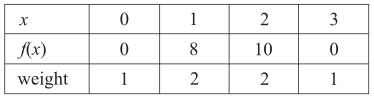
`text(Area)~~ 1/2[0 + 2(8 + 10) + 0]~~ 1/2(36)~~ 18\ text(u)^2`
 

iii.   `y = x^3-7x`

`(dy)/(dx) = 3x^2-7`

`text(Find)\ x\ text(such that)\ \ (dy)/(dx) = 2:`

`3x^2-7` `= 2`
`3x^2` `= 9`
`x^2` `= 3`
`x` `= sqrt 3 qquad (x > 0)`

 
`y= (sqrt 3)^3-7 sqrt 3= 3 sqrt 3-7 sqrt 3= -4 sqrt 3`

`:. P\ \ text(has coordinates)\ (sqrt 3, -4 sqrt 3)`


iv.  

 
`text(dist)\ OA= sqrt((3-0)^2 + (6-0)^2)= sqrt 45= 3 sqrt 5`
 

`text(Find)\ _|_\ text(distance of)\ P\ text(from)\ OA:`

`P(sqrt 3, -4 sqrt 3),\ \ 2x-y=0`

`_|_\ text(dist)= |(2 sqrt 3 + 4 sqrt 3)/sqrt (3 + 2)|= (6 sqrt 3)/sqrt 5`

`:.\ text(Area)= 1/2 xx 3 sqrt 5 xx (6 sqrt 3)/sqrt 5= 9 sqrt 3\ text(units)^2`

Filed Under: Area Under Curves, Areas Under Curves, Trapezium Rule and Newton, Trapezoidal Rule, Trapezoidal Rule Tagged With: Band 4, Band 5, smc-5145-04-Trapezium rule, smc-5145-20-No table, smc-7131-20-Cubic, smc-7132-20-3+ Applications, smc-7132-60-X-topic, smc-975-20-Cubic, smc-976-20-No Table

Calculus, 2ADV C4 2011* HSC 5c

The table gives the speed `v` of a jogger at time `t` in minutes over a  20-minute period. The speed `v` is measured in metres per minute, in intervals of 5 minutes.

\begin{array} {|l|c|}
\hline
\rule{0pt}{2.5ex} \ \ \ t\ \ \  \rule[-1ex]{0pt}{0pt} & \ \ \ 0\ \ \ &\ \ \ 5\ \ \ &\ \ \ 10\ \ \ &\ \ \ 15\ \ \ &\ \ \ 20\ \ \  \\
\hline
\rule{0pt}{2.5ex} \ \ \ v\ \ \  \rule[-1ex]{0pt}{0pt} & 173 & 81 & 127 & 195 & 168 \\
\hline
\end{array}

The distance covered by the jogger over the 20-minute period is given by `int_0^20 v\ dt`.

Use the Trapezoidal rule and the speed at each of the five time values to find the approximate distance the jogger covers in the 20-minute period.   (3 marks)

--- 6 WORK AREA LINES (style=lined) ---
Show Answers Only

 `text(2867.5 metres)`

Show Worked Solution

\begin{array} {|l|c|}
\hline
\rule{0pt}{2.5ex} \ \ \ t\ \ \  \rule[-1ex]{0pt}{0pt} & \ \ \ 0\ \ \ &\ \ \ 5\ \ \ &\ \ \ 10\ \ \ &\ \ \ 15\ \ \ &\ \ \ 20\ \ \  \\
\hline
\rule{0pt}{2.5ex} \ \ \ v\ \ \  \rule[-1ex]{0pt}{0pt} & 173 & 81 & 127 & 195 & 168 \\
\hline
\rule{0pt}{2.5ex} \text{weight} \rule[-1ex]{0pt}{0pt} & 1 & 2 & 2 & 2 & 1 \\
\hline
\end{array}

`int_0^20 v\ dt`

`~~ 5/2[173 + 2(81 + 127 + 195) + 168]`
  `~~ 5/2(1147)`
  `~~ 2867.5\ text(metres)`

Filed Under: Trapezium Rule and Newton, Trapezoidal Rule, Trapezoidal Rule Tagged With: Band 4, smc-5145-04-Trapezium rule, smc-5145-10-Table provided, smc-7132-20-3+ Applications, smc-7132-25-Practical Problems, smc-976-10-Table provided

Calculus, 2ADV C4 2005* HSC 6a

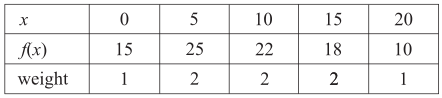
Five values of the function `f(x)` are shown in the table.

Integration, 2UA 2005 HSC 6a

Use the Trapezoidal rule with the five values given in the table to estimate

`int_0^20 f(x)\ dx`.   (3 marks)

Show Answers Only

`387.5`

Show Worked Solution

`:. int_0^20 f(x)\ dx` `~~ 5/2[15 + 2(25 + 22 + 18) + 10]`
  `~~ 5/2(155)`
  `~~ 387.5`

Filed Under: Trapezium Rule and Newton, Trapezoidal Rule, Trapezoidal Rule Tagged With: Band 4, smc-5145-04-Trapezium rule, smc-5145-10-Table provided, smc-7132-20-3+ Applications, smc-976-10-Table provided

Calculus, 2ADV C4 2012* HSC 12d

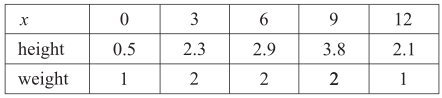
At a certain location a river is 12 metres wide. At this location the depth of the river, in metres, has been measured at 3 metre intervals. The cross-section is shown below.
 

2012 12d

  1. Use the Trapezoidal rule with the five depth measurements to calculate the approximate area of the cross-section.   (3 marks)

    --- 6 WORK AREA LINES (style=lined) ---
  2. The river flows at 0.4 metres per second.
  3. Calculate the approximate volume of water flowing through the cross-section in 10 seconds.   (1 mark)

    --- 2 WORK AREA LINES (style=lined) ---

Show Answers Only

a.    `30.9 \ text(m)^2`

b.    `123.6 \ text(m)^3`  

Show Worked Solution
a.    
`A` `~~ 3/2[0.5 + 2(2.3 + 2.9 + 3.8) + 2.1]`
  `~~ 3/2(20.6)`
  `~~ 30.9\ text(m)^2`

♦ Mean mark (b) 49%.

 
b.
    `text(Distance water flows)= 0.4 xx 10= 4 \ text(metres)`

`text(Volume flow in 10 seconds)~~ 4 xx 30.9 ~~123.6  text(m)^3`

Filed Under: Trapezium Rule and Newton, Trapezoidal Rule, Trapezoidal Rule Tagged With: Band 3, Band 5, smc-5145-04-Trapezium rule, smc-5145-20-No table, smc-7132-20-3+ Applications, smc-7132-25-Practical Problems, smc-976-20-No Table

Calculus, 2ADV C4 2016* HSC 14a

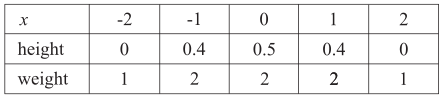
The diagram shows the cross-section of a tunnel and a proposed enlargement.

hsc-2016-14a

The heights, in metres, of the existing section at 1 metre intervals are shown in Table `A.`

hsc-2016-14ai

The heights, in metres, of the proposed enlargement are shown in Table `B.`

hsc-2016-14aii

Use the Trapezoidal rule with the measurements given to calculate the approximate increase in area.   (3 marks)

--- 6 WORK AREA LINES (style=lined) ---
Show Answers Only

`1.3\ text(m)^2`

Show Worked Solution

`text(Consider the shaded area distances:)`

`A` `~~ 1/2[0 + 2(0.4 + 0.5 + 0.4) + 0]`
  `~~ 1/2(2.6)`
  `~~ 1.3\ text(m)^2`

Filed Under: Trapezium Rule and Newton, Trapezoidal Rule, Trapezoidal Rule Tagged With: Band 3, smc-5145-04-Trapezium rule, smc-5145-10-Table provided, smc-5145-30-Estimate comparison, smc-7132-20-3+ Applications, smc-7132-25-Practical Problems, smc-976-10-Table provided, smc-976-30-Estimate Comparison

Copyright © 2014–2026 SmarterEd.com.au · Log in