SmarterEd

Aussie Maths & Science Teachers: Save your time with SmarterEd

  • Login
  • Get Help
  • About

Calculus, 2ADV C4 2025 MET2 6 MC

The trapezium rule is used, with two trapeziums, to estimate the area bounded by the graph of  \(y=f(x)\), the \(x\)-axis and the lines  \(x=0\)  and  \(x=1\).

For which function will the trapezium rule estimate be larger than the exact area?

  1. \(f(x)=3-e^x\)
  2. \(f(x)=x^3+1\)
  3. \(f(x)=3 \sin (x)+1\)
  4. \(f(x)=\log _e(x+3)\)
Show Answers Only

\(B\)

Show Worked Solution

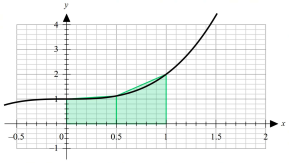
\(\text{Rough sketch the shape of each graph.}\)

\(\text{Consider option B:}\)
♦ Mean mark 50%.

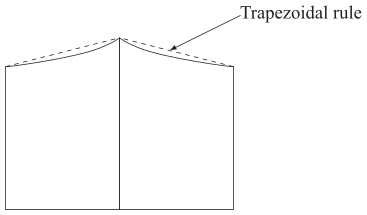
\(\text{By drawing trapeziums (see graph), the estimated area}\)

\(\text{is greater than the actual area.}\)

\(\Rightarrow B\)
Filed Under: Trapezoidal Rule, Trapezoidal Rule Tagged With: Band 5, smc-7132-30-Estimate vs Actual, smc-976-30-Estimate Comparison

Calculus, 2ADV C4 2025 HSC 27

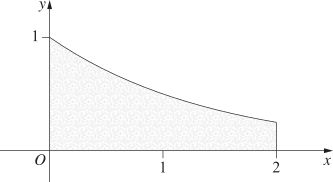
The shaded region is bounded by the graph  \(y=\left(\dfrac{1}{2}\right)^x\), the coordinate axes and  \(x=2\).
 

  1. Use two applications of the trapezoidal rule to estimate the area of the shaded region.   (2 marks)

    --- 5 WORK AREA LINES (style=lined) ---

  2. Show that the exact area of the shaded region is  \(\dfrac{3}{4 \ln 2}\).   (2 marks)

    --- 6 WORK AREA LINES (style=lined) ---

  3. Using your answers from part (a) and part (b), deduce  \(e<2 \sqrt{2}\).   (2 marks)

    --- 9 WORK AREA LINES (style=lined) ---

Show Answers Only

a.    \(A\approx \dfrac{9}{8}\ \text{units}^2\)
 

b.     \(\text{Area}\) \(=\displaystyle \int_0^2\left(\frac{1}{2}\right)^x d x\)
    \(=\left[-\dfrac{2^{-x}}{\ln 2}\right]_0^2\)
    \(=-\dfrac{2^{-2}}{\ln 2}+\dfrac{1}{\ln 2}\)
    \(=-\dfrac{1}{4 \ln 2}+\dfrac{1}{\ln 2}\)
    \(=\dfrac{3}{4 \ln 2}\)

  
c. 
  \(\text{Trapezoidal estimate assumes a straight line (creating a}\)

\(\text{trapezium) between (0,1) and \((2,\dfrac{1}{4})\)}\)

\(\Rightarrow \ \text{Area using trap rule > Actual area}\)

\(\dfrac{9}{8}\) \(>\dfrac{3}{4 \ln 2}\)
\(36\, \ln 2\) \(>24\)
\(\ln 2\) \(>\dfrac{2}{3}\)
\(e^{\large\frac{2}{3}}\) \(>2\)
\(e\) \(>2^{\large\frac{3}{2}}\)
\(e\) \(>2 \sqrt{2}\)
Show Worked Solution

a.  

\begin{array}{|c|c|c|c|}
\hline \ \ x \ \  & \ \ 0 \ \  & \ \ 1 \ \  & \ \ 2 \ \  \\
\hline y & 1 & \dfrac{1}{2} & \dfrac{1}{4} \\
\hline
\end{array}

\(A\) \(\approx \dfrac{h}{2}\left[1 \times 1+2 \times \dfrac{1}{2}+1 \times \dfrac{1}{4}\right]\)
  \(\approx \dfrac{1}{2}\left(\dfrac{9}{4}\right)\)
  \(\approx \dfrac{9}{8}\ \text{units}^2\)
 
b.     \(\text{Area}\) \(=\displaystyle \int_0^2\left(\frac{1}{2}\right)^x d x\)
    \(=\left[-\dfrac{2^{-x}}{\ln 2}\right]_0^2\)
    \(=-\dfrac{2^{-2}}{\ln 2}+\dfrac{1}{\ln 2}\)
    \(=-\dfrac{1}{4 \ln 2}+\dfrac{1}{\ln 2}\)
    \(=\dfrac{3}{4 \ln 2}\)

♦Mean mark (b) 51%.

c.    \(\text{Trapezoidal estimate assumes a straight line (creating a)}\)

\(\text{trapezium between (0,1) and \((2,\dfrac{1}{4}).\)}\)

\(\Rightarrow \ \text{Area using trap rule > Actual area}\)

♦♦♦ Mean mark (c) 25%.
\(\dfrac{9}{8}\) \(>\dfrac{3}{4 \ln 2}\)  
\(36\, \ln 2\) \(>24\)  
\(\ln 2\) \(>\dfrac{2}{3}\)  
\(e^{\large{\frac{2}{3}}}\) \(>2\)  
\(e\) \(>2^{\large\frac{3}{2}}\)  
\(e\) \(>2 \sqrt{2}\)  

Filed Under: Trapezoidal Rule, Trapezoidal Rule Tagged With: Band 4, Band 5, Band 6, smc-7132-10-1-2 Approximations, smc-7132-30-Estimate vs Actual, smc-976-20-No Table, smc-976-30-Estimate Comparison

Calculus, 2ADV C4 2024 HSC 22

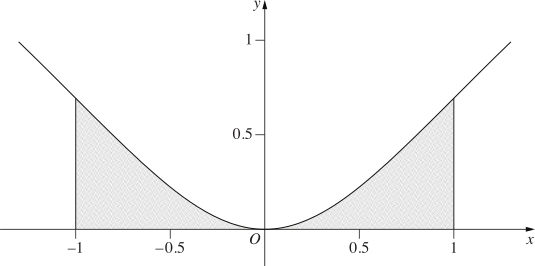
The graph of the function  \(f(x) = \ln(1 + x^{2})\)  is shown.
 

  1. Prove that \(f(x)\) is concave up for  \(-1 < x < 1\).   (3 marks)

    --- 10 WORK AREA LINES (style=lined) ---

  2. A table of function values, correct to 4 decimal places, for some \(x\) values is provided.

\begin{array} {|c|c|c|c|c|c|}
\hline
\rule{0pt}{2.5ex} x \rule[-1ex]{0pt}{0pt} & 0 & 0.25 & 0.5 & 0.75 & 1 \\
\hline
\rule{0pt}{2.5ex} \ln(1+x^2) \rule[-1ex]{0pt}{0pt} & \ \ \ \ 0\ \ \ \  & 0.0606 & 0.2231 & 0.4463 & 0.6931 \\
\hline
\end{array}

  1. Using the function values provided and the trapezoidal rule, estimate the shaded area in the diagram.   (2 marks)

    --- 5 WORK AREA LINES (style=lined) ---

  2. Is the answer to part (b) an overestimate or underestimate? Give a reason for your answer.   (1 mark)

    --- 5 WORK AREA LINES (style=lined) ---

Show Answers Only

a.    \(f(x)= \ln(1+x^2)\)

\(f^{\prime}(x)=\dfrac{2x}{1+x^2}\)

\(f^{\prime\prime}(x)\) \(=\dfrac{2(1+x^2)-2x(2x)}{(1+x^2)^2}\)
  \(=\dfrac{2+2x^2-4x^2}{(1+x^2)^2}\)
  \(=\dfrac{2(1-x^2)}{(1+x^2)^2}\)

 
\(\text{Consider domain}\ x \in(-1,1)\ \ \Rightarrow\ \ 1-x^2>0 \)

\((1+x^2)^2 \gt 0\ \ \text{for all}\ x\)

\(\Rightarrow \ f^{\prime\prime}(x) \gt 0\ \text{for}\ x \in(-1,1) \)

\(\therefore f(x)\ \text{is concave up for}\ x \in(-1,1) \)
 

b.    \(\text{Total shaded area}\ \approx 0.5383\ \text{(4 d.p.)}\)

c.    \(\text{Trapezoidal rule assumes straight lines join points in the table.}\)

\(\text{Since the graph is concave up in the given domain, the trapezoidal}\)

\(\text{rule will overestimate the area.}\)

Show Worked Solution

a.   \(f(x)= \ln(1+x^2)\)

\(f^{′}(x)=\dfrac{2x}{1+x^2}\)

\(f^{″}(x)\) \(=\dfrac{2(1+x^2)-2x(2x)}{(1+x^2)^2}\)  
  \(=\dfrac{2+2x^2-4x^2}{(1+x^2)^2}\)  
  \(=\dfrac{2(1-x^2)}{(1+x^2)^2}\)  

 
\(\text{In domain}\ x \in(-1,1)\ \ \Rightarrow\ \ 1-x^2>0 \)

\((1+x^2)^2 \gt 0\ \ \text{for all}\ x\)

\(\Rightarrow \ f^{″}(x) \gt 0\ \text{for}\ x \in(-1,1) \)

\(\therefore f(x)\ \text{is concave up for}\ x \in(-1,1) \)

♦ Mean mark (a) 47%.

b.   \(\text{Total shaded area}\)

\(\approx 2 \times \dfrac{h}{2}[ y_0 + 2(y_1+y_2+y_3) + y_4] \)

\(\approx 2 \times \dfrac{0.25}{2}[ 0 + 2(0.0606+0.2231+0.4463) + 0.6931] \)

\(\approx 0.538275 \)

\(\approx 0.5383\ \text{(4 d.p.)}\)

♦ Mean mark (b) 50%.

c.   \(\text{Trapezoidal rule assumes straight lines join points in the table.}\)

\(\text{Since the graph is concave up in the given domain, the trapezoidal}\)

\(\text{rule will overestimate the area.}\)

♦ Mean mark (c) 49%.

Filed Under: Interpreting and Graphing Derivatives, The Derivative Function and its Graph, Trapezoidal Rule, Trapezoidal Rule Tagged With: Band 5, smc-1089-40-Investigate Graph Shapes, smc-7132-20-3+ Applications, smc-7132-50-Table Provided, smc-7133-10-Investigate Graph Shapes, smc-976-10-Table provided, smc-976-30-Estimate Comparison

Calculus, 2ADV C4 2022 MET1 4

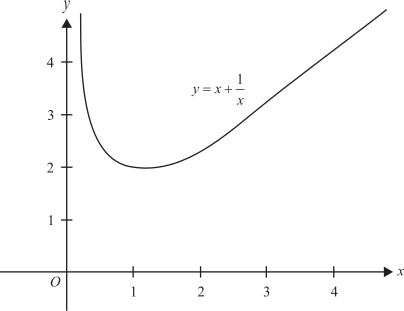
The graph of  \(y=x+\dfrac{1}{x}\) is shown over part of its domain.
 

Use two trapeziums of equal width to approximate the area between the curve, the \(x\)-axis and the lines  \(x=1\)  and  \(x=3\).   (2 marks)

--- 4 WORK AREA LINES (style=lined) ---

Show Answers Only

\(5\dfrac{1}{6}\)

Show Worked Solution

\(\text{Trapezium rule approximation (see formula sheet):}\)

\begin{array} {|c|c|}
\hline
\rule{0pt}{2.5ex} x\rule[-1ex]{0pt}{0pt} & 1&2&3 \\
\hline
\rule{0pt}{2.5ex} f(x)\rule[-1ex]{0pt}{0pt} & 1+1=2 & 2+\dfrac{1}{2}=\dfrac{5}{2} & 3+ \dfrac{1}{3}=\dfrac{10}{3}\\
\hline
\end{array}

\(\text{Area}\) \(\approx \dfrac{3-1}{2\times 2}\Bigg[2+2\times\dfrac{5}{2}+\dfrac{10}{3}\Bigg]\)
  \(\approx\dfrac{1}{2}\Bigg[\dfrac{6}{3}+\dfrac{15}{3}+\dfrac{10}{3}\Bigg]\)
  \(\approx5\dfrac{1}{6}\)

Filed Under: Trapezoidal Rule, Trapezoidal Rule Tagged With: Band 4, smc-7132-10-1-2 Approximations, smc-976-20-No Table

Calculus, 2ADV C4 2022 HSC 29

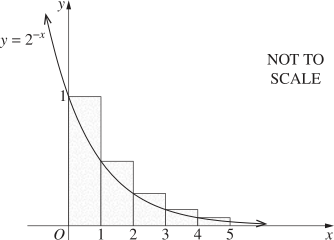
  1. The diagram shows the graph of   `y=2^{-x}`. Also shown on the diagram are the first 5 of an infinite number of rectangular strips of width 1 unit and height  `y=2^{-x}`  for non-negative integer values of  `x`. For example, the second rectangle shown has width 1 and height `(1)/(2)`. 
     

  1. The sum of the areas of the rectangles forms a geometric series.
  2. Show that the limiting sum of this series is 2.   (1 mark)

    --- 2 WORK AREA LINES (style=lined) ---

  3. Show that `int_(0)^(4)2^(-x)\ dx=(15)/(16 ln 2)`.   (2 marks)

    --- 5 WORK AREA LINES (style=lined) ---

  4. Use parts (a) and (b) to show that  `e^(15) < 2^(32)`.   (2 marks)

    --- 4 WORK AREA LINES (style=lined) ---

Show Answers Only

a.    `text{Proof (See Worked Solutions)}`

b.    `text{Proof (See Worked Solutions)}`

c.    `text{Proof (See Worked Solutions)}`

Show Worked Solution

a.    `text{Consider the rectangle heights:}`

`2^0=1, \ 2^(-1)=1/2, \ 2^(-2)= 1/4, \ 2^(-3)= 1/8, …`

`=>\ text{Rectangle Areas}\ = 1, \ 1/2, \  1/4, \ 1/8, …`

`a=1,\ \ r=1/2`

`S_oo=a/(1-r)=1/(1-1/2)=2\ \ text{… as required}`
 

b.   `text{Show}\ \ int_0^4 2^(-x)\ dx = 15/(16ln2)`

`int_0^4 2^(-x)\ dx ` `=(-1)/ln2[2^(-x)]_0^4`
  `=(-1)/ln2(1/16-1)`
  `=1/ln2-1/(16ln2)`
  `=(16-1)/(16ln2)`
  `=15/(16ln2)\ \ text{… as required}`


Mean mark (b) 56%.

c.    `text{Show}\ \ e^15<2^32`

`text{Area under curve < Sum of rectangle areas}`

`15/(16ln2)` `<2`  
`15` `<32ln2`  
`15/32` `<ln2`  
`e^(15/32)` `<e^(ln2)`  
`root(32)(e^15)` `<2`  
`e^15` `<2^32\ \ text{… as required}`  

♦♦♦ Mean mark (c) 9%.

Filed Under: L&E Integration, L&E Integration, Trapezium Rule and Newton, Trapezoidal Rule, Trapezoidal Rule Tagged With: Band 4, Band 6, smc-1203-20-Exponential (Definite), smc-5145-04-Trapezium rule, smc-5145-30-Estimate comparison, smc-7132-20-3+ Applications, smc-7132-30-Estimate vs Actual, smc-7187-20-Exponential (Definite), smc-965-40-Definite Integrals, smc-976-30-Estimate Comparison

Calculus, 2ADV C4 2022 HSC 13

Use two applications of the trapezoidal rule to find an approximate value of  `int_(0)^(2)sqrt(1+x^(2))\ dx`. Give your answer correct to 2 decimal places.   (2 marks)

--- 5 WORK AREA LINES (style=lined) ---

Show Answers Only

`3.03`

Show Worked Solution
`A` `~~h/2(y_0+2y_1+y_2)`
  `~~1/2(1+2 xx sqrt2+sqrt5)`
  `~~3.03\ \ text{(to 2 d.p.)}`

Mean mark 59%.
COMMENT: Results showed a surprisingly low mean mark.

Filed Under: Trapezium Rule and Newton, Trapezoidal Rule, Trapezoidal Rule Tagged With: Band 4, smc-5145-04-Trapezium rule, smc-5145-20-No table, smc-7132-10-1-2 Approximations, smc-976-20-No Table

Calculus, 2ADV C4 2020 HSC 20

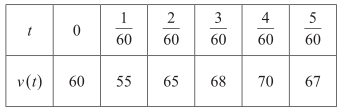
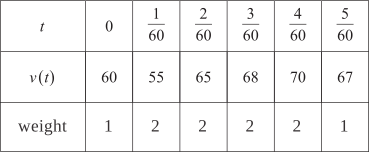
Kenzo is driving his car along a road while his friend records the velocity of the car, `v(t)`, in km/h every minute over a 5-minute period. The table gives the velocity  `v(t)`  at time  `t`  hours.


The distance covered by the car over the 5-minute period is given by

`int_0^(5/60) v(t)\ dt`.

Use the trapezoidal rule and the velocity at each of the six time values to find the approximate distance in kilometres the car has travelled in the 5-minute period. Give your answer correct to one decimal place.   (2 marks)

--- 5 WORK AREA LINES (style=lined) ---

Show Answers Only

`5.4\ text(km)`

Show Worked Solution

`int_0^(5/60) v(t)\ dt` `~~ 1/2 xx 1/60 [60 + 2(55 + 65 + 68 + 70) + 67]`
  `~~ 1/120 (643)`
  `~~ 5.358…`
  `~~ 5.4\ text(km)`

Filed Under: Trapezium Rule and Newton, Trapezoidal Rule, Trapezoidal Rule Tagged With: Band 4, smc-5145-04-Trapezium rule, smc-5145-10-Table provided, smc-7132-20-3+ Applications, smc-7132-25-Practical Problems, smc-976-10-Table provided

Calculus, 2ADV C4 2019 HSC 16b

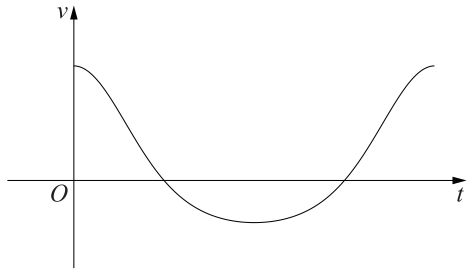
A particle moves in a straight line, starting at the origin. Its velocity, `v\ text(ms)^(_1)`, is given by  `v = e^(cos t)-1`, where `t` is in seconds.

The diagram shows the graph of the velocity against time.
 

Using the Trapezoidal Rule with three function values, estimate the position of the particle when it first comes to rest. Give your answer correct to two decimal places.   (3 marks)

--- 6 WORK AREA LINES (style=lined) ---

Show Answers Only

`1.48\ text{m}`

Show Worked Solution

`v = e^(cos t)-1`

♦♦ Mean mark 30%.

`text(Find)\ \ t\ \ text(when)\ \ v = 0:`

`e^(cos t)` `= 1`
`cos t` `= 0`
`t` `= pi/2`


`qquad t qquad ` `qquad qquad 0 qquad qquad` `qquad qquad pi/4 qquad qquad ` `qquad  pi/2 qquad `
`v` `e-1` `e^(1/sqrt 2)-1` `0`
  `v_0` `v_1` `v_2`


`A` `~~ h/2 (v_0 + 2v_1 + v_2)`
  `~~ pi/8 [e-1 + 2 (e^(1/sqrt 2)-1) + 0]`
  `~~ pi/8(3.774…)`
  `~~ 1.482…`
  `~~ 1.48\ text{(2 d.p.)}`

 
`:.\ text(The particle will be 1.48 metres to the right when it comes to rest.)`

Filed Under: Trapezium Rule and Newton, Trapezoidal Rule, Trapezoidal Rule Tagged With: Band 5, smc-5145-04-Trapezium rule, smc-5145-20-No table, smc-7132-10-1-2 Approximations, smc-7132-25-Practical Problems, smc-976-20-No Table

Calculus, 2ADV C4 2014* HSC 16a

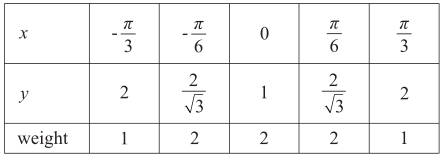
Use the Trapezoidal rule with five function values to show that 

`int_(-pi/3)^(pi/3) sec x\ dx ~~ pi/6 (3 + 4/sqrt3)`.   (3 marks)

--- 7 WORK AREA LINES (style=lined) ---

Show Answers Only

`text(Proof)\ \ text{(See Worked Solutions)}`

Show Worked Solution
♦ Mean mark below 50%. BE CAREFUL! 

`A` `~~ h/2 [y_0 + 2(y_1 + y_2 + y_3) + y_5]`
  `~~ pi/12 [2 + 2(2/sqrt3 + 1 + 2/sqrt3) + 2]`
  `~~ pi/12 [6 + 8/sqrt3]`
  `~~ pi/6 (3 + 4/sqrt3)\ text(u² … as required)`

Filed Under: Trapezium Rule and Newton, Trapezoidal Rule, Trapezoidal Rule Tagged With: Band 5, smc-5145-04-Trapezium rule, smc-5145-20-No table, smc-7132-20-3+ Applications, smc-976-20-No Table

Calculus, 2ADV C4 2013* HSC 15a

The diagram shows the front of a tent supported by three vertical poles. The poles are 1.2 m apart. The height of each outer pole is 1.5 m, and the height of the middle pole is 1.8 m. The roof hangs between the poles.

2013 15a

The front of the tent has area `A\ text(m)^2`. 

  1. Use the trapezoidal rule to estimate `A`.   (1 mark)

    --- 2 WORK AREA LINES (style=lined) ---

  2. Does the Trapezoidal rule give a higher or lower estimate of the actual area? Justify your answer.   (1 mark)

    --- 3 WORK AREA LINES (style=lined) ---

Show Answers Only

a.    `3.96\ text(m)^2`

b.    `text(See Worked Solutions)`

Show Worked Solution
a.     `A` `~~ h/2 [y_0 + 2y_1 + y_2]`
    `~~ 1.2/2 [1.5 + (2 xx 1.8) + 1.5]`
    `~~ 0.6 [6.6]~~ 3.96\ text(m)^2`


b.        

`text(The tent roof is concave up. Since the Trapezoidal rule uses)`

`text(straight lines, it will estimate a higher area.)`

Filed Under: Trapezium Rule and Newton, Trapezoidal Rule, Trapezoidal Rule Tagged With: Band 3, Band 6, smc-5145-04-Trapezium rule, smc-5145-20-No table, smc-5145-30-Estimate comparison, smc-7132-10-1-2 Approximations, smc-7132-25-Practical Problems, smc-7132-30-Estimate vs Actual, smc-976-20-No Table, smc-976-30-Estimate Comparison

Calculus, 2ADV C4 2004* HSC 10a

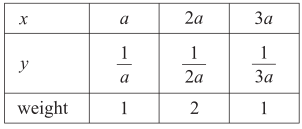
  1. Use the Trapezoidal rule with 3 function values to find an approximation to the area under the curve  `y = 1/x`  between  `x = a ` and  `x = 3a`, where `a` is positive.   (2 marks)

    --- 4 WORK AREA LINES (style=lined) ---

  2. Using the result in part (a), show that  `ln 3 ≑ 7/6`.   (1 mark)

    --- 3 WORK AREA LINES (style=lined) ---

Show Answers Only

a.    `7/6`

b.    `text(Proof)\ \ text{(See Worked Solutions)}`

Show Worked Solution
a.    
`A` `~~ a/2[1/a + 2(1/(2a)) + 1/(3a)]`
  `~~ a/2(7/(3a))~~ 7/6`

  
b.
    `text{Area under the curve}\ \ y=1/x`

`= int_a^(3a) 1/x\ dx`

`= [ln x]_(\ a)^(3a)`

`= ln 3a − ln a`

`= ln\ (3a)/a = ln 3`
   

`text{Trapezoidal rule in part (a) found the approximate value of the same area.)`

`:. ln 3 ≑ 7/6.`

Filed Under: Trapezium Rule and Newton, Trapezoidal Rule, Trapezoidal Rule Tagged With: Band 5, smc-5145-04-Trapezium rule, smc-5145-20-No table, smc-5145-30-Estimate comparison, smc-7132-10-1-2 Approximations, smc-7132-30-Estimate vs Actual, smc-976-20-No Table, smc-976-30-Estimate Comparison

Calculus, 2ADV C4 2018* HSC 15c

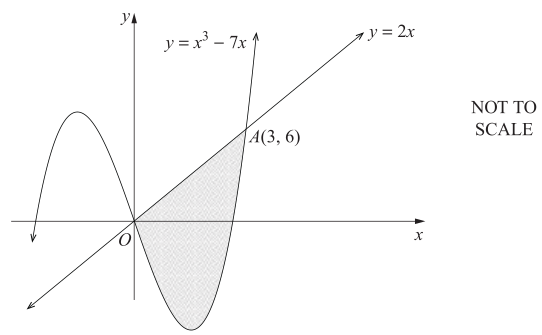
The shaded region is enclosed by the curve  `y = x^3-7x`  and the line  `y = 2x`, as shown in the diagram. The line  `y = 2x`  meets the curve  `y = x^3-7x`  at `O(0, 0)` and `A(3, 6)`. Do NOT prove this.
 

  1.  Use integration to find the area of the shaded region.   (2 marks)

    --- 4 WORK AREA LINES (style=lined) ---

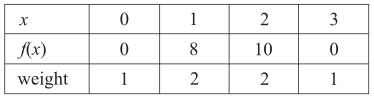
  2. Use the Trapezoidal rule and four function values to approximate the area of the shaded region.   (2 marks)

    --- 5 WORK AREA LINES (style=lined) ---

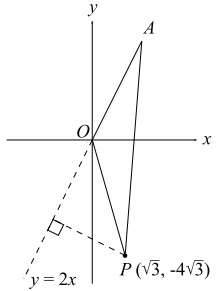
The point `P` is chosen on the curve  `y = x^3-7x`  so that the tangent at `P` is parallel to the line  `y = 2x`  and the `x`-coordinate of `P` is positive

  1.  Show that the coordinates of `P` are  `(sqrt 3, -4 sqrt 3)`.   (2 marks)

    --- 5 WORK AREA LINES (style=lined) ---

  2.  Using the perpendicular distance formula  `|ax_1 + by_1 + c|/sqrt(a^2 + b^2)`, find the area of  `Delta OAP`.   (2 marks)

    --- 5 WORK AREA LINES (style=lined) ---

Show Answers Only

i.    `81/4\ text(units)^2`

ii.   `18\ text(u)^2`

iii.  `text(Proof)\ \ text{(See Worked Solutions)}`

iv.   `9 sqrt 3\ text(units)^2`

Show Worked Solution
i.     `text(Area)` `= int_0^3 2x-(x^3-7x)\ dx`
    `= int_0^3 9x-x^3\ dx`
    `= [9/2 x^2-1/4 x^4]_0^3`
    `= [(9/2 xx 3^2-1/4 xx 3^4)-0]`
    `= 81/2-81/4`
    `= 81/4\ text(units)^2`


ii.   `f(x) = 9x-x^3`

`text(Area)~~ 1/2[0 + 2(8 + 10) + 0]~~ 1/2(36)~~ 18\ text(u)^2`
 

iii.  `y = x^3-7x`

`(dy)/(dx) = 3x^2-7`

`text(Find)\ x\ text(such that)\ \ (dy)/(dx) = 2:`

`3x^2-7` `= 2`
`3x^2` `= 9`
`x^2` `= 3`
`x` `= sqrt 3 qquad (x > 0)`

 
`y= (sqrt 3)^3-7 sqrt 3= 3 sqrt 3-7 sqrt 3= -4 sqrt 3`

`:. P\ \ text(has coordinates)\ (sqrt 3, -4 sqrt 3)`


iv.   

 
`text(dist)\ OA= sqrt((3-0)^2 + (6-0)^2)= sqrt 45= 3 sqrt 5`
 

`text(Find)\ _|_\ text(distance of)\ P\ text(from)\ OA:`

`P(sqrt 3, -4 sqrt 3),\ \ 2x-y=0`

`_|_\ text(dist)= |(2 sqrt 3 + 4 sqrt 3)/sqrt (3 + 2)|= (6 sqrt 3)/sqrt 5`

`:.\ text(Area)= 1/2 xx 3 sqrt 5 xx (6 sqrt 3)/sqrt 5= 9 sqrt 3\ text(units)^2`

Filed Under: Area Under Curves, Areas Under Curves, Trapezium Rule and Newton, Trapezoidal Rule, Trapezoidal Rule Tagged With: Band 4, Band 5, smc-5145-04-Trapezium rule, smc-5145-20-No table, smc-7131-20-Cubic, smc-7132-20-3+ Applications, smc-7132-60-X-topic, smc-975-20-Cubic, smc-976-20-No Table

Calculus, 2ADV C4 2017* HSC 14b

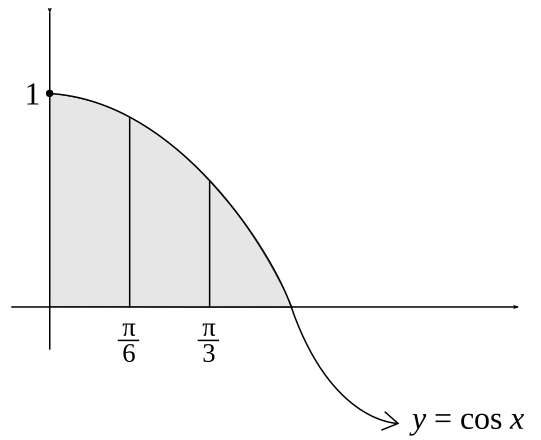
  1. Find the exact value of  `int_0^(pi/3) cos x\ dx`.   (1 mark)

    --- 2 WORK AREA LINES (style=lined) ---

  2. Using the Trapezoidal rule with three function values, find an approximation to the integral `int_0^(pi/3) cos x\ dx,` leaving your answer in terms of  `pi` and  `sqrt 3`.   (2 marks)

    --- 4 WORK AREA LINES (style=lined) ---

  3. Using parts (i) and (ii), show that  `pi ~~ (12 sqrt 3)/(3 + 2 sqrt 3)`.   (1 mark)

    --- 2 WORK AREA LINES (style=lined) ---

Show Answers Only

i.    `sqrt 3/2`

ii.   `((2sqrt3 + 3)pi)/24`

iii.  `text{Proof (See Worked Solutions)}`

Show Worked Solution
i.     `int_0^(pi/3) cos x\ dx` `= [sin x]_0^(pi/3)`
    `= sin\ pi/3-0`
    `= sqrt 3/2`


ii.   

\begin{array} {|l|c|c|c|}\hline
x & \ \ \ 0\ \ \  & \ \ \ \dfrac{\pi}{6}\ \ \  & \ \ \ \dfrac{\pi}{3}\ \ \ \\ \hline
\text{height} & 1 & \dfrac{\sqrt{3}}{2} & \dfrac{1}{2} \\ \hline
\text{weight} & 1 & 2 & 1  \\ \hline \end{array}

`int_0^(pi/3) cos x\ dx` `~~ 1/2 xx pi/6[1 + 2(sqrt3/2) + 1/2]`
  `~~ pi/12((3 + 2sqrt3)/2)`
  `~~ ((3+2sqrt3)pi)/24`


♦ Mean mark part (iii) 49%.

iii.   `((3+2sqrt3)pi)/24` `~~ sqrt3/2`
  `:. pi` `~~ (24sqrt3)/(2(3+2sqrt3))`
    `~~ (12sqrt3)/(3 + 2sqrt3)`

Filed Under: Trapezium Rule and Newton, Trapezoidal Rule, Trapezoidal Rule Tagged With: Band 3, Band 4, Band 5, smc-5145-04-Trapezium rule, smc-5145-20-No table, smc-5145-30-Estimate comparison, smc-7132-10-1-2 Approximations, smc-976-20-No Table, smc-976-30-Estimate Comparison

Calculus, 2ADV C4 2011* HSC 5c

The table gives the speed  `v` of a jogger at time  `t` in minutes over a  20-minute period. The speed  `v` is measured in metres per minute, in intervals of 5 minutes.

\begin{array} {|l|c|}
\hline
\rule{0pt}{2.5ex} \ \ \ t\ \ \  \rule[-1ex]{0pt}{0pt} & \ \ \ 0\ \ \ &\ \ \ 5\ \ \ &\ \ \ 10\ \ \ &\ \ \ 15\ \ \ &\ \ \ 20\ \ \  \\
\hline
\rule{0pt}{2.5ex} \ \ \ v\ \ \  \rule[-1ex]{0pt}{0pt} & 173 & 81 & 127 & 195 & 168 \\
\hline
\end{array}

The distance covered by the jogger over the 20-minute period is given by  `int_0^20 v\ dt`.

Use the Trapezoidal rule and the speed at each of the five time values to find the approximate distance the jogger covers in the 20-minute period.   (3 marks)

--- 6 WORK AREA LINES (style=lined) ---

Show Answers Only

 `text(2867.5 metres)`

Show Worked Solution

\begin{array} {|l|c|}
\hline
\rule{0pt}{2.5ex} \ \ \ t\ \ \  \rule[-1ex]{0pt}{0pt} & \ \ \ 0\ \ \ &\ \ \ 5\ \ \ &\ \ \ 10\ \ \ &\ \ \ 15\ \ \ &\ \ \ 20\ \ \  \\
\hline
\rule{0pt}{2.5ex} \ \ \ v\ \ \  \rule[-1ex]{0pt}{0pt} & 173 & 81 & 127 & 195 & 168 \\
\hline
\rule{0pt}{2.5ex} \text{weight} \rule[-1ex]{0pt}{0pt} & 1 & 2 & 2 & 2 & 1 \\
\hline
\end{array}

`int_0^20 v\ dt` `~~ 5/2[173 + 2(81 + 127 + 195) + 168]`
  `~~ 5/2(1147)~~ 2867.5\ text(metres)`

Filed Under: Trapezium Rule and Newton, Trapezoidal Rule, Trapezoidal Rule Tagged With: Band 4, smc-5145-04-Trapezium rule, smc-5145-10-Table provided, smc-7132-20-3+ Applications, smc-7132-25-Practical Problems, smc-976-10-Table provided

Calculus, 2ADV C4 2006* HSC 10a

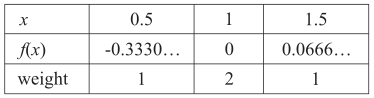
Use the Trapezoidal rule with three function values to find an approximation to the value of

`int_0.5^1.5 (log_e x )^3\ dx`.

Give your answer correct to three decimal places.   (2 marks)

--- 5 WORK AREA LINES (style=lined) ---

Show Answers Only

`-0.067`

Show Worked Solution

`f(x) = (log_e x )^3`

`int_0.5^1.5(log_e x)^3 dx` `~~ 0.5/2[-0.3330… + 2(0) + 0.0666…]`
  `~~ 0.25(-0.2663…)`
  `~~-0.06659…`
  `~~-0.067\ \ \ text{(to 3 d.p.)}`

Filed Under: Trapezium Rule and Newton, Trapezoidal Rule, Trapezoidal Rule Tagged With: Band 4, smc-5145-04-Trapezium rule, smc-5145-20-No table, smc-7132-10-1-2 Approximations, smc-976-20-No Table

Calculus, 2ADV C4 2005* HSC 6a

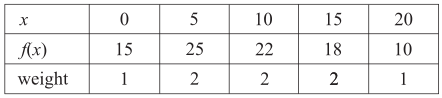
Five values of the function `f(x)` are shown in the table.

Integration, 2UA 2005 HSC 6a

Use the Trapezoidal rule with the five values given in the table to estimate

`int_0^20 f(x)\ dx`.   (3 marks)

--- 6 WORK AREA LINES (style=lined) ---

Show Answers Only

`387.5`

Show Worked Solution

`:. int_0^20 f(x)\ dx` `~~ 5/2[15 + 2(25 + 22 + 18) + 10]`
  `~~ 5/2(155)~~ 387.5`

Filed Under: Trapezium Rule and Newton, Trapezoidal Rule, Trapezoidal Rule Tagged With: Band 4, smc-5145-04-Trapezium rule, smc-5145-10-Table provided, smc-7132-20-3+ Applications, smc-976-10-Table provided

Calculus, 2ADV C4 2012* HSC 12d

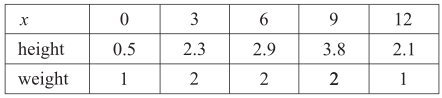
At a certain location a river is 12 metres wide. At this location the depth of the river, in metres, has been measured at 3 metre intervals. The cross-section is shown below.
 

2012 12d

  1. Use the Trapezoidal rule with the five depth measurements to calculate the approximate area of the cross-section.   (3 marks)

    --- 6 WORK AREA LINES (style=lined) ---

  2. The river flows at 0.4 metres per second.
  3. Calculate the approximate volume of water flowing through the cross-section in 10 seconds.   (1 mark)

    --- 2 WORK AREA LINES (style=lined) ---

Show Answers Only

a.    `30.9 \ text(m)^2`

b.    `123.6 \ text(m)^3`  

Show Worked Solution
a.     
`A` `~~ 3/2[0.5 + 2(2.3 + 2.9 + 3.8) + 2.1]`
  `~~ 3/2(20.6)~~ 30.9\ text(m)^2`

♦ Mean mark (b) 49%.

 
b.
    `text(Distance water flows)= 0.4 xx 10= 4 \ text(metres)`

`text(Volume flow in 10 seconds)~~ 4 xx 30.9 ~~123.6  text(m)^3`

Filed Under: Trapezium Rule and Newton, Trapezoidal Rule, Trapezoidal Rule Tagged With: Band 3, Band 5, smc-5145-04-Trapezium rule, smc-5145-20-No table, smc-7132-20-3+ Applications, smc-7132-25-Practical Problems, smc-976-20-No Table

Calculus, 2ADV C4 2016* HSC 14a

The diagram shows the cross-section of a tunnel and a proposed enlargement.

hsc-2016-14a

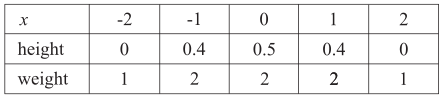
The heights, in metres, of the existing section at 1 metre intervals are shown in Table `A.`

hsc-2016-14ai

The heights, in metres, of the proposed enlargement are shown in Table `B.`

hsc-2016-14aii

Use the Trapezoidal rule with the measurements given to calculate the approximate increase in area.   (3 marks)

--- 6 WORK AREA LINES (style=lined) ---

Show Answers Only

`1.3\ text(m)^2`

Show Worked Solution

`text(Consider the shaded area distances:)`

`A` `~~ 1/2[0 + 2(0.4 + 0.5 + 0.4) + 0]`
  `~~ 1/2(2.6)`
  `~~ 1.3\ text(m)^2`

Filed Under: Trapezium Rule and Newton, Trapezoidal Rule, Trapezoidal Rule Tagged With: Band 3, smc-5145-04-Trapezium rule, smc-5145-10-Table provided, smc-5145-30-Estimate comparison, smc-7132-20-3+ Applications, smc-7132-25-Practical Problems, smc-976-10-Table provided, smc-976-30-Estimate Comparison

Calculus, 2ADV C4 2015 HSC 5 MC

Using the trapezoidal rule with 4 subintervals, which expression gives the approximate area under the curve  `y = xe^x`  between  `x = 1`  and  `x = 3`?

  1. `1/4(e^1 + 6e^1.5 + 4e^2 + 10e^2.5 + 3e^3)`
  2. `1/4(e^1 + 3e^1.5 + 4e^2 + 5e^2.5 + 3e^3)`
  3. `1/2(e^1 + 6e^1.5 + 4e^2 + 10e^2.5 + 3e^3)`
  4. `1/2(e^1 + 3e^1.5 + 4e^2 + 5e^2.5 + 3e^3)`
Show Answers Only

`B`

Show Worked Solution

`y = xe^x`

2UA HSC 2015 5mc

`A` `~~ h/2[y_0 + 2y_1 + 2y_2 + 2y_3 + y_4]`
  `~~ 1/4[e^1 + 3e^1.5 + 4e^2 + 5e^2.5 + 3e^3]`

 
`=> B`

Filed Under: Trapezium Rule and Newton, Trapezoidal and Simpson's Rule, Trapezoidal Rule, Trapezoidal Rule Tagged With: Band 4, smc-5145-04-Trapezium rule, smc-5145-20-No table, smc-7132-10-1-2 Approximations, smc-976-20-No Table

Calculus, 2ADV C4 2010 HSC 3b

  1. Sketch the curve  `y=lnx`.   (1 mark)

    --- 6 WORK AREA LINES (style=lined) ---

  2. Use the trapezoidal rule with 3 function values to find an approximation to `int_1^3 lnx\ dx`   (2 marks) 

    --- 5 WORK AREA LINES (style=lined) ---

  3. State whether the approximation found in part (b) is greater than or less than the exact value of `int_1^3 lnx\ dx`. Justify your answer.   (1 mark)

    --- 2 WORK AREA LINES (style=lined) ---

Show Answer Only

a.    `text(See Worked Solutions for sketch.)`

b.    `1.24\ text(u)^2`

c.    `text(See Worked Solutions)`

Show Worked Solutions
a. 2010 3b image - Simpsons
MARKER’S COMMENT: Important features of the graph should be identified (as shown).


b.    `text(Area)` `~~h/2[f(1)+2xxf(2)+f(3)]`
  `~~1/2[0+2ln2+ln3]`
  `~~1/2[ln(2^2 xx3)]`
  `~~1/2ln12`
  `~~1.24\ \ text{u}^2\ \text{(to 2 d.p.)}`


c. 2010 13b image 2 - Simpsons


♦♦♦ Mean mark (c) 12%.
MARKER’S COMMENT: Best responses commented on concavity, trapezia laying under the curve and featured diagrams.

`text{The approximation is less because the sides of the trapezia}`

`text{lie below the concave down curve (see diagram).}`

Filed Under: Applied Calculus (L&E), Trapezium Rule and Newton, Trapezoidal and Simpson's Rule, Trapezoidal Rule, Trapezoidal Rule Tagged With: Band 4, Band 6, page-break-before-solution, smc-5145-04-Trapezium rule, smc-5145-20-No table, smc-5145-30-Estimate comparison, smc-7132-10-1-2 Approximations, smc-7132-30-Estimate vs Actual, smc-976-20-No Table, smc-976-30-Estimate Comparison

Copyright © 2014–2026 SmarterEd.com.au · Log in