SmarterEd

Aussie Maths & Science Teachers: Save your time with SmarterEd

  • Login
  • Get Help
  • About

Calculus, MET2 2022 VCAA 2

On a remote island, there are only two species of animals: foxes and rabbits. The foxes are the predators and the rabbits are their prey.

The populations of foxes and rabbits increase and decrease in a periodic pattern, with the period of both populations being the same, as shown in the graph below, for all `t \geq 0`, where time `t` is measured in weeks.

One point of minimum fox population, (20, 700), and one point of maximum fox population, (100, 2500), are also shown on the graph.

The graph has been drawn to scale.
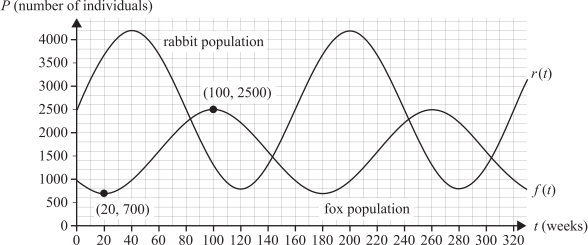
 

The population of rabbits can be modelled by the rule `r(t)=1700 \sin \left(\frac{\pi t}{80}\right)+2500`.

  1.   i. State the initial population of rabbits.   (1 mark)

    --- 2 WORK AREA LINES (style=lined) ---

  2.  ii. State the minimum and maximum population of rabbits.   (1 mark)

    --- 2 WORK AREA LINES (style=lined) ---

  3. iii. State the number of weeks between maximum populations of rabbits.   (1 mark)

    --- 2 WORK AREA LINES (style=lined) ---

The population of foxes can be modelled by the rule `f(t)=a \sin (b(t-60))+1600`.

  1. Show that `a=900` and `b=\frac{\pi}{80}`.   (2 marks)

    --- 4 WORK AREA LINES (style=lined) ---

  2. Find the maximum combined population of foxes and rabbits. Give your answer correct to the nearest whole number.   (1 mark)

    --- 1 WORK AREA LINES (style=lined) ---

  3. What is the number of weeks between the periods when the combined population of foxes and rabbits is a maximum?   (1 mark)

    --- 1 WORK AREA LINES (style=lined) ---

The population of foxes is better modelled by the transformation of `y=\sin (t)` under `Q` given by

 

  1. Find the average population during the first 300 weeks for the combined population of foxes and rabbits, where the population of foxes is modelled by the transformation of `y=\sin(t)` under the transformation `Q`. Give your answer correct to the nearest whole number.   (4 marks)

    --- 8 WORK AREA LINES (style=lined) ---

Over a longer period of time, it is found that the increase and decrease in the population of rabbits gets smaller and smaller.

The population of rabbits over a longer period of time can be modelled by the rule

`s(t)=1700cdote^(-0.003t)cdot sin((pit)/80)+2500,\qquad text(for all)\ t>=0`

  1. Find the average rate of change between the first two times when the population of rabbits is at a maximum. Give your answer correct to one decimal place.   (2 marks)

    --- 3 WORK AREA LINES (style=lined) ---

  2. Find the time, where `t>40`, in weeks, when the rate of change of the rabbit population is at its greatest positive value. Give your answer correct to the nearest whole number.   (2 marks)

    --- 3 WORK AREA LINES (style=lined) ---

  3. Over time, the rabbit population approaches a particular value.
  4. State this value.   (1 mark)

    --- 1 WORK AREA LINES (style=lined) ---
Show Answers Only

ai.   `r(0)=2500`

aii.  Minimum population of rabbits `= 800`

Maximum population of rabbits `= 4200`

aiii. `160`  weeks

b.    See worked solution.

c.    `~~ 5339` (nearest whole number)

d.    Weeks between the periods is 160

e.    `~~ 4142` (nearest whole number)

f.    Average rate of change `=-3.6` rabbits/week (1 d.p.)

g.    `t = 156` weeks (nearest whole number)  

h.    ` s → 2500`

Show Worked Solution

ai.  Initial population of rabbits

From graph when `t=0, \ r(0) = 2500`

Using formula when `t=0`

`r(t)` `= 1700\ sin \left(\frac{\pi t}{80}\right)+2500`  
`r(0)` `= 1700\ sin \left(\frac{\pi xx 0}{80}\right)+2500 = 2500`  rabbits  


aii.
From graph,

Minimum population of rabbits `= 800`

Maximum population of rabbits `= 4200`

OR

Using formula

Minimum is when `t = 120`

`r(120) = 1700\ sin \left(\frac{\pi xx 120}{80}\right)+2500 = 1700 xx (-1) + 2500 = 800`

Maximum is when `t = 40`

`r(40) = 1700\ sin \left(\frac{\pi xx 40}{80}\right)+2500 = 1700 xx (1) + 2500 = 4200`

 
aiii. Number of weeks between maximum populations of rabbits `= 200-40 = 160`  weeks

 
b.  Period of foxes = period of rabbits = 160:

`frac{\2pi}{b} = 160`

`:.\  b = frac{\2pi}{160} = frac{\pi}{80}` which is the same period as the rabbit population.

Using the point `(100 , 2500)`

Amplitude when `b = frac{\pi}{80}`: 

`f(t)` `=a \ sin (pi/80(t-60))+1600`  
`f(100)` `= 2500`  
`2500` `= a \ sin (pi/80(100-60))+1600`  
`2500` `= a \ sin (pi/2)+1600`  
`a` `= 2500-1600 = 900`  

 
`:.\  f(t)= 900 \ sin (pi/80)(t-60) + 1600`


c.    Using CAS find `h(t) = f(t) + r(t)`:

`h(t):=900 \cdot \sin \left(\frac{\pi}{80} \cdot(t-60)\right)+1600+1700\cdot \sin \left(\frac{\pit}{80}\right) +2500`

  
`text{fMax}(h(t),t)|0 <= t <= 160`      `t = 53.7306….`
  

`h(53.7306…)=5339.46`

  
Maximum combined population `~~ 5339` (nearest whole number)


♦♦ Mean mark (c) 40%.
MARKER’S COMMENT: Many rounding errors with a common error being 5340. Many students incorrectly added the max value of rabbits to the max value of foxes, however, these points occurred at different times.

d.    Using CAS, check by changing domain to 0 to 320.

`text{fMax}(h(t),t)|0 <= t <= 320`     `t = 213.7305…`
 
`h(213.7305…)=5339.4568….`
 
Therefore, the number of weeks between the periods is 160.
  

e.    Fox population:

`t^{\prime} = frac{90}{pi}t + 60`   →   `t = frac{pi}{90}(t^{\prime}-60)`

`y^{\prime} = 900y+1600`   →   `y = frac{1}{900}(y^{\prime}-1600)`

`frac{y^{\prime}-1600}{900} = sin(frac{pi(t^{\prime}-60)}{90})`

`:.\  f(t) = 900\ sin\frac{pi}{90}(t-60) + 1600`

  
Average combined population  [Using CAS]   
  
`=\frac{1}{300} \int_0^{300} left(\900 \sin \left(\frac{\pi(t-60)}{90}\right)+1600+1700\ sin\ left(\frac{\pi t}{80}\right)+2500\right) d t`
  

`= 4142.2646…..  ~~ 4142` (nearest whole number)


♦ Mean mark (e) 40%.
MARKER’S COMMENT: Common incorrect answer 1600. Some incorrectly subtracted `r(t)`. Others used average rate of change instead of average value.

f.   Using CAS

`s(t):= 1700e^(-0.003t) dot\sin\frac{pit}{80} + 2500`
 

`text{fMax}(s(t),t)|0<=t<=320`        `x = 38.0584….`
 

`s(38.0584….)=4012.1666….`
 

`text{fMax}(s(t),t)|160<=t<=320`     `x = 198.0584….`
 

`s(198.0584….)=3435.7035….`
 

Av rate of change between the points

`(38.058 , 4012.167)`  and  `(198.058 , 3435.704)`

`= frac{4012.1666….-3435.7035….}{38.0584….-198.0584….} =-3.60289….`
 

`:.` Average rate of change `=-3.6` rabbits/week (1 d.p.)


♦ Mean mark (f ) 45%.
MARKER’S COMMENT: Some students rounded too early.
`frac{s(200)-s(40)}{200-40}` was commonly seen.
Some found average rate of change between max and min populations.

g.   Using CAS

`s^(primeprime)(t) = 0` , `t = 80(n-0.049) \ \forall n \in Z`

After testing `n = 1, 2, 3, 4` greatest positive value occurs for `n = 2` 

`t` `= 80(n-0.049)`  
  `= 80(2-0.049)`  
  `= 156.08`  

 
`:. \ t = 156` weeks (nearest whole number)


♦♦♦ Mean mark (g) 25%.
MARKER’S COMMENT: Many students solved `frac{ds}{dt}=0`.
A common answer was 41.8, as `s(156.11…)=41.79`.
Another common incorrect answer was 76 weeks.

h.   As `t → ∞`, `e^(-0.003t) → 0`

`:.\ s → 2500`

Filed Under: Average Value and Other, Differentiation (Trig), Maxima and Minima, Trig Differentiation Tagged With: Band 2, Band 4, Band 5, Band 6, smc-2757-10-Sin, smc-2757-80-Applications, smc-641-60-Other themes, smc-736-10-sin, smc-744-10-sin, smc-753-60-Matrix, smc-756-20-Trig

Trigonometry, MET2-NHT 2019 VCAA 2

The wind speed at a weather monitoring station varies according to the function

`v(t) = 20 + 16sin ((pi t)/(14))`

where `v` is the speed of the wind, in kilometres per hour (km/h), and  `t`  is the time, in minutes, after 9 am.

  1. What is the amplitude and the period of  `v(t)`?   (2 marks)

    --- 3 WORK AREA LINES (style=lined) ---

  2. What are the maximum and minimum wind speeds at the weather monitoring station?   (1 mark)

    --- 2 WORK AREA LINES (style=lined) ---

  3. Find  `v(60)`, correct to four decimal places.   (1 mark)

    --- 2 WORK AREA LINES (style=lined) ---

  4. Find the average value of  `v(t)`  for the first 60 minutes, correct to two decimal places.   (2 marks)

    --- 5 WORK AREA LINES (style=lined) ---

A sudden wind change occurs at 10 am. From that point in time, the wind speed varies according to the new function

                    `v_1(t) = 28 + 18 sin((pi(t-k))/(7))`

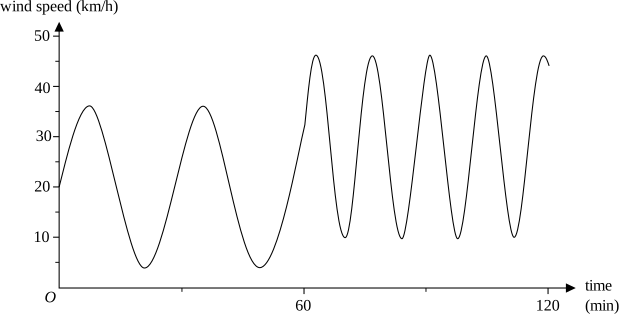
where  `v_1`  is the speed of the wind, in kilometres per hour, `t` is the time, in minutes, after 9 am and  `k ∈ R^+`. The wind speed after 9 am is shown in the diagram below.
 

  1. Find the smallest value of `k`, correct to four decimal places, such that  `v(t)`  and  `v_1(t)`  are equal and are both increasing at 10 am.   (2 marks)

    --- 2 WORK AREA LINES (style=lined) ---

  2. Another possible value of `k` was found to be 31.4358


    Using this value of `k`, the weather monitoring station sends a signal when the wind speed is greater than 38 km/h.


    i.  Find the value of `t` at which a signal is first sent, correct to two decimal places.   (1 mark)

    --- 2 WORK AREA LINES (style=lined) ---


    ii. Find the proportion of one cycle, to the nearest whole percent, for which  `v_1 > 38`.   (2 marks)

    --- 5 WORK AREA LINES (style=lined) ---

  3. Let  `f(x) = 20 + 16 sin ((pi x)/(14))`  and  `g(x) = 28 + 18 sin ((pi(x-k))/(7))`.
     
    The transformation  `T([(x),(y)]) = [(a \ \ \ \ 0),(0 \ \ \ \ b)][(x),(y)] + [(c),(d)]`  maps the graph of  `f`  onto the graph of  `g`.


    State the values of  `a`, `b`, `c` and `d`, in terms of `k` where appropriate.   (3 marks)

    --- 11 WORK AREA LINES (style=lined) ---

Show Answers Only
  1. `28`
  2. `v_text(max) \ = 36 \ text(km/h)`


    `v_text(min) \ = 4 \ text(km/h)`

  3. `32.5093 \ text(km/h)`
  4. `20.45 \ text(km/h)`
  5. `3.4358`
  6. i. `60.75 \ text(m)`


    ii. `31text(%)`

  7. `a = (1)/(2) \ , \ b = (9)/(8) \ , \ c = k \ , \ d = (11)/(2)`
Show Worked Solution

a.    `text(Amplitude) = 16`

`text{Find Period (n):}`

`(2 pi)/(n)` `= (pi)/(14)`
`n` `= 28`


b.    `v_text(max) = 20 + 16 = 36 \ text(km/h)`

`v_text(min) = 20-16 = 4 \ text(km/h)`


c.    `v(60)` `= 20 + 16 sin ((60 pi)/(14))`
  `= 32.5093 \ \ text(km/h)`


d.    `v(t)\ \ text(is always positive.)`

`s(t) = int_0^60 v(t) \ dt`

`v(t)_(avg)` `= (1)/(60) int_0^60 20 + 16 sin ((pi t)/(14))\ dt`
  `= 20.447`
  `= 20.45 \ text(km/h) \ \ text((to 2 d.p.))`


e.    `text(S) text{olve (for}\ k text{):} \ \ v(60) = v_1(60)`

`k = 3.4358 \ \ text((to 4 d.p.))`


f.i.  `text(S) text(olve for) \ t , \ text(given) \ \ v_1(t) = 38 \ \ text(and) \ \ k = 31.4358`

`=> t = 60.75 \ text(minutes)`
 

f.ii.  `text(S) text(olving for) \ \ v_1(t) = 38 \ , \ k = 31.4358`

`t_1 = 60.75 \ text{(part i)}, \ t_2 = 65.123`

`text(Period of) \ \ v_1 = (2 pi)/(n) = (pi)/(7)\ \ => \ n = 14`

`:. \ text(Proportion of cycle)` `= (65.123-60.75)/(14)`
  `= 0.312`
  `= 31 text{%  (nearest %)}`


g.    `f(x) → g(x)`

`y^{prime} = 28 + 18 sin ({pi(x^{prime}-k)}/{7})`

`x^{prime} = ax + c` `\ \ \ \ \ \ y^{prime} = by + d`


`text(Using) \ \ y^{prime} = by + d`

`28 + 18 sin ({pi(x^{prime}-k)}/{7}) = b (20 + 16 sin ({pi x}/{14})) + d`
 

`text(Equating coefficients of) \ \ sin theta :`

`16b = 18 \ \ \ => \ b = (9)/(8)`
 

`text(Equating constants:)`

`20 xx (9)/(8) + d = 28 \ \ \ => \ \ d = (11)/(2)`

`(x^{prime}-k)/(7)` `= (x)/(14)`
`x^{prime}` `= (x)/(2) + k \ \ => \ \ a = (1)/(2) \ , \ c = k`


`a = (1)/(2) \ , \ b = (9)/(8) \ , \ c = k \ , \ d = (11)/(2)`

Filed Under: Transformations, Trig Graphing Tagged With: Band 4, Band 5, Band 6, smc-2757-10-Sin, smc-2757-30-Find period, smc-2757-40-Find amplitude, smc-2757-80-Applications, smc-2757-85-Max/min (non-calc), smc-753-60-Matrix

Graphs, MET2-NHT 2019 VCAA 12 MC

The transformation  `T : R^2 → R^2`,  which maps the graph of  `y = -sqrt(2x + 1)-3`  onto the graph of  `y = sqrtx`, has rule

  1. `T ([(x),(y)]) = [((1)/(2) \ \ \ \ \ 0),(\ \ 0\ \ \ \–1)] [(x),(y)] + [(–1),(–3)]`
  2. `T ([(x),(y)]) = [((1)/(2) \ \ \ \ \ 0),(\ \ 0\ \ \ \–1)] [(x),(y)] + [(–1),(3)]`
  3. `T ([(x),(y)]) = [((1)/(2) \ \ \ \ \ 0),(\ \ 0 \ \ \ \ –1)] [(x),(y)] + [(1),(–3)]`
  4. `T ([(x),(y)]) = [(2 \ \ \ \ \ 0),(\ \ 0 \ \ \ –1)] [(x),(y)] + [(1),(–3)]`
  5. `T ([(x),(y)]) = [(2 \ \ \ \ \ 0),(\ \ 0 \ \ \ –1)] [(x),(y)] + [(–1),(3)]`
Show Answers Only

`D`

Show Worked Solution
`y` `= -sqrt(2x + 1)-3`
`y + 3` `= -sqrt(2x + 1)`
`-y-3` `= -sqrt(2x + 1)`

 
`text(S) text(ince) \ \ y^{′} = sqrt(x^{′})`

`=> x^{′} = 2x + 1 \ , \ \ y^{′} = -y-3` 
 

`[(x^{′}),(y^{′})] = [(2 \ \ \ 0),(0 \ \–1)] [(x),(y)] + [(1),(–3)]` 
 

`=> D`

Filed Under: Transformations Tagged With: Band 5, smc-753-60-Matrix

Graphs, MET2 2019 VCAA 9 MC

The point  `(a, b)`  is transformed by

`T([(x), (y)]) = [(1/2, 0), (0, -2)][(x), (y)]+[(-1/2), (-2)]`

If the image of  `(a, b)`  is  `(0, 0)`, then  `(a, b)`  is

  1. `(1, 1)`
  2. `(-1, 1)`
  3. `(-1, 0)`
  4. `(0, 1)`
  5. `(1, -1)`
Show Answers Only

`E`

Show Worked Solution

`x^{\prime} = 1/2x – 1/2`

`=> 0` `= 1/2a – 1/2`
`a` `= 1`

 
`y^{\prime}= -2y – 2`

`=> 0` `= -2b – 2`
`b` `= -1`

 
`:. (a, b) -= (1, -1)`

`=>   E`

Filed Under: Transformations Tagged With: Band 4, smc-753-60-Matrix

Algebra, MET1 2019 VCAA 2

  1. Let  `f: R\{1/3} -> R,\ f(x) = 1/(3x-1)`.


    Find the rule of  `f^(-1)`.   (2 marks) 

    --- 5 WORK AREA LINES (style=lined) ---

  2. State the domain of  `f^(-1)`.   (1 mark)

    --- 1 WORK AREA LINES (style=lined) ---
  3. Let  `g`  be the function obtained by applying the transformation  `T`  to the function  `f`, where
  4. `qquad qquad qquad T ([(x), (y)]) = [(x), (y)] + [(c), (d)]`
  5. and  `c, d in R`.
  6. Find the values of  `c`  and  `d`  given that  `g = f^(-1)`.   (1 mark)

    --- 4 WORK AREA LINES (style=lined) ---

Show Answers Only
  1. `y = 1/(3x) + 1/3`
  2. `x in R\ text(\){0}`
  3. `c = -1/3,\ d = 1/3`
Show Worked Solution

a.   `text(Let)\ \ y = 1/(3x-1)`

`text(Inverse:  swap)\ \ x↔ y`

`x` `= 1/(3y-1)`
`3y-1` `= 1/x`
`3y` `= 1/x + 1`
`y` `= 1/(3x) + 1/3`


b.   `x in R\ text(\){0}`


c.   `f(x) = 1/(3x-1) \ -> \ f(x) = 1/(3x) + 1/3`

`f(x + 1/3) = 1/(3(x + 1/3)-1) = 1/(3x)`

`:. c = -1/3,\ \ d = 1/3`

Filed Under: Polynomial and Other Functions, Transformations Tagged With: Band 4, smc-5205-40-Other functions, smc-633-40-Other Functions, smc-753-60-Matrix

Algebra, MET2 2018 VCAA 20 MC

The differentiable function  `f : R -> R`  is a probability density function. It is known that the median of the probability density function  `f`  is at  `x = 0`  and  `f^{′} (0) = 4`.

The transformation  `T : R^2 -> R^2`  maps the graph of  `f`  to the graph of  `g`, where  `g : R -> R`  is a probability density function with a median at  `x = 0`  and  `g^{′} (0) = -1`.

The transformation `T` could be given by

  1. `T([(x), (y)]) = [(-2, 0), (0, 1/2)][(x), (y)]`
  2. `T([(x), (y)]) = [(2, 0), (0, -1/2)][(x), (y)]`
  3. `T([(x), (y)]) = [(2, 0), (0, 1/2)][(x), (y)]`
  4. `T([(x), (y)]) = [(-1/2, 0), (0, 2)][(x), (y)]`
  5. `T([(x), (y)]) = [(1/2, 0), (0, -2)][(x), (y)]`
Show Answers Only

`A`

Show Worked Solution

`m_f = 4`

♦♦♦ Mean mark 20%.

`text(Reflect in)\ y text(-axis): m = -4`
 

`text(Dilate by a factor of 2 from)\ y text(-axis):`

`m = (-4)/2 = -2`
 

`text(Dilate by a factor of)\ 1/2\ text{from}\ x text(-axis):`

`m = -1`

`[(-2, 0),(0, 1/2)]\ text(describes this transformation)`

`=>   A`

Filed Under: Transformations Tagged With: Band 6, smc-753-60-Matrix

Algebra, MET2 2017 VCAA 4

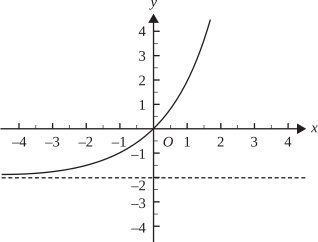
Let  `f : R → R :\  f (x) = 2^(x + 1)-2`. Part of the graph of  `f` is shown below.
 

  1. The transformation  `T: R^2 -> R^2, \ T([(x),(y)]) = [(x),(y)] + [(c),(d)]`  maps the graph of  `y = 2^x`  onto the graph of  `f`.


    State the values of `c` and `d`.   (2 marks)

    --- 5 WORK AREA LINES (style=lined) ---

  2. Find the rule and domain for  `f^(-1)`, the inverse function of  `f`.   (2 marks)

    --- 5 WORK AREA LINES (style=lined) ---

  3. Find the area bounded by the graphs of  `f` and  `f^(-1)`.   (3 marks)

    --- 3 WORK AREA LINES (style=lined) ---

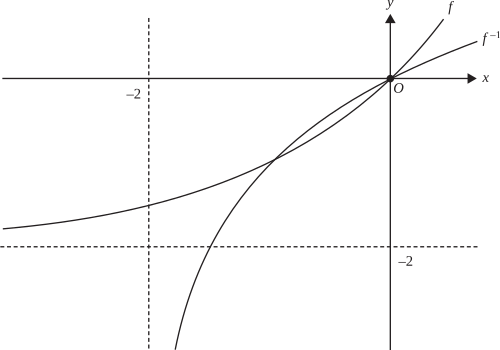
  4. Part of the graphs of  `f` and  `f^(-1)` are shown below.


    Find the gradient of  `f` and the gradient of  `f^(-1)`  at  `x = 0`.   (2 marks)

    --- 2 WORK AREA LINES (style=lined) ---

The functions of  `g_k`, where  `k ∈ R^+`, are defined with domain `R` such that  `g_k(x) = 2e^(kx)-2`.

  1. Find the value of `k` such that  `g_k(x) = f(x)`.  (1 mark)

    --- 3 WORK AREA LINES (style=lined) ---

  2. Find the rule for the inverse functions  `g_k^(-1)` of  `g_k`, where  `k ∈ R^+`.   (1 mark)

    --- 5 WORK AREA LINES (style=lined) ---

  3. i. Describe the transformation that maps the graph of  `g_1` onto the graph of  `g_k`.   (1 mark)

    --- 3 WORK AREA LINES (style=lined) ---

    ii. Describe the transformation that maps the graph of  `g_1^(-1)` onto the graph of  `g_k^(-1)`.   (1 mark)

    --- 3 WORK AREA LINES (style=lined) ---

  4. The lines `L_1` and `L_2` are the tangents at the origin to the graphs of  `g_k`  and  `g_k^(-1)`  respectively.
  5. Find the value(s) of `k` for which the angle between `L_1` and `L_2` is 30°.   (2 marks)

    --- 6 WORK AREA LINES (style=lined) ---

  6. Let `p` be the value of `k` for which  `g_k(x) = g_k^(−1)(x)`  has only one solution.
  7.  i. Find `p`.   (2 marks)

    --- 4 WORK AREA LINES (style=lined) ---

  8. ii. Let  `A(k)`  be the area bounded by the graphs of  `g_k`  and  `g_k^(-1)`  for all  `k > p`.
  9.     State the smallest value of `b` such that  `A(k) < b`.   (1 mark)

    --- 4 WORK AREA LINES (style=lined) ---

Show Answers Only

a.  `c =-1, \ d =-2`

b.  `f^(-1)(x) = log_2 (x + 2)-1, \ x ∈ (-2,∞)`

c.  `3-2/(log_e(2))\ text(units)²`

d. `f^{prime}(0)= 2log_e(2) and f^(-1)^{prime}(0)= 1/(2log_e(2))`

e.  `k = log_e(2)`

f.  `g_k^(-1)(x)= 1/k log_e((x + 2)/2)`

g.i.  `text(Dilation by factor of)\ 1/k\ text(from the)\ ytext(-axis)`

g.ii.  `text(Dilation by factor of)\ 1/k\ text(from the)\ xtext(-axis)`

h.  `k=sqrt3/6\ or\ sqrt3/2`

i.i.  `p = 1/2`

i.ii.  `b=4`

Show Worked Solution

a.   `text(Using the matrix transformation:)`

`x^{prime}` `=x+c\ \ => x=x^{prime}-c`
`y^{prime}` `=y+d\ \ =>y= y^{prime}-d`
   
`y^{prime}-d` `=2^((x)^{prime}-c)`
`y^{prime}` `= 2^((x)^{prime}-c)+d`


`:. c = -1, \ d = -2`


b.   `text(Let)\ \ y = f(x)`

`text(Inverse : swap)\ x\ ↔ \ y`

`x` `= 2^(y + 1)-2`
`x + 2` `= 2^(y + 1)`
`y + 1` `= log_2(x + 2)`
`y` `= log_2(x + 2)-1`


`text(dom)(f^(-1)) = text(ran)(f)`

`:. f^(-1)(x) = log_2 (x + 2)-1, \ x ∈ (-2,∞)`


c.   `text(Intersection points occur when)\ \ f(x)=f^(-1)(x)`

MARKER’S COMMENT: Specifically recommends using  `f^(-1)(x)-f(x)`  in this type of integral to avoid errors in stating the integral.

`x` `= -1, 0`


`text(Area)` `= int_(-1)^0 (f^(-1)(x)-f(x))\ dx`
  `= 3-2/(log_e(2))\ text(units)²`


d.    `f^{prime}(0)` `= 2log_e(2)`
  `f^{(-1)^prime}(0)` `= 1/(2log_e(2))`


e.   `g_k(x) = 2e^(kx)-2`

`text(Solve:)\ \ g_k(x) = f(x)quad text(for)\ k ∈ R^+`

`:. k = log_e(2)`


f.   `text(Let)\ \ y = g_k(x)`

`text(Inverse : swap)\ x\ text(and)\ y`

`x` `= 2e^(ky)-2`
`e^(ky)` `=(x+2)/2`
`ky` `=log_e((x+2)/2)`
`:. g_k^(-1)(x)` `= 1/k log_e((x + 2)/2)`


♦♦ Mean mark part (g)(i) 31%.

g.i.    `g_1(x)` `= 2e^x-2`
  `g_k(x)` `= 2e^(kx)-2`

 
`:. text(Dilation by factor of)\ 1/k\ text(from the)\ ytext(-axis)`


♦♦ Mean mark part (g)(ii) 30%.

g.ii.    `g_1^(-1)(x)` `= log_e((x + 2)/2)`
  `g_k^(-1)(x)` `= 1/klog_e((x + 2)/2)`

 
`:. text(Dilation by factor of)\ 1/k\ text(from the)\ xtext(-axis)`


h.   `text(When)\ \ x=0,`

♦♦♦ Mean mark part (h) 13%.

`g_k^{prime}(0)=2k\ \ => m_(L_1)=2k`

`g_k^{(-1)^prime}(0)=1/(2k)\ \ => m_(L_2)=1/(2k)`


`text(Using)\ \ tan 30^@=|(m_1-m_2)/(1+m_1m_2)|,`

`text(Solve:)\ \ 1/sqrt3` `=+- ((2k-1/(2k)))/2\ \ text(for)\ k`

 
`:. k=sqrt3/6\ or\ sqrt3/2`


i.i   `text(By inspection, graphs will touch once if at)\ \ x=0,`

♦♦♦ Mean mark part (i)(i) 4%.

`m_(L_1)` `=m_(L_2)`
`2k` `=1/(2k)`
`k` `=1/2,\ \ (k>0)`

 
`:. p = 1/2`


i.ii  `text(As)\ k→oo, text(the graph of)\ g_k\ text(approaches)\ \ x=0`

♦♦♦ Mean mark part (i)(ii) 2%.

`text{(vertically) and}\ \ y=-2\ \ text{(horizontally).}`

`text(Similarly,)\ \ g_k^(-1)\ \ text(approaches)\ \ x=-2`

`text{(vertically) and}\ \ y=0\ \ text{(horizontally).}`


`:. lim_(k→oo) A(k) = 4`

`:.b=4`

Filed Under: Area Under Curves, Logs and Exponential Functions, Tangents and Normals, Transformations Tagged With: Band 4, Band 5, Band 6, page-break-before-question, smc-5204-50-Find intersection, smc-634-20-Log/Exp Function, smc-634-80-Angle between tangents/axes, smc-723-50-Log/Exponential, smc-723-80-Area between graphs, smc-753-20-Dilation (Only), smc-753-60-Matrix

Functions, MET2 2017 VCAA 10 MC

A transformation  `T: R^2 → R^2`  with rule  `T([(x),(y)]) = [(2,0),(0,1/3)][(x),(y)]`  maps the graph of  `y = 3sin(2(x + pi/4))`  onto the graph of

  1. `y = sin(x + pi)`
  2. `y = sin(x - pi/2)`
  3. `y = cos(x + pi)`
  4. `y = cos(x)`
  5. `y = cos(x - pi/2)`
Show Answers Only

`D`

Show Worked Solution
`x′` `=2x`
`x` `=(x′)/2`
`y′` `=1/3 y`
`y` `=3y′`


`y` `=3sin(2(x + pi/4))`
`3y′` `=3sin(2((x′)/2 + pi/4))`
`y′` `=sin(x′ + pi/2)`
  `=cos(x′)`


 `=> D`

Filed Under: Transformations Tagged With: Band 5, smc-753-60-Matrix

Graphs, MET2 2008 VCAA 9 MC

The transformation  `T: R^2 -> R^2` with rule

`T([(x), (y)]) = [(4, 0), (0, -2)] [(x), (y)] + [(1), (3)]`

maps the curve with equation  `y = x^3`  to the curve with equation

  1. `y = (-(x - 1)^3)/32 + 3`
  2. `y = (-(4x + 1)^3 + 3)/2`
  3. `y = (-(x + 1)^3)/32 - 3`
  4. `y = ((1 - x)^3)/64 - 3`
  5. `y = ((4x - 1)^3 + 3)/2`
Show Answers Only

`A`

Show Worked Solution

`text(Let)\ \ (x′,y′)\ \ text(be the transformation of)\ \ (x,y).`

♦ Mean mark 38%.
`x′` `= 4x + 1`
`x` `=(x′ – 1)/4`
`y′` `= – 2y + 3`
`y` `=(y′ – 3)/(- 2)`


`text(Substitute)\ \ x, y\ \ text(into)\ \ y = x^3:`

`(y′ – 3)/(- 2)` `= ((x′ – 1)/4)^3`
`y′ – 3` `= (- 2)/4^3 (x′ – 1)^3`
`y` `= (- (x – 1)^3)/32 + 3`

`=>   A`

Filed Under: Transformations Tagged With: Band 5, smc-753-60-Matrix, smc-753-70-Polynomials

Graphs, MET2 2009 VCAA 12 MC

A transformation  `T: R^2 -> R^2`  that maps the curve with equation  `y = sin (x)`  onto the curve with equation  `y = 1 - 3 sin(2x + pi)`  is given by

  1. `T [(x), (y)] = [(2, 0), (0, -3)] [(x), (y)] + [(pi), (1)]`
  2. `T [(x), (y)] = [(– 1/2, 0), (0, 3)] [(x), (y)] + [(pi/2), (1)]`
  3. `T [(x), (y)] = [(0, – 3), (2, 0)] [(x), (y)] - [(pi), (1)]`
  4. `T [(x), (y)] = [(1/2, 0), (0, – 3)] [(x), (y)] + [(– pi/2), (1)]`
  5. `T [(x), (y)] = [(1/2, 0), (0, 3)] [(x), (y)] + [(– pi/2), (– 1)]`
Show Answers Only

`D`

Show Worked Solution

`text(Let)\ \ f(x) = sin (x)`

`text(Let)\ \ g(x) = – 3 sin (2 (x + pi/2)) + 1`

`text(Find transformations taking)\ \ f -> g`


`3 f (2x) = 3 sin (2x) = h(x)`

`– h(x) = – 3 sin (2x) = k(x)`

`k (x + pi/2) + 1 = – 3 sin (2 (x + pi/2)) + 1 = g(x)`


`text(Dilate by factor 3 from)\ \ x text(-axis)`

`text(Dilate by factor)\ \ 1/2\ \ text(from)\ \ y text(-axis)`

`text(Reflect in)\ \ x text(-axis)`

`text(Translate left)\ \ pi/2\ \ text(up 1)`

`=>   D`

Filed Under: Transformations Tagged With: Band 4, smc-753-60-Matrix, smc-753-75-Trig functions

Calculus, MET2 2016 VCAA 1

Let  `f: [0, 8 pi] -> R, \ f(x) = 2 cos (x/2) + pi`.

  1. Find the period and range of `f`.   (2 marks)

    --- 4 WORK AREA LINES (style=lined) ---

  2. State the rule for the derivative function `f^{′}`.   (1 mark)

    --- 1 WORK AREA LINES (style=lined) ---
  3. Find the equation of the tangent to the graph of `f` at  `x = pi`.   (1 mark)

    --- 2 WORK AREA LINES (style=lined) ---

  4. Find the equations of the tangents to the graph of  `f: [0, 8 pi] -> R,\ \ f(x) = 2 cos (x/2) + pi`  that have a gradient of 1.   (2 marks)

    --- 4 WORK AREA LINES (style=lined) ---

  5. The rule of  `f^{′}` can be obtained from the rule of `f` under a transformation `T`, such that
      
    `qquad T: R^2 -> R^2,\ T([(x), (y)]) = [(1, 0), (0, a)] [(x), (y)] + [(−pi), (b)]`


    Find the value of `a` and the value of `b`.   (3 marks)

    --- 8 WORK AREA LINES (style=lined) ---

  6. Find the values of  `x, \ 0 <= x <= 8 pi`, such that  `f(x) = 2 f^{′} (x) + pi`.   (2 marks)

    --- 5 WORK AREA LINES (style=lined) ---

Show Answers Only
  1. `text(Period:)\ 4 pi; qquad text(Range:)\ [pi-2, pi + 2]`
  2. `f^{′} (x) =-sin (x/2)`
  3. `y =-x + 2 pi`
  4. `y = x-2 pi and y = x-6 pi`
  5. `a = 1/2 and b =-pi/2`
  6. `x = (3 pi)/2, (7 pi)/2, (11 pi)/2, (15 pi)/2`
Show Worked Solution

a.   `text(Period)= (2pi)/n = (2 pi)/(1/2) = 4pi`

MARKER’S COMMENT: Including round brackets rather than square ones was a common mistake.

`text(Range:)\ [pi-2, pi + 2]`
  

b.   `f^{′} (x) = text(−sin) (x/2)`
 

c.   `[text(CAS: tangentLine)\ (f(x), x, pi)]`

`y = -x + 2 pi`
 

d.   `text(Solve)\ \ f^{′} (x) = 1\ \ text(for)\ x in [0, 8 pi]`

♦ Mean mark part (d) 50%.

`-> x = 3 pi or 7 pi`

`:. y = x-2 pi and y = x-6 pi\ \ [text(CAS)]`


e.   `text(Using the transition matrix,)`

♦♦ Mean mark part (e) 27%.
`x_T` `=x-pi`
`x` `=x_T+pi`
`y_T` `=ay+b`
`y` `=(y_T-b)/a`
   

`f(x)= cos (x/2) + pi/2\ \ ->\ \ f{′}(x) = -sin(x/2)`

`(y_T-b)/a` `=2cos((x_T+pi)/2)+pi`
`y_T` `=2a cos((x_T+pi)/2)+a pi +b`
  `=-2a sin(x_T/2)+a pi + bqquad [text(Complementary Angles)]`
   
`-2a` `=-1`
`:. a` `=1/2`
`1/2 pi +b` `=0`
`:.b` `=-pi/2`


f.   `text(Solve)\ \ f(x) = 2 f^{′} (x) + pi\ \ text(for)\ \ x in [0, 8 pi]`

♦ Mean mark part (f) 50%.
`2 cos (x/2) + pi` `= -2 sin(x/2)+pi`
`tan(x/2)` `=-1`
`x/2` `=(3pi)/4, (7pi)/4, (11pi)/4, (15pi)/4`
`:.x` `= (3 pi)/2, (7 pi)/2, (11 pi)/2, (15 pi)/2`

Filed Under: Tangents and Normals, Transformations Tagged With: Band 3, Band 4, Band 5, smc-634-30-Trig Function, smc-634-50-Find tangent given curve, smc-753-60-Matrix, smc-753-75-Trig functions

Graphs, MET2 2016 VCAA 20 MC

Consider the transformation `T`, defined as

`T: R^2 -> R^2, T([(x), (y)]) = [(−1, 0), (0, 3)][(x), (y)] + [(0), (5)]`

The transformation `T` maps the graph of  `y = f (x)`  onto the graph of  `y = g(x).`

If  `int_0^3 f(x)\ dx = 5`, then  `int_-3^0 g(x)\ dx`  is equal to

  1. `0`
  2. `15`
  3. `20`
  4. `25`
  5. `30`
Show Answers Only

`E`

Show Worked Solution

`text(Transformation taking)\ \ f -> g:`

♦♦♦ Mean mark 17%.
  • `text(reflection in)\ y text(-axis)`
  • `text(dilation by a factor of 3 from)\ x text(-axis)`
  • `text(translation up 5 units)`

`:. g(x) = 3 f(−x) + 5`

`int_-3^0 g(x)\ dx` `= int_-3^0 (3 f(−x) + 5)\ dx`
  `= 3 int_-3^0 f(−x)\ dx + int_-3^0 5\ dx`
  `=3 int_0^3 f(x)\ dx + [5x]_-3^0`
  `= 3(5) + 15`
  `= 30`

`=>   E`

Filed Under: Transformations Tagged With: Band 6, smc-753-60-Matrix

Functions, MET1 2010 VCAA 6

The transformation  `T: R^2 -> R^2` is defined by
 

`T([(x), (y)]) = [(3, 0), (0, 2)] [(x), (y)] + [(– 1), (4)].`
 

The image of the curve  `y = 2x^2 + 1`  under the transformation `T` has equation  `y = ax^2 + bx + c.`

Find the values of `a, b,` and `c.`   (3 marks)

--- 9 WORK AREA LINES (style=lined) ---

Show Answers Only

`a = 4/9,\ \ \ b = 8/9,\ \ \ c = 58/9`

Show Worked Solution

`text(Expanding the matrix equation:)`

`x^{′}` `= 3x-1` `qquad qquad y^{′}` `= 2y + 4`
`x` `= (x^{′}+1)/3` `qquad qquad y` `= (y^{′} -4)/2`


`text(Substitute)\ \ x, y\ \ text(into)\ \ y = 2x^2 + 1`

♦ Mean mark 40%.
`(y^{′}-4)/2` `= 2 ((x^{′} + 1)/3)^2 + 1`
`y^{′}-4` `= 4/9 ((x^{′})^2 + 2x^{′} + 1) + 2`
`y^{′}` `= 4/9 (x^{′})^2 + 8/9 x^{′} + (4/9 + 6)`
`:. y^{′}` `= 4/9 (x^{′})^2 + 8/9 x^{′} + 58/9`


`:. a = 4/9,\ \ \ b = 8/9,\ \ \ c = 58/9`

Filed Under: Transformations Tagged With: Band 5, smc-753-60-Matrix, smc-753-70-Polynomials

Calculus, MET2 2012 VCAA 2

Let  `f: R text(\{2}) -> R,\ f(x) = 1/(2x-4) + 3.`

  1. Sketch the graph of  `y = f(x)` on the set of axes below. Label the axes intercepts with their coordinates and label each of the asymptotes with its equation.   (3 marks)

    --- 0 WORK AREA LINES (style=lined) ---

           VCAA 2012 2a
     

  2.   i. Find `f^{′}(x)`.   (1 mark)

    --- 1 WORK AREA LINES (style=lined) ---

  3.  ii. State the range of  `f ^{′}`.   (1 mark)

    --- 1 WORK AREA LINES (style=lined) ---

  4. iii. Using the result of part ii. explain why `f` has no stationary points.   (1 mark)

    --- 2 WORK AREA LINES (style=lined) ---

  5. If  `(p, q)`  is any point on the graph of  `y = f(x)`, show that the equation of the tangent to  `y = f(x)`  at this point can be written as  `(2p-4)^2 (y-3) = -2x + 4p-4.`   (2 marks)

    --- 5 WORK AREA LINES (style=lined) ---

  6. Find the coordinates of the points on the graph of  `y = f(x)`  such that the tangents to the graph at these points intersect at  `(-1, 7/2).`   (4 marks)

    --- 4 WORK AREA LINES (style=lined) ---

  7. A transformation  `T: R^2 -> R^2`  that maps the graph of  `f` to the graph of the function  `g: R text(\{0}) -> R,\ g(x) = 1/x`  has rule
  8.      `T([(x), (y)]) = [(a, 0), (0, 1)] [(x), (y)] + [(c), (d)]`, where `a`, `c` and `d` are non-zero real numbers.
  9. Find the values of `a, c` and `d`.   (2 marks)

    --- 6 WORK AREA LINES (style=lined) ---

Show Answers Only
  1. met2-2012-vcaa-sec2-answer
  2.   i. `f^{′}(x) = (−2)/((2x-4)^3)`
     ii. `text(Range) = (−∞,0)`
    iii. `text(See Worked Solutions)`
  3. `text(See Worked Solutions)`
  4. `text(Coordinates:) (1,5/2)\ text(or)\ (5,19/6)`
  5. `a = 2, c = −4, d = −3`
Show Worked Solution

a.   `text(Asymptotes:)`

`x = 2`

`y = 3`

met2-2012-vcaa-sec2-answer


b.i.   `f^{′}(x) = (−2)/((2x-4)^2)`


b.ii.   `text(Range) = (−∞,0), or  R^-`

MARKER’S COMMENT: Incorrect notation in part (b)(ii) was common, including `{-oo,0}, -R, (0,-oo)`.


b.iii.    `text(As)\ \ ` `f^{′}(x) < 0quadtext(for)quadx ∈ R text(\{2})`
    `f^{′}(x) != 0`

 
`:. f\ text(has no stationary points.)`
 

c.   `text(Point of tangency) = P(p,1/(2p-4) + 3)`

♦♦ Mean mark 29%.
`m_text(tang)` `= f^{′}(p)`
  `= (-2)/((2p-4)^2)`

 
`text(Equation of tangent using:)`

`y-y_1` `= m(x-x_1)`
`y-(1/(2p-4) + 3)` `= (-2)/((2p-4)^2)(x-p)`
`y-3` `= (-2(x-p))/((2p-4)^2) + (2p-4)/((2p-4)^2)`
`(2p-4)^2(y-3)` `=-2x + 2p + 2p-4`
`:. (2p-4)^2(y-3)` `=-2x + 4p-4\ \ text(… as required)`


d.   `text(Substitute)\ \ (−1,7/2)\ text{into tangent (part c),}`

♦♦♦ Mean mark 19%.

`text(Solve)\ \ (2p-4)^2(7/2-3) = −2(-1) + 4p-4\ \ text(for)\ p:`

`:. p = 1,\ text(or)\ 5`

`text(Substitute)\ \ p = 1\ text(and)\ p = 5\ text(into)\ \ P(p,1/(2p-4) + 3)`

`:. text(Coordinates:)\ (1,5/2)\ text(or)\ (5,19/6)`
 

e.   `text(Determine transformations that that take)\ f -> g:`

`text(Dilate the graph of)\ \ f(x) = 1/(2x-4) + 3\ \ text(by a)`

`text(factor of 2 from the)\ \ ytext(-axis).`

`y = 1/(2(x/2)-4) + 3= 1/(x-4) + 3`

`text(Translate the graph 4 units to the left and 3)`

`text(units down to obtain)\ \ g(x).`
 

`text(Using the transformation matrix,)`

`x^{′}` `=ax+c`
`y^{′}` `=y+d`

 
`f -> g:\ \ 1/(2x-4) -> 1/(x^{′})`

`x^{′}=2x-4`

`=> a=2,\ \ c=-4`
 

`f -> g:\ \ y -> y^{′} + 3`

`y^{′}=y -3`

`=>\ \ d=-3`

Filed Under: Quotient and Other Graphs, Tangents and Normals, Transformations Tagged With: Band 3, Band 4, Band 5, Band 6, smc-634-50-Find tangent given curve, smc-753-60-Matrix, smc-753-85-Other functions, smc-757-10-Quotient function, smc-757-50-Sketch graph

Graphs, MET2 2014 VCAA 12 MC

The transformation  `T: R^2 -> R^2`  with rule

`T ([(x), (y)]) = [(-1, 0), (0, 2)] [(x), (y)] + [(1), (-2)]`

maps the line with equation  `x - 2y = 3`  onto the line with equation

  1. `x + y = 0`
  2. `x + 4y = 0`
  3. `-x - y = 4`
  4. `x + 4y = -6`
  5. `x - 2y = 1`
Show Answers Only

`C`

Show Worked Solution
`xprime` `= −x + 1`
`1 – xprime` `= x`


`yprime` `= 2y – 2`
`(yprime + 2)/2` `= y`


`text(Substitute)\ \ x,y\ \ text(into)\ \ x – 2y = 3,`

`(1 – xprime) – 2((yprime + 2)/2)` `= 3`
`−xprime – yprime` `= 4`

`=>   C`

Filed Under: Transformations Tagged With: Band 4, smc-753-60-Matrix, smc-753-85-Other functions

Graphs, MET2 2013 VCAA 20 MC

A transformation `T: R^2 -> R^2, T ([(x), (y)]) = [(1, 0), (0, -1)] [(x), (y)] + [(5), (0)]` maps the graph of a function `f` to the graph of `y = x^2, x in R.`

The rule of `f` is

  1. `f(x) = -(x + 5)^2`
  2. `f(x) = (5 - x)^2`
  3. `f(x) = -(x - 5)^2`
  4. `f(x) = -x^2 + 5`
  5. `f(x) = x^2 - 5`
Show Answers Only

`A`

Show Worked Solution

`text(Transformations are:)`

`x′` `=x+5`
`x` `=x′ -5`
`y′` `=-y`
`y` `=-y′`


`-y` `=(x+5)^2`
`f(x)` `= – (x+5)^2`
`-y′` `=-((x′-5)+5)^2`
`y′` `=(x′)^2`


`=>   A`

Filed Under: Transformations Tagged With: Band 6, smc-753-60-Matrix, smc-753-70-Polynomials

Copyright © 2014–2025 SmarterEd.com.au · Log in