The points shown on the chart below represent monthly online sales in Australia. The variable \(y\) represents sales in millions of dollars. The variable \(t\) represents the month when the sales were made, where \(t=1\) corresponds to January 2021, \(t=2\) corresponds to February 2021 and so on. The graph of \(y=p(f)\) is shown as a dashed curve on the set of axes above. It has a local minimum at (2,2500) and a local maximum at (11,4400). --- 5 WORK AREA LINES (style=lined) --- ii. Let \(q:(12,24] \rightarrow R, q(t)=p(t-h)+k\) be a cubic function obtained by translating \(p\), which can be used to model monthly online sales in 2022. Find the values of \(h\) and \(k\) such that the graph of \(y=q(t)\) has a local maximum at \((23,4750)\). (2 marks) --- 5 WORK AREA LINES (style=lined) --- Part of the graph of \(f\) is shown on the axes below. --- 0 WORK AREA LINES (style=lined) --- Find the value of \(n\). (1 mark) --- 3 WORK AREA LINES (style=lined) --- --- 3 WORK AREA LINES (style=lined) --- --- 4 WORK AREA LINES (style=lined) --- ai. \(a\approx -5.21, b\approx 101.65, c\approx -344.03, d\approx 2823.18\) aii. \(h=12, k=350\) bi. bii. \( n=360\) biii. \(f^{\prime}(t)=30-\dfrac{350\pi}{3}\sin\left(\dfrac{\pi t}{6}\right)-\dfrac{400\pi}{3}\sin\left(\dfrac{\pi t}{3}\right)\) biv. \(\text{Maximum rate occurs at }t=10.2, 22.2, 34.2\) \(\text{Maximum rate}\ \approx 725\ \text{million/month}\) \(a\approx -5.21, b\approx 101.65, c\approx -344.03, d\approx 2823.18\) aii. \(\text{Local maximim }p(t)\ \text{is}\ (11, 4400)\) bi. \(\text{Plotting points from CAS:}\) \((24,4820), (26, 3930), (28, 3290), (30, 3600), (32, 3410), (34, 4170), (36, 5180)\) bii. \(\text{Using CAS: }\) \(\therefore\ n=360\) \(\text{Maximum rate occurs at }t=10.2, 22.2, 34.2\) \(\text{Maximum rate using CAS:}\) \(f^{\prime}(10.2)=f^{\prime}(22.2)=f^{\prime}(34.2)=725.396\approx 725\ \text{million/month}\)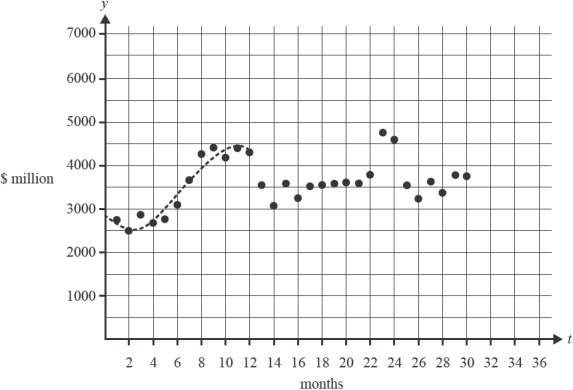
i. Find, correct to two decimal places, the values of \(a, b, c\) and \(d\). (3 mark)
\(f:(0,36] \rightarrow R, f(t)=3000+30 t+700 \cos \left(\dfrac{\pi t}{6}\right)+400 \cos \left(\dfrac{\pi t}{3}\right)\)
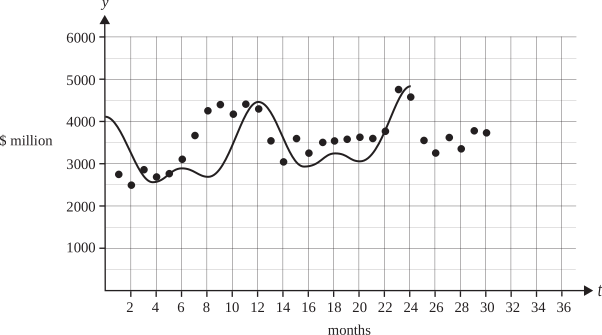
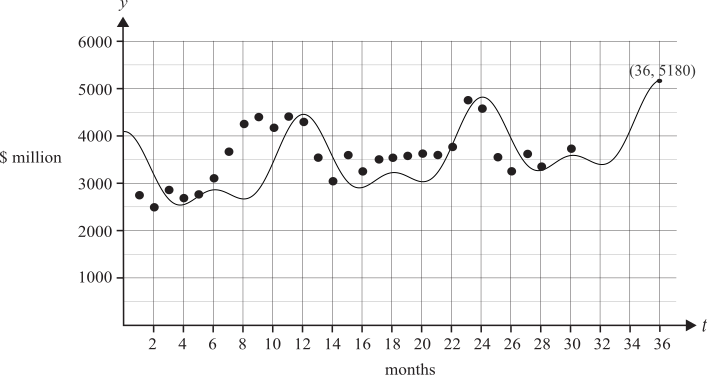
\(\text{Using CAS:}\)
\begin{cases}
8a+4b+2c+d=2500 \\
1331a+121b+11c+d=4400 \\
12a+4b+c=0 \\
363a+22b+c=0
\end{cases}\)
\(\therefore\ h\)
\(=23-11=12\)
\(k\)
\(=4750-4400=350\)
\(f(12)-f(0)\)
\(=4460-4100=360\)
\(f(24)-f(12)\)
\(=4820-4460=360\)
\(f(36)-f(24)\)
\(=5180-4820=360\)
biii.
\(f(t)\)
\(=3000+30t+700\cos\left(\dfrac{\pi t}{6}\right)+400\cos\left(\dfrac{\pi t}{3}\right)\)
\(f^{\prime}(t)\)
\(=30-\dfrac{700\pi}{6}\sin\left(\dfrac{\pi t}{6}\right)-\dfrac{400\pi}{3}\sin\left(\dfrac{\pi t}{3}\right)\)
\(=30-\dfrac{350\pi}{3}\sin\left(\dfrac{\pi t}{6}\right)-\dfrac{400\pi}{3}\sin\left(\dfrac{\pi t}{3}\right)\)
biv. \(\text{Max instantaneous rate of change occurs when }f^{\prime\prime}(t)=0\)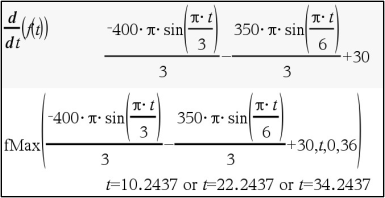
Calculus, MET2 2022 VCAA 2
On a remote island, there are only two species of animals: foxes and rabbits. The foxes are the predators and the rabbits are their prey.
The populations of foxes and rabbits increase and decrease in a periodic pattern, with the period of both populations being the same, as shown in the graph below, for all `t \geq 0`, where time `t` is measured in weeks.
One point of minimum fox population, (20, 700), and one point of maximum fox population, (100, 2500), are also shown on the graph.
The graph has been drawn to scale.
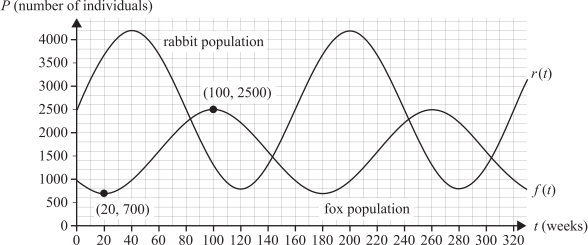
The population of rabbits can be modelled by the rule `r(t)=1700 \sin \left(\frac{\pi t}{80}\right)+2500`.
- i. State the initial population of rabbits. (1 mark)
--- 2 WORK AREA LINES (style=lined) ---
- ii. State the minimum and maximum population of rabbits. (1 mark)
--- 2 WORK AREA LINES (style=lined) ---
- iii. State the number of weeks between maximum populations of rabbits. (1 mark)
--- 2 WORK AREA LINES (style=lined) ---
The population of foxes can be modelled by the rule `f(t)=a \sin (b(t-60))+1600`.
- Show that `a=900` and `b=\frac{\pi}{80}`. (2 marks)
--- 4 WORK AREA LINES (style=lined) ---
- Find the maximum combined population of foxes and rabbits. Give your answer correct to the nearest whole number. (1 mark)
--- 1 WORK AREA LINES (style=lined) ---
- What is the number of weeks between the periods when the combined population of foxes and rabbits is a maximum? (1 mark)
--- 1 WORK AREA LINES (style=lined) ---
The population of foxes is better modelled by the transformation of `y=\sin (t)` under `Q` given by

- Find the average population during the first 300 weeks for the combined population of foxes and rabbits, where the population of foxes is modelled by the transformation of `y=\sin(t)` under the transformation `Q`. Give your answer correct to the nearest whole number. (4 marks)
--- 8 WORK AREA LINES (style=lined) ---
Over a longer period of time, it is found that the increase and decrease in the population of rabbits gets smaller and smaller.
The population of rabbits over a longer period of time can be modelled by the rule
`s(t)=1700cdote^(-0.003t)cdot sin((pit)/80)+2500,\qquad text(for all)\ t>=0`
- Find the average rate of change between the first two times when the population of rabbits is at a maximum. Give your answer correct to one decimal place. (2 marks)
--- 3 WORK AREA LINES (style=lined) ---
- Find the time, where `t>40`, in weeks, when the rate of change of the rabbit population is at its greatest positive value. Give your answer correct to the nearest whole number. (2 marks)
--- 3 WORK AREA LINES (style=lined) ---
- Over time, the rabbit population approaches a particular value.
- State this value. (1 mark)
--- 1 WORK AREA LINES (style=lined) ---
Calculus, MET1 2022 VCAA 8
Part of the graph of `y=f(x)` is shown below. The rule `A(k)=k \ sin(k)` gives the area bounded by the graph of `f`, the horizontal axis and the line `x=k`.
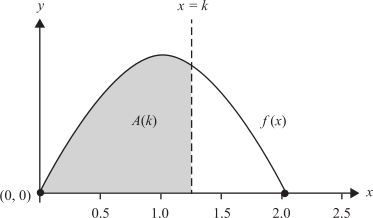
- State the value of `A\left(\frac{\pi}{3}\right)`. (1 mark)
--- 2 WORK AREA LINES (style=lined) ---
- Evaluate `f\left(\frac{\pi}{3}\right)`. (2 marks)
--- 6 WORK AREA LINES (style=lined) ---
- Consider the average value of the function `f` over the interval `x \in[0, k]`, where `k \in[0,2]`.
- Find the value of `k` that results in the maximum average value. (2 marks)
--- 6 WORK AREA LINES (style=lined) ---
Calculus, MET2 2021 VCAA 14 MC
A value of `k` for which the average value of `y = cos (kx - pi/2)` over the interval `[0, pi]` is equal to the average value of `y = sin(x)` over the same interval is
- `1/6`
- `1/5`
- `1/4`
- `1/3`
- `1/2`
Calculus, MET1 2016 VCAA 6b
Let `f : [-π, π] → R`, where `f (x) = 2 sin (2x)-1`.
Calculate the average value of `f` over the interval `-pi/3 <= x <= pi/6`. (3 marks)
--- 9 WORK AREA LINES (style=lined) ---
Algebra, MET2 2017 VCAA 2
Sammy visits a giant Ferris wheel. Sammy enters a capsule on the Ferris wheel from a platform above the ground. The Ferris wheel is rotating anticlockwise. The capsule is attached to the Ferris wheel at point `P`. The height of `P` above the ground, `h`, is modelled by `h(t) = 65-55cos((pit)/15)`, where `t` is the time in minutes after Sammy enters the capsule and `h` is measured in metres.
Sammy exits the capsule after one complete rotation of the Ferris wheel.
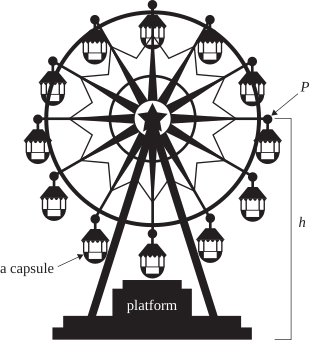
- State the minimum and maximum heights of `P` above the ground. (1 mark)
--- 2 WORK AREA LINES (style=lined) ---
- For how much time is Sammy in the capsule? (1 mark)
--- 2 WORK AREA LINES (style=lined) ---
- Find the rate of change of `h` with respect to `t` and, hence, state the value of `t` at which the rate of change of `h` is at its maximum. (2 marks)
--- 4 WORK AREA LINES (style=lined) ---
As the Ferris wheel rotates, a stationary boat at `B`, on a nearby river, first becomes visible at point `P_1`. `B` is 500 m horizontally from the vertical axis through the centre `C` of the Ferris wheel and angle `CBO = theta`, as shown below.

- Find `theta` in degrees, correct to two decimal places. (1 mark)
--- 3 WORK AREA LINES (style=lined) ---
Part of the path of `P` is given by `y = sqrt(3025-x^2) + 65, x ∈ [-55,55]`, where `x` and `y` are in metres.
- Find `(dy)/(dx)`. (1 mark)
--- 2 WORK AREA LINES (style=lined) ---
As the Ferris wheel continues to rotate, the boat at `B` is no longer visible from the point `P_2(u, v)` onwards. The line through `B` and `P_2` is tangent to the path of `P`, where angle `OBP_2 = alpha`.
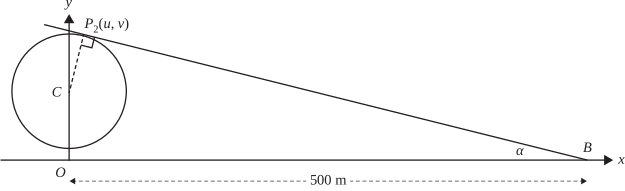
- Find the gradient of the line segment `P_2B` in terms of `u` and, hence, find the coordinates of `P_2`, correct to two decimal places. (3 marks)
--- 10 WORK AREA LINES (style=lined) ---
- Find `alpha` in degrees, correct to two decimal places. (1 mark)
--- 4 WORK AREA LINES (style=lined) ---
- Hence or otherwise, find the length of time, to the nearest minute, during which the boat at `B` is visible. (2 marks)
--- 5 WORK AREA LINES (style=lined) ---
Show Worked Solution
| a. | `h_text(min)` | `= 65-55` | `h_text(max)` | `= 65 + 55` |
| `= 10\ text(m)` | `= 120\ text(m)` |
b. `text(Period) = (2pi)/(pi/15) = 30\ text(min)`
c. `h^{prime}(t) = (11pi)/3\ sin(pi/15 t)`♦ Mean mark 50%.
MARKER’S COMMENT: A number of commons errors here – 2 answers given, calc not in radian mode, etc …
`text(Solve)\ h^{primeprime}(t) = 0, t ∈ (0,30)`
| `t = 15/2\ \ text{(max)}` | `text(or)` | `t = 45/2\ \ text{(min – descending)}` |
`:. t = 7.5`
| d. | 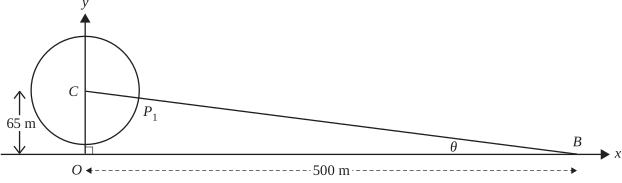 |
♦ Mean mark 36%.
MARKER’S COMMENT: Choosing degrees vs radians in the correct context was critical here.
| `tan(theta)` | `= 65/500` |
| `:. theta` | `=7.406…` |
| `= 7.41^@` |
| e. | `(dy)/(dx)` | `= (-x)/(sqrt(3025-x^2))` |
| f. | 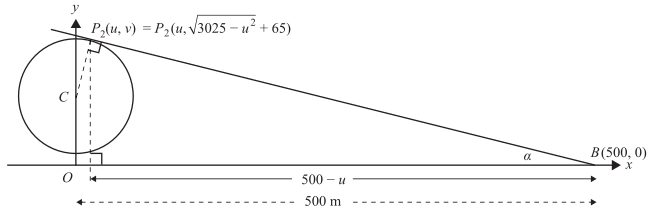 |
`P_2(u,sqrt(3025-u^2) + 65),\ \ B(500,0)`
| `:. m_(P_2B)` | `= (sqrt(3025-u^2) + 65)/(u-500)` |
`text{Using part (e), when}\ \ x=u,`♦♦♦ Mean mark part (f) 18%.
MARKER’S COMMENT: Many students were unable to use the rise over run information to calculate the second gradient.
`dy/dx=(-u)/(sqrt(3025-u^2))`
`text{Solve (by CAS):}`
| `(sqrt(3025-u^2) + 65)/(u-500)` | `= (-u)/(sqrt(3025-u^2))\ \ text(for)\ u` |
`u=12.9975…=13.00\ \ text{(2 d.p.)}`
| `:. v` | `= sqrt(3025-(12.9975…)^2) + 65` |
| `= 118.4421…` | |
| `= 118.44\ \ text{(2 d.p.)}` |
`:.P_2(13.00, 118.44)`
♦♦♦ Mean mark part (g) 7%.
| g. | `tan alpha` | `=v/(500-u)` |
| `= (118.442…)/(500-12.9975…)` | ||
| `:. alpha` | `= 13.67^@\ \ text{(2 d.p.)}` |
| h. | 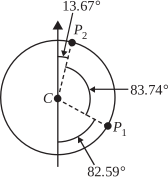 |
♦♦♦ Mean mark 5%.
`text(Find the rotation between)\ P_1 and P_2:`
`text(Rotation to)\ P_1 = 90-7.41=82.59^@`
`text(Rotation to)\ P_2 = 180-13.67=166.33^@`
`text(Rotation)\ \ P_1 → P_2 = 166.33-82.59 = 83.74^@`
| `:.\ text(Time visible)` | `= 83.74/360 xx 30\ text(min)` |
| `=6.978…` | |
| `= 7\ text{min (nearest degree)}` |
Calculus, MET2 2007 VCAA 20 MC
The average value of the function `y = tan (2x)` over the interval `[0, pi/8]` is
- `2/pi log_e (2)`
- `pi/4`
- `1/2`
- `4/pi log_e 2`
- `8/pi`
Calculus, MET2 2010 VCAA 10 MC
The average value of the function `f(x) = e^(2x) cos (3x)` for `0 <= x <= pi` is closest to
A. `– 82.5`
B. `26.3`
C. `– 26.3`
D. `– 274.7`
E. `pi`
Calculus, MET2 2012 VCAA 10 MC
The average value of the function `f: [0, 2 pi] -> R,\ f(x) = sin^2(x)` over the interval `[0, a]` is 0.4.
The value of `a`, to three decimal places, is
- `0.850`
- `1.164`
- `1.298`
- `1.339`
- `4.046`
Calculus, MET2 2012 VCAA 7 MC
The temperature, `T^@C`, inside a building `t` hours after midnight is given by the function
`f: [0, 24] -> R,\ T(t) = 22 - 10\ cos (pi/12 (t - 2))`
The average temperature inside the building between 2 am and 2 pm is
- `10°text(C)`
- `12°text(C)`
- `20°text(C)`
- `22°text(C)`
- `32°text(C)`