Let \(g(x)\) be a function defined so that \(g^{\prime}(x)=\dfrac{1}{2 x+3}\) and \(g(1)=0, \ x \in \left(-\frac{3}{2}, \infty\right).\)
Find \(g(x)\). (3 marks)
--- 8 WORK AREA LINES (style=lined) ---
Aussie Maths & Science Teachers: Save your time with SmarterEd
Let \(g(x)\) be a function defined so that \(g^{\prime}(x)=\dfrac{1}{2 x+3}\) and \(g(1)=0, \ x \in \left(-\frac{3}{2}, \infty\right).\)
Find \(g(x)\). (3 marks)
--- 8 WORK AREA LINES (style=lined) ---
\(g(x)=\dfrac{1}{2} \ln \left(\dfrac{2 x+3}{5}\right)\)
| \(g^{\prime}(x)\) | \(=\dfrac{1}{2 x+3}\) |
| \(g(x)\) | \(=\displaystyle \int \frac{1}{2 x+3}\,dx=\frac{1}{2} \int \frac{2}{2 x+3} \, dx=\frac{1}{2} \ln (2 x+3)+c\) |
\(\text{Given} \ \ g(1)=0:\)
\(\dfrac{1}{2} \ln(2+3)+c=0 \ \ \Rightarrow \ \ c=-\dfrac{1}{2} \ln 5\)
\(g(x)=\dfrac{1}{2} \ln (2 x+3)-\dfrac{1}{2} \ln 5=\dfrac{1}{2} \ln \left(\dfrac{2 x+3}{5}\right)\)
--- 3 WORK AREA LINES (style=lined) ---
--- 7 WORK AREA LINES (style=lined) ---
a. \(\dfrac{d y}{d x} =x+2 x\, \log _e x\)
b. \(\dfrac{e^2}{4}+\dfrac{1}{4}\)
a. \(y=x^2\, \log _e x\)
| \(\dfrac{d y}{d x}\) | \(=x^2 \cdot \dfrac{1}{x}+2 x\, \log _e x\) |
| \(=x+2 x\, \log _e x\) |
b. \(\text{Using part a.}\)
| \(\displaystyle \int x+2 x\, \log _e x\, d x\) | \(=x^2\, \log _e x+c\) | |
| \(\displaystyle \int x\, d x+2 \int x\, \log _e x\, d x\) | \(=x^2\, \log _e x+c\) |
| \(\displaystyle 2 \int_1^e x\, \log _e x\, d x\) | \(=\left[x^2\, \log _e x\right]_1^e-\displaystyle \int_1^e x\, d x\) |
| \(\displaystyle \int_1^e x\, \log _e x\, d x\) | \(=\dfrac{1}{2}\left[\left(e^2 \cdot 1\right)-0\right]-\dfrac{1}{2}\left[\dfrac{x^2}{2}\right]_1^e\) |
| \(=\dfrac{e^2}{2}-\left(\dfrac{e^2}{4}-\dfrac{1}{4}\right)\) | |
| \(=\dfrac{e^2}{4}+\dfrac{1}{4}\) |
--- 2 WORK AREA LINES (style=lined) ---
--- 5 WORK AREA LINES (style=lined) ---
--- 4 WORK AREA LINES (style=lined) ---
a. `text{Proof (See Worked Solutions)}`
b. `text{Proof (See Worked Solutions)}`
c. `text{Proof (See Worked Solutions)}`
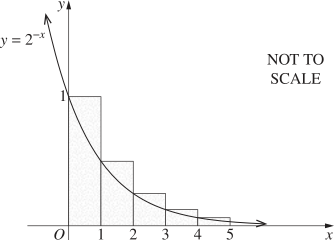
a. `text{Consider the rectangle heights:}`
`2^0=1, \ 2^(-1)=1/2, \ 2^(-2)= 1/4, \ 2^(-3)= 1/8, …`
`=>\ text{Rectangle Areas}\ = 1, \ 1/2, \ 1/4, \ 1/8, …`
`a=1,\ \ r=1/2`
`S_oo=a/(1-r)=1/(1-1/2)=2\ \ text{… as required}`
b. `text{Show}\ \ int_0^4 2^(-x)\ dx = 15/(16ln2)`
| `int_0^4 2^(-x)\ dx ` | `=(-1)/ln2[2^(-x)]_0^4` |
| `=(-1)/ln2(1/16-1)` | |
| `=1/ln2-1/(16ln2)` | |
| `=(16-1)/(16ln2)` | |
| `=15/(16ln2)\ \ text{… as required}` |
c. `text{Show}\ \ e^15<2^32`
`text{Area under curve < Sum of rectangle areas}`
| `15/(16ln2)` | `<2` | |
| `15` | `<32ln2` | |
| `15/32` | `<ln2` | |
| `e^(15/32)` | `<e^(ln2)` | |
| `root(32)(e^15)` | `<2` | |
| `e^15` | `<2^32\ \ text{… as required}` |
If `f^{′}(x)= (x^2)/(x^3 + 1)` and `f(1)= log_e 2,` find `f(x)`. (3 marks)
--- 6 WORK AREA LINES (style=lined) ---
`f(x) = 1/3 log_e(x^3 + 1) + 2/3 log_e 2`
| `f(x)` | `=int f^{prime}(x)\ dx` |
| `=int (x^2)/(x^3 + 1)\ dx` | |
| `= 1/3 int (3x^2)/(x^3 + 1)\ dx` | |
| `=1/3 log_e |(x^3 + 1)|+c` |
`text(S)text(ince)\ \ f(1)= log_e 2\ ,`
| `1/3 log_e 2+c` | `= log_e 2` |
| `c` | `=2/3 log_e 2` |
`:.\ f(x) = 1/3 log_e(x^3 + 1) + 2/3 log_e 2`
--- 4 WORK AREA LINES (style=lined) ---
--- 2 WORK AREA LINES (style=lined) ---
a. `4e^(2x)(x + 1)`
b. `1/4 e^(2x)(2x + 1) + c`
| a. | `y` | `= e^(2x) (2x + 1)` |
| `(dy)/(dx)` | `= 2e^(2x)(2x + 1) + 2e^(2x)` | |
| `= 2e^(2x)(2x + 2)` | ||
| `= 4e^(2x)(x + 1)` |
| b. | `int(x + 1)e^(2x)dx` | `= 1/4 int 4e^(2x)(x + 1)` |
| `= 1/4 e^(2x)(2x + 1) + c` |
Find `int x/(4 + x^2)\ dx`. (2 marks)
--- 3 WORK AREA LINES (style=lined) ---
`1/2 log_e (4 + x^2) + c`
| `int x/(4 + x^2)\ dx` | `= 1/2 int (2x)/(4 + x^2)\ dx` |
| `= 1/2 log_e (4 + x^2) + c` |
What is `int e + e^(3x)\ dx`?
`B`
`int e + e^(3x) = ex + 1/3e^(3x) + c`
`(text(Note)\ e\ text(is a simple constant here))`
`=> B`
Evaluate `int_0^1 e^x - e^-x\ dx`. (2 marks)
--- 3 WORK AREA LINES (style=lined) ---
`e + (1)/(e)-2`
| `int_0^1 e^x-e^-x\ dx` | `= [e^x + e^-x]_0^1` |
| `= [e + (1)/(e)-(1 + 1)]` | |
| `= e + (1)/(e)-2` |
If `m = int_1^3 (2)/(x)\ dx`, express `e^m` in its simplest form. (2 marks)
--- 5 WORK AREA LINES (style=lined) ---
`9`
| `int_1^3 (2)/(x)\ dx` | `= [2 log_e x]_1^3` |
| `m` | `= 2 log_e 3-2 log_e 1` |
| `= 2 log_e 3` | |
| `:. e^m` | `=e^(2 log_e 3)` |
| `= e^(log_e 9)` | |
| `= 9` |
Evaluate `int_0^3 (8x)/(1 + x^2) \ dx`. (3 marks)
--- 6 WORK AREA LINES (style=lined) ---
`4 log_e 10`
`int_0^3 (8x)/(1 + x^2) \ dx`
`= 4 int_0^3 (2x)/(1 + x^2) \ dx`
`= 4 [log_e (1 + x^2)]_0^3`
`= 4 [log_e (1 + 9)-log_e (1 + 0)]`
`= 4 [log_e 10-log_e 1]`
`= 4 log_e 10`
--- 4 WORK AREA LINES (style=lined) ---
--- 2 WORK AREA LINES (style=lined) ---
i. `(2 ln x)/x`
ii. `1/2 (ln x)^2 + C`
i. `y= (ln x)^2`
`(dy)/(dx)= 2 xx 1/x xx ln x= (2 ln x)/x`
ii. `int (ln x)/x\ dx=1/2 int (2 ln x)/x dx= 1/2 (ln x)^2 +C`
Evaluate `int_0^3 e^(5x)\ dx`. (2 marks)
--- 4 WORK AREA LINES (style=lined) ---
`1/5(e^15-1)`
| `int_0^3 e^(5x)\ dx` | `= [1/5 e^(5x)]_0^3` |
| `= 1/5 e^15-1/5 e^0` | |
| `= 1/5(e^15-1)` |
--- 2 WORK AREA LINES (style=lined) ---
--- 4 WORK AREA LINES (style=lined) ---
a. `e^(3x) (1 + 3x)`
b. `6e^6`
a. `y = xe^(3x)`
`text(Using product rule:)`
`(dy)/(dx)= x · 3e^(3x) + 1 · e^(3x)= e^(3x) (1 + 3x)`
b. `int_0^2 e^(3x) (3 + 9x)\ dx`
`= 3 int_0^2 e^(3x) (1 + 3x)\ dx`
`= 3 [x e^(3x)]_0^2`
`= 3 (2e^6-0)= 6e^6`
Find `int x/(x^2-3)\ dx`. (2 marks)
--- 3 WORK AREA LINES (style=lined) ---
`1/2 ln (x^2-3) + C`
`int x/(x^2-3)\ dx`
`= 1/2 int (2x)/(x^2-3)\ dx`
`= 1/2 ln (x^2-3) + C`
Evaluate `int_1^2 e^(3x)\ dx`. (2 marks)
--- 2 WORK AREA LINES (style=lined) ---
`1/3 (e^6-e^3)`
| `int_1^2 e^(3x)\ dx` | `= 1/3 [e^(3x)]_1^2` |
| `= 1/3 (e^6-e^3)` |
Find `int 1 + e^(7x)\ dx`. (2 marks)
--- 2 WORK AREA LINES (style=lined) ---
`x + 1 /7 e^(7x) + c`
`int 1 + e^(7x) \ dx = x + 1/7 e^(7x) + c`
Find `int (6x^2)/(x^3 + 1)\ dx`. (2 marks)
--- 5 WORK AREA LINES (style=lined) ---
`2\ ln\ (x^3 + 1) +C`
| `int (6x^2)/(x^3 + 1)\ dx` | `= 2 int (3x^2)/(x^3 + 1)\ dx` |
| `= 2 ln\ (x^3 + 1) + C` |
Find `int (dx)/(x+5)`. (1 mark)
--- 1 WORK AREA LINES (style=lined) ---
`ln (x + 5) + C`
`int (dx)/(x + 5)`
`= ln (x + 5) + C`
Which expression is equal to `int e^(2x)\ dx`?
`C`
`int e^(2x)\ dx= 1/2 e^(2x) + C`
`=> C`
Evaluate `int_e^(e^3) 5/x\ dx` (2 marks)
--- 5 WORK AREA LINES (style=lined) ---
`10`
`int_e^(e^3) 5/x\ dx`
`=5int_e^(e^3) 1/x\ dx`
`=5[lnx]_e^(e^3)`
`=5(lne^3-lne)`
`=5(3-1)=10`
Find `int(4x)/(x^2+6)\ dx`. (2 marks)
--- 3 WORK AREA LINES (style=lined) ---
`2ln(x^2+6)+C`
`int(4x)/(x^2+6)\ dx`
`=2int(2x)/(x^2+6)\ dx`
`=2ln(x^2+6)+C`
What is the value of `int_1^4 1/(3x)\ dx`?
`B`
`int_1^4 1/(3x)dx`
`=1/3[lnx]_1^4`
`=1/3[ln4-ln1]`
`=1/3ln4`
`=>B`
Evaluate `int_0^1x^2/(x^3+1)\ dx` (3 marks)
--- 5 WORK AREA LINES (style=lined) ---
`1/3ln2`
`int_0^1x^2/(x^3+1)dx`
`=1/3int_0^1(3x^2)/(x^3+1)dx`
`=1/3[ln(x^3+1)]_0^1`
`=1/3(ln2-ln1)`
`=1/3ln2`
Find `inte^(4x+1)dx` (2 marks)
--- 2 WORK AREA LINES (style=lined) ---
`1/4e^(4x+1)+C`
`inte^(4x+1)\ dx=1/4e^(4x+1)+C`