Find the global maximum and minimum values of `y=x^(3)-6x^(2)+8`, where `-1 <= x <= 7`. (4 marks)
--- 8 WORK AREA LINES (style=lined) ---
Aussie Maths & Science Teachers: Save your time with SmarterEd
Find the global maximum and minimum values of `y=x^(3)-6x^(2)+8`, where `-1 <= x <= 7`. (4 marks)
--- 8 WORK AREA LINES (style=lined) ---
Sketch the graph of the curve `y =-x^3 + 3x^2-1`, labelling the stationary points and point of inflection. Do NOT determine the `x`-intercepts of the curve. (4 marks)
--- 20 WORK AREA LINES (style=lined) ---
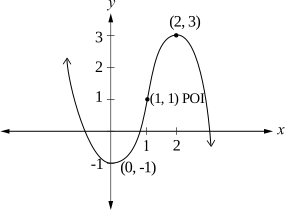
`y=-x^3 + 3x^2-1`
`(dy)/(dx)=-3x^2 + 6x`
`(d^2y)/(dx^2)=-6x + 6`
`text(SP’s when)\ (dy)/(dx) = 0`
| `-3x^2 + 6x` | `= 0` |
| `-3x(x-2)` | `= 0` |
`:.\ x = 0\ \ text(or)\ \ 2`
`text(When)\ \ x = 0,`
`y =-1`
`(d^2 y)/(dx^2) = 6 > 0`
`:. text(MIN at)\ \ (0,-1)`
`text(When)\ \ x = 2,`
`y=-8 + 12-1 = 3`
`(d^2y)/(dx^2)=-6 xx 2 + 6 =-6 < 0`
`:. text(MAX at)\ \ (2, 3)`
`(d^2y)/(dx^2) = 0\ text(when)`
| `-6x + 6` | `= 0` |
| `x` | `= 1` |
`text(Checking change of concavity)`
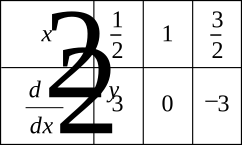
`text(Concavity changes either side of)\ x = 1`
`:.\ text(POI at)\ (1, 1)`
The derivative of a function `y = f(x)` is given by `f^{prime}(x) = 3x^2 + 2x-1`.
--- 6 WORK AREA LINES (style=lined) ---
Find an expression for `f(x)`. (2 marks)
--- 4 WORK AREA LINES (style=lined) ---
--- 8 WORK AREA LINES (style=lined) ---
--- 2 WORK AREA LINES (style=lined) ---
a. `f^{prime}(x) = 3x^2 + 2x-1`
`f^{primeprime}(x) = 6x + 2`
`text(S.P.’s when)\ \ f^{prime}(x) = 0`
| `3x^2 + 2x-1` | `= 0` |
| `(3x-1)(x + 1)` | `= 0` |
`x = 1/3 or -1`
`text(When)\ x = 1/3,`
`f^{primeprime}(x) = 4 > 0 ->\ text(MIN)`
`text(When)\ x =-1,`
`f^{primeprime}(x)=-4 < 0 ->\ text(MAX)`
| b. | `f(x)` | `= int f^{prime}(x)\ dx` |
| `= int 3x^2 + 2x-1\ dx` | ||
| `= x^3 + x^2-x + c` |
`(0, 4)\ \ text(lies on)\ \ f(x)\ \ =>\ \ c = 4`
`:. f(x) = x^3 + x^2-x + 4`
| c. | `text(When)\ \ x =-1,\ \ y = 5` |
| `text(When)\ \ x = 1/3,\ \ y = 103/27` |
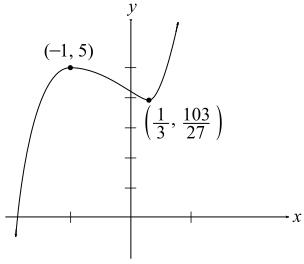
d. `text(Concave down when)\ f^{primeprime}(x) < 0`♦ Mean mark (d) 36%.
| `6x + 2` | `< 0` |
| `6x` | `<-2` |
| `x` | `<-1/3` |
Let `f(x) = x^3 + kx^2 + 3x-5`, where `k` is a constant.
Find the values of `k` for which `f(x)` has NO stationary points. (3 marks)
--- 6 WORK AREA LINES (style=lined) ---
`f(x) = x^3 + kx^2 + 3x-5`♦ Mean mark 49%.
`f^{prime}(x) = 3x^2 + 2kx + 3`
`text(No S.P.’s exist if)\ f^{prime}(x)\ text(has no roots,)`
| `Delta` | `< 0` |
| `b^2-4ac` | `< 0` |
| `(2k)^2-4 xx 3 xx 3` | `< 0` |
| `4k^2-36` | `< 0` |
| `k^2-9` | `< 0` |
| `(k-3) (k + 3)` | `< 0` |
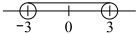
`:. -3 < k < 3`
Consider the curve `y = 6x^2-x^3`.
--- 6 WORK AREA LINES (style=lined) ---
--- 4 WORK AREA LINES (style=lined) ---
--- 8 WORK AREA LINES (style=blank) ---
i. `y = 6x^2-x^3`
`(dy)/(dx) = 12x-3x^2`
`(d^2y)/(dx^2) = 12-6x`
`text(S.P.s occur when)\ \ (dy)/(dx) = 0`
`12x-3x^2 = 0`
`3x(4-x) = 0`
`:.\ x = 0 or 4`
`text(When)\ \ x = 0,\ \ (d^2y)/(dx^2) > 0`
`:.\ text(MIN at)\ (0, 0)`
`text(When)\ \ x = 4,\ \ (d^2y)/(dx^2) < 0`
`:.\ text(MAX at)\ (4, 32)`
ii. `text(P.I. occur when)\ \ (d^2y)/(dx^2) = 0,`
| `12-6x` | `= 0` |
| `x` | `= 2` |
`text(When)\ \ x = 2,\ y = 16`
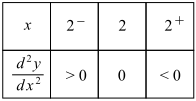
`text(S)text(ince the concavity changes)`
`->\ text(P.I. occurs at)\ \ (2, 16)`
| iii. | 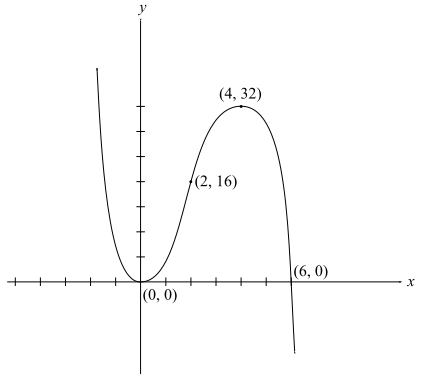 |
Consider the curve `y = 2x^3 + 3x^2-12x + 7`.
--- 8 WORK AREA LINES (style=lined) ---
--- 8 WORK AREA LINES (style=lined) ---
--- 1 WORK AREA LINES (style=lined) ---
i. `text(maximum at)\ (-2, 27)`
`text(minimum at)\ (1, 0)`
| ii. | 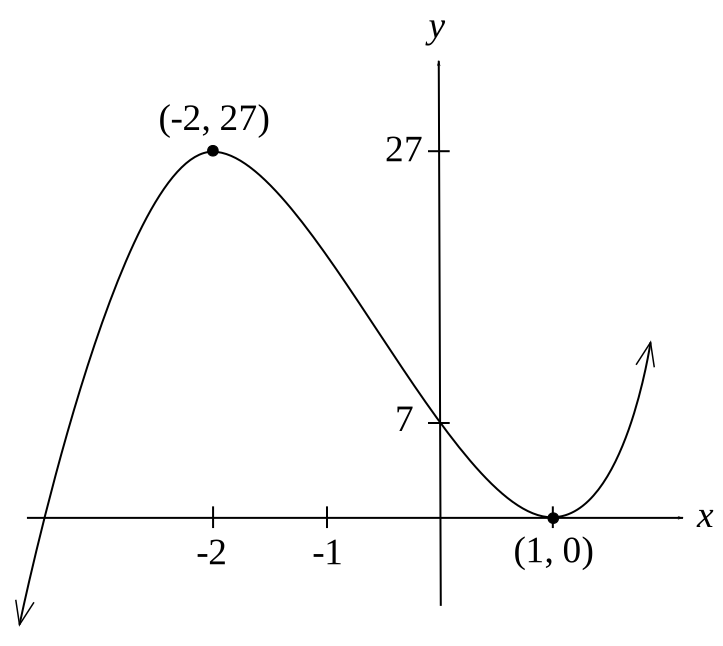 |
iii. `x <-2 and x > 1`
i. `y=2x^3 + 3x^2-12x + 7`
`(dy)/(dx)= 6x^2 + 6x-12`
`(d^2y)/(dx^2)= 12x + 6`
`text(S.P. when)\ (dy)/(dx)=0`
| `6x^2 + 6x-12` | `= 0` |
| `x^2 + x-2` | `= 0` |
| `(x + 2) (x-1)` | `= 0` |
`:.\ x =-2 or 1`
`text(When)\ \ x =-2,\ \ (d^2y)/(dx^2) < 0`
`:.\ text(MAX at)\ (-2, 27)`
`text(When)\ \ x = 1, (d^2y)/(dx^2) > 0`
`:.\ text(MIN at)\ (1, 0)`
| ii. | |
iii. `text(Solution 1)`
`text(From graph, gradient is positive for)`
`x <-2 and x > 1`
`:. (dy)/(dx) > 0\ \ text(for)\ \ x <-2 and x > 1`
`text(Solution 2)`
`(dy)/(dx) > 0`
| `6x^2 + 6x-12` | `> 0` |
| `(x + 2) (x-1)` | `> 0` |
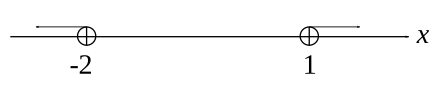
`:. x <-2 and x > 1`
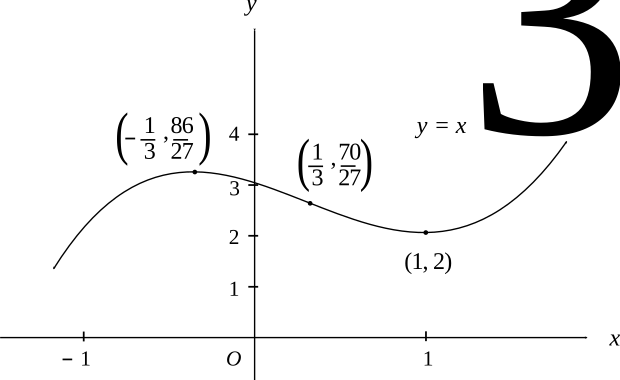
Consider the curve `y = x^3-x^2-x + 3`.
--- 8 WORK AREA LINES (style=lined) ---
--- 5 WORK AREA LINES (style=lined) ---
--- 8 WORK AREA LINES (style=lined) ---
a. `text(MAX at)\ (-1/3, 86/27); \ text(MIN at)\ (1, 2)`
b. `text(Proof)\ \ text{(See Worked Solutions)}`
c.
| a. | `y` | `= x^3- x^2-x + 3` |
| `(dy)/(dx)` | `= 3x^2-2x-1` | |
| `(d^2y)/(dx^2)` | `= 6x-2` |
`text(S.P.’s when)\ (dy)/(dx) = 0`
| `3x^2-2x-1` | `= 0` |
| `(3x + 1) (x-1)` | `= 0` |
`x =-1/3 or 1`
`text(When)\ \ x =-1/3`
| `f(-1/3)` | `= (-1/3)^3-(-1/3)^2-(-1/3) + 3` |
| `=-1/27-1/9 + 1/3 + 3= 86/27` |
`f^{primeprime}(-1/3)= (6 xx-1/3)-2 =-4 < 0`
`:.\ text(MAX at)\ \ (-1/3, 86/27)`
`text(When)\ \ x = 1`
| `f(1)` | `= 1^3-1^2-1 + 3 =2` |
| `f^{primeprime}(1)` | `= (6 xx 1)-2 = 4 > 0` |
`:.\ text(MIN at)\ \ (1, 2)`
b. `(d^2y)/(dx^2) = 0\ \ text(when)`
| `6x-2` | `=0` |
| `x` | `=1/3` |
`text(Checking change of concavity)`
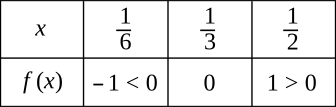
`text(Concavity changes either side of)\ x = 1/3`
`:.\ (1/3, 70/27)\ \ text(is a P.I.)`
| c. `text(When)\ \ x` | `= 0` |
| `y` | `= 3` |
Consider the function `f(x) = x^3-3x^2`.
--- 6 WORK AREA LINES (style=lined) ---
--- 8 WORK AREA LINES (style=lined) ---
--- 5 WORK AREA LINES (style=lined) ---
a. `text(MAX at)\ (0,0),\ \ text(MIN at)\ (2,-4)`
b.

c. `f(x)\ text(is concave up when)\ x>1`
| a. | `f(x)` | `= x^3-3x^2` |
| `f^{prime}(x)` | `= 3x^2-6x` | |
| `f^{primeprime}(x)` | `= 6x-6` |
`text(S.P.’s when)\ \ f'(x) = 0`
| `3x^2-6x` | `= 0` |
| `3x (x-2)` | `= 0` |
`:.\ x= 0\ \ text(or)\ \ 2`
`text(When)\ x = 0`
| `f(0)` | `= 0` |
| `f^{primeprime}(0)` | `= 0-6 =-6 < 0` |
`:.\ text(MAX at)\ (0,0)`
`text(When)\ x = 2`
| `f(2)` | `= 2^3-(3 xx 4) =-4` |
| `f^{primeprime}(2)` | `= (6xx 2-6 = 6 > 0` |
`:.\ text(MIN at)\ (2, -4)`
b. `f(x) = x^3-3x^2\ text(meets the)\ x text(-axis when)\ f(x) = 0`
| `x^3-3x^2` | `= 0` |
| `x^2 (x-3)` | `= 0` |
`:.\ x= 0\ \ text(or)\ \ 3`
c. `f(x)\ text(is concave up when)`
| `f^{primeprime}(x)` | `>0` |
| `6x-6` | `>0` |
| `6x` | `>6` |
| `x` | `>1` |
`:. f(x)\ text(is concave up when)\ \ x>1`
A function `f(x)` is defined by `f(x) = (x + 3)(x^2-9)`.
--- 4 WORK AREA LINES (style=lined) ---
--- 8 WORK AREA LINES (style=lined) ---
--- 8 WORK AREA LINES (style=lined) ---
--- 2 WORK AREA LINES (style=lined) ---
| a. | `f(x)` | `= (x + 3)(x^2-9)` |
| `= (x + 3)(x +3)(x-3)` | ||
| `:. f(x)` | `= 0\ text(when)\ \ x=-3\ text(or)\ 3` |
| b. | `f (x)` | `= (x +3)(x^2-9)` |
| `= x^3-9x + 3x^2-27` | ||
| `= x^3 + 3x^2-9x-27` | ||
| `f^{prime}(x)` | `= 3x^2 + 6x-9` | |
| `f^{primeprime}(x)` | `= 6x + 6` |
`text(S.P.’s when)\ \ f^{prime}(x) = 0`
| `3x^2 + 6x-9` | `= 0` |
| `3(x^2 + 2x-3)` | `= 0` |
| `3(x-1)(x + 3)` | `= 0` |
`text(At)\ x =1`
| `f(1)` | `= (4)(-8)=-32` |
| `f^{primeprime}(1)` | `= 6 + 6=12>0` |
`:.\ text(MIN at)\ (1, -32)`
`text(At)\ x =-3`
| `f(-3)` | `= 0` |
| `f^{primeprime}(-3)` | `= (6 xx-3) + 6 =-12 <0` |
`:.\ text(MAX at)\ (-3, 0)`
| c. |  |
d. `f(x)\ \ text(is concave down when)`
| `f^{primeprime}(x)` | `< 0` |
| `6x + 6` | `< 0` |
| `6x` | `<-6` |
| `x` | `<-1` |
A function `f(x)` is defined by `f(x) =2x^2(3-x)`.
--- 6 WORK AREA LINES (style=lined) ---
--- 2 WORK AREA LINES (style=lined) ---
--- 8 WORK AREA LINES (style=lined) ---
--- 2 WORK AREA LINES (style=lined) ---
a. `text(Min)\ (0, 0),\ text(Max)\ (2, 8)`
b. `text(P.I. at)\ (1, 4)`
c.

d. `-32`
| a. | `f(x)` | `= 2x^2 (3-x)` |
| `= 6x^2-2x^3` | ||
| `f^{prime} (x)` | `= 12x-6x^2` | |
| `f^{primeprime}(x)` | `= 12-12x` |
`text(S.P.’s when)\ f^{prime}(x) = 0`
| `12x-6x^2` | `= 0` |
| `6x(2-x)` | `= 0` |
`x = 0 or 2`
`text(When)\ x = 0`
| `f(0)` | `= 0` |
| `f^{primeprime}(0)` | `= 12-0 = 12 > 0` |
`:.\ text(MIN at)\ (0, 0)`
`text(When)\ x = 2`
| `f(2)` | `= 2 xx 2^2 (3-2)` | `= 8` |
| `f^{primeprime}(2)` | `= 12-(12 xx 2)` | `= -12 < 0` |
`:.\ text(MAX at)\ (2, 8)`
b. `text(P.I. when)\ f^{primeprime}(x) = 0`
| `12-12x` | `= 0` |
| `12x` | `= 12` |
| `x` | `= 1` |
| `f^{primeprime}(0.5)` | `=6>0` |
| `f^{primeprime}(1.5)` | `=-6<0` |
`text(S)text(ince concavity changes)\ \ ->\ text(P.I. exists)`
`f(1)= 2 xx 1^2(3-1)=4\ \ :.\ text(P.I. at)\ (1, 4)`
c. `f(x)\ text(meets)\ x text(-axis when)\ f(x) = 0`
`2x^2 xx (3-x) = 0`
`x = 0 or 3`
d. `text(The graph clearly shows that in the given range)`
`-1<= x<=4,\ text(the minimum will occur when)\ x = 4`
| `:.\ text(Minimum` | `= 2 xx 4^2 (3-4)` |
| `= -32` |
`text(Let)\ \ f(x) = x-(x^2)/2 + (x^3)/3`
--- 4 WORK AREA LINES (style=lined) ---
--- 3 WORK AREA LINES (style=lined) ---
--- 2 WORK AREA LINES (style=lined) ---
ii. Let `g(x) = ln (1 + x)`.
Use the result in part c.i. to show that `f^{prime} (x) >= g ^{prime}(x)` for all `x >= 0`. (2 marks)
--- 5 WORK AREA LINES (style=lined) ---
--- 8 WORK AREA LINES (style=lined) ---
--- 5 WORK AREA LINES (style=lined) ---
--- 5 WORK AREA LINES (style=lined) ---
a. `text{Proof (See Worked Solutions)}`
b. `(1/2, 5/12)`
c.i. `text{Proof (See Worked Solutions)}`
c.ii. `text{Proof (See Worked Solutions)}`
d.

e. `text{Proof (See Worked Solutions)}`
f. `1 5/12-2ln2\ \ text(u²)`
a. `f(x) = x-(x^2)/2 + (x^3)/3`
`text(Turning points when)\ f^{prime} (x) = 0`
`f^{prime}(x) = 1-x + x^2`
`x^2-x + 1 = 0`
| `text(S)text(ince)\ \ Delta` | `= b^2-4ac` |
| `= (-1)^2-4 xx 1 xx 1` | |
| `= -3 < 0 => text(No solution)` |
`:.\ f(x)\ text(has no turning points)`
b. `text(P.I. when)\ f^{prime prime}(x) = 0`
| `f^{prime prime}(x)` | `=-1 + 2x = 0` |
| `2x` | `= 1` |
| `x` | `= 1/2` |
`text(Check for change in concavity)`
| `f^{prime prime}(1/4)` | `=-1/2 < 0` |
| `f^{prime prime}(3/4)` | `= 1/2 > 0` |
`=>\ text(Change in concavity)`
`:.\ text(P.I. at)\ \ x = 1/2`
| `f(1/2)` | `= 1/2-((1/2)^2)/2 + ((1/2)^3)/3` |
| `= 1/2-1/8 + 1/24` | |
| `= 5/12` |
`:.\ text(Point of Inflection at)\ (1/2, 5/12)`
c.i. `text(Show)\ 1- x + x^2-1/(1 + x) = (x^3)/(1 + x),\ \ \ x !=-1`
| `text(LHS)` | `= (1+x)/(1+x)-(x(1+x))/(1+x) + (x^2(1+x))/((1+x))-1/(1+x)` |
| `= (1 + x-x-x^2 + x^2 + x^3-1)/(1+x)` | |
| `= (x^3)/(1+x)\ \ \ text(… as required)` |
c.ii. `text(Let)\ g(x) = ln(1+x)`
`g^{prime} (x) = 1/(1 + x)`
| `f^{prime} (x)-g^{prime} (x)` | `= 1-x + x^2-1/(1+x)` |
| `= (x^3)/(1 + x)\ \ text{(using part (i))}` |
`text(S)text(ince)\ (x^3)/(1 + x) >= 0\ text(for)\ x >= 0`
`f^{prime}(x)-g^{prime}(x) >= 0`
`f^{prime}(x) >= g^{prime}(x)\ text(for)\ x >= 0`
| d. |
|
e. `text(Show)\ d/(dx) [(1 + x) ln (1 + x)-(1 + x)] = ln (1 + x)`
`text(Using)\ d/(dx) uv=uv^{prime}+vu^{prime}`
| `text(LHS)` | `= (1+x) xx 1/(1 + x) + ln(1+x)xx1 +-1` |
| `= 1+ ln(1+x)-1` | |
| `= ln(1+x)` | |
| `=\ text(RHS … as required)` |
| f. | `text(Area)` | `= int_0^1 f(x)-g(x)\ dx` |
| `= int_0^1 (x-(x^2)/2 + (x^3)/3-ln(x+1))\ dx` | ||
| `= [x^2/2-x^3/6 + (x^4)/12-(1 + x) ln (1+x) + (1+x)]_0^1` | ||
| `text{(using part (e) above)}` | ||
| `= [(1/2-1/6 + 1/12-(2)ln2 + 2)-(ln1 + 1)]` | ||
| `= 5/12-2ln2 + 2-1` | ||
| `= 1 5/12-2 ln 2\ \ text(u²)` |
Let `f(x) = x^3-3x^2 + kx + 8`, where `k` is a constant.
Find the values of `k` for which `f(x)` is an increasing function. (2 marks)
--- 5 WORK AREA LINES (style=lined) ---
Let `f(x) = (x + 2)(x^2 + 4)`.
--- 5 WORK AREA LINES (style=lined) ---
--- 5 WORK AREA LINES (style=lined) ---
--- 8 WORK AREA LINES (style=lined) ---
a. `text(Proof) text{(See Worked Solutions)}`
b. `f(x)\ text(is concave down when)\ x <-2/3`
c. `f(x)\ text(is concave up when)\ x >-2/3`

a. `text(Need to show no S.P.’s)`
| `f(x)` | `= (x+2)(x^2 + 4)` |
| `=x^3 + 2x^2 + 4x + 8` | |
| `f^{prime}(x)` | `= 3x^2 + 4x + 4` |
`text(S.P.s occur when)\ \ f^{prime}(x) =0,`
`3x^2 + 4x + 4 =0`
| `Delta` | `= b^2-4ac` |
| `=4^2-(4 xx 3 xx 4)` | |
| `=16-48` | |
| `=-32 < 0` |
`text(S)text(ince)\ \ Delta < 0,\ \ text(No Solution)`
`:.\ text(No S.P.’s for)\ \ f(x)`
b. `f(x)\ text(is concave down when)\ f^{primeprime}(x) < 0`
`f^{primeprime}(x) = 6x + 4`
| `-> 6x + 4` | `< 0` |
| `6x` | `< -4` |
| `x` | `< -2/3` |
`:.\ f(x)\ text(is concave down when)\ x <-2/3`
`f(x)\ text(is concave up when)\ f^{primeprime}(x) > 0`
`f^{primeprime}(x) = 6x + 4`
| `-> 6x + 4` | `> 0` |
| `6x` | `> -4` |
| `x` | `> -2/3` |
`:. f(x)\ text(is concave up when)\ x > -2/3`
c. `y text(-intercept) =2 xx4=8`
`x text(-intercept)=–2`
Let `f(x) = x^3-3x + 2`.
--- 8 WORK AREA LINES (style=lined) ---
--- 2 WORK AREA LINES (style=lined) ---
--- 8 WORK AREA LINES (style=blank) ---
a. `text(MIN at)\ \ (1,0);\ text(MAX at)\ \ (-1,4)`
b.

| a. | `f(x)` | `= x^3-3x + 2` |
| `f^{prime}(x)` | `= 3x^2-3` | |
| `f^{primeprime}(x)` | `=6x` |
`text(Stationary points when)\ f^{prime}(x) = 0`
| `3x^2-3` | `=0` |
| `3 (x^2-1)` | `= 0` |
| `:. x^2` | `=1` |
| `x` | `=+- 1` |
`text(When)\ x = 1`
| `f(1)` | `= 1-3 + 2 = 0` |
| `f^{primeprime}(1)` | `= 6 > 0` |
`:.\ text(MIN S.P. at)\ \ (1,0)`
`text(When)\ \ x=-1`
| `f(-1)` | `= -1 + 3 + 2 = 4` |
| `f^{primeprime}(-1)` | `= -6 < 0` |
`:.\ text(MAX S.P. at)\ \ (-1,4)`
| b. | `y = x^3-3x + 2` |
| `y text(-intercept) = 2` |