SmarterEd

Aussie Maths & Science Teachers: Save your time with SmarterEd

  • Login
  • Get Help
  • About

Mechanics, EXT2 2019 SPEC1 9

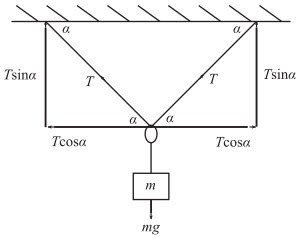
  1. A light inextensible string is connected at each end to a horizontal ceiling. A mass of `m` kilograms hangs in equilibrium from a smooth ring on the string, as shown in the diagram below. The string makes an angle `alpha` with the ceiling.
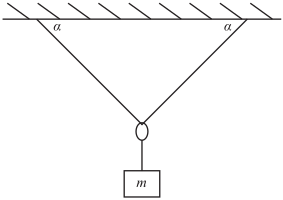
     

  1. Express the tension, `T` newtons, in the string in terms of `m`, `g` and `alpha`.   (1 mark)

    --- 3 WORK AREA LINES (style=lined) ---

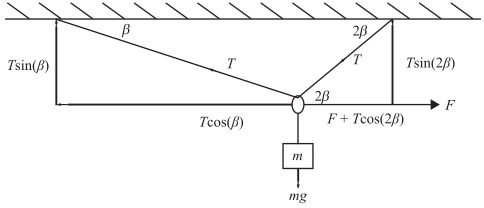
  2. A different light inextensible sting is connected at each end to a horizontal ceiling. A mass of `m` kilograms hangs from a smooth ring on the string. A horizontal force of `F` newtons is applied to the ring. The tension in the sting has a constant magnitude and the system is in equilibrium. At one end the string makes an angle `beta` with the ceiling and at the other end the string makes an angle `2beta` with the ceiling, as shown in the diagram below.
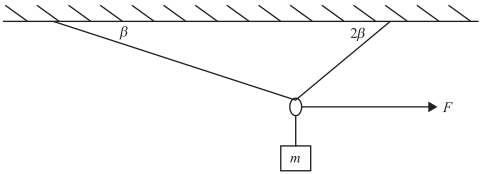
     

  1. Show that  `F = mg((1-cos(beta))/(sin(beta)))`.   (3 marks)

    --- 10 WORK AREA LINES (style=lined) ---

Show Answers Only

a.   `T = (mg)/(2sinalpha)`

b.    `text(See Worked Solutions)`

Show Worked Solution
a.   
`2 xx Tsinalpha` `= mg`
`:.T` `= (mg)/(2sinalpha)`


b.   

`text(Resolving forces vertically:)`

`Tsin(beta) + Tsin(2beta)` `= mg`
`T` `= (mg)/(sin(beta) + sin(2beta))`

`text(Resolving forces horizontally:)`

`F + Tcos(2beta)` `= Tcos(beta)`
`F` `= Tcos(beta)-Tcos(2beta)`
  `= T(cos(beta)-cos(2beta))`
  `= T[cos(beta)-(2cos^2beta-1)]`
  `= T(−2cos^2(beta) + cos(beta) + 1)`
  `= T(−2cos(beta)-1)(cos(beta)-1)`
  `= (mg(1 -cos(beta))(2cosbeta + 1))/(sin(beta) + 2sin(beta)cos(beta))`
  `= (mg(1-cos(beta))(2cos(beta) + 1))/(sin(beta)(1+2cos(beta)))`
  `= mg((1-cos(beta))/(sin(beta)))`

Filed Under: Forces and Further Motion in a Straight Line Tagged With: Band 4, Band 5, smc-7437-50-Resolving Forces

Mechanics, EXT2 EQ-Bank 30

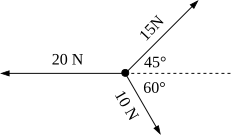
A mass is acted upon by three forces (as shown in the diagram below). Express the resultant force using the standard unit vectors \(\mathbf{i}\) and \(\mathbf{j}\) in the horizontal and vertical directions, and hence calculate the size of the resultant force acting on the mass. Describe the direction of this resultant force.   (4 marks)

--- 5 WORK AREA LINES (style=lined) ---

Show Answers Only


Show Worked Solution

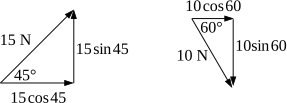
\(\text{Resolving forces into \(\mathbf{i}\) and \(\mathbf{j}\) components}\)

\(\text{Resultant}\)

\(\text{Force:}\)

\(F\) \(=(-20+15 \cos 45+10 \cos 60) \mathbf{i}+(15 \sin 45-10 \sin 60)\mathbf{j}\)
  \(=\left(\dfrac{15 \sqrt{2}}{2}-15\right)\mathbf{i}+\left(\dfrac{15 \sqrt{2}}{2}-5 \sqrt{3}\right)\mathbf{j}\)
\(\abs{F}\) \(=\sqrt{\left(\dfrac{3 \sqrt{2}}{2}-15\right)^2+\left(\dfrac{5 \sqrt{2}}{2}-5 \sqrt{3}\right)^2} =4.805 \cdots=4.81 \ N\)


\(\text{Direction}\):

\(\tan \theta\) \(=\dfrac{\frac{15 \sqrt{2}}{2}-5 \sqrt{3}}{\frac{15 \sqrt{2}}{2}-15}=-0.443 \ldots\)
\(\theta\) \(=180-23.89=156^{\circ}\)


\(\text{i.e.} \ 156^{\circ} \ \text{direction measured from the \(x\)-axis}\)

Filed Under: Forces and Further Motion in a Straight Line Tagged With: Band 5, smc-7437-50-Resolving Forces

Mechanics, EXT2 EQ-Bank 22

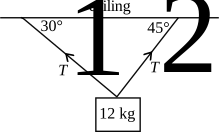
A 12 kilogram object is suspended from a horizontal ceiling by two light, inextensible strings at angles of 30° and 45°, as shown in the diagram.
 

The acceleration due to gravity is \(g\) m s\(^{-2}\) and the tensions in the strings are \(T_1\) newtons and \(T_2\) newtons.

  1. Show that \(T_2=\sqrt{\dfrac{3}{2}} T_1\)   (2 marks)

    --- 5 WORK AREA LINES (style=lined) ---

  2. Determine the tensions, in newtons, of \(T_1\) and \(T_2.\)   (2 marks)

    --- 8 WORK AREA LINES (style=lined) ---

Show Answers Only

a.    \(\text{See Worked Solutions}\)

b.    \(T_1=12(\sqrt{3}-1)g\)

\(T_2=6 \sqrt{6}(\sqrt{3}-1)g\ \ \ (=6 \sqrt{2}(3-\sqrt{3}))\)

Show Worked Solution

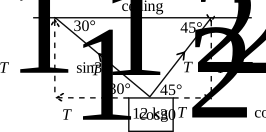
a.    \(\text{Resolve forces into horizontal / vertical components:}\)


\(\text{Horizontal forces are equal.}\)

\(T_1\cos 30^{\circ}\) \(=T_2 \cos 45^{\circ}\)
\(T_1 \times \dfrac{\sqrt{3}}{2}\) \(=T_2 \times \dfrac{1}{\sqrt{2}}\)
\(T_2\) \(=\dfrac{\sqrt{3} \times \sqrt{2}}{\sqrt{2} \times \sqrt{2}} \, T_1=\sqrt{\dfrac{3}{2}}\, T_1\)


b.    \(\text{Vertical forces are equal.}\)

\(T_1 \sin 30+T_2 \sin 45\) \(=12 g\)  
\(T_1 \times \dfrac{1}{2}+T_2 \times \dfrac{1}{\sqrt{2}}\) \(=12 g\)  

 
\(\text{Substitute} \ \ T_2=\sqrt{\dfrac{3}{2}}\, T_1:\)

\(T_1 \times \dfrac{1}{2}+T_1 \times \sqrt{\dfrac{3}{2}} \times \dfrac{1}{\sqrt{2}}\) \(=12 g\)
\(T_1\left(\dfrac{\sqrt{3}+1}{2}\right)\) \(=12 g\)

 
\(T_1=\dfrac{24g}{\sqrt{3}+1} \times \dfrac{\sqrt{3}-1}{\sqrt{3}-1}=12(\sqrt{3}-1)g\)
 

\(T_2\) \(=\sqrt{\dfrac{3}{2}} \times 12(\sqrt{3}-1)g\)
  \(=6 \sqrt{6}(\sqrt{3}-1)g\ \ \ (=6 \sqrt{2}(3-\sqrt{3}))\)

Filed Under: Forces and Further Motion in a Straight Line Tagged With: Band 4, smc-7437-50-Resolving Forces

Mechanics, EXT2 EQ-Bank 17

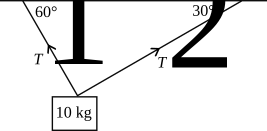
Two light inextensible strings are attached to a horizontal surface and suspended a 10-kilogram object as shown in the diagram below 
 

The tension in the strings are \(T_1\) newtons and \(T_2\) newtons.

  1. Express \(T_1\) in terms of \(T_2\).   (2 marks)

    --- 5 WORK AREA LINES (style=lined) ---

  2. If the acceleration due to gravity is 9.8 ms\(^{-2}\), determine the exact values of \(T_1\) and \(T_2\), in newtons.   (2 marks)

    --- 6 WORK AREA LINES (style=lined) ---

Show Answers Only

a.    \(\text{See Worked Solutions}\)

b.    \(T_1=49 \sqrt{3}, T_2=49\)

Show Worked Solution

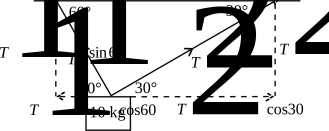
a.    \(\text{Resolve forces into horizontal/vertical components:}\)


\(\text{Horizontal forces are equal.}\)

\(T_1 \cos 60^{\circ}\) \(=T_2 \cos 30^{\circ}\)
\(T_1 \times \dfrac{1}{2}\) \(=T_2 \times \dfrac{\sqrt{3}}{2}\)
\(T_1\) \(=\sqrt{3}\, T_2\)


b.    \(\text{Vertical forces are equal.}\)

\(T_1 \sin 60^{\circ}+T_2 \sin 30^{\circ}\) \(=10 \times 9.8\)
\(T_1 \times \dfrac{\sqrt{3}}{2}+T_2 \times \frac{1}{2}\) \(=98\)


\(\text {Substitute} \ \ T_1=\sqrt{3}\, T_2 :\)

\(\sqrt{3}\, T_2 \times \dfrac{\sqrt{3}}{2}+T_2 \times \dfrac{1}{2}\) \(=98\)
\(2\, T_2\) \(=98\)
\(T_2\) \(=49 \ \text{newtons}\)


\(\therefore T_1=49 \sqrt{3}, \ T_2=49\)

Filed Under: Forces and Further Motion in a Straight Line Tagged With: Band 3, Band 4, smc-7437-50-Resolving Forces

Mechanics, EXT2 EQ-Bank 24

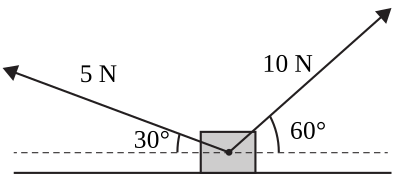
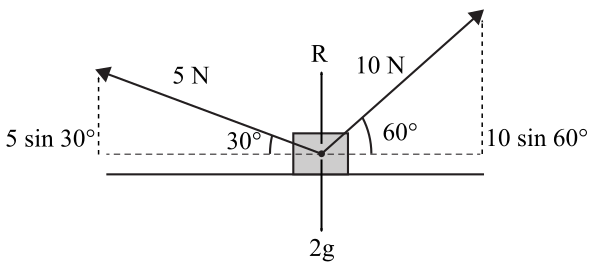
A 2 kg mass is initially at rest on a smooth horizontal surface. The mass is then acted on by two constant forces that cause the mass to move horizontally. One force has magnitude 10 N and acts in a direction 60° upwards from the horizontal, and the other force has magnitude 5 N and acts in a direction 30° upwards from the horizontal, as shown in the diagram below.
 

  1. Find the normal reaction force, in newtons, that the surface exerts on the mass.   (2 marks)
  2. Find the acceleration of the mass, in ms−2, after it begins to move.   (2 marks)
Show Answers Only

a.    `R = 2g-5/2-5 sqrt 3\ text(N)`

b.    `ddot{x} = 5/2-(5 sqrt 3)/2\ text(ms)^(-2)`

Show Worked Solution
a.  

`text{Let}\ R =\ text{normal force}`

`text(Resolving forces vertically:)`

`2g` `= 5 sin 30 + 10 sin 60 + R`
`2g` `= 5/2 + 5 sqrt 3 + R`
`R` `= 2g-5/2-5 sqrt 3\ text(N)`

 
b.
    `text{Using}\ Sigma F=m ddotx :`

  `2ddot{x}` `= 10 cos 60-5 cos 30`
  `2ddot{x}` `= 5-(5 sqrt 3)/2`
  `:.ddot{x}` `= 5/2-(5 sqrt 3)/4\ text(ms)^(-2)`

Filed Under: Forces and Further Motion in a Straight Line Tagged With: Band 4, smc-7437-40-\(\large F=m \ddot{x}\), smc-7437-50-Resolving Forces

Mechanics, EXT2 2020 SPEC2 18 MC

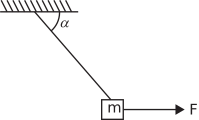
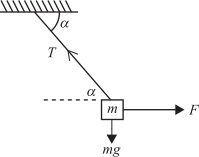
A particle of mass `m` kilogram hangs from a string that is attached to a fixed point. The particle is acted on by a horizontal force of magnitude `F` newtons. The system is in equilibrium when the string makes an angle `alpha` to the horizontal, as shown in the diagram below. The tension in the string has magnitude `T` newtons.
 

The value of  `tan\ alpha`  is

  1. `(mg)/T`
  2. `T/(mg)`
  3. `F/(mg)`
  4. `(mg)/F`
Show Answers Only

`D`

Show Worked Solution

`text(Resolving forces vertically:)`

`mg = Tsin(alpha)`
 

`text(Resolving forces horizontally:)`

`F = Tcos(alpha)`

`:. tan\ alpha = (mg)/F`

`=>D`

Filed Under: Forces and Further Motion in a Straight Line Tagged With: Band 4, smc-7437-50-Resolving Forces

Mechanics, EXT2 M1 2025 SPEC1 3

A particle starts from rest at a fixed point \(O\) and travels in a straight line.

The velocity, \(v\) m s\(^{-1}\), of the particle at time \(t\) seconds has equation  \(v(t)=\dfrac{t}{\sqrt{t^2+k}}\), where \(k\) is a positive constant and  \(t \geq 0\).

  1. Use integration to show that the displacement, \(x\) metres, of the particle relative to \(O\) is given by  \(x(t)=\sqrt{t^2+k}-\sqrt{k}\).   (1 mark)

    --- 5 WORK AREA LINES (style=lined) ---

  2. Find the initial acceleration, in terms of \(k\), of the particle in m s\(^{-2}\).   (2 marks)

    --- 5 WORK AREA LINES (style=lined) ---

  3. Another particle starts at \(O\) at the same time as the first particle and follows the same path.
  4. Its position relative to \(O\) is described by the equation  \(s(t)=t\).
  5. Three seconds after leaving \(O\) the second particle is 1 m ahead of the first particle.
  6. Find the value of \(k\).   (2 marks)

    --- 5 WORK AREA LINES (style=lined) ---

Show Answers Only

a.    \(v=\dfrac{t}{\sqrt{t^2+k}}\)

\(x=\displaystyle \int \frac{t}{\sqrt{t^2+k}} d t=\sqrt{t^2+k}+c\)
 

\(\text{When} \ \  t=0, x=0:\)

\(0=\sqrt{k}+c \ \ \Rightarrow \ \ c=-\sqrt{k}\)

\(\therefore x=\sqrt{t^2+k}-\sqrt{k}\)
 

b.    \(a=-\sqrt{k}\)

c.    \(k=\dfrac{25}{16}\)

Show Worked Solution

a.    \(v=\dfrac{t}{\sqrt{t^2+k}}\)

\(x=\displaystyle \int \frac{t}{\sqrt{t^2+k}} d t=\sqrt{t^2+k}+c\)
 

\(\text{When} \ \  t=0, x=0:\)

\(0=\sqrt{k}+c \ \ \Rightarrow \ \ c=-\sqrt{k}\)

\(\therefore x=\sqrt{t^2+k}-\sqrt{k}\)
 

b.    \(\text{Find initial acceleration:}\)

\(v=t\left(t^2+k\right)^{-\tfrac{1}{2}}\)

\(\text{Using product rule:}\)

\(\dfrac{dv}{dt}\) \(=t\cdot-\dfrac{1}{2} \cdot 2 t\left(t^2+k\right)^{-\tfrac{3}{2}}+\left(t^2+k\right)^{-\tfrac{1}{2}}\)
  \(=-t^2\left(t^2+k\right)^{-\tfrac{3}{2}}+\left(t^2+k\right)^{-\tfrac{1}{2}}\)


\(\text{At} \ \ t=0:\)

\(a=\dfrac{dv}{dt}=0+k^{-\tfrac{1}{2}}=-\sqrt{k}\)
 

c.   \(\text{1st particle:} \ \ x(3)=\sqrt{9+k}-\sqrt{k}\)

\(\text{2nd particle:} \ \ s(3)=3\)
 

\(\text{Since at \(t=3\), second particle is 1m ahead:}\)

\(3-\sqrt{9+k}+\sqrt{k}=1\)

\(\sqrt{9+k}\) \(=2+\sqrt{k}\)
\(\left(\sqrt{9+k}\right)^2\) \(=(2+\sqrt{k})^2\)
\(9+k\) \(=4+4 \sqrt{k}+k\)
\(4 \sqrt{k}\) \(=5\)
\(\sqrt{k}\) \(=\dfrac{5}{4}\)
\(k\) \(=\dfrac{25}{16}\)
♦ Mean mark (c) 40%.

Filed Under: Forces and Further Motion in a Straight Line, Motion Without Resistance Tagged With: Band 4, Band 5, smc-1060-04-Motion as f(t), smc-1060-35-Other function, smc-7437-20-Motion as \(\large \ f(t)\), smc-7437-75-Other functions

Mechanics, EXT2 M1 2025 HSC 8 MC

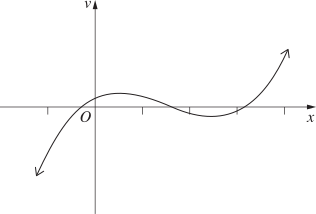
The graph shows the velocity of a particle as a function of its displacement.


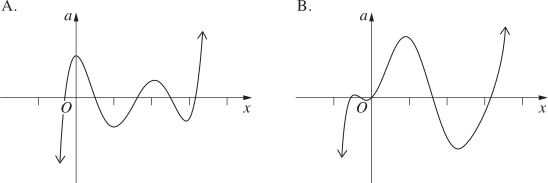
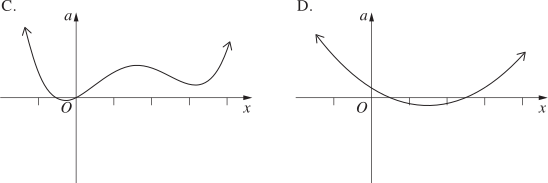
Which of the following graphs best shows the acceleration of the particle as a function of its displacement?
 

Show Answers Only

\(A\)

Show Worked Solution

\(\text{By elimination:}\)

\(v(x)\ \Rightarrow\ \text{degree 3 (see graph)},\ \ \dfrac{dv}{dx}\ \Rightarrow\ \text{degree 2}\)

\(a=v \cdot \dfrac{dv}{dx}\ \Rightarrow\ \text{degree 5 (eliminate C and D)}\)

\(\text{At}\ \ x=0,\ \ v(x)>0\ \ \text{and}\ \ \dfrac{dv}{dx}<0\ \ \Rightarrow\ \ v \cdot \dfrac{dv}{dx} \neq 0\ \text{(eliminate B)}\)

\(\Rightarrow A\)

♦♦ Mean mark 35%.

Filed Under: Forces and Further Motion in a Straight Line, Motion Without Resistance Tagged With: Band 5, smc-1060-02-Motion as f(x), smc-1060-10-Polynomial, smc-7437-10-Motion as \(\large \ f(x)\), smc-7437-80-Graph

Mechanics, EXT2 M1 2025 HSC 14b

The acceleration of a particle is given by  \(\ddot{x}=32 x\left(x^2+3\right)\), where \(x\) is the displacement of the particle from a fixed-point \(O\) after \(t\) seconds, in metres. Initially the particle is at \(O\) and has a velocity of 12 m s\(^{-1}\)  in the negative direction.

  1. Show that the velocity of the particle is given by  \(v=-4\left(x^2+3\right)\).   (2 marks)

    --- 10 WORK AREA LINES (style=lined) ---

  2. Find the time taken for the particle to travel 3 metres from the origin.   (2 marks)

    --- 10 WORK AREA LINES (style=lined) ---

Show Answers Only

i.    \(\text{See Worked Solutions}\)

ii.   \(t=\dfrac{\pi}{12 \sqrt{3}} \ \text{sec}\)

Show Worked Solution

i.    \(\ddot{x}=32 x\left(x^2+3\right)\)

\(\text{Show} \ \ v=-4\left(x^2+3\right)\)

\(\text{Using} \ \ \ddot{x}=v \cdot \dfrac{dv}{dx}:\)

\(v \cdot \dfrac{dv}{dx}\) \(=32 x\left(x^2+3\right)\)
\(\displaystyle \int v \, dv\) \(=\displaystyle \int 32 x^3+96 x\, dx\)
\(\dfrac{v^2}{2}\) \(=8 x^4+48 x^2+c\)

 
\(\text{When} \ \ x=0, v=-12 \ \Rightarrow \ c=72\)

\(\dfrac{v^2}{2}=8 x^4+48 x^2+72\)

\(v^2=16\left(x^4+6 x^2+9\right)\)

\(v=-4\left(x^2+3\right) \quad (V=-12 \ \ \text {when} \ \ x=0)\)
 

ii.   \(\dfrac{dx}{dt}=-4\left(x^2+3\right)\)

\(\dfrac{dt}{dx}=-\dfrac{1}{4\left(x^2+3\right)}\)

\(t=-\dfrac{1}{4} \displaystyle \int \dfrac{1}{3+x^2} d x=-\frac{1}{4} \times \frac{1}{\sqrt{3}} \tan ^{-1}\left(\frac{x}{\sqrt{3}}\right)+c\)

\(\text{When} \ \ t=0, x=0 \ \Rightarrow \ c=0\)
 

\(\text{Since particle is moving left at} \ \ t=0,\)

\(\text{Find \(t\) when} \ \ x=-3:\)

\(t\) \(=-\dfrac{1}{4 \sqrt{3}} \times \tan ^{-1}\left(-\dfrac{3}{\sqrt{3}}\right)\)
  \(=-\dfrac{1}{4 \sqrt{3}} \times \tan ^{-1}(-\sqrt{3})\)
  \(=-\dfrac{1}{4 \sqrt{3}} \times-\dfrac{\pi}{3}\)
  \(=\dfrac{\pi}{12 \sqrt{3}} \ \text{sec}\)

Filed Under: Forces and Further Motion in a Straight Line, Motion Without Resistance Tagged With: Band 3, Band 4, smc-1060-02-Motion as f(x), smc-1060-10-Polynomial, smc-7437-10-Motion as \(\large \ f(x)\), smc-7437-60-Polynomial

Mechanics, EXT2 M1 2024 HSC 15c

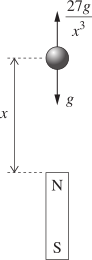
A bar magnet is held vertically. An object that is repelled by the magnet is to be dropped from directly above the magnet and will maintain a vertical trajectory. Let \(x\) be the distance of the object above the magnet.
 

The object is subject to acceleration due to gravity, \(g\), and an acceleration due to the magnet \(\dfrac{27 g}{x^3}\), so that the total acceleration of the object is given by

 \(a=\dfrac{27 g}{x^3}-g\)

The object is released from rest at  \(x=6\).

  1. Show that  \(v^2=g\left(\dfrac{51}{4}-2 x-\dfrac{27}{x^2}\right)\).   (2 marks)

    --- 8 WORK AREA LINES (style=lined) ---

  2. Find where the object next comes to rest, giving your answer correct to 1 decimal place.   (2 marks)

    --- 10 WORK AREA LINES (style=lined) ---

Show Answers Only

i.    \(\text{See Worked Solutions}\)

ii.   \(1.7 \ \text{units}\)

Show Worked Solution

i.    \(a=\dfrac{27 g}{x^3}-g\)

\(\dfrac{d}{dx}(\frac{1}{2}v^{2})\) \(= \dfrac{27g}{x^3}-g\)  
\(\dfrac{1}{2} v^2\) \(=-\dfrac{27 g}{2 x^2}-g x+c\)  

 
\(\text{When}\ \ x=6, v=0:\)

\(0\) \(=-\dfrac{27g}{2 \times 6^2}-6g+c\)  
\(c\) \(=\dfrac{459 g}{72}=\dfrac{51 g}{8}\)  


  \(\dfrac{1}{2} v^2\) \(=-\dfrac{27 g}{2 x^2}-g x+\dfrac{51 g}{8}\)
  \(v^2\) \(=-\dfrac{27 g}{x^2}-2 g x+\dfrac{51g }{4}\)
    \(=g\left(\dfrac{51}{4}-2 x-\dfrac{27}{x^2}\right)\)


ii.    \(\text{Find \(x\) when  \(v=0\):}\)

\(\dfrac{51}{4}-2 x-\dfrac{27}{x^2}\) \(=0\)  
\(51 x^2-8 x^3-108\) \(=0\)  
\(8 x^3-51 x^2+108\) \(=0\)  

 
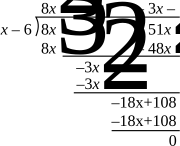
\(\text{Given  \(x=6\)  is a root:}\)

♦♦♦ Mean mark (ii) 24%.

\(8 x^3-51 x^2+108=(x-6)\left(8 x^2-3 x-18\right)\)

\(\text{Other roots:}\)

  \(x\) \(=\dfrac{3 \pm \sqrt{9-4 \cdot 8 \cdot 18}}{2 \times 8}\)
    \(=\dfrac{3 \pm \sqrt{585}}{16}\)
    \(=\dfrac{3+3 \sqrt{65}}{16} \quad(x>0)\)
    \(=1.7 \ \text{units (1 d.p.)}\)

 
\(\therefore \ \text{Object next comes to rest at  \(x=1.7\) units}\) 

Filed Under: Forces and Further Motion in a Straight Line, Resisted Motion Tagged With: Band 3, Band 6, smc-1061-07-Resistive medium, smc-1061-30-R ~ other, smc-7437-10-Motion as \(\large \ f(x)\), smc-7437-70-Inverse

Mechanics, EXT2 M1 2023 SPEC1 8

A body moves in a straight line so that when its displacement from a fixed origin `O` is `x` metres, its acceleration, `a`, is `-4 x \ text{ms}^{-2}`. The body accelerates from rest and its velocity, `v`, is equal to `-2 \ text{ms}^{-1}` as it passes through the origin. The body then comes to rest again.

Find `v` in terms of `x` for this interval.   (4 marks)

--- 9 WORK AREA LINES (style=lined) ---

Show Answers Only

` – 2sqrt(1-x^2)`

Show Worked Solution

`a = -4x`

`d/dx(1/2v^2)` `= -4x`  
`1/2v^2` `= -2x^2 +c`  

 
`v= -2\ \ \text{when}\ \ x = 0\ \ =>\ \ c = 2`

`v^2` `= -4x^2 + 4`  
`v^2` `= 4(1-x^2)`  

 
`v= -2\ \ text{when}\ \ x=0:`

`:.\ v` `= -sqrt(4(1-x^2))`  
  `= -2sqrt(1-x^2)`  

Filed Under: Forces and Further Motion in a Straight Line, Motion Without Resistance Tagged With: Band 4, smc-1060-02-Motion as f(x), smc-1060-10-Polynomial, smc-7437-10-Motion as \(\large \ f(x)\), smc-7437-75-Other functions

Mechanics, EXT2 M1 EQ-Bank 21

The acceleration, \(a\) ms\(^{-2}\), of a particle that starts from rest and moves in a straight line is described by  \(a=1+v\), where \(v\) ms\(^{-1}\) is its velocity after \(t\) seconds.

Determine the velocity of the particle after \( \log _e(e+1) \) seconds.   (3 marks)

--- 8 WORK AREA LINES (style=lined) ---

Show Answers Only

\(e\ \text{ms}^{-1}\)

Show Worked Solution

\(\dfrac{dv}{dt}=1+v\ \ \Rightarrow \ \dfrac{dt}{dv} = \dfrac{1}{1+v} \)

\(t= \displaystyle{\int \dfrac{1}{1+v}\ dv} = \log_e{(1+v)}+c \)

\(\text{When}\ \ t=0, v=0\ \ \Rightarrow \ c=0 \)

\(t\) \(=\log_e(1+v) \)  
\(1+v\) \(=e^t\)  
\(v\) \(=e^t-1\)  

 
\(\text{At}\ \ t=\log_e(e+1): \)

\(v=e^{\log_e{(e+1)}}-1 = e+1-1=e\ \text{ms}^{-1} \)

Filed Under: Forces and Further Motion in a Straight Line, Motion Without Resistance Tagged With: Band 4, smc-1060-06-a=f(v), smc-7437-30-\(\large a=f(v)\), smc-7437-75-Other functions

Mechanics, EXT2 M1 2022 HSC 15a

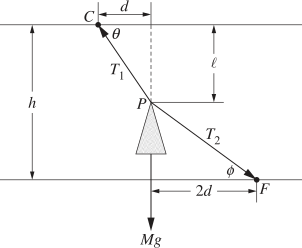
A machine is lifted from the floor of a room using two ropes. The two ropes ensure that the horizontal components of the forces are balanced at all times. It is assumed that at all times the machine moves vertically upwards at a constant velocity.

The machine is located in a room with height `h` metres.

One of the ropes is attached to the point `P` on the machine and to the fixed point `C` on the ceiling of the room. The point `C` is a distance `d` metres to the left of `P`. Let the vertical distance from `P` to the ceiling be `ℓ` metres and let `\theta` be the angle this rope makes with the horizontal.

The other rope is attached to the point `P` and to the fixed point `F` on the floor of the room. The point `F` is a distance `2 d` metres to the right of `P`. Let `\phi` be the angle this rope makes with the horizontal.

Let the tension in the first rope be `T_1` newtons, the tension in the second rope be `T_2` newtons, the mass of the machine be `M` kilograms and the acceleration due to gravity be `g\ text{m s}^(-2)`.
 

  1. By considering horizontal and vertical components of the forces at `P`, show that
  2.            `tan theta=tan phi+(Mg)/(T_(2)cos phi)`   (3 marks)

    --- 6 WORK AREA LINES (style=lined) ---

  3. Hence, or otherwise, show that the point `P` cannot be lifted to a position `{2 h}/{3}` metres above the floor.   (2 marks)

    --- 5 WORK AREA LINES (style=lined) ---

Show Answers Only

i.    `text{Proof (See Worked Solutions)}`

ii.   `text{Proof (See Worked Solutions)}`

Show Worked Solution

i.   
       

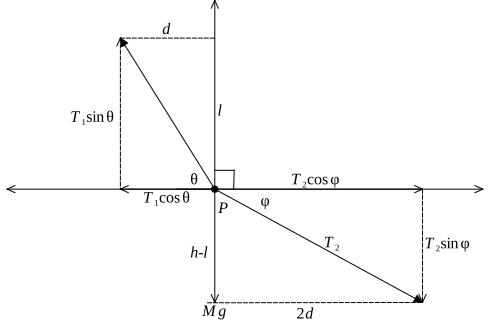
`text{Resolving forces horizontally:}`

`T_1cos\ theta=T_2cos\ phi\ \ text{… (1)}`

`text{Resolving forces vertically:}`

`T_1\ sin\ theta=Mg + T_2\ sin\ phi\ \ text{… (2)}`
 

`text{Divide}\ (2) -: (1):`

`tan\ theta=(Mg + T_2\ sin\ phi)/(cos\ phi)=(Mg)/(T_2\ cos\ phi)+tan\ phi`


Mean mark (i) 56%.

ii.   `text{Using diagram in part (i):}`

`tan\ theta=l/d,\ \ tan\ phi=(h-l)/(2d)`

`text{Using part (i):}`

`l/d=(Mg)/(T_2\ cos\ phi)+tan\ phi=(Mg)/(T_2\ cos\ phi)+(h-l)/(2d)`
 

`text{S}text{ince}\ \ (Mg)/(T_2\ cos\ phi)>0`

`l/d` `>(h-l)/(2d)`  
`l` `>(h-l)/2`  
`(3l)/2` `>h/2`  
`l` `>h/3`  
`h-l` `>h-h/3`  
`h-l` `>(2h)/3`  

 
`:.\ text{Point}\ P\ text(cannot be lifted to)\ (2h)/3\ text(metres above floor.)`


♦♦♦ Mean mark (ii) 27%.

Filed Under: Forces and Further Motion in a Straight Line, Resisted Motion Tagged With: Band 4, Band 5, smc-1061-50-Max Height, smc-1061-70-Newton's Law, smc-7437-50-Resolving Forces

Mechanics, EXT2 M1 2022 HSC 12b

A particle is moving in a straight line with acceleration  `a=12-6 t`. The particle starts from rest at the origin.

What is the position of the particle when it reaches its maximum velocity?   (3 marks)

--- 7 WORK AREA LINES (style=lined) ---

Show Answers Only

`x=16`

Show Worked Solution

`a=12-6t`

`v=int 12-6t\ dt=12t-3t^2+c`

  
`text{When}\ \ t=0, v=0\ \ =>\ \ c=0`

`x=int 12t-3t^2\ dt=6t^2-t^3+c`

 
`text{When}\ \ t=0, x=0\ \ =>\ \ c=0`

`v_max\ \ text{occurs when}\ \ a=0:`

`12-6t=0\ \ =>\ \ t=2`

`:.x|_(t=2)=6(2^2)-2^3=16`

Filed Under: Forces and Further Motion in a Straight Line, Motion Without Resistance Tagged With: Band 3, smc-1060-04-Motion as f(t), smc-7437-20-Motion as \(\large \ f(t)\), smc-7437-75-Other functions

Mechanics, EXT2 M1 2021 SPEC2 15

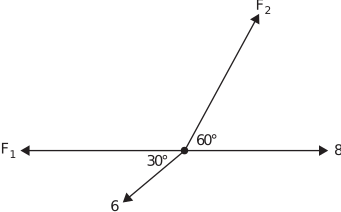
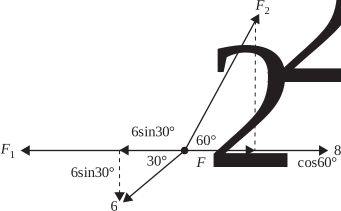
The diagram below shows a stationary body being acted on by four forces whose magnitudes are in newtons. The force of magnitude `F_1` newtons acts in the opposite direction to the force of magnitude 8 N.
 

Calculate the value of `F_1` in newtons.   (3 marks)

--- 6 WORK AREA LINES (style=lined) ---

Show Answers Only

`8-2sqrt3\ \ text(N)`

Show Worked Solution

`text(Resolve forces vertically:)`

`F_2sin60^@` `= 6sin30^@`
`F_2 sqrt3/2` `= 6 xx 1/2`
`F_2` `= 6/sqrt3= 2sqrt3`

 
`text(Resolve forces horizontally:)`

`F_1 + 6cos30^@` `= 2sqrt3 cos60^@ + 8`
`F_1 + 3sqrt3` `= sqrt3 + 8`
`F_1` `= 8-2sqrt3\ \ text(N)`

Filed Under: Forces and Further Motion in a Straight Line, Resisted Motion Tagged With: Band 4, smc-1061-06-Planes/Inclined Planes, smc-1061-70-Newton's Law, smc-7437-50-Resolving Forces

Mechanics, EXT2 M1 2021 HSC 14b

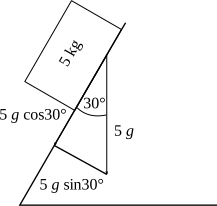
An object of mass 5 kg is on a slope that is inclined at an angle of 60° to the horizontal. The acceleration due to gravity is `g\ text(m s)^(-2)` and the velocity of the object down the slope is `v\ text(m s)^(-1)`.

As well as the force due to gravity, the object is acted on by two forces, one of magnitude `2v` newtons and one of magnitude `2v^2` newtons, both acting up the slope.

  1. Show that the resultant force down the slope is  `(5sqrt3)/2 g-2v-2v^2`  newtons.   (2 marks)

    --- 8 WORK AREA LINES (style=lined) ---

  2. There is one value of `v` such that the object will slide down the slope at a constant speed.
  3. Find this value of `v` in `text(m s)^(-1)`, correct to 1 decimal place, given that  `g = 10`.   (2 marks)

    --- 6 WORK AREA LINES (style=lined) ---

Show Answers Only

i.    `text(See Worked Solutions)`

ii.   `4.2\ \ text(ms)^-1`

Show Worked Solution

i.   

`F_s` `=\ text(force down slope)`
  `= 5g cos30-2v^2-2v`
  `= 5g · sqrt3/2-2v^2-2v`
  `= (5sqrt3)/2 g-2v^2-2v`


ii.   `text(Constant speed occurs if)\ \ a = 0`

`F_s = ma = 0`

`2v^2 + 2v-(5sqrt3)/2 xx 10` `= 0`
`2v^2 + 2v-25sqrt3` `= 0`


`v` `= (-2 + sqrt(2^2 + 4 · 2 · 25sqrt3))/(2 xx 2)`
  `= (-2 + sqrt(4 + 200sqrt3))/4`
  `= (-1 + sqrt(1 + 50 sqrt3))/2`
  `= 4.179…`
  `= 4.2\ \ text(ms)^-1\ text{(1 d.p.)}`

Filed Under: Forces and Further Motion in a Straight Line, Resisted Motion Tagged With: Band 3, Band 4, smc-1061-06-Planes/Inclined Planes, smc-1061-20-R ~ v^2, smc-1061-80-Terminal Velocity, smc-7437-40-\(\large F=m \ddot{x}\), smc-7437-50-Resolving Forces

Mechanics, EXT2 M1 2013 SPEC2 18*

A particle moves in a straight line such that its acceleration is given by  `a = sqrt(v^2-1)` , where `v` is its velocity and `x` is its displacement from a fixed point.

Given that  `v = sqrt2`  when  `x = 0`, find the velocity `v` in terms of `x`.   (4 marks)

--- 10 WORK AREA LINES (style=lined) ---

Show Answers Only

`v = sqrt(1 + (1 + x)^2)`

Show Worked Solution
`v(dv)/(dx)` `= sqrt(v^2-1)`
`(dv)/(dx)` `= sqrt(v^2-1)/v`
`(dx)/(dv)` `= v/sqrt(v^2-1)`
`x` `=int v/sqrt(v^2-1)\ dv`

 
`text(Integration by substitution:)`

`text(Let)\ \ u=v^2-1`

`(du)/(dv) = 2v \ => \ 1/2 du = v\ dv`

`x` `= 1/2 int u^(- 1/2) \ du`
  `= 1/2 * 2 u^(1/2) + c`
  `= sqrt(v^2-1) + c`

 
`text(When)\ \ x=0, \ v = sqrt2\ \ =>\ \ c = −1`

`x` `= sqrt(v^2-1) -1`
`v^2` `= 1 + (1 + x)^2`

 
`:. v = sqrt(1 + (1 + x)^2)`

Filed Under: Forces and Further Motion in a Straight Line, Motion Without Resistance Tagged With: Band 4, smc-1060-06-a=f(v), smc-1060-35-Other function, smc-7437-30-\(\large a=f(v)\), smc-7437-75-Other functions

Mechanics, EXT2 M1 2017 SPEC2 17 MC

The acceleration,  `a\ text(ms)^(-2)`, of a particle moving in a straight line is given by  `a = v^2 + 1`,  where  `v`  is the velocity of the particle at any time `t`. The initial velocity of the particle when at origin `O` is  `2\ text(ms)^(-1)`.

The displacement of the particle from `O` when its velocity is  `3\ text(ms)^(-1)`  is

  1. `log_e(2)`
  2. `1/2 log_e(10/3)`
  3. `1/2 log_e(2)`
  4. `1/2 log_e(5/2)`
Show Answers Only

`C`

Show Worked Solution
`v* (dv)/(dx)` `= v^2 + 1`
`(dv)/(dx)` `= (v^2 + 1)/v`
`(dx)/(dv)` `= v/(v^2 + 1)`
`x` `= int (v/(v^2 + 1))\ dv=1/2 ln(v^2 + 1)+c`

 
`text(When)\ \ x=0, \ v=2:`

`c=-1/2 ln5`

 
`text(Find)\ \ x\ \ text(when)\ \ v=3:`

`x` `= 1/2ln(9 + 1)-1/2 ln5`
  `= 1/2 ln (10/5)`
  `= 1/2 ln 2`

 
`=>   C`

Filed Under: Forces and Further Motion in a Straight Line, Motion Without Resistance Tagged With: Band 5, smc-1060-06-a=f(v), smc-1060-10-Polynomial, smc-7437-30-\(\large a=f(v)\), smc-7437-60-Polynomial

Mechanics, EXT2 M1 2015 SPEC1 6

The acceleration `a\ text{ms}^{-2}` of a body moving in a straight line in terms of the velocity `v\ text{ms}^{-2}` is given by  `a = 4v^2.`

Given that  `v = e`  when  `x = 1`, where `x` is the displacement of the body in metres, find the velocity of the body when  `x = 2.`   (4 marks)

--- 10 WORK AREA LINES (style=lined) ---

Show Answers Only

`e^5`

Show Worked Solution
`v* (dv)/(dx)` `= 4v^2`
`(dv)/(dx)` `= 4v`
`(dx)/(dv)` `= 1/(4v)`
`x` `=int 1/(4v) \ dv=1/4 ln (4v)+c`

 
`text(When)\ \ x=1, v=e:`

`1=1/4 ln(4e)+c\ \ =>\ \ c1-1/4 ln(4e)`

`text(Find)\ v\ text(when)\ \ x=2:`

COMMENT: Strong log and exponential calculation ability required here.

`1/4 ln (4v)+1-1/4 ln(4e)` `= 2`
`1/4 ln(4v)` `= 1/4 ln (4e)+1`
`ln(4v)` `= ln(4e)+4`
`e^(ln4v)` `= e^(ln(4e) +4)`
`4v` `= e^(ln(4e)) * e^4`
`4v` `=4e xx e^4`
`:.v` `=e^5`

Filed Under: Forces and Further Motion in a Straight Line, Motion Without Resistance Tagged With: Band 4, smc-1060-06-a=f(v), smc-1060-10-Polynomial, smc-7437-30-\(\large a=f(v)\), smc-7437-60-Polynomial

Mechanics, EXT2 M1 2020 SPEC2 17 MC

The velocity, `v` ms`\ ^(−1)`, of a particle at time  `t >= 0`  seconds and at position  `x >= 1`  metre from the origin is  `v = 1/x`.

The acceleration of the particle, in `text(ms)^(−2)`, when  `x = 2`  is

  1. `−1/4`
  2. `−1/8`
  3. `1/8`
  4. `1/4`
Show Answers Only

`B`

Show Worked Solution

`v = 1/x`

`a` `= v · (dv)/(dx)`
  `= 1/x · −1/(x^2)`
  `= −1/(x^3)`

 
`text(When)\ \ x = 2:`

`a = −1/(2^3) = −1/8`

`=>B`

Filed Under: Forces and Further Motion in a Straight Line, Motion Without Resistance Tagged With: Band 4, smc-1060-02-Motion as f(x), smc-1060-30-Inverse, smc-7437-10-Motion as \(\large \ f(x)\), smc-7437-70-Inverse

Mechanics, EXT2 M1 2020 HSC 16a

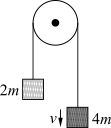
Two masses, `2m` kg and `4m` kg, are attached by a light string. The string is placed over a smooth pulley as shown.

The two masses are at rest before being released and `v` is the velocity of the larger mass at time `t` seconds after they are released.
 

The force due to air resistance on each mass has magnitude `kv`, where `k` is a positive constant.

  1. Show that  `frac{dv}{dt} = frac{gm-kv}{3m}`.   (2 marks)

    --- 6 WORK AREA LINES (style=lined) ---

  2. Given that  `v < frac{gm}{k}`, show that when  `t = frac{3m}{k} ln 2`, the velocity of the larger mass is `frac{gm}{2k}`.   (3 marks)

    --- 12 WORK AREA LINES (style=lined) ---

Show Answers Only

i.    `text{See Worked Solutions}`

ii.   `text{See Worked Solutions}`

Show Worked Solution

i. 

♦ Mean mark part (i) 37%.

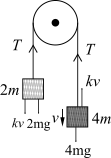
`text{Taking} \ v \ text{downwards as positive.}`

`text{Forces acting on}\ 2m\ text{mass:}`
  
`kv + 2 mg-T = -2m * frac{dv}{dt}\ …\ (1)`
  
`text{Forces acting our} \ 4m \ text{mass:}`
 
`4mg-kv-T = 4m * frac{dv}{dt}\ …\ (2)`

`text{Subtract:} \ (2)-(1)`

`2 mg-2 kv` `= 6 m * frac{dv}{dt}`
`:. frac{dv}{dt}` `= frac{2mg-2 kv}{6 m}= frac{gm-kv}{3m}`


ii.    `frac{dv}{dt}` `= frac{gm-kv}{3m}`
  `frac{dt}{dv}` `= frac{3m}{gm-kv}`
  `t` `= int frac{3m}{gm-kv}\ dv-frac{3m}{k} log_e |gm-kv | + c`

 
`text{When} \ \ t = 0, v = 0:`

`0` `= -frac{3m}{k} log_e \ | gm | + c`
`c` `= frac{3m}{k} log_e \ | gm | `
`t` `= frac{3m}{k} log_e  \ | gm | \-frac{3m}{k} log_e  \ | gm -kv |`
  `= frac{3m}{k} log_e \ | frac{mg}{gm-kv} |`

 
`text{Find} \ v\ \ text{when} \ t = frac{3m}{k} log_e 2 :`

`frac{3m}{k} log_e 2` `= frac{3m}{k} log_e | frac{gm}{gm-kv} |`
`2` `= frac{gm}{gm-kv}`
`2gm-2kv` `= gm`
`2kv` `= gm`
`therefore \ v` `= frac{gm}{2k}`

Filed Under: Forces and Further Motion in a Straight Line, Resisted Motion Tagged With: Band 4, Band 5, smc-1061-09-Pulleys, smc-7437-30-\(\large a=f(v)\), smc-7437-40-\(\large F=m \ddot{x}\), smc-7437-70-Inverse

Mechanics, EXT2 M1 2020 HSC 12a

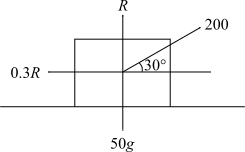
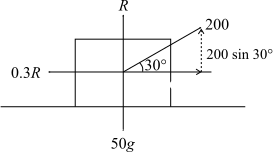
A 50-kilogram box is initially at rest. The box is pulled along the ground with a force of 200 newtons at an angle of 30° to the horizontal. The box experiences a resistive force of `0.3R` newtons, where `R` is the normal force, as shown in the diagram.

Take the acceleration `g` due to gravity to be 10m/s2.
 

  1. By resolving the forces vertically, show that  `R =400`.   (2 marks)

    --- 5 WORK AREA LINES (style=lined) ---

  2. Show that the net force horizontally is approximately 53.2 newtons.   (2 marks)

    --- 4 WORK AREA LINES (style=lined) ---

  3. Find the velocity of the box after the first three seconds.   (2 marks)

    --- 6 WORK AREA LINES (style=lined) ---

Show Answers Only

i.    `text{See Worked Solutions}`

ii.   `text{See Worked Solutions}`

iii.  `3.19 \ text{ms}^-1`

Show Worked Solution

i.   

`text{Resolving forces vertically:}`

`R + 200 \ sin 30^@` `= 50g`
`R + 200 xx frac{1}{2}` `= 50 xx 10`
`R + 100` `= 500`
`therefore \ R` `= 400 \ text(N)`

 
ii.
    `text{Resolving forces horizontally:}`

`text{Net Force}` `= 200 \ cos 30^@-0.3 R`
  `= 200 xx frac{sqrt3}{2}-0.3 xx 400`
  `= 100 sqrt3-120`
  `= 53.2 \ text{N (to 1 d. p.)}`


iii.    `F` `=ma`
  `50 a` `=100 sqrt300-120`
  `a` `= frac{100 sqrt3-120}{50}\ text(ms)^(-2)`

  
`text{Initially,}\ u = 0:`

`v` `= u + at`
`v_(t=3)` `= 0 + frac{100 sqrt3-120}{50} xx 3`
  `= 3.1923 \ …`
  `= 3.19 \ text{ms}^-1 \ text{(to 2 d.p.)}`

Filed Under: Forces and Further Motion in a Straight Line, Resisted Motion Tagged With: Band 3, Band 4, smc-1061-06-Planes/Inclined Planes, smc-1061-30-R ~ c, smc-1061-70-Newton's Law, smc-7437-40-\(\large F=m \ddot{x}\), smc-7437-50-Resolving Forces

Mechanics, EXT2 M1 2020 HSC 11c

A particle starts at the origin with velocity 1 and acceleration given by

`a = v^2 + v`,

where `v` is the velocity of the particle.

Find an expression for `x`, the displacement of the particle, in terms of `v`.   (3 marks)

--- 7 WORK AREA LINES (style=lined) ---

Show Answers Only

`x= ln \ | frac{v + 1}{2} |`

Show Worked Solution
`a` `= v^2 + v`
`v · frac{dv}{dx}` `= v^2 + v`
`frac{dv}{dx}` `= v + 1`
`frac{dx}{dv}` `= frac{1}{v + 1}`
`x` `= int frac{1}{v + 1}\ dv`
  `= ln \ | v + 1 | + c`

 
`text{When} \ \ x = 0 , \ v = 1`

`0 = ln \ 2 + c`

`c = -ln \ 2`

`therefore \ x` `= ln \ | v + 1| – ln \ 2`
  `= ln \ | frac{v + 1}{2} |`

Filed Under: Forces and Further Motion in a Straight Line, Motion Without Resistance Tagged With: Band 3, smc-1060-06-a=f(v), smc-1060-10-Polynomial, smc-7437-30-\(\large a=f(v)\), smc-7437-60-Polynomial

Mechanics, EXT2 M1 EQ-Bank 18

A car and its driver has a mass of 1200 kilograms and is travelling at 90 km/h.

Calculate the magnitude of the uniform breaking force, in Newtons, required to bring the car to a stop in 40 metres.   (3 marks)

--- 10 WORK AREA LINES (style=lined) ---

Show Answers Only

`9375\ text(N)`

Show Worked Solution

`text(Let)\ \ k =\ text{Uniform breaking force (constant)}`

`text(Newton’s 2nd law:)`

`F = mddotx` `= −k`
`1200ddotx` `= −k`
`ddotx` `= −k/1200`
`v · (dv)/(dx)` `= −k/1200`
`(dv)/(dx)` `= −k/(1200v)`
`(dx)/(dv)` `= −1200/k v`
`x` `= −1200/k intv\ dv= −600/k v^2 + C`

 
`text(When)\ \ x = 0, v = (90\ 000)/(60 xx 60) = 25\ text(ms)^(−1):`

`0 = −600/k  · 25^2 + C\ \ =>\ \ C = (375\ 000)/k`

`x = (375\ 000)/k-600/k v^2`
 

`text(When)\ \ x = 40, v = 0:`

`40` `= (375\ 000)/k`  
`:. k` `= 9375\ text(N)`  

Filed Under: Forces and Further Motion in a Straight Line, Resisted Motion Tagged With: Band 4, smc-1061-06-Planes/Inclined Planes, smc-1061-30-R ~ other, smc-1061-70-Newton's Law, smc-7437-40-\(\large F=m \ddot{x}\)

Mechanics, EXT2* M1 2019 HSC 13c

A particle moves in a straight line. At time `t` seconds the particle has a displacement of `x` m, a velocity of `v\ text(m s)^(-1)` and acceleration `a\ text(m s)^(-2)`.

Initially the particle has displacement `0` m and velocity `2\ text(m s)^(-1)`. The acceleration is given by  `a = -2e^(-x)`. The velocity of the particle is always positive.

  1. Show that  `v = 2e^((-x)/2)`.   (2 marks)

    --- 6 WORK AREA LINES (style=lined) ---

  2. Find an expression for `x` as a function of  `t`.   (2 marks)

    --- 6 WORK AREA LINES (style=lined) ---

Show Answers Only
  1. `text(See Worked Solutions)`
  2. `x = 2 ln(t + 1)`
Show Worked Solution

i.    `a= -2e^(-x)`

  `d/(dx)(1/2v^2)` `= -2e^(-x)`
  `1/2 v^2` `= int -2e^(-x)\ dx=2e^(-x) + C`

 
`text(When)\ \ x = 0,\ \ v = 2:`

`1/2 ⋅ 2^2` `= 2e^0 + C`
`C` `= 0`
`1/2 v^2` `= 2e^(-x)`
`v^2` `= 4e^(-x)`
`v` `= +-(4e^(-x))^(1/2)= +-2e^(-x/2)`

 
`text(S)text(ince)\ \ v = 2\ \ text(when)\ \ x = 0:`

`v = 2e^((-x)/2)`


ii.    `(dx)/(dt)` `= 2e^((-x)/2)`
  `(dt)/(dx)` `= (e^(x/2))/2`
  `t` `= 1/2 int e^(x/2) dx= 1/2 xx 2 xx e^(x/2) + C= e^(x/2) + C`

 
`text(When)\ \ t = 0,\ \ x = 0:`

♦ Mean mark part (ii) 46%.

`0= e^0 + C\ \ =>\ \ C=-1`

`t` `= e^(x/2)-1`
`e^(x/2)` `= t + 1`
`x/2` `= ln (t + 1)`
`:. x` `= 2 ln (t + 1)`

Filed Under: Forces and Further Motion in a Straight Line, Motion Without Resistance Tagged With: Band 4, smc-1060-02-Motion as f(x), smc-1060-20-Exponential, smc-7437-10-Motion as \(\large \ f(x)\), smc-7437-65-Exponential

Mechanics, EXT2* M1 2018 HSC 7 MC

The velocity of a particle, in metres per second, is given by  `v = x^2 + 2`  where `x` is its displacement in metres from the origin.

What is the acceleration of the particle at  `x = 1`?

  1. `2\ text(m s)^(-2)`
  2. `3\ text(m s)^(-2)`
  3. `6\ text(m s)^(-2)`
  4. `12\ text(m s)^(-2)`
Show Answers Only

`C`

Show Worked Solution
`a` `= d/dx (1/2  v^2)`
  `= d/dx (1/2 (x^2 + 2)^2)`
  `=1/2 xx 2 xx 2x (x^2+2)`
  `= 2x (x^2 + 2)`

 
`text(When)\ \ x = 1,\ \ a = 6\ text(m s)^(-2)`

`=>C`

Filed Under: Forces and Further Motion in a Straight Line, Motion Without Resistance, Other Motion EXT1 Tagged With: Band 4, smc-1060-02-Motion as f(x), smc-1060-10-Polynomial, smc-7437-10-Motion as \(\large \ f(x)\), smc-7437-60-Polynomial

Mechanics, EXT2* M1 2017 HSC 12d

At time `t` the displacement, `x`, of a particle satisfies  `t=4-e^(-2x)`.

Find the acceleration of the particle as a function of `x`.   (3 marks)

--- 7 WORK AREA LINES (style=lined) ---

Show Answers Only

`(e^(4x))/2`

Show Worked Solution
`t` `= 4-e^(−2x)`
`(dt)/(dx)` `= 2e^(−2x)`
`(dx)/(dt)` `= (e^(2x))/2`


`a` `= {:d/(dx):}(1/2v^2)`
  `= d/(dx)(1/2 · ((e^(2x))/2)^2)`
  `= d/(dx)((e^(4x))/8)`
  `= (e^(4x))/2`

Filed Under: Forces and Further Motion in a Straight Line, Motion Without Resistance, Other Motion EXT1 Tagged With: Band 4, smc-1060-02-Motion as f(x), smc-1060-20-Exponential, smc-7437-10-Motion as \(\large \ f(x)\), smc-7437-65-Exponential

Mechanics, EXT2 M1 2016 HSC 15b

A particle is initially at rest at the point `B` which is `b` metres to the right of `O.`

The particle then moves in a straight line towards `O.`

For `x != 0,` the acceleration of the particle is given by  `(- mu^2)/x^2,`  where `x` is the distance from `O` and `mu` is a positive constant.

  1. Prove that  `(dx)/(dt) = -mu sqrt 2 sqrt((b-x)/(bx)).`   (2 marks)

    --- 4 WORK AREA LINES (style=lined) ---

  2. Using the substitution  `x = b cos^2 theta,` show that the time taken to reach a distance `d` metres to the right of `O` is given by
  3.    `t = (b sqrt (2b))/mu int_0^(cos^-1 sqrt (d/b)) cos^2 theta\ d theta.`   (3 marks)

    --- 8 WORK AREA LINES (style=lined) ---

  4. It can be shown that   `t = 1/mu sqrt (b/2) (sqrt(bd-d^2) + b cos^-1 sqrt (d/b)).`  (Do NOT prove this.)
  5. What is the limiting time taken for the particle to reach `O?`   (1 mark)

    --- 4 WORK AREA LINES (style=lined) ---

Show Answers Only

a.    `text(See Worked Solutions)`

b.    `text(See Worked Solutions)`

c.    `(pi(sqrtb)^3)/(2sqrt2mu)\ text(seconds)`

Show Worked Solution

a.    `a = d/dx(1/2 v^2) = −(mu^2)/(x^2)`

`1/2 v^2= int -(mu^2)/(x^2)\ dx= (mu^2)/x + c`

`text(Initially,)\ v = 0\ text(and)\ x = b\ \ =>\ \ c = -(mu^2)/b`

`v^2` `= 2mu^2(1/x-1/b)`
`v` `= −musqrt2 · sqrt(1/x-1/b)qquad(text(negative since moving to left))`
  `= −musqrt2 · sqrt((b-x)/(bx))\ …\ text(as required.)`


b.     `dx/dt` `= −musqrt2 · sqrt((b-x)/(bx))`
  `dt/dx` `= −1/(musqrt2) · sqrt((bx)/(b-x))`
  `int_0^t dt` `= −1/(musqrt2) · int_b^d sqrt((bx)/(b-x))\ dx`

 
`text(Integration by substitution:)`

`text(Let)\ \ x= bcos^2theta\ \ =>\ \ dx= −2bcosthetasintheta\ d theta`

`text(When)quadx` `= b,` `theta` `= 0`
`x` `= d,` `theta` `= cos^(−1)sqrt(d/b)`


`:. t` `= −1/(musqrt2) · int_0^(cos^(−1)sqrt(d/b))sqrt((b^2cos^2theta)/(b(1-cos^2theta))) · −2bcosthetasintheta\ d theta`
 

`= (2b)/(musqrt2) · int_0^(cos^(−1)sqrt(d/b))(sqrtb costheta)/(sintheta) · costhetasintheta\ d theta`


`= (bsqrt(2b))/mu int_0^(cos^(−1)sqrt(d/b)) cos^2theta\ d theta\ …\ text(as required)`


c.    `t = 1/mu sqrt(b/2)(sqrt(bd-d^2) + bcos^(−1)sqrt(d/b))`

`text(As)\ \ d->0,`

♦♦ Mean mark (c) 9%.
`t` `= 1/mu sqrt(b/2) (sqrt0 + bcos^(−1)0)`
  `= 1/mu sqrt(b/2) · b · pi/2`
  `= (pi(sqrtb)^3)/(2sqrt2mu)\ text(seconds)`

Filed Under: Forces and Further Motion in a Straight Line, Motion Without Resistance, Resisted Motion Tagged With: Band 4, Band 5, smc-1060-02-Motion as f(x), smc-1060-30-Inverse, smc-7437-10-Motion as \(\large \ f(x)\), smc-7437-70-Inverse

Mechanics, EXT2 M1 2006 HSC 6b

In an alien universe, the gravitational attraction between two bodies is proportional to `x^(–3)`, where `x` is the distance between their centres.

A particle is projected upward from the surface of a planet with velocity  `u`  at time  `t = 0`.  Its distance `x` from the centre of the planet satisfies the equation

`ddot x =-k/x^3.`

  1. Show that  `k =gR^3`, where `g` is the magnitude of the acceleration due to gravity at the surface of the planet and `R` is the radius of the planet.   (1 mark)

    --- 4 WORK AREA LINES (style=lined) ---

  2. Show that `v`, the velocity of the particle, is given by
  3.    `v^2 = (gR^3)/x^2-(gR-u^2).`   (3 marks)

    --- 8 WORK AREA LINES (style=lined) ---

  4. It can be shown that  `x = sqrt (R^2 + 2uRt-(gR-u^2) t^2).` (Do NOT prove this.)
  5. Show that if  `u >= sqrt (gR)`  the particle will not return to the planet.   (2 marks)

    --- 8 WORK AREA LINES (style=lined) ---

  6. If  `u < sqrt (gR)`  the particle reaches a point whose distance from the centre of the planet is `D`, and then falls back.
  7.   i.  Use the formula in part (b) to find `D` in terms of `u, R` and `g.`   (1 mark)

    --- 4 WORK AREA LINES (style=lined) ---

  8.   ii. Use the formula in part (c) to find the time taken for the particle to return to the surface of the planet in terms of `u, R` and `g.`   (1 mark)

    --- 5 WORK AREA LINES (style=lined) ---

Show Answers Only

a.    `text(Proof)\ \ text{(See Worked Solutions)}`

b.    `text(Proof)\ \ text{(See Worked Solutions)}`

c.    `text(Proof)\ \ text{(See Worked Solutions)}`

d.i   `D = sqrt ((gR^3)/(gR-u^2))`

d.ii   `(2uR)/(gR-u^2)`

Show Worked Solution
a.    

`text(When)\ x=R,\ \ ddot x =-k/(R^3)`

`text(Given)\ \ ddot x = -g\ \ text(on the surface)`

`-g ­=` `-k/R^3`
`:.k ­=` `gR^3`


b.     `ddot x` `=- (gR^3)/x^3`
  `1/2 v^2` `= int-(gR^3)/x^3\ dx`
  `1/2 v^2` `= (gR^3)/(2x^2)+c_1`
  `:.v^2` `=(gR^3)/x^2 +c_2`

 
`text(When)\ \ t=0, x=R and v=u:`

`u^2` `=(gR^3)/R^2 +c_2`
`c_2` `=u^2-gR`
`:.v^2` `=(gR^3)/x^2 +u^2-gR`
  `=(gR^3)/x^2 -(gR-u^2)`


c.    `text(Solution 1)`

`text(If)\ \ u >= sqrt (gR)\ \ text(then)\ \ u^2 >= gR`

`x` `= sqrt (R^2 + 2uRt-(gR-u^2) t^2)`
  `≥sqrt (R^2 + 2sqrt(gR)Rt-(gR-gR) t^2)`
  `≥sqrt (R^2 + 2sqrt(gR)Rt)`
  `>sqrt (R^2)\ \ \ \ (t>0)`
  `>R`


`:. x>R\ \ text(when)\ \ t>0,\ text(and the particle does not)`

`text(return to the surface of the planet.)`


`text(Solution 2)`

`v^2` `=(gR^3)/x^2 -(gR-u^2)`
  `>=(gR^3)/x^2\ \ \ \ text{(since}\ u^2 >= gR text{)}`
`v` `>=0`

 
`:.\ text(S)text(ince)\ \ v>=0,\ \ text(the particle is never moving back)`

`text(towards the planet and will never return.)`


d.i   `v^2 = (gR^3)/D^2-(gR-u^2)`

`x = D\ \ text(occurs when)\ \ v = 0`

`:.0 ­=` `(gR^3)/D^2-(gR-u^2)`
`D^2 ­=` `(gR^3)/(gR-u^2)`
`:.D ­=` `sqrt ((gR^3)/(gR-u^2))`


d.ii  `text(Find)\ \ t\ \ text(when)\ \ x = R`

`text{Using part (c)}`

`R` `=sqrt (R^2 + 2uRt-(gR-u^2) t^2)`
`R^2` `= R^2 + 2uRt-(gR-u^2) t^2`
`0` `= t(2uR-(gR-u^2)t)`
`:.t` ` = (2uR)/(gR-u^2)\ \ \ \ (t>0)`

 
`:.\ text(It takes)\ \ (2uR)/(gR-u^2)\ \ text(seconds to return to the planet.)`

Filed Under: Forces and Further Motion in a Straight Line, Motion Without Resistance, Resisted Motion Tagged With: Band 4, Band 5, smc-1060-02-Motion as f(x), smc-1060-30-Inverse, smc-7437-10-Motion as \(\large \ f(x)\), smc-7437-70-Inverse

Mechanics, EXT2* M1 2007 HSC 3c

A particle is moving in a straight line with its acceleration as a function of `x` given by  `ddot x = -e^(-2x)`. It is initially at the origin and is travelling with a velocity of 1 metre per second.

  1. Show that  `dot x = e^(-x)`.   (2 marks)

    --- 6 WORK AREA LINES (style=lined) ---

  2. Hence show that  `x = log_e(t + 1)`.   (2 marks)

    --- 6 WORK AREA LINES (style=lined) ---

Show Answers Only

a.    `text{Proof (See Worked Solutions)}`

b.    `text{Proof (See Worked Solutions)}`

Show Worked Solution

a.    `text(Show that)\ \ dot x = e^(−x)`

`ddot x` `= d/(dx)\ (1/2 (dot x)^2) = −e^(−2x)`
`1/2 (dot x)^2` `= int −e^(−2x)\ dx`
  `= 1/2 e^(−2x) + c`

 
`text(When)\ \ x = 0, \ dot x = 1,`

`1/2 · 1^2` `= 1/2 e^0 + c`
`1/2` `= 1/2 + c`
`:.c` `= 0`


MARKER’S COMMENT: Most “neglected” to consider the two cases that  `dot x=+-e^(-x)`.
`1/2 (dot x)^2` `= 1/2 e^(−2x)`
`(dot x)^2` `= e^(−2x)`
`dot x` `= +-e^(−x)`

 
`text(Given initial conditions:)\ \ x=0, dot x = 1,`

`dot x = e^(-x)\ \ text(… as required)`
 

b.    `text(Show)\ \ x = log_e(t + 1)`

`(dx)/(dt)` `= e^(−x)`
`(dt)/(dx)` `= e^x`
`t` `= int e^x= e^x + c`

 
`text(When)\ \ t = 0, \ x = 0:`

`0= e^0 + c\ \ =>\ \ c=-1`

`t` `= e^x-1`
`e^x` `= t + 1`
`log_ee^x` `= log_e(t + 1)`
`x` `= log_e(t + 1)\ …\ text(as required.)`

Filed Under: Forces and Further Motion in a Straight Line, Motion Without Resistance, Other Motion EXT1 Tagged With: Band 4, smc-1060-02-Motion as f(x), smc-1060-20-Exponential, smc-7437-10-Motion as \(\large \ f(x)\), smc-7437-65-Exponential

Mechanics, EXT2* M1 2007 HSC 2d

A skydiver jumps from a hot air balloon which is 2000 metres above the ground. The velocity, `v` metres per second, at which she is falling `t` seconds after jumping is given by  `v =50(1-e^(-0.2t))`.

  1. Find her acceleration ten seconds after she jumps. Give your answer correct to one decimal place.   (2 marks)

    --- 6 WORK AREA LINES (style=lined) ---

  2. Find the distance that she has fallen in the first ten seconds. Give your answer correct to the nearest metre.   (2 marks)

    --- 7 WORK AREA LINES (style=lined) ---

Show Answers Only

a.    `1.4\ text(ms)^(−2)\ \ text{(to 1 d.p.)}`

b.    `284\ text{m  (nearest m)}`

Show Worked Solution
a.      `v` `= 50(1 − e^(-0.2t))`
    `=50-50e^(-0.2t)`
  `ddot x` `= (dv)/(dt)`
    `= −0.2 xx 50 xx −e^(−0.2t)`
    `= 10 e^(−0.2t)`

 
`text(When)\ \ t = 10:`

`ddot x` `= 10 e^(−0.2 xx 10)`
  `= 10 e ^(−2)`
  `= 1.353…`
  `= 1.4\ text(ms)^(−2)\ \ \ text{(to 1 d.p.)}`


b.    `text(Distance travelled)`

`= int_0^10 v\ dt`

`= 50 int_0^10 1 − e^(−0.2t) \ dt`

`= 50 [t + 1/0.2 · e^(−0.2t)]_0^10`

`= 50 [t + 5e^(−0.2t)]_0^10`

`= 50 [(10 + 5e^(−2)) − (0 + 5e^0)]`

`= 50 [10 + 5e^(−2) − 5]`

`= 50 [5 + 5e^(−2)]`

`= 283.833…`

`= 284\ text{m  (nearest m)}`

Filed Under: Forces and Further Motion in a Straight Line, Motion Without Resistance, Other Motion EXT1 Tagged With: Band 3, Band 4, smc-1060-04-Motion as f(t), smc-1060-20-Exponential, smc-7437-20-Motion as \(\large \ f(t)\), smc-7437-65-Exponential

Mechanics, EXT2* M1 2004 HSC 5a

A particle is moving along the `x`-axis, starting from a position  `2`  metres to the right of the origin (that is,  `x = 2`  when  `t = 0`) with an initial velocity of  `5\ text(ms)^(−1)`  and an acceleration given by

`ddot x = 2x^3 + 2x`.

  1. Show that  `dot x = x^2 + 1`.   (2 marks)

    --- 8 WORK AREA LINES (style=lined) ---

  2. Hence find an expression for  `x`  in terms of  `t`.   (3 marks)

    --- 8 WORK AREA LINES (style=lined) ---

Show Answers Only

a.    `text(Show Worked Solutions)`

b.    `tan\ (t + tan^(−1)2)`

Show Worked Solution

a.    `text(Show)\ \ dot x = x^2 + 1`

`ddot x` `= d/(dx)\ (1/2 v^2) = 2x^3 + 2x`
`1/2 v^2` `= int2x^3 + 2x \ dx`
`1/2 v^2` `= 2/4x^4 + x^2 + c`
`v^2` `= x^4 + 2x^2 + c`

 
`text(When)\ \ x = 2, \ v = 5:`

`5^2= 2^4 + (2 xx 2^2) + c\ \ =>\ \ c=1`

`v^2` `= x^4 + 2x^2 + 1= (x^2 + 1)^2`
`v` `= sqrt((x^2 + 1)^2)`
 `:.dot x` `= x^2 + 1\ \ \ …\ text(as required)`


b.     `(dx)/(dt)` `= x^2 + 1`
  `(dt)/(dx)` `= 1/(x^2 + 1)`
  `:.t` `= int1/(x^2 + 1)\ dx= tan^(−1)\ x + c`

 
`text(When)\ \ t = 0, \ x = 2:`

`0= tan^(−1)\ 2 + c\ \ =>\ \ c= −tan^(−1)\ 2`

`t=tan^(−1)\ x − tan^(−1)\ 2`
 

`tan^(−1)\ x` `= t + tan^(−1)2`
`:.x` `= tan (t + tan^(−1)2)`

Filed Under: Forces and Further Motion in a Straight Line, Motion Without Resistance, Other Motion EXT1 Tagged With: Band 4, Band 5, smc-1060-02-Motion as f(x), smc-1060-10-Polynomial, smc-7437-10-Motion as \(\large \ f(x)\), smc-7437-60-Polynomial

Mechanics, EXT2* M1 2006 HSC 4c

A particle is moving so that  `ddot x = 18x^3 + 27x^2 + 9x.`

Initially  `x = – 2`  and the velocity, `v`, is `– 6.`

  1. Show that  `v^2 = 9x^2 (1 + x)^2.`   (2 marks)

    --- 8 WORK AREA LINES (style=lined) ---

  2. Hence, or otherwise, show that
  3.    `int 1/(x(1 + x)) \ dx = -3t.`   (2 marks)

    --- 6 WORK AREA LINES (style=lined) ---

  4. It can be shown that for some constant `c`,
  5.    `log_e (1 + 1/x) = 3t + c.`       (Do NOT prove this.)
  6. Using this equation and the initial conditions, find `x` as a function of  `t.`   (2 marks)

    --- 8 WORK AREA LINES (style=lined) ---

Show Answers Only

a.    `text(Proof)\ \ text{(See Worked Solutions)}`

b.    `text(Proof)\ \ text{(See Worked Solutions)}`

c.    `x = 2/(e^(3t)-2)`

Show Worked Solution

a.    `text(Show)\ \ v^2 = 9x^2 (1 + x)^2`

`ddot x` `= d/(dx) (1/2 v^2)= 18x^3 + 27x^2 + 9x`
`1/2 v^2` `= int 18x^3 + 27x^2 + 9x\ dx`
`1/2 v^2` `= 18/4 x^4 + 27/3 x^3 + 9/2 x^2 + c`
`v^2` `= 9x^4 + 18x^3 + 9x^2 + c`


`text(When)\ \ t = 0,\ \ x = -2,\ \ v = -6`

`(-6)^2` `= 9 (-2)^4 + 18 (-2)^3 + 9 (-2)^2 + c`
`36` `= 144-144 + 36 + c`
`c` `= 0`


`:.\ v^2` `= 9x^4 + 18x^3 + 9x^2`
  `= 9x^2 (x^2 + 2x + 1)`
  `= 9x^2 (1 + x)^2\ \ text(…  as required)`


b.    `text(Show)\ \ int 1/(x (1 + x)) \ dx = -3t`

`v^2 = 9x^2 (1 + x)^2`

`v = +- sqrt (9x^2 (1 + x)^2)`
 

`text(When)\ \ x = -2,\ \ v = -6:`

`v-sqrt (9x^2 (1 + x)^2)= -3x (1 + x)`

`(dx)/(dt)` `= -3x (1 + x)`
`(dt)/(dx)` `= -1/(3x (1 + x))`
`t` `= -1/3 int 1/(x (1 + x)) \ dx`
`-3t` `= int 1/(x (1 + x)) \ dx\ \ text(…  as required)`


c.    `text(Given)\ \ log_e (1 + 1/x) = 3t + c`

`text(When)\ \ t = 0,\ \ x = -2:`

`log_e (1-1/2)` `= 3(0) + c`
`log_e (1/2)` `= c\ \ =>\ \ c== -log_e 2`


`log_e (1 + 1/x)` `= 3t-log_e 2`
`1 + 1/x` `= e^(3t-log_e 2)`
`1/x` `= e^(3t-log_e 2)-1`
  `= (e^(3t))/(e^(log_e 2))-1`
  `= e^(3t)/2-1`
  `= (e^(3t)-2)/2`
`:.\ x` `= 2/(e^(3t)-2)`

Filed Under: Forces and Further Motion in a Straight Line, Motion Without Resistance, Other Motion EXT1 Tagged With: Band 4, Band 5, smc-1060-02-Motion as f(x), smc-1060-10-Polynomial, smc-7437-10-Motion as \(\large \ f(x)\), smc-7437-60-Polynomial

Mechanics, EXT2* M1 2015 HSC 14b

A particle is moving horizontally. Initially the particle is at the origin `O` moving with velocity `1 text(ms)^(−1)`.

The acceleration of the particle is given by  `ddot x = x-1`, where `x` is its displacement at time  `t`.

  1. Show that the velocity of the particle is given by  `dot x = 1-x`.  (3 marks)

    --- 10 WORK AREA LINES (style=lined) ---

  2. Find an expression for `x` as a function of `t`.  (2 marks)

    --- 8 WORK AREA LINES (style=lined) ---

  3. Find the limiting position of the particle.  (1 mark)

    --- 3 WORK AREA LINES (style=lined) ---

Show Answers Only

a.    `text(See Worked Solutions.)`

b.    `x = 1-e^(-t)`

c.    `x = 1`

Show Worked Solution

a.    `ddot x = d/(dx)(1/2 v^2) = x-1`

`1/2 v^2= int ddot x\ dx= int x-1\ dx= 1/2x^2-x + c`

`text(When)\ \ x = 0, \ v = 1:`

`1/2·1^2= 0-0 + c\ \ =>\ \ c=1/2`

`1/2  v^2` `= 1/2x^2-x + 1/2`
`v^2` `= x^2-2x + 1= (x-1)^2`
`:.dot x` `= ±(x-1)`

 
`text(S)text(ince)\ \ dotx = 1\ \ text(when)\ \ x = 0,`

`dot x = 1-x\ \ …\ text(as required)`


b.     `(dx)/(dt)` `= 1-x\ \ \ text{(from (a))}`
  `(dt)/(dx)` `= 1/(1-x)`
  `t` `= int 1/(1-x)\ dx= -ln(1-x) + c`


`text(When)\ \ t = 0, x = 0:`

♦ Mean mark (b) 49%.

`0= -ln1 + c\ \ =>\ \ c=0`

`t` `= -ln(1-x)`
`-t` `= ln(1-x)`
`1-x` `= e^(-t)`
`:.x` `= 1-e^(-t)`


♦ Mean mark (c) 2%.

c.    `text(As)\ t→ ∞, \ e^(-t)→ 0,\ \ x→ 1`

`:.\ text(Limiting position is)\ \ x = 1`

Filed Under: Forces and Further Motion in a Straight Line, Motion Without Resistance, Other Motion EXT1 Tagged With: Band 4, Band 5, smc-1060-02-Motion as f(x), smc-1060-10-Polynomial, smc-7437-10-Motion as \(\large \ f(x)\), smc-7437-60-Polynomial

Mechanics, EXT2* M1 2008 HSC 2b

A particle moves on the `x`-axis with velocity `v`. The particle is initially at rest at  `x = 1`. Its acceleration is given by  `ddot x = x + 4`.

Using the fact that  `ddot x = d/dx (1/2 v^2)`, find the speed of the particle at  `x = 2`.   (3 marks)

--- 8 WORK AREA LINES (style=lined) ---

Show Answers Only

`sqrt11`

Show Worked Solution
`ddot x` `= d/dx (1/2 v^2)=x+4`
`1/2 v^2` `= int ddot x\ dx`
  `= int x + 4\ dx`
  `= 1/2 x^2 + 4x + c`

 
`text(When)\ \ x = 1, v = 0:`

`0= 1/2 + 4 + c\ \ =>\ \ c=4 1/2`

`:.\ 1/2 v^2` `= 1/2 x^2 + 4x-4 1/2`
`v^2` `= x^2 + 8x-9`

 
`text(When)\ \ x = 2:`

`v^2` `= 2^2 + 8 * 2-9= 11`
`v` `= +- sqrt 11`

 
`:.\ text(When)\ x = 2,\ \ text(Speed) = sqrt 11`

Filed Under: Forces and Further Motion in a Straight Line, Motion Without Resistance, Other Motion EXT1 Tagged With: Band 4, smc-1060-02-Motion as f(x), smc-1060-10-Polynomial, smc-7437-10-Motion as \(\large \ f(x)\), smc-7437-60-Polynomial

Mechanics, EXT2* M1 2014 HSC 12c

A particle moves along a straight line with displacement `x\ text(m)` and velocity  `v\ text(ms)^(-1)`. The acceleration of the particle is given by

 `ddot x = 2-e^(-x/2)`.

Given that  `v = 4`  when  `x = 0`, express `v^2` in terms of `x`.   (3 marks)

--- 8 WORK AREA LINES (style=lined) ---

Show Answers Only

`v^2 = 4x + 4e^(-x/2) + 12`

Show Worked Solution

`ddot x = d/(dx) (1/2 v^2) = 2-e^(-x/2)`

`1/2 v^2` `= int (2-e^(-x/2))\ dx`
`1/2 v^2` `= 2x + 2e^(-x/2) + c`
`v^2` `= 4x + 4e^(-x/2) + c`

 
`text(When)\ \ v = 4, x = 0:`

`:. 4^2` `= 0 + 4e^0 + c`
`16` `= 4 + c`
`c` `= 12`

 
`:.\ v^2 = 4x + 4e^(-x/2) + 12`

Filed Under: Forces and Further Motion in a Straight Line, Motion Without Resistance, Other Motion EXT1 Tagged With: Band 4, smc-1060-02-Motion as f(x), smc-1060-20-Exponential, smc-7437-10-Motion as \(\large \ f(x)\), smc-7437-65-Exponential

Copyright © 2014–2026 SmarterEd.com.au · Log in