SmarterEd

Aussie Maths & Science Teachers: Save your time with SmarterEd

  • Login
  • Get Help
  • About

HMS, HAG 2015 HSC 1 MC

Which of the following is the main benefit of emerging treatments and technologies in health care

  1. Reduced costs for health care
  2.  Reduced dental health problems
  3. Improved early detection and screening procedures
  4. Improved waiting times for surgery in public hospitals
Show Answers Only

\(C\)

Show Worked Solution
  • C is correct: New technologies primarily enable earlier disease identification and screening.

Other Options:

  • A is incorrect: Technology typically increases rather than reduces healthcare costs.
  • B is incorrect: Too specific, not the main overall benefit.
  • D is incorrect: Technology doesn’t directly address surgical waiting times.

Filed Under: New technologies and treatments Tagged With: Band 2, smc-5485-35-Innovation benefits

HMS, HAG 2016 HSC 17 MC

Which of the following best describes healthy ageing?

  1. Ageing at a healthy rate and trying to look younger
  2. Increasing the proportion of people who consume healthy foods throughout their life
  3. Reducing the risk of illness and disease when growing older by maintaining physical, dietary and mental health
  4. Reducing the number of people who die at a young age from illnesses related to hereditary and genetic factors
Show Answers Only

\(C\)

Show Worked Solution
  • C is correct: Healthy ageing involves maintaining wellness across all health dimensions.

Other Options:

  • A is incorrect: Focus on appearance rather than genuine health maintenance.
  • B is incorrect: Too narrow, only addresses nutrition not comprehensive health.
  • D is incorrect: Describes preventing premature death, not healthy ageing process.

Filed Under: Impact of an Ageing Population Tagged With: Band 2, smc-5478-05-Healthy ageing

HMS, HAG 2018 HSC 10 MC

Which of the following best describes Medicare?

  1. It is funded by taxpayers and covers the cost of ambulance services.
  2. It is funded by private contributions and covers the cost of physiotherapy.
  3. It is funded by insurance premiums and covers the cost of private hospitals.
  4. It is funded by a levy and subsidises the cost of visits to general practitioners.
Show Answers Only

\(D\)

Show Worked Solution

  • D is correct: Medicare is funded by a levy and subsidises GP visits through bulk billing.

Other Options:

  • A is incorrect: Ambulance services are typically state-funded, not covered by Medicare.
  • B is incorrect: Medicare is government-funded through levy, not private contributions.
  • C is incorrect: Private health insurance covers private hospitals, not Medicare.

Filed Under: Healthcare expenditure Tagged With: Band 2, smc-5482-15-Medicare

HMS, TIP 2018 HSC 1 MC

Which athlete would most benefit from consuming a pre-event meal that is high in complex carbohydrates?

  1. A triathlete
  2. A shot-putter
  3. A high jumper
  4. A soccer goalkeeper
Show Answers Only

\(A\)

Show Worked Solution

  • A is correct: Triathletes need sustained energy from complex carbohydrates for endurance events.

Other Options:

  • B is incorrect: Shot-putters require explosive power, not sustained carbohydrate energy.
  • C is incorrect: High jumpers need power and technique, not endurance fuel.
  • D is incorrect: Goalkeepers need quick reactions, not sustained carbohydrate energy.

Filed Under: Dietary requirements and fluid intake Tagged With: Band 2, smc-5466-05-Dietary requirements, smc-5466-10-Macros, smc-5466-15-Timing

HMS, HAG 2019 HSC 2 MC

Which alternative health care treatment involves inserting fine needles into specific parts of the body?

  1. Acupuncture
  2. Chiropractic
  3. Homeopathy
  4. Iridology
Show Answers Only

\(A\)

Show Worked Solution

  • A is correct: Acupuncture uses fine needles inserted into specific body points

Other Options:

  • B is incorrect: Chiropractic involves spinal manipulation and adjustments.
  • C is incorrect: Homeopathy uses diluted substances as remedies.
  • D is incorrect: Iridology examines the iris for health diagnosis.

Filed Under: Complementary Healthcare Tagged With: Band 2, smc-5489-10-Alternative treatments

HMS, HAG 2019 HSC 1 MC

Which of the following is a non-modifiable risk factor for breast cancer?

  1. Age
  2. Obesity
  3. High-fat diet
  4. Physical inactivity
Show Answers Only

\(A\)

Show Worked Solution

  • A is correct: Age cannot be changed and increases breast cancer risk.

Other Options:

  • B is incorrect: Obesity is modifiable through diet and exercise.
  • C is incorrect: High-fat diet can be changed through nutrition choices.
  • D is incorrect: Physical inactivity is modifiable through lifestyle changes.

Filed Under: Chronic Conditions, Diseases and Injury Tagged With: Band 2, smc-5477-10-Cancer trends

HMS, BM 2020 HSC 3 MC

A player is motivated when, following a pre-season tournament, he is presented with a trophy for being the highest goal scorer and receives cheers and encouragement from the crowd.

Which of the following identifies both the source and type of motivation for this player?

  1. Extrinsic and positive
  2. Extrinsic and negative
  3. Intrinsic and positive
  4. Intrinsic and negative
Show Answers Only

\(A\)

Show Worked Solution
  • A is correct: External reward (trophy/cheers) creates positive motivational experience.

Other Options:

  • B is incorrect: Reward and praise create positive not negative motivation.
  • C is incorrect: Trophy and cheers are external not internal motivation.
  • D is incorrect: External source and positive not negative experience.

Filed Under: Psych–Movement–Performance interplay Tagged With: Band 2, smc-5536-10-Motivation

HMS, HIC 2020 HSC 2 MC

Which of the following identifies the measures of epidemiology?

  1. Diversity, life expectancy, morbidity, quality of life
  2. Infant mortality, life expectancy, morbidity, mortality
  3. Health status, incidence of disease, morbidity, mortality
  4. Infant mortality, mortality, prevalence of disease, quality of life
Show Answers Only

\(B\)

Show Worked Solution
  • B is correct: All four are standard epidemiological measures of population health.

Other Options:

  • A is incorrect: Diversity and quality of life not epidemiological measures.
  • C is incorrect: Health status and incidence too general or specific.
  • D is incorrect: Quality of life not an epidemiological measure.

Filed Under: Health status of Australians Tagged With: Band 2, smc-5504-05-Epidemiology

HMS, HAG 2020 HSC 1 MC

Which type of cancer are people who work outdoors most at risk of developing?

  1. Bowel
  2. Breast
  3. Cervical
  4. Skin
Show Answers Only

\(D\)

Show Worked Solution
  • D is correct: UV exposure from sun increases skin cancer risk significantly.

Other Options:

  • A is incorrect: Bowel cancer linked to diet and lifestyle factors.
  • B is incorrect: Breast cancer affects females, not outdoor work-related.
  • C is incorrect: Cervical cancer caused by HPV, not sun exposure.

Filed Under: Chronic Conditions, Diseases and Injury Tagged With: Band 2, smc-5477-10-Cancer trends

HMS, HAG 2021 HSC 13 MC

The chance of being alive for five years after being diagnosed with a condition, compared with the general population, is called the 5-year relative survival rate.

The table shows data for breast cancer and lung cancer in Australia, 2011-2015.

\begin{array} {|l|c|}
\hline
\rule{0pt}{2.5ex}\ \ \textit{Cancer}\ \ \rule[-1ex]{0pt}{0pt} & \textit{5-year relative survival rate}\\
\hline
\rule{0pt}{2.5ex}\text{Breast}\rule[-1ex]{0pt}{0pt} & \text{90.8%}\\
\hline
\rule{0pt}{2.5ex}\text{Lung}\rule[-1ex]{0pt}{0pt} & \text{17.4%}\\
\hline
\end{array}

Which of the following provides the most likely reason for the difference in these 5-year relative survival rates?

  1. Health promotion strategies in schools have been more effective in reducing risk factors for lung cancer compared to breast cancer.
  2. There was a higher hospitalisation rate and greater demand for emerging treatments for lung cancer compared to breast cancer.
  3. There was a higher demand for palliative care services when individuals were diagnosed with breast cancer compared to lung cancer.
  4. Technology advancements have increased early detection and provided more successful treatment options for breast cancer compared to lung cancer.
Show Answers Only

\(D\)

Show Worked Solution
  • D is correct: Early detection technology improves breast cancer survival rates.

Other Options:

  • A is incorrect: School strategies less effective for lung cancer.
  • B is incorrect: Higher demand doesn’t improve survival outcomes.
  • C is incorrect: Breast cancer has better prognosis requiring less palliative care.

Filed Under: Chronic Conditions, Diseases and Injury Tagged With: Band 2, smc-5477-10-Cancer trends

HMS, TIP 2021 HSC 7 MC

A golfer is extremely nervous and shaking prior to hitting the ball. She closes her eyes and pictures herself making a smooth back swing.

Which psychological strategy is the golfer using?

  1. Focusing
  2. Goal setting
  3. Visualisation
  4. Concentration
Show Answers Only

\(C\)

Show Worked Solution
  • C is correct: Mental imagery of successful performance defines visualisation.

Other Options:

  • A is incorrect: Focusing involves attention on specific cues.
  • B is incorrect: Goal setting establishes specific performance targets.
  • D is incorrect: Concentration maintains attention without mental imagery.

Filed Under: Psychological strategies Tagged With: Band 2, smc-5464-10-Psychological strategies

HMS, HIC EQ-Bank 454 MC

The 'We're All in this Together' initiative in the Illawarra region aims to address how many SDGs?

  1. 5 SDGs
  2. 6 SDGs
  3. 7 SDGs
  4. 8 SDGs
Show Answers Only

\(C\)

Show Worked Solution
  • C is correct: The initiative addresses SDGs 3, 4, 5, 10, 11, 12 and 17 (seven SDGs total).

Other Options:

  • A, B and D incorrect: All incorrect number of SDGs

Filed Under: Improved health through SDGs Tagged With: Band 2, smc-5516-30-Australia's focus

HMS, HIC EQ-Bank 449 MC

The 2030 Agenda for Sustainable Development includes how many Sustainable Development Goals?

  1. 15 goals
  2. 17 goals
  3. 19 goals
  4. 21 goals
Show Answers Only

\(B\)

Show Worked Solution
  • B is correct: The UN developed 17 Sustainable Development Goals to be achieved by 2030.

Other Options:

  • A, C and D all incorrect as they quote an innaccurate number of goals.

Filed Under: Improved health through SDGs Tagged With: Band 2, smc-5516-10-What are SDGs

Networks, GEN1 2024 NHT 33 MC

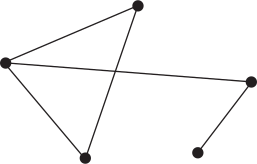
In the graph shown above, the number of vertices of even degree is:

  1. 0
  2. 1
  3. 2
  4. 3
  5. 4
Show Answers Only

\(D\)

Show Worked Solution

\(\Rightarrow D\)

Filed Under: Basic Concepts Tagged With: Band 2, smc-626-20-Degrees of Vertices

HMS, BM 2024 HSC 5 MC

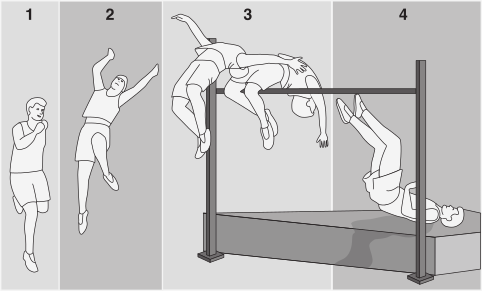
An athlete creates the following sequence of images in their mind as part of their training.
 

Which psychological strategy best describes the process being used by the athlete?

  1. Goal setting
  2. Concentration
  3. Mental rehearsal
  4. Relaxation techniques
Show Answers Only

\(C\)

Show Worked Solution
  • C is correct: The sequence of images shows the steps of performing a high jump, which the athlete is visualising in their mind as a form of mental rehearsal/visualisation/imagery.

Other Options:

  • A is incorrect: Images show visualisation, not establishing performance targets.
  • B is incorrect: Concentration involves focusing attention, not mentally rehearsing a sequence.
  • D is incorrect: Relaxation involves tension reduction methods, not skill visualisation.

Filed Under: Stages of learning Tagged With: Band 2, smc-5921-10-Cognitive

HMS, BM EQ-Bank 949

Identify two signs of dehydration that might affect an athlete's movement during competition.   (2 marks)

--- 5 WORK AREA LINES (style=lined) ---

Show Answers Only

Sample Answer – Any 2 of the following:

  • Decreased coordination – Loss of fine motor control affecting precise movements like shooting or ball handling during critical game moments.
  • Muscle fatigue and cramping – Reduced muscle function causing slower reaction times, impaired power output and painful contractions limiting movement.
  • Dizziness or lightheadedness – Impaired balance and spatial awareness making direction changes difficult and increasing fall risk during play.
  • Increased heart rate – Cardiovascular strain reducing oxygen delivery to muscles, causing earlier fatigue and decreased movement efficiency.
  • Mental confusion – Reduced concentration affecting decision-making, tactical awareness and reaction times during complex game situations.
  • Excessive thirst – Distraction from performance focus and dry mouth affecting breathing patterns during high-intensity movement periods.
Show Worked Solution

Sample Answer - Any 2 of the following:

  • Decreased coordination - Loss of fine motor control affecting precise movements like shooting or ball handling during critical game moments.
  • Muscle fatigue and cramping - Reduced muscle function causing slower reaction times, impaired power output and painful contractions limiting movement.
  • Dizziness or lightheadedness - Impaired balance and spatial awareness making direction changes difficult and increasing fall risk during play.
  • Increased heart rate - Cardiovascular strain reducing oxygen delivery to muscles, causing earlier fatigue and decreased movement efficiency.
  • Mental confusion - Reduced concentration affecting decision-making, tactical awareness and reaction times during complex game situations.
  • Excessive thirst - Distraction from performance focus and dry mouth affecting breathing patterns during high-intensity movement periods.

Filed Under: Role of First Aid Tagged With: Band 2, smc-5527-20-Dehydration

HMS, BM EQ-Bank 899

Outline TWO ways that acute stress affects the digestive system.   (3 marks)

--- 6 WORK AREA LINES (style=lined) ---

Show Answers Only

Sample Answer – Any 2 of the following

Decreased saliva production

  • During acute stress, saliva production decreases due to the sympathetic nervous system activation.
  • Dry mouth often results with initial digestion of carbohydrates less efficient .

Blood diversion from digestive organs

  • Acute stress causes blood to be diverted away from the digestive organs to skeletal muscles, heart, and lungs.
  • This can produce temporarily reduced digestive processes and nutrient absorption.

Slowed/halted peristalsis

  • Acute stress can slow or halt peristalsis (the wave-like muscle contractions that move food through the digestive tract).
  • Therefore feelings of fullness or discomfort can occur.

Sphincter relaxation

  • Stress hormones can cause the sphincter between the oesophagus and stomach to relax inappropriately.
  • Thus a heightened potential for acid reflux or heartburn during stressful situations exists.

Stomach/intestinal contractions

  • The release of adrenaline during acute stress can cause contractions in the stomach and intestines.
  • Nausea, “butterflies in the stomach,” or even diarrhoea are possible consequences in some individuals.

Inflammatory response

  • Acute stress can trigger the release of inflammatory compounds in the digestive tract.
  • As a result gut sensitivity is increased and potentially exacerbates conditions like irritable bowel syndrome.
Show Worked Solution

Sample Answer – Any 2 of the following

Decreased saliva production

  • During acute stress, saliva production decreases due to the sympathetic nervous system activation.
  • Dry mouth often results with initial digestion of carbohydrates less efficient .

Blood diversion from digestive organs

  • Acute stress causes blood to be diverted away from the digestive organs to skeletal muscles, heart, and lungs.
  • This can produce temporarily reduced digestive processes and nutrient absorption.

Slowed/halted peristalsis

  • Acute stress can slow or halt peristalsis (the wave-like muscle contractions that move food through the digestive tract).
  • Therefore feelings of fullness or discomfort can occur.

Sphincter relaxation

  • Stress hormones can cause the sphincter between the oesophagus and stomach to relax inappropriately.
  • Thus a heightened potential for acid reflux or heartburn during stressful situations exists.

Stomach/intestinal contractions

  • The release of adrenaline during acute stress can cause contractions in the stomach and intestines.
  • Nausea, “butterflies in the stomach,” or even diarrhoea are possible consequences in some individuals.

Inflammatory response

  • Acute stress can trigger the release of inflammatory compounds in the digestive tract.
  • As a result gut sensitivity is increased and potentially exacerbates conditions like irritable bowel syndrome.

Filed Under: Digestive and endocrine systems Tagged With: Band 2, smc-5524-10-Stress

HMS, BM EQ-Bank 868

Outline the difference between pulmonary and systemic circulation.   (3 marks)

--- 6 WORK AREA LINES (style=lined) ---

Show Answers Only

Sample Answer

Pulmonary Circulation:

  • Moves blood between the heart and lungs for gas exchange.
  • Carries deoxygenated blood from the right ventricle to the lungs via the pulmonary artery.
  • Returns oxygenated blood to the left atrium via pulmonary veins.

Systemic Circulation:

  • Moves blood between the heart and body tissues.
  • Carries oxygenated blood from the left ventricle to the body via the aorta.
  • Returns deoxygenated blood to the right atrium via the venae cavae.
Show Worked Solution

Sample Answer

Pulmonary Circulation:

  • Moves blood between the heart and lungs for gas exchange.
  • Carries deoxygenated blood from the right ventricle to the lungs via the pulmonary artery.
  • Returns oxygenated blood to the left atrium via pulmonary veins.

Systemic Circulation:

  • Moves blood between the heart and body tissues.
  • Carries oxygenated blood from the left ventricle to the body via the aorta.
  • Returns deoxygenated blood to the right atrium via the venae cavae.

Filed Under: Respiratory and circulatory systems Tagged With: Band 2, smc-5523-15-Blood flow-gas exchange

HMS, BM EQ-Bank 860

Outline the structure of alveoli and explain how this structure enables efficient gas exchange.   (3 marks)

--- 6 WORK AREA LINES (style=lined) ---

Show Answers Only

Sample Answer

  • Alveoli are tiny air sacs located at the end of bronchioles in the lungs.
  • They have extremely thin walls (one cell thick) that enable gases to diffuse easily.
  • They are surrounded by an extensive network of capillaries, which creates a large surface area for gas exchange.
  • The close proximity between alveoli and capillaries results in a short diffusion distance for gases, allowing rapid oxygen and carbon dioxide exchange.
Show Worked Solution

Sample Answer

  • Alveoli are tiny air sacs located at the end of bronchioles in the lungs.
  • They have extremely thin walls (one cell thick) that enable gases to diffuse easily.
  • They are surrounded by an extensive network of capillaries, which creates a large surface area for gas exchange.
  • The close proximity between alveoli and capillaries results in a short diffusion distance for gases, allowing rapid oxygen and carbon dioxide exchange.

Filed Under: Respiratory and circulatory systems Tagged With: Band 2, smc-5523-10-Structure-function

HMS, BM EQ-Bank 765

Explain how causes of fatigue differ between the ATP-PCr system and the glycolytic system during high-intensity exercise.   (4 marks)

--- 10 WORK AREA LINES (style=lined) ---

Show Answers Only

Sample Answer

  • The ATP-PCr system experiences fatigue solely from phosphocreatine depletion after 10-15 seconds of maximal effort.
  • This occurs because stored PCr becomes exhausted without producing any fatiguing by-products.
  • Heat is the only by-product, which enables rapid recovery within 2 minutes.
  • Therefore, ATP-PCr fatigue is temporary and quickly reversible.
  • The glycolytic system fatigues due to lactic acid accumulation in muscle cells.
  • Lactic acid forms when glucose breaks down anaerobically, accumulating faster than removal rates.
  • As a result, the acid interferes with enzyme function and muscle contraction.
  • Consequently, glycolytic fatigue persists longer, requiring 30-60 minutes for complete recovery.
Show Worked Solution

Sample Answer 

  • The ATP-PCr system experiences fatigue solely from phosphocreatine depletion after 10-15 seconds of maximal effort.
  • This occurs because stored PCr becomes exhausted without producing any fatiguing by-products.
  • Heat is the only by-product, which enables rapid recovery within 2 minutes.
  • Therefore, ATP-PCr fatigue is temporary and quickly reversible.
  • The glycolytic system fatigues due to lactic acid accumulation in muscle cells.
  • Lactic acid forms when glucose breaks down anaerobically, accumulating faster than removal rates.
  • As a result, the acid interferes with enzyme function and muscle contraction.
  • Consequently, glycolytic fatigue persists longer, requiring 30-60 minutes for complete recovery.

Filed Under: Energy systems Tagged With: Band 2, Band 3, smc-5528-30-Causes of fatigue

HMS, BM EQ-Bank 761

Describe how fuel sources contribute to fatigue during the final stretch of a 400-metre race.  (3 marks)

--- 7 WORK AREA LINES (style=lined) ---

Show Answers Only

Sample Answer

  • The 400m relies heavily on the glycolytic system which uses glucose as fuel for the final stretch.
  • This system produces ATP quickly but creates lactic acid as a by-product.
  • Lactic acid builds up rapidly in muscles, making them increasingly acidic and reducing their ability to contract.
  • Additionally, the intense effort uses up muscle glucose stores quickly.
  • These combined effects cause severe fatigue, forcing runners to slow dramatically in the final metres.
Show Worked Solution

Sample Answer

  • The 400m relies heavily on the glycolytic system which uses glucose as fuel for the final stretch.
  • This system produces ATP quickly but creates lactic acid as a by-product.
  • Lactic acid builds up rapidly in muscles, making them increasingly acidic and reducing their ability to contract.
  • Additionally, the intense effort uses up muscle glucose stores quickly.
  • These combined effects cause severe fatigue, forcing runners to slow dramatically in the final metres.

Filed Under: Energy systems Tagged With: Band 2, Band 3, smc-5528-10-Fuel Source

HMS, BM EQ-Bank 757

Identify the fuel sources used by the three energy systems and explain why each energy system uses its particular fuel source(s).   (6 marks)

--- 15 WORK AREA LINES (style=lined) ---

Show Answers Only

Sample Answer

  • The ATP-PCr system uses phosphocreatine as fuel because PCr can rapidly donate a phosphate group to ADP to reform ATP without requiring oxygen.
  • The glycolytic (lactic acid) system uses carbohydrates in the form of glucose (from blood) and glycogen (stored in muscles) because these can be quickly broken down anaerobically to produce ATP.
  • The aerobic system can use carbohydrates, fats, and proteins as fuel sources because oxygen is available for complete breakdown of these nutrients through cellular respiration pathways.
  • PCr is used for the ATP-PCr system due to its high concentration in muscle cells (five times that of ATP) allowing for quick energy availability.
  • Carbohydrates are the only fuel source that can be metabolised without oxygen, making them essential for the glycolytic system during high-intensity activities.
  • The aerobic system’s ability to use multiple fuel sources, particularly fat during lower intensities, allows for sustained energy production during prolonged activities when oxygen supply meets demand.
Show Worked Solution

Sample Answer 

  • The ATP-PCr system uses phosphocreatine as fuel because PCr can rapidly donate a phosphate group to ADP to reform ATP without requiring oxygen.
  • The glycolytic (lactic acid) system uses carbohydrates in the form of glucose (from blood) and glycogen (stored in muscles) because these can be quickly broken down anaerobically to produce ATP.
  • The aerobic system can use carbohydrates, fats, and proteins as fuel sources because oxygen is available for complete breakdown of these nutrients through cellular respiration pathways.
  • PCr is used for the ATP-PCr system due to its high concentration in muscle cells (five times that of ATP) allowing for quick energy availability.
  • Carbohydrates are the only fuel source that can be metabolised without oxygen, making them essential for the glycolytic system during high-intensity activities.
  • The aerobic system’s ability to use multiple fuel sources, particularly fat during lower intensities, allows for sustained energy production during prolonged activities when oxygen supply meets demand.

Filed Under: Energy systems (EO-X) Tagged With: Band 2, Band 3, smc-5528-10-Fuel Source

HMS, BM EQ-Bank 753

Describe how outdoor boot camps create opportunities for social interaction that enhance a sense of belonging.   (3 marks)

--- 8 WORK AREA LINES (style=lined) ---

Show Answers Only

Sample Answer

  • Boot camps often incorporate partner exercises requiring communication and collaboration.
  • Outdoor settings provide natural conversation opportunities before and after workouts.
  • The shared experience of training in varied weather conditions creates bonding through collective challenges.
  • Many boot camps organise social events or group challenges beyond regular sessions to strengthen connection.
Show Worked Solution

Sample Answer 

  • Boot camps often incorporate partner exercises requiring communication and collaboration.
  • Outdoor settings provide natural conversation opportunities before and after workouts.
  • The shared experience of training in varied weather conditions creates bonding through collective challenges.
  • Many boot camps organise social events or group challenges beyond regular sessions to strengthen connection.

Filed Under: Communities of exercise (EO-X) Tagged With: Band 2, smc-5537-20-Group Exercise Cohesion

HMS, BM EQ-Bank 747

Describe how parkrun encourages social interaction among participants.   (3 marks)

--- 8 WORK AREA LINES (style=lined) ---

Show Answers Only

Sample Answer

  • Parkrun events occur at regular weekly times. Weekly consistency creates ongoing opportunities for participants to meet and form connections.
  • Post-run coffee meetups are formally organised at local cafés. Social interaction extends beyond the exercise setting into community spaces.
  • Volunteer systems require participants to occasionally help run events. Different interaction opportunities emerge beyond just running together.
  • Non-competitive atmosphere (despite timing) encourages conversations before, during, and after runs. Participants of all abilities feel comfortable interacting with each other.
Show Worked Solution

Sample Answer 

  • Parkrun events occur at regular weekly times. Weekly consistency creates ongoing opportunities for participants to meet and form connections.
  • Post-run coffee meetups are formally organised at local cafés. Social interaction extends beyond the exercise setting into community spaces.
  • Volunteer systems require participants to occasionally help run events. Different interaction opportunities emerge beyond just running together.
  • Non-competitive atmosphere (despite timing) encourages conversations before, during, and after runs. Participants of all abilities feel comfortable interacting with each other.

Filed Under: Communities of exercise Tagged With: Band 2, smc-5537-20-Group Exercise Cohesion

HMS, BM EQ-Bank 741 MC

Which contemporary exercise element is MOST effective in creating social interaction opportunities OUTSIDE the exercise environment?

  1. Synchronised warm-ups before each session
  2. Timed intervals during high-intensity workouts
  3. Coffee meet-ups organised after exercise sessions
  4. Individual fitness assessments conducted by trainers
Show Answers Only

\(C\)

Show Worked Solution
  • C is correct: Coffee meet-ups create social interaction outside exercise environment.

Other Options:

  • A is incorrect: Warm-ups occur during the exercise session.
  • B is incorrect: Timed intervals are part of the exercise session.
  • D is incorrect: Individual assessments don’t promote social interaction.

Filed Under: Communities of exercise Tagged With: Band 2, smc-5537-20-Group Exercise Cohesion

HMS, BM EQ-Bank 714

Outline how elite athletes apply self-regulation to improve their performance.   (3 marks)

--- 8 WORK AREA LINES (style=lined) ---

Show Answers Only

Sample Answer

  • Elite athletes have better awareness of their strengths and weaknesses, which helps them direct training efforts effectively.
  • They can manipulate playing situations to capitalise on their strengths while avoiding weaknesses.
  • Elite athletes control their thoughts and feelings during competition, directing energy toward achieving goals rather than dwelling on obstacles.
  • They reflect objectively on performance to identify improvement areas without being clouded by negative emotions.
Show Worked Solution

Sample Answer 

  • Elite athletes have better awareness of their strengths and weaknesses, which helps them direct training efforts effectively.
  • They can manipulate playing situations to capitalise on their strengths while avoiding weaknesses.
  • Elite athletes control their thoughts and feelings during competition, directing energy toward achieving goals rather than dwelling on obstacles.
  • They reflect objectively on performance to identify improvement areas without being clouded by negative emotions.

Filed Under: Psych–Movement–Performance interplay Tagged With: Band 2, smc-5536-20-Self-regulation

HMS, BM EQ-Bank 710

Outline how self-regulation contributes to sports performance.   (3 marks)

--- 8 WORK AREA LINES (style=lined) ---

Show Answers Only

Sample Answer

  • Self-regulation involves consciously constraining unwanted thoughts or behaviors to focus on achieving goals.
  • Athletes who effectively self-regulate can maintain effort for longer periods in their sport.
  • Self-regulation enables athletes to control emotions in high-pressure situations, preventing poor decisions and emotional outbursts.
  • Without adequate self-regulation, performance deteriorates as athletes lose focus on their goals.
Show Worked Solution

Sample Answer 

  • Self-regulation involves consciously constraining unwanted thoughts or behaviors to focus on achieving goals.
  • Athletes who effectively self-regulate can maintain effort for longer periods in their sport.
  • Self-regulation enables athletes to control emotions in high-pressure situations, preventing poor decisions and emotional outbursts.
  • Without adequate self-regulation, performance deteriorates as athletes lose focus on their goals.

Filed Under: Psych–Movement–Performance Interplay (EO-X) Tagged With: Band 2, smc-5536-20-Self-regulation

HMS, BM EQ-Bank 705 MC

During a football grand final, a player experiences frustration when the opposition scores. The player struggles to maintain focus and begins making poor decisions.

This scenario demonstrates:

  1. The importance of positive self-talk
  2. Ego depletion
  3. Goal-directed behavior
  4. Self-efficacy
Show Answers Only

\(B\)

Show Worked Solution
  • B is correct: Mental resources exhausted after repeated self-regulation efforts.

Other Options:

  • A is incorrect: The scenario doesn’t specifically mention this technique.
  • C is incorrect: Shows breakdown rather than demonstrating goal-directed behaviour.
  • D is incorrect: Self-efficacy refers to belief, not inability to regulate.

Filed Under: Psych–Movement–Performance interplay Tagged With: Band 2, smc-5536-20-Self-regulation

HMS, BM EQ-Bank 702

Describe how a coach can increase positive motivation in young athletes.   (3 marks)

--- 7 WORK AREA LINES (style=lined) ---

Show Answers Only

Sample Answer

  • Coaches should establish progressive, achievable challenges that allow athletes to experience regular success, building confidence through visible skill development rather than emphasising competitive outcomes.
  • Providing specific, genuine praise focused on effort and process rather than natural ability reinforces desired behaviors while promoting growth mindset and resilience.
  • Creating supportive training environments where mistakes are treated as learning opportunities rather than failures helps athletes maintain a positive approach to skill development and risk-taking.
Show Worked Solution

Sample Answer 

  • Coaches should establish progressive, achievable challenges that allow athletes to experience regular success, building confidence through visible skill development rather than emphasising competitive outcomes.
  • Providing specific, genuine praise focused on effort and process rather than natural ability reinforces desired behaviors while promoting growth mindset and resilience.
  • Creating supportive training environments where mistakes are treated as learning opportunities rather than failures helps athletes maintain a positive approach to skill development and risk-taking.

Filed Under: Psych–Movement–Performance Interplay (EO-X) Tagged With: Band 2, Band 3, smc-5536-10-Motivation

HMS, BM EQ-Bank 697

Describe two ways intrinsic motivation supports long-term participation in sport.   (3 marks)

--- 9 WORK AREA LINES (style=lined) ---

Show Answers Only

Sample Answer

  • Intrinsic motivation is self-sustaining as it generates satisfaction from the activity itself, enabling athletes to continue participation even without external recognition or rewards.
  • Athletes who are intrinsically motivated focus on personal improvement and competence development, which creates an ongoing cycle of challenge and achievement that sustains interest.
  • Because intrinsic motivation is tied to enjoyment of the process rather than outcomes, it creates resilience that helps athletes persevere through setbacks or plateaus in performance.
Show Worked Solution

Sample Answer 

  • Intrinsic motivation is self-sustaining as it generates satisfaction from the activity itself, enabling athletes to continue participation even without external recognition or rewards.
  • Athletes who are intrinsically motivated focus on personal improvement and competence development, which creates an ongoing cycle of challenge and achievement that sustains interest.
  • Because intrinsic motivation is tied to enjoyment of the process rather than outcomes, it creates resilience that helps athletes persevere through setbacks or plateaus in performance.

Filed Under: Psych–Movement–Performance interplay Tagged With: Band 2, Band 3, smc-5536-10-Motivation

HMS, BM EQ-Bank 694 MC

Which of the following is the BEST example of intrinsic motivation in sport?

  1. An athlete practising daily to earn a university scholarship
  2. A runner participating in a marathon for the enjoyment of the challenge
  3. A swimmer training harder after being criticised by their coach
  4. A basketball player performing well to receive praise from spectators
Show Answers Only

\(B\)

Show Worked Solution
  • B is correct: The runner is motivated by the internal satisfaction and enjoyment of the challenge itself, representing intrinsic motivation.

Other Options:

  • A is incorrect: Pursuing a scholarship is an external reward (extrinsic motivation).
  • C is incorrect: Responding to criticism represents negative extrinsic motivation.
  • D is incorrect: Performing for spectator praise is a form of positive extrinsic motivation.

Filed Under: Psych–Movement–Performance Interplay (EO-X) Tagged With: Band 2, smc-5536-10-Motivation

HMS, BM EQ-Bank 691 MC

Which statement about motivation in sport is MOST accurate?

  1. Motivation levels remain consistent throughout an athlete's career
  2. Negative consequences are more effective for long-term development than positive reinforcement
  3. Motivation can be influenced to help athletes reach their potential
  4. External rewards provide more sustainable motivation than internal satisfaction
Show Answers Only

\(C\)

Show Worked Solution
  • C is correct: Motivation can be shaped to enhance performance.

Other Options:

  • A is incorrect: Motivation fluctuates based on success and challenges.
  • B is incorrect: Positive approaches generally produce better long-term results.
  • D is incorrect: Internal satisfaction provides more sustainable motivation.

Filed Under: Psych–Movement–Performance interplay Tagged With: Band 2, smc-5536-10-Motivation

HMS, BM EQ-Bank 681

Describe how peer influence can affect a young person's participation in sport.   (3 marks)

--- 6 WORK AREA LINES (style=lined) ---

Show Answers Only

Sample Answer

  • Young people often participate in sports their friends engage in to maintain social connections and avoid feeling excluded from peer groups.
  • Peers can provide encouragement and support during training and competition, enhancing motivation to continue participation.
  • Negative peer interactions or bullying in sporting contexts can discourage participation and cause young people to withdraw from sports they might otherwise enjoy.
Show Worked Solution

Sample Answer 

  • Young people often participate in sports their friends engage in to maintain social connections and avoid feeling excluded from peer groups.
  • Peers can provide encouragement and support during training and competition, enhancing motivation to continue participation.
  • Negative peer interactions or bullying in sporting contexts can discourage participation and cause young people to withdraw from sports they might otherwise enjoy.

Filed Under: Psych–Movement–Performance Interplay (EO-X) Tagged With: Band 2, Band 3, smc-5536-15-Personal Identity

HMS, BM EQ-Bank 678 MC

Sophia has experienced setbacks in her gymnastics career but continues to view challenges as opportunities to improve rather than reasons to give up.

This mindset most directly reflects which personal characteristic that influences sport participation and performance?

  1. Knowledge of various sports
  2. Family support systems
  3. Physical aptitude
  4. Resilience
Show Answers Only

\(D\)

Show Worked Solution
  • D is correct: Resilience is defined by the ability to bounce back from setbacks and view challenges as opportunities.

Other Options:

  • A is incorrect: Knowledge of various sports is not directly related to overcoming setbacks.
  • B is incorrect: While family support may contribute to resilience, the scenario focuses on Sophia’s own mindset and approach.
  • C is incorrect: Physical aptitude refers to natural physical abilities rather than psychological characteristics.

Filed Under: Psych–Movement–Performance Interplay (EO-X) Tagged With: Band 2, smc-5536-15-Personal Identity

HMS, BM EQ-Bank 664

The research plan for front-on tackling in rugby league includes the question: "Does age affect how the front-on tackle should be learnt?"

Suggest two further research questions that could extend understanding of age-appropriate skill development in rugby.   (2 marks)

--- 4 WORK AREA LINES (style=lined) ---

Show Answers Only

Sample Answer – Any TWO of the following or similar

  • How should coaching feedback types be modified for different age groups learning front-on tackling technique to maximise safety and skill development?
  • What modifications to practice environments are most effective for different age groups to develop proper tackling technique while minimising injury risk?
  • At what age should full-contact tackling practice begin, and how should progression differ between younger and older beginners?
  • How do cognitive development stages across different ages affect the optimal sequence for teaching complex tackling technique components?
Show Worked Solution

Sample Answer – Any TWO of the following or similar

  • How should coaching feedback types be modified for different age groups learning front-on tackling technique to maximise safety and skill development?
  • What modifications to practice environments are most effective for different age groups to develop proper tackling technique while minimising injury risk?
  • At what age should full-contact tackling practice begin, and how should progression differ between younger and older beginners?
  • How do cognitive development stages across different ages affect the optimal sequence for teaching complex tackling technique components?

Filed Under: Skill learning and performance - Research Tagged With: Band 2, smc-5535-20-Further Research

HMS, BM EQ-Bank 657

  1. What is a "control group" in a research study about skill development.   (1 mark)

    --- 2 WORK AREA LINES (style=lined) ---

  2. Explain why a control group might be important when researching the effectiveness of a new coaching approach for soccer dribbling skills.   (2 marks)

    --- 6 WORK AREA LINES (style=lined) ---

Show Answers Only

Sample Answer

  1. A control group receives standard training rather than the experimental method, providing a comparison baseline.
  2. A control group helps researchers determine if improvements are actually due to the new coaching approach rather than just from regular practice or other factors.
  3. Without a control group, researchers couldn’t tell if skill improvements happened because the new approach works better or simply because any practice leads to improvement over time.

Show Worked Solution

Sample Answer

  1. A control group receives standard training rather than the experimental method, providing a comparison baseline.
  2. A control group helps researchers determine if improvements are actually due to the new coaching approach rather than just from regular practice or other factors.
  3. Without a control group, researchers couldn’t tell if skill improvements happened because the new approach works better or simply because any practice leads to improvement over time.
  4.  

Filed Under: Skill learning and performance - Research Tagged With: Band 2, Band 3, smc-5535-15-Research Process

HMS, BM EQ-Bank 652

Outline two ways a researcher might collect data when studying how beginners learn the front crawl swimming technique.   (2 marks)

--- 4 WORK AREA LINES (style=lined) ---

Show Answers Only

Sample Answer

  • Researchers could use direct observation with a checklist of technique elements (arm position, breathing timing, kick pattern) to measure improvement over multiple lessons.
  • Video recording of swimming sessions could be collected to allow detailed analysis of technique changes over time, with comparisons between early and later attempts.
Show Worked Solution

Sample Answer 

  • Researchers could use direct observation with a checklist of technique elements (arm position, breathing timing, kick pattern) to measure improvement over multiple lessons.
  • Video recording of swimming sessions could be collected to allow detailed analysis of technique changes over time, with comparisons between early and later attempts.

Filed Under: Uncategorized Tagged With: Band 2, smc-5535-15-Research Process

HMS, BM EQ-Bank 649 MC

What is the MAIN purpose of researching movement skill acquisition in sports?

  1. To identify talented athletes for elite development
  2. To develop better ways of teaching and learning skills
  3. To compare different sports and their techniques
  4. To create more complex sporting competitions
Show Answers Only

\(B\)

Show Worked Solution
  • B is correct: Research aims to improve teaching and learning methods

Other Options:

  • A is incorrect: Talent identification uses research but isn’t main purpose
  • C is incorrect: Technique comparison isn’t central purpose
  • D is incorrect: Competition development not related to skill acquisition

Filed Under: Skill learning and performance - Research Tagged With: Band 2, smc-5535-15-Research Process

HMS, BM EQ-Bank 644

Describe TWO ways researchers could study which types of feedback work best for beginners learning to tackle in rugby league.   (2 marks)

--- 6 WORK AREA LINES (style=lined) ---

Show Answers Only

Sample Answer – Any TWO of the following

  • Researchers could compare two beginner groups learning tackling with different feedback types. One receives knowledge of performance feedback, another receives knowledge of results feedback, then measure technique improvement.
  • Researchers could observe coaching sessions, recording feedback types given and tracking players’ technique development afterwards to identify which feedback produces better outcomes.
  • Researchers could use video analysis to compare tackling technique development between groups receiving immediate feedback versus delayed feedback after practice sessions.
  • Researchers could conduct surveys and interviews with players about their preferred feedback types, then correlate preferences with actual technique improvement measurements.
Show Worked Solution

Sample Answer 

  • Researchers could compare two beginner groups learning tackling with different feedback types. One receives knowledge of performance feedback, another receives knowledge of results feedback, then measure technique improvement.
  • Researchers could observe coaching sessions, recording feedback types given and tracking players’ technique development afterwards to identify which feedback produces better outcomes.
  • Researchers could use video analysis to compare tackling technique development between groups receiving immediate feedback versus delayed feedback after practice sessions.
  • Researchers could conduct surveys and interviews with players about their preferred feedback types, then correlate preferences with actual technique improvement measurements.

Filed Under: Skill learning and performance - Research Tagged With: Band 2, smc-5535-15-Research Process

HMS, BM EQ-Bank 586 MC

In soccer, "marking-up in defence" is an example of a:

  1. Strategic plan
  2. Technical skill
  3. Tactical skill
  4. Performance analysis
Show Answers Only

\(C\)

Show Worked Solution
  • C is correct: Tactical skill involves positioning decisions to gain advantage

Other Options:

  • A is incorrect: Strategic plan is broader overall approach
  • B is incorrect: Technical skills are physical movement execution
  • D is incorrect: Performance analysis reviews play after it occurs

Filed Under: Performance elements Tagged With: Band 2, smc-5925-50-Identify element

HMS, BM EQ-Bank 570 MC

A novice gymnast is learning a complex balance beam routine. Her coach breaks down the routine into smaller segments, having her practise the mount first, then the middle section, and finally the dismount, before attempting the entire routine.

This is an example of which practice method?

  1. Massed practice
  2. Part practice
  3. Random practice
  4. Blocked practice
Show Answers Only

\(B\)

Show Worked Solution
  • B is correct: Part practice involves breaking complex skills into smaller components

Other Options:

  • A is incorrect: Massed practice is continuous with minimal breaks
  • C is incorrect: Random practice mixes different skills unpredictably
  • D is incorrect: Blocked practice repeats one skill before moving to another

Filed Under: Practice methods Tagged With: Band 2, smc-5924-20-Whole/part, smc-5924-50-Identify method

HMS, BM EQ-Bank 547

Describe the role of feedback in the cognitive stage of learning a new swimming stroke.   (3 marks)

--- 7 WORK AREA LINES (style=lined) ---

Show Answers Only

Sample Answer

  • In the cognitive stage, immediate corrective feedback helps swimmers understand what adjustments are needed since they often cannot recognise their own errors in technique or body positioning.
  • Visual feedback through demonstrations or video replays creates clear mental images of proper technique, allowing swimmers to compare their performance against the model.
  • Positive reinforcement of successful attempts builds confidence and motivation to persist through initial difficulties, encouraging swimmers to continue practising despite experiencing discomfort or awkwardness.
Show Worked Solution

Sample Answer 

  • In the cognitive stage, immediate corrective feedback helps swimmers understand what adjustments are needed since they often cannot recognise their own errors in technique or body positioning.
  • Visual feedback through demonstrations or video replays creates clear mental images of proper technique, allowing swimmers to compare their performance against the model.
  • Positive reinforcement of successful attempts builds confidence and motivation to persist through initial difficulties, encouraging swimmers to continue practising despite experiencing discomfort or awkwardness.

Filed Under: Stages of learning Tagged With: Band 2, Band 3, smc-5921-10-Cognitive

HMS, BM EQ-Bank 541 MC

The table below shows characteristics of different skill acquisition stages.

Focus Error Recognition   Movement Efficiency  
How to do the skill     Can identify errors  Moderately Efficient

Which stage of skill acquisition is being described?

  1. Cognitive stage
  2. Associative stage
  3. Autonomous stage
  4. Preparatory stage
Show Answers Only

\(B\)

Show Worked Solution
  • B is correct: Focusing on “how to do the skill,” being able to identify errors, and moderately efficient movements are key characteristics of the associative stage.

Other Options:

  • A is incorrect: The cognitive stage focuses on “what to do” with limited error recognition and inefficient movement.
  • C is incorrect: The autonomous stage would show automatic movement execution with high efficiency.
  • D is incorrect: “Preparatory stage” is not a recognised stage in the three-stage process of skill acquisition.

Filed Under: Stages of learning Tagged With: Band 2, smc-5921-45-Identify stage

HMS, BM EQ-Bank 532

Describe how confidence influences skill acquisition in a novice swimmer.   (3 marks)

--- 7 WORK AREA LINES (style=lined) ---

Show Answers Only

Sample Answer

  • A confident novice swimmer is more likely to attempt new skills like submersion or floating without fear, creating more learning opportunities and practice repetitions.
  • Confidence enables the swimmer to focus on technique rather than anxiety, allowing them to process coaching instructions more effectively and make technical corrections.
  • Early success builds a positive self-image, creating a cycle where confidence leads to greater effort and persistence through challenges, accelerating the learning process when difficulties are encountered.
Show Worked Solution

Sample Answer 

  • A confident novice swimmer is more likely to attempt new skills like submersion or floating without fear, creating more learning opportunities and practice repetitions.
  • Confidence enables the swimmer to focus on technique rather than anxiety, allowing them to process coaching instructions more effectively and make technical corrections.
  • Early success builds a positive self-image, creating a cycle where confidence leads to greater effort and persistence through challenges, accelerating the learning process when difficulties are encountered.

Filed Under: Characteristics of learners Tagged With: Band 2, Band 3, smc-5534-05-Confidence

HMS, BM EQ-Bank 526 MC

Which of the following factors would be classified as a heredity characteristic that influences skill acquisition?

  1. Training experience
  2. Confidence level
  3. Muscle fibre composition
  4. Motivation to learn
Show Answers Only

\(C\)

Show Worked Solution
  • C is correct: The relative percentage of fast-twitch to slow-twitch muscle fibres is an inherited characteristic that cannot be changed.

Other Options:

  • A is incorrect: Training experience is acquired, not inherited.
  • B is incorrect: Confidence develops through successful experiences and is not inherited.
  • D is incorrect: Motivation is a personality trait developed through social interactions and experiences, not inherited.

Filed Under: Characteristics of learners Tagged With: Band 2, smc-5534-10-Heredity

HMS, BM EQ-Bank 520

How can skill-related fitness testing be modified to meet the needs of adolescent athletes compared to elite athletes.   (5 marks)

--- 18 WORK AREA LINES (style=lined) ---

Show Answers Only

Sample Answer

  • Skill-related fitness testing is modified for adolescent athletes through age-appropriate protocols which ensures safe and valid assessment. This process involves reducing test intensity and duration because adolescents have developing musculoskeletal systems. For example, agility tests use wider turning angles which prevents excessive joint stress while still measuring directional change ability.
  • Elite athletes require sport-specific modifications which leads to more precise performance data. This occurs by incorporating game-like conditions into tests because elite performance demands highly specific assessments. Therefore, a tennis player’s agility test includes racquet movements which creates more valid results for their sport.
  • Test instructions are modified through simplified language for adolescents which enables better understanding and compliance. Conversely, elite athletes receive detailed technical feedback because they can process complex information. This difference ensures each group maximises test validity.
  • Recovery periods between tests are extended for adolescents which allows complete physiological recovery. This modification occurs because younger athletes have less developed energy systems. Meanwhile, elite athletes follow shorter recovery protocols which replicates competition demands.
Show Worked Solution

Sample Answer

  • Skill-related fitness testing is modified for adolescent athletes through age-appropriate protocols which ensures safe and valid assessment. This process involves reducing test intensity and duration because adolescents have developing musculoskeletal systems. For example, agility tests use wider turning angles which prevents excessive joint stress while still measuring directional change ability.
  • Elite athletes require sport-specific modifications which leads to more precise performance data. This occurs by incorporating game-like conditions into tests because elite performance demands highly specific assessments. Therefore, a tennis player’s agility test includes racquet movements which creates more valid results for their sport.
  • Test instructions are modified through simplified language for adolescents which enables better understanding and compliance. Conversely, elite athletes receive detailed technical feedback because they can process complex information. This difference ensures each group maximises test validity.
  • Recovery periods between tests are extended for adolescents which allows complete physiological recovery. This modification occurs because younger athletes have less developed energy systems. Meanwhile, elite athletes follow shorter recovery protocols which replicates competition demands.

Filed Under: Fitness testing Tagged With: Band 2, Band 3, smc-5637-50-Skill related

HMS, BM EQ-Bank 516

Explain how reaction time affects performance in sprinting events, and describe two specific training methods that could be used to improve this skill-related component.   (5 marks)

--- 12 WORK AREA LINES (style=lined) ---

Show Answers Only

Sample Answer

  • Reaction time affects sprinting performance because it determines how quickly athletes respond to the starter’s gun. This leads to earlier force generation and forward movement. Consequently, faster reaction times result in better race positions from the start. This advantage occurs because even hundredths of seconds saved can determine final placings in sprint events where margins are minimal.

Training method 1: Auditory response drills

  • Athletes respond to varied sound stimuli (whistles, claps, electronic beeps) from different starting positions
  • Progressively decrease time between warning and stimulus to improve anticipation
  • Measure and record reaction times to track improvement
  • Practice 3-4 times weekly for 10-15 minutes per session

Training method 2: Starting block practice with feedback technology

  • Use timing gates or pressure sensors to measure block clearance time
  • Focus on explosive first movement while maintaining legal starting position
  • Provide immediate feedback on reaction time after each attempt
  • Incorporate video analysis to refine anticipatory positioning and technique
Show Worked Solution

Sample Answer

  • Reaction time affects sprinting performance because it determines how quickly athletes respond to the starter’s gun. This leads to earlier force generation and forward movement. Consequently, faster reaction times result in better race positions from the start. This advantage occurs because even hundredths of seconds saved can determine final placings in sprint events where margins are minimal.

Training method 1: Auditory response drills

  • Athletes respond to varied sound stimuli (whistles, claps, electronic beeps) from different starting positions
  • Progressively decrease time between warning and stimulus to improve anticipation
  • Measure and record reaction times to track improvement
  • Practice 3-4 times weekly for 10-15 minutes per session

Training method 2: Starting block practice with feedback technology

  • Use timing gates or pressure sensors to measure block clearance time
  • Focus on explosive first movement while maintaining legal starting position
  • Provide immediate feedback on reaction time after each attempt
  • Incorporate video analysis to refine anticipatory positioning and technique

Filed Under: Fitness testing Tagged With: Band 2, Band 3, smc-5637-50-Skill related

HMS, BM EQ-Bank 508

Describe how body composition affects health and physical performance. In your answer, explain the difference between essential fat and storage fat, and outline the recommended body fat percentages for men and women.   (5 marks)

--- 15 WORK AREA LINES (style=lined) ---

Show Answers Only

Sample Answer

  • Body composition affects health by influencing metabolic function, with excessive fat increasing risk of cardiovascular disease, diabetes, and joint problems.
  • Physical performance is impacted by body composition as excessive fat increases energy demands and reduces power-to-weight ratio in most activities.
  • Essential fat surrounds and protects vital organs like the heart, kidneys, and nerves, and its absence would lead to chronic health problems.
  • Storage fat serves as an energy reserve, providing fuel during extended exercise when blood glucose is depleted and during rest periods.
  • Recommended body fat percentages are 15-20% for men and 20-25% for women according to the syllabus.
  • Women naturally maintain higher body fat percentages than men due to physiological and hormonal differences.
Show Worked Solution

Sample Answer

  • Body composition affects health by influencing metabolic function, with excessive fat increasing risk of cardiovascular disease, diabetes, and joint problems.
  • Physical performance is impacted by body composition as excessive fat increases energy demands and reduces power-to-weight ratio in most activities.
  • Essential fat surrounds and protects vital organs like the heart, kidneys, and nerves, and its absence would lead to chronic health problems.
  • Storage fat serves as an energy reserve, providing fuel during extended exercise when blood glucose is depleted and during rest periods.
  • Recommended body fat percentages are 15-20% for men and 20-25% for women according to the syllabus.
  • Women naturally maintain higher body fat percentages than men due to physiological and hormonal differences.

Filed Under: Fitness testing (EO-X) Tagged With: Band 2, Band 3, smc-5637-60-Health related

HMS, BM EQ-Bank 490 MC

Which of the following fitness tests would be MOST appropriate for assessing the aerobic capacity of a person with a lower limb disability who uses a wheelchair?

  1. Standard beep test
  2. Sit-and-reach test
  3. Wheelchair shuttle-ride test
  4. Hand grip dynamometer test
Show Answers Only

\(C\)

Show Worked Solution
  • C is correct: Wheelchair-specific aerobic capacity test

Other Options:

  • A is incorrect: Requires running
  • B is incorrect: Tests flexibility
  • D is incorrect: Tests grip strength

Filed Under: Fitness testing Tagged With: Band 2, smc-5637-30-Adaptations

HMS, BM EQ-Bank 485

Describe how the sequencing and timing of different fitness tests could affect the outcomes when conducting a comprehensive fitness assessment on athletes.   (4 marks)

--- 12 WORK AREA LINES (style=lined) ---

Show Answers Only

Sample Answer

  • Performing high-intensity tests like the multi-stage fitness test before other assessments can cause excessive fatigue, negatively affecting performance on subsequent tests such as strength or power measurements.
  • Tests requiring fine motor control or balance should be conducted early in the testing sequence when athletes are less fatigued, as skills like coordination (measured by the stick flip test) deteriorate significantly with fatigue.
  • Adequate recovery periods between tests are essential to prevent residual fatigue from confounding results, with recommended minimum rest periods varying based on the energy systems involved in each test.
  • The time of day significantly impacts test outcomes due to diurnal variations in physiological functions, with strength typically peaking in late afternoon while flexibility is often greater in the morning.
Show Worked Solution

Sample Answer 

  • Performing high-intensity tests like the multi-stage fitness test before other assessments can cause excessive fatigue, negatively affecting performance on subsequent tests such as strength or power measurements.
  • Tests requiring fine motor control or balance should be conducted early in the testing sequence when athletes are less fatigued, as skills like coordination (measured by the stick flip test) deteriorate significantly with fatigue.
  • Adequate recovery periods between tests are essential to prevent residual fatigue from confounding results, with recommended minimum rest periods varying based on the energy systems involved in each test.
  • The time of day significantly impacts test outcomes due to diurnal variations in physiological functions, with strength typically peaking in late afternoon while flexibility is often greater in the morning.

Filed Under: Fitness testing (EO-X) Tagged With: Band 2, Band 3, smc-5637-20-Outcomes

HMS, BM EQ-Bank 473

Explain TWO ways that pre-training fitness testing can benefit an athlete beginning a new training program.   (4 marks)

--- 8 WORK AREA LINES (style=lined) ---

Show Answers Only

Sample Answer – Any 2 of the following or similar with appropriate detail

  • Pre-training testing establishes baseline fitness levels which enables objective measurement of progress. This occurs because athletes can compare future results against initial data, allowing accurate tracking of improvements. Consequently, training effectiveness becomes measurable rather than subjective.
  • Fitness testing identifies specific strengths and weaknesses which leads to targeted program design. As a result, athletes focus on improving weak areas while maintaining strengths. This prevents wasted effort on unnecessary training and ensures efficient use of training time.
  • Initial assessment determines sport-specific fitness requirements which helps match athletes to suitable positions. For example, high aerobic capacity results in placement in positions requiring extensive running. Therefore, athletes perform in roles that suit their physical capabilities.
  • Pre-training testing creates measurable goals which enhances motivation throughout the program. Because athletes have clear targets, they maintain focus and effort. This leads to improved adherence and ultimately results in better training outcomes.
Show Worked Solution

Sample Answer – Any 2 of the following or similar with appropriate detail

  • Pre-training testing establishes baseline fitness levels which enables objective measurement of progress. This occurs because athletes can compare future results against initial data, allowing accurate tracking of improvements. Consequently, training effectiveness becomes measurable rather than subjective.
  • Fitness testing identifies specific strengths and weaknesses which leads to targeted program design. As a result, athletes focus on improving weak areas while maintaining strengths. This prevents wasted effort on unnecessary training and ensures efficient use of training time.
  • Initial assessment determines sport-specific fitness requirements which helps match athletes to suitable positions. For example, high aerobic capacity results in placement in positions requiring extensive running. Therefore, athletes perform in roles that suit their physical capabilities.
  • Pre-training testing creates measurable goals which enhances motivation throughout the program. Because athletes have clear targets, they maintain focus and effort. This leads to improved adherence and ultimately results in better training outcomes.

Filed Under: Fitness testing Tagged With: Band 2, Band 3, smc-5637-10-Purpose

HMS, BM EQ-Bank 465

Describe TWO ways fitness testing could be used to improve community health programs.   (4 marks)

--- 8 WORK AREA LINES (style=lined) ---

Show Answers Only

Sample Answer – Any 2 of the following or similar with equivalent depth

Method 1: Targeted Program Development

  • Fitness testing identifies specific health-related fitness deficiencies within communities.
  • Results reveal whether populations lack cardiorespiratory endurance, strength, or flexibility.
  • This data enables targeted interventions addressing actual needs rather than generic approaches.
  • Programs become more effective when tailored to specific community deficiencies.

Method 2: Evidence-Based Evaluation

  • Baseline testing establishes initial fitness levels before program implementation.
  • Follow-up testing provides objective data demonstrating measurable improvements.
  • This evidence helps justify continued funding to stakeholders and policymakers.
  • Quantifiable results strengthen program credibility and support expansion.

Method 3: Identifying Underserved Populations

  • Testing data reveals demographic patterns in fitness levels across community groups.
  • Analysis identifies populations not effectively reached by current programming.
  • This information enables targeted outreach strategies and culturally appropriate programs.
  • Improving participation among underserved populations enhances overall community health outcomes.

Method 4: Health Education Opportunities

  • Testing sessions create teachable moments about fitness components and health relationships.
  • Participants learn how cardiorespiratory endurance affects heart health or flexibility impacts daily function.
  • This increases health literacy as participants understand their results.
  • Enhanced knowledge empowers informed decisions about physical activity participation.
Show Worked Solution

Sample Answer – Any 2 of the following or similar with equivalent depth

Method 1: Targeted Program Development

  • Fitness testing identifies specific health-related fitness deficiencies within communities.
  • Results reveal whether populations lack cardiorespiratory endurance, strength, or flexibility.
  • This data enables targeted interventions addressing actual needs rather than generic approaches.
  • Programs become more effective when tailored to specific community deficiencies.

Method 2: Evidence-Based Evaluation

  • Baseline testing establishes initial fitness levels before program implementation.
  • Follow-up testing provides objective data demonstrating measurable improvements.
  • This evidence helps justify continued funding to stakeholders and policymakers.
  • Quantifiable results strengthen program credibility and support expansion.

Method 3: Identifying Underserved Populations

  • Testing data reveals demographic patterns in fitness levels across community groups.
  • Analysis identifies populations not effectively reached by current programming.
  • This information enables targeted outreach strategies and culturally appropriate programs.
  • Improving participation among underserved populations enhances overall community health outcomes.

Method 4: Health Education Opportunities

  • Testing sessions create teachable moments about fitness components and health relationships.
  • Participants learn how cardiorespiratory endurance affects heart health or flexibility impacts daily function.
  • This increases health literacy as participants understand their results.
  • Enhanced knowledge empowers informed decisions about physical activity participation.

Filed Under: Fitness testing Tagged With: Band 2, Band 3, smc-5637-20-Outcomes

HMS, BM EQ-Bank 462

Outline THREE potential outcomes of fitness testing for individuals with chronic health conditions.   (3 marks)

--- 6 WORK AREA LINES (style=lined) ---

Show Answers Only

Sample Answer 

  • Appropriate testing can establish safe exercise parameters that minimise risk of exacerbating the condition while maximising health benefits, particularly important for conditions like heart disease or diabetes.
  • Testing results provide objective data to track improvements resulting from exercise interventions, which can be motivating and reinforce adherence to prescribed programs.
  • Regular assessment allows healthcare providers to adjust treatment and exercise recommendations based on changing fitness levels, leading to more personalised care.
Show Worked Solution

Sample Answer 

  • Appropriate testing can establish safe exercise parameters that minimise risk of exacerbating the condition while maximising health benefits, particularly important for conditions like heart disease or diabetes.
  • Testing results provide objective data to track improvements resulting from exercise interventions, which can be motivating and reinforce adherence to prescribed programs.
  • Regular assessment allows healthcare providers to adjust treatment and exercise recommendations based on changing fitness levels, leading to more personalised care.

Filed Under: Fitness testing (EO-X) Tagged With: Band 2, Band 3, smc-5637-20-Outcomes

HMS, BM EQ-Bank 457

Outline TWO benefits of conducting regular fitness testing for high school students.   (3 marks)

--- 6 WORK AREA LINES (style=lined) ---

Show Answers Only

Sample Answer – Any 2 of the following or similar

  • Fitness testing provides baseline measurements allowing students to track their progress over time, helping them set realistic goals for improvement and increase motivation.
  • Testing helps physical education teachers identify students who may need additional support or modified activities, ensuring more inclusive and effective programs.
  • Regular assessment helps identify strengths and weaknesses in the school’s physical education program, allowing for evidence-based curriculum adjustments.
Show Worked Solution

Sample Answer – Any 2 of the following or similar

  • Fitness testing provides baseline measurements allowing students to track their progress over time, helping them set realistic goals for improvement and increase motivation.
  • Testing helps physical education teachers identify students who may need additional support or modified activities, ensuring more inclusive and effective programs.
  • Regular assessment helps identify strengths and weaknesses in the school’s physical education program, allowing for evidence-based curriculum adjustments.

Filed Under: Fitness testing (EO-X) Tagged With: Band 2, Band 3, smc-5637-10-Purpose

HMS, BM EQ-Bank 397

Outline TWO ethical considerations when investigating heart rate responses to aerobic training using student participants.   (3 marks)

--- 8 WORK AREA LINES (style=lined) ---

Show Answers Only

Sample Answer – Any 2 of the following

  • Informed consent must be obtained from all participants and parents/guardians if under 18 years of age. This includes clearly explaining the investigation’s purpose, heart rate monitoring procedures, potential physical discomforts, data usage and participant rights throughout the study.
  • Confidentiality of personal health data must be strictly maintained by using participant codes instead of real names. All heart rate records should be secured in password-protected files with restricted access, and only aggregated results presented in findings.
  • Participants must have the absolute right to withdraw from the investigation at any time without penalty, negative consequences, or need for detailed explanation. Researchers must respect withdrawal decisions and immediately cease data collection from those participants.
Show Worked Solution

Sample Answer – Any 2 of the following

  • Informed consent must be obtained from all participants and parents/guardians if under 18 years of age. This includes clearly explaining the investigation’s purpose, heart rate monitoring procedures, potential physical discomforts, data usage and participant rights throughout the study.
  • Confidentiality of personal health data must be strictly maintained by using participant codes instead of real names. All heart rate records should be secured in password-protected files with restricted access, and only aggregated results presented in findings.
  • Participants must have the absolute right to withdraw from the investigation at any time without penalty, negative consequences, or need for detailed explanation. Researchers must respect withdrawal decisions and immediately cease data collection from those participants.

Filed Under: Investigate aerobic training Tagged With: Band 2, smc-5533-30-Ethical considerations

HMS, BM EQ-Bank 396 MC

When collecting respiratory rate data during aerobic training investigation, which of the following represents appropriate ethical practice?

  1. Recording participants without their knowledge
  2. Sharing identified personal data with the whole class
  3. Allowing participants to withdraw at any time
  4. Requiring participants to complete the investigation regardless of discomfort
Show Answers Only

\(C\)

Show Worked Solution
  • C is correct: Respecting participants’ right to withdraw at any time without penalty is a fundamental ethical principle in human research.

Other Options:

  • A is incorrect: Recording without knowledge violates informed consent principles.
  • B is incorrect: Sharing identified data breaches confidentiality.
  • D is incorrect: Requiring completion despite discomfort disrespects participant autonomy and wellbeing.

Filed Under: Investigate aerobic training Tagged With: Band 2, smc-5533-30-Ethical considerations

HMS, BM EQ-Bank 385

Outline TWO methods that could be used to measure heart rate responses during aerobic training.   (3 marks)

--- 6 WORK AREA LINES (style=lined) ---

Show Answers Only

Sample Answer – Any 2 of the following

  • Heart rate monitor with chest strap provides continuous, accurate recordings throughout the aerobic activity without requiring the participant to stop exercising.
  • Manual pulse palpation at the wrist (radial artery) or neck (carotid artery) for 15 seconds multiplied by 4 gives a heart rate reading, though requires momentary pause in activity.
  • Smartphone applications using the phone’s camera and flash to detect pulse through fingertip blood flow changes can provide heart rate measurements between exercise periods.
Show Worked Solution

Sample Answer – Any 2 of the following

  • Heart rate monitor with chest strap provides continuous, accurate recordings throughout the aerobic activity without requiring the participant to stop exercising.
  • Manual pulse palpation at the wrist (radial artery) or neck (carotid artery) for 15 seconds multiplied by 4 gives a heart rate reading, though requires momentary pause in activity.
  • Smartphone applications using the phone’s camera and flash to detect pulse through fingertip blood flow changes can provide heart rate measurements between exercise periods.

Filed Under: Investigate aerobic training (EO-X) Tagged With: Band 2, smc-5533-20-Data collection

HMS, BM EQ-Bank 384 MC

Which of the following is the most practical method for a student to collect data on perceived exertion during aerobic training?

  1. Blood lactate analyser
  2. Electromyography (EMG)
  3. Rating of Perceived Exertion (RPE) scale
  4. Electrocardiogram (ECG)
Show Answers Only

\(C\)

Show Worked Solution
  • C is correct: RPE scale simple, inexpensive, no specialised equipment needed.

Other Options:

  • A is incorrect: Blood lactate analysers expensive, invasive, require specialised training.
  • B is incorrect: EMG equipment expensive, complex to operate and interpret.
  • D is incorrect: ECG equipment expensive, requires technical expertise.

Filed Under: Investigate aerobic training Tagged With: Band 2, smc-5533-20-Data collection

HMS, BM EQ-Bank 363

Explain what happens to blood lactate levels during aerobic training of increasing intensity.   (5 marks)

--- 10 WORK AREA LINES (style=lined) ---

Show Answers Only

Sample Answer 

  • At rest, blood lactate levels remain low at approximately 1-2 mmol/L. This occurs because the aerobic system meets all energy demands without producing excess lactate.
  • During light to moderate aerobic exercise, lactate production increases slightly as a result of increased energy demands. However, it remains in equilibrium with clearance due to sufficient oxygen availability.
  • When exercise intensity increases to the aerobic threshold, lactate levels begin to rise gradually. The reason for this is that energy demands are approaching the capacity of the aerobic system, though the body can still manage lactate clearance effectively.
  • At the lactate threshold/inflection point, lactate production exceeds the body’s ability to clear it. This happens because insufficient oxygen delivery forces a shift toward anaerobic metabolism.
  • Beyond this point, lactate accumulates rapidly in the bloodstream. Consequently, increased muscle acidity develops, which leads to fatigue and limits performance duration.
Show Worked Solution

Sample Answer 

  • At rest, blood lactate levels remain low at approximately 1-2 mmol/L. This occurs because the aerobic system meets all energy demands without producing excess lactate.
  • During light to moderate aerobic exercise, lactate production increases slightly as a result of increased energy demands. However, it remains in equilibrium with clearance due to sufficient oxygen availability.
  • When exercise intensity increases to the aerobic threshold, lactate levels begin to rise gradually. The reason for this is that energy demands are approaching the capacity of the aerobic system, though the body can still manage lactate clearance effectively.
  • At the lactate threshold/inflection point, lactate production exceeds the body’s ability to clear it. This happens because insufficient oxygen delivery forces a shift toward anaerobic metabolism.
  • Beyond this point, lactate accumulates rapidly in the bloodstream. Consequently, increased muscle acidity develops, which leads to fatigue and limits performance duration.

Filed Under: Responses to training Tagged With: Band 2, Band 3, smc-5532-17-Lactate levels

HMS, BM EQ-Bank 360

Outline the immediate physiological responses to aerobic training.   (3 marks)

--- 6 WORK AREA LINES (style=lined) ---

Show Answers Only

Sample Answer 

  • Heart rate increases to deliver more oxygen to working muscles
  • Ventilation rate increases to take in more oxygen and remove carbon dioxide
  • Cardiac output increases as both heart rate and stroke volume rise to meet increased oxygen demand
Show Worked Solution

Sample Answer 

  • Heart rate increases to deliver more oxygen to working muscles
  • Ventilation rate increases to take in more oxygen and remove carbon dioxide
  • Cardiac output increases as both heart rate and stroke volume rise to meet increased oxygen demand

Filed Under: Responses to training (EO-X) Tagged With: Band 2, smc-5532-08-Heart rate, smc-5532-10-Stroke volume, smc-5532-12-Ventilation rate, smc-5532-15-Cardiac output

  • « Previous Page
  • 1
  • 2
  • 3
  • 4
  • …
  • 11
  • Next Page »

Copyright © 2014–2026 SmarterEd.com.au · Log in