A student's ventilation rate increases during a 5km run. This occurs to:
- Increase oxygen intake and carbon dioxide removal
- Reduce oxygen delivery to the muscles
- Increase carbon dioxide in the bloodstream
- Decrease cardiac output
Aussie Maths & Science Teachers: Save your time with SmarterEd
A student's ventilation rate increases during a 5km run. This occurs to:
\(A\)
Other Options:
Outline the immediate response of cardiac output during aerobic training. (3 marks)
--- 6 WORK AREA LINES (style=lined) ---
Sample Answer
Sample Answer
Outline how ventilation rate responds to moderate aerobic exercise. (3 marks)
--- 6 WORK AREA LINES (style=lined) ---
Sample Answer
Sample Answer
Outline the immediate heart rate response when an individual begins aerobic exercise. (3 marks)
--- 6 WORK AREA LINES (style=lined) ---
Sample Answer
Sample Answer
During an athletics training session, a coach observes a sprinter's heart rate. Which of the following is the most likely immediate physiological response to high-intensity sprint training?
\(B\)
Other Options:
Outline TWO immediate cardiac responses to a training session. (3 marks)
--- 6 WORK AREA LINES (style=lined) ---
Sample Answer – Any 2 of the following
Evaluate `sqrt (2pi + 7)` correct to two decimal places. (2 marks)
`3.34\ \ \ text{(to 2 d.p.)}`
| `sqrt (2pi + 7)` | `= sqrt(2 × 3.14159… + 7)` |
| `= sqrt(6.28318… + 7)` | |
| `= sqrt(13.28318…)` | |
| `= 3.6446…` | |
| `= 3.64\ \ \ text{(to 2 d.p.)}` |
Explain how you would apply each component of the FITT principle when designing an aerobic training program for a recreational tennis player. (5 marks)
--- 20 WORK AREA LINES (style=lined) ---
Sample Answer
Sample Answer
Explain how the FITT principle can be applied when designing an aerobic training program for a middle-distance runner. (5 marks)
--- 11 WORK AREA LINES (style=lined) ---
Sample Answer
Frequency:
Intensity:
Time:
Type:
Progession:
Sample Answe
Frequency:
Intensity:
Time:
Type:
Progession:
A swimmer aims to improve their anaerobic capacity for 100 metre sprint events. Which training program based on the FITT principle is most appropriate?
\(B\)
Other Options:
A volleyball player completes an aerobic continuous training session by riding a stationary bike at a constant pace for 50 minutes at 65% of maximum heart rate.
What is the primary energy system being targeted by this type of training?
\(C\)
Other Options:
Outline the key differences between continuous aerobic training and High Intensity Interval Training (HIIT). (3 marks)
--- 8 WORK AREA LINES (style=lined) ---
Sample Answer
Continuous aerobic training
HIIT:
Sample Answer
Continuous aerobic training
HIIT:
Explain how heart rate monitoring can be used to ensure appropriate intensity in both aerobic and anaerobic training sessions. (3 marks)
--- 8 WORK AREA LINES (style=lined) ---
Sample Answer
Sample Answer
Which energy system produces ATP at the fastest rate?
\(C\)
Other Options:
Outline how inefficient jumping technique can affect the skeletal system and require first aid intervention. (3 marks)
--- 7 WORK AREA LINES (style=lined) ---
Sample Answer
Sample Answer
Explain how the circulatory and respiratory systems respond to dehydration during movement and outline appropriate first aid interventions. (5 marks)
--- 15 WORK AREA LINES (style=lined) ---
Sample Answer
Sample Answer
Describe how the digestive system can create undue stress on the body during physical activity and outline appropriate first aid responses. (5 marks)
--- 15 WORK AREA LINES (style=lined) ---
Sample Answer
Digestive System Stress:
First Aid Responses:
Sample Answer
Digestive System Stress:
First Aid Responses:
During a cross-country run, an athlete experiences severe abdominal cramping. Which first aid response would be most appropriate?
\(D\)
Other Options:
Explain how the respiratory and circulatory systems respond to movement and describe appropriate first aid responses when these systems show signs of stress. (5 marks)
--- 15 WORK AREA LINES (style=lined) ---
Sample Answer
Sample Answer
Outline how the muscular and skeletal systems work together during movement and identify when first aid intervention is required. (3 marks)
--- 7 WORK AREA LINES (style=lined) ---
Sample Answer
Sample Answer
Outline how the skeletal and muscular systems work together during a squat movement. (3 marks)
--- 9 WORK AREA LINES (style=lined) ---
Sample Answer
Descent:
Bottom Position:
Rising:
Sample Answer
Descent:
Bottom Position:
Rising:
During a netball game, a player performs a layup shot. Which body systems are working together to execute this movement?
\(C\)
Other Options:
The muscle group indicated in the image below is primarily responsible for:
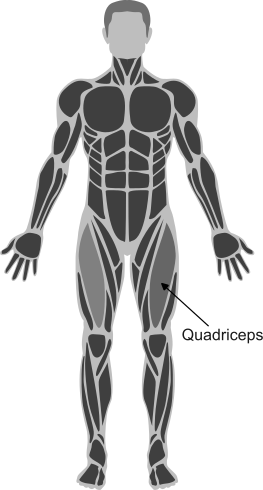
\(B\)
Other Options:
A person had knee surgery. They were able to choose their own doctor, hospital and the date for their surgery.
Which of the following enabled the person to make these choices?
\(B\)
Other Options:
To reduce the number of young people smoking, the sale of tobacco products to people under 18 years of age was made illegal.
Which action area of the Ottawa Charter is this strategy an example of?
\( C\)
Other Options:
The function \(h:[0, \infty) \rightarrow R, \ h(t)=\dfrac{3000}{t+1}\) models the population of a town after \(t\) years. --- 2 WORK AREA LINES (style=lined) --- --- 6 WORK AREA LINES (style=lined) --- --- 6 WORK AREA LINES (style=lined) --- --- 4 WORK AREA LINES (style=lined) --- a. \(600\) b. \(\text{Transformations:}\) \(\text{1- Vertical dilation by a factor of }\frac{1}{2}\ \text{from the }t\ \text{axis}\) \(\text{2- Translation of 1500 units upwards}\) ci. \(\left(\dfrac{3}{5}-\dfrac{\sqrt{6}}{25},\ \dfrac{3}{5}+\dfrac{\sqrt{6}}{25}\right)\) cii. \(300\) a. \(h(4)=\dfrac{3000}{4+1}=600\)
\(\text{Given}\ \ h(0)=h_1(0):\) \(\dfrac{1500}{0+1} +C= 3000\ \ \Rightarrow\ \ C=1500\) \(h_1(t)=\dfrac{1500}{t+1}+1500\) \(\text{Transformations:}\) \(\text{1- Vertical dilation by a factor of }\frac{1}{2}\ \text{from the }t\ \text{axis}\) \(\text{2- Translation of 1500 units upwards}\) ci. \(\hat{p}=\dfrac{60}{100}=\dfrac{3}{5},\quad 1-\hat{p}=\dfrac{2}{5},\quad z=2\)
b.
\(h(t)\)
\(=3000(t+1)^{-1}\)
\(h^{\prime}(t)\)
\(=-\dfrac{3000}{(t+1)^2}\)
\(h_1^{\prime}(t)\)
\(=\dfrac{1}{2}h^{\prime}(t)=-\dfrac{1500}{(t+1)^2}\)
\(h_1(t)\)
\(=\dfrac{1500}{t+1}+C\)
\(\text{Approx CI}\)
\(=\left(\dfrac{3}{5}-2\sqrt{\dfrac{\dfrac{3}{5}\times\dfrac{2}{5}}{100}},\ \dfrac{3}{5}+2\sqrt{\dfrac{\dfrac{3}{5}\times\dfrac{2}{5}}{100}}\right)\)
\(=\left(\dfrac{3}{5}-\dfrac{2\sqrt{6}}{50},\quad \dfrac{3}{5}+\dfrac{2\sqrt{6}}{50}\right)\)
\(=\left(\dfrac{3}{5}-\dfrac{\sqrt{6}}{25},\quad \dfrac{3}{5}+\dfrac{\sqrt{6}}{25}\right)\)
cii.
\(\sqrt{\dfrac{\hat{p}(1-\hat{p})}{n}}\)
\(=\dfrac{\sqrt{2}}{50}\)
\(\sqrt{\dfrac{\dfrac{3}{5}\times\dfrac{2}{5}}{n}}\)
\(=\dfrac{\sqrt{2}}{50}\)
\(\dfrac{6}{25n}\)
\(=\dfrac{2}{2500}\)
\(\dfrac{25n}{6}\)
\(=1250\)
\(n\)
\(=\dfrac{6}{25}\times 1250\)
\(=300\)
A study monitored the changes in the body temperature of a kookaburra (an Australian bird) and a human over a 24-hour period. The results of the study are shown in the graph. --- 2 WORK AREA LINES (style=lined) --- Some endothermic organisms can display torpor (a significant decrease in physiological activity). With reference to the graph, explain whether the human or the kookaburra was displaying torpor and if so, state the time this occurred. (3 marks) --- 7 WORK AREA LINES (style=lined) --- --- 4 WORK AREA LINES (style=lined) --- a. 4 am b. Signs of torpor: c. Kookaburra adaptation: a. 4 am b. Signs of torpor: c. Kookaburra adaptation:
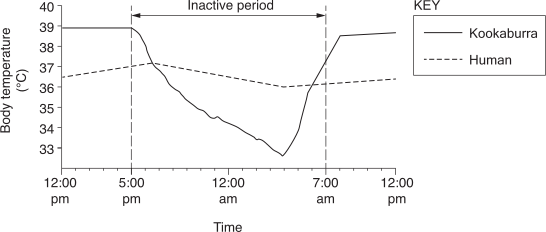
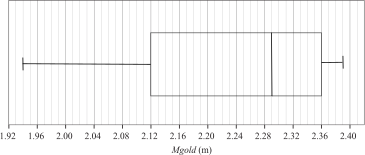
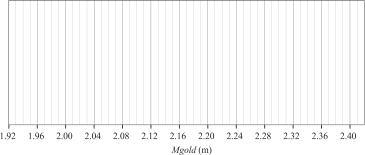
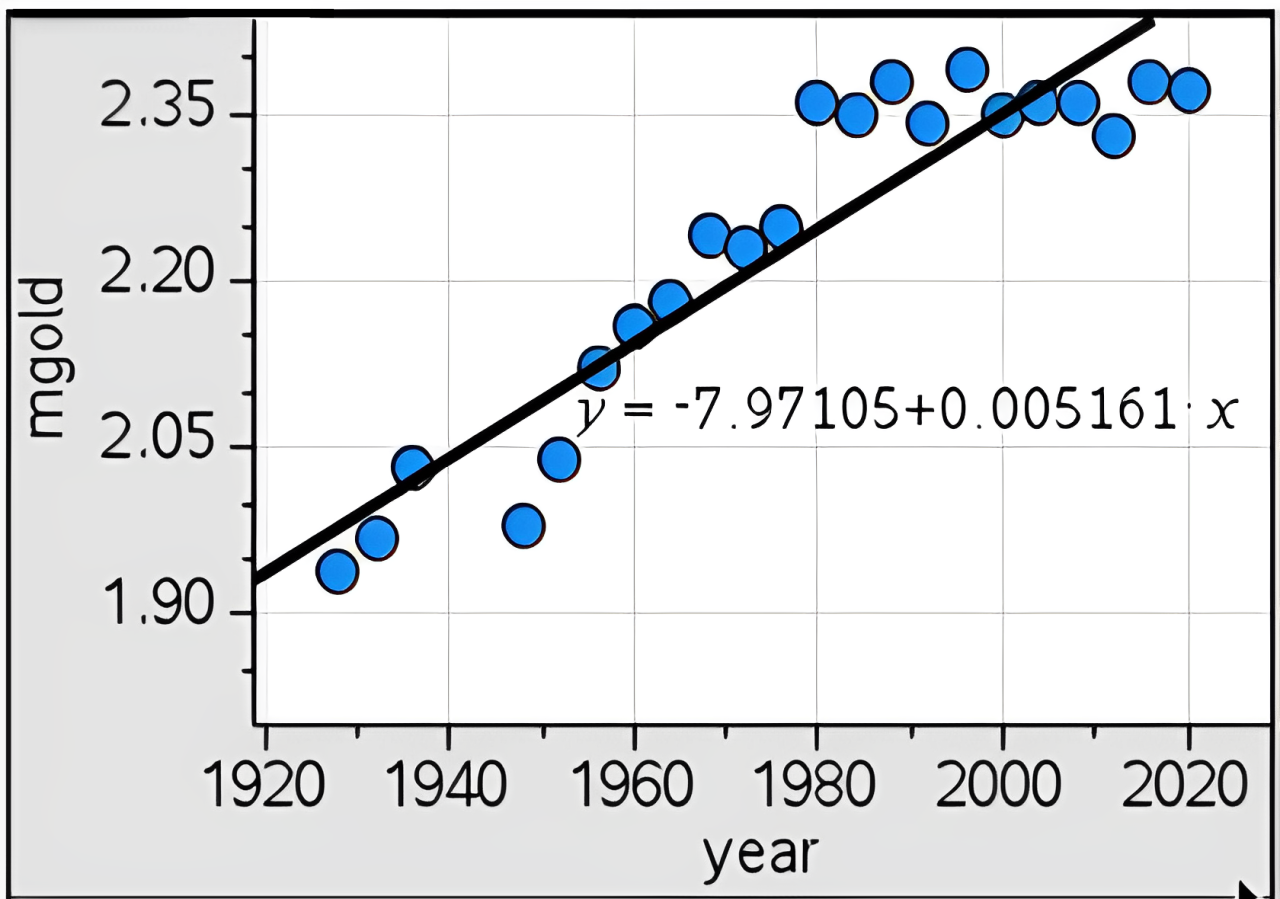
Table 1 lists the Olympic year, \(\textit{year}\), and the gold medal-winning height for the men's high jump, \(\textit{Mgold}\), in metres, for each Olympic Games held from 1928 to 2020. No Olympic Games were held in 1940 or 1944, and the 2020 Olympic Games were held in 2021. Table 1 \begin{array}{|c|c|} --- 1 WORK AREA LINES (style=lined) --- --- 2 WORK AREA LINES (style=lined) --- --- 3 WORK AREA LINES (style=lined) --- --- 0 WORK AREA LINES (style=lined) --- --- 0 WORK AREA LINES (style=lined) --- --- 4 WORK AREA LINES (style=lined) ---
a.i. \(2.39\) a.ii. \(\dfrac{11}{22}=50\%\) \(Q_1=2.12, \ Q_3=2.36\) \(\text{Min}\ =1.94, \ \text{Max}\ =2.39\) e. \(\text{A coefficient of determination of 85.7% shows the variation in}\) \(\text{the}\ Mgold\ \text{that is explained by the variation in the }year.\)
\hline \quad \textit{year} \quad & \textit{Mgold}\,\text{(m)} \\
\hline 1928 & 1.94 \\
\hline 1932 & 1.97 \\
\hline 1936 & 2.03 \\
\hline 1948 & 1.98 \\
\hline 1952 & 2.04 \\
\hline 1956 & 2.12 \\
\hline 1960 & 2.16 \\
\hline 1964 & 2.18 \\
\hline 1968 & 2.24 \\
\hline 1972 & 2.23 \\
\hline 1976 & 2.25 \\
\hline 1980 & 2.36 \\
\hline 1984 & 2.35 \\
\hline 1988 & 2.38 \\
\hline 1992 & 2.34 \\
\hline 1996 & 2.39 \\
\hline 2000 & 2.35 \\
\hline 2004 & 2.36 \\
\hline 2008 & 2.36 \\
\hline 2012 & 2.33 \\
\hline 2016 & 2.38 \\
\hline 2020 & 2.37 \\
\hline
\end{array}
b.
\(z\)
\(=\dfrac{x-\overline x}{s_x}\)
\(=\dfrac{2.35-2.23}{0.15}\)
\(=0.8\)
c. \(Q_2=\dfrac{2.33+2.25}{2}=2.29\)
The vector \(\underset{\sim}{a}\) is \(\left(\begin{array}{l}1 \\ 2 \\ 3\end{array}\right)\) and the vector \(\underset{\sim}{b}\) is \(\left(\begin{array}{c}2 \\ 0 \\ -4\end{array}\right)\). --- 4 WORK AREA LINES (style=lined) --- --- 6 WORK AREA LINES (style=lined) --- 1. \(\left(\begin{array}{c}-1 \\ 0 \\ 2\end{array}\right)\) ii. \(\underset{\sim}{a}-\dfrac{\underset{\sim}{a} \cdot \underset{\sim}{b}}{\underset{\sim}{b} \cdot \underset{\sim}{b}}\, \underset{\sim}{b}=\left(\begin{array}{l}1 \\ 2 \\ 3\end{array}\right)-\left(\begin{array}{c}-1 \\ 0 \\ 2\end{array}\right)=\left(\begin{array}{l}2 \\ 2 \\ 1\end{array}\right)\) \( \left(\underset{\sim}{a}-\dfrac{\underset{\sim}{a} \cdot \underset{\sim}{b}}{\underset{\sim}{b} \cdot \underset{\sim}{b}}\underset{\sim}{b}\right)\left(\begin{array}{c}-1 \\ 0 \\ 2\end{array}\right)=\left(\begin{array}{l}2 \\ 2 \\ 1\end{array}\right)\left(\begin{array}{c}-1 \\ 0 \\ 2\end{array}\right) = -2+0+2=0\) \(\therefore\ \text {Vectors are perpendicular.}\) i. \(\underset{\sim}{a}=\left(\begin{array}{l}1 \\ 2 \\ 3\end{array}\right), \quad \underset{\sim}{b}=\left(\begin{array}{c}2 \\ 0 \\ -4\end{array}\right)\) \(\dfrac{\underset{\sim}{a} \cdot \underset{\sim}{b}}{\underset{\sim}{b} \cdot \underset{\sim}{b}}\, \underset{\sim}{b}=\dfrac{2+0-12}{4+0+16}\left(\begin{array}{c}2 \\ 0 \\ -4\end{array}\right)=-\dfrac{1}{2}\left(\begin{array}{c}2 \\ 0 \\ -4\end{array}\right)=\left(\begin{array}{c}-1 \\ 0 \\ 2\end{array}\right)\) \( \left(\underset{\sim}{a}-\dfrac{\underset{\sim}{a} \cdot \underset{\sim}{b}}{\underset{\sim}{b} \cdot \underset{\sim}{b}}\,\underset{\sim}{b}\right)\left(\begin{array}{c}-1 \\ 0 \\ 2\end{array}\right)=\left(\begin{array}{l}2 \\ 2 \\ 1\end{array}\right)\left(\begin{array}{c}-1 \\ 0 \\ 2\end{array}\right) = -2+0+2=0\)
ii. \(\underset{\sim}{a}-\dfrac{\underset{\sim}{a} \cdot \underset{\sim}{b}}{\underset{\sim}{b} \cdot \underset{\sim}{b}}\, \underset{\sim}{b}=\left(\begin{array}{l}1 \\ 2 \\ 3\end{array}\right)-\left(\begin{array}{c}-1 \\ 0 \\ 2\end{array}\right)=\left(\begin{array}{l}2 \\ 2 \\ 1\end{array}\right)\)
\(\therefore\ \text{Vectors are perpendicular.}\)
--- 4 WORK AREA LINES (style=lined) --- --- 4 WORK AREA LINES (style=lined) --- i. \(2 \text{cis}\left(\dfrac{\pi}{6}\right)=2\left(\cos \left(\dfrac{\pi}{6}\right)+i \sin \left(\dfrac{\pi}{6}\right)\right)\) ii. \(-64 \sqrt{3}-64 i\) i. \(z=\sqrt{3}+i\) \(|z|=\sqrt{3+1}=2\) \(\arg (z)=\tan ^{-1}\left(\dfrac{1}{\sqrt{3}}\right)=\dfrac{\pi}{6}\) \(z=2 \text{cis}\left(\dfrac{\pi}{6}\right)=2\left(\cos \left(\dfrac{\pi}{6}\right)+i \sin \left(\dfrac{\pi}{6}\right)\right)\)
ii.
\((\sqrt{3}+i)^7\)
\(=2^7\left(\cos \left(\dfrac{7 \pi}{6}\right)+i \sin \left(\dfrac{7 \pi}{6}\right)\right)\)
\(=128\left(-\dfrac{\sqrt{3}}{2}-\dfrac{1}{2} i\right)\)
\(=-64 \sqrt{3}-64 i\)
Let \(z=2+3 i\) and \(w=1-5 i\). --- 3 WORK AREA LINES (style=lined) --- --- 3 WORK AREA LINES (style=lined) --- i. \(z+\bar{w}=3+8 i\) ii. \(z^2=-5+12 i\) i. \(z=2+3 i\) \(w=1-5 i \ \Rightarrow \ \bar{w}=1+5 i\) \(z+\bar{w}=2+3 i+1+5 i=3+8 i\)
ii.
\(z^2\)
\(=(2+3 i)^{2}\)
\(=4+12 i+9 i^2\)
\(=-5+12 i\)
Find \(\displaystyle \int x e^x\, d x\) (2 marks) --- 5 WORK AREA LINES (style=lined) --- \(x e^x-e^x+c\) \(u=x \quad \ \ u^{\prime}=1\) \(v^{\prime}=e^x \quad v=e^x\)
\(\displaystyle\int x e^x \,d x\)
\(=u v^{\prime}-\displaystyle \int v u^{\prime}\, d x\)
\(=x e^x- \displaystyle \int e^x \cdot 1\, d x\)
\(=x e^x-e^x+c\)
Consider the vectors \(\underset{\sim}{a}=3 \underset{\sim}{i}+2 \underset{\sim}{j}\) and \(\underset{\sim}{b}=-\underset{\sim}{i}+4 \underset{\sim}{j}\). --- 3 WORK AREA LINES (style=lined) --- --- 3 WORK AREA LINES (style=lined) --- i. \(\displaystyle \binom{7}{0}\) ii. \(5\) i. \(\underset{\sim}{a}=3 \underset{\sim}{i}+2 \underset{\sim}{j}, \ \underset{\sim}{b}=-\underset{\sim}{i}+4 \underset{\sim}{j}\) \(2 \underset{\sim}{a}-\underset{\sim}{b}=2 \displaystyle \binom{3}{2}-\binom{-1}{4}=\binom{6}{4}-\binom{-1}{4}=\binom{7}{0}\) ii. \(\underset{\sim}{a} \cdot \underset{\sim}{b}=\displaystyle\binom{3}{2}\binom{-1}{4}=3 \times(-1)+2 \times 4=5\).
Four people completed the same fitness activity.
The graph shows the heart rate for each person before and after completing the activity.
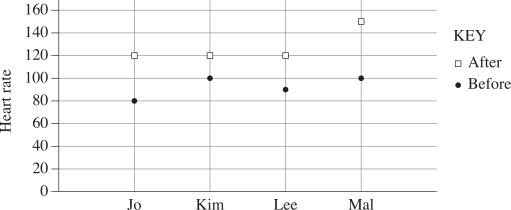
Which person had the LEAST difference in heart rate?
\(B\)
| \(\text{Option A: }\) | \(\text{Jo}\) | \(=120-80=40\) |
| \(\text{Option B: }\) | \(\text{Kim}\) | \(=120-100=20\ \checkmark\) |
| \(\text{Option C: }\) | \(\text{Lee}\) | \(=120-90=30\) |
| \(\text{Option D: }\) | \(\text{Mal}\) | \(=150-100=50\) |
\(\Rightarrow B\)
Consider the statement:
'If a polygon is a square, then it is a rectangle.'
Which of the following is the converse of the statement above?
\(A\)
\(\text{Statement:}\ P \Rightarrow \ Q\)
\(\text{Converse of statement:}\ Q \Rightarrow \ P\)
\(\Rightarrow A\)
Consider the following statement written in the formal language of proof
\(\forall \theta \in\biggl(\dfrac{\pi}{2}, \pi\biggr) \exists\ \phi \in\biggl(\pi, \dfrac{3 \pi}{2}\biggr) ; \ \sin \theta=-\cos \phi\).
Which of the following best represents this statement?
\(C\)
\(\Rightarrow C\)
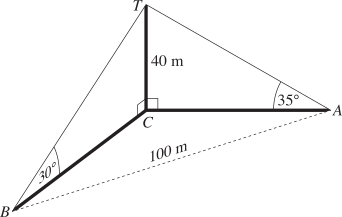
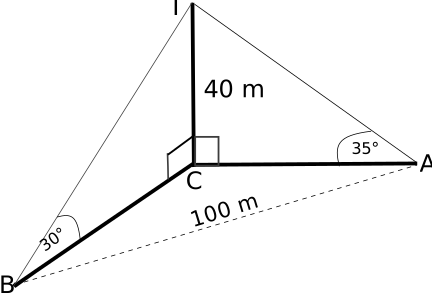
A vertical tower \(T C\) is 40 metres high. The point \(A\) is due east of the base of the tower \(C\). The angle of elevation to the top \(T\) of the tower from \(A\) is 35°. A second point \(B\) is on a different bearing from the tower as shown. The angle of elevation to the top of the tower from \(B\) is 30°. The points \(A\) and \(B\) are 100 metres apart.
--- 4 WORK AREA LINES (style=lined) ---
--- 9 WORK AREA LINES (style=lined) ---
\(194^{\circ}\)
a. \(\text{In}\ \Delta TCA:\)
| \(\tan 35°\) | \( =\dfrac{40}{AC}\) | |
| \(AC\) | \( =\dfrac{40}{\tan 35°}=57.125…=57.13\ \text{m (2 d.p.)}\) |
b. \(\text{In}\ \Delta TCB:\)
| \(\tan 30°\) | \( =\dfrac{40}{BC}\) | |
| \(BC\) | \( =\dfrac{40}{\tan 30°}=69.28\ \text{m}\) |
\( \text{Find} \ \angle BCA \ \text{using cosine rule:}\)
| \(\cos \angle B CA\) | \( = \dfrac{57.13^2+69.28^2-100^2}{2 \times 57.13 \times 69.28}= -0.2446…\) | |
| \(\angle BCA\) | \( = 104.2° \) |
\(\therefore\ \text{Bearing of}\ B\ \text{from}\ C= 90+104=194^{\circ} \text{(nearest degree)} \)
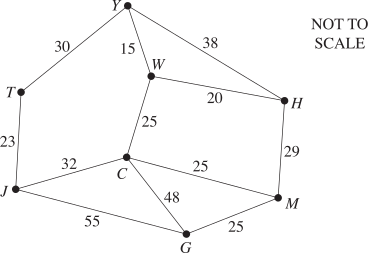
A network of towns and the distances between them in kilometres is shown. --- 2 WORK AREA LINES (style=lined) --- --- 4 WORK AREA LINES (style=lined) --- a. \(TYWH\) b. \(\text{Length of shortest path}\ (YWHMG) = 89 \text{km}\) a. \(TYH=30+38=68, \quad TYWH=30+15+20=65\) \(\therefore \text{ Shortest Path is}\ TYWH.\) b. \(Y W C M G=15+25+25+25=90\) \(YWHMG=15+20+29+25=89\) \(\Rightarrow \ \text{All other paths are longer.}\) \(\therefore\text{ Length of shortest path = 89 km}\)
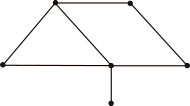
Which of the following structures is present in both prokaryotic and eukaryotic cells?
\(C\)
\(\Rightarrow C\)
Farmers and supermarkets agree that green beans are bought more frequently than yellow beans. A supermarket has asked a farmer to produce only green beans.
One way this could be achieved is by
\(C\)
\(\Rightarrow C\)
Which one of the following statements about proteins is correct?
\(A\)
Consider option A:
\(\Rightarrow A\)
A study assessed the effectiveness and safety of a drug called doxycycline. One hundred and fifty adults hospitalised with malaria were involved. These adults were randomly placed into two groups of equal size. One group received doxycycline in addition to standard care. The other group received standard care only.
The group receiving standard care only was the
\(A\)
\(\Rightarrow A\)
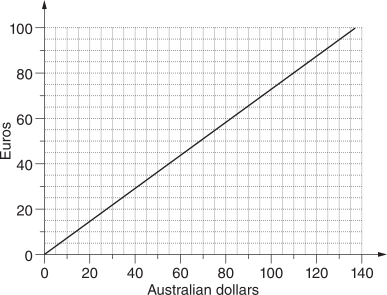
Conversion graphs can be used to convert from one currency to another.
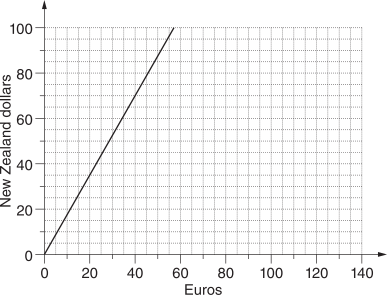
Abbie converted 70 New Zealand dollars into Euros. She then converted all of these Euros into Australian dollars.
How much money, in Australian dollars, should Abbie have?
\(C\)
\(\text{Using the graphs:}\)
| \($70\ \text{New Zealand}\) | \(=40\ \text{Euro}\) |
| \(40\ \text{Euro}\) | \(=$55\ \text{Australian}\) |
\(\Rightarrow C\)
Rhonda is 38 years old, and likes to keep fit by doing cross-fit classes.
--- 2 WORK AREA LINES (style=lined) ---
--- 4 WORK AREA LINES (style=lined) ---
a. \(182\ \text{bpm}\)
b. \(118-155\ \text{bpm}\)
| a. | \(\text{Max heart rate}\) | \(=220-38\) |
| \(=182\ \text{bpm}\) |
b. \(\text{65% max heart rate}\ = 0.65\times 182 = 118.3\ \text{bpm}\)
\(\text{85% max heart rate}\ = 0.85\times 182 = 154.7\ \text{bpm}\)
\(\therefore\ \text{Rhonda should aim for between 118 and 155 bpm during exercise.}\)
The formula \(C=80n+b\) is used to calculate the cost of producing desktop computers, where \(C\) is the cost in dollars, \(n\) is the number of desktop computers produced and \(b\) is the fixed cost in dollars.
--- 2 WORK AREA LINES (style=lined) ---
--- 4 WORK AREA LINES (style=lined) ---
a. \(\text{Find}\ C,\ \text{given}\ n=2458\ \text{and}\ b=18\ 230\)
| \(C\) | \(=80\times 2458+18\ 230\) | |
| \(=$214\ 870\) |
b. \(\text{Find}\ n,\ \text{given}\ C=18 \ 230\ \text{and}\ a=35\)
| \(C\) | \(=80n+an+18\ 230\) |
| \(103\ 330\) | \(=80n+35n+18\ 230\) |
| \(115n\) | \(=85\ 100\) |
| \(n\) | \(=\dfrac{85\ 100}{115}\) |
| \(=740\ \text{desktop computers}\) |
What is the value of \(\dfrac{x-y}{6}\), if \(x=184\) and \(y=46\)?
\(B\)
| \(\dfrac{x-y}{6}\) | \(=\dfrac{184-46}{6}\) |
| \(=23\) |
\(\Rightarrow B\)
If \(V=\dfrac{4}{3}\pi r^3\), what is the value of \(V\) when \(r = 5\), correct to two decimal places?
\(D\)
\(V =\dfrac{4}{3}\pi r^3\)
\(\text{When}\ r = 2,\)
| \(V\) | \(=\dfrac{4}{3}\pi\times 5^3\) |
| \(=523.598\dots\) |
\(\Rightarrow D\)
Which of the following equations has \(x=7\) as the solution?
\(C\)
| \(2x\) | \(=14\) |
| \(x\) | \(=\dfrac{14}{2}\) |
| \(\therefore\ x\) | \(=7\) |
\(\Rightarrow C\)
If \(A=P(1 + r)^n\), find \(A\) given \(P=$500\), \(r=0.09\) and \(n=5\) (give your answer to the nearest cent). (2 marks)
\($769.31\ \text{(nearest cent)}\)
| \(A\) | \(=P(1 + r)^n\) |
| \(=500(1 + 0.09)^5\) | |
| \(=500(1.09)^5\) | |
| \(=769.311\dots\) | |
| \(=$769.31\ \text{(nearest cent)}\) |
Find the value of \(b\) given \(\dfrac{b}{9}-5=3\). (1 mark)
\(72\)
| \(\dfrac{b}{9}-5\) | \(=3\) |
| \(\dfrac{b}{9}\) | \(=8\) |
| \(\therefore\ b\) | \(=72\) |
If \(\dfrac{x-8}{9}=2\), find \(x\). (1 mark)
\(26\)
| \(\dfrac{x-8}{9}\) | \(=2\) |
| \(x-8\) | \(=18\) |
| \(x\) | \(=26\) |
It is given that \(I=\dfrac{3}{2}MR^2\).
What is the value of \(I\) when \(M =19.12\) and \(R = 1.02\), correct to two decimal places?
\(B\)
| \(I\) | \(=\dfrac{3}{2}\times 19.12\times 1.02^2\) |
| \(=29.84\) |
\(\Rightarrow B\)
Magnetic and gravitational forces have a variety of properties.
Which of the following best describes the attraction/repulsion properties of magnetic and gravitational forces?
\begin{align*}
\begin{array}{l}
\rule{0pt}{2.5ex} \ \rule[-1ex]{0pt}{0pt}& \\
\rule{0pt}{2.5ex}\textbf{A.}\rule[-1ex]{0pt}{0pt}\\
\rule{0pt}{2.5ex}\textbf{B.}\rule[-1ex]{0pt}{0pt}\\
\rule{0pt}{2.5ex}\textbf{C.}\rule[-1ex]{0pt}{0pt}\\
\rule{0pt}{2.5ex}\textbf{D.}\rule[-1ex]{0pt}{0pt}\\
\end{array}
\begin{array}{|l|l|}
\hline
\rule{0pt}{2.5ex}\quad \textbf{Magnetic forces}\rule[-1ex]{0pt}{0pt}& \ \textbf{Gravitational forces} \\
\hline
\rule{0pt}{2.5ex}\text{either attract or repel}\rule[-1ex]{0pt}{0pt}&\text{only attract}\\
\hline
\rule{0pt}{2.5ex}\text{only repel}\rule[-1ex]{0pt}{0pt}& \text{neither attract nor repel}\\
\hline
\rule{0pt}{2.5ex}\text{only attract}\rule[-1ex]{0pt}{0pt}& \text{only attract} \\
\hline
\rule{0pt}{2.5ex}\text{either attract or repel}\rule[-1ex]{0pt}{0pt}& \text{either attract or repel} \\
\hline
\end{array}
\end{align*}
\(A\)
\(\Rightarrow A\)
Mika is flipping a coin. The unbiased coin has a probability of \(\dfrac{1}{2}\) of landing on heads and \(\dfrac{1}{2}\) of landing on tails.
Let \(X\) be the binomial random variable representing the number of times that the coin lands on heads.
Mika flips the coin five times.
--- 2 WORK AREA LINES (style=lined) ---
--- 4 WORK AREA LINES (style=lined) ---
The height reached by each of Mika's coin flips is given by a continuous random variable, \(H\), with the probability density function
\(f(h)=\begin{cases} ah^2+bh+c &\ \ 1.5\leq h\leq 3 \\ \\ 0 &\ \ \text{elsewhere} \\ \end{cases}\)
where \(h\) is the vertical height reached by the coin flip, in metres, between the coin and the floor, and \(a, b\) and \(c\) are real constants.
--- 5 WORK AREA LINES (style=lined) ---
--- 2 WORK AREA LINES (style=lined) ---
--- 6 WORK AREA LINES (style=lined) ---
--- 2 WORK AREA LINES (style=lined) ---
a. i. `frac{1}{32}` ii. `frac{13}{16}` iii. `0.806` (3 d.p.)
a. iv `text{E}(X)=5/2, text{sd}(X)=\frac{\sqrt{5}}{2}`
b. i. `1`
b. ii. `a=-frac{4}{5}, b=frac{17}{5}, c=-frac{167}{60}`
b. iii. `r=-1, s=3`
c. i. `text{Discrete}` ii. `(0.208, 0.592)` iii. `n=100`
a.i `X ~ text{Bi}(5 , frac{1}{2})`
`text{Pr}(X = 5) = (frac{1}{2})^5 = frac{1}{32}`
a.ii By CAS: `text{binomCdf}(5,0.5,2,5)` `0.8125`
`text{Pr}(X>= 2) = 0.8125 = frac{13}{16}`
a.iii `\text{Pr}(X \geq 2 | X<5)`
`=frac{\text{Pr}(2 <= X < 5)}{\text{Pr}(X < 5)} = frac{\text{Pr}(2 <= X <= 4)}{text{Pr}(X <= 4)}`
By CAS: `frac{text{binomCdf}(5,0.5,2,4)}{text{binomCdf}(5,0.5,0,4)}`
`= 0.806452 ~~ 0.806` (3 decimal places)
a.iv `X ~ text{Bi}(5 , frac{1}{2})`
`text{E}(X) = n xx p= 5 xx 1/2 = 5/2`
`text{sd}(X) =\sqrt{n p(1-p)}=\sqrt((5/2)(1 – 0.5)) = \sqrt{5/4} =\frac{\sqrt{5}}{2}`
b.i `\int_{1.5}^3 f(h) d h = 1`
b.ii By CAS:
`f(h):= a\·\h^2 + b\·\h +c`
`text{Solve}( {(\int_{1.5}^2 f(h) d h = 0.35), (\int_{2.5}^3 f(h) d h = 0.25), (\int_{1.5}^3 f(h) d h = 1):})`
`a = -0.8 = frac{-4}{5}, \ b = 3.4 = frac{17}{5},\ c = =-2.78 \dot{3} = frac{-167}{60}`
b.iii `h + d = 3`
`:.\ f(h) = f(3 – d) = f(- d + 3)`
`:.\ r = – 1 ` and ` s = 3`
c.i `\hat{p}` is discrete.
The number of coin flips must be zero or a positive integer so `\hat{p}` is countable and therefore discrete.
c.ii `\left(\hat{p}-z \sqrt{\frac{\hat{p}(1-\hat{p})}{n}}, \hat{p}+z \sqrt{\frac{\hat{p}(1-\hat{p})}{n}}\right)`
`\left(0.4-1.96 \sqrt{\frac{0.4 \times 0.6}{25}}\ , 0.4-1.96 \sqrt{\frac{0.4 \times 0.6}{25}}\right)`
`\approx(0.208\ ,0.592)`
c.iii To halve the width of the confidence interval, the standard deviation needs to be halved.
`:.\ \frac{1}{2} \sqrt{\frac{0.4 \times 0.6}{25}} = \sqrt{\frac{0.4 \times 0.6}{4 xx 25}} = \sqrt{\frac{0.4 \times 0.6}{100}}`
`:.\ n = 100`
She would need to flip the coin 100 times
On a remote island, there are only two species of animals: foxes and rabbits. The foxes are the predators and the rabbits are their prey.
The populations of foxes and rabbits increase and decrease in a periodic pattern, with the period of both populations being the same, as shown in the graph below, for all `t \geq 0`, where time `t` is measured in weeks.
One point of minimum fox population, (20, 700), and one point of maximum fox population, (100, 2500), are also shown on the graph.
The graph has been drawn to scale.
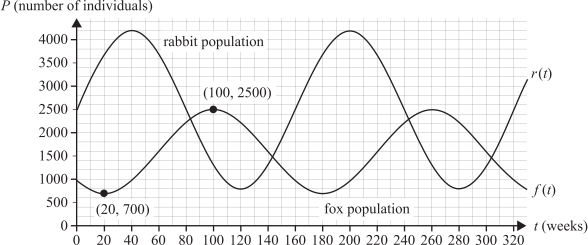
The population of rabbits can be modelled by the rule `r(t)=1700 \sin \left(\frac{\pi t}{80}\right)+2500`.
--- 2 WORK AREA LINES (style=lined) ---
The population of foxes can be modelled by the rule `f(t)=a \sin (b(t-60))+1600`.
--- 4 WORK AREA LINES (style=lined) ---
--- 1 WORK AREA LINES (style=lined) ---
The population of foxes is better modelled by the transformation of `y=\sin (t)` under `Q` given by

--- 8 WORK AREA LINES (style=lined) ---
Over a longer period of time, it is found that the increase and decrease in the population of rabbits gets smaller and smaller.
The population of rabbits over a longer period of time can be modelled by the rule
`s(t)=1700cdote^(-0.003t)cdot sin((pit)/80)+2500,\qquad text(for all)\ t>=0`
--- 3 WORK AREA LINES (style=lined) ---
--- 1 WORK AREA LINES (style=lined) ---
ai. `r(0)=2500`
aii. Minimum population of rabbits `= 800`
Maximum population of rabbits `= 4200`
aiii. `160` weeks
b. See worked solution.
c. `~~ 5339` (nearest whole number)
d. Weeks between the periods is 160
e. `~~ 4142` (nearest whole number)
f. Average rate of change `=-3.6` rabbits/week (1 d.p.)
g. `t = 156` weeks (nearest whole number)
h. ` s → 2500`
ai. Initial population of rabbits
From graph when `t=0, \ r(0) = 2500`
Using formula when `t=0`
| `r(t)` | `= 1700\ sin \left(\frac{\pi t}{80}\right)+2500` | |
| `r(0)` | `= 1700\ sin \left(\frac{\pi xx 0}{80}\right)+2500 = 2500` rabbits |
aii. From graph,
Minimum population of rabbits `= 800`
Maximum population of rabbits `= 4200`
OR
Using formula
Minimum is when `t = 120`
`r(120) = 1700\ sin \left(\frac{\pi xx 120}{80}\right)+2500 = 1700 xx (-1) + 2500 = 800`
Maximum is when `t = 40`
`r(40) = 1700\ sin \left(\frac{\pi xx 40}{80}\right)+2500 = 1700 xx (1) + 2500 = 4200`
aiii. Number of weeks between maximum populations of rabbits `= 200-40 = 160` weeks
b. Period of foxes = period of rabbits = 160:
`frac{\2pi}{b} = 160`
`:.\ b = frac{\2pi}{160} = frac{\pi}{80}` which is the same period as the rabbit population.
Using the point `(100 , 2500)`
Amplitude when `b = frac{\pi}{80}`:
| `f(t)` | `=a \ sin (pi/80(t-60))+1600` | |
| `f(100)` | `= 2500` | |
| `2500` | `= a \ sin (pi/80(100-60))+1600` | |
| `2500` | `= a \ sin (pi/2)+1600` | |
| `a` | `= 2500-1600 = 900` |
`:.\ f(t)= 900 \ sin (pi/80)(t-60) + 1600`
c. Using CAS find `h(t) = f(t) + r(t)`:
`h(t):=900 \cdot \sin \left(\frac{\pi}{80} \cdot(t-60)\right)+1600+1700\cdot \sin \left(\frac{\pit}{80}\right) +2500`
`text{fMax}(h(t),t)|0 <= t <= 160` `t = 53.7306….`
`h(53.7306…)=5339.46`
Maximum combined population `~~ 5339` (nearest whole number)
d. Using CAS, check by changing domain to 0 to 320.
`text{fMax}(h(t),t)|0 <= t <= 320` `t = 213.7305…`
`h(213.7305…)=5339.4568….`
Therefore, the number of weeks between the periods is 160.
e. Fox population:
`t^{\prime} = frac{90}{pi}t + 60` → `t = frac{pi}{90}(t^{\prime}-60)`
`y^{\prime} = 900y+1600` → `y = frac{1}{900}(y^{\prime}-1600)`
`frac{y^{\prime}-1600}{900} = sin(frac{pi(t^{\prime}-60)}{90})`
`:.\ f(t) = 900\ sin\frac{pi}{90}(t-60) + 1600`
Average combined population [Using CAS]
`=\frac{1}{300} \int_0^{300} left(\900 \sin \left(\frac{\pi(t-60)}{90}\right)+1600+1700\ sin\ left(\frac{\pi t}{80}\right)+2500\right) d t`
`= 4142.2646….. ~~ 4142` (nearest whole number)
f. Using CAS
`s(t):= 1700e^(-0.003t) dot\sin\frac{pit}{80} + 2500`
`text{fMax}(s(t),t)|0<=t<=320` `x = 38.0584….`
`s(38.0584….)=4012.1666….`
`text{fMax}(s(t),t)|160<=t<=320` `x = 198.0584….`
`s(198.0584….)=3435.7035….`
Av rate of change between the points
`(38.058 , 4012.167)` and `(198.058 , 3435.704)`
`= frac{4012.1666….-3435.7035….}{38.0584….-198.0584….} =-3.60289….`
`:.` Average rate of change `=-3.6` rabbits/week (1 d.p.)
g. Using CAS
`s^(primeprime)(t) = 0` , `t = 80(n-0.049) \ \forall n \in Z`
After testing `n = 1, 2, 3, 4` greatest positive value occurs for `n = 2`
| `t` | `= 80(n-0.049)` | |
| `= 80(2-0.049)` | ||
| `= 156.08` |
`:. \ t = 156` weeks (nearest whole number)
h. As `t → ∞`, `e^(-0.003t) → 0`
`:.\ s → 2500`
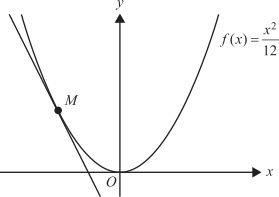
The diagram below shows part of the graph of `y=f(x)`, where `f(x)=\frac{x^2}{12}`.
--- 2 WORK AREA LINES (style=lined) ---
The tangent to `f` at point `M` has gradient `-2` .
--- 6 WORK AREA LINES (style=lined) ---
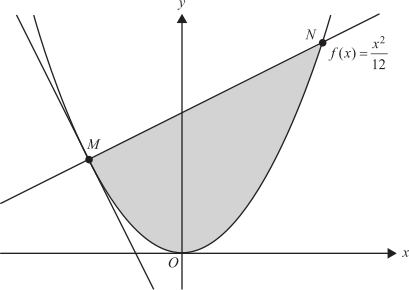
The diagram below shows part of the graph of `y=f(x)`, the tangent to `f` at point `M` and the line perpendicular to the tangent at point `M`.
--- 5 WORK AREA LINES (style=lined) ---
--- 8 WORK AREA LINES (style=lined) ---
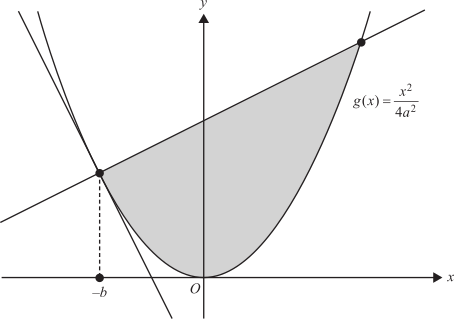
a. `x=0`
b. ` f^{\prime}(x)=1/6x`
c. `x=-12`
di. `y=1/2x + 18`
dii. Area`= 375` units²
e. `b = 2a^2`
a. Axis of symmetry: `x=0`
| b. | `f(x)` | `=\frac{x^2}{12}` | |
| ` f^{\prime}(x)` | `= 1/6x` |
c. At `M` gradient `= -2`
| `1/6x` | `= -2` | |
| `x` | `= -12` |
When `x = -12`
`f(x) = (-12)^2/12 = 12`
Equation of tangent at `(-12 , 12)`:
| `y-y_1` | `=m(x-x_1)` | |
| `y-12` | `= -2(x + 12)` | |
| `y` | `= -2x-12` |
d.i Gradient of tangent `= -2`
`:.` gradient of normal `= 1/2`
Equation at `M(- 12 , 12)`
| `y -y_1` | `=m(x-x_1)` | |
| `y-12` | `= 1/2(x + 12)` | |
| `y` | `=1/2x + 18` |
d.ii Points of intersection of `f(x)` and normal are at `M` and `N`.
So equate ` y = x^2/12` and `y = 1/2x + 18` to find `N`
| `x^2/12` | `=1/2x + 18` | |
| `x^2-6x-216` | `=0` | |
| `(x + 12)(x-18)` | `=0` |
`:.\ x = -12` or `x = 18`
| Area | `= \int_{-12}^{18}\left(\frac{1}{2} x+18-\frac{x^2}{12}\right) d x` | |
| `= [x^2/4 + 18x-x^3/36]_(-12)^18` | ||
| `= [18^2/4 +18^2-18^3/36] – [12^2/4 + 18 xx (-12)-(-12)^3/36]` | ||
| `= 375` units² |
e. `g(x) = x^2/(4a^2)` `a > 0`
At `x = -b` `y = (-b)^2/(4a^2) = b^2/4a^2`
`g^{\prime}(x) = (2x)/(4a^2) = x/(2a^2)`
Gradient of tangent `= (-b)/(2a^2)`
Gradient of normal `= (2a^2)/b`
Equation of normal at `(- b , b^2/(4a^2))`
| `y-y_1` | `= m(x-x_1)` | |
| `y-b^2/(4a^2)` | `= (2a^2)/b(x-(-b))` | |
| `y` | `= (2a^2x)/b + 2a^2 + b^2/(4a^2)` | |
| `y` | `= (2a^2x)/b +(8a^4 + b^2)/(4a^2)` |
Points of intersection of normal and parabola (Using CAS)
solve `((2a^2x)/b +(8a^4 + b^2)/(4a^2) = x^2/(4a^2),x)`
`x =-b` or `x = (8a^4+b^2)/b`
Calculate area using CAS
`A = \int_{-b}^{(8a^4+b^2)/b}\left(\frac{2a^2x}{b} +\frac{8a^4 + b^2}{4a^2}-frac{x^2}{4a^2} \right) dx`
`A = frac{64a^12 + 48a^8b^2 + 12a^4b^4 + b^6}{3a^2b^3}`
Using CAS Solve derivative of `A = 0` with respect to `b` to find `b`
solve`(d/(db)(frac{64a^12 + 48a^8b^2 + 12a^4b^4 + b^6}{3a^2b^3})=0,b)`
`b =-2a^2` and `b = 2a^2`
Given `b > 0`
`b = 2a^2`
The period of the function `f(x)=3 \ cos (2 x+\pi)` is
`B`
| Period | `= (2pi)/n` | `(n = 2)` |
| `= (2pi)/2` | ||
| `= pi` |
`=>B`
Consider the function \(g:R \to R, g(x)=2^x+5\).
--- 1 WORK AREA LINES (style=lined) ---
--- 2 WORK AREA LINES (style=lined) ---
--- 3 WORK AREA LINES (style=lined) ---
--- 8 WORK AREA LINES (style=lined) ---
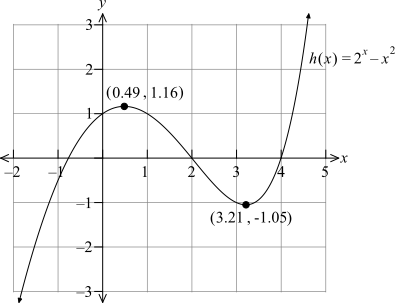
Let \(h:R\to R, h(x)=2^x-x^2\).
--- 2 WORK AREA LINES (style=lined) ---
--- 0 WORK AREA LINES (style=lined) ---
--- 3 WORK AREA LINES (style=lined) ---
--- 5 WORK AREA LINES (style=lined) ---
a. \(5\)
b. \(\log_{e}{2}\ \ \text{or}\ \ \ln\ 2\)
ci. \(y=2^a\ \log_{e}{(2)x}-(a\ \log_{e}{(2)}-1)\times2^a+5\)
\(\text{or}\ \ y=2^a\ \log_{e}{(2)x}-a\ 2^a\ \log_{e}{(2)}+2^a+5\)
cii. \(y=4.255x\)
d. \((2.06 , -0.07)\)
e. \([0.49, 3.21]\)
f.
\begin{array} {|c|c|}
\hline
\rule{0pt}{2.5ex} \qquad x_0\qquad \ \rule[-1ex]{0pt}{0pt} & \qquad \qquad 0 \qquad\qquad \\
\hline
\rule{0pt}{2.5ex} x_1 \rule[-1ex]{0pt}{0pt} & -1.433 \\
\hline
\rule{0pt}{2.5ex} x_2 \rule[-1ex]{0pt}{0pt} & -0.897 \\
\hline
\rule{0pt}{2.5ex} x_3 \rule[-1ex]{0pt}{0pt} & -0.773 \\
\hline
\end{array}
g. \(\text{See worked solution.}\)
h. \(n=e\)
a. \(\text{As }x\to -\infty,\ \ 2^x\to 0\)
\(\therefore\ 2^x+5\to 5\)
| b. | \(g(x)\) | \(=2^x+5\) |
| \(=\Big(e^{\log_{e}{2}}\Big)^x\) | ||
| \(=e\ ^{x\log_{e}{2}}+5\) | ||
| \(g^{\prime}(x)\) | \(=\log_{e}{2}\times e\ ^{x\log_{e}{2}}\) | |
| \(=\log_{e}{2}\times 2^x\) | ||
| \(\therefore\ k\) | \(=\log_{e}{2}\ \ \text{or}\ \ \ln\ 2\) |
| \(y-(2^a+5)\) | \(=\log_{e}{2}\times2^a(x-a)\) |
| \(\therefore\ y\) | \(=2^a\ \log_{e}{(2)x}-a\ 2^a\ \log_{e}{(2)}+2^a+5\) |
cii. \(\text{Substitute }(0, 0)\ \text{into equation from c(i) to find}\ a\)
| \( y\) | \(=2^a\ \log_{e}{(2)x}-a\ 2^a\ \log_{e}{(2)}+2^a+5\) |
| \(0\) | \(=2^a\ \log_{e}{(2)\times 0}-a\ 2^a\ \log_{e}{(2)}+2^a+5\) |
| \(0\) | \(=-a\ 2^a\ \log_{e}{(2)}+2^a+5\) |
\(\text{Solve for }a\text{ using CAS }\rightarrow\ a\approx 2.61784\dots\)
\(\text{Equation of tangent when }\ a\approx 2.6178\)
| \( y\) | \(=2^{2.6178..}\ \log_{e}{(2)x}+0\) |
| \(\therefore\ y\) | \(=4.255x\) |
| d. | \(h(x)\) | \(=2^x-x^2\) |
| \(h^{\prime}(x)\) | \(=\log_{e}{(2)}\cdot 2^x-2x\ \ \text{(Using CAS)}\) | |
| \(h^{”}(x)\) | \(=(\log_{e}{(2)})^2\cdot 2^x-2\ \ \text{(Using CAS)}\) |
\(\text{Solving }h^{”}(x)=0\ \text{using CAS }\rightarrow\ x\approx 2.05753\dots\)
\(\text{Substituting into }h(x)\ \rightarrow\ h(2.05753\dots)\approx-0.070703\dots\)
\(\therefore\ \text{Point of inflection at }(2.06 , -0.07)\ \text{ correct to 2 decimal places.}\)
f. \(\text{Newton’s Method }\Rightarrow\ x_a-\dfrac{h(x_a)}{h'(x_a)}\)
\(\text{for }a=0, 1, 2, 3\ \text{given an initial estimation for }x_0=0\)
\(h(x)=2x-x^2\ \text{and }h^{\prime}(x)=\ln{2}\times 2^x-2x\)
\begin{array} {|c|l|}
\hline
\rule{0pt}{2.5ex} \qquad x_0\qquad \ \rule[-1ex]{0pt}{0pt} & \qquad \qquad 0 \qquad\qquad \\
\hline
\rule{0pt}{2.5ex} x_1 \rule[-1ex]{0pt}{0pt} & 0-\dfrac{2^0-2\times 0}{\ln2\times 2^0\times 0}=-1.433 \\
\hline
\rule{0pt}{2.5ex} x_2 \rule[-1ex]{0pt}{0pt} & -1.433-\dfrac{2^{-1.433}-2\times -1.433}{\ln2\times 2^{-1.433}\times -1.433}=-0.897 \\
\hline
\rule{0pt}{2.5ex} x_3 \rule[-1ex]{0pt}{0pt} & -0.897-\dfrac{2^{-0.897}-2\times -0.897}{\ln2\times 2^{-0.897}\times -0.897}=-0.773 \\
\hline
\end{array}
g. \(\text{The denominator in Newton’s Method is}\ h^{\prime}(x)=\log_{e}{(2)}\cdot 2^x-2x\)
\(\text{and the calculation will be undefined if }h^{\prime}(x)=0\ \text{as the tangent lines are horizontal}.\)
\(\therefore\ \text{The solution to }h^{\prime}(x)=0\ \text{cannot be used for }x_0.\)
h. \(\text{For a local minimum }f(x)=0\)
\(\rightarrow\ n^x-x^n=0\)
\(\rightarrow\ n^x=x^n\ \ \ (1)\)
\(\text{Also for a local minimum }f^{\prime}(x)=0\)
\(\rightarrow\ \ln(n)\cdot n^x-nx^{n-1}=0\ \ \ (2)\)
\(\text{Substitute (1) into (2)}\)
\(\ln(n)\cdot x^n-nx^{n-1}=0\)
\(x^n\Big(\ln(n)-\dfrac{n}{x}\Big)=0\)
\(\therefore\ x^n=0\ \text{or }\ \ln(n)=\dfrac{n}{x}\)
\(x=0\ \text{or }x=\dfrac{n}{\ln(n)}\)
\(\therefore\ n=e\)
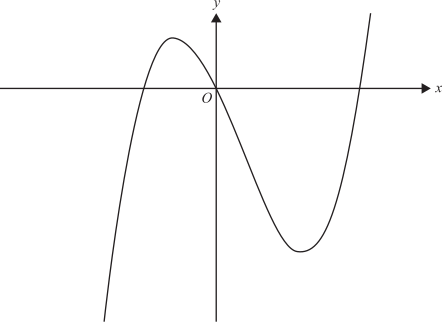
Let \(f:R \rightarrow R, f(x)=x(x-2)(x+1)\). Part of the graph of \(f\) is shown below.
--- 2 WORK AREA LINES (style=lined) ---
--- 3 WORK AREA LINES (style=lined) ---
--- 4 WORK AREA LINES (style=lined) ---
--- 2 WORK AREA LINES (style=lined) ---
--- 9 WORK AREA LINES (style=lined) ---
a. \((-1, 0), (0, 0), (2, 0)\)
b. \(\Bigg(\dfrac{1-\sqrt{7}}{3}, \dfrac{2(7\sqrt{7}-10}{27}\Bigg), \Bigg(\dfrac{1+\sqrt{7}}{3}, \dfrac{-2(7\sqrt{7}-10}{27}\Bigg)\)
c.i. \(x=2,\ \text{or}\ x=\dfrac{-1\pm \sqrt{5}}{2}\)
c.ii. \(\text{Let }a=\dfrac{-1-\sqrt{5}}{2}\ \text{and }b=\dfrac{-1+\sqrt{5}}{2}\)
\(\text{Then}\ A=\displaystyle\int_a^b (x-2)(x^2+x-1)\,dx+\displaystyle\int_b^2 -(x-2)(x^2+x-1)\,dx\)
c.iii. \(5.95\)
d. \(\text{1st case }\rightarrow \ a=\dfrac{2\sqrt{7}+1}{3}, b=\dfrac{1-\sqrt{7}}{3}\)
\(\text{2nd case }\rightarrow \ a=\dfrac{-2\sqrt{7}+1}{3}, b=\dfrac{1+\sqrt{7}}{3}\)
a. \((-1, 0), (0, 0), (2, 0)\)
b. \(\text{Using CAS solve for}\ x:\)
\(\dfrac{d}{dx}(x(x-2)(x+1))=0\)
\(\therefore\ x=\dfrac{1-\sqrt{7}}{3}\ \text{and }x=\dfrac{1+\sqrt{7}}{3}\)
\(\text{Substitute }x\ \text{values into }f(x)\ \text{using CAS to get}\ y\ \text{values}\)
\(\text{The stationary points of }f\ \text{are}:\)
\(\Bigg(\dfrac{1-\sqrt{7}}{3}, \dfrac{2(7\sqrt{7}-10}{27}\Bigg), \Bigg(\dfrac{1+\sqrt{7}}{3}, \dfrac{-2(7\sqrt{7}-10}{27}\Bigg)\)
ci \(\text{Given }f(x)=g(x)\)
| \(x(x-2)(x+1)\) | \(=x-2\) |
| \(x(x-2)(x+1)(x-2)\) | \(=0\) |
| \((x-2)(x(x+1)-1)\) | \(=0\) |
| \((x-2)(x^2+x-1)\) | \(=0\) |
\(\therefore\ \text{Using CAS: } \)
\(x=2,\ \text{or}\ x=\dfrac{-1\pm \sqrt{5}}{2}\)
cii \(\text{Area of bounded region:}\)
\(\text{Let }a=\dfrac{-1-\sqrt{5}}{2}\ \text{and }b=\dfrac{-1+\sqrt{5}}{2}\)
\(\text{Then}\ A=\displaystyle\int_a^b (x-2)(x^2+x-1)\,dx+\displaystyle\int_b^2 -(x-2)(x^2+x-1)\,dx\)
| ciii | \(\text{Solve the integral in c.ii above using CAS:}\) |
| \(\text{Total area}=5.946045..\approx 5.95\) |
d. \(\text{Method 1 – Equating coefficients}\)
\((x-a)(x-b)^2=x(x-2)(x+1)+k\)
\(x^3-2bx^2-ax^2+b^2x+2abx-ab^2=x^3-x^2-2x+k\)
\((x^3-(a+2b)x^2+(2ab+b^2)x-ab^2=x^3-x^2-2x+k\)
\(\therefore\ -(a+2b)=-1\ \to\ a=1-2b …(1)\)
\(2ab+b^2=-2\ \ …(2)\)
\(\text{Substitute (1) into (2) and solve for }b.\)
| \(2b(1-2b)+b^2\) | \(=-2\) |
| \(3b^2-2b-2\) | \(=0\) |
| \(b\) | \(=\dfrac{1\pm \sqrt{7}}{3}\) |
| \(\text{When }b\) | \(=\dfrac{1+\sqrt{7}}{3}\) |
| \(a\) | \(=1-2\Bigg(\dfrac{1+\sqrt{7}}{3}\Bigg)=\dfrac{-2\sqrt{7}+1}{3}\) |
| \(\text{When }b\) | \(=\dfrac{1-\sqrt{7}}{3}\) |
| \(a\) | \(=1-2\Bigg(\dfrac{1-\sqrt{7}}{3}\Bigg)=\dfrac{2\sqrt{7}+1}{3}\) |
\(\text{Method 2 – Using transformations}\)
\(\text{The squared factor in }(x-a)(x-b)^2=x(x-2)(x+1)+k,\)
\(\text{shows that the turning point is on the }x\ \text{axis}.\)
\(\therefore\ \text{Lowering }f(x)\ \text{by }\dfrac{2(7\sqrt{7}-10)}{27}\ \text{and raising }f(x)\ \text{by }\dfrac{2(7\sqrt{7}+10)}{27}\)
\(\text{will give the 2 possible sets of values for }a\ \text{and}\ b.\)
\(\text{1st case – lowering using CAS solve }h(x) =0\ \rightarrow\ h(x)=f(x)-\dfrac{2(7\sqrt{7}-10)}{27}\)
\(\therefore\ x-\text{intercepts}\rightarrow \ a=\dfrac{2\sqrt{7}+1}{3}, b=\dfrac{1-\sqrt{7}}{3}\)
\(\text{2nd case – raising using CAS solve }h(x) =0\ \rightarrow\ h(x)=f(x)+\dfrac{2(7\sqrt{7}+10)}{27}\)
\(\therefore\ x-\text{intercepts}\rightarrow \ a=\dfrac{-2\sqrt{7}+1}{3}, b=\dfrac{1+\sqrt{7}}{3}\)