- Find `int 5\ dx`. (1 mark)
--- 1 WORK AREA LINES (style=lined) ---
- Find `int 3/((x-6)^2)\ dx`. (2 marks)
--- 3 WORK AREA LINES (style=lined) ---
- Evaluate `int_1^4 x^2 + sqrtx\ dx`. (3 marks)
--- 5 WORK AREA LINES (style=lined) ---
Functions, 2ADV F1 2009 HSC 1c
Solve `|x + 1|= 5`. (2 marks)
Algebra, 2UA 2009 HSC 1b
Solve `(5x- 4)/x = 2`. (2 marks)
Trigonometry, 2ADV T3 2010 HSC 8c
The graph shown is `y = A sin bx`.
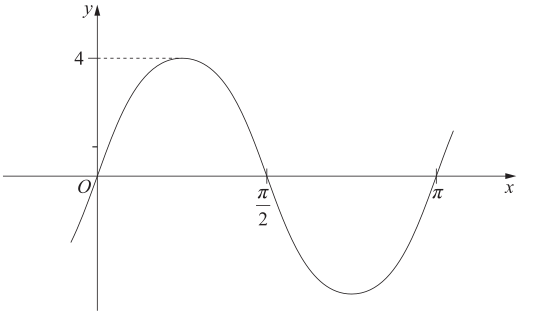
- Write down the value of `A`. (1 mark)
--- 1 WORK AREA LINES (style=lined) ---
- Find the value of `b`. (1 mark)
--- 3 WORK AREA LINES (style=lined) ---
-
On the same set of axes, draw the graph `y = 3 sin x + 1` for `0 <= x <= pi`. (2 marks)
--- 0 WORK AREA LINES (style=lined) ---
Show Worked Solution
a. `A = 4`
b. `text(S)text(ince the graph passes through)\ \ (pi/4, 4)`
`text(Substituting into)\ \ y = 4 sin bx`
| `4 sin (b xx pi/4)` | `=4` |
| `sin (b xx pi/4)` | `= 1` |
| `b xx pi/4` | `= pi/2` |
| `:. b` | `= 2` |
MARKER’S COMMENT: Graphs are consistently drawn too small by many students. Aim to make your diagrams 1/3 to 1/2 of a page.
| c. | 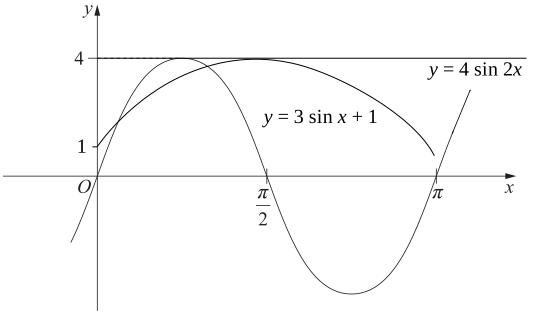 |
Linear Functions, 2UA 2010 HSC 3a
In the diagram `A`, `B` and `C` are the points `( –2, –4 ),\ (12,6)` and `(6,8)` respectively.
The point `N (2,2)` is the midpoint of `AC`. The point `M` is the midpoint of `AB`.

- Find the coordinates of `M`. (1 mark)
- Find the gradient of `BC`. (1 mark)
- Prove that `Delta ABC` is similar to `Delta AMN`. (2 marks)
- Find the equation of `MN`. (2 marks)
- Find the exact length of `BC`. (1 mark)
- Given that the area of `Delta ABC` is `44` square units, find the perpendicular distance from `A` to `BC`. (1 mark)
Functions, 2ADV F1 2010 HSC 1d
Solve `| 2x + 3 | = 9`. (2 marks)
--- 5 WORK AREA LINES (style=lined) ---
Statistics, 2ADV 2011 HSC 5b
Kim has three red shirts and two yellow shirts. On each of the three days, Monday, Tuesday and Wednesday, she selects one shirt at random to wear. Kim wears each shirt that she selects only once.
- What is the probability that Kim wears a red shirt on Monday? (1 mark)
- What is the probability that Kim wears a shirt of the same colour on all three days? (1 mark)
- What is the probability that Kim does not wear a shirt of the same colour on consecutive days? (2 marks)
Linear Functions, 2UA 2011 HSC 3c
The diagram shows a line `l_1`, with equation `3x + 4y - 12 = 0`, which intersects the `y`-axis at `B`.
A second line `l_2`, with equation `4x - 3y = 0`, passes through the origin `O` and intersects `l_1` at `E`.

- Show that the coordinates of `B` are `(0, 3)`. (1 mark)
- Show that `l_1` is perpendicular to `l_2`. (2 marks)
- Show that the perpendicular distance from `O` to `l_1` is `12/5`. (1 mark)
- Using Pythagoras’ theorem, or otherwise, find the length of the interval `BE`. (1 mark)
- Hence, or otherwise, find the area of `Delta BOE`. (1 mark)
Probability, 2UA 2011 HSC 1g
A batch of 800 items is examined. The probability that an item from this batch is defective is 0.02.
How many items from this batch are defective? (1 mark)
Linear Functions, 2UA 2013 HSC 12b
The points `A(–2, –1)`, `B(–2, 24)`, `C(22, 42)` and `D(22, 17)` form a parallelogram as shown. The point `E(18, 39)` lies on `BC`. The point `F` is the midpoint of `AD`.

- Show that the equation of the line through `A` and `D` is `3x- 4y + 2 = 0`. (2 marks)
- Show that the perpendicular distance from `B` to the line through `A` and `D` is `20` units. (1 mark)
- Find the length of `EC`. (1 mark)
- Find the area of the trapezium `EFDC`. (2 marks)
Probability, STD2 S2 2011 HSC 25c
At another school, students who use mobile phones were surveyed. The set of data is shown in the table.

- How many students were surveyed at this school? (1 mark)
--- 1 WORK AREA LINES (style=lined) ---
- Of the female students surveyed, one is chosen at random. What is the probability that she uses pre-paid? (1 mark)
--- 2 WORK AREA LINES (style=lined) ---
Ten new male students are surveyed and all ten are on a plan. The set of data is updated to include this information.
- What percentage of the male students surveyed are now on a plan? Give your answer to the nearest per cent. (1 mark)
--- 2 WORK AREA LINES (style=lined) ---
Probability, STD2 S2 2011 HSC 24b
A die was rolled 72 times. The results for this experiment are shown in the table.
\begin{array} {|c|c|}
\hline
\rule{0pt}{2.5ex} \textit{Number obtained} \rule[-1ex]{0pt}{0pt} & \textit{Frequency} \\
\hline
\rule{0pt}{2.5ex} \ 1 \rule[-1ex]{0pt}{0pt} & 16 \\
\hline
\rule{0pt}{2.5ex} \ 2 \rule[-1ex]{0pt}{0pt} & 11 \\
\hline
\rule{0pt}{2.5ex} \ 3 \rule[-1ex]{0pt}{0pt} & \textbf{A} \\
\hline
\rule{0pt}{2.5ex} \ 4 \rule[-1ex]{0pt}{0pt} & 8 \\
\hline
\rule{0pt}{2.5ex} \ 5 \rule[-1ex]{0pt}{0pt} & 12 \\
\hline
\rule{0pt}{2.5ex} \ 6 \rule[-1ex]{0pt}{0pt} & 15 \\
\hline
\end{array}
- Find the value of `A`. (1 mark)
--- 1 WORK AREA LINES (style=lined) ---
- What was the relative frequency of obtaining a 4. (1 mark)
--- 2 WORK AREA LINES (style=lined) ---
- If the die was unbiased, which number was obtained the expected number of times? (1 mark)
--- 2 WORK AREA LINES (style=lined) ---
Probability, STD2 S2 2010 HSC 23c
On Saturday, Jonty recorded the colour of T-shirts worn by the people at his gym. The results are shown in the graph.
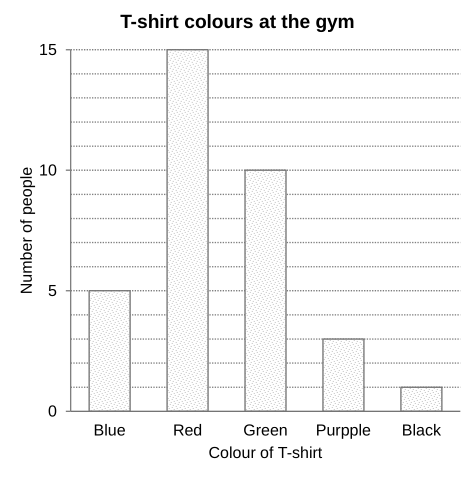
- How many people were at the gym on Saturday? (Assume everyone was wearing a T-shirt). (1 mark)
--- 1 WORK AREA LINES (style=lined) ---
- What is the probability that a person selected at random at the gym on Saturday, would be wearing either a blue or green T-shirt? (1 mark)
--- 2 WORK AREA LINES (style=lined) ---
Algebra, STD2 A4 2012 HSC 30b
A golf ball is hit from point `A` to point `B`, which is on the ground as shown. Point `A` is 30 metres above the ground and the horizontal distance from point `A` to point `B` is 300 m.
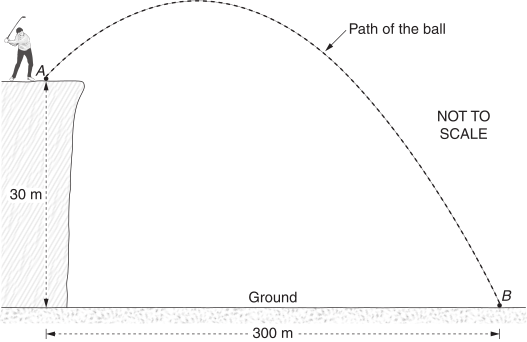
The path of the golf ball is modelled using the equation
`h = 30 + 0.2d-0.001d^2`
where
`h` is the height of the golf ball above the ground in metres, and
`d` is the horizontal distance of the golf ball from point `A` in metres.
The graph of this equation is drawn below.
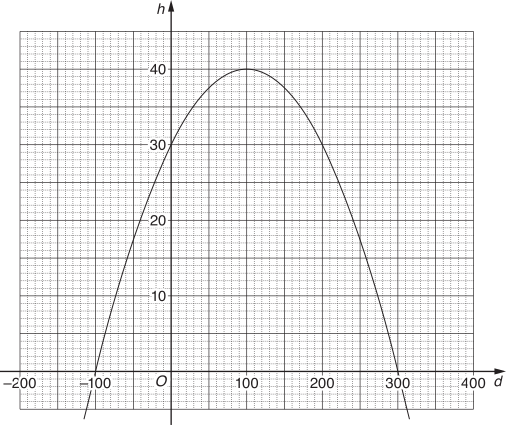
- What is the maximum height the ball reaches above the ground? (1 mark)
--- 1 WORK AREA LINES (style=lined) ---
- There are two occasions when the golf ball is at a height of 35 metres.
What horizontal distance does the ball travel in the period between these two occasions? (1 mark)
--- 2 WORK AREA LINES (style=lined) ---
- What is the height of the ball above the ground when it still has to travel a horizontal distance of 50 metres to hit the ground at point `B`? (1 mark)
--- 2 WORK AREA LINES (style=lined) ---
- Only part of the graph applies to this model.
- Find all values of `d` that are not suitable to use with this model, and explain why these values are not suitable. (2 marks)
--- 4 WORK AREA LINES (style=lined) ---
Measurement, STD2 M1 2011 HSC 1 MC
Which of the solids shown is a prism?

Algebra, STD2 A2 2012 HSC 13 MC
Conversion graphs can be used to convert from one currency to another.
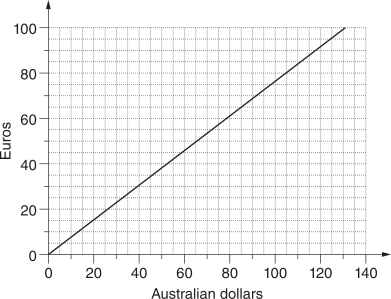
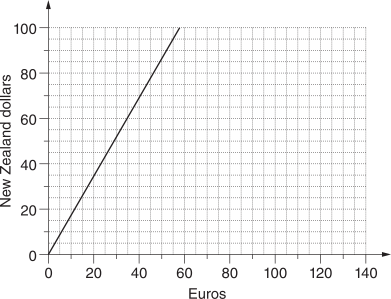
Sarah converted 60 Australian dollars into Euros. She then converted all of these Euros
into New Zealand dollars.
How much money, in New Zealand dollars, should Sarah have?
- $26
- $45
- $78
- $135
Statistics, STD2 S1 2013 HSC 8 MC
A high school has 100 students in each year group, Year 7 to Year 12. A survey is to be conducted to determine the average number of text messages sent per month by students at the school.
Which of the following would provide the most representative sample for this survey?
- All Year 7 students
- All physics students in Year 11 and 12
- 20 students chosen at random from each year group
- 120 students chosen at random from the school roll
Calculus in the Physical World, 2UA 2008 HSC 6b
The graph shows the velocity of a particle, `v` metres per second, as a function of time, `t` seconds.
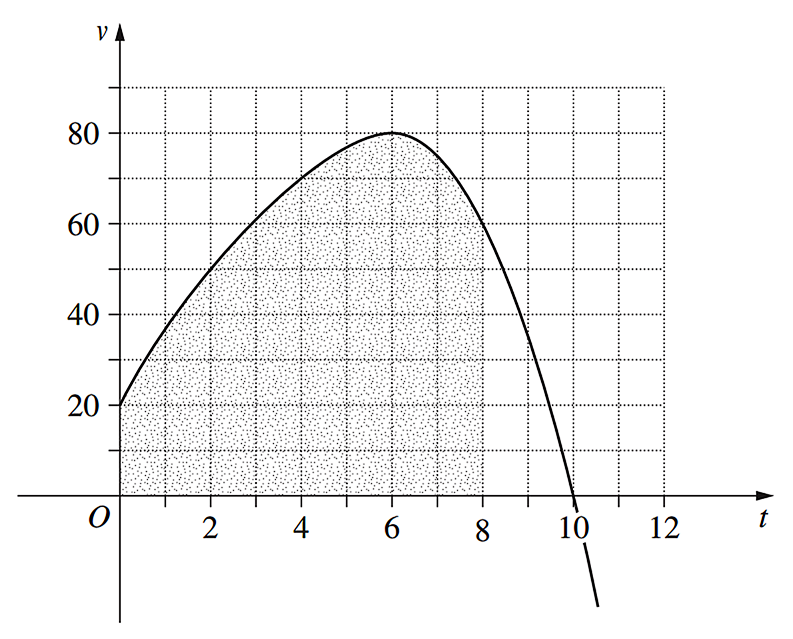
- What is the initial velocity of the particle? (1 mark)
- When is the velocity of the particle equal to zero? (1 mark)
- When is the acceleration of the particle equal to zero? (1 mark)
- By using Simpson's Rule with five function values, estimate the distance travelled by the particle between `t=0` and `t=8`. (3 marks)
Show Worked Solution
(i) `text(Find)\ v \ text(when) t=0`
`v=20\ \ text(m/s)`
(ii) `text(Particle comes to rest at)\ t=10\ text{seconds (from graph)}`
(iii) `text(Acceleration is zero when)\ t=6\ text{seconds (from graph)}`
| (iv) |  |
MARKER’S COMMENT: Less errors were made by students using a table and the given formula. Note however, that the formula `A~~(b-a)/6xx` `[f(a)+4f((a+b)/2)+f(b)]` produced the most errors.
| `text(Area)` | `~~h/3[y_0+y_n+4text{(odds)}+2text{(evens)}]` |
| `~~h/3[y_0+y_4+4(y_1+y_3)+2(y_2)]` | |
| `~~2/3[20+60+4(50+80)+2(70)]` | |
| `~~2/3[740]` | |
| `~~493 1/3` |
`:.\ text{Distance travelled is 493 1/3 m (approx.)}`
Calculus, EXT1 C1 2010 HSC 2b
The mass `M` of a whale is modelled by
`M=36-35.5e^(-kt)`
where `M` is measured in tonnes, `t` is the age of the whale in years and `k` is a positive constant.
- Show that the rate of growth of the mass of the whale is given by the differential equation
`qquad qquad (dM)/(dt)=k(36-M)` (1 mark)
--- 2 WORK AREA LINES (style=lined) ---
- When the whale is 10 years old its mass is 20 tonnes.
Find the value of `k`, correct to three decimal places. (2 marks)
--- 8 WORK AREA LINES (style=lined) ---
- According to this model, what is the limiting mass of the whale? (1 mark)
--- 3 WORK AREA LINES (style=lined) ---
Calculus, EXT1 C1 2011 HSC 5b
To test some forensic science students, an object has been left in the park. At 10am the temperature of the object is measured to be 30°C. The temperature in the park is a constant 22°C. The object is moved immediately to a room where the temperature is a constant 5°C.
The temperature of the object in the room can be modelled by the equation
`T=5+25e^(-kt)`,
where `T` is the temperature of the object in degrees Celcius, `t` is the time in hours since the object was placed in the room and `k` is a constant.
After one hour in the room the temperature of the object is 20°C.
- Show that `k=ln(5/3)` (2 marks)
--- 6 WORK AREA LINES (style=lined) ---
- In a similar manner, the temperature of the object in the park before it was discovered can be modelled by an equation in the form `T=A+Be^(-kt)`, with the same constant `k=ln(5/3)`.
Find the time of day when the object had a temperature of 37°C. (3 marks)
--- 8 WORK AREA LINES (style=lined) ---
Calculus, EXT1* C1 2012 HSC 14c
Professor Smith has a colony of bacteria. Initially there are 1000 bacteria. The number of bacteria, `N(t)`, after `t` minutes is given by
`N(t)=1000e^(kt)`.
- After 20 minutes there are 2000 bacteria.
Show that `k=0.0347` correct to four decimal places. (1 mark)
--- 4 WORK AREA LINES (style=lined) ---
- How many bacteria are there when `t=120`? (1 mark)
--- 2 WORK AREA LINES (style=lined) ---
- What is the rate of change of the number of bacteria per minute, when `t=120`? (1 mark)
--- 5 WORK AREA LINES (style=lined) ---
- How long does it take for the number of bacteria to increase from 1000 to 100 000? (2 marks)
--- 7 WORK AREA LINES (style=lined) ---
Financial Maths, 2ADV M1 2011 HSC 3a
A skyscraper of 110 floors is to be built. The first floor to be built will cost $3 million. The cost of building each subsequent floor will be $0.5 million more than the floor immediately below.
- What will be the cost of building the 25th floor? (2 marks)
--- 4 WORK AREA LINES (style=lined) ---
- What will be the cost of building all 110 floors of the skyscraper? (2 marks)
--- 4 WORK AREA LINES (style=lined) ---
Financial Maths, 2ADV M1 2012 HSC 12c
Jay is making a pattern using triangular tiles. The pattern has 3 tiles in the first row, 5 tiles in the second row, and each successive row has 2 more tiles than the previous row.

- How many tiles would Jay use in row 20? (2 marks)
--- 4 WORK AREA LINES (style=lined) ---
- How many tiles would Jay use altogether to make the first 20 rows? (1 mark)
--- 2 WORK AREA LINES (style=lined) ---
- Jay has only 200 tiles. How many complete rows of the pattern can Jay make? (2 marks)
--- 6 WORK AREA LINES (style=lined) ---
- « Previous Page
- 1
- …
- 9
- 10
- 11