SmarterEd

Aussie Maths & Science Teachers: Save your time with SmarterEd

  • Login
  • Get Help
  • About

Functions, 2ADV EQ-Bank 12

The braking distance of a car, in metres, is directly proportional to the square of its speed in km/h, and can be represented by the equation

`text{braking distance}\ = k xx text{(speed)}^2`

where `k` is the constant of variation.

The braking distance for a car travelling at 50 km/h is 20 m.

  1. Find the value of `k`.   (2 marks)

    --- 4 WORK AREA LINES (style=lined) ---

  2. What is the braking distance when the speed of the car is 90 km/h?   (1 mark)

    --- 2 WORK AREA LINES (style=lined) ---
Show Answers Only

a.    `k=0.008`

b.    `64.8\ text{m}`

Show Worked Solution

a.  `text{braking distance}\ = k xx text{(speed)}^2`

`20` `=k xx 50^2`  
`k` `=20/50^2=0.008`  

 
b.    `text{Find}\ d\ text{when speed = 90 km/h:}`

`d=0.008 xx 90^2=64.8\ text{m}`

Filed Under: Direct and Inverse Variation Tagged With: Band 3, smc-6383-10-\(\propto kx^{n}\), smc-6383-40-Stopping Distance

Functions, 2ADV EQ-Bank 13

Energy \((E)\) stored in a spring, measured in joules, varies directly with the square of its compression distance \(d\), measured in centimetres.

When a spring is compressed by 4 cm, it stores 48 joules of energy.

How much energy is stored when the spring is compressed by 7 cm?   (3 marks)

--- 6 WORK AREA LINES (style=lined) ---

Show Answers Only

\(\text{147 joules}\)

Show Worked Solution

\(E \propto d^2 \ \Rightarrow \ E=k d^2\)

\(\text{Find \(k\) given  \(\ E=48 \ \)  when  \(\ d=4\):}\)

\(48\) \(=k \times 4^2\)
\(k\) \(=3\)

 
\(\text{Find \(E\) when  \(\ d=7\):}\)

\(E=3 \times 7^2=147 \ \text{joules}\)

Filed Under: Direct and Inverse Variation Tagged With: Band 3, smc-6383-10-\(\propto kx^{n}\), smc-6383-50-Real World Examples

Functions, 2ADV EQ-Bank 16

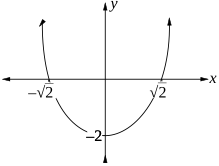
  1. Given the functions  \(f(x)=x-2\)  and  \(g(x)=x^2\), determine the equation of \(f(g(x))\) and sketch its graph showing all intercepts.   (2 marks) 

    --- 10 WORK AREA LINES (style=lined) ---

  2. Evaluate \(g(f(-1))\).   (1 mark)

    --- 2 WORK AREA LINES (style=lined) ---
Show Answers Only

a.   

b.  \(g(f(-1))=9\)

Show Worked Solution

a.    \(f(x)=x-2, \ g(x)=x^2\)

\(f(g(x))=x^2-2\)

\(\text{Intercepts:} \ \ x^2-2=0 \ \Rightarrow \ x= \pm \sqrt{2}\)
 

b.    \(f(-1)=-1-2=-3\)

\(g(f(-1))=g(-3)=9\)

Filed Under: Composite Functions Tagged With: Band 3, Band 4, smc-6216-20-Polynomials, smc-6216-50-Draw/Interpret Graphs

Functions, 2ADV EQ-Bank 13

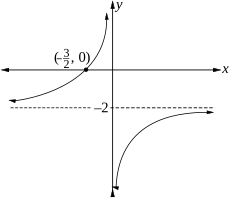
  1. Without calculus, sketch the graph of \(g(x)\), where  \(g(x)=-2-\dfrac{3}{x}\)
  2. In your answer label all asymptotes and any intercepts.   (3 marks)

    --- 10 WORK AREA LINES (style=lined) ---

  3. Express the range of \(g(x)\) in set notation.   (1 mark)

    --- 2 WORK AREA LINES (style=lined) ---
Show Answers Only

a.    
       

b.    \(\text{Range} \ \ y \in(-\infty,-2) \cup(-2, \infty)\)

Show Worked Solution

a.    \(\text{As} \ \ x \rightarrow \infty, g(x) \rightarrow-2^{-}; \text{As} \ \ x \rightarrow-\infty, g(x) \rightarrow-2^{+}\)

\(\text{As} \ \ x \rightarrow 0^{+}, g(x) \rightarrow-\infty; \text{As} \ \ x \rightarrow 0^{-}, g(x) \rightarrow \infty\)

\(\text{Intercept} \ (x \text {-axis}):-2-\dfrac{3}{x}=0 \ \Rightarrow \ 2 x=-3 \ \Rightarrow \ x=-\dfrac{3}{2}\)


b.    \(\text{Range} \ \ y \in(-\infty,-2) \cup(-2, \infty)\)

Filed Under: Reciprocal Graphs Tagged With: Band 3, Band 4, smc-6382-30-Sketch Graph, smc-6382-40-Domain/Range, smc-6382-60-Set Notation

Financial Maths, STD2 EQ-Bank 22

Mei is purchasing a new car and has a choice between two finance packages.

Package A: Deposit of $5000, monthly repayments of $1150 for 4 years.

Package B: No deposit, monthly repayments of $1280 for 5 years.

  1. Determine the total cost of Package A.   (2 marks)

    --- 2 WORK AREA LINES (style=lined) ---
  2. Determine the total cost of Package B.  (2 marks)

    --- 2 WORK AREA LINES (style=lined) ---
  3. How much will Mei save by selecting the cheaper package?  (1 mark)

    --- 2 WORK AREA LINES (style=lined) ---
Show Answers Only

a.   \($60\,200\)

b.   \($76\,800\)

c.   \($16\,600\)

Show Worked Solution

a.    \(\text{Total repayments} (A)=1150\times 12\times 4=$55\,200\)

\(\text{Total cost of Package A}=5000+55\,200=$60\,200\)
 

b.    \(\text{Total repayments (B)}=1280\times 12\times 5=$76\,800\)

\(\text{Total cost of Package B}=$76\,800\ \text{(No deposit)}\)
 

c.    \(\text{Savings using Package A}=76\,800-60\,200=$16\,600\)

Filed Under: Purchasing Goods, Purchasing Goods Tagged With: Band 3, Band 4, smc-6278-35-Buy Now/Pay Later, smc-6517-35-Buy Now/Pay Later

Financial Maths, STD2 EQ-Bank 20

A motorcycle is for sale at $16 500. Finance is available with a $3200 deposit and monthly repayments of $420 for 3 years.

  1. What is the total cost of the repayments?   (1 mark)

    --- 2 WORK AREA LINES (style=lined) ---
  2. How much will the motorcycle cost if Daniel uses the finance package?   (1 mark)

    --- 3 WORK AREA LINES (style=lined) ---
  3. What is the interest paid?   (1 mark)

    --- 2 WORK AREA LINES (style=lined) ---
Show Answers Only

a.   \($15\,120\)

b.   \($18\,320\)

c.   \($1820\)

Show Worked Solution

a.   \(\text{Number of months}=3\times 12=36\ \text{months}\)

\(\text{Total repayments}=36\times 420=$15\,120\)
 

b.    \(\text{Total cost}\) \(=\text{Deposit}+\text{Total repayments}\)
    \(=$3200+$15\,120=$18\,320\)


c.    \(\text{Interest paid}\) \(=\text{Total cost}-\text{Original cost}\)
    \(=$18\,320-$16\,500=$1820\)

Filed Under: Purchasing Goods, Purchasing Goods Tagged With: Band 3, Band 4, smc-6278-35-Buy Now/Pay Later, smc-6517-35-Buy Now/Pay Later

Financial Maths, STD2 EQ-Bank 18

Rachel is purchasing a new refrigerator priced at $3200. The store offers finance terms of 30% deposit and repayments of $65 per week for 40 weeks.

  1. What is the amount of the deposit?   (1 mark)

    --- 2 WORK AREA LINES (style=lined) ---

  2. Find the total cost of the repayments.   (1 mark)

    --- 2 WORK AREA LINES (style=lined) ---
  3. What is the total cost of purchasing the refrigerator using the finance package?   (1 mark)

    --- 2 WORK AREA LINES (style=lined) ---
Show Answers Only

a.   \($960\)

b.   \($2600\)

c.   \($3560\)

Show Worked Solution

a.    \(\text{Deposit}=\dfrac{30}{100}\times 3200=$960\)

b.    \(\text{Total repayments}=65\times 40=$2600\)

c.    \(\text{Total cost}\) \(=\text{Deposit}+\text{Total repayments}\)
    \(=960+2600=$3560\)

Filed Under: Purchasing Goods, Purchasing Goods Tagged With: Band 2, Band 3, smc-6278-35-Buy Now/Pay Later, smc-6517-35-Buy Now/Pay Later

Financial Maths, STD2 EQ-Bank 19

Ben is purchasing a used van with a sale price of $32 600. He has arranged finance with weekly repayments of $280 for 3 years.

Calculate the total amount of the repayments.   (2 marks)

--- 3 WORK AREA LINES (style=lined) ---
Show Answers Only

\($43\,680\)

Show Worked Solution

\(\text{Number of weeks in 3 years}=3\times 52=156\ \text{weeks}\)

\(\text{Total repayments}=280\times 156=$43\,680\)

Filed Under: Purchasing Goods, Purchasing Goods Tagged With: Band 3, smc-6278-35-Buy Now/Pay Later, smc-6517-35-Buy Now/Pay Later

Financial Maths, STD2 EQ-Bank 4 MC

David is purchasing a motorcycle for sale at $15 600. The finance terms are weekly repayments of $180 for 2 years.

What is the total amount of the repayments?

  1. $4320
  2. $8640
  3. $18 720
  4. $19 920
Show Answers Only

\(C\)

Show Worked Solution

\(\text{Number of weeks in 2 years:}=2\times 52=104\)

\(\text{Total repayments}=104\times $180=$18\,720\)

  
\(\Rightarrow C\)

Filed Under: Purchasing Goods, Purchasing Goods Tagged With: Band 3, smc-6278-35-Buy Now/Pay Later, smc-6517-35-Buy Now/Pay Later

Functions, 2ADV EQ-Bank 3 MC

The set of values of `k` for which  `x^2 + 2x-k = 0`  has two real solutions is

  1. `[-1, 1]`
  2. `(-1, oo)`
  3. `(-oo, -1)`
  4. `[-1]`
Show Answers Only

`B`

Show Worked Solution

`text(Two real solutions):`

`b^2-4ac` `> 0`
`4-4 ⋅ 1 ⋅ (-k)` `> 0`
`4k` `> -4`
`k` `> -1`

 
`k in (-1, oo)`

`=>   B`

Filed Under: Algebraic Techniques Tagged With: Band 3, smc-6213-40-Discriminant

Functions, 2ADV EQ-Bank 15

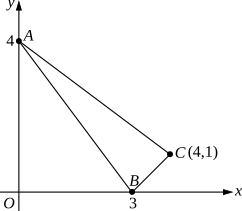
  1. Show the equation of \(AC\) is \(3 x+4 y-16=0\).   ( 2 marks)

    --- 8 WORK AREA LINES (style=lined) ---
  2. Show that \(BC\) is not perpendicular to \(AC\).   (2 marks)

    --- 5 WORK AREA LINES (style=lined) ---
Show Answers Only

a.   \(\text{Proof (See Worked Solutions)}\)

b.   \(\text{Proof (See Worked Solutions)}\)

Show Worked Solution

a.    \(A(0,4), C(4,1)\)

\(m_{AC}=\dfrac{y_2-y_1}{x_2-x_1}=\dfrac{1-4}{4-0}=-\dfrac{3}{4}\)

\(\text{Equation of line with} \ \ m=-\dfrac{3}{4} \ \ \text{through}\ (0,4):\)

\(y-y_1\) \(=m\left(x-x_1\right)\)
\(y-4\) \(=-\dfrac{3}{4}(x-0)\)
\(y-4\) \(=-\dfrac{3}{4} x\)
\(4 y-16\) \(=-3 x\)
\(3 x+4 y-16\) \(=0\)


b.    \(B(3,0), C(4,1)\)

\(m_{BC}=\dfrac{1-0}{4-3}=1\)

\(m_{AC} \times m_{BC}=-\dfrac{4}{3} \times 1=-\dfrac{4}{3} \neq-1\)

\(\therefore AC \ \text{is not} \ \perp \text{to} \ BC.\)

Filed Under: Linear Functions Tagged With: Band 3, Band 4, smc-6214-02-Equation of Line, smc-6214-06-Perpendicular

Functions, 2ADV EQ-Bank 15

Express  \(\dfrac{m^4\, n^{-3}}{m^{-2}\, n^2}\)  with positive indices only.   (1 mark)

--- 3 WORK AREA LINES (style=lined) ---
Show Answers Only

\(\dfrac{m^6}{n^5}\)

Show Worked Solution

\(\dfrac{m^4\, n^{-3}}{m^{-2}\, n^2}=m^{(4+2)}\, n^{(-3-2)}=m^6\, n^{-5}=\dfrac{m^6}{n^5}\)

Filed Under: Algebraic Techniques Tagged With: Band 3, smc-6213-05-Index Laws

Functions, 2ADV EQ-Bank 14

Simplify  \(8ab^2 \times 2a^{-2}\).   (2 marks)

--- 5 WORK AREA LINES (style=lined) ---
Show Answers Only

\(\dfrac{16b^2}{a}\)

Show Worked Solution

\(8ab^2 \times 2a^{-2}=8ab^2 \times \dfrac{2}{a^2}=\dfrac{16b^2}{a}\)

Filed Under: Algebraic Techniques Tagged With: Band 3, smc-6213-05-Index Laws

Functions, 2ADV EQ-Bank 21

Simplify  \(x^5 \ ÷ \ x^{-3}\).   (1 mark)

--- 3 WORK AREA LINES (style=lined) ---
Show Answers Only

\(x^{8}\)

Show Worked Solution

\(x^5 \ ÷ \ x^{-3}=x^{(5-(-3))}=x^8\)

Filed Under: Algebraic Techniques Tagged With: Band 3, smc-6213-05-Index Laws

Financial Maths, STD2 EQ-Bank 14

George has constructed a yearly budget shown below.
  

               Income                      Expenses        
 Salary               $68 450.00   Groceries              $7280.00 
 Interest $825.60   Clothing $3960.00 
     Council Rates  $1740.00 
     Electricity $1890.00 
     Entertainment  $4320.00 
     Insurance $2650.00 
     Loan repayments  $15 840.00 
     Motor vehicle costs  $3180.00 
     Telephone $960.00 
     Work related costs $1250.00 
     Balance  
Total    Total   


  1. Calculate George's total income and total expenses.   (2 marks)

    --- 4 WORK AREA LINES (style=lined) ---

  2. Using the information from part (a), balance the budget.   (1 mark)

    --- 3 WORK AREA LINES (style=lined) ---

  3. What is the amount of George's weekly savings? Give your answer to the nearest dollar.   (1 mark)

    --- 2 WORK AREA LINES (style=lined) ---

Show Answers Only

a.   \(\text{Income}=$69\,275.60,\ \text{Expenses}=$43\,070.00\)

b.   \(\text{Balance}=$26\,205.60\)

c.   \(\text{Savings}=$504\ \text{(nearest dollar)}\)

Show Worked Solution

a.    \(\text{Income}=68\,450.00+825.60=$69\,275.60\)

\(\text{Expenses}\)

\(=7280.00+3960.00+1740.00+1890.00+4320.00\)

\(+2650.00+15840.00+3180.00+960.00+1250.00\)

\(=$43\,070.00\)
   

b.     \(\text{Balance}\) \(=\text{Income}-\text{Expenses}\)
    \(=$69\,275.60-$43\,070.00=$26\,205.60\)

  
c.    \(\text{Weekly savings}=\dfrac{$26\,205.60}{52}=$503.953…\ =$504\ \text{(nearest dollar)}\)

Filed Under: Budgeting, Budgeting Tagged With: Band 2, Band 3, smc-6279-10-Personal Budget, smc-6518-10-Personal Budget

Financial Maths, STD2 EQ-Bank 18

Michael has budgeted $185 per week for groceries, $95 per week for leisure, $38 per fortnight for medical expenses and $115 per week to run a car.

Calculate Michael's monthly expenses. Assume 4 weeks in a month.   (2 marks)

--- 4 WORK AREA LINES (style=lined) ---

Show Answers Only

\($1656\)

Show Worked Solution

\(\text{Calculate weekly expenses:}\)

\(\text{Groceries} =$185 \text{per week}\)

\(\text{Leisure} =$95\ \text{per week}\)

\(\text{Medical} =\dfrac{38}{2}= \$19\ \text{per week}\)

\(\text{Car} =$115\ \text{per week}\)

\(\text{Total weekly expenses}=185+95+19+115=$414\ \text{per week}\)

\(\therefore\ \text{Monthly expenses (assuming 4 weeks in a month)}=414\times 4=$1656\)

Filed Under: Budgeting, Budgeting Tagged With: Band 3, smc-6279-10-Personal Budget, smc-6518-10-Personal Budget

Financial Maths, STD2 EQ-Bank 3 MC

Sophie has the following bills: internet $90 per month, electricity $320 per quarter, insurance $840 per year and rent $280 per week.

What is the total amount Sophie should budget for the year?

  1. $1530
  2. $16 640
  3. $17 760
  4. $18 200
Show Answers Only

\(C\)

Show Worked Solution

\(\text{Internet} =90 \times 12 = \$1080\ \text{per year}\)

\(\text{Electricity} =320 \times 4 = \$1280\ \text{per year}\)

\(\text{Insurance} =$840\ \text{per year}\)

\(\text{Rent} =280 \times 52 = \$14\,560\ \text{per year}\)

\(\therefore\ \text{Total yearly expenses}=1080+1280+840+14\,560=$17\,760\)

\(\Rightarrow C\)

Filed Under: Budgeting, Budgeting Tagged With: Band 3, smc-6279-10-Personal Budget, smc-6518-10-Personal Budget

Algebra, STD2 EQ-Bank 20

Maria drove 420 km in 6 hours. Her average speed for the first 280 km was 80 km per hour.

How long did she take to travel the last 140 km?   (2 marks)

--- 4 WORK AREA LINES (style=lined) ---

Show Answers Only

\(\text{2.5 hours}\)

Show Worked Solution

\(\text{First 280 km:}\)

\(t=\dfrac{\text{distance}}{\text{speed}}=\dfrac{280}{80}= 3.5\ \text{hours}\)

\(\text{Total time}=6\ \text{hours}\)

\(\text{Time for first 280 km}=3.5\ \text{hours}\)

\(\text{Time taken for last 140 km}=6-3.5=\text{2.5 hour}\)

Filed Under: Applications: BAC, D=SxT and Medication, Applications: BAC, Medicine and D=S x T Tagged With: Band 3, smc-6235-20-\(d=s\times t\), smc-6509-20-\(d=s \times t\)

Algebra, STD2 EQ-Bank 18

The distance between Newcastle and Sydney is 165 km. A person travels from Newcastle to Sydney at an average speed of 110 km/h.

How long does it take the person to complete the journey in hours and minutes?   (2 marks)

--- 3 WORK AREA LINES (style=lined) ---

Show Answers Only

\(\text{1 hour 30 minutes}\)

Show Worked Solution

\(\text{Using}\ \ d=s \times t\ \ \Rightarrow\ \ t=\dfrac{d}{s}:\)

\(t=\dfrac{165}{110}=1.5\ \text{hours}\ =\ \text{1 hour 30 minutes}\)

Filed Under: Applications: BAC, D=SxT and Medication, Applications: BAC, Medicine and D=S x T Tagged With: Band 3, smc-6235-20-\(d=s\times t\), smc-6509-20-\(d=s \times t\)

Measurement, STD2 EQ-Bank 19

A bus departs Sydney at 8:00 am on Monday for Perth. The bus makes five stops on the journey whose durations are given below: 

  • Dubbo: 45 minutes
  • Broken Hill: 1 hour 15 minutes
  • Port Augusta: 50 minutes
  • Ceduna: 40 minutes
  • Norseman: 1 hour 10 minutes

The total driving time (excluding stops) is 52 hours and 30 minutes. The bus arrives in Perth at 3:25 pm on Thursday.

  1. Calculate the total time for the journey from Sydney to Perth, including all stops. Give your answer in hours and minutes.   (2 marks)

    --- 5 WORK AREA LINES (style=lined) ---

  2. Convert your answer from part (a) to days, hours and minutes, and hence state the day and time the bus arrives in Perth. Ignore time zones in your calculations.   (2 marks)

    --- 6 WORK AREA LINES (style=lined) ---

Show Answers Only

a.   \(\text{57 hours 10 minutes}\)

b.   \(\text{Bus arrives on Wednesday at 5:10 pm with the journey}\)

\(\text{taking 2 days 9 hours 10 minutes.}\)

Show Worked Solution

a.   \(\text{Total stopping time}\)

\(=45+75+50+40+70\)

\(= 280 \text{ minutes}= 4\ \text{hours}\ 40 \text{ minutes} \)

\(\text{Total journey}\)

\(=52\ \text{hours}\ 30 \text{ minutes}+4\ \text{hours}\ 40 \text{ minutes} \)

\(=57\ \text{hours}\ 10 \text{ minutes} \)
  

b.   \(\text{Convert 57 hours 10 minutes to days, hours and minutes:}\)

\(57\ \text{hours}=(2 \times 24) + 9=2\ \text{days}\ 9\ \text{hours}\)

\(57\ \text{ hours 10 minutes}=2\ \text{days}\ 9\ \text{hours}\ 10\ \text{minutes}\)
 

\(\text{Bus arrival in Perth:}\)

\(\rightarrow\ \text{Bus departs 8 am Monday}\)

\(\rightarrow\ \text{Monday 8:00 am + 2 days = Wednesday 8:00 am}\)

\(\rightarrow\ \text{Wednesday 8:00 am + 9 hours 10 minutes = Wednesday 5:10 pm}\)

\(\therefore\ \text{Bus arrives Wednesday at 5:10 pm.}\)

Filed Under: Time and Time Difference, Time and Time Difference Tagged With: Band 3, Band 4, smc-6306-15-Time Conversions, smc-6306-20-Elapsed Time Problems, smc-6525-15-Time Conversions, smc-6525-20-Elapsed Time Problems, syllabus-2027

Measurement, STD2 EQ-Bank 19

Bangkok is located at \( (14^{\circ}\text{N}, 100^{\circ}\text{E}) \) and Montreal is located at \( (46^{\circ}\text{N}, 74^{\circ}\text{W}) \).

  1. Identify which city is closer to the Equator, giving reasons.   (1 mark)

    --- 3 WORK AREA LINES (style=lined) ---

  2. What is the difference in latitude between Bangkok and Montreal?   (1 mark)

    --- 3 WORK AREA LINES (style=blank) ---

  3. What is the difference in longitude between Bangkok and Montreal?   (1 mark)

    --- 3 WORK AREA LINES (style=lined) ---

Show Answers Only

a.   \(\text{Bangkok}\)

b.   \(32^{\circ}\)

c.   \(174^{\circ}\)

Show Worked Solution

a.   \(\text{Bangkok is at latitude }14^{\circ}\text{N} \)

\(\text{Montreal is at latitude }46^{\circ}\text{N} \)

\(\text{Since 14° < 46°, Bangkok is closer to the Equator.}\)
 

b.    \(\text{Latitude of Bangkok}=14^{\circ}\text{N}\)

\(\text{Latitude of Montreal}=46^{\circ}\text{N}\)

\(\text{Since cities are both in the northern hemisphere, subtract the latitudes.}\)

\(\text{Difference in latitude}=46^{\circ}-14^{\circ}=32^{\circ} \)
 

c.    \(\text{Longitude of Bangkok}=100^{\circ}\text{E}\)

\(\text{Longitude of Montreal}=74^{\circ}\text{W}\)

\(\text{Since cities on opposite sides of the Prime Meridian, add the longitudes.}\)

\(\text{Difference in longitude}=100^{\circ}+74^{\circ}=174^{\circ} \)

Filed Under: Positions on the Earth's Surface, Positions on the Earth's Surface Tagged With: Band 3, Band 4, smc-6305-20-Earth Coordinates, smc-6524-20-Earth Coordinates

Measurement, STD2 EQ-Bank 18

Tokyo is located at \( (36^{\circ}\text{N}, 140^{\circ}\text{E}) \) and Lima is located at \( (12^{\circ}\text{S}, 77^{\circ}\text{W}) \).

  1. Explain which city is closer to the Prime Meridian?   (1 mark)

    --- 3 WORK AREA LINES (style=lined) ---

  2. What is the difference in latitude between Tokyo and Lima?   (1 mark)

    --- 3 WORK AREA LINES (style=blank) ---

  3. What is the difference in longitude between Tokyo and Lima?   (1 mark)

    --- 3 WORK AREA LINES (style=lined) ---

Show Answers Only

a.   \(\text{Lima}\)

b.   \(48^{\circ}\)

c.   \(217^{\circ}\)

Show Worked Solution

a.   \(\text{Tokyo is at longitude }140^{\circ}\text{E} \)

\(\text{Lima is at longitude }77^{\circ}\text{W} \)

\(\text{Since 77° < 140°, Lima is closer to the Prime Meridian.}\)
 

b.    \(\text{Latitude of Tokyo}=36^{\circ}\text{N}\)

\(\text{Latitude of Lima}=12^{\circ}\text{S}\)

\(\text{Since cities on opposite sides of the equator, add the latitudes.}\)

\(\text{Difference in latitude}=36^{\circ}+12^{\circ}=48^{\circ} \)
 

c.    \(\text{Longitude of Tokyo}=140^{\circ}\text{E}\)

\(\text{Longitude of Lima}=77^{\circ}\text{W}\)

\(\text{Since cities on opposite sides of the Prime Meridian, add the longitudes.}\)

\(\text{Difference in longitude}=140^{\circ}+77^{\circ}=217^{\circ} \)

Filed Under: Positions on the Earth's Surface, Positions on the Earth's Surface Tagged With: Band 3, Band 4, smc-6305-20-Earth Coordinates, smc-6524-20-Earth Coordinates

Measurement, STD2 EQ-Bank 3 MC

The coordinates of Cairo are \( (30^{\circ}\text{N}, 31^{\circ}\text{E}) \).

What are the coordinates of Athens if it is 23° west of Cairo and on the same line of longitude?

  1. \( (30^{\circ}\text{N}, 54^{\circ}\text{E}) \)
  2. \( (7^{\circ}\text{N}, 31^{\circ}\text{E}) \)
  3. \( (53^{\circ}\text{N}, 31^{\circ}\text{E}) \)
  4. \( (30^{\circ}\text{N}, 8^{\circ}\text{E}) \)
Show Answers Only

\(D\)

Show Worked Solution

\(\text{Athens is 23° west of Cairo.}\)

\(\text{Latitude of Athens}=30^{\circ}\text{N}\)

\(\text{Longitude of Athens}=31^{\circ}-23^{\circ}=8^{\circ}\text{E}\)

\(\therefore\ \text{Coordinates of Athens are:}\ (30^{\circ}\text{N}, 8^{\circ}\text{E})\)

\(\Rightarrow D\)

Filed Under: Positions on the Earth's Surface, Positions on the Earth's Surface Tagged With: Band 3, smc-6305-20-Earth Coordinates, smc-6524-20-Earth Coordinates

Measurement, STD2 EQ-Bank 4 MC

The coordinates of Jakarta are \( (6^{\circ}\text{S}, 107^{\circ}\text{E}) \).

Darwin and Jakarta share the same longitude but Darwin is \( 18^{\circ} \) south of Jakarta. What are the coordinates of Darwin?

  1. \( (6^{\circ}\text{S}, 125^{\circ}\text{E}) \)
  2. \( (6^{\circ}\text{S}, 89^{\circ}\text{E}) \)
  3. \( (24^{\circ}\text{S}, 107^{\circ}\text{E}) \)
  4. \( (12^{\circ}\text{N}, 107^{\circ}\text{E}) \)
Show Answers Only

\(C\)

Show Worked Solution

\(\text{Darwin is }18^{\circ}\text{ south of Jakarta.}\)

\(\text{Latitude of Darwin}=6^{\circ}+18^{\circ}=24^{\circ}\text{S}\)

\(\text{Longitude of Darwin}=107^{\circ}\text{E}\)

\(\therefore\ \text{Coordinates of Darwin are:}\ (24^{\circ}\text{S}, 107^{\circ}\text{E})\)

\(\Rightarrow C\)

Filed Under: Positions on the Earth's Surface, Positions on the Earth's Surface Tagged With: Band 3, smc-6305-20-Earth Coordinates, smc-6524-20-Earth Coordinates

Measurement, STD2 EQ-Bank 2 MC

Tokyo is 45\(^{\circ}\) west of Sydney. Using longitudinal difference, what is the time in Tokyo when it is 3:00 pm in Sydney?

  1. 6:00 am
  2. 9:00 am
  3. 6:00 pm
  4. 12:00 pm
Show Answers Only

\(D\)

Show Worked Solution

\(15^{\circ}\ =\text{1 hour time difference}\)

\(\text{Longitudinal distance}=45^{\circ}\)

\(\text{Time Difference}=\dfrac{45}{15}=3\ \text{hours}\)

  
\(\text{Time in Sydney}\ =\ 3:00\ \text{pm}\)

\(\text{Since Sydney is East of Tokyo:}\)

\(\text{Time in Tokyo}=\ 3:00\ \text{pm}-3\ \text{hours}=\ 12:00\ \text{pm}\)

\(\Rightarrow D\)

Filed Under: Positions on the Earth's Surface, Positions on the Earth's Surface Tagged With: Band 3, smc-6305-10-Longitude and Time Differences, smc-6524-10-Longitude and Time Differences

Measurement, STD2 EQ-Bank 26

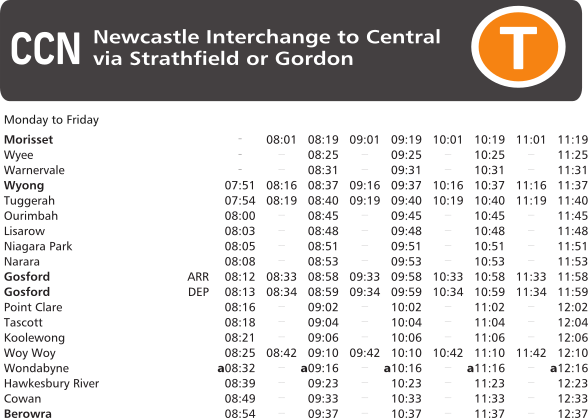
Use the train timetable below to answer this question.

Emma lives in Berowra and travels to Wyong for an appointment. After her appointment, she needs to attend a meeting in Gosford before returning home to Berowra.

  1. Emma catches the train that departs Wyong at 09:16. How long does this train take to reach Gosford?   (1 mark)

    --- 2 WORK AREA LINES (style=lined) ---

  2. Emma's meeting in Gosford starts at 10:15 am at a venue that is 7 minutes walk from Gosford station. What is the latest train she can catch from Wyong to arrive at her meeting on time?   (2 marks)

    --- 3 WORK AREA LINES (style=lined) ---

  3. After her meeting finishes at 11:20 am, Emma walks back to Gosford station (taking 7 minutes). What is the earliest train she can catch from Gosford to return home to Berowra, and what time will she arrive home?   (2 marks)

    --- 3 WORK AREA LINES (style=lined) ---

Show Answers Only

a.   \(17\ \text{minutes}\)

b.   \(09:37\ \text{train}\)

c.   \(\text{11:34 am Gosford train, arrives at Berowra at 12:37 pm}\)

Show Worked Solution

a.   \(\text{Elapsed time:}\ =09:33-09:16 = 17 \text{ minutes} \)

b.   \(\text{Step 1: Meeting starts at 10:15 am}\)

\(\rightarrow\ 7\text{ minutes to walk from Gosford station to the venue.}\)

\(\rightarrow\ \text{At Gosford Station by: }\ 10:15-7 \text{ minutes} = 10:08 \text{ am}\)

\(\text{Step 2: Find latest train arriving at Gosford by 10:08 am}\)

\(\rightarrow\ \text{Arrival times: } 08:12, 08:33, 08:58, 09:33, 09:58, 10:33\)

\(\rightarrow\ \text{She must catch the }09:58.\)

\(\text{Step 3: When does 09:58 depart Wyong?}\)

\(\rightarrow\ 09:37\ \text{train}\)

c.   \(\text{Step 1: Determine when Emma arrives back at Gosford station}\)

\(\rightarrow\ \text{Meeting finishes at }11:20 \text{ am}\)

\(\text{Walking time back to station: 7 minutes}\)

\(\text{Emma arrives at Gosford station at:}\ 11:20 + 7 \text{ minutes} = 11:27 \text{ am} \)

\(\text{Step 1: Find the earliest train departing Gosford after 11:27 am}\)

\(\rightarrow\ \text{Meeting finishes at }11:20 \text{ am}\)

\(\rightarrow\ \text{Relevant departure times:} …10:34, 10:59, 11:34, 11:59\)

\(\rightarrow\ \text{Earliest train after 11:27 am is the }11:34 \text{ am}\)

\(\text{Step 3: Find when this train arrives in Berowra}\)

\(\rightarrow\ \text{11:34 am Gosford train, arrives at Berowra at }12:37 \text{ pm}\)

Filed Under: Uncategorized Tagged With: Band 3, Band 4, Band 5, smc-6306-20-Elapsed Time Problems, smc-6525-20-Elapsed Time Problems

Measurement, STD2 EQ-Bank 4 MC

On Tuesday Sarah started work at 6:45 am and finished at 3:12 pm.

For how many hours and minutes did Sarah work on Tuesday?

  1. 8 hours 27 minutes
  2. 8 hours 33 minutes
  3. 9 hours 27 minutes
  4. 9 hours 33 minutes
Show Answers Only

\(A\)

Show Worked Solution

\(\text{Break into steps}\)

\(\text{From 6:45 am to 7:00 am: }\ 60-45 = 15 \text{ minutes} \)

\(\text{From 7:00 am to 3:12 pm: }\  8\ \text{hours}\ 12 \text{ minutes} \)

\(\text{Total: }\  8\ \text{hours}+12 \text{ minutes} +15 \text{ minutes}=8\ \text{hours}\ 27\ \text{minutes}\)

\(\Rightarrow A\)

Filed Under: Time and Time Difference, Time and Time Difference Tagged With: Band 3, smc-6306-20-Elapsed Time Problems, smc-6525-20-Elapsed Time Problems, syllabus-2027

Measurement, STD2 EQ-Bank 3 MC

A bus departs at 8:23 am and arrives at its destination at 11:47 am.

How long was the bus journey?

  1. 3 hours 24 minutes
  2. 3 hours 34 minutes
  3. 4 hours 24 minutes
  4. 4 hours 34 minutes
Show Answers Only

\(A\)

Show Worked Solution

\(\text{Method 1: Break into steps}\)

\(\rightarrow\text{From 8:23 am to 9:00 am: }\ 60-23 = 37 \text{ minutes} \)

\(\rightarrow\text{From 9:00 am to 11:47 am: }\  2\ \text{hours}\ 47 \text{ minutes} \)

\(\rightarrow\text{Total: }\  37 \text{ minutes} + 2\ \text{hours}+\ 47 \text{ minutes}=2\ \text{hours}\ 84\ \text{minutes}\)

\(=3\ \text{hours}\ 24\ \text{minutes}\)
  

\(\text{Method 2: Calculate hours and minutes separately}\)

\(\rightarrow\text{Hours: } \ 11-8 = 3 \text{ hours} \)

\(\rightarrow\text{Minutes: }\ 47-23 = 24 \text{ minutes} \)

\(\rightarrow\text{Total: }\ 3 \text{ hours } 24 \text{ minutes} \)
  

\(\Rightarrow B\)

Filed Under: Time and Time Difference, Time and Time Difference Tagged With: Band 3, smc-6306-20-Elapsed Time Problems, smc-6525-20-Elapsed Time Problems, syllabus-2027

Measurement, STD2 EQ-Bank 18

A concert runs for 5400 seconds.

  1. Convert this time to hours and minutes.   (2 marks)

    --- 3 WORK AREA LINES (style=lined) ---

  2. If the concert finishes at 10:45 pm, what time did it start?   (2 marks)

    --- 3 WORK AREA LINES (style=lined) ---

Show Answers Only

a.   \(\text{1 hours 30 minutes}\)

b.   \(\text{9:15 pm}\)

Show Worked Solution

a.   \(\text{Step 1: Convert seconds to minutes}\)

\(5400 \text{ seconds} = \dfrac{5400}{60} \text{ minutes} = 90 \text{ minutes} \)

\(\text{Step 2: Convert minutes to hours and minutes}\)

\(90 \text{ minutes} = \dfrac{90}{60} \text{ hours} = 1.5 \text{ hours} \)

\(\therefore\ 90 \text{ minutes} = 1 \text{ hour } 30 \text{ minutes} \)
  

b.   \(\text{Finish time: 10:45 pm}\)

\(\text{Concert duration: 1 hours 30 minutes}\)

\(10:45\ \text{pm}-1\ \text{hour}=9:45\ \text{pm}\)

\(9:45\ \text{pm}-30\ \text{minutes}=9:15\ \text{pm}\)

\(\text{Start time: 9:15 pm}\)

Filed Under: Time and Time Difference, Time and Time Difference Tagged With: Band 3, Band 4, smc-6306-15-Time Conversions, smc-6306-20-Elapsed Time Problems, smc-6525-15-Time Conversions, smc-6525-20-Elapsed Time Problems, syllabus-2027

Measurement, STD2 EQ-Bank 16

A movie runs for 8400 seconds.

  1. Convert this time to hours and minutes.   (2 marks)

    --- 3 WORK AREA LINES (style=lined) ---

  2. If the movie starts at 7:15 pm, what time will it finish?   (1 mark)

    --- 2 WORK AREA LINES (style=lined) ---

Show Answers Only

a.   \(\text{2 hours 20 minutes}\)

b.   \(\text{9:35 pm}\)

Show Worked Solution

a.   \(\text{Step 1: Convert seconds to minutes}\)

\(8400 \text{ seconds} = \dfrac{8400}{60} \text{ minutes} = 140 \text{ minutes} \)

\(\text{Step 2: Convert minutes to hours and minutes}\)

\(140 \text{ minutes} = \dfrac{140}{60} \text{ hours} = 2.333… \text{ hours} \)

\(\text{To find the minutes part:}\ 140 = 2 \times 60 + 20  \)

\(\therefore\ 140 \text{ minutes} = 2 \text{ hours } 20 \text{ minutes} \)
  

b.   \(\text{Starting time: 7:15 pm}\)

\(\text{Movie duration: 2 hours 20 minutes}\)

\(\text{Finish time: 9:35 pm}\)

Filed Under: Time and Time Difference, Time and Time Difference Tagged With: Band 3, smc-6306-15-Time Conversions, smc-6306-20-Elapsed Time Problems, smc-6525-15-Time Conversions, smc-6525-20-Elapsed Time Problems, syllabus-2027

Measurement, STD2 EQ-Bank 5 MC

Jeremy watched a movie at the cinema that began at 11:35 am. If it finished at 2:05 pm, what was the duration of the movie, in minutes?

  1. 25 minutes
  2. 125 minutes
  3. 150 minutes
  4. 250 minutes
Show Answers Only

\(C\)

Show Worked Solution

\(\text{11:35 to 2:05 = 2.5 hours}\)

\(\text{To convert hours to minutes multiply by 60.}\)

\( 2.5 \text{ hours} = 2.5 \times 60 \text{ minutes} = 150 \text{ minutes} \)

\(\Rightarrow C\)

Filed Under: Time and Time Difference, Time and Time Difference Tagged With: Band 3, smc-6306-15-Time Conversions, smc-6525-15-Time Conversions, syllabus-2027

Statistics, STD2 EQ-Bank 3 MC

A dataset has a lower quartile (Q1) of 25 and an upper quartile (Q3) of 35.

Which of the following values would be classified as an outlier?

  1. 2
  2. 10
  3. 48
  4. 50
Show Answers Only

\(A\)

Show Worked Solution

\(\text{IQR}=Q_3-Q_1\)

 \(=35-25=10\)

\(\text{Lower boundary}=25-1.5\times 10=10\)

\(\text{Upper boundary}=35+1.5\times 10=50\)

\(\text{Check each value:} \)

\(2 < 10 \text{ (outlier)} \)

\(10 = 10 \text{ (on boundary, not an outlier)}\)

\(48 < 50 \text{ (not an outlier)} \)

\(50 = 50 \text{ (on boundary, not an outlier)}\)

\(\therefore\ 2\ \text{is the only outlier}\)

\(\Rightarrow A\)

Filed Under: Measures of Centre and Spread, Measures of Centre and Spread Tagged With: Band 3, smc-6312-30-IQR and Outliers, smc-6532-30-IQR and Outliers

Statistics, STD2 EQ-Bank 1 MC

A dataset has the following values arranged in order:

12,  15,  18,  21,  24,  27,  30,  33,  36

What is the interquartile range (IQR) of this dataset?

  1. 12
  2. 15
  3. 18
  4. 24
Show Answers Only

\(B\)

Show Worked Solution

\(\text{Number of data values: }n=9\)

\(\text{Median }(Q_2): =24\)

\(\text{Lower half of data: }12,  15,  18,  21\)

\(Q_1=\dfrac{15+18}{2}\ =16.5\)

\(\text{Upper half of data: } 27,  30,  33,  36\)

\(Q_3=\dfrac{30+33}{2}\ =31.5\)

\(\text{IQR}=Q_3-Q_1\)

 \(=31.5-16.5=15\)

\(\Rightarrow C\)

Filed Under: Measures of Centre and Spread, Measures of Centre and Spread Tagged With: Band 3, smc-6312-30-IQR and Outliers, smc-6532-30-IQR and Outliers

Statistics, STD2 EQ-Bank 2 MC

In a small business, the seven employees earn the following wages per week:

\(\$300, \ \$490, \ \$520, \ \$590, \ \$660, \ \$680, \ \$970\)

What is the population standard deviation of the wages, correct to 2 decimal places?

  1. $187.25
  2. $191.04
  3. $201.58
  4. $215.73
Show Answers Only

\(B\)

Show Worked Solution

\(\text{Using a calculator to find the population standard deviation:}\)

\(\sigma = 191.044…= \$191.04\ \text{(to 2 d.p.)}\)

\(\Rightarrow B\)

Filed Under: Measures of Centre and Spread, Measures of Centre and Spread Tagged With: Band 3, smc-6312-50-Std Dev (by Calc), smc-6532-50-Std Dev (by Calc)

Functions, 2ADV 2011 HSC 3c

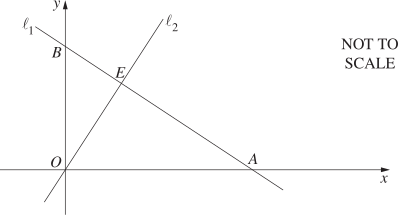
The diagram shows a line `l_1`, with equation  `3x + 4y-12 = 0`, which intersects the `y`-axis at `B`.

A second line `l_2`, with equation  `4x-3y = 0`, passes through the origin `O` and intersects `l_1` at `E`. 
 

  1. Show that the coordinates of `B` are `(0, 3)`.    (1 mark)

    --- 3 WORK AREA LINES (style=lined) ---

  2. Show that `l_1` is perpendicular to `l_2`.   (2 marks)

    --- 5 WORK AREA LINES (style=lined) ---

Show Answers Only

a.    `\text{See Worked Solution}`

b.    `\text{See Worked Solution}`

Show Worked Solution

a.    `B\ text(is)\ y text(-intercept of)\ l_1`

`text(When)\ x = 0:`

`(3 xx 0) + 4y-12=0\ \ =>\ \ y=3`

`:.\ B\ text(is)\ (0,3)`
 

b.    `l_1:\ \ 3x + 4y -12`  `= 0`
  `4y` `= -3x + 12`
  `y` `= -3/4x + 3`

`m(l_1)=-3/4`
 

`l_2:\ \ 4x-3y` `= 0`
`3y` `= 4x`
`y` `= 4/3 x`

`m(l_2)=4/3`
 

`m (l_1) xx m (l_2)= -3/4 xx 4/3= -1`

`:.\ l_1\ text(and)\ l_2\ text(are perpendicular)`

Filed Under: Linear Functions Tagged With: Band 2, Band 3, smc-6214-06-Perpendicular, smc-6214-08-Intercepts

Measurement, STD2 EQ-Bank 3 MC

A square pyramid has a base with side length 9 cm and a perpendicular height of 8 cm.

Calculate the volume of the pyramid. 

  1. 72 cm³
  2. 144 cm³
  3. 192 cm³
  4. 216 cm³
Show Answers Only

\(D\)

Show Worked Solution

\(A=9^2=81\)

\(V=\frac{1}{3}Ah=\frac{1}{3}\times 81\times 8=216\ \text{cm}^3\)

  
\(\Rightarrow D\)

Filed Under: Volume, Mass and Capacity, Volume, Mass and Capacity Tagged With: Band 3, smc-6304-30-Pyramids/Cones, smc-6521-30-Pyramids/Cones

Measurement, STD2 EQ-Bank 5 MC

A conical water tank has a radius of 3 metres and a perpendicular height of 5 metres.

Calculate the volume of water the tank can hold in kilolitres. (Note: 1 m³ = 1 kL)

  1. 15.71 kL
  2. 23.56 kL
  3. 47.12 kL
  4. 141.37 kL
Show Answers Only

\(C\)

Show Worked Solution
\(V\) \(=\frac{1}{3}\pi r^2h\)
  \(=\frac{1}{3}\times \pi \times (3)^2\times 5\)
  \(=47.123\dots\)

 
\(\text{Using: 1 m}^3 = 1\ \text{kL:} \)

\(\text{47.12 m}^3= 47.12\ \text{kL}\)

\(\Rightarrow C\)

Filed Under: Volume, Mass and Capacity Tagged With: Band 3, smc-6304-30-Pyramids/Cones

Measurement, STD2 EQ-Bank 4 MC

A cone has a radius of 6 cm and a height of 8 cm.

Calculate the volume of the cone, giving your answer in cubic centimetres correct to 1 decimal place.

  1. 100.5 cm³
  2. 150.8 cm³
  3. 301.6 cm³
  4. 904.8 cm³
Show Answers Only

\(C\)

Show Worked Solution
\(V\) \(=\frac{1}{3}\pi r^2h\)
  \(=\frac{1}{3}\times \pi \times (6)^2\times 8\)
  \(=301.592\dots=301.6\ \text{cm}^3 \text{(1 d.p.)}\)

  
\(\Rightarrow C\)

Filed Under: Volume, Mass and Capacity, Volume, Mass and Capacity Tagged With: Band 3, smc-6304-30-Pyramids/Cones, smc-6521-30-Pyramids/Cones

Measurement, STD2 EQ-Bank 17

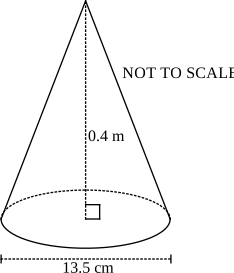
The cone below has a diameter of 13.5 centimetres and a height of 0.4 metres.
 

Calculate the volume of the cone, giving your answer in cubic centimetres correct to 1 decimal place.   (2 marks)

--- 5 WORK AREA LINES (style=lined) ---

Show Answers Only

\(1908.5\ \text{cm}^3 \text{(1 d.p.)}\)

Show Worked Solution

\(\text{Radius}\ =\dfrac{13.5}{2}=6.75\ \text{cm}\)

\(0.4\ \text{m}\ =\ 40\ \text{cm}\)

\(V\) \(=\frac{1}{3}\pi r^2h\)
  \(=\frac{1}{3}\times \pi \times (6.75)^2\times 40\)
  \(=1908.517\dots\)
  \(=1908.5\ \text{cm}^3 \text{(1 d.p.)}\)

Filed Under: Volume, Mass and Capacity, Volume, Mass and Capacity Tagged With: Band 3, smc-6304-30-Pyramids/Cones, smc-6521-30-Pyramids/Cones

Measurement, STD2 EQ-Bank 18

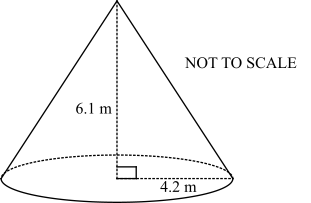
The cone below has a radius of 4.2 metres and a height of 6.1 metres.
 

Calculate the volume of the cone, giving your answer in cubic metres correct to 1 decimal point.   (2 marks)

--- 5 WORK AREA LINES (style=lined) ---

Show Answers Only

\(112.7\ \text{m}^3 \text{(1 d.p.)}\)

Show Worked Solution
\(V\) \(=\frac{1}{3}\pi r^2h\)
  \(=\frac{1}{3}\times \pi \times (4.2)^2\times 6.1\)
  \(=112.682\dots\)
  \(=112.7\ \text{m}^3 \text{(1 d.p.)}\)

Filed Under: Volume, Mass and Capacity, Volume, Mass and Capacity Tagged With: Band 3, smc-6304-30-Pyramids/Cones, smc-6521-30-Pyramids/Cones

Measurement, STD2 EQ-Bank 16

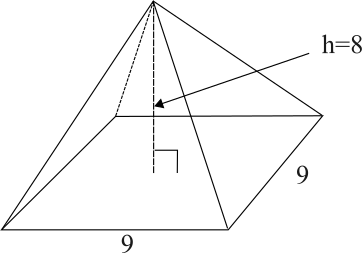
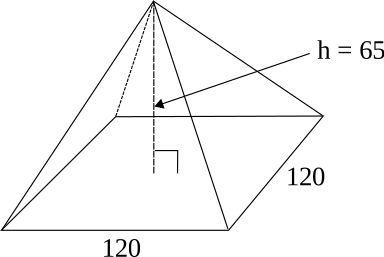
The square pyramid below, has a side measurement of 120 metres and a perpendicular height \((h)\) of 65 metres.
 

Find the volume of the pyramid in cubic metres.   (2 marks)

--- 5 WORK AREA LINES (style=lined) ---

Show Answers Only

\(312\, 000\ \text{m}^3\)

Show Worked Solution
\(V\) \(=\frac{1}{3}Ah\)
  \(=\frac{1}{3}\times 120\times 120\times 65\)
  \(=312\, 000\ \text{m}^3\)

Filed Under: Volume, Mass and Capacity, Volume, Mass and Capacity Tagged With: Band 3, smc-6304-30-Pyramids/Cones, smc-6521-30-Pyramids/Cones

Financial Maths, STD2 EQ-Bank 34

David and Mary are a couple living together. They each receive the maximum Age Pension payment of $888.50 per fortnight (which includes basic rate, Pension Supplement and Energy Supplement).

Their combined income from part-time work is $520 per fortnight. Their Age Pension is reduced by 25 cents each for every dollar of combined income over $380 per fortnight..

  1. Calculate the reduction in each person's Age Pension payment.   (2 marks)

    --- 3 WORK AREA LINES (style=lined) ---

  2. Calculate their total household fortnightly income including their reduced Age Pension payments and earnings.   (2 marks)

    --- 3 WORK AREA LINES (style=lined) ---

  3. What percentage of their total household income comes from their Age Pension payments? Give your answer to 1 decimal place.   (1 mark)

    --- 3 WORK AREA LINES (style=lined) ---

Show Answers Only

a.    \($35\)

b.    \($2227\)

c.    \(76.6\%\ \text{(to 1 d.p.)}\)

Show Worked Solution

a.    \(\text{Combined income over free area} = 520-380=$140\)

\(\text{Reduction for each person} = 0.25 \times 140= $35\)

\(\therefore\ \text{Each person’s pension is reduced by \$35}\)
  

b.    \(\text{Reduced pension for each person}=888.50-35= $853.50\)

\(\text{Combined Age Pension} = 2 \times 853.50=$1707\)

\(\text{Total household income} = 1707+520=$2227\)
  

c.    \(\text{Percentage from Age Pension} =\dfrac{1707}{2227}\times 100=76.6\%\ \text{(to 1 d.p.)}\)

\(\therefore\ 76.6\%\text{ of their household income comes from Age Pension}\)

Filed Under: Ways of Earning Tagged With: Band 3, Band 4, Band 5, smc-6276-40-Govt Payments

Financial Maths, STD2 EQ-Bank 30

Baron is 19 years old, single with no children, and lives away from his parents' home to study. He receives the maximum Youth Allowance payment of $663.30 per fortnight.

Baron supplements his payments by working part-time and earns $15.50 per hour in a retail position. His Youth Allowance is reduced by 50 cents for each dollar earned over $236 per fortnight.

  1. Baron works 22 hours per fortnight. Calculate his total fortnightly income including his reduced Youth Allowance payment and earnings.   (2 marks)

    --- 4 WORK AREA LINES (style=lined) ---

  2. What is the maximum number of hours Baron can work per fortnight before his Youth Allowance payment is reduced to zero? Give your answer to the nearest whole hour.   (2 marks)

    --- 4 WORK AREA LINES (style=lined) ---

Show Answers Only

a.    \(\text{\$951.80 per fortnight}\)

b.    \(\text{101 hours per fortnight}\)

Show Worked Solution

a.    \(\text{Baron’s earnings} = 15.50\times 22=$341\)

\(\text{Income over free area} = 341-236 = $105\)

\(\text{Reduction in payment} = 0.50\times 105= $52.50\)

\(\text{Reduced Youth Allowance} = 663.30-52.50=$610.80\)

\(\text{Total fortnightly income} = 610.80+341=$951.80\)
 

b.    \(\text{For payment to reduce to zero, reduction needed} = $663.30\)

\(\text{Income over free area} = \dfrac{663.30}{0.50}=$1326.60\)

\(\text{Total earnings needed} = 1326.60+236=$1562.60\)

\(\text{Hours needed}=\dfrac{1562.60}{15.50}=100.8\)

\(\therefore\ \text{Baron can work a maximum of 101 hours per fortnight}\)

Filed Under: Ways of Earning Tagged With: Band 3, Band 5, smc-6276-40-Govt Payments

Financial Maths, STD2 EQ-Bank 29

Yuki is single with no children and receives the maximum JobSeeker Payment of $793.60 per fortnight.

Her JobSeeker Payment is reduced by 50 cents for each dollar earned over $150 per fortnight.

  1. Yuki earns $380 per fortnight from casual work. Calculate her reduced JobSeeker Payment.   (2 marks)

    --- 4 WORK AREA LINES (style=lined) ---

  2. How much would Yuki need to earn per fortnight for her JobSeeker Payment to be reduced to $600?   (2 marks)

    --- 4 WORK AREA LINES (style=lined) ---

Show Answers Only

a.    \($678.60\ \text{per fortnight}\)

b.    \($537.20\ \text{per fortnight}\)

Show Worked Solution

a.    \(\text{Income over free area} = 380-150=$230\)

\(\text{Reduction in payment} = 0.50\times 230 = $115\)

\(\text{Reduced JobSeeker Payment} = 793.60-115 = $678.60\)

\(\therefore\ \text{Yuki receives \$678.60 per fortnight}\)

b.    \(\text{Required reduction} = 793.60-600=$193.60\)

\(\text{Income over free area} = \dfrac{193.60}{0.50}=$387.20\)

\(\text{Total income needed} = 387.20+150=$537.20\)

\(\therefore\ \text{Yuki needs to earn \$537.20 per fortnight}\)

Filed Under: Ways of Earning Tagged With: Band 3, Band 5, smc-6276-40-Govt Payments

Financial Maths, STD1 EQ-Bank 25

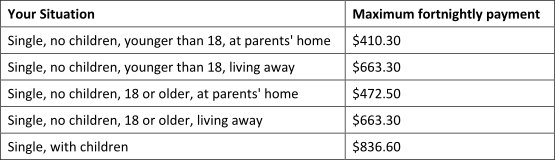
The table shows Youth Allowance payment rates per fortnight.

  1. Helen is single and receives the maximum Age Pension payment. She is entitled to the Pension Supplement and Energy Supplement. Calculate her total Age Pension payment per fortnight.   (1 mark)

    --- 2 WORK AREA LINES (style=lined) ---

  2. Helen earns $290 per fortnight from part-time work. Her pension is reduced by 50 cents for each dollar earned over $218 per fortnight. Calculate Helen's reduced Age Pension payment.   (2 mark)

    --- 3 WORK AREA LINES (style=lined) ---

Show Answers Only

a.    \($1178.70\)

b.    \($1,142.70\ \text{per fortnight}\)

Show Worked Solution

a.    \(\text{Total Age Pension}= 1079.70+84.90+14.10=$1178.70\)

b.    \(\text{Income over free area} =290-218=$72\)

\(\text{Reduction in pension} = 0.50\times 72=$36\)

\(\text{Reduced Age Pension} = 1178.70-36=$1,142.70\)

\(\therefore\ \text{Helen receives }$1,142.70\ \text{per fortnight}\)

Filed Under: Ways of Earning Tagged With: Band 3, Band 4, smc-6515-40-Govt Payments

Financial Maths, STD1 EQ-Bank 24

The table shows Youth Allowance payment rates per fortnight.

\begin{array} {|l|c|}
\hline
\rule{0pt}{2.5ex} \textbf{Your situation} \rule[-1ex]{0pt}{0pt} & \textbf{Maximum fortnightly payment} \\
\hline
\rule{0pt}{2.5ex} \text{Single, no children, younger than 18, at parents' home} \rule[-1ex]{0pt}{0pt} & $410.30 \\
\hline
\rule{0pt}{2.5ex} \text{Single, no children, younger than 18, living away} \rule[-1ex]{0pt}{0pt} & $663.30 \\
\hline
\rule{0pt}{2.5ex} \text{Single, no children, 18 or older, at parents' home} \rule[-1ex]{0pt}{0pt} & $472.50 \\
\hline
\rule{0pt}{2.5ex} \text{Single, no children, 18 or older, living away} \rule[-1ex]{0pt}{0pt} & $663.30 \\
\hline
\rule{0pt}{2.5ex} \text{Single, with children} \rule[-1ex]{0pt}{0pt} & $836.60 \\
\hline
\end{array}

  1. Lisa is 17 years old, single with no children, and lives away from her parents' home to study. What is the maximum Youth Allowance payment she can receive per fortnight?   (1 mark)

    --- 1 WORK AREA LINES (style=lined) ---

  2. Lisa earns $320 per fortnight from part-time work. Her Youth Allowance is reduced by 50 cents for each dollar earned over $236 per fortnight. Calculate Lisa's reduced Youth Allowance payment.   (1 mark)

    --- 3 WORK AREA LINES (style=lined) ---

Show Answers Only

a.    \($663.30\)

b.    \($621.30\ \text{per fortnight}\)

Show Worked Solution

a.    \(\text{From table: Single, no children, younger than 18, living away} = $663.30\)

b.    \(\text{Income over free area} = 320-236=$84\)

\(\text{Reduction in payment} = 0.50\times 84=$42\)

\(\text{Reduced Youth Allowance} = 663.30-42=$621.30\)

\(\therefore\ \text{Lisa receives }$621.30\ \text{per fortnight}\)

Filed Under: Ways of Earning Tagged With: Band 3, Band 4, smc-6515-40-Govt Payments

Financial Maths, STD1 EQ-Bank 23

The table shows JobSeeker Payment rates per fortnight.

\begin{array} {|l|c|}
\hline
\rule{0pt}{2.5ex} \textbf{Your situation} \rule[-1ex]{0pt}{0pt} & \textbf{Maximum fortnightly payment} \\
\hline
\rule{0pt}{2.5ex} \text{Single, no children} \rule[-1ex]{0pt}{0pt} & $793.60 \\
\hline
\rule{0pt}{2.5ex} \text{Single, with a dependent child or children} \rule[-1ex]{0pt}{0pt} & $849.90 \\
\hline
\rule{0pt}{2.5ex} \text{Partnered} \rule[-1ex]{0pt}{0pt} & $726.50 \\
\hline
\end{array}

  1. James is single with a dependent child and receives the maximum JobSeeker Payment. How much does he receive per fortnight?   (1 mark)

    --- 1 WORK AREA LINES (style=lined) ---

  2. James earns $280 per fortnight from casual work. His JobSeeker Payment is reduced by 50 cents for each dollar earned over $150 per fortnight. Calculate James's reduced JobSeeker Payment.   (1 mark)

    --- 3 WORK AREA LINES (style=lined) ---

Show Answers Only

a.    \($849.90\)

b.    \($784.90\ \text{per fortnight}\)

Show Worked Solution

a.    \(\text{From table: Single, with a dependent child} = $849.90\)
 

b.    \(\text{Income over free area} = 280-150=$130\)

\(\text{Reduction in payment} = 0.50\times 130=$65\)

\(\text{Reduced JobSeeker Payment} = 849.90-65=$784.90\)

\(\therefore\ \text{James receives }$784.90\ \text{per fortnight}\)

Filed Under: Ways of Earning Tagged With: Band 3, Band 4, smc-6515-40-Govt Payments

Financial Maths, STD1 EQ-Bank 3 MC

The table shows Youth Allowance payment rates from 1 January 2025.

Marcus is 19 years old, single with no children, and lives at home with his parents.

What is the maximum Youth Allowance payment Marcus can receive per fortnight?

  1. $410.30
  2. $472.50
  3. $663.30
  4. $836.60
Show Answers Only

\(B\)

Show Worked Solution

\(\text{Marcus is 19 years old (18 or older)}\)

\(\text{Marcus is single with no children}\)

\(\text{Marcus lives at his parents’ home}\)

\(\text{From table: Single, no children, 18 or older, at parents’ home} = $472.50\)

\(\Rightarrow B\)

Filed Under: Ways of Earning Tagged With: Band 3, smc-6515-40-Govt Payments

Financial Maths, STD1 EQ-Bank 2 MC

The table shows Age Pension payment rates per fortnight.

Robert is single and receives the maximum Age Pension payment. He is entitled to the Pension Supplement and Energy Supplement.

How much does Robert receive per fortnight?

  1. $888.50
  2. $1079.70
  3. $1178.70
  4. $1777.00
Show Answers Only

\(C\)

Show Worked Solution
\(\therefore\ \text{Total Payment (Single)}\) \(=\text{Basic rate} + \text{Pension Supplement} + \text{Energy Supplement}\)
  \(=1079.70+84.90+14.10=$1,178.70\)

  
\(\Rightarrow C\)

Filed Under: Ways of Earning Tagged With: Band 3, smc-6515-40-Govt Payments

Functions, EXT1′ F1 2012 HSC 11fi

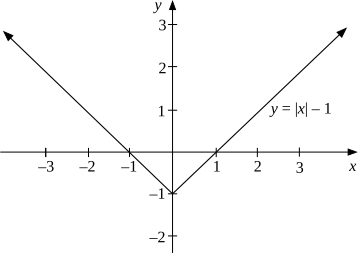
Sketch the function   \(y = \abs{x}- 1\), showing the \(x\)- and \(y\)-intercepts.   (2 marks)

--- 10 WORK AREA LINES (style=lined) ---

Show Answers Only

`text(See Worked Solutions.)`

Show Worked Solution

Filed Under: Graphical Relationships Tagged With: Band 3, smc-6640-30-\(y=\abs{f(x)}; y=f(\abs{x}) \)

Functions, EXT1′ F1 2018 HSC 12di

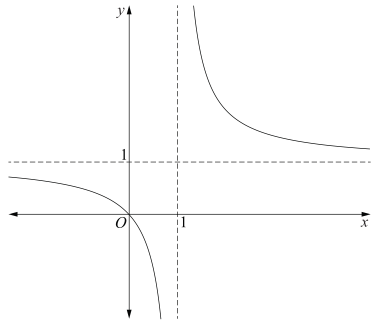
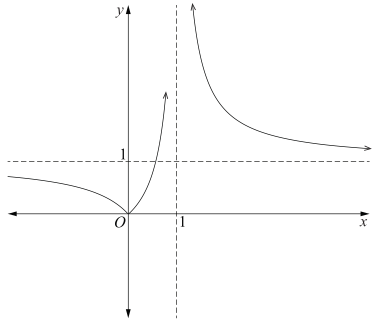
The diagram shows the graph of the function  \(f(x) = \dfrac{x}{x-1}\).


Draw a graph of   \(y = \abs{f(x)}\), showing all asymptotes and intercepts.   (2 marks)

--- 10 WORK AREA LINES (style=lined) ---

Show Answers Only

Show Worked Solution

Filed Under: Graphical Relationships Tagged With: Band 3, smc-6640-30-\(y=\abs{f(x)}; y=f(\abs{x}) \)

Functions, EXT1 EQ-Bank 18

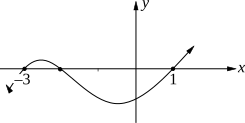
A cubic function is given by  \(f(x)=\left(2 x^2+3 x-5\right)(x+2)\)

  1. Find the zeros of \(f(x)\).   (1 mark)

    --- 3 WORK AREA LINES (style=lined) ---

  2. Hence, or otherwise, solve \(f(x) \geqslant 0\), giving your answer in set notation.   (2 marks)

    --- 6 WORK AREA LINES (style=lined) ---

Show Answers Only

a.    \(\text{Zeros at} \ \ x=-\dfrac{5}{2}, x=1 \ \ \text{and}\ \  x=-2\)

b.    \(x \in\left[-\frac{5}{2},-2\right] \cup\ x \in[1, \infty)\)

Show Worked Solution

a.    \(f(x)=\left(2 x^2+3 x-5\right)(x+2)=(2 x+5)(x-1)(x+2)\)

\(\text{Zeros at} \ \ x=-\dfrac{5}{2}, x=1 \ \ \text{and}\ \  x=-2\)
 

b.    \(\text{Find} \ x \ \text{such that} \ \ f(x) \geqslant 0.\)

\(\text{At} \ \ x=0: \ (5)(-1)(2)<0\)
 

\(\therefore \text{Graph}\ (f(x)) \geqslant 0 \ \ \text{for} \ \  x \in\left[-\frac{5}{2},-2\right] \cup\ x \in[1, \infty)\)

Filed Under: Inequalities Tagged With: Band 3, Band 4, smc-6643-05-Cubics, syllabus-2027

Functions, 2ADV EQ-Bank 14

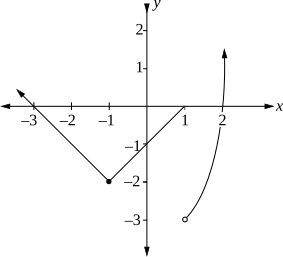
The function  \(y=f(x)\)  is defined by:

\begin{align*}
f(x)= \begin{cases}|x+1|-2, & \text { for }\ x \leqslant 1 \\ x^2-4, & \text { for }\ x>1\end{cases}
\end{align*}

  1. Sketch  \(y=f (x)\)   (3 marks)

    --- 12 WORK AREA LINES (style=lined) ---

  2. For what values of \(x\) is  \(f(x)=0\)?   (1 mark)

    --- 2 WORK AREA LINES (style=lined) ---

Show Answers Only

a.   
     
 
b.    \(f(x)=0\ \ \text{when}\ \ x=-3,2\).

Show Worked Solution

a.   
     
 
b.    \(f(x)=0\ \ \text{when}\ \ x=-3,2\).

Filed Under: Piecewise Functions Tagged With: Band 3, Band 4, smc-6217-10-Sketch graph, smc-6217-60-Other problems, syllabus-2027

Financial Maths, STD2 EQ-Bank 19

Michael is a children's book author. His publisher printed 25000 copies of his new book and after 6 months there are 9200 copies left in stock. Michael receives 12% of the retail price as royalties.

  1. How many copies of Michael's book were sold?   (1 mark)

    --- 2 WORK AREA LINES (style=lined) ---

  2. Calculate Michael's royalty payment if the retail price is $19.95.   (2 marks)

    --- 4 WORK AREA LINES (style=lined) ---

  3. The publisher decides to sell the remaining stock at a reduced price of $15.00 per book. Calculate Michael's total royalty payment if all the remaining books are sold at this price.   (2 marks)

    --- 5 WORK AREA LINES (style=lined) ---

Show Answers Only

a.    \(15\,800\ \text{copies}\)

b.    \($37\,825.20\)

c.    \($54\,385.20\)

Show Worked Solution

a.    \(\text{Copies sold}\ =25\,000-9200\ =15\,800\ \text{copies}\)

b.    \(\text{Total sales}\ =15\,800\times 19.95=$315\,210\)

\(\text{Royalty payment}\) \(=12\% \times 315\,210\)
  \(= 0.12\times 315\,210\)
  \(=$37\,825.20\)


c.    \(\text{Sales from remaining books}\ =9200\times 15.00\ =$138\,000\)

\(\text{Total royalty on remaining books}\ =0.12\times 138\,000=$16\,560\)

\(\text{Total royalty when all books sold}\ = 37\,825.20 + 16\,560\ =$54\,385.20\)

\(\therefore\ \text{Michael’s total royalty payment is }$54\,385.20\)

Filed Under: Ways of Earning, Ways of Earning Tagged With: Band 3, Band 4, smc-6276-30-Piecework/Royalties, smc-6515-30-Piecework/Royalties

Financial Maths, STD2 EQ-Bank 2 MC

A musician receives a royalty of 8% on album sales.

If 3500 albums were sold at $18.00 each, what is the musician's royalty payment?

  1. $4320
  2. $5040
  3. $5600
  4. $6300
Show Answers Only

\(B\)

Show Worked Solution

\(\text{Total sales}\ =3500 \times 18.00\ =$63\,000\)

\(\text{Royalty payment}\) \(=8\% \times 63\,000\)
  \(= 0.08\times 63\,000=$5040\)

\(\Rightarrow B\)

Filed Under: Ways of Earning, Ways of Earning Tagged With: Band 3, smc-6276-30-Piecework/Royalties, smc-6515-30-Piecework/Royalties

Financial Maths, STD2 EQ-Bank 28

Ian works in a packaging factory and is paid $0.85 for each box he packs. Last month he worked 160 hours and packed 8960 boxes.

  1. Calculate Ian's total earnings for the month.   (1 mark)

    --- 2 WORK AREA LINES (style=lined) ---

  2. The following month the factory decides to pay Ian a flat hourly rate of $44.50. What percentage increase/decrease is this from his equivalent hourly wage of the previous month. Give your answer correct to 1 decimal place.   (2 marks)

    --- 5 WORK AREA LINES (style=lined) ---

Show Answers Only

a.    \($7616\)

b.    \(\text{6.5% decrease}\)

Show Worked Solution

a.    \(\text{Total Earnings}=0.85\times 8960=$7616\)
 

b.    \(\text{Hourly rate (last month)}=\dfrac{7616}{160}=$47.60\)

\(\text{New hourly wage} = $44.50\ \text{(given)}\)

\(\text{% decrease}=\dfrac{47.60-44.50}{47.60}=0.0651… = 6.5\%\ \text{decrease}\) 

\(\therefore\ \text{Ian’s hourly rate has decreased 6.5%.}\)

Filed Under: Purchasing Goods, Ways of Earning Tagged With: Band 3, Band 5, smc-6276-30-Piecework/Royalties, smc-6278-10-% Increase/Decrease

Financial Maths, STD2 EQ-Bank 17

Roberto works as a furniture assembler and is paid $18.50 for each bookshelf he completes. In one week he worked 40 hours and earned $1110.

  1. How many bookshelves did Roberto complete that week?   (1 mark)

    --- 2 WORK AREA LINES (style=lined) ---

  2. Calculate his hourly rate of pay.   (2 marks)

    --- 3 WORK AREA LINES (style=lined) ---

Show Answers Only

a.    \(60\ \text{bookshelves}\)

b.    \($27.75\text{/hour}\)

Show Worked Solution
a.     \(\text{Number of Bookshelves}\) \(=\dfrac{1110}{18.50}\)
    \(=60\ \text{bookshelves}\)


b.     \(\text{Hourly rate}\) \(=\dfrac{\text{Total earnings}}{\text{Hours worked}}\)
    \(=\dfrac{1110}{40}=$27.75\)

  
\(\therefore\ \text{Roberto’s hourly rate is }$27.75\)

Filed Under: Ways of Earning Tagged With: Band 3, Band 4, smc-6276-30-Piecework/Royalties

Financial Maths, STD2 EQ-Bank 3 MC

Maria works in a textile factory and is paid $1.20 for each scarf she completes. Last week Maria earned $456.

How many scarves did she complete?

  1. 360
  2. 380
  3. 400
  4. 420
Show Answers Only

\(B\)

Show Worked Solution
\(\text{Number of scarves}\) \(=\dfrac{\text{Total earnings}}{\text{Payment per scarf}}\)
  \(= \dfrac{456}{1.20} =380\)

 
\(\Rightarrow B\)

Filed Under: Ways of Earning, Ways of Earning Tagged With: Band 3, smc-6276-30-Piecework/Royalties, smc-6515-30-Piecework/Royalties

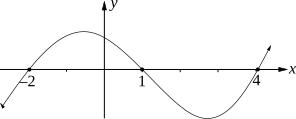
Functions, EXT1 EQ-Bank 12

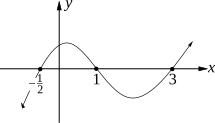
Find all values of \(x\) for which  \((2 x+1)(x-3)(x-1) \leqslant 0\).   (2 marks)

--- 5 WORK AREA LINES (style=lined) ---

Show Answers Only

\(x \leqslant-\dfrac{1}{2}\ \cup \  1 \leqslant x \leqslant 3\)

Show Worked Solution

\((2 x+1)(x-3)(x-1) \leqslant 0\)

\(\text{Zeros at} \ \  x=-\dfrac{1}{2}, x=3 \ \ \text{and} \ \ x=1\)

\(\text{At} \ \ x=0: \ (1)(-3)(-1)>0\)
 

\(\therefore \text{Graph} \ \leqslant 0 \ \ \text{for} \ \ x \leqslant-\dfrac{1}{2}\ \cup \  1 \leqslant x \leqslant 3\)

Filed Under: Inequalities Tagged With: Band 3, smc-6643-05-Cubics, syllabus-2027

Functions, EXT1 EQ-Bank 11

Solve the inequality  \((x-4)(x+2)(x-1) \geqslant 0\).   (2 marks)

--- 8 WORK AREA LINES (style=lined) ---

Show Answers Only

\(-2 \leqslant x \leqslant 1\  \cup\  x \geqslant 4\)

Show Worked Solution

\((x-4)(x+2)(x-1) \geqslant 0\)

\(\text{Zeros at} \ \ x=4, x=-2 \ \ \text{and}\ \  x=1\)

\(\text{At} \ \ x=0: \ (-4)(2)(-1)>0\)
 

\(\therefore \text{Graph}\ \geqslant 0 \ \text {for} \ -2 \leqslant x \leqslant 1\ \cup\ x \geqslant 4\)

Filed Under: Inequalities Tagged With: Band 3, smc-6643-05-Cubics, syllabus-2027

  • « Previous Page
  • 1
  • 2
  • 3
  • 4
  • 5
  • 6
  • …
  • 61
  • Next Page »

Copyright © 2014–2026 SmarterEd.com.au · Log in