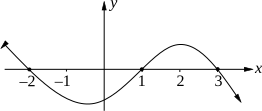
The inequality \((2 x+4)(x-1)(3-x) \leqslant 0\) has solution
- \(x \leqslant-2 \ \cup \ 1 \lt x \leqslant 3\)
- \(-2 \leqslant x \leqslant 1 \ \cup \ x \geqslant 3\)
- \(x \leqslant-2 \ \cup \ x \geqslant 3\)
- \(-2 \leqslant x \leqslant 3\)
Aussie Maths & Science Teachers: Save your time with SmarterEd
The inequality \((2 x+4)(x-1)(3-x) \leqslant 0\) has solution
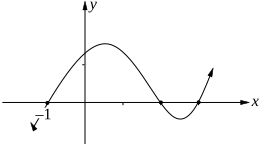
What is the solution to the inequality
\((x-2)(x+1)(x-3)>0\)
The function \(g(x)=\left\{\begin{array}{ll}a x+b, & \text {for } x \leq 2 \\ x^2-1, & \text {for } x>2\end{array}\right.\)
\(g(x)\) is continuous at \(x =2\) and passes through the point \((0,-5)\).
--- 7 WORK AREA LINES (style=lined) ---
--- 2 WORK AREA LINES (style=lined) ---
a. \(a=4, b=-5\)
b. \(17\)
a. \(\text{Since} \ f(x) \ \text{is continuous at} \ \ x=2:\)
| \(a(2)+b\) | \(=2^2-1\) |
| \(2 a+b\) | \(=3\ \ldots\ (1)\) |
\(\text{Since} \ g(x) \ \text{passes through}\ (0,-5):\)
\(a(0)+b=-5 \ \ \Rightarrow\ \ b=-5\)
\(\text{Substitute}\ \ b=-5 \ \ \text{into (1):}\)
\(2 a-5=3 \ \ \Rightarrow\ \ a=4\)
| b. | \(g(3)-g(-1)\) | \(=\left(3^2-1\right)-[4(-1)-5]\) |
| \(=8+9\) | ||
| \(=17\) |
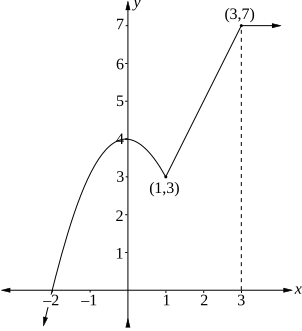
Consider the function
\begin{align*}
f(x)=\begin{cases}-x^2+4, & \text {for }\ x<1 \\ 2 x+1, & \text {for} \ 1 \leq x<3 \\ 7, & \text {for }\ x \geq 3\end{cases}
\end{align*}
--- 10 WORK AREA LINES (style=blank) ---
--- 2 WORK AREA LINES (style=lined) ---
A parking garage charges according to the following piecewise function
\(C(t)= \begin{cases}5, & \text{for }\ 0<t \leq 1 \\ 5+3(t-1), & \text{for }\ 1<t \leq 4 \\ 18, & \text{for }\ t>4\end{cases}\)
where \(C\) is the cost in dollars and \(t\) is time in hours.
How much does it cost to park for 3.5 hours?
\(B\)
\(C(3.5)=5+3(3.5-1)=\$ 12.50\)
\(\Rightarrow B\)

For the function \(f(x)=\left\{\begin{array}{ll}|x+2|, & \text{for } x \leq 0 \\ \sqrt{x}, & \text{for } x>0\end{array}\right.\), what is \(f (-2)+ f (4)\) ?
\(A\)
\(f(x)= \begin{cases}|x+2|, & \text { for } x \leq 0 \\ \sqrt{x}, & \text { for } x>0\end{cases}\)
\(f(-2)=|-2+2|=0\)
\(f(4)=\sqrt{4}=2\)
\(f(-2)+f(4)=2\)
\(\Rightarrow A\)
The function \(f(x)=\left\{\begin{array}{ll}k x+2, & \text{for } x<-1 \\ x^2+3, & \text{for } x \geq-1\end{array}\right.\)
If \(f(x)\) is continuous at \(x =-1\), what is the value of \(k\) ?
\(A\)
\(f(x) \ \text{ is continuous at} \ \ x=-1:\)
\(k(-1)+2=(-1)^2+3 \ \ \Rightarrow\ \ k=-2\)
\(\Rightarrow A\)
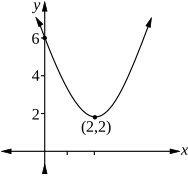
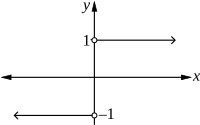
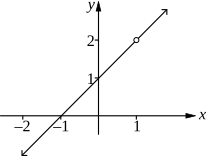
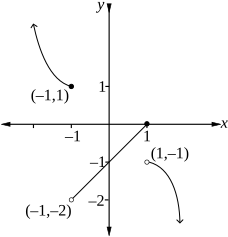
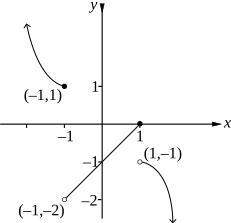
Which of the following piecewise functions is not continuous at \(x =1\) ?
\(C\)
\(\text {Consider option }C:\)
\(\text{As} \ \ x \rightarrow 1^{-},-x^2 \rightarrow-1\)
\(\text{As} \ \ x \rightarrow 1^{+}, 2 x-1 \rightarrow 1\)
\(\therefore \ \text {Not continuous at} \ \ x=1\)
\(\Rightarrow C\)
The cost (\(C\)) of printing flyers varies directly with the number of flyers (\(n\)) printed.
A printing company charges $45 to print 300 flyers.
What is the value of the constant of variation (\(k\))?
\(B\)
\(C \propto n\)
\(C=kn\)
\(\text{When } C = 45 \text{ and } n = 300:\)
| \(45\) | \(=k \times 300\) |
| \(k\) | \(=\dfrac{45}{300}=\dfrac{3}{20}\) |
\(\Rightarrow B\)
An ideal transformer converts 240 V to 2200 V.
Which row in the table best describes the transformer?
\begin{align*}
\begin{array}{l}
\rule{0pt}{2.5ex} \ & \\
\ \rule[-1ex]{0pt}{0pt}& \\
\rule{0pt}{2.5ex}\textbf{A.}\rule[-1ex]{0pt}{0pt}\\
\rule{0pt}{2.5ex}\textbf{B.}\rule[-1ex]{0pt}{0pt}\\
\rule{0pt}{2.5ex}\textbf{C.}\rule[-1ex]{0pt}{0pt}\\
\rule{0pt}{2.5ex}\textbf{D.}\rule[-1ex]{0pt}{0pt}\\
\end{array}
\begin{array}{|c|c|}
\hline
\rule{0pt}{2.5ex}\text{Type of}& \text{Number of turns in}& \text{Number of turns in} \\
\quad \text{transformer}\quad \rule[-1ex]{0pt}{0pt}& \text{primary coil}& \text{secondary coil} \\
\hline
\rule{0pt}{2.5ex}\text{Step up}\rule[-1ex]{0pt}{0pt}&\text{120}&\text{1100}\\
\hline
\rule{0pt}{2.5ex}\text{Step up}\rule[-1ex]{0pt}{0pt}& \text{1100}&\text{120}\\
\hline
\rule{0pt}{2.5ex}\text{Step down}\rule[-1ex]{0pt}{0pt}& \text{12}&\text{1100} \\
\hline
\rule{0pt}{2.5ex}\text{Step down}\rule[-1ex]{0pt}{0pt}& \text{1100} &\text{120}\\
\hline
\end{array}
\end{align*}
\(A\)
\(\Rightarrow A\)
Which of the following did Maxwell contribute to the understanding of the nature of light?
\(B\)
\(\Rightarrow B\)
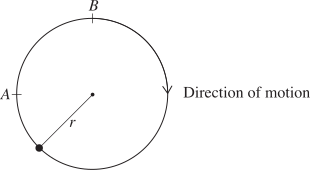
A mass moves around a vertical circular path of radius \(r\), in Earth's gravitational field, without loss of mechanical energy. A string of length \(r\) maintains the circular motion of the mass.
When the mass is at its highest point \(B\), the tension in the string is zero.
--- 4 WORK AREA LINES (style=lined) ---
--- 10 WORK AREA LINES (style=lined) ---
a. \(\text {At point} \ B \ \Rightarrow \ F_c=F_{\text {net}}\)
| \(\dfrac{mv_B^2}{r}\) | \(=T+mg\) |
| \(v_B^2\) | \(=rg \ \ (T=0)\) |
| \(v_B\) | \(=\sqrt{r g}\) |
b. \(\text {Total} \ ME=E_k+GPE\)
\(\text{At point} \ B :\)
| \(\text {Total} \ ME\) | \(=\dfrac{1}{2} m v_B^2+mg(2r)\) |
| \(=\dfrac{1}{2} m \times r g+2 mrg\) | |
| \(=\dfrac{5}{2} m r g\) |
\(\text{At point} \ A :\)
\(\text {Total} \ ME=\dfrac{1}{2} mv_A^2+mrg\)
\(\text{Since \(ME\) is conserved:}\)
| \(\dfrac{5}{2} mrg\) | \(=\dfrac{1}{2} m v_A^2+m r g\) |
| \(\dfrac{1}{2} mv_A^2\) | \(=\dfrac{3}{2} m r g\) |
| \(v_A^2\) | \(=3 rg\) |
| \(v_A\) | \(=\sqrt{3rg}=\sqrt{3} \times v_B\) |
a. \(\text {At point} \ B \ \Rightarrow \ F_c=F_{\text {net}}\)
| \(\dfrac{mv_B^2}{r}\) | \(=T+mg\) |
| \(v_B^2\) | \(=rg \ \ (T=0)\) |
| \(v_B\) | \(=\sqrt{r g}\) |
b. \(\text {Total} \ ME=E_k+GPE\)
\(\text{At point} \ B :\)
| \(\text {Total} \ ME\) | \(=\dfrac{1}{2} m v_B^2+mg(2r)\) |
| \(=\dfrac{1}{2} m \times r g+2 mrg\) | |
| \(=\dfrac{5}{2} m r g\) |
\(\text{At point} \ A :\)
\(\text {Total} \ ME=\dfrac{1}{2} mv_A^2+mrg\)
\(\text{Since \(ME\) is conserved:}\)
| \(\dfrac{5}{2} mrg\) | \(=\dfrac{1}{2} m v_A^2+m r g\) |
| \(\dfrac{1}{2} mv_A^2\) | \(=\dfrac{3}{2} m r g\) |
| \(v_A^2\) | \(=3 rg\) |
| \(v_A\) | \(=\sqrt{3rg}=\sqrt{3} \times v_B\) |
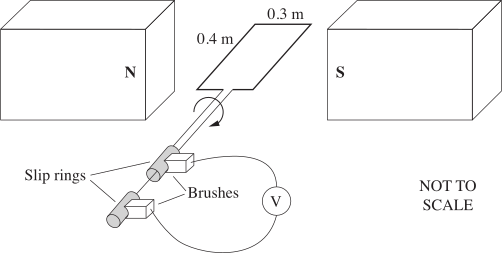
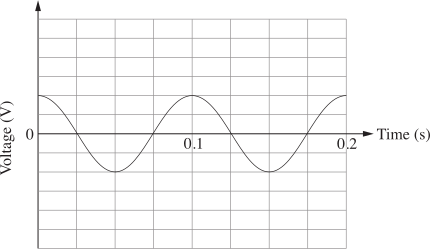
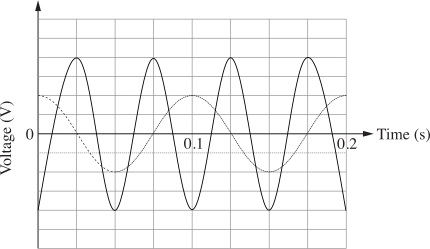
The starting position of a simple AC generator is shown. It consists of a single rectangular loop of wire in a uniform magnetic field of 0.5 T. This loop is connected to two slip rings and the slip rings are connected via brushes to a voltmeter.
--- 5 WORK AREA LINES (style=lined) ---
--- 0 WORK AREA LINES (style=lined) ---
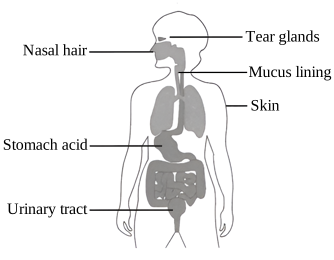
The diagram shows components of the innate immune system in humans.
State the role of TWO components that protect against infection. (2 marks)
\begin{array} {|c|c|}
\hline
\rule{0pt}{2.5ex}\quad \quad \textit{Component} \quad \quad \rule[-1ex]{0pt}{0pt} & \quad \quad \textit{How it protects against infection}\quad \quad \rule[-1ex]{0pt}{0pt}\\
\hline
\ & \\
\ & \\
\ & \\
\ & \\
\ & \\
\hline
\ & \\
\ & \\
\ & \\
\ & \\
\ & \\
\hline
\end{array}
--- 0 WORK AREA LINES (style=lined) ---
Any TWO of the following components
\begin{array} {|l|l|}
\hline
\rule{0pt}{2.5ex}\textit{Component} \quad \quad \rule[-1ex]{0pt}{0pt} & \textit{How it protects against infection}\quad\rule[-1ex]{0pt}{0pt}\\
\hline
\text{Skin} & \text{Acts as a physical barrier}\\
\ & \text{preventing pathogen entry into} \\
\ & \text{tissue}\\
\hline
\text{Stomach} &\text{Destroys ingested pathogens} \\
\text{acid} & \text{through low pH chemical}\\
\ & \text{environment.}\\
\hline
\text{Mucus} &\text{Traps pathogens and prevents} \\
\text{lining} & \text{their entry into underlying}\\
\ & \text{tissues.}\\
\hline
\text{Nasal} &\text{Filters and traps airborne} \\
\text{hair} & \text{pathogens, preventing}\\
\ & \text{respiratory entry.}\\
\hline
\text{Tear glands} &\text{Produce lysozyme enzyme that} \\
\ & \text{destroys bacterial cell walls.}\\
\hline
\text{Urinary} &\text{Flushes pathogens from the} \\
\text{tract} & \text{urethra preventing infection.}\\
\hline
\end{array}
Any TWO of the following components
\begin{array} {|l|l|}
\hline
\rule{0pt}{2.5ex}\textit{Component} \quad \quad \rule[-1ex]{0pt}{0pt} & \textit{How it protects against infection}\quad\rule[-1ex]{0pt}{0pt}\\
\hline
\text{Skin} & \text{Acts as a physical barrier}\\
\ & \text{preventing pathogen entry into} \\
\ & \text{tissue}\\
\hline
\text{Stomach} &\text{Destroys ingested pathogens} \\
\text{acid} & \text{through low pH chemical}\\
\ & \text{environment.}\\
\hline
\text{Mucus} &\text{Traps pathogens and prevents} \\
\text{lining} & \text{their entry into underlying}\\
\ & \text{tissues.}\\
\hline
\text{Nasal} &\text{Filters and traps airborne} \\
\text{hair} & \text{pathogens, preventing}\\
\ & \text{respiratory entry.}\\
\hline
\text{Tear glands} &\text{Produce lysozyme enzyme that} \\
\ & \text{destroys bacterial cell walls.}\\
\hline
\text{Urinary} &\text{Flushes pathogens from the} \\
\text{tract} & \text{urethra preventing infection.}\\
\hline
\end{array}
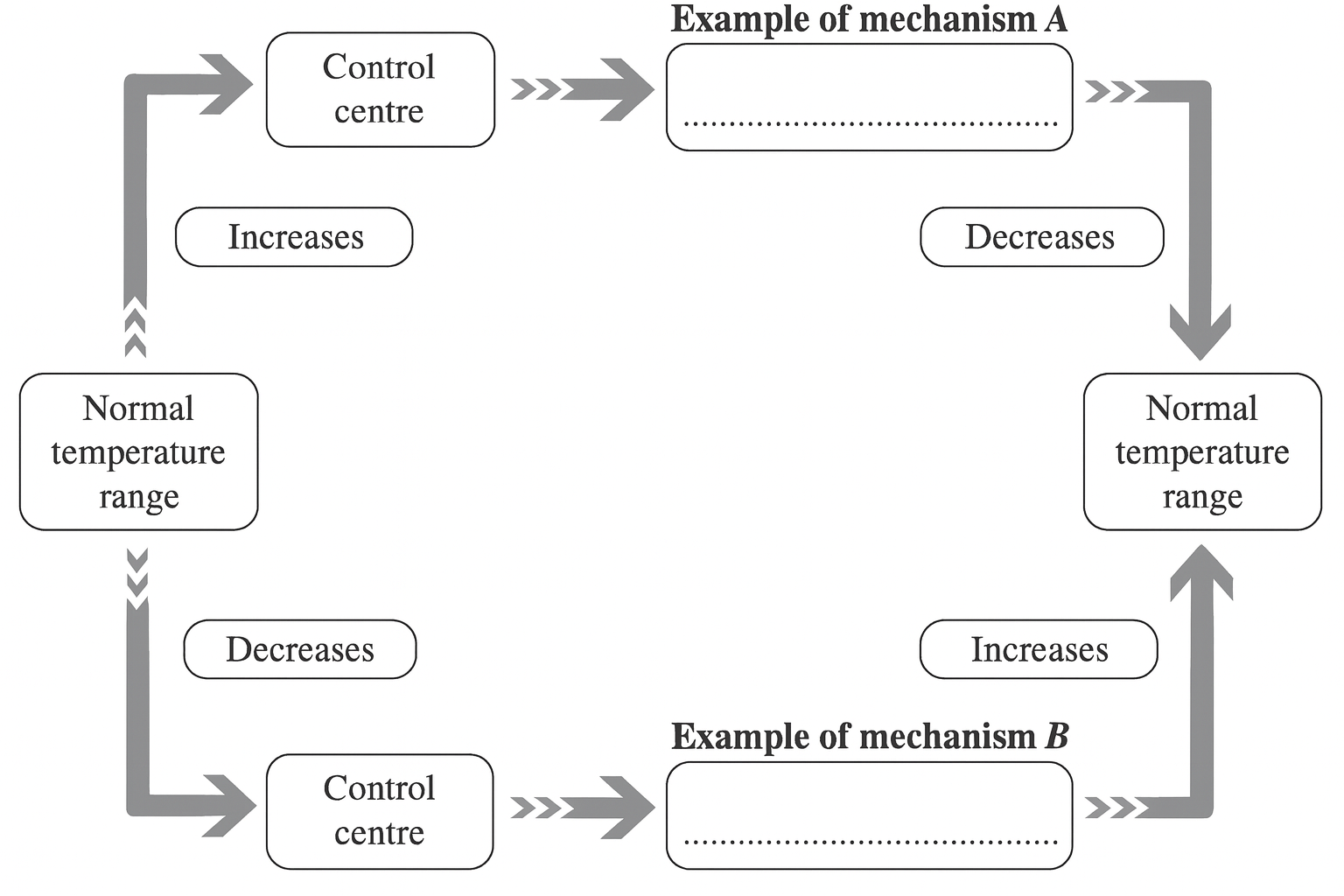
The following flow chart represents the control of body temperature in humans. --- 0 WORK AREA LINES (style=lined) --- --- 4 WORK AREA LINES (style=lined) --- a. Mechanism A (Decreases temperature): Mechanism B (Increases temperature): b. Maintaining homeostasis a. Mechanism A (Decreases temperature): Mechanism B (Increases temperature): b. Maintaining homeostasis
Solve for \(x\), giving your answers in the simplest form \(a+b\sqrt{c}\) where \(a, b\) and \(c\) are real:
\(5 x^2-20 x+4=0\) (2 marks)
--- 6 WORK AREA LINES (style=lined) ---
\(x=2 \pm \dfrac{4}{5} \sqrt{5}\)
\(5 x^2-20 x+4=0\)
| \(x\) | \(=\dfrac{-b \pm \sqrt{b^2-4 a c}}{2 a}\) |
| \(=\dfrac{20 \pm \sqrt{20^2-4 \times 5 \times 4}}{2 \times 5}\) | |
| \(=\dfrac{20 \pm \sqrt{320}}{10}\) | |
| \(=2 \pm \dfrac{8 \sqrt{5}}{10}\) | |
| \(=2 \pm \dfrac{4}{5} \sqrt{5}\) |
What are the solutions to \(3x^2+2x-4=0\)?
\(A\)
\(3 x^2+2 x-4=0\)
| \(x\) | \(=\dfrac{-b \pm \sqrt{b^2-4 a c}}{2a}\) |
| \(=\dfrac{-2 \pm \sqrt{2^2-4 \times 3 \times-4}}{2 \times 3}\) | |
| \(=\dfrac{-2 \pm \sqrt{52}}{6}\) | |
| \(=\dfrac{-1 \pm \sqrt{13}}{3}\) |
\(\Rightarrow A\)
--- 4 WORK AREA LINES (style=lined) ---
--- 8 WORK AREA LINES (style=blank) ---
--- 5 WORK AREA LINES (style=lined) ---
a. \(y=\dfrac{4-1}{-3-2}=-\dfrac{3}{5}\)
b. \(\text {Substitute}\ (7,-2) \ \text{into equation:}\)
| \(-2\) | \(=-\dfrac{3}{5} \times 7+\dfrac{11}{5}\) |
| \(-2\) | \(=-\dfrac{21}{5}+\dfrac{11}{5}\) |
| \(-2\) | \(=-2 \ \text{(correct)}\) |
\(\therefore (7,-2) \text{ lies on line.}\)
a. \((2,1),(-3,4)\)
\(\text{Gradient}=\dfrac{y_2-y_1}{x_2-x_1}=\dfrac{4-1}{-3-2}=-\dfrac{3}{5}\)
\(\text{Find equation with} \ \ m=-\dfrac{3}{5} \ \ \text{through}\ \ (2,1):\)
| \(y-1\) | \(=-\dfrac{3}{5}(x-2)\) |
| \(y\) | \(=-\dfrac{3}{5} x+\dfrac{11}{5}\) |
b. \(\text {Substitute}\ (7,-2)\ \text{into equation:}\)
| \(-2\) | \(=-\dfrac{3}{5} \times 7+\dfrac{11}{5}\) |
| \(-2\) | \(=-\dfrac{21}{5}+\dfrac{11}{5}\) |
| \(-2\) | \(=-2 \ \text{(correct)}\) |
\(\therefore (7,-2) \text{ lies on line.}\)
A set of ordered pairs \((x, y)\) on the coordinate plane are represented by set \(A\) below:
\(A=\{(1,3),(4,6),(5,6),(0,1),(1,7)\}\)
Explain if Set \(A\) a function or a relation? (2 marks)
--- 5 WORK AREA LINES (style=lined) ---
\(\text {If set \(A\) is a function, there can only be one \(y\)-value}\)
\(\text{for any given } x \text{-value.}\)
\(\text{This is not the case} \ \Rightarrow\ (1,3),(1,7)\)
\(\therefore\ \text{Set} \ A \ \text {is a relation.}\)
\(\text {If set \(A\) is a function, there can only be one \(y\)-value}\)
\(\text{for any given } x \text{-value.}\)
\(\text{This is not the case} \ \Rightarrow\ (1,3),(1,7)\)
\(\therefore\ \text{Set} \ A \ \text {is a relation.}\)
Simplify \(\dfrac{x^2}{x^2-2 x-15}-\dfrac{x}{x+3}\). (2 marks)
--- 6 WORK AREA LINES (style=lined) ---
\(\dfrac{5 x}{(x+3)(x-5)}\)
| \(\dfrac{x^2}{x^2-2 x-15}-\dfrac{x}{x+3}\) | \(=\dfrac{x^2}{(x+3)(x-5)}-\dfrac{x}{x+3}\) |
| \(=\dfrac{x^2-x(x-5)}{(x+3)(x-5)}\) | |
| \(=\dfrac{x^2-x^2+5 x}{(x+3)(x-5)}\) | |
| \(=\dfrac{5 x}{(x+3)(x-5)}\) |
Simplify \(\dfrac{a^3 b-a b^3}{a^2+2 a b+b^2}\). (2 marks)
--- 5 WORK AREA LINES (style=lined) ---
\(\dfrac{a b(a-b)}{a+b}\)
| \(\dfrac{a^3 b-a b^3}{a^2+2 a b+b^2}\) | \(=\dfrac{a b\left(a^2-b^2\right)}{(a+b)^2}\) |
| \(=\dfrac{a b(a+b)(a-b)}{(a+b)^2}\) | |
| \(=\dfrac{a b(a-b)}{a+b}\) |
The mass `M` kg of a baby pig at age `x` days is given by `M = A(1.1)^x` where `A` is a constant. The graph of this equation is shown.
--- 1 WORK AREA LINES (style=lined) ---
--- 2 WORK AREA LINES (style=lined) ---
i. `1.5\ text(kg)`
ii. `10text(%)`
i. `text(When)\ x = 0:`
| `1.5` | `= A(1.1)^0` |
| `A` | `= 1.5\ text(kg)` |
ii. `text(Daily growth rate)\ = 0.1 = 10text(%)`
What is the percentage increase in the number of bacteria? (1 mark)
--- 3 WORK AREA LINES (style=lined) ---
What is the number of bacteria after 15 hours? (1 mark)
\begin{array} {|l|c|}
\hline
\rule{0pt}{2.5ex} \text{Time in hours $(t)$} \rule[-1ex]{0pt}{0pt} & \;\; 0 \;\; & \;\; 5 \;\; & \;\; 10 \;\; & \;\; 15 \;\; \\
\hline
\rule{0pt}{2.5ex} \text{Number of bacteria ( $n$ )} \rule[-1ex]{0pt}{0pt} & \;\; 100 \;\; & \;\; 193 \;\; & \;\; 371 \;\; & \;\; ? \;\; \\
\hline
\end{array}
--- 1 WORK AREA LINES (style=lined) ---
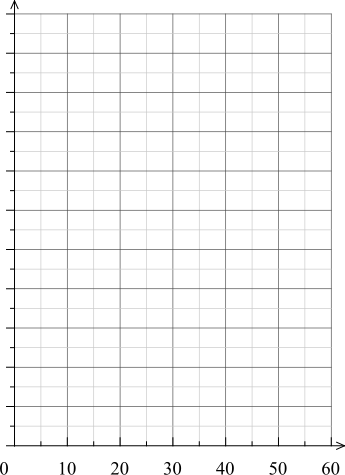
Use about half a page for your graph and mark a scale on each axis. (2 marks)
--- 10 WORK AREA LINES (style=lined) ---
--- 2 WORK AREA LINES (style=lined) ---
a. `text(14%)`
b. `714`
c. `text(Proof)\ \ text{(See Worked Solutions)}`
d. `text(8.4 hours)`
a. `text(Percentage increase)= (114-100)/100 xx 100`= 14text(%)`
b. `n = 100(1.14)^t`
`text(When)\ \ t = 15,`
`n= 100(1.14)^15= 713.793\ …\ = 714\ \ \ text{(nearest whole)}`
| c. | ![]() |
d. `text(Using the graph:)`
`text(The number of bacteria reaches 300 after ~ 8.4 hours.)`
--- 2 WORK AREA LINES (style=lined) ---
--- 6 WORK AREA LINES (style=blank) ---
--- 3 WORK AREA LINES (style=lined) ---
--- 6 WORK AREA LINES (style=blank) ---
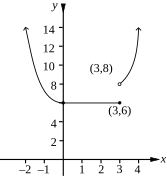
Consider the function \(y=f(x)\) where
\(f(x)= \begin{cases}x^2+6, & \text { for } x \leqslant 0 \\ 6, & \text { for } 0<x \leqslant 3 \\ 2^x, & \text { for } x>3\end{cases}\)
--- 12 WORK AREA LINES (style=lined) ---
--- 1 WORK AREA LINES (style=lined) ---
The distance from the earth to the sun is approximately 150 million kilometres.
This distance expressed in scientific notation is:
\(B\)
\(150\ \text{million}\ =\ 150\,000\,000=1.5\times 10^8\)
\(\Rightarrow B\)
A Physics class of 12 students is going on a 4 day excursion by bus.
The students are asked to each pack one bag for the trip. The bags are weighed, and the weights (in kg) are listed in order as follows:
\(8,\ \ 9, \ \ 10,\ \ 10, \ \ 15, \ \ 18, \ \ 22, \ \ 25, \ \ 29, \ \ 35, \ \ 38, \ \ 41 \)
--- 4 WORK AREA LINES (style=lined) ---
--- 2 WORK AREA LINES (style=lined) ---
a. \(\text{Five number Summary}\)
\begin{array} {|l|c|}
\hline
\rule{0pt}{2.5ex} \text{Minimum} \rule[-1ex]{0pt}{0pt} & 8\\
\hline
\rule{0pt}{2.5ex} \ Q_1 \rule[-1ex]{0pt}{0pt} & 10 \\
\hline
\rule{0pt}{2.5ex} \text{Median} \rule[-1ex]{0pt}{0pt} & 20\\
\hline
\rule{0pt}{2.5ex} \ Q_3 \rule[-1ex]{0pt}{0pt} & 32 \\
\hline
\rule{0pt}{2.5ex} \text{Maximum} \rule[-1ex]{0pt}{0pt} & 41\\
\hline
\end{array}
b. \(22\)
a. \(\text{Five number Summary}\)
\begin{array} {|l|c|}
\hline
\rule{0pt}{2.5ex} \text{Minimum} \rule[-1ex]{0pt}{0pt} & 8\\
\hline
\rule{0pt}{2.5ex} \ Q_1 \rule[-1ex]{0pt}{0pt} & 10 \\
\hline
\rule{0pt}{2.5ex} \text{Median} \rule[-1ex]{0pt}{0pt} & 20\\
\hline
\rule{0pt}{2.5ex} \ Q_3 \rule[-1ex]{0pt}{0pt} & 32 \\
\hline
\rule{0pt}{2.5ex} \text{Maximum} \rule[-1ex]{0pt}{0pt} & 41\\
\hline
\end{array}
b. \(\text{IQR}=Q_3-Q_1=32-10=22\)
If \(d=\sqrt{\dfrac{h}{5}}\), what is the value of \(d\), correct to one decimal place, when \(h=28\)?
\(B\)
\(\text{When}\ h=28:\)
| \(d\) | \(=\sqrt{\dfrac{h}{5}}=\sqrt{\dfrac{28}{5}}\) |
| \(=2.366…\ =2.4\ (\text{1 d.p.})\) |
\(\Rightarrow B\)

Arrange the numbers \(5.6\times 10^{-2}\), \(4.8\times 10^{-1}\), \(7.2\times 10^{-2}\) from smallest to largest.
\(A\)
\(5.6\times 10^{-2}=0.056\)
\(4.8\times 10^{-1}=0.48\)
\(7.2\times 10^{-2}=0.072\)
\(\therefore\ \text{Correct order is: }\ 5.6\times 10^{-2}\), \(7.2\times 10^{-2}\), \(4.8\times 10^{-1}\)
\(\Rightarrow A\)
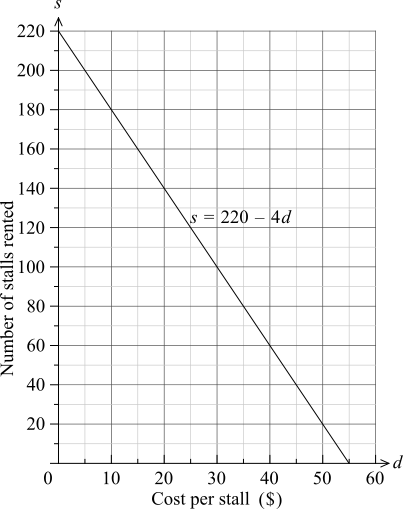
Jerico is the manager of a weekend market in which there are 220 stalls for rent. From past experience, Jerico knows that if he charges \(d\) dollars to rent a stall. then the number of stalls, \(s\), that will be rented is given by:
\(s=220-4d\)
--- 2 WORK AREA LINES (style=lined) ---
--- 0 WORK AREA LINES (style=lined) ---
\begin{array} {|c|c|c|}
\hline
\rule{0pt}{2.5ex} \quad d\quad \rule[-1ex]{0pt}{0pt} & \rule{0pt}{2.5ex} \quad 10\quad\rule[-1ex]{0pt}{0pt} & \rule{0pt}{2.5ex} \quad 30\quad & \rule{0pt}{2.5ex} \quad 50\quad \\
\hline
\rule{0pt}{2.5ex} \quad s\quad \rule[-1ex]{0pt}{0pt} & \ & \ & \\
\hline
\end{array}
--- 0 WORK AREA LINES (style=lined) ---
--- 4 WORK AREA LINES (style=lined) ---
a. \(190\ \text{stalls will be rented}\)
b.
\begin{array} {|c|c|c|}
\hline
\rule{0pt}{2.5ex} \quad d\quad \rule[-1ex]{0pt}{0pt} & \rule{0pt}{2.5ex} \quad 10\quad\rule[-1ex]{0pt}{0pt} & \rule{0pt}{2.5ex} \quad 30\quad & \rule{0pt}{2.5ex} \quad 50\quad \\
\hline
\rule{0pt}{2.5ex} \quad s\quad \rule[-1ex]{0pt}{0pt} & 180 \ & 100 \ & 20 \\
\hline
\end{array}
c.
d. \(\text{When}\ d=60, s=220-4\times 60=-20\)
\(\therefore\ \text{It does not make sense to charge }$60\ \text{ per stall}\)
\(\text{as you cannot have a negative number of stalls.}\)
a. \(s=220-4d=220-4\times 7.50=190\)
\(\therefore 190\ \text{stalls will be rented}\)
b.
\begin{array} {|c|c|c|}
\hline
\rule{0pt}{2.5ex} \quad d\quad \rule[-1ex]{0pt}{0pt} & \rule{0pt}{2.5ex} \quad 10\quad\rule[-1ex]{0pt}{0pt} & \rule{0pt}{2.5ex} \quad 30\quad & \rule{0pt}{2.5ex} \quad 50\quad \\
\hline
\rule{0pt}{2.5ex} \quad s\quad \rule[-1ex]{0pt}{0pt} & 180 \ & 100 \ & 20 \\
\hline
\end{array}
c.
d. \(\text{When}\ d=60, s=220-4\times 60=-20\)
\(\therefore\ \text{It does not make sense to charge }$60\ \text{ per stall}\)
\(\text{as you cannot have a negative number of stalls.}\)
Rationalise the denominator in \(\dfrac{\sqrt{3}-\sqrt{2}}{\sqrt{5}+\sqrt{2}}\), and express in the simplest form. (2 marks)
\(\dfrac{\sqrt{15}-\sqrt{6}-\sqrt{10}+2}{3} \)
\(\dfrac{\sqrt{3}-\sqrt{2}}{\sqrt{5}+\sqrt{2}} \times \dfrac{\sqrt{5}-\sqrt{2}}{\sqrt{5}-\sqrt{2}}\)
\(=\dfrac{(\sqrt{3}-\sqrt{2})(\sqrt{5}-\sqrt{2})}{5-2}\)
\(=\dfrac{\sqrt{15}-\sqrt{6}-\sqrt{10}+2}{3}\)
Phosgene is used in industry as a starting material to synthesise useful polymers. Phosgene \(\ce{(Cl2CO)}\) is a gas at room temperature and is highly toxic.
--- 5 WORK AREA LINES (style=lined) ---
--- 8 WORK AREA LINES (style=lined) ---
a. Precaution when using phosgene inside a fume hood:
b. Role of excess carbon monoxide:
Role of catalyst:
a. Precaution when using phosgene inside a fume hood:
b. Role of excess carbon monoxide:
Role of catalyst:
Mixtures of hydrocarbons can be obtained from crude oil by the process of fractional distillation. Examples include petrol, diesel and natural gas.
--- 5 WORK AREA LINES (style=lined) ---
--- 0 WORK AREA LINES (style=lined) ---
a. Environmental implication:
c.
a. Environmental implication:
c.
65.0 g of ethyne gas reacts with an excess of gaseous hydrogen chloride to produce chloroethene.
\begin{array}{|c|c|}
\hline
\rule{0pt}{2.5ex}\quad \quad \text{Structural formula } \quad \quad \rule[-1ex]{0pt}{0pt}& \quad \quad\text{ Shape of molecule } \quad \quad\\
\hline
\rule{0pt}{2.5ex}\rule[-1ex]{0pt}{0pt}& \\
\hline
\end{array}
--- 0 WORK AREA LINES (style=lined) ---
\begin{array}{|l|c|}
\hline \rule{0pt}{2.5ex}\text{Compound} \rule[-1ex]{0pt}{0pt}& \text{ Molar mass } \\
\hline \rule{0pt}{2.5ex}\text{Ethyne} \rule[-1ex]{0pt}{0pt}& 26.04 \\
\hline \rule{0pt}{2.5ex}\text{Hydrogen chloride} \rule[-1ex]{0pt}{0pt}& 36.46 \\
\hline \rule{0pt}{2.5ex}\text{Chloroethene} \rule[-1ex]{0pt}{0pt}& 62.50 \\
\hline
\end{array}
--- 10 WORK AREA LINES (style=lined) ---
a. Structural formula:
The shape of ethyne is linear.
b. The chemical equation for the reacton occuring is shown below:
\(\ce{C2H2(g) + HCl(g) -> C2H3Cl(g)}\)
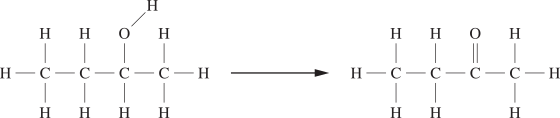
Consider the following sequence of reactions.
This process has been presented in the flow chart below.
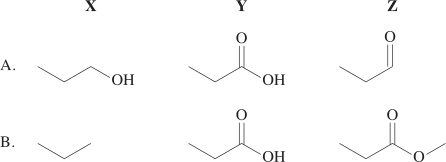
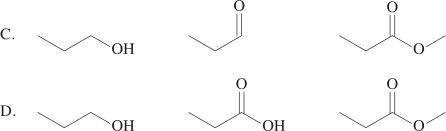
Which option correctly identifies the structures for \(X\), \(Y\) and \(Z\)?
\(D\)
\(\Rightarrow D\)
Consider the following reaction.
\(\ce{3AgNO3(aq) + FeCl3(aq) \rightleftharpoons 3AgCl(s) + Fe(NO3)3(aq)}\)
What is the correct equilibrium expression for this reaction?
\(B\)
\(\Rightarrow B\)
Which of the following options lists ALL the forces that are present between molecules of butanoic acid?
\(D\)
Hydrogen bonding occurs due to the \(\ce{OH}\) group in the carboxylic acid, which can form strong hydrogen bonds between molecules.
Dipole-dipole forces arise from the polar \(\ce{C=O}\) bond in the carboxyl group (carbonyl oxygen is highly electronegative).
Dispersion forces are always present between molecules due to temporary dipoles, especially from the nonpolar hydrocarbon chain.
\(\Rightarrow D\)
Some Torres Strait Islander Peoples pound the leaves of the vine Derris uliginosa to extract a chemical called saponin. Saponin is a relatively large molecule that contains both a water-soluble carbohydrate chain and a fat-soluble side chain.
Which is the most likely use of saponin?
\(A\)
\(\Rightarrow A\)
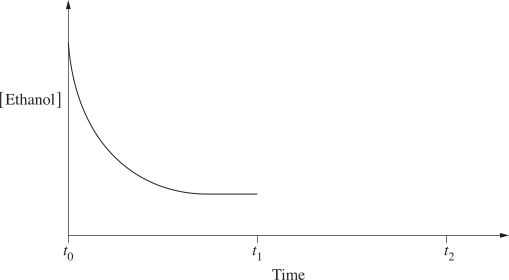
\(\ce{PCl3}\) and \(\ce{Cl2}\) were introduced to an empty sealed vessel.
\(\ce{PCl3}\) reacted with \(\ce{Cl2}\) to produce \(\ce{PCl5}\).
\(\ce{PCl3(g) + Cl2(g) \rightleftharpoons PCl5(g)}\)
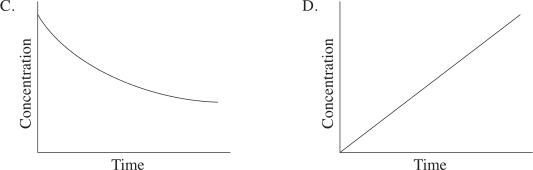
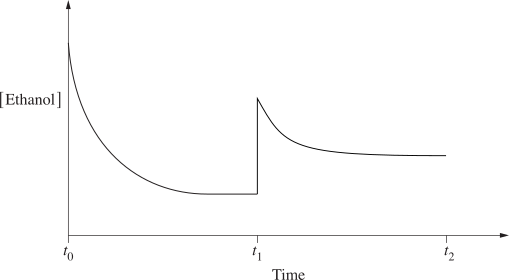
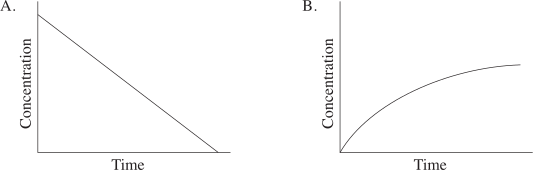
Which graph best represents the changing concentration of \(\ce{Cl2}\) as the system approached the equilibrium point?
\(C\)
\(\Rightarrow C\)
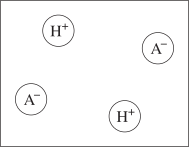
An aqueous solution of an unknown acid \(\ce{(HA)}\) is represented below.
Which row of the table best describes this solution?
\begin{align*}
\begin{array}{l}
\rule{0pt}{2.5ex} \ \rule[-1ex]{0pt}{0pt}& \\
\rule{0pt}{2.5ex}\textbf{A.}\rule[-1ex]{0pt}{0pt}\\
\rule{0pt}{2.5ex}\textbf{B.}\rule[-1ex]{0pt}{0pt}\\
\rule{0pt}{2.5ex}\textbf{C.}\rule[-1ex]{0pt}{0pt}\\
\rule{0pt}{2.5ex}\textbf{D.}\rule[-1ex]{0pt}{0pt}\\
\end{array}
\begin{array}{|c|c|}
\hline
\rule{0pt}{2.5ex}\quad \quad \textit{Strong}\quad \quad \rule[-1ex]{0pt}{0pt}& \ \ \textit{Concentrated} \ \ \\
\hline
\rule{0pt}{2.5ex}\checkmark\rule[-1ex]{0pt}{0pt}&\checkmark\\
\hline
\rule{0pt}{2.5ex}\checkmark\rule[-1ex]{0pt}{0pt}& \large{\times}\\
\hline
\rule{0pt}{2.5ex}\large{\times}\rule[-1ex]{0pt}{0pt}& \checkmark \\
\hline
\rule{0pt}{2.5ex}\large{\times}\rule[-1ex]{0pt}{0pt}& \large{\times} \\
\hline
\end{array}
\end{align*}
\(B\)
\(\Rightarrow B\)
The acceleration of a particle is given by \(\ddot{x}=32 x\left(x^2+3\right)\), where \(x\) is the displacement of the particle from a fixed-point \(O\) after \(t\) seconds, in metres. Initially the particle is at \(O\) and has a velocity of 12 m s\(^{-1}\) in the negative direction.
--- 10 WORK AREA LINES (style=lined) ---
i. \(\text{See Worked Solutions}\)
ii. \(t=\dfrac{\pi}{12 \sqrt{3}} \ \text{sec}\)
i. \(\ddot{x}=32 x\left(x^2+3\right)\)
\(\text{Show} \ \ v=-4\left(x^2+3\right)\)
\(\text{Using} \ \ \ddot{x}=v \cdot \dfrac{dv}{dx}:\)
| \(v \cdot \dfrac{dv}{dx}\) | \(=32 x\left(x^2+3\right)\) |
| \(\displaystyle \int v \, dv\) | \(=\displaystyle \int 32 x^3+96 x\, dx\) |
| \(\dfrac{v^2}{2}\) | \(=8 x^4+48 x^2+c\) |
\(\text{When} \ \ x=0, v=-12 \ \Rightarrow \ c=72\)
\(\dfrac{v^2}{2}=8 x^4+48 x^2+72\)
\(v^2=16\left(x^4+6 x^2+9\right)\)
\(v=-4\left(x^2+3\right) \quad (V=-12 \ \ \text {when} \ \ x=0)\)
ii. \(\dfrac{dx}{dt}=-4\left(x^2+3\right)\)
\(\dfrac{dt}{dx}=-\dfrac{1}{4\left(x^2+3\right)}\)
\(t=-\dfrac{1}{4} \displaystyle \int \dfrac{1}{3+x^2} d x=-\frac{1}{4} \times \frac{1}{\sqrt{3}} \tan ^{-1}\left(\frac{x}{\sqrt{3}}\right)+c\)
\(\text{When} \ \ t=0, x=0 \ \Rightarrow \ c=0\)
\(\text{Since particle is moving left at} \ \ t=0,\)
\(\text{Find \(t\) when} \ \ x=-3:\)
| \(t\) | \(=-\dfrac{1}{4 \sqrt{3}} \times \tan ^{-1}\left(-\dfrac{3}{\sqrt{3}}\right)\) |
| \(=-\dfrac{1}{4 \sqrt{3}} \times \tan ^{-1}(-\sqrt{3})\) | |
| \(=-\dfrac{1}{4 \sqrt{3}} \times-\dfrac{\pi}{3}\) | |
| \(=\dfrac{\pi}{12 \sqrt{3}} \ \text{sec}\) |
--- 5 WORK AREA LINES (style=lined) ---
i. \(\text {Using}\ \ (\sqrt{a}-\sqrt{b})^2 \geqslant 0:\)
| \(a-2 \sqrt{a b}+b\) | \(\geqslant 0\) |
| \(a+b\) | \(\geqslant 2 \sqrt{a b}\) |
| \(\dfrac{a+b}{2}\) | \(\geqslant \sqrt{a b}\) |
ii. \(\text{Show}\ \ \dfrac{2 n+1}{2 n+2}<\dfrac{\sqrt{2 n+1}}{\sqrt{2 n+3}}\)
\(\text{Using part (i):}\)
\(\text{Let} \ \ a=2 n+1, b=2 n+3\)
| \(\dfrac{2 n+1+2 n+3}{2}\) | \(\geqslant \sqrt{2 n+1} \sqrt{2 n+3}\) |
| \(2 n+2\) | \(\geqslant \sqrt{2 n+1} \sqrt{2 n+3}\) |
| \(\dfrac{1}{2 n+2}\) | \(\leqslant \dfrac{1}{\sqrt{2 n+1} \sqrt{2 n+3}}\) |
| \(\dfrac{2 n+1}{2 n+2}\) | \(\leqslant \dfrac{\sqrt{2 n+1}}{\sqrt{2 n+3}}\) |
\(\text{Consider part (i):}\ (\sqrt{a}-\sqrt{b})^2 \geqslant 0\)
\(\Rightarrow \ \text{Equality only holds when} \ \ a=b\)
\(\text{Since}\ \ a=2 n+1 \neq b=2 n+3\)
\(\dfrac{2 n+1}{2 n+2}<\dfrac{\sqrt{2 n+1}}{\sqrt{2 n+3}}\)
i. \(\text {Using}\ \ (\sqrt{a}-\sqrt{b})^2 \geqslant 0:\)
| \(a-2 \sqrt{a b}+b\) | \(\geqslant 0\) |
| \(a+b\) | \(\geqslant 2 \sqrt{a b}\) |
| \(\dfrac{a+b}{2}\) | \(\geqslant \sqrt{a b}\) |
ii. \(\text{Show}\ \ \dfrac{2 n+1}{2 n+2}<\dfrac{\sqrt{2 n+1}}{\sqrt{2 n+3}}\)
\(\text{Using part (i):}\)
\(\text{Let} \ \ a=2 n+1, b=2 n+3\)
| \(\dfrac{2 n+1+2 n+3}{2}\) | \(\geqslant \sqrt{2 n+1} \sqrt{2 n+3}\) |
| \(2 n+2\) | \(\geqslant \sqrt{2 n+1} \sqrt{2 n+3}\) |
| \(\dfrac{1}{2 n+2}\) | \(\leqslant \dfrac{1}{\sqrt{2 n+1} \sqrt{2 n+3}}\) |
| \(\dfrac{2 n+1}{2 n+2}\) | \(\leqslant \dfrac{\sqrt{2 n+1}}{\sqrt{2 n+3}}\) |
\(\text{Consider part (i):}\ (\sqrt{a}-\sqrt{b})^2 \geqslant 0\)
\(\Rightarrow \ \text{Equality only holds when} \ \ a=b\)
\(\text{Since}\ \ a=2 n+1 \neq b=2 n+3\)
\(\dfrac{2 n+1}{2 n+2}<\dfrac{\sqrt{2 n+1}}{\sqrt{2 n+3}}\)
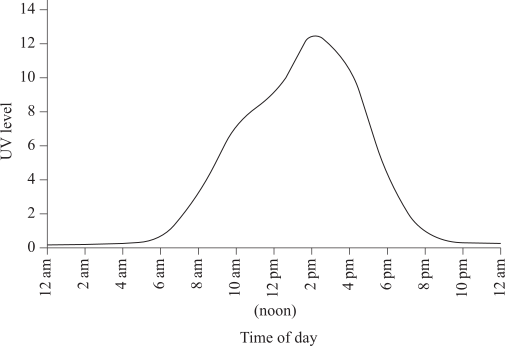
The graph shows the changes in UV level in a single day. The Cancer Council suggests that sun protection is needed whenever the UV level is 3 or above. The information provided on a sunscreen product suggests that sunscreen should be used between 10 am and 4 pm. Using the graph, evaluate the information provided on the sunscreen product with regard to the Cancer Council suggestion. (3 marks) --- 8 WORK AREA LINES (style=lined) --- Evaluation Judgment The sunscreen product recommendation is partially effective but requires improvement for optimal sun protection. Supporting Evidence Conclusion The product advice inadequately protects users during morning and late afternoon exposure periods when UV damage still occurs. Evaluation Judgment The sunscreen product recommendation is partially effective but requires improvement for optimal sun protection. Supporting Evidence Conclusion The product advice inadequately protects users during morning and late afternoon exposure periods when UV damage still occurs.
A particle of mass \(m\) kg moves along a horizontal line with an initial velocity of \(V_0 \ \text{ms}^{-1}\).
The motion of the particle is resisted by a constant force of \(m k\) newtons and a variable force of \(m v^2\) newtons, where \(k\) is a positive constant and \(v \ \text{ms}^{-1}\) is the velocity of the particle at \(t\) seconds.
Show that the distance travelled when the particle is brought to rest is \(\dfrac{1}{2} \ln \left(\dfrac{k+V_0^2}{k}\right)\) metres. (3 marks)
--- 10 WORK AREA LINES (style=lined) ---
| \(ma\) | \(-m k-m v^2\) |
| \(a\) | \(=-k-v^2\) |
| \(v \cdot \dfrac{d v}{d x}\) | \(=-\left(k+\nu^2\right)\) |
| \(\dfrac{d x}{d v}\) | \(=-\dfrac{v}{k+v^2}\) |
| \(x\) | \(=-\displaystyle\frac{1}{2} \int \frac{2 v}{k+v^2}\, d v=-\frac{1}{2} \ln \left(k+v^2\right)+c\) |
\(\text{At} \ \ x=0, v=v_0 \ \ \Rightarrow\ \ c=\dfrac{1}{2} \ln \left(k+V_0^2\right)\)
\(x=\dfrac{1}{2} \ln \left(k+V_0^2\right)-\dfrac{1}{2} \ln \left(k+v^2\right)=\dfrac{1}{2} \ln \left(\dfrac{k+V_0^2}{k+v^2}\right)\)
\(\text{Find \(x\) when \(\ v=0\ \) (distance travelled):}\)
\(x=\dfrac{1}{2} \ln \left(\dfrac{k+V_0^2}{k}\right)\ \text{metres}\)
| \(ma\) | \(-m k-m v^2\) |
| \(a\) | \(=-k-v^2\) |
| \(v \cdot \dfrac{d v}{d x}\) | \(=-\left(k+\nu^2\right)\) |
| \(\dfrac{d x}{d v}\) | \(=-\dfrac{v}{k+v^2}\) |
| \(x\) | \(=-\displaystyle\frac{1}{2} \int \frac{2 v}{k+v^2}\, d v=-\frac{1}{2} \ln \left(k+v^2\right)+c\) |
\(\text{At} \ \ x=0, v=v_0 \ \ \Rightarrow\ \ c=\dfrac{1}{2} \ln \left(k+V_0^2\right)\)
\(x=\dfrac{1}{2} \ln \left(k+V_0^2\right)-\dfrac{1}{2} \ln \left(k+v^2\right)=\dfrac{1}{2} \ln \left(\dfrac{k+V_0^2}{k+v^2}\right)\)
\(\text{Find \(x\) when \(\ v=0\ \) (distance travelled):}\)
\(x=\dfrac{1}{2} \ln \left(\dfrac{k+V_0^2}{k}\right)\ \text{metres}\)
Find \(\displaystyle \int \frac{x^2-2 x+9}{(4-x)\left(x^2+1\right)} \, dx\). (4 marks)
--- 10 WORK AREA LINES (style=lined) ---
\(2\, \tan ^{-1} x-\ln \abs{4-x}+C\)
\(\dfrac{x^2-2 x+9}{(4-x)\left(x^2+1\right)}=\dfrac{A}{(4-x)}+\dfrac{B x+C}{x^2+1}\)
\(A\left(x^2+1\right)+(B x+C)(4-x)=x^2-2 x+9\)
\(\text{If}\ \ x=4:\)
\(17 A=16-8+9=17 \ \ \Rightarrow\ \ A=1\)
\(\text{If}\ \ x=0:\)
\(1+c \times 4=9 \ \ \Rightarrow\ \ C=2\)
\(\text{If}\ \ x=1:\)
\(2+3 B+6=8 \ \ \Rightarrow\ \ B=0\)
| \(\displaystyle\int \frac{x^2-2 x+9}{(4-x)\left(x^2+1\right)}\, d x\) | \(=\displaystyle\int \frac{1}{4-x}\, d x+\int \frac{2}{x^2+1}\, d x\) |
| \(=2\, \tan ^{-1} x-\ln \abs{4-x}+C\) |
--- 4 WORK AREA LINES (style=lined) ---
--- 3 WORK AREA LINES (style=lined) ---
i. \(\text{Unit vector of the direction vector:}\)
\(\dfrac{2 \underset{\sim}{i}-2 \underset{\sim}{j}+\underset{\sim}{k}}{\abs{2 \underset{\sim}{i}-2 \underset{\sim}{j}+\underset{\sim}{k}}} = \dfrac{2 \underset{\sim}{i}-2 \underset{\sim}{j}+\underset{\sim}{k}}{\sqrt{2^2+(-2)^2 + 1^2}} = \dfrac{1}{3} \left( 2 \underset{\sim}{i}-2 \underset{\sim}{j}+\underset{\sim}{k} \right)\)
\(\text{Since \({\underset{\sim}{F}}_1\) has magnitude 12:}\)
\({\underset{\sim}{F}}_1=12 \times \dfrac{1}{3}\left(\begin{array}{c}2 \\ -2 \\ 1\end{array}\right)=\left(\begin{array}{c}8 \\ -8 \\ 4\end{array}\right)\)
\({\underset{\sim}{F}}_1=8\underset{\sim}{i}-8 \underset{\sim}{j}+4 \underset{\sim}{k}\)
ii. \({\underset{\sim}{F}}_3={\underset{\sim}{F}}_1+{\underset{\sim}{F}}_2=\left(\begin{array}{c}8 \\ -8 \\ 4\end{array}\right)+\left(\begin{array}{c}-6 \\ 12 \\ 4\end{array}\right)=\left(\begin{array}{l}2 \\ 4 \\ 8\end{array}\right)\)
\({\underset{\sim}{F}}_3=2 \underset{\sim}{i}+4 \underset{\sim}{j}+8 \underset{\sim}{k}\)
iii. \({\underset{\sim}{F}}_3 \cdot d=\left(\begin{array}{l}2 \\ 4 \\ 8\end{array}\right)\left(\begin{array}{l}1 \\ 1 \\ 2\end{array}\right)=2+4+16=22\)
i. \(\text{Unit vector of the direction vector:}\)
\(\dfrac{2 \underset{\sim}{i}-2 \underset{\sim}{j}+\underset{\sim}{k}}{\abs{2 \underset{\sim}{i}-2 \underset{\sim}{j}+\underset{\sim}{k}}} = \dfrac{2 \underset{\sim}{i}-2 \underset{\sim}{j}+\underset{\sim}{k}}{\sqrt{2^2+(-2)^2 + 1^2}} = \dfrac{1}{3} \left( 2 \underset{\sim}{i}-2 \underset{\sim}{j}+\underset{\sim}{k} \right)\)
\(\text{Since \({\underset{\sim}{F}}_1\) has magnitude 12:}\)
\({\underset{\sim}{F}}_1=12 \times \dfrac{1}{3}\left(\begin{array}{c}2 \\ -2 \\ 1\end{array}\right)=\left(\begin{array}{c}8 \\ -8 \\ 4\end{array}\right)\)
\({\underset{\sim}{F}}_1=8\underset{\sim}{i}-8 \underset{\sim}{j}+4 \underset{\sim}{k}\)
ii. \({\underset{\sim}{F}}_3={\underset{\sim}{F}}_1+{\underset{\sim}{F}}_2=\left(\begin{array}{c}8 \\ -8 \\ 4\end{array}\right)+\left(\begin{array}{c}-6 \\ 12 \\ 4\end{array}\right)=\left(\begin{array}{l}2 \\ 4 \\ 8\end{array}\right)\)
\({\underset{\sim}{F}}_3=2 \underset{\sim}{i}+4 \underset{\sim}{j}+8 \underset{\sim}{k}\)
iii. \({\underset{\sim}{F}}_3 \cdot d=\left(\begin{array}{l}2 \\ 4 \\ 8\end{array}\right)\left(\begin{array}{l}1 \\ 1 \\ 2\end{array}\right)=2+4+16=22\)
Given the function \(y=x e^{2 x}\), use mathematical induction to prove that \(\dfrac{d^n y}{d x^n}=\left(2^n x+n 2^{n-1}\right) e^{2 x}\) for all positive integers \(n\), where \(\dfrac{d^n y}{d x^n}\) is the
\(n\)th derivative of \(y\) and \(\dfrac{d}{d x}\left(\dfrac{d^n y}{d x^n}\right)=\dfrac{d^{n+1} y}{d x^{n+1}}\). (3 marks)
--- 15 WORK AREA LINES (style=lined) ---
\(\text{Proof (See worked solutions)}\)
\(\text{Prove} \ \ \dfrac{d^n y}{d x^n}=\left(2^n x+n 2^{n-1}\right) e^{2 x}\)
\(\text{If } \ \ n=1:\)
\(\operatorname{LHS}=\dfrac{d}{d x}\left(x e^{2 x}\right)=x \cdot 2 e^{2 x}+1 \cdot e^{2 x}=(2 x+1) e^{2 x}\)
\(\operatorname{RHS}=\left(2^{1} \cdot x+1 \cdot 2^{0}\right) e^{2 x}=(2 x+1) e^{2 x}=\operatorname{RHS}\)
\(\therefore \ \text{True for} \ \ n=1\)
\(\text{Assume true for}\ \ n=k:\)
\(\dfrac{d^k y}{d x^k}=\left(2^k x+k\, 2^{k-1}\right) e^{2 x}\)
\(\text{Prove true for}\ \ n=k+1:\)
\(\text{i.e.}\ \dfrac{d^{k+1} y}{d x^{k+1}}=\left(2^{k+1} x+(k+1) 2^k\right) e^{2 x}\)
| \(\dfrac{d^{k+1} y}{d x^{k+1}}\) | \(=\dfrac{d}{d x}\left(2^k x+k\cdot 2^{k-1}\right) e^{2 x}\) |
| \(=\dfrac{d}{d x}\left(2^k x e^{2 x}+k\cdot 2^{k-1} e^{2 x}\right)\) | |
| \(=2^k x \cdot 2 e^{2 x}+2^k \cdot e^{2 x}+k \cdot 2^{k-1} \cdot 2 e^{2 x}\) | |
| \(=2^{k+1} x e^{2 x}+2^k \cdot e^{2 x}+k \cdot 2^k \cdot e^{2 x}\) | |
| \(=2^{k+1} x e^{2 x}+(k+1) 2^k \cdot e^{2 x}\) | |
| \(=\left(2^{k+1} x+(k+1) 2^k\right) e^{2 x}\) |
\(\Rightarrow \ \text{True for} \ \ n=k+1\)
\(\therefore \ \text{Since true for \(\ \ n=1\), by PMI, true for integers} \ \ n \geqslant 1.\)
A particle in simple harmonic motion has speed \(v \ \text{ms}^{-1}\), given by \(v^2=-x^2+2 x+8\) where \(x\) is the displacement from the origin in metres.
What is the amplitude of the motion?
\(B\)
\(\text{Using} \ \ v^2=n^2\left(a^2-(x-c)^2\right):\)
| \(v^2\) | \(=-x^2+2 x+8\) |
| \(=9-\left(x^2-2 x+1\right)\) | |
| \(=9-(x-1)^2\) |
\(\therefore a^2 = 9\ \ \Rightarrow\ \ a=3\)
\(\Rightarrow B\)
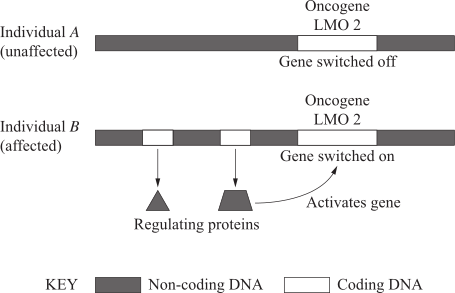
Researchers studying T-cell acute lymphoblastic leukaemia (T-ALL) examined a section of DNA in individuals A and B.
In individual B, they found proteins that can regulate the expression of oncogene LMO 2. The following diagram represents the sections of DNA from the two individuals.
Based on this information, which of the following statements is the best explanation of the cause of T-ALL?
\(D\)
Other Options:
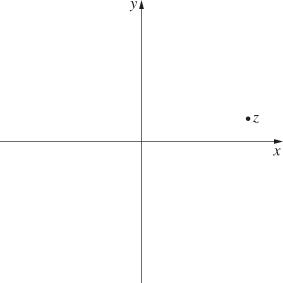
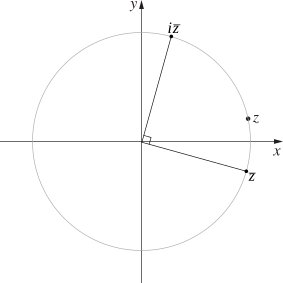
What are the square roots of \(3-4 i\) ?
\(C\)
\(\text{Let} \ \ z=\sqrt{3-4 i}\) :
\(z^2=3-4 i\)
\(z^2=a^2-b^2+2 a b\,i\)
\(\text{Equate real/imaginary parts:}\)
\(a^2-b^2=3\ \ldots\ (1)\)
\(2 a b=-4 \ \ \Rightarrow \ \ a b=-2\ \ldots\ (2)\)
\(\text{By inspection:}\)
\(a=2, b=-1 \ \Rightarrow \ z_1=2-i\)
\(a=-2, b=1 \ \Rightarrow \ z_2=-2+i\)
\(\Rightarrow C\)
Cochlear implants assist with hearing. The following are five steps involved in the process.
Which is the correct order for this process?
\(C\)
Other Options:
In 2018, the Victorian government reported the target of vaccinating more than 95% of children below the age of five had been achieved.
What is the benefit of achieving a 95% vaccination rate for an infectious disease?
\(C\)
Other Options:
Using integration by parts, evaluate \(\displaystyle \int_0^{\small{\dfrac{\pi}{2}}} x\, \sin x \, dx\). (3 marks)
--- 7 WORK AREA LINES (style=lined) ---
\(\displaystyle \int_0^{\small{\dfrac{\pi}{2}}} x\, \sin x \, dx = 1\)
| \(u\) | \(=x\) | \(u^{\prime}\) | \(=1\) |
| \(v^{\prime}\) | \(=\sin\,x\) | \(v\) | \(=-\cos\,x\) |
| \(\displaystyle \int_0^{\small{\dfrac{\pi}{2}}} x\, \sin x \, dx\) | \(=\Big[-x\,\cos\,x\Big]_0^{\small{\dfrac{\pi}{2}}} + \displaystyle \int_0^{\small{\dfrac{\pi}{2}}} \cos x \, dx\) | |
| \(=(0-0)+\Big[\sin\,x\Big]_0^{\small{\dfrac{\pi}{2}}} \) | ||
| \(=\sin\,\dfrac{\pi}{2}-\sin\,0\) | ||
| \(=1\) |
Find \(\displaystyle \int \dfrac{5}{\sqrt{7-x^2-6 x}} \, dx\). (2 marks)
--- 5 WORK AREA LINES (style=blank) ---
\(5\,\sin^{-1} \left( \dfrac{x+3}{4} \right) +c\)
| \(\displaystyle \int \dfrac{5}{\sqrt{7-x^2-6 x}} \, dx\) | \(=\displaystyle \int \dfrac{5}{\sqrt{16-(x^2+6x+9)}} \, dx\) | |
| \(=\displaystyle \int \dfrac{5}{\sqrt{16-(x+3)^2}} \, dx\) | ||
| \(=5\,\sin^{-1} \left( \dfrac{x+3}{4} \right) +c\) |
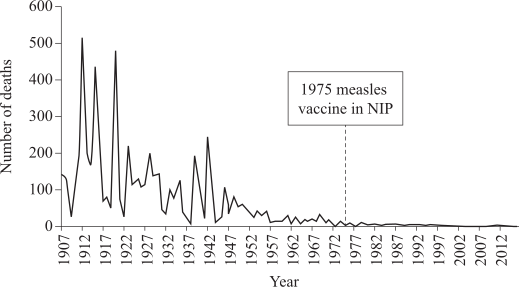
The graph shows the number of recorded deaths, due to measles, before and after the measles vaccine was included in the National Immunisation Program (NIP).
Which of the following is a trend shown in the graph?
\(C\)
Other Options: