SmarterEd

Aussie Maths & Science Teachers: Save your time with SmarterEd

  • Login
  • Get Help
  • About

Data Analysis, GEN1 2025 VCAA 13-14 MC

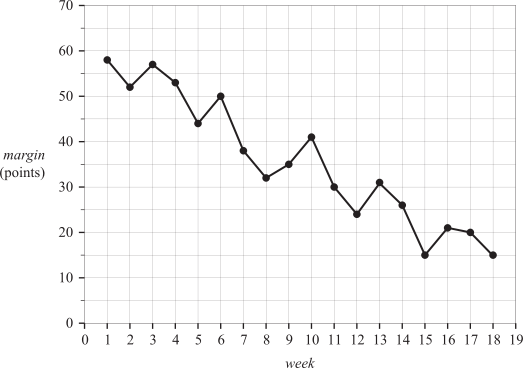
The following time series graph shows the margin, in points, for a team winning all of its games in the first 18 weeks of a season. The team plays one game per week.
 

Part 1

The time series graph is smoothed using five-median smoothing.

The smoothed value for the margin in week 8, in points, is

  1. 32
  2. 35
  3. 38
  4. 41

 
Part 2

Which one of the following options best describes the qualitative features of the time series graph above?

  1. decreasing trend only
  2. irregular fluctuations only
  3. structural change only
  4. decreasing trend with irregular fluctuations
Show Answers Only

\(\text{Part 1:}\ C\)

\(\text{Part 2:}\ D\)

Show Worked Solution

\(\text{Part 1}\)

\(\text{Five values with week 8 in the middle:} \ 50,38,32,35,41\)

\(\text{Ranking values (above):} \ 32,35,38,41,50\)

\(\text{Median}=38\)

\(\Rightarrow C\)
 

\(\text{Part 2}\)

\(\text{Qualitative features of graph:}\)

\(\text{Decreasing trend (eliminate B and C)}\)

\(\text{Irregular fluctuations}\)

\(\Rightarrow D\)

Filed Under: Time Series Tagged With: Band 3, smc-266-40-Time Series Trends, smc-266-70-MEDIAN Smoothing

Data Analysis, GEN1 2025 VCAA 11-12 MC

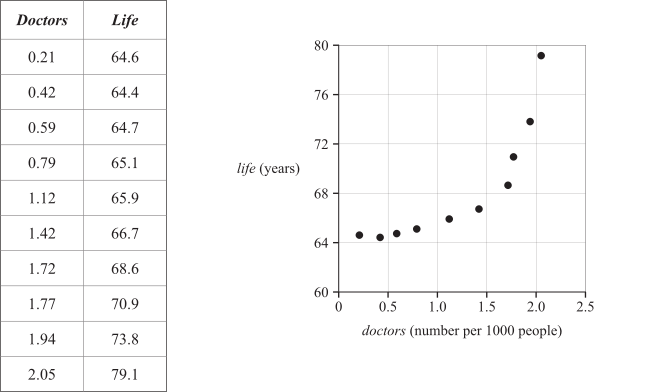
The table below shows the life expectancy in years, life, and the number of doctors per 1000 people, doctors, for a sample of 10 countries in 2024. A scatterplot displaying the data is also shown.


Part 1

A logarithmic (base 10) transformation was applied to the variable life.

With \(\log _{10}(\textit{life})\) as the response variable, the equation of the least squares line fitted to the transformed data is closest to

  1. \(\log _{10}(life)=1.57+0.0123 \times doctors\) 
  2. \(\log _{10}(life)=1.63+0.0326 \times doctors\)
  3. \(\log _{10}(life)=1.79+0.0383 \times doctors\)
  4. \(\log _{10}(life)=1.85+0.0403 \times doctors\)

 
Part 2

A squared transformation was applied to the variable \(doctors\).

The equation of the least squares line fitted to this transformed data is of the form  \(\textit{life}=a+b \times(\textit{doctors})^2\).

Using this equation, the predicted \(life\), in years, for a country with two \(doctors\) per 1000 people is closest to

  1. 73.6
  2. 74.0
  3. 74.5
  4. 74.9
Show Answers Only

\(\text{Part 1:}\ C\)

\(\text{Part 2:}\ C\)

Show Worked Solution

\(\text{Transform data in table (use for parts 1 and 2):}\)

\begin{array} {|c|c|c|c|}
\hline
\rule{0pt}{2.5ex}\ \ \textit{doctors} \ \ \rule[-1ex]{0pt}{0pt} & \log_{10}(\textit{life}) & \textit{doctors}^2 & \quad \textit{life} \quad \\
\hline
\rule{0pt}{2.5ex} 0.21 \rule[-1ex]{0pt}{0pt} & 1.810 &0.044 &64.6\\
\hline
\rule{0pt}{2.5ex} 0.42 \rule[-1ex]{0pt}{0pt} & 1.809 &0.176 &64.4\\
\hline
\rule{0pt}{2.5ex} 0.59 \rule[-1ex]{0pt}{0pt} & 1.811 &0.348 &64.7\\
\hline
\rule{0pt}{2.5ex} 0.79 \rule[-1ex]{0pt}{0pt} & 1.814 &0.624 &65.1\\
\hline
\rule{0pt}{2.5ex} 1.12 \rule[-1ex]{0pt}{0pt} & 1.819 &1.254 &65.9\\
\hline
\rule{0pt}{2.5ex} 1.42 \rule[-1ex]{0pt}{0pt} & 1.824 &2.016 &66.7\\
\hline
\rule{0pt}{2.5ex} 1.72 \rule[-1ex]{0pt}{0pt} & 1.836 &2.958 &68.6\\
\hline
\rule{0pt}{2.5ex} 1.77 \rule[-1ex]{0pt}{0pt} & 1.851 &3.133 &70.9\\
\hline
\rule{0pt}{2.5ex} 1.94 \rule[-1ex]{0pt}{0pt} & 1.868 &3.764 &73.8\\
\hline
\rule{0pt}{2.5ex}2.05 \rule[-1ex]{0pt}{0pt} & 1.898 &4.203 &79.1\\
\hline
\end{array}

 
\(\text{Part 1}\)

\(\text{Calculate LSRL (by CAS):}\)

\(\log _{10}(\textit{life})=1.7879 \ldots+0.03829 \ldots \times \textit{doctors}\)

\(\Rightarrow C\)
 

\(\text{Part 2}\)

\(\text{Calculate LSRL (by CAS):}\)

\(\textit{life}=63.1165+2.8419 \times \textit{doctors}^2\)
 

\(\text{Find}\ \textit{life}\ \text{when} \ \textit{doctors}=2:\)

\(\textit{life}=63.1165+2.8419 \times 2^2=74.48\ldots \ \text{years}\)

\(\Rightarrow C\)

Filed Under: Correlation and Regression Tagged With: Band 3, Band 4, smc-265-70-Linearise - log10, smc-265-71-Linearise - Squared/Inverse

Data Analysis, GEN1 2025 VCAA 7-8 MC

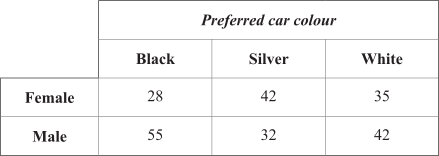
The data in the table below shows the preferred car colour for a sample of female and male car buyers.
 

Part 1

From this table, the percentage of female car buyers whose preferred car colour is silver is closest to

  1. 33%
  2. 40%
  3. 42%
  4. 57%

 
Part 2

Which one of the following is the most appropriate way to graphically display the data shown in the table above?

  1. a histogram
  2. a back-to-back stem plot
  3. parallel boxplots
  4. a segmented bar chart
Show Answers Only

\(\text{Part 1:}\ B\)

\(\text{Part 2:}\ D\)

Show Worked Solution

\(\text{Part 1}\ \)

\(\text{Total females}\ =28+42+35=105\)

\(\text{Females who prefer silver}\ = 42\)

\(\text{Percentage}\ = \dfrac{42}{105}=0.40\)

\(\Rightarrow B\)
 

\(\text{Part 2}\)

\(\text{Most appropriate graphical display is a segmented bar chart.}\)

\(\text{Each bar = a gender with colours represented by segments in each bar.}\)

\(\Rightarrow D\)

Filed Under: Graphs - Histograms and Other Tagged With: Band 3, smc-644-40-Segmented Bar Charts, smc-644-50-Frequency Tables

Data Analysis, GEN1 2025 VCAA 6 MC

The following information relating to life expectancy comes from a sample of nations in the Oceania region.

  • The first quartile is 74.9 years.
  • The third quartile is 78.5 years.
  • The lowest five values recorded are 68.5, 68.6, 69.0, 70.1 and 74.8 years.

How many outliers would be displayed at the lower end of a boxplot showing this sample of Oceania data?

  1. 1
  2. 2
  3. 3
  4. 4
Show Answers Only

\(C\)

Show Worked Solution

\(IQR=78.5-74.9=3.6\)

\(\text{Lower fence}\ = 74.9-1.5 \times 3.6=69.5\)

\(\text{68.5, 68.6 and 69.0 are all less than the lower fence.}\)

\(\Rightarrow C\)

Filed Under: Graphs - Stem/Leaf and Boxplots Tagged With: Band 3, smc-643-10-Single Box-Plots, smc-643-60-Outliers

Data Analysis, GEN1 2025 VCAA 5 MC

The heights of females aged between 16 and 18 years within a population are normally distributed.

Analysis of the heights of this group of females showed that:

  • 2.5% of the heights were greater than 178.9 cm
  • 16% of the heights were less than 157.6 cm.

Using the 68-95-99.7% rule, the mean and standard deviation of the heights of these females are respectively

  1. 150.5 and 21.3
  2. 154.9 and 7.1
  3. 164.7 and 7.1
  4. 171.8 and 14.2
Show Answers Only

\(C\)

Show Worked Solution
\(\bar{x}+2z\) \(=178.9\ \ …\ (1)\)  
\(\bar{x}-z\) \(=157.6\ …\ (2)\)  

 
\(\text{Subtract}\ (1)-(2):\)

\(3z=21.3\ \ \Rightarrow\ \ z=7.1\)

\(\text{Substitute}\ \ z=7.1\ \ \text{into (2):}\)

\(\bar{x}-7.1=157.6\ \ \Rightarrow\ \ \bar{x}=164.7\)

\(\Rightarrow C\)

Filed Under: Normal Distribution Tagged With: Band 3, smc-600-10-Single z-score

Data Analysis, GEN1 2025 VCAA 3 MC

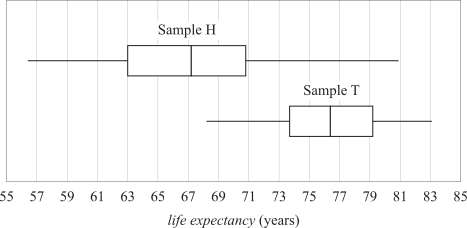
The boxplots below show the life expectancy, in years, for a sample of countries from two different continents (Sample H and Sample T).
 

Which one of the following statements is correct?

  1. The interquartile range for Sample T is greater than the interquartile range for Sample H.
  2. The median for Sample T is more than 10 years greater than the median for Sample H.
  3. The third quartile for Sample H is greater than the first quartile for Sample T.
  4. Life expectancy in all Sample T countries exceeds the median life expectancy in Sample H.
Show Answers Only

\(D\)

Show Worked Solution

\(\text{Options A to C are all demonstrably incorrect.}\)

\(\text{Consider option D:}\)

\(\text{Sample T’s low is higher than Sample H’s median.}\ \checkmark \)

\(\Rightarrow D\)

Filed Under: Graphs - Stem/Leaf and Boxplots Tagged With: Band 3, smc-643-20-Parallel Box-Plots

Data Analysis, GEN1 2025 VCAA 1-2 MC

At a fruit shop, customers can buy avocados in bags.

The bag size ranges from one to six avocados per bag.

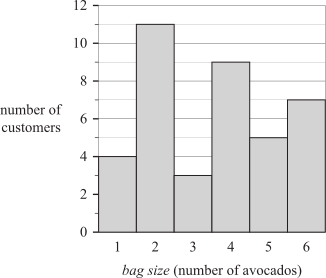
The histogram below shows the number of customers who bought each bag size on a particular day.
 

Part 1

The median bag size bought by customers on the day was

  1. 2
  2. 3
  3. 3.5
  4. 4


Part 2

The total number of avocados sold in bags was

  1. 39
  2. 134
  3. 136
  4. 138
Show Answers Only

\(\text{Part 1:}\ D\)

\(\text{Part 2:}\ D\)

Show Worked Solution

\(\text{Part 1}\)

\(\text{Sum of columns}\ = 4+11+3+9+5+7=39\)

\(\text{Median = 20th value which is in the 4th column (bag size 4).}\)

\(\Rightarrow D\)
 

\(\text{Part 2}\)

\(\text{Total number of avocados}\)

\(=1 \times 4 + 2 \times 11+3 \times 3+4 \times 9+5 \times 5+6 \times 7 =138\)

\(\Rightarrow D\)

Filed Under: Graphs - Histograms and Other Tagged With: Band 3, Band 4, smc-644-20-Histograms

Calculus, 2ADV C1 EQ-Bank 16

A block of ice is melting. The mass \(M\) kilograms of the ice block remaining at time \(t\) hours after it begins to melt is given by  \(M(t)=50(12-3t)^2, 0 \leqslant t \leqslant 4\).

  1. Find the rate of change of the ice block's mass at any time \(t\).   (1 mark)

    --- 3 WORK AREA LINES (style=lined) ---

  2. How long does it take for the ice block to completely melt?   (1 mark)

    --- 5 WORK AREA LINES (style=lined) ---

  3. At what time is the ice melting at a rate of 2100 kilograms per hour?   (2 marks)

    --- 5 WORK AREA LINES (style=lined) ---

Show Answers Only

a.    \(\dfrac{dM}{dt}=-300(12-3t)\)

b.    \(4\ \text{hours}\)

c.    \(t=\dfrac{5}{3}\ \text{hours}\)

Show Worked Solution

a.    \(M(t)=50(12-3t)^2\)

\(\dfrac{dM}{dt}=50 \times 2 \times (-3) \times(12-3t)=-300(12-3t)\)
 

b.    \(\text{Find}\ t\ \text{when}\ \ M(t)=0:\)

\(50(12-3t)^2=0 \ \Rightarrow \ t=4\)

\(\text{Ice block is completely melted at} \ \ t=4 \ \ \text {hours}\)
 

c.    \(\text{Find}\ t \ \text{when}\ \ \dfrac{d M}{d t}=-2100:\)

\(-300(12-3t)\) \(=-2100\)
\(12-3t\) \(=7\)
\(-3t\) \(=-5\)
\(t\) \(=\dfrac{5}{3}\ \text{hours}\)

Filed Under: Rates of Change Tagged With: Band 3, Band 4, smc-6438-18-Other Rate Problems, smc-6438-20-Polynomial Function

Calculus, 2ADV C1 EQ-Bank 11

An oil slick on the surface of water forms a circular shape. The radius \(r\) metres of the oil slick is increasing according to the formula  \(r(t)=3 \sqrt{t}\), where \(t\) is the time in minutes after the oil begins to spread,  \(t \geqslant 0\).

  1. Find the rate at which the radius is increasing at any time \(t\).   (1 mark)

    --- 3 WORK AREA LINES (style=lined) ---

  2. At what rate is the area of the oil slick increasing when \(t=16\) minutes?   (1 mark)

    --- 3 WORK AREA LINES (style=lined) ---

Show Answers Only

a.    \(\dfrac{d r}{d t}=\dfrac{3}{2 \sqrt{t}}\)

b.    \(\dfrac{d r}{d t}=\dfrac{3}{8} \ \text{metres/min}\)

Show Worked Solution

a.    \(r(t)=3 \sqrt{t}\)

\(\dfrac{d r}{d t}=\dfrac{1}{2} \times 3 \times t^{-\tfrac{1}{2}}=\dfrac{3}{2 \sqrt{t}}\)
 

b.    \(\text{Find} \ \dfrac{d r}{d t} \ \text{when} \ \ t=16:\)

\(\dfrac{d r}{d t}=\dfrac{3}{2 \times \sqrt{16}}=\dfrac{3}{8} \ \text{metres/min}\)

Filed Under: Rates of Change Tagged With: Band 3, smc-6438-18-Other Rate Problems, smc-6438-40-Square-Root Function

Calculus, 2ADV C1 EQ-Bank 20

A cylindrical water tank is being filled. The volume \(V\) litres of water in the tank at time \(t\) minutes after filling begins is given by  \(V(t)=500 \sqrt{(2 t+1)}, t \geqslant 0\).

  1. At what rate is water entering the tank at any time \(t\) ?   (1 mark)

    --- 5 WORK AREA LINES (style=lined) ---

  2. Find the rate at which the tank is being filled when \(t=12\) minutes.   (1 mark)

    --- 5 WORK AREA LINES (style=lined) ---

  3. At what time is the water flowing into the tank at a rate of 125 litres per minute?   (2 marks)

    --- 5 WORK AREA LINES (style=lined) ---

Show Answers Only

a.    \(\dfrac{dV}{dt}= \dfrac{500}{\sqrt{2t+1}} \)

b.    \(100\ \text{L/min} \)

c.    \(\dfrac{15}{2}\ \text{mins}\)

Show Worked Solution

a.    \(V(t)=500(2t+1)^{\frac{1}{2}}\)

\(\dfrac{dV}{dt}=\dfrac{1}{2} \times 2 \times 500(2t+1)^{-\frac{1}{2}} = \dfrac{500}{\sqrt{2t+1}} \)
 

b.    \(\text{When}\ \ t=12:\)

\(\dfrac{dV}{dt}= \dfrac{500}{\sqrt{25}} = 100\ \text{L/min} \)
 

c.    \(\text{Find}\ t\ \text{when}\ \dfrac{dV}{dt}=125:\)

\(125\) \(=\dfrac{500}{\sqrt{2t+1}}\)  
\(\sqrt{2t+1}\) \(=4\)  
\(2t+1\) \(=16\)  
\(t\) \(=\dfrac{15}{2}\ \text{mins}\)  

Filed Under: Rates of Change Tagged With: Band 3, Band 4, smc-6438-15-Flow Problems, smc-6438-40-Square-Root Function

Financial Maths, STD2 EQ-Bank 35

Priya works as a sales representative and earns a base wage plus commission. A spreadsheet is used to calculate her weekly earnings.

Total weekly earnings = Base wage + Total sales \(\times\) Commission rate

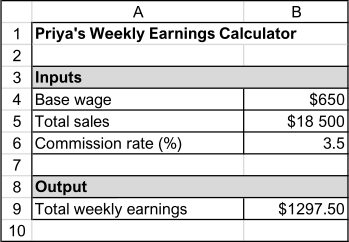
A spreadsheet showing Priya's weekly earnings is shown.


  1. Write down the formula used in cell B9, using appropriate grid references.   (1 mark)

    --- 1 WORK AREA LINES (style=lined) ---

  2. In the following week, Priya earned total weekly earnings of $1437.50. Her base wage and commission rate remained unchanged. Calculate Priya's total sales for that week.   (2 marks)

    --- 5 WORK AREA LINES (style=lined) ---

  3. Priya's employer increases her commission rate to 4.2% but keeps her base wage the same. If Priya makes $22 000 in sales, calculate her new total weekly earnings.   (2 marks)

    --- 5 WORK AREA LINES (style=lined) ---

Show Answers Only

a.   \(=\text{B4}+\text{B5}^*\text{B6}/100\)

b.    \($22\, 500\)

c.    \($1574\)

Show Worked Solution

a.   \(\text{Total weekly earnings} = \text{Base wage}+\text{Total sales} \times \text{Commission rate}\)

\(\therefore\ \text{Formula:}\ =\text{B4}+\text{B5}^*\text{B6}/100\)
 

b.   \(\text{Total weekly earnings} = \text{Base wage}+\text{Total sales} \times \text{Commission rate}\)

\(\text{Let the Total sales}=S\)

\(1437.50\) \(=650+S\times \dfrac{3.5}{100}\)
\(787.50\) \(=S\times \dfrac{3.5}{100}\)
\(S\) \(=\dfrac{787.50\times 100}{3.5}=$22\,500\)

 
\(\text{The amount of Priya’s total sales was \$22 500.}\)
 

c.    \(\text{Base wage}=650\)

\(\text{Total sales}=$22\,000\)

\(\text{New commission rate}=4.2\%\)

\(\text{Total weekly earnings}\) \(=650+22\,000\times \dfrac{4.2}{100}\)
  \(=650+924=$1574\)

Filed Under: Ways of Earning, Ways of Earning Tagged With: Band 3, Band 4, Band 5, smc-6276-20-Commission, smc-6276-60-Spreadsheets, smc-6515-20-Commission, smc-6515-60-Spreadsheets, syllabus-2027

Financial Maths, STD2 EQ-Bank 18

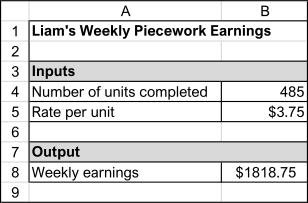
Liam works in a factory assembling electronic components and is paid on a piecework basis. A spreadsheet is used to calculate his weekly earnings.

Weekly earnings = Number of units completed \(\times\) Rate per unit

A spreadsheet showing Liam's earnings for one week is shown.
  

  1. Write down the formula used in cell B8, using appropriate grid references.   (1 mark)

    --- 1 WORK AREA LINES (style=lined) ---

  2. In the following week, Liam earned $2036.25. The rate per unit remained at $3.75. Calculate the number of units Liam completed that week.   (2 marks)

    --- 5 WORK AREA LINES (style=lined) ---

Show Answers Only

a.   \(=\text{B4}^*\text{B5}\)

b.    \(\text{Number of units completed}=543\)

Show Worked Solution

a.   \(\text{Weekly earnings} = \text{Number of units completed} \times \text{Rate per unit}\)

\(\text{Formula:}\ =\text{B4}^*\text{B5}\)
 

b.   \(\text{Weekly earnings} = \text{Number of units completed} \times \text{Rate per unit}\)

\(\text{Let the Weekly earnings}=E\)

\(2036.25\) \(=E\times 3.75 \)
\(E\) \(=\dfrac{2036.25}{3.75}=543\)

Filed Under: Ways of Earning, Ways of Earning Tagged With: Band 3, Band 4, smc-6276-30-Piecework/Royalties, smc-6276-60-Spreadsheets, smc-6515-30-Piecework/Royalties, smc-6515-60-Spreadsheets, syllabus-2027

Financial Maths, STD2 EQ-Bank 20

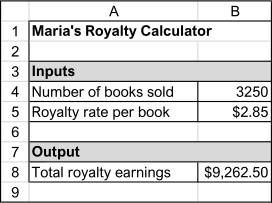
Maria works as a freelance writer and earns income through royalties. A spreadsheet is used to calculate her monthly royalty earnings.

Royalties = Number of books sold \( \times \) Royalty rate per book

A spreadsheet detailing Maria's royalty earnings is shown below.
  

  1. Write down the formula used in cell B8, using appropriate grid references.   (1 mark)

    --- 1 WORK AREA LINES (style=lined) ---

  2. In April, Maria's total royalty earnings were $8960.40. Her royalty rate remained at $2.85 per book. How many books did Maria sell in April?   (2 marks)

    --- 5 WORK AREA LINES (style=lined) ---

Show Answers Only

a.   \(=\text{B4}^*\text{B5}\)

b.    \(\text{Number of books}=3144\)

Show Worked Solution

a.   \(\text{Total royalty earnings} = \text{Number of books sold} \times \text{Royalty rate per book}\)

\(\text{Formula:}\ =\text{B4}^*\text{B5}\)
 

b.   \(\text{Total royalty earnings} = \text{Number of books sold} \times \text{Royalty rate per book}\)

\(\text{Let the Number of books sold}=N\)

\(8960.40\) \(=N\times 2.85 \)
\(N\) \(=\dfrac{8960.40}{2.85}=3144\)

Filed Under: Ways of Earning, Ways of Earning Tagged With: Band 3, Band 4, smc-6276-30-Piecework/Royalties, smc-6276-60-Spreadsheets, smc-6515-30-Piecework/Royalties, smc-6515-60-Spreadsheets, syllabus-2027

Measurement, STD2 EQ-Bank 17

2UG-2005-25b

Use Pythagoras’ theorem to show that `ΔABC` is a right-angled triangle.   (1 mark)

--- 3 WORK AREA LINES (style=lined) ---

Show Answers Only

`ΔABC\ text(is right-angled if)\ \ a^2 + b^2 = c^2:`

`a^2 + b^2= 5^2 + 12^2= 169= 13^2= c^2`

Show Worked Solution

`ΔABC\ text(is right-angled if)\ \ a^2 + b^2 = c^2:`

`a^2 + b^2= 5^2 + 12^2= 169= 13^2= c^2`

Filed Under: Perimeter and Area Tagged With: Band 3, smc-6483-15-Pythagoras, smc-6520-15-Pythagoras

Financial Maths, STD2 EQ-Bank 28

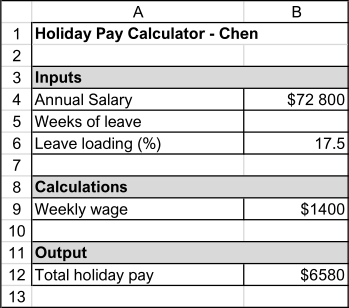
Chen earns an annual salary of $72 800. He is entitled to four weeks annual leave with 17.5% leave loading. A spreadsheet is used to calculate his total holiday pay.

Total holiday pay = 4 × weekly wage + 4 × weekly wage × 17.5%

A spreadsheet showing Chen's holiday pay calculation is shown.

  1. What value from the question should be entered in cell B5?   (1 mark)

    --- 1 WORK AREA LINES (style=lined) ---

  2. Write down the formula used in cell B9 to calculate the weekly wage, using appropriate grid references.   (2 marks)

    --- 2 WORK AREA LINES (style=lined) ---

  3. Verify the amount of Chen's total holiday pay using calculations.   (2 marks)

    --- 5 WORK AREA LINES (style=lined) ---

Show Answers Only

a.   \(4\)

b.   \(=\text{B4}/52\)

c.    \(\text{Total holiday pay}=\text{weekly wage}\times 4 +\ \text{weekly wage}\times 4\ \times 17.5\%\)

\(\text{Total holiday pay}=1400\times 4+1400\times 4\times\dfrac{17.5}{100}=5600+980=$6580\)

Show Worked Solution

a.    \(\text{Chen gets 4 weeks leave }\rightarrow\ 4\)
 

b.    \(\text{Weekly wage }=\dfrac{\text{Annual salary}}{52}\)

\(\text{Formula: }=\text{B4}/52\)
 

c.    \(\text{Total holiday pay}=\text{weekly wage}\times 4 +\ \text{weekly wage}\times 4\ \times 17.5\%\)

\(\text{Total holiday pay}=1400\times 4+1400\times 4\times\dfrac{17.5}{100}=5600+980=$6580\)

Filed Under: Ways of Earning, Ways of Earning Tagged With: Band 2, Band 3, Band 5, smc-6276-10-Wages/Salaries, smc-6276-60-Spreadsheets, smc-6515-10-Wages/Salaries, smc-6515-60-Spreadsheets, syllabus-2027

Algebra, STD2 EQ-Bank 29

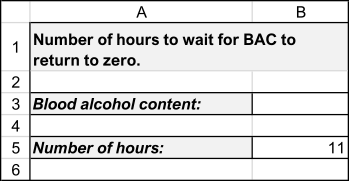
The formula below is used to estimate the number of hours you must wait before your blood alcohol content (BAC) will return to zero after consuming alcohol.

\(\text{Number of hours}\ =\dfrac{\text{BAC}}{0.015}\)

The spreadsheet below has been created by Ben so his 21st birthday attendees can monitor their alcohol consumption if they intend to drive, given their BAC reading. 

  1. By using appropriate grid references, write down a formula that could appear in cell B5.   (2 marks)

    --- 2 WORK AREA LINES (style=lined) ---

  2. Ben's friend Ryan's reading reflects that he will have to wait 11 hours for his BAC to return to zero. Using the formula, calculate the value Ryan entered into cell B3.   (2 marks)

    --- 5 WORK AREA LINES (style=lined) ---

Show Answers Only

a.    \(=\text{B3}/0.015\)

b.    \(0.165\)

Show Worked Solution

a.    \(=\text{B3}/0.015\)

b.    \(11\) \(=\dfrac{\text{BAC}}{0.015}\)
  \(\text{BAC}\) \(=11\times 0.015=0.165\)

  
\(\text{Ryan entered 0.165 into cell B3.}\)

Filed Under: Applications: BAC, D=SxT and Medication, Applications: BAC, Medicine and D=S x T Tagged With: Band 3, Band 5, smc-6235-10-\(BAC\ \) formula, smc-6235-60-Spreadsheets, smc-6509-10-BAC, smc-6509-60-Spreadsheets, syllabus-2027

Financial Maths, STD1 EQ-Bank 18

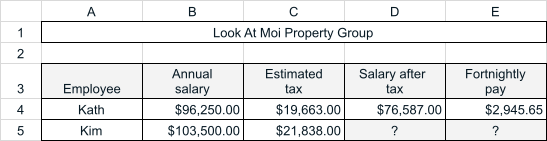
A company uses the spreadsheet below to calculate the fortnightly pay, after tax, of its employees.
 

  1. Write down the formula that was used in cell D5, using appropriate grid references.   (1 mark)

    --- 1 WORK AREA LINES (style=lined) ---

  2. Hence, calculate Kim's fortnightly pay.   (2 marks)

    --- 4 WORK AREA LINES (style=lined) ---

Show Answers Only

a.  \(=\text{B6}-\text{C6}\)

b.    \(\$3140.85\)

Show Worked Solution

a.    \(\text{Formula for Kim’s Salary after tax:}\)

\(=\text{B5}-\text{C5}\)
 

b.    \(\text{Kim’s salary after tax}\ = \$81\,662\)

\(\text{Kim’s fortnightly pay}\ = \dfrac{81\,662}{26}=\$3140.85\)

Filed Under: Taxation Tagged With: Band 3, Band 4, smc-6516-30-Other Tax Problems, smc-6516-50-Spreadsheets, syllabus-2027

Financial Maths, STD2 EQ-Bank 17

The table shows the income tax rate for Australian residents for the 2024-2025 financial year.

\begin{array}{|l|l|}
\hline
\rule{0pt}{2.5ex}\textit{Taxable income} \rule[-1ex]{0pt}{0pt}& \textit{Tax on this income} \\
\hline
\rule{0pt}{2.5ex}0-\$18\,200 \rule[-1ex]{0pt}{0pt}& \text{Nil} \\
\hline
\rule{0pt}{2.5ex}\$18 \, 201-\$45\,000 \rule[-1ex]{0pt}{0pt}& \text{16 cents for each \$1 over \$18 200} \\
\hline
\rule{0pt}{2.5ex}\$45\,001-\$135\,000 \rule[-1ex]{0pt}{0pt}& \$4288 \text{ plus 30 cents for each \$1 over \$45 000} \\
\hline
\rule{0pt}{2.5ex}\$135\,001-\$190\,000 \rule[-1ex]{0pt}{0pt}& \$31 \, 288 \text{ plus 37 cents for each \$1 over \$135 000} \\
\hline
\rule{0pt}{2.5ex}\$190\,001 \text{ and over} \rule[-1ex]{0pt}{0pt}& \$51 \, 638 \text{ plus 45 cents for each \$1 over \$190 000} \\
\hline
\end{array}

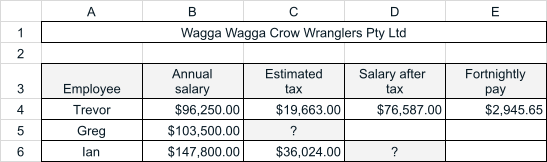
A company's spreadsheet was created that calculates its employees' after tax fortnightly pay, based on the table and excluding the Medicare levy.

  1. Write down the formula that was used in cell D6, using appropriate grid references.   (1 mark)

    --- 1 WORK AREA LINES (style=lined) ---

  2. Write down the formula that was used in cell C5, using appropriate grid references.   (1 mark)

    --- 2 WORK AREA LINES (style=lined) ---

  3. Hence, calculate Greg's fortnightly pay.   (2 marks)

    --- 4 WORK AREA LINES (style=lined) ---

Show Answers Only

a.  \(=\text{B6}-\text{C6}\)

b.  \(=4288+(\text{B5}-45000)^*0.30 \)

c.    \(\$3140.85\)

Show Worked Solution

a.    \(\text{Formula for Ian’s Salary after tax:}\)

\(=\text{B6}-\text{C6}\)
 

b.    \(\text{Formula for Greg’s estimated tax:}\)

\(=4288+(\text{B5}-45000)^*0.30 \)
 

c.    \(\text{Greg’s estimated tax}\ =4288+(103\,500-45\,000) \times 0.30=\$21\,838\)

\(\text{Greg’s salary after tax}\ = 103\,500-21\,838=\$81\,662\)

\(\text{Greg’s fornightly pay}\ = \dfrac{81\,662}{26}=\$3140.85\)

Filed Under: Taxation Tagged With: Band 3, Band 4, smc-6277-10-Tax Tables, smc-6277-40-Spreadsheets, syllabus-2027

Algebra, STD2 EQ-Bank 28

Sharon drinks three glasses of chardonnay over a 180-minute period, each glass containing 1.6 standard drinks.

Sharon weighs 78 kilograms, and her blood alcohol content (BAC) at the end of this period can be calculated using the following formula:

\(\text{BAC}_{\text {female }}=\dfrac{10 N-7.5 H }{5.5 M}\)

where \(N\) = number of standard drinks consumed
\(H\) = the number of hours drinking
\(M\) = the person's mass in kilograms

 
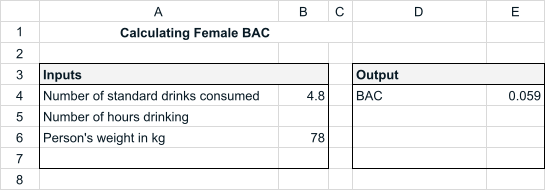
The spreadsheet below can be used to calculate Sharon's \(\text{BAC}\).
 

  1. What value should be input into cell B5.   (1 mark)

    --- 2 WORK AREA LINES (style=lined) ---

  2. Write down the formula that has been used in cell E4, using appropriate grid references.   (2 marks)

    --- 2 WORK AREA LINES (style=lined) ---

Show Answers Only

a.    \(\text{Cell B5 value}=3\)

b.  \(=\left(10^* \text{B4}-7.5^* \text{B5}\right) /(5.5^* \text{B6})\)

Show Worked Solution

a.    \(\text{180 minutes}\ =\ \text{3 hours}\)

\(\therefore \ \text{Cell B5 value}=3\)
 

b.  \(=\left(10^* \text{B4}-7.5^* \text{B5}\right) /(5.5^* \text{B6})\)

Filed Under: Applications: BAC, D=SxT and Medication, Applications: BAC, Medicine and D=S x T Tagged With: Band 3, Band 5, smc-6235-10-\(BAC\ \) formula, smc-6235-60-Spreadsheets, smc-6509-10-BAC, smc-6509-60-Spreadsheets, syllabus-2027

Algebra, STD2 EQ-Bank 16

A fitness app calculates daily calorie requirements using the formula below.

Daily calories = Basal metabolic rate + Calorie burn rate per hour \( \times \) Hours of activity

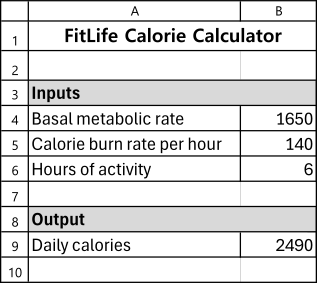
The spreadsheet below has been used to calculate Jamal's daily calorie requirements when he has had 6 hours of activity.
  

  1. Write down the formula used in cell B9, using appropriate grid references.   (1 mark)

    --- 2 WORK AREA LINES (style=lined) ---

  2. Jamal increases his hours of activity to 8 hours per day, while his basal metabolic rate and calorie burn rate remain the same.

    What will be Jamal's new daily calorie requirement?   (1 mark)

    --- 4 WORK AREA LINES (style=lined) ---

Show Answers Only

a.    \(=\text{B4}+ \text{B5} \ ^* \ \text{B6}\)

b.    \(2770\ \text{calories}\)

Show Worked Solution

a.   \(=\text{B4}+ \text{B5} \ ^* \ \text{B6}\)

b.    \(\text{Daily calories}=1650+140\times 8=2770\)

\(\therefore\ \text{Jamal’s new daily calorie requirement is}\ 2770.\)

Filed Under: Applications of Linear Relationships, Applications of Linear Relationships Tagged With: Band 3, smc-6256-50-Spreadsheets, smc-6513-30-Other Linear Applications, smc-6513-50-Spreadsheets, syllabus-2027

Algebra, STD2 EQ-Bank 24

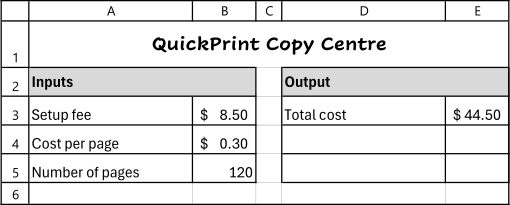
QuickPrint Copy Centre charges for printing services using the formula below.

Total cost = Setup fee + Cost per page \( \times \) Number of pages

A spreadsheet used to calculate the total cost is shown.

  1. Write down the formula used in cell E3, using appropriate grid references.   (1 mark)

    --- 2 WORK AREA LINES (style=lined) ---

  2. QuickPrint increases their cost per page to \$0.42, but keeps the setup fee unchanged. Aisha needs to print 120 pages.

    How much more will Aisha pay compared to the original pricing shown in the spreadsheet?   (2 marks)

    --- 5 WORK AREA LINES (style=lined) ---

Show Answers Only

a.    \(=\text{B3}+ \text{B4} \ ^* \ \text{B5}\)

b.    \($14.40\)

Show Worked Solution

a.   \(=\text{B3}+ \text{B4} \ ^* \ \text{B5}\)
 

b.   \(\text{Original cost from spreadsheet}:\ $44.50\)

\(\text{At increased rate}:\)

\(\text{Total cost}\ =8.50+0.42\times 120=$58.90\)

\(\text{Additional amount}\ =58.90-44.50=$14.40\)

Filed Under: Applications of Linear Relationships, Applications of Linear Relationships Tagged With: Band 3, Band 4, smc-6256-30-Other Linear Applications, smc-6256-50-Spreadsheets, smc-6513-30-Other Linear Applications, smc-6513-50-Spreadsheets, syllabus-2027

Algebra, STD2 EQ-Bank 23

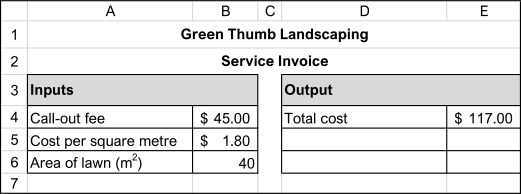
Green Thumb Landscaping charges for their lawn mowing service based on the size of the lawn.

They use the formula below to calculate the cost of each service.

Total cost = Call-out fee + Cost per square metre \( \times \) Area of lawn

The spreadsheet they provide to their clients is included below.

  1. Write down the formula that has been used in cell E4, using appropriate grid references.   (1 mark)

    --- 2 WORK AREA LINES (style=lined) ---

  2. Miguel has a lawn with a different area. The call-out fee and cost per square metre remain the same. When Miguel's lawn area is entered into the spreadsheet, the total cost shown in cell E4 becomes \$153.00.

    What is the area of Miguel's lawn?   (2 marks)

    --- 5 WORK AREA LINES (style=lined) ---

Show Answers Only

a.    \(=\text{B4}+ \text{B5} \ ^* \ \text{B6}\)

b.    \(\text{60 m}^2\)

Show Worked Solution

a.    \(=\text{B4}+ \text{B5} \ ^* \ \text{B6}\)
 

b.     \(153\) \(=45+1.8A\)
  \(108\) \(=1.8A\)
  \(A\) \(=\dfrac{108}{1.8}=60\)

 
\(\therefore\ \text{The area of Miguel’s lawn is 60 m}^2.\)

Filed Under: Applications of Linear Relationships, Applications of Linear Relationships Tagged With: Band 3, Band 4, smc-6256-30-Other Linear Applications, smc-6256-50-Spreadsheets, smc-6513-30-Other Linear Applications, smc-6513-50-Spreadsheets, syllabus-2027

Algebra, STD2 EQ-Bank 17

It is known that a quantity \(N\) varies directly with another quantity \(Q\).

The relationship can be modelled by the equation  \(N= k \times Q\), where \(k\) is a constant.

If \(N = 18\)  when  \(Q=4:\)

  1. Show the value of  \(k=4.5\).   (1 mark)

    --- 2 WORK AREA LINES (style=lined) ---

  2. Hence find the value of \(Q\) when  \(N=63\).  (1 mark)

    --- 3 WORK AREA LINES (style=lined) ---

Show Answers Only

a.    \(\text{Using}\ \ N=k \times Q:\)

\(18= k \times 4\ \ \Rightarrow\ \ k=\dfrac{18}{4}=4.5\)

b.    \(Q=14\)

Show Worked Solution

a.    \(\text{Using}\ \ N=k \times Q:\)

\(18= k \times 4\ \ \Rightarrow\ \ k=\dfrac{18}{4}=4.5\)
 

b.    \(\text{Find}\ Q\ \text{when}\ \ N=63:\)

\(63\) \(=4.5 \times Q\)  
\(Q\) \(=\dfrac{63}{4.5}=14\)  

Filed Under: Direct Variation, Direct Variation Tagged With: Band 3, smc-6249-10-Find k, smc-6249-20-Algebraic, smc-6514-10-Find k, smc-6514-20-Algebraic

Polynomials, EXT1 EQ-Bank 16

The polynomial  \(R(x)=x^3+p x^2+q x+6\)  has a double zero at  \(x=-1\)  and a zero at  \(x=s\).

Find the values of \(p, q\) and \(s\).   (3 marks)

--- 10 WORK AREA LINES (style=lined) ---

Show Answers Only

\(s=-6, \ p=8, \ q=13\)

Show Worked Solution

\(R(x)=x^3+p x^2+q x+6\)

\(R(x)\ \text{is monic with a zero at} \ s \ \text{and double zero at}\ -1:\)

\(R(x)\) \(=(x+1)^2(x-s)\)
  \(=\left(x^2+2 x+1\right)(x-s)\)
  \(=x^3+2 x^2+x-s x^2-2 s x-s\)
  \(=x^3+(2-s) x^2+(1-2 s) x-s\)


\(\text{Equating coefficients:}\)

\(-s=6 \ \Rightarrow \ s=-6\)

\(p=2-(-6)=8\)

\(q=1-2(-6)=13\)

Filed Under: Graphs of Polynomials Tagged With: Band 3, smc-6742-20-Degree/Coefficients, smc-6742-25-Multiplicity of Zeroes, syllabus-2027

Polynomials, EXT1 EQ-Bank 19

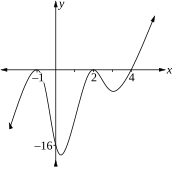
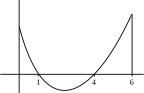
A polynomial has the equation

\(Q(x)=(x+1)^2(x-2)\left(x^2+2 x-8\right)\)

  1. Express  \(Q(x)\)  as a product of linear factors and determine the multiplicity of each of its roots.   (2 marks)

    --- 6 WORK AREA LINES (style=lined) ---

  2. Hence, without using calculus, draw a sketch of \(y=Q(x)\), showing all  \(x\)-intercepts.   (2 marks)

    --- 12 WORK AREA LINES (style=lined) ---

Show Answers Only

a.    \(Q(x) = (x+1)^2(x-2)\left(x^2+2 x-8\right) \)

\(\text{Roots:}\)

\(x=-1 \ \ \text{(multiplicity 2)}\)

\(x=2 \ \ \text{(multiplicity 2)}\)

\(x=4 \ \ \text{(multiplicity 1)}\)
 

b.

Show Worked Solution
a.     \(Q(x)\) \(=(x+1)^2(x-2)\left(x^2+2 x-8\right)\)
    \(=(x+1)^2(x-2)(x-2)(x+4)\)
    \(=(x+1)^2(x-2)^2(x-4)\)


\(\text{Roots:}\)

\(x=-1 \ \ \text{(multiplicity 2)}\)

\(x=2 \ \ \text{(multiplicity 2)}\)

\(x=4 \ \ \text{(multiplicity 1)}\)
 

b.    \(Q(x) \ \text{degree}=5, \ \text{Leading coefficient}=1\)

\(\text{As} \ \ x \rightarrow-\infty, y \rightarrow-\infty\)

\(\text{As} \ \ x \rightarrow \infty, y \rightarrow \infty\)

\(\text{At}\ \ x=0, \ y=1^2 \times (-2)^2 \times -4 = -16\)

Filed Under: Graphs of Polynomials Tagged With: Band 3, Band 4, smc-6742-25-Multiplicity of Zeroes, smc-6742-40-Sketch Graphs, syllabus-2027

Polynomials, EXT1 EQ-Bank 11

A polynomial \(f(x)\) is defined by

\(f(x)=-3x^3+27x^2+12x-1\)

Explain what happens to \(f(x)\) as  \(x \rightarrow-\infty\).   (2 marks)

--- 5 WORK AREA LINES (style=lined) ---

Show Answers Only

\(\text{Since}\ f(x) \ \text{has degree 3:}\)

\(\text{As} \ \ x \rightarrow-\infty, x^3 \rightarrow-\infty\)

\(f(x) \ \text{has leading coefficient}=-3\)

\(\therefore\ \text{As} \ \ x \rightarrow-\infty,-3 x^3 \rightarrow \infty, \ f(x) \rightarrow \infty\)

Show Worked Solution

\(\text{Since}\ f(x) \ \text{has degree 3:}\)

\(\text{As} \ \ x \rightarrow-\infty, x^3 \rightarrow-\infty\)

\(f(x) \ \text{has leading coefficient}=-3\)

\(\therefore\ \text{As} \ \ x \rightarrow-\infty,-3 x^3 \rightarrow \infty, \ f(x) \rightarrow \infty\)

Filed Under: Graphs of Polynomials Tagged With: Band 3, smc-6742-30-\(x \rightarrow \pm \infty\), syllabus-2027

Polynomials, EXT1 EQ-Bank 15

Consider a polynomial  \(y=(x+3)^2(2-x) \cdot Q(x)\)

where  \(Q(x)=6-x-x^2\)

Explain what happens to \(y\) as  \(x \rightarrow-\infty\).   (2 marks)

--- 5 WORK AREA LINES (style=lined) ---

Show Answers Only
\(y\) \(=(x+3)^2(2-x)\left(6-x-x^2\right)\)
  \(=(x+3)^2(2-x)(x+3)(2-x)\)
  \(=(x+3)^3(2-x)^2\)


\(\text{Degree\(=5\), Leading co-efficient\(=1\)}\)

\(\therefore \text{As} \ \ x \rightarrow-\infty, x^5 \rightarrow-\infty, y \rightarrow-\infty\)

Show Worked Solution
\(y\) \(=(x+3)^2(2-x)\left(6-x-x^2\right)\)
  \(=(x+3)^2(2-x)(x+3)(2-x)\)
  \(=(x+3)^3(2-x)^2\)


\(\text{Degree\(=5\), Leading co-efficient\(=1\)}\)

\(\therefore \text{As} \ \ x \rightarrow-\infty, x^5 \rightarrow-\infty, y \rightarrow-\infty\)

Filed Under: Graphs of Polynomials Tagged With: Band 3, smc-6742-30-\(x \rightarrow \pm \infty\), syllabus-2027

Polynomials, EXT1 EQ-Bank 18

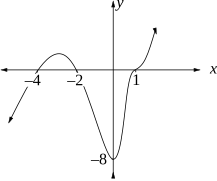
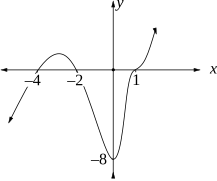
Consider the function  \(P(x)=(x-1)^2(x+2)\left(x^2+3 x-4\right)\)

  1. By expressing \(P(x)\) as a product of its linear factors, identify its zeroes and the multiplicity of each zero.   (2 marks)

    --- 6 WORK AREA LINES (style=lined) ---

  2. Without using calculus, draw a sketch of  \(y=P(x)\)  showing any \(x\)-intercepts.   (2 marks)

    --- 8 WORK AREA LINES (style=lined) ---

Show Answers Only

a.    \(P(x)=(x-1)^3(x+2)(x+4)\)

\(\text{Roots:}\)

\(x=-2 \ \ \text{(multiplicity 1)}\)

\(x=-4 \ \ \text{(multiplicity 1)}\)

\(x=1 \ \ \text{(multiplicity 3)}\)
 

b.  

Show Worked Solution
a.     \(P(x)\) \(=(x-1)^2(x+2)\left(x^2+3 x-4\right)\)
    \(=(x-1)^2(x+2)(x-1)(x+4)\)
    \(=(x-1)^3(x+2)(x+4)\)

 
\(\text{Roots:}\)

\(x=-2 \ \ \text{(multiplicity 1)}\)

\(x=-4 \ \ \text{(multiplicity 1)}\)

\(x=1 \ \ \text{(multiplicity 3)}\)
 

b.    \(\text{Degree} \ P(x)=5, \ \ \text {Leading coefficient }=1\)

\(\text{As} \ \ x \rightarrow \infty, \ y \rightarrow \infty\)

\(\text{As} \ \ x \rightarrow -\infty, \ y \rightarrow -\infty\)

\(\text{At} \ \ x=0, y=-8\)
 

Filed Under: Graphs of Polynomials Tagged With: Band 3, Band 4, smc-6742-25-Multiplicity of Zeroes, smc-6742-40-Sketch Graphs, syllabus-2027

HMS, TIP 2025 HSC 31aii

How can an athlete ensure their training procedures are safe? In your answer, refer to ONE training method.  ( 5 marks)

--- 15 WORK AREA LINES (style=lined) ---

Show Answers Only

Training Method: Plyometrics

  • Athletes must complete comprehensive warm-ups before plyometric sessions. This occurs because muscles and connective tissues require increased temperature and blood flow before explosive movements to prevent strain injuries.
  • For example, performing 10 minutes of dynamic stretching and light jogging prepares joints for impact forces. This reduces injury risk during box jumps and depth jumps.
  • Proper landing technique ensures safety during plyometric exercises. This happens when athletes maintain correct body positioning with bent knees and controlled movements, which prevents excessive joint stress.
  • Progressive overload principles must be applied carefully. This means gradually increasing jump height and repetitions over weeks, allowing tissues to adapt without overuse injuries.
  • Training on appropriate surfaces like gym mats or grass protects joints from impact forces. Consequently, athletes avoid stress fractures and tendon damage during high-intensity explosive training.
Show Worked Solution

Training Method: Plyometrics

  • Athletes must complete comprehensive warm-ups before plyometric sessions. This occurs because muscles and connective tissues require increased temperature and blood flow before explosive movements to prevent strain injuries.
  • For example, performing 10 minutes of dynamic stretching and light jogging prepares joints for impact forces. This reduces injury risk during box jumps and depth jumps.
  • Proper landing technique ensures safety during plyometric exercises. This happens when athletes maintain correct body positioning with bent knees and controlled movements, which prevents excessive joint stress.
  • Progressive overload principles must be applied carefully. This means gradually increasing jump height and repetitions over weeks, allowing tissues to adapt without overuse injuries.
  • Training on appropriate surfaces like gym mats or grass protects joints from impact forces. Consequently, athletes avoid stress fractures and tendon damage during high-intensity explosive training.

Filed Under: Principles of training Tagged With: Band 3, Band 4, smc-5460-20-Sessions

Polynomials, EXT1 EQ-Bank 3 MC

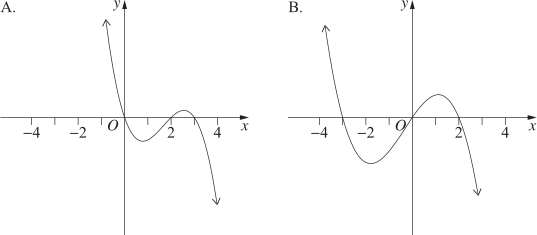
Which of the following best represents the graph of  \(y=-5 x(x-2)(3-x)\)?
 

Show Answers Only

\(C\)

Show Worked Solution

\(\text{By elimination:}\)

\(\text{Degree = 3,  Leading co-efficient}\ = 5\)

\(\text{As}\ \ x \rightarrow \infty,\ \ y \rightarrow \infty\ \text{(eliminate A and B)}\)

\(\text{When}\ x=1:\)

\(y=-5(-1)(2)=10>0\ \ \text{(eliminate D)}\)

\(\Rightarrow C\)

Filed Under: Graphs of Polynomials Tagged With: Band 3, smc-6742-10-Identify Graphs, syllabus-2027

Polynomials, EXT1 EQ-Bank 14

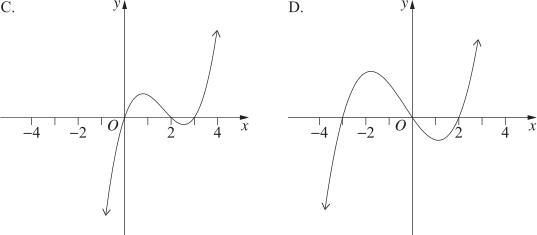
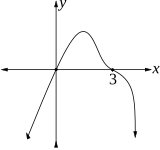
Consider the polynomial \(P(x)=x(3-x)^3\).

  1. State the degree of the polynomial and identify the leading coefficient.   (1 mark)

    --- 2 WORK AREA LINES (style=lined) ---

  2. Explain what happens to \(y\) as  \(x \rightarrow \pm \infty\).   (1 mark)

    --- 2 WORK AREA LINES (style=lined) ---

  3. Without using calculus, sketch \(P(x)\) showing its general form and any \(x\)-intercepts.   (2 marks)

    --- 6 WORK AREA LINES (style=lined) ---

Show Answers Only

a.    \(\text{Degree}\ P(x)=4\)

\(\text{Leading co-efficient}=-1\)
 

b.    \(\text{As} \ \ x \rightarrow-\infty,-x^4 \rightarrow-\infty, \ y \rightarrow-\infty\).

\(\text{As} \ \ x \rightarrow \infty,-x^4 \rightarrow-\infty, \ y \rightarrow-\infty\).
 

c.    \(P(x)\ \text{has zeroes at}\ \ x=0, 3:\)


Show Worked Solution

a.    \(\text{Degree}\ P(x)=4\)

\(\text{Leading co-efficient}=-1\)
 

b.    \(\text{As} \ \ x \rightarrow-\infty,-x^4 \rightarrow-\infty, \ y \rightarrow-\infty\).

\(\text{As} \ \ x \rightarrow \infty,-x^4 \rightarrow-\infty, \ y \rightarrow-\infty\).
 

c.    \(P(x)\ \text{has zeroes at}\ \ x=0, 3:\)


Filed Under: Graphs of Polynomials Tagged With: Band 3, smc-6742-20-Degree/Coefficients, smc-6742-30-\(x \rightarrow \pm \infty\), smc-6742-40-Sketch Graphs, syllabus-2027

Polynomials, EXT1 EQ-Bank 12

Consider a polynomial  \(y=-2 x^5-26 x^4-x+1\).

With reference to the leading term, explain what happens to \(y\) as  \(x \rightarrow-\infty\).   (2 marks)

--- 5 WORK AREA LINES (style=lined) ---

Show Answers Only

\(\text{As}\ \ x \rightarrow-\infty,\ \ x^{5}\ \rightarrow-\infty\)

\(\text{Since the leading coefficient \((-2)\) is negative:}\)

\(\text{As}\ \ x \rightarrow-\infty,\ \ y \rightarrow \infty.\)

Show Worked Solution

\(\text{As}\ \ x \rightarrow-\infty,\ \ x^{5}\ \rightarrow-\infty\)

\(\text{Since the leading coefficient \((-2)\) is negative:}\)

\(\text{As}\ \ x \rightarrow-\infty,\ \ y \rightarrow \infty.\)

Filed Under: Graphs of Polynomials Tagged With: Band 3, smc-6742-30-\(x \rightarrow \pm \infty\), syllabus-2027

Polynomials, EXT1 EQ-Bank 20

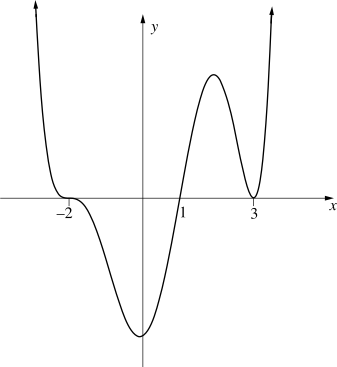
A polynomial has the equation

\(P(x)=(x-1)(x-3)(x+2)^2\left(x^2-x-6\right)\).

  1. By expressing \(P(x)\) as a product of its linear factors, determine the multiplicity of each of the roots of  \(P(x)=0\).   (2 marks)

    --- 5 WORK AREA LINES (style=lined) ---

  2. Hence, without using calculus, draw a sketch of  \(y=P(x)\)  showing all \(x\)-intercepts.   (2 marks)

    --- 12 WORK AREA LINES (style=blank) ---

Show Answers Only
a.     \(P(x)\) \(=(x-1)(x-3)(x+2)^2\left(x^2-x-6\right)\)
    \(=(x-1)(x-3)(x+2)^2(x-3)(x+2)\)
    \(=(x-1)(x-3)^2(x+2)^3\)


\(\text{Roots:}\)

\(x=1\ \text{(multiplicity 1)}\)

\(x=-2\ \text{(multiplicity 3)}\)

\(x=3\ \text{(multiplicity 2)}\)
 

b.
     

Show Worked Solution
a.     \(P(x)\) \(=(x-1)(x-3)(x+2)^2\left(x^2-x-6\right)\)
    \(=(x-1)(x-3)(x+2)^2(x-3)(x+2)\)
    \(=(x-1)(x-3)^2(x+2)^3\)


\(\text{Roots:}\)

\(x=1\ \text{(multiplicity 1)}\)

\(x=-2\ \text{(multiplicity 3)}\)

\(x=3\ \text{(multiplicity 2)}\)
 

b.
     

Filed Under: Graphs of Polynomials Tagged With: Band 3, Band 4, smc-6742-25-Multiplicity of Zeroes, smc-6742-40-Sketch Graphs, syllabus-2027

Functions, EXT1 EQ-Bank 18

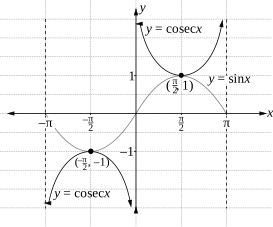
Consider the function  \(y=\operatorname{cosec}\,x\)  for  \(-\pi \leqslant x \leqslant \pi\).

  1. State the equations of all vertical asymptotes in the given domain.   (1 mark)

    --- 3 WORK AREA LINES (style=lined) ---

  2. Sketch the graph of  \(y=\operatorname{cosec} x\), showing all key features.   (2 marks)

    --- 0 WORK AREA LINES (style=lined) ---


Show Answers Only

a.    \(y=\operatorname{cosec}\,x=\dfrac{1}{\sin x}\)

\(\text{Asymptotes when \(\ \sin x=0 \ \) in given domain.}\)

\(\therefore \ \text{Asymptotes at} \ \ x=-\pi, 0, \pi\)
 

b.
       

Show Worked Solution

a.    \(y=\operatorname{cosec}\,x=\dfrac{1}{\sin x}\)

\(\text{Asymptotes when \(\ \sin x=0 \ \) in given domain.}\)

\(\therefore \ \text{Asymptotes at} \ \ x=-\pi, 0, \pi\)
 

b.
       

Filed Under: Graphical Relationships Tagged With: Band 3, Band 4, smc-6640-15-cosec/sec/cot, syllabus-2027

Functions, EXT1 EQ-Bank 17

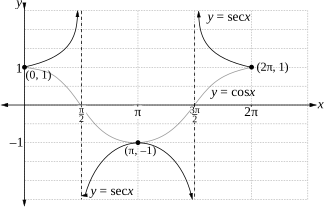
  1. Sketch the graph of  \(y=\sec x\)  for  \(0 \leqslant x \leqslant 2 \pi\).
  2. In your answer, identify all asymptotes and the coordinates of any maximum and minimum turning points.   (2 marks)

    --- 0 WORK AREA LINES (style=lined) ---


  3. Using set notation, state the domain and range of  \(y=\sec x\).   (1 mark)

    --- 2 WORK AREA LINES (style=lined) ---

Show Answers Only

a.
   

b.    \(\text{Domain:} \ x \in\left[0, \frac{\pi}{2}\right) \cup\left(\frac{\pi}{2}, \frac{3 \pi}{2}\right) \cup\left(\frac{3 \pi}{2}, 2 \pi\right]\)

\(\text{Range:} \ y \in(-\infty,-1] \cup[1, \infty)\)

Show Worked Solution

a.    \(\text{Draw}\ \ y=\cos\,x\ \ \text{to inform graph:}\)


\(\text{Minimum TPs:}\ (0,1), (2\pi, 1) \)

\(\text{Maximum TP:}\ (\pi, -1)\)
 

b.    \(\text{Domain:} \ x \in\left[0, \frac{\pi}{2}\right) \cup\left(\frac{\pi}{2}, \frac{3 \pi}{2}\right) \cup\left(\frac{3 \pi}{2}, 2 \pi\right]\)

\(\text{Range:} \ y \in(-\infty,-1] \cup[1, \infty)\)

Filed Under: Graphical Relationships Tagged With: Band 3, Band 4, smc-6640-15-cosec/sec/cot, syllabus-2027

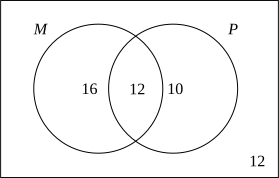
Probability, 2ADV EQ-Bank 18

A survey of 50 students found that:

  • 28 students study Mathematics (set \(M\))
  • 22 students study Physics (set \(P\) )
  • 12 students study both Mathematics and Physics.
  1. How many students study Mathematics or Physics, or both?   (1 mark)

    --- 5 WORK AREA LINES (style=lined) ---

  2. If two students are chosen at random, what is the probability that both DO NOT study either Mathematics or Physics?   (2 marks)

    --- 5 WORK AREA LINES (style=lined) ---

Show Answers Only

a.
     

\(n(M \cup P)=38 \ \text {students}\)
 

b.    \(\dfrac{66}{1225}\)

Show Worked Solution

a.
     

\(n(M \cup P)=38 \ \text {students}\)
 

b.    \(P(M \cup P)=\dfrac{38}{50}\)

\(\text{Student 1:}\ P(\overline{M \cup P})=1-\dfrac{38}{50}=\dfrac{12}{50}\)

\(\text{Student 2:} \ P(\overline{M \cup P})=\dfrac{11}{49}\)

\(\therefore P\left(\text{Both study neither }\right)=\dfrac{12}{50} \times \dfrac{11}{49}=\dfrac{66}{1225}\)

Filed Under: Conditional Probability and Venn Diagrams Tagged With: Band 3, Band 4, smc-6470-05-Sets/Set Notation, smc-6470-20-Venn Diagrams

Probability, 2ADV EQ-Bank 17

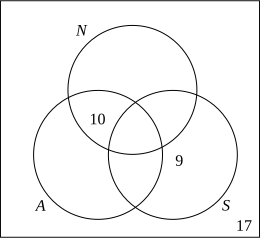
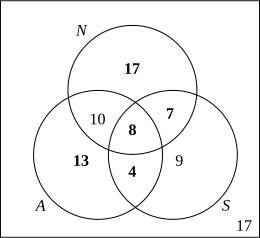
A survey of 85 households asked if they subscribed to the streaming services provided by Netflix (set \(N\)), Apple TV (set \(A\)), and Stan (set \(S\)).

The survey found that 17 households had no subscription and that \(n(N)=42, n(A)=35, n(S)=28\).

The survey also found

\(n(N \cap A)=18, n(N \cap S)=15, n(A \cap S)=12\)  and  \(n(N \cap A \cap S)=8\)

  1. Complete the Venn diagram below to accurately describe the information given.   (2 marks)

    --- 0 WORK AREA LINES (style=lined) ---


  2. A household is chosen randomly and is found to subscribe to Apple TV. What is the probability the household also subscribes to Stan?   (2 marks)

    --- 2 WORK AREA LINES (style=lined) ---

Show Answers Only

a.


b.    \(P(S \mid A)=\dfrac{12}{35}\)

Show Worked Solution

a.


b.    \(n(A)=35, n(A \cap S)=12\)

\(P(S \mid A)=\dfrac{n(A \cap S)}{n(A)}=\dfrac{12}{35}\)

Filed Under: Conditional Probability and Venn Diagrams Tagged With: Band 3, Band 4, smc-6470-05-Sets/Set Notation, smc-6470-10-Conditional Prob Formula

Probability, 2ADV EQ-Bank 13

Consider the universal set  \(U=\{x\) is a positive integer and  \(x \leqslant 24\}\)

Three sets are defined as

\begin{aligned}
& A=\{x \text { is a factor of } 24\} \\
& B=\{x \text { is a perfect square}\} \\
& C=\{x \text { is divisible by } 3\}
\end{aligned}

  1. List the elements of set \(A\).   (1 mark)

    --- 1 WORK AREA LINES (style=lined) ---

  2. Find \(A \cap B\).   (1 mark)

    --- 2 WORK AREA LINES (style=lined) ---

  3. Find \((A \cup B) \cap C^c\)   (2 marks)

    --- 5 WORK AREA LINES (style=lined) ---

Show Answers Only

a.    \(A=\{1,2,3,4,6,8,12,24\}\)

b.    \(A \cap B=\{1,4\}\)

c.    \((A \cup B) \cap C^c=\{1,2,4,8,16\}\)

Show Worked Solution

a.    \(A=\{1,2,3,4,6,8,12,24\}\)
 

b.    \(B=\{1,4,9,16\}\)

\(A \cap B=\{1,4\}\)
 

c.    \(A \cup B=\{1,2,3,4,6,8,9,12,16,24\}\)

\(C=\{3,6,9,12,15,18,21,24\}\)

\(C^c=\{1,2,4,5,7,8,10,11,13,14,16,17,19,20,22,23\}\)

\((A \cup B) \cap C^c=\{1,2,4,8,16\}\)

Filed Under: Conditional Probability and Venn Diagrams Tagged With: Band 2, Band 3, smc-6470-05-Sets/Set Notation, syllabus-2027

Probability, 2ADV EQ-Bank 12

Consider the universal set  \(U=\{x\) is a positive integer and \(x \leqslant 15\}\)

Three sets are defined as:

\begin{aligned}
& A=\{x \text { is a multiple of } 3\} \\
& B=\{x \text{ is a prime number}\} \\
& C=\{x \text{ is even}\}
\end{aligned}

  1. List the elements of set \(A\).   (1 mark)

    --- 1 WORK AREA LINES (style=lined) ---

  2.  Find  \(B \cap C\)   (1 mark)

    --- 3 WORK AREA LINES (style=lined) ---

  3. Find  \(A \cup \overline{C}\)   (2 marks)

    --- 4 WORK AREA LINES (style=lined) ---

Show Answers Only

a.    \(A=\{3,6,9,12,15\}\)

b.   \(B \cap C = \{2\} \)

c.    \(A \cup \overline{C}=\{1,3,5,6,7,9,11,12,13,15\}\)

Show Worked Solution

a.    \(A=\{3,6,9,12,15\}\)
 

b.    \(B=\{2,3,5,7,11,13\}\)

\(C=\{2,4,6,8,10,12,14\}\)

\(B \cap C = \{2\} \)
 

c.    \(\text{Find} \ \ A \cup \overline{C}:\)

\(\overline{C}=\{1,3,5,7,9,11,13\}\)

\(A \cup \overline{C}=\{1,3,5,6,7,9,11,12,13,15\}\)

Filed Under: Conditional Probability and Venn Diagrams Tagged With: Band 2, Band 3, smc-6470-05-Sets/Set Notation, syllabus-2027

Probability, 2ADV EQ-Bank 11

Consider the universal set  \(U=\{1,2,3,4,5,6,7,8,9,10\}\).

Two sets, \(A\) and \(B\), are given as

\(A= \{1,3,4,7,9\}\)

\(B =\{2,4,7,10\}\)

  1. Find \(A \cup B\)   (1 mark)

    --- 2 WORK AREA LINES (style=lined) ---

  2. Find \(A \cap \overline{B}\)   (2 marks)

    --- 4 WORK AREA LINES (style=lined) ---

Show Answers Only

a.    \(A \cup B = \{1,2,3,4,7,9,10\}\)

b.    \(A \cap \overline{B} = \{3, 4, 9\}\)

Show Worked Solution

a.    \(A= \{1,3,4,7,9\},\ \ B=\{2,4,7,10\}\)

\(A \cup B = \{1,2,3,4,7,9,10\}\)
 

b.     \(\overline{B} = \{1,3,5,6,8,9\}\)

\(A \cap \overline{B} = \{3, 4, 9\}\)

Filed Under: Conditional Probability and Venn Diagrams Tagged With: Band 2, Band 3, smc-6470-05-Sets/Set Notation, syllabus-2027

Trigonometry, 2ADV EQ-Bank 11

Prove the identity \(1+\tan ^2 \theta=\sec ^2 \theta\).   (2 marks)

--- 6 WORK AREA LINES (style=lined) ---

Show Answers Only
\(\text{LHS}\) \(=1+\tan ^2 \theta\)
  \(=1+\dfrac{\sin ^2 \theta}{\cos ^2 \theta}\)
  \(=\dfrac{\cos ^2 \theta+\sin ^2 \theta}{\cos ^2 \theta}\)
  \(=\dfrac{1}{\cos ^2 \theta}\)
  \(=\sec ^2 \theta\)
Show Worked Solution

\(\text{Prove}\ \ 1+\tan ^2 \theta=\sec ^2 \theta\)

\(\text{LHS}\) \(=1+\tan ^2 \theta\)
  \(=1+\dfrac{\sin ^2 \theta}{\cos ^2 \theta}\)
  \(=\dfrac{\cos ^2 \theta+\sin ^2 \theta}{\cos ^2 \theta}\)
  \(=\dfrac{1}{\cos ^2 \theta}\)
  \(=\sec ^2 \theta\)

Filed Under: Trig Identities and Harder Equations Tagged With: Band 3, smc-6412-20-Prove Identity

Calculus, 2ADV C1 EQ-Bank 14

A drone travels vertically from its launch pad.

It's height above ground, \(h\) metres, at time \(t\) minutes is modelled by

\(h(t)=-0.2 t^3+3 t^2+5 t\)  for  \(0 \leq t \leq 12\)

  1. Find the velocity of the drone at time \(t\) minutes.   (1 mark)

    --- 3 WORK AREA LINES (style=lined) ---

  2. Determine the exact time interval during which the drone is descending.   (2 marks)

    --- 8 WORK AREA LINES (style=lined) ---

Show Answers Only

a.    \(\dfrac{dh}{dt}=-0.6 t^2+6 t+5\)

b.    \(\dfrac{15+10 \sqrt{3}}{3}<t \leqslant 12\)

Show Worked Solution

a.    \(h=-0.2 t^3+3 t^2+5 t\)

\(\text{Velocity of the drone}=\dfrac{d h}{d t}.\)

\(\dfrac{dh}{dt}=-0.6 t^2+6 t+5\)
 

b.    \(\text{Drone is descending when} \ \ \dfrac{dh}{dt}<0:\)

\(-0.6 t^2+6 t+5\) \(<0\)  
\(0.6 t^2-6 t-5\) \(>0\)  
\(6 t^2-60 t-50\) \(>0\)  

 
\(\text{Solve}\ \ 6 t^2-60 t-50=0:\)

\(t=\dfrac{60 \pm \sqrt{(-60)^2+4 \times 6 \times 50}}{2 \times 6}=\dfrac{60 \pm \sqrt{4800}}{12}=\dfrac{15 \pm 10 \sqrt{3}}{3}\)

 
\(\text{Since parabola is concave up:}\)

\(6 t^2-60 t-50>0\ \ \text{when}\ \ t>\dfrac{15+10 \sqrt{3}}{3} \quad\left( t=\dfrac{15-10 \sqrt{3}}{3}<0\right)\)

\(\therefore \text{Drone is descending for} \ \ \dfrac{15+10 \sqrt{3}}{3}<t \leqslant 12\)

Filed Under: Rates of Change Tagged With: Band 3, Band 4, smc-6438-10-Motion, smc-6438-18-Other Rate Problems

Calculus, 2ADV C1 EQ-Bank 18

The volume of water in a tank, \(V\) litres, at time \(t\) minutes is given by:

\(V(t)=2 t^3-15 t^2+24 t+50\)  for  \(0 \leqslant t \leqslant 6\)

  1. Find an expression for the rate at which water is flowing at time \(t\).   (1 mark)

    --- 2 WORK AREA LINES (style=lined) ---

  2. Calculate the rate of flow at  \(t=4\)  minutes and interpret this value.   (1 mark)

    --- 3 WORK AREA LINES (style=lined) ---

  3. Deduce when the water level in the tank is increasing.   (2 marks)

    --- 8 WORK AREA LINES (style=lined) ---

Show Answers Only

a.    \(\dfrac{dV}{d t}=6 t^2-30 t+24\)
 

b.    \(\text{At} \ \ t=4:\ \ \dfrac{dV}{d t}=0 \ \text{litres/minute}\)

\(\text{Interpretation: At \(\ t=4 \ \), water has stopped flowing either into or}\)

\(\text{out of the tank.}\)
 

c.    \(\text{If water level is increasing} \ \Rightarrow \ \dfrac{dV}{d t}>0:\)

\(\text {Find \(t\) when}\ \dfrac{dV}{d t}>0:\)

\(6 t^2-30t+24\) \(\gt 0\)  
\(6\left(t^2-5 t+4\right)\) \(\gt 0\)  
\((t-4)(t-1)\) \(\gt 0\)  


\(\therefore \ \text{Water level increases for}\ \ t \in [0,1) \cup (4, 6]\)

Show Worked Solution

a.    \(V=2 t^3-15 t^2+24 t+50\)

\(\dfrac{dV}{d t}=6 t^2-30 t+24\)
 

b.    \(\text{At} \ \ t=4:\)

\(\dfrac{dV}{d t}=6 \times 4^2-30 \times 4+24=0 \ \text{litres/minute}\)

\(\text{Interpretation: At \(\ t=4 \ \), water has stopped flowing either into or}\)

\(\text{out of the tank.}\)
 

c.    \(\text{If water level is increasing} \ \Rightarrow \ \dfrac{dV}{d t}>0:\)

\(\text {Find \(t\) when}\ \dfrac{dV}{d t}>0:\)

\(6 t^2-30t+24\) \(\gt 0\)  
\(6\left(t^2-5 t+4\right)\) \(\gt 0\)  
\((t-4)(t-1)\) \(\gt 0\)  


\(\therefore \ \text{Water level increases for}\ \ t \in [0,1) \cup (4, 6]\)

Filed Under: Rates of Change Tagged With: Band 3, Band 4, smc-6438-15-Flow Problems

Functions, 2ADV EQ-Bank 21

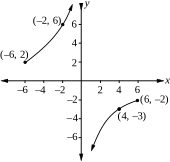
Consider the function  \(g(x)=-\dfrac{12}{x}\)

  1. Is \(g(x)\) an odd or even function? Give reason(s) for your answer.   (2 marks)

    --- 6 WORK AREA LINES (style=lined) ---

  2. Sketch the graph \(y=g(x)\) in the domain \(-6 \leq x \leq 6\). Label the endpoints and two other points on the curve.   (2 marks)

    --- 10 WORK AREA LINES (style=blank) ---

Show Answers Only

a.    \(\text{If}\ g(x)\ \text{is odd}\ \ \Rightarrow \ \ g(-x)=-g(x)\)

\(-g(x)= \dfrac{12}{x}\)

\(g(-x) = -\dfrac{12}{(-x)} = \dfrac{12}{x} = -g(x)\)

\(\therefore g(x)\ \text{is odd (and cannot be even).}\)
 

b.    \(\text{Table of values:}\)

\begin{array}{|c|c|c|c|c|c|}
\hline \rule{0pt}{2.5ex}\ \ x \ \ \rule[-1ex]{0pt}{0pt}& -4 & -2 & \ \ 0 \ \ & 2 & 4 \\
\hline \rule{0pt}{2.5ex}y \rule[-1ex]{0pt}{0pt}& 3 & 6 & \infty & -6 & -3 \\
\hline
\end{array}

\(\text{Endpoints:}\ (-6,2), (6,-2) \)
 

Show Worked Solution

a.    \(\text{If}\ g(x)\ \text{is odd}\ \ \Rightarrow \ \ g(-x)=-g(x)\)

\(-g(x)= \dfrac{12}{x}\)

\(g(-x) = -\dfrac{12}{(-x)} = \dfrac{12}{x} = -g(x)\)

\(\therefore g(x)\ \text{is odd.}\)
 

b.    \(\text{Table of values:}\)

\begin{array}{|c|c|c|c|c|c|}
\hline \rule{0pt}{2.5ex}\ \ x \ \ \rule[-1ex]{0pt}{0pt}& -4 & -2 & \ \ 0 \ \ & 2 & 4 \\
\hline \rule{0pt}{2.5ex}y \rule[-1ex]{0pt}{0pt}& 3 & 6 & \infty & -6 & -3 \\
\hline
\end{array}

\(\text{Endpoints:}\ (-6,2), (6,-2) \)
 

Filed Under: Other Functions and Relations Tagged With: Band 3, Band 4, smc-6218-30-Reciprocal
Functions, 2ADV EQ-Bank 11

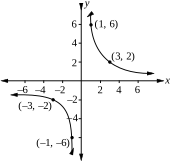
Consider the function  \(f(x)=\dfrac{6}{x}\).

  1. State the equation(s) of any asymptotes of \(f(x)\).   (1 mark)

    --- 3 WORK AREA LINES (style=lined) ---

  2. Complete the table of values of  \(y=f(x)\)  below.   (1 mark)

    --- 0 WORK AREA LINES (style=lined) ---

  3. \begin{array}{|c|c|c|c|c|c|c|}
    \hline \rule{0pt}{2.5ex} \ \ \ x \ \ \ \rule[-1ex]{0pt}{0pt}& -\ 3 \ &   & \quad 1 \quad & \ \ \ 3 \ \ \ \\
    \hline \rule{0pt}{2.5ex} y \rule[-1ex]{0pt}{0pt} &  & -6 &  & 2 \\
    \hline
    \end{array}
  4. Sketch the graph of  \(y=f(x)\), clearly showing any asymptote(s) and points from the table.   (2 marks)

    --- 10 WORK AREA LINES (style=lined) ---

Show Answers Only

a.    \(x=0, \ y=0\)

b.    \(\text{Table of values:}\)

\begin{array}{|c|c|c|c|c|c|c|}
\hline \rule{0pt}{2.5ex} \ \ \ x \ \ \ \rule[-1ex]{0pt}{0pt}& -\ 3 \ & \ -1 \ & \quad 1 \quad & \ \ \ 3 \ \ \ \\
\hline \rule{0pt}{2.5ex} y \rule[-1ex]{0pt}{0pt} & -2 & -6 & 6 & 2 \\
\hline
\end{array} 

c.   
         

Show Worked Solution

a.    \(y=\dfrac{6}{x} \ \Rightarrow \ x \neq 0\)

\(\text{Vertical asymptote at} \ \ x=0.\)

\(\text{As}\ x \rightarrow \infty, \ y \rightarrow 0^{+}\)

\(\text{As}\ x \rightarrow -\infty, \ y \rightarrow 0^{-}\)

\(\text{Horizontal asymptote at} \ \ y=0.\)
 

b.    \(\text{Table of values:}\)

\begin{array}{|c|c|c|c|c|c|c|}
\hline \rule{0pt}{2.5ex} \ \ \ x \ \ \ \rule[-1ex]{0pt}{0pt}& -\ 3 \ & \ -1 \ & \quad 1 \quad & \ \ \ 3 \ \ \ \\
\hline \rule{0pt}{2.5ex} y \rule[-1ex]{0pt}{0pt} & -2 & -6 & 6 & 2 \\
\hline
\end{array} 

c.   
         

Filed Under: Other Functions and Relations Tagged With: Band 2, Band 3, smc-6218-30-Reciprocal

HMS, TIP 2025 HSC 23

Describe the potential effects of caffeine on an athlete's performance.   (4 marks)
--- 10 WORK AREA LINES (style=lined) ---

Show Answers Only

Positive Effects

  • Enhanced Mental Function: Caffeine stimulates the central nervous system. This improves concentration, alertness and decision-making during competition.
  • Increased Endurance: Caffeine mobilises fat stores for energy use. This delays glycogen depletion, allowing athletes to sustain effort for longer periods.

Negative Effects

  • Overstimulation: Excessive caffeine consumption causes nervousness and tremors. This impairs fine motor control required in precision sports like archery or gymnastics.
  • Dehydration Risk: Caffeine acts as a diuretic, increasing fluid loss. This can lead to reduced performance in endurance events if hydration is inadequate.
Show Worked Solution

Positive Effects

  • Enhanced Mental Function: Caffeine stimulates the central nervous system. This improves concentration, alertness and decision-making during competition.
  • Increased Endurance: Caffeine mobilises fat stores for energy use. This delays glycogen depletion, allowing athletes to sustain effort for longer periods.

Negative Effects

  • Overstimulation: Excessive caffeine consumption causes nervousness and tremors. This impairs fine motor control required in precision sports like archery or gymnastics.
  • Dehydration Risk: Caffeine acts as a diuretic, increasing fluid loss. This can lead to reduced performance in endurance events if hydration is inadequate.

Filed Under: Supplementation and performance Tagged With: Band 3, smc-5468-20-Caffeine/creatine

Functions, 2ADV EQ-Bank 28

The cost of hiring an open space for a music festival is  $120 000. The cost will be shared equally by the people attending the festival, so that `C` (in dollars) is the cost per person when `n` people attend the festival.

  1. Complete the table below and draw the graph showing the relationship between `n` and `C`.   (2 marks)
    \begin{array} {|l|c|c|c|c|c|c|}
    \hline
    \rule{0pt}{2.5ex}\text{Number of people} (n) \rule[-1ex]{0pt}{0pt} & \ 500\ & \ 1000 \ & 1500 \ & 2000 \ & 2500\ & 3000 \ \\
    \hline
    \rule{0pt}{2.5ex}\text{Cost per person} (C)\rule[-1ex]{0pt}{0pt} &  &  &  & 60 & 48\ & 40 \ \\
    \hline
    \end{array}


  2. What equation represents the relationship between `n` and `C`?   (1 mark)

    --- 1 WORK AREA LINES (style=lined) ---

  3. Give ONE limitation of this equation in relation to this context.   (1 mark)

    --- 2 WORK AREA LINES (style=lined) ---

Show Answers Only

a.   

\begin{array} {|l|c|c|c|c|c|c|}
\hline
\rule{0pt}{2.5ex}\text{Number of people} (n) \rule[-1ex]{0pt}{0pt} & \ 500\ & \ 1000 \ & 1500 \ & 2000 \ & 2500\ & 3000 \ \\
\hline
\rule{0pt}{2.5ex}\text{Cost per person} (C)\rule[-1ex]{0pt}{0pt} & 240 & 120 & 80 & 60 & 48\ & 40 \ \\
\hline
\end{array}

b.   `C = (120\ 000)/n` 

c.   `text(Limitations can include:)`

  `•\ n\ text(must be a whole number)`

  `•\ C > 0`

Show Worked Solution

a.   

\begin{array} {|l|c|c|c|c|c|c|}
\hline
\rule{0pt}{2.5ex}\text{Number of people} (n) \rule[-1ex]{0pt}{0pt} & \ 500\ & \ 1000 \ & 1500 \ & 2000 \ & 2500\ & 3000 \ \\
\hline
\rule{0pt}{2.5ex}\text{Cost per person} (C)\rule[-1ex]{0pt}{0pt} & 240 & 120 & 80 & 60 & 48\ & 40 \ \\
\hline
\end{array}

b.   `C = (120\ 000)/n` 

c.   `text(Limitations can include:)`

  `•\ n\ text(must be a whole number)`

  `•\ C > 0`

Filed Under: Other Functions and Relations Tagged With: Band 3, Band 4, Band 5, smc-6218-30-Reciprocal

HMS, TIP 2025 HSC 17 MC

A basketball player has a competition game in the afternoon.

Which row of the table describes the appropriate dietary considerations of the athlete for this game?

\begin{align*}
\begin{array}{l}
\rule{0pt}{2.5ex} \ \rule[-1ex]{0pt}{0pt}& \\
\rule{0pt}{2.5ex} \textbf{A.}\rule[-1ex]{0pt}{0pt}\\
\textbf{}\\
\textbf{}\\
\textbf{}\\
\rule{0pt}{2.5ex} \textbf{B.}\\
\textbf{}\\
\textbf{}\\
\textbf{}\\
\rule{0pt}{2.5ex} \textbf{C.}\\
\textbf{}\\
\textbf{}\\
\textbf{}\\
\rule{0pt}{2.5ex} \textbf{D.}\\
\textbf{}\\
\textbf{}\\
\textbf{}\\\\
\end{array}
\begin{array}{|l|l|}
\hline
\rule{0pt}{2.5ex}Pre-performance \rule[-1ex]{0pt}{0pt}& During \ performance \rule[-1ex]{0pt}{0pt} & Post-performance \\
\hline
\rule{0pt}{2.5ex} \text{A meal high in} &\text{Water and a sports drink}  & \text{A meal high in} \\
\text{carbohydrates two to} &\text{}  & \text{carbohydrates and} \\
\text{three hours before the} &\text{}  & \text{protein within an hour}\\
\text{game } & {} & \text{of the game } \\
\hline
\rule{0pt}{2.5ex} \text{A meal high in fat and} & \text{Water and oranges }  & \text{A snack with protein} \\
\text{protein one hour before} & \text{} & \text{and fat immediately} \\
\text{the game } & \text{} & \text{after the game } \\
\hline
\rule{0pt}{2.5ex} \text{A light snack 30 minutes} & \text{Water and electrolyte}  & \text{A meal that contains} \\
\text{before the game} & \text{gel} & \text{protein and fat} \\
\text{} & \text{} & \text{immediately after the } \\
\text{} & \text{} & \text{game} \\
\hline
\rule{0pt}{2.5ex} \text{A large meal that is} & \text{Water and a protein bar}  & \text{A snack high in} \\
\text{high in protein one hour} & \text{} & \text{pcarbohydrates and} \\
\text{high in protein one hour} & \text{} & \text{protein within an hour} \\
\text{} & \text{} & \text{of the game} \\
\hline
\end{array}
\end{align*}

Show Answers Only

\(A\)

Show Worked Solution
  • A is correct: Carbohydrate-loading 2-3 hours before allows digestion; hydration during game; carbs and protein aid recovery

Other Options:

  • B is incorrect: High fat/protein pre-game slows digestion; oranges provide insufficient hydration; immediate fat delays recovery
  • C is incorrect: Light snack 30 minutes before provides inadequate energy; immediate protein/fat post-game delays glycogen restoration
  • D is incorrect: Large protein meal 1 hour before causes digestive discomfort; protein bar during game unnecessary

Filed Under: Dietary requirements and fluid intake, Sleep, nutrition and hydration Tagged With: Band 3, smc-5466-15-Timing, smc-5466-20-Fluids, smc-5467-15-Routines

HMS, HAG 2025 HSC 16 MC

Which of the following statements best reflects the impact of emerging new treatment and technologies on health care?

  1. Developments have increased efficiency, providing equal access to innovative treatments across all populations.
  2. There is increased use of primary services, but it has minimal influence on improving individual health outcomes.
  3. Early detection of a disease has the potential to improve health outcomes, but limited availability may restrict equitable access.
  4. Advancements have largely focused on enhancing elective procedures, which limits their contribution to improving overall delivery of services.
Show Answers Only

\(C\)

Show Worked Solution
  • C is correct: New technologies enable earlier disease detection improving outcomes; however, access inequities remain due to availability limitations

Other Options:

  • A is incorrect: Equal access claim is false; technology availability varies significantly across populations and regions
  • B is incorrect: New technologies demonstrably improve health outcomes through better diagnosis and treatment, not minimal influence
  • D is incorrect: Technologies benefit emergency and essential care, not just elective procedures

Filed Under: Impact of digital health, New technologies and treatments Tagged With: Band 3, smc-5485-35-Innovation benefits, smc-5485-40-Innovation challenges, smc-5486-10-Access equity

HMS, HIC 2025 HSC 8 MC

Which of the following is an example of a sociocultural determinant of skin cancer?

  1. Peers discouraging sunscreen use
  2. Increased sun exposure for blue-collar workers
  3. Accessing preventative measures through telehealth
  4. Government incentives to cover the cost of skin checks
Show Answers Only

\(A\)

Show Worked Solution
  • A is correct: Peer influence on health behaviour represents sociocultural determinant affecting sun protection practices

Other Options:

  • B is incorrect: Occupation-related sun exposure is socioeconomic determinant, not sociocultural influence
  • C is incorrect: Telehealth access relates to environmental determinant (healthcare service availability)
  • D is incorrect: Government funding represents socioeconomic determinant through financial healthcare access

Filed Under: Broad features of society Tagged With: Band 3, smc-5803-40-Media/peer influence, smc-5803-80-Identify determinant

HMS, HIC 2025 HSC 4 MC

Which of the following is an example of applying social justice principles to improve the health of Australians?

  1. Preventing health priorities from being identified
  2. Focusing on curative services to improve the health of Australians
  3. Supporting the health care system to meet the needs of all individuals
  4. Reducing the number of medications on the pharmaceutical benefits scheme
Show Answers Only

\(C\)

Show Worked Solution
  • C is correct: Ensures equity and access by meeting diverse population needs through inclusive healthcare

Other Options:

  • A is incorrect: Preventing priority identification contradicts social justice principles of participation and equity
  • B is incorrect: Curative focus alone ignores prevention and equitable access to health promotion
  • D is incorrect: Reducing medications limits access to essential treatments, opposing equity principles

Filed Under: Social Justice Principles Tagged With: Band 3, smc-5505-50-Multiple principles

HMS, TIP 2025 HSC 1 MC

An athlete is preparing for a marathon.

Which training type would be most suited to this athlete?

  1. Aerobic
  2. Anaerobic
  3. Flexibility
  4. Strength
Show Answers Only

\(A\)

Show Worked Solution
  • A is correct: Marathon running requires sustained aerobic endurance over extended periods. Aerobic training develops cardiovascular fitness and the ability to use oxygen efficiently for prolonged exercise.

Other Options:

  • B is incorrect: Anaerobic training focuses on short bursts of high-intensity activity, not sustained endurance events.
  • C is incorrect: While flexibility is beneficial for injury prevention, it is not the primary training type for marathon preparation.
  • D is incorrect: Strength training supports performance but is secondary to aerobic capacity for marathon success.

Filed Under: Types of training and training methods Tagged With: Band 3, smc-5459-10-Aerobic

L&E, 2ADV EQ-Bank 11

Evaluate \(\log _{3} 6\), giving your answer to 2 significant figures.   (2 marks)

--- 3 WORK AREA LINES (style=lined) ---

Show Answers Only

\(\log _{3} 6=1.6 \ \text{(2 sig fig)}\)

Show Worked Solution

\(\log _{3} 6=\dfrac{\log _e 6}{\log _e 3}=1.6309 \ldots=1.6 \ \text{(2 sig fig)}\)

Filed Under: Log Laws and Equations (Y11) Tagged With: Band 3, smc-6455-30-Logs - COB Rule, smc-6455-80-Significant Figures

Trigonometry, 2ADV EQ-Bank 14

Find the exact value of

  1. \(\sin 240^{\circ}\)   (1 mark)

    --- 2 WORK AREA LINES (style=lined) ---

  2. \(\tan \left(-120^{\circ}\right)\)   (1 mark)

    --- 5 WORK AREA LINES (style=lined) ---

Show Answers Only

a.    \(-\dfrac{\sqrt{3}}{2}\)

b.    \(\sqrt{3}\)

Show Worked Solution

a.    \(\sin 240^{\circ}=\sin (180+60)=-\sin 60^{\circ}=-\dfrac{\sqrt{3}}{2}\)

b.    \(\tan \left(-120^{\circ}\right)=\tan 240^{\circ}\)

\(\tan 240^{\circ}=\tan (180 + 60)=\tan 60^{\circ}=\sqrt{3}\)

Filed Under: Exact Trig Ratios Tagged With: Band 3, smc-6411-10-sin, smc-6411-30-tan, smc-6411-50-Angles of Any Magnitude

Trigonometry, 2ADV EQ-Bank 12

Find the exact value of

  1. \(\tan 330^{\circ}\)   (1 mark)

    --- 3 WORK AREA LINES (style=lined) ---

  2. \(\cos 510^{\circ}\)   (1 mark)

    --- 3 WORK AREA LINES (style=lined) ---

Show Answers Only

a.    \(-\dfrac{1}{\sqrt{3}}\)

b.    \(-\dfrac{\sqrt{3}}{2}\)

Show Worked Solution

a.    \(\tan 330^{\circ}=\tan (360-30)=-\tan 30^{\circ}=-\dfrac{1}{\sqrt{3}}\)

b.    \(\cos 510^{\circ}=\cos 150^{\circ}\)

\(\cos 150^{\circ}=\cos (180-30)=-\cos 30^{\circ}=-\dfrac{\sqrt{3}}{2}\)

Filed Under: Exact Trig Ratios Tagged With: Band 3, smc-6411-20-cos, smc-6411-30-tan, smc-6411-50-Angles of Any Magnitude

Trigonometry, 2ADV EQ-Bank 11

Find the exact value of

  1. \(\cos \left(-150^{\circ}\right)\)   (1 mark)

    --- 3 WORK AREA LINES (style=lined) ---

  2. \(\sin \, 585^{\circ}\)   (1 mark)

    --- 3 WORK AREA LINES (style=lined) ---

Show Answers Only

a.    \(-\dfrac{\sqrt{3}}{2}\)

b.    \(-\dfrac{1}{\sqrt{2}}\)

Show Worked Solution

a.    \(\cos \left(-150^{\circ}\right)=\cos 210^{\circ}\)

\(\cos 210^{\circ}=\cos (180+30)=-\cos 30^{\circ}=-\dfrac{\sqrt{3}}{2}\)
 

b.    \(\sin 585^{\circ}=\sin 225^{\circ}\)

\(\sin 225^{\circ}=\sin (180+45)=-\sin 45^{\circ}=-\dfrac{1}{\sqrt{2}}\)

Filed Under: Exact Trig Ratios Tagged With: Band 3, smc-6411-10-sin, smc-6411-20-cos, smc-6411-50-Angles of Any Magnitude

Trigonometry, 2ADV EQ-Bank 16

Given  \(\cot \theta=-\dfrac{12}{5}\)  and  \(\dfrac{\pi}{2}<\theta<\pi\), find the exact values of

  1. \(\sec \theta\)   (2 marks)

    --- 7 WORK AREA LINES (style=lined) ---

  2. \(\sin \theta\)   (1 mark)

    --- 1 WORK AREA LINES (style=lined) ---

Show Answers Only

a.    \(\sec \theta=-\dfrac{13}{12}\)

b.    \(\sin \theta=\dfrac{7}{13}\)

Show Worked Solution

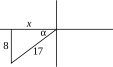
a.  \(\cot \theta=-\dfrac{12}{7} \ \Rightarrow \ \tan \theta=-\dfrac{7}{12}\)

\(\text{Graphically, given} \ \ \dfrac{\pi}{2}<\theta<\pi:\)
 

\(x=\sqrt{7^2+12^2}=13\)

\(\sec \theta=-\dfrac{13}{12}\)
 

b.    \(\sin \theta=\dfrac{7}{13}\)

Filed Under: Exact Trig Ratios Tagged With: Band 3, Band 4, smc-6411-40-cosec/sec/cot, smc-6411-60-Related Trig Ratios

Trigonometry, 2ADV EQ-Bank 17

Given  \(\operatorname{cosec}\,\alpha=-\dfrac{17}{8}\)  and  \(\pi<\alpha<\dfrac{3 \pi}{2}\), find the exact values of

  1. \(\sec \alpha\)   (2 marks)

    --- 7 WORK AREA LINES (style=lined) ---

  2. \(\tan \alpha\)   (1 mark)

    --- 1 WORK AREA LINES (style=lined) ---

Show Answers Only

a.    \(\sec \alpha=-\dfrac{17}{15}\)

b.    \(\tan \alpha=\dfrac{8}{15}\)

Show Worked Solution

a.    \(\operatorname{cosec} \alpha=-\dfrac{17}{8} \ \Rightarrow \ \sin \alpha=-\dfrac{8}{17}\)

\(\text{Graphically, given} \ \ \pi<\alpha<\dfrac{3 \pi}{2}:\)
 

\(x=\sqrt{17^2-8^2}=15\)

\(\sec \alpha=-\dfrac{17}{15}\)
 

b.    \(\tan \alpha=\dfrac{8}{15}\)

Filed Under: Exact Trig Ratios Tagged With: Band 3, Band 4, smc-6411-40-cosec/sec/cot, smc-6411-60-Related Trig Ratios

Trigonometry, 2ADV EQ-Bank 2 MC

For the angle  `theta, tan theta = -5/12`  and  `cos theta = 12/13.`

Which diagram best shows the angle `theta?`
 

hsc-2016-1mcaii

Show Answers Only

`D`

Show Worked Solution

`text(S) text(ince)\ tan theta < 0 and cos theta > 0,`

`(3pi)/2 < theta < 2pi`

`=>  D`

Filed Under: Trig Ratios, Sine and Cosine Rules Tagged With: Band 3, smc-6392-20-Trig Ratios

Functions, 2ADV EQ-Bank 12

Solve the following simultaneous equations:

\(3 x-4 y=5\)

\(x+2 y=15\).   (2 marks)

--- 8 WORK AREA LINES (style=lined) ---

Show Answers Only

\(x=7, \ y=4\)

Show Worked Solution

\(3 x-4 y=5\ \ldots\ (1)\)

\( x+2 y=15\ \ldots\ (2)\)

\(\text{Multiply (2)}  \times 3:\)

\(3 x+6 y=45\ \ldots\ \left(2^{\prime}\right) \)
 

\(\text{Subtract} \ \left(2^{\prime}\right)-(1)\) :

\(10 y=40 \ \Rightarrow \ y=4\)
 

\(\text{Substitute} \ \ y=4 \ \ \text{into (2):}\)

\(x+2 \times 4=15 \ \Rightarrow x=7\)

Filed Under: Linear Functions Tagged With: Band 3, smc-6214-50-Simultaneous Equations

  • « Previous Page
  • 1
  • 2
  • 3
  • 4
  • 5
  • …
  • 61
  • Next Page »

Copyright © 2014–2026 SmarterEd.com.au · Log in