SmarterEd

Aussie Maths & Science Teachers: Save your time with SmarterEd

  • Login
  • Get Help
  • About

CORE*, FUR1 2010 VCAA 3 MC

Peter received a quote from the Artificial Grass Company for his new front lawn.

The quote is for $1880 plus a Goods and Services Tax (GST) of 10%.

The final amount that Peter pays for the new front lawn is

A.     $188

B.   $1880

C.   $1890

D.   $1899

E.   $2068
Show Answers Only

`E`

Show Worked Solution
`text(GST)` `= 1880 xx text(10%)`
  `= 188`


`:.\ text(Total amount)` `= 1880 + 188`
  `= $2068`

`=>  E`

Filed Under: Taxation and Other Tagged With: Band 3, smc-605-10-GST

CORE*, FUR1 2010 VCAA 2 MC

$6000 is invested in an account that earns simple interest at the rate of 3.5% per annum.

The total interest earned in the first four years is

A.     `$70`

B.     `$84`

C.   `$210`

D.   `$840`

E.   `$885`

Show Answers Only

`D`

Show Worked Solution

`P = 6000,\ \ r = 3.5,\ \ T = 4`

`I` `= (PrT) / 100`
`I` `= {(6000) (3.5) (4)} / 100`
  `= 840`

 
`=>  D`

Filed Under: Interest Rates and Investing Tagged With: Band 3, smc-604-10-Simple interest

CORE*, FUR1 2010 VCAA 1 MC

Sally purchased an electronic game machine on hire purchase. She paid $140 deposit and then $25.50 per month for two years.

The total amount that Sally paid is

A.   $191

B.   $446

C.   $612

D.   $740

E.   $752

Show Answers Only

`E`

Show Worked Solution
`text(Total paid)` `= 140 + 25.50 xx 2 xx12`
  `= $752`

`=>E`

Filed Under: Borrowing and Loans Tagged With: Band 3, smc-603-30-Hire purchase

CORE*, FUR1 2015 VCAA 2 MC

The second term of a Fibonacci-related sequence is 36 and the third term is 72.

The first term of this sequence is

  1. `2`
  2. `6`
  3. `18`
  4. `36`
  5. `108`
Show Answers Only

`D`

Show Worked Solution

`text(A Fibonacci sequence takes the form)`

`t_3` `=t_2+t_1`
`:. t_1` `= t_3 – t_2`
  `= 72 – 36`
  `= 36`

 
`=> D`

Filed Under: Difference Equations - MC, Recursion - General Tagged With: Band 3, smc-714-30-RR (Fibonacci)

CORE, FUR1 2015 VCAA 11 MC

A log transformation is used to linearise the relationship between the weight of a mouse, in grams, and its age, in weeks.

When a least squares regression line is fitted to the transformed data, its equation is

`text(weight) = – 7 + 30 log_10(text(age))`

This equation predicts that a mouse aged five weeks has a weight, in grams, that is closest to

A.     `14`

B.     `21`

C.     `23`

D.     `41`

E.   `143`

Show Answers Only

`A`

Show Worked Solution
`text(Weight)` `= – 7 + 30log_10 5`
  `= 13.969…`

`=> A`

Filed Under: Correlation and Regression Tagged With: Band 3, smc-265-70-Linearise - log10

CORE, FUR1 2015 VCAA 2 MC

For an ordered set of data containing an odd number of values, the middle value is always

A.   the mean.

B.   the median.

C.   the mode.

D.   the mean and the median.

E.   the mean, the median and the mode.

Show Answers Only

`B`

Show Worked Solution

`=> B`

Filed Under: Summary Statistics Tagged With: Band 3, smc-468-20-Mean, smc-468-40-Median Mode and Range

CORE*, FUR1 2006 VCAA 3-4 MC

The following information relates to Parts 1 and 2.

A farmer plans to breed sheep to sell.

In the first year she starts with 50 breeding sheep.

During the first year, the sheep numbers increase by 84%.

At the end of the first year, the farmer sells 40 sheep.

Part 1

How many sheep does she have at the start of the second year?

A.     2

B.   42

C.   52

D.   84

E.   92


Part 2

If  `S_n`  is the number of sheep at the start of year `n`, a difference equation that can be used to model the growth in sheep numbers over time is

A.   `S_(n+1) = 1.84S_n - 40` `\ \ \ \ \ text(where)\ \ S_1 = 50`  
B.   `S_(n+1) = 0.84S_n - 50` `\ \ \ \ \ text(where)\ \ S_1 = 40`  
C.   `S_(n+1) = 0.84S_n - 40` `\ \ \ \ \ text(where)\ \ S_1 = 50`  
D.   `S_(n+1) = 0.16S_n - 50` `\ \ \ \ \ text(where)\ \ S_1 = 40`  
E.   `S_(n+1) = 0.16S_n - 40` `\ \ \ \ \ text(where)\ \ S_1 = 50`  
Show Answers Only

`text (Part 1:)\ C`

`text (Part 2:)\ A`

Show Worked Solution

`text (Part 1)`

`text(Number at the start of the 2nd year)`

`=50 + (84text(%) xx 50) – 40`

`=52`

`rArr C`


`text (Part 2)`

`text(If sheep numbers increase by 84% from the start of)`

`text(each year, and 40 sheep are then sold,)`

`S_(n+1)` `=S_n + 0.84S_n – 40`
  `=1.84 S_n – 40`

`rArr A`

Filed Under: Difference Equations - MC, Recursion - General Tagged With: Band 3, smc-714-25-RR (combination), smc-714-50-Find term(s), smc-714-60-Identify RR

PATTERNS, FUR1 2006 VCAA 2 MC

The first three terms of a geometric sequence are  `6, x, 54.`

A possible value of `x` is

A.     `9`

B.   `15`

C.   `18`

D.   `24`

E.   `30`

Show Answers Only

`C`

Show Worked Solution

`text(S)text(ince the sequence is geometric,)`

`r` `=x/6=54/x`
`x^2` `=54 xx 6`
  `=324`
`:.x` `=18`

`rArr C`

Filed Under: APs and GPs - MC Tagged With: Band 3

CORE, FUR1 2006 VCAA 5-6 MC

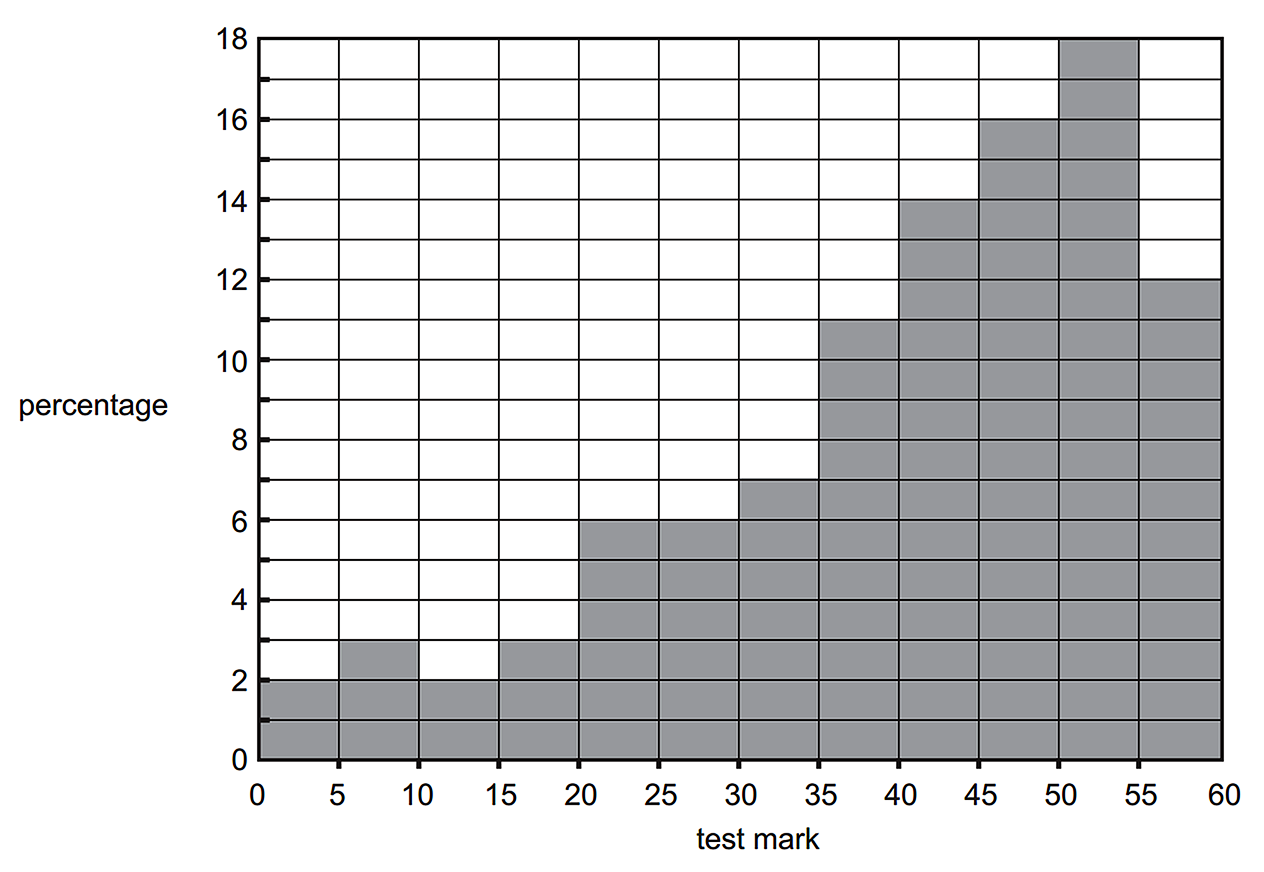
The distribution of test marks obtained by a large group of students is displayed in the percentage frequency histogram below.
 

Part 1

The pass mark on the test was 30 marks.

The percentage of students who passed the test is

A.     `7text(%)`

B.   `22text(%)`

C.   `50text(%)`

D.   `78text(%)`

E.   `87text(%)`


Part 2

The median mark lies between

A.   `35 and 40`

B.   `40 and 45`

C.   `45 and 50`

D.   `50 and 55`

E.   `55 and 60`

Show Answers Only

`text (Part 1:)\ D`

`text (Part 2:)\ B`

Show Worked Solution

`text (Part 1)`

`text(Adding up the percentage bars above 30)`

`=7+11+14+16+18+12`

`=78text(%)`

`rArr D`


`text (Part 2)`

`text(Adding up the percentage bars from the left,)`

`text(the 50th and 51st percentile lie in the 40–45)`

`text(mark interval.)`

`rArr B`

Filed Under: Graphs - Histograms and Other, Summary Statistics Tagged With: Band 3, Band 4, smc-468-40-Median Mode and Range, smc-644-20-Histograms

CORE, FUR1 2006 VCAA 1-3 MC

The back-to-back ordered stemplot below shows the distribution of maximum temperatures (in °Celsius) of two towns, Beachside and Flattown, over 21 days in January.


Part 1

The variables

temperature (°Celsius), and

town (Beachside or Flattown), are

A.   both categorical variables.

B.   both numerical variables.

C.   categorical and numerical variables respectively.

D.   numerical and categorical variables respectively.

E.   neither categorical nor numerical variables.


Part 2

For Beachside, the range of maximum temperatures is

A.     `3°text(C)`

B.   `23°text(C)`

C.   `32°text(C)`

D.   `33°text(C)`

E.   `38°text(C)`


Part 3

The distribution of maximum temperatures for Flattown is best described as

A.   negatively skewed.

B.   positively skewed.

C.   positively skewed with outliers.

D.   approximately symmetric.

E.   approximately symmetric with outliers.

Show Answers Only

`text (Part 1:)\ D`

`text (Part 2:)\ B`

`text (Part 3:)\ E`

Show Worked Solution

`text (Part 1)`

`text(Temperature is numerical,)`

`text(Town is categorical.)`

`rArr D`


`text (Part 2)`

`text(Beachside’s maximum temperature range)`

`=38-15`

`=23°text(C)`

`rArr B`


`text (Part 3)`

`IQR\ text{(Beachside)}`  `=Q_3 – Q_1`
  `=40-33`
  `=7`
`Q_1 – 1.5 xx IQR` `=33 – 1.5 xx7`
  `=22.5°text(C)`

 
`:.\ text(Flattown’s maximum temperature readings of)`

`text(18° and 19° are outliers.)`

`rArr E`

Filed Under: Graphs - Stem/Leaf and Boxplots Tagged With: Band 3, Band 4, smc-643-50-Back-to-Back Stem and Leaf, smc-643-70-Distribution Description

PATTERNS, FUR1 2007 VCAA 6 MC

In the first three layers of a stack of soup cans there are 20 cans in the first layer, 19 cans in the second layer and 18 cans in the third layer.

This pattern of stacking cans in layers continues.

The maximum number of cans that can be stacked in this way is

A.   `190`

B.   `210`

C.   `220`

D.   `380`

E.   `590`

Show Answers Only

`B`

Show Worked Solution

`20, 19, 18, …, 2,1`

`text(AP where)\ \ \ a=20, l=1 and n=20`

`S_n` `=n/2(a+l)`
`:.S_20` `=20/2 (20+1)`
  `=210`

`rArr B`

Filed Under: APs and GPs - MC Tagged With: Band 3

CORE*, FUR1 2007 VCAA 3 MC

 The difference equation

`t_(n+1) = at_n + 6 quad text (where) quad t_1 = 5` 

generates the sequence

`5, 21, 69, 213\ …`

The value of `a` is

A.   – 1

B.     3

C.     4

D.   15

E.   16


Show Answers Only

`B`

Show Worked Solution
`t_2` `=a t_1 +6`
`:. 21` `=5a + 6`
`a` `=3`

 
`rArr B`

Filed Under: Difference Equations - MC, Recursion - General Tagged With: Band 3, smc-714-25-RR (combination)

PATTERNS, FUR1 2007 VCAA 2 MC

The yearly membership of a club follows an arithmetic sequence.

In the club’s first year it had 15 members.

In its third year it had 29 members.

How many members will the club have in the fourth year?

A.     `8`

B.   `22`

C.   `36`

D.   `43`

E.   `57` 

Show Answers Only

`C`

Show Worked Solution

`d=(29-15)/2=7`

`T_4` `=a+3d`
  `=15+3 xx 7`
  `=36`

`rArr C`

Filed Under: APs and GPs - MC Tagged With: Band 3

CORE, FUR1 2007 VCAA 1-2 MC

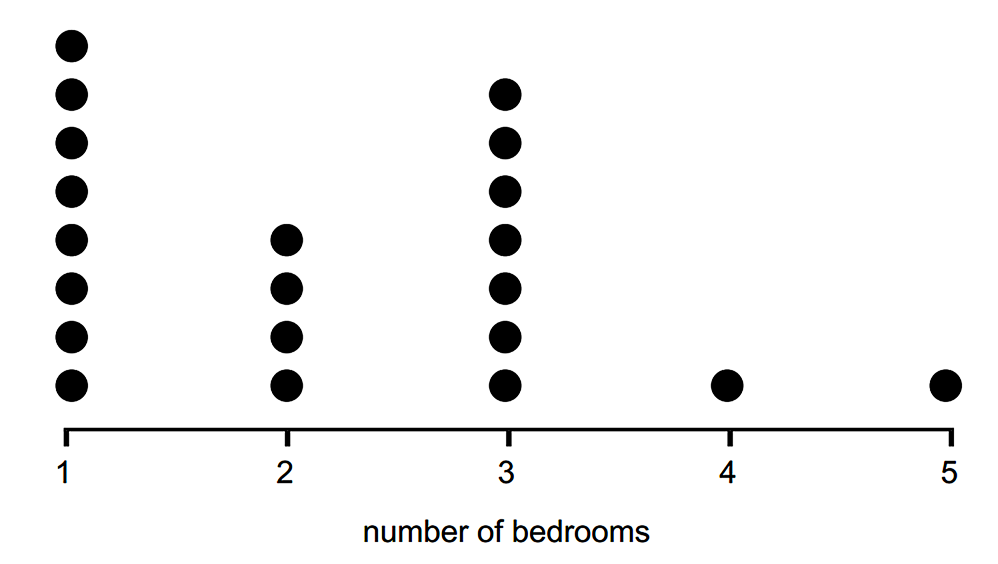
The dot plot below shows the distribution of the number of bedrooms in each of 21 apartments advertised for sale in a new high-rise apartment block.


Part 1

The mode of this distribution is

A.   `1`

B.   `2`

C.   `3`

D.   `7`

E.   `8`


Part 2

The median of this distribution is

A.   `1`

B.   `2`

C.   `3`

D.   `4`

E.   `5`

Show Answers Only

`text (Part 1:)\ A`

`text (Part 2:)\ B`

Show Worked Solution

`text (Part 1)`

`rArr A`


`text (Part 2)`

 `text(The median of 21 data points is the 11th value.)`

`:.\ text(Median) = 2`

`rArr B`

Filed Under: Graphs - Histograms and Other, Summary Statistics Tagged With: Band 2, Band 3, smc-468-40-Median Mode and Range, smc-644-10-Dot Plots

CORE*, FUR1 2008 VCAA 1 MC

A sequence is generated by a first-order linear difference equation. 

The first four terms of this sequence are 1, 3, 7, 15.

The next term in the sequence is

A.   17 

B.   19

C.   22

D.   23

E.   31

Show Answers Only

`E`

Show Worked Solution

`1,3,7,15\ ...`

`text(Sequence has the pattern,)`

`Τ_(n+1)=2T_n+1`

`:. T_5` `= 2 xx T_4 +1`
  `=2 xx 15 +1`
  `=31`

  
`=>E`

Filed Under: Difference Equations - MC, Recursion - General Tagged With: Band 3

CORE*, FUR1 2008 VCAA 7 MC

The sequence  `12, 15, 27, 42, 69, 111 …`  can best be described as

A.  fibonacci-related

B.  arithmetic with  `d > 1`

C.  arithmetic with  `d < 1`

D.  geometric with  `r > 1`

E.  geometric with  `r < 1`


Show Answers Only

`A`

Show Worked Solution

`12, 15, 27, 42, 69, 111\ …`

`T_3 = T_1 + T_2`

`T_4 = T_3 + T_2`

`=>  A`

Filed Under: APs and GPs - MC, Difference Equations - MC, Recursion - General Tagged With: Band 3, smc-714-60-Identify RR

PATTERNS, FUR1 2008 VCAA 3 MC

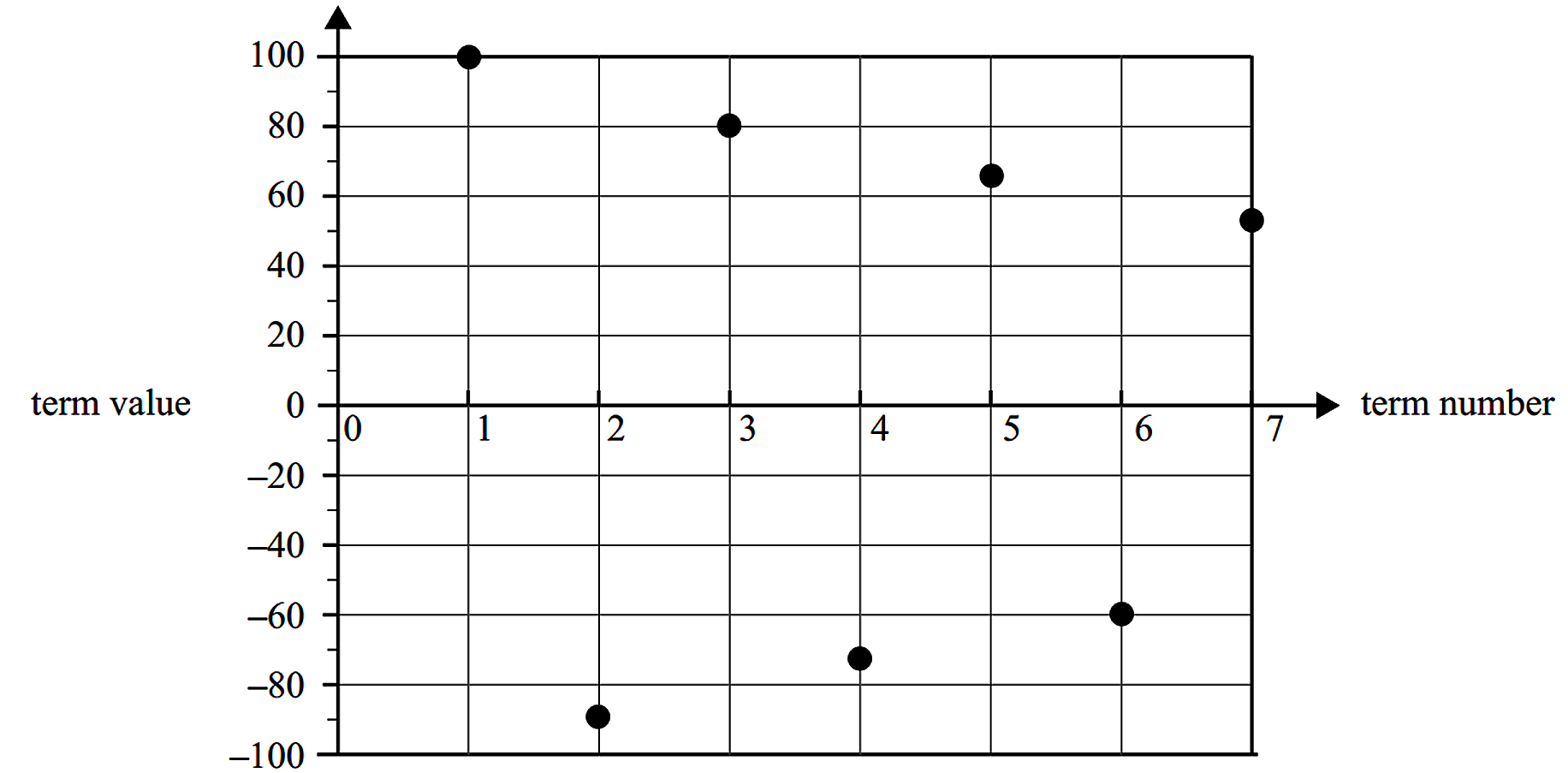
The values of the first seven terms of a geometric sequence are plotted on the graph above.
Values of  `a`  and  `r`  that could apply to this sequence are respectively

(A)   `a=90` `\ \ \ \ r= – 0.9` 
(B)   `a=100` `\ \ \ \ r= – 0.9`  
(C)   `a=100` `\ \ \ \ r= – 0.8`
(D)   `a=100` `\ \ \ \ r=0.8`  
(E)   `a=90` `\ \ \ \ r=0.9`  
Show Answers Only

`B`

Show Worked Solution

`text(By elimination,)`

`T_1=a=100`

`text(Eliminate A and E.)`


`T_2=ar` `=-90`
`:.100r` `=-90`
`r`  `=-0.90`

`text(Eliminate C and D.)`

`=>  B`

Filed Under: APs and GPs - MC Tagged With: Band 3

Probability, MET2 2015 VCAA 14 MC

Consider the following discrete probability distribution for the random variable `X.`
 

VCAA 2015 14mc 

 
The mean of this distribution is

  1. `2`
  2. `3`
  3. `7/2`
  4. `11/3`
  5. `4`
Show Answers Only

`D`

Show Worked Solution

`text(Find)\ p:`

`p + 2p + 3p + 4p + 5p` `= 1`
`:. p` `= 1/15`


`text(E)(X)` `= 1 xx p + 2(2p) + 3(3p) + 4(4p) + 5(5p)`
  `= 55p`
  `= 55 xx (1/15)`
  `= 11/3`

`=>   D`

Filed Under: Probability Distribution Tables Tagged With: Band 3, smc-732-20-E(X) / Mean

Calculus, MET2 2015 VCAA 4 MC

Consider the tangent to the graph of  `y = x^2`  at the point  `(2, 4).`

Which of the following points lies on this tangent?

A.   `text{(1, −4)}`

B.   `(3, 8)`

C.   `text{(−2, 6)}`

D.   `(1, 8)`

E.   `text{(4, −4)}`

Show Answers Only

`B`

Show Worked Solution

`text(Find equation of tangent line)`

`text(at)\ x = 2:`

`y = 4x – 4qquadtext([CAS: tangentLine) (x^2,x,2)]`

`(3,8)\ \ text(is on)\ y = 4x – 4`

`=>   B`

Filed Under: Tangents and Normals Tagged With: Band 3, smc-634-10-Polynomial, smc-634-50-Find tangent given curve

Algebra, MET2 2014 VCAA 9 MC

The inverse of the function  `f: R^+ -> R,\ f(x) = 1/sqrt x + 4`  is

A.    `f^-1: (4, oo) -> R` `f^-1(x) = 1/(x - 4)^2`
B.    `f^-1: R^+ -> R` `f^-1(x) = 1/x^2 + 4`
C.    `f^-1: R^+ -> R` `f^-1(x) = (x + 4)^2`
D.    `f^-1:\ text{(−4, ∞)} -> R`        `f^-1(x) = 1/(x + 4)^2`
E.    `f^-1:\ text{(−∞, 4)} -> R` `f^-1(x) = 1/(x - 4)^2`
Show Answers Only

`A`

Show Worked Solution

`text(Let)\ \ y = f(x)`

`text(Inverse: swap)\ x ↔ y`

`x` `= 1/sqrty + 4`
`x – 4` `= 1/sqrty`
`sqrty` `= 1/(x – 4)`
`y` `= 1/((x – 4)^2) = f^(−1)(x)`


`text(Domain)(f^(−1)) = text(Range)\ (f) = (4,∞)`

`=>   A`

Filed Under: Polynomial and Other Functions Tagged With: Band 3, smc-5205-20-Square root, smc-633-30-Square root

Graphs, MET2 2014 VCAA 2 MC

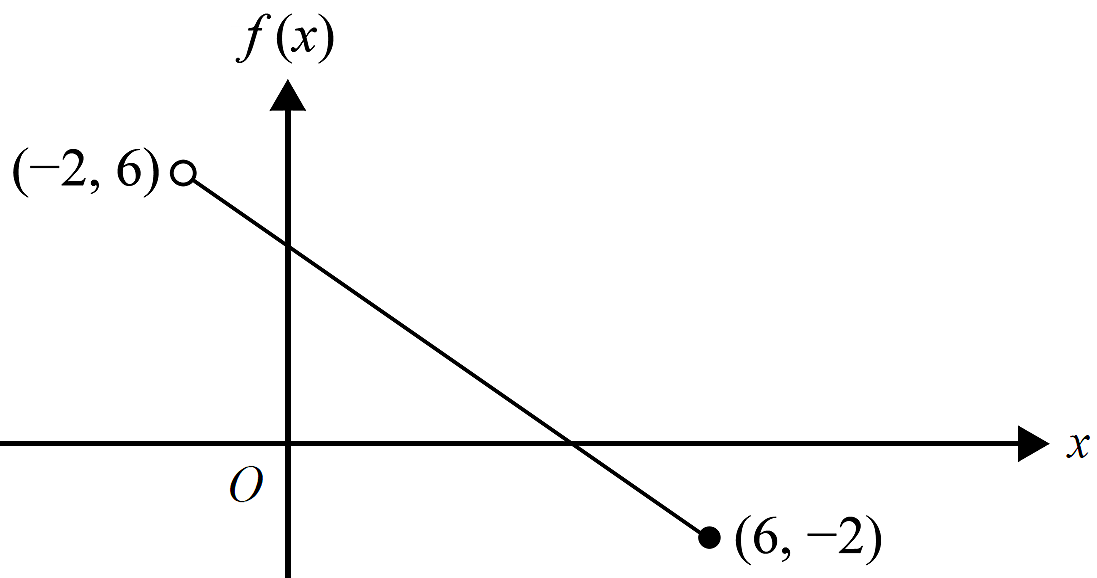
The linear function  `f: D -> R, f (x) = 4 - x`  has range  `text{[−2, 6)}`.

The domain `D` of the function is

  1. `text{[−2, 6)}`
  2. `text{(−2, 2]}`
  3. `R`
  4. `text{(−2, 6]}`
  5. `text{[−6, 2]}`
Show Answers Only

`D`

Show Worked Solution

met2-2014-vcaa-2-mc-answer

`:. D = (−2,6)`

`=>   D`

Filed Under: Coordinate Geometry Tagged With: Band 3, smc-727-40-Domain/Range

Graphs, MET2 2014 VCAA 1 MC

The point `P\ text{(4, −3)}` lies on the graph of a function  `f`. The graph of  `f` is translated four units vertically up and then reflected in the `y`-axis.

The coordinates of the final image of `P` are

  1. `text{(−4, 1)}`
  2. `text{(−4, 3)}`
  3. `text{(0, −3)}`
  4. `text{(4, −6)}`
  5. `text{(−4, −1)}`
Show Answers Only

`A`

Show Worked Solution

`text(Using mapping notation:)`

`P(4,−3)\ {:(y + 4),(vec(quad(1)quad)):}\ (4,1)\ {:(−x),(vec(\ (2)\ )):}\ pprime(−4,1)`

`=>   A`

Filed Under: Transformations Tagged With: Band 3, smc-753-40-Combinations

MATRICES, FUR1 2014 VCAA 2 MC

`y - z` `= 8`
`5x - y` `= 0`
`x + z` `= 4`

  
The system of three simultaneous linear equations above can be written in matrix form as

A. `[[0,1,-1],[0,5,-1],[1,0,1]][[x],[y],[z]]=[[8],[0],[4]]` B. `[[0,1,-1],[5,-1,0],[1,0,1]][[x],[y],[z]]=[[8],[0],[4]]`
       
C. `[[1,-1],[5,-1],[1,1]][[x],[y],[z]]=[[8],[0],[4]]` D. `[[0,5,1],[1,-1,0],[-1,0,1]][[x],[y],[z]]=[[8],[0],[4]]`
       
E. `[[0,5,0],[-1,-1,0],[1,1,0]][[x],[y],[z]]=[[8],[0],[4]]`    
Show Answers Only

`B`

Show Worked Solution

`=>B`

Filed Under: Simultaneous Equations Tagged With: Band 3, smc-617-20-SE to Matrix

Calculus, EXT1 C1 2008 HSC 4a

A turkey is taken from the refrigerator. Its temperature is  5°C when it is placed in an oven preheated to  190°C.

Its temperature,  `T`° C, after  `t`  hours in the oven satisfies the equation

`(dT)/(dt) = -k(T − 190)`.

  1. Show that  `T = 190 - 185e^(-kt)`  satisfies both this equation and the initial condition.  (2 marks)

    --- 5 WORK AREA LINES (style=lined) ---

  2. The turkey is placed into the oven at 9 am. At 10 am the turkey reaches a temperature of  29°C. The turkey will be cooked when it reaches a temperature of 80°C.


    At what time (to the nearest minute) will it be cooked?  (3 marks)

    --- 10 WORK AREA LINES (style=lined) ---

Show Answers Only
  1. `text(See Worked Solutions)`
  2. `12:44\ text(pm)`
Show Worked Solution
i.    `T` `= 190 − 185e^(-kt)`
   `(dT)/(dt)` `= -k xx -185e^(-kt)`
    `= -k(190 − 185e^(-kt) − 190)`
    `= -k(T − 190)`

 
`:.T = 190 − 185e^(-kt)\ text(satisfies equation.)`
 

`text(When)\ \ t = 0,`

`T` `= 190 − 185e^0`
  `= 5°`

 
`:.\ text(Initial conditions are satisfied.)`
 

ii.   `text(When)\ \ t = 1,\ T = 29`

`29` `= 190 − 185e^(-k)`
`185e^(-k)` `= 161`
`e^(-k)` `= 161/185`
`-k` `= ln\ 161/185`
`:.k` `= -ln\ 161/185`
  `= 0.1389…`


`text(Find)\ \  t\ \ text(when)\ \ T = 80 :`

`80` `= 190 − 185e^(-kt)`
`185e^(-kt)` `= 110`
`e^(-kt)` `= 110/185`
`-kt` `= ln\ 110/185`
`:.t=` `= ln\ 110/185 -: -0.1389…`
  `= 3.741…`
  `= 3\ text(hours)\ 44\ text{mins (nearest minute)}`

 
`:.\ text(The turkey will be cooked at 12:44 pm.)`

Filed Under: Exponential Growth and Decay EXT1, Modified Growth and Decay Tagged With: Band 3, Band 4, smc-1080-10-Cooling

Calculus, EXT1* C1 2004 HSC 7b

At the beginning of 1991 Australia’s population was 17 million. At the beginning of 2004 the population was 20 million.

Assume that the population `P` is increasing exponentially and satisfies an equation of the form  `P = Ae^(kt)`, where  `A`  and  `k`  are constants, and  `t`  is measured in years from the beginning of 1991.

  1. Show that  `P = Ae^(kt)`  satisfies  `(dP)/(dt) =kP`.  (1 mark)

    --- 2 WORK AREA LINES (style=lined) ---

  2. What is the value of  `A`?  (1 mark)

    --- 2 WORK AREA LINES (style=lined) ---

  3. Find the value of  `k`.  (2 marks)

    --- 6 WORK AREA LINES (style=lined) ---

  4. Predict the year during which Australia’s population will reach 30 million.  (2 marks)

    --- 8 WORK AREA LINES (style=lined) ---

Show Answers Only
  1. `kP`
  2. `1.7 × 10^7`
  3. `0.013\ \ text(to 3 decimal places.)`
  4. `2036`
Show Worked Solution
i.   `P` `= Ae^(kt)`
  `(dP)/(dt)` `= kAe^(kt)`
    `= kP`


ii.  `P = Ae^(kt)`

`text(When)\ \ t = 0, \ P = 1.7 × 10^7`

`1.7 × 10^7` `= Ae^0`
`1.7 × 10^7`  `= A xx 1` 
`:. A` `= 1.7 × 10^7` 


iii.  `P = 1.7 × 10^7e^(kt)`

`text(When)\ t = 13, \ P = 2 × 10^7`

`2 × 10^7` `= 1.7 × 10^7e^(13k)`
`(2 × 10^7)/(1.7 × 10^7)` `= e^(13k)`
`ln (2/(1.7))` `= ln e^(13k)`
  `= 13k`
`:.k` `= 1/13 ln (2/(1.7))`
  `= 0.0125…`
  `= 0.013\ \ \ text{(to 3 d.p.)}`


iv.  `P` `= 1.7 × 10^7e^(kt)`

`text(Find)\ \ t\ \ text(when)\ \ P = 3 × 10^7,`

MARKER’S COMMENT: Many students had the correct calculations but didn’t answer the question by identifying the exact year and lost a valuable mark.
`3 × 10^7` `= 1.7 × 10^7e^(kt)`
`(3 × 10^7)/(1.7 × 10^7)` `= e^(kt)`
`ln (3/(1.7))` `= ln e^(kt)`
`ln (3/(1.7))` `= kt ln e`
  `= kt`
`:.t` `= (ln (3/(1.7)))/k`
 

`= (ln(3/(1.7)))/(0.0125…)`

  `= 45.433…`
  `= 45.4\ \ text{years    (to 1 d.p.)}`


`:.\ text(The population will reach 30 million in 2036.)`

Filed Under: Exponential growth and decay, Standard Growth and Decay Tagged With: Band 3, Band 4, smc-1081-10-Growth, smc-1081-40-Population

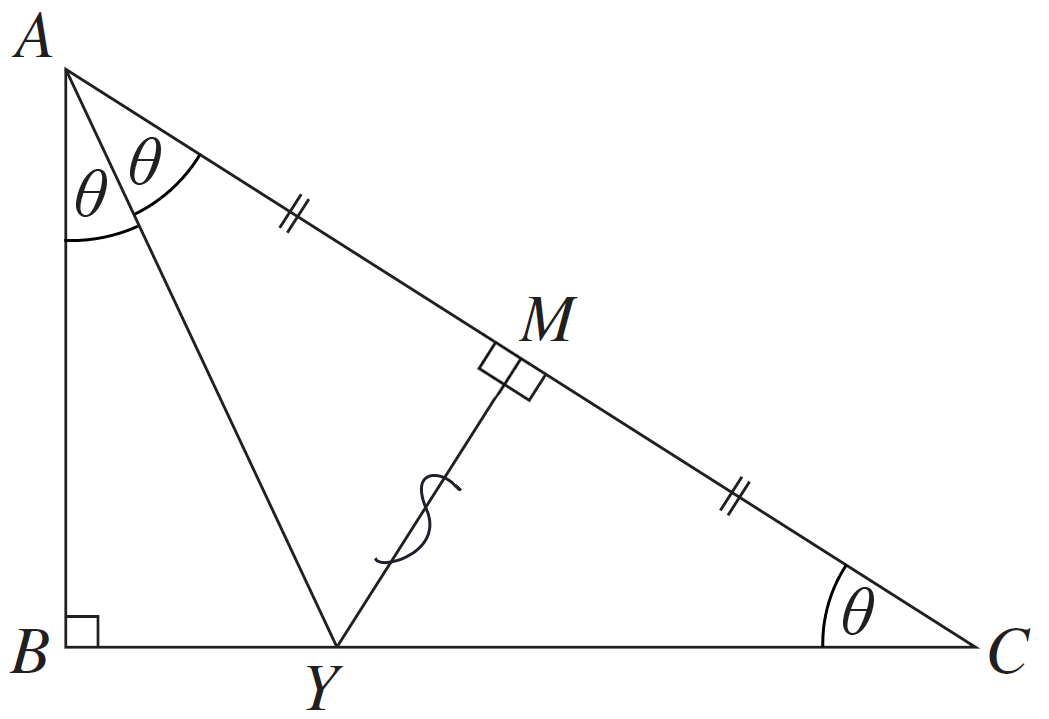
Plane Geometry, 2UA 2004 HSC 6b


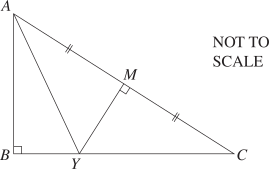
The diagram shows a right-angled triangle  `ABC`  with  `∠ABC = 90^@`. The point  `M`  is the midpoint of  `AC`, and  `Y`  is the point where the perpendicular to  `AC`  at  `M`  meets  `BC`.

  1. Show that  `ΔAYM ≡ ΔCYM`.  (2 marks)
  2. Suppose that it is also given that  `AY`  bisects  `∠BAC`. Find the size of  `∠YCM`  and hence find the exact ratio  `MY : AC`.  (3 marks) 


Show Answers Only
  1. `text(Proof)\ \ text{(See Worked Solutions)}`
  2. `1 : 2sqrt3`
Show Worked Solution
(i)    Plane Geometry, 2UA 2004 HSC 6b Answer

`text(In)\ ΔAYM\ text(and)\ ΔCYM`

MARKER’S COMMENT: Markers strongly recommend that students copy the diagram in geometry questions and label it along with the workings of their solution.
`∠AMY` `= ∠CMY = 90^@\ \ \ (MY ⊥ AC)`
`AM` `=CM\ \ \ text{(given)}`
`YM\ text(is common)`


`:.ΔAYM ≡ ΔCYM\ \ text{(SAS)}`


(ii)  `text(Let)\ \ /_BAC = 2 theta`

`∠YAB = ∠YAM = theta\ \ \ \ (AY\ text(bisects)\ ∠BAC)`

`∠YAM` `= ∠YCM=theta` `\ \ \ text{(corresponding angles of}`
    `\ \ \ text{congruent triangles)}`
`:.∠YAB= ∠ YAM = ∠YCM=theta` 


♦♦ Very few students answered this part correctly.
MARKER’S COMMENT: Students who began by making `∠BAC=2theta` were the most successful.

`text(In)\ \ ΔABC,`

`∠ABC + ∠BAC + ∠YCM` `= 180^@`
`:.90^@ +2theta+theta` `= 180^@`
`3theta` `= 90^@`
`:.theta` `= 30^@`

`text(In)\ \ Delta MYC,`

`:.tan 30^@` `= (MY)/(MC)`
`(MY)/(MC)` `= 1/sqrt3`
`(MY)/(2MC)` `=1/(2 sqrt3)`
`(MY)/(AC)` `= 1/(2sqrt3)\ \ \ text{(given}\ \ AC=2MC text{)}`
`:.MY : AC` `= 1 : 2sqrt3.`

Filed Under: 2. Plane Geometry Tagged With: Band 3, Band 4, Band 5

Calculus, 2ADV C3 2004 HSC 5b

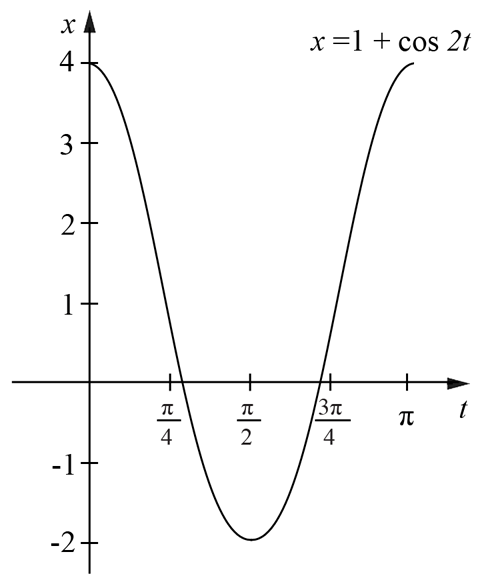
A particle moves along a straight line so that its displacement, `x` metres, from a fixed point `O` is given by  `x = 1 + 3 cos 2t`, where  `t`  is measured in seconds.

  1. What is the initial displacement of the particle?  (1 mark)

    --- 2 WORK AREA LINES (style=lined) ---

  2. Sketch the graph of  `x`  as a function of  `t`  for  `0 ≤ t ≤ pi`.  (2 marks)

    --- 8 WORK AREA LINES (style=lined) ---

  3. Hence, or otherwise, find when AND where the particle first comes to rest after  `t = 0`.  (2 marks)

    --- 4 WORK AREA LINES (style=lined) ---

  4. Find a time when the particle reaches its greatest magnitude of velocity. What is this velocity?  (2 marks)

    --- 4 WORK AREA LINES (style=lined) ---

Show Answers Only
  1. `text(4 m to the right of)\ O.`
  2. `text(See Worked Solutions)`
  3. `t = pi/2\ text(seconds, 2 m to the left of)\ O.`
  4. `text(6 m s)^(−1)`
Show Worked Solution

i.   `x = 1 + 3 cos 2t`

`text(When)\ \ t = 0,`

`x` `= 1 + 3 cos 0`
  `= 1 + 3`
  `= 4`


`:.\ text(Initial displacement is 4 m to the right of)\ O.`


 ii.  `text(Period)\ = (2pi)/n = (2pi)/2 = pi`

`text(Considering the range)`

`-1` `<=cos 2t<=1`
`-3` `<=3cos 2t<=3`
`-2` `<=1 + 3 cos 2t<=4`


 Calculus in the Physical World, 2UA 2004 HSC 5b


iii.   `x` `= 1 + 3 cos 2t`
  `:.v` `= −6 sin 2t`


`text(The particle comes to rest when)\ \ v=0`

`-6 sin 2t` `= 0`
`sin 2t` `= 0`
`2t` `= 0, pi, 2pi…`
`t` `= 0, pi/2, pi…`


`:.\ text(After)\ \ t=0, text(particle first comes to rest when)`

`t = pi/2\ text(seconds.)`

`text(When)\ t = pi/2,`

`x` `= 1 + 3 cos 2(pi/2)`
  `= 1 + 3 cos pi`
  `= 1 + 3(−1)`
  `= −2`


`:.\ text(Particle first comes to rest at 2 m to the left of)\ O.`


iv.  `x = 1 + 3 cos 2t`

`v` `= -6 sin 2t`
`a` `= -12 cos 2t`
   

`text(MAX occurs when)\ \ a=0`

`−12 cos 2t` `= 0`
`cos 2t` `= 0`
`2t` `= pi/2, (3pi)/2, …`
`t` `= pi/4, (3pi)/4, …`

 
`:.\ text(Maximum at)\ \ t=pi/4,\ \ (3pi)/4, …\ text(seconds,)`


`text(When)\ \ t = pi/4\ text(seconds,)`

`v` `= -6 sin 2(pi/4)`
  `= -6 sin(pi/2)`
  `= −6`

 
`:.\ text(Maximum is 6 m s)^(−1).`

Filed Under: Motion, Rates of Change Tagged With: Band 3, Band 4, Band 5, smc-1091-10-Motion, smc-1091-40-Trig Function

Financial Maths, 2ADV M1 2004 HSC 5a

Clare is learning to drive. Her first lesson is 30 minutes long. Her second lesson is 35 minutes long. Each subsequent lesson is 5 minutes longer than the lesson before.

  1. How long will Clare’s twenty-first lesson be?  (1 mark)

    --- 2 WORK AREA LINES (style=lined) ---

  2. How many hours of lessons will Clare have completed after her twenty-first lesson?  (2 marks)

    --- 5 WORK AREA LINES (style=lined) ---

  3. During which lesson will Clare have completed a total of 50 hours of driving lessons?  (2 marks)

    --- 4 WORK AREA LINES (style=lined) ---

Show Answers Only
  1. `text(130 minutes)`
  2. `28\ text(hours)`
  3. `text(30th lesson)`
Show Worked Solution

i.   `30, 35, 40, …`

`=>\ text(AP where)\ \ a = 30,\ \ d = 5`

`T_n` `= a + (n − 1) d`
`T_(21)` `= 30 + 20(5)`
  `= 30 + 100`
  `= 130`


`:.\ text(Clare’s twenty-first lesson will be 130)`

`text(minutes long.)`


ii.  `text(Find)\ \ S_21\ \ text(given)\ \ a = 30, \ d = 5`

`S_n` `= n/2[2a + (n − 1)d]`
`:.S_21` `= 21/2[2(30) + 20 × 5]`
  `= 21/2[60 + 100]`
  `= 21/2 × 160`
  `= 1680\ text(minutes)`
  `= 28\ text(hours.)`


(iii)  `text(50 hours)` `= 50 × 60`
  `= 3000\ text(minutes)`


`text(Find)\ \ n,\ \ text(given)\ \ a = 30, \ d = 5, \ S_n = 3000`

`S_n` `= n/2[2a + (n − 1)d]`
`:. 3000` `= n/2[2(30) + (n − 1)5]`
`6000` `= n[60 + 5n − 5]`
`6000` `= n[55 + 5n]`
`6000` `= 55n + 5n^2`
`5n^2 + 55n − 6000` `= 0`
`n^2 + 11n − 1200` `= 0`
`:.n` `= (−11 ± sqrt((11)^2 − 4(1)(−1200)))/(2(1))`
  `= (−11 ± sqrt(121 + 4800))/(2)`
  `= (−11 ± sqrt4921)/2`
  `= 29.5749…\ \ \ (n> 0)`


`:.\ text(Clare completes 50 hours of lessons during)`

`text(her 30th lesson.)`

Filed Under: Arithmetic Series, Arithmetic Series Tagged With: Band 3, Band 4, smc-1005-10-Find Term, smc-1005-20-Find Sum

Calculus, MET2 2012 VCAA 15 MC

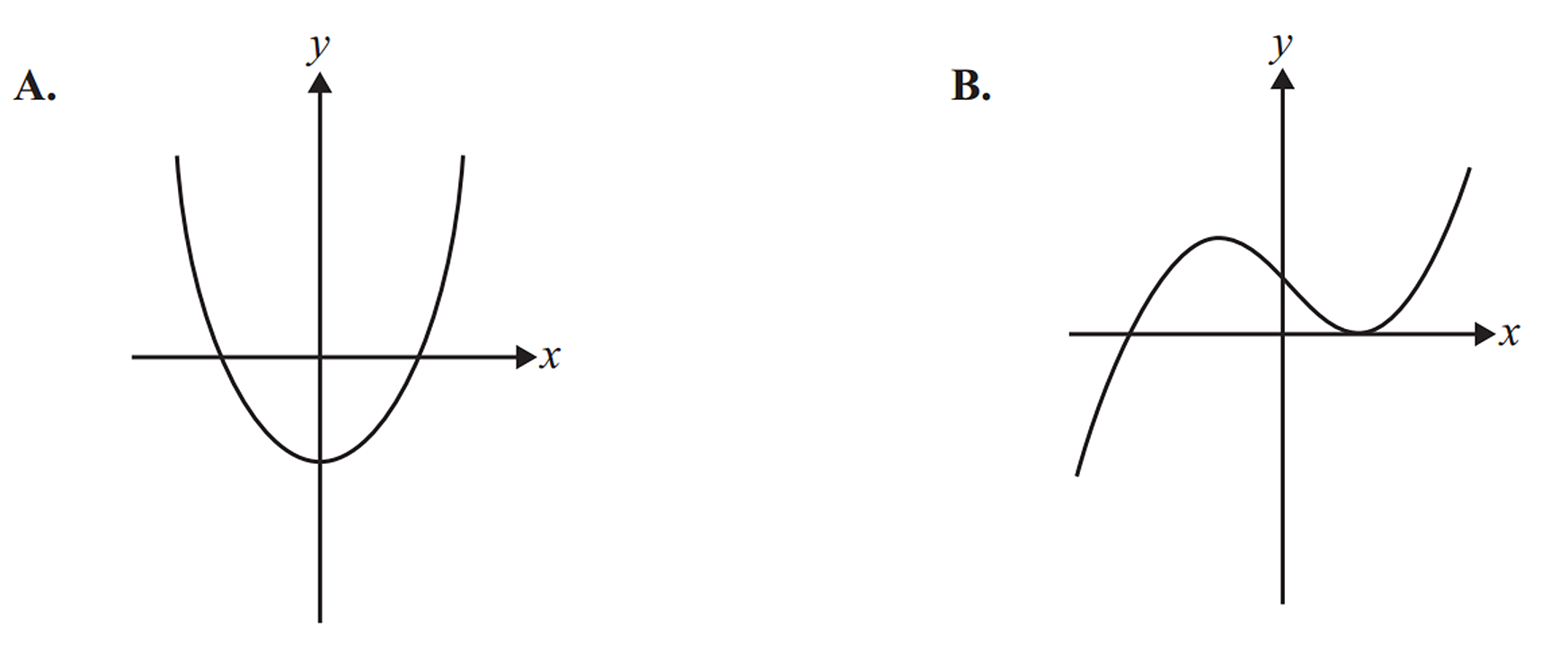
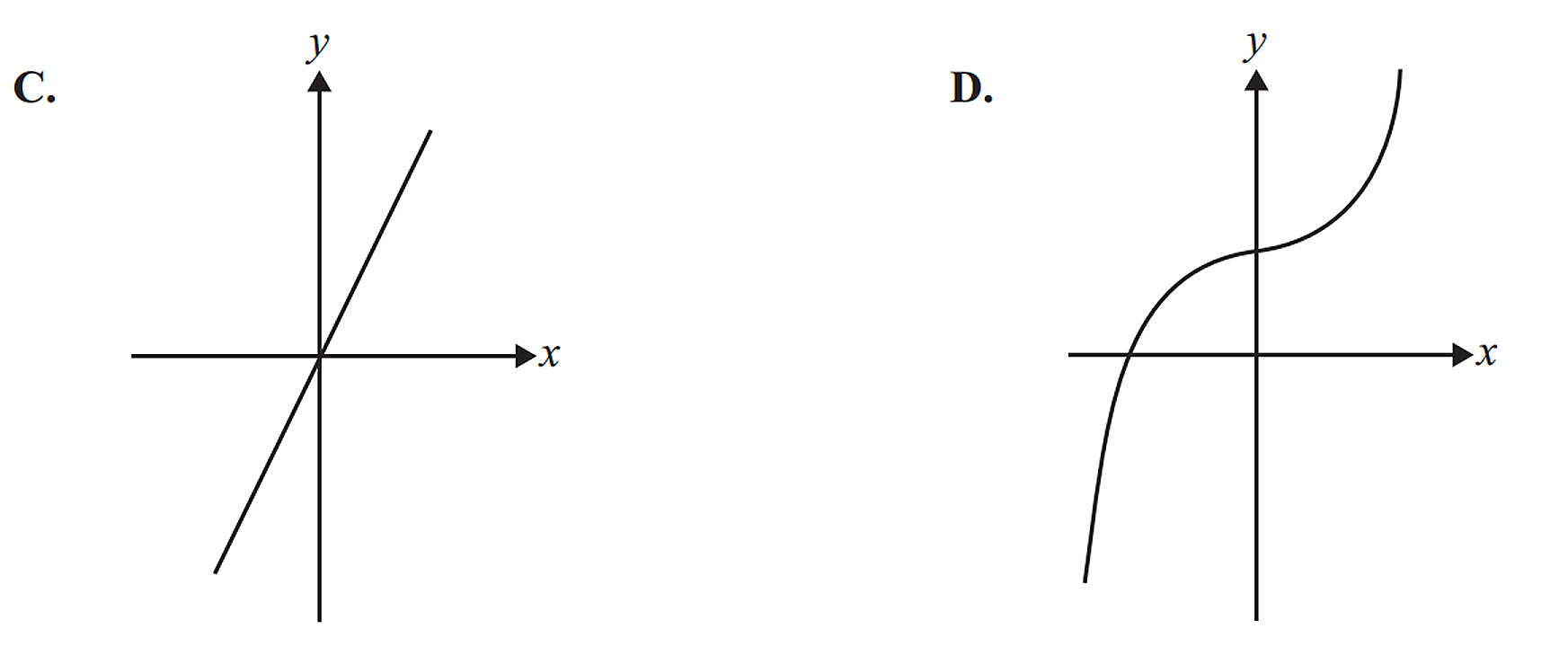
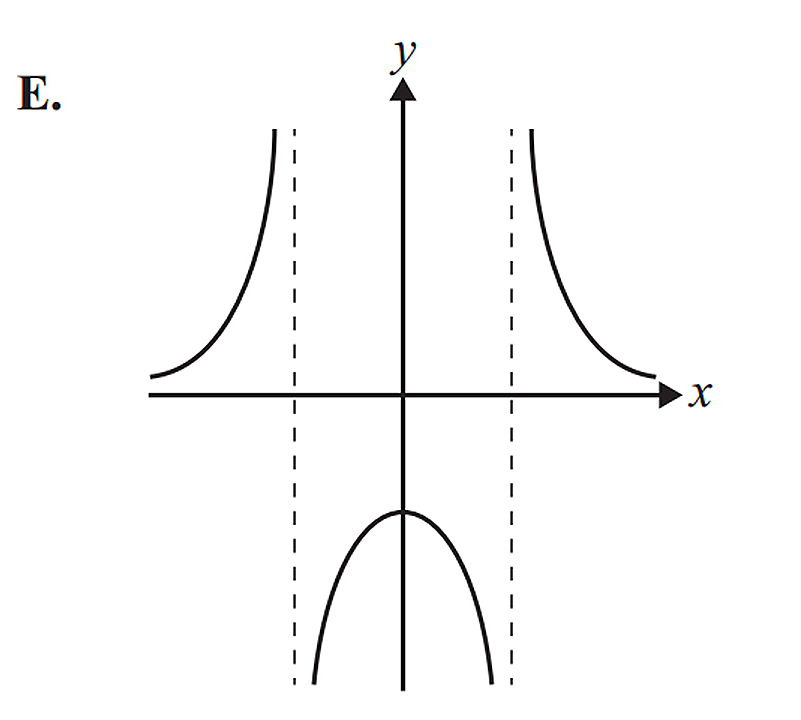
If  `f prime (x) = 3x^2 - 4`, which one of the following graphs could represent the graph of  `y = f (x)`?

VCAA 2012 15mc

VCAA 2012 15mci

VCAA 2012 15mcii

Show Answers Only

`B`

Show Worked Solution

`f prime (x) = 3x^2 – 4`

`:. f(x)\ text(is a cubic with two stationary points.)`

`=>   B`

Filed Under: Standard Integration, The Derivative Function and its Graph Tagged With: Band 3, smc-2830-10-Find f(x) given f'(x), smc-749-30-Find f(x) given f'(x)

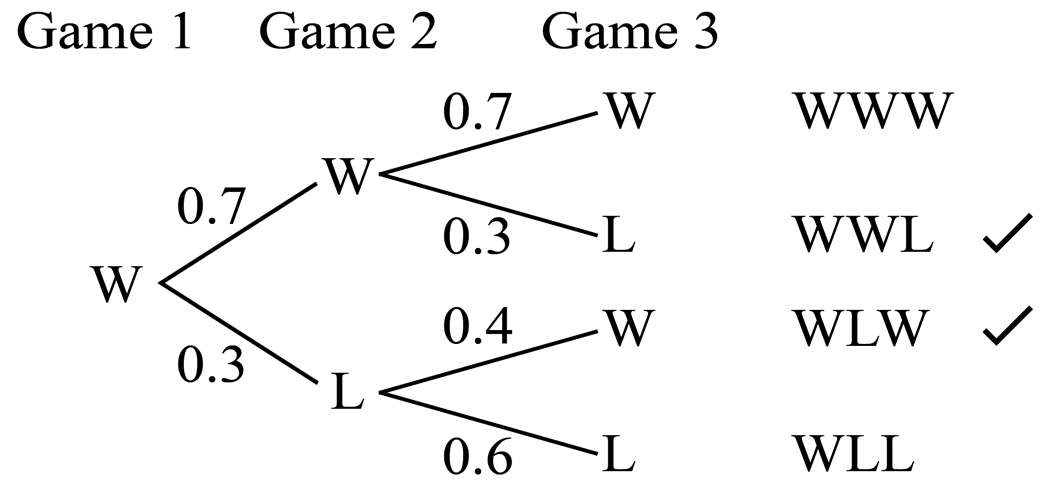
Probability, MET2 2012 VCAA 12 MC

Demelza is a badminton player. If she wins a game, the probability that she will win the next game is 0.7. If she loses a game, the probability that she will lose the next game is 0.6. Demelza has just won a game.

The probability that she will win exactly one of her next two games is

A.   `0.33`

B.   `0.35`

C.   `0.42`

D.   `0.49`

E.   `0.82`

Show Answers Only

`A`

Show Worked Solution

`text(After a win in game 1,)`

`text{Pr(exactly one of next two)}`

`= text(Pr)(WWL) + text(Pr)(WLW)`

`= 1 xx 0.7 xx 0.3 + 1 xx 0.3 xx 0.4`

`= 0.33`

`=>   A`

Filed Under: Uncategorized Tagged With: Band 3

CORE*, FUR2 2014 VCAA 1

The adult membership fee for a cricket club is $150.

Junior members are offered a discount of $30 off the adult membership fee.

  1. Write down the discount for junior members as a percentage of the adult membership fee.   (1 mark)

    --- 2 WORK AREA LINES (style=lined) ---

Adult members of the cricket club pay $15 per match in addition to the membership fee of $150.

  1. If an adult member played 12 matches, what is the total this member would pay to the cricket club?   (1 mark)

    --- 3 WORK AREA LINES (style=lined) ---

If a member does not pay the membership fee by the due date, the club will charge simple interest at the rate of 5% per month until the fee is paid.

Michael paid the $150 membership fee exactly two months after the due date.

  1. Calculate, in dollars, the interest that Michael will be charged.   (1 mark)

    --- 2 WORK AREA LINES (style=lined) ---

The cricket club received a statement of the transactions in its savings account for the month of January 2014.

The statement is shown below.

     BUSINESS, FUR2 2014 VCAA 1

    1. Calculate the amount of the withdrawal on 17 January 2014.   (1 mark)

      --- 2 WORK AREA LINES (style=lined) ---

    2. Interest for this account is calculated on the minimum balance for the month and added to the account on the last day of the month.
    3. What is the annual rate of interest for this account?  Write your answer, correct to one decimal place.   (1 mark)

      --- 3 WORK AREA LINES (style=lined) ---

  1.  

Show Answers Only

  1. `text(20%)`
  2. `$330`
  3. `$15`
    1. `$17\ 000`
    2. `3.5`

Show Worked Solution

a.   `text(Discount for junior members)`

`= 30/150 xx 100text(%)`

`= 20text(%)`

  
b.   `text(Match Payments)= 12 xx 15=$180`

`:.\ text(Total paid to the club)` `= 150 + 180`
  `= $330`


c.    `I` `= (PrT)/100`
    `= (150 xx 5 xx 2)/100`
    `= $15`


d.i.   `text(Withdrawal on 17 Jan)`

`= 59\ 700-42\ 700`

`= $17\ 000`
    

d.ii.   `text(Minimum Jan balance) = $42\ 700`

`47\ 200 xx r xx 1/12` `= 125.12`
`:. r` `= (125.12 xx 12)/(42\ 700)`
  `= 0.0351…`

  
`:.\ text(Annual interest rate) = 3.5text(%)`

Filed Under: Interest Rates and Investing Tagged With: Band 2, Band 3, Band 4, smc-604-10-Simple interest, smc-604-40-% Increase/Decrease, smc-604-80-Bank Statement

Graphs, MET2 2012 VCAA 6 MC

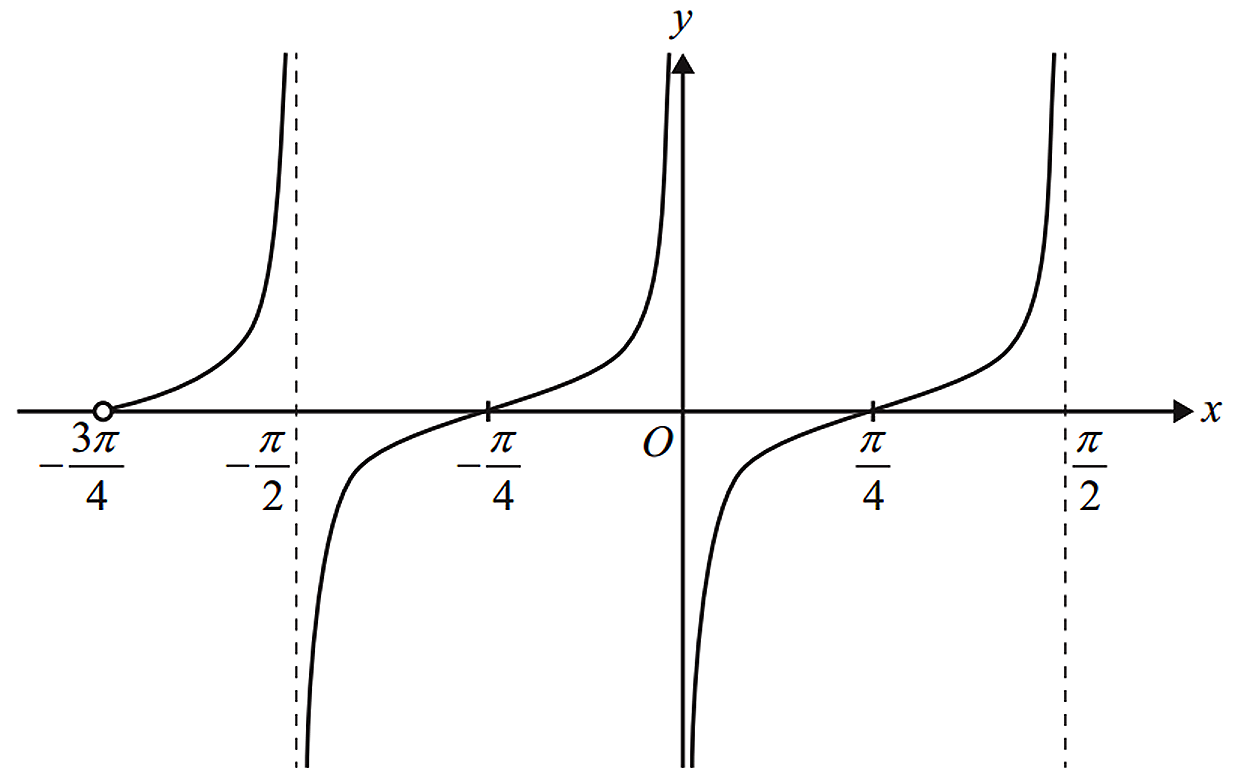
A section of the graph of  `f` is shown below.

VCAA 2012 6mc

The rule of `f` could be

  1. `f (x) = tan (x)`
  2. `f (x) = tan (x - pi/4)`
  3. `f (x) = tan(2 (x - pi/4))`
  4. `f (x) = tan(2 (x - pi/2))`
  5. `f (x) = tan(1/2 (x - pi/2))`
Show Answers Only

`C`

Show Worked Solution

`text(Period) = pi/2`

`=>\ text(must be)\ C\ text(or)\ D`

`text(Shift)\ \ y = tan(x)\ \ text(right)\ \ pi/4.`

`=>   C`

Filed Under: Trig Graphing Tagged With: Band 3, smc-2757-20-Tan, smc-2757-50-Identify graph

Algebra, STD2 A1 EQ-Bank 2

If   `A = P(1 + r)^n`, find  `A`  given  `P = $300`,  `r = 0.12`  and  `n = 3`  (give your answer to the nearest cent).   (2 marks)

Show Answers Only

`$421.48\ \ text{(nearest cent)}`

Show Worked Solution
`A` `= P(1 + r)^n= 300(1 + 0.12)^3`
  `= 300(1.12)^3= 421.478…`
  `= $421.48\ \ text{(nearest cent)}`

Filed Under: AM1 - Algebra (Prelim), Substitution and Other Equations, Substitution and Other Equations, Substitution and Other Equations Tagged With: Band 2, Band 3, smc-1116-10-Substitution, smc-6234-10-Substitution, smc-6508-10-Substitution, smc-789-10-Substitution

Algebra, STD2 A1 EQ-Bank 21

What is the value of  `5a^2-b`, if  `a =-4`  and  `b = 3`.   (2 marks)

--- 3 WORK AREA LINES (style=lined) ---

Show Answers Only

`77`

Show Worked Solution

`5a^2-b= 5(-4)^2-3= 5 xx 16-3=77`

Filed Under: AM1 - Algebra (Prelim), Substitution and Other Equations, Substitution and Other Equations, Substitution and Other Equations Tagged With: Band 3, smc-1116-10-Substitution, smc-6234-10-Substitution, smc-6508-10-Substitution, smc-789-10-Substitution

Algebra, MET2 2013 VCAA 5 MC

If   `f: text{(−∞, 1)} -> R,\ \ f(x) = 2 log_e (1 - x)\ \ text(and)\ \ g: text{[−1, ∞)} -> R, g(x) = 3 sqrt (x + 1),`  then the maximal domain of the function   `f + g`  is

  1. `text{[−1, 1)}`
  2. `(1, oo)`
  3. `text{(−1, 1]}`
  4. `text{(−∞, −1]}`
  5. `R`
Show Answers Only

`A`

Show Worked Solution

`text(Consider)\ \ f(x) = 2 log_e (1 – x):`

`(1-x)` `>0`
`:. x` `<1`


`text(Consider)\ \ g(x) = 3 sqrt (x + 1):`

`(x+1)` `>=0`
`:. x` `>= -1`


`:.\ text(The maximal domain of)\ \ f + g\ \ text{is [−1, 1)}.`

`=>   A`

Filed Under: Functional Equations, Graphs and Applications Tagged With: Band 3, smc-2745-40-Log graphs, smc-2745-50-Find Domain/Range, smc-642-40-Other functions

Graphs, MET2 2013 VCAA 4 MC

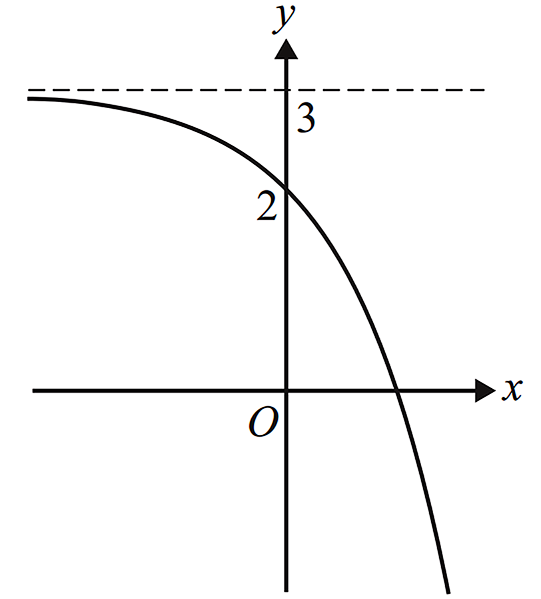
Part of the graph of  `y = f(x)`, where  `f: R -> R,\ \ f(x) = 3-e^x,`  is shown below.
 

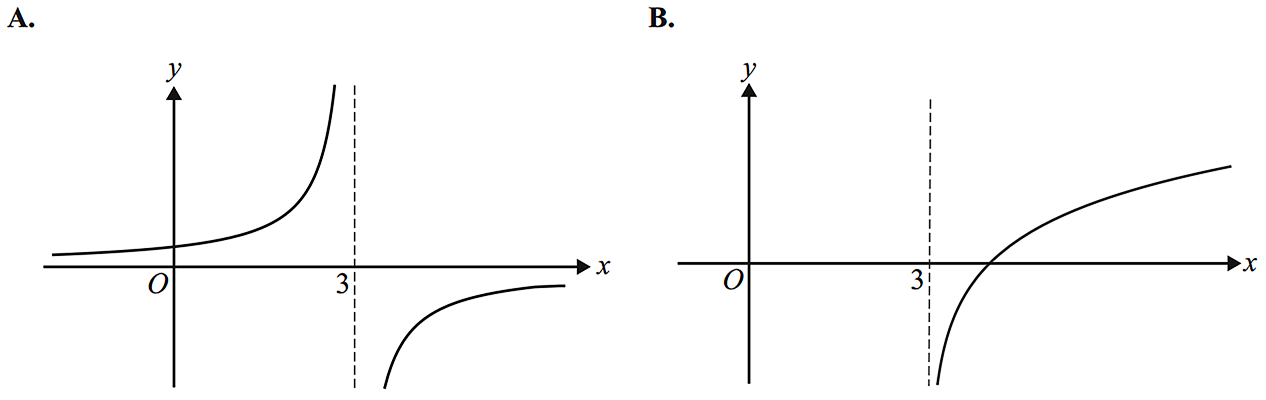
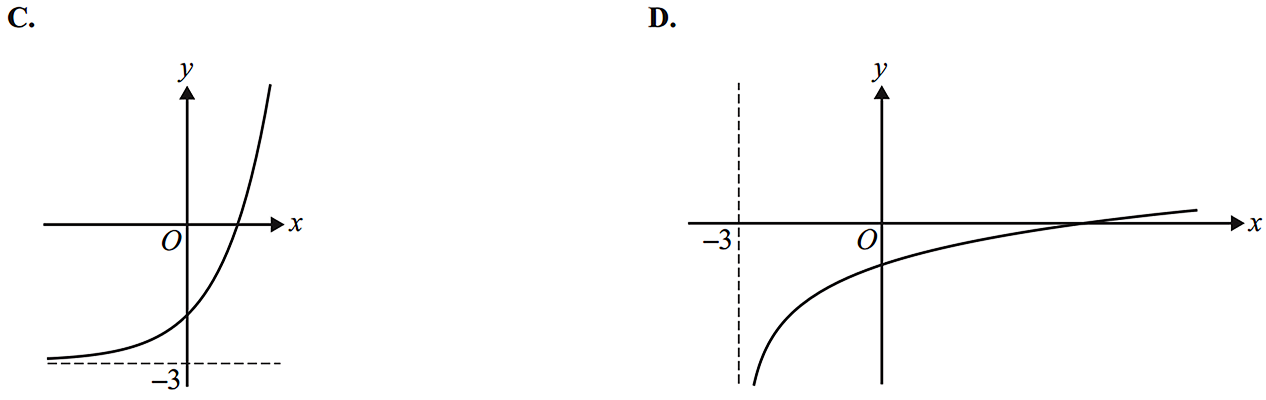
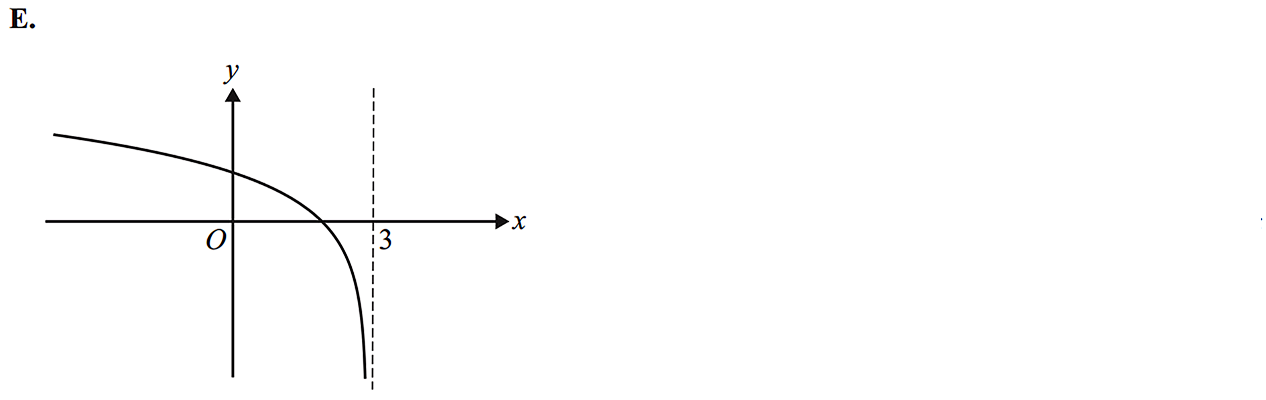
Which one of the following could be the graph of  `y = f^{-1}(x),` where  `f^{-1}` is the inverse of  `f?`

Show Answers Only

`E`

Show Worked Solution

`text(From the graph of)\ \ f(x),`

`f^-1\ \ text(has a vertical asymptote at)\ \ x = 3`

`text(and an)\ \ x text(-intercept at)\ \ (2, 0).`

`=>   E`

Filed Under: Logs and Exponential Functions Tagged With: Band 3, smc-5204-60-Identify graph

Algebra, MET2 2013 VCAA 1 MC

The function with rule  `f(x) = -3 tan(2 pi x)`  has period

  1. `2/pi`
  2. `2`
  3. `1/2`
  4. `1/4`
  5. `2 pi`
Show Answers Only

`C`

Show Worked Solution
`text(Period)` `= pi/n`
  `=pi/(2 pi)`
  `= 1/2`

 
`=>   C`

Filed Under: Trig Graphing Tagged With: Band 3, smc-2757-20-Tan, smc-2757-30-Find period

Functions, EXT1′ F2 2015 HSC 14b

The cubic equation  `x^3 – px + q = 0`  has roots  `alpha, beta`  and  `gamma`.

It is given that  `alpha^2 + beta^2 + gamma^2 = 16`  and  `a^3 + beta^3 + gamma^3 = -9`.

  1. Show that  `p = 8.`   (1 mark)
  2. Find the value of  `q.`   (2 marks)
  3. Find the value of  `alpha^4 + beta^4 + gamma^4.`   (2 marks)
Show Answers Only
  1. `text(Proof)\ \ text{(See Worked Solutions)}`
  2. `3`
  3. `128`
Show Worked Solution

(i)    `alpha + beta + gamma = – b/a=0`

`alpha beta + beta gamma + gamma alpha = c/a= -p`

`(alpha + beta + gamma)^2` `= alpha^2 + beta^2 + gamma^2 + 2(alpha beta + beta gamma + gamma alpha)`
`0` `= 16 – 2p`
`:. p` `= 8`


(ii)    `alpha^3 – 8 alpha + q` `=0\ \ \ …\ (1)`
  `beta^3 – 8 beta + q` `=0\ \ \ …\ (2)`
  `gamma^3 – 8 gamma + q` `=0\ \ \ …\ (3)`

`(1)+(2)+(3)`

`(alpha^3 + beta^3 + gamma^3) – 8(alpha + beta + gamma) + 3q = 0`

`-9 – 0 + 3q` `=0`
`q` `=3`


COMMENT: Part (iii) proved challenging for many students with the State mean mark just over 50%.
(iii)   `alpha(alpha^3 – 8 alpha + 3)` `=0\ \ \ …\ (1)`
  `beta(beta^3 – 8 beta + 3)` `=0\ \ \ …\ (2)`
  `gamma(gamma^3 – 8 gamma + 3)` `=0\ \ \ …\ (3)`

`(1)+(2)+(3)`

`alpha^4 + beta^4 + gamma^4 – 8(alpha^2 + beta^2 + gamma^2) + 3(alpha + beta + gamma) = 0`

`alpha^4 + beta^4 + gamma^4` `= 8 xx 16 – 0`
  `= 128`

Filed Under: Roots and Coefficients Tagged With: Band 3, Band 4

Calculus, EXT2 C1 2015 HSC 14a

  1. Differentiate  `sin^(n - 1) theta cos theta`, expressing the result in terms of  `sin theta`  only.  (2 marks)

    --- 6 WORK AREA LINES (style=lined) ---

  2. Hence, or otherwise, deduce that
     
         `int_0^(pi/2) sin^n theta\ d theta = ((n-1))/n int_0^(pi/2) sin^(n - 2) theta\ d theta`,  for `n>1.`  (2 marks) 

    --- 8 WORK AREA LINES (style=lined) ---

  3. Find  `int_0^(pi/2) sin^4 theta\ d theta.`  (1 mark)

    --- 3 WORK AREA LINES (style=lined) ---

Show Answers Only
  1. `text(See Worked Solutions)`
  2. `text(Proof)\ \ text{(See Worked Solutions)}`
  3. `(3 pi)/16`
Show Worked Solution

i.   `d/(d theta) (sin^(n – 1) theta cos theta)`

`=(n – 1) sin^(n – 2) theta cos theta cos theta + sin^(n – 1) theta xx (-sin theta)`

`=(n – 1) sin^(n – 2) theta cos^2 theta – sin^n theta`

`=(n – 1) sin^(n – 2) theta (1 – sin^2 theta) – sin^n theta`

`=(n – 1) sin^(n – 2) theta – (n – 1) sin^n theta – sin^n theta`

`=(n – 1) sin^(n – 2) theta – n sin^n theta`


ii.   `text{From part (i)}`

`n sin^n theta = (n – 1) sin^(n – 2) theta – d/(d theta) (sin^(n – 1) theta cos theta)`

`:. int_0^(pi/2) sin^n theta\ d theta`

`=1/n int_0^(pi/2) ((n – 1) sin^(n – 2) theta – d/(d theta) (sin^(n – 1) theta cos theta)) d theta`

`=1/n int_0^(pi/2) (n – 1) sin^(n – 2) theta\ d theta – 1/n int_0^(pi/2) d/(d theta) (sin^(n – 1) theta cos theta)\ d theta`

`= 1/n int_0^(pi/2) (n – 1) sin^(n – 2) theta\ d theta – 1/n int_0^(pi/2) d/(d theta) (sin^(n – 1) theta cos theta)\ d theta`

`= (n – 1)/n int_0^(pi/2) sin^(n – 2) theta\ d theta – 1/n [sin^(n – 1) theta cos theta]_0^(pi/2)`

`= (n – 1)/n int_0^(pi/2) sin^(n – 2) theta\ d theta – 1/n (0 – 0)`

`= (n – 1)/n int_0^(pi/2) sin^(n – 2) theta\ d theta,\ \ \ \ (n>1)`


iii.   `int_0^(pi/2) sin^4 theta\ d theta` `= 3/4 int_0^(pi/2) sin^2 theta\ d theta`
    `= 3/4 xx [(2-1)/2 int_0^(pi/2) d theta]`
    `= 3/8 xx [theta]_0^(pi/2)` 
    `= (3 pi)/16`

Filed Under: Trig Integrals, Trig Integration Tagged With: Band 3, Band 4, smc-1193-10-sin/cos, smc-1193-40-Other trig ratios

Harder Ext1 Topics, EXT2 2015 HSC 13c

A small spherical balloon is released and rises into the air. At time  `t`  seconds, it has radius  `r` cm, surface area  `S = 4 pi r^2`  and volume  `V = 4/3 pi r^3`.

As the balloon rises it expands, causing its surface area to increase at a rate of  `((4 pi)/3)^(1/3)\ \text(cm)^2 text(s)^-1`. As the balloon expands it maintains a spherical shape.

  1. By considering the surface area, show that  
    1. `(dr)/(dt) = 1/(8 pi r) (4/3 pi)^(1/3).`  (2 marks)

  2. Show that  
    1. `(dV)/(dt) = 1/2 V^(1/3).`  (2 marks)

  3. When the balloon is released its volume is  `8000\ text(cm³)`. When the volume of the balloon reaches  `64000\ text(cm³)`  it will burst.
  4. How long after it is released will the balloon burst?  (2 marks)


Show Answers Only
  1. `text(Proof)\ \ text{(See Worked Solutions)}`
  2. `text(Proof)\ \ text{(See Worked Solutions)}`
  3. `1\ \ text(hour)`
Show Worked Solution
(i)    `(dS)/(dt)` `= (dS)/(dr) xx (dr)/(dt)`
  `((4 pi)/3)^(1/3)` `=8 pi r xx (dr)/(dt)`
  `(dr)/(dt)` `=((4 pi)/3)^(1/3) xx 1/(8 pi r)`
    `=1/(8 pi r) (4/3 pi)^(1/3)`


(ii)   `(dV)/(dt) = (dV)/(dr) xx (dr)/(dt)`

`(dV)/(dt) ­=` `4 pi r^2 xx ((4 pi)/3)^(1/3) xx 1/(8 pi r)`
`­=` `r/2 xx ((4 pi)/3)^(1/3)`
`­=` `1/2 (4/3 pi r^3)^(1/3)`
`­=` `1/2 V^(1/3)`


(iii)  `text(Find)\ \ t\ \ text(when)\ \ V=64\ 000`

`text(When)\ \ t = 0,\ \ V = 8000`

`(dV)/(dt)` `=1/2 V^(1/3)`
`(dt)/(dV)` `=2/V^(1/3)`
`int_0^t\ dt` `= int_8000^64000 2/V^(1/3)\ dV`
`:.t` `= [3V^(2/3)]_8000^64000`
  `= 3(1600 – 400)`
  `= 3600\ \  text(seconds)`
  `= 1\ \ text(hour)`

Filed Under: Harder Integration Examples, Other Ext1 Topics Tagged With: Band 2, Band 3, Band 4

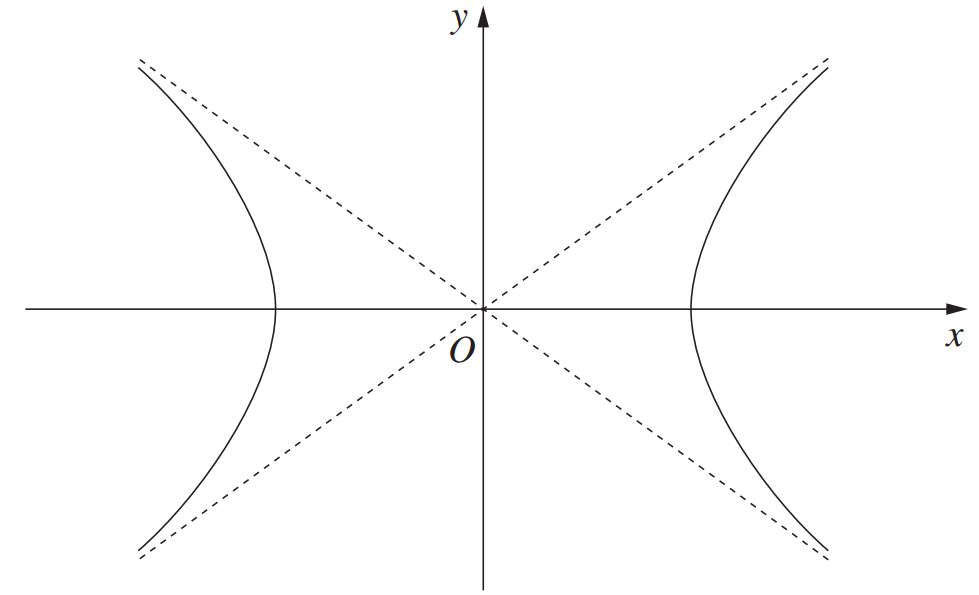
Conics, EXT2 2015 HSC 13a

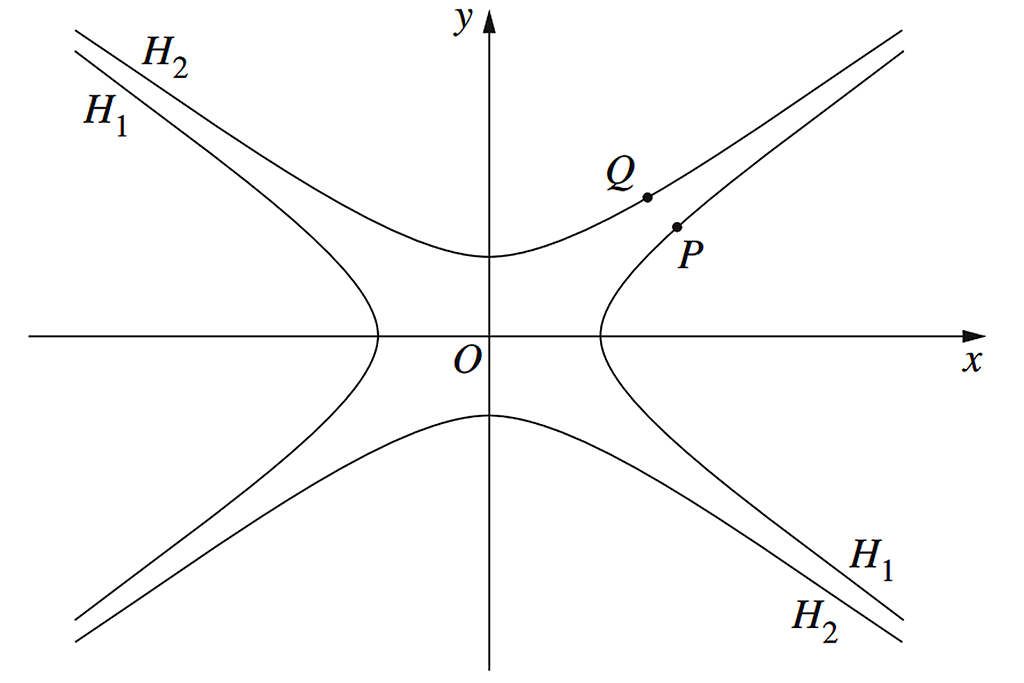
The hyperbolas  `H_1:\ \ x^2/a^2 - y^2/b^2 = 1`  and  `H_2:\ \ x^2/a^2 - y^2/b^2 = -1`  are shown in the diagram.

Let  `P(a sec theta, b tan theta)`  lie on  `H_1`  as shown on the diagram.

Let  `Q`  be the point  `(a tan theta, b sec theta)`.

  1. Verify that the coordinates of  `Q(a tan theta, b sec theta)`  satisfy the equation for  `H_2.`  (1 mark)

  2. Show that the equation of the line  `PQ`  is  `bx + ay = ab (tan theta + sec theta).`  (2 marks)

  3. Prove that the area of  `Delta OPQ`  is independent of  `theta.`  (3 marks)
Show Answers Only
  1. `text(Proof)\ \ text{(See Worked Solutions)}`
  2. `text(Proof)\ \ text{(See Worked Solutions)}`
  3. `text(Proof)\ \ text{(See Worked Solutions)}`
Show Worked Solution

(i)   `text(Substitute)\ \ Q(a tan theta, b sec theta)\ \ text(into)`

`\ \ x^2/a^2 – y^2/b^2 = -1`

`text(LHS)` `=(a^2 tan^2 theta)/a^2 – (b^2 sec^2 theta)/b^2`
  `=tan^2 theta – sec^2 theta\ \ \ \ \ \ (sec^2 theta = tan^2 theta +1)`
  `=-1`

`:. Q\ \ text(lies on)\ \ H_2`


(ii)    `m_(PQ)` `=(b tan theta-b sec theta)/(a sec theta- a tan theta)`
    `=(-b(sec theta – tan theta))/(a(sec theta – tan theta))`
    `=-b/a`


`:. text(Equation of)\ \ PQ`

`(y – b tan theta)` `=-b/a (x – a sec theta)`
`ay – ab tan theta` `=-bx + ab sec theta`
`bx + ay` `=ab (tan theta + sec theta)`
♦ Mean mark 47%.


(iii)  `text(Area)\ \ Delta OPQ = 1/2 xx QP xx d,\ \ text(where)`

`d= text(Perpendicular distance from)\ \  O\ \ text(to)\ \ QP`

`d` `= |\ (-ab(tan theta + sec theta))/sqrt (a^2 + b^2)\ |`
  `= (ab (tan theta + sec theta))/sqrt (a^2 + b^2)`


`text(Distance)\ \ QP`

`QP^2` `=(a sec theta – a tan theta)^2 + (b tan theta – b sec theta)^2`
  `=a^2(sec theta – tan theta)^2+b^2(sec theta – tan theta)^2`
  `=(a^2+b^2)(sec theta – tan theta)^2`
 `QP`  `=sqrt(a^2+b^2) *|\ sec theta – tan theta\ |`
  `=sqrt(a^2+b^2)(sec theta – tan theta),\ \ \ \ \ (sec theta>=tan theta\ \ text(for)\ \ 0<=theta<=90^@)`


`text(Area)\ \ Delta OPQ` `=1/2 sqrt(a^2+b^2)(sec theta – tan theta)*(ab (tan theta + sec theta))/sqrt(a^2 + b^2)`
  `= (ab)/2 xx (sec theta – tan theta) (sec theta + tan theta)`
  `= (ab)/2 xx (sec^2 theta – tan^2 theta)`
  `= (ab)/2`

`:.\ text(Area)\ \ Delta OPQ\ \ text(is independent of)\ \ theta.`

Filed Under: Hyperbola Tagged With: Band 2, Band 3, Band 5

Functions, EXT1′ F1 2015 HSC 12c

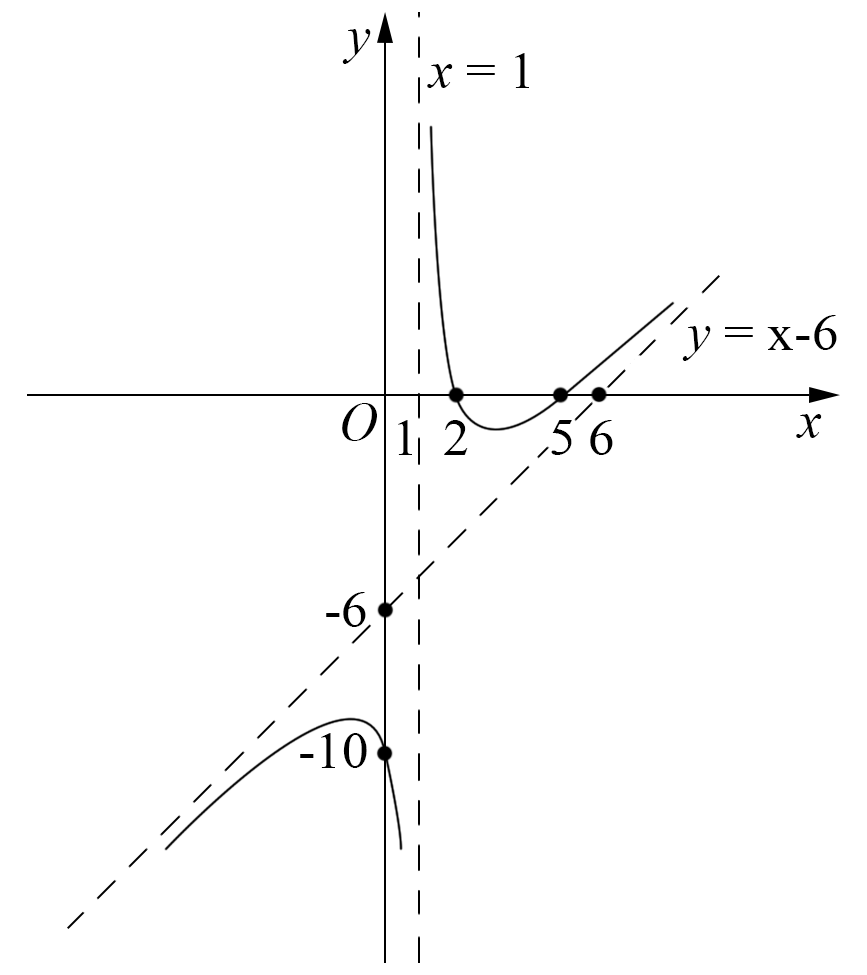
  1. By writing  `((x -2) (x - 5))/(x - 1)`  in the form  `mx + b + a/(x - 1)`,  find the equation of the oblique asymptote of  `y = ((x -2) (x - 5))/(x - 1).`   (2 marks)
     
  2. Hence sketch the graph  `y = ((x -2) (x - 5))/(x - 1)`,  clearly indicating all intercepts and asymptotes.  (2 marks)


Show Answers Only
  1. `y = x − 6`
  2. `text(See Worked Solutions)`
Show Worked Solution
i.   `((x – 2) (x – 5))/(x – 1)` `= (x^2 – 7x + 10)/(x – 1)`
  `= (x(x – 1) – 6 (x – 1) + 4)/(x – 1)`
  `= x – 6 + 4/(x – 1)`


`:.text(Equation of oblique asymptote is)\ \ y = x – 6`


ii.   `text(Vertical asymptote at)\ \ x = 1`

`x text(-intercepts)\ \ 2 and 5,\ \ y text(-intercept) = -10`

Filed Under: Reflections and Harder curves Tagged With: Band 3

Polynomials, EXT2 2015 HSC 12b

The polynomial  `P(x) = x^4 - 4x^3 + 11x^2 - 14x + 10`  has roots  `a + ib`  and  `a + 2ib`  where `a`  and  `b`  are real and  `b != 0.`

  1. By evaluating  `a`  and  `b`, find all the roots of  `P(x).`   (3 marks)
  2. Hence, or otherwise, find one quadratic polynomial with real coefficients that is a factor of  `P(x).`   (1 mark)


Show Answers Only
  1. `1 +- i,\ \ 1 +- 2i`
  2. `x^2 − 2x + 2\ \  or\ \  x^2 − 2x + 5`
Show Worked Solution

(i)   `text(S)text(ince coefficients of)\ \ P(x)\ \ text(are real,)`

`=>\ text(Complex roots occur in conjugate pairs)`

`=>\ text(Roots are)\ \ a +- ib\ \  and\ \  a +- 2ib`

`text(Sum of roots) = -b/a=4`

`4` `=a + ib + a – ib + a + 2ib + a – 2ib`
`4a` `=4`
`:.a` `=1`


`text(Products of roots)`

`(a + ib) (a – ib) (a – 2ib) (a – 2ib)` `= 10`
`(a^2 + b^2) (a^2 + 4b^2)` `= 10`
`(1 + b^2) (1 + 4b^2)` `= 10`
`4b^4 + 5b^2 + 1` `= 10`
`4b^4 + 5b^2 – 9` `= 0`
`(4b^2 + 9) (b^2 – 1)` `= 0`

`:.b^2 = 1,\ \ \ \ (b\ \ text{is real})`

`:.b = +- 1`

`:.P(x)\ text(has roots)\ \ \ 1 +- i,\ 1 +- 2i.`


(ii)    `P(x)` `=(x – 1 – i) (x – 1 + i)(x-1-2i)(x-1+2i)`
    `=(x^2 – 2x + 2)(x^2 – 2x + 5)`


Filed Under: Roots and Coefficients Tagged With: Band 3, Band 4, HSC

Complex Numbers, EXT2 N1 2015 HSC 12a

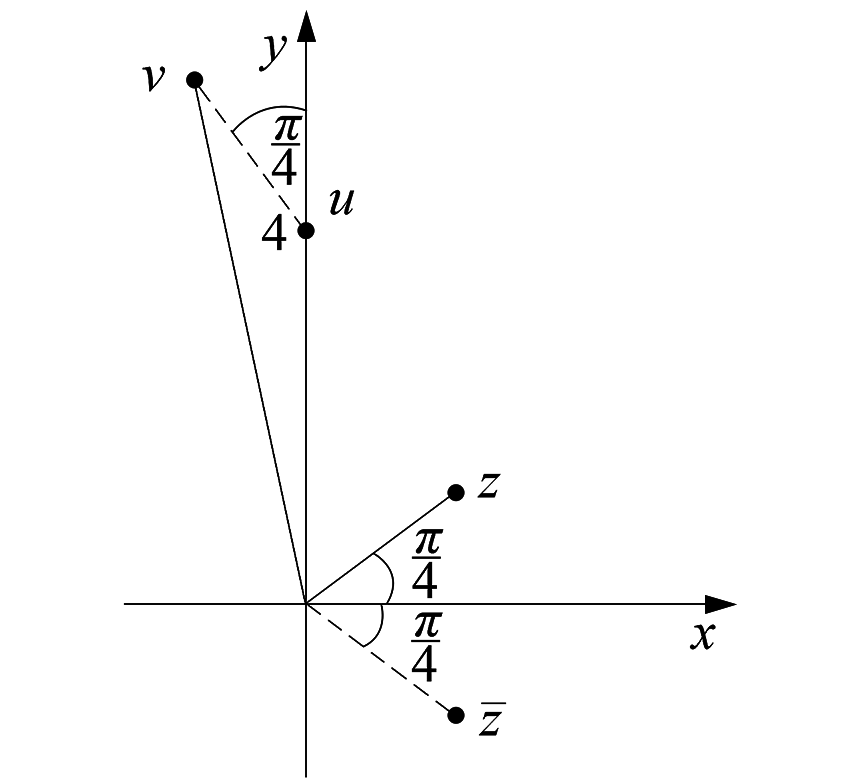
The complex number `z` is such that `|\ z\ |=2`  and  `text(arg)(z) = pi/4.`

Plot each of the following complex numbers on the same half-page Argand diagram.

  1.  `z`   (1 mark)

    --- 6 WORK AREA LINES (style=lined) ---

  2.  `u = z^2`   (1 mark)

    --- 2 WORK AREA LINES (style=lined) ---

  3.  `v = z^2 - bar z`   (1 mark)

    --- 2 WORK AREA LINES (style=lined) ---

Show Answers Only
  1. `text(See Worked Solutions)`
  2. `text(See Worked Solutions)`
  3. `text(See Worked Solutions)`
Show Worked Solution

i.   `z ­=` `2 text(cis) pi/4`
`­=` `sqrt 2 (1 + i)`


ii.   `u ­=` `z^2`
`­=` `4 text(cis)\ pi/2`
`­=` `4i`

COMMENT: 12a(iii) had the lowest mean mark (55%) of any part within Q12 and deserves attention.
iii.  `v ­=` `z^2 – bar z`
`­=` `4i – sqrt 2 (1 – i)`
`­=` `- sqrt 2 + (4 + sqrt 2) i`

Filed Under: Argand Diagrams and Mod/Arg form, Geometry and Complex Numbers (vectors) Tagged With: Band 3, Band 4, smc-1049-40-Mod/Arg arithmetic, smc-1049-50-Powers

Calculus, EXT2 C1 2015 HSC 11f

  1. Show that  
     
    `cot theta + text(cosec)\ theta = cot(theta/2).`   (2 marks)

    --- 6 WORK AREA LINES (style=lined) ---

  2. Hence, or otherwise, find
     
         `int (cot theta + text(cosec)\ theta)\ d theta.`   (1 mark)

    --- 3 WORK AREA LINES (style=lined) ---

Show Answers Only
  1. `text(Proof)\ \ text{(See Worked Solutions)}`
  2. `2 ln\ |sin\ theta/2| + c`
Show Worked Solution
i.   `cot theta + text(cosec)\ theta ­=` `(cos theta)/(sin theta) + 1/(sin theta)`
`­=` `(1 + cos theta)/(sin theta)`
`­=` `(1 + 2 cos^2 (theta/2) – 1)/(2 sin (theta/2) cos (theta/2))`
`­=` `(2 cos^2(theta/2))/(2 sin (theta/2) cos (theta/2))`
`­=` `(cos (theta/2))/(sin (theta/2))`
`­=` `cot (theta/2)`


COMMENT: Part (ii) mean mark 51%.
ii.   `int (cot theta + text(cosec)\ theta)\ d theta ­=` `int cot (theta/2)\ d theta`
`­=` `int (cos (theta/2))/(sin (theta/2))\ d theta`
`­=` `2 ln\ |sin\ theta/2| + c`

Filed Under: Trig Integrals, Trig Integration Tagged With: Band 3, Band 4, smc-1193-40-Other trig ratios

Graphs, EXT2 2015 HSC 11e

Find the value of  `(dy)/(dx)`  at the point  `(2, text(−1))`  on the curve  `x + x^2 y^3 = -2.`  (3 marks)

Show Answers Only

`1/4`

Show Worked Solution

`x + x^2 y^3 = -2`

`1 + 2xy^3 + x^2 3y^2* (dy)/(dx)` `= 0`
`3x^2 y^2* (dy)/(dx)` `= -(1 + 2xy^3)`
`(dy)/(dx)` `= (-(1 + 2xy^3))/(3x^2 y^2)`

`text(At)\ \ P(2, text(−1)),`

`(dy)/(dx) ­=` `(-(1 – 4))/12`
`­=` `1/4`

Filed Under: Implicit Differentiation Tagged With: Band 3

Complex Numbers, EXT2 N1 2015 HSC 11b

Consider the complex numbers  `z = -sqrt 3 + i`  and  `w = 3 (cos\ pi/7 + i sin\ pi/7).`

  1. Evaluate  `|\ z\ |.`   (1 mark)

    --- 1 WORK AREA LINES (style=lined) ---

  2. Evaluate  `text(arg)(z).`   (1 mark)

    --- 2 WORK AREA LINES (style=lined) ---

  3. Find the argument of  `z/w.`   (1 mark)

    --- 2 WORK AREA LINES (style=lined) ---

Show Answers Only
  1. `2`
  2. `(5 pi)/6`
  3. `(29 pi)/42`
Show Worked Solution
i.   `|\ z\ |` `= sqrt ((-sqrt3)^2 + 1^2)`
  `= 2`


ii.   `text(arg)\ (z) ­=` `tan^-1 (1- sqrt 3)`
`­=` `pi – pi/6`
`­=` `(5 pi)/6`


iii.   `text(arg) (z/w) ­=` `text(arg)\ z – text(arg)\ w`
`­=` `(5 pi)/6 – pi/7`
`­=` `(29 pi)/42`

Filed Under: Argand Diagrams and Mod/Arg form, Geometry and Complex Numbers (vectors) Tagged With: Band 1, Band 3, Band 4, smc-1049-40-Mod/Arg arithmetic

Mechanics, EXT2 2006 HSC 5c

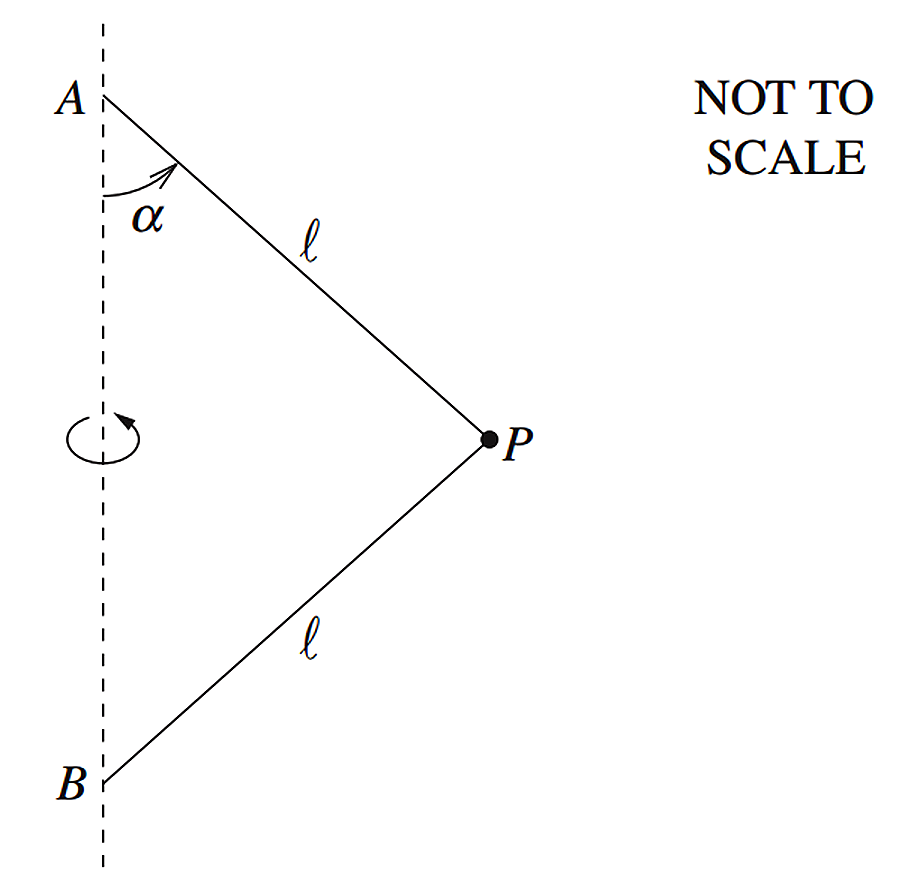
A particle,  `P`, of mass  `m`  is attached by two strings, each of length  `l`, to two fixed points,  `A`  and  `B`, which lie on a vertical line as shown in the diagram.

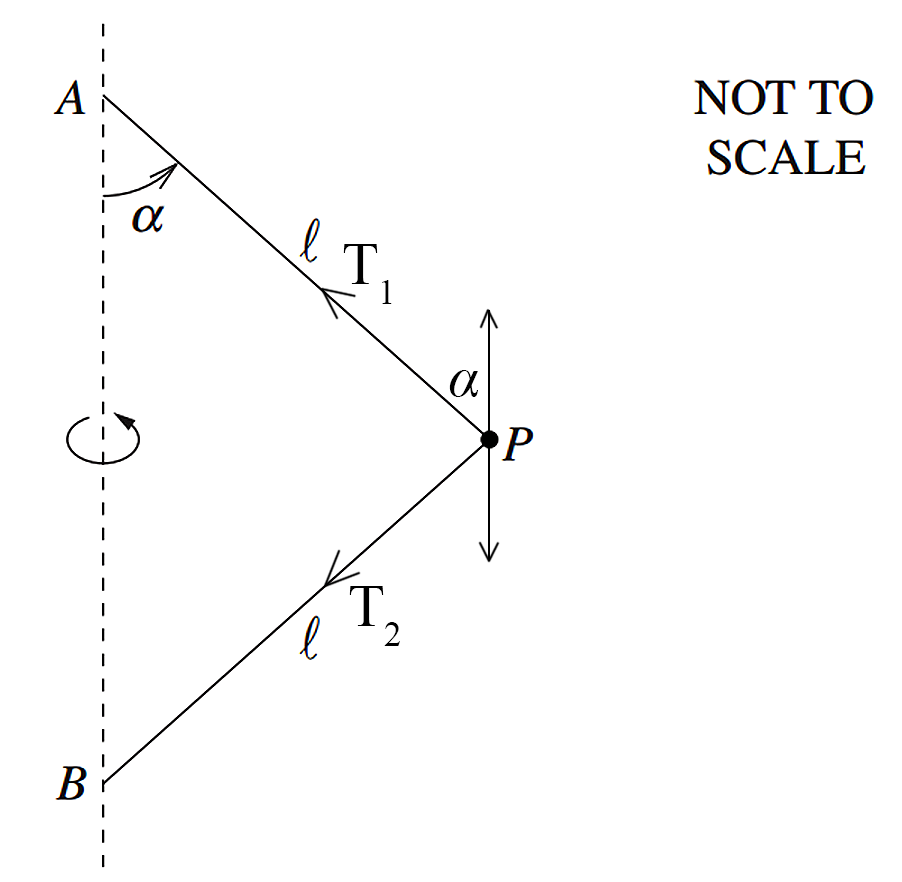
The system revolves with constant angular velocity  `omega`  about  `AB`. The string  `AP`  makes an angle  `alpha`  with the vertical. The tension in the string  `AP`  is  `T_1`  and the tension in the string  `BP`  is  `T_2`  where  `T_1 >= 0`  and  `T_2 >= 0`. The particle is also subject to a downward force,  `mg`, due to gravity.

  1. Resolve the forces on  `P`  in the horizontal and vertical directions.  (2 marks)

  2. If  `T_2 = 0`, find the value of  `omega`  in terms of  `l, g`  and  `alpha.`  (1 mark)
Show Answers Only
  1. `text(Vertical):\ (T_1 – T_2) cos alpha = mg\ \ \ \ \ text(Horizontal):\ T_1 + T_2 = ml omega^2`
  2. `omega = sqrt (g/(l cos alpha))`
Show Worked Solution
(i)   

`text(Resolving the forces vertically)`

`T_1 cos alpha = mg + T_2 cos alpha\ \ \ …\ (1)`

`text(Resolving the forces horizontally)`

` T_1 sin alpha+ T_2 sin alpha = mr omega^2\ \ \ …\ (2)`

`r = l sin alpha`

`:. (T_1 + T_2) sin alpha = m l sin alpha omega^2`

`T_1 + T_2 = m l omega^2`


(ii)   `text(Substitute)\ \ T_2 = 0\ \ text{into (1) and (2)}`

`T_1` `= (mg)/cos alpha\ \ \ …\ (1)`
`T_1 sin alpha` `= m r omega^2`
  `=ml sin alpha omega^2\ \ \ \ text{(since}\ \ r=l sin alpha text{)}`
`T_1` `=ml omega^2\ \ \ …\ (2)`


`:. m l omega^2` `= (mg)/(cos alpha)`
`omega^2` `= g/(l cos alpha)`
`:.omega` `= sqrt(g/(l cos alpha))`

Filed Under: Circular Motion Tagged With: Band 3, Band 4

Conics, EXT2 2006 HSC 4c

Let  `P(p, 1/p), Q(q, 1/q)`  and  `R(r, 1/r)`  be three distinct points on the hyperbola  `xy = 1.`

  1. Show that the equation of the line,  `l`, through  `R`, perpendicular to  `PQ`, is  `y = pqx - pqr + 1/r.`  (2 marks)
  2. Write down the equation of the line,  `m`, through  `P`, perpendicular to  `QR.`  (1 mark)
  3. The lines  `l`  and  `m`  intersect at  `T.`
  4. Show that  `T`  lies on the hyperbola.  (2 marks)


Show Answers Only
  1. `text(Proof)\ \ text{(See Worked Solutions)}`
  2. `y = qrx – pqr + 1/p`
  3. `text(Proof)\ \ text{(See Worked Solutions)}`
Show Worked Solution
(i)   `text(Gradient)\ \ PQ =` `(1/p – 1/q)/(p – q)`
`­=` `((q – p)/(pq))/(p – q)`
`­=` `-1/(pq)`


`=>text(Gradient of perpendicular) = pq`

`:.\ text(Equation of)\ \ l,\ \ text(through)\ \ R(r, 1/r)`

`y – 1/r` `= pq (x – r)`
`y – 1/r` `= pqx – pqr`
`:.y` `= pqx – pqr + 1/r`


(ii)  `text(Equation of)\ \ m,\ \ text(through)\ \ P(p, 1/p),\ \ text(is)`

`y = qrx – pqr + 1/p`


(iii)  `T\ \ text(occurs at the intersection of)`

MARKER’S COMMENT: Many students had difficulty simplifying  `1/p-1/r -: (p-r).` Be clear on how to do this. 

`y = pqx – pqr + 1/r\ \ \ …\ (1)`

`y = qrx – pqr + 1/p\ \ \ …\ (2)`

`text{Subtract (1) – (2)}`

`(pq – qr)x + 1/r – 1/p` `=0`
`q(p – r)x` `= 1/p – 1/r`
`q(p – r)x` `= (r – p)/(pr)`
`x` `= -1/(pqr)`


`text{Substitute into (1)}`

`y = (-pq)/(pqr) – pqr + 1/r = -pqr`

`:.T ((-1)/(pqr), -pqr)`


`text(Substituting into)\ \ xy = 1`

`text(LHS)` `=(-1)/(pqr) xx (-pqr)`
  `=1`
  `=\ text(RHS)`

`:. T\ \ text(lies on the hyperbola)`

Filed Under: Hyperbola Tagged With: Band 3, Band 4

Functions, EXT1′ F2 2006 HSC 4a

The polynomial  `p(x) = ax^3 + bx + c`  has a multiple zero at 1 and has remainder 4 when divided by  `x + 1`. Find `a, b` and `c`.   (3 marks)

Show Answers Only

`a = 1,\ \ b = -3,\ \ c = 2`

Show Worked Solution
`p(x)` `= ax^3 + bx + c`
`p^{′}(x)` `= 3ax^2 + b`


`text(S)text(ince 1 is a multiple root:)`

`p^{′}(1)` `= 3ax^2 + b=0\ \ \ …\ (1)`
`p(1)`  `= a + b + c = 0\ \ \ …\ (2)`
`p(-1)` ` = -a-b + c = 4\ \ \ …\ (3)`

 
`text{Add (2) + (3)}`

`2c = 4,\ \ c = 2`

`text{Subtract (1) – (2):}`

`2a-c = 0,\ \ a=1`

`text{Substituting into (1):}`

`3 + b = 0,\ \ b = -3`
 

`:. a = 1,\ \ b = -3,\ \ c = 2`

Filed Under: Roots and Coefficients Tagged With: Band 3, smc-6645-50-Calculus

Conics, EXT2 2006 HSC 3b

The diagram shows the graph of the hyperbola

`x^2/144 - y^2/25 = 1.`

  1. Find the coordinates of the points where the hyperbola intersects the `x`-axis.  (1 mark)
  2. Find the coordinates of the foci of the hyperbola.  (2 marks)
  3. Find the equations of the directrices and the asymptotes of the hyperbola.  (2 marks)
Show Answers Only
  1. `(12, 0),\ (– 12, 0)`
  2. `(13, 0),\ (– 13, 0)`
  3. `text(Directrices:)\ \ x = +- 144/13;\ \ text(Asymptotes:)\ \ y = +- 5/12 x`
Show Worked Solution

(i)  `text(Intersection when)\ \ y=0`

`x^2/144 + 0` `=1`
`x` `= +-12`


`:. xtext(-axis intersection at)\ \ (12, 0),\ (– 12, 0)`


(ii)  `a=12,\ \ b = 5`

`text(Using)\ \ \ b^2` `=a^2(e^2-1)`
`25` `= 144 (e^2 – 1)`
`25/144` `= e^2 – 1`
`e^2` `= 169/144`
`e` `= 13/12`


`:.S(ae,0)-=(13,0)`

`:. S′(– ae,0)-=(– 13,0)`


(iii)   `text(Directrices when)\ \ \ x` `=+-a/e`
    `=+-144/13`
  `text(Asymptotes when)\ \ \ y` `=+-b/a x`
    `=+- 5/12 x`

Filed Under: Hyperbola Tagged With: Band 2, Band 3, Band 4

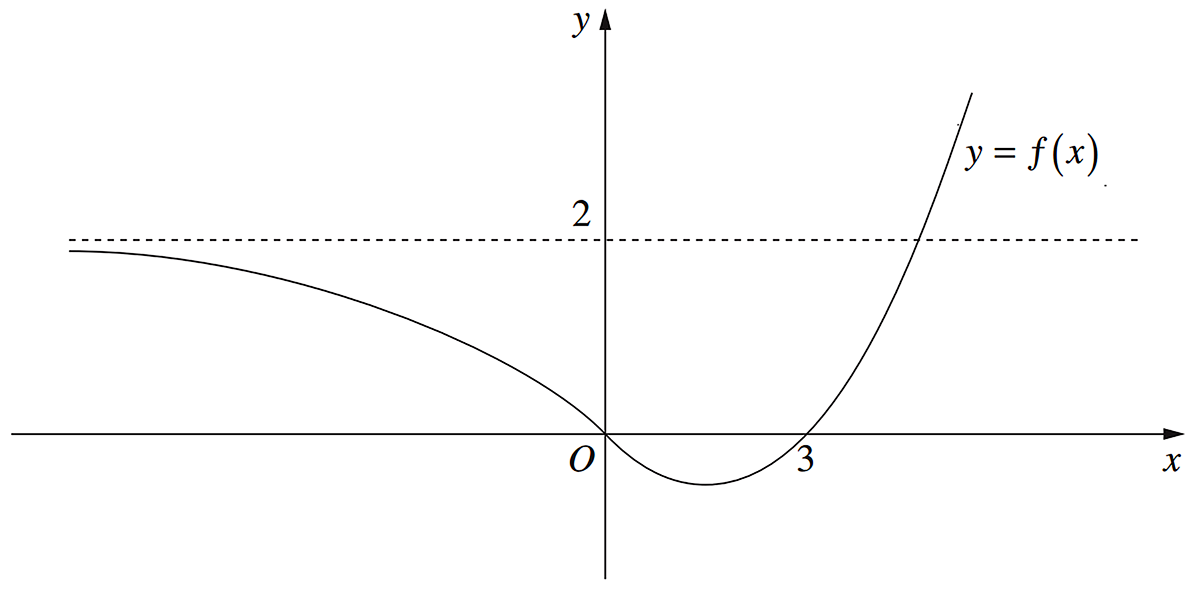
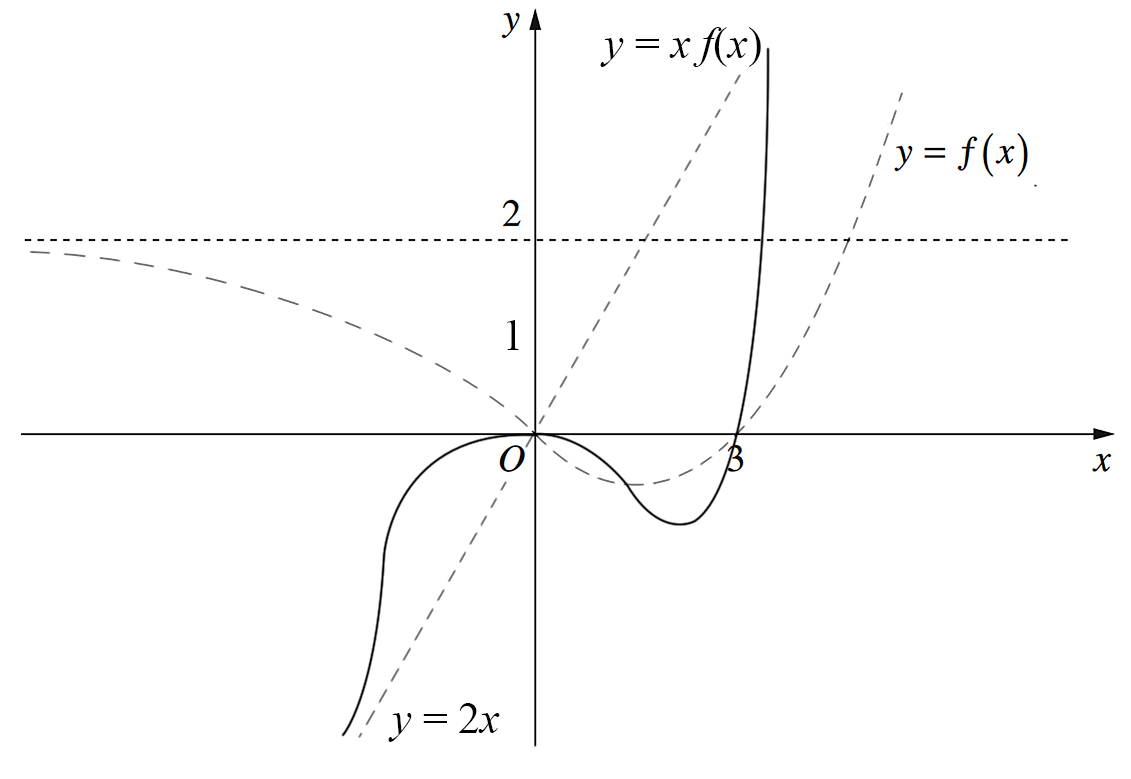
Functions, EXT1′ F1 2006 HSC 3a

The diagram shows the graph of  `y =f(x)`. The graph has a horizontal asymptote at  `y =2`.


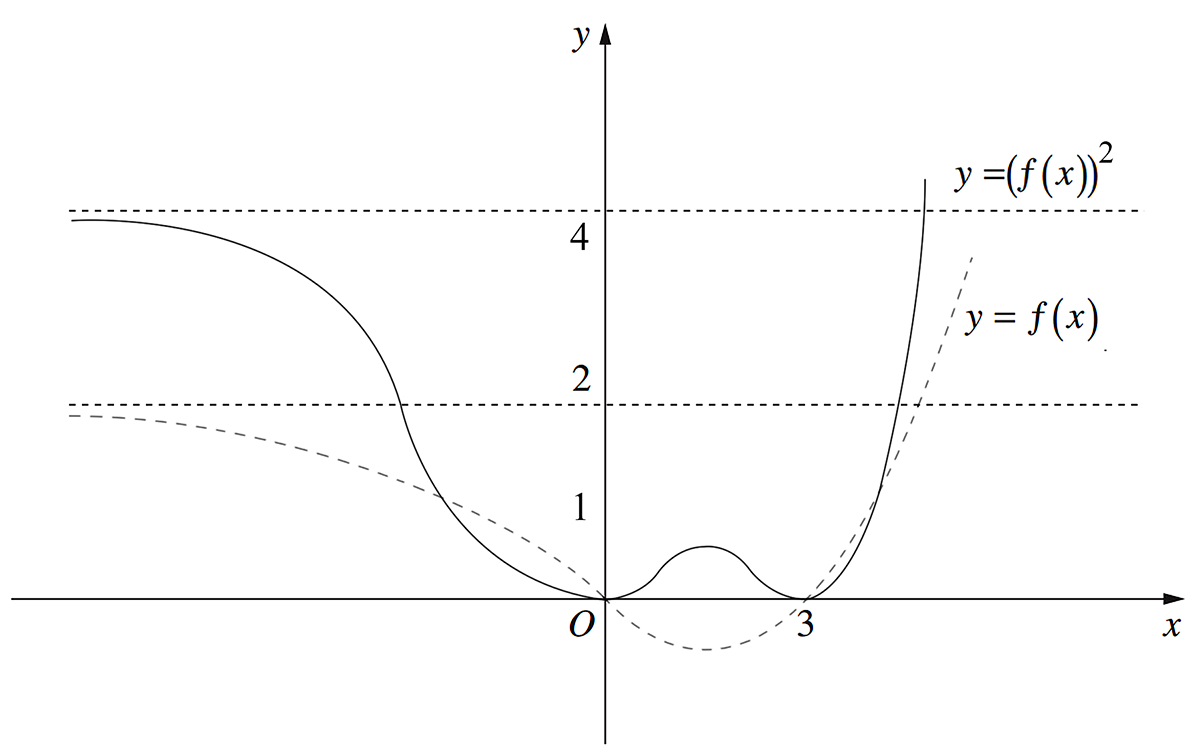
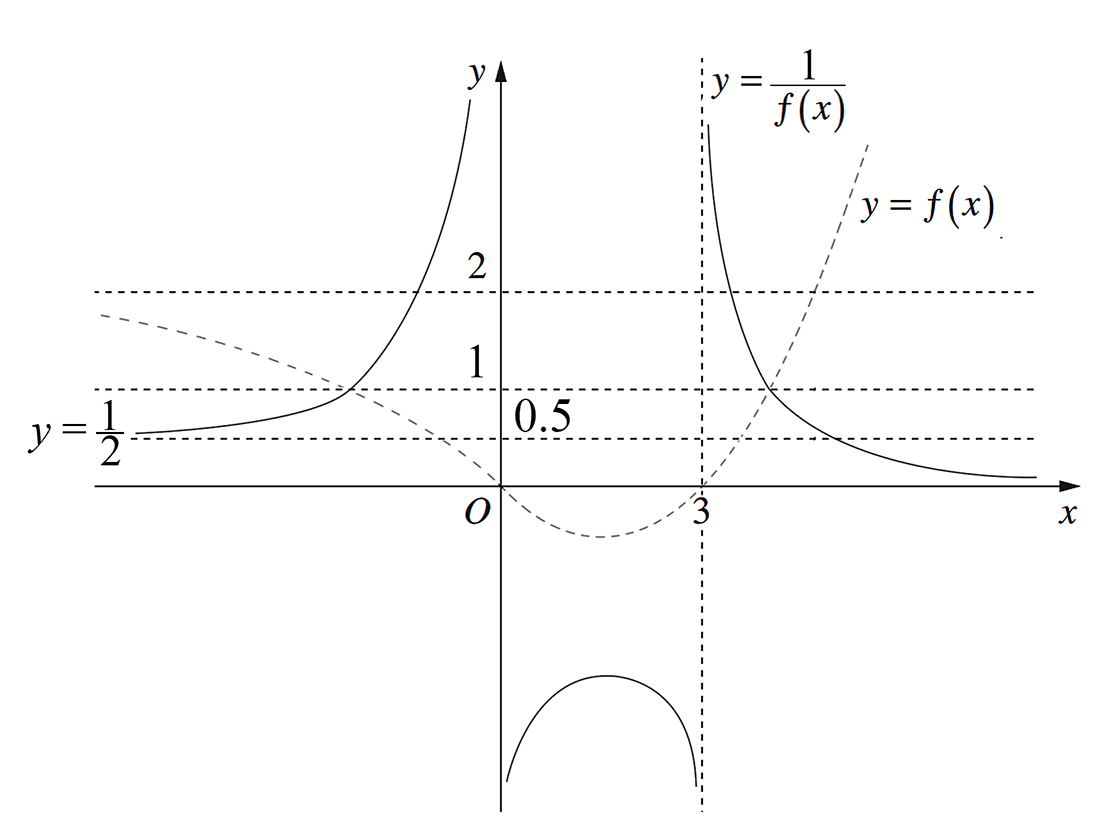
Draw separate one-third page sketches of the graphs of the following:

  1.  `y = (f(x))^2`  (2 marks)

    --- 8 WORK AREA LINES (style=lined) ---

  2.  `y = 1/(f(x))`  (2 marks)

    --- 10 WORK AREA LINES (style=lined) ---

  3.  `y = x\ f(x)`  (2 marks)

    --- 10 WORK AREA LINES (style=lined) ---

Show Answers Only

i.

ii. 

iii. 

Show Worked Solution
i.   


ii.   


iii.   

Filed Under: Addition / Multiplication of 2 Graphs (Ext1), Drawing graphs to powers, Sketching - mult/division of ordinates Tagged With: Band 3, Band 4, page-break-before-solution, smc-1073-30-Other

Conics, EXT2 2007 HSC 7b

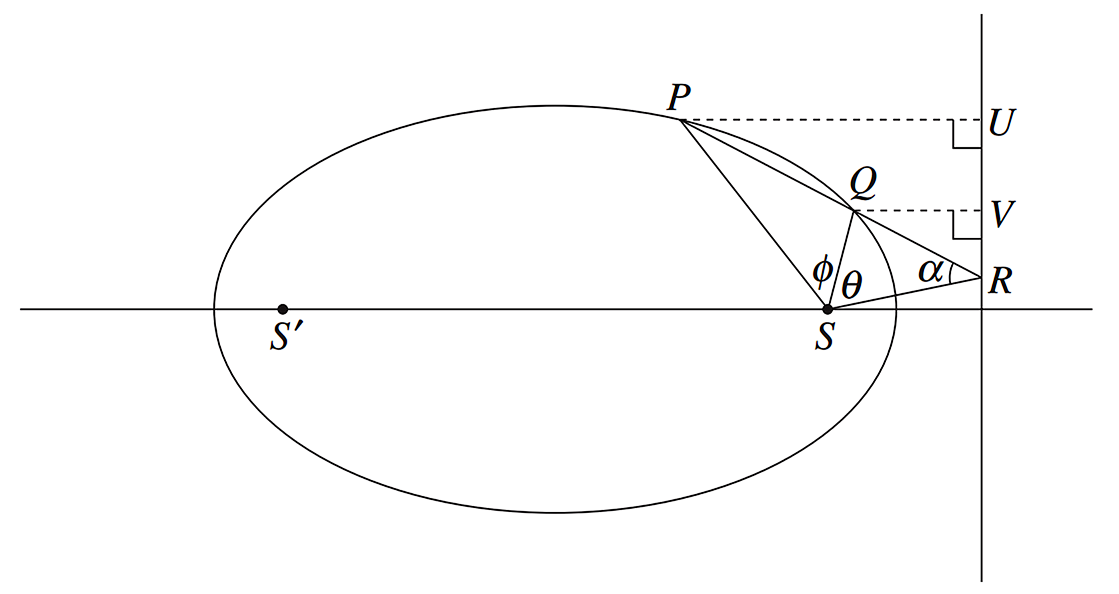
In the diagram the secant  `PQ`  of the ellipse  `x^2/a^2 + y^2/b^2 = 1`  meets the directrix at  `R`. Perpendiculars from  `P`  and  `Q`  to the directrix meet the directrix at  `U`  and  `V`  respectively. The focus of the ellipse which is nearer to  `R`  is at  `S`.

Copy or trace this diagram into your writing booklet.

  1. Prove that
    1. `(PR)/(QR) = (PU)/(QV).`  (1 mark)

  2. Prove that
    1. `(PU)/(QV) = (PS)/(QS).`  (1 mark)

  3. Let  `/_ PSQ = phi,\ \ /_ RSQ = theta and /_ PRS = alpha.`
  4. By considering the sine rule in  `Delta PRS and Delta QRS`, and applying the results of part (i) and part (ii),
  5. show that  `phi = pi - 2 theta.`  (2 marks)

  6. Let  `Q`  approach  `P`  along the circumference of the ellipse, so that  `phi -> 0.`
  7. What is the limiting value of  `theta?`  (1 mark)


Show Answers Only
  1. `text(Proof)\ \ text{(See Worked Solutions)}`
  2. `text(Proof)\ \ text{(See Worked Solutions)}`
  3. `text(Proof)\ \ text{(See Worked Solutions)}`
  4. `theta -> pi/2`
Show Worked Solution

(i)   `text(In)\ \ Delta PUR and Delta QVR`

`/_ PUR` `= /_ QVR=90^@`
`/_ PRU` `= /_ QRV\ \ \ \ \ text{(common angle)}`
`:.\ Delta PUR\ text(|||)\ Delta QVR\ \ \ \ \ text{(equiangular)}` 
`:.\ (PR)/(QR)` `= (PU)/(QV)\ \ \ \ ` `text{(corresponding sides in similar}`
`text{triangles are proportional)}`


(ii)  `(SP)/(PU) = e and (SQ)/(QV) = e`

`(SP)/(PU)` `= (SQ)/(QV)`
`:.\ (PU)/(QV)` `= (PS)/(QS)` 


(iii)  `text(In)\ \ Delta PRS`

`(PS)/(sin alpha)` `= (PR)/(sin(phi + theta))`
`(PS)/(PR) ` `= (sin alpha)/(sin (phi + theta))`


`text(In)\ \ Delta QRS`

`(QS)/(sin alpha)` `= (QR)/(sin theta)`
`(QS)/(QR)` `= (sin alpha)/(sin theta)`


`text(Using)\ \ (PR)/(QR) = (PU)/(QV) = (PS)/(QS)\ \ \ text{(from parts (i) and (ii))}`

`=>(PS)/(PR)` `= (QS)/(QR)`
`(sin alpha)/(sin (phi + theta))` `= (sin alpha)/(sin theta)`


`:.\ sin (phi + theta) = sin theta`

`:.\ phi + theta = pi – theta\ \ \ or\ \ phi + theta = theta`

`:.\ phi = pi – 2 theta,\ \ \ \ \ (phi ≠ 0)`


(iv)   `text(As)\ \ phi`  `-> 0`
  `pi – 2 theta` `-> 0`
  `:.theta` `-> pi/2`

Filed Under: Ellipse Tagged With: Band 3, Band 4, Band 5

Mechanics, EXT2 M1 2007 HSC 6b

A raindrop falls vertically from a high cloud. The distance it has fallen is given by

`x = 5 log_e ((e^(1.4 t) + e^(-1.4 t))/2)`

where `x` is in metres and `t` is the time elapsed in seconds.

  1. Show that the velocity of the raindrop, `v` metres per second, is given by
     
         `v = 7 ((e^(1.4 t) - e^(-1.4 t))/(e^(1.4 t) + e^(-1.4 t)))`  (2 marks)

    --- 3 WORK AREA LINES (style=lined) ---

  2. Hence show that  `v^2 = 49 (1 - e^(-(2x)/5)).`  (2 marks)

    --- 6 WORK AREA LINES (style=lined) ---

  3. Hence, or otherwise, show that  `ddot x = 9.8 - 0.2v^2.`  (2 marks)

    --- 5 WORK AREA LINES (style=lined) ---

  4. The physical significance of the 9.8 in part (iii) is that it represents the acceleration due to gravity.


    What is the physical significance of the term  `–0.2 v^2?`   (1 mark)

    --- 1 WORK AREA LINES (style=lined) ---

  5. Estimate the velocity at which the raindrop hits the ground.   (1 mark)

    --- 3 WORK AREA LINES (style=lined) ---

Show Answers Only
  1. `text(Proof)\ \ text{(See Worked Solutions)}`
  2. `text(Proof)\ \ text{(See Worked Solutions)}`
  3. `text(Proof)\ \ text{(See Worked Solutions)}`
  4. `-0.2v^2\ \ text(is the air resistance)`
  5. `7\ \ text(ms)^-1`
Show Worked Solution
i.    `x` `= 5 log_e ((e^(1.4t) + e^(-1.4t))/2)`
  `v=dx/dt` `= (5(1.4e^(1.4t) – 1.4e^(-1.4t)))/(e^(1.4t) + e^(-1.4t))`
    `= 7 ((e^(1.4 t) – e^(-1.4 t))/(e^(1.4 t) + e^(-1.4 t)))`


ii.    `v^2` `=49 ((e^(1.4 t) – e^(-1.4 t))/(e^(1.4 t) + e^(-1.4 t)))^2`
    `=49 ((e^(2.8 t) + e^(-2.8 t)-2)/(e^(2.8 t) + e^(-2.8 t)+2))`
    `=49 ((e^(2.8 t) + e^(-2.8 t)+2-4)/(e^(2.8 t) + e^(-2.8 t)+2))`
    `=49 (((e^(1.4t) + e^(-1.4t))^2-2^2)/((e^(1.4t) + e^(-1.4t))^2))`
    `=49 (1 – (2/(e^(1.4t) + e^(-1.4t)))^2)`


`text(S)text(ince)\ \ x` `= 5 log_e ((e^(1.4 t) + e^(-1.4 t))/2)`
`e^(x/5)` `=(e^(1.4 t) + e^(-1.4 t))/2`


`:. v^2` `=49 (1 – (e^(- x/5))^2)`
  `=49(1-e^(- (2x)/5))`


iii.   `ddotx` `=d/(dx) (1/2 v^2)`
    `=49/2 xx  2/5 xx e^(-(2x)/5)`
    `=49/5 e^(-(2x)/5)`
    `=49/5 (1- v^2/49),\ \ \ \ text{(from part (ii))}`
    `=9.8 – 0.2v^2`

 
iv.
  `-0.2v^2\ \ text(is the wind resistance acting on the rain drop.)`
 

v.   `text(Terminal velocity occurs when)\ \ ddot x=0`

`9.8 – 0.2v^2` `=0`
`v^2` `=49`
`v` `=7,\ \ \ \ (v > 0)`

 
`:.\ text(The rain drop hits the ground travelling at)\ \ 7\ \ text(ms)^-1`

Filed Under: Resisted Motion, Resisted Motion Tagged With: Band 3, Band 4, smc-1061-05-Projectile Motion, smc-1061-20-R ~ v^2, smc-1061-80-Terminal Velocity

Functions, EXT1′ F2 2012 HSC 8 MC

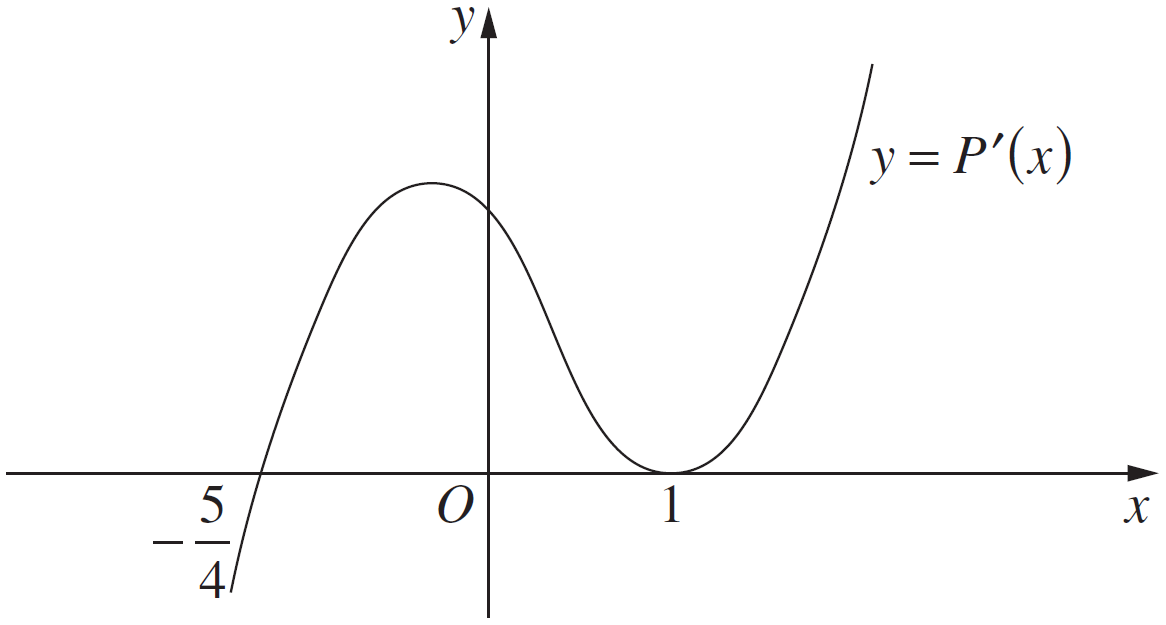
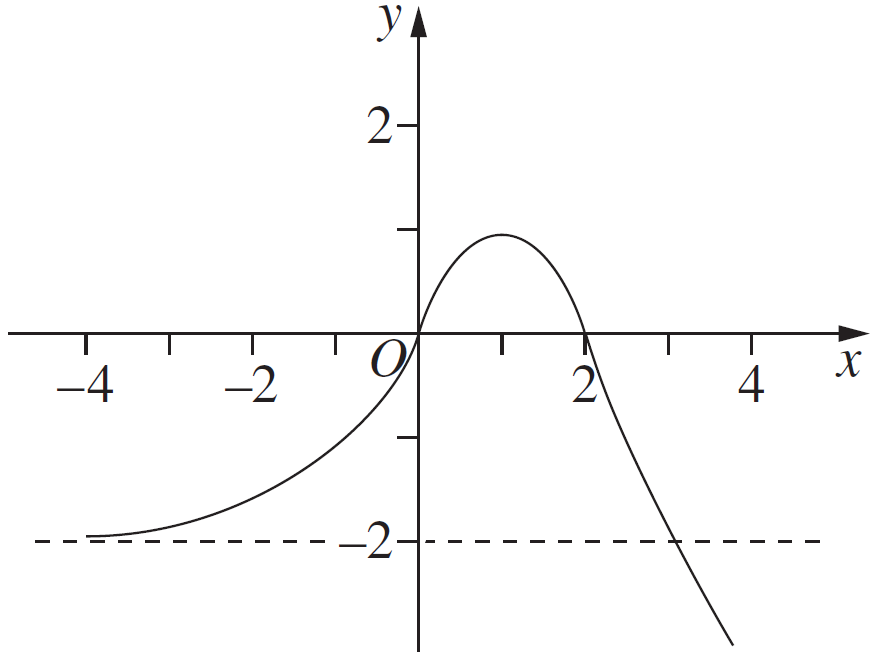
The following diagram shows the graph  `y = P′(x)`, the derivative of a polynomial  `P(x)`.
 

Polynomials, EXT2 2012 HSC 8 MC
 

Which of the following expressions could be  `P(x)`?

  1. `(x − 2)(x − 1)^3`
  2. `(x + 2)(x − 1)^3`
  3. `(x − 2)(x + 1)^3`
  4. `(x + 2)(x + 1)^3` 
Show Answers Only

`B`

Show Worked Solution

`P′(x)\ text(has a double root at)\ x = 1`

`=>P(x)\ text(will have a triple root at)\ x = 1.`

`text(Consider)\ \ P′(−5/4) = 0`

`text(The gradients goes from negative to positive.)`

`=>\ text(Local minimum when)\ \ x=-5/4`

`=> x text(-intercept must be)\ <-5/4`

`:. (x + 2)\ text(could be a factor of)\ \ P(x).`

`=>B`

Filed Under: Roots and Coefficients Tagged With: Band 3

Mechanics, EXT2 2012 HSC 7 MC

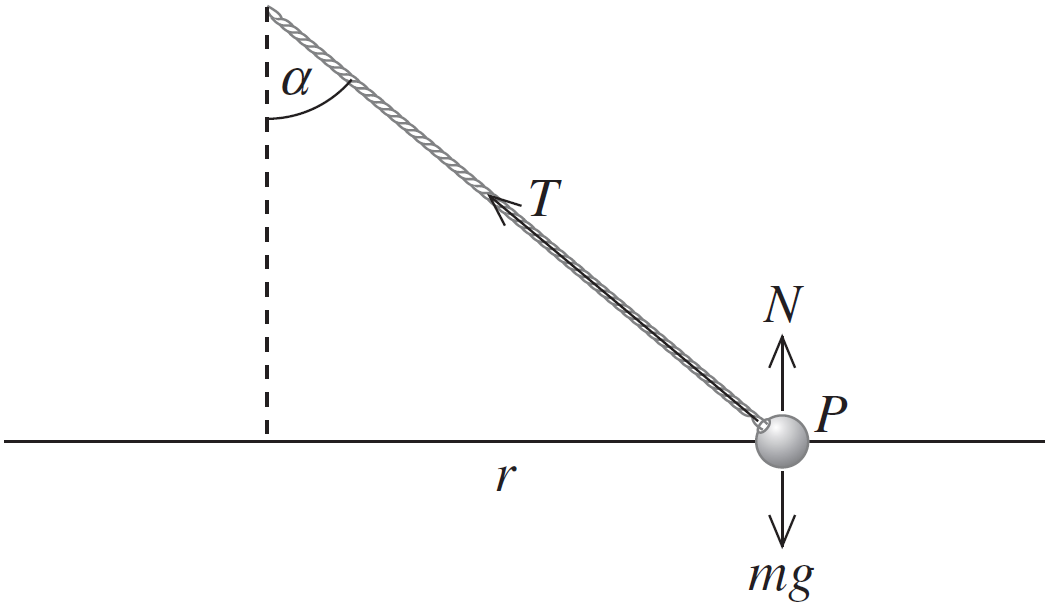
A particle  `P`  of mass  `m`  attached to a string is rotating in a circle of radius  `r`  on a smooth horizontal surface. The particle is moving with constant angular velocity  `ω`. The string makes an angle  `α`  with the vertical. The forces acting on  `P`  are the tension  `T`  in the string, a reaction force  `N`  normal to the surface and the gravitational force  `mg`.

Mechanics, EXT2 2012 HSC 7 MC

Which of the following is the correct resolution of the forces on  `P`  in the vertical and horizontal directions?

  1. `T cosα+ N = mg\ \ \ text(and)\ \ \ T sinα = mrω^2`
  2. `T cosα− N = mg\ \ \ text(and)\ \ \ T sinα = mrω^2`
  3. `T sinα+ N = mg\ \ \ text(and)\ \ \ T cosα = mrω^2`
  4. `T sinα− N = mg\ \ \ text(and)\ \ \ T cosα = mrω^2` 
Show Answers Only

`A`

Show Worked Solution

`text(Resolving the forces vertically,)`

`T cosα + N = mg.`

`text(Resolving the forces horizontally,)`

`T sinα = mrω^2.`

`=>A`

Filed Under: Circular Motion Tagged With: Band 3

Conics, EXT2 2012 HSC 6 MC

What is the eccentricity of the hyperbola  `(x^2)/6 − (y^2)/4 = 1`?

  1. `sqrt10/2`
  2. `sqrt15/3`
  3. `sqrt3/3`
  4. `sqrt13/3` 
Show Answers Only

`B`

Show Worked Solution
`b^2` `= a^2(e^2 − 1)\ \ \ text(where)\ \  a^2 = 6, b^2 = 4`
`a^2e^2` `=a^2+b^2`
`e^2` `= 1 + (b^2)/(a^2)= 1 + 4/6= 5/3`
`:.e` `= sqrt5/sqrt3`
  `= sqrt15/3`

`=>B`

Filed Under: Hyperbola Tagged With: Band 3

Functions, EXT1′ F2 2012 HSC 5 MC

The equation  `2x^3 − 3x^2 − 5x − 1 = 0`  has roots  `α`, `β` and `γ`.

What is the value of  `1/(α^3β^3γ^3)`?

  1. `1/8`
  2. `−1/8`
  3. `8`
  4. `−8` 
Show Answers Only

`C`

Show Worked Solution
`αβγ` `=(-d)/a= 1/2`
`:.α^3β^3γ^3`  `=(1/2)^3=1/8`
`:.1/(α^3β^3γ^3)`  `=8`

 
`=>C`

Filed Under: Roots and Coefficients, Sum, Products and Multiplicity of Roots, Sums and Products of Zeroes Tagged With: Band 3, smc-1205-10-Sum and Product, smc-6645-10-Sum and Product

Graphs, EXT2 2012 HSC 4 MC

The graph  `y =ƒ(x)`  is shown below.

Graphs, EXT2 2012 HSC 4 MC

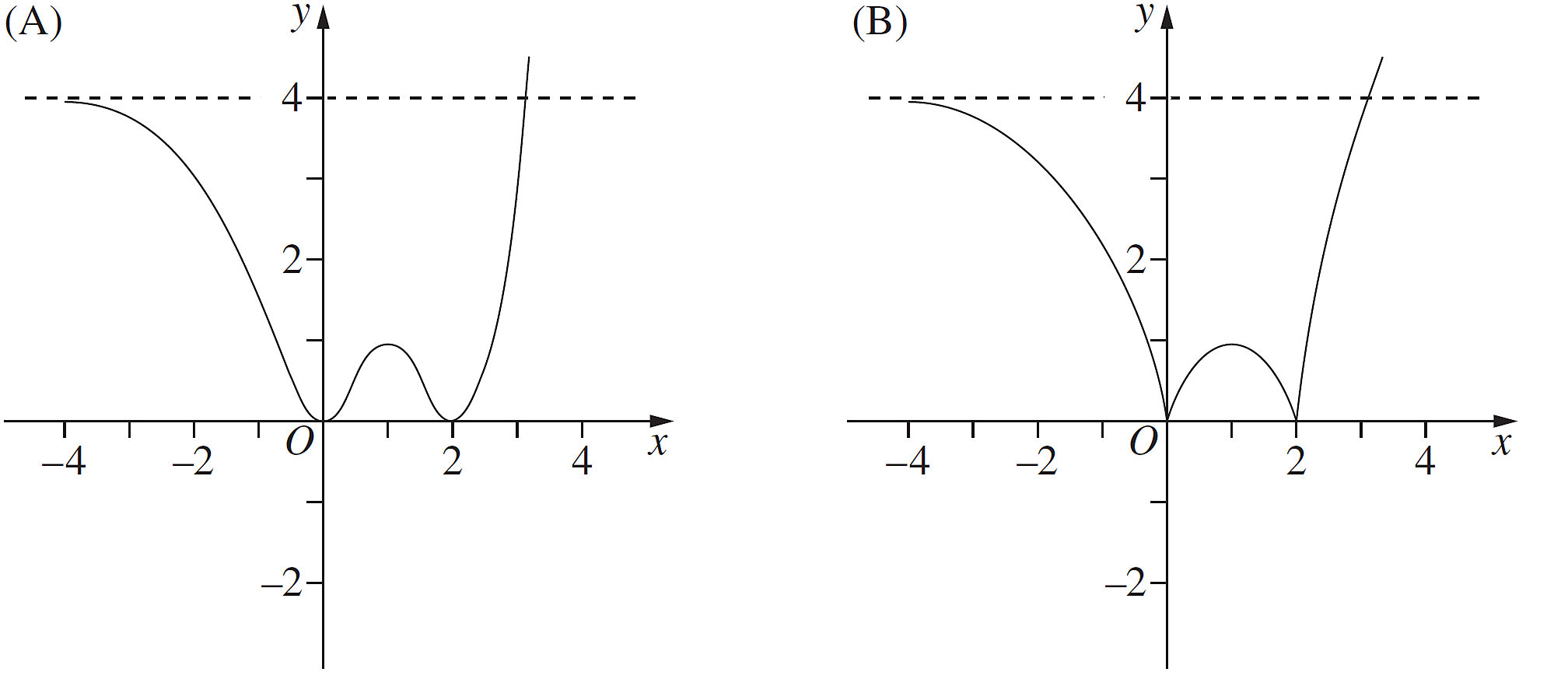
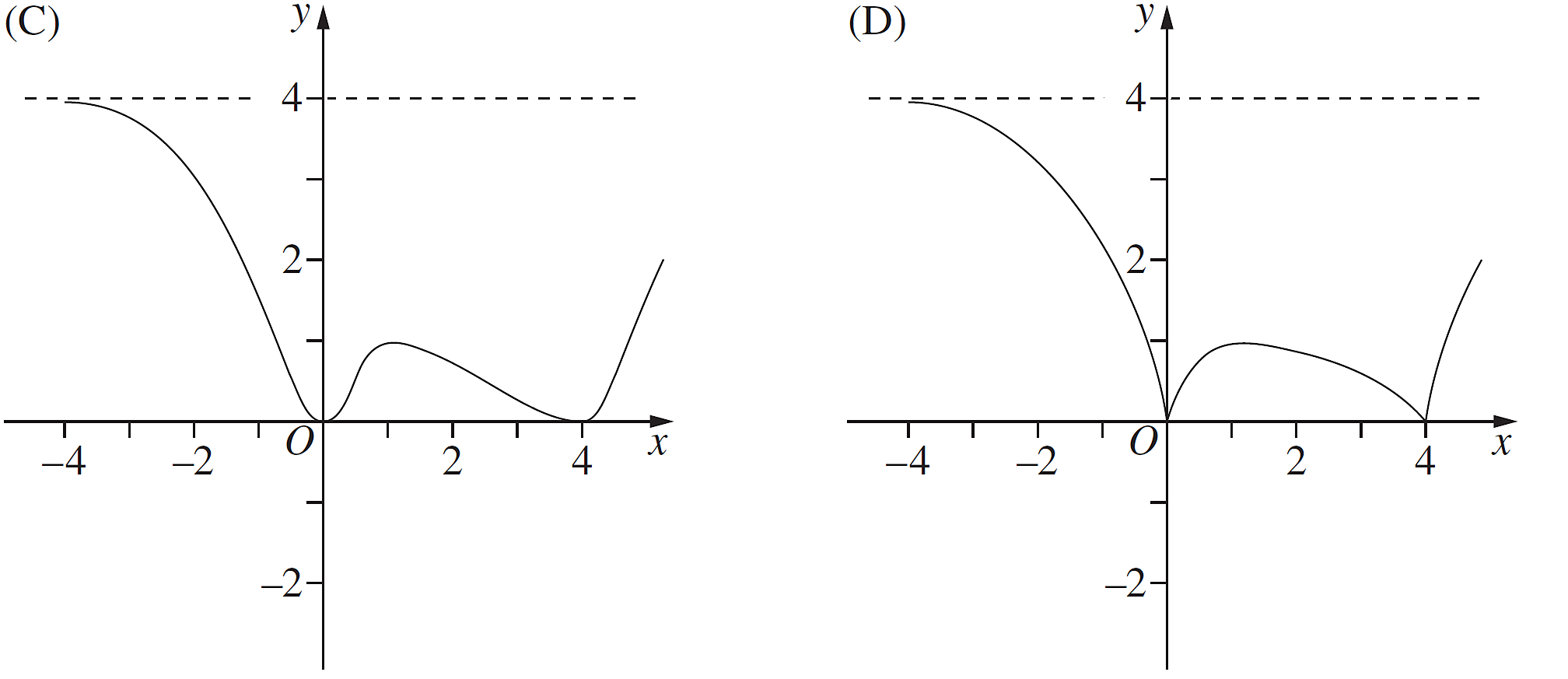
Which of the following graphs best represents  `y = [f(x)]^2`?

Graphs, EXT2 2012 HSC 4 MC ab 

Graphs, EXT2 2012 HSC 4 MC cd

Show Answers Only

`A`

Show Worked Solution

`text(By elimination)`

`[f(x)]^2=0\ \ text(when)\ \ f(x)=0,\ \ text(i.e. at)\ x= 0 and 2`

`=>\ text{Not (C) or (D)`

`text(When)\ \ f(x)=0,\ \ [f(x)]^2\ \ text(has minimum turning)`

`text{points and not cusps as in (B).}` 

`=>A`

Filed Under: Drawing graphs to powers Tagged With: Band 3

Graphs, EXT2 2012 HSC 2 MC

The equation  `x^3 – y^3 + 3xy + 1 = 0`  defines  `y`  implicitly as a function of  `x`.

What is the value of  `(dy)/(dx)`  at the point  `(1, 2)`?

  1. `1/3`
  2. `1/2`
  3. `3/4`
  4. `1` 
Show Answers Only

`D`

Show Worked Solution
`3x^2 − 3y^2y′ + 3xy′ + 3y` `= 0`
`y′(3x − 3y^2)` `= −3x^2 − 3y`
`y′` `= (−3x^2 − 3y)/(3x − 3y^2)`
  `=(x^2 + y)/(y^2− x)`

`text(At)\ \ P(1,2),`

`(dy)/(dx)= (1 + 2)/(4 − 1)=1`

`=>D`

Filed Under: Implicit Differentiation Tagged With: Band 3

  • « Previous Page
  • 1
  • …
  • 48
  • 49
  • 50
  • 51
  • 52
  • …
  • 59
  • Next Page »

Copyright © 2014–2026 SmarterEd.com.au · Log in