SmarterEd

Aussie Maths & Science Teachers: Save your time with SmarterEd

  • Login
  • Get Help
  • About

Calculus, EXT2 C1 2012 HSC 12a

Using the substitution  `t = tan\ theta/2`, or otherwise, find  `int(d theta)/(1 − cos\ theta)`.   (3 marks)

--- 6 WORK AREA LINES (style=lined) ---

Show Answers Only

`-cot\ theta/2 + c`

Show Worked Solution

`t = tan\ theta/2`

`dt=1/2 sec^2 (theta/2)\ d theta,\ \ \ d theta=(2\ dt)/sec^2 (theta/2)=2/(1+t^2)\ dt`

`cos\ theta = (1 − t^2)/(1 + t^2)`

`int(d theta)/(1 − cos\ theta)` `= int1/(1 − ((1 − t^2)/(1 + t^2))) xx 2/(1 + t^2)\ dt`
  `= int 2/(1 + t^2 − (1 − t^2))`
  `= int(dt)/(t^2)`
  `= -1/t + c`
  `= -1/(tan\ theta/2) + c`
  `= -cot\ theta/2 + c`

Filed Under: Trig Integrals, Trig Integration Tagged With: Band 3, smc-1193-20-t = tan theta/2

Calculus, EXT2 C1 2012 HSC 11e

Evaluate  `int_0^1 (e^(2x))/(e^(2x) + 1)\ dx`.  (3 marks)

Show Answers Only

`1/2log_e((e^2 + 1)/2)`

Show Worked Solution
`int_0^1 (e^(2x))/(e^(2x) + 1)\ dx` `= 1/2[log_e(e^(2x) + 1)]_0^1`
  `= 1/2[log_e(e^2 + 1) − log_e2]`
  `= 1/2log_e((e^2 + 1)/2)`

Filed Under: Harder Integration Examples, Substitution and Harder Integration Tagged With: Band 3, smc-1057-20-Logs, smc-1057-30-Exponential

Complex Numbers, EXT2 N2 2012 HSC 11b

Shade the region on the Argand diagram where the two inequalities

    `|\ z + 2\ | ≥ 2`  and  `|\ z − i\ | ≤ 1`

both hold.  (2 marks)

Show Answers Only

Complex Numbers, EXT2 2012 HSC 11b Answer

Show Worked Solution

`|\ z + 2\ | ≥ 2  and  |\ z − i\ | ≤ 1`

`(x + 2)^2 + y^2` `≥ 4`
`x^2 + (y − 1)^2` `≤ 1`

Complex Numbers, EXT2 2012 HSC 11b Answer 

Filed Under: Curves and Regions, Geometrical Implications of Complex Numbers Tagged With: Band 3, smc-1052-10-Sketch regions

Mechanics, EXT2 M1 2013 HSC 15d

A ball of mass `m` is projected vertically into the air from the ground with initial velocity  `u`. After reaching the maximum height `H` it falls back to the ground. While in the air, the ball experiences a resistive force `kv^2`, where `v` is the velocity of the ball and `k` is a constant.

The equation of motion when the ball falls can be written as

`m dot v = mg-kv^2.`      (Do NOT prove this.)

  1. Show that the terminal velocity  `v_T` of the ball when it falls is
  2.    `sqrt ((mg)/k).`  (1 mark)

    --- 4 WORK AREA LINES (style=lined) ---

  3. Show that when the ball goes up, the maximum height  `H`  is
  4.    `H = (v_T^2)/(2g) ln (1 + u^2/(v_T^2)).`  (3 marks)

    --- 8 WORK AREA LINES (style=lined) ---

  5. When the ball falls from height  `H`  it hits the ground with velocity  `w`.
  6. Show that  `1/w^2 = 1/u^2 + 1/(v_T^2).`  (2 marks)

    --- 6 WORK AREA LINES (style=lined) ---

Show Answers Only
  1. `text(Proof)\ \ text{(See Worked Solutions)}`
  2. `text(Proof)\ \ text{(See Worked Solutions)}`
  3. `text(Proof)\ \ text{(See Worked Solutions)}`
Show Worked Solution

i.  `m dot v = mg-kv^2`

`t = 0,\ \ \ v = 0,\ \ \ x = 0\ \ \ text(Ball falling)`

`text{For terminal velocity}\ \(v_T),\ \ \  dot v = 0`

`v_T^2` `= (mg)/k`
`:.v_T` `= sqrt ((mg)/k)`


ii.  `text(When the ball rises),\ \ m dot v = -mg-kv^2`

♦ Mean mark 43%.


MARKER’S COMMENT: More than half of students incorrectly wrote the equation to solve as `m dot v=mg-kv^2!`
`text(Using)\ \ dot v` `= v (dv)/(dx)`
`mv (dv)/(dx)` `= -mg-kv^2`
`dx` `=(-mv)/(mg + kv^2) dv` 
`int_0^H dx` `= -int_u^0 (mv)/(mg + kv^2) dv`
`[x]_0^H` `= -m/(2k) [log_e (mg + kv^2)]_u^0`
`H` `= -m/(2k) (log_e (mg)-log_e (mg + ku^2))`
  `= m/(2k) log_e ((mg + ku^2)/(mg))`
  `= m/(2k) log_e (1 + (ku^2)/(mg))\ \ \ \ text{(using}\ \ k = (mg)/v_T^2 text{)}`
`:.H` `=(v_T^2)/(2g) log_e (1 + u^2/(v_T^2))`


iii.  `text(When the ball falls),\ \ m dot v = mg-kv^2`

♦♦ Mean mark 14%.
`mv (dv)/(dx)` `= mg-kv^2`
`dx` `=(mv)/(mg-kv^2) dv` 


`int_0^H dx` `= int_0^w (mv)/(mg-kv^2)dv`
`[x]_0^H` ` =-m/(2k)[log_e (mg-kv^2)]_0^w`
`H` `= -m/(2k) (log_e (mg-kw^2)-log_e (mg))`
  `= -m/(2k) log_e ((mg-kw^2)/(mg))`
  `= -m/(2k) log_e (1-(kw^2)/(mg))\ \ \ \ text{(using}\ \ k = (mg)/v_T^2 text{)}`
`H` `=-(v_T^2)/(2g) log_e (1-w^2/(v_T^2))`
  `=-(v_T^2)/(2g) log_e ((v_T^2-w^2)/(v_T^2))`
  `=(v_T^2)/(2g) log_e ((v_T^2)/(v_T^2-w^2))`


`text{Using part (ii):}`

`(v_T^2)/(2g) log_e ((v_T^2)/(v_T^2-w^2))` `=(v_T^2)/(2g) log_e (1 + u^2/(v_T^2))`
`(v_T^2)/(v_T^2-w^2)` `=(v_T^2 + u^2)/(v_T^2)`
`(v_T^2 + u^2)(v_T^2-w^2)` `=v_T^4`
`v_T^4-v_T^2 w^2+v_T^2 u^2-w^2 u^2` `=v_T^4`
`v_T^2 w^2+w^2 u^2` `=v_T^2 u^2`
`(v_T^2 w^2)/(v_T^2w^2u^2)+(w^2 u^2)/(v_T^2w^2u^2)` `=(v_T^2 u^2)/(v_T^2w^2u^2)`
`:.1/u^2 + 1/(v_T^2)` `=1/w^2`

Filed Under: Resisted Motion, Resisted Motion Tagged With: Band 3, Band 5, Band 6, smc-1061-05-Projectile Motion, smc-1061-20-R ~ v^2, smc-1061-50-Max Height, smc-1061-70-Newton's Law

Harder Ext1 Topics, EXT2 2013 HSC 15c

Eight cars participate in a competition that lasts for four days. The probability that a car completes a day is `0.7`. Cars that do not complete a day are eliminated.

  1. Find the probability that a car completes all four days of the competition.  (1 mark)
  2. Find an expression for the probability that at least three cars complete all four days of the competition.  (2 marks)
Show Answers Only
  1. `0.2401`
  2. `1-(0.76^8 + \ ^8C_1 * 0.76^7 * 0.24 + \ ^8C_2 * 0.76^6 * 0.24^2)`
Show Worked Solution

(i)    `P text{(Completes 1 day)} = 0.7`

`:.P text{(Completes 4 days)}` `= 0.7^4`
  `~~ 0.2401`


(ii)  `P text{(Does not complete all 4 days)` `= 1 – 0.7^4`
  `= 0.7599`
  `~~ 0.76`
♦♦ Mean mark 26%.

STRATEGY: The use of complementary events reduced the required calculations and subsequent errors in this part.


`text(Let)\ \ C =\ text(number of cars that complete 4 days)`

`:. P text{(At least 3 cars complete all 4 days)}`

`= 1 – [P (C=0) + P (C = 1) + P (C = 2)]`

`= 1 – (\ ^8C_0 *0.76^8 + \ ^8C_1 * 0.76^7 * 0.24 + \ ^8C_2 * 0.76^6 * 0.24^2)`

`=1-(0.76^8 + \ ^8C_1 * 0.76^7 * 0.24 + \ ^8C_2 * 0.76^6 * 0.24^2)`

Filed Under: Probability and The Binomial Tagged With: Band 3, Band 5

Functions, EXT1′ F2 2013 HSC 15b

The polynomial  `P(x) = ax^4 + bx^3 + cx^2 + e`  has remainder `-3` when divided by  `x-1`. The polynomial has a double root at  `x = -1.`

  1. Show that  `4a + 2c = -9/2.`  (2 marks)

    --- 7 WORK AREA LINES (style=lined) ---

  2. Hence, or otherwise, find the slope of the tangent to the graph  `y = P(x)`  when  `x = 1.`  (1 mark)

    --- 2 WORK AREA LINES (style=lined) ---

Show Answers Only

i.    `text(Proof)\ \ text{(See Worked Solutions)}`

ii.   `-9`

Show Worked Solution
i.   `P(x)` `= ax^4 + bx^3 + cx^2 + e`
  `P^{′}(x)` `=4ax^3 + 3bx^2 + 2cx`


`P(1)=-3`
`a+b+c+e` `=-3\ \ \ \ …\  (1)`
`P(-1)=0`
`a-b+c+e` `=0\ \ \ \ …\ (2)`
`P^{′}(-1)=0`
`-4a+3b-2c` `=0\ \ \ \ …\ (3)`
   
`(1)-(2)`
`2b` `=-3`
`b` `=-3/2`

 
`text(Substitute into)\ \ (3)`

`:.4a+2c` `=3b`
  `=-9/2\ \ \ \ text(… as required)`


ii.  `P^{′}(1)` `= 4a + 3b + 2c`
  `= -9/2-9/2`
  `=-9`

Filed Under: Roots and Coefficients, Sum, Products and Multiplicity of Roots Tagged With: Band 3, Band 4, smc-1205-20-Multiplicity of Roots

Functions, EXT1′ F1 2013 HSC 13b

The diagram shows the graph of a function `f(x).`
 

Sketch the following curves on separate half-page diagrams.

  1.   `y^2 = f(x).`   (2 marks)

    --- 8 WORK AREA LINES (style=lined) ---

  2.   `y = 1/(1-f(x)).`   (3 marks)

    --- 12 WORK AREA LINES (style=lined) ---

Show Answers Only
  1. `text(See Worked Solutions)`
  2. `text(See Worked Solutions)`
Show Worked Solution

i.   `y^2 = f(x)`

`text(Only exist for)\ \ f(x) >= 0`

`y^2 = 1,\ \ \ y = +- 1`
 

ii.  `y = 1/(1-f(x))`

MARKER’S COMMENT: Correct working sketches such as `y=-f(x)` and `y=1-f(x)` meant that students could obtain some marks, even if their final sketch was wrong. Note this important advice.

`f(x) = 1,\ \ \ y\ text(undefined.)`

`f(x) > 1,\ \ \ y < 0`

`f(x) <= 0, \ \ \ y <= 1`
 

Filed Under: Drawing graphs to powers, Reflections and Harder curves, Reflections and Harder Graphs (Ext1) Tagged With: Band 3, Band 4, smc-1072-20-\(y=\sqrt{f(x)}; y^{2} = f(x)\), smc-1072-40-Other Graphs

Conics, EXT2 2013 HSC 12d

The points `P (cp, c/p)` and `Q (cq, c/q)`, where `|\ p\ | ≠ |\ q\ |`, lie on the rectangular hyperbola with equation  `xy = c^2.`

The tangent to the hyperbola at `P` intersects the `x`-axis at `A` and the `y`-axis at `B`. Similarly, the tangent to the hyperbola at `Q` intersects the `x`-axis at `C` and the `y`- axis at `D`.

  1. Show that the equation of the tangent at `P` is `x + p^2 y = 2cp.`  (2 marks)
  2. Show that `A, B and O` are on a circle with centre `P.`  (2 marks)
  3. Prove that `BC` is parallel to `PQ.`  (1 mark)
Show Answers Only
  1. `text(Proof)\ \ text{(See Worked Solutions)}`
  2. `text(Proof)\ \ text{(See Worked Solutions)}`
  3. `text(Proof)\ \ text{(See Worked Solutions)}`
Show Worked Solution

(i)  `P (cp, c/p),\ \ Q (cq, c/q),\ \ xy = c^2,\ \ |\ p\ | ≠ |\ q\ |`

`xy = c^2`

`y + x*(dy)/(dx) = 0,\ \ (dy)/(dx) = -y/x`


`text(At)\ \ (cp, c/p)`

`(dy)/(dx) = (-c/p)/(cp) = -1/p^2`


`text(Equation of tangent at)\ \ P`

`y – c/p` `= -1/p^2 (x – cp)`
`p^2 y – cp` `= -x + cp`
`:. x + p^2 y` `= 2cp\ \ \ text(… as required)`


(ii)   `text(Solution 1)`

`text(At)\ \ A, y = 0,\ \ \ x = 2cp`

`text(At)\ \ B, x = 0,\ \ \ y = (2c)/p`

`OP` `= sqrt (c^2 p^2 + c^2/p^2) = c/p sqrt(p^4 + 1)`
`PA` `= sqrt {(2cp – cp)^2 + c^2/p^2} = c/p sqrt (p^4 + 1)`
`PB` `= sqrt{c^2 p^2 + ((2c)/p – c/p)^2} = c/p sqrt (p^4 + 1)`


`OP = PA = PB`

`:. A, B and O\ \ text(are on the circle centre)\ \ P.`


`text(Alternate Solution)`

`text(Mid-point of)\ \ AB`

`=((2cp+0)/2,\ (0+(2c)/p)/2)`

`=(cp,\ c/p)`

`=>P\ \ text(is the midpoint of)\ \ AB`

`text(S)text(ince)\ \ ∠AOB=90^@`

`:. A, B and O\ \ text(are on the circle centre)\ \ P.`


(iii)  `text(Equation of tangent at)\ \ Q\ \ \ text{(using part (i))}`

`x + q^2y = 2cq`

`=> C\ \ text(is)\ \ (2cq, 0)`

`m_(BC)` `= {(2c)/p – 0}/(0 – 2cq)`
  `= – 1/(pq)`
`m_(PQ)` `= (c/p – c/q)/(cp – cq)`
  `=((cq-cp)/(pq))/(c(p-q))`
  `= {-c(p – q)}/{cpq (p – q)}`
  `= -1/(pq)`


`m_(BC) = m_(PQ)`

`:. BC\ text(||)\ PQ`

Filed Under: Hyperbola Tagged With: Band 2, Band 3, Band 4

Graphs, EXT2 2013 HSC 12b

The equation  `log_e y - log_e (1000 - y) = x/50 - log_e 3`  implicitly defines `y` as a function of `x`.

Show that `y` satisfies the differential equation

`(dy)/(dx) = y/50 (1 - y/1000).`  (2 marks)

Show Answers Only

`text(Proof)\ \ text{(See Worked Solutions)}`

Show Worked Solution

`log_e y – log_e (1000 – y) = x/50 – log_e 3`

`1/y* (dy)/(dx) – (-1)/((1000 – y))*(dy)/(dx)` `= 1/50 – 0`
`(dy)/(dx)(1/y + 1/(1000 – y))` `= 1/50`
`(dy)/(dx) ((1000 – y + y)/(y (1000 – y)))` `= 1/50`
`(dy)/(dx) (1000/(y (1000 – y)))` `= 1/50`
`(dy)/(dx)` `= (y (1000 – y))/(50 xx 1000)`
`(dy)/(dx)` `= y/50 (1 – y/1000)`

Filed Under: Implicit Differentiation Tagged With: Band 3

Calculus, EXT2 C1 2013 HSC 12a

Using the substitution  ` t = tan\ x/2`, or otherwise, evaluate

`int_0^(pi/2) 1/(4 + 5 cos x)\ dx.`  (4 marks)

--- 8 WORK AREA LINES (style=lined) ---

Show Answers Only

`1/3 ln 2`

Show Worked Solution

`t = tan\ x/2`

`=>cos x = (1 – t^2)/(1 + t^2)\ ,\ \ \ dx = (2\ dt)/(1 + t^2)`

`text(When)\ \ x = 0\ ,\ t = 0\ ;\ \ x = pi/2\ ,\ t = 1`

`int_0^(pi/2) (dx)/(4 + 5 cos x)` `= int_0^1 1/{4 + (5(1 – t^2))/(1 + t^2)} xx (2\ dt)/(1 + t^2)`
  `= int_0^1 (2\ dt)/(4 + 4t^2 + 5 – 5t^2)`
  `= int_0^1 (2\ dt)/(9 – t^2)`
  `=2 int_0^1 1/((3-t)(3+t))`
  `= 1/3 int_0^1 (1/(3 – t) + 1/(3 + t))\ dt`
  `= 1/3 [-ln (3 – t) + ln (3 + t)]_0^1`
  `= 1/3 [(-ln 2 + ln 4) – (-ln 3 + ln 3)]`
  `= 1/3 ln2`

Filed Under: Trig Integrals, Trig Integration Tagged With: Band 3, smc-1193-20-t = tan theta/2

Complex Numbers, EXT2 N1 2013 HSC 11c

Factorise  `z^2 + 4iz + 5.`  (2 marks)

--- 5 WORK AREA LINES (style=lined) ---

Show Answers Only

`(z – i) (z + 5i)`

Show Worked Solution

`text(Solution 1)`

`alpha + beta = 4i,\ \ \ alpha beta = 5 = -5i^2`

`:. z^2 + 4iz + 5 = (z – i) (z + 5i)`

`(alpha + beta = 4i,\ \ \ alpha beta = 5 = -5i^2)`

MARKER’S COMMENT: Best practice includes stating the general quadratic formula before substituting in values.

 
`text(Solution 2)`

`z` `=(-b+- sqrt(b^2 – 4ac))/(2a)`
  `=(-4i +- sqrt((4i)^2-4 xx 5))/2`
  `=(-4i+-sqrt(-16-20))/2`
  `=(-4i +- 6i)/2`
  `=i\ \ text(or)\ \ -5i`

 
`:.z^2 + 4iz + 5 = (z – i) (z + 5i)`

Filed Under: Arithmetic and Complex Numbers, Solving Equations with Complex Numbers Tagged With: Band 3, smc-1050-10-Quadratic roots

Harder Ext1 Topics, EXT2 2014 HSC 16a

The diagram shows two circles `C_1` and `C_2` . The point `P` is one of their points of intersection. The tangent to `C_2` at `P` meets `C_1` at `Q`, and the tangent to `C_1` at `P` meets `C_2` at `R`.

The points `A` and `D` are chosen on `C_1` so that `AD` is a diameter of `C_1` and parallel to `PQ`. Likewise, points `B` and `C` are chosen on `C_2` so that `BC` is a diameter of `C_2` and parallel to `PR`.


The points `X` and `Y` lie on the tangents `PR` and `PQ`, respectively, as shown in the diagram.

Harder Ext1 Topics, EXT2 2014 HSC 16a 


Copy or trace the diagram into your writing booklet.

  1. Show that `∠APX = ∠DPQ`.  (2 marks)
  2. Show that `A`, `P` and `C` are collinear.  (3 marks)
  3. Show that `ABCD` is a cyclic quadrilateral. (1 mark)
Show Answers Only
  1. `text(See Worked Solutions.)`
  2. `text(See Worked Solutions.)`
  3. `text(See Worked Solutions.)`
Show Worked Solution
(i)

Harder Ext1 Topics, EXT2 2014 HSC 16a  Answer


 `∠APX` `= ∠ADP\ \ \ text{(angle in alternate segment)`βαγ
 `∠ADP` `= ∠DPQ\ \ \ text{(alternate angles,}\ AD\ text(||)\ PQ)`
`:.∠APX` `= ∠DPQ`


(ii)  `text(Join)\ PC\ text(and)\ PB.`

♦♦ Mean mark 31%.
MARKER’S COMMENT: Be vigilant that your reasoning does not implicitly assume `APC` or `DPB` are straight lines.

`text{Let}\ \ ∠APX = ∠DPQ=α\ \ \ text{(from part (i))}`

`text{Similarly,}\ \ ∠YPB = ∠CPR=β`

`∠XPY = ∠RPQ=γ\ \ \ text{(vertically opposite angles.)}`

`∠APD` `= 90^@\ \ \ text{(angle in a semicircle in}\ C_1)`
`∠CPB` `= 90^@\ \ \ text{(angle in a semicircle in}\ C_2)`


`90^@ + 90^@ + 2(α+β+γ)` `= 360^@ \ \ text{(sum of angles at a point}\ Ptext{)}`
`:. (α+β+γ)` `= 90^@`
`∠APC` `=90+(α+β+γ)=180^@`


`:.\ A, P\ text(and)\ C\ text(are collinear.)`


♦ Mean mark 44%.

(iii)  `:.∠APX = ∠CPR\ text{(vertically opposite angles,}\ APC\ text{is a straight line)}`

`:.α=β\ \ =>∠BCA = ∠BDA`

`text(S)text(ince chord)\ AB\ text(subtends a pair of equal angles at)\ C and D`

`=>ABCD\ text(is a cyclic quadrilateral.)`

Filed Under: Circle/Plane Geometry Tagged With: Band 3, Band 5, HSC

Functions, EXT1′ F2 2014 HSC 14a

Let  `P(x) =x^5-10x^2 +15x-6`.

Show that  `x = 1`  is a root of `P(x)` of multiplicity three.   (2 marks)

--- 7 WORK AREA LINES (style=lined) ---

Show Answers Only

`text{See Worked Solutions}`

Show Worked Solution

`P(x) =x^5-10x^2 +15x-6`

`P(1) = 1-10 + 15-6 = 0`
 

`P^{′}(x)` `= 5x^4-20x + 15`
`P^{′}(1)` `= 5-20 + 15 = 0`
`P^{″}(x)` `= 20x^3-20`
`P^{″}(1)` `= 20-20 = 0`
`P^{‴}(x)` `= 60x^2`
`P^{‴}(1)` `= 60 ≠ 0`

 
`:.x = 1\ text(is a root of)\ P(x),\ text(of multiplicity 3.)`

Filed Under: Roots and Coefficients, Sum, Products and Multiplicity of Roots Tagged With: Band 3, smc-1205-20-Multiplicity of Roots

Conics, EXT2 2014 HSC 13c

The point  `S(ae, 0)` is the focus of the hyperbola  `(x^2)/(a^2)-(y^2)/(b^2) = 1` on the positive `x`-axis.

The points  `P(at, bt)`  and  `Q(a/t, −b/t)`  lie on the asymptotes of the hyperbola, where `t > 0`.

The point  `M((a(t^2 + 1))/(2t), (b(t^2 – 1))/(2t))` is the midpoint of `PQ`.

Conics, EXT2 2014 HSC 13c

  1. Show that `M` lies on the hyperbola.  (1 mark)
  2. Prove that the line through `P` and `Q` is a tangent to the hyperbola at `M`.  (3 marks)
  3. Show that  `OP xx OQ = OS^2`.  (2 marks)
  4. If  `P`  and  `S`  have the same `x`-coordinate, show that  `MS`  is parallel to one of the asymptotes of the hyperbola.  (2 marks)
Show Answers Only
  1. `text{Proof (See Worked Solutions)}`
  2. `text{Proof (See Worked Solutions)}`
  3. `text{Proof (See Worked Solutions)}`
  4. `text{Proof (See Worked Solutions)}`
Show Worked Solution

(i)   `text(Substitute)\ \ \ M((a(t^2 + 1))/(2t), (b(t^2 − 1))/(2t))\ \ text(into)`

`(x^2)/(a^2)-(y^2)/(b^2) = 1`

`text(LHS)` `=1/(a^2) xx (a^2(t^2 + 1)^2)/(4t^2) − 1/(b^2) xx (b^2(t^2 − 1)^2)/(4t^2)`
  `=1/(4t^2)[t^4 + 2t^2 + 1 – (t^4 − 2t^2 + 1)]`
  `=1/(4t^2) xx 4t^2`
  `=1`
  `=\ text(RHS)`


`:.M\ text(lies on the hyperbola).`


(ii) `P(at, bt), \ \ Q(a/t, −b/t)`

`m_(PQ)` `= (bt − (-b/t))/(at − a/t) xx t/t`
  `=(bt^2+b)/(at^2-a)`
  `= b/a  ((t^2 + 1)/(t^2 − 1))`


`text(Differentiate the hyperbola)`

`(2x)/(a^2) − (2y*dy/dx)/(b^2)` `= 0`
   `(dy)/(dx)` `= (b^2x)/(a^2y)`


`text(At)\ \ M((a(t^2 + 1))/(2t), (b(t^2 − 1))/(2t)),`

`(dy)/(dx)` `= (b^2)/(a^2) xx (a(t^2 + 1))/(2t) xx (2t)/(b(t^2 – 1))`
  `= b/a ((t^2 + 1)/(t^2 -1))`


`:. m_(PQ)=m_(at\ M)`

`:.text(S)text(ince the tangent to the hyperbola has the same gradient as)\ \ PQ`

`text(and both pass through)\ M,text(they are the same line.)`


(iii)   `OP` `= sqrt(a^2t^2 + b^2t^2) = t sqrt(a^2 + b^2)`
    `OQ` `= sqrt((a^2)/(t^2) + (b^2)/(t^2)) = 1/tsqrt(a^2 + b^2)`
`OP xx OQ` `= tsqrt(a^2 + b^2) xx 1/tsqrt(a^2 + b^2)`
  `= a^2 + b^2`
  `=a^2+a^2(e^2 − 1)`
  `= a^2e^2`
  `=OS^2\ \ \ …\ text(as required)`


(iv)  `text(Given)\ \ P and S\ \ text(have the same)\ x text(-coordinate)`

`at = ae\ \ => t = e`

`S(ae,0),\ \ M((a(e^2 + 1))/(2e), (b(e^2 − 1))/(2e))`

`m_(MS)` `= ((b(e^2 − 1))/(2e) − 0)/((a(e^2 + 1))/(2e) − ae)`
  `= (b(e^2 − 1))/(ae^2 + a − 2ae^2)`
  `= (b(e^2 − 1))/(a − ae^2)`
  `= (b(e^2 − 1))/(-a(e^2 − 1))`
  `= – b/a`

`:.text(S)text(ince the gradients of the hyperbola asymptotes are)\ ±b/a.`

`=>MS\ text(is parallel to one  … as required)`

Filed Under: Hyperbola Tagged With: Band 2, Band 3

Graphs, EXT2 2014 HSC 12c

The point `P(x_0, y_0)` lies on the curves  `x^2 − y^2 = 5`  and  `xy = 6`. Prove that the tangents to these curves at `P` are perpendicular to one another.  (3 marks)


Show Answers Only

`text{Proof (See Worked Solutions)}`

Show Worked Solution

`text(Differentiating)\ \ \ x^2 − y^2 = 5`

`2x − 2y*(dy)/(dx)` `= 0`
`(dy)/(dx)` `=x/y`
`text(At)\ P(x_0, y_0),\ \ (dy)/(dx)` `= x_0/y_0`


`text(Differentiating)\ \ \ xy = 6`

`y + x*(dy)/(dx)` `= 0`
  `(dy)/(dx)` `= -y/x`
  `text(At)\ P(x_0, y_0),\ \ (dy)/(dx)` `= -y_0/x_0`


`text(S)text(ince)\ \ \ x_0/y_0 xx (-y_0/x_0) = -1`

`:.\ text(The tangents to the curves at)\ P(x_0, y_0)\ text(are)`

`text(perpendicular to one another.)`

Filed Under: Implicit Differentiation Tagged With: Band 3

Functions, EXT1′ F1 2014 HSC 12a

The diagram shows the graph of a function  `f(x)`.
 

Graphs, EXT2 2014 HSC 12a
 

Draw a separate half-page graph for each of the following, showing all asymptotes and intercepts.

  1.   `y = f(|\ x\ |)`  (2 marks)

    --- 10 WORK AREA LINES (style=lined) ---

  2.   `y = 1/(f(x))`  (2 marks)

    --- 10 WORK AREA LINES (style=lined) ---

Show Answers Only
  1. `text(See Worked Solutions.)`
  2. `text(See Worked Solutions.)`
Show Worked Solution
i.  

Graphs, EXT2 2014 HSC 12a Answer1


ii.  

Graphs, EXT2 2014 HSC 12a Answer2

Filed Under: Drawing graphs to powers, Graphical Relationships, Reflections and Harder Graphs (Ext1), Sketching - mult/division of ordinates Tagged With: Band 3, smc-1072-10-\(y=\dfrac{1}{f(x)}\), smc-1072-30-\(y=\abs{f(x)}; y=f(\abs{x}) \), smc-6640-10-\(y=\dfrac{1}{f(x)}\), smc-6640-30-\(y=\abs{f(x)}; y=f(\abs{x}) \), y = f(|x|)

Volumes, EXT2 2014 HSC 11e

The region enclosed by the curve  `x = y(6 − y)`  and the `y`-axis is rotated about the `x`-axis to form a solid.

Using the method of cylindrical shells, or otherwise, find the volume of the solid.  (3 marks)

Show Answers Only

`216pi\ \ text(u³)`

Show Worked Solution

`x = y(6 − y)\ \ =>text(Rotate about)\ xtext(-axis.)`

MARKER’S COMMENT: The best responses included a sketch that clearly showed the axis of rotation and an understanding of the use of cylindrical shells, as per the worked solution.

Volumes, EXT2 2014 HSC 11e Answer

`δV` `=2 pi r h delta y`
  `= 2 pi y*y (6-y) delta y`
  `=2 pi(6y^2 – y^3) delta y`


 `:.V` `= 2pi int_0^6(6y^2 − y^3)\ dy`
  `= 2pi[2y^3 −(y^4)/4]_0^6`
  `= 2pi[(432 − 324) − 0]`
  `= 216pi\ \ text(u³)`

Filed Under: Cylindrical Shells Tagged With: Band 3

Calculus, EXT2 C1 2014 HSC 11b

Evaluate  `int_0^(1/2)(3x-1)\ cos\ (pix)\ dx`.  (3 marks)

--- 6 WORK AREA LINES (style=lined) ---

Show Answers Only

`(pi-6)/(2pi²)`

Show Worked Solution

`text(Integrating by parts:)`

`u` `=3x-1` `u^{′}` `=3`
`v^{′}` `=cos(pi x)` `v` `=1/pi sin(pi x)`

`int_0^(1/2)(3x-1)\ cos\ (pix)\ dx`

`= [(3x-1)(sin\ (pix))/pi]_0^(1/2)-int_0^(1/2) 3 xx (sin\ (pix))/pi\ dx`

`= (1/(2pi)\ sin\ pi/2-0) − 3/pi[(-cos\ (pix))/pi]_0^(1/2)`

`= 1/(2pi) + 3/(pi^2)(cos\ pi/2-cos\ 0)`

`= 1/(2pi) + 3/(pi^2)(0-1)`

`= 1/(2pi)-3/(pi^2)`

Filed Under: Integration By Parts, Integration By Parts, Integration By Parts Tagged With: Band 3, smc-1055-30-Trig, smc-5134-30-Trig

Complex Numbers, EXT2 N1 2014 HSC 11a

Consider the complex numbers  `z = -2- 2i`  and  `w = 3 + i`.

  1. Express  `z + w`  in modulus–argument form.  (2 marks)

    --- 4 WORK AREA LINES (style=lined) ---

  2. Express `z/w` in the form  `x + iy`, where  `x`  and  `y`  are real numbers.  (2 marks)

    --- 4 WORK AREA LINES (style=lined) ---

Show Answers Only
  1. `sqrt2\ text(cis)(-pi/4)`
  2. `−4/5 −2/5i`
Show Worked Solution
i.   `z + w` `= −2 − 2i + 3 + i`
     `= 1 − i`
  `|\ z+w\ |` `= sqrt2`
  `text(arg)\ (z+w)` `=- pi/4`
  `:. z+w`   `= sqrt2\ text(cis)(-pi/4)`


ii.  `z/w` `= (−2 − 2i)/(3 + i)`
    `= ((−2 − 2i)(3 − i))/((3 + i)(3 − i))`
    `= (−6 − 6i + 2i − 2)/(9 + 1)`
    `= −8/10 −4/10i`
    `= −4/5 − 2/5i`

Filed Under: Argand Diagrams and Mod/Arg form, Geometry and Complex Numbers (vectors) Tagged With: Band 2, Band 3, smc-1049-20-Cartesian to Mod/Arg

Statistics, EXT1 S1 2007 HSC 4a

In a large city, 10% of the population has green eyes.

  1. What is the probability that two randomly chosen people both have green eyes?  (1 mark)

    --- 1 WORK AREA LINES (style=lined) ---

  2. What is the probability that exactly two of a group of 20 randomly chosen people have green eyes? Give your answer correct to three decimal places.  (1 mark)

    --- 2 WORK AREA LINES (style=lined) ---

  3. What is the probability that more than two of a group of 20 randomly chosen people have green eyes? Give your answer correct to two decimal places.  (2 marks)

    --- 4 WORK AREA LINES (style=lined) ---

Show Answers Only
  1. `0.01`
  2. `0.285\ \ \ text{(to 3 d.p.)}`
  3. `0.32\ \ \ text{(to 2 d.p.)}`
Show Worked Solution
i.       `P(text(G))` `= 0.1`
  `P(text(GG))` `= 0.1 xx 0.1`
    `= 0.01`


ii.  `P(text(not G)) = 1 − 0.1 = 0.9`

`:. P(text(2 out of 20 have green eyes))`

`= \ ^(20)C_2 · (0.1)^2 · (0.9)^(18)`

`= 0.2851…`

`= 0.285\ \ \ text{(to 3 d.p.)}`


iii. `P(text(more than 2 have green eyes))`

`= 1 − [P(0) + P(1) + P(2)]`

`= 1 − [0.9^20 + \ ^20C_1(0.1)^1(0.9)^19 + \ ^20C_2(0.1)^2(0.9)^(18)]`

`= 1 − [0.1215… + 0.2701… + 0.2851…]`

`= 1 − 0.6769…`

`= 0.3230`

`= 0.32\ \ \ text{(to 2 d.p.)}`

Filed Under: Binomial Probability, Binomial Probability EXT1 Tagged With: Band 3, Band 4, Band 5, smc-1084-10-General Case

Mechanics, EXT2* M1 2007 HSC 2d

A skydiver jumps from a hot air balloon which is 2000 metres above the ground. The velocity, `v` metres per second, at which she is falling  `t`  seconds after jumping is given by  `v =50(1 - e^(-0.2t))`.

  1. Find her acceleration ten seconds after she jumps. Give your answer correct to one decimal place.  (2 marks)

    --- 6 WORK AREA LINES (style=lined) ---

  2. Find the distance that she has fallen in the first ten seconds. Give your answer correct to the nearest metre.  (2 marks)

    --- 7 WORK AREA LINES (style=lined) ---

Show Answers Only
  1. `1.4\ text(ms)^(−2)\ \ text{(to 1 d.p.)}`
  2. `284\ text{m  (nearest m)}`
Show Worked Solution
i.     `v` `= 50(1 − e^(-0.2t))`
    `=50-50e^(-0.2t)`
  `ddot x` `= (dv)/(dt)`
    `= −0.2 xx 50 xx −e^(−0.2t)`
    `= 10 e^(−0.2t)`

 
`text(When)\ \ t = 10:`

`ddot x` `= 10 e^(−0.2 xx 10)`
  `= 10 e ^(−2)`
  `= 1.353…`
  `= 1.4\ text(ms)^(−2)\ \ \ text{(to 1 d.p.)}`


ii.  `text(Distance travelled)`

`= int_0^10 v\ dt`

`= 50 int_0^10 1 − e^(−0.2t) \ dt`

`= 50 [t + 1/0.2 · e^(−0.2t)]_0^10`

`= 50 [t + 5e^(−0.2t)]_0^10`

`= 50 [(10 + 5e^(−2)) − (0 + 5e^0)]`

`= 50 [10 + 5e^(−2) − 5]`

`= 50 [5 + 5e^(−2)]`

`= 283.833…`

`= 284\ text{m  (nearest m)}`

Filed Under: Motion Without Resistance, Other Motion EXT1 Tagged With: Band 3, Band 4, smc-1060-04-Motion as f(t), smc-1060-20-Exponential

Functions, EXT1 F2 2007 HSC 2c

The polynomial  `P(x) = x^2 + ax + b`  has a zero at  `x = 2`. When `P(x)` is divided by  `x + 1`, the remainder is `18`.

Find the values of `a` and `b`.   (3 marks)

--- 7 WORK AREA LINES (style=lined) ---

Show Answers Only

`a = -7\ \ text(and)\ \ b = 10`

Show Worked Solution

`P(x) = x^2 + ax + b`

`text(S)text(ince there is a zero at)\ \ x = 2,`

`P(2)` `=0`  
`2^2 + 2a + b` `= 0`  
`2a + b` `= -4`       `…\ (1)`

 
`P(-1) = 18,`

`(-1)^2-a + b` `= 18`  
`-a + b` `= 17`    `…\ (2)`

 
`text(Subtract)\ \ (1)-(2),`

`3a` `= -21`
`a` `= -7`

 
`text(Substitute)\ \ a = -7\ \ text{into (1),}`

`2(-7) + b` `= -4`
`b` `= 10`

 
`:.a = -7\ \ text(and)\ \ b = 10`

Filed Under: Polynomials, Remainder and Factor Theorems, Remainder and Factor Theorems, Roots, Remainders and Factors Tagged With: Band 3, num-title-ct-patha, num-title-qs-hsc, smc-1031-10-Factor Theorem, smc-1031-20-Remainder Theorem, smc-4242-10-Factor Theorem, smc-6644-10-Factor Theorem, smc-6644-20-Remainder Theorem

Trigonometry, EXT1 T1 2007 HSC 2b

Let  `f(x) = 2 cos^(-1)x`.

  1. Sketch the graph of  `y = f(x)`, indicating clearly the coordinates of the endpoints of the graph.  (2 marks)

    --- 8 WORK AREA LINES (style=lined) ---

  2. State the range of  `f(x)`.  (1 mark)

    --- 2 WORK AREA LINES (style=lined) ---

Show Answers Only
  1. `text(See Worked Solutions.)`
  2. `0 ≤ y ≤ 2pi`
Show Worked Solution

i.   `y= 2\ cos^(-1)x`

`text(Domain:)\ -1 ≤ x ≤ 1`

`text{Range:}\ \0 ≤`  `y/2 ≤ pi`  
`0 ≤` `y ≤ 2pi`  


ii.  `text(Range:)\ \ 0 ≤ y ≤ 2pi`

Filed Under: Inverse Trig Functions EXT1, T1 Inverse Trig Functions (Y11) Tagged With: Band 3, Band 4, smc-1024-11-arccos Graphs

Linear Functions, EXT1 2007 HSC 1d

The graphs of the line  `x - 2y + 3= 0`  and the curve  `y = x^3+ 1`  intersect at  `(1, 2)`. Find the exact value, in radians, of the acute angle between the line and the tangent to the curve at the point of intersection.  (3 marks)

Show Answers Only

`pi/4\ text(radians)`

Show Worked Solution
`x − 2y + 3` `= 0`
`2y` `= x + 3`
`y`  `= 1/2x + 3/2`

`:. m_1 = 1/2` 

`y` `= x^3 + 1`
`(dy)/(dx)` `= 3x^2`


`text(When)\ x = 1,`

`(dy)/(dx) = 3`

`:. m_2 = 3`


`tan\ theta` `= |\ (m_1 − m_2)/(1 + m_1m_2)\ |`
  `= |\ (1/2 − 3)/(1 + 1/2 xx 3)\ |`
  `= |\ (−2 1/2)/(2 1/2)|`
  `= 1`
`:. theta` `= pi/4\ text(radians)`

Filed Under: 6. Linear Functions EXT1 Tagged With: Band 3

Calculus, EXT1 C2 2007 HSC 1c

Differentiate  `tan^(–1)(x^4)`  with respect to  `x`.  (2 marks)

Show Answers Only

`(4x^3)/(1 + x^8)`

Show Worked Solution
`y` `= tan^(−1)(x^4)`
`(dy)/(dx)` `= 1/(1 + (x^4)^2) xx d/(dx) (x^4)`
  `= (4x^3)/(1 + x^8)`

Filed Under: 8. Differentiation and 1st Principles EXT1, Inverse Functions Calculus, Inverse Trig Functions EXT1 Tagged With: Band 3, smc-1037-20-Tan Differentiation

Linear Functions, EXT1 2007 HSC 1b

The interval  `AB`, where  `A` is  `(4, 5)` and  `B`  is  `(19, text(−5))`, is divided internally in the ratio  `2\ :\ 3`  by the point  `P(x,y)`. Find the values of  `x`  and  `y`.  (2 marks)

Show Answers Only

`(10, 1)`

Show Worked Solution

`A(4, 5), \ B(19, text(−5))`

`text(Internal division in ratio  2 : 3  at)\ \ P(x, y)`

`P` `= ((nx_1 + mx_2)/(m + n) , (ny_1 + my_2)/(m + n))`
  `= ((3 xx 4 + 2 xx 19)/(2 + 3) , (3 xx 5 + 2 xx (text(−5)))/(2+ 3))`
  `= ((12 + 38)/5 , (15 − 10)/5)`
  `= (10, 1)`

Filed Under: 6. Linear Functions EXT1 Tagged With: Band 3

Mechanics, EXT2* M1 2004 HSC 6b

A fire hose is at ground level on a horizontal plane. Water is projected from the hose. The angle of projection, `theta`, is allowed to vary. The speed of the water as it leaves the hose, `v` metres per second, remains constant. You may assume that if the origin is taken to be the point of projection, the path of the water is given by the parametric equations

`x = vt\ cos\ theta`

`y = vt\ sin\ theta − 1/2 g t^2`

where  `g\ text(ms)^(−2)`  is the acceleration due to gravity.  (Do NOT prove this.)

  1. Show that the water returns to ground level at a distance`(v^2\ sin\ 2theta)/g`  metres from the point of projection.   (2 marks)

    --- 6 WORK AREA LINES (style=lined) ---

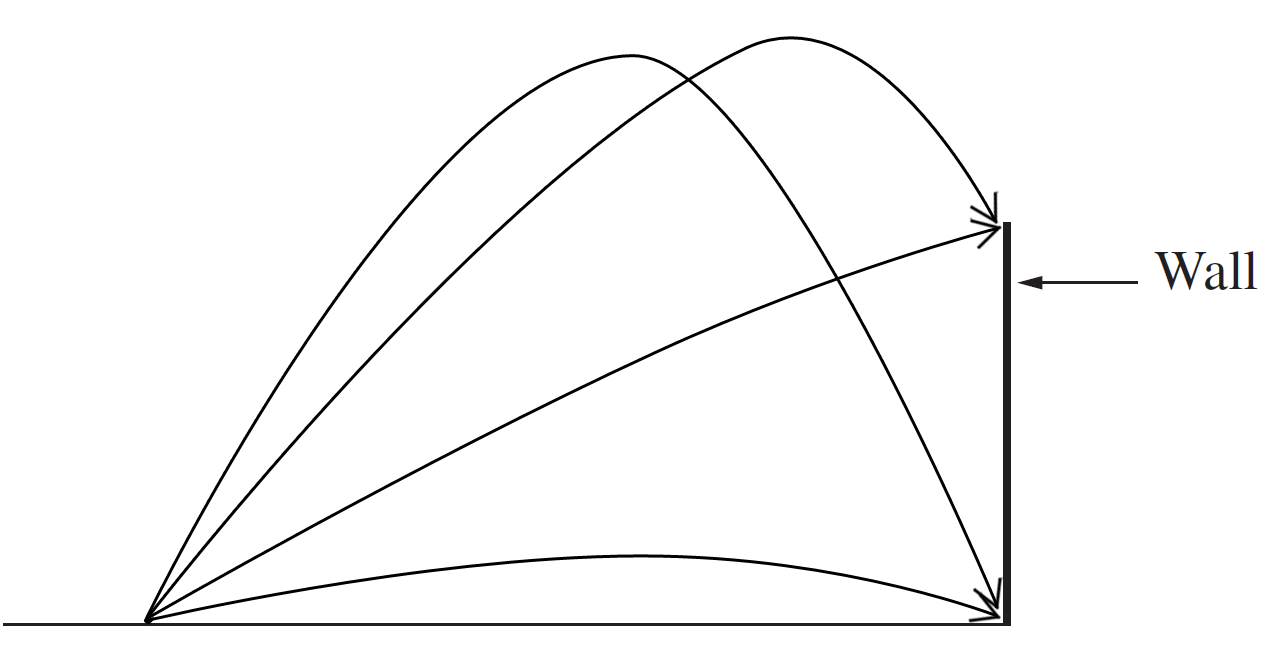
This fire hose is now aimed at a 20 metre high thin wall from a point of projection at ground level 40 metres from the base of the wall. It is known that when the angle  `theta`  is 15°, the water just reaches the base of the wall.  
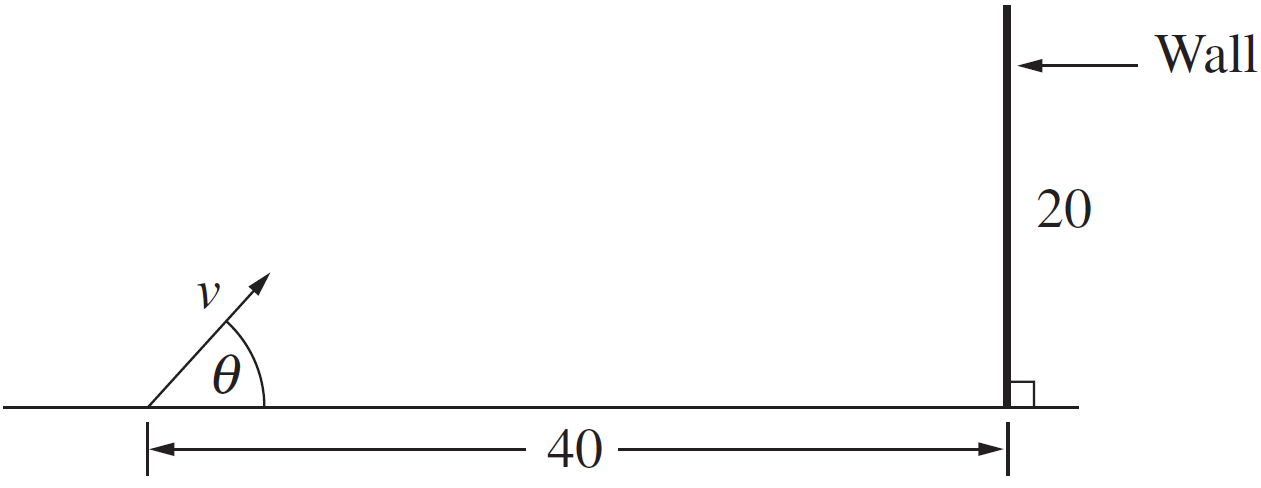
 

Calculus in the Physical World, EXT1 2004 HSC 6b
 

  1. Show that  `v^2 = 80g`.  (1 mark)

    --- 3 WORK AREA LINES (style=lined) ---

  2. Show that the cartesian equation of the path of the water is given by
     
         `y = x\ tan\ theta − (x^2\ sec^2\ theta)/160`.  (2 marks)

    --- 6 WORK AREA LINES (style=lined) ---

  3. Show that the water just clears the top of the wall if
     
         `tan^2\ theta − 4\ tan\ theta + 3 = 0`.  (2 marks)

    --- 6 WORK AREA LINES (style=lined) ---

  4. Find all values of  `theta`  for which the water hits the front of the wall.  (2 marks)

    --- 10 WORK AREA LINES (style=lined) ---

Show Answers Only
  1. `text(See Worked Solutions)`
  2. `text(See Worked Solutions)`
  3. `text(See Worked Solutions)`
  4. `text(See Worked Solutions)`
  5. `15^@ ≤ theta ≤ 45^@ \ \ text(and)\ \ 71.6^@ ≤ theta ≤ 75^@`
Show Worked Solution
i.    `x` `= vt\ cos\ theta`
  `y` `= vt\ sin\ theta − 1/2 g t^2`


`text(Find)\ \ t\ \ text(when)\ \ y = 0`

`vt\ sin\ theta − 1/2 g t^2` `= 0`
`t(v\ sin\ theta − 1/2 g t)` `= 0`
`v\ sin\ theta − 1/2 g t` `= 0, \ \ t ≠ 0`
`1/2 g t` `= v\ sin\ theta`
`t` `= (2v\ sin\ theta)/g`


`text(Find)\ \ x\ \ text(when)\ \ t = (2v\ sin\ theta)/g`

`x` `= v · (2v\ sin\ theta)/g\ cos\ theta`
  `= (v^2 · \ 2\ sin\ theta\ cos\ theta)/g`
  `= (v^2\ sin\ 2theta)/g`


`:.\ text(When)\ \ x = (v^2\ sin\ 2theta)/g,\ \ \text(the water returns)`

`text(to ground level  … as required.)`


ii.   `text(Show)\ \ v^2 = 80\ text(g)`

`text(When)\ \ theta = 15^@, \ x = 40`

`text{From part (i)}`

`40` `= (v^2\ sin\ 30^@)/g`
`v^2 xx 1/2` `= 40g`
`v^2` `= 80g\ \ \ …text(as required)`


iii.  `text(Show)\ \ y = x\ tan\ theta − (x^2\ sec^2\ theta)/160`

`x` `= vt\ cos\ theta`
`:.t` `= x/(v\ cos\ theta)`


`text(Substitute into)`

`y` `= vt\ sin\ theta − 1/2 g t^2`
  `= v · x/(v\ cos\ theta) · sin\ theta −1/2 g  (x/(v\ cos\ theta))^2`
  `= x\ tan\ theta − 1/2  g (x^2/(v^2\ cos^2\ theta))`
  `= x\ tan\ theta − 1/2  g · x^2/(80g\ cos^2\ theta)`
  `= x\ tan\ theta − (x^2\ sec^2\ theta)/160\ \ \ …text(as required.)`


iv.   `text(Water clears the top if)\ \ y = 20\ \ text(when)\ \ x = 40`

`text{Substitute into equation from (iii)}`

`40\ tan\ theta − (40^2\ sec^2\ theta)/160` `= 20`
`40\ tan\ theta − 10\ sec^2\ theta` `= 20`
`40\ tan\ theta − 10(1 + tan^2\ theta)` `= 20`
`40\ tan\ theta − 10 − 10\ tan^2\ theta` `= 20`
`10\ tan^2\ theta − 40\ tan\ theta\ + 30` `= 0`
`tan^2\ theta − 4\ tan\ theta + 3` `= 0\ \ \ text(… as required)`


v.   

Calculus in the Physical World, EXT1 2004 HSC 6b Answer

`text(Water hits the bottom of the wall when)`

`x = 40\ \ text(and)\ \ y = 0`

`40\ tan\ theta − (40^2\ sec^2\ theta)/160` `= 0`
`40\ tan\ theta − 10\ sec^2\ theta` `= 0`
`4\ tan\ theta − (1 + tan^2\ theta)` `= 0`
`tan^2\ theta − 4\ tan\ theta + 1` `= 0`


`text(Using the quadratic formula)`

`tan\ theta` `= (+4 ± sqrt(16 − 4 · 1 · 1))/ (2 xx 1)`
  `= (4 ± sqrt12)/2`
  `= 2 ± sqrt3`
`theta` `= 15^@\ \ text(or)\ \ 75^@`


`text(Water hits the top of the wall when)`

`x = 40\ text(and)\ \ y = 20`

`tan^2\ theta − 4\ tan\ theta + 3` `= 0\ \ \ text{from (iv)}`
`(tan\ theta − 1)(tan\ theta − 3)` `= 0`
`tan\ theta` `= 1` `text(or)` `tan\ theta` `= 3`
`theta` `= 45^@`   `theta` `= tan^(−1)\ 3`
        `= 71.565…`
        `= 71.6^@\ \ \text{(to 1 d.p.)}`


`:.\ text(Following the motion of the water as)\ \ theta\ \ text(increases,)`

`text(water hits the wall when)`

`15^@ ≤ theta ≤ 45^@` `\ text(and)`
`71.6^@ ≤ theta ≤ 75^@`  

Filed Under: Projectile Motion, Projectile Motion EXT1 Tagged With: Band 3, Band 4, Band 5, Band 6, smc-1062-10-Range/Time of Flight, smc-1062-40-Initial Angle/Speed, smc-1062-80-Cartesian, smc-1062-95-Hit Wall

Inverse Functions, EXT1 2004 HSC 5b

The diagram below shows a sketch of the graph of  `y = f(x)`, where  `f(x) = 1/(1 + x^2)`  for  `x ≥ 0`.
 

Inverse Functions, EXT1 2004 HSC 5b
 

  1. Copy or trace this diagram into your writing booklet.
    On the same set of axes, sketch the graph of the inverse function,  `y = f^(−1)(x)`.  (1 mark)
  2.  
  3. State the domain of  `f^(−1)(x)`.  (1 mark)

  4. Find an expression for  `y = f^(−1)(x)`  in terms of  `x`.  (2 marks)

  5. The graphs of  `y = f(x)`  and  `y = f^(−1)(x)`  meet at exactly one point  `P`.
  6. Let  `α`  be the `x`-coordinate of  `P`. Explain why  `α`  is a root of the equation
     

    1. `x^3 + x − 1 = 0`.  (1 mark)
    2.  
  7. Take 0.5 as a first approximation for  `α`. Use one application of Newton’s method to find a second approximation for  `α`.  (2 marks) 


Show Answers Only
  1. `text(See Worked Solutions)`
  2. `0 < x ≤ 1`
  3. `y = sqrt((1 − x)/x), y > 0`
  4.  
  5. `text(See Worked Solutions)`
  6. `0.714\ \ \ text{(to 3 d.p.)}`
Show Worked Solution
(i)   

Inverse Functions, EXT1 2004 HSC 5b Answer

(ii)   `text(Domain of)\ \ f^(−1)(x)\ text(is)`

`0 < x ≤ 1`


(iii)  `f(x) = 1/(1 + x^2)`

 
`text(Inverse: swap)\ \ x↔y`

`x` `= 1/(1 + y^2)`
`x(1 + y^2)` `= 1`
`1 + y^2` `= 1/x`
`y^2` `= 1/x − 1`
  `= (1 − x)/x`
`y` `= ± sqrt((1 − x)/x)`


`:.y = sqrt((1 − x)/x), \ \ y >= 0`


(iv)   `P\ \ text(occurs when)\ \ f(x)\ \ text(cuts)\ \ y = x`

`text(i.e. where)`

`1/(1 + x^2)` `= x`
`1` `= x(1 + x^2)`
`1` `= x + x^3`
`x^3 + x − 1` `= 0`


`=>\ text(S)text(ince)\ α\ text(is the)\ x\ text(-coordinate of)\ P,`

`text(it is a root of)\ \ \ x^3 + x − 1 = 0`


(v)    `f(x)` `= x^3 + x − 1`
  `f′(x)` `= 3x^2 + 1`
  `f(0.5)` `= 0.5^3 + 0.5 − 1`
    `= −0.375`
  `f′(0.5)` `= 3 xx 0.5^2 + 1`
    `= 1.75`


`α_2` `= α_1 − (f(0.5))/(f′(0.5))`
  `= 0.5 − ((−0.375))/1.75`
  `= 0.5 − (−0.2142…)`
  `= 0.7142…`
  `= 0.714\ \ \ text{(to 3 d.p.)}`

Filed Under: Newton's Method etc... EXT1, Other Inverse Functions EXT1 Tagged With: Band 3, Band 4, Band 5

Quadratic, EXT1 2004 HSC 4b

The two points  `P(2ap, ap^2)`  and  `Q(2aq, aq^2)`  are on the parabola  `x^2 = 4ay`.

  1. The equation of the tangent to  `x^2 = 4ay`  at an arbitrary point  `(2at, at^2)`  on the parabola is   `y = tx − at^2`.  (Do not prove this.)
  2. Show that the tangents at the points  `P`  and  `Q`  meet at  `R`, where  `R`  is the point  `(a(p + q), apq)`.  (2 marks)
  3. As  `P`  varies, the point  `Q`  is always chosen so that  `∠POQ`  is a right angle, where  `O`  is the origin.
  4. Find the locus of  `R`.  (2 marks)
Show Answers Only
  1. `text{Proof (See Worked Solutions)}`
  2. `y = −4a`
Show Worked Solution
(i)   

Quadratic, EXT1 2004 HSC 4b Answer

`text(Show)\ \ R(a(prq), apq)`

`text(T)text(angent equations)`

`y` `= px − ap^2` `\ \ …\ (1)`
`y` `= qx − aq^2` `\ \ …\ (2)`


`text(Substitute)\ \y = px − ap^2\ \text(into)\ (2)`

`px − ap^2` `= qx − aq^2`
`px − qx` `= ap^2 − aq^2`
`x(p − q)` `= a(p^2 − q^2)`
  `= a(p + q)(p − q)`
`:.x` `= a(p + q)`


`text(Substitute)\ \x = a(p + q)\ \ text(into)\ (1)`

`y` `= p xx a(p + q) − ap^2`
  `= ap^2 + apq − ap^2`
  `= apq`


`:.R(a(p+q), apq)\ \ \ …text(as required.)`


(ii)  `text(If)\ \ ∠POQ\ text(is a right angle)`

`M_(PO) xx M_(OQ) = −1`

 `M_(PO)` `= (ap^2 − 0)/(2ap − 0)`
  `= p/2`
`M_(OQ)` `= (aq^2 − 0)/(2aq − 0)`
  `= q/2`


`:.p/2 xx q/2` `= −1`
`pq` `= −4`


`⇒R\ \ text(has coordinates)\ \ (a(p+q), −4a)`

`:.\ text(Locus of)\ R\ text(is)\ \ y = −4a`

Filed Under: 9. Quadratics and the Parabola EXT1 Tagged With: Band 3, Band 5

Calculus, EXT1 C1 2004 HSC 3c

A ferry wharf consists of a floating pontoon linked to a jetty by a 4 metre long walkway. Let  `h`  metres be the difference in height between the top of the pontoon and the top of the jetty and let  `x`  metres be the horizontal distance between the pontoon and the jetty.
 

2004 3c
 

  1. Find an expression for  `x`  in terms of  `h`.  (1 mark)

    --- 2 WORK AREA LINES (style=lined) ---

When the top of the pontoon is 1 metre lower than the top of the jetty, the tide is rising at a rate of 0.3 metres per hour.

  1. At what rate is the pontoon moving away from the jetty?  (3 marks)

    --- 10 WORK AREA LINES (style=lined) ---

Show Answers Only
  1. `x=sqrt(16 − h^2)`
  2. `0.077\ text(m/hr)`
Show Worked Solution

i.   `text(Using Pythagoras,)`

`x^2 + h^2` `= 4^2`
`x^2` `= 16 − h^2`
`x` `= sqrt(16 − h^2)`


ii.   `text(Find)\ \ (dx)/(dt)\ \ text(when)\ \ h = 1`

`(dx)/(dt)` `= (dx)/(dh)·(dh)/(dt)`
`x` `= (16 − h^2)^(1/2)`
`(dx)/(dh)` `= 1/2 xx (16 − h^2)^(−1/2) xx d/(dh)(16 − h^2)`
  `= 1/2 (16 − h^2)^(−1/2) xx −2h`
  `= (−h)/(sqrt(16 − h^2))`


`text(When)\ \ h = 1, (dh)/(dt)= −0.3\ text(m/hr)`

`text{(}h\ \ text{decreases when the tide is rising)}`

`(dx)/(dt)` `= (−h)/(sqrt(16 − h^2)) xx −0.3`
  `= (−1)/sqrt(16 − 1^2) xx −0.3`
  `= 0.3/sqrt15`
  `= 0.0774…`
  `= 0.077\ \ \ text{metres per hr (to 2 d.p.)}`


`:.\ text(When)\ \ h = 1,\ text(the pontoon is moving away)`

`text(at 0.077 metres per hr.)`

Filed Under: Rates of Change EXT1, Related Rates of Change Tagged With: Band 3, Band 4, smc-1079-20-Pythagoras

Functions, EXT1 F2 2004 HSC 3b

Let  `P(x) = (x + 1) (x-3)Q(x) + a(x + 1) + b`, where `Q(x)` is a polynomial and `a` and `b` are real numbers.

When `P(x)` is divided by `(x + 1)` the remainder is  `−11`.

When `P(x)` is divided by `(x-3)` the remainder is  `1`.

  1. What is the value of `b`?   (1 mark)

    --- 4 WORK AREA LINES (style=lined) ---

  2. What is the remainder when `P(x)` is divided by `(x + 1)(x-3)`?   (2 marks)

    --- 6 WORK AREA LINES (style=lined) ---

Show Answers Only

a.    `−11`

b.    `3x-8`

Show Worked Solution

a.    `P(x)= (x + 1) (x-3)Q(x) + a(x + 1) + b`

`P(-1)=-11`

`-11=(-1 + 1)(−1-3)Q(x) + a(-1 + 1) + b`

`-11=(0)(-4)Q(x)+a(0)+b`

`:.b = −11`


b.    `P(3) = 1`

`:.(3 + 1)(3-3)Q(x) + a(3 + 1)-11 = 1`

`4a` `= 12`
`a` `= 3`

 
`text(When)\ \ P(x)\ \ text(is divided by)\ (x + 1)(x-3)`

`R(x)` `= a(x + 1) + b`
  `= 3(x + 1)-11`
  `= 3x + 3-11`
  `= 3x-8`

Filed Under: Remainder and Factor Theorems, Remainder and Factor Theorems, Roots, Remainders and Factors Tagged With: Band 3, Band 4, smc-1031-20-Remainder Theorem, smc-6644-20-Remainder Theorem

Combinatorics, EXT1 A1 2004 HSC 2e

A four-person team is to be chosen at random from nine women and seven men.

  1. In how many ways can this team be chosen?   (1 mark)

    --- 2 WORK AREA LINES (style=lined) ---

  2. What is the probability that the team will consist of four women?   (1 mark)

    --- 2 WORK AREA LINES (style=lined) ---

Show Answers Only

a.    `1820`

b.    `9/130`

Show Worked Solution

a.    `text(#Team combinations)`

`=\ ^(16)C_4 = (16!)/((16-4)!\ 4!)= 1820`
 

b.    `text{P(team has 4 women)}`

`= (\ ^9C_4)/1820= 126/1820 = 9/130`

Filed Under: Permutations and Combinations, Permutations and Combinations (Y11), Permutations and Combinations EXT1 Tagged With: Band 3, Band 4, smc-1082-20-Unordered Combinations, smc-6638-20-Unordered Combinations

Calculus, EXT1 C2 2004 HSC 1e

Use the substitution  `u = x − 3` to evaluate

`int_3^4 xsqrt(x − 3)\ dx.` (3 marks)

--- 8 WORK AREA LINES (style=lined) ---

Show Answers Only

`2 2/5`

Show Worked Solution

`text(Let)\ \ u = x − 3`

`=> x = u + 3`

`(du)/dx = 1`

`=> dx = du`

`text(When)\ \ ` `x = 4,` `u = 1`
  `x = 3,` `u = 0`

 
`int_3^4 xsqrt(x − 3\ dx)`

`= int_0^1(u + 3)\ u^(1/2)\ du`

`= int_0^1u^(3/2) + 3u^(1/2)\ du`

`=[2/5u^(5/2) + 3 xx 2/3u^(3/2)]_0^1`

`= [2/5u^(5/2) + 2u^(3/2)]_0^1`

`= [(2/5 + 2) − 0]`

`= 2 2/5`

Filed Under: 11. Integration EXT1, Integration By Substitution Tagged With: Band 3, smc-1036-10-Linear

Calculus, EXT1 C2 2004 HSC 1d

Find  `int_0^1(dx)/(sqrt(4 − x^2))`.  (2 marks) 

Show Answers Only

`pi/6`

Show Worked Solution
`int_0^1(dx)/(sqrt(4 − x^2))` `= [sin^(−1)\ x/2]_0^1`
  `= sin^(−1)(1/2) − sin^(−1)(0)`
  `= pi/6`

Filed Under: Inverse Functions Calculus, Inverse Trig Functions EXT1 Tagged With: Band 3, smc-1037-30-Sin/Cos Integration

Linear Functions, EXT1 2004 HSC 1c

Let  `A`  be the point  `(3, text(−1))`  and  `B`  be the point  `(9, 2)`.

Find the coordinates of the point  `P`  which divides the interval  `AB`  externally in the ratio  `5:2`.  (2 marks)

Show Answers Only

`(13, 4)`

Show Worked Solution

`A(3, text(−1))\ \ B(9, 2)`

`P\ \ text(divides)\ \ AB\ \ text(externally in ratio)\ \ 5:2`

`:.P` `= ((nx_1 + mx_2)/(m + n),(ny_1 + my_2)/(m + n))`
  `= ((text(−2)(3) + 5(9))/(5 + (text(−2))), (text(−2)(text(−1)) + 5(2))/(5 + text{(−2)}))`
  `= ((text(−6)\ + 45)/3, (+2 + 10)/3)`
  `= (13, 4)`

Filed Under: 6. Linear Functions EXT1 Tagged With: Band 3

Functions, EXT1 F1 2004 HSC 1b

Solve  `4/(x + 1) < 3.`  (3 marks)

--- 6 WORK AREA LINES (style=lined) ---

Show Answers Only

`x < −1\ \ text(or)\ \ x > 1/3`

Show Worked Solution

`4/(x + 1) < 3`

`text(Multiply both sides by)\ (x + 1)^2`

`4(x + 1)` `< 3(x + 1)^2`
`4x + 4` `< 3(x^2 + 2x + 1)`
`4x + 4` `< 3x^2 + 6x + 3`
`3x^2 + 2x-1` `> 0`
`(3x-1)(x + 1)` `> 0`

 
`text(LHS) = 0\ \ text(when)\ \ x = 1/3\ \ text(or)\ \ −1`
 

Algebra, EXT1 2004 HSC 1b Answer

`text(From the graph:)`

`x < -1\ \ text(or)\ \ x > 1/3`

Filed Under: 1. Basic Arithmetic and Algebra EXT1, Inequalities, Inequalities Tagged With: Band 3, smc-1033-10-Algebraic Fractions, smc-6643-10-Algebraic Fractions

Functions, EXT1 F1 2004 HSC 1a

Indicate the region on the number plane satisfied by  `y ≥ |\ x + 1\ |.`   (2 marks) 

--- 8 WORK AREA LINES (style=lined) ---

Show Answers Only

`text(See Worked Solution)`

Show Worked Solution

 Real Functions, EXT1 2004 HSC 1a Answer

`y ≥ |\ x + 1\ |`

`text(Test)\ (0, 0):`

`0 ≥ |\ 0 + 1\ |\ \ =>\ \ 0 ≥ 1\ \ =>\ text{False (i.e. (0, 0) lies outside)}`

`:.\ text(Shaded area represents)\ y ≥ |\ x + 1\ |`

Filed Under: 4. Real Functions EXT1, Inequalities, Inequalities Tagged With: Band 3, smc-1033-20-Absolute Value, smc-1033-40-Regions, SMc-6643-20-Absolute Value, smc-6643-40-Regions

Calculus, EXT1 C1 2006 HSC 5c

2006 5c
 

A hemispherical bowl of radius  `r\ text(cm)`  is initially empty. Water is poured into it at a constant rate of  `k\ text(cm³)`  per minute. When the depth of water in the bowl is  `x\ text(cm)`, the volume, `V\ text(cm³)`, of water in the bowl is given by

`V = pi/3 x^2 (3r - x).`    (Do NOT prove this)

  1. Show that  `(dx)/(dt) = k/(pi x (2r - x).`  (2 marks)

    --- 8 WORK AREA LINES (style=lined) ---

  2. Hence, or otherwise, show that it takes 3.5 times as long to fill the bowl to the point where  `x = 2/3r`  as it does to fill the bowl to the point where  `x = 1/3r.`  (2 marks)

    --- 10 WORK AREA LINES (style=lined) ---

Show Answers Only
  1. `text(Proof)\ \ text{(See Worked Solutions)}`
  2. `text(Proof)\ \ text{(See Worked Solutions)}`
Show Worked Solution

i.  `text(Show)\ \ (dx)/(dt) = k/(pi x (2r – x))`

`(dV)/(dt)` `= k`
`V` `= pi/3 x^2 (3r – x)`
  `= r pi x^2 – pi/3 x^3`
`(dV)/(dx)` `= 2 pi r x – pi x^2`
  `= pi x (2r – x)`
   
`(dV)/(dt)` `= (dV)/(dx) * (dx)/(dt)`
`k` `= pi x (2r – x) * (dx)/(dt)`
`:. (dx)/(dt)` `= k/(pi x (2r – x))\ \ text(…  as required)`


ii.  `(dx)/(dt)` `= k/(pi x (2r – x))`
`(dt)/(dx)` `= 1/k pi x (2r – x)`
`t` `= 1/k int 2 pi r x – pi x^2\ dx`
  `= 1/k [pi r x^2 – 1/3 pix^3] + c`

 
`text(When)\ \ t = 0,\ \ \ x = 0`

`:.\ c = 0`

 `:.t = 1/k [pi r x^2 – 1/3 pi x^3]`

 
`text(Find)\ \ t_1,\ \ text(when)\ \ x = 1/3r`

`t_1` `= 1/k [pi r (r/3)^2 – 1/3 pi (r/3)^3]`
  `= 1/k [(pi r^3)/9 – (pi r^3)/81]`
  `= 1/k ((9 pi r^3)/81 – (pi r^3)/81)`
  `= (8 pi r^3)/(81k)`

 
`text(Find)\ \ t_2\ \ text(when)\ \ x = 2/3r`

`t_2` `= 1/k [pi r((2r)/3)^2 – 1/3 pi ((2r)/3)^3]`
  `= 1/k [(4 pi r^3)/9 – (8 pi r^3)/81]`
  `= 1/k ((36 pi r^3)/81 – (8 pi r^3)/81)`
  `= (28 pi r^3)/(81k)`
  `= 3.5 xx (8 pi r^3)/(81k)`
  `= 3.5 xx t_1`

 
`:.\ text(It takes 3.5 times longer to fill the bowl.)`

Filed Under: Rates of Change EXT1, Related Rates of Change Tagged With: Band 3, Band 5, smc-1079-10-Volume

L&E, EXT1 2006 HSC 5a

Show that  `y = 10e^(-0.7t) + 3`  is a solution of

`(dy)/(dt) = -0.7(y - 3).`  (2 marks)

Show Answers Only

`text(Proof)\ \ text{(See Worked Solutions)}`

Show Worked Solution

`y = 10e^(-0.7t) + 3`

`(dy)/(dt)` `= -0.7 xx 10e^(-0.7t)`
  `= -0.7 (10e^(-0.7t) + 3 – 3)`
  `= -0.7 (y – 3)`

Filed Under: 12. Logs and Exponentials EXT1 Tagged With: Band 3

Polynomials, EXT1 2006 HSC 3b

  1. By considering  `f(x) = 3log_e x - x`, show that the curve  `y = 3 log_e x`  and the line  `y = x`  meet at a point  `P`  whose `x`-coordinate is between  `1.5`  and  `2`.  (1 mark)

  2. Use one application of Newton’s method, starting at  `x = 1.5`, to find an approximation to the `x`-coordinate of  `P`. Give your answer correct to two decimal places.  (2 marks)


Show Answers Only
  1. `text(Proof)\ \ text{(See Worked Solutions)}`
  2. `1.78\ \ text{(to 2 d.p.)}`
Show Worked Solution
(i)     `f(x)` `= 3 log_e x – x`
  `f(1.5)` `= 3 log_e 1.5 – 1.5`
    `= -0.283… <0`
  `f(2)` `= 3 log_e 2 – 2`
    `= 0.079… >0`


`:.\ text(S)text(ince the sign changes, a zero must)`

`text(exist between 1.5 and 2.)`


(ii) `f(x)` `= 3 log_e x – x`
  `f prime(x)` `= 3/x – 1`
  `f(1.5)` `= -0.283…`
  `f prime (1.5)` `= 3/1.5 – 1 = 1`


`x_1` `= x_0 – (f(x_0))/(f prime (x_0))`
  `= 1.5 – {(-0.283…)}/1`
  `= 1.783…`
  `= 1.78\ \ text{(to 2 d.p.)}`

Filed Under: Newton's Method etc... EXT1 Tagged With: Band 3, Band 4

Quadratic, EXT1 2006 HSC 2c

2006 2c

The points  `P(2ap, ap^2), Q(2aq, aq^2)`  and  `R(2ar, ar^2)`  lie on the parabola  `x^2 = 4ay`. The chord  `QR`  is perpendicular to the axis of the parabola. The chord  `PR`  meets the axis of the parabola at  `U`.

The equation of the chord  `PR`  is  `y = 1/2(p + r)x - apr.`     (Do NOT prove this.)

The equation of the tangent at  `P`  is  `y = px - ap^2.`            (Do NOT prove this.) 

  1. Find the coordinates of  `U.`  (1 mark)
  2. The tangents at  `P`  and  `Q`  meet at the point  `T`. Show that the coordinates of  `T`  are  `(a(p + q), apq).`  (2 marks)
  3. Show that  `TU`  is perpendicular to the axis of the parabola.  (1 mark)
Show Answers Only
  1. `(0, –apr)`
  2. `text(Proof)\ \ text{(See Worked Solutions)}`
  3. `text(Proof)\ \ text{(See Worked Solutions)}`
Show Worked Solution

(i)   `U\ \ text(is the)\ \ y\ \ text(intercept of)\ \ PR`

`y = 1/2 (p + r)x – apr`

`text(When)\ \ x = 0`

`y = -apr`

`:.\ U\ \ text(has coordinates)\ \ (0, –apr)`


(ii)   `text(Show)\ \ T\ \ text(is)\ \ (a(p + q), apq)`

`text(T)text(angents at)\ \ P and Q\ \ text(are)`

`y` `= px – ap^2\ \ \ \ text{…  (1)}`
`y` `= qx – aq^2\ \ \ \ text{…  (2)}`


`T\ \ text(occurs when)\ \ \ (1) = (2)`

`px – ap^2` `= qx – aq^2`
`px – qx` `= ap^2 – aq^2`
`x(p – q)` `= a (p^2 – q^2)`
  `= a (p – q) (p + q)`
`:.\ x` `= a (p + q)`


`text(Substitute)\ \ x = a (p + q)\ \ text{into  (1)}`

`y` `= p * a (p + q) – ap^2`
  `= ap^2 + apq – ap^2`
  `= apq`


`:.\ T (a (p + q), apq)\ \ text(…  as required.)`


(iii)  `text(Axis of parabola)\ \ x^2 = 4ay\ \ text(is)\ \ y text(-axis)`

`=>TU\ \ text(will be perpendicular to the)\ \ y text(-axis if it has a)`

`text(gradient of)\ \ 0\ \ text{(i.e.}\ \ T and U\ text{have same} y text{-values)}`

`:.\ text(Need to show)\ \ \ -apr = apq.`


`text(Consider)\ \ QR`

`text(S)text(ince it is perpendicular to)\ \ y text(-axis)`

`text(and the parabola is symmetrical)`

`=>\ \ 2aq` `= -2ar`
`q`  `= -r`
`:.\ apq` `= ap (-r)`
`apq` `= -apr`


`:.\ TU\ \ text(is perpendicular.)`

Filed Under: 9. Quadratics and the Parabola EXT1 Tagged With: Band 3, Band 4, Band 5

Binomial, EXT1 2006 HSC 2b

  1. By applying the binomial theorem to `(1 + x)^n` and differentiating, show that
  2. `n(1 + x)^(n - 1) = ((n), (1)) + 2((n), (2)) x + … + r((n), (r)) x^(r - 1) + … + n((n), (n)) x^(n - 1).`   (1 mark)
  3. Hence deduce that
  4. `n3^(n - 1) = ((n), (1)) + … + r((n), (r)) 2^(r - 1) + … + n((n), (n)) 2^(n - 1).`  (1 mark)


Show Answers Only
  1. `text(Proof)\ \ text{(See Worked Solutions)}`
  2. `text(Proof)\ \ text{(See Worked Solutions)}`
Show Worked Solution

(i)  `text(Show)`

`n (1 + x)^(n – 1) = ((n), (1)) + 2((n), (2)) x + … + r((n), (r)) x^(r – 1)`

`+ … + n((n), (n)) x^(n – 1)`

`text(Using binomial expansion)`

`(1 + x)^n = ((n), (0)) + ((n), (1)) x + ((n), (2)) x^2 + … + ((n), (r)) x^r`

`+ … + ((n), (n)) x^n`

`text(Differentiate both sides)`

`n (1 + x)^(n – 1) = ((n), (1)) + 2((n), (2)) x + … + r((n), (r)) x^(r – 1)`

`+ … + n((n), (n)) x^(n – 1)\ \ \ …\ text(as required)`


(ii)  `text(Substitute)\ \ x = 2\ \ text{into above equation}`

`n (1 + 2)^(n – 1) = ((n), (1)) + 2((n), (2)) 2 + … + r((n), (r)) 2^(r – 1)`

`+ … + n((n), (n)) 2^(n – 1)`

`n3^(n – 1) = ((n), (1)) + … + r((n), (r)) 2^(r – 1) + … + n((n), (n)) 2^(n – 1)`

`text(…  as required.)`

Filed Under: 17. Binomial EXT1 Tagged With: Band 3, Band 4

Calculus, EXT1 C2 2006 HSC 2a

Let  `f(x) = sin^-1 (x + 5).`

  1. State the domain and range of the function  `f(x).`  (2 marks)

    --- 4 WORK AREA LINES (style=lined) ---

  2. Find the gradient of the graph of  `y = f(x)`  at the point where  `x = -5.`  (2 marks)

    --- 4 WORK AREA LINES (style=lined) ---

  3. Sketch the graph of  `y = f(x).`  (2 marks)

    --- 8 WORK AREA LINES (style=lined) ---

Show Answers Only
  1. `text(Domain):\ -6 <= x <= -4, \ \ \ text(Range):\ -pi/2 <= y <= pi/2`
  2. `1`
  3.  

Show Worked Solution

i.  `f(x) = sin^-1 (x + 5)`

`text(Domain)`

`-1 <= x + 5 <= 1`

`-6 <= x <= -4`

`text(Range)`

`-pi/2 <= y <= pi/2`


ii.  `y = sin^-1 (x + 5)`

`(dy)/(dx) = 1/sqrt(1-(x + 5)^2)`
 

`text(When)\ \ x = -5`

`(dy)/(dx)` `= 1/sqrt(1-(-5 + 5)^2)`
  `= 1/sqrt(1-0)`
  `= 1`

 
`:.\ text(Gradient of)\ \ y = f(x)\ \ text(at)\ \ x = -5\ \ text(is)\ \ 1.`


iii.

EXT1 2006 2a

Filed Under: Inverse Functions Calculus, Inverse Trig Functions EXT1, T1 Inverse Trig Functions (Y11) Tagged With: Band 3, Band 4, smc-1024-10-arcsin Graphs, smc-1037-10-Sin/Cos Differentiation

Trigonometry, EXT1 T2 2006 HSC 1d

  1. Simplify  `(sin theta + cos theta) (sin^2 theta-sin theta cos theta + cos^2 theta)`   (1 mark)

    --- 3 WORK AREA LINES (style=lined) ---

  2. Hence, or otherwise, express  `(sin^3 theta + cos^3 theta)/(sin theta + cos theta)-1`,  in its simplest form for  `0 < theta < pi/2.`   (2 marks)

    --- 6 WORK AREA LINES (style=lined) ---

Show Answers Only

a.    `sin^3 theta + cos^3 theta`

b.    `-sin theta cos theta`

Show Worked Solution

a.    `(sin theta + cos theta) (sin^2 theta-sin theta cos theta + cos^2 theta)`

`=sin^3 theta -sin^2thetacos theta + sin theta cos^2 theta + cos theta sin^2 theta-sin theta cos^2 theta + cos^3 theta`

`=sin^3 theta + cos^3 theta`
 

b.    `(sin^3 theta + cos^3 theta)/(sin theta + cos theta)-1`

`= {(sin theta + cos theta) (sin^2 theta-sin theta cos theta + cos^2 theta)}/(sin theta + cos theta)-1`

`= sin^2 theta + cos^2 theta-sin theta cos theta-1`

`= 1-sin theta cos theta-1`

`= -sin theta cos theta`

Filed Under: 1. Basic Arithmetic and Algebra EXT1, 5. Trig Ratios EXT1, T2 Further Trigonometric Identities (Y11), Trigonometric Identities Tagged With: Band 3, smc-1025-30-Other, smc-6647-30-Other Problems

Calculus, EXT1 C2 2006 HSC 1b

Using the substitution  `u =x^4 + 8`, or otherwise, find

`int x^3 sqrt (x^4 + 8)\ dx.`  (3 marks)

--- 6 WORK AREA LINES (style=lined) ---

Show Answers Only

`1/6 (x^4 + 8)^(3/2) + c`

Show Worked Solution

`u = x^4 + 8`

`(du)/(dx)` `= 4x^3`
`1/4 du` `= x^3 dx` 

 
`:. int x^3 sqrt (x^4 + 8)\ dx`

`= int u^(1/2) *1/4 * du`

`= 1/4 int u^(1/2) du`

`= 1/4 * 2/3 * u^(3/2) + c`

`= 1/6 u^(3/2) + c`

`= 1/6 (x^4 + 8)^(3/2) + c`

Filed Under: 11. Integration EXT1, Integration By Substitution Tagged With: Band 3, smc-1036-20-Polynomial

Plane Geometry, EXT1 2005 HSC 5b

Two chords of a circle, `AB`  and  `CD`, intersect at  `E`. The perpendiculars to  `AB`  at  `A` and  `CD`  at  `D`  intersect at  `P`. The line  `PE`  meets  `BC`  at  `Q`, as shown in the diagram.

  1. Explain why  `DPAE`  is a cyclic quadrilateral.  (1 mark)
  2. Prove that  `/_ APE = /_ ABC.`  (2 marks)
  3. Deduce that  `PQ`  is perpendicular to  `BC.`  (1 mark)
Show Answers Only

(i)  `text(Proof)\ \ text{(See Worked Solutions)}`

(ii) `text(Proof)\ \ text{(See Worked Solutions)}`

(iii) `text(Proof)\ \ text{(See Worked Solutions)}`

Show Worked Solution

(i)


`/_ PAE = /_ PDE = 90°\ \ text{(given)}`

`:. DPAE\ \ text(is a cyclic quadrilateral)`

`text{(opposite angles are supplementary)}`


(ii)  `text(Prove)\ \ /_ APE = /_ ABC`

`/_ ABC = /_ ADE`

`text{(angles in the same segment on arc}\ AC text{)}`

`text(S) text(ince)\ \ DPAE\ \ text(is a cyclic quad)\ \ text{(from (i))}`

`/_ APE = /_ ADE`

`text{(angles in the same segment on arc}\ AE text{)}`

`:.\ /_ APE = /_ ABC\ \ text(…  as required.)`


(iii)   `/_ APE = /_ ABC\ \ \ text{(from part (ii))}`

`/_ AEP = /_ BEQ\ \ \ text{(vertically opposite angles)}`

`:.\ Delta APE\ \ text(|||)\ \ Delta QBE\ \ text{(equiangular)}`

`:.\ /_ EQB = /_ EAP = 90°`

`text{(corresponding angles of similar triangles)}`

`:.\ PQ _|_ BC\ \ text(…  as required.)`

Filed Under: 2. Plane Geometry EXT1 Tagged With: Band 3, Band 4

Differentiation, EXT1 2005 HSC 3c

Use the definition of the derivative,

`f prime (x) = lim_(h -> 0) (f (x + h) - f(x))/h,`

to find `f prime (x)` when

`f(x) = x^2 + 5x.`  (2 marks)

Show Answers Only

`2x + 5`

Show Worked Solution

`f(x) = x^2 + 5x`

`f(x + h)` `= (x + h)^2 + 5(x + h)`
  `= x^2 + 2xh + h^2 + 5x + 5h`


`f prime (x)` `= lim_(h -> 0) (f (x + h) – f(x))/h`
  `= lim_(h -> 0) (x^2 + 2xh + 5x + h^2 + 5h – x^2 – 5x)/h`
  `= lim_(h -> 0) (2xh + h^2 + 5h)/h`
  `= lim_(h -> 0) 2x + h + 5`
  `= 2x + 5`

Filed Under: 8. Differentiation and 1st Principles EXT1 Tagged With: Band 3, HSC

Calculus, EXT1 C2 2005 HSC 3b

  1. By expanding the left-hand side, show that
  2. `qquad sin(5x + 4x) + sin(5x-4x) = 2 sin (5x) cos(4x)`   (1 mark)

    --- 3 WORK AREA LINES (style=lined) ---

  3. Hence find  `int sin(5x) cos (4x)\ dx.`   (2 marks)

    --- 6 WORK AREA LINES (style=lined) ---

Show Answers Only

a.    `text(Proof)\ \ text{(See Worked Solutions)}`

b.    `-1/18 cos(9x)-1/2 cos(x) + c`

Show Worked Solution

a.    `sin (5x + 4x) + sin (5x-4x) = 2 sin(5x) cos(4x)`

`text(LHS)` `= sin (5x) cos (4x)-sin(4x) cos (5x) + sin (5x) cos (4x)+ sin (4x) cos (5x)`
  `= 2 sin (5x) cos (4x)\ \ text(…  as required)`


b.  `int sin (5x) cos (4x)\ dx`

`= 1/2 int 2 sin (5x) cos (4x)\ dx`

`= 1/2 int sin (5x + 4x) + sin (5x-4x)\ dx`

`= 1/2 int sin (9x) + sin (x)\ dx`

`= 1/2 [-1/9 cos(9x)-cos(x)] + c`

`= -1/18 cos(9x)-1/2 cos(x) + c`

Filed Under: 11. Integration EXT1, 5. Trig Ratios EXT1, Harder Trig Calculus, Identities, Equations and 't' formulae, Other Trig Equations Tagged With: Band 3, Band 4, smc-1038-30-Compound angles, smc-1076-20-Other Identities/Equations, smc-6675-20-Compound Angles

Calculus, EXT1 C1 2005 HSC 2d

A salad, which is initially at a temperature of 25°C, is placed in a refrigerator that has a constant temperature of 3°C. The cooling rate of the salad is proportional to the difference between the temperature of the refrigerator and the temperature, `T`, of the salad. That is, `T` satisfies the equation

`(dT)/(dt) = -k (T-3),` 

where  `t`  is the number of minutes after the salad is placed in the refrigerator.

  1. Show that  `T = 3 + Ae^(–kt)`  satisfies this equation.  (1 mark)

    --- 3 WORK AREA LINES (style=lined) ---

  2. The temperature of the salad is 11°C after 10 minutes. Find the temperature of the salad after 15 minutes.  (3 marks)

    --- 6 WORK AREA LINES (style=lined) ---

Show Answers Only
  1. `text(Proof)\ \ text{(See Worked Solution)}`
  2. `7.8°`
Show Worked Solution
i.  `T` `= 3 + Ae^(-kt)`
  `(dT)/(dt)` `= -k xx Ae^(-kt)`
    `= -k [3 + Ae^(-kt) – 3]`
    `= -k (T – 3)`

 
`:.\ T = 3 + Ae^(-kt)\ \ text(satisfies the equation)`


ii.   `T = 3 + Ae^(-kt)`

`text(When)\ \ t = 0\ ,\ T = 25`

`25` `= 3 + Ae°`
`A` `= 22`
`:.\ T` `= 3 + 22 e^(-kt)`

 
`text(When)\ \ t = 10\ ,\ T = 11`

`:.\ 11` `= 3 + 22e^(-10k)`
`8` `= 22e^(-10k)`
`e^(-10k)` `= 8/22`
`log_e e^(-10k)` `= log_e\ 4/11`
`-10k` `= log_e\ 4/11`
`k` `= -1/10(log_e\ 4/11)`
  `=0.1011…`


`text(Find)\ \ T\ \ text(when)\ \ t = 15:`

`T` `= 3 + 22 e^(-15k),\ \ text(where)\ \ k = 0.1011…`
  `= 3 + 22 e^(-1.5174…)`
  `= 7.8241…`
  `= 7.8°\ \ text{(to 1 d.p.)}`

 
`:.\ text(After 15 minutes, the salad will have a)`

`text(temperature of 7.8°.)`

Filed Under: Exponential Growth and Decay EXT1, Modified Growth and Decay Tagged With: Band 3, smc-1080-10-Cooling

Trig Calculus, EXT1 2005 HSC 2c

  1. Differentiate  `e^(3x) (cos x - 3 sin x).`  (2 marks)
  2. Hence, or otherwise, find
  3. `int e^(3x) sin x\ dx.`  (1 mark)


Show Answers Only
  1. `-10 e^(3x) sin x`
  2. `-1/10  e^(3x) (cos x – 3 sin x) + c`
Show Worked Solution

(i)   `y = e^(3x) (cos x – 3 sin x)`

`text(Using the product rule)`

`(dy)/(dx)` `= e^(3x) (-sin x – 3 cos x) + 3e^(3x) (cos x – 3 sin x)`
  `= -e^(3x) sin x – 3e^(3x) cos x + 3e^(3x) cos x – 9e^(3x) sin x`
  `= -10 e^(3x) sin x`


(ii)  `int e^(3x) sin x\ dx`

`= -1/10 int-10 e^(3x) sin x\ dx`

`= -1/10  e^(3x) (cos x – 3 sin x) + c`


Filed Under: 12. Logs and Exponentials EXT1, 13. Trig Calc, Graphs and Circular Measure EXT1 Tagged With: Band 3

Linear Functions, EXT1 2005 HSC 1e

The point  `P (1, 4)`  divides the line segment joining  `A (text(–1), 8)`  and  `B (x, y)`  internally in the ratio  `2:3`. Find the coordinates of the point  `B.`  (2 marks)

Show Answers Only

`(4, text(–2))`

Show Worked Solution

 `P (1, 4)\ \ text(divides)\ \ A (text(–1), 8)\ and\ B (x, y)`

`text(internally in ratio)\ \ 2:3.`

`P` `-= ((nx_1 + mx_2)/(m + n)\ ,\ (ny_1 + my_2)/(m + n))`
`(1, 4)` `-= ((3 (-1) + 2x)/(2 + 3)\ ,\ (3 (8) + 2y)/(2 + 3))`
  `-= ((2x – 3)/5\ ,\ (24 + 2y)/5)`


`:. (2x -3)/5` `= 1` `\ \ \ \ \ \ \ (24 + 2y)/5` `= 4`
`2x – 3` `= 5` `24 + 2y` `= 20`
`2x` `= 8` `2y` `= -4`
`x` `= 4` `y` `= -2`


`:.\ B\ \ text(has coordinates)\ \ (4, text(–2))`

Filed Under: 6. Linear Functions EXT1 Tagged With: Band 3

Trigonometry, EXT1 T1 2005 HSC 1c

State the domain and range of  `y = cos^-1 (x/4).`   (2 marks)

--- 5 WORK AREA LINES (style=lined) ---

Show Answers Only

`text(Domain)\ \ -4 <= x <= 4`

`text(Range)\ \ 0 <= y <= pi`

Show Worked Solution

 `y = cos^-1\ x/4`

`text(Domain of)\ \ y =cos^-1 x\ \ text(is)`

`-1 <= x <= 1`

`:.\ text(Domain of)\ \ y = cos^-1\ x/4\ \ text(is)`

`-1 <= x/4 <= 1`

`-4 <= x <= 4`


`text(Range)\  \y = cos^-1\ x\ \ text(is)`

`0 <= y <= pi`

`:.\ text(Range)\ \ y = cos^-1\ x/4\ \ text(is)`

`0 <= y <= pi`

Filed Under: Inverse Trig Functions EXT1, T1 Inverse Trig Functions (Y11) Tagged With: Band 3, smc-1024-20-Domain and Range

Calculus, EXT1 C2 2005 HSC 1a

Find  `int 1/(x^2 + 49)\ dx.`  (1 mark)

Show Answers Only

`1/7\ tan^-1\ x/7 + c`

Show Worked Solution
`int 1/(x^2 + 49)\ dx` `= 1/7 int 7/(x^2 + 7^2)\ dx`
  `= 1/7\ tan^-1\ x/7 + c`

Filed Under: Inverse Functions Calculus, Inverse Trig Functions EXT1 Tagged With: Band 3, smc-1037-40-Tan Integration

Calculus, EXT1* C3 2007 HSC 9a

2007 9a
  

The shaded region in the diagram is bounded by the curve  `y = x^2 + 1`, the `x`-axis, and the lines  `x = 0`  and  `x = 1.`

Find the volume of the solid of revolution formed when the shaded region is rotated about the `x`-axis.  (3 marks)

Show Answers Only

`(28 pi)/15\ \ text(u³)`

Show Worked Solution
`V` `= pi int_0^1 y^2\ dx`
  `= pi int_0^1 (x^2 + 1)^2\ dx`
  `= pi int_0^1 x^4 + 2x^2 + 1\ dx`
  `= pi [1/5 x^5 + 2/3 x^3 + x]_0^1`
  `= pi[(1/5 + 2/3 + 1) – 0]`
  `= pi [3/15 + 10/15 + 1]`
  `= (28 pi)/15\ \ text(u³)`

Filed Under: Further Area and Solids of Revolution, Volumes of Solids of Rotation Tagged With: Band 3, Band 4, HSC, smc-1039-10-Polynomial, smc-1039-60-x-axis Rotation

Quadratic, 2UA 2007 HSC 7a

  1. Find the coordinates of the focus, `S`, of the parabola  `y = x^2 + 4`.  (2 marks)
  2. The graphs of  `y = x^2 + 4`  and the line  `y = x + k`  have only one point of intersection, `P`. Show that the `x`-coordinate of `P` satisfies.
    1. `x^2 - x + 4 - k = 0`.  (1 mark)
  3. Using the discriminant, or otherwise, find the value of `k`.  (1 mark)
  4. Find the coordinates of `P`.  (2 marks)
  5. Show that `SP` is parallel to the directrix of the parabola.  (1 mark)
Show Answers Only
  1. `(0, 4 1/4)`

  2. `text(Proof)\ \ text{(See Worked Solutions)}`

  3. `15/4`

  4. `(1/2, 4 1/4)`

  5. `text(Proof)\ \ text{(See Worked Solutions)}`
Show Worked Solution
(i)   `y` `= x^2 + 4`
`x^2` `= y – 4`

`text(Using)\ (x – x_0) = 4a (y – y_0)`

`x_0` `= 0`
`a` `= 1/4`
`y_0` `= 4`

`(x – 0) = 4 xx 1/4 xx (y – 4)`

`text(Vertex)` `= (0, 4)`
`:.\ text(Focus)` `= (0, 4 1/4)`


(ii)  `y` `= x^2 + 4` `\ \ …\ \ (1)`
`y` `= x + k` `\ \ …\ \ (2)`


`text(Solving simultaneously)`

`x^2 + 4` `= x + k`
`x^2 – x + 4 – k` `= 0`


(iii)  `text(If only 1 point of intersection,)`

`b^2 – 4ac` `= 0`
`(–1)^2 – 4 xx 1 xx (4 – k)` `= 0`
`1 – 16 + 4k` `= 0`
`4k` `= 15`
`k` `= 15/4`


(iv)  `text(Finding)\ \ P`

`x^2 – x + 4 – 15/4 = 0`

`x^2 – x + 1/4 = 0`

`(x – 1/2)^2 = 0`

`x = 1/2`

`text(When)\ x = 1/2`

`y` `= (1/2)^2 + 4`
  `= 4 1/4`

`:. P\ text(has coordinates)\ \  (1/2, 4 1/4)`


(v)  `text(Focus)\ (S)` `= (0, 4 1/4)`
`P` `= (1/2, 4 1/4)`


`:.\ text(S)text(ince)\ y text(-values are the same,)\ SP\ text(is parallel)`

`text(with the)\ x text(-axis.)`

`=>text(Directrix has the equation)\ \ y = 3 3/4`

`:. SP\ text(is parallel with the directrix.)`

Filed Under: The Parabola Tagged With: Band 3, Band 4, HSC

Calculus, 2ADV C3 2007 HSC 6b

Let  `f (x) =x^4 - 4x^3`.

  1. Find the coordinates of the points where the curve crosses the axes.  (2 marks)

    --- 4 WORK AREA LINES (style=lined) ---

  2. Find the coordinates of the stationary points and determine their nature.  (4 marks)

    --- 8 WORK AREA LINES (style=lined) ---

  3. Find the coordinates of the points of inflection.  (1 mark)

    --- 2 WORK AREA LINES (style=lined) ---

  4. Sketch the graph of  `y = f (x)`, indicating clearly the intercepts, stationary points and points of inflection.  (3 marks)

    --- 8 WORK AREA LINES (style=lined) ---

Show Answers Only
  1. `(0, 0)\ , \ (4, 0)`
  2. `text(Minimum S.P. at)\ (3,\ text(-27))`
  3. `(0, 0) and (2, 16)`
  4.  
Show Worked Solution

i.  `f (x) = x^4 – 4x^3`

`text(Cuts)\ x text(-axis when)\ f(x) = 0`

`x^4 – 4x` `= 0`
`x^3 (x – 4)` `= 0`

`x = 0 or 4`

`:. text(Cuts the)\ x text(-axis at)\ (0, 0)\ ,\ (4, 0)`


`text(Cuts the)\ y text(-axis when)\ x = 0`

`:. text(Cuts the)\ y text(-axis at)\ (0, 0)`


ii.   `f(x) = x^4 – 4x^3`

`f prime (x) = 4x^3 – 12x^2`

`f″ (x) = 12x^2 – 24x`


`text(S.P.’s when)\ f prime (x) = 0`

`4x^3 – 12x^2` `= 0`
`4x^2 (x – 3)` `= 0`

`x = 0 or 3`

`text(When)\ x = 0`

`f(0) = 0`

`f″(0) = 0`

`text(S)text(ince concavity changes, a P.I.)`

`text(occurs at)\ (0, 0)`


`text(When)\ x = 3`

`f (3)` `= 3^4 – 4 xx 3^3`
  `= -27`
`f″ (3)` `= 12 xx 3^2 – 24 xx 3`
  `= 36 > 0`


`:. text(Minimum S.P. at)\ (3,\ text(–27))`


iii.  `text(P.I. when)\ f″(x) = 0`

`12x^2 – 24x` `= 0`
`12x(x – 2)` `= 0`

`x = 0 or 2`

`text(P.I. at)\ (0, 0)\ \ \ text{(from(ii))}`


`text(When)\ x = 2`

`text(S)text(ince concavity changes, a P.I.)`

`text(occurs when)\ x = 2`

`f (2)` `= 2^4 – 4 xx 2^3`
  `= 16`


`:. text(P.I.’s at)\ (0, 0) and (2, 16)`


iv.

2UA HSC 2007 6b

Filed Under: Curve Sketching, Curve Sketching and The Primitive Function Tagged With: Band 3, Band 4, smc-969-20-Degree 4

Calculus, EXT1* C1 2007 HSC 5b

A particle is moving on the `x`-axis and is initially at the origin. Its velocity, `v` metres per second, at time `t` seconds is given by

`v = (2t)/(16 + t^2).`

  1. What is the initial velocity of the particle?  (1 mark)

    --- 2 WORK AREA LINES (style=lined) ---

  2. Find an expression for the acceleration of the particle.  (2 marks)

    --- 4 WORK AREA LINES (style=lined) ---

  3. Find the time when the acceleration of the particle is zero.  (1 mark)

    --- 4 WORK AREA LINES (style=lined) ---

  4. Find the position of the particle when `t = 4`.  (3 marks)

    --- 8 WORK AREA LINES (style=lined) ---
Show Answers Only
  1. `0`
  2. `{2(16 – t^2)}/(16 + t^2)^2`
  3. `4\ text(seconds)`
  4. `log_e 2\ \ text(metres)`
Show Worked Solution

i.  `v = (2t)/(16 + t^2)`

`text(When)\ t` `= 0`
`v` `= 0`

`:.\ text(Initial velocity is 0.)`


ii.  `a = d/(dt) ((2t)/(16 + t^2))`
 

`text(Using quotient rule)`

`u` `= 2t` `v` `= 16 + t^2`
`u prime` `= 2` `v prime` `= 2t`
`(dv)/(dt)` `= (u prime v – uv prime)/v^2`
  `= {2(16 + t^2) – 2t * 2t}/(16 + t^2)^2`
  `= (32 + 2t^2 – 4t^2)/(16 + t^2)^2`
  `= {2(16 – t^2)}/(16 + t^2)^2`


iii.  `text(Find)\ t\ text(when)\ (dv)/(dt) = 0`

`{2 (16 – t^2)}/(16 + t^2)^2` `= 0`
`2 (16 – t^2)` `= 0`
`t^2` `= 16`
`t` `= 4\ ,\ t >= 0`


`:.\ text(The acceleration is zero when)`

`t = 4\ text(seconds.)`


iv.  `v = (2t)/(16 + t^2)`

`x` `= int v\ dt`
  `= int (2t)/(16 + t^2)`
  `= log_e (16 + t^2) + c`


`text(When)\ \ t = 0\ ,\ x = 0`

`0 = log_e (16 + 0) + c`

`c = -log_e 16`

`:. x = log_e(16 + t^2) – log_e 16`
 

`text(When)\ t = 4,`

`x` `= log_e (16 + 4^2) – log_e 16`
  `= log_e 32 – log_e 16`
  `= log_e (32/16)`
  `= log_e 2\ \ text(metres)`


`:.\ text(When)\ t = 4\ , \ text(the position of the)`

`text(particle is)\ log_e 2 \ text(metres.)`

Filed Under: Motion, Rates of Change with respect to time Tagged With: Band 3, Band 4, Band 5, smc-1077-10-Motion, smc-1077-50-Log Equation

Plane Geometry, 2UA 2007 HSC 5a

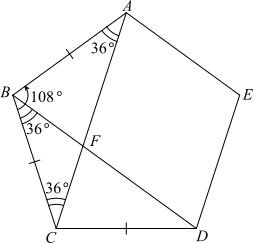
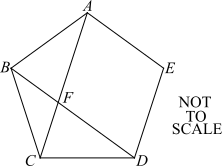
In the diagram, `ABCDE` is a regular pentagon. The diagonals `AC` and `BD` intersect at `F`.

Copy or trace this diagram into your writing booklet.

  1. Show that the size of `/_ABC` is `108°`.  (1 mark)
  2. Find the size of `/_BAC`. Give reasons for your answer.  (2 marks)
  3. By considering the sizes of angles, show that `Delta ABF` is isosceles.  (2 marks)
Show Answers Only
  1. `text(See Worked Solutions)`
  2. `36°`
  3. `text(See Worked Solutions)`
Show Worked Solution
(i)

`text(Sum of all internal angles`

`= (n – 2) xx 180°`

`= (5 – 2) xx 180°`

`= 540°`

`:. /_ABC` `= 540/5= 108°`


(ii)  `BA = BC`

`text{(equal sides of a regular pentagon)}`

`:. Delta BAC\ text(is isosceles)`

`/_BAC` `= 1/2 (180 – 108)\ \ \ text{(base angle of}\ Delta BAC text{)}`
  `= 36°`


(iii)  `text(Consider)\ Delta BCD and Delta ABC`

`BC = CD = BA`

`text{(equal sides of a regular pentagon)}`

`/_BCD = /_ABC = 108°`

`text{(internal angles of a regular pentagon)}`

`:. Delta BCD -= Delta ABC\ \ \ text{(SAS)}`

`:. CBF` `= 36°` `text{(corresponding angles in}`
     `text{congruent triangles)}`
`/_FBA` `= 108 – 36`
  `= 72°`
`/_BFA` `= 180 – (72 + 36)\ \ \ \ text{(angle sum of}\ Delta ABF text{)}`
  `= 72°`

`:. Delta ABF\ \ text(is isosceles.)`

Filed Under: 2. Plane Geometry Tagged With: Band 3, Band 4, HSC

Trigonometry, 2ADV T1 2007 HSC 4c

An advertising logo is formed from two circles, which intersect as shown in the diagram.

The circles intersect at `A` and `B` and have centres at `O` and `C`.

The radius of the circle centred at `O` is 1 metre and the radius of the circle centred at `C` is `sqrt 3` metres. The length of `OC` is 2 metres.

  1. Use Pythagoras’ theorem to show that `/_OAC = pi/2`.   (1 mark)

    --- 2 WORK AREA LINES (style=lined) ---

  2. Find  `/_ ACO`  and  `/_ AOC`.   (2 marks)

    --- 4 WORK AREA LINES (style=lined) ---

  3. Find the area of the quadrilateral `AOBC`.   (1 mark)

    --- 2 WORK AREA LINES (style=lined) ---

  4. Find the area of the major sector `ACB`.   (1 mark)

    --- 2 WORK AREA LINES (style=lined) ---

  5. Find the total area of the logo (the sum of all the shaded areas).   (2 marks)

    --- 4 WORK AREA LINES (style=lined) ---

Show Answers Only
  1. `text(Proof)\ \ text{(See Worked Solutions)}`
  2. `/_ ACO = pi/6\ ,\ /_ AOC = pi/3`
  3. `sqrt 3\ \ text(m²)`
  4. `(5 pi)/2\ text(m²)`
  5. `((19 pi + 6 sqrt 3)/6)\ text(m²)`
Show Worked Solution

i.

`text(In)\ Delta AOC:`

`AO^2 + AC^2= 1^2 + sqrt 3^2= 4= OC^2`

`:. Delta AOC\ \ text(is right-angled and)\ \ /_OAC = pi/2`
 

ii.  `sin /_ACO= 1/2\ \ =>\ \ /_ACO= pi/6`

`sin\  /_AOC= sqrt 3/2\ \ =>\ \ /_AOC= pi/3`
  

iii.  `text(Area)\ AOBC`

`= 2 xx text(Area)\ Delta AOC`

`= 2 xx 1/2 xx b xx h`

`= 2 xx 1/2 xx 1 xx sqrt 3`

`= sqrt 3\ \ text(m)^2`
 

iv.  `/_ACB = pi/6 + pi/6 = pi/3`

`/_ACB\ text{(reflex)}= 2 pi-pi/3= (5 pi)/3`

`text(Area of major sector)\ ACB`

`= theta/(2 pi) xx pi r^2`

`= {(5 pi)/3}/(2 pi) xx pi(sqrt 3)^2`

`= (5 pi)/6 xx 3`

`= (5 pi)/2\ text(m)^2`
 

v.  `/_AOB = pi/3 + pi/3 = (2 pi)/3`

`/_AOB\ text{(reflex)}= 2 pi-(2 pi)/3= (4 pi)/3`

`text(Area of major sector)\ AOB`

`= {(4 pi)/3}/(2 pi) xx pi xx 1^2`

`= (2 pi)/3\ text(m)^2`
 

`:.\ text(Total area of the logo)`

`= (5 pi)/2 + (2 pi)/3 + text(Area)\ AOBC`

`= (15 pi + 4 pi)/6 + sqrt 3`

`= ((19 pi + 6 sqrt 3)/6)\ text(m)^2`

Filed Under: Circular Measure, Circular Measure, Circular Measure, Sine and Cosine Rules, Bearings, Trig Ratios, Sine and Cosine Rules, Trig Ratios, Sine and Cosine Rules Tagged With: Band 3, Band 4, Band 5, page-break-before-solution, smc-6392-10-Pythagoras, smc-6392-20-Trig Ratios, smc-6394-30-Area - Other, smc-978-30-Area - Other, smc-980-10-Pythagoras, smc-980-20-Trig Ratios

Probability, 2ADV S1 2007 HSC 4b

Two ordinary dice are rolled. The score is the sum of the numbers on the top faces.

  1. What is the probability that the score is 10?  (2 marks)

    --- 4 WORK AREA LINES (style=lined) ---

  2. What is the probability that the score is not 10?  (1 mark)

    --- 2 WORK AREA LINES (style=lined) ---

Show Answers Only
  1. `1/12`
  2. `11/12`
Show Worked Solution
i. 2UA HSC 2007 4b

`text{P (score = 10)}= 3/36= 1/12`
 

ii.  `text{P (score is not ten)}`

`= 1-text{P (score is ten)}`

`= 1-1/12`

`= 11/12`

Filed Under: 3. Probability, Multi-Stage Events, Multi-Stage Events Tagged With: Band 3, Band 4, smc-6469-30-Complementary Probability, smc-6469-40-Arrays, smc-989-30-Complementary Probability, smc-989-40-Arrays

  • « Previous Page
  • 1
  • …
  • 50
  • 51
  • 52
  • 53
  • 54
  • …
  • 59
  • Next Page »

Copyright © 2014–2026 SmarterEd.com.au · Log in