Proof, EXT2 P2 EQ-Bank 10
Use mathematical induction to prove that
`sum_(r=1)^n r^3 = 1/4 n^2 (n + 1)^2`
`text(for integers)\ n>=1` (3 marks)
--- 10 WORK AREA LINES (style=lined) ---
Quadratic, EXT1 2014 HSC 13c
The point `P(2at, at^2)` lies on the parabola `x^2 = 4ay` with focus `S`.
The point `Q` divides the interval `PS` internally in the ratio `t^2 :1`.
- Show that the coordinates of `Q` are
- `x = (2at)/(1 + t^2)` and `y = (2at^2)/(1 + t^2)`. (2 marks)
- Express the slope of `OQ` in terms of `t`. (1 mark)
- Using the result from part (ii), or otherwise, show that `Q` lies on a fixed circle of radius `a`. (3 marks)
Quadratic, EXT1 2009 HSC 2c
The diagram shows points `P(2t, t^2)` and `Q(4t, 4t^2)` which move along the parabola `x^2 = 4y`. The tangents to the parabola at `P` and `Q` meet at `R`.
- Show that the equation of the tangent at `P` is `y = tx\ - t^2.` (2 marks)
- Write down the equation of the tangent at `Q`, and find the coordinates of the point `R` in terms of `t`. (2 marks)
- Find the Cartesian equation of the locus of `R`. (1 mark)
Polynomials, EXT1 2013 HSC 14c
The equation `e^t = 1/t` has an approximate solution `t_0 = 0.5`
- Use one application of Newton’s method to show that `t_1 = 0.56` is another approximate solution of `e^t = 1/t`. (2 marks)
- Hence, or otherwise, find an approximation to the value of `r` for which the graphs `y = e^(rx)` and `y = log_e x` have a common tangent at their point of intersection. (3 marks)
Binomial, EXT1 2013 HSC 14b
- Write down the coefficient of `x^(2n)` in the binomial expansion of `(1 + x)^(4n)`. (1 mark)
- Show that
- `(1 + x^2 + 2x)^(2n) = sum_(k=0)^(2n) ((2n),(k)) x^(2n\ - k)(x + 2)^(2n\ - k)`. (2 marks)
- It is known that
`x^(2n\ - k) (x + 2)^(2n\ - k) = ((2n\ - k),(0)) 2^(2n\ - k) x^(2n\ - k) + ((2n\ - k),(1)) 2^(2n\ - k\ - 1) x^(2n\ - k + 1)`-
- `+ ... + ((2n\ - k),(2n\ - k)) 2^0 x^(4n\ - 2k)`. (Do NOT prove this.)
- Show that
-
- `((4n),(2n)) = sum_(k = 0)^(n) 2^(2n\ - 2k) ((2n),(k))((2n\ - k),(k))`. (3 marks)
Calculus, EXT1 C1 2013 HSC 13a
A spherical raindrop of radius `r` metres loses water through evaporation at a rate that depends on its surface area. The rate of change of the volume `V` of the raindrop is given by
`(dV)/(dt) = -10^(-4) A`,
where `t` is time in seconds and `A` is the surface area of the raindrop. The surface area and the volume of the raindrop are given by `A = 4pir^2` and `V = 4/3 pi r^3` respectively.
- Show that `(dr)/(dt)` is constant. (1 mark)
--- 5 WORK AREA LINES (style=lined) ---
- How long does it take for a raindrop of volume `10^(–6)` m3 to completely evaporate? (2 marks)
--- 6 WORK AREA LINES (style=lined) ---
Mechanics, EXT2* M1 2013 HSC 12e
A particle moves along a straight line. The displacement of the particle from the origin is `x`, and its velocity is `v`. The particle is moving so that `v^2 + 9x^2 = k`, where `k` is a constant.
Show that the particle moves in simple harmonic motion with period `(2pi)/3`. (2 marks)
--- 5 WORK AREA LINES (style=lined) ---
Geometry and Calculus, EXT1 2013 HSC 12d
The point `P(t, t^2 + 3)` lies on the curve `y = x^2 + 3`. The line `l` has equation `y = 2x\ – 1`. The perpendicular distance from `P` to the line `l` is `D(t)`.
- Show that
- `D(t) = (t^2\ - 2t + 4)/sqrt5`. (2 marks)
- Find the value of `t` when `P` is closest to `l`. (1 mark)
- Show that, when `P` is closest to `l`, the tangent to the curve at `P` is parallel to `l`. (1 mark)
Calculus, EXT1 C3 2013 HSC 12b
Trigonometry, EXT1 T3 2013 HSC 12a
- Write `sqrt3cos x - sin x` in the form `2 cos (x + alpha)`, where `0 < alpha < pi/2`. (1 mark)
--- 6 WORK AREA LINES (style=lined) ---
- Hence, or otherwise, solve `sqrt3 cos x = 1 + sin x`, where `0 < x < 2pi`. (2 marks)
--- 6 WORK AREA LINES (style=lined) ---
Calculus, EXT1 C2 2013 HSC 11f
Use the substitution `u = e^(3x)` to evaluate `int_0^(1/3) (e^(3x))/(e^(6x) + 1)\ dx`. (3 marks)
--- 8 WORK AREA LINES (style=lined) ---
Trig Calculus, EXT1 2013 HSC 11e
Find `lim_(x -> 0) (sin\ x/2)/(3x)`. (1 mark)
Geometry and Calculus, EXT1 2013 HSC 11d
Consider the function `f(x) = x/(4\ - x^2)`.
- Show that `f prime (x) > 0` for all `x` in the domain of `f(x)`. (2 marks)
- Sketch the graph `y = f(x)`, showing all asymptotes. (2 marks)
Calculus, EXT1 C2 2013 HSC 11b
Find `int 1/sqrt (49 - 4x^2)\ dx`. (2 marks)
Trigonometry, EXT1 T1 2013 HSC 9 MC
Combinatorics, EXT1 A1 2013 HSC 7 MC
A family of eight is seated randomly around a circular table.
What is the probability that the two youngest members of the family sit together?
- `(6!\ 2!)/(7!)`
- `(6!)/(7!\ 2!)`
- `(6!\ 2!)/(8!)`
- `(6!)/(8!\ 2!)`
Calculus, EXT1 C2 2013 HSC 5 MC
Which integral is obtained when the substitution `u = 1 + 2x` is applied to `int x sqrt(1 + 2x)\ dx`?
- `1/4 int (u - 1) sqrt u\ du`
- `1/2 int (u - 1) sqrt u\ du`
- `int (u - 1) sqrt u\ du`
- `2 int (u - 1) sqrt u\ du`
Functions, EXT1 F2 2013 HSC 4 MC
Binomial, EXT1 2010 HSC 7b
The binomial theorem states that
`(1 + x)^n = ((n),(0)) + ((n),(1))x + ((n),(2))x^2 + ((n),(3))x^3 + ... + ((n),(n))x^n.`
- Show that
- `2^n = sum_(k = 0)^n ((n),(k))`. (1 mark)
- Hence, or otherwise, find the value of
- `((100),(0)) + ((100),(1)) + ((100),(2)) + ... + ((100),(100))`. (1 mark)
- Show that
- `n2^(n\ - 1) = sum_(k = 1)^n k ((n),(k))`. (2 marks)
Trigonometry, EXT1 T3 2010 HSC 6a
- Show that `cos(A - B) = cos A cos B(1 + tan A tan B)`. (1 mark)
--- 3 WORK AREA LINES (style=lined) ---
- Suppose that `0 < B < pi/2` and `B < A < pi`.
- Deduce that if `tan Atan B = − 1`, then `A\ - B = pi/2`. (1 mark)
--- 4 WORK AREA LINES (style=lined) ---
Trig Ratios, EXT1 2010 HSC 5a
A boat is sailing due north from a point `A` towards a point `P` on the shore line.
The shore line runs from west to east.
In the diagram, `T` represents a tree on a cliff vertically above `P`, and `L` represents a landmark on the shore. The distance `PL` is 1 km.
From `A` the point `L` is on a bearing of 020°, and the angle of elevation to `T` is 3°.
After sailing for some time the boat reaches a point `B`, from which the angle of elevation to `T` is 30°.
- Show that
`qquad BP = (sqrt3 tan 3°)/(tan20°)`. (3 marks)
- Find the distance `AB`. Give your answer to 1 decimal place. (1 mark)
Quadratic, EXT1 2010 HSC 4c
The diagram shows the parabola `x^2 = 4ay`. The point `P(2ap, ap^2)`, where `p != 0`, is on the parabola.
The tangent to the parabola at `P`, `y = px − ap^2`, meets the `y`-axis at `L`.
The point `M` is on the directrix, such that `PM` is perpendicular to the directrix.
Show that `SLMP` is a rhombus. (3 marks)
Trigonometry, EXT1 T3 2010 HSC 4b
- Express `2 cos theta + 2 cos (theta + pi/3)` in the form `R cos (theta + alpha)`,
where `R > 0` and `0 < alpha < pi/2`. (3 marks)
--- 12 WORK AREA LINES (style=lined) ---
- Hence, or otherwise, solve `2 cos theta + 2 cos (theta + pi/3) = 3`,
- for `0 < theta < 2pi`. (2 marks)
--- 8 WORK AREA LINES (style=lined) ---
Mechanics, EXT2* M1 2010 HSC 4a
A particle is moving in simple harmonic motion along the `x`-axis.
Its velocity `v`, at `x`, is given by `v^2 = 24 − 8x − 2x^2`.
- Find all values of `x` for which the particle is at rest. (1 mark)
--- 4 WORK AREA LINES (style=lined) ---
- Find an expression for the acceleration of the particle, in terms of `x`. (1 mark)
--- 2 WORK AREA LINES (style=lined) ---
- Find the maximum speed of the particle. (2 marks)
--- 6 WORK AREA LINES (style=lined) ---
Inverse Functions, EXT1 2010 HSC 3b
Let `f(x) = e^(-x^2)`. The diagram shows the graph `y = f(x)`.
- The graph has two points of inflection.
- Find the `x` coordinates of these points. (3 marks)
- Explain why the domain of `f(x)` must be restricted if `f(x)` is to have an inverse function. (1 mark)
- Find a formula for `f^(-1) (x)` if the domain of `f(x)` is restricted to `x ≥ 0`. (2 marks)
- State the domain of `f^(-1) (x)`. (1 mark)
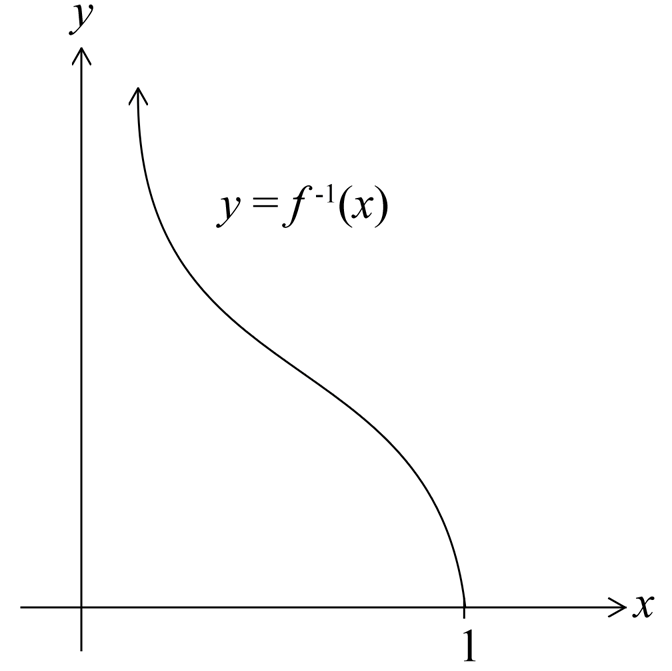
- Sketch the curve `y = f^(-1) (x)`. (1 mark)
- (1) Show that there is a solution to the equation `x = e^(-x^2)` between `x = 0.6` and `x = 0.7`. (1 mark)
- (2) By halving the interval, find the solution correct to one decimal place. (1 mark)
Combinatorics, EXT1 A1 2010 HSC 3a
At the front of a building there are five garage doors. Two of the doors are to be painted red, one is to be painted green, one blue and one orange.
- How many possible arrangements are there for the colours on the doors? (1 mark)
--- 1 WORK AREA LINES (style=lined) ---
- How many possible arrangements are there for the colours on the doors if the two red doors are next to each other? (1 mark)
--- 2 WORK AREA LINES (style=lined) ---
Calculus, EXT1 C1 2010 HSC 2d
A radio transmitter `M` is situated 6 km from a straight road. The closest point on the road to the transmitter is `S`.
A car is travelling away from `S` along the road at a speed of `text(100 km h)`−1. The distance from the car to `S` is `x\ text(km)` and from the car to `M` is `r\ text(km)`.
Find an expression in terms of `x` for `(dr)/(dt)`, where `t` is time in hours. (3 marks)
--- 8 WORK AREA LINES (style=lined) ---
Functions, EXT1 F2 2010 HSC 2c
Let `P(x) = (x + 1)(x-3) Q(x) + ax + b`,
where `Q(x)` is a polynomial and `a` and `b` are real numbers.
The polynomial `P(x)` has a factor of `x-3`.
When `P(x)` is divided by `x + 1` the remainder is `8`.
- Find the values of `a` and `b`. (2 marks)
--- 6 WORK AREA LINES (style=lined) ---
- Find the remainder when `P(x)` is divided by `(x + 1)(x-3)`. (1 mark)
--- 2 WORK AREA LINES (style=lined) ---
Calculus, EXT1 C2 2010 HSC 2a
The derivative of a function `f(x)` is given by
`f^{′}(x) = sin^2 x`.
Find `f(x)`, given that `f(0) = 2`. (2 marks)
--- 5 WORK AREA LINES (style=lined) ---
Statistics, EXT1 S1 2010 HSC 1f
Five ordinary six-sided dice are thrown.
What is the probability that exactly two of the dice land showing a four?
Leave your answer in unsimplified form. (1 mark)
L&E, EXT1 2010 HSC 1c
Solve `ln(x + 6) = 2 ln x`. (3 marks)
Trigonometry, EXT1 T1 2010 HSC 1b
Let `f(x) = cos^(-1) (x/2)`. What is the domain of `f(x)`? (1 mark)
Calculus, EXT1 C1 2011 HSC 7a
The diagram shows two identical circular cones with a common vertical axis. Each cone has height `h` cm and semi-vertical angle 45°.
The lower cone is completely filled with water. The upper cone is lowered vertically into the water as shown in the diagram. The rate at which it is lowered is given by
`(dl)/(dt) = 10`,
where `l` cm is the distance the upper cone has descended into the water after `t` seconds.
As the upper cone is lowered, water spills from the lower cone. The volume of water remaining in the lower cone at time `t` is `V` cm³.
- Show that `V = pi/3(h^3\ - l^3)`. (1 mark)
--- 4 WORK AREA LINES (style=lined) ---
- Find the rate at which `V` is changing with respect to time when `l = 2`. (2 marks)
--- 5 WORK AREA LINES (style=lined) ---
- Find the rate at which `V` is changing with respect to time when the lower cone has lost `1/8` of its water. Give your answer in terms of `h`. (2 marks)
--- 6 WORK AREA LINES (style=lined) ---
Geometry and Calculus, EXT1 2011 HSC 4a
Consider the function `f(x) = e^(-x)\ - 2e^(-2x)`.
- Find `f prime (x)`. (1 mark)
- The graph `y = f(x)` has one maximum turning point.
- Find the coordinates of the maximum turning point. (2 marks)
- Evaluate `f(ln2)`. (1 mark)
- Describe the behaviour of `f(x)` as `x -> oo`. (1 mark)
- Find the `y`-intercept of the graph `y = f(x)`. (1 mark)
- Sketch the graph `y = f(x)` showing the features from parts (ii) - (v).
- You are not required to find any points of inflection. (2 marks)
Quadratic, EXT1 2011 HSC 3b
The diagram shows two distinct points `P(t, t^2)` and `Q(1\ - t, (1\ - t)^2)` on the parabola `y = x^2`. The point `R` is the intersection of the tangents to the parabola at `P` and `Q`.
- Show that the equation of the tangent to the parabola at `P` is `y = 2tx\ – t^2`. (2 marks)
- Using part `text{(i)}`, write down the equation of the tangent to the parabola at `Q`. (1 mark)
- Show that the tangents at `P` and `Q` intersect at
`R (1/2, t\ - t^2)`. (2 marks) - Describe the locus of `R` as `t` varies, stating any restriction on the `y`-coordinate. (2 marks)
Mechanics, EXT2* M1 2011 HSC 3a
The equation of motion for a particle undergoing simple harmonic motion is
`(d^2x)/(dt^2) = -n^2 x`,
where `x` is the displacement of the particle from the origin at time `t`, and `n` is a positive constant.
- Verify that `x = A cos nt + B sin nt`, where `A` and `B` are constants, is a solution of the equation of motion. (1 mark)
--- 5 WORK AREA LINES (style=lined) ---
- The particle is initially at the origin and moving with velocity `2n`.
Find the values of `A` and `B` in the solution `x = A cos nt + B sin nt`. (2 marks)
--- 6 WORK AREA LINES (style=lined) ---
- When is the particle first at its greatest distance from the origin? (1 mark)
--- 5 WORK AREA LINES (style=lined) ---
- What is the total distance the particle travels between `t = 0` and `t = (2pi)/n`? (1 mark)
--- 6 WORK AREA LINES (style=lined) ---
Combinatorics, EXT1 A1 2011 HSC 2e
Alex’s playlist consists of 40 different songs that can be arranged in any order.
- How many arrangements are there for the 40 songs? (1 mark)
--- 1 WORK AREA LINES (style=lined) ---
- Alex decides that she wants to play her three favourite songs first, in any order.
- How many arrangements of the 40 songs are now possible? (1 mark)
--- 2 WORK AREA LINES (style=lined) ---
Trigonometry, EXT1 T1 2011 HSC 2d
Sketch the graph of the function `f(x) = 2arccos x`. Clearly indicate the domain and range of the function. (2 marks)
Combinatorics, EXT1 A1 2011 HSC 2c
Find an expression for the coefficient of `x^2` in the expansion of `(3x - 4/x)^8`. (2 marks)
--- 6 WORK AREA LINES (style=lined) ---
Polynomials, EXT1 2011 HSC 2b
The function `f(x) = cos2x\ - x` has a zero near `x = 1/2`.
Use one application of Newton’s method to obtain another approximation to this zero. Give your answer correct to two decimal places. (3 marks)
Mechanics, EXT2* M1 2012 HSC 14b
A firework is fired from `O`, on level ground, with velocity `70` metres per second at an angle of inclination `theta`. The equations of motion of the firework are
`x = 70t cos theta\ \ \ \ `and`\ \ \ y = 70t sin theta\ – 4.9t^2`. (Do NOT prove this.)
The firework explodes when it reaches its maximum height.
- Show that the firework explodes at a height of `250 sin^2 theta` metres. (2 marks)
--- 6 WORK AREA LINES (style=lined) ---
- Show that the firework explodes at a horizontal distance of `250 sin 2 theta` metres from `O`. (1 mark)
--- 4 WORK AREA LINES (style=lined) ---
- For best viewing, the firework must explode at a horizontal distance between 125 m and 180 m from `O`, and at least 150 m above the ground.
For what values of `theta` will this occur? (3 mark)
--- 8 WORK AREA LINES (style=lined) ---
Plane Geometry, EXT1 2012 HSC 14a
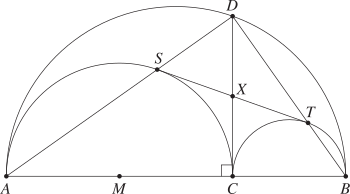
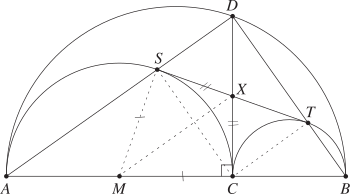
The diagram shows a large semicircle with diameter `AB` and two smaller semicircles with diameters `AC` and `BC`, respectively, where `C` is a point on the diameter `AB`. The point `M` is the centre of the semicircle with diameter `AC`.
The line perpendicular to `AB` through `C` meets the largest semicircle at the point `D`. The points `S` and `T` are the intersections of the lines `AD` and `BD` with the smaller semicircles. The point `X` is the intersection of the lines `CD` and `ST`.
Copy or trace the diagram into your writing booklet.
- Explain why `CTDS` is a rectangle. (1 mark)
- Show that `Delta MXS` and `Delta MXC` are congruent. (2 marks)
- Show that the line `ST` is a tangent to the semicircle with diameter `AC`. (1 mark)
Geometry and Calculus, EXT1 2012 HSC 13d
The concentration of a drug in the blood of a patient `t` hours after it was administered is given by
`C(t) = 1.4te^(–0.2t),`
where `C(t)` is measured in `text(mg/L)`.
- Initially the concentration of the drug in the blood of the patient increases until it reaches a maximum, and then it decreases. Find the time when this maximum occurs. (3 marks)
- Taking `t = 20` as a first approximation, use one application of Newton’s method to find approximately when the concentration of the drug in the blood of the patient reaches `0.3\ text(mg/L)`. (2 marks)
Geometry and Calculus, EXT1 2012 HSC 13b
- Find the horizontal asymptote of the graph
`qquad qquad y=(2x^2)/(x^2 + 9)`. (1 mark) - Without the use of calculus, sketch the graph
`qquad qquad y=(2x^2)/(x^2 + 9)`,
showing the asymptote found in part (i). (2 marks)
Trigonometry, EXT1 T1 2012 HSC 13a
Write `sin(2 cos ^(-1) (2/3))` in the form `a sqrtb`, where `a` and `b` are rational. (2 mark)
--- 5 WORK AREA LINES (style=lined) ---
Quadratic, EXT1 2012 HSC 12d
Let `A(0, –k)` be a fixed point on the `y`-axis with `k > 0`. The point `C(t, 0)` is on the `x`-axis. The point `B(0, y)` is on the `y`-axis so that `Delta ABC` is right-angled with the right angle at `C`. The point `P` is chosen so that `OBPC` is a rectangle as shown in the diagram.
- Show that `P` lies on the parabola given parametrically by (2 marks)
- `x = t\ \ ` and`\ \ y = (t^2)/k`.
- Write down the coordinates of the focus of the parabola in terms of `k`. (1 mark)
Statistics, EXT1 S1 2012 HSC 12c
Kim and Mel play a simple game using a spinner marked with the numbers 1, 2, 3, 4 and 5.
The game consists of each player spinning the spinner once. Each of the five numbers is equally likely to occur.
The player who obtains the higher number wins the game.
If both players obtain the same number, the result is a draw.
- Kim and Mel play one game. What is the probability that Kim wins the game? (1 mark)
--- 5 WORK AREA LINES (style=lined) ---
- Kim and Mel play six games. What is the probability that Kim wins exactly three games? (2 marks)
--- 4 WORK AREA LINES (style=lined) ---
Functions, EXT1 F1 2012 HSC 12b
Let `f(x) = sqrt(4x-3)`
- Find the domain of `f(x)`. (1 mark)
--- 2 WORK AREA LINES (style=lined) ---
- Find an expression for the inverse function `f^(-1) (x)`. (2 marks)
--- 4 WORK AREA LINES (style=lined) ---
- Find the points where the graphs `y = f(x)` and `y=x` intersect. (1 mark)
--- 4 WORK AREA LINES (style=lined) ---
- On the same set of axes, sketch the graphs `y = f(x)` and `y = f^(-1) (x)` showing the information found in part (iii). (2 marks)
--- 8 WORK AREA LINES (style=lined) ---
Proof, EXT1 P1 2012 HSC 12a
Use mathematical induction to prove that `2^(3n)\ – 3^n` is divisible by `5` for `n >= 1`. (3 marks)
--- 14 WORK AREA LINES (style=lined) ---
Combinatorics, EXT1 A1 2012 HSC 11f
- Use the binomial theorem to find an expression for the constant term in the expansion of
`(2x^3 - 1/x)^12`. (2 marks)
--- 5 WORK AREA LINES (style=lined) ---
- For what values of `n` does `(2x^3 - 1/x)^n` have a non-zero constant term? (1 mark)
--- 6 WORK AREA LINES (style=lined) ---
Combinatorics, EXT1 A1 2012 HSC 11e
In how many ways can a committee of 3 men and 4 women be selected from a group of 8 men and 10 women? (1 mark)
--- 2 WORK AREA LINES (style=lined) ---
Plane Geometry, EXT1 2012 HSC 10 MC
Functions, EXT1 F2 2012 HSC 8 MC
When the polynomial `P(x)` is divided by `(x + 1)(x-3)`, the remainder is `2x + 7`.
What is the remainder when `P(x)` is divided by `x-3`?
- `1`
- `7`
- `9`
- `13`
Mechanics, EXT2* M1 2012 HSC 6 MC
A particle is moving in simple harmonic motion with displacement `x`. Its velocity `v` is given by
`v^2 = 16(9 − x^2)`.
What is the amplitude, `A`, and the period, `T`, of the motion?
- `A = 3\ \ \ text(and)\ \ \ T = pi/2`
- `A = 3\ \ \ text(and)\ \ \ T = pi/4`
- `A = 4\ \ \ text(and)\ \ \ T = pi/3`
- `A = 4\ \ \ text(and)\ \ \ T = (2pi)/3`
Combinatorics, EXT1 A1 2012 HSC 5 MC
How many arrangements of the letters of the word `OLYMPIC` are possible if the `C` and the `L` are to be together in any order?
- `5!`
- `6!`
- `2 xx 5!`
- `2 xx 6!`
Trigonometry, EXT1 T1 2012 HSC 4 MC
Calculus, 2ADV C3 2009 HSC 10
`text(Let)\ \ f(x) = x - (x^2)/2 + (x^3)/3`
- Show that the graph of `y = f(x)` has no turning points. (2 marks)
--- 4 WORK AREA LINES (style=lined) ---
- Find the point of inflection of `y = f(x)`. (1 mark)
--- 3 WORK AREA LINES (style=lined) ---
- i. Show that `1 - x + x^2 - 1/(1 + x) = (x^3)/(1 + x)` for `x != -1`. (1 mark)
--- 2 WORK AREA LINES (style=lined) ---
ii. Let `g(x) = ln (1 + x)`.
Use the result in part c.i. to show that `f prime (x) >= g prime (x)` for all `x >= 0`. (2 marks)
--- 5 WORK AREA LINES (style=lined) ---
- Sketch the graphs of `y = f(x)` and `y = g(x)` for `x >= 0`. (2 marks)
--- 8 WORK AREA LINES (style=lined) ---
- Show that `d/(dx) [(1 + x) ln (1 + x) - (1 + x)] = ln (1 + x)`. (2 marks)
--- 5 WORK AREA LINES (style=lined) ---
- Find the area enclosed by the graphs of `y = f(x)` and `y = g(x)`, and the straight line `x = 1`. (2 marks)
--- 5 WORK AREA LINES (style=lined) ---
Trigonometry, 2ADV T3 2009 HSC 7b
Between 5 am and 5 pm on 3 March 2009, the height, `h`, of the tide in a harbour was given by
`h = 1 + 0.7 sin(pi/6 t)\ \ \ text(for)\ \ 0 <= t <= 12`
where `h` is in metres and `t` is in hours, with `t = 0` at 5 am.
- What is the period of the function `h`? (1 mark)
--- 2 WORK AREA LINES (style=lined) ---
- What was the value of `h` at low tide, and at what time did low tide occur? (2 marks)
--- 4 WORK AREA LINES (style=lined) ---
- A ship is able to enter the harbour only if the height of the tide is at least 1.35 m.
Find all times between 5 am and 5 pm on 3 March 2009 during which the ship was able to enter the harbour. (3 marks)
--- 6 WORK AREA LINES (style=lined) ---
Calculus, EXT1* C3 2009 HSC 6a
- « Previous Page
- 1
- …
- 108
- 109
- 110
- 111
- 112
- …
- 114
- Next Page »