SmarterEd

Aussie Maths & Science Teachers: Save your time with SmarterEd

  • Login
  • Get Help
  • About

Calculus, 2ADV C3 2010 HSC 5a

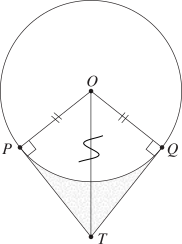
A rainwater tank is to be designed in the shape of a cylinder with radius  `r`  metres and height  `h`  metres.

2010 5a

The volume of the tank is to be 10 cubic metres. Let  `A`  be the surface area of the tank, including its top and base, in square metres.

  1. Given that  `A=2pir^2+2pi r h`,   show that  `A=2 pi r^2+20/r`.   (2 marks)

    --- 4 WORK AREA LINES (style=lined) ---

  2. Show that  `A`  has a minimum value and find the value of  `r`  for which the minimum occurs.  (3 marks)

    --- 6 WORK AREA LINES (style=lined) ---

Show Answers Only
  1. `text{Proof  (See Worked Solutions)}`
  2. `r~~1.17\ text(metres)`
Show Worked Solution

i.    `text(Show)\ A=2 pi r^2+20/r`

MARKER’S COMMENT: Students MUST know the volume formula for a cylinder. Those that did and stated `10=pi r^2 h` most often completed this question efficiently.

`text(S)text(ince)\ V=pi r^2h=10\ \ \ \ =>\ h=10/(pi r^2)`

`text(Substituting into)\ A`

`A` `= pi r^2+2 pi r (10/(pi r^2))`
  `=2 pi r^2+20/r\ \ \ text(…  as required)`


♦ Mean mark 44%
MARKER’S COMMENT: The “table method” or 1st derivative test for proving a minimum (i.e. showing how `(dA)/(dr)` changes sign) was also quite successful.
ii. `A`  `=2 pi r^2+20/r`
  `(dA)/(dr)` `=4 pi r-20/r^2`
  `(d^2A)/(dr^2)` `=4 pi+40/r^3>0\ \ \ \ \ (r>0)`

 
`=>\ text(MIN occurs when)\ \ (dA)/(dr)=0`

`4 pi r-20/r^2` `=0`
`4 pi r^3-20` `=0`
`4 pi r^3` `=20`
`r` `=root3 (5/pi)`
  `=1.16754…`
  `=1.17\ text{metres  (2 d.p.)}`

Filed Under: Maxima and Minima, Maxima and Minima Tagged With: Band 4, Band 5, smc-970-30-Volume - Cylinder

Calculus, 2ADV C3 2011 HSC 10b

A farmer is fencing a paddock using  `P`  metres of fencing. The paddock is to be in the shape of a sector of a circle with radius  `r`  and sector angle `theta`  in radians, as shown in the diagram.

2011 10b

  1. Show that the length of fencing required to fence the perimeter of the paddock is
      
       `P=r(theta+2)`.    (1 mark)

    --- 2 WORK AREA LINES (style=lined) ---

  2. Show that the area of the sector is  `A=1/2 Pr-r^2`.    (1 mark) 

    --- 2 WORK AREA LINES (style=lined) ---

  3. Find the radius of the sector, in terms of  `P`, that will maximise the area of the paddock.    (2 marks)

    --- 4 WORK AREA LINES (style=lined) ---

  4. Find the angle  `theta`  that gives the maximum area of the paddock.    (1 mark)

    --- 2 WORK AREA LINES (style=lined) ---

  5. Explain why it is only possible to construct a paddock in the shape of a sector if
     
         `P/(2(pi+1)) <\ r\ <P/2`   (2 marks)

    --- 5 WORK AREA LINES (style=lined) ---

Show Answers Only
  1. `text{Proof  (See Worked Solutions)}`
  2. `text{Proof  (See Worked Solutions)}`
  3. `r=P/4`
  4. `2\ text(radians)`
  5. `text{Proof  (See Worked Solutions)}`
Show Worked Solution

i.   `text(Need to show)\ \ P=r(theta+2)`

`P` `=(2xxr)+theta/(2pi)xx2pir`
  `=2r+ r theta`
  `=r(theta+2)\ \ text(…  as required)`


ii.   `text(Need to show)\ \ A=1/2 Pr-r^2`.

`text(S)text(ince)\ \ P=r(theta+2)\ \ \ =>\ theta=(P-2r)/r`

♦ Mean mark 41%.
TIP: Area of a sector `=pi r^2 xx` the percentage of the circle that the sector angle accounts for, i.e. `theta/(2 pi)` radians. `:. A=pi r^2“ xx theta/(2 pi)=1/2 r^2 theta`.
`:. A` `=1/2 r^2 theta`
  `=1/2 r^2*(P-2r)/r`
  `=1/2(Pr-2r^2)`
  `=1/2 Pr-r^2\ \ text(…  as required)`


iii.  `A=1/2 Pr-r^2`

♦♦ Mean mark 29%
MARKER’S COMMENT: The second derivative test proved much more successful and easily proven in this part. Make sure you are comfortable choosing between it and the 1st derivative test depending on the required calcs.

`(dA)/(dr)=1/2 P-2r`

`text(MAX or MIN when)\ \ (dA)/(dr)=0`

`1/2 P-2r` `=0`
`2r` `=1/2 P`
`r` `=P/4`

 
`(d^2A)/(dr^2)=-2\ \ \ \ =>text(MAX)`

`:.\ text(Area is a MAX when)\ r=P/4\ text(units)`


iv.   `text(Need to find)\ theta\ text(when area is a MAX)\ =>\ r=P/4`

♦♦♦ Mean mark 20%
`P` `=r(theta+2)`
  `=P/4(theta+2)`
`4P` `=P(theta+2)`
`theta+2` `=4`
`theta` `=2\ text(radians)`


v.  `text(For a sector to exist)\ \ 0<\ theta\ <2pi, \ \ text(and)\ \ theta=(P-2r)/r`

♦♦♦ Mean mark 4%. A BEAST!
MARKER’S COMMENT: When asked to ‘explain’, students should support their answer with a mathematical argument.
`=>(P-2r)/r` `>0`
`P-2r` `>0`
`r` `<P/2`
`=>(P-2r)/r` `<2pi`
`P-2r` `<2r pi`
`2r pi+2r` `>P`
`2r(pi+1)` `>P`
`r` `>P/(2(pi+1))`


`:.P/(2(pi+1)) <\ r\ <P/2\ \ text(…  as required)`

Filed Under: Maxima and Minima, Maxima and Minima Tagged With: Band 4, Band 5, Band 6, page-break-before-solution, smc-970-10-Area

Mechanics, EXT2* M1 2009 HSC 6a

Two points, `A` and `B`,  are on cliff tops on either side of a deep valley. Let `h` and `R` be the vertical and horizontal distances between `A` and `B` as shown in the diagram. The angle of elevation of `B` from `A` is  `theta`,  so that  `theta=tan^-1(h/R)`.
 

2009 6a
 

At time `t=0`,  projectiles are fired simultaneously from `A` and `B`.  The projectile from `A` is aimed at `B`, and has initial speed `U` at an angle of  `theta`  above the horizontal. The projectile from `B` is aimed at `A` and has initial speed `V` at an angle  `theta`  below the horizontal.

The equations of motion for the projectile from `A` are

`x_1=Utcos theta`   and   `y_1=Utsin theta-1/2 g t^2`,

and the equations for the motion of the projectile from `B` are

`x_2=R-Vtcos theta`   and   `y_2=h-Vtsin theta-1/2 g t^2`,     (DO NOT prove these equations.)

  1. Let `T` be the time at which  `x_1=x_2`.
     
    Show that  `T=R/((U+V)\ cos theta)`.   (1 mark)

    --- 3 WORK AREA LINES (style=lined) ---

  2. Show that the projectiles collide.    (2 marks)

    --- 6 WORK AREA LINES (style=lined) ---

  3. If the projectiles collide on the line  `x=lambdaR`,  where  `0<lambda<1`,  show that
     
         `V=(1/lambda-1)U`.    (1 mark)

    --- 6 WORK AREA LINES (style=lined) ---

Show Answers Only
  1. `text{Proof  (See Worked Solutions)}` 
  2. `text{Proof  (See Worked Solutions)}`
  3. `text{Proof  (See Worked Solutions)}`
Show Worked Solution

i.   `text(Let)\ \ x_1=x_2\ \ text(at)\ \ t=T`

`UTcos theta` `=R-VTcos theta`
`UTcos theta+VTcos theta` `=R`
`Tcos theta\ (U+V)` `=R`

 
 `:. T=R/((U+V)\ cos theta)\ \ text(… as required)`


ii.   `text(If particles collide,)\ \  y_1=y_2\ \ text(at)\ \ t=T`

♦♦♦ Mean mark data not available although “few” students were able to complete this part.
MARKER’S COMMENT: Better responses showed  `y_1=y_2`,  or  `y_1-y_2=0`  which eliminated  `–½ g t^2`  from the algebra. Substituting `tan theta=h//R` was a key element in completing this proof.
`y_1` `=UTsin theta-1/2 g T^2`
  `=(UR sin theta)/((U+V)\ cos theta)-1/2 g T^2`
`y_2` `=h-VTsin theta-1/2 g T^2`
  `=Rtan theta-(VR sin theta)/((U+V)\ cos theta)-1/2 g T^2`
  `=R(((sin theta/cos theta)(U+V) cos theta-V sin theta)/((U+V)\ cos theta))-1/2 g T^2`
  `=R/((U+V)\ cos theta)(Usin theta+Vsin theta-Vsin theta)-1/2 g T^2`
  `=(UR sin theta)/((U+V)\ cos theta)-1/2 g T^2`
  `=y_1`


`:.\ text(Particles collide since)\  y_1=y_2\ text(at)\ t=T`.


iii.  `text(Particles collide on line)\ \ x=lambdaR,\ text(i.e.  where)\ \ t=T`

MARKER’S COMMENT: Students must show sufficient working in proofs to convince markers they have derived the answer themselves.
`lambdaR` `=UTcos theta`
  `=U R/((U+V)\ cos theta)cos theta`
  `=(UR)/((U+V))`
`(U+V)(lambdaR)` `=UR`
`U+V` `=(UR)/(lambdaR)`
`V` `=U/lambda-U`
  `=(1/lambda-1)U\ \ text(… as required)`

Filed Under: Projectile Motion, Projectile Motion EXT1 Tagged With: Band 4, Band 5, Band 6, smc-1062-10-Range/Time of Flight, smc-1062-40-Initial Angle/Speed, smc-1062-90-Projectiles Collide

Mechanics, EXT2* M1 2013 HSC 13c

Points `A` and `B` are located `d` metres apart on a horizontal plane. A projectile is fired from `A` towards `B` with initial velocity `u` m/s at angle `alpha` to the horizontal.

At the same time, another projectile is fired from `B` towards `A` with initial velocity `w` m/s at angle `beta` to the horizontal, as shown on the diagram.

The projectiles collide when they both reach their maximum height.
 

2013 13c
 

The equations of motion of a projectile fired from the origin with initial velocity  `V` m/s at angle  `theta`  to the horizontal are

`x=Vtcostheta`   and   `y=Vtsintheta-g/2 t^2`.        (DO NOT prove this.)

  1. How long does the projectile fired from  `A`  take to reach its maximum height?  (2 marks)

    --- 5 WORK AREA LINES (style=lined) ---

  2. Show that  `usinalpha=w sin beta`.    (1 mark)

    --- 3 WORK AREA LINES (style=lined) ---

  3. Show that  `d=(uw)/(g)sin(alpha+beta)`.    (2 marks)

    --- 8 WORK AREA LINES (style=lined) ---
Show Answers Only
  1. `(u)/(g) sin alpha\ \ text(seconds)`
  2. `text{Proof  (See Worked Solutions)}`
  3. `text{Proof  (See Worked Solutions)}`
Show Worked Solution

i.   `y=Vtsintheta-g/2 t^2`

`text(Projectile)\ A\   => V=u,\ \ theta=alpha`

`y` `=ut sinalpha- (g)/2 t^2`
`doty` `=u sinalpha- g t`


`text(Max height when)\  doty=0`

`0` `=usinalpha-g t`
`g t` `=usinalpha`
`t` `=(u)/(g)sinalpha`

 
`:.\ text(Projectile from)\ A\ text(reaches max height at)`

 `t=(u)/(g)sin alpha\ \ text(seconds)`


ii.  `text(Show that)\ \ usin alpha=wsin beta`

IMPORTANT: Part (i) in this example leads students to a very quick solution. Always look to previous parts for clues to direct your strategy.

`text(Projectile)\ B\ =>V=w,\ \ theta=beta`

`y` `=wt sin beta- (g)/2 t^2`
`doty` `=wsin beta-g t`


`text(Max height when)\ \ doty=0`

`t=(w)/(g) sin beta`

`text{Projectiles collide at max heights}`

`text(S)text(ince they were fired at the same time)`

`(u)/(g) sin alpha` `=(w)/(g) sin beta`
`:.\ usin alpha` `=wsin beta\ \ text(… as required)`


iii  `text(Show)\ \ d=(uw)/(g) sin (alpha+beta) :`

`text(Find)\ x text(-values for each projectile at max height)`

`text(Projectile)\ A`

`x_1` `=utcos alpha`
  `=u((u)/(g) sin alpha)cos alpha`
  `=(u^2)/(g) sin alpha cos alpha`


`text(Projectile)\ B`

♦ Mean mark 39%
IMPORTANT: Students should direct their calculations by reverse engineering the required result. `sin(alpha+beta)` in the proof means that  `sin alpha cos beta+“ cos alpha sin beta`  will appear in the working calculations.
`x_2` `=wt cos beta`
  `=w((w)/(g) sin beta)cos beta`
  `=(w^2)/(g) sin beta cos beta`
`d` `=x_1+x_2`
  `=(u^2)/(g) sin alpha cos alpha+(w^2)/(g) sin beta cos beta`
  `=(u)/(g)(u sin alpha)cos alpha+(w)/(g) (w sin beta) cos beta`
  `=(u)/(g)(w sin beta) cos alpha+(w)/(g) (usin alpha)cos beta\ \ text{(part (ii))}`
  `=(uw)/(g) (sin alpha cos beta+cos alpha sin beta)`
  `=(uw)/(g) sin (alpha+beta)\ \ text(… as required)`


Filed Under: Projectile Motion, Projectile Motion EXT1 Tagged With: Band 4, Band 5, Band 6, smc-1062-20-Max Height, smc-1062-90-Projectiles Collide

Calculus in the Physical World, 2UA 2008 HSC 6b

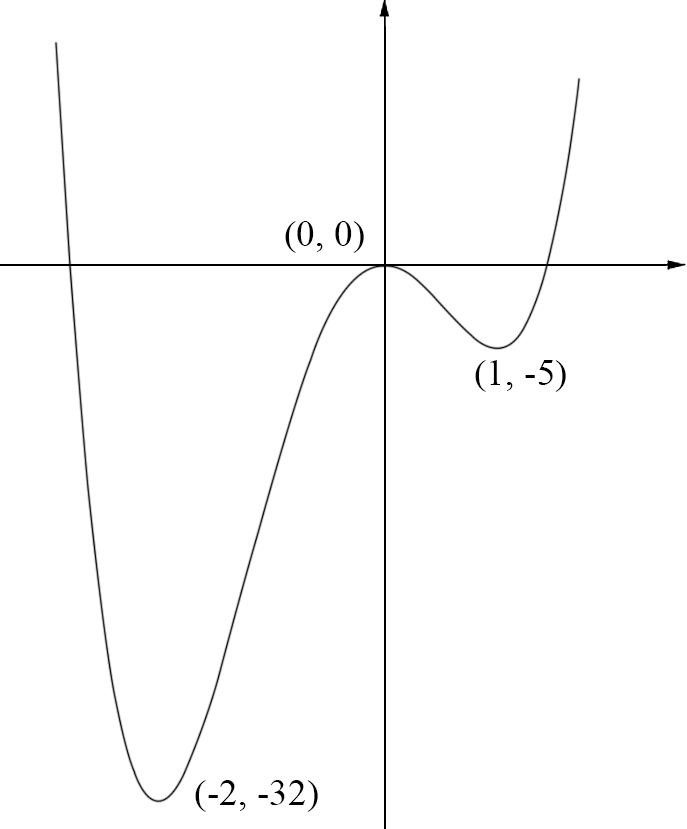
The graph shows the velocity of a particle,  `v`  metres per second, as a function of time,  `t`  seconds.


  1. What is the initial velocity of the particle?   (1 mark)
  2. When is the velocity of the particle equal to zero?    (1 mark)
  3. When is the acceleration of the particle equal to zero?    (1 mark)
  4. By using Simpson's Rule with five function values, estimate the distance travelled by the particle between  `t=0`  and  `t=8`.   (3 marks)
  5.  
Show Answers Only
  1. `20\ text(m/s)`
  2. `t=10\ text(seconds)`
  3. `t=6\ text(seconds)`
  4. `493 1/3\ text(metres)`
Show Worked Solution

(i)    `text(Find)\   v  \ text(when)  t=0`

`v=20\ \ text(m/s)`


(ii)    `text(Particle comes to rest at)\  t=10\ text{seconds  (from graph)}`


(iii)  `text(Acceleration is zero when)\ t=6\ text{seconds  (from graph)}`


(iv)   

MARKER’S COMMENT: Less errors were made by students using a table and the given formula. Note however, that the formula `A~~(b-a)/6xx` `[f(a)+4f((a+b)/2)+f(b)]` produced the most errors.
`text(Area)` `~~h/3[y_0+y_n+4text{(odds)}+2text{(evens)}]`
  `~~h/3[y_0+y_4+4(y_1+y_3)+2(y_2)]`
  `~~2/3[20+60+4(50+80)+2(70)]`
  `~~2/3[740]`
  `~~493 1/3`


`:.\ text{Distance travelled is 493 1/3 m (approx.)}` 

Filed Under: Motion, Trapezoidal and Simpson's Rule Tagged With: Band 2, Band 3, Band 4, HSC

Calculus, 2ADV C4 2009 HSC 7a

The acceleration of a particle is given by

`a=8e^(-2t)+3e^(-t)`,

where  `x`  is the displacement in metres and  `t`  is the time in seconds.

Initially its velocity is  `text(– 6 ms)^(–1)` and its displacement is 5 m.

  1. Show that the displacement of the particle is given by
  2. `qquad  x=2e^(-2t)+3e^-t+t`.   (2 marks) 

    --- 5 WORK AREA LINES (style=lined) ---

  3. Find the time when the particle comes to rest.    (3 marks)

    --- 7 WORK AREA LINES (style=lined) ---

  4. Find the displacement  when the particle comes to rest.    (1 mark)

    --- 3 WORK AREA LINES (style=lined) ---

Show Answers Only
  1. `text{Proof  (See Worked Solutions)}`
  2. `ln4\ text(seconds)`
  3. `7/8+ln4\ \ text(units)`
Show Worked Solution

i.    `text(Show)\ \ x=2e^(-2t)+3e^-t+t`

`a=8e^(-2t)+3e^-t\ \ text{(given)}`

`v=int a\ dt=-4e^(-2t)-3e^-t+c_1`

`text(When)\ t=0,  v=-6\ \ text{(given)}`

`-6` `=-4e^0-3e^0+c_1`
`-6` `=-7+c_1`
`c_1` `=1`

 
`:. v=-4e^(-2t)-3e^-t+1`
 

`x` `=int v\ dt`
  `=int(-4e^(-2t)-3e^-t+1)\ dt`
  `=2e^(-2t)+3e^-t+t+c_2`

 
`text(When)\ \ t=0,\ x=5\ \ text{(given)}`

`5` `=2e^0+3e^0+c_2`
`c_2` `=0`

 
`:.\ x=2e^(-2t)+3e^-t+t\ \ text(… as required)`


ii.   `text(Particle comes to rest when)\ \ v=0`

`text(i.e.)\ \ -4e^(-2t)-3e^-t+1=0`

`text(Let)\ X=e^-t\ \ \ \ =>X^2=e^(-2t)`

`-4X^2-3X+1` `=0`
`4X^2+3X-1` `=0`
`(4X-1)(X+1)` `=0`

 
 `:.\ \ X=1/4\ \ text(or)\ \ X=-1`

`text(When)\ \ X=1/4:`

`e^-t` `=1/4`
`lne^-t` `=ln(1/4)`
`-t` `=ln(1/4)`
`t` `=-ln(1/4)=ln(1/4)^-1=ln4`

 
`text(When)\ \ X=-1:`

`e^-t=-1\ \ text{(no solution)}`
 

`:.\ text(The particle comes to rest when)\ t=ln4\ text(seconds)`
  

iii.  `text(Find)\ \ x\ \ text(when)\ \ t=ln4 :`

`x=2e^(-2t)+3e^-t+t`

`\ \ =2e^(-2ln4)+3e^-ln4+ln4`

`\ \ =2(e^ln4)^-2+3(e^ln4)^-1+ln4`

`\ \ =2xx4^-2+3xx4^-1+ln4`

`\ \ =2/16+3/4+ln4`

`\ \ =7/8+ln4`

ALGEBRA TIP: Helpful identity  `e^lnx=x`. Easily provable as follows:
`e^ln2=x`
`\ =>lne^ln2=lnx\ `
`\ => ln2=lnx\ `
`\ =>x=2`.

Filed Under: Motion, Other Integration Applications Tagged With: Band 3, Band 4, Band 5, smc-1091-10-Motion, smc-1091-30-Log/Exp Function, smc-1213-10-Motion

Calculus, EXT1* C1 2010 HSC 7a

The acceleration of a particle is given by

`ddotx=4cos2t`,

where  `x`  is the displacement in metres and  `t`  is the time in seconds. 

Initially the particle is at the origin with a velocity of  `text(1 ms)^(–1)`.

  1. Show that the velocity of the particle is given by


      `dotx=2sin2t+1`.    (2 marks)

    --- 5 WORK AREA LINES (style=lined) ---

  2. Find the time when the particle first comes to rest.    (2 marks)

    --- 4 WORK AREA LINES (style=lined) ---

  3. Find the displacement,  `x`,  of the particle in terms of  `t`.    (2 marks)

    --- 4 WORK AREA LINES (style=lined) ---

Show Answers Only
  1. `text{Proof  (See Worked Solutions)}`
  2. `(7pi)/12\ text(seconds)`
  3. `x=1-cos2t+t`
Show Worked Solution
i.   `text(Show)\ dotx` `=2sin2t+1`
`dotx` `=intddotx\ dt`
  `=int4cos2t\ dt`
  `=2sin2t+c`

 
`text(When)\ t=0, \ \ dotx=1\ \ text{(given)}`

`1=2sin0+c`

`c=1`

 
`:. dotx=2sin2t+1 \ \ \ text(… as required)`
 

ii.   `text(Find)\ t\ text(when)\ dotx=0 :`

`2sin2t+1` `=0`
`sin2t` `=-1/2`

 
`=>sin theta=1/2\ text(when)\ theta=pi/6`

`text(S)text(ince)\ \ sin theta\ \ text(is negative in 3rd and 4th quadrants)`

`2t` `=pi + pi/6`
`2t` `=(7pi)/6`
`t` `=(7pi)/12`

 
`:.\ text(Particle first comes to rest at)\ t=(7pi)/12\ text(seconds)`
 

iii.    `x` `=intdotx\ dt`
  `=int(2sin2t+1)\ dt`
  `=t-cos2t+c`

 
`text(When)\ t=0,\ x=0\ \ text{(given)}`

`0=0-cos0+c`

`c=1`

 
`:. x=t-cos2t+1`

Filed Under: Motion, Rates of Change with respect to time Tagged With: Band 3, Band 4, Band 5, smc-1077-10-Motion, smc-1077-30-Trig Equation

Calculus, 2ADV C4 2012 HSC 15b

The velocity of a particle is given by

`v=1-2cost`,

where  `x`  is the displacement in metres and  `t`  is the time in seconds. Initially the particle is 3 m to the right of the origin.

  1. Find the initial velocity of the particle.    (1 mark)

    --- 1 WORK AREA LINES (style=lined) ---

  2. Find the maximum velocity of the particle.    (1 mark)

    --- 1 WORK AREA LINES (style=lined) ---

  3. Find the displacement, `x`,  of the particle in terms of  `t`.    (2 marks)

    --- 4 WORK AREA LINES (style=lined) ---

  4. Find the position of the particle when it is at rest for the first time.    (2 marks)

    --- 4 WORK AREA LINES (style=lined) ---

Show Answers Only
  1. `-1\ text(m/s)`
  2. `3\ text(m/s)`
  3. `x=t-2sint+3`
  4. `pi/3-sqrt3+3`
Show Worked Solution

i.    `text(Find)\ \ v\ \ text(when)\ \ t=0`:

`v` `=1-2cos0`
  `=1-2`
  `=-1`

 
`:.\ text(Initial velocity is)\ -1\ text(m/s.)`


ii.  `text(Solution 1)`

`text(Max velocity occurs when)\ \ a=(d v)/(dt)=0`

♦♦ Mean mark 29%
MARKER’S COMMENT: Solution 2 is more efficient here. Using the -1 and +1 limits of trig functions can be very a effective way to calculate max/min values.

`a=2sint`
 

`text(Find)\ \ t\ \ text(when)\ \ a=0 :`

`2sint=0`

`t=0`,  `pi`,  `2pi`, …

`text(At)\ \ t=0,\ \   v=-1\ text(m/s)`

`text(At)\ \ t=pi,\ \ v=1-2(-1)=3\ text(m/s)`

 
`:.\ text(Maximum velocity is 3 m/s)`


`text(Solution 2)`

`v=1-2cost`

`text(S)text(ince)\ \ -1` `<cost<1`
`-2` `<2cost<2`
`-1` `<1-2cost<3`

 
`:.\ text(Maximum velocity is 3 m/s)`


iii.   `x` `=int v\ dt`
  `=int(1-2cost)\ dt`
  `=t-2sint+c`

 
`text(When)\ \ t=0,\ \ x=3\ \ text{(given)}`

`3=0-2sin0+3`

`c=3`

 
`:. x=t-2sint+3`


iv.  `text(Find)\ \ x\ \ text(when)\ \ v=0\ \ text{(first time):}`

♦ Mean mark 50%
MARKER’S COMMENT: Many students found  `t=pi/3`  but failed to gain full marks by omitting to find  `x`. Remember that for calculus, angles are measured in radians, NOT degrees!

`text(When)\ \ v=0 ,`

`0` `=1-2cost`
`cost` `=1/2`
`t` `=cos^-1(1/2)`
  `=pi/3\ \ \ text{(first time)}`

 
`text(Find)\ \ x\ \ text(when)\ \ t=pi/3 :`

`x` `=pi/3-2sin(pi/3)+3`
  `=pi/3-2xxsqrt3/2+3`
  `=pi/3-sqrt3+3\ \ text(units)`

Filed Under: Motion, Other Integration Applications Tagged With: Band 3, Band 4, Band 5, smc-1213-10-Motion

Calculus, EXT1 C1 2010 HSC 2b

The mass `M` of a whale is modelled by

`M=36-35.5e^(-kt)` 

where  `M`  is measured in tonnes,  `t`  is the age of the whale in years and  `k`  is a positive constant.

  1. Show that the rate of growth of the mass of the whale is given by the differential equation
     
    `qquad qquad (dM)/(dt)=k(36-M)`    (1 mark)

    --- 2 WORK AREA LINES (style=lined) ---

  2. When the whale is 10 years old its mass is 20 tonnes.


    Find the value of  `k`,  correct to three decimal places.    (2 marks)

    --- 8 WORK AREA LINES (style=lined) ---

  3. According to this model, what is the limiting mass of the whale?    (1 mark)

    --- 3 WORK AREA LINES (style=lined) ---

Show Answers Only
  1. `text{Proof (See Worked Solutions)}`
  2. `0.080`
  3. `36\ text(tonnes)`
Show Worked Solution

i.  `M=36-35.5e^(-kt)`

IMPORTANT: Know this standard proof well and be able to produce it quickly.

`35.5e^(-kt)=36-M`

`:. (dM)/(dt)` `=-kxx-35.5e^(-kt)`
  `=kxx35.5e^(-kt)`
  `=k(36-M)\ \ \ text(… as required)`


ii.  `text(Find)\ \ k`

`text(When)\ \ t=10,\ \ M=20`

`M` `=36-35.5e^(-kt)`
`20` `=36-35.5e^(-10k)`
`35.5e^(-10k)` `=16`
`lne^(-10k)` `=ln(16/35.5)`
`-10k` `=ln(16/35.5)`
`:. k` `=-ln(16/35.5)/10`
  `=0.07969…`
  `=0.080\ \ text{(to 3 d.p.)}`


iii.  `text(As)\ t->oo,  e^(-kt)=1/e^(kt)\ ->0,\ \ k>0`

`M->36`

`:.\ text(The whale’s limiting mass is 36 tonnes.)`

Filed Under: Exponential Growth and Decay EXT1, Modified Growth and Decay Tagged With: Band 2, Band 3, Band 4, smc-1080-20-Other

Calculus, EXT1 C1 2011 HSC 5b

To test some forensic science students, an object has been left in the park. At 10am the temperature of the object is measured to be 30°C. The temperature in the park is a constant 22°C. The object is moved immediately to a room where the temperature is a constant 5°C.

The temperature of the object in the room can be modelled by the equation

`T=5+25e^(-kt)`,

where  `T`  is the temperature of the object in degrees Celcius, `t` is the time in hours since the object was placed in the room and `k` is a constant.

After one hour in the room the temperature of the object is 20°C.

  1. Show that  `k=ln(5/3)`    (2 marks)

    --- 6 WORK AREA LINES (style=lined) ---

  2. In a similar manner, the temperature of the object in the park before it was discovered can be modelled by an equation in the form  `T=A+Be^(-kt)`,  with the same constant  `k=ln(5/3)`.


    Find the time of day when the object had a temperature of 37°C.    (3 marks)

    --- 8 WORK AREA LINES (style=lined) ---

Show Answers Only
  1. `text{Proof  (See Worked Solutions)}`
  2. `8:46\ text(am)`
Show Worked Solution

i.   `T=5+25e^(-kt)`

`text(At)\ t=1,  T=20`

`20` `=5+25e^(-k)`
`25e^(-k)` `=15`
`e^(-k)` `=15/25=3/5`
`lne^(-k)` `=ln(3/5)`
`-k` `=ln(3/5)`
`k` `=-ln(3/5)`
  `=ln(3/5)^-1`
  `=ln(5/3)\ \ \ text(… as required)`


ii.   `T=A+Be^(-kt)\ \ text(where)\ \ k=ln(5/3)`

`text(S)text(ince park temp is a constant 22°`

`=>A=22`

`:.\ T=22+Be^(-kt)`
 

`text(At)\ t=0\ \ text{(10 am),}\  \ T=30`

`text(i.e.)\ \ 30=22+Be^0`

`=>B=8`

`:.\ T=22+8e^(-kt)`
 

`text(Find)\ \ t\ \ text(when)\ \ T=37`

MARKER’S COMMENT: Many students failed to recognise that a negative value for `t` was not invalid but represented the time before 10am.
`37` `=22+8e^(-kt)`
`8e^(-kt)` `=15`
`lne^(-kt)` `=ln(15/8)`
`-kt` `=ln(15/8)`
`:. t` `=-1/k ln(15/8),\  text(where)\ k=ln(5/3)`
  `=ln(15/8)/ln(5/3)`
  `=-1.23057` ….
  `=- text{1h 14m  (nearest minute)}`

 
`:.\ text{The object had a temp of  37°C  at  8:46 am}`

`text{(1h 14m  before 10am).}`

Filed Under: Exponential Growth and Decay EXT1, Modified Growth and Decay Tagged With: Band 2, Band 4, smc-1080-10-Cooling

Calculus, EXT1* C1 2008 HSC 5c

Light intensity is measured in lux. The light intensity at the surface of a lake is 6000 lux. The light intensity,  `I`  lux, a distance  `s`  metres below the surface of the lake is given by

`I=Ae^(-ks)`

where  `A`,  and  `k`  are constants.

  1. Write down the value of  `A`.   (2 marks)

    --- 2 WORK AREA LINES (style=lined) ---

  2. The light intensity 6 metres below the surface of the lake is 1000 lux. Find the value of  `k`.    (2 marks)

    --- 6 WORK AREA LINES (style=lined) ---

  3. At what rate, in lux per metre, is the light intensity decreasing 6 metres below the surface of the lake?    (2 marks)

    --- 6 WORK AREA LINES (style=lined) ---

Show Answers Only
  1. `6000`
  2. `- 1/6 ln(1/6)\ text(or)\ 0.29863`
  3. `299`
Show Worked Solution

i.   `I=Ae^(-ks)`

`text(Find)\ A,\ text(given)\   I=6000\ text(at)\  s=0`

`6000` `=Ae^0`
`:.\ A` `=6000`


ii.   `text(Find)\ k\ text(given)\  I=1000\ text(at)  s=6`

MARKER’S COMMENT: Many students used the “log” function on their calculator rather than the `log_e` function. BE CAREFUL!
`1000` `=6000e^(-6xxk)`
`e^(-6k)` `=1/6`
`lne^(-6k)` `=ln(1/6)`
`-6k` `=ln(1/6)`
`k` `=- 1/6 ln(1/6)`
  `=0.2986…`
  `=0.30\ \ \ text{(2 d.p.)}`


iii.  `text(Find)\ \ (dI)/(ds)\ \ text(at)\ \ s=6`

ALGEBRA TIP: Tidy your working by calculating `(dI)/(ds)` using `k` and then only substituting for `k` in part (ii) at the final stage.
`I` `=6000e^(-ks)`
`:.(dI)/(ds)` `=-6000ke^(-ks)`

 
`text(At)\ s=6,`

`(dI)/(ds)` `=-6000ke^(-6k),\ \ \ text(where)\ k=- 1/6 ln(1/6)`
  `=-298.623…`
  `=-299\ \ text{(nearest whole number)}`

 
`:. text(At)\ s=6,\ text(the light intensity is decreasing)`

`text(at 299 lux per metre.)`

Filed Under: Exponential growth and decay, Standard Growth and Decay Tagged With: Band 3, Band 4, Band 5, smc-1081-20-Decay, smc-1081-50-Other Themes

Calculus, EXT1* C1 2009 HSC 6b

Radium decays at a rate proportional to the amount of radium present. That is, if  `Q(t)`  is the amount of radium present at time  `t`,  then  `Q=Ae^(-kt)`,  where  `k`  is a positive constant and  `A`  is the amount present at  `t=0`. It takes 1600 years for an amount of radium to reduce by half.

  1. Find the value of  `k`.   (2 marks)

    --- 6 WORK AREA LINES (style=lined) ---

  2. A factory site is contaminated with radium. The amount of radium on site is currently three times the safe level.


    How many years will it be before the amount of radium reaches the safe level.    (2 marks)

    --- 6 WORK AREA LINES (style=lined) ---

Show Answers Only
  1. `(-ln(1/2))/1600\ \ text(or 0.000433)`
  2. `2536\ text(years)`
Show Worked Solution

i.   `Q=Ae^(-kt)`

MARKER’S COMMENT: Students must be familiar with “half-life” and the algebra required. i.e. using `Q=1/2 A` within their calculations.

`text(When)\ \ t=0,\ \ Q=A`

`text(When)\ \ t=1600,\ \ Q=1/2 A`

`:.1/2 A` `=A e^(-1600xxk)`
`e^(-1600xxk)` `=1/2`
`lne^(-1600xxk)` `=ln(1/2)`
`-1600k` `=ln(1/2)`
`k` `=(-ln(1/2))/1600`
  `=0.0004332\ \ text{(to 4 sig. figures)}`


ii.   `text(Find)\ \ t\ \ text(when)\ \ Q=1/3 A :`

IMPORTANT: Know how to use the memory function on your calculator to store the exact value of `k` found in part (i) to save time.
`1/3 A` `=A e^(-kt)`
`e^(-kt)` `=1/3`
`lne^(-kt)` `=ln(1/3)`
`-kt` `=ln(1/3)`
`:.t` `=(-ln(1/3))/k,\ \ \ text(where)\ \ \ k=(-ln(1/2))/1600`
  `=(ln(1/3) xx1600)/ln(1/2)`
  `=2535.940…`

 
`:.\ text(It will take  2536  years.)`

Filed Under: Exponential growth and decay, Standard Growth and Decay Tagged With: Band 3, Band 4, Band 5, page-break-before-solution, smc-1081-20-Decay, smc-1081-30-Radioactivity

Calculus, EXT1* C1 2010 HSC 8a

Assume that the population,  `P`,  of cane toads in Australia has been growing at a rate proportional to  `P`.  That is,  `(dP)/(dt)=kP`  where `k`  is a positive constant.

There were 102 cane toads brought to Australia from Hawaii in 1935.

Seventy-five years later, in 2010, it is estimated that there are 200 million cane toads in Australia.

If the population continues to grow at this rate, how many cane toads will there be in Australia in 2035?   (4 marks)

--- 8 WORK AREA LINES (style=lined) ---

Show Answers Only

`2.5xx10^10`

Show Worked Solution

`text(S)text(ince)\ (dP)/(dt)=kP\ \ \ =>\ P=P_0e^(kt)`

NOTE: Students should be comfortable converting 200 million into scientific notation. It can help noting that 200 million `=200xx10^6“=2 xx 10^8`

`text(At)\ \ t=0,\ \ P=102`

`102` `=P_0xxe^0`
`:.P_0` `=102`

 
`text(When)\ \ t=75,\ P=200\ text(million)=2xx10^8`

MARKER’S COMMENT: This question differed from previous years in that it did not ask students to verify that that  `P=P_0e^(kt)`  is a solution to  `(dP)/(dt)=kP`.
`:.2xx10^8` `=102e^(75xxk)`
`e^(75xxk)` `=(2xx10^8)/102`
`75k` `=ln((2xx10^8)/102)`
`k` `=1/75ln((2xx10^8)/102)`
  `=0.1931847…`

 
`text(Find)\ P\ text{when t = 100  (in 2035)`

`P` `=102xxe^(100k),\ \ \ \ \ k=ln((2xx10^8)/102)`
  `=2.503… xx10^10`
  `=2.5xx10^10\ \ text{(to 2 sig. figures)}`

 
`:.\ text(There will be)\ 2.5xx10^10\ text(cane toads.)`

Filed Under: Exponential growth and decay, Standard Growth and Decay Tagged With: Band 4, smc-1081-10-Growth, smc-1081-40-Population

Calculus, EXT1* C1 2011 HSC 10a

The intensity, `I`,  measured in  watt/m2,  of a sound is given by

`I=10^-12xxe^(0.1L)`,

where  `L`  is the loudness of the sound in decibels.

  1. If the loudness of a sound at a concert is 110 decibels, find the intensity of the sound. Give your answer in scientific notation.   (1 mark)

    --- 2 WORK AREA LINES (style=lined) ---

  2. Ear damage occurs if the intensity of a sound is greater than `8.1xx10^-9`  watt/m2.


    What is the maximum loudness of a sound so that no ear damage occurs?    (2 marks)

    --- 6 WORK AREA LINES (style=lined) ---

  3. By how much will the loudness of a sound have increased if its intensity has doubled?     (2 marks)

    --- 5 WORK AREA LINES (style=lined) ---

Show Answers Only
  1. `6xx10^-8\ \ text{(1 sig. figure)}`
  2. `90\ text(decibels)`
  3. `7\ text(decibels)`
Show Worked Solution

i.    `text(Find)\ I\ text(when)\ \ L=110`

MARKER’S COMMENT: Note that `e^11 xx 10^-12` is not correct scientific notation.
`I` `=10^-12xxe^(0.1xx110)`
  `=10^-12xxe^11`
  `=5.9874…\ \ xx10^-8`
  `=6xx10^-8\ \ \ text{(to 1 sig. fig.)}`


ii.   `text(Find)\ \ L\ \ text(such that)\ \ \ I=8.1xx10^-9`

`text(i.e.)\ \ \  8.1xx10^-9` `=10^-12xxe^(0.1L)`
`e^(0.1L)` `=8.1xx10^3`
`lne^(0.1L)` `=ln8100`
`0.1L xx ln e` `=ln8100`
`L` `=ln8100/0.1`
  `=89.996…`
  `=90\ \ text{(nearest whole)}`

 
`:.\ 90\ text(decibels is the maximum loudness.)`


iii.  `text(Let)\ \ I=I_0 e^(0.1L)`

♦♦ Mean mark 32%
MARKER’S COMMENT: Actual values can help here. Calculate the intensity at `L=0` (which equals `1xx10^-12`) and then find `L` when this intensity level is doubled (to `2xx10^-12`).

`text(Find)\ \ L\ \ text(when)\ \ I=2I_0`

`2I_0` `=I_0e^(0.1L)`
`e^(0.1L)` `=2`
`lne^(0.1L)` `=ln2`
`0.1L` `=ln2`
`L` `=ln2/0.1`
  `=6.93147…`
  `=7\ \ text{(nearest whole)}`

 
`:.\ text(The loudness of a sound must increase 7)`

`text(decibels for the intensity to double.)`

Filed Under: Exponential growth and decay, Standard Growth and Decay Tagged With: Band 4, Band 5, smc-1081-10-Growth, smc-1081-50-Other Themes

Calculus, EXT1* C1 2012 HSC 14c

Professor Smith has a colony of bacteria. Initially there are 1000 bacteria. The number of bacteria,  `N(t)`,  after  `t`  minutes is given by

`N(t)=1000e^(kt)`. 

  1. After 20 minutes there are 2000 bacteria.


    Show that `k=0.0347`  correct to four decimal places.   (1 mark)

    --- 4 WORK AREA LINES (style=lined) ---

  2. How many bacteria are there when  `t=120`?    (1 mark)

    --- 2 WORK AREA LINES (style=lined) ---

  3. What is the rate of change of the number of bacteria per minute, when  `t=120`?     (1 mark)

    --- 5 WORK AREA LINES (style=lined) ---

  4. How long does it take for the number of bacteria to increase from 1000 to 100 000?    (2 marks)

    --- 7 WORK AREA LINES (style=lined) ---

Show Answers Only
  1. `text{Proof (See Worked Solutions).}`
  2. `64\ 328`
  3. `2232`
  4. `133\ text(minutes)` 
Show Worked Solution

i.   `N=1000e^(kt)\ text(and given)\ N=2000\ text(when)\  t=20`

`2000` `=1000e^(20xxk)`
`e^(20k)` `=2`
`lne^(20k)` `=ln2`
`20k` `=ln2`
`:.k` `=ln2/20`
  `=0.0347\ \ text{(to 4 d.p.)  … as required}`


 ii.  `text(Find)\ \ N\ \ text(when)\  t=120`

NOTE: Students could have used the exact value of  `k=ln2/20`  in parts (ii), (iii) and (iv), which would yield the answers (ii) 64,000, (iii) 2,218, and (iv) 133 minutes.
`N` `=1000e^(120xx0.0347)`
  `=64\ 328.321..`
  `=64\ 328\ \ text{(nearest whole number)}`

 
`:.\ text(There are)\  64\ 328\ text(bacteria when t = 120.)`
 

iii.  `text(Find)\ (dN)/(dt)\ text(when)\  t=120`

MARKER’S COMMENT: This part proved challenging for many students. Differentiation is required to find the rate of change in these type of questions.
`(dN)/(dt)` `=0.0347xx1000e^(0.0347t)`
  `=34.7e^(0.0347t)`

 
`text(When)\ \ t=120`

`(dN)/(dt)` `=34.7e^(0.0347xx120)`
  `=2232.1927…`
  `=2232\ \ text{(nearest whole)}`

 
`:.\ (dN)/(dt)=2232\ text(bacteria per minute at)\  t=120`


iv.  `text(Find)\ \ t\ \ text(such that)\  N=100,000`

`=>100\ 000` `=1000e^(0.0347t)`
`e^(0.0347t)` `=100`
`lne^(0.0347t)` `=ln100`
`0.0347t` `=ln100`
`t` `=ln100/0.0347`
  `=132.7138…`
  `=133\ \ text{(nearest minute)}`

 
`:.\ N=100\ 000\ text(when)\  t=133\ text(minutes.)`

Filed Under: Exponential growth and decay, Standard Growth and Decay Tagged With: Band 2, Band 3, Band 4, page-break-before-solution, smc-1081-10-Growth, smc-1081-40-Population

Calculus, EXT1* C1 2013 HSC 16b

Trout and carp are types of fish. A lake contains a number of trout. At a certain time, 10 carp are introduced into the lake and start eating the trout. As a consequence, the number of trout,  `N`,  decreases according to

`N=375-e^(0.04t)`,

where `t` is the time in months after the carp are introduced.

The population of carp,  `P`,  increases according to  `(dP)/(dt)=0.02P`.

  1. How many trout were in the lake when the carp were introduced?    (1 mark)

    --- 2 WORK AREA LINES (style=lined) ---

  2. When will the population of trout be zero?    (1 mark)

    --- 6 WORK AREA LINES (style=lined) ---

  3. Sketch the number of trout as a function of time.     (1 marks)

    --- 6 WORK AREA LINES (style=lined) ---

  4. When is the rate of increase of carp equal to the rate of decrease of trout?    (3 marks)

    --- 10 WORK AREA LINES (style=lined) ---
  5. When is the number of carp equal to the number of trout?    (2 marks)

    --- 8 WORK AREA LINES (style=lined) ---

Show Answers Only
  1. `text(374 trout)`
  2. `text{148 months (nearest month)}`
  3.  
     
    2UA 2013 HSC 16b Answer
  4. `text{After 80 months (nearest month)}`
  5. `text{After 135 months (nearest month)}`
Show Worked Solution

i.    `text(Carp introduced at)\ \ t=0`

MARKER’S COMMENT: A number of students did not equate `e^0=1` in this part.

`N=375-e^0=374`

`:.\ text(There was 374 trout when carp were introduced.)`


ii.    `text(Trout population will be zero when)`

NOTE: The last line of the solution isn’t necessary but is included as good practice as a check that the answer matches the exact question asked.
`N` `=375-e^(0.04t)=0`
`e^(0.04t)` `=375`
`0.04t` `=ln375`
`t` `=ln375/0.04`
  `=148.173 …`
  `=148\ text{months (nearest month)}`

 
`:.\ text(After 148 months, the trout population will be zero.)`
 

iii.   2UA 2013 HSC 16b Answer

♦♦ Mean mark 33% for part (iii)


iv.   `text(We need) \ |(dN)/(dt)|=(dP)/(dt)`

`text(Given)\ N=375-e^(0.04t)`

`(dN)/(dt)=-0.04e^(0.04t)`
  

`text(Find)\ P\ text(in terms of)\  t`

`text(Given)\ (dP)/(dt)=0.02P`

`=> P=Ae^(0.02t)`

♦♦♦ Mean mark 20%
COMMENT: Students who progressed to `0.2e^(0.02t)“=0.04e^(0.04t)` received 2 full marks in this part. Show your working!

 `text(Find)\ A\ \ =>text(when)\  t=0,\ P=10`

`10` `=Ae^0`
`:.A` `=10`
`=>(dP)(dt)` `=10xx0.02e^(0.02t)`
  `=0.2e^(0.02t)`

 
`text(Given that)\ \ (dP)/(dt)=|(dN)/(dt)|`

`0.2e^(0.02t)` `=0.04e^(0.04t)`
`5e^(0.02t)` `=e^(0.04t)`
`e^(0.04t)/e^(0.02t)` `=5`
`e^(0.04t-0.02t)` `=5`
`lne^(0.02t)` `=ln5`
`0.02t` `=ln5`
`t` `=ln5/0.02`
  `=80.4719…`
  `=80\ text{months (nearest month)}`


v.   `text(Find)\ t\ text(when)\ N=P`

`text(i.e.)\ \ 375-e^(0.04t)` `=10e^(0.02t)`
`e^(0.04t)+10e^(0.02t)-375` `=0`

`text(Let)\ X=e^(0.02t),\ text(noting)\ \ X^2=(e^(0.02t))^2=e^(0.04t)`

♦♦♦ Mean mark 4%!
MARKER’S COMMENT: Correctly applying substitution to exponentials to form a solvable quadratic proved very difficult for almost all students.
`:.\ X^2+10X-375` `=0`
`(X-15)(X+25)` `=0`

`X=15\ \ text(or)\ \ –25`

 
`text(S)text(ince)\  X=e^(0.02t)`

`e^(0.02t)` `=15\ \ \ \ (e^(0.02t)>0)`
`lne^(0.02t)` `=ln15`
`0.02t` `=ln15`
`t` `=ln15/0.02`
  `=135.4025…`
  `=135\ text(months)`

Filed Under: Exponential growth and decay, Standard Growth and Decay Tagged With: Band 3, Band 4, Band 5, Band 6, smc-1081-10-Growth, smc-1081-20-Decay, smc-1081-40-Population

Calculus, 2ADV C3 2011 HSC 7b

The velocity of a particle moving along the `x`-axis is given by

`v=8-8e^(-2t)`,

where `t` is the time in seconds and `x` is the displacement in metres.

  1. Show that the particle is initially at rest.     (1 mark)

    --- 1 WORK AREA LINES (style=lined) ---

  2. Show that the acceleration of the particle is always positive.     (1 mark)

    --- 2 WORK AREA LINES (style=lined) ---

  3. Explain why the particle is moving in the positive direction for all  `t>0`.     (2 marks)

    --- 5 WORK AREA LINES (style=lined) ---

  4. As  `t->oo`, the velocity of the particle approaches a constant.


    Find the value of this constant.     (1 mark) 

    --- 2 WORK AREA LINES (style=lined) ---

  5. Sketch the graph of the particle's velocity as a function of time.     (2 marks)

    --- 8 WORK AREA LINES (style=lined) ---

Show Answers Only
  1. `text{Proof (See Worked Solutions)}`
  2. `text{Proof (See Worked Solutions)}`
  3. `text(See Worked Solutions.)`
  4. `8\ text(m/s)`
  5. `text(See sketch in Worked Solutions)`
Show Worked Solution

i.   `text(Initial velocity when)\ \ t=0`

`v` `=8-8e^0`
  `=0\ text(m/s)`
 
`:.\ text(Particle is initially at rest.)`


MARKER’S COMMENT: Students whose working showed `e^(-2t)` as `1/e^(2t)`, tended to score highly in this question.

ii.   `a=d/(dt) (v)=-2xx-8e^(-2t)=16e^(-2t)`

`text(S)text(ince)\  e^(-2t)=1/e^(2t)>0\ text(for all)\  t`.

`=>\ a=16e^(-2t)=16/e^(2t)>0\ text(for all)\  t`.
 

`:.\ text(Acceleration is positive for all)\ \ t>0`.
 

iii.  `text{S}text{ince the particle is initially at rest, and ALWAYS}`

♦♦♦ Mean mark 22%
COMMENT: Students found part (iii) the most challenging part of this question by far.

`text{has a positive acceleration.`
 

`:.\ text(It moves in a positive direction for all)\ t`.
 

iv.   `text(As)\ t->oo`,  `e^(-2t)=1/e^(2t)->0`

`=>8/e^(2t)->0\  text(and)`

`=>v=8-8/e^(2t)->8\ text(m/s)`
 

`:.\ text(As)\ \ t->oo,\ text(velocity approaches 8 m/s.)`


IMPORTANT: Use previous parts to inform this diagram. i.e. clearly show velocity was zero at  `t=0`  and the asymptote at  `v=8`. 
v.   

Calculus in the Physical World, 2UA 2011 HSC 7b Answer

Filed Under: Motion, Rates of Change Tagged With: Band 3, Band 4, Band 5, Band 6, smc-1091-10-Motion, smc-1091-30-Log/Exp Function

Calculus, 2ADV C4 2010 HSC 5c

The diagram shows the curve  `y=1/x`, for  `x>0`.

The area under the curve between  `x=a`  and  `x=1`  is  `A_1`. The area under the curve between  `x=1`  and  `x=b`  is  `A_2`.
 

2010 5c
 

The areas  `A_1`  and  `A_2`  are each equal to `1` square unit.

Find the values of  `a`  and  `b`.     (3 marks)

--- 6 WORK AREA LINES (style=lined) ---

Show Answer Only

`a=1/e`

`b=e`

Show Worked Solutions
IMPORTANT: Note when `log_e a=1`, the definition of a log means that `e^1=a`. Many students failed to earn an easy 3rd mark by recognising this.
`int_a^1 1/x \ dx` `=1`
`[ln x]_a^1` `=1`
`ln1-lna` `=1`
`lna` `=-1`
`:.\ a` `=e^-1=1/e`


`int_1^b 1/x dx` `=1`
`[lnx]_1^b` `=1`
`lnb-ln1` `=1`
`ln b` `=1`
`:.b` `=e`

Filed Under: Applied Calculus (L&E), Areas Under Curves, Areas Under Curves Tagged With: Band 4, Band 5, Logs and exponentials, smc-975-30-Hyperbola/Quotient

Financial Maths, 2ADV M1 2008 HSC 9b

Peter retires with a lump sum of $100 000. The money is invested in a fund which pays interest each month at a rate of 6% per annum, and Peter receives a fixed monthly payment `$M` from the fund. Thus the amount left in the fund after the first monthly payment is   `$(100\ 500-M)`.

  1. Find a formula for the amount, `$A_n`, left in the fund after `n\ ` monthly payments.   (2 marks)

    --- 4 WORK AREA LINES (style=lined) ---

  2. Peter chooses the value of `M` so that there will be nothing left in the fund at the end of the 12th year (after 144 payments). Find the value of `M`.   (3 marks)

    --- 6 WORK AREA LINES (style=lined) ---

Show Answers Only
  1.  `100\ 000(1.005^n)-M((1.005^n-1)/0.005)`
  2. `$975.85`
Show Worked Solutions

i.    `r=(1+0.06/12)=1.005`

MARKER’S COMMENT: Students who developed this answer from writing the calculations of `A_1`, `A_2`, `A_3` to then generalising for `A_n` were the most successful.
`A_1` `=(100\ 500-M)`
  `=100\ 000(1.005)^1-M`
`A_2` `=A_1 (1.005)-M`
  `=[100\ 000(1.005^1)-M](1.005)-M`
  `=100\ 000(1.005^2)-M(1.005)-M`
  `=100\ 000(1.005^2)-M(1+1.005)`
`A_3` `=100\ 000(1.005^3)-M(1+1.005^1+1.005^2)`

`\ \ \ \ \ vdots`

`A_n` `=100\ 000(1.005^n)-M(1+1.005+\ …\ +1.005^(n-1))`
  `=100\ 000(1.005^n)-M((a(r^n-1))/(r-1))`
  `=100\ 000(1.005^n)-M((1(1.005^n-1))/(1.005-1))`
  `=100\ 000(1.005^n)-M((1.005^n-1)/0.005)`


ii.  `text(Find)\ M\  text(such that)\ \ $A_n=0\ \ text(when)\ \ n=144`

`A_144=100\ 000(1.005)^144-M((1.005^144-1)/0.005)=0`

`M((1.005^144-1)/0.005)` `=100\ 000(1.005^144)`
`M(1.005^144-1)` `=500(1.005^144)`
`M` `=(500(1.005^144))/(1.005^144-1)`
  `=975.85`


`:. M=$975.85\ \ text{(nearest cent).}`

Filed Under: Compound interest, loan repayments and annuities, Financial Applications of Series Tagged With: Band 4, Band 5, Band 6, page-break-before-solution, smc-1007-30-Annuity/Deposit - Withdrawal Phase

Financial Maths, 2ADV M1 2008 HSC 5b

Consider the geometric series

`5+10x+20x^2+40x^3+\ ...`

  1. For what values of `x` does this series have a limiting sum?    (2 marks)

    --- 4 WORK AREA LINES (style=lined) ---

  2. The limiting sum of this series is `100`.


    Find the value of `x`.     (2 marks)

    --- 4 WORK AREA LINES (style=lined) ---

Show Answers Only
  1. `-1/2<x<1/2`
  2. `19/40`
Show Worked Solutions

i.   `text(Limiting sum when)\ |\ r\ |<1`

`r=T_2/T_1=(10x)/5=2x`

`:.\ |\ 2x\ |<1`

`text(If)\ \ 2x` `>0` `text(If)\ \ 2x` `<0`
`2x` `<1` `-(2x)` `<1`
`x` `<1/2` `2x` `> -1`
    `x` `> -1/2`


`:. text(Limiting sum when)\ \ -1/2<x<1/2`


ii.  `text(Given)\  S_oo=100,  text(find) \ x`

`=> S_oo=a/(1-r)=100`

` 5/(1-2x)` `=100`
`100(1-2x)` `=5`
`200x` `=95`
`:.\ x` `=95/200=19/40`

Filed Under: Geometric Series, Geometric Series Tagged With: Band 4, Band 5, smc-1006-40-Limiting Sum, smc-1006-70-Calculations Only

Financial Maths, 2ADV M1 2008 HSC 4b

The zoom function in a software package multiplies the dimensions of an image by 1.2.  In an image, the height of a building is 50 mm. After the zoom function is applied once, the height of the building in the image is 60 mm. After the second application, it is 72 mm.

  1. Calculate the height of the building in the image after the zoom function has been applied eight times. Give your answer to the nearest mm.     (2 marks)

    --- 4 WORK AREA LINES (style=lined) ---

  2. The height of the building in the image is required to be more than 400 mm. Starting from the original image, what is the least number of times the zoom function must be applied?     (2 marks)

    --- 4 WORK AREA LINES (style=lined) ---

Show Answers Only
  1. `text(215 mm)`
  2. `12`
Show Worked Solutions
i.    `T_1` `=a=50`
  `T_2` `=ar^1=50(1.2)=60`
  `T_3` `=ar^2=50(1.2)^2=72`

 
`=>\ text(GP where)\ \ a=50,\ \ r=1.2`

`\ \ vdots` 

MARKER’S COMMENT: Within this GP, note that `T_9` is the term where the zoom has been applied 8 times.
`T_9` `=50(1.2)^8`
  `=214.99`


`:.\ text{Height will be 215 mm  (nearest mm)}`


ii.    `T_n=ar^(n-1)` `>400`
  `:.\ 50(1.2)^(n-1)` `>400`
  `1.2^(n-1)` `>8`
  `ln 1.2^(n-1)` `>ln8`
  `n-1` `>ln8/ln1.2`
  `n` `>12.405`


`:.\ text(The height of the building in the 13th image)`

`text(will be higher than 400 mm, which is the 12th)`

`text(time the zoom would be applied.)`

Filed Under: Geometric Series, Geometric Series Tagged With: Band 3, Band 4, smc-1006-10-Find Term, smc-1006-80-Applied Context

Proof, EXT1 P1 2011 HSC 6a

 Use mathematical induction to prove that  for `n>=1`,

`1xx5+2xx6+3xx7+\ …\ +n(n+4)=1/6n(n+1)(2n+13)`.   (3 marks)

--- 14 WORK AREA LINES (style=lined) ---

Show Answer Only

`text{Proof (See Worked Solutions)}`

Show Worked Solution

`text(Prove)\ \ 1xx5+2xx6+3xx7+\ …\ +n(n+4)`

`=1/6n(n+1)(2n+13)\ text(for)\ n>=1`

`text(If)\ n=1`

`text(LHS)=1xx5=5`

`text(RHS)=1/6(1)(2)(15)=30/6=5=text(LHS)`

`:.text(True for)\ \ n=1`

 
`text(Assume true for)\ n=k`

`text(i.e.)\ \ 1xx5+2xx6+3xx7+\ …\ +k(k+4)`

`=1/6k(k+1)(2k+13)`

`text(Prove true for)\ n=k+1`

`text(i.e.)\ 1xx5+2xx6+\ …\ +k(k+4)+(k+1)(k+5)`

`=1/6(k+1)(k+2)(2k+15)`

MARKER’S COMMENT: Write out the statement to be proven. Transcription errors, poor setting out and inefficient algebraic approaches (factorise whenever possible) were common errors.
`text(LHS)` `=1/6k(k+1)(2k+13)+(k+1)(k+5)`
  `=1/6(k+1)[k(2k+13)+6(k+5)]`
  `=1/6(k+1)[2k^2+13k+6k+30]`
  `=1/6k(k+1)(2k^2+19k+30)`
  `=1/6k(k+1)(k+2)(2k+15)`
  `=\ text(RHS … as required)`

 
`=>\ text(True for)\ n=k+1`

`:.\ text{S}text{ince true for}\ \ n=1,\ text{by PMI, true for integral}\  n>=1`.

Filed Under: 7. Induction and Other Series EXT1, P1 Induction (Y12) Tagged With: Band 4, smc-1019-20-Sum of a Series

L&E, 2ADV E1 2009 HSC 1f

Solve the equation  `lnx=2`. Give you answer correct to four decimal places.   (2 marks) 

Show Answer Only

`7.3891`

Show Worked Solutions
MARKER’S COMMENT: Write answers to enough decimal places before rounding up.
`ln x` `=2`
`log_e x` `=2`
`x` `=e^2`
  `=7.38905…`
  `=7.3891\ \ text{(to 4 d.p.)}`

Filed Under: Log Laws and Equations (Y11), Log/Index Laws and Equations, Log/Index laws and Other Equations Tagged With: Band 4, smc-6455-35-Log Definition, smc-6455-40-Logs - Other, smc-6455-80-Significant Figures, smc-963-40-Log - Other

L&E, 2ADV E1 2010 HSC 4d

Let  `f(x)=1+e^x`.

Show that  `f(x)xxf(–x)=f(x)+f(–x)`.   (2 marks) 

--- 5 WORK AREA LINES (style=lined) ---

Show Answer Only

`text{Proof (See Worked Solutions).}`


Show Worked Solutions

`f(x)xxf(–x)`

`=(1+e^x)(1+e^-x)`

MARKER’S COMMENT: A common error in this question was not to realise that `e^xe^-x=e^0=1`.

`=1+e^-x+e^x+e^xe^-x`

`=e^x+e^-x+2`


`f(x)+f(–x)`

`=1+e^x+1+e^-x`

`=e^x+e^-x+2`

`=f(x)xxf(–x)\ \ …\ text(as required)`


Filed Under: Index Laws and Equations (Y11), Log/Index Laws and Equations, Log/Index laws and Other Equations Tagged With: Band 4, smc-6728-10-Exponential Equations, smc-963-50-Exponential Equation

Calculus, 2ADV C4 2010 HSC 4b

The curves  `y=e^(2x)`  and  `y=e^-x`  intersect at the point `(0,1)`  as shown in the diagram.
 

2010 4b
  

Find the exact area enclosed by the curves and the line  `x=2`.          (3 marks)

Show Answer Only

`1/2e^4+e^-2-3/2\ \ text(u²)`

Show Worked Solutions
MARKER’S COMMENT: The best responses used only a single integral before any substitution as shown in Worked Solutions.
`text(Area)` `=int_0^2e^(2x)\ \ dx-int_0^2 e^-x\ \ dx`
  `=int_0^2(e^(2x)-e^-x)dx`
  `=[1/2e^(2x)+e^-x]_0^2`
  `=[(1/2e^4+e^-2)-(1/2e^0+e^0)]`
  `=1/2e^4+e^-2-3/2\ \ \ text(u²)`

Filed Under: Applied Calculus (L&E), Areas Under Curves, Areas Under Curves Tagged With: Band 4, smc-975-40-Exponential

Calculus, 2ADV C4 2010 HSC 3b

  1. Sketch the curve  `y=lnx`.   (1 mark)

    --- 6 WORK AREA LINES (style=lined) ---

  2. Use the trapezoidal rule with 3 function values to find an approximation to `int_1^3 lnx\ dx`   (2 marks) 

    --- 5 WORK AREA LINES (style=lined) ---

  3. State whether the approximation found in part (ii) is greater than or less than the exact value of  `int_1^3 lnx\ dx`. Justify your answer.   (1 mark)

    --- 2 WORK AREA LINES (style=lined) ---

Show Answer Only
  1. `text(See Worked Solutions for sketch.)`
  2. `1.24\ \ text(u²)`
  3. `text(See Worked Solutions)`
Show Worked Solutions
i. 2010 3b image - Simpsons
MARKER’S COMMENT: Many students failed to illustrate important features in their graph such as the concavity, `x`-axis intercept and `y`-axis asymptote (this can be explicitly stated or made graphically clear).


ii.    `text(Area)` `~~h/2[f(1)+2xxf(2)+f(3)]`
  `~~1/2[0+2ln2+ln3]`
  `~~1/2[ln(2^2 xx3)]`
  `~~1/2ln12`
  `~~1.24\ \ text(u²)`    `text{(to 2 d.p.)}`


iii. 2010 13b image 2 - Simpsons


♦♦♦ Mean mark 12%.
MARKER’S COMMENT: Best responses commented on concavity and that the trapezia lay beneath the curve. Diagrams featured in the best responses.

`text(The approximation is less because the sides)`

`text{of the trapezia lie below the concave down}`

`text{curve (see diagram).}`


Filed Under: Applied Calculus (L&E), Trapezium Rule and Newton, Trapezoidal and Simpson's Rule, Trapezoidal Rule Tagged With: Band 4, Band 6, page-break-before-solution, smc-5145-04-Trapezium rule, smc-5145-20-No table, smc-5145-30-Estimate comparison, smc-976-20-No Table, smc-976-30-Estimate Comparison

Calculus, 2ADV C4 2010 HSC 2dii

Find  `intx/(4+x^2)\ dx`.     (2 marks) 

--- 5 WORK AREA LINES (style=lined) ---

Show Answer Only

`1/2ln(4+x^2)+C`

Show Worked Solution

`intx/(4+x^2)\ dx`

IMPORTANT: Minimise errors by adjusting the integral to fit the form `(f'(x))/(f(x))` before integrating.

`=1/2int(2x)/(4+x^2)\ dx`

`=1/2ln(4+x^2)+C`


Filed Under: Integrals, L&E Integration, Log Calculus, Log Calculus (Y12) Tagged With: Band 4, smc-1203-30-Log (Indefinite), smc-964-20-Indefinite Integrals

Calculus, 2ADV C3 2010 HSC 2c

Find the gradient of the tangent to the curve  `y=ln (3x)`  at the point where  `x=2`.     (2 marks) 

Show Answer Only

`1/2`

Show Worked Solutions

`y=ln\ (3x)`

CAUTION: Read the question carefully! MANY wasted valuable exam time finding the equation of the tangent here.

`dy/dx=3/(3x)=1/x`
 

`text(At)\ \ x=2,`   

`dy/dx=1/2`

`:.\ text(The gradient at)\ \ x=2\ \ text(is)\ \ 1/2.`

Filed Under: Applied Calculus (L&E), Tangents, Tangents and Normals Tagged With: Band 4, smc-1090-10-Find tangent given curve, smc-1090-50-Log/Exp Function

Calculus, 2ADV C4 2011 HSC 4b

Evaluate  `int_e^(e^3) 5/x\ dx`   (2 marks)

--- 5 WORK AREA LINES (style=lined) ---

Show Answer Only

`10`

Show Worked Solutions

`int_e^(e^3) 5/x\ dx`

`=5int_e^(e^3) 1/x\ dx`

MARKER’S COMMENT: Most common error was `ln(5x)`. Minimize errors by getting the integral in the form of `(f prime(x))/f(x)` before integrating. 

`=5[lnx]_e^(e^3)`

`=5(lne^3-lne)`

`=5(3-1)`

`=10`


Filed Under: Exponential Calculus, Integrals, L&E Integration, Log Calculus, Log Calculus (Y12) Tagged With: Band 4, smc-1203-40-Log (Definite), smc-964-30-Definite Integals

Calculus, 2ADV C4 2012 HSC 12b

Find   `int(4x)/(x^2+6)\ dx`.     (2 marks) 

--- 5 WORK AREA LINES (style=lined) ---

Show Answer Only

`2ln(x^2+6)+C`

Show Worked Solutions

`int(4x)/(x^2+6)\ dx`

`=2int(2x)/(x^2+6)\ dx`

`=2ln(x^2+6)+C`

Filed Under: Integrals, L&E Integration, Log Calculus, Log Calculus (Y12) Tagged With: Band 4, smc-1203-30-Log (Indefinite), smc-964-20-Indefinite Integrals

Calculus, 2ADV C4 2012 HSC 9 MC

What is the value of  `int_1^4 1/(3x)\ dx`? 

  1. `1/3ln3`
  2. `1/3ln4`
  3. `ln9`
  4. `ln12`


Show Answer Only

`B`

Show Worked Solutions

`int_1^4 1/(3x)dx`

TIP: Note that `ln(1)=0`, as `e^0=1`

`=1/3[lnx]_1^4`

`=1/3[ln4-ln1]`

`=1/3ln4`

`=>B`

Filed Under: Integrals, L&E Integration, Log Calculus, Log Calculus (Y12) Tagged With: Band 4, smc-1203-40-Log (Definite), smc-964-30-Definite Integals

L&E, 2ADV E1 2012 HSC 7 MC

Let  `a=e^x`

Which expression is equal to  `log_e(a^2)`?

  1. `e^(2x)`
  2. `e^(x^2)`
  3. `2x`
  4. `x^2`
Show Answer Only

`C`

Show Worked Solutions
`log_e(a^2)` `=log_e(e^x)^2`
  `=log_e(e^(2x))`
  `=2xlog_ee`
  `=2x`

`=> C`

Filed Under: Log Laws and Equations (Y11), Log/Index Laws and Equations, Log/Index laws and Other Equations Tagged With: Band 4, smc-6455-20-Logs - Power Rule, smc-963-20-Log - power rule

Calculus, 2ADV C4 2013 HSC 11f

Evaluate  `int_0^1x^2/(x^3+1)\ dx`    (3 marks)


Show Answer Only

 `1/3ln2`

Show Worked Solutions

`int_0^1x^2/(x^3+1)dx`

`=1/3int_0^1(3x^2)/(x^3+1)dx`

`=1/3[ln(x^3+1)]_0^1`

TIP: Note that `ln(1)=0`, because `e^0=1`

`=1/3(ln2-ln1)`

`=1/3ln2`


Filed Under: Integrals, L&E Integration, Log Calculus, Log Calculus (Y12) Tagged With: Band 4, smc-1203-40-Log (Definite), smc-964-30-Definite Integals

L&E, 2ADV E1 2013 HSC 9 MC

What is the solution of   `5^x=4`?

  1. `x=(log_2 4)/5`
  2. `x=4/(log_2 5)`
  3. `x=(log_2 4)/(log_2 5)`
  4. `x=log_2(4/5)`
Show Answer Only

 `C`

Show Worked Solutions
`5^x` `=4`
`log_2 5^x` `=log_2 4`
`x  log_2 5` `=log_2 4`
`:.x` `=(log_2 4)/(log_2 5)`

 
`=>C`

Filed Under: Log Laws and Equations (Y11), Log/Index Laws and Equations, Log/Index laws and Other Equations, Logarithms Tagged With: Band 4, num-title-ct-patha, num-title-qs-hsc, smc-4243-50-Change of base, smc-6455-20-Logs - Power Rule, smc-963-20-Log - power rule

Financial Maths, 2ADV M1 2009 HSC 8b

One year ago Daniel borrowed $350 000 to buy a house. The interest rate was 9% per annum, compounded monthly. He agreed to repay the loan in 25 years with equal monthly repayments of $2937.

  1. Calculate how much Daniel owed after his first monthly repayment.    (1 mark)

    --- 2 WORK AREA LINES (style=lined) ---

Daniel has just made his 12th monthly repayment. He now owes $346 095. The interest rate now decreases to 6% per annum, compounded monthly.


The amount  `$A_n`, owing on the loan after the `n`th monthly repayment is now calculated using the formula  
 
`qquad qquad A_n=346,095xx1.005^n-1.005^(n-1)M-\ ... -1.005M-M`
  
where `$M` is the monthly repayment, and `n=1,2,\ ...,288`.   (DO NOT prove this formula.)

  1. Calculate the monthly repayment if the loan is to be repaid over the remaining 24 years (288 months).    (3 marks)

    --- 6 WORK AREA LINES (style=lined) ---

  2. Daniel chooses to keep his monthly repayments at $2937. Use the formula in part (ii) to calculate how long it will take him to repay the $346 095.   (3 marks)

    --- 6 WORK AREA LINES (style=lined) ---

  3. How much will Daniel save over the term of the loan by keeping his monthly repayments at $2937, rather than reducing his repayments to the amount calculated in part (ii)?   (1 mark)

    --- 3 WORK AREA LINES (style=lined) ---

Show Answers Only
  1. `$349\ 688`
  2. `$2270.31\ \ text{(nearest cent)}`
  3. `178.37\ text(months)`
  4. `$129\ 976.59\ \ text{(nearest cent)}`
Show Worked Solutions

i.   `text(Let)\ L_n= text(the amount owing after)\ n\ text(months)`

`text(Repayment)\ =M=$2937\ \ text(and)\ \ r=text(9%)/12=0.0075\ text(/month)`

`:.\ L_1` `=350\ 000(1+r)-M`
  `=350\ 000(1.0075)-2937`
  `=349\ 688`


`:.\ text(After 1 month, the amount owing is)\  $349\ 688`


ii.   `text(After 12 repayments, Daniel owes)\ $346\ 095,\  text(and)\ r darr 6%`

`:.\ r=(6%)/12=0.005`

`text(Loan is repaid over the next 24 years. i.e.)\ $A_n=0\ text(when)\  n=288`

`A_n` `=346\ 095(1.005^n)-1.005^(n-1)M-\ ..\ -1.005M-M`
  `=346\ 095(1.005^n)-M(1+1.005+..+1.005^(n-1))`
`A_288` `=346\ 095(1.005^288)-M(1+1.005+..+1.005^287)=0`

`=>\ GP\ text(where)\ a=1,\ text(and)\  r=1.005`

MARKER’S COMMENT: Careless setting out and poor handwriting, especially where indexes were involved, was a major contributor to errors in this question.

`M((1(1.005^288-1))/(1.005-1))=346\ 095(1.005^288)`

`M` `=(1\ 455\ 529.832)/641.1158`
  `=2270.31`


`:.\ text{Monthly repayment is $2270.31  (nearest cent)}` 


iii.  `text(Given)\ $M\ text(remains at $2937, find)\  n\ text(such that)`

`$A_n=0\ text{(i.e. loan fully paid off)}`

`:. 346\ 095(1.005^n)-2937((1(1.005^n-1))/(1.005-1))` `=0`
`346\ 095(1.005^n)-587\ 400(1.005^n-1)` `=0`
`(346\ 095-587\ 400)(1.005^n)+587\ 400` `=0`
♦♦ A poorly answered question.
MARKER’S COMMENT: Many students struggled to handle the exponential and logarithm calculations in this question.
ALGEBRA TIP: Dividing by `(1.005-1)` in part (iii) is equivalent to multiplying by 200, and cleans up working calculations (see Worked Solutions).
 

`241\ 305(1.005^n)` `=587\ 400`
`ln1.005^n` `=ln((587\ 400)/(241\ 305))`
`n` `=ln2.43426/ln1.005`
  `=178.37..`


`:.\ text{He will pay off the loan in 179 months (note the}`

`text{last payment will be a partial payment).}`


iv.  `text(Total paid at $2937 per month)`

`= 2937xx178.37=$523\ 872.69`

`text(Total paid at $2270.31 per month)`

`=2270.31xx288=$653,849.28`


`:.\ text(The amount saved)`

`=653\ 849.28-523\ 872.69`

`=$129\ 976.59\ \ text{(nearest cent)}`

Filed Under: Compound interest, loan repayments and annuities, Financial Applications of Series Tagged With: Band 3, Band 4, Band 5, smc-1007-10-Loan

Financial Maths, 2ADV M1 2010 HSC 9a

  1. When Chris started a new job, $500 was deposited into his superannuation fund at the beginning of each month. The money was invested at 0.5% per month, compounded monthly. 


    Let  `$P`  be the value of the investment after 240 months, when Chris retires.


    Show that  `P=232\ 175.55`     (2 marks)

    --- 5 WORK AREA LINES (style=lined) ---

  2. After retirement, Chris withdraws $2000 from the account at the end of each month, without making any further deposits. The account continues to earn interest at 0.5% per month.


    Let  `$A_n`  be the amount left in the account  `n`  months after Chris's retirement.


      (1)  Show that  `A_n=(P-400\ 000)xx1.005^n+400\ 000`.     (3 marks)

    --- 7 WORK AREA LINES (style=lined) ---


      (2)  For how many months after retirement will there be money left in the account?     (2 marks)

    --- 4 WORK AREA LINES (style=lined) ---

Show Answers Only
  1. `text{Proof (See Worked Solutions)}`
  2. (1)  `text{Proof (See Worked Solutions)}`
  3. (2)  `text(175 months)`
Show Worked Solutions
i.     `P_1` `=500(1.005)`
`P_2` `=500(1.005^2)+500(1.005^1)`
`P_3` `=500(1.005^3+1.005^2+1.005)`
  `vdots`
`P_240` `=500(1.005+1.005^2+1.005^3 …+1.005^240)`


`=>\ text(GP where)\ \ a=1.005,\ text(and)\ \ r=1.005`

MARKER’S COMMENT: Common errors included using `r=1.05`, and taking the first term of the GP as 1 instead of 1.005 (note that the $500 goes in at the start of the month and earns interest before it is included in `$P_n`).
`P_240` `=500((a(r^n-1))/(r-1))`
  `=500((1.005(1.005^240-1))/(1.005-1))`
  `=100\ 000[1.005(1.005^240-1)]`
  `=232\ 175.55`


`:.\ text(The value of Chris’ investment after 240 months)`

`text(is) \ $232\ 175.55 text(  … as required)`


ii. (1)  `text(After 1 month,)\  A_1=P(1.005)-2000`

IMPORTANT: At the end of the month, `$P` earns interest for the month BEFORE any withdrawal is made. Many students mistakenly had `$A_1=(P-2000)(1.005)`.
`A_2` `=A_1(1.005)-2000`
  `=[P(1.005)-2000](1.005)-2000`
  `=P(1.005^2)-2000(1.005)-2000`
  `=P(1.005^2)-2000(1+1.005)`
  ` vdots`
`A_n` `=P(1.005^n)-2000(1+1.005+…+1.005^(n-1))`

`=>\ text(GP where)\ \ a=1\ \ text(and)\ \ r=1.005`

`A_n` `=P(1.005^n)-2000((1(1.005^n-1))/(1.005-1))`
  `=P(1.005^n)-400\ 000(1.005^n-1)`
  `=P(1.005^n)-400\ 000(1.005^n)+400\ 000`
  `=(P-400\ 000)xx1.005^n+400\ 000\ \ text(… as required)`


ii. (2)  `text(Find)\ n\ text(such that)\ A_n<=0`

♦ Mean mark 38%

`text(S)text(ince)\  P=232\ 175.55`,

`(232\ 175.55-400\ 000)(1.005^n)+400\ 000<=0`

`167\ 824.45(1.005^n)` `>=400\ 000`
`1.005^n` `>=(400\ 000)/(167\ 824.45)`
`n ln1.005` `>=ln2.383443`
`n` `>=ln2.383443/ln1.005`
`n` `>=174.14\ \ text{(to 2 d.p.)}`


`:.\ text(There will be money left in the account for 175 months.)`

Filed Under: Compound interest, loan repayments and annuities, Financial Applications of Series Tagged With: Band 4, Band 5, page-break-before-solution, smc-1007-20-Annuity - Growth phase, smc-1007-30-Annuity/Deposit - Withdrawal Phase

Financial Maths, 2ADV M1 2010 HSC 4a

Susanna is training for a fun run by running every week for 26 weeks. She runs 1 km  in the first week and each week after that she runs 750 m more than the previous week, until she reaches 10 km in a week. She then continues to run 10 km each week.

  1. How far does Susannah run in the 9th week?     (1 mark)

    --- 3 WORK AREA LINES (style=lined) ---

  2. In which week does she first run 10 km?     (1 mark)

    --- 3 WORK AREA LINES (style=lined) ---

  3. What is the total distance that Susannah runs in 26 weeks?     (2 marks)

    --- 4 WORK AREA LINES (style=lined) ---

Show Answers Only
  1. `7\ text(km)`
  2. `13 text(th week)`
  3. `201.5\ text(km)`
Show Worked Solutions

i.    `T_1=a=1`

`T_2=a+d=1.75`

`T_3=a+2d=2.50`

`=>\ text(AP where)\  a=1  \ \ d=0.75`

`\ \ vdots`

`T_9` `=a+8d`
  `=1+8(0.75)`
  `=7`


`:.\ text(Susannah runs 7 km in the 9th week.)`


ii.  `text(Find)\ n\ text(such that)\ T_n=10\ text(km)`

`text(Using)\ T_n=a+(n-1)d`

MARKER’S COMMENT: Better responses wrote the formula for the `nth` term before clearly substituting in known values `a` and `d`.
`1+(n-1)(0.75)` `=10`
`0.75n-0.75` `=9`
`n` `=9.75/0.75`
  `=13`


`:.\ text(Susannah runs 10 km for the first time in the 13th Week.)`


iii.  `text{Let D = the total distance Susannah runs in 26 weeks}`

MARKER’S COMMENT: Many students incorrectly calculated `S_26`, not taking into account the AP stopped at the 13th term.
`text(D)` `=S_13+13(10)`
  `=n/2[2a+(n-1)d]+13(10)`
  `=13/2[2(1)+(13-1)(0.75)]+130`
  `=13/2(2+9)+130`
  `=201.5`


`:.\ text(Susannah runs a total of 201.5 km in 26 weeks.)`

Filed Under: Arithmetic Series, Arithmetic Series Tagged With: Band 3, Band 4, smc-1005-10-Find Term, smc-1005-20-Find Sum, smc-1005-70-Applied Context

Financial Maths, 2ADV M1 2011 HSC 8c

When Jules started working she began paying $100 at the beginning of each month into a superannuation fund.

The contributions are compounded monthly at an interest rate of 6% per annum.

She intends to retire after having worked for 35 years.

  1. Let  `$P`  be the final value of Jules's superannuation when she retires after 35 years (420 months). Show that  `$P=$143\ 183`  to the nearest dollar.     (2 marks)

    --- 4 WORK AREA LINES (style=lined) ---

  2. Fifteen years after she started working Jules read a magazine article about retirement, and realised that she would need `$800\ 000` in her fund when she retires. At the time of reading the magazine article she had `$29\ 227` in her fund. For the remaining 20 years she intends to work, she decides to pay  `$M`  into her fund at the beginning of each month. The contributions continue to attract the same interest rate of 6% per annum, compounded monthly.
  3.  

    At the end of  `n`  months after starting the new contributions, the amount in the fund is  `$A_n`.

  4.  

      (1)  Show that  `A_2=29\ 227xx1.005^2+M(1.005+1.005^2)`.     (1 mark)

    --- 2 WORK AREA LINES (style=lined) ---

  5.  

      (2)  Find the value of  `M`  so that Jules will have $800 000 in her fund after the remaining 20 years (240 months).     (3 marks)

    --- 8 WORK AREA LINES (style=lined) ---

Show Answers Only
  1.  `text{Proof (See Worked Solutions)}`
  2. (1) `text{Proof (See Worked Solutions)}`
    (2) `$1514.48\ text{(nearest cent)}`
Show Worked Solutions
i.    `P_1` `=Pxxr=Pxx(1+(6%)/12)=100(1.005)`
  `P_2` `=P_1(1.005)+100(1.005^1)`
    `=100(1.005^2)+100(1.005^1)`
    `=100(1.005^2+1.005)`
  `P_3` `=(1.005)[100(1.005^2+1.005)]+100(1.005)`
    `=100(1.005+1005^2+1.005^3)`
    `\ \ \ \ vdots`
  `P_420` `=100(1.005+1.005^2+1.005^3 …+1.005^420)`

`=>\ text(GP where)\ \ a=1.005,\ \ r=1.005`

MARKER’S COMMENT: Common errors in this part included having the first term of the GP as 1 instead of 1.005 (note that the $100 goes in at the start of the month and earns interest before it is included in `$P_n)`.
`P_420` `=100((a(r^n-1))/(r-1))`
  `=100((1.005(1.005^420-1))/(1.005-1))`
  `=20\ 000(1.005(1.005^420-1))`
  `=$143\ 183.39`


`:.\ text{The final value of Jules’s superannuation is}`

`$143\ 183\ \ text{(to the nearest dollar)   … as required}`


♦ Mean mark 34% for part (ii)(1)

ii. (1)  `text(After 1 month,)\  A_1=29\ 227(1.005)+M(1.005)`

`A_2` `=A_1 (1.005)+M(1.005)`
  `=[29\ 227(1.005)+M(1.005)](1.005)+M(1.005)`
  `=29\ 227(1.005^2)+M(1.005^2)+M(1.005)`
  `=29\ 227(1.005^2)+M(1.005+1.005^2)\ \ text(… as required)`


ii. (2)  `text(Find)\ $M\ text(such that)\  A_n=$800\ 000\ text(after 240 months.)`

♦ Mean mark 49%

`A_240=29\ 227(1.005^240)+M(1.005+1.005^2+..+1.005^240)`

`=>\ GP\ text(where)\ a=1.005,\ text(and)\ r=1.005`

`800\ 000=29\ 227(1.005^240)+M((1.005(1.005^240-1))/(1.005-1))`

`M((1.005(1.005^240-1))/(1.005-1))=800\ 000-29\ 227(1.005^240)`

`M` `=(703\ 252.65)/(464.3511)`
  `=1514.484`..
`:.M` `=$1514.48\ \ text{(to the nearest cent)}`

Filed Under: Compound interest, loan repayments and annuities, Financial Applications of Series Tagged With: Band 4, Band 5, smc-1007-20-Annuity - Growth phase

Financial Maths, 2ADV M1 2011 HSC 5a

The number of members of a new social networking site doubles every day. On Day 1 there were 27 members and on Day 2 there were 54 members.

  1. How many members were there on Day 12?     (1 mark)

    --- 1 WORK AREA LINES (style=lined) ---

  2. On which day was the number of members first greater than 10 million?     (2 marks)

    --- 6 WORK AREA LINES (style=lined) ---

  3. The site earns 0.5 cents per member per day. How much money did the site earn in the first 12 days? Give your answer to the nearest dollar.     (2 marks)

    --- 5 WORK AREA LINES (style=lined) ---

Show Answers Only
  1. `55\ 296`
  2. `text(20th)`
  3. `$553`
Show Worked Solutions
MARKER’S COMMENT: Better responses stated the general term, `T_n` before any substitution was made, as shown in the worked solutions.

i.   `T_1=a=27`

`T_2=27xx2^1=54`

`T_3=27xx2^2=108`

`=>\ text(GP where)\ \ a=27,\ \ r=2`

`\ \ \ vdots`

`T_n` `=ar^(n-1)`
`T_12` `=27 xx 2^11=55\ 296`


`:.\ text(On Day 12, there are 55 296 members.)`


ii.   `text(Find)\ n\ text(such that)\  T_n>10\ 000\ 000`

MARKER’S COMMENT: Many elementary errors were made by students in dealing with logarithms. BE VIGILANT.
`T_n` `=27(2^(n-1))`
`27xx2^(n-1)` `>10\ 000\ 000`
`2^(n-1)` `>(10\ 000\ 000)/27`
`ln 2^(n-1)` `>ln((10\ 000\ 000)/27)`
`(n-1)ln2` `>ln(370\ 370.370)`
`n-1` `>ln(370\ 370.370)/ln 2`
`n-1` `>18.499…`
`n` `>19.499…`


`:.\ text(On the 20th day, the number of members >10 000 000.)`


iii.  `text(If the site earns 0.5 cents per day per member,)`

`text(On Day 1, it earns)\  27 xx 0.5 = 13.5\ text(cents)`

`text(On Day 2, it earns)\  27 xx 2 xx 0.5 = 27\ text(cents)`

`T_1=a=13.5`

`T_2=27`

`T_3=54`

`=>\ text(GP where)\ \ a=13.5,\ \ r=2`
 

`S_12=text(the total amount of money earned in the first 12 Days)`

♦ Mean mark 44%.
NOTE: This question can also be easily solved by making `S_12` the total sum of members (each day) and then multiplying by 0.5 cents.
`S_12` `=(a(r^n-1))/(r-1)`
  `=(13.5(2^12-1))/(2-1)`
  `=55\ 282.5\ \ text(cents)`
  `=552.825\ \ text(dollars)`


`:.\ text{The site earned $553 in the first 12 Days (nearest $).}`

Filed Under: Geometric Series, Geometric Series Tagged With: Band 4, Band 5, page-break-before-solution, smc-1006-10-Find Term, smc-1006-20-Find Sum, smc-1006-80-Applied Context

Financial Maths, 2ADV M1 2012 HSC 15c

Ari takes out a loan of $360 000. The loan is to be repaid in equal monthly repayments, `$M`, at the end of each month, over 25 years (300 months). Reducible interest is charged at 6% per annum, calculated monthly.

Let  `$A_n`  be the amount owing after the `n`th repayment.

  1. Write down an expression for the amount owing after two months, `$A_2`.   (1 mark)

    --- 2 WORK AREA LINES (style=lined) ---

  2. Show that the monthly repayment is approximately $2319.50.   (2 marks)

    --- 4 WORK AREA LINES (style=lined) ---

  3. After how many months will the amount owing, `$A_n`, become less than $180 000.   (3 marks)

    --- 6 WORK AREA LINES (style=lined) ---

Show Answers Only
  1.  `$A_2=(360\ 000)(1.005^2)-M(1+1.005)`
  2. `text{Proof (See Worked Solutions)}`
  3. `202\ text(months)`
Show Worked Solutions
i.    `A_1` `=360\ 000(1+text(6%)/12)-M`
  `=360\ 000(1.005)-M`
`A_2` `=[360\ 000(1.005)-M](1.005)-M`
  `=360\ 000(1.005^2)-M(1.005)-M`
  `=360\ 000(1.005^2)-M(1+1.005)`


ii.  `A_n=360\ 000(1.005^n)-M(1+1.005^1+ … +1.005^(n-1))`

`text(When)\  n=300,\ A_n=0`

`0=360\ 000(1.005^300)-M(1+1.005^1+….+1.005^299)`

`360\ 000(1.005^300)` `=M((a(r^n-1))/(r-1))`
`M((1(1.005^300-1))/(1.005-1))` `=360\ 000(1.005^300)`
`:.M` `=((1\ 607\ 389.13)/692.994)`
  `~~2319.50\ \ \ text(… as required)`


iii.   `text(Find)\ n\ text(such that)\  $A_n<$180\ 000`

`360\ 000(1.005^n)-2319.50((1.005^n-1)/(1.005-1))` `<180\ 000`
`360\ 000(1.005^n)-463\ 900(1.005^n-1)` `<180\ 000`
`-103\ 900(1.005^n)+463,900` `<180\ 000`
♦ Mean mark 38%
MARKER’S COMMENT: Challenging calculations using logarithms are common in this topic. A high percentage of students consistently struggle in this area.
`103\ 900(1.005^n)` `>283\ 900`
`1.005^n` `>(283\ 900)/(103\ 900)`
`n(ln1.005)` `>ln((283\ 900)/(103\ 900))`
`n` `>1.005193/0.0049875`
`n` `>201.54`


`:.\ text(After 202 months,)\  $A_n< $180\ 000.`

Filed Under: Compound interest, loan repayments and annuities, Financial Applications of Series Tagged With: Band 4, Band 5, smc-1007-10-Loan

Financial Maths, 2ADV M1 2012 HSC 15a

Rectangles of the same height are cut from a strip and arranged in a row. The first rectangle has width 10cm. The width of each subsequent rectangle is 96% of the width of the previous rectangle.
 

2012 15a
 

  1. Find the length of the strip required to make the first ten rectangles.     (2 marks)

    --- 5 WORK AREA LINES (style=lined) ---

  2. Explain why a strip of 3m is sufficient to make any number of rectangles.     (1 mark)

    --- 2 WORK AREA LINES (style=lined) ---

Show Answers Only
  1. `83.8\ text{cm  (1 d.p.)}`
  2. `S_oo=2.5\ text(m)\ \ =>\ \ text(sufficient.)`
Show Worked Solutions
i.    `T_1` `=a=10`
`T_2` `=ar=10xx0.96=9.6`
`T_3` `=ar^2=10xx0.96^2=9.216`

 
`=>\ text(GP where)\ \ a=10\ \ text(and)\ \ r=0.96`

MARKER’S COMMENT: A common error was to find `T_10` instead of `S_10`
`S_10` `=\ text(Length of strip for 10 rectangles)`
  `=(a(1-r^n))/(1-r)`
  `=10((1-0.96^10)/(1-0.96))`
  `=83.8\ text{cm   (to 1 d.p.)}`


ii.   `text(S)text(ince)\ |\ r\ |<\ 1`

`S_oo` `=a/(1-r)`
  `=10/(1-0.96)`
  `=250\ text(cm)`


`:.\ text(S)text(ince  3 m > 2.5 m, it is sufficient.)`

Filed Under: Geometric Series, Geometric Series Tagged With: Band 3, Band 4, smc-1006-20-Find Sum, smc-1006-40-Limiting Sum, smc-1006-80-Applied Context

Financial Maths, 2ADV M1 2012 HSC 12c

Jay is making a pattern using triangular tiles. The pattern has 3 tiles in the first row, 5 tiles in the second row, and each successive row has 2 more tiles than the previous row.

2012 12c

  1. How many tiles would Jay use in row 20?     (2 marks)

    --- 4 WORK AREA LINES (style=lined) ---

  2. How many tiles would Jay use altogether to make the first 20 rows?     (1 mark)

    --- 2 WORK AREA LINES (style=lined) ---

  3. Jay has only 200 tiles. How many complete rows of the pattern can Jay make?     (2 marks)

    --- 6 WORK AREA LINES (style=lined) ---

Show Answers Only
  1. `\ 41`
  2. `440`
  3. `13\ text(rows)`
Show Worked Solutions
i.    `T_1` `=a=3`
  `T_2` `=a+d=5`
  `T_3` `=a+2d=7`

 
`=>\ text(AP where)\ \ a=3,\ \ d=2`

`\ \ \ \ \ vdots`

`T_20` `=a+19d`
  `=3+19(2)`
  `=41`


`:.\ text(Row 20 has 41 tiles.)`


MARKER’S COMMENT: Better responses stated the formula BEFORE any calculations were performed. This enabled students to get some marks if they made an error in their working.
ii.    `S_20` `=\ text(the total number of tiles in first 20 rows)`
`S_20` `=n/2(a+l)`
  `=20/2(3+41)`
  `=440`


`:.\ text(There are 440 tiles in the first 20 rows.)`


 iii.   `text(If Jay only has 200 tiles, then)\ \ S_n<=200`

NOTE: Examiners often ask questions requiring `n` to be found using the formula `S_n=n/2[2a+(n-1)d]` as this requires the solving of a quadratic, and interpretation of the answer.
`n/2(2a+(n-1)d)` `<=200`
`n/2(6+2n-2)` `<=200`
`n(n+2)` `<=200`
`n^2+2n-200` `<=0`
`n` `=(-2+-sqrt(4+4*1*200))/(2*1)`
  `=(-2+-sqrt804)/2`
  `=-1+-sqrt201`
  `=13.16\ \ text{(answer must be positive)}`


`:.\ text(Jay can complete 13 rows.)`

Filed Under: Arithmetic Series, Arithmetic Series Tagged With: Band 1, Band 2, Band 4, page-break-before-solution, smc-1005-10-Find Term, smc-1005-20-Find Sum, smc-1005-70-Applied Context

Financial Maths, 2ADV M1 2013 HSC 13d

A family borrows $500 000 to buy a house. The loan is to be repaid in equal monthly instalments. The interest, which is charged at 6% per annum, is reducible and calculated monthly. The amount owing after  `n`  months, `$A_n`, is given by

`qquad qquadA_n=Pr^n-M(1+r+r^2+ \ .... +r^(n-1))\ \ \ \ \ \ \ \ \ ` (DO NOT prove this)

where  `$P`  is the amount borrowed, `r=1.005`  and  `$M`  is the monthly repayment.

  1. The loan is to be repaid over 30 years. Show that the monthly repayment is $2998 to the nearest dollar.     (2 marks)

    --- 4 WORK AREA LINES (style=lined) ---

  2. Show that the balance owing after 20 years is $270 000 to the nearest thousand dollars.             (1 mark)

    --- 3 WORK AREA LINES (style=lined) ---

After 20 years the family borrows an extra amount, so that the family then owes a total of $370 000. The monthly repayment remains $2998, and the interest rate remains the same.

  1. How long will it take to repay the $370 000?     (2 marks)

    --- 5 WORK AREA LINES (style=lined) ---

Show Answers Only
  1. `text{Proof (See Worked Solutions)}`
  2. `text{Proof (See Worked Solutions)}`
  3. `text(193 months)`
Show Worked Solutions

i.    `text(Find)\  $M\  text(such that the loan is repaid over 30 years.)`

`n=30xx12=360\ text(periods)\ \ \   r=1+6/12%=1.005`

`A_360` `=500\ 000 (1.005^360)-M(1+1.005+..+1.005^359)=0`

`=>GP\ text(where)\ a=1,\ \ r=1.005,\ \ \ n=360`

`M((1(1.005^360-1))/(1.005-1))` `=500\ 000(1.005^360)`
`M(1004.515)` `=3\ 011\ 287.61`
`M` `=2997.75`


`:.$M=$2998\ \ text{(nearest dollar) … as required}`


 ii.    `text(Find)\  $A_n\ text(after 20 years)\ \ \ =>n=20xx12=240` 

`A_240` `=500\ 000(1.005^240)-2998(1+1.005+..+1.005^239)`
  `=1\ 655\ 102.24-2998((1(1.005^240-1))/(1.005-1))`
  `=269\ 903.63`
  `=270\ 000\ \ text{(nearest thousand) … as required}`
MARKER’S COMMENT: Within the GP formula, many students incorrectly wrote the last term as `1.005^240` rather than `1.005^239`. Note `T_n=ar^(n-1)`.


iii.  `text(Loan)=$370\ 000`

`text(Find)\  n\  text(such that)\  $A_n=0,\ \ \ M=$2998`

`A_n=370\ 000(1.005^n)-2998(1+1.005+..+1.005^(n-1))=0`

♦♦ Mean mark 33%
COMMENT: Another good examination of working with logarithms. Students should understand why they must ’round up’ their answer in this question.
`370\ 000(1.005^n)` `=2998((1(1.005^n-1))/(1.005-1))` 
`370\ 000(1.005^n)` `=599\ 600(1.005^n-1)`
`229\ 600(1.005^n)` `=599\ 600`
`ln1.005^n` `=ln((599\ 600)/(229\ 600))`
`n` `=ln2.6115/ln1.005`
`n` `=192.4`

 
`:.\ text(The loan will be repaid after 193 months.)`

Filed Under: Compound interest, loan repayments and annuities, Financial Applications of Series Tagged With: Band 4, Band 5, page-break-before-solution, smc-1007-10-Loan

Financial Maths, 2ADV M1 2013 HSC 12c

Kim and Alex start jobs at the beginning of the same year. Kim's annual salary in the first year is $30,000 and increases by 5% at the beginning of each subsequent year. Alex's annual salary in the first year is $33,000, and increases by $1,500 at the beginning of each subsequent year.

  1. Show that in the 10th year, Kim's annual salary is higher than Alex's annual salary.     (2 marks)

    --- 4 WORK AREA LINES (style=lined) ---

  2. In the first 10 years how much, in total, does Kim earn?     (2 marks)

    --- 4 WORK AREA LINES (style=lined) ---

  3. Every year, Alex saves `1/3` of her annual salary. How many years does it take her to save $87,500?     (3 marks)

    --- 6 WORK AREA LINES (style=lined) ---

Show Answers Only
  1. `text{Proof (See Worked Solutions)}`
  2. `$377\ 336.78`
  3. `text(7  years)`
Show Worked Solutions

i.    `text(Let)\ \ K_n=text(Kim’s salary in Year)\  n`

`{:{:(K_1=a=30\ 000),(K_2=ar^1=30\ 000(1.05^1)):}}{:(\ =>\ GP),(\ \ \ \ \ \ a=30\ 000),(\ \ \ \ \ \ r=1.05):}`

`vdots`

`:.K_10=ar^9=30\ 000(1.05)^9=$46\ 539.85`


`text(Let)\ \ A_n=text(Alex’s salary in Year)\ n`

`{:{:(A_1=a=33\ 000),(A_2=33\ 000+1500=34\ 500):}}{:(\ =>\ AP),(\ \ \ \ \ \ a=33\ 000),(\ \ \ \ \ \ d=1500):}`

`vdots`

`A_10=a+9d=33\ 000+1500(9)=$46\ 500`

`=>K_10>A_10`
 

`:.\ text(Kim earns more than Alex in the 10th year)`


ii.    `text(In the first 10 years, Kim earns)`

`K_1+K_2+\  ….+ K_10`

`S_10` `=a((r^n-1)/(r-1))`
  `=30\ 000((1.05^10-1)/(1.05-1))`
  `=377\ 336.78`


`:.\ text(In the first 10 years, Kim earns $377 336.78)`


iii.   `text(Let)\ T_n=text(Alex’s savings in Year)\ n`

`{:{:(T_1=a=1/3(33\ 000)=11\ 000),(T_2=a+d=1/3(34\ 500)=11\ 500),(T_3=a+2d=1/3(36\ 000)=12\ 000):}}{:(\ =>\ AP),(\ \ \ \ a=11\ 000),(\ \ \ \ d=500):}`
 

`text(Find)\ n\ text(such that)\ S_n=87\ 500`

♦ Mean mark 45%.
IMPORTANT: Using the AP sum formula to create and then solve a quadratic in `n` is challenging and often examined. Students need to solve and interpret the solutions.
`S_n` `=n/2[2a+(n-1)d]`
`87\ 500` `=n/2[22\ 000+(n-1)500]`
`87\ 500` `=n/2[21\ 500+500n]`
`250n^2+10\ 750n-87\ 500` `=0`
`n^2+43n-350` `=0`
`(n-7)(n+50)` `=0`

 
`:.n=7,\ \ \ \ n>0`

`:.\ text(Alex’s savings will be $87,500 after 7 years).`

Filed Under: Arithmetic Series, Arithmetic Series, Geometric Series, Geometric Series Tagged With: Band 4, Band 5, page-break-before-solution, smc-1005-10-Find Term, smc-1005-20-Find Sum, smc-1005-40-AP/GP Combination, smc-1005-70-Applied Context, smc-1006-10-Find Term, smc-1006-20-Find Sum, smc-1006-50-AP/GP Combination, smc-1006-80-Applied Context

  • « Previous Page
  • 1
  • …
  • 116
  • 117
  • 118

Copyright © 2014–2026 SmarterEd.com.au · Log in