SmarterEd

Aussie Maths & Science Teachers: Save your time with SmarterEd

  • Login
  • Get Help
  • About

CHEMISTRY, M3 EQ-Bank 11 MC

Which of the following trends explains why metals become more reactive as you move down a group in the periodic table?

  1. Increasing ionisation energy
  2. Increasing electronegativity
  3. Decreasing atomic radius
  4. Decreasing ionisation energy
Show Answers Only

\(D\)

Show Worked Solution
  • As you move down a group in the periodic table, metals become more reactive because the ionisation energy decreases.
  • This means it requires less energy to remove the outermost electron. 
  • Lower ionisation energy is directly related to higher reactivity because metals more readily lose electrons in reactions, making them more reactive.

\(\Rightarrow D\)

Filed Under: Predicting Reactions of Metals Tagged With: Band 4, smc-4264-20-Reactivity of Metals, smc-4264-50-Patterns in Metal Activity

Calculus, 2ADV C4 2024 HSC 14

The curves  `y=(x-1)^2`  and  `y=5-x^2`  intersect at two points, as shown in the diagram.
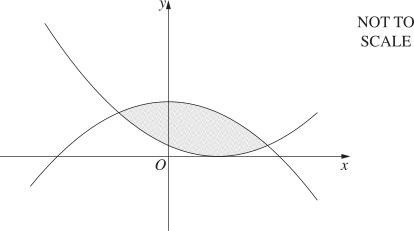
 

  1. Find the `x`-coordinates of the points of intersection of the two curves.   (1 mark)

    --- 4 WORK AREA LINES (style=lined) ---

  2. Find the area enclosed by the two curves.   (3 marks)

    --- 8 WORK AREA LINES (style=lined) ---

Show Answers Only

a.   `x=2\ \text{and}\ -1`

b.   `9\ \text{units}^2`

Show Worked Solution

a.   `y=(x-1)^2, \ y=5-x^2`

\(\text{Intersection occurs when:}\)

`(x-1)^2` `=5-x^2`  
`x^2-2x+1` `=5-x^2`  
`2x^2-2x-4` `=0`  
`2(x-2)(x+1)` `=0`  

 
`x=2\ \text{and}\ -1`
 

b.    `\text{Area}` `= \int_{-1}^{2} (5-x^2)-(x-1)^2\ dx` 
    `=\int_{-1}^{2} 5-x^2-x^2+2x-1\ dx`
    `=\int_{-1}^{2}4-2x^2+2x\ dx`
    `=[4x-\frac{2}{3}x^3+x^2]_{-1}^{2}`
    `=[(8-\frac{16}{3}+4)-(-4+\frac{2}{3}+1)]`
    `=\frac{20}{3}-(-\frac{7}{3})`
    `=9\ \text{u}^2`

Filed Under: Areas Under Curves (Y12) Tagged With: Band 3, Band 4, smc-975-10-Quadratic

Algebra, STD2 A2 2024 HSC 2 MC

Consider the function shown.
 

Which of the following could be the equation of this function?

  1. \(y=2 x+3\)
  2. \(y=2 x-3\)
  3. \(y=-2 x+3\)
  4. \(y=-2 x-3\)
Show Answers Only

\(C\)

Show Worked Solution

\(\text {Gradient is negative (top left } \rightarrow \text { bottom right)}\)

\(y \text{-intercept = 3 (only positive option)}\)

\(\Rightarrow C\)

Filed Under: Linear Equations and Basic Graphs (Std 2), Linear Modelling and Basic Graphs (Std1-2027), Linear Modelling and Basic Graphs (Std2-2027) Tagged With: 2adv-std2-common, Band 4, smc-6255-20-Equation of a Line, smc-6512-20-Equation of a line, smc-792-20-Equation of Line

CHEMISTRY, M3 EQ-Bank 10 MC

\begin{array} {|c|c|}
\hline
\rule{0pt}{2.5ex} \text{Standard potentials} \rule[-1ex]{0pt}{0pt} & \qquad E^{\circ}\ \text{V} \qquad\\
\hline
\rule{0pt}{2.5ex} \ce{Fe(s)/Fe^{2+}} \rule[-1ex]{0pt}{0pt} & -0.44 \\
\hline
\rule{0pt}{2.5ex} \ce{Ag(s)/Ag^{+}} \rule[-1ex]{0pt}{0pt} & 0.8 \\
\hline
\rule{0pt}{2.5ex} \ce{Zn(s)/Zn^{2+}} \rule[-1ex]{0pt}{0pt} & -0.76 \\
\hline
\rule{0pt}{2.5ex} \ce{Ni(s)/Ni^{2+}} \rule[-1ex]{0pt}{0pt} & -0.24 \\
\hline
\end{array}

Using the table above which would be the correct order of reactivity if the metals are ranked in order of decreasing electrochemical reactivity?

  1. \(\ce{Zn > Fe > Ni > Ag}\)
  2. \(\ce{Ag > Ni > Fe > Zn}\)
  3. \(\ce{Fe > Zn > Ni > Ag}\)
  4. \(\ce{Zn > Ni > Fe > Ag}\)
Show Answers Only

\(A\)

Show Worked Solution
  • The more negative the \(E^{\circ}\) value, the higher the reactivity of the metal (tendency to lose electrons).
  • The order of metals from most reactive to least reactive is zinc (–0.76 V), iron (–0.44 V), nickel (–0.24 V), silver (0.8 V). 

\(\Rightarrow A\)

Filed Under: Predicting Reactions of Metals Tagged With: Band 4, smc-4264-20-Reactivity of Metals

CHEMISTRY, M3 EQ-Bank 11

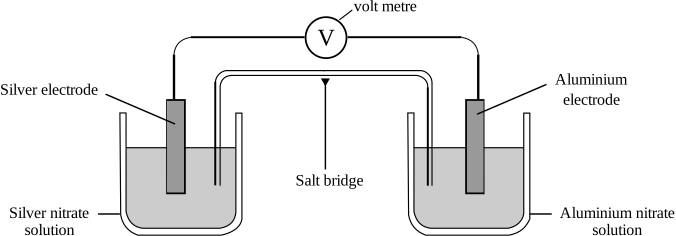
A student set up two half-cells: one with an aluminium nitrate solution and an aluminium metal electrode, and the other with silver nitrate solution and a silver metal electrode. The two solutions were connected by a salt bridge soaked in potassium nitrate, and the electrodes were linked to a volt-meter using electrical wires.

  1. Draw a labelled diagram of the student's setup.   (3 marks)

--- 10 WORK AREA LINES (style=blank) ---

  1. Complete the following table.   (3 marks)

    --- 0 WORK AREA LINES (style=lined) ---

\begin{array} {|c|c|}
\hline
\rule{0pt}{2.5ex} \text{anode half equation} \rule[-1ex]{0pt}{0pt} & \qquad \qquad\qquad \qquad \qquad \\
\hline
\rule{0pt}{2.5ex} \text{cathode half equation} \rule[-1ex]{0pt}{0pt} & \\
\hline
\rule{0pt}{2.5ex} \text{net ionic equation} \rule[-1ex]{0pt}{0pt} &  \\
\hline
\end{array}

  1. Determine the theoretical cell potential of the students galvanic cell.   (2 marks)

--- 4 WORK AREA LINES (style=lined) ---

Show Answers Only

a.   
       

b.   

\begin{array} {|c|c|}
\hline
\rule{0pt}{2.5ex} \text{anode half equation} \rule[-1ex]{0pt}{0pt} & \ce{Al(s) -> Al^{3+}(aq) + 3e^-}\\
\hline
\rule{0pt}{2.5ex} \text{cathode half equation} \rule[-1ex]{0pt}{0pt} & \ce{Ag+(aq) + e^- -> Ag(s)} \\
\hline
\rule{0pt}{2.5ex} \text{net ionic equation} \rule[-1ex]{0pt}{0pt} & \ce{Al(s) + Ag+(aq) -> Al^{3+}(aq) + Ag(s)} \\
\hline
\end{array}

 
c.    
\(E^{\circ}_{\text{cell}}=E^{\circ}_{\text{cathode}}-E^{\circ}_{\text{anode}}=0.8-(-1.68)=2.48\ \text{V}\)

Show Worked Solution

a.  


b.   

\begin{array} {|c|c|}
\hline
\rule{0pt}{2.5ex} \text{anode half equation} \rule[-1ex]{0pt}{0pt} & \ce{Al(s) -> Al^{3+}(aq) + 3e^-}\\
\hline
\rule{0pt}{2.5ex} \text{cathode half equation} \rule[-1ex]{0pt}{0pt} & \ce{Ag+(aq) + e^- -> Ag(s)} \\
\hline
\rule{0pt}{2.5ex} \text{net ionic equation} \rule[-1ex]{0pt}{0pt} & \ce{Al(s) + Ag+(aq) -> Al^{3+}(aq) + Ag(s)} \\
\hline
\end{array}


c.    \(E^{\circ}_{\text{cell}}=E^{\circ}_{\text{cathode}}-E^{\circ}_{\text{anode}}=0.8-(-1.68)=2.48\ \text{V}\)

Filed Under: Predicting Reactions of Metals Tagged With: Band 4, smc-4264-25-Redox, smc-4264-40-Cell Potentials, smc-4264-45-Galvanic Cells

CHEMISTRY, M3 EQ-Bank 10

A student conducted an experiment to measure the voltage generated by using various combinations of metals in an electrolyte solution.
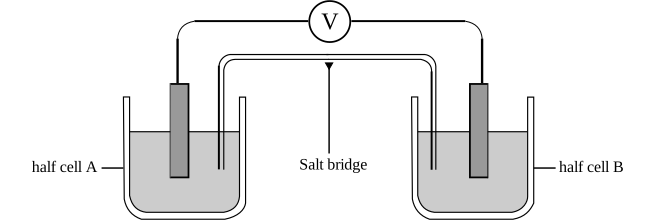


  1. Complete the table below.   (2 marks)

    --- 0 WORK AREA LINES (style=lined) ---

\begin{array} {|c|c|c|c|}
\hline
\rule{0pt}{2.5ex} \textbf{Experiment} \rule[-1ex]{0pt}{0pt} & \textbf{Half cell A} & \textbf{Half cell B} & \textbf{Cell Potential (V)}\\
\hline
\rule{0pt}{2.5ex} \textbf{1} \rule[-1ex]{0pt}{0pt} & \ce{Zn(s) | Zn^{2+}(aq)} & \ce{Pb(s) | Pb^{2+}(aq)} &  \\
\hline
\rule{0pt}{2.5ex} \textbf{2} \rule[-1ex]{0pt}{0pt} & \ce{Cu(s) | Cu^{2+}(aq)} & \ce{Pb(s) | Pb^{2+}(aq)} &  \\
\hline
\end{array}

  1. Explain whether the Zinc electrode is the anode or the cathode.   (2 marks)

--- 3 WORK AREA LINES (style=lined) ---

  1. Write the net ionic equation for Experiment 2.   (2 marks)

--- 3 WORK AREA LINES (style=lined) ---

Show Answers Only

a.  Cell potential of Experiment 1:

\(\ce{Zn(s) -> Zn^{2+} + 2e^-} \quad V=0.76\ \text{V}\)

\(\ce{Pb^{2+} + 2e^- -> Pb(s)} \quad V=-0.13\ \text{V}\)

\(E^{\circ}_{\text{cell}}=0.76 + -0.13 =0.63\ \text{V}\)
 

Cell potential of Experiment 2:

\(\ce{Pb(s) -> Pb^{2+} + 2e^-} \quad V=0.13\ \text{V}\)

\(\ce{Cu^{2+} + 2e^- -> Cu(s)} \quad V=0.34\ \text{V}\)

\(E^{\circ}_{\text{cell}}=0.13 + 0.34 =0.47\ \text{V}\)
 

b.    Zinc electrode is the anode.

  • Zinc is a more reactive metal than lead and therefore will undergo oxidation while lead undergoes reduction.
  • Since oxidation occurs at the anode, the zinc electrode will be the anode in this cell.

 
c.    
\(\ce{Pb(s) + Cu^{2+}(aq) -> Pb^{2+}(aq) + Cu(s)}\)

Show Worked Solution

a.  Cell potential of experiment 1:

\(\ce{Zn(s) -> Zn^{2+} + 2e^-} \quad V=0.76\ \text{V}\)

\(\ce{Pb^{2+} + 2e^- -> Pb(s)} \quad V=-0.13\ \text{V}\)

\(E^{\circ}_{\text{cell}}=0.76 + -0.13 =0.63\ \text{V}\)
 

Cell potential of experiment 2:

\(\ce{Pb(s) -> Pb^{2+} + 2e^-} \quad V=0.13\ \text{V}\)

\(\ce{Cu^{2+} + 2e^- -> Cu(s)} \quad V=0.34\ \text{V}\)

\(E^{\circ}_{\text{cell}}=0.13 + 0.34 =0.47\ \text{V}\)
 

b.    Zinc electrode is the anode.

  • Zinc is a more reactive metal than lead and therefore will undergo oxidation while lead undergoes reduction.
  • Since oxidation occurs at the anode, the zinc electrode will be the anode in this cell.

 
c.    
\(\ce{Pb(s) + Cu^{2+}(aq) -> Pb^{2+}(aq) + Cu(s)}\)

Filed Under: Predicting Reactions of Metals Tagged With: Band 4, Band 5, smc-4264-40-Cell Potentials, smc-4264-45-Galvanic Cells

CHEMISTRY, M3 EQ-Bank 9 MC

For which pair of substances will a displacement reaction occur?

  1. Zinc in a solution of copper ions
  2. Silver in a solution of magnesium ions
  3. Copper in a solution of lead ions
  4. Iron in a solution of aluminium ions
Show Answers Only

\(A\)

Show Worked Solution
  • When a more active metal is placed in a solution of less reactive metal ions, a displacement reaction will occur.
  • Using the standard potentials as a metal activity series, zinc is placed above copper and is therefore more reactive.

\(\Rightarrow A\)

Filed Under: Predicting Reactions of Metals Tagged With: Band 4, smc-4264-20-Reactivity of Metals

CHEMISTRY, M3 EQ-Bank 8 MC

Identify the compound in which chromium has an oxidation state of 6.

  1. \(\ce{CrCl3}\)
  2. \(\ce{Cr2O3}\)
  3. \(\ce{K2Cr2O7}\)
  4. \(\ce{Cr(OH)3}\)
Show Answers Only

\(C\)

Show Worked Solution

Let \(x\) be the oxidation state of chromium in each of the following calculations. 

\(\ce{CrCl3}\) → \(x+3(-1)=0\ \ \Rightarrow \ \ x=3\)

\(\ce{Cr2O3}\) → \(2x+3(-2)=0\ \ \Rightarrow \ \ x=3\)

\(\ce{K2Cr2O7}\) → \(2(1)+ 2x+7(-2)=0\ \ \Rightarrow \ \ x=6\)

\(\ce{Cr(OH)3}\) → \(x+3(-1)=0\ \ \Rightarrow \ \ x=3\)

\(\Rightarrow C\)

Filed Under: Predicting Reactions of Metals Tagged With: Band 4, smc-4264-30-Oxidation Numbers

CHEMISTRY, M3 EQ-Bank 9

A galvanic cell was created as seen below:
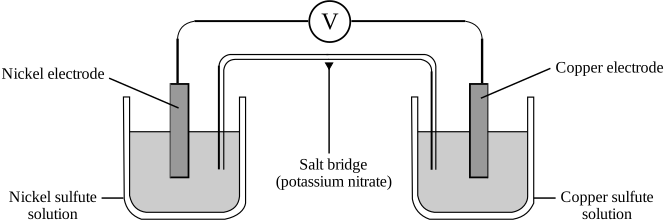


  1. State the direction that the electrons run through the conducting wire.   (1 mark)

--- 1 WORK AREA LINES (style=lined) ---

  1. State which electrode is the anode and which electrode is the cathode.   (1 mark)

--- 2 WORK AREA LINES (style=lined) ---

  1. Explain the direction of the anion flow from the salt bridge.   (2 marks)

--- 4 WORK AREA LINES (style=lined) ---

Show Answers Only

a.    The electrons will run from the nickel electrode to the copper electrode.

  • The electrons run from the more active metal (oxidises) to the less active metal (reduces).

b.    Nickel electrode  \(\Rightarrow\)  is the anode (undergoes oxidation).

Copper electrode  \(\Rightarrow\)  cathode (undergoes reduction).
 

c.    The nitrate ions in the salt bridge will flow to the nickel solution. 

  • At the anode, oxidation occurs, producing positive ions (cations) that increase the positive charge.
  • To balance this, anions move to the nickel solution, neutralising the excess positive charge and maintaining electrical neutrality in the solution.
Show Worked Solution

a.    The electrons will run from the nickel electrode to the copper electrode.

  • The electrons run from the more active metal (oxidises) to the less active metal (reduces).

b.    Nickel electrode  \(\Rightarrow\)  is the anode (undergoes oxidation).

Copper electrode  \(\Rightarrow\)  cathode (undergoes reduction).
 

c.    The nitrate ions in the salt bridge will flow to the nickel solution. 

  • At the anode, oxidation occurs, producing positive ions (cations) that increase the positive charge.
  • To balance this, anions move to the nickel solution, neutralising the excess positive charge and maintaining electrical neutrality in the solution.

Filed Under: Predicting Reactions of Metals Tagged With: Band 4, Band 5, smc-4264-45-Galvanic Cells

CHEMISTRY, M3 EQ-Bank 5 MC

Which statement is correct for the following reaction?

\(\ce{Zn(s) + Cu^{2+}(aq) -> Zn^{2+}(aq) + Cu(s)}\)

  1. \(\ce{Zn}\) is the oxidising agent because it undergoes reduction.
  2. \(\ce{Zn}\) is the reducing agent because it undergoes oxidation.
  3. \(\ce{Cu^{2+}}\) is the reducing agent because it undergoes oxidation.
  4. \(\ce{Cu^{2+}}\) is the oxidising agent because it undergoes oxidation.
Show Answers Only

\(B\)

Show Worked Solution
  • Oxidation is the process in which a substance loses electrons.
  • Reduction is the process in which substance gains electrons.
  • The oxidising agent is reduced and the reducing agent is oxidised.
  • Zinc undergoes oxidation as it loses electrons, \(\ce{Zn(s) -> Zn^{2+}(aq) + 2e^-}\).
  • Zinc is also the reducing agent as it causes Copper to undergo reduction.

\(\Rightarrow B\)

Filed Under: Predicting Reactions of Metals Tagged With: Band 4, smc-4264-25-Redox

BIOLOGY, M4 EQ-Bank 8

A 3000 hectare koala sanctuary was created in 1980 and the koala population over the next 35 years was monitored and the data graphed below.
 

Identify and explain the ecological significance of the parts of the graph labelled A, B and C.   (5 marks)

--- 10 WORK AREA LINES (style=lined) ---

Show Answers Only

Curve at point A:

  • The curve at point A shows exponential population growth.
  • The koala population is rapidly increasing due to abundant resources and minimal limiting factors, allowing for maximum reproductive success. 

Curve at point B:

  • At point B the population growth begins to slow.
  • As the koala population grows, competition for resources like food and habitat increases.
  • While the population still grows, it does so with a decreasing population growth rate. 

Curve at point C:

  • Point C shows the population reaching the sanctuary’s carrying capacity at around 1300 koalas.
  • The koala population has levelled off with births and deaths in balance.
  • At this stage, the environment is supporting the maximum sustainable number of individuals.
Show Worked Solution

Curve at point A:

  • The curve at point A shows exponential population growth.
  • The koala population is rapidly increasing due to abundant resources and minimal limiting factors, allowing for maximum reproductive success. 

Curve at point B:

  • At point B the population growth begins to slow.
  • As the koala population grows, competition for resources like food and habitat increases.
  • While the population still grows, it does so with a decreasing population growth rate. 

Curve at point C:

  • Point C shows the population reaching the sanctuary’s carrying capacity at around 1300 koalas.
  • The koala population has levelled off with births and deaths in balance.
  • At this stage, the environment is supporting the maximum sustainable number of individuals.

Filed Under: Population Dynamics Tagged With: Band 4, Band 5, smc-4311-15-Competition/Predation

BIOLOGY, M2 EQ-Bank 4 MC

In the diagram of a partial cross-section of a vascular plant stem shown below, identify the labeled structure representing the cells responsible for translocation.
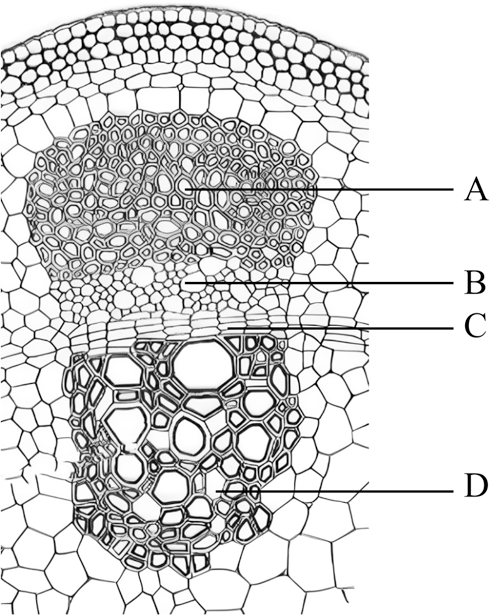
 

Show Answers Only

\(B\)

Show Worked Solution
  • The phloem is responsible for transporting organic nutrients and sugars (i.e. translocation).

\(\Rightarrow B\)

Filed Under: Transport Tagged With: Band 4, smc-4306-30-Plants

CHEMISTRY, M3 EQ-Bank 8

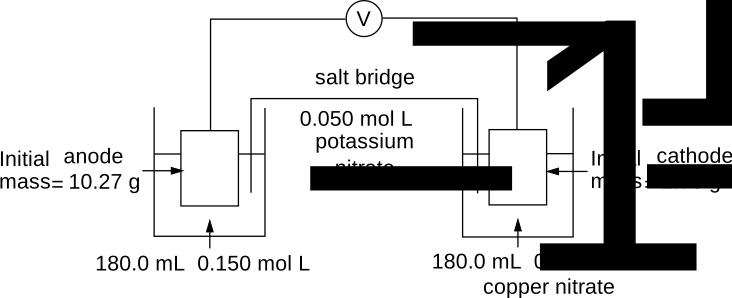
A galvanic cell has been set up as illustrated in the diagram below.

  1. The standard potential for this reaction is 0.78 V. Use half equations to determine the unknown electrode.   (2 marks)

--- 4 WORK AREA LINES (style=blank) ---

  1. The unknown solution is light green in colour. Explain what will happen to the colour of the unknown solution as the reaction proceeds.   (2 marks)

--- 4 WORK AREA LINES (style=lined) ---

  1. After some time, a solid deposit formed on the copper electrode was removed and dried. The mass of the deposit was 0.150 g. Determine the final concentration of the copper nitrate solution.   (3 marks)

--- 6 WORK AREA LINES (style=lined) ---

Show Answers Only

a.    \(\ce{Fe(s) -> Fe^{2+} + 2e^-}\)

b.    As the reaction progresses:

  • The solution will darken, taking on a more intense green colour.
  • This change occurs because nickel undergoes oxidation to form \(\ce{Fe^{2+}}\) ions, which are released into the solution, thereby increasing its colour intensity.

c.    \(0.137\ \text{mol L}^{-1}\)

Show Worked Solution
a.     \(E^{\circ}_{\text{cell}}\) \(=E^{\circ}_{\text{cathode}}-E^{\circ}_{\text{anode}}\)
  \(0.78\) \(=0.34-E^{\circ}_{\text{anode}}\)
  \(E^{\circ}_{\text{anode}}\) \(=0.34-0.78\)
  \(E^{\circ}_{\text{anode}}\) \(=-0.44\)
     
  • \(\ce{Fe^{2+} + 2e^- -> Fe(s)} \qquad -0.44\ \text{V}\)
  • \(\ce{Fe^{2+}}\) is undergoing oxidation. The correct half equation is: \(\ce{Fe(s) -> Fe^{2+} + 2e^-}\)
     

b.    As the reaction progresses:

  • The solution will darken, taking on a more intense green colour.
  • This change occurs because nickel undergoes oxidation to form \(\ce{Fe^{2+}}\) ions, which are released into the solution, thereby increasing its colour intensity.
     

c.    Moles of solid copper formed on electrode: \(\dfrac{m}{MM}=\dfrac{0.175}{63.55}=2.36 \times 10^{-3}\ \text{mol}\)

Moles of copper taken out of solution: \(2.36 \times 10^{-3}\ \text{mol}\)

Moles of copper remaining in solution: \((0.15 \times 0.18)-2.36 \times 10^{-3}= 0.0246\ \text{mol}\)

Final concentration: \(c=\dfrac{n}{V}=\dfrac{0.0246}{0.18}=0.137\ \text{mol L}^{-1}\)

Filed Under: Predicting Reactions of Metals Tagged With: Band 4, Band 5, Band 6, smc-4264-25-Redox, smc-4264-40-Cell Potentials

BIOLOGY, M4 EQ-Bank 7

Examine the diagram provided, which depicts the biological relationships within an ecosystem.
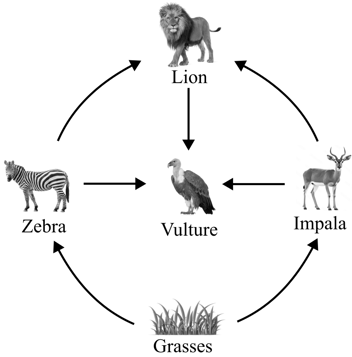
 

  1. Describe how food webs differ from food chains in representing the flow of energy within an ecosystem.   (2 marks)

    --- 4 WORK AREA LINES (style=lined) ---

  2. Name a consumer from the second trophic level in the diagram.   (1 mark)
  3. Poaching has pushed impala populations towards extinction in certain African regions. Describe the potential ecological consequences for other species in the food web shown.   (2 marks)
Show Answers Only

a.   Food webs vs food chains:

  • Food webs and food chains both represent energy flow in ecosystems, but differ in complexity and scope.
  • While a food chain shows a single, linear path of energy transfer from one organism to another, a food web illustrates multiple interconnected food chains within an ecosystem.
  • Food webs thus provide a more comprehensive and realistic depiction of the complex feeding relationships and energy transfers that occur among various species. 

b.   Second trophic level  \(\Rightarrow\)  first order consumer

Zebra or Impala
 

c.   Ecological consequences:

  • The decline or extinction of impalas would impact lions and vultures as they are an important food source of both.
  • Zebras would benefit from increased available vegetation due to reduced competition from impalas, leading to potential population growth.
  • The potential increase in zebra population would provide a more abundant food source for lions and vultures eventually, mitigating but not replacing the loss of impalas to these predator.
  • This scenario illustrates the complex interdependencies within the ecosystem and the cascading effects of species loss on different trophic levels.
Show Worked Solution

a.   Food webs vs food chains:

  • Food webs and food chains both represent energy flow in ecosystems, but differ in complexity and scope.
  • While a food chain shows a single, linear path of energy transfer from one organism to another, a food web illustrates multiple interconnected food chains within an ecosystem.
  • Food webs thus provide a more comprehensive and realistic depiction of the complex feeding relationships and energy transfers that occur among various species. 

b.   Second trophic level  \(\Rightarrow\)  first order consumer

Zebra or Impala
 

c.   Ecological consequences:

  • The decline or extinction of impalas would impact lions and vultures as they are an important food source of both.
  • Zebras would benefit from increased available vegetation due to reduced competition from impalas, leading to potential population growth.
  • The potential increase in zebra population would provide a more abundant food source for lions and vultures eventually, mitigating but not replacing the loss of impalas to these predator.
  • This scenario illustrates the complex interdependencies within the ecosystem and the cascading effects of species loss on different trophic levels.

Filed Under: Population Dynamics Tagged With: Band 3, Band 4, smc-4311-30-Food Webs

BIOLOGY, M4 EQ-Bank 5

Describe the concept of an ecological niche and its significance within an ecosystem's structure.   (2 marks)

--- 5 WORK AREA LINES (style=lined) ---

Show Answers Only
  • An ecological niche refers to the unique role and position a species occupies within its ecosystem, encompassing not only its habitat but also its interactions with other species and its use of resources.
  • It includes factors such as the species’ diet, predators, competitors, and its impact on the environment.
  • Understanding ecological niches is crucial for predicting how changes in an ecosystem might affect different species and for explaining how multiple species can coexist in the same habitat by occupying different niches.
Show Worked Solution
  • An ecological niche refers to the unique role and position a species occupies within its ecosystem, encompassing not only its habitat but also its interactions with other species and its use of resources.
  • It includes factors such as the species’ diet, predators, competitors, and its impact on the environment.
  • Understanding ecological niches is crucial for predicting how changes in an ecosystem might affect different species and for explaining how multiple species can coexist in the same habitat by occupying different niches.

Filed Under: Population Dynamics, Population Dynamics - draft Tagged With: Band 4, smc-4311-18-Ecological Niche

BIOLOGY, M4 EQ-Bank 3 MC

Which of the following is an example of a parasitic relationship?

  1. A bee collecting nectar from a flower .
  2. A tapeworm living in a human intestine.
  3. Egrets following cattle, feeding on the insects.
  4. A bird eating berries from a bush.
Show Answers Only

\(B\)

Show Worked Solution
  • Option B is a parasitic relationship because the tapeworm benefits by absorbing nutrients from the host’s digestive system, while the human host is harmed.
  • The other options which represent mutualism (bee and flower), commensalism (egret and cattle), or a predator-prey relationship (bird eating berries).

\(\Rightarrow B\)

Filed Under: Population Dynamics, Population Dynamics - draft Tagged With: Band 4, smc-4311-15-Symbiotic relationships

BIOLOGY, M4 EQ-Bank 4

Describe the differences between mutualistic and parasitic symbiotic relationships in ecosystems. In your answer, provide one specific example of each type of relationship from nature.   (3 marks)

--- 8 WORK AREA LINES (style=lined) ---

Show Answers Only
  • Mutualistic and parasitic relationships are both types of symbiosis involving a relationship between two different species.
  • In a mutualistic relationship, both organisms benefit from the interaction.
  • Example: the relationship between clownfish and sea anemones, where the clownfish receive protection from predators among the anemone’s tentacles, while the anemone benefits from the fish’s waste products.
  • In contrast, in a parasitic relationship, one organism (the parasite) benefits at the expense of the other (the host). 
  • Example: tapeworms living in a dog’s intestine, where the tapeworm gains nutrients from the dog’s digested food, causing potential health issues for the dog without providing any benefits. 
Show Worked Solution
  • Mutualistic and parasitic relationships are both types of symbiosis involving a relationship between two different species.
  • In a mutualistic relationship, both organisms benefit from the interaction.
  • Example: the relationship between clownfish and sea anemones, where the clownfish receive protection from predators among the anemone’s tentacles, while the anemone benefits from the fish’s waste products.
  • In contrast, in a parasitic relationship, one organism (the parasite) benefits at the expense of the other (the host). 
  • Example: tapeworms living in a dog’s intestine, where the tapeworm gains nutrients from the dog’s digested food, causing potential health issues for the dog without providing any benefits. 

Filed Under: Population Dynamics, Population Dynamics - draft Tagged With: Band 4, Band 5, smc-4311-15-Symbiotic relationships

BIOLOGY, M4 EQ-Bank 3

Consider a grassland ecosystem with a population of rabbits, foxes, and various grass species.

  1. Describe one example of predation in this ecosystem.   (1 mark)
  2. Explain two ways in which competition might occur between the rabbits.   (2 marks)
  3. Describe how the removal of foxes might affect both the rabbit population and the grass species.   (1 mark)
Show Answers Only

a.   Predation occurs when foxes hunt and eat rabbits. 

b.   Competition among rabbits could result from (choose two):

  • limited resources such as food or water
  • suitable burrow sites
  • mating partners 

c.   Removing foxes:

  • could lead to an increase in the rabbit population.
  • this growing population might then overgraze the grass species, potentially causing a decline in grass biodiversity and altering the ecosystem’s structure.
Show Worked Solution

a.   Predation occurs when foxes hunt and eat rabbits. 

b.   Competition among rabbits could result from (choose two):

  • limited resources such as food or water
  • suitable burrow sites
  • mating partners 

c.   Removing foxes:

  • could lead to an increase in the rabbit population.
  • this growing population might then overgraze the grass species, potentially causing a decline in grass biodiversity and altering the ecosystem’s structure.

Filed Under: Population Dynamics, Population Dynamics - draft Tagged With: Band 3, Band 4, smc-4311-15-Competition/Predation

BIOLOGY, M4 EQ-Bank 2

  1. Is soil pH a biotic or abiotic factor?   (1 mark)

    --- 1 WORK AREA LINES (style=lined) ---

  2. Describe how soil pH can affect plant growth.   (1 mark)

    --- 2 WORK AREA LINES (style=lined) ---

  3. Outline one way in which plants might alter soil pH.   (1 mark)

    --- 2 WORK AREA LINES (style=lined) ---

Show Answers Only

a.   Abiotic factor

b.   Soil pH:

  • Affects plant growth by influencing nutrient availability and solubility.
  • Most plants thrive in slightly acidic to neutral soils (pH 6.0-7.0) where essential nutrients are most accessible. 

c.   Plants alter soil pH (choose 1):

  • through root exudates, which release organic acids into the soil.
  • through the decomposition of their leaf litter, which can increase soil acidity over time.
Show Worked Solution

a.   Abiotic factor

b.   Soil pH:

  • Affects plant growth by influencing nutrient availability and solubility.
  • Most plants thrive in slightly acidic to neutral soils (pH 6.0-7.0) where essential nutrients are most accessible. 

c.   Plants alter soil pH (choose 1):

  • through root exudates, which release organic acids into the soil.
  • through the decomposition of their leaf litter, which can increase soil acidity over time.

Filed Under: Population Dynamics, Population Dynamics - draft Tagged With: Band 3, Band 4, Band 5

BIOLOGY, M4 EQ-Bank 1

Explain the concept of a trophic relationship and evaluate its significance within an ecosystem's functioning.   (3 marks)

--- 5 WORK AREA LINES (style=lined) ---

Show Answers Only
  • A trophic relationship refers to the feeding connections between organisms in an ecosystem, essentially describing who eats whom.
  • This relationship forms the basis of energy transfer within an ecosystem, as energy flows from primary producers (like plants) through various levels of consumers.
  • Trophic relationships are crucial in maintaining the balance and structure of ecosystems, influencing population sizes, species interactions, and nutrient cycling.
  • Understanding these relationships helps ecologists predict how changes in one species’ population can affect others throughout the food web, making it a key concept in ecosystem management.
Show Worked Solution
  • A trophic relationship refers to the feeding connections between organisms in an ecosystem, essentially describing who eats whom.
  • This relationship forms the basis of energy transfer within an ecosystem, as energy flows from primary producers (like plants) through various levels of consumers.
  • Trophic relationships are crucial in maintaining the balance and structure of ecosystems, influencing population sizes, species interactions, and nutrient cycling.
  • Understanding these relationships helps ecologists predict how changes in one species’ population can affect others throughout the food web, making it a key concept in ecosystem management.

Filed Under: Population Dynamics, Population Dynamics - draft Tagged With: Band 4, smc-4311-15-Competition/Predation

BIOLOGY, M4 EQ-Bank 2 MC

Which of the following best describes the role of predictive models in managing future ecosystems?

  1. They provide exact forecasts of future biodiversity changes.
  2. They guarantee the success of ecosystem management strategies.
  3. They eliminate the need for ongoing ecosystem monitoring.
  4. They help inform conservation decisions by simulating potential outcomes.
Show Answers Only

\(D\)

Show Worked Solution
  • Predictive models simulate potential future scenarios based on current data and trends.
  • While they don’t provide exact forecasts or guarantee success, they offer valuable insights that guide ecosystem management strategies.

\(\Rightarrow D\)

Filed Under: Future Ecosystems Tagged With: Band 4, smc-4313-12-Models

BIOLOGY, M4 EQ-Bank 1 MC

Human activities have significantly impacted species survival throughout history. Which of the following examples best demonstrates how understanding past human-induced extinctions can inform future ecosystem management?

  1. The extinction of the dodo bird due to hunting informs current wildlife protection laws.
  2. The evolution of antibiotic-resistant bacteria guides modern medical practices.
  3. The disappearance of the Tasmanian tiger influences current conservation strategies in Australia.
  4. The domestication of wolves into dogs shapes modern animal breeding programs.
Show Answers Only

\(C\)

Show Worked Solution
  • The Tasmanian tiger’s extinction was driven by overhunting, habitat loss, and competition from introduced species.
  • Modern scientists can learn from this event by prioritising habitat preservation and controlling invasive species to protect vulnerable ecosystems.

\(\Rightarrow C\)

Filed Under: Future Ecosystems Tagged With: Band 4, smc-4313-10-Extinctions, smc-4313-20-Preserving biodiversity

BIOLOGY, M4 EQ-Bank 8

Indigenous land management practices are increasingly recognised for their effectiveness in ecosystem restoration.

Describe one specific case study where traditional knowledge has been applied to heal a damaged ecosystem in Australia. In your answer, explain the concept of 'Country' or 'Place' in this context and outline two specific restoration strategies used, highlighting their cultural significance.   (5 marks)

--- 10 WORK AREA LINES (style=lined) ---

Show Answers Only

Case study 1: Pilliga forest in NSW (one example of many)

  • In this context, ‘Country’ encompasses not just the physical landscape of the forest but the spiritual and cultural connections of the Aboriginal people.
  • Strategy 1: One key restoration strategy employed is the reintroduction of cultural burning practices. This traditional fire management technique helps reduce fuel loads, promote biodiversity, and encourages the growth of culturally significant plants.
  • Strategy 2: The restoration of natural water flows and wetlands, guided by traditional knowledge of the landscape was another restoration strategy used.
  • This approach not only improves water quality and habitat for native species but also revitalises culturally important water sites.
  • These strategies are culturally significant as they represent a continuation of ancestral practices and reinforce the Aboriginal people’s role as custodians of the land. 

Case study 2: Restoration of the Gulgalda in Tasmania

  • Gulgalda is a critically endangered plant species sacred to the Tasmanian Aboriginal people.
  • In this context, ‘Country’ refers to not just the physical landscape but the interconnected relationships between land, plants and people, including spiritual and cultural elements.
  • Strategy 1: The use of cultural burning, a controlled fire management technique that stimulates Gulgalda germination and reduces competition from other plants.
  • Strategy 2: The project incorporated traditional harvesting practices, where plant material is collected sustainably to propagate new individuals while maintaining the spiritual connection to Country.
  • These strategies hold cultural significance as they preserve ancestral traditions and reaffirm the Aboriginal people’s stewardship over the land.
Show Worked Solution

Case study 1: Pilliga forest in NSW (one example of many)

  • In this context, ‘Country’ encompasses not just the physical landscape of the forest but the spiritual and cultural connections of the Aboriginal people.
  • Strategy 1: One key restoration strategy employed is the reintroduction of cultural burning practices. This traditional fire management technique helps reduce fuel loads, promote biodiversity, and encourages the growth of culturally significant plants.
  • Strategy 2: The restoration of natural water flows and wetlands, guided by traditional knowledge of the landscape was another restoration strategy used.
  • This approach not only improves water quality and habitat for native species but also revitalises culturally important water sites.
  • These strategies are culturally significant as they represent a continuation of ancestral practices and reinforce the Aboriginal people’s role as custodians of the land. 

Case study 2: Restoration of the Gulgalda in Tasmania

  • Gulgalda is a critically endangered plant species sacred to the Tasmanian Aboriginal people.
  • In this context, ‘Country’ refers to not just the physical landscape but the interconnected relationships between land, plants and people, including spiritual and cultural elements.
  • Strategy 1: The use of cultural burning, a controlled fire management technique that stimulates Gulgalda germination and reduces competition from other plants.
  • Strategy 2: The project incorporated traditional harvesting practices, where plant material is collected sustainably to propagate new individuals while maintaining the spiritual connection to Country.
  • These strategies hold cultural significance as they preserve ancestral traditions and reaffirm the Aboriginal people’s stewardship over the land.

Filed Under: Future Ecosystems Tagged With: Band 4, Band 5, smc-4313-40-Ecosystem restoration, smc-4313-50-Concept of Country

BIOLOGY, M4 EQ-Bank 7

Agricultural intensification has led to widespread land degradation in many parts of the world. 

Identify two major forms of land degradation resulting from agricultural practices. In your answer, describe a specific restoration technique used to address each form of degradation.   (4 marks)

--- 8 WORK AREA LINES (style=lined) ---

Show Answers Only

Soil erosion:

  • Soil erosion is a major form of land degradation that is caused by intensive cropping and overgrazing.
  • It can be addressed through crop rotation and destocking. These strategies help to stabilise soil structure, increase organic matter, and reduce erosion. 

Soil salinisation:

  • Soil salinisation is a form of land degradation whereby excessive salts accumulate in the soil, reducing its fertility and hindering plant growth.
  • It is often caused by poor irrigation practices and can be mitigated through the use of salt-tolerant crops and improved drainage systems.
Show Worked Solution

Soil erosion:

  • Soil erosion is a major form of land degradation that is caused by intensive cropping and overgrazing.
  • It can be addressed through crop rotation and destocking. These strategies help to stabilise soil structure, increase organic matter, and reduce erosion. 

Soil salinisation:

  • Soil salinisation is a form of land degradation whereby excessive salts accumulate in the soil, reducing its fertility and hindering plant growth.
  • It is often caused by poor irrigation practices and can be mitigated through the use of salt-tolerant crops and improved drainage systems.

Filed Under: Future Ecosystems Tagged With: Band 4, Band 5, smc-4313-40-Ecosystem restoration

BIOLOGY, M4 EQ-Bank 5

Mining activities often leave significant impacts on ecosystems. Environmental scientists and ecologists work to develop and implement restoration practices to heal these damaged landscapes.

Describe two specific restoration practices commonly used in post-mining landscapes. In your answer, identify one challenge faced in the restoration process and how it might be overcome.   (4 marks)

--- 8 WORK AREA LINES (style=lined) ---

Show Answers Only

Restoration practices (choose 2)

  • Practice 1: Topsoil replacement involves carefully storing the original topsoil during mining operations and then reapplying it during restoration, which helps to preserve the soil’s seed bank and beneficial microorganisms.
  • Practice 2: Native species revegetation focuses on planting local plant species to re-establish the area’s natural ecosystem.
  • Practice 2: Hydrological restoration aims to re-establish natural water flows and drainage patterns disrupted by mining activities. This can involve reshaping the landscape to mimic natural contours and/or creating wetlands. 

Restoration challenge/response:

  • A significant challenge in the restoration process is soil compaction, which can occur due to heavy machinery used during mining and restoration activities.
  • This challenge can be addressed through techniques such as deep ripping, where the soil is mechanically loosened to improve its structure, or by using native plant species with deep root systems that can penetrate and gradually improve compacted soils over time.
Show Worked Solution

Restoration practices (choose 2)

  • Practice 1: Topsoil replacement involves carefully storing the original topsoil during mining operations and then reapplying it during restoration, which helps to preserve the soil’s seed bank and beneficial microorganisms.
  • Practice 2: Native species revegetation focuses on planting local plant species to re-establish the area’s natural ecosystem.
  • Practice 2: Hydrological restoration aims to re-establish natural water flows and drainage patterns disrupted by mining activities. This can involve reshaping the landscape to mimic natural contours and/or creating wetlands. 

Restoration challenge/response:

  • A significant challenge in the restoration process is soil compaction, which can occur due to heavy machinery used during mining and restoration activities.
  • This challenge can be addressed through techniques such as deep ripping, where the soil is mechanically loosened to improve its structure, or by using native plant species with deep root systems that can penetrate and gradually improve compacted soils over time.

Filed Under: Future Ecosystems Tagged With: Band 4, Band 5, smc-4313-40-Ecosystem restoration

CHEMISTRY, M3 EQ-Bank 3 MC

A student set up a galvanic cell using two half-cells: \(\ce{Cu(s)/Cu^{2+}}\) and \(\ce{Zn(s)/Zn^{2+}}\). Assuming standard conditions, what is the maximum potential difference (emf) the student would expect to measure between the two half-cells?

  1. \(0.34\ \text{V}\)
  2. \(0.76\ \text{V}\)
  3. \(1.10\ \text{V}\)
  4. \(1.56\ \text{V}\)
Show Answers Only

\(C\)

Show Worked Solution
  • To find the maximum potential difference, we need to use the standard reduction potentials \(E^{\circ}\) of the half-reactions:
  • Standard reduction potential for \(\ce{Cu^{2+} + 2e^- -> Cu(s)}\) is \(+0.34\ \text{V}\)
  • Standard reduction potential for \(\ce{Zn^{2+} + 2e^- -> Zn(s)}\) is \(-0.76\ \text{V}\)
  •    \(E^{\circ}_{\text{cell}}=E^{\circ}_{\text{cathode}}-E^{\circ}_{\text{anode}}=0.34-(-0.76)=1.10\ \text{V}\)

\(\Rightarrow C\)

Filed Under: Predicting Reactions of Metals Tagged With: Band 4, smc-4264-40-Cell Potentials

CHEMISTRY, M3 EQ-Bank 2 MC

What is the oxidation state of sulfur in the sulfate ion, \(\ce{SO4^{2-}}\)​?

  1. \(+2\)
  2. \(+4\)
  3. \(+6\)
  4. \(-2\)
Show Answers Only

\(C\)

Show Worked Solution
  • The oxidation number of a polyatomic ion is the charge of the ion.
  • Let \(x\) be the oxidation state of sulfur and the oxidation state of oxygen is \(-2\).
\(x +4(-2)\) \(=-2\)  
\(x-8\) \(=-2\)  
\(x\) \(=6\)  

 
\(\Rightarrow C\)

Filed Under: Predicting Reactions of Metals Tagged With: Band 4, smc-4264-30-Oxidation Numbers

BIOLOGY, M4 EQ-Bank 3

In an era of rapid environmental change, scientists are developing sophisticated tools to anticipate shifts in biodiversity. Briefly explain two distinct models scientists use to predict future impacts on biodiversity.   (2 marks)

--- 5 WORK AREA LINES (style=lined) ---

Show Answers Only

Answers could include two of the following:

  • Population growth models predict changes in species abundance over time, considering factors like birth rates, death rates, and carrying capacity. These models help to forecast potential extinctions or population booms.
  • Global warming models simulate future climate scenarios based on greenhouse gas emissions and temperature changes. This allows scientists to predict shifts in species distributions and habitat suitability.
  • Species loss models estimate the number of species that may go extinct as habitat area decreases. These models are used to predict biodiversity loss due to deforestation or other forms of habitat destruction.
Show Worked Solution

Answers could include two of the following:

  • Population growth models predict changes in species abundance over time, considering factors like birth rates, death rates, and carrying capacity. These models help to forecast potential extinctions or population booms.
  • Global warming models simulate future climate scenarios based on greenhouse gas emissions and temperature changes. This allows scientists to predict shifts in species distributions and habitat suitability.
  • Species loss models estimate the number of species that may go extinct as habitat area decreases. These models are used to predict biodiversity loss due to deforestation or other forms of habitat destruction.

Filed Under: Future Ecosystems Tagged With: Band 4, smc-4313-12-Models

BIOLOGY, M4 EQ-Bank 2

Our actions as a human species are inadvertently altering the evolutionary trajectories of countless organisms.

Explain two distinct mechanisms by which human activities exert selection pressures on other species. For each mechanism, provide a specific example of a species affected by this pressure.   (4 marks)

--- 8 WORK AREA LINES (style=lined) ---

Show Answers Only

Answers could include two of the following.

Mechanism: urbanisation

  • Human activities exert selection pressure on other species through urbanisation. As cities expand, isolated pockets of natural habitat are created, forcing species to adapt to smaller, disconnected areas.
  • For example, the San Diego deer mouse has shown rapid evolution in its size and fur colour to better camouflage against urban environments, with urban mice becoming larger and darker than their rural counterparts. 

Mechanism: pollution from fossil fuel burning

  • Humans exert selection pressure on other species through pollution from fossil fuel burning.
  • The emission of sulfur-dioxide from coal-burning power plants has led to acid rain, which changes soil and water pH levels. This has resulted in strong selection pressure on aquatic organisms.
  • For instance, in some Scandinavian lakes, the European perch has evolved increased tolerance to acidic conditions in order to survive. 

Mechanism: use of pesticides

  • Another mechanism is the widespread use of pesticides, which creates strong selection pressures for resistance. In agriculture, the overuse of pesticides has led to the evolution of resistance in many insect pest species.
  • A specific example is the green peach aphid, which has developed resistance to multiple classes of insecticides. This adaptation makes it increasingly difficult to control these crop pests without resorting to even more potent chemicals.
Show Worked Solution

Answers could include two of the following.

Mechanism: urbanisation

  • Human activities exert selection pressure on other species through urbanisation. As cities expand, isolated pockets of natural habitat are created, forcing species to adapt to smaller, disconnected areas.
  • For example, the San Diego deer mouse has shown rapid evolution in its size and fur colour to better camouflage against urban environments, with urban mice becoming larger and darker than their rural counterparts. 

Mechanism: pollution from fossil fuel burning

  • Humans exert selection pressure on other species through pollution from fossil fuel burning.
  • The emission of sulfur-dioxide from coal-burning power plants has led to acid rain, which changes soil and water pH levels. This has resulted in strong selection pressure on aquatic organisms.
  • For instance, in some Scandinavian lakes, the European perch has evolved increased tolerance to acidic conditions in order to survive. 

Mechanism: use of pesticides

  • Another mechanism is the widespread use of pesticides, which creates strong selection pressures for resistance. In agriculture, the overuse of pesticides has led to the evolution of resistance in many insect pest species.
  • A specific example is the green peach aphid, which has developed resistance to multiple classes of insecticides. This adaptation makes it increasingly difficult to control these crop pests without resorting to even more potent chemicals.

Filed Under: Future Ecosystems Tagged With: Band 3, Band 4, smc-4313-11-Human-induced pressures

CHEMISTRY, M3 EQ-Bank 19

Describe two common indicators of a chemical change. Provide an example of each indicator.   (3 marks)

--- 6 WORK AREA LINES (style=lined) ---

Show Answers Only
  • Colour Change: A change in colour that is not just mixing of colours can indicate a chemical reaction. For example, when iron reacts with oxygen it rusts and it changes colour from metallic grey to reddish-brown.
  •    \(\ce{2Fe(s) + O2(g) -> 2FeO(s)}\)
     
  • Gas Production: Bubbling or fizzing without heating shows that a gas is being produced. For example, adding hydrochloric acid to marble chips (calcium carbonate) produces bubbles of carbon dioxide gas.
  •    \(\ce{CaCO3(s) + 2HCl(aq) -> CaCl2(aq) + CO2(g) + H2O(l)}\)

Other answers could include: the formation of a precipitate, change in temperature, light being produced.

Show Worked Solution
  • Colour Change: A change in colour that is not just mixing of colours can indicate a chemical reaction. For example, when iron reacts with oxygen it rusts and it changes colour from metallic grey to reddish-brown.
  •    \(\ce{2Fe(s) + O2(g) -> 2FeO(s)}\)
     
  • Gas Production: Bubbling or fizzing without heating shows that a gas is being produced. For example, adding hydrochloric acid to marble chips (calcium carbonate) produces bubbles of carbon dioxide gas.
  •    \(\ce{CaCO3(s) + 2HCl(aq) -> CaCl2(aq) + CO2(g) + H2O(l)}\)

Other answers could include: the formation of a precipitate, change in temperature, light being produced.

Filed Under: Chemical Reactions Tagged With: Band 4, smc-4263-8-Indicators of chemical change

BIOLOGY, M4 EQ-Bank 1

Human activities have become a powerful force in the natural world, often altering the course of evolution.

Explain the concept of human-induced selection pressures and in your answer, describe two specific examples where these pressures have led to species extinction.   (3 marks)

--- 6 WORK AREA LINES (style=lined) ---

Show Answers Only
  • Human-induced selection pressures are changes in the environment caused by human activities that affect the survival and reproduction of species.

Extinction examples (choose two):

  • The extinction of the dodo bird in Mauritius, where human hunting and the introduction of invasive predators like rats and pigs led to the species’ extinction.
  • The extinction of the passenger pigeon in North America, where extensive hunting and habitat destruction resulted in their extinction.
  • The extinction of the Tasmanian tiger (thylacine) in Australia, where government-sponsored hunting due to perceived threats to livestock, combined with habitat loss and the introduction of dogs, led to its extinction.
Show Worked Solution
  • Human-induced selection pressures are changes in the environment caused by human activities that affect the survival and reproduction of species.

Extinction examples (choose two):

  • The extinction of the dodo bird in Mauritius, where human hunting and the introduction of invasive predators like rats and pigs led to the species’ extinction.
  • The extinction of the passenger pigeon in North America, where extensive hunting and habitat destruction resulted in their extinction.
  • The extinction of the Tasmanian tiger (thylacine) in Australia, where government-sponsored hunting due to perceived threats to livestock, combined with habitat loss and the introduction of dogs, led to its extinction.

Filed Under: Future Ecosystems Tagged With: Band 4, smc-4313-10-Extinctions

BIOLOGY, M4 EQ-Bank 10

Ecosystems are dynamic, shaped not only by physical forces but also by the living organisms within them. Including a specific example, explain one biotic factor that has significantly impacted past ecosystems:

  1. Over a relatively short timescale (within a few decades or centuries)   (2 marks)

    --- 3 WORK AREA LINES (style=lined) ---

  2. Over an extended geological timescale (millions of years)   (2 marks)

    --- 3 WORK AREA LINES (style=lined) ---

Show Answers Only

a.   Short timescale biotic factor: introduction of invasive species

  • The introduction of cane toads in Australia in 1935 has rapidly altered local ecosystems within decades.
  • Cane toads have caused declines in native predator populations that attempt to eat the toxic toads, leading to cascading effects throughout the food web. 

b.   Geological timescale biotic factor: evolution of land plants

  • The development of land plants around 470 Mya led to increased oxygen production, soil formation, and the creation of new habitats.
  • This gradual but profound change altered atmospheric composition and weather patterns. This reshaped terrestrial ecosystems and paved the way for the evolution of terrestrial animal life.
Show Worked Solution

a.   Short timescale biotic factor: introduction of invasive species

  • The introduction of cane toads in Australia in 1935 has rapidly altered local ecosystems within decades.
  • Cane toads have caused declines in native predator populations that attempt to eat the toxic toads, leading to cascading effects throughout the food web. 

b.   Geological timescale biotic factor: evolution of land plants

  • The development of land plants around 470 Mya led to increased oxygen production, soil formation, and the creation of new habitats.
  • This gradual but profound change altered atmospheric composition and weather patterns. This reshaped terrestrial ecosystems and paved the way for the evolution of terrestrial animal life.

Filed Under: Past Ecosystems Tagged With: Band 3, Band 4, smc-4312-05-Changes in ecosystems, smc-4312-20-Biotic/Abiotic factors

BIOLOGY, M4 EQ-Bank 9

Over geological timescales, our planet's ecosystems have undergone dramatic transformations. Name and briefly explain two abiotic factors that have played significant roles in driving these long-term changes in past ecosystems.   (2 marks)

--- 5 WORK AREA LINES (style=lined) ---

Show Answers Only
  • Two significant abiotic factors that have contributed to changes in past ecosystems over long periods of time are climate change and plate tectonics.
  • Long-term climate changes, such as ice ages and warming periods, have dramatically altered global temperatures and precipitation patterns, leading to shifts in vegetation types and animal distributions.
  • Plate tectonics, including continental drift and mountain formation, have reshaped landscapes over millions of years. It has created new oceans and influenced global climate patterns, all of which have had profound effects on the evolution and distribution of species.
Show Worked Solution
  • Two significant abiotic factors that have contributed to changes in past ecosystems over long periods of time are climate change and plate tectonics.
  • Long-term climate changes, such as ice ages and warming periods, have dramatically altered global temperatures and precipitation patterns, leading to shifts in vegetation types and animal distributions.
  • Plate tectonics, including continental drift and mountain formation, have reshaped landscapes over millions of years. It has created new oceans and influenced global climate patterns, all of which have had profound effects on the evolution and distribution of species.

Filed Under: Past Ecosystems Tagged With: Band 4, smc-4312-20-Biotic/Abiotic factors

CHEMISTRY, M3 EQ-Bank 17

A student tested how soluble silver salts are by reacting a 0.1 mol L\(^{-1}\) silver nitrate solution with 0.1 mol L\(^{-1}\) solutions of calcium hydroxide, calcium chloride, and calcium sulfate. The results are shown below:

\begin{array} {|l|l|}
\hline \ \ \ \ \ \text{Compound} & \ \ \ \ \ \text{Observation} \\
\hline \text{calcium hydroxide} & \text{No reaction} \\
\hline \text{calcium chloride} & \text{White precipitate} \\
\hline \text{calcium sulfate} & \text{No reaction} \\
\hline \end{array}

  1. Write a balanced chemical equation for the reaction with calcium chloride.   (2 marks)

--- 2 WORK AREA LINES (style=lined) ---

  1. Name the white precipitate.   (1 mark)

--- 1 WORK AREA LINES (style=lined) ---

Show Answers Only

a.    \(\ce{CaCl2(aq) + 2AgNO3(aq) -> Ca(NO3)2(aq) + 2AgCl(s)}\)

b.    The white precipitate is \(\ce{AgCl}\) → silver chloride.

Show Worked Solution

a.    \(\ce{CaCl2(aq) + 2AgNO3(aq) -> Ca(NO3)2(aq) + 2AgCl(s)}\)
 

b.    The white precipitate is \(\ce{AgCl}\) → silver chloride.

Filed Under: Chemical Reactions Tagged With: Band 3, Band 4, smc-4263-10-Balanced chemical equations, smc-4263-15-Predicting products, smc-4263-25-Precipitation

BIOLOGY, M4 EQ-Bank 8

Explain how the unique abiotic factors of the Australian continent have influenced the evolution of sclerophyll plants. In your answer, provide two specific adaptations.   (4 marks)

--- 8 WORK AREA LINES (style=lined) ---

Show Answers Only
  • The evolution of sclerophyll plants in Australia is closely tied to the continent’s abiotic factors, particularly its nutrient-poor soils, arid climate, and frequent bushfires.
  • These plants have developed tough, leathery leaves with a thick cuticle to reduce water loss in the dry Australian environment, a key adaptation to water scarcity.
  • Sclerophyll species like eucalypts and banksias have also evolved strategies to cope with nutrient-poor soils, such as cluster roots that efficiently extract phosphorus.
  • Many sclerophyll plants have developed fire-resistant adaptations, including lignotubers for post-fire regeneration and fruits that release seeds after fire.
  • These adaptations demonstrate how the challenging abiotic conditions in Australia have acted as strong selective pressures, shaping the evolution of a unique flora highly specialised for survival in this harsh environment.
Show Worked Solution
  • The evolution of sclerophyll plants in Australia is closely tied to the continent’s abiotic factors, particularly its nutrient-poor soils, arid climate, and frequent bushfires.
  • These plants have developed tough, leathery leaves with a thick cuticle to reduce water loss in the dry Australian environment, a key adaptation to water scarcity.
  • Sclerophyll species like eucalypts and banksias have also evolved strategies to cope with nutrient-poor soils, such as cluster roots that efficiently extract phosphorus.
  • Many sclerophyll plants have developed fire-resistant adaptations, including lignotubers for post-fire regeneration and fruits that release seeds after fire.
  • These adaptations demonstrate how the challenging abiotic conditions in Australia have acted as strong selective pressures, shaping the evolution of a unique flora highly specialised for survival in this harsh environment.

Filed Under: Past Ecosystems Tagged With: Band 4, Band 5, smc-4312-16-Schlerophyll plants, smc-4312-20-Biotic/Abiotic factors

BIOLOGY, M4 EQ-Bank 7

Analyse the evidence for the evolution of marsupials in Australia. In your answer, describe one piece of fossil evidence that supports the evolution of marsupials in Australia and provide one limitation of using fossil evidence to reconstruct evolutionary histories.   (4 marks)

--- 8 WORK AREA LINES (style=lined) ---

Show Answers Only
  • Fossil evidence strongly supports the evolution of marsupials in Australia.
  • Riversleigh fossil deposits in Queensland provide important fossil evidence from 33 Mya. These deposits contain marsupial fossils of the ancestors of modern kangaroos, koalas, and wombats.
  • The diversity and age of these fossils demonstrate the long evolutionary history of marsupials on the Australian continent and provide insights into their adaptive radiation into various ecological niches. 
  • A limitation of using fossil evidence to reconstruct evolutionary histories is the incompleteness of the fossil record.
  • Many species may not fossilise due to their soft bodies or the absence of suitable preservation conditions, leading to gaps in our understanding of evolutionary transitions.
Show Worked Solution
  • Fossil evidence strongly supports the evolution of marsupials in Australia.
  • Riversleigh fossil deposits in Queensland provide important fossil evidence from 33 Mya. These deposits contain marsupial fossils of the ancestors of modern kangaroos, koalas, and wombats.
  • The diversity and age of these fossils demonstrate the long evolutionary history of marsupials on the Australian continent and provide insights into their adaptive radiation into various ecological niches. 
  • A limitation of using fossil evidence to reconstruct evolutionary histories is the incompleteness of the fossil record.
  • Many species may not fossilise due to their soft bodies or the absence of suitable preservation conditions, leading to gaps in our understanding of evolutionary transitions.

Filed Under: Past Ecosystems Tagged With: Band 4, Band 5, smc-4312-15-Mammals

BIOLOGY, M4 EQ-Bank 6

The graph below shows the concentration of \(\ce{CO2}\) in the earth's atmosphere over the last 800 years.
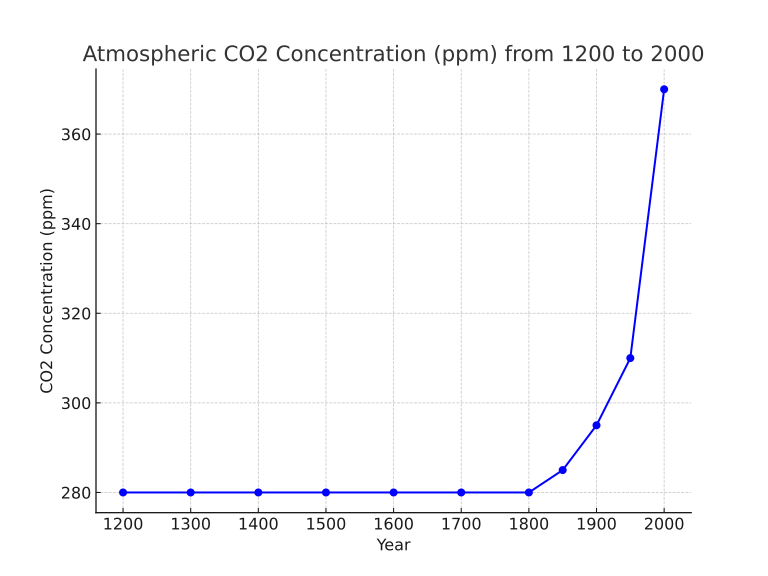
  1. How would scientists obtain these historical levels of \(\ce{CO2}\)?   (1 mark)

    --- 1 WORK AREA LINES (style=lined) ---

  2. Explain the shape of the graph over the 800 years of data presented.   (3 marks)

    --- 6 WORK AREA LINES (style=lined) ---

Show Answers Only

a.   Data would be obtained by gas analysis within ice cores.

b.   Graph shape over the past 800 years:

  • Atmospheric levels of \(\ce{CO2}\) were very steady between the period 1200-1800 at approximately 280 ppm.
  • In the period 1800-2000, \(\ce{CO2}\) levels increased exponentially from 280 ppm to 370 ppm.
  • This increase coincided with industrialisation which saw the widespread use of fossil fuels like coal, oil, and natural gas for energy.
  • The use of these energy sources released large amounts of (\ce{CO2}\) into the atmosphere and is regarded as a major contributing factor to rise in atmospheric \(\ce{CO2}\) levels over this period.
Show Worked Solution

a.   Data would be obtained by gas analysis within ice cores.

b.   Graph shape over the past 800 years:

  • Atmospheric levels of \(\ce{CO2}\) were very steady between the period 1200-1800 at approximately 280 ppm.
  • In the period 1800-2000, \(\ce{CO2}\) levels increased exponentially from 280 ppm to 370 ppm.
  • This increase coincided with industrialisation which saw the widespread use of fossil fuels like coal, oil, and natural gas for energy.
  • The use of these energy sources released large amounts of (\ce{CO2}\) into the atmosphere and is regarded as a major contributing factor to rise in atmospheric \(\ce{CO2}\) levels over this period.

Filed Under: Past Ecosystems Tagged With: Band 3, Band 4, smc-4312-05-Changes in ecosystems, smc-4312-10-Dating technologies

BIOLOGY, M4 EQ-Bank 1 MC

Which of the following statements about radiometric dating is correct?

  1. It can only be used to date organic materials.
  2. It is based on the constant decay rate of radioactive isotopes.
  3. It provides the relative age of fossils, not the absolute age.
  4. It is most accurate for dating materials less than 1,000 years old.
Show Answers Only

\(B\)

Show Worked Solution

Consider each statement.

  • Option A: Incorrect. Radiometric dating can be used on both organic and inorganic materials.
  • Option B: Correct. Radiometric dating is based on calculations of the ratio of parent to daughter isotopes in a process of constant decay.
  • Option C: Incorrect. Radiometric dating actually provides the absolute age of materials, not just relative age. 
  • Option D: Incorrect. While some radiometric methods (like carbon-14 dating) are useful for relatively recent materials, many radiometric techniques can date materials billions of years old. 

\(\Rightarrow B\)

Filed Under: Past Ecosystems Tagged With: Band 4, smc-4312-10-Dating technologies

BIOLOGY, M4 EQ-Bank 4

Geologists often say that rocks are pages in Earth's history book.

Explain how scientists use paleontological and geological evidence from rock structures and formations to reconstruct past ecosystems and their changes over time. Include a specific example in your answer.   (3 marks)

--- 6 WORK AREA LINES (style=lined) ---

Show Answers Only
  • Rock formations like sedimentary layers can preserve a wealth of information about past ecosystems.
  • For example, the Green River Formation in the USA contains sediments deposited in a lake system over 50 million years ago.
  • These layers contain fossils of plants, insects, and fish, providing a detailed snapshot of a lush, subtropical ecosystem very different from the current arid environment.
  • The presence of certain minerals and sediment types in the layers also indicates changes in water depth and chemistry over time.
  • By analysing these fossils and sediment characteristics, scientists can reconstruct how the ecosystem changed in response to environmental factors over millions of years.
Show Worked Solution
  • Rock formations like sedimentary layers can preserve a wealth of information about past ecosystems.
  • For example, the Green River Formation in the USA contains sediments deposited in a lake system over 50 million years ago.
  • These layers contain fossils of plants, insects, and fish, providing a detailed snapshot of a lush, subtropical ecosystem very different from the current arid environment.
  • The presence of certain minerals and sediment types in the layers also indicates changes in water depth and chemistry over time.
  • By analysing these fossils and sediment characteristics, scientists can reconstruct how the ecosystem changed in response to environmental factors over millions of years.

Filed Under: Past Ecosystems Tagged With: Band 4, smc-4312-05-Changes in ecosystems

BIOLOGY, M4 EQ-Bank 3

Describe two ways in which ice core data provides evidence of past changes in ecosystems.   (2 marks)

--- 4 WORK AREA LINES (style=blank) ---

Show Answers Only

Answers could include two of the following:

  • Ice cores provide valuable information about past climates through trapped air bubbles, which reveal historical atmospheric compositions, including greenhouse gas levels that influenced past ecosystems.
  • Ice cores also contain dust particles, pollen, and other organic materials that offer direct evidence of past vegetation and environmental conditions, allowing scientists to reconstruct ancient ecosystems and their changes over time.
  • The thickness and composition of annual ice layers in cores provide a record of past precipitation rates, offering insights into historical patterns of rainfall and drought.
Show Worked Solution

Answers could include two of the following:

  • Ice cores provide valuable information about past climates through trapped air bubbles, which reveal historical atmospheric compositions, including greenhouse gas levels that influenced past ecosystems.
  • Ice cores also contain dust particles, pollen, and other organic materials that offer direct evidence of past vegetation and environmental conditions, allowing scientists to reconstruct ancient ecosystems and their changes over time.
  • The thickness and composition of annual ice layers in cores provide a record of past precipitation rates, offering insights into historical patterns of rainfall and drought.

Filed Under: Past Ecosystems Tagged With: Band 4, smc-4312-05-Changes in ecosystems

BIOLOGY, M4 EQ-Bank 2

Aboriginal rock paintings provide valuable insights into Australia's past ecosystems and the changes they've undergone over time.

Explain why Aboriginal rock paintings are considered a valid source of ecological information and how it complements other forms of paleontological data in understanding ecosystem changes.   (4 marks)

--- 7 WORK AREA LINES (style=lined) ---

Show Answers Only
  • Aboriginal rock paintings provide direct visual records of flora and fauna from thousands of years ago.
  • These paintings were created by people who closely observed their environment.
  • A notable example is the Nawarla Gabarnmang rock art site in Arnhem Land, which features a painting of a thylacine (Tasmanian tiger) dated to be at least 17,000 years old.
  • This painting provides evidence that thylacines once inhabited mainland Australia, long after they had disappeared from the fossil record in this region.
  • In this way, Aboriginal rock art sites help to fill gaps in the paleontological record and provides insights into the distribution of this species before its mainland extinction.
  • By comparing such rock art with current ecosystems, scientists can infer changes in biodiversity, contributing to our understanding of long-term ecological changes in Australia.
Show Worked Solution
  • Aboriginal rock paintings provide direct visual records of flora and fauna from thousands of years ago.
  • These paintings were created by people who closely observed their environment.
  • A notable example is the Nawarla Gabarnmang rock art site in Arnhem Land, which features a painting of a thylacine (Tasmanian tiger) dated to be at least 17,000 years old.
  • This painting provides evidence that thylacines once inhabited mainland Australia, long after they had disappeared from the fossil record in this region.
  • In this way, Aboriginal rock art sites help to fill gaps in the paleontological record and provides insights into the distribution of this species before its mainland extinction.
  • By comparing such rock art with current ecosystems, scientists can infer changes in biodiversity, contributing to our understanding of long-term ecological changes in Australia.

Filed Under: Past Ecosystems Tagged With: Band 4, Band 5, smc-4312-05-Changes in ecosystems

BIOLOGY, M4 EQ-Bank 1

Describe two examples of paleontological evidence from Australia that provide insights into past changes in ecosystems.   (4 marks)

--- 8 WORK AREA LINES (style=lined) ---

Show Answers Only

Example 1: Megafauna fossils in the Naracoorte Caves, South Australia

  • The Naracoorte Caves contain fossil record of Australian megafauna, including giant kangaroos and marsupial lions, dating back to the Pleistocene epoch.
  • These fossils provide evidence of a dramatic shift in Australia’s ecosystem, from one that supported large herbivores and their predators to the current environment dominated by smaller species.
  • The disappearance of these megafauna species from the fossil record around 46,000 years ago coincides with human arrival in Australia, suggesting a potential link between human activity and ecosystem change.  

Example 2: Plant microfossils from the Atherton Tablelands, Qld

  • Sediment cores from crater lakes in the Atherton Tablelands contain plant microfossils such as pollen grains that date back over 200,000 years.
  • Analysis of these microfossils reveals changes in vegetation types over time, indicating shifts between rainforest and dry forest dominance in response to climate fluctuations.
  • This evidence provides a detailed record of how Australian plant communities have responded to past climate changes, including glacial and interglacial periods. 
Show Worked Solution

Example 1: Megafauna fossils in the Naracoorte Caves, South Australia

  • The Naracoorte Caves contain fossil record of Australian megafauna, including giant kangaroos and marsupial lions, dating back to the Pleistocene epoch.
  • These fossils provide evidence of a dramatic shift in Australia’s ecosystem, from one that supported large herbivores and their predators to the current environment dominated by smaller species.
  • The disappearance of these megafauna species from the fossil record around 46,000 years ago coincides with human arrival in Australia, suggesting a potential link between human activity and ecosystem change.  

Example 2: Plant microfossils from the Atherton Tablelands, Qld

  • Sediment cores from crater lakes in the Atherton Tablelands contain plant microfossils such as pollen grains that date back over 200,000 years.
  • Analysis of these microfossils reveals changes in vegetation types over time, indicating shifts between rainforest and dry forest dominance in response to climate fluctuations.
  • This evidence provides a detailed record of how Australian plant communities have responded to past climate changes, including glacial and interglacial periods. 

Filed Under: Past Ecosystems Tagged With: Band 4, Band 5, smc-4312-05-Changes in ecosystems

BIOLOGY, M3 EQ-Bank 8

Absolute dating techniques provide crucial information about the age of fossils and rocks, but different methods are suitable for different time periods.

Describe two absolute dating methods used by scientists, each appropriate for a different time scale.   (4 marks)

--- 8 WORK AREA LINES (style=lined) ---

Show Answers Only

Carbon-14 dating:

  • Carbon-14 dating is an absolute dating method used for relatively recent organic materials. It’s based on the decay of radioactive carbon-14 to nitrogen-14.
  • Carbon-14 has a half-life of 5730 years and measuring the ratio of carbon-14 to stable carbon-12, scientists can determine when the organism died.
  • Carbon-14 dating is most effective for materials up to about 50,000 years old, making it useful for dating recent fossils. 

Potassium-40 dating:

  • Potassium-40 dating is an absolute dating technique that can be used for much older materials.
  • It’s based on the decay of radioactive potassium-40 to argon-40. This method is effective for dating rocks and minerals containing potassium, typically those of igneous or metamorphic origin.
  • Potassium-40 has a half-life of about 1.3 billion years, making this method suitable for dating ancient fossils and rock layers from 50,000 to billions of years old.
Show Worked Solution

Carbon-14 dating:

  • Carbon-14 dating is an absolute dating method used for relatively recent organic materials. It’s based on the decay of radioactive carbon-14 to nitrogen-14.
  • Carbon-14 has a half-life of 5730 years and measuring the ratio of carbon-14 to stable carbon-12, scientists can determine when the organism died.
  • Carbon-14 dating is most effective for materials up to about 50,000 years old, making it useful for dating recent fossils. 

Potassium-40 dating:

  • Potassium-40 dating is an absolute dating technique that can be used for much older materials.
  • It’s based on the decay of radioactive potassium-40 to argon-40. This method is effective for dating rocks and minerals containing potassium, typically those of igneous or metamorphic origin.
  • Potassium-40 has a half-life of about 1.3 billion years, making this method suitable for dating ancient fossils and rock layers from 50,000 to billions of years old.

Filed Under: Evolution - The Evidence Tagged With: Band 4, Band 5, smc-4310-05-Fossils

BIOLOGY, M3 EQ-Bank 6

Paleontologists use various methods to determine the age of fossils, providing crucial information about Earth's history and the evolution of life.

Describe two techniques that can be used to date fossils. In your answer, discuss one advantage and one limitation of each method.   (4 marks)

--- 8 WORK AREA LINES (style=lined) ---

Show Answers Only

Stratigraphy:

  • Stratigraphy is a relative dating technique based on the principle that sedimentary rocks are deposited in layers, with older layers at the bottom and younger layers on top.
  • An advantage of stratigraphy is that it can provide relative ages for fossils without requiring specialised equipment.
  • However, a limitation is that it only provides relative dates, not absolute ages, and can be disrupted by geological processes like folding or faulting. 

Radiocarbon dating:

  • Radiocarbon dating is an absolute dating technique used to determine the age of organic materials up to about 50,000 years old by measuring the decay of radioactive carbon-14 in fossils.
  • An advantage of this method is that it can provide precise absolute dates for relatively recent fossils.
  • However, a limitation is its restricted time range; it cannot be used for fossils older than about 50,000 years because most of the carbon-14 will have decayed.
Show Worked Solution

Stratigraphy:

  • Stratigraphy is a relative dating technique based on the principle that sedimentary rocks are deposited in layers, with older layers at the bottom and younger layers on top.
  • An advantage of stratigraphy is that it can provide relative ages for fossils without requiring specialised equipment.
  • However, a limitation is that it only provides relative dates, not absolute ages, and can be disrupted by geological processes like folding or faulting. 

Radiocarbon dating:

  • Radiocarbon dating is an absolute dating technique used to determine the age of organic materials up to about 50,000 years old by measuring the decay of radioactive carbon-14 in fossils.
  • An advantage of this method is that it can provide precise absolute dates for relatively recent fossils.
  • However, a limitation is its restricted time range; it cannot be used for fossils older than about 50,000 years because most of the carbon-14 will have decayed.

Filed Under: Evolution - The Evidence Tagged With: Band 4, Band 5, smc-4310-05-Fossils

BIOLOGY, M3 EQ-Bank 2 MC

Consider the following:

    1. The presence of pharyngeal arches in human and fish embryos
    2. The distribution of marsupials primarily in Australia and South America
    3. The similarity in limb bone structure between bats and birds
    4. The near-identical amino acid sequence of cytochrome c in humans and chimpanzees

Which combination correctly identifies examples of comparative embryology and biogeography?

  1. 1 and 2
  2. 1 and 3
  3. 2 and 3
  4. 2 and 4
Show Answers Only

\(A\)

Show Worked Solution
  • Option 1 – comparative embryology, which studies similarities in embryonic development across species.
  • Option 2 – biogeography, which examines the geographical distribution of species in relation to evolutionary history and geological events.
  • Option 3 – comparative anatomy, which analyses similarities in the physical structures of different species to infer evolutionary relationships.
  • Option 4 – biochemical evidence, which looks at similarities in genetic material or proteins across species to determine how closely related they are.

\(\Rightarrow A\)

Filed Under: Evolution - The Evidence Tagged With: Band 4, smc-4310-20-Comparative embryology, smc-4310-30-Biogeography

BIOLOGY, M3 EQ-Bank 1 MC

Which type of evidence for evolution is demonstrated by the similarity in DNA sequences of the FOXP2 gene in humans and chimpanzees?

  1. Comparative anatomy
  2. Biogeography
  3. Biochemical evidence
  4. Comparative embryology
Show Answers Only

\(C\)

Show Worked Solution
  • The similarity in DNA sequences of the FOXP2 gene in humans and chimpanzees is an example of biochemical evidence.
  • This type of evidence looks at similarities in genetic material or proteins across species to infer evolutionary relationships.

\(\Rightarrow C\)

Filed Under: Evolution - The Evidence Tagged With: Band 4, smc-4310-10-Biochemical, smc-4310-15-Comparative anatomy, smc-4310-30-Biogeography

BIOLOGY, M3 EQ-Bank 3

Ginkgo biloba, often called a 'living fossil', is the only surviving species of the division Ginkgophyta. While native to China today, fossils of ginkgo-like plants have been found on every continent except Antarctica.

These fossils date back to the Permian period, over 270 million years ago. Ginkgo fossils have been discovered in locations as diverse as North America, Europe, and Australia.

Explain how this widespread fossil distribution of Ginkgo, compared to its limited native range today, supports the theory of evolution by natural selection.   (4 marks)

--- 8 WORK AREA LINES (style=lined) ---

Show Answers Only
  • The presence of Ginkgo fossils on multiple continents can be explained by the existence of the supercontinent Pangaea, which began breaking up about 200 million years ago.
  • Ginkgo-like plants were already present before this breakup, allowing their fossils to be distributed across what would become separate continents.
  • As continents drifted apart and climates changed over millions of years, Ginkgo species faced varying selection pressures in different regions.
  • In many areas, these pressures led to the extinction of local Ginkgo populations, demonstrating natural selection in action.
  • The survival of Ginkgo biloba shows the process of evolutionary adaptation. Its survival is likely due to traits that were advantageous within its specific environment, illustrating how environmental changes can drive both extinction and adaptation, key concepts in Darwin and Wallace’s theory.
Show Worked Solution
  • The presence of Ginkgo fossils on multiple continents can be explained by the existence of the supercontinent Pangaea, which began breaking up about 200 million years ago.
  • Ginkgo-like plants were already present before this breakup, allowing their fossils to be distributed across what would become separate continents.
  • As continents drifted apart and climates changed over millions of years, Ginkgo species faced varying selection pressures in different regions.
  • In many areas, these pressures led to the extinction of local Ginkgo populations, demonstrating natural selection in action.
  • The survival of Ginkgo biloba shows the process of evolutionary adaptation. Its survival is likely due to traits that were advantageous within its specific environment, illustrating how environmental changes can drive both extinction and adaptation, key concepts in Darwin and Wallace’s theory.

Filed Under: Evolution - The Evidence Tagged With: Band 4, Band 5, smc-4310-30-Biogeography

BIOLOGY, M3 EQ-Bank 4

Comparative embryology provides compelling evidence for Darwin and Wallace's Theory of Evolution by Natural Selection.

Describe two examples of embryological similarities across different species and explain how these examples support the theory of evolution.   (4 marks)

--- 8 WORK AREA LINES (style=lined) ---

Show Answers Only

Answers could include two of the following:

Gill slits

  • Gill-like structures appear in both fish and human embryos during early development.
  • In humans, these structures eventually develop into various head and neck tissues, while in fish they form gills.
  • This shared developmental pattern supports the Darwin/Wallace theory by indicating a common ancestral origin between humans and fish, despite their vastly different adult forms and habitats. 

Tail bones

  • A tail appears in human embryos, complete with several vertebrae. This resembles the tails of other mammals and is typically reabsorbed before birth.
  • Its presence in human embryos, despite humans being tailless as adults, indicates our evolutionary relationship with other mammals and supports the Darwin/Wallace theory. 

Pharyngeal arches

  • Pharyngeal arch structures appear in fish, amphibians, reptiles, birds, and mammals during early development, despite their diverse adult forms.
  • In fish, they develop into gill arches, while in mammals they contribute to structures like the jaw and inner ear bones.
  • This similarity suggests a common evolutionary origin for all vertebrates, supporting Darwin and Wallace’s concept of descent with modification.
Show Worked Solution

Answers could include two of the following:

Gill slits

  • Gill-like structures appear in both fish and human embryos during early development.
  • In humans, these structures eventually develop into various head and neck tissues, while in fish they form gills.
  • This shared developmental pattern supports the Darwin/Wallace theory by indicating a common ancestral origin between humans and fish, despite their vastly different adult forms and habitats. 

Tail bones

  • A tail appears in human embryos, complete with several vertebrae. This resembles the tails of other mammals and is typically reabsorbed before birth.
  • Its presence in human embryos, despite humans being tailless as adults, indicates our evolutionary relationship with other mammals and supports the Darwin/Wallace theory. 

Pharyngeal arches

  • Pharyngeal arch structures appear in fish, amphibians, reptiles, birds, and mammals during early development, despite their diverse adult forms.
  • In fish, they develop into gill arches, while in mammals they contribute to structures like the jaw and inner ear bones.
  • This similarity suggests a common evolutionary origin for all vertebrates, supporting Darwin and Wallace’s concept of descent with modification.

Filed Under: Evolution - The Evidence Tagged With: Band 4, Band 5, smc-4310-20-Comparative embryology

BIOLOGY, M3 EQ-Bank 5

On a remote island, a group of flightless birds called the Insulavis live peacefully.

These birds have small, stubby appendages where their wings should be. Despite never using these appendages for flight, every Insulavis is born with them.

Using your understanding of Darwin and Wallace's Theory of Evolution by Natural Selection, explain how the presence of these structures in Insulavis supports the theory of evolution. In your answer, provide a possible evolutionary scenario that could have led to the current state of Insulavis wings.   (4 marks)

--- 8 WORK AREA LINES (style=lined) ---

Show Answers Only
  • The small wing appendages of the Insulavis are vestigial structures, which provide strong support for the theory.
  • These structures indicate that Insulavis likely descended from flying ancestors, but over time, as the birds adapted to their island environment where flight was unnecessary or disadvantageous, their wings gradually reduced in size and functionality.
  • Natural selection would have favoured individuals with smaller wings, as they might have required less energy to maintain or provided other benefits in their flightless lifestyle.
  • This gradual reduction in wing size over many generations demonstrates the principle of descent with modification, a key component of evolutionary theory.
  • The presence of these vestigial wings in all Insulavis individuals shows how evolutionary history is preserved in an organism’s anatomy, even as it adapts to new environmental pressures.
Show Worked Solution
  • The small wing appendages of the Insulavis are vestigial structures, which provide strong support for the theory.
  • These structures indicate that Insulavis likely descended from flying ancestors, but over time, as the birds adapted to their island environment where flight was unnecessary or disadvantageous, their wings gradually reduced in size and functionality.
  • Natural selection would have favoured individuals with smaller wings, as they might have required less energy to maintain or provided other benefits in their flightless lifestyle.
  • This gradual reduction in wing size over many generations demonstrates the principle of descent with modification, a key component of evolutionary theory.
  • The presence of these vestigial wings in all Insulavis individuals shows how evolutionary history is preserved in an organism’s anatomy, even as it adapts to new environmental pressures.

Filed Under: Evolution - The Evidence Tagged With: Band 4, Band 5, smc-4310-15-Comparative anatomy

BIOLOGY, M3 EQ-Bank 7

Describe one type of biochemical evidence that provides strong support for Darwin and Wallace's Theory of Evolution by Natural Selection.   (2 marks)

--- 6 WORK AREA LINES (style=lined) ---

Show Answers Only

Answers could include one of the following:

Oxygen transporting proteins

  • Biochemical evidence supporting evolutionary relationships can be found in the similarities of oxygen-transporting proteins across species.
  • Haemoglobin, the primary oxygen-carrying protein in vertebrates, shows structural similarities across diverse animal groups, indicating a common ancestral origin.
  • This evidence supports Darwin and Wallace’s theory by demonstrating common descent with modification. 

DNA

  • One type of biochemical evidence supporting evolutionary relationships is the similarity in DNA sequences and proteins across different species.
  • The more closely related species are, the more similar their DNA and protein sequences tend to be, indicating common ancestry.
  • In Australian marsupials, DNA analysis has revealed close genetic relationships between seemingly diverse species like the Tasmanian devil and the numbat.
  • By supporting their common evolutionary origin, DNA provides support for Darwin and Wallace’s Theory.
Show Worked Solution

Answers could include one of the following:

Oxygen transporting proteins

  • Biochemical evidence supporting evolutionary relationships can be found in the similarities of oxygen-transporting proteins across species.
  • Haemoglobin, the primary oxygen-carrying protein in vertebrates, shows structural similarities across diverse animal groups, indicating a common ancestral origin.
  • This evidence supports Darwin and Wallace’s theory by demonstrating common descent with modification. 

DNA

  • One type of biochemical evidence supporting evolutionary relationships is the similarity in DNA sequences and proteins across different species.
  • The more closely related species are, the more similar their DNA and protein sequences tend to be, indicating common ancestry.
  • In Australian marsupials, DNA analysis has revealed close genetic relationships between seemingly diverse species like the Tasmanian devil and the numbat.
  • By supporting their common evolutionary origin, DNA provides support for Darwin and Wallace’s Theory.

Filed Under: Evolution - The Evidence Tagged With: Band 4, smc-4310-10-Biochemical

CHEMISTRY, M3 EQ-Bank 17

How does the presence of a catalyst influence the rate of a chemical reaction?   (2 marks)

--- 4 WORK AREA LINES (style=lined) ---
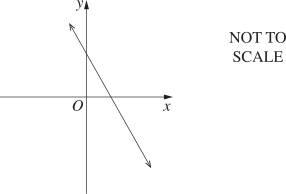
Show Answers Only
  • Catalysts are substances that increase the rate of a chemical reaction without being consumed in the process.
  • They work by providing an alternative reaction pathway with a lower activation energy, which is the energy required for the reaction to occur. Because of this, more reactant particles can successfully collide with enough energy to undergo the reaction at a given temperature.
  • As a result, the reaction occurs faster when a catalyst is present.
Show Worked Solution
  • Catalysts are substances that increase the rate of a chemical reaction without being consumed in the process.
  • They work by providing an alternative reaction pathway with a lower activation energy, which is the energy required for the reaction to occur. Because of this, more reactant particles can successfully collide with enough energy to undergo the reaction at a given temperature.
  • As a result, the reaction occurs faster when a catalyst is present.

Filed Under: Rates of Reactions Tagged With: Band 4, smc-4265-50-Catalysts

CHEMISTRY, M3 EQ-Bank 4 MC

The fruits of the cycad Macrozamia, are known to be highly toxic for consumption.

Which of the following methods conducted by Indigenous peoples is most effective in removing toxins from this cycad?

  1. Letting the seeds mature before consuming them.
  2. Removing the individual seeds from the fruit before cooking them in a fire.
  3. Cooking the seeds with fire before leaching them out in running water overnight.
  4. Removing the individual seeds from the fruit and baking them in the sun.
Show Answers Only

\(C\)

Show Worked Solution
  • Cooking of the seeds in fire helps to break down the toxins within the seeds.
  • The toxins within the seeds are soluble compounds and so the leaching process helps eliminate any remaining harmful substances as the toxins are dissolved and diffused into the water and then washed away.

\(\Rightarrow C\)

Filed Under: Chemical Reactions Tagged With: Band 4, smc-4263-50-Food detoxification

CHEMISTRY, M3 EQ-Bank 1 MC

For centuries, Indigenous Australians have used chemical processes to detoxify certain foods. The seeds of the nardoo fern (Marsilea) were a traditional food source, but they contain harmful toxins. To safely consume the seeds, they were first ground into a paste and soaked in water for several days.

Soaking the nardoo seeds aids in detoxification by:

  1. Causing the water to neutralise the harmful substances.
  2. Altering the chemical structure of the toxins through grinding.
  3. Allowing the water to remove the toxins from the paste.
  4. Increasing the temperature to speed up the breakdown of toxins.
Show Answers Only

\(C\)

Show Worked Solution
  • Water removes the toxins from nardoo fern seeds during the leaching process because the toxic substance is water-soluble, meaning they can dissolve in water.
  • When the seeds are soaked, the toxins dissolve and diffuse into the surrounding water. By changing or draining the water, the dissolved toxins are effectively removed from the food.
  • This process relies on the solubility of the toxins, and repeated soaking ensures that a significant amount of the harmful compounds is washed away, leaving the food safe for consumption.

\(\Rightarrow C\)

Filed Under: Chemical Reactions Tagged With: Band 4, smc-4263-50-Food detoxification

BIOLOGY, M3 EQ-Bank 3

"Natural selection is the architect of biodiversity."

Justify this statement. In your answer, describe how natural selection can lead to changes in a population and over time, increased biodiversity. Provide an example from the Australian ecosystems that demonstrates this relationship.   (5 marks)

--- 8 WORK AREA LINES (style=lined) ---

Show Answers Only
  • Natural selection is the architect of biodiversity as it drives the adaptation of populations to their environments, leading to the evolution of new species over time.
  • This process begins with genetic variations within a population, where individuals with traits better suited to their environment are more likely to survive and reproduce, passing these beneficial traits to their offspring.
  • Over generations, this can lead to significant changes in the population, potentially resulting in the emergence of new species adapted to specific environmental niches.
  • As populations adapt to different environments or ecological roles, the overall biodiversity increases.
  • Australian ecosystem example: the radiation of marsupials, such as the diverse kangaroo species.
  • From a common ancestor, natural selection has led to the evolution of various kangaroo species adapted to different habitats, from the large red kangaroos of the arid interior to the tree-dwelling tree-kangaroos of the rainforests.
  • Each fill a unique ecological niche and contribute to Australia’s biodiversity.
Show Worked Solution
  • Natural selection is the architect of biodiversity as it drives the adaptation of populations to their environments, leading to the evolution of new species over time.
  • This process begins with genetic variations within a population, where individuals with traits better suited to their environment are more likely to survive and reproduce, passing these beneficial traits to their offspring.
  • Over generations, this can lead to significant changes in the population, potentially resulting in the emergence of new species adapted to specific environmental niches.
  • As populations adapt to different environments or ecological roles, the overall biodiversity increases.
  • Australian ecosystem example: the radiation of marsupials, such as the diverse kangaroo species.
  • From a common ancestor, natural selection has led to the evolution of various kangaroo species adapted to different habitats, from the large red kangaroos of the arid interior to the tree-dwelling tree-kangaroos of the rainforests.
  • Each fill a unique ecological niche and contribute to Australia’s biodiversity.

Filed Under: Natural Selection Tagged With: Band 4, Band 5, smc-4309-10-Biological diversity

BIOLOGY, M3 EQ-Bank 2

  1. Define convergent evolution within the context of Darwin and Wallace's Theory of Evolution by Natural Selection.   (1 mark)

    --- 2 WORK AREA LINES (style=lined) ---

  2. Describe two key principles of natural selection that lead to convergent evolution.   (2 marks)

    --- 4 WORK AREA LINES (style=lined) ---
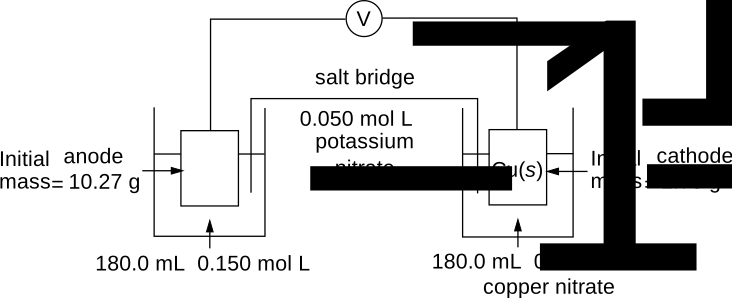
  3. Provide two examples of convergent evolution, one involving Australian fauna and one non-Australian, explaining how each demonstrates the process of natural selection.   (2 marks)

    --- 4 WORK AREA LINES (style=lined) ---
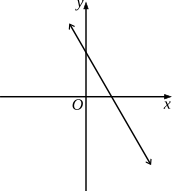
Show Answers Only

a.   Convergent evolution definition:

  • The process by which unrelated organisms develop similar traits or features as a result of adapting to similar environmental pressures or ecological niches. 

b.   Key principles that lead to convergent evolution:

  • Natural selection acts on existing variations within populations, favouring traits that enhance survival and reproduction in specific environments.
  • When unrelated organisms face similar environmental challenges, natural selection can lead to the evolution of similar adaptations, even in distantly related species.
  • This process occurs independently in each lineage, resulting in analogous structures or behaviours that serve similar functions but have different evolutionary origins. 

c.   Australian fauna (example):

  • The similarity between the marsupial Tasmanian tiger (thylacine) and the placental grey wolf is an example of convergent evolution.
  • Despite their distant relationship, both evolved similar body shapes, jaw structures, and striped patterns due to adapting to similar predatory lifestyles.  

Non-Australian (example):

  • The similar body shapes of sharks and dolphins is another example of convergent evolution.
  • Though one is a fish and the other a mammal, both have evolved streamlined bodies, dorsal fins, and tail flukes as adaptations for efficient swimming in marine environments.
  • This demonstrates how natural selection can produce similar outcomes in response to comparable environmental pressures.
Show Worked Solution

a.   Convergent evolution definition:

  • The process by which unrelated organisms develop similar traits or features as a result of adapting to similar environmental pressures or ecological niches. 

b.   Key principles that lead to convergent evolution:

  • Natural selection acts on existing variations within populations, favouring traits that enhance survival and reproduction in specific environments.
  • When unrelated organisms face similar environmental challenges, natural selection can lead to the evolution of similar adaptations, even in distantly related species.
  • This process occurs independently in each lineage, resulting in analogous structures or behaviours that serve similar functions but have different evolutionary origins. 

c.   Australian fauna (example):

  • The similarity between the marsupial Tasmanian tiger (thylacine) and the placental grey wolf is an example of convergent evolution.
  • Despite their distant relationship, both evolved similar body shapes, jaw structures, and striped patterns due to adapting to similar predatory lifestyles.  

Non-Australian (example):

  • The similar body shapes of sharks and dolphins is another example of convergent evolution.
  • Though one is a fish and the other a mammal, both have evolved streamlined bodies, dorsal fins, and tail flukes as adaptations for efficient swimming in marine environments.
  • This demonstrates how natural selection can produce similar outcomes in response to comparable environmental pressures.

Filed Under: Natural Selection Tagged With: Band 3, Band 4, Band 5, smc-4309-35-Convergent/Divergent

BIOLOGY, M3 EQ-Bank 3 MC

Which of the following groups of organisms is the best example of divergent evolution?

  1. Sharks, dolphins, and penguins
  2. Darwin's finches in the Galapagos Islands
  3. Cacti in America and euphorbia (a succulent species) in Africa
  4. Marsupial and placental mammals
Show Answers Only

\(B\)

Show Worked Solution
  • Darwin’s finches in the Galapagos Islands are a classic example of divergent evolution because they all descended from a common ancestor but evolved different beak shapes and sizes to exploit differing food sources.
  • This adaptation to different ecological niches led to the formation of distinct species from a single ancestral population.

\(\Rightarrow B\)

Filed Under: Natural Selection Tagged With: Band 4, smc-4309-35-Convergent/Divergent

BIOLOGY, M3 EQ-Bank 2 MC

Which of the following pairs of organisms best demonstrates convergent evolution?

  1. Tasmanian tiger and grey wolf
  2. Kangaroo and wallaby
  3. Eucalyptus and acacia trees
  4. Platypus and echidna
Show Answers Only

\(A\)

Show Worked Solution
  • The Tasmanian tiger (a marsupial) and grey wolf (a placental mammal) demonstrate convergent evolution because they developed similar body shapes and predatory features despite being unrelated and evolving in different parts of the world.
  • This similarity in form is due to adapting to similar ecological niches and hunting strategies.

\(\Rightarrow A\)

Filed Under: Natural Selection Tagged With: Band 4, smc-4309-35-Convergent/Divergent

BIOLOGY, M3 EQ-Bank 1

  1. Explain the difference between micro-evolution and macro-evolution, highlighting their key characteristics and relationship.   (2 marks)

    --- 5 WORK AREA LINES (style=lined) ---

  2. Provide an example of how microevolutionary changes can accumulate to drive larger evolutionary changes and potentially lead to speciation.   (2 marks)

    --- 5 WORK AREA LINES (style=lined) ---

Show Answers Only

a.   Difference between microevolution and macroevolution:

  • Microevolution refers to small-scale changes in gene frequencies within a population over time, such as changes in colour or size.
  • Macroevolution, on the other hand, involves large-scale changes that lead to the formation of new species or higher taxonomic groups.
  • While both rely on the same mechanics of change, microevolution occurs relatively quickly and can be observed within human timescales while macroevolution typically occurs over much longer periods and is inferred from fossil records. 

b.   Answers could include one of the following examples.

Evolution of the platypus:

  • Over millions of years, the evolution of the platypus saw small genetic changes accumulate.
  • This process resulted in a combination of reptilian and mammalian features, such as egg-laying and milk production.
  • These gradual changes eventually led to the emergence of a distinct species that occupies a unique ecological niche. 

Evolution of the horse:

  • Fossil evidence shows the evolution of the horse from a small, multi-toed ancestor to larger, single-toed modern horses.
  • Each small change, such as increases in size or reductions in toe number, represented micro-evolutionary steps.
  • Over millions of years, these accumulated changes resulted in the diverse horse species we see today, adapted to various environments.
Show Worked Solution

a.   Difference between microevolution and macroevolution:

  • Microevolution refers to small-scale changes in gene frequencies within a population over time, such as changes in colour or size.
  • Macroevolution, on the other hand, involves large-scale changes that lead to the formation of new species or higher taxonomic groups.
  • While both rely on the same mechanics of change, microevolution occurs relatively quickly and can be observed within human timescales while macroevolution typically occurs over much longer periods and is inferred from fossil records. 

b.   Answers could include one of the following examples.

Evolution of the platypus:

  • Over millions of years, the evolution of the platypus saw small genetic changes accumulate.
  • This process resulted in a combination of reptilian and mammalian features, such as egg-laying and milk production.
  • These gradual changes eventually led to the emergence of a distinct species that occupies a unique ecological niche. 

Evolution of the horse:

  • Fossil evidence shows the evolution of the horse from a small, multi-toed ancestor to larger, single-toed modern horses.
  • Each small change, such as increases in size or reductions in toe number, represented micro-evolutionary steps.
  • Over millions of years, these accumulated changes resulted in the diverse horse species we see today, adapted to various environments.

Filed Under: Natural Selection Tagged With: Band 4, Band 5, smc-4309-20-Micro/Macroevolution

BIOLOGY, M3 EQ-Bank 4 MC

Which of the following scenarios best demonstrates a physiological adaptation rather than a structural or behavioural adaptation in an Australian organism?

  1. A kangaroo's ability to hop at high speeds over long distances.
  2. The drought deciduousness of mulga trees in arid regions.
  3. The mallee fowl's behaviour of building and maintaining large incubation mounds.
  4. The production of cyanide compounds by Swainsona plants when grazed upon.
Show Answers Only

\(D\)

Show Worked Solution
  • Physiological adaptations refer to functions of an organism’s structural features that have evolved to help them survive in their specific environments.

\(\Rightarrow D\)

Filed Under: Adaptations Tagged With: Band 4, smc-4308-10-Structural adaptations, smc-4308-15-Physiological adaptations

BIOLOGY, M3 EQ-Bank 6

Many plants in hot climates exhibit leaf droop, where their leaves hang downwards during the hottest parts of the day.

  1. Describe this type of adaptation.   (1 mark)

    --- 1 WORK AREA LINES (style=lined) ---

  2. Provide two reasons why this adaptation might be beneficial for plants in these environments.   (2 marks)

    --- 4 WORK AREA LINES (style=lined) ---
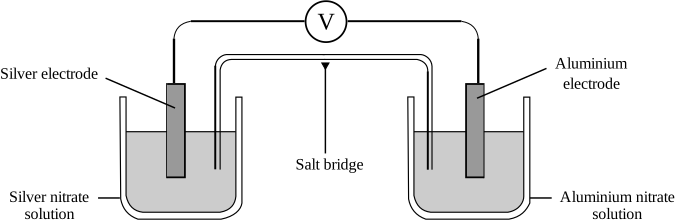
Show Answers Only

a.   Behavioural adaptation.

  • Leaf droop is classified as a behavioural adaptation because it involves a dynamic response to environmental conditions rather than a fixed structural or physiological change. 

b.   This adaption is beneficial because:

  • it reduces the surface area of the leaf directly exposed to intense sunlight, minimising water loss and protecting the leaf from heat damage.
  • when drooping leaves are arranged vertically, they direct water to the base of the plant where the roots can more efficiently absorb it. This is particularly beneficial in arid environments.
Show Worked Solution

a.   Behavioural adaptation.

  • Leaf droop is classified as a behavioural adaptation because it involves a dynamic response to environmental conditions rather than a fixed structural or physiological change. 

b.   This adaption is beneficial because:

  • it reduces the surface area of the leaf directly exposed to intense sunlight, minimising water loss and protecting the leaf from heat damage.
  • when drooping leaves are arranged vertically, they direct water to the base of the plant where the roots can more efficiently absorb it. This is particularly beneficial in arid environments.

Filed Under: Adaptations Tagged With: Band 4, Band 5, smc-4308-18-Behavioural adaptations

  • « Previous Page
  • 1
  • …
  • 31
  • 32
  • 33
  • 34
  • 35
  • …
  • 114
  • Next Page »

Copyright © 2014–2025 SmarterEd.com.au · Log in