SmarterEd

Aussie Maths & Science Teachers: Save your time with SmarterEd

  • Login
  • Get Help
  • About

PHYSICS, M7 EQ-Bank 27

Monochromatic light of wavelength `lambda` strikes a double slit and produces bright and dark fringes on a screen. Light from slit `S_1` travels along path `P_1` and light from slit `S_2` travels along `P_2` to produce the dark fringe shown.
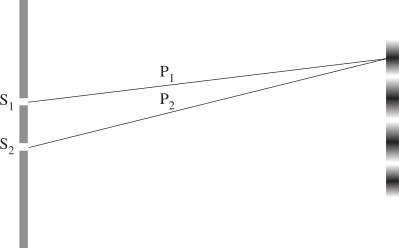
 

Calculate the difference in length between `P_1` and `P_2` ?  (2 marks)
Show Answers Only

`(3lambda)/2`

Show Worked Solution
  • Dark fringes occur when the path difference is an odd multiple of `(lambda)/2`. i.e at `(lambda)/2`, `(3lambda)/2`, `(5lambda)/2` etc.
  • This is the second dark fringe from the central maximum.
  • So, the difference in length between `P_1` and `P_2` is `(3lambda)/2`

Filed Under: Light: Wave Model Tagged With: Band 4, smc-3697-30-Double Slit Calcs

PHYSICS, M7 EQ-Bank 5 MC

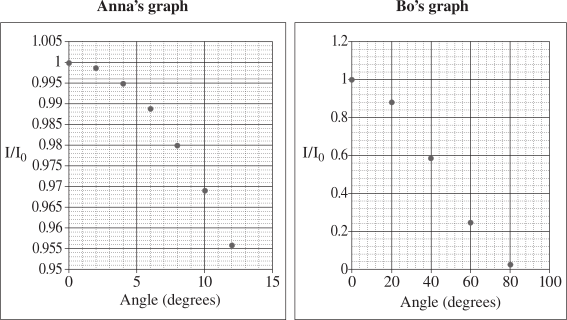
Anna and Bo carried out independent experiments to investigate Malus's Law. They graphed the results of their experiments. The graphs are shown below.
 

Based on the two graphs, which of the following is correct?

  1. Anna has taken more measurements but Bo has used a better data range.
  2. Bo's graph is more precise as the angles in Anna's graph are too small.
  3. Anna's graph is more valid as Bo's graph shows a straight line relationship.
  4. Anna's measurements are more reliable than Bo's as a line of best fit cannot be drawn for Bo's graph.
Show Answers Only

`A`

Show Worked Solution

By Elimination:

  • Anna’s graph uses too narrow an angle range whereas Bo’s graph does not include enough measurements to show a valid relationship (possibly A).
  • It is not possible to determine precision or validity without knowing the equipment used or experimental design of both experiments (eliminate B and C).
  • Reliability refers to the consistency of results and has no impact on the ability to draw a line of best fit (eliminate D).

`=>A`

Filed Under: Light: Wave Model Tagged With: Band 4, smc-3697-40-Polarisation

PHYSICS, M7 EQ-Bank 6 MC

Which statement describes how an electromagnetic wave is propagated?

  1. An oscillating electric field causes a constant magnetic field parallel to the electric field.
  2. An oscillating magnetic field causes an oscillating electric field parallel to the magnetic field.
  3. An oscillating electric field causes an oscillating magnetic field perpendicular to the electric field.
  4. An oscillating magnetic field causes a constant electric field perpendicular to the magnetic field.
Show Answers Only

`C`

Show Worked Solution
  • As per Maxwell’s predictions, an oscillating electric field induces an oscillating magnetic field perpendicular to the electric field.
  • This oscillating magnetic field induces an oscillating electric field perpendicular to it. This process continues and an electromagnetic wave is propagated.

`=>C`

Filed Under: Electromagnetic Spectrum Tagged With: Band 4, smc-3696-40-Electromagnetic Waves

PHYSICS, M7 EQ-Bank 22

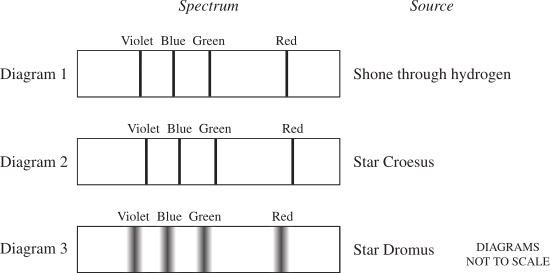
Diagram 1 shows the absorption spectrum of light produced by an incandescent filament, after it has been shone through a quantity of hydrogen gas. Diagrams 2 and 3 show the spectra obtained from two stars: Croesus and Dromus. The dark lines in the diagrams are absorption bands.
 

Explain what the spectrum of each star, Croesus and Dromus, tells us about the motion of that star.  (3 marks)

--- 6 WORK AREA LINES (style=lined) ---

Show Answers Only
  • The spectra from Croesus is red shifted which indicates it is moving away from Earth.
  • The thin spectra lines from Croesus also indicate that it is not rotating.
  • The centre of spectral lines from Dromus are blue shifted which indicates it is moving towards Earth. 
  • Dromus’ spectral lines are wide and blurry (simultaneously red and blue shifting), which indicates that it is rotating.
Show Worked Solution
  • The spectra from Croesus is red shifted which indicates it is moving away from Earth.
  • The thin spectra lines from Croesus also indicate that it is not rotating.
  • The centre of spectral lines from Dromus are blue shifted which indicates it is moving towards Earth. 
  • Dromus’ spectral lines are wide and blurry (simultaneously red and blue shifting), which indicates that it is rotating.

Filed Under: Electromagnetic Spectrum Tagged With: Band 4, smc-3696-30-Stars

PHYSICS, M7 EQ-Bank 4 MC

Betelgeuse is a red giant star in our galaxy. The following are facts about this star:

Fact 1: Its distance from us is 640 light years.

Fact 2: It has a surface temperature of 3500 K.

Fact 3: Its atmosphere contains titanium dioxide.

Fact 4: It is moving away from us at a speed of `21.9 \ text{km s}^(-1)`.

Which of the given facts about Betelgeuse CANNOT be determined from its spectrum?

  1. Fact 1
  2. Fact 2
  3. Fact 3
  4. Fact 4
Show Answers Only

`A`

Show Worked Solution

By elimination:

  • The star’s surface temperature can be found by determining the peak wavelength from its spectrum then using Wein’s Law. (Eliminate B)
  • The atmospheric composition of the star can be found by matching its spectra to the known spectra of gases. (Eliminate C)
  • Comparing the spectral lines of the star with those of corresponding compounds on Earth, the degree of red shift can be calculated. Applying the doppler effect, the recessional velocity of the star can be determined. (Eliminate D)

`=>A`

Filed Under: Electromagnetic Spectrum Tagged With: Band 4, smc-3696-30-Stars

PHYSICS, M6 EQ-Bank 27

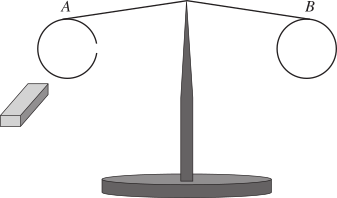
The diagram shows two rings `A` and `B`, connected to a balancing arm which swings freely on a pivot. Ring `A` has a split in it as shown.
 

When a bar magnet is pushed into one of the rings, the whole balancing arm begins to rotate on the pivot. When the magnet is pulled out, the balancing arm begins to rotate in the opposite direction. When the magnet is pushed in and out of the other ring, the apparatus does not move at all.

Account for these observations using Lenz's Law and conservation of energy.  (5 marks)

--- 15 WORK AREA LINES (style=lined) ---

Show Answers Only
  • When the magnet is pushed into ring `B`, a current is induced in the ring (Faraday’s Law). 
  • The induced current is in the direction such that the magnetic field it produces opposes the original change caused by the moving magnet (Lenz’s Law).
  • When the magnet is pushed into ring `B`, a like pole is produced which causes the magnet and the ring to repel. When the magnet is pulled out of ring `B`, an opposite pole is produced which causes the magnet and the ring to attract.
  • This is consistent with the law of conservation of energy as follows:
    • If the current were in the opposite direction then the field produced would cause a movement that increases the change in flux through the ring.
    • This would thereby produce an even greater induced current which in turn would accelerate the ring even more, in turn leading to an even greater change in flux through the ring.
    • This cycle would continue producing more kinetic and heat energy in the ring than was initially in the system thereby violating the law of conservation of energy. 
  • When the magnet is pushed into ring `A`, no movement of the ring is observed because the gap in the ring prevents a current from being induced.
  • In this instance, no magnetic field is created which means there is no attractive or repulsive force between the ring and the magnet.
Show Worked Solution
  • When the magnet is pushed into ring `B`, a current is induced in the ring (Faraday’s Law). 
  • The induced current is in the direction such that the magnetic field it produces opposes the original change caused by the moving magnet (Lenz’s Law).
  • When the magnet is pushed into ring `B`, a like pole is produced which causes the magnet and the ring to repel. When the magnet is pulled out of ring `B`, an opposite pole is produced which causes the magnet and the ring to attract.
  • This is consistent with the law of conservation of energy as follows:
    • If the current were in the opposite direction then the field produced would cause a movement that increases the change in flux through the ring.
    • This would thereby produce an even greater induced current which in turn would accelerate the ring even more, in turn leading to an even greater change in flux through the ring.
    • This cycle would continue producing more kinetic and heat energy in the ring than was initially in the system thereby violating the law of conservation of energy. 
  • When the magnet is pushed into ring `A`, no movement of the ring is observed because the gap in the ring prevents a current from being induced.
  • In this instance, no magnetic field is created which means there is no attractive or repulsive force between the ring and the magnet.

Filed Under: Applications of the Motor Effect Tagged With: Band 4, Band 5, smc-3695-60-Lenz's Law and the Law of Conservation of Energy

PHYSICS, M6 EQ-Bank 22

An 'electron gun' like that used by JJ Thomson is shown.
 

Electrons leave the cathode and are accelerated towards the anode.

  1. Show that the acceleration of the electrons as they just leave the cathode is  `4 × 10^(16) \ text{m s}^(-2)`.   (2 marks)

    --- 5 WORK AREA LINES (style=lined) ---

  1. Calculate the velocity of an electron as it reaches the anode.   (2 marks)

    --- 5 WORK AREA LINES (style=lined) ---

Show Answers Only
  1. `4 xx10^(16)  text{m s}^(-2)`
  2. `4 xx10^7  text{m s}^(-1)`
Show Worked Solution

a.   The force on the electrons is given by  `F=qE`.

The electric field strength is given by  `E=(V)/(d)`:

`F` `=(Vq)/(d)`  
`a` `=(F)/(m)`  
  `=(Vq)/(dm)`  

 
Calculate the acceleration:

`a` `=(Vq)/(dm)`  
  `=(5000 xx1.602 xx10^(-19))/(0.02 xx9.109 xx10^(-31))`  
  `=4 xx10^(16)  text{m s}^(-2)`  


b.    Using kinematic equations:

`v^(2)` `=u^(2)+2as`  
`v` `=sqrt(2as),\ \ \ (u=0)`  
  `=sqrt(2xx4xx10^(16)xx0.02)`  
  `=4 xx10^7  text{m s}^(-1)`   

Filed Under: Charged Particles, Conductors and Electric/Magnetic Fields Tagged With: Band 3, Band 4, smc-3693-10-Charged Particles in EF

PHYSICS, M6 EQ-Bank 26

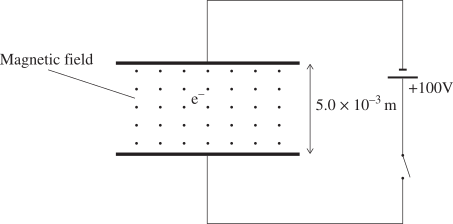
The diagram shows a stationary electron in a magnetic field. The magnetic field is surrounded by two parallel plates separated by a distance of `5.0 × 10^(-3) \ text {m}` and connected to a power supply and a switch.
 

The switch is initially open. At a later time the switch is closed.

Analyse the effects of the magnetic and electric fields on the acceleration of the electron both before and immediately after the switch is closed. In your answer, include calculation of the acceleration of the electron immediately after the switch is closed.   (5 marks)

Show Answers Only
  • Before the switch is closed, there is no electric field and so no electric force causing the electron to accelerate. As the electron is stationary, the magnetic field has no effect on it.
  • Once the switch is closed, the electric field causes the electron to accelerate down the page (towards the positive plate).
  • Calculating the acceleration of the electron immediately after the switch is closed:

`E=(V)/(d)=(100)/(0.005)=20\ 000\ text{V m}^(-1)`

`F=Eq=20\ 000 xx1.602 xx10^(-19)=3.2 xx10^(-15)  text{N}`

`a=(F)/(m)=(3.2 xx10^(-15))/(9.109 xx10^(-31))=3.5 xx10^(15)  text{m s}^(-2)  text{down page.}`

  • Now that the electron is moving, the magnetic field exerts a force on it towards the right (using the right hand palm rule).
  • The force and acceleration on the electron will increase due to its increasing velocity.
Show Worked Solution
  • Before the switch is closed, there is no electric field and so no electric force causing the electron to accelerate. As the electron is stationary, the magnetic field has no effect on it.
  • Once the switch is closed, the electric field causes the electron to accelerate down the page (towards the positive plate).
  • Calculating the acceleration of the electron immediately after the switch is closed:

`E=(V)/(d)=(100)/(0.005)=20\ 000\ text{V m}^(-1)`

`F=Eq=20\ 000 xx1.602 xx10^(-19)=3.2 xx10^(-15)  text{N}`

`a=(F)/(m)=(3.2 xx10^(-15))/(9.109 xx10^(-31))=3.5 xx10^(15)  text{m s}^(-2)  text{down page.}`

  • Now that the electron is moving, the magnetic field exerts a force on it towards the right (using the right hand palm rule).
  • The force and acceleration on the electron will increase due to its increasing velocity.

Filed Under: Charged Particles, Conductors and Electric/Magnetic Fields Tagged With: Band 4, Band 5, smc-3693-18-Combination EF and MF

PHYSICS, M6 EQ-Bank 23

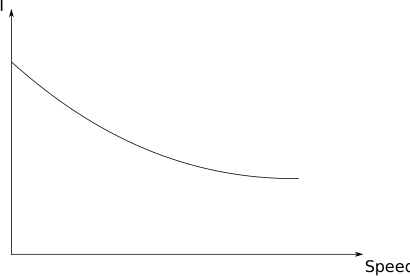
An electric motor is connected to a power supply of constant voltage. The motor runs at different speeds by adjusting a brake.

On the graph below, show the relationship between the current through the motor and its speed?  (2 marks)
   

--- 14 WORK AREA LINES (style=lined) ---

Show Answers Only

Show Worked Solution

Points to note on graph shape:

  • As the speed of the motor increases, the rate of change of magnetic flux through its coil increases.
  • This increases the induced emf in the motor (Faraday’s Law).
  • This induced emf, known as back emf acts to oppose the rotation of the motor (Lenz’s Law). 
  • The back emf opposes the current supplied to the motor and decreases the net current through the motor.

Filed Under: Applications of the Motor Effect Tagged With: Band 4, smc-3695-20-Back emf

PHYSICS, M6 EQ-Bank 3 MC

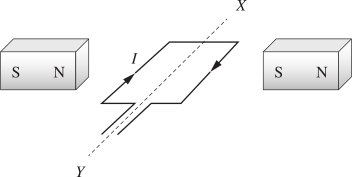
A rectangular loop of wire passes between two magnets as shown and is free to rotate about `X Y`. The loop has a current flowing through it.
 

Without changing the current, which of the following would result in the greatest increase in torque?

  1. Increase the thickness of the wire in the loop.
  2. Decrease the thickness of the wire in the loop.
  3. Extend the length of the loop in the `X Y` direction.
  4. Extend the width of the loop towards the magnets.
Show Answers Only

`D`

Show Worked Solution

Consider  `tau=rFsin theta`:

  • Extending the width of the loop towards the magnets increases the distance between the point of application of force to the coil and the axis of rotation (i.e. `r`).
  • By increasing `r`, the torque will increase.

`=>D`

Filed Under: Applications of the Motor Effect Tagged With: Band 4, smc-3695-10-Torque

PHYSICS, M6 EQ-Bank 6 MC

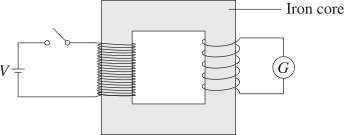
The diagram shows an ideal transformer.
 

When the switch is closed, the pointer on the galvanometer deflects.

How could the size of this deflection be increased?

  1. Decrease the number of primary coils.
  2. Decrease the number of secondary coils.
  3. Replace the iron core with a copper core.
  4. Place a resistor in series with the galvanometer.
Show Answers Only

`B`

Show Worked Solution
  • In order to increase the deflection of the galvanometer, the current through the secondary coil must increase.
  • The input power (`V_(p)I_(p)`) is fixed.
  • Since  `V_(p)I_(p)=V_(s)I_(s)`, the voltage of the secondary coil (`V_(s)`) must decrease if `I_(s)` increases.
  •   `(V_(p))/(V_(s))=(N_(p))/(N_(s))\ \ =>\ \ V_(s)=(V_(p)N_(s))/(N_(p))`
  • Reducing the number of secondary coils (`N_(s)`) will therefore decrease the secondary voltage (`V_(s)`) and consequently increase the current through the secondary coil.

`=>B`

Filed Under: Electromagnetic Induction Tagged With: Band 4, smc-3705-70-Transformer Efficiency

PHYSICS, M6 EQ-Bank 5 MC

The total flux in the core of an electrical machine is 30 mWb and its flux density is 0.6 T.

What is the cross-sectional area of the core?

  1. `0.018 \ text{m}^(2)`
  2. `0.05 \ text{m}^(2)`
  3. `20 \ text{m}^(2)`
  4. `50 \ text{m}^(2)`
Show Answers Only

`B`

Show Worked Solution
`Phi` `=BA`  
`A` `=(Phi)/(B)`  
  `=(30 xx10^(-3))/(0.6)`  
  `=50 xx10^(-3)\ text{m}^(2)`  
  `=0.05\ text{m}^(2)`  

 
`=>B`

Filed Under: Electromagnetic Induction Tagged With: Band 4, smc-3705-30-Magnetic Flux

BIOLOGY, M8 EQ-Bank 14

Glucose is a chemical that must be maintained at concentrations between 70 to 130 mg/dL in the blood in order for the body to function normally.

  1. Draw a diagram that illustrates how the body maintains blood glucose within this range.  (3 marks)

    --- 12 WORK AREA LINES (style=blank) ---

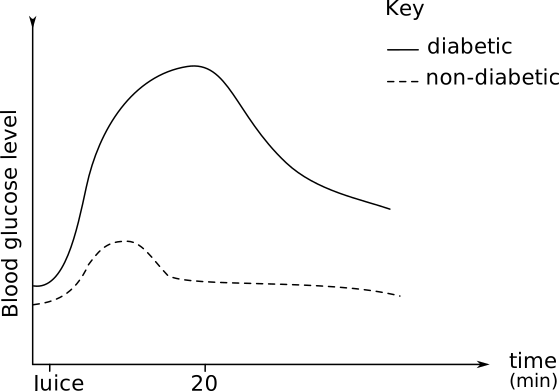
  2. Sketch a graph on the axes provided showing the expected blood glucose levels of both a healthy person and a diabetic person after consuming a fruit juice. On the same graph, show what would happen when the diabetic person injects themself with insulin 20 minutes after consuming the fruit juice.  (3 marks)


    --- 0 WORK AREA LINES (style=lined) ---

Show Answers Only

a.  

 
b.


Show Worked Solution

a.  

 
b.


Filed Under: Homeostasis Tagged With: Band 4, Band 5, smc-3659-25-BGL/Diabetes

BIOLOGY, M8 EQ-Bank 15

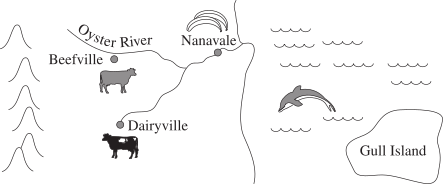
The diagram shows a rural coastal area and the towns, rivers and associated industry for each of the townships.
 

An epidemic of a disease has broken out in Nanavale. The symptoms are stomach ache, vomiting and tiredness. Many families in Nanavale have only one member with the disease, therefore it appears to be non-infectious. The symptoms are worse in infants than in adults.

Isolated cases of this disease have occurred in the nearby towns of Dairyville and Beefville. No cases have been reported on Gull Island.

Design an epidemiological study to investigate the origin of the disease. Refer to features of validity and reliability in your answer.   (7 marks)

--- 16 WORK AREA LINES (style=lined) ---

Show Answers Only
  • When planning an epidemiological study it is important to first analyse all the initial evidence to better construct an effective study.
  • The disease is most likely infectious as an outbreak that affects many people is very unlikely to be due to a previously masked non-infectious disease.
  • The fact that the disease is not present on gull island also supports this and may indicate that the disease is not waterborne and may spread through physical touch, close proximity, food or radioactive toxic elements.
  • The disease also affects children more severely. This fact must be addressed in the study and measures taken to protect and monitor this vulnerable group.
  • The study should survey affected families to try to pinpoint the transmission of the disease.
  • Appropriate fact finding questions should include
    • Where have you travelled to?
    • What have you eaten/drunk and where did you get it from?
    • Who else have you been in contact with and where are they from?
  • These results should be analysed for common factors and then compared to results from the same set of questions asked of unaffected families, thus increasing the study’s validity.
  • The more people that can be reached and questioned, the more accurate the findings of the study will be.
  • Geiger readings, screening and soil extraction may pinpoint whether the disease is caused by a carcinogen on the coastal area.
  • Common factors found in the study may also reveal an antidote or treatment for affected individuals.
Show Worked Solution
  • When planning an epidemiological study it is important to first analyse all the initial evidence to better construct an effective study.
  • The disease is most likely infectious as an outbreak that affects many people is very unlikely to be due to a previously masked non-infectious disease.
  • The fact that the disease is not present on gull island also supports this and may indicate that the disease is not waterborne and may spread through physical touch, close proximity, food or radioactive toxic elements.
  • The disease also affects children more severely. This fact must be addressed in the study and measures taken to protect and monitor this vulnerable group.
  • The study should survey affected families to try to pinpoint the transmission of the disease.
  • Appropriate fact finding questions should include
    • Where have you travelled to?
    • What have you eaten/drunk and where did you get it from?
    • Who else have you been in contact with and where are they from?
  • These results should be analysed for common factors and then compared to results from the same set of questions asked of unaffected families, thus increasing the study’s validity.
  • The more people that can be reached and questioned, the more accurate the findings of the study will be.
  • Geiger readings, screening and soil extraction may pinpoint whether the disease is caused by a carcinogen on the coastal area.
  • Common factors found in the study may also reveal an antidote or treatment for affected individuals.

Filed Under: Epidemiology Tagged With: Band 4, Band 5, Band 6, smc-3661-20-Evaluating the Method, smc-3661-30-Benefits

BIOLOGY, M8 EQ-Bank 16

How effective is renal dialysis in compensating for the loss of kidney function?   (7 marks)

--- 20 WORK AREA LINES (style=lined) ---

Show Answers Only

Normal kidney function

  • The kidneys are the main components of the mammalian urinary system. They are organs which filter blood and maintain water, pH, ion and salt concentration in the body through varying concentrations of each in excreted urine dependent on the body’s needs.
  • Each kidney contains 1 million nephrons, the main unit responsible for filtration.
  • Each one also contains a Bowman’s capsule, proximal and distal tubules as well as the Loop of Henle which acts as a site for selective re-absorption of certain components of the blood. This is controlled by both passive diffusion of unwanted substances through a concentration gradient (e.g. urea) or by hormonal control.
  • Aldosterone and ADH are hormones secreted by the hypothalamus which increase the permeability of the distal convoluted tubule to salt and water respectively.

Kidney disfunction and dialysis

  • Kidney function can however be impaired by diseases or disorders (such as polycystic kidney disease), many of which can kill affected individuals in a number of months if left untreated.
  • When kidney function drops below 80%, haemodialysis is an effective treatment to replace kidney function.
  • Haemodialysis involves the removal of blood from the body into the dialysis machine, which will clean the blood before returning it to the body. This is achieved by running a fluid known as dialysate, countercurrent to the blood.
  • The dialysate contains a similar composition to the blood with low urea and toxins to allow the passive diffusion of the substances via the concentration gradient into the dialysate. This is then removed and constantly replenished during a session. The countercurrent direction also improves effectiveness of this process. The dialysate can also be altered to have varying amounts of salt and ions depending on the concentration in the patients body.
  • Haemodialysis can provide an effective treatment for individuals until death or an effective transplant can be found, however the process often requires 3-4 sessions per week each of which is 4 hours long.
  • Without haemodialysis loss of kidney function is often fatal, but this life-saving technology is extremely effective in preventing many deaths despite its inconvenience.
Show Worked Solution

Normal kidney function

  • The kidneys are the main components of the mammalian urinary system. They are organs which filter blood and maintain water, pH, ion and salt concentration in the body through varying concentrations of each in excreted urine dependent on the body’s needs.
  • Each kidney contains 1 million nephrons, the main unit responsible for filtration.
  • Each one also contains a Bowman’s capsule, proximal and distal tubules as well as the Loop of Henle which acts as a site for selective re-absorption of certain components of the blood. This is controlled by both passive diffusion of unwanted substances through a concentration gradient (e.g. urea) or by hormonal control.
  • Aldosterone and ADH are hormones secreted by the hypothalamus which increase the permeability of the distal convoluted tubule to salt and water respectively.

Kidney disfunction and dialysis

  • Kidney function can however be impaired by diseases or disorders (such as polycystic kidney disease), many of which can kill affected individuals in a number of months if left untreated.
  • When kidney function drops below 80%, haemodialysis is an effective treatment to replace kidney function.
  • Haemodialysis involves the removal of blood from the body into the dialysis machine, which will clean the blood before returning it to the body. This is achieved by running a fluid known as dialysate, countercurrent to the blood.
  • The dialysate contains a similar composition to the blood with low urea and toxins to allow the passive diffusion of the substances via the concentration gradient into the dialysate. This is then removed and constantly replenished during a session. The countercurrent direction also improves effectiveness of this process. The dialysate can also be altered to have varying amounts of salt and ions depending on the concentration in the patients body.
  • Haemodialysis can provide an effective treatment for individuals until death or an effective transplant can be found, however the process often requires 3-4 sessions per week each of which is 4 hours long.
  • Without haemodialysis loss of kidney function is often fatal, but this life-saving technology is extremely effective in preventing many deaths despite its inconvenience.

Filed Under: Technologies and Disorders Tagged With: Band 4, Band 5, Band 6, smc-3663-10-Kidneys

BIOLOGY, M8 EQ-Bank 14

  1. Identify a disorder or disease, and describe how it affects the normal function of an organ.   (2 marks)

    --- 4 WORK AREA LINES (style=lined) ---

  2. Evaluate the effectiveness of a technology in managing the disorder or disease described in part (a).   (4 marks)

    --- 10 WORK AREA LINES (style=lined) ---

Show Answers Only

a.   Polycystic kidney disease

  • A disease in which cysts grow in the kidney.
  • This interferes with filtration and overtime, adversely affects the overall function of the kidney.

Other disorders/disease can include

  • Astigmatism, myopia or hyperopia.
  • Single sided deafness, hearing loss.

b.   Use of technology in treating polycystic kidney disease

  • Polycystic kidney disease will often progress in patients until kidney failure has occurred.
  • When 80% of kidney function is lost and a transplant cannot be found, dialysis is often the only viable option.
  • There are two types of dialysis, both of which replace the function of the kidney and clean the blood.
    • Haemodialysis is where blood is removed from the body and passed through a dialysis machine. The main component of the machine runs a special fluid known as dialysate countercurrent to the blood next to a permeable membrane. This allows the blood to effectively remove the toxins into the dialyse by diffusion. While this is extremely effective, it involves multiple visits per week and is very time consuming for the patients.
    • Peritoneal dialysis involves the flushing of dialysate directly into the abdominal cavity through a catheter. The peritoneal membrane then acts as the filter and blood is cleaned via diffusion. The dialysate containing the waste products then exits the body into another section of the catheter. In contrast to haemodialysis, this method requires a more involved initial surgery but provides the benefit of patients being able to do this by themselves at night.
  • Both forms of dialysis are extremely effective in replacing kidney function. Despite being time consuming and uncomfortable, they allow patients suffering from polycystic kidney disease to survive for extended periods, during which a transplant may become available.

Other technologies can include

  • Glasses.
  • Any form of hearing aid dependent on the ear disease/disorder, including standard hearing aids, bone conduction implants or cochlear implant.
Show Worked Solution

a.   Polycystic kidney disease

  • A disease in which cysts grow in the kidney.
  • This interferes with filtration and overtime, adversely affects the overall function of the kidney.

Other disorders/disease can include

  • Astigmatism, myopia or hyperopia.
  • Single sided deafness, hearing loss.

b.   Use of technology in treating polycystic kidney disease

  • Polycystic kidney disease will often progress in patients until kidney failure has occurred.
  • When 80% of kidney function is lost and a transplant cannot be found, dialysis is often the only viable option.
  • There are two types of dialysis, both of which replace the function of the kidney and clean the blood.
    • Haemodialysis is where blood is removed from the body and passed through a dialysis machine. The main component of the machine runs a special fluid known as dialysate countercurrent to the blood next to a permeable membrane. This allows the blood to effectively remove the toxins into the dialyse by diffusion. While this is extremely effective, it involves multiple visits per week and is very time consuming for the patients.
    • Peritoneal dialysis involves the flushing of dialysate directly into the abdominal cavity through a catheter. The peritoneal membrane then acts as the filter and blood is cleaned via diffusion. The dialysate containing the waste products then exits the body into another section of the catheter. In contrast to haemodialysis, this method requires a more involved initial surgery but provides the benefit of patients being able to do this by themselves at night.
  • Both forms of dialysis are extremely effective in replacing kidney function. Despite being time consuming and uncomfortable, they allow patients suffering from polycystic kidney disease to survive for extended periods, during which a transplant may become available.

Other technologies can include

  • Glasses.
  • Any form of hearing aid dependent on the ear disease/disorder, including standard hearing aids, bone conduction implants or cochlear implant.

Filed Under: Technologies and Disorders Tagged With: Band 3, Band 4, Band 5, smc-3663-10-Kidneys

BIOLOGY, M8 EQ-Bank 12

Polio is a disease that can both kill people and leave others scarred and disabled for life.

The poster below is part of an educational program that targets polio.

Describe the benefits of such campaigns to the broader society.   (3 marks)

Show Answers Only
  • Educational programs can take the form of school lessons, television advertisements or posters like the one above. They aim to reduce incidence of a disease by targeting and promoting the uptake of polio vaccines.
  • The poster highlights vulnerable babies, encouraging their parents to vaccinate them against the disease. It emphasises the zero cost involved to remove hurdles for positive action.
  • The benefit of the poster is that it is cheap to produce and easy to target a large group of people if placed in high foot-traffic areas.
  • Reducing polio incidence will benefit families of potential sufferers that do not become ill by allowing them to contribute to the economy and not require ongoing medical assistance.
  • Reducing polio incidence will also benefit the government through reduced health costs.
Show Worked Solution
  • Educational programs can take the form of school lessons, television advertisements or posters like the one above. They aim to reduce incidence of a disease by targeting and promoting the uptake of polio vaccines.
  • The poster highlights vulnerable babies, encouraging their parents to vaccinate them against the disease. It emphasises the zero cost involved to remove hurdles for positive action.
  • The benefit of the poster is that it is cheap to produce and easy to target a large group of people if placed in high foot-traffic areas.
  • Reducing polio incidence will benefit families of potential sufferers that do not become ill by allowing them to contribute to the economy and not require ongoing medical assistance.
  • Reducing polio incidence will also benefit the government through reduced health costs.

Filed Under: Prevention Tagged With: Band 4, smc-3662-11-Educational Programs

BIOLOGY, M7 EQ-Bank 23

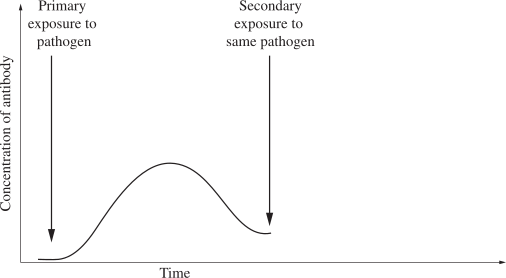
The diagram shows the immune response after primary exposure to a pathogen.
 

--- 2 WORK AREA LINES (style=blank) ---

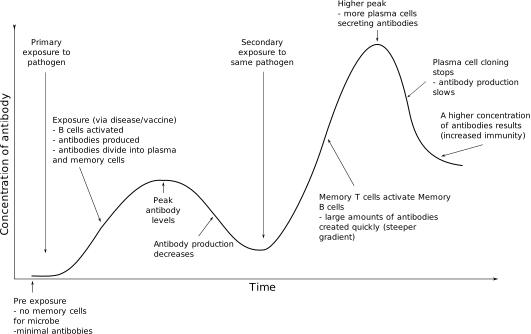
  1. On the diagram, continue the graph to show the immune response upon secondary exposure to the same pathogen.   (2 marks)
  2. Using annotations on the diagram, explain the shape of the entire graph.   (4 marks)

    --- 0 WORK AREA LINES (style=lined) ---

Show Answers Only

a. & b.

Show Worked Solution

a. & b.

Filed Under: Immunity and Responses to Pathogens Tagged With: Band 3, Band 4, Band 5, smc-3657-25-Antibodies

BIOLOGY, M8 EQ-Bank 13

A scientist performed an epidemiological study to investigate the cause and effect relationship of smoking and lung cancer as follows:

    1. Handed out a scientifically valid questionnaire to all employees at her daughter's high school (n=96)
    2. Checked that there were an equal number of male and female respondents
    3. Discovered that there were more non-smoking respondents than smoking respondents. Removed some of the non-smokers until both groups had equal numbers
    4. Required all respondents to have a general check up from their doctor before participating 
    5. Analysed data, wrote the paper and published it in a scientific blog

From the information provided, assess the suitability of the methodology for this investigation.   (5 marks)

--- 10 WORK AREA LINES (style=lined) ---

Show Answers Only
  • This study cannot be referred to as a suitable comparison between smoking and lung cancer due to several flaws in its methodology.
  • The sample size of the study is too small and confined to one workplace.
  • The participants should represent a number of equal categories such as age and ethnicity, not just equal representation of males and females.
  • The fact that participants were removed in order to create equal smoking/non-smoking categories reduces the validity of the findings.
  • The medical check ups should not be general and instead be in relation to the study such as cancer and lung checks.
  • The study will also benefit from peer review.
Show Worked Solution
  • This study cannot be referred to as a suitable comparison between smoking and lung cancer due to several flaws in its methodology.
  • The sample size of the study is too small and confined to one workplace.
  • The participants should represent a number of equal categories such as age and ethnicity, not just equal representation of males and females.
  • The fact that participants were removed in order to create equal smoking/non-smoking categories reduces the validity of the findings.
  • The medical check ups should not be general and instead be in relation to the study such as cancer and lung checks.
  • The study will also benefit from peer review.

Filed Under: Epidemiology Tagged With: Band 4, Band 5, smc-3661-20-Evaluating the Method

BIOLOGY, M8 EQ-Bank 7 MC

A patient has experienced an injury that affected the retina of her eye. She asked her doctor if LASIK eye surgery could help restore her sight. The doctor said that LASIK eye surgery would have no impact on her condition.

Why did the doctor give this advice?

  1. LASIK eye surgery is a replacement of the lens in the eye and cannot repair a retina
  2. LASIK eye surgery will only temporarily repair her retina and her vision problems would return
  3. LASIK eye surgery is only used for people who have a damaged cornea and cannot repair a retina
  4. LASIK eye surgery is only used to change the shape of the cornea to enhance vision and cannot repair a retina
Show Answers Only

`D`

Show Worked Solution

`=>D`

Filed Under: Technologies and Disorders Tagged With: Band 4, smc-3663-20-Eyes

BIOLOGY, M8 EQ-Bank 6 MC

A patient has been diagnosed with severe hearing loss in the inner ear.

Which type of hearing technology can be used to help restore the patient's hearing?

  1. Hearing aid
  2. Cochlear implant
  3. Artificial ear drum
  4. Bone conduction implant
Show Answers Only

`B`

Show Worked Solution
  • The cochlear implant can bypass the cochlear and send electric impulses directly to the auditory nerve.

`=>B`

Filed Under: Technologies and Disorders Tagged With: Band 4, smc-3663-30-Ears

BIOLOGY, M8 EQ-Bank 7 MC

For many years, some cigarette companies have denied that there were increased risks of lung cancer as a result of cigarette smoking.

How can an epidemiological study into lung cancer be useful in this situation?

  1. It can show that the chemicals in cigarette smoke cause cancer.
  2. It can demonstrate that second-hand smoke has no impact on lung cancer rates.
  3. It can provide evidence that people who smoke are more likely to develop lung cancer.
  4. It can show that the cigarette companies have been lying about the cause of lung cancer.
Show Answers Only

`C`

Show Worked Solution
  • An epidemiological study will gather statistics surrounding smoking and lung cancer.
  • The data will then be analysed and conclusions drawn to show that a link between them exists.

`=>C`

Filed Under: Epidemiology Tagged With: Band 4, smc-3661-30-Benefits

BIOLOGY, M8 EQ-Bank 1 MC

The diagram shows a homeostatic mechanism in a mammal.


What does X represent in the diagram?

  1. The brain
  2. The heart
  3. A thermoreceptor in the skin
  4. A pressure receptor in a blood vessel
Show Answers Only

`A`

Show Worked Solution
  • The brain (more specifically the hypothalamus) is the organ responsible for the detection of a change in body temperature.

`=>A`

Filed Under: Homeostasis Tagged With: Band 4, smc-3659-15-Temperature

BIOLOGY, M7 EQ-Bank 26

The immune system's primary role is to defend against pathogens. For this to be effective the immune system must be able to recognise cells that belong to the body and cells that do not.

  1. Describe the mechanism that the immune system uses to distinguish between body cells and potential pathogens. Support your answer with an example.   (3 marks)

    --- 8 WORK AREA LINES (style=lined) ---

  2. Explain why this mechanism means that patients who receive an organ donation require immune suppression drugs.   (3 marks)

    --- 8 WORK AREA LINES (style=lined) ---

Show Answers Only

a.    Immune system blood type mechanisms

  • Every cell has proteins on its surface which the body can use to distinguish them from self and non-self.
  • The body’s own cells produce a specific composition of surface proteins referred to as the major histocompatibility complex (MHC), as opposed to other proteins which are not recognised by the immune system and are called antigens.
  • This provides the basis of blood types, where A and B are specific surface proteins while O is blood with no surface proteins.
  • AB blood type individuals are therefore universal recipients, as their immune system has recognised both A and B proteins as self. This also explains why type O individuals are universal donors as their blood has no surface proteins, hence type O, A, B and AB individuals will not recognise it as foreign.
     

b.    Immune systems detect new donated organs as foreign bodies.

  • When foreign cells/material are detected by the body, an immune response will attempt to kill or remove it from the body.
  • The same scenario occurs during an organ transplant, as the donor’s MHC complex is different to that of the recipient.
  • To counteract this, specialists run genetic testing on donors as well as the recipient to find people with a similar chromosome 6 genetic sequence. MHC is coded by genes found on this chromosome and compatible organ donors are often family members.
  • As a precaution, specialists administer immune suppression drugs which will slow the patient’s immune response, reducing the chance of an attack on the donated organ.
Show Worked Solution

a.    Immune system blood type mechanisms

  • Every cell has proteins on its surface which the body can use to distinguish them from self and non-self.
  • The body’s own cells produce a specific composition of surface proteins referred to as the major histocompatibility complex (MHC), as opposed to other proteins which are not recognised by the immune system and are called antigens.
  • This provides the basis of blood types, where A and B are specific surface proteins while O is blood with no surface proteins.
  • AB blood type individuals are therefore universal recipients, as their immune system has recognised both A and B proteins as self. This also explains why type O individuals are universal donors as their blood has no surface proteins, hence type O, A, B and AB individuals will not recognise it as foreign. 

b.    Immune systems detect new donated organs as foreign bodies.

  • When foreign cells/material are detected by the body, an immune response will attempt to kill or remove it from the body.
  • The same scenario occurs during an organ transplant, as the donor’s MHC complex is different to that of the recipient.
  • To counteract this, specialists run genetic testing on donors as well as the recipient to find people with a similar chromosome 6 genetic sequence. MHC is coded by genes found on this chromosome and compatible organ donors are often family members.
  • As a precaution, specialists administer immune suppression drugs which will slow the patient’s immune response, reducing the chance of an attack on the donated organ.

Filed Under: Immunity and Responses to Pathogens Tagged With: Band 4, Band 5, smc-3657-10-Antibody Mediated, smc-3657-20-Cell Mediated

BIOLOGY, M7 EQ-Bank 25

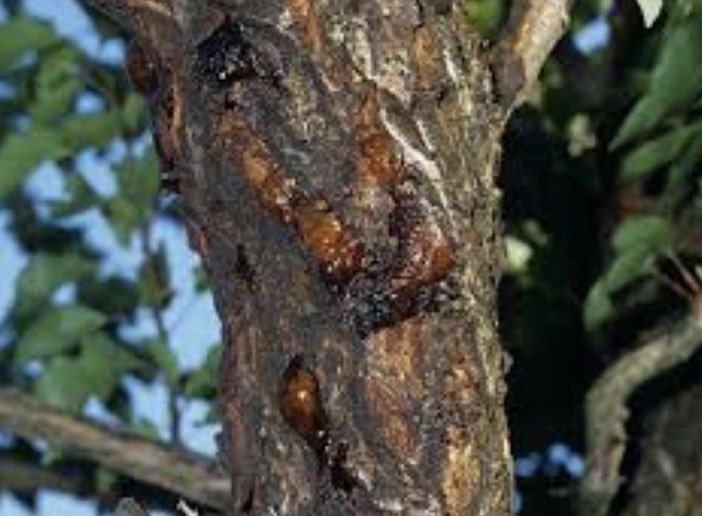
A silver birch tree, Butula pendula, has been attacked by a fungal stem canker. Fungal cankers are opportunistic plant pathogens that gain access to the inner layers of the stem as a result of damage to the protective outer layer of bark. The inner layers provide suitable conditions for the fungus to grow. Once established it destroys the bark cells that protect the tree. The tree responds to the presence of the canker under its bark by producing an excess of resinous sap at the wound site.
 

  1. Using the information provided, suggest a hypothesis to explain how the tree is responding to the presence of the canker.   (2 marks)
    --- 4 WORK AREA LINES (style=lined) ---

  2. Consider another plant with a different response to a specific pathogen.
  3. Compare the necessity and limitations of this plant's response with the response of the birch tree described above.   (4 marks)

    --- 8 WORK AREA LINES (style=lined) ---

Show Answers Only

a.    Hypothesis of birch tree response:

  • Excess sap production alters the growth conditions of the canker.
  • The sap will change the chemical environment around the wound site and inflame the site to reduce the spread of the pathogen, much similar to inflammation in humans. 

b.   Red river gum comparison

  • The river red gum responds to halo leaf spot cankers by dropping its leaves.
  • While this means the tree will have to expend energy and resources regrowing leaves, it simultaneously counteracts the canker as it blocks the ability of the leaves to photosynthesise.
  • By dropping the affected leaves, the tree can grow them quicker than if the leaves were left to die.
  • The birch tree will counteract a stem canker by producing excess sap. While this may not completely get rid of any pathogens, the tree cannot simply remove its own stems like the river red gum.
  • This method isolates the infected area, similar to inflammation, retarding its growth and potentially killing the fungus.
  • The isolation reduces the canker’s ability to adversely effect the birch tree’s supply of water and nutrients via the xylem and phloem of the tree.
  • This process occurs with the canker still attached to the tree, making the fungus relatively more difficult to kill.
Show Worked Solution

a.    Hypothesis of birch tree response:

  • Excess sap production alters the growth conditions of the canker.
  • The sap will change the chemical environment around the wound site and inflame the site to reduce the spread of the pathogen, much similar to inflammation in humans. 

b.   Red river gum comparison

  • The river red gum responds to halo leaf spot cankers by dropping its leaves.
  • While this means the tree will have to expend energy and resources regrowing leaves, it simultaneously counteracts the canker as it blocks the ability of the leaves to photosynthesise.
  • By dropping the affected leaves, the tree can grow them quicker than if the leaves were left to die.
  • The birch tree will counteract a stem canker by producing excess sap. While this may not completely get rid of any pathogens, the tree cannot simply remove its own stems like the river red gum.
  • This method isolates the infected area, similar to inflammation, retarding its growth and potentially killing the fungus.
  • The isolation reduces the canker’s ability to adversely effect the birch tree’s supply of water and nutrients via the xylem and phloem of the tree.
  • This process occurs with the canker still attached to the tree, making the fungus relatively more difficult to kill.

Filed Under: Immunity and Responses to Pathogens Tagged With: Band 4, Band 5, smc-3657-40-Plant Responses

BIOLOGY, M7 EQ-Bank 11

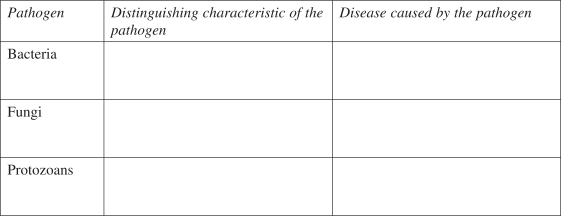
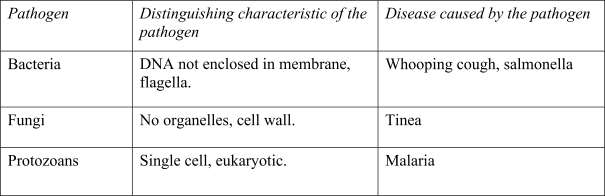
Complete the following table to show the distinguishing characteristic of each pathogen and a disease caused by each.   (3 marks)
 

--- 0 WORK AREA LINES (style=lined) ---

Show Answers Only

Show Worked Solution

Filed Under: Causes of Infectious Disease Tagged With: Band 4, smc-3655-10-Classifying Pathogens

BIOLOGY, M7 EQ-Bank 7 MC

How do vaccinations prevent disease?

  1. They increase the inflammation process.
  2. They enable the infected cells to seal off the pathogen.
  3. They increase the number of antibodies against the pathogen.
  4. They decrease the number of antigens that trigger the immune response.
Show Answers Only

`C`

Show Worked Solution
  • Vaccines stimulate the immune response, encouraging the division of B cells and therefore producing more antibodies.

`=>C`

Filed Under: Prevention, Treatment and Control Tagged With: Band 4, smc-3658-20-Vaccines

BIOLOGY, M7 EQ-Bank 9 MC

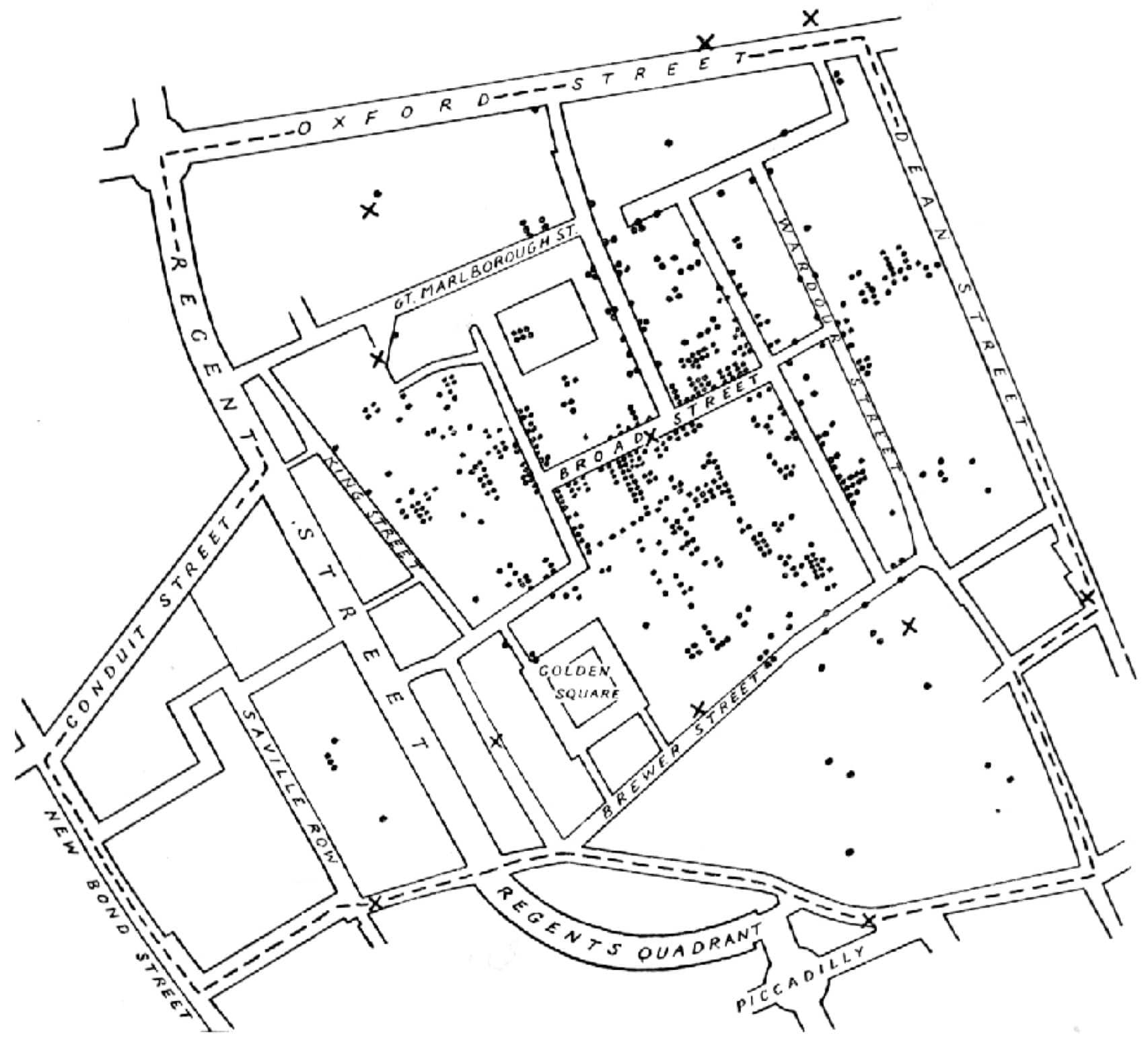
The map shown was drawn by Dr John Snow during the 1854 London cholera epidemic.
 

The dots indicate people who died from cholera and the crosses indicate the location of water pumps.

Which of the following is the most likely hypothesis for which Dr John Snow was gathering evidence?

  1. That the outbreak of cholera was caused by people living near each other
  2. That the people who died from cholera drank water from the Broad Street pump
  3. That cholera was caused by an infectious agent that can be found and transmitted in water
  4. That the cause of a disease can be determined by mapping the location of infected patients
Show Answers Only

`C`

Show Worked Solution
  • The outbreak was mainly centralised around the Broad Street water pump.
  • Snow therefore hypothesised that cholera may be caused by a pathogen in the water, hence mainly affecting people that used and drank the water from the infected pump.

`=>C`

Filed Under: Prevention, Treatment and Control Tagged With: Band 4, smc-3658-40-Interpreting Data

BIOLOGY, M7 EQ-Bank 4 MC

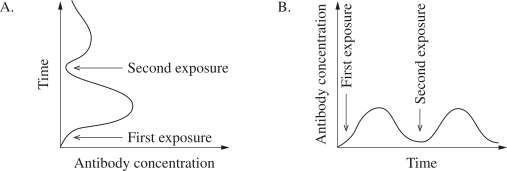
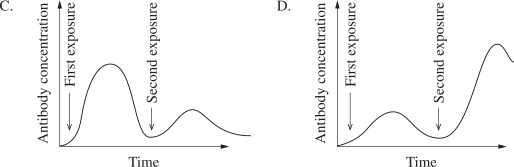
A student was vaccinated for rubella when they were 13 . Three years later, they were exposed to the active rubella virus.

Which graph best represents the student's production of antibodies over time?


Show Answers Only

`D`

Show Worked Solution
  • When exposed to a pathogen for a second time, memory B cells can produce more antibodies in a shorter amount of time, providing the basis of immunity.
  • The initial exposure represents the vaccine, and second represents the exposure 3 years later.

`=>D`

Filed Under: Immunity and Responses to Pathogens Tagged With: Band 4, smc-3657-10-Antibody Mediated, smc-3657-25-Antibodies

BIOLOGY, M7 EQ-Bank 5 MC

When a foreign body breaches the first line of defence the mast cells produce histamines in response.

What is the role of histamines in the defence of the body?

  1. To attack the invading pathogen
  2. To activate B and T lymphocytes of the specific immune response
  3. To activate the inflammation response and increase blood flow to the affected area
  4. To retain information on a pathogen's antigen so that the immune system can respond quickly to any subsequent infection
Show Answers Only

`=>C`

Show Worked Solution
  • Histamines are the chemicals released by a mast cell in response to tissue damage.
  • They increase blood flow by dilating blood vessels and increasing permeability of capillaries.

`=>C`

Filed Under: Immunity and Responses to Pathogens Tagged With: Band 4, smc-3657-30-Innate Response (2nd Line)

BIOLOGY, M7 EQ-Bank 3 MC

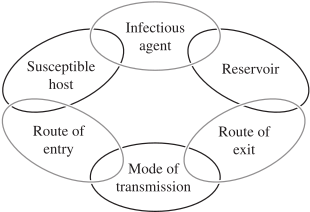
The diagram shows a model of disease transmission.
 

A pathogen was identified as being unadapted to dry conditions and as having the gastrointestinal tract as the 'route of entry' and the 'route of exit'.

Using this information, what is the most likely mode of transmission?

  1. Skin to skin contact
  2. Coughing or sneezing
  3. Contaminated water supplies
  4. Transmission of infected blood products
Show Answers Only

`C`

Show Worked Solution
  • The pathogen is most likely to have adapted to be transmitted through conditions which are moist and can be more effective at entering through the gastrointestinal tract.

`=>C`

Filed Under: Causes of Infectious Disease Tagged With: Band 4, smc-3655-20-Transmission, smc-3655-40-Pathogen Adaptations

BIOLOGY, M6 EQ-Bank 28

Describe how technological developments led to the advancement of our knowledge and understanding of inheritance. Support your answer with examples.   (7 marks)

--- 16 WORK AREA LINES (style=lined) ---

Show Answers Only
  • Artificial pollination is the process by which pollen with known characteristics is manually applied to another plant with known genotypes anther.
  • This is used in agriculture to preserve favourable characteristics in plants. However, it can also be used to study inheritance patterns and genotype/phenotype relationships.
  • Mendel used this process to investigate ‘pure-breeding’ individuals/plants (ones which always produce the same offspring) to develop the idea of recessive and dominant alleles and the offspring they produced depending on the genotype. This laid the basis for the concept of ‘Mendelian ratios’.
  • Mendel used artificial pollination on purple and white pea plants which were known pure-breeding plants and found that all the offspring (F1 Generation) were purple, determining that the purple allele was dominant.
  • When he again used artificial pollination between F1 Generation plants, he found that it always produced 3/4 of purple plants and 1/4 white. This showed that F1 Generation purple plants were not pure-breed and instead ‘heterozygous’ and contained a masked allele for the white colour. This 3:1 ratio is what became known as a Mendelian ratio. 

Other suggested examples include:

  • Gene editing technology CRISPR
  • Microscopy and staining – behaviour of chromosomes (Sutton and Boveri)
  • X‐ray crystallography and DNA structure (Rosalind Franklin)
  • Radiation – one gene, one polypeptide (Beadle and Tatum)
Show Worked Solution
  • Artificial pollination is the process by which pollen with known characteristics is manually applied to another plant with known genotypes anther.
  • This is used in agriculture to preserve favourable characteristics in plants. However, it can also be used to study inheritance patterns and genotype/phenotype relationships.
  • Mendel used this process to investigate ‘pure-breeding’ individuals/plants (ones which always produce the same offspring) to develop the idea of recessive and dominant alleles and the offspring they produced depending on the genotype. This laid the basis for the concept of ‘Mendelian ratios’.
  • Mendel used artificial pollination on purple and white pea plants which were known pure-breeding plants and found that all the offspring (F1 Generation) were purple, determining that the purple allele was dominant.
  • When he again used artificial pollination between F1 Generation plants, he found that it always produced 3/4 of purple plants and 1/4 white. This showed that F1 Generation purple plants were not pure-breed and instead ‘heterozygous’ and contained a masked allele for the white colour. This 3:1 ratio is what became known as a Mendelian ratio. 

Other suggested examples include:

  • Gene editing technology CRISPR
  • Microscopy and staining – behaviour of chromosomes (Sutton and Boveri)
  • X‐ray crystallography and DNA structure (Rosalind Franklin)

Filed Under: Genetic Technologies Tagged With: Band 4, Band 5, smc-3654-30-Benefits, smc-3654-51-Reproductive Technologies

BIOLOGY, M6 EQ-Bank 25

A woman recently conceived a baby guaranteed to be free from hereditary breast cancer. Doctors screened for an embryo that was free from a gene that can cause breast cancer.

The screening was performed due to the long history of this form of cancer in the family and the fact that any daughter born with the gene would have a 50-80% chance of developing breast cancer.

  1. Explain the possible impact of this reproductive technology on the genetic composition of the population.   (2 marks)
    --- 5 WORK AREA LINES (style=lined) ---

  2. Discuss the use of this genetic technology in the treatment of medical conditions.   (3 marks)
    --- 6 WORK AREA LINES (style=lined) ---

Show Answers Only

a.    Impact on genetic composition of population

  • This use of this technology will reduce the frequency of the gene that is likely to produce breast cancer in the population.
  • In the longer term, proceeding generations of offspring will also not have the gene, resulting in fewer people suffering from breast cancer. 

b.    Genetic technology treatments

  • Genetic technologies are a great tool against preventing life-threatening genetic diseases, as well as being used as a treatment for other serious conditions such as cancer.
  • These genetic technologies can treat and potentially cure many genetic conditions, improving life expectancy, quality of life and reducing incidence. 
  • Although many of the treatments are expensive upfront, they can reduce future ongoing medical costs.
  • Genetic technologies are relatively new and experimental on humans. This poses a risk of unknown side-effects later on in the patient’s life.
  • Scepticism surrounding many genetic technologies has brought up several ethical considerations including the unnatural attributes of the procedures and concerns of personal liberty and choice.
Show Worked Solution

a.    Impact on genetic composition of population

  • This use of this technology will reduce the frequency of the gene that is likely to produce breast cancer in the population.
  • In the longer term, proceeding generations of offspring will also not have the gene, resulting in fewer people suffering from breast cancer. 

b.    Genetic technology treatments

  • Genetic technologies are a great tool against preventing life-threatening genetic diseases, as well as being used as a treatment for other serious conditions such as cancer.
  • These genetic technologies can treat and potentially cure many genetic conditions, improving life expectancy, quality of life and reducing incidence. 
  • Although many of the treatments are expensive upfront, they can reduce future ongoing medical costs.
  • Genetic technologies are relatively new and experimental on humans. This poses a risk of unknown side-effects later on in the patient’s life.
  • Scepticism surrounding many genetic technologies has brought up several ethical considerations including the unnatural attributes of the procedures and concerns of personal liberty and choice.

Filed Under: Biotechnology Tagged With: Band 4, Band 5, smc-3653-20-Evaluating Genetic Technology

BIOLOGY, M6 EQ-Bank 24

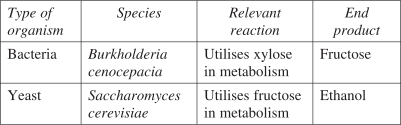
The yeast Saccharomyces cerevisiae cannot naturally ferment the sugar xylose. Low value biomass, such as straw and wood fibres, contains up to 20% xylose. S. cerevisiae was modified to enable it to produce ethanol from xylose. Information on the two species involved in making the modified S. cerevisiae is shown in the table.
 

  1. Explain why biotechnology was needed to modify S. cerevisiae.   (2 marks)
    --- 5 WORK AREA LINES (style=lined) ---

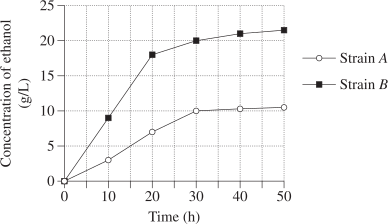
  2. Two strains of genetically modified S.cerevisiae were produced. The two strains were compared under the same conditions. The results are shown.


  3. Justify which of these two strains would be better to use to produce commercial quantities of ethanol using low value biomass. In your answer, refer to information from the graph.   (3 marks)

    --- 6 WORK AREA LINES (style=lined) ---

Show Answers Only

a.    The table shows that the organisms are from different genera.

  • Genetic material generally can’t be transferred between organisms of different genera.
  • Genetic technology was therefore needed to cut out and insert the required genes from B. cenocepacia to create the genetically modified S. cerevisiae as this process could not occur naturally. 

b.    Best strain for commercial production

  •  Strain B would be the more effective strain to use as it consistently produces double the ethanol of Strain A.
  • This can be seen even at the plateau of both strains, where at 30 hrs Strain B produced 20g/L of ethanol whilst Strain A only produced 10g/L.
  • These data in the graph indicates that Strain B will be more efficient at producing commercial ethanol in any given time-frame.
Show Worked Solution

a.    The table shows that the organisms are from different genera.

  • Genetic material generally can’t be transferred between organisms of different genera.
  • Genetic technology was therefore needed to cut out and insert the required genes from B. cenocepacia to create the genetically modified S. cerevisiae as this process could not occur naturally. 

b.    Best strain for commercial production

  •  Strain B would be the more effective strain to use as it consistently produces double the ethanol of Strain A.
  • This can be seen even at the plateau of both strains, where at 30 hrs Strain B produced 20g/L of ethanol whilst Strain A only produced 10g/L.
  • These data in the graph indicates that Strain B will be more efficient at producing commercial ethanol in any given time-frame.

Filed Under: Biotechnology, Genetic Technologies Tagged With: Band 4, Band 5, smc-3653-20-Evaluating Genetic Technology, smc-3654-05-Transgenic Organisms, smc-3654-20-Agriculture

BIOLOGY, M6 EQ-Bank 23

'The application of reproductive technologies in plant and animal breeding limits genetic diversity.'

To what extent is this statement correct?   (6 marks)

--- 14 WORK AREA LINES (style=lined) ---

Show Answers Only
  • Reproductive technologies intervene in natural reproduction and allow offspring with a higher chance of favourable characteristics.
  • Examples includes artificial insemination in animals, artificial pollination in plants, as well as IVF and selective breeding.
  • In all the above processes, male gametes with favourable traits are isolated and delivered into the reproductive system of selected females using technology.
  • The processes greatly increase the number of offspring generated by one parent, thus decreasing the genetic variability amongst them.
  • The repetitive use of the same male gametes across generations will eventually reduce the genetic diversity amongst the entire species, as the favoured characteristics will increase and less favourable alleles will be lost.
  • It should be noted that these technologies can also increase genetic diversity of a species through the collection and transportation of male gametes. This process helps genes to overcome geographical and time barriers, allowing for genotypes and hybrids which would otherwise not be possible by natural processes.
Show Worked Solution
  • Reproductive technologies intervene in natural reproduction and allow offspring with a higher chance of favourable characteristics.
  • Examples includes artificial insemination in animals, artificial pollination in plants, as well as IVF and selective breeding.
  • In all the above processes, male gametes with favourable traits are isolated and delivered into the reproductive system of selected females using technology.
  • The processes greatly increase the number of offspring generated by one parent, thus decreasing the genetic variability amongst them.
  • The repetitive use of the same male gametes across generations will eventually reduce the genetic diversity amongst the entire species, as the favoured characteristics will increase and less favourable alleles will be lost.
  • It should be noted that these technologies can also increase genetic diversity of a species through the collection and transportation of male gametes. This process helps genes to overcome geographical and time barriers, allowing for genotypes and hybrids which would otherwise not be possible by natural processes.

Filed Under: Genetic Technologies Tagged With: Band 4, Band 5, smc-3654-10-Genetic Diversity

BIOLOGY, M6 EQ-Bank 27

Compare the processes and effects of point mutations and chromosomal mutations. Include examples in your answer.   (8 marks)

--- 20 WORK AREA LINES (style=lined) ---

Show Answers Only
  • Mutations are the change in an individuals genome. Their effects are dependent on
    • the location of the mutation. Mutations in coding DNA can affect proteins and have adverse physiological affects while mutations in non-coding DNA often have no affect, however may slightly impact cell activity.
    • the type of cell it occurs in. Somatic cell mutations only affect the individual, while germ-line mutations occur in germ-line cells which go on to produce gametes, thus potentially affecting offspring. 
  • Point mutations are mutations which change only a single base in a DNA sequence. They can be a single base substitution or the deletion or insertion of an extra base. Deletion or insertions are referred to as ‘frameshift’ mutations as they impact all codons proceeding it.
  • Sometimes substitution mutations are neutral and occur in non-coding DNA, code for an amino acid of very similar chemical composition or even code for the same amino acid. When a mutation does code for a dissimilar amino acid or a stop codon causing premature termination, this interferes with the shape of the polypeptide chain and the protein it becomes part of, rendering it faulty or completely unusable (e.g. sickle cell anaemia, NRAS mutation). The nature of frameshift mutations affecting every codon proceeding it are often more severe, as there is more potential to cause a faulty polypeptide chain (e.g. cystic fibrosis).
  • Chromosomal mutations can refer to the removal, insertion, translocation or inversion of large sections of a chromosome. These often affect genes by either splitting them up or relocating them to a new chromosome.
  • Chromosomal mutations can also refer to the relocation of entire chromosomes during meiosis of germ-line cells where they fail to separate. This is called non-disjunction and results in aneuploidy of two gametes, one which will result in having an extra chromosome (trisomy) and one will lack a chromosome (monosomy). Conditions such as Down’s syndrome (trisomy-21) or Turner syndrome (XO) are aneuploidy conditions but most often cause a miscarriage or unsuccessful zygote development.
  • Polyploidy is the complete development of an entirely new set of chromosomes. This is known to occur in strawberries which have 8 sets of chromosomes but cannot occur in humans.
  • While both can cause radical health defects, it is important to note that these mutations are the basis of evolution. Beneficial mutations are more likely to be carried through a species through generations according to natural selection.
Show Worked Solution
  • Mutations are the change in an individuals genome. Their effects are dependent on
    • the location of the mutation. Mutations in coding DNA can affect proteins and have adverse physiological affects while mutations in non-coding DNA often have no affect, however may slightly impact cell activity.
    • the type of cell it occurs in. Somatic cell mutations only affect the individual, while germ-line mutations occur in germ-line cells which go on to produce gametes, thus potentially affecting offspring. 
  • Point mutations are mutations which change only a single base in a DNA sequence. They can be a single base substitution or the deletion or insertion of an extra base. Deletion or insertions are referred to as ‘frameshift’ mutations as they impact all codons proceeding it.
  • Sometimes substitution mutations are neutral and occur in non-coding DNA, code for an amino acid of very similar chemical composition or even code for the same amino acid. When a mutation does code for a dissimilar amino acid or a stop codon causing premature termination, this interferes with the shape of the polypeptide chain and the protein it becomes part of, rendering it faulty or completely unusable (e.g. sickle cell anaemia, NRAS mutation). The nature of frameshift mutations affecting every codon proceeding it are often more severe, as there is more potential to cause a faulty polypeptide chain (e.g. cystic fibrosis).
  • Chromosomal mutations can refer to the removal, insertion, translocation or inversion of large sections of a chromosome. These often affect genes by either splitting them up or relocating them to a new chromosome.
  • Chromosomal mutations can also refer to the relocation of entire chromosomes during meiosis of germ-line cells where they fail to separate. This is called non-disjunction and results in aneuploidy of two gametes, one which will result in having an extra chromosome (trisomy) and one will lack a chromosome (monosomy). Conditions such as Down’s syndrome (trisomy-21) or Turner syndrome (XO) are aneuploidy conditions but most often cause a miscarriage or unsuccessful zygote development.
  • Polyploidy is the complete development of an entirely new set of chromosomes. This is known to occur in strawberries which have 8 sets of chromosomes but cannot occur in humans.
  • While both can cause radical health defects, it is important to note that these mutations are the basis of evolution. Beneficial mutations are more likely to be carried through a species through generations according to natural selection.

Filed Under: Mutation Tagged With: Band 4, Band 5, smc-3652-30-Point Mutations, smc-3652-40-Chromosomal Mutations, smc-3652-55-Mutation in Reproduction

BIOLOGY, M6 EQ-Bank 22

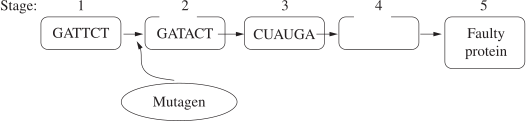
The flow chart illustrates the effect of a point mutation on an organism.
 

  1. Outline the series of events from stages 2 to 4 that resulted in the faulty protein.   (3 marks)

    --- 5 WORK AREA LINES (style=lined) ---

  2. Describe how a type of mutagen may have caused the changes observed in stage 2.   (2 marks)

    --- 5 WORK AREA LINES (style=lined) ---

  3. Given the information in the chart shown, describe the effect caused by the mutation in stage 4 and the effect this would have on the organism.   (3 marks)


    --- 6 WORK AREA LINES (style=lined) ---

Show Answers Only

a.    Events causing faulty protein:

  • Stage 2: A mutagen causes a point mutation in the DNA.
  • Stage 3: The mutated DNA transcription into mRNA.
  • Stage 4: The translation of the mRNA into a polypeptide chain which is not functional due to the mutation.

b.    Possible causes of Stage 2 observed changes:

  • High frequency photons including gamma and X-rays are regarded as ionising radiation due to their extremely high energy.
  • They can interfere with DNA undergoing replication causing misalignment and a possible substation change.
  • High energy gamma radiation may also cause mutation when directly striking a nitrogenous base.  

Answers could also include

  • Chemical mutagens (alkylating, delaminating and structurally similar chemicals).
  • Carcinogenic metals/elements (radon, cadmium)

c.   Effects of Stage 4 mutation:

  • When considering the above sequence as 2 codons, the chart shows us that this mutation results in an arginine amino becoming a stop codon.
  • This mutation will hence cause a premature termination of the polypeptide and result in a non-functional polypeptide/protein it forms a part of.
  • Due to the severity of this type of mutation it usually results in extensive health complications for affected individuals.
Show Worked Solution

a.    Events causing faulty protein:

  • Stage 2: A mutagen causes a point mutation in the DNA.
  • Stage 3: The mutated DNA transcription into mRNA.
  • Stage 4: The translation of the mRNA into a polypeptide chain which is not functional due to the mutation.

b.    Possible causes of Stage 2 observed changes:

  • High frequency photons including gamma and X-rays are regarded as ionising radiation due to their extremely high energy.
  • They can interfere with DNA undergoing replication causing misalignment and a possible substation change.
  • High energy gamma radiation may also cause mutation when directly striking a nitrogenous base.  

Answers could also include

  • Chemical mutagens (alkylating, delaminating and structurally similar chemicals).
  • Carcinogenic metals/elements (radon, cadmium)

c.   Effects of Stage 4 mutation:

  • When considering the above sequence as 2 codons, the chart shows us that this mutation results in an arginine amino becoming a stop codon.
  • This mutation will hence cause a premature termination of the polypeptide and result in a non-functional polypeptide/protein it forms a part of.
  • Due to the severity of this type of mutation it usually results in extensive health complications for affected individuals.

Filed Under: Mutation Tagged With: Band 3, Band 4, Band 5, smc-3652-30-Point Mutations, smc-3652-60-Mutagens

BIOLOGY, M6 EQ-Bank 6 MC

Glofish are a genetically-modified organism in which the gene that causes fluorescence in jellyfish has been inserted into a tropical fish species, typically Zebra fish. These fish are sold commercially for home aquariums. Some sectors of the community have said that humans do not have the right to make genetically-modified organisms for this purpose.

What is the main nature of their concern?

  1. The limited application the Glofish have in society
  2. The risks to the biodiversity of the Zebra fish species
  3. The ethics of manipulating an organism's genes for commercial gain
  4. That the Glofish may interbreed with other species causing serious mutations in the future
Show Answers Only

`C`

Show Worked Solution
  • Ethical and moral dilemmas are always primary concerns when evaluating the use of transgenic organisms.

`=>C`

Filed Under: Biotechnology Tagged With: Band 4, smc-3653-20-Evaluating Genetic Technology

BIOLOGY, M6 EQ-Bank 7 MC

The following events occur after DNA is subjected to radiation. The events are listed in no specific order.

1:  Mutation
2: Change in cell activity
3: Change in protein structure
4: Change in polypeptide sequence

What is the correct sequence of steps?

  1. 1, 2, 3, 4
  2. 4, 2, 1, 3
  3. 4, 3, 2, 1
  4. 1, 4, 3, 2
Show Answers Only

`D`

Show Worked Solution

`=>D`

Filed Under: Mutation Tagged With: Band 4, smc-3652-30-Point Mutations, smc-3652-60-Mutagens

BIOLOGY, M6 EQ-Bank 12 MC

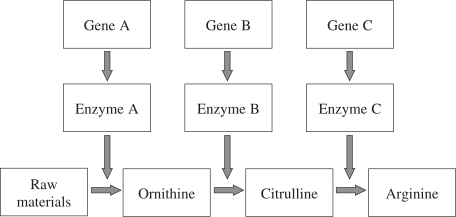
The bread mould, Neurospora crassa, normally produces its own amino acids from raw materials through a system of enzymes.
 

If a mutation occurred in gene B, the bread mould would still produce arginine if supplied with

  1. citrulline.
  2. ornithine.
  3. enzyme C.
  4. raw materials.
Show Answers Only

`A`

Show Worked Solution
  • Enzyme B only aids the production of ornithine to citrulline.
  • If the mould was directly supplied with citrulline, this would bypass enzyme B and it would be able to still produce arginine.

`=>A`

Filed Under: Mutation Tagged With: Band 4, smc-3652-30-Point Mutations, smc-3652-40-Chromosomal Mutations

BIOLOGY, M5 EQ-Bank 25

A student plans to investigate whether the development of insulin has affected the prevalence of Type 1 diabetes in the human population and subsequently influenced human evolution. She has access to data on Australians with diabetes extending back to 1973 .

  1. Propose a suitable hypothesis for this investigation.   (2 marks)

    --- 4 WORK AREA LINES (style=lined) ---

  2. Identify TWO variables that need to be controlled for this investigation and explain their importance.   (4 marks)

    --- 10 WORK AREA LINES (style=lined) ---

Show Answers Only

a.   Two possible hypotheses include:

  • The development of insulin has led to a decrease in the prevalence of Type 1 diabetics.
  • The use of insulin by people who have Type 1 diabetes has increased the prevalence of Type 1 diabetes in the human population.
     

b.  Variables to be controlled:

  • The growth of the Australian population in general will statistically lead to a bias in more recent years, where higher a number of individuals with Type 1 diabetes is to be expected.
  • To control this variable, the investigation should be measured using a fixed rate such as ‘per 100 000’.
  • The time of diagnosis and length of time an individual has used insulin can impact the trend of the obtained data.
  • This data must be obtained and accounted for to be able to increase the validity of findings.
Show Worked Solution

a.   Two possible hypotheses include:

  • The development of insulin has led to a decrease in the prevalence of Type 1 diabetics.
  • The use of insulin by people who have Type 1 diabetes has increased the prevalence of Type 1 diabetes in the human population.

b.  Variables to be controlled

  • The growth of the Australian population in general will statistically lead to a bias in more recent years, where higher a number of individuals with Type 1 diabetes is to be expected.
  • To control this variable, the investigation should be measured using a fixed rate such as ‘per 100 000’.
  • The time of diagnosis and length of time an individual has used insulin can impact the trend of the obtained data.
  • This data must be obtained and accounted for to be able to increase the validity of findings.

Filed Under: Genetic Variation / Inheritance Tagged With: Band 4, Band 5, smc-3648-75-Inheritance Patterns

BIOLOGY, M5 EQ-Bank 24

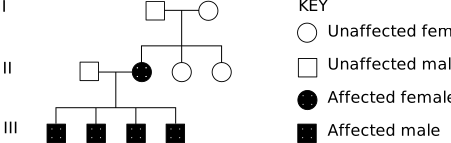
A non-infectious disease was observed in a mother and her four sons who live with her. She has no daughters. The father of these children does not have the disease and does not live with them. The woman's parents and her two sisters who live overseas do not have the disease.

A geneticist suspects that the disease is inherited.

  1. Draw the family pedigree for this disease.   (3 marks)


  2. From the evidence, what indicates that the disease could be the result of a recessive allele and not be sex-linked?   (2 marks)

    --- 4 WORK AREA LINES (style=lined) ---

Show Answers Only

a.   


b.   Evidence disease is recessive and not sex-linked:

  • Generation 1 parents do not have the disease but it is present in their daughter, meaning it must be recessive.
  • If the disease was sex-linked, the same daughter who has the disease must have a father with the disease, however this is not the case.
Show Worked Solution

a.   


b.   Evidence disease is recessive and not sex-linked:

  • Generation 1 parents do not have the disease but it is present in their daughter, meaning it must be recessive.
  • If the disease was sex-linked, the same daughter who has the disease must have a father with the disease, however this is not the case.

Filed Under: Genetic Variation / Inheritance Tagged With: Band 3, Band 4, smc-3648-10-Pedigrees, smc-3648-30-Sex Linkage, smc-3648-35-Autosomal

BIOLOGY, M5 EQ-Bank 23

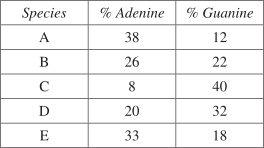
Students conducted preliminary experiments to analyse the DNA base composition of five different individuals.

The table shows the experimental data collected.
 

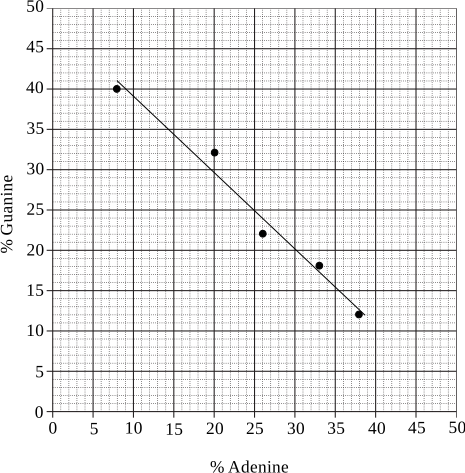
  1. On the grid provided, plot the % Guanine against % Adenine of the individuals analysed and draw a suitable line of best fit.   (3 marks)


  2. Identify the relationship shown by the data.   (1 mark)

    --- 2 WORK AREA LINES (style=lined) ---

  3. Explain the relationship shown by the data.   (3 marks)

    --- 8 WORK AREA LINES (style=lined) ---

Show Answers Only

a.   
       

b.  Relationship: As the % of Adenine increases, the % of Guanine decreases.

c.   Adenine/Guanine relationship

→ Because Adenine pairs with Thymine and Cytosine pairs with Guanine occurring to DNA base pairing rules, each should directly correlate to each other and account for the same % within the DNA composition of any species.

→ There are the only 4 components that make up all DNA composition. This also means that when comparing % of bases that do not pair, such as Adenine and Guanine, they must combine to form 50% of all DNA. This is evident when looking at individuals A and B, as well as C, D and E which are only off by 1-2%, most likely due to human error.

→ This always explains the relationship where an increase in Adenine (and Thymine) % will result in a decrease in Guanine (and Cytosine) % as the A and T pairs now occupy more space in the genome.

Show Worked Solution

a.   
       

b.  Relationship: As the % of Adenine increases, the % of Guanine decreases.

c.   Adenine/Guanine relationship

→ Because Adenine pairs with Thymine and Cytosine pairs with Guanine occurring to DNA base pairing rules, each should directly correlate to each other and account for the same % within the DNA composition of any species.

→ There are the only 4 components that make up all DNA composition. This also means that when comparing % of bases that do not pair, such as Adenine and Guanine, they must combine to form 50% of all DNA. This is evident when looking at individuals A and B, as well as C, D and E which are only off by 1-2%, most likely due to human error.

→ This always explains the relationship where an increase in Adenine (and Thymine) % will result in a decrease in Guanine (and Cytosine) % as the A and T pairs now occupy more space in the genome.

Filed Under: Uncategorized Tagged With: Band 3, Band 4, Band 5, smc-3649-10-DNA Structure

BIOLOGY, M5 EQ-Bank 27

Explain why internal fertilisation is a more robust process than external fertilisation in maintaining a species generation after generation.   (5 marks)

--- 10 WORK AREA LINES (style=lined) ---

Show Answers Only
  • In order for a species to successfully continue and avoid extinction, a sufficient number of offspring must be able to survive until gestational maturity and produce offspring themselves, hence continuing the cycle.
  • External fertilisation is used mainly in sea animals such as fish where the survival rate of offspring is low due to the plentiful numbers of predators in such a vast environment.
  • In response to this environment, external fertilisation methods must produce large numbers of sperm and eggs to increase the number of fertilised embryos. This process requires of a significant amount of energy.
  • Fertilised embryos typically experience minimal or no parental care, further lowering the survival rate of offspring. Therefore, external fertilisation has numerous disadvantages to overcome in achieving the continuity of the species.
  • Internal fertilisation is generally more common amongst varying species (such as humans). Despite often only producing one child at a time, internal fertilisation as a process protects the developing embryo inside the female uterus.
  • Although the number of fertilised embryos is lower, greater parental care throughout most of early life and a significant decrease in predation creates a higher survival rate.
  • In this way, internal fertilisation is more advantageous to ensure the continuity of a species.
Show Worked Solution
  • In order for a species to successfully continue and avoid extinction, a sufficient number of offspring must be able to survive until gestational maturity and produce offspring themselves, hence continuing the cycle.
  • External fertilisation is used mainly in sea animals such as fish where the survival rate of offspring is low due to the plentiful numbers of predators in such a vast environment.
  • In response to this environment, external fertilisation methods must produce large numbers of sperm and eggs to increase the number of fertilised embryos. This process requires of a significant amount of energy.
  • Fertilised embryos typically experience minimal or no parental care, further lowering the survival rate of offspring. Therefore, external fertilisation has numerous disadvantages to overcome in achieving the continuity of the species.
  • Internal fertilisation is generally more common amongst varying species (such as humans). Despite often only producing one child at a time, internal fertilisation as a process protects the developing embryo inside the female uterus.
  • Although the number of fertilised embryos is lower, greater parental care throughout most of early life and a significant decrease in predation creates a higher survival rate.
  • In this way, internal fertilisation is more advantageous to ensure the continuity of a species.

Filed Under: Reproduction Tagged With: Band 4, Band 5, smc-3647-15-Internal vs. External

BIOLOGY, M5 EQ-Bank 22

  1. The following data shows the average amount of Human Chorionic Gonadotropin (hCG) produced by pregnant women.
      
    \begin{array}{|c|c|}
    \hline \rule{0pt}{2.5ex}\text {Weeks of pregnancy} \rule[-1ex]{0pt}{0pt} & h C G\,\text{(ng/mL)} \\
    \hline \rule{0pt}{2.5ex}0 \rule[-1ex]{0pt}{0pt}& 0 \\
    \hline \rule{0pt}{2.5ex}4 \rule[-1ex]{0pt}{0pt}& 85 \\
    \hline \rule{0pt}{2.5ex}8 \rule[-1ex]{0pt}{0pt}& 185 \\
    \hline \rule{0pt}{2.5ex}12 \rule[-1ex]{0pt}{0pt}& 185 \\
    \hline \rule{0pt}{2.5ex}16 \rule[-1ex]{0pt}{0pt}& 80 \\
    \hline \rule{0pt}{2.5ex}20 \rule[-1ex]{0pt}{0pt}& 65 \\
    \hline \rule{0pt}{2.5ex}24 \rule[-1ex]{0pt}{0pt}& 60 \\
    \hline \rule{0pt}{2.5ex}28 \rule[-1ex]{0pt}{0pt}& 65 \\
    \hline \rule{0pt}{2.5ex}32 \rule[-1ex]{0pt}{0pt}& 75 \\
    \hline \rule{0pt}{2.5ex}36 \rule[-1ex]{0pt}{0pt}& 65 \\
    \hline \rule{0pt}{2.5ex}40 \rule[-1ex]{0pt}{0pt}& 35 \\
    \hline
    \end{array}

      
    Use the information provided to graph the levels of hCG in a normal pregnancy.   (3 marks)
     
  2. Describe the role and changes in levels of a hormone in pregnancy.   (3 marks)

    --- 5 WORK AREA LINES (style=lined) ---

Show Answers Only

a.  Levels of hCG in a normal pregnancy

b.   The role and changes in levels of hormones in pregnancy.

  •  Progesterone is a sex hormone which is initially secreted by the corpus leuteum after ovulation to thicken the endometrium for implantation.
  • Once the placenta has developed, it then increases the progesterone levels which maintain the pregnancy.
  • Progesterone levels eventually drop in the last stage of pregnancy to facilitate delivery.

Answers could also include information about other hormones including:

  • Oestrogen
  • hCG
Show Worked Solution

a.  Levels of hCG in a normal pregnancy

b.    The role and changes in levels of hormones in pregnancy.

  •  Progesterone is a sex hormone which is initially secreted by the corpus leuteum after ovulation to thicken the endometrium for implantation.
  • Once the placenta has developed, it then increases the progesterone levels which maintain the pregnancy.
  • Progesterone levels eventually drop in the last stage of pregnancy to facilitate delivery.
      

Answers could also include information about other hormones including:

  • Oestrogen
  • hCG

Filed Under: Reproduction Tagged With: Band 3, Band 4, smc-3647-05-Human/Mammal, smc-3647-50-Hormones

BIOLOGY, M5 EQ-Bank 9 MC

Muscular Distrophy is a sex-linked recessive trait.

Nicole does not have Muscular Distrophy but her father does. Nicole is married to Keith who does not have Muscular Distrophy. Nicole and Keith are expecting twins, a boy and a girl.

Which row in the table shows the probability of Muscular Distrophy in the boy and the girl?

\begin{align*}
\begin{array}{l}
\rule{0pt}{2.5ex} \ \rule[-1ex]{0pt}{0pt}& \\
\rule{0pt}{2.5ex} \textbf{A.}\rule[-1ex]{0pt}{0pt}\\
\rule{0pt}{2.5ex} \textbf{B.}\rule[-1ex]{0pt}{0pt}\\
\rule{0pt}{2.5ex} \textbf{C.}\rule[-1ex]{0pt}{0pt}\\
\rule{0pt}{2.5ex} \textbf{D.}\rule[-1ex]{0pt}{0pt}\\
\end{array}
\begin{array}{|c|c|}
\hline \rule{0pt}{2.5ex} \quad \quad\  \textit{Boy}\  \quad\quad & \quad \quad\textit{Girl} \quad\quad  \\
\hline \rule{0pt}{2.5ex}  0 \% \rule[-1ex]{0pt}{0pt}& 0 \% \\
\hline \rule{0pt}{2.5ex} 50 \% \rule[-1ex]{0pt}{0pt}& 0 \% \\
\hline \rule{0pt}{2.5ex} 0 \% \rule[-1ex]{0pt}{0pt}& 50 \% \\
\hline \rule{0pt}{2.5ex} 50 \% \rule[-1ex]{0pt}{0pt}& 50 \% \\
\hline
\end{array}
\end{align*}

Show Answers Only

\(B\)

Show Worked Solution
  • The probability can be predicted using the punnet square below.
  • Since Nicole does not have Muscular Dystrophy but her father does, she must be heterozygous.
  • Nicole : \(\text{X}^\text{B} \text{X}^\text{b}\)   Keith : \(\text{X}^\text{b} \text{Y}\)

\begin{array} {|l|c|c|}
\hline  & \text{X}^\text{b} & \text{Y} \\
\hline \text{X}^\text{B} & \text{X}^\text{B}\text{X}^\text{b} & \text{X}^\text{B}\text{Y}\\
\hline \text{X}^\text{b} & \text{X}^\text{b}\text{X}^\text{b} & \text{X}^\text{b}\text{Y} \\
\hline \end{array}

  • This shows that there is a 50% chance for boys to be \(\text{X}^{b} \text{Y}\) and therefore a 50% chance to have Muscular Dystrophy, while the girls will always have an \(\text{X}^\text{B}\) allele and therefore cannot have Muscular Dystrophy.

\(\Rightarrow B\)

Filed Under: Genetic Variation / Inheritance Tagged With: Band 4, smc-3648-30-Sex Linkage

BIOLOGY, M5 EQ-Bank 7 MC

In which of the following do both processes result in genetic variation of offspring?

  1. DNA mutation and polypeptide production
  2. Cell differentiation and gamete formation
  3. DNA mutation and gamete formation
  4. Cell differentiation and polypeptide production
Show Answers Only

`C`

Show Worked Solution

By Elimination

  • Cell differentiation is the specialisation of cells into a specific type, e.g. the differentiation of specific plasma B cells. This does not impact the individual’s genome or their offspring (Eliminate B and D).
  • Polypeptide production is a result of the individuals DNA and does not effect their genotype and thus has no effect on offspring (Eliminate A).

`=>C`

Filed Under: Genetic Variation / Inheritance Tagged With: Band 4, smc-3648-50-Meiosis

PHYSICS, M8 EQ-Bank 26

Observations and mathematical ideas are critical to the improvement of scientific models.

Discuss this statement with reference to scientific discoveries that have contributed to our understanding of the atom.   (8 marks)

--- 22 WORK AREA LINES (style=lined) ---

Show Answers Only
  • [P] Observations have been critical in advancing atomic models.
  • [E] When experiments reveal unexpected results, scientists must revise their models to match reality.
  • [Ev] The Geiger-Marsden experiment showed alpha particles bouncing back from gold foil, contradicting the plum pudding model. This led Rutherford to propose a dense nucleus.
  • [L] This demonstrates how observations drive scientific progress in understanding atoms.
     
  • [P] Mathematical ideas provide essential frameworks for atomic models.
  • [E] Mathematics allows scientists to make precise predictions and test theories quantitatively.
  • [Ev] Bohr developed a mathematical model explaining the specific wavelengths emitted which relies on Rydberg’s equation: `(1)/(lambda)=R((1)/(n_(f)^2)-(1)/(n_(i)^2))`.
  • [Ev] This model was limited as it was only able to explain the hydrogen atom. De Broglie built upon it by postulating that electrons behaved as a wave, eventually describing the equation `\lambda=h/{mv}` which helped explain electron wave behaviour.
  • [L] These mathematical models transformed vague ideas into testable predictions about atomic structure.
     
  • [P] However, observations and mathematics alone have limitations.
  • [E] Models based purely on observations can miss underlying principles without theoretical insight.
  • [Ev] Bohr’s model perfectly matched hydrogen spectra but failed for other atoms because it lacked deeper quantum understanding.
  • [L] This shows that observation and mathematics need theoretical frameworks to truly advance atomic understanding.
     
  • [P] Nevertheless, observations and mathematical ideas remain fundamental to atomic theory development.
  • [E] Despite limitations, these tools work together to progressively refine scientific understanding.
  • [Ev] The progression from Rutherford to Bohr to de Broglie shows each model building on previous observations and mathematical frameworks, creating increasingly accurate atomic models.
  • [L] Therefore, the statement is valid as both elements are critical for advancing our understanding of the atom.

Answers could also reference:

  • Thomson’s discovery of the electron.
  • Further contributions from Davisson-Germer as well as Schrodinger and Heisenberg.
Show Worked Solution
  • [P] Observations have been critical in advancing atomic models.
  • [E] When experiments reveal unexpected results, scientists must revise their models to match reality.
  • [Ev] The Geiger-Marsden experiment showed alpha particles bouncing back from gold foil, contradicting the plum pudding model. This led Rutherford to propose a dense nucleus.
  • [L] This demonstrates how observations drive scientific progress in understanding atoms.
     
  • [P] Mathematical ideas provide essential frameworks for atomic models.
  • [E] Mathematics allows scientists to make precise predictions and test theories quantitatively.
  • [Ev] Bohr developed a mathematical model explaining the specific wavelengths emitted which relies on Rydberg’s equation: `(1)/(lambda)=R((1)/(n_(f)^2)-(1)/(n_(i)^2))`.
  • [Ev] This model was limited as it was only able to explain the hydrogen atom. De Broglie built upon it by postulating that electrons behaved as a wave, eventually describing the equation `\lambda=h/{mv}` which helped explain electron wave behaviour.
  • [L] These mathematical models transformed vague ideas into testable predictions about atomic structure.
     
  • [P] However, observations and mathematics alone have limitations.
  • [E] Models based purely on observations can miss underlying principles without theoretical insight.
  • [Ev] Bohr’s model perfectly matched hydrogen spectra but failed for other atoms because it lacked deeper quantum understanding.
  • [L] This shows that observation and mathematics need theoretical frameworks to truly advance atomic understanding.
     
  • [P] Nevertheless, observations and mathematical ideas remain fundamental to atomic theory development.
  • [E] Despite limitations, these tools work together to progressively refine scientific understanding.
  • [Ev] The progression from Rutherford to Bohr to de Broglie shows each model building on previous observations and mathematical frameworks, creating increasingly accurate atomic models.
  • [L] Therefore, the statement is valid as both elements are critical for advancing our understanding of the atom.

Answers could also reference:

  • Thomson’s discovery of the electron.
  • Further contributions from Davisson-Germer as well as Schrodinger and Heisenberg.

Filed Under: Quantum Mechanical Nature of the Atom, Structure of the Atom Tagged With: Band 4, Band 5, smc-3701-40-Rutherford, smc-3702-10-Bohr's Model, smc-3702-40-De Broglie

PHYSICS, M8 EQ-Bank 27

Explain how the analysis of quantitative observations contributed to the development of the concept that certain matter and energy are quantised.   (9 marks)

--- 18 WORK AREA LINES (style=lined) ---

Show Answers Only

Experiments such as Millikan’s oil drop experiment and others testing the photoelectric effect have demonstrated that certain quantities of matter and energy are quantised which means they are multiples of some fundamental value.

Millikan’s Oil Drop Experiment

  • Millikan’s oil drop experiment was able to show that charge is quantised. 
  • Millikan levitated oil drops in an electric field by balancing the electric and gravitational forces on them. This allowed him to find the electric force acting on each oil drop, and using the mass of the oil drop he found its charge.
  • Analysing his results, he found that the charge on every oil drop was an integer multiple of `1.602 xx10^(-19) C`. This was determined to be the fundamental charge on an electron.
  • Further, with Thompson’s later discovery of the charge to mass ratio of an electron, its mass could be determined. 

Photoelectric Effect

  • Photoelectric effect experiments showed the quantum properties of light which seemingly contradicted the view of light as a wave.
  • It was found that there was a minimum frequency (energy) of light that would cause photoemission when it was incident upon a metal plate, and no photoemission occurred with light lower than this frequency, regardless of intensity.
  • As one photon would strike one electron on the metal surface, the electron would receive a discrete amount of energy from that photon determined by its frequency `E=hf`. If a photon didn’t have enough energy, an electron couldn’t be removed.
  • This experimental evidence changed the conceptual understanding of energy within physics and provided a basis for the quantisation of the energy of light. 

Other quantitative experiments that could be explored include:

  • Bohr’s analysis of emission spectra to demonstrate the existence of quantised energy levels in atoms.
  • Cathode ray experiments showing the particle nature of electrons.
  • Blackbody radiation experiments. 
Show Worked Solution

Experiments such as Millikan’s oil drop experiment and others testing the photoelectric effect have demonstrated that certain quantities of matter and energy are quantised which means they are multiples of some fundamental value.

Millikan’s Oil Drop Experiment

  • Millikan’s oil drop experiment was able to show that charge is quantised. 
  • Millikan levitated oil drops in an electric field by balancing the electric and gravitational forces on them. This allowed him to find the electric force acting on each oil drop, and using the mass of the oil drop he found its charge.
  • Analysing his results, he found that the charge on every oil drop was an integer multiple of `1.602 xx10^(-19) C`. This was determined to be the fundamental charge on an electron.
  • Further, with Thompson’s later discovery of the charge to mass ratio of an electron, its mass could be determined. 

Photoelectric Effect

  • Photoelectric effect experiments showed the quantum properties of light which seemingly contradicted the view of light as a wave.
  • It was found that there was a minimum frequency (energy) of light that would cause photoemission when it was incident upon a metal plate, and no photoemission occurred with light lower than this frequency, regardless of intensity.
  • As one photon would strike one electron on the metal surface, the electron would receive a discrete amount of energy from that photon determined by its frequency `E=hf`. If a photon didn’t have enough energy, an electron couldn’t be removed.
  • This experimental evidence changed the conceptual understanding of energy within physics and provided a basis for the quantisation of the energy of light. 

Other quantitative experiments that could be explored include:

  • Bohr’s analysis of emission spectra to demonstrate the existence of quantised energy levels in atoms.
  • Cathode ray experiments showing the particle nature of electrons.
  • Blackbody radiation experiments. 

Filed Under: Light: Quantum Model, Structure of the Atom Tagged With: Band 4, Band 5, Band 6, smc-3698-10-Photoelectric Effect, smc-3698-80-Wave/Particle models, smc-3701-20-Millikan

PHYSICS, M8 EQ-Bank 25

Compare the features of emission and absorption spectra in terms of how they are produced.   (4 marks)

Show Answers Only
  • Emission and absorption spectra are both produced by the transition of electrons between energy levels in an atom.
  • Emission spectra involve a series of coloured lines corresponding to “emitted” light of discrete wavelengths on a black background. Absorption spectra differ by presenting a continuous spectrum with some specific wavelengths appearing with lower intensities (having been “absorbed”). In this way, the emission and absorption spectra of a specific element or compound appear as negatives of each other.
  • Emission spectra are produced when electrons are in higher energy shells in which they are unstable and fall back to lower, more stable levels. They emit a photon of light with energy equal to the difference in energy between the two shells. These photons correspond to emission lines.
  • Absorption spectra are produced when a continuous spectrum is passed through a cool gas. Certain wavelengths of light with energies corresponding to a difference in energy levels are absorbed by the electron and it jumps to a higher energy level. This results in a dark line.
Show Worked Solution
  • Emission and absorption spectra are both produced by the transition of electrons between energy levels in an atom.
  • Emission spectra involve a series of coloured lines corresponding to “emitted” light of discrete wavelengths on a black background. Absorption spectra differ by presenting a continuous spectrum with some specific wavelengths appearing with lower intensities (having been “absorbed”). In this way, the emission and absorption spectra of a specific element or compound appear as negatives of each other.
  • Emission spectra are produced when electrons are in higher energy shells in which they are unstable and fall back to lower, more stable levels. They emit a photon of light with energy equal to the difference in energy between the two shells. These photons correspond to emission lines.
  • Absorption spectra are produced when a continuous spectrum is passed through a cool gas. Certain wavelengths of light with energies corresponding to a difference in energy levels are absorbed by the electron and it jumps to a higher energy level. This results in a dark line.

Filed Under: Origins of Elements Tagged With: Band 4, smc-3700-20-Spectra

PHYSICS, M8 EQ-Bank 23

Describe TWO processes by which stars produce energy.   (4 marks)

--- 8 WORK AREA LINES (style=lined) ---

Show Answers Only
  • At the most basic level, stars produce energy through the process of nuclear fusion.
  • In less massive, lower temperature stars (like our Sun), the proton-proton chain reaction generates energy through nuclear fusion via the fusion of four hydrogen atoms to one helium atom. 
  • In more massive, hotter stars, the CNO cycle is the dominant means by which energy is produced. This process involves carbon, nitrogen and oxygen acting as catalysts for the similar nuclear fusion of four hydrogen atoms into one helium atom and high energy gamma ray photons.
Show Worked Solution
  • At the most basic level, stars produce energy through the process of nuclear fusion.
  • In less massive, lower temperature stars (like our Sun), the proton-proton chain reaction generates energy through nuclear fusion via the fusion of four hydrogen atoms to one helium atom. 
  • In more massive, hotter stars, the CNO cycle is the dominant means by which energy is produced. This process involves carbon, nitrogen and oxygen acting as catalysts for the similar nuclear fusion of four hydrogen atoms into one helium atom and high energy gamma ray photons.

Filed Under: Origins of Elements Tagged With: Band 4, smc-3700-40-Nuclear Reactions in Stars

PHYSICS, M5 EQ-Bank 23

A horizontal disc is rotating clockwise on a table when viewed from above. Two small blocks are attached to the disc at different radii from the centre.

Using the diagram below, draw vector arrows to show the relative linear velocities and centripetal forces for each block as the disc rotates.   (3 marks)
 

Show Answers Only

Show Worked Solution

Points to note on the image

  • Centripetal force and velocity vectors are perpendicular
  • Vector arrows should show relative magnitudes of velocities and centripetal forces.

Filed Under: Circular Motion Tagged With: Band 4, smc-3691-10-Centripetal Forces, smc-3691-30-Linear Velocity

PHYSICS, M8 EQ-Bank 22

Einstein's equation `E = mc^(2)`  is one of the most important equations in the history of physics.

Justify this statement.   (7 marks)

--- 14 WORK AREA LINES (style=lined) ---

Show Answers Only

Position Statement

  • Einstein’s equation `E=mc^2` is among physics’ most important equations because it reveals mass-energy equivalence and explains fundamental processes from atomic to cosmic scales.

Nuclear Applications

  • The equation explains energy from nuclear fission and fusion processes. It shows how tiny amounts of matter convert to enormous energy in nuclear reactions.
  • The mass defect in atoms directly relates to binding energy through `E=mc^2` and this principle drives nuclear reactors that power cities and nuclear weapons.
  • These applications are responsible for revolutionising both energy production and global politics.

Cosmic and Particle Physics

  • Stars produce energy by converting mass to energy through fusion reactions. The Sun converts 4 million tonnes of mass to energy every second using this principle
  • Particle accelerators create new particles by converting kinetic energy into mass. This allows scientists to study fundamental matter structure and discover new particles.
  • Furthermore, mass dilation near light speed also follows from this mass-energy relationship.

Reinforcement

  • While other equations like Newton’s gravity law are important, they lack the broad applicability of `E=mc^2`.
  • No other single equation explains phenomena from subatomic particles to stellar processes.
  • The equation unified our understanding of matter and energy as different forms of the same thing.
  • This justifies calling `E=mc^2` one of history’s most important physics equations.
Show Worked Solution

Position Statement

  • Einstein’s equation `E=mc^2` is among physics’ most important equations because it reveals mass-energy equivalence and explains fundamental processes from atomic to cosmic scales.

Nuclear Applications

  • The equation explains energy from nuclear fission and fusion processes. It shows how tiny amounts of matter convert to enormous energy in nuclear reactions.
  • The mass defect in atoms directly relates to binding energy through `E=mc^2` and this principle drives nuclear reactors that power cities and nuclear weapons.
  • These applications are responsible for revolutionising both energy production and global politics.

Cosmic and Particle Physics

  • Stars produce energy by converting mass to energy through fusion reactions. The Sun converts 4 million tonnes of mass to energy every second using this principle
  • Particle accelerators create new particles by converting kinetic energy into mass. This allows scientists to study fundamental matter structure and discover new particles.
  • Furthermore, mass dilation near light speed also follows from this mass-energy relationship.

Reinforcement

  • While other equations like Newton’s gravity law are important, they lack the broad applicability of `E=mc^2`.
  • No other single equation explains phenomena from subatomic particles to stellar processes.
  • The equation unified our understanding of matter and energy as different forms of the same thing.
  • This justifies calling `E=mc^2` one of history’s most important physics equations.

Filed Under: Light and Special Relativity, Origins of Elements, Properties of the Nucleus Tagged With: Band 3, Band 4, Band 5, smc-3699-80-E = mc^2, smc-3700-60-Mass-Energy Equivalence, smc-3703-20-Conservation of Mass-Energy

PHYSICS, M8 EQ-Bank 13 MC

The table lists the first generation of quarks and antiquarks.


The Standard Model of matter states that baryons, such as protons and neutrons, consist of three quarks.

Using the table, which of the following represents the quark composition for a neutron and an antineutron, respectively?

  1. `text{u}\text{u}\text{d} and bar text{u}\bar text{u}\bar text{d}`
  2. `bar text{u}\bar text{u}\bar text {d} and text{u}\text{u}\text{d}`
  3. `text{u}\text{d}\text{d} and bar text{u}\bar text{d}\bar text{d}`
  4. `bar text{u}\bar text{d}\bar text{d} and text{u}\text{d}\text{d}`
Show Answers Only

`C`

Show Worked Solution
  • A neutron has a charge of zero, so it is made up of one up quark and two down quarks.
  • An antineutron is composed of the corresponding antiquarks. So, it is made up of one up antiquark and two down antiquarks.

`=>C`

Filed Under: Deep Inside the Atom Tagged With: Band 4, smc-3704-20-Quarks

PHYSICS, M8 EQ-Bank 7 MC

The following equation describes the natural decay process of uranium-238.

\({ }_{92}^{238} \text{U} \rightarrow{ }_{90}^{234}\text{Th} +{ }_2^4 \text{He}\)

Which row of the table describes the changes in total mass and total binding energy in the decay of uranium-238?

\begin{align*}
\begin{array}{l}
\rule{0pt}{2.5ex} \ \rule[-1ex]{0pt}{0pt}& \\
\rule{0pt}{2.5ex}\textbf{A.}\rule[-1ex]{0pt}{0pt}\\
\rule{0pt}{2.5ex}\textbf{B.}\rule[-1ex]{0pt}{0pt}\\
\rule{0pt}{2.5ex}\textbf{C.}\rule[-1ex]{0pt}{0pt}\\
\rule{0pt}{2.5ex}\textbf{D.}\rule[-1ex]{0pt}{0pt}\\
\end{array}
\begin{array}{|c|c|}
\hline
\rule{0pt}{2.5ex}\quad \quad \textit{Total mass}\quad  \quad \rule[-1ex]{0pt}{0pt}& \textit{Total binding energy} \\
\hline
\rule{0pt}{2.5ex}\text{Decreases}\rule[-1ex]{0pt}{0pt}&\text{Increases}\\
\hline
\rule{0pt}{2.5ex}\text{Decreases}\rule[-1ex]{0pt}{0pt}& \text{Decreases}\\
\hline
\rule{0pt}{2.5ex}\text{Increases}\rule[-1ex]{0pt}{0pt}& \text{Increases} \\
\hline
\rule{0pt}{2.5ex}\text{Increases}\rule[-1ex]{0pt}{0pt}& \text{Decreases} \\
\hline
\end{array}
\end{align*}

Show Answers Only

\(A\)

Show Worked Solution
  • Mass is converted into energy in this nuclear reaction, so total mass decreases.
  • When elements heavier than iron undergo nuclear fission, the daughter nuclei produced are more stable with a greater binding energy per nucleon. As there are the same number of nucleons before and after the decay, total binding energy increases.

\(\Rightarrow A\)

Filed Under: Properties of the Nucleus Tagged With: Band 4, smc-3703-20-Conservation of Mass-Energy, smc-3703-50-Nuclear Fission

PHYSICS, M8 EQ-Bank 5 MC

In an experiment, an electrically charged oil drop was suspended in air by an electric field. The electric field could be adjusted to balance the weight of the oil drop.

If more drops were suspended and measurements taken, which of the following properties would all of the oil drops be observed to have in common?

  1. The mass of each drop would be a multiple of a fundamental mass.
  2. The mass of each drop would be the same as each of the other drops.
  3. The charge of each drop would be a multiple of a fundamental charge.
  4. The charge of each drop would be the same as each of the other drops.
Show Answers Only

`C`

Show Worked Solution
  • Each oil drop would have an integer number of electrons.
  • Therefore, the charge on an oil drop would be a multiple of the charge on an electron which is a fundamental charge.

`=>C`

Filed Under: Structure of the Atom Tagged With: Band 4, smc-3701-20-Millikan

PHYSICS, M8 EQ-Bank 6 MC

The Hertzsprung-Russell diagram shown is used to classify stars.
 

Stars in region `S` of the diagram are much dimmer than other stars in the same spectral class.

What property of the stars in region `S` explains their relatively low luminosity?

  1. They are cooler than other stars.
  2. They have a smaller mass than other stars.
  3. They have a smaller surface area than other stars.
  4. They are further away from Earth than other stars.
Show Answers Only

`C`

Show Worked Solution

By elimination:

  • All stars in the same spectral class have similar temperatures (eliminate A).
  • Stars become white dwarves when they no longer are able to fuse elements to generate energy. The outer gaseous layers are expelled and only the hot, dense core is left. In this way, white dwarves do not have significantly lower masses compared to other stars (eliminate B).
  • Luminosity refers to the total energy radiated by a star per second and is independent on a star’s distance from Earth (eliminate D).

`=>C`

Filed Under: Origins of Elements Tagged With: Band 4, smc-3700-10-H-R Diagrams

PHYSICS, M5 EQ-Bank 27

A toy car was placed facing outwards on a rotating turntable. The car was held in place by a force sensor connected to the centre of the turntable. The centre of mass of the car was 0.25 metres from the centre of the turntable. The reading from the force sensor was recorded at varying speeds of rotation. A stopwatch was used to time the rotation of the turntable. The linear velocity was calculated from the period of rotation. The graph shows the force on the car versus the square of the linear velocity of the car.


  1. Use the graph to determine the mass of the car.   (3 marks)

--- 0 WORK AREA LINES (style=lined) ---

  1. Identify possible errors in the data and outline how to reduce their effects on the estimation of the mass of the car.   (4 marks)

--- 10 WORK AREA LINES (style=lined) ---

Show Answers Only

a.   0.034 kg

b.   Errors and reduction strategies:

  • If the sensor does not produce accurate readings then systemic errors will result. 
  • Inaccurate readings can be minimised by calibrating the sensor. This can be done against a known force such as the force of gravity on a 1 kg mass.
  • If the stopwatch used to time rotations is manually operated, then error due to human inaccuracy and varying reaction times is introduced. Inaccurate calculations of the motion’s period (i.e. timing of one rotation) makes linear velocity estimations (`v=romega`) less accurate.
  • A strategy for mitigating this inaccuracy is by using the stopwatch to measure several rotations at a time and then dividing the result by the total number of rotations.
Show Worked Solution

a.   Graph passes through `(2,0)` and `(25, 3.1)`:

`text{Gradient}` `=(3.1-0)/(25-2)=0.135`  
`text{Gradient}` `=(F)/(v^2)=0.135`  

 
Since the car is undergoing uniform circular motion:

`F_(c)` `=(mv^2)/(r)`  
`(F_(c))/(v^2)` `=(m)/(r)`  
`0.135` `=(m)/(r)`  
`:. m` `=0.135 xx 0.25=0.03375=0.034\ text{kg}`  


b.   Errors and reduction strategies:

  • If the sensor does not produce accurate readings then systemic errors will result. 
  • Inaccurate readings can be minimised by calibrating the sensor. This can be done against a known force such as the force of gravity on a 1 kg mass.
  • If the stopwatch used to time rotations is manually operated, then error due to human inaccuracy and varying reaction times is introduced. Inaccurate calculations of the motion’s period (i.e. timing of one rotation) makes linear velocity estimations (`v=romega`) less accurate.
  • A strategy for mitigating this inaccuracy is by using the stopwatch to measure several rotations at a time and then dividing the result by the total number of rotations.

Filed Under: Circular Motion Tagged With: Band 4, Band 5, smc-3691-10-Centripetal Forces, smc-3691-40-Angular Velocity

PHYSICS, M5 EQ-Bank 26

A baseball is hit with a velocity of 28 m s ¯1 at an angle of 30° to the horizontal at an initial height of 1.0 m above the plate. Ignore air resistance in your calculations.
 

  1. How long does it take the ball to return to the initial height above the ground?   (3 marks)

--- 6 WORK AREA LINES (style=lined) ---

  1. The ball is hit directly towards a stationary outfielder who is 85 m from the plate. At the instant the ball is hit, the outfielder begins to run towards the plate with constant acceleration.
  2. What is the magnitude of her acceleration if she catches the ball when it is 0.50 m above the ground?   (4 marks)

--- 8 WORK AREA LINES (style=lined) ---

Show Answers Only

a.   `t=2.9\ text{seconds}`

b.   `a=3.6  text{m s}^(-2)`

Show Worked Solution

a.   At initial height: `s_y=0`

Initial vertical velocity:  `u_y=28sin30°=14\ text{m s}^(-1)`

Vertical acceleration: `-9.8\ text{m s}^(-2)`

`s_(y)` `=u_(y)t+(1)/(2)a_(y)t^2`  
`0` `=14 t+(1)/(2)xx(-9.8)xxt^(2)`  
`0` `=14 t-4.9 xxt^(2)`  
`0` `=t(14-4.9 t)`  
`t` `=(14)/(4.9)=2.9\ text{seconds},\ \ (t>0)`  


b.   At  `s_y=0.50\ text{m}`:

`v_(y)^2` `=u_(y)^2+2a_(y)s_(y)`  
`v_(y)^2` `=14^(2)+2(-9.8)(-0.50)`  
`v_(y)` `=sqrt(205.8)~~14.3457\ text{m s}^(-1)`  

 
Using  `v_y=u_(y)+a_(y)t:`

`-14.3457` `=14-9.8t`  
`t` `=(14+14.3457)/(9.8)=2.892\ text{s}`  

 
Horizontal range travelled (`s_x`):

`s_(x)=u_(x)t=28 cos 30^{\circ} xx 2.892=70.127\ text{m}`
 

COMMENT: Note `v_y` and `u_y` are in opposite directions and have opposite signs.

  Distance fielder travelled `=85-70.127 = 14.873\ text{m}`

`s` `=ut+(1)/(2)at^(2)`  
`14.873` `=0+(1)/(2)xx a xx2.892^(2)`  
`:.a` `=(2 xx 14.873)/2.892^(2)`  
  `=3.6\ text{m s}^(-2)\ \ text{(to 1 d.p.)}`  

Filed Under: Projectile Motion Tagged With: Band 4, Band 5, smc-3690-25-Range, smc-3690-45-Time of Flight

PHYSICS, M5 EQ-Bank 21

Planet `X` has a mass eight times that of Earth. The acceleration due to gravity on the surface of this planet is half that on the surface of Earth.

If Earth has a radius of 1, what is the radius of Planet `X` ?   (3 marks)

Show Answers Only

`4`

Show Worked Solution

Radius of Earth:

`F_(g)` `=(GM_em)/(r_e)^2`  
`g` `=(F)/(m)=(GM_e)/(r_e)^2`  
`:.r_(e)` `=sqrt((GM_e)/(g))`  

 
Radius of planet `X`:

`(g)/(2)` `=(G xxM_x)/(r_x)^2`  
  `=(G xx8M_e)/(r_x)^2`  
`:.r_(x)` `=sqrt((16GM_e)/(g))=4r_e`  

 
`:.` Since Earth has a radius of 1 `=>\ r_(x)=4`

Filed Under: Motion in Gravitational Fields Tagged With: Band 4, smc-3692-15-Gravitational field strength

  • « Previous Page
  • 1
  • …
  • 48
  • 49
  • 50
  • 51
  • 52
  • …
  • 114
  • Next Page »

Copyright © 2014–2025 SmarterEd.com.au · Log in