A current-carrying wire is in a magnetic field, as shown.
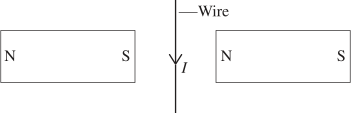
What is the direction of the force on the wire?
- Left
- Right
- Into the page
- Out of the page
Aussie Maths & Science Teachers: Save your time with SmarterEd
A current-carrying wire is in a magnetic field, as shown.
What is the direction of the force on the wire?
A ball, initially at rest in position `P`, travels along a frictionless track to point `Q` and then falls to strike the floor below.
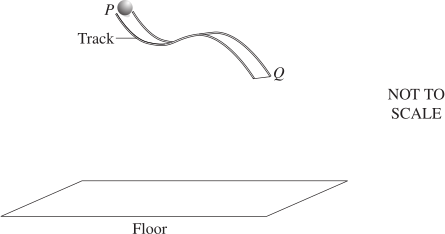
At the instant the ball leaves the track at `Q` it has a velocity of 1.5 `text{m s}^(-1)` at an angle of 50° to the horizontal.
--- 6 WORK AREA LINES (style=lined) ---
--- 6 WORK AREA LINES (style=lined) ---
A particle having mass `m` and charge `q` is accelerated from rest through a potential difference `V`. Assume that the only force acting on the particle is due to the electric field associated with this potential difference.
Show that the final velocity of the particle is given by `v = sqrt((2qV)/m)`. (3 marks)
--- 5 WORK AREA LINES (style=lined) ---
--- 6 WORK AREA LINES (style=lined) ---
--- 6 WORK AREA LINES (style=lined) ---
A student carried out an experiment to investigate the relationship between the torque produced by a force and the angle at which the force is applied. A 400 N force was applied to the same position on the handle of a spanner at different angles, as shown.
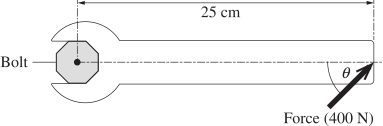
A high-precision device measured the torque applied to the bolt.
The data from the experiment is graphed below.
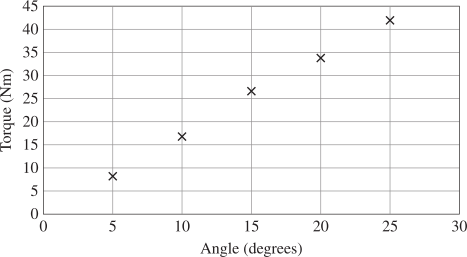
The student concluded that the torque `(tau)` was proportional to the angle `(theta)` and proposed the model
`tau=ktheta`
where `k` = 1.7 Nm/degree.
--- 8 WORK AREA LINES (style=lined) ---
--- 8 WORK AREA LINES (style=lined) ---
In a population of rabbits, black fur colour is dominant over white fur. A black rabbit, whose mother has white fur, mates with a white rabbit.
Predict the phenotypic ratio for the offspring of this cross. Show your working. (3 marks)
--- 1 WORK AREA LINES (style=lined) ---

--- 1 WORK AREA LINES (style=lined) ---


\begin{array} {|c|l|l|}
\hline
\rule{0pt}{2.5ex} \quad \textit{Farm} \quad \rule[-1ex]{0pt}{0pt} & \quad\quad\quad \quad \textit{Strategy} & \quad\quad\quad \quad \textit{Result}\\
\hline
\rule{0pt}{2.5ex} 1 & \text{Treatment with antibiotics} & \text{All pigs recovered after two}\\
\rule[-1ex]{0pt}{0pt} & \text{} & \text{weeks}\\
\hline
\rule{0pt}{2.5ex} 2 & \text{Elimination of rats and mice} & \text{Decrease in number of sick}\\
& \text{from pig sheds to improve} & \text{animals over three months}\\
\rule[-1ex]{0pt}{0pt} & \text{hygiene} & \\
\hline
\end{array}
Outline ONE benefit and ONE limitation of the strategies used on each farm. (3 marks) --- 6 WORK AREA LINES (style=lined) ---
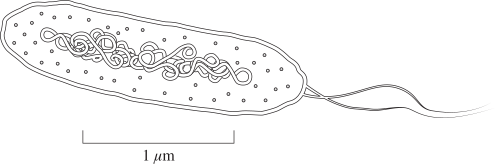
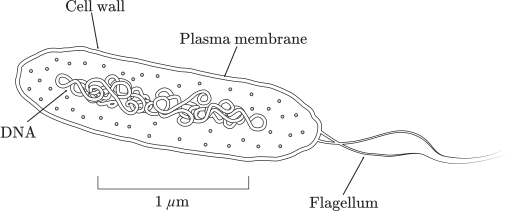
a. Include two of the following labels:
b. Box 2: Bacteria grown in pure culture and identified.
Box 4: Healthy pig became ill with diarrhoea.
c. Benefits and Limitations of the strategies used on each farm.
Other correct answers:
a. Include two of the following labels:
b. Box 2: Bacteria grown in pure culture and identified.
Box 4: Healthy pig became ill with diarrhoea.
c. Benefits and Limitations of the strategies used on each farm.
Other correct answers:
A chocolate factory sells 150-gram chocolate bars. There has been a complaint that the bars actually weigh less than 150 grams, so a team of inspectors was sent to the factory to check. They randomly selected 16 bars, weighed them and noted that 8 bars weighed less than 150 grams.
The factory manager claims 80% of the chocolate bars produced by the factory weigh 150 grams or more.
--- 5 WORK AREA LINES (style=lined) ---
--- 3 WORK AREA LINES (style=lined) ---
A solid of revolution is to be found by rotating the region bounded by the `x`-axis and the curve `y=(k+1) \sin (k x)`, where `k>0`, between `x=0` and `x=\frac{\pi}{2 k}` about the `x`-axis.
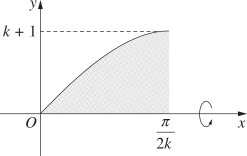
Find the value of `k` for which the volume is `pi^2`. (3 marks)
--- 8 WORK AREA LINES (style=lined) ---
Three different points `A, B` and `C` are chosen on a circle centred at `O`.
Let `underset~a= vec(OA),underset~b= vec(OB)` and `underset~c= vec(OC)`. Let `underset~h=underset~a + underset~b+ underset~c` and let `H` be the point such that `vec(OH)= underset~h`, as shown in the diagram.
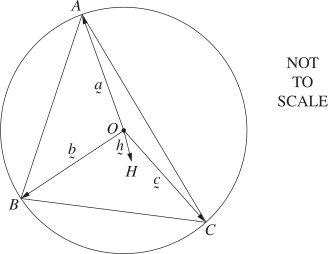
Show that `vec(BH)` and `vec(CA)` are perpendicular. (3 marks)
--- 8 WORK AREA LINES (style=lined) ---
Use mathematical induction to prove that `15 ^(n)+6^(2n+1)` is divisible by 7 for all integers `n >= 0`. (3 marks)
--- 14 WORK AREA LINES (style=lined) ---
In a room with temperature 12°C, coffee is poured into a cup. The temperature of the coffee when it is poured into the cup is 92°C, and it is far too hot to drink.
The temperature, `T`, in degrees Celsius, of the coffee, `t` minutes after it is made, can be modelled using the differential equation `(dT)/(dt)=k(T-T_(1))`, where `k` is the constant of proportionality and `T_1` is a constant.
--- 10 WORK AREA LINES (style=lined) ---
--- 5 WORK AREA LINES (style=lined) ---
Find the equation of the tangent to the curve `y=x text{arctan}(x)` at the point with coordinates `(1,(pi)/(4))`. Give your answer in the form `y=mx+c` (3 marks)
--- 6 WORK AREA LINES (style=lined) ---
Express `sqrt3sin(x)-3cos(x)` in the form `R sin(x+alpha)`. (3 marks)
--- 8 WORK AREA LINES (style=lined) ---
Find the coefficients of `x^(2)` and `x^(3)` in the expansion of `(1-(x)/(2))^(8)`. (2 marks)
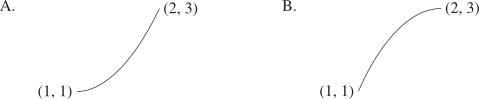
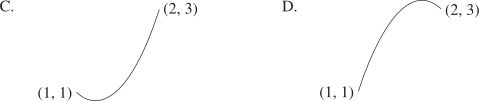
A curve is defined in parametric form by `x=2+t` and `y=3-2t^(2)` for `-1 <= t <= 0`.
Which diagram best represents this curve?
The graph of `f(x)=(3)/(x-1)+2` is shown.
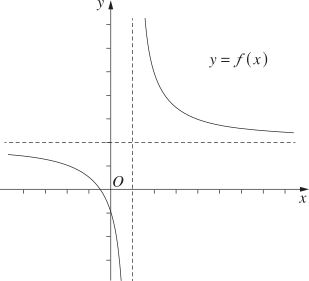
The graph of `f(x)` was transformed to get the graph of `g(x)` as shown.
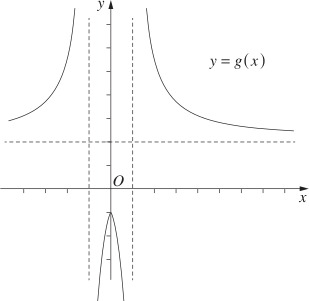
What transformation was applied?
It is given that `cos((23 pi)/(12))=(sqrt6+sqrt2)/(4)`.
Which of the following is the value of `cos^(-1)((sqrt6+sqrt2)/(4))`?
In a reducing-balance loan, an amount `$P` is borrowed for a period of `n` months at an interest rate of 0.25% per month, compounded monthly. At the end of each month, a repayment of `$M` is made. After the `n`th repayment has been made, the amount owing, `$A_n`, is given by
`A_(n)=P(1.0025)^(n)-M(1+(1.0025)^(1)+(1.0025)^(2)+cdots+(1.0025)^(n-1))`
(Do NOT prove this.)
The loan is to be repaid in 180 monthly repayments.
Show that `M` = 1381.16, when rounded to the nearest cent. (2 marks)
--- 5 WORK AREA LINES (style=lined) ---
After 100 repayments of $1381.16 have been made, the interest rate changes to 0.35% per month.
At this stage, the amount owing to the nearest dollar is $100 032. (Do NOT prove this.)
Jane continues to make the same monthly repayments.
For how many more months will Jane need to make full monthly payments of $1381.16? (3 marks)
--- 6 WORK AREA LINES (style=lined) ---
--- 4 WORK AREA LINES (style=lined) ---
Let `f(x)=xe^(-2x)`.
It is given that `f^(′)(x)=e^(-2x)-2xe^(-2x)`.
--- 4 WORK AREA LINES (style=lined) ---
--- 6 WORK AREA LINES (style=lined) ---
--- 8 WORK AREA LINES (style=lined) ---
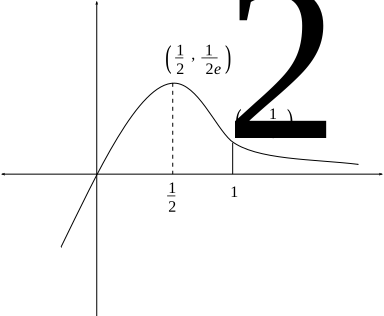
a. `f^(′)(x)=e^(-2x)-2xe^(-2x)`
| `f^(″)(x)` | `=-2e^(-2x)-[2x(-2)e^(-2x)+2e^(-2x)]` | |
| `=-2e^(-2x)+4xe^(-2x)-2e^(-2x)` | ||
| `=4xe^(-2x)-4e^(-2x)` | ||
| `=4(x-1)e^(-2x)\ \ text{… as required}` |
b. `text{S.P.’s occur when}\ \ f^(′)(x)=0`
| `e^(-2x)-2xe^(-2x)` | `=0` | |
| `e^(-2x)(1-2x)` | `=0` |
`e^(-2x)=0\ \ =>\ \ text{No solution}`
`1-2x=0\ \ =>\ \ x=1/2`
| `f^(″)(1/2)` | `=4(1/2-1)e^(-2xx1/2)` | |
| `=-2e^(-1)<0\ \ =>\ text{MAX}` |
`f(1/2)=1/2e^(-1)=1/(2e)`
c. `text{POI occurs when}\ \ f^(″)(x)=0`
`f^(″)(x)=4(x-1)e^(-2x)=0\ \ =>\ \ x=1`
`text{Test for change in concavity:}`
`f^(″)(0)=4(0-1)e^0=-4`
`f^(″)(2)=4(2-1)e^(-4)>0\ \ =>\ text{Concavity changes}`
`:.\ text{POI exists at}\ \ (1,1/e^2)`
`text{As}\ \ x->oo\ \ =>\ \ y->0^+`

--- 2 WORK AREA LINES (style=lined) ---
--- 5 WORK AREA LINES (style=lined) ---
--- 4 WORK AREA LINES (style=lined) ---
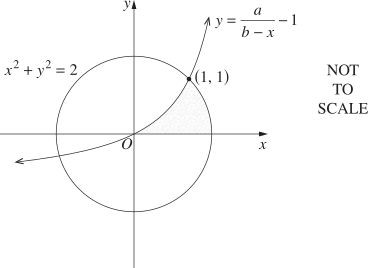
The graph of the circle `x^2+y^2=2` is shown.
The interval connecting the origin, `O`, and the point `(1,1)` makes an angle `theta` with the positive `x`-axis.

--- 4 WORK AREA LINES (style=lined) ---
Part of the hyperbola `y=(a)/(b-x)-1` which passes through the points `(0,0)` and `(1,1)` is drawn with the circle `x^2+y^2=2` as shown.
--- 5 WORK AREA LINES (style=lined) ---
--- 6 WORK AREA LINES (style=lined) ---
Let `f(x)=sin(2x)`.
Find the value of `x`, for `0 < x < pi`, for which `f^(′)(x)=-sqrt3` AND `f^(″)(x)=2`. (3 marks)
--- 6 WORK AREA LINES (style=lined) ---
The depth of water in a bay rises and falls with the tide. On a particular day the depth of the water, `d` metres, can be modelled by the equation
`d=1.3-0.6 cos((4pi)/(25)t)`,
where `t` is the time in hours since low tide.
--- 3 WORK AREA LINES (style=lined) ---
--- 3 WORK AREA LINES (style=lined) ---
--- 6 WORK AREA LINES (style=lined) ---
Find the global maximum and minimum values of `y=x^(3)-6x^(2)+8`, where `-1 <= x <= 7`. (4 marks)
--- 8 WORK AREA LINES (style=lined) ---
--- 4 WORK AREA LINES (style=lined) ---
--- 1 WORK AREA LINES (style=lined) ---
The parabola `y=x^2` meets the line `y=2 x+3` at the points `(-1,1)` and `(3,9)` as shown in the diagram.
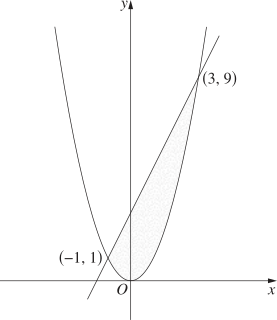
Find the area enclosed by the parabola and the line. (3 marks)
In a bag there are 3 six-sided dice. Two of the dice have faces marked 1, 2, 3, 4, 5, 6. The other is a special die with faces marked 1, 2, 3, 5, 5, 5.
One die is randomly selected and tossed.
--- 2 WORK AREA LINES (style=lined) ---
--- 3 WORK AREA LINES (style=lined) ---
The graph of `y=k sin (ax)`

What are the values of `k` and `a`? (2 marks)
--- 4 WORK AREA LINES (style=lined) ---
Use two applications of the trapezoidal rule to find an approximate value of `int_(0)^(2)sqrt(1+x^(2))\ dx`. Give your answer correct to 2 decimal places. (2 marks)
--- 4 WORK AREA LINES (style=lined) ---
The graph of the even function `y=f(x)` is shown.
The area of the shaded region `A` is `1/2` and the area of the shaded region `B` is `3/2`.

What is the value of `int_(-2)^(2)f(x)\ dx`?
A student believes that the time it takes for an ice cube to melt (`M` minutes) varies inversely with the room temperature `(T^@ text{C})`. The student observes that at a room temperature of `15^@text{C}` it takes 12 minutes for an ice cube to melt.
--- 2 WORK AREA LINES (style=lined) ---
\begin{array} {|c|c|c|c|}
\hline \ \ T\ \ & \ \ 5\ \ & \ 15\ & \ 30\ \\
\hline M & & & \\
\hline \end{array}
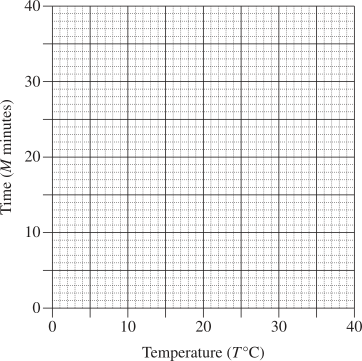
--- 0 WORK AREA LINES (style=lined) ---
a. `M=180/T`
b.
\begin{array} {|c|c|c|c|}
\hline \ \ T\ \ & \ \ 5\ \ & \ 15\ & \ 30\ \\
\hline M & 36 & 12 & 6 \\
\hline \end{array}
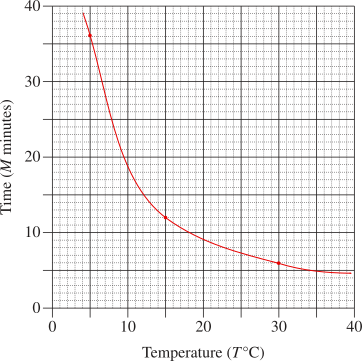
| a. | `M` | `prop 1/T` |
| `M` | `=k/T` | |
| `12` | `=k/15` | |
| `k` | `=15 xx 12` | |
| `=180` |
`:.M=180/T`
b.
\begin{array} {|c|c|c|c|}
\hline \ \ T\ \ & \ \ 5\ \ & \ 15\ & \ 30\ \\
\hline M & 36 & 12 & 6 \\
\hline \end{array}
Consider the following graph of a probability density function `f(x)`.

What is the value of the mode?
What is `int(1)/((2x+1)^(2))\ dx` ?
Let `h(x)=(f(x))/(g(x))`, where
`{:[f(1)=2, qquad f^{′}(1)=4],[g(1)=8, qquad g^{′}(1)=12]:}`
What is the gradient of the tangent to the graph of `y=h(x)` at `x=1` ?
A tower `B T` has height `h` metres.
From point `A`, the angle of elevation to the top of the tower is `26^@` as shown.
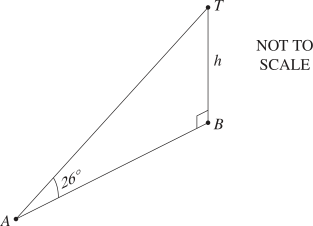
Which of the following is the correct expression for the length of `A B` ?
The life span of batteries from a particular factory is normally distributed with a mean of 840 hours and a standard deviation of 80 hours.
It is known from statistical tables that for this distribution approximately 60% of the batteries have a life span of less than 860 hours.
What is the approximate percentage of batteries with a life span between 820 and 920 hours? (3 marks)
--- 6 WORK AREA LINES (style=lined) ---
`mu=840, \ sigma=80`
`ztext{-score (860)}\ = (x-mu)/sigma=(860-840)/80=0.25`
`ztext{-score (820)}\ =(820-840)/80=-0.25`
`ztext{-score (920)}\ =(920-840)/80=1`

`text{50% of batteries have a life span below 840 hours (by definintion)}`
`=>\ text{10% lie between 840 and 860 hours}`
`=>\ text{By symmetry, 10% lie between 820 and 840 hours}`
`=> P(-0.25<=z<=0)=10text{%}`
`:.\ text{Percentage between 820 and 920}`
`=P(-0.25<=z<=1)`
`=P(-0.25<=z<=0) + P(0<=z<=1)`
`=10+34`
`=44text{%}`
Jo is researching the relationship between the ages of teenage characters in television series and the ages of actors playing these characters.
After collecting the data, Jo finds that the correlation coefficient is 0.4564.
A scatterplot showing the data is drawn. The line of best fit with equation `y=-7.51+1.85 x`, is also drawn.
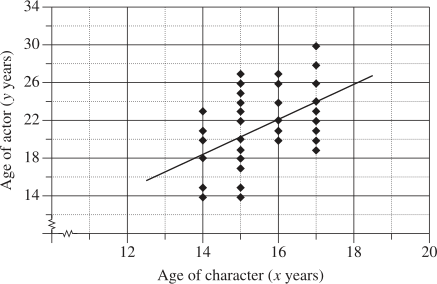
Describe and interpret the data and other information provided, with reference to the context given. (4 marks)
--- 8 WORK AREA LINES (style=lined) ---
Eli is choosing between two investment options.

A table of future value interest factors for an annuity of $1 is shown.

--- 4 WORK AREA LINES (style=lined) ---
--- 4 WORK AREA LINES (style=lined) ---
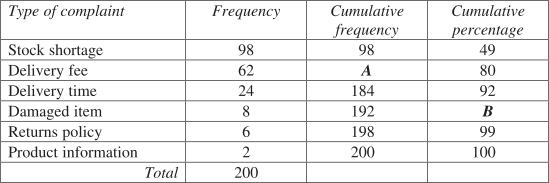
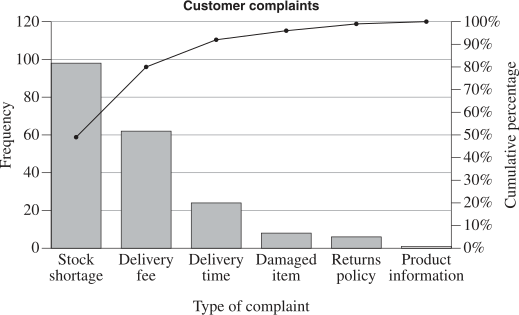
The table shows the types of customer complaints received by an online business in a month.
--- 4 WORK AREA LINES (style=lined) ---
--- 2 WORK AREA LINES (style=lined) ---
Frankie borrows $200 000 from a bank. The loan is to be repaid over 23 years at a rate of 7.2% per annum, compounded monthly. The repayments have been set at $1485 per month.
The interest charged and the balance owing for the first three months of the loan are shown in the spreadsheet below.

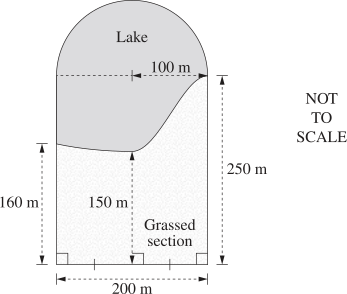
The diagram shows a park consisting of a rectangle and a semicircle. The semicircle has a radius of 100 m. The dimensions of the rectangle are 200 m and 250 m.
A lake occupies a section of the park as shown. The rest of the park is a grassed section. Some measurements from the end of the grassed section to the edge of the lake are also shown.
--- 4 WORK AREA LINES (style=lined) ---
--- 4 WORK AREA LINES (style=lined) ---
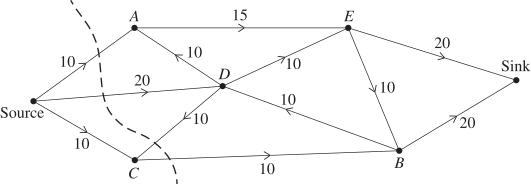
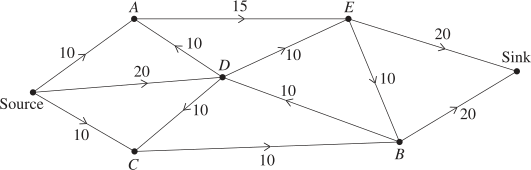
A wildlife park has 5 main attractions `(A, B, C, D, E)` connected by directional paths. A simple network is drawn to represent the flow through the park's paths. The number of visitors who can access each path at any one time is also shown.
--- 2 WORK AREA LINES (style=lined) ---
--- 2 WORK AREA LINES (style=lined) ---
--- 4 WORK AREA LINES (style=lined) ---
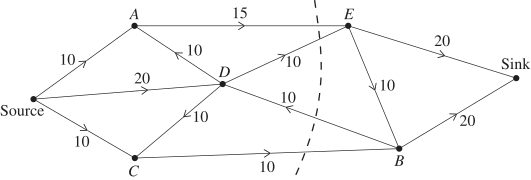
a. `text{Flow capacity = 10 + 20 + 10 = 40}`
`text{(DE is not counted as it runs from sink → source)}`
b.
`text{Min Cut = Max Flow}`
| `text{Max Flow}` | `=15+10+10` | |
| `=35<40` |
c. `text{Two strategies:}`
`text{(both strategies would increase the minimum cut to}`
`text{40 by increasing the flow to vertex}\ E\ text{to 30)}`
Sydney is 10 hours ahead of Coordinated Universal Time (UTC +10) and New York is 5 hours behind Coordinated Universal Time (UTC –5).
Tony travels from Sydney to New York. His plane leaves Sydney at 8:20 pm on Wednesday local time and flies non-stop to New York.
The flight takes 20 hours and 24 minutes.
What time and day is it in New York when the plane lands? (3 marks)
The table shows the future value of an annuity of $1.
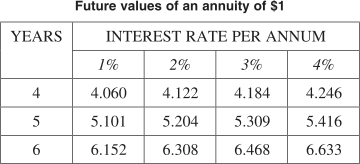
Zal is saving for a trip and estimates he will need $15 000. He opens an account earning 3% per annum, compounded annually.
--- 4 WORK AREA LINES (style=lined) ---
--- 4 WORK AREA LINES (style=lined) ---
The numbers 1, 2, 3, 4, 5 and 6 are each written on separate cards.
Amy has cards 1, 3 and 5 and Bob has cards 2, 4 and 6.
They play a game in which each person randomly chooses one of their own cards and compares it with the other person's card. The person with the higher card wins.
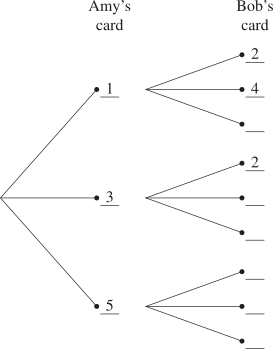
--- 2 WORK AREA LINES (style=lined) ---
a.

`P(text{Bob wins}) = 6/9=2/3`
| b. | `text{Expected wins}` | `=2/3 xx 30` |
| `=20` |
The formula `C=100 n+b` is used to calculate the cost of producing laptops, where `C` is the cost in dollars, `n` is the number of laptops produced and `b` is the fixed cost in dollars.
--- 2 WORK AREA LINES (style=lined) ---
--- 4 WORK AREA LINES (style=lined) ---
The table shows the types of customer complaints received by an online business in a month.
--- 4 WORK AREA LINES (style=lined) ---
--- 2 WORK AREA LINES (style=lined) ---
The marks in a test were normally distributed. The mean mark was 60 and the standard deviation was 15 .
What was the percentage of marks higher than 90? (2 marks)
--- 4 WORK AREA LINES (style=lined) ---
| `ztext{-score}` | `=(x-mu)/sigma` | |
| `=(90-60)/15` | ||
| `=2` |
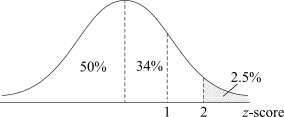
`text{% marks > 90}\ = 2.5text{%}`
Which of the following correctly expresses `x` as the subject of `y=(ax-b)/(2)` ?
For a particular course, the recorded data show a relationship between the number of hours of study per week and the marks achieved out of 100 .
A least-squares regression line is fitted to this dataset. The equation of this line is given by
`M=20+3 H,`
where `M` is the predicted mark and `H` is the number of hours of study per week.
Based on this regression equation, which of the following is correct regarding the predicted mark of a student?
In ten years, the future value of an investment will be $150 000. The interest rate is 4% per annum, compounded half-yearly.
Which equation will give the present value `(PV)` of the investment?
Which true bearing is the same as `text{S} 48^@ text{W}`?
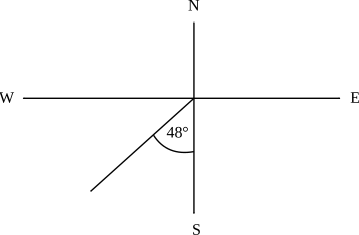
| `text{True bearing}` | `=180 + 48` |
| `=228^@` |
`=>C`
What is 20 minutes to one-third of a day, expressed as a ratio in simplest form?
Consider the following dataset.
`{:[13,16,17,17,21,24]:}`
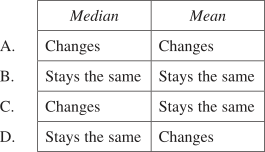
Which row of the table shows how the median and mean are affected when a score of 5 is added to the dataset?
The network diagram shows the time needed for each step in order to complete a project.
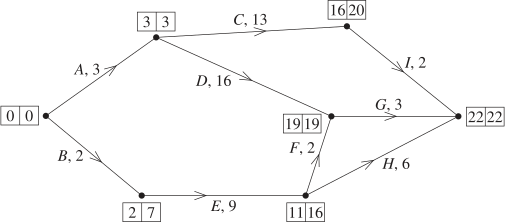
What is the critical path to complete the project?
A student investigated the photoelectric effect. The frequency of light incident on a metal surface was varied and the corresponding maximum kinetic energy of the photoelectrons was measured.
The following results were obtained.
\begin{array}{|l|c|c|c|c|c|}
\hline \rule{0pt}{2.5ex}\textit{Frequency}\ \left(\times 10^{14} Hz\right) \rule[-1ex]{0pt}{0pt}& 11.2 & 13.5 & 15.2 & 18.6 & 20.0 \\
\hline \rule{0pt}{2.5ex}\textit{Maximum kinetic energy}\ (eV) \rule[-1ex]{0pt}{0pt}& 0.6 & 1.3 & 2.3 & 3.3 & 4.2 \\
\hline
\end{array}
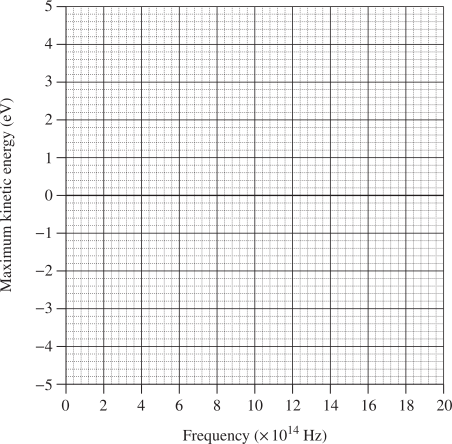
Plot the results on the axes below and hence determine the work function of the metal in electron volts. (3 marks)
--- 3 WORK AREA LINES (style=lined) ---
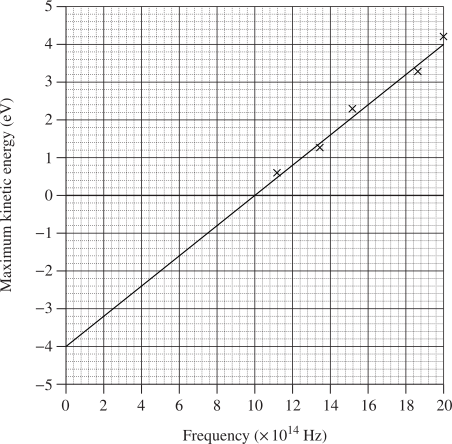
The metal has a work function of 4 eV (this is the negative of the \(y\)-intercept).
Spectra can be used to determine the chemical composition and surface temperature of stars.
Describe how spectra provide information about OTHER features of stars. (3 marks)
--- 8 WORK AREA LINES (style=lined) ---
Outline de Broglie's contribution to quantum mechanics. Support your answer with a relevant equation. (2 marks)
--- 4 WORK AREA LINES (style=lined) ---
Monochromatic light passes through two slits 1 \(\mu \text{m}\) apart. The resulting diffraction pattern is measured at a distance of 0.3 m.
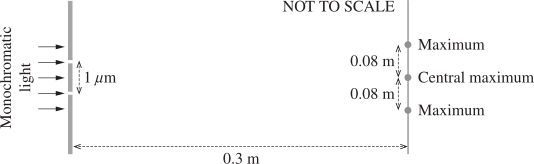
This diffraction pattern can be analysed using the equation \(d \sin \theta=\lambda\).
What values of \(d\) and \(theta\) should be used in the equation?
\begin{align*}
\begin{array}{l}
\rule{0pt}{2.5ex} \ \rule[-2.5ex]{0pt}{0pt}& \\
\rule{0pt}{3ex}\textbf{A.}\rule[-2.5ex]{0pt}{0pt}\\
\rule{0pt}{3ex}\textbf{B.}\rule[-3ex]{0pt}{0pt}\\
\rule{0pt}{3ex}\textbf{C.}\rule[-3ex]{0pt}{0pt}\\
\rule{0pt}{3ex}\textbf{D.}\rule[-3ex]{0pt}{0pt}\\
\end{array}
\begin{array}{|c|c|}
\hline
\rule{0pt}{2.5ex}\quad d \quad \rule[-1ex]{0pt}{0pt}& \theta \\
\hline
\rule{0pt}{2.5ex}0.3 \ \text{m}\rule[-1ex]{0pt}{0pt}&\tan ^{-1}\left(\dfrac{0.08}{0.3}\right)\\
\hline
\rule{0pt}{2.5ex}0.3 \ \text{m}\rule[-1ex]{0pt}{0pt}& \sin ^{-1}\left(\dfrac{0.08}{0.3}\right) \\
\hline
\rule{0pt}{2.5ex}1 \ \mu \text{m}\rule[-1ex]{0pt}{0pt}& \tan ^{-1}\left(\dfrac{0.08}{0.3}\right)\\
\hline
\rule{0pt}{2.5ex}1 \ \mu \text{m} \rule[-1ex]{0pt}{0pt}&\sin ^{-1}\left(\dfrac{0.08}{0.3}\right) \\
\hline
\end{array}
\end{align*}