During a flood, 12.5 hectares of land was covered by water to a depth of 30 cm.
How many kilolitres of water covered the land?
(1 hectare = 10 000 m² and 1 m³ = 1000 L)
- 3.75 kL
- 37.5 kL
- 37 500 kL
- 37 500 000 kL
Aussie Maths & Science Teachers: Save your time with SmarterEd
During a flood, 12.5 hectares of land was covered by water to a depth of 30 cm.
How many kilolitres of water covered the land?
(1 hectare = 10 000 m² and 1 m³ = 1000 L)
Which of the following expresses S25°E as a true bearing?
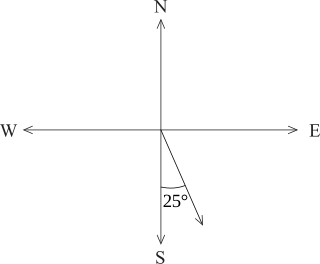
| `text(S60°W)` | `= 180-25` |
| `= 155°` |
`=>D`
Consider the function `f` with rule `f(x) = 1/sqrt(sin^(-1)(cx + d))`, where `c, d in R` and `c > 0`.
The domain of `f` is
A. `x > -d/c`
B. `-d/c < x <= (1 - d)/c`
C. `(-1 - d)/c <= x <= (1 - d)/c`
D. `x in R\ text(\) {-d/c}`
E. `x in R`
Two friends, Sequoia and Raven, sold organic chapsticks at the the local market.
Sequoia sold her chapsticks for $4 and Raven sold hers for $3 each. In the first hour, their total combined sales were $20.
If Sequoia sold `x` chapsticks and Raven sold `y` chapsticks, then the following equation can be formed:
`4x + 3y = 20`
In the first hour, the friends sold a total of 6 chapsticks between them.
Find the number of chapsticks each of the friends sold during this time by forming a second equation and solving the simultaneous equations graphically. (5 marks)
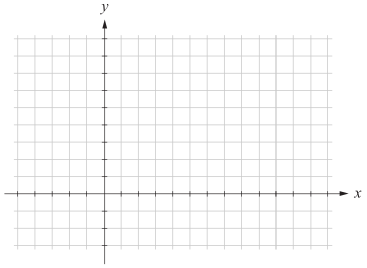
| `text(Graphing)\ \ 4x + 3y` | `= 20` |
| `y` | `= −4/3x + 20/3` |
`ytext(-intercept) = (0, 20/3)`
`xtext(-intercept)= (5, 0)`
`text(Gradient)\ = -4/3`
`text(S)text(econd equation:)`
`x + y = 6`
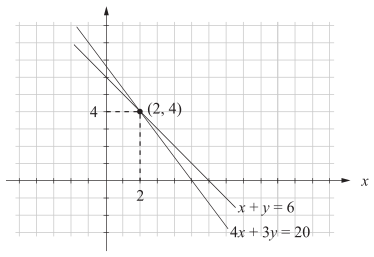
`text(From the graph,)`
`text(Sequoia sold 2 and Raven sold 4.)`
The graph of the line `y = 4 - x` is shown.
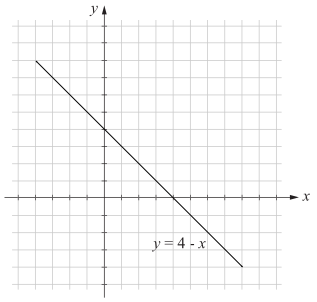
By graphing `y = 2x + 1` on the grid provided, find the point of intersection of `y = 4 - x` and `y = 2x + 1`. (3 marks)
--- 1 WORK AREA LINES (style=lined) ---
`text(Graphing)\ y = 2x + 1 :`
`ytext(-intercept = 1)`
`text(Gradient = 2)`
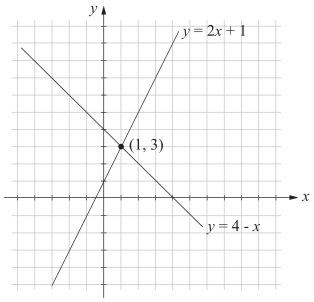
`:.\ text{Point of intersection is (1, 3).}`
A student was asked to solve the following simultaneous equations.
`y = 2x - 8`
`x - 4y + 3 = 0`
After graphing the equations, the student found the point of intersection to be `(5,2)`?
Is the student correct? Support your answer with calculations. (2 marks)
--- 5 WORK AREA LINES (style=lined) ---
A game consists of two tokens being drawn at random from a barrel containing 20 tokens. There are 17 red tokens and 3 black tokens. The player keeps the two tokens drawn.
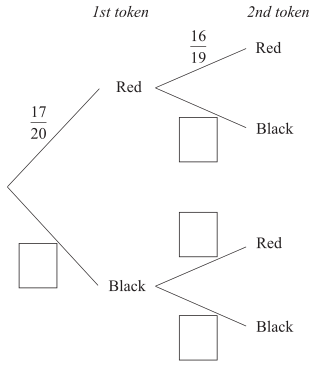
--- 4 WORK AREA LINES (style=lined) ---
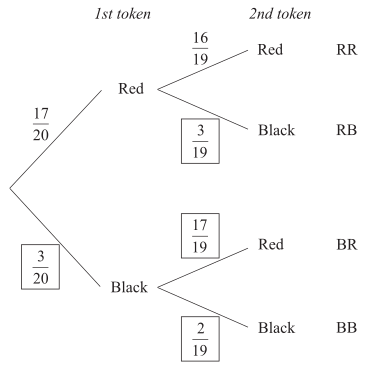
| i. | |
ii. `P(text(at least one red))`
`= 1 – P(BB)`
`= 1 – 3/20 · 2/19`
`= 187/190`
An investment fund purchases 4500 shares of Bank ABC for a total cost of $274 500 (ignore any transaction costs).
The investment fund is paid a divided of $3.66 per share in the first year.
--- 6 WORK AREA LINES (style=lined) ---
--- 9 WORK AREA LINES (style=lined) ---


i.
ii. `text(Transforming)\ \ y = ln x => \ y = ln(x + 2)`
`y = ln x\ \ =>\ text(shift 2 units to left.)`
`text(Transforming)\ \ y = ln(x + 2)\ \ text(to)\ \ y = 3ln(x + 2)`
`=>\ text(increase each)\ y\ text(value by a factor of 3)`
The displacement `x` metres from the origin at time `t` seconds of a particle travelling in a straight line is given by
`x = 2t^3 - t^2 - 3t + 11` when `t >= 0`
--- 2 WORK AREA LINES (style=lined) ---
--- 4 WORK AREA LINES (style=lined) ---
--- 4 WORK AREA LINES (style=lined) ---
--- 3 WORK AREA LINES (style=lined) ---
Given `sectheta = −37/12` for `0 < theta < pi`,
find the exact value of `text(cosec)\ theta`. (2 marks)
--- 5 WORK AREA LINES (style=lined) ---
`sec\ theta = -37/12 => cos\ theta = -12/37`
`text(Graphically:)`
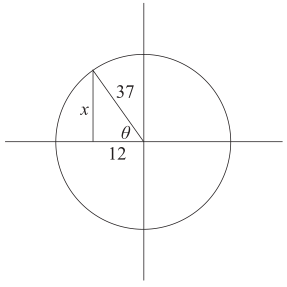
`x=sqrt(37^2-12^2)=35`
| `:.\ text(cosec)\ theta` | `= 1/(sintheta)` |
| `= 1/(35/37)` | |
| `= 37/35` |
Express `5cot^2 x - 2text(cosec)\ x + 2` in terms of `text(cosec)\ x` and hence solve
`5cot^2 x - 2text(cosec)\ x + 2 = 0` for `0 < x < 2pi`. (3 marks)
--- 6 WORK AREA LINES (style=lined) ---
Given `cottheta = −24/7` for `−pi/2 < theta < pi/2`, find the exact value of
--- 4 WORK AREA LINES (style=lined) ---
--- 1 WORK AREA LINES (style=lined) ---
i. `cot theta = −24/7\ \ =>\ \ tan theta=– 7/24`
`text(Graphically, given)\ −pi/2 < theta < pi/2:`
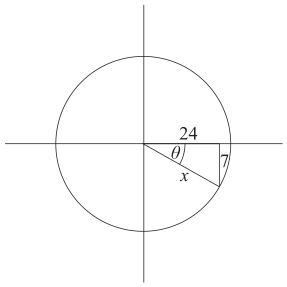
`x= sqrt(24^2 + 7^2)=25`
| `sectheta` | `= 1/(costheta)` |
| `= 1/(24/25)` | |
| `= 25/24` |
ii. `sintheta = −7/25`
The stopping distance of a car on a certain road, once the brakes are applied, is directly proportional to the square of the speed of the car when the brakes are first applied.
A car travelling at 70 km/h takes 58.8 metres to stop.
How far does it take to stop if it is travelling at 105 km/h? (3 marks)
--- 6 WORK AREA LINES (style=lined) ---
Fuifui finds that for Giant moray eels, the mass of an eel is directly proportional to the cube of its length.
An eel of this species has a length of 25 cm and a mass of 4350 grams.
What is the expected length of a Giant moray eel with a mass of 6.2 kg? Give your answer to one decimal place. (3 marks)
--- 7 WORK AREA LINES (style=lined) ---
Damon owns a swim school and purchased a new pool pump for $3250.
He writes down the value of the pool pump by 8% of the original price each year.
--- 1 WORK AREA LINES (style=lined) ---
--- 8 WORK AREA LINES (style=lined) ---
| i. `text(Depreciation each year)` | `= 8text(%) xx 3250` |
| `= $260` |
`:.\ text(Value) = 3250 – 260t`
ii.

`text(Find)\ \ t\ \ text(when value = 0)`
| `3250 – 260t` | `= 0` |
| `t` | `= 3250/260` |
| `= 12.5\ text(years)` |
`text(Domain)\ \ {t: 0 <= t <= 12.5}`
`text(Range)\ \ {y: 0 <= y <= 3250}`
Find the values of `k` for which the expression `x^2-3x + (4-2k)` is always positive. (3 marks)
--- 7 WORK AREA LINES (style=lined) ---
Worker A picks a bucket of blueberries in `a` hours. Worker B picks a bucket of blueberries in `b` hours.
--- 3 WORK AREA LINES (style=lined) ---
--- 2 WORK AREA LINES (style=lined) ---
Simplify `(p/q)^3 ÷ (pq^(-2))`. (2 marks)
A particle is moving along the `x`-axis. Its velocity `v` at time `t` is given by
`v = sqrt(20t - 2t^2)` metres per second
Find the acceleration of the particle when `t = 4`.
Express your answer as an exact value in its simplest form. (3 marks)
--- 6 WORK AREA LINES (style=lined) ---
Find the exact value of `cos((11pi)/12)`. (2 marks)
--- 5 WORK AREA LINES (style=lined) ---
If `sintheta = −4/6` and `−pi/2 < theta < pi/2`,
determine the exact value of `costheta` in its simplest form. (2 marks)
--- 5 WORK AREA LINES (style=lined) ---
`text(Consider the angle graphically:)`COMMENT: Pay careful attention to the range of `theta`.

`text(S)text(ince)\ sintheta\ text(is negative) => underbrace(text(4th quadrant))_(−pi/2 <\ theta\ < pi/2)`
`text(Using Pythagoras:)`
`x^2 = 6^2-4^2`
`x = sqrt20 = 2sqrt5`
`:. costheta= (2sqrt5)/6= sqrt5/3`
Find the exact value of `cos\ pi/8`. (2 marks)
--- 5 WORK AREA LINES (style=lined) ---
A circle has centre `(5,3)` and radius 3.
--- 4 WORK AREA LINES (style=lined) ---
--- 8 WORK AREA LINES (style=lined) ---
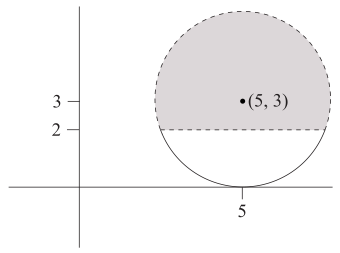
i. `text(Equation of circle:)`
`(x-5)^2 + (y-3)^2 = 3^2`
`:.\ text(Region is:)`
`(x-5)^2 + (y- 3)^2 < 9\ ∩\ y > 2`
COMMENT: The broken line on the graph represents an excluded boundary.
ii.
Find the coefficient of `x^4` in the expansion of `(x^2 - 3/x)^5`. (2 marks)
--- 6 WORK AREA LINES (style=lined) ---
`(1-2sqrt2)^6 = x + ysqrt2`
Evaluate the value of `x` and `y`. (2 marks)
--- 5 WORK AREA LINES (style=lined) ---
Determine all possible dimensions for triangle `ABC` given `AB = 6.2\ text(cm)`, `angleABC = 35°` and `AC = 4.1`.
Give all dimensions correct to one decimal place. (3 marks)
--- 8 WORK AREA LINES (style=lined) ---
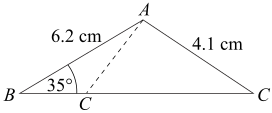
`text(Using the sine rule:)`
| `(sinangleACB)/6.2` | `= (sin35^@)/4.1` |
| `sinangleACB` | `= (6.2 xx sin35^@)/4.1` |
| `= 0.8673…` | |
| `angleACB` | `= 60.15…^@\ text(or)\ 119.84…^@` |
`text(If)\ \ angleACB = 60.15^@,`
`angleBAC = 180 – (35 + 60.15) = 84.85^@`
| `(BC)/(sin84.85)` | `= 4.1/(sin35^@)` |
| `BC` | `= 7.11…` |
| `= 7.1\ text(cm)` |
`text(If)\ \ angleACB = 119.85^@,`
`angleBAC = 180 – (35 + 119.85) = 25.15^@`
| `(BC)/(sin25.15)` | `= 4.1/(sin35^@)` |
| `BC` | `= 3.03…` |
| `= 3.0\ text(cm)` |
`:.\ text(Possible dimensions are:)`
`text(7.1 cm, 6.2 cm, 4.1 cm or)`
`text(3.0 cm, 6.2 cm, 4.1 cm.)`
The region enclosed by the semicircle `y = sqrt(1 - x^2)` and the `x`-axis is to be divided into two pieces by the line `x = h`, when `0 <= h <1`.
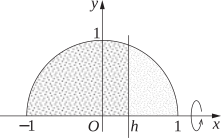
The two pieces are rotated about the `x`-axis to form solids of revolution. The value of `h` is chosen so that the volumes of the solids are in the ratio `2 : 1`.
Show that `h` satisfies the equation `3h^3 - 9h + 2 = 0`. (3 marks)
--- 8 WORK AREA LINES (style=lined) ---
With a suitable substitution `int_1^2 x^2 sqrt(2 - x)\ dx` can be expressed as
The solutions to `z^n = 1 + i, \ n ∈ Z^+` are given by
Let `f(x) = e^(-x^2)`. The diagram shows the graph `y = f(x)`.

Find the `x` coordinates of these points. (3 marks)
--- 6 WORK AREA LINES (style=lined) ---
--- 3 WORK AREA LINES (style=lined) ---
--- 5 WORK AREA LINES (style=lined) ---
--- 2 WORK AREA LINES (style=lined) ---
--- 5 WORK AREA LINES (style=lined) ---
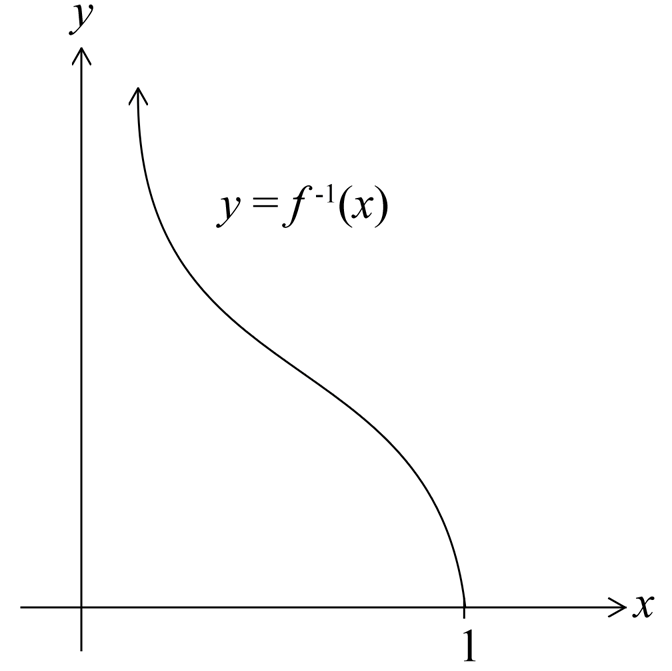
| i. | `y` | `= e^(-x^2)` |
| `dy/dx` | `= -2x * e^(-x^2)` | |
| `(d^2y)/(dx^2)` | `= -2x (-2x * e^(-x^2)) + e ^(-x^2) (-2)` | |
| `= 4x^2 e^(-x^2)\ – 2e^(-x^2)` | ||
| `= 2e^(-x^2) (2x^2\ – 1)` |
`text(P.I. when)\ \ (d^2y)/(dx^2) = 0`
| `2e^(-x^2) (2x^2\ – 1)` | `= 0` |
| `2x^2\ – 1` | `= 0` |
| `x^2` | `= 1/2` |
| `x` | `= +- 1/sqrt2` |
| `text(When)\ \ ` | `x < 1/sqrt2,` | `\ (d^2y)/(dx^2) < 0` |
| `x > 1/sqrt2,` | `\ (d^2y)/(dx^2) > 0` |
`=>\ text(Change of concavity)`
`:.\ text(P.I. at)\ \ x = 1/sqrt2`
| `text(When)\ \ ` | `x < – 1/sqrt2,` | `\ (d^2y)/(dx^2) > 0` |
| `x > – 1/sqrt2,` | `\ (d^2y)/(dx^2) < 0` |
`=>\ text(Change of concavity)`
`:.\ text(P.I. at)\ \ x = – 1/sqrt2`
| ii. | `text(In)\ f(x), text(there are 2 values of)\ y\ text(for)` |
| `text(each value of)\ x.` | |
| `:.\ text(The domain of)\ f(x)\ text(must be restricted)` | |
| `text(for)\ \ f^(-1) (x)\ text(to exist).` |
| iii. | `y = e^(-x^2)` |
`text(Inverse function can be written)`
| `x` | `= e^(-y^2),\ \ \ x >= 0` |
| `lnx` | `= ln e^(-y^2)` |
| `-y^2` | `= lnx` |
| `y^2` | `= -lnx` |
| `=ln(1/x)` | |
| `y` | `= +- sqrt(ln (1/x))` |
`text(Restricting)\ \ x>=0,\ \ =>y>=0`
`:. f^(-1) (x)=sqrt(ln (1/x))`
| iv. | `f(0) = e^0 = 1` |
`:.\ text(Range of)\ \ f(x)\ \ text(is)\ \ 0 < y <= 1`
`:.\ text(Domain of)\ \ f^(-1) (x)\ \ text(is)\ \ 0 < x <= 1`
| v. |
|
The diagram below shows a sketch of the graph of `y = f(x)`, where `f(x) = 1/(1 + x^2)` for `x ≥ 0`.

--- 1 WORK AREA LINES (style=lined) ---
--- 5 WORK AREA LINES (style=lined) ---
Let `α` be the `x`-coordinate of `P`. Explain why `α` is a root of the equation `x^3 + x − 1 = 0`. (1 mark)
--- 4 WORK AREA LINES (style=lined) ---
| i. |
|
ii. `text(Domain of)\ \ f^(−1)(x)\ text(is)`
`0 < x ≤ 1`
iii. `f(x) = 1/(1 + x^2)`
`text(Inverse: swap)\ \ x↔y`
| `x` | `= 1/(1 + y^2)` |
| `x(1 + y^2)` | `= 1` |
| `1 + y^2` | `= 1/x` |
| `y^2` | `= 1/x − 1` |
| `= (1 − x)/x` | |
| `y` | `= ± sqrt((1 − x)/x)` |
`:.y = sqrt((1 − x)/x), \ \ y >= 0`
iv. `P\ \ text(occurs when)\ \ f(x)\ \ text(cuts)\ \ y = x`
`text(i.e. where)`
| `1/(1 + x^2)` | `= x` |
| `1` | `= x(1 + x^2)` |
| `1` | `= x + x^3` |
| `x^3 + x − 1` | `= 0` |
`=>\ text(S)text(ince)\ α\ text(is the)\ x\ text(-coordinate of)\ P,`
`text(it is a root of)\ \ \ x^3 + x − 1 = 0`
If the equation `f(2x) - 2f(x) = 0` is true for all real values of `x`, then `f(x)` could equal
A. `x^2/2`
B. `sqrt (2x)`
C. `2x`
D. `x - 2`
Which one of the following functions satisfies the functional equation `f (f(x)) = x`?
A. `f(x) = 2 - x`
B. `f(x) = x^2`
C. `f(x) = 2 sqrt x`
D. `f(x) = x - 2`
If `f(x - 1) = x^2 - 2x + 3`, then `f(x)` is equal to
A. `x^2 - 2`
B. `x^2 + 2`
C. `x^2 - 2x + 4`
D. `x^2 - 4x + 6`
Let `f (x) = x^2`
Which one of the following is not true?
A. `f(xy) = f (x) f (y)`
B. `f(x) - f(-x) = 0`
C. `f (2x) = 4 f (x)`
D. `f (x - y) = f(x) - f(y)`
Let `f(x) = log_e(x)` for `x>0,` and `g (x) = x^2 + 1` for all `x`.
--- 2 WORK AREA LINES (style=lined) ---
--- 4 WORK AREA LINES (style=lined) ---
--- 4 WORK AREA LINES (style=lined) ---
Let `f(x) = sqrt(x + 1)` for `x>=0`
--- 4 WORK AREA LINES (style=lined) ---
--- 6 WORK AREA LINES (style=lined) ---
i. `text(Sketch of)\ \ f(x):`
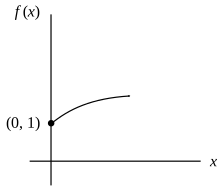
`:.\ text(Range:)\ \ y>= 1`
ii. `text(Sketch)\ \ g(x) = (x + 1) (x + 3)`
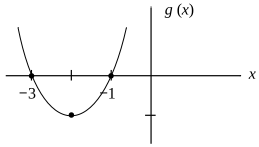
`text(Domain of)\ \ f(x):\ \ x>=0`
`text(Find domain of)\ g(x)\ text(such that range)\ g(x):\ y>=0`
`text(Graphically, this occurs when)\ \ g(x)\ \ text(has domain:)`
`x <= –3\ \ text(and)\ \ x>=-1`
`:. c = -3`
An object is moving on the `x`-axis. The graph shows the velocity, `(dx)/(dt)`, of the object, as a function of time, `t`. The coordinates of the points shown on the graph are `A (2, 1), B (4, 5), C (5, 0) and D (6, –5)`. The velocity is constant for `t >= 6`.

--- 1 WORK AREA LINES (style=lined) ---
--- 5 WORK AREA LINES (style=lined) ---
--- 10 WORK AREA LINES (style=lined) ---
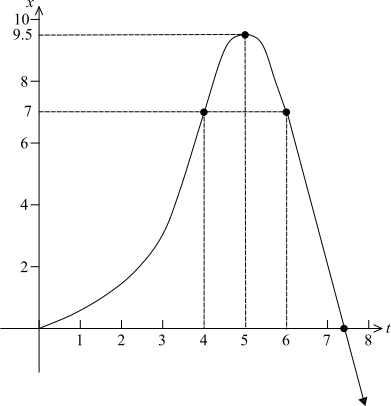
i. `text(Displacement is reducing when the velocity is negative.)`
`:. t > 5\ \ text(seconds)`
ii. `text(At)\ B,\ text(the displacement) = 7\ text(units)`
`text(Considering displacement from)\ B\ text(to)\ D:`
`text(S)text(ince the area below the graph from)`
`B\ text(to)\ C\ text(equals the area above the)`
`text(graph from)\ C\ text(to)\ D,\ text(there is no change)`
`text(in displacement from)\ B\ text(to)\ D.`
`text(Considering)\ t >= 6`
`text(Time required to return to origin)`
| `t` | `= d/v` |
| `= 7/5` | |
| `= 1.4\ \ text(seconds)` |
`:.\ text(The particle returns to the origin after 7.4 seconds.)`
iii.
Sharnie records the number of items she recycles in one week.
The tally table shows Sharnie's results.

How many items does Sharnie recycle in total?
For events `A` and `B` from a sample space, `P(A text(|)B) = 1/5` and `P(B text(|)A) = 1/4`. Let `P(A nn B) = p`.
--- 2 WORK AREA LINES (style=lined) ---
--- 6 WORK AREA LINES (style=lined) ---
--- 3 WORK AREA LINES (style=lined) ---
| i. | `P\ (A)` | `=(P\ (A nn B))/(P\ (B text(|) A))` |
| `=p/(1/4)` | ||
| `=4p` |
ii. `text(Consider the Venn diagram:)`
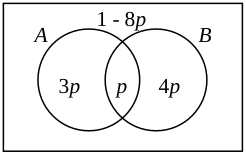
`P\ (A^{′} nn B^{′}) = 1-8p`
iii. `text(Given)\ P(A uu B) = 8p`
`=> 0 < 8p <= 1/5`
`:. 0 < p <= 1/40`
Sally aims to walk her dog, Mack, most mornings. If the weather is pleasant, the probability that she will walk Mack is `3/4`, and if the weather is unpleasant, the probability that she will walk Mack is `1/3`.
Assume that pleasant weather on any morning is independent of pleasant weather on any other morning.
Find the probability that Sally walked Mack on at least one of these two mornings. (2 marks)
--- 3 WORK AREA LINES (style=lined) ---
--- 6 WORK AREA LINES (style=lined) ---
--- 4 WORK AREA LINES (style=lined) ---
| a. | `Ptext{(at least 1 walk)}` | `= 1 – Ptext{(no walk)}` |
| `= 1 – 1/4 xx 2/3` | ||
| `= 5/6` |
b.i. `text(Construct tree diagram:)`

| `P(PW) + P(P′W)` | `= 5/8 xx 3/4 + 3/8 xx 1/3` |
| `= 19/32` |
| b.ii. | `P(P | W)` | `= (P(P ∩ W))/(P(W))` |
| `= (5/8 xx 3/4)/(19/32)` | ||
| `= 15/32 xx 32/19` | ||
| `= 15/19` |
Two events, `A` and `B`, are such that `P(A) = 3/5` and `P(B) = 1/4.`
If `A^{′}` denotes the compliment of `A`, calculate `P (A^{′} nn B)` when
--- 8 WORK AREA LINES (style=lined) ---
--- 6 WORK AREA LINES (style=lined) ---
i. `text(Sketch Venn Diagram)`

| `P (A uu B)` | `= P (A) + P (B)-P (A nn B)` |
| `3/4` | `= 3/5 + 1/4-P (A nn B)` |
| `P (A nn B)` | `= 1/10` |
`:.\ P(A^{′} nn B) = 1/4-1/10 = 3/20`
| ii. |  |
`P (A∩ B)=0\ \ text{(mutually exclusive)},`
`:.\ P (A^{′} nn B) = P (B) = 1/4`
There is a daily flight from Paradise Island to Melbourne. The probability of the flight departing on time, given that there is fine weather on the island, is 0.8, and the probability of the flight departing on time, given that the weather on the island is not fine, is 0.6.
In March the probability of a day being fine is 0.4.
Find the probability that on a particular day in March
--- 8 WORK AREA LINES (style=lined) ---
--- 3 WORK AREA LINES (style=lined) ---
| i. |  |
`P(FT) +\ P(F^{′}T)`
`= 0.4 xx 0.8 + 0.6 xx 0.6`
`= 0.32 + 0.36`
`= 0.68`
ii. `text(Conditional probability:)`
| `P(F\ text(|)\ T)` | `= (P(F ∩ T))/(P(T))` |
| `= 0.32/0.68` |
`:. P(F\ text(|)\ T) = 8/17`
For events `A` and `B` from a sample space, `P(A | B) = 3/4` and `P(B) = 1/3`.
--- 3 WORK AREA LINES (style=lined) ---
--- 3 WORK AREA LINES (style=lined) ---
--- 3 WORK AREA LINES (style=lined) ---
i. `text(Using Conditional Probability:)`
| `P(A | B)` | `= (P(A ∩ B))/(P(B))` |
| `3/4` | `= (P(A ∩ B))/(1/3)` |
| `:. P(A ∩ B)` | `= 1/4` |
| ii. |  |
| `P(A^{′} ∩ B)` | `= P(B)-P(A ∩B)` |
| `= 1/3-1/4` | |
| `= 1/12` |
iii. `text(If)\ A, B\ text(independent)`
| `P(A ∩ B)` | `= P(A) xx P(B)` |
| `1/4` | `= P(A) xx 1/3` |
| `:. P(A)` | `= 3/4` |
| `P(A ∪ B)` | `= P(A) + P(B)-P(A ∩ B)` |
| `= 3/4 + 1/3-1/4` | |
| `:. P(A ∪ B)` | `= 5/6` |
Four identical balls are numbered 1, 2, 3 and 4 and put into a box. A ball is randomly drawn from the box, and not returned to the box. A second ball is then randomly drawn from the box.
--- 1 WORK AREA LINES (style=lined) ---
--- 2 WORK AREA LINES (style=lined) ---
--- 4 WORK AREA LINES (style=lined) ---
For events `A` and `B,\ P(A ∩ B) = p,\ P(A^{′}∩ B) = p -1/8` and `P(A ∩ B^{′}) = (3p)/5.`
If `A` and `B` are independent, then the value of `p` is
`A` and `B` are events of a sample space `S.`
`P(A nn B) = 2/5` and `P(A nn B^(′)) = 3/7`
`P(B^(′) | A)` is equal to

| `P(B ^(′) | A)` | `= (P(B^(′) nn A))/(P(A))` |
| `= (P(B^(′) nn A))/(P(B^(′) nn A)+ P(A nn B))` | |
| `= (3/7)/(3/7 + 2/5)` | |
| `= 15/29` |
`=> B`
The probability distribution of a discrete random variable, `X`, is given by the table below.
\begin{array} {|c|c|c|c|c|}
\hline
\rule{0pt}{2.5ex} x \rule[-1ex]{0pt}{0pt} & \ \ \ 0\ \ \ & \ \ \ 1\ \ \ & \ \ \ 2\ \ \ & \ \ \ 3\ \ \ &\ \ \ 4\ \ \ \\
\hline
\rule{0pt}{2.5ex} P(X=x) \rule[-1ex]{0pt}{0pt} & 0.2 & 0.6p^{2} & 0.1 & 1-p & 0.1 \\
\hline
\end{array}
--- 6 WORK AREA LINES (style=lined) ---
--- 4 WORK AREA LINES (style=lined) ---
--- 2 WORK AREA LINES (style=lined) ---
On any given day, the number `X` of telephone calls that Daniel receives is a random variable with probability distribution given by
\begin{array} {|c|c|c|c|c|}
\hline
\rule{0pt}{2.5ex} x \rule[-1ex]{0pt}{0pt} & \ \ \ 0\ \ \ & \ \ \ 1\ \ \ & \ \ \ 2\ \ \ & \ \ \ 3\ \ \ \\
\hline
\rule{0pt}{2.5ex} P(X=x) \rule[-1ex]{0pt}{0pt} & 0.2 & 0.2 & 0.5 & 0.1 \\
\hline
\end{array}
--- 3 WORK AREA LINES (style=lined) ---
--- 2 WORK AREA LINES (style=lined) ---
What is the probability that Daniel receives a total of four calls over these two days? (3 marks)
--- 6 WORK AREA LINES (style=lined) ---
The discrete random variable `X` has the probability distribution
\begin{array} {|c|c|c|c|c|}
\hline
\rule{0pt}{2.5ex} x \rule[-1ex]{0pt}{0pt} & \ \ \ \ -1\ \ \ \ & \ \ \ \ \ 0\ \ \ \ \ & \ \ \ \ \ 1\ \ \ \ \ & \ \ \ \ \ 2\ \ \ \ \ \\
\hline
\rule{0pt}{2.5ex} P(X=x) \rule[-1ex]{0pt}{0pt} & p^{2} & p^{2} & \dfrac{p}{4} & \dfrac{4p+1}{8} \\
\hline
\end{array}
Find the value of `p.` (3 marks)
The random variable `X` has this probability distribution.
\begin{array} {|c|c|c|c|c|}
\hline
\rule{0pt}{2.5ex} x \rule[-1ex]{0pt}{0pt} & \ \ \ 0\ \ \ & \ \ \ 1\ \ \ & \ \ \ 2\ \ \ & \ \ \ 3\ \ \ &\ \ \ 4\ \ \ \\
\hline
\rule{0pt}{2.5ex} P(X=x) \rule[-1ex]{0pt}{0pt} & 0.1 & 0.2 & 0.4 & 0.2 & 0.1 \\
\hline
\end{array}
Find
--- 4 WORK AREA LINES (style=lined) ---
--- 8 WORK AREA LINES (style=lined) ---
Jane drives to work each morning and passes through three intersections with traffic lights. The number `X` of traffic lights that are red when Jane is driving to work is a random variable with probability distribution given by
\begin{array} {|c|c|c|c|c|}
\hline
\rule{0pt}{2.5ex} x \rule[-1ex]{0pt}{0pt} & \ \ \ 0\ \ \ & \ \ \ 1\ \ \ & \ \ \ 2\ \ \ & \ \ \ 3\ \ \ \\
\hline
\rule{0pt}{2.5ex} P(X=x) \rule[-1ex]{0pt}{0pt} & 0.1 & 0.2 & 0.3 & 0.4 \\
\hline
\end{array}
--- 1 WORK AREA LINES (style=lined) ---
--- 3 WORK AREA LINES (style=lined) ---
The discrete random variable `X` has a probability distribution as shown.
\begin{array} {|c|c|c|c|c|}
\hline
\rule{0pt}{2.5ex} x \rule[-1ex]{0pt}{0pt} & \ \ \ 0\ \ \ & \ \ \ 1\ \ \ & \ \ \ 2\ \ \ & \ \ \ 3\ \ \ \\
\hline
\rule{0pt}{2.5ex} P(X=x) \rule[-1ex]{0pt}{0pt} & 0.4 & 0.2 & 0.3 & 0.1 \\
\hline
\end{array}
The median of `X` is
The random variable `X` has the following probability distribution, where `0 < p < 1/3`.
\begin{array} {|c|c|c|c|c|}
\hline
\rule{0pt}{2.5ex} x \rule[-1ex]{0pt}{0pt} & \ \ \ -1\ \ \ & \ \ \ \ 0\ \ \ \ & \ \ \ \ 1\ \ \ \ \\
\hline
\rule{0pt}{2.5ex} P(X=x) \rule[-1ex]{0pt}{0pt} & p & 2p & 1-3p \\
\hline
\end{array}
The variance of `X` is
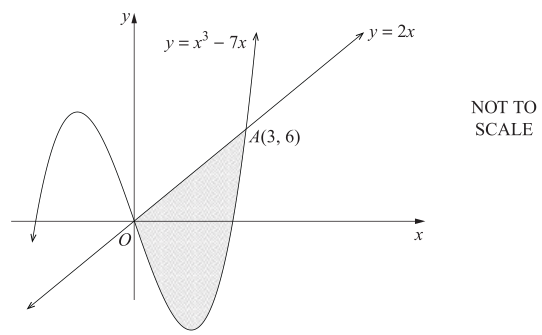
The shaded region is enclosed by the curve `y = x^3 - 7x` and the line `y = 2x`, as shown in the diagram. The line `y = 2x` meets the curve `y = x^3 - 7x` at `O(0, 0)` and `A(3, 6)`. Do NOT prove this.
--- 4 WORK AREA LINES (style=lined) ---
--- 5 WORK AREA LINES (style=lined) ---
The point `P` is chosen on the curve `y = x^3 − 7x` so that the tangent at `P` is parallel to the line `y = 2x` and the `x`-coordinate of `P` is positive
--- 5 WORK AREA LINES (style=lined) ---
--- 4 WORK AREA LINES (style=lined) ---
| i. | `text(Area)` | `= int_0^3 2x – (x^3 – 7x)\ dx` |
| `= int_0^3 9x – x^3\ dx` | ||
| `= [9/2 x^2 – 1/4 x^4]_0^3` | ||
| `= [(9/2 xx 3^2 – 1/4 xx 3^4) – 0]` | ||
| `= 81/2 – 81/4` | ||
| `= 81/4\ text(units²)` |
ii. `f(x) = 9x – x^3`

| `text(Area)` | `~~ 1/2[0 + 2(8 + 10) + 0]` |
| `~~ 1/2(36)` | |
| `~~ 18\ text(u²)` |
iii. `y = x^3 – 7x`
`(dy)/(dx) = 3x^2 – 7`
`text(Find)\ \ x\ \ text(such that)\ \ (dy)/(dx) = 2`
| `3x^2 – 7` | `= 2` |
| `3x^2` | `= 9` |
| `x^2` | `= 3` |
| `x` | `= sqrt 3 qquad (x > 0)` |
| `y` | `= (sqrt 3)^3 – 7 sqrt 3` |
| `= 3 sqrt 3 – 7 sqrt 3` | |
| `= -4 sqrt 3` |
`:. P\ \ text(has coordinates)\ (sqrt 3, -4 sqrt 3)`
| iv. | 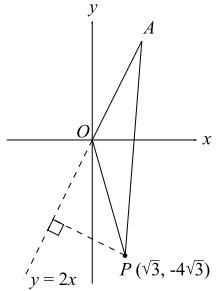 |
| `text(dist)\ OA` | `= sqrt((3 – 0)^2 + (6 – 0)^2)` |
| `= sqrt 45` | |
| `= 3 sqrt 5` |
`text(Find)\ _|_\ text(distance of)\ \ P\ \ text(from)\ \ OA`
`P(sqrt 3, -4 sqrt 3),\ \ 2x – y=0`
| `_|_\ text(dist)` | `= |(2 sqrt 3 + 4 sqrt 3)/sqrt (3 + 2)|` |
| `= (6 sqrt 3)/sqrt 5` | |
| `:.\ text(Area)` | `= 1/2 xx 3 sqrt 5 xx (6 sqrt 3)/sqrt 5` |
| `= 9 sqrt 3\ text(units²)` |
--- 2 WORK AREA LINES (style=lined) ---
--- 4 WORK AREA LINES (style=lined) ---
--- 2 WORK AREA LINES (style=lined) ---
| i. | `int_0^(pi/3) cos x\ dx` | `= [sin x]_0^(pi/3)` |
| `= sin\ pi/3-0` | ||
| `= sqrt 3/2` |
| ii. | 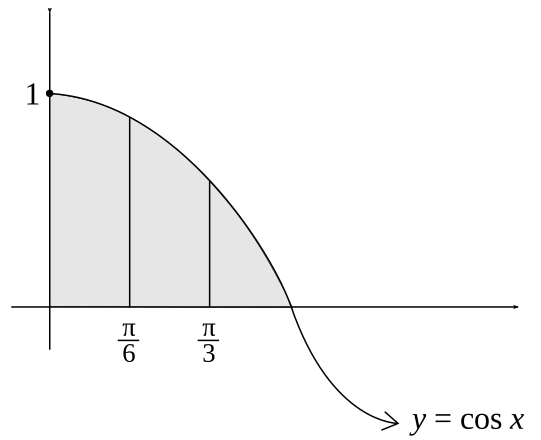 |
\begin{array} {|l|c|c|c|}\hline
x & \ \ \ 0\ \ \ & \ \ \ \dfrac{\pi}{6}\ \ \ & \ \ \ \dfrac{\pi}{3}\ \ \ \\ \hline
\text{height} & 1 & \dfrac{\sqrt{3}}{2} & \dfrac{1}{2} \\ \hline
\text{weight} & 1 & 2 & 1 \\ \hline \end{array}
| `int_0^(pi/3) cos x\ dx` | `~~ 1/2 xx pi/6[1 + 2(sqrt3/2) + 1/2]` |
| `~~ pi/12((3 + 2sqrt3)/2)` | |
| `~~ ((3+2sqrt3)pi)/24` |
♦ Mean mark part (iii) 49%.
| (iii) | `((3+2sqrt3)pi)/24` | `~~ sqrt3/2` |
| `:. pi` | `~~ (24sqrt3)/(2(3+2sqrt3))` | |
| `~~ (12sqrt3)/(3 + 2sqrt3)` |
The table gives the speed `v` of a jogger at time `t` in minutes over a 20-minute period. The speed `v` is measured in metres per minute, in intervals of 5 minutes.
\begin{array} {|l|c|}
\hline
\rule{0pt}{2.5ex} \ \ \ t\ \ \ \rule[-1ex]{0pt}{0pt} & \ \ \ 0\ \ \ &\ \ \ 5\ \ \ &\ \ \ 10\ \ \ &\ \ \ 15\ \ \ &\ \ \ 20\ \ \ \\
\hline
\rule{0pt}{2.5ex} \ \ \ v\ \ \ \rule[-1ex]{0pt}{0pt} & 173 & 81 & 127 & 195 & 168 \\
\hline
\end{array}
The distance covered by the jogger over the 20-minute period is given by `int_0^20 v\ dt`.
Use the Trapezoidal rule and the speed at each of the five time values to find the approximate distance the jogger covers in the 20-minute period. (3 marks)
--- 6 WORK AREA LINES (style=lined) ---
The diagram shows a block of land and its dimensions, in metres. The block of land is bounded on one side by a river. Measurements are taken perpendicular to the line `AB`, from `AB` to the river, at equal intervals of 50 m.

Use the Trapezoidal rule with six subintervals to find an approximation to the area of the block of land. (3 marks)

| `A` | `~~ 50/2[210 + 2(220 + 200 + 190 + 210 + 240) + 240]` |
| `~~ 25(2570)` | |
| `~~ 64\ 250\ text(m²)` |
`:.\ text(The block of land)\ ~~64 250 m²`
