SmarterEd

Aussie Maths & Science Teachers: Save your time with SmarterEd

  • Login
  • Get Help
  • About

GRAPHS, FUR1 2018 VCAA 06 MC

Amy makes and sells quilts.

The fixed cost to produce the quilts is $800.

Each quilt costs an additional $35 to make.

Amy made and sold a batch of 80 quilts for a profit of $1200.

The selling price of each quilt was

  1.  $15.00
  2.  $22.50
  3.  $30.00
  4.  $45.00
  5.  $60.00
Show Answers Only

`E`

Show Worked Solution
`text(C)text(ost of 80 quilts)` `= 800 + 80 xx 35`
  `= $3600`

Mean mark 51%.

`text(Profit)` `=\ text(Revenue) – text(C)text(ost)`
`1200` `= 80 xx text(sale price) – 3600`
`:.\ text(sale price)` `= (1200 + 3600)/80`
  `= $60`

`=> E`

Filed Under: Linear relationships Tagged With: Band 4

GRAPHS, FUR1 2018 VCAA 04 MC

A team of four students competes in a 4 × 100 m relay race.

Each student in the race runs 100 m.

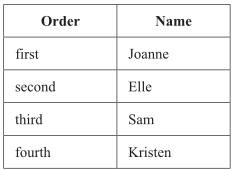
The order in which each student runs in the race is shown in the table below.


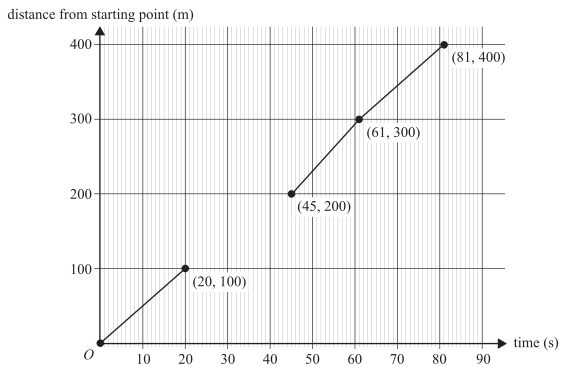
The following line-segment graph represents the race for Joanne, Sam and Kristen, where `d` is the distance, in metres, from the starting point and `t` is the recorded time, in seconds.

Elle’s line segment is missing.


The equation representing Elle’s line segment is

  1. `d = 4t`
  2. `d = 4t + 20`
  3. `d = 5t`
  4. `d = 5t - 5`
  5. `d = 6.25t - 81.25`
Show Answers Only

`B`

Show Worked Solution
`m_d` `= (200 – 100)/(45 – 20)`
  `= 4`


`d_text(Elle)` `= 100 + 4(t – 20)`
  `= 100 + 4t – 80`
  `= 4t + 20`

 
`=> B`

Filed Under: Linear relationships Tagged With: Band 4

GRAPHS, FUR1 2018 VCAA 03 MC

The three inequalities below were used to construct the feasible region for a linear programming problem.

`x` `<3`
`y` `<6`
`x + y` `> 6`

 
A point that lies within this feasible region is

  1. `(0, 6)`
  2. `(1, 5)`
  3. `(2, 4)`
  4. `(2, 5)`
  5. `(3, 6)`
Show Answers Only

`D`

Show Worked Solution

`text(By trial and error,)`

`text(Consider option)\ D:`

`(2,5)`

`x < 3 -> 2 < 3\ \ text(satisfies)`

`y < 6 -> 5 < 6\ \ text(satisfies)`

`x + y > 6 -> 2 + 5 > 6\ \ text(satisfies)`
 

`:. (2,5)\ text(lies within the feasible region.)`

`=> D`

Filed Under: Linear Programming Tagged With: Band 4

GRAPHS, FUR2 2018 VCAA 3

Robert wants to hire a geologist to help him find potential gold locations.

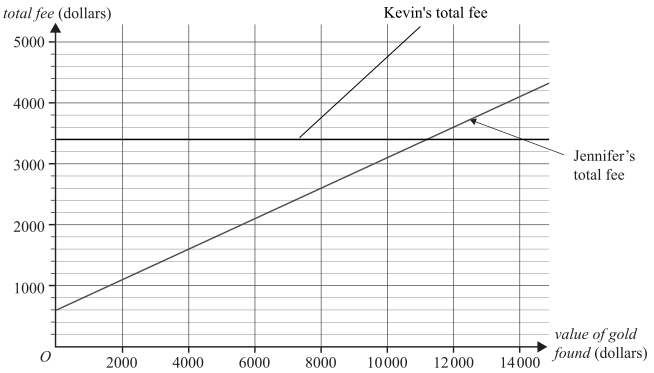
One geologist, Jennifer, charges a flat fee of $600 plus 25% commission on the value of gold found.

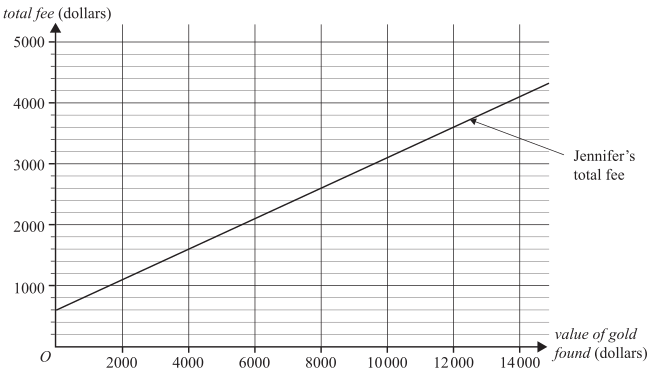
The following graph displays Jennifer’s total fee in dollars.


Another geologist, Kevin, charges a total fee of $3400 for the same task.

  1. Draw a graph of the line representing Kevin’s fee on the axes above.  (1 mark)


    `qquad qquad`(answer on the axes above.)

  2. For what value of gold found will Kevin and Jennifer charge the same amount for their work?  (1 mark)
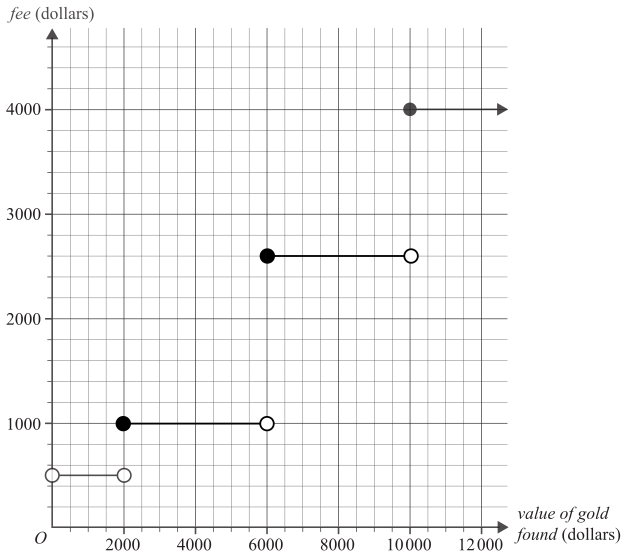
  3. A third geologist, Bella, has offered to assist Robert.
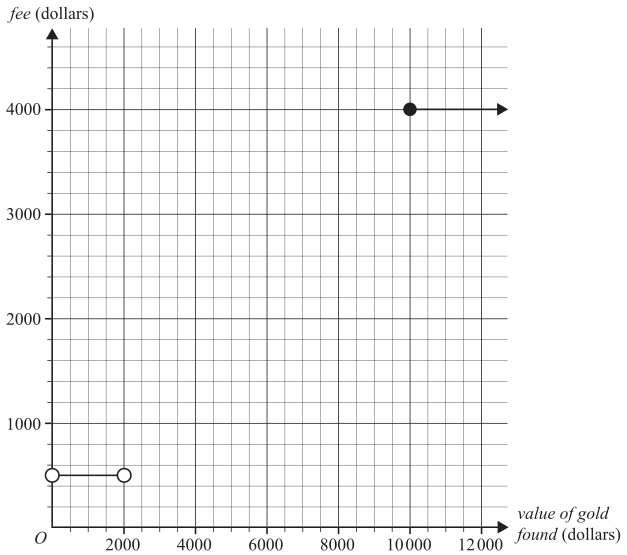
  4. Below is the relation that describes Bella’s fee, in dollars, for the value of gold found.

  5. `qquad  text{fee (dollars)} = {(quad 500),(1000),(2600),(4000):}qquad qquad quad{:(qquad quad 0 <),(2000 <=),(6000 <=),(quad):}{:(text(value of gold found) < 2000),(text(value of gold found) < 6000),(text(value of gold found) < 10\ 000),(text(value of gold found) >= 10\ 000):}`


    The step graph below representing this relation is incomplete.


    Complete the step graph by sketching the missing information.  (2 marks)
     

Show Answers Only
  1. `text(See Worked Solutions)`
  2. `$11\ 200`
  3. `text(See Worked Solutions)`
Show Worked Solution
a.  


b.    `text(Let)\ \ x = text(value of gold)`

♦ Mean mark 41%.

`text(Jennifer’s total fee) = 600 + 0.25x`

`text(Equating fees:)`

`600 + 0.25x` `= 3400`
`0.25x` `= 2800`
`:.x` `= 2800/0.25`
  `= $11\ 200`


c.  

Filed Under: Linear relationships Tagged With: Band 3, Band 4, Band 5

GEOMETRY, FUR1 2018 VCAA 8 MC

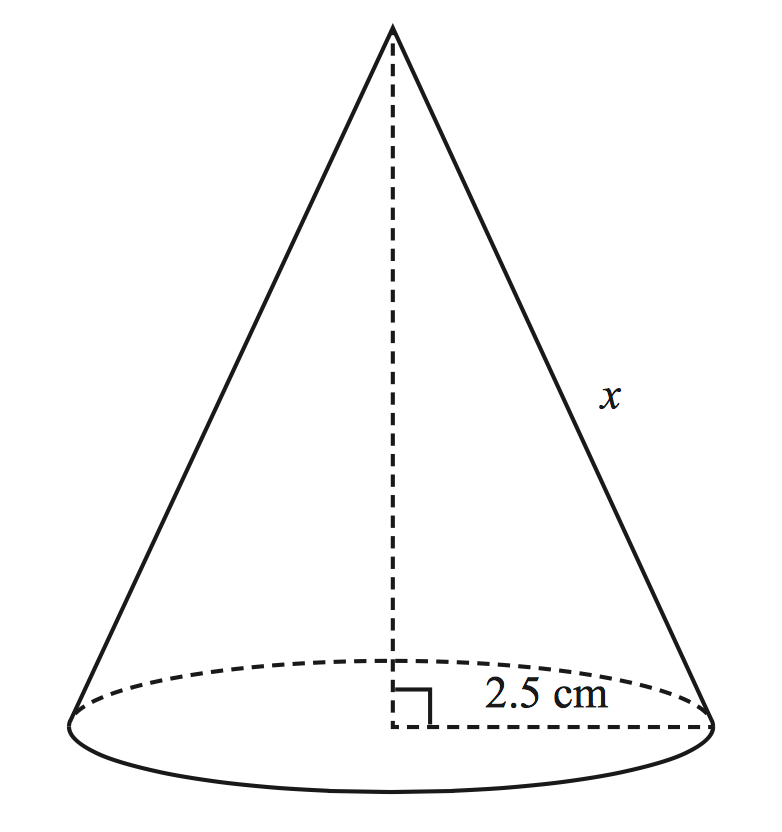
A cone with a radius of 2.5 cm is shown in the diagram below.

The slant edge, `x`, of this cone is also shown.

The volume of this cone is 36 cm³.

The surface area of this cone, including the base, can be found using the rule 

`text(surface area) = πr(r + x)`.

The total surface area of this cone, including the base, in square centimetres, is closest to

  1.  20
  2.  42
  3.  63
  4.  67
  5.  90
Show Answers Only

`D`

Show Worked Solution
`text(Volume of cone)` `= 1/3pir^2h`
`36` `= 1/3pi xx 2.5^2 xx h`
`h` `= 108/(pi xx 2.5^2)`
  `= 5.50…`

 
`text(Using Pythagoras,)`

Mean mark 51%.

`x` `= sqrt(2.5^2 + 5.50…^2)`
  `= 6.04…\ \ text(cm)`


`:.\ text(Surface Area)` `= pi xx 2.5(2.5 + 6.04)`
  `= 67.07…\ \ text(cm²)`

`=> D`

Filed Under: Perimeter, Area and Volume Tagged With: Band 4

Trigonometry, 2ADV T1 EQ-Bank 4 MC

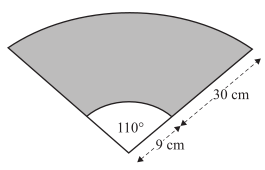
A windscreen wiper blade can clean a large area of windscreen glass, as shown by the shaded area in the diagram below.


The windscreen wiper blade is 30 cm long and it is attached to a 9 cm long arm.

The arm and blade move back and forth in a circular arc with an angle of 110° at the centre.

The area cleaned by this blade, in square centimetres, is closest to

  1.    786
  2.  1382
  3.  2573
  4.  4524
Show Answers Only

`B`

Show Worked Solution
`text(Area cleaned)` `=\ text(large sector)-\text(small sector)`
  `= 110/360 xx pi xx 39^2-110/360 xx pi xx 9^2`
  `= 1382.3…\ \ text(cm)^2`

`=>B`

Filed Under: Circular Measure, Circular Measure, Circular Measure Tagged With: Band 4, smc-6394-20-Area of Sector, smc-978-20-Area of Sector

GEOMETRY, FUR1 2018 VCAA 07 MC

A windscreen wiper blade can clean a large area of windscreen glass, as shown by the shaded area in the diagram below.


The windscreen wiper blade is 30 cm long and it is attached to a 9 cm long arm.

The arm and blade move back and forth in a circular arc with an angle of 110° at the centre.

The area cleaned by this blade, in square centimetres, is closest to

  1.    786
  2.  1382
  3.  2573
  4.  2765
  5.  4524
Show Answers Only

`B`

Show Worked Solution
`text(Area cleaned)` `=\ text(large sector − small sector)`
  `= 110/360 xx pi xx 39^2 – 110/360 xx pi xx 9^2`
  `= 1382.3…\ \ text(cm²)`

`=>B`

Filed Under: Perimeter, Area and Volume Tagged With: Band 4

GEOMETRY, FUR1 2018 VCAA 5 MC

On the first day of June 2019 in the city of St Petersburg, Russia, (60° N, 30° E) the sun is expected to rise at 3.48 am.

On this same day, the sun is expected to rise in Helsinki, Finland, (60° N, 25° E) approximately

  1. at the same time.
  2. 20 minutes earlier.
  3. 20 minutes later.
  4. one hour earlier.
  5. one hour later.
Show Answers Only

`C`

Show Worked Solution

`text(Difference in longitude) = 30 – 25 = 5°`

Mean mark 51%.

`text(S)text(ince 15° = 1 hour difference)`

`text(Time difference)` `= 5/15 xx 60`
  `= 20\ text(minutes)`

  
`text(St Petersburg is further east.)`

`:.\ text(Sunrise in Helsinki is 20 mins later.)`

`=> C`

Filed Under: Great Circle Geometry Tagged With: Band 4, smc-758-10-Time differences

GRAPHS, FUR2 2018 VCAA 2

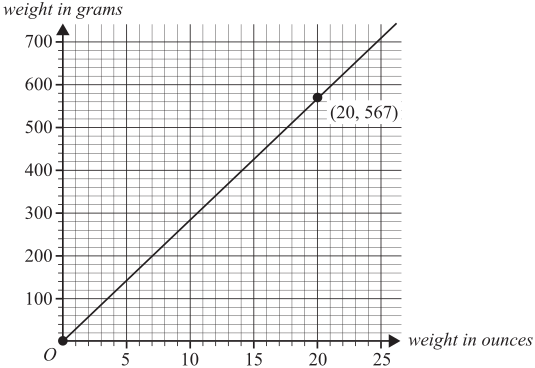
The weight of gold can be recorded in either grams or ounces.

The following graph shows the relationship between weight in grams and weight in ounces.


The relationship between weight measured in grams and weight measured in ounces is shown in the equation

     weight in grams = `M` × weight in ounces
 

  1. Show that  `M = 28.35`  (1 mark)
  2. Robert found a gold nugget weighing 0.2 ounces.


    Using the equation above, calculate the weight, in grams, of this gold nugget.  (1 mark)

  3. Last year Robert sold gold to a buyer at $55 per gram.
    The buyer paid Robert a total of $12 474.


    Using the equation above, calculate the weight, in ounces, of this gold.   (1 mark)

Show Answers Only
  1. `text(Proof)\ \ text{(See Worked Solutions)}`
  2. `5.67\ text(g)`
  3. `8\ text(ounces)`
Show Worked Solution

a.    `text{Substitute (20, 567) into equation:}`

Mean mark 53%.
MARKER’S COMMENT: Giving the equation and writing “solve” did not receive a mark in part (a).

`567` `= M xx 20`
`:. M` `= 567/20`
  `= 28.35\ text(… as required.)`


b.   `text{Weight (grams)}` `= 28.35 xx 0.2`
    `= 5.67\ text(g)`


c.   `text(Total grams sold)` `= 12474/55`
    `= 226.8\ text(g)`


`226.8` `= 28.35 xx W_text(ounces)`
`W_text(ounces)` `= 226.8/28.35`
  `= 8\ text(ounces)`

Filed Under: Linear relationships Tagged With: Band 3, Band 4

GEOMETRY, FUR2 2018 VCAA 3

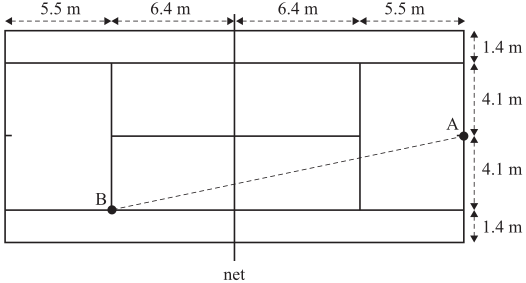
Frank owns a tennis court.

A diagram of his tennis court is shown below

Assume that all intersecting lines meet at right angles.

Frank stands at point `A`. Another point on the court is labelled point `B`.
 

  1. What is the straight-line distance, in metres, between point `A` and point `B`?


    Round your answer to one decimal place.   (1 mark)

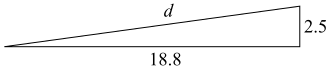
  2. Frank hits a ball when it is at a height of 2.5 m directly above point `A`.


    Assume that the ball travels in a straight line to the ground at point `B`.


    What is the straight-line distance, in metres, that the ball travels?


    Round your answer to the nearest whole number.   (1 mark)

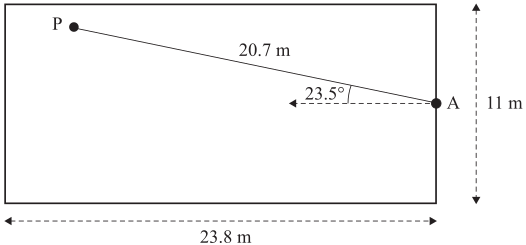
Frank hits two balls from point `A`.

For Frank’s first hit, the ball strikes the ground at point `P`, 20.7 m from point `A`.

For Frank’s second hit, the ball strikes the ground at point `Q`.

Point `Q` is `x` metres from point `A`.

Point `Q` is 10.4 m from point `P`.

The angle, `PAQ`, formed is 23.5°.


    1. Determine two possible values for angle `AQP`.


      Round your answers to one decimal place.   (1 mark)

    2. If point `Q` is within the boundary of the court, what is the value of `x`?


      Round your answer to the nearest metre.  (1 mark)

Show Answers Only
  1. `18.8\ text{m (to 1 d.p.)}`
  2. `19\ text(m)\ text{(nearest m)}`
    1. `52.5^@,\ 127.5^@`
    2. `13\ text(m)\ text{(nearest m)}`
Show Worked Solution
a.    `text(Using Pythagoras,)`
  `AB` `= sqrt(4.1^2 + (6.4 + 6.4 + 5.5)^2`
    `= 18.75…`
    `= 18.8\ text{m (to 1 d.p.)}`


b. `text(Let)\ \ d = text(distance travelled)`


`d` `= sqrt(2.5^2 + 18.8^2)`
  `= 18.96…`
  `= 19\ text{m (nearest m)}`


c.i.  

`/_AQP ->\ text(2 possibilities)`

♦♦ Mean mark 25%.

`text(Using Sine rule,)`

`(sin/_AQP)/20.7` `= (sin 23.5^@)/10.4`
`sin /_AQP` `= (20.7 xx sin 23.5^@)/10.4`
  `= 0.7936…`
`:. /_AQP` `= 52.5^@ or 127.5^@\ \ \ text{(to 1 d.p.)}`


♦♦♦ Mean mark 18%.

c.ii.    `Q\ text(is within court when)\ \ /_AQP = 127.5^@`
  `/_APQ = 180 – (127.5 + 23.5) = 29^@`
   
  `text(Using sine rule,)`
  `x/(sin 29^@)` `= 10.4/(sin 23.5^@)`
  `:. x` `= (10.4 xx sin 29^@)/(sin 23.5^@)`
    `= 12.64…`
    `= 13\ text{m (nearest m)}`

Filed Under: Trig - Harder Applications Tagged With: Band 4, Band 5, Band 6

NETWORKS, FUR1 2018 VCAA 2 MC

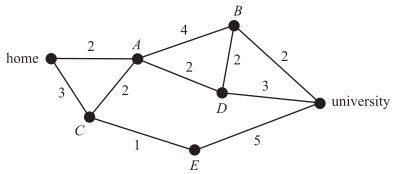
Niko drives from his home to university.

The network below shows the distances, in kilometres, along a series of streets connecting Niko’s home to the university.

The vertices `A`, `B`, `C`, `D` and `E` represent the intersection of these streets.


The shortest path for Niko from his home to the university could be found using

  1. a minimum cut.
  2. Prim’s algorithm.
  3. Dijkstra’s algorithm.
  4. critical path analysis.
  5. the Hungarian algorithm.
Show Answers Only

`C`

Show Worked Solution

`text(Djikstra’s algorithm can be used to find the)`

`text(shortest path.)`

`text(Note that Prim’s algorithm can be used to)`

`text(find the minimum spanning tree but doesn’t)`

`text(necessary provide the shortest path from 2)`

`text(nominated vertices.)`

`=> C`

Filed Under: Minimum Spanning Trees and Shortest Paths Tagged With: Band 4, smc-624-40-Prim's Algorithm, smc-624-60-Shortest Paths, smc-624-70-Djikstra's Algorithm

GEOMETRY, FUR2 2018 VCAA 1

Tennis balls are packaged in cylindrical containers.

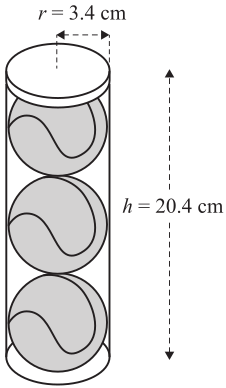
Frank purchases a container of tennis balls that holds three standard tennis balls, stacked one on top of the other.

This container has a radius of 3.4 cm and a height of 20.4 cm, as shown in the diagram below.
 

  1. What is the diameter, in centimetres, of this container?   (1 mark)
  2. What is the total outside surface area of this container, including both ends?


    Write your answer in square centimetres, rounded to one decimal place.  (1 mark)

A standard tennis ball is spherical in shape with a radius of 3.4 cm.

    1. Write a calculation that shows that the volume, rounded to one decimal place, of one standard tennis ball is 164.6 cm³.  (1 mark)
    2. Write a calculation that shows that the volume, rounded to one decimal place, of the cylindrical container that can hold three standard tennis balls is 740.9 cm³. (1 mark)
    3. How much unused volume, in cubic centimetres, surrounds the tennis balls in this container?


      Round your answer to the nearest whole number.  (1 mark)

Show Answers Only
  1. `6.8\ text(cm)`
  2. `508.4\ text(cm)^2\ text{(to 1 d.p.)}`
    1. `164.6\ text(cm)^3\ text{(to 1 d.p.)}`
    2. `740.9\ text(cm)^3\ text{(to 1 d.p.)}`
    3. `247\ text(cm)^3\ text{(nearest cm}^3 text{)}`
Show Worked Solution
a.    `text(Diameter)` `= 2 xx text(radius)`
    `= 2 xx 3.4`
    `= 6.8\ text(cm)`


b.    `text(S.A.)` `= 2 pi r^2 + 2 pi rh`
    `= 2 xx pi xx 3.4^2 + 2 xx pi xx 3.4 xx 20.4`
    `= 508.43…`
    `= 508.4\ text(cm)^2\ text{(to 1 d.p.)}`


c.i.    `text(Volume)` `= 4/3 pi r^3`
    `= 4/3 xx pi xx 3.4^3`
    `= 164.6\ text(cm)^3\ text{(to 1 d.p.)}`


c.ii.    `text(Volume)` `= Ah`
    `= pi xx 3.4^2 xx 20.4`
    `= 740.86…`
    `= 740.9\ text(cm)^3\ text{(to 1 d.p.)}`


c.iii.    `text(Unused volume)` `= text(cylinder volume) – text(volume of balls)`
    `= 740.9 – 3 xx 164.6`
    `= 247.1`
    `= 247\ text(cm)^3\ text{(nearest cm}^3 text{)}`

Filed Under: Perimeter, Area and Volume Tagged With: Band 3, Band 4

NETWORKS, FUR2 2018 VCAA 3

At the Zenith Post Office all computer systems are to be upgraded.

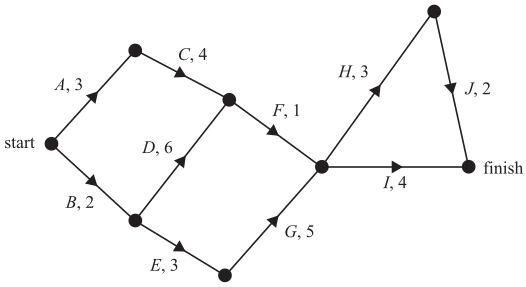
This project involves 10 activities, `A` to `J`.

The directed network below shows these activities and their completion times, in hours.
 

  1. Determine the earliest starting time, in hours, for activity `I`.   (1 mark)

    --- 2 WORK AREA LINES (style=lined) ---

  2. The minimum completion time for the project is 15 hours.


    Write down the critical path.   (1 mark)

    --- 1 WORK AREA LINES (style=lined) ---

  3. Two of the activities have a float time of two hours.


    Write down these two activities.   (1 mark)

    --- 3 WORK AREA LINES (style=lined) ---

  4. For the next upgrade, the same project will be repeated but one extra activity will be added.
    This activity has a duration of one hour, an earliest starting time of five hours and a latest starting time of 12 hours.


    Complete the following sentence by filling in the boxes provided.   (1 mark)

    --- 3 WORK AREA LINES (style=lined) ---


    The extra activity could be represented on the network above by a directed edge from the

   end of activity   
 
  to the start of activity   
 
Show Answers Only
  1. `10\ text(hours)`
  2. `B-E-G-H-J`
  3.  `text(Activity)\ A\ text(and)\ C`
  4. `text(end of activity)\ E\ text(to the start of activity)\ J`
Show Worked Solution

a.  `text(Longest path to)\ I:`

`B -> E -> G`

`:.\ text(EST for)\ \ I` `= 2 + 3 + 5`
  `= 10\ text(hours)`

 
b.
  `B-E-G-H-J`
 

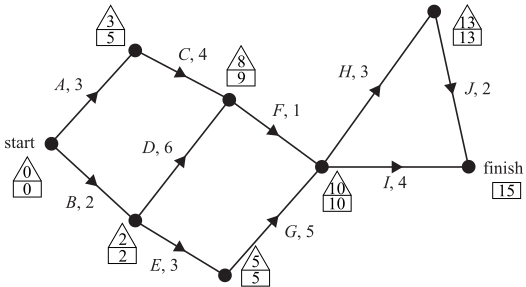
c.  `text(Scanning forwards and backwards:)`

♦ Mean mark 45%.


`:.\ text(Activity)\ A\ text(and)\ C\ text(have a 2 hour float time.)`
 

d.   `text(end of activity)\ E\ text(to the start of activity)\ J`

♦♦ Mean mark 25%.
 

`text(By inspection of forward and backward scanning:)`

`text(EST of 5 hours is possible after activity)\ E.`

`text(LST of 12 hours after activity)\ E -> text(edge has weight)`

`text(of 1 and connects to)\ J`

Filed Under: Critical Path Analysis Tagged With: Band 3, Band 4, Band 5, smc-621-20-Critical Paths/EST, smc-621-30-Float time/LST, smc-621-45-Adding activities

NETWORKS, FUR2 2018 VCAA 2

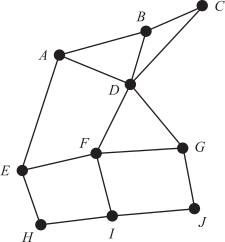
In one area of the town of Zenith, a postal worker delivers mail to 10 houses labelled as vertices `A` to `J` on the graph below.
 

  1. Which one of the vertices on the graph has degree 4?   (1 mark)

    --- 1 WORK AREA LINES (style=lined) ---

For this graph, an Eulerian trail does not currently exist.

  1. For an Eulerian trail to exist, what is the minimum number of extra edges that the graph would require.   (1 mark)

    --- 1 WORK AREA LINES (style=lined) ---

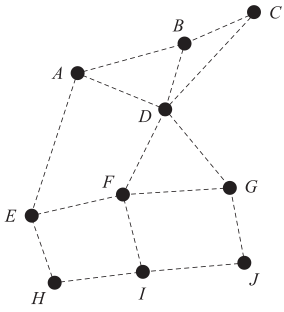
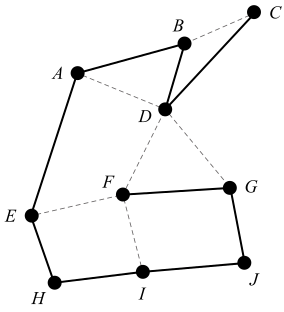
  2. The postal worker has delivered the mail at `F` and will continue her deliveries by following a Hamiltonian path from `F`.


    Draw in a possible Hamiltonian path for the postal worker on the diagram below.   (1 mark)

    --- 0 WORK AREA LINES (style=lined) ---


Show Answers Only
  1. `text(Vertex)\ F`
  2. `2`
  3.  `text(See Worked Solutions)`
Show Worked Solution

a.   `text(Vertex)\ F`
 

b. `text(Eulerian trail)\ =>\ text(all edges used exactly once.)`

`text(6 vertices are odd)`

`=> 2\ text(extra edges could create graph with only 2)`

`text(odd vertices)`

`:.\ text(Minimum of 2 extra edges.)`
 

c.  `text{One example (of a number) beginning at)\ F:}`


`text{(Note: path should not return to}\ F text{)}`

Filed Under: Basic Concepts, Travelling Problems and Adjacency Matrices Tagged With: Band 2, Band 4, smc-622-10-Euler, smc-626-20-Degrees of Vertices

MATRICES, FUR2 2018 VCAA 2

The Westhorn Council must prepare roads for expected population changes in each of three locations: main town `(M)`, villages `(V)` and rural areas `(R)`.

The population of each of these locations in 2018 is shown in matrix  `P_2018`  below.

`P_2018 = [(2100),(1800),(1700)]{:(M),(V),(R):}`

The expected annual change in population in each location is shown in the table below.
       

  1. Write down matrix  `P_2019`, which shows the expected population in each location in 2019.   (1 mark)

    --- 3 WORK AREA LINES (style=lined) ---

  2. The expected population in each of the three locations in 2019 can be determined from the matrix product.
  3. `qquad qquad P_2019 = F xx P_2018,` where `F` is a diagonal matrix.
  4. Write down matrix  `F`.   (1 mark)

    --- 3 WORK AREA LINES (style=lined) ---

Show Answers Only
  1. `P_2019 = [(1.04 xx 2100),(0.99 xx 1800),(0.98 xx 1700)] = [(2184),(1782),(1666)]`
  2. `F = [(1.04, 0, 0),(0, 0.99, 0),(0, 0, 0.98)]`
Show Worked Solution

a.   `P_2019 = [(1.04 xx 2100),(0.99 xx 1800),(0.98 xx 1700)] = [(2184),(1782),(1666)]`

♦ Mean mark part (b) 40%.
COMMENT: Many students included 0.04, -0.01 and -0.02 in this matrix. Know why this is incorrect!

 
b.
   `F = [(1.04, 0, 0),(0, 0.99, 0),(0, 0, 0.98)]`

Filed Under: Matrix Applications Tagged With: Band 4, Band 5, smc-619-20-Matrix product from table, smc-619-30-Matrix product and interpretation

MATRICES, FUR2 2018 VCAA 1

A toll road is divided into three sections, `E, F` and `G`.

The cost, in dollars, to drive one journey on each section is shown in matrix `C` below.

`C = [(3.58),(2.22),(2.87)]{:(E),(F),(G):}`

  1. What is the cost of one journey on section `G`?   (1 mark)

    --- 1 WORK AREA LINES (style=lined) ---

  2. Write down the order of matrix `C`.   (1 mark)

    --- 1 WORK AREA LINES (style=lined) ---

  3. One day Kim travels once on section `E` and twice on section `G`.
  4. His total toll cost for this day can be found by the matrix product  `M xx C`.
  5. Write down the matrix  `M`.   (1 mark)

    --- 2 WORK AREA LINES (style=lined) ---

Show Answers Only
  1. `$2.87`
  2. `text(Order:)\ 3 xx 1`
  3. `M = [(1, 0, 2)]`
Show Worked Solution

a.   `$2.87`
 

b.   `text(Order:)\ 3 xx 1`
 

c.   `M = [(1, 0, 2)]`

Filed Under: Matrix Applications Tagged With: Band 2, Band 4, smc-619-30-Matrix product and interpretation, smc-619-40-Interpret Elements

CORE, FUR2 2018 VCAA 5

After three years, Julie withdraws $14 000 from her account to purchase a car for her business.

For tax purposes, she plans to depreciate the value of her car using the reducing balance method.

The value of Julie’s car, in dollars, after `n` years, `C_n`, can be modelled by the recurrence relation shown below

`C_0 = 14\ 000, qquad C_(n + 1) = R xx C_n`

  1. For each of the first three years of reducing balance depreciation, the value of `R` is 0.85


    What is the annual rate of depreciation in the value of the car during these three years?  (1 mark)

    --- 4 WORK AREA LINES (style=lined) ---

  2. For the next five years of reducing balance depreciation, the annual rate of depreciation in the value of the car is changed to 8.6%.


    What is the value of the car eight years after it was purchased?
    Round your answer to the nearest cent.  (2 marks)

    --- 6 WORK AREA LINES (style=lined) ---

Show Answers Only
  1. `15 text(%)`
  2. `$5484.23\ text{(nearest cent)}`
Show Worked Solution

a.  `text(S)text(ince)\ \ R = 0.85,`

COMMENT: Note almost half of students answered incorrectly here!

`=> 85 text(% of the car’s value remains at the end of each)`

      `text{year (vs the value at the start of the same year.)}`

`:.\ text(Annual rate of depreciation) = 15 text(%)`

  
b.
   `text(Value after 3 years)`

♦ Mean mark 42%.

`C_3` `= (0.85)^3 xx 14\ 000`
  `= $8597.75`

 
`:.\ text(Value after 8 years)`

`C_8` `= (0.914)^5 xx C_3`
  `= (0.914)^5 xx 8597.75`
  `= $5484.23\ text{(nearest cent)}`

Filed Under: Depreciation, Recursion - Financial Tagged With: Band 4, Band 5, smc-602-20-Reducing balance, smc-602-50-Recurrence relation, smc-717-60-Depreciation (reducing balance), smc-717-80-Interpret RR

CORE, FUR2 2018 VCAA 4


Julie deposits some money into a savings account that will pay compound interest every month.

The balance of Julie’s account, in dollars, after `n` months, `V_n` , can be modelled by the recurrence relation shown below.

`V_0 = 12\ 000, qquad V_(n + 1) = 1.0062 V_n` 

  1. How many dollars does Julie initially invest?   (1 mark)

    --- 1 WORK AREA LINES (style=lined) ---

  2. Recursion can be used to calculate the balance of the account after one month.
    1. Write down a calculation to show that the balance in the account after one month, `V_1`, is  $12 074.40.   (1 mark)

      --- 3 WORK AREA LINES (style=lined) ---

    2. After how many months will the balance of Julie’s account first exceed $12 300?   (1 mark)

      --- 3 WORK AREA LINES (style=lined) ---

  3. A rule of the form  `V_n = a xx b^n`  can be used to determine the balance of Julie's account after `n` months.
    1. Complete this rule for Julie’s investment after `n` months by writing the appropriate numbers in the boxes provided below.   (1 mark)

      --- 0 WORK AREA LINES (style=lined) ---

    2. Balance = 
       
       × 
       
       `n`
    3. What would be the value of  `n`  if Julie wanted to determine the value of her investment after three years?   (1 mark)

      --- 1 WORK AREA LINES (style=lined) ---

Show Answers Only

  1. `$12\ 000`
    1. `text(Proof)\ \ text{(See Worked Solutions)}`
    2. `4\ text(months)`
    1. `text(balance) = 12\ 000 xx 1.0062^n`
    2. `36`

Show Worked Solution

a.   `$12\ 000`
 

b.i.   `V_1` `= 1.0062 xx V_0`
    `= 1.0062 xx 12000`
    `= $12\ 074.40\ text(… as required.)`


b.ii.   `V_2` `= 1.0062 xx 12\ 074.40 = 12\ 149.26`
  `V_3` `= 1.0062 xx 12\ 149.26 = 12\ 224.59`
  `V_4` `= 1.0062 xx 12\ 224.59 = 12\ 300.38`

 
`:.\ text(After 4 months)`

 
c.i.
  `text(balance) = 12\ 000 xx 1.0062^n`

 
c.ii.
  `n = 12 xx 3 = 36`

Filed Under: Interest Rates and Investing, Recursion - Financial Tagged With: Band 2, Band 3, Band 4, smc-604-95-Recurrence relations, smc-717-10-Compound interest, smc-717-70-Find RR

CORE, FUR2 2018 VCAA 3

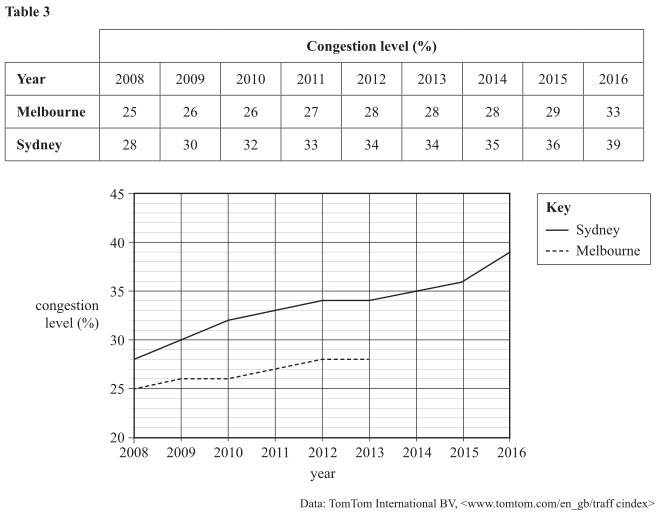
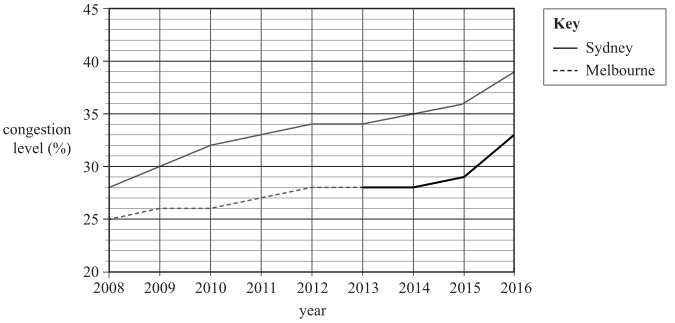
Table 3 shows the yearly average traffic congestion levels in two cities, Melbourne and Sydney, during the period 2008 to 2016. Also shown is a time series plot of the same data.

The time series plot for Melbourne is incomplete.

  1. Use the data in Table 3 to complete the time series plot above for Melbourne.   (1 mark)

    --- 0 WORK AREA LINES (style=lined) ---

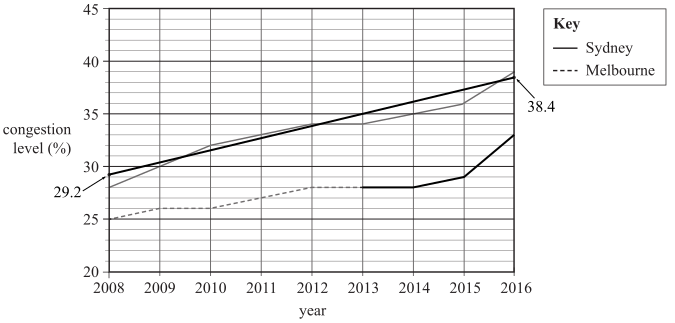
  2. A least squares line is used to model the trend in the time series plot for Sydney. The equation is

       `text(congestion level = −2280 + 1.15 × year)`

  1.   i. Draw this least squares line on the time series plot.   (1 mark)

    --- 0 WORK AREA LINES (style=lined) ---

  2.  ii. Use the equation of the least squares line to determine the average rate of increase in percentage congestion level for the period 2008 to 2016 in Sydney.   (1 mark)

    --- 2 WORK AREA LINES (style=lined) ---

    iii. Use the least squares line to predict when the percentage congestion level in Sydney will be 43%.   (1 mark)

    --- 3 WORK AREA LINES (style=lined) ---

The yearly average traffic congestion level data for Melbourne is repeated in Table 4 below.

  1. When a least squares line is used to model the trend in the data for Melbourne, the intercept of this line is approximately –1514.75556
  2. Round this value to four significant figures.   (1 mark)

    --- 1 WORK AREA LINES (style=lined) ---

  3. Use the data in Table 4 to determine the equation of the least squares line that can be used to model the trend in the data for Melbourne. The variable year is the explanatory variable.
  4. Write the values of the intercept and the slope of this least squares line in the appropriate boxes provided below.
  5. Round both values to four significant figures.   (2 marks)

    --- 0 WORK AREA LINES (style=lined) ---

congestion level = 
 
 + 
 
 × year
  1. Since 2008, the equations of the least squares lines for Sydney and Melbourne have predicted that future traffic congestion levels in Sydney will always exceed future traffic congestion levels in Melbourne.


    Explain why, quoting the values of appropriate statistics.   (2 marks)

    --- 5 WORK AREA LINES (style=lined) ---

Show Answers Only
  1. `text(See Worked Solutions)`
    1. `text(See Worked Solutions)`
    2. `1.15 text(%)`
    3. `2020`
  2. `-1515`
  3. `text(congestion level) = -1515 + 0.7667 xx text(year)`
  4. `text(See Worked Solutions)`
Show Worked Solution
a.   


b.i.   


b.ii.  `text(The least squares line is 1.15% higher each year.)`

♦ Mean mark (b)(ii) 36%.
COMMENT: Major problems caused by part (b)(ii). Review!

  ` :.\ text(Average rate of increase) = 1.15 text(%)`
 

b.iii.    `text(Find year when:)`
  `43` `= -2280 + 1.15 xx text(year)`
  `text(year)` `= 2323/1.15`
    `= 2020`

 
c.
  `-1515`
 

d.   `text(congestion level) = -1515 + 0.7667 xx text(year)`
 

e.   `text(Melbourne congestion level in 2008)`

♦♦♦ Mean mark 18%.

`= -1515 + 0.7667 xx 2008`

`= 24.5 text(%)`

 
`text{In 2008 Sydney has higher congestion (29.2 > 24.5)}`

`text(After 2008, Sydney congestion grows at 1.15% per)`

`text(year and Melbourne grows at 0.7667% per year.)`

`:.\ text(Sydney predicted to always exceed Melbourne.)`

Filed Under: Correlation and Regression Tagged With: Band 4, Band 5, Band 6, page-break-before-question, smc-265-20-Find LSRL Equation/Gradient, smc-265-60-Extrapolation / Interpolation, smc-265-80-Rounding (Sig Fig)

CORE, FUR2 2018 VCAA 2

The congestion level in a city can be recorded as the percentage increase in travel time due to traffic congestion in peak periods (compared to non-peak periods).

This is called the percentage congestion level.

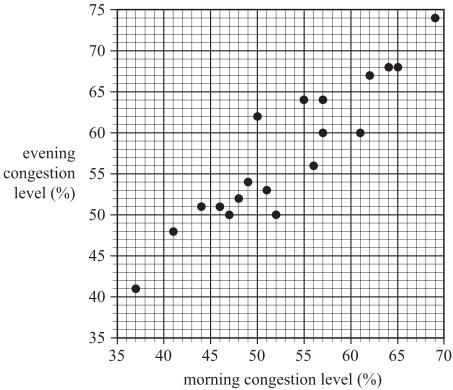
The percentage congestion levels for the morning and evening peak periods for 19 large cities are plotted on the scatterplot below.
 

  1. Determine the median percentage congestion level for the morning peak period and the evening peak period.


    Write your answers in the appropriate boxes provided below.   (2 marks)

    --- 0 WORK AREA LINES (style=lined) ---

Median percentage congestion level for morning peak period
%
Median percentage congestion level for evening peak period
%

A least squares line is to be fitted to the data with the aim of predicting evening congestion level from morning congestion level.

The equation of this line is.

evening congestion level = 8.48 + 0.922 × morning congestion level

  1. Name the response variable in this equation.   (1 mark)

    --- 1 WORK AREA LINES (style=lined) ---

  2. Use the equation of the least squares line to predict the evening congestion level when the morning congestion level is 60%.   (1 mark)

    --- 2 WORK AREA LINES (style=lined) ---

  3. Determine the residual value when the equation of the least squares line is used to predict the evening congestion level when the morning congestion level is 47%.
  4. Round your answer to one decimal place?   (2 marks)

    --- 4 WORK AREA LINES (style=lined) ---

  5. The value of the correlation coefficient `r` is 0.92
  6. What percentage of the variation in the evening congestion level can be explained by the variation in the morning congestion level?
  7. Round your answer to the nearest whole number.   (1 mark)

    --- 2 WORK AREA LINES (style=lined) ---

Show Answers Only
  1. `52 text(%);\ 56 text(%)`
  2. `text(evening congestion level)`
  3. `63.8 text(%)`
  4. `-1.8 text{% (to 1 d.p.)}`
  5. `85 text(%)`
Show Worked Solution

a.   `19\ text(data points of morning peak)`

Mean mark 56%.
COMMENT: This question was surprisingly poorly answered. Review carefully!

`text(Median is 10th data point moving left to right.)`

`:.\ text{Median (morning peak) = 52%}`


`text(Median of evening peak is 10th data point)`

`text(moving bottom to top.)`

`:.\ text{Median (afternoon peak) = 56%}`
 

b.   `text(Response variable is evening congestion level.)`
 

c.    `text(evening congestion level)` `= 8.48 + 0.922 xx 60`
    `= 63.8 text(%)`

 
d.
 `text(When morning level = 47%, Actual = 50%)`

Mean mark part (d) 53%.
COMMENT: Many students had problems at a number of stages in this part.

`text(Residual)` `=\ text(Actual evening congestion − predicted)`
  `= 50 – (8.48 + 0.922 xx 47)`
  `= -1.814`
  `= -1.8 text{% (to 1 d.p.)}`


e.    `r` `= 0.92`
  `r^2` `= 0.8464`
    `= 85 text{% (nearest whole)}`

 
`:. 85 text(% of the variations is explained.)`

Filed Under: Correlation and Regression Tagged With: Band 3, Band 4, smc-265-10-r / r^2 and Association, smc-265-50-Residuals, smc-265-75-Explanatory / Response

CORE, FUR2 2018 VCAA 1


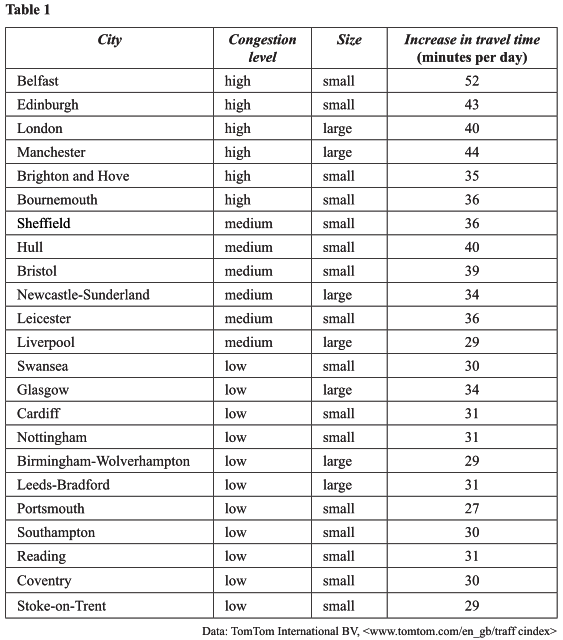
The data in Table 1 relates to the impact of traffic congestion in 2016 on travel times in 23 cities in the United Kingdom (UK).

The four variables in this data set are:

  • city — name of city
  • congestion level — traffic congestion level (high, medium, low)
  • size — size of city (large, small)
  • increase in travel time — increase in travel time due to traffic congestion (minutes per day).
  1. How many variables in this data set are categorical variables?  (1 mark)

    --- 1 WORK AREA LINES (style=lined) ---

  2. How many variables in this data set are ordinal variables  (1 mark)

    --- 1 WORK AREA LINES (style=lined) ---

  3. Name the large UK cities with a medium level of traffic congestion.  (1 mark)

    --- 1 WORK AREA LINES (style=lined) ---

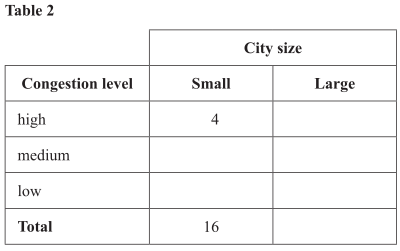
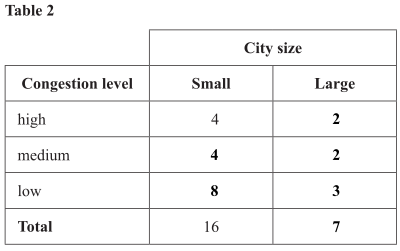
  4. Use the data in Table 1 to complete the following two-way frequency table, Table 2.  (2 marks)

    --- 0 WORK AREA LINES (style=lined) ---


  5. What percentage of the small cities have a high level of traffic congestion?  (1 mark)

    --- 3 WORK AREA LINES (style=lined) ---

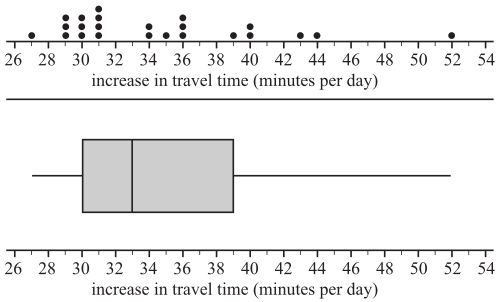
Traffic congestion can lead to an increase in travel times in cities. The dot plot and boxplot below both show the increase in travel time due to traffic congestion, in minutes per day, for the 23 UK cities.


  1. Describe the shape of the distribution of the increase in travel time for the 23 cities.  (1 mark)

    --- 1 WORK AREA LINES (style=lined) ---

  2. The data value 52 is below the upper fence and is not an outlier.
  3. Determine the value of the upper fence.  (1 mark)

    --- 3 WORK AREA LINES (style=lined) ---

Show Answers Only

  1. `3\ text(city, congestion level, size)`
  2. `2\ text(congestion level, size)`
  3. `text(Newcastle-Sunderland and Liverpool)`
  4. `text(See Worked Solutions)`
  5. `25 text(%)`
  6. `text(Positively skewed)`
  7. `52.5`

Show Worked Solution

a.   `3\-text(city, congestion level, size)`
 

b.   `2\-text(congestion level, size)`
 

c.   `text(Newcastle-Sunderland and Liverpool)`
 

d.   


e.    `text(Percentage)` `= text(Number of small cities high congestion)/text(Number of small cities) xx 100`
    `= 4/16 xx 100`
    `= 25 text(%)`

 
f.
   `text(Positively skewed)`


g.   `IQR = 39-30 = 9`
 

`text(Calculate the Upper Fence:)`

`Q_3 + 1.5 xx IQR` `= 39 + 1.5 xx 9`
  `= 52.5`

Filed Under: Graphs - Stem/Leaf and Boxplots, Summary Statistics Tagged With: Band 2, Band 3, Band 4, page-break-before-question, smc-468-10-Data Classification, smc-468-50-IQR / Outliers, smc-643-10-Single Box-Plots, smc-643-60-Outliers, smc-643-70-Distribution Description

MATRICES, FUR1 2018 VCAA 4 MC

Matrix `P` is a 4 × 4 permutation matrix.

Matrix `W` is another matrix such that the matrix product `P × W` is defined.

This matrix product results in the entire first and third rows of matrix `W` being swapped.

The permutation matrix `P` is

A.  `[(0,0,0,1),(0,1,0,0),(0,0,1,0),(0,0,0,1)]` B.  `[(0,0,1,0),(0,1,0,0),(1,0,0,0),(0,0,0,1)]` C.  `[(1,0,0,0),(0,0,0,0),(1,0,0,0),(0,0,0,0)]`
           
D.  `[(1,0,0,0),(0,0,0,0),(0,0,1,0),(0,0,0,0)]` E.  `[(1,0,0,0),(0,1,0,0),(1,0,0,0),(0,0,0,1)]`    
Show Answers Only

`B`

Show Worked Solution

`text(By trial and error:)`

`text(S)text(ince)\ P xx W\ \ text(is defined,)`

`=>\ W\ text(can be a 4 × 1 matrix)`
 

`text(Consider option)\ B,`

`[(0,0,1,0),(0,1,0,0),(1,0,0,0),(0,0,0,1)][(a),(b),(c),(d)] = [(c),(b),(a),(d)]`
 

`=> B`

Filed Under: Matrix Applications Tagged With: Band 4, smc-619-90-Permutation

MATRICES, FUR1 2018 VCAA 2 MC

The matrix product `[(4,2,0)] xx [(4),(12),(8)]` is equal to

  1. `[144]`
  2. `[(16),(24),(0)]`
  3. `4 xx [(1,2,0)] xx [(1),(12),(8)]`
  4. `2 xx [(2,1,0)] xx [(2),(6),(4)]`
  5. `4 xx [(2,1,0)] xx [(2),(6),(4)]`
Show Answers Only

`E`

Show Worked Solution
`[(4,2,0)] xx [(4),(12),(8)]` `= 2[(2,1,0)] xx 2[(2),(6),(4)]`
  `= 4 xx [(2,1,0)] xx [(2),(6),(4)]`

`=> E`

Filed Under: Matrix Calculations Tagged With: Band 4, smc-616-30-Matrix Product

CORE, FUR1 2018 VCAA 21 MC

Which one of the following recurrence relations could be used to model the value of a perpetuity investment, `P_n`, after `n` months?

  1. `P_0 = 120\ 000,qquadP_(n + 1) = 1.0029 × P_n - 356`
  2. `P_0 = 180\ 000,qquadP_(n + 1) = 1.0047 × P_n - 846`
  3. `P_0 = 210\ 000,qquadP_(n + 1) = 1.0071 × P_n - 1534`
  4. `P_0 = 240\ 000,qquadP_(n + 1) = 0.0047 × P_n - 2232`
  5. `P_0 = 250\ 000,qquadP_(n + 1) = 0.0085 × P_n - 2125`
Show Answers Only

`B`

Show Worked Solution

`text(Perpetuity) => P_0 = P_1 = P_2 = … = P_n`

`text(By trial and error, consider option)\ B:`

`P_1` `= 1.0047 xx 180\ 000 – 846`
  `= 180\ 000`
  `= P_0`

 
`=> B`

Filed Under: Annuities and Perpetuities, Recursion - Financial Tagged With: Band 4, smc-2512-70-Recurrence relations, smc-717-40-Perpetuity

CORE, FUR1 2018 VCAA 19 MC

Daniel borrows $5000, which he intends to repay fully in a lump sum after one year.

The annual interest rate and compounding period for five different compound interest loans are given below:
 
• Loan I – 12.6% per annum, compounding weekly
• Loan II – 12.8% per annum, compounding weekly
• Loan III – 12.9% per annum, compounding weekly
• Loan IV – 12.7% per annum, compounding quarterly
• Loan V – 13.2% per annum, compounding quarterly

When fully repaid, the loan that will cost Daniel the least amount of money is

  1. Loan I.
  2. Loan II.
  3. Loan III.
  4. Loan IV.
  5. Loan V.
Show Answers Only

`D`

Show Worked Solution

`text(Weekly compounding loans ⇒ Loan I is cheaper)`

`text(Repayment of Loan I)` `= 5000 xx (1 + 12.6/(52 xx 100))^52`
  `= $5670.55`

 
`text(Quarterly compounding loans ⇒ Loan IV is cheaper)`

`text(Repayment of Loan IV)` `= 5000 xx (1 + 2.7/(12 xx 100))^12`
  `= $5136.68`

 
`:.\ text(Loan IV is cheapest.)`

`=> D`

Filed Under: Interest Rates and Investing Tagged With: Band 4, smc-604-20-Compound interest

CORE, FUR1 2018 VCAA 17-18 MC

The value of an annuity investment, in dollars, after `n` years, `V_n` , can be modelled by the recurrence relation shown below.

`V_0 = 46\ 000, quadqquadV_(n + 1) = 1.0034V_n + 500`

 
Part 1

What is the value of the regular payment added to the principal of this annuity investment?

  1.   $34.00
  2. $156.40
  3. $466.00
  4. $500.00
  5. $656.40

 
Part 2

Between the second and third years, the increase in the value of this investment is closest to

  1.   $656
  2.   $658
  3.   $661
  4. $1315
  5. $1975
Show Answers Only

`text(Part 1:)\ D`

`text(Part 2:)\ C`

Show Worked Solution

`text(Part 1)`

`text(Regular payment = $500)`

`=> D`
 

`text(Part 2)`

`V_1` `= 1.0034 xx 46\ 000 + 500 = $46\ 656.40`
`V_2` `= 1.0034 xx 46\ 656.40 + 500 = $47\ 315.03`
`V_3` `= 1.0034 xx 47\ 315.03 + 500 = $47\ 975.90`


`:.\ text(Increase)` `= 47\ 975.90 – 47\ 315.03`
  `= $660.87`

`=> C`

Filed Under: Annuities and Perpetuities, Recursion - Financial Tagged With: Band 3, Band 4, smc-2512-70-Recurrence relations, smc-717-30-Annuity, smc-717-80-Interpret RR

CORE, FUR1 2018 VCAA 16 MC

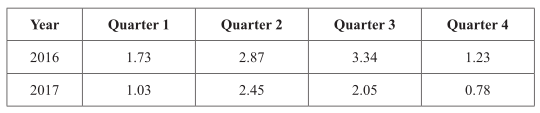
The quarterly sales figures for a large suburban garden centre, in millions of dollars, for 2016 and 2017 are displayed in the table below.

Using these sales figures, the seasonal index for Quarter 3 is closest to

  1.  1.28
  2.  1.30
  3.  1.38
  4.  1.46
  5.  1.48
Show Answers Only

`C`

Show Worked Solution

`text{Quarterly average (2016)}`

Mean mark 51%.

`= (1.73 + 2.87 + 3.34 + 1.23) ÷ 4`

`= 2.2925`

`text{Quarterly average (2017)}`

`= (1.03 + 2.45 + 2.05 + 0.78) ÷ 4`

`= 1.5775`

`:.\ text{Seasonal Index (Q3)}` `= (3.34/2.2925 + 2.05/1.5775)-: 2`
  `= 1.3782…`

`=> C`

Filed Under: Time Series Tagged With: Band 4, smc-266-10-Seasonal Index from a Table

CORE, FUR1 2018 VCAA 12 MC

A  `log_10(y)`  transformation was used to linearise a set of non-linear bivariate data.

A least squares line was then fitted to the transformed data.

The equation of this least squares line is

`log_10(y) = 3.1 - 2.3x`

This equation is used to predict the value of `y` when  `x = 1.1`

The value of `y` is closest to

  1. –0.24
  2.   0.57
  3.   0.91
  4.   1.6
  5.   3.7
Show Answers Only

`E`

Show Worked Solution
`log_10y` `= 3.1 – 2.3(1.1)`
  `= 0.57`
`:.y` `= 10^(0.57)`
  `= 3.71…`

 
`=> E`

Filed Under: Correlation and Regression Tagged With: Band 4, smc-265-70-Linearise - log10

CORE, FUR1 2018 VCAA 11 MC

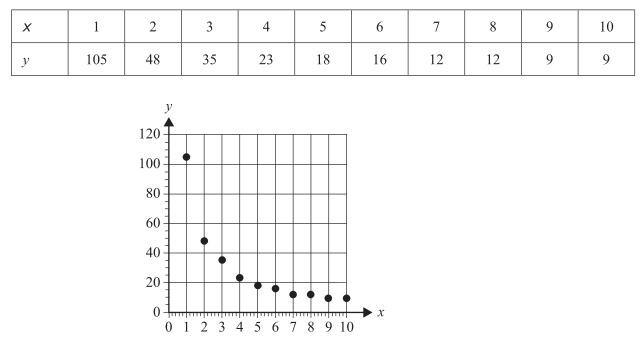
Freya uses the following data to generate the scatterplot below.

The scatterplot shows that the data is non-linear.

To linearise the data, Freya applies a reciprocal transformation to the variable `y`.

She then fits a least squares line to the transformed data.

With `x` as the explanatory variable, the equation of this least squares line is closest to

  1. `1/y = −0.0039 + 0.012x`
  2. `1/y = −0.025 + 1.1x`
  3. `1/y = 7.8 - 0.082x`
  4. `y = 45.3 + 59.7 xx 1/x`
  5. `y = 59.7 + 45.3 xx 1/x`
Show Answers Only

`A`

Show Worked Solution

`text(By trial and error:)`

COMMENT: Carefully choosing a data point to test all options can sometimes eliminate all incorrect answers.

`text(Consider Option)\ A,`

`text{Using (9,9) to test .. }`

`1/9` `~~ -0.0039 + 0.012x`
`0.111…` `~~0.1041\ \ text{(a close approximation)}`
   

`text(All other options are not close.)`

`=> A`

Filed Under: Correlation and Regression Tagged With: Band 4, smc-265-71-Linearise - Squared/Inverse

CORE, FUR1 2018 VCAA 10 MC

In a study of the association between a person’s height, in centimetres, and body surface area, in square metres, the following least squares line was obtained.

body surface area = –1.1 + 0.019 × height

Which one of the following is a conclusion that can be made from this least squares line?

  1. An increase of 1 m² in body surface area is associated with an increase of 0.019 cm in height.
  2. An increase of 1 cm in height is associated with an increase of 0.019 m² in body surface area.
  3. The correlation coefficient is 0.019
  4. A person’s body surface area, in square metres, can be determined by adding 1.1 cm to their height.
  5. A person’s height, in centimetres, can be determined by subtracting 1.1 from their body surface area, in square metres.
Show Answers Only

`B`

Show Worked Solution

`text(By definition of the equation, option)\ B\ text(is a)`

♦ Mean mark 51%.

`text(correct conclusion.)`

`=> B`

Filed Under: Correlation and Regression Tagged With: Band 4, smc-265-40-Interpret Gradient

CORE, FUR1 2018 VCAA 7-9 MC

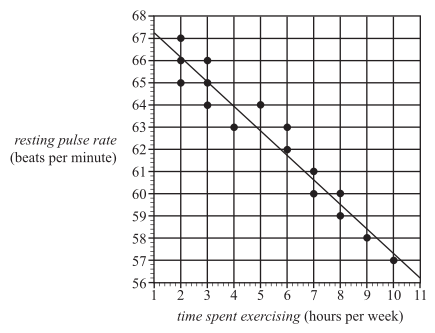
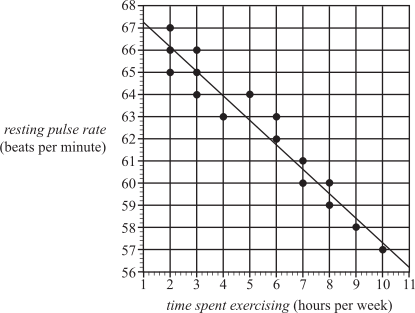
The scatterplot below displays the resting pulse rate, in beats per minute, and the time spent exercising, in hours per week, of 16 students. A least squares line has been fitted to the data.


Part 1

Using this least squares line to model the association between resting pulse rate and time spent exercising, the residual for the student who spent four hours per week exercising is closest to

  1. –2.0 beats per minute.
  2. –1.0 beats per minute.
  3. –0.3 beats per minute.
  4.   1.0 beats per minute.
  5.   2.0 beats per minute.

 
Part 2

The equation of this least squares line is closest to

  1. resting pulse rate = 67.2 – 0.91 × time spent exercising
  2. resting pulse rate = 67.2 – 1.10 × time spent exercising
  3. resting pulse rate = 68.3 – 0.91 × time spent exercising
  4. resting pulse rate = 68.3 – 1.10 × time spent exercising
  5. resting pulse rate = 67.2 + 1.10 × time spent exercising

 
Part 3

The coefficient of determination is 0.8339

The correlation coefficient `r` is closest to

  1. –0.913
  2. –0.834
  3. –0.695
  4.   0.834
  5.   0.913
Show Answers Only

`text(Part 1:)\ B`

`text(Part 2:)\ D`

`text(Part 3:)\ A`

Show Worked Solution

`text(Part 1)`

`text(Predicted rate = 64 bpm)`

`:.\ text(Residual)` `=\ text(actual − predicted)`
  `= 63 – 64`
  `= −1.0\ text(bpm)`

`=> B`


`text(Part 2)`

♦ Mean mark 46%.

`text(By elimination:)`

`ytext(-intecept) != 67.2\ text(since the)\ xtext(-axis starts)`

`text(at)\ \ x = 1\ \ (text(not)\ \ x = 0)`

`:.\ text(Eliminate)\ A, B\ text(and)\ E.`
 

`text(Consider the gradient.)`

`text(For each horizontal run of 1 unit, the line)`

`text(decreases vertically more than 1 unit.)`

`:.\ text(Eliminate)\ C.`

`=> D`


`text(Part 3)`

♦ Mean mark 45%.

`text(The correlation is clearly negative.)`

`:. r` `= −sqrt(0.8339)`
  `= −0.913`

`=>A`

Filed Under: Correlation and Regression Tagged With: Band 4, Band 5, smc-265-10-r / r^2 and Association, smc-265-20-Find LSRL Equation/Gradient, smc-265-50-Residuals

CORE, FUR1 2018 VCAA 6 MC

Data was collected to investigate the association between the following two variables:

    • age (29 and under, 30–59, 60 and over)
    • uses public transport (yes, no)

Which one of the following is appropriate to use in the statistical analysis of this association?

  1. a scatterplot
  2. parallel box plots
  3. a least squares line
  4. a segmented bar chart
  5. the correlation coefficient r
Show Answers Only

`=> D`

Show Worked Solution

`text(A segmented bar chart is the best way to display the association)`

`text(between these two categorical variables.)`

`=> D`

Filed Under: Graphs - Histograms and Other, Graphs - Stem/Leaf and Boxplots Tagged With: Band 4, smc-643-70-Distribution Description, smc-644-40-Segmented Bar Charts

CORE, FUR1 2018 VCAA 3-5 MC

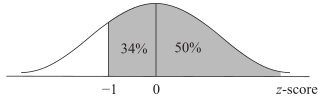
The pulse rates of a population of Year 12 students are approximately normally distributed with a mean of 69 beats per minute and a standard deviation of 4 beats per minute.
 

Part 1

A student selected at random from this population has a standardised pulse rate of  `z = –2.5`

This student’s actual pulse rate is

  1.  59 beats per minute.
  2.  63 beats per minute.
  3.  65 beats per minute.
  4.  73 beats per minute.
  5.  79 beats per minute.
     

Part 2

Another student selected at random from this population has a standardised pulse rate of  `z=–1.`

The percentage of students in this population with a pulse rate greater than this student is closest to

  1.   2.5%
  2.   5%
  3.  16%
  4.  68%
  5.  84%
     

Part 3

A sample of 200 students was selected at random from this population.

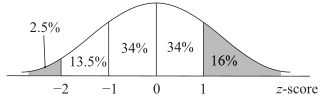
The number of these students with a pulse rate of less than 61 beats per minute or greater than 73 beats per minute is closest to

  1.  19
  2.  37
  3.  64
  4.  95
  5. 190
Show Answers Only

`text(Part 1:)\ A`

`text(Part 2:)\ E`

`text(Part 3:)\ B`

Show Worked Solution

`text(Part 1)`

`ztext(-score)` `= (x – barx)/s`
`−2.5` `= (x – 69)/4`
`x – 69` `= −10`
`:. x` `= 59`

 
`=> A`
 

`text(Part 2)`

`ztext(-score) = −1`
 

`text(% above)` `= 34 + 50`
  `= 84 text(%)`

`=> E`
 

`text(Part 3)`

`z-text(score)\ (61)` `= (61 – 69)/4 = −2`
`z-text(score)\ (73)` `= (73 – 69)/4 = 1`


`text(Percentage)` `= 2.5 + 16`
  `= 18.5text(%)`


`:.\ text(Number of students)` `= 18.5 text(%) xx 200`
  `= 37`

`=> B`

Filed Under: Normal Distribution Tagged With: Band 3, Band 4, smc-600-10-Single z-score, smc-600-20-z-score Intervals

Networks, STD2 N3 SM-Bank 31

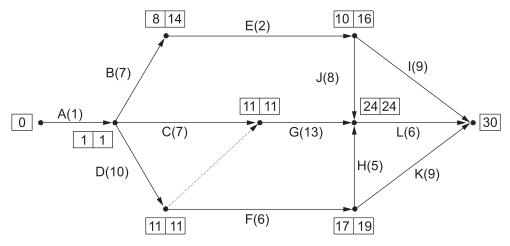
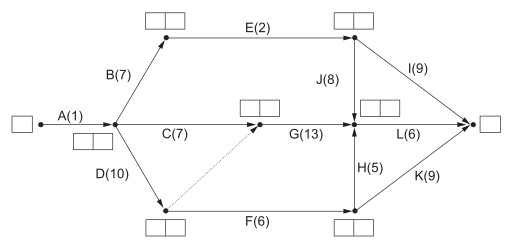
Murray is building a new garage. The project involves activities `A` to `L`.


The network diagram shows these activities and their completion times in days.

  1. Which TWO activities immediately precede activity `G`?  (1 mark)

    --- 2 WORK AREA LINES (style=lined) ---

  2. By completing the diagram shown, calculate the minimum time required to build the new garage.  (2 marks)

    --- 4 WORK AREA LINES (style=lined) ---

  3. Hence, what is the float time for activity `E`?  (1 mark)

    --- 1 WORK AREA LINES (style=lined) ---

Show Answers Only
  1. `text(Activity)\ C\ text(and)\ D.`
  2. `30\ text(days)`
  3. `6\ text(days)`
Show Worked Solution

a.   `text(Activity)\ C\ text(and)\ D.`


b.   

`text(Critical path)\ \ A – D – G – L`

`= 1 + 10 + 13 + 6`

`= 30\ text(days)`


c.   `text(Float time of Activity)\ E`

`= 14 – 8`

`= 6\ text(days)`

Filed Under: Critical Paths Tagged With: Band 3, Band 4, smc-916-30-Scanning Both Ways

Networks, STD2 N2 EQ-Bank 30

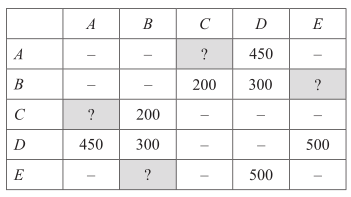
An amusement park has five toilet areas, `A`, `B`, `C`, `D` and `E`, which are connected by pathways.

The table shows the length of some of the pathways, in metres.


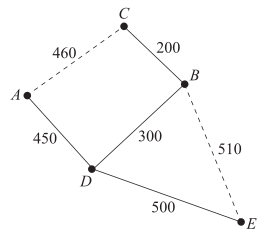
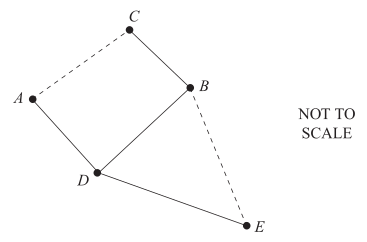
The following network diagram is drawn to represent this information and a correct minimum spanning tree is shown by the solid lines.

Complete the network diagram including a possible value for each of the two edges `AC` and `BE`, and justify why `AC` and `BE` were not included as part of the minimum spanning tree.   (3 marks)

--- 4 WORK AREA LINES (style=lined) ---

Show Answers Only

 
`BE > 500, AC > 450`

Show Worked Solution

`text(Consider Kruskal’s algorithm for the given minimum spanning tree:)`

`CB ->\ text{1st edge (200 – minimum weight)}`

`BD ->\ text{2nd edge (300)}`

`AD ->\ text{3rd edge (450)}`

`=> AC=460\ \ text{(choose any value such that}\ \ AC>450)`
 

`DE ->\ text{4th edge (500)}`

`=> BE=510\ \ text{(choose any value such that}\ \ BE>500)`
 

`:. BE > 500\ (BE\ text(must be greater than)\ DE)`

`:. AC > 450\ (AC\ text(must be greater than)\ AD)`

Filed Under: Minimum Spanning Trees, Minimum Spanning Trees, Spanning Trees, Spanning Trees Tagged With: Band 4, smc-1138-50-Unknown Edge, smc-6320-50-Unknown Edge, smc-6528-50-Unknown Edge, smc-914-50-Unknown Edge

Networks, STD2 N2 EQ-Bank 22

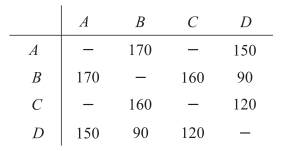
In central Queensland, there are four petrol stations `A`, `B`, `C` and `D`. The table shows the length, in kilometres, of roads connecting these petrol stations.
 

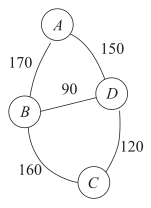
  1. Construct a network diagram to represent the information in the table.   (2 marks)

    --- 5 WORK AREA LINES (style=lined) ---

  2. A petrol tanker needs to refill each station. It starts at Station `A` and visits each station.


    Calculate the shortest distance that can be travelled by the petrol tanker. In your answer, include the order the petrol stations are refilled.   (2 marks)

    --- 4 WORK AREA LINES (style=lined) ---

Show Answers Only
  1.  
  2. `380\ text(km)`
Show Worked Solution
a.   


b.   `text(Shortest Path from)\ A\ (text(visiting all stations)):`

`A – B – D – C`

`text(Distance)= 170 + 90 + 120= 380\ text(km)`

Filed Under: Basic Concepts, Basic Concepts, Network Concepts, Network Concepts, Shortest Path, Shortest Paths, Shortest Paths, Shortest Paths Tagged With: Band 3, Band 4, smc-1136-10-Table to Network, smc-1137-20-Table, smc-6307-10-Table to Network, smc-6308-20-Tables, smc-6526-10-Table to Network, smc-6527-20-Tables, smc-912-10-Table to Network, smc-913-20-Table

Networks, STD2 N2 EQ-Bank 14 MC

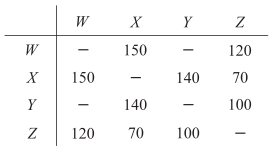
In a town, there are four cafes `W`, `X`, `Y` and `Z`. The table shows the distances, in metres, of paved footpath connecting the cafes.

A coffee supplier needs to visit each cafe.

What is the shortest distance she needs to walk along the paved footpath if she starts at cafe `W`?

  1. 260 m
  2. 320 m
  3. 330 m
  4. 360 m
Show Answers Only

`B`

Show Worked Solution

`text(Possible paths:)`

`W-Z-X-Y = 120 + 70 + 140 = 330\ text(m)`

`W-Z-Y-X = 120 + 100 + 140 = 360\ text(m)`

`W-X-Z-Y = 150 + 70 + 100 = 320\ text(m)`

`W-X-Y-Z = 150 + 140 + 100 = 390\ text(m)`

`=> B`

Filed Under: Shortest Path, Shortest Paths, Shortest Paths, Shortest Paths Tagged With: Band 4, smc-1137-20-Table, smc-6308-20-Tables, smc-6527-20-Tables, smc-913-20-Table

Measurement, STD2 M7 SM-Bank 7

The scale on a given map is `1:80\ 000`.

If the actual distance between two points is 3.4 kilometres, how far apart on the map would be the two points be, in centimetres?  (2 marks)

--- 4 WORK AREA LINES (style=lined) ---

Show Answers Only

`4.25\ text(cm)`

Show Worked Solution

`text(Actual distance on map)`

`= text(real distance)/text(scale)`

`= text(3.4 km)/(80\ 000)`

`= text(3400 m)/(80\ 000)`

`= 0.0425\ text(m)`

`= 4.25\ text(cm)`

Filed Under: M5 Scale Drawings (Y12), Ratio and Scale Tagged With: Band 4, smc-1105-20-Maps and Scale Drawings, smc-1187-40-Maps and Scale Drawings

Measurement, STD2 M2 EQ-Bank 2

Bert is in Moscow, which is three hours behind of Coordinated Universal Time (UTC).

Karen is in Sydney, which is eleven hours ahead of UTC.

  1. Bert is going to ring Karen at 9 pm on Tuesday, Moscow time. What day and time will it be in Sydney when he rings?   (1 mark)

    --- 2 WORK AREA LINES (style=lined) ---

  2. Karen is going to fly from Sydney to Moscow. Her flight will leave on Wednesday at 8 am, Sydney time, and will take 15 hours. What day and time will it be in Moscow when she arrives?   (2 marks)

    --- 4 WORK AREA LINES (style=lined) ---

Show Answers Only

a.   `11\ text(am Wednesday)`

b.   `9\ text(am Wednesday)`

Show Worked Solution

a.   `text(Bert is 14 hours behind Karen.)`

`text(At 9 pm in Moscow:)`

`text(Time in Sydney)` `= 9\ text(pm + 14 hours)`
  `= 11\ text(am Wednesday)`


b.    `text(Arrival time)` `= 8\ text(am + 15 hours)`
    `= 11\ text{pm Wednesday (Sydney time)}`


`:.\ text(Time in Moscow)` `= 11\ text(pm less 14 hours)`
  `= 9\ text(am Wednesday)`

Filed Under: M2 Working with Time (Y11), M2 Working with Time (Y11), Time and Time Difference, Time and Time Difference Tagged With: Band 3, Band 4, smc-1102-10-Time Differences, smc-6306-10-Time Differences, smc-6525-10-Time Differences, smc-776-10-Time Differences

Measurement, STD2 M7 SM-Bank 6

In a raffle, the total prize money is shared among the first two tickets drawn in the ratio  6 : 4.

The prize for the second ticket drawn is $360.

What is the total prize money?  (2 marks)

Show Answers Only

`$900`

Show Worked Solution

`4/10 xx text(Total prize money = $360)`

`=> 1/10 xx text(Total prize money = $90)`

`:.\ text(Total prize money)` `= 90 xx 10`
  `= $900`

Filed Under: M5 Scale Drawings (Y12), Ratio and Scale Tagged With: Band 4, smc-1105-40-Ratio (2 part), smc-1187-10-Ratio (2 part)

Measurement, STD2 M7 SM-Bank 4

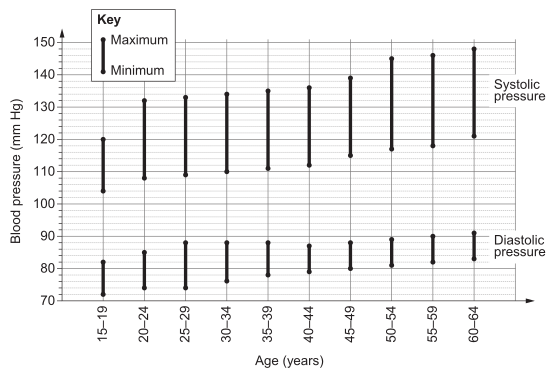
Blood pressure is measured using two numbers: systolic pressure and diastolic pressure. If the measurement shows 120 systolic and 80 diastolic, it is written as 120/80.

The bars on the graph show the normal range of blood pressure for people of various ages.

  1. What is the normal range of blood pressure for a 53-year-old?  (2 marks)

    --- 4 WORK AREA LINES (style=lined) ---

  2. Ralph, aged 53, had a blood pressure reading of 173 over 120. A doctor prescribed Ralph a medication to reduce his blood pressure to be within the normal range. To check that the medication was being effective, the doctor measured Ralph's blood pressure for 10 weeks and recorded the following results.  


    With reference to the data provided, comment on the effectiveness of the medication during the 10-week period in returning Ralph’s blood pressure to the normal range.  (3 marks)

    --- 6 WORK AREA LINES (style=lined) ---

Show Answers Only

a.   `text{Normal range (systolic): 117 – 145}`

       `text{Normal range (diastolic): 81 – 89}`

b.   `text(Effectiveness of medication)`

`text(• systolic and diastolic pressure reduced below original)`

   `text(readings from week 3 onwards.)`

`text(• systolic pressure in normal range from week 5 onwards.)`

`text(• diastolic pressure in normal range from week 7 onwards.)`

`text(• blood pressure only in the normal range from week 7.)`

Show Worked Solution

a.   `text{Normal range (systolic): 117 – 145}`

`text{Normal range (diastolic): 81 – 89}`


b.   `text(Effectiveness of medication)`

`text(• systolic and diastolic pressure reduced below original)`

     `text(readings from week 3 onwards.)`

`text(• systolic pressure in normal range from week 5 onwards.)`

`text(• diastolic pressure in normal range from week 7 onwards.)`

`text(• blood pressure only in the normal range from week 7.)`

Filed Under: M4 Rates (Y12), Rates Tagged With: Band 3, Band 4, smc-1104-40-Heart Rates/Blood Pressure, smc-805-40-Heart Rates

Measurement, STD2 M1 EQ-Bank 12 MC

During a flood, 12.5 hectares of land was covered by water to a depth of 30 cm.

How many kilolitres of water covered the land?

(1 hectare = 10 000 m² and 1 m³ = 1000 L)

  1. 3.75 kL
  2. 37.5 kL
  3. 37 500 kL
  4. 37 500 000 kL
Show Answers Only

`C`

Show Worked Solution

`text(Volume of water in m³:)`

`text(Vol)` `= Ah`
  `= 12.5 xx 10\ 000 xx 30\ text(cm)`
  `= 12.5 xx 10\ 000 xx 0.3`
  `= 37\ 500 \ text(m³)= 37\ 500\ text(kL)`

 
`=>C`

Filed Under: Perimeter, Area and Volume, Volume, Mass and Capacity, Volume, Mass and Capacity Tagged With: Band 4, smc-6304-40-Volume, smc-6304-60-Water Catchment, smc-6521-40-Volume, smc-6521-60-Water Catchment, smc-798-40-Volume, smc-798-60-Water Catchment

Measurement, STD2 M6 EQ-Bank 4 MC

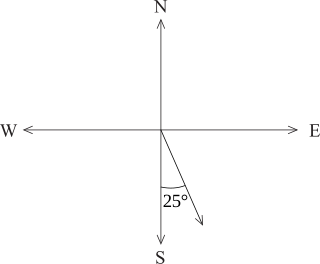
Which of the following expresses S25°E as a true bearing?

  1.  `025°`
  2.  `065°`
  3.  `115°`
  4.  `155°`
Show Answers Only

`D`

Show Worked Solution

`text(S60°W)= 180-25= 155°`

`=>D`

Filed Under: Bearings, Bearings, Bearings and Radial Surveys Tagged With: Band 4, common-content, smc-6395-30-Compass vs True Bearings, smc-803-30-Compass vs True Bearings, smc-981-20-Compass vs True Bearings

Algebra, SPEC2 2018 VCAA 2 MC

Consider the function  `f` with rule  `f(x) = 1/sqrt(sin^(-1)(cx + d))`, where  `c, d in R`  and  `c > 0`.

The domain of  `f` is

A.  `x > -d/c`

B.  `-d/c < x <= (1 - d)/c`

C.  `(-1 - d)/c <= x <= (1 - d)/c`

D. `x in R\ text(\) {-d/c}`

E.  `x in R` 

Show Answers Only

`B`

Show Worked Solution
`cx + d` `in [-1, 1]`
`cx` `in [-1-d, 1-d]`
`x` `in [(-1-d)/c, (1 – d)/c]\ \ …\ (1)`


`sin^(-1) (cx + d)` `> 0`
`cx + d` `>0`
`cx` `> -d`
`x` `> -d/c\ \ …\ (2)`


`(1) nn (2):`

`x in (-d/c, (1 – d)/c]`

 
`=>  B`

Filed Under: Inverse Trig Functions Tagged With: Band 4, smc-1153-10-arcsin

Algebra, STD2 A4 EQ-Bank 8

Two friends, Sequoia and Raven, sold organic chapsticks at the the local market.

Sequoia sold her chapsticks for $4 and Raven sold hers for $3 each. In the first hour, their total combined sales were $20.

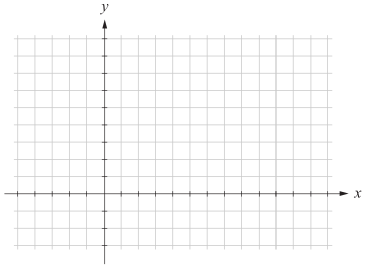
If Sequoia sold `x` chapsticks and Raven sold `y` chapsticks, then the following equation can be formed:

`4x + 3y = 20`

In the first hour, the friends sold a total of 6 chapsticks between them.

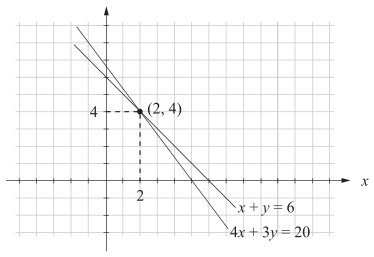
Find the number of chapsticks each of the friends sold during this time by forming a second equation and solving the simultaneous equations graphically.  (5 marks)

Show Answers Only

`text(Sequoia sold 2 and Raven sold 4.)`

Show Worked Solution
`text(Graphing)\ \ 4x + 3y` `= 20`
`y` `= −4/3x + 20/3`

 
`ytext(-intercept) = (0, 20/3)`

`xtext(-intercept)= (5, 0)`

`text(Gradient)\ = -4/3`
 

`text(S)text(econd equation:)`

`x + y = 6`

`text(From the graph,)`

`text(Sequoia sold 2 and Raven sold 4.)`

Filed Under: Simultaneous Equations and Applications Tagged With: Band 4, smc-794-15-Other SE Applications, smc-794-30-Sketch Linear Equations

Algebra, STD2 A4 SM-Bank 7

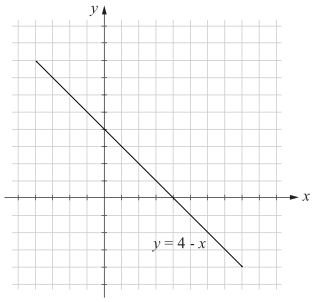
The graph of the line  `y = 4 - x`  is shown.


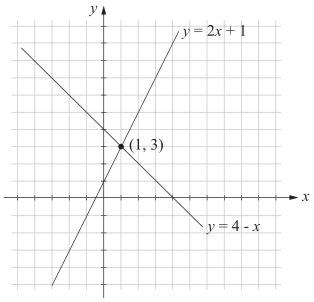
By graphing  `y = 2x + 1`  on the grid provided, find the point of intersection of  `y = 4 - x`  and  `y = 2x + 1`.  (3 marks)

--- 1 WORK AREA LINES (style=lined) ---

Show Answers Only

`(1, 3)`

Show Worked Solution

`text(Graphing)\ y = 2x + 1 :`

`ytext(-intercept = 1)`

`text(Gradient = 2)`


`:.\ text{Point of intersection is (1, 3).}`

Filed Under: A3 Types of Relationships (Y12), Simultaneous Equations and Applications Tagged With: Band 4, smc-1099-30-Find intersection, smc-1099-40-Sketch equations, smc-794-20-Find Intersection, smc-794-30-Sketch Linear Equations

Algebra, STD2 A4 SM-Bank 6

A student was asked to solve the following simultaneous equations.

`y = 2x - 8`

`x - 4y + 3 = 0`

After graphing the equations, the student found the point of intersection to be `(5,2)`?

Is the student correct? Support your answer with calculations.  (2 marks)

--- 5 WORK AREA LINES (style=lined) ---

Show Answers Only

`text(See Worked Solutions)`

Show Worked Solution

`text{Substitute (5, 2) into}\ \ y = 2x – 8`

`text(LHS) = y = 2`

`text(RHS) = 2(5) – 8 = 2`

`:.\ text(LHS = RHS)`
 

`text{Substitute (5, 2) into}\ \ x – 4y + 3 = 0`

`text(LHS)` `= 5 – 4(2) + 3`
  `= 0`
  `=\ text(RHS)`

 
`=> (5,2)\ text(satisfies both equations.)`

`:.\ text(Student is correct.)`

Filed Under: A3 Types of Relationships (Y12), Simultaneous Equations and Applications Tagged With: Band 4, smc-1099-30-Find intersection

Probability, STD2 S2 SM-Bank 1

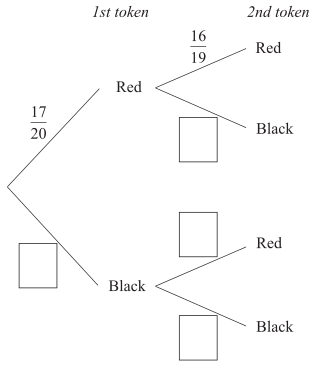
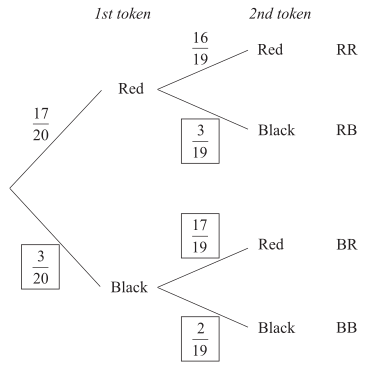
A game consists of two tokens being drawn at random from a barrel containing 20 tokens. There are 17 red tokens and 3 black tokens. The player keeps the two tokens drawn.

  1.  Complete the probability tree by writing the missing probabilities in the boxes.  (2 marks)


  2.  What is the probability that a player draws at least one red token. Give your answer in exact form.  (2 marks)

    --- 4 WORK AREA LINES (style=lined) ---

Show Answers Only
  1.  
  2. `187/190`
Show Worked Solution
i.   


ii.   `P(text(at least one red))`

`= 1 – P(BB)`

`= 1 – 3/20 · 2/19`

`= 187/190`

Filed Under: Multi-Stage Events, Single and Multi-Stage Events Tagged With: Band 4, Band 5, smc-1135-10-Probability Trees, smc-1135-30-P(E) = 1 - P(not E), smc-829-10-Probability Trees, smc-829-30-P(E) = 1 - P(not E)

Financial Maths, STD2 F4 SM-Bank 1

An investment fund purchases 4500 shares of Bank ABC for a total cost of $274 500 (ignore any transaction costs).

The investment fund is paid a divided of $3.66 per share in the first year.

  1. What was the purchase price of 1 share?  (1 mark)
  2. Calculate the divided yield.  (1 mark)
Show Answers Only
  1. `$61`
  2. `text(6%)`
Show Worked Solution

i.   `text(Price per share)`

`= (274\ 500)/4500`

`= $61`
 

ii.   `text(Dividend Yield)`

`= text(Dividend)/text(Share Price) xx 100`

`= 3.66/61 xx 100`

`= 6text(%)`

Filed Under: Compound Interest and Shares Tagged With: Band 4, Band 5, smc-817-40-Shares/Dividends

Functions, 2ADV F2 EQ-Bank 12

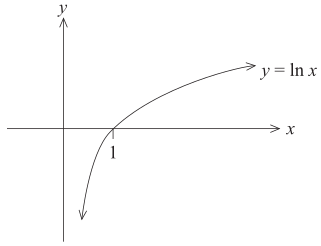
  1.  Draw the graph  `y = ln x`.   (1 mark)

    --- 6 WORK AREA LINES (style=lined) ---

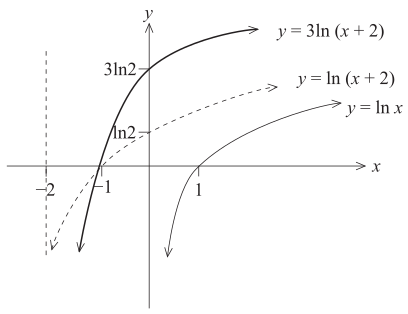
  2.  Explain how the above graph can be transformed to produce the graph
  3.     `y = 3ln(x + 2)`
  4. and sketch the graph, clearly identifying all intercepts.   (3 marks)

    --- 9 WORK AREA LINES (style=lined) ---

Show Answers Only

a.    

b.     

Show Worked Solution

a.

 
b. 
 `text(Transforming)\ \ y = ln x => \ y = ln(x + 2)`

`y = ln x\ \ =>\ text(shift 2 units to left.)`
 

`text(Transforming)\ \ y = ln(x + 2)\ \ text(to)\ \ y = 3ln(x + 2)`

`=>\ text(increase each)\ y\ text(value by a factor of 3)`
 

Filed Under: Graphs and Applications, Other Graph Transformations, Transformations Tagged With: Band 2, Band 4, smc-1008-30-Log/Exp, smc-1008-70-Combinations, smc-6408-20-Log/Exp, smc-6408-60-Combinations, smc-966-40-Log graphs

Calculus, 2ADV C1 EQ-Bank 17

The displacement `x` metres from the origin at time `t` seconds of a particle travelling in a straight line is given by

`x = 2t^3-t^2-3t + 11`  when  `t >= 0`

  1.  Calculate the velocity when  `t = 2`.   (1 mark)

    --- 2 WORK AREA LINES (style=lined) ---

  2.  When is the particle stationary?   (2 marks)

    --- 4 WORK AREA LINES (style=lined) ---

Show Answers Only

 a.    `17\ text(ms)^(−1)`

 b.    `(1 + sqrt19)/6`

Show Worked Solution

a.   `x =2t^3-t^2-3t + 11` 

`v = (dx)/(dt) = 6t^2-2t-3`

 
`text(When)\ t = 2:`

`v= 6 xx 2^2-2 · 2-3= 17\ text(ms)^(−1)`
 

b.   `text(Particle is stationary when)\ \ v = 0`

`6t^2-2t-3=0`

`:. t` `= (2 ±sqrt((−2)^2-4 · 6 · (−3)))/12`
  `= (2 ± sqrt76)/12`
  `= (1 ± sqrt19)/6`
  `= (1 + sqrt19)/6 qquad(t >= 0)`

Filed Under: Rates of Change, Rates of Change Tagged With: Band 3, Band 4, smc-1083-20-Polynomial Function, smc-6438-10-Motion, smc-6438-20-Polynomial Function

Calculus, 2ADV C1 EQ-Bank 16

  1.  Find the equations of the tangents to the curve  `y = x^2-3x`  at the points where the curve cuts the `x`-axis.   (2 marks)

    --- 6 WORK AREA LINES (style=lined) ---

  2.  Where do the tangents intersect?   (2 marks)

    --- 5 WORK AREA LINES (style=lined) ---

Show Answers Only

a.    `y = -3x, \ y = 3x-9`

b.    `(3/2, -9/4)`

Show Worked Solution

a.    `y= x^2-3x= x(x-3)`

`text(Cuts)\ xtext(-axis at)\ \ x = 0\ \ text(or)\ \ x = 3`

`(dy)/(dx) = 2x-3`

`text(At)\ \ x = 0 \ => \ (dy)/(dx) = -3`

`T_1\ text(has)\ \ m = -3,\ text{through (0, 0):}`

`y-0` `= -3(x-0)`
`y` `= -3x`

 
`text(At)\ \ x = 3 \ => \ (dy)/(dx) = 3`

`T_2\ text(has)\ \ m = 3,\ text{through (3, 0):}`

`y-0` `= 3(x-3)`
`y` `= 3x-9`


b.   `text(Intersection occurs when:)`

`3x-9` `= -3x`
`6x` `= 9`
`x` `= 3/2`


`y = -3 xx 3/2 = -9/2`

`:.\ text(Intersection at)\ \ (3/2, -9/2)`

Filed Under: Tangents, Tangents Tagged With: Band 3, Band 4, smc-6437-10-Find Tangent Gradient/Equation, smc-6437-30-Intersections, smc-973-10-Find Tangent Equation, smc-973-30-Intersections

Trigonometry, 2ADV T2 EQ-Bank 20

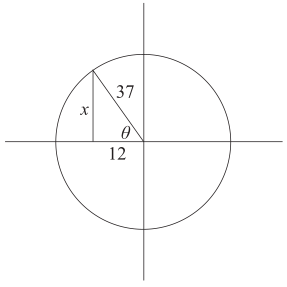
Given  `sectheta = −37/12`  for  `0 < theta < pi`,

find the exact value of  `text(cosec)\ theta`.   (2 marks)

--- 5 WORK AREA LINES (style=lined) ---

Show Answers Only

`37/35`

Show Worked Solution

`sec\ theta = -37/12 => cos\ theta = -12/37`

`text(Graphically:)`

`x=sqrt(37^2-12^2)=35`

`:.\ text(cosec)\ theta= 1/(sintheta)= 1/(35/37)= 37/35`

Filed Under: Exact Trig Ratios, Exact Trig Ratios Tagged With: Band 4, smc-6411-60-Related Trig Ratios, smc-979-50-Find ratio given ratio

Trigonometry, 2ADV T2 EQ-Bank 25

Express  `5cot^2 x-2text(cosec)\ x + 2`  in terms of  `text(cosec)\ x`  and hence solve

`5cot^2 x-2text(cosec)\ x + 2 = 0`  for  `0 < x < 2pi`.   (3 marks)

--- 8 WORK AREA LINES (style=lined) ---

Show Answers Only

`x = pi/2`

Show Worked Solution

`cot^2 x= (cos^2 x)/(sin^2 x)= (1-sin^2 x)/(sin^2 x)= text(cosec)^2 x-1`
 

`5cot^2 x-2text(cosec)\ x + 2` `= 0`
`5(text(cosec)^2 x-1)-2text(cosec)\ x + 2` `= 0`
`5text(cosec)^2 x-2text(cosec)\ x-3` `= 0`
`(5text(cosec)\ x + 3)(text(cosec)\ x-1)` `= 0`
`text(cosec)\ x` `= -3/5` `text(cosec)\ x` `= 1`
`sinx` `= -5/3` `sinx` `= 1`
`(text(no solution))` `x` `= pi/2`

 
`:. x = pi/2`

Filed Under: Trig Identities and Harder Equations, Trig Identities and Harder Equations Tagged With: Band 4, smc-1189-10-Solve Equation, smc-6412-10-Solve Equation, smc-6412-25-Quadratics

Trigonometry, 2ADV T2 EQ-Bank 18

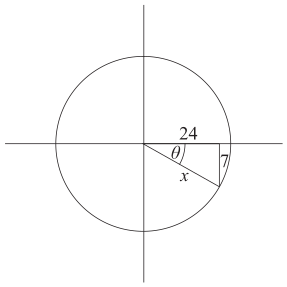
Given  `cot theta = −24/7`  for  `−pi/2 < theta < pi/2`, find the exact value of

  1.  `sec theta`   (2 marks)

    --- 4 WORK AREA LINES (style=lined) ---

  2.  `sin theta`   (1 mark)

    --- 1 WORK AREA LINES (style=lined) ---

Show Answers Only

a.    `25/24`

b.    `-7/25`

Show Worked Solution

a.   `cot theta = −24/7\ \ =>\ \ tan theta=– 7/24`

`text(Graphically, given)\ −pi/2 < theta < pi/2:`

`x= sqrt(24^2 + 7^2)=25`

`sectheta= 1/(costheta)= 1/(24/25)= 25/24`
  

b.   `sintheta = −7/25`

Filed Under: Exact Trig Ratios, Exact Trig Ratios Tagged With: Band 3, Band 4, smc-6411-40-cosec/sec/cot, smc-6411-60-Related Trig Ratios, smc-979-40-cosec/sec/cot, smc-979-50-Find ratio given ratio

Functions, 2ADV F1 EQ-Bank 27

The stopping distance of a car on a certain road, once the brakes are applied, is directly proportional to the square of the speed of the car when the brakes are first applied.

A car travelling at 70 km/h takes 58.8 metres to stop.

How far does it take to stop if it is travelling at 105 km/h?   (3 marks)

--- 7 WORK AREA LINES (style=lined) ---

Show Answers Only

`132.3\ text(metres)`

Show Worked Solution

`text(Let)\ d\ text(= stopping distance)`

`d \prop s^2\ \ =>\ \ d = ks^2`

`text(Find)\ k:`

`58.8` `= k xx 70^2`
`k` `= 58.8/(70^2)= 0.012`

 
`text(Find)\ d\ text(when)\ s = 105:`

`d= 0.012 xx 105^2= 132.3\ text(metres)`

Filed Under: Direct and Inverse Variation, Further Functions and Relations Tagged With: Band 4, smc-6383-10-\(\propto kx^{n}\), smc-6383-40-Stopping Distance, smc-987-60-Proportional

Functions, 2ADV F1 EQ-Bank 26

Fuifui finds that for Giant moray eels, the mass of an eel is directly proportional to the cube of its length.

An eel of this species has a length of 25 cm and a mass of 4350 grams.

What is the expected length of a Giant moray eel with a mass of 6.2 kg? Give your answer to one decimal place.  (3 marks)

--- 7 WORK AREA LINES (style=lined) ---

Show Answers Only

`28.1\ text{cm}`

Show Worked Solution

`text(Mass) prop text(length)^3`

`m = kl^3`

`text(Find)\ k:`

`4350` `= k xx 25^3`
`k` `= 4350/25^3= 0.2784`

 
`text(Find)\ l\ text(when)\ m = 6200:`

`6200` `= 0.2784 xx l^3`
`l^3` `= 6200/0.2784`
`:. l` `= 28.13…= 28.1\ text{cm  (to 1 d.p.)}`

Filed Under: Direct and Inverse Variation, Further Functions and Relations Tagged With: Band 4, smc-6383-10-\(\propto kx^{n}\), smc-987-60-Proportional

Functions, 2ADV F1 EQ-Bank 17

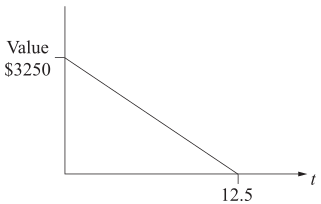
Damon owns a swim school and purchased a new pool pump for $3250.

He writes down the value of the pool pump by 8% of the original price each year.

  1.  Construct a function to represent the value of the pool pump after `t` years.   (1 mark)

    --- 1 WORK AREA LINES (style=lined) ---

  2.  Draw the graph of the function and state its domain and range.   (2 marks)

    --- 8 WORK AREA LINES (style=lined) ---

Show Answers Only

a.    `text(Value) = 3259-260t`

b.    `text(Domain)\ {t: 0 <= t <= 12.5}`

`text(Range)\ {y: 0 <= y <= 3250}`

Show Worked Solution

a.    `text(Depreciation each year)= 8text(%) xx 3250= $260`

`:.\ text(Value) = 3250-260t`
 

b.   

`text(Find)\ \ t\ \ text(when value = 0)`

`3250-260t` `= 0`
`t` `= 3250/260= 12.5\ text(years)`

 
`text(Domain)\ \ {t: 0 <= t <= 12.5}`

`text(Range)\ \ {y: 0 <= y <= 3250}`

Filed Under: Linear Functions, Linear Functions Tagged With: Band 3, Band 4, smc-6214-60-Other Real World Applications, smc-985-20-Other Linear Applications

Functions, 2ADV F1 EQ-Bank 23

Find the values of `k` for which the expression  `x^2-3x + (4-2k)`  is always positive.  (3 marks)

--- 7 WORK AREA LINES (style=lined) ---

Show Answers Only

`k < 7/8`

Show Worked Solution

`x^2-3x + (4-2k) > 0`

`x^2-3x + (4-2k) = 0\ \ text(is a concave up parabola)`

`=>\ text{Always positive (no roots) if}\ \ Delta < 0`
 

`b^2-4ac < 0`

`(−3)^2-4 · 1 · (4-2k)` `< 0`
`9-16 + 8k` `< 0`
`8k` `< 7`
`k` `< 7/8`

Filed Under: Quadratics and Cubic Functions, Quadratics and Cubic Functions Tagged With: Band 4, smc-6215-10-Quadratics, smc-6215-80-Discriminant, smc-984-10-Quadratics, smc-984-50-Discriminant

Functions, 2ADV F1 EQ-Bank 23

Worker A picks a bucket of blueberries in `a` hours. Worker B picks a bucket of blueberries in `b` hours.

  1.  Write an algebraic expression for the fraction of a bucket of blueberries that could be picked in one hour if A and B worked together.  (2 marks)

    --- 3 WORK AREA LINES (style=lined) ---

  2.  What does the reciprocal of this fraction represent?  (1 mark)

    --- 2 WORK AREA LINES (style=lined) ---

Show Answers Only

a.    `(a + b)/(ab)`

b.    `text(The reciprocal represents the number of hours it would)`

`text(take to fill one bucket, with A and B working together.)`

Show Worked Solution

a.    `text(In one hour:)`

COMMENT: Note that the question asks for “a fraction”.

`text(Worker A picks)\ 1/a\ text(bucket.)`

`text(Worker B picks)\ 1/b\ text(bucket.)`
 

`:.\ text(Fraction picked in 1 hour working together)`

`= 1/a + 1/b`

`= (a + b)/(ab)`
 

b.   `text(The reciprocal represents the number of hours it would)`

`text(take to fill one bucket, with A and B working together.)`

Filed Under: Algebraic Techniques, Algebraic Techniques Tagged With: Band 3, Band 4, common-content, smc-6213-10-Algebraic Fractions, smc-983-40-Algebraic Fractions

  • « Previous Page
  • 1
  • …
  • 81
  • 82
  • 83
  • 84
  • 85
  • …
  • 117
  • Next Page »

Copyright © 2014–2026 SmarterEd.com.au · Log in