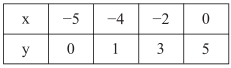
| `y` | `= x + 5` |
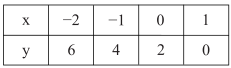
| `y + 2x` | `= 2` |
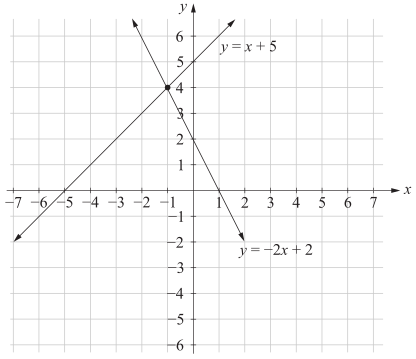
Draw these two linear graphs on the number plane below and determine their intersection. (3 marks)
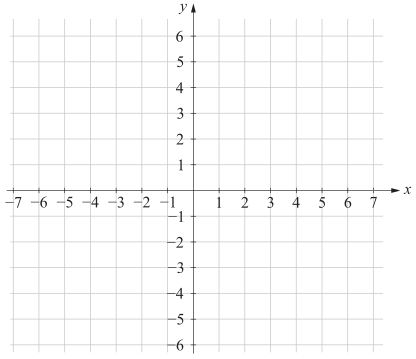
--- 2 WORK AREA LINES (style=lined) ---
Aussie Maths & Science Teachers: Save your time with SmarterEd
| `y` | `= x + 5` |
| `y + 2x` | `= 2` |
Draw these two linear graphs on the number plane below and determine their intersection. (3 marks)
--- 2 WORK AREA LINES (style=lined) ---
`(−1,4)`
The line `3x-4y + 3 = 0` is a tangent to a circle with centre (3, – 2).
What is the equation of the circle?
`D`
`text(Radius) = _|_\ text{distance of (3, −2) from}\ \ 3x-4y + 3 = 0`
| `_|_\ text(dist)` | `= |(ax_1 + by_1 + c)/sqrt(a^2 + b^2)|` |
| `= |(3(3)-4(-2) + 3)/sqrt(3^2 + (-4)^2)|` | |
| `= |(9 + 8 + 3)/sqrt 25|` | |
| `= 4` |
`text{Equation of circle, centre (3, –2) with radius 4}`
`(x-3)^2 + (y + 2)^2 = 16`
`=> D`
Joanna sits a Physics test and a Biology test.
Calculate the `z`-score for Joanna’s mark in this test. (1 mark)
--- 2 WORK AREA LINES (style=lined) ---
Joanna’s `z`-score is the same in both the Physics test and the Biology test.
What is her mark in the Biology test? (2 marks)
--- 4 WORK AREA LINES (style=lined) ---
i. `x = 70, \ mu = 58, \ sigma = 8`
| `:. ztext(-score)` | `= (x – mu)/sigma` |
| `= (70 – 58)/8` | |
| `= 1.5` |
| ii. | `1.5` | `= (x – 64)/10` |
| `x – 64` | `= 15` | |
| `:. x` | `= 79` |
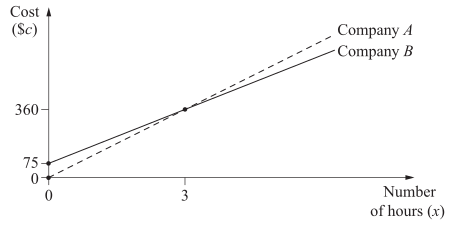
The graph displays the cost (`$c`) charged by two companies for the hire of a minibus for `x` hours.
Both companies charge $360 for the hire of a minibus for 3 hours.
--- 1 WORK AREA LINES (style=lined) ---
Write a formula, in the form of `c = mx + b`, for the cost of hiring a minibus from Company B for `x` hours. (2 marks)
--- 4 WORK AREA LINES (style=lined) ---
Calculate how much cheaper this is than hiring from Company A. (2 marks)
--- 4 WORK AREA LINES (style=lined) ---
| i. | `text(Hourly rate)\ (A)` | `= 360 ÷ 3` |
| `= $120` |
ii. `m = text(hourly rate)`
`text(Find)\ m,\ text(given)\ c = 360,\ text(when)\ \ x = 3\ \ text(and)\ \ b = 75`
| `360` | `= m xx 3 + 75` |
| `3m` | `= 285` |
| `m` | `= 95` |
`:. c = 95x + 75`
| iii. | `text(C)text(ost)\ (A)` | `= 120 xx 5 = $600` |
| `text(C)text(ost)\ (B)` | `= 95 xx 5 + 75 = $550` |
`:.\ text(Company)\ B’text(s hiring cost is $50 cheaper.)`
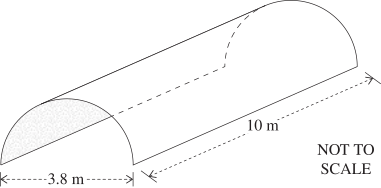
A shade shelter is to be constructed in the shape of half a cylinder with open ends. The diameter is 3.8 m and the length is 10 m.
The curved roof is to be made of plastic sheeting.
What area of plastic sheeting is required, to the nearest m²? (2 marks)
--- 4 WORK AREA LINES (style=lined) ---
`60\ text(m² (nearest m²))`
`text(Flatten out the half cylinder,)`
| `text(Width)` | `= 1/2 xx text(circumference)` |
| `= 1/2 xx pi xx 3.8= 5.969…` |
| `:.\ text(Sheeting required)` | `= 10 xx 5.969…= 59.69…` |
| `= 60\ text(m² (nearest m²))` |
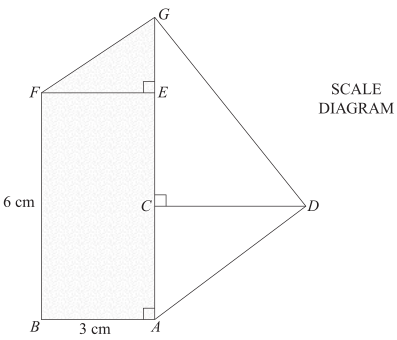
A field diagram of a block of land has been drawn to scale. The shaded region `ABFG` is covered in grass.
The actual length of `AG` is 24 m.
--- 1 WORK AREA LINES (style=lined) ---
--- 6 WORK AREA LINES (style=lined) ---
| i. | `text(Scale 8 cm)` | `\ :\ text(24 m)` |
| `text(1 cm)` | `\ :\ text(3 m)` | |
| `1` | `\ :\ 300` |
ii. `text(Area of rectangle)\ ABFE`
`= 6\ text(cm × 3 cm)`
`= 18\ text(m × 9 m)`
`= 162\ text(m²)`
`text(Area of)\ DeltaEFG`
`= 1/2 xx 3\ text(cm) xx 2\ text(cm)`
`= 1/2 xx 9 xx 6`
`= 27\ text(m²)`
| `:.\ text(Fertiliser needed)` | `= (162 + 27) xx 26.5` |
| `= 5008.5\ text(grams)` |
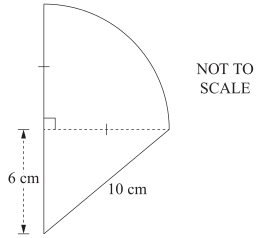
A shape consisting of a quadrant and a right-angled triangle is shown.
What is the perimeter of this shape, correct to one decimal place?
`B`
`text(Using Pythagoras to find radius)\ (r):`
`r= sqrt(10^2-6^2)= sqrt64= 8\ text(cm)`
`text(Arc length)= 1/4 xx 2 pi r= 1/4 xx 2 xx pi xx 8= 12.56…\ text(cm)`
`:.\ text(Perimeter)= 8 + 6 + 10 + 12.56…= 36.57…`
`=> B`
David earns a gross income of $890 per week. Each week, 25% of this income is deducted in taxation. David budgets to save 20% of his net income.
How much does he budget to save each week?
`B`
`text(Net Income)= 75% xx 890= $667.50`
`text(Savings)= 20% xx 667.50= $133.50`
`=>B`
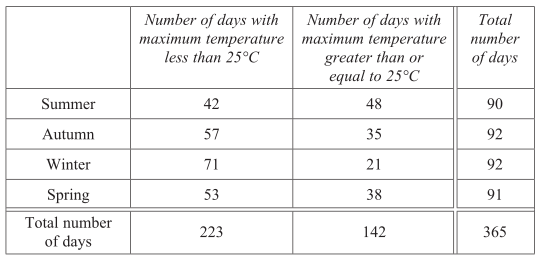
During a year, the maximum temperature each day was recorded. The results are shown in the table.
From the days with a maximum temperature less than 25°C, one day is selected at random.
What is the probability, to the nearest percentage, that the selected day occurred during winter?
`text(C)`
| `text{P(winter day)}` | `= (text(winter days < 25))/text(total days < 25) xx 100` |
| `= 71/223 xx 100` | |
| `= 31.8…%` |
`=>\ text(C)`
The length of a window is measured as 2.4 m.
Which calculation will give the percentage error for this measurement?
`A`
`text{Absolute error}\ =1/2 xx text{precision}\ = 1/2 xx 0.1 = 0.05\ text{m}`
| `text{% error}` | `=\ frac{text{absolute error}}{text{measurement}} xx 100%` | |
| `=0.05/2.4 xx 100%` |
`=>A`
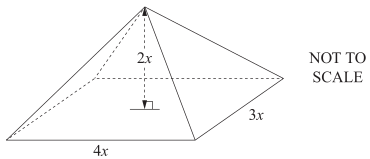
A rectangular pyramid has base side lengths `3x` and `4x`. The perpendicular height of the pyramid is `2x`. All measurements are in metres.
What is the volume of the pyramid in cubic metres?
`A`
`text(Volume)= 1/3Ah= 1/3(4x xx 3x xx 2x)= 8x^3`
`=>A`
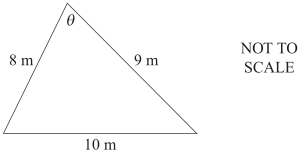
The diagram shows a triangle with side lengths 8 m, 9 m and 10m.
What is the value of `theta`, marked on the diagram, to the nearest degree?
`text(D)`
`text(Using the cosine rule:)`
| `costheta` | `= (8^2 + 9^2 – 10^2)/(2 xx 8 xx 9)` |
| `= 0.3125` | |
| `:.theta` | `= cos^(−1)(0.3125)` |
| `= 71.790…^@` |
`=>D`
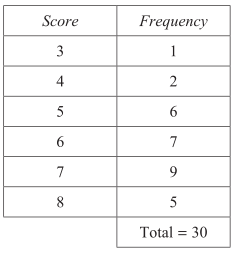
A set of data is summarised in this frequency distribution table.
Which of the following is true about the data?
`B`
`text{Mode = 7 (highest frequency of 9)}`
`text(Median = average of 15th and 16th data points.)`
`:.\ text(Median = 6)`
`=> B`
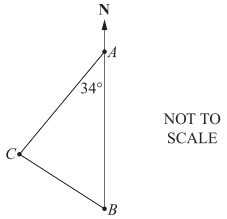
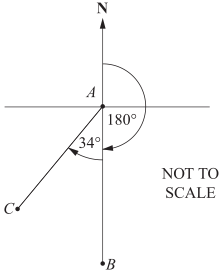
The diagram shows the positions of towns `A`, `B` and `C`.
Town `A` is due north of town `B` and `angleCAB = 34°`
What is the bearing of town `C` from town `A`?
`C`
`text(Bearing of Town)\ C\ text(from Town)\ A:`
| `text(Bearing)` | `= 180 + 34` |
| `= 214^@` |
`=>C`
A survey asked the following question.
'How many brothers do you have?'
How would the responses be classified?
`C`
`text(The number of brothers a person has is)`
`text(an exact whole number.)`
`:.\ text(Classification is numerical, discrete.)`
`=> C`
What is the value of `3x^0 + 1`?
`text(D)`
| `3x^0 + 1` | `= 3(1) + 1` |
| `= 4` |
`=>\ text(D)`
An object is projected from the origin with an initial velocity of `V` at an angle `theta` to the horizontal. The equations of motion of the object are
| `x(t)` | `= Vt cos theta` |
| `y(t)` | `= Vt sin theta - (g t^2)/2.` (Do NOT prove this.) |
`V^2/g sin 2 theta` (2 marks)
--- 6 WORK AREA LINES (style=lined) ---
`V^2/g sin 2 theta`. (1 mark)
--- 3 WORK AREA LINES (style=lined) ---
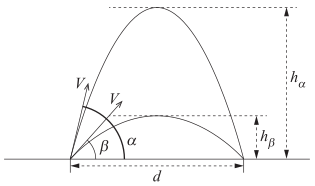
Let these angles be `alpha` and `beta`, where `beta = pi/2 - alpha.`
Let `h_alpha` be the maximum height reached by the object when projected at the angle `alpha` to the horizontal.
Let `h_beta` be the maximum height reached by the object when projected at the angle `beta` to the horizontal.
Show that the average of the two heights, `(h_alpha + h_beta)/2`, depends only on `V` and `g`. (3 marks)
--- 9 WORK AREA LINES (style=lined) ---
i. `text(Horizontal range occurs when)\ \ y = 0`
| `Vt sin theta – (g t^2)/2` | `= 0` |
| `V sin theta – (g t)/2` | `= 0` |
| `t` | `= (2V sin theta)/g` |
`text(Find)\ \ x\ \ text(when)\ \ t=(2V sin theta)/g :`
| `x` | `= Vt cos theta` |
| `= V((2V sin theta)/g) cos theta` | |
| `= (V^2 * 2sin theta cos theta)/g` | |
| `= V^2/g sin 2 theta\ \ \ text(.. as required)` |
ii. `text(Find)\ \ x\ \ text(when)\ \ theta = (pi/2 – theta):`
| `x` | `= V^2/g sin 2 (pi/2 – theta)` |
| `= V^2/g underbrace {sin (pi – 2 theta)}_{text(Using)\ \ sin (pi-theta) = sin theta}` | |
| `= V^2/g sin 2 theta\ \ \ text(.. as required)` |
iii. `text(Highest point → half way through the flight.)`
`=> h_alpha\ \ text(occurs when)\ \ t=(V sin alpha)/g\ \ text{(by symmetry)}`
| `:. h_alpha` | `= V((V sin alpha)/g) sin alpha – g/2 ((V sin alpha)/g)^2` |
| `= (V^2 sin^2 alpha)/g – g/2 ((V^2 sin^2 alpha)/g^2)` | |
| `= (V^2 sin^2 alpha)/g – (V^2 sin^2 alpha)/(2g)` | |
| `= (V^2 sin^2 alpha)/(2g)` |
`text(Similarly,)\ \ h_beta = (V^2 sin^2 beta)/(2g)`
| `:. (h_alpha + h_beta)/2` | `= 1/2 ((V^2 sin^2 alpha)/(2g) + (V^2 sin^2 beta)/(2g))` |
| `= V^2/(4g) (sin^2 alpha + underbrace{sin^2 beta}_{text(Using)\ \ beta= pi/2 -alpha})` | |
| `= V^2/(4g) (sin^2 alpha + sin^2(pi/2 – alpha)) ` | |
| `= V^2/(4g) (sin^2 alpha + cos^2 alpha)` | |
| `= V^2/(4g)` |
`:. text(The average height depends only on)\ V\ text(or)\ g.`
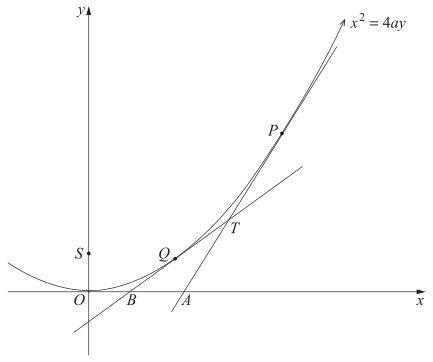
The points `P(2ap, ap^2)` and `Q(2aq, aq^2)` lie on the parabola `x^2 = 4ay`. The focus of the parabola is `S(0, a)` and the tangents at `P` and `Q` intersect at `T(a(p + q), apq)`. (Do NOT prove this.)
The tangents at `P` and `Q` meet the `x`-axis at `A` and `B` respectively, as shown.
(i) `y=x^2/(4a)\ \ => dy/dx=x/(2a)`
`text(At)\ \ x=2ap,\ \ m_text(tang) = p`
`text(Equation of tangent)\ \ m=p, text(through)\ (2ap, ap^2):`
| `y-ap^2` | `=p(x-2ap)` | |
| `y` | `=px-ap^2` |
`text(When)\ \ y=0, x=ap`
`:. A(ap,0)`
| `m_(AP)` | `= (ap^2 – 0)/(2ap-ap)` |
| `= p` |
| `m_(AS)` | `= (0 – a)/(ap – 0)` |
| `= -1/p` |
`m_(AP) xx m_(AS) = -1`
`:. /_PAS = 90°\ \ text(… as required)`
(ii) `text{Similarly to part (i):}`
`=> B(aq,0)`
`=> m_(BQ) xx m_(BS) = -1`
`=> /_QBS = 90°`
`text(S)text(ince)\ \ T\ \ text(is the intersection of both tangents,)`
`/_ PAS = /_ TAS = 90^@`
`/_QBS = /_ TBS = 90^@`
`=> ST\ text(can be considered the extreme points of a circle diameter)`
`text(that is subtending 2 right angles on the circle circumference.)`
`:. SBAT\ text(are concyclic points.)`
(iii) `text(Diameter = distance)\ ST:`
`S(0,a),\ \ T((a(p + q), apq)`
| `d^2` | `= ST^2` |
| `=(x_2-x_1)^2 + (y_2-y_1)^2` | |
| `= (a(p + q) – 0)^2 + (apq – a)^2` | |
| `= a^2 (p + q)^2 + a^2 (pq – 1)^2` | |
| `= a^2(p^2 + 2pq + q^2 + p^2q^2 – 2pq + 1)` | |
| `= a^2(p^2 + q^2 + p^2q^2 + 1)` | |
| `= a^2(p^2 + 1) (q^2 + 1)` | |
| `:.d` | `= a sqrt((p^2 + 1)(q^2 + 1))\ \ text(… as required)` |
A group of 12 people sets off on a trek. The probability that a person finishes the trek within 8 hours is 0.75.
Find an expression for the probability that at least 10 people from the group complete the trek within 8 hours. (2 marks)
`text(See Worked Solutions)`
`text{P(finishes within 8 hours)} = 0.75`
`text{P(not finish within 8 hours)} = 0.25`
`text(Let)\ \ X = text(number who finish below 8 hours)`
`:.\ text{P(at least 10 finish within 8 hours)}`
`=\ text{P(X=10) + P(X=11) + P(X=12)}`
`= ((12), (10)) (0.75)^10 (0.25)^2 + ((12), (11)) (0.75)^11 (0.25)^1 + ((12), (12)) (0.75)^12`
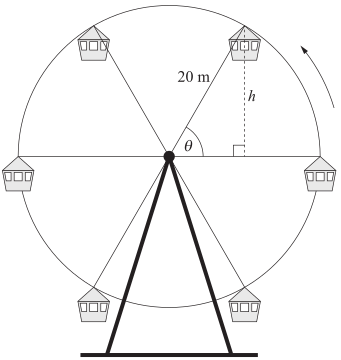
A ferris wheel has a radius of 20 metres and is rotating at a rate of 1.5 radians per minute. The top of a carriage is `h` metres above the horizontal diameter of the ferris wheel. The angle of elevation of the top of the carriage from the centre of the ferris wheel is `theta`.
--- 2 WORK AREA LINES (style=lined) ---
--- 6 WORK AREA LINES (style=lined) ---
i. `text(From the diagram,)`
| `sin theta` | `= h/20` |
| `h` | `= 20 sin theta` |
| `:. (dh)/(d theta)` | `= 20 cos theta` |
ii. `text(Find)\ \ (dh)/(dt)\ text(when)\ h = 15:`
| `(dh)/(dt)` | `= (dh)/(d theta) xx (d theta)/(dt)` |
| `= (20 cos theta) xx 1.5` | |
| `= 30 cos theta` |
`text(Find)\ cos theta\ \ text(when)\ h = 15`
`text(Using Pythagoras,)`
| `cos theta` | `=sqrt(20^2 – 15^2)/20` | |
| `=sqrt7/4` |
| `:. (dh)/(dt)` | `= 30 cos theta` |
| `= (15 sqrt 7)/2` | |
| `~~ 19.8\ text{metres per minute (1 d.p)}` |
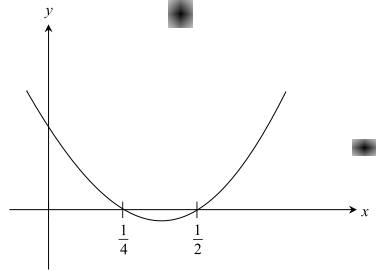
Consider the function `f(x) = 1/(4x - 1)`.
(i) `text(Domain is)\ {text(all real)\ x, x!=1/4}`
| (ii) | `1/(4x – 1)` | `< 1` |
| `(4x – 1)` | `< (4 x – 1)^2` | |
| `(4x – 1)^2 – (4x – 1)` | `> 0` | |
| `(4x – 1)[4x – 1- 1]` | `> 0` | |
| `2 (4x – 1) (2x – 1)` | `> 0` |
`text(Sketching the parabola:)`
`x > 1/2 or x < 1/4.`
`text(From the graph,)`
`y > 1\ \ text(when)\ \ x < 1/4 or x > 1/2`
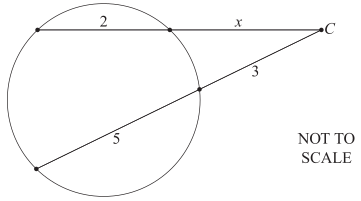
Two secants from the point `C` intersect a circle as shown in the diagram.
What is the value of `x`? (2 marks)
--- 4 WORK AREA LINES (style=lined) ---
`4`
`text(Using formula for intercepts of intersecting secants:)`
| `x (x + 2)` | `= 3 (3 + 5)` |
| `x^2 + 2x` | `= 24` |
| `x^2 + 2x – 24` | `= 0` |
| `(x + 6) (x – 4)` | `= 0` |
| `:. x` | `= 4 \ \ \ (x > 0)` |
The velocity of a particle, in metres per second, is given by `v = x^2 + 2` where `x` is its displacement in metres from the origin.
What is the acceleration of the particle at `x = 1`?
A. `2\ text(m s)^(-2)`
B. `3\ text(m s)^(-2)`
C. `6\ text(m s)^(-2)`
D. `12\ text(m s)^(-2)`
`C`
| `a` | `= d/dx (1/2 v^2)` |
| `= d/dx (1/2 (x^2 + 2)^2)` | |
| `=1/2 xx 2 xx 2x (x^2+2)` | |
| `= 2x (x^2 + 2)` |
`text(When)\ \ x = 1,`
`a = 6\ text(m s)^(-2)`
`⇒ C`
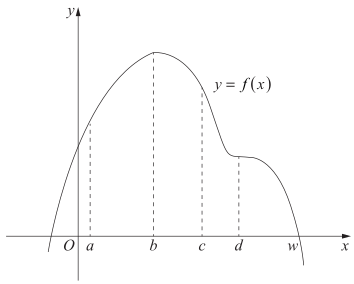
The diagram shows the graph of `y = f(x)`. The equation `f(x) = 0` has a solution at `x = w`.
Newton’s method can be used to give an approximation close to the solution `x = w`.
Which initial approximation, `x_1`, will give the second approximation that is closest to the solution `x = w`?
A. `x_1 = a`
B. `x_1 = b`
C. `x_1 = c`
D. `x_1 = d`
`C`
`text(Consider where the tangents at each point will cross the)`
`xtext(-axis).`
`x_1 = a\ text(will approximate the negative root.)`
`x_1 = c\ text(will cross the)\ x text(-axis closest to) \ w.`
`⇒ C`
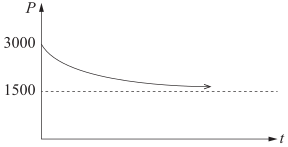
The diagram shows the number of penguins, `P(t)`, on an island at time `t`.
Which equation best represents this graph?
A. `P(t) = 1500 + 1500e^(-kt)`
B. `P(t) = 3000 - 1500e^(-kt)`
C. `P(t) = 3000 + 1500e^(-kt)`
D. `P(t) = 4500 - 1500e^(-kt)`
`A`
`P(0) = 3000\ text{(from graph) → Eliminate B and C}`
`text(As),\ t -> oo,\ 1500e^(-kt) -> 0,`
`:. 1500 + 1500e^(-kt) => 1500`
`=> A`
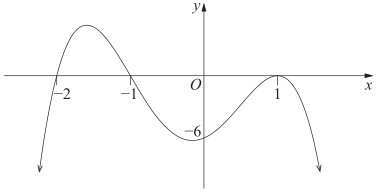
The diagram shows the graph of `y = a(x + b) (x + c) (x + d)^2`.
What are possible values of `a, b, c` and `d`?
A. `a = -6,\ \ b = -2,\ \ c = -1,\ \ d = 1`
B. `a = -6,\ \ b = 2,\ \ c = 1,\ \ d = -1`
C. `a = -3,\ \ b = -2,\ \ c = -1,\ \ d = 1`
D. `a = -3,\ \ b = 2,\ \ c = 1,\ \ d = -1`
`D`
`text(S)text(ingle roots at:)\ \ x = -2, -1`
`text(Double root at:)\ \ x = 1`
`:. b = 2,\ \ c = 1,\ \ d = -1`
`y text(-intercept occurs when)\ x=0,`
`=> abcd^2 = -6`
`a(2)(1)(1^2) = -6`
`:.a = -3`
`⇒ D`
What is the value of `lim_(x -> 0) (sin 3x cos 3x)/(12x)`?
A. `1/4`
B. `1/2`
C. `3/4`
D. `1`
`A`
| `lim_(x -> 0) (sin 3x cos 3x)/(12x)` | `= lim_(x -> 0) (1/2 xx 2 sin 3x cos 3x)/(12x)` |
| `= lim_(x ->0) (1/2 xx sin 6x)/(12x)` | |
| `= 1/4 lim_(x ->0) (sin 6x)/(6x)` | |
| `= 1/4` |
`⇒ A`
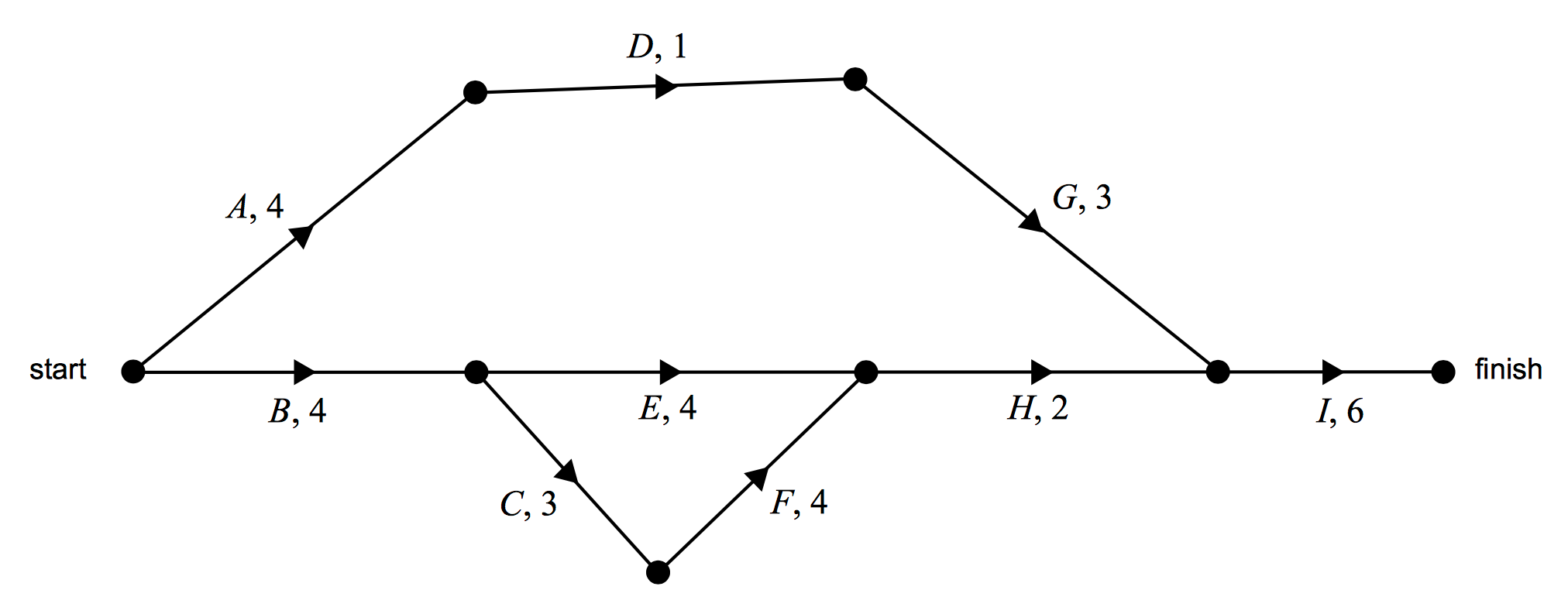
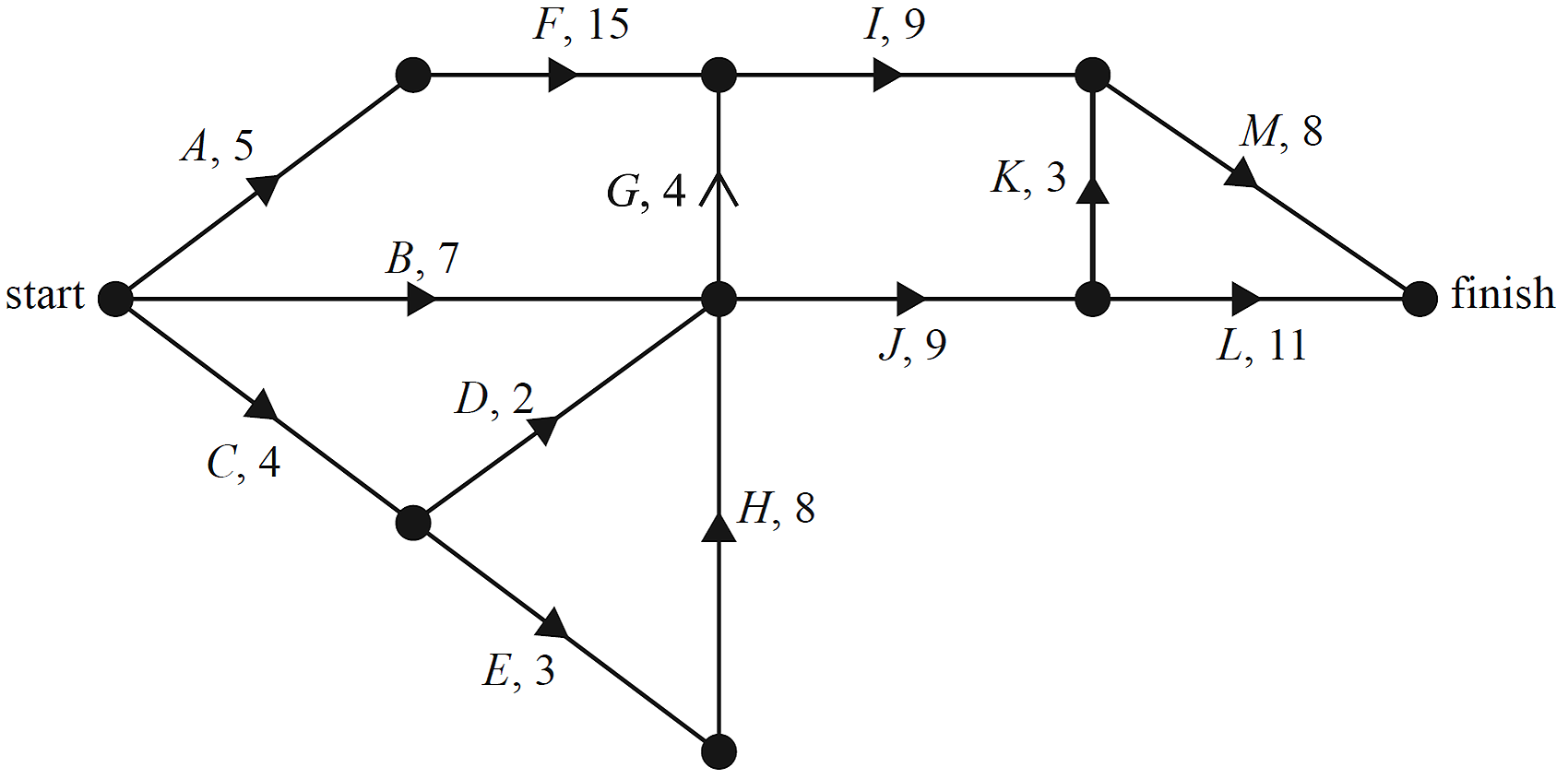
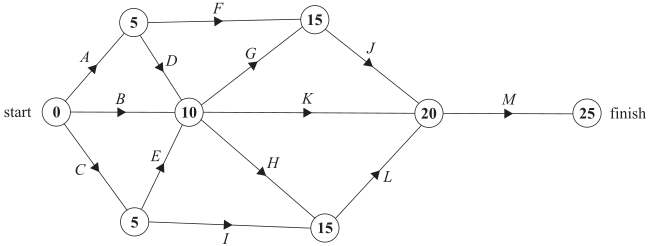
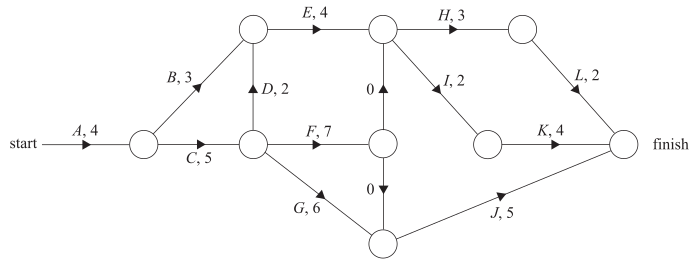
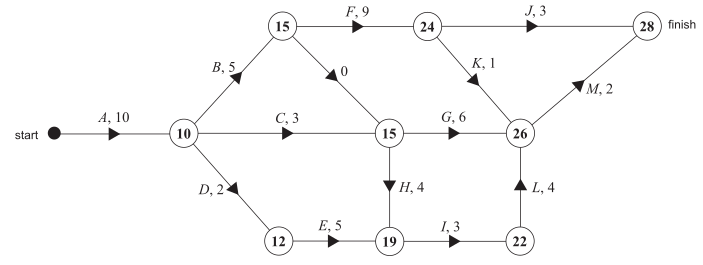
A community centre is to be built on the new housing estate.
Nine activities have been identified for this building project.
The directed network below shows the activities and their completion times in weeks.
--- 1 WORK AREA LINES (style=lined) ---
--- 4 WORK AREA LINES (style=lined) ---
The builders of the community centre are able to speed up the project.
Some of the activities can be reduced in time at an additional cost.
The activities that can be reduced in time are `A`, `C`, `E`, `F` and `G`.
--- 2 WORK AREA LINES (style=lined) ---
The owner of the estate is prepared to pay the additional cost to achieve early completion.
The cost of reducing the time of each activity is $5000 per week.
The maximum reduction in time for each one of the five activities, `A`, `C`, `E`, `F`, `G`, is `2` weeks.
--- 1 WORK AREA LINES (style=lined) ---
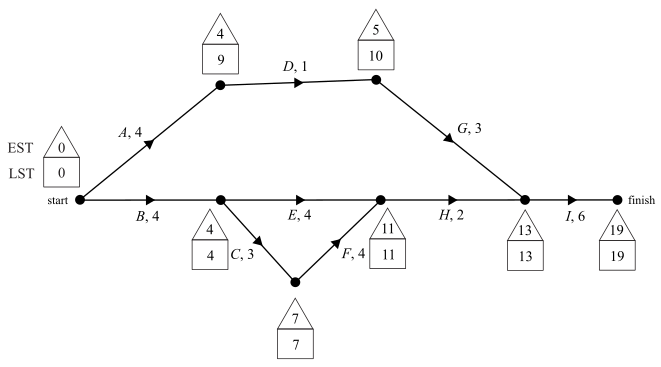
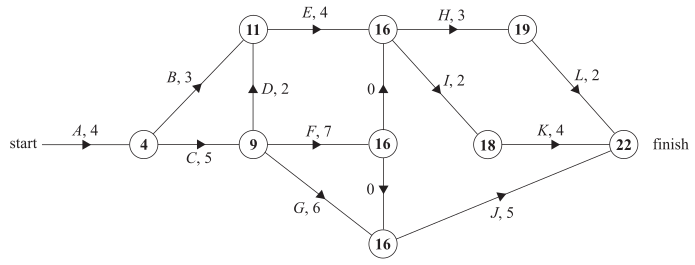
a. `text(Scanning forwards and backwards:)`
`BCFHI\ \ text(is the critical path.)`
| `:.\ text(Minimum time)` | `= 4 + 3 + 4 + 2 + 6` |
| `= 19\ text(weeks)` |
| b. | `text(EST of)\ D` | `= 4` |
| `text(LST of)\ D` | `= 9` |
| `:.\ text(Float time of)\ D` | `= 9 – 4` |
| `= 5\ text(weeks)` |
c. `A, E,\ text(and)\ G\ text(are not currently on the critical path,)`
`text(therefore reducing their time will not result in an)`
`text(earlier completion time.)`
d. `text(Reduce)\ C\ text(and)\ F\ text(by 2 weeks each.)`
`text(However, a new critical path created:)\ BEHI\ \ text{(16 weeks)}`
`:.\ text(Also reduce)\ E\ text(by 1 week.)`
`:.\ text(Minimum completion time = 15 weeks)`
| e. | `text(Additional cost)` | `= 5 xx $5000` |
| `= $25\ 000` |
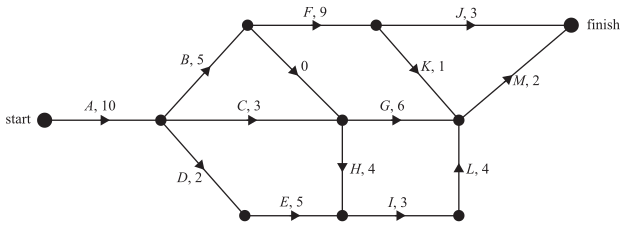
The five musicians are to record an album. This will involve nine activities.
The activities and their immediate predecessors are shown in the following table.
The duration of each activity is not yet known.
There is only one critical path for this project.
--- 1 WORK AREA LINES (style=lined) ---
The following table gives the earliest start times (EST) and latest start times (LST) for three of the activities only. All times are in hours.
--- 1 WORK AREA LINES (style=lined) ---
The minimum time required for this project to be completed is 19 hours.
The duration of activity `C` is 3 hours.
--- 1 WORK AREA LINES (style=lined) ---
| a. | ![]() |
b. `text(S)text(ince no time information, possible critical paths are:)`
`ADGI, BEGI\ text(or)\ CFHI\ \ text{(all have 4 activities)}`
`:.\ text(Non-critical activities)`
`= 9 – 4 = 5`
c. `text(Critical activities have zero float time.)`
`=> A\ text(and)\ C\ text(are non-critical.)`
`:. B E G I\ text(is the critical path.)`
| d. | `text(Duration of)\ \ I` | `= 19 – 12` |
| `= 7\ text(hours)` |
e. `text(Maximum time for)\ F\ text(and)\ H`
`=\ text(LST of)\ I – text(duration)\ C – text(slack time of)\ C`
`= 12 – 3 – 1`
`= 8\ text(hours)`
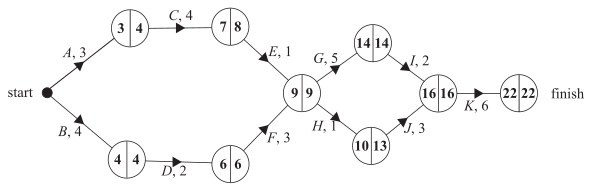
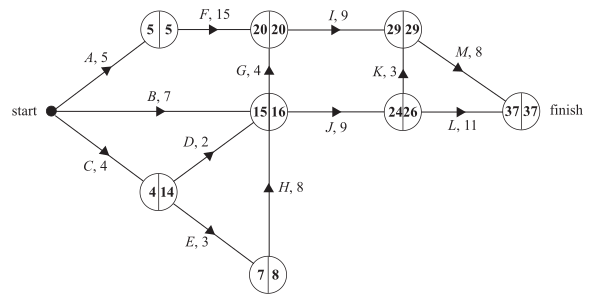
A project will be undertaken in the wildlife park. This project involves the 13 activities shown in the table below. The duration, in hours, and predecessor(s) of each activity are also included in the table.
Activity `G` is missing from the network diagram for this project, which is shown below.
--- 1 WORK AREA LINES (style=lined) ---
--- 2 WORK AREA LINES (style=lined) ---
--- 1 WORK AREA LINES (style=lined) ---
‘If the time to complete just one of the activities in this project is reduced by one hour, then the minimum time to complete the entire project will be reduced by one hour.’
Explain the circumstances under which this statement will be true for this project. (1 mark)
--- 2 WORK AREA LINES (style=lined) ---
| a. | ![]() |
b. `text(Scanning forwards and backwards:)`
`text(EST for Activity)\ H`
`= 4 + 3`
`= 7\ text(hours)`
c.i. `A F I M`
c.ii. `text(LST of)\ G = 20 – 4 = 16\ text(hours)`
`text(LST of)\ D = 16 – 2 = 14\ text(hours)`
d. `text(The statement will only be true if the time reduced activity)`
`text(is on the critical path)\ \ A F I M.`
e. `A F I M\ text(is 37 hours.)`
`text(If)\ F\ text(is reduced by 2 hours, the new critical)`
`text(path is)\ \ C E H G I M\ text{(36 hours)}`
`:.\ text(Minimum completion time = 36 hours)`
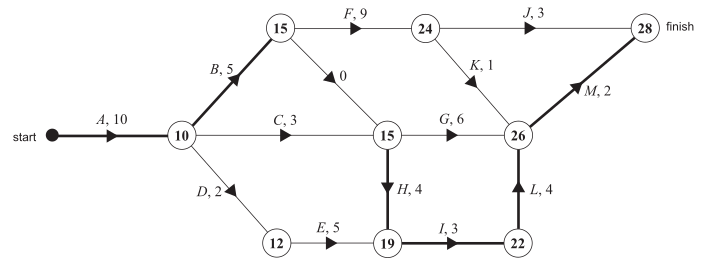
Thirteen activities must be completed before the produce grown on a farm can be harvested.
The directed network below shows these activities and their completion times in days.
--- 1 WORK AREA LINES (style=lined) ---
Explain why this activity is used on the network diagram. (1 mark)
--- 1 WORK AREA LINES (style=lined) ---
--- 2 WORK AREA LINES (style=lined) ---
--- 1 WORK AREA LINES (style=lined) ---
| a. | `text(EST of)\ E` | `= 10 + 2` |
| `= 12\ text(days)` |
b. `F\ text(has)\ B\ text(as a predecessor while)\ G\ text(and)\ H`
`text(have)\ B\ text(and)\ C\ text(as predecessors.)`
`text(S)text(ince there cannot be 2 activities called)\ B, text(a zero)`
`text{duration activity is drawn as an extension of}\ B\ text(to)`
`text(show that it is also a predecessor of)\ G\ text(and)\ H.`
c. `text(Scanning forwards:)`
`text(EST for)\ H = 15\ text(days)`
d. `text(The critical path is)\ \ ABHILM`
e. `text(The shortest time to complete all the activities)`
`= 10 + 5 + 4 + 3 + 4 + 2`
`= 28\ text(days)`
| `:.\ text(LST of)\ J` | `= 28 − 3` |
| `= 25\ text(days)` |
A walkway is to be built across the lake.
Eleven activities must be completed for this building project.
The directed network below shows the activities and their completion times in weeks.
--- 1 WORK AREA LINES (style=lined) ---
Determine the longest float time, in weeks, on the supervisor’s list. (1 mark)
--- 2 WORK AREA LINES (style=lined) ---
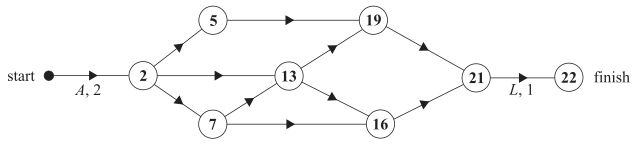
A twelfth activity, L, with duration three weeks, is to be added without altering the critical path.
Activity L has an earliest start time of four weeks and a latest start time of five weeks.
Determine the total overall time, in weeks, for the completion of this building project. (1 mark)
--- 2 WORK AREA LINES (style=lined) ---
a. `7\ text(weeks)`
b. `text(Scanning forwards and backwards)`
`text(Critical Path is)\ BDFGIK`
c. `H\ text(or)\ J\ text(can be delayed for a maximum)`
`text(of 3 weeks.)`
| d. | ![]() |
e. `text(The new critical path is)\ BLEGIK.`
`=>\ text(Activity)\ L\ text(now takes 7 weeks.)`
`:.\ text(Time for completion)`
`= 4 + 7 + 1 + 5 + 2 + 6`
`= 25\ text(weeks)`
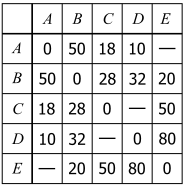
The following table shows the travelling time, in minutes, between towns which are directly connected by roads.
A dash indicates that towns are not directly connected.
--- 10 WORK AREA LINES (style=lined) ---
--- 2 WORK AREA LINES (style=lined) ---
The directed graph below shows the sequence of activities required to complete a project.
The time to complete each activity, in hours, is also shown.
To complete the project in minimum time, some activities cannot be delayed.
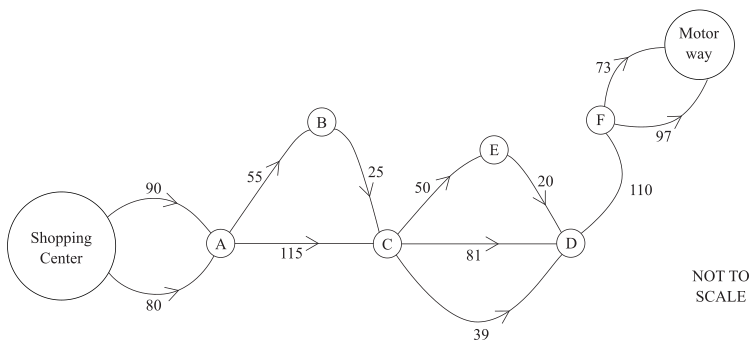
The network diagram represents a system of roads connecting a shopping centre to the motorway.
Two routes from the shopping centre connect to A and one route connects D to F.
The number on the edge of each road indicates the number of vehicles that can travel on it per hour.
Draw additional road(s) on the diagram to maximise the capacity. Include the number of vehicles that can travel on each road. (2 marks)
--- 0 WORK AREA LINES (style=lined) ---
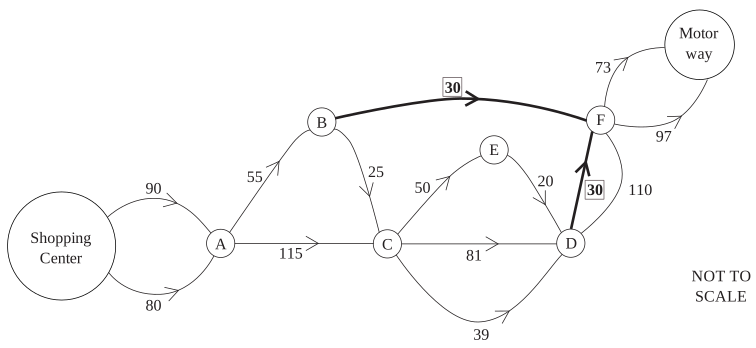
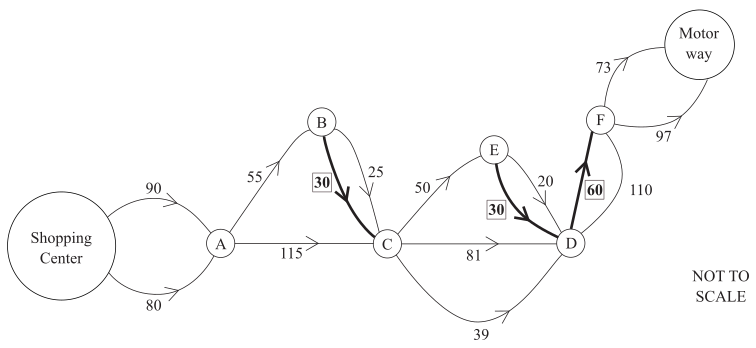
`text(Solutions could be:)`
The network diagram represents a system of roads connecting a shopping centre to the motorway.
Two routes from the shopping centre connect to A and one route connects to D to F.
The number on the edge of each road indicates the number of vehicles that can travel on it per hour.
At present, the capacity of the network from the shopping centre to the motorway is not maximised.
Which additional road(s) would increase the network capacity to its maximum?
| A. | A road from A to F with a capacity of 20 vehicles per hour |
| B. | A road from B to E with a capacity of 30 vehicles per hour |
| C. | A road from C to F with a capacity of 30 vehicles per hour and a road from E to F with a capacity of 60 vehicles per hour |
| D. | A road from B to F with a capacity of 30 vehicles per hour and a road from D to F with a capacity of 30 vehicles per hour |
`text(D)`
`text(Consider option D:)`
`text(Adding these two roads increases the minimum cut/maximum)`
`text(flow to 170 vehicles per hour throughout the network.)`
`=>\ text(D)`
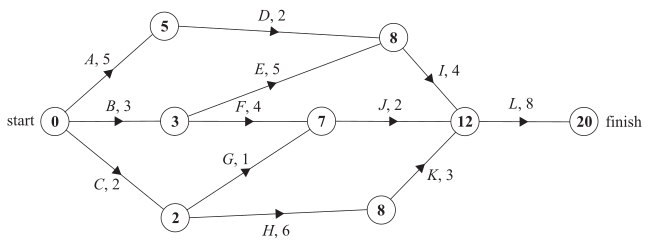
The directed graph below shows the sequence of activities required to complete a project.
All times are in hours.
--- 1 WORK AREA LINES (style=lined) ---
--- 2 WORK AREA LINES (style=lined) ---
i. `I\ text(and)\ J`
`:.\ text(2 activities have exactly two immediate predecessors.)`
ii. `text(Scanning forwards:)`
`:.\ text(Initial critical path)\ BEIL`
iii. `text(If)\ E\ text(reduced by 1 hour, critical path)\ BEIL`
`text(reduces to 19 hours.)`
`:.\ text(Other critical paths of 19 hours are:)`
`ADIL = 5 + 2 + 4 + 8 = 19`
`CHKL = 2 + 6 + 3 + 8 = 19`
The network shows the activities that are needed to complete a particular project.
--- 1 WORK AREA LINES (style=lined) ---
The duration of every activity is initially 5 hours.
--- 4 WORK AREA LINES (style=lined) ---
i. `A, B, C, D, E, H\ text(and)\ I\ text(must be completed before)\ L.`
`:.\ text(7 activities need to be completed.)`
ii. `text{Scanning forward (all activities take 5 hours):}`
`text(Activity)\ F\ text(and)\ K\ text(are not on any critical path.)`
`:.\ text(Reducing either will not change the completion time)`
`text(for the project.)`
The network below shows the activities that are needed to finish a particular project and their completion times (in days).
Part 1
The earliest start time for Activity K, in days, is
A. `7`
B. `15`
C. `16`
D. `19`
Part 2
This project currently has one critical path.
A second critical path, in addition to the first, would be created by
A. increasing the completion time of D by 7 days.
B. increasing the completion time of G by 1 day.
C. increasing the completion time of I by 2 days.
D. decreasing the completion time of C by 1 day.
`text(Part 1:)\ C`
`text(Part 2:)\ A`
`text(Part 1)`
`text(Scanning forwards:)`
`text(EST for Activity)\ K`
`=\ text(Duration)\ ACFI`
`= 2 + 5 + 6 + 3`
`= 16`
`=> C`
`text(Part 2)`
`text(Original critical path:)\ ACFHJL\ text{(22 days)}`
`text(Consider option)\ A,`
`text(New critical path:)\ ABDJL\ text{(22 days)}`
`=> A`
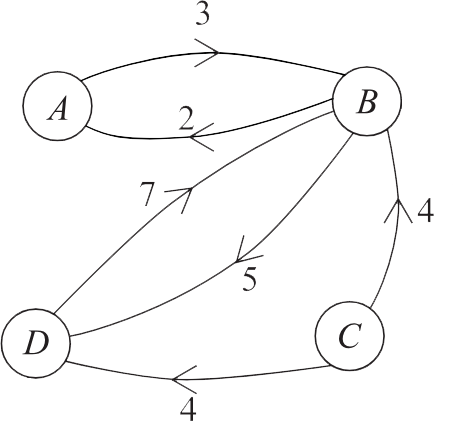
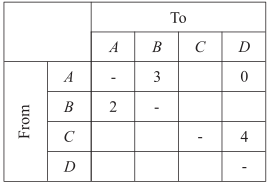
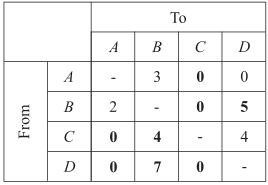
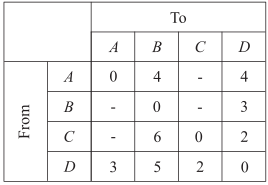
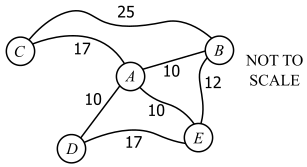
A network of roads between towns shows the travelling times in minutes between towns that are directly connected.
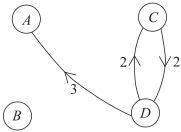
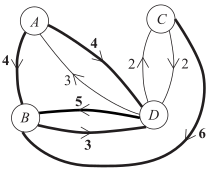
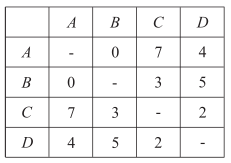
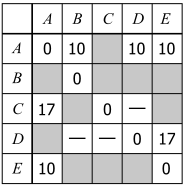
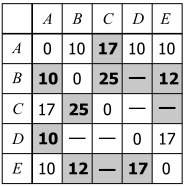
Complete the shaded cells in the following table so that it represents the information in this network. (2 marks)
--- 0 WORK AREA LINES (style=lined) ---
`text(Note the symmetry in this table across the diagonal.)`
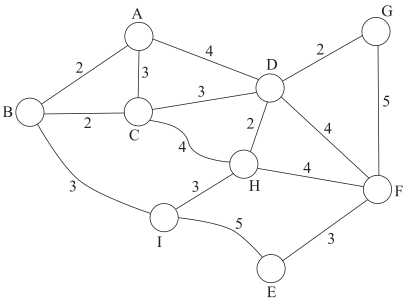
Consider the network pictured below.
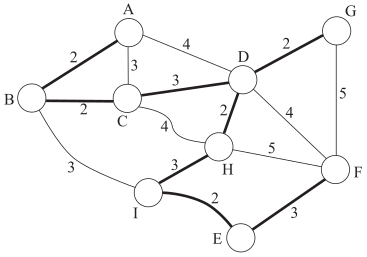
Find the length of the shortest path from A to E. (2 marks)
--- 4 WORK AREA LINES (style=lined) ---
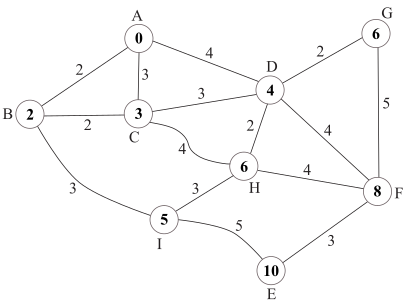
`10`
`text(One strategy – Using Dijkstra’s algorithm:)`
`text{The shortest path A – B – I – E has a distance (weight) = 10.}`
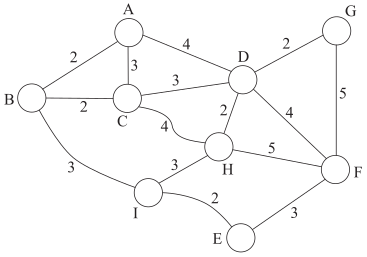
In a separate diagram or on the diagram above, show the minimum spanning tree. (2 marks)
--- 0 WORK AREA LINES (style=lined) ---
`text(One strategy – Using Kruskal’s algorithm:)`
`text(Edges 1 – 5: AB, BC, DG, DH and EI)`
`text(Edges 6 – 8: CD, EF and HI)`
`(text(note AC cannot be chosen → creates a cycle))`
`text(NB: There is more than one minimal spanning tree in this)`
`text{circuit (having a weight of 19).}`
The table below shows, in minutes, the duration, the earliest starting time (EST) and the latest starting time (LST) of eight activities needed to complete a project.
Which one of the following directed graphs shows the sequence of these activities?
| A. | ![]() |
| B. | ![]() |
| C. | ![]() |
| D. | ![]() |
`B`
The diagram shows the tasks that must be completed in a project.
Also shown are the completion times, in minutes, for each task.
The critical path for this project includes activities
A. `B and I.`
B. `C and H.`
C. `D and E.`
D. `F and K.`
`D`
`text(Scanning forward:)`
`:.\ text(The critical path is)\ \ ACFIK.`
`=> D`
The rangers at the wildlife park restrict access to the walking tracks through areas where the animals breed.
The edges on the directed network diagram below represent one-way tracks through the breeding areas. The direction of travel on each track is shown by an arrow. The numbers on the edges indicate the maximum number of people who are permitted to walk along each track each day.
One day, all the available walking tracks will be used by students on a school excursion.
The students will start at `A` and walk in four separate groups to `D`.
Students must remain in the same groups throughout the walk.
| a. | `text(Maximum flow)` | `=\ text(Minimum cut through)\ CD and ED` |
| `= 24 + 13` | ||
| `= 37` |
`:.\ text(A maximum of 37 people can walk)`
`text(to)\ D\ text(from)\ A.`
b.i. `A B E C D`
b.ii. `text(One solution using the second possible largest)`
`text(group of 11 students and two groups from the)`
`text(remaining 9 students is:)`
The following directed graph shows the flow of water, in litres per minute, in a system of pipes connecting the source to the sink.
Calculate the maximum flow, in litres per minute, from the source to the sink. (2 marks)
`18`
| `text(Maximum Flow)` | `=\ text(Capacity of Minimum Cut)` |
| `= 2 + 10 + 6` | |
| `= 18\ \ text(litres/minute)` |
The arrows on the diagram below show the direction of the flow of waste through a series of pipelines from a factory to a waste dump.
The numbers along the edges show the number of megalitres of waste per week that can flow through each section of pipeline.
The minimum cut is shown as a dotted line.
Calculate the capacity of this cut, in megalitres of waste per week. (2 marks)
`26`
`text(Flows from the waste dump side of the minimum cut to)`
`text(the factory side are ignored.)`
`:.\ text{Minimum Cut}`
`= 5 + 2 + 12 + 7`
`= 26\ \ text(ML/week)`
In the directed network diagram above, all vertices are reachable from every other vertex.
All vertices would still be reachable from every other vertex if we remove the edge in the direction from
A. `Q` to `U`
B. `R` to `S`
C. `S` to `T`
D. `T` to `R`
`A`
`text(Consider option B:)`
`text(If R to S is removed, vertex S cannot be reached from other)`
`text(vertices. All vertices only remain reachable from all other vertices)`
`text(if Q to U is removed.)`
`rArr A`
In the directed graph above the weight of each edge is non-zero.
The capacity of the cut shown is
A. a + b + c + d + e
B. a + c + d + e
C. a + b + c + e
D. a + b + c – d + e
`C`
`text(Flows in the opposite direction are not counted when)`
`text(calculating the capacity of a cut.)`
`:.\ text(Capacity of the cut) = a + b + c + e`
`rArr C`
Alana, Ben, Ebony, Daniel and Caleb are friends. Each friend has a different age.
The arrows in the graph below show the relative ages of some, but not all, of the friends. For example, the arrow in the graph from Alana to Caleb shows that Alana is older than Caleb.
Using the information in the graph, it can be deduced that the second-oldest person in this group of friends is
A. Alana
B. Ben
C. Caleb
D. Ebony
`B`
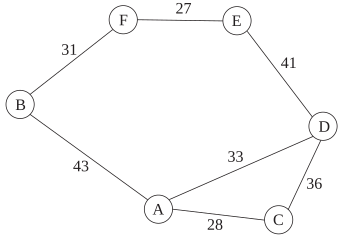
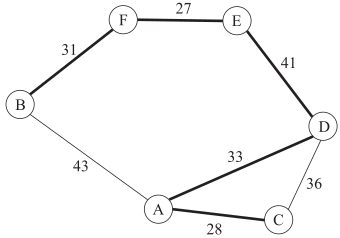
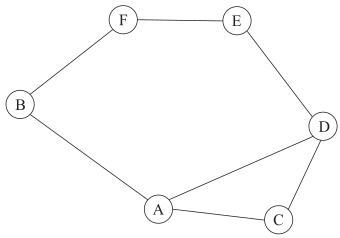
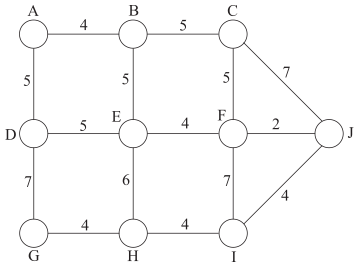
Highlight the minimal spanning tree of this network on the diagram above, or in a separate diagram. (2 marks)
--- 0 WORK AREA LINES (style=lined) ---
How many spanning trees are possible for this network?
`C`
`text(S)text(ince there are 6 vertices, each spanning tree will have)`
`text{5 edges (with no cycles).}`
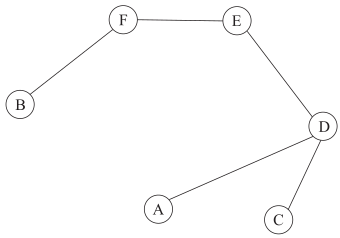
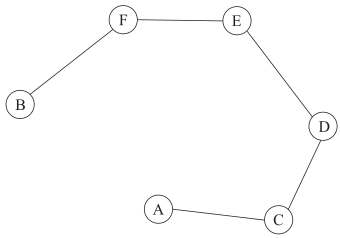
`text(Consider if A and B are not connected, possible spanning)`
`text(trees are:)`
`text(3 other spanning trees exist when BF is not connected, and likewise)`
`text(when EF and ED are not connected.)`
`text(Finally, 2 other spanning trees exist when AD and AC are removed, and)`
`text(when AD and CD are removed.)`
`:.\ text(Total spanning trees)= 4 xx 3 + 2= 14`
`=>C`
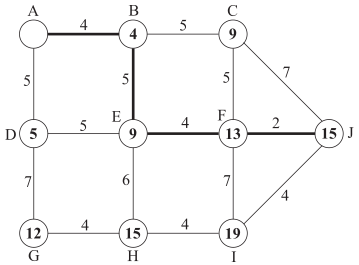
Describe the shortest path between A and J in the network above and its weight. (2 marks)
--- 4 WORK AREA LINES (style=lined) ---
`text(Shortest path is:)`
`text(A – B – E – F – J)`
`text(Weight of shortest path is 15.)`
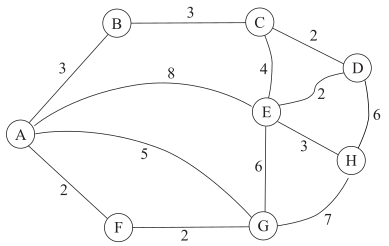
A network of roads is pictured below, with the distances of each road represented, in kilometres, on each edge.
A driver wants to travel from A to H in the shortest distance possible.
Describe the possible paths she can take, and the total distance she must travel. (2 marks)
--- 5 WORK AREA LINES (style=lined) ---
`text(Shortest distance paths:)`
`text(A – E – H or A – F – G – H)`
`text(Shortest distance is 11 km.)`
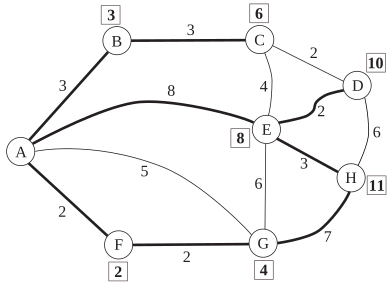
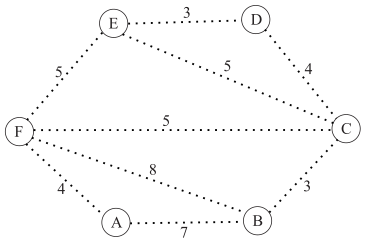
Complete the minimal spanning tree of the network above on the diagram below. (2 marks)
--- 0 WORK AREA LINES (style=lined) ---
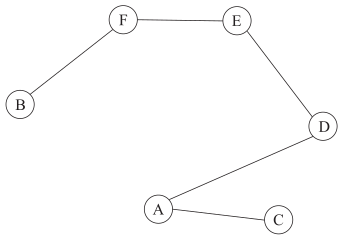
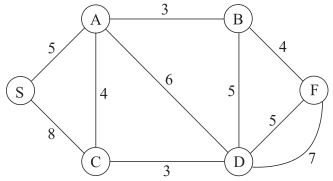
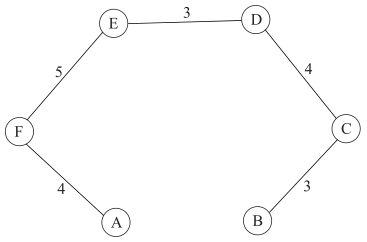
The diagram below is a connected network.
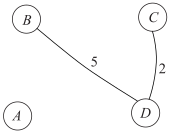
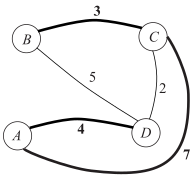
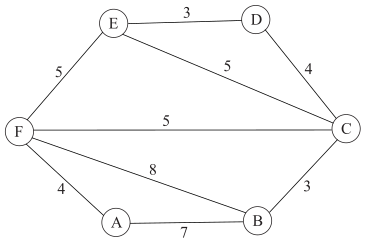
Complete the diagram below to show the minimal spanning tree of this network. (2 marks)
--- 0 WORK AREA LINES (style=lined) ---
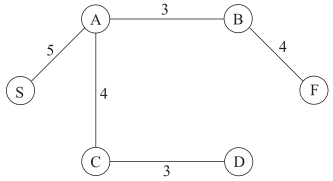
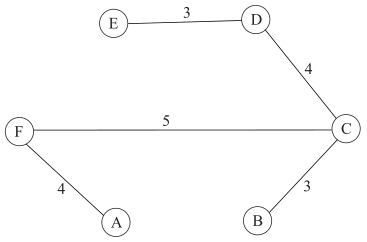
`text(or)`
`text(One Strategy – Kruskul’s algorithm)`
`text(There are 6 vertices, so we need 5 edges.)`
`text{Edge 1: BC (least weight) – could have chosen ED}`
`text{Edge 2: DE (next least weight)}`
`text{Edge 3: AF (could have been CD)}`
`text(Edge 4: CD)`
`text{Edge 5: CF or EF (reject CE as it creates a cycle)}`
`text(or)`
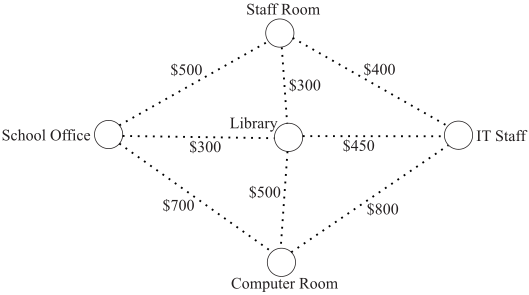
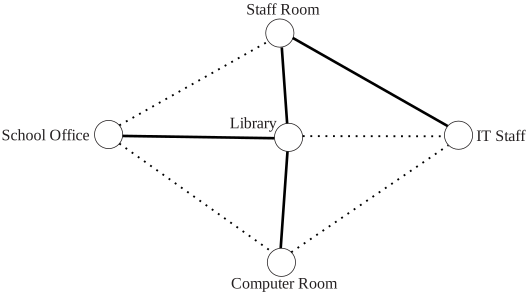
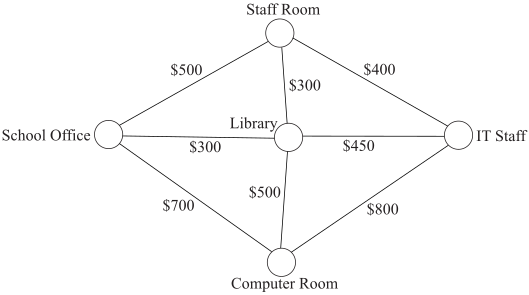
A school is designing a computer network between five key areas within the school.
The cost of connecting the rooms is shown in the diagram below.
a. `text(One Strategy: Using Prim’s Algorithm)`
`text(Starting vertex – Staff Room)`
`text(1st edge: Staff Room – Library)`
`text(2nd edge: Library – School Office)`
`text(3rd edge: Staff Room – IT Staff)`
`text(4th edge: Library – Computer Room)`
b. `text(Minimum Cost)= 300 + 300 + 400 + 500= $1500`