SmarterEd

Aussie Maths & Science Teachers: Save your time with SmarterEd

  • Login
  • Get Help
  • About

HMS, HAG EQ-Bank 46 MC

In Australia's healthcare system, the federal government provides Medicare funding while state governments manage public hospitals. Which statement BEST describes how these system components work together?

  1. Federal and state governments operate completely separate healthcare systems with no coordination
  2. Federal funding supports state-delivered services, creating integrated patient care across different providers
  3. State governments are responsible for all healthcare funding and service delivery decisions
  4. Private organisations have no role in the collaborative healthcare system
Show Answers Only

\(B\)

Show Worked Solution
  • B is correct: Federal funding integrated with state service delivery creates coordinated patient care.

Other Options:

  • A is incorrect: Government levels coordinate extensively to provide seamless healthcare delivery.
  • C is incorrect: Federal government provides significant funding including Medicare and PBS.
  • D is incorrect: Private sector plays important role alongside government in healthcare delivery.

Filed Under: Person centred health - Govt/Non-Govt orgs Tagged With: Band 4, smc-5481-05-System components

CHEMISTRY, M2 EQ-Bank 5 MC

In which molecule is the percentage by mass of oxygen closest to 70%?

  1. \(\ce{H2O}\)
  2. \(\ce{SO2}\)
  3. \(\ce{CO2}\)
  4. \(\ce{CH2O}\)
Show Answers Only

\(C\)

Show Worked Solution
  • For \(\ce{H2O}\): \(MM = 2(1.008) + 16.00 = 18.016\ \text{g mol}^{-1}\).
  •    % Mass of oxygen \(=\dfrac{16.00}{18.016} \times 100 = 88.8\)%. 
  • For \(\ce{SO2}\): \(MM = 32.07 + 2(16.00) = 64.07\ \text{g mol}^{-1}\).
  •    % Mass of oxygen \(=\dfrac{2(16.00)}{64.07} \times 100 = 49.9\)%.
  • For \(\ce{CO2}\): \(MM = 12.01 + 2(16.00) = 44.01\ \text{g mol}^{-1}\).
  •    % Mass of oxygen \(=\dfrac{2(16.00)}{44.01} \times 100 = 72.7\)%.
  • For \(\ce{CH2O}\): \(MM = 12.01 + 2(1.008) + 16.00 = 30.026\ \text{g mol}^{-1}\).
  •    % Mass of oxygen \(=\dfrac{16.00}{30.026} \times 100 = 53.3\)%.

\(\therefore \ce{CO2}\) has the closest oxygen percentage to 70%.

\(\Rightarrow C\)

Filed Under: Mole Concept Tagged With: Band 4, smc-4260-50-Percentage composition

CHEMISTRY, M2 EQ-Bank 4 MC

What is the empirical formula for a compound that is 52.1% \(\ce{Al}\) and 47.9% \(\ce{O}\)?

  1. \(\ce{AlO}\)
  2. \(\ce{AlO2}\)
  3. \(\ce{Al3O2}\)
  4. \(\ce{Al2O3}\)
Show Answers Only

\(D\)

Show Worked Solution
  • Assume that there is \(100\) grams in sample.
  • There are \(52.1\) grams of \(\ce{Al}\) and \(47.9\) grams of \(\ce{O}\).
  •    \(n(\ce{Al}) = \dfrac{52.1}{26.98} = 1.93\ \text{mol}\).
  •    \(n(\ce{O}) = \dfrac{47.9}{16.00} = 2.99\ \text{mol}\).
  • Divide through by the smallest number of moles to determine the empirical formula:
  •   \(\ce{Al}:\dfrac{1.93}{1.93} = 1\)
  •   \(\ce{O}:\dfrac{2.99}{1.93} = 1.55\)
  • The empirical formula for the compound is \(\ce{Al2O3}\).

\(\Rightarrow D\)

Filed Under: Mole Concept Tagged With: Band 4, smc-4260-60-Empirical formula

HMS, HAG EQ-Bank 43 MC

A young person is approached by a door-to-door salesperson promoting expensive vitamin supplements claiming to prevent all chronic diseases. Which strategy BEST protects them as a health consumer?

  1. Purchase the supplements immediately to secure the special discount offer
  2. Ask for detailed product information and time to research before making any commitment
  3. Trust the salesperson's claims since they seem knowledgeable about health
  4. Buy a smaller quantity first to test the product's effectiveness
Show Answers Only

\(B\)

Show Worked Solution
  • B is correct: Requesting information and research time protects against pressure selling tactics.

Other Options:

  • A is incorrect: Immediate purchasing prevents proper evaluation and verification of claims.
  • C is incorrect: Sales knowledge doesn’t guarantee medical expertise or product validity.
  • D is incorrect: Even small purchases reward unverified claims and may cause harm.

Filed Under: Being a critical health consumer Tagged With: Band 4, smc-5483-17-Accuracy and credibility

HMS, HAG EQ-Bank 40 MC

A young adult with chronic back pain is exploring treatment options beyond conventional medicine. What information do they need to know MOST importantly when considering complementary therapies?

  1. Whether the therapy is covered by private health insurance or Medicare
  2. How long the therapy has been practiced in other countries
  3. The qualifications of practitioners and evidence supporting the treatment's effectiveness
  4. Whether celebrities or influencers have endorsed the particular therapy
Show Answers Only

\(C\)

Show Worked Solution
  • C is correct: Practitioner qualifications and treatment evidence are essential for safety and effectiveness.

Other Options:

  • A is incorrect: While cost important, safety and effectiveness must be established first.
  • B is incorrect: Historical use doesn’t guarantee safety or effectiveness for individual conditions.
  • D is incorrect: Celebrity endorsements don’t indicate therapeutic value or safety.

Filed Under: Being a critical health consumer Tagged With: Band 4, smc-5483-12-Informed decisions

HMS, HAG EQ-Bank 39 MC

A patient is considering surgery for a knee injury and wants to make an informed decision. Which combination of information is MOST essential for making this healthcare choice?

  1. The latest medical technology available regardless of suitability
  2. Only the surgeon's recommendation and the hospital's reputation
  3. Treatment options, side effects, costs, recovery time, and effectiveness rates
  4. Personal testimonials from other patients who had similar surgeries
Show Answers Only

\(C\)

Show Worked Solution
  • C is correct: Comprehensive information covering options, risks, costs, and outcomes enables informed decisions.

Other Options:

  • A is incorrect: Technology availability doesn’t address individual suitability or necessity.
  • B is incorrect: Single professional opinion insufficient without considering alternatives and personal factors.
  • D is incorrect: Testimonials provide limited perspective without broader medical context.

Filed Under: Being a critical health consumer Tagged With: Band 4, smc-5483-12-Informed decisions

HMS, HAG EQ-Bank 38 MC

When researching vaccination information online, a critical health consumer finds multiple websites with different advice. Which website characteristic BEST indicates a trustworthy source?

  1. The website has the most colourful graphics and engaging multimedia content
  2. The site ends with .gov.au and is published by the Department of Health and Aged Care
  3. The website appears first in search engine results
  4. The site contains numerous personal testimonials from satisfied users
Show Answers Only

\(B\)

Show Worked Solution
  • B is correct: Government domains (.gov.au) undergo rigorous accreditation indicating trustworthy sources.

Other Options:

  • A is incorrect: Visual appeal doesn’t indicate accuracy or credibility of health information.
  • C is incorrect: Search ranking reflects popularity, not necessarily trustworthiness or accuracy.
  • D is incorrect: Personal testimonials can be fabricated and don’t represent scientific evidence.

Filed Under: Being a critical health consumer Tagged With: Band 4, smc-5483-07-Trustworthy sources

CHEMISTRY, M2 EQ-Bank 2 MC

What would the percentage of calcium in a sample of calcium carbonate \(\ce{(CaCO3)}\) be closest to?

  1. 30 %
  2. 40 %
  3. 50 %
  4. 60 %
Show Answers Only

\(B\)

Show Worked Solution

\(\ce{MM(CaCO3)} = 40.08 + 12.01 + 3(16.00) = 100.09\ \text{g mol}^{-1}\).

  • The mass of calcium is \(40.08\ \text{g mol}^{-1}\).
  • Percentage composition of calcium in \(\ce{(CaCO3)} = \dfrac{40.08}{100.09} \times 100 \approx 40\)%.

\(\Rightarrow B\)

Filed Under: Mole Concept Tagged With: Band 4, smc-4260-50-Percentage composition

HMS, TIP EQ-Bank 017 MC

Which row in the table identifies the recording option that provides the most effective data for monitoring an athlete's training and performance?

\begin{align*}
\begin{array}{l}
\rule{0pt}{2.5ex} \ \rule[-1ex]{0pt}{0pt}& \\
\rule{0pt}{2.5ex}\textbf{A.}\rule[-1ex]{0pt}{0pt}\\
\rule{0pt}{2.5ex}\textbf{B.}\rule[-1ex]{0pt}{0pt}\\
\textbf{}\rule[-1ex]{0pt}{0pt}\\
\rule{0pt}{2.5ex}\textbf{C.}\rule[-1ex]{0pt}{0pt}\\
\rule{0pt}{2.5ex}\textbf{D.}\rule[-1ex]{0pt}{0pt}\\
\end{array}
\begin{array}{|l|l|}
\hline
\rule{0pt}{2.5ex}\quad \ \ \  \textit{Recording option}\rule[-1ex]{0pt}{0pt}& \quad \quad\quad\quad\quad\quad\quad\quad\quad \textit{Data} \\
\hline
\rule{0pt}{2.5ex}\text{Heart rate monitor}\rule[-1ex]{0pt}{0pt}&\text{Aerobic and anaerobic thresholds}\\
\hline
\rule{0pt}{2.5ex}\text{GPS tracking unit}\rule[-1ex]{0pt}{0pt}& \text{Distance covered during training and number of}\\
\rule[-1ex]{0pt}{0pt}& \text{calories burnt}\\
\hline
\rule{0pt}{2.5ex}\text{Athlete reflection activity}\rule[-1ex]{0pt}{0pt}& \text{Rate of perceived exertion during training} \\
\hline
\rule{0pt}{2.5ex}\text{Smart watch}\rule[-1ex]{0pt}{0pt}& \text{Approximate measurement of distance and steps} \\
\hline
\end{array}
\end{align*}

Show Answers Only

\(A\)

Show Worked Solution
  • A is correct. Heart rate monitors provide data about aerobic and anaerobic thresholds, enabling monitoring of training intensity zones for optimal performance.

Other options:

  • B is incorrect. Distance and calories don’t indicate training intensity or physiological stress – two athletes could cover the same distance with vastly different effort levels.
  • C is incorrect. Rate of perceived exertion is subjective and influenced by mood and external factors, lacking objectivity for precise training monitoring.
  • D is incorrect. Approximate measurements are too general for serious athletic training and don’t provide insight into training intensity or physiological responses.

Filed Under: Technology and performance Tagged With: Band 4, smc-5471-10-Equipment advances

HMS, HAG EQ-Bank 016 MC

Digital health records, such as the Australian Government’s My Health Record, were introduced to support patients and the work of healthcare providers.

What is a key benefit of digital health records for healthcare providers?

  1. Large content database
  2. In-built translator service
  3. Streamlined payment for services
  4. Up-to-date information about patients
Show Answers Only

\(D\)

Show Worked Solution
  • D is correct. Digital health records provide healthcare providers with current and comprehensive patient information. This enables better clinical decision-making and care.

Other options:

  • Option A – While My Health Record does store personal information, its primary purpose isn’t to be a general medical database.
  • Option B – Translation services are not a built-in feature. 
  • Option C – My Health Record is not designed for billing. Medicare and private health insurance systems handle payment functions separately.

Filed Under: Technology and Health relationship Tagged With: Band 4

HMS, HAG EQ-Bank 021

Describe TWO strategies a local council could implement to promote SDG 11 (Sustainable Cities and Communities) for improving youth mental health, including indicators of success.   (4 marks)

--- 12 WORK AREA LINES (style=lined) ---

Show Answers Only

Strategy 1: Create youth-specific public spaces

  • Councils should build infrastructure such as skate parks, basketball courts and quiet zones with free Wi-Fi.
  • These spaces provide safe, accessible environments for social connection, physical activity and stress relief.
  • Success can be measured through electronic usage data, reduced vandalism rates in surrounding areas, youth satisfaction surveys and increased physical activity levels among local young people.

Strategy 2: Develop connected walking and cycling paths

  • These types of initiatives should prioritise linking schools, youth centres and residential areas and have adequate lighting and safety features.
  • This promotes active transport, reduces isolation and creates opportunities for incidental social interactions.
  • Success indicators could include hard data on increased pedestrian/cyclist counts or mental health presentations to emergency departments of young people.
  • Surveys could also be used as evidence of success by showing improved perceptions of neighbourhood safety.
Show Worked Solution

Strategy 1: Create youth-specific public spaces

  • Councils should build infrastructure such as skate parks, basketball courts and quiet zones with free Wi-Fi.
  • These spaces provide safe, accessible environments for social connection, physical activity and stress relief.
  • Success can be measured through electronic usage data, reduced vandalism rates in surrounding areas, youth satisfaction surveys and increased physical activity levels among local young people.

Strategy 2: Develop connected walking and cycling paths

  • These types of initiatives should prioritise linking schools, youth centres and residential areas and have adequate lighting and safety features.
  • This promotes active transport, reduces isolation and creates opportunities for incidental social interactions.
  • Success indicators could include hard data on increased pedestrian/cyclist counts or mental health presentations to emergency departments of young people.
  • Surveys could also be used as evidence of success by showing improved perceptions of neighbourhood safety.

Filed Under: Application of SDGs 3, 4, 10 & 11 Tagged With: Band 4, smc-5492-05-Community applications/lessons, smc-5492-20-Advocacy strategies

HMS, HAG EQ-Bank 020

Outline how a social media campaign could be used to advocate for SDG 3 (Good Health and Wellbeing) in reducing youth vaping rates and how its effectiveness could be measured in the short and longer term.   (3 marks)

--- 8 WORK AREA LINES (style=lined) ---

Show Answers Only
  • A social media campaign could enlist peer influencers who share personal stories about quitting vaping and suggest healthier alternatives.
  • Effectiveness in the short term can be measured through engagement metrics including likes, shares, comments and pre/post campaign surveys on vaping attitudes.
  • Effectiveness in the longer term can look at youth vaping statistics in the local region, school-based data on vaping incidents and health service usage for vaping-related issues as evidence of behaviour change.
Show Worked Solution
  • A social media campaign could enlist peer influencers who share personal stories about quitting vaping and suggest healthier alternatives.
  • Effectiveness in the short term can be measured through engagement metrics including likes, shares, comments and pre/post campaign surveys on vaping attitudes.
  • Effectiveness in the longer term can look at youth vaping statistics in the local region, school-based data on vaping incidents and health service usage for vaping-related issues as evidence of behaviour change.

Filed Under: Application of SDGs 3, 4, 10 & 11 Tagged With: Band 4, smc-5492-20-Advocacy strategies

HMS, HAG EQ-Bank 018

Sarah, a 17-year-old student from Western Sydney, notices her grandmother frequently misses medical appointments because the closest specialist is two hours away by public transport. After researching, she discovers many elderly residents in her multicultural community face similar barriers, with some avoiding healthcare entirely due to language difficulties and transport costs.

Describe THREE strategies Sarah could implement to advocate for improved healthcare access in her community. Consider both immediate actions and long-term systemic changes.   (5 marks)

--- 15 WORK AREA LINES (style=lined) ---

Show Answers Only

Immediate action:

  • Organise a community transport network.
  • Sarah could coordinate with local churches, community centres and youth groups to establish a volunteer driver program. Volunteers would provide transport to medical appointments for elderly residents.
  • She could create a simple booking system using social media or phone calls to match drivers with those needing assistance.

Medium-term advocacy:

  • Partner with medical students for language support.
  • Sarah could contact Western Sydney University’s medical program to recruit bilingual students as interpreters.
  • These students could accompany elderly patients to appointments, gaining clinical experience while addressing language barriers. This creates a sustainable model benefiting both parties.

Longer-term advocacy:

  • Sarah could document the health impacts of poor specialist access through surveys and case studies and present the data to local government
  • By presenting this evidence at council meetings and to the local MP, she could advocate for mobile specialist clinics or telehealth hubs in community centres.
  • This initiative would permanently improve healthcare accessibility for her community.
Show Worked Solution

Immediate action:

  • Organise a community transport network.
  • Sarah could coordinate with local churches, community centres and youth groups to establish a volunteer driver program. Volunteers would provide transport to medical appointments for elderly residents.
  • She could create a simple booking system using social media or phone calls to match drivers with those needing assistance.

Medium-term advocacy:

  • Partner with medical students for language support.
  • Sarah could contact Western Sydney University’s medical program to recruit bilingual students as interpreters.
  • These students could accompany elderly patients to appointments, gaining clinical experience while addressing language barriers. This creates a sustainable model benefiting both parties.

Longer-term advocacy:

  • Sarah could document the health impacts of poor specialist access through surveys and case studies and present the data to local government
  • By presenting this evidence at council meetings and to the local MP, she could advocate for mobile specialist clinics or telehealth hubs in community centres.
  • This initiative would permanently improve healthcare accessibility for her community.

Filed Under: Application of SDGs 3, 4, 10 & 11 Tagged With: Band 4, Band 5, smc-5492-20-Advocacy strategies

HMS, HAG EQ-Bank 016

In Australia, there are groups experiencing inequities in health.

Describe TWO factors that can contribute to the health status of ONE group experiencing inequities in health.   (4 marks)

--- 12 WORK AREA LINES (style=lined) ---

Show Answers Only

Sample Answer 1 – ATSI Peoples

Factor 1: Intergenerational trauma

  • This type of trauma significantly impacts health outcomes through chronic stress responses passed down through families.
  • The forced removal of children, destruction of cultural practices, and ongoing discrimination create psychological wounds. These manifest as higher rates of mental illness, substance abuse, and chronic disease across generations.

Factor 2: Disrupted connection to Country

  • Disrupted connection to Country affects spiritual, mental and physical wellbeing.
  • Traditional lands provide not just physical resources but cultural identity, healing practices, and community cohesion.
  • Displacement from Country breaks these protective health systems, leading to poorer nutrition, reduced physical activity, and loss of traditional medicinal knowledge.

 
Sample Answer 2 – Rural communities

Factor 1: Geographic isolation

  • This creates substantial barriers to accessing healthcare services.
  • Rural residents must travel hundreds of kilometres for specialist appointments, emergency care, or diagnostic tests.
  • This distance delays treatment and results in later-stage disease diagnosis.

Factor 2: Limited economic opportunities

  • This directly impacts health through lower incomes and job insecurity.
  • Rural communities often rely on single industries like farming or mining, creating financial stress during downturns.
  • Lower incomes reduce ability to afford healthy food, medications, and private health services.
Show Worked Solution

Sample Answer 1 – ATSI Peoples

Factor 1: Intergenerational trauma

  • This type of trauma significantly impacts health outcomes through chronic stress responses passed down through families.
  • The forced removal of children, destruction of cultural practices, and ongoing discrimination create psychological wounds. These manifest as higher rates of mental illness, substance abuse, and chronic disease across generations.

Factor 2: Disrupted connection to Country

  • Disrupted connection to Country affects spiritual, mental and physical wellbeing.
  • Traditional lands provide not just physical resources but cultural identity, healing practices, and community cohesion.
  • Displacement from Country breaks these protective health systems, leading to poorer nutrition, reduced physical activity, and loss of traditional medicinal knowledge.

 
Sample Answer 2 – Rural communities

Factor 1: Geographic isolation

  • This creates substantial barriers to accessing healthcare services.
  • Rural residents must travel hundreds of kilometres for specialist appointments, emergency care, or diagnostic tests.
  • This distance delays treatment and results in later-stage disease diagnosis.

Factor 2: Limited economic opportunities

  • This directly impacts health through lower incomes and job insecurity.
  • Rural communities often rely on single industries like farming or mining, creating financial stress during downturns.
  • Lower incomes reduce ability to afford healthy food, medications, and private health services.

Filed Under: Key features of SDGs Tagged With: Band 3, Band 4, smc-5491-30-SDG 10

HMS, HAG EQ-Bank 015

Explain the challenges for both patients and medical professionals of online medical consultations.   (4 marks)

--- 12 WORK AREA LINES (style=lined) ---

Show Answers Only

Challenges for patients:

  • Technology barriers create difficulties accessing online consultations. This occurs because patients may lack reliable internet or struggle with digital platforms. Consequently, older patients or those in low-income areas face exclusion from telehealth services.
  • Privacy concerns lead to reluctance in sharing sensitive health information. The reason for this is uncertainty about data security and who might access medical records. Therefore, patients may withhold important symptoms.

Challenges for medical professionals:

  • Limited physical examination capabilities result in diagnostic challenges. This happens when doctors cannot palpate, listen to chest sounds, or observe subtle physical signs. As a result, conditions requiring hands-on assessment may be missed.
  • Communication barriers generate misdiagnosis risks. This is due to poor video quality or patients struggling to describe symptoms accurately. Hence, doctors must rely on incomplete information, potentially compromising care quality.
Show Worked Solution

Challenges for patients:

  • Technology barriers create difficulties accessing online consultations. This occurs because patients may lack reliable internet or struggle with digital platforms. Consequently, older patients or those in low-income areas face exclusion from telehealth services.
  • Privacy concerns lead to reluctance in sharing sensitive health information. The reason for this is uncertainty about data security and who might access medical records. Therefore, patients may withhold important symptoms.

Challenges for medical professionals:

  • Limited physical examination capabilities result in diagnostic challenges. This happens when doctors cannot palpate, listen to chest sounds, or observe subtle physical signs. As a result, conditions requiring hands-on assessment may be missed.
  • Communication barriers generate misdiagnosis risks. This is due to poor video quality or patients struggling to describe symptoms accurately. Hence, doctors must rely on incomplete information, potentially compromising care quality.

Filed Under: New technologies and treatments Tagged With: Band 4, Band 5, smc-5485-40-Innovation challenges

HMS, HAG EQ-Bank 36 MC

A friend recommends a weight loss product that "worked amazingly" for them, claiming it's completely natural and safe. Which approach BEST reflects the importance of maintaining a critical health consumer mindset?

  1. Trust the friend's recommendation completely since personal experience is always reliable
  2. Research the product's ingredients, check for scientific evidence, and consult healthcare professionals
  3. Assume that because it's "natural" it must be safe for everyone to use
  4. Purchase the product immediately to avoid missing out on potential benefits
Show Answers Only

\(B\)

Show Worked Solution
  • B is correct: Research, evidence-checking, and professional consultation demonstrate comprehensive critical approach.

Other Options:

  • A is incorrect: Personal anecdotes don’t guarantee safety or effectiveness for different individuals.
  • C is incorrect: “Natural” doesn’t automatically mean safe or appropriate for everyone.
  • D is incorrect: Immediate purchasing without verification ignores potential risks and interactions.

Filed Under: Being a critical health consumer Tagged With: Band 4, smc-5483-17-Accuracy and credibility

HMS, HAG EQ-Bank 014

Discuss two challenges faced by Australian communities in achieving equitable health outcomes in an urban environment and the strategies that could address these disparities.   (6 marks)

--- 18 WORK AREA LINES (style=lined) ---

Show Answers Only

Challenge 1: Socioeconomic disparities

  • [P] Low-income urban residents face significant barriers to accessing quality healthcare.
  • [E] This occurs because private healthcare costs too much for disadvantaged populations while public services experience long wait times.
  • [Ev] Western Sydney residents have lower median incomes and poorer health outcomes than affluent eastern suburbs.
  • [L] This demonstrates how income inequality directly impacts health equity in cities.

Strategy: Implement community health hubs in disadvantaged areas

  • [P] Establishing integrated health centres addresses multiple barriers simultaneously.
  • [E] These hubs combine medical services, mental health support and preventive programs in accessible locations.
  • [Ev] Illawarra’s Healthy Cities initiatives show multi-service approaches improve engagement.
  • [L] This holistic strategy reduces health disparities.

Challenge 2: Cultural barriers limiting healthcare access

  • [P] Culturally diverse urban populations often underutilise mainstream health services.
  • [E] Language barriers and cultural misunderstandings prevent effective healthcare delivery.
  • [Ev] ATSI Peoples report lower satisfaction with healthcare despite availability.
  • [L] Cultural competency gaps create inequitable health outcomes.

Strategy: Develop culturally responsive healthcare services

  • [P] Training healthcare workers in cultural competency improves service delivery.
  • [E] This ensures providers understand diverse health beliefs and communication styles.
  • [Ev] Employing bilingual health workers and interpreters increases service utilisation.
  • [L] In this way, culturally appropriate care reduces barriers and improves health equity.
Show Worked Solution

Challenge 1: Socioeconomic disparities

  • [P] Low-income urban residents face significant barriers to accessing quality healthcare.
  • [E] This occurs because private healthcare costs too much for disadvantaged populations while public services experience long wait times.
  • [Ev] Western Sydney residents have lower median incomes and poorer health outcomes than affluent eastern suburbs.
  • [L] This demonstrates how income inequality directly impacts health equity in cities.

Strategy: Implement community health hubs in disadvantaged areas

  • [P] Establishing integrated health centres addresses multiple barriers simultaneously.
  • [E] These hubs combine medical services, mental health support and preventive programs in accessible locations.
  • [Ev] Illawarra’s Healthy Cities initiatives show multi-service approaches improve engagement.
  • [L] This holistic strategy reduces health disparities.

Challenge 2: Cultural barriers limiting healthcare access

  • [P] Culturally diverse urban populations often underutilise mainstream health services.
  • [E] Language barriers and cultural misunderstandings prevent effective healthcare delivery.
  • [Ev] ATSI Peoples report lower satisfaction with healthcare despite availability.
  • [L] Cultural competency gaps create inequitable health outcomes.

Strategy: Develop culturally responsive healthcare services

  • [P] Training healthcare workers in cultural competency improves service delivery.
  • [E] This ensures providers understand diverse health beliefs and communication styles.
  • [Ev] Employing bilingual health workers and interpreters increases service utilisation.
  • [L] In this way, culturally appropriate care reduces barriers and improves health equity.

Filed Under: Application of SDGs 3, 4, 10 & 11 Tagged With: Band 4, Band 5, smc-5492-20-Advocacy strategies

HMS, HAG EQ-Bank 013

Outline three strategies that could be used to advocate for improved health outcomes in a rural Australian community.   (3 marks)

--- 7 WORK AREA LINES (style=lined) ---

Show Answers Only

Answers could include any three of the following:

  • Establish community health committees that bring together local residents, healthcare workers, and council representatives to identify priority health issues and develop solutions.
  • Organise petition campaigns and meetings with state MPs to secure funding for essential services such as mobile health clinics.
  • Partner with local media to raise awareness about health disparities, sharing community stories that highlight the need for improved healthcare access and infrastructure.
  • Implement school and youth-based advocacy programs that empower young people to promote healthy lifestyles.
Show Worked Solution

Answers could include any three of the following:

  • Establish community health committees that bring together local residents, healthcare workers, and council representatives to identify priority health issues and develop solutions.
  • Organise petition campaigns and meetings with state MPs to secure funding for essential services such as mobile health clinics.
  • Partner with local media to raise awareness about health disparities, sharing community stories that highlight the need for improved healthcare access and infrastructure.
  • Implement school and youth-based advocacy programs that empower young people to promote healthy lifestyles.

Filed Under: Application of SDGs 3, 4, 10 & 11 Tagged With: Band 4, smc-5492-20-Advocacy strategies

HMS, HAG EQ-Bank 012

Explain how two lessons from Healthy Cities Illawarra's community health initiatives could be adapted to improve health outcomes in your local community. Provide specific examples of implementation.    (5 marks)

--- 15 WORK AREA LINES (style=lined) ---

Show Answers Only

Answers could include two of the following:

Lesson – Use holistic approach

  • Integrating multiple SDGs produces synergistic health improvements. This happens when programs simultaneously address health, education, equity and sustainability.
  • For example, Safe Routes to School combines physical activity (SDG 3), road safety education (SDG 4), equal access (SDG 10) and sustainable transport (SDG 11).
  • Therefore, one initiative achieves multiple community benefits efficiently.

Lesson – Target specific age groups

  • Targeting specific age groups with tailored programs creates more effective health interventions. This works by addressing the unique developmental needs of different populations.
  • For instance, when my local community implements an “Active In-betweens” style program for 8-12 year olds, it could focus on “after school” junior sports clubs. By tailoring physical activity to a targeted group of children, they are more inclined to willingly participate during their crucial developmental years.
  • The reason for this is that age-specific programs engage participants more effectively than generic approaches. Consequently, children develop healthy habits early and achieve better long-term health outcomes.

 Lesson – Build collaborative partnerships

  • Building collaborative partnerships enables comprehensive health solutions. This occurs because multiple organisations bring different resources and expertise.
  • There is a direct link between multi-sector collaboration and sustainable program delivery. As a result, initiatives receive broader community support and funding.
  • More specifically, my community could unite schools, local health services and sporting clubs. This process ensures programs address health holistically and benefit from broad community awareness.
Show Worked Solution

Answers could include two of the following:

Lesson – Use holistic approach

  • Integrating multiple SDGs produces synergistic health improvements. This happens when programs simultaneously address health, education, equity and sustainability.
  • For example, Safe Routes to School combines physical activity (SDG 3), road safety education (SDG 4), equal access (SDG 10) and sustainable transport (SDG 11).
  • Therefore, one initiative achieves multiple community benefits efficiently.

Lesson – Target specific age groups

  • Targeting specific age groups with tailored programs creates more effective health interventions. This works by addressing the unique developmental needs of different populations.
  • For instance, when my local community implements an “Active In-betweens” style program for 8-12 year olds, it could focus on “after school” junior sports clubs. By tailoring physical activity to a targeted group of children, they are more inclined to willingly participate during their crucial developmental years.
  • The reason for this is that age-specific programs engage participants more effectively than generic approaches. Consequently, children develop healthy habits early and achieve better long-term health outcomes.

 Lesson – Build collaborative partnerships

  • Building collaborative partnerships enables comprehensive health solutions. This occurs because multiple organisations bring different resources and expertise.
  • There is a direct link between multi-sector collaboration and sustainable program delivery. As a result, initiatives receive broader community support and funding.
  • More specifically, my community could unite schools, local health services and sporting clubs. This process ensures programs address health holistically and benefit from broad community awareness.

Filed Under: Application of SDGs 3, 4, 10 & 11 Tagged With: Band 4, Band 5, smc-5492-05-Community applications/lessons

HMS, HAG EQ-Bank 011

Describe how a community initiative can provide a holistic approach incorporating three Sustainable Development Goals (SDG's) to improve health outcomes.   (5 marks)

--- 15 WORK AREA LINES (style=lined) ---

Show Answers Only
  • The ‘Safe and Active Routes to School’ program addresses SDGs 3, 10 and 11 by creating protected walking and cycling paths to schools.
  • This infrastructure promotes children’s physical activity (SDG 3) while ensuring equal access to safe transport regardless of socioeconomic status (SDG 10).
  • These routes connect to broader community cycling networks, enabling families to adopt active transport for daily activities. This reduces car dependence, lowering emissions and creating more sustainable urban environments (SDG 11).
  • Drug Action Teams complement this by addressing substance misuse through education programs in schools along these safe routes. They target vulnerable populations including culturally diverse communities, reducing health inequalities (SDG 10).
  • The interconnection occurs when safer streets encourage community engagement, reducing social isolation that often contributes to substance misuse. Active transport improves mental and physical health while building stronger community connections (SDG 3, 10).
  • Together, these initiatives holistically create environments where healthy choices become easier, education is more accessible, and all residents can participate equally in community life (SDG 3, 10, 11).
Show Worked Solution
  • The ‘Safe and Active Routes to School’ program addresses SDGs 3, 10 and 11 by creating protected walking and cycling paths to schools.
  • This infrastructure promotes children’s physical activity (SDG 3) while ensuring equal access to safe transport regardless of socioeconomic status (SDG 10).
  • These routes connect to broader community cycling networks, enabling families to adopt active transport for daily activities. This reduces car dependence, lowering emissions and creating more sustainable urban environments (SDG 11).
  • Drug Action Teams complement this by addressing substance misuse through education programs in schools along these safe routes. They target vulnerable populations including culturally diverse communities, reducing health inequalities (SDG 10).
  • The interconnection occurs when safer streets encourage community engagement, reducing social isolation that often contributes to substance misuse. Active transport improves mental and physical health while building stronger community connections (SDG 3, 10).
  • Together, these initiatives holistically create environments where healthy choices become easier, education is more accessible, and all residents can participate equally in community life (SDG 3, 10, 11).

Filed Under: Application of SDGs 3, 4, 10 & 11 Tagged With: Band 4, Band 5, smc-5492-05-Community applications/lessons

HMS, HAG EQ-Bank 010

Outline three major health issues that disproportionately affect Aboriginal and Torres Strait Islander communities in Australia.   (3 marks)

--- 7 WORK AREA LINES (style=lined) ---

Show Answers Only
  • Higher rates of chronic diseases including diabetes and cardiovascular disease.
  • Mental health challenges and psychological distress, often stemming from intergenerational trauma, disruption to culture and discrimination.
  • Lower life expectancy compared to non-Indigenous people, with a gap of approximately 8-10 years, reflecting cumulative health disadvantages and barriers to healthcare access.
Show Worked Solution
  • Higher rates of chronic diseases including diabetes and cardiovascular disease.
  • Mental health challenges and psychological distress, often stemming from intergenerational trauma, disruption to culture and discrimination.
  • Lower life expectancy compared to non-Indigenous people, with a gap of approximately 8-10 years, reflecting cumulative health disadvantages and barriers to healthcare access.

Filed Under: Application of SDGs 3, 4, 10 & 11 Tagged With: Band 4, smc-5492-15-Community health issues

HMS, HAG EQ-Bank 009

Discuss how geographic isolation impacts healthcare delivery in rural and remote Australian communities. In your response, examine both the barriers created and the potential solutions available, explaining how these relate to Sustainable Development Goals.   (6 marks)

--- 18 WORK AREA LINES (style=lined) ---

Show Answers Only

Challenges of geographic isolation on healthcare access:

  • [P] Geographic isolation creates significant barriers to healthcare services (SDG 10).
  • [E] Remote communities often lack basic medical facilities and specialists, forcing residents to travel hundreds of kilometres for treatment.
  • [Ev] Western NSW has only around 400 GPs serving over 400,000 square kilometres, with services concentrated in larger cities (SDG 10).
  • [L] This demonstrates how distance becomes a major obstacle to accessing timely healthcare (SDG 3).
     
  • [P] Workforce shortages worsen healthcare inequities in isolated areas (SDG 10).
  • [E] Healthcare professionals often prefer urban positions, leaving rural communities understaffed.
  • [Ev] Remote areas experience higher preventable hospitalisation rates due to limited preventive care access (SDG 3).
  • [L] This highlights how isolation compounds existing health disparities.

Opportunities to address these inequities:

  • [P] Telehealth technology offers promising solutions (SDG 10).
  • [E] Digital consultations can connect remote patients with specialists without travel.
  • [Ev] Expanding broadband infrastructure (SDG 11) enables diagnosis, treatment and follow-up care remotely.
  • [L] This shows how technology can bridge geographical gaps in healthcare delivery.
     
  • [P] Rural medical training programs (SDG 4) create sustainable workforce solutions.
  • [E] Training healthcare professionals locally increases retention in rural areas.
  • [Ev] Students trained in rural settings are more likely to practice there after graduation.
  • [L] This demonstrates how targeted education initiatives can address long-term workforce needs.
Show Worked Solution

Challenges of geographic isolation on healthcare access:

  • [P] Geographic isolation creates significant barriers to healthcare services (SDG 10).
  • [E] Remote communities often lack basic medical facilities and specialists, forcing residents to travel hundreds of kilometres for treatment.
  • [Ev] Western NSW has only around 400 GPs serving over 400,000 square kilometres, with services concentrated in larger cities (SDG 10).
  • [L] This demonstrates how distance becomes a major obstacle to accessing timely healthcare (SDG 3).
     
  • [P] Workforce shortages worsen healthcare inequities in isolated areas (SDG 10).
  • [E] Healthcare professionals often prefer urban positions, leaving rural communities understaffed.
  • [Ev] Remote areas experience higher preventable hospitalisation rates due to limited preventive care access (SDG 3).
  • [L] This highlights how isolation compounds existing health disparities.

Opportunities to address these inequities:

  • [P] Telehealth technology offers promising solutions (SDG 10).
  • [E] Digital consultations can connect remote patients with specialists without travel.
  • [Ev] Expanding broadband infrastructure (SDG 11) enables diagnosis, treatment and follow-up care remotely.
  • [L] This shows how technology can bridge geographical gaps in healthcare delivery.
     
  • [P] Rural medical training programs (SDG 4) create sustainable workforce solutions.
  • [E] Training healthcare professionals locally increases retention in rural areas.
  • [Ev] Students trained in rural settings are more likely to practice there after graduation.
  • [L] This demonstrates how targeted education initiatives can address long-term workforce needs.

Filed Under: Application of SDGs 3, 4, 10 & 11 Tagged With: Band 4, Band 5, smc-5492-15-Community health issues

HMS, HAG EQ-Bank 008

Describe a mentorship program that connects local professionals with students at risk of leaving school early. Explain how this approach addresses SDG 4 (Quality Education) and SDG 3 (Good Health and Wellbeing) in communities facing educational disadvantage.   (5 marks)

--- 15 WORK AREA LINES (style=lined) ---

Show Answers Only
  • Mentorship programs create regular one-on-one connections between at-risk students and working professionals. This occurs because students receive personalised support and see real-world applications of education. As a result, they develop stronger motivation to continue their schooling.
  • This process ensures students gain both academic guidance and career insights. The reason for this is that mentors share their educational journeys and workplace experiences. Consequently, students understand how education connects to future opportunities.
  • Regular mentor meetings generate improved mental wellbeing among participants. This happens when students build trusting relationships with supportive adults outside their usual circles. Therefore, anxiety about the future decreases while self-confidence grows.
  • This shows a clear connection between educational support (SDG 4) and health outcomes (SDG 3). More specifically, students who feel supported academically experience less stress and depression. This demonstrates why addressing educational disadvantage simultaneously improves psychological health.
  • The underlying reason is that education and wellbeing are interconnected. Hence, programs targeting school completion naturally support both SDG 4 and SDG 3.
Show Worked Solution
  • Mentorship programs create regular one-on-one connections between at-risk students and working professionals. This occurs because students receive personalised support and see real-world applications of education. As a result, they develop stronger motivation to continue their schooling.
  • This process ensures students gain both academic guidance and career insights. The reason for this is that mentors share their educational journeys and workplace experiences. Consequently, students understand how education connects to future opportunities.
  • Regular mentor meetings generate improved mental wellbeing among participants. This happens when students build trusting relationships with supportive adults outside their usual circles. Therefore, anxiety about the future decreases while self-confidence grows.
  • This shows a clear connection between educational support (SDG 4) and health outcomes (SDG 3). More specifically, students who feel supported academically experience less stress and depression. This demonstrates why addressing educational disadvantage simultaneously improves psychological health.
  • The underlying reason is that education and wellbeing are interconnected. Hence, programs targeting school completion naturally support both SDG 4 and SDG 3.

Filed Under: Application of SDGs 3, 4, 10 & 11 Tagged With: Band 4, Band 5

HMS, HAG EQ-Bank 007

Describe how expanding telehealth services addresses both SDG 3 (Good Health and Wellbeing) and SDG 11 (Sustainable Cities and Communities) in remote Australian areas.   (4 marks)

--- 10 WORK AREA LINES (style=lined) ---

Show Answers Only
  • Telehealth services enable remote residents to access specialist consultations and follow-up care without lengthy travel (SDG 3).
  • This occurs because digital technology connects patients with healthcare providers across vast distances (SDG 3).
  • As a result, chronic conditions are better managed and preventable hospitalisations decrease (SDG 3).
  • This creates more sustainable communities by allowing people to remain in rural areas while receiving quality healthcare (SDG 11).
  • Consequently, rural populations become more viable and resilient (SDG 11). 
Show Worked Solution
  • Telehealth services enable remote residents to access specialist consultations and follow-up care without lengthy travel (SDG 3).
  • This occurs because digital technology connects patients with healthcare providers across vast distances (SDG 3).
  • As a result, chronic conditions are better managed and preventable hospitalisations decrease (SDG 3).
  • This creates more sustainable communities by allowing people to remain in rural areas while receiving quality healthcare (SDG 11).
  • Consequently, rural populations become more viable and resilient (SDG 11). 

Filed Under: Application of SDGs 3, 4, 10 & 11 Tagged With: Band 4

HMS, HAG EQ-Bank 015 MC

Why is telehealth infrastructure considered an effective strategy for Western NSW communities?

  1. It trains local doctors to stay in rural areas
  2. It ensures all residents complete Year 12
  3. It reduces long travel distances to access healthcare
  4. It replaces the need for Aboriginal Medical Services
Show Answers Only

\(C\)

Show Worked Solution
  • C is correct. Telehealth reduces long travel distances by allowing residents in rural areas to access healthcare consultations and follow-up care online.

Other options:

  • A is incorrect – Rural training programs are a separate strategy to encourage doctors to remain in rural areas, not a function of telehealth.
  • B is incorrect – Completing Year 12 is linked to education initiatives, not healthcare access through telehealth.
  • D is incorrect – Telehealth complements existing Aboriginal Medical Services rather than replacing them, as culturally appropriate care is still essential.

Filed Under: Application of SDGs 3, 4, 10 & 11 Tagged With: Band 4

HMS, HAG EQ-Bank 014 MC

The Age Friendly Illawarra program contributes to SDG 11 (Sustainable Cities and Communities) because it:

  1. Builds hospitals in rural areas
  2. Creates inclusive public spaces and accessible transport
  3. Provides education programs for school children
  4. Reduces drug-related crime in the region
Show Answers Only

\(B\)

Show Worked Solution
  • B is correct. The program supports SDG 11 by creating inclusive public spaces and improving transport accessibility, ensuring older adults can participate fully in community life.

Other options:

  • A is incorrect – Building hospitals in rural areas addresses healthcare access (SDG 3), not sustainable cities and communities.
  • C is incorrect – Education programs for children align more closely with SDG 4 (Quality Education).
  • D is incorrect – Reducing drug-related crime is the focus of community drug action teams, not the Age Friendly Illawarra program.

Filed Under: Application of SDGs 3, 4, 10 & 11 Tagged With: Band 4, smc-5492-60-Illawarra

HMS, HAG EQ-Bank 013 MC

According to the Western NSW health data, which combination of factors most likely contributes to health inequities in remote areas?

  1. Higher education levels but limited job opportunities
  2. Young population demographics and excess healthcare providers
  3. High employment rates and poor telehealth infrastructure
  4. Concentrated healthcare services in cities and lower median incomes
Show Answers Only

\(D\)

Show Worked Solution
  • D is correct.  The data shows healthcare services are concentrated in larger cities while remote areas have limited access, combined with lower median incomes, creating significant barriers to healthcare access.

Other options:

  • A is incorrect – Education levels are actually lower than state average in Western NSW.
  • B is incorrect – There’s a chronic shortage of healthcare providers, not an excess.
  • C is incorrect – Employment rates decrease with remoteness, and telehealth is proposed as a solution (not a cause) to current inequities.

Filed Under: Application of SDGs 3, 4, 10 & 11 Tagged With: Band 4, smc-5491-60-Identify SDG

HMS, HAG EQ-Bank 012 MC

A rural community implements free driving lessons for Aboriginal youth. This initiative would most directly support which SDG outcomes?

  1. SDG 3 only, by reducing stress-related health issues
  2. SDG 4 and SDG 10, by providing skills and reducing incarceration inequities
  3. SDG 11 only, by improving road safety
  4. SDG 3 and SDG 11, by preventing accidents and building infrastructure
Show Answers Only

\(B\)

Show Worked Solution
  • B is correct.  The initiative addresses high incarceration rates from driving offences, directly supporting education (SDG 4) through skill development and reducing inequalities (SDG 10) in the justice system.

Other options:

  • A is incorrect – While it may reduce stress, the primary purpose is addressing justice inequities, not health.
  • C is incorrect – Road safety is a benefit but not the main goal.
  • D is incorrect – The focus is on reducing incarceration through education, not primarily on health or infrastructure.

Filed Under: Application of SDGs 3, 4, 10 & 11 Tagged With: Band 4, smc-5491-60-Identify SDG

HMS, HAG EQ-Bank 011 MC

Which Sustainable Development Goal (SDG) focuses on ensuring all people gain the knowledge and skills needed to live productive lives and participate fully in society?

  1. SDG 3
  2. SDG 4
  3. SDG 10
  4. SDG 11
Show Answers Only

\(B\)

Show Worked Solution
  • B is correct. SDG 4 represents Quality Education and aims to provide equitable education and lifelong learning opportunities so that individuals can improve their lives and contribute to their communities.

Filed Under: Key features of SDGs Tagged With: Band 4, smc-5491-60-Identify SDG

HMS, HAG EQ-Bank 008 MC

A rapidly growing city is developing strategies to align with SDG 11. Which approach would most comprehensively address this goal?

  1. Construction of luxury eco-apartments in the city centre and expansion of highways to reduce traffic congestion.
  2. Development of affordable housing near public transport hubs, creation of accessible green spaces, and disaster-resilient infrastructure.
  3. Preservation of historic districts, installation of air quality monitors, and privatisation of waste management services.
  4. Establishment of business districts with modern offices and implementation of smart city technologies in affluent neighbourhoods.
Show Answers Only

\(B\)

Show Worked Solution
  • B is correct. This option addresses the key pillars of SDG 11 – it ensures inclusive urbanisation through affordable housing, promotes sustainability via public transport and green spaces, and builds resilience through disaster-ready infrastructure.

Other options:

  • A is incorrect – Luxury housing excludes low-income residents and highway expansion increases car dependence, contradicting sustainability goals.

  • C is incorrect – While preserving heritage and monitoring pollution are valuable, privatisation may reduce access for vulnerable populations and doesn’t address housing or transport needs.

  • D is incorrect – This approach benefits only businesses and wealthy residents, failing to create inclusive communities or address environmental sustainability.

Filed Under: Key features of SDGs Tagged With: Band 4, smc-5491-40-SDG 11

HMS, HAG EQ-Bank 006

Explain how creating sustainable cities and communities can address inequality in urban environments, with particular reference to the relationship between SDG 11 (Sustainable Cities and Communities) and SDG 10 (Reduced Inequalities). Provide examples to support your answer.   (5 marks)

--- 15 WORK AREA LINES (style=lined) ---

Show Answers Only
  • Affordable housing in well-serviced areas creates equal opportunities for all income groups. This occurs because low-income families gain access to quality schools, healthcare and jobs. Consequently, economic segregation decreases. For instance, when mixed-income developments are built, all residents share the same infrastructure.
  • Public transport systems directly link disadvantaged communities to employment centres. This works by removing the financial barrier of car ownership. As a result, people from all backgrounds can reach job opportunities. This demonstrates why efficient metro networks reduce inequality between suburbs and city centres.
  • Inclusive public spaces such as parks give free recreation for all residents. This creates social cohesion and breaks down class barriers. The underlying reason is shared spaces encourage community connection and improve health.
  • Safe pedestrian infrastructure uses universal design. This demonstrates why cities become fairer when everyone, including people with disabilities, can move independently.
Show Worked Solution
  • Affordable housing in well-serviced areas creates equal opportunities for all income groups. This occurs because low-income families gain access to quality schools, healthcare and jobs. Consequently, economic segregation decreases. For instance, when mixed-income developments are built, all residents share the same infrastructure.
  • Public transport systems directly link disadvantaged communities to employment centres. This works by removing the financial barrier of car ownership. As a result, people from all backgrounds can reach job opportunities. This demonstrates why efficient metro networks reduce inequality between suburbs and city centres.
  • Inclusive public spaces such as parks give free recreation for all residents. This creates social cohesion and breaks down class barriers. The underlying reason is shared spaces encourage community connection and improve health.
  • Safe pedestrian infrastructure uses universal design. This demonstrates why cities become fairer when everyone, including people with disabilities, can move independently.

Filed Under: Key features of SDGs Tagged With: Band 4, Band 5, smc-5491-30-SDG 10, smc-5491-40-SDG 11, smc-5491-50-Interconnected

HMS, HAG EQ-Bank 005

Outline THREE key features of Sustainable Development Goal (SDG) 11: Sustainable Cities and Communities.   (3 marks)

--- 7 WORK AREA LINES (style=lined) ---

Show Answers Only
  • SDG 11 addresses the need for cities to be environmentally sustainable, inclusive and safe for all residents, particularly as urban populations grow.
  • It aims to ensure access to adequate, safe and affordable housing and basic services for all urban dwellers.
  • The goal promotes sustainable urban planning and resilient infrastructure to help cities withstand natural and human-made challenges.
  • It focuses on reducing urban pollution and environmental impact while improving public transport and green spaces.
Show Worked Solution
  • SDG 11 addresses the need for cities to be environmentally sustainable, inclusive and safe for all residents, particularly as urban populations grow.
  • It aims to ensure access to adequate, safe and affordable housing and basic services for all urban dwellers.
  • The goal promotes sustainable urban planning and resilient infrastructure to help cities withstand natural and human-made challenges.
  • It focuses on reducing urban pollution and environmental impact while improving public transport and green spaces.

Filed Under: Key features of SDGs Tagged With: Band 4, smc-5491-40-SDG 11

HMS, HAG EQ-Bank 003

Describe ways in which SDG 10 (Reduced Inequalities) supports improved health for diverse Australian communities.   (4 marks)

--- 9 WORK AREA LINES (style=lined) ---

Show Answers Only
  • SDG 10 promotes inclusive policies that ensure equitable access to healthcare services for marginalised groups including ATSI peoples and other diverse populations.
  • Reducing economic inequalities enables disadvantaged Australians to afford nutritious food, safe housing, and preventive healthcare, directly improving health outcomes.
  • Addressing social inequalities removes systemic barriers in healthcare delivery, ensuring all Australians receive culturally appropriate and timely medical treatment.
  • Political inclusion empowers diverse communities to advocate for health services that meet their specific needs.
Show Worked Solution
  • SDG 10 promotes inclusive policies that ensure equitable access to healthcare services (SDG 3) for marginalised groups including ATSI peoples and other diverse populations.
  • Reducing economic inequalities enables disadvantaged Australians to afford nutritious food, safe housing, and preventive healthcare, directly improving health outcomes.
  • Addressing social inequalities removes systemic barriers in healthcare delivery, ensuring all Australians receive culturally appropriate and timely medical treatment.
  • Political inclusion empowers diverse communities to advocate for health services that meet their specific needs.

Filed Under: Key features of SDGs Tagged With: Band 4, smc-5491-05-SDG 3, smc-5491-30-SDG 10, smc-5491-50-Interconnected

HMS, HAG EQ-Bank 002

Describe the relationship between achieving SDG 4 (Quality Education) and progress toward SDG 11 (Sustainable Cities and Communities). Include specific examples in your response.   (5 marks)

--- 15 WORK AREA LINES (style=lined) ---

Show Answers Only
  • Quality education (SDG 4) equips citizens with knowledge and skills needed for sustainable urban development (SDG 11), enabling them to make informed decisions about resource use and environmental protection.
  • Educated populations better understand and advocate for sustainable practices like waste reduction, public transport use, and green space preservation.
  • Education on urban planning and environmental science creates professionals who can design inclusive, resilient cities.
  • Schools teaching sustainability concepts produce environmentally conscious citizens who support eco-friendly urban policies.
  • Education improves employment opportunities, reducing urban poverty and enabling communities to invest in sustainable infrastructure and housing solutions.
Show Worked Solution
  • Quality education (SDG 4) equips citizens with knowledge and skills needed for sustainable urban development (SDG 11), enabling them to make informed decisions about resource use and environmental protection.
  • Educated populations better understand and advocate for sustainable practices like waste reduction, public transport use, and green space preservation.
  • Education on urban planning and environmental science creates professionals who can design inclusive, resilient cities.
  • Schools teaching sustainability concepts produce environmentally conscious citizens who support eco-friendly urban policies.
  • Education improves employment opportunities, reducing urban poverty and enabling communities to invest in sustainable infrastructure and housing solutions.

Filed Under: Key features of SDGs Tagged With: Band 4, Band 5, smc-5491-10-SDG 4, smc-5491-40-SDG 11, smc-5491-50-Interconnected

HMS, HAG EQ-Bank 004 MC

According to the holistic nature of SDGs, how does SDG 4 (Quality Education) support SDG 3 (Good Health and Wellbeing)?

  1. By providing employment opportunities in healthcare
  2. Through education on health topics leading to better hygiene and nutrition
  3. By funding hospital construction in educational institutions
  4. Through mandatory health screenings in schools
Show Answers Only

\(B\)

Show Worked Solution
  • B is correct. Progress in education on health matters has a direct positive effect on good hygiene and nutrition of those involved.

Other options:

  • A is incorrect – Employment is not the primary link between education and health in the SDG framework.
  • C is incorrect – Infrastructure funding is not how SDG 4 supports SDG 3.
  • D is incorrect – Health screenings are a health intervention, not an educational support for health.

Filed Under: Key features of SDGs Tagged With: Band 4, smc-5491-05-SDG 3, smc-5491-10-SDG 4

HMS, HAG EQ-Bank 003 MC

A city implements free public transport for students and improves lighting in public spaces. This initiative would most directly support which combination of SDGs?

  1. SDG 3 and SDG 4 only
  2. SDG 4 and SDG 10 only
  3. SDG 10 and SDG 11 only
  4. SDG 4, SDG 10 and SDG 11
Show Answers Only

\(D\)

Show Worked Solution
  • D is correct. The initiatives mentioned directly support education (SDG 4), reduced inequities (SDG 10) and sustainable cities (SDG 11).

Other options:

  • A is incorrect – While it supports education (SDG 4), it doesn’t directly address health (SDG 3).
  • B is incorrect – It does support these two, but also clearly supports SDG 11 (sustainable cities).
  • C is incorrect – It supports these two, but also clearly supports SDG 4 (education access).

Filed Under: Key features of SDGs Tagged With: Band 4, smc-5491-10-SDG 4, smc-5491-30-SDG 10, smc-5491-40-SDG 11

HMS, HAG EQ-Bank 002 MC

Which of the following could result in improved health status for all people as identified in Sustainable Development Goal (SDG) 10: Reduced Inequalities?

  1. Access to safe and inclusive green and public spaces
  2. Equal access for all to affordable and quality education
  3. Promotion of inclusive political, economic and social policies
  4. Reduced deaths and illnesses from hazardous chemicals and pollution
Show Answers Only

\(C\)

Show Worked Solution
  • C is correct. This option focuses on SDG 10’s core approach of promoting inclusive policies across political, economic and social dimensions. 

Other options:

  • A is incorrect – Access to safe and inclusive green and public spaces is a target under SDG 11: Sustainable Cities and Communities.
  • B is incorrect – Equal access to affordable and quality education is the primary focus of SDG 4: Quality Education.
  • D is incorrect – Reducing deaths and illnesses from hazardous chemicals and pollution is addressed under SDG 3: Good Health and Wellbeing.

Filed Under: Key features of SDGs Tagged With: Band 4, smc-5491-30-SDG 10

HMS, HAG EQ-Bank 001 MC

Which of the following areas is a target of Sustainable Development Goal (SDG) 11: Sustainable Cities and Communities?

  1. Safe and affordable housing
  2. Upgraded education facilities
  3. Well-managed migration policies
  4. Reduced number of deaths from road accidents
Show Answers Only

\(A\)

Show Worked Solution
  • A is correct. SDG 11 (Target 11.1) aims to ensure access to adequate, safe and affordable housing and basic services for all by 2030.

Other Options:

  • B is incorrect – Upgraded education facilities fall under SDG 4: Quality Education.
  • C is incorrect – Well-managed migration policies are addressed under SDG 10: Reduced Inequalities.
  • D is incorrect – While SDG 11 does address safe transport systems, the specific target of halving global deaths from road traffic accidents is under SDG 3: Good Health and Wellbeing.

Filed Under: Key features of SDGs Tagged With: Band 4, smc-5491-40-SDG 11

Calculus, EXT1 C3 EQ-Bank 16

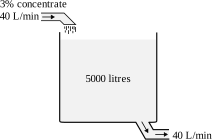
A tank contains 5000 litres of fruit juice concentrate solution with an initial concentrate percentage of 5.0%. Another fruit juice solution with a concentrate percentage of 3.0% is pumped into the tank at a rate of 40 litres per minute. The mixture is pumped out at the same rate, keeping the volume constant, and the liquid is kept thoroughly mixed.
 

Let \(y\) be the volume of fruit concentrate, in litres, present in the tank at time \(t\).

  1. Show that  \(\dfrac{dy}{dt}=\dfrac{150-y}{125} \)   (1 mark)

    --- 4 WORK AREA LINES (style=lined) ---

  2. Show that the amount fruit juice concentrate in the tank at time \(t\) is given by
  3.       \(y=150 + 100e^{-0.008t} \)   (3 marks)

    --- 9 WORK AREA LINES (style=lined) ---

  4. Determine how long will it take for the mixture to reach a fruit juice concentration of 3.5%, giving your answer to the nearest minute?   (2 marks)

    --- 6 WORK AREA LINES (style=lined) ---

Show Answers Only

a.   \(\text{See Worked Solutions}\)

b.  \(\text{See Worked Solutions}\)

c.   \(\text{174 minutes}\)

Show Worked Solution

a.    \(\text{Inflow}=40 \ \text{L/min} \times 0.03=1.2 \ \text{L/min}\)

\(\text{Outflow }=40 \ \text{L/min} \times \dfrac{y}{5000}=\dfrac{y}{125} \ \text{L/min}\)

\(\dfrac{dy}{dt}\) \(=\text{Inflow}-\text{Outflow}\)
  \(=1.2-\dfrac{y}{125}\)
  \(=\dfrac{150-y}{125}\)


b.     \(\dfrac{dy}{dt}\) \(=\dfrac{150-y}{125}\)
  \(\dfrac{dt}{dy}\) \(=\dfrac{125}{150-y}\)
  \(\displaystyle\int dt\) \(=\displaystyle \int \dfrac{125}{150-y} \, dy\)
  \(t\) \(=-125\, \ln \abs{150-y}+c\)
  \(\ln \abs{150-y}\) \(=-\dfrac{t}{125}+c\)
  \(150-y\) \(=e^{-0.008 t+c}\)
  \(150-y\) \(=e^{-0.008 t} \cdot e^c\)
  \(150-y\) \(=A e^{-0.008 t}\)

 
\(\text{At} \ \ t=0, y=5000 \times 0.05=250\ \text{L}\)

\(150-250=Ae^{\circ} \ \  \Rightarrow \ \  A=-100\)

\(150-y\) \(=-100 e^{-0.008 t}\)
\(y\) \(=150+100 e^{0.008 t}\)


c.   \(\text{When fruit concentrate}=3.5 \%\)

\(y=5000 \times 0.035=175 \ \text{L}\)

\(\text{Find} \ t \ \text{when} \ \ y=175:\)

\(175\) \(=150+100 e^{-0.008 t}\)
\(25\) \(=100 e^{-0.008 t}\)
\(e^{-0.008t}\) \(=0.25\)
\(-0.008 t\) \(=\ln (0.25)\)
\(t\) \(=\dfrac{\ln (0.25)}{-0.008}\)
  \(=173.28 \ldots\)


\(\therefore \ \text{After 174 minutes, the fruit concentrate first falls below} \  3.5\%\)

Filed Under: Applications of Differential Equations Tagged With: Band 4, Band 5, smc-1198-10-Mixing

Calculus, EXT1 C2 EQ-Bank 4

Find the value of \(n\), given

\(\displaystyle \int_0^n-\dfrac{1}{\sqrt{1-x^2}}=-\dfrac{\pi}{6}\).   (2 marks)

Show Answers Only

\(n=\dfrac{1}{2}\)

Show Worked Solution
\(\displaystyle\int_0^n-\dfrac{1}{\sqrt{1-x^2}}\) \(=-\dfrac{\pi}{6}\)
\(\left[\cos ^{-1} x\right]_0^n\) \(=-\dfrac{\pi}{6}\)
\(\cos ^{-1}(n)-\cos ^{-1} 0\) \(=-\dfrac{\pi}{6}\)
\(\cos ^{-1}(n)-\dfrac{\pi}{2}\) \(=-\dfrac{\pi}{6}\)
\(\cos ^{-1}(n)\) \(=\dfrac{\pi}{2}-\dfrac{\pi}{6}\)
\(n\) \(=\cos \left(\dfrac{\pi}{3}\right)\)
  \(=\dfrac{1}{2}\)

Filed Under: Inverse Functions Calculus (Ext1) Tagged With: Band 4, smc-1037-30-Sin/Cos Integration

Calculus, EXT1 C2 EQ-Bank 3

Use the substitution  \(u=\cos\,x\)  to evaluate

\(\displaystyle {\int}_{\frac{\pi}{2}}^\pi e^{\cos\,x} \sin x\, dx\).   (3 marks)

--- 7 WORK AREA LINES (style=lined) ---

Show Answers Only

\(1-\dfrac{1}{e}\)

Show Worked Solution

\(u=\cos x\)

\(\dfrac{d u}{d x}=-\sin\,x\  \Rightarrow\  du=-\sin\,x\,dx\)

\(\text {When} \ \ x=\pi, u=-1\)

\(\text{When} \ \ x=\dfrac{\pi}{2}, u=0\)

\(\displaystyle \int_{\frac{\pi}{2}}^\pi e^{\cos\,x} \sin\,x\,d x\) \(=\displaystyle -\int_0^{-1} e^u\,d u\)
  \(=\left[-e^u\right]_0^{-1}\)
  \(=-e^{-1}+e^0\)
  \(=1-\dfrac{1}{e}\)

Filed Under: Integration By Substitution (Ext1) Tagged With: Band 4, smc-1036-30-Trig, smc-1036-50-Limits Invert

Calculus, EXT1 C3 EQ-Bank 1

Find the general solution to the differential equation  \(y^{\prime}=e^{-y}\).   (2 marks)

--- 6 WORK AREA LINES (style=lined) ---

Show Answers Only

\(\ln \left|x+c_1\right|\)

Show Worked Solution
\(\dfrac{d y}{d x}\) \(=e^{-y}\)
\(\dfrac{d x}{d y}\) \(=e^y\)
\(\displaystyle \int d x\) \(=\displaystyle \int e^y\, d y\)
\(x\) \(=e^y+c\)
\(e^y\) \(=x+c_1\)
\(y\) \(=\ln \left|x+c_1\right|\)

Filed Under: Equations and Slope Fields Tagged With: Band 4, smc-1197-40-dy/dx = f(y)

Calculus, EXT1 C2 EQ-Bank 2

Find  \(\displaystyle \int \frac{1}{\sqrt{15-2 x-x^2}}\, d x\).   (3 marks)

--- 6 WORK AREA LINES (style=lined) ---

Show Answers Only

\(\displaystyle\sin ^{-1}\left(\frac{x+1}{4}\right)+c\)

Show Worked Solution
\(\displaystyle\int \frac{1}{\sqrt{15-2 x-x^2}}\, d x\) \(=\displaystyle\int \frac{1}{\sqrt{16-1-2 x-x^2}}\, d x\)
  \(=\displaystyle\int \frac{1}{\sqrt{16-(x+1)^2}}\, d x\)
  \(=\displaystyle\sin ^{-1}\left(\frac{x+1}{4}\right)+c\)

Filed Under: Inverse Functions Calculus (Ext1) Tagged With: Band 4, smc-1037-30-Sin/Cos Integration

Calculus, EXT1 C2 EQ-Bank 1 MC

\(\displaystyle \int \dfrac{1}{\sqrt{5-4 x-x^2}}\, d x=\)
 

  1. \(\sin ^{-1}\left(\dfrac{x+2}{3}\right)+c \)
  2. \( \sin ^{-1}\left(\dfrac{x-2}{3}\right)+c \)
  3. \(\sin ^{-1}\left(\dfrac{x+2}{9}\right)+c \)
  4. \(\sin ^{-1}\left(\dfrac{x-2}{9}\right)+c\)
Show Answers Only

\(\Rightarrow A\)

Show Worked Solution
\(\displaystyle \int \frac{1}{\sqrt{5-4 x-x^2}}\, d x\) \(=\displaystyle\int \frac{1}{\sqrt{9-4-4 x-x^2}}\,dx\)
  \(=\displaystyle \int \frac{1}{\sqrt{9-(x+2)^2}}\,dx\)
  \(=\sin ^{-1}\left(\dfrac{x+2}{3}\right)+c\)

\(\Rightarrow A\)

Filed Under: Inverse Functions Calculus (Ext1) Tagged With: Band 4, smc-1037-30-Sin/Cos Integration

Statistics, 2ADV S3 EQ-Bank 2

A probability density function for a random variable, \(X\), is defined by the following function
 

\(f(x)=\left\{\begin{array}{rl}
k x(2-x), & 0 \leqslant x \leqslant 2 \\
0, & \text{for all other } x
\end{array}\right.\)
 

Determine the value of \(k\) and hence write the equation of the Cumulative Density Function.   (3 marks)

--- 10 WORK AREA LINES (style=lined) ---

Show Answers Only

\(F(x)=\dfrac{3}{4} x^2-\dfrac{1}{4} x^3\)

Show Worked Solution
  \(\displaystyle \int_0^2 k x(2-x)\) \(=1\)
  \(\displaystyle \int_0^2 2 k x-k x^2\) \(=1\)
  \(\left[k x^2-\dfrac{k}{3} x^3\right]_0^2\) \(=1\)
  \(\left(4 k-\dfrac{8 k}{3}\right)-0\) \(=1\)
  \(4 k\) \(=3\)
  \(k\) \(=\dfrac{3}{4}\)


\(F(x)\) \(=\displaystyle \int 2 \times \frac{3}{4} x-\frac{3}{4} x^2\, d x\)
  \(=\displaystyle \int \frac{3}{2} x-\frac{3}{4} x^2\, d x\)
  \(=\dfrac{3}{4} x^2-\dfrac{1}{4} x^3+c\)

 
\(\text{When} \ \ x=0, F(x)=0 \ \Rightarrow \ c=0\)

\(\therefore\ F(x)=\dfrac{3}{4} x^2-\dfrac{1}{4} x^3\)

Filed Under: Probability Density Functions (Y12) Tagged With: Band 4, smc-994-40-Cumulative Distribution Fn

HMS, HAG EQ-Bank 34 MC

A weight loss supplement advertisement states "Lose 10kg in 7 days without diet or exercise - doctors don't want you to know this secret!" Which combination of warning signs indicates this product should be avoided?

  1. Unrealistic promises, conspiracy claims and lack of effort required
  2. The product targets weight loss rather than general wellness
  3. The advertisement uses specific numbers and timeframes
  4. The product is marketed as a supplement rather than prescription medication
Show Answers Only

\(A\)

Show Worked Solution
  • A is correct: Unrealistic promises, conspiracy theories and “no effort” claims are major red flags.

Other Options:

  • B is incorrect: Weight loss products can be legitimate when properly evidence-based.
  • C is incorrect: Specific numbers alone don’t indicate poor products if realistic.
  • D is incorrect: Supplement classification doesn’t automatically indicate unreliable products.

Filed Under: Being a critical health consumer Tagged With: Band 4, smc-5483-17-Accuracy and credibility

HMS, HAG EQ-Bank 31 MC

When comparing health information from different sources, which combination of factors provides the MOST reliable evaluation framework?

  1. Publication date, author credentials, peer review status and presence of references
  2. Website popularity, number of social media shares and attractive visual design
  3. Length of the article, use of medical terminology and presence of advertising
  4. Personal testimonials, celebrity endorsements and promotional offers available
Show Answers Only

\(A\)

Show Worked Solution
  • A is correct: Publication currency, expertise, peer review and references indicate reliable sources.

Other Options:

  • B is incorrect: Popularity and design don’t indicate information accuracy or reliability.
  • C is incorrect: Length and terminology alone don’t guarantee credible health information.
  • D is incorrect: Testimonials and endorsements are marketing tools, not credibility indicators.

Filed Under: Being a critical health consumer Tagged With: Band 4, smc-5483-17-Accuracy and credibility

HMS, HAG EQ-Bank 29 MC

When assessing the credibility of a health website promoting a new dietary supplement, which factor is MOST important to evaluate first?

  1. The number of positive customer testimonials displayed on the website
  2. How professionally designed and visually appealing the website appears
  3. The qualifications and expertise of the authors and any cited research studies
  4. Whether the website offers a money-back guarantee for the product
Show Answers Only

\(C\)

Show Worked Solution
  • C is correct: Author qualifications and research citations indicate reliable, evidence-based information.

Other Options:

  • A is incorrect: Testimonials can be fabricated and don’t represent scientific evidence.
  • B is incorrect: Professional design doesn’t guarantee accurate or credible health information.
  • D is incorrect: Money-back guarantees are marketing tools, not credibility indicators.

Filed Under: Being a critical health consumer Tagged With: Band 4, smc-5483-17-Accuracy and credibility

HMS, HAG EQ-Bank 26 MC

An individual searches online for information about managing their diabetes and finds multiple websites with different recommendations. Which combination of skills demonstrates effective health information literacy?

  1. Selecting information only from websites with the most attractive design and layout
  2. Accessing multiple sources, evaluating author credentials, and discussing findings with healthcare professionals
  3. Choosing the first search result that appears regardless of its source or content
  4. Relying solely on personal experience without seeking any external information
Show Answers Only

\(C\)

Show Worked Solution
  • B is correct: Multiple source access, credential evaluation and professional consultation demonstrate comprehensive literacy.

Other Options:

  • A is incorrect: Visual appeal doesn’t indicate information accuracy or reliability.
  • C is incorrect: Search ranking doesn’t guarantee credibility or medical accuracy.
  • D is incorrect: Personal experience alone insufficient for complex health management decisions.

Filed Under: Being a critical health consumer Tagged With: Band 4, smc-5483-07-Trustworthy sources

HMS, HAG EQ-Bank 22 MC

Mediterranean countries such as Spain demonstrate lower obesity rates compared to Australia, partly attributed to traditional diets rich in fruits and vegetables. Which lesson from this international example could BEST be applied to improve Australia's obesity rankings?

  1. Mandate that all Australians follow Mediterranean diets exclusively
  2. Promote cultural dietary practices that emphasise fresh produce consumption
  3. Ban all processed food production in Australia immediately
  4. Focus only on increasing physical activity levels without dietary changes
Show Answers Only

\(B\)

Show Worked Solution
  • B is correct: Promoting fresh produce consumption addresses Australia’s poor vegetable guideline compliance.

Other Options:

  • A is incorrect: Mandating specific diets ignores cultural diversity and personal choice.
  • C is incorrect: Complete bans are impractical and economically disruptive.
  • D is incorrect: Physical activity alone insufficient without addressing dietary patterns.

Filed Under: Australia vs OECD Countries Tagged With: Band 4, smc-5476-15-Global lessons

HMS, HAG EQ-Bank 19 MC

Based on Australia's Health 2024 OECD ranking data, which statement BEST describes the pattern of Australia's health performance across different indicators?

  1. Australia consistently ranks in the top 5 for all major health indicators
  2. Australia performs well in some areas but faces significant challenges in others
  3. Australia ranks below average for all lifestyle-related health measures
  4. Australia's rankings show no clear pattern across different health indicators
Show Answers Only

\(B\)

Show Worked Solution
  • B is correct: Strong tobacco control but challenges with alcohol and obesity rankings.

Other Options:

  • A is incorrect: Mixed rankings across indicators, not consistently top 5.
  • C is incorrect: Tobacco control shows above-average performance among lifestyle measures.
  • D is incorrect: Clear pattern of strengths and weaknesses evident.

Filed Under: Australia vs OECD Countries Tagged With: Band 4, smc-5476-05-OECD rankings

HMS, HAG EQ-Bank 16 MC

Australia ranks fourth highest for life expectancy among OECD countries. Which factor BEST explains why Australia achieves this high ranking?

  1. Australia has the highest health spending per capita among all OECD countries
  2. Australia's climate prevents all forms of chronic disease development
  3. Australia has effective public health campaigns combined with accessible healthcare through Medicare
  4. Australia has eliminated all preventable risk factors from the population
Show Answers Only

\(C\)

Show Worked Solution
  • C is correct: Medicare accessibility and public health initiatives contribute to longevity outcomes.

Other Options:

  • A is incorrect: Australia ranks 15th in health spending, not highest.
  • B is incorrect: Climate alone cannot prevent chronic diseases entirely.
  • D is incorrect: Risk factors like obesity still present challenges.

Filed Under: Australia vs OECD Countries Tagged With: Band 4, smc-5476-10-Health comparisons

HMS, HAG EQ-Bank 14 MC

Based on Australia's Health 2024 data comparing risk factors across OECD countries, which statement BEST describes Australia's performance in health risk areas?

  1. Australia performs poorly across all major health risk factors compared to OECD countries
  2. Australia has successfully reduced tobacco smoking but faces challenges with overweight and obesity rates
  3. Australia ranks highest among OECD countries for alcohol consumption per person
  4. Australia has the lowest rates of overweight and obesity among all OECD member countries
Show Answers Only

\(B\)

Show Worked Solution
  • B is correct: Fifth lowest tobacco smoking but 10th highest overweight/obesity among OECD countries.

Other Options:

  • A is incorrect: Australia performs well in tobacco control measures.
  • C is incorrect: Australia ranks 16th highest, not highest for alcohol consumption.
  • D is incorrect: Australia has 10th highest overweight/obesity rates.

Filed Under: Australia vs OECD Countries Tagged With: Band 4, smc-5476-10-Health comparisons

HMS, HAG EQ-Bank 11 MC

According to Australia's Health 2024, people living in rural and remote areas experience higher death rates and poorer health outcomes compared to those in major cities. Which approach would BEST address these geographic health inequities?

  1. Reduce healthcare funding to major cities to redistribute resources
  2. Focus only on emergency medical services in remote areas
  3. Implement identical healthcare delivery models across all geographic locations
  4. Increase telehealth services and mobile healthcare units for remote communities
Show Answers Only

\(D\)

Show Worked Solution
  • D is correct: Telehealth and mobile units address geographic barriers to healthcare access.

Other Options:

  • A is incorrect: Reducing city services doesn’t improve rural access effectively.
  • B is incorrect: Emergency-only approach ignores preventive and routine care needs.
  • C is incorrect: One-size-fits-all models don’t address unique rural challenges.

Filed Under: Current Health Status Tagged With: Band 4, smc-5474-10-Inequity issues

HMS, HAG EQ-Bank 10 MC

According to Australia's Health 2024 data on tobacco and e-cigarette use patterns, which statement BEST describes the socioeconomic trends that exist in substance use behaviours?

  1. Both tobacco smoking and e-cigarette use follow identical socioeconomic patterns
  2. Tobacco use is higher in disadvantaged areas whilst e-cigarette use is higher in advantaged areas
  3. E-cigarette use shows no relationship to socioeconomic status across Australia
  4. Advantaged areas have equally high rates of both tobacco and e-cigarette use
Show Answers Only

\(B\)

Show Worked Solution
  • B is correct: Data shows opposite patterns – tobacco higher in disadvantaged, e-cigarettes in advantaged areas.

Other Options:

  • A is incorrect: Patterns are opposite between tobacco and e-cigarettes.
  • C is incorrect: Clear socioeconomic pattern exists for e-cigarette use.
  • D is incorrect: Advantaged areas have low tobacco but high e-cigarette rates.

Filed Under: Current Health Status Tagged With: Band 4, smc-5474-15-Sociological factors

HMS, HAG EQ-Bank 8 MC

A teenager begins vaping after seeing their favourite social media influencer promoting e-cigarettes during online content. This scenario BEST demonstrates which sociological cause of risky health behaviour?

  1. Social relationships through peer pressure from close friends
  2. Culture of everyday life influenced by media and normalisation
  3. Social interaction within workplace environments
  4. Family environment and parental modelling of behaviour
Show Answers Only

\(B\)

Show Worked Solution
  • B is correct: Media influence and normalisation of e-cigarettes demonstrates cultural factors.

Other Options:

  • A is incorrect: Involves media influence, not direct peer relationships.
  • C is incorrect: Scenario involves social media, not workplace interaction.
  • D is incorrect: Involves external media influence, not family modelling.

Filed Under: Current Health Status Tagged With: Band 4, smc-5474-15-Sociological factors

HMS, HAG EQ-Bank 5 MC

According to Australia's Health 2024 data, which statement BEST describes the differences in leading causes of disease burden between males and females?

  1. Both males and females have identical leading causes of disease burden
  2. Males experience higher rates of anxiety disorders whilst females experience higher rates of suicide
  3. Coronary heart disease is the leading cause for males whilst dementia is the leading cause for females
  4. Back pain and problems affects females more than males across all age groups
Show Answers Only

\(C\)

Show Worked Solution
  • C is correct: Data shows coronary heart disease leads for males, dementia for females.

Other Options:

  • A is incorrect: Leading causes differ significantly between genders.
  • B is incorrect: Anxiety disorders lead for females, suicide for males.
  • D is incorrect: Back pain ranks similarly for both genders.

Filed Under: Current Health Status Tagged With: Band 4, smc-5474-05-Major causes

Calculus, 2ADV C4 EQ-Bank 2

  1. The graph of \(f(x)\) is drawn below
     

  1. Evaluate \(\displaystyle \int_0^6 f(x)\, d x\)   (2 marks)

    --- 6 WORK AREA LINES (style=lined) ---

  2. Evaluate \(\displaystyle \int_0^6[f(x)-3]\, d x\)    (2 marks)

    --- 6 WORK AREA LINES (style=lined) ---

  3. Evaluate \(\displaystyle \int_4^6 f^{\prime}(x)\, d x\)   (1 mark)

    --- 6 WORK AREA LINES (style=lined) ---

Show Answers Only

a.   \(8 \dfrac{1}{2}\)

b.   \(-9 \dfrac{1}{2}\)

c.   \(-3\)

Show Worked Solution

a.
     

\(\displaystyle \int_0^6 f(x)\) \(=\text{net area above the}\ x \text{-axis }\)
  \(=\text{Area 1}+ \text{Area 3}-\text{Area 2}\)
  \(=\left(6+1 \dfrac{1}{2}\right)+3-2\)
  \(=8 \dfrac{1}{2}\)


b.    \(f(x)-3 \ \ \text{shifts graph (above) 3 units lower:}\)
 

\(\displaystyle\int_0^6[f(x)-3] \ \ \text{will be negative (areas below \(x\)-axis)}\)
  \(=-\left(1 \dfrac{1}{2}+5+3\right)\)
  \(=-9 \dfrac{1}{2}\)


c.     \(\displaystyle \int_4^6 f^{\prime}(x) d x\) \(=[f(x)]_4^6\)
    \(=f(6)-f(4)\)
    \(=0-3\)
    \(=-3\)

Filed Under: Areas Under Curves (Y12) Tagged With: Band 4, Band 5, smc-975-70-Functions - no integration

HMS, TIP 2012 HSC 32b

Evaluate the risks and ethical issues related to the use of drugs to improve performance.   (12 marks)

--- 28 WORK AREA LINES (style=lined) ---

Show Answers Only

Evaluation Statement

  • Performance-enhancing drug use presents significant risks and serious ethical concerns that outweigh potential performance benefits.
  • Assessment reveals substantial health dangers and major ethical violations that undermine sport integrity.

Health and Safety Risks

  • Drug use demonstrates severe health consequences affecting multiple body systems and long-term wellbeing.
  • Anabolic steroids cause liver damage, cardiovascular disease and hormonal disruptions that persist beyond athletic careers.
  • EPO increases blood viscosity, creating high risk of stroke and heart attack, particularly during intense competition.
  • Stimulants produce cardiac arrhythmias and hyperthermia that can result in sudden death during performance.
      
  • Long-term health effects prove extremely concerning as many consequences emerge years after use ceases.
  • Steroid use in adolescents causes premature growth plate closure, permanently stunting height development.
  • Female athletes experience masculinisation effects including voice deepening and increased body hair that remain irreversible.
  • Mental health impacts include depression, aggression and dependency issues that affect life quality beyond sport participation.

Ethical and Fair Play Issues

  • Drug use creates fundamental ethical problems that violate sport integrity and fair competition principles.
  • Enhanced performance through artificial means provides unfair advantages over clean athletes who train naturally.
  • This undermines fair competition in sport and devalues genuine athletic achievement earned through training and talent.
      
  • Role model responsibilities present serious ethical concerns as athletes influence youth behaviour and sporting culture.
  • Professional athletes using drugs send dangerous messages to young participants who may emulate these practices.
  • This perpetuates harmful behaviours throughout sporting communities and normalises cheating as acceptable practice.

Final Evaluation

  • Evidence demonstrates that performance-enhancing drugs present unacceptable risks and severe ethical violations that cannot be justified by temporary performance gains.
  • The overwhelming negative consequences for individual health and sport integrity establish drug use as fundamentally incompatible with ethical athletic participation.
Show Worked Solution

Evaluation Statement

  • Performance-enhancing drug use presents significant risks and serious ethical concerns that outweigh potential performance benefits.
  • Assessment reveals substantial health dangers and major ethical violations that undermine sport integrity.

Health and Safety Risks

  • Drug use demonstrates severe health consequences affecting multiple body systems and long-term wellbeing.
  • Anabolic steroids cause liver damage, cardiovascular disease and hormonal disruptions that persist beyond athletic careers.
  • EPO increases blood viscosity, creating high risk of stroke and heart attack, particularly during intense competition.
  • Stimulants produce cardiac arrhythmias and hyperthermia that can result in sudden death during performance.
      
  • Long-term health effects prove extremely concerning as many consequences emerge years after use ceases.
  • Steroid use in adolescents causes premature growth plate closure, permanently stunting height development.
  • Female athletes experience masculinisation effects including voice deepening and increased body hair that remain irreversible.
  • Mental health impacts include depression, aggression and dependency issues that affect life quality beyond sport participation.

Ethical and Fair Play Issues

  • Drug use creates fundamental ethical problems that violate sport integrity and fair competition principles.
  • Enhanced performance through artificial means provides unfair advantages over clean athletes who train naturally.
  • This undermines fair competition in sport and devalues genuine athletic achievement earned through training and talent.
      
  • Role model responsibilities present serious ethical concerns as athletes influence youth behaviour and sporting culture.
  • Professional athletes using drugs send dangerous messages to young participants who may emulate these practices.
  • This perpetuates harmful behaviours throughout sporting communities and normalises cheating as acceptable practice.

Final Evaluation

  • Evidence demonstrates that performance-enhancing drugs present unacceptable risks and severe ethical violations that cannot be justified by temporary performance gains.
  • The overwhelming negative consequences for individual health and sport integrity establish drug use as fundamentally incompatible with ethical athletic participation.

Filed Under: Impact of drug use Tagged With: Band 4, Band 5, smc-5473-10-Health implications, smc-5473-20-Ethical considerations

HMS, HIC 2012 HSC 29a

Explain the determining factors that affect the health of young people in Australia.   (8 marks)

--- 24 WORK AREA LINES (style=lined) ---

Show Answers Only
  • Socioeconomic factors significantly impact young people’s health through education, employment and income levels. When families experience financial disadvantage, this leads to reduced access to nutritious food, healthcare services and recreational facilities. For example, adolescents from low-income households are more likely to consume processed foods due to cost constraints, resulting in higher obesity rates and nutritional deficiencies. Educational disadvantage creates limited health literacy, preventing young people from making informed health decisions.
  • Environmental determinants influence health through both built and natural surroundings. Poor housing conditions create respiratory problems while lack of safe recreational spaces limits physical activity opportunities. Urban pollution causes increased asthma rates among young people, particularly those living near busy roads or industrial areas. Inadequate transport infrastructure results in social isolation and reduced healthcare access.
  • Sociocultural factors shape health behaviours through peer influence, family values and cultural norms. Social media exposure leads to body image concerns and mental health issues among teenagers. Family attitudes towards alcohol and substance use directly affect adolescent experimentation patterns. Cultural beliefs about help-seeking behaviour can prevent young people from accessing mental health support services.
  • Individual health behaviours determine immediate and long-term health outcomes. Risk-taking behaviours such as excessive alcohol consumption, smoking and unprotected sexual activity result in acute injuries, addiction and sexually transmitted infections among young Australians.
Show Worked Solution
  • Socioeconomic factors significantly impact young people’s health through education, employment and income levels. When families experience financial disadvantage, this leads to reduced access to nutritious food, healthcare services and recreational facilities. For example, adolescents from low-income households are more likely to consume processed foods due to cost constraints, resulting in higher obesity rates and nutritional deficiencies. Educational disadvantage creates limited health literacy, preventing young people from making informed health decisions.
  • Environmental determinants influence health through both built and natural surroundings. Poor housing conditions create respiratory problems while lack of safe recreational spaces limits physical activity opportunities. Urban pollution causes increased asthma rates among young people, particularly those living near busy roads or industrial areas. Inadequate transport infrastructure results in social isolation and reduced healthcare access.
  • Sociocultural factors shape health behaviours through peer influence, family values and cultural norms. Social media exposure leads to body image concerns and mental health issues among teenagers. Family attitudes towards alcohol and substance use directly affect adolescent experimentation patterns. Cultural beliefs about help-seeking behaviour can prevent young people from accessing mental health support services.
  • Individual health behaviours determine immediate and long-term health outcomes. Risk-taking behaviours such as excessive alcohol consumption, smoking and unprotected sexual activity result in acute injuries, addiction and sexually transmitted infections among young Australians.

♦♦ Mean mark 50%.

Filed Under: Broad features of society Tagged With: Band 4, Band 5, smc-5803-60-Interaction of determinants

  • « Previous Page
  • 1
  • …
  • 7
  • 8
  • 9
  • 10
  • 11
  • …
  • 114
  • Next Page »

Copyright © 2014–2025 SmarterEd.com.au · Log in