SmarterEd

Aussie Maths & Science Teachers: Save your time with SmarterEd

  • Login
  • Get Help
  • About

HMS, BM EQ-Bank 976

Describe the biomechanical principles involved in effectively catching fast-moving objects.   (5 marks)

--- 15 WORK AREA LINES (style=lined) ---

Show Answers Only
  • Impact force absorption involves the relationship between object momentum and catching distance. Athletes extend arms fully before contact then draw the object toward the body. Drawing the hands back increases the time and distance over which the object is stopped, which reduces the peak force on the hands. 
  • Multi-point contact distribution spreads forces across multiple body segments. Both hands create larger contact surface area while engaging multiple joints. Force distribution occurs through fingers, wrists, elbows, and shoulders rather than single-point concentration.
  • Progressive joint movement characterises the kinetic chain during catching. Movement flows from fingers through to trunk segments. Each joint bends in sequence with muscles lengthening under control to absorb energy.
  • Pre-contact positioning requires anticipatory movements before ball arrival. Athletes adopt wide stances with flexed knees for stability. Arms position at appropriate height with slight elbow flexion, ready for extension and subsequent catching motion.
  • Visual tracking and timing coordinates body movements with object trajectory. Eyes maintain focus throughout the flight path. Hand positioning adjusts continuously based on visual information, with grasping timed for optimal catching distance.
Show Worked Solution
  • Impact force absorption involves the relationship between object momentum and catching distance. Athletes extend arms fully before contact then draw the object toward the body. Drawing the hands back increases the time and distance over which the object is stopped, which reduces the peak force on the hands. 
  • Multi-point contact distribution spreads forces across multiple body segments. Both hands create larger contact surface area while engaging multiple joints. Force distribution occurs through fingers, wrists, elbows, and shoulders rather than single-point concentration.
  • Progressive joint movement characterises the kinetic chain during catching. Movement flows from fingers through to trunk segments. Each joint bends in sequence with muscles lengthening under control to absorb energy.
  • Pre-contact positioning requires anticipatory movements before ball arrival. Athletes adopt wide stances with flexed knees for stability. Arms position at appropriate height with slight elbow flexion, ready for extension and subsequent catching motion.
  • Visual tracking and timing coordinates body movements with object trajectory. Eyes maintain focus throughout the flight path. Hand positioning adjusts continuously based on visual information, with grasping timed for optimal catching distance.

Filed Under: Fluid Mechanics and Force Tagged With: Band 4, Band 5, smc-5879-50-Body absorbing force

HMS, BM EQ-Bank 972

Analyse the relationship between fluid resistance forces and swimming efficiency in competitive performance.   (8 marks)

--- 22 WORK AREA LINES (style=lined) ---

Show Answers Only

Overview Statement

  • Fluid resistance forces interact with swimming technique and body position to determine competitive efficiency. Key relationships include drag-speed interactions, technique adaptations, and performance trade-offs that affect energy expenditure and race outcomes.

Drag-Speed Relationship

  • Water resistance increases sharply as swimming velocity rises, directly affecting energy demands. This force opposes forward motion by acting parallel to water flow against the swimmer.
  • Streamlined positions substantially reduce resistance compared to poor alignment. This pattern shows elite swimmers maintain higher speeds with lower energy costs.
  • Evidence indicates that doubling speed quadruples drag forces. Therefore, small improvements in body position create significant efficiency gains during races.

Technique and Propulsion

  • Skilled swimmers transform resistance forces into forward propulsion through hand and body movements. Proper technique converts water pressure into useful thrust rather than just overcoming drag.
  • High elbow catches and body rotation redirect water flow to create forward push. Elite swimmers convert far more of each stroke into forward propulsion, while beginners waste energy moving water in unproductive directions.
  • This reveals how technical skill determines whether resistance hinders or helps performance. The trend indicates mastery of water manipulation separates elite from average swimmers.

Performance Trade-offs

  • Different events require balancing competing demands between reducing drag and maximising propulsion. Swimmers must choose between streamlining for low resistance or powerful strokes for speed.
  • Sprinters often accept higher resistance to generate maximum power, while distance swimmers prioritise efficiency over force. This demonstrates event-specific approaches to resistance management.
  • These patterns show no single solution exists for all swimming events.

Implications and Synthesis

  • Fluid resistance fundamentally shapes competitive swimming through complex interactions with technique, speed, and event demands. Swimmers who understand these relationships optimise their individual approach.
  • Consequently, training must address both resistance reduction and propulsion enhancement. The significance is that efficiency improvements through resistance management often exceed gains from fitness alone.
Show Worked Solution

Overview Statement

  • Fluid resistance forces interact with swimming technique and body position to determine competitive efficiency. Key relationships include drag-speed interactions, technique adaptations, and performance trade-offs that affect energy expenditure and race outcomes.

Drag-Speed Relationship

  • Water resistance increases sharply as swimming velocity rises, directly affecting energy demands. This force opposes forward motion by acting parallel to water flow against the swimmer.
  • Streamlined positions substantially reduce resistance compared to poor alignment. This pattern shows elite swimmers maintain higher speeds with lower energy costs.
  • Evidence indicates that doubling speed quadruples drag forces. Therefore, small improvements in body position create significant efficiency gains during races.

Technique and Propulsion

  • Skilled swimmers transform resistance forces into forward propulsion through hand and body movements. Proper technique converts water pressure into useful thrust rather than just overcoming drag.
  • High elbow catches and body rotation redirect water flow to create forward push. Elite swimmers convert far more of each stroke into forward propulsion, while beginners waste energy moving water in unproductive directions.
  • This reveals how technical skill determines whether resistance hinders or helps performance. The trend indicates mastery of water manipulation separates elite from average swimmers.

Performance Trade-offs

  • Different events require balancing competing demands between reducing drag and maximising propulsion. Swimmers must choose between streamlining for low resistance or powerful strokes for speed.
  • Sprinters often accept higher resistance to generate maximum power, while distance swimmers prioritise efficiency over force. This demonstrates event-specific approaches to resistance management.
  • These patterns show no single solution exists for all swimming events.

Implications and Synthesis

  • Fluid resistance fundamentally shapes competitive swimming through complex interactions with technique, speed, and event demands. Swimmers who understand these relationships optimise their individual approach.
  • Consequently, training must address both resistance reduction and propulsion enhancement. The significance is that efficiency improvements through resistance management often exceed gains from fitness alone.

Filed Under: Fluid Mechanics and Force Tagged With: Band 5, Band 6, smc-5879-20-Fluid resistance

HMS, BM EQ-Bank 969

Evaluate the biomechanical principles that enable swimmers to maintain effective flotation during competitive performance.   (8 marks)

--- 24 WORK AREA LINES (style=lined) ---

Show Answers Only

Evaluation Statement

  • Biomechanical principles are highly effective for maintaining competitive flotation. Three criteria determine effectiveness: body alignment, muscular control, and individual adaptability.

Body Alignment

  • Centre of gravity and buoyancy alignment strongly meets flotation requirements. Vertical alignment achieves horizontal positioning with minimal effort.
  • Elite swimmers demonstrate optimal alignment maintaining flat positions throughout races. This flat position substantially reduces drag compared to misalignment.
  • Evidence proves this principle fundamental – without alignment, other techniques fail. The principle achieves significant performance benefits.

Muscular Control

  • Core engagement adequately fulfils position maintenance needs. Abdominal contraction keeps hips elevated despite fatigue.
  • Demonstrates high effectiveness by preventing leg drop, which increases frontal area and drag. Sprinters show superior core strength at race speeds.
  • Conscious control allows adjustment based on conditions, proving highly valuable for success.

Individual Adaptability

  • Principles partially address body composition variations through technique modifications. Dense swimmers adjust kick patterns compensating for reduced buoyancy.
  • While somewhat effective, adaptations require extra energy. Lean sprinters work harder to stay horizontal than swimmers with higher body fat.
  • Shows limitations – physics cannot be overcome completely. Strategies achieve moderate success managing disadvantages.

Final Evaluation

  • Biomechanical principles prove highly effective when criteria work together. Alignment and control strongly support performance while adaptations adequately manage variations.
  • Strengths outweigh limitations as technique overcomes most disadvantages. Understanding these principles remains essential for competitive success.
Show Worked Solution

Evaluation Statement

  • Biomechanical principles are highly effective for maintaining competitive flotation. Three criteria determine effectiveness: body alignment, muscular control, and individual adaptability.

Body Alignment

  • Centre of gravity and buoyancy alignment strongly meets flotation requirements. Vertical alignment achieves horizontal positioning with minimal effort.
  • Elite swimmers demonstrate optimal alignment maintaining flat positions throughout races. This flat position substantially reduces drag compared to misalignment.
  • Evidence proves this principle fundamental – without alignment, other techniques fail. The principle achieves significant performance benefits.

Muscular Control

  • Core engagement adequately fulfils position maintenance needs. Abdominal contraction keeps hips elevated despite fatigue.
  • Demonstrates high effectiveness by preventing leg drop, which increases frontal area and drag. Sprinters show superior core strength at race speeds.
  • Conscious control allows adjustment based on conditions, proving highly valuable for success.

Individual Adaptability

  • Principles partially address body composition variations through technique modifications. Dense swimmers adjust kick patterns compensating for reduced buoyancy.
  • While somewhat effective, adaptations require extra energy. Lean sprinters work harder to stay horizontal than swimmers with higher body fat.
  • Shows limitations – physics cannot be overcome completely. Strategies achieve moderate success managing disadvantages.

Final Evaluation

  • Biomechanical principles prove highly effective when criteria work together. Alignment and control strongly support performance while adaptations adequately manage variations.
  • Strengths outweigh limitations as technique overcomes most disadvantages. Understanding these principles remains essential for competitive success.

Filed Under: Fluid Mechanics and Force Tagged With: Band 5, Band 6, smc-5879-10-Flotation and buoyancy

HMS, BM EQ-Bank 960 MC

A cricket bowler delivers a ball with side-spin that curves away from a right-handed batter. This lateral movement is caused by:

  1. Wind resistance acting on the ball's seam
  2. Magnus force generated by the ball's rotation
  3. Gravitational pull affecting the ball's trajectory
  4. Air pressure changes from the bowler's release technique
Show Answers Only

\(B\)

Show Worked Solution
  • B is correct: Side-spin creates the Magnus force perpendicular to both the spin axis and direction of travel, causing lateral curve.

Other Options:

  • A is incorrect: Seam position affects swing, but the question specifically describes side-spin effects.
  • C is incorrect: Gravity acts vertically and wouldn’t cause lateral movement.
  • D is incorrect: Release technique initiates spin but doesn’t directly create the curving force.

Filed Under: Fluid Mechanics and Force Tagged With: Band 5, smc-5879-30-Magnus force

HMS, HIC EQ-Bank 464

How does SDG 11: Sustainable Cities and Communities promote healthy and active lifestyles for young people?   (5 marks)

--- 15 WORK AREA LINES (style=lined) ---

Show Answers Only

*Cause-and-effect language that directly addresses the “How” (unofficial) keyword is bolded in the answer below.

SDG 11: Sustainable Cities and Communities

  • Promotes the creation of walkways and footpaths that provides safe spaces for young people to exercise. This addresses the barriers to outdoor recreation in urban environments.
  • Opens up more green spaces in high-density suburbs, increasing opportunities for leisure and recreation activities that support mental and physical health.
  • Constructs designated cycling lanes on roads, offering safe and sustainable transport methods for young people while promoting regular physical activity through daily commuting.
  • Reduces traffic congestion and improves air quality by encouraging alternative transport methods.
  • Assists in reducing emissions and pollution by decreasing car dependency, This addresses environmental health determinants that particularly affect growing children and adolescents.
  • Tackles accessibility challenges in metropolitan suburbs and rural areas where public space may be limited due to population density or geographic isolation.
  • Facilitates social interaction and community connection through shared public spaces that support mental health and social development among young people.
  • Creates sustainable infrastructure that supports long-term community health across multiple generations.
Show Worked Solution

*Cause-and-effect language that directly addresses the “How” (unofficial) keyword is bolded in the answer below.

SDG 11: Sustainable Cities and Communities

  • Promotes the creation of walkways and footpaths that provides safe spaces for young people to exercise. This addresses the barriers to outdoor recreation in urban environments.
  • Opens up more green spaces in high-density suburbs, increasing opportunities for leisure and recreation activities that support mental and physical health.
  • Constructs designated cycling lanes on roads, offering safe and sustainable transport methods for young people while promoting regular physical activity through daily commuting.
  • Reduces traffic congestion and improves air quality by encouraging alternative transport methods.
  • Assists in reducing emissions and pollution by decreasing car dependency, This addresses environmental health determinants that particularly affect growing children and adolescents.
  • Tackles accessibility challenges in metropolitan suburbs and rural areas where public space may be limited due to population density or geographic isolation.
  • Facilitates social interaction and community connection through shared public spaces that support mental health and social development among young people.
  • Creates sustainable infrastructure that supports long-term community health across multiple generations.

Filed Under: Improved health through SDGs Tagged With: Band 4, Band 5, smc-5516-40-SDGs & youth health

HMS, HIC EQ-Bank 462

How do data collection challenges limit the Australian government's ability to effectively report on SDG progress?   (8 marks)

--- 22 WORK AREA LINES (style=lined) ---

Show Answers Only

*Recommended language to consider for “To What Extent” questions is bolded in the answer below.

Judgment Statement

  • Data collection challenges significantly limit Australia’s SDG reporting ability.
  • Evidence shows fragmented systems, missing indicators, and coordination barriers severely impact effectiveness.

Fragmented Data Systems

  • Evidence supporting this includes the fact that important data is scattered across multiple government departments with different collection methods.
  • States and territories maintain separate systems rather than unified approaches. This fragmentation means Australia cannot produce comprehensive SDG progress reports. For example, health data is collected differently in NSW versus Queensland which creates inconsistent national pictures.
  • The main factors supporting this include incompatible technology systems and varying departmental priorities.

Missing Measurement Frameworks

  • However, it is important to consider that some limitations are more severe than others.
  • Several SDG indicators have no accepted Australian measurement methods at all. This completely prevents reporting on certain goals regardless of coordination efforts.
  • Despite this, Australia remains one of the stronger performers compared to many nations because existing systems do provide partial data.
  • An alternative perspective to this issue suggests that while developing frameworks requires years of work, Australia is relatively well placed to create new measurement systems for collecting this data.
  • Nevertheless, current system shortcomings mean Australia cannot fully assess progress on all 17 SDGs.

Reaffirmation

  • Data challenges significantly constrain Australia’s SDG reporting capabilities.
  • Systemic differences in reporting between jurisdictions combine with missing indicators to create substantial barriers to reporting.
  • These limitations mean Australia cannot effectively demonstrate progress toward 2030 targets.
  • Implications suggest an urgent need for national coordination and standardised data systems.
Show Worked Solution

*Recommended language to consider for “To What Extent” questions is bolded in the answer below.

Judgment Statement

  • Data collection challenges significantly limit Australia’s SDG reporting ability.
  • Evidence shows fragmented systems, missing indicators, and coordination barriers severely impact effectiveness.

Fragmented Data Systems

  • Evidence supporting this includes the fact that important data is scattered across multiple government departments with different collection methods.
  • States and territories maintain separate systems rather than unified approaches. This fragmentation means Australia cannot produce comprehensive SDG progress reports. For example, health data is collected differently in NSW versus Queensland which creates inconsistent national pictures.
  • The main factors supporting this include incompatible technology systems and varying departmental priorities.

Missing Measurement Frameworks

  • However, it is important to consider that some limitations are more severe than others.
  • Several SDG indicators have no accepted Australian measurement methods at all. This completely prevents reporting on certain goals regardless of coordination efforts.
  • Despite this, Australia remains one of the stronger performers compared to many nations because existing systems do provide partial data.
  • An alternative perspective to this issue suggests that while developing frameworks requires years of work, Australia is relatively well placed to create new measurement systems for collecting this data.
  • Nevertheless, current system shortcomings mean Australia cannot fully assess progress on all 17 SDGs.

Reaffirmation

  • Data challenges significantly constrain Australia’s SDG reporting capabilities.
  • Systemic differences in reporting between jurisdictions combine with missing indicators to create substantial barriers to reporting.
  • These limitations mean Australia cannot effectively demonstrate progress toward 2030 targets.
  • Implications suggest an urgent need for national coordination and standardised data systems.

Filed Under: Improved health through SDGs Tagged With: Band 4, Band 5, smc-5516-30-Australia's focus

HMS, HIC EQ-Bank 460

Explain how WHO promotes shared responsibility across different sectors to improve health outcomes.   (5 marks)

--- 15 WORK AREA LINES (style=lined) ---

Show Answers Only

*Language highlighting the cause-effect relationship is bolded in the answer below.

  • WHO encourages multi-sector collaboration because isolated interventions fail to address health holistically.
  • Healthcare, education, workplace, urban planning and global partnerships are encouraged to work together, creating synergistic effects that amplify the impact on population health.
  • Healthcare focuses on early detection and treatment of diseases which prevents serious complications while also providing expertise for prevention programs.
  • Health education informs students about risk factors and healthy choices, thereby reducing future health burdens.
  • Workplace programs often provide exercise facilities and stress reduction that reduces sick leave, consequently improving productivity.
  • Urban planning creates parks and bike lanes that encourage physical activity which leads to decreased obesity rates.
  • Global partnerships accelerate the development of healthcare technology by enabling countries to share research findings and pool resources.
  • As a result, this multi-sector approach addresses social determinants rather than merely treating symptoms after illness occurs, thus creating sustainable health improvements.
  • This demonstrates why integrated strategies succeed where single-sector interventions fail, generating comprehensive wellbeing outcomes.
Show Worked Solution

*Language highlighting the cause-effect relationship is bolded in the answer below.

  • WHO encourages multi-sector collaboration because isolated interventions fail to address health holistically.
  • Healthcare, education, workplace, urban planning and global partnerships are encouraged to work together, creating synergistic effects that amplify the impact on population health.
  • Healthcare focuses on early detection and treatment of diseases which prevents serious complications while also providing expertise for prevention programs.
  • Health education informs students about risk factors and healthy choices, thereby reducing future health burdens.
  • Workplace programs often provide exercise facilities and stress reduction that reduces sick leave, consequently improving productivity.
  • Urban planning creates parks and bike lanes that encourage physical activity which leads to decreased obesity rates.
  • Global partnerships accelerate the development of healthcare technology by enabling countries to share research findings and pool resources.
  • As a result, this multi-sector approach addresses social determinants rather than merely treating symptoms after illness occurs, thus creating sustainable health improvements.
  • This demonstrates why integrated strategies succeed where single-sector interventions fail, generating comprehensive wellbeing outcomes.

Filed Under: Improved health through SDGs Tagged With: Band 4, Band 5, smc-5516-20-WHO health lens

HMS, HIC EQ-Bank 458

Explain how the SDGs address the interconnected nature of global challenges.   (5 marks)

--- 15 WORK AREA LINES (style=lined) ---

Show Answers Only

*Language highlighting the cause-effect relationship is bolded in the answer below.

  • The 17 SDGs address interconnected challenges because global problems share common root causes. For example, poverty can be directly linked to poor health, limited education, and environmental degradation simultaneously.
  • Due to this connection, goals need to be designed to work together rather than in isolation.
  • The framework functions through five areas: People, Planet, Prosperity, Peace, and Partnership.
  • This works by ensuring each area supports the others. For instance, when SDG 1 (poverty) improves, this leads to better outcomes in SDG 2 (hunger) and SDG 3 (health).
  • Further, there is a direct link between environmental protection and human wellbeing. This happens when climate action (SDG 13) enables food security through sustainable farming. As a result, protecting the planet directly supports human prosperity.
  • All 193 UN nations adopt SDGs because global challenges cross borders. This results in universal cooperation where wealthy nations support developing countries.
  • Consequently, coordinated global action generates measurable results by addressing interconnected challenges. In this way, the SDGs succeed through integrated solutions rather than isolated efforts.
Show Worked Solution

*Language highlighting the cause-effect relationship is bolded in the answer below.

  • The 17 SDGs address interconnected challenges because global problems share common root causes. For example, poverty can be directly linked to poor health, limited education, and environmental degradation simultaneously.
  • Due to this connection, goals need to be designed to work together rather than in isolation.
  • The framework functions through five areas: People, Planet, Prosperity, Peace, and Partnership.
  • This works by ensuring each area supports the others. For instance, when SDG 1 (poverty) improves, this leads to better outcomes in SDG 2 (hunger) and SDG 3 (health).
  • Further, there is a direct link between environmental protection and human wellbeing. This happens when climate action (SDG 13) enables food security through sustainable farming. As a result, protecting the planet directly supports human prosperity.
  • All 193 UN nations adopt SDGs because global challenges cross borders. This results in universal cooperation where wealthy nations support developing countries.
  • Consequently, coordinated global action generates measurable results by addressing interconnected challenges. In this way, the SDGs succeed through integrated solutions rather than isolated efforts.

Filed Under: Improved health through SDGs Tagged With: Band 4, Band 5, smc-5516-10-What are SDGs

PHYSICS, M3 EQ-Bank 6

A student investigates how heat travels through different materials. They smear small pieces of wax onto rods made of aluminium and plastic, placing identical metal pins into the wax at regular intervals. The rods are then heated at one end using a Bunsen burner. The student times how long it takes for each pin to fall as the wax melts.

After testing the aluminium rod, the experiment is repeated using a plastic rod under the same conditions.

Using your understanding of heat transfer in solids, explain what property of the materials is being investigated. Describe what you expect to observe for each material, and explain your reasoning using principles of thermal conduction.   (4 marks)

Show Answers Only
  • This experiment investigates the thermal conductivity of different materials. When one end of each rod is heated by the Bunsen burner, heat energy travels along the rod via conduction, where thermal energy is transferred through collisions between particles.
  • Metals like aluminium are good conductors because they have free-moving electrons that rapidly transfer energy through the material.
  • In contrast, plastics are poor conductors (insulators) because they lack these free electrons, and energy is transferred only through slower molecular vibrations.
  • On the aluminium rod, the pins will fall off more quickly and in succession, starting from the end nearest the heat source. This shows that heat is conducted rapidly and efficiently along the metal rod.
  • On the plastic rod, the pins will either not fall off at all or will fall off much more slowly and inconsistently, because plastic does not effectively transfer heat along its length.
Show Worked Solution
  • This experiment investigates the thermal conductivity of different materials. When one end of each rod is heated by the Bunsen burner, heat energy travels along the rod via conduction, where thermal energy is transferred through collisions between particles.
  • Metals like aluminium are good conductors because they have free-moving electrons that rapidly transfer energy through the material.
  • In contrast, plastics are poor conductors (insulators) because they lack these free electrons, and energy is transferred only through slower molecular vibrations.
  • On the aluminium rod, the pins will fall off more quickly and in succession, starting from the end nearest the heat source. This shows that heat is conducted rapidly and efficiently along the metal rod.
  • On the plastic rod, the pins will either not fall off at all or will fall off much more slowly and inconsistently, because plastic does not effectively transfer heat along its length.

Filed Under: Thermodynamics Tagged With: Band 4, Band 5, smc-4282-20-Thermal conductivity, smc-4282-40-Energy transfer

PHYSICS, M3 EQ-Bank 11

Sound waves can undergo different types of interactions when they encounter obstacles or boundaries.

  1. Describe how diffraction and reflection affect the propagation of sound in everyday situations.   (2 marks)

--- 4 WORK AREA LINES (style=lined) ---

  1. A musical instrument produces sound by forming standing waves within a tube. Explain how resonance and superposition contribute to the production of clear, sustained notes in such an instrument.   (2 marks)

--- 4 WORK AREA LINES (style=lined) ---

Show Answers Only

a.    Sound wave propagation:

  • Reflection of sound occurs when sound waves bounce off hard surfaces, like walls or cliffs. This allows echoes to be heard in large halls or open spaces.
  • Diffraction allows sound to bend around obstacles or spread out after passing through narrow openings. This is why we can still hear someone speaking around a corner, even without direct line of sight.

b.   Musical instruments sound production:

  • Resonance occurs when the frequency of the sound wave matches the natural frequency of the air column in the instrument, causing amplification of the sound.
  • Superposition of the incident and reflected waves inside the tube creates standing waves, with nodes and antinodes, reinforcing specific frequencies and allowing clear, sustained musical notes to be produced.
Show Worked Solution

a.    Sound wave propagation:

  • Reflection of sound occurs when sound waves bounce off hard surfaces, like walls or cliffs. This allows echoes to be heard in large halls or open spaces.
  • Diffraction allows sound to bend around obstacles or spread out after passing through narrow openings. This is why we can still hear someone speaking around a corner, even without direct line of sight.

b.   Musical instruments sound production:

  • Resonance occurs when the frequency of the sound wave matches the natural frequency of the air column in the instrument, causing amplification of the sound.
  • Superposition of the incident and reflected waves inside the tube creates standing waves, with nodes and antinodes, reinforcing specific frequencies and allowing clear, sustained musical notes to be produced.

Filed Under: Sound Waves Tagged With: Band 4, Band 5, smc-4280-30-Sound wave behaviour

Measurement, STD2 M1 2014 HSC 20 MC (Adapted)

In a household of 5, each member uses an average of 8 minutes of hot water per day.

The household uses a 7.5 kW hot water unit.

Electricity is charged at 30.2 c/kWh when the hot water unit is being used.

What is the electricity cost for the hot water used by this household in one week?

  1. $7.92
  2. $9.84
  3. $10.57
  4. $11.32
Show Answers Only

`C`

Show Worked Solution

`text(Usage per day) = 5 xx 8 = 40\ text(mins)`

`text(Usage per week) = 7 xx 40 = 280\ text(mins)`

`text(Convert minutes to hours) = 280/60 = 4.67\ \text{hours}`

`text(Energy used in kWh) = 4.67 xx 7.5 = 35.0\ \text{kWh}`

`text(Cost in cents) = 35.0 xx 30.2 = 1057`

`= 1057\text(¢)`

`= $10.57`

`=> C`

Filed Under: Energy and Mass (Std2-X) Tagged With: adapted, Band 5, smc-1104-25-Energy, smc-799-20-Electricity

HMS, HIC EQ-Bank 448

Evaluate the potential effectiveness of using multiple SDGs to address the complex health needs of young people in Australian communities.   (8 marks)

--- 22 WORK AREA LINES (style=lined) ---

Show Answers Only

Evaluation Statement

  • Using multiple SDGs is highly effective for addressing complex youth health needs in Australian communities.
  • This evaluation examines a comprehensive coverage of health determinants and practical implementation capacity.

Comprehensive Coverage of Health Determinants

  • Multiple SDGs effectively meet the need for addressing interconnected youth health factors.
  • Evidence supporting this includes combining healthcare (SDG 3), education (SDG 4), and sustainable communities (SDG 11). Furthermore, the NDIS demonstrates superior outcomes by integrating healthcare, educational support, and community engagement.
  • Positive Behaviour for Learning shows how education improvements increase Aboriginal youth healthcare engagement.
  • Overall, a critical strength is addressing root causes rather than symptoms alone.
  • This comprehensive approach achieves significant improvements compared to single-issue interventions.

Practical Implementation Capacity

  • Local communities partially fulfil requirements for coordinating multiple SDGs effectively.
  • Communities must navigate complex funding across federal, state, and local government levels.
  • Evidence indicates many communities lack sophisticated planning frameworks needed for integration.
  • While strong in major cities, rural areas show limited capacity for multi-SDG coordination.
  • Voluntary participation creates inconsistent service coverage across regions. Although effective for well-resourced communities, the voluntary nature of many SDG providers proves less suitable for disadvantaged areas.

Final Evaluation

  • Weighing these factors shows multiple SDGs offer a highly valuable framework for youth health.
  • The strengths in comprehensive health improvement outweigh implementation challenges.
  • Although coordination proves difficult, integrated approaches deliver better long-term outcomes.
  • In summary, the evaluation demonstrates a need for simplified coordination tools and increased community support.
  • Implications suggest communities need better training and resources to fully benefit from integrated SDG approaches.
Show Worked Solution

Evaluation Statement

  • Using multiple SDGs is highly effective for addressing complex youth health needs in Australian communities.
  • This evaluation examines a comprehensive coverage of health determinants and practical implementation capacity.

Comprehensive Coverage of Health Determinants

  • Multiple SDGs effectively meet the need for addressing interconnected youth health factors.
  • Evidence supporting this includes combining healthcare (SDG 3), education (SDG 4), and sustainable communities (SDG 11). Furthermore, the NDIS demonstrates superior outcomes by integrating healthcare, educational support, and community engagement.
  • Positive Behaviour for Learning shows how education improvements increase Aboriginal youth healthcare engagement.
  • Overall, a critical strength is addressing root causes rather than symptoms alone.
  • This comprehensive approach achieves significant improvements compared to single-issue interventions.

Practical Implementation Capacity

  • Local communities partially fulfil requirements for coordinating multiple SDGs effectively.
  • Communities must navigate complex funding across federal, state, and local government levels.
  • Evidence indicates many communities lack sophisticated planning frameworks needed for integration.
  • While strong in major cities, rural areas show limited capacity for multi-SDG coordination.
  • Voluntary participation creates inconsistent service coverage across regions. Although effective for well-resourced communities, the voluntary nature of many SDG providers proves less suitable for disadvantaged areas.

Final Evaluation

  • Weighing these factors shows multiple SDGs offer a highly valuable framework for youth health.
  • The strengths in comprehensive health improvement outweigh implementation challenges.
  • Although coordination proves difficult, integrated approaches deliver better long-term outcomes.
  • In summary, the evaluation demonstrates a need for simplified coordination tools and increased community support.
  • Implications suggest communities need better training and resources to fully benefit from integrated SDG approaches.

Filed Under: Improved health through SDGs Tagged With: Band 5, Band 6, smc-5516-40-SDGs & youth health

HMS, HIC EQ-Bank 447

Assess how effectively different sectors in Australia are collaborating to achieve the SDGs.   (8 marks)

--- 22 WORK AREA LINES (style=lined) ---

Show Answers Only

Judgment Statement

  • Australian sectors demonstrate moderately successful collaboration in achieving SDGs.
  • This assessment is based on individual sector progress and the effectiveness of inter-sector coordination.

Individual Sector Progress

  • Government shows considerable commitment through policy integration and SDG alignment.
  • Evidence supporting this includes agencies incorporating SDGs into reporting despite data fragmentation challenges.
  • The business sector is demonstrating strong voluntary participation through workplace wellness programs.
  • Companies are also active in providing safe environments, living wages and reviewing their supply chains.
  • Universities achieve significant multiplier effects by training future SDG implementers.
  • Overall, collaboration within sectors is demonstrating high effectiveness in building long-term capacity to achieve SDG’s.

Inter-sector Coordination

  • Coordination between sectors shows limited effectiveness for integrated transformation.
  • Complex challenges require shared measurement frameworks that currently don’t exist.
  • Local initiatives like “We’re All in this Together” produce promising results. However, scaling these programs nationally faces major coordination barriers.
  • The results indicate weak accountability systems between sectors.
  • Different sectors find it much easier to address SDG’s in isolation rather than collaborative partnerships.
  • This minimal coordination impact prevents achieving transformative outcomes.

Overall Assessment

  • When all factors are considered, Australia shows moderate SDG collaboration success.
  • Individual sectors perform well independently but fail to integrate efforts effectively.
  • On balance, this proves sufficient for incremental progress but insufficient for transformation.
  • The assessment reveals urgent need for formal coordination mechanisms and shared accountability.
  • Implications suggest establishing national frameworks to connect sector initiatives for greater impact.
Show Worked Solution

Judgment Statement

  • Australian sectors demonstrate moderately successful collaboration in achieving SDGs.
  • This assessment is based on individual sector progress and the effectiveness of inter-sector coordination.

Individual Sector Progress

  • Government shows considerable commitment through policy integration and SDG alignment.
  • Evidence supporting this includes agencies incorporating SDGs into reporting despite data fragmentation challenges.
  • The business sector is demonstrating strong voluntary participation through workplace wellness programs.
  • Companies are also active in providing safe environments, living wages and reviewing their supply chains.
  • Universities achieve significant multiplier effects by training future SDG implementers.
  • Overall, collaboration within sectors is demonstrating high effectiveness in building long-term capacity to achieve SDG’s.

Inter-sector Coordination

  • Coordination between sectors shows limited effectiveness for integrated transformation.
  • Complex challenges require shared measurement frameworks that currently don’t exist.
  • Local initiatives like “We’re All in this Together” produce promising results. However, scaling these programs nationally faces major coordination barriers.
  • The results indicate weak accountability systems between sectors.
  • Different sectors find it much easier to address SDG’s in isolation rather than collaborative partnerships.
  • This minimal coordination impact prevents achieving transformative outcomes.

Overall Assessment

  • When all factors are considered, Australia shows moderate SDG collaboration success.
  • Individual sectors perform well independently but fail to integrate efforts effectively.
  • On balance, this proves sufficient for incremental progress but insufficient for transformation.
  • The assessment reveals urgent need for formal coordination mechanisms and shared accountability.
  • Implications suggest establishing national frameworks to connect sector initiatives for greater impact.

Filed Under: Improved health through SDGs Tagged With: Band 5, Band 6, smc-5516-30-Australia's focus

HMS, HIC EQ-Bank 446

Evaluate the effectiveness of WHO's health lens approach in achieving comprehensive health outcomes through the SDGs.   (8 marks)

--- 22 WORK AREA LINES (style=lined) ---

Show Answers Only

Evaluation Statement

  • WHO’s health lens approach is partially effective in achieving comprehensive health outcomes through SDGs.
  • This evaluation is based on multi-sector integration success and implementation feasibility challenges.

Multi-sector Integration Success

  • WHO’s health lens approach views health not just as a medical issue but as an outcome influenced by all sectors of society that requires coordinated action.
  • The approach strongly meets the need for addressing health’s root causes through collaboration.
  • Comprehensive health outcomes require healthcare (SDG 3), education (SDG 4), workplaces (SDG 8) and urban planning (SDG 11) working together. For example, coronary heart disease prevention shows superior outcomes when all sectors contribute simultaneously.
  • Likewise, healthcare connects with SDG 6 (clean water) to reduce waterborne diseases and integrated approaches that address poverty reduction (SDG 1) produce significantly better health outcomes.

Implementation Feasibility

  • Getting different sectors to work together only partly meets real-world needs.
  • Health, education and other sectors work on different schedules when implementing SDGs.
  • It’s hard to measure how non-health programs actually improve health. Results take years to show up, making partners lose patience.
  • The highly integrated approach works well on paper but struggles particularly in resource poor countries.
  • In fact, high costs prevent all countries from implementing all 17 SDGs effectively.

Final Evaluation

  • Weighing these factors shows WHO’s health lens achieves moderate effectiveness.
  • WHO’s approach shows strengths in comprehensive improvement which mitigates coordination difficulties.
  • Although effective for well-resourced nations pursuing multiple SDGs, it is less suitable for developing nations.
  • Implications suggest countries should adjust the approach to match their resources while still keeping different sectors working together on SDGs.
Show Worked Solution

Evaluation Statement

  • WHO’s health lens approach is partially effective in achieving comprehensive health outcomes through SDGs.
  • This evaluation is based on multi-sector integration success and implementation feasibility challenges.

Multi-sector Integration Success

  • WHO’s health lens approach views health not just as a medical issue but as an outcome influenced by all sectors of society that requires coordinated action.
  • The approach strongly meets the need for addressing health’s root causes through collaboration.
  • Comprehensive health outcomes require healthcare (SDG 3), education (SDG 4), workplaces (SDG 8) and urban planning (SDG 11) working together. For example, coronary heart disease prevention shows superior outcomes when all sectors contribute simultaneously.
  • Likewise, healthcare connects with SDG 6 (clean water) to reduce waterborne diseases and integrated approaches that address poverty reduction (SDG 1) produce significantly better health outcomes.

Implementation Feasibility

  • Getting different sectors to work together only partly meets real-world needs.
  • Health, education and other sectors work on different schedules when implementing SDGs.
  • It’s hard to measure how non-health programs actually improve health. Results take years to show up, making partners lose patience.
  • The highly integrated approach works well on paper but struggles particularly in resource poor countries.
  • In fact, high costs prevent all countries from implementing all 17 SDGs effectively.

Final Evaluation

  • Weighing these factors shows WHO’s health lens achieves moderate effectiveness.
  • WHO’s approach shows strengths in comprehensive improvement which mitigates coordination difficulties.
  • Although effective for well-resourced nations pursuing multiple SDGs, it is less suitable for developing nations.
  • Implications suggest countries should adjust the approach to match their resources while still keeping different sectors working together on SDGs.

Filed Under: Improved health through SDGs Tagged With: Band 5, Band 6, smc-5516-20-WHO health lens

HMS, HIC EQ-Bank 445

Assess the significance of the SDGs as a framework for addressing global challenges by 2030.   (8 marks)

--- 22 WORK AREA LINES (style=lined) ---

Show Answers Only

*Recommended words/phrases for answering “Assess” questions are bolded in the answer below.

Judgment Statement

  • The SDGs demonstrate substantial effectiveness as a global framework but face significant implementation challenges.
  • This assessment is based on universal participation scope and practical achievement barriers.

Universal Participation and Scope

  • The framework achieves unprecedented global consensus with all 193 UN Member States committed.
  • The framework design shows that the 17 goals ain to address the interconnected challenges from poverty to climate action.
  • This demonstrates strong effectiveness in creating universal accountability for both developed and developing nations.
  • The holistic approach covering People, Planet, Prosperity, Peace, and Partnership illustrates a comprehensive design.
  • This framework is a significant advancement over previous fragmented development efforts.
  • Furthermore, it produces measurable coordination where education improvements simultaneously advance poverty reduction and gender equality.

Implementation Challenges

  • The ambitious 2030 timeline shows limited practicality given current progress rates.
  • Countries struggle with measuring complex indicators across 17 diverse goals.
  • Evidence indicates competing national priorities divert resources during economic downturns, thereby demonstrating only moderate success in attracting sustained political commitment.
  • Also, coordination requirements exceed many nations’ administrative capacities.
  • The results highlight a strong framework design but weak execution mechanisms.
  • A key concern is limited funding availability which undermines the framework’s ability to achieving long lasting change.

Overall Assessment

  • When all factors are considered, the SDGs prove highly valuable as a conceptual framework.
  • The substantial quality of universal agreement outweighs implementation difficulties.
  • On balance, this framework represents humanity’s best coordinated attempt at addressing global challenges. However, achieving 2030 targets requires urgent acceleration of efforts.
  • Implications of this assessment suggest the need for simplified indicators and increased financial support.
Show Worked Solution

*Recommended words/phrases for answering “Assess” questions are bolded in the answer below.

Judgment Statement

  • The SDGs demonstrate substantial effectiveness as a global framework but face significant implementation challenges.
  • This assessment is based on universal participation scope and practical achievement barriers.

Universal Participation and Scope

  • The framework achieves unprecedented global consensus with all 193 UN Member States committed.
  • The framework design shows that the 17 goals ain to address the interconnected challenges from poverty to climate action.
  • This demonstrates strong effectiveness in creating universal accountability for both developed and developing nations.
  • The holistic approach covering People, Planet, Prosperity, Peace, and Partnership illustrates a comprehensive design.
  • This framework is a significant advancement over previous fragmented development efforts.
  • Furthermore, it produces measurable coordination where education improvements simultaneously advance poverty reduction and gender equality.

Implementation Challenges

  • The ambitious 2030 timeline shows limited practicality given current progress rates.
  • Countries struggle with measuring complex indicators across 17 diverse goals.
  • Evidence indicates competing national priorities divert resources during economic downturns, thereby demonstrating only moderate success in attracting sustained political commitment.
  • Also, coordination requirements exceed many nations’ administrative capacities.
  • The results highlight a strong framework design but weak execution mechanisms.
  • A key concern is limited funding availability which undermines the framework’s ability to achieving long lasting change.

Overall Assessment

  • When all factors are considered, the SDGs prove highly valuable as a conceptual framework.
  • The substantial quality of universal agreement outweighs implementation difficulties.
  • On balance, this framework represents humanity’s best coordinated attempt at addressing global challenges. However, achieving 2030 targets requires urgent acceleration of efforts.
  • Implications of this assessment suggest the need for simplified indicators and increased financial support.

Filed Under: Improved health through SDGs Tagged With: Band 5, Band 6, smc-5516-10-What are SDGs

HMS, HIC EQ-Bank 444

Analyse how cultural identity and traditional practices protect and promote the mental health and wellbeing of Aboriginal and Torres Strait Islander young people.   (8 marks)

--- 22 WORK AREA LINES (style=lined) ---

Show Answers Only

*Recommended words/phrases to convey relationships and implications are bolded.

Overview Statement

  • Cultural identity and traditional practices strengthen mental health through three key pathways: creating belonging, providing healing methods, and fostering community connections.
  • These factors create holistic wellbeing systems for Aboriginal and Torres Strait Islander (ATSI) young people.

Cultural Identity and Belonging 

  • Strong cultural identity promotes strong mental health in an individual by providing purpose and cultural connection.
  • When young people participate in ceremonies and learn traditional languages, this prevents the isolation that leads to mental health challenges
  • Research reveals Aboriginal youth engaged in cultural activities exhibit much higher self-esteem than disconnected peers.
  • This indicates that cultural grounding functions as protective armour against psychological distress.
  • Therefore, identity directly influences resilience by creating unshakeable foundations of self-worth.
  • This pattern shows that culture acts as a primary prevention for mental health issues.

Traditional Healing and Community Support

  • Traditional practices complement Western mental health services by providing culturally authentic healing methods.
  • Smoking ceremonies and Elder mentorship enable trauma processing that resonates with Indigenous worldviews.
  • Young people accessing both traditional and contemporary support demonstrate better recovery rates.
  • Consequently, dual approaches are important as they create healthcare that addresses both spiritual and psychological needs.

Implications and Synthesis

  • These interconnected relationships create a protective framework that is unique to Indigenous cultures.
  • This analysis indicates mental health programs are most effective when they incorporate cultural elements.
  • The significance is that strengthening cultural connections results in measurable mental health improvements.
  • Supporting traditional practices therefore represents essential public health strategy for Indigenous youth wellbeing.
Show Worked Solution

*Recommended words/phrases to convey relationships and implications are bolded.

Overview Statement

  • Cultural identity and traditional practices strengthen mental health through three key pathways: creating belonging, providing healing methods, and fostering community connections.
  • These factors create holistic wellbeing systems for Aboriginal and Torres Strait Islander (ATSI) young people.

Cultural Identity and Belonging 

  • Strong cultural identity promotes strong mental health in an individual by providing purpose and cultural connection.
  • When young people participate in ceremonies and learn traditional languages, this prevents the isolation that leads to mental health challenges
  • Research reveals Aboriginal youth engaged in cultural activities exhibit much higher self-esteem than disconnected peers.
  • This indicates that cultural grounding functions as protective armour against psychological distress.
  • Therefore, identity directly influences resilience by creating unshakeable foundations of self-worth.
  • This pattern shows that culture acts as a primary prevention for mental health issues.

Traditional Healing and Community Support

  • Traditional practices complement Western mental health services by providing culturally authentic healing methods.
  • Smoking ceremonies and Elder mentorship enable trauma processing that resonates with Indigenous worldviews.
  • Young people accessing both traditional and contemporary support demonstrate better recovery rates.
  • Consequently, dual approaches are important as they create healthcare that addresses both spiritual and psychological needs.

Implications and Synthesis

  • These interconnected relationships create a protective framework that is unique to Indigenous cultures.
  • This analysis indicates mental health programs are most effective when they incorporate cultural elements.
  • The significance is that strengthening cultural connections results in measurable mental health improvements.
  • Supporting traditional practices therefore represents essential public health strategy for Indigenous youth wellbeing.

Filed Under: Strengthening, protecting and enhancing health Tagged With: Band 5, Band 6, smc-5511-40-Skills application/impact

Financial Maths, STD2 F4 2022 HSC 27 (Adapted)

A business buys a delivery van for $60 000. The two depreciation methods under consideration are the declining-balance method and the straight-line method.

  1. For the declining-balance method, the salvage value of the van after `n` years is given by the formula
  2. `S=V_(0)xx(0.75)^(n),`
  3. where `S` is the salvage value and `V_(0)` is the initial cost of the asset.
    1. What is the annual rate of depreciation used in this formula?   (1 mark)

      --- 1 WORK AREA LINES (style=lined) ---

    2. Calculate the salvage value of the van after 2 years, based on the given formula.   (1 mark)

      --- 3 WORK AREA LINES (style=lined) ---

  4. Using the straight-line method, the van depreciates by 13.75% of its purchase price each year.
  5. After how many full years will the value of the van be equal to or less than the value found in part (a.ii)?   (2 marks)

    --- 6 WORK AREA LINES (style=lined) ---

Show Answers Only

 a.i   `25text{%}`

a.ii  `$33\ 750`

b.    `4\ text{years}`

Show Worked Solution

a.i.   `text{Depreciation rate}\ = 1-0.75 = 0.25 = 25text{%}`

a.ii.  `text{Find}\ S\ text{when}\ \ n=2:`

`S` `= V_0 xx (0.75)^2`
  `= 60\ 000 xx 0.5625`
  `= $33\ 750`

 
b.
  `text{Using the SL method:}`

`S_n= 60\ 000-(0.1375 xx 60\ 000) xx n= 60\ 000-8250n`

`text{Set}\ \ S_n \leq 33\ 750:`

`33\ 750` `= 60\ 000-8250n`
`8250n` `= 26\ 250`
`n` `= (26\ 250) / 8250 = 3.18`

 
`:. \ text{After 4 full years, the value will be}\ <= $33\ 750`

Filed Under: Depreciation - Declining Balance (Std2-X), Depreciation (Y12-X) Tagged With: adapted, Band 3, Band 5, smc-7727-30-Declining Balance vs Straight-line

HMS, HIC EQ-Bank 443

To what extent does developing multiple individual strengthening skills, help young people address complex health challenges such as balancing academic pressure with maintaining physical and mental wellbeing?   (6 marks)

--- 18 WORK AREA LINES (style=lined) ---

Show Answers Only

*Recommended language to consider for “To What Extent” questions is bolded in the answer below.

Judgment Statement

  • Multiple strengthening skills significantly help young people manage complex health challenges.
  • Evidence shows integrated skills create comprehensive solutions for academic and wellbeing balance.

Integrated Skill Effectiveness

  • Evidence supporting this includes problem-solving skills enabling systematic approaches to competing demands.
  • One major reason why this works is that young people with time management and stress-reduction techniques show moderately higher wellbeing during exam periods.
  • Coping strategies combined with clear purpose help maintain exercise routines despite increased life stressors.
  • This demonstrates that multiple skills working together significantly outperform single approaches.
  • An alternative perspective is that single focused skills might be easier to master, but evidence shows integrated approaches prove more effective.

Limitations in Extreme Situations

  • However, it is important to consider that extreme academic pressure can overwhelm even strong skill sets.
  • Some students with excellent skills still experience burnout during HSC preparation.
  • Despite this, multiple skills remain the stronger factor because they provide options when one approach fails.
  • Students with diverse skills recover faster from setbacks, largely due to their ability to switch strategies.

Reaffirmation

  • Evidence confirms multiple strengthening skills significantly enhance young people’s capacity for balance.
  • The main factors supporting this include integrated problem-solving and healthy coping.
  • This implies schools should only minimally focus on single skills and instead prioritise teaching diverse skill sets.
  • Developing multiple skills creates resilient young people who thrive academically while maintaining wellbeing.
Show Worked Solution

*Recommended language to consider for “To What Extent” questions is bolded in the answer below.

Judgment Statement

  • Multiple strengthening skills significantly help young people manage complex health challenges.
  • Evidence shows integrated skills create comprehensive solutions for academic and wellbeing balance.

Integrated Skill Effectiveness

  • Evidence supporting this includes problem-solving skills enabling systematic approaches to competing demands.
  • One major reason why this works is that young people with time management and stress-reduction techniques show moderately higher wellbeing during exam periods.
  • Coping strategies combined with clear purpose help maintain exercise routines despite increased life stressors.
  • This demonstrates that multiple skills working together significantly outperform single approaches.
  • An alternative perspective is that single focused skills might be easier to master, but evidence shows integrated approaches prove more effective.

Limitations in Extreme Situations

  • However, it is important to consider that extreme academic pressure can overwhelm even strong skill sets.
  • Some students with excellent skills still experience burnout during HSC preparation.
  • Despite this, multiple skills remain the stronger factor because they provide options when one approach fails.
  • Students with diverse skills recover faster from setbacks, largely due to their ability to switch strategies.

Reaffirmation

  • Evidence confirms multiple strengthening skills significantly enhance young people’s capacity for balance.
  • The main factors supporting this include integrated problem-solving and healthy coping.
  • This implies schools should only minimally focus on single skills and instead prioritise teaching diverse skill sets.
  • Developing multiple skills creates resilient young people who thrive academically while maintaining wellbeing.

Filed Under: Strengthening, protecting and enhancing health Tagged With: Band 4, Band 5, smc-5511-40-Skills application/impact

HMS, HIC EQ-Bank 441

Analyse how strong community connectedness can influence young people to make ethical choices that benefit both individual and collective wellbeing.   (8 marks)

--- 22 WORK AREA LINES (style=lined) ---

Show Answers Only

*Language that helps to highlight relationships and draw out implications is bolded throughout the answer below.

Overview Statement

  • Community connectedness shapes ethical decision-making through social accountability, positive role models, and sense of belonging
  • These components influence young people’s choices creating mutual benefits for individuals and communities

Social Accountability

  • Strong community bonds connect to ethical behaviour through awareness of how actions affect others
  • When young people feel accountable, this leads to careful consideration before acting.
  • This reveals that caring relationships prevent selfish choices.
  • Therefore, social accountability can help transform decisions into collective considerations.

Role Models and Belonging

  • Positive role models directly influence ethical development through observation and imitation.
  • For example, sports coaches demonstrating fair play enable young athletes to adopt similar standards.
  • Simultaneously, a sense of belonging can motivate ethical choices to protect community reputation.
  • Young people who feel they belong contribute through volunteering and service.
  • This pattern shows belonging creates emotional investment in collective wellbeing.
  • Consequently, young people make choices that show they value their community.

Implications and Synthesis

  • Community and role model relationships form an ethical ecosystem supporting youth development.
  • This analysis demonstrates how individual wellbeing can thrive when supported by strong collective ethical standards.
  • Therefore, investing in community programs is critical as it cultivates ethical development that benefits both young people and their communities
  • The significance is that strong connectedness enables young people to become ethical citizens who balance personal needs with community benefit.
Show Worked Solution

*Good words/phrases to convey relationships and implications are bolded.

Overview Statement

  • Community connectedness shapes ethical decision-making through social accountability, positive role models, and sense of belonging
  • These components influence young people’s choices creating mutual benefits for individuals and communities

Social Accountability

  • Strong community bonds connect to ethical behaviour through awareness of how actions affect others
  • When young people feel accountable, this leads to careful consideration before acting.
  • This reveals that caring relationships prevent selfish choices.
  • Therefore, social accountability can help transform decisions into collective considerations.

Role Models and Belonging

  • Positive role models directly influence ethical development through observation and imitation.
  • For example, sports coaches demonstrating fair play enable young athletes to adopt similar standards.
  • Simultaneously, a sense of belonging can motivate ethical choices to protect community reputation.
  • Young people who feel they belong contribute through volunteering and service.
  • This pattern shows belonging creates emotional investment in collective wellbeing.
  • Consequently, young people make choices that show they value their community.

Implications and Synthesis

  • Community and role model relationships form an ethical ecosystem supporting youth development.
  • This analysis demonstrates how individual wellbeing can thrive when supported by strong collective ethical standards.
  • Therefore, investing in community programs is critical as it cultivates ethical development that benefits both young people and their communities
  • The significance is that strong connectedness enables young people to become ethical citizens who balance personal needs with community benefit.

Filed Under: Strengthening, protecting and enhancing health Tagged With: Band 4, Band 5, smc-5511-30-Social connection/ethics

HMS, HIC EQ-Bank 435 MC

A young person wants to address mental health stigma in their school community after experiencing anxiety themselves. Which approach best combines multiple strengthening skills?

  1. Create an anonymous online forum where students can share mental health struggles without adult supervision
  2. Organise peer support groups with teacher guidance while advocating for improved school mental health resources
  3. Focus exclusively on their own recovery without involving others in mental health discussions
  4. Distribute mental health information pamphlets without engaging in direct communication with peers
Show Answers Only

\(B\)

Show Worked Solution
  • B is correct: A sense of purpose is demonstrated through advocacy, connectedness through peer support, and ethical behaviour through responsible adult involvement.

Other Options:

  • A is incorrect: Shows sense of purpose but lacks ethical consideration of safety and appropriate supervision for vulnerable discussions.
  • C is incorrect: Demonstrates self-care but misses opportunities for connectedness and broader sense of purpose.
  • D is incorrect: Shows some sense of purpose but lacks meaningful connectedness and engagement with the community.

Filed Under: Strengthening, protecting and enhancing health Tagged With: Band 5, smc-5511-40-Skills application/impact

HMS, HIC EQ-Bank 429

Body image concerns and disordered eating patterns significantly impact the physical and mental health of young Australians.

Analyse the protective factors that can prevent these issues and the skills and actions that young people can develop to promote positive body image and healthy eating behaviours.   (8 marks)

--- 22 WORK AREA LINES (style=lined) ---

Show Answers Only

ANSWER STYLE #1: General Points to use within student-chosen answer structure

*Recommended words/phrases to convey relationships and implications are bolded.

Overview Statement

  • Protective factors including support networks, health literacy, and critical thinking skills can shape and reinforce personal actions to help prevent body image issues.
  • These factors influence young people’s relationships with food and body image through multiple pathways.

Support Networks and Health Literacy

  • Strong family support in combination with accurate nutritional knowledge helps foster a strong protection against disordered eating.
  • This reveals that emotional support combined with factual information prevents harmful diet trends
  • In this way, relationships and knowledge work together to build realistic body perspectives.
  • This means that protection requires both emotional and educational components.

Critical Thinking and Personal Actions

  • Media literacy skills directly influence young people’s ability to set health-focused goals.
  • This works by teaching young people to spot fake images, which empowers them to reject unhealthy weight-loss goals.
  • Young people who critically analyse advertising tactics develop wellbeing goals that prioritise energy and fitness. This is a clear illustration of critical thinking transforming into positive health behaviours.
  • As a consequence, understanding media manipulation promotes sustainable lifestyle choices over quick fixes.

Implications and Synthesis

  • These protective factors form an integrated defence system against body image issues.
  • This analysis indicates that skills development must combine with supportive environments to be most effective.
  • Consequently, when schools and families are dealing with issues of body image and eating disorders, they must combine both education and emotional support.
  • The significance is that isolated interventions fail while comprehensive strategies can create lasting protection.


ANSWER STYLE #2: Highly structured (PEEL)

*PEEL – Solution is structured using an adjusted PEEL method; [P] Identify components and their relationship, [E] explain the interaction/influence between them, [Ev] provide evidence showing the relationship in action, [L] linking sentence back to question.

  • [P] Personal support networks and critical thinking skills combine to protect against body image issues.
  • [E] The relationship between family support and media literacy creates multiple defence layers against harmful messages.
  • [Ev] Young people with strong family connections who also possess media analysis skills are at much less risk of developing eating disorders.
  • [L] This interaction demonstrates how protective factors work together to prevent body image concerns.
     
  • [P] Health knowledge and assertiveness skills work together to help young people make informed food choices.
  • [E] Access to dietitian advice directly influences young people’s ability to resist harmful diet trends on social media.
  • Ev] Teens who consult qualified professionals develop confidence to challenge peer pressure about restrictive eating.
  • [L] These elements working together enable young people to maintain healthy eating behaviours despite external pressures.
     
  • [P] Individual resilience skills and community advocacy create a reinforcing cycle of positive body image.
  • [E] When confident individuals take action, they can change the attitudes of those around them.
  • [Ev] Students who promote body diversity at school feel better about themselves while helping classmates accept different body types.
  • [L] This relationship reveals how personal skills translate into broader protective environments.
     
  • [P] Goal-setting focused on wellbeing rather than weight operates on multiple levels of protection.
  • [E] Health-focused objectives promote action and influence psychological attitudes.
  • [Ev] For example, young people pursuing fitness goals experience improved mental health regardless of body shape changes.
  • [L] Together, these protective factors and skills and actions determine long-term resilience against disordered eating patterns.
Show Worked Solution

*Recommended words/phrases to convey relationships and implications are bolded.

Overview Statement

  • Protective factors including support networks, health literacy, and critical thinking skills can shape and reinforce personal actions to help prevent body image issues.
  • These factors influence young people’s relationships with food and body image through multiple pathways.

Support Networks and Health Literacy

  • Strong family support in combination with accurate nutritional knowledge helps foster a strong protection against disordered eating.
  • This reveals that emotional support combined with factual information prevents harmful diet trends
  • In this way, relationships and knowledge work together to build realistic body perspectives.
  • This means that protection requires both emotional and educational components.

Critical Thinking and Personal Actions

  • Media literacy skills directly influence young people’s ability to set health-focused goals.
  • This works by teaching young people to spot fake images, which empowers them to reject unhealthy weight-loss goals.
  • Young people who critically analyse advertising tactics develop wellbeing goals that prioritise energy and fitness. This is a clear illustration of critical thinking transforming into positive health behaviours.
  • As a consequence, understanding media manipulation promotes sustainable lifestyle choices over quick fixes.

Implications and Synthesis

  • These protective factors form an integrated defence system against body image issues.
  • This analysis indicates that skills development must combine with supportive environments to be most effective.
  • Consequently, when schools and families are dealing with issues of body image and eating disorders, they must combine both education and emotional support.
  • The significance is that isolated interventions fail while comprehensive strategies can create lasting protection.

Filed Under: Research and Health Related Issues, Strengthening, protecting and enhancing health Tagged With: Band 4, Band 5, smc-5511-10-Personal empowerment, smc-5511-20-Health management, smc-5511-40-Skills application/impact, smc-5800-10-Youth health issue, smc-5800-15-Protective/risk factors, smc-5800-25-Strategy dev and advocacy

PHYSICS, M3 EQ-Bank 8

Two guitar strings are played together, producing a fluctuating loud–soft sound pattern (beats). The first string is known to vibrate at 300 Hz, and the second string is slightly out of tune.

  1. If the beat frequency heard is 6 Hz, calculate the two possible frequencies the second string could be vibrating at.   (2 marks)

--- 4 WORK AREA LINES (style=lined) ---

  1. Describe the phenomenon of beats in terms of the superposition of sound waves and wave interference.   (3 marks)

--- 6 WORK AREA LINES (style=lined) ---

Show Answers Only

a.    \(f_{\text{beat}} = \abs{300-f_1} = 6\).

  • The absolute difference between the two frequencies is equal to \(6\). 
  •   \(f_1 = 300 \pm 6\ \ \Rightarrow \ \ f_1 = 306\ \text{or } 294\).

b.    Description of “beats”:

  • Beats are caused by the superposition of two sound waves with slightly different frequencies.
  • As the two waves interfere, they produce constructive interference (louder sound) when their compressions and rarefactions align, and destructive interference (softer sound) when they are out of phase.
  • This interference results in a periodic fluctuation in volume, called a beat, with a frequency equal to the difference between the two original frequencies.
  • This demonstrates the wave nature of sound, where sound behaves as a longitudinal wave capable of interference and superposition.
Show Worked Solution

a.    \(f_{\text{beat}} = \abs{300-f_1} = 6\).

  • The absolute difference between the two frequencies is equal to \(6\). 
  •   \(f_1 = 300 \pm 6\ \ \Rightarrow \ \ f_1 = 306\ \text{or } 294\).

b.    Description of “beats”:

  • Beats are caused by the superposition of two sound waves with slightly different frequencies.
  • As the two waves interfere, they produce constructive interference (louder sound) when their compressions and rarefactions align, and destructive interference (softer sound) when they are out of phase.
  • This interference results in a periodic fluctuation in volume, called a beat, with a frequency equal to the difference between the two original frequencies.
  • This demonstrates the wave nature of sound, where sound behaves as a longitudinal wave capable of interference and superposition.

Filed Under: Sound Waves Tagged With: Band 5, Band 6, smc-4280-30-Sound wave behaviour

PHYSICS, M3 EQ-Bank 6

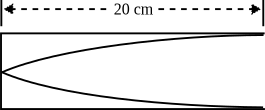
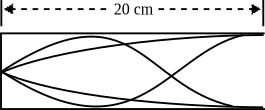
The diagram below shows the fundamental standing wave pattern in an air column that is closed at one end and open at the other.


  1. On the same diagram, draw the shape of the first overtone (which corresponds to the third harmonic) standing wave pattern.   (2 marks)

    --- 0 WORK AREA LINES (style=lined) ---

  2. State the frequencies of the fundamental and the first overtone (third harmonic) resonance modes for this air column.   (2 mark)

--- 4 WORK AREA LINES (style=lined) ---

Show Answers Only

a.    
         

 b.   The fundamental frequency is 425 Hz.

The frequency of the first overtone is 1275 Hz.

Show Worked Solution

a.  


b.    For the fundamental frequency \((f_1)\), \(\dfrac{\lambda_1}{4} = 0.2\ \text{m}\ \Rightarrow\ \lambda_1 = 0.8\ \text{m}\)

\(f_1 = \dfrac{v}{\lambda_1} = \dfrac{340}{0.8} = 425\ \text{Hz}\).

For the frequency of the first overtone \((f_2)\):

\(f_2 = 3 \times f_1 = 3 \times 425 = 1275\ \text{Hz}\).

Filed Under: Sound Waves Tagged With: Band 4, Band 5, smc-4280-40-Standing Waves in Closed Pipes

PHYSICS, M3 EQ-Bank 4 MC

Two musicians are tuning their instruments by playing notes at nearly the same frequency. As they adjust their instruments to match each other more closely in pitch, they begin to notice changes in the beat pattern.

What happens to the beat frequency and what do they hear when the two notes are perfectly in tune?

  1. The beats get slower, and then completely stop when the frequencies match.
  2. The beats get faster, and then completely stop when the frequencies match.
  3. The beats get louder, and continue at the same rate as the frequencies match.
  4. The beats get slower, and become more regular when the frequencies match.
Show Answers Only

\(A\)

Show Worked Solution
  • Beats occur when two sound waves of slightly different frequencies interfere with each other, creating a pulsing effect in loudness. The frequency of the beats is equal to the absolute difference between the two frequencies:
  •    \(f_{\text{beat}} = \abs{f_1-f_2}\)
  • As the two notes get closer in pitch, the difference between their frequencies decreases. This causes the beat frequency to get lower, so the beats sound slower.
  • When the two frequencies become exactly the same, the beat frequency becomes zero. This means no more interference pattern occurs, and the beats disappear completely. At this point, the two instruments are perfectly in tune, and you hear a single, steady tone.

\(\Rightarrow A\)

Filed Under: Sound Waves Tagged With: Band 5, smc-4280-30-Sound wave behaviour

HMS, HIC EQ-Bank 430

Australian research indicates that gambling participation increases dramatically when young people reach the legal gambling age of 18, with many forms of gambling showing substantial increases as young people gain legal access.

Analyse how individual strengthening skills can protect young people from developing gambling problems and enhance their overall wellbeing as they transition into legal gambling accessibility.   (8 marks)

--- 22 WORK AREA LINES (style=lined) ---

Show Answers Only

*Language to use that helps to highlight relationships and draw out implications is bolded.

Overview Statement

  • Individual strengthening skills including self-efficacy, health literacy, problem solving and resilience, interact with each other to protect young people from gambling problems.
  • These skills form protective relationships that influence decision-making as young people become old enough to legally gamble.

Self-efficacy and Health Literacy Relationship

  • Self-efficacy crosses over with health literacy by enabling young people to understand gambling risks.
  • When young people understand how gambling odds work against them and recognise addiction warning signs, they make informed choices to avoid gambling.
  • Evidence shows young adults with high self-efficacy combined with gambling awareness reduce participation by almost 50%.
  • This means that knowledge alone isn’t sufficient – confidence to act on that knowledge determines protective outcomes.
  • Therefore, these skills work together to resist peer pressure.

Problem-solving and Resilience Interaction

  • Problem-solving abilities depend on resilience when facing circumstances that trigger gambling urges.
  • Resilient young people use problem-solving to identify healthy alternatives like sport participation.
  • This relationship enables them to address real world pressures without any accompanying financial risk.
  • Consequently, this combination prevents gambling becoming a coping mechanism for adult pressures.

Implications and Synthesis

  • These skills function as an integrated protection system rather than isolated factors.
  • Evidence indicates that pre-adult skill development can result in lifelong gambling resistance and the critical importance of pre-emptive education programs.
  • By strengthening multiple skills simultaneously, individuals can create a strong protection against gambling.
  • Young people equipped with this skill system are much more likely to transition safely into legal gambling age.
Show Worked Solution

*Language to use that helps to highlight relationships and draw out implications is bolded.

Overview Statement

  • Individual strengthening skills including self-efficacy, health literacy, problem solving and resilience, interact with each other to protect young people from gambling problems.
  • These skills form protective relationships that influence decision-making as young people become old enough to legally gamble.

Self-efficacy and Health Literacy Relationship

  • Self-efficacy crosses over with health literacy by enabling young people to understand gambling risks.
  • When young people understand how gambling odds work against them and recognise addiction warning signs, they make informed choices to avoid gambling.
  • Evidence shows young adults with high self-efficacy combined with gambling awareness reduce participation by almost 50%.
  • This means that knowledge alone isn’t sufficient – confidence to act on that knowledge determines protective outcomes.
  • Therefore, these skills work together to resist peer pressure.

Problem-solving and Resilience Interaction

  • Problem-solving abilities depend on resilience when facing circumstances that trigger gambling urges.
  • Resilient young people use problem-solving to identify healthy alternatives like sport participation.
  • This relationship enables them to address real world pressures without any accompanying financial risk.
  • Consequently, this combination prevents gambling becoming a coping mechanism for adult pressures.

Implications and Synthesis

  • These skills function as an integrated protection system rather than isolated factors.
  • Evidence indicates that pre-adult skill development can result in lifelong gambling resistance and the critical importance of pre-emptive education programs.
  • By strengthening multiple skills simultaneously, individuals can create a strong protection against gambling.
  • Young people equipped with this skill system are much more likely to transition safely into legal gambling age.

Filed Under: Strengthening, protecting and enhancing health Tagged With: Band 4, Band 5, smc-5511-10-Personal empowerment, smc-5511-20-Health management

HMS, HIC EQ-Bank 128

Alex is a 17-year-old living in a rural town who has been experiencing depression and anxiety following family breakdown. The nearest mental health professional is 200km away, and Alex's family cannot afford private treatment. The local school has basic counselling services, but Alex feels uncomfortable accessing them due to stigma in the small community.

Discuss the effectiveness of ways in which the government, non-government organisations and the community could advocate for Alex's health needs.   (8 marks)

--- 22 WORK AREA LINES (style=lined) ---

Show Answers Only

*PEEL – Solution is structured using separate PEEL methods for each side of the argument; [P] Identify the point, [E] expand on the point with a link to question asked, [Ev] apply evidence/examples, [L] linking sentence back to question.

Effective Government Advocacy:

  • [P] Government advocacy effectively addresses Alex’s access barriers through systematic solutions.
  • [E] Legislative power is able to create telehealth funding and mobile mental health services for rural areas.
  • [Ev] Medicare subsidies for online consultations eliminate 200km travel barriers.
  • [L] Government creates comprehensive, funded solutions to rural mental health inequities.

Limitations of Government Advocacy:

  • [P] Government advocacy fails to provide immediate crisis intervention.
  • [E] Bureaucratic red tape can create lengthy implementation delays.
  • [Ev] Policy changes requiring approval cannot address Alex’s urgent depression symptoms.
  • [L] Government solutions lack immediacy needed for mental health crises.

Effective NGO Advocacy:

  • [P] NGOs provide most effective immediate support for Alex’s circumstances.
  • [E] Independent operation enables rapid crisis response with youth-focused services.
  • [Ev] For example, NGO’s such as headspace offer 24/7 support, online counselling, addressing stigma concerns.
  • [L] In this way, NGOs fill critical gaps through immediate, accessible mental health intervention.

Limitations of NGO Advocacy:

  • [P] NGO advocacy limited by resource constraints and sustainability issues.
  • [E] Donation-dependent funding creates uncertainty.
  • [Ev] Cannot establish permanent rural infrastructure or guarantee ongoing availability.
  • [L] Resource limitations compromise long-term comprehensive support.

Effective Community Advocacy:

  • [P] Community advocacy can effectively address local stigma and social support needs.
  • [E] Local understanding enables culturally appropriate mental health initiatives.
  • [Ev] Peer support groups can normalise help-seeking behaviour in a rural context and direct Alex to government and NGO health services.
  • [L] Community can transform local attitudes supporting Alex’s recovery.

Limitations of Community Advocacy:

  • [P] Community advocacy cannot replace professional clinical intervention.
  • [E] Community members lack specialised mental health training and expertise.
  • [Ev] They also cannot assess Alex or prescribe drugs or treatment for his depression.
  • [L] Community support is valuable but insufficient, by itself, for Alex’s clinical needs. When it complements other governmental and NGO health services, the best outcomes are achievable.
Show Worked Solution

*PEEL – Solution is structured using separate PEEL methods for each side of the argument; [P] Identify the point, [E] expand on the point with a link to question asked, [Ev] apply evidence/examples, [L] linking sentence back to question.

Effective Government Advocacy

  • [P] Government advocacy effectively addresses Alex’s access barriers through systematic solutions.
  • [E] Legislative power is able to create telehealth funding and mobile mental health services for rural areas.
  • [Ev] Medicare subsidies for online consultations eliminate 200km travel barriers.
  • [L] Government creates comprehensive, funded solutions to rural mental health inequities.

Limitations of Government Advocacy

  • [P] Government advocacy fails to provide immediate crisis intervention.
  • [E] Bureaucratic red tape can create lengthy implementation delays.
  • [Ev] Policy changes requiring approval cannot address Alex’s urgent depression symptoms.
  • [L] Government solutions lack immediacy needed for mental health crises.

Effective NGO Advocacy

  • [P] NGOs provide most effective immediate support for Alex’s circumstances.
  • [E] Independent operation enables rapid crisis response with youth-focused services.
  • [Ev] For example, NGO’s such as headspace offer 24/7 support, online counselling, addressing stigma concerns.
  • [L] In this way, NGOs fill critical gaps through immediate, accessible mental health intervention.

Limitations of NGO Advocacy

  • [P] NGO advocacy limited by resource constraints and sustainability issues.
  • [E] Donation-dependent funding creates uncertainty.
  • [Ev] Cannot establish permanent rural infrastructure or guarantee ongoing availability.
  • [L] Resource limitations compromise long-term comprehensive support.

Effective Community Advocacy

  • [P] Community advocacy can effectively address local stigma and social support needs.
  • [E] Local understanding enables culturally appropriate mental health initiatives.
  • [Ev] Peer support groups can normalise help-seeking behaviour in a rural context and direct Alex to government and NGO health services.
  • [L] Community can transform local attitudes supporting Alex’s recovery.

Limitations of Community Advocacy

  • [P] Community advocacy cannot replace professional clinical intervention.
  • [E] Community members lack specialised mental health training and expertise.
  • [Ev] They also cannot assess Alex or prescribe drugs or treatment for his depression.
  • [L] Community support is valuable but insufficient, by itself, for Alex’s clinical needs. When it complements other governmental and NGO health services, the best outcomes are achievable.

Filed Under: Individual, organisational and community advocacy Tagged With: Band 4, Band 5, Band 6, smc-5512-20-Government, smc-5512-40-NGOs, smc-5512-50-Other organisations

HMS, HIC EQ-Bank 095 MC

A remote Aboriginal community has limited access to healthcare services. The government responds by establishing a mobile health clinic program and partnering with local Aboriginal Health Services to provide culturally appropriate care for young people.

This government action primarily demonstrates which combination of advocacy responsibilities?

  1. Setting policies and strengthening community partnerships.
  2. Developing personal skills and creating supportive environments.
  3. Building healthy public policy and reorienting health services.
  4. Allocating funding and implementing targeted programs.
Show Answers Only

\(D\)

Show Worked Solution
  • D is correct because the government is allocating funding (establishing the mobile clinic program) and implementing targeted programs (culturally appropriate care for young people in remote areas).

Other options:

  • A is incorrect because while partnerships exist, the primary focus is on funding allocation and program implementation rather than policy setting.
  • B is incorrect because these are Ottawa Charter action areas rather than the government’s specific advocacy roles.
  • C is incorrect because these are also Ottawa Charter action areas, not specific government advocacy responsibilities as outlined in the syllabus.

Filed Under: Individual, organisational and community advocacy Tagged With: Band 5, smc-5512-20-Government

HMS, HIC EQ-Bank 127

A 16-year-old student, Maya, is struggling with anxiety but cannot access affordable mental health services through the public system due to long waiting lists. Meanwhile, her school has recently implemented a new wellbeing curriculum mandated by the state government.

Describe the differences between how government and non-government organisations would advocate for Maya's health needs in this situation.   (5 marks)

--- 15 WORK AREA LINES (style=lined) ---

Show Answers Only

Government advocacy:

  • Government advocacy for Maya would involve systematic, policy-level responses.
  • The government could addresses Maya’s needs through mandatory school wellbeing programs, funding public mental health services, and setting Medicare rebate structures.
  • However, government responses are often slow due to bureaucratic red tape and focus on population-wide solutions rather than immediate individual needs.
  • The government’s role is creating frameworks and policies that should prevent situations like Maya’s.

NGO advocacy:

  • NGO advocacy provides immediate, targeted support that government cannot deliver.
  • Organisations like headspace would offer Maya direct counselling services without waiting lists, filling gaps in the system.
  • NGOs advocate by providing evidence of unmet needs to government, offering specialised youth-focused services, and adapting quickly to emerging mental health trends.
  • They can provide culturally appropriate support and innovative service delivery models that complement government frameworks.
  • Both approaches are necessary – the government provides the funding and creates the framework while NGOs provide responsive, specialised advocacy and services.
Show Worked Solution

Government advocacy:

  • Government advocacy for Maya would involve systematic, policy-level responses.
  • The government could addresses Maya’s needs through mandatory school wellbeing programs, funding public mental health services, and setting Medicare rebate structures.
  • However, government responses are often slow due to bureaucratic red tape and focus on population-wide solutions rather than immediate individual needs.
  • The government’s role is creating frameworks and policies that should prevent situations like Maya’s.

NGO advocacy:

  • NGO advocacy provides immediate, targeted support that government cannot deliver.
  • Organisations like headspace would offer Maya direct counselling services without waiting lists, filling gaps in the system.
  • NGOs advocate by providing evidence of unmet needs to government, offering specialised youth-focused services, and adapting quickly to emerging mental health trends.
  • They can provide culturally appropriate support and innovative service delivery models that complement government frameworks.
  • Both approaches are necessary – the government provides the funding and creates the framework while NGOs provide responsive, specialised advocacy and services.

Filed Under: Individual, organisational and community advocacy Tagged With: Band 4, Band 5, smc-5512-20-Government, smc-5512-40-NGOs

Financial Maths, STD2 F4 2020 HSC 11 MC (Adapted)

An industrial machine is depreciated using the declining-balance method with a rate of 10% per quarter. The machine was bought for $12,000.

What is the salvage value of the machine after 2 years?

  1. $4893.21
  2. $5165.61
  3. $6543.82
  4. $7200.25
Show Answers Only

`B`

Show Worked Solution

♦ Remember: 10% depreciation per **quarter**, and 2 years = 8 quarters.

`V_0 = 12\ 000 \ , \ r = 0.10 \ , \ n = 8`

`S` `= V_0 (1-r)^n`
  `= 12\ 000 (1-0.10)^8`
  `= 12\ 000 (0.90)^8`
  `= 12\ 000 × 0.43046721`
  `= $5165.61`

`Rightarrow B`

Filed Under: Depreciation - Declining Balance (Std2-X), Depreciation (Y12-X) Tagged With: adapted, Band 5, smc-1139-10-Find \(S\), smc-7727-20-Declining Balance, smc-813-10-Find \(S\)

PHYSICS, M3 EQ-Bank 5

A tightly stretched string, fixed at both ends, is 1.80 m long. When it vibrates at a frequency of 90 Hz, it forms a standing wave pattern with three antinodes (loops) as seen below:

  1. What is the wavelength of the waves on the string?   (1 mark)

--- 2 WORK AREA LINES (style=lined) ---

  1. Calculate the wave speed along the string.   (1 mark)

--- 2 WORK AREA LINES (style=lined) ---

  1. Determine the fundamental frequency (lowest possible standing wave frequency) for this string. Show your reasoning.   (2 marks)

--- 4 WORK AREA LINES (style=lined) ---

Show Answers Only

a.    \(1.20\ \text{m}\)

b.    \(108\ \text{m/s}\)

c.    \(30\ \text{Hz}\)

Show Worked Solution

a.    There are \(\dfrac{3}{2}\lambda\) on the \(1.80\ \text{m}\) string.

\(\therefore \lambda = \dfrac{2}{3} \times 1.80 = 1.20\ \text{m}\)
 

b.    \(v = f\lambda = 90 \times 1.2 = 108\ \text{m/s}\).
 

c.    Fundamental frequency occurs when the wavelength of the standing wave is the largest.

  • This will occur when \(\dfrac{\lambda}{2} = 1.80\ \text{m} \ \Rightarrow \ \lambda = 3.6\ \text{m}\).
  •    \(f = \dfrac{v}{\lambda} = \dfrac{108}{3.6} = 30\ \text{Hz}\).

Filed Under: Sound Waves Tagged With: Band 3, Band 5, smc-4280-20-Modelling standing waves

Calculus, 2ADV C4 EQ-Bank 30

Evaluate  \(\displaystyle \int_{-2}^0 \sqrt{4-x^2} \, d x\).   (3 marks)

--- 6 WORK AREA LINES (style=lined) ---

Show Answers Only

\(\pi\)

Show Worked Solution

\(\sqrt{4-x^2} \ \ \text{is a semicircle, centre}\ \ (0,0) \ \ \text {and radius 2.}\)
 

STRATEGY: This integral is beyond 2ADV integration techniques. An alternate strategy is required.
\(\displaystyle \int_{-2}^0 \sqrt{4-x^2} \, d x \ \) \( \ =\ \text{Shaded area (above)}\)
  \(=\dfrac{1}{4} \times \pi+2^2\)
  \(=\pi\)

Filed Under: Area Under Curves, Areas Under Curves Tagged With: Band 5, smc-7131-60-Other, smc-7131-70-Areas Without Calculus, smc-975-60-Other, smc-975-70-Areas Without Calculus

PHYSICS, M3 EQ-Bank 4

A fire truck is moving toward a stationary observer at a speed of 20 ms\(^{-1}\). The siren on the fire truck emits sound at a frequency of 600 Hz.
 

  1. Calculate the observed frequency of the siren as heard by the observer.   (1 mark)

--- 2 WORK AREA LINES (style=lined) ---

  1. The flashing lights on the fire truck do not show a noticeable Doppler shift as it passes by. Explain why the Doppler effect for light is not observed in this situation.   (2 marks)

--- 4 WORK AREA LINES (style=lined) ---

Show Answers Only

a.    \(638\ \text{Hz}\)

b.    The Doppler effect for light:

  • The effect does occur for light, but it is only noticeable when objects move at speeds close to the speed of light.
  • Since the fire truck is moving at only 20 ms\(^{-1}\), the change in frequency of the light is extremely small, far too small for the human eye to detect.
  • Therefore, the Doppler shift for the headlights is negligible and not observable in this everyday situation.
Show Worked Solution

a.    By the Doppler effect:

\(f^{′} = f \dfrac{v \pm v_{\text{observer}}}{v \mp v_{\text{source}}} = 600 \times \dfrac{340}{340-20} = 638\ \text{Hz}\)
 

b.    The Doppler effect for light:

  • The effect does occur for light, but it is only noticeable when objects move at speeds close to the speed of light.
  • Since the fire truck is moving at only 20 ms\(^{-1}\), the change in frequency of the light is extremely small, far too small for the human eye to detect.
  • Therefore, the Doppler shift for the headlights is negligible and not observable in this everyday situation.

Filed Under: Sound Waves Tagged With: Band 4, Band 5, smc-4280-10-Doppler effect

PHYSICS, M3 EQ-Bank 6

An arrow of height 2 cm is placed 6 cm in front of a biconvex lens of focal length 3cm.

  1. Draw a principle ray diagram to show the image that is formed.   (3 marks)


  1. Is the image real or virtual and give a reason for your answer.   (2 marks)

--- 3 WORK AREA LINES (style=lined) ---

  1. Use the principle ray diagram to determine the size of the image.   (1 mark)

--- 1 WORK AREA LINES (style=lined) ---

Show Answers Only

a.  
       

b.   The image is real.

  • The rays of light from the arrow are bent toward each other by the lens and actually converge on the opposite side of the lens.
  • Because the rays physically meet, a real image is formed.

c.    The size of the image is 2 cm.

Show Worked Solution

a.    


b.   The image is real.

  • The rays of light from the arrow are bent toward each other by the lens and actually converge on the opposite side of the lens.
  • Because the rays physically meet, a real image is formed.

c.    The size of the image is 2 cm.

Filed Under: Ray Model of Light Tagged With: Band 4, Band 5, smc-4281-55-Mirrors/Lenses

HMS, HIC EQ-Bank 428

Aboriginal and Torres Strait Islander young people experience significantly higher rates of mental health issues and suicide compared to non-Indigenous young people.

Outline the roles of government and non-government organisations in addressing this issue and discuss strategies they could adopt to improve the mental health outcomes of Aboriginal and Torres Strait Islander young people.   (6 marks)

--- 18 WORK AREA LINES (style=lined) ---

Show Answers Only

*Recommended phrases for balanced “for/against” language are bolded in the answer below.

Government Role

  • Provide funding for culturally appropriate mental health services specifically designed for ATSI communities

Government Strategies

  • Implement culturally responsive mental health programs in schools with high ATSI student populations. While this provides accessible early intervention, critics contend school-based programs often fail to be effective for disconnected youth.
  • Develop Aboriginal Community Controlled Health Organisation partnerships. On one hand, this ensures cultural governance. On the other hand, bureaucratic requirements may slow implementation.

NGO Role

  • Deliver community-based support programs incorporating traditional healing practices alongside contemporary mental health approaches.

NGO Strategies

  • Establish peer support networks led by ATSI young people to reduce stigma. A key advantage is connecting young people with relatable role models. Conversely, young leaders may lack training for difficult cases. This creates both opportunities for culturally safe spaces and challenges in ensuring support quality.
  • Train ATSI Elders as mental health first aid advocates. From one perspective, this respects traditional knowledge systems. An alternative perspective suggests Elders may feel burdened with Western responsibilities. Nevertheless, combining traditional wisdom with contemporary training offers sustainable solutions despite potential tensions.
Show Worked Solution

*Recommended phrases for balanced “for/against” language are bolded in the answer below.

Government Role

  • Provide funding for culturally appropriate mental health services specifically designed for ATSI communities

Government Strategies

  • Implement culturally responsive mental health programs in schools with high ATSI student populations. While this provides accessible early intervention, critics contend school-based programs often fail to be effective for disconnected youth.
  • Develop Aboriginal Community Controlled Health Organisation partnerships. On one hand, this ensures cultural governance. On the other hand, bureaucratic requirements may slow implementation.

NGO Role

  • Deliver community-based support programs incorporating traditional healing practices alongside contemporary mental health approaches.

NGO Strategies

  • Establish peer support networks led by ATSI young people to reduce stigma. A key advantage is connecting young people with relatable role models. Conversely, young leaders may lack training for difficult cases. This creates both opportunities for culturally safe spaces and challenges in ensuring support quality.
  • Train ATSI Elders as mental health first aid advocates. From one perspective, this respects traditional knowledge systems. An alternative perspective suggests Elders may feel burdened with Western responsibilities. Nevertheless, combining traditional wisdom with contemporary training offers sustainable solutions despite potential tensions.

Filed Under: Individual, organisational and community advocacy Tagged With: Band 4, Band 5, smc-5512-20-Government, smc-5512-40-NGOs

HMS, HIC EQ-Bank 425

The eSafety Commissioner provides educational resources, cyberbullying reporting systems, and online safety programs specifically targeting Australian young people and their families.

Identify TWO such resources and explain how they address technology-related health issues in young Australians.   (5 marks)

--- 15 WORK AREA LINES (style=lined) ---

Show Answers Only

*Language highlighting the cause-effect relationship is bolded in the answer below.

Answers could include any two of the following:

Cyberbullying reporting portal

  • This online system allows young people to report serious cyberbullying incidents directly to eSafety, who can then require social media platforms to remove harmful content within 24 hours.
  • This leads to immediate reduction in psychological harm because victims regain control over their online experience and see tangible action taken against perpetrators.
  • As a result, young people feel empowered to seek help early, which prevents the escalation of mental health issues like anxiety and depression that occur when cyberbullying continues unchecked.

Online safety education programs

  • These school-based initiatives teach young people to recognise online risks, manage their digital footprint, and develop resilience strategies against cyber-threats.
  • This works by building critical thinking skills that enable students to identify predatory behaviour, scams, and harmful content before engaging with them.
  • The reason this is effective is that prevention through education creates long-lasting protective behaviours, which results in fewer technology-related mental health issues and demonstrates why early intervention through schools is crucial.

Parent and carer resources

  • Educational materials help adults understand online risks, privacy settings, and age-appropriate content restrictions for different platforms.
  • This occurs because informed parents can implement protective measures at home, which creates safer digital environments where young people can explore technology without excessive exposure to harmful content.
  • This relationship results in stronger family communication about online experiences, thereby reducing the likelihood of young people hiding cyber-incidents and ensuring early intervention when problems arise.

Safer Internet Day campaigns

  • Annual awareness activities promote positive online behaviours, digital citizenship, and responsible technology use among young Australians through schools and community events.
  • This happens when widespread messaging reaches multiple stakeholders simultaneously, which causes a collective shift in understanding about healthy online interactions.
  • This demonstrates why community-wide approaches are powerful – they create social norms around respectful online behaviour, which leads to reduced cyberbullying incidents and establishes technology use as a shared responsibility between young people, families, and schools.
Show Worked Solution

*Language highlighting the cause-effect relationship is bolded in the answer below.

Answers could include any two of the following:

Cyberbullying reporting portal

  • This online system allows young people to report serious cyberbullying incidents directly to eSafety, who can then require social media platforms to remove harmful content within 24 hours.
  • This leads to immediate reduction in psychological harm because victims regain control over their online experience and see tangible action taken against perpetrators.
  • As a result, young people feel empowered to seek help early, which prevents the escalation of mental health issues like anxiety and depression that occur when cyberbullying continues unchecked.

Online safety education programs

  • These school-based initiatives teach young people to recognise online risks, manage their digital footprint, and develop resilience strategies against cyber-threats.
  • This works by building critical thinking skills that enable students to identify predatory behaviour, scams, and harmful content before engaging with them.
  • The reason this is effective is that prevention through education creates long-lasting protective behaviours, which results in fewer technology-related mental health issues and demonstrates why early intervention through schools is crucial.

Parent and carer resources

  • Educational materials help adults understand online risks, privacy settings, and age-appropriate content restrictions for different platforms.
  • This occurs because informed parents can implement protective measures at home, which creates safer digital environments where young people can explore technology without excessive exposure to harmful content.
  • This relationship results in stronger family communication about online experiences, thereby reducing the likelihood of young people hiding cyber-incidents and ensuring early intervention when problems arise.

Safer Internet Day campaigns

  • Annual awareness activities promote positive online behaviours, digital citizenship, and responsible technology use among young Australians through schools and community events.
  • This happens when widespread messaging reaches multiple stakeholders simultaneously, which causes a collective shift in understanding about healthy online interactions.
  • This demonstrates why community-wide approaches are powerful – they create social norms around respectful online behaviour, which leads to reduced cyberbullying incidents and establishes technology use as a shared responsibility between young people, families, and schools.

Filed Under: Research and Health Related Issues Tagged With: Band 4, Band 5, smc-5800-20-Current strategies

HMS, HIC EQ-Bank 422

Describe areas for further research that could build understanding and advocacy regarding sense of self and body issues among young Australians.   (4 marks)

--- 10 WORK AREA LINES (style=lined) ---

Show Answers Only

Social media impact studies:

  • Longitudinal research examining how different social media platforms and usage patterns specifically influence body image development and self-esteem in Australian adolescents.

Cultural diversity research:

  • Investigating how body image perceptions vary across different cultural backgrounds within Australia’s multicultural youth population to develop culturally appropriate interventions.

Gender identity studies:

  • Research exploring body image experiences among gender-diverse young people to better understand their unique challenges and support needs.

Early intervention effectiveness:

  • Evaluating which school-based body positivity programs show the most promising results in preventing eating disorders and improving self-concept among young Australians.
Show Worked Solution

Social media impact studies:

  • Longitudinal research examining how different social media platforms and usage patterns specifically influence body image development and self-esteem in Australian adolescents.

Cultural diversity research:

  • Investigating how body image perceptions vary across different cultural backgrounds within Australia’s multicultural youth population to develop culturally appropriate interventions.

Gender identity studies:

  • Research exploring body image experiences among gender-diverse young people to better understand their unique challenges and support needs.

Early intervention effectiveness:

  • Evaluating which school-based body positivity programs show the most promising results in preventing eating disorders and improving self-concept among young Australians.

Filed Under: Research and Health Related Issues Tagged With: Band 4, Band 5, smc-5800-25-Strategy dev and advocacy

PHYSICS, M3 EQ-Bank 10 MC

A candle is placed in front of a concave mirror, positioned beyond the centre of curvature.


Which of the following best describes the image formed by the mirror?

  1. Real, diminished and inverted
  2. Real, magnified and upright
  3. Virtual, diminished and upright
  4. Virtual, magnified and inverted
Show Answers Only

\(A\)

Show Worked Solution

When an object is placed beyond the centre of curvature of a concave mirror, the image formed is:

  • Real – because the reflected rays converge.
  • Inverted – the image appears upside down relative to the object.
  • Diminished – the image is smaller than the object.

\(\Rightarrow A\)

Filed Under: Ray Model of Light Tagged With: Band 5, smc-4281-45-Light Reflection, smc-4281-55-Mirrors/Lenses

PHYSICS, M3 EQ-Bank 5

Optical fibres are made using materials with different refractive indices to allow total internal reflection. The diagram below shows an optical fibre with a core and an outer cladding.

A laser beam with a wavelength of 620 nm in air is directed into the fibre from air.
 

  1. Calculate the frequency of the laser light before entering the optical fibre.   (2 marks)

--- 4 WORK AREA LINES (style=lined) ---

  1. The refractive index of the core is 1.50 and the cladding is 1.40. Calculate the critical angle at the core–cladding boundary.
    Show all working.   (2 marks)

--- 4 WORK AREA LINES (style=lined) ---

  1. What is the frequency of the light while it is travelling through the optical fibre?   (1 mark)

--- 2 WORK AREA LINES (style=lined) ---

Show Answers Only

a.    \(4.84 \times 10^{14}\ \text{Hz}\)

b.    \(61.9^{\circ}\)

c.    → Frequency of light is independent of the medium it is travelling through.

→ The frequency will be \(4.84 \times 10^{14}\ \text{Hz}\) as it travels though the optical fibre.

Show Worked Solution
a.     \(f\) \(=\dfrac{c}{\lambda}\)
    \(=\dfrac{3 \times 10^8}{620 \times 10^{-9}}\)
    \(=4.84 \times 10^{14}\ \text{Hz}\)


b.     \(\sin\theta_c\) \(=\dfrac{n_1}{n_2}\)
  \(\theta_c\) \(=\sin^{-1}\left(\dfrac{n_1}{n_2}\right)=\sin^{-1}\left(\dfrac{1.5}{1.7}\right)=61.9^{\circ}\)

 
c.   
Frequency of light:

  • Frequency of light is independent of the medium it is travelling through.
  • The frequency will be \(4.84 \times 10^{14}\ \text{Hz}\) as it travels though the optical fibre.

Filed Under: Ray Model of Light Tagged With: Band 4, Band 5, smc-4281-20-Snell's Law and TIR

PHYSICS, M3 EQ-Bank 9 MC

A point light source emits light uniformly in all directions. At a distance of 1 metre, a detector records a certain light intensity.

At what distance from the source would the intensity be expected to drop to \(\dfrac{1}{200}\)th of its value at 1 metre?

  1. 2 m
  2. 14 m
  3. 20 m
  4. 200 m
Show Answers Only

\(B\)

Show Worked Solution
  • Light intensity decreases via the inverse square law: \(I_1r_1^2 = I_2r_2^2\)
  • Let \(I_1 = 200\), \(r_1 = 1\)
  • Find \(r_2\) when  \(I_2 = 1\):
\(200 \times 1^2\) \(= 1 \times r_2^2\)  
\(r_2\) \(=\sqrt{200}=14.1\ \text{m}\)  

 
\(\Rightarrow B\)

Filed Under: Ray Model of Light Tagged With: Band 5, smc-4281-50-Light Intensity

PHYSICS, M3 EQ-Bank 11 MC

Which of the following best describes what happens to the wave as it enters medium 2?
 

  1. The wavelength decreases.
  2. The frequency increases.
  3. The wavelength increases.
  4. The frequency decreases.
Show Answers Only

\(C\)

Show Worked Solution
  • The light ray for the wave can be drawn as seen in the diagram below:
     

  • As the wave enters medium 2, the wave refracts away from the normal. This indicates that the wave is speeding up.
  • The frequency of the wave does not change when it enters a new medium. Therefore, as \(v = f\lambda\), the wavelength of the wave \(\lambda)\) must increase as the velocity increases.

\(\Rightarrow C\)

Filed Under: Wave Properties and Behaviour Tagged With: Band 5, smc-4278-60-Refraction

HMS, HIC EQ-Bank 123

Discuss how physical resources in a community can act as both positive and negative determinants of health.   (4 marks)

--- 10 WORK AREA LINES (style=lined) ---

Show Answers Only

*PEEL – Solution is structured using separate PEEL methods for each side of the argument; [P] Identify the point, [E] expand on the point with a link to question asked, [Ev] apply evidence/examples, [L] linking sentence back to question.

  • [P] On one hand, adequate physical resources promote positive health outcomes.
  • [E] Parks, sporting facilities, cycleways and safe footpaths make it easier for people to be active and socialise.
  • [Ev] For example, a well-lit local park with walking paths encourages regular exercise, reducing the risk of obesity and cardiovascular disease.
  • [L] In this way, good community infrastructure supports healthy behaviours.
      
  • [P] Conversely, a lack of physical resources creates barriers to good health.
  • [E] Communities without public transport, recreational facilities or shade offer fewer opportunities to be active or reach services.
  • [Ev] For instance, outer-suburb residents with poor public transport may struggle to attend appointments and are often more sedentary.
  • [L] Consequently, inadequate resources can widen health inequities between communities.
Show Worked Solution

*PEEL – Solution is structured using separate PEEL methods for each side of the argument; [P] Identify the point, [E] expand on the point with a link to question asked, [Ev] apply evidence/examples, [L] linking sentence back to question.

  • [P] On one hand, adequate physical resources promote positive health outcomes.
  • [E] Parks, sporting facilities, cycleways and safe footpaths make it easier for people to be active and socialise.
  • [Ev] For example, a well-lit local park with walking paths encourages regular exercise, reducing the risk of obesity and cardiovascular disease.
  • [L] In this way, good community infrastructure supports healthy behaviours.
      
  • [P] Conversely, a lack of physical resources creates barriers to good health.
  • [E] Communities without public transport, recreational facilities or shade offer fewer opportunities to be active or reach services.
  • [Ev] For instance, outer-suburb residents with poor public transport may struggle to attend appointments and are often more sedentary.
  • [L] Consequently, inadequate resources can widen health inequities between communities.

Filed Under: Environmental Tagged With: Band 4, Band 5, smc-5804-45-Community resources, smc-5804-55-Inequities

HMS, HIC EQ-Bank 122

Describe how political structures and policies can function as a determinant of health in Australia.   (5 marks)

--- 15 WORK AREA LINES (style=lined) ---

Show Answers Only

Answers could include a selection of the following:

Healthcare systems

  • The Australian Government funds Medicare, which provides free treatment in public hospitals and subsidised visits to doctors.
  • It also funds the Pharmaceutical Benefits Scheme, which lowers the cost of prescription medicines.
  • This reduces cost as a barrier, so more people can access care when they need it.

Laws and regulations

  • Governments pass laws that protect health, such as tobacco plain packaging, food safety standards and workplace health and safety rules.
  • These laws reduce exposure to risks across the whole population.
  • For example, tobacco laws have contributed to a long-term fall in smoking rates.

Funding decisions

  • Budget decisions determine how much money goes to hospitals, mental health services and rural health programs.
  • Areas that receive less funding may have longer waiting times and fewer services.

Policies beyond health

  • Policies on housing, education and welfare also affect health, as they shape people’s living conditions and opportunities.
  • For example, secure housing reduces stress and exposure to unsafe living conditions.
Show Worked Solution

Answers could include a selection of the following:

Healthcare systems

  • The Australian Government funds Medicare, which provides free treatment in public hospitals and subsidised visits to doctors.
  • It also funds the Pharmaceutical Benefits Scheme, which lowers the cost of prescription medicines.
  • This reduces cost as a barrier, so more people can access care when they need it.

Laws and regulations

  • Governments pass laws that protect health, such as tobacco plain packaging, food safety standards and workplace health and safety rules.
  • These laws reduce exposure to risks across the whole population.
  • For example, tobacco laws have contributed to a long-term fall in smoking rates.

Funding decisions

  • Budget decisions determine how much money goes to hospitals, mental health services and rural health programs.
  • Areas that receive less funding may have longer waiting times and fewer services.

Policies beyond health

  • Policies on housing, education and welfare also affect health, as they shape people’s living conditions and opportunities.
  • For example, secure housing reduces stress and exposure to unsafe living conditions.

Filed Under: Broad features of society Tagged With: Band 4, Band 5, smc-5803-45-Political structures

HMS, HIC EQ-Bank 121

Discuss how language and media as broad features of society can both create and reduce health inequities in Australia.   (6 marks)

--- 18 WORK AREA LINES (style=lined) ---

Show Answers Only

*PEEL – Solution is structured using separate PEEL methods for each side of the argument; [P] Identify the point, [E] expand on the point with a link to question asked, [Ev] apply evidence/examples, [L] linking sentence back to question.

Creating health inequities

  • [P] On one hand, language barriers prevent people with limited English from using health services.
  • [E] This creates inequity, as they may not understand diagnoses or medication instructions.
  • [Ev] For example, newly arrived refugees may avoid appointments if no interpreter is available.
  • [L] This shows how language can widen health inequities.
      
  • [P] From one perspective, mainstream media can exclude minority groups.
  • [E] Health messages are often only in English and rarely reflect cultural diversity.
  • [Ev] As a result, some culturally and linguistically diverse communities miss prevention information, such as screening reminders.
  • [L] Narrow media focus therefore worsens existing inequities.

Reducing health inequities

  • [P] Conversely, interpreter services reduce language barriers.
  • [E] They allow patients to understand and consent to their treatment.
  • [Ev] For example, TIS National provides free interpreting for doctors and their patients.
  • [L] In this way, language support directly reduces inequity.
      
  • [P] Culturally targeted media can also promote health equity.
  • [E] It reaches groups that mainstream campaigns often miss.
  • [Ev] During COVID-19, SBS and government agencies provided health information in many languages.
  • [L] This shows media can bridge information gaps.

Despite these benefits, interpreters and translated materials are not always available. Nevertheless, both can significantly reduce inequities when properly resourced.

Show Worked Solution

*PEEL – Solution is structured using separate PEEL methods for each side of the argument; [P] Identify the point, [E] expand on the point with a link to question asked, [Ev] apply evidence/examples, [L] linking sentence back to question.

Creating health inequities

  • [P] On one hand, language barriers prevent people with limited English from using health services.
  • [E] This creates inequity, as they may not understand diagnoses or medication instructions.
  • [Ev] For example, newly arrived refugees may avoid appointments if no interpreter is available.
  • [L] This shows how language can widen health inequities.
      
  • [P] From one perspective, mainstream media can exclude minority groups.
  • [E] Health messages are often only in English and rarely reflect cultural diversity.
  • [Ev] As a result, some culturally and linguistically diverse communities miss prevention information, such as screening reminders.
  • [L] Narrow media focus therefore worsens existing inequities.

Reducing health inequities

  • [P] Conversely, interpreter services reduce language barriers.
  • [E] They allow patients to understand and consent to their treatment.
  • [Ev] For example, TIS National provides free interpreting for doctors and their patients.
  • [L] In this way, language support directly reduces inequity.
      
  • [P] Culturally targeted media can also promote health equity.
  • [E] It reaches groups that mainstream campaigns often miss.
  • [Ev] During COVID-19, SBS and government agencies provided health information in many languages.
  • [L] This shows media can bridge information gaps.

Despite these benefits, interpreters and translated materials are not always available. Nevertheless, both can significantly reduce inequities when properly resourced.

Filed Under: Broad features of society Tagged With: Band 4, Band 5, smc-5803-40-Media/peer influence, smc-5803-50-Culture, smc-5803-55-Inequities

HMS, HIC EQ-Bank 413

To what extent can protective factors prevent substance misuse among young Australians.   (12 marks)

--- 30 WORK AREA LINES (style=lined) ---

Show Answers Only

Judgment Statement

  • Protective factors can significantly prevent substance misuse among young Australians.
  • Evidence shows family connections, personal skills, and community engagement substantially reduce risk.

Family and Personal Protective Factors:

  • Research has consistently shown that strong family relationships significantly reduce the risk of any individual becoming a drug addict.
  • Young people with parents who model responsible attitudes and communicate openly about risks show markedly lower substance use rates.
  • Clear family expectations create boundaries that guide decision-making during peer pressure situations.
  • One major reason why these factors work is that they establish healthy normative beliefs before exposure to substances.
  • Additionally, self-regulation skills provide crucial alternatives to substance use when facing stress.
  • Youth who learn mindfulness and healthy coping mechanisms show resilience in stressful situations that increase the risk for substance use.
  • These combined family and personal factors form powerful prevention barriers.

Community and School Connections

  • Community engagement through sports, arts, and volunteering creates protective social networks.
  • These activities provide identity, purpose, and recognition that reduce needs for substances as social tools.
  • School connectedness adds another protective layer through adult supervision and future goal orientation.
  • However, it is important to consider that some youth lack access to these protective environments.
  • Socioeconomic and cultural barriers can limit participation in activities or create family stress that undermines protection.
  • Despite this, protective factors remain the stronger influence on young Australians.

Reaffirmation

  • The evidence demonstrates protective factors significantly prevent youth substance misuse.
  • Multiple protective layers working together create resilience stronger than individual risk factors.
  • Implications suggest that investing in family support, personal skill development and community programs will further increase the most influential protective factors for young people.
Show Worked Solution

Judgment Statement

  • Protective factors can significantly prevent substance misuse among young Australians.
  • Evidence shows family connections, personal skills, and community engagement substantially reduce risk.

Family and Personal Protective Factors:

  • Research has consistently shown that strong family relationships significantly reduce the risk of any individual becoming a drug addict.
  • Young people with parents who model responsible attitudes and communicate openly about risks show markedly lower substance use rates.
  • Clear family expectations create boundaries that guide decision-making during peer pressure situations.
  • One major reason why these factors work is that they establish healthy normative beliefs before exposure to substances.
  • Additionally, self-regulation skills provide crucial alternatives to substance use when facing stress.
  • Youth who learn mindfulness and healthy coping mechanisms show resilience in stressful situations that increase the risk for substance use.
  • These combined family and personal factors form powerful prevention barriers.

Community and School Connections

  • Community engagement through sports, arts, and volunteering creates protective social networks.
  • These activities provide identity, purpose, and recognition that reduce needs for substances as social tools.
  • School connectedness adds another protective layer through adult supervision and future goal orientation.
  • However, it is important to consider that some youth lack access to these protective environments.
  • Socioeconomic and cultural barriers can limit participation in activities or create family stress that undermines protection.
  • Despite this, protective factors remain the stronger influence on young Australians.

Reaffirmation

  • The evidence demonstrates protective factors significantly prevent youth substance misuse.
  • Multiple protective layers working together create resilience stronger than individual risk factors.
  • Implications suggest that investing in family support, personal skill development and community programs will further increase the most influential protective factors for young people.

Filed Under: Research and Health Related Issues Tagged With: Band 4, Band 5, Band 6, smc-5800-15-Protective/risk factors

HMS, HIC EQ-Bank 412

Using ONE health-related issue affecting young people, evaluate the effectiveness of social justice principles in addressing health inequities experienced by young Australians.   (12 marks)

--- 30 WORK AREA LINES (style=lined) ---

Show Answers Only

Health related issue: Youth violence and bullying

Evaluation Statement

  • Social justice principles are partially effective in addressing youth violence and bullying among young Australians.
  • This evaluation examines equity in access to anti-violence programs and empowerment through participation.

Equity in Access to Programs

  • Equity principles partially fulfil the goal of equal protection from violence for all youth.
  • Evidence supporting this includes school-based anti-bullying programs reaching diverse student populations.
  • However, rural and remote communities have limited access to specialised support services. For example, Indigenous youth experience 2.5 times higher bullying rates despite targeted interventions.
  • While strong in metropolitan areas, programs show limitations in addressing geographic disparities.
  • Socioeconomic barriers prevent some families accessing private counselling when school programs prove insufficient.
  • A critical weakness is inconsistent program quality across different schools and regions.

Empowerment Through Participation

  • The participation principle strongly meets youth empowerment objectives.
  • Student-led anti-bullying committees are self reported by participants as more effective than adult-imposed policies.
  • Evidence indicates peer mentoring programs reduce bullying incidents by 30% in participating schools.
  • Research confirms youth-designed campaigns achieve higher engagement than traditional approaches. These campaigns promote young people’s leadership skills while creating culturally relevant solutions.
  • This comprehensive involvement addresses root causes rather than just symptoms.
  • The evidence indicates that meaningful participation transforms students from victims to advocates.

Final Evaluation

  • Weighing these factors shows social justice principles achieve moderate success overall.
  • The strengths in participation partially compensate for equity limitations.
  • Although effective for empowering engaged students, social justice principles prove less suitable for reaching marginalised youth
  • The overall evaluation demonstrates need for better resource distribution to underserved communities.
  • Implications suggest combining strong participation frameworks with targeted equity investments. This process will address both empowerment and access barriers simultaneously.
Show Worked Solution

Health related issue: Youth violence and bullying

Evaluation Statement

  • Social justice principles are partially effective in addressing youth violence and bullying among young Australians.
  • This evaluation examines equity in access to anti-violence programs and empowerment through participation.

Equity in Access to Programs

  • Equity principles partially fulfil the goal of equal protection from violence for all youth.
  • Evidence supporting this includes school-based anti-bullying programs reaching diverse student populations.
  • However, rural and remote communities have limited access to specialised support services. For example, Indigenous youth experience 2.5 times higher bullying rates despite targeted interventions.
  • While strong in metropolitan areas, programs show limitations in addressing geographic disparities.
  • Socioeconomic barriers prevent some families accessing private counselling when school programs prove insufficient.
  • A critical weakness is inconsistent program quality across different schools and regions.

Empowerment Through Participation

  • The participation principle strongly meets youth empowerment objectives.
  • Student-led anti-bullying committees are self reported by participants as more effective than adult-imposed policies.
  • Evidence indicates peer mentoring programs reduce bullying incidents by 30% in participating schools.
  • Research confirms youth-designed campaigns achieve higher engagement than traditional approaches. These campaigns promote young people’s leadership skills while creating culturally relevant solutions.
  • This comprehensive involvement addresses root causes rather than just symptoms.
  • The evidence indicates that meaningful participation transforms students from victims to advocates.

Final Evaluation

  • Weighing these factors shows social justice principles achieve moderate success overall.
  • The strengths in participation partially compensate for equity limitations.
  • Although effective for empowering engaged students, social justice principles prove less suitable for reaching marginalised youth
  • The overall evaluation demonstrates need for better resource distribution to underserved communities.
  • Implications suggest combining strong participation frameworks with targeted equity investments. This process will address both empowerment and access barriers simultaneously.

Filed Under: Research and Health Related Issues Tagged With: Band 4, Band 5, smc-5800-10-Youth health issue, smc-5800-15-Protective/risk factors

HMS, HIC EQ-Bank 411

Assess how youth violence affects the physical, social and mental wellbeing of young people in Australia.   (8 marks)

--- 22 WORK AREA LINES (style=lined) ---

Show Answers Only

Judgment Statement

  • Youth violence has substantial negative impact on young Australians’ overall wellbeing.
  • This assessment is based on its severity of health consequences and widespread occurrence across populations.

Physical and Mental Health Impact

  • Violence causes severe adverse effects on young people’s physical and mental health.
  • Evidence shows one in four Australian students experience weekly bullying resulting in physical injuries like bruising, fractures, and head trauma.
  • Mental health consequences include depression, anxiety and suicidal thoughts that persist into adulthood.
  • These effects further act to disrupt education and sport participation and can be a major contributor to measurable long-term health deterioration.
  • The combination of immediate physical harm and lasting psychological damage indicates major health impacts.

Social Wellbeing and Community Connection

  • Violence achieves considerable disruption to social relationships and community participation.
  • Victims experience social isolation, trust issues and withdrawal from protective activities like team sports.
  • Studies indicate a strong correlation between a young person’s exposure to violence and school disengagement.
  • Further, this research shows violence creates social anxiety preventing healthy peer relationships.
  • When all factors are considered, violence substantially undermines social support systems.

Overall Assessment

  • On the whole, youth violence proves highly damaging across all wellbeing dimensions. The substantial quantity of evidence confirms violence as a major public health concern.
  • Physical injuries, mental health disorders, and social disconnection combine to create comprehensive harm.
  • Implications of this assessment suggest the urgent implementation of prevention strategies and support services is required.
  • Creating safer environments requires policy reforms addressing this significant threat to young Australians’ wellbeing.
Show Worked Solution

Judgment Statement

  • Youth violence has substantial negative impact on young Australians’ overall wellbeing.
  • This assessment is based on its severity of health consequences and widespread occurrence across populations.

Physical and Mental Health Impact

  • Violence causes severe adverse effects on young people’s physical and mental health.
  • Evidence shows one in four Australian students experience weekly bullying resulting in physical injuries like bruising, fractures, and head trauma.
  • Mental health consequences include depression, anxiety and suicidal thoughts that persist into adulthood.
  • These effects further act to disrupt education and sport participation and can be a major contributor to measurable long-term health deterioration.
  • The combination of immediate physical harm and lasting psychological damage indicates major health impacts.

Social Wellbeing and Community Connection

  • Violence achieves considerable disruption to social relationships and community participation.
  • Victims experience social isolation, trust issues and withdrawal from protective activities like team sports.
  • Studies indicate a strong correlation between a young person’s exposure to violence and school disengagement.
  • Further, this research shows violence creates social anxiety preventing healthy peer relationships.
  • When all factors are considered, violence substantially undermines social support systems.

Overall Assessment

  • On the whole, youth violence proves highly damaging across all wellbeing dimensions. The substantial quantity of evidence confirms violence as a major public health concern.
  • Physical injuries, mental health disorders, and social disconnection combine to create comprehensive harm.
  • Implications of this assessment suggest the urgent implementation of prevention strategies and support services is required.
  • Creating safer environments requires policy reforms addressing this significant threat to young Australians’ wellbeing.

Filed Under: Research and Health Related Issues Tagged With: Band 5, Band 6, smc-5800-10-Youth health issue

HMS, HIC EQ-Bank 410

Evaluate the importance of health literacy skills in empowering young people to make positive health decisions about food choices.   (8 marks)

--- 22 WORK AREA LINES (style=lined) ---

Show Answers Only

*Recommended words/phrases for “Evaluation” keyword questions are highlighted in bold throughout the answer below.

Evaluation Statement

  • Health literacy skills are highly effective in empowering young people to make positive food choices.
  • This evaluation examines practical application abilities and long-term behaviour change impact.

Practical Application Abilities

  • Health literacy effectively equips young people with practical decision-making skills.
  • Evidence shows health-literate teens successfully read food labels and identify hidden sugars.
  • Research indicates they make significantly better supermarket choices than those without these skills.
  • This indicates a real world practical benefit as young people apply their knowledge to daily food selection.
  • The ability to decode marketing claims proves particularly valuable in today’s misleading food environment.

Long-term Behaviour Change

  • Health literacy is partially successful in achieving sustained healthy eating patterns.
  • While strong in building knowledge, only 5% of young Australians aged 15-24 meet recommended fruit and vegetable intake.
  • This shows limitations between possessing literacy and consistent application.
  • Social pressures and convenience often override health knowledge in food decisions.
  • Although effective for understanding nutrition, it proves less suitable for overcoming environmental barriers like cost and accessibility.
  • The gap between knowledge and action reveals moderate long-term success.

Final Evaluation

  • Weighing these factors shows health literacy is highly valuable but insufficient alone.
  • The strengths outweigh weaknesses because foundational skills enable lifelong learning.
  • The overall evaluation demonstrates health literacy forms a critical foundation requiring environmental support.
  • Implications suggest combining literacy education with practical cooking skills and improved food access.
Show Worked Solution

*Recommended words/phrases for “Evaluation” keyword questions are highlighted in bold throughout the answer below.

Evaluation Statement

  • Health literacy skills are highly effective in empowering young people to make positive food choices.
  • This evaluation examines practical application abilities and long-term behaviour change impact.

Practical Application Abilities

  • Health literacy effectively equips young people with practical decision-making skills.
  • Evidence shows health-literate teens successfully read food labels and identify hidden sugars.
  • Research indicates they make significantly better supermarket choices than those without these skills.
  • This indicates a real world practical benefit as young people apply their knowledge to daily food selection.
  • The ability to decode marketing claims proves particularly valuable in today’s misleading food environment.

Long-term Behaviour Change

  • Health literacy is partially successful in achieving sustained healthy eating patterns.
  • While strong in building knowledge, only 5% of young Australians aged 15-24 meet recommended fruit and vegetable intake.
  • This shows limitations between possessing literacy and consistent application.
  • Social pressures and convenience often override health knowledge in food decisions.
  • Although effective for understanding nutrition, it proves less suitable for overcoming environmental barriers like cost and accessibility.
  • The gap between knowledge and action reveals moderate long-term success.

Final Evaluation

  • Weighing these factors shows health literacy is highly valuable but insufficient alone.
  • The strengths outweigh weaknesses because foundational skills enable lifelong learning.
  • The overall evaluation demonstrates health literacy forms a critical foundation requiring environmental support.
  • Implications suggest combining literacy education with practical cooking skills and improved food access.

Filed Under: Research and Health Related Issues, Strengthening, protecting and enhancing health Tagged With: Band 4, Band 5, smc-5511-20-Health management, smc-5800-10-Youth health issue

HMS, HIC EQ-Bank 409

Analyse how socioeconomic factors influence the food choices and nutritional health of young people.   (8 marks)

--- 22 WORK AREA LINES (style=lined) ---

Show Answers Only
  • Lower socioeconomic status directly impacts food security, with the Australian Institute of Health and Welfare reporting that young people from disadvantaged backgrounds have limited access to fresh, nutritious foods due to cost barriers and geographic food deserts.
  • Educational disparity affects nutritional literacy, as young people from higher socioeconomic backgrounds typically receive more comprehensive education about nutrition at home and school, enhancing their ability to make informed food choices.
  • Time poverty in lower-income families often results in greater reliance on convenience and fast foods, as parents working multiple jobs have less time for meal preparation, resulting in higher consumption of processed foods high in salt, sugar and unhealthy fats.
  • Cultural food practices intersect with socioeconomic status, influencing dietary patterns and nutritional intake across different communities, with some traditional diets offering protective health benefits despite economic challenges.
  • Food marketing disproportionately targets lower socioeconomic areas with unhealthy options, with research showing higher densities of fast food advertising in disadvantaged neighbourhoods, influencing young people’s food preferences and consumption patterns.
  • Government initiatives like school breakfast programs and subsidised healthy canteens can help minimise socioeconomic differences in nutrition, though implementation varies significantly across different communities and school districts.
Show Worked Solution
  • Lower socioeconomic status directly impacts food security, with the Australian Institute of Health and Welfare reporting that young people from disadvantaged backgrounds have limited access to fresh, nutritious foods due to cost barriers and geographic food deserts.
  • Educational disparity affects nutritional literacy, as young people from higher socioeconomic backgrounds typically receive more comprehensive education about nutrition at home and school, enhancing their ability to make informed food choices.
  • Time poverty in lower-income families often results in greater reliance on convenience and fast foods, as parents working multiple jobs have less time for meal preparation, resulting in higher consumption of processed foods high in salt, sugar and unhealthy fats.
  • Cultural food practices intersect with socioeconomic status, influencing dietary patterns and nutritional intake across different communities, with some traditional diets offering protective health benefits despite economic challenges.
  • Food marketing disproportionately targets lower socioeconomic areas with unhealthy options, with research showing higher densities of fast food advertising in disadvantaged neighbourhoods, influencing young people’s food preferences and consumption patterns.
  • Government initiatives like school breakfast programs and subsidised healthy canteens can help minimise socioeconomic differences in nutrition, though implementation varies significantly across different communities and school districts.

Filed Under: Research and Health Related Issues Tagged With: Band 5, Band 6, smc-5800-10-Youth health issue

HMS, HIC EQ-Bank 408

Evaluate the effectiveness of social media in influencing young people's health behaviours.   (8 marks)

--- 22 WORK AREA LINES (style=lined) ---

Show Answers Only

ANSWER STYLE #1: General Points to use within student-chosen answer structure

  • Social media platforms provide accessible health information and education through influencers promoting positive health behaviors such as exercise routines, nutrition advice, and mental health awareness campaigns.
  • Online communities create support networks for young people facing health challenges, reducing isolation and providing encouragement for those managing conditions like anxiety, depression or chronic illnesses.
  • However, social media can spread misinformation about health practices, particularly concerning nutrition, fitness, and mental health treatments, leading young people to adopt potentially harmful practices without professional guidance.
  • The pressure to conform to idealised body images on platforms like Instagram contributes to poor body image, with research showing increased rates of disordered eating patterns among heavy social media users.
  • Health promotion campaigns utilising social media have demonstrated effectiveness in reaching young audiences with targeted messaging about issues like quitting smoking and sexual health, particularly when content is youth-led and authentic.
  • The algorithms of social media platforms can create echo chambers that reinforce harmful behaviours like extreme dieting or substance use by connecting users with similar content, limiting exposure to balanced health perspectives.


ANSWER STYLE #2: Highly structured

Evaluation Statement

  • Social media is partially effective in influencing young people’s health behaviours.
  • This evaluation examines reach and engagement capabilities versus harmful content exposure.

Reach and Engagement

  • Social media demonstrates superior reach for health messaging to young audiences.
  • Evidence supporting this includes health campaigns achieving millions of views through youth influencers.
  • Online support communities successfully connect isolated young people managing anxiety or chronic illnesses.
  • Online platforms are very good at engaging young people through interactive features and peer-to-peer support networks.
  • For example, youth-led content about quitting smoking shows 60% higher engagement than traditional campaigns.
  • Another critical strength is 24/7 accessibility allowing immediate health information access.

Harmful Content Exposure

  • Social media can often fail to achieve safe health information delivery for vulnerable youth.
  • Research indicates that Instagram use correlates with increased eating disorders among teenagers due to its algorithms creating echo chambers that reinforce extreme dieting.
  • Platforms inadequately fulfil their responsibility to filter health misinformation. While strong in spreading content, online platforms do not consider it their responsibility to verify its accuracy.
  • As a result, harmful content such as unqualified influencers promoting dangerous detox teas can reach more youth than qualified health professionals.

Final Evaluation

  • Weighing these factors shows social media’s influence is a double-edged sword.
  • The strengths partially outweigh weaknesses because positive campaigns can counteract harmful content.
  • Although effective for health promotion reach, it proves less suitable for ensuring information quality.
  • The overall evaluation demonstrates urgent need for digital health literacy education.
  • Implications suggest platforms should be pressured to implement stricter controls over the accuracy of content that appears on their site.
Show Worked Solution

ANSWER STYLE #1: General Points to use within student-chosen answer structure

  • Social media platforms provide accessible health information and education through influencers promoting positive health behaviors such as exercise routines, nutrition advice, and mental health awareness campaigns.
  • Online communities create support networks for young people facing health challenges, reducing isolation and providing encouragement for those managing conditions like anxiety, depression or chronic illnesses.
  • However, social media can spread misinformation about health practices, particularly concerning nutrition, fitness, and mental health treatments, leading young people to adopt potentially harmful practices without professional guidance.
  • The pressure to conform to idealised body images on platforms like Instagram contributes to poor body image, with research showing increased rates of disordered eating patterns among heavy social media users.
  • Health promotion campaigns utilising social media have demonstrated effectiveness in reaching young audiences with targeted messaging about issues like quitting smoking and sexual health, particularly when content is youth-led and authentic.
  • The algorithms of social media platforms can create echo chambers that reinforce harmful behaviours like extreme dieting or substance use by connecting users with similar content, limiting exposure to balanced health perspectives.


ANSWER STYLE #2: Highly structured

Evaluation Statement

  • Social media is partially effective in influencing young people’s health behaviours.
  • This evaluation examines reach and engagement capabilities versus harmful content exposure.

Reach and Engagement

  • Social media demonstrates superior reach for health messaging to young audiences.
  • Evidence supporting this includes health campaigns achieving millions of views through youth influencers.
  • Online support communities successfully connect isolated young people managing anxiety or chronic illnesses.
  • Online platforms are very good at engaging young people through interactive features and peer-to-peer support networks.
  • For example, youth-led content about quitting smoking shows 60% higher engagement than traditional campaigns.
  • Another critical strength is 24/7 accessibility allowing immediate health information access.

Harmful Content Exposure

  • Social media can often fail to achieve safe health information delivery for vulnerable youth.
  • Research indicates that Instagram use correlates with increased eating disorders among teenagers due to its algorithms creating echo chambers that reinforce extreme dieting.
  • Platforms inadequately fulfil their responsibility to filter health misinformation. While strong in spreading content, online platforms do not consider it their responsibility to verify its accuracy.
  • As a result, harmful content such as unqualified influencers promoting dangerous detox teas can reach more youth than qualified health professionals.

Final Evaluation

  • Weighing these factors shows social media’s influence is a double-edged sword.
  • The strengths partially outweigh weaknesses because positive campaigns can counteract harmful content.
  • Although effective for health promotion reach, it proves less suitable for ensuring information quality.
  • The overall evaluation demonstrates urgent need for digital health literacy education.
  • Implications suggest platforms should be pressured to implement stricter controls over the accuracy of content that appears on their site.

Filed Under: Research and Health Related Issues Tagged With: Band 3, Band 4, Band 5, smc-5800-10-Youth health issue

PHYSICS, M3 EQ-Bank 1

A ray of light of wavelength 4 \(\times\) 10\(^{-7}\) metres crosses from air into a block of glass as shown below. The refractive index of the glass is 1.6.
 

  1. What will be the angle of refraction in the glass?   (2 marks)

--- 4 WORK AREA LINES (style=lined) ---

  1. What is the speed of the light within the glass?   (1 mark)

--- 2 WORK AREA LINES (style=lined) ---

  1. What is the frequency of the light within the glass?   (2 marks)

--- 4 WORK AREA LINES (style=lined) ---

Show Answers Only

a.    \(30.8^{\circ}\)

b.    \(1.88 \times 10^8\ \text{ms}^{-1}\)

c.    \(7.5 \times 10^{14}\)

Show Worked Solution

a.    Using Snell’s Law:

\(n_1 \sin\theta_1\) \(=n_2 \sin \theta_2\)  
\(\theta_2\) \(=\sin^{-1}\left(\dfrac{n_1 \sin\theta_1}{n_2}\right)\)  
\(\theta_2\) \(=\sin^{-1}\left(\dfrac{1 \times \sin 55}{1.6}\right)\), where the angle of incidence is between the ray and the normal.   
  \(=30.8^{\circ}\)  


b.   \(v_g=\dfrac{c}{n_g}=\dfrac{3 \times 10^8}{1.6}=1.88 \times 10^8\ \text{ms}^{-1}\)
 

c.    The frequency of light is independent of the medium it is travelling through.

  • The frequency of the light in the glass will be the same as the frequency of the light in air.
  •    \(f=\dfrac{c}{\lambda_{\text{air}}} = \dfrac{3 \times 10^8}{4 \times 10^{-7}} = 7.5 \times 10^{14}\)

Filed Under: Ray Model of Light Tagged With: Band 4, Band 5, smc-4281-10-Snell's Law, smc-4281-20-Snell's Law and TIR, smc-4281-40-Speed of light in medium

HMS, HIC EQ-Bank 118

Outline TWO inequities related to environmental factors of health in Australia and suggest one way each could be addressed.   (4 marks)

--- 10 WORK AREA LINES (style=lined) ---

Show Answers Only

Inequity 1: Remoteness and access to health services

  • People in remote areas, including many Aboriginal and Torres Strait Islander communities, have limited access to doctors, specialists and hospitals.
  • This leads to delayed treatment and higher rates of preventable hospitalisation.
  • Addressed by: expanding telehealth and training local Aboriginal health workers to provide care within communities.
  • Mobile clinics and visiting specialists can also bring services closer.

Inequity 2: Exposure to air pollution

  • People on lower incomes are more likely to live near major roads or industrial areas, where air pollution is higher.
  • This increases their rates of asthma and other respiratory conditions.
  • Addressed by: stricter limits on industrial emissions near homes, and planning that separates new housing from major pollution sources.
  • More green space and tree planting in these suburbs can also improve air quality.
Show Worked Solution

Inequity 1: Remoteness and access to health services

  • People in remote areas, including many Aboriginal and Torres Strait Islander communities, have limited access to doctors, specialists and hospitals.
  • This leads to delayed treatment and higher rates of preventable hospitalisation.
  • Addressed by: expanding telehealth and training local Aboriginal health workers to provide care within communities.
  • Mobile clinics and visiting specialists can also bring services closer.

Inequity 2: Exposure to air pollution

  • People on lower incomes are more likely to live near major roads or industrial areas, where air pollution is higher.
  • This increases their rates of asthma and other respiratory conditions.
  • Addressed by: stricter limits on industrial emissions near homes, and planning that separates new housing from major pollution sources.
  • More green space and tree planting in these suburbs can also improve air quality.

Note: Other valid inequities include poorer water quality in some remote communities, limited access to affordable fresh food, limited internet access for telehealth, and fewer parks, shade and cooling in lower-income suburbs. Each must be linked to a health effect and a realistic strategy.

Filed Under: Environmental Tagged With: Band 4, Band 5, smc-5804-10-Geographic location, smc-5804-20-Natural environment (air/water/UV), smc-5804-30-Access to health services, smc-5804-55-Inequities

HMS, HIC EQ-Bank 117

Explain how health inequities can result from differences in health behaviours across population groups in Australia.   (5 marks)

--- 15 WORK AREA LINES (style=lined) ---

Show Answers Only

Low and high socioeconomic groups

  • People in the most disadvantaged areas are the most likely to smoke daily, while those in the most advantaged areas are the least likely.
  • This occurs because financial stress and lower health literacy make smoking more common and quitting harder.
  • As a result, disadvantaged groups have higher rates of lung cancer, heart disease and respiratory disease, widening the health gap.

Rural and remote compared with city populations

  • People in regional and remote areas are more likely to smoke daily and drink above the alcohol guidelines than people in major cities.
  • This is because local social norms, isolation and fewer support services, such as quit programs, reinforce these behaviours.
  • Consequently, rural and remote Australians experience more preventable illness and injury, including alcohol-related road crashes. Long distances to care also delay treatment, worsening outcomes.
  • Therefore, differences in health behaviours are shaped by social and environmental conditions, so inequities persist unless these conditions are addressed.
Show Worked Solution

*Cause-and-effect language that directly addresses the “Explain” keyword is bolded in the answer below.

Low and high socioeconomic groups

  • People in the most disadvantaged areas are the most likely to smoke daily, while those in the most advantaged areas are the least likely.
  • This occurs because financial stress and lower health literacy make smoking more common and quitting harder.
  • As a result, disadvantaged groups have higher rates of lung cancer, heart disease and respiratory disease, widening the health gap.

Rural and remote compared with city populations

  • People in regional and remote areas are more likely to smoke daily and drink above the alcohol guidelines than people in major cities.
  • This is because local social norms, isolation and fewer support services, such as quit programs, reinforce these behaviours.
  • Consequently, rural and remote Australians experience more preventable illness and injury, including alcohol-related road crashes. Long distances to care also delay treatment, worsening outcomes.
  • Therefore, differences in health behaviours are shaped by social and environmental conditions, so inequities persist unless these conditions are addressed.

Filed Under: Biomedical and Health Behaviours Tagged With: Band 4, Band 5, smc-5806-10-Health behaviours, smc-5806-70-Inequities, smc-5806-80-Interaction of determinants

HMS, HIC EQ-Bank 116

Outline TWO inequities related to biomedical factors of health in Australia and suggest one way each could be addressed.   (4 marks)

--- 10 WORK AREA LINES (style=lined) ---

Show Answers Only

Inequity 1: Socioeconomic position and high blood pressure

  • People in the lowest socioeconomic areas are more likely to have high blood pressure that is undiagnosed or poorly controlled.
  • Cost and time off work can discourage regular check-ups.
  • This increases their risk of heart attack, stroke and kidney disease.
  • Addressed by: free blood pressure checks in community settings, such as pharmacies and community health centres in disadvantaged areas.

Inequity 2: Aboriginal and Torres Strait Islander peoples and type 2 diabetes

  • Aboriginal and Torres Strait Islander peoples have much higher rates of type 2 diabetes than other Australians.
  • This leads to more complications, such as kidney disease and vision loss.
  • Addressed by: diabetes prevention and early detection programs led by Aboriginal Community Controlled Health Organisations.
    • These provide culturally safe care, and annual health checks support early diagnosis.
Show Worked Solution

Inequity 1: Socioeconomic position and high blood pressure

  • People in the lowest socioeconomic areas are more likely to have high blood pressure that is undiagnosed or poorly controlled.
  • Cost and time off work can discourage regular check-ups.
  • This increases their risk of heart attack, stroke and kidney disease.
  • Addressed by: free blood pressure checks in community settings, such as pharmacies and community health centres in disadvantaged areas.

Inequity 2: Aboriginal and Torres Strait Islander peoples and type 2 diabetes

  • Aboriginal and Torres Strait Islander peoples have much higher rates of type 2 diabetes than other Australians.
  • This leads to more complications, such as kidney disease and vision loss.
  • Addressed by: diabetes prevention and early detection programs led by Aboriginal Community Controlled Health Organisations.
    • These provide culturally safe care, and annual health checks support early diagnosis.

Filed Under: Biomedical and Health Behaviours Tagged With: Band 4, Band 5, smc-5806-20-Biomedical, smc-5806-70-Inequities

HMS, HIC EQ-Bank 404

Justify the classification of social media use as a significant health issue for young Australians.   (6 marks)

--- 18 WORK AREA LINES (style=lined) ---

Show Answers Only

Position Statement

  • Social media use is justifiably classified as a significant health issue for young Australians.
  • Evidence confirms widespread usage, mental health impacts, and cyberbullying prevalence.

Mental Health and Usage Impacts

  • Research shows one-third of teenagers aged 13-17 use social media “almost constantly”.
  • This demonstrates significant risks because almost 50% of young Australians report negative online experiences.
  • Studies indicate strong links between social media and increased anxiety and depression.
  • Excessive screen time decreases physical activity, contributing to obesity.
  • The significance of this health issue is compounded because it affects both mental and physical health simultaneously.

Cyberbullying and Sleep Disruption

  • The eSafety Commissioner identifies cyberbullying as causing serious psychological distress.
  • Additionally, excessive use disrupts sleep through blue light exposure.
  • The negative health impacts of poor sleep grow in significance due to the direct influence they have on cognitive function and academic performance.
  • Evidence confirms these effects further compound existing mental health vulnerabilities.

Reinforcement

  • While social media provides benefits like health information access, negative impacts outweigh positives.
  • The evidence remains compelling because harm affects the core health areas.
  • This justifies urgent public health responses including education programs.
  • Classification as significant is warranted given the widespread, multifaceted health consequences.
Show Worked Solution

Position Statement

  • Social media use is justifiably classified as a significant health issue for young Australians.
  • Evidence confirms widespread usage, mental health impacts, and cyberbullying prevalence.

Mental Health and Usage Impacts

  • Research shows one-third of teenagers aged 13-17 use social media “almost constantly”.
  • This demonstrates significant risks because almost 50% of young Australians report negative online experiences.
  • Studies indicate strong links between social media and increased anxiety and depression.
  • Excessive screen time decreases physical activity, contributing to obesity.
  • The significance of this health issue is compounded because it affects both mental and physical health simultaneously.

Cyberbullying and Sleep Disruption

  • The eSafety Commissioner identifies cyberbullying as causing serious psychological distress.
  • Additionally, excessive use disrupts sleep through blue light exposure.
  • The negative health impacts of poor sleep grow in significance due to the direct influence they have on cognitive function and academic performance.
  • Evidence confirms these effects further compound existing mental health vulnerabilities.

Reinforcement

  • While social media provides benefits like health information access, negative impacts outweigh positives.
  • The evidence remains compelling because harm affects the core health areas.
  • This justifies urgent public health responses including education programs.
  • Classification as significant is warranted given the widespread, multifaceted health consequences.

Filed Under: Research and Health Related Issues Tagged With: Band 4, Band 5, smc-5800-10-Youth health issue

HMS, HIC EQ-Bank 401 MC

Based on recent Mission Australia reporting, which of the following statements about body image concerns among young Australians is most accurate?

  1. Body image concerns affect only a small percentage of young Australians
  2. Body image ranks among the top concerns for both non-Indigenous and Aboriginal and Torres Strait Islander young people
  3. Body image concerns have significantly decreased among all demographic groups
  4. Body image concerns affect young females but not young males
Show Answers Only

\(B\)

Show Worked Solution
  • B is correct: Mission Australia’s youth surveys consistently show body image remains in the top four major concerns for non-Indigenous young people and in the top four (females) and top five (males) major concerns for young Aboriginal and Torres Strait Islander people.

Other Options:

  • A is incorrect: National surveys demonstrate body image is a major concern for many young Australians, not just a small percentage.
  • C is incorrect: Research data does not indicate any significant decrease in body image concerns across demographic groups.
  • D is incorrect: Survey results clearly show body image concerns affect both young males and females, though sometimes at different rates.

Filed Under: Research and Health Related Issues Tagged With: Band 5, smc-5800-10-Youth health issue

PHYSICS, M3 EQ-Bank 8

A group of students investigates resonance using a mechanical oscillator (e.g. a mass-spring system) driven by a motor that allows them to vary the driving frequency. They measure the amplitude of oscillation at different frequencies.

  1. Describe what happens to the amplitude of the oscillating system as the driving frequency approaches the natural frequency of the system.   (2 marks)

--- 5 WORK AREA LINES (style=lined) ---

  1. Explain the relationship between driving frequency, natural frequency, and energy transfer in this system.   (2 marks)

--- 5 WORK AREA LINES (style=lined) ---

Show Answers Only

a.    As the driving frequency approaches the natural frequency:

  • The amplitude of the oscillation increases significantly.
  • At exact resonance, the system reaches its maximum amplitude because the energy from the driver is transferred most efficiently. 

b.   Frequency and energy transfer:

  • When the driving frequency equals the natural frequency, the system experiences resonance, resulting in maximum energy transfer into the system.
  • At other frequencies, less energy is transferred, and the amplitude of motion is smaller.
  • This shows that energy transfer is most efficient when both frequencies match.
Show Worked Solution

a.    As the driving frequency approaches the natural frequency:

  • The amplitude of the oscillation increases significantly.
  • At exact resonance, the system reaches its maximum amplitude because the energy from the driver is transferred most efficiently. 

b.   Frequency and energy transfer:

  • When the driving frequency equals the natural frequency, the system experiences resonance, resulting in maximum energy transfer into the system.
  • At other frequencies, less energy is transferred, and the amplitude of motion is smaller.
  • This shows that energy transfer is most efficient when both frequencies match.

Filed Under: Wave Properties and Behaviour Tagged With: Band 5, smc-4278-55-Resonance

PHYSICS, M3 EQ-Bank 6

A student team conducted an experiment using a horizontal spring to study wave properties. They measured the wave speed, frequency, and wavelength under normal conditions.

The students then repeated the experiment after making a modification to the spring system.

For each of the following changes, explain whether the wave speed, frequency, and wavelength would increase, decrease, or remain unchanged using the equation \(v=\sqrt{\dfrac{T}{\mu}}\) where \(T\) is the tension in the string and \(\mu\) is the mass of the string per unit of length. Support each answer with brief reasoning.

  1. The students decrease the tension in the spring while maintaining the same oscillation pattern at the source.   (3 marks)

--- 6 WORK AREA LINES (style=lined) ---

  1. The students increase the mass per unit length of the spring by attaching small weights along its length, while keeping the tension and oscillation pattern constant.   (3 marks)

--- 6 WORK AREA LINES (style=lined) ---

Show Answers Only

a.    Velocity: decrease.

  • \(v\) is proportional to \(\sqrt{T}\), hence if the tension in the spring decreases, the wave velocity will also decrease.

Frequency: no change.

  • The frequency is determined by the oscillation pattern at the source. This is constant and therefore the frequency will not change.

Wavelength: decrease.

  • The wavelength is proportional to the velocity of the wave \((v=f\lambda)\). Since the frequency remains constant and the velocity decreases, the wavelength must also decrease.

b.    Velocity: decrease.

  • \(v\) is proportional to \(\sqrt{\dfrac{1}{\mu}}\). Given the mass per unit of length of the spring increases, the velocity of the wave will decrease.

Frequency: no change.

  • The frequency is determined by the oscillation pattern at the source. This is constant and therefore the frequency will not change.

Wavelength: decrease.

  • The wavelength is proportional to the velocity of the wave as \(v=f\lambda\). Since the frequency remains constant and the velocity decreases, the wavelength must also decrease.
Show Worked Solution

a.    Velocity: decrease.

  • \(v\) is proportional to \(\sqrt{T}\), hence if the tension in the spring decreases, the wave velocity will also decrease.

Frequency: no change.

  • The frequency is determined by the oscillation pattern at the source. This is constant and therefore the frequency will not change.

Wavelength: decrease.

  • The wavelength is proportional to the velocity of the wave \((v=f\lambda)\). Since the frequency remains constant and the velocity decreases, the wavelength must also decrease.

b.    Velocity: decrease.

  • \(v\) is proportional to \(\sqrt{\dfrac{1}{\mu}}\). Given the mass per unit of length of the spring increases, the velocity of the wave will decrease.

Frequency: no change.

  • The frequency is determined by the oscillation pattern at the source. This is constant and therefore the frequency will not change.

Wavelength: decrease.

  • The wavelength is proportional to the velocity of the wave as \(v=f\lambda\). Since the frequency remains constant and the velocity decreases, the wavelength must also decrease.

Filed Under: Wave Properties and Behaviour Tagged With: Band 5, smc-4278-35-Mechanical Waves

HMS, HIC EQ-Bank 112

Analyse how socioeconomic determinants contribute to health inequities experienced by young Australians.   (8 marks)

--- 24 WORK AREA LINES (style=lined) ---

Show Answers Only

Overview Statement

  • Socioeconomic determinants interact to create health inequities between young Australians from different backgrounds.
  • Education, employment and income reinforce each other, so disadvantage in one area often leads to disadvantage in others.

Component Relationship 1: Family income and education

  • Low family income limits access to tutoring, sport, healthy food and school resources.
  • Students in lower-income areas may also attend schools with fewer resources.
  • This affects educational achievement, which reduces health literacy and future job prospects.
  • As a result, young people from low-income families are more likely to leave school early and adopt less healthy behaviours.
  • This shows that family income shapes education, which then shapes long-term health.

Component Relationship 2: Employment and housing

  • Many young people work in casual jobs with unpredictable hours, low pay and no sick leave.
  • This increases stress and leads some to delay medical appointments.
  • Without savings, young people may also skip dental care or prescriptions.
  • Low income also causes rental stress, forcing some young people into crowded or poor-quality housing.
  • Consequently, insecure work and housing combine to harm both mental and physical health.

Implications and Synthesis

  • These relationships reveal that young people’s health inequities stem from connected socioeconomic factors, not individual choices alone.
  • The greatest disadvantage occurs when low income, early school leaving and insecure work occur together.
  • Digital disadvantage can add to this, as cost limits access to online health information and telehealth.
  • Therefore, effective strategies must combine education support, secure employment pathways and affordable housing.
Show Worked Solution

Overview Statement

  • Socioeconomic determinants interact to create health inequities between young Australians from different backgrounds.
  • Education, employment and income reinforce each other, so disadvantage in one area often leads to disadvantage in others.

Component Relationship 1: Family income and education

  • Low family income limits access to tutoring, sport, healthy food and school resources.
  • Students in lower-income areas may also attend schools with fewer resources.
  • This affects educational achievement, which reduces health literacy and future job prospects.
  • As a result, young people from low-income families are more likely to leave school early and adopt less healthy behaviours.
  • This shows that family income shapes education, which then shapes long-term health.

Component Relationship 2: Employment and housing

  • Many young people work in casual jobs with unpredictable hours, low pay and no sick leave.
  • This increases stress and leads some to delay medical appointments.
  • Without savings, young people may also skip dental care or prescriptions.
  • Low income also causes rental stress, forcing some young people into crowded or poor-quality housing.
  • Consequently, insecure work and housing combine to harm both mental and physical health.

Implications and Synthesis

  • These relationships reveal that young people’s health inequities stem from connected socioeconomic factors, not individual choices alone.
  • The greatest disadvantage occurs when low income, early school leaving and insecure work occur together.
  • Digital disadvantage can add to this, as cost limits access to online health information and telehealth.
  • Therefore, effective strategies must combine education support, secure employment pathways and affordable housing.

Filed Under: Socioeconomic Tagged With: Band 4, Band 5, Band 6, smc-5805-10-Education, smc-5805-20-Employment, smc-5805-30-Income, smc-5805-50-Interconnection of socioeconomic factors, smc-5805-80-Inequities

PHYSICS, M3 EQ-Bank 3

How do mechanical waves differ from electromagnetic waves? Include examples to illustrate your response.   (4 marks)

--- 12 WORK AREA LINES (style=lined) ---

Show Answers Only
  • Mechanical waves (e.g. sound, water waves, vibrations on a string) need a medium to travel through.
  • They transfer energy by making particles in the medium vibrate. This vibration can be either perpendicular (transverse waves – eg. ripples in water) or parallel (longitudinal waves – eg. sound waves in air) to the direction of motion.
  • The speed of a mechanical wave depends on the medium’s physical properties.
  • Electromagnetic waves (e.g. light, radio waves, X-rays) do not need a medium and can move through a vacuum.
  • These waves are transverse, made of electric and magnetic fields oscillating at right angles.
  • They travel fastest in a vacuum \((3 \times 10^8\ \text{ms}^{-1})\) and slow down in materials like air or glass—how much depends on the material’s refractive index.
  • The electromagnetic spectrum includes a wide range, from low-frequency radio waves to high-frequency gamma rays.
Show Worked Solution
  • Mechanical waves (e.g. sound, water waves, vibrations on a string) need a medium to travel through.
  • They transfer energy by making particles in the medium vibrate. This vibration can be either perpendicular (transverse waves – eg. ripples in water) or parallel (longitudinal waves – eg. sound waves in air) to the direction of motion.
  • The speed of a mechanical wave depends on the medium’s physical properties.
  • Electromagnetic waves (e.g. light, radio waves, X-rays) do not need a medium and can move through a vacuum.
  • These waves are transverse, made of electric and magnetic fields oscillating at right angles.
  • They travel fastest in a vacuum \((3 \times 10^8\ \text{ms}^{-1})\) and slow down in materials like air or glass—how much depends on the material’s refractive index.
  • The electromagnetic spectrum includes a wide range, from low-frequency radio waves to high-frequency gamma rays.

Filed Under: Wave Properties and Behaviour Tagged With: Band 4, Band 5, smc-4278-35-Mechanical Waves, smc-4278-45-EMR

HMS, HIC EQ-Bank 093 MC

The graph below shows the relationship between educational attainment and life expectancy in a given population.

Which of the following would be the most effective intervention to improve health outcomes for the group with the lowest life expectancy?

  1. Providing subsidised healthcare services to all citizens regardless of income.
  2. Implementing strict workplace health and safety regulations.
  3. Increasing access to quality education and retention in schools.
  4. Offering tax benefits to individuals who maintain private health insurance.

Show Answers Only

\(C\)

Show Worked Solution
  • C is correct: The graph links less education to lower life expectancy, so improving education targets the root cause.

Other Options:

  • A is incorrect: Subsidised healthcare helps, but it does not address the education gap shown in the graph.
  • B is incorrect: Workplace regulations only benefit people who are employed.
  • D is incorrect: Private health insurance tax benefits mainly help people who can already afford insurance.

Filed Under: Socioeconomic Tagged With: Band 5, smc-5805-10-Education, smc-5805-80-Inequities

  • « Previous Page
  • 1
  • …
  • 15
  • 16
  • 17
  • 18
  • 19
  • …
  • 88
  • Next Page »

Copyright © 2014–2026 SmarterEd.com.au · Log in