SmarterEd

Aussie Maths & Science Teachers: Save your time with SmarterEd

  • Login
  • Get Help
  • About

PHYSICS, M2 EQ-Bank 5

Liam is carrying two boxes stacked on top of each other to a customer. The lighter 2.8 kg box is placed on top of the heavier 4.2 kg box.

Liam lifts the stack by applying an upward force of 40 N with each hand to the bottom of the heavier box, as shown below.
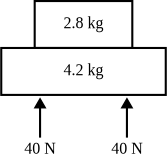
 

  1. Calculate the magnitude of the acceleration of the boxes as Liam lifts them.   (2 marks)

--- 4 WORK AREA LINES (style=lined) ---

  1. Explain why the force that the 4.2 kg box applies to the 2.8 kg box is greater while the boxes are being accelerated than when they are stationary.   (2 marks)

--- 5 WORK AREA LINES (style=lined) ---
Show Answers Only

a.    \(1.63\ \text{ms}^{-2}\)

b.    When the boxes are at rest:

  • The force that the 4.2 kg box applies to the 2.8 kg box is equal and opposite weight force of the 2.8 kg box.

When the boxes are accelerating:

  • The net force of the system is positive as the system is accelerating.
  • The 4.2 kg box must be applying extra force to the 2.8 kg box to cause it to accelerate at 1.63 ms\(^{-2}\).
Show Worked Solution
a.     \(F_{\text{net}}\) \(=\) total applied force upwards \(-\) weight force of the two boxes
    \(= (2 \times 40)-(7 \times 9.8)\)
    \(=11.4\ \text{N}\)

 
\(a=\dfrac{F_{\text{net}}}{m}=\dfrac{11.4}{7.0}=1.63\ \text{ms}^{-2}\)
  

b.    When the boxes are at rest:

  • The force that the 4.2 kg box applies to the 2.8 kg box is equal and opposite weight force of the 2.8 kg box.

When the boxes are accelerating:

  • The net force of the system is positive as the system is accelerating.
  • The 4.2 kg box must be applying extra force to the 2.8 kg box to cause it to accelerate at 1.63 ms\(^{-2}\).

Filed Under: Forces, Acceleration and Energy Tagged With: Band 4, Band 5, smc-4276-30-Gravity, smc-4276-50-F=ma

Recursion, GEN2 2024 NHT 8

Cleo owns equipment that was purchased for $50 000.

She depreciates the value of the equipment using the unit cost method.

Let \(V_n\) be the value of the equipment, in dollars, after \(n\) units of use.

A recurrence relation that can model this value from one unit of use to the next is given by

\(V_0=50\,000, \quad V_{n+1}=V_n-k\)

  1. What does \(k\) represent in this recurrence relation?   (1 mark)

    --- 1 WORK AREA LINES (style=lined) ---

  2. If  \(k=12.50\), determine the value of the equipment after one year if it is used twice per day on all 365 days of the year.   (1 mark)

    --- 2 WORK AREA LINES (style=lined) ---

Another option for Cleo is to depreciate the value of the $50 000 equipment using the reducing balance method.

The value of the equipment, in dollars, after \(n\) months, \(V_n\), can be modelled by a recurrence relation of the form

\(V_0=50\,000, \quad V_{n+1}=R V_n\)

  1. If the depreciation rate per month was 1.5%, what would be the value of \(R\) in this recurrence relation?   (1 mark)

    --- 2 WORK AREA LINES (style=lined) ---

  2. For what value of \(R\) would the equipment be valued at $42 868.75 after three months?   (1 mark)

    --- 2 WORK AREA LINES (style=lined) ---

Show Answers Only

a.   \(k\ \text{represents the depreciation per unit of use.}\)

b.   \(V_{730} =\$40\,875\)

c.   \(R=0.985\)

d.   \(R=0.95\)

Show Worked Solution

a.   \(k\ \text{represents the depreciation per unit of use.}\)
 

b.   \(\text{Units of use}\ = 365 \times 2=730\)

\(V_{730} = 50\,000-(730 \times 12.5)=\$40\,875\)
 

c.   \(R=1-0.015=0.985\)
 

d.   \(\text{Find \(R\) such that:}\)

\(R^{3} \times 50\,000\) \(= 42\,868.75 \)  
\(R\) \(=\sqrt[3]{\dfrac{42\,868.75}{50\,000}}\)  
  \(=0.95\)  

Filed Under: Recursion - Financial Tagged With: Band 4, Band 5, smc-717-50-Depreciation (SL), smc-717-80-Interpret RR

Recursion, GEN2 2024 NHT 7

Cleo took out a reducing balance loan to buy an apartment.

Interest on this loan is charged monthly and the loan is scheduled to be repaid in full with monthly repayments over 20 years.

The balance of Cleo's loan, in dollars, after \(n\) months, \(C_n\), can be modelled by the recurrence relation

\(C_0=560\,000\ \qquad \ \  C_{n+1}=1.005C_n-4012\)

  1. What amount, in dollars, did Cleo borrow?   (1 mark)

    --- 1 WORK AREA LINES (style=lined) ---

  2. Determine the total value, in dollars, of the repayments made by Cleo in the first year of the loan.   (1 mark)

    --- 1 WORK AREA LINES (style=lined) ---

  3. The interest rate for Cleo's loan is 6% per annum.    
  4. Use this value in a calculation to show that the multiplication factor in the recurrence relation is 1.005   (1 mark)

    --- 2 WORK AREA LINES (style=lined) ---

  5. Complete the next line in the amortisation table.
  6. Write your answers in the spaces provided in the table below.   (1 mark)

    --- 0 WORK AREA LINES (style=lined) ---

\begin{array}{|c|c|c|c|c|}
\hline
\rule{0pt}{2.5ex}\text{Payment} & \text{Repayment} & \quad \text{Interest} \quad & \text{Principal reduction} & \quad \text{Balance} \quad \\
\text{number} \rule[-1ex]{0pt}{0pt}& \text{(\$)} & \text{(\$)} & \text{(\$)} & \text{(\$)}\\
\hline
\rule{0pt}{2.5ex}0 \rule[-1ex]{0pt}{0pt}& 0.00 & 0.00 & 0.00 & 560 \ 000.00\\
\hline
\rule{0pt}{2.5ex}1 \rule[-1ex]{0pt}{0pt}&&&& \\
\hline
\end{array}

  1. The final monthly repayment required to fully repay the loan to the nearest cent will be slightly higher than all previous payments.
  2. Determine the value of this final repayment.
  3. Round your answer to the nearest cent.   (1 mark)

    --- 2 WORK AREA LINES (style=lined) ---

Show Answers Only

a.   \(\$560\,000\)

b.   \(\text{Total repayments}\ = 12 \times 4012=\$48\,144\)

c.   \(\text{Monthly interest rate}\ =\dfrac{0.06}{12}=0.005\)

\(\text{Multiplication factor}\ =1+0.005=1.005\)

d.   

\begin{array}{|c|c|c|c|c|}
\hline
\rule{0pt}{2.5ex}\text{Payment} & \text{Repayment} & \quad \text{Interest} \quad & \text{Principal reduction} & \quad \text{Balance} \quad \\
\text{number} \rule[-1ex]{0pt}{0pt}& \text{(\$)} & \text{(\$)} & \text{(\$)} & \text{(\$)}\\
\hline
\rule{0pt}{2.5ex}1 \rule[-1ex]{0pt}{0pt}& \$4012.00 & \$2800.00 & \$1212.00 & \$558\,788.00 \\
\hline
\end{array}


e. 
 \(\text{Final repayment}\ = 4012+6.44= \$4018.44\)

Show Worked Solution

a.   \(\$560\,000\)
 

b.   \(\text{Total repayments}\ = 12 \times 4012=\$48\,144\)
 

c.   \(\text{Monthly interest rate}\ =\dfrac{0.06}{12}=0.005\)

\(\text{Multiplication factor}\ =1+0.005=1.005\)
 

d.   

\begin{array}{|c|c|c|c|c|}
\hline
\rule{0pt}{2.5ex}\text{Payment} & \text{Repayment} & \quad \text{Interest} \quad & \text{Principal reduction} & \quad \text{Balance} \quad \\
\text{number} \rule[-1ex]{0pt}{0pt}& \text{(\$)} & \text{(\$)} & \text{(\$)} & \text{(\$)}\\
\hline
\rule{0pt}{2.5ex}1 \rule[-1ex]{0pt}{0pt}& \$4012.00 & \$2800.00 & \$1212.00 & \$558\,788.00 \\
\hline
\end{array}


e. 
 \(\text{Find number of payments (by TVM Solver):}\)

\(N= \text{SOLVE}\ = 240.0016\)

\(I\%=6.00\%\)

\(PV=560\,000\)

\(PMT = -4012\)

\(FV=0\)

\(P/Y = C/Y = 12\)
 

\(\text{Find \(PV\) (by TVM Solver):}\)

\(N= 240\)

\(I\%=6.00\%\)

\(PV=560\,000\)

\(PMT = -4012\)

\(FV= \text{SOLVE}\ =-6.44\)

\(P/Y = C/Y = 12\)
 

\(\therefore\ \text{Final repayment}\ = 4012+6.44= \$4018.44\)

Filed Under: Recursion - Financial Tagged With: Band 3, Band 4, Band 5, smc-717-20-Loans, smc-717-80-Interpret RR

Data Analysis, GEN2 2024 NHT 6

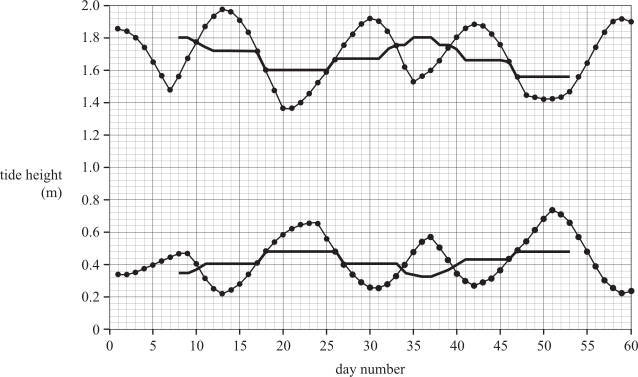
The time series plot below shows the height, in metres, of the highest high tides \((HHT)\) and lowest low tides \((L L T)\) for Sydney for the first 60 days of 2021.

The thick line for each tide type shows the results of smoothing using a moving median.
 

Complete the sentence below by entering a number in the space provided.   (1 mark)

Both the \(H H T\) data and the \(L L T\) data have been smoothed using ____-median smoothing.

--- 0 WORK AREA LINES (style=lined) ---

Show Answers Only

\(15\)

Show Worked Solution

\(\text{By trial and error (noting the smoothing line shows significant smoothing i.e. the number will be high).}

\(15\)

Filed Under: Time Series Tagged With: Band 5, smc-266-70-MEDIAN Smoothing

Data Analysis, GEN2 2024 NHT 5

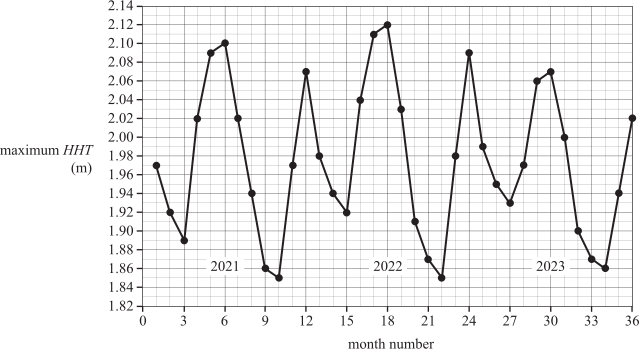
The height, in metres, of the maximum highest high tides \((HHT)\) for Sydney Harbour change from month to month during the year. This is shown in the time series plot below for the years 2021, 2022 and 2023.

In this graph, month number 1 is January 2021, month number 2 is February 2021, and so on.
 

The average height, in metres, of the maximum \(H H T\) for each year, rounded to two decimal places, is given in the table below.

Table 5

\begin{array}{|l|c|c|c|}
\hline
\rule{0pt}{2.5ex}\text{Year} \rule[-1ex]{0pt}{0pt}&\ \ \ \ 2021\ \ \ \  &\ \ \ \ 2022\ \ \ \ &\ \ \ \ 2023\ \ \ \ \\
\hline
\rule{0pt}{2.5ex}\text{Average height of the} &1.98 &1.99&1.96\\
\rule[-1ex]{0pt}{0pt} \text{maximum \(HTT\) (m)}\\
\hline
\end{array}

The three years of data shown in this graph and in Table 5 will be used to calculate seasonal indices.

Determine the seasonal index for March.

Round your answer to two decimal places.    (2 marks)

--- 5 WORK AREA LINES (style=lined) ---
Show Answers Only

\(0.97\)

Show Worked Solution

\(\text{March index (2021)}\ = \dfrac{1.89}{1.98}\)

\(\text{March index (2022)}\ = \dfrac{1.92}{1.99}\)

\(\text{March index (2023)}\ = \dfrac{1.93}{1.96}\)

\(\therefore\ \text{Seasonal index (Mar)}\ = \left( \dfrac{1.89}{1.98}+\dfrac{1.92}{1.99}+\dfrac{1.93}{1.96}\right)\ ÷\ 3= 0.97\ \text{(2 d.p.)}\)

Filed Under: Time Series Tagged With: Band 5, smc-266-10-Seasonal Index from a Table

HMS, HIC EQ-Bank 71

Explain how both family relationships and peer interactions influence adolescent development during the identity formation stage.   (5 marks)

--- 15 WORK AREA LINES (style=lined) ---

Show Answers Only

Family relationships

  • Supportive families provide emotional security, which allows adolescents to explore new interests and identities with confidence.
  • Families also pass on early values and beliefs, forming the foundation of a young person’s sense of self.
  • In contrast, family conflict or rejection can make young people less confident exploring their identity.

Peer interactions

  • Peers give feedback through acceptance or rejection, so adolescents often adjust their clothing, interests and behaviour to belong.
  • Friendship groups also allow young people to try different social roles, helping them discover who they are.
  • Online feedback through likes and comments now adds to this influence.

Interaction of family and peers

  • When family and peer values conflict, adolescents must decide which values to keep.
  • Young people with strong family support are generally better able to resist negative peer pressure.
  • As a result, they develop independent thinking and form their own identity, drawing on both influences.
Show Worked Solution

*Cause-and-effect language that directly addresses the “Explain” keyword is bolded in the answer below.

Family relationships

  • Supportive families provide emotional security, which allows adolescents to explore new interests and identities with confidence.
  • Families also pass on early values and beliefs, forming the foundation of a young person’s sense of self.
  • In contrast, family conflict or rejection can make young people less confident exploring their identity.

Peer interactions

  • Peers give feedback through acceptance or rejection, so adolescents often adjust their clothing, interests and behaviour to belong.
  • Friendship groups also allow young people to try different social roles, helping them discover who they are.
  • Online feedback through likes and comments now adds to this influence.

Interaction of family and peers

  • When family and peer values conflict, adolescents must decide which values to keep.
  • Young people with strong family support are generally better able to resist negative peer pressure.
  • As a result, they develop independent thinking and form their own identity, drawing on both influences.

Filed Under: Aspects of young people's lives Tagged With: Band 4, Band 5, smc-5507-10-Stages of development, smc-5507-20-Family influence, smc-5507-30-Peer influence

Networks, STD2 N3 2024 NHT 38*

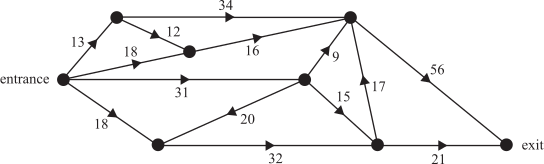
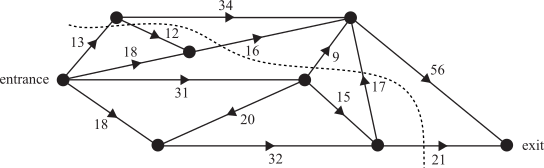
The following directed graph represents the one-way paths between attractions at an historical site. The entrance, exit and attractions are represented by vertices.

The numbers on the edges represent the maximum number of visitors allowed along each path per hour.
 

Determine the maximum number of visitors able to walk from the entrance to the exit each hour?   (3 marks)

--- 5 WORK AREA LINES (style=lined) ---
Show Answers Only

\(\text{Maximum number = 76}\)

Show Worked Solution

\(\text{Max flow = min cut}\)

\(\text{Discounting flows that move from “exit” to “entrance”:}\)

\(\text{Max flow}\ = 13+16+9+17+21 = 76\ \text{visitors}\)

Filed Under: Flow Networks and Minimum Cuts, Network Flow (Y12) Tagged With: Band 5, smc-6915-10-Min Cut/Max Flow, smc-915-10-Min Cut/Max Flow

Statistics, STD2 S5 2024 GEN2 3

The time difference between successive high tides and low tides is approximately normally distributed.

Analysis of the 2021 tide chart showed that

  • 99.85% of the time differences are more than 4.88 hours
  • 16% of the time differences are less than 5.76 hours.

Determine the mean and standard deviation for this normal distribution.   (3 marks)

--- 6 WORK AREA LINES (style=lined) ---

Show Answers Only

\(\sigma=0.44, \ \overline{x}=6.2\)

Show Worked Solution

\(\text{99.85% of the time differences are more than 4.88 hours:}\)

\(-3=\dfrac{4.88-\overline{x}}{\sigma}\ \ \Rightarrow \ -3 \times \sigma=4.88-\overline{x}\ …\ (1)\)

\(\text{16% of the time differences are less than 5.76 hours:}\)

\(-1=\dfrac{5.76-\overline{x}}{\sigma}\ \ \Rightarrow \ -\sigma=5.76-\overline{x}\ …\ (2)\)

\(\text{Subtract}\ (2)-(1):\)

\(2\sigma\) \(=0.88\)  
\(\sigma\) \(=0.44\)  

 
\(\text{Substitute into (2):}\)

\(\overline{x}=5.76+0.44=6.2\)

Filed Under: S5 The Normal Distribution (Y12), The Normal Distribution (Y12) Tagged With: Band 5, smc-6919-10-Single z-score, smc-819-10-Single z-score

Data Analysis, GEN2 2024 NHT 3

The time difference between successive high tides and low tides is approximately normally distributed.

Analysis of the 2021 tide chart showed that

  • 99.85% of the time differences are more than 4.88 hours
  • 16% of the time differences are less than 5.76 hours.

Use the 68-95-99.7% rule to determine the mean and standard deviation for this normal distribution.   (2 marks)

--- 5 WORK AREA LINES (style=lined) ---
Show Answers Only

\(s_x=0.44, \ \overline{x}=6.2\)

Show Worked Solution

\(\text{99.85% of the time differences are more than 4.88 hours:}\)

\(-3=\dfrac{4.88-\overline{x}}{s_x}\ \ \Rightarrow \ -3 \times s_x=4.88-\overline{x}\ …\ (1)\)

\(\text{16% of the time differences are less than 5.76 hours:}\)

\(-1=\dfrac{5.76-\overline{x}}{s_x}\ \ \Rightarrow \ -s_x=5.76-\overline{x}\ …\ (2)\)

\(\text{Subtract}\ (2)-(1):\)

\(2s_x\) \(=0.88\)  
\(s_x\) \(=0.44\)  

 
\(\text{Substitute into (2):}\)

\(\overline{x}=5.76+0.44=6.2\)

Filed Under: Normal Distribution Tagged With: Band 5, smc-600-20-z-score Intervals

HMS, TIP 2024 HSC 31b

To what extent have advancements in sporting technology improved performance?   (12 marks)

--- 28 WORK AREA LINES (style=lined) ---

Show Answers Only

Judgment Statement

  • Advancements in sporting technology have significantly improved performance across multiple sports disciplines.
  • Key factors include equipment innovation, biomechanical analysis systems, and performance monitoring technologies.

Equipment and Material Innovation

  • Swimming technology demonstrates substantial performance gains through advanced materials.
  • Modern racing suits significantly reduced water resistance, leading to numerous world records and eventual regulation by swimming authorities.
  • Tennis racquet evolution from wooden to graphite composites increased serve speeds and they now achieve speeds up to 200 km/h.
  • Modern equipment enables athletes to achieve previously impossible performance levels.
  • These innovations directly translate to measurable improvements in speed, power and accuracy.

Performance Analysis and Monitoring Systems

  • GPS tracking and biomechanical analysis provide significant advantages in training optimisation.
  • Rugby union teams use GPS data to monitor player workloads, helping coaches reduce injury risk while maintaining performance.
  • High-speed cameras and motion sensors allow precise technical refinements in cricket bowling and golf swings.
  • Real-time feedback systems enable immediate corrections during training sessions.
  • Data-driven approaches result in more efficient training programs and reduced injury rates.

Limitations and Access Inequality

  • Technology benefits are not equally distributed across all sports and nations.
  • Financial resources determine access levels to advanced technological systems.
  • Traditional sports may resist technological integration to preserve their character.
  • Wealthier nations with greater technology investment demonstrate higher medal counts at international competitions.
  • Equipment regulations in some sports limit the extent of technological advantages.

Reaffirmation

  • Technology has substantially transformed sporting performance across multiple disciplines.
  • While access inequality moderates the overall impact, the evidence demonstrates significant improvements in speed, accuracy and training efficiency.
  • The extent remains considerable for athletes with access to advanced technological systems.
Show Worked Solution

Judgment Statement

  • Advancements in sporting technology have significantly improved performance across multiple sports disciplines.
  • Key factors include equipment innovation, biomechanical analysis systems, and performance monitoring technologies.

Equipment and Material Innovation

  • Swimming technology demonstrates substantial performance gains through advanced materials.
  • Modern racing suits significantly reduced water resistance, leading to numerous world records and eventual regulation by swimming authorities.
  • Tennis racquet evolution from wooden to graphite composites increased serve speeds and they now achieve speeds up to 200 km/h.
  • Modern equipment enables athletes to achieve previously impossible performance levels.
  • These innovations directly translate to measurable improvements in speed, power and accuracy.

Performance Analysis and Monitoring Systems

  • GPS tracking and biomechanical analysis provide significant advantages in training optimisation.
  • Rugby union teams use GPS data to monitor player workloads, helping coaches reduce injury risk while maintaining performance.
  • High-speed cameras and motion sensors allow precise technical refinements in cricket bowling and golf swings.
  • Real-time feedback systems enable immediate corrections during training sessions.
  • Data-driven approaches result in more efficient training programs and reduced injury rates.

Limitations and Access Inequality

  • Technology benefits are not equally distributed across all sports and nations.
  • Financial resources determine access levels to advanced technological systems.
  • Traditional sports may resist technological integration to preserve their character.
  • Wealthier nations with greater technology investment demonstrate higher medal counts at international competitions.
  • Equipment regulations in some sports limit the extent of technological advantages.

Reaffirmation

  • Technology has substantially transformed sporting performance across multiple disciplines.
  • While access inequality moderates the overall impact, the evidence demonstrates significant improvements in speed, accuracy and training efficiency.
  • The extent remains considerable for athletes with access to advanced technological systems.

♦♦ Mean mark 50%.

Filed Under: Technology and performance Tagged With: Band 4, Band 5, smc-5471-10-Equipment advances, smc-5471-20-Recording and monitoring, smc-5471-40-Multiple technologies

HMS, TIP 2024 HSC 31aii

Explain how an athlete could taper to improve performance for a major sporting event.   (5 marks)

--- 15 WORK AREA LINES (style=lined) ---
Show Answers Only
  • Tapering is a strategic reduction in training load before competition that enables athletes to reach peak performance when it matters most. This occurs because reducing training volume allows the body to recover from built-up fatigue.
  • Athletes preparing for major events systematically reduce training volume by 40-60% whilst maintaining intensity levels during the final 1-3 weeks. This process ensures that fitness adaptations are preserved whilst eliminating residual fatigue. Therefore, the body can fully recover and prepare for optimal competition performance.
  • For example, a marathon runner might decrease weekly kilometres from 100 to 40 in the final two weeks. However, they continue including high-intensity intervals to maintain cardiovascular adaptations and prevent detraining effects. This demonstrates how volume reduction preserves training gains whilst promoting recovery.
  • The significance is that tapering allows both physiological and psychological recovery from intensive training periods. Consequently, athletes arrive at competition in their optimal state, resulting in improved power output, reduced fatigue and enhanced performance outcomes during major sporting events.
Show Worked Solution
  • Tapering is a strategic reduction in training load before competition that enables athletes to reach peak performance when it matters most. This occurs because reducing training volume allows the body to recover from built-up fatigue.
  • Athletes preparing for major events systematically reduce training volume by 40-60% whilst maintaining intensity levels during the final 1-3 weeks. This process ensures that fitness adaptations are preserved whilst eliminating residual fatigue. Therefore, the body can fully recover and prepare for optimal competition performance.
  • For example, a marathon runner might decrease weekly kilometres from 100 to 40 in the final two weeks. However, they continue including high-intensity intervals to maintain cardiovascular adaptations and prevent detraining effects. This demonstrates how volume reduction preserves training gains whilst promoting recovery.
  • The significance is that tapering allows both physiological and psychological recovery from intensive training periods. Consequently, athletes arrive at competition in their optimal state, resulting in improved power output, reduced fatigue and enhanced performance outcomes during major sporting events.

♦♦ Mean mark 45%.

Filed Under: Individual vs group programs Tagged With: Band 5, smc-5463-30-Peaking/Tapering

Networks, GEN1 2024 NHT 40 MC

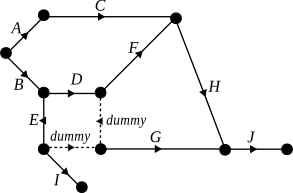
A project has 10 activities, labelled \(A\) to \(J\). The table below shows the immediate predecessor(s) for each activity. Each activity has a duration of at least one day.

\begin{array}{|c|c|}
\hline
\rule{0pt}{2.5ex}\textbf{Activity} & \textbf{Immediate}\\
&\textbf{predecessor(s)} \rule[-1ex]{0pt}{0pt}\\
\hline
\rule{0pt}{2.5ex}A \rule[-1ex]{0pt}{0pt}& - \\
\hline
\rule{0pt}{2.5ex}B \rule[-1ex]{0pt}{0pt}& - \\
\hline
\rule{0pt}{2.5ex}C \rule[-1ex]{0pt}{0pt}& A \\
\hline
\rule{0pt}{2.5ex}D \rule[-1ex]{0pt}{0pt}& B \\
\hline
\rule{0pt}{2.5ex}E \rule[-1ex]{0pt}{0pt}& B \\
\hline
\rule{0pt}{2.5ex}F \rule[-1ex]{0pt}{0pt}& D \\
\hline
\rule{0pt}{2.5ex}G \rule[-1ex]{0pt}{0pt}& D, E \\
\hline
\rule{0pt}{2.5ex}H \rule[-1ex]{0pt}{0pt}& C, F \\
\hline
\rule{0pt}{2.5ex}I \rule[-1ex]{0pt}{0pt}& E \\
\hline
\rule{0pt}{2.5ex}J \rule[-1ex]{0pt}{0pt}& G,H \\
\hline
\end{array}

Which one of the following statements about this project is not true?

  1. The earliest starting time of activity \(H\) could be two days.
  2. In the network for this project, there would be a dummy activity from the end of activity \(D\) to the start of activity \(G\).
  3. One of the paths through the network of this project is \(B D G J\).
  4. The latest starting time of activity \(E\) could be three days.
  5. The network for this project would require two dummy activities.
Show Answers Only

\(A\)

Show Worked Solution

\(\text{One strategy: draw a network diagram:}\)
 

\(\text{Earliest starting time of activity \(H\) = 3 days.}\)

\(\Rightarrow A\)

Filed Under: Critical Path Analysis Tagged With: Band 5, smc-621-10-Network table, smc-621-20-Critical Paths/EST

Networks, GEN1 2024 NHT 38-39 MC

The following directed graph represents the one-way paths between attractions at an historical site. The entrance, exit and attractions are represented by vertices.

The numbers on the edges represent the maximum number of visitors allowed along each path per hour.
 

Question 38

What is the maximum number of visitors able to walk from the entrance to the exit each hour?

  1. 75
  2. 76
  3. 77
  4. 88
  5. 96

 
Question 39

A group of students set out from the entrance and walk to the exit. The students all walk together and travel along the same route. They are the only people visiting the site that hour. What is the maximum number of students that could be in the group?

  1. 9
  2. 15
  3. 16
  4. 20
  5. 31
Show Answers Only

\(\text{Question 38:}\ B\)

\(\text{Question 39:}\ D\)

Show Worked Solution

\(\text{Question 38}\)

\(\text{Max flow = min cut}\)

\(\text{Max flow = 13+16+9+17+21=76\)

\(\Rightarrow B\)
  

\(\text{Question 39}\)

\(\text{Given all students must take the same route:}\)

\(\text{Path for max students is 32 → 20 → 32 → 21}\)

\(\text{Max students = minimum capacity of any edge = 20}\)

\(\Rightarrow D\)

Filed Under: Flow Problems Tagged With: Band 4, Band 5, smc-625-20-Max Flow/Min Cut

HMS, TIP 2024 HSC 30b

Evaluate the use of specific warm-up and psychological readiness procedures to indicate if an athlete is ready to return to play after an injury.   (12 marks)

--- 28 WORK AREA LINES (style=lined) ---
Show Answers Only

Evaluation Statement:

  • Specific warm-up and psychological readiness procedures are highly effective indicators for return-to-play decisions when used together. Physical warm-up assessments provide objective movement evaluation whilst psychological readiness addresses crucial mental factors affecting re-injury risk.

Warm-up Procedures Effectiveness:

  • Physical warm-up procedures demonstrate strong effectiveness in assessing movement quality and injury site response through progressive sport-specific activities.
  • These protocols bridge clinical clearance and competitive participation by systematically evaluating functional capacity. For example, a footballer recovering from hamstring strain progresses through jogging, sprinting, directional changes, and ball skills under defensive pressure.
  • Evidence supporting this includes successful protocols that replicate game demands and identify movement compensations. However, warm-up assessments show limitations in replicating competitive intensities and psychological pressure that occur during actual competition.
  • The overall evaluation demonstrates that physical procedures provide valuable objective data but cannot assess complete readiness alone.

Psychological Readiness Assessment:

  • Psychological readiness procedures prove highly valuable in measuring confidence levels, re-injury anxiety, and mental preparedness that significantly influence movement patterns.
  • Athletes who fear re-injury may move hesitantly or protect the injured area, which can increase their risk of further injury. This highlights the importance of psychological factors.
  • Sports psychologists assess concentration capacity and willingness to perform previously injurious movements through validated questionnaires and interviews.
  • Psychological evaluation helps identify athletes who are not yet mentally ready, which can reduce the risk of re-injury. A critical weakness is reliance on self-reporting that may be influenced by external pressures to return quickly. The assessment proves psychological procedures address essential factors that physical tests cannot evaluate.

Final Evaluation:

  • Weighing these factors shows both procedures are most effective when integrated rather than used independently. Athletes who meet both physical and psychological criteria are better prepared to return safely than those assessed on physical tests alone.
  • The strengths outweigh the weaknesses because comprehensive protocols incorporating multiple assessment dimensions provide superior return-to-play decisions that protect athlete welfare whilst optimising performance outcomes.
Show Worked Solution

Evaluation Statement:

  • Specific warm-up and psychological readiness procedures are highly effective indicators for return-to-play decisions when used together. Physical warm-up assessments provide objective movement evaluation whilst psychological readiness addresses crucial mental factors affecting re-injury risk.

Warm-up Procedures Effectiveness:

  • Physical warm-up procedures demonstrate strong effectiveness in assessing movement quality and injury site response through progressive sport-specific activities.
  • These protocols bridge clinical clearance and competitive participation by systematically evaluating functional capacity. For example, a footballer recovering from hamstring strain progresses through jogging, sprinting, directional changes, and ball skills under defensive pressure.
  • Evidence supporting this includes successful protocols that replicate game demands and identify movement compensations. However, warm-up assessments show limitations in replicating competitive intensities and psychological pressure that occur during actual competition.
  • The overall evaluation demonstrates that physical procedures provide valuable objective data but cannot assess complete readiness alone.

Psychological Readiness Assessment:

  • Psychological readiness procedures prove highly valuable in measuring confidence levels, re-injury anxiety, and mental preparedness that significantly influence movement patterns.
  • Athletes who fear re-injury may move hesitantly or protect the injured area, which can increase their risk of further injury. This highlights the importance of psychological factors.
  • Sports psychologists assess concentration capacity and willingness to perform previously injurious movements through validated questionnaires and interviews.
  • Psychological evaluation helps identify athletes who are not yet mentally ready, which can reduce the risk of re-injury. A critical weakness is reliance on self-reporting that may be influenced by external pressures to return quickly. The assessment proves psychological procedures address essential factors that physical tests cannot evaluate.

Final Evaluation:

  • Weighing these factors shows both procedures are most effective when integrated rather than used independently. Athletes who meet both physical and psychological criteria are better prepared to return safely than those assessed on physical tests alone.
  • The strengths outweigh the weaknesses because comprehensive protocols incorporating multiple assessment dimensions provide superior return-to-play decisions that protect athlete welfare whilst optimising performance outcomes.

♦♦ Mean mark 50%.

Filed Under: Management/prevention of injuries Tagged With: Band 5, Band 6, smc-5472-50-Return to play

Networks, GEN1 2024 NHT 37 MC

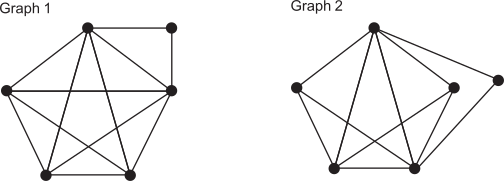
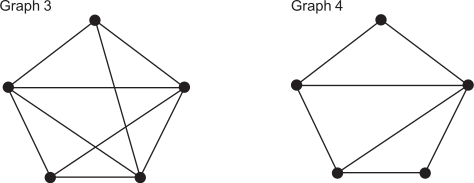
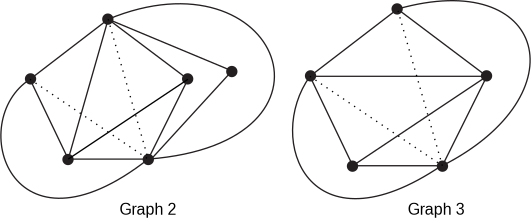
Euler's formula can be applied to which of the following graphs?
 

  1. Graph 4 only
  2. Graphs 1 and 2 only
  3. Graphs 1, 2, 3 and 4
  4. Graphs 3 and 4 only
  5. Graphs 2, 3 and 4 only
Show Answers Only

\(E\)

Show Worked Solution

\(\text{Euler’s formula applies to planar graphs.}\)

\(\text{Graph 1 has a complete pentagon \(\Rightarrow\) cannot be drawn as a planar graph.}\)

\(\text{Graph 4 is already planar.}\)

\(\text{Graph 2 and 3 can both be drawn as a planar graphs.}\)
 

\(\Rightarrow E\)

Filed Under: Basic Concepts Tagged With: Band 5, smc-626-30-Planar/Isomorphic, smc-626-40-Euler's Formula

Networks, GEN1 2024 NHT 36 MC

Four students, Peggy, Quincy, Radley and Sarah, are grouped together to complete a project. The project is in four parts, labelled \(W, X, Y\) and \(Z\). Each student must complete one part of the project.

The table below shows each student's estimate of the score they will receive if they complete each section.

\begin{array}{|c|c|c|c|c|}
\hline \rule{0pt}{2.5ex}\quad \quad \rule[-1ex]{0pt}{0pt}& \text{Peggy}& \text{Quincy}&\text{Radley}&\text{Sarah} \\
\hline \rule{0pt}{2.5ex}W \rule[-1ex]{0pt}{0pt}& 12 & 19 & 18 & 16 \\
\hline \rule{0pt}{2.5ex}X \rule[-1ex]{0pt}{0pt}& 16 & 15 & 15 & 16 \\
\hline \rule{0pt}{2.5ex}Y \rule[-1ex]{0pt}{0pt}& 10 & 16 & 17 & 15 \\
\hline \rule{0pt}{2.5ex}Z \rule[-1ex]{0pt}{0pt}& 19 & 20 & 18 & 18 \\
\hline
\end{array}

Based on the estimates, which allocation of project parts will maximise the students' group score on the project?


A.  
\begin{array}{|c|c|}
\hline \rule{0pt}{2.5ex}W\rule[-1ex]{0pt}{0pt} & \text { Quincy } \\
\hline \rule{0pt}{2.5ex}X \rule[-1ex]{0pt}{0pt}& \text { Sarah } \\
\hline \rule{0pt}{2.5ex}Y \rule[-1ex]{0pt}{0pt}& \text { Radley } \\
\hline \rule{0pt}{2.5ex}Z \rule[-1ex]{0pt}{0pt}& \text { Peggy } \\
\hline
\end{array}

     B.  
\begin{array}{|c|c|}
\hline \rule{0pt}{2.5ex}W \rule[-1ex]{0pt}{0pt}& \text { Radley } \\
\hline \rule{0pt}{2.5ex}X \rule[-1ex]{0pt}{0pt}& \text { Peggy } \\
\hline \rule{0pt}{2.5ex}Y \rule[-1ex]{0pt}{0pt}& \text { Quincy } \\
\hline \rule{0pt}{2.5ex}Z \rule[-1ex]{0pt}{0pt}& \text { Sarah } \\
\hline
\end{array}

     C.  
\begin{array}{|c|l|}
\hline \rule{0pt}{2.5ex}W \rule[-1ex]{0pt}{0pt}& \text { Sarah } \\
\hline \rule{0pt}{2.5ex}X \rule[-1ex]{0pt}{0pt}& \text { Quincy } \\
\hline \rule{0pt}{2.5ex}Y \rule[-1ex]{0pt}{0pt}& \text { Peggy } \\
\hline \rule{0pt}{2.5ex}Z \rule[-1ex]{0pt}{0pt}& \text { Radley } \\
\hline
\end{array}

D.
\begin{array}{|c|c|}
\hline \rule{0pt}{2.5ex}W \rule[-1ex]{0pt}{0pt}& \text { Radley } \\
\hline \rule{0pt}{2.5ex}X \rule[-1ex]{0pt}{0pt}& \text { Peggy } \\
\hline \rule{0pt}{2.5ex}Y \rule[-1ex]{0pt}{0pt}& \text { Sarah } \\
\hline \rule{0pt}{2.5ex}Z \rule[-1ex]{0pt}{0pt}& \text { Quincy } \\
\hline
\end{array}

     E.
\begin{array}{|l|l|}
\hline \rule{0pt}{2.5ex}W \rule[-1ex]{0pt}{0pt}& \text { Sarah } \\
\hline \rule{0pt}{2.5ex}X \rule[-1ex]{0pt}{0pt}& \text { Peggy } \\
\hline \rule{0pt}{2.5ex}Y \rule[-1ex]{0pt}{0pt}& \text { Radley } \\
\hline \rule{0pt}{2.5ex}Z \rule[-1ex]{0pt}{0pt}& \text { Quincy } \\
\hline
\end{array}
 
Show Answers Only

\(A\)

Show Worked Solution

\(\text{Calculate the score for each option:}\)

\(A: 19+16+17+19=71\)

\(B: 18+16+16+18=68\)

\(C: 16+15+10+18=59\)

\(D: 18+16+15+20=69\)

\(E: 16+16+17+20=69\)

\(\Rightarrow A\)

Filed Under: Matching Problems Tagged With: Band 5, smc-623-20-Other Matching

PHYSICS, M2 EQ-Bank 4

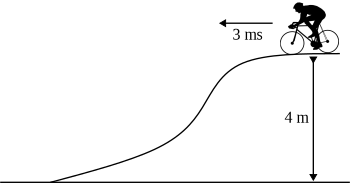
A 65 kg rider is on a 15 kg bicycle, moving across the top of a 4 metre high hill with a horizontal speed of 3 ms\(^{-1}\).
 

  1. The bicycle descends the hill, dropping a vertical distance of 4.0 meters before reaching level ground. Assuming no energy is lost to friction or air resistance, calculate the speed of the bicycle and rider at the bottom of the hill.   (3 marks)

--- 6 WORK AREA LINES (style=lined) ---
  1. At the bottom, the rider applies the brakes. The bike skids 15 metres across flat ground before coming to a stop. Calculate the magnitude of the frictional force acting on the bike during this motion.   (2 marks)

--- 5 WORK AREA LINES (style=lined) ---
Show Answers Only

a.    \(9.35\ \text{ms}^{-1}\)

b.    \(233\ \text{N}\)

Show Worked Solution

a.    By applying the Law of Conservation of Energy:

\(E_{\text{after}}\) \(=E_{\text{before}}\)  
\(\dfrac{1}{2}mv^2\) \(=\dfrac{1}{2}mu^2+mgh\)  
\(v^2\) \(=u^2 +2gh\)  
\(v\) \(=\sqrt{3^2+2 \times 9.8 \times 4}\)  
  \(=9.35\ \text{ms}^{-1}\)  


  • The velocity of the rider at the bottom of the hill is 9.35 ms\(^{-1}\).

b.    At the bottom of the hill:

  • Work done to slow rider = change in rider’s kinetic energy
\(W\) \(=\Delta KE\)  
\(Fs\) \(=\dfrac{1}{2}mv^2-\dfrac{1}{2}mu^2\)  
\(F \times 15\) \(=\dfrac{1}{2} \times 80 \times 0^2-\dfrac{1}{2} \times 80 \times 9.35^2\)  
\(F\) \(=-\dfrac{3496.9}{15}\)  
  \(=-233\ \text{N}\)  


  • The braking force acting on the bike is \(233\ \text{N}\).

Filed Under: Forces, Acceleration and Energy Tagged With: Band 4, Band 5, smc-4276-10-Conservation of energy, smc-4276-40-Work done, smc-4276-60-Kinetic Energy

HMS, HIC 2024 HSC 28b

Evaluate the effectiveness of legislation and health promotion initiatives in addressing ONE major health issue affecting young people.   (12 marks)

--- 28 WORK AREA LINES (style=lined) ---
Show Answers Only

Evaluation Statement

  • Legislation and health promotion initiatives are highly effective in addressing youth road safety when implemented together.
  • This evaluation examines behavioural change impact and long-term sustainability of interventions.

Behavioural Change Impact

  • Graduated licensing systems are highly influential in reducing youth road fatalities.
  • Evidence supporting this includes the 120 supervised hours requirement, passenger limits for P1 drivers and speed restrictions that have coincided with a sizeable reduction in collision rates.
  • The “Plan B” drink-driving campaign has also proven highly effective by promoting practical drink-driving alternatives. Campaign evaluations show a significant percentage decrease in alcohol-related crashes since 2012.
  • A critical strength of these approaches is the combination of addressing specific risk factors while building safe driving habits.
  • In this way, combined approaches can achieve comprehensive behaviour modification.

Long-term Sustainability

  • Legislative measures show excellent sustainability through systematic enforcement.
  • Mobile phone bans partially fulfil objectives due to enforcement challenges. While awareness has increased, detection difficulties limit long-term compliance although this shortcoming is being mitigated by technology developments.
  • Health promotion campaigns like “Speeding. No One Thinks Big of You” achieve moderate sustainability. Research indicates 75% of young males felt discouraged from speeding after viewing.
  • However, campaign effects diminish without ongoing reinforcement. Although effective for immediate impact, promotion requires continuous investment.

Final Evaluation

  • Weighing these factors shows integrated approaches prove most effective.
  • The strengths outweigh limitations because combining external regulation with attitude change can create lasting impact.
  • While legislation provides consistent framework, health promotion addresses cultural motivations.
  • The overall evaluation reveals neither approach alone suffices.
  • Implications suggest continued investment in both legislative and promotional strategies maximises youth road safety outcomes.
Show Worked Solution

Evaluation Statement

  • Legislation and health promotion initiatives are highly effective in addressing youth road safety when implemented together.
  • This evaluation examines behavioural change impact and long-term sustainability of interventions.

Behavioural Change Impact

  • Graduated licensing systems are highly influential in reducing youth road fatalities.
  • Evidence supporting this includes the 120 supervised hours requirement, passenger limits for P1 drivers, and speed restrictions that have coincided with a sizeable reduction in collision rates.
  • The “Plan B” drink-driving campaign has also proven highly effective by promoting practical drink-driving alternatives. Campaign evaluations show a significant percentage decrease in alcohol-related crashes since 2012.
  • A critical strength of these approaches is the combination of addressing specific risk factors while building safe driving habits.
  • In this way, combined approaches can achieve comprehensive behaviour modification.

Long-term Sustainability

  • Legislative measures show excellent sustainability through systematic enforcement.
  • Mobile phone bans partially fulfil objectives due to enforcement challenges. While awareness has increased, detection difficulties limit long-term compliance although this shortcoming is being mitigated by technology developments.
  • Health promotion campaigns like “Speeding. No One Thinks Big of You” achieve moderate sustainability. Research indicates 75% of young males felt discouraged from speeding after viewing.
  • However, campaign effects diminish without ongoing reinforcement. Although effective for immediate impact, promotion requires continuous investment.

Final Evaluation

  • Weighing these factors shows integrated approaches prove most effective.
  • The strengths outweigh limitations because combining external regulation with attitude change can create lasting impact.
  • While legislation provides consistent framework, health promotion addresses cultural motivations.
  • The overall evaluation reveals neither approach alone suffices.
  • Implications suggest continued investment in both legislative and promotional strategies maximises youth road safety outcomes.

♦♦ Mean mark 43%.

Filed Under: Models of health promotion Tagged With: Band 4, Band 5, smc-5510-280-Legislation

HMS, HIC 2024 HSC 28aii

Explain how the developmental stage of a young person's life can cause their motivation AND values to vary.   (5 marks)

--- 15 WORK AREA LINES (style=lined) ---

Show Answers Only

Physical development

  • Puberty and growth spurts change a young person’s body, which can affect their motivation to be active.
  • For example, a young person who grows tall quickly may become more motivated to play basketball.
  • However, body changes can also increase concern about appearance, motivating unhealthy dieting.

Cognitive development

  • As abstract thinking develops, young people begin to consider long-term consequences.
  • As a result, many older adolescents become more motivated by future goals, such as fitness or further study.
  • However, impulse control is still developing, so immediate rewards can still outweigh long-term health.

Social and emotional development

  • Family values shape what young people consider important, for example valuing help-seeking during stressful times.
  • However, young people who feel less emotionally connected to family may seek acceptance from peers.
  • This can lead to risk-taking behaviours, such as binge drinking, to fit in.
  • In contrast, peer groups that value sport or not drinking can motivate healthy choices.
Show Worked Solution

*Cause-and-effect language that directly addresses the “Explain” keyword is bolded in the answer below.

Physical development

  • Puberty and growth spurts change a young person’s body, which can affect their motivation to be active.
  • For example, a young person who grows tall quickly may become more motivated to play basketball.
  • However, body changes can also increase concern about appearance, motivating unhealthy dieting.

Cognitive development

  • As abstract thinking develops, young people begin to consider long-term consequences.
  • As a result, many older adolescents become more motivated by future goals, such as fitness or further study.
  • However, impulse control is still developing, so immediate rewards can still outweigh long-term health.

Social and emotional development

  • Family values shape what young people consider important, for example valuing help-seeking during stressful times.
  • However, young people who feel less emotionally connected to family may seek acceptance from peers.
  • This can lead to risk-taking behaviours, such as binge drinking, to fit in.
  • In contrast, peer groups that value sport or not drinking can motivate healthy choices.

♦ Mean mark 53%.

Filed Under: Aspects of young people's lives Tagged With: Band 4, Band 5, smc-5507-10-Stages of development, smc-5507-20-Family influence, smc-5507-30-Peer influence

Financial Maths, STD2 F4 2021 HSC 30 (Adapted)

Dianne owns 1600 shares in a company. The market price for each share is $30. Dianne's total dividend from these shares is $768.

Calculate the dividend yield for her shares.   (2 marks)

--- 5 WORK AREA LINES (style=lined) ---
Show Answers Only

`1.6 text(%)`

Show Worked Solution

♦ Mean mark 47%.
`text(Dividend yield)` `= text(Dividend)/text(Value of shares)`  
  `= 768/(1600xx 30)`  
  `=0.016`  
  `= 1.6 text(% yield)`  

Filed Under: Compound Interest and Shares (Std2-X), Investment (Y12-X) Tagged With: adapted, Band 5, smc-7726-40-Shares and Dividends, smc-817-40-Shares/Dividends

Matrices, GEN1 2024 NHT 32 MC

An online shop offers monthly subscriptions for protein powder.

The shop offers protein powder in three flavours: vanilla \((V)\), chocolate \((C)\) and malt \((M)\).

Let \(P_n\) be the state matrix that shows the expected number of subscribers for each flavour \(n\) months after sales of the protein powder began.

The expected number of subscribers for each flavour can be determined by the matrix recurrence rule

\(P_{n+1}=T P_n+K\)

where

\begin{aligned}
& \quad \quad \quad \ \text { this month }\\
& \quad \quad \quad \ V \quad \ \ C \quad \ M \\ 
& T=\begin{bmatrix}0.2 & 0.2 & 0.1 \\
0.4 & 0.2 & 0.1 \\
0.4 & 0.6 & 0.8
\end{bmatrix} \begin{array}{l}
V \\ C\\ M
\end{array}
\ \text{next month} \quad \text { and } \quad K=\begin{bmatrix} 93 \\ 59 \\ 9\end{bmatrix}\begin{array}{l}V \\ C \\ M \end{array}\end{aligned}

The state matrix, \(P_2\), below shows the expected number of subscribers for each flavour two months after sales began.

\begin{align*}
P_2=\begin{bmatrix}
147 \\
137 \\
199
\end{bmatrix}
\end{align*}

The increase in the expected number of subscribers for vanilla \((V)\) between the initial sales, \(P_0\), and the first month after sales began, \(P_1\), is equal to

  1. 27
  2. 54
  3. 60
  4. 87
  5. 93
Show Answers Only

\(C\)

Show Worked Solution

\(P_{n+1} = TP_{n}+K\ \Rightarrow\ P_2=TP_1+K \ \Rightarrow\ P_1=T^{-1}(P_2-K) \) 
 

\(P_1=\begin{bmatrix}0.2 & 0.2 & 0.1 \\ 0.4 & 0.2 & 0.1 \\ 0.4 & 0.6 & 0.8\end{bmatrix}^{-1}\left(\begin{bmatrix}147 \\ 137 \\ 199\end{bmatrix}-\begin{bmatrix}93 \\ 59 \\ 9\end{bmatrix}\right)=\begin{bmatrix} 120 \\ 98 \\ 104\end{bmatrix}\)
 

\(P_0=\begin{bmatrix}0.2 & 0.2 & 0.1 \\ 0.4 & 0.2 & 0.1 \\ 0.4 & 0.6 & 0.8\end{bmatrix}^{-1}\left(\begin{bmatrix}120 \\ 98 \\ 104\end{bmatrix}-\begin{bmatrix}93 \\ 59 \\ 9\end{bmatrix}\right)=\begin{bmatrix}60 \\ 49 \\ 52\end{bmatrix}\)
 

\(\therefore\ \text{Increase in vanilla subscribers}\ =120-60=60\)

\(\Rightarrow C\)

Filed Under: Transition Matrices - Modified Tagged With: Band 5, smc-1893-25-Inverse Matrix, smc-1893-33-5x5 Matrix

Financial Maths, STD2 F4 2013 HSC 26e (Adapted)

Lucas invests $5000.

Interest is compounded half-yearly at a rate of 3% per half-year.

2013 26e

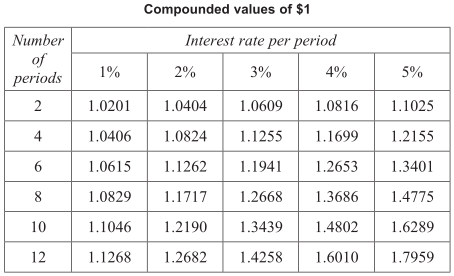
Use the table to calculate the value of his investment at the end of 4 years.   (2 marks)

--- 4 WORK AREA LINES (style=lined) ---
Show Answers Only

`$6335`

Show Worked Solution
♦ Mean mark 44%
COMMENT: Structure your answer: 1-Find the interest rate per compounding period (same in this case). 2-Find the number of compounding periods..

`r =\ text(3% per half-year)`

`n = 8 \ \ \ \  text{(8 half-years in 4 years)}`

`⇒ \text{Table Factor} = 1.267`

`text(Investment)` `= 5000 × 1.267`
  `= $6335`

`:.\ \text{After 4 years, investment value is } $6335`

Filed Under: Compound Interest and Shares (Std2-X) Tagged With: adapted, Band 5, common-content, smc-1002-10-Compounded Value of $1 Table, smc-1108-40-Compounded Value of $1, smc-817-10-Compounded Value of $1 Table

Matrices, GEN1 2024 NHT 31 MC

A group of meerkats lives in an enclosure at a zoo.

The meerkats sleep during the night in one of two chambers, chamber A or chamber B.

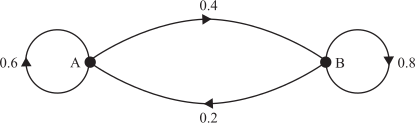
The transition diagram below shows the proportion of meerkats that stay in the same sleeping location or change sleeping location from night to night.
 

Every night there are \(a\) meerkats in chamber A.

Every night there are \(b\) meerkats in chamber B .

Of the meerkats sleeping in chamber A on Friday night, eight had slept in chamber B on the previous night.

How many meerkats live in the enclosure?

  1. 20
  2. 30
  3. 40
  4. 50
  5. 60
Show Answers Only

\(E\)

Show Worked Solution
\(20\% \times b\) \(=8\)  
\(b\) \(=\dfrac{8}{0.2} = 40\)  

 
\(\text{Since \(a\) and \(b\) remain the same:}\)

\(0.4 \times a\) \(=8\)  
\(a\) \(=\dfrac{8}{0.4} = 20\)  

 
\(\therefore\ \text{Total meercats}\ = 40+20=60\)

\(\Rightarrow E\)

Filed Under: Transition Matrices - Regular Tagged With: Band 5, smc-618-25-Interpret Diagram

Financial Maths, STD2 F4 2014 HSC 30a (Adapted)

Jordan wants to accumulate $15 000 in a savings account over 10 years to buy a new car.

The account pays interest at 4% per annum compounded monthly.

Calculate how much Jordan must deposit now to achieve this goal.   (3 marks)

--- 6 WORK AREA LINES (style=lined) ---
Show Answers Only

`$10\ 110\ \ \text{(nearest $)}`

Show Worked Solution
♦ Mean mark 52%

`FV = 15\ 000,\ \ n = 10 \times 12 = 120,`

`r = 0.04 / 12 = 0.003333…`

`FV` `= PV (1 + r)^n`
`15\ 000` `= PV (1 + 0.003333…)^{120}`
`PV` `= \frac{15\ 000}{(1.003333…)^{120}}`
  `= 10\ 109.88…`

`∴ \ \text{Jordan must deposit} \ $10\ 110\ \text{(nearest $)}`

Filed Under: Compound Interest and Shares (Std2-X), Investment (Y12-X) Tagged With: adapted, Band 5, common-content, smc-1002-20-FV Formula, smc-1108-20-FV Formula, smc-7726-20-FV Formula, smc-817-20-FV Formula

Matrices, GEN1 2024 NHT 29 MC

Matrix \(J\) is a row matrix of order  \(1 \times n\).

Matrix \(K\) is a column matrix of order  \(n \times 1\).

Matrix \(J^T\) is the transpose of Matrix \(J\).

Matrix \(K^T\) is the transpose of Matrix \(K\).

Consider the following matrix products where \(n\) is a whole number greater than or equal to 2:

    • \(J^2\)
    • \(JK\)
    • \(K J\)
    • \(J^T K^T\)
    • \(K^T J^T\)

How many of the above matrix products are defined?

  1. 1
  2. 2
  3. 3
  4. 4
  5. 5
Show Answers Only

\(D\)

Show Worked Solution

\(\text{Note:}\ J^{T}\ \text{is order}\ (n \times 1), \ K^{T}\ \text{is order}\ (1 \times n) \)

\(J^2: (1 \times n) \times (1 \times n) \Rightarrow \text{Undefined}\)

\(JK: (1 \times n) \times (n \times 1) \Rightarrow \text{Defined}\)

\(KJ: (n \times 1) \times (1 \times n) \Rightarrow \text{Defined}\)

\(J^T K^T: (n \times 1) \times (1 \times n) \Rightarrow \text{Defined}\)

\(K^T J^T: (1 \times n) \times (n \times 1) \Rightarrow \text{Defined}\)

\(\Rightarrow D\)

Filed Under: Matrix Calculations Tagged With: Band 5, smc-616-20-Order / (Un)Defined

Financial Maths, STD2 F4 2021 HSC 26 (Adapted)

Mila plans to invest $42 000 for 1.5 years. She is offered two different investment options.

Option A:  Interest is paid at 5% per annum compounded monthly.

Option B:  Interest is paid at `r` % per annum simple interest.

  1. Calculate the future value of Mila's investment after 1.5 years if she chooses Option A.   (2 marks)

    --- 4 WORK AREA LINES (style=lined) ---
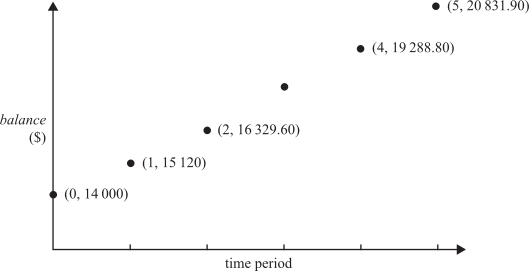
  2. Find the value of `r` in Option B that would give Mila the same future value after 1.5 years as for Option A. Give your answer correct to two decimal places.   (2 marks)

    --- 4 WORK AREA LINES (style=lined) ---

Show Answers Only
  1. `$45\ 264.08`
  2. `5.18text(%)`
Show Worked Solution
a.   `r` `= text(5%)/12 = text(0.4167%) = 0.004167\ \text(per month)`
  `n` `= 12 × 1.5 = 18`
`FV` `= PV(1 + r)^n`
  `= 42\ 000(1 + 0.004167)^{18}`
  `= $45\ 264.08`


b.   `I` `= Prn`
  `3\ 264.08` `= 42\ 000 × r × 1.5`
  `r` `= 3\ 264.08 / (42\ 000 × 1.5)`
    `= 0.0518…`
    `= 5.18\ \text{% (to 2 d.p.)}`

Filed Under: Compound Interest and Shares (Std2-X), Investment (Y12-X) Tagged With: adapted, Band 4, Band 5, num-title-ct-coreb, num-title-qs-hsc, smc-4334-10-Find FV, smc-4334-40-Find r, smc-4334-50-Compound vs Simple, smc-7726-30-Interest Rate Comparisons, smc-817-20-FV Formula, smc-817-30-i/r comparisons (incl. graphs)

HMS, HAG 2024 HSC 27

Select ONE of the following groups that experience health inequities:

  • Socioeconomically disadvantaged people
  • People in rural and remote areas
  • Overseas-born people
  • The elderly
  • People with disabilities

To what extent do socioeconomic factors affect the health of this group?   (8 marks)
  

Group selected:............................................................................................

--- 30 WORK AREA LINES (style=lined) ---
Show Answers Only

Group selected: People with disabilities

Introduction – Overall judgement

  • Socioeconomic factors significantly affect the health of people with disabilities in Australia
  • Create a cycle of disadvantage that severely impacts both physical and mental wellbeing
  • Influence multiple aspects of life including healthcare access, housing, and social participation

Employment barriers – Primary socioeconomic influence

  • Approximately 30% lower employment rates than general population
  • Limited income potential restricts ability to afford:
    • Specialised healthcare services not covered by Medicare
    • Gap payments for NDIS-supported therapies
    • Essential assistive technologies and modifications
  • Directly impacts access to vital treatments, therapies, and medications

Educational disadvantage – Compounding factor

  • Physical access barriers and inadequate support in educational settings
  • Lower completion rates of secondary and tertiary education
  • Results in limited employment options and lower-paying positions
  • Creates cycle of disadvantage affecting ability to afford:
    • Private health insurance
    • Preventative healthcare services
    • Regular health monitoring

Housing challenges – Financial manifestation

  • Limited accessible housing options at premium prices
  • Contributes to housing stress and potential homelessness
  • Associated mental health conditions including anxiety and depression
  • Extended waiting lists for accessible public housing (often several years)
  • Many forced to live in unsuitable accommodation that compromises health and safety

Counter-argument – Other determinants:

  • Environmental barriers exist regardless of socioeconomic status
  • Healthcare system gaps include inaccessible facilities and equipment
  • Societal attitudes and stigma affect quality of care
  • Healthcare professionals’ lack of disability awareness leads to diagnostic overshadowing
  • These factors can affect health independent of financial means

Predominant influence – Financial burden:

  • Gap payments for therapies not fully covered by support systems
  • Specialised equipment costs beyond subsidies
  • Home modifications essential for independence
  • Significant portion of household income consumed by disability-related expenses
  • Disability Support Pension often insufficient, falling below poverty line
  • Forces difficult choices between healthcare needs and other essentials

Conclusion – Final judgment:

  • Socioeconomic factors affect health of people with disabilities to a very large extent
  • While other factors contribute, financial disadvantage creates the most pervasive barriers
  • Long-term cycle of disadvantage significantly impacts:
    • Quality of life
    • Health outcomes
    • Life expectancy for Australians with disabilities
Show Worked Solution

Group selected: People with disabilities

Introduction – Overall judgement

  • Socioeconomic factors significantly affect the health of people with disabilities in Australia
  • Create a cycle of disadvantage that severely impacts both physical and mental wellbeing
  • Influence multiple aspects of life including healthcare access, housing, and social participation

Employment barriers – Primary socioeconomic influence

  • Approximately 30% lower employment rates than general population
  • Limited income potential restricts ability to afford:
    • Specialised healthcare services not covered by Medicare
    • Gap payments for NDIS-supported therapies
    • Essential assistive technologies and modifications
  • Directly impacts access to vital treatments, therapies, and medications

Educational disadvantage – Compounding factor

  • Physical access barriers and inadequate support in educational settings
  • Lower completion rates of secondary and tertiary education
  • Results in limited employment options and lower-paying positions
  • Creates cycle of disadvantage affecting ability to afford:
    • Private health insurance
    • Preventative healthcare services
    • Regular health monitoring

Housing challenges – Financial manifestation

  • Limited accessible housing options at premium prices
  • Contributes to housing stress and potential homelessness
  • Associated mental health conditions including anxiety and depression
  • Extended waiting lists for accessible public housing (often several years)
  • Many forced to live in unsuitable accommodation that compromises health and safety

Counter-argument – Other determinants:

  • Environmental barriers exist regardless of socioeconomic status
  • Healthcare system gaps include inaccessible facilities and equipment
  • Societal attitudes and stigma affect quality of care
  • Healthcare professionals’ lack of disability awareness leads to diagnostic overshadowing
  • These factors can affect health independent of financial means

Predominant influence – Financial burden:

  • Gap payments for therapies not fully covered by support systems
  • Specialised equipment costs beyond subsidies
  • Home modifications essential for independence
  • Significant portion of household income consumed by disability-related expenses
  • Disability Support Pension often insufficient, falling below poverty line
  • Forces difficult choices between healthcare needs and other essentials

Conclusion – Final judgment:

  • Socioeconomic factors affect health of people with disabilities to a very large extent
  • While other factors contribute, financial disadvantage creates the most pervasive barriers
  • Long-term cycle of disadvantage significantly impacts:
    • Quality of life
    • Health outcomes
    • Life expectancy for Australians with disabilities

♦♦ Mean mark 45%.

Filed Under: Groups Experiencing Inequities Tagged With: Band 4, Band 5, smc-5475-20-Other Inequity Groups, smc-5475-40-Causes of Inequity

HMS, HIC EQ-Bank 68

Research indicates that young people's definitions of health evolve as they move through adolescence.

How do young people's health priorities typically change between early adolescence (12-14 years) and late adolescence (17-19 years).   (5 marks)

--- 15 WORK AREA LINES (style=lined) ---
Show Answers Only

*Cause-and-effect language that directly addresses the “How” (unofficial) keyword is bolded in the answer below.

  • Young adolescents (12-14) typically define health concretely through immediate, observable aspects like physical appearance and energy levels. This occurs because their developmental stage limits abstract thinking abilities.
  • As a result of cognitive development progressing, late adolescents (17-19) shift toward more sophisticated health concepts that include preventive behaviours, long-term wellbeing, and the integration of physical, mental and social dimensions. This demonstrates why maturity changes health understanding.
  • Peer influence on health definitions transforms from early adolescence, where fitting in often dictates health behaviours, to late adolescence. This happens when greater independence enables young people to balance social factors with personal values.
  • Biological changes during puberty initially focus younger adolescents on body-related health concerns. This process leads to increased autonomy in later adolescence, which allows broader consideration of lifestyle choices.
  • These elements work together to require different health approaches: concrete, socially-relevant messaging for younger adolescents versus participatory, autonomy-respecting strategies for older teens. This shows a clear connection between developmental stage and effective health communication.
Show Worked Solution

*Cause-and-effect language that directly addresses the “How” (unofficial) keyword is bolded in the answer below.

  • Young adolescents (12-14) typically define health concretely through immediate, observable aspects like physical appearance and energy levels. This occurs because their developmental stage limits abstract thinking abilities.
  • As a result of cognitive development progressing, late adolescents (17-19) shift toward more sophisticated health concepts that include preventive behaviours, long-term wellbeing, and the integration of physical, mental and social dimensions. This demonstrates why maturity changes health understanding.
  • Peer influence on health definitions transforms from early adolescence, where fitting in often dictates health behaviours, to late adolescence. This happens when greater independence enables young people to balance social factors with personal values.
  • Biological changes during puberty initially focus younger adolescents on body-related health concerns. This process leads to increased autonomy in later adolescence, which allows broader consideration of lifestyle choices.
  • These elements work together to require different health approaches: concrete, socially-relevant messaging for younger adolescents versus participatory, autonomy-respecting strategies for older teens. This shows a clear connection between developmental stage and effective health communication.

Filed Under: Meanings of health - investigation Tagged With: Band 4, Band 5, smc-5508-50-Determinants of health

HMS, HIC EQ-Bank 59 MC

A researcher compared how young people from different socioeconomic backgrounds define health priorities.

Which combination of factors would most likely influence differences in these definitions?

    1. Access to healthcare resources in their communities
    2. Cultural beliefs and practices around health
    3. Individual genetic predispositions to certain health conditions
    4. Social media representation of health and fitness
  1. 1 and 2
  2. 1 and 3
  3. 2 and 4
  4. 3 and 4
Show Answers Only
\(A\)
Show Worked Solution
  • A is correct because resource access shapes awareness of health options while cultural beliefs fundamentally determine how health is understood within different communities.

Other options:

  • B is incorrect because genetic predispositions don’t systematically influence how different socioeconomic groups conceptualise health.
  • C is incorrect because social media has less fundamental impact than resource access on how different groups define health priorities.
  • D is incorrect because neither genetics nor social media are primary determinants of socioeconomic differences in health definitions.

Filed Under: Meanings of health - investigation Tagged With: Band 5, smc-5508-50-Determinants of health

HMS, HIC EQ-Bank 66

A researcher wants to investigate adolescents' experiences with physical activity and mental wellbeing. They have designed a study using online surveys with multiple-choice and rating scale questions.

Evaluate the validity, reliability and credibility of this data collection method for understanding adolescent health experiences.   (8 marks)

--- 22 WORK AREA LINES (style=lined) ---
Show Answers Only

Evaluation Statement

  • Online surveys with fixed responses prove partially effective for researching adolescent health experiences.
  • This evaluation examines validity, reliability and credibility of a study using online surveys with multiple-choice and rating scale questions.

Validity

  • The method partially fulfils validity requirements for capturing complex health experiences.
  • The research involves a method that can gather large samples quickly.
  • However, predetermined response options fail to capture nuanced adolescent perspectives, especially for subjective concepts like mental wellbeing.
  • While strong in measuring basic activity levels through quantifiable data, it proves less suitable for exploring personal health experiences that involve deeper meanings.

Reliability

  • The survey approach inadequately fulfils reliability standards without proper testing and diverse sampling.
  • A lack of pilot testing increases the risk of inconsistent question interpretation across age groups.
  • Also, without demographic information about participants, findings cannot reliably apply to all adolescents.

Credibility

  • Single-method data collection severely limits credibility of findings.
  • Online surveys alone prove insufficient for understanding lived experiences of adolescents.
  • A critical weakness is relying solely on quantitative data when health experiences require qualitative exploration.
  • Evidence shows mixed methods combining surveys with interviews produce superior insights.

Final Evaluation

  • Weighing these factors, the data collection method described provides limited insight into adolescent health experiences.
  • All three criteria reveal significant weaknesses in capturing complex teen health realities.
  • The overall evaluation demonstrates urgent need for mixed methods approaches.
  • Implications suggest researchers must combine quantitative surveys with qualitative interviews to achieve credible, valid and reliable understanding of adolescent wellbeing.
Show Worked Solution

Evaluation Statement

  • Online surveys with fixed responses prove partially effective for researching adolescent health experiences.
  • This evaluation examines validity, reliability and credibility of a study using online surveys with multiple-choice and rating scale questions.

Validity

  • The method partially fulfils validity requirements for capturing complex health experiences.
  • The research involves a method that can gather large samples quickly.
  • However, predetermined response options fail to capture nuanced adolescent perspectives, especially for subjective concepts like mental wellbeing.
  • While strong in measuring basic activity levels through quantifiable data, it proves less suitable for exploring personal health experiences that involve deeper meanings.

Reliability

  • The survey approach inadequately fulfils reliability standards without proper testing and diverse sampling.
  • A lack of pilot testing increases the risk of inconsistent question interpretation across age groups.
  • Also, without demographic information about participants, findings cannot reliably apply to all adolescents.

Credibility

  • Single-method data collection severely limits credibility of findings.
  • Online surveys alone prove insufficient for understanding lived experiences of adolescents.
  • A critical weakness is relying solely on quantitative data when health experiences require qualitative exploration.
  • Evidence shows mixed methods combining surveys with interviews produce superior insights.

Final Evaluation

  • Weighing these factors, the data collection method described provides limited insight into adolescent health experiences.
  • All three criteria reveal significant weaknesses in capturing complex teen health realities.
  • The overall evaluation demonstrates urgent need for mixed methods approaches.
  • Implications suggest researchers must combine quantitative surveys with qualitative interviews to achieve credible, valid and reliable understanding of adolescent wellbeing.

Filed Under: Meanings of health - investigation Tagged With: Band 4, Band 5, Band 6, smc-5508-30-Data collection methods, smc-5508-40-Ethical considerations

HMS, TIP 2024 HSC 26*

Assess the possible benefits of implementing hydrotherapy as a recovery strategy on performance.    (8 marks)

--- 24 WORK AREA LINES (style=lined) ---

Show Answers Only

Judgement statement

  • Hydrotherapy is a highly beneficial recovery strategy for performance. This is judged by its ability to reduce muscle soreness, speed recovery between competitions and maintain training quality.

Reducing soreness and inflammation

  • Cold water immersion (10–15°C) constricts blood vessels, which limits swelling and inflammation in damaged muscle. It also slows nerve conduction, lowering the perception of pain.
  • For example, rugby league players use ice baths after matches to reduce delayed onset muscle soreness.
  • This is highly effective, because athletes with less soreness can train at full intensity sooner.

Speeding recovery between performances

  • Contrast water therapy alternates cold and warm water, causing repeated vasoconstriction and vasodilation. This pumping action increases circulation and helps remove metabolic waste.
  • For example, tennis players competing over consecutive days of a tournament use contrast baths between matches.
  • This strongly supports sustained performance when recovery time is short.

Maintaining movement and mobility

  • Warm water pool sessions relax muscles and allow light movement without impact on the joints.
  • For example, swimmers and runners use pool recovery sessions the day after hard training to maintain mobility.
  • This adequately supports recovery, though its benefits are smaller than those of cold water methods for acute soreness.

Limitations

  • However, the benefits depend on how hydrotherapy is used. Research suggests that regular cold water immersion after strength training may reduce long-term gains in muscle size and strength.
  • In addition, facilities such as ice baths and heated pools are not available to all athletes.

Overall assessment

  • When all factors are considered, hydrotherapy is highly beneficial for performance, particularly during competition periods when fast recovery is essential.
  • Its effectiveness is greatest when athletes use the method that matches their recovery needs and timing.
Show Worked Solution

Judgement statement

  • Hydrotherapy is a highly beneficial recovery strategy for performance. This is judged by its ability to reduce muscle soreness, speed recovery between competitions and maintain training quality.

Reducing soreness and inflammation

  • Cold water immersion (10–15°C) constricts blood vessels, which limits swelling and inflammation in damaged muscle. It also slows nerve conduction, lowering the perception of pain.
  • For example, rugby league players use ice baths after matches to reduce delayed onset muscle soreness.
  • This is highly effective, because athletes with less soreness can train at full intensity sooner.

Speeding recovery between performances

  • Contrast water therapy alternates cold and warm water, causing repeated vasoconstriction and vasodilation. This pumping action increases circulation and helps remove metabolic waste.
  • For example, tennis players competing over consecutive days of a tournament use contrast baths between matches.
  • This strongly supports sustained performance when recovery time is short.

Maintaining movement and mobility

  • Warm water pool sessions relax muscles and allow light movement without impact on the joints.
  • For example, swimmers and runners use pool recovery sessions the day after hard training to maintain mobility.
  • This adequately supports recovery, though its benefits are smaller than those of cold water methods for acute soreness.

Limitations

  • However, the benefits depend on how hydrotherapy is used. Research suggests that regular cold water immersion after strength training may reduce long-term gains in muscle size and strength.
  • In addition, facilities such as ice baths and heated pools are not available to all athletes.

Overall assessment

  • When all factors are considered, hydrotherapy is highly beneficial for performance, particularly during competition periods when fast recovery is essential.
  • Its effectiveness is greatest when athletes use the method that matches their recovery needs and timing.

♦♦♦ Mean mark 37%.

Filed Under: Recovery strategies Tagged With: Band 5, Band 6, smc-5470-20-Hydrotherapy/Cryotherapy

HMS, HIC EQ-Bank 57 MC

A researcher is collecting data on adolescent health behaviours through an anonymous online survey.

Which combination of approaches best addresses ethical requirements when studying sensitive topics?

    1. Obtaining both parental consent and adolescent assent before participation
    2. Including only questions that parents have pre-approved
    3. Providing contact information for relevant support services
    4. Clearly explaining the limits of confidentiality in the consent process
  1. 1 and 2
  2. 1 and 3
  3. 1 and 4
  4. 3 and 4
Show Answers Only
\(D\)
Show Worked Solution
  • Option 1 (obtaining parental consent and adolescent assent) is generally good practice but may not be feasible or appropriate for truly anonymous online surveys.
  • Option 2 (only including parent-approved questions) could compromise research validity and adolescent autonomy.
  • Option 3 ensures participants have access to appropriate support resources.
  • Option 4 ensures transparency about confidentiality limitations in the consent process.

\(\Rightarrow D\)

Filed Under: Meanings of health - investigation Tagged With: Band 5, smc-5508-40-Ethical considerations

HMS, HIC EQ-Bank 64

Describe THREE ethical considerations that are present when collecting data from adolescents about their meaning of health.

Include a way in which researchers can address each ethical consideration in your answer.   (5 marks)

--- 15 WORK AREA LINES (style=lined) ---

Show Answers Only

Sample Answer

  • When collecting data from adolescents about health, researchers must get informed consent from both the teenagers and their parents.
    • Researchers should make sure the participant (and parents) understand what the research involves and that they can withdraw at any time.
  • Confidentiality is essential, so researchers should keep all personal information private.
    • Researchers should use anonymous surveys where possible to protect participants’ identities.
  • Researchers should also be careful that their questions about health aren’t too personal or sensitive.
    • Where appropriate, researchers should provide support resources in case talking about health issues causes any emotional distress.
Show Worked Solution

Sample Answer

  • When collecting data from adolescents about health, researchers must get informed consent from both the teenagers and their parents.
    • Researchers should make sure the participant (and parents) understand what the research involves and that they can withdraw at any time.
  • Confidentiality is essential, so researchers should keep all personal information private.
    • Researchers should use anonymous surveys where possible to protect participants’ identities.
  • Researchers should also be careful that their questions about health aren’t too personal or sensitive.
    • Where appropriate, researchers should provide support resources in case talking about health issues causes any emotional distress.

Filed Under: Meanings of health - investigation Tagged With: Band 4, Band 5, smc-5508-40-Ethical considerations

HMS, HIC EQ-Bank 56 MC

A researcher collected the following sets of data while investigating young people's health behaviours:

    1. The percentage of adolescents who exercised at least three times per week
    2. Patient identification numbers from a youth mental health clinic database
    3. Daily caloric intake recorded by teenagers in a nutrition study
    4. BMI measurements of all individual participants

Which combination correctly identifies all the quantitative data sets?

  1. 1 and 2
  2. 1, 2 and 3
  3. 1, 3 and 4
  4. 3 and 4
Show Answers Only
\(C\)
Show Worked Solution
  • C is correct as all statements listed provide a numerical percentage that can be statistically analysed, which is characteristic of quantitative data.

Explanation:

  • 1 – Quantitative data (numerical measurement that can be mathematically analysed).
  • 2 – Qualitative data. Even though these are numbers, they function as labels or identifiers rather than measurements.
  • 3 – Quantitative data (numerical measurements of food consumption).
  • 4 – Quantitative data. BMI (Body Mass Index) is a numerical measurement calculated from height and weight that can be used for statistical analysis.

Filed Under: Meanings of health - investigation Tagged With: Band 5, smc-5508-10-Data classification

PHYSICS, M2 EQ-Bank 2

Consider the information in the diagram below.
  
  1. Calculate the acceleration of the blocks as a result of the applied forces acting on them.   (2 marks)

--- 5 WORK AREA LINES (style=lined) ---
  1. What forces does block \(Y\) apply to block \(X\).   (2 marks)

--- 4 WORK AREA LINES (style=lined) ---

Show Answers Only

a.    \(0.5\ \text{ms}^{-2}\)

b.    \(1500\ \text{N}\)

Show Worked Solution

a.    Total system mass \(= 1000 + 2000 = 3000\ \text{kg}\)

Applied force on system \(= 2250\ \text{N}\)

Frictional force on system \(= 0.25 \times 3000 = 750\ \text{N}\)

Net force \(=\) the applied force \(-\) the frictional force \(=2250-750 =1500\ \text{N}\)

Find acceleration using \(F_{\text{net}}= ma\):

\(a=\dfrac{F_{\text{net}}}{m} =\dfrac{1500}{3000} = 0.5\ \text{ms}^{-2}\)


b.    Net force on \(X = ma = 1000 \times 0.5 = 500\ \text{N}\) 

Net force on \(X\)  \(=\)  applied force on \(X -\) force of \(Y\) on \(X -\) the frictional force on \(X\).  
\(500\) \(=2250-F_{Y → X}-(1000 \times 0.25)\)  
\(F_{Y → X}\) \(=2250-500-250=1500\ \text{N}\)  

Filed Under: Forces, Acceleration and Energy Tagged With: Band 4, Band 5, smc-4276-20-Friction, smc-4276-50-F=ma

Financial Maths, STD2 F4 2018 HSC 19 MC (Adapted)

The table shows the compounded values of $1 at different interest rates over different periods.


Ben hopes to have $18 000 in 2 years to travel. He opens an account today which pays interest of 4% p.a., compounded quarterly.

Using the table, which expression calculates the minimum single sum that Ben needs to invest today to ensure he reaches his savings goal?

  1. 18 000 × 1.0816
  2. 18 000 ÷ 1.0816
  3. 18 000 × 1.0829
  4. 18 000 ÷ 1.0829
Show Answers Only

`text(D)`

Show Worked Solution

`text(4% annual)`

`= (4%)/4 = 1% per quarter`

`2 \ text(years) = 8 \ text(periods)`

`\text(From the table: at 8 periods and 1%, compounded value) = 1.0829`.

`:.\ text(Minimum sum) = 18\ 000 ÷ 1.0829`

`=>\ text(D)`

Filed Under: Compound Interest and Shares (Std2-X) Tagged With: adapted, Band 5, common-content, smc-1002-10-Compounded Value of $1 Table, smc-1108-40-Compounded Value of $1, smc-817-10-Compounded Value of $1 Table

Financial Maths, 2ADV M1 2024 NHT1 24*

Jarryd invested $14 000 into an account earning compound interest at a fixed rate per time period.

The graph below shows the balance of the account for four of the first five time periods after the initial investment. The information for time period 3 is not shown.


Immediately after the interest was calculated for time period 3, Jarryd added an extra one-off amount into the account.

Determine the value of Jarrod's extra one off amount, giving your answer correct to the nearest cent.   (3 marks)

--- 6 WORK AREA LINES (style=lined) ---

Show Answers Only

\(\$224.03 \)

Show Worked Solution

\(\text{Increase factor between periods}\ = \dfrac{15\,120}{14\,000}=1.08\)

\(\text{At time period 3:}\)

\(\text{Balance (before extra payment)}\ = 14\,000 \times 1.08^{3} = 17\,635.97 \)

\(\text{Let}\ V = 17\,635.97 +\ \text{extra payment}\)

\(V \times 1.08 = 19\,288.80\ \ \Rightarrow\ \ V=17\,860.00\)

\(\therefore \ \text{Extra payment}\ = 17\,860.00-17\,635.97=\$224.03 \)

Filed Under: Modelling Investments and Loans Tagged With: Band 5, smc-1002-20-FV Formula

Financial Maths, STD2 F1 2024 NHT1 24*

Jarryd invested $14 000 into an account earning compound interest at a fixed rate per time period.

The graph below shows the balance of the account for four of the first five time periods after the initial investment. The information for time period 3 is not shown.


Immediately after the interest was calculated for time period 3, Jarryd added an extra one-off amount into the account.

Determine the value of Jarrod's extra one off amount, giving your answer correct to the nearest cent.   (3 marks)

--- 6 WORK AREA LINES (style=lined) ---

Show Answers Only

\(\$224.03 \)

Show Worked Solution

\(\text{Increase factor between periods}\ = \dfrac{15\,120}{14\,000}=1.08\)

\(\text{At time period 3:}\)

\(\text{Balance (before extra payment)}\ = 14\,000 \times 1.08^{3} = 17\,635.97 \)

\(\text{Let}\ V = 17\,635.97 +\ \text{extra payment}\)

\(V \times 1.08 = 19\,288.80\ \ \Rightarrow\ \ V=17\,860.00\)

\(\therefore \ \text{Extra payment}\ = 17\,860.00-17\,635.97=\$224.03 \)

Filed Under: Compound Interest and Shares, Investment Tagged With: Band 5, smc-6924-20-FV Formula, smc-6924-30-Interest Comparisons, smc-817-20-FV Formula, smc-817-30-i/r comparisons (incl. graphs)

HMS, BM 2024 HSC 15 MC

The diagram shows the order of three sport skills on a continuum, representing both the precision and size of muscular movement involved in the skill.

Which skills are represented by \(X\), \(Y\) and \(Z\)?

\begin{align*}
\begin{array}{c}
\rule{0pt}{2.5ex} \ \rule[-1ex]{0pt}{0pt}& \\
\rule{0pt}{2.5ex}\textbf{A.}\\
\textbf{}\rule[-1ex]{0pt}{0pt}\\
\rule{0pt}{2.5ex}\textbf{B.}\\
\textbf{}\rule[-1ex]{0pt}{0pt}\\
\rule{0pt}{2.5ex}\textbf{C.}\rule[-1ex]{0pt}{0pt}\\
\rule{0pt}{2.5ex}\textbf{D.}\rule[-1ex]{0pt}{0pt}\\
\end{array}
\begin{array}{|l|l|l|}
\hline
\rule{0pt}{2.5ex} X\rule[-1ex]{0pt}{0pt}& Y & Z \\
\hline
\rule{0pt}{2.5ex}\text{Basketball free-throw}&\text{Pedalling in cycling} &\text{Accelerating from a block }\\
\text{}\rule[-1ex]{0pt}{0pt}&\text{} &\text{start in athletics}\\
\hline
\rule{0pt}{2.5ex}\text{Shooting in archery}& \text{Accelerating from a block} &\text{Paddling in kayaking}\\
\text{}\rule[-1ex]{0pt}{0pt}& \text{start in athletics} &\text{}\\
\hline
\rule{0pt}{2.5ex}\text{Paddling in kayaking}\rule[-1ex]{0pt}{0pt}& \text{Tumble turn in swimming} &\text{Shooting in archery} \\
\hline
\rule{0pt}{2.5ex}\text{Tumble turn in swimming}\rule[-1ex]{0pt}{0pt}& \text{Basketball free-throw}  &\text{Pedalling in cycling}\\
\hline
\end{array}
\end{align*}

Show Answers Only

\(A\)

Show Worked Solution
  • A is correct: Basketball free-throw being the most precise/fine, pedalling intermediate, and block start acceleration the most gross motor movement.

Other Options:

  • B, C and D all incorrect: All ordered incorrectly on the fine-gross continuum.

♦♦♦ Mean mark 33%.

Filed Under: Characteristics of skills Tagged With: Band 5, smc-5922-10-Gross/Fine

HMS, HAG 2024 HSC 14 MC

The graph shows the number of deaths of Australian females over time for TWO cancers, X and Y, that resulted in more deaths than for any other forms of cancer.

Which cancer is represented by cancer Y?

  1. Breast
  2. Cervical
  3. Lung
  4. Skin
Show Answers Only

\(C\)

Show Worked Solution
  • C is correct: Cancer Y represents lung cancer, a leading cause of cancer deaths in Australian females, with numbers declining since 2000.

Other Options:

  • A is incorrect: Breast cancer would likely show as the higher line (X).
  • B is incorrect: Cervical cancer has much lower mortality numbers.
  • D is incorrect: Skin cancer mortality is significantly lower than lung cancer.

♦♦♦ Mean mark 34%.

Filed Under: Chronic Conditions, Diseases and Injury Tagged With: Band 5, smc-5477-10-Cancer, smc-5477-30-Groups and Changing Patterns, smc-5477-50-Stimulus

HMS, HAG 2024 HSC 11 MC

Why do private health insurance providers apply waiting periods for certain procedures and services?

  1. To ensure the policy is suitable for the policyholder
  2. To assess the policyholder's capacity to pay premiums
  3. To maximise eligibility of government rebates for consumers
  4. To prevent immediate claims for pre-existing medical conditions
Show Answers Only

\(D\)

Show Worked Solution
  • D is correct: Waiting periods implemented primarily to prevent people from joining only when they need treatment for pre-existing conditions.

Other Options:

  • A is incorrect: Suitability is determined by policy features, not waiting periods.
  • B is incorrect: This is determined during application, not waiting periods.
  • C is incorrect: Rebates aren’t affected by waiting periods.

♦♦ Mean mark 40%.

Filed Under: Healthcare expenditure Tagged With: Band 5, smc-5482-25-Private insurance

HMS, BM 2024 HSC 7 MC

After training, an elite athlete watches a video recording of their gymnastics routine.

Which TWO types of feedback is the athlete receiving from the video?

  1. Internal feedback and concurrent feedback
  2. External feedback and concurrent feedback
  3. Internal feedback and knowledge of performance
  4. External feedback and knowledge of performance
Show Answers Only

\(D\)

Show Worked Solution
  • D is correct: Provides external feedback (outside athlete) and knowledge of performance (how the skill was performed, not just the result).

Other Options:

  • A and C are incorrect: Video is external feedback, not internal.
  • B is incorrect: The feedback is delayed (after training), not concurrent.

♦♦ Mean mark 42%.

Filed Under: Feedback Tagged With: Band 5, smc-7997-10-Task-intrinsic/augmented, smc-7997-20-Concurrent/delayed, smc-7997-30-KR/KP, smc-7997-60-Identify type of feedback

HMS, TIP 2024 HSC 2 MC

A coach develops a resistance training program where the weight load to be lifted is at 15−20 repetition maximum (15−20 RM).

By following the program's repetition maximum, what is the primary focus the coach is aiming to improve?

  1. Endurance
  2. Hypertrophy
  3. Power
  4. Strength
Show Answers Only

\(A\)

Show Worked Solution
  • A is correct: Primarily targets muscular endurance. Rep range too high for maximum strength or power development.

Other Options:

  • B is incorrect: Hypertrophy training typically uses 8-12 RM.
  • C is incorrect: Power training typically uses 1-5 RM with explosive movements.
  • D is incorrect: Strength training typically uses 1-6 RM.

♦ Mean mark 55%.

Filed Under: Principles of training Tagged With: Band 5, smc-5460-20-Thresholds

Financial Maths, STD2 F4 2005 HSC 13 MC (Adapted)

Two years ago, Jordan bought 200 shares at $3.00 per share. They are now worth $3.75 per share. Jordan receives a dividend of $0.15 per share.

What is the dividend yield?

  1.    `text(3.75%)`
  2.    `text(4%)`
  3.    `text(4.5%)`
  4.    `$30`
Show Answers Only

`B`

Show Worked Solution
`text(Dividend yield)` `= text(Dividend)/text(Share Value)`
  `= 0.15/3.75`
  `= 0.04`
  `= 4 text(%)`

`=> B`

Filed Under: Compound Interest and Shares (Std2-X), Investment (Y12-X) Tagged With: adapted, Band 5, smc-7726-40-Shares and Dividends, smc-817-40-Shares/Dividends

HMS, HIC EQ-Bank 52 MC

When conducting research on the meanings of health for young people, what is the primary advantage of using a survey over other data collection methods?

  1. Surveys eliminate all forms of researcher bias.
  2. Surveys can only be administered to large groups.
  3. Surveys are quick to complete and provide easily collectable data.
  4. Surveys provide more in-depth responses than interviews.
Show Answers Only

\(C\)

Show Worked Solution
  • C is correct because surveys are efficient for collecting data and can be completed quickly.

Other options:

  • A is incorrect as researcher bias can still influence survey design and administration.
  • B is incorrect as surveys can be conducted with individuals or small groups.
  • D is incorrect as interviews typically provide more in-depth responses than surveys.

Filed Under: Meanings of health - investigation Tagged With: Band 5, smc-5508-30-Data collection methods

PHYSICS, M2 EQ-Bank 4 MC

Two blocks, \(A\) and \(B\), are in contact on a horizontal frictionless surface. A 45 \(\text{N}\) constant force is applied to Block \(A\) as shown.
  

What is the magnitude of the force of Block \(B\) on Block \(A\)?

  1. \(0\ \text{N}\)
  2. \(15\ \text{N}\)
  3. \(30\ \text{N}\)
  4. \(45\ \text{N}\)
Show Answers Only

\(C\)

Show Worked Solution
  • Since both blocks are on a frictionless surface and are in contact, they will move together with the same acceleration.
  • Total mass of system \((m_T) = 5 + 10 = 15\ \text{kg}\)
  • Acceleration \(a\) of system \(=\dfrac{F}{m_T} = \dfrac{45}{15} = 3\ \text{ms}^{-2}\)
  • Block \(A\) has a mass of \(5\ \text{kg}\) and is accelerating at \(3\ \text{ms}^{-2}\).
  • It has two horizontal forces acting upon it, the \(45\ \text{N}\) force forwards and the contact force from Block \(B\) pushing back on it \((F_{B → A})\). These forces must sum to the net force acting on Block \(A\).
\(45-F_{B → A}\) \(=5 \times 3\)  
\(F_{B → A}\) \(=45-15=30\ \text{N}\)  

 
\(\Rightarrow C\)

Filed Under: Forces, Acceleration and Energy Tagged With: Band 5, smc-4276-50-F=ma

HMS, HAG 2024 HSC 16 MC

Which cardiovascular condition results in the blood vessels that carry oxygen away from the heart becoming damaged due to losing their elasticity?

  1. Angina
  2. Arteriosclerosis
  3. Carotid artery disease
  4. Deep vein thrombosis
Show Answers Only

\(B\)

Show Worked Solution
  • B is correct: Arteriosclerosis is the condition where blood vessels lose elasticity and become hardened, affecting oxygen delivery from the heart.

Other Options:

  • A is incorrect: Angina is chest pain from reduced blood flow to the heart muscle.
  • C is incorrect: Specifically affects the carotid arteries in the neck.
  • D is incorrect: DVT refers to a blood clot in deep veins, typically in the legs.

♦♦ Mean mark 50%.

Filed Under: Chronic Conditions, Diseases and Injury Tagged With: Band 5, smc-5477-05-Cardiovascular disease

PHYSICS, M2 EQ-Bank 3 MC

A cyclist is moving with a velocity of \(u\) m/s and comes to a complete stop over a distance of \(s\) meters.

If the cyclist’s initial speed was increased to four times the original speed, what would be the new stopping distance (in metres), assuming the braking force remains the same?

  1. \(2s\)
  2. \(4s\)
  3. \(16s\)
  4. \(\dfrac{1}{4}s\)
Show Answers Only

\(C\)

Show Worked Solution
  • Stopping force remains the same  \(\Rightarrow\)  deceleration remains the same \((F=ma)\).
\(v^2\) \(=u^2 + 2as\)  
\(0\) \(=u^2-2as\)  (acceleration is negative)  
\(s\) \(=\dfrac{u^2}{2a}\)  
     
  •  Given \(u \Rightarrow 4u :\)
  • \(s_{\text{new}} =\dfrac{(4u)^2}{2a}=\dfrac{16u^2}{2a}=16 \times \dfrac{u^2}{2a}=16s\)

\(\Rightarrow C\)

Filed Under: Forces, Acceleration and Energy Tagged With: Band 5, smc-4276-50-F=ma

HMS, HIC EQ-Bank 061

Discuss how the relationship between connection to Country and health outcomes can work as a protective factor for Aboriginal and Torres Strait Islander young people.   (5 marks)

--- 15 WORK AREA LINES (style=lined) ---

Show Answers Only

*PEEL – Solution is structured using separate PEEL methods for each side of the argument; [P] Identify the point, [E] expand on the point with a link to question asked, [Ev] apply evidence/examples, [L] linking sentence back to question.

  • [P] On one hand, connection to Country provides holistic health benefits.
  • [E] This approach offers protection across physical, mental, spiritual and social wellbeing simultaneously.
  • [Ev] ABS data shows ATSI youth on traditional Country report better self-rated health outcomes.
  • [L] This demonstrates Country connection as an important protective factor.
     
  • [P] From one perspective, cultural activities on Country strengthen resilience.
  • [E] Young people gain mental health protection through ceremonies, bush tucker gathering and storytelling.
  • [Ev] These practices can reduce psychological distress by providing ATSI youth with identity and belonging.
  • [L] A key advantage is how traditional activities directly support youth wellbeing
     
  • [P] Conversely, barriers to Country such as living in urban areas can create significant negative influences on health.
  • [E] This raises the issue of ATSI youth needing economic necessities such as education and jobs, that are more accessible in cities. This reality separates them from Country.
  • [Ev] Compounding this problem, a majority of ATSI young people now live in cities, limiting their traditional connections.
  • [L] In summary, despite the obvious health benefits of connection to Country, economic realities prevent many ATSI youth from accessing its protective factors.
Show Worked Solution

*PEEL – Solution is structured using separate PEEL methods for each side of the argument; [P] Identify the point, [E] expand on the point with a link to question asked, [Ev] apply evidence/examples, [L] linking sentence back to question.

  • [P] On one hand, connection to Country provides holistic health benefits.
  • [E] This approach offers protection across physical, mental, spiritual and social wellbeing simultaneously.
  • [Ev] ABS data shows ATSI youth on traditional Country report better self-rated health outcomes.
  • [L] This demonstrates Country connection as an important protective factor.
     
  • [P] From one perspective, cultural activities on Country strengthen resilience.
  • [E] Young people gain mental health protection through ceremonies, bush tucker gathering and storytelling.
  • [Ev] These practices can reduce psychological distress by providing ATSI youth with identity and belonging.
  • [L] A key advantage is how traditional activities directly support youth wellbeing
     
  • [P] Conversely, barriers to Country such as living in urban areas can create significant negative influences on health.
  • [E] This raises the issue of ATSI youth needing economic necessities such as education and jobs, that are more accessible in cities. This reality separates them from Country.
  • [Ev] Compounding this problem, a majority of ATSI young people now live in cities, limiting their traditional connections.
  • [L] In summary, despite the obvious health benefits of connection to Country, economic realities prevent many ATSI youth from accessing its protective factors.

Filed Under: Health Status of Young People Tagged With: Band 4, Band 5, smc-5509-40-Protective factors, smc-5509-70-ATSI

HMS, HIC EQ-Bank 060

Explain how Aboriginal Community Controlled Health Organisations (ACCHOs) are addressing barriers to healthcare access for Aboriginal and Torres Strait Islander young people.   (4 marks)

--- 10 WORK AREA LINES (style=lined) ---

Show Answers Only

*PEEL – Solution is structured using an adjusted PEEL method to show cause and effect: [P] State the cause/factor [E] Show how it causes the effect [Ev] Evidence demonstrating why/how [L] Reinforce the causal relationship.

Language highlighting the cause-effect relationship is bolded in the answer below.

  • [P] ACCHOs employ Aboriginal staff who understand cultural needs.
  • [E] This leads to culturally safe healthcare environments.
  • [Ev] As a result, young ATSI people feel comfortable seeking help without fear of judgment or discrimination.
  • [L] This demonstrates why ACCHO’s can utilise cultural alignment to remove access barriers.
     
  • [P] ACCHOs operate in remote communities.
  • [E] This causes reduced travel distances for healthcare.
  • [Ev] This happens when services locate where young people live, eliminating multi-hour trips to cities.
  • [L] In this way, ACCHO’s provide local services that is critical to providing a more equitable access to healthcare.
     
  • [P] Community control creates self-determination..
  • [E] ACCHO’s can effectively promote trust in the healthcare system by taking on the role of health provider.
  • [Ev] In effect, this system allows ATSI communities to make their own health decisions.
  • [L] An important result of this relationship is an increased use of health services by young people.
Show Worked Solution

*PEEL – Solution is structured using an adjusted PEEL method to show cause and effect: [P] State the cause/factor [E] Show how it causes the effect [Ev] Evidence demonstrating why/how [L] Reinforce the causal relationship.

Language highlighting the cause-effect relationship is bolded in the answer below.

  • [P] ACCHOs employ Aboriginal staff who understand cultural needs.
  • [E] This leads to culturally safe healthcare environments.
  • [Ev] As a result, young ATSI people feel comfortable seeking help without fear of judgment or discrimination.
  • [L] This demonstrates why ACCHO’s can utilise cultural alignment to remove access barriers.
     
  • [P] ACCHOs operate in remote communities.
  • [E] This causes reduced travel distances for healthcare.
  • [Ev] This happens when services locate where young people live, eliminating multi-hour trips to cities.
  • [L] In this way, ACCHO’s provide local services that is critical to providing a more equitable access to healthcare.
     
  • [P] Community control creates self-determination..
  • [E] ACCHO’s can effectively promote trust in the healthcare system by taking on the role of health provider.
  • [Ev] In effect, this system allows ATSI communities to make their own health decisions.
  • [L] An important result of this relationship is an increased use of health services by young people.

Filed Under: Health Status of Young People Tagged With: Band 4, Band 5, smc-5509-20-Causes of health issues, smc-5509-40-Protective factors, smc-5509-70-ATSI, smkey-hsc-Explain

PHYSICS, M2 EQ-Bank 2 MC

In a laboratory experiment, students are examining the motion of two blocks, Block \(A\) and Block \(B\). A force of 30 N is applied to move the blocks, while the floor exerts a frictional force of 6 N opposing their motion. Measurements show that both blocks accelerate at a rate of 4 m/s\(^{2}\).
  

What is the mass of Block \(B\)?

  1. \(1\ \text{kg}\)
  2. \(2\ \text{kg}\)
  3. \(3\ \text{kg}\)
  4. \(4\ \text{kg}\)
Show Answers Only

\(B\)

Show Worked Solution
  • Net force on system: \(F_{\text{net}}= 30-6=24\ \text{N}\)
  • The total mass of the system can be calculated using \(F_{\text{net}}=ma\):
  •    \(m=\dfrac{F_{\text{net}}}{a}=\dfrac{24}{4}=6\ \text{kg}\)
  • Mass of Block \(B = 6-4=2\) kg

\(\Rightarrow B\)

Filed Under: Forces, Acceleration and Energy Tagged With: Band 5, smc-4276-50-F=ma

Financial Maths, GEN1 2024 NHT 23 MC

Todd invested $450 000 in an annuity at the start of 2024.

The interest rate for this annuity is 3.75% per annum compounding monthly.

He will receive regular monthly payments for the 15-year life of the annuity.

In which year will the balance of the annuity first fall below $350 000?

  1. 2027
  2. 2028
  3. 2029
  4. 2030
  5. 2031
Show Answers Only

\(B\)

Show Worked Solution

\(\text{Find monthly payment (by TVM Solver):}\)

\(N=15 \times 12 = 180\)

\(I\%=3.75\%\)

\(PV=450\,000\)

\(PMT = \text{SOLVE}\ = -3272.50\)

\(FV=0\)

\(P/Y = C/Y = 12\)
 

\(\text{Find \(N\) when balance = \$350 000 (by TVM Solver):}\)

\(N= \text{SOLVE}\ = 49.61\)

\(I\%=3.75\%\)

\(PV=450\,000\)

\(PMT = -3272.50\)

\(FV= -350\,000 \)

\(P/Y = C/Y = 12\)
 

\(\text{49.61 months = 4.13 years}\ \ \Rightarrow \ \ \text{4 years after 2024 = 2028}\)

\(\Rightarrow B\)

Filed Under: Annuities and Perpetuities Tagged With: Band 5, smc-2512-10-Annuity, smc-2512-50-CAS solver

Recursion, GEN1 2024 NHT 22 MC

The recurrence relation below models the value, \(P_n\), in a financial context after \(n\) time periods.

\(P_0=a, \quad P_{n+1}=R P_n-d\)

All constants, \(a, R\) and \(d\), are greater than 1 .

Four options of what the value of \(P_n\) could represent are listed below.

  • a reducing balance loan
  • an annuity
  • an asset depreciated using the unit cost method
  • a perpetuity

How many of these four options could be represented by the recurrence relation?

  1. 0
  2. 1
  3. 2
  4. 3
  5. 4
Show Answers Only

\(D\)

Show Worked Solution

\(\text{The recurrence relation shows an amount that compounds each}\)

\(\text{year with a fixed amount removed from the growing balance.}\)

\(\text{Possibilities: reducing balance loan, annuity and perpetuity.}\)

\(\Rightarrow D\)

Filed Under: Recursion - Financial Tagged With: Band 5, smc-717-80-Interpret RR

Financial Maths, STD2 F4 EQ-Bank 33

Yolanda purchased a motorcycle for $30 000. She explores two options for predicting the value of the motorcycle after four years.

Option 1:

For the first two years, the value of the motorcycle is depreciated by 10% per annum using flat rate depreciation. For the next two years, the value of the motorcycle is depreciated by 10% per annum using reducing balance depreciation.

Option 2:

The value of the motorcycle is depreciated using reducing balance depreciation with a constant depreciation rate per annum for four years.

For both options to predict the same value after four years, determine the rate per annum used for Option 2, giving your answer as a percentage correct to one decimal place.   (3 marks)

--- 7 WORK AREA LINES (style=lined) ---

Show Answers Only

\(10.3\%\)

Show Worked Solution

\(\text{Let \(V_n\) = Value after \(n\) years}\)

\(\text{Option 1:}\)

\(V_1=30\,000-(10\% \times 30\,000)=27\,000,\ \ V_2=27\,000-3000=24\,000\)

\(V_3=24\,000 \times 0.9=21\,600,\ \ V_4=21\,600 \times 0.9 = 19\,440\)

 
\(\text{Option 2 (predicting the same value):}\)

\(30\,000(1-r)^{4}\) \(=19\,440\)
\((1-r)^{4}\) \(=\dfrac{19\,440}{30\,000}\)
\(r\) \(=\left(\dfrac{19\,440}{30\,000}\right)^{\frac{1}{4}}-1\)
  \(= 0.1027…=10.3\%\ \text{(to 1 d.p.)}\)

Filed Under: Depreciation, Depreciation - Declining Balance Tagged With: Band 5, smc-6925-20-Declining Balance, smc-6925-50-Declining Balance vs Straight-line, smc-813-20-Find r, smc-813-50-Declining Balance vs Straight Line

Financial Maths, GEN1 2024 NHT 21 MC

Yolanda purchased a motorcycle for $30 000. She explores two options for predicting the value of the motorcycle after four years.

Option 1:

For the first two years, the value of the motorcycle is depreciated by 10% per annum using flat rate depreciation. For the next two years, the value of the motorcycle is depreciated by 10% per annum using reducing balance depreciation.

Option 2:

The value of the motorcycle is depreciated using reducing balance depreciation with a constant depreciation rate per annum for four years.

For both options to predict the same value after four years, the rate per annum used for Option 2 is closest to

  1. 9.4%
  2. 9.7%
  3. 10.0%
  4. 10.3%
  5. 10.6%
Show Answers Only

\(D\)

Show Worked Solution

\(\text{Let \(V_n\) = Value after \(n\) years}\)

\(\text{Option 1}\)

\(V_1=30\,000-(10\% \times 30\,000)=27\,000,\ \ V_2=27\,000-3000=24\,000\)

\(V_3=24\,000 \times 0.9=21\,600,\ \ V_4=21\,600 \times 0.9 = 19\,440\)

\(\text{Option 2}\)

\(30\,000(1-r)^{4}\) \(=19\,440\)  
\((1-r)^{4}\) \(=\dfrac{19\,440}{30\,000}\)  
\(r\) \(=\left(\dfrac{19\,440}{30\,000}\right)^{\frac{1}{4}}-1\approx 0.1027…\)  

 
\(\Rightarrow D\)

Filed Under: Depreciation Tagged With: Band 5, smc-602-40-Comparing methods

Data Analysis, GEN1 2024 NHT 16 MC

Seasonal indices for visitor numbers to a theme park in a particular year are given in the table below. The seasonal index for summer is not given.

\begin{array}{|l|c|c|c|c|}
\hline
\rule{0pt}{2.5ex} \textbf{Season} \rule[-1ex]{0pt}{0pt}& \text{ Spring } & \text{Summer} & \text{Autumn} & \text{ Winter } \\
\hline
\rule{0pt}{2.5ex}\textbf{Seasonal index} \rule[-1ex]{0pt}{0pt}& 0.85 & & 0.96 & 0.45 \\
\hline
\end{array}

In this particular year, 33 120 visitors attended during summer.

The total annual attendance for this particular year is closest to

  1. 73 960
  2. 74 520
  3. 75 820
  4. 76 140
  5. 77 380
Show Answers Only

\(D\)

Show Worked Solution

\(\text{Summer index}\ =4-(0.85+0.96+0.45)=1.74\)

\(\dfrac{33\,120}{\text{Average}}\) \(=1.74\)  
\(\text{Average}\) \(=\dfrac{33\,120}{1.74}\)  
  \(=19\,034.48…\)  

 
\(\text{Total annual attendance}\ = 4 \times 19\,034\approx 76\,140\)

\(\Rightarrow D\)

Filed Under: Time Series Tagged With: Band 5, smc-266-10-Seasonal Index from a Table

Data Analysis, GEN1 2024 NHT 15 MC

The sales revenue, in dollars, from the sale of chocolate eggs is seasonal.

To correct the sales revenue in May for seasonality, the actual sales revenue, to the nearest percent, is decreased by 17 %.

The seasonal index for that month is closest to

  1. 0.77
  2. 0.83
  3. 1.17
  4. 1.20
  5. 1.25
Show Answers Only

\(D\)

Show Worked Solution

\(\text{17% decrease}\ \Rightarrow\ \text{Multiplying factor = 0.83}\)

\(\text{Seasonal index}\ = \dfrac{1}{0.83}=1.204…\)

\(\Rightarrow D\)

Filed Under: Time Series Tagged With: Band 5, smc-266-20-(De)Seasonalising Data

HMS, TIP EQ-Bank 954

Evaluate the effectiveness of various hydration strategies for preventing dehydration-related movement inefficiencies across different sporting contexts.   (8 marks)

--- 24 WORK AREA LINES (style=lined) ---

Show Answers Only

Evaluation Statement

  • Hydration strategies show highly variable effectiveness across different sporting contexts.
    Evaluation criteria include fluid retention, performance maintenance, and practical application.

Pre-Event Hydration

  • Sodium-containing fluids prove highly effective for endurance athletes.
  • Fluid retention improves significantly, delaying dehydration symptoms that compromise movement.
  • Marathon runners using this strategy successfully maintain movement quality longer.
  • Evidence strongly supports pre-event sodium loading for events exceeding 90 minutes.
  • The effectiveness rates as superior for endurance contexts.

Individualised Approaches

  • Personal sweat rate calculations substantially improve hydration outcomes.
  • Athletes lose between 0.5-2.5L per hour, making generic approaches inadequate.
  • Customised plans optimally address individual needs for movement efficiency.
  • Practical implementation remains moderately challenging in team sport environments.

Environmental Adaptations

  • Combined cooling-hydration strategies prove exceptionally effective in hot conditions.
  • Lower body temperature significantly reduces fluid requirements.
  • Cold weather strategies remain insufficiently implemented despite proven needs.
  • Altitude hydration often fails to meet increased physiological demands.

Sport-Specific Timing

  • Soccer’s limited breaks require highly effective pre-game and halftime strategies.
  • Tennis allows superior hydration maintenance through regular changeovers.
  • Continuous sports face considerable challenges in maintaining optimal hydration.
  • Sports drinks containing carbohydrates comprehensively address energy and fluid needs for activities over 60 minutes.

Final Evaluation

  • Pre-event sodium loading and individualised plans prove most effective overall.
  • Environmental conditions strongly influence strategy success rates.
  • While monitoring methods improve outcomes, practical application remains inconsistent.
  • Therefore, context-specific approaches are essential for preventing movement inefficiencies.
Show Worked Solution

Evaluation Statement

  • Hydration strategies show highly variable effectiveness across different sporting contexts.
    Evaluation criteria include fluid retention, performance maintenance, and practical application.

Pre-Event Hydration

  • Sodium-containing fluids prove highly effective for endurance athletes.
  • Fluid retention improves significantly, delaying dehydration symptoms that compromise movement.
  • Marathon runners using this strategy successfully maintain movement quality longer.
  • Evidence strongly supports pre-event sodium loading for events exceeding 90 minutes.
  • The effectiveness rates as superior for endurance contexts.

Individualised Approaches

  • Personal sweat rate calculations substantially improve hydration outcomes.
  • Athletes lose between 0.5-2.5L per hour, making generic approaches inadequate.
  • Customised plans optimally address individual needs for movement efficiency.
  • Practical implementation remains moderately challenging in team sport environments.

Environmental Adaptations

  • Combined cooling-hydration strategies prove exceptionally effective in hot conditions.
  • Lower body temperature significantly reduces fluid requirements.
  • Cold weather strategies remain insufficiently implemented despite proven needs.
  • Altitude hydration often fails to meet increased physiological demands.

Sport-Specific Timing

  • Soccer’s limited breaks require highly effective pre-game and halftime strategies.
  • Tennis allows superior hydration maintenance through regular changeovers.
  • Continuous sports face considerable challenges in maintaining optimal hydration.
  • Sports drinks containing carbohydrates comprehensively address energy and fluid needs for activities over 60 minutes.

Final Evaluation

  • Pre-event sodium loading and individualised plans prove most effective overall.
  • Environmental conditions strongly influence strategy success rates.
  • While monitoring methods improve outcomes, practical application remains inconsistent.
  • Therefore, context-specific approaches are essential for preventing movement inefficiencies.

Filed Under: Sleep, nutrition and hydration Tagged With: Band 5, Band 6, smc-5467-03-Impact on movement

HMS, BM EQ-Bank 953

Explain the physiological mechanisms by which dehydration affects movement efficiency in athletic performance.   (6 marks)

--- 18 WORK AREA LINES (style=lined) ---

Show Answers Only

Sample Answer

  • Cardiovascular function is compromised because blood volume decreases during dehydration. This leads to increased heart rate but reduced stroke volume per beat. As a result, oxygen delivery to working muscles is limited, causing decreased movement efficiency and earlier fatigue.
  • Body temperature regulation becomes less effective due to reduced fluid availability for sweating. Internal temperature therefore rises rapidly during exercise. Consequently, the central nervous system is affected, which leads to reduced muscle activation and compromised motor control.
  • Muscle function deteriorates as electrolyte imbalances, particularly sodium loss, occur. These imbalances disrupt normal contraction processes in muscle cells. Therefore, movements become less powerful and coordinated, resulting in inefficient biomechanics and wasted energy.
  • Energy production efficiency declines because cellular processes are altered by dehydration. Glycogen stores subsequently deplete faster than normal. Hence, the body must rely on less efficient energy systems, which creates premature fatigue and reduced performance capacity.
  • Movement coordination decreases when nerve signals are affected by dehydration. Poor proprioceptive feedback results in compromised technique execution. Consequently, athletes require more energy to perform the same movements, further reducing efficiency.
  • Perception of effort increases significantly as various physiological stress responses are triggered. Athletes therefore feel movements are more difficult than normal. The outcome is unconsciously reduced intensity, which compounds the negative effects on performance.
Show Worked Solution

Sample Answer

  • Cardiovascular function is compromised because blood volume decreases during dehydration. This leads to increased heart rate but reduced stroke volume per beat. As a result, oxygen delivery to working muscles is limited, causing decreased movement efficiency and earlier fatigue.
  • Body temperature regulation becomes less effective due to reduced fluid availability for sweating. Internal temperature therefore rises rapidly during exercise. Consequently, the central nervous system is affected, which leads to reduced muscle activation and compromised motor control.
  • Muscle function deteriorates as electrolyte imbalances, particularly sodium loss, occur. These imbalances disrupt normal contraction processes in muscle cells. Therefore, movements become less powerful and coordinated, resulting in inefficient biomechanics and wasted energy.
  • Energy production efficiency declines because cellular processes are altered by dehydration. Glycogen stores subsequently deplete faster than normal. Hence, the body must rely on less efficient energy systems, which creates premature fatigue and reduced performance capacity.
  • Movement coordination decreases when nerve signals are affected by dehydration. Poor proprioceptive feedback results in compromised technique execution. Consequently, athletes require more energy to perform the same movements, further reducing efficiency.
  • Perception of effort increases significantly as various physiological stress responses are triggered. Athletes therefore feel movements are more difficult than normal. The outcome is unconsciously reduced intensity, which compounds the negative effects on performance.

Filed Under: Role of First Aid Tagged With: Band 4, Band 5, smc-5527-20-Dehydration

HMS, BM EQ-Bank 952

Discuss the first aid response required for a soccer player showing signs of dehydration during a match in hot conditions.   (5 marks)

--- 15 WORK AREA LINES (style=lined) ---

Show Answers Only

*PEEL – Structure solution using separate PEEL methods for each side of the argument; [P] Identify the point, [E] expand on the point with a link to question asked, [Ev] apply evidence/examples, [L] linking sentence back to question.

Sample Answer

  • [P] Immediate removal from play is essential.
  • E] This prevents further fluid loss through continued exertion in hot conditions.
  • [Ev] Moving the player to a shaded area reduces heat exposure and allows for proper assessment.
  • [L] This initial action protects the player from worsening dehydration.
      
  • [P] Vital signs assessment determines treatment urgency.
  • [E] Checking consciousness level, skin condition and heart rate reveals dehydration severity.
  • [Ev] Severe symptoms like confusion or rapid pulse indicate potential heat illness requiring emergency care.
  • [L] Accurate assessment guides appropriate intervention levels.
      
  • [P] Rehydration requires careful management.
  • [E] Small, frequent sips of electrolyte drinks prevent gastrointestinal distress while replacing lost fluids and salts.
  • [Ev] Sports drinks are preferred over water alone to restore sodium balance.
  • [L] Proper rehydration technique ensures effective recovery.
      
  • [P] Active cooling measures complement rehydration.
  • [E] Cold towels applied to neck, armpits and groin reduce core temperature efficiently.
  • [Ev] Monitoring for symptom improvement like reduced dizziness confirms treatment effectiveness.
  • [L] Combined cooling and hydration optimises recovery.
      
  • [P] Documentation ensures continuity of care.
  • [E] Recording fluid loss estimates, treatments given and player response helps medical decisions.
  • [Ev] This information determines safe return-to-play timing.
  • [L] Thorough documentation prevents premature return and potential relapse.
Show Worked Solution

*PEEL – Structure solution using separate PEEL methods for each side of the argument; [P] Identify the point, [E] expand on the point with a link to question asked, [Ev] apply evidence/examples, [L] linking sentence back to question.

Sample Answer

  • [P] Immediate removal from play is essential.
  • E] This prevents further fluid loss through continued exertion in hot conditions.
  • [Ev] Moving the player to a shaded area reduces heat exposure and allows for proper assessment.
  • [L] This initial action protects the player from worsening dehydration.
      
  • [P] Vital signs assessment determines treatment urgency.
  • [E] Checking consciousness level, skin condition and heart rate reveals dehydration severity.
  • [Ev] Severe symptoms like confusion or rapid pulse indicate potential heat illness requiring emergency care.
  • [L] Accurate assessment guides appropriate intervention levels.
      
  • [P] Rehydration requires careful management.
  • [E] Small, frequent sips of electrolyte drinks prevent gastrointestinal distress while replacing lost fluids and salts.
  • [Ev] Sports drinks are preferred over water alone to restore sodium balance.
  • [L] Proper rehydration technique ensures effective recovery.
      
  • [P] Active cooling measures complement rehydration.
  • [E] Cold towels applied to neck, armpits and groin reduce core temperature efficiently.
  • [Ev] Monitoring for symptom improvement like reduced dizziness confirms treatment effectiveness.
  • [L] Combined cooling and hydration optimises recovery.
      
  • [P] Documentation ensures continuity of care.
  • [E] Recording fluid loss estimates, treatments given and player response helps medical decisions.
  • [Ev] This information determines safe return-to-play timing.
  • [L] Thorough documentation prevents premature return and potential relapse.

Filed Under: Role of First Aid Tagged With: Band 4, Band 5, smc-5527-20-Dehydration

  • « Previous Page
  • 1
  • …
  • 17
  • 18
  • 19
  • 20
  • 21
  • …
  • 88
  • Next Page »

Copyright © 2014–2026 SmarterEd.com.au · Log in