SmarterEd

Aussie Maths & Science Teachers: Save your time with SmarterEd

  • Login
  • Get Help
  • About

Statistics, SPEC2 2022 VCAA 18 MC

The time taken, \(T\) minutes, for a student to travel to school is normally distributed with a mean of 30 minutes and a standard deviation of 2.5 minutes.

Assuming that individual travel times are independent of each other, the probability, correct to four decimal places, that two consecutive travel times differ by more than 6 minutes is

  1. 0.0448
  2. 0.0897
  3. 0.1151
  4. 0.2301
  5. 0.9103
Show Answers Only

\(B\)

Show Worked Solution

\(T_d=T_1-T_2\)

\(E(T_d)=E(T_1)-E(T_2)=30-30-0\)

\(\text{Var}(T_1)=\ \text{Var}(T_2) = 2.5^2=6.25\)

\(\text{Var}(T_d)=1^2 \times \text{Var}(T_1)+(-1)^2 \times \text{Var}(T_2) = 12.5 \)

\(\sigma(T_d) = \sqrt{12.5}\)

\(1-\text{Pr}(-6 \lt T_d \lt 6)=0.0897 \ \ \text{(by CAS)}\)

\(\Rightarrow B\)

♦ Mean mark 42%.

Filed Under: Confidence Intervals and Hypothesis Testing (SM), Linear Combinations and Sample Means (SM) Tagged With: Band 5, smc-1160-30-Z = aX + bY

Calculus, 2ADV C1 2023 MET2 11 MC
Two functions, \(f\) and \(g\), are continuous and differentiable for all  \(x\in R\). It is given that  \(f(-2)=-7,\ g(-2)=8\)  and  \(f^{′}(-2)=3,\ g^{′}(-2)=2\).

The gradient of the graph  \(y=f(x)\times g(x)\)  at the point where  \(x=-2\)  is

  1. \(-6\)
  2. \(0\)
  3. \(6\)
  4. \(10\)
Show Answers Only

\(D\)

Show Worked Solution

\(\text{Using the Product Rule when}\ \ x=-2:\)

\(\dfrac{d}{dx}(f(x)\times g(x))\) \(=f(x)g^{′}(x)+g(x)f^{′}(x)\)
  \(=f(-2)g^{′}(-2)+g(-2)f^{′}(-2)\)
  \(=-7\times 2+8\times 3\)
  \(=10\)

 
\(\Rightarrow D\)


♦♦♦ Mean mark 22%.

Filed Under: Standard Differentiation (Adv-2027), Standard Differentiation (Y11) Tagged With: Band 5, smc-1069-25-Product Rule, smc-1069-45-Composite functions, smc-6436-25-Chain Rule, smc-6436-45-Composite Functions

Probability, 2ADV S1 2023 MET2 8 MC

A box contains \(n\) green balls and \(m\) red balls. A ball is selected at random, and its colour is noted. The ball is then replaced in the box.

In 8 such selections, where \(n\neq m\), what is the probability that a green ball is selected at least once?

  1. \(8\Bigg(\dfrac{n}{n+m}\Bigg)\Bigg(\dfrac{m}{n+m}\Bigg)^7\)
  2. \(1-\Bigg(\dfrac{n}{n+m}\Bigg)^8\)
  3. \(1-\Bigg(\dfrac{m}{n+m}\Bigg)^8\)
  4. \(1-\Bigg(\dfrac{n}{n+m}\Bigg)\Bigg(\dfrac{m}{n+m}\Bigg)^7\)
Show Answers Only

\(C\)

Show Worked Solution

\(\text{In any single selection:}\)

\(P(\text{green})\ =\Bigg(\dfrac{n}{n+m}\Bigg), \ \ P(\text{not green})\ =\Bigg(\dfrac{m}{n+m}\Bigg) \)

\(\text{Let}\ \ X=\ \text{choosing a green ball}\)

\(P(X\geq 1)\) \(=1-\text{Pr}(X=0)\)
  \(=1-\Bigg(\dfrac{m}{n+m}\Bigg)^8\)

 
\(\Rightarrow C\)


♦ Mean mark 49%.

Filed Under: Multi-Stage Events (Adv-2027), Multi-Stage Events (Y11) Tagged With: Band 5, smc-6469-20-Other Multi-Stage Events, smc-6469-30-Complementary Probability, smc-989-20-Other Multi-Stage Events, smc-989-30-Complementary Probability

PHYSICS, M5 2020 VCE 11 MC

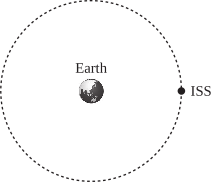
The International Space Station (ISS) is travelling around Earth in a stable circular orbit, as shown in the diagram below.
 

Which one of the following statements concerning the momentum and the kinetic energy of the ISS is correct?

  1. Both the momentum and the kinetic energy vary along the orbital path.
  2. Both the momentum and the kinetic energy are constant along the orbital path.
  3. The momentum is constant, but the kinetic energy changes throughout the orbital path.
  4. The momentum changes, but the kinetic energy remains constant throughout the orbital path.
Show Answers Only

\(D\)

Show Worked Solution
  • The magnitude of both the kinetic energy and momentum of the ISS remains constant.
  • However, momentum is a vector and as the direction of the ISS is continually changing so is the direction of the momentum of the ISS.

\(\Rightarrow D\)

♦♦ Mean mark 31%.
COMMENT: Students need to ensure they consider the direction of vector quantities as well as the magnitudes.

Filed Under: Motion in Gravitational Fields Tagged With: Band 5, smc-3692-20-Energy Changes, smc-3692-40-Satellites

PHYSICS, M8 2021 VCE 19

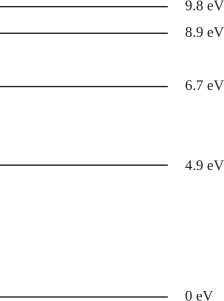
A simplified diagram of some of the energy levels of an atom is shown in the diagram.
 

  1. Identify the transition on the energy level diagram that would result in the emission of a 565 nm photon. Show your working.   (2 marks)

--- 6 WORK AREA LINES (style=lined) ---

  1. A sample of the atoms is excited into the 9.8 eV state and a line spectrum is observed as the states decay. Assume that all possible transitions occur.

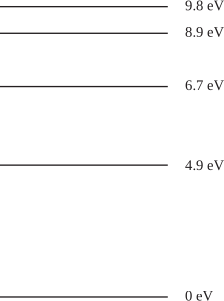
    What is the total number of lines in the spectrum? Explain your answer. You may use the diagram below to support your answer.   (2 marks)
     

--- 6 WORK AREA LINES (style=lined) ---

Show Answers Only

a.    The energy transition from 8.9 eV to 6.7 eV.

b.    9 spectral lines.

Show Worked Solution

a.    \(E=hf=\dfrac{hc}{\lambda}=\dfrac{6.626 \times 10^{-34} \times 3 \times 10^8}{565 \times 10^{-9}}=3.52 \times 10^{-19}\ \text{J}\)

\(\text{Convert to eV}\ =\dfrac{3.52 \times 10^{-19}}{1.602 \times 10^{-19}}=2.2\ \text{eV}\)

  • The energy transition from 8.9 eV to 6.7 eV will result in the emission of a 565 nm photon.
  • Note: This could have also been shown on the diagram as a downwards arrow from 8.9 eV to 6.7 eV.
     
♦ Mean mark (a) 50%.

b.    Decay from the 9.8 eV state:

  • Each photon emitted that has its own unique energy will result in a spectrum line.
  • There are 4 possible transitions from 9.8 eV, 3 from 8.9 eV, 2 from 6.7 eV and 1 from 4.9 eV, resulting in 10 different transitions.
  • However, the transition from 9.8 eV to 4.9 eV and 4.9 eV to 0 eV will produce a photon of the same energy, hence they will have the same spectral line. 
  • Therefore, there will be 9 lines in the spectrum.
♦♦ Mean mark (b) 31%.

Filed Under: Quantum Mechanical Nature of the Atom Tagged With: Band 5, smc-3702-20-Electron Transitions, smc-3702-30-Photon Energy

Calculus, 2ADV C4 2023 MET2 6 MC

Suppose that \(\displaystyle \int_{3}^{10} f(x)\,dx=C\)  and  \(\displaystyle \int_{7}^{10} f(x)\,dx=D\). The value of \(\displaystyle \int_{7}^{3} f(x)\,dx\) is

  1. \(C+D\)
  2. \(C+D-3\)
  3. \(C-D\)
  4. \(D-C\)
Show Answers Only

\(D\)

Show Worked Solution

\(\text{Given }\displaystyle \int_{3}^{10} f(x)\,dx=C\ \ \text{and}\ \displaystyle \int_{7}^{10} f(x)\,dx=D\)

\(\text{We can deduce:}\)

 \(\displaystyle \int_{3}^{10} f(x)\,dx\) \(=\displaystyle \int_{3}^{7} f(x)\,dx+\displaystyle \int_{7}^{10} f(x)\,dx\)
\(C\) \(=\displaystyle \int_{3}^{7} f(x)\,dx+D\)
\(C-D\) \(=\displaystyle \int_{3}^{7} f(x)\,dx\)
\(\therefore\ \displaystyle \int_{7}^{3} f(x)\,dx\) \(=D-C\)

 
\(\Rightarrow D\)


♦ Mean mark 49%.
MARKER’S COMMENT: 41% of students chose option C incorrectly assuming \(\int_{7}^3 f(x)\,dx=\int_{3}^7 f(x)\,dx\).

Filed Under: Areas Under Curves (Y12) Tagged With: Band 5, smc-975-70-Functions - no integration

Functions, EXT1 F1 2023 MET1 7

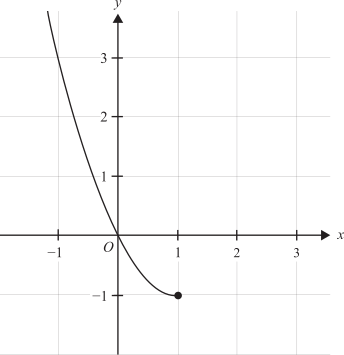
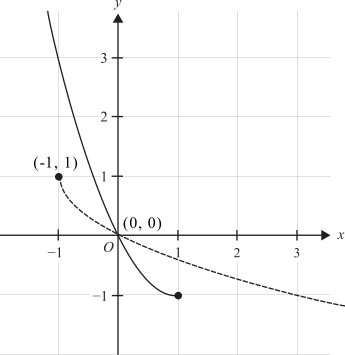
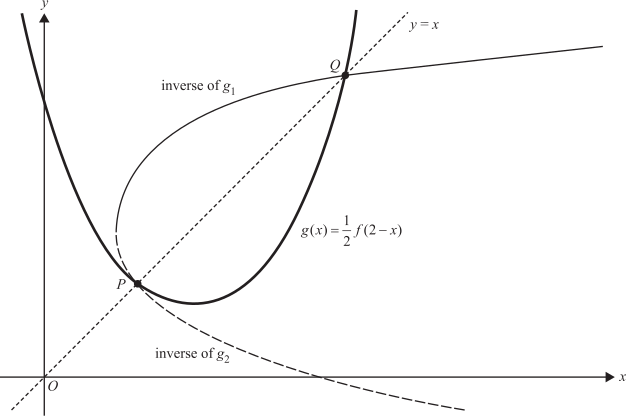
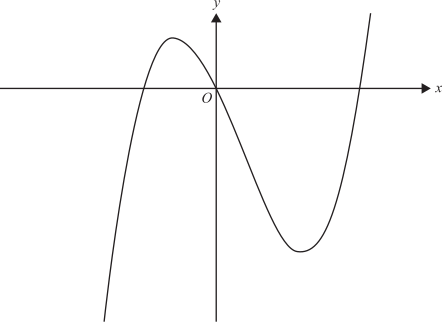
Consider \(f:(-\infty, 1]\rightarrow R, f(x)=x^2-2x\). Part of the graph of  \(y=f(x)\)  is shown below.
 

  1. State the range of \(f\).   (1 mark)

    --- 2 WORK AREA LINES (style=lined) ---

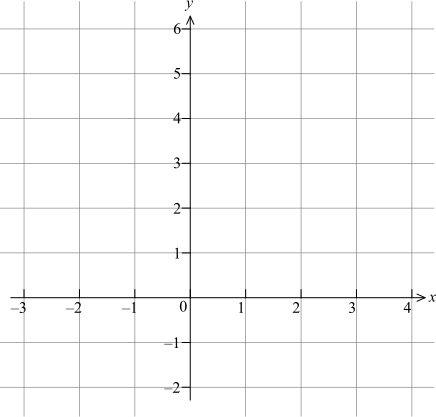
  2. Sketch the graph of the inverse function  \(y=f^{-1}(x)\) on the axes above. Label any endpoints and axial intercepts with their coordinates.   (2 marks)

    --- 0 WORK AREA LINES (style=lined) ---

  3. Determine the equation of the domain for the inverse function  \(f^{-1}\).   (2 marks)

    --- 3 WORK AREA LINES (style=lined) ---

Show Answers Only

a.    \([-1, \infty)\)

b.   

c.    \(f^{-1}(x)=1-\sqrt{x+1}\)

\(\text{Domain}\ [-1, \infty)\)

Show Worked Solution

a.    \([-1, \infty)\)

b.   

c.    \(\text{When }f(x)\ \text{is written in turning point form}\)

\(y=(x-1)^2-1\)
 

\(\text{Inverse function: swap}\ x \leftrightarrow y\)

\(x\) \(=(y-1)^2-1\)
\(x+1\) \(=(y-1)^2\)
\(-\sqrt{x+1}\) \(=y-1\)
\(f^{-1}(x)\) \(=1-\sqrt{x+1}\)

 
\(\text{Domain}\ [-1, \infty)\)


♦ Mean mark (c) 48%.
MARKER’S COMMENT: Common error → writing the function as \(f^{-1}(x)=1+\sqrt{x+1}\).

Filed Under: Inverse Functions (Ext1-2027), Inverse Functions (Ext1) Tagged With: Band 3, Band 4, Band 5, smc-1034-20-Other Functions, smc-6641-20-Other Functions

PHYSICS, M7 2021 VCE 16

Light can be described by a wave model and also by a particle (or photon) model. The rapid emission of photoelectrons at very low light intensities supports one of these models but not the other.

Identify the model that is supported, giving a reason for your answer.   (2 marks)

--- 5 WORK AREA LINES (style=lined) ---

Show Answers Only

Model supported: Particle (photon) model

Reasons could include one of the following:

  • Each electron ejection corresponds to the absorption of a single photon.
  • The immediate ejection of a photoelectron corresponds to its direct interaction with the initial photon.
  • Contrary to the wave theory, which suggests that energy accumulates gradually, the emission of photoelectrons at very low light intensities demonstrates that energy is delivered in discrete quanta.
Show Worked Solution

Model supported: Particle (photon) model

Reasons could include one of the following:

  • Each electron ejection corresponds to the absorption of a single photon.
  • The immediate ejection of a photoelectron corresponds to its direct interaction with the initial photon.
  • Contrary to the wave theory, which suggests that energy accumulates gradually, the emission of photoelectrons at very low light intensities demonstrates that energy is delivered in discrete quanta.
♦ Mean mark 42%.

Filed Under: Light: Quantum Model Tagged With: Band 5, smc-3698-80-Wave/Particle models

Calculus, MET2 2022 VCAA 2

On a remote island, there are only two species of animals: foxes and rabbits. The foxes are the predators and the rabbits are their prey.

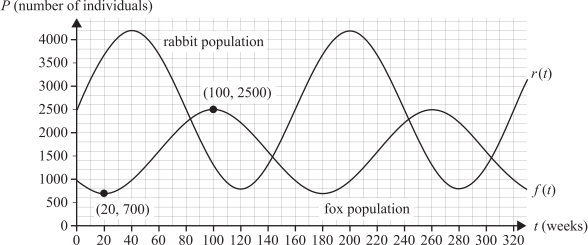
The populations of foxes and rabbits increase and decrease in a periodic pattern, with the period of both populations being the same, as shown in the graph below, for all `t \geq 0`, where time `t` is measured in weeks.

One point of minimum fox population, (20, 700), and one point of maximum fox population, (100, 2500), are also shown on the graph.

The graph has been drawn to scale.
 

The population of rabbits can be modelled by the rule `r(t)=1700 \sin \left(\frac{\pi t}{80}\right)+2500`.

  1.   i. State the initial population of rabbits.   (1 mark)

    --- 2 WORK AREA LINES (style=lined) ---

  2.  ii. State the minimum and maximum population of rabbits.   (1 mark)

    --- 2 WORK AREA LINES (style=lined) ---

  3. iii. State the number of weeks between maximum populations of rabbits.   (1 mark)

    --- 2 WORK AREA LINES (style=lined) ---

The population of foxes can be modelled by the rule `f(t)=a \sin (b(t-60))+1600`.

  1. Show that `a=900` and `b=\frac{\pi}{80}`.   (2 marks)

    --- 4 WORK AREA LINES (style=lined) ---

  2. Find the maximum combined population of foxes and rabbits. Give your answer correct to the nearest whole number.   (1 mark)

    --- 1 WORK AREA LINES (style=lined) ---

  3. What is the number of weeks between the periods when the combined population of foxes and rabbits is a maximum?   (1 mark)

    --- 1 WORK AREA LINES (style=lined) ---

The population of foxes is better modelled by the transformation of `y=\sin (t)` under `Q` given by
 

  1. Find the average population during the first 300 weeks for the combined population of foxes and rabbits, where the population of foxes is modelled by the transformation of `y=\sin(t)` under the transformation `Q`. Give your answer correct to the nearest whole number.   (4 marks)

    --- 8 WORK AREA LINES (style=lined) ---

Over a longer period of time, it is found that the increase and decrease in the population of rabbits gets smaller and smaller.

The population of rabbits over a longer period of time can be modelled by the rule

`s(t)=1700cdote^(-0.003t)cdot sin((pit)/80)+2500,\qquad text(for all)\ t>=0`

  1. Find the average rate of change between the first two times when the population of rabbits is at a maximum. Give your answer correct to one decimal place.   (2 marks)

    --- 3 WORK AREA LINES (style=lined) ---

  2. Find the time, where `t>40`, in weeks, when the rate of change of the rabbit population is at its greatest positive value. Give your answer correct to the nearest whole number.   (2 marks)

    --- 3 WORK AREA LINES (style=lined) ---

  3. Over time, the rabbit population approaches a particular value.
  4. State this value.   (1 mark)

    --- 1 WORK AREA LINES (style=lined) ---

Show Answers Only

ai.   `r(0)=2500`

aii.  Minimum population of rabbits `= 800`

Maximum population of rabbits `= 4200`

aiii. `160`  weeks

b.    See worked solution.

c.    `~~ 5339` (nearest whole number)

d.    Weeks between the periods is 160

e.    `~~ 4142` (nearest whole number)

f.    Average rate of change `=-3.6` rabbits/week (1 d.p.)

g.    `t = 156` weeks (nearest whole number)  

h.    ` s → 2500`

Show Worked Solution

ai.  Initial population of rabbits

From graph when `t=0, \ r(0) = 2500`

Using formula when `t=0`

`r(t)` `= 1700\ sin \left(\frac{\pi t}{80}\right)+2500`  
`r(0)` `= 1700\ sin \left(\frac{\pi xx 0}{80}\right)+2500 = 2500`  rabbits  


aii.
From graph,

Minimum population of rabbits `= 800`

Maximum population of rabbits `= 4200`

OR

Using formula

Minimum is when `t = 120`

`r(120) = 1700\ sin \left(\frac{\pi xx 120}{80}\right)+2500 = 1700 xx (-1) + 2500 = 800`

Maximum is when `t = 40`

`r(40) = 1700\ sin \left(\frac{\pi xx 40}{80}\right)+2500 = 1700 xx (1) + 2500 = 4200`

 
aiii. Number of weeks between maximum populations of rabbits `= 200-40 = 160`  weeks

 
b.  Period of foxes = period of rabbits = 160:

`frac{\2pi}{b} = 160`

`:.\  b = frac{\2pi}{160} = frac{\pi}{80}` which is the same period as the rabbit population.

Using the point `(100 , 2500)`

Amplitude when `b = frac{\pi}{80}`: 

`f(t)` `=a \ sin (pi/80(t-60))+1600`  
`f(100)` `= 2500`  
`2500` `= a \ sin (pi/80(100-60))+1600`  
`2500` `= a \ sin (pi/2)+1600`  
`a` `= 2500-1600 = 900`  

 
`:.\  f(t)= 900 \ sin (pi/80)(t-60) + 1600`


c.    Using CAS find `h(t) = f(t) + r(t)`:

`h(t):=900 \cdot \sin \left(\frac{\pi}{80} \cdot(t-60)\right)+1600+1700\cdot \sin \left(\frac{\pit}{80}\right) +2500`

  
`text{fMax}(h(t),t)|0 <= t <= 160`      `t = 53.7306….`
  

`h(53.7306…)=5339.46`

  
Maximum combined population `~~ 5339` (nearest whole number)


♦♦ Mean mark (c) 40%.
MARKER’S COMMENT: Many rounding errors with a common error being 5340. Many students incorrectly added the max value of rabbits to the max value of foxes, however, these points occurred at different times.

d.    Using CAS, check by changing domain to 0 to 320.

`text{fMax}(h(t),t)|0 <= t <= 320`     `t = 213.7305…`
 
`h(213.7305…)=5339.4568….`
 
Therefore, the number of weeks between the periods is 160.
  

e.    Fox population:

`t^{\prime} = frac{90}{pi}t + 60`   →   `t = frac{pi}{90}(t^{\prime}-60)`

`y^{\prime} = 900y+1600`   →   `y = frac{1}{900}(y^{\prime}-1600)`

`frac{y^{\prime}-1600}{900} = sin(frac{pi(t^{\prime}-60)}{90})`

`:.\  f(t) = 900\ sin\frac{pi}{90}(t-60) + 1600`

  
Average combined population  [Using CAS]   
  
`=\frac{1}{300} \int_0^{300} left(\900 \sin \left(\frac{\pi(t-60)}{90}\right)+1600+1700\ sin\ left(\frac{\pi t}{80}\right)+2500\right) d t`
  

`= 4142.2646…..  ~~ 4142` (nearest whole number)


♦ Mean mark (e) 40%.
MARKER’S COMMENT: Common incorrect answer 1600. Some incorrectly subtracted `r(t)`. Others used average rate of change instead of average value.

f.   Using CAS

`s(t):= 1700e^(-0.003t) dot\sin\frac{pit}{80} + 2500`
 

`text{fMax}(s(t),t)|0<=t<=320`        `x = 38.0584….`
 

`s(38.0584….)=4012.1666….`
 

`text{fMax}(s(t),t)|160<=t<=320`     `x = 198.0584….`
 

`s(198.0584….)=3435.7035….`
 

Av rate of change between the points

`(38.058 , 4012.167)`  and  `(198.058 , 3435.704)`

`= frac{4012.1666….-3435.7035….}{38.0584….-198.0584….} =-3.60289….`
 

`:.` Average rate of change `=-3.6` rabbits/week (1 d.p.)


♦ Mean mark (f ) 45%.
MARKER’S COMMENT: Some students rounded too early.
`frac{s(200)-s(40)}{200-40}` was commonly seen.
Some found average rate of change between max and min populations.

g.   Using CAS

`s^(primeprime)(t) = 0` , `t = 80(n-0.049) \ \forall n \in Z`

After testing `n = 1, 2, 3, 4` greatest positive value occurs for `n = 2` 

`t` `= 80(n-0.049)`  
  `= 80(2-0.049)`  
  `= 156.08`  

 
`:. \ t = 156` weeks (nearest whole number)


♦♦♦ Mean mark (g) 25%.
MARKER’S COMMENT: Many students solved `frac{ds}{dt}=0`.
A common answer was 41.8, as `s(156.11…)=41.79`.
Another common incorrect answer was 76 weeks.

h.   As `t → ∞`, `e^(-0.003t) → 0`

`:.\ s → 2500`

Filed Under: Average Value and Other, Differentiation (Trig), Maxima and Minima, Trig Differentiation Tagged With: Band 2, Band 4, Band 5, Band 6, smc-2757-10-Sin, smc-2757-80-Applications, smc-641-60-Other themes, smc-736-10-sin, smc-744-10-sin, smc-753-60-Matrix, smc-756-20-Trig

Calculus, MET2 2022 VCAA 1

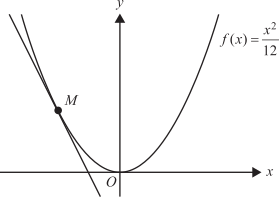
The diagram below shows part of the graph of `y=f(x)`, where `f(x)=\frac{x^2}{12}`.
 

  1. State the equation of the axis of symmetry of the graph of `f`.   (1 mark)

    --- 2 WORK AREA LINES (style=lined) ---

  2. State the derivative of `f` with respect to `x`.   (1 mark)

    --- 2 WORK AREA LINES (style=lined) ---

The tangent to `f` at point `M` has gradient `-2` .

  1. Find the equation of the tangent to `f` at point `M`.   (2 marks)

    --- 6 WORK AREA LINES (style=lined) ---

The diagram below shows part of the graph of `y=f(x)`, the tangent to `f` at point `M` and the line perpendicular to the tangent at point `M`.


  1.  i. Find the equation of the line perpendicular to the tangent passing through point `M`.   (1 mark)

    --- 5 WORK AREA LINES (style=lined) ---

  2. ii. The line perpendicular to the tangent at point `M` also cuts `f` at point `N`, as shown in the diagram above.
  3.     Find the area enclosed by this line and the curve `y=f(x)`.   (2 marks)

    --- 8 WORK AREA LINES (style=lined) ---

  4. Another parabola is defined by the rule `g(x)=\frac{x^2}{4 a^2}`, where `a>0`.
  5. A tangent to `g` and the line perpendicular to the tangent at `x=-b`, where `b>0`, are shown below.

  1. Find the value of `b`, in terms of `a`, such that the shaded area is a minimum.   (4 marks)

    --- 8 WORK AREA LINES (style=lined) ---

Show Answers Only

a.    `x=0`

b.    ` f^{\prime}(x)=1/6x`

c.    `x=-12`

di.    `y=1/2x + 18`

dii.   Area`= 375` units²

e.    `b = 2a^2`

Show Worked Solution

a.   Axis of symmetry:  `x=0`
  

b.    `f(x)`  `=\frac{x^2}{12}`  
  ` f^{\prime}(x)` `= 1/6x`  

  
c.  
At `M` gradient `= -2`

`1/6x` `= -2`  
`x` `= -12`  

 
When  `x = -12`
 

`f(x) = (-12)^2/12 = 12`
 
Equation of tangent at `(-12 , 12)`:

`y-y_1` `=m(x-x_1)`  
`y-12` `= -2(x + 12)`  
`y` `= -2x-12`  


d.i  
Gradient of tangent `= -2`

`:.`  gradient of normal `= 1/2` 

Equation at `M(- 12 , 12)`

`y -y_1` `=m(x-x_1)`  
`y-12` `= 1/2(x + 12)`  
`y` `=1/2x + 18`  


d.ii 
Points of intersection of `f(x)` and normal are at  `M` and `N`.

So equate ` y = x^2/12` and  `y = 1/2x + 18` to find `N`

`x^2/12` `=1/2x + 18`  
`x^2-6x-216` `=0`  
`(x + 12)(x-18)` `=0`  

   
`:.\  x = -12` or `x = 18`

Area `= \int_{-12}^{18}\left(\frac{1}{2} x+18-\frac{x^2}{12}\right) d x`  
  `= [x^2/4 + 18x-x^3/36]_(-12)^18`  
  `= [18^2/4 +18^2-18^3/36] – [12^2/4 + 18 xx (-12)-(-12)^3/36]`  
  `= 375` units²  


e.   `g(x) = x^2/(4a^2)`   `a > 0`

At `x = -b`   `y = (-b)^2/(4a^2) = b^2/4a^2`

`g^{\prime}(x) = (2x)/(4a^2) = x/(2a^2)`

Gradient of tangent `= (-b)/(2a^2)`

Gradient of normal `= (2a^2)/b`

Equation of normal at `(- b , b^2/(4a^2))`

`y-y_1` `= m(x-x_1)`  
`y-b^2/(4a^2)` `= (2a^2)/b(x-(-b))`  
`y` `= (2a^2x)/b + 2a^2 + b^2/(4a^2)`  
`y` `= (2a^2x)/b +(8a^4 + b^2)/(4a^2)`  

 
Points of intersection of normal and parabola (Using CAS)

solve `((2a^2x)/b +(8a^4 + b^2)/(4a^2) = x^2/(4a^2),x)`

`x =-b`  or  `x = (8a^4+b^2)/b`

 
Calculate area using CAS

`A = \int_{-b}^{(8a^4+b^2)/b}\left(\frac{2a^2x}{b} +\frac{8a^4 + b^2}{4a^2}-frac{x^2}{4a^2} \right) dx`

`A = frac{64a^12 + 48a^8b^2 + 12a^4b^4 + b^6}{3a^2b^3}`
 
Using CAS Solve derivative of `A = 0`  with respect to `b` to find `b`

solve`(d/(db)(frac{64a^12 + 48a^8b^2 + 12a^4b^4 + b^6}{3a^2b^3})=0,b)`

 
`b =-2a^2`   and  `b = 2a^2`

Given `b > 0`

`b = 2a^2`


♦♦ Mean mark (e) 33%.
MARKER’S COMMENT: Common errors: Students found `\int_{-b}^{\frac{8 a^4+b^2}{b}}\left(y_n\right) d x` and failed to subtract `g(x)` or had incorrect terminals.

Filed Under: Area Under Curves, Maxima and Minima, Tangents and Normals Tagged With: Band 2, Band 4, Band 5, Band 6, smc-634-10-Polynomial, smc-634-50-Find tangent given curve, smc-641-10-Area, smc-723-10-Quadratic, smc-723-80-Area between graphs

Calculus, MET2 2022 VCAA 19 MC

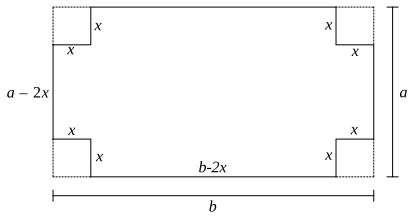
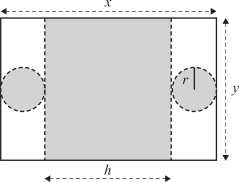
A box is formed from a rectangular sheet of cardboard, which has a width of `a` units and a length of `b` units, by first cutting out squares of side length `x` units from each corner and then folding upwards to form a container with an open top.

The maximum volume of the box occurs when `x` is equal to

  1. `\frac{a-b+\sqrt{a^2-a b+b^2}}{6}`
  2. `\frac{a+b+\sqrt{a^2-a b+b^2}}{6}`
  3. `\frac{a-b-\sqrt{a^2-a b+b^2}}{6}`
  4. `\frac{a+b-\sqrt{a^2-a b+b^2}}{6}`
  5. `\frac{a+b-\sqrt{a^2-2 a b+b^2}}{6}`
Show Answers Only

`D`

Show Worked Solution

`V(x)=x(b-2 x)(a-2 x)=abx-2(a+b)x^2+4x^3`

Maximum occurs when `V\^{\prime} (x)=0`

`V\^{\prime} (x)=ab-4(a+b)x+12x^2=0`

Solving for `x` using CAS.

`x=\frac{a+b \+ \sqrt{a^2-a b+b^2}}{6}`  or  `x=\frac{a+b \- \sqrt{a^2-a b+b^2}}{6}`

Testing shape of the cubic using `b = 2` and `a = 1`

Maximum occurs at the smaller value of `x`

`:.\  x=\frac{a+b \- \sqrt{a^2-a b+b^2}}{6}`

`=>D`


♦♦ Mean mark 34%.
MARKER’S COMMENT: 34% of students incorrectly chose option B. 

Filed Under: Maxima and Minima Tagged With: Band 5, smc-641-40-Volume (Other)

Probability, MET2 2022 VCAA 18 MC

If `X` is a binomial random variable where `n=20, p=0.88` and `\text{Pr}(X \geq 16|X\geq a)=0.9175`, correct to four decimal places, then `a` is equal to

  1. 11
  2. 12
  3. 13
  4. 14
  5. 15
Show Answers Only

`B`

Show Worked Solution

`X \~ \text{Bi}(20,0.88)`

`\text{Pr}(X \geq 16|X\geq a)=0.9175`

`\frac{\text{Pr}(X \geq 16 \cap X \geq a)}{\text{Pr}(X \geq a)} \approx 0.9175`
 

All options are `< 16`

`:.\ \frac{\text{Pr}(X \geq 16)}{\text{Pr}(X \geq a)} \approx 0.9175`
 

Testing options using CAS

Option A: `\ \frac{\text{Pr}(X \geq 16)}{\text{Pr}(X \geq 11)} \approx 0.9173`

Option B: `\ \frac{\text{Pr}(X \geq 16)}{\text{Pr}(X \geq 12)} \approx 0.9175`

Option C: `\ \frac{\text{Pr}(X \geq 16)}{\text{Pr}(X \geq 13)} \approx 0.9186`

Option D: `\ \frac{\text{Pr}(X \geq 16)}{\text{Pr}(X \geq 14)} \approx 0.9235`

Option E: `\ \frac{\text{Pr}(X \geq 16)}{\text{Pr}(X \geq 15)} \approx 0.9418`
  

`=>B`


♦♦ Mean mark 47%.

Filed Under: Binomial Tagged With: Band 5, smc-638-20-binomCdf (CAS), smc-638-50-Conditional

Calculus, MET2 2022 VCAA 17 MC

A function `g` is continuous on the domain `x \in[a, b]` and has the following properties:

  • The average rate of change of `g` between `x=a` and `x=b` is positive.
  • The instantaneous rate of change of `g` at `x=\frac{a+b}{2}` is negative.

Therefore, on the interval `x \in[a, b]`, the function must be

  1. many-to-one.
  2. one-to-many.
  3. one-to-one.
  4. strictly decreasing.
  5. strictly increasing.
Show Answers Only

`A`

Show Worked Solution

The first property shows that the point (`a` , __ ) must be below (`b` , __ ) to give a positive rate of change.

The second property gives the midpoint of `a` and `b`. But this point has a negative instantaneous rate of change.

Therefore, this shows that the function `g(x)` has turning points and is in the shape of a cubic, so many-to-one is the correct description.

 
`=>A`


♦♦ Mean mark 39%.

Filed Under: Standard Differentiation Tagged With: Band 5, smc-746-40-Average ROC

Graphs, MET2 2022 VCAA 13 MC

The function `f(x)=\log _e\left(\frac{x+a}{x-a}\right)`, where `a` is a positive real constant, has the maximal domain

  1. `[-a, a]`
  2. `(-a, a)`
  3. `R \backslash[-a, a]`
  4. `R \backslash(-a, a)`
  5. `R`
Show Answers Only

`C`

Show Worked Solution

`f(x)=\log _e\left(\frac{x+a}{x-a}\right),\ a>0`

For `\frac{x+a}{x-a}>0` either both `x + a` and `x – a` are positive and `x > a` or both are negative and `x < -a`.

`:.` maximal domain occurs when `\ x \in R \backslash[-a, a]`
 

`=>C`


♦♦ Mean mark 39%.

Filed Under: Graphs and Applications Tagged With: Band 5, smc-2745-40-Log graphs, smc-2745-50-Find Domain/Range

Probability, MET2 2022 VCAA 12 MC

A bag contains three red pens and `x` black pens. Two pens are randomly drawn from the bag without replacement. The probability of drawing a pen of each colour is equal to

  1. `\frac{6 x}{(2+x)(3+x)}`
  2. `\frac{3 x}{(2+x)(3+x)}`
  3. `\frac{x}{2+x}`
  4. `\frac{3+x}{(2+x)(3+x)}`
  5. `\frac{3+x}{5+2 x}`
Show Answers Only

`A`

Show Worked Solution
Pr`(RB)` + Pr`(BR)` `= \frac{3}{3+x} \times \frac{x}{2+x}+\frac{x}{3+x} \times \frac{3}{2+x}`  
  `= \frac{6 x}{(2+x)(3+x)}`  

 
`=>A`


♦ Mean mark 52%.


Filed Under: Multi-Stage Events Tagged With: Band 5, smc-646-10-MSE with no replacement

Graphs, MET2 2022 VCAA 9 MC

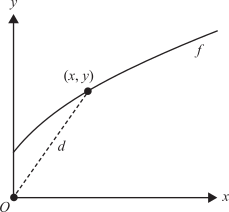
Let `f:[0, \infty) \rightarrow R, f(x)=\sqrt{2 x+1}`.

The shortest distance, `d`, from the origin to the point `(x, y)` on the graph of `f` is given by

  1. `d=x^2+2 x+1`
  2. `d=x^2+\sqrt{2 x+1}`
  3. `d=\sqrt{x^2-2 x+1}`
  4. `d=x+1`
  5. `d=2 x+1`
Show Answers Only

`D`

Show Worked Solution

Straight line distance is the shortest.

`:.` Therefore, using pythagoras and given `f(x) = \sqrt{2x+1}` 

`d^2` `= x^2 + y^2`  
  `=x^2 + (sqrt{2x+1})^2`  
  `= x^2 + 2x +1`  
  `=(x + 1)^2`  
`d` `=sqrt((x + 1)^2)`  
  `= x+1`  

  
`=>D`


♦ Mean mark 50%.

Filed Under: Coordinate Geometry Tagged With: Band 5, smc-727-20-Distance

Functions, MET2 2022 VCAA 6 MC

Which of the pairs of functions below are not inverse functions?

  1. \( \begin {cases}f(x)=5x+3         &\ \ x\in R \\ g(x)=\dfrac{x-3}{5}         &\ \ x \in R \\ \end{cases}\)
     
  2. \( \begin {cases}f(x)=\frac{2}{3}x+2         &\ \ x\in R \\ g(x)=\frac{3}{2}x-3         &\ \ x \in R \\ \end{cases}\)
     
  3. \( \begin {cases}f(x)=x^2         &\ \ x<0 \\ g(x)=\sqrt{x}         &\ \ x >0 \\ \end{cases}\)
     
  4. \( \begin {cases}f(x)=\dfrac{1}{x}        &\ \ x\neq 0 \\ g(x)=\dfrac{1}{x}         &\ \ x \neq 0 \\ \end{cases}\)
     
  5. \( \begin {cases}f(x)=\log_e(x)+1        &\ \ x>0 \\ g(x)=e^{x-1}        &\ \ x \in R \\ \end{cases}\)
Show Answers Only

\(C\)

Show Worked Solution

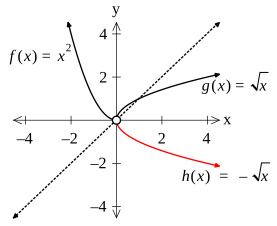
\(\text{Graphically, it can be seen that } f(x)=x^2\ \text{and }g(x)=\sqrt{x}\ \text{are not}\)

\(\text{inverse functions as }g(x)\ \text{is not a reflection of }f(x)\ \text{in the line }y=x.\)

\(g(x)\ \text{should be the curve drawn as } h(x)=-\sqrt{x}\ \text{below}.\)

\(\Rightarrow C\)


♦ Mean mark 47%.

Filed Under: Logs and Exponential Functions, Polynomial and Other Functions Tagged With: Band 5, smc-5204-60-Identify graph, smc-5205-20-Square root, smc-5205-40-Other functions, smc-5205-60-Identify graph

PHYSICS, M7 2021 VCE 13

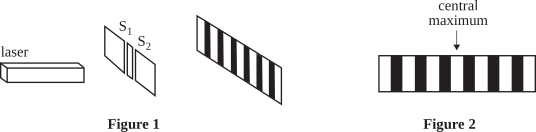
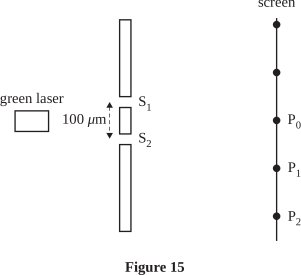
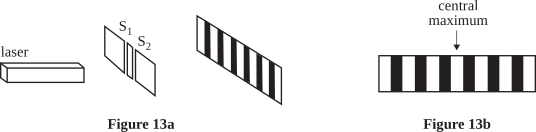
In Young's double-slit experiment, the distance between two slits, S\(_1\) and S\(_2\), is 2.0 mm. The slits are 1.0 m from a screen on which an interference pattern is observed, as shown in Figure 1. Figure 2 shows the central maximum of the observed interference pattern.
 

  1. If a laser with a wavelength of 620 nm is used to illuminate the two slits, what would be the distance between two successive dark bands? Show your working.   (2 marks)

--- 5 WORK AREA LINES (style=lined) ---

  1. Explain how this experiment supports the wave model of light.   (2 marks)

--- 5 WORK AREA LINES (style=lined) ---

Show Answers Only

a.    \(3.1 \times 10^{-4}\ \text{m}\)

b.    The experiment supports the wave theory as follows:

  • Young’s double slit experiment demonstrates how light will refract and form an interference pattern against a screen.
  • Since interference is a wave phenomenon, the experiment supports the wave model of light.

Show Worked Solution

a.    \(d\,\sin \theta=m \lambda\ \ \text{and}\ \ \sin \theta=\dfrac{\Delta x}{D}\)

  • \(\Delta x\) is the distance between two successive dark bands and \(D\) is the distance from the slits to the screen.
  •    \( \dfrac{d \Delta x}{D}\) \(=m \lambda \)
  •         \( \Delta x-\dfrac{D \lambda}{d} \)
  •              \(=\dfrac{1 \times 620 \times 10^{-9}}{2 \times 10^{-3}}\)
  •              \(=3.1 \times 10^{-4}\ \text{m}\)
♦ Mean mark (a) 51%.

b.    The experiment supports the wave theory as follows:

  • Young’s double slit experiment demonstrates how light will refract and form an interference pattern against a screen.
  • Since interference is a wave phenomenon, the experiment supports the wave model of light.

Filed Under: Light: Wave Model Tagged With: Band 4, Band 5, smc-3697-20-Young, smc-3697-30-Double Slit Calcs

PHYSICS, M6 2021 VCE 6

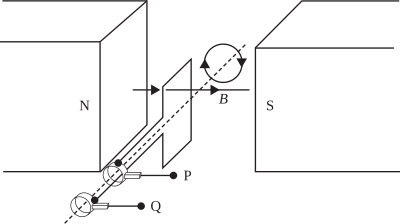
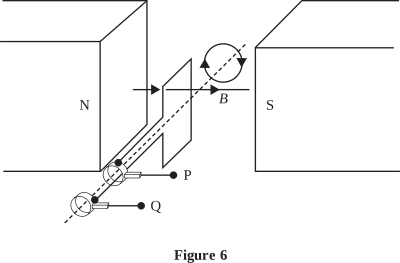
The diagram shows a simple AC generator. A mechanical energy source rotates the loop smoothly at 50 revolutions per second and the loop generates a voltage of 6 V. The magnetic field, \(B\), is constant and uniform. The direction of rotation is as shown in the diagram.
 

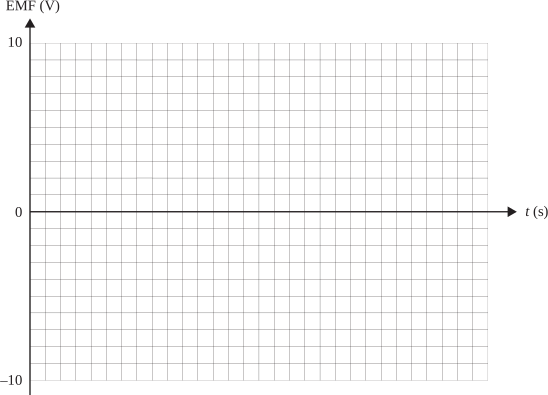
  1. Sketch the output EMF between \(\text{P}\) and \(\text{Q}\) versus time, \(t\), on the grid below, starting with the loop in the position shown in the diagram. Show at least two complete revolutions.   (3 marks)
     

--- 0 WORK AREA LINES (style=blank) ---

  1. Describe the function of the slip rings shown in the diagram.   (1 mark)

--- 2 WORK AREA LINES (style=lined) ---

  1.  i. How could the AC generator shown be changed to a DC generator?   (1 mark)

  2. ii. Sketch the output EMF versus time, \(t\), for this DC generator.
  3.     Graph the output for at least two complete revolutions.   (2 marks)


--- 0 WORK AREA LINES (style=blank) ---

Show Answers Only

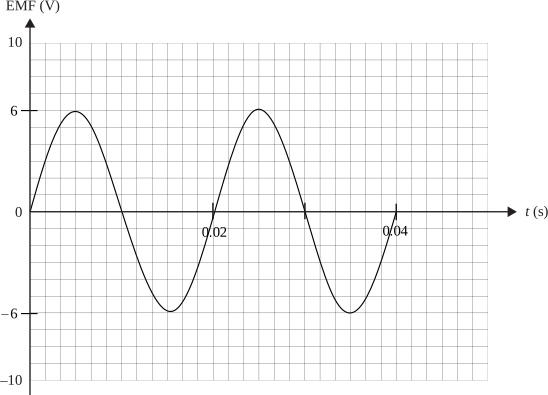
a.   


b.    The function of the slip rings:

  • Produce an AC voltage output by maintaining a constant connection between the loop and the external circuit.
     

c.i.   Changing the slip rings to a split ring commutator.

c.ii. 


Show Worked Solution

a.    \(\text{Period}\ (T)=\dfrac{1}{f}=\dfrac{1}{50}=0.02\ \text{s}\).

b.    The function of the slip rings:

  • Produce an AC voltage output by maintaining a constant connection between the loop and the external circuit.
♦ Mean mark (b) 54%.

c.i.   Changing the slip rings to a split ring commutator.
 

c.ii.  The output of a DC generator is positive only.


♦ Mean mark (c)(i) 55%.

Filed Under: Applications of the Motor Effect Tagged With: Band 4, Band 5, smc-3695-40-Generators

PHYSICS, M6 2021 VCE 7

The generator of an electrical power plant delivers 500 MW to external transmission lines when operating at 25 kV. The generator's voltage is stepped up to 500 kV for transmission and stepped down to 240 V 100 km away (for domestic use). The overhead transmission lines have a total resistance of 30.0 \(\Omega\). Assume that all transformers are ideal.

  1. Explain why the voltage is stepped up for transmission along the overhead transmission lines.   (2 marks)

--- 5 WORK AREA LINES (style=lined) ---

  1. Calculate the current in the overhead transmission lines. Show your working.   (2 marks)

--- 5 WORK AREA LINES (style=lined) ---

  1. Determine the maximum power available for domestic use at 240 V. Show all your working.   (3 marks)

--- 7 WORK AREA LINES (style=lined) ---

Show Answers Only

a.    Since  `P=IV:`

  • The voltage is stepped up for transmission in overhead transmission lines to reduce the current while maintaining a constant power output.
  • Since  \(P_{\text{loss}}=I^2R\), if the current is reduced, the power loss will is reduced significantly.

b.    \(I=1000\ \text{A}\)

c.    \(P_{\text{avail}}=470\ \text{MW}\)

Show Worked Solution

a.    Since  `P=IV:`

  • The voltage is stepped up for transmission in overhead transmission lines to reduce the current while maintaining a constant power output.
  • Since  \(P_{\text{loss}}=I^2R\), if the current is reduced, the power loss will is reduced significantly.
♦♦ Mean mark (a) 30%.
COMMENT: Students must state that the power is constant when stepping up the voltage to decrease the current.

b.    The power in the lines is 500 MW.

Voltage through the transmission lines is 500 kV.

Using \(P=IV:\)

   \(I=\dfrac{P}{V}=\dfrac{500 \times 10^6}{500 \times 10^3}=1000\ \text{A}\)
 

♦ Mean mark (b) 43%.

c.    \(P_{\text{loss}}=I^2R=(1000)^2 \times 30=30\ \text{MW}\)

\(\text{Power (delivered)}\ =500\ \text{MW}-30\ \text{MW}=470\ \text{MW}\)

♦♦ Mean mark (c) 38%.

Filed Under: Electromagnetic Induction Tagged With: Band 5, smc-3705-80-Energy Distribution

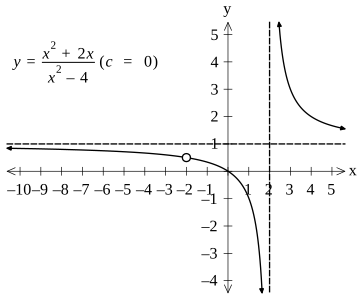
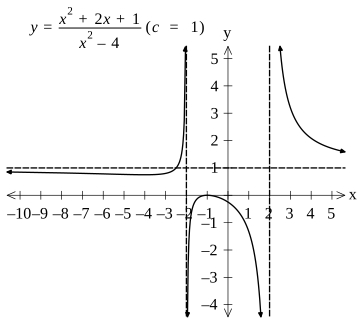
Functions, 2ADV F2 2022 SPEC2 3 MC

The graph of  `y=\frac{x^2+2x+c}{x^2-4}`, where `c \in R`, will always have

  1. two vertical asymptotes and one horizontal asymptote.
  2. a vertical asymptote with equation `x=-2` and one horizontal asymptote with equation `y=1`.
  3. one horizontal asymptote with equation `y=1` and only one vertical asymptote with equation `x=2`.
  4. a horizontal asymptote with equation `y=1` and at least one vertical asymptote.
Show Answers Only

`D`

Show Worked Solution

`y=\frac{x^2+2x+c}{x^2-4}\ \ =>\ \ y=\frac{x^2+2x+c}{(x-2)(x+2)}`

`text{Vertical asymptotes:}\ x=2, \ x=-2`

`->\ text{However, if}\ c=0,\ \text{only 1 vertical asymptote at}\ \ x=2.`

`text{Horizontal asymptote:}\ y=1`

`=>D`


♦♦ Mean mark 38%.
41% of students chose `A` and did not consider when `c = 0`

Filed Under: Non-Calculus Graphing (Y12) Tagged With: Band 5, smc-1009-10-Quotient Function, smc-1009-40-Identify Asymptotes

Graphs, SPEC2 2022 VCAA 3 MC

The graph of  `y=\frac{x^2+2x+c}{x^2-4}`, where `c \in R`, will always have

  1. two vertical asymptotes and one horizontal asymptote.
  2. two horizontal asymptotes and one vertical asymptote.
  3. a vertical asymptote with equation `x=-2` and one horizontal asymptote with equation `y=1`.
  4. one horizontal asymptote with equation `y=1` and only one vertical asymptote with equation `x=2`.
  5. a horizontal asymptote with equation `y=1` and at least one vertical asymptote.
Show Answers Only

`E`

Show Worked Solution

`y=\frac{x^2+2x+c}{x^2-4}\ \ =>\ \ y=\frac{x^2+2x+c}{(x-2)(x+2)}`

`text{Vertical asymptotes:}\ x=2, \ x=-2`

`->\ text{However, if}\ c=0,\ \text{only 1 vertical asymptote at}\ \ x=2.`

`text{Horizontal asymptote:}\ y=1`

`text{Using CAS to graph for different values of}\ c:`

`=>E`


♦♦ Mean mark 38%.
41% of students chose `A` and did not consider when `c = 0`

Filed Under: Partial Fractions, Quotient and Other Functions (SM) Tagged With: Band 5, smc-1154-10-Quotient functions/Asymptotes

Calculus, MET2 2023 VCAA 3

Consider the function \(g:R \to R, g(x)=2^x+5\).

  1. State the value of \(\lim\limits_{x\to -\infty} g(x)\).   (1 mark)

    --- 1 WORK AREA LINES (style=lined) ---

  2. The derivative, \(g^{'}(x)\), can be expressed in the form \(g^{'}(x)=k\times 2^x\).
  3. Find the real number \(k\).   (1 mark)

    --- 2 WORK AREA LINES (style=lined) ---

  4.  i. Let \(a\) be a real number. Find, in terms of \(a\), the equation of the tangent to \(g\) at the point \(\big(a, g(a)\big)\).   (1 mark)

    --- 3 WORK AREA LINES (style=lined) ---

    ii. Hence, or otherwise, find the equation of the tangent to \(g\) that passes through the origin, correct to three decimal places.   (2 marks)

    --- 8 WORK AREA LINES (style=lined) ---

  1.  

Let \(h:R\to R, h(x)=2^x-x^2\).

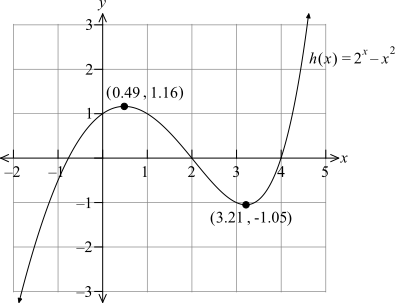
  1. Find the coordinates of the point of inflection for \(h\), correct to two decimal places.   (1 mark)

    --- 2 WORK AREA LINES (style=lined) ---

  2. Find the largest interval of \(x\) values for which \(h\) is strictly decreasing.
  3. Give your answer correct to two decimal places.   (1 mark)

    --- 2 WORK AREA LINES (style=lined) ---

  4. Apply Newton's method, with an initial estimate of \(x_0=0\), to find an approximate \(x\)-intercept of \(h\).
  5. Write the estimates \(x_1, x_2,\) and \(x_3\) in the table below, correct to three decimal places.   (2 marks)
      

    \begin{array} {|c|c|}
    \hline
    \rule{0pt}{2.5ex} \qquad x_0\qquad \ \rule[-1ex]{0pt}{0pt} & \qquad \qquad 0 \qquad\qquad \\
    \hline
    \rule{0pt}{2.5ex} x_1 \rule[-1ex]{0pt}{0pt} &  \\
    \hline
    \rule{0pt}{2.5ex} x_2 \rule[-1ex]{0pt}{0pt} &  \\
    \hline
    \rule{0pt}{2.5ex} x_3 \rule[-1ex]{0pt}{0pt} &  \\
    \hline
    \end{array}

    --- 0 WORK AREA LINES (style=lined) ---

  6. For the function \(h\), explain why a solution to the equation \(\log_e(2)\times (2^x)-2x=0\) should not be used as an initial estimate \(x_0\) in Newton's method.   (1 mark)

    --- 3 WORK AREA LINES (style=lined) ---

  7. There is a positive real number \(n\) for which the function \(f(x)=n^x-x^n\) has a local minimum on the \(x\)-axis.
  8. Find this value of \(n\).   (2 marks)

    --- 5 WORK AREA LINES (style=lined) ---

Show Answers Only

a.    \(5\)

b.    \(\log_{e}{2}\ \ \text{or}\ \ \ln\ 2\)

ci.  \(y=2^a\ \log_{e}{(2)x}-(a\ \log_{e}{(2)}-1)\times2^a+5\)

\(\text{or}\ \ y=2^a\ \log_{e}{(2)x}-a\ 2^a\ \log_{e}{(2)}+2^a+5\)

cii. \(y=4.255x\)

d. \((2.06 , -0.07)\)

e. \([0.49, 3.21]\)

f. 

\begin{array} {|c|c|}
\hline
\rule{0pt}{2.5ex} \qquad x_0\qquad \ \rule[-1ex]{0pt}{0pt} & \qquad \qquad 0 \qquad\qquad \\
\hline
\rule{0pt}{2.5ex} x_1 \rule[-1ex]{0pt}{0pt} &  -1.433 \\
\hline
\rule{0pt}{2.5ex} x_2 \rule[-1ex]{0pt}{0pt} &  -0.897 \\
\hline
\rule{0pt}{2.5ex} x_3 \rule[-1ex]{0pt}{0pt} &  -0.773 \\
\hline
\end{array}

g. \(\text{See worked solution.}\)

h. \(n=e\)

Show Worked Solution

a.    \(\text{As }x\to -\infty,\ \ 2^x\to 0\)

\(\therefore\ 2^x+5\to 5\)
  

b.     \(g(x)\) \(=2^x+5\)
    \(=\Big(e^{\log_{e}{2}}\Big)^x\)
    \(=e\ ^{x\log_{e}{2}}+5\)
  \(g^{\prime}(x)\) \(=\log_{e}{2}\times e\ ^{x\log_{e}{2}}\)
     \(=\log_{e}{2}\times 2^x\)
  \(\therefore\ k\) \(=\log_{e}{2}\ \ \text{or}\ \ \ln\ 2\)
   
ci.  \(\text{Tangent at}\ (a, g(a)):\)

\(y-(2^a+5)\) \(=\log_{e}{2}\times2^a(x-a)\)
\(\therefore\ y\) \(=2^a\ \log_{e}{(2)x}-a\ 2^a\ \log_{e}{(2)}+2^a+5\)

♦♦ Mean mark (c)(i) 50%.

cii.  \(\text{Substitute }(0, 0)\ \text{into equation from c(i) to find}\ a\)

\( y\) \(=2^a\ \log_{e}{(2)x}-a\ 2^a\ \log_{e}{(2)}+2^a+5\)
\(0\) \(=2^a\ \log_{e}{(2)\times 0}-a\ 2^a\ \log_{e}{(2)}+2^a+5\)
\(0\) \(=-a\ 2^a\ \log_{e}{(2)}+2^a+5\)

  
\(\text{Solve for }a\text{ using CAS }\rightarrow\ a\approx 2.61784\dots\)

\(\text{Equation of tangent when }\ a\approx 2.6178\)

\( y\) \(=2^{2.6178..}\ \log_{e}{(2)x}+0\)
\(\therefore\  y\) \(=4.255x\)

♦♦♦ Mean mark (c)(ii) 30%.
MARKER’S COMMENT: Some students did not substitute (0, 0) into the correct equation or did not find the value of \(a\) and used \(a=0\).
d.     \(h(x)\) \(=2^x-x^2\)
  \(h^{\prime}(x)\) \(=\log_{e}{(2)}\cdot 2^x-2x\ \ \text{(Using CAS)}\)
  \(h^{”}(x)\) \(=(\log_{e}{(2)})^2\cdot 2^x-2\ \ \text{(Using CAS)}\)

\(\text{Solving }h^{”}(x)=0\ \text{using CAS }\rightarrow\ x\approx 2.05753\dots\)

\(\text{Substituting into }h(x)\ \rightarrow\ h(2.05753\dots)\approx-0.070703\dots\)

\(\therefore\ \text{Point of inflection at }(2.06 , -0.07)\ \text{ correct to 2 decimal places.}\)

e.    \(\text{From graph (CAS), }h(x)\ \text{is strictly decreasing between the 2 turning points.}\)

\(\therefore\ \text{Largest interval includes endpoints and is given by }\rightarrow\ [0.49, 3.21]\)


♦♦ Mean mark (e) 40%.
MARKER’S COMMENT: Round brackets were often used which were incorrect as endpoints were included. Some responses showed the interval where the function was strictly increasing.

f.    \(\text{Newton’s Method }\Rightarrow\  x_a-\dfrac{h(x_a)}{h'(x_a)}\) 

\(\text{for }a=0, 1, 2, 3\ \text{given an initial estimation for }x_0=0\)

\(h(x)=2x-x^2\ \text{and }h^{\prime}(x)=\ln{2}\times 2^x-2x\)

\begin{array} {|c|l|}
\hline
\rule{0pt}{2.5ex} \qquad x_0\qquad \ \rule[-1ex]{0pt}{0pt} & \qquad \qquad 0 \qquad\qquad \\
\hline
\rule{0pt}{2.5ex} x_1 \rule[-1ex]{0pt}{0pt} &  0-\dfrac{2^0-2\times 0}{\ln2\times 2^0\times 0}=-1.433 \\
\hline
\rule{0pt}{2.5ex} x_2 \rule[-1ex]{0pt}{0pt} &  -1.433-\dfrac{2^{-1.433}-2\times -1.433}{\ln2\times 2^{-1.433}\times -1.433}=-0.897 \\
\hline
\rule{0pt}{2.5ex} x_3 \rule[-1ex]{0pt}{0pt} &  -0.897-\dfrac{2^{-0.897}-2\times -0.897}{\ln2\times 2^{-0.897}\times -0.897}=-0.773 \\
\hline
\end{array}

g.    \(\text{The denominator in Newton’s Method is}\ h^{\prime}(x)=\log_{e}{(2)}\cdot 2^x-2x\)

\(\text{and the calculation will be undefined if }h^{\prime}(x)=0\ \text{as the tangent lines are horizontal}.\)

\(\therefore\ \text{The solution to }h^{\prime}(x)=0\ \text{cannot be used for }x_0.\)

♦♦♦ Mean mark (g) 20%.

h.    \(\text{For a local minimum }f(x)=0\)

\(\rightarrow\ n^x-x^n=0\)

\(\rightarrow\ n^x=x^n\ \ \ (1)\)

\(\text{Also for a local minimum }f^{\prime}(x)=0\)

\(\rightarrow\ \ln(n)\cdot n^x-nx^{n-1}=0\ \ \ (2)\)

\(\text{Substitute (1) into (2)}\)

\(\ln(n)\cdot x^n-nx^{n-1}=0\) 

\(x^n\Big(\ln(n)-\dfrac{n}{x}\Big)=0\)

\(\therefore\ x^n=0\ \text{or }\ \ln(n)=\dfrac{n}{x}\)

\(x=0\ \text{or }x=\dfrac{n}{\ln(n)}\)

\(\therefore\ n=e\)


♦♦♦ Mean mark (h) 10%.
MARKER’S COMMENT: Many students showed that \(f'(x)=0\) but failed to couple it with \(f(x)=0\). Ensure exact values are given where indicated not approximations.

Filed Under: Differentiation (L&E), Functional Equations, L&E Differentiation, Tangents and Normals Tagged With: Band 2, Band 4, Band 5, Band 6, smc-634-20-Log/Exp Function, smc-634-50-Find tangent given curve, smc-745-10-Exponential, smc-750-35-Newton's method

Calculus, EXT1 C3 2022 SPEC1 10

Let `f(x)=\sec (4 x)`.

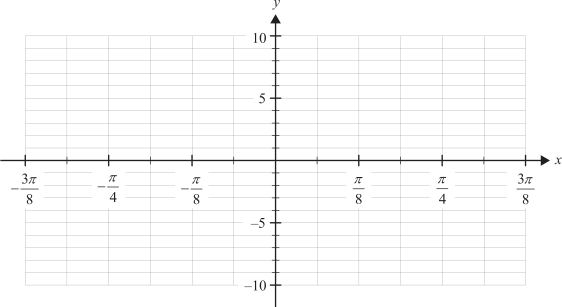
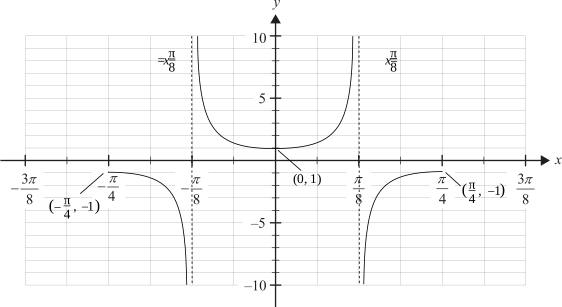
  1. Sketch the graph of `f` for `x \in\left[-\frac{\pi}{4}, \frac{\pi}{4}\right]` on the set of axes below. Label any asymptotes with their equations and label any turning points and the endpoints with their coordinates.   (3 marks)


  2. The graph of  `y=f(x)` for `x \in\left[-\frac{\pi}{24}, \frac{\pi}{48}\right]` is rotated about the `x`-axis to form a solid of revolution.
    Find the volume of this solid. Give your answer in the form `\frac{(a-\sqrt{b}) \pi}{c}`, where `a`, `b`, `c in R`.   (3 marks)
Show Answers Only

a.  
       

b.   `\frac{(3-\sqrt{3}) \pi}{6}`

Show Worked Solution

a.      


♦ Mean mark (a) 49%.
b.    `V` `=\pi \int_{-\frac{\pi}{24}}^{\frac{\pi}{48}} \sec ^2(4 x)\ dx`
    `=\frac{\pi}{4}[\tan (4 x)]_{-\frac{\pi}{24}}^{\frac{\pi}{48}}`
    `=\frac{\pi}{4} \tan \left(\frac{\pi}{12}\right)-\frac{\pi}{4} \tan \left(-\frac{\pi}{6}\right)`
    `=\frac{\pi}{4} \tan \left(\frac{\pi}{3}-\frac{\pi}{4}\right)-\frac{\pi}{4} \xx -\frac{1}{\sqrt{3}}`
    `=\frac{\pi}{4} \left(\frac{sqrt3-1}{1+sqrt3} xx \frac{1-sqrt3}{1-sqrt3}\right)+\frac{\pi}{4sqrt3}`
    `=\frac{\pi}{4} \left(\frac{sqrt3-3-1+sqrt3}{-2}\right)+\frac{\pi}{4sqrt3}`
    `=\frac{\pi}{4}(2-\sqrt{3}) +\frac{\pi}{4sqrt3}`
    `=\frac{\pi(2 \sqrt{3}-3+1)}{4 \sqrt{3}}`
    `=\frac{(6-2 \sqrt{3}) \pi}{12}`
    `=\frac{(3-\sqrt{3}) \pi}{6}`

♦ Mean mark (b) 55%.

Filed Under: Further Area and Solids of Revolution (Ext1) Tagged With: Band 5, smc-1039-20-Trig Function, smc-1039-60-x-axis Rotation

Calculus, SPEC1 2022 VCAA 10

Let `f(x)=\sec (4 x)`.

  1. Sketch the graph of `f` for `x \in\left[-\frac{\pi}{4}, \frac{\pi}{4}\right]` on the set of axes below. Label any asymptotes with their equations and label any turning points and the endpoints with their coordinates.   (3 marks)


  2. The graph of  `y=f(x)` for `x \in\left[-\frac{\pi}{24}, \frac{\pi}{48}\right]` is rotated about the `x`-axis to form a solid of revolution.
    Find the volume of this solid. Give your answer in the form `\frac{(a-\sqrt{b}) \pi}{c}`, where `a`, `b`, `c in R`.   (3 marks)
Show Answers Only

a.  
       

b.   `\frac{(3-\sqrt{3}) \pi}{6}`

Show Worked Solution

a.      


♦ Mean mark (a) 49%.
b.    `V` `=\pi \int_{-\frac{\pi}{24}}^{\frac{\pi}{48}} \sec ^2(4 x)\ dx`
    `=\frac{\pi}{4}[\tan (4 x)]_{-\frac{\pi}{24}}^{\frac{\pi}{48}}`
    `=\frac{\pi}{4} \tan \left(\frac{\pi}{12}\right)-\frac{\pi}{4} \tan \left(-\frac{\pi}{6}\right)`
    `=\frac{\pi}{4} \tan \left(\frac{\pi}{3}-\frac{\pi}{4}\right)-\frac{\pi}{4} \xx -\frac{1}{\sqrt{3}}`
    `=\frac{\pi}{4} \tan \left(\frac{sqrt3-1}{1+sqrt3} xx \frac{1-sqrt3}{1-sqrt3}\right)+\frac{\pi}{4sqrt3}`
    `=\frac{\pi}{4} \tan \left(\frac{sqrt3-3-1+sqrt3}{-2}\right)+\frac{\pi}{4sqrt3}`
    `=\frac{\pi}{4}(2-\sqrt{3}) +\frac{\pi}{4sqrt3}`
    `=\frac{\pi(2 \sqrt{3}-3+1)}{4 \sqrt{3}}`
    `=\frac{(6-2 \sqrt{3}) \pi}{12}`
    `=\frac{(3-\sqrt{3}) \pi}{6}`

♦ Mean mark (b) 55%.

Filed Under: Solids of Revolution Tagged With: Band 5, smc-1180-20-Trig function, smc-1180-50-x-axis rotations

Calculus, EXT2 C1 2022 SPEC1 9

Given that  `f^{\prime}(x)=\frac{\cos (2 x)}{\sin ^3(2 x)}`  and  `f((pi)/(8))=(3)/(4)`, find `f(x)`.   (4 marks)

--- 9 WORK AREA LINES (style=lined) ---

Show Answers Only

`f(x)=\frac{-1}{4 \sin ^2(2 x)}+\frac{5}{4}=-\frac{1}{4} \text{cosec}^2(2 x)+\frac{5}{4}`

Show Worked Solution

`text{Let}\ \ u=sin(2x)\ \ =>\ \ {du}/{dx}=2cos(2x)`

`\int \frac{\cos (2 x)}{\sin ^3(2 x)} d x` `=\frac{1}{2} \int \frac{d u}{u^3}`  
  `= -\frac{1}{4} u^{-2}+c`  
  `=-\frac{1}{4} \ xx \frac{1}{\sin ^2(2 x)}+c`  

 
`text{When}\ \ x = pi/8:`

`-\frac{1}{4} \cdot \frac{1}{(\frac{1}{sqrt{2}})^2}+c` `=\frac{3}{4}`  
`-\frac{1}{4} \cdot 2+c` `=\frac{3}{4}`  
`\Rightarrow c` `=\frac{3}{4}+\frac{2}{4}=5/4`  

 
`:. \  f(x)=\frac{-1}{4 \sin ^2(2 x)}+\frac{5}{4}=-\frac{1}{4} \text{cosec}^2(2 x)+\frac{5}{4}`


♦ Mean mark 50%.

Filed Under: Substitution and Harder Integration Tagged With: Band 5, smc-1057-10-Trig, smc-1057-60-Substitution not given

Calculus, SPEC1 2022 VCAA 9

Given that  `f^{\prime}(x)=\frac{\cos (2 x)}{\sin ^3(2 x)}`  and  `f((pi)/(8))=(3)/(4)`, find `f(x)`.   (4 marks)

--- 9 WORK AREA LINES (style=lined) ---

Show Answers Only

`f(x)=\frac{-1}{4 \sin ^2(2 x)}+\frac{5}{4}=-\frac{1}{4} \text{cosec}^2(2 x)+\frac{5}{4}`

Show Worked Solution

`text{Let}\ \ u=sin(2x)\ \ =>\ \ {du}/{dx}=2cos(2x)`

`\int \frac{\cos (2 x)}{\sin ^3(2 x)} d x` `=\frac{1}{2} \int \frac{d u}{u^3}`  
  `= -\frac{1}{4} u^{-2}+c`  
  `=-\frac{1}{4} \ xx \frac{1}{\sin ^2(2 x)}+c`  

 
`text{When}\ \ x = pi/8:`

`-\frac{1}{4} \cdot \frac{1}{(\frac{1}{sqrt{2}})^2}+c` `=\frac{3}{4}`  
`-\frac{1}{4} \cdot 2+c` `=\frac{3}{4}`  
`\Rightarrow c` `=\frac{3}{4}+\frac{2}{4}=5/4`  

 
`:. \  f(x)=\frac{-1}{4 \sin ^2(2 x)}+\frac{5}{4}=-\frac{1}{4} \text{cosec}^2(2 x)+\frac{5}{4}`


♦ Mean mark 50%.

Filed Under: Integration by Substitution (SM) Tagged With: Band 5, smc-2564-30-Trig

Calculus, SPEC1 2022 VCAA 7

A curve has equation `x cos(x+y)=(pi)/(48)`.

Find the gradient of the curve at the point `((pi)/(24),(7pi)/(24))`. Give your answer in the form `(asqrtb-pi)/(pi)`, where `a,b in Z`.   (3 marks)

--- 10 WORK AREA LINES (style=lined) ---

Show Answers Only

`(8sqrt3-pi)/pi`

Show Worked Solution

`text{Using implicit differentiation and the chain and product rules:}`

`d/(dx)(cos(x + y))`

`text{Let}\ \ u = x + y\ \ \=>\ \ y = cos(u)` 

`(du)/(dx) = 1 +dy/dx,\ \ (dy)/(du) = -sin(u)`

`cos (x+y)-x\ sin (x+y)(dy/dx+1)` `=0`  
`cos (x+y)-x\ sin(x+y)(dy/dx)-x\ sin(x+y)` `=0`  
`x\ sin(x+y)(dy/dx)` `=cos (x+y)-x\ sin(x+y)`  
`dy/dx` `=(cos (x+y))/(x\ sin(x+y)) – (x\ sin(x+y))/(x\ sin(x+y))`  
  `=(cos (x+y))/(x\ sin(x+y))-1`  

 
`text{At}\ ((pi)/(24),(7pi)/(24))\ \ \=>\ \ x+y = (pi)/(24)+(7pi)/(24) = (pi)/(3)`

`dy/dx` `=cos(pi/3)÷[(pi)/(24)sin(pi/3)]-1`  
  `=(1/2)/((pi)/(24) xx sqrt3/2)-1`  
  `=24/(sqrt3pi)-1`  
  `=(24-sqrt3pi)/(sqrt3pi) xx (sqrt3/sqrt3)`  
  `=(24sqrt3-3pi)/(3pi)`  
  `=(8sqrt3-pi)/pi`  

♦ Mean mark 50%.

Filed Under: Tangents and Curve Sketching Tagged With: Band 5, smc-1182-10-Find gradient, smc-1182-50-Implicit functions

Statistics, SPEC1 2022 VCAA 3

The time taken by a coffee machine to dispense a cup of coffee varies normally with a mean of 10 seconds and a standard deviation of 1.5 seconds.

Find the probability that more than 34 seconds is needed to dispense a total of four cups of coffee. Give your answer correct to two decimal places.   (2 marks) 

--- 5 WORK AREA LINES (style=lined) ---

Show Answers Only

`0.98`

Show Worked Solution

`\text{1 cup:}\ \ mu=10,\ \ sigma=1.5, \ \text{Var(X)}\ =1.5^2 = 2.25`

`\text{4 cups:}\ \ mu=4 xx 10= 40,\ \text{Var(X)}\ = 4 xx 2.25=9, \ sigma = \sqrt{9}=3`

`Z\ ~\ N(0,1)`

`text{Pr}(Z>(34-40)/(3))` `= text{Pr}(Z> -2)`  
  `~~ 0.975`  
  `=0.98\ \text{(2 d.p.)}`  

♦♦ Mean mark 36%.

Filed Under: Linear Combinations and Sample Means (SM) Tagged With: Band 5, smc-1160-10-Y = aX + b, smc-1160-30-Z = aX + bY

Vectors, SPEC2 2023 VCAA 5

The points with coordinates \(A(1,1,2), B(1,2,3)\) and \(C(3,2,4)\) all lie in a plane \(\Pi\).

  1. Find the vectors \(\overrightarrow{A B}\) and \(\overrightarrow{A C}\), and hence show that the area of triangle \(A B C\) is 1.5 square units.  (2 marks)

    --- 5 WORK AREA LINES (style=lined) ---

  2. Find the shortest distance from point \(B\) to the line segment \(A C\).  (2 marks)

    --- 3 WORK AREA LINES (style=lined) ---

A second plane, \(\psi\), has the Cartesian equation  \(2 x-2 y-z=-18\).

  1. At what acute angle does the line given by \(\underset{\sim}{ r }(t)=3 \underset{\sim}{ i }+2 \underset{\sim}{ j }+4 \underset{\sim}{ k }+t(\underset{\sim}{ i }-2 \underset{\sim}{ j }+2\underset{\sim}{ k }), t \in R\), intersect the plane \(\psi\) ? Give your answer in degrees correct to the nearest degree.  (2 marks)

    --- 4 WORK AREA LINES (style=lined) ---

A line \(L\) passes through the origin and is normal to the plane \(\psi\). The line \(L\) intersects \(\psi\) at a point \(D\).

  1. Write down an equation of the line \(L\) in parametric form.  (1 mark)

    --- 2 WORK AREA LINES (style=lined) ---

  2. Find the shortest distance from the origin to the plane \(\psi\).  (2 marks)

    --- 3 WORK AREA LINES (style=lined) ---

  3. Find the coordinates of point \(D\).  (2 marks)

    --- 5 WORK AREA LINES (style=lined) ---

Show Answers Only

a.     \(\overrightarrow{A B}  =\overrightarrow{O B}-\overrightarrow{O A}=\left(\begin{array}{l}1 \\ 2 \\ 3\end{array}\right)-\left(\begin{array}{l}1 \\ 1 \\ 2\end{array}\right)=\left(\begin{array}{l}0 \\ 1 \\ 1\end{array}\right)\)
  \(\overrightarrow{A C}  =\overrightarrow{O C}-\overrightarrow{O A}=\left(\begin{array}{l}3 \\ 2 \\ 4\end{array}\right)-\left(\begin{array}{l}1 \\ 1 \\ 2\end{array}\right)=\left(\begin{array}{l}2 \\ 1 \\ 2\end{array}\right)\)

\(\text{Area}=\dfrac{1}{2}\ \bigg|\overrightarrow{AB} \times \overrightarrow{AC}\bigg|=\dfrac{1}{2}\ \left|\begin{array}{ccc}\underset{\sim}{i} & \underset{\sim}{j} & \underset{\sim}{k} \\ 0 & 1 & 1 \\ 2 & 1 & 2\end{array}\right|=\dfrac{1}{2}\ \bigg|\underset{\sim}{i}+2 \underset{\sim}{j}-2 \underset{\sim}{k}\bigg|=\dfrac{3}{2}\)

b.    \(\text {Shortest distance }=1 \text { unit }\)

c.     \(26^{\circ}\)

d.    \(\underset{\sim}{r}(t)=\underset{\sim}{n} \times t=2 t \underset{\sim}{i}-2 t \underset{\sim}{j}-t \underset{\sim}{k}\)

\(x=2 t, y=-2 t, z=-t \quad \text{(also accepted)}\)

e.    \(\text {Shortest distance }=6\)

f.    \(D(-4,4,2)\)

Show Worked Solution

a.     \(\overrightarrow{A B}  =\overrightarrow{O B}-\overrightarrow{O A}=\left(\begin{array}{l}1 \\ 2 \\ 3\end{array}\right)-\left(\begin{array}{l}1 \\ 1 \\ 2\end{array}\right)=\left(\begin{array}{l}0 \\ 1 \\ 1\end{array}\right)\)
  \(\overrightarrow{A C}  =\overrightarrow{O C}-\overrightarrow{O A}=\left(\begin{array}{l}3 \\ 2 \\ 4\end{array}\right)-\left(\begin{array}{l}1 \\ 1 \\ 2\end{array}\right)=\left(\begin{array}{l}2 \\ 1 \\ 2\end{array}\right)\)

\(\text{Area}=\dfrac{1}{2}\ \bigg|\overrightarrow{AB} \times \overrightarrow{AC}\bigg|=\dfrac{1}{2}\ \left|\begin{array}{ccc}\underset{\sim}{i} & \underset{\sim}{j} & \underset{\sim}{k} \\ 0 & 1 & 1 \\ 2 & 1 & 2\end{array}\right|=\dfrac{1}{2}\ \bigg|\underset{\sim}{i}+2 \underset{\sim}{j}-2 \underset{\sim}{k}\bigg|=\dfrac{3}{2}\)

 
b.   
\(\text {In } \triangle ABC \text {, shortest distance of } B \text { to } A C\ \text {is the} \perp \text {distance }\)

\(|\overrightarrow{A C}|= \displaystyle{\sqrt{2^2+1^2+2^2}}=3\)

\(\dfrac{3}{2}=\dfrac{1}{2}\ |\overrightarrow{A C}| \times h \ \Rightarrow \ h=1\)

\(\therefore \text { Shortest distance }=1 \text { unit }\)
 

♦♦ Mean mark (b) 35%.

c.    \(\text {Vector} \perp \text {to plane}\ \psi\  \text {is}\ \ \underset{\sim}{n}=2 \underset{\sim}{i}-2 \underset{\sim}{j}-\underset{\sim}{k}\)

\(\text{Parallel line to}\ \underset{\sim}{r}(t) \ \text{is}\ \ \underset{\sim}{m}=\underset{\sim}{i}-2 \underset{\sim}{j}+2\underset{\sim}{k}\)

\(\text{Find angle } \alpha \text{ between }\underset{\sim}{n} \text{ and } \underset{\sim}{m},\)

\(\text{Solve for } \alpha:\)

\((2 \underset{\sim}{i}-2 \underset{\sim}{j}-\underset{\sim}{k})(\underset{\sim}{i}-2 \underset{\sim}{j}+\underset{\sim}{2 k})=3 \times 3 \times \cos \, \alpha\)

\(\Rightarrow \alpha=64^{\circ} \text { (nearest degree) }\)
 

\(\text{Find angle } \theta \text{ between } \underset{\sim}{m} \text{ and plane } \psi :\)

\(\theta=90-64=26^{\circ}\)
 

d.    \(\underset{\sim}{r}(t)=\underset{\sim}{n} \times t=2 t \underset{\sim}{i}-2 t \underset{\sim}{j}-t \underset{\sim}{k}\)

\(x=2 t, y=-2 t, z=-t \quad \text{(also accepted)}\)
 

♦ Mean mark (d) 52%.

e.    \(|\overrightarrow{OD}|=\text{shortest distance from } O \text{ to plane } \psi\).

\(\Rightarrow D \text{ is on } L \text{ and } \psi\)

\(\text{Solve for } t: \  2(2 t)-2(-2 t)-(t)=-18\)

\(\Rightarrow t=-2\)

\(|\overrightarrow{OD}|=-4 \underset{\sim}{i}+4 \underset{\sim}{j}+2 \underset{\sim}{k}\)

\(\text {Shortest distance }=\displaystyle{\sqrt{(-4)^2+4^2+2^2}}=6\)
 

f.    \(\overrightarrow{OD}=-4 \underset{\sim}{i}+4 \underset{\sim}{j}+2 \underset{\sim}{i}\)

\(D(-4,4,2)\)

♦ Mean mark (f) 41%.

Filed Under: Basic Concepts and Calculations, Vector Lines, Planes and Geometry Tagged With: Band 4, Band 5, smc-1176-20-Angle between vectors, smc-1176-45-Vector planes, smc-1177-40-Triangles, smc-1177-50-2D problems

PHYSICS, M6 2021 VCE 5

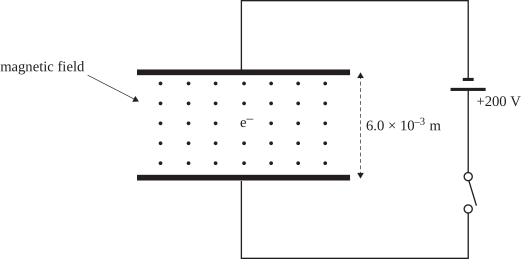
The digram shows shows a stationary electron (e\(^{-}\)) in a uniform magnetic field between two parallel plates. The plates are separated by a distance of 6.0 × 10\(^{-3}\) m, and they are connected to a 200 V power supply and a switch. Initially, the plates are uncharged. Assume that gravitational effects on the electron are negligible.
 

  1. Explain why the magnetic field does not exert a force on the electron. Justify your answer with an appropriate formula.   (2 marks)

--- 3 WORK AREA LINES (style=lined) ---

The switch is now closed.

  1. Determine the magnitude and the direction of any electric force now acting on the electron. Show your working.   (3 marks)

--- 5 WORK AREA LINES (style=lined) ---

  1. Ravi and Mia discuss what they think will happen regarding the size and the direction of the magnetic force on the electron after the switch is closed.

    Ravi says that there will be a magnetic force of constant magnitude, but it will be continually changing direction.

    Mia says that there will be a constantly increasing magnetic force, but it will always be acting in the same direction.

    Evaluate these two statements, giving clear reasons for your answer.   (4 marks)

--- 8 WORK AREA LINES (style=lined) ---

Show Answers Only

a.   Magnetic force does not exert force on electron:

  • Force of a magnetic field on an electron  \(\Rightarrow F=qvB\).
  • Electron is stationary (\(v=0\))
  • The force on the electron = \(0\).

b.    \(F=qE=\dfrac{qV}{d}=\dfrac{1.602 \times 10^{-19} \times 200}{6 \times 10^{-3}}=5.34 \times 10^{-15}\ \text{N}\)

  • Since the bottom plate is positively charged, the direction of the electron will be down the page (towards the bottom plate).

c.    Both statements contain a correct assertion and incorrect assertion.

  • Ravi was incorrect to say that the magnitude of the magnetic force on the electron will be constant.
  • Mia, however, was correct in saying that the magnetic force on the electron will increase in magnitude.
  • This is due to the velocity of the electron increasing under the acceleration of the electric field. As the velocity of the electron increases, so will the magnitude of the force of the magnetic field on the electron (\(F=qvB\)). 
  • Mia was incorrect to say that the direction of the magnetic force on the electron would not change.
  • Instead, Ravi was correct in saying that the magnetic force would be continuously changing direction.
  • This is because the force of the magnetic field on the electron will act perpendicular to the velocity of the electron and will cause the electron to move in circular motion. As the force is always perpendicular to the velocity of the electron, it will continually change to act towards the centre of the electrons circular motion.

Show Worked Solution

a.   Magnetic force does not exert force on electron:

  • Force of a magnetic field on an electron  \(\Rightarrow F=qvB\).
  • Electron is stationary (\(v=0\))
  • The force on the electron = \(0\).
♦♦ Mean mark (a) 35%. 
COMMENT: Many students confused the forces of electric (not applicable here) and magnetic fields.

b.    \(F=qE=\dfrac{qV}{d}=\dfrac{1.602 \times 10^{-19} \times 200}{6 \times 10^{-3}}=5.34 \times 10^{-15}\ \text{N}\)

  • Since the bottom plate is positively charged, the direction of the electron will be down the page (towards the bottom plate).

c.    Both statements contain a correct assertion and incorrect assertion.

  • Ravi was incorrect to say that the magnitude of the magnetic force on the electron will be constant.
  • Mia, however, was correct in saying that the magnetic force on the electron will increase in magnitude.
  • This is due to the velocity of the electron increasing under the acceleration of the electric field. As the velocity of the electron increases, so will the magnitude of the force of the magnetic field on the electron (\(F=qvB\)). 
  • Mia was incorrect to say that the direction of the magnetic force on the electron would not change.
  • Instead, Ravi was correct in saying that the magnetic force would be continuously changing direction.
  • This is because the force of the magnetic field on the electron will act perpendicular to the velocity of the electron and will cause the electron to move in circular motion. As the force is always perpendicular to the velocity of the electron, it will continually change to act towards the centre of the electrons circular motion.
♦♦♦ Mean mark (c) 18%.
COMMENT: Students need well planned responses to properly evaluate the physics principles required for 4 marks.

Filed Under: Charged Particles, Conductors and Electric/Magnetic Fields Tagged With: Band 5, Band 6, smc-3693-18-Combination EF and MF

Statistics, SPEC2 2023 VCAA 6

A forest ranger wishes to investigate the mass of adult male koalas in a Victorian forest. A random sample of 20 such koalas has a sample mean of 11.39 kg.

It is known that the mass of adult male koalas in the forest is normally distributed with a standard deviation of 1 kg.

  1. Find a 95% confidence interval for the population mean (the mean mass of all adult male koalas in the forest). Give your values correct to two decimal places.  (1 mark)

    --- 3 WORK AREA LINES (style=lined) ---

  2. Sixty such random samples are taken and their confidence intervals are calculated.
  3. In how many of these confidence intervals would the actual mean mass of all adult male koalas in the forest be expected to lie?  (1 mark)

    --- 2 WORK AREA LINES (style=lined) ---

The ranger wants to decrease the width of the 95% confidence interval by 60% to get a better estimate of the population mean.

  1. How many adult male koalas should be sampled to achieve this?  (1 mark)

    --- 2 WORK AREA LINES (style=lined) ---

It is thought that the mean mass of adult male koalas in the forest is 12 kg. The ranger thinks that the true mean mass is less than this and decides to apply a one-tailed statistical test. A random sample of 40 adult male koalas is taken and the sample mean is found to be 11.6 kg.

  1. Write down the null hypothesis, \(H_0\), and the alternative hypothesis, \(H_1\), for the test.   (1 mark)

    --- 2 WORK AREA LINES (style=lined) ---

The ranger decides to apply the one-tailed test at the 1% level of significance and assumes the mass of adult male koalas in the forest is normally distributed with a mean of 12 kg and a standard deviation of 1 kg.

  1.  i. Find the \(p\) value for the test correct to four decimal places.  (1 mark)

    --- 2 WORK AREA LINES (style=lined) ---

  2. ii. Draw a conclusion about the null hypothesis in part d. from the \(p\) value found above, giving a reason for your conclusion.  (1 mark)

    --- 2 WORK AREA LINES (style=lined) ---

  3. What is the critical sample mean (the smallest sample mean for \(H_0\) not to be rejected) in this test? Give your answer in kilograms correct to three decimal places.  (1 mark)

    --- 2 WORK AREA LINES (style=lined) ---

Suppose that the true mean mass of adult male koalas in the forest is 11.4 kg, and the standard deviation is 1 kg. The level of significance of the test is still 1%.

  1. What is the probability, correct to three decimal places, of the ranger making a type \(\text{II}\) error in the statistical test?  (1 mark)

    --- 2 WORK AREA LINES (style=lined) ---

Show Answers Only

a.    \((10.95,11.83)\)

b.    \(57\)

c.    \(n=125\)

d.    \(H_0: \mu=12, \quad H_1: \mu<12\)

e.i.  \(p=0.0057\)

e.ii. \(\text{Since } p<0.01 \text { : reject } H_0 \text {, favour } H_1\)

f.    \(\text {Critical sample mean } \bar{x} \approx 11.632\)

g.    \(\text{Pr}(\bar{x} \geqslant 11.63217 \mid \mu=11.4) \approx 0.071\)

Show Worked Solution

a.    \(\sigma_{\text{pop}}=1\)

\(\text{Sample:}\ \ n=20,\ \ \bar{x}=11.39,\ \ \sigma_{\text {sample }}=\dfrac{1}{\sqrt{20}}\)

\(\text{Find 95% C.I. (by CAS):}\)

\((10.95,11.83)\)
 

b.    \(\text{95% C.I. for 60 samples calculated}\)

\(\text{Number expected }(\mu \text{ within C.I.)}=0.95 \times 60=57\)
 

c.    \(\text {C.I.}=\left(11.39-1.96 \times \dfrac{1}{\sqrt{20}}, 11.39+1.96 \times \dfrac{1}{\sqrt{20}}\right)\)

\(\Rightarrow \text { Interval }=2 \times 1.96 \times \dfrac{1}{\sqrt{20}}\)

\(\text{Interval reduced by } 60\%\)

\(\Rightarrow \text{ New interval }=0.40 \times 2 \times 1.96 \times \dfrac{1}{\sqrt{20}}\)

\(\text{Solve for } n\) :

\(2 \times 1.96 \times \dfrac{1}{\sqrt{n}}=0.40 \times 2 \times 1.96 \times \dfrac{1}{\sqrt{20}}\)

\(\Rightarrow n=125\)
 

♦♦♦ Mean mark (c) 28%.

d.    \(H_0: \mu=12,\ \ H_1: \mu<12\)
 

e.i.  \(E(\bar{X})=\mu=12\)

 \(\bar{x}=11.6, \ \sigma(\bar{X})=\dfrac{1}{\sqrt{40}}\)

 \(p=\operatorname{Pr}(\bar{X} \leqslant 11.6)=0.0057\)


e.ii. \(\text{Since}\ \  p<0.01 \text {: reject } H_0 \text {, favour } H_1\)
 

f.    \(\text{Pr}(\bar{X} \leqslant a \mid \mu=12) \geqslant 0.01\) 

\(\text{Find } a \text{ (by CAS):}\)

\(\text{inv Norm}\left(0.01,12, \dfrac{1}{\sqrt{40}}\right) \ \Rightarrow \ a \geqslant 11.63217\)

\(\text {Critical sample mean}\ \ \bar{x} \approx 11.632\)
 

g.    \(\mu=11.4,\ \ \sigma_{\text{pop}}=1,\ \  n=40\)

\(\text{Pr}(\bar{X} \geqslant 11.63217 \mid \mu=11.4) \approx 0.071\)

♦♦ Mean mark (g) 39%.

Filed Under: Confidence Intervals and Hypothesis Testing (SM) Tagged With: Band 3, Band 4, Band 5, smc-1162-10-95% CI (sample), smc-1162-30-One-tail test, smc-1162-50-Null/Alternative hypothesis

Functions, MET2 2023 VCAA 2

The following diagram represents an observation wheel, with its centre at point \(P\). Passengers are seated in pods, which are carried around as the wheel turns. The wheel moves anticlockwise with constant speed and completes one full rotation every 30 minutes.When a pod is at the lowest point of the wheel (point \(A\)), it is 15 metres above the ground. The wheel has a radius of 60 metres.
 

Consider the function \(h(t)=-60\ \cos(bt)+c\) for some \(b, c \in R\), which models the height above the ground of a pod originally situated at point \(A\), after time \(t\) minutes.

  1. Show that \(b=\dfrac{\pi}{15}\) and \(c=75\).   (2 marks)

    --- 5 WORK AREA LINES (style=lined) ---

  2. Find the average height of a pod on the wheel as it travels from point \(A\) to point \(B\).
  3. Give your answer in metres, correct to two decimal places.   (2 marks)

    --- 3 WORK AREA LINES (style=lined) ---

  4. Find the average rate of change, in metres per minute, of the height of a pod on the wheel as it travels from point \(A\) to point \(B\).   (1 mark)

    --- 3 WORK AREA LINES (style=lined) ---

After 15 minutes, the wheel stops moving and remains stationary for 5 minutes. After this, it continues moving at double its previous speed for another 7.5 minutes.

The height above the ground of a pod that was initially at point \(A\), after \(t\) minutes, can be modelled by the piecewise function \(w\):
 

\(w(t) = \begin {cases}
h(t)         &\ \ 0 \leq t < 15 \\
k         &\ \ 15 \leq t < 20 \\
h(mt+n) &\ \ 20\leq t\leq 27.5
\end{cases}\)

 
where \(k\geq 0, m\geq 0\) and \(n \in R\).

  1.   i.State the values of \(k\) and \(m\).   (1 mark)

    --- 2 WORK AREA LINES (style=lined) ---

      
     ii. Find all possible values of \(n\).   (2 marks)

    --- 4 WORK AREA LINES (style=lined) ---


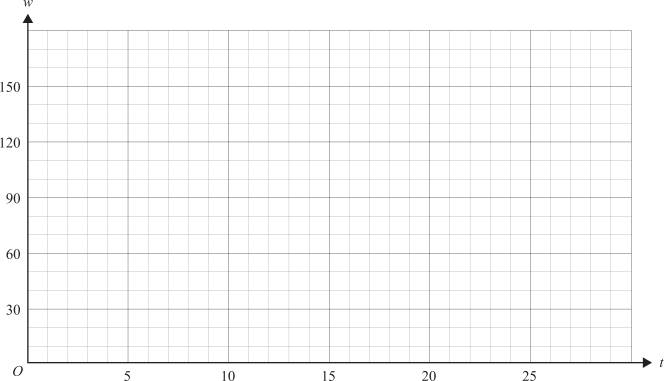
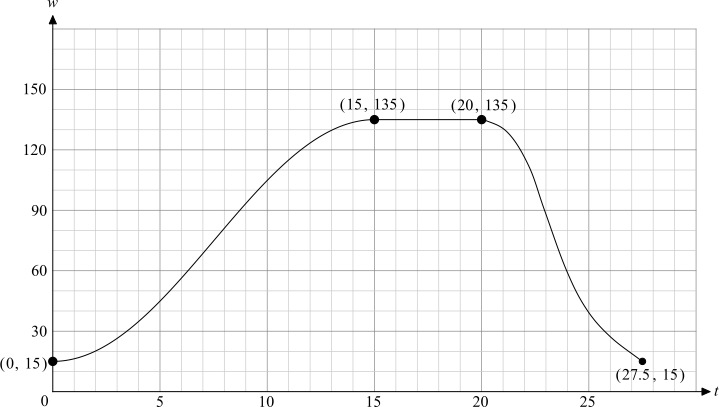
    iii. Sketch the graph of the piecewise function \(w\) on the axes below, showing the coordinates of the endpoints.   (3 marks)

    --- 0 WORK AREA LINES (style=lined) ---


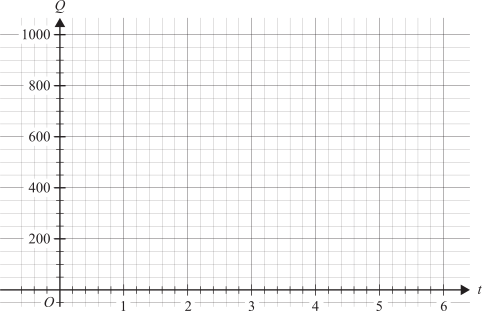
  1.  
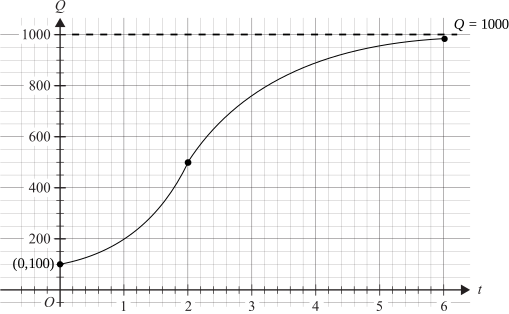
Show Answers Only

a.    \(\text{See worked solution}\)

b.    \(\approx 36.80\ \text{m}\)

c.    \(8\)

d.i.  \(k=135, m=2\)

d.ii. \(n=30p+5,\ p\in Z\)

d.iii. 

Show Worked Solution
a.    \(\text{Period:}\) \(\dfrac{2\pi}{b}\) \(=30\)
    \(\therefore\ b\) \(=\dfrac{\pi}{15}\)

  
\(\text{Given }h(t)=-60\cos(bt)+c,\ \text{evaluate when }t=0, h=15\ \text{to find }c.\)

\(-60\ \cos(0)+c\)  \(=15\)
\(c\) \(=75\)

  \(\therefore\ h(t)=-60\cos(\dfrac{\pi t}{15})+75\)

b.     \(\text{Average height}\) \(=\dfrac{1}{\frac{30}{4}-0}\displaystyle\int_0^{\frac{30}{4}}\Bigg(-60\cos\Bigg(\dfrac{\pi}{15}t\Bigg)+75\Bigg)\,dt\)
    \(=\dfrac{2}{15}\left[75t-\dfrac{900\ \sin(\frac{\pi}{15}t)}{\pi}\right]_{0}^{7.5}\)
    \(=\dfrac{2}{15}\Bigg[75\times 7.5-\dfrac{900\ \sin(\frac{\pi}{15}\times 7.5)}{\pi}\Bigg]-\Bigg[0\Bigg]\)
    \(=\dfrac{75\pi-120}{\pi}=\dfrac{15(5\pi-8)}{\pi}\)
    \(=36.802\dots\approx 36.80\ \text{m}\)
 
♦♦ Mean mark (b) 45%.
MARKER’S COMMENT: \(\frac{1}{60}\int_0^{60} h(t)dt\) was a common error.
Others incorrectly found average rate of change instead of average value.

c.   \(\text{Av rate of change of height}\)

  \(=\dfrac{h(7.5)-h(0)}{7.5}\)
  \(=\dfrac{\Bigg(75-60\cos(\dfrac{\pi \times 7.5}{15})\Bigg)-\Bigg(75-60\cos(\dfrac{\pi\times 0}{15})\Bigg)}{7.5}\)
  \(=\dfrac{75-15}{7.5}=8\)
 
♦ Mean mark (c) 50%.
MARKER’S COMMENT: Common incorrect answer was – 8.
di.    \(\text{Period is 30 minutes, so after 15 minutes pod}\)
\(\text{is at the top of the wheel.}\)
  \(\therefore\ k=75-60\ \cos(\frac{\pi}{15}\times 15)=135\)

  
\(\text{Pod is travelling at twice its previous speed}\)
\(\text{so one revolution takes 15 minutes}\)

\(\therefore\ \text{Period}\rightarrow\) \(\dfrac{2\pi}{bm}\) \(=15\)
  \(bm\) \(=\dfrac{2\pi}{15}\)
  \(\dfrac{\pi}{15}\cdot m\) \(=\dfrac{2\pi}{15}\)
  \(m\) \(=\dfrac{2\pi}{15}\times \dfrac{15}{\pi}\)
    \(=2\)
 
♦♦ Mean mark (d)(i) 40%.
MARKER’S COMMENT: Many students could find \(k\) but not \(m\) with \(m=\frac{1}{2}\) a common error.
dii.   \(\text{When }t=20\ \text{the pod is at the top of the wheel and height is 135.}\)
  
\(\text{When }t=27.5\ \text{the pod is back at the start and height is 15.}\)

   
\(\text{Using CAS solve for }t=20:\rightarrow\ h(2(20)+n)=135\ \rightarrow\ n=30p+5\)

\(\text{Using CAS solve for }t=27.5:\rightarrow\ h(2(27.5)+n)=15\ \rightarrow\ n=30p+5\)

\(\therefore\ n=30p+5,\ p\in Z\)

 
♦♦♦ Mean mark (d)(ii) 20%.
MARKER’S COMMENT: Many students set up the correct equations to solve but did not provide the general solution. Some incorrectly stated the variable as an element of R.

diii.   

 
♦♦♦ Mean mark (d)(iii) 40%.
MARKER’S COMMENT: Students are reminded to include all endpoints and be particular about the curvature of graph.

Filed Under: Average Value and Other, Integration (Trig), Trig Equations, Trig Integration Tagged With: Band 4, Band 5, Band 6, smc-2757-70-Sketch graph, smc-725-20-Cos, smc-747-20-cos, smc-747-60-Average Value

PHYSICS, M7 2021 VCE 20 MC

One of Einstein's postulates for special relativity is that the laws of physics are the same in all inertial frames of reference.

Which one of the following best describes a property of an inertial frame of reference?

  1. It is travelling at a constant speed.
  2. It is travelling at a speed much slower than \(c\).
  3. Its movement is consistent with the expansion of the universe.
  4. No observer in the frame can detect any acceleration of the frame.
Show Answers Only

\(D\)

Show Worked Solution
  • An inertial frame of reference is one where there is no acceleration acting on the bodies.
  • Therefore, no observer will be able to detect any acceleration.

\(\Rightarrow D\)

♦ Mean mark 49%.

Filed Under: Light and Special Relativity Tagged With: Band 5, smc-3699-40-Einstein's Postulates

PHYSICS, M8 2021 VCE 18*

A monochromatic light source is emitting green light with a wavelength of 550 nm. The light source emits 2.8 × 10\(^{16}\) photons every second.

Calculate the power of the light source in Watts?   (2 marks)

--- 5 WORK AREA LINES (style=lined) ---

Show Answers Only

\(1.0 \times 10^{-2}\ \text{W}\)

Show Worked Solution

\(\text{Energy per photon:}\)

\(E=\dfrac{hc}{\lambda}= \dfrac{6.626 \times 10^{-34} \times 3 \times 10^8}{550 \times 10^{-9}}=3.614 \times 10^{-19}\ \text{J}\)

\(\therefore \ \text{Power} =3.614 \times 10^{-19} \times 2.8 \times 10^{16}=1.0 \times 10^{-2}\ \text{W}\)

♦ Mean mark 47%.

Filed Under: Quantum Mechanical Nature of the Atom Tagged With: Band 5, smc-3702-30-Photon Energy

PHYSICS, M7 2021 VCE 16 MC

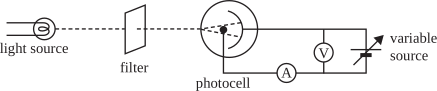
The diagram below shows a circuit that is used to study the photoelectric effect.
 

Which one of the following is essential to the measurement of the maximum kinetic energy of the emitted photoelectrons?

  1. the level of brightness of the light source
  2. the wavelengths that pass through the filter
  3. the reading on the voltmeter when the current is at a minimum value
  4. the reading on the ammeter when the voltage is at a maximum value
Show Answers Only

\(C\)

Show Worked Solution
  • The maximum kinetic energy of the photoelectrons is determined by the stopping voltage. The stopping voltage can be determined by reading the voltmeter when the current is at zero.
  • \(B\) is incorrect because although knowing the wavelengths of the light passing through will help you determine the total energy of the photons, this is different to the maximum kinetic energy of the photoelectrons (where the work function needs to be taken into account).
♦♦ Mean mark 35%.

Filed Under: Light: Quantum Model Tagged With: Band 5, smc-3698-10-Photoelectric Effect, smc-3698-20-Kinetic energy calcs

PHYSICS, M6 2021 VCE 5 MC

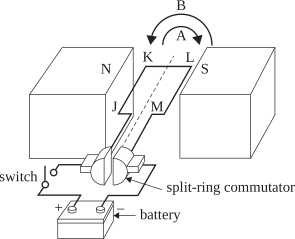
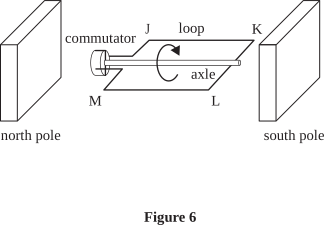
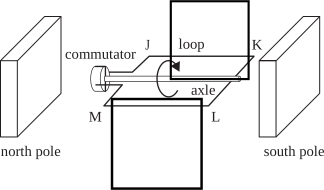
The diagram below shows a small DC electric motor, powered by a battery that is connected via a split-ring commutator. The rectangular coil has sides KJ and LM. The magnetic field between the poles of the magnet is uniform and constant.
 

The switch is now closed, and the coil is stationary and in the position shown in the diagram.

Which one of the following statements best describes the motion of the coil when the switch is closed?

  1. The coil will remain stationary.
  2. The coil will rotate in direction A, as shown in the diagram.
  3. The coil will rotate in direction B, as shown in the diagram.
  4. The coil will oscillate regularly between directions A and B, as shown in the diagram.
Show Answers Only

\(C\)

Show Worked Solution
  • When the switch is closed, the current through the side \(JK\) will run from \(J\) to \(K\) and the direction magnetic field is to the right.
  • Using the Right hand rule, the force on side JK will be down and the coil will rotate in direction B (anti-clockwise).

\(\Rightarrow C\)

♦ Mean mark 51%.

Filed Under: Applications of the Motor Effect Tagged With: Band 5, smc-3695-10-Torque, smc-3695-30-DC motor components

PHYSICS, M5 2021 VCE 4*

The planet Phobetor has a mass four times that of Earth. Acceleration due to gravity on the surface of Phobetor is 18 m s\(^{-2}\).

If Earth has a radius \(R\), calculate the radius of Phobetor in terms of \(R\)?   (2 marks)

--- 5 WORK AREA LINES (style=lined) ---

Show Answers Only

\(\sqrt{2.22} \times R\)

Show Worked Solution

\(g=\dfrac{GM}{R^2}\ \Rightarrow \  R=\sqrt{\dfrac{GM}{g}}\)

\(\text{Phobetor:}\ M → 4M\ \ \text{and}\ \ g → 1.8g\)

\(\text{Radius of Phobetor}\) \(=\sqrt{\dfrac{4GM}{1.8g}}\)  
  \(=\sqrt{\dfrac{2.22GM}{g}}\)  
  \(=\sqrt{2.22} \times \sqrt{\dfrac{GM}{g}}\)  
  \(=\sqrt{2.22} \times R\)  
♦ Mean mark 44%.

Filed Under: Motion in Gravitational Fields Tagged With: Band 5, smc-3692-15-Gravitational field strength

PHYSICS, M8 2022 VCE 17

A materials scientist is studying the diffraction of electrons through a thin metal foil. She uses electrons with an energy of 10.0 keV. The resulting diffraction pattern is shown in Figure 19.
 

  1. Calculate the de Broglie wavelength of the electrons in nanometres.  (4 marks)

--- 6 WORK AREA LINES (style=lined) ---

  1. The materials scientist then increases the energy of the electrons by a small amount and hence their speed by a small amount.

    Explain what effect this would have on the de Broglie wavelength of the electrons. Justify your answer.  (3 marks)

--- 6 WORK AREA LINES (style=lined) ---

Show Answers Only

a.    \(0.012\ \text{nm}\)

b.    Effects when speed of the electron increases by a small amount:

  • Momentum will increase by a small amount
  • As \(\lambda \propto \dfrac{1}{mv}\), if the momentum of the electron increases, its corresponding de Broglie wavelength will decrease.

Show Worked Solution

a.    Convert electron volts to joules:

\(\Rightarrow \ E=10 \times 10^3 \times 1.602 \times 10^{-19}=1.602 \times 10^{-15}\ \text{J}\)

\(E\) \(=\dfrac{1}{2}mv^2\)  
\(v\) \(=\sqrt{\dfrac{2E}{m}}\)  
  \(=\sqrt{\dfrac{2 \times 1.602 \times 10^{-15}}{9.109 \times 10^{-31}}}\)  
  \(=5.93 \times 10^7\)  


\(\therefore \lambda\) \(=\dfrac{h}{mv}\)  
  \(=\dfrac{6.626 \times 10^{-34}}{9.109 \times 10^{-27} \times 5.93 \times 10^7}\)  
  \(=1.23 \times 10^{-11}\ \text{m}\)  
  \(=0.012\ \text{nm}\)  

♦ Mean mark 42%.

b.    Effects when speed of the electron increases by a small amount:

  • Momentum will increase by a small amount
  • As \(\lambda \propto \dfrac{1}{mv}\), if the momentum of the electron increases, its corresponding de Broglie wavelength will decrease.

Filed Under: Quantum Mechanical Nature of the Atom Tagged With: Band 4, Band 5, smc-3702-40-De Broglie

Functions, MET2 2023 VCAA 20 MC

Let \(f(x)=\log_{e}\Bigg(x+\dfrac{1}{\sqrt{2}}\Bigg)\).

Let \(g(x)=\sin(x)\) where \(x\in (-\infty, 5)\).

The largest interval of \(x\) values for which \((f\circ g)(x)\) and \((g\circ f)(x)\) both exist is
 

  1. \(\Bigg(-\dfrac{1}{\sqrt{2}},\dfrac{5\pi}{4}\Bigg)\)
  2. \(\Bigg[-\dfrac{1}{\sqrt{2}},\dfrac{5\pi}{4}\Bigg)\)
  3. \(\Bigg(-\dfrac{\pi}{4},\dfrac{5\pi}{4}\Bigg)\)
  4. \(\Bigg[-\dfrac{\pi}{4},\dfrac{5\pi}{4}\Bigg]\)
  5. \(\Bigg[-\dfrac{\pi}{4},-\dfrac{1}{\sqrt{2}}\Bigg]\)
Show Answers Only

\(A\)

Show Worked Solution

\(f(x)=\log_e\Bigg(x+\dfrac{1}{\sqrt{2}}\Bigg)\ \text{and }g(x)=\sin(x)\ \text{for}\ x\in (-\infty, 5)\)

\(1.\  \ (f \circ g)(x)=\log_e\Bigg(\sin(x)+\dfrac{1}{\sqrt{2}}\Bigg)\)

\(\to\ \) \(\sin(x)+\dfrac{1}{\sqrt{2}}\) \(>0\)
  \(\sin(x)\) \(>-\dfrac{1}{\sqrt{2}}\)
  \(\therefore\ x\) \(\in\Bigg(-\dfrac{\pi}{4}, \dfrac{5\pi}{4}\Bigg)\cup \Bigg(-\dfrac{9\pi}{4}, -\dfrac{9\pi}{4}\Bigg)\cup\dots\ = \Bigg(-\dfrac{\pi}{4}+2\pi k, \dfrac{5\pi}{4}+2\pi k\Bigg)\)

  
\(2.\  \ (g \circ f)(x)=\sin\Bigg(\log_e\Bigg(x+\dfrac{1}{\sqrt{2}}\Bigg)\Bigg)\)

\(\to\ \) \(\log_e\Bigg(x+\dfrac{1}{\sqrt{2}}\Bigg)\) \(<5\)
  \(x\) \(=e^5-\dfrac{1}{\sqrt{2}}\)
  \(\therefore\ x\) \(\in \bigg(-\dfrac{1}{\sqrt{2}},e^5-\dfrac{1}{\sqrt{2}}\Bigg)\) 

  
\(\text{Largest interval of }x\ \text{for which both }(f \circ g)(x)\ \text{and }(g \circ f)(x)\text{ exist is:}\)

\(\Bigg(-\dfrac{\pi}{4}+2\pi k, \dfrac{5\pi}{4}+2\pi k\Bigg)\cap \bigg(-\dfrac{1}{\sqrt{2}},e^5-\dfrac{1}{\sqrt{2}}\Bigg)\) 

\(=\bigg(-\dfrac{1}{\sqrt{2}}, \dfrac{5\pi}{4}\Bigg)\) 


\(\Rightarrow A\)


♦♦ Mean mark 30%.
MARKER’S COMMENT: 26% incorrectly chose C.

Filed Under: Functional Equations Tagged With: Band 5, smc-642-10-(f o g)(x)

Functions, 2ADV F2 2023 MET1 3

  1. Sketch the graph of  \(f(x)=2-\dfrac{3}{x-1}\) on the axes below, labelling all asymptotes with their equation and axial intercepts with their coordinates.   (3 marks)


    --- 0 WORK AREA LINES (style=lined) ---

  2. Find the values of \(x\) for which \(f(x)\leq1\).   (1 mark)

    --- 2 WORK AREA LINES (style=lined) ---

Show Answers Only

a.   

b.    \(1<x\leq4\ \ \ \text{or}\ \ \big(1,4\big]\)

Show Worked Solution

a.    \(\text{Vertical asymptote when}\ \ x=1\)

\(y\text{-int:}\ y=2-(-3)\ \ \Rightarrow\ \ y=5\)

\(x\text{-int:}\ 2-\dfrac{3}{x-1}=0\ \ \Rightarrow\ \ x=\dfrac{5}{2} \)

\(\text{As}\ \ x \rightarrow \infty, \ \ y \rightarrow 2^{-}; \ \ x \rightarrow -\infty, \ \ y \rightarrow 2^{+} \)

b.    \(\text{From the graph:}\)

\(f(x)=1\ \text{when }x=4\)

\(x>1\ \text{to the right of the vertical asymptote}\)

\(\therefore\ f(x)\leq1\ \text{when}\ \ 1<x\leq4\ \ \ \text{or}\ \ \big(1,4\big]\)


♦♦ Mean mark (b) 38%.
MARKER’S COMMENT: Many students did not use their graph from part (a).

Filed Under: Non-Calculus Graphing (Y12), Reciprocal Functions (Adv-2027) Tagged With: Band 3, Band 5, smc-1009-10-Quotient Function, smc-6382-30-Sketch Graph

PHYSICS, M7 2022 VCE 11

Explain why muons formed in the outer atmosphere can reach the surface of Earth even though their half-lives indicate that they should decay well before reaching Earth's surface.    (2 marks)

--- 4 WORK AREA LINES (style=lined) ---

Show Answers Only

Using the special relativity principal of time dilation:

  • The average lifespans of muons are 2.2 μs, but when they are observed from the Earth’s frame of reference this becomes significantly dilated.
  • Thus, they are able to travel from the outer atmosphere and reach the surface of the Earth before they decay.
  • Other answers could have also referred to length contraction from the perspective of the muons.
Show Worked Solution

Answer 1: Using the special relativity principal of time dilation:

  • The average lifespans of muons are 2.2 μs, but when they are observed from the Earth’s frame of reference this becomes significantly dilated.
  • Thus, they are able to travel from the outer atmosphere and reach the surface of the Earth before they decay.
  • Other answers could have also referred to length contraction from the perspective of the muons.

Answer 2: Using the special relativity principal of length contraction:

  • A muon’s frame of reference measures the distance to the Earth as shorter than that measured from the Earth’s frame of reference.
  • This shorter distance allows the muons to reach the Earth before they decay.
♦ Mean mark 41%.

Filed Under: Light and Special Relativity Tagged With: Band 5, smc-3699-10-Time Dilation, smc-3699-20-Length Contraction

PHYSICS, M5 2022 VCE 8

A Formula 1 racing car is travelling at a constant speed of 144 km h\(^{-1}\) (40 m s\(^{-1}\)) around a horizontal corner of radius 80.0 m. The combined mass of the driver and the car is 800 kg. The two diagrams below show a front view and top view of the car.
 

  1. Calculate the magnitude of the net force acting on the racing car and driver as they go around the corner.   (2 marks)

--- 4 WORK AREA LINES (style=lined) ---

  1. On the "Top view" diagram, draw the direction of the net force acting on the racing car using an arrow.   (1 mark)

--- 0 WORK AREA LINES (style=blank) ---

  1. Explain why the racing car needs a net horizontal force to travel around the corner and state what exerts this horizontal force.   (2 marks)

--- 5 WORK AREA LINES (style=lined) ---

Show Answers Only

a.    \(1.6 \times 10^4\ \text{N}\)

b.    
       

c.   Net horizontal force:

  • A net horizontal force is required for circular motion.
  • The horizontal force is perpendicular to the direction of travel.
  • This is the force which changes the direction of travel.
  • The force of friction from the road acts on the tires provides the centripetal force in this motion.
Show Worked Solution

a.    \(F=\dfrac{mv^2}{r}=\dfrac{800 \times (40)^2}{80}=1.6 \times 10^4\ \text{N}\)

b.   
       

c.   Net horizontal force:

  • A net horizontal force is required for circular motion.
  • The horizontal force is perpendicular to the direction of travel.
  • This is the force which changes the direction of travel.
  • The force of friction from the road acts on the tires provides the centripetal force in this motion.
♦ Mean mark 42%.

Filed Under: Circular Motion Tagged With: Band 3, Band 5, smc-3691-10-Centripetal Forces

PHYSICS, M8 2022 VCE 9

A star is transforming energy at a rate of 2.90 × 10\(^{25}\) W.

Explain the type of transformation involved and what effect, if any, the transformation would have on the mass of the star. No calculations are required.  (2 marks)

--- 6 WORK AREA LINES (style=lined) ---

Show Answers Only
  • The transformation involved is the transformation of mass to energy using Einstein’s mass-energy equivalence formula, \(E=mc^2\)
  • The process undertaken is called nuclear fusion and commonly occurs in the form of the proton-proton chain or CNO cycle.
  • This transformation would decrease the mass of the star as energy is produced and radiates away from the star.
Show Worked Solution
  • The transformation involved is the transformation of mass to energy using Einstein’s mass-energy equivalence formula, \(E=mc^2\)
  • The process undertaken is called nuclear fusion and commonly occurs in the form of the proton-proton chain or CNO cycle.
  • This transformation would decrease the mass of the star as energy is produced and radiates away from the star.
♦ Mean mark 47%.

Filed Under: Origins of Elements Tagged With: Band 5, smc-3700-40-Nuclear Reactions in Stars

PHYSICS, M6 2022 VCE 4

A square loop of wire connected to a resistor, \(\text{R}\), is placed close to a long wire carrying a constant current, \(I\), in the direction shown in the diagram.

The square loop is moved three times in the following order:

  • Movement A – Starting at Position 1 in the diagram, the square loop rotates one full rotation at a steady speed about the \(x\)-axis. The rotation causes the resistor, \(\text{R}\), to first move out of the page.
  • Movement B – The square loop is then moved at a constant speed, parallel to the current carrying wire, from Position 1 to Position 2.
  • Movement C – The square loop is moved at a constant speed, perpendicular to the current carrying wire, from Position 2 to Position 3.
     

Complete the table below to show the effects of each of the three movements by:

  • sketching any EMF generated in the square loop during the motion on the axes provided (scales and values are not required)
  • stating whether any induced current in the square loop is 'alternating', 'clockwise', 'anticlockwise' or has 'no current'.

--- 0 WORK AREA LINES (style=blank) ---

Show Answers Only

Show Worked Solution
  • The magnetic field strength around a current carrying conductor, \(B \propto \dfrac{1}{r}\). Hence, for the movement in C, the change in magnetic field strength and therefore magnetic flux is one of inverse proportionality as depicted in the graph below.
♦ Mean mark 43%.

Filed Under: Electromagnetic Induction Tagged With: Band 5, smc-3705-20-Induced emf

Calculus, SPEC2 2023 VCAA 4

A fish farmer releases 200 fish into a pond that originally contained no fish. The fish population, \(P\), grows according to the logistic model,  \(\dfrac{d P}{d t}=P\left(1-\dfrac{P}{1000}\right)\) , where \(t\) is the time in years after the release of the 200 fish.

  1. The above logistic differential equation can be expressed as
  2. \(\displaystyle \int \frac{A}{P}+\dfrac{B}{1-\dfrac{P}{1000}} d P=\int dt \text {, where } A, B \in R .\)
  3. Find the values of \(A\) and \(B\).  (1 mark)

    --- 2 WORK AREA LINES (style=lined) ---

One form of the solution for \(P\) is  \(P=\dfrac{1000}{1+D e^{-t}}\ \),  where \(D\) is a real constant.

  1. Find the value of \(D\).  (1 mark)

    --- 2 WORK AREA LINES (style=lined) ---

The farmer releases a batch of \(n\) fish into a second pond, pond 2 , which originally contained no fish. The population, \(Q\), of fish in pond 2 can be modelled by  \(Q=\dfrac{1000}{1+9 e^{-1.1 t}}\),  where \(t\) is the time in years after the \(n\) fish are released.

  1. Find the value of \(n\).  (1 mark)

    --- 2 WORK AREA LINES (style=lined) ---

  2. Find the value of \(Q\) when \(t=6\).
  3. Give your answer correct to the nearest integer.  (1 mark)

    --- 2 WORK AREA LINES (style=lined) ---

  4.  i. Given that  \(\dfrac{dQ}{dt}=\dfrac{11}{10} Q\left(1-\dfrac{Q}{1000}\right)\),  express  \(\dfrac{d^2 Q}{d t^2}\)  in terms of \(Q\).  (1 mark)

    --- 4 WORK AREA LINES (style=lined) ---

  5. ii. Hence or otherwise, find the size of the fish population in pond 2 and the value of \(t\) when the rate of growth of the population is a maximum. Give your answer for \(t\) correct to the nearest year.  (2 marks)

    --- 4 WORK AREA LINES (style=lined) ---

  6. Sketch the graph of \(Q\) versus \(t\) on the set of axes below. Label any axis intercepts and any asymptotes with their equations.  (2 marks)

    --- 0 WORK AREA LINES (style=lined) ---


The farmer wishes to take 5.5% of the fish from pond 2 each year. The modified logistic differential equation that would model the fish population, \(Q\), in pond 2 after \(t\) years in this situation is

\(\dfrac{d Q}{d t}=\dfrac{11}{10}\, Q\left(1-\dfrac{Q}{1000}\right)-0.055Q\)

  1. Find the maximum number of fish that could be supported in pond 2 in this situation.  (1 mark)

    --- 4 WORK AREA LINES (style=lined) ---

Show Answers Only

a.    \(A=1, \quad B=\dfrac{1}{1000}\)

b.   \(\Rightarrow D=4\)

c.    \(n=\dfrac{1000}{1+9 e^0}=100\)

d.   \(Q=\dfrac{1000}{1+9 e^{-6.6}} \approx 988\)

e.i.  \(Q^{\prime}=\frac{121}{100}\, Q\left(1-\frac{Q}{1000}\right)^2-\frac{121}{100\ 000}\left(1-\frac{Q}{1000}\right)\)

e.ii. \(t=2\)

f.   


g.  \(Q=950\)

Show Worked Solution

a.    \(\dfrac{dP}{dt}=P\left(1-\dfrac{P}{1000}\right) \ \Rightarrow \ \dfrac{d t}{d P}=\dfrac{1}{P}\left(\dfrac{1}{1-\frac{P}{1000}}\right)\)

\(\text{Expand (by CAS):}\)

\(\dfrac{1}{P}\left(\dfrac{1}{1-\frac{P}{1000}}\right)=\dfrac{1}{P}-\dfrac{1}{(P-1000)}=\dfrac{1}{P}+\dfrac{1}{1000}\left(\dfrac{1}{1-\frac{P}{1000}}\right)\)

\(A=1, \quad B=\dfrac{1}{1000}\)
 

♦ Mean mark (a) 48%.

b.   \(\text{When}\ \ t=0, P=200 \text{ (given)}\)

\(\text{Solve}\ \ 200=\dfrac{1000}{1+D e^0}\ \ \text{for}\  t:\)

\(\Rightarrow D=4\ \ \text {(by CAS):}\)
 

c.    \(Q=\dfrac{1000}{1+9 e^{-1.1 t}}\)

\(\text{At}\ \ t=0, Q=n\):

\(n=\dfrac{1000}{1+9 e^0}=100\)
 

d.    \(\text{Find } Q \text{ when } t=6:\)

\(Q=\dfrac{1000}{1+9 e^{-6.6}} \approx 988\)
 

e.i.  \(\dfrac{d Q}{d t}=\dfrac{11}{10}\, Q\left(1-\dfrac{Q}{1000}\right)\)

\(\text{Using the product rule:}\)

\begin{aligned}
Q^{\prime \prime} & =\frac{11}{10}\left[Q^{\prime}\left(1-\frac{Q}{1000}\right)+Q\left(-\frac{1}{1000}\, Q^{\prime}\right)\right] \\
& =\frac{11}{10}\left[\frac{11}{10}\, Q\left(1-\frac{Q}{1000}\right)^2-\frac{Q}{1000}\left(\frac{11}{10}\, Q\left(1-\frac{Q}{1000}\right)\right)\right] \\
& =\frac{121}{100}\, Q\left(1-\frac{Q}{1000}\right)^2-\frac{121}{100\ 000}\left(1-\frac{Q}{1000}\right)
\end{aligned}


♦♦♦ Mean mark (e)(i) 21%.

e.ii. \(\text{Max } Q^{\prime} \Rightarrow Q^{\prime \prime}=0\)

\(\text{Solve } Q^{\prime \prime}=0 \ \ \text {(by CAS):}\)

\(\Rightarrow Q=500\)

\(\text{Solve } Q=500 \text{ for } t \text{ (by CAS):}\)

\(t=1.99 \ldots=2 \ \text{(nearest year)}\)
 

f.   


g.  \(\text{Solve for } Q \ \text{(by CAS):}\)

\(\dfrac{d Q}{d t}=\dfrac{11}{10}\, Q\left(1-\dfrac{Q}{1000}\right)-0.055\,Q=0\)

\(\Rightarrow Q=950\)

♦ Mean mark (g) 40%.

Filed Under: Applied Contexts Tagged With: Band 3, Band 4, Band 5, smc-1184-60-Growth and decay

PHYSICS, M7 2023 VCE 13

A group of physics students undertake a Young's double-slit experiment using the apparatus shown in the diagram. They use a green laser that produces light with a wavelength of 510 nm. The light is incident on two narrow slits, S\(_1\) and S\(_2\). The distance between the two slits is 100 \( \mu \)m.
 

An interference pattern is observed on a screen with points P\(_{0}\), P\(_{1}\) and P\(_2\) being the locations of adjacent bright bands, as shown. Point  P\(_0\) is the central bright band.

  1. Calculate the path difference between S\(_{1}\)P\(_{2}\) and S\(_{2}\)P\(_{2}\). Give your answer in metres. Show your working.   (2 marks)

--- 3 WORK AREA LINES (style=lined) ---

  1. The green laser is replaced by a red laser.
  2. Describe the effect of this change on the spacing between adjacent bright bands.   (1 mark)

--- 2 WORK AREA LINES (style=lined) ---

  1. Explain how Young's double-slit experiment provides evidence for the wave-like nature of light and not the particle-like nature of light.   (3 marks)

--- 6 WORK AREA LINES (style=lined) ---

Show Answers Only

a.    \(1.02 \times 10^{-6}\ \text{m}\)

b.    The spacing between adjacent bright bands will increase.

c.    Evidence for the wave-like nature of light:

  • Young’s double slit experiment was used to show that light can produce an interference pattern as it diffracts when it passes through the slits.
  • As this is a wave phenomenon, the experiment provided valuable evidence to support the wave-like nature of light.
  • Using the particle-like nature of light as a model, two bright bands would have been expected behind the two slits as the particles would have passed through the slits in a straight line which was not observed.
Show Worked Solution

a.    \(\text{Difference in distance}\ = 2 \lambda\)

\(\text{Path difference}\ =2 \times 510 \times 10^{-9} = 1.02 \times 10^{-6}\ \text{m}\).

♦ Mean mark (a) 45%.

b.    The spacing will increase.

  • \( x=\dfrac{m\lambda D}{d}\), where \(D\) is the length between the screen and the slits and \(x\) is the distance between adjacent bright bands.
  • Since \(x \propto \lambda\), as the wavelength of light increases from green to red, so will the spacing between adjacent bright bands.
     

c.    Evidence for the wave-like nature of light:

  • Young’s double slit experiment was used to show that light can produce an interference pattern as it diffracts when it passes through the slits.
  • As this is a wave phenomenon, the experiment provided valuable evidence to support the wave-like nature of light.
  • Using the particle-like nature of light as a model, two bright bands would have been expected behind the two slits as the particles would have passed through the slits in a straight line which was not observed.

Filed Under: Light: Wave Model Tagged With: Band 4, Band 5, smc-3697-20-Young, smc-3697-30-Double Slit Calcs

PHYSICS, M5 2023 VCE 9

Giorgos is practising his tennis serve using a tennis ball of mass 56 g.

  1. Giorgos practises throwing the ball vertically upwards from point A to point B, as shown in Diagram A. His daughter Eka, a physics student, models the throw, assuming that the ball is at the level of Giorgos's shoulder, point A, both when it leaves his hand and also when he catches it again. Point A is 1.8 m from the ground. The ball reaches a maximum height, point B, 1.8 m above Giorgos's shoulder.


  1. Show that the ball is in the air for 1.2 s from the time it leaves Giorgos's hand, which is level with his shoulder, until he catches it again at the same height.   (2 marks)

--- 5 WORK AREA LINES (style=lined) ---

  1. Giorgos swings his racquet from point D through point C, which is horizontally behind him at shoulder height, as shown in Diagram B, to point B. Eka models this swing as circular motion of the racquet head. The centre of the racquet head moves with constant speed in a circular arc of radius 1.8 m from point C to point B.

  1. The racquet passes point C at the same time that the ball is released at point A and then the racquet hits the ball at point B.
  2. Calculate the speed of the racquet at point C.   (2 marks)

--- 5 WORK AREA LINES (style=lined) ---

  1. The ball leaves Giorgos's racquet with an initial speed of 24 m s\(^{-1}\) in a horizontal direction, as shown in Diagram C. A tennis net is located 12 m in front of Giorgos and has a height of 0.90 m.
     

  1. How far above the net will the ball be when it passes above the net? Assume that there is no air resistance. Show your working.   (3 marks)

--- 7 WORK AREA LINES (style=lined) ---

Show Answers Only

a.    \(1.2\ \text{s}\)

b.    \(4.7\ \text{ms}^{-1}\)

c.    \(1.475\ \text{m}\)

Show Worked Solution

a.    Time to for the ball to fall from max height back to shoulder level:

\(s\) \(=ut+\dfrac{1}{2}at^2\)  
\(1.8\) \(=0 \times t + \dfrac{1}{2} \times 9.8 \times t^2\)  
\(t\) \(=\sqrt{\dfrac{1.8}{4.9}}=0.606\ \text{s}\)  


\(\text{Total time of flight}\ =0.606 \times 2=1.2\ \text{s}\)
 

b.    The racket travels a quarter of the circumference of the circle in 0.606 seconds.

\(v=\dfrac{d}{t}=\dfrac{2\pi \times 1.8 \times 0.25}{0.606}=4.7\ \text{ms}^{-1}\)
 

♦♦ Mean mark (b) 27%.

c.    Time for the ball to reach the net:

  \(t=\dfrac{d}{v}=\dfrac{12}{24}=0.5\ \text{s}\)

Vertical displacement from max height in 0.5 seconds:

  \(s=ut+\dfrac{1}{2}at^2=0 \times 0.5 + \dfrac{1}{2} \times 9.8 \times 0.5^2=1.225\ \text{m}\).

\(\text{Height (at net)}\ =3.6-1.225=2.375\ \text{m}\).

\(\therefore\ \text{Height (above net)}\ =2.375-0.9=1.475\ \text{m}\)

♦ Mean mark (c) 47%.

Filed Under: Projectile Motion Tagged With: Band 4, Band 5, smc-3690-40-Vertical Displacement, smc-3690-45-Time of Flight

Calculus, SPEC2 2023 VCAA 3

The curve given by  \(y^2=x-1\), where  \(2 \leq x \leq 5\), is rotated about the \(x\)-axis to form a solid of revolution.

  1.  i. Write down the definite integral, in terms of \(x\), for the volume of this solid of revolution.  (1 mark)

    --- 2 WORK AREA LINES (style=lined) ---

  2. ii. Find the volume of the solid of revolution.  (1 mark)

    --- 2 WORK AREA LINES (style=lined) ---

  3.  i. Express the curved surface area of the solid in the form  \(\pi \displaystyle \int_a^b \sqrt{A x-B}\, d x\), where \(a, b, A, B\) are all positive integers.  (2 marks)

    --- 4 WORK AREA LINES (style=lined) ---

  4. ii. Hence or otherwise, find the curved surface area of the solid correct to three decimal places.  (1 mark)

    --- 2 WORK AREA LINES (style=lined) ---

The total surface area of the solid consists of the curved surface area plus the areas of the two circular discs at each end.

The 'efficiency ratio' of a body is defined as its total surface area divided by the enclosed volume.

  1. Find the efficiency ratio of the solid of revolution correct to two decimal places.  (2 marks)

    --- 2 WORK AREA LINES (style=lined) ---

  2. Another solid of revolution is formed by rotating the curve given by  \(y^2=x-1\) about the \(x\)-axis for  \(2 \leq x \leq k\), where \(k \in R\). This solid has a volume of \(24 \pi\).
  3. Find the efficiency ratio for this solid, giving your answer correct to two decimal places.  (3 marks)

    --- 4 WORK AREA LINES (style=lined) ---

Show Answers Only

a.i. \(\displaystyle V=\pi \int y^2 d x=\pi \int_2^5(x-1) dx\)
 

a.ii. \(\text{Evaluating integral (by calc):}\)

\(V=\dfrac{15 \pi}{2}\ \text{u}^3\)
 

b.i.  \(\displaystyle y=\sqrt{x-1} \ \Rightarrow \ \frac{d y}{d x}=\frac{1}{2} \cdot \frac{1}{\sqrt{x-1}} \ \Rightarrow \ \frac{d^2 y}{dx^2}=\frac{1}{4(x-1)}\)

\(\ \ \begin{aligned} \displaystyle \int_2^5 2 \pi \sqrt{x-1} \ \sqrt{1+\frac{1}{4(x-1)}} \ d x & =\int_2^5 2 \pi \sqrt{x-1+\frac{1}{4}}\, d x \\ & =\pi \int_2^5 \sqrt{4 x-3}\, d x\end{aligned}\)

 
b.ii.
\(\text{Evaluate integral in b.i.}\)

\(\text {S.A.}=30.847\ \text{u}^2\)
 

c.    \(y=\sqrt{x-1}\)

\(\text{At}\ \ x=2\ \ \Rightarrow y=1\)

\(\text{At}\ \ x=5\ \ \Rightarrow y=2\)

\begin{aligned}
\text{Total S.A. } &=30.847+\pi(1)^2+\pi(2)^2 \\
&=46.5545\ \text{u}^2 \\
\end{aligned}

\(\text {Efficiency ratio}=\dfrac{46.5545}{\frac{15 \pi}{2}}=1.98\ \text{(2 d.p.)}\)
 

d.   \(V=\displaystyle \pi \int_2^k(x-1) d x=24 \pi\)

\(\text{Solve (by calc):}\)

\(\dfrac{\pi k(k-2)}{2}=24 \pi \ \Rightarrow \ k=8 \)

\(\text {S.A.}=\pi \displaystyle{\int_2^8} \sqrt{4 x-3}\, d x=75.9163 \ldots\)

\(\text{Total S.A.}=75.9163+\pi(1+7)=101.049 \)

\(\text{Efficiency ratio}=\dfrac{101.049}{24 \pi}= 1.34\ \text{(2 d.p.)}\)

Show Worked Solution

a.i. \(\displaystyle V=\pi \int y^2 d x=\pi \int_2^5(x-1) dx\)
 

a.ii. \(\text{Evaluating integral (by calc):}\)

\(V=\dfrac{15 \pi}{2}\ \text{u}^3\)
 

b.i.  \(\displaystyle y=\sqrt{x-1} \ \Rightarrow \ \frac{d y}{d x}=\frac{1}{2} \cdot \frac{1}{\sqrt{x-1}} \ \Rightarrow \ \frac{d^2 y}{dx^2}=\frac{1}{4(x-1)}\)

\(\ \ \begin{aligned} \displaystyle \int_2^5 2 \pi \sqrt{x-1} \ \sqrt{1+\frac{1}{4(x-1)}} \ d x & =\int_2^5 2 \pi \sqrt{x-1+\frac{1}{4}}\, d x \\ & =\pi \int_2^5 \sqrt{4 x-3}\, d x\end{aligned}\)

 
b.ii.
\(\text{Evaluate integral in b.i.}\)

\(\text {S.A.}=30.847\ \text{u}^2\)
 

c.    \(y=\sqrt{x-1}\)

\(\text{At}\ \ x=2\ \ \Rightarrow y=1\)

\(\text{At}\ \ x=5\ \ \Rightarrow y=2\)

\begin{aligned}
\text{Total S.A. } &=30.847+\pi(1)^2+\pi(2)^2 \\
&=46.5545\ \text{u}^2 \\
\end{aligned}

\(\text {Efficiency ratio}=\dfrac{46.5545}{\frac{15 \pi}{2}}=1.98\ \text{(2 d.p.)}\)
 

d.   \(V=\displaystyle \pi \int_2^k(x-1) d x=24 \pi\)

\(\text{Solve (by calc):}\)

\(\dfrac{\pi k(k-2)}{2}=24 \pi \ \Rightarrow \ k=8 \)

\(\text {S.A.}=\pi \displaystyle{\int_2^8} \sqrt{4 x-3}\, d x=75.9163 \ldots\)

\(\text{Total S.A.}=75.9163+\pi(1+7)=101.049 \)

\(\text{Efficiency ratio}=\dfrac{101.049}{24 \pi}= 1.34\ \text{(2 d.p.)}\)

Filed Under: Solids of Revolution Tagged With: Band 3, Band 4, Band 5, smc-1180-30-Square root, smc-1180-50-x-axis rotations, smc-1180-65-Surface area, smc-1180-80-Efficiency ratio

Functions, MET2 2023 VCAA 19 MC

Find all the values of \(k\), such that the equation \(x^2+(4k+3)x+4k^2-\dfrac{9}{4}=0\) has two real solutions for \(x\), one positive and one negative.

  1. \(k>-\dfrac{3}{4}\)
  2. \(k\geq-\dfrac{3}{4}\)
  3. \(k>\dfrac{3}{4}\)
  4. \(-\dfrac{3}{4}<k<\dfrac{3}{4}\)
  5. \(k<-\dfrac{3}{4}\ \text{or}\ k>\dfrac{3}{4}\)
Show Answers Only

\(D\)

Show Worked Solution

\(\text{Use the quadratic formula and solve for }k\text{ using CAS.}\)

\(x^2+(4k+3)x+4k^2-\dfrac{9}{4}=0\)

\(\text{Need one positive and one negative solution.}\)

\(\therefore\ \text{Solve:}\)

\(\ \dfrac{-b+\sqrt{b^2-4ac}}{2a}\) \(>0\)      
\(\ \dfrac{-4k-3+\sqrt{(4k+3)^2-4(4k^2-\dfrac{9}{4}}}{2}\) \(>0\)      

 
\(\to\ \ -\dfrac{3}{4}<k<\dfrac{3}{4}\)

 \(\dfrac{-b-\sqrt{b^2-4ac}}{2a}\) \(<0\)
\(\ \dfrac{-4k-3-\sqrt{(4k+3)^2-4(4k^2-\dfrac{9}{4}}}{2}\) \(<0\)

 
\(\to\ \ \ k>-\dfrac{3}{4}\)
 
\(\text{Must be the intersection of the values of }k\)

\(\therefore\ \ -\dfrac{3}{4}<k<\dfrac{3}{4}\ \text{is the correct range of values of }k\)

\(\Rightarrow D\)


♦♦ Mean mark 32%.
MARKER’S COMMENT: 27% incorrectly chose A.

Filed Under: Polynomials Tagged With: Band 5, smc-750-30-Discriminant

Graphs, MET2 2023 VCAA 18 MC

Consider the function \(f:[-a\pi, a\pi] \rightarrow\ R, f(x)=\sin(ax)\), where \(a\) is a positive integer.

The number of local minima in the graph of \(y=f(x)\) is always equal to

  1. \(2\)
  2. \(4\)
  3. \(a\)
  4. \(2a\)
  5. \(a^2\)
Show Answers Only

\(E\)

Show Worked Solution

\(\text{Check graphs for different values of }a\)

\(a=1\to \text{1 local minimum}\)


\(a=2\to \text{4 local minimums}\)


\(a=3\to \text{9 local minimums}\)


\(\therefore\ \text{Number of local minimums is always equal to }a^2\)
 

\(\Rightarrow E\)


♦♦ Mean mark 29%.
MARKER’S COMMENT: 22% incorrectly chose C and 26% incorrectly chose D.

Filed Under: Trig Graphing Tagged With: Band 5, smc-2757-10-Sin, smc-2757-30-Find period

Calculus, MET2 2023 VCAA 17 MC

A cylinder of height \(h\) and radius \(r\) is formed from a thin rectangular sheet of metal of length \(x\) and \(y\), by cutting along the dashed lines shown below.

The volume of the cylinder, in terms of \(x\) and \(y\), is given by

  1. \(\pi x^2y\)
  2. \(\dfrac{\pi xy^2-2y^3}{4\pi^2}\)
  3. \(\dfrac{2y^3-\pi xy^2}{4\pi^2}\)
  4. \(\dfrac{\pi xy-2y^2}{2\pi}\)
  5. \(\dfrac{2y^2-\pi xy}{2\pi}\)
Show Answers Only

\(B\)

Show Worked Solution

\(y=2\pi r \to r=\dfrac{y}{2\pi}\ \ \ (1)\)

\(h\) \(=x-4r\)
  \(=x-4\times\dfrac{y}{2\pi}\)
  \(=x-\dfrac{2y}{\pi}\ \ \ (2)\)

 
\(\text{Substitute equations (1) and (2) into volume formula.}\)

\(V\) \(=\pi r^2h\)
  \(=\pi\times\Bigg(\dfrac{y}{2\pi}\Bigg)^2\times \Bigg(x-\dfrac{2y}{\pi}\Bigg)\)
  \(=\Bigg(\dfrac{y^2}{4\pi}\Bigg)\times \Bigg(\dfrac{\pi x-2y}{\pi}\Bigg)\)
  \(=\dfrac{\pi xy^2-2y^3}{4\pi^2}\)

♦♦ Mean mark 28%.
MARKER’S COMMENT: 26% incorrectly chose both C and D.

 
\(\Rightarrow B\)

Filed Under: Maxima and Minima Tagged With: Band 5, smc-641-30-Volume (Circular measure)

Probability, MET2 2023 VCAA 4

A manufacturer produces tennis balls.

The diameter of the tennis balls is a normally distributed random variable \(D\), which has a mean of 6.7 cm and a standard deviation of 0.1 cm.

  1. Find  \(\Pr(D>6.8)\), correct to four decimal places.   (1 mark)

    --- 1 WORK AREA LINES (style=lined) ---

  2. Find the minimum diameter of a tennis ball that is larger than 90% of all tennis balls produced.
  3. Give your answer in centimetres, correct to two decimal places.   (1 mark)

    --- 2 WORK AREA LINES (style=lined) ---

Tennis balls are packed and sold in cylindrical containers. A tennis ball can fit through the opening at the top of the container if its diameter is smaller than 6.95 cm.

  1. Find the probability that a randomly selected tennis ball can fit through the opening at the top of the container.
  2. Give your answer correct to four decimal places.   (1 mark)

    --- 2 WORK AREA LINES (style=lined) ---

  3. In a random selection of 4 tennis balls, find the probability that at least 3 balls can fit through the opening at the top of the container.
  4. Give your answer correct to four decimal places.   (2 marks)

    --- 2 WORK AREA LINES (style=lined) ---

A tennis ball is classed as grade A if its diameter is between 6.54 cm and 6.86 cm, otherwise it is classed as grade B.

  1. Given that a tennis ball can fit through the opening at the top of the container, find the probability that it is classed as grade A.
  2. Give your answer correct to four decimal places.   (2 marks)

    --- 4 WORK AREA LINES (style=lined) ---

  3. The manufacturer would like to improve processes to ensure that more than 99% of all tennis balls produced are classed as grade A.
  4. Assuming that the mean diameter of the tennis balls remains the same, find the required standard deviation of the diameter, in centimetres, correct to two decimal places.   (2 marks)

    --- 5 WORK AREA LINES (style=lined) ---

  5. An inspector takes a random sample of 32 tennis balls from the manufacturer and determines a confidence interval for the population proportion of grade A balls produced.
  6. The confidence interval is (0.7382, 0.9493), correct to four decimal places.
  7. Find the level of confidence that the population proportion of grade A balls is within the interval, as a percentage correct to the nearest integer.   (2 marks)

    --- 5 WORK AREA LINES (style=lined) ---

A tennis coach uses both grade A and grade B balls. The serving speed, in metres per second, of a grade A ball is a continuous random variable, \(V\), with the probability density function
 

\(f(v) = \begin {cases}
\dfrac{1}{6\pi}\sin\Bigg(\sqrt{\dfrac{v-30}{3}}\Bigg)         &\ \ 30 \leq v \leq 3\pi^2+30 \\
0         &\ \ \text{elsewhere}
\end{cases}\)
 

  1. Find the probability that the serving speed of a grade A ball exceeds 50 metres per second.
  2. Give your answer correct to four decimal places.   (1 mark)

    --- 2 WORK AREA LINES (style=lined) ---

  3. Find the exact mean serving speed for grade A balls, in metres per second.   (1 mark)

    --- 3 WORK AREA LINES (style=lined) ---

The serving speed of a grade B ball is given by a continuous random variable, \(W\), with the probability density function \(g(w)\).

A transformation maps the graph of \(f\) to the graph of \(g\), where \(g(w)=af\Bigg(\dfrac{w}{b}\Bigg)\).

  1. If the mean serving speed for a grade B ball is \(2\pi^2+8\) metres per second, find the values of \(a\) and \(b\).   (2 marks)

    --- 5 WORK AREA LINES (style=lined) ---

Show Answers Only

a.    \(0.1587\)

b.    \(d\approx6.83\)

c.    \(0.9938\)

d.    \(0.9998\)

e.    \(0,8960\)

f.    \(0.06\)

g.    \(90\%\)

h.    \(0.1345\)

i.    \(3(\pi^2+4)\)

j.    \(a=\dfrac{3}{2}, b=\dfrac{2}{3}\)

Show Worked Solution

a.    \(\text{Normal distribution:}\to \mu=6.7, \sigma=0.1\)

\(D\sim N(6.7, 0.1^2)\)

\(\text{Using CAS: }[\text{normCdf}(6.8, \infty, 6.7, 0.1)]\)

\(\Pr(D>6.8)=0.15865…\approx0.1587\)
 

b.    \(\Pr(D<d)=0.90\)  

\(\Pr\Bigg(Z<\dfrac{d-6.7}{0.1}\Bigg)=0.90\)

\(\text{Using CAS: }[\text{invNorm}(0.9, 6.7, 0.1)]\)

\(\therefore\ d=6.828155…\approx6.83\ \text{cm}\)


c.   \(\text{Normal distribution:}\to \mu=6.7, \sigma=0.1\)

\(D\sim N(6.7, 0.1^2)\)

\(\text{Using CAS: }[\text{normCdf}(-\infty, 6.95, 6.7, 0.1)]\)

\(\Pr(D<6.95)=0.99379…\approx0.9938\)
 

d.    \(\text{Binomial:}\to  n=4, p=0.99379…\)

\(X=\text{number of balls}\)

\(X\sim \text{Bi}(4, 0.999379 …)\)

\(\text{Using CAS: }[\text{binomCdf}(4, 0.999379 …, 3, 4)]\)

\(\Pr(X\geq 3)=0.99977 …\approx 0.9998\)


e.    \(\Pr(\text{Grade A|Fits})\) \(=\Pr(6.54<D<6.86|D<6.95)\)
    \(=\dfrac{\Pr(6.54<D<6.86)}{\Pr(D<6.95)}\)
  \(\text{Using CAS: }\) \(=\Bigg[\dfrac{\text{normCdf}(6.54, 6.86, 6.7, 0.1)}{\text{normCdf}(-\infty, 6.95, 6.7, 0.1)}\Bigg]\)
    \(=\dfrac{0.89040…}{0.99977…}\)
    \(=0.895965…\approx 0.8960\)


f.    \(\text{Normally distributed → symmetrical}\)

\(\text{Pr ball diameter outside the 99% interval}=1-0.99=0.01\)

\(D\sim N(6.7, \mu^2)\)

\(\Pr(6.54<D<6.86)>0.99\)

\(\therefore\ \Pr(D<6.54)<\dfrac{1-0.99}{2}\)

\(\text{Find z score using CAS: }\Bigg[\text{invNorm}\Bigg(\dfrac{1-0.99}{2},0,1\Bigg)\Bigg]=-2.575829…\)

\(\text{Then solve:} \ \dfrac{6.54-6.7}{\sigma}<-2.575829…\)

\(\therefore\ \sigma<0.0621\approx 0.06\)


♦♦ Mean mark (f) 35%.
MARKER’S COMMENT: Incorrect responses included using \(\Pr(D<6.86)=0.99\). Many answers were accepted in the range \(0<\sigma\leq0.06\) as max value of SD was not asked for provided sufficient working was shown.

g.   \(\hat{p}=\dfrac{0.7382+0.9493}{2}=0.84375\)

\(\text{Solve the following simultaneous equations for }z, \hat{p}=0.84375\)

\(0.84375-z\sqrt{\dfrac{0.84375(1-0.84375)}{32}}\) \(=0.7382\)      \((1)\)
\(0.84375+z\sqrt{\dfrac{0.84375(1-0.84375)}{32}}\) \(=0.9493\) \((2)\)
\(\text{Equation}(2)-(1)\)    
\(2z\sqrt{\dfrac{0.84375(1-0.84375)}{32}}\) \(=0.2111\)  
\(z=\dfrac{0.10555}{\sqrt{\dfrac{0.84375(1-0.84375)}{32}}}\) \(=1.64443352\)  

 
\(\text{Alternatively using CAS: Solve the following simultaneous equations for }z, \hat{p}\)

\(\hat{p}-z\sqrt{\dfrac{\hat{p}(1-\hat{p})}{32}}\) \(=0.7382\)
\(\text{and}\)  
\(\hat{p}+z\sqrt{\dfrac{\hat{p}(1-\hat{p})}{32}}\) \(=0.9493\)

\(\rightarrow \ z=1.64444…\ \text{and}\ \hat{p}=0.84375\)
 

\(\therefore\ \text{Using CAS: normCdf}(-1.64443352, 1.64443352, 0 , 1)\)

\(\text{Level of Confidence} =0.89999133…=90\%\)


♦♦ Mean mark (g) 25%.
MARKER’S COMMENT: \(\hat{p}\) was often calculated incorrectly with \(\hat{p}=0.8904\) frequently seen.

h.   \(\text{Using CAS: Evaluate }\to \displaystyle \int_{50}^{3\pi^2+30} \frac{1}{6\pi}\sin\Bigg(\sqrt{\dfrac{v-30}{3}}\Bigg)\,dx=0.1345163712\approx 0.1345\)

i.   \(\text{Using CAS: Evaluate }\to \displaystyle \int_{30}^{3\pi^2+30} v.\dfrac{1}{6\pi}\sin\Bigg(\sqrt{\dfrac{v-30}{3}}\Bigg)\,dx=3(\pi^2+4)=3\pi^2+12\)

j.  \(\text{When the function is dilated in both directions, }a\times b=1\)
 

\(\text{Method 1 : Simultaneous equations}\)

\(g(w) = \begin {cases}
\dfrac{b}{6\pi}\sin\Bigg(\sqrt{\dfrac{\dfrac{w}{b}-30}{3}}\Bigg)         &\ \ 30b \leq v \leq b(3\pi^2+30) \\
\\ 0         &\ \ \text{elsewhere}
\end{cases}\)

\(\text{Using CAS: Define }g(w)\ \text{and solve the simultaneous equations below for }a, b.\)
 

\(\displaystyle \int_{30.b}^{b.(3\pi^2+30)} g(w)\,dw=1\)

\(\displaystyle \int_{30.b}^{b.(3\pi^2+30)} w.g(w)\,dw=2\pi^2+8\)

\(\therefore\ b=\dfrac{2}{3}\ \text{and}\ a=\dfrac{3}{2}\)

 
\(\text{Method 2 : Transform the mean}\)


\(\text{Area}\) \(=1\)
\(\therefore\ a\) \(=\dfrac{1}{b}\)
\(\to\ b\) \(=\dfrac{E(W)}{E(V)}\)
  \(=\dfrac{2\pi^2+8}{3\pi^2+12}\)
  \(=\dfrac{2(\pi^2+4)}{3(\pi^2+4)}\)
  \(=\dfrac{2}{3}\)
 
\(\therefore\ a\) \(=\dfrac{3}{2}\)

♦♦♦ Mean mark (j) 10%.

Filed Under: Normal Distribution, Probability density functions Tagged With: Band 3, Band 4, Band 5, Band 6, smc-637-45-Other probability, smc-637-80-Trig PDF, smc-719-10-Single z-score, smc-719-20-95% confidence intervals, smc-719-30-Other z-score intervals, smc-719-50-Conditional probability

PHYSICS, M6 2023 VCE 6

Kim and Charlie are attempting to create a DC generator and have arranged the magnets along the axis of rotation of the wire loop, J, K, L and M, as shown in the diagram. They are having some trouble getting it to work. They rotate the loop in the direction of the arrow, as shown in the diagram.
 

  1. Using physics concepts, explain why this orientation of the magnets will not generate an EMF.   (2 marks)

--- 4 WORK AREA LINES (style=lined) ---

  1. Kim and Charlie decide to move the magnets so that an EMF is generated. On the diagram, draw the positions of the magnets to ensure that an EMF is generated.   (1 mark)

--- 4 WORK AREA LINES (style=lined) ---

Show Answers Only

a.    EMF will not be generated:

  • The generator has the magnetic field parallel to the plane of the loop. 
  • Therefore, there is no flux cutting through the loop of wire.
  • Further, as the loop rotates there is no change in flux and no current or EMF produced.

b.   The magnets should be rotated by 90°.
 

Show Worked Solution

a.    EMF will not be generated:

  • The generator has the magnetic field parallel to the plane of the loop. 
  • Therefore, there is no flux cutting through the loop of wire.
  • Further, as the loop rotates there is no change in flux and no current or EMF produced.
♦ Mean mark (a) 46%.

b.   The magnets should be rotated by 90°.
 

Filed Under: Applications of the Motor Effect Tagged With: Band 3, Band 5, smc-3695-40-Generators

PHYSICS, M6 2023 VCE 5

Figure 1 shows a single square loop of conducting wire placed just outside a constant uniform magnetic field, \(B\). The length of each side of the loop is 0.040 m. The magnetic field has a magnitude of 0.30 T and is directed out of the page.

Over a time period of 0.50 s, the loop is moved at a constant speed, \(v\), from completely outside the magnetic field, Figure 1, to completely inside the magnetic field, Figure 2.
 

  1. Calculate the average EMF produced in the loop as it moves from the position just outside the region of the field, Figure 1, to the position completely within the area of the magnetic field, Figure 2.
  2. Show your working.   (2 marks)

--- 5 WORK AREA LINES (style=lined) ---

  1. On the small square loop in Figure 3, show the direction of the induced current as the loop moves into the area of the magnetic field.   (1 mark)
     

--- 5 WORK AREA LINES (style=blank) ---

Show Answers Only

a.    \(9.6 \times 10^{-4}\ \text{V}\)

b.    
       

Show Worked Solution
a.     \(\varepsilon\) \(=\dfrac{\Delta \phi}{\Delta t}\)
    \(=\dfrac{\Delta B A}{\Delta t}\)
    \(=\dfrac{0.3 \times 0.04^2}{0.5}\)
    \(=9.6 \times 10^{-4}\ \text{V}\)


b.  
         

♦ Mean mark (b) 45%.

Filed Under: Electromagnetic Induction Tagged With: Band 4, Band 5, smc-3705-20-Induced emf, smc-3705-40-Lenz and Faraday

Calculus, MET2 2023 VCAA 5

Let \(f:R \to R, f(x)=e^x+e^{-x}\) and \(g:R \to R, g(x)=\dfrac{1}{2}f(2-x)\).

  1. Complete a possible sequence of transformations to map \(f\) to \(g\).   (2 marks)
    •    Dilation of factor \(\dfrac{1}{2}\) from the \(x\) axis.

    --- 2 WORK AREA LINES (style=lined) ---

Two functions \(g_1\) and \(g_2\) are created, both with the same rule as \(g\) but with distinct domains, such that \(g_1\) is strictly increasing and \(g_2\) is strictly decreasing.

  1. Give the domain and range for the inverse of \(g_1\).   (2 marks)

    --- 3 WORK AREA LINES (style=lined) ---

Shown below is the graph of \(g\), the inverse of \(g_1\) and \(g_2\), and the line \(y=x\).
 

The intersection points between the graphs of \(y=x, y=g(x)\) and the inverses of \(g_1\) and \(g_2\), are labelled \(P\) and \(Q\).

    1. Find the coordinates of \(P\) and \(Q\), correct to two decimal places.   (1 mark)

      --- 2 WORK AREA LINES (style=lined) ---

    1. Find the area of the region bound by the graphs of \(g\), the inverse of \(g_1\) and the inverse of \(g_2\).
    2. Give your answer correct to two decimal places.   (2 marks)

      --- 4 WORK AREA LINES (style=lined) ---

Let \(h:R\to R, h(x)=\dfrac{1}{k}f(k-x)\), where \(k\in (o, \infty)\).

  1. The turning point of \(h\) always lies on the graph of the function \(y=2x^n\), where \(n\) is an integer.
  2. Find the value of \(n\).  (1 mark)

    --- 2 WORK AREA LINES (style=lined) ---

Let \(h_1:[k, \infty)\to R, h_1(x)=h(x)\).

The rule for the inverse of \(h_1\) is \(y=\log_{e}\Bigg(\dfrac{1}{k}x+\dfrac{1}{2}\sqrt{k^2x^2-4}\Bigg)+k\)

  1. What is the smallest value of \(k\) such that \(h\) will intersect with the inverse of \(h_1\)?\
  2. Give your answer correct to two decimal places.   (1 mark)

    --- 3 WORK AREA LINES (style=lined) ---

It is possible for the graphs of \(h\) and the inverse of \(h_1\) to intersect twice. This occurs when \(k=5\).

  1. Find the area of the region bound by the graphs of \(h\) and the inverse of \(h_1\), where \(k=5\).
  2. Give your answer correct to two decimal places.   (2 marks)

    --- 5 WORK AREA LINES (style=lined) ---

Show Answers Only

a.    \(\text{Reflect in the }y\text{-axis}\)

\(\text{Then translate 2 units to the right}\)

\(\text{OR}\)

\(\text{Translate 2 units to the left}\)

\(\text{Then reflect in the }y\text{-axis}\)

\(\text{OR}\)

\(\text{Translate 2 units to the right only }(f \ \text{even function})\)

b.    \(\text{See worked solution}\)

c.i.  \(P(1.27, 1.27\), Q(4.09, 4.09)\)

c.ii. \(2\displaystyle \int_{1.27…}^{4.09…} (x-g(x))\,dx=5.56\)

d.    \(n=-1\)

e. \(k\approx 1.27\)

f. \(A=43.91\)

Show Worked Solution

a.    \(\text{Reflect in the }y\text{-axis}\)

\(\text{Then translate 2 units to the right}\)

\(\text{OR}\)

\(\text{Translate 2 units to the left}\)

\(\text{Then reflect in the }y\text{-axis}\)

\(\text{OR}\)

\(\text{Translate 2 units to the right only }(f \ \text{even function})\)

b.    \(\text{Some options include:}\)

•  \(\text{Domain}\to [1, \infty)\ \ \ \text{Range}\to [2, \infty)\)
\(\text{or}\)
•  \(\text{Domain}\to (1, \infty)\ \ \ \text{Range}\to (2, \infty)\)
 

\(\text{If functions split at turning point } (2, 1)\ \text{then possible options:}\)

• \(\text{Domain}\ g_1\to [2, \infty)\ \ \ \text{Range}\to [1, \infty)\)
   \(\text{and }\)
  \(\text{Domain}\ g_1^{-1}\to [1, \infty)\ \ \ \text{Range}\to [2, \infty)\)

\(\text{or}\)

•  \(\text{Domain}\ g_1\to (2, \infty)\ \ \ \text{Range}\to (1, \infty)\)
   \(\text{and }\)
   \(\text{Domain}\ g_1^{-1}\to (1, \infty)\ \ \ \text{Range}\to (2, \infty)\)


♦ Mean mark 50%.
MARKER’S COMMENT: Note: maximal domain not requested so there were many correct answers. Many students seemed to be confused by notation. Often domain and range reversed.

c.i.  \(\text{By CAS:}\  P(1.27, 1.27), Q(4.09, 4.09)\)

c.ii.   \(\text{Area}\) \(=2\displaystyle \int_{1.27…}^{4.09…} (x-g(x))\,dx\)
    \(=2\displaystyle \int_{1.27…}^{4.09…} \Bigg(x-\dfrac{1}{2}\Big(e^{2-x}+e^{x-2}\Big)\Bigg)\,dx\)
    \(\approx 5.56\)

♦♦ Mean mark (c)(ii) 30%.
MARKER’S COMMENT: Some students set up the integral but did not provide an answer.
Others did not double the integral. Some incorrectly used \(\displaystyle \int_{1.27…}^{4.09…}(g_1^-1-g(x))\,dx\).
Others had correct answer but incorrect integral.

d.    \((0, 2)\ \text{turning pt of }f(x)\)

\(\text{and }h(x) \text{is the transformation from }f(x)\)

\(\therefore \Bigg(k, \dfrac{2}{k}\Bigg)\ \text{turning tp of }h(x)\)

\(\text{so the coordinates have the relationship}\)

\(y=\dfrac{2}{x}=2x^{-1}\)

\(\therefore\ n=-1\)


♦♦♦ Mean mark (d) 10%.
MARKER’S COMMENT: Question not well done. \(n=1\) a common error.

e.    \(\text{Smallest }k\ \text{is when inverse of the curves }h_1\ \text{and}\ h\)

\(\text{touch with the line }y=x.\)

\(\therefore\ h(x)\) \(=\dfrac{1}{k}\Big(e^{k-x}+e^{x-k}\Big)\)
  \(=x\)


\(\text{and}\ h'(x)\) \(=\dfrac{1}{k}\Big(-e^{k-x}+e^{x-k}\Big)\)
  \(=1\)

\(\text{at point of intersection, where }k>0.\)

\(\text{Using CAS graph both functions to solve or solve as simultaneous equations.}\)

\(\rightarrow\ k\approx 1.2687\approx 1.27\)


♦♦♦♦ Mean mark (e) 0%.
MARKER’S COMMENT: Question poorly done with many students not attempting.

f.    \(\text{When}\ k=5\)

\(h_1^{-1}(x)=\log_e\Bigg(\dfrac{5}{2}x+\dfrac{1}{2}\sqrt{25x^2-4}\Bigg)+5\)

\(\text{and }h(x)=\dfrac{1}{5}\Big(e^{5-x}+e^{x-5}\Big)\)

\(\text{Using CAS: values of }x\ \text{at of intersection of fns are}\)

\(x\approx 1.45091…\ \text{and}\ 8.78157…\)

\(\text{Area}\) \(=\displaystyle \int_{1.45091…}^{8.78157…}h_1^{-1}(x)- h(x)\,dx\)
  \(=\displaystyle \int_{1.45091…}^{8.78157…} \log_e\Bigg(\dfrac{5}{2}x+\dfrac{1}{2}\sqrt{25x^2-4}\Bigg)+5-\dfrac{1}{5}\Big(e^{5-x}+e^{x-5}\Big)\,dx\)
  \(=43.91\) 

♦♦♦ Mean mark (f) 15%.
MARKER’S COMMENT: Errors were made with terminals. Common error using \(x=2.468\), which was the \(x\) value of the pt of intersection of \(h\) and \(y=x\).

Filed Under: Area Under Curves, Integration (L&E), L&E Integration, Logs and Exponential Functions, Transformations Tagged With: Band 4, Band 5, Band 6, smc-5204-50-Find intersection, smc-5204-80-Area between curves, smc-723-50-Log/Exponential, smc-723-95-Transformations, smc-740-20-Exponential (definite), smc-748-20-Exponential (definite)

PHYSICS, M6 2023 VCE 4*

A transformer is used to provide a low-voltage supply for six outdoor garden globes. The circuit is shown in the diagram below. Assume there is no power loss in the connecting wires. 
 

The input of the transformer is connected to a power supply that provides an AC voltage of 240 V. The globes in the circuit are designed to operate with an AC voltage of 12 V. Each globe is designed to operate with a power of 20 W.

  1. Assuming that the transformer is ideal, calculate the ratio of primary turns to secondary turns of the transformer.   (1 mark)

--- 2 WORK AREA LINES (style=lined) ---

The globes are turned on.

  1. Calculate the current in the primary coil of the transformer.   (2 marks)

--- 4 WORK AREA LINES (style=lined) ---

  1. Explain why the input current to the primary coil of the transformer must be AC rather than constant DC for the globes to shine.   (2 marks)

--- 4 WORK AREA LINES (style=lined) ---

Show Answers Only

a.    \(20:1\)

b.    \(0.5\ \text{A}\)

c.    AC input current:

  • A change in flux from the primary coil induces an EMF in the secondary coil.
  • Only an AC current will provide the change in flux required for the transformer to work. 
  • DC currents provide a constant flux and therefore will not work on a transformer.

Show Worked Solution

a.    \(\dfrac{N_p}{N_s}=\dfrac{240}{12}=20:1\)
 

b.    The total power drawn on the secondary side \(=6 \times 20=120\ \text{W}\)

Total power on the primary side is \(120\ \text{W}\).

\(I=\dfrac{P}{V}=\dfrac{120}{240}=0.5\ \text{A}\)

♦ Mean mark (b) 43%.

c.    AC input current:

  • A change in flux from the primary coil induces an EMF in the secondary coil.
  • Only an AC current will provide the change in flux required for the transformer to work. 
  • DC currents provide a constant flux and therefore will not work on a transformer.
♦ Mean mark (c) 42%.

Filed Under: Electromagnetic Induction Tagged With: Band 4, Band 5, smc-3705-50-Transformer Calcs

PHYSICS, M5 2023 VCE 2

Phobos is a small moon in a circular orbit around Mars at an altitude of 6000 km above the surface of Mars.

The gravitational field strength of Mars at its surface is 3.72 N kg\(^{-1}\). The radius of Mars is 3390 km.

  1. Show that the gravitational field strength 6000 km above the surface of Mars is 0.48 N kg\(^{-1}\).   (2 marks)

--- 6 WORK AREA LINES (style=lined) ---

  1. Calculate the orbital period of Phobos. Give your answer in seconds.  (3 marks)

--- 7 WORK AREA LINES (style=lined) ---

  1. Phobos is very slowly getting closer to Mars as it orbits.
  2. Will the orbital period of Phobos become shorter, stay the same or become longer as it orbits closer to Mars? Explain your reasoning.  (2 marks)

--- 5 WORK AREA LINES (style=lined) ---

Show Answers Only

a.    \(0.48\ \text{N kg}^{-1}\)

b.    \(2.77 \times 10^4\ \text{s}\)

c.    The orbital period will become shorter.

Show Worked Solution

a.    \(\text{Find the mass of Mars:}\)

         \(g\) \(=\dfrac{GM}{r^2}\)
  \(M\) \(=\dfrac{gr^2}{G}\)
    \(=\dfrac{3.72 \times (3390 \times 10^3)^2}{6.67 \times 10^{-11}}\)
    \(=6.409 \times 10^{23}\)

 
\(\text{Find the gravitational field strength where}\ \ r= 9390\ \text{km:}\) 

         \(g\) \(=\dfrac{GM}{r^2}\)
    \(=\dfrac{6.67 \times 10^{-11} \times 6.41 \times 10^{23}}{(9\ 390\ 000)^2}\)
    \(=0.48\ \text{N kg}^{-1}\)


b.     \(\dfrac{r^3}{T^2}\) \(=\dfrac{GM}{4\pi^2}\)
  \(T\) \(=\sqrt{\dfrac{4\pi^2 r^3}{GM}}\)
    \(=\sqrt{\dfrac{4\pi^2 (9\ 390\ 000)^3}{6.67 \times 10^{-11} \times 6.409 \times 10^{23}}}\)
    \(=27\ 652\ \text{s}\)
    \(=2.77 \times 10^4\ \text{s}\)

♦ Mean mark (b) 53%. 
COMMENT: 
Rounded calculations, such as using 6.41 × 10^23 were marked as wrong.

c.    \(T=\sqrt{\dfrac{4\pi^2 r^3}{GM}}\)

\(T \propto \sqrt{r^3}\)

\(\therefore\) Decreasing the orbital radius will also decrease the orbital period.

Filed Under: Motion in Gravitational Fields Tagged With: Band 4, Band 5, smc-3692-15-Gravitational field strength, smc-3692-30-Orbital Velocity/Period/Radius

PHYSICS, M5 2023 VCE 3 MC

Space scientists want to place a satellite into a circular orbit where the gravitational field strength of Earth is half of its value at Earth's surface.

Which one of the following expressions best represents the altitude of this orbit above Earth's surface, where \(R\) is the radius of Earth?

  1. \(\dfrac{\sqrt{2} R}{2}-R\)
  2. \(\sqrt{2} R\)
  3. \((\sqrt{2} R)-R\)
  4. \(2 R-\sqrt{2} R\)
Show Answers Only

\(C\)

Show Worked Solution
  • For gravitational field strength, \(r \propto \sqrt{\dfrac{1}{g}}\)
  • Therefore if \(g\) → \(\dfrac{g}{2}\), the radius will become \(\sqrt{2}R\).
  • Thus the altitude above the surface of the earth is \(\sqrt{2}R\ -\ R\).

\(\Rightarrow C\)

♦♦ Mean mark 39%.

Filed Under: Motion in Gravitational Fields Tagged With: Band 5, smc-3692-15-Gravitational field strength

Statistics, SPEC2 2023 VCAA 20 MC

The lifespan of a certain electronic component is normally distributed with a mean of \(\mu\) hours and a standard deviation of \(\sigma\) hours.

Given that a 99% confidence interval, based on a random sample of 100 such components, is (10 500, 15 500), the value of \(\sigma\) is closest to

  1. 9710
  2. 10 750
  3. 12 750
  4. 15 190
  5. 19 390
Show Answers Only

\(A\)

Show Worked Solution

\(\sigma(\bar{X}) = \dfrac{\sigma}{\sqrt{100}} = \dfrac{\sigma}{10} \)

\(\bar{x} = \dfrac{10\ 500+15\ 500}{2} = 13\ 000 \)
 

\(\text{Find}\ z\ \text{for 99% CI:}\)

\(\text{Pr}(Z<z) = 0.995\ \ \Rightarrow \ z=2.57583 \)
 

\(\text{Solve for}\ \sigma\ \text{(by CAS)}: \)

\(13\ 000+2.57583 \times \dfrac{\sigma}{10} = 15\ 500 \)

\(\sigma \approx 9710\)

\(\Rightarrow A\)

Filed Under: Confidence Intervals and Hypothesis Testing (SM) Tagged With: Band 5, smc-1162-20-Other CI (sample)

  • « Previous Page
  • 1
  • …
  • 26
  • 27
  • 28
  • 29
  • 30
  • …
  • 82
  • Next Page »

Copyright © 2014–2025 SmarterEd.com.au · Log in