SmarterEd

Aussie Maths & Science Teachers: Save your time with SmarterEd

  • Login
  • Get Help
  • About

Algebra, MET2 2019 VCAA 20 MC

The expression `log_x(y) + log_y(z)`, where `x, y` and `z` are all real numbers greater than 1, is equal to

  1. `-1/(log_y(x)) - 1/(log_z(y))`
  2. `1/(log_x(y)) + 1/(log_y(z))`
  3. `-1/(log_x(y)) - 1/(log_y(z))`
  4. `1/(log_y(x)) + 1/(log_z(y))`
  5. `log_y(x) + log_z(y)`
Show Answers Only

`D`

Show Worked Solution
`log_x(y) + log_y(z)` `= (log_y(y))/(log_y(x)) + (log_z(z))/(log_z(y))`
  `= 1/(log_y(x)) + 1/(log_z(y))`

 
`=>   D`

Filed Under: Log/Index Laws and Equations Tagged With: Band 5, smc-726-30-Change of Base Rule

Probability, MET2 2019 VCAA 18 MC

The distribution of a continuous random variable, `X`, is defined by the probability density function  `f`, where
 

`f(x) = {(p(x)), (0):} qquad {:(-a <= x <= b), (text(otherwise)):}`
 

and  `a, b in RR^+`

The graph of the function  `p`  is shown below.
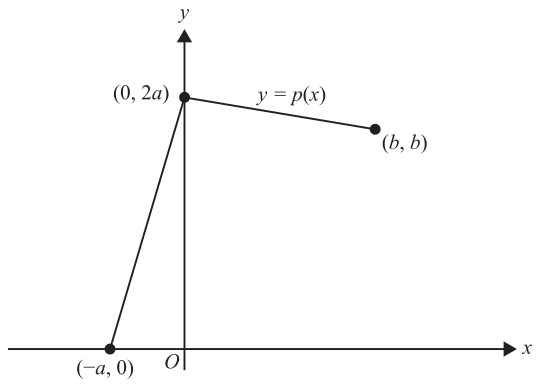


It is known that the average value of  `p`  over the interval  `[-a, b]`  is  `3/4`.

`text(Pr)(X > 0)`  is

A.   `2/3`

B.   `3/4`

C.   `4/5`

D.   `7/9`

E.   `5/6`

Show Answers Only

`D`

Show Worked Solution
`text(Area)` `= 1/2 (a xx 2a) + 1/2 b(2a + b)`
`1` `= a^2 + ab + (b^2)/2\ …\ (1)`


`text(Average value)` `= 1/(b + a) (a^2 + ab + (b^2)/2)`
`3/4` `= 1/(b + a)\ …\ (2)`

 
`text(Solve for) \ \ a\ \ text{(by CAS):}`

`a = – sqrt 2/3`

`text(Pr)(X > 0)` `= 1 – text(Pr)(X < 0)`
  `= 1 – a^2`
  `= 7/9`

 
`=>   D`

Filed Under: Probability density functions Tagged With: Band 5, smc-637-35-Sum probabilities = 1

Probability, MET2 2019 VCAA 17 MC

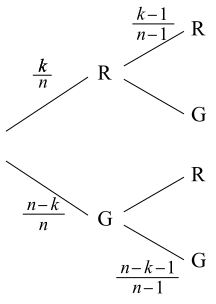
A box contains  `n`  marbles that are identical in every way except colour, of which  `k`  marbles are coloured red and the remainder of the marbles are coloured green. Two marbles are drawn randomly from the box.

If the first marble is not replaced into the box before the second marble is drawn, then the probability that the two marbles drawn are the same colour is

  1. `(k^2 + (n-k)^2)/n^2`
  2. `(k^2 + (n-k-1)^2)/n^2`
  3. `(2k(n-k-1))/(n(n-1))`
  4. `(k(k-1) + (n-k)(n-k-1))/(n(n-1))`
  5. `\ ^n C_2 (k/n)^2 (1-k/n)^(n-2)`
Show Answers Only

`D`

Show Worked Solution

`n\ text(marbles) \ => \ k\ text(red), \ (n-k)\ \ text(green)`
 

`:.\ P(text{same colour})` `= k/n ⋅ ((k-1))/((n-1)) + ((n-k))/n ⋅ ((n-k-1))/((n-1))`
  `= (k(k-1) + (n-k)(n-k-1))/(n(n-1))`

 
`=>   D`

Filed Under: Multi-Stage Events Tagged With: Band 5, smc-646-10-MSE with no replacement

Calculus, MET2 2019 VCAA 15 MC

Let  `f: [2, oo) -> R, \ f(x) = x^2 - 4x + 2`  and  `f(5) = 7`. The function  `g`  is the inverse function of  `f`.

`g prime(7)`  is equal to

A.   `1/6`

B.   `5`

C.   `(sqrt7)/14`

D.   `6`

E.   `1/7`

Show Answers Only

`A`

Show Worked Solution

`f(x) = x^2 – 4x + 2`

`f(5) = 7\ \ =>\ \ g(7) = 5\ \ text{(inverse function)}`

`f prime(x) = 2x – 4`

`f prime(5) = 6`

`g prime(7) = 1/(f prime(5)) = 1/6`

 
`=>   A`

Filed Under: Average Value and Other Tagged With: Band 5, smc-756-50-Other problems

Graphs, MET2 2019 VCAA 13 MC

The graph of the function  `f`  passes through the point  `(-2, 7)`.

If  `h(x) = f(x/2) + 5`, then the graph of the function  `h`  must pass through the point

  1. `(-1, -12)`
  2. `(-1, 19)`
  3. `(-4, 12)`
  4. `(-4, -14)`
  5. `(3, 3.5)`
Show Answers Only

`C`

Show Worked Solution

`h(x) = f(x/2) + 5`

`text(Dilate by a factor 2 from)\ y text(-axis)`

`(-2, 7) -> (-2 xx 2, 7) -= (-4, 7)`

`text(Translate up 5 vertically):`

`(-4, 7) -> (-4, 7 + 5) -= (-4, 12)`
 

`=>   C`

Filed Under: Transformations Tagged With: Band 5, smc-753-40-Combinations

Calculus, MET2 2019 VCAA 12 MC

If  `int_1^4 f(x)\ dx = 4`  and  `int_2^4 f(x)\ dx = -2`, then  `int_1^2(f(x) + x)\ dx`  is equal to

A.   `2`

B.   `6`

C.   `8`

D.   `7/2`

E.   `15/2`

Show Answers Only

`E`

Show Worked Solution
`int_1^2 f(x) + x\ dx` `= int_1^2 x\ dx + int_1^2 f(x)\ dx`
  `= [(x^2)/2]_1^2 + int_1^4 f(x)\ dx – int_2^4 f(x)\ dx`
  `= (2 – 1/2) + 4 – (-2)`
  `= 15/2`

`=>   E`

Filed Under: Area Under Curves Tagged With: Band 5, smc-723-70-Other

Algebra, NAP-L4-CA02 SA

The table shows the distances Angus swims on four different days.



Every day, Angus increases the distance he swims by the same amount.

What distance will Angus swim on Thursday?

   km
Show Answers Only

`3.4\ text(km)`

Show Worked Solution

`text(Each day, Angus swims an extra 0.3 km.)`

`:.\ text{Distance (on Thurs)}` `= 3.1 + 0.3`
  `= 3.4\ text(km)`

Filed Under: Patterns and Coordinate Geometry, Patterns and Coordinate Geometry Tagged With: Band 5, smc-3180-10-Patterns and numbers, smc-665-10-Patterns and numbers

Statistics, NAP-L4-CA01

This graph shows the amount of electricity generated by solar power and wind power in the Australian states.
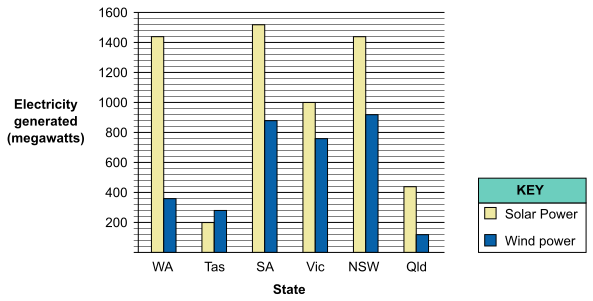
Which state generates the most electricity using wind power?

WA Tas SA Vic NSW Qld


Show Answers Only

`text(NSW)`

Show Worked Solution

`text(NSW)`

Filed Under: Data and Interpretation, Data and Statistics Tagged With: Band 5, smc-3190-12-Bar charts, smc-681-12-Bar charts

Statistics, 2ADV S3 EQ-Bank 16

A probability density function is defined by
 

`f(x) = {(a, \ text(for)\ \ 0 <= x <= 4),(3a, \ text(for)\  4 < x <= 8):}`
 

  1. Find the value of  `a`.  (2 marks)

    --- 4 WORK AREA LINES (style=lined) ---

  2. Sketch the probability density function.  (1 mark)

    --- 6 WORK AREA LINES (style=lined) ---

  3. Find an expression for the cumulative distribution function.  (2 marks)

    --- 5 WORK AREA LINES (style=lined) ---

Show Answers Only
  1. `1/16`
  2.  
  3. `F(x) = {(x/16, text(for)\ 0 <= x <= 4),((3x)/16 – 1/2, text(for)\ 4 < x <= 8):}`
Show Worked Solution

i.   `int_0^4 a\ dx = [ax]_0^4 = 4a`

`int_4^8 3a\ dx = [3ax]_4^8 = 24a – 12a = 12a`

`4a + 12a` `= 1`
`a` `= 1/16`


ii.   


iii.   `text(When)\ \ 0 <= x <= 4:`

`F(x) = int 1/16\ dx = x/16 + C`

`F(0) = 0 \ => \ C = 0`

`F(x) = x/16\ \ …\ (1)`
 

`text(When)\ \ 4 < x <= 8:`

`F(x) = int 3/16\ dx = (3x)/16 + C`

`F(4) = 1/4\ \ (text{see (1) above})`

COMMENT: Understand why you can check your equation here by confirming  `F(8)=1`

`(3 xx 4)/16 + C` `= 1/4`
`C` `= −1/2`

 
`F(x) = (3x)/16 – 1/2`
 

`:. F(x) = {(x/16, \ text(for)\ \ 0 <= x <= 4),((3x)/16 – 1/2, \ text(for)\ \ 4 < x <= 8):}`

Filed Under: Probability Density Functions (Y12) Tagged With: Band 4, Band 5, smc-994-40-Cumulative Distribution Fn, smc-994-90-Other PDF functions

Statistics, 2ADV S3 EQ-Bank 17

The diastolic measurement for blood pressure in 35-year-old people is normally distributed, with a mean of 75 and a standard deviation of 12.

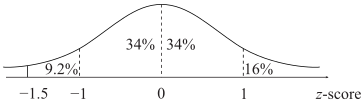
  1. A person is considered to have low blood pressure if their diastolic measurement is 63 or less.What percentage of 35-year-olds have low blood pressure?  (1 mark)

    --- 2 WORK AREA LINES (style=lined) ---

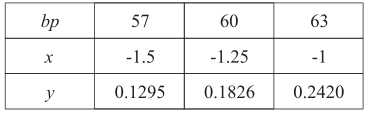
  2. Calculate the `z`-score for a diastolic measurement of 57.  (1 mark)

    --- 1 WORK AREA LINES (style=lined) ---

  3. The probability that a 35-year-old person has a diastolic measurement for blood pressure between 57 and 63 can be found by evaluating
     
    `qquad qquad int_a^b f(x)\ dx`
     
    where `a` and `b` are constants and where
     
    `qquad qquad f(x) = 1/(sqrt(2pi)) e^((−x^2)/2)`
     
    is the normal probability density function with mean 0 and standard deviation 1.


    By first finding the values `a` and `b`, calculate an approximate value for this probability by using the trapezoidal rule with 3 function values.  (3 marks)

    --- 6 WORK AREA LINES (style=lined) ---

  4. Hence, find the approximate probability that a 35-year-old person chosen at random has a diastolic measurement of 57 or less.  (1 mark)

    --- 2 WORK AREA LINES (style=lined) ---

Show Answers Only
  1. `16text(% have low blood pressure)`
  2. `−1.5`
  3. `9.2text(%)`
  4. `6.8text(%)`
Show Worked Solution
i.    `ztext(-score)\ (63)` `= (x – mu)/σ`
    `= (63 – 75)/12`
    `= −1`


`:. 16text(% have low blood pressure)`


ii.    `ztext(-score)` `= (57 – 75)/12`
    `= −1.5`


iii.  `y = 1/sqrt(2pi) e^((−x^2)/2)`

 
`text(Area)` `= h/2(y_0 + 2y_1 + y_2)`
  `~~ 0.25/2 (0.1295 + 2 xx 0.1826 + 0.2420)`
  `~~ 0.0920`
  `~~ 9.2text(%)`


iv.   


`P(text{blood pressure}\ <= 57)` `= 16 – 9.2`
  `~~ 6.8text(%)`

Filed Under: Normal Distribution (Y12) Tagged With: Band 3, Band 4, Band 5, smc-995-50-Normal PDF / Trap Rule

Functions, 2ADV F1 SM-Bank 40

A factory makes boots and sandals. In any week

• the total number of pairs of boots and sandals that are made is 200
• the maximum number of pairs of boots made is 120
• the maximum number of pairs of sandals made is 150.

The factory manager has drawn a graph to show the numbers of pairs of boots (`x`) and sandals (`y`) that can be made.
 

2UG-2009-24d
 

  1. Find the equation of the line `AD`.   (1 mark)
  2. Explain why this line is only relevant between `B` and `C` for this factory.     (1 mark)
  3. The profit per week, `$P`, can be found by using the equation
     
  4.       `P = 24x + 15y`.
     
    Compare the profits at `B` and `C`.     (2 marks)


Show Answers Only
  1. `x + y = 200`
  2. `text(S)text(ince the max amount of boots = 120)`
  3. `=> x\ text(cannot)\ >120`
  4.  
  5. `text(S)text(ince the max amount of sandals = 150`
  6.  
  7. `=> y\ text(cannot)\ >150`
  8.  
  9. `:.\ text(The line)\ AD\ text(is only possible between)\ B\ text(and)\ C.`
  10.  
  11. `text(The profits at)\ C\ text(are $630 more than at)\ B.`


Show Worked Solution

(i)   `text{We are told the number of boots}\ (x),`

Question taken from Gen2 exam – now common content with Advanced course.

`text{and shoes}\  (y),\ text(made in any week = 200)`

`=>text(Equation of)\ AD\ text(is)\ \ x + y = 200`


(ii)  `text(S)text(ince the max amount of boots = 120)`

`=> x\ text(cannot)\ >120`

`text(S)text(ince the max amount of sandals = 150`

`=> y\ text(cannot)\ >150`

`:.\ text(The line)\ AD\ text(is only possible between)\ B\ text(and)\ C.`


(iii)  `text(At)\ B,\ \ x = 50,\ y = 150`

`=>$P  (text(at)\ B)` `= 24 xx 50 + 15 xx 150`
  `= 1200 + 2250`
  ` = $3450`

`text(At)\ C,\ \  x = 120 text(,)\ y = 80`

`=> $P  (text(at)\ C)` `= 24 xx 120 + 15 xx 80`
  `= 2880 + 1200`
  `= $4080`


`:.\ text(The profits at)\ C\ text(are $630 more than at)\ B.`

Filed Under: Uncategorized Tagged With: Band 4, Band 5

Calculus, MET1 2019 VCAA 9

Consider the functions  `f: R -> R,\ \ f(x) = 3 + 2x-x^2`  and  `g: R -> R,\ \ g(x) = e^x`

  1. State the rule of `g(f(x))` .  (1 mark) 

    --- 2 WORK AREA LINES (style=lined) ---

  2. Find the values of `x` for which the derivative of `g(f(x))` is a negative.  (2 marks)

    --- 4 WORK AREA LINES (style=lined) ---

  3. State the rule of `f(g(x))`.  (1 mark)

    --- 2 WORK AREA LINES (style=lined) ---

  4. Solve  `f(g(x)) = 0`.  (2 marks)

    --- 5 WORK AREA LINES (style=lined) ---

  5. Find the coordinates of the stationary point of the graph of `f(g(x))`.  (2 marks)

    --- 5 WORK AREA LINES (style=lined) ---

  6. State the number of solutions to  `g(f(x)) + f(g(x)) = 0`.  (1 mark)

    --- 5 WORK AREA LINES (style=lined) ---

Show Answers Only
  1. `g(f(x)) = e^(3 + 2x-x^2)`
  2. `x > 1`
  3. `f(g(x)) = 3 + 2e^x-e^(2x)`
  4. `x = ln 3`
  5. `text(S.P. at)\ (0, 4)`
  6. `text(1 solution only)`
Show Worked Solution

a.   `g(f(x)) = e^(3 + 2x-x^2)`
 

b.   `d/(dx) g(f(x)) = (2-2x)e^(3 + 2x-x^2)`

`e^(3 + 2x-x^2) > 0\ \ text(for all)\ \ x`

`=> d/(dx) g(f(x)) < 0\  \text(when):`

`2-2x` `< 0`
`x` `> 1`

 
c.
   `f(g(x)) = 3 + 2e^x-e^(2x)`
 

d.   `e^(2x)-2e^x-3 = 0`

`text(Let)\ \ X = e^x`

`X^2-2X-3` `= 0`
`(X-3)(X + 1)` `= 0`

 
`X = 3 or -1`

`text(When)\ \ X = 3,\ \ e^x = 3 => x = ln 3`

`text(When)\ \ X = -1,\ \ e^x = -1 \ => \ text(no solution)`

`:. x = ln 3`
 

e.    `d/(dx)\ f(g(x))` `= 2e^x-2e^(2x)`
    `= 2e^x (1-e^x)`

 
`text(S.P. occurs when:)`

`2e^x(1-e^x)` `= 0`
`e^x` `= 1`
`x` `= 0`

 
`text(When)\ \ x = 0,`

`f(g(x))` `= 3 + 2-1=4`

 
`:.\ text(S.P. at)\ \ (0, 4)`
 

f.    `text(Solutions occur when)\ \ g(f(x)) = -f(g(x))`

`text{Sketch both graphs (using parts a-e):}`
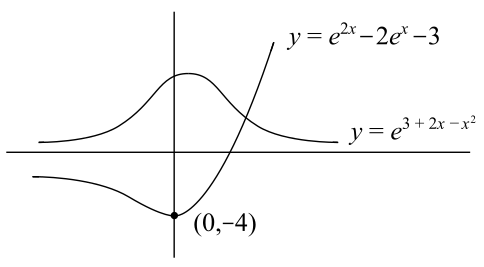


`:. 1\ text(solution only)`

Filed Under: Curve Sketching Tagged With: Band 4, Band 5, Band 6, smc-724-35-Composite functions

Algebra, MET1 2019 VCAA 8

The function  `f: R -> R, \ f(x)`  is a polynomial function of degree 4. Part of the graph of  `f`  is shown below.

The graph of  `f`  touches the `x`-axis at the origin.
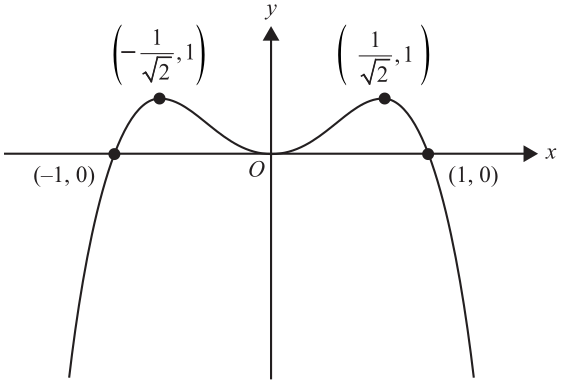


  1. Find the rule of  `f`.   (1 mark) 

    --- 4 WORK AREA LINES (style=lined) ---

Let  `g`  be a function with the same rule as  `f`.

Let  `h: D -> R, \ h(x) = log_e (g(x))-log_e (x^3 + x^2)`, where  `D`  is the maximal domain of  `h`.

  1. State  `D`.   (1 mark)

    --- 3 WORK AREA LINES (style=lined) ---

  2. State the range of  `h`.   (2 marks)

    --- 5 WORK AREA LINES (style=lined) ---

Show Answers Only
  1. `f(x) = -4x^2(x^2-1)`
  2. `x in (-1, 1) text(\{0})`
  3. `h(x) in (-oo, 3 log_e 2) text(\ {)2 log_e 2 text(})`
Show Worked Solution
a.    `y` `= ax^2 (x-1)(x + 1)`
    `= ax^2 (x^2-1)\ …\ (1)`

 
`text(Substitute)\ (1/ sqrt 2, 1)\ text{into  (1):}`

`1 = a ⋅ (1/sqrt 2)^2 ((1/sqrt 2)^2-1)`

`1 = a(1/2)(-1/2)`

`a = -4`

`:. f(x) = -4x^2(x^2-1)`


b.    `g(x) > 0` `=> -4x^2 (x^2-1) > 0`
    `=> x in (-1, 1)\  text(\{0})`

`text(and)`

`x^3 + x^2 > 0 => text(true for)\ \ x in (-1 , 1)\ text(\{0})`

`:. D:\ x in (-1, 1)\ text(\{0})`


c.    `h(x)` `= log_e ((-4x^2(x^2-1))/(x^3 + x^2))`
    `= log_e ((-4x^2(x + 1)(x-1))/(x^2(x + 1)))`
    `= log_e (4(1-x))\ \ text(where)\ \ x in (-1, 1)\ text(\{0})`

  
`text(As)\ \ x -> -1,\ \ h(x) -> log_e 8 = 3 log_e 2`

`text(As)\ \ x -> 1,\ \ h(x) -> -oo`

`text(As)\ \ x -> 0,\ \ h(x) -> log_e 4 = 2 log_e 2`

`text{(}h(x)\ text(undefined when)\ \ x = 0 text{)}`
 

`:.\ text(Range)\ \ h(x) in (-oo, 3 log_e 2)\ text(\{) 2 log_e 2 text(})`

Filed Under: Functional Equations, Log/Index Laws and Equations Tagged With: Band 4, Band 5, Band 6, smc-2745-40-Log graphs, smc-2745-50-Find Domain/Range, smc-642-40-Other functions

Calculus, MET1 2019 VCAA 7

The graph of the relation  `y = sqrt (1-x^2)`  is shown on the axes below. `P` is a point on the graph of this relation, `A` is the point `(-1, 0)` and `B` is the point `(x, 0)`.
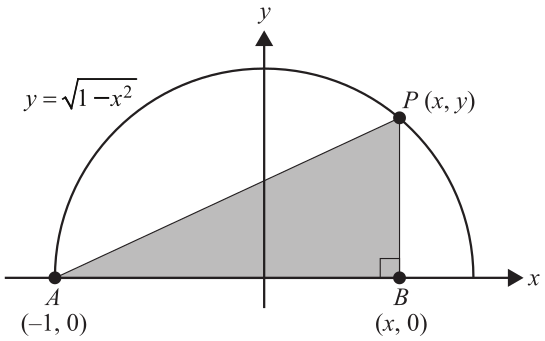
 

  1. Find an expression for the length `PB` in terms of `x` only.   (1 mark) 

    --- 1 WORK AREA LINES (style=lined) ---

  2. Find the maximum area of the triangle `ABP`.  (3 marks)

    --- 9 WORK AREA LINES (style=lined) ---

Show Answers Only
  1. `PB = sqrt(1-x^2)`
  2. `(3 sqrt 3)/8`
Show Worked Solution

a.    `PB = sqrt(1-x^2)`


b.    `A` `= 1/2 ⋅ AB ⋅ PB`
    `= 1/2 (x + 1) ⋅ (1-x^2)^(1/2)`
  `(dA)/(dx)` `= 1/2[(x + 1) ⋅ 1/2 ⋅ -2x ⋅ 1/sqrt(1-x^2) + sqrt(1-x^2)]`
    `= 1/2((-x^2-x + 1-x^2)/sqrt(1-x^2))`
    `= (-2x^2-x + 1)/(2 sqrt(1-x^2))`

 
`text(Find max when)\ \ (dA)/(dx) = 0`

`2x^2 + x-1 = 0`

`(2x-1)(x + 1) = 0`

`x = 1/2 qquad (x =\ text{–1 is a min)}`

`:. A_max` `= 1/2 (3/2)(1-1/4)^(1/2)`
  `= 3/4 ⋅ sqrt(3/4)`
  `= (3 sqrt 3)/8`

Filed Under: Maxima and Minima Tagged With: Band 3, Band 5, smc-641-10-Area

Probability, MET1 2019 VCAA 6

Fred owns a company that produces thousands of pegs each day. He randomly selects 41 pegs that are produced on one day and finds eight faulty pegs.

  1. What is the proportion of faulty pegs in this sample?  (1 mark) 

    --- 1 WORK AREA LINES (style=lined) ---

  2. Pegs are packed each day in boxes. Each box holds 12 pegs. Let  `hat P`  be the random variable that represents the proportion of faulty pegs in a box.
  3. The actual proportion of faulty pegs produced by the company each day is `1/6`.
  4. Find  `text(Pr)(hat P < 1/6)`. Express your answer in the form  `a(b)^n`, where  `a`  and  `b`  are positive rational numbers and  `n`  is a positive integer.  (2 marks)

    --- 5 WORK AREA LINES (style=lined) ---
Show Answers Only

  1. `8/41`
  2. `(17/6) ⋅ (5/6)^11`

Show Worked Solution

a.    `text(Proportion of faulty pegs) = 8/41`
 

b.   `hat P = x/n = 1/6`

`text(Given)\ \ n = 12`

`1/6 = X/12 \ => \ X = 2`

`X\ ~\ text(Bi) (12, 1/6)`

`text(Pr)(hat P < 1/6)` `= text(Pr)(X < 2)`
  `= text(Pr)(X = 0) + text(Pr)(X = 1)`
  `= \ ^12 C_0 * (5/6)^12 + \ ^12 C_1 ⋅ (1/6)(5/6)^11`
  `= (5/6)^11 (5/6 + 12/6)`
  `= (17/6) ⋅ (5/6)^11`

Filed Under: Binomial Tagged With: Band 3, Band 5, smc-638-25-Find p given sample prop

Graphs, MET1 2019 VCAA 4

  1. Solve  `1-cos (x/2) = cos (x/2)`  for  `x in [-2 pi, pi]`.   (2 marks) 

    --- 5 WORK AREA LINES (style=lined) ---

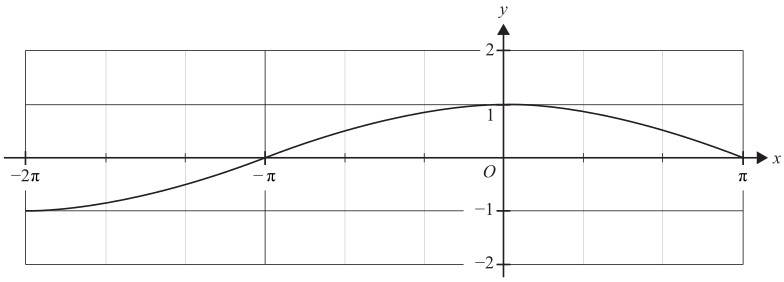
  2. The function  `f: [-2pi, pi] -> R,\ \ f(x) = cos (x/2)`  is shown on the axes below.


    Let  `g: [-2pi, pi] -> R,\ \ g(x) = 1-f(x)`.


    Sketch the graph of  `g`  on the axes above. Label all points of intersection of the graphs of  `f`  and  `g`, and the endpoints of  `g`, with their coordinates.   (2 marks)

    --- 2 WORK AREA LINES (style=lined) ---

Show Answers Only
  1. `(2 pi)/3, (-2 pi)/3`
  2. `text(See Worked Solutions)`
Show Worked Solution
a.    `2 cos (x/2)` `= 1`
  `cos (x/2)` `= 1/2`

 
`=>\ text(Base angle)\ \ pi/3`

`x/2 = pi/3, -pi/3, (-5 pi)/3`

`x = (2 pi)/3, (-2 pi)/3 qquad (x in [-2pi, pi])`


b.   `text(Plot points for)\ \ g(x):`

`text(- reflect)\ f(x)\ text(in)\ x text(-axis, then)`

`text(- translate 1 upwards.)`
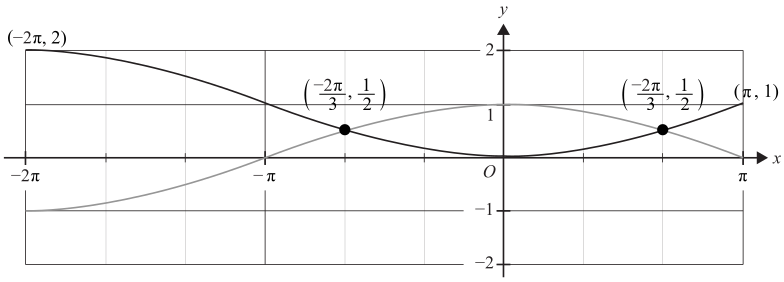
Filed Under: Trig Graphing Tagged With: Band 4, Band 5, smc-2757-15-Cos, smc-2757-70-Sketch graph

Probability, MET1 2019 VCAA 3

The only possible outcomes when a coin is tossed are a head or a tail. When an unbiased coin is tossed, the probability of tossing a head is the same as the probability of tossing a tail.

Jo has three coins in her pocket; two are unbiased and one is biased. When the biased coin is tossed, the probability of tossing a head is `1/3`.

Jo randomly selects a coin from her pocket and tosses it.

  1. Find the probability that she tosses a head.  (2 marks) 

    --- 5 WORK AREA LINES (style=lined) ---

  2.  Find the probability that she selected an unbiased coin, given that she tossed a head.  (1 mark)

    --- 3 WORK AREA LINES (style=lined) ---

Show Answers Only

  1. `4/9`
  2. `3/4`

Show Worked Solution

a.    `text(Pr)(B) = 1/3,\ \text(Pr)(B^{\prime}) = 2/3`

`text(Pr)(H|B) = 1/3,\ \ text(Pr)(H|B^{\prime}) = 1/2`


`:. text(Pr)(H)` `= text(Pr)(B) xx text(Pr)(H nn B) + text(Pr)(B^{\prime}) xx text(Pr)(H nn B^{\prime})`
  `= 1/3 xx 1/3 + 2/3 xx 1/2`
  `= 1/9 + 1/3`
  `= 4/9`


b.    `text(Pr)(B^{\prime}|H)` `= (text(Pr)(B^{\prime} nn H))/(text(Pr)(H))`
    `= (2/3 xx 1/2)/(4/9)`
    `= 3/4`

Filed Under: Conditional Probability and Set Notation Tagged With: Band 4, Band 5, smc-2736-10-Conditional probability

Statistics, NAP-L3-CA13

Students in Year 7 were surveyed to find out how much time they spent studying each day.
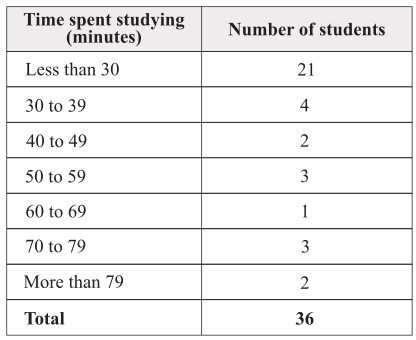


How many students spent one hour or more studying each day?

`2` `4` `5` `6`


Show Answers Only

`6`

Show Worked Solution

`text(Number of students studying ≥ 60 mins)`

`= 1 + 3 + 2`

`= 6`

Filed Under: Data and Interpretation, Data and Statistics (7) Tagged With: Band 5, smc-3166-20-Table data, smc-674-20-Table data

Vectors, EXT1 V1 SM-Bank 23

A fireworks rocket is fired from an origin `O`, with a velocity of 140 metres per second at an angle of  `theta`  to the horizontal plane.
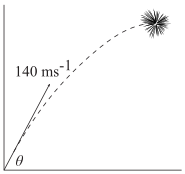


The position vector `underset~s(t)`, from `O`, of the rocket after  `t`  seconds is given by

`underset~s = 140tcosthetaunderset~i + (140tsintheta - 4.9t^2)underset~j`

The rocket explodes when it reaches its maximum height.

  1. Show the rocket explodes at a height of  `1000sin^2theta`  metres.  (2 marks)

    --- 5 WORK AREA LINES (style=lined) ---

  2. Show the rocket explodes at a horizontal distance of  `1000sin 2theta`  metres from `O`.  (1 mark)

    --- 2 WORK AREA LINES (style=lined) ---

  3. For best viewing, the rocket must explode at a horizontal distance of 500 m and 800 m from `O`, and at least 600 m above the ground.


    For what values of  `theta`  will this occur.  (3 marks)

    --- 8 WORK AREA LINES (style=lined) ---

Show Answers Only
  1. `text(See Worked Solutions)`
  2. `text(See Worked Solutions)`
  3. `63.4° <= theta <= 75°`
Show Worked Solution

i.    `underset~s = 140tcosthetaunderset~i + (140tsintheta – 4.9t^2)underset~j`

`underset~v = 140costhetaunderset~i + (140sintheta – 9.8t)underset~j`

`text(Max height occurs when)\ underset~j\ text(component of)\ underset~v = 0`

`0` `= 140sintheta – 9.8t`
`t` `= (140sintheta)/9.8`

 
`text(Max height:)\ \ underset~j\ text(component of)\ underset~s\ text(when)\ t = (140sintheta)/9.8`

`text(Max height)` `= 140sintheta · (140sintheta)/9.8 – (4.9 · 140^2sin^2theta)/(9.8^2)`
  `= 2000sin^2theta – 1000sin^2theta`
  `= 1000sin^2theta`


ii.   `text(Horizontal distance)\ (d):`

`=>\ underset~i\ text(component of)\ underset~s\ text(when)\ \ t = (140sintheta)/9.8`

`:.d` `= 140costheta · (140sintheta)/9.8`
  `= (140 xx 70 xx sin2theta)/9.8`
  `= 1000sin2theta`


iii.   `text(Using part ii),`

`500<=1000sin2theta<=800`
`0.5<=sin2theta<=0.8`


`text(In the 1st quadrant:)`

`30° <=` `2theta` `<= 53.13°`
`15° <=` `theta` `<= 26.6°`

 
`text(In the 2nd quadrant:)`

`126.87°<=` `2theta` `<= 150°`
`63.4°<=` `theta` `<= 75°`

 
`text(When)\ theta = 26.6°:`

`text(Max height)` `= 1000 · sin^2 26.6°`
  `= 200.5\ text(metres)\ (< 600\ text(m))`

 
`=>\ text(Highest max height for)\ \ 15° <= theta < 26.6°\ \ text(does not satisfy.)`
 

`text(When)\ theta = 63.4°:`

`text(Max height)` `= 1000 · sin^2 63.4°`
  `= 799.5\ text(metres)\ (> 600\ text(m))`

 
`=>\ text(Lowest max height for)\ \ 63.4° <= theta <= 75°\ \ text(satisfies).`

`:. 63.4° <= theta <= 75°`

Filed Under: Vectors and Projectile Motion (Ext1) Tagged With: Band 4, Band 5, smc-1087-10-Range, smc-1087-20-Maximum Height, smc-1087-70-Range of Initial Angle

Geometry, NAP-L4-CA06

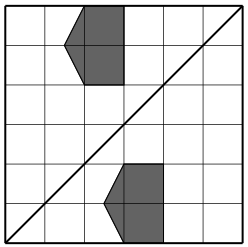
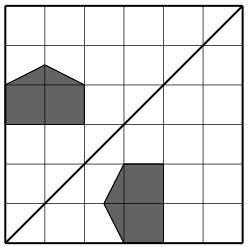
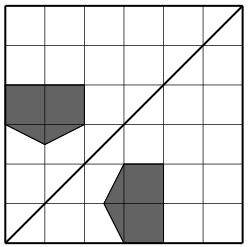
Chelsea draws a design by reflecting this shape across a mirror line.
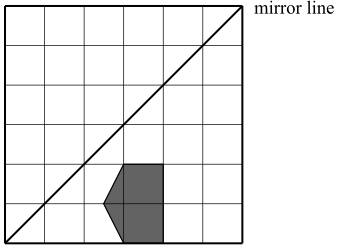
 

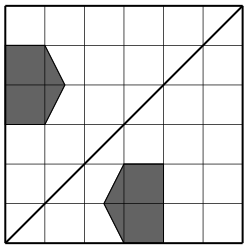
Which design shows the correct reflection?


Show Answers Only

Show Worked Solution

Filed Under: Transformations, Transformations and Symmetry, Transformations and Symmetry Tagged With: Band 5, smc-3163-15-Reflections/Folding, smc-3186-10-Reflections, smc-3196-10-Reflections

Complex Numbers, EXT2 N2 2019 HSC 16b

Let  `P(z) = z^4 - 2kz^3 + 2k^2z^2 + mz + 1`, where  `k`  and  `m`  are real numbers.

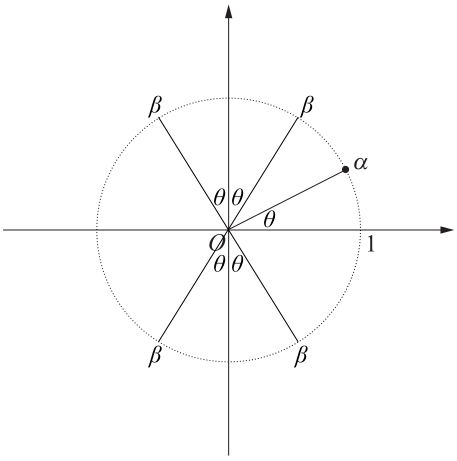
The roots of  `P(z)`  are  `alpha, bar alpha, beta, bar beta`.

It is given that  `|\ alpha\ | = 1`  and  `|\ beta\ | = 1`.

  1. Show that  `(text{Re} (alpha))^2 + (text{Re} (beta))^2 = 1`.  (3 marks)

    --- 8 WORK AREA LINES (style=lined) ---
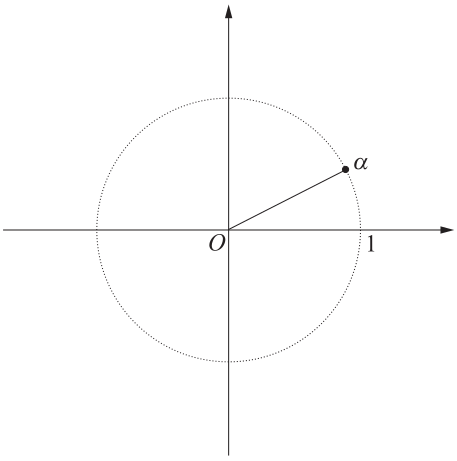
  2. The diagram shows the position of  `alpha`.


On the diagram, accurately show all possible positions of  `beta`.  (2 marks)

--- 0 WORK AREA LINES (style=lined) ---

Show Answers Only
  1. `text(Proof)\ text{(See Worked Solutions)}`
  2. `text(See Worked Solutions)`
Show Worked Solution

i.    `P(z) = z^4 – 2kz^3 + 2k^2z^2 + mz + 1,\ \ k, m in RR`

`text(Roots):\ \ alpha, bar alpha, beta, bar beta and |\ alpha\ | = 1, |\ beta\ | = 1`

`text(Show)\ \ (text{Re} (alpha))^2 + (text{Re} (beta))^2 = 1`

♦♦ Mean mark part (i) 26%.

`alpha + bar alpha + beta + bar beta` `= 2k`
`2 text{Re} (alpha) + 2 text{Re} (beta)` `= 2k`
`text{Re} (alpha) + text{Re} (beta)` `= k`


`alpha bar alpha + alpha beta + alpha bar beta + bar alpha beta + bar alpha bar beta + beta bar beta` `= 2k^2`
`|\ alpha\ |^2 + alpha(beta + bar beta) + bar alpha(beta + bar beta) + |\ beta\ |^2` `= 2k^2`
`1 + (alpha + bar alpha)(beta + bar beta) + 1` `= 2k^2`
`2 + 2 text{Re} (alpha) ⋅ 2 text{Re} (beta)` `= 2 (text{Re} (alpha) + text{Re} (beta))^2`
`2 + 4 text{Re} (alpha) text{Re} (beta)` `= 2 text{Re} (alpha)^2 + 4 text{Re} (alpha) text{Re} (beta) + 2 text{Re} (beta)^2`
`2` `= 2(text{Re} (alpha)^2 + text{Re} (beta)^2)`
`:. 1` `= text{Re} (alpha)^2 + text{Re} (beta)^2`


ii.    `|\ alpha\ | = |\ beta\ |\ \ \ text{(given)}`
  `text{Re}(alpha)^2 + text{Re}(beta)^2 = 1\ \ \ text{(see part (i))}`
  `text{Re}(alpha)^2 + text{Im}(alpha)^2 = 1\ \ \ (|\ alpha\ | = 1)`
  `=> text{Re}(beta)^2 = text{Im} (alpha)^2`
  `\ \ \ \ \ \ text{Re}(beta) = +-text{Im}(alpha)`


♦♦♦ Mean mark part (ii) 10%.

Filed Under: Geometrical Implications of Complex Numbers, Solving Equations with Complex Numbers Tagged With: Band 5, Band 6, smc-1050-35-Conjugate roots, smc-1052-50-Sketch roots

Functions, EXT1′ F2 2019 HSC 16aii

Let  `alpha, beta`  and  `gamma`  be the roots of the equation

`x^3 + 9x^2 + 15x - 17 = 0`.

Show that  `alpha + 3, \ beta + 3, \ gamma + 3`  are the roots of  `x^3 - 12x - 8 = 0`.  (2 marks)

Show Answers Only

`text(Proof)\ text{(See Worked Solutions)}`

Show Worked Solution

`P(x) = x^3 + 9x^2 + 15x – 17 = 0 \ => \ text(roots)\ alpha, beta, gamma`

`text(Let)\ Q(x)\ text(have roots:)\ \ alpha + 3, \ beta + 3, \ gamma + 3` 

`:. Q(x)` `= P(x – 3)`
  `= (x – 3)^3 + 9(x – 3)^2 + 15(x – 3) – 17`
  `= x^3 – 9x^2 + 27x – 27 + 9x^2 – 54x + 81 + 15x – 45 – 17`
  `= x^3 – 12x – 8`

 
`:. alpha + 3, beta + 3, gamma + 3\ \ text(are the roots of)\ \ x^3 – 12x – 8 = 0`

Filed Under: Roots and Coefficients Tagged With: Band 5

Functions, EXT1′ F2 2019 HSC 16ai

Consider the equation  `x^3 - px + q = 0`, where `p` and `q` are real numbers and  `p > 0`.

Let  `r = sqrt((4p)/3)` and  `cos 3 theta = (-4q)/r^3`.

Show that  `r cos theta`  is a root of  `x^3 - px + q = 0`.

You may use the result  `4 cos^3 theta - 3 cos theta = cos 3 theta`.  (Do NOT prove this.)  (2 marks)

--- 5 WORK AREA LINES (style=lined) ---

Show Answers Only

`text(Proof)\ text{(See Worked Solutions)}`

Show Worked Solution

`x^3 – px + q = 0\ …\ (1)`

♦ Mean mark 49%.

`r = sqrt((4p)/3) \ => \ p=(3r^2)/4`

`cos 3 theta = (-4q)/r^3 \ => \ q = (-r^3 cos 3 theta)/4`

`text(Given)\ \ 4 cos^3 theta – 3 cos theta = cos 3 theta\ …\ (2)` 

 
`text(Substitute)\ \ x = r cos theta\ \ text{into (1)}`

`r^3 cos^3 theta – (3r^2)/4 r cos theta – (r^3 cos 3 theta)/4` `= 0`
`r^3/4  underbrace((4 cos^3 theta – 3 cos theta – cos 3 theta))_(=\ 0\ text{(see (2) above)})` `= 0`

`:.r cos theta\ \ text(is a root).`

Filed Under: Roots and Coefficients, Sum, Products and Multiplicity of Roots (Ext1) Tagged With: Band 5, smc-1205-30-Other

Measurement, NAP-L3-CA05

Carrie has a small container of milk.

It contains 250 millilitres of milk.

 

Carrie buys a pack of 6 of these milk containers.

How many litres of milk are in the pack?

0.25 litres 1.5 litres 2.5 litres 15 litres


Show Answers Only

`1.5\ text(litres)`

Show Worked Solution
`text(Total volume in pack)` `= 6 xx 250`
  `=1500\ text(mL)`
  `= 1.5\ text(litres)`

Filed Under: Units of Measurement, Units of Measurement Tagged With: Band 5, smc-3152-30-Convert mL/L, smc-668-30-Convert mL/L

Algebra, NAP-L3-CA04

Jack Newton holds a junior golf tournament every two years.

It was first held in 1987.

Kirsty attends the tournament as a spectator whenever she can.

In which two of the following years could Kirsty have attended the tournament?

`2012` `2013` `2014` `2015`


Show Answers Only

`text(2013 and 2015)`

Show Worked Solution

`text(Tournament only held in odd years.)`

`:.\ text(2013 and 2015).`

Filed Under: Patterns and Coordinate Geometry (8), Patterns and The Number Plane Tagged With: Band 5, smc-3151-10-Patterns and numbers, smc-664-10-Patterns and numbers

Proof, EXT2 P2 2019 HSC 14c

  1. Show that  `cot x - cot 2x = text(cosec)\ 2x`.  (2 marks)

    --- 6 WORK AREA LINES (style=lined) ---

  2. Use mathematical induction to prove that, for all  `n >= 1`,

`sum_(r = 1)^n\ text(cosec)(2^r x) = cot x - cot(2^n x)`.  (2 marks)

--- 8 WORK AREA LINES (style=lined) ---

Show Answers Only
  1. `text(Proof)\ text{(See Worked Solutions)}`
  2. `text(Proof)\ text{(See Worked Solutions)}`
Show Worked Solution

i.    `text(Show)\ \ cot x – cot 2x = text(cosec)\ 2x`

`text(LHS)` `= (cos x)/(sin x) – 1/(tan 2x)`
  `= (cos x)/(sin x) – (1 – tan^2 x)/(2 tan x)`
  `= (cos x)/(sin x) – ((1 – (sin^2 x)/(cos^2 x))/(2 (sin x)/(cos x)))`
  `= (cos x)/(sin x) – ((cos^2 x – sin^2 x)/(2 sin x cos x))`
  `= (2 cos^2 x – cos^2 x + sin^2 x)/(2 sin x cos x)`
  `= 1/(sin 2x)`
  `= text(cosec)\ 2x`
  `= ­text(RHS)`


ii.    `text(Prove)\ \ sum_(r = 1)^n\ text(cosec)(2^rx) = cot x – cot 2^n x\ \ text(for)\ \ n >= 1`

`text(Show true for)\ \ n = 1:`

♦ Mean mark 45%.

`text(LHS) = text(cosec)(2x)`

`text(RHS) = cot x – cot 2x = text(cosec)(2x)\ \ text{(using part (i))}`

`:.\ text(True for)\ \ n = 1`
 

`text(Assume true for)\ \ n = k:`

`text(cosec)\ 2x + text(cosec)\ 4x + … + text(cosec)\ 2^rx = cot x – cot 2^r x`

`text(Prove true for)\ \ n = k + 1:`

`text(i.e. cosec)\ 2x + … + text(cosec)\ 2^r x + text(cosec)\ 2^(r + 1) x = cot x – cot 2^(r + 1) x`

`text(LHS)` `= cot x – cot 2^r x + text(cosec)\ 2^(r + 1) x`
  `= cot x – cot 2^r x + text(cosec)\ (2.2^r x)`
  `= cot x – cot 2^r x + cot 2^r x – cot 2^(r + 1) x`
  `= cot x – cot 2^(r + 1) x`
  `= ­text(RHS)`

 
`:.\ text(True for)\ \ n=k+1`

`:.\ text(S)text(ince true for)\ \ n=1, text(by PMI, true for integral)\ \ n>=1.`

Filed Under: Induction, P2 Induction (Ext2) Tagged With: Band 3, Band 5, smc-1044-30-Trig, smc-1044-68-Sigma Notation, smc-5115-30-Trig, smc-5115-68-Sigma notation

Mechanics, EXT2* M1 2019 HSC 13c

Two objects are projected from the same point on a horizontal surface. Object 1 is projected with an initial velocity of  `20\ text(ms)^(-1)` directed at an angle of  `pi/3`  to the horizontal. Object 2 is projected 2 seconds later.

The equations of motion of an object projected from the origin with initial velocity `v` at an angle `theta` to the `x`-axis are

`x = vt cos theta`

`y = -4.9t^2 + vt sin theta`,

where  `t`  is the time after the projection of the object. Do NOT prove these equations.

  1. Show that Object 1 will land at a distance  `(100 sqrt 3)/4.9` m from the point of projection.  (2 marks)

    --- 8 WORK AREA LINES (style=lined) ---

  2. The two objects hit the horizontal plane at the same place and time.


    Find the initial speed and the angle of projection of Object 2, giving your answer correct to 1 decimal place.  (3 marks)

    --- 10 WORK AREA LINES (style=lined) ---

Show Answers Only
  1. `text(Proof)\ text{(See Worked Solutions)}`
  2. `24.2\ text(ms)^(-1)`
Show Worked Solution

a.   `text(Object 1:)`

`x` `= 20t cos\ pi/3`
  `= 10t`
`y` `= -4.9t^2 + 20t sin\ pi/3`
  `= -4.9t^2 + 10 sqrt 3 t`

 
`text(Let)\ \ t_1 = text{time of flight (Object 1)}`

`-4.9t_1^2 + 10 sqrt 3 t_1` `= 0`
`t_1(-4.9t_1 + 10 sqrt 3)` `= 0`
`4.9t_1` `= 10 sqrt 3\ \ (t >= 0)`
`t_1` `= (10 sqrt 3)/4.9`

 
`text(Find)\ \ x\ \ text(when)\ \ t_1 = (10 sqrt 3)/4.9:`

`x` `= 10 xx (10 sqrt 3)/4.9`
  `= (100 sqrt 3)/4.9\ text(… as required)`


(ii)   `text{Time of flight (Object 2)}= (10 sqrt 3)/4.9 – 2`

♦ Mean mark 42%.

`text(Range)` `= (100 sqrt 3)/4.9`
`(100 sqrt 3)/4.9` `= v((10 sqrt 3)/4.9 – 2) cos theta`
`v cos theta` `= (100 sqrt 3)/4.9 xx 4.9/(10 sqrt 3 – 9.8)`
`v cos theta` `= (100 sqrt 3)/(10 sqrt 3 – 9.8) \ \ \ …\ (1)`


`0` `= -4.9t^2 + vt sin theta`
`0` `= -4.9 xx ((10 sqrt 3)/4.9 – 2)^2 + v((10 sqrt 3)/4.9 – 2) sin theta`
`0` `= -4.9((10 sqrt 3 – 9.8)/4.9) + v sin theta`
`v sin theta` `= 10 sqrt 3 – 9.8 \ \ \ …\ (2)`

 
`(2) ÷ (1)`

`tan theta` `= (10 sqrt 3 – 9.8) xx (10 sqrt 3 – 9.8)/(100 sqrt 3)`
  `= 0.3265…`
`:. theta` `= 18.1^@\ text{(1 d.p.)}`

 
`text{Substitute into (2)}`

`:.v` `= (10 sqrt 3 – 9.8) /(sin 18.1^@)`
  `= 24.206`
  `= 24.2\ text(ms)^(-1)\ text{(1 d.p.)}`

Filed Under: Projectile Motion Tagged With: Band 3, Band 5, smc-1062-10-Range/Time of Flight, smc-1062-40-Initial Angle/Speed, smc-1062-90-Projectiles Collide

Trigonometry, EXT1 T3 SM-Bank 1

A billboard of height  `a`  metres is mounted on the side of a building, with its bottom edge  `h`  metres above street level. The billboard subtends an angle  `theta`  at the point  `P`,  `x`  metres from the building.


Use the identity  `tan (A - B) = (tan A - tan B)/(1 + tanA tanB)`  to show that
 

`theta = tan^(-1) [(ax)/(x^2 + h(a + h))]`.   (2 marks)

--- 5 WORK AREA LINES (style=lined) ---

Show Answers Only

`text(Proof)\ \ text{(See Worked Solutions)}`

Show Worked Solution

`text(Consider angles)\ \ A and B\ \ text(on the graph:)`

MARKER’S COMMENT: Answers that included a diagram and clearly labelled angles were generally successful.

`text(Show)\ \ theta = tan^(-1) [(ax)/(x^2 + h(a + h))]`

`tan A` `= (a + h)/x`
`tan B` `= h/x`
`tan (A – B)` `= ((a + h)/x – h/x)/(1 + ((a + h)/x)(h/x)) xx (x^2)/(x^2)`
  `= (x(a + h) – xh)/(x^2 + h(a + h))`
  `= (ax)/(x^2 + h(a + h)`


`text(S)text(ince)\ \ theta` `= A – B`
`theta` `= tan^(-1) [(ax)/(x^2 + h(a + h))]\ \ \ text(… as required.)`

Filed Under: Identities, Equations and 't' formulae (Ext1) Tagged With: Band 5, smc-1076-20-Other Identities/Equations

Calculus, EXT1 C2 2019 HSC 14c

The diagram shows the two curves  `y = sin x`  and  `y = sin(x - alpha) + k`, where  `0 < alpha < pi`  and  `k > 0`. The two curves have a common tangent at `x_0` where  `0 < x_0 < pi/2`.
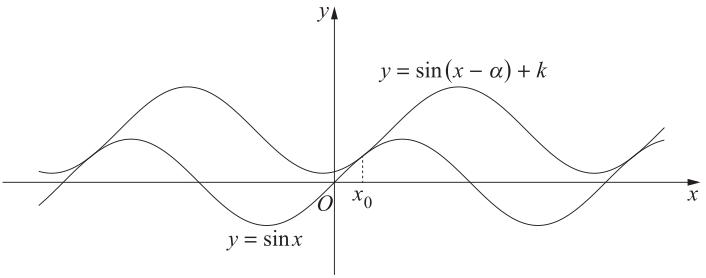


  1. Explain why   `cos x_0 = cos (x_0 - alpha)`.  (1 mark)

    --- 4 WORK AREA LINES (style=lined) ---

  2. Show that  `sin x_0 = -sin(x_0 - alpha)`.  (2 marks)

    --- 5 WORK AREA LINES (style=lined) ---

  3. Hence, or otherwise, find  `k`  in terms of  `alpha`.  (2 marks)

    --- 8 WORK AREA LINES (style=lined) ---

Show Answers Only
  1. `text(See Worked Solutions)`
  2. `text(Proof)\ text{(See Worked Solutions)}`
  3. `k = 2 sin\ alpha/2`
Show Worked Solution
i.    `y_1` `= sin x`
  `(dy_1)/(dx)` `= cos x`
  `y_2` `= sin(x – alpha) + k`
  `(dy_2)/(dx)` `= cos (x – alpha)`

 
`text(At)\ \ x = x_0,\ \ text(tangent is common)`

♦ Mean mark part (i) 47%.

`:. cos x_0 = cos(x_0 – alpha)`


ii.   `x_0\ \ text{is in 1st quadrant (given)}`

`text{Using part  (i):}`

`cos\ x_0 = cos(x_0 – alpha) >0`

♦♦♦ Mean mark part (ii) 19%.

`=> x_0 – alpha\ \ \ text(is in 4th quadrant)\ \ (0 < alpha < pi)`

`text(S)text(ince sin is positive in 1st quadrant and)`

`text(negative in 4th quadrant)`

`=> sin x_0 = -sin(x_0 – alpha)`


iii.   

`text(When)\ \ x = x_0,`

`y_1` `=sin x_0`  
`y_2` `=sin(x_0 – alpha) + k`  
`sin x_0` `=sin (x_0 – alpha) + k`  
  `= -sin x_0 + k`  
`k` `== 2\ sin x_0`  


♦♦ Mean mark part (iii) 21%.

`text(S)text(ince)\ \ cos x_0` `= cos(x_0 – alpha)`
`x_0` `= -(x_0 – alpha)`
`2x_0` `= alpha`
`x_0` `= alpha/2`

 
 `:. k = 2 sin\ alpha/2`

Filed Under: Harder Trig Calculus (Ext1), T2 Further Trigonometric Identities (Y11) Tagged With: Band 5, Band 6, smc-1025-20-Compound Angles, smc-1038-30-Compound angles

Measurement, STD1 M1 2019 HSC 36

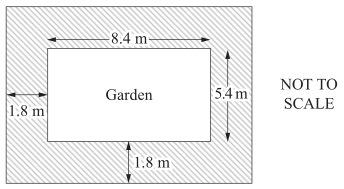
A path 1.8 m wide is being built around a rectangular garden. The garden is 8.4 m long and 5.4 m wide. The path is shaded in the diagram.


The path is to be covered with triangular pavers with side lengths of 15 cm and 20 cm as shown.
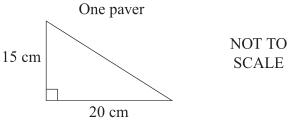


The pavers are to be laid to cover the path with no gaps or overlaps.

How many pavers are needed?  (4 marks)

--- 8 WORK AREA LINES (style=lined) ---

Show Answers Only

`4176`

Show Worked Solution
`text(Shaded Area)` `=\ text(Large rectangle − garden area)`
  `=(1.8+8.4+1.8) xx (1.8+5.4+1.8) – (8.4 xx 5.4)`
  `= 12 xx 9 – 8.4 xx 5.4`
  `= 62.64\ text(m²)`

♦♦ Mean mark 18%.
COMMENT: Convert all measurements to the same units to minimise errors (either m² or cm²).

`text(Area of 1 paver (in m²))` `= 1/2 xx 0.15 xx 0.20`
  `= 0.015\ text(m²)`

 
`:.\ text(Number of pavers needed)`

`= 62.64/0.015`

`= 4176`

Filed Under: Perimeter and Area (Std 1), Perimeter and Area (Std2-2027), Perimeter, Area and Volume (Std 2) Tagged With: Band 5, smc-1121-10-Perimeter and Area, smc-6483-20-Composite areas, smc-798-10-Perimeter and Area

Financial Maths, STD1 F2 2019 HSC 35

A bank offers two different savings accounts.

Account `X` offers simple interest of 7% per annum.
Account `Y` offers compound interest of 6% per annum compounded yearly.

The table displays the future values of $20 000 invested in each account for the first 2 years.


  1. How much more money is there in Account `X` than in Account `Y` at the end of 2 years?  (1 mark)

    --- 2 WORK AREA LINES (style=lined) ---

  2. Show that there would be more money in Account `Y` than in Account `X` at the end of 8 years.  (3 marks)

    --- 6 WORK AREA LINES (style=lined) ---

Show Answers Only
  1. `$328`
  2. `text(See Worked Solutions)`
Show Worked Solution
a.    `text(Extra money in)\ \ X` `= 22\ 800 – 22\ 472`
    `= $328`


b.   `text(Account)\ X:`

♦ Mean mark part (b) 30%.

`I` `= Prn`
  `= 20\ 000 xx 7/100 xx 8`
  `= 11\ 200`

 
`=> text(Balance)\ X = 20\ 000 + 11\ 200 = $31\ 200`
 

`text(Account)\ Y:`

`FV` `= PV(1 + r)^n`
  `= 20\ 000(1 + 6/100)^8`
  `= $31\ 876.96`

 
`:. text(After 8 years, there’s more money in Account)\ Y.`

Filed Under: F2 Investment (Y12) Tagged With: Band 3, Band 5, smc-1108-20-FV Formula, smc-1108-30-i/r comparisons (incl. graphs)

Algebra, STD1 A1 2019 HSC 34

Given the formula  `C = (A(y + 1))/24`, calculate the value of  `y`  when  `C = 120`  and  `A = 500`.  (3 marks)

Show Answers Only

`4.76`

Show Worked Solution

`text(Make)\ \ y\ \ text(the subject:)`

♦♦ Mean mark 32% (Std1).

`C` `= (A(y + 1))/24`
`24C` `= A(y + 1)`
`y + 1` `= (24C)/A`
`y` `= (24C)/A – 1`
  `= (24 xx 120)/500 – 1`
  `= 4.76`

Filed Under: Formula Rearrange (Std 1), Substitution and Other Equations (Std 1) Tagged With: Band 5, smc-1116-20-Rearrange and Substitute, smc-1201-10-Linear

Algebra, STD1 A2 2019 HSC 33

The relationship between British pounds `(p)` and Australian dollars `(d)` on a particular day is shown in the graph.
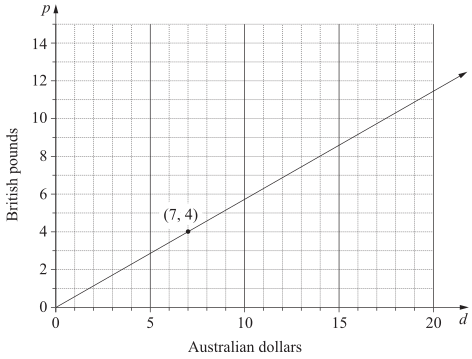


  1. Write the direct variation equation relating British pounds to Australian dollars in the form  `p = md`. Leave `m` as a fraction.  (1 mark)

    --- 2 WORK AREA LINES (style=lined) ---

  2. The relationship between Japanese yen `(y)` and Australian dollars `(d)` on the same day is given by the equation  `y = 76d`.


    Convert 93 100 Japanese yen to British pounds.  (2 marks)

    --- 4 WORK AREA LINES (style=lined) ---

Show Answers Only
  1. `p = 4/7 d`
  2. `93\ 100\ text(Yen = 700 pounds)`
Show Worked Solution

a.   `m = text(rise)/text(run) = 4/7`

♦♦♦ Mean mark part (a) 8%.

`p = 4/7 d`


b.   `text(Yen to Australian dollars:)`

♦♦ Mean mark part (b) 16%.

`y` `=76d`
`93\ 100` `= 76d`
`d` `= (93\ 100)/76`
  `= 1225`

 
`text(Aust dollars to pounds:)`

`p` `= 4/7 xx 1225`
  `= 700\ text(pounds)`

 
`:. 93\ 100\ text(Yen = 700 pounds)`

Filed Under: Applications: Currency, Fuel and Other Problems (Std 1) Tagged With: Band 5, Band 6, smc-1119-10-Currency Conversion

Algebra, STD1 A3 2019 HSC 30

A small business makes and sells bird houses.

Technology was used to draw straight-line graphs to represent the cost of making the bird houses `(C)` and the revenue from selling bird houses `(R)`. The `x`-axis displays the number of bird houses and the `y`-axis displays the cost/revenue in dollars.
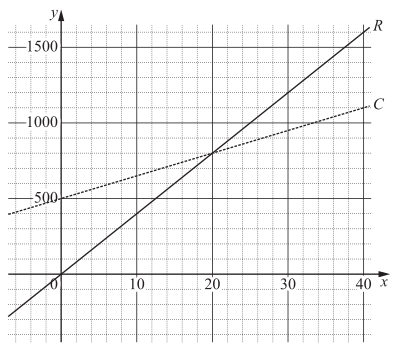


  1. How many bird houses need to sold to break even?  (1 mark)

    --- 2 WORK AREA LINES (style=lined) ---

  2. By first forming equations for cost `(C)` and revenue `(R)`, determine how many bird houses need to be sold to earn a profit of $1900.  (3 marks)

    --- 6 WORK AREA LINES (style=lined) ---

Show Answers Only
  1. `20`
  2. `96`
Show Worked Solution

a.   `20\ \ (xtext(-value at intersection))`


b.   `text(Find equations of both lines):`

♦ Mean mark part (b) 47%.

`(0, 500)\ text(and)\ (20, 800)\ text(lie on)\ \ C`

`m_C = (800 – 500)/(20 – 1) = 15`

`=> C = 500 + 15x`
 

`(0,0)\ text(and)\ (20, 800)\ text(lie on)\ \ R`

`m_R = (800 – 0)/(20 – 0) = 40`

`=> R = 40x`
 

`text(Profit) = R – C`

`text(Find)\ \ x\ \ text(when Profit = $1900:)`

`1900` `= 40x – (500 + 15x)`
`25x` `= 2400`
`x` `= 96`

Filed Under: A3 Types of Relationships (Y12) Tagged With: Band 4, Band 5, smc-1099-10-Cost/Revenue

Measurement, STD1 M5 2019 HSC 29

Concrete is made by mixing cement, sand and aggregate. Different types of concrete are produced by changing the ratio of the mix of these materials.The table shows the ratio of the materials for different types of concrete and examples of their common use.
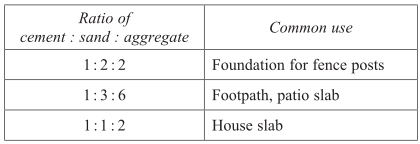
 

The amount of concrete required for a patio slab is 3.5 cubic metres.

How many cubic metres of sand will be needed?   (2 marks)

--- 4 WORK AREA LINES (style=lined) ---

Show Answers Only

`1.05\ text(m³)`

Show Worked Solution

`text(Patio ratio,)`

♦ Mean mark 34%.

`text(Cement : Sand : Aggregate )` `= 1:3:6`

 
`text(Concrete required = 3.5 m³)`

`:.\ text(Sand required)` `= text(sand parts)/text(total parts)  xx 3.5`
  `= 3/(1+3+6) xx 3.5`
  `= 1.05\ text(m³)`

Filed Under: M5 Scale Drawings (Y12) Tagged With: Band 5, smc-1105-50-Ratio (3 part)

Networks, STD1 N1 2019 HSC 28

The network diagram shows the tracks connecting 8 picnic sites in a nature park. The vertices `A` to `H` represents the picnic sites. The weights on the edges represent the distance along the tracks between the picnic sites, in kilometres.
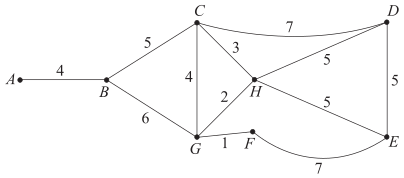


  1. Each picnic site needs to provide drinking water. The main water source is at site `A`.


    Draw a minimum spanning tree and calculate the minimum length of water pipes required to supply water to all the sites if the water pipes can only be laid along the tracks.  (2 marks)

    --- 5 WORK AREA LINES (style=lined) ---

  2. One day, the track between `C` and `H` is closed. State the vertices that identify the shortest path from `C` to `E` that avoids the closed track.  (1 mark)

    --- 1 WORK AREA LINES (style=lined) ---

Show Answers Only
  1. `text(25 km)`
  2. `CGHE`
Show Worked Solution

a.   `text(One strategy – using Prim’s algorithm:)`

♦ Mean mark part (a) 45%.

`text(Starting at)\ A`

`text(1st edge -)\ AB,\ \ text(2nd edge -)\ BC`

`text(3rd edge -)\ CH,\ \ text(4th edge -)\ HG`

`text(5th edge -)\ GF,\ \ text(6th edge -)\ HD`

`text(7th edge -)\ DE\ text(or)\ HE`
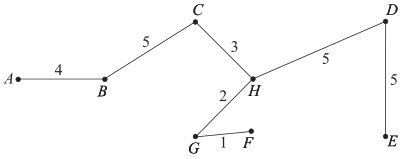
 

`text(Maximum length = 4 + 5 + 3 + 2 + 1 + 5 + 5 = 25 km)`

♦♦ Mean mark part (b) 30%.


b.   `text(Shortest Path is)\ CGHE`


Filed Under: Minimum Spanning Trees Tagged With: Band 5

Statistics, STD1 S3 2019 HSC 27

A set of bivariate data is collected by measuring the height and arm span of eight children. The graph shows a scatterplot of these measurements.
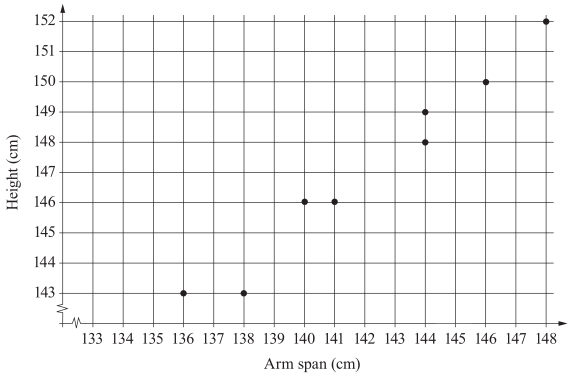
 

  1. On the graph, draw a line of best fit by eye.  (1 mark)

    --- 0 WORK AREA LINES (style=lined) ---

  2. Robert is a child from the class who was absent when the measurements were taken. He has an arm span of 147 cm. Using your line of best fit from part (a), estimate Robert’s height.  (1 mark)

    --- 1 WORK AREA LINES (style=lined) ---

Show Answers Only
  1.   
  2. `text(Robert’s height ≈ 151.1 cm)`
Show Worked Solution

a.     
       

♦ Mean mark (a) 38%.

b.   `text(Robert’s height ≈ 151.1 cm)`

`text{(Answers can vary slightly depending on line of best fit drawn).}`

Filed Under: S3 Further Statistical Analysis (Y12) Tagged With: Band 4, Band 5, num-title-ct-coreb, num-title-qs-hsc, smc-1113-10-Line of Best Fit, smc-5022-10-Line of best fit graphs, smc-5022-25-Draw LOBF

Measurement, STD1 M1 2019 HSC 25

The diagram shows a sector with an angle of 120° cut from a circle with radius 10 m.
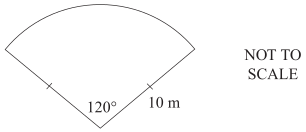


What is the perimeter of the sector? Write your answer correct to 1 decimal place.  (3 marks)

Show Answers Only

`40.9\ \ (text(1 d. p.))`

Show Worked Solution
`text(Arc length)` `= 120/360 xx 2 xx pi xx 10`
  `= 20.94`


♦♦♦ Mean mark 16%.

`:.\ text(Perimeter)` `= 20.94 + 2 xx 10`
  `= 40.94`
  `= 40.9\ \ (text(1 d. p.))`

Filed Under: Perimeter and Area (Std 1) Tagged With: Band 5, smc-1121-20-Perimeter and Area (Circular Measure)

Algebra, STD1 A3 2019 HSC 23

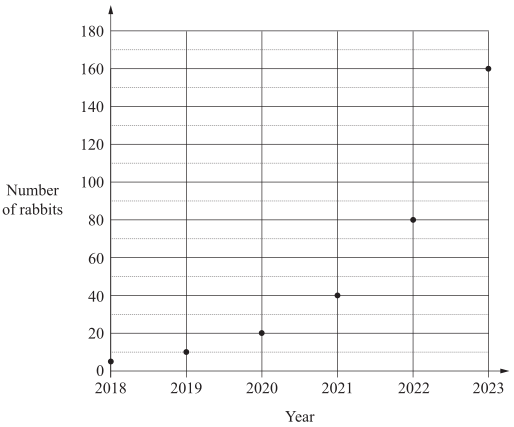
Five rabbits were introduced onto a farm at the start of 2018. At the start of 2019 there were 10 rabbits on the farm. It is predicted that the number of rabbits on the farm will continue to double each year.

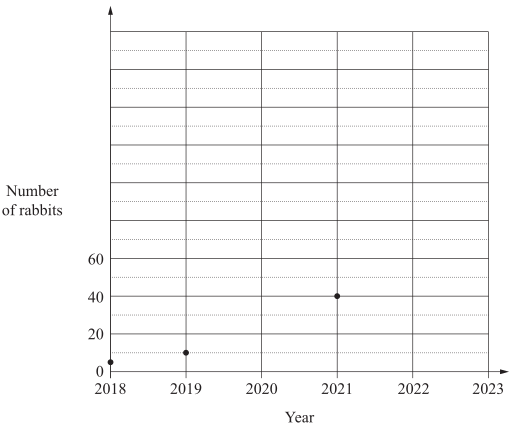
  1. Complete the following table.  (1 mark)


  2. Complete the scale on the vertical axis and then plot the data from part (a) on the grid.  (2 marks)


  3. Would a linear model or an exponential model better fit this graph? Explain the reason for your answer.  (1 mark)

    --- 2 WORK AREA LINES (style=lined) ---

Show Answers Only
  1. `text(Exponential model – the graph isn’t a straight line.)`
    `text(The number of rabbits grow at an increasing rate.)`
Show Worked Solution
a.   


b.   

♦ Mean mark part (c) 25%.

c.   `text(Exponential model – the graph isn’t a straight line.)`

`text(The number of rabbits grow at an increasing rate.)`

Filed Under: A3 Types of Relationships (Y12) Tagged With: Band 3, Band 5, smc-1099-50-Non-linear graphs

Statistics, STD1 S1 2019 HSC 19

The heights, in centimetres, of 10 players on a basketball team are shown.

170, 180, 185, 188, 192, 193, 193, 194, 196, 202

Is the height of the shortest player on the team considered an outlier? Justify your answer with calculations.  (3 marks)

Show Answers Only

`text(See Worked Solutions)`

Show Worked Solution

`Q_1 = 185, quad Q_3 = 194`

♦♦ Mean mark 24%.

`IQR = 194 – 185 = 9`

`text(Shortest player = 170)`

`text(Outlier height:)`

COMMENT: The last statement must be made to achieve full marks here!

`Q_1 – 1.5 xx IQR ` `= 185 – 1.5 xx 9`
  `= 171.5`

 
`:.\ text(S)text(ince 170 < 171.5, 170 is an outlier.)`

Filed Under: Summary Statistics (Std 1) Tagged With: Band 5, smc-1131-30-IQR and Outliers

Measurement, STD1 M4 2019 HSC 18

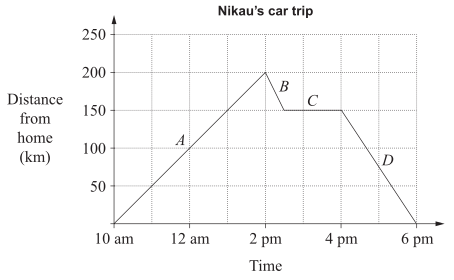
The travel graph displays Nikau's car trip along a straight road from home and back again. The trip has been broken into four separate sections: `A`, `B`, `C`  and  `D`.


  1. How far did Nikau travel in total?  (1 mark)

    --- 1 WORK AREA LINES (style=lined) ---

  2. In which section of the trip, `A`, `B`, `C` and `D`, did Nikau travel the fastest?  (1 mark)

    --- 1 WORK AREA LINES (style=lined) ---

Show Answers Only
  1. `400\ text(km)`
  2. `text(S)text(ection)\ D`
Show Worked Solution
a.    `text(Distance travelled)` `= 2 xx 200`
    `= 400\ text(km)`


♦ Mean mark part (b) 42%.

b.   `text{Fastest section has the steepest slope (in either direction).}`

`:. text(S)text(ection)\ D\ text(was the fastest.)`

Filed Under: M4 Rates (Y12) Tagged With: Band 4, Band 5, smc-1104-10-Travel Graphs

Financial Maths, STD1 F1 2019 HSC 16

What is the interest earned when $800 is invested for 7 months at a simple interest rate of 3% per annum?  (2 marks)

Show Answers Only

`$14`

Show Worked Solution

♦ Mean mark 38%.

`text(Interest)` `= Prn`
  `= 800 xx 0.03 xx 7/12`
  `= $14`

Filed Under: Simple Interest and S/L Depreciation (Std 1) Tagged With: Band 5, smc-1124-10-Simple Interest

Measurement, STD1 M1 2019 HSC 15

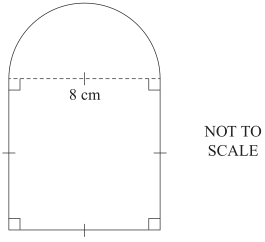
The diagram shows a shape made up of a square of side length 8 cm and a semicircle.


Find the area of the shape to the nearest square centimetre.  (3 marks)

--- 6 WORK AREA LINES (style=lined) ---

Show Answers Only

`89\ text(cm²  (nearest cm²))`

Show Worked Solution

♦♦ Mean mark 26%.

`text(Area)` `=\ text(Area of square + Area of semicircle)`
  `= 8 xx 8 + 1/2 xx pi xx 4^2`
  `= 89.13…`
  `= 89\ text(cm²  (nearest cm²))`

Filed Under: Circular measure, Perimeter and Area (Std 1) Tagged With: Band 5, num-title-ct-core, num-title-qs-hsc, smc-1121-20-Perimeter and Area (Circular Measure), smc-4944-50-Composite shapes

Financial Maths, STD1 F1 2019 HSC 29

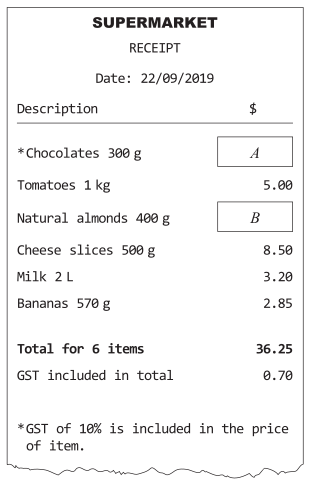
Part of a supermarket receipt is shown.

Determine the missing values, `A` and `B`, to complete the receipt.  (2 marks)

--- 4 WORK AREA LINES (style=lined) ---

Show Answers Only

`$9.00`

Show Worked Solution

`text(Chocolate is the only item where GST applies.)`

`text(GST on chocolate = 0.70)`

`=> text(C)text(ost of chocolate) = $7.00`

`:. A = 7.00 + 0.70 = $7.70`

`:. B` `= 36.25 – (7.70 + 5.00 + 8.50 + 3.20 + 2.85)`
  `= $9.00`

Filed Under: Tax and Percentage Increase/Decrease (Std 1) Tagged With: Band 5, smc-1125-20-GST

Measurement, STD1 M3 2019 HSC 12

A surfer is 150 metres out to sea. From that point, the angle of elevation to the top of the cliff is 12°.


How high is the cliff, to the nearest metre?  (2 marks)

Show Answers Only

`32\ text(metres  (nearest m))`

Show Worked Solution

`tan12° = h/150`

♦♦ Mean mark 33%.

`h` `= 150 xx tan12°`
  `= 31.88…`
  `= 32\ text(metres  (nearest m))`

Filed Under: M3 Right-Angled Triangles (Y12) Tagged With: Band 5, smc-1103-20-Right-angled Trig, smc-1103-40-Angle of Elevation

Measurement, STD1 M5 2019 HSC 10 MC

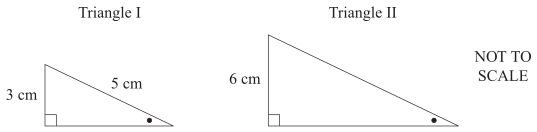
Triangle I and Triangle II are similar. Pairs of equal angles are shown.
 

What is the area of Triangle II?

  1. 18 cm²
  2. 24 cm²
  3. 30 cm²
  4. 48 cm²
Show Answers Only

`B`

Show Worked Solution

`text(In Triangle I, using Pythagoras:)`

`text{Base}` `= sqrt(5^2-3^2)`
  `= 4`

 
`text(Triangle I ||| Triangle II (given))`

♦♦ Mean mark 29%.

`=>\ text(corresponding sides are in the same ratio)`

`text{Scale factor}\ = 6/2=2`

`text{Scale factor (Area)}\ = 2^2=4`

`:. text(Area (Triangle II))` `= 4 xx text{Area of triangle I}`
  `= 4 xx 1/2 xx 3 xx 4`
  `=24\ text{cm}^2`

  
`=> B`

Filed Under: M5 Scale Drawings (Y12) Tagged With: Band 5, smc-1105-30-Similarity

Measurement, STD1 M4 2019 HSC 8 MC

Heart rate is measured in beats per minute. Maximum heart rate (MHR) is calculated using the following formula.

MHR = 220 − age

Target heart rates are calculated as a percentage of MHR.

Felicity's age is 28. Her trainer calculates that her target heart rate range is 60% to 80% of her MHR.

Which of the following lies within this target heart rate range?

  1. 100 beats per minute
  2. 140 beats per minute
  3. 180 beats per minute
  4. 220 beats per minute
Show Answers Only

`B`

Show Worked Solution
`text(MHR)` `= 220 – 28`
  `= 192`
`text(60%) xx 192` `= 115.2`
`text(80%) xx 192` `= 153.6`

 
`text(140 beats is in the range.)`

♦ Mean mark 46%.

`text(i.e.)\ 115.2 < 140 < 153.6`

`=> B`

Filed Under: M4 Rates (Y12) Tagged With: Band 5, smc-1104-40-Heart Rates/Blood Pressure

Measurement, STD1 M4 2019 HSC 5 MC

Which expression can be used to convert a speed of 3 metres per minute to a speed in centimetres per second?

  1. `3 xx 100 ÷ 60`
  2. `3 xx 100 xx 60`
  3. `3 ÷ 100 ÷ 60`
  4. `3 ÷ 100 xx 60`
Show Answers Only

`A`

Show Worked Solution

♦ Mean mark 47%.

`text(3 m/min)` `= 3 xx 100\ text(cm/minute)`
  `= 3 xx 100 ÷ 60\ text(cm/second)`

 
`=> A`

Filed Under: M4 Rates (Y12) Tagged With: Band 5, smc-1104-15-General rate problems

Measurement, STD1 M2 2019 HSC 2 MC

What is the time difference between 8:35 am and 2:10 pm?

  1. 5 hours and 25 minutes
  2. 5 hours and 35 minutes
  3. 6 hours and 25 minutes
  4. 6 hours and 35 minutes
Show Answers Only

`A`

Show Worked Solution

`text(8:35 am − 2:10 pm = 5 hours and 25 minutes)`

♦ Mean mark 48%.

`=> A`


Filed Under: M2 Working with Time (Y11), Time and Time Difference (Std2-2027) Tagged With: Band 5, smc-1102-10-Time Differences, smc-6306-10-Time Differences

Mechanics, EXT2* M1 2019 HSC 13d

The point  `O`  is on a sloping plane that forms an angle of 45° to the horizontal. A particle is projected from the point  `O`. The particle hits a point  `A`  on the sloping plane as shown in the diagram.


The equation of the line  `OA`  is  `y = -x`. The equations of motion of the particle are

`x = 18t`

`y = 18 sqrt(3t) - 5t^2,`

where  `t`  is the time in seconds after projection. Do NOT prove these equations.

  1. Find the distance  `OA`  between the point of projection and the point where the particle hits the sloping plane.  (2 marks)

    --- 6 WORK AREA LINES (style=lined) ---

  2. What is the size of the acute angle that the path of the particle makes with the sloping plane as the particle hits the point  `A`?  (3 marks)

    --- 8 WORK AREA LINES (style=lined) ---

Show Answers Only
  1. `(324(sqrt 2 + sqrt 6))/5\ text(units)`
  2. `30^@`
Show Worked Solution
i.    `x` `= 18t`
  `y` `= 18 sqrt 3 t – 5t^2`

 
`text(Particle hits slope when)\ \ y = -x`

`18 sqrt 3 t – 5t^2` `= -18t`
`5t^2 – 18t – 18 sqrt3 t` `= 0`
`t(5t – 18 – 18 sqrt 3)` `= 0`
`5t – 18 – 18 sqrt 3` `= 0`
`5t` `= 18 + 18 sqrt 3`
`t` `= (18 + 18 sqrt 3)/5`

 
`text(When)\ t = (18 + 18 sqrt 3)/5,`

`x = 18 xx ((18 + 18 sqrt 3)/5)`

`text{Using Pythagoras (isosceles Δ):}`

`OA` `= sqrt(2 xx 18^2 xx((18 + 18 sqrt 3)/5)^2)`
  `= sqrt 2 xx 18 xx ((18 + 18 sqrt 3)/5)`
  `= (324(sqrt 2 + sqrt 6))/5\ text(units)`


ii.    `x` `= 18t => dot x = 18`
  `y` `= 18 sqrt 3 t – 5t^2 => dot y = 18 sqrt 3 – 10t`

 
`text(When)\ \ t = (18 + 18 sqrt 3)/5,`

`dot y` `= 18 sqrt 3 – 10 ((18 + 18 sqrt 3)/5)`
  `= 18 sqrt 3 – 36 – 36 sqrt 3`
  `= -18 sqrt 3 – 36`
  `= -18(sqrt 3 + 2)`


`text(Find angle with the horizontal at impact:)`

♦ Mean mark part (ii) 39%.


`tan theta` `= (18(sqrt 3 + 2))/18`
  `= sqrt 3 + 2`
`theta` `= tan^(-1)(sqrt 3 + 2)`
  `= 75^@`

 
`:.\ text(Angle made with the slope)`

`= 75 – 45`

`= 30^@`

Filed Under: Projectile Motion Tagged With: Band 4, Band 5, smc-1062-10-Range/Time of Flight, smc-1062-50-Angle of Trajectory/Impact, smc-1062-70-Sloped Landing

Mechanics, EXT2* M1 2019 HSC 12b

A particle is moving along the `x`-axis in simple harmonic motion. The position of the particle is given by

`x = sqrt 2 cos 3t + sqrt 6 sin 3t,` for  `t >= 0` 

  1. Write  `x`  in the form  `R cos(3t - alpha)`, where  `R > 0`  and  `0 < alpha < pi/2`.  (2 marks)

    --- 6 WORK AREA LINES (style=lined) ---

  2. Find the two values for  `x`  where the particle comes to rest.   (1 mark)

    --- 2 WORK AREA LINES (style=lined) ---
  3. When is the first time that the speed of the particle is equal to half of its maximum speed?  (2 marks)

    --- 8 WORK AREA LINES (style=lined) ---

Show Answers Only
  1. `x = 2 sqrt 2 cos (3t – pi/3)`
  2. `2 sqrt 2 or -2 sqrt 2`
  3. `t = pi/18`
Show Worked Solution

i.    `x = sqrt 2 cos 3t + sqrt 6 sin 3t`

`R cos (3t – alpha) = R cos alpha cos 3t + R sin alpha sin 3t`

`=> R cos alpha = sqrt 2`

`=> R sin alpha = sqrt 6`

`R^2 cos^2 alpha + R^2 sin^2 alpha` `= 2 + 6`
`R^2 (cos^2 alpha + sin^2 alpha)` `= 8`
`R` `=2sqrt2`


`2 sqrt 2 cos alpha` `= sqrt 2`
`cos alpha` `= 1/2`
`alpha` `= pi/3`

 
`:. x = 2 sqrt 2 cos (3t – pi/3)`

♦ Mean mark part (ii) 46%.


ii.    `text(At the extremities of the amplitude,)`
 

`text(the particle stops and reverses.)`

`:. v = 0\ \ text(when)\ \ x = 2 sqrt 2 or -2 sqrt 2`


iii.   `x = 2 sqrt 2 cos (3t – pi/3)`

♦ Mean mark part (iii) 49%.

`(dx)/(dt) = -6 sqrt 2 sin(3t – pi/3)`

 
`text(Max speed) = 6 sqrt 2`

`text(Find)\ \ t\ \ text(when)\ \ (dx)/(dt) = +-3 sqrt 2`

`-6 sqrt 2 sin (3t – pi/3)` `= 3 sqrt 2`
`sin(3t – pi/3)` `= -1/2`
`3t – pi/3` `= -pi/6`
`3t` `= pi/6`
`t` `= pi/18`


`-6 sqrt 2 sin (3t – pi/3)` `= -3 sqrt 2`
`sin(3t – pi/3)` `= 1/2`
`3t – pi/3` `= pi/6`
`3t` `= pi/2`
`t` `= pi/6`

 
`:. t = pi/18\ text{(1st time)}`

Filed Under: Simple Harmonic Motion Tagged With: Band 4, Band 5, smc-1059-30-At Rest, smc-1059-31-Max Speed, smc-1059-40-Auxiliary Angles

Mechanics, EXT2* M1 2019 HSC 5 MC

A particle starts from rest, 2 metres to the right of the origin, and moves along the `x`-axis in simple harmonic motion with a period of 2 seconds.

Which equation could represent the motion of the particle?

A.     `x = 2cos pi t`

B.     `x = 2 cos 2t`

C.     `x = 2 + 2 sin pi t`

D.     `x = 2 + 2 sin 2t`

Show Answers Only

`A`

Show Worked Solution
`text(Period)` `= 2`
`(2 pi)/n` `= 2`
`n` `= pi`

 
`:.\ text(Eliminate B and D)`

♦ Mean mark 49%.
 

`text(Particle starts at rest,)`

`(dx)/(dt) = 0\ \ text(when)\ \ t = 0`

`text(Consider A:)`

`(dx)/(dt) = -2pi sin (pi xx 0) = 0`

`text(Consider C:)`

`(dx)/(dt) = 2 pi cos (pi xx 0) = 2pi`

 
`=>  A`

Filed Under: Simple Harmonic Motion Tagged With: Band 5, smc-1059-10-Amplitude / Period

Calculus, 2ADV C4 2019 HSC 16c

The diagram shows the region  `R`, bounded by the curve  `y = x^r`, where  `r >= 1`, the `x`-axis and the tangent to the curve at the point  `(1, 1)`.
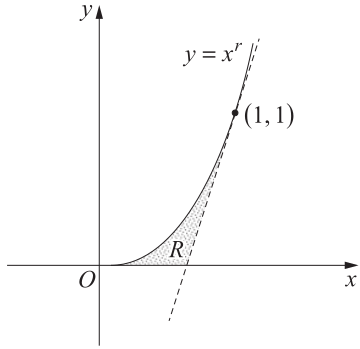
 

  1. Show that the tangent to the curve at  `(1, 1)`  meets the `x`-axis at
     
         `qquad ((r - 1)/r, 0)`.  (2 marks)

    --- 5 WORK AREA LINES (style=lined) ---

  2. Using the result of part (i), or otherwise, show that the area of the region  `R`  is
     
         `qquad (r - 1)/(2r (r + 1))`.  (2 marks)

    --- 6 WORK AREA LINES (style=lined) ---

  3. Find the exact value of  `r`  for which the area of  `R`  is a maximum.  (3 marks)

    --- 6 WORK AREA LINES (style=lined) ---

Show Answers Only
  1. `text(Proof)\ text{(See Worked Solutions)}`
  2. `text(Proof)\ text{(See Worked Solutions)}`
  3. `r = 1 + sqrt 2`
Show Worked Solution
i.    `y` `= x^r`
  `(dy)/(dx)` `= r x^(r – 1)`

 
`text(When)\ \ x = 1, \ (dy)/(dx) = r`

♦♦ Mean mark part (i) 31%.

`text(Equation of tangent:)`

`y – 1` `= r(x – 1)`
`y` `= rx – r + 1`

 
`text(When)\ \ y = 0:`

`rx – r + 1` `= 0`
`rx` `= r – 1`
`x` `= (r – 1)/r`

 
`:.\ text(T)text(angent meets)\ x text(-axis at)\ \ ((r – 1)/r, 0)`


ii.   `text(Area under curve)`

♦♦♦ Mean mark part (ii) 21%.

`= int_0^1 x^r`

`= [1/(r + 1) ⋅ x^(r + 1)]_0^1`

`= 1/(r + 1) xx 1^(r + 1) – 0`

`= 1/(r + 1)`

 
`text(Area under tangent)`

`= 1/2 xx b xx h`

`= 1/2 (1 – (r – 1)/r) xx 1`

`= 1/2 (1 – (r – 1)/r)`
 

`:. R` `= 1/(r + 1) – 1/2(1 – (r – 1)/r)“
  `= 1/(r + 1) – 1/(2r) [r – (r – 1)]`
  `= 1/(r + 1) – 1/(2r)`
  `= (2r – (r + 1))/(2r(r + 1))`
  `= (r – 1)/(2r(r + 1))`


iii.    `R` `= (r – 1)/(2r(r + 1)) = (r – 1)/(2r^2 + 2r)`
  `(dR)/(dr)` `= ((2r^2 + 2r) xx 1 – (r – 1)(4r + 2))/(2r^2 + 2r)^2`
    `= (2r^2 + 2r – 4r^2 – 2r + 4r + 2)/(2r^2 + 2r)^2`
    `= (-2r^2 + 4r + 2)/(2r^2 + 2r)^2`
    `= (-2(r^2 – 2r – 1))/(2r^2 + 2r)^2`


`text(Find)\ \ r\ \ text(when)\ \ (dR)/(dr) = 0:`

♦♦ Mean mark part (iii) 23%.

`r^2 – 2r – 1 = 0`

`r` `= (2 +- sqrt((-2)^2 – 4 xx 1 xx (-1)))/2 `
  `= (2 +- sqrt 8)/2`
  `= 1 + sqrt 2\ \ (r >= 1)`


  `qquadr qquad` `qquad 1 qquad` `\ \ 1 + sqrt 2\ \ ` `qquad 3 qquad`
  `(dR)/(dr)` `1/4` `0` `-1/144`


`:. R_text(max)\ text(occurs when)\ \ r = 1 + sqrt 2`

Filed Under: Areas Under Curves (Y12), Maxima and Minima (Y12) Tagged With: Band 5, Band 6, smc-970-10-Area, smc-975-40-Exponential

Calculus, 2ADV C4 2019 HSC 16b

A particle moves in a straight line, starting at the origin. Its velocity, `v\ text(ms)^(_1)`, is given by  `v = e^(cos t) - 1`, where  `t`  is in seconds.

The diagram shows the graph of the velocity against time.


Using the Trapezoidal Rule with three function values, estimate the position of the particle when it first comes to rest. Give your answer correct to two decimal places.  (3 marks)

--- 6 WORK AREA LINES (style=lined) ---

Show Answers Only

`1.48\ text{(2 d.p.)}`

Show Worked Solution

`v = e^(cos t) – 1`

♦♦ Mean mark 30%.

`text(Find)\ \ t\ \ text(when)\ \ v = 0:`

`e^(cos t)` `= 1`
`cos t` `= 0`
`t` `= pi/2`


  `qquad t qquad ` `qquad qquad 0 qquad qquad` `qquad qquad pi/4 qquad qquad ` `qquad  pi/2 qquad `
  `v` `e – 1` `e^(1/sqrt 2) – 1` `0`
    `v_0` `v_1` `v_2`


`A` `~~ h/2 (v_0 + 2v_1 + v_2)`
  `~~ pi/8 [e – 1 + 2 (e^(1/sqrt 2) – 1) + 0]`
  `~~ pi/8(3.774…)`
  `~~ 1.482…`
  `~~ 1.48\ text{(2 d.p.)}`

 
`:.\ text(The particle will be 1.48 metres to the right when it comes to rest.)`

Filed Under: Trapezium Rule and Newton, Trapezoidal Rule (Y12) Tagged With: Band 5, smc-5145-04-Trapezium rule, smc-5145-20-No table, smc-976-20-No Table

Probability, 2ADV S1 2019 HSC 15d

The probability that a person chosen at random has red hair is 0.02

  1. Two people are chosen at random.


    What is the probability that at least ONE has red hair?  (2 marks)

    --- 4 WORK AREA LINES (style=lined) ---

  2. What is the smallest number of people that can be chosen at random so that the probability that at least ONE has red hair is greater than 0.4?  (2 marks)

    --- 5 WORK AREA LINES (style=lined) ---

Show Answers Only
  1. `0.0396`
  2. `26\ text(people)`
Show Worked Solution
a.   `P(R)` `= 0.02`
  `P(barR)` `= 0.98`

 
`P\ text{(At least 1 has red hair)}`

`= 1 – P(barR, barR)`

`= 1 – 0.98 xx 0.98`

`= 0.0396`


b.  `text(Find)\ \ n\ \ text(such that)`

♦♦ Mean mark 24%.

`1 – 0.98^n` `> 0.4`
`0.98^n` `< 0.6`
`ln 0.98^n` `< ln 0.6`
`n ln 0.98` `< ln 0.6`
`n` `> (ln 0.6)/(ln 0.98),\ \ \ (ln 0.98 <0)`
  `> 25.28…`

 
`:. 26\ text(people must be chosen.)`

Filed Under: Multi-Stage Events (Adv-2027), Multi-Stage Events (Y11) Tagged With: Band 4, Band 5, smc-6469-30-Complementary Probability, smc-989-30-Complementary Probability

Calculus, 2ADV C3 2019 HSC 15c

The entry points, `R`  and  `Q`, to a national park can be reached via two straight access roads. The access roads meet the national park boundaries at right angles. The corner, `P`, of the national park is 8 km from  `R`  and 1 km from  `Q`. The boundaries of the national park form a right angle at  `P`.

A new straight road is to be built joining these roads and passing through  `P`.

Points  `A`  and  `B`  on the access roads are to be chosen to minimise the distance, `D`  km, from  `A`  to  `B`  along the new road.

Let the distance  `QA`  be  `x`  km.


  1. Show that  `D^2 = (x + 8)^2 + (8/x + 1)^2`.  (3 marks)

    --- 6 WORK AREA LINES (style=lined) ---

  2. Show that  `x = 2`  gives the minimum value of  `D^2`.  (3 marks)

    --- 6 WORK AREA LINES (style=lined) ---

Show Answers Only
  1. `text(Proof)\ text{(See Worked Solutions)}`
  2. `text(Proof)\ text{(See Worked Solutions)}`
Show Worked Solution
i.    `/_ BRP` `= /_ PQA = 90^@\ \ text{(given)}`
  `/_ BPR` `= /_ PAQ\ \ text{(corresponding)}`
  `=> Delta  BRP\ text(|||)\ Delta PQA\ \ text{(equiangular)}`


`(BR)/(RP)` `= (PQ)/(QA)` `text{(corresponding sides of}`
  `text{similar triangles)}`
`(BR)/8` `= 1/x`  
`BR` `= 8/x`  

 
`text(Using Pythagoras,)`

♦ Mean mark part (i) 41%.

`D^2` `= (QA + RP)^2 + (BR + PQ)^2`
  `= (x + 8)^2 + (8/x + 1)^2`


ii.    `(D^2) prime` `= 2*(x + 8) + 2(-1) ⋅ 8/x^2 (8/x + 1)`
    `= 2x + 16 – 16/x^2 (8/x + 1)`
    `= 2x + 16 – 128/x^3 – 16/x^2`
  `(D^2)″` `= 2 – (-3) ⋅ 128/x^4 -(-2) ⋅ 16/x^3`
    `= 2 + 384/x^4 + 32/x^3`

 
`text(When)\ \ x = 2,`

♦♦ Mean mark part (ii) 31%.

`(D^2) prime = 2 xx 2 + 16 – 128/8 – 16/4 = 0`

`=>\ text(S.P. at)\ \ x = 2`

`(D^2)″ = 2 + 384/16 + 32/8 > 0`
 

`:.\ text(MIN value of)\ \ D^2\ \ text(at)\ \ x = 2.`

Filed Under: Maxima and Minima (Y12) Tagged With: Band 5, smc-970-50-Distance

Financial Maths, STD2 F5 2019 HSC 42

The table shows the future values of an annuity of $1 for different interest rates for 4, 5 and 6 years. The contributions are made at the end of each year.


An annuity account is opened and contributions of $2000 are made at the end of each year for 7 years.

For the first 6 years, the interest rate is 4% per annum, compounding annually.

For the 7th year, the interest rate increases to 5% per annum, compounding annually.

Calculate the amount in the account immediately after the 7th contribution is made.  (3 marks)

--- 6 WORK AREA LINES (style=lined) ---

Show Answers Only

`$15\ 929.30`

Show Worked Solution

`text{Annuity compounding factor (4% for 6 years)} = 6.633`

♦♦ Mean mark 27%.

`:.\ text(Value after 6 years)` `= 2000 xx 6.633`
  `= $13\ 266.00`

 
`text(At the end of 7th year:)`

`text(Value)` `= 13\ 266 xx 1.05 + 2000`
  `= 13\ 929.30 + 2000`
  `= $15\ 929.30`

Filed Under: F5 Annuities (Y12), Modelling Investments and Loans (Y12) Tagged With: Band 5, common-content, smc-1002-40-FV Annuity Table, smc-816-10-FV of $1 Annuity Table

Measurement, STD2 M7 2019 HSC 41

A map is drawn to scale, on 1-cm paper, showing the position of a supermarket and a cinema. A reservoir is also shown.


  1. It takes 10 minutes to walk in a straight line from the cinema to the supermarket at a constant speed of 3 km/h. Show that the scale of the map is 1 cm = 100 m.  (3 marks)

    --- 6 WORK AREA LINES (style=lined) ---

  2. The reservoir is initially empty. During a storm 20 mm of rain falls on the reservoir.


    With the aid of one application of the trapezoidal rule, estimate the amount of water in the reservoir immediately after the storm. Assume that all rain which falls over the reservoir is stored. Give your answer in cubic metres.  (3 marks)

    --- 6 WORK AREA LINES (style=lined) ---

Show Answers Only
  1. `text(See Worked Solutions)`
  2. `1600\ text(m)^3`
Show Worked Solution

a.   `text(3 km/h = 3000 metres per 60 minutes)`

♦ Mean mark part (a) 49%.

`text(In 10 minutes:)`

`text(Actual distance) = 3000 xx 10/60 = 500\ text(metres)`

`text(Distance on map = 5 cm)`

`:.\ text(Scale   5 cm)` `: 500\ text(metres)`
`text(1 cm)` `: 100\ text(metres)`


b.   


`A` `~~ h/2(a + b)`
  `~~ 400/2(100 + 300)`
  `~~ 80\ 000\ text(m²)`

 
`text(Converting mm to metres:)`

♦♦ Mean mark part (b) 28%.

`text(20 mm) = 20/1000 text(m = 0.02 metres)`

 
`:.\ text(Volume of water)`

`= A xx h`

`= 80\ 000 xx 0.02`

`= 1600\ text(m)^3`

Filed Under: Ratio and Scale (Std2), Trapezoidal Rule (Std 2), Trapezoidal Rule (Std2-2027) Tagged With: Band 5, smc-1187-40-Maps and Scale Drawings, smc-6328-10-1-3 Approximations, smc-941-10-1-3 Approximations

Networks, STD2 N3 2019 HSC 40

A museum is planning an exhibition using five rooms.

The museum manager draws a network to help plan the exhibition. The vertices `A`, `B`, `C`, `D` and `E` represent the five rooms. The number on the edges represent the maximum number of people per hour who can pass through the security checkpoints between the rooms.


  1. What is the capacity of the cut shown?  (1 mark)

    --- 2 WORK AREA LINES (style=lined) ---

  2. The museum manager is planning for a maximum of 240 visitors to pass through the exhibition each hour. By using the 'minimum cut-maximum flow' theorem, the manager determines that the plan does not provide sufficient flow capacity.


    Draw the minimum cut onto the network below and recommend a change that the manager could make to one or more security checkpoints to increase the flow capacity to 240 visitors per hour.   (2 marks)


    --- 2 WORK AREA LINES (style=lined) ---

Show Answers Only
  1. `290`
  2.   

Show Worked Solution
a.    `text(Capacity)` `= 130 + 90 + 70`
    `= 290`

♦♦ Mean mark 32%.
COMMENT: In part (a), edge BC flows from the exit to the entry and is therefore not counted.

b.   `text(Maximum flow capacity:)`


`text(Minimum cut = 80 + 40 + 65 + 45 = 230)`

♦♦♦ Mean mark 19%.
COMMENT: In part (b), edge BC now flows from entry to exit in the new “minimum” cut and is counted.

`text(If security is improved to increase the flow)`

`text(between Room C and Room B by 10 visitors)`

`text(per hour, the network’s flow capacity increases)`

`text(to 240.)`

Filed Under: Flow Networks and Minimum Cuts Tagged With: Band 5, Band 6, smc-915-10-Min Cut/Max Flow, smc-915-20-Cut Capacity, smc-915-50-Network Adjustments

Statistics, STD2 S1 2019 HSC 39

Two netball teams, Team A and Team B, each played 15 games in a tournament. For each team, the number of goals scored in each game was recorded.

The frequency table shows the data for Team A.


The data for Team B was analysed to create the box-plot shown.


Compare the distributions of the number of goals scored by the two teams. Support your answer with the construction of a box-plot for the data for Team A.  (5 marks)

--- 8 WORK AREA LINES (style=lined) ---

Show Answers Only

`text(See Worked Solution)`

Show Worked Solution

`text(Team A: High = 28, Low = 19,)\ Q_1 = 23, Q_3 = 27,\ text{Median = 26}`
 

`text(Team A’s distribution is negatively skewed while)`

♦♦ Mean mark 28%.

`text(Team B’s distribution is slightly positively skewed.)`

`text(The standard deviation of Team A’s distribution is)`

`text(smaller than Team B, as both its IQR and range is)`

`text(smaller.)`

`text(Team B is a more successful team at scoring goals)`

`text(as each value in its 5-point summary is higher than)`

`text(Team A’s equivalent value.)`

Filed Under: Summary Statistics - Box Plots (Std 2), Summary Statistics - Box Plots (Std2-2027), Summary Statistics - Box Plots (Y12) Tagged With: Band 5, common-content, smc-1000-20-Parallel Box-Plots, smc-1000-30-Draw Box-Plots, smc-6313-20-Parallel Box Plots, smc-6313-30-Draw Box Plots, smc-825-20-Parallel Box-Plots, smc-825-30-Draw Box-Plots

  • « Previous Page
  • 1
  • …
  • 51
  • 52
  • 53
  • 54
  • 55
  • …
  • 81
  • Next Page »

Copyright © 2014–2025 SmarterEd.com.au · Log in