Solve `e^(2 ln x) = x + 6` (2 marks)
--- 5 WORK AREA LINES (style=lined) ---
Aussie Maths & Science Teachers: Save your time with SmarterEd
Solve `e^(2 ln x) = x + 6` (2 marks)
--- 5 WORK AREA LINES (style=lined) ---
`x = 3 or -2`
| `e^(2 ln x)` | `= x + 6` |
| `ln e^(2 ln x)` | `= ln (x + 6)` |
| `2 ln x` | `= ln (x + 6)` |
| `ln x^2` | `= ln (x + 6)` |
| `x^2` | `= x + 6` |
| `x^2 – x – 6` | `= 0` |
| `(x – 3) (x + 2)` | `= 0` |
`:. x = 3 \ \ (x>0)`
In a particular country, the birth weight of babies is normally distributed with a mean of 3000 grams. It is known that 95% of these babies have a birth weight between 1600 grams and 4400 grams.
One of these babies has a birth weight of 3497 grams. What is the `z`-score of this baby's birth weight? (2 marks)
--- 4 WORK AREA LINES (style=lined) ---
`0.71`
`text(95% babies within)\ 1600 – 4400`
`text(i.e.)\ \ 3000 +- \ 2\ text(σ = 1600 – 4400)`
| `2sigma` | `= 4400-3000` |
| `= 1400` | |
| `sigma` | `= 700` |
| `:. ztext(-score)\ (3497)` | `= (x-mu)/σ` |
| `= (3497 – 3000)/700` | |
| `= 0.71` |
A small business makes and sells bird houses.
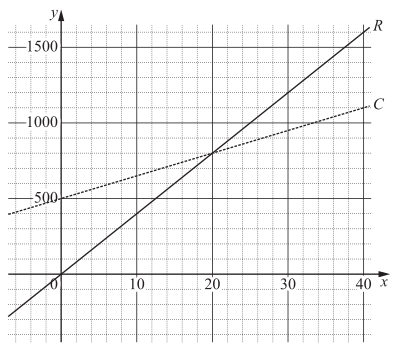
Technology was used to draw straight-line graphs to represent the cost of making the bird houses `(C)` and the revenue from selling bird houses `(R)`. The `x`-axis displays the number of bird houses and the `y`-axis displays the cost/revenue in dollars.
--- 1 WORK AREA LINES (style=lined) ---
--- 6 WORK AREA LINES (style=lined) ---
a. `20\ \ (xtext(-value at intersection))`
b. `text(Find equations of both lines):`
`(0, 500)\ text(and)\ (20, 800)\ text(lie on)\ \ C`
`m_C = (800-500)/(20-0) = 15`
`=> C = 500 + 15x`
`(0,0)\ text(and)\ (20, 800)\ text(lie on)\ \ R`
`m_R = (800-0)/(20-0) = 40`
`=> R = 40x`
`text(Profit) = R-C`
`text(Find)\ \ x\ \ text(when Profit = $1900:)`
| `1900` | `= 40x-(500 + 15x)` |
| `25x` | `= 2400` |
| `x` | `= 96` |
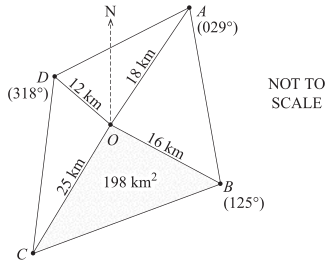
A compass radial survey shows the position of four towns `A`, `B`, `C` and `D` relative to point `O`.
The area of triangle `BOC` is 198 km².
Calculate the bearing of town `C` from point `O`, correct to the nearest degree. (3 marks)
--- 6 WORK AREA LINES (style=lined) ---
`207°`
`text(In)\ DeltaCOB,`
`text(Area) = 1/2 ab sinc`
| `198` | `= 1/2 xx 16 xx 25 xx sinangleCOB` |
| `sinangleCOB` | `= (2 xx 198)/(16 xx 25)` |
| `= 0.99` | |
| `angleCOB` | `= sin^(−1)0.99` |
| `= 81°53′` |
| `:. text(Bearing of)\ C\ text(from)\ O` | `= 125° + 81°53′` |
| `= 206°53′` | |
| `= 207°\ \ (text(nearest degree))` |
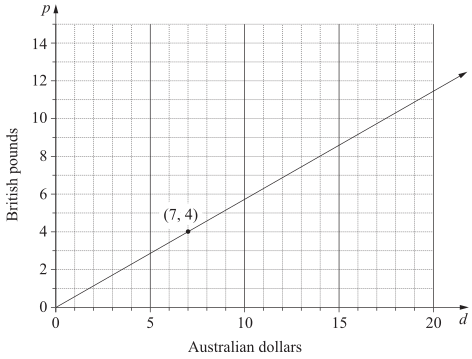
The relationship between British pounds `(p)` and Australian dollars `(d)` on a particular day is shown in the graph.
--- 2 WORK AREA LINES (style=lined) ---
Convert 93 100 Japanese yen to British pounds. (2 marks)
--- 4 WORK AREA LINES (style=lined) ---
a. `m = text(rise)/text(run) = 4/7`
`p = 4/7 d`
b. `text(Yen to Australian dollars:)`
| `y` | `=76d` |
| `93\ 100` | `= 76d` |
| `d` | `= (93\ 100)/76` |
| `= 1225` |
`text(Aust dollars to pounds:)`
| `p` | `= 4/7 xx 1225` |
| `= 700\ text(pounds)` |
`:. 93\ 100\ text(Yen = 700 pounds)`
A rectangle has width `w` centimetres. The area of the rectangle, `A`, in square centimetres, is `A = 2w^2 + 5w`.
The graph `A = 2w^2 + 5w` is shown.
--- 2 WORK AREA LINES (style=lined) ---
--- 4 WORK AREA LINES (style=lined) ---
a. `text(The width of a rectangle cannot be negative.)`
b. `text(When)\ A = 18, w = 2`
`text(Let)\ h =\ text(height of rectangle)`
| `18` | `= 2 xx h` |
| `h` | `= 9\ text(cm)` |
| `:.\ text(Perimeter)` | `= 2 xx (2 + 9)` |
| `= 22\ text(cm)` |
The equation of the tangent to the curve `y = x^3 + ax^2 + bx + 4` at the point where `x = 2` is `y = x - 4`.
Find the values of `a` and `b`. (3 marks)
--- 6 WORK AREA LINES (style=lined) ---
`b = -3,\ \ a = -2`
| `y ` | `= x^3 + ax^2 + bx + 4` |
| `(dy)/(dx)` | `= 3x^2 + 2ax + b` |
`text(When)\ \ x = 2,\ \ (dy)/(dx) = 1`
| `12 + 4a + b` | `= 1` |
| `4a + b` | `= -11\ …\ (1)` |
`text(The point)\ (2, -2)\ text(lies on)\ y:`
| `8 + 4a + 2b + 4` | `=-2` |
| `4a + 2b` | `= -14\ …\ (2)` |
`text(Subtract)\ \ (2) – (1)`
`b = -3`
`text(Substitute into)\ (1)`
| `4a – 3` | `= -11` |
| `4a` | `= -8` |
| `a` | `= -2` |
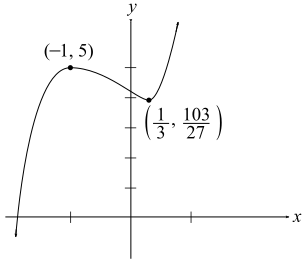
The derivative of a function `y = f(x)` is given by `f^{′}(x) = 3x^2 + 2x-1`.
--- 6 WORK AREA LINES (style=lined) ---
Find an expression for `f(x)`. (2 marks)
--- 4 WORK AREA LINES (style=lined) ---
--- 8 WORK AREA LINES (style=lined) ---
--- 2 WORK AREA LINES (style=lined) ---
a. `f^{′}(x) = 3x^2 + 2x-1`
`f^{″}(x) = 6x + 2`
`text(S.P.’s when)\ \ f^{′}(x) = 0`
| `3x^2 + 2x-1` | `= 0` |
| `(3x-1)(x + 1)` | `= 0` |
`x = 1/3 or -1`
`text(When)\ x = 1/3,`
`f^{″}(x) = 4 > 0 =>\ text(MIN)`
`text(When)\ x = -1,`
`f^{″}(x)= -4 < 0 =>\ text(MAX)`
| b. | `f(x)` | `= int f^{′}(x)\ dx` |
| `= int 3x^2 + 2x-1\ dx` | ||
| `= x^3 + x^2-x + c` |
`(0, 4)\ \ text(lies on)\ \ f(x)\ \ =>\ \ c = 4`
`:. f(x) = x^3 + x^2-x + 4`
| c. | `text(When)\ \ x = -1,\ \ y = 5` |
| `text(When)\ \ x = 1/3,\ \ y = 103/27` |
d. `text(Concave down when)\ f^{″}(x) < 0`
| `6x + 2` | `< 0` |
| `6x` | `< -2` |
| `x` | `< -1/3` |
--- 4 WORK AREA LINES (style=lined) ---
--- 2 WORK AREA LINES (style=lined) ---
| i. | `y` | `= (ln x)^2` |
| `(dy)/(dx)` | `= 2 ⋅ 1/x ⋅ ln x` | |
| `= (2 ln x)/x` |
| ii. | `int (ln x)/x\ dx` | `=1/2 int (2 ln x)/x dx` |
| `= 1/2 (ln x)^2 +C` |
Solve `2 sin x cos x = sin x` for `0 <= x <= 2pi`. (3 marks)
`x = 0, quad pi/3, quad pi, quad (5 pi)/3`
| `2 sin x cos x-sin x` | `= 0` |
| `sin x (2 cos x-1)` | `= 0` |
| `sin x` | `= 0` |
| `=> x` | `= 0,\ pi,\ 2pi` |
| `cos x` | `= 1/2` |
| `=> x` | `= pi/3, (5 pi)/3` |
`:. x = 0, quad pi/3, quad pi, quad (5 pi)/3,quad 2pi`
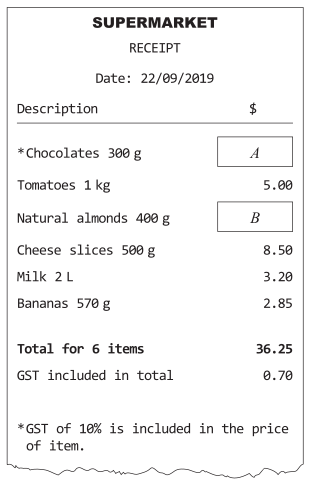
Part of a supermarket receipt is shown.
Determine the missing values, `A` and `B`, to complete the receipt. (2 marks)
--- 4 WORK AREA LINES (style=lined) ---
`$9.00`
`text(Chocolate is the only item where GST applies.)`
`text(GST on chocolate = 0.70`
`=> text(C)text(ost of chocolate) = $7.00`
`:. A = 7.00 + 0.70 = $7.70`
| `:. B` | `= 36.25 – (7.70 + 5.00 + 8.50 + 3.20 + 2.85)` |
| `= $9.00` |
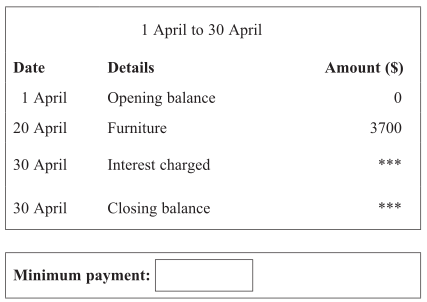
Ashley has a credit card with the following conditions:
Ashley's credit card statement for April is shown, with some figures missing.
The minimum payment is calculated as 2% of the closing balance on 30 April.
Calculate the minimum payment. (3 marks)
`$74.40`
| `text(Daily interest)` | `= 18.25/(100 xx 365)` |
| `= 0.0005` |
| `text(Closing balance)` | `= 3700(1.0005)^11` |
| `= 3720.40` |
| `:.\ text(Minimum payment)` | `= 3720.40 xx 0.02` |
| `= $74.408…` | |
| `= $74.41\ \ text{(nearest cent)}` |
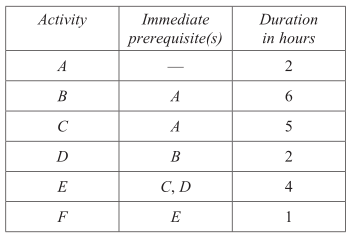
A project requires activities `A` to `F` to be completed. The activity chart shows the immediate prerequisite(s) and duration for each activity.
--- 8 WORK AREA LINES (style=lined) ---
--- 2 WORK AREA LINES (style=lined) ---
| a. |
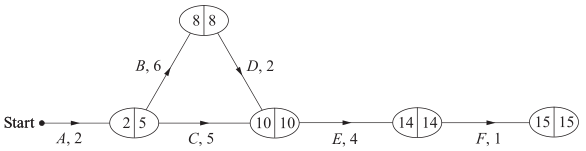
`text(Scanning forwards:)`
`text(Minimum time = 2 + 6 + 2 + 4 + 1 = 15 hours)`
`text{(Scanning forwards and backwards is highly recommended but not}`
`text{required in the network diagram.)}`
b. `text(Critical Path is)\ ABDEF.`
`text(Non-critical activity is)\ C.`
| `text(Float time)` | `= 5 – 2` |
| `= 3\ text(hours)` |
A bowl of fruit contains 17 apples of which 9 are red and 8 are green.
Dennis takes one apple at random and eats it. Margaret also takes an apple at random and eats it.
By drawing a probability tree diagram, or otherwise, find the probability that Dennis and Margaret eat apples of the same colour. (3 marks)
--- 8 WORK AREA LINES (style=lined) ---
`8/17`
A particle is moving along a straight line with displacement `x` at time `t`.
The particle is stationary when `t = 11` and when `t = 13`.
Which of the following MUST be true in this case?
| A. | The particle changes direction at some time between `t = 11` and `t = 13`. |
| B. | The displacement function of the particle has a stationary point at some time between `t = 11` and `t = 13`. |
| C. | The acceleration of the particle is 0 at some time between `t = 11` and `t = 13`. |
| D. | The acceleration function of the particle has a stationary point at some time between `t = 11` and `t = 13`. |
`C`
`text(Given)\ \ v = 0\ \ text(at)\ \ t = 11 and t = 13,`
`text(Consider option)\ C:`
`text(If)\ v\ text(remains)\ 0, \ a = 0.`
`text(If)\ v\ text(increases)\ (a > 0 )\ text(or decreases)\ (a < 0)\ text(after)\ \ t = 11,`
`text(it must then decrease)\ (a < 0)\ text(or increase)\ (a > 0)`
`text(respectively so that)\ \ v = 0\ \ text(when)\ \ t = 13.`
`text(In each scenario,)\ a = 0\ text(between)\ \ t = 11 and t = 13.`
`=> C`
Which expression is equal to `int tan^2 x\ dx`?
`A`
`text(Consider option)\ A:`
`d/(dx) (tan x – x + C)`
`= sec^2 x – 1`
`= tan^2 x`
`:. int tan^2 x\ dx = tan x – x + C`
`=> A`
An owl is 7 metres above ground level, in a tree. The owl sees a mouse on the ground at an angle of depression of 32°.
How far must the owl fly in a straight line to catch the mouse, assuming the mouse does not move?
`D`
Which of the following correctly expresses `y` as the subject of the formula `3x-4y-1 = 0`?
`C`
| `3x-4y-1` | `= 0` |
| `4y` | `= 3x-1` |
| `:. y` | `= (3x-1)/4` |
`=> C`
A person's weight is measured as 79.3 kg.
What is the absolute error of this measurement?
`B`
| `text(A)text(bsolute error)` | `= 1/2 xx\ text(precision)` |
| `= 1/2 xx 0.1\ text(kg)` | |
| `= 1/2 xx 100\ text(grams)` | |
| `= 50\ text(grams)` |
`=> B`
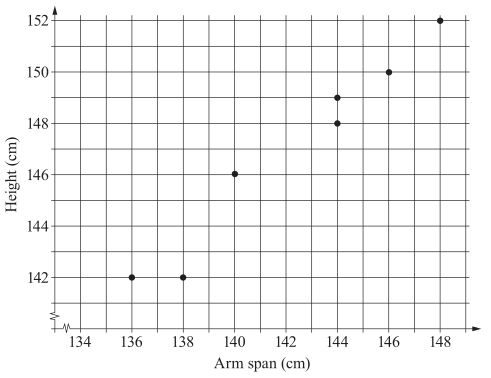
A set of bivariate data is collected by measuring the height and arm span of seven children. The graph shows a scatterplot of these measurements.
--- 1 WORK AREA LINES (style=lined) ---
--- 2 WORK AREA LINES (style=lined) ---
Calculate the predicted height for this child using the equation of the least-squares regression line. (1 mark)
--- 1 WORK AREA LINES (style=lined) ---
a. `text{Use “A + Bx” function (fx-82 calc):}`
COMMENT: Issues here? YouTube has short and excellent help videos – search your calculator model and topic – eg. “fx-82 correlation” .
| `r` | `= 0.9811…` |
| `= 0.98\ \ (text(2 d.p.))` |
b. `text(Direction: positive)`
`text(Strength: strong)`
| c. | `text(Height)` | `= 0.866 xx 143 + 23.7` |
| `= 147.538\ text(cm)` |
The diagram shows a projectile fired at an angle `theta` to the horizontal from the origin `O` with initial velocity `V\ text(ms)^(−1)`.

The position vector for the projectile is given by
`qquad underset~s(t) = Vtcosthetaunderset~i + (Vtsintheta - 1/2 g t^2)underset~j` (DO NOT prove this)
where `g` is the acceleration due to gravity.
--- 5 WORK AREA LINES (style=lined) ---
The projectile is fired so that `theta = pi/3`.
--- 5 WORK AREA LINES (style=lined) ---
i. `text(Time of flight when)`
`underset~j\ text(component of)\ underset~v = 0`
| `Vtsintheta – 1/2 g t^2` | `= 0` |
| `t(Vsintheta – 1/2 g t)` | `= 0` |
| `1/2g t` | `= Vsintheta` |
| `t` | `= (2Vsintheta)/g` |
`text(Range) \ => \ underset~i\ text(component of)\ underset~s`
`text(when) \ \ t = (2Vsintheta)/g`
| `text(Range)` | `= V · ((2Vsintheta)/g) · costheta` |
| `= (V^2)/g · 2sinthetacostheta` | |
| `= (V^2sin2theta)/g` |
ii. `text(Time of flight) = (2Vsin\ pi/3)/g = (sqrt3 V)/g`
`text(S)text(ince parabolic path is symmetrical,)`
`=>\ text(Upwards if)\ \ t < (sqrt3 V)/(2g)`
`=>\ text(Downwards if)\ \ t > (sqrt3 V)/(2g)`
`:. \ text(At)\ \ t = (2V)/(sqrt3 g), text(travelling downwards)`
`text(as) \ \ 2/sqrt3 · V/g > sqrt3/2 · V/g`
A projectile is fired horizontally off a cliff at an initial speed of `V` metres per second.
The projectile strikes the water, `l` metres from the base of the cliff.
Let `g` be the acceleration due to gravity and assume air resistance is negligible.
--- 5 WORK AREA LINES (style=lined) ---
--- 6 WORK AREA LINES (style=lined) ---
--- 2 WORK AREA LINES (style=lined) ---
| i. | `underset~v` | `= Vcosthetaunderset~i + (Vsintheta – g t)underset~j` |
| `= Vcos0 underset~i + (Vsin0 – g t)underset~j` | ||
| `= Vunderset~i – g tunderset~j` |
| `underset~s` | `= intunderset~v\ dt` |
| `= Vtunderset~i – 1/2g t^2 underset~j + c` |
`text(When)\ t = 0, underset~s = 0, c = 0`
`text(Time of flight:)`
`underset~j\ text(component of)\ underset~s = −d`
| `−1/2 g t^2` | `= −d` |
| `t^2` | `= (2d)/g` |
| `t` | `= sqrt((2d)/g)` |
ii. `l = 2d\ \ (text(given))`
`text(Projectile hits water at)\ theta:`
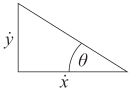
| `overset.y` | `= underset~j\ text(component of)\ underset~v` |
| `= −g t` | |
| `= −g · sqrt((2d)/g)` | |
| `= −sqrt(2dg)` | |
| `overset.x` | `= underset~i\ text(component of)\ underset~v` |
| `= V` |
`text(When)\ \ t = sqrt((2d)/g),`
`underset~i\ text(component of)\ underset~s = 2d`
| `2d` | `= V · sqrt((2d)/g)` |
| `V` | `= (2dsqrtg)/sqrt(2d) = sqrt(2dg)` |
| `tantheta` | `= (|overset.y|)/(|overset.x|)= sqrt(2dg)/sqrt(2dg)=1` |
| `:. theta` | `= 45°` |
iii. `text(Speed = magnitude of velocity)`
| `|underset~v|` | `= sqrt((sqrt(2dg))^2 + (sqrt(2dg))^2)` |
| `= sqrt(4dg)` | |
| `= 2sqrt(dg)` |
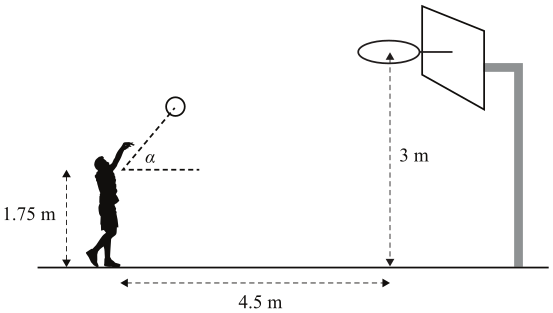
A basketball player aims to throw a basketball through a ring, the centre of which is at a horizontal distance of 4.5 m from the point of release of the ball and 3 m above floor level. The ball is released at a height of 1.75 m above floor level, at an angle of projection `alpha` to the horizontal and at a speed of `V\ text(ms)^(-1)`. Air resistance is assumed to be negligible.
The position vector of the centre of the ball at any time, `t` seconds, for `t >= 0`, relative to the point of release is given by
`qquad underset ~s(t) = Vt cos (alpha) underset ~i + (Vt sin(alpha) - 4.9t^2) underset ~j`,
where `underset ~i` is a unit vector in the horizontal direction of motion of the ball and `underset ~j` is a unit vector vertically up. Displacement components are measured in metres.
For the player’s first shot at goal, `V = 7\ text(ms)^(-1)` and `alpha = 45^@`
--- 5 WORK AREA LINES (style=lined) ---
--- 2 WORK AREA LINES (style=lined) ---
--- 3 WORK AREA LINES (style=lined) ---
| a.i. | `underset ~s(t)` | `=7t\ cos 45^@ underset ~i+(7t\ sin 45^@ – 4.9t^2) underset ~j` |
| `=(7sqrt2 t)/2 underset ~i + ((7sqrt2)/2 t – 4.9t^2) underset ~j` | ||
`text(Maximum height ⇒ find)\ \t\ text(when)\ \ underset~j\ \ text(component of)\ \ underset ~V(t) = 0:`
`underset~V = (7sqrt2)/2 underset ~i + ((7sqrt2)/2 – 9.8t) underset ~j`
| `(7sqrt2)/2 – 9.8t` | `= 0` |
| `t` | `= (5 sqrt 2)/14\ \ text(seconds)` |
a.ii. `text(Max height)\ =>\ text(Find)\ \ underset~j\ \ text(component of)\ \ underset~s(t)\ \ text(when)\ \ t=(5 sqrt 2)/14`
| `underset ~s_(underset ~j)((5 sqrt 2)/14)` | `= 7 xx (5 sqrt 2)/14 xx 1/sqrt 2 – 4.9 xx ((5 sqrt 2)/14)^2` | |
| `= 1.25\ text(m)` |
`:.\ text(Height above floor) = 1.25 + 1.75 = 3\ text(m)`
a.iii. `underset ~s_text(ring)= 4.5 underset ~i + 1.25 underset ~j`
`text(After 1 second,)`
`underset~s_text(ball) = 7/sqrt 2 underset ~i + ((7sqrt2)/2 – 4.9)underset ~j`
| `:.d` | `= |underset ~s_text(ring) – underset ~s(1)|` | |
| `= sqrt((4.5 – 7/sqrt 2)^2 + (1.25 – 7/sqrt 2 + 4.9)^2)` | ||
| `~~ 1.28\ text(m)` |
A cricketer hits a ball at time `t = 0` seconds from an origin `O` at ground level across a level playing field.
The position vector `underset ~s(t)`, from `O`, of the ball after `t` seconds is given by
`qquad underset ~s(t) = 15t underset ~i + (15 sqrt 3 t - 4.9t^2)underset ~j`,
where, `underset ~i` is a unit vector in the forward direction, `underset ~j` is a unit vector vertically up and displacement components are measured in metres.
--- 5 WORK AREA LINES (style=lined) ---
--- 4 WORK AREA LINES (style=lined) ---
--- 2 WORK AREA LINES (style=lined) ---
How far horizontally from `O` is the fielder when the ball is caught? Give your answer in metres, correct to one decimal place. (2 marks)
--- 5 WORK AREA LINES (style=lined) ---
`theta = pi/3 = 60^@`
a. `underset ~v (t) = underset ~ dot s (t) = 15 underset ~i + (15 sqrt 3 – 9.8t)underset ~j`
`text(Initial velocity occurs when)\ \ t=0:`
`:. underset ~v (0) = 15 underset ~i + 15 sqrt 3 underset ~j`
`text(Let)\ \ theta = text(Initial trajectory,)`
| `tan theta` | `=(15sqrt3)/15` | |
| `=sqrt3` | ||
| `:. theta` | `=pi/3\ \ text(or)\ \ 60^@` |
b. `text(Max height)\ =>underset~j\ \ text(component of)\ \ underset ~v=0.`
| `15 sqrt 3 – 9.8t` | `=0` |
| `t` | `=(15 sqrt 3)/9.8` |
| `=2.651…` |
`text(Find max height when)\ \ t = 2.651…`
| `:.\ text(Max height)` | `= 15 sqrt 3 xx 2.651 – 4.9 xx (2.651)^2` |
| `~~ 34.44\ text(m)` |
c. `text(Ball travels in symmetrical parabolic path.)`
`:.\ text(Total time of flight)`
`= 2 xx (15 sqrt 3)/9.8`
`= (15 sqrt 3)/4.9`
`~~ 5.302\ text(s)`
d. `text(Range)\ =>underset~i\ \ text(component of)\ \ underset~s(t)\ \ text(when)\ \ t= (15 sqrt 3)/4.9`
| `:.\ text(Range)` | `= 15 xx (15 sqrt 3)/4.9` |
| `= (225 sqrt 3)/4.9` | |
| `~~ 79.5\ text(m)` |
e. `text(Find)\ t\ text(when height of ball = 2 m:)`
| `15 sqrt 3 t – 4.9t^2` | `=2` | |
| `4.9t^2 – 15 sqrt 3 t + 2` | `=0` |
| `t=(15 sqrt 3 +- sqrt ((15 sqrt 3)^2 – 4 xx 4.9 xx2))/(2 xx 4.9)` | ||
`t ~~ 0.078131\ \ text(or)\ \ t ~~ 5.22406`
`text(When)\ \ t=0.0781,`
`x= 15 xx 0.0781 = 1.17\ text(m)\ \ text{(no solution →}\ x<40 text{)}`
`text(When)\ \ t=5.2241,`
`x=15 xx 5.2241 = 78.4\ text(m)`
`:.\ text(Ball is caught 78.4 m horizontally from)\ O.`
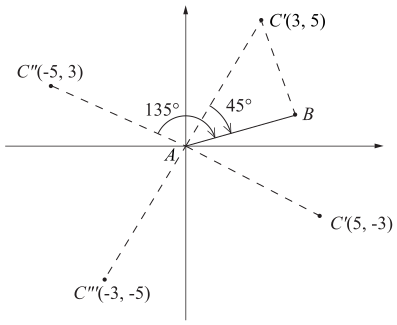
Points `A` and `B` are on the number plane. The vector `overset(->)(AB)` is `((4),(1))`.
Point `C` is chosen so that the area of `DeltaABC` is `17/2` square units and `|overset(->)(AC)| = sqrt34`.
Find all possible vectors `overset(->)(AC)`. (4 marks)
--- 10 WORK AREA LINES (style=lined) ---
`((3),(5)),((5),(−3)),((−3),(−5))\ text(and)\ ((−5),(3))`
`|overset(->)(AB)| = sqrt(4^2 + 1^2) = sqrt17`
`text(Let)\ \ angleCAB = theta`
| `text(Area)\ DeltaABC` | `= 1/2 · |overset(->)(AB)| · |overset(->)(AC)| · sintheta` |
| `17/2` | `= 1/2 · sqrt17 · sqrt34 sintheta` |
| `17` | `= 17sqrt2 sintheta` |
| `sintheta` | `= 1/sqrt2` |
| `theta` | `= pi/4\ text(or)\ (3pi)/4\ \ (theta>0)` |
`=> costheta = ±1/sqrt2`
| `overset(->)(AB) · overset(->)(AC)` | `= |overset(->)(AB)| · |overset(->)(AC)| · costheta` |
| `= ±sqrt17 · sqrt34 · 1/sqrt2` | |
| `= ±17` |
`text(Let)\ \ overset(->)(AC) = ((x),(y))`
| `overset(->)(AB) · overset(->)(AC)` | `= ((4),(1))((x),(y))` |
| `= 4x + y` |
`4x + y = ±17…\ \ (1)`
| `|overset(->)(AC)|` | `= sqrt(x^2 + y^2) = sqrt34` |
| `x^2 + y^2` | `= 34\ …\ \ (2)` |
`text(Solving simultaneously:)`
`4x + y = 17 \ => \ y = 17-4x`
`text{Substitute into (2)}`
| `x^2 + (17-4x)^2` | `= 34` |
| `x^2 + 289-136x + 16x^2` | `= 34` |
| `17x^2-136x + 255` | `= 0` |
| `x^2-8x + 15` | `= 0` |
| `(x-3)(x-5)` | `= 0` |
`:. x = 3, y = 5\ \ text(or)\ \ x = 5, y = −3`
`text(Similarly for)\ \ 4x + y = −17 \ => \ y = −4x-17`
| `x^2 + (−4x-17)^2` | `= 34` |
| `x^2 + 8x + 15` | `= 0` |
| `(x + 3)(x + 5)` | `= 0` |
`:. x = −3, y = −5\ \ text(or)\ \ x = −5, y = 3`
`:. text(Possible vectors)\ overset(->)(AC)\ text(are)`
`((3),(5)),((5),(−3)),((−3),(−5))\ text(and)\ ((−5),(3))`
Shoddy Ltd produces statues that are classified as Superior or Regular and are entirely made by machines, on a construction line. The quality of any one of Shoddy’s statues is independent of the quality of any of the others on its construction line. The probability that any one of Shoddy’s statues is Regular is 0.8.
Shoddy Ltd wants to ensure that the probability that it produces at least one Superior statues in a day’s production run is at least 0.95.
Calculate the minimum number of statues that Shoddy would need to produce in a day to achieve this aim. (3 marks)
--- 8 WORK AREA LINES (style=lined) ---
`14`
`text(Let)\ \ X = text(Number of superior statues)`
`X∼\ text(Bin) (n, 0.2)`
| `P(X >= 1)` | `>= 0.95` |
| `1 – P(X = 0)` | `>= 0.95` |
| `1 – ((n),(0)) (0.8^n) (0.2^0)` | `>= 0.95` |
| `1-0.8^n` | `>=0.95` |
| `0.8^n` | `<=0.05` |
| `n ln 0.8` | `<=ln 0.05` |
| `n` | `>= ln 0.05/ln 0.8,\ \ \ text{(ln 0.8 < 0)}` |
| `n` | `>= 13.4…` |
| `:. n_min` | `= 14` |
A biased coin tossed three times. The probability of a head from a toss of this coin is `p.`
--- 1 WORK AREA LINES (style=lined) ---
--- 2 WORK AREA LINES (style=lined) ---
--- 3 WORK AREA LINES (style=lined) ---
| a.i. | `text(P) (HHH)` | `= p xx p xx p` |
| `= p^3` |
ii. `text(P) text{(2 Heads and 1 Tail from 3 tosses)}`
`= ((3), (2)) xx p^2 xx (1 – p)^1`
`= 3 p^2 (1 – p)`
b. `text(If probabilities are equal:)`
| `p^3` | `= 3p^2 – 3p^3` |
| `4p^3 – 3p^2` | `= 0` |
| `p^2 (4p – 3)` | `= 0` |
`:. p = 0 or p = 3/4`
Let `X` be a discrete random variable with binomial distribution `X ~\ text(Bin)(n, p)`. The mean and the standard deviation of this distribution are equal.
Given that `0 < p < 1`, what is the smallest number of trials, `n`, such that `p ≤ 0.01`. (2 marks)
--- 6 WORK AREA LINES (style=lined) ---
`99`
`mu = np,\ \ text(Var)(X) = np(1-p) = σ_x ^2`
`text(Given)\ \ mu = σ_x,`
| `np` | `= sqrt(np(1 – p))` |
| `n^2p^2` | `= np(1 – p)` |
| `np(np-1+p)` | `=0` |
| `np-1+p` | `=0,\ \ \ (np!=0)` |
| `p(n+1)` | `=1` |
| `p` | `=1/(n+1)` |
| `1/(n + 1)` | `<= 1/100` |
| `n+1` | `>=100` |
| `n` | `>= 99` |
`:. n_text(min) = 99`
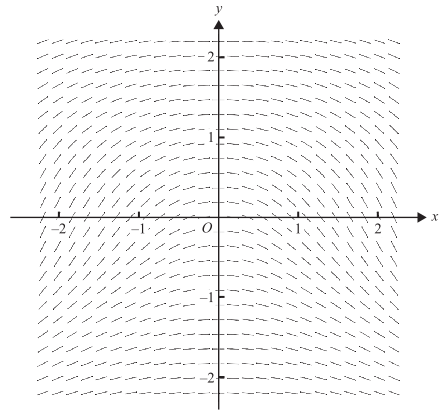
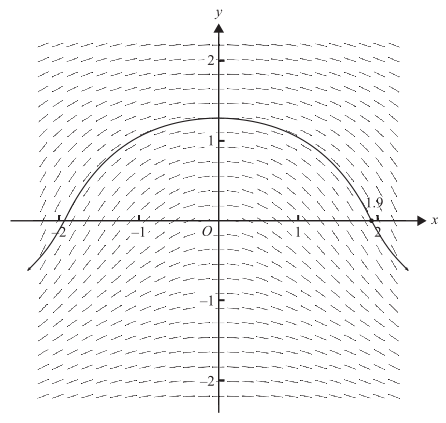
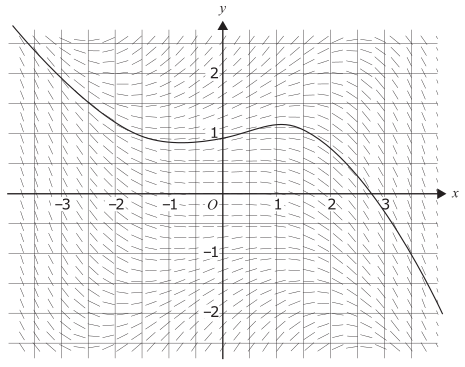
A slope field representing the differential equation `dy/dx = −x/(1 + y^2)` is shown below.
--- 6 WORK AREA LINES (style=lined) ---
| a. |
MARKER’S COMMENT: Solution curve should follow slope ticks and not cross them.
| b. | `(1 + y^2)(dy)/(dx)` | `= −x` |
| `int 1 + y^2 dy` | `= −int x\ dx` | |
| `y + (y^3)/3` | `= −(x^2)/2 + C, C ∈ R` |
`text(Substituting)\ (-1,1):`
| `1 + (1^3)/3` | `= −((−1)^2)/2 + C` |
| `1 + 1/3` | `= −1/2 + C` |
| `:. C` | `= 11/6` |
| `y + 1/3y^3` | `= −1/2x^2 + 11/6` |
| `6y + 2y^3` | `= −3x^2 + 11` |
`:. 2y^3 + 6y + 3x^2 – 11 = 0`
The direction field for a certain differential equation is shown above.
The solution curve to the differential equation that passes through the point `(–2.5, 1.5)` could also pass through
A. `(0, 2)`
B. `(1, 2)`
C. `(3, 1)`
D. `(3, –0.5)`
`D`
Solve the differential equation `sqrt(2-x^2) (dy)/(dx) = 1/(2-y)`, given that `y(1) = 0`. Express `y` as a function of `x`. (4 marks)
--- 10 WORK AREA LINES (style=lined) ---
`y = 2-sqrt(4 + pi/2-2 sin^(-1)(x/sqrt 2))`
| `sqrt(2-x^2) *(dy)/(dx)` | `= 1/(2-y)` |
| `(2-y)* (dy)/(dx)` | `= 1/sqrt(2-x^2)` |
| `int 2-y\ dy` | `= int 1/(sqrt(2-x^2))\ dx` |
| `2y-y^2/2` | `= sin^(-1) (x/sqrt 2) + c` |
`text(Given)\ \ y(1) = 0:`
`0=sin^(-1) (1/sqrt 2) + c`
`c=-pi/4`
| `2y-y^2/2` | `= sin^(-1) (x/sqrt 2)-pi/4` |
| `y^2-4y` | `= -2 sin^(-1) (x/sqrt 2) + pi/2` |
| `(y-2)^2-4` | `= -2 sin^(-1) (x/sqrt 2) + pi/2` |
| `(y-2)^2` | `= 4 + pi/2-2 sin^(-1) (x/sqrt 2)` |
| `(y-2)` | `= +- sqrt(4 + pi/2-2 sin^(-1) (x/sqrt 2))` |
| `y` | `=2 +- sqrt(4 + pi/2-2 sin^(-1) (x/sqrt 2))` |
`text(Given)\ \ y=0\ \ text(when)\ \ x=1:`
`:. y=2-sqrt(4 + pi/2-2 sin^(-1) (x/sqrt 2))`
A tank initially holds 16 L of water in which 0.5 kg of salt has been dissolved. Pure water then flows into the tank at a rate of 5 L per minute. The mixture is stirred continuously and flows out of the tank at a rate of 3 L per minute.
a. `Q_0 = 0.5, \ V_0 = 16`
| `V(t)` | `= 16 + (5 – 3) t` |
| `= 16 + 2t` |
`text(Concentration)\ (C)= Q/V= Q/(16 + 2t)\ text(kg/L)`
| `(dQ)/(dt)` | `= 0 xx 5 – 3C` |
| `= -(3Q)/(16 + 2t)` |
b. `-1/(3Q) * (dQ)/(dt) = 1/(16 + 2t)`
| `int -1/(3Q)\ dQ` | `= int 1/(16 + 2t) dt` |
| `-1/3 int 1/Q\ dQ` | `= 1/2 int 2/(16 + 2t)\ dt` |
| `-1/3 ln Q` | ` = [1/2 ln(16 + 2t)] + c` |
`text(When)\ \ t=0,\ \ Q=0.5,`
| `-1/3 ln (1/2)` | `= 1/2 ln (16) +c` |
| `c` | `= -1/2 ln (16) -1/3 ln (1/2)` |
| `-1/3 ln Q` | `= 1/2 ln(16 + 2t) -1/2 ln(16) – 1/3 ln (1/2)` |
| `-1/3 ln Q` | `= 1/2 ln ((16 + 2t)/16) – 1/3 ln (1/2)` |
| `-1/3 ln Q` | `= ln (((16 + 2t)^(1/2))/4) – ln (2^(-1/3))` |
| `ln (Q^(-1/3))` | `= ln (((16 + 2t)^(1/2))/(2^2 ⋅ 2^(-1/3)))` |
| `Q^(-1/3)` | `= ((16 + 2t)^(1/2))/(2^(5/3))` |
| `Q` | `= (((16 + 2t)^(1/2))/(2^(5/3)))^-3` |
| `= (16 + 2t)^(- 3/2)/(2^(-5))` | |
| `:. Q` | `= 32/((16 + 2t)^(3/2))` |
Relative to a fixed origin, the points `B`, `C` and `D` are defined respectively by the position vectors `underset~b = underset~i - underset~j + 2underset~k, \ underset~c = 2underset~i - underset~j + underset~k` and `underset~d = aunderset~i - 2underset~j` where `a` is a real constant.
Given that the magnitude of angle `BCD` is `pi/3`, find `a`. (4 marks)
--- 10 WORK AREA LINES (style=lined) ---
`a = −2`
`text(Angle between)\ overset(->)(CB)\ text(and)\ overset(->)(CD) = pi/3`
| `overset(->)(CB)` | `= (1 – 2)underset~i + (−1 – −1)underset~j + (2 – 1)underset~k` |
| `= −underset~i + underset~k` |
| `overset(->)(CD)` | `= (a – 2)underset~i + (−2 – −1)underset~j + (−1 + 0)underset~k` |
| `= (a – 2)underset~i – underset~j – underset~k` |
| `overset(->)(CD) · overset(->)(CB)` | `= −(a – 2) + 0 – 1` |
| `= 1 – a` | |
| `= |overset(->)(CD)||overset(->)(CB)|cos(pi/3)` |
| `1 – a` | `= sqrt((a – 2)^2 + (−1)^2 + (−1)^2)sqrt((−1)^2 + (1)^2)cos(pi/3)` |
| `1 – a` | `= sqrt(a^2 – 4a + 4 + 1 + 1) xx sqrt2 xx 1/2` |
| `2(1 – a)` | `= sqrt(2a^2 – 8a + 12), \ \ a < 1` |
| `4(1 – a)^2` | `= 2a^2 – 8a + 12, \ \ a < 1` |
| `4(1 – 2a + a^2)` | `= 2a^2 – 8a + 12` |
| `4 – 8a + 4a^2` | `= 2a^2 – 8a + 12` |
| `2a^2` | `= 8` |
| `a^2` | `= 4` |
| `:. a` | `= −2\ \ \ (a<1)` |
Points `A`, `B` and `C` have position vectors `underset~a = 2underset~i + underset~j`, `underset~b = 3underset~i-underset~j + underset~k` and `underset~c = -3underset~j + underset~k` respectively.
Find the cosine of angle `ABC`. (2 marks)
--- 5 WORK AREA LINES (style=lined) ---
`(-1)/(sqrt6sqrt13)`
`vec(BA) = vec(OA)-vec(OB) =-underset~ i + 2underset~j-underset~k`
`=>\ |\ vec(BA)\ | = sqrt6`
`vec(BC) = vec(OC)-vec(OB) = -3underset~i-2underset~j`
`=>\ |\ vec(BC)\ | = sqrt13`
| `vec(BA).vec(BC)` | `= |\ vec(BA)\ ||\ vec(BC)\ |cos angleABC` |
| `cos angleABC` | `= (vec(BA).vec(BC))/(|\ vec(BA)\ ||\ vec(BC)\ |)` |
| `= (-3xx-1 + 2 xx-2)/(sqrt6sqrt13)` | |
| `= (-1)/(sqrt6sqrt13)` |
The projection of the force `underset~F = aunderset~i + bunderset~j`, where `a` and `b` are non-zero real constants, in the direction of the vector `underset~w = underset~i + underset~j`, is
A. `((a + b)/2)underset~w`
B. `underset~F/(a + b)`
C. `((a + b)/(a^2 + b^2))underset~F`
D. `((a + b)/sqrt2)underset~w`
`A`
| `hatw` | `= tildew/sqrt(1+1)` |
| `= (tildei + tildej)/sqrt2` |
`tildeF*hat w = (a + b)/sqrt2`
| `(tildeF*hat w)hatw` | `= ((a + b)/sqrt2) tildew/sqrt2` |
| `= ((a + b)/2) tildew` |
`=> A`
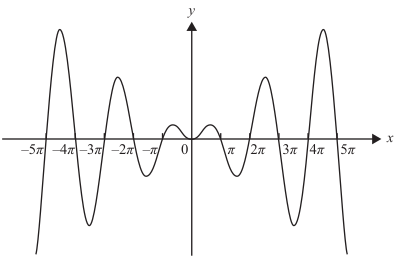
Consider a part of the graph of `y = xsin(x)`, as shown below.
--- 5 WORK AREA LINES (style=lined) ---
ii. Given that `int(xsin(x))\ dx = sin(x)-xcos(x) + c`, evaluate `int_(npi)^((n + 1)pi)(xsin(x))\ dx` when `n` is a positive odd integer.
Give your answer in simplest form. (1 mark)
--- 4 WORK AREA LINES (style=lined) ---
--- 5 WORK AREA LINES (style=lined) ---
--- 2 WORK AREA LINES (style=lined) ---
--- 8 WORK AREA LINES (style=lined) ---
a.i. `text(Given)\ \ n\ \ text(is a positive even integer:)`
`int_(npi)^((n + 1)pi)(xsin(x))dx`
`= [sin(x)-xcos(x)]_(npi)^((n + 1)pi)`
`= [sin((n + 1)pi)-(n + 1)pi · cos((n + 1)pi)]-[sin(npi)-npi · cos(npi)]`
`= [0-(n + 1)pi (−1)]-[0-npi]`
`= (n + 1)pi + npi`
`= (2n + 1)pi`
a.ii. `text(Given)\ \ n\ \ text(is a positive odd integer:)`
`int_(npi)^((n + 1)pi)(xsin(x))dx`
`= [sin((n + 1)pi)-(n + 1)pi · cos((n + 1)pi)]-[sin(npi)-npi · cos(npi)]`
`= [0-(n + 1)pi(1)]-[0-npi(−1)]`
`= -(n + 1)pi-npi`
`= -(2n + 1)pi`
| b. | `y` | `= xsin(x)` |
| `(dy)/(dx)` | `= x · cos(x) + sin(x)` |
| `(dy)/(dx)` | `= -(5pi)/2 · cos(-(5pi)/2) + sin(-(5pi)/2)` |
| `= -(5pi)/2 · (0) + (-1)` | |
| `= -1` |
`text(T)text(angent has equation)\ \ y =-x + c\ \ text(and passes through)\ \ (-(5pi)/2, (5pi)/2):`
| `(5pi)/2` | `= +(5pi)/2 + c` |
| `c` | `= 0` |
`:. y = -x`
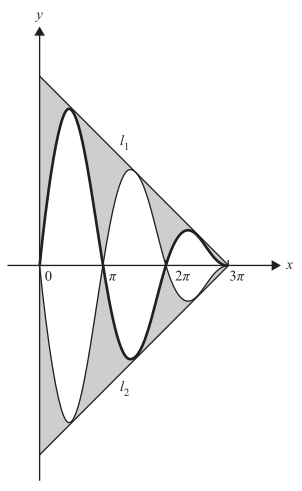
| c. | `y` | `= (3pi-x)sin(x)` |
| `=-(x-3pi)sin(x)` |
`:. a = 3pi`
d. `f(x) = (3pi-x)sin(x)`
`-> l_1\ text(is the tangent)\ \ y =-x\ \ (text{using part (b)})`
`-> g(x)\ text(is)\ \ y=xsin(x)\ \ text(translated 3π to the right.)`
`-> f(x)\ text(is)\ \ g(x)\ \ text(reflected in the)\ \ x text(-axis.)`
`text(Area between)\ f(x)\ text(and)\ xtext(-axis)`
`= int_0^pi xsin(x)\ dx + | int_pi^(2pi) xsin(x)\ dx | + int_(2pi)^(3pi) xsin(x)\ dx`
`= (2 xx 0 + 1)pi + |-1(2 xx 1 + 1)pi | + (2 xx 2 + 1)pi\ \ (text{using part (a)})`
`= pi + 3pi + 5pi`
`= 9pi`
`:.\ text(Shaded Area)`
`= 2 xx (1/2 xx 3pi xx 3pi)-2 xx 9pi`
`= 9pi^2-18pi`
`= 9pi(pi-2)`
The transformation that maps the graph of `y = sqrt(8x^3 + 1)` onto the graph of `y = sqrt(x^3 + 1)` is a
`A`
| `text(Let)\ f(x)` | `= sqrt(8x^3 + 1)` |
| `f(1/2 x)` | `= sqrt(8(1/2 x)^3 + 1)` |
| `= sqrt(x^3 + 1)` |
`:.\ text(Transformation correct when)\ \ x\ \ text(is swapped for)\ \ x/2`
`text(i.e. graph is dilated by factor of 2 from)\ ytext(-axis)`
`=> A`
The point `A (3, 2)` lies on the graph of the function `f(x)`. A transformation maps the graph of `f(x)` to the graph of `g(x)`,
where `g(x) = 1/2 f(x - 1)`. The same transformation maps the point `A` to the point `P`.
The coordinates of the point `P` are
A. `(2, 1)`
B. `(2, 4)`
C. `(4, 1)`
D. `(4, 2)`
`C`
`g(x) = 1/2 f(x – 1),\ A(3, 2)`
`text(Dilate by a factor of)\ 1/2\ text(from)\ x text(-axis:)`
`A(3, 2) -> A′(3, 1)`
`text(Translate 1 unit to right:)`
`A′(3, 1) -> P(4, 1)`
`=> C`
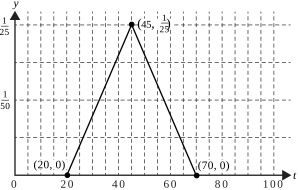
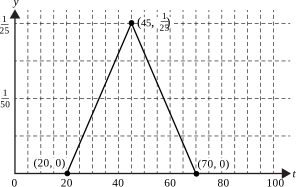
The time Jennifer spends on her homework each day varies, but she does some homework every day.
The continuous random variable \(T\), which models the time, \(t\), in minutes, that Jennifer spends each day on her homework, has a probability density function \(f\), where
\(f(t)= \begin{cases}
\dfrac{1}{625}(t-20) & 20 \leq t<45 \\
\ \\
\dfrac{1}{625}(70-t) & 45 \leq t \leq 70 \\
\ \\
0 & \text {elsewhere }
\end{cases}\)
| i. |
ii. \(\text{Mode \(=45\) (value of \(t\) at highest value of \(f(t))\)}\)
iii. \(P(25 \leq T \leq 55)\)
\(\begin{aligned}
& =\int_{25}^{45} \dfrac{1}{625}(t-20) d t+\int_{45}^{55} \dfrac{1}{625}(70-t) d t \\
& =\dfrac{1}{625}\left[\dfrac{t^2}{2}-20 t\right]_{25}^{45}+\dfrac{1}{625}\left[70 t-\dfrac{t^2}{2}\right]_{45}^{55} \\
& =\dfrac{1}{625}[112.5-(-187.5)]+\dfrac{1}{625}(2337.5-2137.5) \\ & =\dfrac{300}{625}+\dfrac{200}{625} \\
& =\dfrac{4}{5}
\end{aligned}\)
A probability density function \(f(x)\) is given by
\(f(x)= \begin{cases}
\dfrac{1}{12}\left(8 x-x^3\right) & 0 \leq x \leq 2 \\
\ \\
0 & \text{elsewhere }
\end{cases}\)
The median \(m\) of this function satisfies the equation
\(D\)
\(\begin{aligned} \int_0^m \dfrac{1}{12}\left(8 x-x^3\right) d x & =0.5 \\
{\left[\dfrac{1}{12}\left(4 x^2-\dfrac{x^4}{4}\right)\right]_0^m } & =0.5 \\
4 m^2-\dfrac{m^4}{4} & =6 \\
16 m^2-m^4 & =24 \\ m^4-16 m^2+24 & =0
\end{aligned}\)
\(\Rightarrow D\)
The continuous random variable, \(X\), has a probability density function given by
\(f(x)= \begin{cases}
\dfrac{1}{4} \cos \left(\dfrac{x}{2}\right) & 3 \pi \leq x \leq 5 \pi \\
\ & \ \\
0 & \text {elsewhere}
\end{cases}\)
The value of \(a\) such that \(P(X<a)=\dfrac{\sqrt{3}+2}{4}\) is
\(B\)
\(\begin{aligned}
\int_{3 \pi}^a \dfrac{1}{4}\, \cos \left(\dfrac{x}{2}\right) d x & =\dfrac{\sqrt{3}+2}{4} \\
{\left[\dfrac{1}{2}\, \sin \left(\dfrac{x}{2}\right)\right]_{3 \pi}^a } & =\dfrac{\sqrt{3}+2}{4} \\
\dfrac{1}{2}\left[\sin \left(\dfrac{a}{2}\right)-\sin \left(\dfrac{3 \pi}{2}\right)\right] & =\dfrac{\sqrt{3}+2}{4} \\
\dfrac{1}{2}\, \sin \left(\dfrac{a}{2}\right)+\dfrac{1}{2} & =\dfrac{\sqrt{3}+2}{4} \\
\sin \left(\dfrac{a}{2}\right) & =\dfrac{\sqrt{3}}{2} \\
\dfrac{a}{2} & =\dfrac{\pi}{3}, \dfrac{2 \pi}{3}, \dfrac{7 \pi}{3}, \ldots \\
\therefore a & =\dfrac{14 \pi}{3} \quad(3 \pi \leq a \leq 5 \pi)
\end{aligned}\)
\(\Rightarrow B\)
The continuous random variable `X` has a probability density function given by
`f(x) = {(pi sin (2 pi x), text(if)\ \ 0 <= x <= 1/2), (0, text(elsewhere)):}`
Find the value of `a` such that `P(X > a) = 0.2`. Give your answer to 2 decimal places. (3 marks)
--- 6 WORK AREA LINES (style=lined) ---
`0.35`
`int_a^(1/2) pi sin (2 pi x)\ dx = 0.2`
| `-1/2 [cos(2 pi x)]_a^(1/2)` | `=0.2` | |
| `-1/2[cos(pi) -cos(2 pia)]` | `=0.2` | |
| `-1/2(-1-cos(2pia))` | `=0.2` | |
| `-1-cos(2pia)` | `=-0.4` | |
| `cos(2pia)` | `=-0.6` | |
| `2pia` | `=cos^(-1)(-0.6)` | |
| `:.a` | `=cos^(-1)(-0.6)/(2pi)` | |
| `=0.3524…` | ||
| `=0.35\ \ \ text{(to 2 d.p.)}` |
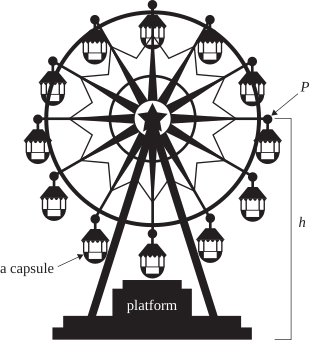
Sammy visits a giant Ferris wheel. Sammy enters a capsule on the Ferris wheel from a platform above the ground. The Ferris wheel is rotating anticlockwise. The capsule is attached to the Ferris wheel at point `P`. The height of `P` above the ground, `h`, is modelled by `h(t) = 65 - 55cos((pit)/15)`, where `t` is the time in minutes after Sammy enters the capsule and `h` is measured in metres.
Sammy exits the capsule after one complete rotation of the Ferris wheel.
--- 2 WORK AREA LINES (style=lined) ---
--- 1 WORK AREA LINES (style=lined) ---
--- 4 WORK AREA LINES (style=lined) ---
| i. | `h_text(min)` | `= 65 – 55` | `h_text(max)` | `= 65 + 55` |
| `= 10\ text(m)` | `= 120\ text(m)` |
ii. `text(Period) = (2pi)/(pi/15) = 30\ text(min)`
| iii. | `h′(t)` | `=65 – 55cos((pit)/15)` |
| `h′(t)` | `=pi/15 xx 55sin(pi/15 t)` | |
| `= (11pi)/3\ sin(pi/15 t)` | ||
`text(S)text(ince)\ \ sin(pi/15 t)_text(max) = sin (pi/2),`
`:. h′(t)_text(max)\ \ text(occurs when)`
| `(pi t)/15` | `=pi/2` | |
| `:. t` | `=pi/2 xx 15/pi` | |
| `=15/2\ text(minutes)\ \ (0<=t<=30)` |
Let `(tantheta-1) (sin theta-sqrt 3 cos theta) (sin theta + sqrt 3 costheta) = 0`.
--- 2 WORK AREA LINES (style=lined) ---
--- 4 WORK AREA LINES (style=lined) ---
i. `(tantheta-1) (sin theta-sqrt 3 cos theta) (sin theta + sqrt 3 costheta) = 0`
`=> tan theta = 1`
| `=>sin theta-sqrt 3 cos theta` | `=0` |
| `sin theta` | `=sqrt3 cos theta` |
| `tan theta` | `=sqrt3` |
| `=>sin theta + sqrt 3 cos theta` | `=0` |
| `sin theta` | `=-sqrt3 cos theta` |
| `tan theta` | `=-sqrt3` |
`:. tan theta = 1 or tan theta = +- sqrt 3`
ii. `(tan theta-1) (sin^2 theta-3 cos^2 theta) = 0`
`text(Using part a:)`
`(tan theta-1) (sin theta-sqrt 3 cos theta) (sin theta + sqrt 3 cos theta) = 0`
| `=> tan theta` | `= 1` | `qquad or qquad` | `tan theta` | `= +- sqrt 3` |
| `theta` | `= pi/4` | `theta` | `= pi/3, (2 pi)/3` |
`:. theta = pi/4, pi/3 or (2 pi)/3\ \ \ \ (0<=theta<=pi)`
The graphs of `y = cos (x) and y = a sin (x)`, where `a` is a real constant, have a point of intersection at `x = pi/3.`
--- 4 WORK AREA LINES (style=lined) ---
--- 2 WORK AREA LINES (style=lined) ---
i. `text(Intersection occurs when)\ \ x=pi/3,`
| `a sin(pi/3)` | `= cos (pi/3)` |
| `tan(pi/3)` | `= 1/a` |
| `sqrt 3` | `=1/a` |
| `:. a` | `=1/sqrt3` |
| ii. | `tan (x)` | `= sqrt 3` |
| `x` | `= pi/3, (4 pi)/3, 2pi+ pi/3, …` | |
| `:. x` | `= (4 pi)/3\ \ \ (0<= x<= 2 pi)` |
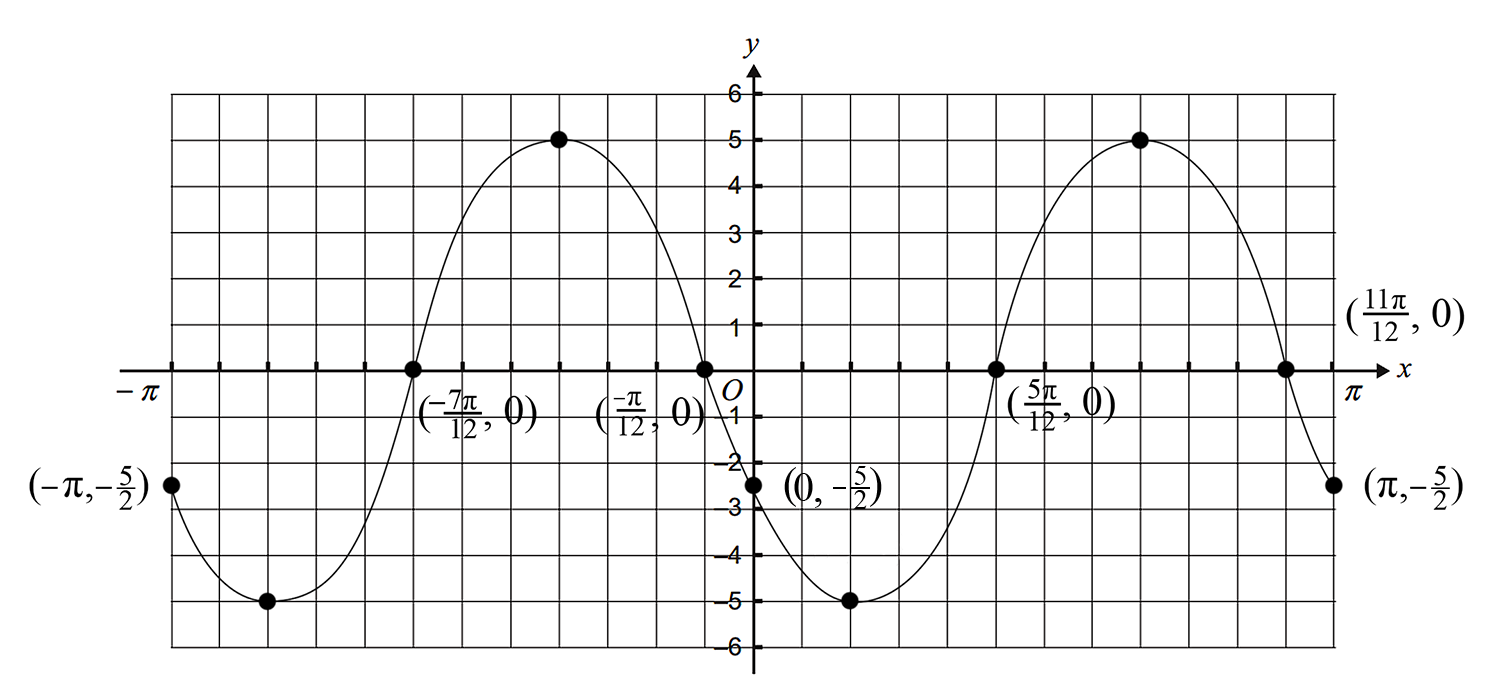
For the function `f(x) = 5 cos (2 (x + pi/3)),\ \ \ -pi<=x<=pi`
--- 4 WORK AREA LINES (style=lined) ---
Label endpoints of the graph with their coordinates. (3 marks)
--- 0 WORK AREA LINES (style=lined) ---
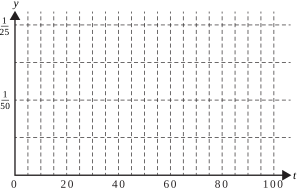
The population of wombats in a particular location varies according to the rule `n(t) = 1200 + 400 cos ((pi t)/3)`, where `n` is the number of wombats and `t` is the number of months after 1 March 2018.
--- 4 WORK AREA LINES (style=lined) ---
--- 3 WORK AREA LINES (style=lined) ---
--- 2 WORK AREA LINES (style=lined) ---
--- 4 WORK AREA LINES (style=lined) ---
i. `text(Period) = (2pi)/n = (2pi)/(pi/3) = 6\ text(months)`
`text(A)text(mplitude) = 400`
ii. `text(Max:)\ 1200 + 400 = 1600\ text(wombats)`
`text(Min:)\ 1200 – 400 = 800\ text(wombats)`
| iii. | `n(10)` | `=1200 + 400 cos ((10 pi)/3)` |
| `=1200 + 400 cos ((2 pi)/3)` | ||
| `=1200-400 xx 1/2` | ||
| `= 1000\ text(wombats)` |
iv. `text(Find)\ \ t\ \ text(when)\ \ n(t)=1000`
| `1000` | `=1200 + 400 cos((pit)/3)` | |
| `cos((pit)/3)` | `=- 1/2` | |
| `(pit)/3` | `=(2pi)/3, (4pi)/3, (8pi)/3, (10pi)/3, … ` | |
| `t` | `=2,4,8,10` |
`text(S)text(ince)\ \ n(0)=1600,`
`=> n(t)\ \ text(drops below 1000 between)\ \ t=2\ \ text(and)\ \ t=4,`
`text(and between)\ \ t=8\ \ text(and)\ \ t=10.`
| `:.\ text(Fraction)` | `= (2 + 2)/12` |
| `= 1/3\ \ text(year)` |
`f(x) = 2 sin (2x)` is defined in the domain `{x: \ pi/8 <= x < pi/3)`
What is the range of the function `f(x)`? (2 marks)
--- 5 WORK AREA LINES (style=lined) ---
`text(Range) = [sqrt 2, 2]`
`sin(2x)_text(max)\ \ text(occurs when)\ \ x=pi/4\ \ text{(within domain)}`
`=> f(x)_text(max) = 2 sin(pi/2) = 2`
`text(Checking endpoints:)`
`text(When)\ \ x=pi/8\ \ =>\ \ y=2 sin(pi/4) = sqrt2`
`text(When)\ \ x=pi/3\ \ =>\ \ y=2 sin((2pi)/3) = sqrt3`
`:.\ text(Range) = [sqrt 2, 2],`
On a map, the distance between two towns is measured at 54 millimetres.
--- 1 WORK AREA LINES (style=lined) ---
i. `text{Convert both distance to the same unit (cm).}`
| `text(54 mm)` | `= 5.4\ text(cm)` |
| `text(16.2 km)` | `= 16\ 200\ text(m)` |
| `= 1\ 620\ 000\ text(cm)` |
| `:.\ text(Scale) \ \ 5.4\ ` | `: 1\ 620\ 000` |
| `1\ ` | `: 300\ 000` |
| ii. | `text(Actual distance)` | `= 9.2 xx 300\ 000` |
| `= 2\ 760\ 000\ text(cm)` | ||
| `= 27\ 600\ text(m)` | ||
| `= 27.6\ text(km)` |
A farmer sells 216 sheep at a livestock auction.
Three buyers purchased all the sheep in the ratio 7:3:2
How many sheep did the buyer of the highest number of sheep purchase? (2 marks)
--- 4 WORK AREA LINES (style=lined) ---
`126\ text(sheep)`
`7:3:2 => 7/12: 3/12:2/12`
`:.\ text(Buyer of the most sheep)`
`= 7/12 xx 216`
`= 126\ text(sheep)`
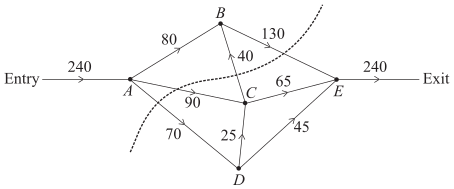
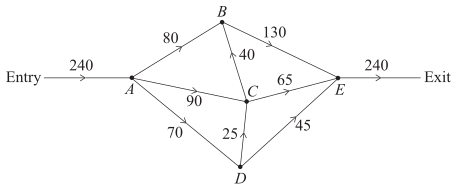
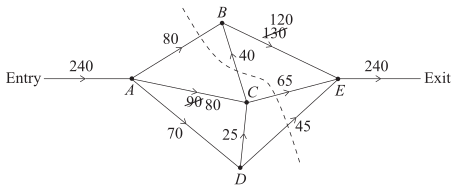
An oil pipeline network is drawn below that shows the flow capacity of oil pipelines in kilolitres per hour.
A cut is shown.
--- 1 WORK AREA LINES (style=lined) ---
--- 3 WORK AREA LINES (style=lined) ---
--- 8 WORK AREA LINES (style=lined) ---
Bianca is designing a project for producing an advertising brochure. It involves activities A-M.
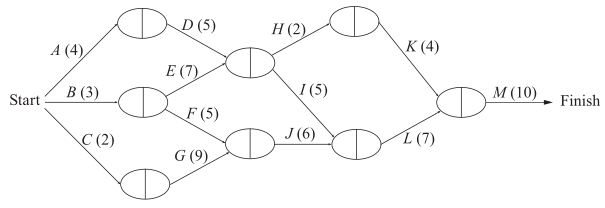
The network below shows these activities and their completion time in hours.
--- 1 WORK AREA LINES (style=lined) ---
--- 4 WORK AREA LINES (style=lined) ---
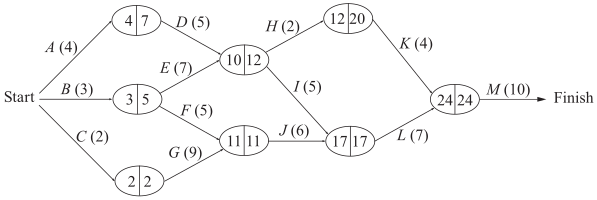
i. `text(Scanning forwards and backwards)`
`text{EST (activity}\ J) = 11\ text(hours)`
| ii. | `text{LST (activity}\ H)` | `=\ text{LST}\ (H)-text(weight)\ (H)` |
| `= 20-2` | ||
| `=18\ text(hours)` |
| iii. | `text{Float time}\ (I)` | `=\ text(LST)\ (I)-text(EST)\ (I)` |
| `=12-10` | ||
| `= 2\ text(hours)` |
iv. `text(Critical Path is)\ CGJLM`
| `:.\ text(Minimum time)` | `= 2 + 9 + 6 + 7 + 10` |
| `= 34\ text(hours)` |
The number of trees that can be planted along the fence line of a paddock varies inversely with the distance between each tree.
There will be 108 trees if the distance between them is 5 metres.
--- 4 WORK AREA LINES (style=lined) ---
--- 1 WORK AREA LINES (style=lined) ---
a. `90`
b. `4.5\ text(metres)`
a. `t \prop 1/d \ \ =>\ \ t=k/d`
| `108` | `= k/5` |
| `k` | `= 540` |
`text(Find)\ \ t\ \ text(when)\ \ d = 6:`
`t= 540/6= 90`
ii. `text(Find)\ \ d\ \ text(when)\ \ t = 120:`
| `120` | `= 540/d` |
| `d` | `= 540/120` |
| `= 4.5\ text(metres)` |
At her favourite fun park, Katherine’s first activity is to slide down a 10 m long straight slide. She starts from rest at the top and accelerates at a constant rate, until she reaches the end of the slide with a velocity of `6\ text(ms)^(-1)`.
--- 3 WORK AREA LINES (style=lined) ---
When at the top of the slide, which is 6 m above the ground, Katherine throws a chocolate vertically upwards. The chocolate travels up and then descends past the top of the slide to land on the ground below. Assume that the chocolate is subject only to gravitational acceleration and that air resistance is negligible.
--- 4 WORK AREA LINES (style=lined) ---
At what velocity would the chocolate need to be propelled upwards, if Katherine were to immediately slide down the slide and run to reach the chocolate just as it hits the ground?
Give your answer in `text(ms)^(-1)`, correct to one decimal place. (2 marks)
--- 4 WORK AREA LINES (style=lined) ---
Katherine’s next activity is to ride a mini speedboat. To stop at the correct boat dock, she needs to stop the engine and allow the boat to be slowed by air and water resistance.
At time `t` seconds after the engine has been stopped, the acceleration of the boat, `a\ text(ms)^(-2)`, is related to its velocity, `v\ text(ms)^(-1)`, by
`a = -1/10 sqrt(196-v^2)`.
Katherine stops the engine when the speedboat is travelling at `7\ text(m/s)`.
--- 6 WORK AREA LINES (style=lined) ---
--- 4 WORK AREA LINES (style=lined) ---
--- 5 WORK AREA LINES (style=lined) ---
a. `u = 0, quad v = 6, quad s = 10`
| `text(Solve for)\ \ t:\ \ \ ((u + v)/2)t` | `= s` |
| `((0 + 6)/2)t` | `= 10` |
| `t` | `= 10/3\ text(s)` |
b. `u = 10, quad a = -9.8, quad s = -6`
`text(Solve for)\ \ t:`
| `s` | `= ut + 1/2 at^2` |
| `-6` | `= 10t-4.9 t^2` |
| `:. t` | `~~2.5\ text(s)\ \ \ text{(by CAS)}` |
c. `text(Time of chocolate in air)`
`= 10/3 + 4`
`=22/3`
`text(Solve for)\ \ u:`
| `-6` | `= 22/3 u -4.9(22/3)^2` |
| `:. u` | `~~35.1\ text(m s)^(−1)\ \ \ text{(by CAS)}` |
| d.i. | `(dv)/(dt)` | `= -1/10 sqrt(196-v^2)` |
| `(dt)/(dv)` | `= (-10)/sqrt(196-v^2)` | |
| `t` | `= int(-10)/sqrt(196-v^2)\ dv` | |
| `-t/10` | `= int 1/sqrt(14^2-v^2) dv` | |
| `-t/10` | `= sin^(-1)(v/14) + c` |
`text(When)\ \ t = 0, v = 7`
`=> c=-sin^(-1)(1/2) = -pi/6`
| `-t/10` | `=sin^(-1)(v/14)-pi/6` | |
| `sin^(-1) (v/14)` | `= pi/6-t/10` | |
| `:. v` | `=14sin(pi/6-t/10)` |
d.ii. `text(Find)\ \ t\ \ text(when)\ \ v=0:`
| `-t/10` | `=sin^(-1)(0)-pi/6` | |
| `t` | `= -10 sin^(-1)(0) + (10 pi)/6` | |
| `= (5 pi)/3\ text(s)` |
d.iii. `v = 14sin(pi/6-t/10)`
| `(dx)/(dt)` | `=14sin(pi/6-t/10)` |
| `x` | `= int_0^((5pi)/3)14sin(pi/6-t/10)\ dt` |
| `~~ 18.8\ text(m)\ \ \ text{(by CAS)}` |
The position vector of the International Space Station `text{(S)}`, when visible above the horizon from a radar tracking location `text{(O)}` on the surface of Earth, is modelled by
`underset ~r(t) = 6800 sin(pi(1.3t-0.1))underset~i + (6800 cos(pi(1.3t-0.1))-6400)underset ~j`,
for `t in [0, 0.154]`,
where `underset ~i` is a unit vector relative to `text(O)` as shown and `underset ~j` is a unit vector vertically up from point `text(O)`. Time `t` is measured in hours and displacement components are measured in kilometres.
--- 3 WORK AREA LINES (style=lined) ---
--- 5 WORK AREA LINES (style=lined) ---
--- 4 WORK AREA LINES (style=lined) ---
--- 6 WORK AREA LINES (style=lined) ---
a. `text(At)\ \ P,\ \ x(t)=0`
| `text{Solve (by CAS):}\ \ 6800 sin (pi(1.3t-0.1))` | `= 0` |
`=> t=0.076923…`
| `:. h` | `= 6800 cos (pi (1.3(0.076923)-0.1))-6400` |
| `= 400` |
| b. | `underset ~(dot r) (t)` | `= 8840pi cos (pi(1.3t-0.1)) underset ~i-8840pi sin (pi(1.3t-0.1)) underset ~j` |
| `underset ~(ddot r) (t)` | `= -11\ 492 pi^2 sin (pi(1.3t-0.1))underset ~i-11\ 492 pi^2 cos (pi(1.3t-0.1)) underset ~j` |
`text(Let)\ \ u=pi(1.3t-0.1),`
| `underset ~(ddot r) (t) ⋅ underset ~(dot r) (t)` | `= -(8840)(11\492) pi^3 cos (u) sin (u) + (8840)(11\492) pi^3 cos(u)sin(u)`
|
| `= 0` |
`:. underset ~(ddot r) (t) _|_ underset ~(dot r) (t)`
c. `text(Speed)\ = |\ dotr(t)\ |`
| `|\ dotr(t)\ |` | `= sqrt((8840pi)^2 cos^2(pi(1.3t-0.1)) + (8840pi)^2 sin^2 (pi(1.3t-0.1)))` |
| `= 8840 pi` | |
| `~~ 27\ 772` |
| d. | `x/6800` | `= sin(pi(1.3t-0.1))` |
| `(6400 + y)/6800` | `= cos(pi (1.3t-0.1))` |
`text(Using)\ \ sin^2theta + cos^2theta = 1`
| `x^2/6800^2 + (6400 + y)^2/6800^2` | `=1` | |
| `x^2 + (y + 6400)^2` | `= 6800^2` |
e. `underset ~r(t) = 6800 sin(u)underset~i + (6800 cos(u)-6400)underset ~j`
`text(Find)\ \ t\ \ text(such that)\ \ |\ underset ~r(t)\ | = 1000:`
`6800^2sin^2(u) + (6800 cos(u) -6400)^2 = 1000^2,\ \ \ (u=pi(1.3t-0.1))`
`6800^2-2 xx 6400 xx 6800 cos(u) + 6400^2 = 1000^2`
`=>cos(pi(1.3t-0.1)) = 0.9903\ \ \ text{(by CAS)}`
`:. t=0.04 or 0.11`
A car accelerates from rest. Its speed after `T` seconds is `V\ text(ms)^(−1)`, where
`V = 17 tan^(−1)((pi T)/6), T >= 0`
--- 1 WORK AREA LINES (style=lined) ---
--- 2 WORK AREA LINES (style=lined) ---
--- 4 WORK AREA LINES (style=lined) ---
After accelerating to `25\text(ms)^(−1)`, the car stays at this speed for 120 seconds and then begins to decelerate while braking. The speed of the car `t` seconds after the brakes are first applied is `v\ text(ms)^(−1)` where
`(dv)/(dt) =-1/100 (145-2t),`
until the car comes to rest.
--- 3 WORK AREA LINES (style=lined) ---
--- 4 WORK AREA LINES (style=lined) ---
Give your answer in metres correct to the nearest metre. (1 mark)
--- 3 WORK AREA LINES (style=lined) ---
`d_2 = 25 xx 120`
`d_3 = int_0^20 -1/100 [145 t-t^2] + 25\ dt`
a. `text(As)\ \ T->oo,\ \ tan^(-1)((piT)/6)->pi/2`
| `:.underset (T->oo) (limV)` | `= (17 pi)/2` |
b. `(dV)/(dt)= (102 pi)/(36 + pi^2 T^2),\ \ \ text{(by CAS)}`
`text(When)\ \ T=10:`
| `(dV)/(dt)` | `= (102 pi)/(36 + 100 pi^2)` |
| `~~ 0.3` |
c. `text(Find)\ \ T\ \ text(when)\ \ V=25:`
| `17 tan^(-1) ((pi T)/6)` | `=25 ` | |
| `T` | `= 18.995\ \ \ text{(by CAS)}` | |
| `~~ 19\ text(seconds)` |
| d.i. | `v` | `= -1/100 int_0^t 145-2t\ dt` |
| `v` | `= -1/100 [145 t-t^2] + c` |
`text(When)\ \ t=0, \ v=25:`
`=> c=25`
`:. v= -1/100 [145 t-t^2] + 25`
d.ii. `text(Find)\ \ t\ \ text(when)\ \ v=0:`
`-1/100[145t-t^2] + 25=0`
`:. t=20\ text(seconds)\ \ \ text{(by CAS)}`
e.i. `text(Stage 1: car travels from rest to 25 m/s)`
`d_1 = int_0^19 17 tan^(-1) ((pi T)/6)\ dT`
`text(Stage 2: car travels at 25 m/s for 120 seconds)`
| `d_2` | `= 25 xx 120` |
| `= 3000` |
`text(Stage 3: car decelerates for 20 seconds`
`d_3 = int_0^20 -1/100 [145 t-t^2] + 25\ dt`
| e.ii. | `d_1` | `~~ 400.131` |
| `d_2` | `= 3000` | |
| `d_3` | `= 236.6` |
| `text(Total distance)` | `= d_1 + d_2 + d_3` |
| `~~ 3637\ text(m)` |
--- 5 WORK AREA LINES (style=lined) ---
--- 2 WORK AREA LINES (style=lined) ---
`{z: text(Arg)(z_1) <= text(Arg)(z) <= text(Arg)(z_1^4)} ∩ {z: 1 <= |\ z\ | <= 2}, z ∈ C`. (2 marks)
--- 0 WORK AREA LINES (style=lined) ---
--- 5 WORK AREA LINES (style=lined) ---
--- 6 WORK AREA LINES (style=lined) ---
--- 2 WORK AREA LINES (style=lined) ---
ii. `z_1^4 = text(cis) pi/3`
ii. `z_1^n = ±i\ text(for)\ k ∈ Z`
| a. | `cos^2(pi/12) + sin^2(pi/12)` | `= 1` |
| `sin^2(pi/12)` | `= 1-(sqrt 3 + 2)/4` | |
| `= (2-sqrt 3)/4` |
`:. sin (pi/12) = sqrt(2-sqrt 3)/2,\ \ \ (sin (pi/12) > 0)`
| b.i. | `z_1` | `= cos(pi/12) + i sin (pi/12)` |
| `= text(cis)(pi/12)` |
| b.ii. | `z_1^4` | `= 1^4 text(cis) ((4 pi)/12)` |
| `= text(cis)(pi/3)` |
| c. |
d. `text(Area of large sector)`
`=theta/(2pi) xx pi r^2`
`=(pi/3-pi/12)/(2pi) xx pi xx 2^2`
`=pi/2`
`text(Area of small sector)`
`=1/2 xx pi/4 xx 1`
`=pi/8`
`:.\ text(Area shaded)`
`= pi/2-pi/8`
`= (3 pi)/8`
| e.i. | `z_1^n` | `= 1^n text(cis) ((n pi)/12)` |
| `text(Re)(z_1^n)` | `= cos((n pi)/12) = 0` | |
| `(n pi)/12` | `=cos^(-1)0 +2pik,\ \ \ k in ZZ` | |
| `(n pi)/12` | `= pi/2 + k pi` | |
| `n` | `= 6 + 12k,\ \ \ k in ZZ` |
e.ii. `text(When)\ \ n=(6 + 12k):`
| `z_1^n` | `= 1^(6 + 12k) text(cis) (((6 + 12k)pi)/12), quad k in ZZ` | |
| `= i xx sin (((6 + 12k)pi)/12)` | ||
| `= i xx sin (pi/2 + k pi)` |
`text(If)\ \ k=0 or text(even,)\ \ z_1^n=i`
`text(If)\ \ k\ text(is odd,)\ \ z_1^n=-i`
`:. z_1^n = +-i,\ \ \ k in ZZ`
A particle of mass 3 kg is acted on by a variable force, so that its velocity `v` m/s when the particle is `x` m from the origin is given by `v = x^2`.
The force acting on the particle when `x = 2`, in newtons, is
A. 4
B. 12
C. 16
D. 36
E. 48
`E`
| `v` | `=x^2` |
| `a` | `= v *(dv)/(dx)` |
| `= x^2 xx 2x` | |
| `= 2x^3` |
`text(When)\ \ x=2:`
| `a` | `= 2 xx 2^3` |
| `=16` | |
| `:.F` | `= 3 xx 16` |
| `=48` |
`=> E`
Particles of mass 3 kg and `m` kg are attached to the ends of a light inextensible string that passes over a smooth pulley, as shown.
If the acceleration of the 3 kg mass is `4.9\ text(m/s)^2` upwards, then
A. `m` = 4.5
B. `m` = 6.0
C. `m` = 9.0
D. `m` = 13.5
E. `m` = 18.0
`C`