SmarterEd

Aussie Maths & Science Teachers: Save your time with SmarterEd

  • Login
  • Get Help
  • About

NETWORKS, FUR1 2018 VCAA 6 MC

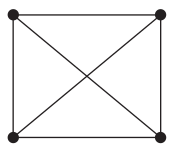
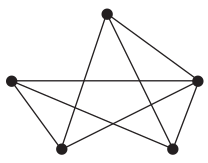
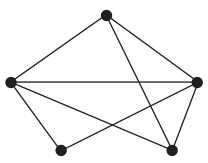
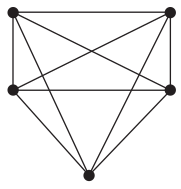
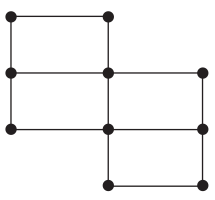
Which one of the following graphs is not a planar graph?

A. B.
C. D.
E.    
Show Answers Only

`D`

Show Worked Solution

`text(Method 1)`

`text(Draw each graph with non-intersecting edges.)`

`text(This is possible for all options except)\ D.`
 

`text(Method 2)`

`text(Option 2 is a complete graph with five vertices.)`

`text(Any complete graph with 5 or more vertices is)`

`text(non-planar.)`

`=> D`

Filed Under: Basic Concepts Tagged With: Band 5, smc-626-30-Planar/Isomorphic

NETWORKS, FUR1 2018 VCAA 5 MC

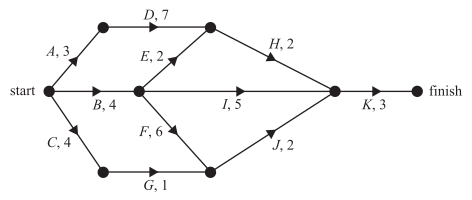
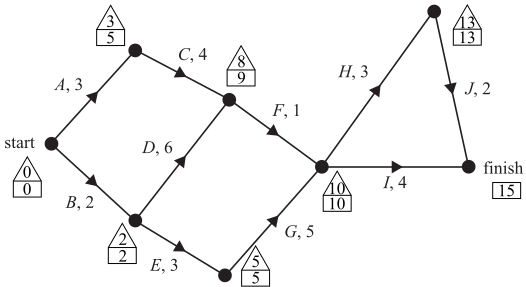
The directed network below shows the sequence of 11 activities that are needed to complete a project.

The time, in weeks, that it takes to complete each activity is also shown.


How many of these activities could be delayed without affecting the minimum completion time of the project?

  1. 3
  2. 4
  3. 5
  4. 6
  5. 7
Show Answers Only

`B`

Show Worked Solution

`text(Activities not on critical path can be delayed.)`

`text{Two critical paths exist (15 weeks)}`

♦ Mean mark 43%.

`ADHK\ text(and)\ BFJK`

`:.\ text(Activity)\ C, E, G\ text(and)\ I\ text(could be delayed)`

`=> B`

Filed Under: Critical Path Analysis Tagged With: Band 5, smc-621-20-Critical Paths/EST

NETWORKS, FUR2 2018 VCAA 4

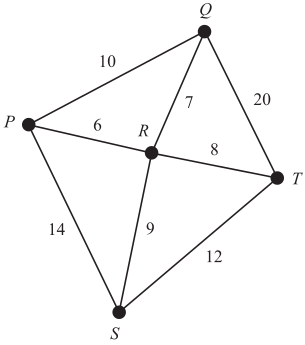
Parcel deliveries are made between five nearby towns, `P` to `T`.

The roads connecting these five towns are shown on the graph below. The distances, in kilometres, are also shown.
 

A road inspector will leave from town `P` to check all the roads and return to town `P` when the inspection is complete. He will travel the minimum distance possible.

  1.  How many roads will the inspector have to travel on more than once?   (1 mark)

    --- 3 WORK AREA LINES (style=lined) ---

  2.  Determine the minimum distance, in kilometres, that the inspector will travel.   (1 mark)

    --- 5 WORK AREA LINES (style=lined) ---

Show Answers Only
  1. `2\ text(roads)`
  2. `108\ text(km)`
Show Worked Solution

a.   `text(Minimum distance if Eulerian circuit exists.)`

♦♦ Mean mark 31%.

`->\ text(no Eulerian circuit possible since 4 vertices are odd)`

`->\ text(if 2 edges added, Eulerian circuit exists)`

`:.\ text(Inspector will travel on 2 roads more than once.)`


b.   `text(By inspection, an extra edge added to)\ PQ\ text{(10)}`

♦♦♦ Mean mark 14%.

`text(and)\ ST\ text{(12) creates an Eulerian circuit with}`

`text(minimum distance.)`
 

`:.\ text(Min distance)`

`= (10 xx 2) + (12 xx 2) + 14 + 20 + 6 + 7 + 8 + 9`

`= 108\ text(km)`

Filed Under: Travelling Problems and Adjacency Matrices Tagged With: Band 5, Band 6, smc-622-10-Euler

NETWORKS, FUR2 2018 VCAA 3

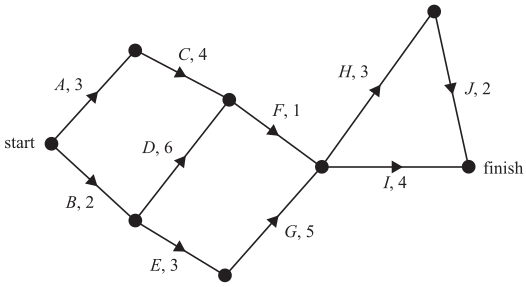
At the Zenith Post Office all computer systems are to be upgraded.

This project involves 10 activities, `A` to `J`.

The directed network below shows these activities and their completion times, in hours.
 

  1. Determine the earliest starting time, in hours, for activity `I`.   (1 mark)

    --- 2 WORK AREA LINES (style=lined) ---

  2. The minimum completion time for the project is 15 hours.


    Write down the critical path.   (1 mark)

    --- 1 WORK AREA LINES (style=lined) ---

  3. Two of the activities have a float time of two hours.


    Write down these two activities.   (1 mark)

    --- 3 WORK AREA LINES (style=lined) ---

  4. For the next upgrade, the same project will be repeated but one extra activity will be added.
    This activity has a duration of one hour, an earliest starting time of five hours and a latest starting time of 12 hours.


    Complete the following sentence by filling in the boxes provided.   (1 mark)

    --- 3 WORK AREA LINES (style=lined) ---


    The extra activity could be represented on the network above by a directed edge from the

   end of activity   
 
  to the start of activity   
 
Show Answers Only
  1. `10\ text(hours)`
  2. `B-E-G-H-J`
  3.  `text(Activity)\ A\ text(and)\ C`
  4. `text(end of activity)\ E\ text(to the start of activity)\ J`
Show Worked Solution

a.  `text(Longest path to)\ I:`

`B -> E -> G`

`:.\ text(EST for)\ \ I` `= 2 + 3 + 5`
  `= 10\ text(hours)`

 
b.
  `B-E-G-H-J`
 

c.  `text(Scanning forwards and backwards:)`

♦ Mean mark 45%.


`:.\ text(Activity)\ A\ text(and)\ C\ text(have a 2 hour float time.)`
 

d.   `text(end of activity)\ E\ text(to the start of activity)\ J`

♦♦ Mean mark 25%.
 

`text(By inspection of forward and backward scanning:)`

`text(EST of 5 hours is possible after activity)\ E.`

`text(LST of 12 hours after activity)\ E -> text(edge has weight)`

`text(of 1 and connects to)\ J`

Filed Under: Critical Path Analysis Tagged With: Band 3, Band 4, Band 5, smc-621-20-Critical Paths/EST, smc-621-30-Float time/LST, smc-621-45-Adding activities

NETWORKS, FUR2 2018 VCAA 1

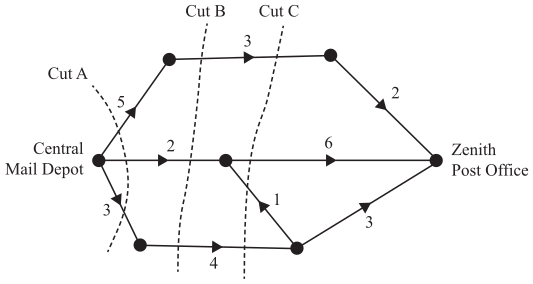
The graph below shows the possible number of postal deliveries each day between the Central Mail Depot and the Zenith Post Office.

The unmarked vertices represent other depots in the region.

The weighting of each edge represents the maximum number of deliveries that can be made each day.


  1.  Cut A, shown on the graph, has a capacity of 10.


     Two other cuts are labelled as Cut B and Cut C.
     i.  Write down the capacity of Cut B.   (1 mark)

    --- 2 WORK AREA LINES (style=lined) ---

    ii.  Write down the capacity of Cut C.   (1 mark)

    --- 2 WORK AREA LINES (style=lined) ---

  1. Determine the maximum number of deliveries that can be made each day from the Central Mail   Depot to the Zenith Post Office.   (1 mark)

    --- 2 WORK AREA LINES (style=lined) ---

Show Answers Only
  1.  i.  `9`
    ii.  `13`
  2.  `7`
Show Worked Solution
a.i.    `text{Capacity (Cut B)}` `= 3 + 2 + 4`
    `= 9`


a.ii.    `text{Capacity (Cut C)}` `= 3 + 6 + 4`
    `= 13`

♦ Mean mark part (b) 32%.
COMMENT: Review carefully! Most common incorrect answer was 9.


b.  `text(Minimum cut) = 2 + 2 + 3 = 7`

`:.\ text(Maximum deliveries) = 7`

Filed Under: Flow Problems Tagged With: Band 3, Band 5, smc-625-10-Cut Capacity, smc-625-20-Max Flow/Min Cut

MATRICES, FUR1 2018 VCAA 8 MC

A public library organised 500 of its members into five categories according to the number of books each member borrows each month.

These categories are

J = no books borrowed per month
K = one book borrowed per month
L = two books borrowed per month
M = three books borrowed per month
N = four or more books borrowed per month

The transition matrix, `T`, below shows how the number of books borrowed per month by the members is expected to change from month to month.
 

`{:(),(),(T=):}{:(qquadqquadqquad\ text(this month)),((qquadJ,quadK,quadL,quadM,quadN)),([(0.1,0.2,0.2,0,0),(0.5,0.2,0.3,0.1,0),(0.3,0.3,0.4,0.1,0.2),(0.1,0.2,0.1,0.6,0.3),(0,0.1,0,0.2,0.5)]):}{:(),(),({:(J),(K),(L),(M),(N):}):}{:(),(),(text(next month)):}`

 
In the long term, which category is expected to have approximately 96 members each month?

  1. `J`
  2. `K`
  3. `L`
  4. `M`
  5. `N`
Show Answers Only

`B`

Show Worked Solution

`text(Any initial member split by category will)`

♦ Mean mark 46%.

`text(result in the same long term expectations.)`

`text(Starting with 100 in each category:)`
 

`T^50[(100),(100),(100),(100),(100)] = [(49),(96),(124),(151),(80)]`
 

`:.\ text(Category)\ K\ text(is expected to have 96 members.)`

`=> B`

Filed Under: Transition Matrices - Regular Tagged With: Band 5, smc-618-40-Steady State, smc-618-63-5x5 Matrix

MATRICES, FUR1 2018 VCAA 7 MC

A study of the antelope population in a wildlife park has shown that antelope regularly move between three locations, east (`E`), north (`N`) and west (`W`).

Let  `A_n` be the state matrix that shows the population of antelope in each location `n` months after the study began.

The expected population of antelope in each location can be determined by the matrix recurrence rule
 

`A_(n + 1) = T A_n - D`
 

where

`{:(),(),(T=):}{:(qquadquadtext(this month)),((qquadE,quadN,quadW)),([(0.4,0.2,0.2),(0.3,0.6,0.3),(0.3,0.2,0.5)]):}{:(),(),({:(E),(N),(W):}):}{:(),(),(text(next month)):}`

and

`D = [(50),(50),(50)]{:(E),(N),(W):}`
 

The state matrix, `A_3`, below shows the population of antelope three months after the study began.
 

`A_3 = [(1616),(2800),(2134)]{:(E),(N),(W):}`
 

The number of antelope in the west (`W`) location two months after the study began, as found in the state matrix `A_2`, is closest to

  1. 2060
  2. 2130
  3. 2200
  4. 2240
  5. 2270
Show Answers Only

`E`

Show Worked Solution

`A_(n + 1) = TA_n – D\ \ (text(given))`

♦♦ Mean mark 28%.

`A_3` `= TA_2 – D`
`TA_2` `= [(1616),(2800),(2134)] + [(50),(50),(50)] = [(1666),(2850),(2184)]`
`A_2` `= [(0.4,0.2,0.2),(0.3,0.6,0.3),(0.3,0.2,0.5)]^(−1)[(1666),(2850),(2184)] = [(1630),(2800),(2270)]`

 
`:.\ text(Antelope population in the west = 2270)`

`=> E`
Filed Under: Transition Matrices - Modified Tagged With: Band 5, smc-1893-20-State Matrix in discrete period, smc-1893-33-5x5 Matrix

MATRICES, FUR2 2018 VCAA 4

Beginning in the year 2021, a new company takes over the maintenance of the 2700 km highway with a new contract.

Each year sections of highway must be graded `(G)`, resurfaced `(R)` or sealed `(S)`.

The remaining highway will need no maintenance `(N)` that year.

Let  `M_n` be the state matrix that shows the highway maintenance schedule of this company for the `n`th year after 2020.

The maintenance schedule for 2020 is shown in matrix  `M_0` below.

For these 2700 km of highway, the matrix recurrence relation shown below can be used to determine the number of kilometres of this highway that will require each type of maintenance from year to year.
 
`qquad qquad M_(n + 1) = TM_n + B`

where

  `{:(\ \ qquad qquad qquad qquad quad text(this year)),(qquad qquad quad quad G qquad quad R qquad quad S quad quad \ N):}`  
`M_0 = [(500),(400),(300),(1500)]{:(G),(R),(S),(N):}text (,)` `T = [(0.2,0.1,0.0,0.2),(0.1,0.1,0.0,0.2),(0.2,0.1,0.2,0.1),(0.5, 0.7,0.8,0.5)]{:(G),(R),(S),(N):} \ text(next year,)` `B = [(k),(20),(10),(-60)]`


  1. Write down the value of `k` in matrix `B`.   (1 mark)

    --- 2 WORK AREA LINES (style=lined) ---

  2. How many kilometres of highway are expected to be graded `(G)` in the year 2022?   (1 mark)

    --- 3 WORK AREA LINES (style=lined) ---

Show Answers Only
  1. `k =30`
  2. `457\ text(km)`
Show Worked Solution

a.    `text(S) text(ince the length of highway is constant:)`

♦ Mean mark 39%.

`k + 20 + 10-60` `= 0`
`k` `= 30`


♦♦ Mean mark 23%.

b.    `M_1 (2021)` `= TM_0 + B= [(470),(410),(360),(1460)]`
     
  `M_2 (2022)` `= TM_1 + B= [(457),(400),(363),(1480)]`

 
`:. 457\ text(km are expected to be graded in 2022.)`

Filed Under: Transition Matrices - Modified Tagged With: Band 5, smc-1893-20-State Matrix in discrete period, smc-1893-32-4x4 Matrix

MATRICES, FUR2 2018 VCAA 3

The Hiroads company has a contract to maintain and improve 2700 km of highway.

Each year sections of highway must be graded `(G)`, resurfaced `(R)` or sealed `(S)`.

The remaining highway will need no maintenance `(N)` that year.

Let `S_n` be the state matrix that shows the highway maintenance schedule for the `n`th year after 2018.

The maintenance schedule for 2018 is shown in matrix `S_0` below.

 
`S_0 = [(700),(400),(200),(1400)]{:(G),(R),(S),(N):}`
 

The type of maintenance in sections of highway varies from year to year, as shown in the transition matrix `T`, below.
 

`{:(qquad qquad qquad qquad qquad quad text(this year)),(qquad qquad quad quad G qquad quad R qquad quad S quad quad \ N),(T = [(0.2,0.1,0.0,0.2),(0.1,0.1,0.0,0.2),(0.2,0.1,0.2,0.1),(0.5, 0.7,0.8,0.5)]{:(G),(R),(S),(N):} \ text (next year)):}`
 

  1. Of the length of highway that was graded `(G)` in 2018, how many kilometres are expected to be resurfaced `(R)` the following year?   (1 mark)

    --- 2 WORK AREA LINES (style=lined) ---

  2. Show that the length of highway that is to be graded `(G)` in 2019 is 460 km by writing the appropriate numbers in the boxes below.   (1 mark)

    --- 0 WORK AREA LINES (style=lined) ---


`× 700 +`
 
`× 400 +`
 
`× 200 +`
 
`× 1400 = 460`


The state matrix describing the highway maintenance schedule for the nth year after 2018 is given by

`S_(n + 1) = TS_n`
 

  1. Complete the state matrix, `S_1`, below for the highway maintenance schedule for 2019 (one year after 2018).   (1 mark)

    --- 0 WORK AREA LINES (style=lined) ---


    `qquad qquad S_1 = [(460),(text{____}),(text{____}),(1490)]{:(G),(R),(S),(N):}`
     

  2. In 2020, 1536 km of highway is expected to require no maintenance `(N)`
  3. Of these kilometres, what percentage is expected to have had no maintenance `(N)` in 2019?
  4. Round your answer to one decimal place.   (1 mark)

    --- 3 WORK AREA LINES (style=lined) ---

  5. In the long term, what percentage of highway each year is expected to have no maintenance `(N)`?
  6. Round your answer to one decimal place.   (1 mark)

    --- 4 WORK AREA LINES (style=lined) ---

Show Answers Only
  1. `70\ text(km)`
  2. `G_2019 = 0.2 xx 700 + 0.1 xx 400 + 0 xx 200 + 0.2 xx 1400 = 460`
  3. `[(460),(390),(360),(1490)]`
  4. `48.5 text{%  (to 1 d.p.)}`
  5. `56.7 text{%  (to 1 d.p.)}`
Show Worked Solution
a.    `G -> R` `= 0.1 xx 700`
    `= 70\ text(km)`

♦ Mean mark part (a) 48%.


b.    `G_2019` `= 0.2 xx 700 + 0.1 xx 400 + 0 xx 200 + 0.2 xx 1400`
    `= 460`


c.    `S_1` `= TS_0`
    `= [(0.2,0.1,0.0,0.2),(0.1,0.1,0.0,0.2),(0.2,0.1,0.2,0.1),(0.5,0.7,0.8,0.5)][(700),(400),(200),(1400)]=[(460),(390),(360),(1490)]`


d.   `N_2019 = 1490`

`:.\ text(Percentage)` `= (0.5 xx 1490)/1536 xx 100`
  `= 48.502…`
  `= 48.5 text{%  (to 1 d.p.)}`


e.  `text(Raise)\ \ T\ \ text(to a high power)\ (n = 50):`

`T^50 = [(0.160,0.160,0.160,0.160),(0.144,0.144,0.144,0.144),(0.129,0.129,0.129,0.129),(0.567,0.567,0.567,0.567)]`

`:.\ %N` `= 0.567`
  `= 56.7 text{%  (to 1 d.p.)}`

Filed Under: Transition Matrices - Regular Tagged With: Band 3, Band 5, smc-618-30-State Matrix in discrete period, smc-618-40-Steady State, smc-618-62-4x4 Matrix

MATRICES, FUR2 2018 VCAA 2

The Westhorn Council must prepare roads for expected population changes in each of three locations: main town `(M)`, villages `(V)` and rural areas `(R)`.

The population of each of these locations in 2018 is shown in matrix  `P_2018`  below.

`P_2018 = [(2100),(1800),(1700)]{:(M),(V),(R):}`

The expected annual change in population in each location is shown in the table below.
       

  1. Write down matrix  `P_2019`, which shows the expected population in each location in 2019.   (1 mark)

    --- 3 WORK AREA LINES (style=lined) ---

  2. The expected population in each of the three locations in 2019 can be determined from the matrix product.
  3. `qquad qquad P_2019 = F xx P_2018,` where `F` is a diagonal matrix.
  4. Write down matrix  `F`.   (1 mark)

    --- 3 WORK AREA LINES (style=lined) ---

Show Answers Only
  1. `P_2019 = [(1.04 xx 2100),(0.99 xx 1800),(0.98 xx 1700)] = [(2184),(1782),(1666)]`
  2. `F = [(1.04, 0, 0),(0, 0.99, 0),(0, 0, 0.98)]`
Show Worked Solution

a.   `P_2019 = [(1.04 xx 2100),(0.99 xx 1800),(0.98 xx 1700)] = [(2184),(1782),(1666)]`

♦ Mean mark part (b) 40%.
COMMENT: Many students included 0.04, -0.01 and -0.02 in this matrix. Know why this is incorrect!

 
b.
   `F = [(1.04, 0, 0),(0, 0.99, 0),(0, 0, 0.98)]`

Filed Under: Matrix Applications Tagged With: Band 4, Band 5, smc-619-20-Matrix product from table, smc-619-30-Matrix product and interpretation

CORE, FUR2 2018 VCAA 6


Julie has retired from work and has received a superannuation payment of $492 800.

She has two options for investing her money.

Option 1

Julie could invest the $492 800 in a perpetuity. She would then receive $887.04 each fortnight for the rest of her life.

  1. At what annual percentage rate is interest earned by this perpetuity?  (1 mark)

    --- 4 WORK AREA LINES (style=lined) ---

Option 2

Julie could invest the $492 800 in an annuity, instead of a perpetuity.

The annuity earns interest at the rate of 4.32% per annum, compounding monthly.

The balance of Julie’s annuity at the end of the first year of investment would be $480 242.25

    1. What monthly payment, in dollars, would Julie receive?   (1 mark)

      --- 1 WORK AREA LINES (style=lined) ---

    2. How much interest would Julie’s annuity earn in the second year of investment?
    3. Round your answer to the nearest cent.    (1 mark)

      --- 6 WORK AREA LINES (style=lined) ---

Show Answers Only

  1. `4.68 text(%)`
    1. `$2800`
    2. `$20\ 488.89`

Show Worked Solution

a.    `text(Annual interest)` `= 26 xx 887.04`
    `= $23\ 063.04`

♦ Mean mark 41%.
 

`:.\ text(Annual percentage rate)` `= (23\ 063.04)/(492\ 800)`
  `= 4.68 text(%)`


b.i.   `text(Find the monthly payment by TVM Solver:)`

♦ Mean mark 48%.

`N` `= 12`
`I(%)` `= 4.32`
`PV` `= -492\ 800`
`PMT` `= ?`
`FV` `= 480\ 242.25`
`text(P/Y)` `= text(C/Y) = 12`

 
`=> PMT = $2800.00`
 

♦♦♦ Mean mark 16%.

b.ii.   `text(Year 2 start balance)` `= $480\ 242.25`
  `text(Year 2 end balance)` `= $467\ 131.14`
  `text(Balance reduction)` `= 480\ 242.25-467\ 131.14`
    `= 13\ 111.11`

 
`text(Year 2 total payment) = 12 xx 2800 = 33\ 600`

`:.\ text(Interest)` `= 33\ 600-13\ 111.11`
  `= $20\ 488.89`

Filed Under: Annuities and Perpetuities Tagged With: Band 5, Band 6, smc-2512-10-Annuity, smc-2512-20-Perpetuity, smc-2512-50-CAS solver

CORE, FUR2 2018 VCAA 5

After three years, Julie withdraws $14 000 from her account to purchase a car for her business.

For tax purposes, she plans to depreciate the value of her car using the reducing balance method.

The value of Julie’s car, in dollars, after `n` years, `C_n`, can be modelled by the recurrence relation shown below

`C_0 = 14\ 000, qquad C_(n + 1) = R xx C_n`

  1. For each of the first three years of reducing balance depreciation, the value of `R` is 0.85


    What is the annual rate of depreciation in the value of the car during these three years?  (1 mark)

    --- 4 WORK AREA LINES (style=lined) ---

  2. For the next five years of reducing balance depreciation, the annual rate of depreciation in the value of the car is changed to 8.6%.


    What is the value of the car eight years after it was purchased?
    Round your answer to the nearest cent.  (2 marks)

    --- 6 WORK AREA LINES (style=lined) ---

Show Answers Only
  1. `15 text(%)`
  2. `$5484.23\ text{(nearest cent)}`
Show Worked Solution

a.  `text(S)text(ince)\ \ R = 0.85,`

COMMENT: Note almost half of students answered incorrectly here!

`=> 85 text(% of the car’s value remains at the end of each)`

      `text{year (vs the value at the start of the same year.)}`

`:.\ text(Annual rate of depreciation) = 15 text(%)`

  
b.
   `text(Value after 3 years)`

♦ Mean mark 42%.

`C_3` `= (0.85)^3 xx 14\ 000`
  `= $8597.75`

 
`:.\ text(Value after 8 years)`

`C_8` `= (0.914)^5 xx C_3`
  `= (0.914)^5 xx 8597.75`
  `= $5484.23\ text{(nearest cent)}`

Filed Under: Depreciation, Recursion - Financial Tagged With: Band 4, Band 5, smc-602-20-Reducing balance, smc-602-50-Recurrence relation, smc-717-60-Depreciation (reducing balance), smc-717-80-Interpret RR

MATRICES, FUR1 2018 VCAA 5 MC

Liam cycles, runs, swims and walks for exercise several times a month.

Each time he cycles, Liam covers a distance of `c` kilometres.

Each time he runs, Liam covers a distance of `r` kilometres.

Each time he swims, Liam covers a distance of `s` kilometres.

Each time he walks, Liam covers a distance of `w` kilometres.

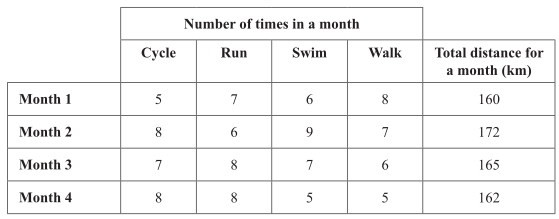
The number of times that Liam cycled, ran, swam and walked each month over a four-month period, and the total distance that Liam travelled in each of those months, are shown in the table below.


The matrix that contains the distance each time Liam cycled, ran, swam and walked, `[(c),(r),(s),(w)]`, is

A. `[(5),(6),(7),(5)]` B. `[(8),(6),(1),(9)]` C. `[(8),(6),(7),(9)]`
           
D. `[(8),(8),(9),(8)]` E. `[(4290),(4931),(4623),(4291)]`    
Show Answers Only

`B`

Show Worked Solution

`text(Simultaneous equations matrix:)`

♦ Mean mark 42%.

`[(5,7,6,8),(8,6,9,7),(7,8,7,6),(8,8,5,5)][(c),(r),(s),(w)] = [(160),(172),(165),(162)]`
 

`[(c),(r),(s),(w)] = [(5,7,6,8),(8,6,9,7),(7,8,7,6),(8,8,5,5)]^(−1)[(160),(172),(165),(162)] = [(8),(6),(1),(9)]`
 

`=> B`

Filed Under: Simultaneous Equations Tagged With: Band 5, smc-617-40-Inverse Matrix to solve equation

CORE, FUR2 2018 VCAA 3

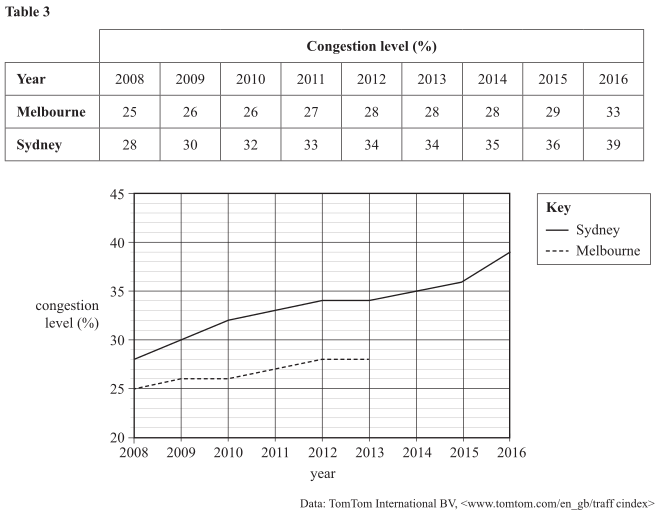
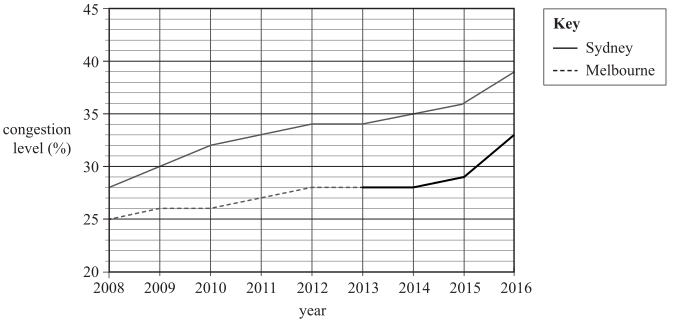
Table 3 shows the yearly average traffic congestion levels in two cities, Melbourne and Sydney, during the period 2008 to 2016. Also shown is a time series plot of the same data.

The time series plot for Melbourne is incomplete.

  1. Use the data in Table 3 to complete the time series plot above for Melbourne.   (1 mark)

    --- 0 WORK AREA LINES (style=lined) ---

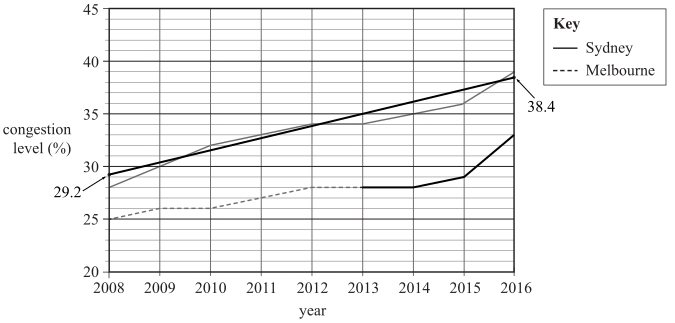
  2. A least squares line is used to model the trend in the time series plot for Sydney. The equation is

       `text(congestion level = −2280 + 1.15 × year)`

  1.   i. Draw this least squares line on the time series plot.   (1 mark)

    --- 0 WORK AREA LINES (style=lined) ---

  2.  ii. Use the equation of the least squares line to determine the average rate of increase in percentage congestion level for the period 2008 to 2016 in Sydney.   (1 mark)

    --- 2 WORK AREA LINES (style=lined) ---

    iii. Use the least squares line to predict when the percentage congestion level in Sydney will be 43%.   (1 mark)

    --- 3 WORK AREA LINES (style=lined) ---

The yearly average traffic congestion level data for Melbourne is repeated in Table 4 below.

  1. When a least squares line is used to model the trend in the data for Melbourne, the intercept of this line is approximately –1514.75556
  2. Round this value to four significant figures.   (1 mark)

    --- 1 WORK AREA LINES (style=lined) ---

  3. Use the data in Table 4 to determine the equation of the least squares line that can be used to model the trend in the data for Melbourne. The variable year is the explanatory variable.
  4. Write the values of the intercept and the slope of this least squares line in the appropriate boxes provided below.
  5. Round both values to four significant figures.   (2 marks)

    --- 0 WORK AREA LINES (style=lined) ---

congestion level = 
 
 + 
 
 × year
  1. Since 2008, the equations of the least squares lines for Sydney and Melbourne have predicted that future traffic congestion levels in Sydney will always exceed future traffic congestion levels in Melbourne.


    Explain why, quoting the values of appropriate statistics.   (2 marks)

    --- 5 WORK AREA LINES (style=lined) ---

Show Answers Only
  1. `text(See Worked Solutions)`
    1. `text(See Worked Solutions)`
    2. `1.15 text(%)`
    3. `2020`
  2. `-1515`
  3. `text(congestion level) = -1515 + 0.7667 xx text(year)`
  4. `text(See Worked Solutions)`
Show Worked Solution
a.   


b.i.   


b.ii.  `text(The least squares line is 1.15% higher each year.)`

♦ Mean mark (b)(ii) 36%.
COMMENT: Major problems caused by part (b)(ii). Review!

  ` :.\ text(Average rate of increase) = 1.15 text(%)`


b.iii.    `text(Find year when:)`
  `43` `= -2280 + 1.15 xx text(year)`
  `text(year)` `= 2323/1.15`
    `= 2020`


c.  `-1515`


d.   `text(congestion level) = -1515 + 0.7667 xx text(year)`


e.   `text(Melbourne congestion level in 2008)`

♦♦♦ Mean mark 18%.

`= -1515 + 0.7667 xx 2008`

`= 24.5 text(%)`

 
`text{In 2008 Sydney has higher congestion (29.2 > 24.5)}`

`text(After 2008, Sydney congestion grows at 1.15% per)`

`text(year and Melbourne grows at 0.7667% per year.)`

`:.\ text(Sydney predicted to always exceed Melbourne.)`

Filed Under: Correlation and Regression Tagged With: Band 3, Band 4, Band 5, Band 6, page-break-before-question, smc-265-20-Find LSRL Equation/Gradient, smc-265-60-Extrapolation / Interpolation, smc-265-80-Rounding (Sig Fig)

CORE, FUR1 2018 VCAA 24 MC

Mariska plans to retire from work 10 years from now.

Her retirement goal is to have a balance of $600 000 in an annuity investment at that time.

The present value of this annuity investment is $265 298.48, on which she earns interest at the rate of 3.24% per annum, compounding monthly.

To make this investment grow faster, Mariska will add a $1000 payment at the end of every month.

Two years from now, she expects the interest rate of this investment to fall to 3.20% per annum, compounding monthly. It is expected to remain at this rate until Mariska retires.

When the interest rate drops, she must increase her monthly payment if she is to reach her retirement goal.

The value of this new monthly payment will be closest to

  1. $1234
  2. $1250
  3. $1649
  4. $1839
  5. $1854
Show Answers Only

`E`

Show Worked Solution

`text(Find)\ FV\ text{after 2 years (by TVM solver):}`

♦ Mean mark 45%.

`N` `= 24`
`I(%)` `= 3.24`
`PV` `= −265\ 298.48`
`PMT` `= −1000`
`FV` `= ?`
`text(P/Y)` `= text(C/Y) = 12`

 
`=>FV = $307\ 794.50\ text{(nearest cent)}`
 

`text(Find new monthly payment:)`

`N` `= 8 xx 12 = 96`
`I(%)` `= 3.20`
`PV` `= –307\ 794.50`
`PMT` `= ?`
`FV` `= 600\ 000`
`text(P/Y)` `= text(C/Y) = 12`

 
`=> PMT = −1854.05`

`=> E`

Filed Under: Annuities and Perpetuities Tagged With: Band 5, smc-2512-10-Annuity, smc-2512-50-CAS solver

CORE, FUR1 2018 VCAA 23 MC

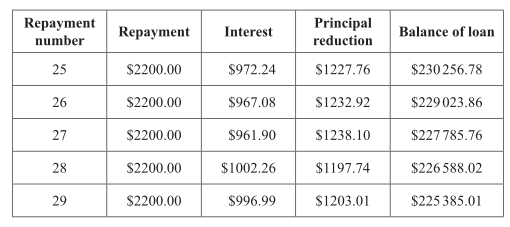
Five lines of an amortisation table for a reducing balance loan with monthly repayments are shown below.

The interest rate for this loan changed immediately before repayment number 28.

This change in interest rate is best described as

  1. an increase of 0.24% per annum.
  2. a decrease of 0.024% per annum.
  3. an increase of 0.024% per annum.
  4. a decrease of 0.0024% per annum.
  5. an increase of 0.00024% per annum.
Show Answers Only

`A`

Show Worked Solution

`text(Original interest rate)`

♦♦ Mean mark 29%.

`= 967.08/(230\ 256.78) xx 100`

`= 0.0042`

`= 0.42text(% per month)`
 

`text(New interest rate)`

`= 996.99/(226\ 588.02) xx 100`

`= 0.44text(% per month)`
 

`:.\ text(Change)` `= 0.02text(% per month)`
  `= 0.24text(% per annum)`

`=> A`

Filed Under: Borrowing and Loans Tagged With: Band 5, smc-603-50-P+I-R table

CORE, FUR1 2018 VCAA 22 MC

Adam has a home loan with a present value of $175 260.56

The interest rate for Adam’s loan is 3.72% per annum, compounding monthly.

His monthly repayment is $3200.

The loan is to be fully repaid after five years.

Adam knows that the loan cannot be exactly repaid with 60 repayments of $3200.

To solve this problem, Adam will make 59 repayments of $3200. He will then adjust the value of the final repayment so that the loan is fully repaid with the 60th repayment.

The value of the 60th repayment will be closest to

  1.   $368.12
  2. $2831.88
  3. $3200.56
  4. $3557.09
  5. $3568.12
Show Answers Only

`E`

Show Worked Solution

`text(By TVM Solver:)`

♦♦ Mean mark 29%.

`N` `= ?`
`I(%)` `= 3.72`
`PV` `= 175\ 260.56`
`PMT` `= −3200`
`FV` `= ?`
`text(P/Y)` `= text(C/Y) = 12`

 
`=> FV = −368.12`
 

`:.\ text(Final payment)` `= 3200 + 368.12`
  `= $3568.12`

`=> E`

Filed Under: Borrowing and Loans Tagged With: Band 5, smc-603-22-Reducible balance loans, smc-603-60-CAS (1 step)

CORE, FUR1 2018 VCAA 20 MC

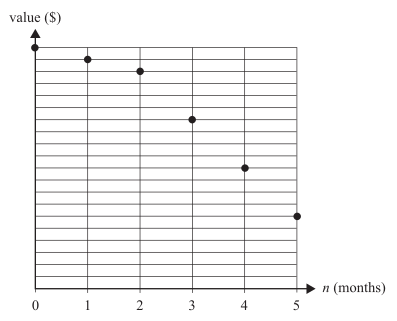
The graph below shows the value, `V_n`, of an asset as it depreciates over a period of five months.

Which one of the following depreciation situations does this graph best represent?

  1. flat rate depreciation with a decrease in depreciation rate after two months
  2. flat rate depreciation with an increase in depreciation rate after two months
  3. unit cost depreciation with a decrease in units used per month after two months
  4. reducing balance depreciation with an increase in the rate of depreciation after two months
  5. reducing balance depreciation with a decrease in the rate of depreciation after two months
Show Answers Only

`B`

Show Worked Solution

`text(1-2 months → rate of depreciation is constant.)`

♦ Mean mark 39%.

`text{After 2 months → rate is again constant but}`

`text{has increased (line is steeper.)}`

`=> B`

Filed Under: Depreciation Tagged With: Band 5, smc-602-60-Depreciation graphs

CORE, FUR1 2018 VCAA 14 MC

A least squares line is fitted to a set of bivariate data.

Another least squares line is fitted with response and explanatory variables reversed.

Which one of the following statistics will not change in value?

  1. the residual values
  2. the predicted values
  3. the correlation coefficient `r`
  4. the slope of the least squares line
  5. the intercept of the least squares line
Show Answers Only

`C`

Show Worked Solution

`text(If the variables are reversed, the equation changes.)`

♦ Mean mark 42%.

`:.\ text(Differences will occur in:)`

`text(- slope)`

`text(- intercept)`

`text(- predicted and residual values)`
 

`text(The correlation co-efficient will remain unchanged however,)`

`text(as the scattering of the points around the line of best fit is)`

`text{the same (i.e. scattering of}\ x\ text(values relative to)\ y\ text(values)`

`text(is the same as)\ y\ text(values relative to)\ x).`

`=> C`

Filed Under: Correlation and Regression Tagged With: Band 5, smc-265-10-r / r^2 and Association, smc-265-40-Interpret Gradient, smc-265-50-Residuals, smc-265-75-Explanatory / Response

CORE, FUR1 2018 VCAA 13 MC

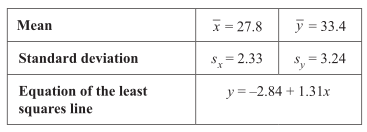
The statistical analysis of a set of bivariate data involving variables `x` and `y` resulted in the information displayed in the table below.

Using this information, the value of the correlation coefficient `r` for this set of bivariate data is closest to

  1. 0.88
  2. 0.89
  3. 0.92
  4. 0.94
  5. 0.97
Show Answers Only

`D`

Show Worked Solution

♦ Mean mark 49%.

`text(Gradient)` `= r(s_y)/(s_x)`
`1.31` `= r xx 3.24/2.33`
`:. r` `= 1.31 xx 2.33/3.24`
  `= 0.942…`

`=> D`

Filed Under: Correlation and Regression Tagged With: Band 5, smc-265-30-LSRL formula

CORE, FUR1 2018 VCAA 7-9 MC

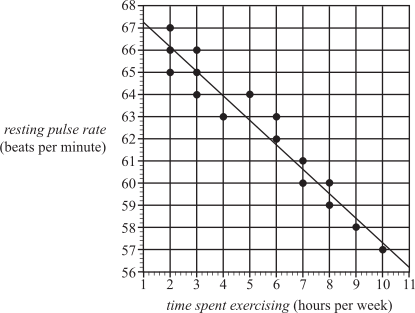
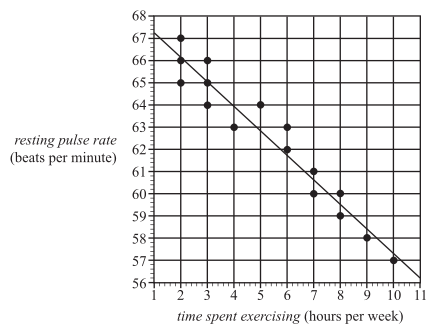
The scatterplot below displays the resting pulse rate, in beats per minute, and the time spent exercising, in hours per week, of 16 students. A least squares line has been fitted to the data.


Part 1

Using this least squares line to model the association between resting pulse rate and time spent exercising, the residual for the student who spent four hours per week exercising is closest to

  1. –2.0 beats per minute.
  2. –1.0 beats per minute.
  3. –0.3 beats per minute.
  4.   1.0 beats per minute.
  5.   2.0 beats per minute.

 
Part 2

The equation of this least squares line is closest to

  1. resting pulse rate = 67.2 – 0.91 × time spent exercising
  2. resting pulse rate = 67.2 – 1.10 × time spent exercising
  3. resting pulse rate = 68.3 – 0.91 × time spent exercising
  4. resting pulse rate = 68.3 – 1.10 × time spent exercising
  5. resting pulse rate = 67.2 + 1.10 × time spent exercising

 
Part 3

The coefficient of determination is 0.8339

The correlation coefficient `r` is closest to

  1. –0.913
  2. –0.834
  3. –0.695
  4.   0.834
  5.   0.913
Show Answers Only

`text(Part 1:)\ B`

`text(Part 2:)\ D`

`text(Part 3:)\ A`

Show Worked Solution

`text(Part 1)`

`text(Predicted rate = 64 bpm)`

`:.\ text(Residual)` `=\ text(actual − predicted)`
  `= 63 – 64`
  `= −1.0\ text(bpm)`

`=> B`


`text(Part 2)`

♦ Mean mark 46%.

`text(By elimination:)`

`ytext(-intecept) != 67.2\ text(since the)\ xtext(-axis starts)`

`text(at)\ \ x = 1\ \ (text(not)\ \ x = 0)`

`:.\ text(Eliminate)\ A, B\ text(and)\ E.`
 

`text(Consider the gradient.)`

`text(For each horizontal run of 1 unit, the line)`

`text(decreases vertically more than 1 unit.)`

`:.\ text(Eliminate)\ C.`

`=> D`


`text(Part 3)`

♦ Mean mark 45%.

`text(The correlation is clearly negative.)`

`:. r` `= −sqrt(0.8339)`
  `= −0.913`

`=>A`

Filed Under: Correlation and Regression Tagged With: Band 4, Band 5, smc-265-10-r / r^2 and Association, smc-265-20-Find LSRL Equation/Gradient, smc-265-50-Residuals

Vectors, SPEC2 2017 VCAA 12 MC

Let   `underset~r(t) = (1 - sqrt(a)sin(t))underset~i + (1 - 1/b cos(t))underset~j`  for  `t >= 0`  and  `a, b ∈ R^−`  be the path of a particle moving in the cartesian plane.

The path of the particle will always be a circle if

  1. `ab^2 = 1`
  2. `a^2b = 1`
  3. `ab^2 != 1`
  4. `ab = 1`
  5. `a^2b != 1`
Show Answers Only

`A`

Show Worked Solution

♦ Mean mark 49%.

`x` `= 1 – sqrta sin(t)`
`1 – x` `= sqrta sin(t)`
`sin(t)` `= (1 – x)/(sqrta)`
`sin^2(t)` `= ((1 – x)^2)/a`


`y` `= 1 – 1/b cos(t)`
`1 – y`  `= 1/b cos(t)`
`b(1 – y)` `= cos(t)`
`b^2(1 – y)^2` `= cos^2(t)`


` ((1 – x)^2)/a + b^2(1 – y)^2` `= sin^2(t) + cos^2(1)`
`((1 – x)^2)/a + b^2(1 – y)^2` `= 1`

 
`text(Equation describes a circle when:)`

 `1/a = b^2\ \ =>\ \ ab^2 = 1`

`=> A`

Filed Under: Position Vectors as a Function of Time Tagged With: Band 5, smc-1178-10-Find Cartesian equation

Networks, STD2 N3 SM-Bank 29

The construction of The Royal Easter show involves activities `A` to `L`. The diagram shows these activities and their completion times in days.


The company contracted to construct it are given a completion deadline of 31 days.

Calculate the float time of Activity `G`.  (3 marks)

--- 6 WORK AREA LINES (style=lined) ---

Show Answers Only

`8\ text(days)`

Show Worked Solution

`text(Scanning forwards and backwards:)`


`text(Critical Path is)\ \ A B E J L\ \ text{(29 days)}`

`=>\ text(Critical path is 2 days less than 31 day deadline)`

`:. text(Float time of Activity)\ G` `= (22 – 16) + 2`
  `= 8\ text(days)`

Filed Under: Critical Paths Tagged With: Band 5, smc-916-30-Scanning Both Ways

Trigonometry, SPEC2 2018 VCAA 4 MC

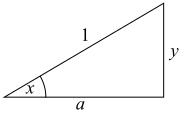
If  `cos(x) = -a`  and  `cot(x) = b`, where  `a, b > 0`, then  `text{cosec}(-x)`  is equal to

  1. `b/a`
  2. `-b/a`
  3. `-a/b`
  4. `a/b`
  5. `-ab` 
Show Answers Only

`A`

Show Worked Solution

`cos(x) < 0, \ cot(x) > 0 => x\ text(is in 3rd quadrant,)`

`text(or)\ \ x in (pi, (3 pi)/2)(+2k pi, k in ZZ)`

♦ Mean mark 49%.


`cot(x) = a/y = b\ \ =>\ \ y = a/b`

`text(cosec)(-x) = 1/(sin(-x)) = -1/(sin(x)) =-text(cosec)(x)`

 
`text(In 3rd quadrant:)`

`text(cosec)(x) < 0 \ =>\ \ text(cosec)(-x) > 0`

`:. text(cosec)(-x) = 1/y = b/a`

 
`=>  A`

Filed Under: Trigonometry (SM) Tagged With: Band 5, smc-1150-10-Solve equations

Algebra, SPEC2 2018 VCAA 3 MC

Which one of the following, where `A, B, C` and `D` are non-zero real numbers, is the partial fraction form for the expression

      `(2x^2 + 3x + 1)/{(2x + 1)^3 (x^2 - 1)}?`

A.  `A/(2x + 1) + B/(x - 1) + C/(x + 1)`

B.  `A/(2x + 1) + B/(2x - 1)^2 + C/(2x + 1)^3 + (Dx)/(x^2 - 1)`

C. `A/(2x + 1) + (Bx + C)/(x^2 - 1)`

D.  `A/(2x + 1) + B/(2x + 1)^2 + C/(x - 1)`

E.  `A/(2x + 1) + (Bx + C)/(2x + 1)^2 + D/(x - 1)` 

Show Answers Only

`D`

Show Worked Solution

`(2x^2 + 3x + 1)/{(2x + 1)^3 (x^2 – 1)}`

♦ Mean mark 46%.

`= ((2x^2 + 2x) + (x + 1))/((2x + 1)^3 (x – 1) (x + 1))`

`= (2x(x + 1) + (x + 1))/((2x + 1)^3 (x – 1) (x + 1))`

`= ((2x + 1)(x + 1))/((2x + 1)^3 (x – 1) (x + 1))`

`= 1/((2x + 1)^2(x – 1))`

`= A/(2x + 1) + B/(2x + 1)^2 + C/(x – 1)`

 
`=>  D`

Filed Under: Partial Fractions, Quotient and Other Functions (SM) Tagged With: Band 5, smc-1154-20-Partial fractions

Probability, STD2 S2 SM-Bank 1

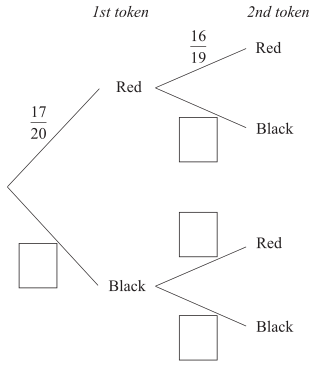
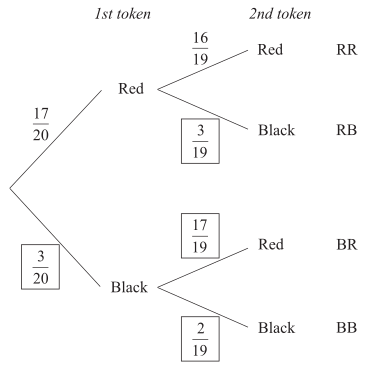
A game consists of two tokens being drawn at random from a barrel containing 20 tokens. There are 17 red tokens and 3 black tokens. The player keeps the two tokens drawn.

  1.  Complete the probability tree by writing the missing probabilities in the boxes.  (2 marks)


  2.  What is the probability that a player draws at least one red token. Give your answer in exact form.  (2 marks)

    --- 4 WORK AREA LINES (style=lined) ---

Show Answers Only
  1.  
  2. `187/190`
Show Worked Solution
i.   


ii.   `P(text(at least one red))`

`= 1 – P(BB)`

`= 1 – 3/20 · 2/19`

`= 187/190`

Filed Under: Multi-Stage Events (Std 2), Single and Multi-Stage Events (Std 1) Tagged With: Band 4, Band 5, smc-1135-10-Probability Trees, smc-1135-30-P(E) = 1 - P(not E), smc-829-10-Probability Trees, smc-829-30-P(E) = 1 - P(not E)

Financial Maths, STD2 F4 SM-Bank 1

An investment fund purchases 4500 shares of Bank ABC for a total cost of $274 500 (ignore any transaction costs).

The investment fund is paid a divided of $3.66 per share in the first year.

  1. What was the purchase price of 1 share?  (1 mark)
  2. Calculate the divided yield.  (1 mark)
Show Answers Only
  1. `$61`
  2. `text(6%)`
Show Worked Solution

i.   `text(Price per share)`

`= (274\ 500)/4500`

`= $61`
 

ii.   `text(Dividend Yield)`

`= text(Dividend)/text(Share Price) xx 100`

`= 3.66/61 xx 100`

`= 6text(%)`

Filed Under: Compound Interest and Shares (Std2) Tagged With: Band 4, Band 5, smc-817-40-Shares/Dividends

Measurement, STD2 M2 2017 HSC 27d

Island A and island B are both on the equator. Island B is west of island A. The longitude of island A is 5°E and the angle at the centre of Earth (O), between A and B, is 30°.
 

  1. What is the latitude and longitude of island `B`?  (2 marks)

    --- 4 WORK AREA LINES (style=lined) ---

  2. What time is it on island `B` when it is 10 am on island `A`?  (1 mark)

    --- 1 WORK AREA LINES (style=lined) ---

Show Answers Only

a.   `(0°, 25W)`

b.   `8\ text(am)`

Show Worked Solution
a. `text{Longitude (island}\ B)` `= 5-30`
    `= -25`
    `= 25^@\ text(W)`


`:.\ text(Island)\ B\ text{is  (0°, 25°W).}`
 

b.    `text(Time difference) = 30 xx 4 = 120 \ text(mins)\ =2\ text(hours)`

`text(S)text(ince)\ B\ text(is west of)\ A,`

`text(Time on island)\ B` `= 10\ text(am less 2 hours)`
  `= 8\ text(am)`
♦ Mean marks (a) 40% and (b) 45%.

Filed Under: M2 Working with Time (Y11), Positions on the Earth's Surface (Std2-2027) Tagged With: Band 5, smc-6305-10-Longitude and Time Differences, smc-6305-20-Earth Coordinates, smc-776-20-Longitude and Time Differences, smc-776-30-Earth Coordinates

Combinatorics, EXT1 A1 SM-Bank 2

Using `(1 + x)^4(1 + x)^9 = (1 + x)^13`

show that

   `\ ^9C_4 + \ ^4C_1\ ^9C_3 + \ ^4C_2\ ^9C_2 + \ ^4C_3\ ^9C_1 + 1 = \ ^13C_4`   (2 marks)

--- 6 WORK AREA LINES (style=lined) ---

Show Answers Only

`text(See Worked Solutions)`

Show Worked Solution

`text(Expanding)\ \ (1 + x)^13 :`

`T_k = \ ^13C_k · 1^(13 – k) · x^k`

`=> \ ^13C_4\ text(is coefficient of)\ x^4`
 

`(1 + x)^4 = \ ^4C_0 + \ ^4C_1 x + \ ^4C_2 x^2 + \ ^4C_3 x^3 + \ ^4C_4 x^4`

`(1 + x)^9 = \ ^9C_0 + \ ^9C_1 x + \ ^9C_2 x^2 + \ ^9C_3 x^3 + \ ^9C_4 x^4 + …`


`:.\ text(Coefficient of)\ x^4\ text(in)\ \ (1 + x)^4(1 + x)^9`

`= \ ^4C_0·\ ^9C_4 + \ ^4C_1·\ ^9C_3 + \ ^4C_2·\ ^9C_2 + \ ^4C_3·\ ^9C_1 + \ ^4C_4·\ ^9C_0`

`= \ ^9C_4 + \ ^4C_1·\ ^9C_3 + \ ^4C_2·\ ^9C_2 + \ ^4C_3·\ ^9C_1 + 1`

`= \ ^13C_4\ \ …\ text(as required)`

Filed Under: Binomial Expansion (Ext1) Tagged With: Band 5, smc-1088-30-Proofs

Calculus, SPEC2 2017 VCAA 9 MC

Consider  `(dy)/(dx) = 2x^2 + x + 1`, where  `y(1) = y_0 = 2`.

Using Euler's method with a step size of 0.1, an approximation to  `y(0.8) = y_2`  is given by

  1.  `0.94`
  2.  `1.248`
  3.  `1.6`
  4.  `2.4`
  5.  `2.852`
Show Answers Only

`B`

Show Worked Solution
`y(0.9)~~y_1` `= y_0 + h * (dy)/(dx)|_{(x_0,y_0)}`
  `= 2 – 0.1 xx (2 xx 1^2 + 1 + 1)`
  `= 2 – 0.1(4)`
  `= 2 – 0.4`
  `= 1.6`

♦ Mean mark 45%.

`y(0.8)~~y_2` `= y_1 + h*(dy)/(dx)|_{(x_1,y_1)}`
  `= 1.6 – 0.1(2(0.9)^2 + 0.9 + 1)`
  `= 1.248`

 
`=>B`

Filed Under: Euler, Pseudocode and Slope Fields Tagged With: Band 5, smc-1183-10-Euler method

Calculus, SPEC2 2017 VCAA 8 MC

Let  `f(x) = x^3 - mx^2 + 4`, where  `m, x ∈ R`.

The gradient of  `f` will always be strictly increasing for

  1.  `x >= 0`
  2.  `x >= m/3`
  3.  `x <= m/3`
  4.  `x >= (2m)/3`
  5.  `x <= (2m)/3`
Show Answers Only

`B`

Show Worked Solution

  `f(x) = x^3 – mx^2 + 4`

♦♦ Mean mark 29%.

`fprime(x)` `= 3x^2 – 2mx`
`f″(x)` `= 6x – 2m`

 
`text(Gradient increasing when)\ \ f″(x)>=0`

`6x >= 2m`

 `x >= (2m)/6 = m/3`

 
`=>B`

Filed Under: Tangents and Curve Sketching Tagged With: Band 5, smc-1182-40-Other 1st/2nd deriv problems

Calculus, SPEC2 2017 VCAA 6 MC

Given that  `(dy)/(dx) = e^x\ text(arctan)(y)`, the value of  `(d^2y)/(dx^2)`  at the point  `(0,1)`  is

  1.      `1/2`
  2.     `(3pi)/8`
  3.  `−1/2`
  4.     `pi/4`
  5.  `−pi/8`
Show Answers Only

`B`

Show Worked Solution
`(d^2y)/(dx^2)` `= d/(dx)(e^x) xx text(arctan)(y) + d/(dx)(text(arctan)(y)) xx e^x`
  `= e^xtext(arctan)(y) + e^x (1/(1 + y^2))(dy)/(dx)`

♦ Mean mark 46%.

`(d^2y)/(dx^2)|_(text{(0, 1)})` `= e^0text(arctan)(1) + e^0(1/(1 + 1^2)) xxe^0text(arctan)(1)`
  `= 1 xx pi/4 + 1 xx 1/2 xx pi/4`
  `= (3pi)/8`

`=>B`

Filed Under: Tangents and Curve Sketching Tagged With: Band 5, smc-1182-40-Other 1st/2nd deriv problems, smc-1182-60-Inverse Trig functions

Complex Numbers, SPEC2 2017 VCAA 3 MC

The number of distinct roots of the equation  `(z^4 - 1)(z^2 + 3iz - 2) = 0`, where  `z ∈ C`  is

  1.  2
  2.  3
  3.  4
  4.  5
  5.  6
Show Answers Only

`D`

Show Worked Solution

`text(Solve:)\ \ z^4 = 1`

`z_1 = 1, \ \ z_2 = text(cis)(pi/2) = i, \ \ z_3 = text(cis)(pi)=−1,`

`z_4 = text(cis)((−pi)/4) = -i`

 
`text(Solve:)\ \ z^2 + 3iz – 2=0`

`z^2 + 3iz + ((3i)/2)^2 – (9i^2)/4 – 2` `= 0`
`(z + (3i)/2)^2 + (9 – 8)/4` `= 0`
`(z + (3i)/2)^2 + 1/4` `= 0`
`z + (3i)/2` `= ±i/sqrt4`
`z` `= (−3i ± i)/2`
`z_5` `= (−4i)/2 = −2i`
`z_6` `= (−2i)/2=-i = z_4`

`=>D`

Filed Under: Factors and Roots (SM) Tagged With: Band 5, smc-1172-30-Roots > 3

Trigonometry, SPEC2 2017 VCAA 2 MC

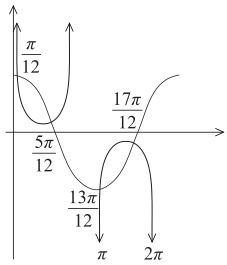
The solutions to  `cos(x) > 1/4 text(cosec)(x)`  for  `x ∈ (0,2pi)\ text(\) {pi}`  are given by

  1. `x ∈ (pi/12,(5pi)/12) ∪ ((5pi)/12,(13pi)/12) ∪ ((17pi)/12,2pi)`
  2. `x ∈ (pi/12,(5pi)/12) ∪ ((13pi)/12,(17pi)/12)`
  3. `x ∈ (pi/12,(5pi)/12) ∪ (pi,(13pi)/12) ∪ ((13pi)/12,2pi)`
  4. `x ∈ (pi/12,(13pi)/12) ∪ ((17pi)/12,2pi)`
  5. `x ∈ (pi/12,(5pi)/12) ∪ (pi,(13pi)/12) ∪ ((17pi)/12,2pi)`
Show Answers Only

`E`

Show Worked Solution

`cos(x) > 1/4 text(cosec)(x)`

♦ Mean mark 37%.

`4cos(x) > text(cosec)(x)`
 

`text(Consider:)\ \ 4cos(x) = 1/(sin(x))`

`4cos(x)sin(x)` `= 1`
`2(2sin(x)cos(x))` `= 1`
`2(sin(2x))` `= 1`
`sin(2x)` `= 1/2`
`2x` `= pi/6,(5pi)/6,(13pi)/6,(17pi)/6`
`:. x` `= pi/12,(5pi)/12,(13pi)/12,(17pi)/12\ \ \ (x ∈ (0,2pi)\ text(\) {pi})`


`x ∈ (pi/12,(5pi)/12) ∪ (pi,(13pi)/12) ∪ ((17pi)/12,2pi)`

 
`=>E`

Filed Under: Trigonometry (SM) Tagged With: Band 5, smc-1150-10-Solve equations

Functions, EXT1 F1 2010 HSC 3b*

Let  `f(x) = e^(-x^2)`.  The diagram shows the graph  `y = f(x)`.
 

 Inverse Functions, EXT1 2010 HSC 3b

  1. The graph has two points of inflection.  


    Find the  `x`  coordinates of these points.   (3 marks)

    --- 6 WORK AREA LINES (style=lined) ---

  2. Explain why the domain of  `f(x)`  must be restricted if  `f(x)`  is to have an inverse function.    (1 mark)

    --- 3 WORK AREA LINES (style=lined) ---

  3. Find a formula for  `f^(-1) (x)`  if the domain of  `f(x)`  is restricted to  `x ≥ 0`.   (2 marks)

    --- 5 WORK AREA LINES (style=lined) ---

  4. State the domain of  `f^(-1) (x)`.    (1 mark)

    --- 2 WORK AREA LINES (style=lined) ---

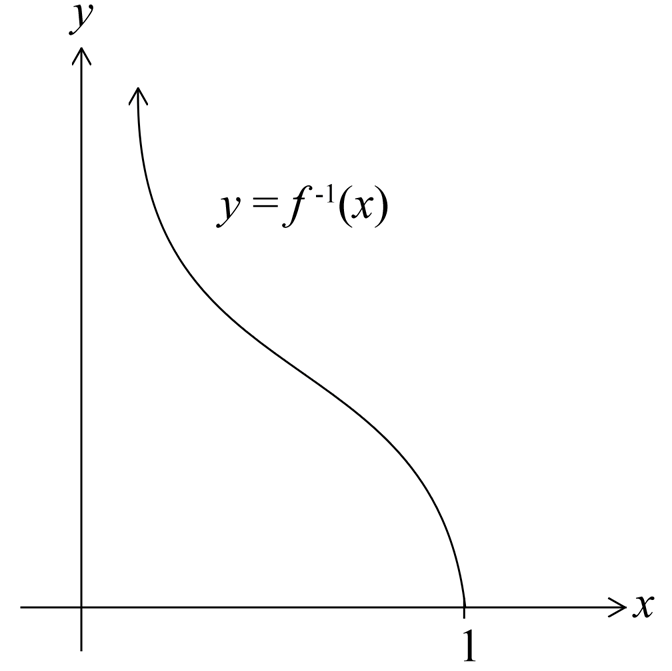
  5. Sketch the curve  `y = f^(-1) (x)`.    (1 mark)

    --- 5 WORK AREA LINES (style=lined) ---

Show Answers Only
  1. `x = +- 1/sqrt2` 
  2. `text(There can only be 1 value of)\ y\ text(for each value of)\ x.`
  3. `f^(-1)x = sqrt(ln(1/x))`
  4. `0 <= x <= 1`
  5.  
  6. Inverse Functions, EXT1 2010 HSC 3b Answer
Show Worked Solution
i.    `y` `= e^(-x^2)`
  `dy/dx` `= -2x * e^(-x^2)`
  `(d^2y)/(dx^2)` `= -2x (-2x * e^(-x^2)) + e ^(-x^2) (-2)`
    `= 4x^2 e^(-x^2)\ – 2e^(-x^2)`
    `= 2e^(-x^2) (2x^2\ – 1)`


`text(P.I. when)\ \ (d^2y)/(dx^2) = 0`

`2e^(-x^2) (2x^2\ – 1)` `= 0` 
 `2x^2\ – 1` `= 0` 
 `x^2` `= 1/2`
 `x` `= +- 1/sqrt2` 
COMMENT: It is also valid to show that `f(x)` is an even function and if a P.I. exists at `x=a`, there must be another P.I. at `x=–a`.
`text(When)\ \ ` `x < 1/sqrt2,` `\ (d^2y)/(dx^2) < 0`
  `x > 1/sqrt2,` `\ (d^2y)/(dx^2) > 0`

`=>\ text(Change of concavity)`

`:.\ text(P.I. at)\ \ x = 1/sqrt2`

`text(When)\ \ ` `x < – 1/sqrt2,` `\ (d^2y)/(dx^2) > 0`
  `x > – 1/sqrt2,` `\ (d^2y)/(dx^2) < 0`

`=>\ text(Change of concavity)`

`:.\ text(P.I. at)\ \ x = – 1/sqrt2`


ii.   `text(In)\ f(x), text(there are 2 values of)\ y\ text(for)`
  `text(each value of)\ x.`
  `:.\ text(The domain of)\ f(x)\ text(must be restricted)`
  `text(for)\ \ f^(-1) (x)\ text(to exist).`


iii.   `y = e^(-x^2)`

`text(Inverse function can be written)` 

`x` `= e^(-y^2),\ \ \ x >= 0`
`lnx` `= ln e^(-y^2)`
`-y^2` `= lnx`
`y^2` `= -lnx`
  `=ln(1/x)`
`y` `= +- sqrt(ln (1/x))`


`text(Restricting)\ \ x>=0,\ \ =>y>=0`

`:.  f^(-1) (x)=sqrt(ln (1/x))`
 

♦ Parts (iv) and (v) were poorly answered with mean marks of 39% and 49% respectively.
iv.   `f(0) = e^0 = 1`

`:.\ text(Range of)\ \ f(x)\ \ text(is)\ \ 0 < y <= 1`

`:.\ text(Domain of)\ \ f^(-1) (x)\ \ text(is)\ \ 0 < x <= 1`


v. 

Inverse Functions, EXT1 2010 HSC 3b Answer

Filed Under: Inverse Functions (Ext1) Tagged With: Band 3, Band 4, Band 5, page-break-before-solution, smc-1034-10-Logs and Exponentials

Functions, EXT1 F1 2004 HSC 5b*

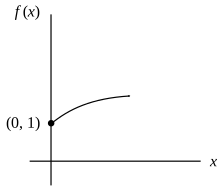
The diagram below shows a sketch of the graph of  `y = f(x)`, where  `f(x) = 1/(1 + x^2)`  for  `x ≥ 0`.
 

Inverse Functions, EXT1 2004 HSC 5b

  1. On the same set of axes, sketch the graph of the inverse function,  `y = f^(−1)(x)`.  (1 mark)
  2. State the domain of  `f^(−1)(x)`.  (1 mark)

    --- 1 WORK AREA LINES (style=lined) ---

  3. Find an expression for  `y = f^(−1)(x)`  in terms of  `x`.  (2 marks)

    --- 5 WORK AREA LINES (style=lined) ---

  4. The graphs of  `y = f(x)`  and  `y = f^(−1)(x)`  meet at exactly one point  `P`.


    Let  `α`  be the `x`-coordinate of  `P`. Explain why  `α`  is a root of the equation  `x^3 + x − 1 = 0`.  (1 mark)

    --- 4 WORK AREA LINES (style=lined) ---

Show Answers Only
  1. `text(See Worked Solutions)`
  2. `0 < x ≤ 1`
  3. `y = sqrt((1 − x)/x), \ y > 0`
  4. `text(See Worked Solutions)`
Show Worked Solution
i.  

Inverse Functions, EXT1 2004 HSC 5b Answer

ii.   `text(Domain of)\ \ f^(−1)(x)\ text(is)`

`0 < x ≤ 1`
 

iii.  `f(x) = 1/(1 + x^2)`

`text(Inverse: swap)\ \ x↔y`

`x` `= 1/(1 + y^2)`
`x(1 + y^2)` `= 1`
`1 + y^2` `= 1/x`
`y^2` `= 1/x − 1`
  `= (1 − x)/x`
`y` `= ± sqrt((1 − x)/x)`


`:.y = sqrt((1 − x)/x), \ \ y >= 0`


iv.   `P\ \ text(occurs when)\ \ f(x)\ \ text(cuts)\ \ y = x`

`text(i.e. where)`

`1/(1 + x^2)` `= x`
`1` `= x(1 + x^2)`
`1` `= x + x^3`
`x^3 + x − 1` `= 0`


`=>\ text(S)text(ince)\ α\ text(is the)\ x\ text(-coordinate of)\ P,`

 `text(it is a root of)\ \ \ x^3 + x − 1 = 0`

Filed Under: Inverse Functions (Ext1) Tagged With: Band 3, Band 4, Band 5, smc-1034-20-Other Functions

Functions, 2ADV F1 SM-Bank 14 MC

Let  `g(x) = log_2(x),\ \ x > 0`

Which one of the following equations is true for all positive real values of  `x?`

A.   `2g (8x) = g (x^2) + 8`

B.   `2g (8x) = g (x^2) + 6`

C.   `2g (8x) = (g (x) + 8)^2`

D.   `2g (8x) = g (2x) + 6`

Show Answers Only

`B`

Show Worked Solution

`text(Consider Option)\ B:`

♦♦ Mean mark 35%.
`text(LHS)` `= 2g(8x)`
  `= 2log_2(8x)`
  `= 2log_2(8) + 2log_2(x)`
  `=2log_2 (2^3)+ 2log_2(x)`
  `= 6 + log_2(x^2)`
  `= g(x^2) + 6`

`=>   B`

Filed Under: Composite Functions (Adv-2027), Composite Functions (Y11) Tagged With: Band 5, smc-6216-10-Log/Exp, smc-986-10-Log/Exp

Functions, 2ADV F1 SM-Bank 7

Let  `f(x) = log_e(x)`  for  `x>0,`  and  `g (x) = x^2 + 1`  for  all `x`.

  1. Find  `h(x)`, where  `h(x) = f (g(x))`.  (1 mark)

    --- 2 WORK AREA LINES (style=lined) ---

  2. State the domain and range of  `h(x)`.  (2 marks)

    --- 4 WORK AREA LINES (style=lined) ---

  3. Show that  `h(x) + h(−x) = f ((g(x))^2 )`.  (2 marks)

    --- 4 WORK AREA LINES (style=lined) ---

Show Answers Only
  1. `log_e(x^2 + 1)`
  2. `text(Domain)\ (h):\ text(all)\ x`


    `text(Range)\ h(x):\ \  h>=0`

  3. `text(See Worked Solutions)`
Show Worked Solution
i.    `h(x)` `= f(x^2 + 1)`
    `= log_e(x^2 + 1)`


ii.   `text(Domain)\ (h) =\ text(Domain)\ (g):\ text(all)\ x`

♦♦ Mean mark part (a)(ii) 30%.
`=> x^2 + 1 >= 1`
`=> log_e(x^2 + 1) >= 0`

 
`:.\ text(Range)\ h(x):\ \  h>=0`


MARKER’S COMMENT: Many students were unsure of how to present their working in this question. Note the layout in the solution.
iii.   `text(LHS)` `= h(x) + h(−x)`
    `= log_e(x^2 _ 1) + log_e((−x)^2 + 1)`
    `= log_e(x^2 + 1) + log_e(x^2 + 1)`
    `= 2log_e(x^2 + 1)`


`text(RHS)` `= f((x^2 + 1)^2)`
  `= 2log_e(x^2 + 1)`

 
`:. h(x) + h(−x) = f((g(x))^2)\ \ text(… as required)`

Filed Under: Composite Functions (Adv-2027), Composite Functions (Y11) Tagged With: Band 4, Band 5, smc-6216-10-Log/Exp, smc-6216-20-Quadratics, smc-6216-40-Domain/Range, smc-986-10-Log/Exp, smc-986-20-Quadratic, smc-986-40-Domain/Range

Functions, 2ADV F1 SM-Bank 6 MC

Let  `f(x) = e^x + e^(–x).`

`f(2u)`  is equal to
  

A.   `f(u) + f(-u)`

B.   `2 f(u)`

C.   `(f(u))^2 - 2`

D.   `(f(u))^2 + 2`

Show Answers Only

`C`

Show Worked Solution

`text(By trial and error,)`

♦ Mean mark 44%.

`text(Consider)\ \ (f(u))^2 – 2:`

`f(2u)` `=e^(2u) + e^(-2u)`
`(f(u))^2` `=(e^u + e^(-u))^2`
  `=e^(2u) + 2 + e^(-2u)`
   

`:. f(2u) = (f(u))^2-2`

`=>C`

Filed Under: Composite Functions (Adv-2027), Composite Functions (Y11) Tagged With: Band 5, smc-6216-10-Log/Exp, smc-986-10-Log/Exp

Functions, 2ADV F1 SM-Bank 4 MC

The function  `f(x)`  satisfies the functional equation  `f (f (x)) = x`  for  `{x:\ text(all)\ x,\ x!=1}`.

The rule for the function is

A.   `f(x) = x + 1`

B.   `f(x) = x - 1`

C.   `f(x) = (x - 1)/(x + 1)`

D.   `f(x) = (x + 1)/(x - 1)`

Show Answers Only

`D`

Show Worked Solution

`text(By trial and error:)`

♦ Mean mark 47%.

`text(Consider)\ \ f(x) = (x + 1)/(x – 1)`

`f(f(x))` `=((x + 1)/(x – 1) +1)/((x + 1)/(x – 1) -1)`
  `=(x+1+x-1)/(x+1-x+1)`
  `=x`

 
`=>D`

Filed Under: Composite Functions (Adv-2027), Composite Functions (Y11) Tagged With: Band 5, smc-6216-30-Other Functions, smc-986-30-Other

Functions, 2ADV F1 SM-Bank 3

Let  `f(x) = sqrt(x + 1)`   for   `x>=0`

  1. State the range of  `f(x)`.   (1 mark)

    --- 4 WORK AREA LINES (style=lined) ---

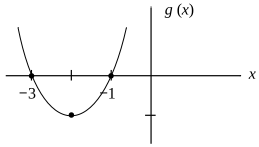
  2. Let  `g(x)=x^2+4x+3`,  where  `x<=c`  and  `c<=0`.
  3. Find the largest possible value of `c` such that the range of `g(x)` is a subset of the domain of `f(x)`.   (2 marks)

    --- 6 WORK AREA LINES (style=lined) ---

Show Answers Only
  1.   `y>= 1`
  2.  `-3`
Show Worked Solution

i.  `text(Sketch of)\ \ f(x):`
 

`:.\ text(Range:)\ \ y>= 1`


ii.  `text(Sketch)\ \ g(x) = (x + 1) (x + 3)`


`text(Domain of)\ \ f(x):\ \ x>=0`

`text(Find domain of)\ g(x)\ text(such that range)\ g(x):\ y>=0`

`text(Graphically, this occurs when)\ \ g(x)\ \ text(has domain:)`

`x <= –3\ \ text(and)\ \ x>=-1`
 

`:. c = -3`

Filed Under: Composite Functions (Adv-2027), Composite Functions (Y11) Tagged With: Band 4, Band 5, smc-6216-30-Other Functions, smc-6216-40-Domain/Range, smc-986-30-Other, smc-986-40-Domain/Range

Functions, 2ADV F1 SM-Bank 1 MC

Let  `h(x) = 1/(x - 1)`   for   `-1<h<1`.

Which one of the following statements about `h` is not true?

  1. `h(x)h(–x) = –h(x^2)`
  2. `h(x) - h(0) = xh(x)`
  3. `h(x) - h(–x) = 2xh(x^2)`
  4. `(h(x))^2 = h(x^2)`
Show Answers Only

`D`

Show Worked Solution

`text(By trial and error, consider option)\ E:`

♦ Mean mark 46%.

`h(x) = 1/(x – 1)`

`(h(x))^2 = 1/(x – 1)^2=1/(x^2-2x+1)`

`h(x^2)=1/(x^2-1) != (h(x))^2`

 
`=> D`

Filed Under: Composite Functions (Adv-2027), Composite Functions (Y11) Tagged With: Band 5, smc-6216-30-Other Functions, smc-986-30-Other

Calculus, 2ADV C4 2014* HSC 16a

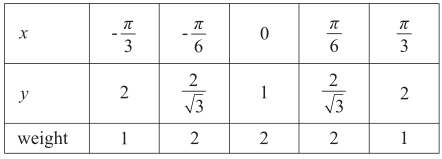
Use the Trapezoidal rule with five function values to show that 

`int_(- pi/3)^(pi/3) sec x\ dx ~~ pi/6 (3 + 4/sqrt3)`.   (3 marks)

--- 7 WORK AREA LINES (style=lined) ---

Show Answers Only

`text(Proof)\ \ text{(See Worked Solutions)}`

Show Worked Solution
♦ Mean mark below 50%. BE CAREFUL! 

`A` `~~ h/2 [y_0 + 2(y_1 + y_2 + y_3) + y_5]`
  `~~ pi/12 [2 + 2(2/sqrt3 + 1 + 2/sqrt3) + 2]`
  `~~ pi/12 [6 + 8/sqrt3]`
  `~~ pi/6 (3 + 4/sqrt3)\ text(u² … as required)`

Filed Under: Trapezium Rule and Newton, Trapezoidal Rule (Y12) Tagged With: Band 5, smc-5145-04-Trapezium rule, smc-5145-20-No table, smc-976-20-No Table

Calculus, 2ADV C4 2007* HSC 10a

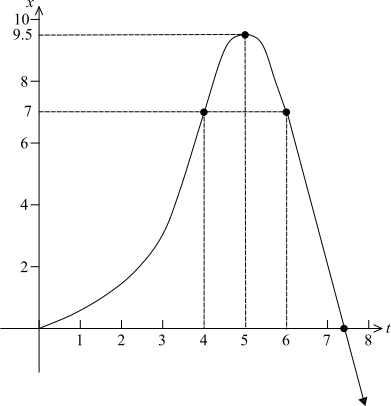
An object is moving on the `x`-axis. The graph shows the velocity, `(dx)/(dt)`, of the object, as a function of time, `t`. The coordinates of the points shown on the graph are  `A (2, 1), B (4, 5), C (5, 0) and D (6, –5)`. The velocity is constant for  `t >= 6`.


  1. The object is initially at the origin. During which time(s) is the displacement of the object decreasing?  (1 mark)

    --- 1 WORK AREA LINES (style=lined) ---

  2. If the object travels 7 units in the first 4 seconds, estimate the time at which the object returns to the origin. Justify your answer.  (2 marks)

    --- 5 WORK AREA LINES (style=lined) ---

  3. Sketch the displacement, `x`, as a function of time.  (2 marks)

    --- 10 WORK AREA LINES (style=lined) ---

Show Answers Only
  1. `t > 5\ \ text(seconds)`
  2. `7.2\ \ text(seconds)`
  3.    
Show Worked Solution

i.  `text(Displacement is reducing when the velocity is negative.)`

`:. t > 5\ \ text(seconds)`


ii.  `text(At)\ B,\ text(the displacement) = 7\ text(units)`

`text(Considering displacement from)\ B\ text(to)\ D:`

`text(S)text(ince the area below the graph from)`

`B\ text(to)\ C\ text(equals the area above the)`

`text(graph from)\ C\ text(to)\ D,\ text(there is no change)`

`text(in displacement from)\ B\ text(to)\ D.`


`text(Considering)\ t >= 6`

`text(Time required to return to origin)`

`t` `= d/v`
  `= 7/5`
  `= 1.4\ \ text(seconds)`


`:.\ text(The particle returns to the origin after 7.4 seconds.)`
   

iii.   

Filed Under: Other Integration Applications (Y12) Tagged With: Band 4, Band 5, Band 6, smc-1213-10-Motion, smc-975-70-Functions - no integration

Calculus, 2ADV C4 2004* HSC 10a

  1. Use the Trapezoidal rule with 3 function values to find an approximation to the area under the curve  `y = 1/x`  between  `x = a ` and  `x = 3a`, where  `a`  is positive.  (2 marks)

    --- 4 WORK AREA LINES (style=lined) ---

  2. Using the result in part (i), show that  `ln 3 ≑ 7/6`.  (1 mark)

    --- 3 WORK AREA LINES (style=lined) ---

Show Answers Only
  1. `7/6`
  2. `text(Proof)\ \ text{(See Worked Solutions)}`
Show Worked Solution
i.   
`A` `~~ a/2[1/a + 2(1/(2a)) + 1/(3a)]`
  `~~ a/2(7/(3a))`
  `~~ 7/6`


ii.  `text{Area under the curve}\ \ y=1/x`

`= int_a^(3a) 1/x\ dx`

`= [ln x]_(\ a)^(3a)`

`= ln 3a − ln a`

`= ln\ (3a)/a`

`= ln 3`
 

`text{Trapezoidal rule in part (i) found the approximate}`

`text(value of the same area.)`

`:. ln 3 ≑ 7/6.`

Filed Under: Trapezium Rule and Newton, Trapezoidal Rule (Y12) Tagged With: Band 5, smc-5145-04-Trapezium rule, smc-5145-20-No table, smc-5145-30-Estimate comparison, smc-976-20-No Table, smc-976-30-Estimate Comparison

Probability, 2ADV S1 2007 MET1 6

Two events, `A` and `B`, from a given event space, are such that  `P(A) = 1/5`  and  `P(B) = 1/3`.

  1. Calculate  `P(A′ ∩ B)`  when  `P(A ∩ B) = 1/8`.  (1 mark)

    --- 6 WORK AREA LINES (style=lined) ---

  2. Calculate  `P(A′ ∩ B)`  when `A` and `B` are mutually exclusive events.  (1 mark)

    --- 3 WORK AREA LINES (style=lined) ---

Show Answers Only
  1. `5/24`
  2. `1/3`
Show Worked Solution

i.   `text(Sketch Venn diagram:)`

♦♦ Mean mark 31%.
MARKER’S COMMENTS: Students who drew a Venn diagram or Karnaugh map were the most successful.

met1-2007-vcaa-q6-answer3

`:.P(A′ ∩ B)` `=P(B) – P(A ∩B)`
  `=1/3 – 1/8`
  `=5/24`


♦♦ Mean mark 23%.
ii.    met1-2007-vcaa-q6-answer4

`text(Mutually exclusive means)\ \ P(A ∩ B)=0,`

`:. P(A′ ∩ B) = 1/3`

Filed Under: Conditional Probability and Venn Diagrams (Adv-2027), Conditional Probability and Venn Diagrams (Y11) Tagged With: Band 5, Band 6, smc-6470-20-Venn Diagrams/Intersections, smc-6470-30-Independent Events, smc-991-20-Venn Diagrams/Intersections, smc-991-30-Independent Events

Probability, 2ADV S1 2017 MET1 8

For events `A` and `B` from a sample space, `P(A text(|)B) = 1/5`  and  `P(B text(|)A) = 1/4`.  Let  `P(A nn B) = p`.

  1. Find  `P(A)` in terms of `p`.  (1 mark)

    --- 2 WORK AREA LINES (style=lined) ---

  2. Find  `P(A nn B^{′})` in terms of `p`.  (2 marks)

    --- 6 WORK AREA LINES (style=lined) ---

  3. Given that  `P(A uu B) <= 1/5`, state the largest possible interval for `p`.  (2 marks)

    --- 3 WORK AREA LINES (style=lined) ---

Show Answers Only
  1. `P (A) = 4p,\ \ p > 0`
  2. `1-8p`
  3. `0 < p <= 1/40`
Show Worked Solution
i.    `P\ (A)` `=(P\ (A nn B))/(P\ (B text(|) A))`
    `=p/(1/4)`
    `=4p`


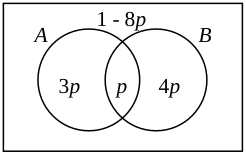
ii.  `text(Consider the Venn diagram:)`

♦ Mean mark 40%.
MARKER’S COMMENT: The most successful answers used a Venn diagram or table.
 

`P\ (A^{′} nn B^{′}) = 1-8p`


iii.  `text(Given)\ P(A uu B) = 8p`

♦ Mean mark 37%.

`=> 0 < 8p <= 1/5`

`:. 0 < p <= 1/40`

Filed Under: Conditional Probability and Venn Diagrams (Adv-2027), Conditional Probability and Venn Diagrams (Y11) Tagged With: Band 4, Band 5, smc-6470-10-Conditional Prob Formula, smc-6470-20-Venn Diagrams/Intersections, smc-991-10-Conditional Prob Formula, smc-991-20-Venn Diagrams/Intersections

Probability, 2ADV S1 2014 MET1 9

Sally aims to walk her dog, Mack, most mornings. If the weather is pleasant, the probability that she will walk Mack is `3/4`, and if the weather is unpleasant, the probability that she will walk Mack is `1/3`.

Assume that pleasant weather on any morning is independent of pleasant weather on any other morning.

  1. In a particular week, the weather was pleasant on Monday morning and unpleasant on Tuesday morning.


    Find the probability that Sally walked Mack on at least one of these two mornings.  (2 marks)

    --- 3 WORK AREA LINES (style=lined) ---

  2. In the month of April, the probability of pleasant weather in the morning was `5/8`.
    1. Find the probability that on a particular morning in April, Sally walked Mack.  (2 marks)

      --- 6 WORK AREA LINES (style=lined) ---

    2. Using your answer from part b.i., or otherwise, find the probability that on a particular morning in April, the weather was pleasant, given that Sally walked Mack that morning.  (2 marks)

      --- 4 WORK AREA LINES (style=lined) ---

Show Answers Only
  1. `5/6`
  2. i. `19/32`
     
    ii. `15/19`
Show Worked Solution
a.    `Ptext{(at least 1 walk)}` `= 1 – Ptext{(no walk)}`
    `= 1 – 1/4 xx 2/3`
    `= 5/6`


b.i.   `text(Construct tree diagram:)`
 

met1-2014-vcaa-q9-answer1 
 

`P(PW) + P(P′W)` `= 5/8 xx 3/4 + 3/8 xx 1/3`
  `= 19/32`


♦ Part (b)(ii) mean mark 38%.
b.ii.    `P(P | W)` `= (P(P ∩ W))/(P(W))`
    `= (5/8 xx 3/4)/(19/32)`
    `= 15/32 xx 32/19`
    `= 15/19`

Filed Under: Conditional Probability and Venn Diagrams (Adv-2027), Conditional Probability and Venn Diagrams (Y11) Tagged With: Band 4, Band 5, smc-6470-10-Conditional Prob Formula, smc-991-10-Conditional Prob Formula

Probability, 2ADV S1 2011 MET1 8

Two events, `A` and `B`, are such that  `P(A) = 3/5`  and  `P(B) = 1/4.`

If  `A^{′}` denotes the compliment of `A`, calculate  `P (A^{′} nn B)` when

  1. `P (A uu B) = 3/4`  (2 marks)

    --- 8 WORK AREA LINES (style=lined) ---

  2. `A` and `B` are mutually exclusive.  (1 mark)

    --- 6 WORK AREA LINES (style=lined) ---

Show Answers Only
  1. `3/20`
  2. `1/4`
Show Worked Solution

i.   `text(Sketch Venn Diagram)`

vcaa-2011-meth-8i

`P (A uu B)` `= P (A) + P (B)-P (A nn B)`
`3/4` `= 3/5 + 1/4-P (A nn B)`
`P (A nn B)` `= 1/10`


 `:.\ P(A^{′} nn B) = 1/4-1/10 = 3/20`


ii.   vcaa-2011-meth-8ii

`P (A∩ B)=0\ \ text{(mutually exclusive)},`

`:.\ P (A^{′} nn B) = P (B) = 1/4`

Filed Under: Conditional Probability and Venn Diagrams (Adv-2027), Conditional Probability and Venn Diagrams (Y11) Tagged With: Band 4, Band 5, smc-6470-20-Venn Diagrams/Intersections, smc-6470-30-Independent Events, smc-991-20-Venn Diagrams/Intersections, smc-991-30-Independent Events

Probability, 2ADV S1 2007 MET1 11

There is a daily flight from Paradise Island to Melbourne. The probability of the flight departing on time, given that there is fine weather on the island, is 0.8, and the probability of the flight departing on time, given that the weather on the island is not fine, is 0.6.

In March the probability of a day being fine is 0.4.

Find the probability that on a particular day in March

  1. the flight from Paradise Island departs on time  (2 marks)

    --- 8 WORK AREA LINES (style=lined) ---

  2. the weather is fine on Paradise Island, given that the flight departs on time.  (2 marks)

    --- 3 WORK AREA LINES (style=lined) ---

Show Answers Only
  1. `0.68`
  2. `8/17`
Show Worked Solution
i.   

 
`P(FT) +\ P(F^{′}T)`

`= 0.4 xx 0.8 + 0.6 xx 0.6`

`= 0.32 + 0.36`

`= 0.68`


ii.   `text(Conditional probability:)`

♦♦ Mean mark 29%.
MARKER’S COMMENT: Students continue to struggle with conditional probability. Attention required here.
`P(F\ text(|)\ T)` `= (P(F ∩ T))/(P(T))`
  `= 0.32/0.68`


`:. P(F\ text(|)\ T) = 8/17`

Filed Under: Conditional Probability and Venn Diagrams (Adv-2027), Conditional Probability and Venn Diagrams (Y11) Tagged With: Band 4, Band 5, smc-6470-10-Conditional Prob Formula, smc-991-10-Conditional Prob Formula

Probability, 2ADV S1 2015 MET1 8

For events `A` and `B` from a sample space, `P(A | B) = 3/4`  and  `P(B) = 1/3`.

  1.  Calculate  `P(A ∩ B)`.  (1 mark)

    --- 3 WORK AREA LINES (style=lined) ---

  2.  Calculate  `P(A^{′} ∩ B)`, where `A^{′}` denotes the complement of `A`.  (1 mark)

    --- 3 WORK AREA LINES (style=lined) ---

  3.  If events `A` and `B` are independent, calculate  `P(A ∪ B)`.  (1 mark)

    --- 3 WORK AREA LINES (style=lined) ---

Show Answers Only
  1. `1/4`
  2. `1/12`
  3. `5/6`
Show Worked Solution

i.   `text(Using Conditional Probability:)`

`P(A | B)` `= (P(A ∩ B))/(P(B))`
`3/4` `= (P(A ∩ B))/(1/3)`
`:. P(A ∩ B)` `= 1/4`


ii.    met1-2015-vcaa-q8-answer
`P(A^{′} ∩ B)` `= P(B)-P(A ∩B)`
  `= 1/3-1/4`
  `= 1/12`


iii.   `text(If)\ A, B\ text(independent)`

♦♦ Mean mark 28%.
MARKER’S COMMENT: A lack of understanding of independent events was clearly evident.
`P(A ∩ B)` `= P(A) xx P(B)`
`1/4` `= P(A) xx 1/3`
`:. P(A)` `= 3/4`


`P(A ∪ B)` `= P(A) + P(B)-P(A ∩ B)`
  `= 3/4 + 1/3-1/4`
`:. P(A ∪ B)` `= 5/6`

Filed Under: Conditional Probability and Venn Diagrams (Adv-2027), Conditional Probability and Venn Diagrams (Y11) Tagged With: Band 3, Band 4, Band 5, smc-6470-10-Conditional Prob Formula, smc-6470-20-Venn Diagrams/Intersections, smc-6470-30-Independent Events, smc-991-10-Conditional Prob Formula, smc-991-20-Venn Diagrams/Intersections, smc-991-30-Independent Events

Probability, 2ADV S1 2009 MET1 5

Four identical balls are numbered 1, 2, 3 and 4 and put into a box. A ball is randomly drawn from the box, and not returned to the box. A second ball is then randomly drawn from the box.

  1. What is the probability that the first ball drawn is numbered 4 and the second ball drawn is numbered 1?  (1 mark)

    --- 1 WORK AREA LINES (style=lined) ---

  2. What is the probability that the sum of the numbers on the two balls is 5?  (1 mark)

    --- 2 WORK AREA LINES (style=lined) ---

  3. Given that the sum of the numbers on the two balls is 5, what is the probability that the second ball drawn is numbered 1?  (2 marks)

    --- 4 WORK AREA LINES (style=lined) ---

Show Answers Only
  1. `1/12`
  2. `1/3`
  3. `1/4`
Show Worked Solution
i.    `P (4, 1)` `= 1/4 xx 1/3`
    `= 1/12`


ii.   `P (text(Sum) = 5)`

`= P (1, 4) + P (2, 3) + P (3, 2) + P (4, 1)`

`= 4 xx (1/4 xx 1/3)`

`= 1/3`


iii.   `text(Conditional Probability)`

♦ Mean mark 46%.

`P (2^{text(nd)} = 1\ |\ text(Sum) = 5)`

`= (P (4, 1))/(P (text(Sum) = 5))`

`= (1/12)/(1/3)`

`= 1/4`

Filed Under: Conditional Probability and Venn Diagrams (Adv-2027), Conditional Probability and Venn Diagrams (Y11) Tagged With: Band 3, Band 4, Band 5, smc-6470-10-Conditional Prob Formula, smc-991-10-Conditional Prob Formula

Probability, 2ADV S1 2014 MET2 14 MC

If  `X`  is a random variable such that  `P(X > 5) = a`  and  `P(X > 8) = b`, then  `P(X < 5 | X < 8)`  is

A.   `a/b`

B.   `(a - b)/(1 - b)`

C.   `(1 - b)/(1 - a)`

D.   `(a - 1)/(b - 1)`

Show Answers Only

`D`

Show Worked Solution

`P(X < 5) | P(X < 8)`

♦ Mean mark 45%.

`=(P(X<5 ∩ X<8))/(P(X < 8))`

`= (P(X < 5))/(P(X < 8))`

`= (1 – a)/(1 – b)`

`= (a – 1)/(b – 1)`

 
`=>   D`

Filed Under: Conditional Probability and Venn Diagrams (Adv-2027), Conditional Probability and Venn Diagrams (Y11) Tagged With: Band 5, smc-6470-10-Conditional Prob Formula, smc-991-10-Conditional Prob Formula

Probability, 2ADV S1 2013 MET2 17 MC

`A` and `B` are events of a sample space.

Given that  `P(A | B) = p,\ \ P(B) = p^2`  and  `P(A) = p^(1/3),\ P(B | A)`  is equal to

A.   `p^3`

B.   `p^(4/3)`

C.   `p^(7/3)`

D.   `p^(8/3)`

Show Answers Only

`D`

Show Worked Solution
`P(A | B)` `= (P(A ∩ B))/(P(B)`
`p` `= (P(A ∩ B))/(p^2)`
`:. P(A ∩ B)` `= p^3`
♦ Mean mark 49%.


`P(B | A)` `= (P(A ∩ B))/(P(A))`
  `= (p^3)/(p^(1/3))`
`:. P(B | A)` `= p^(8/3)`

 
`=>   D`

Filed Under: Conditional Probability and Venn Diagrams (Adv-2027), Conditional Probability and Venn Diagrams (Y11) Tagged With: Band 5, smc-6470-10-Conditional Prob Formula, smc-991-10-Conditional Prob Formula

Probability, 2ADV S1 2010 MET2 21 MC

Events `A` and `B` are mutually exclusive events of a sample space with

`P(A) = p and P (B) = q\ \ text(where)\ \ 0 < p < 1 and 0 < q < 1.`

`P (A^{′} nn B^{′})` is equal to

  1. `(1-p) (1-q)`
  2. `1-pq`
  3. `1-(p + q)`
  4. `1 - (p + q - pq)`
Show Answers Only

`C`

Show Worked Solution

♦ Mean mark 43%.
`P (A^{′} nn B^{′})` `= 1-p-q`
  `= 1-(p + q)`

`=>   C`

Filed Under: Conditional Probability and Venn Diagrams (Adv-2027), Conditional Probability and Venn Diagrams (Y11) Tagged With: Band 5, smc-6470-30-Independent Events, smc-991-30-Independent Events

Probability, 2ADV S1 2013 MET1 7

The probability distribution of a discrete random variable, `X`, is given by the table below.

\begin{array} {|c|c|c|c|c|}
\hline
\rule{0pt}{2.5ex} x \rule[-1ex]{0pt}{0pt} & \ \ \ 0\ \ \  & \ \ \ 1\ \ \  & \ \ \ 2\ \ \  & \ \ \ 3\ \ \ &\ \ \ 4\ \ \  \\
\hline
\rule{0pt}{2.5ex} P(X=x) \rule[-1ex]{0pt}{0pt} & 0.2 & 0.6p^{2} & 0.1 & 1-p & 0.1 \\
\hline
\end{array}

  1. Show that  `p = 2/3 or p = 1`.  (3 marks)

    --- 6 WORK AREA LINES (style=lined) ---

  2. Let  `p = 2/3`.

    1. Calculate  `E(X)`.  Answer in exact form.  (2 marks)

      --- 4 WORK AREA LINES (style=lined) ---

    2. Find  `P(X >= E(X))`.  (1 mark)

      --- 2 WORK AREA LINES (style=lined) ---

Show Answers Only
  1. `text(Proof)\ \ text{(See Worked Solutions)}`
    1. `28/15`
    2. `8/15`
Show Worked Solution

a.   `text(S)text(ince probabilities must sum to 1:)`

`0.2 + 0.6p^2 + 0.1 + 1-p + 0.1` `= 1`
`0.6p^2-p + 0.4` `= 0`
`6p^2-10p + 4` `= 0`
`3p^2-5p + 2` `= 0`
`(p-1) (3p-2)` `= 0`

`:. p = 1 or p = 2/3`


b.i.   `E(X)` `= sum x * P (X = x)`
    `= 1 xx (3/5 xx 2^2/3^2) + 2 (1/10) + 3 (1-2/3) + 4 (1/10)`
    `= 4/15 + 1/5 + 1 + 2/5`
    `= 28/15`


♦♦ Part (b)(ii) mean mark 32%.
  ii.   `P(X >= 28/15)` `=P(X = 2) + P(X = 3) + P(X = 4)`
    `= 1/10 + 1/3 + 1/10`
    `= 8/15`

Filed Under: Discrete Probability Distributions (Y11) Tagged With: Band 4, Band 5, smc-992-10-Sum of Probabilities = 1, smc-992-20-E(X) / Mean

Probability, 2ADV S1 2012 MET1 4

On any given day, the number `X` of telephone calls that Daniel receives is a random variable with probability distribution given by

\begin{array} {|c|c|c|c|c|}
\hline
\rule{0pt}{2.5ex} x \rule[-1ex]{0pt}{0pt} & \ \ \ 0\ \ \  & \ \ \ 1\ \ \  & \ \ \ 2\ \ \  & \ \ \ 3\ \ \  \\
\hline
\rule{0pt}{2.5ex} P(X=x) \rule[-1ex]{0pt}{0pt} & 0.2 & 0.2 & 0.5 & 0.1 \\
\hline
\end{array}

  1. Find the mean of  `X`.   (2 marks)

    --- 3 WORK AREA LINES (style=lined) ---

  2. What is the probability that Daniel receives only one telephone call on each of three consecutive days?   (1 mark)

    --- 2 WORK AREA LINES (style=lined) ---

  3. Daniel receives telephone calls on both Monday and Tuesday.


    What is the probability that Daniel receives a total of four calls over these two days?   (3 marks)

    --- 6 WORK AREA LINES (style=lined) ---

Show Answers Only
  1. `1.5`
  2. `0.008`
  3. `29/64`
Show Worked Solution
i.    `E(X)` `= 0 xx 0.2 + 1 xx 0.2 + 2 xx 0.5 + 3 xx 0.1`
    `= 0 + .2 + 1 + 0.3`
    `= 1.5`


ii.   `P(1, 1, 1)` `= 0.2 xx 0.2 xx 0.2`
    `= 0.008`


iii.   `text(Conditional Probability:)`

♦ Mean mark 36%.

`P(x = 4 | x >= 1\ text{both days})`

`= (P(1, 3) + P(2, 2) + P(3, 1))/(P(x>=1\ text{both days}))`

`= (0.2 xx 0.1 + 0.5 xx 0.5 + 0.1 xx 0.2)/(0.8 xx 0.8)`

`= (0.02 + 0.25 + 0.02)/0.64`

`= 0.29/0.64`

`= 29/64`

Filed Under: Discrete Probability Distributions (Y11) Tagged With: Band 3, Band 4, Band 5, smc-992-20-E(X) / Mean, smc-992-60-Conditional Probability, smc-992-70-Other Probability

Calculus, 2ADV C4 2018* HSC 15c

The shaded region is enclosed by the curve  `y = x^3 - 7x`  and the line  `y = 2x`, as shown in the diagram. The line  `y = 2x`  meets the curve  `y = x^3 - 7x`  at  `O(0, 0)`  and  `A(3, 6)`. Do NOT prove this.


  1.  Use integration to find the area of the shaded region.  (2 marks)

    --- 4 WORK AREA LINES (style=lined) ---

  2. Use the Trapezoidal rule and four function values to approximate the area of the shaded region.  (2 marks)

    --- 5 WORK AREA LINES (style=lined) ---

The point `P` is chosen on the curve  `y = x^3 − 7x`  so that the tangent at `P` is parallel to the line  `y = 2x`  and the `x`-coordinate of `P` is positive

  1.  Show that the coordinates of `P` are  `(sqrt 3, -4 sqrt 3)`.  (2 marks)

    --- 5 WORK AREA LINES (style=lined) ---

  2.  Using the perpendicular distance formula  `|ax_1 + by_1 + c|/sqrt(a^2 + b^2)`,  find the area of  `Delta OAP`.  (2 marks)

    --- 4 WORK AREA LINES (style=lined) ---

Show Answers Only
  1. `81/4\ text(units²)`
  2. `18\ text(u²)`
  3. `text(Proof)\ \ text{(See Worked Solutions)}`
  4. `9 sqrt 3\ text(units²)`
Show Worked Solution
i.   `text(Area)` `= int_0^3 2x – (x^3 – 7x)\ dx`
    `= int_0^3 9x – x^3\ dx`
    `= [9/2 x^2 – 1/4 x^4]_0^3`
    `= [(9/2 xx 3^2 – 1/4 xx 3^4) – 0]`
    `= 81/2 – 81/4`
    `= 81/4\ text(units²)`


ii.  `f(x) = 9x – x^3`

`text(Area)` `~~ 1/2[0 + 2(8 + 10) + 0]`
  `~~ 1/2(36)`
  `~~ 18\ text(u²)`


iii.   `y = x^3 – 7x`

`(dy)/(dx) = 3x^2 – 7`

`text(Find)\ \ x\ \ text(such that)\ \ (dy)/(dx) = 2`

`3x^2 – 7` `= 2`
`3x^2` `= 9`
`x^2` `= 3`
`x` `= sqrt 3 qquad (x > 0)`


`y` `= (sqrt 3)^3 – 7 sqrt 3`
  `= 3 sqrt 3 – 7 sqrt 3`
  `= -4 sqrt 3`

 
`:. P\ \ text(has coordinates)\ (sqrt 3, -4 sqrt 3)`


iv.  


`text(dist)\ OA` `= sqrt((3 – 0)^2 + (6 – 0)^2)`
  `= sqrt 45`
  `= 3 sqrt 5`

 
`text(Find)\ _|_\ text(distance of)\ \ P\ \ text(from)\ \ OA`

`P(sqrt 3, -4 sqrt 3),\ \ 2x – y=0`

`_|_\ text(dist)` `= |(2 sqrt 3 + 4 sqrt 3)/sqrt (3 + 2)|`
  `= (6 sqrt 3)/sqrt 5`
   
`:.\ text(Area)` `= 1/2 xx 3 sqrt 5 xx (6 sqrt 3)/sqrt 5`
  `= 9 sqrt 3\ text(units²)`

Filed Under: Areas Under Curves (Y12), Trapezium Rule and Newton, Trapezoidal Rule (Y12) Tagged With: Band 4, Band 5, smc-5145-04-Trapezium rule, smc-5145-20-No table, smc-975-20-Cubic, smc-976-20-No Table

Calculus, 2ADV C4 2017* HSC 14b

  1. Find the exact value of  `int_0^(pi/3) cos x\ dx`.  (1 mark)

    --- 2 WORK AREA LINES (style=lined) ---

  2. Using the Trapezoidal rule with three function values, find an approximation to the integral  `int_0^(pi/3) cos x\ dx,` leaving your answer in terms of `pi` and `sqrt 3`.  (2 marks)

    --- 4 WORK AREA LINES (style=lined) ---

  3. Using parts (i) and (ii), show that  `pi ~~ (12 sqrt 3)/(3 + 2 sqrt 3)`.  (1 mark)

    --- 2 WORK AREA LINES (style=lined) ---

Show Answers Only
  1. `sqrt 3/2`
  2. `((2sqrt3 + 3)pi)/24`
  3. `text{Proof (See Worked Solutions)}`
Show Worked Solution
i.   `int_0^(pi/3) cos x\ dx` `= [sin x]_0^(pi/3)`
    `= sin\ pi/3-0`
    `= sqrt 3/2`


ii.  

\begin{array} {|l|c|c|c|}\hline
x & \ \ \ 0\ \ \  & \ \ \ \dfrac{\pi}{6}\ \ \  & \ \ \ \dfrac{\pi}{3}\ \ \ \\ \hline
\text{height} & 1 & \dfrac{\sqrt{3}}{2} & \dfrac{1}{2} \\ \hline
\text{weight} & 1 & 2 & 1  \\ \hline \end{array}

`int_0^(pi/3) cos x\ dx` `~~ 1/2 xx pi/6[1 + 2(sqrt3/2) + 1/2]`
  `~~ pi/12((3 + 2sqrt3)/2)`
  `~~ ((3+2sqrt3)pi)/24`


♦ Mean mark part (iii) 49%.

(iii)    `((3+2sqrt3)pi)/24` `~~ sqrt3/2`
  `:. pi` `~~ (24sqrt3)/(2(3+2sqrt3))`
    `~~ (12sqrt3)/(3 + 2sqrt3)`

Filed Under: Trapezium Rule and Newton, Trapezoidal Rule (Y12) Tagged With: Band 3, Band 4, Band 5, smc-5145-04-Trapezium rule, smc-5145-20-No table, smc-5145-30-Estimate comparison, smc-976-20-No Table, smc-976-30-Estimate Comparison

Calculus, 2ADV C4 2012* HSC 12d

At a certain location a river is 12 metres wide. At this location the depth of the river, in metres, has been measured at 3 metre intervals. The cross-section is shown below.
 

2012 12d

  1. Use the Trapezoidal rule with the five depth measurements to calculate the approximate area of the cross-section.   (3 marks)

    --- 6 WORK AREA LINES (style=lined) ---

  2. The river flows at 0.4 metres per second.
  3. Calculate the approximate volume of water flowing through the cross-section in 10 seconds.   (1 mark)

    --- 2 WORK AREA LINES (style=lined) ---

Show Answers Only
  1. `30.9 \ text(m²)`
  2. `123.6 \ text(m³)`  
Show Worked Solution
i.   
`A` `~~ 3/2[0.5 + 2(2.3 + 2.9 + 3.8) + 2.1]`
  `~~ 3/2(20.6)`
  `~~ 30.9\  text(m²)`


♦ Mean mark 49%.

ii.  `text(Distance water flows)`  `= 0.4 xx 10`
  `= 4 \ text(metres)`


`text(Volume flow in 10 seconds)` `~~ 4 xx 30.9`
  `~~ 123.6  text(m³)`

Filed Under: Trapezium Rule and Newton, Trapezoidal Rule (Y12) Tagged With: Band 3, Band 5, smc-5145-04-Trapezium rule, smc-5145-20-No table, smc-976-20-No Table

  • « Previous Page
  • 1
  • …
  • 55
  • 56
  • 57
  • 58
  • 59
  • …
  • 81
  • Next Page »

Copyright © 2014–2025 SmarterEd.com.au · Log in