SmarterEd

Aussie Maths & Science Teachers: Save your time with SmarterEd

  • Login
  • Get Help
  • About

Measurement, STD2 M6 2011 HSC 24c

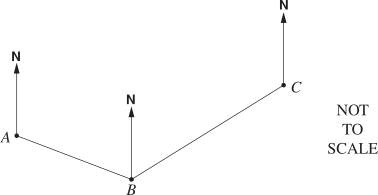
A ship sails 6 km from `A` to `B` on a bearing of 121°. It then sails 9 km to `C`.  The
size of angle `ABC` is 114°.
 

  1. What is the bearing of `C` from `B`?   (1 mark)

    --- 2 WORK AREA LINES (style=lined) ---

  2. Find the distance `AC`. Give your answer correct to the nearest kilometre.   (2 marks)

    --- 4 WORK AREA LINES (style=lined) ---

  3. What is the bearing of `A` from `C`? Give your answer correct to the nearest degree.   (3 marks)

    --- 6 WORK AREA LINES (style=lined) ---

Show Answers Only
  1.  `055^@`
  2.  `13\ text(km)`
  3.  `261^@`
Show Worked Solution
STRATEGY: Important: Draw North-South parallel lines through major points to make the angle calculations easier!
i.     2011 HSC 24c

 `text(Let point)\ D\ text(be due North of point)\ B`

`/_ABD=180-121\ text{(cointerior with}\ \ /_A text{)}\ =59^@`

`/_DBC=114-59=55^@`   

`:. text(Bearing of)\ \ C\ \ text(from)\ \ B\ \ text(is)\ 055^@`


ii.    `text(Using cosine rule:)`

`AC^2` `=AB^2+BC^2-2xxABxxBCxxcos/_ABC`
  `=6^2+9^2-2xx6xx9xxcos114^@`
  `=160.9275…`
`:.AC` `=12.685…\ \ \ text{(Noting}\ AC>0 text{)}`
  `=13\ text(km)\ text{(nearest km)}`


iii.    `text(Need to find)\ /_ACB\ \ \ text{(see diagram)}`

MARKER’S COMMENT: The best responses clearly showed what steps were taken with working on the diagram. Note that all North/South lines are parallel.
`cos/_ACB` `=(AC^2+BC^2-AB^2)/(2xxACxxBC)`
  `=((12.685…)^2+9^2-6^2)/(2xx(12.685..)xx9)`
  `=0.9018…`
`/_ACB` `=25.6^@\ text{(to 1 d.p.)}`


`text(From diagram,)`

`/_BCE=55^@\ text{(alternate angle,}\ DB\ text(||)\ CE text{)}`

`:.\ text(Bearing of)\ A\ text(from)\ C`

  `=180+55+25.6`
  `=260.6`
  `=261^@\ text{(nearest degree)}`

Filed Under: Bearings and Radial Surveys (Std2) Tagged With: Band 4, Band 5, Band 6, common-content, smc-803-10-Bearings

Trigonometry, 2ADV* T1 2009 HSC 27b

A yacht race follows the triangular course shown in the diagram. The course from  `P`  to  `Q`  is 1.8 km on a true bearing of 058°.

At  `Q`  the course changes direction. The course from  `Q`  to  `R`  is 2.7 km and  `/_PQR = 74^@`.
 

 2009-2UG-27b
 

  1. What is the bearing of  `R`  from  `Q`?   (1 mark)

    --- 2 WORK AREA LINES (style=lined) ---

  2. What is the distance from  `R`  to  `P`?     (2 marks)

    --- 5 WORK AREA LINES (style=lined) ---

  3. The area inside this triangular course is set as a ‘no-go’ zone for other boats while the race is on.


    What is the area of this ‘no-go’ zone?   (1 mark)

    --- 2 WORK AREA LINES (style=lined) ---

Show Answers Only
  1. `312^@`
  2. `2.8\ text(km)\ \ \ text{(1 d.p.)}`
  3. `2.3\ text(km²)\ \ \ text{(1 d.p.)}`
Show Worked Solution
i.    2UG-2009-27b-Answer

`/_ PQS = 58^@ \ \ \ (text(alternate to)\ /_TPQ)`

TIP: Draw North-South parallel lines through relevant points to help calculate angles as shown in the Worked Solutions.

`text(Bearing of)\ R\ text(from)\ Q`

`= 180^@ + 58^@ + 74^@`
`= 312^@`


(ii)   `text(Using Cosine rule:)`

`RP^2` `=RQ^2` + `PQ^2` `- 2` `xx RQ` `xx PQ` `xx cos` `/_RQP`
  `= 2.7^2` + `1.8^2` `- 2` `xx 2.7` `xx 1.8` `xx cos74^@`
  `=7.29 + 3.24\ – 2.679…`
  `=7.851…`
`:.RP` `= sqrt(7.851…)`
  `=2.8019…`
  `~~ 2.8\ text(km)  (text(1 d.p.) )`


(iii)   `text(Using)\ A = 1/2 ab sinC`

`A` `= 1/2` `xx 2.7` `xx 1.8` `xx sin74^@`
  `= 2.3358…`
  `= 2.3\ text(km²)`


`:.\ text(No-go zone is 2.3 km²)`

Filed Under: Bearings (Adv-2027), Bearings (Y11) Tagged With: Band 4, Band 5, common-content, smc-6395-10-Bearings, smc-6395-50-Find Area, smc-981-10-Bearings, smc-981-30-Find Area

Measurement, STD2 M1 2007 HSC 28c*

A piece of plaster has a uniform cross-section, which has been shaded, and has dimensions as shown.


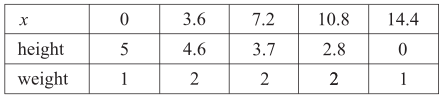
  1. Use the Trapezoidal rule to approximate the area of the cross-section.    (3 marks)

    --- 6 WORK AREA LINES (style=lined) ---

  2. The total surface area of the piece of plaster is 7480.8 cm²
  3. Calculate the area of the curved surface as shown on the diagram. Give your answer to the nearest square centimetre   (2 marks)

    --- 4 WORK AREA LINES (style=lined) ---

Show Answers Only
  1. `48.96\ text(cm²)`
  2. `3502.88\ text(cm²)`
Show Worked Solution
a.   
`A` `~~ 3.6/2 [5 + 2(4.6 + 3.7 + 2.8) + 0]`
  `~~ 1.8(27.2)`
  `~~ 48.96\ text(cm²)`


b.  `text(Total Area) = 7480.8\ text{cm²   (given)}`

`text(Area of Base)` `= 14.4 xx 200`
  `= 2880\ text(cm²)`
`text(Area of End)` `= 5 xx 200`
  `= 1000\ text(cm²)`
`text(Area of sides)` `= 2 xx 48.96`
  `= 97.92\ text(cm²)`


`:.\ text(Area of curved surface)`

`= 7480.8 – (2880 + 1000 + 97.92)`

`= 3502.88`

`=3503\ text{cm²  (nearest cm²)}`

Filed Under: Trapezoidal Rule (Std 2), Trapezoidal Rule (Std2-2027) Tagged With: Band 4, Band 5, smc-6328-20-4 Approximations, smc-941-20-4 Approximations

Measurement, STD2 M1 2008 HSC 28b*

A tunnel is excavated with a cross-section as shown.


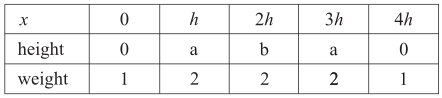
  1. Find an expression for the area of the cross-section using the Trapezoidal rule.  (2 marks)

    --- 4 WORK AREA LINES (style=lined) ---

  2. The area of the cross-section must be 600 m2. The tunnel is 80 m wide. 


    If the value of `a` increases by 2 metres, by how much will `b` change?   (2 marks)

    --- 4 WORK AREA LINES (style=lined) ---

Show Answers Only
  1. `h(2a + b)`
  2. `b\ text(decreases by 4.)`
Show Worked Solution
a.   
`A` `~~ h/2[0 + 2(a + b + a) + 0]`
  `~~ h/2(4a + 2b)`
  `~~ h(2a + b)`


b.   `A = 600\ text(m²)`

`text(If tunnel is 80 metres wide)`

`4h` `= 80`
`h` `= 20`

 
`text{Using part (i):}`

`600 = 20(2a + b)`

`2a + b` `= 30`
`b` `= 30 – 2a`

 
`:.\ text(If)\ a\ text(increases by 2,)\ b\ text(must decrease by 4.)`

Filed Under: Trapezoidal Rule (Std 2), Trapezoidal Rule (Std2-2027) Tagged With: Band 4, Band 5, smc-6328-20-4 Approximations, smc-941-20-4 Approximations

Measurement, STD2 M1 2009 HSC 25c*

There is a lake inside the rectangular grass picnic area  `ABCD`, as shown in the diagram.
 

2UG-2009-25c
  

  1. Use Trapezoidal’s Rule to find the approximate area of the lake’s surface.   (3 marks)

    --- 6 WORK AREA LINES (style=lined) ---

The lake is 60 cm deep. Bozo the clown thinks he can empty the lake using a four-litre bucket.

  1. How many times would he have to fill his bucket from the lake in order to empty the lake? (Note that 1 m³ = 1000 L).    (2 marks)

    --- 4 WORK AREA LINES (style=lined) ---

Show Answers Only
  1. 426 m²
  2. 63 900 times
Show Worked Solution
a.     `text(Area of lake = Area of rectangle)\ – text(Area of grass)`
`text(Area of rectangle)` `= 24 xx 55`
  `= 1320\ text(m²)`

 
`text{Area of grass (two applications)}`

`~~ 12/2(20 + 5) + 12/2(5 + 10) + 12/2(35 + 22) + 12/2(22 + 30)`
`~~ 6(25 + 15 + 57 + 52)`
`~~ 894\ text(m²)`


`:.\ text(Area of lake)` `~~ 1320\ – 894`
  `~~ 426\ text(m²)`


♦ Mean mark 44%
STRATEGY: Most students who did calculations in cm² and cm³ made errors. Keeping calculations in metres is much easier here.
b.    `V` `= Ah`
    `= 426 xx 0.6`
    `= 255.6\ text(m³)`
    `= 255\ 600\ text(L)\ \ \ text{(1 m³ = 1000  L)}`


`:.\ text(Times to fill bucket)` `= 255\ 600 -: 4`
  `= 63\ 900`

Filed Under: Trapezoidal Rule (Std 2), Trapezoidal Rule (Std2-2027) Tagged With: Band 4, Band 5, smc-6328-10-1-3 Approximations, smc-941-10-1-3 Approximations

Statistics, NAP-J2-31

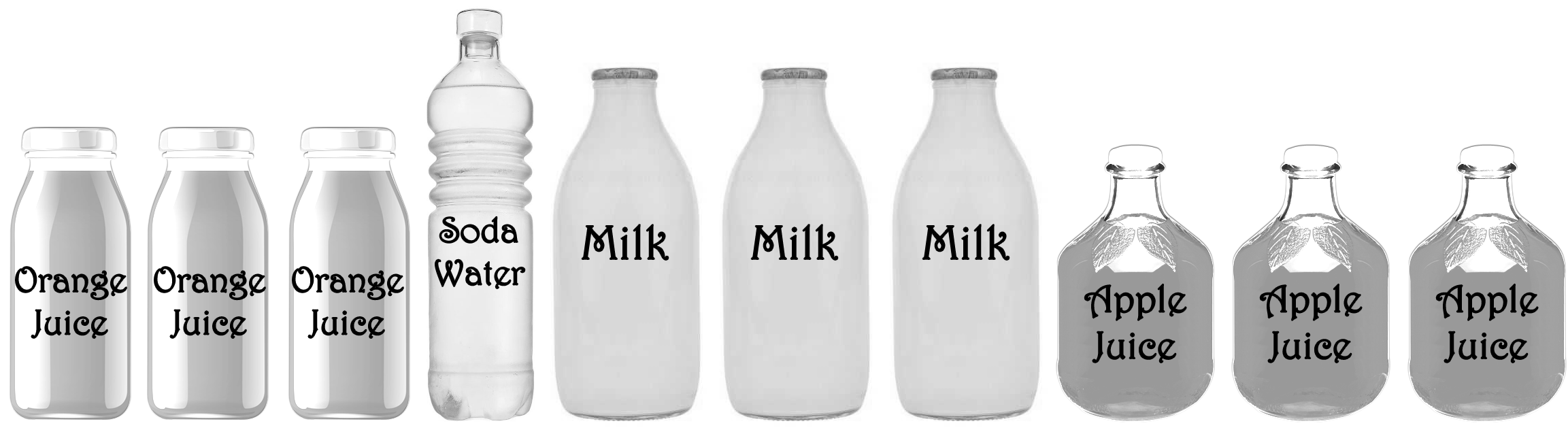
The bottles in Renee's fridge are pictured below.


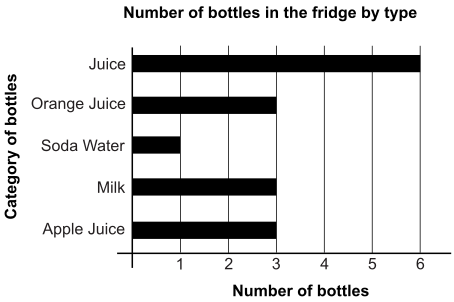
Renee decides to make a graph where each bar represents one type of bottle in her fridge.


Renee makes an error when creating the graph.

What should Renee do to correct the error?

 
Make each category bar a different colour.
 
Change the title to 'Number of bottles in the fridge by volume'.
 
Change the 'Number of bottles' label to 'Volume of bottles'.
 
Remove the 'Juice' category since orange juice and apple juice are already shown.
Show Answers Only

`text(Remove the ‘Juice’ category since orange juice and)`

`text(apple juice are already shown.)`

Show Worked Solution

`text(Remove the ‘Juice’ category since orange juice and)`

`text(apple juice are already shown.)`

Filed Under: Data and Interpretation, Data and Interpretation Tagged With: Band 5, smc-3136-20-Column graphs, smc-698-20-Column graphs

Statistics, NAP-J2-29

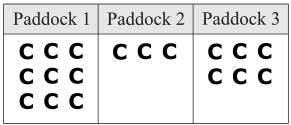
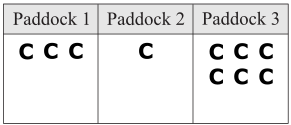
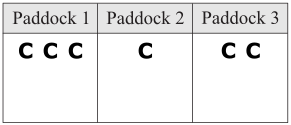
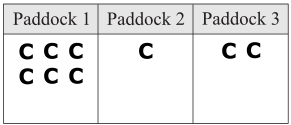
Ray counts the number of cows in three paddocks.

  • Paddock 1 has 9 cows.
  • Paddock 2 has 3 cows.
  • Paddock 3 has 6 cows.

In each picture graph below,  = 3 cows
Select the picture graph that shows the number of cows Ray counts.


Show Answers Only

Show Worked Solution
  `text(= 3 cows)`

Filed Under: Data and Interpretation, Data and Interpretation, Data and Interpretation Tagged With: Band 5, smc-3052-10-Picture graph, smc-3136-10-Picture graph, smc-698-10-Picture graph

Number and Algebra, NAP-J2-20

Jack turns on a tap and pours  `8/10`  of a litre into his bucket.


Which is another way to write  `8/10`  of a litre?

0.08 litre 0.8 litre 8 litre 80 litre


Show Answers Only

`text(0.8 litre)`

Show Worked Solution

`8/10\ \ text(litre) =\ text(0.8 litre)`

Filed Under: Fractions and Decimals, Fractions and Decimals, Fractions and Decimals Tagged With: Band 5, smc-3019-60-Fraction/decimal conversion, smc-3087-40-Decimal/percentage conversion, smc-691-40-Decimal/percentage conversion

Polynomials, EXT2 2018 HSC 16c

Let  `alpha, beta, gamma`  be the zeros of  `p(x) = x^3 + px + q`, where `p` and `q` are real and  `q != 0`.

  1.  Show that  `(beta - gamma)^2 = alpha^2 + (4q)/alpha`.  (2 marks)
  2.  By considering the constant term of a cubic equation with roots  `(alpha - beta)^2, (beta - gamma)^2` and `(gamma - alpha)^2`, or otherwise, show that
     
       `(alpha - beta)^2(beta - gamma)^2(gamma - alpha)^2 = −(27q^2 + 4p^3)`.  (3marks)
     
  3.  Deduce that if  `27q^2 + 4p^3 < 0`, then the equation  `p(x) = 0`  has 3 distinct real roots.  (2 marks)
Show Answers Only
  1. `text(See Worked Solutions)`
  2. `text(See Worked Solutions)`
  3. `text(See Worked Solutions)`
Show Worked Solution

i.   `p(x) = x^3 + px + q`

`alpha + beta + gamma = 0\ \ =>\ \ alpha = −beta – gamma`

♦ Mean mark 34%.
COMMENT: Solving from the RHS makes this proof much simpler.

`alphabetagamma = −q`

`alphabeta + betagamma + gammaalpha = p`

`text(Show)\ \ (beta – gamma)^2 = alpha^2 + (4q)/alpha`

`text(RHS)` `= (−beta – gamma)^2 + (4(−alphabetagamma))/alpha`
  `= beta^2 + 2betagamma + gamma^2 – 4betagamma`
  `= beta^2 – 2betagamma + gamma^2`
  `= (beta – gamma)^2`
  `=\ text(LHS)`


ii.    `(beta – gamma)^2` `= alpha^2 – (4q)/alpha`
    `= (alpha^3 – 4q)/alpha`
    `= ((alpha^3 + px + q) + 3q – palpha)/alpha`
    `= (3q – palpha)/alpha\ \ \ \ (alpha^3 + palpha + q = 0)`


`x` `= (3q – palpha)/alpha`
`alphax – palpha` `= 3q`
`alpha` `= (3q)/(x – p)`

 
`text(Substituting back into)\ p(x)`

♦♦♦ Mean mark 6%
COMMENT: This question produced just just the 4th lowest mean mark in a tough 2018 paper.

`((3q)/((x + p)))^3 + p((3q)/((x + p))) + q = 0`

`=> 27q^3 + 3pq(x + p)^2 + q(x + p)^3 = 0`

 
`text(Co-efficient of)\ x^3 = q`

`text(Constant term)` `= 27q^3 + 3p^3q + qp^3`
  `= 27q^3 + 4p^3q`


`:. (alpha – beta)^2(beta – gamma)^2(gamma – alpha)^2`

`= (−(27q^3 + 4p^3q))/q`

`= −(27q^2 + 4p^3)`


iii.   `text(If)\ \ 27q^2 + 4p^3 < 0`

♦♦♦ Mean mark 5%.

`=> (alpha – beta)^2(beta – gamma)^2(gamma – alpha)^2 > 0`
 

`text(If roots are not distinct, then)\ \ alpha = beta`

`=> (alpha – beta)^2(beta – gamma)^2(gamma – alpha)^2 = 0`

`:.\ text(By contradiction, roots are distinct.)`
 

`p(x)\ text(is a cubic.)`

`text(If roots are not all real, conjugate root theorem)`

`text(states there must be 2 complex roots.)`

`text(Let roots be:) \ \ alpha, baralpha\ \ text{(complex) and}\ \ beta\ \ text{(real)}`
 

`(alpha – beta)^2(beta – baralpha)^2(baralpha – alpha)^2`

`= [alphabeta – alphabaralpha – beta^2 + baralphabeta]^2(−2text{Im})^2`

`= [−alphabaralpha – beta^2 + beta(alpha + baralpha)]^2(−2text{Im})^2`

`=\ (text{real})^2(text{Im})^2`

`<0`
 

`:. text(By contradiction,)\ p(x)\ text(cannot have 2 complex roots.)`

`:. p(x) = 0\ \ text(has 3 real distinct roots.)`

Filed Under: Roots and Coefficients Tagged With: Band 5, Band 6

Proof, EXT2 P2 2018 HSC 16a

Use mathematical induction to prove that, for  `n >= 1`,

`x^((3^n)) - 1 = (x - 1)(x^2 + x + 1)(x^6 + x^3 + 1) … (x^((2 xx 3^(n - 1))) + x^((3^(n - 1))) + 1)`.  (3 marks)

--- 10 WORK AREA LINES (style=lined) ---

Show Answers Only

`text(See Worked Solutions)`

Show Worked Solution

`text(If)\ \ n = 1`

♦ Mean mark 51%.

`text(LHS) = x^3 – 1`

`text(RHS)` `=(x-1)(x^2+x+1)`  
  `=x^3+x^2+x-x^2-x-1`  
  `=x^3-1 = text(LHS)`  

 
`:.\ text(True for)\ n = 1`
 

`text(Assume true for)\ \ n = k`

`x^(3^k) – 1 = (x – 1)(x^2 + x + 1) … (x^(2 xx 3^(k – 1)) + x^(3^(k – 1)) + 1)`

 
`text(Prove true for)\ \ n = k + 1`

`text(i.e.)\ \ \ x^(3^(k + 1)) = underbrace{(x – 1)(x^2 + x + 1) …(x^(2 xx 3^(k – 1)) + x^(3^(k – 1)) + 1)}_{x^(3^k) – 1) (x^(2 xx 3^k) + x^(3^k) + 1)`

`x^(3^(k + 1)) – 1` `= (x^(3^k) – 1)(x^(2 xx 3^k) + x^(3^k) + 1)`
  `= x^(3 xx 3^k) + x^(2 xx 3^k) + x^(3^k) – x^(2 xx 3^k) – x^(3^k) – 1`
  `= x^(3^(k + 1)) – 1`

 
`=>\ text(True for)\ \ n = k + 1`

`:.\ text(S)text(ince true for)\ \ n = 1,\ text(by PMI, true for integral)\ \ n >= 1.`

Filed Under: Induction, Induction EXT2, P2 Induction (Ext2) Tagged With: Band 5, smc-1044-80-Other, smc-5115-80-Other

Proof, EXT2 P1 2018 HSC 15c

Let  `n`  be a positive integer and let  `x`  be a positive real number.

  1.  Show that  `x^n - 1 - n(x - 1) = (x - 1)(1 + x + x^2 + … + x^(n - 1) - n)`.  (1 mark)

    --- 3 WORK AREA LINES (style=lined) ---

  2.  Hence, show that  `x^n >= 1 + n(x - 1)`.  (2 marks)

    --- 5 WORK AREA LINES (style=lined) ---

  3.  Deduce that for positive real numbers `a` and `b`,
     
          `a^nb^(1-n)>=na + (1-n)b`  (2 marks)

    --- 3 WORK AREA LINES (style=lined) ---

Show Answers Only
  1. `text(See Worked Solutions)`
  2. `text(See Worked Solutions)`
  3. `text(See Worked Solutions)`
Show Worked Solution
i.    `text(RHS)` `= (x – 1)underbrace{(1 + x + x^2 + … + x^(n – 1) – n)}_{text(GP where)\ \ a = 1,\ r = x}`
    `= (x – 1) ((1(x^n – 1))/(x – 1) – n)`
    `= x^n – 1 – n(x – 1)`
    `=\ text(LHS)`


ii.   `text(Let)\ P(x) = (x – 1)(1 + x + x^2 + … + x^(n – 1) – n)`

♦♦♦ Mean mark 11%.

`text(If)\ \ x = 1, P(x) = 0`
 

`text(If)\ \ 0 < x < 1, \ (x – 1) < 0, \ (1 + x + x^2 + … + x^(n – 1) – n) < 0`

`=> P(x) > 0`
 

`text(If)\ \ x > 1, \ (x – 1) > 0, \ (1 + x + … + x^(n – 1) – n) > 0`

`=> P(x) > 0`
 

`x^n – 1 – n(x – 1) >= 0`

`:. x^n >= 1 + n(x – 1)`


iii.   `x^n >= 1 + n(x – 1)\ \ text(for)\ \ x ∈ R^+`

♦♦ Mean mark 23%.

`text(S)text(ince)\ a,b ∈ R^+`

`(a/b)^n` `>= 1 + n(a/b – 1)`
`(a^n)/(b^n) xx b` `>= b + na – nb,\ \ \ \ (b > 0)`
`a^n b^(1 – n)` `>= na + (1 – n)b`

Filed Under: Inequalities EXT2, Proof and Inequalities Tagged With: Band 4, Band 5, Band 6, smc-1208-60-Other Proofs, smc-1208-80-Geometric Series

Number and Algebra, NAP-K2-21

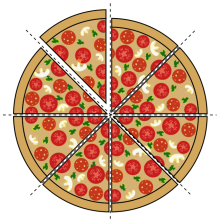
Luke cuts a pizza into 8 smaller pieces along the lines shown.


How many pieces are in one-quarter of the whole pizza?

1 2 4 8


Show Answers Only

`2`

Show Worked Solution
`text(Pieces in one quarter)` `= 1/4 xx text(total pieces)`
  `= 1/4 xx 8`
  `= 2`

Filed Under: Fractions and Decimals, Fractions and Decimals Tagged With: Band 5, smc-3087-30-Fraction word problems, smc-691-30-Fraction word problems

Number and Algebra, NAP-K2-16 SA

There are 48 students at an assembly.

Mr Lantry lines the students up so there are 8 students in each row.

How many rows are there?
 
Show Answers Only

`6`

Show Worked Solution
`text(Number of rows)` `= 48 ÷ 8`
  `= 6`

Filed Under: Solving Problems - Multiply/Divide, Solving problems - Multiply/Divide Tagged With: Band 5, smc-3085-20-Division, smc-922-20-Division

Harder Ext1 Topics, EXT2 2018 HSC 15a

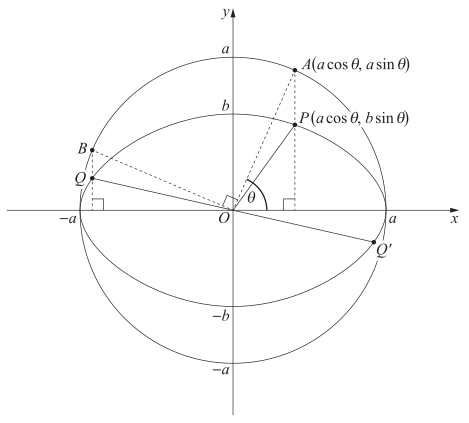
The point  `P(acostheta, bsintheta)`, where  `0 < theta < pi/2`, lies on the ellipse  `(x^2)/(a^2) + (y^2)/(b^2) = 1`, where ` a > b`. The point  `A(acostheta, asintheta)`  lies vertically above `P` on the auxiliary circle  `x^2 + y^2 = a^2`. The point `B` lies on the auxiliary circle such that  `angleAOB = pi/2`  and the point `Q` lies on the ellipse vertically below `B`, as shown.
 

  1. Show that `Q` has coordinates  `(−asintheta, bcostheta)`.  (2 marks)
     

The line `QO` meets the ellipse again at  `Qprime(asintheta, −bcostheta)`.   (Do NOT prove this.)

  1. Show that the minimum size of  `anglePOQprime`  is  `tan^(−1) ((2ab)/(a^2 - b^2))`.  (3 marks)
Show Answers Only
  1. `text(See Worked Solutions)`
  2. `text(See Worked Solutions)`
Show Worked Solution

i.   `x_Q = x_B`

`A(acostheta, asintheta)`
 

`text(S)text(ince)\ angleAOB = 90°,`

`=> x_B` `= acos(theta + pi/2)`
  `= −asintheta`

 
`text(Find)\ \ y_Q\ \ text(when)\ \ x = −asintheta`

`((−asintheta)^2)/(a^2) + (y^2)/(b^2) = 1`

`y^2` `= b^2(1 – sin^2theta)`
  `= b^2cos^2theta`
`=> y_Q` `= bcostheta\ \ \ \ (y > 0)`

 
`:.Q (−asintheta, bcostheta)\ \ …\ text(as required)`


ii.   `m_(OP) = (b sintheta)/(acostheta) = b/a tantheta`

♦ Mean mark 38%.


`m_(OQprime) = (−bcostheta)/(asintheta) = −b/a cottheta`
 

`tan anglePOQprime` `= |(m_1 – m_2)/(1 + m_1m_2)|`
  `= |(b/atantheta + b/acottheta)/(1 – b/atantheta b/acottheta)|`
  `= |(ab(tantheta + cottheta))/(a^2 – b^2(tanthetacottheta))|`
  `= |(ab)/(a^2 – b^2)| · |(sintheta)/(costheta) + (costheta)/(sintheta)|`
  `= |(ab)/(a^2 – b^2)| · |(sin^2theta + cos^2theta)/(sinthetacostheta)|`
  `= |(ab)/(a^2 – b^2)| · |2/(sin2theta)|`
  `= (ab)/(a^2 – b^2) · 2/(|sin2theta|)qquadtext{(given}\ \ a > b text{)}`


`=>\ text(Minimum angle when)\ tan anglePOQprime\ text(is a minimum.)`

`=>\ text(Minimum)\ \ (ab)/(a^2 – b^2) · 2/(|sin2theta|) = (2ab)/(a^2 – b^2) qquad (sin 2theta = 1)`
 

`:.\text(Minimum size of)\ anglePOQprime`

`= tan^(−1)((2ab)/(a^2 – b^2))`

Filed Under: Ellipse, Other Ext1 Topics Tagged With: Band 4, Band 5

Harder Ext1 Topics, EXT2 2018 HSC 14d

Three people, `A`, `B` and `C`, play a series of n games, where  `n ≥ 2`. In each of the games there is one winner and each of the players is equally likely to win.

  1.  What is the probability that player `A` wins every game?  (1 mark)
  2.  Show that the probability that `A` and `B` win at least one game each but `C` never wins, is
     
         `(2/3)^n - 2(1/3)^n`.  (1 mark)
     
  3.  Show that the probability that each player wins at least one game is 
     
         `(3^(n - 1) - 2^n + 1)/(3^(n - 1))`.  (2 marks)
Show Answers Only
  1. `(1/3)^n`
  2. `text(See Worked Solutions)`
  3. `text(See Worked Solutions)`
Show Worked Solution

i.   `text{Pr (A wins every game)} = (1/3)^n`


ii.   `text{Pr (C never wins)} = (2/3)^n`

♦ Mean mark 36%.

`text(If C never wins, only 2 scenarios occur where A or B)`

`text(don’t win at least 1 game)`

`→\ text(A wins all or B wins all.)`
 

`:.\ text{Pr (No C, A and B win at least 1 game)}`

`=\ text{Pr (No C) – Pr (A wins all) – Pr (B wins all)}`

`= (2/3)^n – 2(1/3)^n`


iii.   `=>\ text{A, B or C cannot win all games (part(i)).}`

♦♦♦ Mean mark 19%.

`=>\ text(A cannot lose all games, with B and C winning)`

`text{at least 1 each (part (ii)). Similarly for each player.}`
 

`:.\ text{Pr (each player wins at least 1 game)}`

`= 1 – 3(1/3)^n – 3[(2/3)^n – 2(1/3)^n]`

`= (3^n – 3 – 3 · 2^n + 6)/(3^n)`

`= (3^n – 3 · 2^n + 3)/(3^n)`

`= (3^(n – 1) – 2^n + 1)/(3^(n – 1))\ \ …\ text(as required.)`

Filed Under: Probability and The Binomial Tagged With: Band 3, Band 5, Band 6

Measurement, NAP-K2-15

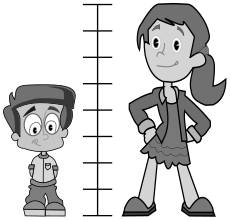
Ren is 160 centimetres tall.


About how tall is her little brother Matt?

80 centimetres 100 centimetres 120 centimetres 135 centimetres


Show Answers Only

`100\ text(centimetres)`

Show Worked Solution

`text(S) text(ince Ren is 160 cm, each mark) = 20\ text(cm)`
 

`:.\ text(Matt’s height)` `= 5 xx 20`
  `= 100\ text(cm)`

Filed Under: Units of Measurement, Units of Measurement, Units of Measurement Tagged With: Band 5, smc-3035-10-Scale measure, smc-3089-10-Scale measure, smc-919-10-Scale measure

Harder Ext1 Topics, EXT2 2018 HSC 13d

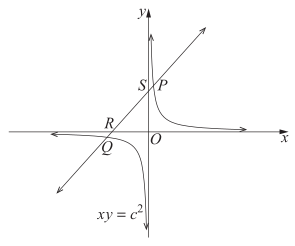
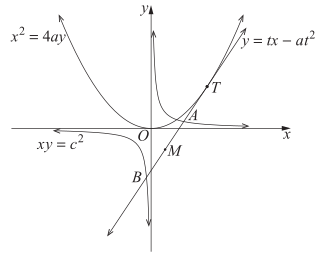
The points  `P(cp, c/p)`  and  `Q(cp, c/q)`  lie on the rectangular hyperbola  `xy = c^2`.

The line `PQ` has equation  `x + pqy = c(p + q)`. (Do NOT prove this.)

The `x` and `y` intercepts of `PQ` are `R` and `S` respectively, as shown in the diagram.


  1. Show that  `PS = QR`.  (3 marks)

The point  `T(2at, at^2)`  lies on the parabola  `x^2 = 4ay`. The tangent to the parabola at `T` intersects the rectangular hyperbola  `xy = c^2`  at `A` and `B` and has equation  `y = tx - at^2`. (Do NOT prove this.) The point `M` is the midpoint of the interval `AB`. One such case is shown in the diagram.
 

  1. Using part (i), or otherwise, show that `M` lies on the parabola  `2x^2 = −ay`.  (2 marks)
Show Answers Only
  1. `text(See Worked Solutions)`
  2. `text(See Worked Solutions)`
Show Worked Solution

i.   `P(cp, c/p)\ text(and)\ Q(cq, c/q)`

`PQ:\ \  x + pqy = c(p + q)`

 
`text(When)\ \ y = 0, x = c(p + q)`

`=> R(c(p + q), 0)`

`text(When)\ x = 0, y = (c(p + q))/(pq)`

`=> S(0, (c(p + q))/(pq))`
 

`text(Using Pythagoras:)`

`(PS)^2` `= (0 – cp)^2 + ((c(p + q))/(pq) – c/p)^2`
  `= c^2p^2 + (c/q + c/p – c/p)^2`
  `= c^2p^2 + (c^2)/(q^2)`


`(QR)^2` `= (cq – c(p + q))^2 + (c^2)/(q^2)`
  `= (cq – cp – cq)^2 + (c^2)/(q^2)`
  `= c^2p^2 + (c^2)/(q^2)`

 
`:. PS = QR\ \ \ text(… as required)`


ii.    `y = tx – at^2`

♦ Mean mark part (ii) 50%.

`=> xtext(-intercept at)\ \ R(at, 0)`

`=> ytext(-intercept at)\ \ S(0,−at^2)`
 

`text(S)text(ince)\ \ AR = BS\ \ \ (text{from part(i)})`

`M_(AB)` `= M_(RS)= ((at)/2, (−at^2)/2)“

 
`text(Find locus of)\ M:`

`x = (at)/2 \ => \ t = (2x)/a`

`y` `= (−at^2)/2`
  `= −a/2 xx ((2x)/a)^2`
  `= (−2x^2)/a`
`:. 2x^2` `= −ay\ \ \ text(… as required)`

Filed Under: Other Ext1 Topics Tagged With: Band 3, Band 5, page-break-before-question

Harder Ext1 Topics, EXT2 2018 HSC 08 MC

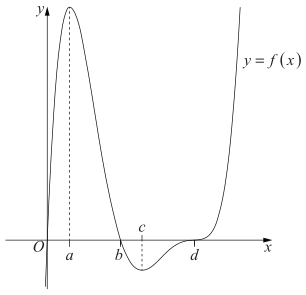
The diagram shows the graph of the curve  `y = f(x)`.


Let  `F(x) = int_0^x f(t)\ dt`.

At what value(s) of `x` does the concavity of the curve  `y = F(x)`  change?

  1. `d`
  2. `a, c`
  3. `b, d`
  4. `a, c, d`
Show Answers Only

`text(B)`

Show Worked Solution

`y = F(x)`

♦♦ Mean mark 34%.

`=> f(x)\ text(is the gradient function of)\ F(x)`
 

`text(1st condition for concavity change)`

`fprime(x) = 0`

`=>\ text(possibilities are)\ a, c\ text(and)\ d.`
 

`text(2nd condition:)\ (d^2y)/(dx^2)\ text(changes signs either side)`

`text(i.e. the gradient of)\ \ f(x)\ \ text(changes signs.)`

 
`text(From diagram, this occurs at)\ a\ text(and)\ c\ text(but not)\ d.`

`=>\ text(B)`

Filed Under: Other Ext1 Topics Tagged With: Band 5

Statistics, NAP-K2-14

Khloe is in Year 5. She wants to know the most popular sport for girls in Year 5.

First she asks 7 of her girl friends, but Khloe wants to ask more people.

Which of these would best help Khloe to know the most popular sport for Year 5 girls?

 
Ask all the girls in her school.
 
Ask all the boys and girls in her class.
 
Ask all the teachers in her school.
 
Ask all the girls in her class.
Show Answers Only

`text(Ask all the girls in her class.)`

Show Worked Solution

`text(The best data will come from asking Year 5 girls.)`

`:.\ text(She should ask all the girls in her class.)`

Filed Under: Data and Interpretation, Data and Interpretation Tagged With: Band 5, smc-3136-70-Collecting data, smc-698-70-Collecting data

Geometry, NAP-K2-13

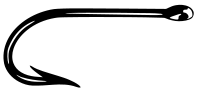
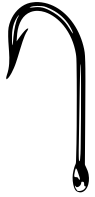
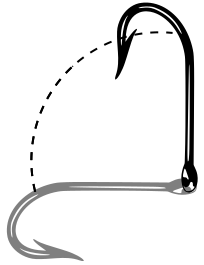
Jillian sticks a pin in a fishing hook.

She then rotates the fishing hook a quarter turn clockwise.


Which of the following shows Jillian's hook after the rotation?


Show Answers Only

Show Worked Solution

`90^@\ text(clockwise)`

Filed Under: Transformations and Symmetry, Transformations and symmetry, Transformations and Symmetry Tagged With: Band 5, smc-3122-20-Rotations, smc-3555-20-Rotations, smc-920-20-Rotations

Probability, NAP-K2-12

There are 10 balls, numbered from 1 to 10, in a basket.

Five balls are taken out of the basket, one at a time, and not replaced.

The first ball taken out is number 4.

Which of the following cannot happen?

 
The second ball is odd.
 
The third ball is even.
 
The fourth ball is 7.
 
The fifth ball is 4.
Show Answers Only

`text(The fifth ball is 4)`

Show Worked Solution

`text(Once number 4 is drawn, it cannot be taken)`

`text{out again (no replacement).}`

`:.\ text(The fifth ball cannot be 4.)`

Filed Under: Chance, Chance Tagged With: Band 5, smc-3137-20-Selection, smc-699-20-Selection

Number and Algebra, NAP-K2-08

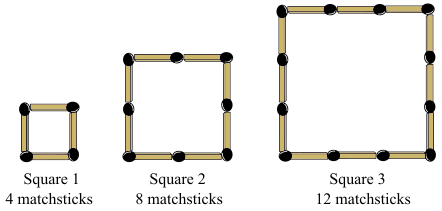
Oliver is using matchsticks to make a pattern of squares.


How many matchsticks will Oliver need to make square 5?

5 16 20 24


Show Answers Only

`20`

Show Worked Solution

`text(Pattern 1 = 4)`

`text(Pattern 2 = 8)`

`text(Pattern 3 = 12)`

`=> 4\ text(matchsticks are added each square)`
 

`:.\ text(Square 5)\ =5 xx 4 = 20\ text(matchsticks)`

Filed Under: Patterns, Patterns, Patterns Tagged With: Band 5, smc-3021-20-Patterns and images, smc-3088-20-Patterns and images, smc-692-20-Patterns and images

Number and Algebra, NAP-K2-3 SA

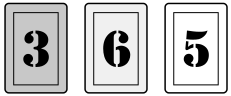
What is the largest number that can be made using two of these cards?


Write the number in the box below.

Show Answers Only

`65`

Show Worked Solution

`65`

Filed Under: Number and Place, Number and Place Value Tagged With: Band 5, smc-3083-60-Place value, smc-690-60-Place value

Integration, 2UA 2018 HSC 15c

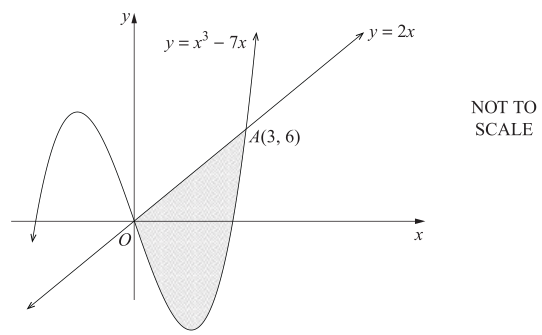
The shaded region is enclosed by the curve  `y = x^3 - 7x`  and the line  `y = 2x`, as shown in the diagram. The line  `y = 2x`  meets the curve  `y = x^3 - 7x`  at  `O(0, 0)`  and  `A(3, 6)`. Do NOT prove this.


  1. Use integration to find the area of the shaded region.  (2 marks)
  2. Verify that one application of Simpson’s rule gives the exact area of the shaded region.  (2 marks)
     
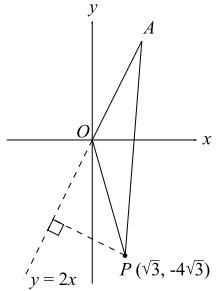
  3. The point `P` is chosen on the curve  `y = x^3 − 7x`  so that the tangent at `P` is parallel to the line  `y = 2x`  and the `x`-coordinate of `P` is positive.
     
  4. Show that the coordinates of `P` are  `(sqrt 3, -4 sqrt 3)`.  (2 marks)
  5. Find the area of  `Delta OAP`.  (2 marks)
Show Answers Only
  1. `81/4\ text(units²)`

  2. `text(Proof)\ \ text{(See Worked Solutions)}`
  3. `text(Proof)\ \ text{(See Worked Solutions)}`
  4. `9 sqrt 3\ text(units²)`
Show Worked Solution
(i)   `text(Area)` `= int_0^3 2x – (x^3 – 7x)\ dx`
    `= int_0^3 9x – x^3\ dx`
    `= [9/2 x^2 – 1/4 x^4]_0^3`
    `= [(9/2 xx 3^2 – 1/4 xx 3^4) – 0]`
    `= 81/2 – 81/4`
    `= 81/4\ text(units²)`


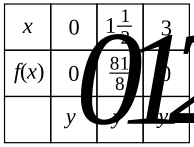
(ii)  `text(Using Simpson’s rule)`

♦ Mean mark 45%.

`y = 9x – x^3`
 

`text(A)` `~~ h/3 (y_0 + 4y_1 + y_2)`
  `= 3/6 (0 + 4 xx 81/8 + 0)`
  `= 1/2 (81/2)`
  `= 81/4\ text( … as required)`


(iii)   `y = x^3 – 7x`

`(dy)/(dx) = 3x^2 – 7`

`text(Find)\ \ x\ \ text(such that)\ \ (dy)/(dx) = 2`

`3x^2 – 7` `= 2`
`3x^2` `= 9`
`x^2` `= 3`
`x` `= sqrt 3 qquad (x > 0)`


`y` `= (sqrt 3)^3 – 7 sqrt 3`
  `= 3 sqrt 3 – 7 sqrt 3`
  `= -4 sqrt 3`

 
`:. P\ \ text(has coordinates)\ (sqrt 3, -4 sqrt 3)`


(iv)  


`text(dist)\ OA` `= sqrt((3 – 0)^2 + (6 – 0)^2)`
  `= sqrt 45`
  `= 3 sqrt 5`

 
`text(Find)\ _|_\ text(distance of)\ \ P\ \ text(from)\ \ OA`

♦♦ Mean mark 27%.

`P(sqrt 3, -4 sqrt 3),\ \ 2x – y=0`

`_|_\ text(dist)` `= |(2 sqrt 3 + 4 sqrt 3)/sqrt (3 + 2)|`
  `= (6 sqrt 3)/sqrt 5`
   
`:.\ text(Area)` `= 1/2 xx 3 sqrt 5 xx (6 sqrt 3)/sqrt 5`
  `= 9 sqrt 3\ text(units²)`

Filed Under: 6. Linear Functions, Areas Under Curves, Trapezoidal and Simpson's Rule Tagged With: Band 4, Band 5

Financial Maths, 2ADV M1 2018 HSC 16c

Kara deposits an amount of $300 000 into an account which pays compound interest of 4% per annum, added to the account at the end of each year. Immediately after the interest is added, Kara makes a withdrawal for expenses for the coming year. The first withdrawal is `$P`. Each subsequent withdrawal is 5% greater than the previous one.

Let  `$A_n`  be the amount in the account after the `n`th withdrawal.

  1. Show that  `A_2 = 300\ 000(1.04)^2 - P[(1.04) + (1.05)]`.  (1 mark)

    --- 2 WORK AREA LINES (style=lined) ---

  2. Show that  `A_3 = 300\ 000 (1.04)^3 - P[(1.04)^2 + (1.04)(1.05) + (1.05)^2]`.  (1 mark)

    --- 2 WORK AREA LINES (style=lined) ---

  3. Show that there will be money in the account when
     
    `qquad (105/104)^n < 1 + 3000/P`  (3 marks)

    --- 6 WORK AREA LINES (style=lined) ---

Show Answers Only
  1. `text(Proof)\ \ text{(See Worked Solutions)}`
  2. `text(Proof)\ \ text{(See Worked Solutions)}`
  3. `text(Proof)\ \ text{(See Worked Solutions)}`
Show Worked Solution

♦ Mean mark 47%.

i.   `A_1` `= 300\ 000 (1.04) – P`
  `A_2` `= [300\ 000 (1.04) – P](1.04) – P(1.05)`
    `= 300\ 000 (1.04)^2 – P(1.04) – P(1.05)`
    `= 300\ 000 (1.04)^2 – P[1.04 + 1.05]`


♦ Mean mark part (ii) 30%.

ii.   `A_3` `= [300\ 000 (1.04)^2 – P(1.04 + 1.05)](1.04) – P(1.05)^2`
    `= 300\ 000 (1.04)^3 – P(1.04)^2 – P(1.04)(1.05) – P(1.05)^3`
    `= 300\ 000 (1.04)^3 – P[(1.04)^2 + P(1.04)(1.05) + (1.05)^2]`


iii.   `A_4` `= 300\ 000 (1.04)^4 – P[(1.04)^3 + (1.04)^2(1.05) + … + (1.05)^3]`
    `vdots`
  `A_n` `= 300\ 000 (1.04)^n`
    `- P underbrace{[(1.04)^(n-1) + (1.04)^(n-2) (1.05) + … + (1.04)(1.05)^(n-2) + (1.05)^(n-1)]}_{text(GP),\ a = (1.04)^(n-1),\ r = 1.05/1.04}`

 
`text(Money in account when)\ \ A_n > 0:`

♦♦♦ Mean mark part (iii) 8%.

`(300\ 000(1.04)^n)/P` `> (1.04)^(n-1)[((1.05/1.04)^n-1)/((1.05/1.04)-1)]`
`(300\ 000)/P` `> 1/1.04 [((1.05/1.04)^n-1)/((1.05/1.04)-1)]`
`(300\ 000)/P` `> ((1.05/1.04)^n – 1)/(1.05 – 1.04)`
`3000/P` `> (1.05/1.04)^n – 1`
`3000/P + 1` `> (105/104)^n qquad (text{s}text{ince}\ \ (1.05/1.04)^n = (105/104)^n)`

Filed Under: Compound interest, loan repayments and annuities, Financial Applications of Series (Y12) Tagged With: Band 5, Band 6, smc-1007-30-Annuity/Deposit - Withdrawal Phase

Probability, 2ADV S1 2018 HSC 16b

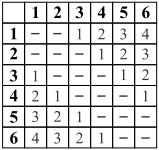
A game involves rolling two six-sided dice, followed by rolling a third six-sided die. To win the game, the number rolled on the third die must lie between the two numbers rolled previously. For example, if the first two dice show 1 and 4, the game can only be won by rolling a 2 or 3 with the third die.

  1. What is the probability that a player has no chance of winning before rolling the third die?   (2 marks)

    --- 8 WORK AREA LINES (style=lined) ---

  2. What is the probability that a player wins the game?   (2 marks)

    --- 4 WORK AREA LINES (style=lined) ---

Show Answers Only
  1. `4/9`
  2. `5/27`
Show Worked Solution

i.   `text(Construct a sample space of the number)`

♦ Mean mark 40%.
COMMENT: Constructing the full sample space is a critical step here..

`text(of possible winning rolls:)`
 

`text{P(no chance)}` `= text(number of pairs with no gap)/text(total possibilities)`
  `= 16/36`
  `= 4/9`


ii.   `text(The sample space in the table shows:)`

♦♦♦ Mean mark 7%.

`text(→ 8 combinations leave a gap for a single winning number,)`

`text(→ 6 combinations leave a gap for two winning numbers,)`

`vdots`

`:.\ text{P(winning)}` `= 1/36 [8 xx 1/6 + 6 xx 2/6 + 4 xx 3/6 + 2 xx 4/6]`
  `= 1/36 (8/6 + 12/6 + 12/6 + 8/6)`
  `= 1/36 (40/6)`
  `= 5/27`

Filed Under: 3. Probability, Multi-Stage Events (Adv-2027), Multi-Stage Events (Y11) Tagged With: Band 5, Band 6, smc-6469-40-Arrays, smc-989-40-Arrays

Calculus, 2ADV C3 2018 HSC 16a

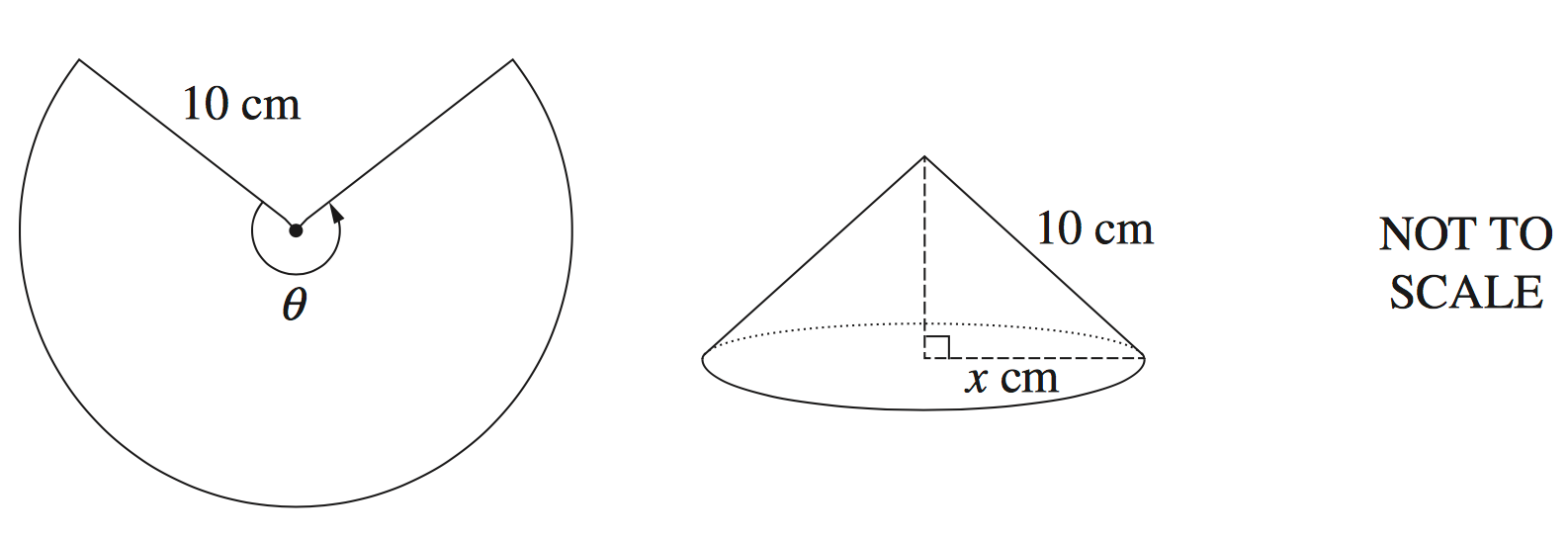
A sector with radius 10 cm and angle  `theta`  is used to form the curved surface of a cone with base radius `x` cm, as shown in the diagram.


The volume of a cone of radius `r` and height `h` is given by  `V = 1/3 pi r^2 h`.

  1. Show that the volume, `V` cm³, of the cone described above is given by
     
          `V = 1/3 pi x^2 sqrt(100-x^2)`.   (1 mark)

    --- 2 WORK AREA LINES (style=lined) ---

  2. Show that  `(dV)/(dx) = (pi x (200-3x^2))/(3 sqrt(100-x^2))`.   (2 marks)

    --- 5 WORK AREA LINES (style=lined) ---

  3. Find the exact value of  `theta`  for which `V` is a maximum.   (3 marks)

    --- 7 WORK AREA LINES (style=lined) ---

Show Answers Only
  1. `text(Proof)\ \ text{(See Worked Solutions)}`
  2. `text(Proof)\ \ text{(See Worked Solutions)}`
  3. `(2 sqrt 2 pi)/sqrt 3`
Show Worked Solution

i.   `V = 1/3 pi r^2 h`

`text(Using Pythagoras,)`

`h = sqrt(100-x^2)`

`r = x`

`:.\ text(Volume) = 1/3 pi x^2 sqrt(100-x^2)`
 

♦ Mean mark (ii) 45%.

ii.   `V` `= 1/3 pi x^2 sqrt(100-x^2)`
  `(dV)/(dh)` `= 1/3 pi [2x ⋅ sqrt(100-x^2)-2x ⋅ 1/2 (100-x^2)^(-1/2) ⋅ x^2]`
    `= 1/3 pi [(2x (100-x^2)-x^3)/sqrt(100-x^2)]`
    `= 1/3 pi [(200 x-2x^3-x^3)/sqrt(100-x^2)]`
    `= (pi x(200-3x^2))/(3 sqrt (100-x^2))\ \ text{.. as required}`


iii.  `text(Find)\ \ x\ \ text(when)\ \ (dV)/(dx) = 0`

♦♦ Mean mark (iii) 23%.

`200-3x^2` `= 0`
`x` `= sqrt(200/3)`

 
`text(When)\ \ x < sqrt(200/3),\ (200-3x^2) > 0`

`=> (dV)/(dx) > 0`

`text(When)\ \ x > sqrt(200/3),\ (200-3x^2) < 0`

`=> (dV)/(dx) < 0`

`:.\ text(MAX when)\ \ x = sqrt(200/3)`
 

`text(Equating the arc length of the section)`

`text(to the circumference of the cone:)`

`2 pi r ⋅ theta/(2 pi)` `= 2 pi ⋅ x`
`10 theta` `= 2 pi sqrt (200/3)`
`:. theta` `= (2 pi ⋅ 10 sqrt 2)/(10 ⋅ sqrt 3)`
  `= (2 sqrt 2 pi)/sqrt 3`

Filed Under: Maxima and Minima, Maxima and Minima (Y12) Tagged With: Band 4, Band 5, smc-970-20-Volume - Cone

Trigonometry, 2ADV T3 2018 HSC 15a

The length of daylight, `L(t)`, is defined as the number of hours from sunrise to sunset, and can be modelled by the equation

`L(t) = 12 + 2 cos ((2 pi t)/366)`,

where `t` is the number of days after 21 December 2015, for  `0 ≤ t ≤ 366`.

  1. Find the length of daylight on 21 December 2015.   (1 mark)

    --- 1 WORK AREA LINES (style=lined) ---

  2. What is the shortest length of daylight?  (1 mark)

    --- 1 WORK AREA LINES (style=lined) ---

  3. What are the two values of  `t`  for which the length of daylight is 11?  (2 marks)

    --- 4 WORK AREA LINES (style=lined) ---

Show Answers Only
  1. `14\ text(hours)`
  2. `10\ text(hours)`
  3. `t = 122 or 244`
Show Worked Solution

i.   `L(t) = 12 + 2 cos ((2 pi t)/366)`

`text(On 21 Dec 2015) => t = 0`

`:. L(0)` `= 12 + 2 cos 0`
  `= 14\ text(hours)`


ii.   `text(Shortest length of daylight occurs when)`

♦ Mean mark 43%.

`cos ((2 pi t)/366) = -1`
 

`:.\ text(Shortest length)` `= 12 + 2 (-1)`
  `= 10\ text(hours)`


iii.   `text(Find)\ \ t\ \ text(such that)\ \ L(t) = 11:`

`11 = 12 + 2 cos ((2 pi t)/366)`

`cos ((2 pi t)/366) = -1/2`
 

`(2 pi t)/366` `= (2 pi)/3` `qquad\ \ text(or)`     `(2 pi t)/366` `= (4 pi)/3`
`t` `= 366/3`   `t` `= (366 xx 2)/3`
  `= 122`     `= 244`

 
`:. t = 122 or 244`

Filed Under: Exact Trig Ratios and Other Identities, Trig Applications (Y12) Tagged With: Band 3, Band 4, Band 5, smc-1188-30-Other Applications

Probability, 2ADV S1 2018 HSC 14e

Two machines, `A` and `B`, produce pens. It is known that 10% of the pens produced by machine `A` are faulty and that 5% of the pens produced by machine `B` are faulty.

  1. One pen is chosen at random from each machine.


    What is the probability that at least one of the pens is faulty?  (1 mark)

    --- 2 WORK AREA LINES (style=lined) ---

  2. A coin is tossed to select one of the two machines. Two pens are chosen at random from the selected machine.


    What is the probability that neither pen is faulty?  (2 marks)

    --- 4 WORK AREA LINES (style=lined) ---

Show Answers Only
  1. `0.145`
  2. `0.85625`
Show Worked Solution
i.   `text{P(at least 1 faulty)}` `= 1 –  text{P(both faulty)}`
    `= 1 – 0.9 xx 0.95`
    `= 1 – 0.855`
    `= 0.145`


ii.   `text{P(2 non-faulty pens})`

♦ Mean mark 48%.

`= text{(choose A, NF, NF)} + P text{(choose B, NF, NF)}`

`= 1/2 xx 0.9 xx 0.9 + 1/2 xx 0.95 xx 0.95`

`= 0.405 + 0.45125`

`=0.85625`

Filed Under: 3. Probability, Multi-Stage Events (Adv-2027), Multi-Stage Events (Y11) Tagged With: Band 4, Band 5, smc-6469-20-Other Multi-Stage Events, smc-6469-30-Complementary Probability, smc-989-20-Other Multi-Stage Events, smc-989-30-Complementary Probability

Financial Maths, 2ADV M1 2018 HSC 14d

An artist posted a song online. Each day there were  `2^n + n`  downloads, where `n` is the number of days after the song was posted.

  1. Find the number of downloads on each of the first 3 days after the song was posted.  (1 mark)

    --- 1 WORK AREA LINES (style=lined) ---

  2. What is the total number of times the song was downloaded in the first 20 days after it was posted?  (2 marks)

    --- 4 WORK AREA LINES (style=lined) ---

Show Answers Only
  1. `text(Day 1) : 3`
    `text(Day 2) : 6`
    `text(Day 3) : 11`

  2. `2\ 097\ 360`
Show Worked Solution

i.   `text(Day 1:)\ \ 2^1 + 1 = 3`

`text(Day 2:)\ \ 2^2 + 2 = 6`

`text(Day 3:)\ \ 2^3 + 3 = 11`


ii.  `text{Total downloads (20 days)}`

♦ Mean mark 38%.

`= 2^1 + 1 + 2^2 + 2 + … + 2^20 + 20`

`= underbrace(2^1 + 2^2 + … + 2^20)_{text(GP),\ a = 2,\ r=2} + underbrace(1 + 2 + … + 20)_{text(AP),\ a = 1,\ d = 1}`

`= (2(2^20 – 1))/(2 – 1) + 20/2(1 + 20)`

`= 2\ 097\ 150 + 210`

`= 2\ 097\ 360`

Filed Under: Arithmetic Series, Arithmetic Series (Y12), Geometric Series, Geometric Series (Y12) Tagged With: Band 3, Band 5, smc-1005-10-Find Term, smc-1005-20-Find Sum, smc-1005-40-AP/GP Combination, smc-1006-10-Find Term, smc-1006-20-Find Sum, smc-1006-50-AP/GP Combination

Calculus, 2ADV C3 2018 HSC 14c

Let  `f(x) = x^3 + kx^2 + 3x - 5`, where `k` is a constant.

Find the values of `k` for which  `f(x)`  has NO stationary points.  (3 marks)

--- 6 WORK AREA LINES (style=lined) ---

Show Answers Only

`-3 < k < 3`

Show Worked Solution

`f(x) = x^3 + kx^2 + 3x – 5`

♦ Mean mark 49%.

`f prime(x) = 3x^2 + 2kx + 3`
 

`text(No S.P.’s exist if)\ \ f prime(x)\ \ text(has no roots,)`

`Delta` `< 0`
`b^2 – 4ac` `< 0`
`(2k)^2 – 4 xx 3 xx 3` `< 0`
`4k^2 – 36` `< 0`
`k^2 – 9` `< 0`
`(k – 3) (k + 3)` `< 0`


`:. -3 < k < 3`

Filed Under: Curve Sketching and The Primitive Function, The Derivative Function and its Graph (Y12) Tagged With: Band 5, smc-1089-49-No SPs

Trigonometry, 2ADV T1 2018 HSC 14a

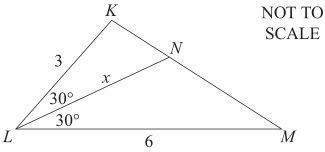
In  `Delta KLM, KL`  has length 3, `LM` has length 6 and `/_KLM` is 60°. The point `N` is chosen on side  `KM`  so that  `LN`  bisects `/_KLM`. The length  `LN`  is `x`.


  1. Find the exact value of the area of  `Delta KLM`.  (1 mark)

    --- 2 WORK AREA LINES (style=lined) ---

  2. Hence, or otherwise, find the exact value of `x`.  (2 marks)

    --- 5 WORK AREA LINES (style=lined) ---

Show Answers Only
  1. `(9 sqrt 3)/2`
  2. `2 sqrt 3`
Show Worked Solution

i.   `text(Using sine rule:)`

`text(Area)\ \ Delta KLM` `= 1/2 xx 3 xx 6 xx sin 60^@`
  `= (9 sqrt 3)/2\ \ text(u²)`


ii.  `text(Area)\ \ Delta KLN + text(Area)\ \ Delta NLM = text(Area)\ \ Delta KLM`

`1/2 xx 3 xx x xx sin 30^@ + 1/2 xx x xx 6 xx sin 30^@ = (9 sqrt 3)/2`

♦ Mean mark 37%.

`3/4 x + 3/2 x` `= (9 sqrt 3)/2`
`9/4 x` `= (9 sqrt 3)/2`
`:. x` `= (9 sqrt 3)/2 xx 4/9`
  `= 2 sqrt 3`

Filed Under: Sine and Cosine Rules, Bearings, Trig Ratios, Sine and Cosine Rules (Adv-2027), Trig Ratios, Sine and Cosine Rules (Y11) Tagged With: Band 4, Band 5, smc-6392-30-Sine Rule, smc-980-30-Sine Rule

Probability, 2UG 2018 HSC 30d

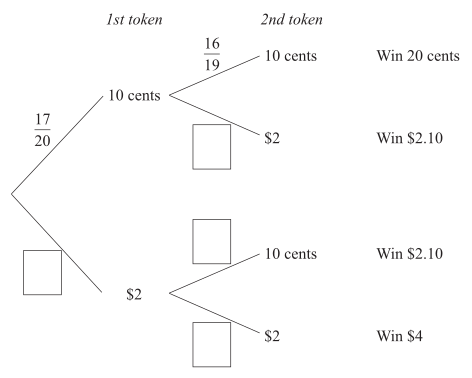
A game consists of two tokens being drawn at random from a barrel containing 20 tokens. There are 17 tokens labelled 10 cents and 3 tokens labelled $2. The player wins the total value of the two tokens drawn.

  1. Complete the probability tree by writing the missing probabilities in the boxes.  (2 marks)


  2. Considering that the game costs $1 to play, calculate the financial expectation of the game.  (3 marks)
Show Answers Only
  1.  
  2. `−$0.23\ \ (text(or $0.23 loss))`
Show Worked Solution
i.   


ii.   `text(Expectated Gain/Loss)`

♦♦ Mean mark part (ii) 27%.
COMMENT: Financial expectation included here (one example only in database) as it is possible to argue that it is an application of expectation.

`= [17/20 xx 16/19 xx 0.20 + 17/20 xx 3/19 xx 2.1`

`+ 3/20 + 17/19 xx 2.1 + 3/20 xx 2/19 xx 4] – 1`

`= 0.77 – 1`

`= −$0.23\ \ (text(or $0.23 loss))`

Filed Under: Uncategorized Tagged With: Band 4, Band 5

Measurement, STD2 M6 2018 HSC 30c

The diagram shows two triangles.

Triangle `ABC` is right-angled, with  `AB = 13 text(cm)`  and  `/_ABC = 62°`.

In triangle  `ACD, \ AD = x\ text(cm)`  and  `/_DAC = 40°`. The area of triangle  `ACD`  is 30 cm².


What is the value of `x`, correct to one decimal place?  (3 marks)

--- 6 WORK AREA LINES (style=lined) ---

Show Answers Only

`8.1\ text{cm  (1 d.p.)}`

Show Worked Solution

`text(Find)\ AC:`

♦ Mean mark 39%.

`sin62°` `= (AC)/13`
`AC` `= 13 xx sin62°`
  `= 11.478…`

 
`text(Using the sine rule in)\ DeltaACD :`

`text(Area)` `= 1/2 xx AC xx AD xx sin40°`
`30` `= 1/2 xx 11.478… xx x xx sin40°`
`:.x` `= (30 xx 2)/(11.478… xx sin40°)`
  `= 8.13…`
  `= 8.1\ text{cm  (1 d.p.)}`

Filed Under: Non Right-Angled Trig, Non-Right Angled Trig (Std2) Tagged With: Band 5, num-title-ct-pathc, num-title-qs-hsc, smc-4553-30-Sine Rule (Area), smc-804-30-Sine Rule (Area), smc-804-40-2-Triangle

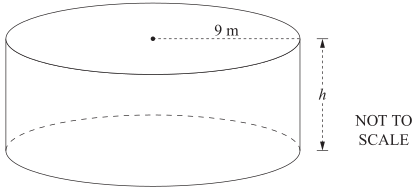
Measurement, STD2 M1 2018 HSC 30a

A cylindrical water tank has a radius of 9 metres and a capacity of 1.26 megalitres.
 

What is the height of the water tank? Give your answer in metres, correct to two decimal places.  (3 marks)

--- 6 WORK AREA LINES (style=lined) ---

Show Answers Only

`4.95\ text{m}`

Show Worked Solution

`text{Converting megalitres to m³  (using 1 m³ = 1000 L):}`

♦ Mean mark 48%.

`1.26\ text(ML)` `= (1.26 xx 10^6)/(10^3)`
  `= 1.26 xx 10^3\ text(m)^3`
  `= 1260\ text(m)^3`


`V` `= pir^2h`
`1260` `= pi xx 9^2 xx h`
`h` `= 1260/(pi xx 9^2)`
  `= 4.951…`
  `= 4.95\ text{m  (2 d.p.)}`

Filed Under: Perimeter, Area and Volume (Std 2), Volume, Volume, Mass and Capacity (Std2-2027) Tagged With: Band 5, num-title-ct-corea, num-title-qs-hsc, smc-4235-20-Cylinders, smc-4235-80-Capacity in litres, smc-6304-50-Volume (Circular Measure), smc-798-50-Volume (Circular Measure)

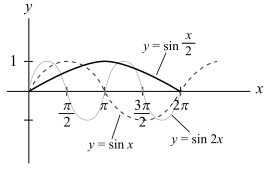
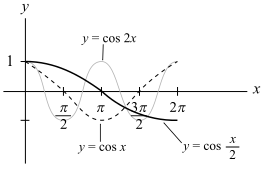
Calculus, 2ADV C4 2018 HSC 10 MC

A trigonometric function  `f(x)`  satisfies the condition
 

`int_0^pi f(x)\ dx != int_pi^(2pi) f(x)\ dx.`

 
Which function could be  `f(x)`?

  1. `f(x) = sin (2x)`
  2. `f(x) = cos (2x)`
  3. `f(x) = sin (x/2)`
  4. `f(x) = cos (x/2)`
Show Answers Only

`D`

Show Worked Solution

`text(Consider options A and C)`

 
`text(Consider options B and D)`


`text(When)\ \ y = cos\ x/2 ,`

`int_0^pi f(x)\ dx != int_pi^(2 pi) f(x)\ dx`

`=>  D`

Filed Under: Areas Under Curves (Y12) Tagged With: Band 5, smc-975-50-Trig

Calculus, 2ADV C3 2018 HSC 9 MC

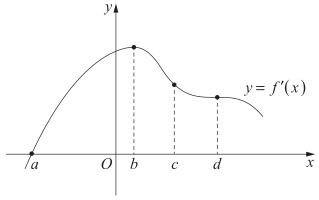
The diagram shows the graph of  `f^{′}(x)`, the derivative of a function.
 

For what value of `x` does the graph of the function  `f(x)`  have a point of inflection?

  1. `x = a`
  2. `x = b`
  3. `x = c`
  4. `x = d`
Show Answers Only

`B`

Show Worked Solution

`text(P.I. will occur when the graph of)\ \ f^{′}(x)`

♦ Mean mark 41%.

`text(has a turning point).`

`:. x = b`

`=>  B`

Filed Under: Curve Sketching and The Primitive Function, The Derivative Function and its Graph (Y12) Tagged With: Band 5, smc-1089-40-Investigate Graph Shapes

Algebra, STD2 A4 2018 HSC 29c

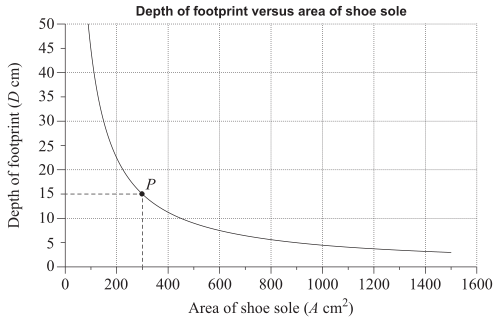
When people walk in snow, the depth (`D` cm) of each footprint depends on both the area (`A` cm²) of the shoe sole and the weight of the person. The graph shows the relationship between the area of the shoe sole and the depth of the footprint in snow, for a group of people of the same weight.


  1. The graph is a hyperbola because `D` is inversely proportional to `A`. The point `P` lies on the hyperbola.


    Find the equation relating `D` and `A`.  (2 marks)

    --- 4 WORK AREA LINES (style=lined) ---

  2. A man from this group walks in snow and the depth of his footprint is 4 cm.


    Use your equation from part (i) to calculate the area of his shoe sole.  (1 mark)

    --- 1 WORK AREA LINES (style=lined) ---

Show Answers Only
  1. `D = 4500/A`
  2. `1125\ text(cm²)`
Show Worked Solution

i.     `D prop 1/A \ =>\ D = k/A`

♦♦ Mean mark part (i) 22%.


`text(When)\ D = 15, A = 300`

`15` `= k/300`
`k` `= 4500`
`:. D` `=4500/A`


♦♦ Mean mark part (ii) 33%.

ii.    `4` `= 4500/A`
  `:. A` `= 4500/4`
    `= 1125\ text(cm²)`

Filed Under: Non-Linear: Inverse and Other Problems (Std 2) Tagged With: Band 5, smc-795-10-Inverse, smc-795-40-Proportional

Algebra, STD2 A1 2018 HSC 28e

Sophie is driving at 70 km/h. She notices a branch on the road ahead and decides to apply the brakes. Her reaction time is 1.5 seconds. Her braking distance (`D` metres) is given by  `D = 0.01v^2`, where  `v ` is speed in km/h.

Stopping distance can be calculated using the following formula
 

`text(stopping distance = {reaction time distance} + {braking distance})`
 

What is Sophie’s stopping distance, to the nearest metre?  (3 marks)

--- 6 WORK AREA LINES (style=lined) ---

Show Answers Only

`78\ text{m  (nearest m)}`

Show Worked Solution
`text(70 km/hr)` `= 70\ 000\ text(m/hr)`
  `= (70\ 000)/(60 xx 60)\ text(m/sec)`
  `= 19.44…\ text(m/sec)`


`:.\ text(Total stopping distance)`

♦ Mean mark 46%.

`=\ text(reaction time distance + braking distance)`

`= 1.5 xx 19.44… + 0.01 xx 70^2`

`= 78.166…`

`= 78\ text{m  (nearest m)}`

Filed Under: Applications: BAC, Medication and D=SxT (Std 2), Applications: BAC, Medicine and D=SxT (Std2-2027), Applications: D=SxT and Other (Std 1) Tagged With: Band 5, smc-1117-40-Stopping Distance, smc-6235-40-Stopping Distance, smc-791-40-Stopping Distance

Financial Maths, STD2 F4 2018* HSC 28d

Yanika opens a new credit card account, with interest and fees as shown.
 

Interest

    • Compound interest calculated daily at the rate 12.41% p.a.
    • No interest-free period

Fees

    • $0 for online repayments
    • $3 for repayments in cash (fee added to balance immediately after repayment)
        

Yanika makes a single purchase of $849 with the credit card.

  1. Show that the balance owing on the credit card 24 days after making the purchase is $855.95 .  (2 marks)

    --- 4 WORK AREA LINES (style=lined) ---

  2. Yanika makes her first repayment 24 days after making the purchase. She makes a cash repayment of $450.


    What is the balance owing on the credit card immediately after her repayment is made and the repayment fee has been charged?  (1 mark)

    --- 1 WORK AREA LINES (style=lined) ---

Show Answers Only
  1. `text(See Worked Solutions)`
  2. `$408.95`
Show Worked Solution

i.   `text(Days of interest)\ (n) = 24`

♦ Mean mark part (i) 48%, part (ii) 49%.

`text(Daily interest rate)\ (r) = 0.1241/365 = 0.00034`

`text(Balance Owing)\ (FV)` `= PV(1+r)^n`
  `= 849(1.00034)^24`
  `= 855.954…`
  `=$855.95\ \ text{(nearest cent)}`


ii.    `text(Balance owing)` `= 855.95 – 450 + 3`
    `= $408.95`

Filed Under: Credit Cards (Std 1), Loans and Credit Cards (Std 2) Tagged With: Band 5, smc-814-10-Credit Cards

Algebra, STD2 A1 2018 HSC 28b

Solve the equation  `(2x)/5 + 1 = (3x + 1)/2`, leaving your answer as a fraction.  (3 marks)

--- 6 WORK AREA LINES (style=lined) ---

Show Answers Only

`5/11`

Show Worked Solution

♦ Mean mark 35%.

`underbrace{(2x)/5 + 1}_text(multiply x10)` `=underbrace{(3x + 1)/2}_text(multiply x10)`
`4x + 10` `= 15x + 5`
`11x` `= 5`
`x` `= 5/11`

Filed Under: Algebraic Fractions, Substitution and Other Equations (Std 1), Substitution and Other Equations (Std 2), Substitution and Other Equations (Std2-2027) Tagged With: Band 5, common-content, num-title-ct-pathc, num-title-qs-hsc, smc-1116-30-Algebraic Fractions, smc-4402-40-Multiple fractions, smc-6234-30-Algebraic Fractions, smc-789-30-Algebraic Fractions

Calculus, 2ADV C4 2018 HSC 7 MC

The diagram shows the graph of  `y = f(x)`  with intercepts at  `x = -1, 0, 3 and 4.`


The area of shaded region `R_1` is 2.

The area of shaded region `R_2` is 3.

It is given that `int_0^4 f(x)\ dx = 10`.

What is the value of `int_(-1)^3 f(x)\ dx?`

  1. 5
  2. 9
  3. 11
  4. 15
Show Answers Only

`C`

Show Worked Solution

`int_0^4 f(x)\ dx = 10`

♦ Mean mark 36%.

`:. R_3 – R_2` `= 10`
`R_3` `= 13`


`int_(-1)^3 f(x)\ dx` `= R_3 – R_1`
  `= 13 – 2`
  `= 11`

 `=>  C`

Filed Under: Areas Under Curves, Areas Under Curves (Y12) Tagged With: Band 5, smc-975-70-Functions - no integration

Probability, 2ADV S1 2018 HSC 6 MC

A runner has four different pairs of shoes.

If two shoes are selected at random, what is the probability that they will be a matching pair?

  1. `1/56`
  2. `1/16`
  3. `1/7`
  4. `1/4`
Show Answers Only

`C`

Show Worked Solution

`text(Strategy One:)`

♦♦ Mean mark 31%.

`text(Choose 1 shoe then find the probability)`

`text(the next choice is matching).`

`P` `= 1 xx 1/7`
  `= 1/7`


`P` `= text(Number of desired outcomes)/text(Number of possibilities)`
  `= 4/(\ ^8C_2)`
  `= 4/28`
  `= 1/7`

 
 `=>  C`

Filed Under: 3. Probability, Multi-Stage Events (Adv-2027), Multi-Stage Events (Y11) Tagged With: Band 5, smc-6469-20-Other Multi-Stage Events, smc-989-20-Other Multi-Stage Events

Measurement, STD2 M7 2018 HSC 26g

A field diagram of a block of land has been drawn to scale. The shaded region `ABFG` is covered in grass.


The actual length of `AG` is 24 m.

  1. If the length of `AG` on the field diagram is 8 cm, what is the scale of the diagram?  (1 mark)

    --- 1 WORK AREA LINES (style=lined) ---

  2. How much fertiliser would be needed to fertilise the grassed area  `ABFG`  at the rate of 26.5 g /m²?  (3 marks)

    --- 6 WORK AREA LINES (style=lined) ---

Show Answers Only
  1. `text(1 : 300)`
  2. `5008.5\ text(grams)`
Show Worked Solution

♦♦ Mean mark 32%.

i.    `text(Scale    8 cm)` `\ :\ text(24 m)`
  `text(1 cm)` `\ :\ text(3 m)`
  `1` `\ :\ 300`


ii.   `text(Area of rectangle)\ ABFE`

`= 6\ text(cm × 3 cm)`

`= 18\ text(m × 9 m)`

`= 162\ text(m²)`
 

`text(Area of)\ DeltaEFG`

`= 1/2 xx 3\ text(cm) xx 2\ text(cm)`

`= 1/2 xx 9 xx 6`

`= 27\ text(m²)`
 

`:.\ text(Fertiliser needed)` `= (162 + 27) xx 26.5`
  `= 5008.5\ text(grams)`

Filed Under: M4 Rates (Y12), M5 Scale Drawings (Y12), Rates (Std2) Tagged With: Band 4, Band 5, smc-1104-15-General rate problems, smc-1105-20-Maps and Scale Drawings, smc-805-60-Other rate problems

Probability, STD2 S2 2018 HSC 26f

A toy shop sells buckets and spades separately. Buckets are available in one of six colours. Spades are also available in one of the same six colours.

Abdul wants to buy a bucket-and-spade set where the bucket and spade are of different colours.

How many different bucket-and-spade sets are possible for Abdul to buy?  (1 mark)

Show Answers Only

`30`

Show Worked Solution

♦ Mean mark 35%.

`text(Total combinations)` `=\ text(bucket choices × spade choices)`
  `= 6 xx 5`
  `= 30`

Filed Under: Combinations (Std 1), Combinations and Single Stage Events (Std 2) Tagged With: Band 5, smc-1134-40-Combinations - Other, smc-828-40-Combinations - Other

Statistics, STD2 S1 2018 HSC 26e

A cumulative frequency table for a data set is shown.

\begin{array} {|c|c|}
\hline
\ \ \ \ \ \ \ \textit{Score}\ \ \ \ \ \ \   & \ \ \ \ \ \textit{Cumulative}\ \ \ \ \  \\ & \textit{frequency} \\
\hline
\rule{0pt}{2.5ex} \text{1} \rule[-1ex]{0pt}{0pt} & 5 \\
\hline
\rule{0pt}{2.5ex} \text{2} \rule[-1ex]{0pt}{0pt} & 9 \\
\hline
\rule{0pt}{2.5ex} \text{3} \rule[-1ex]{0pt}{0pt} & 16 \\
\hline
\rule{0pt}{2.5ex} \text{4} \rule[-1ex]{0pt}{0pt} & 20 \\
\hline
\rule{0pt}{2.5ex} \text{5} \rule[-1ex]{0pt}{0pt} & 34 \\
\hline
\rule{0pt}{2.5ex} \text{6} \rule[-1ex]{0pt}{0pt} & 42 \\
\hline
\end{array}

What is the interquartile range of this data set?   (2 marks)

--- 4 WORK AREA LINES (style=lined) ---

Show Answers Only

`2`

Show Worked Solution

`text(42 data points ⇒ median) = text(21st + 22nd)/2`

♦♦ Mean mark 27%.

`text(Q)_1` `= 11text(th data point) = 3`
`text(Q)_3` `= 32text(nd data point) = 5`


`:.\ text(IQR)` `= 5 – 3`
  `= 2`

Filed Under: Measures of Centre and Spread (Std2-2027), Summary Statistics - No Graph (Std 2), Summary Statistics - No graph (Y12), Summary Statistics (Std 1) Tagged With: Band 5, common-content, smc-1131-30-IQR and Outliers, smc-1131-60-Frequency Tables, smc-6312-30-IQR and Outliers, smc-6312-60-Frequency Tables, smc-824-30-IQR and Outliers, smc-824-60-Frequency Tables, smc-999-30-IQR and Outliers, smc-999-60-Frequency Tables

Statistics, STD2 S1 2018 HSC 26d

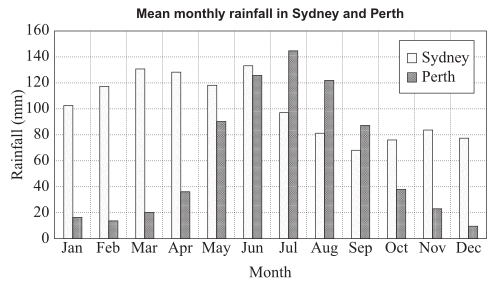
The graph displays the mean monthly rainfall in Sydney and Perth.


  1. For how many months is the mean monthly rainfall higher in Perth than in Sydney?  (1 mark)

    --- 1 WORK AREA LINES (style=lined) ---

  2. For which of the two cities is the standard deviation of the mean monthly rainfall smaller? Justify your answer WITHOUT calculations.  (1 mark)

    --- 2 WORK AREA LINES (style=lined) ---

Show Answers Only
  1. `3`
  2. `text(The mean monthly rainfall of Sydney is in a)`
    `text(much tighter range than Perth.)`
    `:.\ text(Sydney has a smaller standard deviation.)`
Show Worked Solution

i.   `text(3 months (Jul, Aug and Sep))`

♦ Mean mark part (ii) 38%.
COMMENT: Extremely volatile result between parts with part (i) producing a 91% mean mark.


ii.    `text(The mean monthly rainfall of Sydney is in a)`

`text(much tighter range than Perth.)`

`:.\ text(Sydney has a smaller standard deviation.)`

Filed Under: Bar Charts and Histograms (Std 2), Bar Charts and Histograms (Std2-2027), Bar Charts and Histograms (Y12), Bar Charts, Histograms and Other Graphs (Std 1) Tagged With: Band 2, Band 5, common-content, smc-1128-10-Bar Charts, smc-6310-10-Bar Charts, smc-821-10-Bar Charts, smc-997-10-Bar Charts

Probability, STD2 S2 2018 HSC 26a

Jeremy rolled a biased 6-sided die a number of times. He recorded the results in a table.
  

\begin{array} {|l|c|c|c|c|c|c|}
\hline
\rule{0pt}{2.5ex} \text{Number} \rule[-1ex]{0pt}{0pt} & \ \ 1 \ \ & \ \ 2 \ \  & \ \ 3 \ \  & \ \ 4 \ \  & \ \ 5 \ \  & \ \ 6 \ \ \\
\hline
\rule{0pt}{2.5ex} \text{Frequency} \rule[-1ex]{0pt}{0pt} & \ \ 23 \ \ & \ \ 19 \ \  & \ \ 48 \ \  & \ \ 20 \ \  & \ \ 21 \ \  & \ \ 19 \ \ \\
\hline
\end{array} 

What is the relative frequency of rolling a 3?  (1 mark)

--- 2 WORK AREA LINES (style=lined) ---

Show Answers Only

\(\dfrac{8}{25}\)

Show Worked Solution
♦ Mean mark 40%.

\(\text{Rel Freq}\) \(=\dfrac{\text{number of 3’s rolled}}{\text{total rolls}}\)
  \(=\dfrac{48}{150}\)
  \(=\dfrac{8}{25}\)

Filed Under: Probability, Relative Frequency (Std 1), Relative Frequency (Std 2), Relative Frequency (Y11) Tagged With: Band 5, common-content, num-title-ct-core, num-title-qs-hsc, smc-1133-20-Games of Chance, smc-4225-35-Relative frequency, smc-827-20-Games of Chance, smc-990-20-Games of Chance

Measurement, STD2 M1 2018 HSC 24 MC

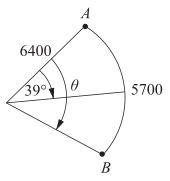
The coordinates of city A are (39°N, 75°W). City B lies on the same longitude and is 5700 km south of city A.

What is the latitude of city B, given the earth's radius is 6400 km?

  1. 51°N
  2. 51°S
  3. 12°N
  4. 12°S
Show Answers Only

`text(D)`

Show Worked Solution

`text(Circumference) = 2 xx pi xx 6400`

♦ Mean mark 45%.
COMMENT: If the earth’s radius is stated, this past question is arguably within the scope of the new syllabus.

`theta/360` `= 5700/(2pi xx 6400)`
`theta` `= (5700 xx 360)/(2pi xx 6400)`
  `~~ 51°`

   
`:. text(City)\ B\ text(is 12° South.)`

`=>\ text(D)`

Filed Under: Perimeter and Area (Std2-2027), Perimeter, Area and Volume (Std 2) Tagged With: Band 5, smc-6483-40-Perimeter (Circular Measure), smc-798-20-Perimeter and Area (Circular Measure)

Statistics, STD2 S5 2018 HSC 23 MC

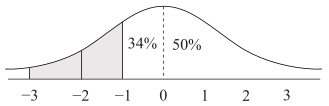
A set of data is normally distributed with a mean of 48 and a standard deviation of 3.

Approximately what percentage of the scores lies between 39 and 45?

  1. 15.85%
  2. 31.7%
  3. 47.5%
  4. 49.85%
Show Answers Only

`A`

Show Worked Solution

`text(Given)\ \ mu = 48, \ sigma = 3`

♦ Mean mark 47%.

`ztext{-score (39)}` `= (x – mu)/sigma`
  `= (39 – 48)/3`
  `= −3`


`ztext{-score (45)}` `= (45 – 48)/3`
  `= −1`


`:.\ text(Scores between 39 and 45)`

`~~ 16text(%)`

`=>A`

`text(Note that % of scores below 39 is very small.)`

Filed Under: Normal Distribution (Y12), S5 The Normal Distribution (Y12) Tagged With: Band 5, common-content, smc-819-20-z-score Intervals, smc-995-20-z-score Intervals

Financial Maths, STD2 F4 2018 HSC 19 MC

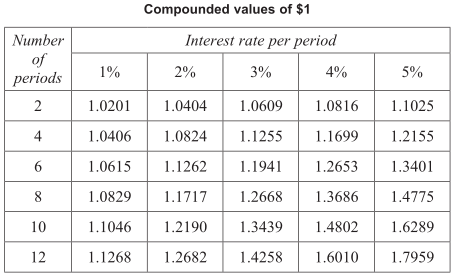
The table shows the compounded values of $1 at different interest rates over different periods.


Amy hopes to have $21 000 in 2 years to buy a car. She opens an account today which pays interest of 4% pa, compounded quarterly.

Using the table, which expression calculates the minimum single sum that Amy needs to invest today to ensure she reaches her savings goal?

  1. 21 000 × 1.0816
  2. 21 000 ÷ 1.0816
  3. 21 000 × 1.0829
  4. 21 000 ÷ 1.0829
Show Answers Only

`text(D)`

Show Worked Solution

`text(4% annual)`

♦♦ Mean mark 33%.

`=> (4%)/4 = 1text(% compounded quarterly)`

`=> n = 8`

`=>\  text(Factor) = 1.0829`

`:.\ text(Minimum sum) = 21\ 000 ÷ 1.0829`

`=>\ text(D)`

Filed Under: Compound Interest and Shares (Std2), F2 Investment (Y12), Modelling Investments and Loans (Y12) Tagged With: Band 5, common-content, smc-1002-10-Compounded Value of $1 Table, smc-1108-40-Compounded Value of $1, smc-817-10-Compounded Value of $1 Table

Financial Maths, STD2 F1 2018 HSC 15 MC

Sam is the driver at fault in a car accident.

Which of the following is covered by Sam's compulsory third-party (CTP) insurance?

  1. Repairs to Sam's car
  2. Injury to the other driver
  3. Damage to the other driver's car
  4. Cost of repairing a building damaged in the accident
Show Answers Only

`B`

Show Worked Solution

`text(CTP insurance covers liability for death or injury)`

♦♦ Mean mark 34%.

`text(to other people, but does not cover property damage.)`

`=>B`

Filed Under: Earning Money and Budgeting (Std 1), Earning Money and Budgeting (Std 2), Purchasing Goods (Std2-2027) Tagged With: Band 5, smc-1126-40-Insurance, smc-6278-20-Stamp Duty/Insurance, smc-810-40-Insurance

Financial Maths, STD2 F1 2018 HSC 14 MC

To determine the retail price of an item, a shop owner increases its cost price by 30%. In a sale, the retails price is reduced by 30% to give the sale price.

How does the sale price compare to the cost price?

  1. The sale price is less than the cost price.
  2. The sale price is the same as the cost price.
  3. The sale price is more than the cost price.
  4. It is impossible to compare without knowing the cost price.
Show Answers Only

`text(A)`

Show Worked Solution

`text{Take an item that costs $100 (for example):}`

♦ Mean mark 50%.

`=>\ text(Original price) = 100 xx 1.3 = $130`

`=>\ text(Sale Price) = 130 xx 0.7 = $91`

`:.\ text(Sale price < cost price)`

`=>\ text(A)`

Filed Under: Purchasing Goods (Std2-2027), Tax and Percentage Increase/Decrease (Std 1), Tax and Percentage Increase/Decrease (Std 2) Tagged With: Band 5, smc-1125-30-% Increase/Decrease, smc-6278-10-%Increase/Decrease, smc-831-30-% Increase/Decrease

Financial Maths, STD2 F1 2018 HSC 8 MC

A nanny charges $15 per hour, or part thereof, for looking after a child.

What does the nanny charge for looking after a child from 8 am until 3.20 pm on a particular day?

  1. $105
  2. $108
  3. $110
  4. $120
Show Answers Only

`text(D)`

Show Worked Solution
`text(8 am – 3:20 pm)` `= 7\ text(hrs 20 mins)`


`text(S)text(ince part of an hour is charged as a full hour,)`

`:.\ text(Charge)` `= 8 xx 15`
  `= $120`

 
`=>\ text(D)`

Filed Under: Earning Money and Budgeting (Std 1), Earning Money and Budgeting (Std 2), Ways of Earning (Std2-2027) Tagged With: Band 5, smc-1126-10-Wages, smc-6276-10-Wages/Salaries, smc-810-10-Wages

Statistics, STD2 S1 2018 HSC 6 MC

A set of data is displayed in this dot plot.


Which of the following best describes this set of data?

  1. Symmetrical
  2. Positively skewed
  3. Negatively skewed
  4. Normally distributed
Show Answers Only

`text(C)`

Show Worked Solution

`text(Data is skewed.)`

♦ Mean mark 43% (a surprisingly poor result!)

`text(S)text(ince the “tail” is on the left had side, the)`

`text(data is negatively skewed.)`

`=>\ text(C)`

Filed Under: Other Chart Types (Y12), Other Charts (Std 2), Other Charts (Std2-2027) Tagged With: Band 5, common-content, smc-6311-30-Other Charts, smc-822-40-Other Charts, smc-998-40-Other Charts

Plane Geometry, EXT1 2018 HSC 14c

In triangle `ABC, BC` is perpendicular to `AC`. Side `BC` has length `a`, side `AC` has length `b` and side `AB` has length `c`. A quadrant of a circle of radius `x`, centered at `C`, is constructed. The arc meets side `BC` at `E`. It touches the side `AB` at `D`, and meets side `AC` at `F`. The interval `CD` is perpendicular to `AB`.


  1. Show that `Delta ABC` and `Delta ACD` are similar.  (1 mark)
  2. Show that
     
    `qquad x = (ab)/c`.  (1 mark)
     

  3. From `F`, a line perpendicular to `AC` is drawn to meet `AB` at `G`, forming the right-angled triangle `GFA`. A new quadrant is constructed in triangle `GFA` touching side `AB` at `H`. The process is then repeated indefinitely.


  4. Show that the limiting sum of the areas of all the quadrants is
     
    `qquad (pi ab^2)/(4(2c - a)).`  (4 marks)
     

  5. Hence, or otherwise, show that
     
    `qquad pi/2 < (2c - a)/b`.  (1 mark)


Show Answers Only
  1. `text(Proof)\ \ text{(See Worked Solutions)}`
  2. `text(Proof)\ \ text{(See Worked Solutions)}`
  3. `text(Proof)\ \ text{(See Worked Solutions)}`
  4. `text(Proof)\ \ text{(See Worked Solutions)}`
Show Worked Solution

(i)   `text(In)\ triangle ABC,`

`/_BCA = 90^@\ \ \ (BC _|_ AC)`
 

`/_ BCA = /_ ADC\ \ text{(right-angles)}`

`/_ BAC = /_ DAC\ \ text{(common)}`
 

`:. Delta ABC\ text(|||)\ Delta ACD\ \ text{(equiangular)}`


(ii) `(CD)/(BC)` `= (AC)/(AB)` `text{(corresponding sides of}`
   `text{similar triangles)}`
  `x/a` `= b/c`  
  `:. x` `= (ab)/c`  


(iii)
  `text(Area of)\ Q_1 = 1/4 pi x^2`

♦♦♦ Mean mark part (iii) 19%.

`text(Area of)\ Q_2 => text(find)\ x_1`


`text(Consider)\ Delta ACD and Delta AFH`

`/_ADC = /_AHF\ \ text{(right angles)}`

`/_ CAD = /_FAH\ \ text{(common)}`

`:. Delta ACD\ text(|||)\ Delta AFH\ \ text{(equiangular)}`


`(FH)/(CD)` `= (AF)/(AC)` `text{(corresponding sides}`
`text{of similar triangles)}`
`x_1/x` `= (AC – CF)/(AC)`  
  `= (b – x)/b`  
  `= (b – (ab)/c)/b` `text{(using part (ii))}`
  `= (cb – ab)/(bc)`  
  `= (c – a)/c`  
`:. x_1` `= x((c – a)/c)`  


`=> x_2\ text(will be shorter again by the same ratio)`

`x_2` `= x_1 ((c – a)/c)`
  `= x((c – a)/c)^2`
  `vdots`
`x_n` `= x((c – a)/c)^n`


`text(Limiting sum of quadrant areas)`

`= Q_1 + Q_2 + … + Q_n`

`= 1/4 pi x^2 + 1/4 {:pi x_1:}^ 2 + … + 1/4 {:pi x_n:}^2`

`= 1/4 pi x^2 + 1/4 pi x^2 ((c – a)/c)^2 + … + 1/4 pi x^2 ((c – a)/c)^(2n)`

`= 1/4 pi x^2 underbrace{[1 + ((c – a)/c)^2 + … + ((c – a)/c)^(2n)]}_{text(GP with)\ a = 1, \ r = ((c-a)/c)^2`

`= 1/4 pi x^2 [1/(1 – ((c-a)/c)^2)]`

`= 1/4 pi ((ab)/c)^2 (c^2/(c^2 – (c – a)^2))`

`= pi/4 xx (a^2 b^2)/(c^2 – c^2 + 2ac – a^2)`

`= pi/4 xx (a^2 b^2)/(a(2c – a))`

`= (pi ab^2)/(4(2c – a))\ \ \ text(… as required)`


(iv)  `text(S)text{ince the limiting sum all the quadrants (from part (iii))}`

♦♦ Mean mark part (iv) 21%.

`text(is less than the area of)\ \ Delta ABC:`

`(pi ab^2)/(4(2c – a))` `< (ab)/2`
`(pi b)/(4(2c – a))` `< 1/2`
`pi/4` `< (2c – a)/(2b)`
`pi/2` `< (2c – a)/b\ \ \ text(… as required)`

Filed Under: 2. Plane Geometry EXT1 Tagged With: Band 3, Band 5, Band 6

Binomial, EXT1 2018 HSC 14b

  1. By considering the expansions of `(1 + (1 + x))^n` and `(2 + x)^n,` show that
     
    `((n),(r))((r),(r)) + ((n),(r +1))((r + 1),(r)) + ((n),(r + 2))((r + 2),(r)) +`
     
                                `… + ((n),(n))((n),(r)) = ((n),(r)) 2^(n - r)`.  (3 marks)
     

  2. There are 23 people who have applied to be selected for a committee of 4 people.
     
    The selection process starts with Selector `A` choosing a group of at least 4 people from the 23 people who applied.
     
    Selector `B` then chooses the 4 people to be on the committee from the group Selector `A` has chosen.
     
    In how many ways could this selection process be carried out?  (2 marks)


Show Answers Only
  1. `text(Proof)\ \ text{(See Worked Solutions)}`
  2. `((23), (4)) 2^19`
Show Worked Solution

(i)    `text(Using binomial expansion:)`

`(2 + x)^n= ((n), (0)) 2^n + ((n), (1)) 2^(n – 1) x + ((n), (2)) 2^(n – 2) x^2 + … + ((n), (n)) x^n`

`[1 + (1 + x)]^n= ((n), (0)) + ((n), (1)) (1 + x) + ((n), (2)) (1 + x)^2 + … + ((n), (n)) (1 + x)^n`
 

`=>\ text(S)text(ince both expansions are equal, we can equate the)`

`text(the coefficients of)\ \ x^r.`
 

`text(Coefficient of)\ x^r\ text(in the expansion of)\ \ (2+x)^n :`

♦ Mean mark 46%.

`((n), (r)) 2^(n-r) qquad …\ text{(1)}` 

  
`text(Coefficient of)\ x^r\ text(in the expansion of)\ \ [1 + (1 + x)]^n :`

`=>x^r\ \ text(exists in all terms where)\ \ n>=r`

 
`text(Consider the co-efficients of)\ \ x^r ,`

`text(When)\ \ n=r:\ \ ((n), (r))((r), (r))`

`text(When)\ \ n=r+1:\ \ ((n), (r+1))((r+1), (r))`

`vdots`

`text(When)\ \ n=n:\ \ ((n), (n))((n), (r))`
 

`text{Equating the coefficients ⇒ (1) = (2):}`
 

`((n), (r))((r), (r)) + ((n), (r + 1))((r + 1), (r)) + … + ((n), (n))((n), (r)) =((n), (r)) 2^(n – r)`

`text(… as required)`


(ii)  `text(Consider the possible combinations when,)`

`A\ text(selects 4:)\ \ ((23), (4))((4),(4))`

♦♦ Mean mark 32%.

`A\ text(selects 5:)\ \ ((23), (5))((5),(4))`

`A\ text(selects 6:)\ \ ((23), (6))((6),(4))`

`vdots`

`A\ text(selects 23:)\ \ ((23), (23))((23),(4))`
 

`:.\ text(Total possibilities)`

`=underbrace{((23), (4))((4),(4)) + ((23), (5))((5),(4)) + … + ((23), (23))((23),(4))}_text{Using part (i)}`

`=((23), (4)) 2^(23-4)`

`= ((23), (4)) 2^(19)`

Filed Under: 17. Binomial EXT1 Tagged With: Band 5

Plane Geometry, EXT1 2018 HSC 14a

The diagram shows quadrilateral  `ABCD`  and the bisectors of the angles at  `A, B, C` and `D`. The bisectors at  `A` and  `B` intersect at the point `P`. The bisectors at  `A` and `D` meet at `Q`. The bisectors at `C` and `D` meet at `R`. The bisectors at  `B` and `C` meet at `S`.


Copy or trace the diagram into your writing booklet.

Show that  `PQRS`  is a cyclic quadrilateral.  (3 marks)

Show Answers Only

`text(Proof)\ \ text{(See Worked Solutions)}`

Show Worked Solution

`text(In)\ \ ΔABP,`

Mean mark 51%.

`/_APB = 180-(alpha + beta)`

`=> /_SPQ = 180-(alpha + beta)\ \ \ text{(vertically opposite angles)}`


`text(In)\ \ ΔCDR,`

`/_CRD = 180-(gamma + delta)`

`=> /_SRQ = 180-(gamma + delta)\ \ \ text{(vertically opposite angles)}`


`/_SPQ + /_ SRQ` `= 360 – (alpha + beta + gamma + delta)`
  `= 360 – 1/2 underbrace{(2 alpha + 2 beta + 2 gamma + 2 delta)}_text{angle sum of quad ABCD}`
  `= 360 – 1/2 (360)`
  `= 180`

 
`:.\ text(S)text(ince opposite angles in)\ \ SPQR\ \ text(are supplementary,)`

`text(it is a cyclic quadrilateral.)`

Filed Under: 2. Plane Geometry EXT1 Tagged With: Band 5

Functions, EXT1 F1 2018 HSC 13b

The diagram shows the graph  `y = x/(x^2 + 1)`, for all real `x`.


Consider the function  `f(x) = x/(x^2 + 1)`, for `x >= 1.`

The function  `f(x)`  has an inverse. (Do NOT prove this.)

  1.  State the domain and range of  `f^(-1) (x).`  (2 marks)

    --- 4 WORK AREA LINES (style=lined) ---

  2.  Sketch the graph  `y = f^(-1)(x).`  (1 mark)

    --- 6 WORK AREA LINES (style=lined) ---

  3.  Find an expression for  `f^(-1)(x).`  (3 marks)

    --- 5 WORK AREA LINES (style=lined) ---

Show Answers Only
  1. `text(Domain:)\ 0 < x <= 1/2`
    `text(Range:)\ y >= 1`
  2. `text(See Worked Solutions)`
  3. `y = (1 + sqrt(1 – 4x^2))/(2x)`
Show Worked Solution

i.   `text(Domain of)\ \ f(x)\ \ text(is)\ \ x>=1\ \ text{(given)}`

♦♦ Mean mark part (i) 31%.

`=>\ text(Range of)\ \ f^(-1)(x)\ \ text(is)\ \ y >= 1`
 

`text(Range of)\ \ f(x)\ \ text(is)\ \ 0<y<1/2`

`=>\ text(Domain of)\ \ f^-1(x)\ text(is)\ 0 < x <= 1/2.`


♦ Mean mark part (ii) 43%.

ii.  


iii.  `y=x/(x^2+1)`

♦ Mean mark part (iii) 45%.

`text(Inverse:)\ \ x ↔ y`

`x` `= y/(y^2 + 1)`
`xy^2+ x` `= y`
`xy^2-y+x` `=0`
`y` `= (1 +- sqrt(1 – 4x^2))/(2x)`

 
`text(S)text(ince, range of)\ \ f^(-1)(x)\ \ text(is)\ \ y >= 1,`
 

`:. f^(-1)(x) = (1 + sqrt(1 – 4x^2))/(2x)`

Filed Under: Inverse Functions (Ext1), Other Inverse Functions EXT1 Tagged With: Band 5, smc-1034-20-Other Functions

Mechanics, EXT2* M1 2018 HSC 13c

An object is projected from the origin with an initial velocity of  `V` at an angle  `theta`  to the horizontal. The equations of motion of the object are

`x(t)` `= Vt cos theta`
`y(t)` `= Vt sin theta - (g t^2)/2.`  (Do NOT prove this.)


  1. Show that when the object is projected at an angle  `theta`, the horizontal range is


         `V^2/g sin 2 theta`  (2 marks)

    --- 6 WORK AREA LINES (style=lined) ---

  2. Show that when the object is projected at an angle  `pi/2 - theta`, the horizontal range is also 


         `V^2/g sin 2 theta`.  (1 mark)

    --- 3 WORK AREA LINES (style=lined) ---

  3. The object is projected with initial velocity `V` to reach a horizontal distance `d`, which is less than the maximum possible horizontal range. There are two angles at which the object can be projected in order to travel that horizontal distance before landing.


    Let these angles be `alpha`  and  `beta`, where  `beta = pi/2 - alpha.`


    Let  `h_alpha`  be the maximum height reached by the object when projected at the angle `alpha` to the horizontal.


    Let  `h_beta`  be the maximum height reached by the object when projected at the angle `beta` to the horizontal.


    Show that the average of the two heights, `(h_alpha + h_beta)/2`, depends only on `V` and `g`.  (3 marks)

    --- 9 WORK AREA LINES (style=lined) ---

Show Answers Only
  1. `text(Proof)\ \ text{(See Worked Solutions)}`
  2. `text(Proof)\ \ text{(See Worked Solutions)}`
  3. `text(Proof)\ \ text{(See Worked Solutions)}`
Show Worked Solution

i.    `text(Horizontal range occurs when)\ \ y = 0`

`Vt sin theta – (g t^2)/2` `= 0`
`V sin theta – (g t)/2` `= 0`
`t` `= (2V sin theta)/g`

 
`text(Find)\ \ x\ \ text(when)\ \ t=(2V sin theta)/g :`

`x` `= Vt cos theta`
  `= V((2V sin theta)/g) cos theta`
  `= (V^2 * 2sin theta cos theta)/g`
  `= V^2/g sin 2 theta\ \ \ text(.. as required)`


ii.  `text(Find)\ \ x\ \ text(when)\ \ theta = (pi/2 – theta):`

`x` `= V^2/g sin 2 (pi/2 – theta)`
  `= V^2/g underbrace {sin (pi – 2 theta)}_{text(Using)\ \ sin (pi-theta) = sin theta}`
  `= V^2/g sin 2 theta\ \ \ text(.. as required)`


iii.  `text(Highest point → half way through the flight.)`

`=> h_alpha\ \ text(occurs when)\ \ t=(V sin alpha)/g\ \ text{(by symmetry)}`
  

`:. h_alpha` `= V((V sin alpha)/g) sin alpha – g/2 ((V sin alpha)/g)^2`
  `= (V^2 sin^2 alpha)/g – g/2 ((V^2 sin^2 alpha)/g^2)`
  `= (V^2 sin^2 alpha)/g – (V^2 sin^2 alpha)/(2g)`
  `= (V^2 sin^2 alpha)/(2g)`


`text(Similarly,)\ \ h_beta = (V^2 sin^2 beta)/(2g)`

♦ Mean mark 44%.
 

`:. (h_alpha + h_beta)/2` `= 1/2 ((V^2 sin^2 alpha)/(2g) + (V^2 sin^2 beta)/(2g))`
  `= V^2/(4g) (sin^2 alpha + underbrace{sin^2 beta}_{text(Using)\ \ beta= pi/2 -alpha})`
  `= V^2/(4g) (sin^2 alpha + sin^2(pi/2 – alpha)) `
  `= V^2/(4g) (sin^2 alpha + cos^2 alpha)`
  `= V^2/(4g)`

 
`:. text(The average height depends only on)\ V\ text(or)\ g.`

Filed Under: Projectile Motion, Projectile Motion EXT1 Tagged With: Band 3, Band 4, Band 5, smc-1062-10-Range/Time of Flight, smc-1062-20-Max Height

  • « Previous Page
  • 1
  • …
  • 56
  • 57
  • 58
  • 59
  • 60
  • …
  • 81
  • Next Page »

Copyright © 2014–2025 SmarterEd.com.au · Log in