SmarterEd

Aussie Maths & Science Teachers: Save your time with SmarterEd

  • Login
  • Get Help
  • About

Probability, MET2 2011 VCAA 2*

In a chocolate factory the material for making each chocolate is sent to one of two machines, machine A or machine B.

The time, `X` seconds, taken to produce a chocolate by machine A, is normally distributed with mean 3 and standard deviation 0.8.

The time, `Y` seconds, taken to produce a chocolate by machine B, has the following probability density function
 

`f(y) = {{:(0,y < 0),(y/16,0 <= y <= 4),(0.25e^(−0.5(y-4)),y > 4):}`
 

  1. Find correct to four decimal places

    1. `text(Pr)(3 <= X <= 5)`   (1 mark)

      --- 3 WORK AREA LINES (style=lined) ---

    2. `text(Pr)(3 <= Y <= 5)`   (3 marks)

      --- 3 WORK AREA LINES (style=lined) ---

  2. Find the mean of `Y`, correct to three decimal places.   (3 marks)

    --- 5 WORK AREA LINES (style=lined) ---

  3. It can be shown that  `text(Pr)(Y <= 3) = 9/32`. A random sample of 10 chocolates produced by machine B is chosen. Find the probability, correct to four decimal places, that exactly 4 of these 10 chocolate took 3 or less seconds to produce.   (2 marks)

    --- 5 WORK AREA LINES (style=lined) ---

All of the chocolates produced by machine A and machine B are stored in a large bin. There is an equal number of chocolates from each machine in the bin.

It is found that if a chocolate, produced by either machine, takes longer than 3 seconds to produce then it can easily be identified by its darker colour.

  1. A chocolate is selected at random from the bin. It is found to have taken longer than 3 seconds to produce.
  2. Find, correct to four decimal places, the probability that it was produced by machine A.   (3 marks)

    --- 6 WORK AREA LINES (style=lined) ---

Show Answers Only

a.i.  `0.4938`

a.ii. `0.4155`

b.    `4.333`

c.    `0.1812`

d.    `0.4103`

Show Worked Solution

a.i.   `X ∼\ N(3,0.8^2)`

`text(Pr)(3 <= X <= 5) = 0.4938\ \ text{(4 d.p.)}`


a.ii.    `text(Pr)(3 <= Y <= 5)` `= text(Pr)(3 <= Y <= 4) + (4 < Y <= 5)`
    `= int_3^4 (y/16)dy + int_4^5(1/4 e^(−1/2(y-4)))dy`
    `= 0.4155\ \ text{(4 d.p.)}`


b.    `text(E)(Y)` `= int_0^4 y(y/16)dy + int_4^∞ 0.25ye^(−1/2(y-4))dy`
    `= 4.333\ \ text{(3 d.p.)}`


c.   `text(Solution 1)`

`text(Let)\ \ W = #\ text(chocolates from)\ B\ text(that take less)`

`text(than 3 seconds)`

`W ∼\ text(Bi)(10, 9/32)`

`text(Using CAS: binomPdf)(10, 9/32,4)`

`text(Pr)(W = 4) = 0.1812\ \ text{(4 d.p.)}`
 

`text(Solution 2)`

`text(Pr)(W = 4)`  `=((10),(4)) (9/32)^4 (23/32)^6` 
  `=0.1812`

♦♦♦ Mean mark part (e) 19%.
MARKER’S COMMENT: Students who used tree diagrams were the most successful.


d.   
`text(Pr)(A | L)` `= (text(Pr)(AL))/(text(Pr)(L))`
  `= (0.5 xx 0.5)/(0.5 xx 0.5 + 0.5 xx 23/32)`
  `= 0.4103\ \ text{(4 d.p.)}`
Filed Under: Binomial, Conditional Probability and Set Notation, Normal Distribution, Probability density functions Tagged With: Band 4, Band 5, Band 6, smc-2736-10-Conditional probability, smc-637-10-E(X), smc-637-45-Other probability, smc-637-70-Exp/Log PDF, smc-638-10-binomial expansion (non-calc), smc-638-20-binomCdf (CAS), smc-646-20-Multi-stage events, smc-719-10-Single z-score, smc-719-30-Other z-score intervals

Calculus, MET2 2011 VCAA 1

Two ships, the Elsa and the Violet, have collided. Fuel immediately starts leaking from the Elsa into the sea.

The captain of the Elsa estimates that at the time of the collision his ship has 6075 litres of fuel on board and he also forecasts that it will leak into the sea at a rate of `(t^2)/5` liters per minute, where `t` is the number of minutes that have elapsed since the collision.

  1. At this rate how long, in minutes, will it take for all the fuel from the Elsa to leak into the sea?   (3 marks)

    --- 5 WORK AREA LINES (style=lined) ---

*Parts (b) - (d) are no longer in the syllabus. 

Show Answers Only
  1. `45\ text(min)`
Show Worked Solution

a.   `text(Let)\ \ f = text(fuel in Elsa at)\ t\ text(min)`

♦♦♦ Mean mark 23%.

`(df)/(dt) = (-t^2)/5\ \ text{(given)}`
  

`text(Find)\ f\ text(in terms of)\ t:`

`f` `= int-1/5t^2 dt`
`f` `= (-t^3)/15 + c`


`text(Substitute)\ \ (0,6075):`

`6075` `= 0/15 + c`
`:. c` `= 6075`


`text(Solve:)\ \ 0 = -(t^2)/15 + 6075\ \ text(for)\ t`

`:. t = 45\ text(min)`


*Parts (b) – (d) are no longer in the syllabus.

Filed Under: Average Value and Other Tagged With: Band 5, smc-756-50-Other problems

CORE, FUR2 SM-Bank 4

Damon runs a swim school.

The value of his pool pump is depreciated over time using flat rate depreciation.

Damon purchased the pool pump for $28 000 and its value in dollars after `n` years, `P_n`, is modelled by the recursion equation below:

`P_0 = 28\ 000,qquad P_(n + 1) = P_n - 3500`

  1. Write down calculations, using the recurrence relation, to find the pool pump's value after 3 years.   (1 mark)

    --- 4 WORK AREA LINES (style=lined) ---

  2. After how many years will the pump's depreciated value reduce to $7000?   (1 mark)

    --- 5 WORK AREA LINES (style=lined) ---

The reducing balance depreciation method can also be used by Damon.

Using this method, the value of the pump is depreciated by 15% each year.

A recursion relation that models its value in dollars after `n` years, `P_n`, is:

`P_0 = 28\ 000, qquad P_(n + 1) = 0.85P_n`

  1. After how many years does the reducing balance method first give the pump a higher valuation than the flat rate method in part (a)?   (2 marks)

    --- 8 WORK AREA LINES (style=lined) ---

Show Answers Only
  1. `$17\ 500`
  2. `6\ text(years)`
  3. `4\ text(years)`
Show Worked Solution
a.    `P_1` `= 28\ 000-3500 = 24\ 500`
  `P_2` `= 24\ 500-3500 = 21\ 000`
  `P_3` `= 21\ 000-3500 = 17\ 500`

  
`:.\ text(After 3 years, the pump’s value is $17 500.)`
  

b.   `text(Find)\ n\ text(such that:)`

`7000` `= 28\ 000-3500n`
`3500n` `= 21\ 000`
`n` `= (21\ 000)/3500`
  `= 6\ text(years)`

  
c.
  `text(Using the reducing balance method)`

`P_1` `= 0.85 xx 28\ 000 = 23\ 800`
`P_2` `= 0.85 xx 23\ 800 = 20\ 230`
`P_3` `= 0.85 xx 20\ 230 = 17\ 195`
`P_4` `= 0.85 xx 17\ 195 = 14\ 615.75`

  
`text{Using the flat rate method (see part (a))}`

`P_4 = 17\ 500-3500 = 14\ 000`

`14\ 615.75 > 14\ 000`
  

`:.\ text(After 4 years, the reducing balance method)`

`text(first values the pump higher.)`

Filed Under: Depreciation, Recursion - Financial Tagged With: Band 4, Band 5, smc-602-40-Comparing methods, smc-602-50-Recurrence relation, smc-717-50-Depreciation (SL), smc-717-60-Depreciation (reducing balance)

Calculus, MET2 2016 VCAA 4

  1. Express  `(2x + 1)/(x + 2)`  in the form  `a + b/(x + 2)`,  where `a` and `b` are non-zero integers.   (2 marks)

    --- 2 WORK AREA LINES (style=lined) ---

  2. Let  `f: R text(\){−2} -> R,\ f(x) = (2x + 1)/(x + 2)`.
    1. Find the rule and domain of `f^(-1)`, the inverse function of `f`.   (2 marks)

      --- 3 WORK AREA LINES (style=lined) ---

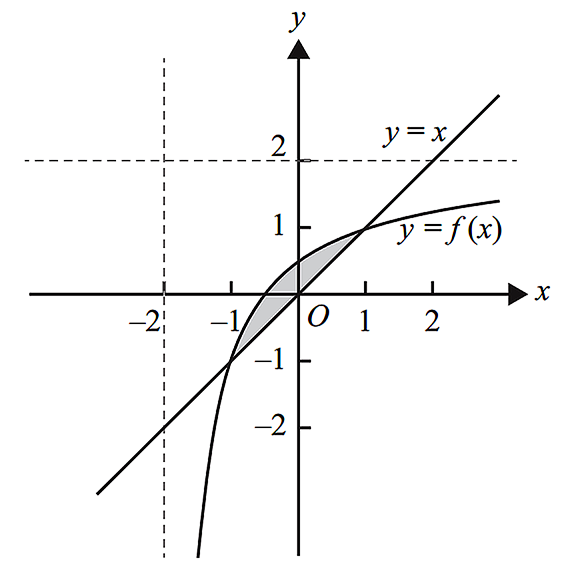
    2. Part of the graphs of `f` and  `y = x`  are shown in the diagram below.
       

    3. Find the area of the shaded region.   (1 mark)

      --- 5 WORK AREA LINES (style=lined) ---

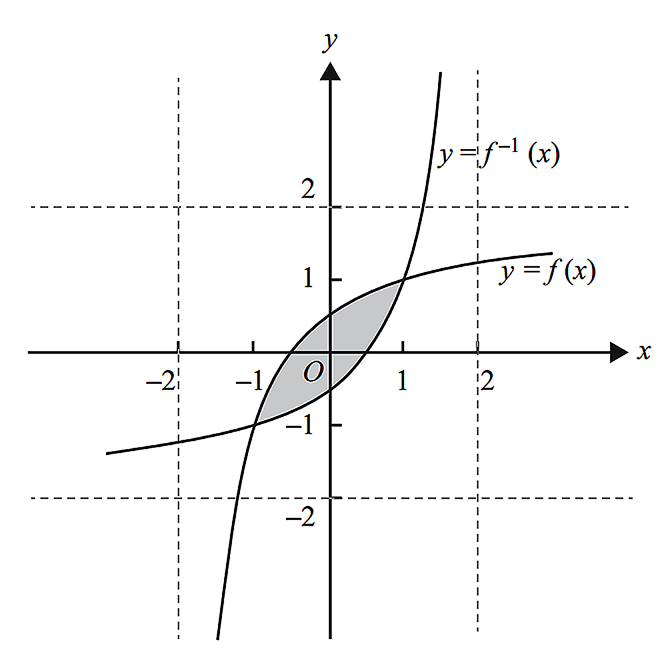
    4. Part of the graphs of `f` and `f^(-1)` are shown in the diagram below.
       

    5. Find the area of the shaded region.   (1 mark) 

      --- 5 WORK AREA LINES (style=lined) ---

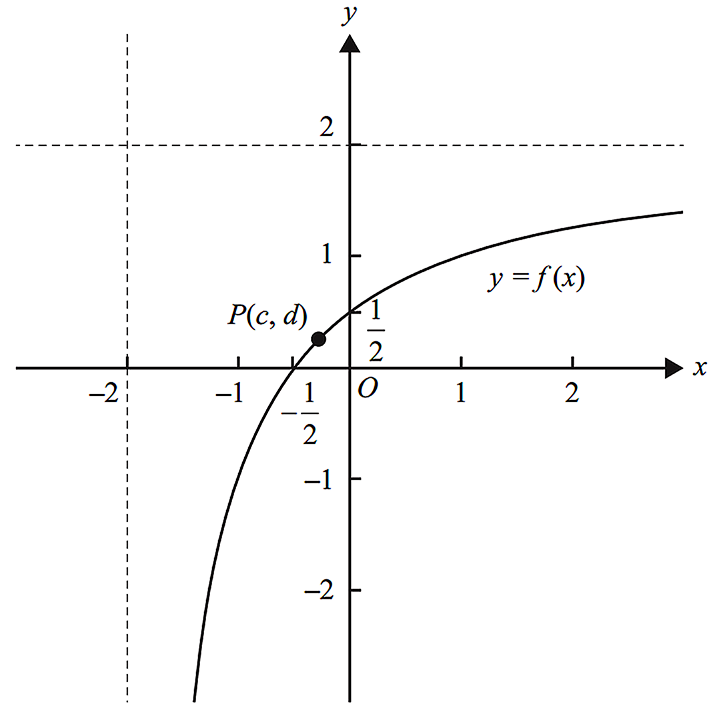
  1. Part of the graph of `f` is shown in the diagram below.


    The point `P(c, d)` is on the graph of `f`.


    Find the exact values of `c` and `d` such that the distance of this point to the origin is a minimum, and find this minimum distance.   (3 marks)

    --- 6 WORK AREA LINES (style=lined) ---

Let  `g: (−k, oo) -> R, g(x) = (kx + 1)/(x + k)`, where `k > 1`.

  1. Show that  `x_1 < x_2`  implies that  `g(x_1) < g(x_2),` where  `x_1 in (−k, oo) and x_2 in (−k, oo)`.   (2 marks)

    --- 7 WORK AREA LINES (style=lined) ---

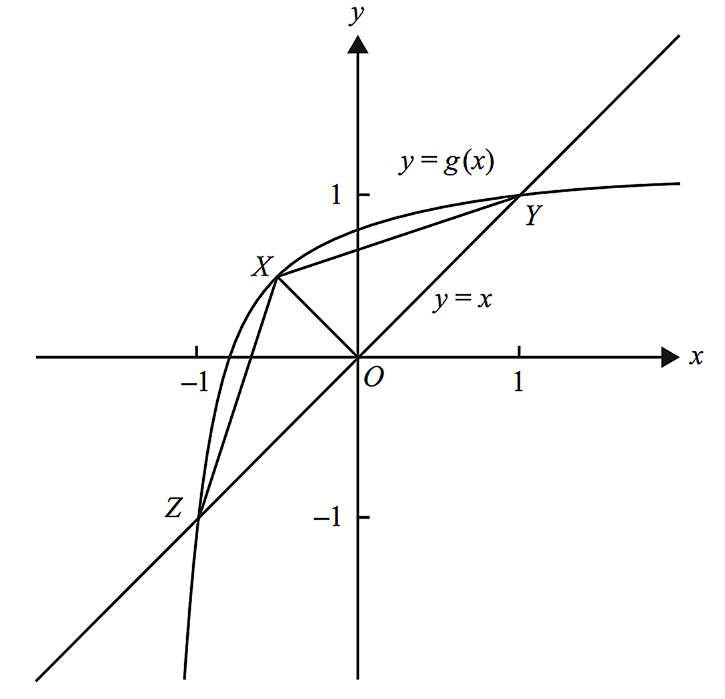
  2. Let `X` be the point of intersection of the graphs of  `y = g (x) and y = −x`.
    1. Find the coordinates of `X` in terms of `k`.   (2 marks)

      --- 7 WORK AREA LINES (style=lined) ---

    2. Find the value of `k` for which the coordinates of `X` are  `(-1/2, 1/2)`.   (2 marks)

      --- 5 WORK AREA LINES (style=lined) ---

    3. Let  `Ztext{(− 1, − 1)}, Y(1, 1)`  and `X` be the vertices of the triangle `XYZ`. Let  `s(k)`  be the square of the area of triangle `XYZ`.


      Find the values of `k` such that  `s(k) >= 1`.   (2 marks)

      --- 5 WORK AREA LINES (style=lined) ---

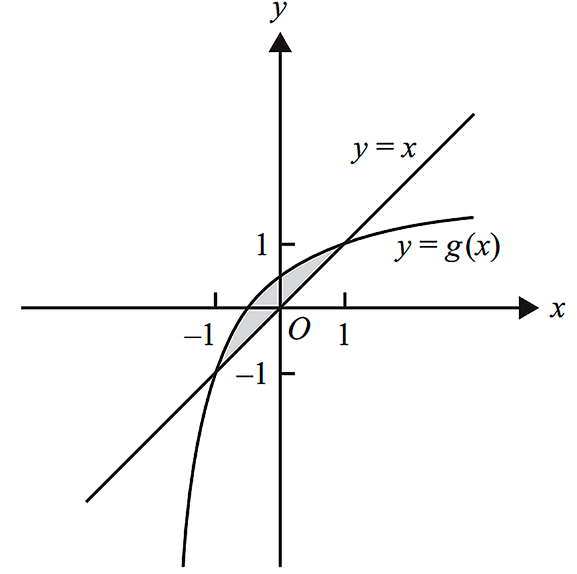
  3. The graph of `g` and the line  `y = x`  enclose a region of the plane. The region is shown shaded in the diagram below.


    Let  `A(k)`  be the rule of the function `A` that gives the area of this enclosed region. The domain of `A` is  `(1, oo)`.

    1. Give the rule for `A(k)`.   (2 marks)

      --- 4 WORK AREA LINES (style=lined) ---

    2. Show that  `0 < A(k) < 2`  for all  `k > 1`.   (2 marks)

      --- 6 WORK AREA LINES (style=lined) ---

Show Answers Only
  1. `2 + {(−3)}/(x + 2)`
  2.   i. `f^(-1) (x) = (-3)/(x-2)-2,\ \ x in R text(\){2}`
  3.  ii. `4-3 ln(3)\ text(units²)`
  4. iii. `8-6 log_e (3)\ text(units²)`
  5. `c = sqrt 3-2, \ d = 2-sqrt 3`
  6. `text(min distance) = (2 sqrt 2-sqrt 6)`
  7. `text(Proof)\ \ text{(See Worked Solutions)}`
  8.   i. `X (−k + sqrt (k^2-1), k-sqrt (k^2-1))`
  9.  ii. `k = 5/4`
  10. iii. `k in (1, 5/4]`
  11.  i. `A(k) = (k^2-1) log_e ((k-1)/(k + 1)) + 2k`
  12. ii. `text(Proof)\ \ text{(See Worked Solutions)}`
Show Worked Solution

a.   `text(Solution 1)`

`(2x + 1)/(x + 2)` `= 2-3/(x + 2)`
  `= 2 + {(-3)}/(x + 2) qquad [text(CAS: prop Frac) ((2x + 1)/(x + 2))]`


`text(Solution 2)`

`(2x + 1)/(x + 2)` `=(2(x+2)-3)/(x+2)`
  `=2+ (-3)/(x+2)`


b.i.  `text(Let)\ \ y = f(x)`

`text(For Inverse: swap)\ \ x ↔ y`

`x` `=2-3/(y + 2)`
`(x-2)(y+2)` `=-3`
`y` `=(-3)/(x-2)-2`


`text(Range of)\ f(x):\ \ y in R text(\){2}`

`:. f^(-1) (x) = (-3)/(x-2)-2, \ x in R text(\){2}`


b.ii.   `text(Find intersection points:)`

`f(x)` `= x`
`(2x+1)/(x+2)` `=x`
`2x+1` `=x^2+2x`
`:. x` `= +- 1`
`:.\ text(Area)` `= int_(-1)^1 (f(x)-x)\ dx`
  `=int_(-1)^1 (2-3/(x + 2)-x)\ dx`
  `= 4-3 ln(3)\ text(u²)`


b.iii.    `text(Area)` `= int_(-1)^1 (f(x)-f^(-1) (x)) dx`
    `=2 xx (4-3 ln(3))\ \ \ text{(twice the area in (b)(ii))}`
    `= 8-6 log_e (3)\ text(u²)`
♦♦♦ Mean mark part (c) 25%.


c.   
  `text(Let)\ \ z` `= OP, qquad P(c, -3/(c + 2) + 2)`
  `z` `= sqrt (c^2 + (2-3/(c + 2))^2), \ c > -2`

`text(Stationary point when:)`

`(dz)/(dc) = 0, c > -2`

`:.\ c = sqrt 3-2 overset and (->) d = 2-sqrt 3`

`:. text(Minimum distance) = (2 sqrt 2-sqrt 6)`


d.   `text(Given:)\ \ -k < x_1 < x_2`

♦♦♦ Mean mark part (d) 8%.

`text(Must prove:)\ \ g(x_2)-g(x_1) > 0`

`text(LHS:)`

`g(x_2)-g(x_1)`

`= (kx_2 +1)/(x_2+k)-(kx_1 +1)/(x_1+k)`

`=((kx_2 +1)(x_1+k)-(kx_1 +1)(x_2+k))/((x_2+k)(x_1+k))`

`=(k^2(x_2-x_1)-(x_2-x_1))/((x_2+k)(x_1+k))`

`=((k^2-1)(x_2-x_1))/((x_2+k)(x_1+k))`


`x_2-x_1 >0,\ and \ k^2-1>0`

`text(S)text(ince)\ \ x_2>x_1> -k,`

`=> -x_2<-x_1<k`

`=>k+x_1 >0, \ and \ k+x_2>0`


`:.g(x_2)-g(x_1) >0`

`:. g(x_2) > g(x_1)`


♦♦ Mean mark part (e)(i) 32%.
e.i.    `g(x)` `= -x`
  `(kx +1)/(x+k)` `=-x`
  `kx+1` `=-x^2-xk`
  `x^2+2k+1` `=0`
  `:. x` `=(-2k +- sqrt(4k^2-4))/2`
    `= sqrt (k^2-1)-k\ \ text(for)\ \ x > -k`


`:. X (-k + sqrt(k^2-1),\ \ k-sqrt(k^2-1))`


e.ii.   `text(Equate)\ \ x text(-coordinates:)`

♦ Mean mark part (e)(ii) 44%.
`-k + sqrt(k^2-1)` `= -1/2`
`sqrt(k^2-1)` `=k-1/2`
`k^2-1` `=k^2-k+1/4`
`:. k` `= 5/4`


e.iii.   `s(k)` `= (1/2 xx YZ xx XO)^2`
    `= 1/4 xx (YZ)^2 xx (XO)^2`


`ZO = sqrt(1^2+1^2) = sqrt2`

♦♦♦ Mean mark (e)(iii) 6%.

`YZ=2 xx ZO = 2sqrt2`

`(YZ)^2 = 8`

`(XO)^2` `=(-k + sqrt(k^2-1))^2-(k-sqrt (k^2-1))^2`
  `=2(-k + sqrt(k^2-1))^2`
   

 `text(Solve)\ \ s(k) >= 1\ \ text(for)\ \ k >= 1,`

`1/4 xx 8 xx 2(-k + sqrt(k^2-1))^2` `>=1`
`(-k + sqrt(k^2-1))^2` `>=1/4`
`k-sqrt(k^2-1)` `>=1/2`
`k-1/2` `>= sqrt(k^2-1)`
`k^2-k+1/4` `>=k^2-1`
`:.k` `<= 5/4`

`:.  1<k<= 5/4`


♦♦ Mean mark (f)(i) 28%.
f.i.    `A(k)` `= int_(-1)^1 (g(x)-x)\ dx,\ \ k > 1`
    `= int_(-1)^1 ((kx+1)/(x+k) -x)\ dx`
    `= int_(-1)^1 (k+ (1-k^2)/(x+k) -x)`
    `=[kx + (1-k^2) log_e(x+k)-x^2/2]_(-1)^1`
    `=(k+(1-k^2)log_e(1+k)-1/2)-(-k+(1-k^2)log_e(k-1)-1/2)`
    `=2k+(1-k^2)log_e ((1+k)/(k-1))`
    `= (k^2-1) log_e ((k-1)/(k + 1)) + 2k`


♦♦♦ Mean mark part (f)(ii) 4%.
f.ii.  
  `0` `< A(k) < text(Area of)\ Delta ABC`
  `0` `< A(k) < 1/2 xx AC xx BO`
  `0` `< A(k) < 1/2 sqrt(2^2 + 2^2) xx (sqrt(1^2 + 1^2))`
  `0` `< A(k) < 1/2 xx 2 sqrt 2 xx sqrt 2`
  `:. 0` `< A(k) < 2`

Filed Under: Area Under Curves, Maxima and Minima Tagged With: Band 4, Band 5, Band 6, page-break-before-question, smc-641-50-Distance, smc-723-40-Hyperbola/Quotient, smc-723-80-Area between graphs

Probability, MET2 2016 VCAA 3*

A school has a class set of 22 new laptops kept in a recharging trolley. Provided each laptop is correctly plugged into the trolley after use, its battery recharges.

On a particular day, a class of 22 students uses the laptops. All laptop batteries are fully charged at the start of the lesson. Each student uses and returns exactly one laptop. The probability that a student does not correctly plug their laptop into the trolley at the end of the lesson is 10%. The correctness of any student’s plugging-in is independent of any other student’s correctness.

  1. Determine the probability that at least one of the laptops is not correctly plugged into the trolley at the end of the lesson. Give your answer correct to four decimal places.   (2 marks)

    --- 5 WORK AREA LINES (style=lined) ---

  2. A teacher observes that at least one of the returned laptops is not correctly plugged into the trolley.
  3. Given this, find the probability that fewer than five laptops are not correctly plugged in. Give your answer correct to four decimal places.   (2 marks)

    --- 5 WORK AREA LINES (style=lined) ---

The time for which a laptop will work without recharging (the battery life) is normally distributed, with a mean of three hours and 10 minutes and standard deviation of six minutes. Suppose that the laptops remain out of the recharging trolley for three hours.

  1. For any one laptop, find the probability that it will stop working by the end of these three hours. Give your answer correct to four decimal places.   (2 marks)

    --- 5 WORK AREA LINES (style=lined) ---

A supplier of laptops decides to take a sample of 100 new laptops from a number of different schools. For samples of size 100 from the population of laptops with a mean battery life of three hours and 10 minutes and standard deviation of six minutes, `hat P` is the random variable of the distribution of sample proportions of laptops with a battery life of less than three hours.

  1. Find the probability that `text(Pr) (hat P >= 0.06 | hat P >= 0.05)`. Give your answer correct to three decimal places. Do not use a normal approximation.   (3 marks)

    --- 6 WORK AREA LINES (style=lined) ---

It is known that when laptops have been used regularly in a school for six months, their battery life is still normally distributed but the mean battery life drops to three hours. It is also known that only 12% of such laptops work for more than three hours and 10 minutes.

  1. Find the standard deviation for the normal distribution that applies to the battery life of laptops that have been used regularly in a school for six months, correct to four decimal places.   (2 marks)

    --- 5 WORK AREA LINES (style=lined) ---

The laptop supplier collects a sample of 100 laptops that have been used for six months from a number of different schools and tests their battery life. The laptop supplier wishes to estimate the proportion of such laptops with a battery life of less than three hours.

  1. Suppose the supplier tests the battery life of the laptops one at a time.
  2. Find the probability that the first laptop found to have a battery life of less than three hours is the third one.   (1 mark)

    --- 2 WORK AREA LINES (style=lined) ---

The laptop supplier finds that, in a particular sample of 100 laptops, six of them have a battery life of less than three hours.

  1. Determine the 95% confidence interval for the supplier’s estimate of the proportion of interest. Give values correct to two decimal places.   (1 mark)

    --- 2 WORK AREA LINES (style=lined) ---

  2. The supplier also provides laptops to businesses. The probability density function for battery life, `x` (in minutes), of a laptop after six months of use in a business is


    `qquad qquad f(x) = {(((210-x)e^((x-210)/20))/400, 0 <= x <= 210), (0, text{elsewhere}):}`
     

  3. Find the mean battery life, in minutes, of a laptop with six months of business use, correct to two decimal places.   (1 mark)

--- 2 WORK AREA LINES (style=lined) ---

Show Answers Only

  1. `0.9015`
  2. `0.9311`
  3. `0.0478`
  4. `0.658`
  5. `8.5107`
  6. `1/8`
  7. `p in (0.01, 0.11)`
  8. `170.01\ text(min)`

Show Worked Solution

a.   `text(Solution 1)`

`text(Let)\ \ X = text(number not correctly plugged),`

`X ~ text(Bi) (22, .1)`

`text(Pr) (X >= 1) = 0.9015\ \ [text(CAS: binomCdf)\ (22, .1, 1, 22)]`


`text(Solution 2)`

`text(Pr) (X>=1)` `=1-text(Pr) (X=0)`
  `=1-0.9^22`
  `=0.9015\ \ text{(4 d.p.)}`


 b.   `text(Pr) (X < 5 | X >= 1)`

MARKER’S COMMENT: Early rounding was a common mistake, producing 0.9312.

`= (text{Pr} (1 <= X <= 4))/(text{Pr} (X >= 1))`

`= (0.83938…)/(0.9015…)\ \ [text(CAS: binomCdf)\ (22, .1, 1,4)]`

`= 0.9311\ \ text{(4 d.p.)}`


c.   `text(Let)\ \ Y = text(battery life in minutes)`

MARKER’S COMMENT: Some working must be shown for full marks in questions worth more than 1 mark.

`Y ~ N (190, 6^2)`

`text(Pr) (Y <= 180)= 0.0478\ \ text{(4 d.p.)}`

`[text(CAS: normCdf)\ (−oo, 180, 190,6)]`


d.   `text(Let)\ \ W = text(number with battery life less than 3 hours)`

♦ Mean mark part (d) 33%.

`W ~ Bi (100, .04779…)`

`text(Pr) (hat P >= .06 | hat P >= .05)` `= text(Pr) (X_2 >= 6 | X_2 >= 5)`
  `= (text{Pr} (X_2 >= 6))/(text{Pr} (X_2 >= 5))`
  `= (0.3443…)/(0.5234…)`
  `= 0.658\ \ text{(3 d.p.)}`


e.   `text(Let)\ \ B = text(battery life), B ~ N (180, sigma^2)`

`text(Pr) (B > 190)` `= .12`
`text(Pr) (Z < a)` `= 0.88`
`a` `dot = 1.17499…\ \ [text(CAS: invNorm)\ (0.88, 0, 1)]`
`-> 1.17499` `= (190-180)/sigma\ \ [text(Using)\ Z = (X-u)/sigma]`
`:. sigma` `dot = 8.5107`


f.    `text(Pr) (MML)` `= 1/2 xx 1/2 xx 1/2`
    `= 1/8`


g.   `text(95% confidence int:) qquad quad [(text(CAS:) qquad qquad 1-text(Prop)\ \ z\ \ text(Interval)), (x = 6), (n = 100)]`

`p in (0.01, 0.11)`


h.    `mu` `= int_0^210 (x* f(x)) dx`
  `:. mu` `dot = 170.01\ text(min)`

Filed Under: Binomial, Normal Distribution, Probability density functions Tagged With: Band 3, Band 4, Band 5, Band 6, smc-637-10-E(X), smc-637-70-Exp/Log PDF, smc-638-20-binomCdf (CAS), smc-719-10-Single z-score, smc-719-20-95% confidence intervals

Calculus, MET2 2016 VCAA 2

Consider the function  `f(x) = -1/3 (x + 2) (x-1)^2.`

  1.  i. Given that  `g^{′}(x) = f (x) and g (0) = 1`,
  2.      show that  `g(x) = -x^4/12 + x^2/2-(2x)/3 + 1`.   (1 mark)

    --- 3 WORK AREA LINES (style=lined) ---

  3. ii. Find the values of `x` for which the graph of  `y = g(x)`  has a stationary point.   (1 mark)

    --- 3 WORK AREA LINES (style=lined) ---

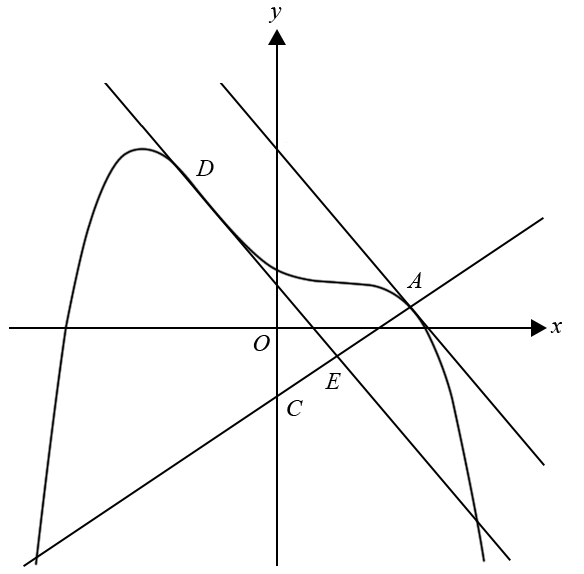
The diagram below shows part of the graph of  `y = g(x)`, the tangent to the graph at  `x = 2`  and a straight line drawn perpendicular to the tangent to the graph at  `x = 2`. The equation of the tangent at the point `A` with coordinates  `(2, g(2))`  is  `y = 3-(4x)/3`.

The tangent cuts the `y`-axis at `B`. The line perpendicular to the tangent cuts the `y`-axis at `C`.


  1.   i. Find the coordinates of `B`.   (1 mark)

    --- 2 WORK AREA LINES (style=lined) ---

  2.  ii. Find the equation of the line that passes through `A` and `C` and, hence, find the coordinates of `C`.   (2 marks)

    --- 5 WORK AREA LINES (style=lined) ---

  3. iii. Find the area of triangle `ABC`.   (2 marks)

    --- 4 WORK AREA LINES (style=lined) ---

  4. The tangent at `D` is parallel to the tangent at `A`. It intersects the line passing through `A` and `C` at `E`.


     i. Find the coordinates of `D`.   (2 marks)

    --- 4 WORK AREA LINES (style=lined) ---

  5. ii. Find the length of `AE`.   (3 marks)

    --- 6 WORK AREA LINES (style=lined) ---

Show Answers Only
  1.  i. `text(Proof)\ \ text{(See worked solutions)}`
  2. ii. `x = -2, 1`
  3.   i. `(0, 3)`
  4. ii. `y = 3/4 x-7/6`
  5.      `(0, -7/6)`
  6. iii. `25/6\ text(u²)`
  7. `(-1, 25/12)`
  8. `27/20\ text(u)`
Show Worked Solution
a.i.    `g(x)` `= int f(x)\ dx`
    `=-1/3 int (x + 2) (x-1)^2\ dx`
    `=-1/3int(x^3-3x+2)\ dx`
  `:.g(x)` `= -x^4/12 + x^2/2-(2x)/3 + c`

 
`text(S)text(ince)\ \ g(0) = 1,`

`1` `= 0 + 0-0 + c`
`:. c` `= 1`

  
`:. g(x) = -x^4/12 + x^2/2-(2x)/3 + 1\ \ …\ text(as required)`
 

a.ii.   `text(Stationary point when:)`

`g^{′}(x) = f(x) = 0`

`-1/3(x + 2) (x-1)^2=0`

`:. x = -2, 1`
 

b.i.   

`B\ text(is the)\ y text(-intercept of)\ \ y = 3-4/3 x`

`:. B (0, 3)`
 

b.ii.   `m_text(norm) = 3/4, \ text(passes through)\ \ A(2, 1/3)`

   `text(Equation of normal:)`

`y-1/3` `=3/4(x-2)`
`y` `=3/4 x-7/6`
   

`:. C (0, -7/6)`
 

b.iii.   `text(Area)` `= 1/2 xx text(base) xx text(height)`
    `= 1/2 xx (3 + 7/6) xx 2`
    `= 25/6\ text(u²)`


♦ Mean mark part (c)(i) 43%.
MARKER’S COMMENT: Many students gave an incorrect `y`-value here. Be careful!
c.i.    `text(Solve)\ \ \ g^{′}(x)` `= -4/3\ \ text(for)\ \ x < 0`
  `=> x` `= -1`
  `g(-1)` `=-1/12+1/2+2/3+1`
    `=25/12`

  
`:. D (−1, 25/12)`
 

c.ii.   `text(T) text(angent line at)\ \ D:`

`y-25/12` `=-4/3(x+1)`
`y` `=-4/3x + 3/4`

 
`DE\ \ text(intersects)\ \ AE\ text(at)\ E:`

♦♦ Mean mark 32%.
`-4/3 x + 3/4` `= 3/4 x-7/6`
`25/12 x` `= 23/12`
`x` `=23/25`

 
`:. E (23/25, -143/300)`
 

`:. AE` `= sqrt((2-23/25)^2 + (1/3-(-143/300))^2)`
  `= 27/20\ text(units)`

Filed Under: Coordinate Geometry, Curve Sketching, Tangents and Normals Tagged With: Band 3, Band 4, Band 5, smc-634-10-Polynomial, smc-634-50-Find tangent given curve, smc-634-70-Find point of tangency, smc-724-20-Degree 4, smc-727-10-Equation of line, smc-727-20-Distance

Calculus, MET2 2016 VCAA 1

Let  `f: [0, 8 pi] -> R, \ f(x) = 2 cos (x/2) + pi`.

  1. Find the period and range of `f`.   (2 marks)

    --- 4 WORK AREA LINES (style=lined) ---

  2. State the rule for the derivative function `f^{′}`.   (1 mark)

    --- 1 WORK AREA LINES (style=lined) ---

  3. Find the equation of the tangent to the graph of `f` at  `x = pi`.   (1 mark)

    --- 2 WORK AREA LINES (style=lined) ---

  4. Find the equations of the tangents to the graph of  `f: [0, 8 pi] -> R,\ \ f(x) = 2 cos (x/2) + pi`  that have a gradient of 1.   (2 marks)

    --- 4 WORK AREA LINES (style=lined) ---

  5. The rule of  `f^{′}` can be obtained from the rule of `f` under a transformation `T`, such that
      
    `qquad T: R^2 -> R^2,\ T([(x), (y)]) = [(1, 0), (0, a)] [(x), (y)] + [(−pi), (b)]`


    Find the value of `a` and the value of `b`.   (3 marks)

    --- 8 WORK AREA LINES (style=lined) ---

  6. Find the values of  `x, \ 0 <= x <= 8 pi`, such that  `f(x) = 2 f^{′} (x) + pi`.   (2 marks)

    --- 5 WORK AREA LINES (style=lined) ---

Show Answers Only
  1. `text(Period:)\ 4 pi; qquad text(Range:)\ [pi-2, pi + 2]`
  2. `f^{′} (x) =-sin (x/2)`
  3. `y =-x + 2 pi`
  4. `y = x-2 pi and y = x-6 pi`
  5. `a = 1/2 and b =-pi/2`
  6. `x = (3 pi)/2, (7 pi)/2, (11 pi)/2, (15 pi)/2`
Show Worked Solution

a.   `text(Period)= (2pi)/n = (2 pi)/(1/2) = 4pi`

MARKER’S COMMENT: Including round brackets rather than square ones was a common mistake.

`text(Range:)\ [pi-2, pi + 2]`
  

b.   `f^{′} (x) = text(−sin) (x/2)`
 

c.   `[text(CAS: tangentLine)\ (f(x), x, pi)]`

`y = -x + 2 pi`
 

d.   `text(Solve)\ \ f^{′} (x) = 1\ \ text(for)\ x in [0, 8 pi]`

♦ Mean mark part (d) 50%.

`-> x = 3 pi or 7 pi`

`:. y = x-2 pi and y = x-6 pi\ \ [text(CAS)]`


e.   `text(Using the transition matrix,)`

♦♦ Mean mark part (e) 27%.
`x_T` `=x-pi`
`x` `=x_T+pi`
`y_T` `=ay+b`
`y` `=(y_T-b)/a`
   

`f(x)= cos (x/2) + pi/2\ \ ->\ \ f{′}(x) = -sin(x/2)`

`(y_T-b)/a` `=2cos((x_T+pi)/2)+pi`
`y_T` `=2a cos((x_T+pi)/2)+a pi +b`
  `=-2a sin(x_T/2)+a pi + bqquad [text(Complementary Angles)]`
   
`-2a` `=-1`
`:. a` `=1/2`
`1/2 pi +b` `=0`
`:.b` `=-pi/2`


f.   `text(Solve)\ \ f(x) = 2 f^{′} (x) + pi\ \ text(for)\ \ x in [0, 8 pi]`

♦ Mean mark part (f) 50%.
`2 cos (x/2) + pi` `= -2 sin(x/2)+pi`
`tan(x/2)` `=-1`
`x/2` `=(3pi)/4, (7pi)/4, (11pi)/4, (15pi)/4`
`:.x` `= (3 pi)/2, (7 pi)/2, (11 pi)/2, (15 pi)/2`

Filed Under: Tangents and Normals, Transformations Tagged With: Band 3, Band 4, Band 5, smc-634-30-Trig Function, smc-634-50-Find tangent given curve, smc-753-60-Matrix, smc-753-75-Trig functions

Probability, MET2 2010 VCAA 21 MC

Events `A` and `B` are mutually exclusive events of a sample space with

`text(Pr) (A) = p and text(Pr) (B) = q\ \ text(where)\ \ 0 < p < 1 and 0 < q < 1.`

`text(Pr) (A prime nn B prime)` is equal to

  1. `(1 - p) (1 - q)`
  2. `1 - pq`
  3. `1 - (p + q)`
  4. `2 - p - q`
  5. `1 - (p + q - pq)`
Show Answers Only

`C`

Show Worked Solution

♦ Mean mark 43%.
`text(Pr) (A prime nn B prime)` `= 1 – p – q`
  `= 1 – (p + q)`

`=>   C`

Filed Under: Conditional Probability and Set Notation Tagged With: Band 5, smc-2736-20-Set Notation, smc-2736-40-Independent Events

Probability, MET2 2010 VCAA 12 MC

A soccer player is practising her goal kicking. She has a probability of  `3/5`  of scoring a goal with each attempt. She has 15 attempts.

The probability that the number of goals she scores is less than 7 is closest to

A.   `0.0612`

B.   `0.0950`

C.   `0.1181`

D.   `0.2131`

E.   `0.7869`

Show Answers Only

`B`

Show Worked Solution

`text(Let)\ \ X = text(Number of goals scored),`

`X∼\ text(Bi) (15, 3/5)`

♦ Mean mark 44%.

`text(Pr) (X<7)`

`= text(Pr) (X <= 6)\ \ [text(CAS: binomCdf)\ (15, 3/5, 0, 6)]`

`= 0.0950`

`=>   B`

Filed Under: Binomial Tagged With: Band 5, smc-638-20-binomCdf (CAS)

Algebra, MET2 2010 VCAA 7 MC

The simultaneous linear equations  `(m - 1) x + 5y = 7  and  3x + (m - 3) y = 0.7 m`  have infinitely many solutions for

  1. `m in R text(\{0, −2})`
  2. `m in R text(\{0})`
  3. `m in R text(\{6})`
  4. `m = 6`
  5. `m = – 2`
Show Answers Only

`D`

Show Worked Solution

`text(Infinite solutions occur when:)`

`->\ text(same gradient and same)\ \ y text(-intercept)`

`(m_1 – 1) x + 5y_1` `=7`
`y_1` `=- (m_1 – 1)/5 x+ 7/5`
`3x + (m_2 – 3) y_2` `= 0.7m`
`y_2` `=- 3/(m_2 – 3)x +(0.7m)/(m_2 – 3)`
   

`text(Gradients equal when,)`

♦ Mean mark 47%.
`- (m – 1)/5` `= – 3/(m – 3)`
`m^2-4m+3` `=15`
`(m-6)(m+2)` `=0`

`m = – 2 or m = 6`
 

`text(Coefficients equal when:)`

`7/5` `=(0.7m)/(m – 3)`
`7m – 21` `= 3.5m`
`3.5m` `=21`
`m` `=6`

 
`=>   D`

Filed Under: Simultaneous Equations Tagged With: Band 5, smc-721-20-Infinite solutions

Calculus, MET2 2016 VCAA 14 MC

A rectangle is formed by using part of the coordinate axes and a point  `(u, v)`, where  `u > 0`  on the parabola  `y = 4 - x^2.`
 

Which one of the following is the maximum area of the rectangle?

  1. `4`
  2. `(2 sqrt 3)/3`
  3. `(8 sqrt 3 - 4)/3`
  4. `8/3`
  5. `(16 sqrt 3)/9`
Show Answers Only

`E`

Show Worked Solution
`text(Area)` `=u xx (4-u^2)`
  `=4u-u^3`
`(dA)/(du)` `=4-3u^2`


`text(Maximum area occurs when)\ \ (dA)/(du)=0,`

♦♦ Mean mark 37%.
`4-3u^2` `=0`
`u^2` `=4/3`
`u` `= (2 sqrt 3)/3`


`:. A_text(max)` `=(2 sqrt 3)/3 xx (4-(2 sqrt 3)^2/9)`
  `=(2 sqrt 3)/3 xx 8/3`
  ` = (16 sqrt 3)/9`

 
`=>   E`

Filed Under: Maxima and Minima Tagged With: Band 5, smc-641-10-Area

Algebra, MET2 2016 VCAA 11 MC

The function  `f` has the property  `f(x) - f(y) = (y - x)\ f(xy)`  for all non-zero real numbers `x` and `y`.

Which one of the following is a possible rule for the function?

  1. `f(x) = x^2`
  2. `f(x) = x^2 + x^4`
  3. `f(x) = x log_e (x)`
  4. `f(x) = 1/x`
  5. `f(x) = 1/x^2`
Show Answers Only

`D`

Show Worked Solution

`text(Solution 1)`

♦ Mean mark 47%.

`text(Consider option)\ D:`

`text(LHS)\ = 1/x – 1/y`

`text(RHS)\ =(y-x) xx 1/(xy) = 1/x – 1/y =\ text(LHS)`

`=>D`


`text{Solution 2 (using technology)}`

`text(Define each specific function on CAS)`

`[text(i.e.)\ \ f(x) = 1/x]`

`text(Enter functional equation)\ \ f(x) – f(y) = (y – x)\ f(xy)`

`text(unitl CAS output is “TRUE”)`

`=>   D`

Filed Under: Functional Equations Tagged With: Band 5, smc-642-40-Other functions

Calculus, MET2 2016 VCAA 9 MC

Given that  `(d(xe^(kx)))/(dx) = (kx + 1)e^(kx)`, then  `int xe^(kx) dx` is equal to

  1. `(xe^(kx))/(kx + 1) + c`
  2. `((kx + 1)/k)e^(kx) + c`
  3. `1/k int e^(kx) dx`
  4. `1/k (xe^(kx) - int e^(kx) dx) + c`
  5. `1/k^2 (xe^(kx) - e^(kx)) + c`
Show Answers Only

`D`

Show Worked Solution
♦ Mean mark 41%.
`int (kx + 1)e^(kx) dx` `= xe^(kx) + c_1`
`k int xe^(kx) dx + int e^(kx) dx` `= xe^(kx) + c_1`
`k int xe^(kx) dx` `= xe^(kx) – int e^(kx) dx + c_1`
`:. int xe^(kx) dx` `= 1/k (xe^(kx) – int e^(kx) dx) + c`

 
`=>   D`

Filed Under: Integration (L&E), L&E Integration Tagged With: Band 5, smc-740-10-Exponential (indefinite), smc-740-80-Integration by recognition, smc-748-10-Exponential (indefinite), smc-748-80-Integration by recognition

Algebra, MET2 2011 VCAA 22 MC

The expression

`log_c(a) + log_a(b) + log_b(c)`

is equal to

  1. `1/(log_c(a)) + 1/(log_a(b)) + 1/(log_b(c))`
  2. `1/(log_a(c)) + 1/(log_b(a)) + 1/(log_c(b))`
  3. `− 1/(log_a(b)) - 1/(log_b(c)) - 1/(log_c(a))`
  4. `1/(log_a(a)) + 1/(log_b(b)) + 1/(log_c(c))`
  5. `1/(log_c(ab)) + 1/(log_b(ac)) + 1/(log_a(cb))`
Show Answers Only

`=> B`

Show Worked Solution

`text(Solution 1)`

♦ Mean mark 45%.

`text(Using Change of Base:)`

`log_c(a) + log_a(b) + log_b(c)`

`=(log_a(a))/(log_a(c)) + (log_b(b))/(log_b(a)) + (log_c(c))/(log_c(b))`

`=1/(log_a(c)) + 1/(log_b(a)) + 1/(log_c(b))`

 
`=> B`


`text(Solution 2)`

`text(Let)\ \ x` `=log_c(a)`
`c^x` `=a`
`x log_a c` `=log_a a`
`x` `=1/log_a c`


`text(Apply similarly for the other terms.)`

`=> B`


`text(Solution 3)`

`text(Use technology to test the truth of each statement.)`

Filed Under: Log/Index Laws and Equations Tagged With: Band 5, smc-726-30-Change of Base Rule

Calculus, MET2 2011 VCAA 19 MC

A part of the graph of  `f: R -> R, f(x) = x^2`  is shown below. Zoe finds the approximate area of the shaded region by drawing rectangles as shown in the second diagram.

met2-2011-vcaa-19-mc

Zoe's approximation is  `ptext(%)` more than the exact value of the area.

The value of `p` is closest to

A.   `10`

B.   `15`

C.   `20`

D.   `25`

E.   `30`

Show Answers Only

`=> D`

Show Worked Solution
`A_text(exact)` `= int_0^6 x^2 dx`
  `= 72`
♦ Mean mark 43%.
`A_text(approx)`

`= 1[f(1) + f(2) + f(3) + …`

       `+ f(4) + f(5) + f(6)]`

  `= 91`


`p text(%)` `= text(increase)/text(exact area) xx 100`
  `= (91 – 72)/72 xx 100`
  `= 26.4 text(%)`

`=> D`

Filed Under: Area Under Curves (old) Tagged With: Band 5, smc-723-10-Quadratic, smc-723-90-Approximations

Calculus, MET2 2011 VCAA 17 MC

The normal to the curve with equation  `y = x^(3/2) + x`  at the point  `(4,12)`  is parallel to the straight line with equation

A.   `4x = y`

B.   `4y + x = 7`

C.   `y = x/4 + 1`

D.   `x - 4y = −5`

E.   `4y + 4x = 20` 

Show Answers Only

`=> B`

Show Worked Solution

`text(Solution 1:)`

♦ Mean mark 48%.
`y` `= x^(3/2) + x`
`dy/dx` `=3/2 x^(1/2)+1`


`text(At)\ \ x=4,`

`m=3/2 sqrt4 +1 = 4`

`m_text(norm) = – 1/4`

`text(Consider the gradients of each option:)`

`m_text(option B) = -1/4`

`=>B`


`text(Solution 2:)`

`text(Equation of normal at)\ \ x = 4:`

`y = −1/4x + 13qquad[text(CAS: normal Line) (x^(3/2) + x, x, 4)]`

`m = −1/4`

`=> B`

Filed Under: Tangents and Normals Tagged With: Band 5, smc-634-90-Normals

Calculus, MET2 2011 VCAA 14 MC

met2-2011-vcaa-14-mc2 

To find the area of the shaded region in the diagram shown, four different students proposed the following calculations.

  1. `int_0^1 e^(2x)\ dx`
  2. `e^2 - int_0^1 e^(2x)\ dx`
  3. `int_1^(e^2) e^(2y)\ dy`
  4. `int_1^(e^2) (log_e(x))/2 \ dx`

Which of the following is correct?

A.   ii. only

B.   ii. and iii. only

C.   i., ii., iii. and iv.

D.   ii. and iv. only

E.   i. and iv. only 

Show Answers Only

`=> D`

Show Worked Solution
`text(Area)` `=\ text(Area of rect) – text(Area under curve)`
  `= e^2 – int_0^1 e^(2x)\ dx`

`:.\ text(Statement ii is correct.)`


`text(Consider the shaded area between the curve and)\ y text(-axis:)`

`y` `=e^(2x)`
`log_e y` `=2x`
`x` `=(log_e(y))/2`

`text(Area)\ = int_1^(e^2) (log_e(x))/2 \ dx`

`:.\ text(Statement iv is correct.)`

`=> D`

Filed Under: Area Under Curves Tagged With: Band 5, smc-723-50-Log/Exponential, smc-723-80-Area between graphs

Probability, MET2 2011 VCAA 13 MC

In an orchard of 2000 apple trees it is found that 1735 trees have a height greater than 2.8 metres. The heights are distributed normally with a mean `mu` and standard deviation 0.2 metres.

The value of `mu` is closest to

  1. `3.023`
  2. `2.577`
  3. `2.230`
  4. `1.115`
  5. `0.223` 
Show Answers Only

`=> A`

Show Worked Solution

met2-2011-vcaa-13-mc-answer

`X = text(height), X ∼\ N(μ,0.2^2)`

`text(Pr)(X <= 2.8)` `= 1 – 1735/2000`
  `= 0.1325`
`text(Pr)(Z < a)` `= .1325`
`:. a` `= −1.1147qquad[text(CAS: inv Norm)]`


`text(Relate)\ X\ text(and)\ Z\ text(scores:)`

`−1.1147` `= (2.8 – μ)/0.2`
`:. μ` `= 3.023`

 
`=> A`

Filed Under: Normal Distribution Tagged With: Band 5, smc-719-10-Single z-score

NETWORKS, FUR2 2016 VCAA 3

A new skateboard park is to be built in Beachton.

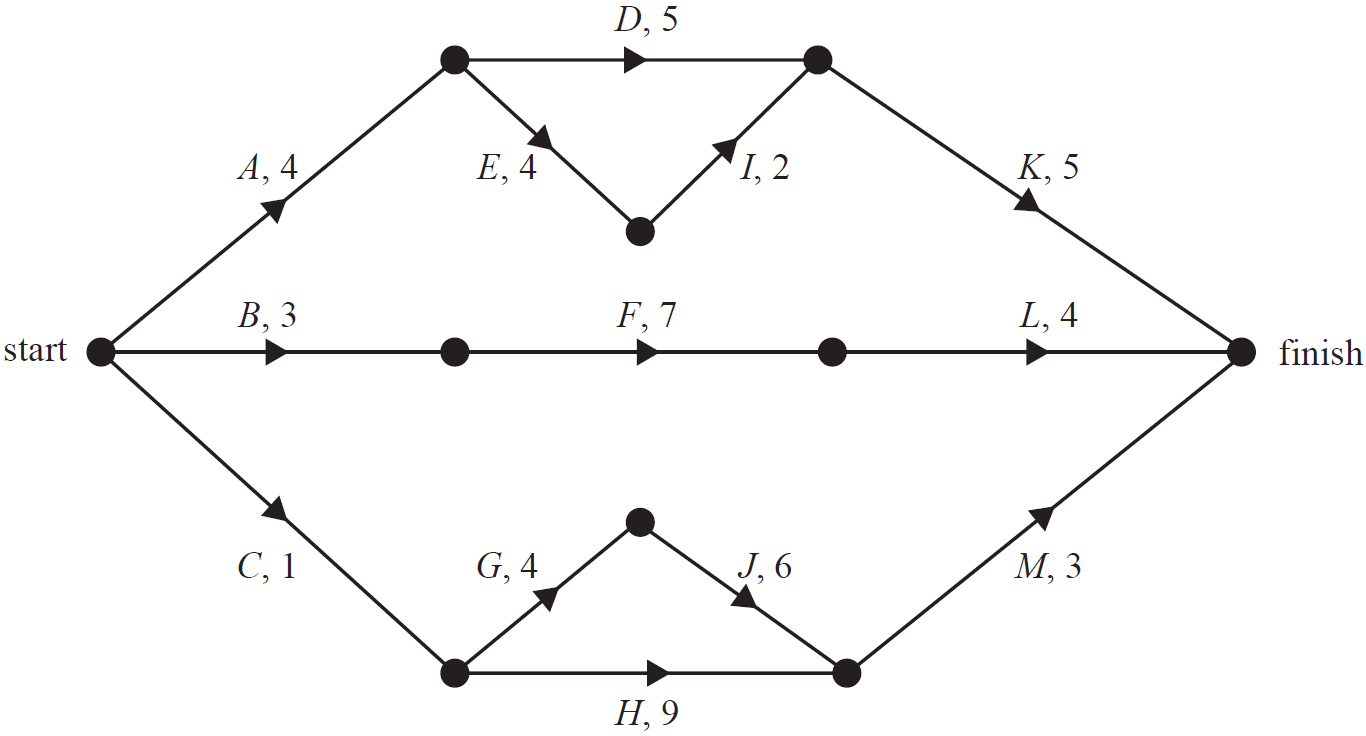
This project involves 13 activities, `A` to `M`.

The directed network below shows these activities and their completion times in days.


  1. Determine the earliest start time for activity `M`.   (1 mark)

    --- 2 WORK AREA LINES (style=lined) ---

  2. The minimum completion time for the skateboard park is 15 days.


    Write down the critical path for this project.   (1 mark)

    --- 1 WORK AREA LINES (style=lined) ---

  3. Which activity has a float time of two days?   (1 mark)

    --- 1 WORK AREA LINES (style=lined) ---

  4. The completion times for activities `E, F, G, I` and `J` can each be reduced by one day.


    The cost of reducing the completion time by one day for these activities is shown in the table below.


    What is the minimum cost to complete the project in the shortest time possible?   (1 mark)

    --- 2 WORK AREA LINES (style=lined) ---

  5. The original skateboard park project from part (a), before the reduction of time in any activity, will be repeated at another town named Campville, but with the addition of one extra activity.


    The new activity, `N`, will take six days to complete and has a float time of one day.


    Activity `N` will finish at the same time as the project.


     i.  Add activity `N` to the network below.   (1 mark) 

    --- 0 WORK AREA LINES (style=lined) ---


    ii.  What is the latest start time for activity `N`?   (1 mark)

    --- 3 WORK AREA LINES (style=lined) ---

Show Answers Only
  1. `11\ text(days)`
  2. `AEIK`
  3. `text(Activity)\ H`
  4. `text(Minimum cost of $2000 when activity)\ I\ text(is reduced by 1 day.)`

    1. `9\ text(days from the start)`
Show Worked Solution
a.    `text(EST)` `= 1 + 4 + 6`
    `= 11\ text(days)`

  
b.
  `text(Critical Path:)\ AEIK`

♦♦ Mean mark part (c) 37%, part (d) 21%.
MARKER’S COMMENT: In part (d), `ADK` cannot be crashed, therefore shortest duration is 14 days. Activity `I` is cheapest to reduce.
  

c.   `text(Activity)\ H`
  

d.   `text(Minimum days to complete is 14 days by reducing)`

`text(either)\ E\ text(or)\ I\ text(by 1 day.)`

`:. text(Minimum cost of $2000 when activity)\ I\ text(is reduced)`

`text(by 1 day.)`
  

e.i.   

♦♦ Mean mark part (e)(i) 21%, (e)(ii) 27%.
MARKER’S COMMENT: In (e)(ii), activity `N` must have an arrow on it.
  

e.ii.    `text(LST)` `=\ text(critical path time − 6 days)`
    `= 15-6`
    `= 9\ text(days from the start.)`

Filed Under: Critical Path Analysis Tagged With: Band 4, Band 5, Band 6, smc-621-20-Critical Paths/EST, smc-621-30-Float time/LST, smc-621-40-Crashing/Reduce completion time, smc-621-45-Adding activities

NETWORKS, FUR2 2016 VCAA 2

The suburb of Alooma has a skateboard park with seven ramps.

The ramps are shown as vertices `T`, `U`, `V`, `W`, `X`, `Y` and `Z` on the graph below.


The tracks between ramps `U` and `V` and between ramps `W` and `X` are rough, as shown on the graph above.

  1. Nathan begins skating at ramp `W` and follows an Eulerian trail.


    At which ramp does Nathan finish?   (1 mark)

    --- 2 WORK AREA LINES (style=lined) ---

  2. Zoe begins skating at ramp `X` and follows a Hamiltonian path.


    The path she chooses does not include the two rough tracks.


    Write down a path that Zoe could take from start to finish.   (1 mark)

    --- 2 WORK AREA LINES (style=lined) ---

  3. Birra can skate over any of the tracks, including the rough tracks.


    He begins skating at ramp `X` and will complete a Hamiltonian cycle.


    In how many ways could he do this?   (1 mark) 

    --- 3 WORK AREA LINES (style=lined) ---

Show Answers Only
  1. `U`
  2. `XYTUZVW`
    `XYTUZWV`
  3. `4\ text(ways)`
Show Worked Solution

a.   `text{The Eulerian trail (visits each edge exactly once):}`

“XYZWVZUYTU`

`:. text(Finishes at ramp)\ U.`
  

b.   `text{Hamiltonian Paths (touch each vertex exactly once):}`

`XYTUZVW`

`XYTUZWV`
  

c.   `text(Hamiltonian cycles:)`

♦♦ Mean mark 31%.

`XYTUZVWX`

`XYTUVZWX`

`text(These two cycles can be reversed)`

`text(to add two more possibilities.)`

`XWVZUTYX`

`XWZVUTYX`

`:. 4\ text(ways.)`

Filed Under: Travelling Problems and Adjacency Matrices Tagged With: Band 3, Band 4, Band 5, smc-622-10-Euler, smc-622-20-Hamiltonian

NETWORKS, FUR2 2016 VCAA 1

A map of the roads connecting five suburbs of a city, Alooma (`A`), Beachton (`B`), Campville (`C`), Dovenest (`D`) and Easyside (`E`), is shown below.


  1. Starting at Beachton, which two suburbs can be driven to using only one road?   (1 mark)

    --- 2 WORK AREA LINES (style=lined) ---

A graph that represents the map of the roads is shown below.


One of the edges that connects to vertex `E` is missing from the graph.

  1.  i. Add the missing edge to the graph above.   (1 mark)

    (Answer on the graph above)

    --- 0 WORK AREA LINES (style=lined) ---

  2. ii. Explain what the loop at `D` represents in terms of a driver who is departing from Dovenest.   (1 mark)

    --- 2 WORK AREA LINES (style=lined) ---

Show Answers Only

a.    `text(Alooma and Easyside.)`

b.i. 

b.ii. `text(The loop represents that a driver can take a route out)`

`text(of Dovenest and return home without going through another)`

`text(suburb or turning back.)`

Show Worked Solution

a.   `text(Alooma and Easyside.)`


b.i.   

`text(Draw a third edge between Easyside and Dovenest.)`


b.ii. `text(The loop represents that a driver can take a)`

♦♦ Mean mark 30%.

`text(route out of Dovenest and return home without)`

`text(going through another suburb or turning back.)`

Filed Under: Travelling Problems and Adjacency Matrices Tagged With: Band 2, Band 4, Band 5, smc-622-50-Draw Network from Map/Matrix

GRAPHS, FUR2 2016 VCAA 3

A company produces two types of hockey stick, the ‘Flick’ and the ‘Jink’.

Let `x` be the number of Flick hockey sticks that are produced each month.

Let `y` be the number of Jink hockey sticks that are produced each month.

Each month, up to 500 hockey sticks in total can be produced.

The inequalities below represent constraints on the number of each hockey stick that can be produced each month.

Constraint 1 `x >= 0` Constraint 2 `y >= 0`
Constraint 3 `x + y <= 500` Constraint 4 `y <= 2x`
  1. Interpret Constraint 4 in terms of the number of Flick hockey sticks and the number of Jink hockey sticks produced each month.  (1 mark)

There is another constraint, Constraint 5, on the number of each hockey stick that can be produced each month.

Constraint 5 is bounded by Line `A`, shown on the graph below.

The shaded region of the graph contains the points that satisfy constraints 1 to 5.

  1. Write down the inequality that represents Constraint 5.  (1 mark)

The profit, `P`, that the company makes from the sale of the hockey sticks is given by

`P = 62x + 86y`

  1. Find the maximum profit that the company can make from the sale of the hockey sticks.  (1 mark)
  2. The company wants to change the selling price of the Flick and Jink hockey sticks in order to increase its maximum profit to $42 000.

    All of the constraints on the numbers of Flick and Jink hockey sticks that can be produced each month remain the same.

    The profit, `Q`, that is made from the sale of hockey sticks is now given by

    `qquadQ = mx + ny`


    The profit made on the Flick hockey sticks is `m` dollars per hockey stick.

    The profit made on the Jink hockey sticks is `n` dollars per hockey stick.

    The maximum profit of $42 000 is made by selling 400 Flick hockey sticks and 100 Jink hockey sticks.

    What are the values of `m` and `n`?  (2 marks)

Show Answers Only
  1. `text(Constraint 4 means the number of Jink sticks produced each)`
    `text(month is less than or equal to twice the number of flick)`
    `text(sticks produced each month.)`
  2. `y <= 300`
  3. `$38\ 200`
  4. `84`
Show Worked Solution

a.   `text(Constraint 4 means the number of Jink sticks)`

♦♦♦ Mean mark 25%.

`text(produced each month is less than or equal to)`

`text(twice the number of flick sticks produced each)`

`text(month.)`


b.   `y <= 300`


c.   `text(From the equation, 1 Jink stick produces a)`

`text(higher profit than 1 Flick stick.)`

`text(Maximum profit at)\ (200,300)`

`P` `= (62 xx 200) + (86 xx 300)`
  `= $38\ 200`


d.   `Q = mx + ny`

♦♦♦ Mean mark 7%.
MARKER’S COMMENT: Very few students were able to identify the need for the sliding line concept and execute it correctly in this question.

`text(Max profit at)\ (400,100)`

`(400,100)\ text(lies on)\ x + y = 500`

`=>\ text(Max profit equation has the same)`

`text(gradient as the profit line.)`

`=> m = −1, m = n`

`text(Using the maximum profit = $42 000,)`

`400m + 100n` `= 42\ 000`
`500m` `= 42\ 000`
`m` `= (42\ 000)/500`
  `= 84`

`:. m = n = 84`

Filed Under: Linear Programming Tagged With: Band 4, Band 5, Band 6

MATRICES, FUR2 2016 VCAA 3

A travel company is studying the choice between air (`A`), land (`L`), sea (`S`) or no (`N`) travel by some of its customers each year.

Matrix `T`, shown below, contains the percentages of customers who are expected to change their choice of travel from year to year.

`{:(qquadqquadqquadqquadqquadquadtext(this year)),(qquadqquadqquadquadAqquadqquadLqquadqquadSqquadquadN),(T = [(0.65,0.25,0.25,0.50),(0.15,0.60,0.20,0.15),(0.05,0.10,0.25,0.20),(0.15,0.05,0.30,0.15)]{:(A),(L),(S),(N):}text(next year)):}`

Let `S_n` be the matrix that shows the number of customers who choose each type of travel `n` years after 2014.

Matrix `S_0` below shows the number of customers who chose each type of travel in 2014.

`S_0 = [(520),(320),(80),(80)]{:(A),(L),(S),(N):}`

Matrix `S_1` below shows the number of customers who chose each type of travel in 2015.

`S_1 = TS_0 = [(478),(d),(e),(f)]{:(A),(L),(S),(N):}`

  1. Find the values missing from matrix `S_1 (d, e, f )`.   (1 mark)

    --- 2 WORK AREA LINES (style=lined) ---

  2. Write a calculation that shows that 478 customers were expected to choose air travel in 2015.   (1 mark)

    --- 2 WORK AREA LINES (style=lined) ---

  3. Consider the customers who chose sea travel in 2014.
  4. How many of these customers were expected to choose sea travel in 2015?   (1 mark)

    --- 3 WORK AREA LINES (style=lined) ---

  5. Consider the customers who were expected to choose air travel in 2015.
  6. What percentage of these customers had also chosen air travel in 2014?
  7. Round your answer to the nearest whole number.   (1 mark)

    --- 4 WORK AREA LINES (style=lined) ---

In 2016, the number of customers studied was increased to 1360.
Matrix `R_2016`, shown below, contains the number of these customers who chose each type of travel in 2016.

`R_2016 = [(646),(465),(164),(85)]{:(A),(L),(S),(N):}`

  1. The company intends to increase the number of customers in the study in 2017 and in 2018.
  2. The matrix that contains the number of customers who are expected to choose each type of travel in 2017 (`R_2017`) and 2018 (`R_2018`) can be determined using the matrix equations shown below.

`R_2017 = TR_2016 + BqquadqquadqquadR_2018 = TR_2017 + B`
 

`{:(qquadqquadqquadqquadqquadquadtext(this year)),(qquadqquadqquadquadAqquadqquadLqquadqquadSqquadquadN),(T = [(0.65,0.25,0.25,0.50),(0.15,0.60,0.20,0.15),(0.05,0.10,0.25,0.20),(0.15,0.05,0.30,0.15)]{:(A),(L),(S),(N):}text(next year)):}qquadqquad{:(),(),(B = [(80),(80),(40),(−80)]{:(A),(L),(S),(N):}):}`

    1. The element in the fourth row of matrix `B` is – 80.
    2. Explain this number in the context of selecting customers for the studies in 2017 and 2018.   (1 mark)

      --- 2 WORK AREA LINES (style=lined) ---

    3. Determine the number of customers who are expected to choose sea travel in 2018.
    4. Round your answer to the nearest whole number.   (2 marks)

      --- 5 WORK AREA LINES (style=lined) ---

Show Answers Only
  1. `d=298, \ e=94, \ f=130`
  2. `(0.65 xx 520) + (0.25 xx 320) + (0.25 xx 80) + (0.50 xx 80) = 478`
  3. `20\ text(customers)`
  4. `71text(%)`
  5.  
    1. `text(80 customers who have no travel in a given)`
      `text(year are removed from the study. This occurs)`
      `text(in both 2017 and 2018.)`
    2. `text(190 customers)`
Show Worked Solution

a.   `d=298, \ e=94, \ f=130`
 

b.   `(0.65 xx 520) + (0.25 xx 320) + (0.25 xx 80) + (0.50 xx 80) = 478`

♦♦ Mean mark part (b) and (c) was 35% and 45% respectively.


c.   `text(Sea Travel in 2014-80 customers.)`

`text(Of those 80 customers,)`

`text(Sea Travel in 2015)` `= 25text(%) xx 80`
  `= 20\ text(customers)`


d.   `text(Expected total for air travel in 2015)`

♦♦♦ Mean mark 17%.

`= 478\ text(customers)`
 

`text(In 2014, 520 customers chose air travel.)`

`text(65% of those chose air travel in 2015)`

`= 65text(%) xx 520`

`= 338\ text(customers)`

`:.\ text(Percentage)` `= 338/478 xx 100`
  `= 70.71…`
  `= 71text(%)`


e.i.   `text(80 customers who have no travel in a given)`

♦ Mean mark 14%.
MARKER’S COMMENT: “80 people chose not to travel” was a common answer that received no marks.

`text(year are removed from the study. This occurs)`

`text(in both 2017 and 2018.)`


e.ii.   `R_2017` `= TR_2016 + B`
    `= [(0.65,0.25,0.25,0.50),(0.15,0.60,0.20,0.15),(0.05,0.10,0.25,0.20),(0.15,0.05,0.30,0.15)][(646),(465),(164),(85)] + [(80),(80),(40),(−80)]`
    `= [(699.65),(501.45),(176.80),(102.10)]`


`R_2018` `= TR_2017 + B`
  `= [(0.65,0.25,0.25,0.50),(0.15,0.60,0.20,0.15),(0.05,0.10,0.25,0.20),(0.15,0.05,0.30,0.15)][(699.65),(501.45),(176.80),(102.10)]`
  `= [(755.39),(536.49),(189.75),(118.38)]`


`:. 190\ text(customers are expected to choose)`

`text(sea travel in 2018.)`

Filed Under: Transition Matrices - Modified Tagged With: Band 2, Band 5, Band 6, page-break-before-question, smc-1893-20-State Matrix in discrete period, smc-1893-32-4x4 Matrix, smc-1893-60-Regular Transition Matrices

GEOMETRY, FUR2 2016 VCAA 5

A golf course has a sprinkler system that waters the grass in the shape of a sector, as shown in the diagram below. 
 

A sprinkler is positioned at point `S` and can turn through an angle of 100°.

The shaded area on the diagram shows the area of grass that is watered by the sprinkler.

  1. If 147.5 m² of grass is watered, what is the maximum distance, `d` metres, that the water reaches from `S`?


    Round your answer to the nearest metre.  (1 mark)

  2. Another sprinkler can water a larger area of grass.


    This sprinkler will water a section of grass as shown in the diagram below.


    The section of grass that is watered is 4.5 m wide at all points.


    Water can reach a maximum of 12 m from the sprinkler at `L`.


    What is the area of grass that this sprinkler will water?


    Round your answer to the nearest square metre.  (2 marks)

Show Answers Only
  1. `13\ text{m  (nearest m)}`
  2. `199\ text{m²  (nearest m²)}`
Show Worked Solution
♦ Mean mark 48%.
a.    `text(Area of sector)` `= theta/360 xx pi xx r^2`
  `147.5` `= 100/360 xx pi xx d^2`
  `d^2` `= 147.5/pi xx 360/100`
    `= 169.02…`
  `:.d` `= 13.00…`
    `= 13\ text{m  (nearest m)}`
♦♦♦ Mean mark 23%.


b.    `text(Area)` `= ((360 – theta))/360 xx pi xx R^2 – ((360 – theta))/360 xx pi xx r^2`
    `= 260/360 xx pi (12^2 – 7.5^2)`
    `= 199.09…`
    `= 199\ text{m²  (nearest m²)}`

Filed Under: Perimeter, Area and Volume Tagged With: Band 5, Band 6

GEOMETRY, FUR2 2016 VCAA 3

A golf tournament is played in St Andrews, Scotland, at location 56° N, 3° W.

  1. Assume that the radius of Earth is 6400 km.


    Find the shortest great circle distance to the equator from St Andrews.


    Round your answer to the nearest kilometre.  (1 mark)

  2. The tournament begins on Thursday at 6.32 am in St Andrews, Scotland.


    Many people in Melbourne will watch the tournament live on television.


    Assume that the time difference between Melbourne (38° S, 145° E) and St Andrews (56° N, 3° W) is 10 hours.


    On what day and at what time will the tournament begin in Melbourne?  (1 mark) 

Show Answers Only
  1. `6255\ text{km (nearest km)}`
  2. `4:32\ text(pm on Thursday)`
Show Worked Solution
a.   

`text(Great circle distance to equator)`

♦ Mean mark 42%.
MARKER’S COMMENT: Longitude figures were not relevant here!

`= theta/360 xx 2pir`

`= 56/360 xx 2 xx pi xx 6400`

`= 6255.26…`

`= 6255\ text{km (nearest km)}`


b.   `text(Melbourne is East of St Andrews)`

♦♦ Mean mark 37%.
MARKER’S COMMENT: The time difference between the two cities here is given! Longitudinal difference calculations are not required.

`=>\ text(Melbourne is 10 hours ahead.)`

`:.\ text(Time in Melbourne)`

`= 6:32\ text(am + 10 hours)`

`= 4:32\ text(pm on Thursday)`

Filed Under: Great Circle Geometry Tagged With: Band 5, smc-758-10-Time differences, smc-758-20-Great Circle distance

CORE, FUR2 2016 VCAA 7


Ken has borrowed $70 000 to buy a new caravan.

He will be charged interest at the rate of 6.9% per annum, compounding monthly.

  1. For the first year (12 months), Ken will make monthly repayments of $800.

    1. Find the amount that Ken will owe on his loan after he has made 12 repayments.   (1 mark)

      --- 3 WORK AREA LINES (style=lined) ---

    2. What is the total interest that Ken will have paid after 12 repayments?   (1 mark)

      --- 4 WORK AREA LINES (style=lined) ---

  2. After three years, Ken will make a lump sum payment of $L in order to reduce the balance of his loan.
  3. This lump sum payment will ensure that Ken’s loan is fully repaid in a further three years.
  4. Ken’s repayment amount remains at $800 per month and the interest rate remains at 6.9% per annum, compounding monthly.
  5. What is the value of Ken’s lump sum payment, $L?
  6. Round your answer to the nearest dollar.   (2 marks)

    --- 5 WORK AREA LINES (style=lined) ---

Show Answers Only

a.i.`$65\ 076.22`

a.ii.`$4676.22`

b.  `$28\ 204.02`

Show Worked Solution

a.i.  `text(By TVM Solver,)`

♦ Mean mark 46%.

`N` `= 12`
`I(%)` `= 6.9`
`PV` `= 70\ 000`
`PMT` `= -800`
`FV` `= ?`
`text(P/Y)` `= text(C/Y) = 12`

 
`=> FV = -65\ 076.219…`

`:.\ text(Ken will owe $65 076.22)`

♦♦ Mean mark 26%.

a.ii.    `text(Total interest paid)` `= text(Total repayments) – text(reduction in principal)`
    `= (12 xx 800) – (70\ 000 – 65\ 076.22)`
    `= $4676.22`

  
b.   
`text(Find the loan balance after 3 years)`

♦♦♦ Mean mark 20%.
MARKER’S COMMENT: Correct input tables allowed for a method mark if answers were calculated incorrectly.

`N` `= 12 xx 3 = 36`
`I(%)` `= 6.9`
`PV` `= 70\ 000`
`PMT` `= -800`
`FV` `= ?`
`text(P/Y)` `=text(C/Y)=12`
   

`=> FV = 54\ 151.60`

  
`text(Find the loan amount that can be)`

`text(fully repaid by monthly payments)`

`text(of $800 over 3 years.)`

`N` `= 36`
`I(%)` `= 6.9`
`PV` `= ?`
`PMT` `= -800`
`FV` `= 0`
`text(P/Y)` `= text(C/Y)= 0`

 
`=> PV = 25\ 947.58`
  

`:.\ $L` `= 54\ 151.60 -25\ 947.58`
  `= $28\ 204.02`

Filed Under: Borrowing and Loans Tagged With: Band 5, Band 6, smc-603-22-Reducible balance loans, smc-603-60-CAS (1 step), smc-603-65-CAS (2 step)

CORE*, FUR2 2016 VCAA 6

Ken’s first caravan had a purchase price of $38 000.

After eight years, the value of the caravan was $16 000.

  1. Show that the average depreciation in the value of the caravan per year was $2750.   (1 mark)

    --- 2 WORK AREA LINES (style=lined) ---

  2. Let `C_n` be the value of the caravan `n` years after it was purchased.


    Assume that the value of the caravan has been depreciated using the flat rate method of depreciation.


    Write down a recurrence relation, in terms of `C_(n +1)` and `C_n`, that models the value of the caravan.   (1 mark)

    --- 2 WORK AREA LINES (style=lined) ---

  3. The caravan has travelled an average of 5000 km in each of the eight years since it was purchased.


    Assume that the value of the caravan has been depreciated using the unit cost method of depreciation.


    By how much is the value of the caravan reduced per kilometre travelled?   (1 mark)

    --- 5 WORK AREA LINES (style=lined) ---

Show Answers Only
  1. `text(Proof)\ text{(See Worked Solutions)}`
  2. `text(See Worked Solutions)`
  3. `$0.55`
Show Worked Solution
a.    `text(Average depreciation)`

`= {(38\ 000-16\ 000)}/8`

`= $2750`


♦♦ Mean mark (a) 39%.
MARKER’S COMMENT: A “show that” question should include an equation
  

b.    `C_0` `= 38\ 000,`
  `C_(n+1)` `= C_n-2750`

♦♦ Mean mark (b) 33%.
MARKER’S COMMENT: A lack of attention to detail and careless errors were common!
  

c.    `text(Total kms travelled)` `= 8 xx 5000`
    `= 40\ 000`

 
`:.\ text(Depreciation per km)`

`= {(38\ 000-16\ 000)}/(40\ 000)`

`= $0.55`


♦♦ Mean mark (c) 29%.
  

Filed Under: Depreciation, Recursion - Financial Tagged With: Band 5, Band 6, smc-602-40-Comparing methods, smc-717-50-Depreciation (SL), smc-717-70-Find RR

CORE, FUR2 2016 VCAA 5

Ken has opened a savings account to save money to buy a new caravan.

The amount of money in the savings account after `n` years, `V_n`, can be modelled by the recurrence relation shown below.

`V_0 = 15000, qquad qquad qquad V_(n + 1) = 1.04 xx V_n`

  1. How much money did Ken initially deposit into the savings account?  (1 mark)

    --- 2 WORK AREA LINES (style=lined) ---

  2. Use recursion to write down calculations that show that the amount of money in Ken’s savings account after two years, `V_2`, will be $16 224.  (1 mark)

    --- 5 WORK AREA LINES (style=lined) ---

  3. What is the annual percentage compound interest rate for this savings account?  (1 mark)

    --- 2 WORK AREA LINES (style=lined) ---

  4. The amount of money in the account after `n` years, `Vn` , can also be determined using a rule.
    i.
    Complete the rule below by writing the appropriate numbers in the boxes provided.   (1 mark)

    --- 0 WORK AREA LINES (style=lined) ---

    `V_n =` 
     
    `­^n xx`
     
  5. ii. How much money will be in Ken’s savings account after 10 years?   (1 mark)

    --- 3 WORK AREA LINES (style=lined) ---

Show Answers Only
  1. `$15000`
  2. `text(Proof)\ text{(See Worked Solutions)}`
  3. `4 text(%)`
  4. i. `text(See Worked Solutions)`
    ii. `$22\ 203.66` 
Show Worked Solution
a.    `text(Initial deposit)` `= V_0`
    `= $15\ 000`
b.    `V_0` `= $15\ 000`
  `V_1` `= 1.04 xx 15\ 000`
    `= $15\ 600`
  `V_2` `= 1.04 xx 15\ 600`
    `= $16\ 224\ text(… as required.)`

MARKER’S COMMENT: (b) Stating `V_2 =1.04^2 xx 15\ 600` `=16\ 224` is not using recursion as required here and did not gain a mark.
c.    `text(Annual compound interest)` `= 0.04 xx 100`
    `= 4 text(%)`


d.i.   `V_n` `= 1.04^n xx V_0`
d.ii.    `V_10` `= 1.04^10 xx 15\ 000`
    `= $22\ 203.664…`
    `= $22\ 203.66\ text{(nearest cent)}`

♦ Mean mark (d)(ii) 47%.
MARKER’S COMMENT: Rounding to $22 203.70 lost a mark!

Filed Under: Recursion - Financial Tagged With: Band 2, Band 3, Band 4, Band 5

CORE, FUR2 2016 VCAA 4

The time series plot below shows the minimum rainfall recorded at the weather station each month plotted against the month number (1 = January, 2 = February, and so on).

Rainfall is recorded in millimetres.

The data was collected over a period of one year.
 

  1. Five-median smoothing has been used to smooth the time series plot above.


    The first four smoothed points are shown as crosses (×).


    Complete the five-median smoothing by marking smoothed values with crosses (×) on the time series plot above.   (2 marks)

    --- 0 WORK AREA LINES (style=lined) ---

The maximum daily rainfall each month was also recorded at the weather station.

The table below shows the maximum daily rainfall each month for a period of one year.

The data in the table has been used to plot maximum daily rainfall against month number in the time series plot below.
 

  1. Two-mean smoothing with centring has been used to smooth the time series plot above.


    The smoothed values are marked with crosses (×).


    Using the data given in the table, show that the two-mean smoothed rainfall centred on October is 157.25 mm.   (2 marks)

    --- 5 WORK AREA LINES (style=lined) ---

Show Answers Only
  1. `text(See Worked Solutions)`
  2. `text(Proof)\ text{(See Worked Solutions)}`
Show Worked Solution
a.   
♦ Mean mark of both Parts (a) and (b) was 49%.
MARKER’S COMMENT: Use the accurate table data when available. Reading values from the graph will cause inaccuracies.
b.    `text(Mean)\ _text(Sep-Oct)` `= (124 + 140)/2`
    `= 132\ text(mm)`
  `text(Mean)\ _text(Oct-Nov)` `= (140 + 225)/2`
    `= 182.5\ text(mm)`

 
`:.\ text{Two mean (smoothed) for October}`

`= (132 +182.5)/2`

`= 157.25\ text(mm … as required)`

Filed Under: Time Series Tagged With: Band 5, smc-266-60-MEAN Smoothing, smc-266-70-MEDIAN Smoothing

CORE, FUR2 2016 VCAA 3

The data in the table below shows a sample of actual temperatures and apparent temperatures recorded at a weather station. A scatterplot of the data is also shown.

The data will be used to investigate the association between the variables apparent temperature and actual temperature.
 

  1. Use the scatterplot to describe the association between apparent temperature and actual temperature in terms of strength, direction and form.   (1 mark)

    --- 2 WORK AREA LINES (style=lined) ---

  2.  i. Determine the equation of the least squares line that can be used to predict the apparent temperature from the actual temperature.
  3. Write the values of the intercept and slope of this least squares line in the appropriate boxes provided below.
  4. Round your answers to two significant figures.   (3 marks)
     apparent temperature `=`    
 
`+`  
 
`xx`   actual temperature
  1. ii. Interpret the intercept of the least squares line in terms of the variables apparent temperature and actual temperature.   (1 mark)

    --- 2 WORK AREA LINES (style=lined) ---

  2. The coefficient of determination for the association between the variables apparent temperature and actual temperature is 0.97
  3. Interpret the coefficient of determination in terms of these variables.   (1 mark)

    --- 2 WORK AREA LINES (style=lined) ---

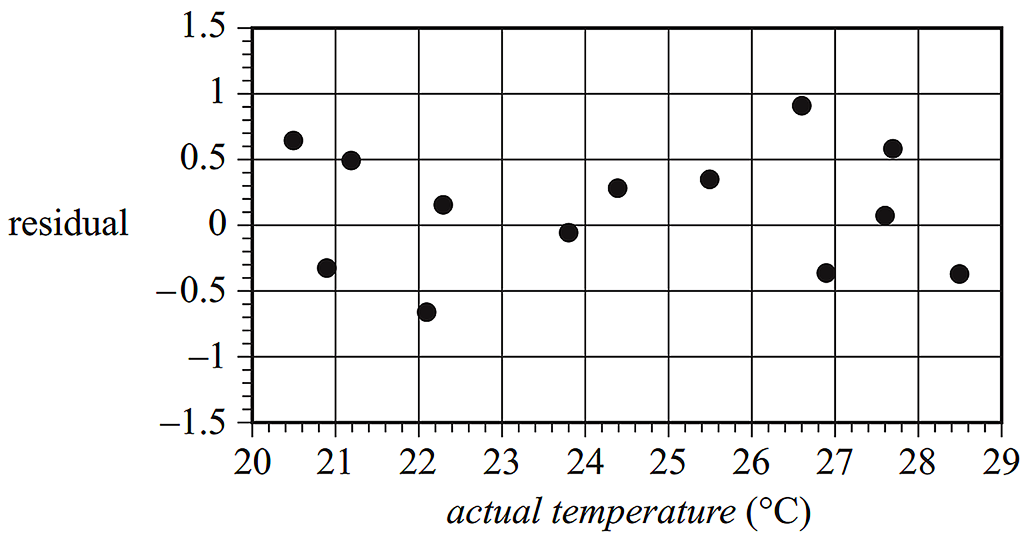
  4. The residual plot obtained when the least squares line was fitted to the data is shown below.
     
     
  5.  i. A residual plot can be used to test an assumption about the nature of the association between two numerical variables.
  6.     What is this assumption?   (1 mark)

    --- 2 WORK AREA LINES (style=lined) ---

  7. ii. Does the residual plot above support this assumption? Explain your answer.   (1 mark)

    --- 2 WORK AREA LINES (style=lined) ---

Show Answers Only

a.   `text(Strong, positive and linear)`

b.i.  `text(apparent temperature) = -1.7 xx 0.94 xx text(actual temperature)`

b.ii.  `text(When actual temperature is 0°C, on average,)`

`text(the apparent temperature is)\ − 1.7^@\text(C.)`

c.  `text(97% of the variation in the apparent temperature can be explained)`

`text(by the variation in the actual temperature.)`

d.i.  `text(There is a linear relationship between the two variables.)`

d.ii.  `text(The random pattern supports the assumption.)`

`text{(Students should refer to randomness or a lack of pattern}`

`text{explicitly here).}`

Show Worked Solution

a.   `text(Strong, positive and linear)`
 

b.i.   `text(By calculator:)`

`text(apparent temperature) = -1.7 xx 0.94 xx text(actual temperature)`
 

♦♦ Mean mark of part (b)(ii) – 28%.
MARKER’S COMMENT: “the predicted apparent temp is -1.7°C” also gained a mark.
b.ii.    `text(When actual temperature is 0°C, on average,)`
 

`text(the apparent temperature is)\ − 1.7^@\text(C.)`


♦ Mean mark 49%.
IMPORTANT: Any mention of causality loses a mark!

c.  `text(97% of the variation in the apparent temperature can be explained)`

`text(by the variation in the actual temperature.)`
  

d.i.  `text(There is a linear relationship between the two variables.)`

♦ Mean mark of both parts of (d) was 46%.

d.ii.  `text(The random pattern supports the assumption.)`

`text{(Students should refer to randomness or a lack of pattern}`

`text{explicitly here).}`

Filed Under: Correlation and Regression Tagged With: Band 3, Band 4, Band 5, smc-265-10-r / r^2 and Association, smc-265-20-Find LSRL Equation/Gradient, smc-265-50-Residuals

CORE, FUR2 2016 VCAA 2

A weather station records daily maximum temperatures.

  1. The five-number summary for the distribution of maximum temperatures for the month of February is displayed in the table below.


  1. There are no outliers in this distribution.
  2.  i. Use the five-number summary above to construct a boxplot on the grid below.   (1 mark)

    --- 0 WORK AREA LINES (style=lined) ---


  1. ii. What percentage of days had a maximum temperature of 21°C, or greater, in this particular February?   (1 mark)

    --- 2 WORK AREA LINES (style=lined) ---

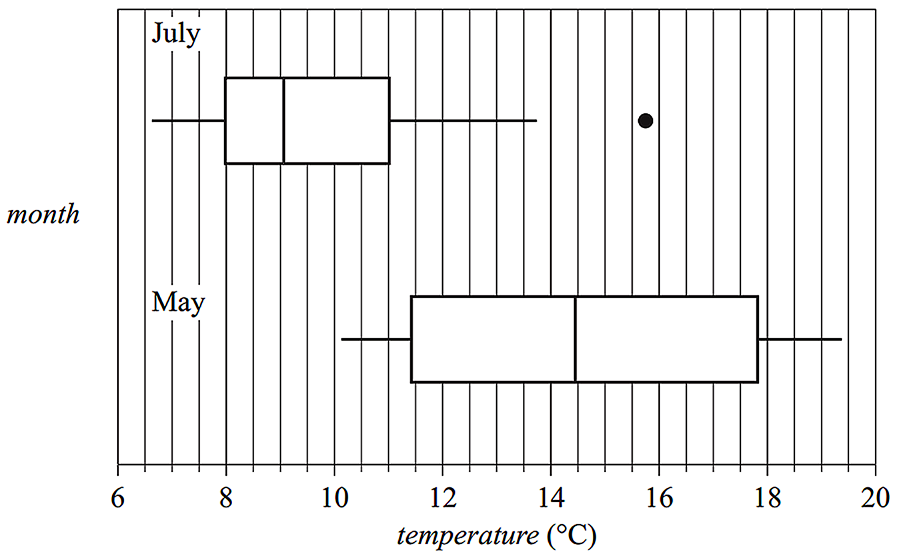
  2. The boxplots below display the distribution of maximum daily temperature for the months of May and July.
     

  3.   i. Describe the shapes of the distributions of daily temperature (including outliers) for July and for May.   (1 mark)

    --- 2 WORK AREA LINES (style=lined) ---

  4.  ii. Determine the value of the upper fence for the July boxplot.   (1 mark)

    --- 3 WORK AREA LINES (style=lined) ---

  5. iii. Using the information from the boxplots, explain why the maximum daily temperature is associated with the month of the year. Quote the values of appropriate statistics in your response.   (1 mark)

    --- 3 WORK AREA LINES (style=lined) ---

Show Answers Only
a.i.   

a.ii.   `text(75%)`

b.i.    `text(July – Positively skewed with an outlier.)`
  `text(May – Symmetrical with no outliers.)`

b.ii.  `15.5^@\text(C)`

b.iii. `text{The median temperature in May (14.5°C)}`

`text(differs from the median temperature in July)`

`text{(just over 9°C). This difference is why the}`

`text(maximum daily temperature is associated)`

`text(with the month.)`

Show Worked Solution
a.i.   

a.ii.   `text(75%)`

MARKER’S COMMENT: Incorrect May descriptors included “evenly or normally distributed”, “bell shaped” and “symmetrically skewed.”
b.i.    `text(July – Positively skewed with an outlier.)`
  `text(May – Symmetrical with no outliers.)`


b.ii.    `text(Upper fence)` `= Q_3 + 1.5 xx IQR`
    `= 11 + 1.5 xx (11 – 8)`
    `= 11 + 4.5`
    `= 15.5^@\text(C)`
♦♦ Mean mark (b)(iii) – 30%.
COMMENT: Refer to the difference in medians. Just quoting the numbers was not enough to gain a mark here.

b.iii. `text{The median temperature in May (14.5°C)}`

`text(differs from the median temperature in July)`

`text{(just over 9°C). This difference is why the}`

`text(maximum daily temperature is associated)`

`text(with the month.)`

Filed Under: Graphs - Stem/Leaf and Boxplots Tagged With: Band 2, Band 3, Band 4, Band 5, smc-643-10-Single Box-Plots, smc-643-20-Parallel Box-Plots, smc-643-30-Draw Box Plots, smc-643-60-Outliers, smc-643-70-Distribution Description

NETWORKS, FUR1 2016 VCAA 6-7 MC

The directed graph below shows the sequence of activities required to complete a project.

All times are in hours.


Part 1

The number of activities that have exactly two immediate predecessors is

  1. 0
  2. 1
  3. 2
  4. 3
  5. 4

 
Part 2

There is one critical path for this project.

Three critical paths would exist if the duration of activity

  1. I were reduced by two hours.
  2. E were reduced by one hour.
  3. G were increased by six hours.
  4. K were increased by two hours.
  5. F were increased by two hours. 
Show Answers Only

`text(Part 1:)\ C`

`text(Part 1:)\ B`

Show Worked Solution

`text(Part 1)`

`I\ text(and)\ J`

`=> C`


`text(Part 2)`

♦ Mean mark of Part 2: 45%.

`text(The possible paths are:)`

`ADIL – 19\ text(mins)`

`BEIL – 20\ text(mins)`

`BFJL – 17\ text(mins)`

`CGJL – 13\ text(mins)`

`CHKL – 19\ text(mins)`

`text(If)\ E\ text(were reduced by 1 hour,)\ BEIL\ text(will)`

`text{take 19 minutes (i.e. 3 critical paths of 19}`

`text{minutes would exist).}`

`=> B`

Filed Under: Critical Path Analysis Tagged With: Band 4, Band 5, smc-621-20-Critical Paths/EST

NETWORKS, FUR1 2016 VCAA 4 MC

The minimum spanning tree for the network below includes the edge with weight labelled `k`.


The total weight of all edges for the minimum spanning tree is 33.

The value of `k` is

  1. `1`
  2. `2`
  3. `3`
  4. `4`
  5. `5`
Show Answers Only

`E`

Show Worked Solution

`text(Minimum spanning tree)`

`text(Total weight)` `= k + 5 + 5 + 3 + 2 + 4 + 2 + 1 + 6`
`33` `= k + 28`
`:. k` `= 5`

`=> E`

Filed Under: Minimum Spanning Trees and Shortest Paths Tagged With: Band 5, smc-624-50-Unknown Edge

GRAPHS, FUR1 2016 VCAA 7 MC

Simon grows cucumbers and zucchinis.

Let `x` be the number of cucumbers that are grown.

Let `y` be the number of zucchinis that are grown.

For every two cucumbers that are grown, Simon grows at least three zucchinis.

An inequality that represents this situation is

  1. `y >= x/2 + 3`
  2. `y >= x/3 + 2`
  3. `y <= x/3 + 2`
  4. `y >= (2x)/3`
  5. `y >= (3x)/2`
Show Answers Only

`E`

Show Worked Solution

`text(Inequality can be restated:)`

`text(For every one cucumber grown, Simon)`

`text(grows at least)\ 3/2\ text(zucchinis.)`

`:. y >= (3x)/2`

`=> E`

Filed Under: Linear Programming Tagged With: Band 5

GEOMETRY, FUR1 2016 VCAA 7 MC

The diagram below shows a rectangular-based right pyramid, ABCDE.

In this pyramid, AB = DC = 24 cm, AD = BC = 10 cm and AE = BE = CE = DE = 28 cm.

The height, OE, of the pyramid, in centimetres, is closest to

  1. `10.4`
  2. `13.0`
  3. `24.8`
  4. `25.3`
  5. `30.9`
Show Answers Only

`C`

Show Worked Solution

`text(Find)\ AC,\ text(using Pythagoras,)`

`AC^2` `= 24^2 + 10^2`
  `= 676`
`AC` `= 26`


`text(Consider)\ DeltaAEO,`

`AO` `= 1/2AC`
  `= 13`


`text(Using Pythagoras,)`

`OE^2 + AO^2` `= AE^2`
`OE^2` `= 28^2 – 13^2`
  `= 615`
`:. OE` `= 24.79…`

`=> C`

Filed Under: Trig - Harder Applications Tagged With: Band 5

MATRICES, FUR1 2016 VCAA 8 MC

The matrix below shows the result of each match between four teams, A, B, C and D, in a bowling tournament. Each team played each other team once and there were no draws.
 

`{:(qquadqquadqquadqquadqquadqquadquadtext(loser)),(qquadqquadqquadqquadqquadquadAquadBquadCquadD),(text(winner)quad{:(A),(B),(C),(D):}[(0,0,1,0),(1,0,0,1),(0,1,0,1),(1,0,0,0)]):}`
 

In this tournament, each team was given a ranking that was determined by calculating the sum of its one-step and two-step dominances. The team with the highest sum was ranked number one (1). The team with the second-highest sum was ranked number two (2), and so on.

Using this method, team C was ranked number one (1).

Team A would have been ranked number one (1) if the winner of one match had lost instead.

That match was between teams

  1. A and B.
  2. A and D.
  3. B and C.
  4. B and D.
  5. C and D.
Show Answers Only

`A`

Show Worked Solution

`text(Test one and two step dominances after)`

♦ Mean mark 42%.

`text(swapping one result until)\ A\ text(is ranked)`

`text(number one.)`

`text(If we reverse the result and swap)\ A\ text(vs)\ B\ (text(now)\ A\ text(wins,))`

`text(Total dominances:)`
  

`{:(qquadqquadqquadqquadqquad\ text(lose)),(qquadqquadqquadqquadAquadBquadCquadDqquadqquadqquadqquadqquadqquadqquadqquadqquadqquadqquadqquadtext(total)),(text(win)quad{:(A),(B),(C),(D):}[(0,1,1,0),(0,0,0,1),(0,1,0,1),(1,0,0,0)] + [(0,1,1,0),(0,0,0,1),(0,1,0,1),(1,0,0,0)]^2 = [(0,2,1,2),(1,0,0,1),(1,1,0,2),(1,1,1,0)]{:(5),(2),(4),(3):}):}`


`:.\ text(If the result in)\ A\ text(vs)\ B\ text(was reversed,)`

`A\ text(would have ranked number one.)`

`=> A`

Filed Under: Matrix Applications Tagged With: Band 5, smc-619-70-One/Two Step Dominances

MATRICES, FUR1 2016 VCAA 7 MC

Each week, the 300 students at a primary school choose art (A), music (M) or sport (S) as an afternoon activity.

The transition matrix below shows how the students’ choices change from week to week.
 

`{:(qquadqquadqquadqquadtext(this week)),((qquadqquadqquadA,quadM,quadS)),(T=[(0.5,0.4,0.1),(0.3,0.4,0.4),(0.2,0.2,0.5)]{:(A),(M),(S):}quad{:text(next week):}):}`


Based on the information above, it can be concluded that, in the long term

  1. no student will choose sport.
  2. all students will choose to stay in the same activity each week.
  3. all students will have chosen to change their activity at least once.
  4. more students will choose to do music than sport.
  5. the number of students choosing to do art and music will be the same.
Show Answers Only

`D`

Show Worked Solution

`text(Consider)\ n\ text(large)\ (n = 50),\ text(and begin with)`

`text(the students spread equally among the sports.)`

`[(0.5,0.4,0.1),(0.3,0.4,0.4),(0.2,0.2,0.5)]^(50)[(100),(100),(100)]~~[(105),(109),(86)]`


`:.\ text(There will be 109 students in music)`

`text(and 86 in sport.)`

`=> D`

Filed Under: Transition Matrices - Regular Tagged With: Band 5, smc-618-40-Steady State, smc-618-61-3x3 Matrix

MATRICES, FUR1 2016 VCAA 5 MC

Let `M = [(1,2,3,4),(3,4,5,6)]`.

The element in row `i` and column `j` of `M` is `m_(ij)`.

The elements of `M` are determined by the rule

  1. `m_(ij) = i + j - 1`
  2. `m_(ij) = 2i - j + 1`
  3. `m_(ij) = 2i + j - 2`
  4. `m_(ij) = i + 2j - 2`
  5. `m_(ij) = i + j + 1` 
Show Answers Only

`C`

Show Worked Solution

`text(Check)\ m_14 = 4,`

`text(Option)\ A:\  1 + 4 – 1 = 4\ \ text{(correct)}`

`text(Option)\ B:\  2 – 4 + 1 = −1\ \ text{(incorrect)}`

`text(Option)\ C:\  2 + 4 – 2 = 4\ \ text{(correct)}`

`text(Option)\ D:\  1 + 8 – 2 = 7\ \ text{(incorrect)}`

`text(Option)\ E:\  1 + 4 + 1 = 6\ \ text{(incorrect)}`


`text(Check)\ m_22 = 4,`

`text(Option)\ A:\  2 + 2 – 1 = 3\ \ text{(incorrect)}`

`text(Option)\ C:\  4 + 2 – 2 = 4\ \ text{(correct)}`

`=> C`

Filed Under: Matrix Calculations Tagged With: Band 5, smc-616-70-Elements/Rules

MATRICES, FUR1 2016 VCAA 4 MC

The table below shows the number of each type of coin saved in a moneybox.


The matrix product that displays the total number of coins and the total value of these coins is
 

A.    `[(5,10,20,50)][(15),(32),(48),(24)]` B.    `[(15,32,48,24)][(1,5),(1,10),(1,20),(1,50)]`
C.    `[(5,10,20,50)][(1,15),(1,32),(1,48),(1,24)]` D.    `[(15,32,48,24)][(5),(10),(20),(50)]`
E.    `[(5,10,20,50),(15,32,48,24)][(1),(1),(1),(1)]`    
Show Answers Only

`B`

Show Worked Solution
`[(15,32,48,24)]quad[(1,5),(1,10),(1,20),(1,50)]`
`qquadquad1xx4qquadqquadqquadqquadqquad\ 4xx2`
♦♦ Mean mark 34%.


`= [15 + 32 + 48 + 24qquadqquad15 xx 5 + 32 xx 10 + 48 xx 20 + 24 xx 50]` 

`=[119  qquad 2555]`

`= {:[text(total number)qquadtext(total value)]:}`

`=> B`

Filed Under: Matrix Applications Tagged With: Band 5, smc-619-20-Matrix product from table

CORE, FUR1 2016 VCAA 23 MC

Sarah invests $5000 in a savings account that pays interest at the rate of 3.9% per annum compounding quarterly. At the end of each quarter, immediately after the interest has been paid, she adds $200 to her investment.

After two years, the value of her investment will be closest to

  1. $5805
  2. $6600
  3. $7004
  4. $7059
  5. $9285
Show Answers Only

`D`

Show Worked Solution

`text(By TVM Solver, after 2 years)`

`N` `= 2 xx 4 = 8`
`I(text(%))` `= 3.9`
`PV` `= −5000`
`PMT` `= −200`
`FV` `= ?`
`text(P/Y)` `= text(C/Y) = 4`
   
`:. FV` `= 7059.25`

 
`=> D`

Filed Under: Annuities and Perpetuities Tagged With: Band 5, smc-2512-10-Annuity, smc-2512-50-CAS solver

CORE, FUR1 2016 VCAA 22 MC

The first three lines of an amortisation table for a reducing balance home loan are shown below.

The interest rate for this home loan is 4.8% per annum compounding monthly.

The loan is to be repaid with monthly payments of $1500.


The amount of payment number 2 that goes towards reducing the principal of the loan is

  1.  $486
  2.  $502
  3.  $504
  4.  $996
  5.  $998
Show Answers Only

`B`

Show Worked Solution
`text(Interest)` `= 249\ 500 xx (4.8text(%))/12`
  `= 249\ 500 xx 0.048/12`
  `= $998`


`:.\ text(Amount that reduces principal)`

`= 1500 – 998`

`= $502`

`=> B`

Filed Under: Borrowing and Loans Tagged With: Band 5, smc-603-50-P+I-R table

CORE, FUR1 2016 VCAA 21 MC

Juanita invests $80 000 in a perpetuity that will provide $4000 per year to fund a scholarship at a university.

The graph that shows the value of this perpetuity over a period of five years is


Show Answers Only

`B`

Show Worked Solution

`text(A perpetuity lasts indefinitely by only)`

`text(paying out interest.)`

`:.\ text(The graph should show a value that)`

`text(does not change over the years.)`

`=> B`

Filed Under: Annuities and Perpetuities Tagged With: Band 5, smc-2512-20-Perpetuity, smc-2512-60-Graphs

CORE, FUR1 2016 VCAA 14-16 MC

The table below shows the long-term average of the number of meals served each day at a restaurant. Also shown is the daily seasonal index for Monday through to Friday.


Part 1

The seasonal index for Wednesday is 0.84

This tells us that, on average, the number of meals served on a Wednesday is

  1. 16% less than the daily average.
  2. 84% less than the daily average.
  3. the same as the daily average.
  4. 16% more than the daily average.
  5. 84% more than the daily average.


Part 2

Last Tuesday, 108 meals were served in the restaurant.

The deseasonalised number of meals served last Tuesday was closest to

  1.   `93`
  2. `100`
  3. `110`
  4. `131`
  5. `152`


Part 3

The seasonal index for Saturday is closest to

  1. `1.22`
  2. `1.31`
  3. `1.38`
  4. `1.45`
  5. `1.49`
Show Answers Only

`text(Part 1:)\ A`

`text(Part 2:)\ E`

`text(Part 3:)\ D`

Show Worked Solution

`text(Part 1)`

`1 – 0.84 = 0.16`

`:.\ text(A seasonal index of 0.84 tell us)`

`text(16% less meals are served.)`

`=> A`


`text(Part 2)`

`text{Deseasonalised number (Tues)}`

`= text(actual number)/text(seasonal index)`

`= 108/0.71`

`~~ 152`

`=> E`


`text(Part 3)`

`text(S)text(ince the same number of deseasonalised)`

`text(meals are served each day.)`

`text{S.I. (Sat)}/190` `= 1.10/145`
`text{S.I. (Sat)}` `= (1.10 xx 190)/145`
  `= 1.44…`

`=> D`

Filed Under: Time Series Tagged With: Band 3, Band 4, Band 5, smc-266-10-Seasonal Index from a Table, smc-266-20-(De)Seasonalising Data

CORE, FUR1 2016 VCAA 11-12 MC

The table below gives the Human Development Index (HDI) and the mean number of children per woman (children) for 14 countries in 2007.

A scatterplot of the data is also shown. 


Part 1

The scatterplot is non-linear.

A log transformation applied to the variable children can be used to linearise the scatterplot.

With HDI as the explanatory variable, the equation of the least squares line fitted to the linearised data is closest to

  1. log(children) = 1.1 – 0.0095 × HDI
  2. children = 1.1 – 0.0095 × log(HDI)
  3. log(children) = 8.0 – 0.77 × HDI
  4. children = 8.0 – 0.77 × log(HDI)
  5. log(children) = 21 – 10 × HDI


Part 2

There is a strong positive association between a country’s Human Development Index and its carbon dioxide emissions.

From this information, it can be concluded that

  1. increasing a country’s carbon dioxide emissions will increase the Human Development Index of the country.
  2. decreasing a country’s carbon dioxide emissions will increase the Human Development Index of the country.
  3. this association must be a chance occurrence and can be safely ignored.
  4. countries that have higher human development indices tend to have higher levels of carbon dioxide emissions.
  5. countries that have higher human development indices tend to have lower levels of carbon dioxide emissions.
Show Answers Only

`text(Part 1:)\ A`

`text(Part 2:)\ D`

Show Worked Solution

`text(Part 1)`

`=>A`


`text(Part 2)`

`text(A strong positive association does not mean)`

`text(an increase in one variable causes an increase)`

`text(in the other.)`

`=> D`

Filed Under: Correlation and Regression Tagged With: Band 4, Band 5, smc-265-10-r / r^2 and Association, smc-265-70-Linearise - log10

CORE, FUR1 2016 VCAA 8 MC

Parallel boxplots would be an appropriate graphical tool to investigate the association between the monthly median rainfall, in millimetres, and the

  1. monthly median wind speed, in kilometres per hour.
  2. monthly median temperature, in degrees Celsius.
  3. month of the year (January, February, March, etc.).
  4. monthly sunshine time, in hours.
  5. annual rainfall, in millimetres.
Show Answers Only

`C`

Show Worked Solution

`text(Parallel boxplots can be used to investigate an)`

♦ Mean mark 45%.

`text(association between categorical and numerical)`

`text(variables.)`

`text(S)text(ince rainfall is numerical, the other variable must)`

`text(be categorical. Only)\ C\ text(is categorical.)`

`=> C`

Filed Under: Graphs - Stem/Leaf and Boxplots Tagged With: Band 5, smc-643-20-Parallel Box-Plots

CORE, FUR1 2016 VCAA 6-7 MC

Part 1

The histogram below shows the distribution of the number of billionaires per million people for 53 countries.
 

Using this histogram, the percentage of these 53 countries with less than two billionaires per million people is closest to

  1. `text(49%)`
  2. `text(53%)`
  3. `text(89%)`
  4. `text(92%)`
  5. `text(98%)`


Part 2

The histogram below shows the distribution of the number of billionaires per million people for the same 53 countries as in Part 1, but this time plotted on a `log_10` scale.
 

Based on this histogram, the number of countries with one or more billionaires per million people is

  1.   `text(1)`
  2.   `text(3)`
  3.   `text(8)`
  4.   `text(9)`
  5. `text(10)`
Show Answers Only

`text(Part 1:)\ D`

`text(Part 1:)\ E`

Show Worked Solution

`text(Part 1)`

`text(Percentage with less than 2)`

`= text(countries with less than 2)/text(total countries)`

`= 49/((49 + 2 + 1 + 1))`

`= 49/53`

`~~ 92.4text(%)`

`=> D`


`text(Part 2)`

`text(Let)\ \ x=\ text(number of billionaires per million,)`

`text(Number of countries where)\ \ x >= 1,`

♦ Mean mark 45%.
MARKER’S COMMENT: On a `log_10` scale, 1 is plotted as 0 because `log_10\ 1 = 0`, or `10^0=1`

`=> log_10 x >= 0`

`:.\ text(Number of countries)`

`= 9 + 1`

`= 10`

`=> E`

Filed Under: Graphs - Histograms and Other Tagged With: Band 4, Band 5, page-break-before-question, smc-644-20-Histograms, smc-644-60-Histogram (log10)

CORE, FUR1 2016 VCAA 1-2 MC

The blood pressure (low, normal, high) and the age (under 50 years, 50 years or over) of 110 adults were recorded. The results are displayed in the two-way frequency table below.


Part 1

The percentage of adults under 50 years of age who have high blood pressure is closest to

  1.  11%
  2.  19%
  3.  26%
  4.  44%
  5.  58%

Part 2

The variables blood pressure (low, normal, high) and age (under 50 years, 50 years or over) are

  1. both nominal variables.
  2. both ordinal variables.
  3. a nominal variable and an ordinal variable respectively.
  4. an ordinal variable and a nominal variable respectively.
  5. a continuous variable and an ordinal variable respectively.
Show Answers Only

`text(Part 1:)\ B`

`text(Part 2:)\ B`

Show Worked Solution

`text(Part 1)`

`text(Percentage)` `= text(Under 50 with high BP)/text(Total under 50)`
  `= 11/58`
  `~~ 19text(%)`

 
`=> B`


`text(Part 2)`

♦♦ Mean mark of Part 2: 31%.
MARKER’S COMMENT: Many students incorrectly identified the age (under 50, 50 or over) as nominal.

`text(Blood pressure is an ordinal variable)`

`text(because it is categorical data that can)`

`text(have an order.)`

`text(Under 50 and over 50, likewise, is an)`

`text(ordinal variable.)`

`=> B`

Filed Under: Summary Statistics Tagged With: Band 3, Band 5, smc-468-10-Data Classification

Number, NAP-B4-CA05 SA

The arrow points to a position on the number line.

What number is at this position?

Show Answers Only

`-1.5`

Show Worked Solution

`-1.5`

Filed Under: Basic Algebra and Rules, Basic Concepts and Calculations, Basic Concepts and Calculations, Basic Concepts and Calculations Tagged With: Band 5, smc-3143-10-Number lines, smc-3173-10-Number lines, smc-890-10-Number lines

Geometry, NAP-B4-CA03

Two places are 5.4 cm apart on a map.

On the map 1 cm represents 4 km.

What is the actual distance between the two places?

1.08 km 10.8 km 21.6 km 43.4 km


Show Answers Only

`21.6\ text(km)`

Show Worked Solution
`text(Actual distance)` `=5.4 xx 4`
  `=21.6\ text(km)`

Filed Under: Maps and Bearings, Maps and Bearings Tagged With: Band 5, smc-3187-20-Map scales, smc-670-20-Map scales

Measurement, NAP-B4-NC03

This dipstick measures the depth of oil in a car's oil tank.


How deep is the oil?

`text(1.5 cm)` `text(5 cm)` `text(15 cm)` `text(105 cm)`


Show Answers Only

`text(5 cm)`

Show Worked Solution

`text(5 cm)`

Filed Under: Units of Measurement, Units of Measurement Tagged With: Band 5, smc-3182-10-Scale measure, smc-671-10-Scale measure

Statistics, NAP-F4-NC02

This graph shows the number of bats in a fruit tree at 15 minute intervals over 4 hours.


At which time were the highest number of bats in the fruit tree?

`5:45` `6:00` `6:15` `6:30`


Show Answers Only

`text(6:15 pm)`

Show Worked Solution

`text(The highest data point is one interval past 6:00 pm.)`

`:.\ text(The highest number were in the tree at 6:15 pm.)`

Filed Under: Data and Interpretation, Data and Statistics Tagged With: Band 5, smc-3190-10-Dot plots, smc-681-10-Dot plots

Number and Algebra, NAP-B2-19

Mandy has 46 jelly beans. Jenny has 34 Jelly beans.

How many jelly beans should Mandy give to Jenny if Mandy wanted them both to have the same number of jelly beans?

`6` `12` `40` `80`


Show Answers Only

`6\ text(jelly beans)`

Show Worked Solution

`text(If Mandy gives Jenny 6 jelly beans,)`

`text(Mandy’s jelly beans)` `=46-6`
  `=40`
`text(Jenny’s jelly beans)` `=34+6`
  `=40`


`:. 6\ text(jelly beans.)`

Filed Under: Solving problems - Add/Subtract, Solving problems - Add/Subtract Tagged With: Band 5, smc-3084-30-Combination, smc-693-30-Combination

Geometry, NAP-B2-16

Jeff folds this net to make a rectangular prism.


Which face is opposite of `D`?

 
Show Answers Only

`F`

Show Worked Solution

`F`

Filed Under: 2D-3D Shapes, 2D-3D Shapes Tagged With: Band 5, smc-3121-60-Nets, smc-695-60-Nets

Geometry, NAP-B2-15


Which shows the kangaroo flipped over the dotted line?


Show Answers Only

Show Worked Solution

Filed Under: Transformations and Symmetry, Transformations and symmetry, Transformations and Symmetry Tagged With: Band 5, smc-3122-10-Reflections/Folding, smc-3555-10-Reflections/Folding, smc-920-10-Reflections/Folding

Measurement, NAP-B2-14 SA

James needs to catch a bus to the city from Greenville. Below is the bus timetable.

What is the latest time James can catch the bus to get to the city before 2 pm?

Show Answers Only

`text(12:40)`

Show Worked Solution

`text(The 12:40 pm bus leaving Greenville arrives at)`

`text(Town Hall at 1:55 pm and is the latest bus)`

`text(arriving before 2 pm.)`

Filed Under: Time Tagged With: Band 5, smc-3091-60-Timetables, smc-694-60-Timetables

Measurement, NAP-C1-28

A holiday soccer camp has the plan below for Day 1.

At 1:00, the soccer players will be

 
doing kicking drills.
 
having morning tea.
 
eating lunch.
 
having shooting practice. 
Show Answers Only

`text(eating lunch.)`

Show Worked Solution

`text(eating lunch.)`

Filed Under: Time, Time Tagged With: Band 5, smc-3037-60-Timetable, smc-707-60-Timetable

Number and Algebra, NAP-C1-24

Cecil is packing away his club's lawn bowls after a practice session.

One bag carries 4 lawn bowls, as shown below.

Cecil needs to pack away 16 bowls.

Which of these shows how Cecil could work out the number of bags he needs?

`16 ÷ 4` `16 xx 4` `16 - 4` `16 + 4`


Show Answers Only

`16 ÷ 4`

Show Worked Solution

`text(S)text(ince each bag can carry 4 bowls, and there)`

`text(are 16 bowls in total,)`

`text(The number of bags = 16 ÷ 4)`

Filed Under: Solving Problems - Multiply/Divide, Solving Problems - Multiply/Divide, Solving Problems - Multiply/Divide, TESTLET E Tagged With: Band 5, smc-2907-40-Find equation, smc-3018-40-Find equation

Geometry, NAP-C1-23

Isla folds a rectangle of paper along the dotted line and cuts out some shapes.

She unfolds the paper and turns it around.

Which of these is Isla's paper?


Show Answers Only

Show Worked Solution

Filed Under: 2D-3D Shapes, 2D-3D Shapes Tagged With: Band 5, smc-3050-10-2D shapes, smc-704-10-2D shapes

Number and Algebra, NAP-B2-17 SA

Kim is packing 27 plums into boxes to take to the market.

Each box can hold 5 plums.

What is the smallest number of boxes Kim needs to make sure all the plums are packed?

Show Answers Only

`6\ text(boxes)`

Show Worked Solution
`text(Boxes needed)` `=27 -: 5`
  `=5\ \ text(remainder 2)`
  `=6\ text(boxes)`

Filed Under: Solving Problems - Multiply/Divide, Solving problems - Multiply/Divide Tagged With: Band 5, smc-3085-20-Division, smc-922-20-Division

Measurement, NAP-B1-27

Which clock shows a quarter to seven?


Show Answers Only

Show Worked Solution

Filed Under: Time, Time Tagged With: Band 5, smc-3037-10-Telling the time, smc-707-10-Telling the time

  • « Previous Page
  • 1
  • …
  • 60
  • 61
  • 62
  • 63
  • 64
  • …
  • 81
  • Next Page »

Copyright © 2014–2025 SmarterEd.com.au · Log in