SmarterEd

Aussie Maths & Science Teachers: Save your time with SmarterEd

  • Login
  • Get Help
  • About

Quadratic, 2UA 2005 HSC 10a

2005 10a

The parabola  `y = x^2`  and the line  `y = mx + b`  intersect at the points  `A(α,α^2)`  and  `B(β, β^2)`  as shown in the diagram.

  1. Explain why  `α + β = m`  and  `αβ = –b`.  (1 mark)
  2. Given that
  3. `(α − β)^2 + (α^2 − β^2)^2 = (α − β)^2[1 + (α + β)^2]`, show that the distance  `AB = sqrt((m^2 + 4b)(1 + m^2)).`  (2 marks)
  4. The point  `P(x, x^2)`  lies on the parabola between  `A`  and  `B`. Show that the area of the triangle  `ABP`  is given by  `1/2(mx − x^2 + b)sqrt(m^2 + 4b).`  (2 marks)
  5.  
  6. The point  `P`  in part (iii) is chosen so that the area of the triangle  `ABP`  is a maximum.
  7. Find the coordinates of  `P`  in terms of  `m`.  (2 marks)
  8.  
Show Answers Only
  1. `text(See Worked Solutions)`
  2. `text(See Worked Solutions)`
  3. `text(See Worked Solutions)`
  4. `P(m/2, m^2/4)`
Show Worked Solution

(i)   `text(Instersection)`

`y = x^2` `\ \ …\ (1)`
`y = mx + b` `\ \ …\ (2)`

`text(Substitute)\ y = x^2\ text(into)\ \ (2)`

`x^2 = mx + b`

`x^2 − mx − b = 0`

`text(We know the intersection occurs when)`

`x = α\ \ text(and)\ \ x = β`

`:.α\ \ text(and)\ \ β\ \ text(are roots of)\ \ x^2 − mx − b = 0`

`:.α + β` `= (−b)/a` `= m`  
`αβ` `= c/a` `= −b` `\ \ …text(as required)`


(ii)   `A(α, α^2),\ \ B(β, β^2)`

`AB` `= sqrt((α − β)^2 + (α^2 − β^2)^2)`
  `= sqrt((α − β)^2[1 + (α + β)^2])`
  `= sqrt([(α + β)^2 − 4αβ][1 + (α + β)^2])`
  `= sqrt([m^2 − 4(−b)][1 + m^2])`
  `= sqrt((m^2 + 4b)(1 + m^2))\ \ …text(as required)`


(iii) `⊥\ text(distance of)\ \ (x, x^2)\ \ text(from)\ \ \ y=mx+b`

`text(i.e.)\ \ mx – y+b=0`

`= |(ax_1 + by_1 + c)/(sqrt(a^2 + b^2))|`

`= |(mx − 1(x^2) + b)/(sqrt(m^2 + (−1)^2))|`

`= |(mx − x^2 + b)/(sqrt(m^2 + 1))|`


`text(Area of)\ ΔABP`

`= 1/2 xx AB xx h`

`= 1/2 xx sqrt((m^2 + 4b)(1 + m^2)) xx (mx − x^2 + b)/(sqrt(m^2 + 1))`

`= 1/2 (mx − x^2 + b)sqrt(m^2 + 4b)`


(iv) `A` `= 1/2 sqrt(m^2 + 4b)(mx − x^2 + b)`
  `(dA)/(dx)` `= 1/2 sqrt(m^2 + 4b)(m − 2x)` 
  `(d^2A)/(dx^2)` `= 1/2 sqrt(m^2 + 4b)(−2)`
    `= −sqrt(m^2 + 4b)` 


`text(Max or min when)\ (dA)/(dx) = 0`

`1/2sqrt(m^2 + 4b)(m − 2x)` `= 0`
`m-2x` `=0`
`2x` `= m`
`x` ` = m/2`

`text(When)\ x = 2`

`(d^2A)/(dx^2) = −sqrt(m^2 + 4b) < 0\ \ \ text{(constant)}`

`:.\ text(Maximum when)\ x = m/2`

`:.P\ text(is)\ (m/2, m^2/4)` 

Filed Under: Maxima and Minima, The Parabola Tagged With: Band 4, Band 5, Band 6

Mechanics, EXT2* M1 2015 HSC 14b

A particle is moving horizontally. Initially the particle is at the origin `O` moving with velocity `1 text(ms)^(−1)`.

The acceleration of the particle is given by  `ddot x = x − 1`, where `x` is its displacement at time  `t`.

  1. Show that the velocity of the particle is given by  `dot x = 1 − x`.  (3 marks)

    --- 10 WORK AREA LINES (style=lined) ---

  2. Find an expression for `x` as a function of `t`.  (2 marks)

    --- 8 WORK AREA LINES (style=lined) ---

  3. Find the limiting position of the particle.  (1 mark)

    --- 3 WORK AREA LINES (style=lined) ---

Show Answers Only
  1. `text(See Worked Solutions.)`
  2. `x = 1 − e^(-t)`
  3. `x = 1`
Show Worked Solution

i.   `ddot x = d/(dx)(1/2 v^2) = x − 1`

`1/2 v^2` `= int ddot x\ dx`
  `= int x − 1\ dx`
  `= 1/2x^2 − x + c`

 
`text(When)\ \ x = 0, \ v = 1:`

`1/2·1^2` `= 0 − 0 + c`
`c` `= 1/2`


`:.1/2  v^2` `= 1/2x^2 − x + 1/2`
`v^2` `= x^2 − 2x + 1`
  `= (x − 1)^2`
`:.dot x` `= ±(x − 1)`

 
`text(S)text(ince)\ \ dotx = 1\ \ text(when)\ \ x = 0,`

`dot x = 1 − x\ \ …\ text(as required)`


ii.   `(dx)/(dt)` `= 1 − x\ \ \ text{(from (i))}`
  `(dt)/(dx)` `= 1/(1 − x)`
  `t` `= int 1/(1 − x)\ dx`
    `= -ln(1 − x) + c`


`text(When)\ \ t = 0, x = 0:`

♦ Mean mark 49%.
`0` `= -ln1 + c`
`:.c` `= 0`
`t` `= -ln(1 − x)`
`-t` `= ln(1 − x)`
`1 − x` `= e^(-t)`
`:.x` `= 1 − e^(-t)`


♦ Mean mark 42%.
iii.   `text(As)\ t` `→ ∞`
  `e^(-t)` `→ 0`
  `x` `→ 1`


`:.\ text(Limiting position is)\ \ x = 1`

Filed Under: Motion Without Resistance, Other Motion EXT1 Tagged With: Band 4, Band 5, smc-1060-02-Motion as f(x), smc-1060-10-Polynomial

Mechanics, EXT2* M1 2015 HSC 14a

A projectile is fired from the origin `O` with initial velocity `V` m s`\ ^(−1)` at an angle `theta` to the horizontal. The equations of motion are given by

`x = Vt\ cos\ theta, \ y = Vt\ sin\ theta − 1/2 g t^2`.    (Do NOT prove this)
 

Calculus in the Physical World, EXT1 2015 HSC 14a
 

  1. Show that the horizontal range of the projectile is
     
         `(V^2\ sin\ 2theta)/g`.  (2 marks)

    --- 6 WORK AREA LINES (style=lined) ---

A particular projectile is fired so that  `theta = pi/3`.

  1. Find the angle that this projectile makes with the horizontal when
     
         `t = (2V)/(sqrt3\ g)`.  (2 marks)

    --- 8 WORK AREA LINES (style=lined) ---


  2. State whether this projectile is travelling upwards or downwards when
     
          `t = (2V)/(sqrt3\ g)`. Justify your answer.  (1 mark)

    --- 2 WORK AREA LINES (style=lined) ---

Show Answers Only
  1. `text(See Worked Solutions.)`
  2. `30^@`
  3. `text(Downwards)`
Show Worked Solution

i.   `text(Show range is)\ \ (V^2\ sin\ 2theta)/g`

`x` `= Vt\ cos\ theta`
`y` `= Vt\ sin\ theta − 1/2 g t^2`

 
`text(Horizontal range occurs when)\ \ y = 0`

`Vt\ sin\ theta − 1/2 g t^2` `= 0`
`t(V\ sin\ theta − 1/2 g t)` `= 0`
`:.V\ sin\ theta − 1/2 g t` `= 0`
`1/2 g t` `= V\ sin\ theta`
`t` `= (2V\ sin\ theta)/g`

 
`text(Find)\ \ x\ \ text(when)\ \ t = (2V\ sin\ theta)/g`

`x` `= V · (2V\ sin\ theta)/g · cos\ theta`
  `= (V^2\ sin\ 2theta)/g\ \ …\ text(as required)`


♦♦ Mean mark part (ii) 28%.
ii.    `x` `= Vt\ cos\ theta`
  `dot x` `= V\ cos\ theta`
  `y` `= Vt\ sin\ theta − 1/2 g t^2`
  `dot y` `= V\ sin\ theta − g t`


`text(When)\ \ t = (2V)/(sqrt3\ g)\ \ text(and)\ \ theta = pi/3`

`dot x` `= V\ cos\ pi/3 = V/2`
`dot y` `= V\ sin\ pi/3 − g\ (2V)/(sqrt3\ g)`
  `= (sqrt3V)/2 − (2V)/sqrt3`
  `= (sqrt3(sqrt3V) − 2 xx 2V)/(2sqrt3)`
  `= -V/(2sqrt3)`

Calculus in the Physical World, EXT1 2015 HSC 14a Answer

`text(Let)\ alpha =\ text(Angle of projectile with the horizontal)`

`tan\ α` `=(|\ doty\ |) / dotx`
  `= (V/(2sqrt3))/(V/2)`
  `= V/(2sqrt3) xx 2/V`
  `= 1/sqrt3`
`:.α` `= 30^@`

 
`:.\ text(When)\ \ t = (2V)/(sqrt3\ g),\ text(the projectile makes)`

`text(a)\ \ 30^@\ \ text(angle with the horizontal.)`


iii.  `text(When)\ t = (2V)/(sqrt3\ g)`

♦♦ Mean mark part (iii) 31%.

`dot y = −V/(2sqrt3)`

`text(The negative value of)\ \ dot y\ \ text(indicates that)`

`text(the particle is travelling downwards.)`

Filed Under: Projectile Motion, Projectile Motion EXT1 Tagged With: Band 3, Band 5, smc-1062-10-Range/Time of Flight, smc-1062-50-Angle of Trajectory/Impact

Calculus, EXT1 C2 2015 HSC 13d

Let  `f(x) = cos^(-1)\ (x) + cos^(-1)\ (-x)`, where  `-1 ≤ x ≤ 1`.

  1. By considering the derivative of  `f(x)`, prove that  `f(x)`  is constant.  (2 marks)

    --- 4 WORK AREA LINES (style=lined) ---

  2. Hence deduce that  `cos^(-1)\ (-x) = pi - cos^(-1)\ (x)`.  (1 mark)

    --- 4 WORK AREA LINES (style=lined) ---

Show Answers Only
  1. `text(See Worked Solutions.)`
  2. `text(See Worked Solutions.)`
Show Worked Solution

i.  `text(Prove)\ f(x)\ text(is a constant)`

`f(x)` `= cos^(-1)(x) + cos^(-1)(-x), \ \ -1 ≤ x ≤ 1`
`f′(x)` `= (-1)/sqrt(1 – x^2) + (-1)/sqrt(1 -(-x)^2) xx d/(dx) (-x)`
  `= (-1)/sqrt(1 – x^2) + 1/sqrt(1 – x^2)`
  `= 0`

 
`:.\ text(S)text(ince)\ \ f′(x) = 0,  f(x)\ text(must be a constant.)`
 

♦ Mean mark 35%.
ii.   `f(0)` `= cos^(−1)(0) + cos^(−1)(0)`
    `= pi/2 + pi/2`
    `= pi`

 
`:.f(x) = pi`

`pi = cos^(−1)(x) + cos^(−1)(−x)`

`:.cos^(−1)(−x) = pi – cos^(−1)(x)\ \ …text(as required)`

Filed Under: Inverse Functions Calculus (Ext1), Inverse Trig Functions EXT1 Tagged With: Band 4, Band 5, smc-1037-10-Sin/Cos Differentiation

Mechanics, EXT2* M1 2015 HSC 13a

A particle is moving along the `x`-axis in simple harmonic motion. The displacement of the particle is `x` metres and its velocity is `v` ms`\ ^(–1)`. The parabola below shows `v^2` as a function of `x`.

2015 13a

  1. For what value(s) of `x` is the particle at rest?  (1 mark)

    --- 2 WORK AREA LINES (style=lined) ---

  2. What is the maximum speed of the particle?  (1 mark)

    --- 2 WORK AREA LINES (style=lined) ---

  3. The velocity `v` of the particle is given by the equation

         `v^2 = n^2(a^2 − (x −c)^2)`  where `a`, `c` and `n` are positive constants.


    What are the values of `a`, `c` and `n`?  (3 marks)

    --- 6 WORK AREA LINES (style=lined) ---

Show Answers Only
  1. `3\ text(or)\ 7`
  2. `V = sqrt11\ text(m/s)`
  3. `a = 2, c = 5,`
  4. `n = (sqrt11)/2`
Show Worked Solution

i.   `text(Particle is at rest when)\ v^2 = 0`

`:. x = 3\ \ text(or)\ \ 7`


ii.   `text(Maximum speed occurs when)`

`v^2` `= 11`
`v` `= sqrt11\ text(m/s)`


iii.  `v^2 = n^2(a^2 − (x − c)^2)`

♦ Mean mark 41%.

`text(Amplitude) = 2`

`:.a = 2`

`text(Centre of motion when)\ x = 5`

`:.c = 5`

`text(S)text(ince)\ \ v^2 = 11\ \ text(when)\ \ x = 5`

`11` `= n^2(2^2 − (5 − 5)^2)`
  `= 4n^2`
`n^2` `= 11/4`
`:.n`  `= sqrt11/2`

Filed Under: Simple Harmonic Motion, Simple Harmonic Motion EXT1 Tagged With: Band 3, Band 4, Band 5, smc-1059-10-Amplitude / Period, smc-1059-20-Prove/Identify SHM, smc-1059-30-At Rest, smc-1059-31-Max Speed

Plane Geometry, EXT1 2015 HSC 3 MC

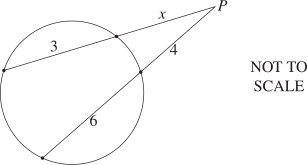
Two secants from the point `P` intersect a circle as shown in the diagram.
  

What is the value of `x`?

  1. `2`
  2. `5`
  3. `7`
  4. `8`
Show Answers Only

`B`

Show Worked Solution

`text{Property: products of intercepts of secants from external point are equal}`

`x(x + 3)` `= 4(4 + 6)`
`x^2 + 3x` `= 40`
`x^2 + 3x-40` `= 0`
`(x-5)(x + 8)` `= 0`

 
`:.x = 5,\ \  (x>0)`

`=>B`

Filed Under: 2. Plane Geometry EXT1, Circle Geometry Tagged With: Band 5, num-title-ct-patha, num-title-qs-hsc, smc-4240-55-Secants

Measurement, STD2 M6 2015 HSC 30e

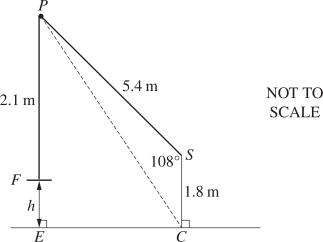
From point `S`, which is 1.8 m above the ground, a pulley at `P` is used to lift a flat object `F`. The lengths `SP` and `PF` are 5.4 m and 2.1 m respectively. The angle `PSC` is 108°.


  1. Show that the length  `PC`  is 6.197 m, correct to 3 decimal places.  (1 mark)

    --- 2 WORK AREA LINES (style=lined) ---

  2. Calculate `h`, the height of the object above the ground.  (4 marks)

    --- 8 WORK AREA LINES (style=lined) ---

Show Answers Only
  1. `6.197\ text{m  (to 3 d.p.)  … as required}`
  2. `1.37\ text{m  (to 2 d.p.)}`
Show Worked Solution
i.   

2UG 2015 30e Answer

`text(Show)\ PC = 6.197\ text(m)`

♦ Mean mark 41%.

`text(Using the cosine rule in)\ Delta PSC` 

`PC^2` `= PS^2 + SC^2-2 xx PS xx SC xx cos\ 108^@`
  `= 5.4^2 + 1.8^2-2 xx 5.4 xx 1.8 xx cos\ 108^@`
  `= 38.4072…`
`:.PC` `= 6.19736…`
  `= 6.197\ text{m  (to 3 d.p.)  …as required}`


ii.   `text(Let)\ \ SD⊥PE`

♦♦ Mean mark below 19%.
STRATEGY: Finding `PC` in part (i) and needing `PE` to find `h` should flag the strategy of finding `EC` and using Pythagoras.

`∠DSC\ text(is a right angle)`

`:.∠DSP = 108^@-90^@ = 18^@`


`text(In)\ ΔPDS`

`cos\ 18^@` `= (DS)/5.4`
 `DS` `= 5.4 xx cos\ 18^@`
  `= 5.1357…\ text(m)`

 
`EC = DS = 5.1357…\ text{m  (opposite sides of rectangle}\ DECS text{)}`
 

`text(Using Pythagoras in)\ Delta PEC:`

`PE^2 + EC^2 = PC^2`

`PE^2 + 5.1357^2` `= 6.197^2`
`PE^2` `= 12.027…`
`PE` `= 3.468…\ text(m)`

 
`text(From the diagram,)`

`h` `= PE-PF`
  `= 3.468…-2.1`
  `= 1.368…`
  `= 1.37\ text{m  (to 2 d.p.)}`

Filed Under: 2-Triangle and Harder Examples, Non-Right Angled Trig, Non-Right Angled Trig (Std2) Tagged With: Band 5, Band 6, smc-804-10-Cosine Rule, smc-804-40-2-Triangle

Algebra, STD2 A1 2015 HSC 30d

Claire is driving on a motorway at a speed of 110 kilometres per hour and has to brake suddenly. She has a reaction time of 2 seconds and a braking distance of 59.2 metres.

Stopping distance can be calculated using the following formula
 

`text(stopping distance = {reaction time distance} + {braking distance})`

 
What is Claire's stopping distance.  (2 marks)

--- 5 WORK AREA LINES (style=lined) ---

Show Answers Only

`120.3\ text{metres  (to 1 d.p.)}`

Show Worked Solution
♦ Mean mark 34%.
`110\ text(km/hr)` `= 110\ 000\ text(m/hr)`
  `= (110\ 000)/(60 xx 60)\ text(m/sec)`
  `= 30.555…\ text(m/sec)`


`text(Reaction time distance)` `=2 xx 30.555…`
  `= 61.11…\ text(metres)`


`:.\ text(Stopping distance)`

`=\ text(Reaction time distance + braking distance)`

`= 61.11… + 59.2`

`= 120.311…`

`= 120.3\ text{metres  (to 1 d.p.)}`

Filed Under: Applications: BAC, Medication and D=SxT (Std 2), Applications: BAC, Medicine and D=SxT (Std2-2027), Applications: D=SxT and Other (Std 1), Safety: D=ST & BAC Tagged With: Band 5, smc-1117-40-Stopping Distance, smc-6235-40-Stopping Distance, smc-791-40-Stopping Distance

Financial Maths, STD2 F5 2015 HSC 30c

The table gives the present value interest factors for an annuity of $1 per period, for various interest rates `(r)` and numbers of periods `(N)`.

2015 30c

  1. Oscar plans to invest $200 each month for 74 months. His investment will earn interest at the rate of 0.0080 (as a decimal) per month.


    Use the information in the table to calculate the present value of this annuity.  (1 mark)

    --- 2 WORK AREA LINES (style=lined) ---

  2. Lucy is using the same table to calculate the loan repayment for her car loan. Her loan is `$21\ 500` and will be repaid in equal monthly repayments over 6 years. The interest rate on her loan is 10.8% per annum.


    Calculate the amount of each monthly repayment, correct to the nearest dollar.  (2 marks)

    --- 4 WORK AREA LINES (style=lined) ---

Show Answers Only
  1. `$11\ 136.89\ \ text{(nearest cent)}`
  2. `$407\ \ text{(nearest dollar)}`
Show Worked Solution

i.    `N = 74, r = 0.0080`

♦ Mean mark 48%.

`PVtext{(annuity) table factor}\ = 55.68446`

`:.PV\ text(of annuity)`

`= $200 xx 55.68446`

`= $11\ 136.892`

`= $11\ 136.89\ \ text{(nearest cent)}`


ii.  `text(Over 6 years)`

♦♦ Mean mark 33%.

`N = 6 xx 12 = 72\ text(months)`

`r = 10.8/12 = text(0.9%) = 0.009`

`PVtext{(annuity) table factor}\ =52.82118`
 

`text(Let)\ $M =\ text(monthly repayment)`

`text(Loan)\ = PV\ text(of annuity)`

`$21\ 500` `= M xx 52.82118`
 `:.\ M` `= $407.033…`
  `= $407\ \ text{(nearest dollar)}`

Filed Under: F5 Annuities (Y12), FM5 - Annuities and Loan repayments, Modelling Investments and Loans (Y12) Tagged With: Band 5, common-content, smc-1002-50-PV Annuity Table, smc-816-20-PV of $1 Annuity Table

Probability, STD2 S2 2015 HSC 30b

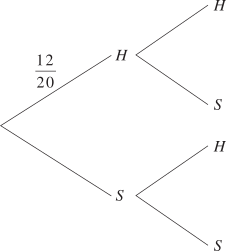
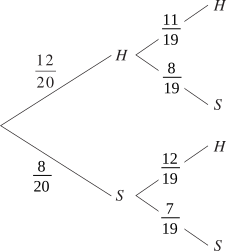
On a tray there are 12 hard‑centred chocolates `(H)` and 8 soft‑centred chocolates `(S)`. Two chocolates are selected at random. A partially completed probability tree is shown.
 

What is the probability of selecting one of each type of chocolate?  (3 marks)

--- 7 WORK AREA LINES (style=lined) ---

Show Answers Only

`48/95`

Show Worked Solution

`Ptext{(one of each type)}`

♦ Mean mark 45%.

`= P(HS) + P(SH)`

`= (12/20 xx 8/19) + (8/20 xx 12/19)`

`= 24/95 + 24/95`

`= 48/95`

Filed Under: Multi-stage Events, Multi-Stage Events (Std 2), Single and Multi-Stage Events (Std 1) Tagged With: Band 5, smc-829-10-Probability Trees

Measurement, STD2 M1 2015 HSC 30a

The energy consumption of a computer in standby mode is 21 watts. The cost of electricity is 31 cents per kWh.

A school computer room has 20 computers.

How much will the school save by switching off all 20 computers during 11 weeks of school holidays? (2 marks)

--- 4 WORK AREA LINES (style=lined) ---

Show Answers Only

`$240.61`

Show Worked Solution

`text(21 watts usage per computer per hour.)`

♦ Mean mark 49%.

`text(Watts used by 20 computers in 11 weeks)`

`= 21 xx 20 xx 24 xx 7 xx 11`

`= 776\ 160\ text(watts)`

`= 776.16\ text(kW)`
 

`:.\ text(C)text(ost of energy)`

`= 776.16 xx $0.31`

`= $240.6096`

`= $240.61\ \ text{(nearest cent)}`


`:.\ text(The school will save $240.61 by switching)`

`text(off all the computers.)`

Filed Under: Energy and Mass (Std 2), FS Resources, M4 Rates (Y12) Tagged With: Band 5, smc-1104-25-Energy, smc-799-20-Electricity

Statistics, STD2 S1 2015 HSC 29d

Data from 200 recent house sales are grouped into class intervals and a cumulative frequency histogram is drawn.
 

2UG 2015 29d1 
 

  1. Use the graph to estimate the median house price.   (1 mark)

    --- 1 WORK AREA LINES (style=lined) ---

  2. By completing the table, calculate the mean house price.   (3 marks)

\begin{array} {|c|c|}
\hline
\rule{0pt}{2.5ex} \text{Class Centre} \rule[-1ex]{0pt}{0pt} & \text{Frequency} \\ \text{(\$'000)} &  \\
\hline
\rule{0pt}{2.5ex}  \rule[-1ex]{0pt}{0pt} &  \\
\hline
\rule{0pt}{2.5ex}  \rule[-1ex]{0pt}{0pt} &  \\
\hline
\rule{0pt}{2.5ex}  \rule[-1ex]{0pt}{0pt} &  \\
\hline
\rule{0pt}{2.5ex}  \rule[-1ex]{0pt}{0pt} & \\
\hline
\end{array}

--- 2 WORK AREA LINES (style=lined) ---

Show Answers Only
  1. `text(See Worked Solutions.)`
  2. `text(See Worked Solutions.)`
Show Worked Solution
a.   

2UG 2015 29d Answer

`text(From the graph, the estimated median)`

`text(house price = $392 500)`

♦♦♦ Mean marks of 9% for part (i) and 34% for part (ii)!

 
b.

\begin{array} {|c|c|}
\hline
\rule{0pt}{2.5ex} \text{Class Centre} \rule[-1ex]{0pt}{0pt} & \text{Frequency} \\ \text{(\$’000)} &  \\
\hline
\rule{0pt}{2.5ex}  375 \rule[-1ex]{0pt}{0pt} & 30\\
\hline
\rule{0pt}{2.5ex}  385 \rule[-1ex]{0pt}{0pt} &  50 \\
\hline
\rule{0pt}{2.5ex}  395 \rule[-1ex]{0pt}{0pt} & 70 \\
\hline
\rule{0pt}{2.5ex}  405 \rule[-1ex]{0pt}{0pt} & 50 \\
\hline
\end{array}

 
`text(Mean house price ($’000))`

`= (375xx30 + 385xx50 + 395xx70 + 405xx50)/200`

`=$392`

`:. text(Mean house price is)\ $392\ 000`

Filed Under: Bar Charts and Histograms, Bar Charts and Histograms (Std 2), Bar Charts and Histograms (Std2-2027), Bar Charts and Histograms (Y12) Tagged With: Band 5, Band 6, common-content, smc-6310-30-Cumulative Frequency Histograms, smc-6310-50-Class Centres, smc-821-20-Cumulative Frequency Histograms, smc-821-40-Class Centres, smc-997-20-Cumulative Frequency Histograms, smc-997-40-Class Centres

Measurement, STD2 M7 2015 HSC 29c

The image shows a rectangular farm shed with a flat roof.
 

Measurement, 2UG 2015 HSC 29c

 
The real width of the shed indicated by the dotted line was measured using an online ruler tool, and found to be approximately 12 metres.

  1. By measurement and calculation, show that the area of the roof of the shed is approximately 216 m².  (2 marks)

    --- 4 WORK AREA LINES (style=lined) ---

  2. All the rain that falls onto this roof is diverted into a cylindrical water tank which has a diameter of 3.6 m. During a storm, 5 mm of rain falls onto the roof.


    Calculate the increase in the depth of water in the tank due to the rain that falls onto the roof during the storm.  (3 marks)

    --- 6 WORK AREA LINES (style=lined) ---

Show Answers Only
  1. `text(See Worked Solutions.)`
  2. `10.6\ text{cm  (to 1 d.p.)}`
Show Worked Solution

i.    `text(By measurement,)`

♦ Mean mark 35%.

`text(Roof length = 1.5 times the roof width)`

`text{Width = 12 m  (given)}`

`text(Length)` `= 1.5 xx 12`
  `= 18\ text(m)`


`:.\ text(Area of roof)` `= 12 xx 18`
  `= 216\ text(m²)\ \ text(…as required)`


ii.  `text(Volume of water)`

♦♦♦ Mean mark 14%.

`= Ah`

`= 216 xx 0.005\ \ \ (5\ text(mm) = 0.005\ text(m))`

`= 1.08\ text(m³)`
 

`text(Volume of cylinder =)\ pir^2h`

`r = 3.6/2 = 1.8\ text(m)`
 

`text(Find)\ h\ text(when)\ V= 1.08\ text(m³),`

`pi xx 1.8^2 xx h` `= 1.08`
 `:. h` `= 1.08/(pi xx 1.8^2)`
  `= 0.1061…\ text(m)`
  `= 10.6\ text{cm  (to 1 d.p.)}`

Filed Under: M5 Scale Drawings (Y12), MM2 - Perimeter, Area and Volume (Prelim), Ratio and Scale (Std2), Similarity and Scale Tagged With: Band 5, Band 6, smc-1105-10-Floor Plans, smc-1187-50-Floor Plans

Financial Maths, STD2 F4 2015 HSC 29b

Jamal borrowed  $350 000  to be repaid over 30 years, with monthly repayments of  $1880. However, after 10 years he made a lump sum payment of  $80 000. The monthly repayment remained unchanged. The graph shows the balances owing over the period of the loan.
 

2015 29b

Over the period of the loan, how much less did Jamal pay by making the lump sum payment?  (2 marks)

--- 5 WORK AREA LINES (style=lined) ---

Show Answers Only

`$100\ 480`

Show Worked Solution

`text(Without the lump sum payment)`

♦ Mean mark 34%.
`text(Total repayments)` `= 30 xx 12 xx $1880`
  `= $676\ 800`


`text(With the lump sum payment)`

`text(Total repayments)` `= (22 xx 12 xx $1880) + $80\ 000`
  `= $496\ 320 + $80\ 000`
  `= $576\ 320`


`:.\ text(Amount Jamal saved)`

`= 676\ 800 − 576\ 230`

`= $100\ 480`

Filed Under: FM5 - Annuities and Loan repayments, Loans (Std 1), Loans and Credit Cards (Std 2) Tagged With: Band 5, smc-1140-40-Total Loan/Interest Payments, smc-1140-50-Loan Graphs, smc-814-40-Total Loan/Interest Payments, smc-814-50-Loan Graphs

Financial Maths, STD2 F4 2015* HSC 29a

On 20 August, tickets were purchased for $425 using a credit card. No other purchases were made using this card in August. Compound interest was charged daily at a rate of 18.25% per annum. There was no interest‑free period. The period for which interest was charged included the date of purchase and the date of payment.

What amount was paid when the account was paid in full on 31 August?  (2 marks)

--- 4 WORK AREA LINES (style=lined) ---

Show Answers Only

`$427.56`

Show Worked Solution

`text(Days of interest)\ = 12`

♦ Mean mark 35%.

`text(Daily interest rate)\ = 0.1825/365=0.0005`

`text(Total Paid)\ (FV)` `= PV(1+r)^n`
  `= 425(1.0005)^12`
  `= 427.557…`
  `=$427.56\ \ text{(nearest cent)}`

Filed Under: Credit Cards (Std 1), FM4 - Credit and Borrowing, Loans and Credit Cards (Std 2) Tagged With: Band 5, smc-814-10-Credit Cards

Algebra, STD2 A4 2015 HSC 28f

A charity seeks to raise money by telephoning people at random from a call centre and asking them to donate.

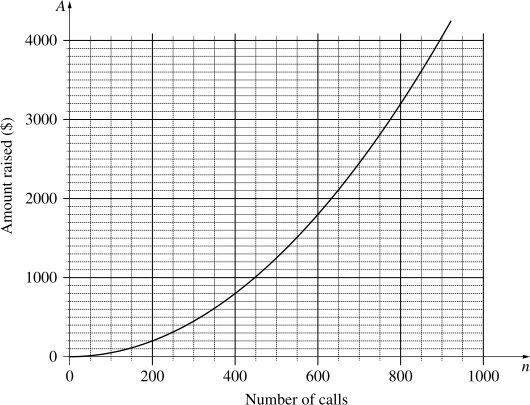
Over the years, this charity has found that the amount of money raised `($A)` is related to the number of telephone calls made `(n)`. A graph of this relationship is shown.


It costs the charity $2100 per week to run the call centre. It also costs an average of 50 cents per telephone call.

  1. Write an equation to represent the total cost, `C`, of running the call centre for a week in which `n` phone calls are made.  (1 mark)

    --- 1 WORK AREA LINES (style=lined) ---

  2. By graphing this equation on the axes above, determine the number of phone calls the charity needs to make in order to break even.  (2 marks)

    --- 1 WORK AREA LINES (style=lined) ---

Show Answers Only
  1. `C = $2100 + $0.50n`
  2. `text(700 calls)`
Show Worked Solution

i.   `C = $2100 + $0.50n`

♦ Mean marks of 48% and 32% for parts (i) and (ii) respectively.


ii.  

2UG 2015 28f Answer

`text(From the above graph, the charity needs to)`

`text(make 700 calls to break even.)`

Filed Under: Breakeven and Financial modelling, Simultaneous Equations and Applications (Std 2) Tagged With: Band 5, smc-794-10-Cost/Revenue

Statistics, STD2 S4 2015 HSC 28e

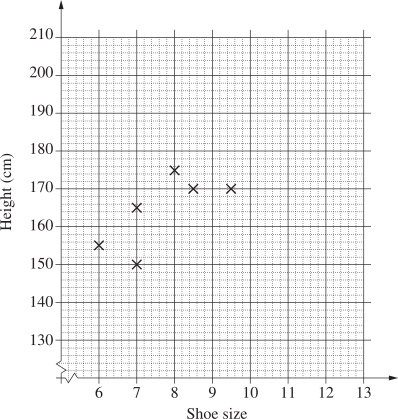
The shoe size and height of ten students were recorded.

\begin{array} {|l|c|c|}
\hline \rule{0pt}{2.5ex} \text{Shoe size} \rule[-1ex]{0pt}{0pt} & \text{6} & \text{7} & \text{7} & \text{8} & \text{8.5} & \text{9.5} & \text{10} & \text{11} & \text{12} & \text{12} \\
\hline \rule{0pt}{2.5ex} \text{Height} \rule[-1ex]{0pt}{0pt} & \text{155} & \text{150} & \text{165} & \text{175} & \text{170} & \text{170} & \text{190} & \text{185} & \text{200} & \text{195} \\
\hline
\end{array}

  1. Complete the scatter plot AND draw a line of fit by eye.  (2 marks)
     
     
  2. Use the line of fit to estimate the height difference between a student who wears a size 7.5 shoe and one who wears a size 9 shoe.  (1 mark)

    --- 1 WORK AREA LINES (style=lined) ---

  3. A student calculated the correlation coefficient to be 1 for this set of data. Explain why this cannot be correct.  (1 mark)

    --- 2 WORK AREA LINES (style=lined) ---

Show Answers Only
  1. `text(See Worked Solutions.)`
  2. `13\ text{cm  (or close given LOBF drawn)}
  3. `text(A correlation co-efficient of 1 would)`
    `text(mean that all data points occur on the)`
    `text(line of best fit which clearly isn’t the case.)`
Show Worked Solution

i.    
      2UG 2015 28e Answer

ii.   `text{Shoe size 7½ gives a height estimate of 162 cm (see graph)}`

`text{Shoe size 9 gives a height estimate of 175 cm (see graph)}`

`:.\ text(Height difference)` `= 175-162`
  `= 13\ text{cm  (or close given LOBF drawn)}`


iii.   `text(A correlation co-efficient of 1 would mean)`

♦ Mean mark (c) 39%.

`text(that all data points occur on the line of best)`

`text(fit which clearly isn’t the case.)`

Filed Under: Bivariate Data Analysis (Y12), Correlation / Body Measurements, S3 Further Statistical Analysis (Y12), S4 Bivariate Data Analysis (Y12) Tagged With: Band 4, Band 5, common-content, smc-1001-10-Line of Best Fit, smc-1001-30-Correlation, smc-1113-10-Line of Best Fit, smc-1113-20-Scatterplot from Table, smc-1113-30-Correlation, smc-785-10-Line of Best Fit, smc-785-30-Correlation

Statistics, STD2 S5 2015 HSC 28b

The results of two tests are normally distributed. The mean and standard deviation for each test are displayed in the table.
 

2015 28b

 
Kristoff scored 74 in Mathematics and 80 in English. He claims that he has performed better in English.

Is Kristoff correct? Justify your answer using appropriate calculations.  (2 marks)

--- 4 WORK AREA LINES (style=lined) ---

Show Answers Only

`text(He is correct.)`

Show Worked Solution

`text(In Maths)`

♦ Mean mark 44%.
`ztext{-score(74)}` `= (x − mu)/sigma`
  `= (74 − 70)/6.5`
  `= 0.6153…`

 
`text(In English)`

`ztext{-score(80)}` `= (80 − 75)/8`
  `= 0.625`

 
`=>\ text(Kristoff’s)\ ztext(-score in English is higher than)`

`text(his)\ z text(-score in Maths.)`

`:.\ text(He is correct. He performed better in English.)`

Filed Under: DS5/6 - Normal Distribution and Sampling, Normal Distribution (Y12), S5 The Normal Distribution (Y12) Tagged With: Band 5, common-content, smc-819-10-Single z-score, smc-819-30-Comparisons of Data Sets, smc-995-10-Single z-score, smc-995-30-Comparisons of Data Sets

FS Comm, 2UG 2015 HSC 27e

A `42` megabyte (MB) file is to be downloaded at a rate of `500` kilobits per second (kbps), where `1` kilobit = `1000` bits.

How long would it take to download this file? Give your answer in minutes and seconds, correct to the nearest second.  (3 marks)

Show Answers Only

`text{11 mins 45 seconds  (nearest second)}`

Show Worked Solution
`42\ text(MB)` `= 42 xx 2^20`
  `= 44\ 040\ 192\ \ text(bytes)`
  `= 352\ 321\ 536\ \ text{bits  (1 byte = 8 bits)}`


♦ Mean mark 50%.

`text(Download speed = 500 000 bits per second)`

`:.\ text(Download time)` `= (352\ 321\ 536)/(500\ 000)`
  `= 704.64…`
  `=11\ text{mins 45 seconds  (nearest second)}`

Filed Under: FS Communication Tagged With: Band 5, HSC

Statistics, STD2 S1 2015 HSC 27d

In a small business, the seven employees earn the following wages per week:

\(\$300, \ \$490, \ \$520, \ \$590, \ \$660, \ \$680, \ \$970\)

  1.  Is the wage of $970 an outlier for this set of data? Justify your answer with calculations.  (3 marks)

    --- 6 WORK AREA LINES (style=lined) ---

  2.  Each employee receives a $20 pay increase.


     What effect will this have on the standard deviation?  (1 mark)

    --- 2 WORK AREA LINES (style=lined) ---

Show Answers Only

a.    \(\text{See Worked Solutions.} \)

b.    \(\text{The standard deviation will remain the same.}\)

Show Worked Solution

a.    \(300, 490, 520, 590, 660, 680, 970\)

\(\text{Median}\) \(= 590\)
\(Q_1\) \(= 490\)
\(Q_3\) \(= 680\)
\(IQR\) \(= 680-490 = 190\)


\(\text{Outlier if \$970 is greater than:} \)

\(Q_3 + 1.5 x\times IQR = 680 + 1.5 \times 190 = \$965 \) 

\(\therefore\ \text{The wage \$970 per week is an outlier.}\)

♦ Mean mark (a) 39%.


b. 
  \(\text{All values increase by \$20, but so too does the mean.} \)

\(\text{Therefore the spread about the new mean will not change} \)

\(\text{and therefore the standard deviation will remain the same.} \)

Filed Under: Measures of Centre and Spread (Std2-2027), Summary Statistics - No Graph (Std 2), Summary Statistics - No graph (Y12), Summary Statistics (no graph), Summary Statistics (Std 1) Tagged With: Band 4, Band 5, common-content, smc-1131-30-IQR and Outliers, smc-1131-50-Std Dev (by calc), smc-6312-30-IQR and Outliers, smc-6312-50-Std Dev (by Calc), smc-824-30-IQR and Outliers, smc-824-50-Std Dev (by calc), smc-999-30-IQR and Outliers, smc-999-50-Std Dev (by calc)

Algebra, STD2 A2 2015 HSC 27c

Ariana’s parents have given her an interest‑free loan of $4800 to buy a car. She will pay them back by paying `$x` immediately and `$y` every month until she has repaid the loan in full.

After 18 months Ariana has paid back $1510, and after 36 months she has paid back $2770.

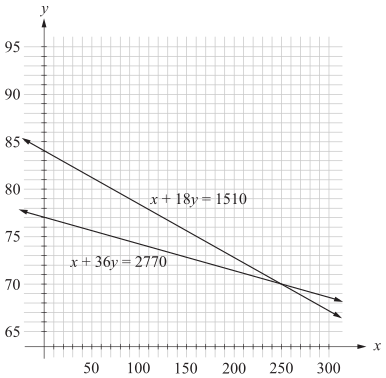
This information can be represented by the following equations.

`x + 18y = 1510`

`x + 36y = 2770`

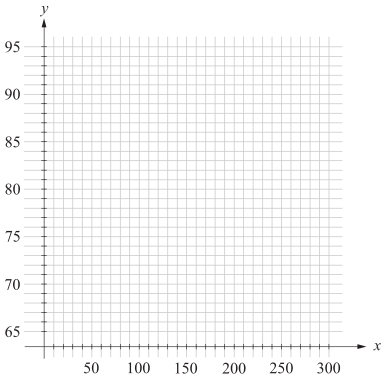
  1. Graph these equations below and use to solve simultaneously for the values of `x` and `y`.   (2 marks)


    --- 1 WORK AREA LINES (style=lined) ---

  2. How many months will it take Ariana to repay the loan in full? (2 marks)

    --- 4 WORK AREA LINES (style=lined) ---

Show Answers Only
  1. `x = 250, \ y = 70`
  2. `text(65 months)`
Show Worked Solution

i.

 
`:.\ text(Solution is)\ \ x = 250, \ y = 70`
 

ii.  `text(Let)\ \ A = text(the amount paid back after)\ n\ text(months)`

`A = 250 + 70n`

♦ Mean mark 44%.

`text(Find)\ n\ text(when)\ A = 4800`

`250 + 70n` `= 4800`
`70n` `= 4550`
`n` `= 65`


`:.\ text(It will take Ariana 65 months to repay)`

`text(the loan in full.)`

Filed Under: Breakeven and Financial modelling, Linear Applications, Linear Functions (Adv-2027), Linear Functions (Y11) Tagged With: Band 5, common-content, num-title-ct-coreb, num-title-qs-hsc, smc-4421-30-Cost/Revenue, smc-6214-20-Other Real World Applications, smc-985-20-Other Linear Applications

Measurement, STD2 M6 2015 HSC 22 MC

The area of the triangle shown is 250 cm².


What is the value of `x`, correct to the nearest whole number?

  1. `11`
  2. `18`
  3. `22`
  4. `24`
Show Answers Only

`D`

Show Worked Solution

`text(Using)\ \ \ A = 1/2ab\ sin\ C`

♦ Mean mark 42%.
`250` `= 1/2 xx 30x\ sin\ 44^@`
`250` `= 15x\ sin\ 44 ^@`
`:.x` `= 250/(15\ sin\ 44^@)`
  `= 23.99…\ text(m)`

 
`=>D`

Filed Under: Non Right-Angled Trig, Non-Right Angled Trig, Non-Right Angled Trig (Std2) Tagged With: Band 5, num-title-ct-pathc, num-title-qs-hsc, smc-4553-30-Sine Rule (Area), smc-804-30-Sine Rule (Area)

Probability, STD2 S2 2015 HSC 21 MC

Four cards, labelled 2, 3, 5 and 7, are placed on a table to form a four‑digit number.

How many different numbers greater than 3000 can be formed?

  1.    6
  2.    12
  3.    18
  4.    24
Show Answers Only

`C`

Show Worked Solution

`#\ text{Combinations greater than 3000}`

♦ Mean mark 48%.

`= 3 xx 3 xx 2 xx 1`

`= 18`

`=> C`

Filed Under: # Combinations, Combinations (Std 1), Combinations and Single Stage Events (Std 2) Tagged With: Band 5, smc-1134-20-Number Combinations, smc-828-20-Number Combinations

Statistics, STD2 S5 2015 HSC 20 MC

A machine produces cylindrical pipes. The mean of the diameters of the pipes is 8 cm and the standard deviation is 0.04 cm.

Assuming a normal distribution, what percentage of cylindrical pipes produced will have a diameter less than 7.96 cm?

  1. `text(16%)`
  2. `text(32%)`
  3. `text(34%)`
  4. `text(68%)`
Show Answers Only

`A`

Show Worked Solution

`mu = 8\ text(cm)\ \ \ s = 0.04\ text(cm)`

♦ Mean mark 50%.
`ztext{-score(7.96)}` `= (x − mu)/sigma`
  `= (7.96 − 8)/0.04`
  `= −1`


2UG 2015 20MC Answer

`:.\ text(% of pipes with a diameter less than 7.96 cm.)`

`=\ text(50%) – text(34%)`

`=\ text(16%)`

`⇒ A`

Filed Under: DS5/6 - Normal Distribution and Sampling, Normal Distribution (Y12), S5 The Normal Distribution (Y12) Tagged With: Band 5, common-content, smc-819-10-Single z-score, smc-995-10-Single z-score

Statistics, STD2 S1 2015 HSC 19 MC

The table shows the life expectancy (expected remaining years of life) for females at selected ages in the given periods of time.

2015 19 mc

In 1975, a 45‑year‑old female used the information in the table to calculate the age to which she was expected to live. Twenty years later she recalculated the age to which she was expected to live.

What is the difference between the two ages she calculated?

  1.    2.7 years
  2.    3.1 years
  3.    3.7 years
  4.    5.8 years
Show Answers Only

`D`

Show Worked Solution

`text(In 1975, her life expectancy)`

♦ Mean mark 39%.

`=\ text(age + remaining years)`

`= 45 + 34`

`= 79`

`text(In 1995,  her life expectancy)`

`= 65 + 19.8`

`= 84.8`

`:.\ text(Difference)` `= 84.8 − 79`
  `= 5.8\ text(years)`

`⇒ D`

Filed Under: Bar Charts, Histograms and Other Graphs (Std 1), Life Expectancy, Other Chart Types (Y12), Other Charts (Std 2), Other Charts (Std2-2027), S4 Bivariate Data Analysis (Y12) Tagged With: Band 5, common-content, smc-1128-28-Other Charts, smc-6311-30-Other Charts, smc-822-40-Other Charts, smc-998-40-Other Charts

Probability, 2UG 2015 HSC 18 MC

A Student Representative Council (SRC) consists of five members. Three of the members are being selected to attend a conference.

In how many ways can the three members be selected?

(A)   `10`

(B)   `20`

(C)   `30`

(D)   `60`

Show Answers Only

`A`

Show Worked Solution
♦ Mean mark 37%.
`#\ text(Combinations)` `= (5 xx 4 xx 3)/(3 xx 2 xx 1)`
  `= 10`

`⇒ A`

Filed Under: # Combinations Tagged With: Band 5, HSC, M/C

Financial Maths, STD2 F1 2015 HSC 15 MC

A camera costs $449, including 12% GST.

What is the price of the camera without GST, correct to the nearest dollar?

  1.    `$395`
  2.    `$401`
  3.    `$437`
  4.    `$503`
Show Answers Only

`B`

Show Worked Solution

`text(Let)\ C\ text(= cost of camera ex-GST)`

♦ Mean mark 36%.
`C + text(12%)C` `= $449`
`1.12C` `= 449`
`:. C` `= 449/1.12`
  `= $400.89…`

`⇒ B`

Filed Under: FM3 - Taxation, Purchasing Goods (Std2-2027), Tax and Percentage Increase/Decrease (Std 1), Tax and Percentage Increase/Decrease (Std 2) Tagged With: Band 5, smc-1125-20-GST, smc-6278-20-GST/VAT, smc-831-20-GST

Algebra, STD2 A2 2015 HSC 13 MC

What is the equation of the line `l`?
 

  1. `y = -2x + 2`
  2. `y = 2x + 2`
  3. `y = -x/2 + 2`
  4. `y = x/2 +2`
Show Answers Only

`A`

Show Worked Solution

`l\ text{passes through (0, 2) and (1, 0)}`

♦ Mean mark 48%.
`text(Gradient)` `= (y_2-y_1)/(x_2-x_1)`
  `= (0-2)/(1-0)`
  `= -2`

 
`y\ text(intercept = 2)`

`:.y = -2x + 2`

`=>A`

Filed Under: AM2 - Linear Relationships (Prelim), Linear Equations and Basic Graphs (Std 1), Linear Equations and Basic Graphs (Std 2), Linear Relationships and Basic Graphs (Std2-2027) Tagged With: Band 5, smc-1118-20-Identify graph/equation, smc-6255-20-Equation of a line, smc-792-20-Equation of Line

Measurement, STD2 M1 2015 HSC 12 MC

The length of a fish was measured to be 49 cm, correct to the nearest cm.

What is the percentage error in this measurement, correct to one significant figure?

  1. 0.01%
  2. 0.5%
  3. 1%
  4. 2%
Show Answers Only

`C`

Show Worked Solution
♦ Mean mark 41%.

`text{Absolute error}\ =1/2 xx text{precision}\ = 1/2 xx 1 = 0.5\ text{cm}`

`text{% error}` `=\ frac{text{absolute error}}{text{measurement}} xx 100%`  
  `=0.5/49 xx 100%`  
  `=1.020… %`  
  `=1%\ \ text{(to 1 sig fig)}`  

 
`=>C`

Filed Under: Numbers of Any Magnitude, Simpson's Rule/Measurement Error, Units and Measurement Error (Std 1), Units and Measurement Error (Std 2) Tagged With: Band 5, num-title-ct-corea, num-title-qs-hsc, smc-1120-10-Measurement Error, smc-4232-10-Measurement error, smc-4232-50-Significant figures, smc-797-10-Measurement Error

Algebra, 2UG 2015 HSC 11 MC

Which of the following is  `3x^0 + 5x`  in its simplest form?

  1. `6x`
  2. `8x`
  3. `1 + 5x`
  4. `3 + 5x`
Show Answers Only

`D`

Show Worked Solution
♦ Mean mark below 43%. BE CAREFUL! 
`3x^0 + 5x` `= 3 xx 1 + 5x`
  `= 3 + 5x`

 
`=> D`

Filed Under: Index and Log Laws, Indices Tagged With: Band 5, num-title-ct-pathb, smc-4228-20-Power zero

Measurement, STD2 M6 2015 HSC 9 MC

From the top of a cliff 67 metres above sea level, the angle of depression of a buoy is 42°.


How far is the buoy from the base of the cliff, to the nearest metre?

  1. `60\ text(m)`
  2. `74\ text(m)`
  3. `90\ text(m)`
  4. `100\ text(m)`
Show Answers Only

`B`

Show Worked Solution
♦ Mean mark 49%.
COMMENT: The angle of depression is a regularly examined concept. Make sure you know exactly what it refers to.

`text(Let)\ x\ text(= distance of buoy from cliff base)`

`tan\ 42^@` `= 67/x`
`x\ tan\ 42^@` `= 67`
`x` `= 67/(tan\ 42^@)`
  `= 74.41…\ text(m)`

`⇒ B`

Filed Under: 2-Triangle and Harder Examples, M3 Right-Angled Triangles (Y12), Pythagoras and Right-Angled Trig (Std2), Right-Angled Trig Tagged With: Band 5, num-title-ct-coreb, num-title-qs-hsc, smc-1103-20-Right-angled Trig, smc-1103-30-Angle of Depression, smc-4552-40-Real world applications, smc-4552-50-Angle of depression, smc-802-20-Right-Angled Trig, smc-802-30-Angle of Depression

Algebra, 2UG 2015 HSC 5 MC

Which of the following graphs best represents the equation  `y = x^3 + 1`?

2015 5 mc1

2015 5 mc2

Show Answers Only

`B`

Show Worked Solution

`text(The graph is the shape of the cubic curve,)`

`y = x^3,\ text(raised up 1 unit on the)\ ytext(-axis.)`

`⇒ B`

Filed Under: Exponential/Quadratic (Projectile) Tagged With: Band 5, HSC, M/C

Measurement, STD2 M1 2015 HSC 1 MC

What is  1 560 200 km written in standard form correct to two significant figures?

  1. `1.56 × 10^4 \ text(km)`
  2. `1.6 × 10^5 \ text(km)`
  3. `1.56 × 10^6 \ text(km)`
  4. `1.6 × 10^6 \ text(km)`
Show Answers Only

`D`

Show Worked Solution

♦♦ Mean mark 30%.
COMMENT: Incredibly, the first MC question in 2015 had the lowest mean mark of all MC questions in the exam!

`1\ 560\ 200`

`= 1.5602 xx 10^6`

`= 1.6 xx 10^6\ text(km)\ \ \ text{(2 sig fig)}`

 
`=> D`

Filed Under: Identify and Convert Between Units (Std2-2027), MM1 - Units of Measurement, Numbers of Any Magnitude, Units and Measurement Error (Std 1), Units and Measurement Error (Std 2) Tagged With: Band 5, num-title-ct-corea, num-title-qs-hsc, smc-1120-20-Scientific Notation, smc-1120-30-Significant Figures, smc-4232-30-Scientific notation, smc-4232-50-Significant figures, smc-6303-40-Scientific Notation, smc-6303-50-Significant Figures, smc-797-20-Scientific Notation, smc-797-30-Significant Figures

Calculus, EXT1* C3 2015 HSC 16b

A bowl is formed by rotating the curve  `y = 8 log_e (x - 1)`  about the `y`-axis for  `0 <= y <= 6.`
 

2015 16b
 

Find the volume of the bowl. Give your answer correct to 1 decimal place.  (3 marks)

--- 8 WORK AREA LINES (style=lined) ---

Show Answers Only

`118.7\ text(u³)`

Show Worked Solution
♦ Mean mark 38%.
`y` `=8 log_e (x – 1)`
`y/8` `=log_e (x – 1)`
`e^(y/8)` `=x – 1`
`x` `=e^(y/8) + 1`
`x^2` `=(e^(y/8) + 1)^2`
  `=(e^(y/8))^2 + 2e^(y/8) + 1`
  `=e^(y/4) + 2e^(y/8) + 1`


`V` `= pi int_0^6 x^2\ dy`
  `= pi int_0^6 (e^(y/4) + 2e^(y/8) + 1)\ dy`
  `= pi [4e^(y/4) + 16e^(y/8) + y]_0^6`
  `= pi [(4e^(6/4) + 16e^(6/8) + 6) – (4e^0 + 16e^0 + 0)]`
  `= pi [(4e^1.5 + 16e^0.75 + 6) – (4 + 16)]`
  `= pi [4e^1.5 + 16e^0.75 – 14]`
  `= 118.748…`
  `= 118.7\ \ text{(to 1 d.p.)}`

 
`:.\ text(Volume of the bowl is 118.7 u³.)`

Filed Under: Applied Calculus (L&E), Further Area and Solids of Revolution (Ext1), Volumes of Solids of Rotation Tagged With: Band 5, smc-1039-40-Other Graphs, smc-1039-61-y-axis Rotation

Calculus, 2ADV C4 2015 HSC 16a

The diagram shows the curve with equation  `y = x^2-7x + 10`. The curve intersects the `x`-axis at points `A and B`. The point `C` on the curve has the same `y`-coordinate as the `y`-intercept of the curve.


  1. Find the `x`-coordinates of points `A and B.`  (1 mark)

    --- 1 WORK AREA LINES (style=lined) ---

  2. Write down the coordinates of `C.`  (1 mark)

    --- 1 WORK AREA LINES (style=lined) ---

  3. Evaluate  `int _0^2 (x^2-7x + 10)\ dx.`  (1 mark)

    --- 1 WORK AREA LINES (style=lined) ---

  4. Hence, or otherwise, find the area of the shaded region.  (2 marks)

    --- 4 WORK AREA LINES (style=lined) ---

Show Answers Only
  1. `A = 2,\ \ B = 5`
  2. `(7, 10)`
  3. `8 2/3`
  4. `16 1/3\ text(u²)`
Show Worked Solution
i.    `y` `= x^2-7x + 10`
  `= (x-2) (x-5)`

 
`:.x = 2 or 5`

`:.\ \ x text(-coordinate of)\ \ A = 2`

`x text(-coordinate of)\ \ B = 5`


ii.    `y\ text(intercept occurs when)\ \ x = 0`

`=>y text(-intercept) = 10`
 

`C\ text(occurs at intercept:)`

`y` `= x^2-7x + 10` `\ \ \ \ \ text{…  (1)}`
`y` `= 10` `\ \ \ \ \ text{…  (2)}`

 
`(1) = (2)`

`x^2-7x + 10` `= 10`
`x^2-7x` `= 10`
`x (x-7)` `= 10`

 
`x = 0 or 7`

`:.\ C\ \ text(is)\ \ (7, 10)`


iii.  `int_0^2 (x^2 – 7x + 10)\ dx`

`= [1/3 x^3 – 7/2 x^2 + 10x]_0^2`

`= [(1/3 xx 2^3 – 7/2 xx 2^2 + 10 xx 2) – 0]`

`= 8/3 – 14 + 20`

`= 8 2/3`


iv.  

`A_1 = A_2`

♦ Mean mark 49%.

`A_2 = 8 2/3\ text(u²)\ \ \ \ text{(from part (iii))}`

`text(Let)\ \ D\ \ text(be)\ \ (7, 0)`

`text(Shaded Area)`

`= text(Area of)\ \ Delta ACD – A_2`

`= 1/2 bh – 8 2/3`

`= 1/2 xx 5 xx 10 – 8 2/3`

`= 16 1/3\ text(u²)`

Filed Under: Areas Under Curves, Areas Under Curves (Y12) Tagged With: Band 2, Band 3, Band 5, smc-975-10-Quadratic

Calculus, 2ADV C4 2015 HSC 15c

Water is flowing in and out of a rock pool. The volume of water in the pool at time `t` hours is `V` litres. The rate of change of the volume is given by

`(dV)/(dt) = 80 sin(0.5t)`

At time  `t = 0`, the volume of water in the pool is 1200 litres and is increasing.

  1. After what time does the volume of water first start to decrease?  (2 marks)

    --- 6 WORK AREA LINES (style=lined) ---

  2. Find the volume of water in the pool when  `t = 3`.  (2 marks)

    --- 6 WORK AREA LINES (style=lined) ---

  3. What is the greatest volume of water in the pool?  (1 mark)

    --- 3 WORK AREA LINES (style=lined) ---

Show Answers Only
  1. `2 pi\ text(hours)`
  2. `1349\ text(litres)`
  3. `1520\ text(litres)`
Show Worked Solution

i.   `(dV)/(dt) = 80 sin (0.5t)`

♦ Mean mark (i) 37%.

`text(Volume decreases when)\ \ (dV)/(dt) < 0`

`(dV)/(dt) < 0\ \ text(when)\ \ t > 2 pi\ text(hours)`

`:.\ text(After 2)\pi\ \text(hours, volume starts to decrease.)`


ii.   `V` `= int (dV)/(dt)\ dt`
  `= int 80 sin (0.5t)\ dt`
  `= -160 cos (0.5t) + c`


`text(When)\ \ t = 0,\ V = 1200`

`1200` `= -160 cos 0 + c`
`c` `= 1360`
`:.\ V` `= -160 cos (0.5t) + 1360`


`text(When)\ \ t = 3`

`V` `= -160 cos (0.5 xx 3) + 1360`
  `= 1348.68…\ \ text(litres)`
  `= 1349\ text{litres  (nearest litre)}`


iii.  `V = -160 cos (0.5t) + 1360`

♦♦ Mean mark (iii) 27%.

`=>\ text(Greatest volume occurs when)`

`cos (0.5t) = -1`

`:.\ text(Maximum volume)`

`= -160 (-1) + 1360`

`= 1520\ text(litres)`

Filed Under: Other Integration Applications (Y12), Rates of Change Tagged With: Band 4, Band 5, smc-1091-20-Flow, smc-1091-40-Trig Function, smc-1213-15-Flow

Plane Geometry, 2UA 2015 HSC 15b

The diagram shows `Delta ABC` which has a right angle at `C`. The point `D` is the midpoint of the side `AC`. The point `E` is chosen on `AB` such that `AE = ED`. The line segment `ED` is produced to meet the line `BC` at `F`.

Copy or trace the diagram into your writing booklet.

  1. Prove that `Delta ACB` is similar to `Delta DCF.`  (2 marks)
  2. Explain why `Delta EFB` is isosceles.  (1 mark)
  3. Show that `EB = 3AE.`  (2 marks)
Show Answers Only
  1. `text(Proof)\ \ text{(See Worked Solutions)}`
  2. `text(Proof)\ \ text{(See Worked Solutions)}`
  3. `text(Proof)\ \ text{(See Worked Solutions)}`
Show Worked Solution

(i)  `text(Prove)\ \ Delta ACB\ \ text(|||)\ \ Delta DCF`

`/_ EAD = /_ ADE = theta\ \ text{(base angles of isosceles}\ \ Delta AED text{)}`

`/_ CDF = /_ ADE = theta\ \ text{(vertically opposite angles)}`

`/_ DCF = /_ ACB = 90°\ \ text{(}/_ FCB\ text{is a straight angle)}`

`:.\ Delta ACB\ \ text(|||)\ \ Delta DCF\ \ text{(equiangular)}`


♦ Mean mark 45%.

(ii)  `/_ DFC = 90 – theta\ \ text{(angle sum of}\ \ Delta DCF text{)}`

`/_ ABC = 90 – theta\ \ text{(angle sum of}\ \ Delta ACB text{)}`

`:.\ Delta EFB\ \ text{is isosceles  (base angles are equal)}`


(iii)  `text(Show)\ \ EB = 3AE`

♦♦ Mean mark 23%.
`(DC)/(AC)` `= (DF)/(AB)`

`\ \ \ \ \ text{(corresponding sides of}`

`\ \ \ \ \ text{similar triangles)}`

`1/2` `= (DF)/(AB)`  
`2DF` `= AB`  
`2(EF – ED)` `= AE + EB`  
`2(EB – AE)` `= AE + EB` `\ \ \ \ \ text{(given}\ EF = EB, ED = AE text{)}`
`2EB – 2AE` `= AE + EB`  


`:. EB = 3AE\ \ text(…  as required)`

Filed Under: 2. Plane Geometry Tagged With: Band 4, Band 5, Band 6, HSC

Financial Maths, 2ADV M1 2015 HSC 14c

Sam borrows $100 000 to be repaid at a reducible interest rate of 0.6% per month. Let  `$A_n`  be the amount owing at the end of  `n`  months and  `$M`  be the monthly repayment.

  1. Show that  `A_2 = 100\ 000 (1.006)^2 - M (1 + 1.006).`  (1 mark)

    --- 1 WORK AREA LINES (style=lined) ---

  2. Show that  `A_n = 100\ 000 (1.006)^n - M (((1.006)^n - 1)/0.006).`  (2 marks)

    --- 5 WORK AREA LINES (style=lined) ---

  3. Sam makes monthly repayments of $780. Show that after making 120 monthly repayments the amount owing is $68 500 to the nearest $100.  (1 mark)

    --- 2 WORK AREA LINES (style=lined) ---

Immediately after making the 120th repayment, Sam makes a one-off payment, reducing the amount owing to $48 500. The interest rate and monthly repayment remain unchanged.

  1. After how many more months will the amount owing be completely repaid?  (3 marks)

    --- 6 WORK AREA LINES (style=lined) ---

Show Answers Only
  1. `text(Proof)\ \ text{(Show Worked Solutions)}`
  2. `text(Proof)\ \ text{(Show Worked Solutions)}`
  3. `text(Proof)\ \ text{(Show Worked Solutions)}`
  4. `79\ text(months)`
Show Worked Solution
i.  `A_1` `= 100\ 000 (1.006) – M`
`A_2` `= A_1 (1.006) – M`
  `= [100\ 000 (1.006) – M] (1.006) – M`
  `= 100\ 000 (1.006)^2 – M (1.006) – M`
  `= 100\ 000 (1.006)^2 – M (1 + 1.006)\ \ text(…  as required)`


ii.  `A_3 = 100\ 000 (1.006)^3 – M (1 + 1.006 + 1.006^2)`

`vdots`

`A_n = 100\ 000 (1.006)^n – M (1 + 1.006 + … + 1.006^(n-1))`

`=> text(S)text(ince)\ \ (1 + 1.006 + … + 1.006^(n-1))\ text(is a)`

`text(GP with)\ \ a = 1,\ r = 1.006`

`:.\ A_n` `= 100\ 000 (1.006)^n – M ((a (r^n – 1))/(r – 1))`
  `= 100\ 000 (1.006)^n – M ((1 (1.006^n – 1))/(1.006 – 1))`
  `= 100\ 000 (1.006)^n – M (((1.006)^n – 1)/0.006)`

`text(…  as required.)`


iii.  `text(If)\ \ M = 780 and n = 120`

`A_120` `= 100\ 000 (1.006)^120 – 780 ((1.006^120 – 1)/0.006)`
  `= 205\ 001.80… – 780 (175.0030…)`
  `= 205\ 001.80… – 136\ 502.34…`
  `= 68\ 499.45…`
  `= $68\ 500\ \ text{(to nearest $100)  …  as required}`


iv.  `text(After the one-off payment, amount owing)=$48\ 500`

`:. A_n = 48\ 500 (1.006)^n – 780 ((1.006^n – 1)/0.006)`

`text(where)\ \ n\ \ text(is the number of months after)`

 `text(the one-off payment.)`
 

`text(Find)\ \ n\ \ text(when)\ \ A_n = 0`

`48\ 500 (1.006)^n – 780 ((1.006^n – 1)/0.006) = 0`

`48\ 500 (1.006)^n` `= 780 ((1.006^n – 1)/0.006)`
`48\ 500 (1.006)^n` `= 130\ 000 (1.006^n – 1)`
  `= 130\ 000 (1.006)^n – 130\ 000`
`81\ 500 (1.006)^n` `= 130\ 000`
`1.006^n` `= (130\ 000)/(81\ 500)`
`n xx ln 1.006` `= ln\ 1300/815`
`n` `= (ln\ 1300/815)/(ln\ 1.006)`
  `= 78.055…`

 
`:.\ text(The amount owing will be completely repaid after)`

`text(another 79 months.)`

Filed Under: Compound interest, loan repayments and annuities, Financial Applications of Series (Y12) Tagged With: Band 3, Band 4, Band 5, smc-1007-10-Loan

Functions, EXT1* F1 2015 HSC 13b

  1. Find the domain and range for the function  `f(x) = sqrt (9 - x^2)`.  (2 marks)

    --- 4 WORK AREA LINES (style=lined) ---

  2. On a number plane, shade the region where the points `(x, y)` satisfy both of the inequalities
     
      `qquad y <= sqrt (9 - x^2)`  and  `y >= x` .  (2 marks)

    --- 10 WORK AREA LINES (style=lined) ---

Show Answers Only
  1. `text(Domain)\ -3 <= x <= 3\ \ \ \ \ \ \ \ text(Range)\ 0<= y <= 3`
  2. `text(See Worked Solutions)`
Show Worked Solution

i.  `f(x) = sqrt(9 – x^2)`

`text(Domain)`

`9 – x^2` `>= 0`
`x^2` `<= 9`

`-3 <= x <= 3`

`text(Range)`

`0 <= y <= 3`


♦ Mean mark 34%.
ii.   

Filed Under: 4. Real Functions, Inequalities (Ext1) Tagged With: Band 4, Band 5, smc-1033-40-Regions

Trigonometry, 2ADV T1 2015 HSC 13a

The diagram shows `Delta ABC` with sides  `AB = 6` cm, `BC = 4` cm  and  `AC = 8` cm.
 

  1. Show that  `cos A = 7/8`.  (1 mark)

    --- 2 WORK AREA LINES (style=lined) ---

  2. By finding the exact value of `sin A`, determine the exact value of the area of  `Delta ABC`.  (2 marks)

    --- 5 WORK AREA LINES (style=lined) ---

Show Answers Only
  1. `text(Proof)\ \ text{(See Worked Solutions)}`
  2. `3 sqrt 15\ \ text(cm²)`
Show Worked Solution

i.  `text(Show)\ cos A = 7/8`

`text(Using the cosine rule)`

`cos A` `= (b^2 + c^2-a^2)/(2bc)`
  `= (8^2 + 6^2-4^2)/(2 xx 8 xx 6)`
  `= (64 + 36-16)/96`
  `= 84/96`
  `= 7/8\ \ text(…  as required)`


♦ Mean mark 40%.
ii.    2UA HSC 2015 13ai
`a^2 + 7^2` `= 8^2`
`a^2 + 49` `= 64`
`a^2` `= 15`
`a` `= sqrt 15`
`:.\ sin A` `= (sqrt 15)/8`


`:.\ text(Area)\ Delta ABC` `= 1/2 bc\ sin A`
  `= 1/2 xx 8 xx 6 xx (sqrt 15)/8`
  `= 3 sqrt 15\ \ text(cm²)`

Filed Under: Sine and Cosine Rules, Bearings, Trig Ratios, Sine and Cosine Rules (Adv-2027), Trig Ratios, Sine and Cosine Rules (Y11) Tagged With: Band 3, Band 5, smc-6392-30-Sine Rule, smc-6392-40-Cosine Rule, smc-980-30-Sine Rule, smc-980-40-Cosine Rule

Plane Geometry, 2UA 2006 HSC 10b

A rectangular piece of paper `PQRS` has sides `PQ = 12` cm and `PS = 13` cm. The point `O` is the midpoint of `PQ`. The points `K` and `M` are to be chosen on `OQ` and `PS` respectively, so that when the paper is folded along `KM`, the corner that was at `P` lands on the edge `QR` at `L`. Let `OK = x` cm and `LM = y` cm.

Copy or trace the diagram into your writing booklet.

  1. Show that `QL^2 = 24x`.  (1 mark)
  2. Let `N` be the point on `QR` for which `MN` is perpendicular to `QR`.
  3. By showing that `Delta QKL\ text(|||)\ Delta NLM`, deduce that `y = {sqrt 6 (6 + x)}/sqrt x`.  (3 marks)
  4. Show that the area, `A`, of `Delta KLM` is given by
    1. `A = {sqrt 6 (6 + x)^2}/(2 sqrt x)`  (1 mark)
    2.  
  5. Use the fact that `12 <= y <= 13` to find the possible values of `x`.  (2 marks)
  6. Find the minimum possible area of `Delta KLM`.  (3 marks)
Show Answers Only
  1. `text(Proof)\ \ text{(See Worked Solutions)}`
  2. `text(Proof)\ \ text{(See Worked Solutions)}`
  3. `text(Proof)\ \ text{(See Worked Solutions)}`
  4. `2 2/3 <= x <= 6`
  5.  
  6. `53.33…\ text(cm²)`
Show Worked Solution
(i)     

 `text(Show)\ QL^2 = 24x`

`KP = KL = 6 + x`

`KQ = 6 – x`

`text(Using Pythagoras)`

`QL^2` `= KL^2 – KQ^2`
  `= (6 + x)^2 – (6 – x)^2`
  `= 36 + 12x + x^2 – 36 + 12x – x^2`
  `= 24x\ …\ text(as required)`


(ii)  `text(Show)\ y = {sqrt 6 (6 + x)}/sqrt x`

`text(In)\ Delta QKL`

`/_LQK=90°\ \ text{(given)}`

`text(Let)\ /_QKL = theta`

`:. /_QLK = 90 – theta\ \ text{(angle sum of}\ Delta QKL text{)}`

`text(In)\ Delta NLM`

`/_LNM=90°\ \ text{(given)}`

`/_NLM` `= 180 – (90 + 90 – theta)\ \ (/_QLN\ text(is a straight angle))`
  `= theta`

`:. Delta QKL\ text(|||)\ Delta NLM\ \ \ text{(equiangular)}`

`:. y/(MN)` `= (KL)/(QL)\ \ text{(corresponding sides of}`
  `text{similar triangles)}` 
`y/12` `= (6 + x)/sqrt(24x)`
`y` `= (12(6 + x))/(2 sqrt (6x))`
  `= (6 (6 + x))/(sqrt x xx sqrt 6) xx sqrt 6/sqrt 6`
  `= (sqrt 6 (6 + x))/sqrt x\ …\ text(as required)`


(iii)  `text(Area)\ DeltaKLM` `= 1/2 xx y xx KL`
  `= 1/2 xx (sqrt 6 (6 + x))/sqrt x xx (6 + x)`
  `= (sqrt 6 (6 + x)^2)/(2 sqrt x)\ …\ text(as required.)`


(iv)  `text(Given that)\ \ \ \ \ \ \ \ 12 <= y <= 13`

`12 <= (sqrt 6 (6 + x))/sqrt x <= 13`

`text(Consider)\ (sqrt 6 ( 6 + x))/sqrt x` `>= 12`
`(6 (6 + x)^2)/x` `>= 144`
`(6 + x)^2` `>= 24x`
`36 + 12x + x^2` `>= 24x`
`x^2 – 12x + 36` `>= 0`
`(x – 6)^2` `>= 0`
`:. x` `>= 6`

`text(However, we know)\ OP=6,\ text(and)\ x <= 6`.

`:. x = 6\ text(satisfies both conditions)`

`text(Consider)\ (sqrt 6 (6 + x))/sqrt x` `<= 13`
`(6 (6 + x)^2)/x` `<= 169`
`6 (6 + x)^2` `<= 169x`
`6 (36 + 12x + x^2)` `<= 169x`
`216 + 72x + 6x^2` `<= 169x`
`6x^2 – 97x + 216` `<= 0`


`text(Using the quadratic formula)`

`x` `= (-b +- sqrt (b^2 -4ac))/(2a)`
  `= (97 +- sqrt ((-97)^2 -4 xx 6 xx 216))/(2 xx 6)`
  `= (97 +- sqrt 4225)/12`
  `= (97 +- 65)/12`
  `= 13 1/2 or 2 2/3`

`:. 2 2/3 <= x <= 13 1/2`

`text(However, we know)\ x <= 6,\ text(so)`

`2 2/3 <= x <= 6\ text(satisfies both conditions)`

`:.\ text(All possible values of)\ x\ text(are)`

`2 2/3 <= x <= 6`.


(v)  `A = (sqrt 6 (6 + x)^2)/(2 sqrt x)`

`text(Using the quotient rule)`

`(dA)/(dx)` `= (u prime v – uv prime)/v^2`
  `= {2 sqrt 6 (6 + x) xx 2 sqrt x – sqrt 6 (6 + x)^2 xx 1/2 xx 2 xx x^(-1/2)}/(2 sqrt x)^2`
  `= {4 sqrt x sqrt 6 (6 + x) – sqrt 6 (6 + x)^2 * 1/sqrt x}/(4x)`
  `= {4 sqrt 6 x (6 + x) – sqrt 6 (6 + x)^2}/(4x sqrt x)`
  `= (sqrt 6 (6 + x) (4x – 6 – x))/(4x sqrt x)`
  `= (sqrt 6 (6 + x) (3x – 6))/(4x sqrt x)`

`text(Max or min when)\ (dA)/(dx) = 0`

`sqrt 6 (6 + x) (3x – 6) = 0`

`:. 3x = 6\ \ ,\ \ x ≠ -6`

`x = 2`

`text(However,)\ x = 2\ text(lies outside the range)`

`text(of possible values)\ \ 2 2/3 <= x <= 6`

`:.\ text(Check limits)`

`text(At)\ \ x = 2 2/3`

`A` `= (sqrt 6 (6 + 2 2/3)^2)/(2 sqrt (2 2/3))`
  `= 56.33…\ text(cm²)`


`text(At)\ \ x = 6`

`A` `= (sqrt 6 (6 + 6)^2)/(2 sqrt 6)`
  `= 72.0\ text(cm²)`


`:.\ text(Minimum area of)\ Delta KLM\ text(is 56.33… cm²)`

Filed Under: 2. Plane Geometry, Maxima and Minima Tagged With: Band 4, Band 5, Band 6

Calculus, 2ADV C3 2006 HSC 9c

A cone is inscribed in a sphere of radius `a`, centred at `O`. The height of the cone is `x` and the radius of the base is `r`, as shown in the diagram.

  1. Show that the volume, `V`, of the cone is given by
     
         `V = 1/3 pi(2ax^2 - x^3)`.  (2 marks)

    --- 5 WORK AREA LINES (style=lined) ---

  2. Find the value of `x` for which the volume of the cone is a maximum. You must give reasons why your value of `x` gives the maximum volume.  (3 marks)

    --- 8 WORK AREA LINES (style=lined) ---

Show Answers Only
  1. `text(Proof)\ \ text{(See Worked Solutions)}`
  2. `x = 4/3 a`
Show Worked Solution

i.  `text(Show)\ V = 1/3 pi (2ax^2 – x^3)`

`V = 1/3 pi r^2 h`

`text(Using Pythagoras)`

`(x – a)^2 + r^2` `= a^2`
`r^2` `= a^2 – (x – a)^2`
  `= a^2 – x^2 + 2ax – a^2`
  `= 2ax – x^2`
`:. V` `= 1/3 xx pi xx (2ax – x^2) xx x`
  `= 1/3 pi (2ax^2 – x^3)\ …\ text(as required)`


ii.  `(dV)/(dx) = 1/3 pi (4ax – 3x^2)`

`(d^2V)/(dx^2) = 1/3 pi (4a – 6x)`

`text(Max or min when)\ (dV)/(dx) = 0`

`1/3 pi (4ax – 3x^2)` `= 0`
`4ax – 3x^2` `= 0`
`x(4a – 3x)` `= 0`
`3x` `= 4a,` ` \ \ \ \ x ≠ 0`
`x` ` =4/3 a`  


`text(When)\ \ x = 4/3 a`

`(d^2V)/(dx^2)` `= 1/3 pi (4a – 6 xx 4/3 a)`
  `= 1/3 pi (-4a) < 0`
`=>\ text(MAX)`


`:.\ text(Cone volume is a maximum when)\ \ x = 4/3 a.`

Filed Under: Maxima and Minima, Maxima and Minima (Y12) Tagged With: Band 5, Band 6, smc-970-20-Volume - Cone

Calculus, 2ADV C4 2006 HSC 9b

During a storm, water flows into a 7000-litre tank at a rate of `(dV)/(dt)` litres per minute, where `(dV)/(dt) = 120 + 26t-t^2` and `t` is the time in minutes since the storm began.

  1. At what times is the tank filling at twice the initial rate?  (2 marks)

    --- 6 WORK AREA LINES (style=lined) ---

  2. Find the volume of water that has flowed into the tank since the start of the storm as a function of `t`.  (1 mark)

    --- 3 WORK AREA LINES (style=lined) ---

  3. Initially, the tank contains 1500 litres of water. When the storm finishes, 30 minutes after it began, the tank is overflowing.


    How many litres of water have been lost?  (2 marks)

    --- 6 WORK AREA LINES (style=lined) ---

Show Answers Only
  1. `t = 6 or 20\ text(minutes)`
  2. `V = 120t + 13t^2 – 1/3t^3`
  3. `800\ text(litres)`
Show Worked Solution

i.  `(dV)/(dt) = 120 + 26t-t^2`

`text(When)\ t = 0, (dV)/(dt) = 120`

`text(Find)\ t\ text(when)\ (dV)/(dt) = 240`

`240 = 120 + 26t-t^2`

`t^2-26t + 120 = 0`

`(t-6)(t-20) = 0`

`t = 6 or 20`

`:.\ text(The tank is filling at twice the initial rate)`

`text(when)\ t = 6 and t = 20\ text(minutes)`


ii.  `V` `= int (dV)/(dt)\ dt`
  `= int 120 + 26t-t^2\ dt`
  `= 120t + 13t^2-1/3t^3 + c`

 
`text(When)\ t = 0, V = 0`

`=>  c = 0`

`:. V= 120t + 13t^2-1/3t^3`


iii.  `text(Storm water volume into the tank when)\ t = 30`

`= 120(30) + 13(30^2)-1/3 xx 30^3`

`= 3600 + 11\ 700-9000`

`= 6300\ text(litres)`
 

`text(Total volume)` `= 6300 + 1500`
  `= 7800\ text(litres)`


`:.\ text(Overflow)` `= 7800-7000`
  `= 800\ text(litres)`

Filed Under: Other Integration Applications (Y12), Rates of Change Tagged With: Band 4, Band 5, Band 6, HSC, smc-1091-20-Flow, smc-1091-50-Other Function, smc-1213-15-Flow

Quadratic, 2UA 2006 HSC 9a

Find the coordinates of the focus of the parabola  `12y = x^2 - 6x - 3`.  (2 marks)

Show Answers Only

`(3, 2)`

Show Worked Solution
`12y` `= x^2 – 6x – 3`
  `= x^2 – 6x + 9 – 12`
`12y` `= (x – 3)^2 – 12`
`(x – 3)^2` `= 12y + 12`
  `= 12(y + 1)`


`:.\ text{Vertex is (3, –1)}`

`4a` `= 12`
`a` `= 3`


`:.\ text(Coordinates of focus are)\ (3, 2).`

Filed Under: The Parabola Tagged With: Band 4, Band 5, HSC

Quadratic, 2UA 2006 HSC 7a

Let  `alpha`  and  `beta`  be the solutions of  `x^2 - 3x + 1 = 0`.

  1. Find  `alpha beta`.  (1 mark)
  2. Hence find  `alpha + 1/alpha`.  (1 mark)  


Show Answers Only
  1. `1`
  2. `3`
Show Worked Solution

(i)  `x^2 – 3x + 1 = 0`

`alpha beta` `= c/a`
  `= 1`


(ii)  `alpha + 1/alpha` `= alpha + beta\ \ \ text{(using}\ beta = 1/alpha\ text{from part (i))}`
  `= -b/a`
  `= (-(-3))/1`
  `= 3`

Filed Under: Roots and the discriminant Tagged With: Band 4, Band 5, HSC

Plane Geometry, 2UA 2006 HSC 6a

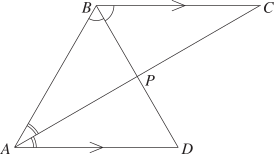
In the diagram, `AD` is parallel to `BC`, `AC` bisects `/_BAD` and `BD` bisects `/_ABC`. The lines `AC` and `BD` intersect at `P`.

Copy or trace the diagram into your writing booklet.

  1. Prove that `/_BAC = /_BCA`.  (1 mark)
  2. Prove that `Delta ABP ≡ Delta CBP`.  (2 marks)
  3. Prove that `ABCD` is a rhombus.  (3 marks)
Show Answers Only
  1. `text(Proof)\ \ text{(See Worked Solutions)}`
  2. `text(Proof)\ \ text{(See Worked Solutions)}`
  3. `text(Proof)\ \ text{(See Worked Solutions)}`
Show Worked Solution
(i)  

`text(Prove)\ /_BAC = /_BCA`

`/_BCA` `= /_CAD\ \ \ text{(alternate angles,}\ BC\ text(||)\ AD text{)}`
`/_CAD` `= /_BAC\ \ \ text{(}AC\ text(bisects)\ /_BAD text{)}`
`:. /_BAC` `= /_BCA\ …\ text(as required)`


(ii)  `text(Prove)\ Delta ABP ≡ Delta CBP`

`/_BAC` `= /_BCA\ \ \ text{(from part (i))}`
`/_ABP` `= /_CBP\ text{(}BD\ text(bisects)\ /_ABC text{)}`
`BP\ text(is common)`


`:. Delta ABP ≡ Delta CBP\ \ text{(AAS)}`


(iii)  `text(Using)\ Delta ABP ≡ Delta CBP`

`AP = PC\ \ text{(corresponding sides of congruent triangles)}`

`/_BPA = /_BPC\ \ text{(corresponding angles of congruent triangles)}`

`text(Also,)\ /_BPA = /_BPC = 90^@`

`text{(}/_APC\ text{is a straight angle)}`


`text(Considering)\ Delta APD and Delta APB`

`/_DAP` `= /_BAP\ text{(}AC\ text(bisects)\ /_BAD text{)}`
`/_DPA` `= 90^@\ text{(vertically opposite angles)}`
`:. /_DPA` `= /_BPA = 90^@`

`PA\ text(is common)`

`:. Delta APD ≡ Delta APB\ \ text{(AAS)}`

`BP = PD\ \ text{(corresponding sides of congruent triangles)}`


 `:. ABCD\ text(is a rhombus as its diagonals are)`

`text(perpendicular bisectors.)`

Filed Under: 2. Plane Geometry Tagged With: Band 3, Band 4, Band 5, HSC, page-break-before-solution

Calculus, 2ADV C4 2006 HSC 5b

  1. Show that `d/dx log_e (cos x) = -tan x.`  (1 mark)

    --- 2 WORK AREA LINES (style=lined) ---


  2.   
     
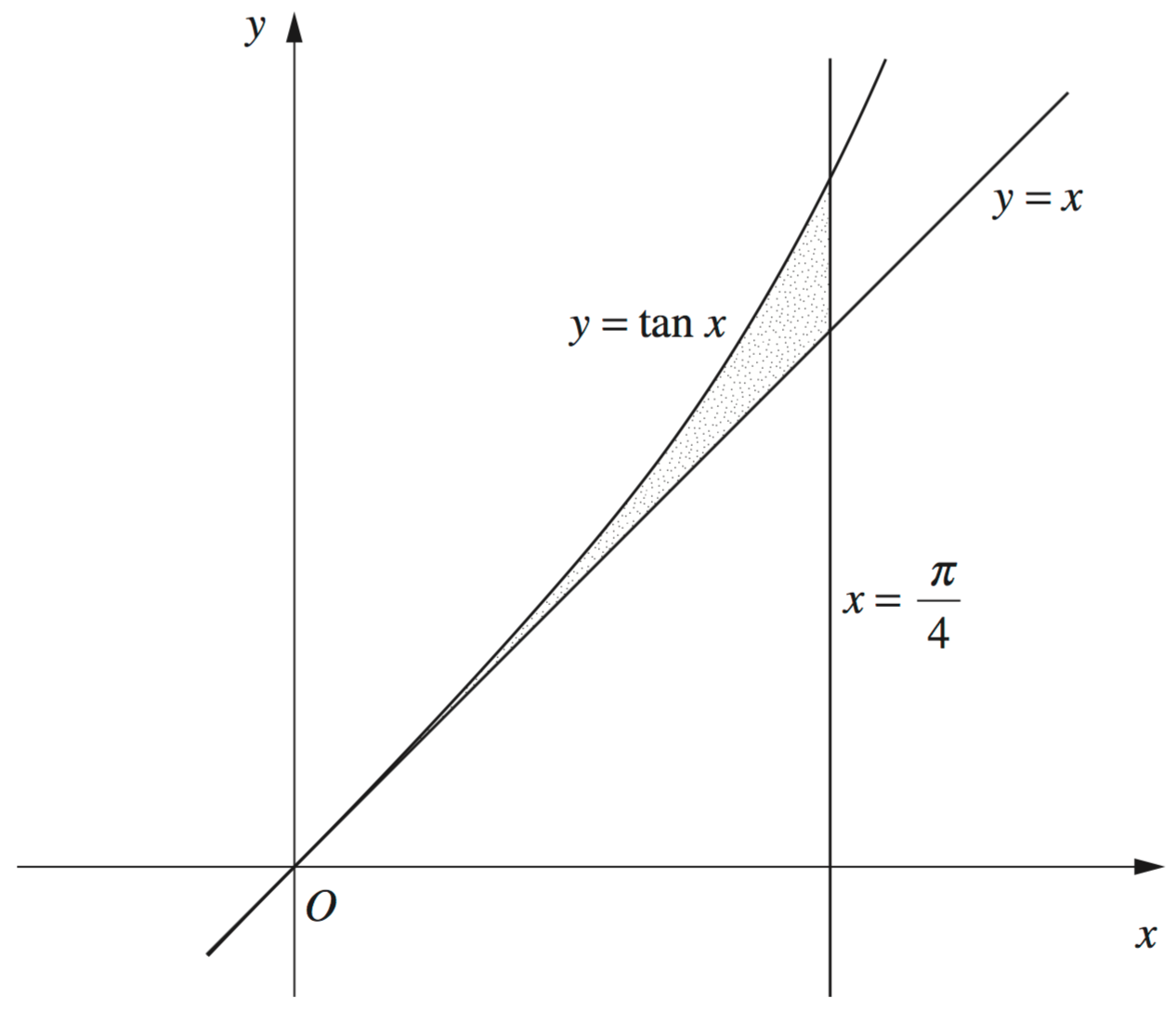
    2006 5b
     
    The shaded region in the diagram is bounded by the curve  `y =tan x`  and the lines  `y =x`  and  `x = pi/4.`


    Using the result of part (i), or otherwise, find the area of the shaded region.  (3 marks)

    --- 6 WORK AREA LINES (style=lined) ---

Show Answers Only
  1. `text(Proof)\ \ text{(See Worked Solutions)}`
  2. `(1/2 log_e 2 – pi^2/32)\ text(u²)`
Show Worked Solution
i.   `d/dx log_e (cos x)` `= (-sin x)/cos x`
  `= – tan x\ …\ text(as required)`


ii.  `text(Shaded Area)`

`= int_0^(pi/4) tan x\ dx – int_0^(pi/4) x\ dx`

`= int_0^(pi/4) tan x – x\ dx`

`= [-log_e (cos x) – 1/2 x^2]_0^(pi/4)`

`=[(-log_e (cos­ pi/4) – 1/2 xx (pi^2)/16) – (-log_e(cos 0) – 0)]`

`= -log_e­ 1/sqrt 2 – pi^2/32 + log_e1`

`= -log_e 2^(-1/2) – pi^2/32`

`= (1/2 log_e 2 – pi^2/32)\ text(u²)`

Filed Under: Areas Under Curves, Areas Under Curves (Y12) Tagged With: Band 3, Band 4, Band 5, smc-975-50-Trig

Measurement, 2UG 2015 HSC 26c

Two cities lie on the same meridian of longitude. One is 40° north of the other.

What is the distance between the two cities, correct to the nearest kilometre? (2 marks)

Show Answers Only

`4468\ text{km   (nearest km)}`

Show Worked Solution
♦ Mean mark 46%.

2UG 2015 23c Answer

`text(Distance between two cities)`

`= text(Arc length)\  AB`

`= 40/360 xx 2 xx pi xx r`

`= 1/9 xx 2 xx pi xx 6400`

`= 4468.04…`

`= 4468\ text{km  (nearest km)}`

Filed Under: MM6 - Spherical Geometry Tagged With: Band 5, HSC

Calculus, 2ADV C3 2004 HSC 4b

Consider the function  `f(x) = x^3 − 3x^2`.

  1. Find the coordinates of the stationary points of the curve  `y = f(x)`  and determine their nature.   (3 marks)

    --- 6 WORK AREA LINES (style=lined) ---

  2. Sketch the curve showing where it meets the axes.   (2 marks)

    --- 8 WORK AREA LINES (style=lined) ---

  3. Find the values of  `x`  for which the curve  `y = f(x)`  is concave up.   (2 marks)

    --- 5 WORK AREA LINES (style=lined) ---
Show Answers Only
  1. `text(MAX at)\ (0,0),\ \ text(MIN at)\ (2,-4)`
  2.  
    1. Geometry and Calculus, 2UA 2004 HSC 4b Answer
  3. `f(x)\ text(is concave up when)\ x>1`
Show Worked Solution
(i)    `f(x)` `= x^3 – 3x^2`
  `f'(x)` `= 3x^2 – 6x`
  `f″(x)` `= 6x – 6`


`text(S.P.’s  when)\ \ f'(x) = 0`

`3x^2 – 6x` `= 0`
`3x (x – 2)` `= 0`
`x` `= 0\ \ text(or)\ \ 2`


`text(When)\ x = 0`

`f(0)` `= 0`
`f″(0)` `= 0 – 6 = -6 < 0`
`:.\ text(MAX at)\ (0,0)`


`text(When)\ x = 2`

`f(2)` `= 2^3 – (3 xx 4) = -4`
`f″(2)` `= (6 xx 2) – 6 = 6 > 0`
`:.\ text(MIN at)\ (2, -4)`


(ii)   `f(x) = x^3 – 3x^2\ text(meets the)\ x text(-axis when)\ f(x) = 0`
`x^3 – 3x^2` `= 0`
`x^2 (x-3)` `= 0`
`x` `= 0\ \ text(or)\ \ 3`

 Geometry and Calculus, 2UA 2004 HSC 4b Answer

(iii)   `f(x)\ text(is concave up when)`
`f″(x)` `>0`
`6x – 6` `>0`
`6x` `>6`
`x` `>1`


`:. f(x)\ text(is concave up when)\ \ x>1`

Filed Under: Curve Sketching (Y12), Curve Sketching and The Primitive Function Tagged With: Band 3, Band 4, Band 5, page-break-before-solution, smc-969-10-Cubic, smc-969-40-Concavity Intervals

Trigonometry, 2ADV T1 2005 HSC 9b

Trig Ratios, 2UA 2005 HSC 9b
 

The triangle  `ABC`  has a right angle at `B, \ ∠BAC = theta` and  `AB = 6`. The line `BD` is drawn perpendicular to `AC`. The line `DE` is then drawn perpendicular to `BC`. This process continues indefinitely as shown in the diagram.

  1. Find the length of the interval `BD`, and hence show that the length of the interval  `EF`  is  `6 sin^3\ theta`.  (2 marks)

    --- 4 WORK AREA LINES (style=lined) ---
  2. Show that the limiting sum 
     
    `qquad BD + EF + GH + ···`
     
    is given by  `6 sec\ theta tan\ theta`.  (3 marks)

    --- 6 WORK AREA LINES (style=lined) ---

Show Answers Only
  1. `text(See Worked Solutions)`
  2. `text(See Worked Solutions)`
Show Worked Solution
i.   Trig Ratios, 2UA 2005 HSC 9b Answer

`text(Show)\ EF = 6\ sin^3\ theta`

`text(In)\ ΔADB`

`sin\ theta` `= (DB)/6`
`DB` `= 6\ sin\ theta`
`∠ABD` `= 90 − theta\ \ \ text{(angle sum of}\ ΔADB)`
`:.∠DBE` `= theta\ \ \ (∠ABE\ text{is a right angle)}`


`text(In)\ ΔBDE:`

`sin\ theta` `= (DE)/(DB)`
  `= (DE)/(6\ sin\ theta)`
`DE` `= 6\ sin^2\ theta`
`∠BDE` `= 90 − theta\ \ \ text{(angle sum of}\ ΔDBE)`
`∠EDF` `= theta\ \ \ (∠FDB\ text{is a right angle)}`


`text(In)\ ΔDEF:`

`sin\ theta` `= (EF)/(DE)`
  `= (EF)/(6\ sin^2\ theta)`
`:.EF` `= 6\ sin^3\ theta\ \ …text(as required)`


ii. `text(Show)\ \ BD + EF + GH\ …`

`text(has limiting sum)\ =6 sec theta tan theta`

`underbrace{6\ sin\ theta + 6\ sin^3\ theta +\ …}_{text(GP where)\ \ a = 6 sin theta, \ \ r = sin^2 theta}`
 

`text(S)text(ince)\ \ 0 < theta < 90^@`

`−1` `< sin\ theta` `< 1`
`0` `< sin^2\ theta` `< 1`

 
`:. |\ r\ | < 1`
 

`:.S_∞` `= a/(1 − r)`
  `= (6\ sin\ theta)/(1 − sin^2\ theta)`
  `= (6\ sin\ theta)/(cos^2\ theta)`
  `= 6 xx 1/(cos\ theta) xx (sin\ theta)/(cos\ theta)`
  `= 6 sec\ theta\ tan\ theta\ \ …text(as required.)`

Filed Under: Geometric Series, Geometric Series (Y12), Sine and Cosine Rules, Bearings, Trig Ratios, Sine and Cosine Rules (Adv-2027), Trig Ratios, Sine and Cosine Rules (Y11) Tagged With: Band 4, Band 5, Band 6, smc-1006-40-Limiting Sum, smc-1006-80-Applied Context, smc-1006-95-X-topic, smc-6392-20-Trig Ratios, smc-980-20-Trig Ratios

Calculus, EXT1* C1 2005 HSC 9a

A particle is initially at rest at the origin. Its acceleration as a function of time, `t`, is given by

`ddot x = 4sin2t`

  1. Show that the velocity of the particle is given by  `dot x = 2 − 2\ cos\ 2t`.  (2 marks)

    --- 5 WORK AREA LINES (style=lined) ---

  2. Sketch the graph of the velocity for  `0 ≤ t ≤ 2π`  AND determine the time at which the particle first comes to rest after  `t = 0`.  (3 marks)

    --- 10 WORK AREA LINES (style=lined) ---
  3. Find the distance travelled by the particle between  `t = 0`  and the time at which the particle first comes to rest after  `t = 0`.  (2 marks)

    --- 4 WORK AREA LINES (style=lined) ---
Show Answers Only
  1. `text(See Worked Solutions)`
  2. `text(See Worked Solutions)`
  3. `2pi\ \ text(units)`
Show Worked Solution

i.   `text(Show)\ \ dot x = 2 − 2\ cos\ 2t`

`ddot x` `= 4\ sin\ 2t`
`dot x` `= int ddot x\ dt`
  `= int4\ sin\ 2t\ dt`
  `= −2\ cos\ 2t + c`

 
`text(When)\ t = 0, \ x = 0`

`0 = −2\ cos\ 0 + c`

`c = 2`

`:.dot x = 2 − 2\ cos\ 2t\ \ …text(as required)`


ii.  `text(Considering the range)`

`−1` `≤ \ \ \ cos\ 2t` `≤ 1`
`−2` `≤ \ \ \ 2\ cos\ 2t`  `≤ 2` 
`0` `≤ 2 − 2\ cos\ 2t` `≤ 4` 

 
`text(Period) = (2pi)/n = (2pi)/2 = pi`

Calculus in the Physical World, 2UA 2005 HSC 9a Answer

`text(After)\ t = 0,\ text(the particle next comes)`

`text(to rest at)\ t = pi.`


iii.  `text(Distance travelled)`

`= int_0^pi dot x\ dt`

`= int_0^pi 2 − 2\ cos\ 2t\ dt`

`= [2t − sin\ 2t]_0^pi`

`= [(2pi − sin\ 2pi) − (0 − sin\ 0)]`

`= 2pi\ \ text(units)`

Filed Under: Motion, Rates of Change with respect to time (Ext1) Tagged With: Band 3, Band 4, Band 5, smc-1077-10-Motion, smc-1077-30-Trig Equation

Financial Maths, 2ADV M1 2005 HSC 8c

Weelabarrabak Shire Council borrowed $3 000 000 at the beginning of 2005. The annual interest rate is 12%. Each year, interest is calculated on the balance at the beginning of the year and added to the balance owing. The debt is to be repaid by equal annual repayments of $480 000, with the first repayment being made at the end of 2005.

Let  `A_n`  be the balance owing after the `n`-th repayment.

  1. Show that  `A_2 = (3 × 10^6)(1.12)^2 - (4.8 × 10^5)(1 + 1.12)`.  (1 mark)

    --- 2 WORK AREA LINES (style=lined) ---

  2. Show that  `A_n = 10^6[4 − (1.12)^n]`.  (2 marks)

    --- 4 WORK AREA LINES (style=lined) ---

  3. In which year will Weelabarrabak Shire Council make the final repayment?  (2 marks)

    --- 5 WORK AREA LINES (style=lined) ---

Show Answers Only
  1. `text(See Worked Solutions)`
  2. `text(See Worked Solutions)`
  3. `2017`
Show Worked Solution
i.    `A_1` `= (3 xx 10^6)(1.12) − (4.8 xx 10^5)`
  `A_2` `= A_1(1.12) − (4.8 xx 10^5)`
    `= [(3 xx 10^6)(1.12) − (4.8 xx 10^5)](1.12) − (4.8 xx 10^5)`
    `= (3 xx 10^6)(1.12)^2 − (4.8 xx 10^5)(1.12) − (4.8 xx 10^5)`
    `= (3 xx 10^6)(1.12)^2 − (4.8 xx 10^5)(1 + 1.12)\ \ …text(as required)`


ii.  `text(Show)\ A_n = 10^6[4 − (1.12)^n]`

`A_3` `= (3 xx 10^6)(1.12)^3 − (4.8 xx 10^5)(1 + 1.12 + 1.12^2)`
`vdots`  
`A_n` `= (3 xx 10^6)(1.12)^n − (4.8 xx 10^5)(1 + 1.12 + … + 1.12^(n − 1))`
  `=> text(Noting that)\ \ (1+1.12+ … + 1.12^(n-1))\ text(is a)`
  `text(GP where)\ \ a = 1, \ \ r = 1.12`
 `A_n` `= (3 xx 10^6)(1.12)^n − (4.8 xx 10^5)((1(1.12^n − 1))/(1.12 − 1))`
  `= (3 xx 10^6)(1.12)^n − (4.8 xx 10^5)((1(1.12^n − 1))/0.12)`
  `= (3 xx 10^6)(1.12)^n − (4 xx 10^6)(1.12^n − 1)`
  `= 10^6[3(1.12)^n − 4(1.12^n − 1)]`
  `= 10^6[3(1.12)^n − 4(1.12^n) + 4]`
  `= 10^6[4 − (1.12)^n]\ \ …text(as required)`


iii.  `text(Find)\ n\ text(such that)\ A_n = 0`

`10^6[4 − (1.12)^n]` `= 0`
`4 − (1.12)^n` `= 0`
`1.12^n` `= 4`
`n xx ln 1.12` `= ln4`
`n` `= (ln4)/ln1.12`
  `= 12.23…\ \ text(years.)`


`:.\ text(The final repayment will be made)`

`text(in 2017, the thirteenth year.)`

Filed Under: Compound interest, loan repayments and annuities, Financial Applications of Series (Y12) Tagged With: Band 4, Band 5, smc-1007-10-Loan

Calculus, 2ADV C3 2005 HSC 8a

2005 8a

A cylinder of radius  `x`  and height  `2h`  is to be inscribed in a sphere of radius  `R`  centred at  `O`  as shown.

  1. Show that the volume of the cylinder is given by
     
         `V = 2pih(R^2 − h^2).` (1 mark)

    --- 2 WORK AREA LINES (style=lined) ---

  2. Hence, or otherwise, show that the cylinder has a maximum volume when  `h = R/sqrt3.`  (3 marks)

    --- 6 WORK AREA LINES (style=lined) ---
Show Answers Only
  1. `text{Proof (See Worked Solutions).}`
  2. `text{Proof (See Worked Solutions).}`
Show Worked Solution
i.    `V` `= pir^2h\ \ \ \ text{(general form)}`
    `= pix^2 xx 2h`


`text(Using Pythagoras)`

`R^2` `= h^2 + x^2`
`x^2` `= R^2 − h^2`
`:.V` `= 2pih(R^2 − h^2)\ \ …text(as required.)` 


ii. `V` `= 2pih(R^2 − h^2)`
    `= 2piR^2h − 2pih^3`
  `(dV)/(dh)` `= 2piR^2 − 3 xx 2pih^2`
    `= 2piR^2 − 6pih^2`
  `(d^2V)/(dh^2)` `= −12pih`

`text(Max or min when)\ (dV)/(dh) = 0`

`2piR^2 − 6pih^2` `= 0`
`6pih^2` `= 2piR^2`
`h^2` `= R^2/3`
`h` `= R/sqrt3,\ \ h > 0`

`text(When)\ h = R/sqrt3`

`(d^2V)/(dh^2) = −12pi xx R/sqrt3 < 0`

`:.\ text(Volume is a maximum when)\ h = R/sqrt3\ text(units.)`

Filed Under: Maxima and Minima, Maxima and Minima (Y12) Tagged With: Band 4, Band 5, smc-970-30-Volume - Cylinder

Calculus, EXT1* C1 2005 HSC 7b

Calculus in the Physical World, 2UA 2005 HSC 7b
 

The graph shows the velocity, `(dx)/(dt)`, of a particle as a function of time. Initially the particle is at the origin. 

  1. At what time is the displacement, `x`, from the origin a maximum?  (1 mark)

    --- 2 WORK AREA LINES (style=lined) ---

  2. At what time does the particle return to the origin? Justify your answer.  (2 marks)

    --- 6 WORK AREA LINES (style=lined) ---
  3. Draw a sketch of the acceleration,  `(d^2x)/(dt^2)`, as a function of time for  `0 ≤ t ≤ 6`.  (2 marks)

    --- 8 WORK AREA LINES (style=lined) ---

Show Answers Only
  1. `2`
  2. `4`
  3. `text(See Worked Solutions.)`
Show Worked Solution

i.   `text(Maximum displacement in graph when)`

`(dx)/(dt)` `= 0`
`:.t` `= 2`


ii.  `text(Particle returns to the origin when)\ t = 4.`

`text(The displacement can be calculated by the)`

`text(net area below the curve and since the)`

`text(area above the curve between)\ t = 0\ text(and)\ t = 2`

`text(is equal to the area below the curve between)`

`t = 2\ text(and)\ t = 4,\ text(the displacement returns to)`

`text{the initial displacement (i.e. the origin).}`


iii.   Calculus in the Physical World, 2UA 2005 HSC 7b Answer

Filed Under: Motion, Rates of Change with respect to time (Ext1) Tagged With: Band 4, Band 5, Band 6, smc-1077-10-Motion

Algebra, STD2 A4 2006 HSC 28b

A new tunnel is built. When there is no toll to use the tunnel, 6000 vehicles use it each day. For each dollar increase in the toll, 500 fewer vehicles use the tunnel.

  1. Find the lowest toll for which no vehicles will use the tunnel.  (1 mark)

    --- 1 WORK AREA LINES (style=lined) ---

  2. For a toll of $5.00, how many vehicles use the tunnel each day and what is the total daily income from tolls?  (2 marks)

    --- 4 WORK AREA LINES (style=lined) ---
  3. If `d` (dollars) represents the value of the toll, find an equation for the number of vehicles `(v)` using the tunnel each day in terms of `d`.  (2 marks)

    --- 4 WORK AREA LINES (style=lined) ---
  4. Anne says ‘A higher toll always means a higher total daily income’.


    Show that Anne is incorrect and find the maximum daily income from tolls. (Use a table of values, or a graph, or suitable calculations.)  (3 marks)

    --- 7 WORK AREA LINES (style=lined) ---
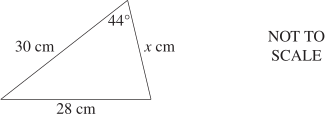
Show Answers Only
  1. `text($12 toll is the lowest for which)`


    `text(no vehicles will use the tunnel.)`

  2. `$17\ 500`
  3. `v = 6000 – 500d`
  4. `text{Proof (See Worked Solutions)}`
Show Worked Solution

i.  `text(500 less vehicles per $1 toll)`

`12 xx 500 = 6000`

`:. $12\ text(toll is the lowest for which no)`

`text(vehicles will use the tunnel.)`


ii.  `text(If the toll is $5)`

`5 xx 500 = 2500\ text(less vehicles)`

`:.\ text(Vehicles using the tunnel)`

`= 6000 – 2500`

`= 3500`

`:.\ text(Daily toll income)` `= 3500 xx $5`
  `= $17\ 500`


iii.    `d` `=\ text(toll)`
`v` `=\ text(Number of vehicles using the tunnel)`
    `:. v` `= 6000 – 500d`


iv.  `text(Income from tolls)`

`=\ text(Number of vehicles) xx text(toll)`

`= (6000 – 500d) xx d`

`= 6000d – 500d^2`

`= 500d (12 – d)`


`text(From the graph, the maximum income from tolls)`

`text(occurs when the toll is $6.)`

`:.\ text(Anne is incorrect.)`


`text(Alternate Solution)`

`text{The table of values shows that income (I) increases}`

`text(and peaks when the toll hits $6 before decreasing)`

`text(again as the toll gets more expensive.)`

`:.\ text(Anne is incorrect.)`

Filed Under: Breakeven and Financial modelling, Exponential/Quadratic (Projectile), Non-Linear: Exponential/Quadratics (Std 2) Tagged With: Band 4, Band 5, Band 6, smc-830-20-Quadratics

Financial Maths, STD2 F4 2006 HSC 27c

Kai purchased a new car for $30 000. It depreciated in value by $2000 per year for the first three years.

After the end of the third year, Kai changed the method of depreciation to the declining balance method at the rate of 25% per annum.

  1. Calculate the value of the car at the end of the third year.  (1 mark)

    --- 1 WORK AREA LINES (style=lined) ---

  2. Calculate the value of the car seven years after it was purchased.  (2 marks)

    --- 4 WORK AREA LINES (style=lined) ---

  3. Without further calculations, sketch a graph to show the value of the car over the seven years.


    Use the horizontal axis to represent time and the vertical axis to represent the value of the car.  (3 marks)

    --- 8 WORK AREA LINES (style=lined) ---
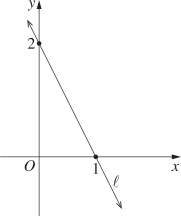
Show Answers Only
  1. `$24\ 000`
  2. `$7593.75`
  3. `text{See Worked Solutions}`
Show Worked Solution

i.  `text(Using)\ \ S = V_0 – Dn`

`S` `= 30\ 000 – (2000 xx 3)`
  `= $24\ 000`


ii.  `text(Using)\ \ S = V_0(1 – r)^n`

`text(where)\ V_0` `= 24\ 000`
`r` `= 0.25`
`n` `= 4`


`S` `= 24\ 000(1 – 0.25)^4`
  `= $7593.75`

 
`:.\ text(The value of the car after 7 years is $7593.75)`


iii.

Filed Under: Depreciation - Declining Balance (Std 1), Depreciation - Declining Balance (Std 2), Depreciation / Running costs Tagged With: Band 3, Band 4, Band 5, smc-1139-50-Declining Balance vs Straight Line, smc-1139-60-Depreciation Graphs, smc-813-50-Declining Balance vs Straight Line, smc-813-60-Depreciation Graphs

Statistics, STD2 S4 2006 HSC 27b

Each member of a group of males had his height and foot length measured and recorded. The results were graphed and a line of fit drawn.
 

  1. Why does the value of the `y`-intercept have no meaning in this situation?  (1 mark)

    --- 2 WORK AREA LINES (style=lined) ---
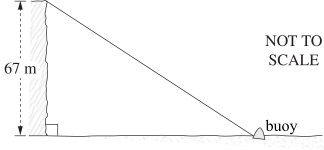
  2. George is 10 cm taller than his brother Harry. Use the line of fit to estimate the difference in their foot lengths.  (1 mark)

    --- 2 WORK AREA LINES (style=lined) ---
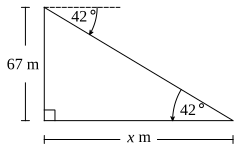
  3. Sam calculated a correlation coefficient of  −1.2  for the data. Give TWO reasons why Sam must be incorrect.  (2 marks)

    --- 5 WORK AREA LINES (style=lined) ---

Show Answers Only
  1. `text(The y-intercept occurs when)\ x = 0.\ text(It has`
    `text(no meaning to have a height of 0 cm.)`
  2. `text(A 10 cm height difference means George should)`
    `text(have a 3 cm longer foot.)`
  3. `text(A correlation co-efficient must be between –1 and 1.)`
    `text(Foot length is positively correlated to a person’s)`
    `text(height and therefore can’t be a negative value.)`
Show Worked Solution

i.  `text(The y-intercept occurs when)\ x = 0.\ text(It has)`

`text(no meaning to have a height of 0 cm.)`


ii.  `text(A 20 cm height difference results in a foot length)`

`text(difference of 6 cm.)`
 

`:.\ text(A 10 cm height difference means George should)`

`text(have a 3 cm longer foot.)`


iii.  `text(A correlation co-efficient must be between –1 and 1.)`

`text(Foot length is positively correlated to a person’s)`

`text(height and therefore isn’t a negative value.)`

Filed Under: Bivariate Data Analysis (Y12), Correlation / Body Measurements, S3 Further Statistical Analysis (Y12), S4 Bivariate Data Analysis (Y12) Tagged With: Band 4, Band 5, Band 6, common-content, smc-1001-10-Line of Best Fit, smc-1001-30-Correlation, smc-1113-10-Line of Best Fit, smc-1113-30-Correlation, smc-785-10-Line of Best Fit, smc-785-30-Correlation

Financial Maths, STD2 F4 2006 HSC 27a

Liliana wants to borrow money to buy a house. The bank sent her an email with the following table attached.

2006 27a

  1. Liliana decides that she can afford $1000 per month on repayments.


    What is the maximum amount she can borrow, and how many years will she have to repay the loan?  (1 mark)

    --- 2 WORK AREA LINES (style=lined) ---

  2. Zali intends to borrow  $160 000  over 15 years from the same bank.


    If she chooses to borrow  $160 000  over 20 years instead, how much more interest will she pay?  (2 marks)

    --- 5 WORK AREA LINES (style=lined) ---

Show Answers Only
  1. `text{$130 000 (over 30 years)}`
  2. `$45\ 964.80`
Show Worked Solution

i.  `text(From table)`

`text{$130 000 (over 30 years)}`


ii.  `text(Total repayments over 15 years)`

`= $1529.04 xx 180`

`= $275\ 227.20`

`text(Total repayments over 20 years)`

`= $1338.30 xx 240`

`= $321\ 192.00`


`:.\ text(Extra interest over 20 years)`

`= 321\ 192.00 – 275\ 227.20`

`= $45\ 964.80`

Filed Under: FM5 - Annuities and Loan repayments, Loans (Std 1), Loans and Credit Cards (Std 2) Tagged With: Band 4, Band 5, smc-1140-30-Other Loan Tables, smc-1140-40-Total Loan/Interest Payments, smc-814-30-Other Loan Tables, smc-814-40-Total Loan/Interest Payments

Measurement, STD2 M6 2006 HSC 26a

Daniel conducts an offset survey to sketch a diagram, `ABCD`, of a block of land.

Daniel walks from `A` to `C`, a distance of 62 m.

When he is 15 m from `A`, he notes that point `D` is 25 m to his right.

When he is 57 m from `A`, he notes that point `B` is 20 m to his left.

This is his notebook entry.

  1. Draw a neat sketch of the block of land. Label `A, B, C` and `D` on your diagram.  (1 mark)

    --- 6 WORK AREA LINES (style=lined) ---

  2. Calculate the distance from `C` to `D`. (Give your answer to the nearest metre.)  (2 marks)

    --- 4 WORK AREA LINES (style=lined) ---

Show Answers Only
  1.  
  2. `text{53 m (nearest m)}`
Show Worked Solution
i.   


ii.  `text(Using Pythagoras:)`

`CD^2` `= 47^2 + 25^2`
  `= 2834`
`:. CD` `= 53.235…`
  `= 53\ text{m  (nearest m)}`

Filed Under: Bearings & Field Surveys, Bearings and Radial Surveys (Std2) Tagged With: Band 4, Band 5, smc-803-40-Other

Probability, STD2 S2 2006 HSC 25c

Sonia buys three raffle tickets.

HSC 2006 25c

  1. What is the probability that Sonia wins first prize?  (1 mark)

    --- 1 WORK AREA LINES (style=lined) ---

  2. What is the probability that she wins both prizes?  (2 marks)

    --- 4 WORK AREA LINES (style=lined) ---

Show Answers Only
  1. `1/60`
  2. `1/5370`
Show Worked Solution
i.  `text{P (wins 1st prize)}` `= text(# tickets bought) / text(total tickets)`
  `= 3/180`
  `= 1/60`


ii.  `text{P (wins both)}` `= text{P (wins 1st)} xx text{P (wins 2nd)}`
  `= 1/60 xx 2/179`
  `= 1/5370`

Filed Under: Multi-stage Events, Multi-Stage Events (Std 2), Single and Multi-Stage Events (Std 1) Tagged With: Band 4, Band 5, smc-1135-20-Other Multi-Stage Events, smc-829-20-Other Multi-Stage Events

  • « Previous Page
  • 1
  • …
  • 72
  • 73
  • 74
  • 75
  • 76
  • …
  • 81
  • Next Page »

Copyright © 2014–2025 SmarterEd.com.au · Log in