SmarterEd

Aussie Maths & Science Teachers: Save your time with SmarterEd

  • Login
  • Get Help
  • About

Plane Geometry, EXT1 2014 HSC 13d

In the diagram,  `AB`  is a diameter of a circle with centre  `O`. The point  `C`  is chosen such that  `Delta ABC`  is acute-angled. The circle intersects  `AC`  and  `BC`  at  `P`  and  `Q`  respectively.
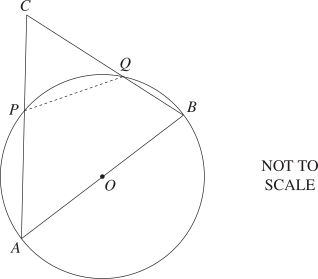
Copy or trace the diagram into your writing booklet.

  1. Why is   `/_BAC = /_CQP`?   (1 mark)
  2. Show that the line  `OP`  is a tangent to the circle through  `P`,  `Q`  and  `C`.    (2 marks)
Show Answers Only
  1. `text(Proof)\ \ text{(See Worked Solutions)}`
  2. `text(Proof)\ \ text{(See Worked Solutions)}`
Show Worked Solution
(i)   

`APQB\ text(is a cyclic quad)`

`=> /_BAC + /_BQP = 180°`

`text{(opposite angles of cyclic quadrilateral}\ BAPQ text{)}`

`/_CQP + /_BQP = 180°\ text{(}/_ CQB\ text{is a straight angle)}`

`:.\ /_BAC = /_CQP`


(ii)  `text(Let)\ /_BAC = alpha`

♦ Mean mark 37%
COMMENT: Labelling angles `alpha` and `beta` etc.. can often make a proof clearer and less messy.

`/_OPA = alpha\ \ \ \ text{(angles opposite equal sides}`

`text(in)\ Delta OAP,\ OA=OP\ text{radii)}`

`/_TPC = alpha\ \ \ text{(vertically opposite)}`

`text(S)text(ince)\ /_TPC = /_CQP = alpha`


`:. OP\ text(is a tangent to circle)\ CPQ`

`text{(angles in alternate segments equal)}`

Filed Under: 2. Plane Geometry EXT1 Tagged With: Band 4, Band 5

Polynomials, EXT1 2014 HSC 12e

The diagram shows the graph of a function  `f(x)`.

The equation  `f(x) = 0`  has a root at  `x = alpha`. The value `x_1`, as shown in the diagram, is chosen as a first approximation of `alpha`.


A second approximation, `x_2`, of `alpha` is obtained by applying Newton’s method once, using  `x_1`  as the first approximation.

Using a diagram, or otherwise, explain why `x_1` is a closer approximation of `alpha` than `x_2`.   (1 mark) 

Show Answers Only

`text(Proof)\ \ text{(See Worked Solutions)}`

Show Worked Solution

`text(Graphically, Newton’s approximation gives the point on the)`

♦ Mean mark 47%
COMMENT: A Newton approximation can actually be worse in certain circumstances.

`xtext(-axis where the tangent at)\ x_1\ text(cuts it.)`

`text(In this instance, the diagram shows that)\ x_1\ text(is closer)`

`text(to)\ alpha\ text(than)\ x_2 .`


Filed Under: Newton's Method etc... EXT1 Tagged With: Band 5

Real Functions, EXT1 2014 HSC 10 MC

Which equation describes the locus of points  `(x, y)`  which are equidistant from the distinct points  `(a + b, b − a)`  and  `(a − b, b + a)`?

  1. `bx + ay = 0`
  2. `bx + ay = 2ab`
  3. `bx − ay = 0`
  4. `bx − ay = 2ab`
Show Answers Only

`C`

Show Worked Solution
 
♦ Mean mark 39% 

`text(Locus is)\ _|_\ text(bisector between)`

`(a + b, b – a),\ \ (a – b, b + a)`

`text(Midpoint)` `= ( (a + b + a – b)/2,\ (b – a + b + a)/2 )`
  `= (a, b)`

 
`m_text(locus) xx m_1 = -1`

`m_1` `= (y_2 – y_1)/(x_2 – x_1)`
  `= (b + a – (b – a))/(a – b – (a + b))`
  `= (2a)/(-2b)`
  `= -a/b`

 
`=> m_text(locus) = b/a`
 

`:.\ text(Equation of locus)`

`y – y_1` `= m(x – x_1)`
`y – b` `= b/a (x – a)`
`ay – ab` `= bx – ab`
`bx – ay` `= 0`

 
`=>  C`

Filed Under: 4. Real Functions EXT1 Tagged With: Band 5

Mechanics, EXT2* M1 2014 HSC 7 MC

A particle is moving in simple harmonic motion with period 6 and amplitude 5.

Which is a possible expression for the velocity, `v`, of the particle?

  1. `v = (5pi)/3 cos (pi/3 t)`
  2. `v = 5 cos (pi/3 t)`
  3. `v = (5pi)/6 cos (pi/6 t)`
  4. `v = 5 cos (pi/6 t)`
Show Answers Only

`A`

Show Worked Solution

`text(By Elimination:)`

`text(General form is)\ \x = a sin (nt)`

♦ Mean mark 43%
COMMENT: Elimination can be a very effective and time efficient strategy for solving MC questions.

`text(Period) = 6\ text{(given)}`

`=> (2pi)/n` `= 6`
`n` `= pi/3`

 
`:.\ text(Cannot be)\ C\ text(or)\ D`


`text(Using)\ \ x = int v\ dt`

`text(Consider answer)\ B`

`x` `= 5 xx 3/pi sin (pi/3 t) + c`
  `text(Amplitude) = 15/pi`

 
`:.\ text(Cannot be)\ B`


`text(Consider answer)\ A`

`x` `= (5pi)/3 xx 3/pi sin (pi/3 t) + c`
  `= 5 sin (pi/3 t) + c`
 `:.\ text(Amplitude) = 5`

 
`=>  A`

Filed Under: Simple Harmonic Motion, Simple Harmonic Motion EXT1 Tagged With: Band 5, smc-1059-20-Prove/Identify SHM

Plane Geometry, EXT1 2009 HSC 7c

Consider the billboard below. There is a unique circle that passes through the top and bottom of the billboard (points  `Q`  and  `R`  respectively) and is tangent to the street at  `T`.

Let  `phi`  be the angle subtended by the billboard at  `S`, the point where  `PQ`  intersects the circle.

Copy the diagram into your writing booklet. 

  1. Show that  `theta < phi`  when  `P`  and  `T`  are different points, and hence show that  `theta`  is a maximum when  `P`  and  `T`  are the same point.   (3 marks)
  2. Using circle properties, find the distance of  `T`  from the building.     (1 mark)
Show Answers Only
  1. `text(Proof)\ \ text{(See Worked Solutions)}`
  2. `sqrt (h (a + h))`
Show Worked Solution
(i) 
♦♦ Both parts proved extremely challenging for students.
MARKER’S COMMENT: Very few students recognised that `phi` is the external angle of `Delta PSR`.

`text(Show)\ \ theta < phi\ \ text(when)\ \ P != T`

`text(Let)\ \ /_PRS = alpha`

`phi` `= theta + alpha\ \ text{(exterior angle of}\ Delta PSR text{)}`

`:.\ theta < phi,\ alpha != 0`


`text(When)\ P\ text(and)\ T\ text(are the same point,)`

`S,\ P, and T\ \ text(are the same point.)`

`text(i.e. when)\ \  /_PRS = alpha = 0`

`:. theta\ text(will be a maximum)\ (= phi)`

`text(when)\ P = T.`


(ii)  `text(Square of tangent)\ =\ text(product of)`

`text(intercepts from an external point.)`

`text(i.e.)\ \ OT^2` `= OR xx QR`
  `= h (a + h)`
`:.\ OT` `= sqrt (h (a + h))`

Filed Under: 2. Plane Geometry EXT1 Tagged With: Band 5, Band 6

Geometry and Calculus, EXT1 2009 HSC 7b

A billboard of height  `a`  metres is mounted on the side of a building, with its bottom edge  `h`  metres above street level. The billboard subtends an angle  `theta`  at the point  `P`,  `x`  metres from the building.


  1. Use the identity  `tan (A - B) = (tan A - tan B)/(1 + tanA tanB)`  to show that
  2.  
    1. `theta = tan^(-1) [(ax)/(x^2 + h(a + h))]`.   (2 marks)
    2.  
  3. The maximum value of  `theta`  occurs when  `(d theta)/(dx) = 0`  and  `x`  is positive.
  4.  
  5. Find the value of  `x`  for which  `theta`  is a maximum.     (3 marks)


Show Answers Only
  1. `text(Proof)\ \ text{(See Worked Solutions)}`
  2. `sqrt(h (a + h)),\ x > 0`
Show Worked Solution

(i)   `text(Consider angles)\ \ A and B\ \ text(on the graph:)`

♦♦ Mean mark data not available for parts of questions although Q7 as a whole scored <30%.
MARKER’S COMMENT: Answers that included a diagram and clearly labelled angles were generally successful.

`text(Show)\ \ theta = tan^(-1) [(ax)/(x^2 + h(a + h))]`

`tan A` `= (a + h)/x`
`tan B` `= h/x`
`tan (A – B)` `= ((a + h)/x – h/x)/(1 + ((a + h)/x)(h/x)) xx (x^2)/(x^2)`
  `= (x(a + h) – xh)/(x^2 + h(a + h))`
  `= (ax)/(x^2 + h(a + h)`


`text(S)text(ince)\ \ theta` `= A – B`
`theta` `= tan^(-1) [(ax)/(x^2 + h(a + h))]\ \ \ text(… as required.)`


(ii)  `text(Max when)\ \ (d theta)/(dx) = 0\ \ text(and)\ \ x > 0`

`text(Let)\ \ u` `= (ax)/(x^2 + h(a + h))`
`theta` `= tan^(-1) u`
`(du)/(dx)` `=(a[x^2 + h (a + h)] – ax * 2x)/([x^2 + h (a + h)]^2)`
  `=(-ax^2 + ah (a + h))/([x^2 + h (a + h)]^2)`


`(d theta)/(dx)` `=(d theta)/(du) * (du)/(dx)`
  `= 1/(1 + u^2) * (du)/(dx)`
  `= 1/(1 + [(ax)/(x^2 + h(a + h))]^2) xx (-ax^2 + ah (a + h))/[x^2 + h (a + h)]^2`
  `=(-ax^2 + ah(a + h))/([x^2 + h (a + h)]^2 + a^2 x^2)`


`text(Note that)\ \ (d theta)/(dx) = 0\ \ text(when)`

`-ax^2 + ah (a + h)` `= 0`
`ax^2` `= ah (a + h)`
`x^2` `= h (a + h)`
`x` `= sqrt (h (a + h))\ \ \ \ (x > 0)`

Filed Under: 10. Geometrical Applications of Calculus EXT1, 5. Trig Ratios EXT1, Inverse Trig Functions EXT1 Tagged With: Band 5, Band 6

Binomial, EXT1 2009 HSC 6b

  1. Sum the geometric series  
    1. `(1 + x)^r + (1 + x)^(r + 1) + ... + (1 + x)^n`
  2.  
  3. and hence show that
     
    1. `((r),(r)) + ((r + 1),(r)) + ... + ((n),(r)) = ((n + 1),(r + 1))`.   (3 marks)
    2.  
  4. Consider a square grid with  `n`  rows and  `n`  columns of equally spaced points.
  5.  
    1. 2009 6b
  6. The diagram illustrates such a grid. Several intervals of gradient  `1`, whose endpoints are a pair of points in the grid, are shown. 
  7.  
  8. (1)   Explain why the number of such intervals on the line  `y = x`  is equal to  `((n),(2))`.   (1 mark)
  9. (2)   Explain why the total number,  `S_n`, of such intervals in the grid is given by
  10.  
    1. `S_n = ((2),(2)) + ((3),(2)) + ... + ((n - 1),(2)) + ((n),(2)) + ((n - 1),(2)) +`
      1. `... + ((3),(2)) + ((2),(2))`.   (1 mark)
    2.  
  11. Using the result in part (i), show that 
    1. `S_n = (n(n - 1)(2n - 1))/6`.   (3 marks)


Show Answers Only
  1. `text(Proof)\ \ text{(See Worked Solutions)}`
  2. (1) `text(Proof)\ \ text{(See Worked Solutions)}`
  3. (2) `text(Proof)\ \ text{(See Worked Solutions)}`
  4.  
  5. `text(Proof)\ \ text{(See Worked Solutions)}`
Show Worked Solution

(i)   `(1 + x)^r + (1 + x)^(r + 1) + … + (1 + x)^n`

♦♦ Exact data unavailable although mean marks for all Q6 was < 25%.
MARKER’S COMMENT: A common mistake was to assume the number of terms in the series was  `n`.
`=> text(GP where)\ \ a` `= (1 + x)^r`
`r` `= (1 + x)`
`#\ text(Terms)` `= n – r + 1`


`text(Sum)` `= (a (r^n – 1))/(r – 1)`
  `= ((1 + x)^r [(1 + x)^(n\ – r + 1) – 1])/((1 + x) – 1)`
  `= ((1 + x)^(n\ – r + 1 + r) – (1 + x)^r)/x`
  `= ((1 + x)^(n + 1) – (1 + x)^r)/x`


`text(Show)`

`((r),(r)) + ((r + 1),(r)) + … + ((n),(r)) = ((n + 1),(r + 1))`


`text(Consider series)\ (1 + x)^r + (1 + x)^(r + 1) + … + (1 + x)^n`

`text(Co-efficient of)\ \ x^r = ((r),(r)) + ((r + 1),(r)) + … + ((n),(r))`


`text(Consider sum of series)\ \ \ ((1 + x)^(n + 1)\ – (1 + x)^r)/x`

`text(Co-efficient of)\ \ x^r` `=\ text(co-efficient of)\ \ x^(r + 1)\ \ text(in numerator)`
  `= ((n +1),(r + 1))`


`:.\ text(S)text(ince co-efficients are equal)`

`((r),(r)) + ((r + 1),(r)) + … + ((n),(r)) = ((n + 1),(r + 1))`

`text(… as required.)`


(ii)(1)   `text(All intervals start and finish at different points.)`
  `text(Any)\ n xx x\ text(grid has)\ n\ text(points on the)\ y = x\ text(diagonal.)`
  `:.\ text(Possible intervals) = ((n),(2))`
   
     (2)   `text(The longest diagonal of)\ n xx n\ text(grid is)`
  `text(the)\ y = x\ text(diagonal with)\ ((n),(2))\ text(intervals.)`
  `text(Each side of this, there is one less point)`
  `text(on the diagonals, with)\ ((n – 1),(2))\ text(intervals.)`
  `text(This continues until there are only 2 points)`
  `text(on the diagonal with)\ ((2),(2))\ text(intervals.)`


`:.\ S_n` `= ((2),(2)) + ((3),(2)) + … + ((n – 1),(2)) + ((n),(2))`
  `+ ((n – 1),(2)) + … + ((2),(2))`
  `text(… as required.)`


♦♦♦ Exact data unavailable although very few completed part (iii) correctly. 
MARKER’S COMMENT: Note that even if part (i) wasn’t solved, the proof as stated in the question can be used to solve part (iii).
(iii) `text(Show)\ \ S_n = (n(n – 1)(2n – 1))/6`
   `S_n` `= { ((2),(2)) + ((3),(2)) + … + ((n – 1),(2)) + ((n),(2))}`
  `+ {((n – 1),(2)) + … + ((2),(2))}`
  `= ((n + 1),(3)) + ((n),(3))\ \ \ text{(from part (i))}`
  `= ((n + 1)*n*(n – 1))/(3 * 2 * 1) + (n* (n – 1)*(n – 2))/(3 * 2 * 1)`
  `= 1/6 n (n – 1) (n + 1 + n – 2)`
  `= (n(n – 1)(2n – 1))/6\ \ \ text(… as required.)`

Filed Under: 17. Binomial EXT1, 7. Induction and Other Series EXT1, Permutations and Combinations EXT1 Tagged With: Band 5, Band 6, HSC

Calculus, EXT1 C1 2009 HSC 5b

The cross-section of a 10 metre long tank is an isosceles triangle, as shown in the diagram. The top of the tank is horizontal.


When the tank is full, the depth of water is 3 m. The depth of water at time `t` days is `h` metres.   

  1. Find the volume, `V`, of water in the tank when the depth of water is `h` metres.     (1 mark)

    --- 6 WORK AREA LINES (style=lined) ---

  2. Show that the area, `A`, of the top surface of the water is given by  `A = 20 sqrt3 h`.   (1 mark)

    --- 2 WORK AREA LINES (style=lined) ---

  3. The rate of evaporation of the water is given by  `(dV)/(dt) = - kA`, where `k` is a positive constant. 


    Find the rate at which the depth of water is changing at time `t`.   (2 marks)

    --- 6 WORK AREA LINES (style=lined) ---

  4. It takes 100 days for the depth to fall from 3 m to 2 m. Find the time taken for the depth to fall from 2 m to 1 m.   (1 mark)

    --- 2 WORK AREA LINES (style=lined) ---

Show Answers Only
  1. `10 sqrt 3 h^2\ \ text(m³)`
  2. `text(Proof)\ \ text{(See Worked Solutions)}`
  3. `-k\ \ \ text(metres per day)`
  4. `100\ text(days)`
Show Worked Solution
MARKER’S COMMENT: Students who drew a diagram and included their working calculations on it were the most successful.
(i) 
  `text(Let)\ A = text(area of front)`
`tan 30^@` `= h/x`
`x` `= h/(tan 30^@)`
  `= sqrt3 h`
`:.\ A` `= 2 xx 1/2 xx sqrt 3 h xx h`
  `= sqrt 3 h^2\ \ text(m²)`


`V` `= Ah`
  `= sqrt 3 h^2 xx 10`
  `= 10 sqrt3 h^2\ \ text(m³)`


(ii)    `text(Area of surface)`
  `= 10 xx 2 sqrt 3 h`
  `= 20 sqrt 3 h\ \ text(m²)`


(iii)    `(dV)/(dt)` `= -kA`
    `= -k\ 20 sqrt3 h`
`V` `= 10 sqrt3 h^2`
`(dV)/(dh)` `= 20 sqrt 3 h`


`text(Find)\ (dh)/(dt)`

MARKER’S COMMENT: Half marks awarded for stating an appropriate chain rule, even if the following calculations were incorrect. Show your working!
`(dV)/(dt)` `= (dV)/(dh) * (dh)/(dt)`
`(dh)/(dt)` `= ((dV)/(dt))/((dV)/(dh))`
  `= (-k * 20 sqrt 3 h)/(20 sqrt 3 h)`
  `= -k`


`:.\ text(The water depth is changing at a rate)`

`text(of)\ -k\ text(metres per day.)`


♦♦♦ Exact data for part (iv) not available.
COMMENT: Interpreting a constant rate of change was very poorly understood!
(iv)    `text(S)text(ince)\ \ (dh)/(dt)\ \ text(is a constant, each metre)`
  `text(takes the same time.)`

 
`:.\ text(It takes 100 days to fall from 2 m to 1 m.)`

Filed Under: Rates of Change EXT1, Related Rates of Change (Ext1) Tagged With: Band 4, Band 5, Band 6, page-break-before-solution, smc-1079-10-Volume

Mechanics, EXT2* M1 2009 HSC 5a

The equation of motion for a particle moving in simple harmonic motion is given by

`(d^2x)/(dt^2) = -n^2x`

where  `n`  is a positive constant,  `x`  is the displacement of the particle and  `t`  is time.  

  1. Show that the square of the velocity of the particle is given by
     
         `v^2 = n^2 (a^2\ - x^2)`


    where  `v = (dx)/(dt)`  and  `a`  is the amplitude of the motion.   (3 marks)

    --- 6 WORK AREA LINES (style=lined) ---

  2. Find the maximum speed of the particle.     (1 mark)

    --- 3 WORK AREA LINES (style=lined) ---

  3. Find the maximum acceleration of the particle.    (1 mark)

    --- 2 WORK AREA LINES (style=lined) ---

  4. The particle is initially at the origin. Write down a formula for  `x`  as a function of  `t`, and hence find the first time that the particle’s speed is half its maximum speed.   (2 marks)

    --- 5 WORK AREA LINES (style=lined) ---

Show Answers Only
  1. `text(Proof)\ \ text{(See Worked Solutions)}`
  2. `na`
  3. `n^2 a`
  4. `pi/(3n)`
Show Worked Solution
i.    `text(Show)\ \ v^2 = n^2 (a^2\ – x^2)`

`(d^2x)/(dt^2) = -n^2x`

`d/(dx) (1/2 v^2)` `= -n^2 x`
`1/2 v^2` `= int -n^2x\ dx`
  `= (-n^2 x^2)/2 + c`
`v^2` `= -n^2 x^2 + c`

 
`text(When)\ \ v = 0,\ \ x = a`

`0` `= -n^2a + c`
`c` `= n^2 a^2`
`:.\ v^2` `= -n^2 x^2 + n^2 a^2`
  `= n^2 (a^2\ – x^2)\ \ text(… as required)`


ii.    `text(Max speed when)\ \ x = 0`
`v^2` `= n^2 (a^2\ – 0)`
  `= n^2 a^2`
`:.v_text(max)` `= na`


iii.   `(d^2x)/(dt^2)\ \ text(is maximum at limits)\ \ (x = +-a)`
`(d^2x)/(dt^2)` `= |n^2 (a)|`
  `= n^2 a`


iv.   `x` `= a sin nt`
  `dot x` `= an cos nt`


`text(Find)\ \ t\ \ text(when)\ \ dot x = (na)/2`

`(na)/2` `= an cos nt`
`cos nt` `= 1/2`
`nt` `= pi/3`
`:.t` `= pi/(3n)`

Filed Under: Simple Harmonic Motion, Simple Harmonic Motion EXT1 Tagged With: Band 4, Band 5, smc-1059-20-Prove/Identify SHM, smc-1059-31-Max Speed

Geometry and Calculus, EXT1 2009 HSC 4b

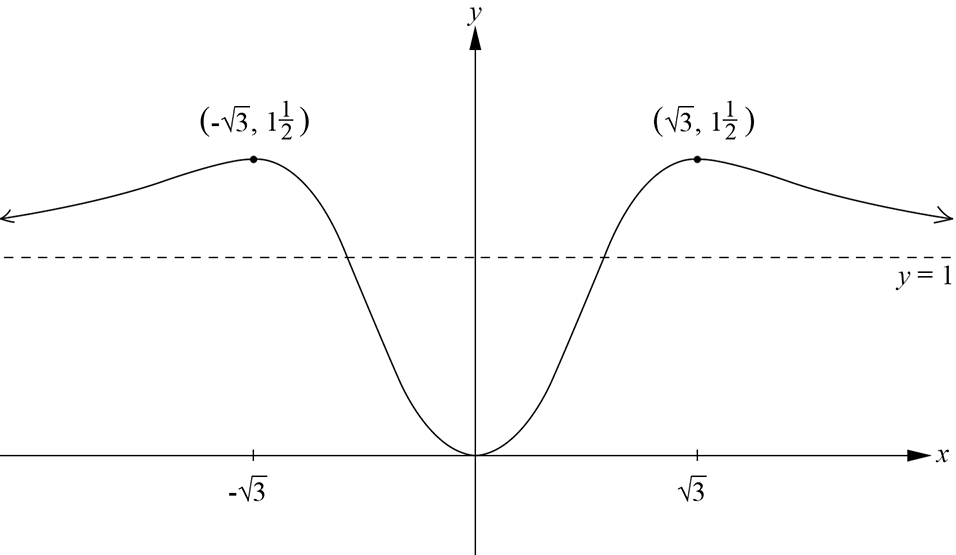
Consider the function  `f(x) = (x^4 + 3x^2)/(x^4 + 3)`. 

  1. Show that  `f(x)`  is an even function.    (1 mark)
  2. What is the equation of the horizontal asymptote to the graph  `y = f(x)`?    (1 mark)
  3. Find the  `x`-coordinates of all stationary points for the graph  `y = f(x)`.   (3 marks)
  4. Sketch the graph  `y = f(x)`. You are not required to find any points of inflection.    (2 marks)
Show Answers Only
  1. `text(Proof)\ \ text{(See Worked Solutions)}`
  2. `y = 1`
  3. `x = 0, – sqrt 3, sqrt 3`
  4.  
Show Worked Solution
(i)    `f(x)` `= (x^4 + 3x^2)/(x^4 + 3)`
  `f(–x)` `= ((–x)^4 + 3(-x)^2)/((–x)^4 + 3)`
    `= (x^4 + 3x^2)/(x^4 + 3)`
    `= f(x)`


`:.\ text(Even function.)`


(ii)    `y` `= (x^4 + 3x^2)/(x^4 + 3)`
    `= (1 + 3/(x^2))/(1 + 3/(x^4))`
`text(As)\ \ ` `x` `-> oo`
  `y` `-> 1`


`:.\ text(Horizontal asymptote at)\ \ y = 1`


(iii)   `f(x) = (x^4 + 3x^2)/(x^4 + 3)`
`u` `= x^4 + 3x^2\ \ \ \ \ ` `v` `= x^4 + 3`
`u prime` `= 4x^3 + 6x\ \ \ \ \ ` `v prime` `= 4x^3`
`f prime (x)` `= (u prime v\ – u v prime)/(v^2)`
  `= ((4x^3 + 6x)(x^4 + 3)\ – (x^4 + 3x^2)4x^3)/((x^4 + 3)^2)`
  `= (4x^7 + 12x^3 + 6x^5 + 18x\ – 4x^7\ – 12x^5)/((x^4 + 3)^2)`
  `= (-6x^5 + 12x^3 + 18x)/((x^4 + 3)^2)`
  `= (-6x(x^4\ – 2x^2\ – 3))/((x^4 + 3)^2)`


`text(S.P. when)\ x = 0\ \ \ text(or) \ \ x^4\ – 2x^2\ – 3 = 0`

`text(Let)\ X = x^2`

MARKER’S COMMENT: Many students did not realise the denominator of  `f′(x)` could be ignored when equating  `f′(x)=0`.
`X^2\ – 2X\ – 3` `= 0`
`(X\ – 3)(X + 1)` `= 0`

`X = 3\ \ text(or)\ \ -1`

`:. x^2` `= 3` `text(or)\ \ \ \ \ ` `x^2 = -1`
`x` `= +- sqrt3\ \ \ \ `   `text{(no solution)}`


`:.\ text(SPs occur when)\ \ x = 0, – sqrt3, sqrt3`


(iv)    `text(When)\ x = 0,\ ` `y = 0`
  `text(When)\ x = sqrt3,\ \ \ ` `y = ((sqrt3)^4 + 3(sqrt3)^2)/((sqrt3)^4 + 3) = 3/2`


EXT1 2009 4b

Filed Under: 10. Geometrical Applications of Calculus EXT1 Tagged With: Band 3, Band 4, Band 5

Statistics, EXT1 S1 2009 HSC 4a

A test consists of five multiple-choice questions. Each question has four alternative answers. For each question only one of the alternative answers is correct.

Huong randomly selects an answer to each of the five questions. 

  1. What is the probability that Huong selects three correct and two incorrect answers?   (2 marks)

    --- 4 WORK AREA LINES (style=lined) ---

  2. What is the probability that Huong selects three or more correct answers?    (2 marks)

    --- 3 WORK AREA LINES (style=lined) ---

  3. What is the probability that Huong selects at least one incorrect answer?  (1 mark)

    --- 2 WORK AREA LINES (style=lined) ---

Show Answers Only
  1. `45/512`
  2. `53/512`
  3. `1023/1024`
Show Worked Solution

i.   `P text{(correct)} = 1/4`

`P text{(wrong)} = 3/4`

`P text{(3 correct, 2 wrong)}`

`=\ ^5C_3 * (1/4)^3 (3/4)^2`

`= (5!)/(3!2!) * (1/64) * (9/16)`

`= 90/1024`

`= 45/512`
 

ii.  `P text{(3 or more correct)}`

`= P text{(3 correct)} + P text{(4 correct)} + P text{(5 correct)}`

`=\ ^5C_3 * (1/4)^3 (3/4)^2 +\ ^5C_4 * (1/4)^4 (3/4)^1 +\ ^5C_5 (1/4)^5 (3/4)^0`

`= 90/1024 + 15/1024 + 1/1024`

`= 53/512`
 

iii.  `P text{(at least 1 incorrect)}`

TIP: The use of “at least” should flag a good chance of applying `1-P text{(complement)}` to solve.

`= 1\ – P text{(0 incorrect)}`

`= 1 -\ ^5C_5 (1/4)^5 (3/4)^0`

`= 1\ – 1/1024`

`= 1023/1024`

Filed Under: Binomial Probability (Ext1), Binomial Probability EXT1 Tagged With: Band 4, Band 5, smc-1084-10-General Case

Trig Calculus, EXT1 2009 HSC 3b

  1. On the same set of axes, sketch the graphs of  
    1. `y = cos 2x`  and  `y = (x + 1)/2`, for  `–pi <= x <= pi`.    (2 marks)
  2. Use your graph to determine how many solutions there are to the equation  `2 cos 2x = x + 1`  for  `–pi <= x <= pi`.     (1 mark)
  3. One solution of the equation  `2 cos 2x = x + 1`  is close to  `x = 0.4`. Use one application of Newton’s method to find another approximation to this solution. Give your answer correct to three decimal places.   (3 marks)


Show Answers Only
  1. `text(See sketch in Worked Solutions)`
  2. `text(3 solutions)`
  3. `0.398\ text{(3 d.p.)}`
Show Worked Solution
(i)   


(ii)  `text(3 solutions)`


(iii)  `2 cos 2x = x + 1`

MARKER’S COMMENT: Better responses defined `f(x)` and `f′(x)` and evaluated each for `x=0.4` before calculating Newton’s formula, as done in the Worked Solution.
`f(x)` `= 2 cos 2x\ – x\ – 1`
`f prime (x)` `= -4 sin 2x\ – 1`


`=>f(0.4)` `= 2 cos 0.8\ – 0.4\ – 1`
  `=-0.0065865 …`
`=> f prime(0.4)` `= -4 sin 0.8\ – 1`
  `=-3.869424 …`


`text(Find)\ x_1\ text(where)`

 `x_1` `= 0.4\ – (f(0.4))/(f prime(0.4))`
  `= 0.4\ – ((-0.0065865 …)/(-3.869424 …))`
  `= 0.39829…`
  `= 0.398\ \ text{(3 d.p.)}`

Filed Under: 13. Trig Calc, Graphs and Circular Measure EXT1, Newton's Method etc... EXT1 Tagged With: Band 3, Band 4, Band 5, HSC

Functions, EXT1 F1 2009 HSC 3a

Let  `f(x) = (3 + e^(2x))/4`. 

  1.  Find the range of  `f(x)`.   (1 mark)

    --- 2 WORK AREA LINES (style=lined) ---

  2.  Find the inverse function  `f^(-1) (x)`.    (2 marks)

    --- 5 WORK AREA LINES (style=lined) ---

Show Answers Only
  1. `y > 3/4`
  2. `f^(-1) (x) = 1/2 ln(4x\ – 3)`
Show Worked Solution
i.   `f(x) = (3 + e^(2x))/4`

`text(As)\ \ x -> oo, \ e^(2x) ->oo, \ f(x)->oo`

`text(As)\ \ x -> -oo, \ e^(2x) ->0, \ f(x)->3/4`

`:.\ text(Range is)\ \ y > 3/4`


ii.   `text(Inverse function: swap)\ \ x↔y` 

`x` `= (3 + e^(2y))/4`
`4x` `= 3 + e^(2y)`
`e^(2y)` `= 4x\ – 3`
`ln e^(2y)` `= ln (4x\ – 3)`
`2y` `= ln (4x\ – 3)`
`y` `= 1/2 ln (4x\ – 3)`


`:.\ f^(-1) (x) = 1/2 ln (4x\ – 3)`

Filed Under: 12. Logs and Exponentials EXT1, Inverse Functions (Ext1), Other Inverse Functions EXT1 Tagged With: Band 4, Band 5, smc-1034-10-Logs and Exponentials

Calculus, 2ADV C3 2014 HSC 16c

The diagram shows a window consisting of two sections. The top section is a semicircle of diameter  `x`  m. The bottom section is a rectangle of width  `x`  m and height  `y`  m.

The entire frame of the window, including the piece that separates the two sections, is made using 10 m of thin metal.

The semicircular section is made of coloured glass and the rectangular section is made of clear glass.

Under test conditions the amount of light coming through one square metre of the coloured glass is 1 unit and the amount of light coming through one square metre of the clear glass is 3 units.

The total amount of light coming through the window under test conditions is  `L`  units.

  1. Show that  `y = 5 - x(1 + pi/4)`.   (2 marks)

    --- 4 WORK AREA LINES (style=lined) ---

  2. Show that  `L = 15x - x^2 (3 + (5pi)/8)`.    (2 marks)

    --- 4 WORK AREA LINES (style=lined) ---

  3. Find the values of  `x`  and  `y`  that maximise the amount of light coming through the window under test conditions.   (3 marks)

    --- 6 WORK AREA LINES (style=lined) ---

Show Answers Only
  1. `text(Proof)\ \ text{(See Worked Solutions)}`
  2. `text(Proof)\ \ text{(See Worked Solutions)}`
  3. `x = 1.511\ text(m  and)\ \ y = 2.302\ text(m)`
Show Worked Solution
i.   

`text(Frame is 10m)`

`10` `= 2x + 2y + 1/2 pi x`
`2y` `= 10\ – 2x\ – 1/2 pi x`
`:.y` `= 5\ – x\ – pi/4 x`
  `= 5\ – x (1 + pi/4)\ \ \ text(… as required.)`


♦ Mean mark 35%
ii.    `text(Area)\ text{(clear)}` `= x xx y`
  `text(Area)\ text{(colour)}` `= 1/2 xx pi r^2`
    `= 1/2 xx pi (x/2)^2`
    `= (pi x^2)/8`


`:.\ L` `= 3xy + ((pix^2)/8 xx 1)`
  `= 3x [5\ – x (1 + pi/4)] + (pix^2)/8\ \ \ text{(see part (i))}`
  `= 15x\ – 3x^2\ – (3x^2pi)/4 + (x^2 pi)/8`
  `= 15x\ – 3x^2\ – (5x^2 pi)/8`
  `= 15x\ – x^2 (3 + (5pi)/8)\ \ \ text(… as required)`


♦ Mean mark 38%
COMMENT: A sanity check for your answer could be to compare your answers to the perimeter restriction of 10m.
iii.   `L` `= 15x\ – x^2 (3 + (5pi)/8)`
  `(dL)/(dx)` `= 15\ – 2x (3 + (5pi)/8)`
  `(d^2L)/(dx^2)` `= -2 (3 + (5pi)/8)`


`text(Max or min when)\ (dL)/(dx) = 0`

`15\ – 2x (3x + (5pi)/8)=` `0`
`2x (3 + (5pi)/8)=` `15`
`x=` `15/(2 (3 + (5pi)/8)`
 `=` `1.51103…`
`=` `1.511\ \ \ text{(3 d.p.)}`


`text(S)text(ince)\ (d^2L)/(dx^2) < 0\ \ \ => text(MAX)`

`text(When)\ \ x` `= 1.511`
`y` `= 5\ – 1.511 (1 + pi/4)`
  `= 2.3022…`
  `= 2.302\ text{(3 d.p.)}`


`:.\ text(MAX light when)\ x = 1.511\ text(m)`

`text(and)\ y = 2.302\ text(m.)`

Filed Under: Maxima and Minima, Maxima and Minima (Y12) Tagged With: Band 4, Band 5, page-break-before-solution, smc-970-10-Area

Financial Maths, 2ADV M1 2014 HSC 16b

At the start of a month, Jo opens a bank account and makes a deposit of $500.  At the start of each subsequent month, Jo makes a deposit which is 1% more than the previous deposit.

At the end of every month, the bank pays interest of 0.3% (per month) on the balance of the account.  

  1. Explain why the balance of the account at the end of the second month is 


      `$500 (1.003)^2 + $500 (1.01) (1.003)`.    (2 marks)

    --- 5 WORK AREA LINES (style=lined) ---

  2. Find the balance of the account at the end of the 60th month, correct to the nearest dollar.     (3 marks)

    --- 6 WORK AREA LINES (style=lined) ---

Show Answers Only
  1. `text(Proof)\ \ text{(See Worked Solutions)}`
  2. `$44\ 404`
Show Worked Solution

i.  `text(Let)\ A_n=text(balance at end of month)\ n`

`A_1` `= 500 (1.003)`
`A_2` `= A_1 (1.003) + 500 (1.01) (1.003)`
  `= 500 (1.003) (1.003) + 500 (1.01)(1.003)`
  `= 500 (1.003)^2 + 500 (1.01) (1.003)`


♦ Mean mark 38%
 

ii.  `text(Need to find)\ A_60`

`A_3` `= A_2 (1.003) + 500 (1.01)^2 (1.003)`
  `= [500 (1.003)^2 + 500 (1.01) (1.003)] (1.003)`
  `+ 500 (1.01)^2 (1.003)`
  `= 500 (1.003)^3 + 500 (1.003)^2 (1.01) + 500 (1.003) (1.01)^2`
  `= 500 [1.003 (1.01)^2 + (1.003)^2 (1.01) + (1.003)^3]`

`vdots`

`A_60` `= 500 [1.003 (1.01)^59 + (1.003)^2 (1.01)^58 + … `
  `… + (1.003)^60]`
  `=> text(GP where)\ a = 1.003 (1.01)^59,\ \ r = T_2/T_1=1.003/1.01`
 `:. A_60` `= 500 [ (a(r^n\ – 1))/(r\ – 1)]`
  `= 500 [ (1.003 (1.01)^59 ((1.003/1.01)^60\ – 1))/(1.003/1.01\ – 1) ]`
  `= 500 [ (1.8041057(-0.3411697))/-0.00693069 ]`
  `= 44\ 404.396…`
  `= $44\ 404\ \ text{(nearest dollar)}`


`:.\ text(At the end of 60 months, the balance would)`

`text(be)\ $44\ 404.`

Filed Under: Compound interest, loan repayments and annuities, Financial Applications of Series (Y12) Tagged With: Band 5, smc-1007-20-Annuity - Growth phase

Integration, 2UA 2014 HSC 16a

Use Simpson’s Rule with five function values to show that 

`int_(- pi/3)^(pi/3) sec x\ dx ~~ pi/9 (3 + 8/sqrt3)`.   (3 marks)

Show Answers Only

`text(Proof)\ \ text{(See Worked Solutions)}`

Show Worked Solution
♦ Mean mark below 50%. BE CAREFUL! 

`A` `~~ h/3 [y_0 + 4(y_1 + y_3) + 2y_2 + y_4]`
  `~~ pi/18 [2 + 4(2/sqrt3 + 2/sqrt3) + 2(1) + 2]`
  `~~ pi/18 [6 + 16/sqrt3]`
  `~~ pi/9 (3 + 8/sqrt3)\ text(u² … as required)`

Filed Under: Trapezoidal and Simpson's Rule, Trig graphs Tagged With: Band 5

Calculus, 2ADV C3 2014 HSC 15c

The line  `y = mx`  is a tangent to the curve  `y = e^(2x)`  at a point  `P`. 

  1. Sketch the line and the curve on one diagram.   (1 mark)

    --- 8 WORK AREA LINES (style=lined) ---

  2. Find the coordinates of  `P`.     (3 marks)

    --- 6 WORK AREA LINES (style=lined) ---

  3. Find the value of  `m`.   (1 mark)

    --- 1 WORK AREA LINES (style=lined) ---

Show Answers Only
  1.   
  2. `P(1/2 ln (m/2), m/2)`
  3. `2e`
Show Worked Solution
i. 


ii. `y` `= e^(2x)`
  `dy/dx` `= 2e^(2x)`

 
`text(Gradient of)\ \ y = mx\ \ text(is)\ \ m`

♦ Mean mark 40%
COMMENT: Given `y= e^(ln(m/2))`, it follows `y=m/2`. Make sure you understand the arithmetic behind this (NB. Simply take the `ln` of both sides).

`text(Gradients equal when)`

`2e^(2x)` `= m`
`e^(2x)` `= m/2`
`ln e^(2x)` `= ln (m/2)`
`2x` `= ln (m/2)`
`x` `= 1/2 ln (m/2)`

 
`text(When)\ \ x = 1/2 ln (m/2)`

`y` `= e^(2 xx 1/2 ln (m/2))`
  `= e^(ln(m/2))`
  `= m/2`

 
`:.\ P (1/2 ln (m/2), m/2)`


iii.   `y=mx\ \ text(passes through)\ \ (0,0)\ text(and)\ (1/2 ln (m/2), m/2)`

♦♦ Mean mark 30%.

`text(Equating gradients:)`

`(m/2 – 0)/(1/2 ln (m/2) – 0)`  `=m`
`m/2` `=m xx 1/2 ln(m/2)`
`ln (m/2)` `= 1`
`m/2` `= e^1`
`m` `= 2e`

Filed Under: Applied Calculus (L&E), Curve Sketching and The Primitive Function, Tangents (Y12), Tangents and Normals Tagged With: Band 4, Band 5, page-break-before-solution, smc-1090-20-Log/Exp Function, smc-1090-60-Find point of tangency

Plane Geometry, 2UA 2014 HSC 15b

In  `Delta DEF`, a point  `S`  is chosen on the side  `DE`. The length of  `DS`  is  `x`, and the length of  `ES`  is  `y`. The line through  `S`  parallel to  `DF`  meets  `EF`  at  `Q`. The line through  `S`  parallel to  `EF`  meets  `DF`  at  `R`.

The area of  `Delta DEF`  is  `A`. The areas of  `Delta DSR`  and  `Delta SEQ`  are  `A_1`  and  `A_2`  respectively.

  1. Show that  `Delta DEF`  is similar to  `Delta DSR`.    (2 marks)
  2. Explain why  `(DR)/(DF) = x/(x + y)`.    (1 mark)
  3.  
  4. Show that  
    1. `sqrt ((A_1)/A) = x/(x + y)`.  (2 marks)
    2.  
  5. Using the result from part (iii) and a similar expression for  
    1. `sqrt ((A_2)/A)`, deduce that  `sqrt A = sqrt (A_1) + sqrt (A_2)`.   (2 marks)


Show Answers Only
  1. `text(Proof)\ \ text{(See Worked Solutions)}`
  2. `text(Corresponding sides of similar)\ Delta text(s)`
  3. `text(are in the same ratio.)`
  4.  
  5. `text(Proof)\ \ text{(See Worked Solutions)}`
  6. `text(Proof)\ \ text{(See Worked Solutions)}`
  7.  
Show Worked Solution

(i)   `text(Need to show)\ Delta DEF\  text(|||) \ Delta DSR`

`/_FDE\ text(is common)`

`/_DSR = /_DEF = theta\ \ text{(corresponding angles,}\ RS\ text(||)\ FE text{)}`

`:.\ Delta DEF \ text(|||) \ Delta DSR\ \ text{(equiangular)}`


(ii)  `(DR)/(DF) = (DS)/(DE) = x/(x + y)`

`text{(Corresponding sides of similar triangles)}`


♦♦ Mean mark 27%
COMMENT: The critical step in solving part (iii) is realising that you need the areas of 2 non-right angled triangles and therefore the formula  `A=½\ ab sin C` is required.

(iii)  `text(Show)\ sqrt((A_1)/A) = x/(x + y)`

`text(Using Area)` `= 1/2 ab sin C`
`A_1` `= 1/2 xx DR xx x xx sin alpha`
`A` `= 1/2 xx DF xx (x + y) xx sin alpha`
`(A_1)/A` `= (1/2 * DR * x * sin alpha)/(1/2 * DF * (x + y) * sin alpha)`
  `= (DR * x)/(DF * (x + y)`
  `= (x * x)/((x + y)(x + y))\ \ \ \ text{(using part(ii))}`
  `= (x^2)/((x + y)^2)`
`:.\ sqrt ((A_1)/A)` `= x/((x + y))\ \ \ text(… as required.)`


(iv)  `text(Consider)\ Delta DFE\ text(and)\ Delta SQE`

`/_FED` `= theta\ text(is common)`
`/_FDE` `= /_QSE = alpha\ \ ` `text{(corresponding angles,}\ DF\ text(||)\ QS text{)}`


`:.\ Delta DFE\ text(|||)\ Delta SQE\ \ text{(equiangular)}`

`(QE)/(FE) = (SE)/(DE) = y/(x +y)`

`text{(corresponding sides of similar triangles)}` 

♦♦ Mean mark 26%
`A_2` `= 1/2 xx QE xx y xx sin theta`
`A` `= 1/2 xx FE xx (x + y) xx sin theta`
`(A_2)/A` `= (QE * y)/(FE * (x + y))`
  `= (y^2)/((x + y)^2)`
`sqrt ((A_2)/A)` `= y/((x + y))`


`text(Need to show)\ sqrt A = sqrt (A_1) + sqrt (A_2)`

`sqrt(A_2)/sqrtA` `= y/((x + y))`
`sqrt (A_2)` `= (sqrtA * y)/((x + y))`


`text(Similarly, from part)\ text{(iii)}`

`sqrt (A_1) = (sqrtA * x)/((x + y))`

`sqrt (A_1) + sqrt (A_2)` `= (sqrt A * x)/((x + y)) + (sqrt A * y)/((x + y))`
  `= (sqrt A (x + y))/((x + y))`
  `= sqrt A\ \ \ text(… as required.)`

Filed Under: 2. Plane Geometry Tagged With: Band 3, Band 4, Band 5, Band 6

Trigonometry, 2ADV T2 2014 HSC 15a

Find all solutions of  `2 sin^2 x + cos x − 2 = 0`, where  `0 <= x <= 2pi`.   (3 marks)

--- 6 WORK AREA LINES (style=lined) ---

Show Answers Only

`x = pi/3,\ pi/2,\ (3pi)/2,\ (5pi)/3`

Show Worked Solution
♦ Mean mark 42%
`2 sin^2 x + cos x\ – 2` `= 0`
`2(1\ – cos^2x) + cos x\ – 2` `= 0`
`2\ – 2cos^2x + cosx\ – 2` `= 0`
`-2cos^2x + cosx` `= 0`
`cosx (-2 cosx + 1)` `= 0`


`:. -2 cosx + 1` `= 0` `\ text(or)\ \ \ \ \ \ \ ` `cos x` `= 0`
`2 cos x` `= 1`   `x` `= pi/2,\ (3pi)/2`
`cos x` `= 1/2`      
`cos(pi/3)` `=1/2`      


`text(S)text(ince cos is positive in)\ 1^text(st) // 4^text(th)\ text(quadrants,)`

`x` `= pi/3,\ 2 pi \  – pi/3`
  `= pi/3,\ (5pi)/3`


`:. x = pi/3,\ pi/2,\ (3pi)/2,\ (5pi)/3\ \ text(for)\ \ 0 <= x <= 2pi`

Filed Under: Exact Trig Ratios and Other Identities, Trig Identities and Harder Equations (Adv-2027), Trig Identities and Harder Equations (Y11) Tagged With: Band 5, smc-1189-10-Solve Equation, smc-6412-10-Solve Equation

Calculus, 2ADV C3 2014 HSC 14e

The diagram shows the graph of a function `f(x)`. 

The graph has a horizontal point of inflection at `A`, a point of inflection at `B` and a maximum turning point at `C`.

  
On the diagram above, sketch the graph of the derivative `f^{′}(x)`.   (3 marks)

--- 0 WORK AREA LINES (style=lined) ---

Show Answers Only


Show Worked Solution

2UA HSC 2014 14ei

Filed Under: Curve Sketching and The Primitive Function, The Derivative Function and its Graph (Y12) Tagged With: Band 5, smc-1089-20-Graph f'(x) given f(x)

Probability, 2ADV S1 2014 HSC 10 MC

Three runners compete in a race. The probabilities that the three runners finish the race in under  10  seconds are  `1/4`, `1/6`  and  `2/5`  respectively.

What is the probability that at least one of the three runners will finish the race in under 10 seconds? 

  1. `1/60`
  2. `37/60`
  3. `3/8`
  4. `5/8`
Show Answers Only

`D`

Show Worked Solution
♦♦ Mean mark 26%

`text{P} (R_1 < 10\ text(secs) ) = 1/4\ \ =>text{P} (bar R_1) = 3/4`

`text{P} (R_2 < 10\ text(secs) ) = 1/6\ \ =>text{P} (bar R_2) = 5/6`

`text{P} (R_3 < 10\ text(secs) ) = 2/5\ \ =>text{P} (bar R_3) = 3/5`
 

`:.\text{P} ( text(at least)\ 1 < 10\ text(secs) )`

`= 1\ -text{P} ( text(all) >= 10\ text(secs) )`

`= 1\ – 3/4 xx 5/6 xx 3/5`

`= 1\ – 45/120`

`= 5/8`

`=>  D`

Filed Under: 3. Probability, Multi-Stage Events (Adv-2027), Multi-Stage Events (Y11) Tagged With: Band 5, smc-6469-30-Complementary Probability, smc-989-30-Complementary Probability

Statistics, STD2 S4 2014* HSC 30b

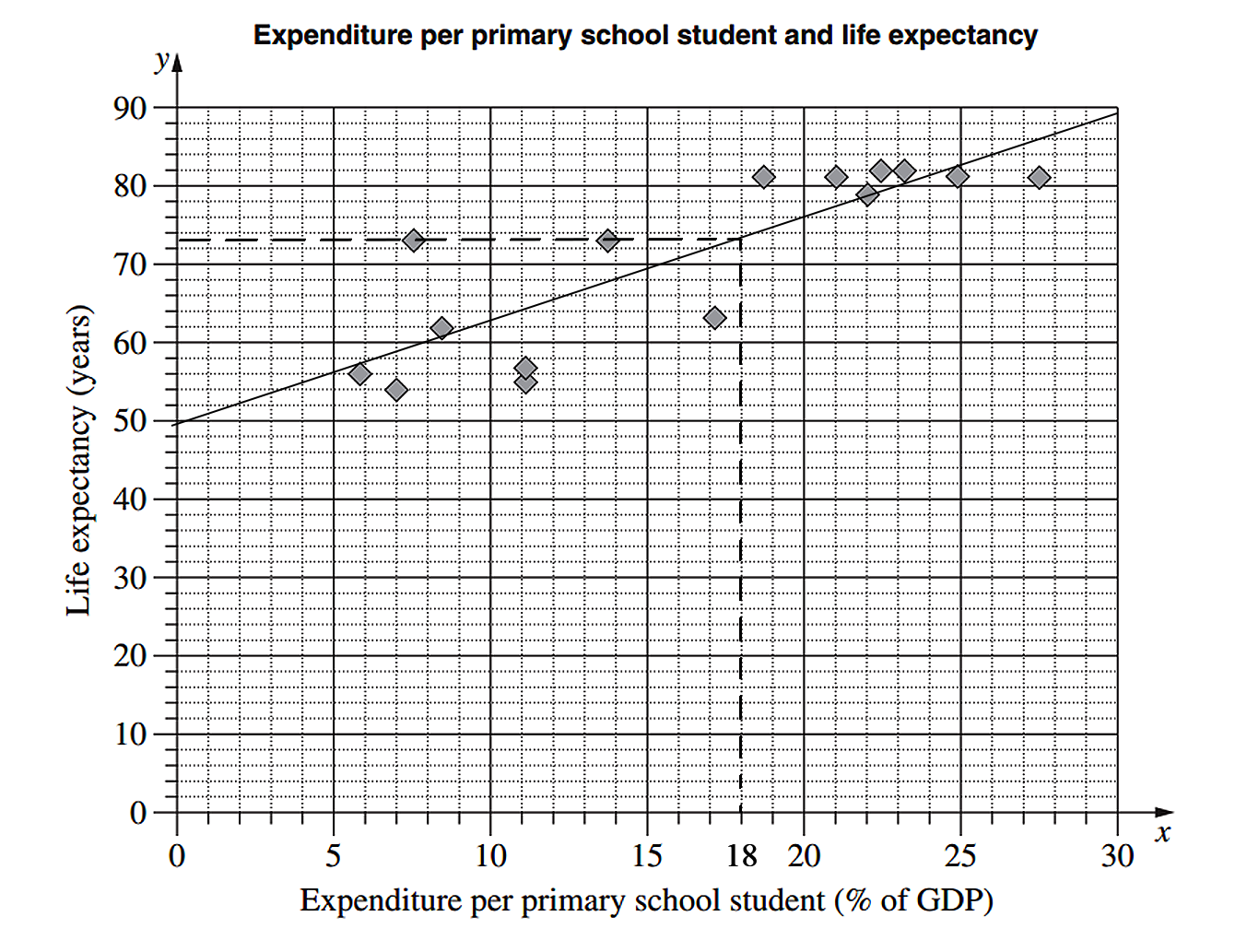
The scatterplot shows the relationship between expenditure per primary school student, as a percentage of a country’s Gross Domestic Product (GDP), and the life expectancy in years for 15 countries.


  1. For the given data, the correlation coefficient,  `r`, is 0.83. What does this indicate about the relationship between expenditure per primary school student and life expectancy for the 15 countries?   (1 mark)

    --- 1 WORK AREA LINES (style=lined) ---

  2. For the data representing expenditure per primary school student,  `Q_L`  is 8.4 and  `Q_U`  is 22.5.


    What is the interquartile range?   (1 mark)

    --- 1 WORK AREA LINES (style=lined) ---

  3. Another country has an expenditure per primary school student of 47.6% of its GDP.


    Would this country be an outlier for this set of data? Justify your answer with calculations.   (2 marks)

    --- 4 WORK AREA LINES (style=lined) ---

  4. On the scatterplot, draw the least-squares line of best fit  `y = 1.29x + 49.9`.    (2 marks)

    --- 4 WORK AREA LINES (style=lined) ---

  5. Using this line, or otherwise, estimate the life expectancy in a country which has an expenditure per primary school student of 18% of its GDP.   (1 mark)

    --- 1 WORK AREA LINES (style=lined) ---

  6. Why is this line NOT useful for predicting life expectancy in a country which has expenditure per primary school student of 60% of its GDP?   (1 mark)

    --- 1 WORK AREA LINES (style=lined) ---

Show Answers Only
  1. `text(It indicates there is a strong positive)`


    `text(correlation between the two variables.)`

  2. `14.1`
  3. `text(Yes, because it’s > 43.65%)`
  4.  
  5. `73.1\ text(years)`
  6. `text(At 60% GDP, the line predicts a life expectancy)`
  7.  

    `text(of 127.3. This line of best fit is only accurate)`

  8.  

    `text(in a lower range of GDP expediture.)`

Show Worked Solution
i. `text(It indicates there is a strong positive)`
  `text(correlation between the two variables)`


ii. `text(IQR)` `= Q_U\ – Q_L`
    `= 22.5\ – 8.4`
    `= 14.1`


♦ Mean mark 35% 

iii.  `text(An outlier on the upper side must be more than)` 

`Q_u\ +1.5xxIQR`

`=22.5+(1.5xx14.1)`

`=\ text(43.65%)`

`:.\ text(A country with an expenditure of 47.6% is an outlier).`


iv.  

v.  `text(Life expectancy) ~~ 73.1\ text{years (see dotted line)}`

♦♦ Mean mark 39%


`text(Alternative Solution)`

`text(When)\ x=18`

`y=1.29(18)+49.9=73.12\ \ text(years)`


♦♦♦ Mean mark 0%. The toughest question on the 2014 paper.
COMMENT: Examiners regularly ask students to identify and comment on outliers where linear relationships break down.
vi.   `text(At 60% GDP, the line predicts a life)`
  `text(expectancy of 127.3. This line of best)`
  `text(fit is only predictive in a lower range)`
  `text(of GDP expenditure.)`

Filed Under: Bivariate Data Analysis (Y12), Correlation / Body Measurements, Life Expectancy, Other Linear Modelling, S4 Bivariate Data Analysis (Y12) Tagged With: Band 4, Band 5, Band 6, common-content, smc-1001-10-Line of Best Fit, smc-1001-30-Correlation, smc-1001-60-Limitations, smc-785-10-Line of Best Fit, smc-785-30-Correlation, smc-785-60-Limitations

Financial Maths, STD2 F4 2014 HSC 30a

Chandra and Sascha plan to have $20 000 in an investment account in 15 years time for their grandchild’s university fees.

The interest rate for the investment account will be fixed at 3% per annum compounded monthly.

Calculate the amount that they will need to deposit into the account now in order to achieve their plan.   (3 marks)

--- 6 WORK AREA LINES (style=lined) ---

Show Answers Only

`$12\ 760\ \ text{(nearest $)}`

Show Worked Solution
♦ Mean mark 49%

`FV = $20\ 000,\ \ n = 15xx 12=180,`

`r = 0.03 /12=0.0025`
 

`FV` `= PV (1 + r)^n`
`20\ 000` `=PV (1 + 0.0025)^180`
`PV` `=(20\ 000)/(1.0025)^180`
  `=12\ 759.73…`


`:.\ text(They need to deposit) \ \ $12\ 760\ \ text{(nearest $)}`

Filed Under: Compound Interest and Shares (Std2), F2 Investment (Y12), FM4 - Credit and Borrowing, Modelling Investments and Loans (Y12) Tagged With: Band 5, common-content, smc-1002-20-FV Formula, smc-1108-20-FV Formula, smc-817-20-FV Formula

Statistics, STD2 S1 2014 HSC 29c

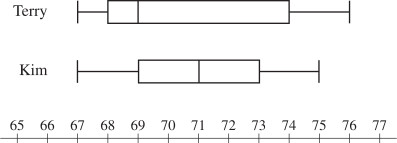
Terry and Kim each sat twenty class tests. Terry’s results on the tests are displayed in the box-and-whisker plot shown in part (i).
 

  1. Kim’s  5-number summary for the tests is  67,  69,  71,  73,  75.


    Draw a box-and-whisker plot to display Kim’s results below that of Terry’s results.   (1 mark)


  2. What percentage of Terry’s results were below 69?     (1 mark)

    --- 1 WORK AREA LINES (style=lined) ---

  3. Terry claims that his results were better than Kim’s. Is he correct?


    Justify your answer by referring to the summary statistics and the skewness of the distributions.    (4 marks)

    --- 8 WORK AREA LINES (style=lined) ---

Show Answers Only
  1. `text(See Worked Solutions)`
  2. `text(50%)`
  3. `text(See Worked Solutions)`
Show Worked Solution
a.    


♦ Mean mark 39%

b.  `text(50%)`


c.  `text(Terry’s results are more positively skewed than)`

♦♦ Mean mark 29%
COMMENT: Examiners look favourably on using language of location in answers, particularly the areas they have specifically pointed students towards (skewness in this example).

`text(Kim’s and also have a higher limit high.)`

`text(However, Kim’s results are more consistent,)`

`text(showing a tighter IQR. They also have a)`

`text(significantly higher median than Terry’s and)`

`text(are evenly skewed.)`

`:.\ text(Kim’s results were better.)`

Filed Under: Stem & Leaf, Box & Whisker, Summary Statistics - Box Plots (Std 2), Summary Statistics - Box Plots (Std2-2027), Summary Statistics - Box Plots (Y12) Tagged With: Band 3, Band 5, common-content, smc-1000-20-Parallel Box-Plots, smc-1000-30-Draw Box-Plots, smc-6313-20-Parallel Box Plots, smc-6313-30-Draw Box Plots, smc-825-20-Parallel Box-Plots, smc-825-30-Draw Box-Plots

Algebra, STD2 A4 2014 HSC 29a

The cost of hiring an open space for a music festival is  $120 000. The cost will be shared equally by the people attending the festival, so that  `C`  (in dollars) is the cost per person when  `n`  people attend the festival.

  1. Complete the table below by filling in the THREE missing values.   (1 mark)
    \begin{array} {|l|c|c|c|c|c|c|}
    \hline
    \rule{0pt}{2.5ex}\text{Number of people} (n) \rule[-1ex]{0pt}{0pt} & \ 500\ & \ 1000 \ & 1500 \ & 2000 \ & 2500\ & 3000 \ \\
    \hline
    \rule{0pt}{2.5ex}\text{Cost per person} (C)\rule[-1ex]{0pt}{0pt} &  &  &  & 60 & 48\ & 40 \ \\
    \hline
    \end{array}
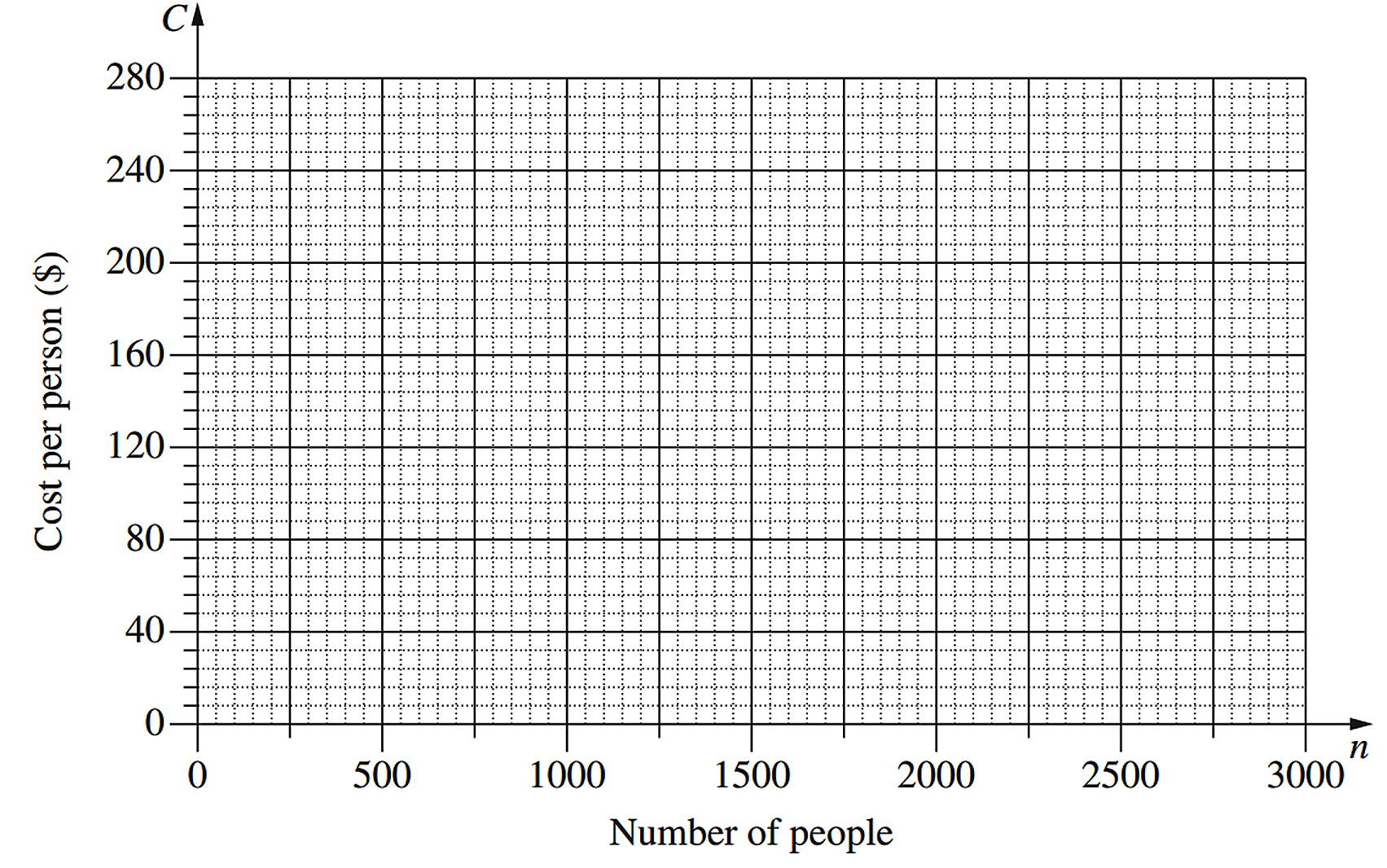
  2. Using the values from the table, draw the graph showing the relationship between  `n`  and  `C`.   (2 marks)
     
  3. What equation represents the relationship between `n` and `C`?   (1 mark)

    --- 1 WORK AREA LINES (style=lined) ---

  4. Give ONE limitation of this equation in relation to this context.   (1 mark)

    --- 2 WORK AREA LINES (style=lined) ---

  5. Is it possible for the cost per person to be $94? Support your answer with appropriate calculations.   (1 mark)

    --- 2 WORK AREA LINES (style=lined) ---

Show Answers Only

i.   

\begin{array} {|l|c|c|c|c|c|c|}
\hline
\rule{0pt}{2.5ex}\text{Number of people} (n) \rule[-1ex]{0pt}{0pt} & \ 500\ & \ 1000 \ & 1500 \ & 2000 \ & 2500\ & 3000 \ \\
\hline
\rule{0pt}{2.5ex}\text{Cost per person} (C)\rule[-1ex]{0pt}{0pt} & 240 & 120 & 80 & 60 & 48\ & 40 \ \\
\hline
\end{array}
 

ii. 

iii.   `C = (120\ 000)/n`

`n\ text(must be a whole number)`
 

iv.   `text(Limitations can include:)`

  `•\ n\ text(must be a whole number)`

  `•\ C > 0`
 

v.   `text(If)\ C = 94:`

`94` `= (120\ 000)/n`
`94n` `= 120\ 000`
`n` `= (120\ 000)/94`
  `= 1276.595…`

 
`:.\ text(C)text(ost cannot be $94 per person,)`

`text(because)\ n\ text(isn’t a whole number.)`

Show Worked Solution

i.   

\begin{array} {|l|c|c|c|c|c|c|}
\hline
\rule{0pt}{2.5ex}\text{Number of people} (n) \rule[-1ex]{0pt}{0pt} & \ 500\ & \ 1000 \ & 1500 \ & 2000 \ & 2500\ & 3000 \ \\
\hline
\rule{0pt}{2.5ex}\text{Cost per person} (C)\rule[-1ex]{0pt}{0pt} & 240 & 120 & 80 & 60 & 48\ & 40 \ \\
\hline
\end{array}
 

ii. 


♦ Mean mark (iii) 48%

iii.   `C = (120\ 000)/n`


♦♦♦ Mean mark (iv) 7%
COMMENT: When asked for limitations of an equation, look carefully at potential restrictions with respect to both the domain and range.

iv.   `text(Limitations can include:)`

  `•\ n\ text(must be a whole number)`

  `•\ C > 0`


v.   `text(If)\ C = 94`

`=> 94` `= (120\ 000)/n`
`94n` `= 120\ 000`
`n` `= (120\ 000)/94`
  `= 1276.595…`
♦ Mean mark (v) 38%


`:.\ text(C)text(ost cannot be $94 per person,)`

`text(because)\ n\ text(isn’t a whole number.)`

Filed Under: Circles and Hyperbola, Inverse, Non-Linear: Inverse and Other Problems (Std 2) Tagged With: Band 4, Band 5, Band 6, num-title-ct-pathc, num-title-qs-hsc, smc-4445-60-Hyperbola applications, smc-795-10-Inverse, smc-795-30-Limitations

FS Resources, 2UG 2014 HSC 28d

An aerial diagram of a swimming pool is shown. 

The swimming pool is a standard length of 50 metres but is not in the shape of a rectangle.

(i)   Given  `AB=8\ text(cm)`, determine the scale of the diagram such that

1 cm = `x` m   (1 mark)

(ii)  If the length of a carpark next to the pool measured 5 cm (not shown), how long would it be in real life?   (1 mark)

(iii)  In the diagram of the swimming pool, the five widths are measured to be: 

`CD = 21.88\ text(m)`

`EF = 25.63\ text(m)`

`GH = 31.88\ text(m)`

`IJ = 36.25\ text(m)`

`KL = 21.88\ text(m)` 


The average depth of the pool is 1.2 m

Calculate the approximate volume of the swimming pool, in cubic metres. In your calculations, use TWO applications of Simpson’s Rule.   (3 marks)

Show Answers Only

(i)   `x=6.25\ text(m)`

(ii)  `31.25\ text(m)`

(iii) `1775\ text(m³)`

Show Worked Solution
(i) `\ \ \ \ 8\ text(cm)` `=50\ text(m)`
  `1\ text(cm)` `=50/8`
    `=6.25\ text(m)`

`:.x=6.25\ text(m)`


(ii)  `text{Using scale from (i)}`

`5\ text(cm)` `=5 xx 6.25`
  `=31.25\ text(m)`

`:.\ text(The carpark would be 31.25 m long)`


(iii)

`h = 50/4 = 12.5\ text(m)`

♦ Mean mark 50%. Be careful not to give away easy marks! 
`A` `~~ h/3 [y_0 + 4(y_1) + y_2]\ \ text(… applied twice)`
  `~~ 12.5/3 [21.88 + 4(25.63) + 31.88]`
  `+ 12.5/3 [31.88 + 4(36.25) + 21.88]`
  `~~ 12.5/3 [156.28] + 12.5/3 [198.76]`
  `~~ 1,479.33\ text(m²)`


`V` `= Ah`
  `~~ 1479.33 xx 1.2`
  `~~ 1775.2`
  `~~ 1775\ text(m³)`

Filed Under: FS Resources, Simpson's Rule/Measurement Error Tagged With: Band 4, Band 5, page-break-before-question

Measurement, STD2 M6 2014 HSC 28b

A radial compass survey of a sports centre is shown in the diagram. 


  1. Show that the size of angle  `AOB`  is  114°.   (1 mark)

    --- 2 WORK AREA LINES (style=lined) ---

  2. Calculate the length of the boundary `AB`, to the nearest metre.     (2 marks)

    --- 4 WORK AREA LINES (style=lined) ---

  3. Find the area of triangle `AOB` in hectares, correct to two significant figures.   (3 marks)

    --- 6 WORK AREA LINES (style=lined) ---

Show Answers Only
  1. `text(Proof)\ \ text{(See Worked Solutions)}`
  2. `420\ text(m)\ text{(nearest m)}`
  3. `2.8\ text(ha)\ text{(2 sig. figures)}`
Show Worked Solution
i.   


`text(Let)\ D\ text(be directly north of)\ O`

`/_AOD = 360\ – 320 = 40^@`

`:.\ /_AOB = 40 + 74 = 114^@\ \ \ text(… as required)`


ii.  `text(Using cosine rule)`

`AB^2` `= AO^2 + BO^2\ – 2 xx AO xx BO xx cos /_AOB`
  `= 287^2 + 211^2\ – 2 xx 287 xx 211 xx cos 114^@`
  `= 126\ 890\ – 121\ 114 (-0.4067…)`
  `= 176\ 151.50…`
`AB` `= 419.704…`
  `= 420\ text(m)\ text{(nearest m)}`
♦ Mean marks of 42% and 41% for parts (ii) and (iii) respectively.
 

iii.  `text(Using)\ A = 1/2 ab sin C,`

`text(Area)\ Delta AOB` `= 1/2 xx 287 xx 211 xx sin 114^@`
  `= 27\ 660.786…\ text(m²)`
  `= 2.7660…\ text(ha)\ \ \ \ text{(1 ha = 10 000 m²)}`
  `= 2.8\ text(ha)\ text{(2 sig figures)}`

Filed Under: Bearings & Field Surveys, Bearings and Radial Surveys (Std2) Tagged With: Band 4, Band 5, smc-803-20-Radial Surveys

Probability, 2UG 2014 HSC 28a

James plays a game involving a spinner with sectors of equal size labelled `A`, `B` and `C`, as shown.

2014 28a

He pays  `$2`  to play the game. He wins  `$5`  if the spinner stops in `A` and  `50`  cents if it stops in `B` or `C`.

Calculate James’s financial expectation for the game.  (2 marks)

Show Answers Only

`text(James should expect to breakeven.)`

Show Worked Solution
♦ Mean mark 49%

`P(A) = 1/3`

`P(B\ text(or)\ C) = 2/3`

`text(Financial expectation)`

`=(1/3 xx 5) + (2/3 xx 0.50)\ – 2`

`= 5/3 + 1/3\ – 2`

`= 0`

`:.\ text(James should expect to breakeven.)`

Filed Under: Financial Expectation Tagged With: Band 5

Measurement, STD2 M1 2014 HSC 27c

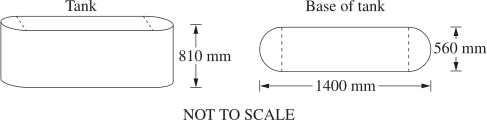
The base of a water tank is in the shape of a rectangle with a semicircle at each end, as shown.

The tank is 1400 mm long, 560 mm wide, and has a height of 810 mm.  
  

What is the capacity of the tank, to the nearest litre?   (4 marks) 

--- 10 WORK AREA LINES (style=lined) ---

Show Answers Only

`581\ text(L)`

Show Worked Solution

`V = Ah` 

♦ Mean mark 41%
STRATEGY: Adjusting measurements to metres makes the final conversion to litres simple.

`text(Finding Area of base)`

`text(Semi-circles have radius 280 mm) = 0.28\ text(m)`

`:.\ text(Area of 2 semicircles)`

`=2 xx 1/2 xx pi r^2`

`= pi xx (0.28)^2`

`= 0.2463…\ text(m)^2`
 

`text(Area of rectangle)`

`= l xx b`

`= (1.4-2 xx 0.28) xx 0.56`

`= 0.4704\ text(m)^2`


`:.\ text(Volume)` `= Ah`
  `= (0.2463… + 0.4704) xx 0.810`
  `= 0.580527…\ text(m)^3`
  `= 580.527…\ text(L)\ \ text{(using 1m³} = 1000\ text{L)}`
  `= 581\ text(L)\ text{(nearest L)}`

Filed Under: Areas and Volumes (Harder), FS Resources, Perimeter, Area and Volume (Std 2), Volume, Volume, Mass and Capacity (Std2-2027) Tagged With: Band 5, num-title-ct-corea, num-title-qs-hsc, smc-4235-20-Cylinders, smc-4235-80-Capacity in litres, smc-6304-50-Volume (Circular Measure), smc-6304-60-Water Catchment, smc-798-50-Volume (Circular Measure), smc-798-60-Water Catchment

FS Driving, 2UG 2014 HSC 27a

Alex is buying a used car which has a sale price of  $13 380. In addition to the sale price there are the following costs:

2014 27a1

  1. Stamp Duty for this car is calculated at $3 for every $100, or part thereof, of the sale price.  
  2. Calculate the Stamp Duty payable.   (1 mark)
  3.  
  4. Alex borrows the total amount to be paid for the car including Stamp Duty and transfer of registration. Interest on the loan is charged at a flat rate of  7.5%  per annum. The loan is to be repaid in equal monthly instalments over 3 years.  
  5.  
    Calculate Alex’s monthly repayments.   (4 marks)
  6.  
  7. Alex wishes to take out comprehensive insurance for the car for 12 months. The cost of comprehensive insurance is calculated using the following: 
    1.  
    2. 2014 27a2
  8. Find the total amount that Alex will need to pay for comprehensive insurance.   (3 marks)
  9.  
  10. Alex has decided he will take out the comprehensive car insurance rather than the less expensive non-compulsory third-party car insurance.
  11. What extra cover is provided by the comprehensive car insurance?   (1 mark)


Show Answers Only
  1. `$402`
  2. `$470\ text{(nearest dollar)}`
  3. `$985.74`
  4. `text(Comprehensive insurance covers Alex)`
  5. `text(for damage done to his own car as well.)`
  6.  
Show Worked Solution
♦♦♦ Mean mark 12%
IMPORTANT: “or part thereof ..” in the question requires students to round up to 134 to get the right multiple of $3 for their calculation.
(i)    `($13\ 380)/100 = 133.8`
`:.\ text(Stamp duty)` `= 134 xx $3`
  `= $402`


(ii)    `text(Total loan)` `= $13\ 380 + 30 + 402`
    `= $13\ 812`


`text(Total interest)\ (I)` `= Prn`
  `= 13\ 812 xx 7.5/100 xx 3`
  `= 3107.70`


`text(Total to repay)` `= 3107.70 + 13\ 812`
  `= 16\ 919.70`


`text(# Repayments) = 3 xx 12 = 36`

`:.\ text(Monthly repayment)` `= (16\ 919.70)/36`
  `= 469.9916…`
  `= $470\ text{(nearest dollar)}`


(iii)   `text(Base rate) = $845`

`text(FSL) =\ text(1%) xx 845 = $8.45`

`text(Stamp)` `=\ text(5.5%) xx(845 + 8.45)`
  `= 46.9397…`
  `= $46.94\ text{(nearest cent)}`
`text(GST)` `= 10 text(%) xx(845 + 8.45)`
  `= 85.345`
  `= $85.35`


`:.\ text(Total cost)` `= 845 + 8.45 + 46.94 + 85.35`
  `= $985.74`


♦ Mean mark 34%.
(iv)   `text(Comprehensive insurance covers Alex)`
  `text(for damage done to his own car as well.)`

Filed Under: Costs to Purchase / Insurance, FM3 - Taxation, FM4 - Credit and Borrowing Tagged With: Band 4, Band 5, Band 6

Measurement, 2UG 2014 HSC 26g

Singapore is located at  1°N 104°E  and has a UTC of +8. Sydney is located at 34°S 151°E and has a UTC of +11. 

What is the time difference between Singapore and Sydney? (Ignore daylight saving.)   (2 marks)

Show Answers Only

`text(Sydney is 3hrs 8mins ahead)`

Show Worked Solution

`text(Longitude angular difference)`

♦ Mean mark 50%

`= 151\ – 104`

`= 47^@`
 

`text(Time difference)` `= 47 xx 4`
  `= 188\ text(mins)`
  `=\ text(3hrs 8mins)`

 
`=>text(Sydney is East of)\ text(S)text(ingapore)`

`:.\ text(Sydney is 3hrs 8mins ahead.)`

Filed Under: Uncategorized Tagged With: Band 5

Algebra, 2UG 2014 HSC 26d

Solve these simultaneous equations to find the values of  `x`  and  `y`.    (3 marks)

`y = 2x + 1`

`x − 2y − 4 = 0`

Show Answers Only

`x = -2,\ y = -3`

Show Worked Solution
♦ Mean mark 36%

`text(Solution 1 – Substitution)`

`y = 2x + 1\ \ \ \ \ …\ text{(i)}`

`x\ – 2y\ – 4 = 0\ \ \ \ \ …\ text{(ii)}`


`text(Subst.)\ \ y = 2x + 1\ \ text(into)\ text{(ii)}`

`x\ – 2(2x + 1)\ – 4` `= 0`
`x\ – 4x\ – 2\ – 4` `= 0`
`-3x\ – 6` `= 0`
`3x` `= -6`
`x` `= -2`

`text(Subst.)\ \ x = –2\ \ text(into)\ text{(i)}`

`y = 2(–2) + 1 = -3`


`:.\ text(Solution is)\ x = -2,\ y = -3`


`text(Alternative Solution – Elimination)`

`y = 2x + 1\ \ \ \ \ …\ text{(i)}`

`x\ – 2y\ – 4 = 0\ \ \ \ \ …\ text{(ii)}`

`text(Mult)\ text{(i)} xx 2`

`2y` `= 4x + 2`
`-4x + 2y\ – 2` `= 0\ \ \ \ \ …\ text{(iii)}`


`text{Add  (ii) + (iii)}`

`-3x\ – 6` `= 0`
`x` `= -2`
`y` `= -3\ \ text{(see Solution 1)}`


Filed Under: Linear and Other Equations Tagged With: Band 5

Measurement, STD2 M1 2014 HSC 25 MC

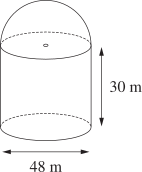
A grain silo is made up of a cylinder with a hemisphere (half a sphere) on top. The outside of the silo is to be painted.
  

 What is the area to be painted?

  1. `8143\ text(m²)`
  2. `11\ 762\ text(m²)`
  3. `12\ 667\ text(m²)`
  4. `23\ 524\ text(m²)`
Show Answers Only

`A`

Show Worked Solution

`text(Total Area) = text(Area of cylinder) + text(½ sphere)`

♦ Mean mark 40%
`text(Area of cylinder)` `= 2 pi rh`
  `= 2pi xx 24 xx 30`
  `= 4523.9`
`text(Area of ½ sphere)` `= 1/2 xx 4 pi r^2`
  `= 1/2 xx 4 pi xx 24^2`
  `= 3619.1`
`:.\ text(Total area)` `= 4523.9 + 3619.1`
  `= 8143\ text(m²)`

`=>  A`

Filed Under: Area and Surface Area, Areas and Volumes (Harder), Perimeter, Area and Volume (Std 2), Surface Area (Std1-2027), Surface Area (Std2-2027) Tagged With: Band 5, num-title-ct-pathb, num-title-qs-hsc, smc-4234-45-SA (cylinder), smc-4234-50-SA (sphere), smc-6484-20-Surface Area (Circular Measure), smc-6522-20-Surface Area (Circular Measure), smc-798-25-Surface Area

Statistics, STD2 S5 2014 HSC 24 MC

The weights of  10 000 newborn babies in NSW are normally distributed. These weights have a mean of 3.1 kg and a standard deviation of 0.35 kg.

How many of these newborn babies have a weight between 2.75 kg and 4.15 kg?

  1. `4985`
  2. `6570`
  3. `8370`
  4. `8385`
Show Answers Only

`D`

Show Worked Solution
♦ Mean mark 46%

`text(Find)\ z text(-scores of 2.75 and 4.15 kg)`

`z\ (2.75)` `= (x – mu)/5 = (2.75 – 3.1)/0.35 = -1`
`z\ (4.15)` `= (4.15 – 3.1)/0.35 = 3`

 
`text(68% between)\ z=–1\ text(and 1)`

`=> text(34% between)\ z=–1\ text(and 0)`

`text(99.7% between)\ z=–3\ text(and 3)`

`=> text(49.85% between)\ z=0\ text(and)\ 3`


`:.%\ text(with)\ z text(-scores between)\ –1\ text(and 3)`

`= 34 + 49.85`

`=\ text(83.85%)`


`:.\ text(# Babies between 2.75 kg and 4.15 kg)`

`= text(83.85%) xx 10\ 000`

`= 8385`

`=>  D`

Filed Under: DS5/6 - Normal Distribution and Sampling, Normal Distribution (Y12), S5 The Normal Distribution (Y12) Tagged With: Band 5, common-content, smc-819-20-z-score Intervals, smc-995-20-z-score Intervals

Measurement, STD2 M6 2014 HSC 23 MC

The following information is given about the locations of three towns `X`, `Y` and `Z`: 

• `X` is due east of  `Z`

• `X` is on a bearing of  145°  from  `Y` 

• `Y` is on a bearing of  060°  from  `Z`. 

Which diagram best represents this information?
 

HSC 2014 23mci

Show Answers Only

`C`

Show Worked Solution
♦ Mean mark 38%
COMMENT: Drawing a parallel North/South line through `Y` makes this question much simpler to solve.

`text(S)text(ince)\ X\ text(is due east of)\ Z`

`=> text(Cannot be)\ B\ text(or)\ D`


`text(The diagram shows we can find)`

`/_ZYX = 60 + 35^@ = 95^@`

`text(Using alternate angles)\ (60^@)\ text(and)`

`text(the)\ 145^@\ text(bearing of)\ X\ text(from)\ Y`

`=>  C`

Filed Under: Bearings & Field Surveys, Bearings and Radial Surveys (Std2) Tagged With: Band 5, common-content, smc-1103-60-Bearings, smc-803-10-Bearings

Financial Maths, STD2 F5 2014 HSC 21 MC

A table of future value interest factors is shown.

2014 21 mc

A certain annuity involves making equal contributions of $25 000 into an account every 6 months for 2 years at an interest rate of 4% per annum.

Based on the information provided, what is the future value of this annuity? 

  1.    `$50\ 500`
  2.    `$51\ 000`
  3.    `$103\ 040`
  4.    `$106\ 162`
Show Answers Only

`C`

Show Worked Solution

`text(4 contributions of $25 000 made.)`

♦ Mean mark 43%

`text(Annuity period = 6 months)`

`text{Rate (per annuity period)}=(text(4%))/2=text(2%)`

`text{# Periods = 4     (4 x 6 months = 2 years)}`

`text(Table value = 4.1216)`
 

`:.\ text(Annuity Value)=4.1216 xx 25\ 000=$103\ 040`

`=>  C`

Filed Under: F5 Annuities (Y12), FM5 - Annuities and Loan repayments, Modelling Investments and Loans (Y12) Tagged With: Band 5, common-content, smc-1002-40-FV Annuity Table, smc-816-10-FV of $1 Annuity Table

Measurement, STD2 M1 2014 HSC 20 MC

In a household of 4, each member uses an average of 13 minutes of hot water per day.

The household uses a 9 kW hot water unit.

Electricity is charged at 11.97 c/kWh when the hot water unit is being used.

What is the electricity cost for the hot water used by this household in one week?

  1. $1.63
  2. $6.54
  3. $392.14
  4. $653.56
Show Answers Only

`B`

Show Worked Solution

`text(Usage per day) = 4 xx 13 = 52\ text(mins)`

♦ Mean mark 39%.

`text(Usage per week) = 7 xx 52 = 364\ text(mins)`

`text(Converting to kWh)`

`= text{(hours of usage)} xx 9\ text(kW)`

`= 364/60 xx 9`

`= 54.6\ text(kWh)`
 

`:.\ text(C)text(ost)` `= 54.6 xx 11.97 text(c)`
  `~~ 654 text(c)`
  `~~$6.54`

`=>  B`

Filed Under: Energy and Mass (Std 2), FS Resources, M4 Rates (Y12) Tagged With: Band 5, smc-1104-25-Energy, smc-799-20-Electricity

Financial Maths, STD2 F1 2014 HSC 18 MC

The average NSW annual water consumption from the residential sector is equal to  90 340  litres per person per year. The Building Sustainability Index (BASIX) uses this as the benchmark to set a target for reducing water consumption by up to 40%.

A new building, planned to house 50 people, has been designed to meet a 25% reduction on this water consumption benchmark.

How much water per year, to the nearest kilolitre, is this building designed to save when fully occupied?

  1.    1129
  2.    1807
  3.    2710
  4.    3388
Show Answers Only

`A`

Show Worked Solution

`text(Benchmark) = 90\ 340\ text(L)`

`text(Water saved if usage)\ darr text(25%)`

`= 90\ 340 xx text(25%)`

`= 22\ 585\ text(L per person)`

 
`:.\ text(Water saved for 50 people)`

`= 50 xx 22\ 585`

`= 1\ 129\ 250\ text(L)`

`~~ 1129\ text(kL)`

`=>  A`

Filed Under: FS Resources, Purchasing Goods (Std1-2027), Purchasing Goods (Std2-2027), Tax and Percentage Increase/Decrease (Std 1), Tax and Percentage Increase/Decrease (Std 2) Tagged With: Band 5, smc-1125-30-% Increase/Decrease, smc-6278-10-%Increase/Decrease, smc-6517-10-%Increase/Decrease, smc-831-30-% Increase/Decrease

Statistics, STD2 S1 2014 HSC 14 MC

Twenty Year 12 students were surveyed. These students were asked how many hours of sport they play per week, to the nearest hour.

The results are shown in the frequency table. 

\begin{array} {|c|c|}
\hline
\rule{0pt}{2.5ex} \textit{Hours per week} \rule[-1ex]{0pt}{0pt} & \ \ \ \ \ \textit{Frequency}\ \ \ \ \  \\
\hline
\rule{0pt}{2.5ex} \text{0 – 2} \rule[-1ex]{0pt}{0pt} & 5 \\
\hline
\rule{0pt}{2.5ex} \text{3 – 5} \rule[-1ex]{0pt}{0pt} & 10 \\
\hline
\rule{0pt}{2.5ex} \text{6 – 8} \rule[-1ex]{0pt}{0pt} & 3 \\
\hline
\rule{0pt}{2.5ex} \text{9 – 11} \rule[-1ex]{0pt}{0pt} & 2 \\
\hline
\end{array}

 What is the mean number of hours of sport played by the students per week?

  1.    3.3
  2.    4.3
  3.    5.0
  4.    5.3
Show Answers Only

`B`

Show Worked Solution

`text(Using the class centres)`

`text(Total hours)` `= (1 xx 5) + (4 xx 10) + (7 xx 3) + (10 xx 2)`
  `= 5 + 40 + 21 + 20`
  `= 86`
♦ Mean mark 45%
COMMENT: The mean is calculated using “class centres” in grouped data.
`text(Mean hours)` `= 86/20 = 4.3`

`=>  B`

Filed Under: Measures of Central and Spread (Std1-2027), Measures of Centre and Spread (Std2-2027), Summary Statistics - No Graph (Std 2), Summary Statistics - No graph (Y12), Summary Statistics (no graph), Summary Statistics (Std 1) Tagged With: Band 5, common-content, smc-1131-10-Mean, smc-1131-40-Class Centres, smc-6312-10-Mean, smc-6312-40-Class Centres, smc-6532-10-Mean, smc-6532-40-Class Centres, smc-824-10-Mean, smc-824-40-Class Centres, smc-999-10-Mean, smc-999-40-Class Centres

Measurement, STD2 M1 2014 HSC 10 MC

The top of the Sydney Harbour Bridge is measured to be 138.4 m above sea level. 

What is the percentage error in this measurement?

  1. 0.036%
  2. 0.050%
  3. 0.072%
  4. 0.289%
Show Answers Only

`A`

Show Worked Solution
 
♦ Mean mark 48%

`text{Absolute error}\ =1/2 xx text{precision}\ = 1/2 xx 0.1 = 0.05\ text{m}`

`text{% error}` `=\ frac{text{absolute error}}{text{measurement}} xx 100%`  
  `=0.05/138.4 xx 100%`  
  `=0.036%`  

 
`=>  A`

Filed Under: Numbers of Any Magnitude, Simpson's Rule/Measurement Error, Units and Measurement Error (Std 1), Units and Measurement Error (Std 2) Tagged With: Band 5, num-title-ct-corea, num-title-qs-hsc, smc-1120-10-Measurement Error, smc-4232-10-Measurement error, smc-797-10-Measurement Error

Algebra, STD2 A2 2014 HSC 7 MC

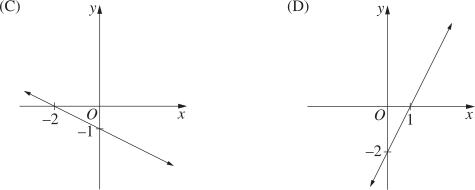
Which of the following is the graph of   `y = 2x-2`? 


Show Answers Only

`D`

Show Worked Solution
♦ Mean mark 46%

`y = 2x-2`

`text(By elimination)`

`text(It has a)\ y\ text(intercept of)\ -2`

`=> text(Cannot be)\ B\ text(or)\ C`


`(-1, 0)text{ from}\ A\ text(doesn’t satisfy equation)`

`text(but)\ (1,0)\ text(from)\ D\ text(does)`

`=>  D`

Filed Under: AM2 - Linear Relationships (Prelim), Cartesian Plane, Linear Equations and Basic Graphs (Std 1), Linear Equations and Basic Graphs (Std 2), Linear Modelling and Basic Graphs (Std1-2027), Linear Modelling and Basic Graphs (Std2-2027) Tagged With: Band 5, num-title-ct-pathc, num-title-qs-hsc, smc-1118-20-Identify graph/equation, smc-4422-25-y-int gradient, smc-4422-35-Sketch graph, smc-6255-20-Equation of a Line, smc-6512-20-Equation of a line, smc-792-20-Equation of Line

Algebra, STD2 A1 2014 HSC 4 MC

Young’s formula below is used to calculate the required dosages of medicine for children aged 1–12 years.

 `text(Dosage) = (text(age of child)\ text{(in years)} xx text(adult dosage))/(text(age of child)\ text{(in years)} + 12)`

How much of the medicine should be given to an 18-month-old child in a 24-hour period if each adult dosage is 45 mL? The medicine is to be taken every 6 hours by both adults and children.

  1.       5 mL
  2.    20 mL
  3.    27 mL
  4.    30 mL
Show Answers Only

`B`

Show Worked Solution
♦ Mean mark 42%
`text(Dosage)` `= (1.5 xx 45)/(1.5 + 12)`
  `= 5\ text(mL)`

 
`text(S)text(ince 1 dosage every 6 hrs)`

`text(In 24 hours,)`

`text(Medicine given) = 4 xx 5 = 20\ text(mL)`

`=>  B`

Filed Under: Applications: BAC, Medication and D=SxT (Std 2), Applications: BAC, Medicine and D=SxT (Std1-2027), Applications: BAC, Medicine and D=SxT (Std2-2027), Applications: D=SxT and Other (Std 1), Medication Tagged With: Band 5, smc-1117-30-Medication Formulae, smc-6235-30-Medication Formulas, smc-6509-30-Medication Formulas, smc-791-30-Medication Formulae

Proof, EXT2 P2 EQ-Bank 8

Prove by mathematical induction that  `2^n > n^2`  for integral  `n > 4`.  (3 marks)

--- 9 WORK AREA LINES (style=lined) ---

Show Answers Only

`text(Proof)\ \ text{(See Worked Solutions)}`

Show Worked Solution
IMPORTANT: Inequality induction is challenging. Students need to state clearly what they need to prove and then use logic to advance their answer toward the desired result.

`text(Prove)\ \ 2^n > n^2\ \ text(for integral)\ \ n > 4`

`text(If)\ \ n = 5,`

`text(LHS)` `= 2^5 = 32`
`text(RHS)` `= 5^2 = 25 < text(LHS)`

 
`:.\ text(True for)\ n = 5`

 
`text(Assume true for)\ n = k:`

`text(i.e.)\ \ \ 2^k > k^2`

`text(Prove true for)\ n = k + 1`

`text(i.e.)\ \ \ ` `2^(k + 1)` `> (k + 1)^2`
  `2^(k + 1)` `> k^2 + 2k + 1`


`text(LHS)` `= 2^(k + 1)`
  `= 2*2^k`
  `> 2k^2`
  `> k^2 + k^2`
  `> k^2 + 4k\ \ text{(} text(noting)\ k^2>4k,\ k>4 text{)}`
  `> k^2 + 2k + 8\ \ text{(} text(noting)\ 4k > 2k + 8,\ k > 4 text{)}`
  `> k^2 + 2k + 1`
  `> (k + 1)^2`


`=>\ text(True for)\ n = k + 1`

`:.\ text(S)text(ince true for)\ \ n = 5, text(by PMI, true for integral)\ \ n > 4.`

Filed Under: 7. Induction and Other Series EXT1, Induction, P2 Induction (Ext2) Tagged With: Band 5, smc-1044-10-Inequalities, smc-5115-10-Inequalities

Proof, EXT1 P1 SM-Bank 3

Prove by mathematical induction that  `(3n + 1)7^n  - 1`  is divisible by 9 for integral  `n >= 1`.  (3 marks)

--- 14 WORK AREA LINES (style=lined) ---

Show Answers Only

`text(Proof)\ \ text{(See Worked Solutions)}`

Show Worked Solution

`text(Prove)\ \ (3n + 1)7^n\ – 1\ \ text(is divisible)`

`text(by 9 for integers)\ n >= 1.`

`text(If)\ \ n = 1`

`(3n + 1)7^n\ – 1` `= (3 xx 1 + 1)7^1\ – 1`
  `= 27`

`=>\ text(Divisible by 9)\ \ (27//9=3)`
 

`text(Assume true for)\ n = k`

IMPORTANT: In cases where substitution doesn’t work, remember that `f(k+1)-f(k)` can be used to illustrate divisibility as well (Tony Lantry special).

`text(i.e.)\ (3k + 1)7^k\ – 1 = 9P\ \ \ text{(} P\ text(integer) text{)}`

`f(k)` `= (3k + 1)7^k\ – 1`
`f(k + 1)` `= (3 (k + 1) + 1)7^(k+1)\ – 1`
  `= (3k + 4)7^(k+1)\ – 1`

 
`f(k + 1)\ – f(k)`

`= (3k + 4) 7^(k + 1)\ -1- [(3k + 1)7^k\ – 1]`
`= 3k * 7^(k + 1) + 4 * 7^(k + 1)\ – 1\ – [3k*7^k + 7^k\ – 1]`
`= 21k*7^k + 28*7^k\ – 1\ – 3k*7^k\ – 7^k + 1`
`= 18k*7^k + 27*7^k`
`= 9 (2k*7^k + 3*7^k)\ \ text{(divisible)}`
 
`text(S)text(ince)\ \ ` `f(k + 1)\ – f(k)\ text(is divisible by 9 and)`
  `\ \ \ \ \ \ f(k)\ text(is divisible by 9,)`

 
`=> f(k + 1)\ text(is divisible by 9)`

`text(S)text(ince true for)\ n = 1,\ text(true for integral)\ n >= 1`

Filed Under: 7. Induction and Other Series EXT1, P1 Induction (Y12) Tagged With: Band 5, smc-1019-10-Divisibility

Proof, EXT2 P2 EQ-Bank 5

Use mathematical induction to prove that  `7^n + 15^n`  is divisible by 11 where  `n`  is an odd integer.  (3 marks)

--- 7 WORK AREA LINES (style=lined) ---

Show Answers Only

`text(Proof)\ \ text{(See Worked Solutions)}`

Show Worked Solution

`text(Prove)\ \ 7^n + 15^n\ \ text(is divisible by 11, where)\ n\ text(is odd)`

`text(If)\ \ n = 1`

`7^n + 15^n` `= 7 + 15 = 22`
`22/11` `= 2\ \ \ :.\ text(Divisible by 11)`

 
`text(Assume true for)\ \ n = k`

`text(i.e.)\ 7^k + 15^k` `= 11P\ \ \ \ text{(}P\ text(integer) text{)}`
`7^k` `= 11P\ – 15^k\ \ \ \ \ …\ text{(∗)}`

 
`text(Prove true for)\ \ n = k + 2`

`7^(k + 2) + 15^(k + 2)` `= 7^2 * 7^k + 15^2 * 15^k`
  `= 49 (11P\ – 15^k) + 225 (15^k)\ \ \ text(… from)\ text{(∗)}`
  `= 49 * 11P\ – 49 * 15^k + 225 (15^k)`
  `= 49 * 11P + 176 * 15^k`
  `= 11 (49P + 16 * 15^k)`

  
`=>text(True for)\ n = k + 2`

`text(S)text(ince true for)\ n = 1,\ text(by PMI, true for odd integral)\ \ n >= 1`

Filed Under: 7. Induction and Other Series EXT1, Induction, P2 Induction (Ext2) Tagged With: Band 5, smc-1044-20-Divisibility, smc-5115-20-Divisibility

Quadratic, EXT1 2014 HSC 13c

The point  `P(2at, at^2)`  lies on the parabola  `x^2 = 4ay`  with focus  `S`.

The point  `Q`  divides the interval  `PS`  internally in the ratio  `t^2 :1`.

2014 13c 

  1. Show that the coordinates of  `Q`  are  
  2. `x = (2at)/(1 + t^2)`  and  `y = (2at^2)/(1 + t^2)`.  (2 marks)
  3. Express the slope of  `OQ`  in terms of  `t`.    (1 mark)
  4. Using the result from part (ii), or otherwise, show that  `Q`  lies on a fixed circle of radius  `a`.   (3 marks)


Show Answers Only
  1. `text(Proof)\ \ text{(See Worked Solutions)}`
  2. `m_(OQ) = t`
  3. `text(Proof)\ \ text{(See Worked Solutions)}`
Show Worked Solution

(i)   `text(Show)\ \ Q = ((2at)/(1 + t^2), (2at^2)/(1 + t^2))`

`P (2at, at^2),\ S (0, a)`

`PS\ text(is divided internally in ratio)\ t^2: 1`

`Q` `= ((nx_1 + mx_2)/(m + n), (ny_1 + my_2)/(m + n))`
  `= ((1(2at) + t^2(0))/(t^2 + 1), (1(at^2) + t^2 (a))/(t^2 + 1))`
  `= ((2at)/(1 + t^2), (2at^2)/(1 + t^2))\ \ text(… as required.)`


(ii)    `m_(OQ)` `= (y_2\ – y_1)/(x_2\ – x_1)`
    `= ((2at^2)/(1 + t^2))/((2at)/(1 + t^2)) xx (1+t^2)/(1+t^2)`
    `= (2at^2)/(2at)`
    `= t`


(iii)   `text(Show)\ Q\ text(lies on a fixed circle radius)\ a`
  `text(S)text(ince)\ Q\ text(passes through)\ (0, 0)`


`=>\ text(If locus of)\ Q\ text(is a circle, it has)`

`text(diameter)\ QT\ text(where)\ T(0, 2a)`


`text(Show)\ \ QT _|_ OQ`

♦♦ Mean mark 22%

`text{(} text(angles on circum. subtended by)`

  `text(a diameter are)\ 90^@ text{)}`


`m_(OQ) = t\ \ \ \ text{(see part (ii))}`

`text(Find)\ m_(QT),\ \ text(where:)`

`Q((2at)/(1 + t^2), (2at^2)/(1 + t^2)),\ \ \ \ \ T (0,2a)`

`m_(QT)` `= (y_2\ – y_1)/(x_2\ – x_1)`
  `= ((2at^2)/(1 + t^2)\ – 2a)/((2at)/(1 + t^2)\ – 0)`
  `= (2at^2\ – 2a (1 + t^2))/(2at)`
  `= – (2a)/(2at)`
  `= – 1/t`


`m_(QT) xx m_(OT) = -1/t xx t = -1`

`=> QT _|_ OQ`

`=>O,\ T,\ Q\ text(lie on a circle.)`

`:.\ text(Locus of)\ Q\ text(is a fixed circle,)`

`text(centre)\ (0, a),\ text(radius)\ a`

Filed Under: 9. Quadratics and the Parabola EXT1 Tagged With: Band 3, Band 4, Band 5, Band 6

Binomial, EXT1 2011 HSC 7b

The binomial theorem states that 
 

`(1 + x)^n = sum_(r = 0)^(n) ((n),(r)) x^r`  for all integers  `n >= 1`. 
 

  1. Show that    
    1. `sum_(r=1)^n ((n),(r)) rx^r = nx (1 + x)^(n\ - 1)`.   (2 marks)
    2.  
  2. By differentiating the result from part (i), or otherwise, show that
    1. `sum_(r = 1)^n ((n),(r)) r^2 = n (n + 1) 2^(n\ - 2)`.    (2 marks)
    2.  
  3. Assume now that  `n`  is even. Show that, for  `n >= 4`, 
    1. `((n),(2)) 2^2 + ((n),(4)) 4^2 + ((n),(6)) 6^2 + ... + ((n),(n)) n^2 = n(n+1)2^(n\ - 3)`.  
    2. (3 marks)


Show Answers Only
  1. `text(Proof)\ \ text{(See Worked Solutions)}`
  2. `text(Proof)\ \ text{(See Worked Solutions)}`
  3. `text(Proof)\ \ text{(See Worked Solutions)}`
Show Worked Solution
♦ Mean mark 36%. 
MARKER’S COMMENT: Better responses provided a narrative through the solution such as “Differentiate both sides” and “Mult. by `x`”, as seen in the solutions.

(i) `text(Show)\ sum_(r=1)^n ((n),(r)) rx^r = nx (1 + x)^(n\ – 1)`

`text(Using)\ (1 + x)^n = sum_(r=0)^n ((n),(r)) x^r :`

`(1 + x)^n = ((n),(0)) + ((n),(1)) x + ((n),(2)) x^2 + … + ((n),(n)) x^n`
 

`text(Differentiate both sides)`

`n(1 + x)^(n\ – 1) = ((n),(1)) + ((n),(2)) 2x + … + ((n),(n)) nx^(n\ – 1)`
 

`text(Multiply both sides by)\ x`

`nx (1 + x)^(n\ – 1)` `= ((n),(1)) x + ((n),(2)) 2x^2 + … + ((n),(n)) nx^n`
  `= sum_(r=1)^n ((n),(r)) rx^r\ \ text(… as required.)`


(ii)  `text(Show)\ \ sum_(r=1)^n ((n),(r)) r^2 = n (n+1) 2^(n\ – 2)`

♦♦ Mean mark 36%.

 
`text(Using part)\ text{(i)}`

`nx (1 + x)^(n\ – 1) = ((n),(1)) x + ((n),(2)) 2x^2 + … + ((n),(n)) nx^n`
 

`text(Differentiate LHS)`

`nx (n\ – 1)(1 + x)^(n\ – 2) + n(1 + x)^(n\ – 1)`

`= n (1 + x)^(n\ – 2) [x (n\ – 1) + (1 + x)]`

`= n (1 + x)^(n\ – 2) (xn\ – x + 1 + x)`

`= n (xn + 1)(1 + x)^(n\ – 2)`
 

`text(Differentiate RHS)`

`((n),(1)) + ((n),(2)) 2^2 x + ((n),(3)) 3^2 x^2 + … + ((n),(n)) n^2 x^(n\ – 1)\ text{… (*)}`

 
`text(Substitute)\ \x = 1\ text(into both sides)`

`((n),(1)) + ((n),(2)) 2^2 + … + ((n),(n)) n^2` `= n (n + 1)(1 + 1)^(n\ – 2)`
`sum_(r=1)^n ((n),(r)) r^2` `= n (n + 1) 2^(n\ – 2)`


(iii)  `text(Show for)\ \ n >= 4`

`((n),(2)) 2^2 + ((n),(4)) 4^2 + ((n),(6)) 6^2 + … + ((n),(n)) n^2 = n (n + 1) 2^(n\ – 3)`

♦♦♦ Toughest question in the 2011 exam. Mean mark of 2%. The lowest mean of any Ext1 question since that data became available post-2009!

 
`text{From part(ii) … (*) we know}`

`((n),(1)) + ((n),(2)) 2^2 x + … + ((n),(n)) n^2 x^(n\ – 1) = n (xn + 1)(1 + x)^(n\ – 2)`

 
`text(When)\ \ x = 1`

`((n),(1)) + ((n),(2)) 2^2 + … + ((n),(n)) n^2 = n (n + 1) 2^(n\ – 2)\ \ \ \ \ …\ (1)`

 
`text(When)\ x = –1`

`((n),(1))\ – ((n),(2)) 2^2 + ((n),(3)) 3^2\ – …\ – ((n),(n)) n^2`
 `= n (-n + 1)* 0^(n\ – 2)=0\ \ \ \ \ …\ (2)`
`text{(Note that}\ n≠2\ \ text{because}\ 0^0\ text{is undefined)}`

 
`(1)\ – (2)`

`2[((n),(2)) 2^2 + ((n),(4)) 4^2 + … + ((n),(n)) n^2]` `= n (n + 1) 2^(n\ – 2) – 0`
`((n),(2)) 2^2 + ((n),(4)) 4^2 + … + ((n),(n)) n^2` `= 1/2 n (n + 1) 2^(n\ – 2)`
  `= n (n + 1) 2^(n\ – 3)`

 
`:.\ text(Above statement true for integers)\ n >= 4.`

Filed Under: 17. Binomial EXT1 Tagged With: Band 5, Band 6

Binomial, EXT1 2013 HSC 14b

  1. Write down the coefficient of  `x^(2n)`  in the binomial expansion of  `(1 + x)^(4n)`.    (1 mark)
  2. Show that  
    1. `(1 + x^2 + 2x)^(2n) = sum_(k=0)^(2n) ((2n),(k)) x^(2n\ - k)(x + 2)^(2n\ - k)`.   (2 marks)
       
  3. It is known that  
     
    `x^(2n\ - k) (x + 2)^(2n\ - k) = ((2n\ - k),(0)) 2^(2n\ - k) x^(2n\ - k) + ((2n\ - k),(1)) 2^(2n\ - k\ - 1) x^(2n\ - k + 1)`

    1.  
      1.     `+ ... + ((2n\ - k),(2n\ - k)) 2^0 x^(4n\ - 2k)`.   (Do NOT prove this.)
      2.  
  4. Show that
  5.  
    1. `((4n),(2n)) = sum_(k = 0)^(n) 2^(2n\ - 2k) ((2n),(k))((2n\ - k),(k))`.   (3 marks)


Show Answers Only
  1. `((4n),(2n))`
  2.  
  3. `text(Proof)\ \ text{(See Worked Solutions)}`
  4. `text(Proof)\ \ text{(See Worked Solutions)}`
Show Worked Solution

(i)  `text(Find co-efficient of)\ \ x^(2n)`

`text(Expanding)\ \ (1+x)^(4n)`

`((4n),(0)) + ((4n),(1))x + ((4n),(2))x^2 + … + ((4n),(2n))x^(2n) + …`

`:.\ text(Co-efficient of)\ \ x^(2n)\ text(is)\ ((4n),(2n))`


(ii)  `text(Show)\ (1 + x^2 + 2x)^(2n) = sum_(k=0)^(2n) ((2n),(k)) x^(2n\ – k) (x + 2)^(2n\ – k)`

♦♦ Mean mark 30%.

`text(Using)\ (1 + x^2 + 2x)^(2n) = [x(x + 2) + 1]^(2n)`

`[x (x + 2) + 1]^(2n)`
`= ((2n),(0)) (x(x + 2))^(2n) + ((2n),(1)) (x(x + 2))^(2n\ – 1) + … + ((2n),(2n))` 
`= ((2n),(0)) x^(2n)(x + 2)^(2n) + ((2n),(1)) x^(2n\ – 1) (x + 2)^(2n\ – 1) + … + ((2n),(2n))` 
`= sum_(k=0)^(2n) ((2n),(k)) x^(2n\ – k) (x + 2)^(2n\ – k)\ text(… as required.)`


(iii)  `((4n),(2n))\ text(is the co-eff of)\ x^(2n)\ text(in expansion)\ (1+x)^(4x)`

`text(S)text(ince)\ (1 + x^2 + 2x)^(2n) = ((x+1)^2)^(2n) = (1 + x)^(4n)`

`=> ((4n),(2n))\ text(is co-efficient of)\ x^(2n)\ text(in expansion)\ (1 + x^2 + 2x)^(2n)`

 
`text(Using part)\ text{(ii)}`

`(1 + x^2 + 2x)^(2n) = sum_(k=0)^(2n) ((2n),(k))\ x^(2n\ – k) (x + 2)^(2n\ – k)`


`text(Using the given identity,)\ x^(2n)\ text(co-efficients are)`

♦♦♦ Toughest question in the 2013 exam with Mean mark 12%!
MARKER’S COMMENT: Simply stating `(1+x^2+2x)^(2n)“=(1+x)^(4n)` received 1 full mark, showing that even initial working can gain marks.
`k = 0,` `\ ((2n),(0))((2n\ – 0),(0)) 2^(2n\ – 0)`
`k = 1,` `\ ((2n),(1))((2n\ – 1),(1)) 2^(2n\ – 1\ – 1)`
`vdots`  
`k = n,` `\ ((2n),(n))((2n\ – n),(n)) 2^(2n\ – n\ – n)`


`:.\ ((4n),(2n))`
 `= ((2n),(0))((2n),(0))2^(2n) + ((2n),(1))((2n\ – 1),(1))2^(2n\ – 2) + … + ((2n),(n))((n),(n)) 2^0`
` = sum_(k=0)^(n)\ ((2n),(k))((2n\ – k),(k)) 2^(2n\ – 2k)\ \ \ \ text(… as required)`

Filed Under: 17. Binomial EXT1 Tagged With: Band 4, Band 5, Band 6

Plane Geometry, EXT1 2013 HSC 13d

The circles  `C_1`  and  `C_2`  touch at the point  `T`. The points  `A`  and  `P`  are on  `C_1`. The line  `AT`  intersects  `C_2`  at  `B`. The point  `Q`  on  `C_2`  is chosen so that  `BQ`  is parallel to  `PA`.

Copy or trace the diagram into your writing booklet.

Prove that the points  `Q`,  `T`  and  `P`  are collinear.   (3 marks)

Show Answers Only

`text(Proof)\ \ text{(See Worked Solutions)}`

Show Worked Solution

`text(Need to prove)\ Q,\ T,\ P\ text(are collinear)`

♦♦ Mean mark 31%
COMMENT: Proving or using collinearity is often examined in this topic area.

`CD\ text(is a common tangent)`

`text(Let)\ /_CTQ` `= alpha`
`/_ QBT` `= alpha\ \ text{(angle in alternate segment)}`
`text(Let)\ \ ` `/_DTP` `= beta`
  `/_PAT` `= beta\ \ text{(angle in alternate segment)}`


`text(S)text(ince)\ /_PAT = /_QBT\ text{(} text(alternate,)\ BQ\  text(||) \ AP text{)}`

`=> alpha = beta`

`:.\ /_QTC = /_DTP`

`QP\ text(must be a straight line since)`

`/_QTC\ text(and)\ /_DTP\ text(are vertically opposite and equal)`

`:.\ P,\ T,\ Q\ text(are collinear   … as required)`

Filed Under: 2. Plane Geometry EXT1 Tagged With: Band 5

Quadratic, EXT1 2013 HSC 13b

The point  `P(2ap, ap^2)`  lies on the parabola  `x^2 = 4ay`.  The tangent to the parabola at  `P`  meets the  `x`-axis at  `T (ap, 0)`.  The normal to the tangent at  `P`  meets the  `y`-axis at  `N(0, 2a + ap^2)`.

2013 13b

The point  `G`  divides  `NT`  externally in the ratio  `2 :1`. 

  1. Show that the coordinates of  `G`  are  `(2ap, –2a – ap^2)`.    (2 marks)
  2. Show that  `G`  lies on a parabola with the same directrix and focal length as the original parabola.    (2 marks)


Show Answers Only
  1. `text(Proof)\ \ text{(See Worked Solutions)}`
  2. `text(Proof)\ \ text{(See Worked Solutions)}`
Show Worked Solution

(i)   `N (0, 2a + ap^2)`

`T (ap, 0)`

`G\ \ text(divides)\ \ NT\ \ text(externally in ratio)\ \ 2:1,`

`text(i.e.)\ \ (m:n = 2:–1)`

`:.\ G` `= ((nx_1 + mx_2)/(m + n), (ny_1 + my_2)/(m + n))`
  `= ((0 + 2ap)/(2\ – 1), (-2a\ – ap^2 + 0)/(2\ – 1))`
  `= (2ap, -2a\ – ap^2)\ text(… as required)`


♦♦ Mean mark 31%.
IMPORTANT: Remember that finding the locus involves eliminating the parameter. Expressing the locus in the form `x^2=4ay` is critical to finding its directrix and focal length.

(ii)  `x^2 = 4ay\ text(has focal length)\ \  a`

`text(and directrix)\ \ y = -a`

`text(Locus of)\ G`

`x = 2ap \ \ \ \  \ \ \ \ \ \ …\ (1)`

`y = -2a\ – ap^2\ \ \ \ \ \ …\ (2)`

`text{From (1)},\ \ \ \ p = x/(2a)`

`text(Substitute)\ \ p = x/(2a)\ \ text{into (2)}`

`y` `= -2a\ – a (x/(2a))^2`
`y` `= -2a\ – (ax^2)/(4a^2)`
`(x^2)/(4a)` `= -y\ – 2a`
`x^2` `= -4a (y + 2a)`


`text(Focal length) = a`

`text(Vertex at)\ (0, –2a)`

`text(Directrix)\ \ \ y = -2a + a = -a`


`:.\ text(Locus of)\ G\ text(has same focal length and)`

`text(directrix as)\ \ x^2 = 4ay.`

Filed Under: 6. Linear Functions EXT1, 9. Quadratics and the Parabola EXT1 Tagged With: Band 3, Band 5

Calculus, EXT1 C1 2013 HSC 13a

A spherical raindrop of radius `r` metres loses water through evaporation at a rate that depends on its surface area.  The rate of change of the volume `V` of the raindrop is given by

`(dV)/(dt) = -10^(-4) A`, 

where `t` is time in seconds and `A` is the surface area of the raindrop. The surface area and the volume of the raindrop are given by  `A = 4pir^2`  and  `V = 4/3 pi r^3`  respectively.

  1. Show that  `(dr)/(dt)`  is constant.   (1 mark)

    --- 5 WORK AREA LINES (style=lined) ---

  2. How long does it take for a raindrop of volume  `10^(–6)` m3  to completely evaporate?     (2 marks)

    --- 6 WORK AREA LINES (style=lined) ---

Show Answers Only
  1. `text(Proof)\ \ text{(See Worked Solutions)}`
  2. `62\ text(seconds)`
Show Worked Solution
i.    `text(Show)\ \ (dr)/(dt)\ \ text(is a constant)`

 `(dV)/(dt) = (dV)/(dr) * (dr)/(dt)\ \ \ …\ text{(1)}`

`V` `= 4/3 pi r^3`
`:. (dV)/(dr)` `= 4 pi r^2`
`(dV)/(dt)` `= -10^(-4) A\ \ text{(given)}`

 
`text(Substituting into)\ text{(1)}`

`-10^(-4) A` `= 4 pi r^2 xx (dr)/(dt)`
  `= A xx (dr)/(dt)`
`:.\ (dr)/(dt)` `= -10^(-4)\ \ text(… as required)`


ii.    `V` `= 10^(-6)\ text(m³)`
  `4/3 pi r^3` `= 10^(-6)`
  `r^3` `= (3 xx 10^(-6))/(4pi)`
  `r` `= root(3)((3 xx 10^(-6))/(4pi))`


`text(S)text(ince the radius decreases at a constant rate,)`

♦♦ Mean mark 31%

`t=(root(3)((3 xx 10^(-6))/(4pi)))/(10^(-4))`

`\ \ =62.035 …`

`\ \ =62\ text(seconds)\ text{(nearest whole)}`


`:.\ text(It takes 62 seconds for the raindrop)`

`text(to evaporate.)`

Filed Under: Rates of Change EXT1, Related Rates of Change (Ext1) Tagged With: Band 4, Band 5, smc-1079-30-Area

Geometry and Calculus, EXT1 2013 HSC 12d

The point  `P(t, t^2 + 3)`  lies on the curve  `y = x^2 + 3`. The line  `l`  has equation  `y = 2x\ – 1`. The perpendicular distance from  `P`  to the line  `l`  is  `D(t)`.

2013 12d

  1. Show that  
    1. `D(t) = (t^2\ - 2t + 4)/sqrt5`.   (2 marks)
  2. Find the value of  `t`  when  `P`  is closest to  `l`.     (1 mark)
  3. Show that, when  `P`  is closest to  `l`, the tangent to the curve at  `P`  is parallel to  `l`.   (1 mark)
Show Answers Only
  1. `text(Proof)\ \ text{(See Worked Solutions)}`
  2. `t=1`
  3. `text(Proof)\ \ text{(See Worked Solutions)}`
Show Worked Solution
(i)    `text(Show)\ \ D(t) = (t^2\ – 2t + 4)/sqrt5`
`D(t)` `= _|_\ text(dist of)\ (t, t^2 + 3)\ text(from)\ 2x\ – y\ – 1 = 0`
`D` `= |(ax_1 + by_1 + c)/sqrt(a^2 + b^2)|`
  `= |(2(t)\ – 1 (t^2 + 3)\ – 1)/sqrt(2^2 + (-1)^2)|`
  `= |(2t\ – t^2\ – 3\ – 1)/sqrt5|`
  `= |(-(t^2\ – 2t + 4))/sqrt5|`
Mean mark 40%
MARKER’S COMMENT: The biggest difficulty in part (i) was to explain the removal of the absolute value sign.


`text(S)text(ince)\ \ t^2\ – 2t + 4\ \ text(is positive definite)`

`text{(i.e.} \ Delta < 0\ text(and co-efficient of)\ t^2 > 0 text{)},`

`t^2\ – 2t + 4\ \ text(is positive for all)\ t.`

`:.\ D(t) = (t^2\ – 2t + 4)/sqrt5\ \ text(… as required)`


(ii)    `text(MAX or MIN when)\ \ (dD)/(dt) = 0`
`(dD)/(dt) = 1/sqrt5 (2t\ – 2)` `= 0`
`2t\ – 2` `= 0`
`t` `= 1`

`(d^2D)/(dt^2) = 2/sqrt5 > 0\  =>\  text(MIN)`

`:.\ P\ text(is closest to)\ l\ text(when)\ t = 1`


(iii)   `y` `= x^2 + 3`
  `dy/dx` `= 2x`
`text(When)\ x = t`

`dy/dx = 2t`

`text(At)\ t = 1`

`dy/dx = 2,`

`=> m_text(tangent) = 2\ \ and\ \ m_l = 2`


`:.\ text(T)text(angent is parallel to)\ \ l\ \ \ \ text(… as required)`

Filed Under: 10. Geometrical Applications of Calculus EXT1, 6. Linear Functions EXT1 Tagged With: Band 4, Band 5

Functions, EXT1 F1 2013 HSC 10 MC

Which inequality has the same solution as  `|\ x + 2\ | + |\ x- 3\ | = 5`?

  1. `5/(3 - x) >= 1`
  2. `1/(x - 3)\ - 1/(x + 2) <= 0`
  3. `x^2 - x - 6 <= 0`
  4. `|\ 2x - 1\ | >= 5`
Show Answers Only

`C`

Show Worked Solution
♦♦ Mean mark 39%
COMMENT: Note that the quick elimination of `A, B` and `D` is sufficient to get to the correct answer without proving `C` (although we have done this in the solution).

`text(In)\ A\ text(and)\ B, \ x ≠ 3\ text(but when)\ x=3,`

`|\ 3 + 2\ | + |\ 3 – 3\ | = 5\ \ text(is correct.)`

`:.\ text(Not)\ \ A\ \ text(or)\ \ B.`


`text(Consider)\ D`

`x -> oo\ text(satisfies)\ |\ 2x – 1\ | >= 5,\ \ text(but)`

`text(obviously not)\ |\ x + 2\ | + |\ x – 3\ | = 5.`

 
`text(Consider)\ C`

`x^2 – x – 6` `<= 0`
`(x – 3)(x + 2)` `<= 0`


`text(True when)\ \ \ -2 <= x <= 3.`

 
`text(In this range,)`

`(x + 2) >= 0\ \ text(and)\ \ (x – 3)<= 0`

`:.\ text(We can write)`

`|\ x + 2\ | + |\ x – 3\ |` `= (x + 2)\ – (x – 3)`
  `= x + 2 – x + 3`
  `= 5`

 
`:. C\ text(has the same solution)`

`=>  C\ text(is correct.)`

Filed Under: 1. Basic Arithmetic and Algebra EXT1, Inequalities (Ext1) Tagged With: Band 5, smc-1033-20-Absolute Value

Trigonometry, EXT1 T2 2013 HSC 8 MC

The angle  `theta`  satisfies  `sin theta = 5/13`  and  `pi/2 < theta < pi`.

What is the value of  `sin 2 theta`?

  1. `10/13`
  2. `- 10/13` 
  3. `120/169`
  4. `- 120/169`
Show Answers Only

`D`

Show Worked Solution
 
♦ Mean mark 44% 

`sin theta = 5/13\ \ \ (pi/2 < theta < pi)`

`text(S)text(ince)\ \ theta\ \ text(is in the 2nd quadrant,)`

`cos theta = -12/13`

`:.sin 2theta` `= 2 sin theta cos theta`
  `= 2 xx 5/13 xx -12/13`
  `= -120/169`

`=>  D`

Filed Under: 5. Trig Ratios EXT1, T2 Further Trigonometric Identities (Y11) Tagged With: Band 5, smc-1025-10-Double Angles

Trig Ratios, EXT1 2013 HSC 6 MC

Let  `|\ a\ | <= 1`. What is the general solution of  `sin 2x = a`?

  1. `x = n pi + (-1)^n (sin^(-1) a)/2,\ n\ text(is an integer)`
  2. `x = (n pi + (-1)^n sin^(-1) a)/2,\ n\ text(is an integer)`
  3. `x = 2n pi +- (sin^(-1) a)/2,\ n\ text(is an integer)`
  4. `x = (2n pi +- sin^(-1) a)/2,\ n\ text(is an integer)`
Show Answers Only

`B`

Show Worked Solution
♦ Mean mark 42%

`text(Find general solution:)`

`sin 2x = a,\ \ \ |\ a\ | <= 1`

`2x` `= sin^(-1)a,\ pi\ – sin^(-1)a,\ 2pi + sin^(-1)a,\ 3pi\ – sin^(-1) a,\ …`
  `= npi + (-1)^n sin^(-1)a`
`x` `= (npi + (-1)^n sin^(-1)a)/2`

`=>  B`

Filed Under: 5. Trig Ratios EXT1, Inverse Trig Functions EXT1 Tagged With: Band 5

Plane Geometry, EXT1 2013 HSC 3 MC

The points  `A`,  `B`  and  `C`  lie on a circle with centre  `O`, as shown in the diagram.

The size of  `/_AOC`  is  `(3pi)/5`  radians. 

What is the size of  `/_ABC`  in radians? 

  1. `(3pi)/10`
  2. `(2pi)/5`
  3. `(7pi)/10`
  4. `(4pi)/5`
Show Answers Only

`C`

Show Worked Solution
♦ Mean mark 49%

`text(Reflex)\ /_AOC` `= 2pi\ – (3pi)/5`
  `= (7pi)/5`

`:. /_ABC = 1/2 xx (7pi)/5 = (7pi)/10`

`text{(angle at circumference and}`

`text{centre on arc}\ AC text{)}`

`=>  C`

Filed Under: 2. Plane Geometry EXT1 Tagged With: Band 5

Binomial, EXT1 2010 HSC 7b

The binomial theorem states that 
 

`(1 + x)^n = ((n),(0)) + ((n),(1))x + ((n),(2))x^2 + ((n),(3))x^3 + ... + ((n),(n))x^n.` 
  

  1. Show that  
    1. `2^n = sum_(k = 0)^n ((n),(k))`.   (1 mark)
  2.  
  3. Hence, or otherwise, find the value of
     

    1. `((100),(0)) + ((100),(1)) + ((100),(2)) + ... + ((100),(100))`.   (1 mark)
    2.  
  4. Show that
    1.  `n2^(n\ - 1) = sum_(k = 1)^n k ((n),(k))`.   (2 marks)
    2.  
Show Answers Only
  1. `text(Proof)\ \ text{(See Worked Solutions)}`
  2. `2^100`
  3. `text(Proof)\ \ text{(See Worked Solutions)}`
Show Worked Solution

(i)   `(1 + x)^n = ((n),(0)) + ((n),(1))x + … + ((n),(n))x^n`

`text(Let)\ \ x = 1`

`(1 + 1)^n` `= ((n),(0)) + ((n),(1))1 + ((n),(2))1^2 + … + ((n),(n))1^n`
`2^n` `= ((n),(0)) + ((n),(1)) + … + ((n),(n))`
  `= sum_(k=0)^n ((n),(k))\ text(… as required)`


(ii)   `((100),(0)) + ((100),(1)) + ((100),(2)) + … + ((100),(100)) = 2^100`

`text{(} text(from part)\ text{(i)} text{)}`

♦ Mean mark 37%
 

(iii)  `(1 + x)^n = ((n),(0)) + ((n),(1))x + ((n),(2))x^2 + … + ((n),(n))x^n`
 

`text(Differentiate both sides)`

`n(1 + x)^(n\ – 1) = 1((n),(1)) + 2x ((n),(2)) + 3x^2 ((n),(3)) + … + nx^(n\ – 1) ((n),(n))`
 

`text(Let)\ \ x = 1`

`n (1 + 1)^(n\ – 1)` `= 1 ((n),(1)) + 2 ((n),(2)) + 3 ((n),(3)) + … + n ((n),(n))`
`n 2^(n\ – 1)` `= sum_(k = 1)^n k ((n),(k))\ text(… as required)`

Filed Under: 17. Binomial EXT1 Tagged With: Band 4, Band 5

Proof, EXT1 P1 2010 HSC 7a

Prove by induction that 

`47^n + 53 xx 147^(n-1)`

is divisible by  `100`  for all integers  `n >= 1`.    (3 marks)

--- 14 WORK AREA LINES (style=lined) ---

Show Answers Only

 `text(Proof)\ \ text{(See Worked Solutions)}`

Show Worked Solution

`text(Prove)\ \ 47^n + 53 xx 147^(n – 1)\ \ text(is divisible)`

`text(by 100 for)\ n >= 1.`

`text(If)\ n = 1`

`47^1 + 53 xx 147^(1 – 1)` `= 47 + 53`
  `= 100\ \ text{(divisible by 100)}`

`:.\ text(True for)\ n = 1`

♦ Mean mark 51%.
IMPORTANT: Making `47^k` the subject helps the substitution in the proof for `n+1`. Students must state that `P` is an integer. NOTE: using `147^k=147xx147^(k-1)` develops proof for `n=k+1`.

 
`text(Assume true for)\ \ n = k`

`text(i.e.)\ 47^k + 53 xx 147^(k – 1) = 100P\ \ \ text{(} P\ text(integer) text{)}`

`47^k = 100P\ – (53 xx 147^(k – 1))\ \ \ text(…)\ text{(1)}`

`text(Prove true for)\ \ n = k + 1`

`47^(k + 1) + 53 xx 147^(k)`
`= 47 xx 47^k + 53 xx 147^k`
`text{(substitute from (1) above)}`
`= 47 [100P\ – (53 xx 147^(k – 1))] + 53 xx 147 xx 147^(k – 1)`
`= 4700P\ – 2491 xx 147^(k – 1) + 7791 xx 147^(k – 1)`
`= 4700P + 5300 xx 147^(k – 1)`
`= 100 (47P + 53 xx 147^(k – 1))`

 
`=>\ text(True for)\ n = k + 1`

`:.\ text(S)text(ince true for)\ n = 1,\ text(by PMI, true for integral)\ n >= 1`

Filed Under: 7. Induction and Other Series EXT1, P1 Induction (Y12) Tagged With: Band 5, smc-1019-10-Divisibility

Plane Geometry, EXT1 2010 HSC 5c

In the diagram,  `ST`  is tangent to both the circles at  `A`.

The points  `B`  and  `C`  are on the larger circle, and the line  `BC`  is tangent to the smaller circle at  `D`. The line  `AB`  intersects the smaller circle at  `X`.


Plane Geometry, EXT1 2010 HSC 5c

Copy or trace the diagram into your writing booklet 

  1. Explain why  `/_AXD = /_ABD + /_XDB.`   (1 mark)
  2. Explain why  `/_AXD = /_TAC + /_CAD.`   (1 mark)
  3. Hence show that  `AD`  bisects  `/_BAC`.    (2 marks)
Show Answers Only
  1. `text(Proof)\ \ text{(See Worked Solutions)}`
  2. `text(Proof)\ \ text{(See Worked Solutions)}`
  3. `text(Proof)\ \ text{(See Worked Solutions)}`
Show Worked Solution
(i)    Plane Geometry, EXT1 2010 HSC 5c Answer
`/_ AXD = /_ABD + /_XDB`
`text{(exterior angle of}\ Delta BXD text{)}`


♦ Mean mark 47%
(ii)    `/_AXD` `= /_TAD \ \ text{(angle in alternate segment)}`
    `= /_TAC + /_CAD\ \ text(… as required)`


(iii)  `text(Show)\ \ /_XAD = /_CAD`

`/_ABD + /_XDB` `=/_TAC + /_CAD\ \ text{(} text(from part)\ text{(i)} text(,)\ text{(ii)} text{)}`


`text(S)text(ince)\ /_TAC= /_ABD\ text{(angle in alternate segment)}`

♦♦ Mean mark 22%
IMPORTANT: Recognising that angles in the alternate segment are equal is an examiner favourite. LOOK FOR IT!
`=>/_XDB` `=/_CAD`
`/_XDB` `= /_XAD\ text{(angle in alternate segment)}`
`:. /_XAD` `= /_CAD`


`:.\ AD\ \ text(bisects)\ /_BAC.`

Filed Under: 2. Plane Geometry EXT1 Tagged With: Band 3, Band 5, Band 6

Calculus, EXT1 C2 2010 HSC 5b

Let  `f(x) = tan^(-1)(x) + tan^(-1)(1/x)`  for  `x != 0`. 

  1. By differentiating  `f(x)`, or otherwise, show that  `f(x) = pi/2`  for  `x > 0`.   (3 marks)

    --- 6 WORK AREA LINES (style=lined) ---

  2. Given that  `f(x)`  is an odd function, sketch the graph  `y = f(x)`.     (1 mark)

    --- 6 WORK AREA LINES (style=lined) ---

Show Answers Only
  1. `text(Proof)\ \ text{(See Worked Solutions)}`
  2. Inverse Functions, EXT1 2010 HSC 5b Answer


Show Worked Solution
♦ Mean mark 48%
MARKER’S COMMENT: The most common errors were not being able to differentiate `tan^(-1) (1/x)` and not recognising the significance of `f′(x)=0`.
i.    `f(x)` `= tan^(-1) (x) + tan^(-1) (1/x)\ text(for)\ x != 0`
  `f prime (x)` `= 1/(1 + x^2) + 1/(1 + (1/x)^2) xx d/(dx) (1/x)`
    `= 1/(1 + x^2) + 1/(1 + 1/(x^2)) xx -1/(x^2)`
    `= 1/(1 + x^2)\ – 1/(x^2 + 1)`
    `= 0`


`text(S)text(ince)\ \ f prime (x) = 0`

`=> f(x)\ text(is a constant)`


`text(Substitute)\ \ x = 1\ \ text(into)\ \ f(x)` 

`f(1)` `= tan^(-1) 1 + tan^(-1) (1/1)`
  `= pi/4 + pi/4`
  `= pi/2`


`:.\ f(x) = pi/2\ \ text(for)\ \ x > 0\ \ \ …\ text(as required)`


♦ Mean mark 35%
ii.    `text(Given)\ \ f(x)\ \ text(is odd)`
  `f(–x) = -f(x)`

Inverse Functions, EXT1 2010 HSC 5b Answer

Filed Under: Inverse Functions Calculus (Ext1), Inverse Trig Functions EXT1 Tagged With: Band 5, smc-1037-20-Tan Differentiation

  • « Previous Page
  • 1
  • …
  • 76
  • 77
  • 78
  • 79
  • 80
  • …
  • 82
  • Next Page »

Copyright © 2014–2025 SmarterEd.com.au · Log in