SmarterEd

Aussie Maths & Science Teachers: Save your time with SmarterEd

  • Login
  • Get Help
  • About

Algebra, 2UG 2008 HSC 19 MC

The height of a particular termite mound is directly proportional to the square root of the number of termites.

The height of this mound is 35 cm when the number of termites is 2000.

What is the height of this mound, in centimetres, when there are  10 000  termites? 

(A)   `16`

(B)   `78`

(C)   `175`

(D)   `875`

Show Answers Only

`B`

Show Worked Solution
`text(Height)\ (h)` `prop sqrt( text(Termites)\ (T)`
`=>h` `= k sqrt T`


`text(Given)\ \ h = 35\ \ text(when)\ \ T = 2000`

`35` `= k xx sqrt 2000`
`k` `= 35/ sqrt 2000`
  `= 0.7826…`

`text(Find)\ \ h\ \ text(when)\ \ T = 10\ 000`

`h` `= 0.7826… xx sqrt (10\ 000)`
  `= 78.26…\ text(cm)`

`=> B`

Filed Under: Exponential/Quadratic (Projectile) Tagged With: Band 6

Calculus, 2ADV C4 2008 HSC 9c

A beam is supported at  `(-b, 0)`  and  `(b, 0)`  as shown in the diagram.
 

2008 9c

 
It is known that the shape formed by the beam has equation  `y = f(x)`, where  `f(x)`  satisfies

  `f^{″}(x)` `= k (b^2-x^2),\ \ \ \ \ `(`k` is a positive constant) 
and        `f^{′}(-b)` `= -f'(b)`.


  1. Show that  `f^{′}(x) = k (b^2x-(x^3)/3)`.   (2 marks)

    --- 5 WORK AREA LINES (style=lined) ---

  2. How far is the beam below the  `x`-axis at  `x = 0`?   (2 marks)

    --- 6 WORK AREA LINES (style=lined) ---

Show Answers Only
  1. `text(Proof)\ text{(See Worked Solutions)}`
  2. `(5kb^4)/12\ text(units)`
Show Worked Solution
i.    `text(Show)\ \ f^{′}(x) = k (b^2x-x^3/3)`
`f^{″}(x)` `= k (b^2 – x^2)`
`f^{′}(x)` `= int k (b^2-x^2)\ dx`
  `= k int b^2-x^2\ dx`
  `= k (b^2x-x^3/3) + c`


`text(S)text(ince S.P. exists at)\ \ x = 0`

`=> f^{′}(x)` `= 0\ \ text(when)\ \  x = 0`
`0` `= k (b^2 * 0-0) + c`
`c` `= 0`


`:.\ f^{′}(x) = k (b^2x-x^3/3)\ \ \ text(… as required)`


ii.   `f(x)` `= int f^{′}(x)\ dx`
    `= k int b^2x-x^3/3\ dx`
    `= k ((b^2x^2)/2-x^4/12) + c`


`text(We know)\ \ f(x) = 0\ \ text(when)\ \ x = b`

`=> 0` `= k ( (b^2*b^2)/2-b^4/12) + c`
`c` `= -k ( (6b^4)/12-b^4/12)`
  `= -k ( (5b^4)/12 )`
  `= -(5kb^4)/12`


`:.\ text(When)\ \ x = 0, text(the beam is)\ \ (5kb^4)/12\ \ text(units)`

`text(below the)\ x text(-axis.)`

Filed Under: Integrals, Other Integration Applications (Y12) Tagged With: Band 5, Band 6, page-break-before-solution, smc-1213-25-Tangents/Primitive function

Combinatorics, EXT1 A1 2014 HSC 14b

Two players  `A`  and  `B`  play a game that consists of taking turns until a winner is determined. Each turn consists of spinning the arrow on a spinner once. The spinner has three sectors  `P`,  `Q`  and  `R`. The probabilities that the arrow stops in sectors  `P`,  `Q` and  `R`  are  `p`,  `q`  and  `r`  respectively.
 

2014 14b
 

The rules of the game are as follows:

• If the arrow stops in sector  `P`, then the player having the turn wins.

• If the arrow stops in sector  `Q`, then the player having the turn loses and the other player wins.

• If the arrow stops in sector  `R`, then the other player takes a turn.

Player  `A`  takes the first turn.

  1. Show that the probability of player  `A`  winning on the first or the second turn of the game is  `(1 − r) (p + r)`.   (2 marks)

    --- 6 WORK AREA LINES (style=lined) ---

  2. Show that the probability that player  `A`  eventually wins the game is  `(p + r)/(1 + r)`.   (3 marks)

    --- 8 WORK AREA LINES (style=lined) ---

Show Answers Only
  1. `text(Proof)\ \ text{(See Worked Solutions)}`
  2. `text(Proof)\ \ text{(See Worked Solutions)}`
Show Worked Solution

i.  `text(Show)\ P text{(}A\ text(wins)\ T_1\ text(or)\ T_2 text{)} = (1 – r)(p + r)`

`P (A\ text(wins on)\ T_1) = p`

`P (A\ text(wins on)\ T_2)`

`= P text{(} A\ text(lands on)\ R,\ B\ text(lands on)\ Q text{)}`

`= rq`


`:.\ P text{(}A\ text(wins)\ T_1\ text(or)\ T_2 text{)}`

♦♦ Mean mark 25%.
HINT: Expand out the solution `(1-r)(p+r)“=p+r-rp-r^2` to get a better idea of what you need to prove. 

`= p + rq`
 

`text(S)text(ince)\ q = 1 – (p + r),`

`P text{(} A\ text(wins)\ T_1\ text(or)\ T_2 text{)}`

`= p + r [1 – (p + r)]`

`= p + r – rp – r^2`

`= (1 – r)(p + r)\ \ \ text(… as required.)`
 

ii.  `text(Show)\ P text{(}A\ text(wins eventually) text{)} = (p + r)/(1 + r)`


`P text{(} A\ text(wins)\ T_1\ text(or)\ T_2 text{)} = (1 – r)(p + r)`

`P text{(} text(No result)\ T_1\ text(or)\ T_2 text{)} = r * r = r^2`
 

`:.\ P text{(} A\ text(wins eventually) text{)}`

`= underbrace{(1 – r)(p + r) + r^2 (1 – r)(p + r) + r^2*r^2 (1 – r)(p + r) + …}_{text(GP where)\ \ a = (1 – r)(p + r),\ \ r = r^2}`
 

`text(S)text(ince)\ \ 0 < r < 1 \ \ =>\ \  0 < r^2 < 1`

♦♦♦ Mean mark 11%. Lowest in the 2014 HSC exam!
HINT: The use of ‘eventually’ in the question should flag the possibility of solving by using `S_oo` in a GP.
`:.\ S_oo` `= a/(1 – r)`
  `= ((1 – r)(p + r))/(1 – r^2)`
  `= ((1 – r)(p + r))/((1 – r)(1 + r))`
  `= (p + r)/(1 + r)\ \ \ text(… as required)`

Filed Under: Binomial Probability EXT1, Permutations and Combinations (Ext1) Tagged With: Band 6, smc-1082-10-Ordered Combinations

Plane Geometry, EXT1 2009 HSC 7c

Consider the billboard below. There is a unique circle that passes through the top and bottom of the billboard (points  `Q`  and  `R`  respectively) and is tangent to the street at  `T`.

Let  `phi`  be the angle subtended by the billboard at  `S`, the point where  `PQ`  intersects the circle.

Copy the diagram into your writing booklet. 

  1. Show that  `theta < phi`  when  `P`  and  `T`  are different points, and hence show that  `theta`  is a maximum when  `P`  and  `T`  are the same point.   (3 marks)
  2. Using circle properties, find the distance of  `T`  from the building.     (1 mark)
Show Answers Only
  1. `text(Proof)\ \ text{(See Worked Solutions)}`
  2. `sqrt (h (a + h))`
Show Worked Solution
(i) 
♦♦ Both parts proved extremely challenging for students.
MARKER’S COMMENT: Very few students recognised that `phi` is the external angle of `Delta PSR`.

`text(Show)\ \ theta < phi\ \ text(when)\ \ P != T`

`text(Let)\ \ /_PRS = alpha`

`phi` `= theta + alpha\ \ text{(exterior angle of}\ Delta PSR text{)}`

`:.\ theta < phi,\ alpha != 0`


`text(When)\ P\ text(and)\ T\ text(are the same point,)`

`S,\ P, and T\ \ text(are the same point.)`

`text(i.e. when)\ \  /_PRS = alpha = 0`

`:. theta\ text(will be a maximum)\ (= phi)`

`text(when)\ P = T.`


(ii)  `text(Square of tangent)\ =\ text(product of)`

`text(intercepts from an external point.)`

`text(i.e.)\ \ OT^2` `= OR xx QR`
  `= h (a + h)`
`:.\ OT` `= sqrt (h (a + h))`

Filed Under: 2. Plane Geometry EXT1 Tagged With: Band 5, Band 6

Geometry and Calculus, EXT1 2009 HSC 7b

A billboard of height  `a`  metres is mounted on the side of a building, with its bottom edge  `h`  metres above street level. The billboard subtends an angle  `theta`  at the point  `P`,  `x`  metres from the building.


  1. Use the identity  `tan (A - B) = (tan A - tan B)/(1 + tanA tanB)`  to show that
  2.  
    1. `theta = tan^(-1) [(ax)/(x^2 + h(a + h))]`.   (2 marks)
    2.  
  3. The maximum value of  `theta`  occurs when  `(d theta)/(dx) = 0`  and  `x`  is positive.
  4.  
  5. Find the value of  `x`  for which  `theta`  is a maximum.     (3 marks)


Show Answers Only
  1. `text(Proof)\ \ text{(See Worked Solutions)}`
  2. `sqrt(h (a + h)),\ x > 0`
Show Worked Solution

(i)   `text(Consider angles)\ \ A and B\ \ text(on the graph:)`

♦♦ Mean mark data not available for parts of questions although Q7 as a whole scored <30%.
MARKER’S COMMENT: Answers that included a diagram and clearly labelled angles were generally successful.

`text(Show)\ \ theta = tan^(-1) [(ax)/(x^2 + h(a + h))]`

`tan A` `= (a + h)/x`
`tan B` `= h/x`
`tan (A – B)` `= ((a + h)/x – h/x)/(1 + ((a + h)/x)(h/x)) xx (x^2)/(x^2)`
  `= (x(a + h) – xh)/(x^2 + h(a + h))`
  `= (ax)/(x^2 + h(a + h)`


`text(S)text(ince)\ \ theta` `= A – B`
`theta` `= tan^(-1) [(ax)/(x^2 + h(a + h))]\ \ \ text(… as required.)`


(ii)  `text(Max when)\ \ (d theta)/(dx) = 0\ \ text(and)\ \ x > 0`

`text(Let)\ \ u` `= (ax)/(x^2 + h(a + h))`
`theta` `= tan^(-1) u`
`(du)/(dx)` `=(a[x^2 + h (a + h)] – ax * 2x)/([x^2 + h (a + h)]^2)`
  `=(-ax^2 + ah (a + h))/([x^2 + h (a + h)]^2)`


`(d theta)/(dx)` `=(d theta)/(du) * (du)/(dx)`
  `= 1/(1 + u^2) * (du)/(dx)`
  `= 1/(1 + [(ax)/(x^2 + h(a + h))]^2) xx (-ax^2 + ah (a + h))/[x^2 + h (a + h)]^2`
  `=(-ax^2 + ah(a + h))/([x^2 + h (a + h)]^2 + a^2 x^2)`


`text(Note that)\ \ (d theta)/(dx) = 0\ \ text(when)`

`-ax^2 + ah (a + h)` `= 0`
`ax^2` `= ah (a + h)`
`x^2` `= h (a + h)`
`x` `= sqrt (h (a + h))\ \ \ \ (x > 0)`

Filed Under: 10. Geometrical Applications of Calculus EXT1, 5. Trig Ratios EXT1, Inverse Trig Functions EXT1 Tagged With: Band 5, Band 6

Binomial, EXT1 2009 HSC 6b

  1. Sum the geometric series  
    1. `(1 + x)^r + (1 + x)^(r + 1) + ... + (1 + x)^n`
  2.  
  3. and hence show that
     
    1. `((r),(r)) + ((r + 1),(r)) + ... + ((n),(r)) = ((n + 1),(r + 1))`.   (3 marks)
    2.  
  4. Consider a square grid with  `n`  rows and  `n`  columns of equally spaced points.
  5.  
    1. 2009 6b
  6. The diagram illustrates such a grid. Several intervals of gradient  `1`, whose endpoints are a pair of points in the grid, are shown. 
  7.  
  8. (1)   Explain why the number of such intervals on the line  `y = x`  is equal to  `((n),(2))`.   (1 mark)
  9. (2)   Explain why the total number,  `S_n`, of such intervals in the grid is given by
  10.  
    1. `S_n = ((2),(2)) + ((3),(2)) + ... + ((n - 1),(2)) + ((n),(2)) + ((n - 1),(2)) +`
      1. `... + ((3),(2)) + ((2),(2))`.   (1 mark)
    2.  
  11. Using the result in part (i), show that 
    1. `S_n = (n(n - 1)(2n - 1))/6`.   (3 marks)


Show Answers Only
  1. `text(Proof)\ \ text{(See Worked Solutions)}`
  2. (1) `text(Proof)\ \ text{(See Worked Solutions)}`
  3. (2) `text(Proof)\ \ text{(See Worked Solutions)}`
  4.  
  5. `text(Proof)\ \ text{(See Worked Solutions)}`
Show Worked Solution

(i)   `(1 + x)^r + (1 + x)^(r + 1) + … + (1 + x)^n`

♦♦ Exact data unavailable although mean marks for all Q6 was < 25%.
MARKER’S COMMENT: A common mistake was to assume the number of terms in the series was  `n`.
`=> text(GP where)\ \ a` `= (1 + x)^r`
`r` `= (1 + x)`
`#\ text(Terms)` `= n – r + 1`


`text(Sum)` `= (a (r^n – 1))/(r – 1)`
  `= ((1 + x)^r [(1 + x)^(n\ – r + 1) – 1])/((1 + x) – 1)`
  `= ((1 + x)^(n\ – r + 1 + r) – (1 + x)^r)/x`
  `= ((1 + x)^(n + 1) – (1 + x)^r)/x`


`text(Show)`

`((r),(r)) + ((r + 1),(r)) + … + ((n),(r)) = ((n + 1),(r + 1))`


`text(Consider series)\ (1 + x)^r + (1 + x)^(r + 1) + … + (1 + x)^n`

`text(Co-efficient of)\ \ x^r = ((r),(r)) + ((r + 1),(r)) + … + ((n),(r))`


`text(Consider sum of series)\ \ \ ((1 + x)^(n + 1)\ – (1 + x)^r)/x`

`text(Co-efficient of)\ \ x^r` `=\ text(co-efficient of)\ \ x^(r + 1)\ \ text(in numerator)`
  `= ((n +1),(r + 1))`


`:.\ text(S)text(ince co-efficients are equal)`

`((r),(r)) + ((r + 1),(r)) + … + ((n),(r)) = ((n + 1),(r + 1))`

`text(… as required.)`


(ii)(1)   `text(All intervals start and finish at different points.)`
  `text(Any)\ n xx x\ text(grid has)\ n\ text(points on the)\ y = x\ text(diagonal.)`
  `:.\ text(Possible intervals) = ((n),(2))`
   
     (2)   `text(The longest diagonal of)\ n xx n\ text(grid is)`
  `text(the)\ y = x\ text(diagonal with)\ ((n),(2))\ text(intervals.)`
  `text(Each side of this, there is one less point)`
  `text(on the diagonals, with)\ ((n – 1),(2))\ text(intervals.)`
  `text(This continues until there are only 2 points)`
  `text(on the diagonal with)\ ((2),(2))\ text(intervals.)`


`:.\ S_n` `= ((2),(2)) + ((3),(2)) + … + ((n – 1),(2)) + ((n),(2))`
  `+ ((n – 1),(2)) + … + ((2),(2))`
  `text(… as required.)`


♦♦♦ Exact data unavailable although very few completed part (iii) correctly. 
MARKER’S COMMENT: Note that even if part (i) wasn’t solved, the proof as stated in the question can be used to solve part (iii).
(iii) `text(Show)\ \ S_n = (n(n – 1)(2n – 1))/6`
   `S_n` `= { ((2),(2)) + ((3),(2)) + … + ((n – 1),(2)) + ((n),(2))}`
  `+ {((n – 1),(2)) + … + ((2),(2))}`
  `= ((n + 1),(3)) + ((n),(3))\ \ \ text{(from part (i))}`
  `= ((n + 1)*n*(n – 1))/(3 * 2 * 1) + (n* (n – 1)*(n – 2))/(3 * 2 * 1)`
  `= 1/6 n (n – 1) (n + 1 + n – 2)`
  `= (n(n – 1)(2n – 1))/6\ \ \ text(… as required.)`

Filed Under: 17. Binomial EXT1, 7. Induction and Other Series EXT1, Permutations and Combinations EXT1 Tagged With: Band 5, Band 6, HSC

Calculus, EXT1 C1 2009 HSC 5b

The cross-section of a 10 metre long tank is an isosceles triangle, as shown in the diagram. The top of the tank is horizontal.


When the tank is full, the depth of water is 3 m. The depth of water at time `t` days is `h` metres.   

  1. Find the volume, `V`, of water in the tank when the depth of water is `h` metres.     (1 mark)

    --- 6 WORK AREA LINES (style=lined) ---

  2. Show that the area, `A`, of the top surface of the water is given by  `A = 20 sqrt3 h`.   (1 mark)

    --- 2 WORK AREA LINES (style=lined) ---

  3. The rate of evaporation of the water is given by  `(dV)/(dt) = - kA`, where `k` is a positive constant. 


    Find the rate at which the depth of water is changing at time `t`.   (2 marks)

    --- 6 WORK AREA LINES (style=lined) ---

  4. It takes 100 days for the depth to fall from 3 m to 2 m. Find the time taken for the depth to fall from 2 m to 1 m.   (1 mark)

    --- 2 WORK AREA LINES (style=lined) ---

Show Answers Only
  1. `10 sqrt 3 h^2\ \ text(m³)`
  2. `text(Proof)\ \ text{(See Worked Solutions)}`
  3. `-k\ \ \ text(metres per day)`
  4. `100\ text(days)`
Show Worked Solution
MARKER’S COMMENT: Students who drew a diagram and included their working calculations on it were the most successful.
(i) 
  `text(Let)\ A = text(area of front)`
`tan 30^@` `= h/x`
`x` `= h/(tan 30^@)`
  `= sqrt3 h`
`:.\ A` `= 2 xx 1/2 xx sqrt 3 h xx h`
  `= sqrt 3 h^2\ \ text(m²)`


`V` `= Ah`
  `= sqrt 3 h^2 xx 10`
  `= 10 sqrt3 h^2\ \ text(m³)`


(ii)    `text(Area of surface)`
  `= 10 xx 2 sqrt 3 h`
  `= 20 sqrt 3 h\ \ text(m²)`


(iii)    `(dV)/(dt)` `= -kA`
    `= -k\ 20 sqrt3 h`
`V` `= 10 sqrt3 h^2`
`(dV)/(dh)` `= 20 sqrt 3 h`


`text(Find)\ (dh)/(dt)`

MARKER’S COMMENT: Half marks awarded for stating an appropriate chain rule, even if the following calculations were incorrect. Show your working!
`(dV)/(dt)` `= (dV)/(dh) * (dh)/(dt)`
`(dh)/(dt)` `= ((dV)/(dt))/((dV)/(dh))`
  `= (-k * 20 sqrt 3 h)/(20 sqrt 3 h)`
  `= -k`


`:.\ text(The water depth is changing at a rate)`

`text(of)\ -k\ text(metres per day.)`


♦♦♦ Exact data for part (iv) not available.
COMMENT: Interpreting a constant rate of change was very poorly understood!
(iv)    `text(S)text(ince)\ \ (dh)/(dt)\ \ text(is a constant, each metre)`
  `text(takes the same time.)`

 
`:.\ text(It takes 100 days to fall from 2 m to 1 m.)`

Filed Under: Rates of Change EXT1, Related Rates of Change (Ext1) Tagged With: Band 4, Band 5, Band 6, page-break-before-solution, smc-1079-10-Volume

Plane Geometry, 2UA 2014 HSC 15b

In  `Delta DEF`, a point  `S`  is chosen on the side  `DE`. The length of  `DS`  is  `x`, and the length of  `ES`  is  `y`. The line through  `S`  parallel to  `DF`  meets  `EF`  at  `Q`. The line through  `S`  parallel to  `EF`  meets  `DF`  at  `R`.

The area of  `Delta DEF`  is  `A`. The areas of  `Delta DSR`  and  `Delta SEQ`  are  `A_1`  and  `A_2`  respectively.

  1. Show that  `Delta DEF`  is similar to  `Delta DSR`.    (2 marks)
  2. Explain why  `(DR)/(DF) = x/(x + y)`.    (1 mark)
  3.  
  4. Show that  
    1. `sqrt ((A_1)/A) = x/(x + y)`.  (2 marks)
    2.  
  5. Using the result from part (iii) and a similar expression for  
    1. `sqrt ((A_2)/A)`, deduce that  `sqrt A = sqrt (A_1) + sqrt (A_2)`.   (2 marks)


Show Answers Only
  1. `text(Proof)\ \ text{(See Worked Solutions)}`
  2. `text(Corresponding sides of similar)\ Delta text(s)`
  3. `text(are in the same ratio.)`
  4.  
  5. `text(Proof)\ \ text{(See Worked Solutions)}`
  6. `text(Proof)\ \ text{(See Worked Solutions)}`
  7.  
Show Worked Solution

(i)   `text(Need to show)\ Delta DEF\  text(|||) \ Delta DSR`

`/_FDE\ text(is common)`

`/_DSR = /_DEF = theta\ \ text{(corresponding angles,}\ RS\ text(||)\ FE text{)}`

`:.\ Delta DEF \ text(|||) \ Delta DSR\ \ text{(equiangular)}`


(ii)  `(DR)/(DF) = (DS)/(DE) = x/(x + y)`

`text{(Corresponding sides of similar triangles)}`


♦♦ Mean mark 27%
COMMENT: The critical step in solving part (iii) is realising that you need the areas of 2 non-right angled triangles and therefore the formula  `A=½\ ab sin C` is required.

(iii)  `text(Show)\ sqrt((A_1)/A) = x/(x + y)`

`text(Using Area)` `= 1/2 ab sin C`
`A_1` `= 1/2 xx DR xx x xx sin alpha`
`A` `= 1/2 xx DF xx (x + y) xx sin alpha`
`(A_1)/A` `= (1/2 * DR * x * sin alpha)/(1/2 * DF * (x + y) * sin alpha)`
  `= (DR * x)/(DF * (x + y)`
  `= (x * x)/((x + y)(x + y))\ \ \ \ text{(using part(ii))}`
  `= (x^2)/((x + y)^2)`
`:.\ sqrt ((A_1)/A)` `= x/((x + y))\ \ \ text(… as required.)`


(iv)  `text(Consider)\ Delta DFE\ text(and)\ Delta SQE`

`/_FED` `= theta\ text(is common)`
`/_FDE` `= /_QSE = alpha\ \ ` `text{(corresponding angles,}\ DF\ text(||)\ QS text{)}`


`:.\ Delta DFE\ text(|||)\ Delta SQE\ \ text{(equiangular)}`

`(QE)/(FE) = (SE)/(DE) = y/(x +y)`

`text{(corresponding sides of similar triangles)}` 

♦♦ Mean mark 26%
`A_2` `= 1/2 xx QE xx y xx sin theta`
`A` `= 1/2 xx FE xx (x + y) xx sin theta`
`(A_2)/A` `= (QE * y)/(FE * (x + y))`
  `= (y^2)/((x + y)^2)`
`sqrt ((A_2)/A)` `= y/((x + y))`


`text(Need to show)\ sqrt A = sqrt (A_1) + sqrt (A_2)`

`sqrt(A_2)/sqrtA` `= y/((x + y))`
`sqrt (A_2)` `= (sqrtA * y)/((x + y))`


`text(Similarly, from part)\ text{(iii)}`

`sqrt (A_1) = (sqrtA * x)/((x + y))`

`sqrt (A_1) + sqrt (A_2)` `= (sqrt A * x)/((x + y)) + (sqrt A * y)/((x + y))`
  `= (sqrt A (x + y))/((x + y))`
  `= sqrt A\ \ \ text(… as required.)`

Filed Under: 2. Plane Geometry Tagged With: Band 3, Band 4, Band 5, Band 6

Trigonometry, 2ADV T2 2014 HSC 7 MC

How many solutions of the equation  `(sin x-1)(tan x + 2) = 0`  lie between  `0`  and  `2 pi`?

  1. `1`
  2. `2`
  3. `3`
  4. `4`
Show Answers Only

`B`

Show Worked Solution
♦♦♦ Mean mark 25%, making it the toughest MC question in the 2014 exam.
COMMENT: Note that the “2 solutions” answer relies on the sum of an infinity of zeros not equalling zero. This concept created unintended difficulty in this question.

`text(When)\ (sin x-1)(tan x + 2) = 0`

`(sinx-1) = 0\ \ text(or)\ \ tan x + 2 = 0`

`text(If)\ \ sin x-1= 0:`

`sin x= 1\ \ =>\ \ x= pi/2,\ \ \ 0 < x < 2 pi`
 

`text(If)\ \ tan x + 2= 0:`

`tan x= -2`

`text{Since}\ tan\ pi/2\ text{is undefined, there are only 2 solutions when}`

`tan x = -2\ \text{(which occurs in the 1st and 4th quadrants).}`
  

`:.\ 2\ text(solutions)`

`=>  B`

Filed Under: Exact Trig Ratios and Other Identities, Trig Identities and Harder Equations (Adv-2027), Trig Identities and Harder Equations (Y11) Tagged With: Band 6, smc-1189-10-Solve Equation, smc-6412-10-Solve Equation

Statistics, STD2 S4 2014* HSC 30b

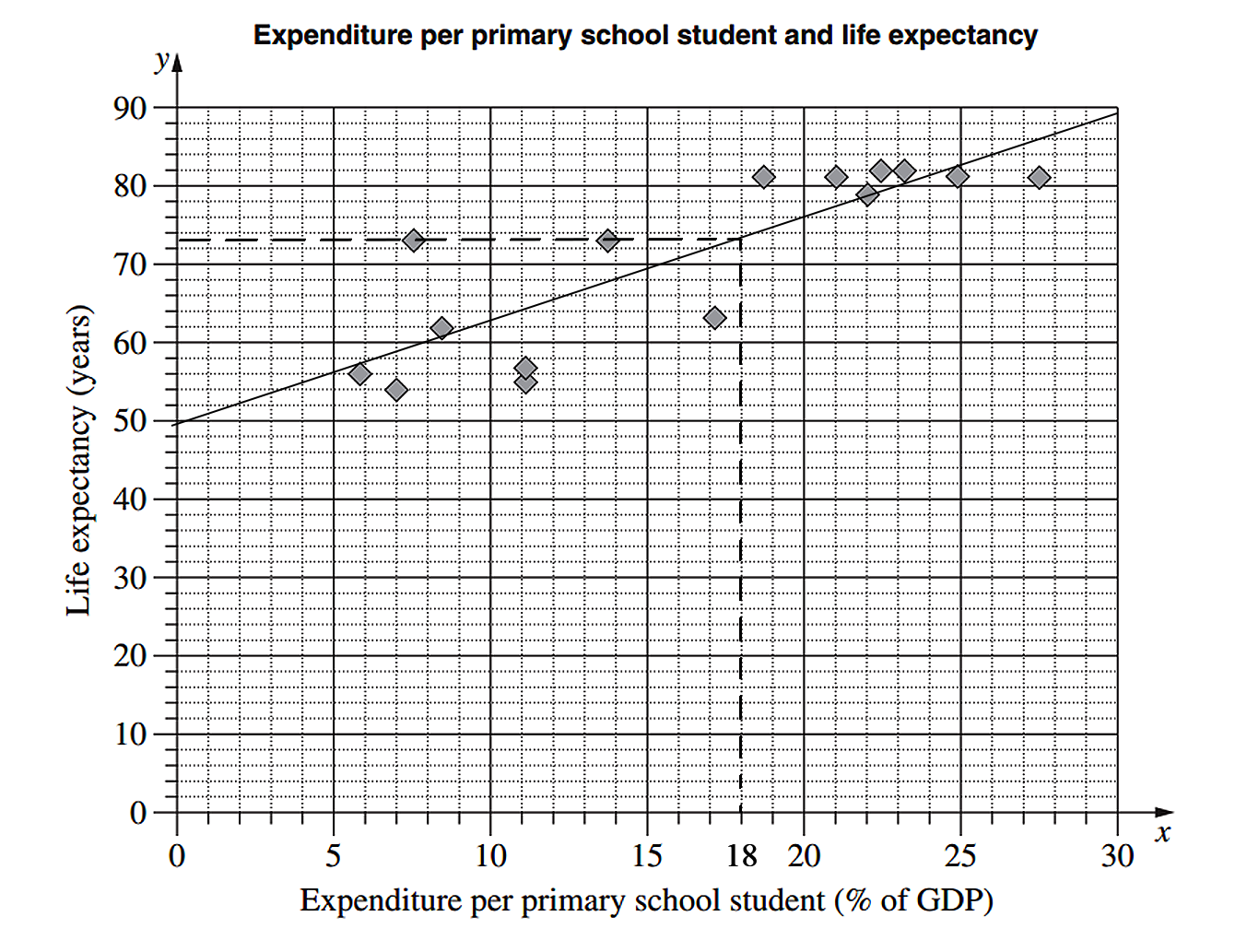
The scatterplot shows the relationship between expenditure per primary school student, as a percentage of a country’s Gross Domestic Product (GDP), and the life expectancy in years for 15 countries.


  1. For the given data, the correlation coefficient,  `r`, is 0.83. What does this indicate about the relationship between expenditure per primary school student and life expectancy for the 15 countries?   (1 mark)

    --- 1 WORK AREA LINES (style=lined) ---

  2. For the data representing expenditure per primary school student,  `Q_L`  is 8.4 and  `Q_U`  is 22.5.


    What is the interquartile range?   (1 mark)

    --- 1 WORK AREA LINES (style=lined) ---

  3. Another country has an expenditure per primary school student of 47.6% of its GDP.


    Would this country be an outlier for this set of data? Justify your answer with calculations.   (2 marks)

    --- 4 WORK AREA LINES (style=lined) ---

  4. On the scatterplot, draw the least-squares line of best fit  `y = 1.29x + 49.9`.    (2 marks)

    --- 4 WORK AREA LINES (style=lined) ---

  5. Using this line, or otherwise, estimate the life expectancy in a country which has an expenditure per primary school student of 18% of its GDP.   (1 mark)

    --- 1 WORK AREA LINES (style=lined) ---

  6. Why is this line NOT useful for predicting life expectancy in a country which has expenditure per primary school student of 60% of its GDP?   (1 mark)

    --- 1 WORK AREA LINES (style=lined) ---

Show Answers Only
  1. `text(It indicates there is a strong positive)`


    `text(correlation between the two variables.)`

  2. `14.1`
  3. `text(Yes, because it’s > 43.65%)`
  4.  
  5. `73.1\ text(years)`
  6. `text(At 60% GDP, the line predicts a life expectancy)`
  7.  

    `text(of 127.3. This line of best fit is only accurate)`

  8.  

    `text(in a lower range of GDP expediture.)`

Show Worked Solution
i. `text(It indicates there is a strong positive)`
  `text(correlation between the two variables)`


ii. `text(IQR)` `= Q_U\ – Q_L`
    `= 22.5\ – 8.4`
    `= 14.1`


♦ Mean mark 35% 

iii.  `text(An outlier on the upper side must be more than)` 

`Q_u\ +1.5xxIQR`

`=22.5+(1.5xx14.1)`

`=\ text(43.65%)`

`:.\ text(A country with an expenditure of 47.6% is an outlier).`


iv.  

v.  `text(Life expectancy) ~~ 73.1\ text{years (see dotted line)}`

♦♦ Mean mark 39%


`text(Alternative Solution)`

`text(When)\ x=18`

`y=1.29(18)+49.9=73.12\ \ text(years)`


♦♦♦ Mean mark 0%. The toughest question on the 2014 paper.
COMMENT: Examiners regularly ask students to identify and comment on outliers where linear relationships break down.
vi.   `text(At 60% GDP, the line predicts a life)`
  `text(expectancy of 127.3. This line of best)`
  `text(fit is only predictive in a lower range)`
  `text(of GDP expenditure.)`

Filed Under: Bivariate Data Analysis (Y12), Correlation / Body Measurements, Life Expectancy, Other Linear Modelling, S4 Bivariate Data Analysis (Y12) Tagged With: Band 4, Band 5, Band 6, common-content, smc-1001-10-Line of Best Fit, smc-1001-30-Correlation, smc-1001-60-Limitations, smc-785-10-Line of Best Fit, smc-785-30-Correlation, smc-785-60-Limitations

Algebra, STD2 A4 2014 HSC 29a

The cost of hiring an open space for a music festival is  $120 000. The cost will be shared equally by the people attending the festival, so that  `C`  (in dollars) is the cost per person when  `n`  people attend the festival.

  1. Complete the table below by filling in the THREE missing values.   (1 mark)
    \begin{array} {|l|c|c|c|c|c|c|}
    \hline
    \rule{0pt}{2.5ex}\text{Number of people} (n) \rule[-1ex]{0pt}{0pt} & \ 500\ & \ 1000 \ & 1500 \ & 2000 \ & 2500\ & 3000 \ \\
    \hline
    \rule{0pt}{2.5ex}\text{Cost per person} (C)\rule[-1ex]{0pt}{0pt} &  &  &  & 60 & 48\ & 40 \ \\
    \hline
    \end{array}
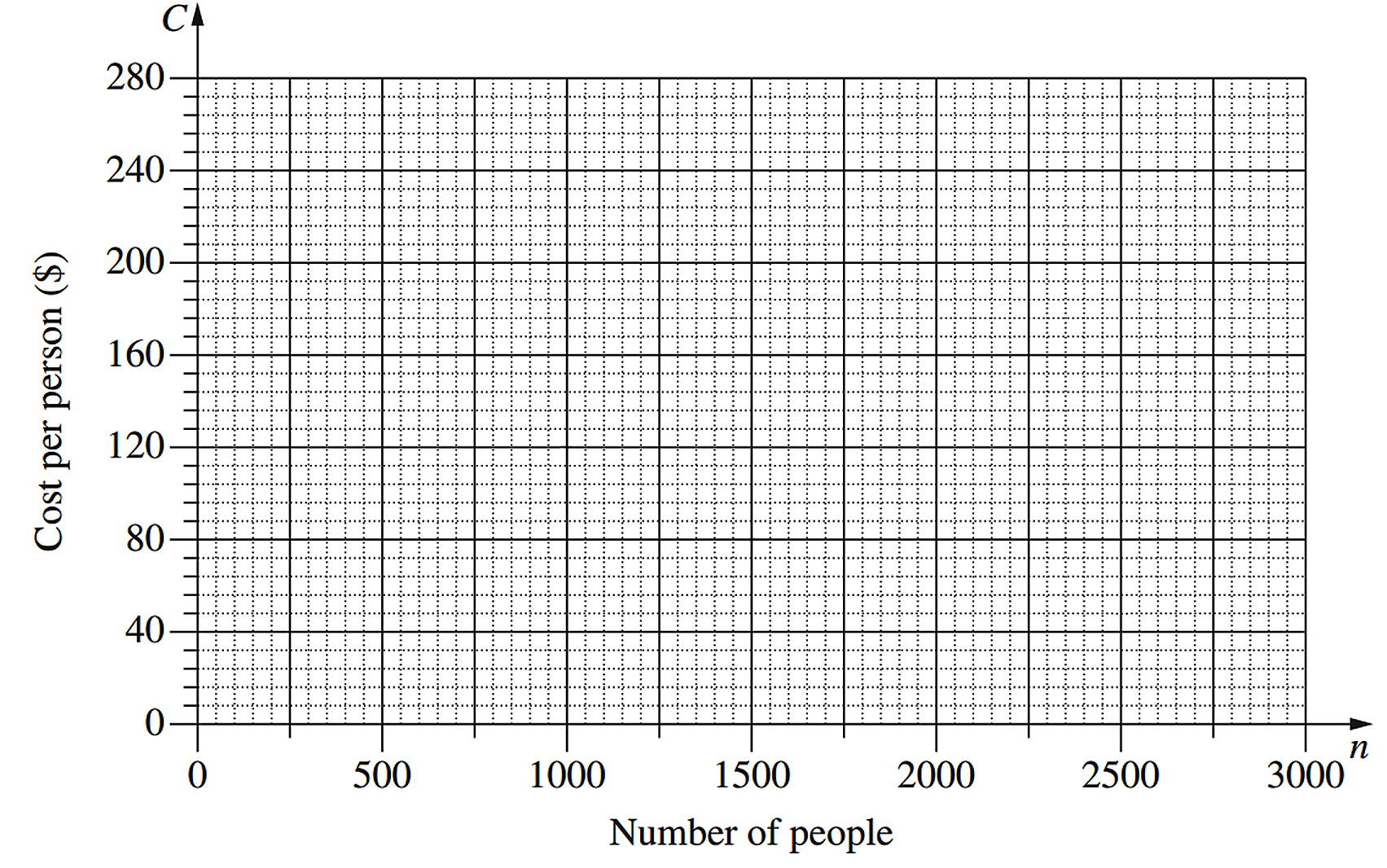
  2. Using the values from the table, draw the graph showing the relationship between  `n`  and  `C`.   (2 marks)
     
  3. What equation represents the relationship between `n` and `C`?   (1 mark)

    --- 1 WORK AREA LINES (style=lined) ---

  4. Give ONE limitation of this equation in relation to this context.   (1 mark)

    --- 2 WORK AREA LINES (style=lined) ---

  5. Is it possible for the cost per person to be $94? Support your answer with appropriate calculations.   (1 mark)

    --- 2 WORK AREA LINES (style=lined) ---

Show Answers Only

i.   

\begin{array} {|l|c|c|c|c|c|c|}
\hline
\rule{0pt}{2.5ex}\text{Number of people} (n) \rule[-1ex]{0pt}{0pt} & \ 500\ & \ 1000 \ & 1500 \ & 2000 \ & 2500\ & 3000 \ \\
\hline
\rule{0pt}{2.5ex}\text{Cost per person} (C)\rule[-1ex]{0pt}{0pt} & 240 & 120 & 80 & 60 & 48\ & 40 \ \\
\hline
\end{array}
 

ii. 

iii.   `C = (120\ 000)/n`

`n\ text(must be a whole number)`
 

iv.   `text(Limitations can include:)`

  `•\ n\ text(must be a whole number)`

  `•\ C > 0`
 

v.   `text(If)\ C = 94:`

`94` `= (120\ 000)/n`
`94n` `= 120\ 000`
`n` `= (120\ 000)/94`
  `= 1276.595…`

 
`:.\ text(C)text(ost cannot be $94 per person,)`

`text(because)\ n\ text(isn’t a whole number.)`

Show Worked Solution

i.   

\begin{array} {|l|c|c|c|c|c|c|}
\hline
\rule{0pt}{2.5ex}\text{Number of people} (n) \rule[-1ex]{0pt}{0pt} & \ 500\ & \ 1000 \ & 1500 \ & 2000 \ & 2500\ & 3000 \ \\
\hline
\rule{0pt}{2.5ex}\text{Cost per person} (C)\rule[-1ex]{0pt}{0pt} & 240 & 120 & 80 & 60 & 48\ & 40 \ \\
\hline
\end{array}
 

ii. 


♦ Mean mark (iii) 48%

iii.   `C = (120\ 000)/n`


♦♦♦ Mean mark (iv) 7%
COMMENT: When asked for limitations of an equation, look carefully at potential restrictions with respect to both the domain and range.

iv.   `text(Limitations can include:)`

  `•\ n\ text(must be a whole number)`

  `•\ C > 0`


v.   `text(If)\ C = 94`

`=> 94` `= (120\ 000)/n`
`94n` `= 120\ 000`
`n` `= (120\ 000)/94`
  `= 1276.595…`
♦ Mean mark (v) 38%


`:.\ text(C)text(ost cannot be $94 per person,)`

`text(because)\ n\ text(isn’t a whole number.)`

Filed Under: Circles and Hyperbola, Inverse, Non-Linear: Inverse and Other Problems (Std 2) Tagged With: Band 4, Band 5, Band 6, num-title-ct-pathc, num-title-qs-hsc, smc-4445-60-Hyperbola applications, smc-795-10-Inverse, smc-795-30-Limitations

FS Driving, 2UG 2014 HSC 27a

Alex is buying a used car which has a sale price of  $13 380. In addition to the sale price there are the following costs:

2014 27a1

  1. Stamp Duty for this car is calculated at $3 for every $100, or part thereof, of the sale price.  
  2. Calculate the Stamp Duty payable.   (1 mark)
  3.  
  4. Alex borrows the total amount to be paid for the car including Stamp Duty and transfer of registration. Interest on the loan is charged at a flat rate of  7.5%  per annum. The loan is to be repaid in equal monthly instalments over 3 years.  
  5.  
    Calculate Alex’s monthly repayments.   (4 marks)
  6.  
  7. Alex wishes to take out comprehensive insurance for the car for 12 months. The cost of comprehensive insurance is calculated using the following: 
    1.  
    2. 2014 27a2
  8. Find the total amount that Alex will need to pay for comprehensive insurance.   (3 marks)
  9.  
  10. Alex has decided he will take out the comprehensive car insurance rather than the less expensive non-compulsory third-party car insurance.
  11. What extra cover is provided by the comprehensive car insurance?   (1 mark)


Show Answers Only
  1. `$402`
  2. `$470\ text{(nearest dollar)}`
  3. `$985.74`
  4. `text(Comprehensive insurance covers Alex)`
  5. `text(for damage done to his own car as well.)`
  6.  
Show Worked Solution
♦♦♦ Mean mark 12%
IMPORTANT: “or part thereof ..” in the question requires students to round up to 134 to get the right multiple of $3 for their calculation.
(i)    `($13\ 380)/100 = 133.8`
`:.\ text(Stamp duty)` `= 134 xx $3`
  `= $402`


(ii)    `text(Total loan)` `= $13\ 380 + 30 + 402`
    `= $13\ 812`


`text(Total interest)\ (I)` `= Prn`
  `= 13\ 812 xx 7.5/100 xx 3`
  `= 3107.70`


`text(Total to repay)` `= 3107.70 + 13\ 812`
  `= 16\ 919.70`


`text(# Repayments) = 3 xx 12 = 36`

`:.\ text(Monthly repayment)` `= (16\ 919.70)/36`
  `= 469.9916…`
  `= $470\ text{(nearest dollar)}`


(iii)   `text(Base rate) = $845`

`text(FSL) =\ text(1%) xx 845 = $8.45`

`text(Stamp)` `=\ text(5.5%) xx(845 + 8.45)`
  `= 46.9397…`
  `= $46.94\ text{(nearest cent)}`
`text(GST)` `= 10 text(%) xx(845 + 8.45)`
  `= 85.345`
  `= $85.35`


`:.\ text(Total cost)` `= 845 + 8.45 + 46.94 + 85.35`
  `= $985.74`


♦ Mean mark 34%.
(iv)   `text(Comprehensive insurance covers Alex)`
  `text(for damage done to his own car as well.)`

Filed Under: Costs to Purchase / Insurance, FM3 - Taxation, FM4 - Credit and Borrowing Tagged With: Band 4, Band 5, Band 6

Statistics, STD2 S1 2014 HSC 26e

The times taken for 160 music downloads were recorded, grouped into classes and then displayed using the cumulative frequency histogram shown.   


On the diagram, draw the lines that are needed to find the median download time.   (2 marks)

--- 0 WORK AREA LINES (style=lined) ---

Show Answers Only

Show Worked Solution
♦♦♦ Mean mark 17%.

HSC 2014 26ei

Filed Under: Bar Charts and Histograms, Bar Charts and Histograms (Std 2), Bar Charts and Histograms (Std2-2027), Bar Charts and Histograms (Y12) Tagged With: Band 6, common-content, smc-6310-30-Cumulative Frequency Histograms, smc-821-20-Cumulative Frequency Histograms, smc-997-20-Cumulative Frequency Histograms

Probability, STD2 S2 2014 HSC 16 MC

In Mathsville, there are on average eight rainy days in October.

Which expression could be used to find a value for the probability that it will rain on two consecutive days in October in Mathsville?

  1. `8/31 xx 7/30`
  2. `8/31 xx 7/31`
  3. `8/31 xx 8/30`
  4. `8/31 xx 8/31`
Show Answers Only

`D`

Show Worked Solution

`P text{(rains)} = 8/31\ \ \text{(independent event for each day)}`

`text{Since each day has same probability:}`

`P(R_1 R_2) = 8/31 xx 8/31`

`=>  D`

♦♦♦ Mean mark 16%.
Lowest mark of any MC question in 2014!

Filed Under: Multi-stage Events, Multi-Stage Events, Multi-Stage Events (Std 2) Tagged With: Band 6, num-title-ct-corea, num-title-qs-hsc, smc-4238-20-Independent events, smc-829-20-Other Multi-Stage Events

FS Comm, 2UG 2014 HSC 5 MC

How many kilobytes are there in 2 gigabytes?

(A)   `2^20` 

(B)   `2^21`

(C)   `2^30`

(D)   `2^31`

Show Answers Only

`B`

Show Worked Solution
♦♦♦ Mean mark 24%!
`2\ text(GB)` `= 2 xx 2^20\ text(kB)`
  `= 2^21\ text(kB)`

`=>  B`

Filed Under: FS Communication Tagged With: Band 6

Quadratic, EXT1 2014 HSC 13c

The point  `P(2at, at^2)`  lies on the parabola  `x^2 = 4ay`  with focus  `S`.

The point  `Q`  divides the interval  `PS`  internally in the ratio  `t^2 :1`.

2014 13c 

  1. Show that the coordinates of  `Q`  are  
  2. `x = (2at)/(1 + t^2)`  and  `y = (2at^2)/(1 + t^2)`.  (2 marks)
  3. Express the slope of  `OQ`  in terms of  `t`.    (1 mark)
  4. Using the result from part (ii), or otherwise, show that  `Q`  lies on a fixed circle of radius  `a`.   (3 marks)


Show Answers Only
  1. `text(Proof)\ \ text{(See Worked Solutions)}`
  2. `m_(OQ) = t`
  3. `text(Proof)\ \ text{(See Worked Solutions)}`
Show Worked Solution

(i)   `text(Show)\ \ Q = ((2at)/(1 + t^2), (2at^2)/(1 + t^2))`

`P (2at, at^2),\ S (0, a)`

`PS\ text(is divided internally in ratio)\ t^2: 1`

`Q` `= ((nx_1 + mx_2)/(m + n), (ny_1 + my_2)/(m + n))`
  `= ((1(2at) + t^2(0))/(t^2 + 1), (1(at^2) + t^2 (a))/(t^2 + 1))`
  `= ((2at)/(1 + t^2), (2at^2)/(1 + t^2))\ \ text(… as required.)`


(ii)    `m_(OQ)` `= (y_2\ – y_1)/(x_2\ – x_1)`
    `= ((2at^2)/(1 + t^2))/((2at)/(1 + t^2)) xx (1+t^2)/(1+t^2)`
    `= (2at^2)/(2at)`
    `= t`


(iii)   `text(Show)\ Q\ text(lies on a fixed circle radius)\ a`
  `text(S)text(ince)\ Q\ text(passes through)\ (0, 0)`


`=>\ text(If locus of)\ Q\ text(is a circle, it has)`

`text(diameter)\ QT\ text(where)\ T(0, 2a)`


`text(Show)\ \ QT _|_ OQ`

♦♦ Mean mark 22%

`text{(} text(angles on circum. subtended by)`

  `text(a diameter are)\ 90^@ text{)}`


`m_(OQ) = t\ \ \ \ text{(see part (ii))}`

`text(Find)\ m_(QT),\ \ text(where:)`

`Q((2at)/(1 + t^2), (2at^2)/(1 + t^2)),\ \ \ \ \ T (0,2a)`

`m_(QT)` `= (y_2\ – y_1)/(x_2\ – x_1)`
  `= ((2at^2)/(1 + t^2)\ – 2a)/((2at)/(1 + t^2)\ – 0)`
  `= (2at^2\ – 2a (1 + t^2))/(2at)`
  `= – (2a)/(2at)`
  `= – 1/t`


`m_(QT) xx m_(OT) = -1/t xx t = -1`

`=> QT _|_ OQ`

`=>O,\ T,\ Q\ text(lie on a circle.)`

`:.\ text(Locus of)\ Q\ text(is a fixed circle,)`

`text(centre)\ (0, a),\ text(radius)\ a`

Filed Under: 9. Quadratics and the Parabola EXT1 Tagged With: Band 3, Band 4, Band 5, Band 6

Binomial, EXT1 2011 HSC 7b

The binomial theorem states that 
 

`(1 + x)^n = sum_(r = 0)^(n) ((n),(r)) x^r`  for all integers  `n >= 1`. 
 

  1. Show that    
    1. `sum_(r=1)^n ((n),(r)) rx^r = nx (1 + x)^(n\ - 1)`.   (2 marks)
    2.  
  2. By differentiating the result from part (i), or otherwise, show that
    1. `sum_(r = 1)^n ((n),(r)) r^2 = n (n + 1) 2^(n\ - 2)`.    (2 marks)
    2.  
  3. Assume now that  `n`  is even. Show that, for  `n >= 4`, 
    1. `((n),(2)) 2^2 + ((n),(4)) 4^2 + ((n),(6)) 6^2 + ... + ((n),(n)) n^2 = n(n+1)2^(n\ - 3)`.  
    2. (3 marks)


Show Answers Only
  1. `text(Proof)\ \ text{(See Worked Solutions)}`
  2. `text(Proof)\ \ text{(See Worked Solutions)}`
  3. `text(Proof)\ \ text{(See Worked Solutions)}`
Show Worked Solution
♦ Mean mark 36%. 
MARKER’S COMMENT: Better responses provided a narrative through the solution such as “Differentiate both sides” and “Mult. by `x`”, as seen in the solutions.

(i) `text(Show)\ sum_(r=1)^n ((n),(r)) rx^r = nx (1 + x)^(n\ – 1)`

`text(Using)\ (1 + x)^n = sum_(r=0)^n ((n),(r)) x^r :`

`(1 + x)^n = ((n),(0)) + ((n),(1)) x + ((n),(2)) x^2 + … + ((n),(n)) x^n`
 

`text(Differentiate both sides)`

`n(1 + x)^(n\ – 1) = ((n),(1)) + ((n),(2)) 2x + … + ((n),(n)) nx^(n\ – 1)`
 

`text(Multiply both sides by)\ x`

`nx (1 + x)^(n\ – 1)` `= ((n),(1)) x + ((n),(2)) 2x^2 + … + ((n),(n)) nx^n`
  `= sum_(r=1)^n ((n),(r)) rx^r\ \ text(… as required.)`


(ii)  `text(Show)\ \ sum_(r=1)^n ((n),(r)) r^2 = n (n+1) 2^(n\ – 2)`

♦♦ Mean mark 36%.

 
`text(Using part)\ text{(i)}`

`nx (1 + x)^(n\ – 1) = ((n),(1)) x + ((n),(2)) 2x^2 + … + ((n),(n)) nx^n`
 

`text(Differentiate LHS)`

`nx (n\ – 1)(1 + x)^(n\ – 2) + n(1 + x)^(n\ – 1)`

`= n (1 + x)^(n\ – 2) [x (n\ – 1) + (1 + x)]`

`= n (1 + x)^(n\ – 2) (xn\ – x + 1 + x)`

`= n (xn + 1)(1 + x)^(n\ – 2)`
 

`text(Differentiate RHS)`

`((n),(1)) + ((n),(2)) 2^2 x + ((n),(3)) 3^2 x^2 + … + ((n),(n)) n^2 x^(n\ – 1)\ text{… (*)}`

 
`text(Substitute)\ \x = 1\ text(into both sides)`

`((n),(1)) + ((n),(2)) 2^2 + … + ((n),(n)) n^2` `= n (n + 1)(1 + 1)^(n\ – 2)`
`sum_(r=1)^n ((n),(r)) r^2` `= n (n + 1) 2^(n\ – 2)`


(iii)  `text(Show for)\ \ n >= 4`

`((n),(2)) 2^2 + ((n),(4)) 4^2 + ((n),(6)) 6^2 + … + ((n),(n)) n^2 = n (n + 1) 2^(n\ – 3)`

♦♦♦ Toughest question in the 2011 exam. Mean mark of 2%. The lowest mean of any Ext1 question since that data became available post-2009!

 
`text{From part(ii) … (*) we know}`

`((n),(1)) + ((n),(2)) 2^2 x + … + ((n),(n)) n^2 x^(n\ – 1) = n (xn + 1)(1 + x)^(n\ – 2)`

 
`text(When)\ \ x = 1`

`((n),(1)) + ((n),(2)) 2^2 + … + ((n),(n)) n^2 = n (n + 1) 2^(n\ – 2)\ \ \ \ \ …\ (1)`

 
`text(When)\ x = –1`

`((n),(1))\ – ((n),(2)) 2^2 + ((n),(3)) 3^2\ – …\ – ((n),(n)) n^2`
 `= n (-n + 1)* 0^(n\ – 2)=0\ \ \ \ \ …\ (2)`
`text{(Note that}\ n≠2\ \ text{because}\ 0^0\ text{is undefined)}`

 
`(1)\ – (2)`

`2[((n),(2)) 2^2 + ((n),(4)) 4^2 + … + ((n),(n)) n^2]` `= n (n + 1) 2^(n\ – 2) – 0`
`((n),(2)) 2^2 + ((n),(4)) 4^2 + … + ((n),(n)) n^2` `= 1/2 n (n + 1) 2^(n\ – 2)`
  `= n (n + 1) 2^(n\ – 3)`

 
`:.\ text(Above statement true for integers)\ n >= 4.`

Filed Under: 17. Binomial EXT1 Tagged With: Band 5, Band 6

Polynomials, EXT1 2013 HSC 14c

The equation  `e^t = 1/t`   has an approximate solution  `t_0 = 0.5`

  1. Use one application of Newton’s method to show that  `t_1 = 0.56`  is another approximate solution of  `e^t = 1/t`.   (2 marks)
  2. Hence, or otherwise, find an approximation to the value of  `r`  for which the graphs  `y = e^(rx)`  and  `y = log_e x`  have a common tangent at their point of intersection.     (3 marks)
Show Answers Only
  1. `text(Proof)\ \ text{(See Worked Solutions)}`
  2. `0.097\ text{(to 3 d.p.)}`
Show Worked Solution
MARKER’S COMMENT: Many students had difficulty expressing a valid function while too many others carelessly used `t_0=0.56` rather than 0.5.
(i) `e^t` `= 1/t`
  `e^t\ – 1/t` `= 0`
`text(Let)\ \ f(t)` `= e^t\ – 1/t`
`f prime (t)` `= e^t + 1/(t^2)`
`f(0.5)` `=e^0.5-1/0.5`
  `=–0.3512…`
`f′(0.5)` `=e^0.5 +1/0.5^2`
  `=5.6487…`


`text(Applying Newton where)\ \ t_0 = 0.5`

`t_1` `= 0.5\ – (f(0.5))/(f prime (0.5)`
  `= 0.5\ – (–0.3512…)/(5.6487…)`
  `= 0.5\ – (- 0.062)`
  `= 0.56\ text{(2 d.p.)}\ \ text(… as required.)`


(ii) `y_1` `= e^(rx),` `\ \ \ \ \ (dy_1)/(dx) = re^(rx)`
  `y_2` `= log_e x,` `\ \ \ \ \ (dy_2)/(dx) = 1/x`
♦♦♦ 2nd toughest question on 2013 paper with mean mark 15%.
MARKER’S COMMENT: Few students used the common tangent information to equate the derivative functions.
 

`text(S)text(ince tangent is common),\ \ (dy_1)/(dx)=(dy_2)/(dx)`

`re^(rx)` `= 1/x`
`e^(rx)` `= 1/(rx)`


`text(Using part)\ text{(i)},\ rx ~~ 0.56`

`text(At intersection of curves)\ \ y_1 = y_2`

`e^(rx)` `= log_e x`
`e^0.56` `= log_e x`
`x` `= e^(e^0.56)`
  `= 5.758 …`
`text(S)text(ince)\ rx` `~~ 0.56`
`=> r` `~~ 0.56/(5.758 … )`
  `~~ 0.0972 …`
  `~~ 0.097\ text{(to 3 d.p.)}`

Filed Under: 12. Logs and Exponentials EXT1, Newton's Method etc... EXT1 Tagged With: Band 4, Band 6

Binomial, EXT1 2013 HSC 14b

  1. Write down the coefficient of  `x^(2n)`  in the binomial expansion of  `(1 + x)^(4n)`.    (1 mark)
  2. Show that  
    1. `(1 + x^2 + 2x)^(2n) = sum_(k=0)^(2n) ((2n),(k)) x^(2n\ - k)(x + 2)^(2n\ - k)`.   (2 marks)
       
  3. It is known that  
     
    `x^(2n\ - k) (x + 2)^(2n\ - k) = ((2n\ - k),(0)) 2^(2n\ - k) x^(2n\ - k) + ((2n\ - k),(1)) 2^(2n\ - k\ - 1) x^(2n\ - k + 1)`

    1.  
      1.     `+ ... + ((2n\ - k),(2n\ - k)) 2^0 x^(4n\ - 2k)`.   (Do NOT prove this.)
      2.  
  4. Show that
  5.  
    1. `((4n),(2n)) = sum_(k = 0)^(n) 2^(2n\ - 2k) ((2n),(k))((2n\ - k),(k))`.   (3 marks)


Show Answers Only
  1. `((4n),(2n))`
  2.  
  3. `text(Proof)\ \ text{(See Worked Solutions)}`
  4. `text(Proof)\ \ text{(See Worked Solutions)}`
Show Worked Solution

(i)  `text(Find co-efficient of)\ \ x^(2n)`

`text(Expanding)\ \ (1+x)^(4n)`

`((4n),(0)) + ((4n),(1))x + ((4n),(2))x^2 + … + ((4n),(2n))x^(2n) + …`

`:.\ text(Co-efficient of)\ \ x^(2n)\ text(is)\ ((4n),(2n))`


(ii)  `text(Show)\ (1 + x^2 + 2x)^(2n) = sum_(k=0)^(2n) ((2n),(k)) x^(2n\ – k) (x + 2)^(2n\ – k)`

♦♦ Mean mark 30%.

`text(Using)\ (1 + x^2 + 2x)^(2n) = [x(x + 2) + 1]^(2n)`

`[x (x + 2) + 1]^(2n)`
`= ((2n),(0)) (x(x + 2))^(2n) + ((2n),(1)) (x(x + 2))^(2n\ – 1) + … + ((2n),(2n))` 
`= ((2n),(0)) x^(2n)(x + 2)^(2n) + ((2n),(1)) x^(2n\ – 1) (x + 2)^(2n\ – 1) + … + ((2n),(2n))` 
`= sum_(k=0)^(2n) ((2n),(k)) x^(2n\ – k) (x + 2)^(2n\ – k)\ text(… as required.)`


(iii)  `((4n),(2n))\ text(is the co-eff of)\ x^(2n)\ text(in expansion)\ (1+x)^(4x)`

`text(S)text(ince)\ (1 + x^2 + 2x)^(2n) = ((x+1)^2)^(2n) = (1 + x)^(4n)`

`=> ((4n),(2n))\ text(is co-efficient of)\ x^(2n)\ text(in expansion)\ (1 + x^2 + 2x)^(2n)`

 
`text(Using part)\ text{(ii)}`

`(1 + x^2 + 2x)^(2n) = sum_(k=0)^(2n) ((2n),(k))\ x^(2n\ – k) (x + 2)^(2n\ – k)`


`text(Using the given identity,)\ x^(2n)\ text(co-efficients are)`

♦♦♦ Toughest question in the 2013 exam with Mean mark 12%!
MARKER’S COMMENT: Simply stating `(1+x^2+2x)^(2n)“=(1+x)^(4n)` received 1 full mark, showing that even initial working can gain marks.
`k = 0,` `\ ((2n),(0))((2n\ – 0),(0)) 2^(2n\ – 0)`
`k = 1,` `\ ((2n),(1))((2n\ – 1),(1)) 2^(2n\ – 1\ – 1)`
`vdots`  
`k = n,` `\ ((2n),(n))((2n\ – n),(n)) 2^(2n\ – n\ – n)`


`:.\ ((4n),(2n))`
 `= ((2n),(0))((2n),(0))2^(2n) + ((2n),(1))((2n\ – 1),(1))2^(2n\ – 2) + … + ((2n),(n))((n),(n)) 2^0`
` = sum_(k=0)^(n)\ ((2n),(k))((2n\ – k),(k)) 2^(2n\ – 2k)\ \ \ \ text(… as required)`

Filed Under: 17. Binomial EXT1 Tagged With: Band 4, Band 5, Band 6

Combinatorics, EXT1 A1 2010 HSC 7c

  1. A box contains  `n`  identical red balls and  `n`  identical blue balls. A selection of  `r`  balls is made from the box, where  `0 <= r <= n`.


    Explain why the number of possible colour combinations is  `r + 1`.   (1 mark)

    --- 4 WORK AREA LINES (style=lined) ---

  2. Another box contains  `n`  white balls labelled consecutively from `1` to  `n`.  A selection of  `n − r`  balls is made from the box, where  `0 <= r <= n`.


    Explain why the number of different selections is  `((n),(r))`.   (1 mark)

    --- 4 WORK AREA LINES (style=lined) ---

  3. The  `n`  red balls, the  `n`  blue balls and the  `n`  white labelled balls are all placed into one box, and a selection of  `n`  balls is made.


    Using the identity,  `n2^(n-1)=sum_(k=1)^n  k ((n),(k)),` or otherwise, show that the number of different selections is  `(n + 2)2^(n- 1)`.    (3 marks)

    --- 6 WORK AREA LINES (style=lined) ---

Show Answers Only
  1. `text(Proof)\ \ text{(See Worked Solutions)}`
  2. `text(Proof)\ \ text{(See Worked Solutions)}`
  3. `text(Proof)\ \ text{(See Worked Solutions)}`
Show Worked Solution
♦♦♦ Mean mark 4%.
COMMENT: Solving this part required high level logical reasoning which proved extremely challenging for the vast majority of candidates.
i.    `text(1 Ball, # Combinations)` `= 2\ text{(R or B)}`
  `text(2 Balls, # Combinations)` `= 3\ text{(BB, BR, RR)}`
  `text(3 Balls, # Combinations)` `= 4`


`text{(BBB, RBB, RRB, RRR)}`

`text(i.e. # Red balls could be 0, 1, 2, 3, …)`
 

`:.\ text(If)\ r\ text(balls chosen, # Combinations) = r + 1`


ii.    `text(# Selections when choosing)\ (n\ – r)\ text(from)\ n`

`= ((n),(n\ – r))`

♦♦♦ Mean mark 18%.
 

`((n),(n\ – r))` `= (n!)/((n\ – r)!(n\ – (n\ – r))!)`
  `= (n!)/((n\ – r)! r!`
  `= ((n),(r))`


♦♦♦ Mean mark part (iii) 2%. Beast alert – equal lowest mean mark of any part of any question since this data has been available post-2009.

iii.   `text(If)\ n\ text(balls are chosen,)`

   `text(Let)\ r\ text(balls be red and blue and)`

   `(n\ – r)\ text(balls be white labelled.)`

`=> text{# Combinations (Red and blue)} = r + 1`

`=> text{# Combinations (White)} = ((n),(r))`

`text(Any selection of)\ \ r\ \ text(red and blue balls would)`

`text(result in)\ \ (n-r)\ \ text(white balls, with) \ r=0,1,2,…`


`:.\ text{# Selections (for any given}\ r\ text{)}`

`= (r + 1)((n),(r))`

`= r ((n),(r)) + ((n),(r))` 
 

 `:.\ text{Total Selections}` `= sum_(r=1)^n r ((n),(r)) + sum_(r=0)^n ((n),(r))`
  `= n2^(n\ – 1) + 2^n`
  `= n2^(n\ – 1) + 2*2^(n\ – 1)`
  `= (n + 2)2^(n\ – 1)\ text(… as required)`

Filed Under: Permutations and Combinations (Ext1), Permutations and Combinations EXT1 Tagged With: Band 6, smc-1082-40-Pigeonhole

Plane Geometry, EXT1 2010 HSC 5c

In the diagram,  `ST`  is tangent to both the circles at  `A`.

The points  `B`  and  `C`  are on the larger circle, and the line  `BC`  is tangent to the smaller circle at  `D`. The line  `AB`  intersects the smaller circle at  `X`.


Plane Geometry, EXT1 2010 HSC 5c

Copy or trace the diagram into your writing booklet 

  1. Explain why  `/_AXD = /_ABD + /_XDB.`   (1 mark)
  2. Explain why  `/_AXD = /_TAC + /_CAD.`   (1 mark)
  3. Hence show that  `AD`  bisects  `/_BAC`.    (2 marks)
Show Answers Only
  1. `text(Proof)\ \ text{(See Worked Solutions)}`
  2. `text(Proof)\ \ text{(See Worked Solutions)}`
  3. `text(Proof)\ \ text{(See Worked Solutions)}`
Show Worked Solution
(i)    Plane Geometry, EXT1 2010 HSC 5c Answer
`/_ AXD = /_ABD + /_XDB`
`text{(exterior angle of}\ Delta BXD text{)}`


♦ Mean mark 47%
(ii)    `/_AXD` `= /_TAD \ \ text{(angle in alternate segment)}`
    `= /_TAC + /_CAD\ \ text(… as required)`


(iii)  `text(Show)\ \ /_XAD = /_CAD`

`/_ABD + /_XDB` `=/_TAC + /_CAD\ \ text{(} text(from part)\ text{(i)} text(,)\ text{(ii)} text{)}`


`text(S)text(ince)\ /_TAC= /_ABD\ text{(angle in alternate segment)}`

♦♦ Mean mark 22%
IMPORTANT: Recognising that angles in the alternate segment are equal is an examiner favourite. LOOK FOR IT!
`=>/_XDB` `=/_CAD`
`/_XDB` `= /_XAD\ text{(angle in alternate segment)}`
`:. /_XAD` `= /_CAD`


`:.\ AD\ \ text(bisects)\ /_BAC.`

Filed Under: 2. Plane Geometry EXT1 Tagged With: Band 3, Band 5, Band 6

Calculus, EXT1 C1 2011 HSC 7a

The diagram shows two identical circular cones with a common vertical axis.  Each cone has height `h` cm and semi-vertical angle 45°.
 

2011 7a

The lower cone is completely filled with water. The upper cone is lowered vertically into the water as shown in the diagram. The rate at which it is lowered  is given by  

`(dl)/(dt) = 10`,

where `l` cm is the distance the upper cone has descended into the water after `t` seconds.

As the upper cone is lowered, water spills from the lower cone. The volume of water remaining in the lower cone at time `t` is  `V` cm³.

  1. Show that  `V = pi/3(h^3\ - l^3)`.   (1 mark)

    --- 4 WORK AREA LINES (style=lined) ---

  2. Find the rate at which `V` is changing with respect to time when  `l = 2`.     (2 marks)

    --- 5 WORK AREA LINES (style=lined) ---

  3. Find the rate at which `V` is changing with respect to time when the lower cone has lost  `1/8`  of its water. Give your answer in terms of `h`.   (2 marks)

    --- 6 WORK AREA LINES (style=lined) ---

Show Answers Only
  1. `text(Proof)\ \ text{(See Worked Solutions)}`
  2. `-40 pi\ \ text(cm³)// text(sec)`
  3. `(-5pih^2)/2\ text(cm³)// text(sec)`
Show Worked Solution

i.   `text(Show that)\ V = pi/3 (h^3\ – l^3)`

 ♦ Mean mark 42% 

`text(S)text(ince)\ \ tan45° = r/h=1`

`=>r=h`

`=>\ text(Radius of lower cone) = h`

`:.\ V text{(lower cone)}` `= 1/3 pi r^2 h`
  `= 1/3 pi h^3`

 
 `text(Similarly,)`

`V text{(submerged upper cone)} = 1/3 pi l^3`

`V text{(water left)}` `= 1/3 pi h^3\ – 1/3 pi l^3`
  `= pi/3 (h^3\ – l^3)\ \ \ text(… as required)`


ii.  `text(Find)\ (dV)/(dt)\ text(at)\ l = 2`

`(dV)/(dt)= (dV)/(dl) xx (dl)/(dt)\ …\ text{(1)}`

`=>(dl)/(dt)` `= 10\ text{(given)}`
`text(Using)\ \ V` `= pi/3 (h^3\ – l^3)\ \ \ \ text(from part)\ text{(i)}`
`=>(dV)/(dl)` `= -3 xx pi/3 l^2`
  `= -pi l^2`

  
`text(At)\ \ l = 2,`

`text{Substitute into (1) above}`

`(dV)/(dt)` `= -pi xx 2^2 xx 10`
  `= -40 pi\ \ \ text(cm³)//text (sec)`


iii.  `text(Find)\ \ (dV)/(dt)\ \ text(when lower cone has lost)\ 1/8 :`

♦♦♦ Mean mark 12%
MARKER’S COMMENT: Many unsuccessful answers attempted to find an alternate version of `(dV)/(dt)`. Part (ii) directed students directly toward the correct strategy.

`text(Find)\ \ l\ \ text(when)\ \ V = 7/8 xx 1/3 pi h^3`

`pi/3 (h^3\ – l^3)` `= 7/8 xx 1/3 pi h^3`
`h^3 -l^3` `= 7/8 h^3`
`l^3` `= 1/8 h^3`
`l` `= h/2`

   
`text(When)\ \ l = h/2 ,`

`(dV)/(dt)` `= -pi (h/2)^2 xx 10\ \ …\ text{(*)}`
  `= (-5pih^2)/2\ text(cm³)// text(sec)`

 
`:. V\ text(is decreasing at the rate of)\ \  (5 pi h^2)/2\ text(cm³)//text(sec).`

Filed Under: Rates of Change EXT1, Related Rates of Change (Ext1) Tagged With: Band 4, Band 5, Band 6, smc-1079-10-Volume

Statistics, EXT1 S1 2011 HSC 6c

A game is played by throwing darts at a target. A player can choose to throw two or three darts.

Darcy plays two games. In Game 1, he chooses to throw two darts, and wins if he hits the target at least once. In Game 2, he chooses to throw three darts, and wins if he hits the target at least twice.

The probability that Darcy hits the target on any throw is  `p`, where  `0 < p < 1`.

  1. Show that the probability that Darcy wins Game 1 is  `2p- p^2`.    (1 mark)

    --- 4 WORK AREA LINES (style=lined) ---

  2. Show that the probability that Darcy wins Game 2 is  `3p^2- 2p^3`.     (1 mark)

    --- 3 WORK AREA LINES (style=lined) ---

  3. Prove that Darcy is more likely to win Game 1 than Game 2.    (2 marks)

    --- 3 WORK AREA LINES (style=lined) ---

  4. Find the value of  `p`  for which Darcy is twice as likely to win Game 1 as he is to win Game 2.    (2 marks)

    --- 6 WORK AREA LINES (style=lined) ---

Show Answers Only
  1. `text(Proof)\ \ text{(See Worked Solutions)}`
  2. `text(Proof)\ \ text{(See Worked Solutions)}`
  3. `text(Proof)\ \ text{(See Worked Solutions)}`
  4. `p = (7 – sqrt17)/8`
Show Worked Solution

i.  `text(Show)\ P text{(wins Game 1)} = 2p\ – p^2`

♦ Mean mark 47%.

`P text{(Hits)} = P text{(H)} = p`

`P text{(Miss)} = P text{(M)} = 1 – p`
 

`P text{(Wins G1)}` `= 1 – P text{(MM)}`
  `= 1 – (1 – p)^2`
  `= 1 – 1 + 2p – p^2`
  `= 2p – p^2\ \ \ text(… as required)`


ii.  `text(Show)\ \ P text{(wins Game 2)} = 3p – 2p^3 :`

♦ Mean mark 40%.

`text(Darcy wins G2 if he hits 3 times, or twice.)`

`Ptext{(Hits 3 times)}=\ ^3C_3 (p)^3=p^3`

`Ptext{(Hits twice)}=\ ^3C_2 (p)^2 (1-p)=3p^2-3p^3`

 `P text{(Wins G2)}` `= p^3 + 3p^2-3p^3`
  `= 3p^2 – 2p^3\ \ \ text(… as required)`


♦♦♦ Mean mark 17%.
COMMENT: It is critical for students to utilise the limits of  `0<p<1`  to answer part (iii).

iii.  `text(Prove more likely to win G1 vs G2)`

`text(i.e.  Show)\ \ \ ` `2p – p^2 > 3p^2 – 2p^3`
  `2p^3 – 4p^2 + 2p` `> 0`
  `2p (p^2 – 2p + 1)` `> 0` 
  `2p (p – 1)^2` `> 0` 

 
`=> text(TRUE since)\ \ (p-1)^2>0\ \ text(and)\ \ 0 < p < 1`

`:.\ text(More likely for Darcy to win Game 1.)`
 

iv.  `text(If twice as likely to win G1 vs G2)`

♦♦ Mean mark 21%.
MARKER’S COMMENT: BE CAREFUL in formulating your equation here. Many students multiplied the wrong side by 2.
`2p\ – p^2` `= 2(3p^2 – 2p^3)`
  `= 6p^2 – 4p^3`
`4p^3 – 7p^2 + 2p` `= 0`
`p(4p^2 – 7p + 2)` `= 0`


`p` `= (–(–7) +- sqrt((–7)^2\ – 4 xx 4 xx 2))/(2 xx 4)`
  `= (7 +- sqrt(49\ – 32))/8`
  `= (7 +- sqrt17)/8`

 
`text(S)text(ince)\ \ 0<p<1,`

`p = (7\ – sqrt17)/8`

Filed Under: Binomial Probability (Ext1), Binomial Probability EXT1 Tagged With: Band 5, Band 6, smc-1084-30-Algebraic examples

Trig Ratios, EXT1 2011 HSC 5a

In the diagram,  `Q(x_0, y_0)`  is a point on the unit circle  `x^2 + y^2 = 1`  at an angle  `theta`  from the positive  `x`-axis, where  `− pi/2 < theta < pi/2`. The line through  `N(0, 1)`  and  `Q`  intersects the line  `y = –1`  at  `P`. The points  `T(0, y_0)`  and  `S(0, –1)` are on the  `y`-axis.


  1. Use the fact that  `Delta TQN`  and  `Delta SPN`  are similar to show that
     
  2.      `SP = (2costheta)/(1\ - sin theta)`.  (2 marks)
  3.  
  4. Show that  `(costheta)/(1\ - sin theta) = sec theta + tan theta`.    (1 mark)
  5.  
  6. Show that  `/_ SNP = theta/2 + pi/4`.   (1 mark)
  7.  
  8. Hence, or otherwise, show that  `sectheta + tantheta = tan(theta/2 + pi/4)`.   (1 mark)
  9.  
  10. Hence, or otherwise, solve  `sec theta + tan theta = sqrt3`, where  `-pi/2 < theta < pi/2`.   (2 marks)


Show Answers Only
  1. `text(Proof)\ \ text{(See Worked Solutions)}`
  2. `text(Proof)\ \ text{(See Worked Solutions)}`
  3. `text(Proof)\ \ text{(See Worked Solutions)}`
  4. `text(Proof)\ \ text{(See Worked Solutions)}`
  5. `pi/6\ text(radians)`
Show Worked Solution
(i)


♦ Mean mark 41%
MARKER’S COMMENT: When questions direct you to use a certain fact for a proof, use that fact!

`text(Show)\ SP = (2 cos theta)/(1\ – sin theta)`

`Delta SPN \ text(|||) \ Delta TQN\ \ \ text{(given)}`

`(SP)/(SN) = (TQ)/(TN)\ \ \ text{(corresponding sides of similar triangles)}`

`/_TQO = theta\ \ \ text{(alternate,}\ TQ\ text(||)\  x text{-axis)}`

  `sin theta` `= (OT)/1 => OT = sin theta`
`=>` `TN` `= 1\ – sin theta`
  `cos theta` `= (TQ)/1`
`=>` `TQ` `= cos theta`
`SN` `= 2\ \ \ text{(diameter of unit circle)}`
`:. (SP)/2` `= cos theta/(1\ – sin theta)`
`SP` `= (2 cos theta)/(1\ – sin theta)\ \ \ text(… as required)`


(ii)   `text(Show)\ \ costheta/(1\ – sin theta) = sec theta + tan theta`

♦ Mean mark 35%
`text(RHS)` `= 1/(costheta) + (sintheta)/(costheta)`
  `=(1 + sin theta)/cos theta xx cos theta/cos theta`
  `= (costheta(1 + sintheta))/(cos^2theta)`
  `= (costheta(1 + sin theta))/(1\ – sin^2 theta)`
  `= (costheta(1 + sin theta))/((1 + sin theta)(1\ – sin theta)`
  `= costheta/(1\ – sin theta)\ \ \ text(… as required)`


(iii)  `text(Show)\ \ /_SNP = theta/2 + pi/4`

♦♦♦ Mean mark 11%

`/_TOQ = 90\ – theta`

`text(S)text(ince)\ ON = OQ = 1\ text{(unit circle)}`

`=> Delta ONQ\ text(is isosceles)`

`:.\ /_SNP` `= 1/2 (180\ – (90\ – theta))\ \ \ \ text{(angle sum of}\ Delta ONQ text{)}`
  `= 90\ – 45 + theta/2`
  `= 45 + theta/2`
  `= pi/4 + theta/2\ \ \ text(… as required)`


(iv)  `text(Show)\ sec theta + tan theta = tan (theta/2 + pi/4)`

♦♦ Mean mark 28%

`text(S)text(ince)\ /_SNP = pi/4 + theta/2\ \ \ \ text{(} text(part)\ text{(iii)} text{)}`

`=> tan\  /_SNP = tan (pi/4 + theta/2)`


`text(Also,)\ tan\   /_SNP` `= (SP)/(SN)`
  `= ((2costheta)/(1\ – sin theta))/2`
  `= (cos theta)/(1\ – sin theta)`
  `= sec theta + tan theta\ \ \ \ text{(part (ii))}`


`:.\ sec theta + tan theta = tan (pi/4 + theta/2)\ \ \ text(… as required)`


♦ Mean mark 45%
(v)    `sec theta + tan theta` `= sqrt3,\ \ \ (-pi/2 < theta < pi/2)`
  `tan (pi/4 + theta/2)` `= sqrt3\ \ \ \ text{(part (iv))}`
  `tan (pi/3)` `= sqrt 3`

`text(S)text(ince tan is positive in)\  1^text(st) // 3^text(rd)\ text(quads)`

`theta/2 + pi/4` `= pi/3,\ (4pi)/3`
`theta/2` `= pi/12\ \ \ \ (-pi/2 < theta < pi/2)`
`:.\ theta` `= pi/6\ text(radians)`

Filed Under: 2. Plane Geometry EXT1, 5. Trig Ratios EXT1 Tagged With: Band 5, Band 6, page-break-before-solution

Plane Geometry, EXT1 2011 HSC 4b

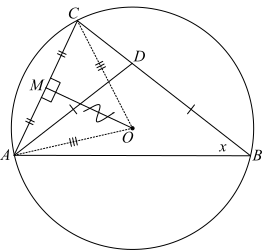
In the diagram, the vertices of  `Delta ABC`  lie on the circle with centre  `O`. The point  `D`  lies on  `BC`  such that  `Delta ABD`  is isosceles and  `/_ABC = x`.

Copy or trace the diagram into your writing booklet. 

  1. Explain why  `/_AOC = 2x`.    (1 mark)
  2. Prove that  `ACDO`  is a cyclic quadrilateral.    (2 marks)
  3. Let  `M`  be the midpoint of  `AC`  and  `P`  the centre of the circle through `A, C, D`  and  `O`. 
  4. Show that  `P, M`  and  `O`  are collinear.   (1 mark)
Show Answers Only
  1. `text(Angle at the centre of a circle is twice)`
  2. `text(angle of circumference on same arc)`
  3.  
  4. `text(Proof)\ \ text{(See Worked Solutions)}`
  5. `text(Proof)\ \ text{(See Worked Solutions)}`
Show Worked Solution
(i)

`/_AOC = 2x`

`text{(angles at circumference and}`

`text{centre on arc}\ AC text{)}`


♦ Mean mark 38%
STRATEGY: Proving part (ii) by showing opposite angles are supplementary also worked but was more time consuming.

(ii)  `text(Prove)\ ACDO\ text(is cyclic)`

`text(S)text(ince)\ Delta ADB\ text(is isosceles)`

`/_DAB = x\ \ \ text{(opposite equal sides in}\ Delta DBA text{)}`

`=> /_ADB` `= 180\ – 2x\ \ \ text{(angle sum of}\ Delta DAB text{)}`
`=> /_CDA` `= 2x\ \ \ text{(}CDB\ text{is a straight angle)}`


`text(S)text(ince chord)\ AC\ text(subtends)\ /_CDA = 2x`

`text(and)\ /_COA = 2x,`

`:.\ text(Quadrilateral)\ ACDO\ text(must be cyclic.)`


(iii)

 `text(Need to show)\ OM\ text(passes through)\ P,\ text(centre)`

♦♦♦ Mean mark 7%. 2nd hardest question in the 2011 paper!

`text(of circle through)\ ACDO.`

`AM` `= CM\ text{(} M\ text(is midpoint) text{)}`
`OC` `= OA\ text{(radii)}`

`OM\ text(is common)`

`:.\ Delta OAM -= Delta OCM\ \ \ text{(SSS)}`

`:. /_CMO = /_AMO\ \ \ ` `text{(corresponding angles of}`
  `\ \ text{congruent triangles)}`


`text(S)text(ince)\ ∠AMC\ text(is straight angle)`

`/_CMO = /_AMO = 90°`

`:.OM\ text(is perpendicular bisector)`

`text(of chord)\ AC.`

`:. OM\ text(passes through)\ P.`

`:.\ P, M,\ text(and)\ O\ text(are collinear.)`

Filed Under: 2. Plane Geometry EXT1 Tagged With: Band 3, Band 5, Band 6, page-break-before-solution

Mechanics, EXT2* M1 2011 HSC 3a

The equation of motion for a particle undergoing simple harmonic motion is 

 `(d^2x)/(dt^2) = -n^2 x`,

where `x` is the displacement of the particle from the origin at time `t`, and `n` is a positive constant.

  1. Verify that  `x = A cos nt + B sin nt`, where `A` and `B` are constants, is a solution of the equation of motion.    (1 mark)

    --- 5 WORK AREA LINES (style=lined) ---

  2. The particle is initially at the origin and moving with velocity `2n`. 


    Find the values of `A` and `B` in the solution  `x = A cos nt + B sin nt`.    (2 marks)

    --- 6 WORK AREA LINES (style=lined) ---

  3. When is the particle first at its greatest distance from the origin?   (1 mark)

    --- 5 WORK AREA LINES (style=lined) ---

  4. What is the total distance the particle travels between  `t = 0`  and  `t = (2pi)/n`?   (1 mark)

    --- 6 WORK AREA LINES (style=lined) ---

Show Answers Only
  1. `text(Proof)\ \ text{(See Worked Solutions)}`
  2. `A = 0,\ B = 2`
  3. `t = pi/(2n)`
  4. `text(8 units)`
Show Worked Solution
i.   `x` `= A cos nt + B sin nt`
  `(dx)/(dt)` `= – An sin nt + Bn cos nt`
  `(d^2x)/(dt^2)` `= – An^2 cos nt\ – Bn^2 sin nt`
    `= -n^2 (A cos nt + B sin nt)`
    `= -n^2 x\ \ \ text(… as required)`


ii.   `text(At)\ \ t=0, \ x=0, \ v=2n:`

`x` `= Acosnt + Bsinnt`
`0` `= A cos 0 + B sin 0`
`:.A` `= 0`

  
`text(Using)\ \ (dx)/(dt) = Bn cos nt`

`2n` `= Bn cos 0`
`Bn` `= 2n`
`:.B` `= 2`
♦♦ Mean mark part (iii) 47%
 

iii.   `text(Max distance from origin when)\ (dx)/(dt) = 0`

`(dx)/(dt)` `= 2n cos nt`
`0` `= 2n cos nt`
`cos nt` `= 0`
`nt` `= pi/2,\ (3pi)/2,\ (5pi)/2`
`t` `= pi/(2n),\ (3pi)/(2n), …`


`:.\ text(Particle is first at greatest distance)`

`text(from)\ O\ text(when)\ t = pi/(2n).`


iv.  `text(Solution 1)`

`text(Find the distance travelled from)\ \ t=0\ \→\ \ t=(2pi)/n`

`text{(i.e. 1 full period)}`

♦♦ Mean mark 22%
MARKER’S COMMENT: Many students found the displacement at `t` rather than the distance travelled while another common error found distance as 2 x amplitude.

`text(S)text(ince)\ \ x=2 sin (nt)`

`=> text(Amplitude)=2`

`:.\ text(Distance travelled)=4 xx2=8\ text(units)`


`text(Solution 2)`

`text(At)\ t = 0,\ x = 0`

`text(At)\ t` `= pi/(2n)`
`x` `= 2 sin (n xx pi/(2n)) = 2`
`text(At)\ t` `= (3pi)/(2n)\ \ \ text{(i.e. the next time}\ \ (dx)/(dt) = 0 text{)}`
`x` `= 2 sin (n xx (3pi)/(2n)) = -2`
`text(At)\ t` `= (2pi)/n`
`x` `= 2 sin (n xx (2pi)/n) = 0`


`:.\ text(Total distance travelled)`

`= 2 + 4 + 2`
`= 8\ \ text(units)`

Filed Under: Simple Harmonic Motion, Simple Harmonic Motion EXT1 Tagged With: Band 4, Band 5, Band 6, smc-1059-20-Prove/Identify SHM, smc-1059-32-Total Distance

Calculus, EXT1 C1 2012 HSC 14c

A plane `P` takes off from a point `B`. It flies due north at a constant angle `alpha` to the horizontal. An observer is located at `A`, 1 km from `B`, at a bearing 060° from `B`.

Let `u` km be the distance from `B` to the plane and let `r` km be the distance from the observer to the plane. The point `G` is on the ground directly below the plane.
 

2012 14c
 

  1. Show that  `r = sqrt(1 + u^2 - u cos alpha)`.   (3 marks)

    --- 10 WORK AREA LINES (style=lined) ---

  2. The plane is travelling at a constant speed of 360 km/h.
  3. At what rate, in terms of  `alpha`, is the distance of the plane from the observer changing 5 minutes after take-off?    (2 marks)

    --- 6 WORK AREA LINES (style=lined) ---

Show Answers Only
  1. `text(Proof)\ \ text{(See Worked Solutions)}`
  2. `(180 (60\ – cos alpha))/sqrt(901\ – 30 cos alpha)\ \ text(km/hr)`
Show Worked Solution

i.  `text(Show)\ r = sqrt(1 + u^2 – u cos alpha)`

♦ Mean mark 42%
IMPORTANT: Students should always be looking for opportunities to use the identity `sin^2 alpha“+cos^2 alpha=1` to clean up calculations with trig functions.

`text(In)\ Delta PGB:`

`cos alpha` `= (BG)/u`
`BG` `= u cos alpha`
`sin alpha` `= (PG)/(u)`
`PG` `= u sin alpha`

 
`text(In)\ Delta PGA,\ text(using Pythagoras):`

`AG^2` `= r^2\ – PG^2`
  `= r^2\ – u^2 sin^2 alpha`

 
`text(Using cosine rule in)\ Delta ABG:`

`AG^2` `= BG^2 + AB^2\ – 2 xx BG xx AB xx cos 60^@`
`r^2\ – u^2 sin^2 alpha` `= u^2 cos^2 alpha + 1\ – 2 (u cos alpha) xx 1 xx 1/2`
`r^2` `= u^2 cos^2 alpha + u^2 sin^2 alpha + 1\ – u cos alpha`
  `= u^2 (cos^2 alpha + sin^2 alpha) + 1\ – u cos alpha`
  `= u^2 + 1\ – u cos alpha`
`r` `= sqrt(u^2 + 1\ – u cos alpha)\ \ text(… as required)`


ii.  `text(Find)\ \ (dr)/(dt)\ text(when)\ t =5`

♦♦♦ Mean mark 14%

`(dr)/(dt) = (dr)/(du) xx (du)/(dt)`

`r` `= (u^2 + 1\ – u cos alpha)^(1/2)`
`(dr)/(du)` `= 1/2 (u^2 + 1\ – u cos alpha)^(-1/2) xx (2u\ – cos alpha)`
  `= (2u\ – cos alpha)/(2 sqrt(u^2 + 1\ – u cos alpha))`

 
`(du)/(dt)= 360\ text{km/hr   (plane’s speed)}`

 
`text(After 5 mins,)`

`u` `= 5/60 xx 360 = 30\ text(km)`
`(dr)/(dt)` `= ((2 xx 30)\ – cos alpha)/( 2 sqrt(30^2 + 1\ – 30 cos alpha)) xx 360`
  `= (180 (60\ – cos alpha))/sqrt(901\ – 30 cos alpha)\ \ text(km/hr)`

Filed Under: 5. Trig Ratios EXT1, Rates of Change EXT1, Related Rates of Change (Ext1) Tagged With: Band 5, Band 6, smc-1079-20-Pythagoras, smc-1079-40-Other Themes

Combinatorics, EXT1 A1 2012 HSC 11f


  1. Use the binomial theorem to find an expression for the constant term in the expansion of 
     
     
    `(2x^3 - 1/x)^12`.   (2 marks)

    --- 5 WORK AREA LINES (style=lined) ---

  2. For what values of  `n`  does  `(2x^3 - 1/x)^n`  have a non-zero constant term?    (1 mark)

    --- 6 WORK AREA LINES (style=lined) ---

Show Answers Only
  1. `-1760`
  2. `n\ text(must be a multiple of 4)`
Show Worked Solution

i.  `text(General term)`

`\ ^12C_k * (2x^3)^(12\ – k) (-1/x)^k` 

`=\ ^12C_k * (–1)^k *2^(12\ – k) * x^(36\ – 3k)  * x^(-k)`

`=\ ^12C_k * (–1)^k*2^(12\ – k) * x^(36\ – 4k)`
 

`text(Constant term occurs when)`

`36\ – 4k` `= 0`
`k` `= 9`


`:.\ text(Constant term)` `=\ ^12C_9 * (–1)^9*2^3`
  `= – (12!)/(3!9!) xx 8`
  `= – 1760`


ii.  `text(General term of)\ (2x^3\ – 1/x)^n`

♦♦♦ Mean mark 16%.

`\ ^nC_k * (2x^3)^(n\ – k) (–1/x)^k`

`=\ ^nC_k * 2^(n\ – k) * x^(3n\ – 3k) * (–1)^k * x^(-k)`

`=\ ^nC_k * (–1)^k*2^(n\ -k) * x^(3n\ – 4k)`


`text(Constant term when)\ \ 3n\ – 4k = 0.`

`text(i.e.)\ \ k=3/4n`
 

`text(S)text(ince)\ n\ text(and)\ k\ text(must be integers,)\ \ n\ \ text(must)`

`text(be a multiple of 4.)`

Filed Under: 17. Binomial EXT1, Binomial Expansion (Ext1) Tagged With: Band 4, Band 6, smc-1088-20-Independent Term

Calculus, 2ADV C3 2009 HSC 10

`text(Let)\ \ f(x) = x - (x^2)/2 + (x^3)/3`

  1. Show that the graph of  `y = f(x)`  has no turning points.   (2 marks)

    --- 4 WORK AREA LINES (style=lined) ---

  2. Find the point of inflection of  `y = f(x)`.     (1 mark)

    --- 3 WORK AREA LINES (style=lined) ---

  3. i. Show that `1 - x + x^2 - 1/(1 + x) = (x^3)/(1 + x)`  for  `x != -1`.   (1 mark)

    --- 2 WORK AREA LINES (style=lined) ---


    ii. Let  `g(x) = ln (1 + x)`.


        Use the result in part c.i. to show that  `f prime (x) >= g prime (x)`  for all  `x >= 0`.   (2 marks)

    --- 5 WORK AREA LINES (style=lined) ---

  1. Sketch the graphs of  `y = f(x)`  and  `y = g(x)`  for  `x >= 0`.    (2 marks)

    --- 8 WORK AREA LINES (style=lined) ---

  2. Show that  `d/(dx) [(1 + x) ln (1 + x) - (1 + x)] = ln (1 + x)`.   (2 marks)

    --- 5 WORK AREA LINES (style=lined) ---

  3. Find the area enclosed by the graphs of  `y = f(x)`  and  `y = g(x)`, and the straight line  `x = 1`.   (2 marks)

    --- 5 WORK AREA LINES (style=lined) ---

Show Answers Only
  1. `text{Proof  (See Worked Solutions)}`
  2. `(1/2, 5/12)`
  3. i. `text{Proof  (See Worked Solutions)}`


    ii. `text{Proof  (See Worked Solutions)}` 

  4.  
        Geometry and Calculus, 2UA 2009 HSC 10 Answer
  5. `text{Proof  (See Worked Solutions)}`
  6. `1 5/12\ – 2ln2\ \ text(u²)`
Show Worked Solution
a.    `f(x) = x\ – (x^2)/2 + (x^3)/3`
♦♦ Mean mark 28% for all of Q10 (note that data for each question part is not available).
 

`text(Turning points when)\ f prime (x) = 0`

`f prime (x) = 1\ – x + x^2`

`x^2\ – x + 1 = 0`

`text(S)text(ince)\ \ Delta` `= b^2\ – 4ac`
  `= (–1)^2\ – 4 xx 1 xx 1`
  `= -3 < 0 => text(No solution)`

 
`:.\ f(x)\ text(has no turning points)`


b.    `text(P.I. when)\ f″(x) = 0`
`f″(x)` `= -1 + 2x = 0`
`2x` `= 1`
`x` `= 1/2`

`text(Check for change in concavity)`

`f″(1/4)` `= -1/2 < 0`
`f″(3/4)` `= 1/2 > 0`

`=>\ text(Change in concavity)`

`:.\ text(P.I. at)\ \ x = 1/2`


`f(1/2)` `= 1/2\ – ((1/2)^2)/2 + ((1/2)^3)/3`
  `= 1/2\ – 1/8 + 1/24`
  `= 5/12`

`:.\ text(Point of Inflection at)\ (1/2, 5/12)`


c.i.    `text(Show)\ 1\ – x + x^2\ – 1/(1 + x) = (x^3)/(1 + x),\ \ \ x != -1` 
`text(LHS)` `= (1+x)/(1+x)\ – (x(1+x))/(1+x) + (x^2(1+x))/((1+x))\ – 1/(1+x)`
  `= (1 + x\ – x\ – x^2 + x^2 + x^3\ – 1)/(1+x)`
  `= (x^3)/(1+x)\ \ \ text(… as required)`


c.ii.   `text(Let)\ g(x) = ln(1+x)`
  `g prime (x) = 1/(1 + x)`
`f prime (x)\ – g prime (x)` `= 1\ – x + x^2\ – 1/(1+x)`
  `= (x^3)/(1 + x)\ \ text{(using part (i))}`

`text(S)text(ince)\ (x^3)/(1 + x) >= 0\ text(for)\ x >= 0`

`f prime (x)\ – g prime (x) >= 0`
`f prime (x) >= g prime (x)\ text(for)\ x >= 0`
MARKER’S COMMENT: When 2 graphs are drawn on the same set of axes, you must label them. 
 

d. 

Geometry and Calculus, 2UA 2009 HSC 10 Answer

e.    `text(Show)\ d/(dx) [(1 + x) ln (1 + x)\ – (1 + x)] = ln (1 + x)`
  `text(Using)\ d/(dx) uv=uv′+vu′`
`text(LHS)` `= (1+x) xx 1/(1 + x) + ln(1+x)xx1 +  – 1`
  `= 1+ ln(1+x)\ – 1`
  `= ln(1+x)`
  `=\ text(RHS    … as required)`


f.    `text(Area)` `= int_0^1 f(x)\ – g(x)\ dx`
    `= int_0^1 (x\ – (x^2)/2 + (x^3)/3\ – ln(x+1))\ dx`
    `= [x^2/2\ – x^3/6 + (x^4)/12\ – (1 + x) ln (1+x) + (1+x)]_0^1`
    `text{(using part (e) above)}`
    `= [(1/2 – 1/6 + 1/12 – (2)ln2 + 2) – (ln1 + 1)]`
    `= 5/12\ – 2ln2 + 2\ – 1`
    `= 1 5/12\ – 2 ln 2\ \ text(u²)`

Filed Under: Applied Calculus (L&E), Areas Under Curves, Areas Under Curves (Y12), Curve Sketching (Y12), Curve Sketching and The Primitive Function Tagged With: Band 4, Band 5, Band 6, smc-969-10-Cubic, smc-969-30-Other Graphs, smc-975-60-Other

Probability, 2ADV S1 2009 HSC 9a

Each week Van and Marie take part in a raffle at their respective workplaces.
The probability that Van wins a prize in his raffle is  `1/9`. The probability that Marie wins a prize in her raffle is  `1/16`.  

What is the probability that, during the next three weeks, at least one of them wins a prize?   (2 marks)

--- 5 WORK AREA LINES (style=lined) ---

Show Answers Only

`91/216`

Show Worked Solution
`P text{(Van loses)}` `= 1 – 1/9 = 8/9`
`P text{(Marie loses)}` `= 1 – 1/16 = 15/16`
`P text{(both lose)}` `= 8/9 xx 15/16 = 5/6`


`text{P(At least 1 wins)}`

`= 1\ – P text{(both lose for 3 weeks)}`

`= 1\ – (5/6)(5/6)(5/6)`

`= 1\ – 125/216`

`= 91/216`

Filed Under: 3. Probability, Multi-Stage Events (Adv-2027), Multi-Stage Events (Y11) Tagged With: Band 6, smc-6469-30-Complementary Probability, smc-989-30-Complementary Probability

Calculus, 2ADV C3 2009 HSC 8a

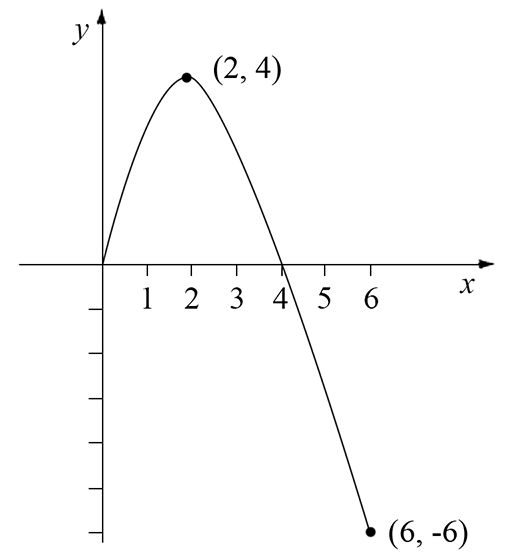
Geometry and Calculus, 2UA 2009 HSC 8a

The diagram shows the graph of a function  `y = f(x)`. 

  1. For which values of  `x`  is the derivative,  `f^{′}(x)`, negative?    (1 mark)

    --- 1 WORK AREA LINES (style=lined) ---

  2. What happens to  `f^{′}(x)`  for large values of  `x`?    (1 mark)

    --- 2 WORK AREA LINES (style=lined) ---

  3. Sketch the graph  `y = f^{′}(x)`.     (2 marks)

    --- 7 WORK AREA LINES (style=lined) ---

Show Answers Only
  1. `f^{′}(x) < 0\ text(when)`


    `-1 < x < 3`

  2. `text(As)\ x -> oo`


    `f^{′}(x) -> 0`

  3.   
    Geometry and Calculus, 2UA 2009 HSC 8a Answer

Show Worked Solution

i.   `f^{′}(x) < 0\ text(when)`

`-1 < x < 3`

♦♦ Exact data not available.


ii.   `text(As)\ x -> oo,`

`f^{′}(x) -> 0`


♦♦ Exact data not available.
MARKER’S COMMENT: Poorly drawn graphs with axes not labelled and inaccurate scales were common.

iii.

  Geometry and Calculus, 2UA 2009 HSC 8a Answer

Filed Under: Curve Sketching and The Primitive Function, The Derivative Function and its Graph (Y12) Tagged With: Band 5, Band 6, smc-1089-20-Graph f'(x) given f(x)

Trigonometry, 2ADV T3 2009 HSC 7b

Between 5 am and 5 pm on 3 March 2009, the height, `h`, of the tide in a harbour was given by

`h = 1 + 0.7 sin(pi/6 t)\ \ \ text(for)\ \ 0 <= t <= 12`

where  `h`  is in metres and  `t`  is in hours, with  `t = 0`  at 5 am. 

  1. What is the period of the function  `h`?    (1 mark)

    --- 2 WORK AREA LINES (style=lined) ---

  2. What was the value of  `h`  at low tide, and at what time did low tide occur?     (2 marks)

    --- 4 WORK AREA LINES (style=lined) ---

  3. A ship is able to enter the harbour only if the height of the tide is at least 1.35 m.


    Find all times between 5 am and 5 pm on 3 March 2009 during which the ship was able to enter the harbour.    (3 marks)

    --- 6 WORK AREA LINES (style=lined) ---

Show Answers Only
  1. `12\ text(hours)`
  2. `text(2pm)\ \ text{(5am + 9 hours)}`
  3. `text(6am to 10am)`
Show Worked Solution

i.   `h = 1 + 0.7 sin (pi/6 t)\ \ text(for)\ 0 <= t <= 12`

`T` `= (2pi)/n\ \ text(where)\ n = pi/6`
  `= 2 pi xx 6/pi`
  `= 12\ text(hours)`


`:.\ text(The period of)\ h\ text(is 12 hours.)`


ii.  `text(Find)\ h\ text(at low tide)`

IMPORTANT: Using `sin x=–1` for a minimum here is very effective and time efficient. This property of trig functions is often very useful in harder questions.

`=> h\ text(will be a minimum when)`

`sin(pi/6 t) = -1`

`:.\ h_text(min)` `= 1 + 0.7(-1)`
  `= 0.3\ text(metres)`


`text(S)text(ince)\ \ sinx = -1\ \ text(when)\ \ x = (3pi)/2`

`pi/6 t` `= (3pi)/2`
`t` `= (3pi)/2 xx 6/pi`
  `= 9\ text(hours)`

 
`:.\ text{Low tide occurs at 2pm (5 am + 9 hours)}`


iii.
  `text(Find)\ \ t\ \ text(when)\ \ h >= 1.35`

`1 + 0.7 sin (pi/6 t)` `>= 1.35`
`0.7 sin (pi/6 t)` `>= 0.35`
`sin (pi/6 t)` `>= 1/2`
`sin (pi/6 t)` `= 1/2\ text(when)`
`pi/6 t` `= pi/6,\ (5pi)/6,\ (13pi)/6,\ text(etc …)`
   
`t` `= 1,\ 5\ \ \ \ \ \ (0 <= t <= 12)`


Trig Calculus, 2UA 2009 HSC 7b Answer

`text(From the graph,)`

`sin(pi/6 t) >= 1/2\ \ \ text(when)\ \ 1 <= t <= 5`

 
`:.\ text(Ship can enter the harbour between 6 am and 10 am.)`

Filed Under: Trig Applications (Y12), Trig graphs Tagged With: Band 4, Band 5, Band 6, smc-1188-20-Tides

Calculus, 2ADV C1 2009 HSC 6c

The diagram illustrates the design for part of a roller-coaster track. The section  `RO`  is a straight line with slope 1.2, and the section  `PQ`  is a straight line with slope  – 1.8. The section  `OP`  is a parabola  `y = ax^2 + bx`. The horizontal distance from the  `y`-axis to  `P`  is 30 m.
 

2009 6c
 

In order that the ride is smooth, the straight line sections must be tangent to the parabola at  `O`  and at  `P`.  

  1. Find the values of  `a`  and  `b`  so that the ride is smooth.   (3 marks)

    --- 6 WORK AREA LINES (style=lined) ---

  2. Find the distance  `d`, from the vertex of the parabola to the horizontal line through  `P`, as shown on the diagram.     (2 marks)

    --- 5 WORK AREA LINES (style=lined) ---

Show Answers Only
  1. `text(For a smooth ride,)\ a = -0.05\ text(and)\ b = 1.2`
  2. `16.2\ text(m)`
Show Worked Solution
i.    `y` `= ax^2 + bx`
  `dy/dx` `= 2ax + b`
  `text(At)\ \ x = 0,`
  `dy/dx` `= b`
♦♦♦ Exact data unavailable.
MARKER’S COMMENT: Successful students equated the curve gradient to the straight section as a requirement for a smooth ride.
 

`text(We need)\ m\ text(at)\ O = 1.2`

`:.\ b = 1.2`
 

`text(At)\ P,\ x = 30`

`dy/dx` `= 2 xx a xx 30 + 1.2`
  `= 60a + 1.2`

 
`text(We need)\ m\ text(at)\ P = -1.8`

`60a + 1.2` `= -1.8`
`60a` `= -3`
`a` `= -3/60`
  `= -0.05`

 
`:.\ text(For a smooth ride,)\ a = –0.05\ \ text(and)\ \ b = 1.2`


ii.    `y` `= -0.05x^2 + 1.2x`
  `dy/dx` `= -0.1x + 1.2`

 
`text(Find)\ x\ text(when)\ dy/dx = 0`

`-0.1x + 1.2` `= 0`
`x` `= 1.2/0.1`
  `= 12`

 
`:.\ text(MAX when)\ x = 12`

 
`text(When)\ x = 12`

`y` `= -0.05 xx 12^2 + 1.2 xx 12`
  `= -7.2 + 14.4`
  `= 7.2`

 
`text(When)\ x = 30`

`y` `= -0.05 xx 30^2 + 1.2 xx 30`
  `= -45 + 36`
  `= -9`


`:.\ d` `= 7.2 + |–9|`
  `= 16.2\ text(m)`

Filed Under: Tangents (Adv-2027), Tangents (Y11), Tangents and Normals, The Parabola Tagged With: Band 5, Band 6, smc-6437-40-Applied Context, smc-973-40-Applied Context

Plane Geometry, 2UA 2009 HSC 4c

In the diagram,  `Delta ABC`  is a right-angled triangle, with the right angle at  `C`. The midpoint of  `AB`  is  `M`, and  `MP _|_ AC`.

Plane Geometry, 2UA 2009 HSC 4c_1

Copy or trace the diagram into your writing booklet. 

  1. Prove that  `Delta AMP`  is similar to  `Delta ABC`.   (2 marks)
  2. What is the ratio of  `AP`  to  `AC`?    (1 mark)
  3. Prove that  `Delta AMC`  is isosceles.   (2 marks)
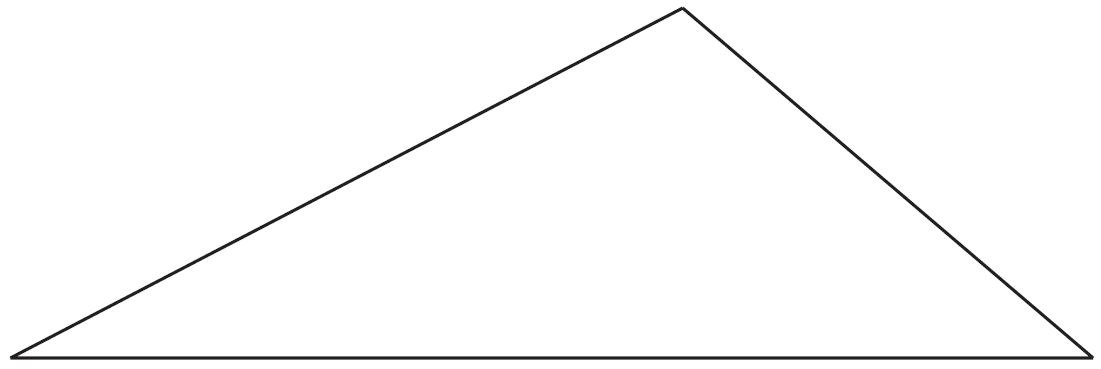
  4. Show that  `Delta ABC`  can be divided into two isosceles triangles.   (1 mark)
  5. Plane Geometry, 2UA 2009 HSC 4c_2
  6. Copy or trace this triangle into your writing booklet and show how to divide it into four isosceles triangles.   (1 mark)
  7.  
Show Answers Only
  1. `text(Proof)\ \ text{(See Worked Solutions)}`
  2. `text(Ratio)\ AP:AC = 1:2`
  3. `text(Proof)\ \ text{(See Worked Solutions)}`
  4. `text(Proof)\ \ text{(See Worked Solutions)}`
  5. Plane Geometry, 2UA 2009 HSC 4c_2 Answer1
Show Worked Solution
(i)    `text(Need to prove)\ Delta AMP\  text(|||)\  Delta ABC`
  `/_ PAM\ text(is common)`
  `/_ MPA = /_BCA = 90°\ \ \ text{(given)}`
  `:.\ Delta AMP \ text(|||) \ Delta ABC\ \ \ text{(equiangular)}`


(ii)   `(AP)/(AC) = (AM)/(AB)\ \ \ ` `text{(corresponding sides of}`
    `text{similar triangles)}`


`text(S)text(ince)\ \ AB = 2 xx AM`
`(AP)/(AC) = 1/2`
`:.\ text(Ratio)\ AP:AC = 1:2`


(iii)

Plane Geometry, 2UA 2009 HSC 4c_1 Answer

`AP = PC \ \ \ text{(from part (ii))}`
`PM\ text(is common)`
`/_APM = /_CPM = 90°\ \ text{(∠}\ APC\ text{is a straight angle)}`
`:.\ Delta AMP ~= Delta CMP\ text{(SAS)}`
`=> AM = CM\ \ ` `text{(corresponding sides of}`
  `text{congruent triangles)}`

`:.\ Delta AMC\ text(is isosceles.)`


(iv)   `text(S)text(ince)\ \ AM` `= MC\ \ \ text{(part (iii))}`
  `AM`  `= MB\ text{(given)}`
  `:. MC`  `= MB`
`:. Delta MCB\ text(is isosceles)`
`:. Delta ABC\ text(can be divided into 2 isosceles)`
`text(triangles)\ (Delta AMC\ text(and)\ Delta MCB text{)}`


(v)

Plane Geometry, 2UA 2009 HSC 4c_2 Answer1

♦♦ Mean mark 25%.
MARKER’S COMMENT: Use a ruler, draw large diagrams and always pay careful attention to previous parts of the question!
`/_AFB = /_CFB = 90°`
`DF\ text(bisects)\ AB`
`EF\ text(bisects)\ BC`
`text(From part)\ text{(iv)}\ text(we get 4 isosceles)`
`text(triangles as shown.)`

Filed Under: 2. Plane Geometry Tagged With: Band 3, Band 4, Band 5, Band 6

Calculus, EXT1* C3 2010 HSC 10b

The circle  `x^2 + y^2 = r^2`  has radius `r` and centre `O`. The circle meets the positive `x`-axis at `B`. The point `A` is on the interval `OB`. A vertical line through `A` meets the circle at `P`. Let  `theta = /_OPA`.
  

2010 10b1

  1. The shaded region bounded by the arc `PB` and the intervals `AB` and `AP` is rotated about the `x`-axis. Show that the volume, `V`, formed is given by
  2. `V = (pi r^3)/3 (2-3 sin theta + sin^3 theta)`   (3 marks)

    --- 8 WORK AREA LINES (style=lined) ---

  3. A container is in the shape of a hemisphere of radius `r` metres. The container is initially horizontal and full of water. The container is then tilted at an angle of `theta` to the horizontal so that some water spills out. 

  1. (1) Find `theta` so that the depth of water remaining is one half of the original depth.   (1 mark)

    --- 4 WORK AREA LINES (style=lined) ---

  2. (2) What fraction of the original volume is left in the container?   (2 marks)

    --- 6 WORK AREA LINES (style=lined) ---

Show Answers Only
  1. `text(Proof)  text{(See Worked Solutions)}`
  2. (1) `theta = pi/6\ text(radians)`
  3. (2) `5/16`
Show Worked Solution

i.    `text(Show that)\ V = (pir^3)/3 (2-3sin theta + sin^3 theta)`

♦♦♦ Mean mark (i) 16%.
MARKER’S COMMENT: A common error was to integrate `r^2` to `1/3 r^3` instead of `r^2 x` (note that `r` is a constant).  
`sin theta` `= (OA)/r`
`:.\ OA` `= r sin theta`
`=> A` `= (r sin theta, 0),\ \ \ \ B = (r,0)`


`:.V` `= pi int_(rsintheta)^r y^2\ dx`
  `= pi int_(rsintheta)^r (r^2-x^2)\ dx\ \ \ \ text{(using}\ x^2+y^2=r^2text{)}`
  `= pi [r^2 x-(x^3)/3]_(rsintheta)^r`
  `= pi [(r^3-r^3/3)-(r^3 sin theta-(r^3 sin^3 theta)/3)]`
  `= pi ((2r^3)/3-r^3 sin theta + (r^3 sin^3 theta)/3)`
  `= (pir^3)/3 (2-3 sin theta + sin^3 theta)\ \ \ text(… as required)`


ii. (1) `text(Depth of water remaining) = 1/2 xx text(original depth:)`

♦♦♦ Part (ii) mean marks 3% and 2% for (ii)(1) and (ii)(2) respectively.
`r-r sin theta` `=1/2 r`
`r (1-sin theta)` `= 1/2 r`
`1-sin theta` `= 1/2`
`sin theta` `= 1/2`
`:.\ theta` `= pi/6\ text(radians)`


 MARKER’S COMMENT: Previous parts of a question should always be at the front and centre of a student’s mind and direct their strategy.
ii. (2)    `text(Original Volume)` `= 1/2 xx 4/3 pi r^3`
    `= 2/3 pi r^3`


`text(New Volume)` `= (pi r^3)/3 [2-3 sin(pi/6) + sin^3(pi/6)]`
  `= (pir^3)/3 [2-(3 xx 1/2) + (1/2)^3]`
  `= (pi r^3)/3 [2-3/2 + 1/8]`
  `= (pir^3)/3 (5/8)`
  `= (5 pi r^3)/24`


`:.\ text(Fraction of original volume left)`

`= ((5pir^3)/24)/(2/3 pi r^3)`

`= 5/24 xx 3/2`

`= 5/16`

Filed Under: Circular Measure, Exact Trig Ratios and Other Identities, Further Area and Solids of Revolution (Ext1), Volumes of Solids of Rotation Tagged With: Band 6, smc-1039-30-(Semi) Circle, smc-1039-60-x-axis Rotation

Plane Geometry, 2UA 2010 HSC 10a

In the diagram  `ABC`  is an isosceles triangle with  `AC = BC = x`. The point  `D`  on the interval  `AB`  is chosen so that  `AD = CD`. Let  `AD = a`,  `DB = y`  and  `/_ADC = theta`.


  1. Show that  `Delta ABC`  is similar to  `Delta ACD`.    (2 marks)
  2. Show that  `x^2 = a^2 + ay`.     (1 mark)
  3. Show that  `y = a(1 − 2 cos theta )`.   (2 marks)
  4. Deduce that  `y <= 3a`.   (1 mark) 
Show Answers Only
  1. `text(Proof)  text{(See Worked Solutions)}`
  2. `text(Proof)  text{(See Worked Solutions)}`
  3. `text(Proof)  text{(See Worked Solutions)}`
  4. `text(Proof)  text{(See Worked Solutions)}`
Show Worked Solution
MARKER’S COMMENT: When dealing with multiple triangles, the best performing students label all angles clearly and unambiguously.
(i)

`/_CAD\ text(is common)`

`/_CAD = /_ACD = /_DBC`

`text{(Angles opposite equal sides in}`

`\ \ text{isosceles}\ Delta ACD\ text(and)\ Delta ABC text{)}`
 

`/_ADC = /_ACB\ \ (180^@\ text(in)\ Delta text{)}`

`:.\ Delta ABC\  text(|||) \ Delta ACD\ \ \ text{(AAA)}\ \ \ text(… as required)`


♦♦ Mean mark 25%.
MARKER’S COMMENT: The similarity proof in part (i) should have immediately alerted students to using similar ratios of sides to solve part (ii). Many did not follow this obvious hint.

(ii)  `text(Using similarity)`

`(AC)/(AD)` `= (AB)/(CB)` `\ \ text{(corresponding sides of}`
`\ \ \ \ text{similar triangles)}`
`x/a` `= (a + y)/x`  


`:.\ x^2 = a^2 + ay\ \ \ text(… as required)`


(iii)  `text(Show)\ \ y = a(1\ – 2 cos theta)`

`text(Using Cosine Rule:)`

`cos theta` `= (a^2 + a^2\ – x^2)/(2 xx a xx a)`
`2a^2costheta` `= 2a^2\ – x^2`
  `= 2a^2\ – (a^2 + ay)\ \ text{(from part (ii))}`
  `= a^2\ – ay`
`ay` `= a^2\ – 2a^2cos theta`
`y` `= a\ – 2a cos theta`
  `= a (1\ – 2 cos theta)\ \ \ \ text(… as required)`


(iv)  `text(S)text(ince)\  1 <= cos theta <= 1`

♦♦♦ Parts (iii) and (iv) mean marks – 18% and just 4% respectively.
IMPORTANT: Limits of trig functions are often extremely useful in proving inequalities (see Worked Solutions).

` -2 <= 2 cos theta <= 2`

` -1 <= 1\ – 2 cos theta <= 3`

`y` `=a(1\ – 2 cos theta)\ \ \ text{(from part (iii))}`
`:.\ y` `<= a(3)`
  `<= 3a\ \ …\ text(as required)`

Filed Under: 2. Plane Geometry, Sine and Cosine Rules, Bearings Tagged With: Band 5, Band 6, HSC

Calculus, 2ADV C3 2010 HSC 9b

Let  `y=f(x)`  be a function defined for  `0 <= x <= 6`, with  `f(0)=0`. 

The diagram shows the graph of the derivative of `f`,  `y = f^{′}(x)`. 

The shaded region `A_1` has area 4 square units. The shaded region `A_2` has area 4 square units. 

  1. For which values of `x` is `f(x)` increasing?  (1 mark)

    --- 2 WORK AREA LINES (style=lined) ---

  2. What is the maximum value of `f(x)`?     (1 mark)

    --- 3 WORK AREA LINES (style=lined) ---

  3. Find the value of `f(6)`.   (1 mark)

    --- 3 WORK AREA LINES (style=lined) ---

  4. Draw a graph of  `y =f(x)`  for  `0 <= x <= 6`.   (2 marks)

    --- 8 WORK AREA LINES (style=lined) ---

Show Answers Only
  1. `f(x)\ text(is increasing when)\ 0 <= x < 2`
  2. `text(MAX value of)\ f(x) = 4`
  3. `-6`
  4.  
  5.  
Show Worked Solution
i.    `f(x)\ text(is increasing when)\ \ f^{′}(x) > 0`
  `text(From the graph)`
  `f(x)\ text(is increasing when)\ 0 <= x < 2`


ii.   `f^{′}(x) = 0\ \ text(when)\ \ x=2`
  `:.\ text(MAX at)\ \ x = 2`
  `int_0^2 f^{′}(x)\ dx = 4\ \ \ (text(given since)\ A_1 = 4 text{)}`
  `text(We also know)`
`int_0^2\ f^{′}(x)\ dx` `= [f(x)]_0^2`
  `= f(2)-f(0)`
  `= f(2)\ \ \ \ text{(since}\ f(0) = 0 text{)}`

`=> f(2) = 4` 

♦♦♦ Parts (ii) and (iii) proved particularly difficult for students with mean marks of 12% and 11% respectively.

 
`:.\ text(MAX value of)\ \ f(x) = 4`
 

iii.   `int_0^4 f^{′}(x)` `= A_1-A_2`
    `=0`

`text(We also know)`

`int_0^4 f^{′}(x)\ dx` `= int_2^4 f^{′}(x)\ dx + int_0^2 f^{′}(x)\ dx`
  `=[f(x)]_2^4 + 4`
  `= f(4)-f(2) + 4\ \ \ (text(note)\ f(2)=4)`
  `=f(4)`

`=> f(4) = 0`

 
`text(Gradient = – 3  from)\ \ x = 4\ \ text(to)\ \ x = 6`

`:.\ f(6)` `= -3 (6\ – 4)`
  `= -6`


♦♦ Mean mark 28%
EXAM TIP: Clearly identify THE EXTREMES when given a defined domain. In this case, the origin is obvious graphically, and the other extreme at `x=6`, is CLEARLY LABELLED! 
iv.  2UA HSC 2010 9bi

Filed Under: Areas Under Curves, Areas Under Curves (Y12), Curve Sketching and The Primitive Function, The Derivative Function and its Graph (Y12) Tagged With: Band 5, Band 6, page-break-before-solution, smc-1089-10-Graph f(x) given f'(x), smc-975-50-Trig

Financial Maths, 2ADV M1 2011 HSC 9d


  1. Rationalise the denominator in the expression  `1/(sqrtn + sqrt(n+1))`  where  `n`  is an integer and  `n >= 1`.   (1 mark)

    --- 4 WORK AREA LINES (style=lined) ---

  2. Using your result from part (i), or otherwise, find the value of the sum
     
         `1/(sqrt1+ sqrt2) + 1/(sqrt2 + sqrt3) + 1/(sqrt3 + sqrt4) + ... + 1/(sqrt99 + sqrt100)`   (2 marks)

    --- 5 WORK AREA LINES (style=lined) ---

Show Answers Only
  1. `sqrt(n+1)\ – sqrtn`
  2. `9`
Show Worked Solution

i.  `1/(sqrtn + sqrt(n+1)) xx (sqrtn\ – sqrt(n+1))/(sqrtn\ – sqrt(n+1))`

MARKER’S COMMENT: Students connecting the information between parts (i) and (ii) were easily the most successful. AGAIN, the information from earlier parts of multi-part questions is gold plated information for directing your answer.

`= (sqrtn\ – sqrt(n+1))/((sqrtn)^2\ – (sqrt(n+1))^2)`

`= (sqrtn\ – sqrt(n+1))/(n\ – (n + 1))`

`= (sqrtn\ – sqrt(n+1))/-1`

`= sqrt(n+1)\ – sqrtn`


ii.  `1/(sqrt1 + sqrt2) + 1/(sqrt2 + sqrt3) + 1/(sqrt3 + sqrt4) + … + 1/(sqrt99 + sqrt100)`

`= (sqrt2\ – sqrt1) + (sqrt3\ – sqrt2) + (sqrt4\ – sqrt3) + … + (sqrt100\ – sqrt99)`

`= – sqrt1 + sqrt 100`

♦♦♦ Mean mark 15%.

`= -1 + 10`

`= 9`


Filed Under: Geometric Series, Geometric Series (Y12) Tagged With: Band 3, Band 6, smc-1006-20-Find Sum, smc-1006-70-Calculations Only

Calculus, 2ADV C4 2011 HSC 9b

A tap releases liquid  `A`  into a tank at the rate of  `(2 + t^2/(t + 1))`  litres per minute, where  `t`  is time in minutes. A second tap releases liquid  `B`  into the same tank at the rate of  `(1 + 1/(t+1))`  litres per minute. The taps are opened at the same time and release the liquids into an empty tank. 

  1. Show that the rate of flow of liquid  `A`  is greater than the rate of flow of liquid  `B`  by  `t`  litres per minute.    (1 mark)

    --- 4 WORK AREA LINES (style=lined) ---

  2. The taps are closed after 4 minutes. By how many litres is the volume of liquid  `A`  greater than the volume of liquid  `B`  in the tank when the taps are closed?    (2 marks)

    --- 6 WORK AREA LINES (style=lined) ---

Show Answers Only
  1. `text(Proof)  text{(See Worked Solutions)}`
  2. `text(There is 8 litres more of liquid)\ A\ text(than)\ B.`
Show Worked Solution
♦♦♦ Mean mark 16%
MARKER’S COMMENT: Many students incorrectly differentiated in part (i). The 1 mark allocation indicates the answer will not require an involved multi-step process.

i.   `text(Show difference in flow rate)\ (D) = t`

`D` `= (2 + t^2/(t+1))-(1+ 1/(t+1))`
  `= (2(t+1) + t^2)/(t+1)-((t+1) + 1)/(t + 1)`
  `= (2t + 2 + t^2-t-2)/(t + 1)`
  `= (t^2 + t)/(t + 1)`
  `= (t (t + 1))/(t + 1)`
  `= t\ \ \ … text(as required)`


ii.   `text(Difference in Volume)`

♦♦♦ Mean mark 15%
MARKER’S COMMENT: Few students were able to answer this part. Previous parts of any question should be front and centre of your thinking when working out strategies.

`= int_0^4 (2 + t^2/(1+ t))\ dt\-int_0^4 (1 + t/(1+t))\ dt`

`= int_0^4 t\ dt\ \ \ \ \ text{(using part(i))}`

`= [t^2/2]_0^4`

`= 16/2\ – 0`

` = 8`
 

`:.\ text(There is 8 litres more of liquid)\ A\ text(than)\ B.`

Filed Under: Integrals, Other Integration Applications (Y12), Rates of Change Tagged With: Band 6, smc-1091-20-Flow, smc-1091-50-Other Function, smc-1213-15-Flow

Plane Geometry, 2UA 2011 HSC 9a

The diagram shows  `Delta ADE`, where  `B`  is the midpoint of  `AD`  and  `C`  is the midpoint of  `AE`. The intervals  `BE`  and  `CD`  meet at  `F`.

Plane Geometry, 2UA 2011 HSC 9a 


  1. Explain why  `Delta ABC`  is similar to  `Delta ADE`.    (1 marks)
  2. Hence, or otherwise, prove that the ratio  `BF : FE = 1: 2`.     (2 marks)
Show Answers Only
  1. `text(Proof)  text{(See Worked Solutions)}`
  2. `text(Proof)  text{(See Worked Solutions)}`
Show Worked Solution

(i)  `/_ BAC\ text(is common)`

`(AB)/(AD) = (AC)/(AE) = 1/2`

`:.\ Delta ABC\ text(is similar to)\ Delta ADE`

`text{(two sides are in the same ratio and the}`

`\ \ text{included angle is equal)}`


♦♦ Mean mark 22%.
TIP: Proving similarity via (AAA) test only requires proving 2 angles are equal because the remaining angle then must be equal – this will help save time in proofs.
(ii)

Plane Geometry, 2UA 2011 HSC 9a Answer

`/_ ABC = /_ ADE\ \ \ ` `text{(corresponding angles of}`
  `\ \ text{similar triangles)}`
`:. BC\ text(||)\ DE\ \ text{(corresponding angles are equal)}`


`/_ FED` `= /_ FBC\ text{(alternate,}\ BC\ text(||)\ DEtext{)}`
`/_ FDE` `= /_ FCB\ text{(alternate,}\ BC\ text(||)\ DEtext{)}`
`:.\ Delta FED\ text(|||)\ Delta FBC\ \ \ text{(equiangular)}`


`=>(BF)/(FE) = (BC)/(ED)= 1/2`

`text{(corresponding sides of similar triangles)}`

`:. BF : FE = 1 : 2\ \ \ text(… as required).`

Filed Under: 2. Plane Geometry Tagged With: Band 4, Band 6

Calculus, 2ADV C3 2012 HSC 14a

A function is given by  `f(x) = 3x^4 + 4x^3-12x^2`. 

  1. Find the coordinates of the stationary points of  `f(x)`  and determine their nature.   (3 marks)

    --- 6 WORK AREA LINES (style=lined) ---

  2. Hence, sketch the graph  `y = f(x)`   showing the stationary points.   (2 marks)

    --- 8 WORK AREA LINES (style=lined) ---

  3. For what values of  `x`  is the function increasing?   (1 mark)

    --- 2 WORK AREA LINES (style=lined) ---

  4. For what values of  `k`  will  `f(x) = 3x^4 + 4x^3-12x^2 + k = 0`  have no solution?   (1 mark)

    --- 2 WORK AREA LINES (style=lined) ---

Show Answers Only
  1. `text{MAX at (0,0), MINs at (1, –5) and (–2, –32)}`
  2.  
        
        2UA HSC 2012 14ai
     
  3. `f(x)\ text(is increasing for)\ -2 < x < 0\ text(and)\ x > 1`
  4. `text(No solution when)\ k > 32`
Show Worked Solution
i. `f(x)` `= 3x^4 + 4x^3-12x^2`
  `f^{′}(x)` `= 12x^3 + 12x^2-24x`
  `f^{″}(x)` `= 36x^2 + 24x-24`


`text(Stationary points when)\ f^{′}(x) = 0`

`12x^3 + 12x^2-24x` `=0`
`12x(x^2 + x-2)` `=0`
`12x (x+2) (x-1)` `=0`


`:.\ text(Stationary points at)\ x=0,\ 1\ text(or)\ -2`
 

`text(When)\ x=0,\ \ \ \ f(0)=0`
`f^{″}(0)` `= -24 < 0`
`:.\ text{MAX at  (0,0)}`


`text(When)\ x=1`

`f(1)` `= 3+4-12 = -5`
`f^{″}(1)` `= 36 + 24-24 = 36 > 0`
`:.\ text{MIN at}\  (1,-5)`


`text(When)\ x=–2`

`f(-2)` `=3(-2)^4 + 4(-2)^3-12(-2)^2`
  `= 48-32-48`
  `= -32`
`f^{″}(-2)` `= 36(-2)^2 + 24(-2)-24`
  `=144-48-24 = 72 > 0`
`:.\ text{MIN at  (–2, –32)}`


ii.  2UA HSC 2012 14ai
♦ Mean mark 42%
MARKER’S COMMENT: Be careful to use the correct inequality signs, and not carelessly include ≥ or ≤ by mistake.


iii. `f(x)\ text(is increasing for)`
  `-2 < x < 0\ text(and)\ x > 1`


iv.   `text(Find)\ k\ text(such that)`

♦♦♦ Mean mark 12%.

`3x^4 + 4x^3-12x^2 + k = 0\ text(has no solution)`

`k\ text(is the vertical shift of)\ \ y = 3x^4 + 4x^3-12x^2`

`=>\ text(No solution if it does not cross the)\ x text(-axis.)`

`:.\ text(No solution when)\ k > 32`

Filed Under: Curve Sketching (Y12), Curve Sketching and The Primitive Function Tagged With: Band 4, Band 5, Band 6, page-break-before-solution, smc-969-20-Degree 4, smc-969-50-Increasing/Decreasing Intervals

Calculus, EXT1* C3 2011 HSC 8b

The diagram shows the region enclosed by the parabola  `y = x^2`, the  `y`-axis and the line  `y = h`, where  `h > 0`. This region is rotated about the  `y`-axis to form a solid called a paraboloid. The point  `C`  is the intersection of  `y = x^2` and  `y = h`.

The point  `H`  has coordinates  `(0, h)`.
 

2011 8b

  1. Find the exact volume of the paraboloid in terms of  `h`.    (2 marks)

    --- 5 WORK AREA LINES (style=lined) ---

  2. A cylinder has radius  `HC`  and height  `h`.    


    What is the ratio of the volume of the paraboloid to the volume of the cylinder?   (1 mark)

    --- 8 WORK AREA LINES (style=lined) ---

Show Answers Only
  1. `(pi h^2)/2\ text(u³)`
  2. `1:2`
Show Worked Solution
IMPORTANT: Most common errors: 1-use the correct axis, and 2-check the limits!
i.    `V` `= pi int_0^h x^2\ dy`
    `= pi int_0^h y\ dy`
    `= pi [1/2 y^2]_0^h`
    `= pi (1/2 h^2)`
    `= (pi h^2)/2 \ text(u³)`

 
`:.\ text(The volume of the paraboloid is)\  (pi h^2)/2\ text(u³)`
 

ii.   `text(Radius of cylinder)\ (r) = HC`

`text(Find)\ x text(-coordinate of)\ C:`

♦♦ Mean mark of 24%.
`text(When)\ y` `=h`
`=> x^2` `= h`
`x` `= sqrt h`
`:. r` `= sqrth`


`text(Volume of cylinder)` `= pi r^2 h`
  `= pi (sqrth)^2 h`
  `= pi h^2`

 
`:.\ text(Volume of paraboloid : volume of cylinder)`

`= (pi h^2)/2 : pi h^2`

`= 1:2`

Filed Under: Further Area and Solids of Revolution (Ext1), Volumes of Solids of Rotation Tagged With: Band 4, Band 6, smc-1039-10-Polynomial, smc-1039-61-y-axis Rotation

Plane Geometry, 2UA 2013 HSC 16c

The diagram shows triangles  `ABC`  and  `ABD`  with  `AD`  parallel to  `BC`. The sides  `AC`  and  `BD`  intersect at  `Y`. The point  `X`  lies on  `AB`  such that  `XY`  is parallel to  `AD`  and  `BC`.

2UA 2013 HSC 16c

  1. Prove that  `Delta ABC`  is similar to  `Delta AXY`.   (2 marks)
  2. Hence, or otherwise, prove that  `1/(XY) = 1/(AD) + 1/(BC)`.   (2 marks)
Show Answers Only
  1. `text(Proof)\ \ text{(See Worked Solutions)}`
  2. `text(Proof)\ \ text{(See Worked Solutions)}`
Show Worked Solution
(i)   2UA 2013 HSC 16c Answer

`text(Prove)\ Delta ABC\ text(|||)\ Delta AXY`

COMMENT: A great example of easy marks that appear in the early stages of the final questions.

`/_YAX\ text(is common)`

`/_AYX= /_ACB\ \ \ text{(corresponding,  YX || CB)}`

`:.\ Delta ABC\ text(|||)\ Delta AXY\ \ \ text{(equiangular)}`


(ii)  `text(Need to prove)\ 1/(XY) = 1/(AD) + 1/(BC)`

♦♦♦ Mean mark 13%.
COMMENT: The presence of `AD` in the required proof should alert students to the strategy of finding another set of congruent triangles where this side can be utilised.

`text(Using part)\ text{(i)}`

`=>(AX)/(AB) = (XY)/(BC)`

`text(Similarly,)\ Delta ABD\ text(|||)\ Delta XBY\ \ text{(equiangular)}`

`(BX)/(AB) = (XY)/(AD)`

`text(Adding the identities)`

`(AX)/(AB) + (BX)/(AB)` `= (XY)/(BC) + (XY)/(AD)`
`( (AX + BX) )/(AB)` `= XY (1/(BC) + 1/(AD) )`
`(AB)/(AB)` `= XY (1/(AD) + 1/(BC))\ \ \ \ (text(Note)\ AX + BX = AB text{)}`
 `1` `= XY (1/(AD) + 1/(BC))` 
 `1/(XY)` `= 1/(AD) + 1/(BC)\ \ \ text(… as required)` 

Filed Under: 2. Plane Geometry Tagged With: Band 4, Band 6

Functions, 2ADV F2 2013 HSC 15c

  1. Sketch the graph  `y = |\ 2x-3\ |`.   (1 mark)

    --- 6 WORK AREA LINES (style=lined) ---

  2. Using the graph from part (i), or otherwise, find all values of  `m`  for which the equation  `|\ 2x-3\ | = mx + 1`  has exactly one solution.   (2 marks)

    --- 4 WORK AREA LINES (style=lined) ---

Show Answers Only
  1.  
    2UA 2013 HSC 15c Answer
  2. `text(When)\ m = -2/3,\ m >= 2\ text(or)\ m<-2`
Show Worked Solution

i. 

♦ Mean mark 49%
MARKER’S COMMENT: Many students drew diagrams that were “too small”, didn’t use rulers or didn’t use a consistent scale on the axes!

2UA 2013 HSC 15c Answer


ii.

   2UA 2013 HSC 15c1 Answer


`text(Line of intersection)\ \ y=mx + 1\ \ text(passes through)\ \ (0,1)`

♦♦ Mean mark 25%.
COMMENT: Students need a clear graphical understanding of what they are finding to solve this very challenging, Band 6 question.

`text(If it also passes through)\ \ (1.5, 0) => text(1 solution)`

`m` `=(y_2-y_1)/(x_2-x_1)`
  `= (1 -0)/(0- 3/2)`
  `=-2/3`

  
`text(Gradients of)\ \ y=|\ 2x-3\ |\ \ text(are)\ \ 2\ text(or)\ -2`
 

`text(Considering a line through)\ \ (0,1):`

`text(If)\ \ m >= 2\ text(, only intersects once.)`
 

`text(Similarly,)`

`text(If)\ \ m<-2 text(, only intersects once.)`

`:.\ text(Only one solution when)\ \ m = -2/3,\ \ m >= 2\ \ text(or)\ \ m<-2`

Filed Under: 4. Real Functions, Graph Transformations (Adv-2027), Transformations (Y12) Tagged With: Band 5, Band 6, smc-1008-20-Absolute Value, smc-1008-70-Combinations, smc-6408-15-Absolute Value, smc-6408-60-Combinations

Integration, 2UA 2013 HSC 15a

The diagram shows the front of a tent supported by three vertical poles. The poles are 1.2 m apart. The height of each outer pole is 1.5 m, and the height of the middle pole is 1.8 m. The roof hangs between the poles.

2013 15a

The front of the tent has area `A\ text(m²)`. 

  1. Use the trapezoidal rule to estimate  `A`.    (1 mark)
  2. Use Simpson’s rule to estimate  `A`.     (1 mark)
  3. Explain why the trapezoidal rule gives the better estimate of  `A`.    (1 mark)
Show Answers Only
  1. `3.96\ text(m²)`
  2. `4.08\ text(m²)`
  3. 2UA 2013 15a ans
  4. `text(S)text(ince the tent roof is concave up, the)`
  5. `text(trapezoidal rule uses straight lines and Simpson’s)`
  6. `text(Rule assumes a concave down arc, the trapezoidal)`
  7. `text(rule will be more accurate)\ text{(as per diagram)}`
Show Worked Solution
(i)    `A` `~~ h/2 [y_0 + 2y_1 + y_2]`
    `~~ 1.2/2 [1.5 + (2 xx 1.8) + 1.5]`
    `~~ 0.6 [6.6]`
    `~~ 3.96\ text(m²)`


(ii)    `A` `~~ h/3 [y_0 + 4y_1 + y_2]`
    `~~1.2/3 [1.5 + (4 xx 1.8) + 1.5]`
    `~~ 0.4 [10.2]`
    `~~ 4.08\ text(m²)`


♦♦♦ This proved the hardest mark to get in the whole 2013 HSC paper with a mean mark of just 3%!
MARKER’S COMMENT: Ensure you understand the different lines that result from using Simpson’s Rule vs the Trapezoidal Rule. Drawing a sketch is often the clearest way to explain (see Worked Solutions).


(iii)  
    2UA 2013 15a ans

`text(S)text(ince the tent roof is concave up, the)`

`text(trapezoidal rule uses straight lines and Simpson’s)`

`text(Rule assumes a concave down arc, the trapezoidal)`

`text(rule will be more accurate)\ text{(as per diagram)}`

Filed Under: Trapezoidal and Simpson's Rule Tagged With: Band 4, Band 6

Calculus, 2ADV C4 2013 HSC 14d

The diagram shows the graph  `f(x)`.
 

2013 14d
 

What is the value of  `a`, where  `a > 0`, so that  `int_-a^a f(x)\ dx = 0`?   (1 mark)  

--- 3 WORK AREA LINES (style=lined) ---

Show Answers Only

 `a=4.5`

Show Worked Solution

`text(If)\ int_-a^a f(x)\ dx =0`

 ♦♦♦ A devilish 1-mark question mid-paper that had a mean mark of just 12%. 
MARKER’S COMMENT: The fact that this question was worth only 1 mark means that it is not necessary for students to show any detailed working.

`text(We know the area below the curve)`

`text(and above the)\ x text(-axis = area above the)`

`text(curve and below the)\ x text(-axis.)`

`text(By inspection, we can see)`

`int_-3^-1 f(x)\ dx=0\ \ text(and)\ \  int_2^3 f(x)\ dx= 0`

`text(We need)\ int_3^a f(x)\ dx + int_-a^-3 f(x)\ dx`  `=-3`
`text(because)\ \  int_-1^2 f(x)\ dx=3`   

 
`=>\ text(S)text(ince areas have height = 1, each)`

`text(must be 1.5 units wide.)`

`:. a = 4.5`

Filed Under: Areas Under Curves, Areas Under Curves (Y12) Tagged With: Band 6, smc-975-70-Functions - no integration

Calculus, EXT1* C1 2013 HSC 10 MC

A particle is moving along the  `x`-axis. The displacement of the particle at time  `t`  seconds is  `x`  metres.

At a certain time,  `dot x = -3\ text(ms)^(-1)`  and  `ddot x = 2\ text(ms)^(-2)`.

Which statement describes the motion of the particle at that time?

  1. The particle is moving to the right with increasing speed.
  2. The particle is moving to the left with increasing speed.
  3. The particle is moving to the right with decreasing speed.
  4. The particle is moving to the left with decreasing speed.
Show Answers Only

`D`

Show Worked Solution
♦♦ Mean mark 26%.

`text(S)text(ince)\ dot x = -3 text(ms)`-1

`=>\ text(Particle is moving to the left)`

`text(S)text(ince)\ ddot x = 2 text(ms)`-2

`=>\ text(Acceleration is to the right, against)`

`text(the particle’s motion)`

`:.\ text(Speed is decreasing)`

`=>  D`

Filed Under: Motion, Rates of Change with respect to time (Ext1) Tagged With: Band 6, smc-1077-10-Motion

Financial Maths, STD2 F4 2011 HSC 28b

Norman and Pat each bought the same type of tractor for $60 000 at the same time. The value of their tractors depreciated over time.

The salvage value `S`, in dollars, of each tractor, is its depreciated value after `n` years.

Norman drew a graph to represent the salvage value of his tractor.
 

 2011 28b

  1. Find the gradient of the line shown in the graph.   (1 mark)

    --- 2 WORK AREA LINES (style=lined) ---

  2. What does the value of the gradient represent in this situation?   (1 mark)

    --- 2 WORK AREA LINES (style=lined) ---

  3. Write down the equation of the line shown in the graph.   (1 mark)

    --- 3 WORK AREA LINES (style=lined) ---

  4. Find all the values of `n` that are not suitable for Norman to use when calculating the salvage value of his tractor. Explain why these values are not suitable.   (2 marks)

    --- 4 WORK AREA LINES (style=lined) ---

Pat used the declining balance formula for calculating the salvage value of her tractor. The depreciation rate that she used was 20% per annum.

  1. What did Pat calculate the salvage value of her tractor to be after 14 years?   (2 marks)

    --- 4 WORK AREA LINES (style=lined) ---

  2. Using Pat’s method for depreciation, describe what happens to the salvage value of her tractor for all values of `n` greater than 15.   (1 mark)

    --- 2 WORK AREA LINES (style=lined) ---

Show Answers Only
  1. `text(Gradient) =-4000`
  2. `text(The amount the tractor depreciates each year.)`
  3. `S = 60\ 000\-4000n`
  4. `text(It is unsuitable to use)`
    `n<0\ text(because time must be positive)`
    `n>15\ text(because the tractor has no more value after 15 years and)`
    `text(therefore can’t depreciate further.)`
  5. `text(After 14 years, the tractor is worth $2638.83)`
  6. `text(As)\ n\ text(increases above 15 years,)\ S\ text(decreases but remains)>0.`
  7.  
Show Worked Solution
♦♦♦ Mean mark 14%
COMMENT: The intercepts of both axes provide points where the gradient can be quickly found.
i.    `text(Gradient)` `= text(rise)/text(run)`
    `= (- 60\ 000)/15`
    `=-4000`


♦ Mean mark 37%

ii.   `text(The amount the tractor depreciates each year)`


♦♦ Mean mark 28%
COMMENT: Using the general form `y=mx+b` is quick here because you have the gradient (from part (i)) and the `y`-intercept is obviously `60\ 000`.
iii.   `text(S)text(ince)\ \ S = V_0\-Dn`
  `:.\ text(Equation of graph:)`
  `S = 60\ 000-4000n`


iv.   `text(It is unsuitable to use)` 

♦♦♦ Mean mark 20%
`n<0,\ text(because time must be positive:)`
`n>15,\ text(because it has no more value after 15)`
`text(years and therefore can’t depreciate further.)`


v.    `text(Using)\ S = V_0 (1-r)^n\ \ text(where)\ r = text(20%,)\ n = 14`
`S` `= 60\ 000 (1\-0.2)^14`
  `= 60\ 000 (0.8)^14`
  `= 2\ 638.8279…`


`:.\ text(After 14 years, the tractor is worth $2638.83`


♦ Mean mark 37%
vi.   `text(As)\ n\ text(increases above 15 years,)\ S\ text(decreases)`
  `text(but remains > 0.)`

Filed Under: Depreciation - Declining Balance (Std 1), Depreciation - Declining Balance (Std 2), Depreciation / Running costs, Other Linear Modelling Tagged With: Band 4, Band 5, Band 6, smc-1139-10-Find S, smc-1139-60-Depreciation Graphs, smc-813-10-Find S, smc-813-60-Depreciation Graphs

Statistics, STD2 S1 2011 HSC 25a

A study on the mobile phone usage of NSW high school students is to be conducted.

Data is to be gathered using a questionnaire.

The questionnaire begins with the three questions shown.

2UG 2011 25a

  1. Classify the type of data that will be collected in Q2 of the questionnaire.  (1 mark)

    --- 1 WORK AREA LINES (style=lined) ---

  2. Write a suitable question for this questionnaire that would provide discrete ordinal data.   (1 mark)

    --- 2 WORK AREA LINES (style=lined) ---

  3. An initial study is to be conducted using a stratified sample.


    Describe a method that could be used to obtain a representative stratified sample.  (1 mark)

    --- 2 WORK AREA LINES (style=lined) ---

  4. Who should be surveyed if it is decided to use a census for the study?  (1 mark)

    --- 2 WORK AREA LINES (style=lined) ---

Show Answers Only
  1. `text(Categorical)`
  2. `text(See Worked Solutions)`
  3. `text(See Worked Solutions)`
  4. `text(A census would involve all high school students in NSW.)`
Show Worked Solution

i.  `text(Categorical)`


ii.  `text(How many outgoing calls do you make per day?)`

`text{(Ensure it can be answered with a numerical score.)}`


iii.  `text(The method could be to work out how many)`

♦♦♦ Mean mark 7%. Toughest mark to get in the 2011 exam!
COMMENT: Know and be able to describe random, systematic and stratified sampling!

`text{students are in each year and ask 10% of the}`

`text{students in each year. (Note the sample of}`

`text{students in each year must be  proportional to}`

`text{their percentage in the population).}`


♦♦♦ Mean mark 18%.
MARKER’S COMMENT: A specific population needed (i.e. high school students).

iv.  `text(A census would involve all high school)`

`text(students in NSW.)`

Filed Under: Classifying Data (Std 1), Classifying Data (Std 2), Data Classification, Investigation and Sampling Methods (Std2-2027), DS1 - Stats and society Tagged With: Band 4, Band 5, Band 6, common-content, smc-1127-10-Sampling Methods, smc-1127-20-Classifying Data, smc-1127-30-Other, smc-6309-10-Sampling Methods, smc-6309-20-Data Classification, smc-6309-30-Other, smc-820-10-Sampling Methods, smc-820-20-Classifying Data, smc-820-30-Other

Algebra, STD2 A2 2010 HSC 27c

The graph shows tax payable against taxable income, in thousands of dollars.

2010 27c

  1. Use the graph to find the tax payable on a taxable income of $21 000.  (1 mark)

    --- 1 WORK AREA LINES (style=lined) ---

  2. Use suitable points from the graph to show that the gradient of the section of the graph marked  `A`  is  `1/3`.    (1 mark)

    --- 3 WORK AREA LINES (style=lined) ---

  3. How much of each dollar earned between  $21 000  and  $39 000  is payable in tax?   (1 mark)

    --- 2 WORK AREA LINES (style=lined) ---

  4. Write an equation that could be used to calculate the tax payable, `T`, in terms of the taxable income, `I`, for taxable incomes between  $21 000  and  $39 000.   (2 marks)

    --- 4 WORK AREA LINES (style=lined) ---

Show Answers Only
  1. `$3000\ \ \ text{(from graph)}`
  2. `1/3`
  3. `33 1/3\ text(cents per dollar earned)`
  4. `text(Tax payable on)\ I = 1/3 I\-4000`
Show Worked Solution
i.

 `text(Income on)\ $21\ 000=$3000\ \ \ text{(from graph)}`


ii.  `text(Using the points)\ (21,3)\ text(and)\ (39,9)`

♦♦ Mean mark 25%
`text(Gradient at)\ A` `= (y_2\-y_1)/(x_2\ -x_1)`
  `= (9000-3000)/(39\ 000 -21\ 000)`
  `= 6000/(18\ 000)`
  `= 1/3\ \ \ \ \ text(… as required)`


iii.  `text(The gradient represents the tax applicable to each dollar)`

♦♦♦ Mean mark 12%!
MARKER’S COMMENT: Interpreting gradients is an examiner favourite, so make sure you are confident in this area.
`text(Tax)` ` = 1/3\ text(of each dollar earned)`
  ` = 33 1/3\ text(cents per dollar earned)`


iv.  `text( Tax payable up to $21 000 = $3000)`

`text(Tax payable on income between $21 000 and $39 000)`

♦♦♦ Mean mark 15%.
STRATEGY: The earlier parts of this question direct students to the most efficient way to solve this question. Make sure earlier parts of a question are front and centre of your mind when devising strategy.

` = 1/3 (I\-21\ 000)`

`:.\ text(Tax payable on)\ \ I` `= 3000 + 1/3 (I\-21\ 000)`
  `= 3000 + 1/3 I\-7000`
  `= 1/3 I\-4000`

Filed Under: Applications: Currency, Fuel and Other Problems (Std 2), Applications: Currency, Fuel and Other Problems (Std2-2027), Breakeven and Financial modelling, FM3 - Taxation, Linear Functions (Adv-2027), Linear Functions (Y11), Tax and Percentage Increase/Decrease (Std 2), Taxation (Std2-2027) Tagged With: Band 3, Band 5, Band 6, common-content, page-break-before-solution, smc-6214-20-Other Real World Applications, smc-6256-30-Other Linear Applications, smc-6277-10-Tax Tables, smc-793-30-Other Linear Applications, smc-831-10-Tax Tables, smc-985-20-Other Linear Applications

Statistics, STD2 S1 2010 HSC 26b

A new shopping centre has opened near a primary school. A survey is conducted to determine the number of motor vehicles that pass the school each afternoon between 2.30 pm and 4.00 pm.

The results for 60 days have been recorded in the table and are displayed in the cumulative frequency histogram.
 

2010 26b

  1. Find the value of  Χ  in the table.   (1 mark)

    --- 1 WORK AREA LINES (style=lined) ---

  2. On the cumulative frequency histogram above, draw a cumulative frequency polygon (ogive) for this data.   (1 mark)
  3. Use your graph to determine the median. Show, by drawing lines on your graph, how you arrived at your answer.   (1 mark)
  4. Prior to the opening of the new shopping centre, the median number of motor vehicles passing the school between  2.30 pm  and  4.00 pm  was 57 vehicles per day.


    What problem could arise from the change in the median number of motor vehicles passing the school before and after the opening of the new shopping centre?


    Briefly recommend a solution to this problem.   (2 marks)

    --- 5 WORK AREA LINES (style=lined) ---

Show Answers Only
  1. `15`
  2.  
  3.  
  4. `text(Problems)`
  5. `text(- increased traffic delays)`
  6. `text(- increased danger to students leaving school)`
  7.  

    `text(Solutions)`

  8. `text(- signpost alternative routes around school)`
  9. `text(- decrease the speed limit in the area)`
Show Worked Solution
i. `X` `= 25\ -10`
    `= 15`


♦♦♦ Mean mark 18%
MARKER’S COMMENT: The ogive was poorly drawn with many students incorrectly joining the middle of each column rather than from corner to corner.
ii.
♦♦ Mean mark 25%
MARKER’S COMMENT: Many students did not “show by drawing lines on the graph” as the question asked.

iii.  `text(Median)\ ~~155`

♦ Mean mark 47%
MARKER’S COMMENT: Short answers were often the best. Be concise when you can.
iv. `text(Problems)`
  `text(- increased traffic delays)`
  `text(- increased danger to students leaving school)`
   
  `text(Solutions)`
  `text(- signpost alternative routes around school)`
  `text(- decrease the speed limit in the area)`

Filed Under: Bar Charts and Histograms, Bar Charts and Histograms (Std 2), Bar Charts and Histograms (Std2-2027), Bar Charts and Histograms (Y12) Tagged With: Band 3, Band 5, Band 6, common-content, page-break-before-question, page-break-before-solution, smc-1128-40-Class Centres, smc-6310-30-Cumulative Frequency Histograms, smc-6310-50-Class Centres, smc-821-20-Cumulative Frequency Histograms, smc-821-40-Class Centres, smc-997-20-Cumulative Frequency Histograms, smc-997-40-Class Centres

Measurement, STD2 M7 2013 HSC 30c

Joel mixes petrol and oil in the ratio  40 : 1  to make fuel for his leaf blower. 

  1. Joel pours 5 litres of petrol into an empty container to make fuel for his leaf blower.


    How much oil should he add to the petrol to ensure that the fuel is in the correct ratio?   (1 mark)

    --- 2 WORK AREA LINES (style=lined) ---

  2. Joel has 4.1 litres of fuel left in his container after filling his leaf blower.


    He wishes to use this fuel in his lawnmower. However, his lawnmower requires the petrol and oil to be mixed in the ratio  25 : 1.


    How much oil should he add to the container so that the fuel is in the correct ratio for his lawnmower?   (3 marks)

    --- 6 WORK AREA LINES (style=lined) ---

Show Answers Only
  1. `text(0.125 L)`
  2. `60\ text(mL)`
Show Worked Solution
♦ Mean mark 50% 
i.    `text(Petrol : Oil) = 40\ :\ 1`
  `5\ text(Litres :)\ X = 40\ :\ 1`
`:. 5/X` `= 40/1`
`40X` `=5`
`X` `= 5/40 = 0.125\ text(L)`


`:.\ text(Joel should add 0.125 L of oil)`


ii.  `text(4.1 L)\ = 4100\ text(mL)`

`text(In ratio  40:1,  there is)`

♦♦♦ Mean mark 8% 
STRATEGY: The critical information required is how much petrol is in the container. Once known, the oil required to satisfy a 25:1 ration can be easily found.

`=>\ text(4000 mL Petrol and 100 mL Oil)`


`text(Lawnmower ratio) = 25:1`

`text(Let Oil required for 4000 mL Petrol)\ = X\ text(mL)`

`X/4000` `=1/25`
`25X` `=4000`
`X` `=4000/25`
  `=160\ text(mL)`

 
`text(4 L of petrol requires 160 mL of oil)`

`text(Container already has 100 mL of oil)`

`:.\ text(Oil to add)\ ` `=160\ -100`
  `=60\ text(mL)`

Filed Under: MM1 - Units of Measurement, Ratio and Scale (Std2) Tagged With: Band 5, Band 6, smc-1187-10-Ratio (2 part)

Measurement, 2UG 2011 HSC 24c

A ship sails 6 km from `A` to `B` on a bearing of 121°. It then sails 9 km to `C`.  The
size of angle `ABC` is 114°.

2UG 2011 24c

Copy the diagram into your writing booklet and show all the information on it.

  1. What is the bearing of `C` from `B`?   (1 mark)
  2. Find the distance `AC`. Give your answer correct to the nearest kilometre.   (2 marks)
  3. What is the bearing of `A` from `C`? Give your answer correct to the nearest degree.   (3 marks)


Show Answers Only
  1.  `055^@`
  2.  `13\ text(km)`
  3.  `261^@`
Show Worked Solution
♦♦ Mean mark 24% 
STRATEGY: This deserves repeating again: Draw North-South parallel lines through major points to make the angle calculations easier.
(i)     2011 HSC 24c

 `text(Let point)\ D\ text(be due North of point)\ B`

`/_ABD` `=180-121\ text{(cointerior with}\ \ /_A text{)}`
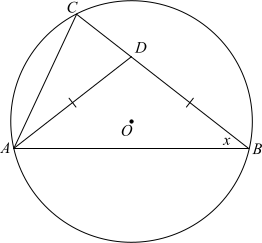
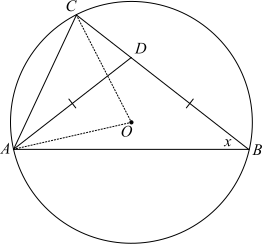
  `=59^@`
`/_DBC` `=114-59`
  `=55^@`


`:. text(Bearing of)\ \ C\ \ text(from)\ \ B\ \ text(is)\ 055^@`


(ii)    `text(Using cosine rule:)`

♦ Mean mark 39%
`AC^2` `=AB^2+BC^2-2xxABxxBCxxcos/_ABC`
  `=6^2+9^2-2xx6xx9xxcos114^@`
  `=160.9275…`
`:.AC` `=12.685…\ \ \ text{(Noting}\ AC>0 text{)}`
  `=13\ text(km)\ text{(nearest km)}`


(iii)    `text(Need to find)\ /_ACB\ \ \ text{(see diagram)}`

♦♦♦ Mean mark 15%
MARKER’S COMMENT: The best responses clearly showed what steps were taken with working on the diagram. Note that all North/South lines are parallel.
`cos/_ACB` `=(AC^2+BC^2-AB^2)/(2xxACxxBC)`
  `=((12.685…)^2+9^2-6^2)/(2xx(12.685..)xx9)`
  `=0.9018…`
`/_ACB` `=25.6^@\ text{(to 1 d.p.)}`


`text(From diagram,)`

`/_BCE=55^@\ text{(alternate angle,}\ DB\ text(||)\ CE text{)}`

`:.\ text(Bearing of)\ A\ text(from)\ C`

  `=180+55+25.6`
  `=260.6`
  `=261^@\ text{(nearest degree)}`

Filed Under: Bearings & Field Surveys Tagged With: Band 5, Band 6, HSC

Probability, STD2 S2 2009 HSC 28d

In an experiment, two unbiased dice, with faces numbered  1, 2, 3, 4, 5, 6  are rolled 18 times.

The difference between the numbers on their uppermost faces is recorded each time. Juan performs this experiment twice and his results are shown in the tables.

 2009 28d

Juan states that Experiment 2 has given results that are closer to what he expected than the results given by Experiment 1.

Is he correct? Explain your answer by finding the sample space for the dice differences and using theoretical probability.    (4 marks)

--- 8 WORK AREA LINES (style=lined) ---


Show Answers Only

 `text{Juan is correct (See Worked Solutions)}`

Show Worked Solution
♦♦♦ Mean mark 7%. Toughest question in the 2009 exam.
MARKER’S COMMENT: This question guides students by asking for an explanation using the sample space for the dice differences. This step alone received 2 full marks. Note that instructions to explain your answer requires mathematical calculations to support an argument.

`text(Sample space for dice differences)`

2UG-2009-28d1

2UG-2009-28d2_1

2UG-2009-28d3_1

`text(Juan is correct.  The table shows Experiment 1)`

`text(has greater total differences to the expected)`

`text(frequencies than Experiment 2)`

Filed Under: Multi-stage Events, Multi-Stage Events (Std 2), Relative Frequency, Relative Frequency (Std 2), Relative Frequency (Y11) Tagged With: Band 6, common-content, smc-827-20-Games of Chance, smc-827-40-Expected Frequency (np), smc-829-50-Arrays

Statistics, STD2 S4 2009 HSC 28b

The height and mass of a child are measured and recorded over its first two years. 

\begin{array} {|l|c|c|}
\hline \rule{0pt}{2.5ex} \text{Height (cm), } H \rule[-1ex]{0pt}{0pt} & \text{45} & \text{50} & \text{55} & \text{60} & \text{65} & \text{70} & \text{75} & \text{80} \\
\hline \rule{0pt}{2.5ex} \text{Mass (kg), } M \rule[-1ex]{0pt}{0pt} & \text{2.3} & \text{3.8} & \text{4.7} & \text{6.2} & \text{7.1} & \text{7.8} & \text{8.8} & \text{10.2} \\
\hline
\end{array}

This information is displayed in a scatter graph. 
 

  1. Describe the correlation between the height and mass of this child, as shown in the graph.   (1 mark)

    --- 2 WORK AREA LINES (style=lined) ---

  2. A line of best fit has been drawn on the graph.


    Find the equation of this line.   (2 marks)

    --- 4 WORK AREA LINES (style=lined) ---

Show Answers Only
  1. `text(The correlation between height and)`


    `text(mass is positive and strong.)`

  2. `M = 0.23H-8`
Show Worked Solution

i.  `text(The correlation between height and)`

♦ Mean mark 48%. 

`text(mass is positive and strong.)`


ii.  `text(Using)\ \ P_1(40, 1.2)\ \ text(and)\ \ P_2(80, 10.4)`

♦♦♦ Mean mark 18%. 
MARKER’S COMMENT: Many students had difficulty due to the fact the horizontal axis started at `H= text(40cm)` and not the origin.
`text(Gradient)` `= (y_2-y_1)/(x_2-x_1)`
  `= (10.4-1.2)/(80-40)`
  `= 9.2/40`
  `= 0.23`


`text(Line passes through)\ \ P_1(40, 1.2)`

`text(Using)\ \ \ y-y_1` `= m(x-x_1)`
`y-1.2` `= 0.23(x-40)`
`y-1.2` `= 0.23x-9.2`
`y` `= 0.23x-8`

 
`:. text(Equation of the line is)\ \ M = 0.23H-8`

Filed Under: Bivariate Data, Bivariate Data Analysis (Y12), Life Expectancy, Other Linear Modelling, S3 Further Statistical Analysis (Y12), S4 Bivariate Data Analysis (Y12) Tagged With: Band 5, Band 6, common-content, num-title-ct-coreb, num-title-qs-hsc, smc-1001-10-Line of Best Fit, smc-1001-30-Correlation, smc-1113-10-Line of Best Fit, smc-1113-30-Correlation, smc-5022-28-LOBF equations, smc-5022-30-Correlation, smc-785-10-Line of Best Fit, smc-785-30-Correlation

Measurement, STD2 M6 2009 HSC 27b

A yacht race follows the triangular course shown in the diagram. The course from  `P`  to  `Q`  is 1.8 km on a true bearing of 058°.

At  `Q`  the course changes direction. The course from  `Q`  to  `R`  is 2.7 km and  `/_PQR = 74^@`.
 

 2009-2UG-27b
 

  1. What is the bearing of  `R`  from  `Q`?   (1 mark)

    --- 1 WORK AREA LINES (style=lined) ---

  2. What is the distance from  `R`  to  `P`?     (2 marks)

    --- 4 WORK AREA LINES (style=lined) ---

  3. The area inside this triangular course is set as a ‘no-go’ zone for other boats while the race is on.


    What is the area of this ‘no-go’ zone?   (1 mark)

    --- 2 WORK AREA LINES (style=lined) ---

Show Answers Only
  1. `312^@`
  2. `2.8\ text(km)\ \ \ text{(1 d.p.)}`
  3. `2.3\ text(km²)\ \ \ text{(1 d.p.)}`
Show Worked Solution
i.    2UG-2009-27b-Answer

`/_ PQS = 58^@ \ \ \ (text(alternate to)\ /_TPQ)`

♦♦♦ Mean mark 18%.
TIP: Draw North-South parallel lines through relevant points to help calculate angles as shown in the Worked Solutions.

`text(Bearing of)\ R\ text(from)\ Q`

`= 180^@ + 58^@ + 74^@`
`= 312^@`


ii.   `text(Using Cosine rule:)`

♦ Mean mark 36%
`RP^2` `=RQ^2` + `PQ^2` `- 2` `xx RQ` `xx PQ` `xx cos` `/_RQP`
  `= 2.7^2` + `1.8^2` `- 2` `xx 2.7` `xx 1.8` `xx cos74^@`
  `=7.29 + 3.24\ – 2.679…`
  `=7.851…`
`:.RP` `= sqrt(7.851…)`
  `=2.8019…`
  `~~ 2.8\ text(km)  (text(1 d.p.) )`


iii.   `text(Using)\ \ A = 1/2 ab sinC`

♦ Mean mark 44%
`A` `= 1/2` `xx 2.7` `xx 1.8` `xx sin74^@`
  `= 2.3358…`
  `= 2.3\ text(km²)`


`:.\ text(No-go zone is 2.3 km²)`

Filed Under: Bearings & Field Surveys, Bearings and Radial Surveys (Std2) Tagged With: Band 5, Band 6, common-content, page-break-before-solution, smc-803-10-Bearings

Statistics, STD2 S1 2009 HSC 26a

In a school, boys and girls were surveyed about the time they usually spend on the internet over a weekend. These results were displayed in box-and-whisker plots, as shown below. 
 

2UG-2009-26a

  1. Find the interquartile range for boys.   (1 mark)

    --- 1 WORK AREA LINES (style=lined) ---

  2. What percentage of girls usually spend 5 or less hours on the internet over a weekend?  (1 mark)

    --- 1 WORK AREA LINES (style=lined) ---

  3. Jenny said that the graph shows that the same number of boys as girls usually spend between 5 and 6 hours on the internet over a weekend.


    Under what circumstances would this statement be true?    (1 mark)

    --- 2 WORK AREA LINES (style=lined) ---

Show Answers Only
  1. `4`
  2. `text(75% of girls spend 5 hours or less)`
  3. `text(5-6 hours for girls accounts for 25% of all girls.)`
  4. `text(5-6 hours for boys accounts for 25% of all boys,)`
  5. `text(as median to upper quartile is 25%.)`
     
  6. `=>\ text(This will be the same number only if the number of)`
  7. `text(all girls surveyed equals the number of boys surveyed.)`
Show Worked Solution
i.    `text(Interquartile range)` `= 6` `- 2`
    `= 4`


♦♦ Mean mark part ii: 31%
ii.    `text(Upper quartile = 5`
  `:.\ text(75% of girls spend 5 or less hours)`


♦♦♦ Mean mark part iii: 9%
iii.    `text(5-6 hours for girls accounts for 25% of all girls.)`
  `text(5-6 hours for boys accounts for 25% of all boys,)`
  `text{(median to the upper quartile represents 25%.)}`
  `=>\ text(This will only be the same number if the number of)`
  `text(all girls surveyed equals the number of boys surveyed.)`

Filed Under: Stem & Leaf, Box & Whisker, Summary Statistics - Box Plots (Std 2), Summary Statistics - Box Plots (Std2-2027), Summary Statistics - Box Plots (Y12) Tagged With: Band 4, Band 5, Band 6, common-content, smc-1000-20-Parallel Box-Plots, smc-6313-20-Parallel Box Plots, smc-825-20-Parallel Box-Plots

Measurement, STD2 M1 2009 HSC 25b

The mass of a sample of microbes is 50 mg. There are approximately  `2.5 × 10^6` microbes in the sample.

In standard form, what is the approximate mass in grams of one microbe?   (2 marks)

--- 4 WORK AREA LINES (style=lined) ---

Show Answers Only

`2 xx 10^-8\ text(grams)`

Show Worked Solution
♦♦♦ Mean mark 20%.
IMPORTANT: Can you solve: 8 apples weigh 1kg, what does 1 apple weigh? This is exactly the same concept.
`text(We need to convert 50 mg into grams)`
`50\ text(mg) = 50/1000 = 0.05\ text(g) = 5 xx 10^-2\ text(grams)`


`:.\ text(Mass of 1 microbe)` `= text(mass of sample)/text(# microbes)`
  `= (5 xx 10^-2)/(2.5 xx 10^6)`
  `= 2 xx 10^-8\ text(grams)`

Filed Under: Identify and Convert Between Units (Std2-2027), MM1 - Units of Measurement, Units and Measurement Error (Std 1), Units and Measurement Error (Std 2) Tagged With: Band 6, smc-1120-20-Scientific Notation, smc-6303-30-Capacity/Volume/Mass, smc-6303-40-Scientific Notation, smc-797-20-Scientific Notation

Financial Maths, STD2 F4 2013 HSC 28d

Adhele has 2000 shares. The current share price is  $1.50  per share. Adhele is paid a dividend of  $0.30  per share. 

  1. What is the current value of her shares?   (1 mark)
  2. Calculate the dividend yield.    (1 mark)
Show Answers Only
  1. `$3000`
  2. `text(20%)`
Show Worked Solution
i.    `text(# Shares)=2000`
  `text(Share price) = $1.50`


`:.\ text(Current value)` `= 2000 xx 1.50`
  `=$3000`
♦♦♦ Mean mark 13%
MARKER’S COMMENT: A large majority of students had a poor understanding of the term dividend yield.
  

ii.    `text(Dividend yield)` `=\ text(Dividend)/text(Share price)`
    `= 0.30/1.50`
    `=20 text(%)`

Filed Under: Compound Interest and Shares (Std2), FM2 - Investing Tagged With: Band 4, Band 6, smc-817-40-Shares/Dividends

Statistics, STD2 S1 2013 HSC 27c

A retailer has collected data on the number of televisions that he sold each week in 2012.

He grouped the data into classes and displayed the data using a cumulative frequency histogram and polygon (ogive).
 

2013 27c

  1. Use the cumulative frequency polygon to determine the interquartile range.  (2 marks)

    --- 4 WORK AREA LINES (style=lined) ---

  2. Oscar said that the retailer sold 300 televisions in 6 of the weeks in 2012.


    Is he correct? Give a reason for your answer.   (1 mark)

    --- 2 WORK AREA LINES (style=lined) ---

Show Answers Only
  1. `280`
  2. `text(Oscar is not correct because the data is grouped.)`
  3.  

    `text(He could only say that the retailer sold between 250`

  4.  

    `text(and 350 units in 6 of the weeks in 2012.)`

Show Worked Solution

i.  `text(S)text(ince cumulative frequency = 52 at max)`

♦♦♦ Mean mark 13%
COMMENT: Finding median and quartile values from cumulative frequency charts is an important skill that is often examined.

`=> text(Lower quartile at week) = 52/4 = 13`

`text(Lower quartile = 190)\ \ \ \ text{(from graph)}`

`=> text(Upper quartile at week) = 3 xx 13 = 39`

`text(Upper quartile = 470)`

`:.\ text(IQR)`  `= 470` `-190`
  `=280`


ii.  `text(Oscar is not correct because the data is grouped.)`

♦♦♦ This question proved a beast, with a mean mark of 1%. Toughest question in the 2013 exam!

`text(He could only say the retailer sold between)`

`text(250 and 350 units in 6 of the weeks in 2012.)`

Filed Under: Bar Charts and Histograms, Bar Charts and Histograms (Std 2), Bar Charts and Histograms (Std2-2027), Bar Charts and Histograms (Y12) Tagged With: Band 6, common-content, smc-6310-30-Cumulative Frequency Histograms, smc-6310-40-IQR, smc-821-20-Cumulative Frequency Histograms, smc-821-30-IQR, smc-997-20-Cumulative Frequency Histograms, smc-997-30-IQR

  • « Previous Page
  • 1
  • …
  • 25
  • 26
  • 27
  • 28
  • Next Page »

Copyright © 2014–2025 SmarterEd.com.au · Log in